Shared posts

14 Aug 03:04

How Atomic Blonde's Amazing Stairwell Fight Came Together

by Steven Ward

Whether as an actor, stuntman, or director, David Leitch has been the architect behind some of the most captivating recent fight scenes in film. His catalog of work spans some of the biggest action movies of the last twenty years, including the last two films in "The Matrix Trilogy," "300," and "Deadpool 2."Although it was in Leitch's directorial debut, "John Wick," where he developed his signature for boldly executed action sequences that both captivate and drive the plot forward, he perfected his process on his second project, "Atomic Blonde." 

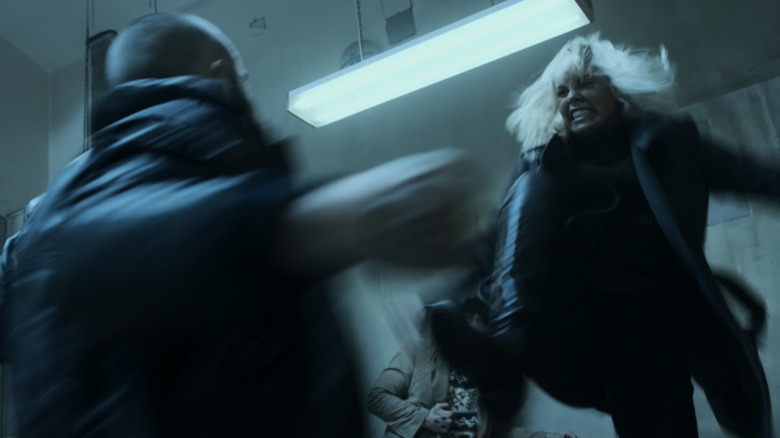
One scene stands out in particular: the brutal 10-minute stairwell fight Charlize Theron's character, MI6 agent Lorraine Broughton, engages in near the end of the film. Inspired by the stitched-together long takes of Alfonso Cuarón's "Children of Men," Leitch admitted in a GQ interview he'd long had the idea to do something similar, but had never been able to implement it.

After Theron bought the rights to the graphic novel "Atomic Blonde" would be based on, the actress approached Leitch to direct. He realized this was his chance to finally nab the white whale of his career. But filming the stairwell fight sequence would prove to be exceptionally demanding. For Leitch and those responsible for editing, there were logistical hurdles to be overcome while Theron and the stunt actors needed to give realistically gritty and visceral performances without getting too injured.

Charlize Theron Surpassed Leitch's Expectations
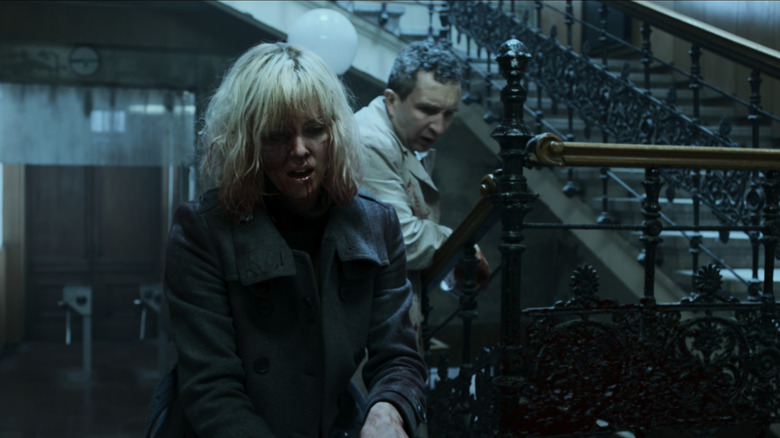
Theron as Broughton is of course the linchpin of the entire stairwell fight — which means not only did she need to be able to do a lot of those stunts herself, she had to memorize the complicated choreography. Speaking with Vanity Fair, Leitch explained that she underwent an intense six weeks of training, four to five days a week to prepare for the role of Broughton.

It wasn't long before the director realized he'd struck gold with Theron as his lead. He told Business Insider that he started getting "remote videos from L.A." and with every update on her training, he realized he'd finally found an actor who might be able to pull off the kind of extended take he'd always dreamed of doing. It also helped that Theron had been a trained dancer in her youth. "Fight choreography has far more in common with dance choreography than it does with actual martial arts," Leitch told GQ. "You learn martial arts techniques but those are just the movements for the choreography," he said. "You're working with a partner in choreography. You're working on timing. Having the dance background was invaluable."

Of course, successfully getting Theron and the stunt actors to nail the choreography was one thing. Doing it all without anyone getting seriously injured, or worse yet, putting your lead out of commission, was another challenge entirely.

Dodging Injuries And Knowing When To Use Stunt Doubles
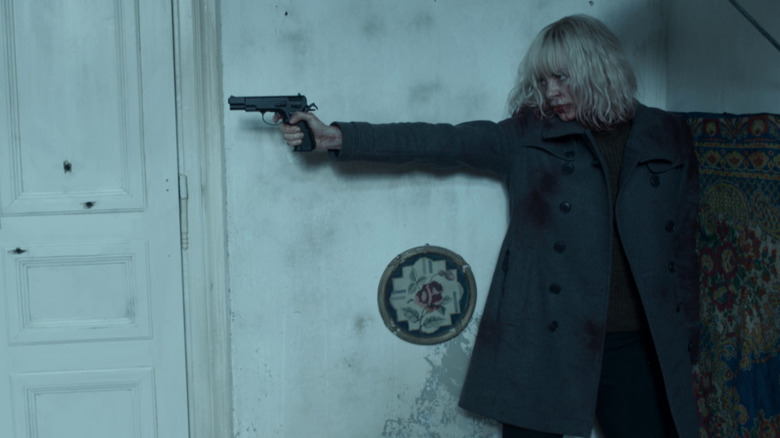
With Leitch's abundance of experience filming and being a part of scenes like the stairwell fight, he recognized injuries are inevitable -- but they can be greatly mitigated. The director went into detail with GQ about all the things that can go wrong at any moment that might lead to some kind of injury:

"You're doing all these reactions with your neck and your neck is thrown out of wack. You're blocking the stunt performers and there are bruises on your forearm. You are missing a punch and you hit the matte box of the camera. She did bend her fingers back and there are bruises on her forearm. She knee slides and misses her knee pad and then you've got swelling on your knee. Even when you're being safe, eight hours of choreography makes you look like you've been through a war. It's hard. It's like playing hockey for eight hours."

Because of the grueling toll, Leitch strategically chose when to use Theron's stunt double Monique Ganderton. Take for instance the moment Broughton is thrown down the stairs near the beginning of the fight. That's actually Ganderton doing the roll, but Theron who gets slammed into the wall — so even when she had a double she was still taking hits. "She would do both," Leitch admits. "But you had to keep shooting and you couldn't risk that type of injury."

So instead they just used the motion blur of Ganderton's fall to hide the switch to Theron. After all, there's really no point in risking your actor for stunts that audiences can't even tell it's them for. Which makes sense given there's so much in the 10-minute sequence that benefits from us seeing Theron herself fighting.

Creating The Scene's Progressive Special Effects
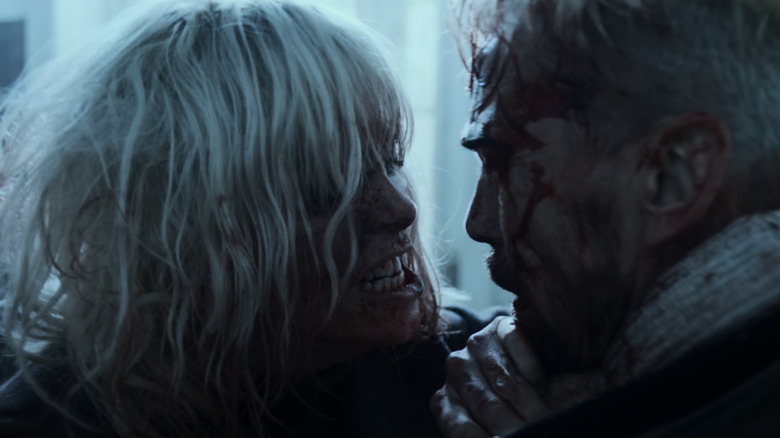
Leitch's whole purpose for wanting to shoot the stairwell scene was to see if he could forward the film's plot throughout all the action. A small but vitally important piece of that meant that if this was going to be 10-minutes of real-time fighting, there needed to be a way to illustrate the effect on each character.

Leitch told GQ that Theron gave a mandate for all the action in the film to be "real and have consequences." The director continued:

"I wanted to show consequential action. You fight long, you get tired. You get hit in the face, you get a black eye. There's blood in your mouth. Special effects make-up would come in and we had it all broken out, the different levels of damage for each stitch. We were constantly adding as we progressed. We shot the fight in continuity."

In a lot of ways, the entire stairwell action scene is a battle of attrition between Broughton and her attackers. As she fights, she takes blows that start to degrade her ability to defend herself and attack. But the same happens to her assailants — albeit far more quickly and fatally than for Broughton. The upside to this attention to detail is a potent sense of realism that also heightens the stakes. Not only do you hear every blow that Theron's character takes but you also can see it: the blood, the glass, the way she struggles to get her balance, and her increased reliance on anything she can get her hands on to use as a weapon. And as the desperation of Theron and her attackers grow the anxiety keeps you glued to the edge of your seat.

Leitch Got Crafty With The Edits And Hidden Cuts
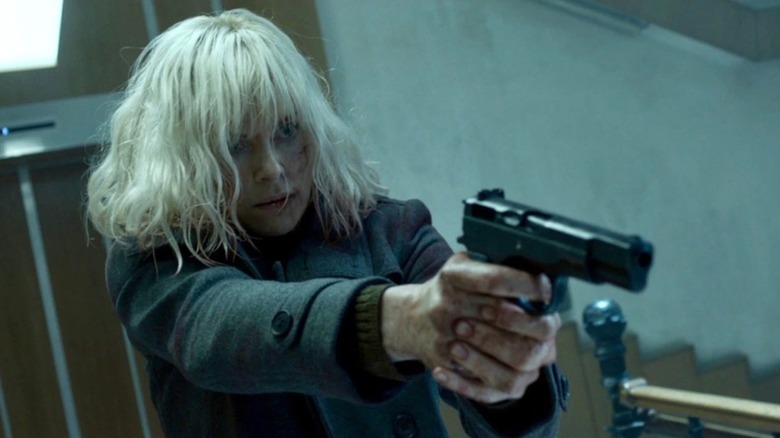
The final piece of the puzzle for Leitch after the choreography and special effects was figuring out how to edit and slyly cut the stairwell scene. His plan was to use hidden cuts that would allow them to stitch the scenes together, creating the illusion of a continuous shot. Luckily Leitch had the same talented editor who worked with him on "John Wick" and his latest film "Bullet Traim," Elísabet Ronaldsdóttir.

In that same Vanity Fair video, the director even points out each of the hidden cuts. But don't go thinking this somehow made the whole ordeal easier — it just made logistical sense. "It involved using a lot of old-school camera tricks — pans, wipes, body-crossings — that allowed us editorially to have breaks, to choose between takes, but so it would never feel like we cut out," he explained to GQ. "But the pieces we stitched together were really long, some as long as two minutes."

And even then the actors had to do multiple takes of each stitch, which were shot chronologically over four days. When you watch the full sequence though it's pretty much impossible to find any sort of hiccup with the cuts seamless as they are. It's a perfect example of just how much editing can affect the way we experience a scene — especially one as kinetic and dynamic as the "Atomic Blonde" stairwell fight.

Read this next: 12 Awesome Action Movies That Never Got Sequels

The post How Atomic Blonde's Amazing Stairwell Fight Came Together appeared first on /Film.
13 Aug 22:31

Who "Owns" Your Infrastructure?

by Unknown

That's a good question.

You go into work every day, sit down at your desk, log in...but who actually "owns" the systems and network that you're using? Is it you, your employer...or someone else?

Anyone who's been involve in this industry for even a short time has either seen or heard how threat actors will modify an infrastructure to meet their needs, enabling or disabling functionality (as the case may be) to cover their tracks, make it harder for responders to track them, or to simply open new doors for follow-on activity.

Cisco (yes, *that* Cisco) was compromised in May 2022, and following their investigation, provided a thorough write-up of what occurred. From their write-up:

"Once the attacker had obtained initial access, they enrolled a series of new devices for MFA and authenticated successfully to the Cisco VPN." (emphasis added)

Throughout the course of the engagement, the threat actor apparently added a user, modified the Windows firewall, cleared Windows Event Logs, etc. Then, later in the Cisco write-up, we see that the threat actor modified the Windows Registry to allow for unauthenticated SYSTEM-level access back into systems by setting StickyKeys. What this means is that if Cisco goes about their remediation steps, including changing passwords, but misses this one, the threat actor can return, hit a key combination, and gain SYSTEM-level access back into the infrastructure without having to enter a password. There's no malware involved...this based on functionality provided by Microsoft.

Remember..the Cisco write-up states that the activity is attributed to an IAB, which means that this activity was likely intended to gain and provide access to a follow-on threat actor. As a result of response actions taken by the Cisco team, that follow-on access has been obviated.

On 11 Aug 2022, the SANS Internet Storm Center included this write-up regarding the use of a publicly available tool called nsudo. There's a screen capture in the middle of the write-up that shows a number of modifications the threat actor makes to the system, the first five of which are clearly Registry modifications via reg add. Later there's the use of the Powershell Mp-Preference module to enable Windows Defender exclusions, but I don't know if those will even take effect if the preceding commands to stop and delete Windows Defender succeeded. Either way, it's clear that the threat actor in this case is taking steps to modify the infrastructure to meet their needs.

It doesn't stop there; there is a great deal of native functionality that threat actors can leverage to modify systems to meet their needs. For example, it's one thing to clear Windows Event Logs or delete web server log files; as we saw with NotPetya in 2017, those logs can still be recovered. To take this a step further, I've seen threat actors use appcmd.exe to disable IIS logging; if the logs are never written, they can't be recovered. We've seen threat actors install remote access tools, and install virtual machines or hard drives from which to run their malicious software, because (a) the VMs are not identified as malicious by AV software, and (b) AV software doesn't "look inside" the VMs.

So what? What does all this mean?

What this means is that these modifications can be detected and responded to early in the attack cycle, inhibiting or even obviating follow-on activity (ransomware deployment?). When I was researching web shells, for example, I kept running into trouble with Windows Defender; no matter how "esoteric" the web shell, if I didn't disable Defender before downloading it, Defender would quite literally eat the web shell! Other tools do a great job of detecting and quarantining web shells, and even more identify them. That's a means of initial access, so detecting and quarantining the web shell means you've obviated the rest of the attack and forced the threat actor to look for another means, AND you know someone's knocking at your door!

13 Aug 22:24

How A 10-Year-Old Genndy Tartakovsky Came Up With Samurai Jack

by Adam Wescott

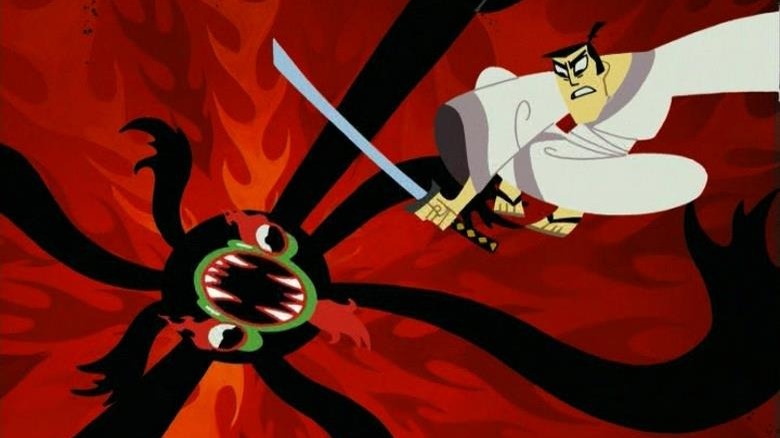
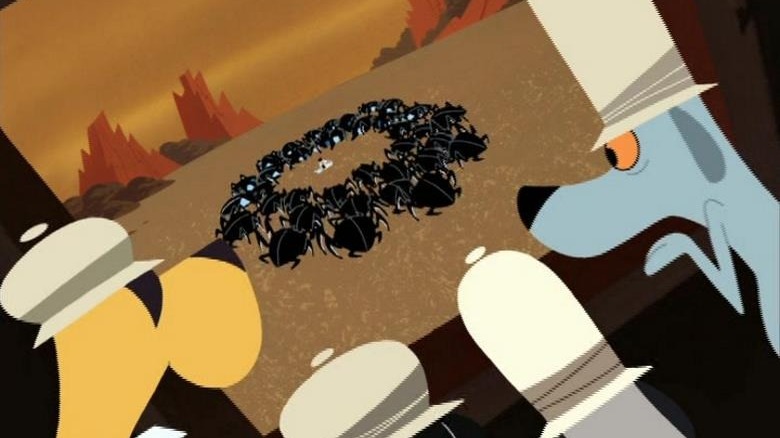
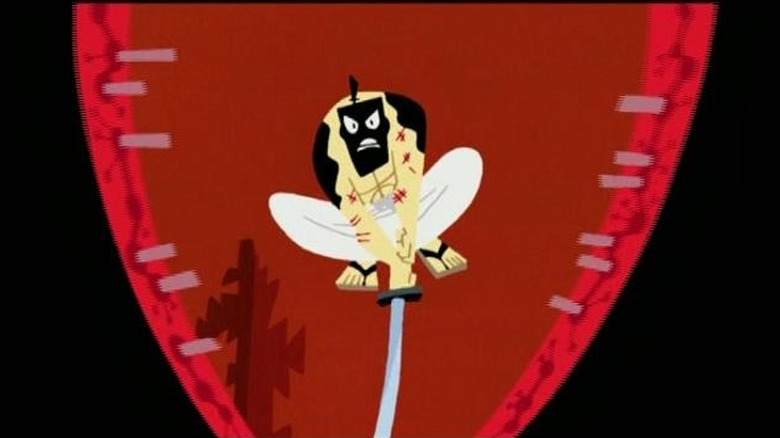
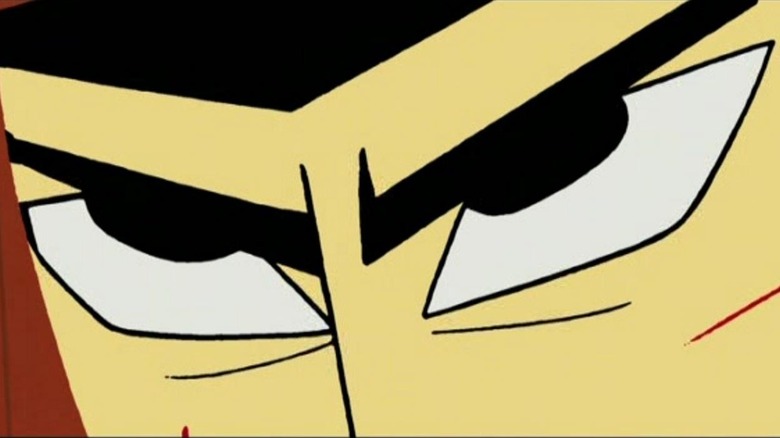
"Samurai Jack" gave me something I didn't know I wanted as a kid, which was violence. At the climax of the show's "Premiere Movie," Jack defends a pack of hapless dogs from an army of mechanical beetles commanded by the demon Aku. The beetles are impaled, decapitated, blasted by rocket fire. As Jack slices them in half, oil spurts from their severed pipes. Jack is bathed in this black filth. As a child I could not process what I was seeing. The sea of beetles swallowing the red hills, the repeated swing of Jack's sword, and the rictus of his face was like a nightmare. But that is why "Samurai Jack" succeeds, beyond its remarkable style. It delivers everything a kid could want — samurai, monsters, robots — at a level of intensity just outside of their comfort zone.

Jack's story was no nightmare for Genndy Tartakovsky, the creator of "Samurai Jack." "I had the same dream since I was 10," he said in an interview with The Verge, "about the world being destroyed and run by mutants. I'd find a samurai sword, pick up a girl I had a crush on, and we'd go through the land, surviving." Any pulp artist on autopilot can regurgitate these ideas, pretending they're channeling their inner child when the child of their memories died long ago. Tartakovsky's strength is he is never on autopilot. He always finds something to latch onto. Even in a movie like "Hotel Transylvania 2," saddled with a weak script and heavy producer interference, you can tell from the expressive designs and movement that you are watching a Tartakovsky production.

No Mortal Can Hurt The Great Aku

At 2020's Chicago Comic & Entertainment Expo, Genndy Tartakovsky spoke at a panel about his early career. As a child in Soviet Russia, he grew up watching a cartoon called "Well Just You Wait!" Picture a very Russian "Tom and Jerry," starring an oblivious rabbit and a long-suffering wolf, and you just about have it. When Tartakovsky's family moved to the United States, he fell in love with "Looney Tunes" and "Popeye." He carried these influences with him to university, where he abandoned his career path as an advertiser to pursue animation full time. After a year at the California Institute of the Arts, a university famous for its animation school, he followed a winding road to Hanna-Barbera, Cartoon Network, and his first big success, "Dexter's Laboratory."

You might think the stylish violence of "Samurai Jack" is a world away from "Looney Tunes." But watch the climax of the "Premiere Movie," and think again. Jack's battle against the robot beetles is more or less a series of gags, a "Road Runner" cartoon reconstructed as an epic battle. The beetles come after Jack, they stumble into a trap and are dispatched in hilarious detail. Repeat until the ground is covered in motor oil. "Popeye," too, remains near and dear to Tartakovsky's heart. He directed "Hotel Transylvania" at Sony to earn a swing at the "Popeye" movie of his dreams, a take that would "elicit laughs from just movement" rather than the script-driven gags of so many modern animated movies. Tartakovsky's proposal was rejected by the studio, but an 87-minute animatic of the project was leaked in July 2022.

You May Have Beaten Me Now

In interviews, Genndy Tartakovsky insists his approach remains the same as it was when his team produced "Samurai Jack." When The Verge asked how the final season of "Samurai Jack" was made, he confessed "we just use Photoshop ... we would have made the same show 10 years ago." In an interview with Animation World about his recent series "Primal," a near-wordless prehistoric drama about a man and his dinosaur, Tartakovsky insists the series is "basically traditional animation done on a Cintiq in TVPaint." Retaining the feel of his early work is clearly important to him. But there is also a clear progression throughout his career, a whittling down of dialogue and extraneous detail to a core of wordless cinematic action. "Primal" is just the most extreme expression of an approach leading back to "Clone Wars," "Samurai Jack," and perhaps even Tartakovsky's contributions to "Powerpuff Girls."

"Samurai Jack" lacks the elaborate world building and character drama of other cult TV animation classics like "Gargoyles." It exists within the limitations of its medium, rather than rupturing them. But there's a confidence to the series, an aesthetic consistency, that captures the imagination of children regardless. Tartakovsky discusses this approach in the aforementioned Verge interview. It's "kind of pulpy, and very specific to its own world. It's something that the 12- or 14-year-old kid in me just loves." "Samurai Jack" may be recycled from the daydreams of 10-year-old Genndy Tartakovsky, but its delivery is fully committed to the integrity of its world even when that world is purely ridiculous.

But I Will Destroy You In The Future

When I rewatched the end of "Samurai Jack: The Premiere Movie" for this article, I was struck by the discrepancies in my memory compared to the actual work. I thought the eyes of the beetles were red, but they were blue, while the background was red. I remembered the intense violence, but I had forgotten the humor, and the way the series uses pans and repeated footage to suggest intensity while saving money on production. It had been so long since I had seen "Samurai Jack" that my dream of the series had replaced the real thing.

But perhaps that is to be expected. In that Verge interview, Tartakovsky suggests that as an artist or a storyteller, "you want to create an experience — comical, emotional, horror — that gives the viewer a reaction." As a 10 year old watching "Samurai Jack," a series dreamed by animators who were once 10 years old themselves, I was right where they wanted me. A "lasting memory" was created, a scar that would follow me into adulthood. That scar remained even as the details of "Samurai Jack" itself faded from my memory. Whether we're talking about fine art or pulp, there's nothing more powerful than that.

Read this next: Every Time Futurama Predicted The Future

The post How A 10-Year-Old Genndy Tartakovsky Came Up With Samurai Jack appeared first on /Film.

13 Aug 22:19

Researchers Pinpointed Covid-19's Origin to Within a Few Metres

by EditorDavid
Australia's public broadcaster interviewed a virologist who "played a key role in mapping the evolution of COVID-19" (and was also "the first person to release the sequence of SARS-CoV-2 to the world.") But interestingly, this Australian virologist also visited the Wuhan market in 2014, "and recognised the risk of virus transmission between animals and humans and suggested taking some samples." "While I was there, I noticed there were these live wildlife for sale, particularly raccoon dogs and ... muskrats" he said. "I took the photographs because I thought to myself: 'God, that's, that's not quite right'." Raccoon dogs had been associated with the emergence of a different coronavirus outbreak, SARS-CoV-1, in 2002-04, which became known worldwide as the SARS virus. Even in 2014, Professor Holmes believed the market could become a site of virus transmission between animals and humans. The monitoring that Professor Holmes suggested never took place but, in the early days of COVID-19, he was still convinced that a market like the one in Wuhan was the logical origin of the virus. "They are the kind of engine room of [this sort] of disease emergence ... because what you're doing is you're putting humans and wildlife in close proximity to each other," he said. The professor also describes the theory that the virus some how leaked from a Chinese lab as "horrendous, blame-game finger-pointing," noting that the nearest lab is miles away. And he cites other reasons the market is where the virus originated: Aside from the geographic clustering, he also points to the fact that two different strands emerged almost simultaneously in humans, something that is much more likely if the virus had already been mutating in animals. "They're sufficiently far apart that they were probably independent jumps. "It means there was a pool of infected animals in the market and it's mutated amongst them before it jumped to humans." All of this has led Professor Holmes to conclude that the question of how COVID-19 emerged is settled. "I'm extremely confident that the virus is not from a laboratory. I think that's just a nonsensical theory," he said. Detailed mapping of where samples were detected inside the Huanan seafood wholesale market allowed Professor Holmes and his colleagues to even pinpoint to a few square metres where COVID-19 was likely to have jumped between humans and animals. "It's extraordinary," he said. "And I took a photo in 2014 of one of the stalls that was the most positively tested in the whole market."

Read more of this story at Slashdot.

13 Aug 22:18

Even Will Poulter Was Disturbed By Midsommar — Here's Why

by Shania Russell

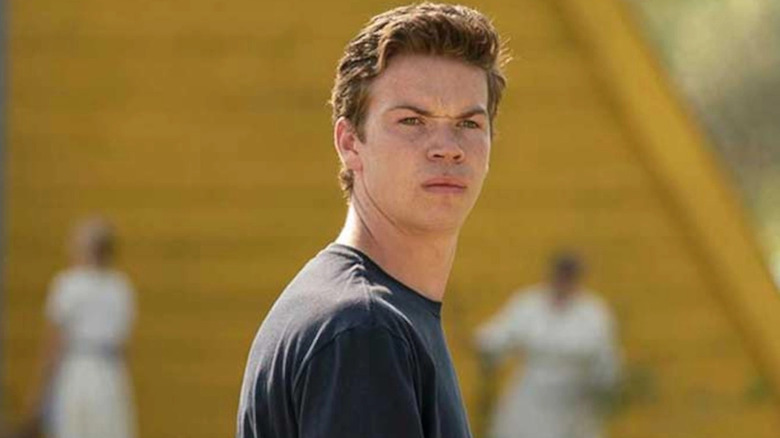
Will Poulter is no stranger to the world of off-kilter horror. Back when Cary Fukanaga was attached to direct an adaptation of Stephen King's "It," Poulter had plans to don the clown suit and become a thing of nightmares. As Pennywise the dancing clown, he would've delved into the sewers as the walking embodiment of pure evil, but when the project fell through and a new adaptation entered the development stage, Poulter passed on the opportunity to actually fill the role. But that wasn't the last time he walked an eerie path.

Just a few years later, Will Poulter ended up starring in Netflix's interactive "Black Mirror" episode "Bandersnatch." Clearly a fan of interactive stories, he'd later snag a role in the Supermassive Games horror survival series, "The Dark Pictures Anthology." But while both projects have their fair share of disturbing themes, there's an entirely different film that haunts Poulter to this day: Ari Aster's sophomore feature, "Midsommar."

The Haunting Nature Of Midsommar

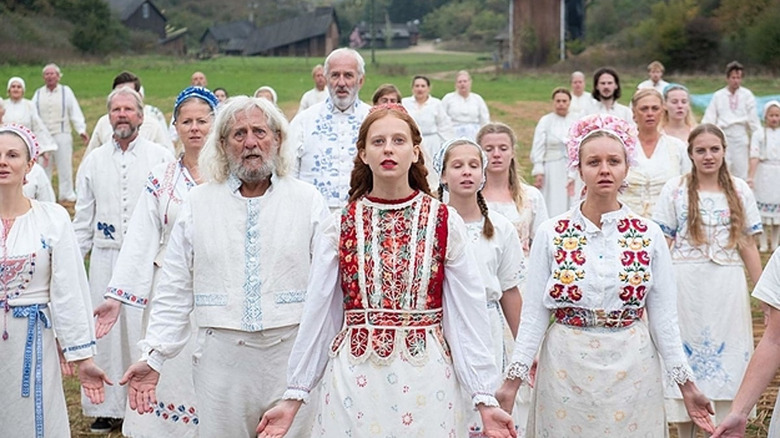
In case you haven't had the pleasure of being traumatized by Ari Aster, here's what you should know: "Midsommar" is the story of American couple Christian (Jack Reynor) and Dani (Florence Pugh) who, despite their strained relationship, embark on a trip to Sweden with some friends. Among their traveling companions is Pelle, a Swedish native who invites them back to his remote ancestral village to witness its famed midsummer festival, where everything is fine and nothing bad ever happens ... just kidding! Their so-called idyllic retreat is soon plagued by sorrow, violence, and the kind of imagery ready to sear itself into your brain forever!

As all viewers can attest, Aster's film is exceedingly effective at that last bit. Poulter himself is walking proof, because when he caught up with The Independent to chat about the film, he had just spent time at the Glastonbury Festival, where the images of "Midsommar" continued to haunt him:

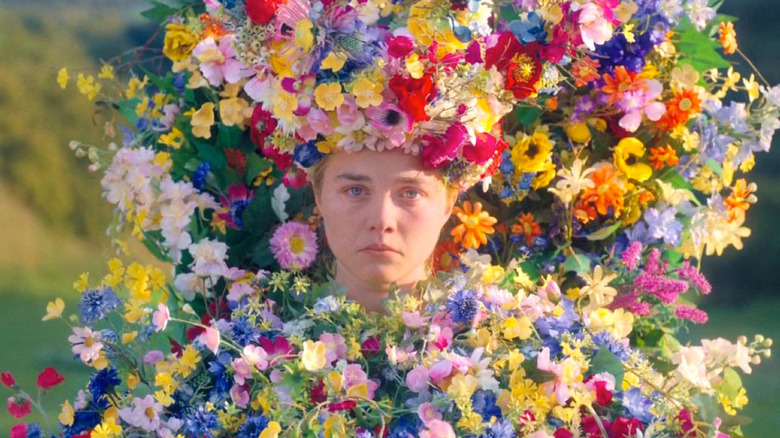
"I've got to say that being out in the sun at Glastonbury and seeing the odd person with flowers in their hair did trip me out a bit."

Who among us doesn't wince in fear when we see women with bright flowers in their hair? Fools, that's who! Those of us in the know are rightfully terrified of anything even tangentially related to "Midsommar." Poulter went on to explain that the scares in this film can't be waved away with disbelief of the supernatural because they go eerily deeper than that.

"What you come to terms with pretty quickly is that there aren't ghouls or goblins in Midsommar; everything that is horrifying comes from a very organic place and all the terrible things that happen are enacted by humans on humans. That's really quite disturbing to me."

Not Your Traditional Horror Movie

So what makes "Midsommar" so scary? If you saw a stray clip from the film — a woman drenched in sunlight, walking through a grassy field with flowers in her hair — horror might not be your first thought. But actually experiencing the film is something else entirely. The oddness of it all is what drew Will Poulter to the script in the first place. While chatting with Nightmarish Conjurings, he unpacked the ways that Aster's haunting film spans across tones and genres:

"You could describe it as a psychedelic thriller, you could explain it as a kind of trippy horror film, but you could also describe it as a film that is about human relationships. About grief, about empathy, about our capacity for empathy when faced against the tide of grief and in the context of a toxic relationship – it's all these that are innately more interesting and human to me. I love the fact that he delves into that."

"Midsommar" is a rare horror movie that doesn't lurk in the shadows, but instead embraces the power of sunlight. There is nowhere to hide in the festival's perpetual daylight: Trauma must be confronted and inner selves beg to be revealed. In some of the film's most horrifying moments, that happens in a very literal, grotesque way — Aster embraces gore with an unflinching camera and there's no shortage of grisly deaths to prove it. Between that imagery, the dark, festering themes, and the claustrophobic tension that builds over the course of the film, it's no surprise that "Midsommar" leaves such a lasting mark on its audience.

Read this next: Horror Roles That Changed Actors Forever

The post Even Will Poulter Was Disturbed By Midsommar — Here's Why appeared first on /Film.

13 Aug 16:40

The 15 Best Hot Ones Guests, Ranked

by Lyvie Scott

What makes a great "Hot Ones" episode? An unshakable serenity from its guests? Intriguing celebrity anecdotes? A healthy dose of schadenfreude? For this writer, a lot of the "Hot Ones" appeal comes from watching your faves suffer a little bit. The First We Feast phenomenon is all about watching celebrities chow down on the spiciest wings on the planet, and some of the best episodes often feature uncontrollable coughing fits, trippy revelations, or a whole lot of milk-chugging — ideally all three, but I'm not picky.

That said, it doesn't always have to be complete misery. A genuine connection with host Sean Evans is also very important: it helps the first half of the interview, over some of the milder wings, go over a lot smoother. There's a delicate balance to maintain, and the "best" episode might be different for everyone. Natalie Portman's unflappable composure won't be as fun for some as watching Gordon Ramsay mainline Pepto Bismol. But that's really the beauty of "Hot Ones": with nearly 20 seasons and over 300 episodes, there's literally something for everyone.

That said, some guests stand out more than others. Let's take a look at some of the best guests to appear on "Hot Ones" — and, of course, rank them accordingly.

15. Padma Lakshmi

Sometimes, the conceit of "Hot Ones" is three-fold. Yes, the questions are hot, as are the wings — but has anyone noticed that some of the hottest guests on the show are also the ones that handle spice the best? Padma Lakshmi is just one of many gorgeous guests that conquered the wings without batting an eye, and delivered a classy, funny interview to boot. Padma unpacks her iconic appearance on "Star Trek: Enterprise," as well as her tenure with "Top Chef." Plus Sean seems a little starstruck, which is so endearing either way.

Padma appeared on "Hot Ones" in the earlier days of the series, but she set the bar high. At a moment when rappers and athletes were actively getting schooled by the wings of death, Padma made it look like child's play. A legend if there ever was one.

14. Elizabeth Olsen

She feels brave, she feels strong ... If you're online even a little bit, there's a chance you've seen that viral clip from Elizabeth Olsen's time on "Hot Ones." It's just the cherry on top of an incredibly delightful interview: Olsen may not have been fazed by the wings of death (like, at all), but her composure, her charm, and her offbeat brand of humor make for a really enjoyable watch. Long-suffering theater kids will likely feel very seen when Olsen talks shop about Fitzmaurice Voicework, and she's got an arsenal of behind-the-scenes anecdotes for those without that niche knowledge. Overall, it's one of the most wholesome episodes to watch for the guest alone.

13. John Boyega

It's always great when "Hot Ones" hosts celebs who are genuine fans of the show, a fact that John Boyega ratified by praying to Issa Rae during his own interview. The "Star Wars" alum made it through all 10 wings without water or milk — always an impressive feat — and though he emerged more or less unscathed, his reactions to the latter half of the board make his "Hot Ones" episode one of the most fun ... and one of the most underrated.

Boyega's "Hot Ones" interview also came at a time when the vitriol towards the "Star Wars" sequels (and the actor himself) was at a decisive high. It seemed like so many wanted to pick a fight with the actor, at least on social media. Boyega manages to address and unpack some of the most ridiculous drama of the era with his signature lighthearted flair, proving exactly why he's become one of the most promising actors in Hollywood today.

12. Jon Bernthal

With over 40 credits in film and television — the edgiest of which have become his claim to fame — one wouldn't expect Jon Bernthal to be one of the kindest guests to ever grace the "Hot Ones" set. But the actor is actually the furthest thing from the characters he's best known for playing. He apologizes when he feels he's being too cocky with the wings of death, comments succinctly about masculinity in media, and uses his 30-second plug to encourage others to be kind. His conversation with Sean is enough to make this episode great, but as the wings get hotter, his reactions to the spice get even funnier. Most of us already love Bernthal as an actor, but after his time on "Hot Ones," it's impossible not to love him as a person, too.

11. Thundercat

"Hot Ones" guests come from every industry there is, but some of its highest-viewed episodes feature the biggest names in the music industry. Sean's interview with full-time bassist and part-time actor Thundercat is a majorly underrated episode: he takes down each wing without breaking much of a sweat, but his perspective on anime, music and film is so entertaining that you don't really mind. It's no wonder his is one of Dave Grohl's favorite episodes of "Hot Ones": watching Thundercat chat his way through the spice gauntlet makes his interview feel like a sitdown with an old friend.

10. Charlize Theron

Charlize Theron is pretty well-known for her effortlessly cool, tough-as-nails demeanor on the set of action films like "Atomic Blonde" and "Mad Max: Fury Road." But how does she fare against the wings of death? Theron is definitely a fan of spice in her day-to-day life (she seems to genuinely love the taste of The Last Dab, of all things) and she does have a gangster-level tolerance, but she's not entirely immune to the power of the sauces. Even when she's not actively suffering though, she and Sean have a lot of fun together. It's one of the rare occasions that Sean forgoes his typical onscreen persona, and it results in a genuinely hilarious, organic conversation with his guest.

9. Tom Holland

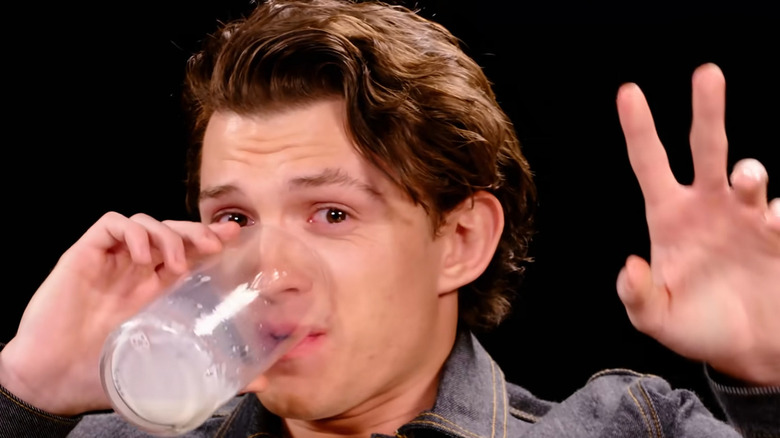
Listen, not everyone can get through the gauntlet unscathed. For every Charlize Theron, there's going to be a guest with a less accommodating palate. Fortunately, though, there are those like "Spider-Man" star Tom Holland, who — despite the obvious toll of the wings — powers through like an absolute champ. Holland is a truly entertaining guest on the foundation of his reactions alone: His threshold for spice is endearingly low, which means that the sauces kick in right from the jump. But he does not let the wings get the better of him. He even goes in for extra bites (whether he regrets it later is another story) and offers some interesting insight into Marvel's Cinematic Universe.

8. Keke Palmer

With the central brief of "Hot Ones" being what it is, you wouldn't expect that most guests would be lining up for seconds. But there have actually been quite a few celebs who have appeared on "Hot Ones" after their initial run with the wings of death, and Keke Palmer is one of them. Palmer first tackled the gauntlet in 2017, but her second appearance in 2021 is definitely one for the books. Her lighthearted rapport with Sean makes for such a fun interview from start to finish — and it doesn't hurt that she's one of the most underrated entertainers in the industry. If you're unfamiliar with Palmer's oeuvre, her "Hot Ones" interview is a great place to start — but this episode is a total treat for those who grew up watching her, too.

7. Keegan Michael Key And Jordan Peele

There are over 300 episodes of "Hot Ones," which means that some of the older episodes of the series can get lost in the shuffle from time to time. That said, there are still some gems, and Sean's sit-down with Keegan Michael Key and Jordan Peele is still hilarious today. "Hot Ones" crashed the "Keanu" press junket in 2016 for a truncated interview with Key and Peele. With only 15 minutes to eat five wings, things obviously heat up fast. Their taste buds may have suffered, but the spice does not kill their sense of humor by any stretch.

With Peele's meteoric rise as a horror auteur these past few years, it might be easy to forget he got his start in sketch comedy. His "Hot Ones" interview with Key is a great reminder of their effortless chemistry, and a great entry point for any "Hot Ones" novices.

6. Dave Grohl

Sean Evans' onscreen gimmick is definitely one of the selling points of "Hot Ones." But it's also great when he encounters a guest that brings his walls down, just as the wings of death do to even the most seasoned interviewees. Case in point: his interview with Dave Grohl, in which he knocks back shots of Crown Royal and Coke in between his signature hot questions and even hotter wings. The Foo Fighters frontman was one of the most requested guests in "Hot Ones" history, and his episode delivered in every possible way. By the time he and Sean hit the Last Dab, they've exchanged a few heartfelt confessions (and perhaps phone numbers, as well). Grohl has long been regarded as one of the coolest dudes in music, so it's great to see that affirmed for anyone unfamiliar with his work.

5. Lorde

It's a commonly-held theory that Lorde might not be ... of this world. Like many musicians that have preceded her, Lorde is notoriously enigmatic, and while her "Hot Ones" appearance offers a delightful peek into her inner world, there's no way she's fully human. Lorde's tolerance is honestly baffling — refreshing too, but baffling all the same. She treats each wing like an interesting mini-meal, cheerfully examining each sauce and pointing out the distinct flavor profiles in each of them. Not even Da Bomb is quite enough to trip her up, a feat that noticeably throws Sean as well. Lorde handled the wings of death with more poise than anyone before her, and her reactions are so much funnier when compared to the show's more viral guests.

4. Josh Brolin

"Hot Ones" is arguably at its best when things traipse a bit into the absurd — the kookier the guest, the better. Josh Brolin is no stranger to a goofy interview, and "Hot Ones" pulls out his sense of humor in the best possible way. He and Sean enjoy a really engaging conversation before the spice starts to kick in, and once it does, all bets are off. Brolin is genuinely hilarious: every word out of his mouth gets a laugh out of either Sean or his crew. If you don't already have a bit of a crush on the guy, wait till you see him lick the sauce off the board. No one is immune.

3. Gordon Ramsay

Gordon Ramsay's episode of "Hot Ones" is the most-viewed episode of the show, currently sitting at over 100 million views (at least at the time of this writing). It was the most requested too, and for good reason: Ramsay has doled out so much pain in his 30 years as a chef and restauranteur, it's only natural that he eventually got served in kind.

Ramsay and Sean's conversation will be very interesting for the foodies out there: He manages to share his secrets for a great burger before the wings get too spicy, among other things. And by the time he reaches the infamous eighth wing, Da Bomb, "Hot Ones" dips into its signature hilarity. Ramsay pulls out all the stops to combat the wings of death: donuts, limes, Pepto Bismol, anything. His signature commentary never falters though, and he manages to stay engaged with Sean through it all. This episode is one of the best for a reason: Most fans likely came to see Ramsay suffer, but he still has a lot of fun on the show — so much so that he returned for the "Hot Ones" Holiday special in 2021.

2. Halle Berry

For as long as "Hot Ones" is alive, the debate surrounding the "best" guest will likely never end. It's a conversation that constantly evolves as more celebrities appear on the show, and everyone's ranking is more or less subjective. But no ranking is complete without the inclusion of Halle Berry. She is, hands down, the most underrated "Hot Ones" guest: Not only does she power through without even glancing at her water or her milk, she cleans the meat off the bone each and every time. And aside from a few comments about boob sweat, she seems relatively unfazed by the progressive hotness of each wing. She even takes home an actual trophy for her efforts! The only "Hot Ones" guest to do so! It's basically a bottle of The Last Dab mounted on a pedestal, but Berry deserves some respect on her name regardless.

More than that, her conversation with Sean is enlightening and entertaining. With over 25 years in the industry, Berry's seen it all, and she tackles every topic with equal parts poise and humor.

1. Paul Rudd

If there was ever any doubt that Paul Rudd is the nicest, funniest guy in Hollywood, his "Hot Ones" episode effectively squashed that doubt for good. This episode has long been immortalized within the meme canon — "Look at us, who would have thought?" — but the entire interview is packed with one surprising, hilarious bit after the next. At a certain point, it becomes less about Rudd's reaction to the hot sauce (though they're always appropriate) and more about his jaw-dropping parlor tricks. Plus, he and Sean actually connect, which is always a plus.

Rudd's time on "Hot Ones" sets the bar high, not just for future episodes of the show, but for other chat shows like it. It's no wonder more and more outlets are trying to replicate its success, but nothing has come close just yet — and for good reason.

Read this next: The Best Movies Streaming Right Now: Malignant, A Hero, And More

The post The 15 Best Hot Ones Guests, Ranked appeared first on /Film.

12 Aug 22:24

One Of Anne Heche's Greatest Performances Was A Stephen King Audiobook

by Ryan Scott

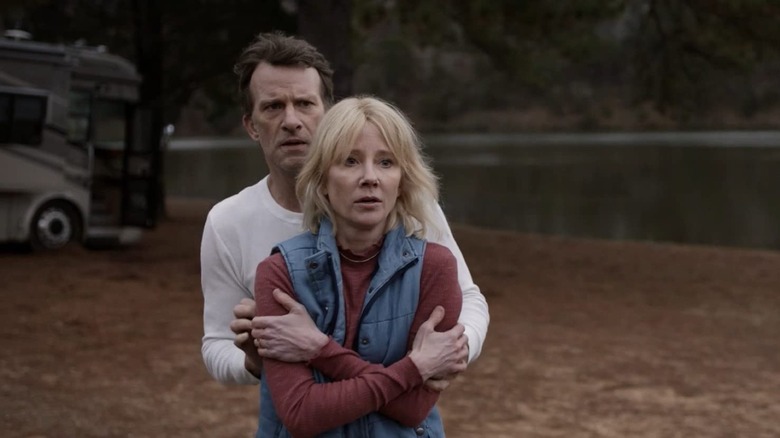
The world lost a real talent recently as Anne Heche, star of movies such as "Donnie Brasco" and "John Q," passed away following a tragic car accident. The 53-year-old actress will certainly be remembered for her decades-long career that included everything from big-budget romantic comedies ("Six Days and Seven Nights") to classic slasher flicks ("I Know What You Did Last Summer"). But one of Heche's very best performances required absolutely nothing other than her voice, and it was a performance capable of moving one to tears. This is something I can attest to personally.

Audiobooks have really exploded in recent years and, in many cases, companies like Audible will bring in an accomplished actor to read a book to add a little star power, not to mention talent. Such was the case when Stephen King's "The Girl Who Loved Tom Gordon" was done as an audiobook, with none other than Heche brought in to bring King's 1999 tale to life for listeners. As a frequent listener of audiobooks, I can tell you that they are not all created equal. So many are performed with the same level of thrill one can expect to find at a laundromat on a weekday night. Heche, however, brought her A-game to this performance and the story was all the better for it.

For those who may not be familiar, "The Girl Who Loved Tom Gordon" focuses on a 9-year-old girl named Trisha McFarland who strays from the path while she and her family are on a hike. She winds up being lost for days, wandering further and further away from civilization. Trisha only has her portable radio for comfort and is a huge fan of Tom Gordon, a baseball player for the Boston Red Sox. Listening to the games for comfort, this young girl unfortunately discovers that something dangerous may be tracking her through the dark, dangerous woods.

Elevating The Material

Now, in discussing the performance at hand, it is important to acknowledge that Stephen King is one of the finest authors alive or dead, so Heche was dealing with source material from a true master. That having been said, this is not often listed as one of King's more cherished works, though I count it as a personal favorite. That is in large part thanks to Heche, who straight-up elevated the material with her touching, emotional, and affecting performance.

The book is very singular-minded as we spend most of our time with Trisha as things go from bad to worse in the woods. Heche manages to bring you into the mind of that young girl so effectively that everything happening to her is felt on a deep level. This was not just an actress cashing an easy check -- this was someone making an absolute meal out of a performance. Heche probably didn't have to bring out the big guns for this one, but she did and I can't imagine this book without her as my guide.

To punctuate the effectiveness of Heche's work, I finished the book while grocery shopping one day. In the end, I found myself openly crying while leaning on my shopping cart as her final words rang out. If making a 30-year-old man unsuspectingly cry in the middle of a crowded store isn't the mark of a great performance, what is?

"The Girl Who Loved Tom Gorodn," as performed by Anne Heche, is available on Audible.

Read this next: Actors Who Died In 2021

The post One of Anne Heche's Greatest Performances Was A Stephen King Audiobook appeared first on /Film.

12 Aug 22:10

Researchers Uncover UEFI Secure Boot Bypass in 3 Microsoft Signed Boot Loaders

by noreply@blogger.com (Ravie Lakshmanan)
A security feature bypass vulnerability has been uncovered in three signed third-party Unified Extensible Firmware Interface (UEFI) boot loaders that allow bypass of the UEFI Secure Boot feature. "These vulnerabilities can be exploited by mounting the EFI System Partition and replacing the existing bootloader with the vulnerable one, or modifying a UEFI variable to load the vulnerable loader
12 Aug 17:56

Anne Heche, Actress In Volcano And Donnie Brasco, Dies After Accident

by BJ Colangelo

It is with great sadness that we report that actress Anne Heche has passed away following a devastating car crash. The award-winning performer was only 53. Her loved ones have said that she had suffered a "severe anoxic brain injury" and was "not expected to survive." Heche remained on life support for several days while the medical team determined if any of her organs were viable for donation, since organ donation had "long been her choice."

Today, Heche's family decided to allow her to peacefully pass by giving permission for life support to be withdrawn, as confirmed by The Guardian. Shortly before her passing, the family released a statement to Deadline regarding their decision for her end of life plans, and to honor her memory.

"Anne had a huge heart and touched everyone she met with her generous spirit. More than her extraordinary talent, she saw spreading kindness and joy as her life's work — especially moving the needle for acceptance of who you love. She will be remembered for her courageous honesty and dearly missed for her light."

Anne Heche described her upbringing as a "life movies are made of" in her 2001 memoir "Call Me Crazy," which documented her afflictive childhood and her path toward healing. Heche broke into the industry shortly after she graduated high school by playing Vicky Hudson/Marley Love on "Another World," which won her a Daytime Emmy Award and two Soap Opera Digest Awards. Heche would see mainstream popularity throughout the 1990s thanks to roles in "Donnie Brasco," "Volcano," Gus Van Sant's "Psycho," "Six Days, Seven Nights," "I Know What You Did Last Summer," "Wag the Dog," and "Return to Paradise."

"People are somewhat confused by me and I understand that," Heche wrote in her memoir. "But I also am proud that I'm a woman who represents making difficult choices that bring you to where you want to be."

Remember To See The Good

Anne Heche was truly in a league of her own on screen, cast in roles that appeared as if she was the only person on the planet capable of playing the part. Heche truly stole every scene she was in, and elevated every role by performing with a fearless vulnerability that could not be taught; it just existed within her, seemingly forged in the fire of surviving her difficult life. Heche was very vocal about her struggles with mental health and addiction, and the unfortunate reality is that the self-destruction has also left a trail in her wake. Heche should be remembered for her remarkable talent and the joy she brought to so many people, but the circumstances surrounding her passing cannot be dismissed.

There's a line in her memoir that feels particularly poignant today where she said, "I've always wanted to heal my life. I always wanted to see the good side of life. I've always wanted to see the good in everything that happened to me." Today, we should all strive to see the good in Anne Heche. She was a loving mother, a gifted actress, a groundbreaking queer figure, one of the earliest celebrities to candidly discuss mental illness, trauma, abuse, and addiction, and a human being who does not deserve to have a life defined by her lowest moments. 

May she rest in peace.

Read this next: Actors Who Died In 2021

The post Anne Heche, Actress in Volcano and Donnie Brasco, Dies After Accident appeared first on /Film.

12 Aug 17:13

I think my cats hate video games, and I'm absolutely devastated

by Katharine Castle

As many of you well know, I rather enjoyed cat adventure Stray recently. As an owner of two tortoiseshells myself, it was right up my alley. I do, however, have a confession to make. When I started seeing other real life cats enjoying the game alongside their respective humans, I began to feel sad and a bit left out. You see, my cats Maple and Midna (still!) haven't shown any interest in Stray whatsoever, not even flicking up their ears in response to the cat's in-game meow. I'm not gonna lie, it kinda broke my heart a little bit.

However, I'm beginning to think their (clear and apparent) hatred of video games goes further than simple disinterest. I was playing A Plague Tale for the first time last week, a game famous for its swarms of screeching rats, and STILL nothing. They love hunting rats and bringing them home to leave as little presents for us on our back door step. Heck, they'll even wig out and go into prowl mode when they hear them scrabbling away underneath our floorboards (yes, we do have a rat problem in our house). But clearly, their ice cold little murder hearts are unmoved by their video game equivalents. Is this what it's like when your children reject your hobbies and go and sulk in their rooms for the rest of the day? Because it sure does feel like it.

Read more

12 Aug 17:03

Can You Live 100% Off the Grid in a City or Suburb?

by Jeff Somers

Modern city life is kind of amazing—we can have burritos biked to our door and (usually) have reliable internet. But cities are built on a delicate web of interconnected services and infrastructure, and maybe you don’t want to be dependent on its whims. If you’re the kind of person who is interested in living off the…

Read more...

12 Aug 17:02

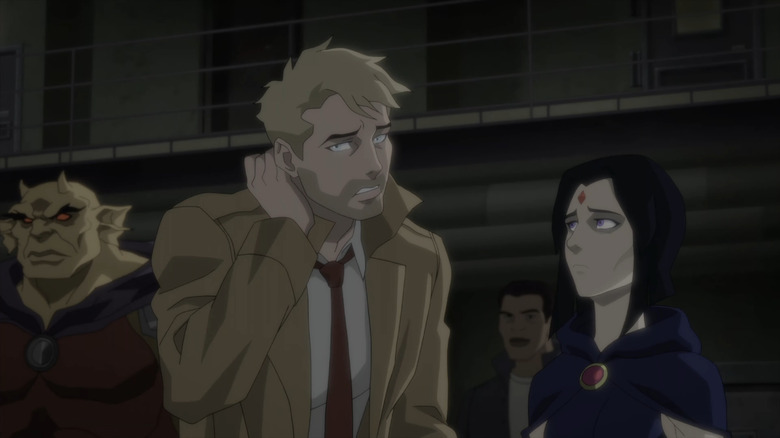
How Matt Ryan's Constantine Became The Center Of The Modern DC Universe

by Rafael Motamayor

The DC cinematic universe, especially its live-action movies, seems quite disjointed and messy. There is no cohesive arc to the movies, no build-up to something bigger. For the last couple of years, however, that has been part of the charm, with standalone, isolated movies like "The Suicide Squad," "Birds of Prey," and "The Batman" exploring weird stories and characters in creative ways. Sure, they are not connecting into a big event film, but the sheer creativeness of each of the films makes them better than what a coherent, uniform, but formulaic universe could produce.

Reportedly, this was all supposed to somewhat change with "The Flash," a movie with a lot of aspirations. Not only is it supposed to introduce the multiverse to the DCEU, but also bring back Michael Keaton as Batman, all while also serving as a sort of reboot the same way "Flashpoint" did for the DC comics. In that storyline, Barry Allen, aka The Flash, ends up accidentally changing the course of history by going back in time and changing the past. When he goes back to undo it, it accidentally resets the entire DC universe.

While the fate of "The Flash" movie is still up in the air, it is time to recognize we don't need to wait for Barry Allen to become the center of the DC multiverse, because we already have one. The answer to every DC problem has been staring us in the face for the past eight years: make it all about Matt Ryan's Constantine.

From Humble Beginnings To A Central Role

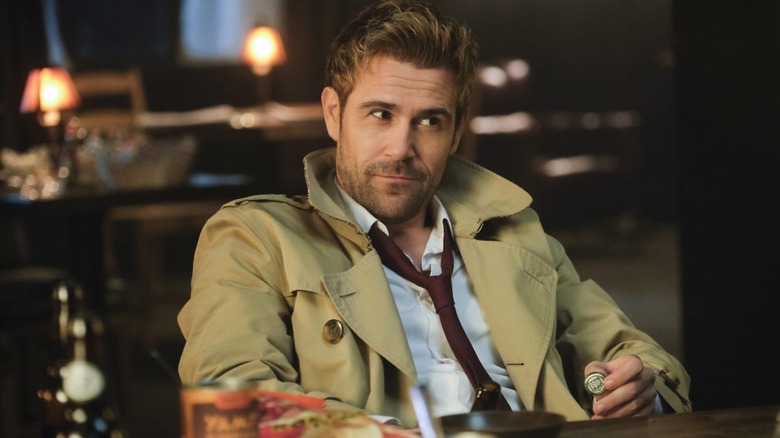
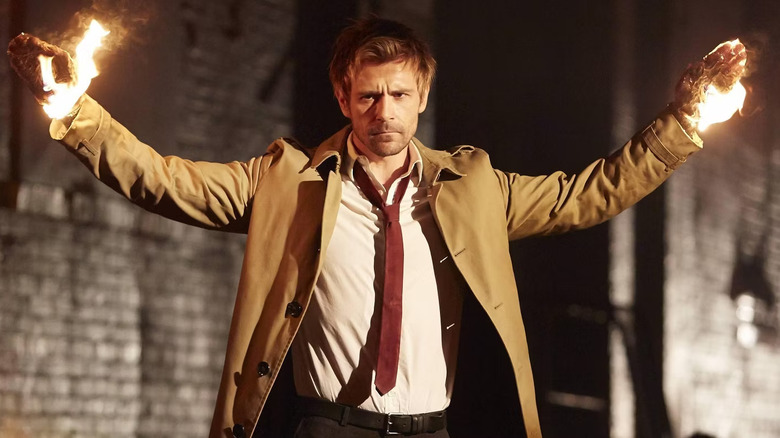
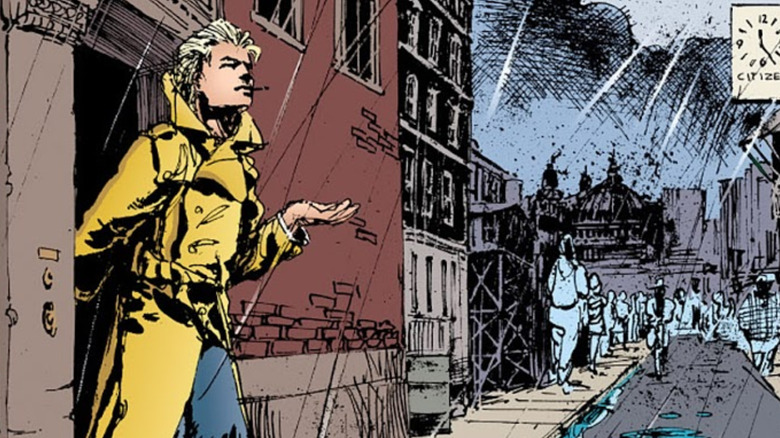
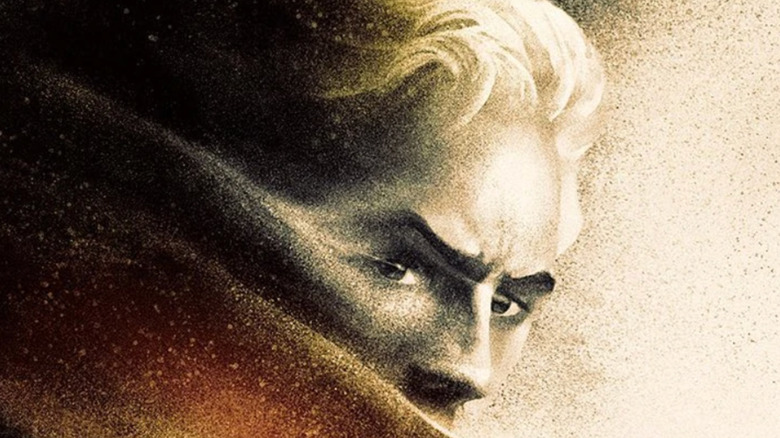
Back in 2014, Ryan starred as John Constantine in an NBC pilot for a show built around the character created by Alan Moore, Stephen R. Bissette, Rick Veitch, and John Totleben on the pages of the iconic '80s run of "Swamp Thing." A working-class occult detective, warlock, and con man, Ryan's Constantine was praised for being a comics-accurate depiction of the Hellblazer in a show that had fantastic special effects and good use of creepy atmosphere, especially for a NBC series. But as comics-accurate as Ryan was in the titular role, the show was severely bogged down by a dull narrative and network censorship that prevented the character from smoking on screen or from being bisexual like in the source material.

The show was canceled after 13 episodes, but almost immediately there were plans to bring Constantine over to the Arrowverse. Stephen Amell and "Arrow" showrunner Marc Guggenheim campaigned to integrate Constantine into that universe as they had already introduced some mystical elements from the comics like the Lazarus Pit. Finally, in 2015, Ryan reprised the role in an episode of "Arrow" where he helps bring Sara Lance's soul back from hell, playing the same version of the character from the NBC show.

The news got even better once Ryan made an appearance on the best TV show, "Legends of Tomorrow," which then led to a series regular role and some of the best moments of that show. Constantine brought dry humor, tons of scams, and some horror flair that mixed phenomenally with the Legends' wacky slapstick, all while quickly becoming a bisexual icon on the show.

The Animated Return Of A King

Live-action is not enough for the Hellblazer, of course. Even before "Legends of Tomorrow" got tragically canceled, Ryan was already giving voice to the character on various animated projects. There was the Arrowverse-adjacent "Constantine: City of Demons" web series, but also the "Justice League Dark" movie set in the DCAU — a series of interconnected animated movies that started out as adaptations of comic book storylines but started to revolve more and more around original stories.

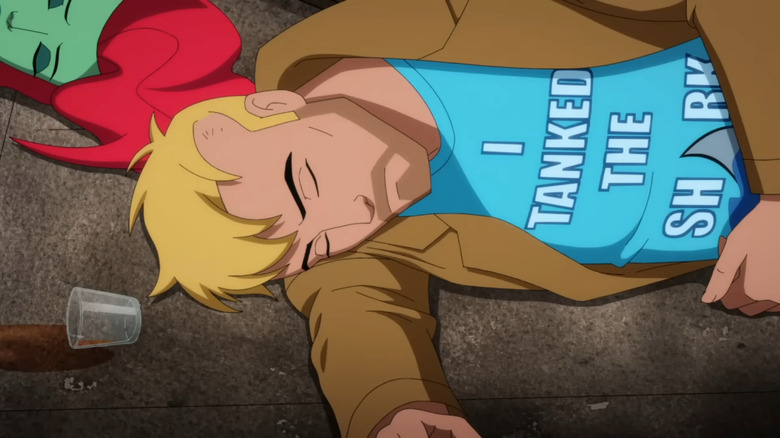
Most importantly, Constantine even got to be the center focus of the last DCAU movie before that continuity got rebooted, in "Justice League Dark: Apokolips War." That movie played out as a Crisis event, and was inspired by Grant Morrison's "Final Crisis." The film follows the efforts of the remaining members of the Justice League to regroup after Darkseid decimated the Earth and all its heroes. Constantine plays a major role in getting the team together and saving the world (while reuniting with his ex, King Shark!), and it is he who convinces Flash to go back in time and change the timeline, leading to a reset.

Most recently, Ryan reprised his role once again in the excellent third season of "Harley Quinn." This one is notable because the show is renowned for its disregard for DC canon and continuity, as it constantly reimagines popular characters like Nightwing, while killing established characters like Scarecrow, Penguin, Mr. Freeze, and even actual actor Billy Bob Thornton.

The Key To The DC Universe

If the whole point of "The Flash" movie being crucial to the future of the DC cinematic universe is that Barry Allen is the one that causes the plot of the movie — and the eventual reboot — to happen via time travel, then Warner Bros. Discovery can easily find a way to make Constantine the culprit. I mean, the guy is a wizard! Would it be harder to believe that a spell gone wrong causes the entire multiverse to change compared to a guy running so fast he goes back in time?

Granted, Matt Ryan reprising the role in so many projects could be just a coincidence or a cool homage to a good actor in a fantastic role, but what if it isn't? What if Matt Ryan's Constantine is the one constant in every DC universe? That would easily solve all of DC's continuity problems, and allow for arguably the single biggest crossover in film. 

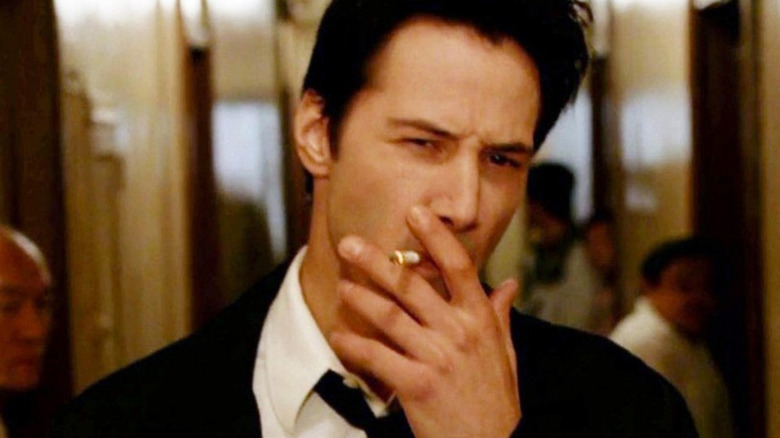
Forget "Infinity War," and forget "Spider-Man: No Way Home." Make a DC crisis film where you bring in all the live-action movies, the entire Arrowverse, but also the DC animated universe, and even "Harley Quinn." Hell, if you want, you can even bring in Keanu Reeves from 2005's "Constantine" for good measure and explain it as bizarro world. And if we're really shooting for the stars here, why not get Guillermo del Toro to direct the film and make the Justice League Dark movie he always wanted?

Read this next: Every DC Movie Made Prior To The DCEU Ranked From Worst To Best

The post How Matt Ryan's Constantine Became the Center of the Modern DC Universe appeared first on /Film.

12 Aug 17:00

One Of The Scariest Scenes In Event Horizon Sends You To Hell

by Chris Evangelista

(Welcome to Scariest Scene Ever, a column dedicated to the most pulse-pounding moments in horror with your tour guides, horror experts Chris Evangelista and Matt Donato. In this edition, Chris wants you to save yourself from hell).

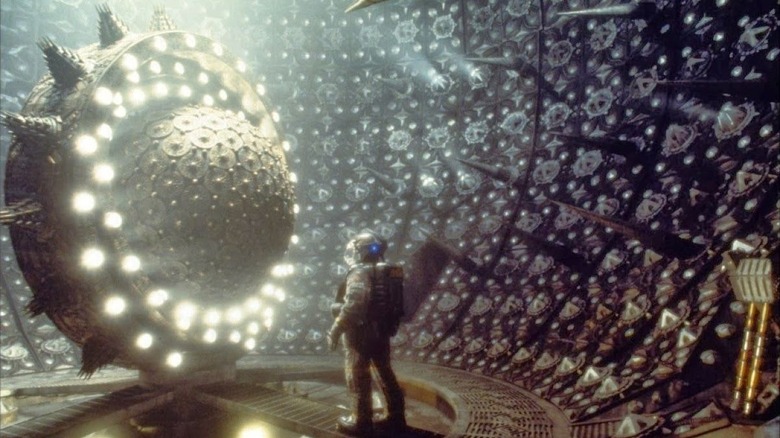
Paul W. S. Anderson's best movie, "Event Horizon," was a box office flop when it arrived in 1997. But in the years since the film's release, it's built up a cult following, with fans singing the praises of Anderson's gory sci-fi/horror romp. Is it the most original film? Heavens, no! There's a ton of material here borrowed from an endless stream of movies, including "Alien" and "Hellraiser." But it's also full of unnerving imagery that has a way of unsettling even the most strong-willed of viewers. And it also features an all-time-great scene of horror that has the power to give you the creeps no matter how many times you've watched the movie. 

The Setup

In the not-too-distant future (the year 2047, to be precise), a cutting-edge starship known as the Event Horizon vanished with its crew. Years later, the ship has reappeared near Neptune. A rescue crew, led by Captain Miller (Laurence Fishburne) is sent to investigate, along with Dr. Weir (Sam Neill), the man who designed the ship — and its Gravity Drive, which has the power to open up a black hole in order to allow the Event Horizon to travel vast distances in the blink of an eye. Once aboard the ship, the crew finds one dead crew member, but the rest have vanished without a trace. And oh yeah, a bunch of spooky stuff starts happening, making this the equivalent of a haunted house movie set in space. 

The Story So Far

During the investigation of the ship, the crew discovers a garbled video message from the moment the Event Horizon crew opened up the Gravity Drive to unleash the black hole. The image is blurry and the sound is loud and eerie. And nestled in the midst of that sound is a voice saying "Liberate me." D.J., one of the crew who just happens to speak Latin, says the phrase means "Save me." However, the more the audio is cleaned up, the clearer the message becomes, and D.J. realizes what's actually being said is "Liberate tutemet ex inferis," which means "Save yourself from hell." 

Uh-oh.

The Scene

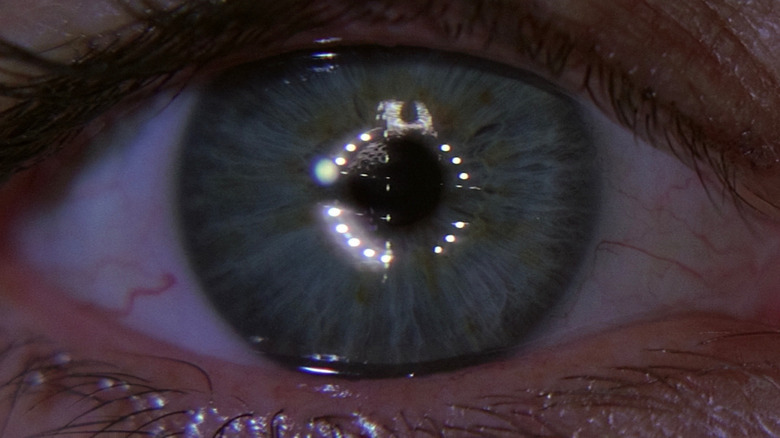
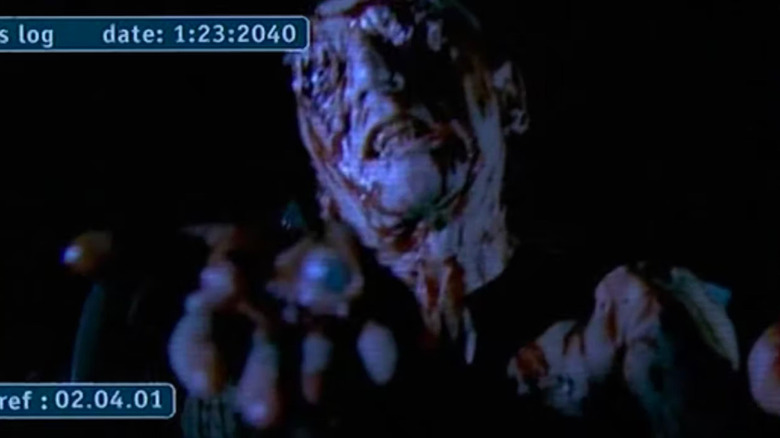
Eventually, the crew is able to clean up the video and see what horrors it beholds: it seems the minute the ship opened a black hole, they also opened a gateway to hell. As a result, the video shows the crew engaged in all sorts of grisly, gruesome, graphic stuff — people shove entire hands down their throats, bodies are destroyed, blood ad gore is everywhere, screams ring out, and the Event Horizon's captain rips out his own eyes and holds them up to the camera (he's the one saying "Liberate tutemet ex inferis," by the way. Should've listened to him). As you can guess, things get progressively worse from there, and the main characters start getting bumped off in nasty ways. 

By now, an even more graphic version of "Event Horizon" has become the stuff of legend. Anderson's film was reportedly even gorier than its theatrical version, and he had to trim some stuff down to get an R-rating. For years there's been talk of releasing the uncut version, but unfortunately, it looks like the cut footage has been lost forever. Even so, the film is still plenty bloody, and this scene in particular always gives me the creeps. I've seen "Event Horizon" several times now, and yet every time I watch it, the video message from hell is so jarring and gnarly that it makes me incredibly uncomfortable. And that's what I'm looking for in a good horror movie. 

The Impact (Matt's Take)

I mean, it's "Hellraiser" meets "Society" in space. The above clip is cursed footage that delivers gore, repulsion, and degradation in such a despicably short burst. "We're leaving," spouts Laurence Fishburne's captain (as he should). Paul W.S. Anderson prepares audiences for a far more terrifying brand of science fiction than what's typically shot in space, and his characters react appropriately.

It's a functionally alarming manipulation of "Captain's Log" storytelling that keeps all the worst yet to come in full view. So often, inspecting characters will roll a past crew's recordings only for an abrupt ending before we can distinguish what went haywire. There's an element of suspense that Anderson doesn't need because he'd rather us know and fear the horrors aboard Event Horizon. There's no hiding from the sodomy and torn-out eyeballs. You pressed play. You live with your choices.

We all know Anderson as the blockbuster filmmaker who loves his video game adaptations, but "Event Horizon" is a sickeningly unsettling example of cosmic horror. "Event Horizon" manages to disgust and traumatize in a matter of seconds, and that's just a nauseating taste. The "Captain's Log" is such a glorious precursor to an exemplary interstellar frightener, filled with horrors meant for sadomasochistic nightmares. Anderson's always had an eye for the genre, despite his love of horror-action popcorn flicks. This scene is a reminder of what Anderson's truly capable of when in the right mood.

Read this next: The 19 Greatest Movie Couples Of All Time Ranked

The post One Of The Scariest Scenes In Event Horizon Sends You to Hell appeared first on /Film.

12 Aug 16:57

America's 3 top companies describe 3 dire warning signs about the state of the American economy. 1) It's too hard to find workers willing to accept slave wages, 2) Telecommuting makes micromanaging the slaves harder, 3) We have to pay taxes now [Obvious]

12 Aug 16:57

Why You Should Freeze Your Water Bottles at an Angle

by Meredith Dietz

Surviving the heat means staying on top of your hydration, especially if you’re trying to stick to your exercise plan during this brutally hot summer. We’ve told you before that your freezer needs water bottles. What if I told you that those water bottles need to be frozen on their sides—and at a specific angle? It’s…

Read more...

12 Aug 16:56

'The Rehearsal,' and 13 Other Movies and Shows That Bend Reality

by Stephen Johnson

If you’re not watching HBO Max’s new series The Rehearsal, you’re missing out. This new “reality” show from Nathan Fielder (Nathan For You) punches holes in the veil between the actual and the fictional by creating extremely realistic simulations of people’s lives so they can rehearse real upcoming events before they…

Read more...

12 Aug 10:55

First screenshots & details leaked for Alone in the Dark Remake

by John Papadopoulos

French retailer Smartoys has just leaked the first screenshots and details for an upcoming remake of Alone in the Dark. And since THQ Nordic will hold its Digital Showcase later today, we are pretty sure that the publisher will officially reveal it today. Here are the game’s key features: Explore Derceto’s mansion in this revisit … Continue reading First screenshots & details leaked for Alone in the Dark Remake →

The post First screenshots & details leaked for Alone in the Dark Remake appeared first on DSOGaming.

12 Aug 02:25

Mac Hacker's Code Is So Good, Corporations Keep Stealing It

by BeauHD
Patrick Wardle, founder of the Objective-See Foundation, a nonprofit that creates open-source security tools for macOS, has had his code make its way into a number of commercial products over the years -- "all without the users crediting him or licensing and paying for the work," reports The Verge. Wardle, a Mac malware specialist and former employee of the NSA and NASA, will lay out his case in a presentation today at the Black Hat cybersecurity conference with Tom McGuire, a cybersecurity researcher at Johns Hopkins University. From the report: The problem, Wardle says, is that it's difficult to prove that the code was stolen rather than implemented in a similar way by coincidence. Fortunately, because of Wardle's skill in reverse-engineering software, he was able to make more progress than most. "I was only able to figure [the code theft] out because I both write tools and reverse engineer software, which is not super common," Wardle told The Verge in a call before the talk. "Because I straddle both of these disciplines I could find it happening to my tools, but other indie developers might not be able to, which is the concern." One of the central examples in Wardle's case is a software tool called OverSight, which Wardle released in 2016. Oversight was developed as a way to monitor whether any macOS applications were surreptitiously accessing the microphone or webcam, with much success: it was effective not only as a way to find Mac malware that was surveilling users but also to uncover the fact that a legitimate application like Shazam was always listening in the background. [...] But years after Oversight was released, he was surprised to find a number of commercial applications incorporating similar application logic in their own products -- even down to replicating the same bugs that Wardle's code had. Three different companies were found to be incorporating techniques lifted from Wardle's work in their own commercially sold software. None of the offending companies are named in the Black Hat talk, as Wardle says that he believes the code theft was likely the work of an individual employee, rather than a top-down strategy. The companies also reacted positively when confronted about it, Wardle says: all three vendors he approached reportedly acknowledged that his code had been used in their products without authorization, and all eventually paid him directly or donated money to the Objective-See Foundation. The Verge notes that Wardle's cousin Josh Wardle created the popular Wordle game, which was purchased earlier this year by The New York Times.

Read more of this story at Slashdot.

12 Aug 02:24

Researchers Find Vulnerability In Software Underlying Discord, Microsoft Teams, and Other Apps

by BeauHD
An anonymous reader quotes a report from Motherboard: A group of security researchers found a series of vulnerabilities in the software underlying popular apps like Discord, Microsoft Teams, Spotify and many others, which are used by tens of millions of people all over the world. At the Black Hat cybersecurity conference in Las Vegas on Thursday, the researchers presented their findings, detailing how they could have hacked people who use Discord, Microsoft Teams, and the chat app Element by exploiting the software underlying all of them: Electron, which is a framework built on the open source Chromium and the cross-platform javascript environment Node JS. In all these cases, the researchers submitted vulnerabilities to Electron to get them fixed, which earned them more than $10,000 in rewards. The bugs were fixed before the researchers published their research. Aaditya Purani, one of the researchers who found these vulnerabilities, said that "regular users should know that the Electron apps are not the same as their day-to-day browsers," meaning they are potentially more vulnerable. In the case of Discord, the bug Purani and his colleagues found only required them to send a malicious link to a video. With Microsoft Teams, the bug they found could be exploited by inviting a victim to a meeting. In both cases, if the targets clicked on these links, hackers would have been able to take control of their computers, Purani explained in the talk. For him, one of the main takeaways of their research is that Electron is risky precisely because users are very likely to click on links shared in Discord or Microsoft Teams.

Read more of this story at Slashdot.

12 Aug 02:22

Meta Injecting Code Into Websites Visited By Its Users To Track Them, Research Says

by BeauHD
Meta, the owner of Facebook and Instagram, has been rewriting websites its users visit, letting the company follow them across the web after they click links in its apps, according to new research from an ex-Google engineer. The Guardian reports: The two apps have been taking advantage of the fact that users who click on links are taken to webpages in an "in-app browser," controlled by Facebook or Instagram, rather than sent to the user's web browser of choice, such as Safari or Firefox. "The Instagram app injects their tracking code into every website shown, including when clicking on ads, enabling them [to] monitor all user interactions, like every button and link tapped, text selections, screenshots, as well as any form inputs, like passwords, addresses and credit card numbers," says Felix Krause, a privacy researcher who founded an app development tool acquired by Google in 2017. Krause discovered the code injection by building a tool that could list all the extra commands added to a website by the browser. For normal browsers, and most apps, the tool detects no changes, but for Facebook and Instagram it finds up to 18 lines of code added by the app. Those lines of code appear to scan for a particular cross-platform tracking kit and, if not installed, instead call the Meta Pixel, a tracking tool that allows the company to follow a user around the web and build an accurate profile of their interests. The company does not disclose to the user that it is rewriting webpages in this way. No such code is added to the in-app browser of WhatsApp, according to Krause's research. [...] It is unclear when Facebook began injecting code to track users after clicking links. "We intentionally developed this code to honor people's [Ask to track] choices on our platforms," a Meta spokesperson told The Guardian in a statement. "The code allows us to aggregate user data before using it for targeted advertising or measurement purposes. We do not add any pixels. Code is injected so that we can aggregate conversion events from pixels." They added: "For purchases made through the in-app browser, we seek user consent to save payment information for the purposes of autofill."

Read more of this story at Slashdot.

11 Aug 22:19

Latest Dwarf Fortress video highlights new art and menus by taking the bins out

by Graham Smith

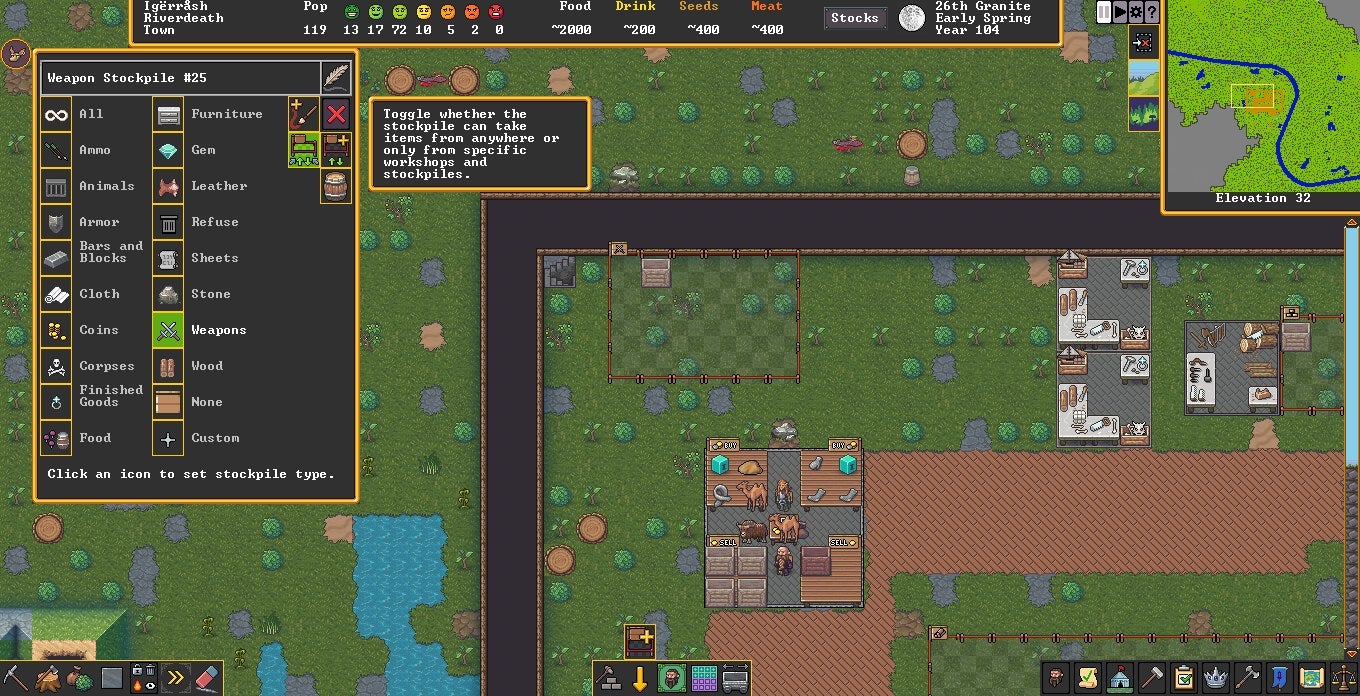
As we've written about before, Dwarf Fortress is getting a Steam release with an official tileset, a new UI, and mouse controls. The latest video from Kitfox Games, who are handling the polished release, features original DF co-creator Zach Adams talking through new menus and artwork... while taking his fort's bins out.

Read more

11 Aug 22:18

Interactive fiction: the fascinating space between literature and games

by Noelle Warner

Interactive fiction games

Clicking on static text has never been so exciting

Narrative games may be a small niche within the gaming industry as a whole, but there’s an even smaller subsection of the genre that a lot of gamers don’t know about: interactive fiction also known as IF. With the exception of some UI upgrades or a musical score, the vast majority of IF is just simple text on a screen that the player clicks through. It exists in the space between my two favorite things: literature and video games. Technically interactive fiction got its start in the late 1970s with text adventures like Zork, but now the world of text-based games has taken on a whole new life.

I’ve always dabbled in the world of IF, but when I came across this thread on Twitter, it reminded me that the community surrounding this genre is more active among the writers and narrative designers in games than one might think.

I love interactive fiction for a few reasons, chief among them being that I love reading, but also because IF does something that a vast majority of games do not — it puts story above gameplay. I know this is kind of sacrilegious in the games space, but in the world of IF, interactivity is used more for artistic narrative expression than anything else.

This one is really growing on me

Take the piece titled “growth” by Liz England, for example. I recommend playing it (it’s short, like two minutes tops) before you proceed, because I’m about to spoil it.

It starts with the player finding a growth on their hand, and gives them a few options like “Call a doctor” and “Call a friend.” As they start making these choices, however, they realize that nothing they can do will really help to make the growth go away. The choices soon become more and more unhinged, and eventually end with the player cutting off the growth themselves, which they then realize is their thumb.

I love “growth” because it’s essentially an interactive poem that meditates on losing control of your thoughts. It’s short and simple, but it does a great job of illustrating how quickly we can devolve into our own intrusive thoughts. The twist at the end of the growth being your thumb all along is a jarring return to reality, and has a twinge of silliness to it.

“growth” is also a great example of how IF uses a lack of autonomy in its favor. You can click on the options in any order you want, but ultimately, you will always arrive at the same conclusion. Not to go all textual analysis on you, but it ties into the narrative so well because the player character can’t even stop sawing off their own thumb even when they want to.

Choices don't matter, and that's great

A lot of gamers seem to have come to the conclusion that if your choices don’t matter in a narrative game, then the game is poorly designed. What these players mean, of course, is that they want their choices to alter the game’s narrative in a way that feels noticeable.

The irony here is that choices never really “mattered” anyway, because until we have AI and procedural generation that’s strong enough to create a story on the fly, developers and writers had to create every possible scenario that the players could encounter. It’s much less about players having real control than it is making them think that they do.

Another must-play in the IF genre that also illustrates this point beautifully is “The Writer Will Do Something” by Matthew S Burns and Tom Bissell. The premise is that you’re playing as a games writer who’s sitting in on a meeting for the AAA game that they’re working on. Not only is this game hilarious, but the whole bit is that no matter what the writer says or does, the outlook of the meeting keeps getting bleaker and bleaker, and the executives are convinced that “the writer will do something,” hence the title.

It’s an eerily accurate depiction of what it’s like to make games at a big studio (unsurprising considering Bissell worked on franchises like Gears of War and Rocksteady’s Batman), but it’s also effective in using choices that don’t change anything to make you feel increasingly hopeless and dejected.

Making your own IF

The other awesome thing about IF, especially for those who are just getting started as writers, is that the tools to make them are really accessible and easy to use. The two most popular are Twine and Ink, both of which can be ported to Unity and have also been used to create commercial games. They’re both open source as well, so they’re free, have active communities, and the companies behind them are always working hard to improve the software.

My personal favorite is Ink because it’s a custom scripting language, so there’s a lot of functionality there. However, if you’re more of a visual learner, I recommend Twine because you can chart your whole story with boxes and arrows that connect all the pieces.

I’m only scratching the surface here of what IF can do, so if any of this sounds interesting to you, I’d encourage you to check it out. There’s a whole world of interactive storytelling out there that runs the gambit of experimental, emotional, weird, exciting, and beautiful, and while I love a classic gaming experience, interactive fiction will always hold a special place in my heart.


Story Beat is a weekly column discussing anything and everything to do with storytelling in video games.

The post Interactive fiction: the fascinating space between literature and games appeared first on Destructoid.

11 Aug 20:12

It Might Be Our Data, But It’s Not Our Breach

by BrianKrebs

Image: Shutterstock.

A cybersecurity firm says it has intercepted a large, unique stolen data set containing the names, addresses, email addresses, phone numbers, Social Security Numbers and dates of birth on nearly 23 million Americans. The firm’s analysis of the data suggests it corresponds to current and former customers of AT&T. The telecommunications giant stopped short of saying the data wasn’t theirs, but it maintains the records do not appear to have come from its systems and may be tied to a previous data incident at another company.

Milwaukee-based cybersecurity consultancy Hold Security said it intercepted a 1.6 gigabyte compressed file on a popular dark web file-sharing site. The largest item in the archive is a 3.6 gigabyte file called “dbfull,” and it contains 28.5 million records, including 22.8 million unique email addresses and 23 million unique SSNs. There are no passwords in the database.

Hold Security founder Alex Holden said a number of patterns in the data suggest it relates to AT&T customers. For starters, email addresses ending in “att.net” accounted for 13.7 percent of all addresses in the database, with addresses from SBCGLobal.net and Bellsouth.net — both AT&T companies — making up another seven percent. In contrast, Gmail users made up more than 30 percent of the data set, with Yahoo addresses accounting for 24 percent. More than 10,000 entries in the database list “none@att.com” in the email field.

Hold Security found these email domains account for 87% of all domains in the data set. Nearly 21% belonged to AT&T customers.

Holden’s team also examined the number of email records that included an alias in the username portion of the email, and found 293 email addresses with plus addressing. Of those, 232 included an alias that indicated the customer had signed up at some AT&T property; 190 of the aliased email addresses were “+att@”; 42 were “+uverse@,” an oddly specific reference to an AT&T entity that included broadband Internet. In September 2016, AT&T rebranded U-verse as AT&T Internet.

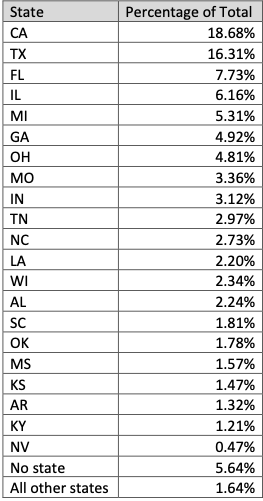
According to its website, AT&T Internet is offered in 21 states, including Alabama, Arkansas, California, Florida, Georgia, Indiana, Kansas, Kentucky, Louisiana, Michigan, Missouri, Nevada, North Carolina, Ohio, Oklahoma, Tennessee, Texas and Wisconsin. Nearly all of the records in the database that contain a state designation corresponded to those 21 states; all other states made up just 1.64 percent of the records, Hold Security found.

Image: Hold Security.

The vast majority of records in this database belong to consumers, but almost 13,000 of the entries are for corporate entities. Holden said 387 of those corporate names started with “ATT,” with various entries like “ATT PVT XLOW” appearing 81 times. And most of the addresses for these entities are AT&T corporate offices.

How old is this data? One clue may be in the dates of birth exposed in this database. There are very few records in this file with dates of birth after 2000.

“Based on these statistics, we see that the last significant number of subscribers born in March of 2000,” Holden told KrebsOnSecurity, noting that AT&T requires new account holders to be 18 years of age or older. “Therefore, it makes sense that the dataset was likely created close to March of 2018.”

There was also this anomaly: Holden said one of his analysts is an AT&T customer with a 13-letter last name, and that her AT&T bill has always had the same unique misspelling of her surname (they added yet another letter). He said the analyst’s name is identically misspelled in this database.

KrebsOnSecurity shared the large data set with AT&T, as well as Hold Security’s analysis of it. AT&T ultimately declined to say whether all of the people in the database are or were at some point AT&T customers. The company said the data appears to be several years old, and that “it’s not immediately possible to determine the percentage that may be customers.”

“This information does not appear to have come from our systems,” AT&T said in a written statement. “It may be tied to a previous data incident at another company. It is unfortunate that data can continue to surface over several years on the dark web. However, customers often receive notices after such incidents, and advice for ID theft is consistent and can be found online.”

The company declined to elaborate on what they meant by “a previous data incident at another company.”

But it seems likely that this database is related to one that went up for sale on a hacker forum on August 19, 2021. That auction ran with the title “AT&T Database +70M (SSN/DOB),” and was offered by ShinyHunters, a well-known threat actor with a long history of compromising websites and developer repositories to steal credentials or API keys.

Image: BleepingComputer

ShinyHunters established the starting price for the auction at $200,000, but set the “flash” or “buy it now” price at $1 million. The auction also included a small sampling of the stolen information, but that sample is no longer available. The hacker forum where the ShinyHunters sales thread existed was seized by the FBI in April, and its alleged administrator arrested.

But cached copies of the auction, as recorded by cyber intelligence firm Intel 471, show ShinyHunters received bids of up to $230,000 for the entire database before they suspended the sale.

“This thread has been deleted several times,” ShinyHunters wrote in their auction discussion on Sept. 6, 2021. “Therefore, the auction is suspended. AT&T will be available on WHM as soon as they accept new vendors.”

The WHM initialism was a reference to the White House Market, a dark web marketplace that shut down in October 2021.

“In many cases, when a database is not sold, ShinyHunters will release it for free on hacker forums,” wrote BleepingComputer’s Lawrence Abrams, who broke the news of the auction last year and confronted AT&T about the hackers’ claims.

AT&T gave Abrams a similar statement, saying the data didn’t come from their systems.

“When asked whether the data may have come from a third-party partner, AT&T chose not to speculate,” Abrams wrote. “‘Given this information did not come from us, we can’t speculate on where it came from or whether it is valid,'” AT&T told BleepingComputer.

Asked to respond to AT&T’s denial, ShinyHunters told BleepingComputer at the time, “I don’t care if they don’t admit. I’m just selling.”

On June 1, 2022, a 21-year-old Frenchman was arrested in Morocco for allegedly being a member of ShinyHunters. Databreaches.net reports the defendant was arrested on an Interpol “Red Notice” at the request of a U.S. federal prosecutor from Washington state.

Databreaches.net suggests the warrant could be tied to a ShinyHunters theft in May 2020, when the group announced they had exfiltrated 500 GB of Microsoft’s source code from Microsoft’s private GitHub repositories.

“Researchers assess that Shiny Hunters gained access to roughly 1,200 private repositories around March 28, 2020, which have since been secured,” reads a May 2020 alert posted by the New Jersey Cybersecurity & Communications Integration Cell, a component within the New Jersey Office of Homeland Security and Preparedness.

“Though the breach was largely dismissed as insignificant, some images of the directory listing appear to contain source code for Azure, Office, and some Windows runtimes, and concerns have been raised regarding access to private API keys or passwords that may have been mistakenly included in some private repositories,” the alert continues. “Additionally, Shiny Hunters is flooding dark web marketplaces with breached databases.”

Last month, T-Mobile agreed to pay $350 million to settle a consolidated class action lawsuit over a breach in 2021 that affected 40 million current and former customers. The breach came to light on Aug. 16, 2021, when someone starting selling tens of millions of SSN/DOB records from T-Mobile on the same hacker forum where the ShinyHunters would post their auction for the claimed AT&T database just three days later.

T-Mobile has not disclosed many details about the “how” of last year’s breach, but it said the intruder(s) “leveraged their knowledge of technical systems, along with specialized tools and capabilities, to gain access to our testing environments and then used brute force attacks and other methods to make their way into other IT servers that included customer data.”

A sales thread tied to the stolen T-Mobile customer data.

11 Aug 19:59

Better Call Saul Never Planned On Killing Off A Certain Key Character

by Jeremy Mathai

Spoilers for the latest episode of "Better Call Saul" follow.

The closer and closer that "Better Call Saul" draws to the finish line, the more stress and anxiety Kim Wexler (Rhea Seehorn) enthusiasts have felt about how her overall arc on the series would conclude. After all, there's a good reason why /Film's Chris Evangelista's weekly reviews incorporated a "Kim Watch" segment to chart exactly how worried we ought to be with each new episode. As "Breaking Bad" fans are well aware, there really is no such thing as unmitigated happy endings in this universe ... well, other than a few exceptions, at least.

For the vast majority of characters caught up in the wake of the most chaotic forces at work — Bryan Cranston's Walter White in the original series and Bob Odenkirk's Jimmy McGill in the spin-off — there's usually a piper that needs to be paid. But surely an individual as endearing and lovable and important as Kim, Jimmy's (now ex) wife, conscience, and occasional partner in crime, couldn't be destined for the gruesome fate that have taken down many a "Breaking Bad"/"Better Call Saul" character before, right? Well, in an interview with Rolling Stone, creator Vince Gilligan confirmed that Kim's death was never in the cards.

"I think it could have gone any which way, but there probably also was an element of us being loath to kill off her character. There were so many elements of this story that were preordained. You can't kill off Jimmy McGill in his own show, you can't kill off any character whom we know the fate of from 'Breaking Bad.' But with Kim, the sky was the limit. I guess it just didn't feel right to kill her off. That was probably never on the table, honestly."

'You're Not Gonna Kill Kim, Are You?'

Now that we know Kim is alive and well in the black-and-white timeline Gene Takovic currently resides in — though in potential legal trouble, now that she's confessed her and Jimmy's roles in the murder of Howard Hamlin (Patrick Fabian) — it would seem fans can look forward to the series finale without the looming specter of death hanging over Kim's head. To be sure, her dalliances with Jimmy have ultimately cost her the career she loved, her happy life with Jimmy, and, most devastatingly of all, her morals. But there's one line that the creators were never going to cross, even if fans were convinced otherwise. As Gilligan went on to say:

"We certainly kept silently smiling while people stopped us on the street and said, 'You're not gonna kill Kim, are you?' We let people think that maybe we would, but none of us wanted to do it. But figuring out where she wound up, it was in little baby steps, little fits and starts, like every other bit of plotting we do."

The writers on "Breaking Bad" were notorious for never fully planning on the broad scope of the story, instead relying on writing themselves out of corners on the fly (the most famous example being the machine gun in Walt's trunk in the final season). As explained in the above quote, "Better Call Saul" clearly followed in its footsteps. Thankfully, however, they've planned much bigger things for Kim. Thrillingly (and nerve-wrackingly enough), we have one episode left to find out exactly how her story comes to a close.

The series finale of "Better Call Saul" airs Monday, August 15, 2022 on AMC.

Read this next: 14 Most Memorable Kim Wexler Moments In Better Call Saul

The post Better Call Saul Never Planned on Killing Off a Certain Key Character appeared first on /Film.
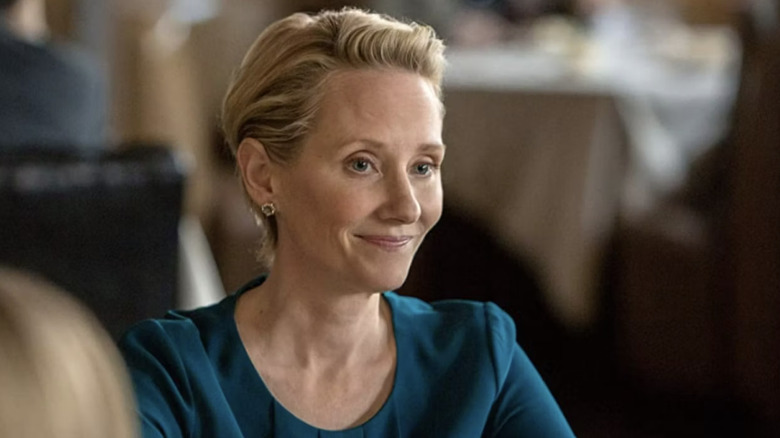
11 Aug 19:57

Elon Musk's Starlink Loses $886M Subsidy to Expand Rural Internet Access - CNET

by Andrew Blok
The FCC wasn't convinced the SpaceX division "could deliver the promised service."
11 Aug 19:55

Every Onscreen John Constantine Ranked

by Erin Brady

John Constantine is a fascinating character not just in the realm of DC Comics, but for modern comics as a whole. The occultist is both a fun and tragic character, never diving deep into edgy territory and always being entertaining to read, even if some of his stories are better than others. This isn't even taking into consideration how badass he can be.

With a character like this, it shouldn't be a surprise that Constantine has been portrayed in animated, live-action, and even auditory media. After all, he's grown a pretty big fanbase after his involvement in the "Hellblazer," "Justice League Dark," and, of course, "Sandman" comics. All of these portrayals are great in their own right, but some of these are admittedly better than others in terms of characterization and execution. Here are the most prominent examples of Constantine getting the adaptation treatment, ranked by some very scientific barometers.

Keanu Reeves Constantine - Constantine (2005)

It really does pain me to put my darling Keanu at the very bottom of this list. I don't even think this performance of his is necessarily bad, nor does he seem like an unconvincing Constantine. However, the script that he is reciting makes him out to be more of a generic exorcist rather than the Hellblazer himself. A fitting performance can only work if the writing is just as properly characterized, which means that Reeves' turn as Constantine just wasn't meant to be.

Effectiveness at fighting demons: This Constantine seems to be really unlucky most of the time, only really succeeding due to quick thinking or divine intervention.

Moodiness: The dude lit up a cigarette after getting told he was diagnosed with terminal lung cancer. That's all you really need to know.

Likelihood that he'll save you: If you're possessed, then he'll save you. Not sure about any other time, though.

Taron Egerton Constantine - The Sandman Audiobook (2020)

Okay, listen. I know that the title of this piece contains the word "onscreen," and that this shouldn't count because this version of Constantine is never actually shown due to it being an audiobook. However, you should consider the fact that this list needs to have a little teeny bit of suspense, so you're just going to have to deal with this performance being on here.

Effectiveness at fighting demons: Honestly, I have no idea how he'd handle a life-threatening situation, as he doesn't actually encounter any major threats in his audiobook appearance. Maybe he'd be great, maybe he wouldn't. Who knows!

Moodiness: Good grief, if this list was ranked by moodiness, this version would be on top. This Constantine is as moody as Batman!

Likelihood that he'll save you: See the above entry on his effectiveness.

Jenna Coleman Constantine - The Sandman (2022)

It's a bit strange putting this version of Constantine on this list, but of course, it was strange when it was revealed that Coleman will be playing both Johanna Constantine from the 18th century and from modern times. While an unexpected change, it was certainly a welcome one -- after all, variety is the spice of life, and it's not like gender-bending the character would be unreasonable given the family's history. This version is a bit smarmier than her male counterparts, but she still moves through the world in a way only a cynic can, making her more than worthy of the Constantine name and coat.

Effectiveness at fighting demons: Other than that one Astra incident, she seems pretty capable of whiffing away demons with only a few Latin phrases.

Moodiness: Her moodiness is more subtle than the others on this list, but if you really pay attention to her, you'll know she's just as depressed as her counterparts. Maybe even more!

Likelihood that she'll save you: She probably will be able to help you out, as long as you pay her triple her usual rate.

Matt Ryan Constantine - Constantine, Arrowverse, And Miscellaneous (2014 To Present)

Come on, did you really think any other version of Constantine would take the top spot? While other actors may come and go, Ryan will likely be remembered as the definitive version of the character for years to come. This isn't even taking into account him being the most prolific actor to take on the character. It's ultimately his depth of emotion that makes him the best Constantine. While smarmy and pessimistic, his genuine desire to help others is perfectly clear in everything he does. Not only that but he's arguably got the best one-liners out of all the other portrayals of the character.

Effectiveness at fighting demons: Well, not all of his jobs get perfect results, but then again, who is perfect at their jobs? All things considered, he's gotten more problems solved than most.

Moodiness: He's got that perfect balance of dreariness and smartassery. He's kind of a mess but doesn't let that fact dictate his entire personality.

Likelihood that he'll save you: You've got a fairly good shot at surviving a demonic encounter if you have this Constantine by your side. That is, if you've encountered him after the events of his solo series.

Read this next: Every DC Movie Made Prior To The DCEU Ranked From Worst To Best

The post Every Onscreen John Constantine Ranked appeared first on /Film.
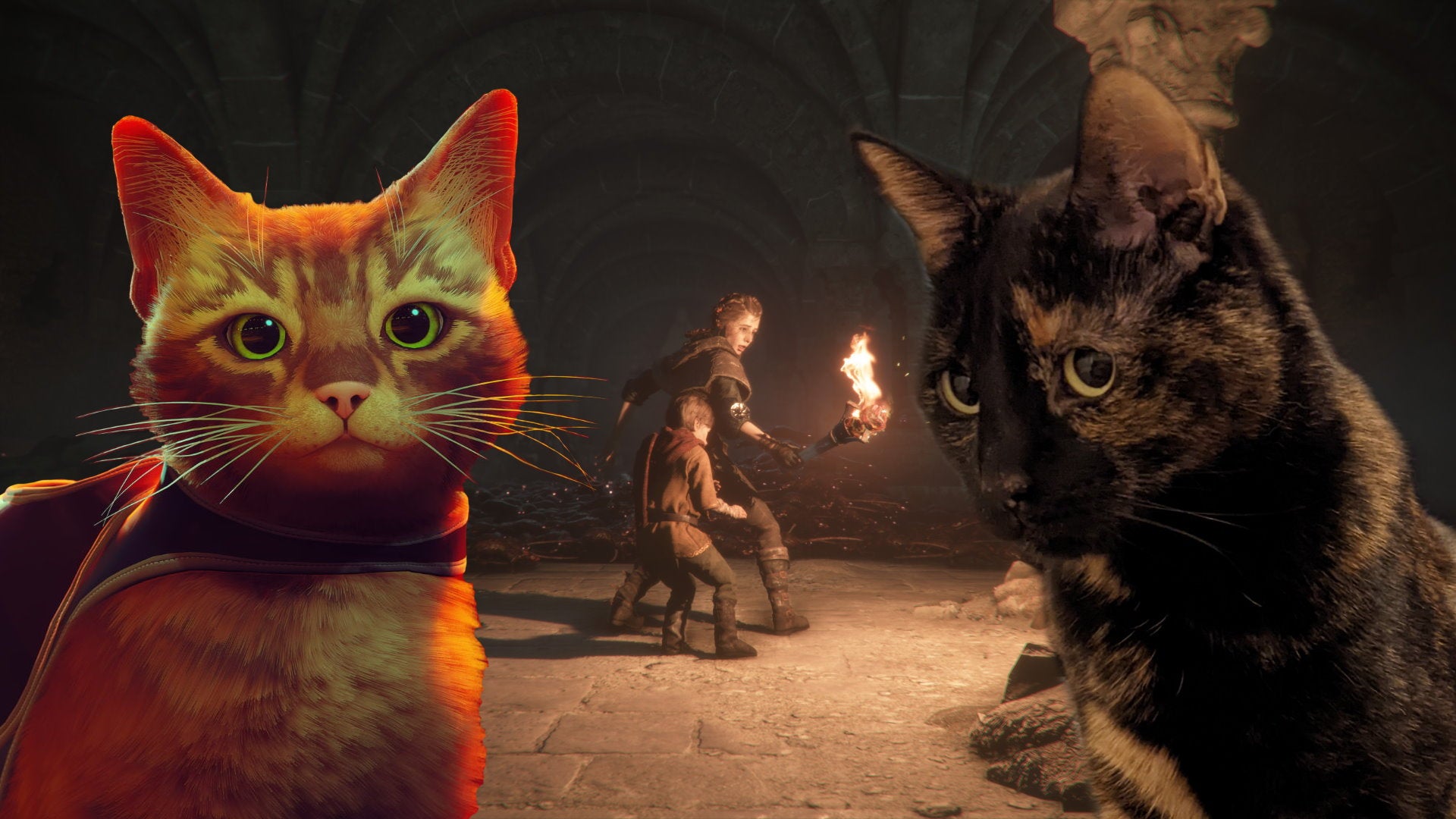
11 Aug 19:54

Distribution Release: Ubuntu 22.04.1

Canonical has announced the release of an update to their Ubuntu 22.04 series along with updated official community editions. The new version, 22.04.1, include minor updates, fixes, and improved RISC-V support. "The Ubuntu team is pleased to announce the release of Ubuntu 22.04.1 LTS (Long-Term Support) for its....
11 Aug 19:51

The Geekbox: Episode 629

Wherein we discuss How To with John Wilson, Sandman, Batgirl and the future of the DC Extended Universe, Avatar 2, Better Call Saul, Daredevil, and Ms. Marvel. Starring Ryan Scott, Justin Haywald, and Ryan Higgins.

11 Aug 19:50

[Steam] (Game) Battlestar Galactica Deadlock

by /u/Takkie79
11 Aug 19:49

Jesse Pinkman Was The True Heart And Soul Of Breaking Bad

by Danielle Ryan

"Breaking Bad" has plenty of funny moments, but at its heart, the story is a tragedy. The acclaimed series follows put-upon high school chemistry teacher Walter White (Bryan Cranston) who begins to deal meth in order to ensure a financial future for his family after a cancer diagnosis. As Walt's morality crumbles and he becomes a drug kingpin, the only character to really hold his humanity accountable is his business partner, former student and meth dealer Jesse Pinkman (Aaron Paul). Walt slowly alienates himself from his wife Skylar (Anna Gunn), son Walt Jr. (RJ Mitte), and brother-in-law Hank (Dean Norris), but Jesse never quite gives up on "Mr. White." 

Jesse was initially supposed to die at the end of the first season in order to make Walt realize the dangers of his new lifestyle, but the chemistry between Paul and Cranston was undeniable. From the first time Jesse shows up in the series, dropping out of a window shirtless during a DEA raid, he's a bright spot in the darkness of the show, youthful and earnest and mischievous. He's the perfect foil for Walt, who is older, bitter, and jaded. Their partnership is the driving force of the story, and while Walt is definitely the brains of the outfit, Jesse is the pair's beating heart. 

Love And Laughs

Just as Jimmy and Kim's romance on "Better Call Saul" keeps viewers rooting for the pair, the bizarre friendship between Walt and Jesse is what makes "Breaking Bad" work on an emotional level. Walt's relationship with his family is deeply strained even at the beginning; there's simmering resentment between everyone at the breakfast table going all the way back to the pilot. He has nothing to lose, so his descent into being a drug kingpin loses some of its weight and becomes just sort of a weird joke about a chemistry teacher related to a DEA agent who becomes a criminal. Jesse gives Walt's journey real stakes and breaks up the tension with some humor, which is much-needed several times throughout the grim and often heart-wrenching series. 

Some of the series' funniest moments happen through Jesse's good-natured goofing around and juvenile sense of humor. He finds ways to entertain himself because he's basically a child in a world of stern adults, and that entertainment gets passed onto us. Whether he's awkwardly sipping water during dinner between Skylar and Walt and making the world's most uncomfortable expression or playing around with the equipment in a meth lab, Jesse's whimsical nature brings necessary levity. 

A Kicked Puppy

The characters in "Breaking Bad" and its spin-off series "Better Call Saul" are almost all doomed to tragic fates, because Gilligan apparently really enjoys torturing his characters. In a podcast with IndieWire in 2013, Gilligan revealed that he not only originally planned to kill Jesse at the end of season 1, but that Jesse's death would lead to a series of events that ended with Walt Jr. dying horribly as well. The studio executives weren't exactly thrilled with the idea, and the other writers helped him take things down a few notches. Some of the ideas he came up with would be repurposed for other storylines, but Jesse (and Walt Jr.) would live. 

That didn't mean that Jesse was off the hook completely, however. Because Walt is dying and he grows progressively more heartless, he's impossible to hurt. Jesse, however, is an empathetic, broken creature who just wants to be loved. Over the course of the series, Jesse is brutalized mentally, emotionally, and physically, eventually culminating in his capture and literal torture at the hands of a group of neo-Nazis. It's harrowing stuff, and Paul plays it to perfection. His humanity is raw and real, a stark contrast to Cranston's calculated cruelty as Walt. He repeatedly tries to get out of the business or to step things down, desperate for a return to the days when he cooked garbage meth laced with chili powder because at least things were simple. 

When Jesse finally escapes the neo-Nazis and runs away for good at the end of "Breaking Bad," he cries with both pain and joy. He's free, but he's survived so much and the future isn't going to be easy. 

Important Enough To Earn His Own Movie

Gilligan had too many ideas for the "Breaking Bad" universe, and the incredible characters he created eventually spun the series off into a whole franchise. The incredible sorta-prequel series "Better Call Saul" has given so much more background to Jimmy McGill (Bob Odenkirk) that he might actually be the franchise's main character, not Walt, but Jesse is still a vital part of the whole shebang. In fact, the first addition to the "Breaking Bad" canon was "El Camino," a Netflix film from Gilligan that told the story of what happened to Jesse after he escaped in the final episode of the series. While some fans found the movie to be extraneous, those who had become attached to Jesse finally got a satisfying conclusion to his story. After all, the end of "Breaking Bad" gives Walt the ending he deserves, so why not poor Jesse?

"El Camino" shows Jesse as a deeply broken man who will never be the same, but there's hope that he can start a new life in Alaska. His heart was almost always in the right place, and Walt often pushed him to do things he would never have done otherwise, going all the way back to dissolving a corpse in acid in season 1. Jesse went from a goofy little punk who said "b****" too often to one of television's most compelling characters, and without him, "Breaking Bad" would have been just another story about a seemingly normal guy turned evil because of dire situations. Instead, it's a perfect character study of two men who couldn't be more different, and that duality is everything. Look, they don't build bronze statues in downtown Albuquerque of just anyone, okay?

"Breaking Bad," "El Camino," and "Better Call Saul" are all streaming on Netflix. 

Read this next: 12 Shows Like Stranger Things You Definitely Need To Stream

The post Jesse Pinkman Was the True Heart and Soul of Breaking Bad appeared first on /Film.