Shared posts

21 Mar 21:52

Relax in Old-School Style With These Knitted Converse Slippers

by John Metcalfe
Image Etsy/CrazyButterflies
Etsy/CrazyButterflies

Love your Chucks so much you want to wear them in the house? Then wiggle into these slippers from Elena Milanova, which are handcrafted to resemble high-top Converse sneakers.

Milanova, who hails from the Chuck Taylor capital of the world—er, Gorna Oryahovitsa, Bulgaria—writes that she knits and crochets these ersatz kicks “naturally, with love and warmth” for any size of man, woman, even baby. They come in gray, blue, pink, or orange, though if you slip Milanova a few extra bucks, maybe she’ll make black Bart Simpson limited-edition ones, too.

The production time for a set is one to two weeks, and shipping to the U.S. usually takes 10 to 21 days (note: it could be longer due to customs or foul weather). They’re meant to be worn as slippers; however, comedians might use them as socks just to see the reactions when they remove their Converse only to have another pair appear.

Slippers, $17-35 plus shipping, at Etsy.

Etsy/CrazyButterflies
20 Mar 14:49

Good News

by Bill Amend

ft160320goodnews

17 Mar 03:17

Photo


16 Mar 19:06

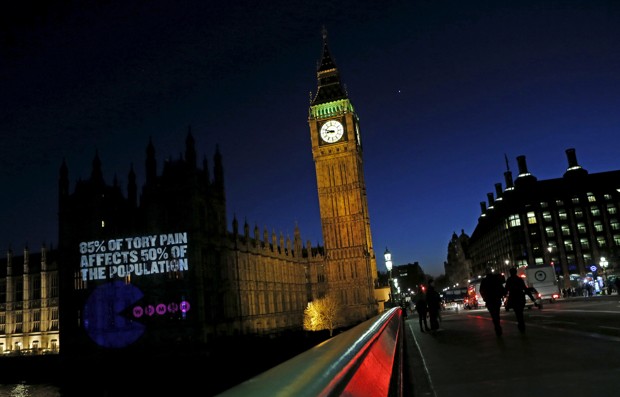
Stop Projecting Trashy Ads on Historic Buildings, Warns the U.K. Parliament

by Feargus O'Sullivan
Image Reuters Pictures/Sergio Perez
An official projection of the U.K. flag onto the Houses of Parliament during the 2012 Olympics. (Reuters Pictures/Sergio Perez)

You can’t really blame the U.K. parliament for being a little grumpy. Since last winter, the neo-gothic hulk of London’s Houses of Parliament has been besmirched with huge, unauthorized projections that have at various points included a monkey, a swastika, and a reality star’s weight-loss photos. The building has become the go-to canvas for any advertiser (or occasional political activist) looking for an eye-catching backdrop for their campaign, thanks to its iconic status and easy use as a projection screen from the opposite bank of the River Thames.

Now, says Parliament’s external communications director Lee Bridges, enough is enough. Writing an angry piece this month for advertising industry news sheet Campaign, Bridges warned readers implicitly that if they indulged in more projection bombing, they’d be messing with the wrong people:

“We are not being killjoys or jobsworths. The Houses of Parliament, famed for their stunning Gothic architecture, are part of an Unesco World Heritage Site and need to be enjoyed as such. These buildings are not free billboards—proposals to project commercial campaigns that are not in the national interest will not be granted permission.”

You can understand why parliament’s keepers are annoyed. The trend started ignominiously in 1999, when FHM magazine projected the hugely enlarged image of a naked TV presenter onto the building. Parliament didn’t take kindly to being the backdrop to an ad for a competition to find the U.K.’s sexiest woman, but the trend caught on. Last month, tea brand PG Tips projected an enormous chimpanzee (part of its advertising campaigns for decades) onto the building to tie-in with Chinese New Year. The previous winter, Parliament was graced with before and after shots promoting the weight loss DVD of a star of Geordie Shore, a Newcastle-based rip-off of U.S. reality show Jersey Shore that succeeds in being more low-rent than its model. Other attempts have been more political, such as when campaign group Avaaz criticized the U.K. visit of India’s nationalist Prime Minister Narendra Modi by projecting a swastika onto Big Ben, parliament’s clocktower.

What makes this opportunism more grating is that parliament buildings elsewhere have actually provided sites from some pretty eye-catching works of art. Building on the brilliant projection-based work of such artists as Jenny Holzer, the filmmaker Darren Aronovsky and the French artist JR projected the faces of a dense crowd of people onto the façade of France’s Assemblée Nationale during the COP21 climate change talks last year, as a reminder of the phenomenon’s present and future victims. On a far grander scale was the wrapping and illumination of Berlin’s Reichstag Building by the artists Christo and Jeanne-Claude in 1995, prior to its rehabilitation as Germany’s parliament by Norman Foster. The wrapping’s floodlit nocturnal removal chimed brilliantly with the spirit of the moment, a ritual unveiling that was a counterpart to the re-launch of Berlin as a national capital. It’s no wonder that Britain’s parliament is frustrated at merely being the screen for a Godzilla-sized butt.

A recent unauthorized projection onto the Houses of Parliament. (Reuters Pictures/Cathal McNaughton)

In fairness, it has done a little better than that. The building is sometimes used for official projections, such as when lit with the union flag during the 2012 Olympics. But when it comes to unofficial use, there isn’t a whole lot parliament can do. They can shame the advertisers and possibly slap them with a fine, but there’s no way to stop such projections going ahead short of closing the entire Thames Embankment. As these images are seen by far more people online than on-site, the projections only really need to be up long enough to take a few photos. Maybe this month’s warning to the advertising industry will be enough to scare at least a few of the monkeys and models away.

16 Mar 19:04

The Tackiest Architecture in the Entire World

by Kriston Capps

Sure, a ban on weird architecture sounds bad. The directive from Chinese President Xi Jingping prohibiting China from pursuing new directions in design may strike some Westerners as excessive, backward, or overprotective. While hasty and awkward designs have plagued China’s unrivaled building spree, President Xi may have thrown the baby out with the bathwater by curbing design in hopes of bolstering building standards.

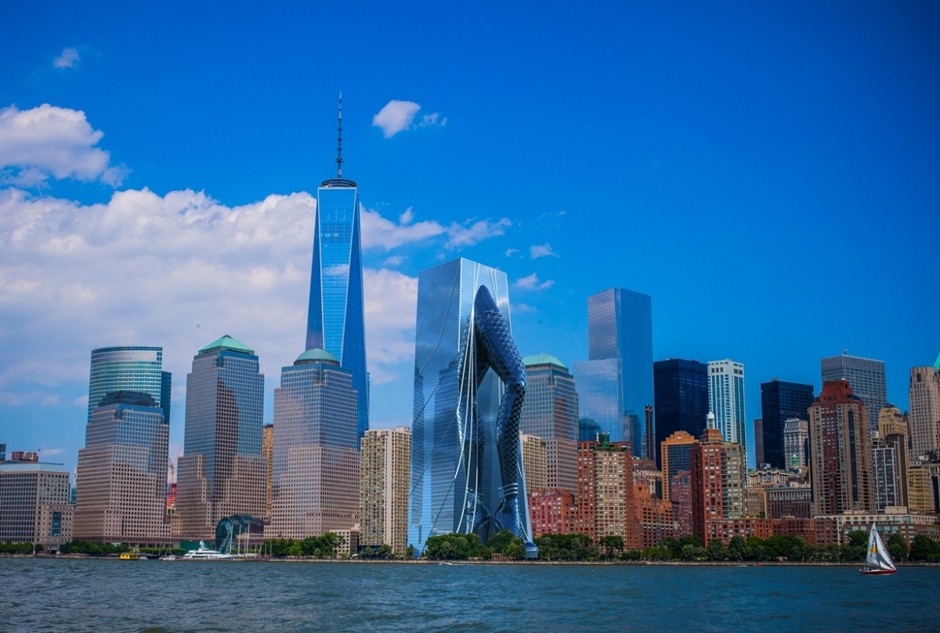
Then again, some building concepts are so hostile, so aggressive, so absolutely bonkers that state action against them almost seems warranted. One of them is a plan to build a sexy leg in Lower Manhattan.

“Someone will be shocked by this idea, someone will find it beautiful and sexy. Someone—vulgar, but everybody, without an exception, would want to observe such a tower or visit it at least once in a lifetime,” writes Vasily Klyukin, the mind behind Top Sexy Tower NYC. “I personally would like to live in this tower.”

Rendering for Top Sexy Tower NYC. (Vasily Klyukin)

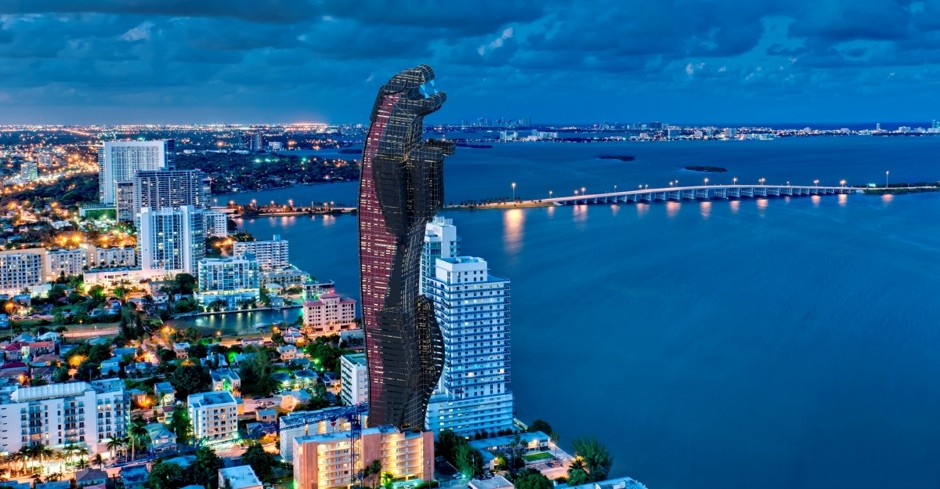
That is a leg building—that is a sexy leg building, modeled in a stiletto heel and fishnets—emerging from the curtain wall of that central tower. The Top Sexy Tower. “The higher it gets, the more breathtaking it is and this is applicable to the skyscrapers, as well as to the models' legs, as well as to the Wall Street quotes,” Klyukin writes on his website.

Klyukin is a Russian-born Tony Stark, a billionaire banker and real-estate mogul turned science-fiction novelist turned self-styled starchitect. He lives in Monaco. (Of course he lives in Monaco.) He has never built anything, barring his own personal empire.

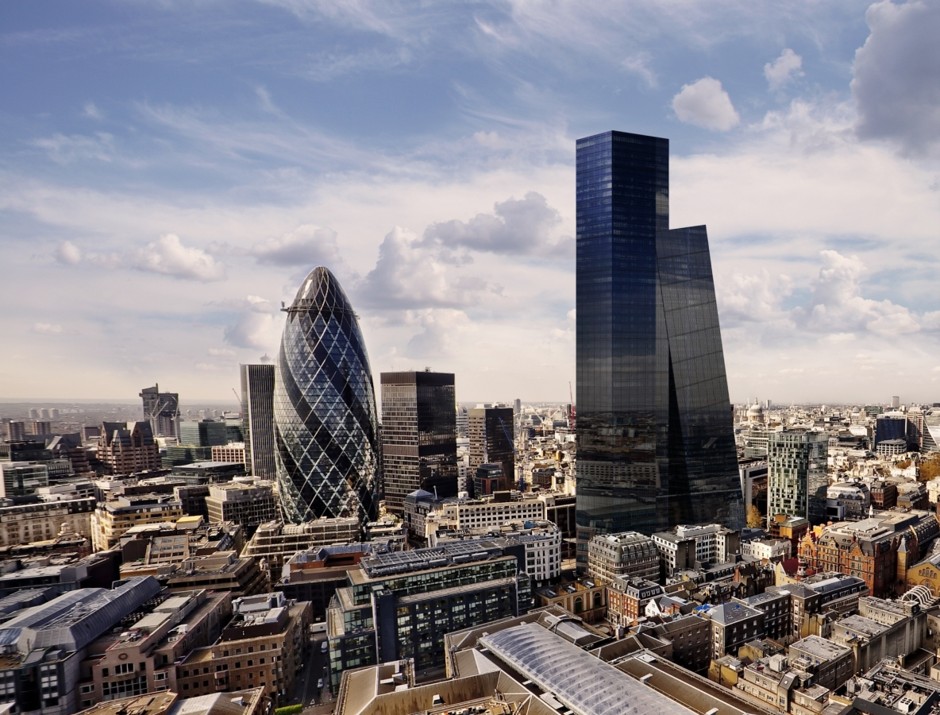
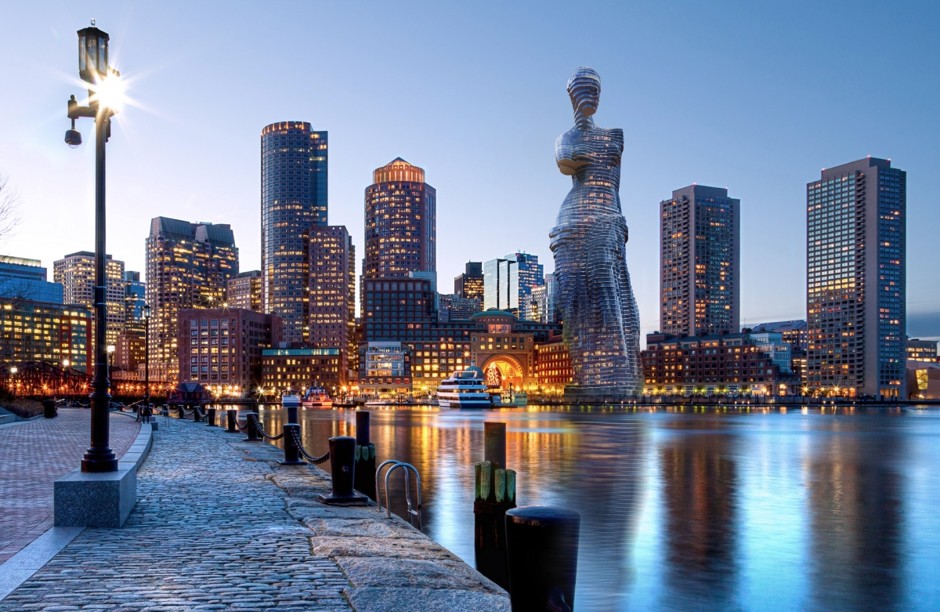
And yet, he is now proposing buildings across the world. The Asian Cobra Tower doesn’t even have a destination in mind, beyond “any Eastern city.” Some of Klyukin’s renderings show the same building in multiple places: Dubai, London, New York. It’s not clear whether he thinks that a Venus Tower could be dropped in any of those cities or whether the thinks each of them needs a Venus Tower.

Now, you might object that a vast frigate-shaped spa is a less-than-serious building proposal. Or that the leg lamp from A Christmas Story, enlarged to the scale of a city, is a non-starter. These are doodles boosted by computer-assisted design, technology that has lowered barriers to entry across the field. Would-be designers don’t need to know how to draw or build to re-imagine the world around them.

White Sails Hospital & Spa (Vasily Klyukin)

That’s one argument. Another might be a series of retching sounds and furious strangling gestures.

One thing that Klyukin’s designs reveal that will resonate in New York and London—and perhaps in President Xi’s China—is the billionaire’s contempt for locality. These proposals don’t make room for regionalism or context because they are utterly unconcerned with it. If Klyukin espouses any robust design philosophy, it’s globalism, a High International Kitsch.

He is by no means heartless. The pitch for one design, the In Love Towers, which involves one tower gently nuzzling up against another tower, is a poem:

We were in love, but not together
No chance to touch, it broke my heart.
But once the dream came true forever
Now we could lean and never part

In Love, far right. (Vasily Klyukin)

Just not a poem to London.

So far, none of Klyukin’s projects has been completed or even commissioned. No one is going to build a tower shaped like a jaguar. No one but 12-year-old me wants to see a city skyline graced by a menacing cobra. That’s not the fear.

Rather, designs like Klyukin’s point to the toll that weird design has taken on the public’s conception of what architecture means. His work is the opposite of design by someone like Annabelle Selldorf, a subtle and context-driven architect. His work is spectacle, outrageous, tacky.

Which is all fine and good (for a laugh, anyway). But there’s a serious point here, too. Klyukin’s ideas didn’t come from a vacuum. He’s pushing the next step in a trend of spectacles promoted by major museum commissions and open-design competitions, allegedly honest arbiters of material culture and the built environment. Klyukin is simply willing to take spectacle further. So much further.

Asian Cobra Tower (Vasily Klyukin)
Venus (Vasily Klyukin)
Virgin RB (Vasily Klyukin)
America Plaza (Vasily Klyukin)
Jaguar (Vasily Klyukin)
Manhattan (Vasily Klyukin)
Mondrian (Vasily Klyukin)
Rays (Vasily Klyukin)
Top Sexy Tower NYC (Vasily Klyukin)
16 Mar 19:01

Stunning 3D Topographic Maps of Any Place on Earth

by John Metcalfe
Image 3D Wooden Maps
3D Wooden Maps

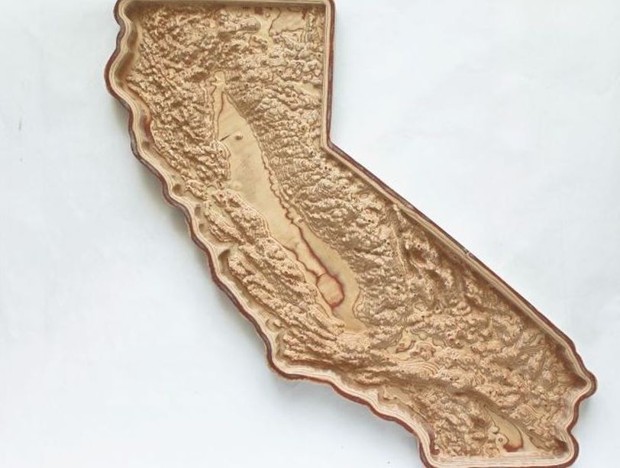
Love maps so much you’re not content to just look at them, but need to rub your fingers over all their various lumps and fissures? Then pick a location, any location, tell it to the folks at 3D Wooden Maps, and they’ll carve a highly accurate simulacrum of it suitable for hanging on the wall.

The person behind the business, who’s reputedly a geologist, uses satellite or LIDAR terrain data to cut topographies in 1.7-inch-thick plywood with a CNC milling machine. According to Designboom:

The essence and motivation behind the project is to give maps another dimension. To do so, the digital satellite terrain data was converted into 3D models, adjusting scales to give an impressive look on wood. The dark layers of glue on the plywood play the role of the isohypse lines as on topological maps.

There’s no limit on scale: You can go big with a map of the world, which displays mountain ranges, bathymetry, and examples of “tectonic plates drift, collision, and rifting points”:

3D Wooden Maps

Or you can go smaller with cities and metropolitan regions, like this model of the Bay Area (San Francisco is at lower left):

3D Wooden Maps

Prices vary according to the job; the pieces presented on the 3D Wooden Maps online store range from $222 to $1,666. Here are a few more examples:

North America (3D Wooden Maps)
California (3D Wooden Maps)
Lake Tahoe, on the border of California and Nevada (3D Wooden Maps)
The Grand Canyon (3D Wooden Maps)
Australia (3D Wooden Maps)
16 Mar 04:31

Apple's Response To DOJ: Your Filing Is Full Of Blatantly Misleading Claims And Outright Falsehoods

by Mike Masnick
As expected, Apple has now responded to the DOJ in the case about whether or not it can be forced to write code to break its own security features to help the FBI access the encrypted work iPhone of Syed Farook, one of the San Bernardino attackers. As we noted, the DOJ's filing was chock-full of blatantly misleading claims, and Apple was flabbergasted by just how ridiculous that filing was. That comes through in this response.
The government attempts to rewrite history by portraying the Act as an all-powerful magic wand rather than the limited procedural tool it is. As theorized by the government, the Act can authorize any and all relief except in two situations: (1) where Congress enacts a specific statute prohibiting the precise action (i.e., says a court may not “order a smartphone manufacturer to remove barriers to accessing stored data on a particular smartphone,” ... or (2) where the government seeks to “arbitrarily dragoon[]” or “forcibly deputize[]” “random citizens” off the street.... Thus, according to the government, short of kidnapping or breaking an express law, the courts can order private parties to do virtually anything the Justice Department and FBI can dream up. The Founders would be appalled.
The Founders would be appalled. That's quite a statement.

Apple also slams the DOJ for insisting that this really is all about the one iPhone and that the court should ignore the wider precedent, citing FBI Director James Comey's own statements:
It has become crystal clear that this case is not about a “modest” order and a “single iPhone,” Opp. 1, as the FBI Director himself admitted when testifying before Congress two weeks ago. Ex. EE at 35 [FBI Director James Comey, Encryption Hr’g] (“[T]he broader question we’re talking about here goes far beyond phones or far beyond any case. This collision between public safety and privacy—the courts cannot resolve that.”). Instead, this case hinges on a contentious policy issue about how society should weigh what law enforcement officials want against the widespread repercussions and serious risks their demands would create. “Democracies resolve such tensions through robust debate” among the people and their elected representatives, Dkt. 16-8 [Comey, Going Dark], not through an unprecedented All Writs Act proceeding.
Apple then, repeatedly, points out where the DOJ selectively quoted, misquoted or misleadingly quoted arguments in its favor. For example:
The government misquotes Bank of the United States v. Halstead,..., for the proposition that “‘[t]he operation of [the Act]’” should not be limited “‘to that which it would have had in the year 1789.’” ... (misquoting Halstead, 23 U.S. (10 Wheat.) at 62) (alterations are the government’s). But what the Court actually said was that the “operation of an execution”—the ancient common law writ of “venditioni exponas”—is not limited to that “which it would have had in the year 1789.” ... see also... (“That executions are among the writs hereby authorized to be issued, cannot admit of a doubt . . . .”). The narrow holding of Halstead was that the Act (and the Process Act of 1792) allowed courts “to alter the form of the process of execution.” ... (courts are not limited to the form of the writ of execution “in use in the Supreme Courts of the several States in the year 1789”). The limited “power given to the Courts over their process is no more than authorizing them to regulate and direct the conduct of the Marshal, in the execution of the process.”

The authority to alter the process by which courts issue traditional common law writs is not authority to invent entirely new writs with no common law analog. But that is precisely what the government is asking this Court to do: The Order requiring Apple to create software so that the FBI can hack into the iPhone has no common law analog.
The filing then goes step by step in pointing out how the government is wrong about almost everything. The DOJ, for example, kept insisting that CALEA doesn't apply at all to Apple, but Apple points out that the DOJ just seems to be totally misreading the law:
Contrary to the government’s assertion that its request merely “brush[es] up against similar issues” to CALEA..., CALEA, in fact, has three critical limitations—two of which the government ignores entirely—that preclude the relief the government seeks.... First, CALEA prohibits law enforcement agencies from requiring “electronic communication service” providers to adopt “any specific design of equipment, facilities, services, features, or system configurations . . . .” The term “electronic communication service” provider is broadly defined to encompass Apple. ... (“any service which provides to users thereof the ability to send or receive wire or electronic communications”). Apple is an “electronic communication services” provider for purposes of the very services at issue here because Apple’s software allows users to “send or receive . . . communications” between iPhones through features such as iMessage and Mail....

The government acknowledges that FaceTime and iMessage are electronic communication services, but asserts that this fact is irrelevant because “the Court’s order does not bear at all upon the operation of those programs.” ... Not so. The passcode Apple is being asked to circumvent is a feature of the same Apple iOS that runs FaceTime, iMessage, and Mail, because an integral part of providing those services is enabling the phone’s owner to password-protect the private information contained within those communications. More importantly, the very communications to which law enforcement seeks access are the iMessage communications stored on the phone.... And, only a few pages after asserting that “the Court’s order does not bear at all upon the operation of” FaceTime and iMessage for purposes of the CALEA analysis..., the government spends several pages seeking to justify the Court’s order based on those very same programs, arguing that they render Apple “intimately close” to the crime for purposes of the New York Telephone analysis.

Second, the government does not dispute, or even discuss, that CALEA excludes “information services” providers from the scope of its mandatory assistance provisions.... Apple is indisputably an information services provider given the features of iOS, including Facetime, iMessage, and Mail....

Finally, CALEA makes clear that even telecommunications carriers (a category of providers subject to more intrusive requirements under CALEA, but which Apple is not) cannot be required to “ensure the government’s ability” to decrypt or to create decryption programs the company does not already “possess.”... If companies subject to CALEA’s obligations cannot be required to bear this burden, Congress surely did not intend to allow parties specifically exempted by CALEA (such as Apple) to be subjected to it. The government fails to address this truism.
Next, Apple rebuts the DOJ saying that since CALEA doesn't address this specific situation, that means Congress is just leaving it up to the courts to use the All Writs Act. As Apple points out, in some cases, Congress not doing something doesn't mean it rejected certain positions, but in this case, the legislative history is quite clear that Congress did not intend for companies to be forced to help in this manner.
Here, Congress chose to require limited third-party assistance in certain statutes designed to aid law enforcement in gathering electronic evidence (although none as expansive as what the government seeks here), but it has declined to include similar provisions in other statutes, despite vigorous lobbying by law enforcement and notwithstanding its “prolonged and acute awareness of so important an issue” as the one presented here.... Accordingly, the lack of statutory authorization in CALEA or any of the complementary statutes in the “comprehensive federal scheme” of surveillance and telecommunications law speaks volumes.... To that end, Congress chose to “greatly narrow[]” the “scope of [CALEA],” which ran contrary to the FBI’s interests but was “important from a privacy standpoint.” ... Indeed, CALEA’s provisions were drafted to “limit[] the scope of [industry’s] assistance requirements in several important ways.”....

That the Executive Branch recently abandoned plans to seek legislation expanding CALEA’s reach... provides renewed confirmation that Congress has not acceded to the FBI’s wishes, and belies the government’s view that it has possessed such authority under the All Writs Act since 1789.
In fact, in a footnote, Apple goes even further in not just blasting the DOJ's suggestion that Congress didn't really consider a legislative proposal to update CALEA to suck in requirements for internet communications companies, but also highlighting the infamous quote from top intelligence community lawyer Robert Litt about how they'd just wait for the next terrorist attack and get the law passed in their favor at that point.
The government’s attempts to minimize CALEA II, saying its plans consisted of “mere[] vague discussions” that never developed into a formal legislative submission ..., but federal officials familiar with that failed lobbying effort confirmed that the FBI had in fact developed a “draft proposal” containing a web of detailed provisions, including specific fines and compliance timelines, and had floated that proposal with the White House..... As The Washington Post reported, advocates of the proposal within the government dropped the effort, because they determined they could not get what they wanted from Congress at that time: “Although ‘the legislative environment is very hostile today,’ the intelligence community’s top lawyer, Robert S. Litt, said to colleagues in an August [2015] e-mail, which was obtained by The Post, ‘it could turn in the event of a terrorist attack or criminal event where strong encryption can be shown to have hindered law enforcement.’ There is value, he said, in ‘keeping our options open for such a situation.’”
Next Apple goes through the arguments for saying that, even if the All Writs Act does apply, and even if the court accepts the DOJ's made up three factor test, Apple should still prevail. It notes, again, that it is "far removed" from the issue and reminds the court that the order sought here is very different from past cases where Apple has cooperated:
The government argues that “courts have already issued AWA orders” requiring manufacturers to “unlock” phones ... but those cases involved orders requiring “unlocking” assistance to provide access through existing means, not the extraordinary remedy sought here, i.e., an order that requires creating new software to undermine the phones’ (or in the Blake case, the iPad’s) security safeguards.
It also mocks that weird argument from the DOJ that said because Apple "licenses" rather than "sells" its software, that means Apple is more closely tied to the case:
The government discusses Apple’s software licensing and data policies at length, equating Apple to a feudal lord demanding fealty from its customers (“suzerainty”). ... But the government does not cite any authority, and none exists, suggesting that the design features and software that exist on every iPhone somehow link Apple to the subject phone and the crime. Likewise, the government has cited no case holding that a license to use a product constituted a sufficient connection under New York Telephone. Indeed, under the government’s theory, any ongoing postpurchase connection between a manufacturer or service provider and a consumer suffices to connect the two in perpetuity—even where, as here, the data on the iPhone is inaccessible to Apple.
From there, Apple dives in on the question of how much of a "burden" this would be. This is the issue that Judge Pym has indicated she's most interested in, and Apple goes deep here -- again and again focusing on how the DOJ was blatantly misleading in its motion:
Forcing Apple to create new software that degrades its security features is unprecedented and unlike any burden ever imposed under the All Writs Act. The government’s assertion that the phone companies in Mountain Bell and In re Application of the U.S. for an Order Authorizing the Installation of a Pen Register or Touch-Tone Decoder and a Terminating Trap ..., were conscripted to “write” code, akin to the request here... mischaracterizes the actual assistance required in those cases. The government seizes on the word “programmed” in those cases and superficially equates it to the process of creating new software..... But the “programming” in those cases—back in 1979 and 1980—consisted of a “technician” using a “teletypewriter” in Mountain Bell ..., and “t[ook] less than one minute” in Penn Bell... Indeed, in Mountain Bell, the government itself stated that the only burden imposed “was a large number of print-outs on the teletype machine”—not creating new code..... More importantly, the phone companies already had and themselves used the tracing capabilities the government wanted to access.... And although relying heavily on Mountain Bell, the government neglects to point out the court’s explicit warning that “[t]his holding is a narrow one, and our decision today should not be read to authorize the wholesale imposition upon private, third parties of duties pursuant to search warrants.” ...This case stands light years from Mountain Bell. The government seeks to commandeer Apple to design, create, test, and validate a new operating system that does not exist, and that Apple believes—with overwhelming support from the technology community and security experts—is too dangerous to create.

Seeking to belittle this widely accepted policy position, the government grossly mischaracterizes Apple’s objection to the requested Order as a concern that “compliance will tarnish its brand”..., a mischaracterization that both the FBI Director and the courts have flatly rejected. [See Comey] (“I don’t question [Apple’s] motive”);... (disagreeing “with the government’s contention that Apple’s objection [to being compelled to decrypt an iPhone] is not ‘conscientious’ but merely a matter of ‘its concern with public relations’”). As Apple explained in its Motion, Apple prioritizes the security and privacy of its users, and that priority is reflected in Apple’s increasingly secure operating systems, in which Apple has chosen not to create a back door.
Apple also calls out the DOJ's technical ignorance.
The government’s assertion that “there is no reason to think that the code Apple writes in compliance with the Order will ever leave Apple’s possession” ... simply shows the government misunderstands the technology and the nature of the cyber-threat landscape. As Apple engineer Erik Neuenschwander states:
I believe that Apple’s iOS platform is the most-attacked software platform in existence. Each time Apple closes one vulnerability, attackers work to find another. This is a constant and never-ending battle. Mr. Perino’s description of third-party efforts to circumvent Apple’s security demonstrates this point. And the protections that the government now asks Apple to compromise are the most security-critical software component of the iPhone—any vulnerability or back door, whether introduced intentionally or unintentionally, can represent a risk to all users of Apple devices simultaneously.
... The government is also mistaken in claiming that the crippled iOS it wants Apple to build can only be used on one iPhone:
Mr. Perino’s characterization of Apple’s process . . . is inaccurate. Apple does not create hundreds of millions of operating systems each tailored to an individual device. Each time Apple releases a new operating system, that operating system is the same for every device of a given model. The operating system then gets a personalized signature specific to each device. This personalization occurs as part of the installation process after the iOS is created.

Once GovtOS is created, personalizing it to a new device becomes a simple process. If Apple were forced to create GovtOS for installation on the device at issue in this case, it would likely take only minutes for Apple, or a malicious actor with sufficient access, to perform the necessary engineering work to install it on another device of the same model.

. . . [T]he initial creation of GovtOS itself creates serious ongoing burdens and risks. This includes the risk that if the ability to install GovtOS got into the wrong hands, it would open a significant new avenue of attack, undermining the security protections that Apple has spent years developing to protect its customers.
And, not surprisingly, Apple angrily attacks the DOJ's bogus misleading use of Apple's transparency report statements about responding to lawaful requests for government information in China, by pointing out how that's quite different than this situation:
Finally, the government attempts to disclaim the obvious international implications of its demand, asserting that any pressure to hand over the same software to foreign agents “flows from [Apple’s] decision to do business in foreign countries . . . .”. Contrary to the government’s misleading statistics ..., which had to do with lawful process and did not compel the creation of software that undermines the security of its users, Apple has never built a back door of any kind into iOS, or otherwise made data stored on the iPhone or in iCloud more technically accessible to any country’s government.... The government is wrong in asserting that Apple made “special accommodations” for China, as Apple uses the same security protocols everywhere in the world and follows the same standards for responding to law enforcement requests.
Apple also points out that the FBI appears to be contradicting itself as well:
Moreover, while they now argue that the FBI’s changing of the iCloud passcode—which ended any hope of backing up the phone’s data and accessing it via iCloud—“was the reasoned decision of experienced FBI agents”, the FBI Director himself admitted to Congress under oath that the decision was a “mistake”.... The Justice Department’s shifting, contradictory positions on this issue—first blaming the passcode change on the County, then admitting that the FBI told the County to change the passcode after the County objected to being blamed for doing so, and now trying to justify the decision in the face of Director Comey’s admission that it was a mistake—discredits any notion that the government properly exhausted all viable investigative alternatives before seeking this extraordinary order from this Court.
On the Constitutional questions, again Apple points out that the DOJ doesn't appear to understand what it's talking about:
The government begins its First Amendment analysis by suggesting that “[t]here is reason to doubt that functional programming is even entitled to traditional speech protections” ... , evincing its confusion over the technology it demands Apple create. Even assuming there is such a thing as purely functional code, creating the type of software demanded here, an operating system that has never existed before, would necessarily involve precisely the kind of expression of ideas and concepts protected by the First Amendment. Because writing code requires a choice of (1) language, (2) audience, and (3) syntax and vocabulary, as well as the creation of (4) data structures, (5) algorithms to manipulate and transform data, (6) detailed textual descriptions explaining what code is doing, and (7) methods of communicating information to the user, “[t]here are a number of ways to write code to accomplish a given task.”... As such, code falls squarely within the First Amendment’s protection, as even the cases cited by the government acknowledge...
Later it points out that the DOJ's claim that since Apple can write such code however it wants it's not compelled speech, Apple points out that their argument says the exact opposite:
The government attempts to evade this unavoidable conclusion by insisting that, “[t]o the extent [that] Apple’s software includes expressive elements . . . the Order permits Apple to express whatever it wants, so long as the software functions” by allowing it to hack into iPhones.... This serves only to illuminate the broader speech implications of the government’s request. The code that the government is asking the Court to force Apple to write contains an extra layer of expression unique to this case. When Apple designed iOS 8, it consciously took a position on an issue of public importance.... The government disagrees with Apple’s position and asks this Court to compel Apple to write new code that reflects its own viewpoint—a viewpoint that is deeply offensive to Apple.
The filing is basically Apple, over and over again, saying, "uh, what the DOJ said was wrong, clueless, technically ignorant, or purposely misleading." Hell, they even attack the DOJ's claim that the All Writs Act was used back in 1807 to force Aaron Burr's secretary to decrypt one of Burr's cipher-protected letters. Apple points out that the DOJ is lying.
The government contends that Chief Justice Marshall once ordered a third party to “provide decryption services” to the government.... He did nothing of the sort, and the All Writs Act was not even at issue in Burr. In that case, Aaron Burr’s secretary declined to state whether he “understood” the contents of a certain letter written in cipher, on the ground that he might incriminate himself.... The Court held that the clerk’s answer as to whether he understood the cipher could not incriminate him, and the Court thus held that “the witness may answer the question now propounded”—i.e., whether he understood the letter.... The Court did not require the clerk to decipher the letter.
If anything, to be honest, I'm surprised that Apple didn't go even harder on the DOJ for misrepresenting things. Either way, Apple is pretty clearly highlighting just how desperate the DOJ seems in this case.

Permalink | Comments | Email This Story


15 Mar 17:26

White House Begins To Realize It May Have Made A Huge Mistake In Going After Apple Over iPhone Encryption

by Mike Masnick
One of the key lines that various supporters of backdooring encryption have repeated in the last year, is that they "just want to have a discussion" about the proper way to... put backdoors into encryption. Over and over again you had the likes of James Comey insisting that he wasn't demanding backdoors, but really just wanted a "national conversation" on the issue (despite the fact we had just such a conversation in the 90s and concluded: backdoors bad, let's move on.):
My goal today isn’t to tell people what to do. My goal is to urge our fellow citizens to participate in a conversation as a country about where we are, and where we want to be, with respect to the authority of law enforcement.
And, yet, now we're having that conversation. Very loudly. And while the conversation really has been going on for almost two years, in the last month it moved from a conversation among tech geeks and policy wonks into the mainstream, thanks to the DOJ's decision to force Apple to write some code that would undermine security features on the work iPhone of Syed Farook, one of the San Bernardino attackers. According to some reports, the DOJ and FBI purposely chose this case in the belief that it was a perfect "test" case for its side: one that appeared to involve "domestic terrorists" who murdered 14 people. There were reports claiming that Apple was fine fighting this case under seal, but that the DOJ purposely chose to make this request public.

However, now that this has resulted in just such a "national conversation" on the issue, the DOJ, FBI and others in the White House are suddenly realizing that perhaps the public isn't quite as with them as they had hoped. And now there are reports that some in the White House are regretting the decision to move forward and are experiencing this well known feeling: According to the NY Times:
Officials had hoped the Apple case involving a terrorist’s iPhone would rally the public behind what they see as the need to have some access to information on smartphones. But many in the administration have begun to suspect that the F.B.I. and the Justice Department may have made a major strategic error by pushing the case into the public consciousness.

Many senior officials say an open conflict between Silicon Valley and Washington is exactly what they have been trying to avoid, especially when the Pentagon and intelligence agencies are trying to woo technology companies to come back into the government’s fold, and join the fight against the Islamic State. But it appears it is too late to confine the discussion to the back rooms in Washington or Silicon Valley.
While the various public polling on the issue has led to very mixed results, it's pretty clear that the public did not universally swing to the government's position on this. In fact, it appears that the more accurately the situation is described to the public, the more likely they are to side with Apple over the FBI. Given that, John Oliver's recent video on the subject certainly isn't good news for the DOJ.

Either way, the DOJ and FBI insisted they wanted a conversation on this, and now they're getting it. Perhaps they should have been more careful what they wished for.

Permalink | Comments | Email This Story


15 Mar 03:04

Simulation shows why polls don’t always match future results

by Nathan Yau

Rock 'n Poll

With election season in full swing, as far as the news is concerned at least, we get to see poll after poll in the beginning of a voting day and then reports the next day about which ones were wrong. Based on the news alone, it feels like almost every poll is just plain wrong. Maarten Lambrechts shows what’s going on here with Rock ‘n Poll. It simulates a poll and then multiple polls, showing how small differences in the numbers can seem like a lot once the voting results come in.

Tags: polling, simulation, uncertainty

14 Mar 21:35

Photo


14 Mar 15:05

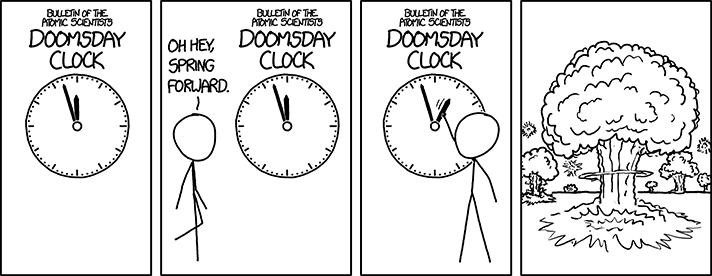
Doomsday Clock

After a power outage at the Bulletin of the Atomic Scientists, the new Digital Doomsday Clock is flashing 00:00 and mushroom clouds keep appearing and then retracting once a second.
14 Mar 01:38

Depressing Study Finds Gender Stereotypes Haven’t Changed Since the 1980s

by Melissa Dahl

In the early 1980s, psychologists published a study examining the gender stereotypes held by American college students. Thirty years later, a different team of psychologists was curious: So much has changed since then. How have young people’s ideas about gender changed along with the times?

The depressing answer: They haven’t. The...More »

12 Mar 01:30

Is This a Puppy or a Bagel? — Food News

by Ariel Knutson

This week Twitter was obsessed with one important question: Can you tell the difference between a dog and some random food item? There's the image you see above, which is a bunch of puppies and some bagels, but then there was also a series of labradoodles next to fried chicken, and then a chihuahua and a blueberry muffin.

Can you really tell the difference?

READ MORE »

11 Mar 16:24

This Satirical App Makes a Serious Point About the Wage Gap

by Jessica Leigh Hester
Image Mike_tn/Flickr
Mike_tn/Flickr

Settling on how to split a restaurant bill is a sticky situation for groups of diners. Should you itemize it? Should you split it down the middle? Should you just stay home forever and absolve yourself of these awkward discussions? A torrent of contradictory advice gives etiquette experts conniptions.

A new app, set to launch for iOS this month, claims to offer a new solution to this interminable debate—but really, in this case, the bill isn’t the point at all.

EquiTable uses the headache-inducing occasion of splitting a check as a way to broach discussions about inequality on the basis of gender and race. It draws upon data from the Bureau of Labor Statistics to apportion responsibility commensurate with guests’ average earning potential. So, a white guy out to dinner with a black woman would fork over more money to cover the check, as a product of the enduring wage gap.

The app splits bills based on demographics. (EquiTable)

The app doesn’t account for how much the people at the table are making in their respective jobs—instead, it weighs the burdens of their demographic groups as a whole. “You can’t detract our current social and political systems from how labor markets have treated groups of people historically,” says Graham Starr, a writer who worked on the app. (Full disclosure: he’s now a fellow at The Atlantic, though we haven’t met.)

The app is tongue-in-cheek, for sure—white diners can contest their privilege by claiming exemptions on the basis of ugliness or the indignity of growing up as a middle child. It’s deliberately funny, and, in fact, was conceived at Comedy Hack Day, which describes itself as an incubator for “hilarious tech.” EquiTable is the brainchild of Luna Malbroux, who works as an anti-bias educator in San Francisco, and was brought to life by a team of seven comedians, designers, and programmers.

But the team is quick to point out that its satirical bent doesn’t prevent the app from tackling a real issue—in fact, the cheekiness is a deliberate tactic to make an often-uncomfortable topic a little more palatable. “I thought a bill-splitting app would be a fun way to show how inequality plays into people’s lives economically,” Malbroux explains. The goal is to use everyday interactions as an entry point for tackling big-issue discussions. “We’re not making fun of the problem—we’re worried that people aren’t seeing the problem,” says Starr. The app is usable—that is to say, it does function as a bill-splitter—but it’s more potent as a thought experiment.

Of course, the app won’t shrink the wage gap. But it might remind people that it exists. That’s because comedy and satire can disarm taboo topics, and, in the process, cultivate empathy and awareness, Starr explains. “It’s silly, it’s funny, but it’s still real.”

11 Mar 16:22

TBT


TBT

10 Mar 02:42

20 Years Later, Few Nintendo Games Have Lived Up To Super Mario RPG

20 Years Later, Few Nintendo Games Have Lived Up To Super Mario RPG

Squirreled away in a secret room within Monstro Town, a cliffside hamlet in Super Mario RPG, there’s a purple-skinned warrior named Culex. You can go the whole game without ever meeting this man; finding him requires you to backtrack to an earlier town, purchase a pricey set of fireworks, and trade it to an NPC for a crystal that opens the door to his lair. Once you do find the enigmatic knight, he challenges you to a duel. Accept the offer and you’ll have to face down a boss more challenging than any other in the game.

Difficult sidequests like that—sidequests that a fraction of players will even discover, let alone complete—are rare in Nintendo games. But Super Mario RPG, which turns 20 today, was no ordinary Nintendo game.

It’s hard not to find fans of SMRPG, a 1996 collaboration between Nintendo and Squaresoft that inserted the ubiquitous plumber into his very own Final Fantasy-like role-playing game. Blending Square’s intricate gameplay systems with an original story starring the goofy denizens of the Mushroom Kingdom, Super Mario RPG was a dream mash-up. Players loved everything about it—they loved the world, the music, the way it guided them through a story that always felt epic, yet never took itself too seriously. At the time, it felt like Mario and RPGs would make a natural partnership for years to come; they went together like chocolate and chunky peanut butter.

Sadly, Nintendo and Squaresoft weren’t nearly as compatible. Square ditched the N64 and its antiquated cartridges for the lure of Sony’s PlayStation, and the companies’ relationship was never the same. Super Mario RPG 2 never happened, but Nintendo kept making Mario RPGs, flattening their plumber for the creative Paper Mario series and adding his brother to the mix for the portable Mario & Luigi games. There have been nine role-playing games featuring Mario since the days of Super Mario RPG, each with its own set of gimmicks. Some of them are excellent; others are less excellent.

Few of these games have lived up to Super Mario RPG. Over the past two decades, none of Mario’s other RPGs have had characters as iconic and memorable as Croco the thieving lizard or the magical doll Geno, who is requested for Smash Bros. so frequently, the creators of Nintendo’s fighting game added a costume just for him. The closest Nintendo came to recreating the greatness of Super Mario RPG was on the GameCube, with Paper Mario: The Thousand-Year Door, a game that embraced its RPG heritage full-on, rewarding the smart, curious player with all sorts of secrets including items and party members.

20 Years Later, Few Nintendo Games Have Lived Up To Super Mario RPG

For whatever reason—soft sales, bad reviews, Miyamoto’s distaste for story—Nintendo wasn’t satisfied with The Thousand-Year Door, and they spent the coming years taking Paper Mario in a totally new direction. In 2007 they released Super Paper Mario, a Wii game that ditched turn-based combat in favor of real-time platforming. A few years later came Paper Mario: Sticker Star, a game that was less RPG and more point-and-click adventure. With no level system, few interesting locales, and an emphasis on trial-and-error rather than strategic combat, Sticker Star was generally seen as a miss for the series.

Last week, Nintendo announced Paper Mario: Color Splash, and reactions have been just as tepid. We don’t know much about it yet, but early footage appears to show that same focus on action over role-playing. Outspoken RPG fans are actively wondering why the series has ditched what people loved so much about The Thousand-Year Door and Super Mario RPG before it. As many have pointed out, today’s Mario RPGs don’t have the gravitas of their SNES ancestor.

It’s not just nostalgia talking. Even today, Super Mario RPG holds up as a stellar example of what role-playing games can do. It subverts expectations, encourages clever thinking, and never fails to make the player laugh—I’ll never stop enjoying the in-joke of Mario, the silent protagonist, wildly gesticulating to explain various plot developments. And I’ll always enjoy challenges as rewarding as the Culex fight, with or without Final Fantasy music.

Happy 20th birthday, Super Mario RPG. Maybe one day, we’ll see a game like you again.

You can reach the author of this post at jason@kotaku.com or on Twitter at @jasonschreier.

09 Mar 16:39

Ever See a Total Solar Eclipse From an Airplane?

by John Metcalfe

A total solar eclipse is an awesome sight—during a livestream from Micronesia yesterday (or today in Micronesian time), crowds roared and birds exploded from trees as the sun morphed into a black pit rimmed with flaming “diamond rings.”

But an even-more profound spectacle might be catching the same eclipse from a plane, as passengers did during a trip to Hawaii on Alaska Airlines Flight 870. The airliner had rerouted the plane to take advantage of the eclipse—even cleaning that omnipresent hair-or-face-or-what-the-heck-else grease off its windows for better viewing—and it looks like the effort paid off, to judge from this picture from flight attendants:

There’s also this beaut of a shot from KOMO-TV reporter Morgan Chesky:

The views from lower altitudes weren’t that shabby, either. Here are some of the better ones:

Solar Eclipse sunrise seen from Phuket, Thailand Solar Eclipse - November 13, 2012

Good news: We observed the total eclipse! The full story will be posted later. Meanwhile, enjoy this video recorded...

Posted by Earth to Sky Calculus on Tuesday, March 8, 2016

Wow, a total solar #eclipse2016! See the moon pass directly in front of the sun. It happened at 8:38 to 8:42 pm ET. https://t.co/qK6O4xppbn

— NASA (@NASA) March 9, 2016
09 Mar 16:38

United States Map

It would be pretty unfair to give to someone a blank version of this map as a 'how many states can you name?' quiz. (If you include Alaska and Hawaii, you should swap the Aleutian Islands with the Hawaiian ones.)
09 Mar 16:35

A Mosaic Artist Brings Fine Art to Chicago's Potholes

by Linda Poon
Image Jim Bachor
Jim Bachor

Artist Jim Bachor has taken a thousand-year-old art form from the ancient ruins of Italy to Chicago’s streets. He creates mosaics of ice cream sandwiches, tulips, and logo designs from high-end brands like Gucci and Burberry. And he puts them in potholes.

Chicagoans may have come across Bachor before, perhaps bent over a pothole in an orange vest and surrounded by orange traffic cones. That’s because since 2013, Bachor has been going from neighborhood to neighborhood filling potholes with marble and glass mosaics that reflect a dry wit. “This is not a pothole,” reads one of the his works, located in downtown Chicago. In some places, he’s created mosaics of serial numbers to poke fun at the sheer number of potholes throughout the city. His most recent series, from 2015, featured variations on the theme of “Treats in the Streets,” in which he installed pothole mosaics of classic frozen treats.

A photo posted by bachor (@jimbachor) on

Those works juxtaposed the universally reviled holes with images of things  people generally love. Not only was the pothole fixed with an ancient yet resilient method, but the finished product offered city-dwellers some whimsy in a harsh, urban setting.

This time around, the artist created a Kickstarter page to help fund his latest project. With a few weeks left, he has already surpassed his $1,000 goal and raised more than $10,000—the largest amount of money he’s ever had to work with.

“I think part of the reason [the pothole] project has really taken hold is because everyone can relate to it,” he tells CityLab. “Doesn’t matter who you are or where you live: Everyone hates potholes.”

Bachor expects to start his new works at the end of the month, though he won’t say what his next theme is. The first people to know will be his Kickstarter supporters—one of the many perks he’s offering donors. The money he raises, he says, will support not only more mosaics in Chicago, but also some in Italy, San Antonio, and Los Angeles.

Bachor is choosy about his potholes. Chicago had at least 19,600 reported in 2015, but Bachor creates just about 20 pieces each year. For each piece, he spends hours driving around the city looking for the ideal potholes to fill. They have to be just the right size and depth, and the surrounding streets can’t be so dilapidated that the city plans to fill all the potholes itself. His work is mostly an independent project, but he also has more than 7,000 Instagram followers who let him know about prime potholes around the city.

Bachor works without permission from the city government, and that means work that takes him days to complete can be paved over in just minutes. Some works have lasted for years while others have disappeared in just months.

At first, Bachor found this situation disappointing. But the project has evolved for him. “It's kind of an ephemeral thing, and it’s more about documenting the installations and [capturing them] with nice photography. Whatever happens after that happens,” he says. “Yeah, it's a little bit of bummer when they go away. But, you know, that's what I get for playing in the streets.”

(Jim Bachor)
(Jim Bachor)
(Jim Bachor)
09 Mar 00:57

Alaska Airlines Adjusts Plane’s Departure To Ensure Passengers See Total Eclipse

by Ashlee Kieler

It’s not everyday that we get to see a total solar eclipse, and it’s not everyday that an airline will adjust a flight’s path and departure time just so passengers can get the best possible view of said solar eclipse. But that’s exactly what Alaska Airlines did for a flight from Alaska to Hawaii today.

Alaska Airlines announced it has changed the departure time for Flight 870 from Anchorage to Honolulu so that the plane’s passengers could see the entirety of the eclipse, which occurs when the moon completely covers the sun’s solar disc.

The flight change is actually a year in the making, according to the carrier, which says the deviation was precisely planned with the help of astronomers and veteran “eclipse chasers.”

Joe Rao, an associate astronomer at the American Museum of Natural History’s Hayden Planetarium, discovered that Flight 870 would intersect the “path of totality” during its regular trip, but would miss the totality by about 25 minutes.

Rao, who will be one of the 163 passengers on the flight today, called Alaska Airlines, and the carrier decided to move the flight back 25 minutes.

“It’s an unbelievably accommodating gesture,” Mike Kentrianakis, solar eclipse project manager for the American Astronomical Society, who will also be on the flight, said in a statement. “Not only is Alaska Airlines getting people from Point A to Point B, but they’re willing to give them an exciting flight experience. An airline that’s actually talking to their people – and listening! That’s customer service at its best. It’s become personal.”

While the flight time has already been pushed back to 2 p.m. local time, Alaska says it will decide the exact flight path today in an attempt to find the “most efficient route.”

“We recognize our customer’s passions,” Chase Craig, Alaska’s director of onboard brand experience, said. “Certainly we can’t change flight plans for every interest, but this was a special moment, so we thought it was worth it. Now we have a plane full of customers who will be treated to a special occurrence.”

08 Mar 16:45

What It Feels Like to Be a Dyslexic Reader

by Tanya Basu

The letters constantly flicker around, and everything seems jumbled. The words seem to make sense at first and then they don’t, and just when you think you’ve figured out the word, it seems to morph into a totally different one. The letters jumble so often and at such a frequency,...More »

07 Mar 00:48

$password

by Bill Amend

ft160306$password

03 Mar 00:02

Boston's Playful New Campaign to Get Smokers to Stop Littering

by Aria Bendix
Image ibahnun / Shutterstock.com
ibahnun / Shutterstock.com

Boston, like many other cities, has a litter problem. But it recently rolled out an initiative to manage the disposal of cigarette butts—the most common form of litter worldwide.

In addition to their obvious health hazards (smoking is still the leading cause of preventable death in the U.S.), cigarettes pose a serious environmental hazard if left lying on the street. Not only do discarded cigarette butts attract harmful bacteria and threaten nearby plants and animals, but they can also take up to ten years to decompose.

Already, the city of Boston has made significant efforts to reduce smoking in public areas. Starting in 2003, the city banned smoking in indoor workplaces, followed by a ban on selling cigarettes in pharmacies and on college campuses in 2008. Four years later, the city also banned smoking in public housing, and in 2014, smoking was officially banned in Boston’s public parks.

Unlike your average trash can, these receptacles turn the stub disposal process into a game.

In addition to $100-300 fines for violating these bans, residents can be charged with up to 30 days in jail for tossing cigarette butts out of their car windows, according to Massachusetts state law. And yet even with all of these regulations in place, discarded cigarette butts continue to litter Boston’s streets.

That’s where the “Neat Streets” initiative comes in. On Monday, Boston’s new municipal program installed five receptacles in the city’s high-foot-traffic corridors. But, unlike your average trash can, these receptacles attempt to turn the stub disposal process into something of a game.

On the front of each bright red box, the city has included a question with two possible answers. Residents can use their butts to cast a vote for their superpower of choice (invisibility or flight) or choose the quality most valued in a friend (loyalty or humor). Other questions range from sports-related topics to guessing the amount of snow Boston will receive this year.

City of Boston

The initial design inspiration came from a London initiative of the same name, which distributed its own “ballot bins” throughout the city. Thanks to the success of the project, the parent company, Hubbub, now sells the bins for customers to purchase (they can even personalize their color and questions).

But according to Atma Khalsa, Managing Director of danger!awesome, the 3D printing start-up that designed the Boston boxes, the Boston project was executed “entirely from scratch without having any designs or input from London.” After being approached by the city of Boston, Khalsa worked with them over the course of several months to develop a series of prototypes. During this time, the city even tested one of the initial prototypes by having it torched by the fire department.

In the end, Khalsa was tasked with creating five boxes for the launch, with the option to produce more if the initiative is successful. (The production process is outlined in the video below.) Working with the city, she says, has opened her eyes to the extent of their of civic engagement. “I love how ready the city is to do interesting, fun things in order to solve these problems,” Khalsa tells CityLab.

Indeed, by making the disposal process interactive, the city hopes that residents and tourists will be encouraged to protect their surrounding environment. But an initiative like this also stands to save the city a good deal of money. Most of danger!awesome’s projects cost around $100-200 per item to manufacture; in contrast, the Massachusetts Department of Transportation recently allotted a $1.3 million annual budget for picking up trash off its streets.

Of course, cigarette butts are just one of the many problems that cities have to address when designing their clean-up efforts. But the more people dispose of their cigarette butts in trash bins or “Neat Streets” receptacles, the less disgusting sidewalks will be for everyone.

Top image: ibahnun / Shutterstock.com

02 Mar 23:54

Congress Seems Pretty Angry About The FBI's Belief That The Courts Can Force Apple To Help It Get Into iPhones

by Mike Masnick
Congressional hearings involving law enforcement and intelligence folks tend to be fawning affairs, with most of Congress willing to accept whatever these guys have to say. Sure, you'll always have a few people critical of certain aspects, but generally speaking, Congress is especially friendly to the FBI, NSA, CIA, etc. So it must have come as a bit of a shock to FBI Director James Comey that during a long House Judiciary Committee hearing yesterday, they seemed pretty pissed off at Comey's belief that the courts should force Apple to help him open up encrypted iPhones.
One judiciary member questioned how the FBI managed to mess up so badly during the San Bernardino investigation and reset the shooter’s password, which is what kicked this whole controversy and court case in motion in the first place. And if the case was such an emergency, why did they wait 50 days to go to court? Another member questioned what happens when China inevitably asks for the same extraordinary powers the FBI is demanding now. Others questioned whether the FBI had really used all the resources available to break into the phone without Apple’s help. For example, why hasn’t the FBI attempted to get the NSA’s help to get into the phone, since hacking is their job?

[....]

More than anything, though, the members of Congress expressed anger that the FBI director didn’t follow through earlier on his stated intention to engage in a debate in Congress and the public about the proper role for encryption in society. Instead, he decided to circumvent that debate altogether and quietly go to court to get a judge to do what the legislative branch has so far refused to do.
In some cases, they directly called out Comey for appearing to use the San Bernardino tragedy for political purposes:
“I would be deeply disappointed if it turns out the government is found to be exploiting a national tragedy to pursue a change in the law,” Rep. John Conyers (D-MI) told Comey.

[....]

“But what concerns me, Mr. Chairman, is that in the middle of an ongoing Congressional debate on this subject, the Federal Bureau of Investigation would ask a federal magistrate to give them the special access to secure products that this committee, this Congress, and the administration have so far refused to provide,” he said. “Why has the government taken this step and forced this issue?”

He went on to speculate that the reason could be found in an email from “a senior lawyer in the intelligence community,” obtained and published in part by the Washington Post in September 2015. The email said that the “the legislative environment [with respect to mandating backdoors] is very hostile today,” but that “it could turn in the event of a terrorist attack or criminal event where strong encryption can be shown to have hindered law enforcement.”

“I’m deeply concerned by this cynical mindset,” said Conyers, implying that the Department of Justice and the FBI might be exploiting the San Bernardino attacks in order to mandate backdoors.

To be fair, contrary to what some articles are saying, this is not the first time Congress has been skeptical about the FBI's view on the encryption wars. A little less than a year ago, a hearing set up by a different committee, the House Oversight Committee included some similar points with Congressional reps being quite skeptical of the claims by law enforcement about the need for encryption backdoors. However, the drumbeat from Congress appears to be getting louder -- and that's a good thing.

Of course, some of the annoyance from Congress appears to just be about who gets to decide what happens here. That is, some of the anger seemed to be over the DOJ's decision to rush to the judicial branch, rather than let the legislative branch figure out what it wants to do. However, there's definitely a clear (and, amazingly, bipartisan) group of folks in Congress who recognize that the FBI's arguments about how it "needs" this information is a bunch of hogwash.

Permalink | Comments | Email This Story


01 Mar 16:53

Can Google's Driverless Car Project Survive a Fatal Crash?

by Adrienne LaFrance
Image Elijah Nouvelage / REUTERS
Street scene data is visualized by a Google self-driving car during a presentation in Mountain View, California, in September 2015. (Elijah Nouvelage / REUTERS)

Everybody knew this day would come.

After several years and more than 1.4 million miles of test driving, Google’s perfect streak came to an end. In all that time, the tech giant’s self-driving cars had been in fewer than two dozen minor accidents, none of which were caused by the autonomous vehicles.

On February 14, that changed. One of Google’s self-driving Lexus SUVs, traveling about 2 miles per hour, side-swiped a city bus in Mountain View, California, according to several reports. No one was injured. The Google car had been trying to merge in front of the bus to avoid sandbags on the roadway ahead.

Google said in a statement that “we clearly bear some responsibility, because if our car hadn’t moved, there wouldn’t have been a collision.” The test driver in the car—Google has human drivers ready to take over when its cars are in autonomous mode—incorrectly believed the bus was going to slow or stop to let Google’s car merge. Apparently the self-driving car thought so, too.

This was bound to happen sooner or later. Google’s self-driving cars are logging some 15,000 autonomous miles per week on public streets. And while the crash will certainly offer a learning experience for Google’s engineers, it doesn’t actually call into question the larger goal of building reliable, safe self-driving cars. I suspect this fender bender won’t change public opinion much, if at all.

There’s still something that might, though.

I’ve interviewed dozens of computer scientists, artificial intelligence researchers, engineers, and other thinkers focused on self-driving cars in the past several months, and almost all of them bring up a universal worry: The first fatal collision in which a self-driving car is to blame.

If driverless cars are to deliver on their promise, and really replace the majority of human-driven cars on the roads, a fatal crash will eventually happen. And a fatal crash could doom the entire effort.

How the public responds to the first human deaths caused by self-driving cars will ultimately determine the technology’s trajectory.

There’s some precedent for all this, of course. It’s not as though the car as we know it today was thwarted by human deaths. The first recorded traffic fatality in the United States occurred in 1899, in New York City, when a man stepping off a trolley was struck by a taxi.

The three decades that followed were chaotic and deadly. Scholars and justices debated whether the automobile was, perhaps, inherently evil. By the 1920s, cars were causing so many deaths that people in cities like New York and Detroit began throwing parades in an attempt to underscore the need for traffic safety. Tow trucks would haul smashed, totaled vehicles along the course of the parade. From The Detroit News:

Some wrecks featured mannequin drivers dressed as Satan and bloody corpses as passengers. Children crippled from accidents rode in the back of open cars waving to other children watching from sidewalks. Washington, D.C., and New York City held parades including 10,000 children dressed as ghosts, representing each a death that year. They were followed by grieving young mothers who wore white or gold stars to indicate they'd lost a child.

Eventually, traffic laws and other safety features—stop lights, brightly painted lanes, speed limits—were standardized. And car safety technology improved, too. Vehicles got shatterproof windshields, turn signals, parking brakes, and eventually seat belts and airbags. In 1970, about 60,000 people died each year on American roads. By 2013, the number of annual traffic fatalities had been cut almost in half.

Self-driving cars could dramatically reduce the number of deaths yet again. If, as many researchers believe, self-driving cars end up shrinking traffic fatalities by up to 90 percent this century, driverless cars could save as many lives as anti-smoking efforts have.

But none of the promise of this technology takes away from the fact that autonomous vehicles still face a thicket of difficult ethical and regulatory uncertainties. One of the biggest questions of all is social in nature: How will the public accept a car that is 100 percent autonomous but not 100 percent safe—even if it’s far safer than a human-driven alternative?

It isn’t Google’s recent collision, but a more serious one that will reveal the answer.

This story originally appeared on The Atlantic.
01 Mar 16:52

Finally, a Weather Forecast Presented in Old-School ASCII

by John Metcalfe
Image Igor Chubin/wttr.in
Igor Chubin/wttr.in

Geeks have their own dating sites, clothing stores, and even bars—why not a weather service, too?

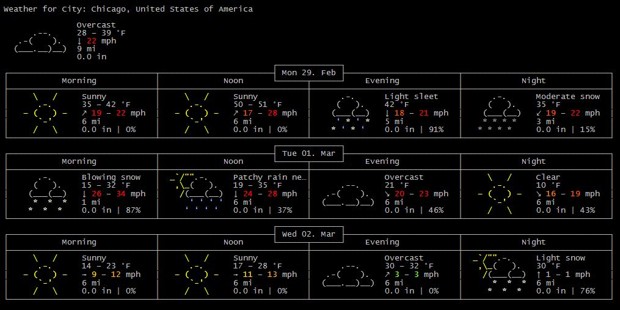
Well, now they do thanks to Igor Chubin, a Russian living in Germany, “hardcore UNIX/Linux developer and devoted opensource enthusiast,” and inveterate polymath fluent in “7 human languages and a dozen computer languages,” he writes via Twitter. Chubin has created an endearingly old-school weather report for “geeks, software developers, hackers, and tech people,” presenting the forecast in ASCII characters like yellow lines (sunny); gray, bulbous parentheses (cloudy); and drifting asterisks (snow).

Simply visit the site to see what the local skies promise over the next couple of days, or type a city after the URL to examine a different region (for example, http://wttr.in/new_york). The pictographs at left indicate general conditions such as “Clear” or “Light sleet,” while three lower rows display wind speed and direction, visibility, and precipitation amount and probability. Adding ?m to the end of the URL will get you metric equivalent for everything.

Igor Chubin/wttr.in

The web service, which is based on work by Markus Teich, draws from several public and commercial sources and doesn’t always agree with official agencies like the National Weather Service (specifically, temperature readings are sometimes off). It’s accurate enough to help plan your day—just don’t use it to go on international boating trips, say, or to close a school district.

Chubin is planning to tweak the tool in the weeks ahead—perhaps adding pictographs of the moon at night, for instance—so if you have ideas for improvement, hit him up on Twitter. Meanwhile, here’s more from the developer on why he built this curious thing:

Doing many outdoor activities (predominantly long distance running) I often needed actual weather reports, just to plan my activities better (to find the best time for them, plus to know what kind of outfit I will need). To my surprise, I didn’t manage to find a convenient and reliable way to access the weather reports from the [UNIX/Linux] console. There are plenty of services that have text/console interface, but they are not intuitive, or they have no web counterpart (and you don’t always have a console at hand, sometimes it’s only a web browser or a smartphone). There are some tools that are really good, but they need special access keys to access weather services, and they need to be installed, so you don’t have them by default at hand.

So I decided to create a service that will cover all these problems at once and will suit all my needs (as well as the need of other users like me):
1) It will be accessible with the same comfort from a UNIX-shell, a web browser and from a smartphone;
2) It will be intuitive and convenient;
3) It will be completely free and won’t need any access keys to use;
4) It will support as many access ways and network protocols as possible (this feature is not yet fully implemented but there are some new possibilities to come);
5) It will allow equally easily access to weather reports about any locations in the world for all people in the world independently of their language and their origin (not yet fully implemented but will be implemented soon).

01 Mar 16:45

How 3D-Printed Maps Are Helping the Blind and Visually Impaired

by Linda Poon
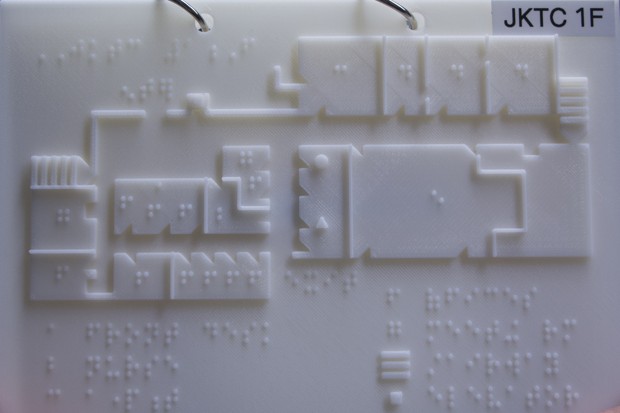
A close-up of a 3D-printed map of Joseph Kohn Training Center. (Cameron Bowman/Rutgers University)

The Joseph Kohn Training Center in Brunswick, New Jersey, is a state-funded facility that teaches vocational skills to the blind and visually impaired. Old wooden maps help students navigate the halls: They are about two feet tall by three feet wide, with braille labels and hand-cut pieces crudely glued on to indicate rooms, stairs, and other building amenities.

They’re usually only hung on the walls of the three-story building when new students need to familiarize themselves with the floor plan. “Students have to memorize everything, because they can’t carry the map with them,” says Howon Lee, a mechanical engineer at Rutgers University.

Courtesy of Howon Lee

But that’s finally changing. Beginning last summer, Lee and his student Jason Kim decided to give the maps a much-needed upgrade—using 3D printing.

The technology has helped architects dream up incredible structures, inspired urban planners, and even helped refugees rebuild lost landmarks. So why couldn’t it become a tool for the blind and visually impaired, who make up an estimated 285 million people globally?

Using the university’s 3D printers and modeling software, Lee and Kim recreated the maps—with some changes. The wood was replaced with durable plastic. Each floor is now mapped separately, the stack kept together with binder rings. And they’ve designed the whole thing to be the size of a small tablet, so students can carry it with them. There’s still enough space to include all the essentials, Lee notes: The map outlines all the rooms, and there’s a legend with different shapes representing bathrooms (a circle for the men’s room and a triangle for the women’s), elevators (squares), and stairways (multiple lines).

Tactile maps aren’t new. Through sounds and textures, scientists and architects have come up with a slew of designs to guide the visually impaired through transit, buildings, and even a lesson on the history of evolution. Such maps often use embossing printers to put texture onto a piece of paper. And while Lee’s and Kim’s project is certainly not the first 3D-printed map, engineers and designers are just starting to explore how the technology can applied to the needs of the blind community.

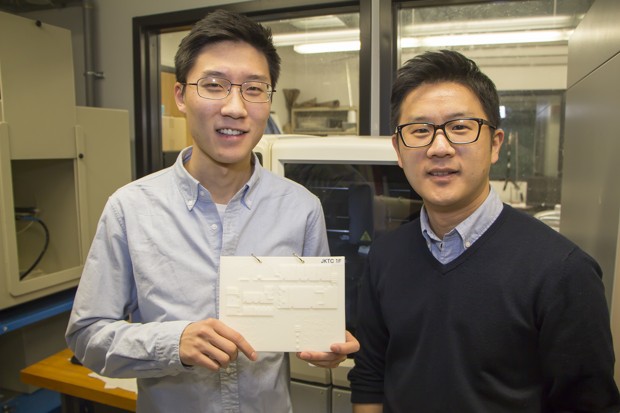
Undergraduate Jason Kim and mechanical engineer Howon Lee with their 3D-printed map for the students of Joseph Kohn Training Center. (Cameron Bowman/Rutgers University)

In 2014, Japanese developers created software that allows people to download geospatial data and print out low-cost maps that can clearly differentiate highways, walkways, and railways. The creators now plan to use 3D-printer-friendly designs to outline uneven surfaces and hills to make the maps more helpful during weather-related evacuations. And just last year, students at the University of Central Missouri spent a month making a 3D map of their campus. At the suggestion of a fellow student, who is blind, buildings were kept at a uniform height so users can feel large areas at once. Doorways are marked with stars, and grid lines help users estimate the distance between points.

“The strength of 3D printing is to be able to print any features you want,” Lee says. “You create your three-dimensional model [on the computer], send this data to the printer, and you can [carry] the 3D object with you.”

Portability, speed, and durability are just three advantages of 3D printing. Lee says that technology’s versatility is also a big plus. He and Kim are working to find low-cost ways to scale their mapping project so that every student at the training center can have his or her own set. In the long term, however, Lee hopes to develop such a map for entire cities.

One thing about cities is that they are constantly changing. “There are new buildings and new construction everywhere,” he tells CityLab. “With 3D printers, you can easily change your designs on the computer. Everything is digital.”

What might a city map look like in 3D? One of the key goals of any map is to help users differentiate between buildings and transit hubs, railways and roadways, water and land. Using open data from Open Street Map, one Finland-based designer, Samuli Kärkkäinen, has started working on that. The application, Touch Mapper, allows users to put in any address to generate customized tactile maps of a neighborhood. The program has a variety of different symbols and textures to represent different features, according to 3DPrint.com:

Varied heights and textures differentiate the different topography; most bodies of water are represented by wavy surfaces, while smaller streams are just narrow lines. Pedestrian roads are raised higher than other roads, as the visually impaired utilize them more frequently. The user’s selected address is marked as a raised cone, and the map’s northeast corner is specially marked to ensure proper orientation.

But engineers haven’t got 3D maps all figured out yet. For one thing, cities are huge, and full of small details. There has to be room for compromise, Lee says. He plans a map of Brunswick that will likely highlight major buildings like city hall and transit points like bus stops and subways, with different textures and shapes representing different features. “It's all about how much detail you want to put on it,” Lee says. “Obviously you don’t want to carry a very big map with you … because that’s not practical.”

So while the sighted community have turned to smartphones and GPS, engineers and scientists are just beginning to mine the potential of physical maps. And with some technological advancements, low-tech maps may serve the needs of some communities perfectly, and not be obsolete after all.

01 Mar 16:44

Photo


01 Mar 16:44

This Feminist Street Artist Paints a Hopeful Image Over War-Torn Kabul

by Natalie Delgadillo
Image Facebook / Shamsia Hassani
Shamsia Hassani with a mural from her "Once Upon a Time" series. (Facebook / Shamsia Hassani)

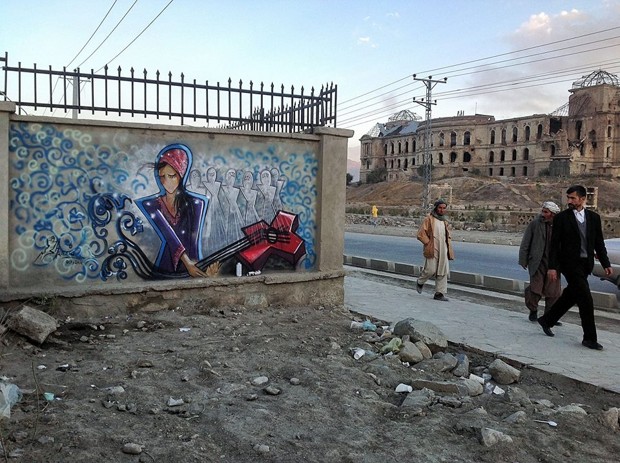
On the very edge of Kabul, down a long, dusty road that cuts through the city, the ruins of Darul Aman Palace stand empty and pocked with shells. The building, once a beautiful nod to neoclassical architecture, is now mostly another reminder of all the ways that war has torn the city apart.

Across the street from the ruins, a brightly-colored mural adorns a drab gray wall at pedestrians’ eye level—at once a testament to the country’s rocky present and a message of hope for its future. “Afghanistan is famous for politics and war,” says Shamsia Hassani, the Afghani street artist who created the mural.“But there are people here who are hopeful for a better future, who are working to help their country.”

Shamsia Hassani’s mural, “Secret,” across from the Darul Aman Palace. (Facebook/Shamsia Hassani)

Hassani is an unlikely force to be reckoned with in a country that has often made it difficult for women to comfortably traverse the public sphere. But she has made it a point to force public attention on women: their shape, their thoughts, and their point of view. Her work, which adorns public walls and sidewalks throughout Kabul, is uniquely centered on the experience of Afghani women, sometimes drawn in burqas and sometimes not, but always represented powerfully and at the center of the frame.

“When I started, I painted a woman with the burqa. I created a new shape of a woman in burqa, with sharp shoulders, with movement,” Hassani says. “Now I paint women without the burqa, because I wanted to show the woman [may] not have the burqa, but inside she still feels the same. She has all the same problems in society, and she is still not free.”

Hassani’s artwork generally features the same female protagonist, sometimes alone and sometimes standing in the foreground of a group of women, often holding a musical instrument that’s meant to convey self-expression and ownership of her voice.

A work from Shamsia Hassani’s “Birds of No Nation” series. (Facebook/Shamsia Hassani)

Much of her work is painted on the grounds of the Kabul University, where Hassani teaches graffiti classes, and where she is least likely to be harassed while she paints. However powerful and beautiful her artwork may be, the streets of Kabul are often unsafe for her to linger in because of frequent bombings and a conservative contingent of Afghani citizens who take issue with her painting and shout or curse at her while she works. Sometimes, she says, she has been forced to leave paintings unfinished because she felt too uncomfortable to stay and complete them.

Currently, Hassani is the artist in residence at the Hammer Museum in Los Angeles. Her three-month residency has been worlds away from her experience painting in Kabul.“When I paint here, I experience a new artistic life,” Hassani says. “I never had such a big space to work. Here you’re free to do anything you want. In my country, I’m always feeling that something will happen to me and I cannot paint with a free mind.”

But she hopes that her work in America, where she has been creating art for galleries and exhibitions, will open people’s minds to a different side of her country and its people. “There are some people who have bad ideas about the women of Afghanistan,” she says. “They feel that most [Afghan women] are uneducated, have nothing to do for their society, or aren’t strong. When I come and I say, I’m here, I’m trying to do something for my country, and I’m educated, then people can see there is something positive [in Afghanistan], as well.”

Shamsia Hassani with a mural she painted on West Adams Boulevard in L.A. (Facebook/Shamsia Hassani)

Even given her artistic freedom in the U.S., Hassani says that as a street artist, there is a big difference between creating for galleries and creating in the streets of Kabul. The work that gets shown in galleries or exhibitions is seen by the same small group of people who always attend galleries and exhibitions, she says. The point of street art is to make the work and its message accessible to everyone. “In Afghanistan, when you paint something on canvas, most people can’t see it. We don’t have many galleries or exhibitions. The reason I paint in the street in Kabul is because I want to show art to people who have never seen it,” she says.

And she hopes it will make some tangible difference for the city she lives in and loves. “Art cannot change anything directly,” she says. “Art can only change people’s minds, and then people’s minds can change the society. That is what I hope for.”

From Shamsia Hassani’s “Birds of No Nation” series, at Kabul University. (Facebook/Shamsia Hassani)
Shamsia Hassani showing her sidewalk painting to a little boy. (Facebook/Shamsia Hassani)
From Shamsia Hassani’s “Birds of No Nation” series. (Facebook/Shamsia Hassani)
Part of Shamsia Hassani’s “Dreaming Graffiti” series, which places images over photos of walls because Hassani cannot safely draw directly on them in Kabul.
(Facebook/Shamsia Hassani)
01 Mar 16:42

Will Shoppers Buy Healthier Food if They See Nutrition Data on Their Receipts?

by Eillie Anzilotti
Image Courtesy of Hayden Peek
Courtesy of Hayden Peek

The link between grocery stores and health is a complicated one. As Vicky Gan noted in a CityLab story about a rural Wisconsin town’s effort to encourage healthy food choices: “Any healthy eating initiative has to start with access to healthy food, but it can’t end there.”

It can’t end there because, as numerous studies have shown, access to healthy choices does not guarantee that shoppers will bring those items from the shelf into their kitchens. And although we live in an age when the nutritional value of individual food items is obsessively tracked and qualified, there are far fewer ways to account for the totality of a purchase.

But could it be as simple as tallying it all up at the bottom of a receipt?

The U.K.-based designer Hayden Peek had watched people in various fields “try to combat the obesity epidemic, with little or no effect,” he explains. “I thought it was time a designer stepped into the ring.”

On his website this month, Peek floated a solution: color-coded labels at the bottom of a receipt showing the total calories, fat, sugar, saturated fat, and salt for the whole purchase. The categories mirror the Facts Up Front labels seen on individual food items. But Peek’s labels, instead of showing just a number or daily value percentage, would apply the traffic light system to each total: green for healthy, yellow for moderate, and red indicating that changes need to be made.

Courtesy of Hayden Peek

For now, Peek’s idea remains conceptual. He tells CityLab that the response has been overwhelmingly positive; he hopes to partner with a grocery store in the future to implement his design.

It would be beneficial for stores to do so, says Christina Roberto, a professor of medical ethics at the University of Pennsylvania. “We’re at a place where information needs to get out there in ways that are easy to understand,” she tells CityLab.

The effectiveness of traffic-light coding in food choice, she adds, has previously been proven. A 2014 study published in The American Journal of Preventative Medicine tracked how labeling options with green, yellow, and red influenced patrons’ selections in a large hospital cafeteria. After two years, the researchers found that sales of red (unhealthy) items decreased from 24 percent to 20, while sales of green items increased from 41 percent to 46.

This mode of “choice architecture” is similar to that of the Guiding Stars program, which rates items in select grocery store chains (among them Food Lion and Hannaford) with anywhere from one to three stars, which are affixed to the items’ price labels. A 2013 study documented a shift toward healthier, three-star items over 20 months, the Huffington Post reports.

Yet these strategies differ in in a crucial way from Peek’s idea, Roberto says: they influence decision making while the shopper is still selecting items, while Peek’s offers an after-the-fact assessment. The impact of the latter on its own, Roberto says, may not be that great; without in-store guidance, the tallies have the potential to read as a retroactive slap on the wrist.

Instead, she says, Peek’s idea points to a need for supermarkets to implement uniform, storewide guidance policies. “There are so many customers that are interested in making healthier choices,” she says, but the onslaught of information in food labels is often difficult to navigate.

Given that people respond so intuitively to traffic-light coding, Roberto says, it would make sense for stores to combine the choice-architecture model seen in programs like Guiding Stars with Peek’s tally system.

“There’s absolutely a space for supermarkets to intervene and help customers make healthy choices,” Roberto says. What’s crucial, she adds, is that they find a way to do so that provides the necessary information alongside what to do with it.