Bernie Sanders has introduced the Stop Bad Employers by Zeroing Out Subsidies (STOP BEZOS) Act, which will force any corporation with more than 500 employees to reimburse the government for any workers whose wages are so low that they end up on food stamps, national school lunch/breakfast programs, Section 8 housing or Medicaid.
(more…)
The Democratic Republic of Congo continues to fight off the worst Ebola outbreak in years. Butembo, a major regional hub of 1 million people, has now had a confirmed death.
The World Health Organization is worried, and recommends you worry too.
The Democratic Republic of Congo has confirmed its first Ebola death in the eastern city of Butembo, a trade hub with Uganda that is home to almost a million people. This first urban death, combined with ongoing violence in the northeastern outbreak area in DRC and some community resistance, is worrying experts that the slowing outbreak could still escalate.
Having already killed 87 people, this outbreak is close to becoming the eighth-largest Ebola outbreak in history. While officials have been pleased with the decreasing pace of cases and a successful vaccination and contact tracing campaign, this new case in an urban setting is worrisome, Peter Salama, the World Health Organization’s emergency response chief, told HuffPost.
“When you have an Ebola case confirmed in a city with 1 million people, no one should be sleeping well tonight around the world,” Salama said.
The patient traveled from the current outbreak hotspot, the town of Beni, 35 miles southwest, to Butembo after disregarding medical advice, Salama said. The patient died at a health facility there.
While WHO team members are on site and working to quickly trace and vaccinate those with whom the patient came into contact, the potential for further spread could “change the trajectory of the outbreak,” Salama said. Two more cases are suspected in the trading hub, the DRC’s Ministry of Health reported Wednesday. Butembo is known for being critical to import and export between DRC and East Africa, Reuters reported.
In 1996, physicist Alan Sokal suspected that cultural studies lacked academic rigor. So he wrote an intentionally nonsensical paper, Transgressing the Boundaries: Towards a Transformative Hermeneutics of Quantum Gravity, and submitted it for publication in the respected academic journal Social Text. It was accepted. Sokal exposed the hoax, the embarrassed academics made their excuses, and the paper was retracted. The imbroglio was posed largely as a story of flimflam and imposture in postmodernism.
This year, mathematician Theodore P. Hill co-wrote a paper about how the variability of traits differ between men and women. Uh-oh! It was accepted for publication by the respected academic journal The New York Journal of Mathematics. But within days it was gone, leading to accusations that scientific ideas were being suppressed. Upon close reading, though, the paper turned out to be, as Fields Medalist Tim Gowers put it, "a bad mistake."
https://twitter.com/ilaba/status/1038956672159379456
The imbroglio is still being posed largely as a story of academic censorship. By The Feminists.
And just last month, researcher Lisa Littman authored a paper suggesting a social contagion model of transgender identification, replete with a DSM-ready diagnosis named "Rapid Onset Gender Dysphoria." Once more eyeballs (not least those of angry trans activists) fell upon it, serious methodological flaws were noted and both Littman's university and the publishing journal, PLOS ONE, began cringing at what they had put their names to.
Censorship, etc.
Sokal was a scientist deliberately trolling the pompous appropriation of scientific terminology by sociologists. In these new papers, the authors sincerely believe in their work, but face accusations of shoddiness and inappropriate abstraction. Sokal was presented as evidence of academic fraudulence; the recent examples as evidence of academic censorship.
But these dynamics are shared:
1. Dubious work is accepted for publication in an academic journal.
2. It is publicly debunked, making fools of the institutions involved.
3. Retractions and other defensive PR exercises generate the bulk of media attention.
There are two things about this "Sokal model" of media attention that stand out to me, lowly humanities graduate that I am:
First, beware excuses from academic publishers and institutions. Whatever else it might accomplish, it evades discussion of the sausage factory of scientific publication, especially the failure of peer review and the fact no-one gets any sleep. It's worth thinking about how culture war debates might obscure the systematic flaws of process that aggravate them. Conversely, beware any story about culture war stuff that rides in on conveniently angry tide of academic conspiracy. You're promised steak, but you're getting cake.
Second, the scientific certitude of nonexpert journalists is taking on an uncanny air. It's a permission slip to glibly turn science stories in culture stories without addressing the science.
It even suggests a game! Can you get an internet knowitall to support any old horseshit so long as it serves their ideological vanity? Per Sokal that's a lefty postmodern trap, but we are all Post-Truth now. Just put your horseshit somewhere you know it'll get removed, wait for the censorship to happen, then tell someone about it. QED.
HARD MODE: Skeptics NORMAL MODE: Libertarians EASY MODE: "Classical liberals" STORY MODE: Target identifies or is identified as part of the Intellectual Dark Web.
Look, I know we've all got our stock stories and Ctrl-V at the ready. I'm just saying that academic publishing is a mess and it makes culture wars dumber.
by Chip Colwell, Lecturer on Anthropology, University of Colorado Denver
Brazil's gutted National Museum now resembles an archaeological ruin itself. AP Photo/Mario Lobao
We now know what history going up in flames looks like.
On Sept. 2, the National Museum of Brazil lit up Rio de Janeiro’s night sky. Perhaps started by an errant paper hot air balloon landing on the roof or a short circuit in a laboratory, the fire gutted the historic 200-year-old building. Likely gone are a collection of resplendent indigenous ceremonial robes, the first dinosaur found in South America, Portuguese royal furniture, ancient Egyptian mummies, a vast library and so much more. In six hours, an estimated 18 million artifacts were turned to smoke and ash.
The images of the hollowed-out museum are a living nightmare for a curator like me. I know that most museum collections are truly irreplaceable. But, for me, the fire is also a vital reminder that the greatest dangers to humanity’s collective heritage are not natural disasters but human ones.
There’s an important lesson for all of us in the fire’s embers.
White walls and imposing columns signal that this place is pristine and eternal.
Tamara Menzi/Unsplash, CC BY
The perils museums face
A museum presents itself as permanent and timeless. It’s why so many sport Greek columns, sterile white walls and clean objects under clear glass. The message is that the museum and its treasures should exist beyond the fleeting moment of our visit – connecting past, present and future. Whether displaying dinosaurs or dodos, art or archaeology, the museum is our bank vault for the world’s natural wonders and human achievements. The museum aspires to be a fortress against time.
The reality is that time is inexorable and relentless. Museums are locked in a constant struggle against decay and an almost absurdly wide-ranging array of natural and human threats. There’s even a formal list of the evil-sounding “agents of deterioration” that museums use to evaluate risks to their collections, ranging from bugs to temperature to water to fire.
Sometimes looted pieces, such as the ‘Warka Mask,’ a 3100 B.C. Sumerian artifact taken from Iraq’s National Museum as Saddam Hussein’s regime collapsed, are recovered. Oftentimes they are not.
AP Photo/Samir Mezban
These risks are constantly evolving. War might turn a museum overnight into a looter’s paradise, as in the case of the National Museum of Iraq. Market forces or colonial revenge may spur thieves to steal artifacts, as recently seen with a pandemic of thefts of Chinese art. Some are even adding climate change to the menaces facing collections, such as the Bass Museum along Miami Beach, as it prepares for rising sea levels.
For museum curators, a terrifying range of hazards could devastate the treasures we are appointed to safeguard. Tragically, fire has long been at the top of the list. As early as 1865, the Smithsonian in Washington, D.C. – “America’s attic,” as it is famously known – caught aflame, resulting in what was then called a “national calamity.” In more recent years, infernos destroyed Madagascar’s royal palace museum, Delhi’s natural history museum and a history museum in Washington state, which housed rare artifacts from the late musician Kurt Cobain.
Despite the known risk of fire, reports suggest that Brazil’s National Museum was woefully unprepared. It apparently lacked a fire suppression system. Nearby fire hydrants went dry.
The spark that started the fire was perhaps an unforeseen event, but the conflagration that followed was not.
Most hazards that endanger museums can be mitigated. Conservation programs can hunt artifact-eating bugs, storage rooms can control temperature and humidity, security systems can prevent burglary and more. But implementing such protections requires serious resources.
By all accounts, this is where Brazil’s caretakers failed. As a national museum, Brazil’s elected officials were responsible for directing the appropriate funds to the museum. Instead, they underfunded the museum and allowed it to fall into disrepair. With the proper buildings and equipment, Brazil’s museum fire would likely not have been so disastrous.
Such indifference is not limited to Brazil. For example, a 2016 report found that Canada’s six national museums are underfunded by about US$60 million each year. In the United States, President Trump’s 2019 fiscal year budget sought to entirely eliminate three vital federal agencies – the National Endowment for the Humanities, National Endowment for the Arts and Institute of Museum and Library Services – that preserve much of the country’s cultural heritage in museums. Even before Trump, all of these programs have had relatively stagnant funding for years.
From Brazil, those holding the purse strings on citizens’ behalf must learn that museums are not forever. Collections are never permanently safe. They require focused investments and proactive stewardship to ensure their survival long into the future. Otherwise, it’s only a matter of time before the next fire.
Chip Colwell has received funding from the National Endowment for the Humanities, and is participating on projects funded by the Institute of Museum and Library Services. He is also a senior curator of anthropology at the Denver Museum of Nature & Science.
It’s back to school time in the United States. As I’m writing this college and high school students across the country either have just started or are preparing to start their 2018-2019 school year.
If you are one of those students, you will undoubtedly be getting student handbooks, syllabi and other information from your school that will detail all of their policies, including their ones on plagiarism.
But, as important as those policies are, they may not tell the full story about how plagiarism is handled at your school. There are a few more things that you will probably want to understand before you hand in your first essay.
To that end, here are five things that you should know about plagiarism in the in 2018.
1: Plagiarism Detection Software is Everywhere
Your school may advertise that it uses plagiarism detection technology of some sort. They may even require you to sign a waiver to run your content through it.
However, even if your school doesn’t run a dedicated system, it doesn’t mean that you’re off the hook and no one is checking for plagiarism.
Plagiarism detection tools are ubiquitous in 2018 and, even if your school hasn’t adopted a solution, it doesn’t mean your teachers haven’t. There are a variety of low-cost tools that teachers can and do use on their own. Even Google can be turned into a powerful plagiarism detection tool with a bit of work.
A large percentage of plagiarism investigations begin with a hunch, including the Harvard Cheating Scandal of 2012. It’s much better to assume that your work is being checked, because it may very well be.
2: Teachers Are the Arbiters of Plagiarism
Always remember this:
When it comes to plagiarism: Schools set policies, instructors set rules.
While your school’s policies are important in determining what happens AFTER you face a plagiarism allegation, it’s the instructor who determines what is or is not plagiarism.
For example, your instructor will set the boundaries on how you can work with other students (if at all), the format of the citation that’s required and what the specific originality requirements are.
In the end, it’s up to the teachers to decide what the rules are in their classroom. As such, if you have questions about those rules, they’re the ones you will want to take it up with.
3: If You’re Accused of Plagiarism, There’s Little Defense
Though schools often structure their academic disciplinary system to be like that of a court of law, it rarely operates anything like one.
In any disciplinary hearing, including plagiarism, the playing field is inevitably tilted against the accused.
There are many reasons for this, the biggest is that such cases don’t usually get brought unless the evidence is overwhelming. But couple that with the fact schools rarely seek impartial outsiders to hear cases and that those prosecuting the case are colleagues of those judging them, it’s almost impossible to overturn an accusation of plagiarism, especially once they reach that point.
As such, if you are accused of plagiarism and it makes it to a tribunal stage, the best thing you can do is mitigate the severity of the punishment, not prevent it.
4: However, Plagiarism is Rarely Life and Death
On the other hand, if you are accused of plagiarism, it probably won’t be as serious as you might think.
Though schools talk up severe penalties for plagiarism, most first offenses result in either a student being forced to redo an assignment or getting a zero in it.
While that’s still a potentially significant punishment, it isn’t expulsion or suspension either. Depending on the assignment and the class, you may even be able to recover and still get a decent grade in that class.
This is because teachers often choose to handle such cases in class rather than turning to the school’s disciplinary process. The reasons for this are complex but often include a desire to avoid the hassle of the disciplinary process or the fear of first-time plagiarists getting hit with a disproportionate punishment. Either way, first-time plagiarism offenses rarely become disciplinary matters.
That being said, do bear in mind that the punishment for plagiarism tends to get more severe the more significant the assignment and the further along you are in your educational career. A graduate student plagiarizing their thesis isn’t going to be treated the same as a high school freshman plagiarizing a weekly essay, even if both are first time offenders.
Essay mills are easy to fall for but do not let it happen to you.
Bottom Line
In 2018 plagiarism in academia is something of a mess. Schools are still attempting to strike a balance between education on plagiarism and punishment for plagiarists. This is particularly true when looking at citation issues with students who are non-native English speakers.
Still, as a student beginning the 2018 school year, this is the reality you are walking into. As such, the best advice you’re going to get from me, and likely anyone else, is to simply do your work, cite to the best of your ability and work with your teachers to address any issues you are unsure about.
If you do those things, you’re unlikely to have any significant troubles in this, or any other, year.
California’s net neutrality bill, S.B. 822 has received a majority of votes in the Senate and is heading to the governor’s desk. In this fight, ISPs with millions of dollars to spend lost to the voice of the majority of Americans who support net neutrality. This is a victory that can be replicated.
ISPs like Verizon, AT&T, and Comcast hated this bill. S.B. 822 bans blocking, throttling, and paid prioritization, classic ways that companies have violated net neutrality principles. It also incorporates much of what the FCC learned and incorporated into the 2015 Open Internet Order, preventing new assaults on the free and open Internet. This includes making sure companies can’t circumvent net neutrality at the point of interconnection within the state of California. It also prevents companies from using zero rating—the practice of not counting certain apps or services against a data limit—in a discriminatory way. That is to say that, say, there could be a plan where all media streaming services were zero-rated, but not one where just one was. One that had either paid for the privilege or one owned by the service provider. In that respect, it’s a practice much like discriminatory paid prioritization, where ISPs create fast lanes for those who can pay or for other companies they own.
ISPs and their surrogates waged a war of misinformation on this bill. They argued that net neutrality made it impossible to invest in expanding and upgrading their service, even though they make plenty of money. Lobbying groups sent out robocalls that didn’t mention net neutrality—which remains overwhelmingly popular—merely mentioned the bill’s number and claimed, with no evidence, that it would force ISPs to raise their prices by $30. And they argued against the zero-rating provision when we know those practices disproportionately affect lower-income consumers [pdf].
There was a brief moment in this fight when it looked like the ISPs had won. Amendments offered in the Assembly Committee on Communication and Conveyance after the bill had passed the California Senate mostly intact gutted the bill. But you made your voices heard again and again until the bill’s strength was restored and we turned opponents into supporters in the legislature.
In the middle of all of this, the story broke that Verizon had throttled the service of a fire department in California during a wildfire. During the largest wildfire in California history, the Santa Clara fire department found that its “unlimited” data plan was being throttled by Verizon and, when contacted, the ISP told the fire department they needed to pay more for a better plan. Under the 2015 Open Internet Order, the FCC would have been able to investigate Verizon’s actions. But since that order’s been repealed, Verizon might escape meaningful punishment for its actions.
The story underscored the importance of FCC oversight and its public safety implications. On August 30, S.B. 822 passed the California Assembly and then, on August 31, it received enough Senate votes to continue to the governor. With the governor’s signature, California will have passed a model net neutrality bill.
California’s fight is a microcosm of the nation’s. Net neutrality is popular across the country. The same large ISPs that led the fight against it in California are the ones that serve the rest of the country, a majority of which don’t have a choice of provider. The arguments that they made in California are the same ones they made to the FCC to get the Open Internet Order repealed. The only thing preventing what happened to California’s firefighters from happening elsewhere is Verizon saying it won’t.
We need to net neutrality protections on as many levels as we can get them. And Congress can still vote to restore the FCC’s 2015 Open Internet Order. In fact, the Senate already did. So contact your member of the House of Representatives and tell them to vote for the Congressional Review Act and save national net neutrality protections. Californians, tell Gov. Jerry Brown to sign S.B. 822.
The American Library Association this week argued in support of the Federal Communications Commission’s (FCC) strong, enforceable rules to protect and preserve the open internet with an amici filing with the U.S. Court of Appeals for the District of Columbia Circuit.
“The FCC made an ill-considered decision to roll back vital net neutrality protections in December 2017, and it will now have to defend its arbitrary move in court,” said American Library Association (ALA) President Loida Garcia-Febo. “Network neutrality is essential to ensuring open and nondiscriminatory access to information for all, and we have long been clear that preserving strong protections is a vital concern for our nation’s libraries. By rolling back court-affirmed and broadly supported net neutrality protections, the FCC has enabled commercial interests at the expense of the public, which depends on the internet as its primary means of information gathering, learning and communication. We will continue to fight the FCC’s decision, and we have filed as a friend of the court in support of strong, enforceable net neutrality protections.”
The American Library Association, along with other network neutrality allies also filing legal briefs, joined the Association of Research Libraries (ARL) and higher education organizations including the American Council on Education and EDUCAUSE to file in support of petitioners in the case of Mozilla Corporation v. Federal Communications Commission and United States of America. ALA and the other library and higher education organizations focused their filing on how the FCC ignored the impacts on libraries and institutions of higher learning in its decision to eliminate the 2015 Open Internet rules. In its rush to judgment, the FCC ignored the impacts on libraries and institutions of higher learning that these organizations detailed and submitted into the record. The group of organizations filing in support of petitioners seeks to demonstrate to the Court that the FCC’s action will “imperil the internet’s continued operation as a reliable platform for research, learning and information sharing, and that the FCC’s decision should be reversed as arbitrary and capricious.”
Our journey to and from the office has been taken over by work. Rather than reading a book, catching up with the news, or just relaxing, our commute time is now increasingly spent reading and replying to work-related emails. The transport we use to get to and from our jobs has become another venue for work.
The sad thing is that we consent to this extra work, despite it not being remunerated. Hours spent commuting are unpaid – they add nothing to our bank balances, though they save our employers the expense of higher wages.
The extension of work into commute time reflects the presence of an intrusive and pernicious “always-on” culture. It reflects an environment where we are enslaved to work, even when not physically in the office. Our busyness, however, can only come at the expense of the quality of our lives and our health. We must fight to resist it.
Work-life imbalance
Research shows how workers fit work into commute time, in part, to ease the burden of work. Answering emails on route to work can help to save time once you’re at work. Equally email can be answered on the way home from work to ease the pressure of work during the next working day. Work can also be done on the move that could not be finished at work.
But here “savings” of time and effort are likely to be illusory. Employers are not going to cut email traffic just because workers are replying to emails on the way to and from work. To the contrary the incentive is for employers to encourage email traffic outside of regular hours in order to exploit the free work of workers.
Work “saved” during commute time, in this case, may translate into more work during paid work time. Workers again may be in the position of doing more work, for no extra pay. Out-of-hours working implies that work cannot be fitted into paid hours. It suggests that workers are overworked (and underpaid) for the work they do.
Always-on culture
New technology enables us to connect with our work, beyond normal hours. Laptops and iPhones mean we have instant access to our work and workplaces. Wifi on trains and buses has helped to turn commuting into work time. But technology itself does not explain why work is performed outside of regular hours. For that we need to look at organisational culture.
Organisations increasingly demand that their employees give their bodies and lives to work. Staying late at work is a badge of honour. Presenteeism – the act of being present at work for longer than is required – is rife in workplaces and reflects on the culture of overwork that is endemic in modern society.
Staying late has become a badge of honour in some companies.
Shutterstock
Working during commute time is simply an extension of the same culture. It demonstrates the way work has taken over our lives. We find time to work even when not at work because we are exposed to a culture that venerates hard work.
Few benefits
Yet, all this extra work seems to bring few economic benefits. Productivity remains low in the UK despite workers working all hours. Commuters are no more productive for answering emails on the go. Indeed productivity is likely to be lower due to the stressed out and exhausting nature of long commute and work schedules.
Research continues to show the negative health effects of long hours of work. By working more we suffer ill-health, physical as well as mental. We also neglect our families, friends and communities. And we lose the ability to think and act beyond the roles we fill as workers.
Work may now be a normal part of commuting time but its performance imposes high costs on us and society more generally. In a rational world, we would move to ban out-of-hours email, not just to protect free time, but also to safeguard health. Beyond this we would look to challenge the hegemony of work and promote ways of living that are less work-centred. Cutting work hours would be the only sane way of restoring any semblance of balance between jobs and life.
David Spencer has previously received funding from ESRC, EPSRC, and FP7
by Sharon Austin, Professor of Political Science and Director of the African American Studies Program, University of Florida
Andrew Gillum with wife R. Jai Gillum addresses supporters after winning the Democrat primary for governor. AP Photo/Steve Cannon
Tallahassee Mayor Andrew Gillum electrified Democrats with his surprising victory in the Florida’s Democratic primary – but will he go on to win in the general election?
Come November, voters will choose between Gillum and Trump-endorsed candidate U.S. Rep. Ron DeSantis. DeSantis, who represents Florida’s Sixth Congressional District, won his nomination by a significant margin. Both men are 39 years old, politically experienced Florida natives – perhaps the only two similarities they share.
After trailing in the polls for weeks before the election, Gillum, who spent US$6.5 million in the primary, defeated three opponents who each spent more than $100 million in their campaigns. Gillum, the only candidate who was not a millionaire, received $650,000 in last-minute contributions from donors such as Tom Steyer and George Soros.
He now joins Georgia’s Stacey Abrams and Maryland’s Ben Jealous – two other young African-Americans with strong chances of winning their state’s gubernatorial elections. Each won their Democratic primaries because of the strong backing from black voters. But because none of them could have won with the black vote alone, their campaigns emphasized issues voters of all races were concerned with, like health care, and education and jobs. All received significant backing in some predominantly white communities.
Gillum in particular is competing in a state that hasn’t elected a Democratic governor in 20 years. True, former President Barack Obama won Florida twice, but it was by close margins – 3.8 percent in 2008 and 0.9 percent in 2012. Then, President Trump again put Florida in the red category in 2016 by defeating Hillary Clinton by a mere 0.8 percent. However, as a professor of political science and African-American studies, I believe the unpredictable outcomes in recent national elections – as well as Florida’s tendency to swing from red to blue – should encourage Gillum.
So how can Gillum win? He’ll need a large turnout among his base of minority voters and progressives. He’ll also need to expand his appeal among moderate Democrats and to seek crossover support from Republicans who are dissatisfied with President Trump. In the primary, he won only 18 of the state’s 67 counties. Some of these included cities and towns with larger minority populations, but others were rural or suburban predominantly white counties – like Clay, Escambia and Hamilton. Gillum also did well in South Florida counties like Broward, Hendry, Miami-Dade and Palm Beach.
Unfortunately for Andrew Gillum, he won’t be running against Ron DeSantis alone. He’s also be running against Donald Trump.
A more troublesome dilemma for Gillum concerns Tallahassee’s problems.
Three years after he entered office, in June 2017, the FBI issued a subpoena of city records. Although Gillum is reportedly not the focus of their corruption investigation, the investigation allows the DeSantis campaign to accuse him of being untrustworthy regardless of the outcome.
Tallahassee also has the highest crime rate in Florida, even though crime has actually decreased since Gillum began his term in 2014.
On the positive side, Gillum’s progressive agenda and endorsement from Bernie Sanders may appeal to younger voters. During the primary, the Gillum campaign emphasized the mobilization of African-Americans and younger voters. Even before he began his gubernatorial campaign, Gillum carried out several efforts to mobilize young voters in support of progressive causes. About a week after a February 2018 shooting at Marjory Stoneman Douglas High School resulted in the deaths of 17 students and educators in Parkland, Florida, Gillum led thousands of gun control advocates in a march at Florida State University in Tallahassee. He also opposes Florida’s controversial “Stand Your Ground Law.”
Race as the ‘elephant in the room’
Soon after Gillum’s primary victory, the issue of race surfaced. In a television interview, DeSantis said, “You know, he is an articulate spokesman for those far-left views and he’s a charismatic candidate.” He then said, “The last thing we need to do is to monkey this up by trying to embrace a socialist agenda with huge tax increases and bankrupting the state. That is not going to work. That’s not going to be good for Florida.”
Immediately, a debate surfaced about racialized rhetoric. DeSantis later argued that he had no racial intent. But, DeSantis has taken heat before. He referred to Puerto Rican candidate Alexandria Ocasio-Cortez as a “girl of whatever she is” after she won the Democratic primary in New York’s 14th Congressional District.
He also was criticized by Democrats – and praised by Republicans – because of a controversial campaign ad that featured him showing his young daughter how to “build the wall” and reading Trump’s “The Art of the Deal” to his infant son.
Regardless of the outcome, this will be a campaign that won’t soon be forgotten in Florida.
Sharon Austin does not work for, consult, own shares in or receive funding from any company or organisation that would benefit from this article, and has disclosed no relevant affiliations beyond their academic appointment.
by Fabrizio Carmignani, Professor, Griffith Business School, Griffith University
The evidence on the ground is very clear. The Trump tax cuts have led to stronger investment, stronger growth, lower unemployment rate and higher wages.
After two years of debate and months of intense negotiation, the government’s proposal to cut the corporate tax rate from 30% to 25% for companies with turnover of more than A$50 million was voted down in the Senate.
But while the government’s attempts to pass tax cuts in Australia were not fruitful, tax reform remains a significant international issue.
In arguing for a tax reduction for big business, Minister for Finance Mathias Cormann pointed to economic outcomes in the United States, where corporate tax rates were cut from 35% to 21% in January this year.
“If you look at the economic data in the US in the second quarter, of course post the Trump tax cuts, the US is recording in excess of 4% growth on an annualised basis, the unemployment rate now has a ‘three’ in front of it, and wages growth is the strongest it’s been in a very long time,” Cormann said.
“Massive, massive capital investment has been returned to the United States.”
Is that right? And if yes, are the tax cuts to thank? Let’s take a closer look.
You can read the full response from Cormann’s office here.
Verdict
Minister for Finance Mathias Cormann’s statement that corporate tax cuts in the US had “led to stronger investment, stronger growth, lower unemployment rate and higher wages” is not supported by evidence.
Cormann pointed to US economic data from the second quarter of 2018 (shortly after the US corporate tax cuts were enacted) to support his statement.
Cormann correctly quoted the figures about GDP growth and the unemployment rate. His statement on wage growth is debatable, and there are qualifications to be made about his interpretation of the capital investment data.
But the simple observation that some US economic indicators improved in the second quarter of 2018 does not imply that those improvements were caused by the tax cuts.
Even if causation could be established, one quarter of data tells us very little about the effect of tax reform. It takes time for companies and workers to adjust to changed taxation environments. These adjustments happen progressively over time, and this can lead to significant differences in the short term and long term responses.
It’s worth noting that the improvement in economic conditions in the US started in mid-2016, around 18 months before the tax reform.
The fundamental issues with the claim
Can we really look to US economic data from the second quarter of 2018 to support (or for that matter, reject) the argument that corporate tax cuts would benefit Australia?
My answer is no, for two reasons.
There is not evidence of causation
The simple observation that some US economic indicators improved in the second quarter of 2018 (after the introduction of the corporate tax cuts) does not imply that those improvements were caused by the tax cuts.
Several other factors will determine economic dynamics in any given quarter. A sophisticated statistical analysis based on a longer string of data after the second quarter of 2018 would be needed to determine the causal contribution of corporate tax cuts.
The assessment of causality is further complicated by the fact that there is a lag effect of corporate tax cuts on the economy.
It takes time for companies and workers to adjust to changed taxation environments. These adjustments happen progressively over time, and this can lead to significant differences in the short term and long term responses.
It’s also important to note that the improvement in US economic conditions started in mid-2016, around 18 months before the tax reform.
One quarter of data is not enough
Even if we neglected the causality issue, data from the second quarter of 2018 only gives us a limited idea of the very short term effects of the corporate tax cuts.
When it comes to tax reform, long term effects are what really matters. The important difference between short term and long term effects is evident from the preliminary economic projections published by the International Monetary Fund (IMF) in August 2018.
According to the authors of the IMF working paper, the US corporate tax cuts are projected to have a modest impact on long term growth, but will also cause an increase in the US federal debt to GDP ratio by approximately five percentage points by 2023.
Therefore, the corporate tax cuts may, in the end, fail to sustain long term growth, and make it harder to reduce government deficits and debt.
Rather than focusing on what happened in the second quarter of 2018 in the US, those debating corporate tax cuts should look at the economic theory and evidence drawn from countries where tax reforms have been implemented for a longer period of time (for example, Canada and Germany).
In general, this body of research does not provide any solid theoretical or empirical evidence backing the argument that corporate tax cuts will lead to a more prosperous economy.
A closer look at the economic figures
As outlined above, we cannot say that the Trump tax cuts “led to” the economic outcomes quoted by Cormann. But we can take a look at the numbers, for interest’s sake.
Cormann said the US is “recording in excess of 4% growth on an annualised basis”.
Based on GDP data from US Bureau of Economic Analysis, and with the growth rate calculated as annualised change over the previous quarter, Cormann was correct: GDP growth hit 4.1% in the second quarter of 2018.
The GDP growth rate can also be calculated as the change compared to the same quarter of the previous year.
On that measure, the growth rate was 2.8%, compared to 2.1% in the second quarter of 2017, following a steady increase from 1.3% in the second quarter of 2016.
US unemployment rate
In July 2018, the US unemployment rate was 3.9%, as Cormann correctly stated.
The chart below shows both the employment rate at the end of each quarter (for example, June 2018 for the second quarter of 2018) and the average rate across the three months in each quarter.
US wages growth
To support his statement about US wages growth, Cormann pointed to a Bloomberg article which drew on data from the US Bureau of Labour and Statistics Employment Cost Index. In the second quarter of 2018, this particular index did record its highest growth since mid-2008.
However, measures of “wages” differ depending on which parts of employees’ salaries are included, and which are excluded.
Another, and perhaps more useful, definition of wages is employees’ average hourly earnings, also reported in the table.
The picture emerging from this measure quite different. These figures show that employees’ average hourly earnings actually fell in the year to the second quarter of 2018.
This doesn’t support the conclusion that wage growth in the second quarter of 2018 was the “strongest it’s been in a very long time”.
US capital investment
We can measure capital investment by looking at Nonresidential Gross Private Domestic Investment data, sourced from the US Bureau of Economic Analysis. These figures show a pick up in investment in the first and, to a lesser extent, second quarters of 2018.
These figures are not, however, necessarily evidence of “massive capital investment” being “returned” to the US, as Cormann stated.
The figures Cormann quoted in his response to The Conversation measure capital expenditure on commercial real estate, factories, tools and machineries in the US – not where the investment comes from.
The term “nonresidential” doesn’t refer to foreign investment, but to investments in commercial (rather than residential) assets.
The chart below, based on data from US Bureau of Economic analysis, shows there was an increase in capital investment in the first quarter of 2018 (when the tax cuts were implemented).
Again, this follows a trend of increases in capital investment, with peaks and troughs, since the first quarter of 2016.
The continuation of an existing trend
Overall, the data paint a rather favourable picture for the US in the second quarter of 2018.
However, it also seems that these macroeconomic indicators began to improve in mid-2016. This is particularly the case for GDP growth and unemployment.
Therefore, the positive outlook for the US in the second quarter seems to be the continuation of a positive cyclical phase that started before the enactment of the corporate tax cuts. – Fabrizio Carmignani
Blind review
I concur with the verdict.
Senator Cormann’s assertion that the growth in business investment and wages and the decline in unemployment observed in the US over the first half of this year can be attributed, either wholly or in part, to the Trump administration’s corporate tax cuts is not supported by the evidence.
As this FactCheck points out, all of these trends were under way well before the corporate tax cuts took effect, and one or two quarters worth of data is not sufficient to establish that the tax cuts have made any significant or sustained change to those trends.
I disagree that average hourly earnings is a ‘better’ measure of US wages growth than the employment cost index (for the same reasons that most Australian economists regard the ABS wage price index as a better measure of Australian wages growth than average weekly earnings).
But that doesn’t undermine the conclusion that the gradual upward trend in US wages growth was well established before the Trump administration’s corporate tax cuts came into effect, and owes far more to the gradual tightening in the US labour market (which has been underway for a long time before those tax cuts came into effect) than it does to those tax cuts.
Indeed, over the first two quarters of 2018, the employment cost index rose by just 0.1 of a percentage point more than it did over the first two quarters of 2017, which is hardly compelling evidence of a significant impact of the corporate tax cuts.
It is worth noting that one-fifth of the 21% annualised rate of growth in US real private non-residential fixed investment over the first half of this year was due to a 156% (annualised) increase in investment in “mining exploration, shafts and wells”.
This category that accounts for less than 4% of the level of private non-residential fixed investment, and the spurt in this category of business investment would have owed far more to the rise in oil prices since the middle of last year than it would have to the cut in corporate tax rates.
Finally, it is also worth noting that the one component of the Trump administration’s corporate tax reforms which the IMF and others have acknowledged would likely have some temporary positive impact on business investment - the immediate expensing for tax purposes of capital expenditures incurred before 2023 (what we in Australia call an “instant asset write off”) - isn’t part of the measures which Senator Cormann had been asking the Senate to pass. –Saul Eslake
The Conversation FactCheck is accredited by the International Fact-Checking Network.
The Conversation’s FactCheck unit was the first fact-checking team in Australia and one of the first worldwide to be accredited by the International Fact-Checking Network, an alliance of fact-checkers hosted at the Poynter Institute in the US. Read more here.
Have you seen a “fact” worth checking? The Conversation’s FactCheck asks academic experts to test claims and see how true they are. We then ask a second academic to review an anonymous copy of the article. You can request a check at checkit@theconversation.edu.au. Please include the statement you would like us to check, the date it was made, and a link if possible.
Fabrizio Carmignani has received funding from the Australian Research Council for a project on the estimation of the piecewise continuous linear model and its macroeconomic applications.
Saul Eslake does not work for, consult, own shares in or receive funding from any company or organisation that would benefit from this article, and has disclosed no relevant affiliations beyond their academic appointment.
Labor Day is our New Year’s Eve. Rather than vowing to lose weight or spend less time on our phones, as college professors we head into the new school year with a different kind of resolution: to inspire and prepare our students to become agents of positive change.
The world’s problems certainly didn’t take a break this summer, and we know that successfully addressing them depends on a mindset much broader than any one discipline can offer. Our strategy is to cultivate a way of thinking that blends insights from multiple perspectives.
As a psychologist, an anthropologist and an historian who teach at an engineering college, happily, we see examples of this kind of integration all around us.
Globally
Global climate change may be the biggest challenge facing humanity, and it is a problem that illustrates the world-changing implications of interdisciplinary problem-solving. In an analysis of the economic impact of reducing greenhouse gas emissions, experts at the consulting firm McKinsey & Company identified a spectrum of strategies and their associated costs. Options like converting to nuclear energy, shifting to electric vehicles, and retrofitting coal and gas plants all have great potential, but we can produce the most benefits for the lowest cost by adopting strategies such as switching homes to energy efficient lighting and better insulating our residences and workplaces. Compared to changing the national energy supply chain, these changes aren’t highly technical. They are matters of changing human beliefs and behavior.
An article published in Science last year diagnosed the real problem of climate change in this way: “Experiencing the self as separate from nature is the foundation of humanity’s damaged relationship to planetary resources.” The only real solution to the climate problems facing our planet is to change mindsets, an approach that requires a complex understanding of all the ways that individuals and institutions interact with the natural world. In other words, students should not only study the social sciences or the natural sciences, but also learn how the insights gained from both can be combined to be even more powerful.
Locally
The importance of making connections across perspectives also plays out at the local level.
One traffic intersection in the center of Drachten, Netherlands, accommodates 20,000 drivers as well as many bicyclists and pedestrians each day. As a result, it became notorious for its high rate of accidents and deaths. A conventional solution might have been to load up the roads with signage and signals that clearly instruct everyone where to go and when. But when Dutch traffic engineer Hans Monderman approached the problem, he saw the congested conduit as a place of profound disconnection. Rather than peppering the roads with signs, in 2003 he took all signage away. This approach to “shared space” design meant that drivers, cyclists and pedestrians had to increase their awareness of each other to successfully navigate the intersection. This reliance on human connection rather than engineered traffic patterns upended conventional thinking, and dramatically decreased the number of accidents and deaths. The most innovative solutions to local problems like this demand deep integration of quantitative and emotional insights that are too often segregated between traditional academic disciplines.
Individually
Finally, we see many challenges at the individual, personal level that call out for integrated thinking.
Terri, a Boston-area woman in her 60s who uses a wheelchair, told a team in one of our engineering design classes here at Olin College of Engineering that she finds grocery shopping a cumbersome and physically painful experience. A traditional engineer’s answer might point her to online services that could provide convenient in-home grocery delivery without unpleasant exertion.
But when our students joined Terri at the supermarket, tried to navigate the store from her wheelchair, and spent time with her in her home, they discovered something unexpected. For Terri, grocery shopping wasn’t only focused on getting food, but offered a special opportunity to laugh with the butcher, exercise autonomy and experience community membership. An online service could deliver her ground turkey, but it would also make her feel lonely. The students’ solution was a custom easily adaptable rack for the chair – painted bright purple, Terri’s favorite color – that eased the physical challenges of shopping while enhancing her ability to engage with her community in a meaningful way. Devising this solution required a nimble synthesis of engineering design and attention to human values.
Teaching new approaches
As these examples illustrate, we need to teach students to approach complex problems differently. Our future is at stake.
This past May, a joint task force from the National Academies of Sciences, Engineering, and Medicine released a report entitled “Branches From the Same Tree: The Integration of the Humanities and Arts with Sciences, Engineering, and Medicine in Higher Education.” This study identified the great potential in interdisciplinary education. The list of possible benefits include improved student motivation and enjoyment of learning, development of teamwork and communication skills, ethical decision-making and critical thinking.
Done correctly, engineering begins and ends with people. Done optimally, tackling our world’s biggest challenges requires a diverse and integrative approach.
We see encouraging examples of this type of innovative integration in diverse corners of academia. For example, at George Mason University, the Rain Project, part of the EcoScience + Art Initiative brought together faculty from sciences, arts, humanities and design departments to develop a floating wetland. The project not only improved water quality and stormwater management, but also demonstrated the local community’s dependence on their wetlands for survival. Or the STAGE Lab at the University of Chicago, where new pieces of theater and film are created within the context of the Institute for Molecular Engineering. Here, the creation of new plays and films alongside the creation of new scientific findings inspires new ways of asking questions, in both art and science.
Ethics, sustainability, questions of identity, equity or social justice, and many other topics, must be included in the scientist’s or engineer’s design process. And their repertoire must include rigorous communication, teaming, self-directed learning, self-reflection and other skills. Similarly, artists, writers, managers and other non-technical professionals lose out when their work ends where scientific thinking begins.
Our Labor Day resolution this year won’t help us with weight or time management. Instead, it will help us to humbly remember the limits of any one way of thinking about major challenges and the promise of true integration.
The authors do not work for, consult, own shares in or receive funding from any company or organisation that would benefit from this article, and have disclosed no relevant affiliations beyond their academic appointment.
by Charlotte-Rose Millar, UQ Research Fellow, The University of Queensland
A medieval engraving of the persecution of witches: historians are increasingly demonstrating that belief in witchcraft survived in Western Europe well into the 18th, 19th and even 20th centuries. Wikimedia Commons
Between 1450 and 1750, some 45,000 men, women and children were executed in Western Europe as accused witches. Today, emerging new research shows that, during the past 20 years, upwards of 600 people were reported killed in witchcraft related attacks in Papua New Guinea, while current estimates are that thousands are killed in witchcraft-related violence around the world each year.
Today, it is popularly believed that violence against those accused of “witchcraft” and “sorcery” in the Global South mirrors European witchcraft-persecutions in the past. For example, international media outlets have responded to current accusations of sorcery related violence in Melanesia with headlines such as “Papua New Guinea ‘Witch’ Murder is a Reminder of our Gruesome Past”.
Supplied image obtained in 2015 of Mifila, a Papua New Guinea woman reported axed to death after being accused of sorcery in the country’s highlands.
Anton Lutz/AAP
But what exactly are the connections and similarities between these two different contexts? Historians and anthropologists are understandably wary of the colonial overtones of any argument that places present-day Melanesian beliefs and practices in an evolutionary schema – equating them with those of pre-modern Europeans. But does this mean such comparisons should never be made?
Historians today largely attribute the decline in European witchcraft trials to increased scepticism by judges and magistrates about the possibility of proving witchcraft in a state court (even if they continued to believe in the existence of witchcraft).
This scepticism included concern about the veracity of confessions obtained under torture, which was the main source of evidence in many trials (a notable exception here is England in which suspects were not tortured). As torture is widely used in vigilante “trials” of those accused of sorcery in PNG today, we wonder if efforts to end torture might have far-reaching consequences in ending sorcery-related violence.
Although state-sanctioned witchcraft trials did die out in Europe (almost entirely by the 18th century) we now know that belief in witchcraft and associated violence lasted much longer. Indeed, historians are increasingly demonstrating that belief in witchcraft survived in Western Europe well into the 18th, 19th and even 20th centuries (see, for example, Owen Davies’ work on witchcraft in America or his new book on supernatural belief in the First World War).
For contemporary policymakers, this suggests that overcoming sorcery accusations and related violence may not require first changing entire belief systems, or introducing so-called “rational” ways of thinking into a population.
Instead, it directs attention to considering far more specific questions about what motivates people to accuse and harm those they suspect of witchcraft or sorcery.
The role of law
The role of law in addressing contemporary violence related to accusations of sorcery is a contentious one. There are debates for and against creating specific forms of crime to deal with the problem, such as crimes of accusing someone of practising sorcery, or specific types of violence addressed at those accused of witchcraft. For example, in India last month a specific anti-witch hunting Bill was enacted.
In early modern Europe, the legislation criminalising witchcraft was eventually repealed and replaced in some countries with legislation criminalising those who tried to “trick” or deceive others through pretending to use witchcraft. The historical record indicates that one impact of this legislative change was that it made it much easier for people to talk openly about their scepticism towards witchcraft, and made the public defence of witch beliefs increasingly socially unacceptable in educated circles.
While law alone cannot change belief systems, the early modern experience suggests a potentially valuable role for legislation in facilitating certain types of public discourse about witchcraft, and officially condemning violence as a response towards fears of it.
Contagious narratives
History is also replete with examples of stories with a catalysing effect on communities, provoking sporadic “outbreaks” of violence. This suggests that all populations can potentially be susceptible to contagion of new and terrifying narratives, particularly where they resonate with existing prejudices or ways of thinking.
In PNG, and indeed many places across the world today, new or revised narratives of sorcery and witchcraft are infecting populations and leading to what some describe as “epidemics” of violence. These are spread by word of mouth, social media, and in Africa at least, through popular local films.
In tackling their impact on populations, it is important to recognise these as being new or recently modified stories in many places, rather than entrenched cultural traditions. Framing them as foreign can potentially help to undermine arguments that such violence is justified by culture, and can prompt attention to countering their transmission.
There are of course some limitations with taking a comparative approach. Violence against witches in the South Pacific tends to be incited by individuals or communities acting outside the law; whereas early modern Europe executed and tortured witches fully in accordance with legal statutes against witchcraft.
It is crucial to acknowledge these differences and to be very careful not to suggest that witchcraft is the same everywhere, across time and place.
But, at the same time, if it is possible to learn anything at all from the past about how to stop the torture and murder of hundreds of innocent men and women in the world today then these conversations can have a very real impact.
Daniel Midena receives funding from the Australian Research Council.
Miranda Forsyth receives funding from Pacific Women Shaping Pacific Development through the Australian Aid program.
Charlotte-Rose Millar does not work for, consult, own shares in or receive funding from any company or organisation that would benefit from this article, and has disclosed no relevant affiliations beyond their academic appointment.
by Kylie Pappalardo, Lecturer, School of Law, Queensland University of Technology
The on-paper designs for furniture belong to the designer, just like any other artists. But things get more complicated when designs become physical objects. Shutterstock
Furniture stores are often filled with designs that look similar to others. But is copying furniture legal, and should we feel bad about buying replicas?
Recently, interior designers accused the supermarket Aldi of copying an Australian designer’s stool in the launch of a new range of “luxe” furniture. Some, including the Design Institute of Australia, noted the stool’s similarities to designer Mark Tuckey’s eggcup stool, which retails for more than $550. Aldi withdrew its stool (priced at $69) on the day of the sale, citing quarantine issues and said it was scheduled to return to stores in late August. (There is no suggestion that Aldi has broken the law here).
In general, copying furniture designs that have not been registered in Australia is likely to be legal. This means that, in most circumstances when designers have not registered their work, businesses are able to sell, and Australian consumers are able to purchase, replica furniture without breaking the law.
How designs are protected
A designer of furniture, fashion or any other product will normally start out by creating a 2D drawing of their product. The drawing might be made by hand or using a computer or machine. This initial design is automatically protected under copyright law as an “artistic work”. For most types of artistic works, copyright lasts for the lifetime of the creator plus an additional 70 years.
Furniture designers’ drawings will be protected under copyright automatically.
Shutterstock
Copyright law prevents a person from copying someone else’s work if they do not have permission or a legal excuse. Making a 3D reproduction of a 2D artistic work counts as “copying” under law. So a person who makes, for example, a physical 3D chair using a designer’s 2D design of that chair may be infringing copyright of that 2D artistic work.
However, there is an interesting feature of copyright law that applies only to designers. A designer will lose copyright protection in their 2D artistic work if it is “industrially applied”.
“Industrial application” is generally understood to mean that 50 or more copies of the 3D product deriving from the design are made and offered for sale. Any mass commercial production will therefore take the product outside of the scope of copyright law.
However, mass-designed products can be protected by Australia’s designs system. This system protects the visual appearance of a product. Unlike with copyright, designers must register their designs to be protected under law.
For a design to be registered, it must meet certain minimum requirements. Importantly, it must be new and visually distinctive. The novelty of a design is critical to protection. These requirements ensure that ordinary and unremarkable designs are not constrained by intellectual property law, but are free for people to make and sell.
How is this determined? An application for design registration is filed with and assessed by IP Australia, located in Canberra. It usually takes between three and 12 months to process an application, and costs around $300 to apply. Once registered, design protection lasts for five years, with the opportunity to renew registration for a further five years - so 10 years in total.
The designs register is searchable online. Our search did not reveal any designs registered to Mark Tuckey.
Incomplete protection is deliberate
There are important policy reasons why designers are not given complete protection under intellectual property law. For one, it is often difficult to determine what is an original design when aesthetics meets functionality - there are a limited number of ways to design a seat that people will actually want to sit on! Designs protection is limited so that consumers can affordably access practical products.
Designs law tries to balance a designer’s right to protect their product with the public’s right to access. Getting the balance right is tricky, and is likely to be under increasing pressure with the advent of 3D printing for the home.
It is now possible to print replica furniture, and this practice may become more popular as 3D printing technology becomes simultaneously more sophisticated and more widely available. This is likely to raise ongoing questions about the scope of designs protection under copyright and designs law, and whether the law is appropriately tailored to protect designers.
The option of 3D printing your furniture brings about new headaches for copyright.
Shutterstock
For Australian designers, the answer may not be stronger legal protection. First, we should ensure that the designs registration system is working effectively. Anecdotal reports suggest that the designs system is underused. We need to make sure that registration is affordable and accessible. Only then will we be in a position to know whether the protection offered by designs registration is enough.
For consumers, the good news is that replica furniture is likely to continue to be available in retail stores. There is certainly nothing illegal about buying replica furniture. Those with the budget to do so, however, may want to consider supporting local Australian designers of furniture and home crafts.
Kylie Pappalardo is a postdoctoral researcher on the ARC Discovery Project: "Inventing the Future: Intellectual Property and 3D Printing".
Karnika Bansal does not work for, consult, own shares in or receive funding from any company or organisation that would benefit from this article, and has disclosed no relevant affiliations beyond their academic appointment.
They served in the Army, Border Patrol and as police. They have legitimate U.S. birth certificates. But Trump's government is denying their passport applications and telling them they aren't U.S. citizens. (more…)
Senator John McCain, who died on Saturday at age 81 from an aggressive form of brain cancer, wrote a farewell letter to America. The letter was read by family spokesman Rick Davis this afternoon.
[youtube https://www.youtube.com/watch?v=tNTe_G-Xc0s?start=1019&w=560&h=315]
Full text:
My fellow Americans, whom I have gratefully served for sixty years, and especially my fellow Arizonans,
Thank you for the privilege of serving you and for the rewarding life that service in uniform and in public office has allowed me to lead. I have tried to serve our country honorably. I have made mistakes, but I hope my love for America will be weighed favorably against them.
I have often observed that I am the luckiest person on earth. I feel that way even now as I prepare for the end of my life. I have loved my life, all of it. I have had experiences, adventures and friendships enough for ten satisfying lives, and I am so thankful. Like most people, I have regrets. But I would not trade a day of my life, in good or bad times, for the best day of anyone else’s.
I owe that satisfaction to the love of my family. No man ever had a more loving wife or children he was prouder of than I am of mine. And I owe it to America. To be connected to America’s causes — liberty, equal justice, respect for the dignity of all people — brings happiness more sublime than life’s fleeting pleasures. Our identities and sense of worth are not circumscribed but enlarged by serving good causes bigger than ourselves.
'Fellow Americans' — that association has meant more to me than any other. I lived and died a proud American. We are citizens of the world’s greatest republic, a nation of ideals, not blood and soil. We are blessed and are a blessing to humanity when we uphold and advance those ideals at home and in the world. We have helped liberate more people from tyranny and poverty than ever before in history. We have acquired great wealth and power in the process.
We weaken our greatness when we confuse our patriotism with tribal rivalries that have sown resentment and hatred and violence in all the corners of the globe. We weaken it when we hide behind walls, rather than tear them down, when we doubt the power of our ideals, rather than trust them to be the great force for change they have always been.
We are three-hundred-and-twenty-five million opinionated, vociferous individuals. We argue and compete and sometimes even vilify each other in our raucous public debates. But we have always had so much more in common with each other than in disagreement. If only we remember that and give each other the benefit of the presumption that we all love our country we will get through these challenging times. We will come through them stronger than before. We always do.
Ten years ago, I had the privilege to concede defeat in the election for president. I want to end my farewell to you with the heartfelt faith in Americans that I felt so powerfully that evening.
I feel it powerfully still.
Do not despair of our present difficulties but believe always in the promise and greatness of America, because nothing is inevitable here. Americans never quit. We never surrender. We never hide from history. We make history.
Farewell, fellow Americans. God bless you, and God bless America.
by Hila Shachar, Senior Lecturer in English Literature, De Montfort University
Emily Brontë published Wuthering Heights in 1847, at a time when writing was largely the preserve of men. BBC/PBS
With their fierce, independent heroines, brooding anti-heroes and all sorts of dastardly plots, it’s no surprise the Brontë sisters and their novels occupy a special place in screen adaptations of literature.
Emily Brontë’s Wuthering Heights (1847) tends to attract different kinds of film and TV adaptations to the usual polite drawing-room dramas. This is partly because Wuthering Heights is a brutal novel, despite all the romance associated with it. But it’s also down to how Brontë is remembered as an author. In this, her bicentenary year, her enduring appeal as a romanticised figure is much discussed.
This can be traced back to her older sister Charlotte’s own myth-making around Emily following her death in 1848. The myth of Emily relies on her image as a noble savage: a child-like innocent who had little contact with the world beyond her Yorkshire village and beloved moors. Charlotte’s defence relied on the idea that Emily didn’t really know what she was doing when she wrote this extraordinary novel.
It’s easy to understand why Charlotte felt compelled to defend her sister. In the 19th century, writing was still considered a masculine creative act, and taking up the pen as a woman brought accusations of being “unfeminine”. The Brontës existed in the real world and had to navigate their social reputations within it, especially if one of the aims of their writing was economic independence. But Charlotte’s defence of her sister set the scene for how adapters would later approach Emily and her work.
Bringing out Emily
A good example is the 1992 film adaptation of Wuthering Heights starring Ralph Fiennes as Heathcliff and Juliette Binoche as Cathy. This version neatly does away with the novel’s complicated story-within-a-story structure and its two main narrators – housekeeper Nelly Dean and the pompous visitor Lockwood – and instead casts Emily herself as the storyteller.
Played by the waif-like Irish singer Sinéad O’Connor, Emily stumbles upon the ruins of a real house while wandering the moors and, under a mysterious hooded cloak, tells the viewer:
First I found the place … something whispered to my mind, and I began to write.
Emily as a mystical medium is the ultimate visual symbol of how authors are commonly conjured up – as divine geniuses, inspired from above. Of course this is far more attractive than showing the blood, sweat and tears that come with the real craft of writing. But there is something more going on here – something which is representative of wider cultural politics and what often happens with authors like Emily Brontë: they are turned into easily consumable, harmless, generic figures.
Western culture tends to invest in ideas of transcendence around well-known writers. People like to think of them as unique beings who move above and beyond their own cultural and social moments. But when it comes to Emily Brontë, perhaps there is also an unspoken desire to neutralise her complex and subversive engagement with her own world.
Hollywood’s 1939 version of Wuthering Heights is a strongly romantic interpretation that ignores much of the novel’s original plot.
United Artists
An explosive tale, Wuthering Heights is unflinching in its depiction of domestic abuse, racism, women as property and the abuse of social power. The direct, unromantic way in which this is explored in the novel is itself threatening to the social order it portrays, and seems like a subversive act for a female author. Adapting the story as romance sells better, and plays down the book’s uncomfortable brutality, as does the idea of Emily Brontë as an “unworldly” young woman who existed outside of conventional society.
This results in constant adaptations of her novel that rely on almost identical images of natural transcendence, beginning with an image from William Wyler’s hugely popular 1939 Hollywood version starring Laurence Olivier and Merle Oberon. It shows Cathy and Heathcliff together on the moors, which seems to encapsulate for many people what the novel is about. Most adaptations repeat this imagery, but you’d have to search hard to find it in the novel, as Cathy and Heathcliff aren’t really depicted as adult lovers frolicking on the moors.
This iconic imagery is not just due to Hollywood creating a visual “template” for the novel through romance; it’s also the product of how adapters have woven the myth of Emily as a transcendent noble savage into her own characters.
A more realistic Emily
A notable and recent exception is To Walk Invisible, the 2016 BBC biopic of the Brontës, in which the sisters are shown discussing the economic necessity of becoming writers. When debating whether to take up male pseudonyms, Emily, played by a straight-talking Chloe Pirrie, says:
When a man writes something it’s what he’s written that’s judged. When a woman writes something it’s her that’s judged.
This blunt assertion seems to summarise how authors of the past – particularly female authors – are dealt with: who they are as human beings and their specific cultural environment are often ignored. They are rendered harmless and powerless to speak to us in a politicised way about the past we’ve inherited, and about our own world. With Emily, the emphasis is instead on romanticising the female author as a child-mystic, rather than focusing on her fiction as informed adult social critique.
Mythologising an author like Emily Brontë may provide a consistent and comfortable way to “consume” famous writers in contemporary culture, but it does a disservice to the potential for a more complex dialogue between past and present – after all, the realities of power, race, gender and class that Brontë wrote about in the 19th century are still issues being tackled today.
The question is, in 2018, should adaptations continue to collude in the screen legacy of a “safe” Emily Brontë, viewed from a transcending distance, or could they consider a more dangerous, unpredictable Emily who compels the reader to examine forms of power and powerlessness in contemporary times? It’s time to shed the romance for the reality.
Hila Shachar does not work for, consult, own shares in or receive funding from any company or organisation that would benefit from this article, and has disclosed no relevant affiliations beyond their academic appointment.
by Michelle Langley, ARC DECRA Research Fellow, Griffith University
We don't have the full skeleton of a Denisovan so we don't really know what they looked like. from www.shutterstock.com
A new ancient DNA study published in Nature today reports the first known person to have had parents of two different species. The studied remains belonged to a girl who had a Neanderthal mother and a Denisovan father.
Neanderthals (Homo neanderthalensis) lived throughout Europe and Western Asia until around 30,000 years ago. This species lived in several different ecological zones, survived three glacial periods, and were excellent hunters and tool-makers.
Denisovans (Homo sapiens denisova), on the other hand, we know very little about. Thus far they have only been found in Denisova Cave in Sibera as tiny bone fragments. We don’t yet know what they looked like – nor exactly what they were capable of.
Neanderthal, Denisovans, and modern humans all shared a common ancestor more than 400,000 years ago.
Is this what Denisova 11’s mother looked like? A museum model of a Neanderthal woman.
from www.shutterstock.com
Found in Denisova Cave, this child — known as “Denisova 11” — was at least 13 years of age at the time of her death. Analysis of a piece of her bone found that the girl died more than 50,000 years ago.
Over many thousands of years, Denisova Cave in Siberia was occupied by Denisovans, Neanderthals and modern humans.
Google Earth
This discovery occurred through ancient DNA analysis, whereby a small piece of the teenager’s bone was pulverised, the DNA extracted, and then sequenced. The sequence was then compared to previously analysed samples from Neanderthals, modern humans, and Denisovans. Her genetic traits could only be explained if her mother was a Neanderthal and her father was a Denisovan.
Denisova 11 was a first generation Neanderthal-Denisovan woman – perhaps we could call her a “Neandersovan”?
The DNA of this girl — Denisova 11 — also suggests that there was some quite significant movement of Neanderthal groups between Western Europe and the East. Analysis of her DNA found that rather than being more closely related to a Neanderthal who lived in her home cave sometime prior to her birth, she instead showed more connections to those recovered in Western Europe.
This finding is interesting because most archaeological evidence indicates that Neanderthals — unlike modern humans — were not interested in long-distance movement. They don’t seem to have moved much beyond relatively constrained territories which provided everything they needed for day-to-day life.
Denisova 11 suggests that at least some major movement of ancient humans occurred between west and east. But when? And why?
And how did a Neanderthal woman meet a Denisovan man? How did their respective communities interact? These are questions that now must be asked and investigated.
Scientists found the unique bone in the East Chamber of Denisova Cave, Russia.
Bence Viola
Mystery girl
While this young girl has told us so much about her ancestors, we know very little about her.
Because it was only a small piece of one of her long bones found, we don’t know how she died. We can’t know if she suffered any serious illness in her short life, nor if she ever broke a bone.
We only know that she lived.
Michelle Langley is an Australian Research Council DECRA Research Fellow in the Australian Research Centre for Human Evolution at Griffith University.
by Mary Barrett, Professor of Management, University of Wollongong
As technology improves, it’s tempting for company executives to slash jobs that are “standard” and “routine”, making them easy to automate. But research shows focusing on improving management practices will do more to improve companies’ bottom lines.
In a study of 32,000 manufacturing firms, American researchers showed firms using certain management practices had 20% better productivity than firms that neglected to use them.
At the same time, integrating technology into business practices was found to only improve firm productivity by 10%.
The firms studied varied widely in how much they used structured management practices - targets, performance monitoring and incentives. Targets and monitoring make it clear what employees need to do and whether they are doing it. The right incentives give them a reason to make the necessary effort.
This suggests organisations such as Optus, Telstra, the big four banks, CSIRO and the ABC, who have all cut jobs citing the possibility of new technology, may be pursuing the least effective option.
While standard, routine problems can be automated, others require managers to invent a range of options, choose among these alternatives, and then persuade other people to follow that choice.
ethos: an understanding of human character and goodness. To change a situation, managers need credibility and authenticity
logos: the capacity to reason logically. Managers must put forward a rigorous case for converting a firm’s problems into ideas, then options, then actions
pathos: the ability to understand emotions. To persuade people, especially in large numbers, managers must understand their audience.
Managers shedding staff in the interests of organisational survival face a severe test of all three persuasion skills. In terms of ethos (credibility and authenticity), managers need to admit they cannot offer loyalty to employees and so should not expect it.
Rather than shedding jobs in favour of technology, and at a minimum, organisations should offer training to prepare people for the time they will no longer be needed. And, respecting pathos (emotional understanding), treat departing employees with care and respect.
A drop in share price is a sign shareholders lack confidence in the logos (reasoned logic) of an organisation’s strategy. But there are other, more subtle signals an organisation has over-played its digital capabilities.
An example is the reputational damage to organisations that use cybervetting - seeking information about job applicants from social media and search engines. Studies of cybervetting show some employers use technology to better their business at potentially the expense of good management.
Employers see cybervetting as a digital extension of background checking that increases organisational efficiency. Some even see it as the beginning of an employment relationship. But applicants disagree with this logic, perceiving the practice as unfair.
Cybervetting reduces applicants’ trust and identification with the organisation because they perceive it as lacking ethos (credibility and autheniticity). Its reputation is damaged in their eyes so they are less likely to accept a job offer.
Framing a solution
Applying technology to organisational processes is part of working smarter, not harder. Careful management is the other part. But as organisations’ technological capacities grow, managers need to ask themselves what is possible and desirable when using technology.
Logos (reasoned logic) and ethos (credibility and authenticity) will be useful as they do this. Then, using pathos (emotional understanding), they must try to understand how others are likely to frame their answers to similar questions.
Applicants, unlike employers, don’t see cybervetting as a more efficient replacement for personal interaction during the early stages of an employment relationship. To use Karl Weick’s term, job applicants and employers make sense of the same situation differently.
Mary Barrett does not work for, consult, own shares in or receive funding from any company or organisation that would benefit from this article, and has disclosed no relevant affiliations beyond their academic appointment.
In the winter of 1847, the people of Ireland were suffering from a devastating famine. Meanwhile, members of the Choctaw Nation of American Indians, one of the five great southern tribes of the United States, met in a small town in Indian Territory called Skullyville. There, members of the tribe discussed the experiences of the Irish poor. It was proposed that they would gather what monies they could spare. This wasn’t going to be much in the wake of their recent removal from their tribal homelands east of the Mississippi River.
Ultimately, they collected US$170, a sum roughly equivalent to US$5,000 today. Rather than use what money they had to buy badly needed resources in the new territory — land, food, housing, and so on — the tribe made the altogether remarkable decision to send a goodly portion of their money to those who were starving and destitute in Ireland.
There was an unprecedented global response to the Irish Famine of 1845-52, and aid came from many sources. But the fact that the Choctaws had suffered great losses in the early decades of the 19th century makes their donation particularly marvellous. In those years, the tribe had endured displacement, poverty and untold hardship. Virtually all of this had been caused by their removal from their ancestral lands following the Treaty of Dancing Rabbit Creek in 1830.
Of course, Ireland, the destination for the charitable gift, was also a site of great hardship. This was the worst famine that was to befall any European country in the 19th century. The blight that decimated the potato crop in 1845 was a calamity of huge proportions; a million people died during the Great Irish Famine, and at least a million more emigrated.
Choctaw Village near the Chefuncte, François Bernard, 1869.
Wikimedia Commons
Choctaw charity
What, we might ask, led to the Choctaw peoples’ particularly affecting instance of generosity? The historian Turtle Bunbury has credited Major William Armstrong with gathering the collection at Skullyville. Armstrong, who was of Scots-Irish descent and had been appointed special agent and superintendent of the removal of the Choctaws from their homes east of the Mississippi River in 1832, may well have spoken of Ireland’s plight.
But it seems more likely that the task of calling the meeting would have fallen instead to one of the 27 elected representatives who made up the Choctaw general council, or one of the executive departments three district chiefs. Those tribal leaders possibly heard about the Irish famine from recently settled Irish immigrants or religious missionaries.
The Choctaw’s extraordinary act of charity has a lot to say about contemporary philanthropy and nation-to-nation relationships. To those of us alive today, it is a salient reminder that we live in an interlinked global village. We might read it as a true moment of cross-cultural interaction, championing the power and importance of true selflessness and solidarity. LeAnne Howe from the University of Georgia, reminds us of that fact when she notes that the word “ima”, which means “to give” in the Choctaw language, carries the connotes that there are “no strings attached”.
Of course, the tribe’s concern for the people of Ireland might also be viewed in terms of diplomacy and perhaps even deliberateness. The monies gathered in Skullyville became, in many respects, emblematic of the Choctaw’s continued autonomy, strength and robustness; it was a sign of their endurance and moral strength.
In any event, it is important that we remember not only the generosity shown by the tribe, but also the Irish people’s great need at that time. Speaking in 2002, at the official dedication of the Irish Hunger Memorial in New York, the Irish President Mary McAleese described Ireland as “a first world nation with a third world memory” (echoing Irish academic Luke Gibbons). McAleese’s words underlined the manner in which our values and ideals in the present moment, as well as our ability to map new futures, are influenced by our understanding of history.
It is in that spirit, I believe, that Ireland recently sought membership of the United Nations Security Council. On the whole, the Irish see themselves as obligated rather than entitled. America’s tribal peoples often see themselves in the same light; connected and compelled to think both globally and connectedly as well as locally and collectively. Jodi Byrd has written a wonderful precis of this metaphoric cosmos or worldview as it is held by her tribe, the Chickasaw, for a book that I and Howe are currently editing on the topic of the Choctaw gift. The Chickasaw are closely linked to the Choctaw, and their jurisdictional territory includes 7,648 square miles of south-central Oklahoma. Byrd explains that her community:
Locates itself initially within the particularities of Chickasaw and Choctaw structures of relationality and governance, and from there it looks out toward a region, a hemisphere, to a world.
Views of this kind are sorely needed in our world today, especially when international politicians such as Matteo Salvini, Italy’s interior minister, and US President Donald Trump are employing the rhetoric of discrimination and illiberality to further their political ends.
By remembering the great hunger and the Choctaw’s gift, Irish people such as myself are reminded of our reliance on others in the past and our good fortune now. And we might all be reminded of the importance of tolerance, acceptance, empathy and dialogue between culturally distinct communities.
Padraig Kirwan does not work for, consult, own shares in or receive funding from any company or organization that would benefit from this article, and has disclosed no relevant affiliations beyond their academic appointment.
The Attorneys General of New York, California, Connecticut, Delaware, Hawaii, Illinois, Iowa, Kentucky, Maine, Maryland, Massachusetts, Minnesota, Mississippi, New Mexico, North Carolina, Oregon, Pennsylvania, Rhode Island, Vermont, Virginia, Washington, and the District of Columbia have filed suit in the U.S. Court of Appeals for the D.C. Circuit, asking it to reinstate the Network Neutrality rules killed by Trump FCC Chairman Ajit Pai.
(more…)
Anti-vaccine shenanigans have lowered Europe's average vaccination rate below the threshold to adequately provide for herd immunity. Following the decade's lowest year of measles cases in 2016, the rate of measles cases in Europe in 2018 is already headed for the stars.
(more…)
Julia Reda is the Member of the European Parliament who has led the fight against Article 13, a proposal to force all online services to create automatic filters that block anything claimed as a copyrighted work.
(more…)
One of my favorite things about learning Japanese and living here for over half my life is discovering all the words and phrases that have no exact equivalent in English. It’s an incredible feeling when you learn to describe an emotion, situation, or predicament that you never even realized you hadn’t previously been able to articulate.
It wasn’t too long ago that the Japanese words kintsugi (repairing broken pottery with lacquer mixed with gold) and tsundoku (the act of piling up reading material, but not quite getting around to reading it) made the rounds. It dawned on me that maybe other people like discovering these little treasures, as well.
Today I give you one of my favorite Japanese phrases: mushaburui.
This one’s an oldie but a goodie. Let me explain: Musha in Japanese means warrior or samurai. While the character for burui is a different pronunciation of furu, to shiver, quiver, or shake. Thus, I give you the “shivering samurai”. But what it means is even better than that.
When I was first taught this phrase, I was told to imagine the evening before a large battle. A samurai warrior is quietly making his preparations. He’s nervous, frightened, excited. Yet, despite this mix of emotions, there is a calmness and resignation at facing what might be a great victory or his inevitable death. He doesn’t know why, but as he reaches for his sword he’s trembling.
It is an older Japanese term used to describe a feeling I think we’ve all had at sometime in our lives. Maybe we weren’t standing at the jaws of war. Maybe we were simply just about to do something out of our comfort zone, something we were terrified to do, but knew we had to do it. Going for an interview at our dream job. Telling our best friend that we’ve been in love with them all this time. Maybe we were submitting an article to BoingBoing. These situations, too, are mushaburui.
The look was inspired by a Soviet hatchback model developed in the 1970s called “Izh-Kombi”, according to a statement on the Kalashnikov website.
Its holding company, Kalashnikov Concern, said it had developed cutting-edge elements for the “electric supercar”, including a “revolutionary” inverter. The vehicle can travel 217 miles (350km) on one charge.
Putin's army pushed our buttons over the anti-vax agenda during the 2016 US election, and likely beyond. The Russians do this to help spread distrust in the government, distrust in vaccines and to sow general discord.
Here’s a word I learned in English today: hair whorl. Wikipedia defines it as “…a patch of hair growing in a circular direction around a visible center point. Hair whorls occur in most hairy animals, on the body as well as on the head.”
It’s curious that I’ve known the word in Japanese for a very long time now, but I had to look it up in English. The reason I know it in Japanese is because people actually say the word. Friends actually talk about their children’s hair whorls in casual conversation. Also, it’s used in a common idiom and in an curious superstition.
Let’s start off with how to say hair whorl in Japanese. It’s a cute word: tsumuji. I think it has a nicer ring than hair whorl.
Next, the idiom you sometimes hear people use is tsumuji wo mageru, or you could call someone tsumuji magari. Literally, bending or twisting one’s hair whorl. If someone does this, it means they’re being contrary, unreasonable, or unaccommodating. “My little brother is a tsumuji magari. He disagrees with everything I say.” Something like that.
The superstition, on the other hand, is one you'll hear Japanese children giggling about. That is, you should never press on your friend’s hair whorl. Why? Well, the jury is out on which of the following will happen, but neither sound good. It’s said if you push on a person’s hair whorl, they’ll either go bald or come down with a bad case of diarrhea. Again, this is a childhood superstition, still, you might not want to go pressing on your hair whorl to test it out. Just in case.
On a side note: the Japanese language seems to have quite a few ways to say someone is being contrary or difficult or just a pain in the ass. I talk about a mythical heavenly demon (amanojaku) and how this creature’s name is also a label for contrariness here.Photo: Thersa Matsuura
This is one of those genius "I can't believe this hasn't been done already" kind of things.
An architect from Indiana has photoshopped recognizable modernist homes into the overly sentimental, idyllic world of a Thomas Kinkade painting, making for a funny mashup series.
It all started with this tweet from another architect, Donna Sink, where she instigates, "Does anyone do paintings of Modern buildings in the style of Thomas Kincade?"
https://twitter.com/DonnaSinkArch/status/1030653974637096961
Indianapolis-based @robyniko answered her call, writing, "I'm in. Let's start off easy with one of Kahn's beautiful boxes (eg the Fisher house)..."
Here's that one (the wishing well is a nice touch!):
Then someone requested he do architect Philip Johnson's historic Glass House next. He calls his creation "Philip Johnson's Glass Cottage," (emphasis mine) a nod to Kinkade's use of cottages in his paintings:
On this one, he writes, "Ok i really have to stop now. Merry Corbsmas:"
But he didn't stop. He then tackled the Farnsworth House (which I included as the lead image above).
A couple days later he was still at it. On this one, he writes, "Pack your bags for a rocky seaside getaway at the Gehryhaus! You'll love the *squints at copy* homey chain link fence & softly weathered *checks notes* corrugated steel siding while you eat a homemade breakfast in the soft glow of the *deep sigh* aggressively geometric sun room."
You can follow how it all went down in this thread:
https://twitter.com/robyniko/status/1031000496608292872
by oracleeditor@gmail.com (Paige Wisniewski, COLUMNIST )
Netflix should have cancelled the fat-shaming series before it ever aired. SPECIAL TO THE ORACLE
When a TV show’s trailer generates as much public scrutiny as Netflix’s Insatiable, it would most likely be in the streaming platform’s best interest to cancel it before its premiere. However, Netflix still decided to stream a show that promotes fat shaming and a negative stigma toward overweight bodies.
The show’s premise involves an overweight high-school student, Patty Bladell (often referred to as “Fatty Patty”), who loses 70 pounds in three months after being assaulted, causing her mouth to be wired shut. Patty then becomes thin and starts seeking revenge on all her peers who previously bullied and mocked her.
It is unsurprising that a show where a character’s self worth being related to her dress size would not be well received by a larger audience. Before Insatiable’s release date on Aug. 10, a Change.org petition already acquired over 200,000 signatures calling for the show’s cancellation.
Patty is played by actress and former Disney-Channel star Debby Ryan, who appears in a fat suit in the beginning of the first episode.
Dressing a thin actor in a fat suit has been a “comedic” device used in many popular shows to make a large body a punchline. Such instances include, Terry Jeffords in Brooklyn Nine Nine or Monica Geller in Friends, so the Patty character is no exception to this trope.
The use of this method — especially in the context of Insatiable — contributes to a narrative that one’s value is determined by their weight. It promotes the idea that when a body is fat, it can be the subject of ridicule and discrimination, but when the same body becomes a size deemed culturally acceptable, only then is personal and social success possible.
The show’s creator, Lauren Gussis, and one of the show’s stars, Alyssa Milano, took to Twitter to defend the show after the initial backlash received from the trailer release on July 19.
Gussis wrote, “This show is a cautionary tale about how damaging it can be to believe the outsides are more important — to judge without going deeper.”
Milano wrote in a Tweet, “We are addressing (through comedy) the damage that occurs from fat shaming.”
Even if their claims that Insatiable is a purely satirical comedy are sincere, it seems that satirizing a fat person’s experiences as based on relentless abuse until they lose weight is tasteless and lazy writing.
Patty’s fatness was reduced to a “sickness” and blamed on an out-of-control appetite.
Real people have diverse bodies.
Assuming a large body is an unhealthy body only perpetuates fat stigma.
Insatiable is not a ground-breaking comedy that gives light to body image issues, regardless of its creator’s intentions. Netflix should not be promoting a sitcom that alienates a significant part of its intended audience. A better narrative would showcase a fat character, played by a fat actor, who remains the same size throughout the show, and knows their worth and successes have nothing to do with a number on a scale.
Paige Wisniewski is a senior majoring in interdisciplinary social science.


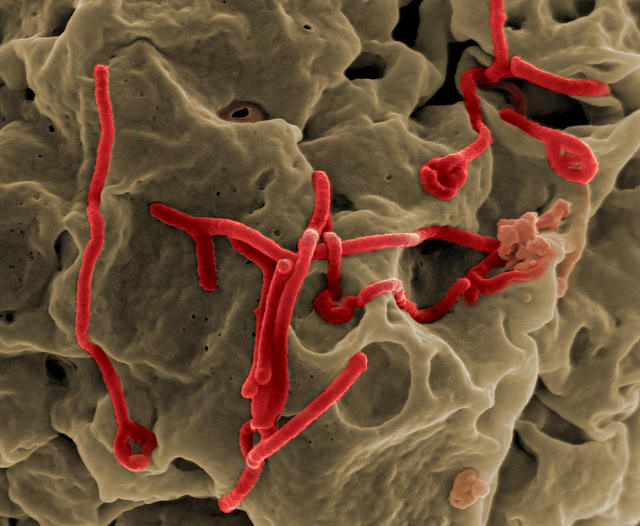




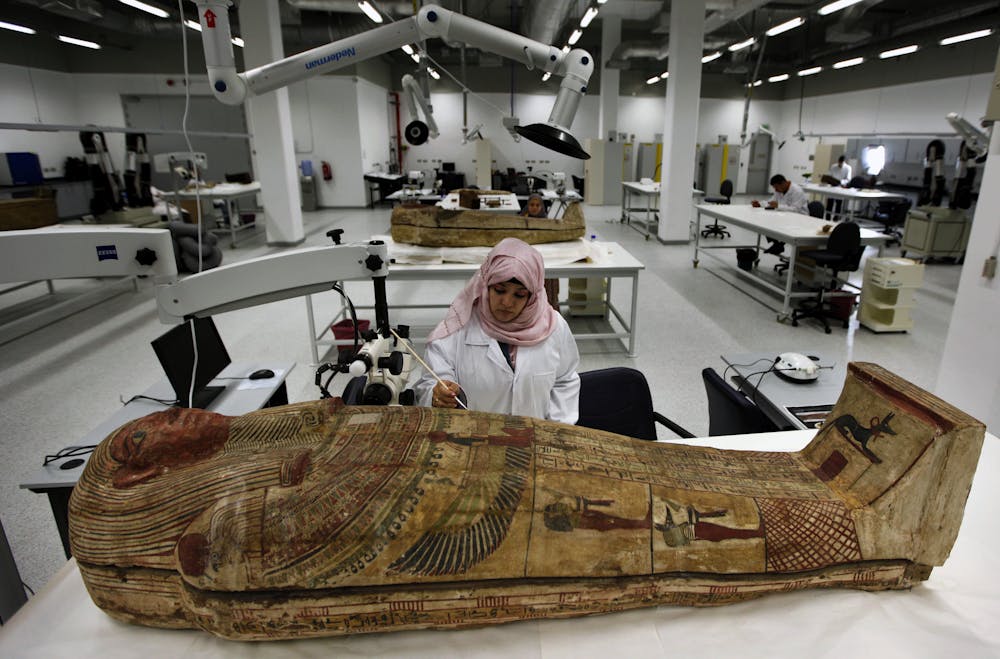


 It’s back to school time in the United States. As I’m writing this college and high school students across the country either have just started or are preparing to start their 2018-2019 school year.
 Your school may advertise that it uses plagiarism detection technology of some sort. They may even require you to sign a waiver to run your content through it.



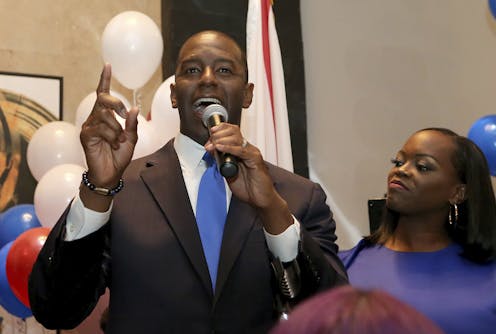





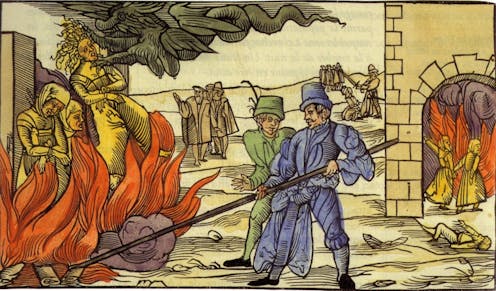







:origin()/pre00/6ceb/th/pre/i/2018/246/b/a/di_streghe_zucche_e_gatti_neri_by_blackbanshee80-dclxb33.jpg)
























 On this one, he writes, "Ok i really have to stop now. Merry Corbsmas:"
 But he didn't stop. He then tackled the