Shared posts

28 Aug 16:58

Baobabs: Africa’s unique trees defy climate challenges, continue to flourish

by Sarah Venter, Baobab Ecologist, University of the Witwatersrand

Baobabs reach extraordinarily old ages. Some have been found to be thousands of years old. During these life spans, elder baobabs have survived erratic climate conditions.

As an ecologist who has spent the last 17 years studying baobab, I decided to look specifically at the health of adult baobabs in Southern Africa and then in Africa as a whole, to establish if more recent human-induced climate change has started having an effect on these magnificent trees.

Over the course of 2023 I travelled across Botswana, South Africa, Namibia and Zimbabwe visiting baobabs located in the area as well as 13 other particularly old and large specimens, including Sagole (named after a local hot spring), the largest baobab in the world.

As I travelled, I became increasingly impressed by baobabs’ fortitude. Not only is the cohort of southern Africa’s oldest and largest baobabs enduring, but most baobab populations in Africa are healthy and stable, with very low mortality rates. Indeed, nothing I saw supported the notion that Africa’s baobabs are dying as a result of climate change.

This is important because baobabs have been a source of food, fibre and medicine for centuries. Over 300 uses of baobabs have been described.

In the last decade the growing trade in baobab fruit products has supported thousands of rural communities, especially marginalised women who are able to collect fruit from the trees around their homesteads and sell it for much needed income. The possible demise of baobabs would have devastating consequences for many people and local economies.

Climate change is not new for millennial trees

Baobabs are originally from Africa, where they occur in 32 countries.

It is well-known that baobabs reach extraordinary old ages. Radio-carbon dating has repeatedly found baobabs well over 1,000 years old, with the oldest among them reaching 2,500 years in age. Over their life spans baobabs have survived erratic climate conditions including droughts and floods. Researchers used carbon isotopes recovered from the pith of nine baobabs to recreate rainfall patterns for the last 1,000 years. These records show that the southern part of Africa experienced numerous successive droughts, one of which was even severe enough to cause the abandonment of the Mapungubwe capital, a significant archaeological settlement, in the early 14th century.

My observations on the general good health of baobabs do not stand alone. Several surveys across many parts of Africa also show stable baobab populations. It is estimated that there are up to four million baobab trees in Zimbabwe alone, and this only represents a fraction of Africa’s population.

Adult tree mortality is negligible, except for where elephants are found. Elephants rely on eating baobab bark in the dry season, and when elephant numbers get too high, baobab trees become over utilised, which can lead to population decline. However, where there are no elephants, adult baobab trees have a very high survival rate.

Baobabs are not immortal, so what are the threats?

There are of course several threats to baobabs – the most devastating of which is herbivory (the act of eating plants). Studies across Africa have shown that young trees are under high browsing pressures from domestic animals and wildlife. While browsing is not as much of a threat to adult baobabs, elephants are.

These animals were responsible for the dramatic decline and almost extinction of baobabs in Tsavo East National Park (Kenya) in the 1970s. They were responsible for a mortality rate of 8% in Mapungubwe National Park (South Africa) between 2009 and 2019.

This rapid loss of adult trees is doubly alarming as baobabs rely on a storage effect for episodic recruitment (meaning that the long-lived nature of the tree allows them to keep producing seed for hundreds of years). Without adult trees, these areas will not easily be populated again.

While major drought events of the mid 1960s and early 1970s, 1980s, and 1990s certainly caused the death of several baobabs in the region, too much water appears to be more of a threat to baobabs than too little.

Baobabs are vulnerable to too much water in the dry season (winter) when leafless, as leaves act as a pump for water that comes from the roots. Without leaves, baobabs have no way of getting rid of excess water and develop root and stem rot, leading to collapse or death.

This may be why baobabs in high rainfall areas do not achieve the same longevity as those in drier areas. It is also interesting to note that only one baobab named in previous studies which described the collapse and death of a number of large baobabs in southern Africa died during a drought period while two collapsed from too much water due to artificial watering over multiple winter seasons.

Symbols of resilience

As global temperatures continue to rise, millions of life-forms around the globe are under threat.

Plants and animals differ in their ability to cope with variable climate conditions. Many are sensitive to the slightest change and thus may be the first to die.

In contrast, baobabs are well adapted to changes in temperature and rainfall, as can be seen by their wide geographic distribution and extreme longevity. Baobabs, like any life-form, are not immortal, but they may well be the “last tree standing”. Far from victims of climate change, as punted by social media, they can be symbols of resilience.

The Conversation

Sarah Venter is the Director of The Baobab Foundation.

28 Aug 16:57

AI used by police cannot tell Black people apart and other reasons Canada’s AI laws need urgent attention

by Kevin Walby, Associate Professor of Criminal Justice, University of Winnipeg

Artificial intelligence (AI) is a powerful tool.

In the hands of public police and other criminal justice agencies, AI can lead to injustice. For example, Detroit resident Robert Williams was arrested in front of his children and held in detention for a night after a false positive in an AI facial recognition system. Williams had his name in the system for years and had to sue the police and local government for wrongful arrest to get it removed. He eventually found out that faulty AI had identified him as the suspect.

Around the corner, the same thing happened to another Detroit resident, Michael Oliver, and in New Jersey, to Nijeer Parks. These three men have two things in common. One, they are all victims of false positives in AI facial recognition systems. And two, they are all Black men.

It turns out: AI facial recognition systems cannot tell most people of colour apart. According to one study, the error rate is the highest for Black women, at 35 per cent.

These examples reveal the critical issues at stake with using AI in policing and law, especially in this moment, when AI is being used in the criminal justice system and in public and private sectors more than ever before.

In Canada: New laws, old problems

Currently, two new laws with major implications for the use of AI for years to come are being considered in Canada. Both lack protections for the public when it comes to police use of AI. As scholars who study computer science, policing and law, we are troubled by these gaps.

In Ontario, Bill 194, or the Strengthening Cyber Security and Building Trust in the Public Sector Act, is focused on AI use in the public sector.

The federal Bill C-27 would enact the Artificial Intelligence and Data Act (AIDA). Although the focus of AIDA is the private sector, it has implications for the public sector because of the high number of public-private partnerships in government.

Public police use AI as owners and operators of AI. They can also contract a private sector agency as a proxy to conduct AI-driven analyses.

Because of this public use of private-sector AI, even laws intended to regulate private sector use of AI should offer rules of engagement for criminal justice agencies using the technology.

Racial profiling and AI

AI has powerful predictive capabilities. Using machine learning, AI can be fed a database of profiles to “determine” the probability of who might do what or match faces to profiles. AI might also determine where police patrols are directed to based on past crime data.

These techniques sound as if they might boost efficiency or reduce bias. However, police use of AI can increase racial profiling and increase unnecessary police deployments.

Civil liberties and privacy groups have written reports on AI and surveillance practices. They provide examples of racial bias from places where police use AI technology. And they point to the many false arrests.

In Canada, the Royal Canadian Mounted Police (RCMP) and other policing agencies, including the Toronto Police Service and the Ontario Provincial Police, have already been called out by the Office of the Privacy Commissioner of Canada for using the Clearview AI technology to conduct mass surveillance.

Clearview AI has a database of over three billion images that were collected without consent by scraping the internet. Clearview AI matches faces from the database against other footage. This violates Canadian privacy laws. The Office of the Privacy Commissioner of Canada has critiqued RCMP use of this technology and the Toronto Police Services suspended use of that product.

By leaving the regulation of law enforcement out of Bill 194 and Bill C-27, AI companies in Canada could enable similar mass surveillance.


Read more: How police surveillance technologies act as tools of white supremacy


The EU leads the way

Internationally, there have been gains in getting AI use regulated in the public sector.

So far, the European Union’s AI Act is the best piece of law in the world when it comes to protecting the privacy and civil liberties of its citizens.

The EU’s AI Act takes a risk-and-harms-based approach to the regulation of AI, expecting that users of AI must take concrete steps to protect personal information and prevent mass surveillance.

In contrast, both Canadian and U.S. laws pit the rights of citizens to be free from mass surveillance against the desire of corporations to be efficient and competitive.

A trailer for ‘Coded Bias.’

Still time to make changes

There is still time to make changes. Bill 194 is being debated by the Ontario Legislative Assembly. And Bill C-27 is being debated in the Canadian Parliament.

Leaving police and criminal justice agencies out of Bill 194 and Bill C-27 is a glaring oversight. It potentially brings justice into disrepute in Canada.

The Law Commission of Ontario has critiqued Bill 194. They say the proposed law does not promote human rights or privacy, and would allow the unhindered use of AI in ways that could upset the privacy of Canadians. They say Bill 194 would allow public bodies to use AI in secret, arguing that Bill 194 ignores AI use by police, jails, courts and other criminal justice agencies.

Regarding Bill C-27, the Canadian Civil Liberties Association (CCLA) has issued a cautionary note and has petitioned for the bill to be withdrawn. They say the regulatory measures in Bill C-27 are geared toward enhancing private sector productivity and data mining rather than protecting the privacy and civil liberties of Canadian citizens.

Given that police and national security agencies often work with private providers in surveillance and security intelligence activities, regulations are needed to cover such partnerships. But police and national security agencies are not mentioned in Bill C-27.

The CCLA recommends Bill C-27 be harmonized with the European Union’s AI Act to include guard rails preventing mass surveillance and protecting against abuses of the power of AI.

These will be Canada’s first AI laws. We are years behind where regulation needs to be to prevent abuses of AI use in the public and private sectors.

During this time of growth in the use of AI by criminal justice agencies, changes must be made to Bill 194 and Bill C-27 now to protect Canadian citizens.

The Conversation

Kevin Walby receives funding from the Social Sciences and Humanities Research Council of Canada (SSHRC).

Oluwasola Mary Adedayo receives funding from the Social Sciences and Humanities Research Council of Canada (SSHRC).

Gustavo da Costa Markowicz does not work for, consult, own shares in or receive funding from any company or organisation that would benefit from this article, and has disclosed no relevant affiliations beyond their academic appointment.

28 Aug 16:57

The orchid and dandelion phenomenon in brain aging: Personalizing cognitive health approaches for older adults

by Emma A. Rodrigues, PhD Candidate in Computational Neuroscience, Simon Fraser University
The orchid and dandelion phenomenon offers a new framework for understanding the diverse experiences of cognitive aging. (Erwin, Razzmatazz0r/Pixabay)

As the global population ages, understanding the variability in cognitive aging becomes increasingly important. Why do some individuals remain cognitively sharp while others experience significant decline?

This question has been central to my doctoral research. Recent studies introduce the “orchid and dandelion” phenomenon to cognitive aging, suggesting that some people, like orchids, are highly sensitive to their environment, thriving or deteriorating based on external conditions. Others, like dandelions, show resilience and maintain cognitive performance regardless of their surroundings.

This framework could reshape our approach to cognitive health interventions in older adults, leading to more personalized and effective strategies to mitigate cognitive decline.

The orchid and dandelion phenomenon

Two older men talking
Personalized approach could be key to helping more people maintain cognitive function and quality of life in their later years. (Gerd Altman/Pixabay)

The orchid and dandelion metaphor was introduced in the field of developmental psychology and describes how individuals differ in their sensitivity to environmental conditions.

“Orchids” represent individuals who are strongly affected by their surroundings, thriving in optimal environments but struggling in less supportive ones. In contrast, “dandelions” represent resilient individuals who are able to maintain their health regardless of external conditions.

Our research has explored the differences in the interaction between environmental factors and cognitive performance in older adults. Results suggest that some individuals — cognitive “orchids” — are more susceptible to environmental influences on cognitive health. Cognitive “dandelions,” while resistant to environmental detriments, also do not benefit as much from supportive environments.

Real world impact of lifestyle choices on health

The orchid and dandelion framework provides a new perspective on why lifestyle choices do not always predict health outcomes.

Consider individuals who engage in unhealthy behaviours such as smoking, a sedentary lifestyle, social isolation or other detrimental environments. Surprisingly, some of these people live long, cognitively (relatively) healthy lives, possibly due to their “dandelion” resilience.

On the other hand, others who follow healthy habits — exercising regularly, eating well, avoiding harmful substances — may still experience cognitive decline, reflecting the vulnerability of cognitive “orchids.”

For instance, an “orchid” might experience significant decline after a stressful life event, but in an enriched, supportive environment, they could outperform a “dandelion” who remains cognitively stable in most conditions. These examples highlight the limitations of a one-size-fits-all approach to health, and show the need for personalized interventions.

Cognitive health interventions

Research suggests that there is an ongoing debate regarding the efficacy of interventions aimed at promoting good cognitive health in older people. Exploring the cognitive aging process through this lens could have significant implications for designing the interventions needed to support older adults’ cognitive health.

For cognitive “orchids,” targeted strategies such as promoting physical activity, cognitive training or social engagement could be beneficial. On the other hand, cognitive “dandelions” may benefit more from general health maintenance strategies.

By recognizing these individual differences, health-care providers can develop more effective, personalized approaches to cognitive health, potentially improving cognitive outcomes for older adults.

Implications for an aging world

Given the global trend toward an aging population, our research team’s findings are timely. As the population lives longer, the prevalence of cognitive decline and dementia is expected to rise, posing challenges for individuals, families and health-care systems.

The current approach to cognitive health, which often treats everyone the same, may not be sufficient to address the complexities of cognitive aging. By adopting a more detailed understanding of how cognitive health varies among individuals, we can develop interventions that are better suited to each person’s needs.

In child development, it’s estimated that 15 to 20 per cent of children experience over half of the recorded cognitive illnesses. These children likely represent “orchid” individuals in detrimental environments.

While it remains unclear whether this significant proportion carries into older ages, and what the long-term impact may be, recognizing and addressing the specific needs of these individuals is crucial. By identifying “dandelions” who are more resilient to negative changes and focusing early interventions, such as personalized social prescribing, on “orchids,” we could potentially mitigate cognitive decline.

This approach may not only improve individual health outcomes, but also lead to meaningful savings in health-related costs, making it a vital consideration in public health planning.

The orchid and dandelion phenomenon offers a new framework for understanding the diverse experiences of cognitive aging. By recognizing the unique environmental sensitivity individuals may experience, we can develop interventions that more effectively support cognitive health in older adults.

More research is needed to better understand the implications of these findings, but this personalized approach could be key to helping more people maintain cognitive function and quality of life in their later years.

The Conversation

Emma A. Rodrigues does not work for, consult, own shares in or receive funding from any company or organisation that would benefit from this article, and has disclosed no relevant affiliations beyond their academic appointment.

28 Aug 16:50

All politicians change their minds – and have been flip-flopping on positions for hundreds of years

by Shannon Bow O'Brien, Associate Professor of Instruction, The University of Texas at Austin
Kamala Harris and Donald Trump are far from the first politicians to be accused of flip-flopping on issues. Francesco Zerilli/Zerillimedia/Science Photo Library

People change their opinions. As my husband says, “I always reserve the right to get smarter,” paraphrasing Konrad Adenauer, the former chancellor of Germany.

But when politicians reverse course and change their opinions, political pundits, critics and others often call them out for lack of consistency, and might label them a flip-flopper, U-turner or backflipper.

Republican presidential nominee Donald Trump has been criticized for changing his mind on on everything from immigration policy to abortion, depending on who he is talking to and when.

Likewise, Democratic presidential nominee Kamala Harris has been accused of reversing her stances on private health insurance, fracking and other issues in order to win new voters.

Trump’s running mate, JD Vance, has drastically changed his mind over the past few years, as well. Before Trump was elected president in 2016, Vance publicly called him an “idiot” and privately compared him to Adolf Hitler – before going on to accept Trump’s offer to run for office together eight years later.

At the start of Democratic vice presidential nominee Tim Walz’s political career in 2007, he received an endorsement from the National Rifle Association for his support of gun rights. But Walz had what he called a “reckoning” after the 2018 Parkland high school shooting in Florida. He went on to support and approve gun safety measures as Minnesota governor.

Some voters demand that politicans’ beliefs should be stagnant, as if they were preserved in amber.

The reality is, as much as people sometimes forget, politicians are humans, too. They have all the same strengths and flaws as the rest of us. When I teach a course on the American presidency every fall, I often point out that perspective can change depending on which side of the desk someone is sitting on in the president’s office.

Hundreds of years of flip-flopping

Thomas Jefferson, the third U.S. president from 1801 through 1809, was a huge advocate for limited government when he ran for office in 1800. Jefferson and his anti-federalist allies called sitting president John Adams at one point a “royalist.” Jefferson accused people in the Federalist Party, who wanted a strong national government, of trying to set up a monarchy in the United States.

Before Jefferson became president, he embraced the idea of a very small national government with restricted powers. He emphasized the importance of strong state power and a very limited national budget.

However, once he was elected president, he was given the opportunity to buy 530 million acres in North America from France, in what we now call the Louisiana Purchase. This doubled the size of the U.S. by adding land from the Mississippi River to the Rocky Mountains.

Jefferson bought this land without input from Congress, demonstrating a stark reversal of his previous policy that de-emphasized the federal government.

Jefferson was aware of this conundrum and, in a letter to American politician Levi Lincoln in 1803, wrote, “The less is said about any constitutional difficulty, the better: and that it will be desirable for Congress to do what is necessary in silence.”

Jefferson knew that he was flip-flopping, but he also believed the Louisiana Purchase was in the country’s best interest.

A man stands at a podium behind a large American flag and people seated nearby him.
George H.W. Bush delivers his State of the Union address in Washington in 1990. Mark Reinstein/Corbis via Getty Images

To tax or not to tax?

Nearly two centuries later, George H.W. Bush ran for president in 1988. During the Republican National Convention that year, Bush wanted to draw a clear line between himself and Michael Dukakis, his Democratic opponent.

Dukakis had said he would raise federal taxes as a last resort. And Bush wanted to shore up conservative support. During his acceptance speech, Bush uttered the now famous phrase, “Read my lips: no new taxes.”

Unfortunately for Bush, the economic climate was not on his side. A slowing economy meant that, as president, Bush was forced to raise taxes – or else enact massive budget cuts that would be unacceptable to the Democrats controlling the House and Senate.

Still, some Republicans felt betrayed by Bush’s reversal.

Bush’s flip-flop on taxes is considered a large contributing factor to his loss in 1992 when he ran for reelection.

A man wears a black track suit and a white hat and holds a golf club as he walks on grass, surrounded by people who are in golf carts.
Donald Trump plays golf at a resort in Glasgow, Scotland, in July 2018. Andy Buchanan/AFP via Getty Images

I did, before I didn’t

The term “flip-flopping” reached new heights of popularity during the 2004 presidential election. Republican presidential nominee George W. Bush – son of George H.W. Bush – and others pegged the Democratic rival, John Kerry, as a flip-flopper to help discredit him.

“You get a little dizzy if you listen to John Kerry explain his recent position on any particular issue at the time,” said Jeb Bush, brother of George W. Bush, in 2004. “There really is a tale of two Kerrys.”

Bush and other Republicans used the term to paint Kerry as a person who shifted positions with the wind for political gain. In March 2004, Kerry memorably said that,, with respect to his Senate votes on additional spending on the military, “I actually did vote for the $87 billion before I voted against it.”

Kerry was attempting to explain that he voted for an earlier, Democratic-proposed version of a military appropriations bill that would have given money to U.S. operations in Iraq and Afghanistan, paid for by reducing tax cuts. But this measure was defeated, and so Kerry voted against a different, final version of the bill to demonstrate his opposition to then-president George W. Bush’s Iraq policy.

This convoluted phrase became the defining moment of Kerry’s campaign, which ended in defeat.

Flip-flopping today

Trump has flip-flopped on issues, from the innocuous to the important, throughout his political career and it has done little to erode support from his most ardent followers.

After years of declaring that mail-in ballots are crooked and fraudulent, Trump now embraces them as an electoral strategy in 2024. Trump also changed his political party affiliation multiple times, and has been a Republican, independent and Democrat before switching back to being a Republican a few years before his 2016 campaign.

When Trump was running for president, he heavily criticized Barack Obama for playing golf as president. Obama ultimately played about 105 rounds of golf in his first term. Trump went to a golf club 285 times in the same period and played golf at least 142 times.

And while in 2019 Harris, then running for president, said that she would support a ban on fracking, she now opposes doing so.

She also then supported a broad government-run health insurance program and proposed having “Medicare for all.” Harris’ campaign has said in 2024 that she will not push for this kind of government health insurance.

A woman walks past a large group of people holding cameras and microphones.
Kamala Harris speaks to the media after a Democratic primary debate in June 2019 in Miami. Saul Loeb/AFP via Getty Images

A political strategy

Flip-flopping is an easy slur to hurl at an opponent.

This can be a brilliant way to try to throw someone on the defensive while appearing to have clean hands yourself.

People evolve. Information changes. Hard choices have to be made for the good of the country. I think that we should all reserve the right to get smarter and, hopefully, better.

The Conversation

Shannon Bow O'Brien does not work for, consult, own shares in or receive funding from any company or organization that would benefit from this article, and has disclosed no relevant affiliations beyond their academic appointment.

28 Aug 16:44

How a survey of over 2,000 women in the 1920s changed the way Americans thought about female sexuality

by Anya Jabour, Regents Professor of History, University of Montana
In the 1920s, many women became more comfortable in their skin. But the facts of life remained in short supply. George Grantham Bain Collection/Library of Congress

American women still have fewer orgasms than men, according to new research that suggests that decades after the sexual revolution, the “orgasm gap” is still very much in effect.

One of the study’s lead authors at the Kinsey Institute for Research in Sex, Gender, and Reproduction told The New York Times that the gap persists because many Americans continue to “prioritize men’s pleasure and undervalue women’s sexual pleasure.”

As my research shows, these attitudes toward sexual pleasure have a long history.

But so do efforts to push back against them.

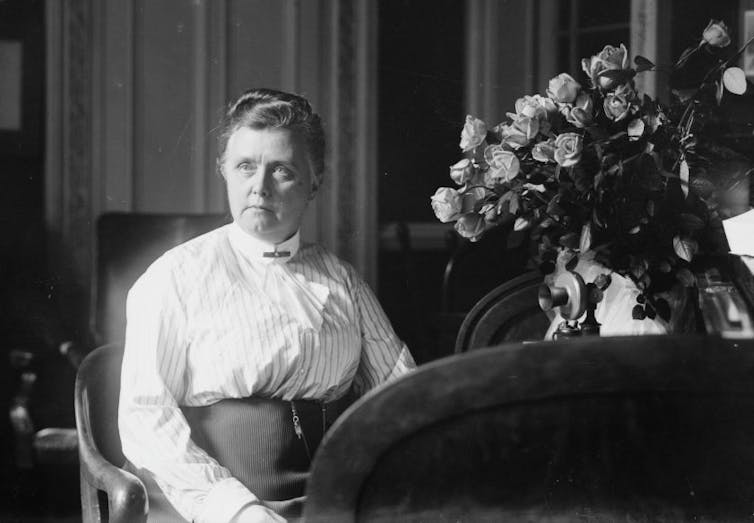
Almost a century ago, a pioneering American sex researcher named Katharine Bement Davis challenged the prevailing view that respectable women did not – and should not – experience sexual desire or have sex, except to please men or to have children.

Davis’s 1929 book, “Factors in the Sex Life of Twenty-Two Hundred Women,” completely upended this thinking.

By surveying everyday American women, she was able to show that it was completely normal for American women to have sex for the sake of pleasure.

An unlikely advocate for sexual liberation

Davis spent the first half of her career policing women’s sexuality, not promoting it.

In 1901, after earning her Ph.D. at the University of Chicago, Davis became superintendent of the New York State Reformatory for Women at Bedford Hills. While there, she studied the women in her care. Most female convicts, she concluded, were “immoral women.”

Davis’ efforts to enforce sexual morality drew the attention of philanthropist John D. Rockefeller Jr. In 1917, he invited her to lead his private agency, the Bureau of Social Hygiene, founded to study and combat prostitution and venereal disease.

During World War I, Davis promoted sex education to curb sexually transmitted infections among soldiers and civilians. Through this work, she became convinced that sexual ignorance – not sexual immorality – posed the greatest danger to women’s welfare.

Davis had long criticized the sexual double standard, which condoned men’s sexual experimentation but condemned women’s sexual experience.

Now, she also recognized that this double standard promoted women’s chastity at the expense of knowledge. She complained that discussions of women’s sexuality were “taboo,” which resulted in “distorted views, baffled speculation, and unfortunate experiences.”

Tackling a taboo topic

Insisting that Americans needed accurate information to achieve “a sane outlook on all matters pertaining to sex,” Davis made it her mission to teach women about sex.

But first, she needed to learn about women’s actual sexual experiences. Davis decided to undertake a large-scale study of what she called “the sex life of normal women.”

Davis’ approach was a dramatic departure from existing studies of “abnormal” sexuality focused on institutionalized populations. “Except on the pathological side,” she remarked, “sex is scientifically an unexplored country.”

Woman in white blouse seated in chair posing for a portrait next to a bouquet of flowers.
Katharine Bement Davis was frustrated by the double standard that celebrated men’s sexual experiences and condemned those of women. Heritage Art/Heritage Images via Getty Images

By contrast, Davis explained, she wanted to understand “the woman who was not pathological mentally or physically.”

To that end, Davis distributed a detailed questionnaire to what she called “women of good standing in the community” from 1921 to 1923. The resulting study sample of 1,000 married women and 1,200 unmarried women was not representative – it skewed white, well-educated and well-to-do. But their responses allowed Davis to redefine female sexuality.

America’s first sexual revolution

Davis launched her study of women’s sexuality during what historians now refer to as America’s first sexual revolution. The second – and more well-known one – would take place in the 1960s.

In the 1920s, as one commentator noted, a “revolution in manners and morals” was underway. Sex suffused popular culture. Contestants in beauty pageants displayed their charms in skimpy bathing costumes and short skirts. Actresses flaunted their sex appeal on stage and screen.

New attitudes about sex affected the daily lives of average Americans, too. Young women throughout the nation adopted the sexy look of “flappers,” the term used for women who sported short skirts, rolled stockings and bobbed hair.

Prior to the 1920s, courtship often took place in the home, allowing parents to closely supervise couples. But the ubiquitous automobile – which one juvenile court judge had dubbed “a house of prostitution on wheels” – rendered adult chaperonage obsolete and granted young people unprecedented sexual freedom.

Meanwhile, birth control activists like Margaret Sanger and Mary Ware Dennett distributed contraceptive devices and disseminated sexual information in defiance of the Comstock Act of 1873, which had defined birth control and sex education as “obscene” and made circulating such materials a federal crime.

Sex, secrecy and shame

Even amid the nation’s first sexual revolution, the facts of life remained in short supply.

According to surveys Davis distributed to married women, only about half of the respondents believed that they had been “adequately prepared … for the sex side of marriage.”

After expanding her study to include unmarried women, Davis found that fewer than one-third of all participants received sex education from their parents.

Many women didn’t know how pregnancy occurred. Some had been unprepared even for menstruation. One recalled that when she experienced her first period, “I naturally thought I was bleeding to death.”

In place of information, many women imbibed shame. “Having acquired the feeling as a small child that any sex pleasure was shameful and a great sin,” as one respondent put it, some could never overcome their discomfort with sex. Another woman regarded all sexual thoughts as “something to be shunned like the devil.”

One response succinctly summarized the problem: “Our present secrecy, fear, and repression are responsible for most of our sex ills.”

Challenging the conspiracy of silence

Many women were eager to challenge what one called a “conspiracy of silence” surrounding female sexuality.

Study participants ended up providing Davis with over 10,000 pages of handwritten responses. She used this information to produce the nation’s first major study of women’s sexuality, a 400-plus page book brimming with both statistical data and personal stories.

Factors in the Sex Life of Twenty-Two Hundred Women” covered a wide range of topics, ranging from sex education to sex play. Running throughout the entire work, however, was one central idea: Women liked sex.

Davis included data on birth control, same-sex relationships and masturbation. At the time, these practices were universally stigmatized and often criminalized. Yet significant proportions of study participants engaged in all these activities.

Nearly three-quarters of married respondents reported using contraceptives. Many probably took advantage of state laws allowing physicians to prescribe diaphragms to protect patients’ health. Surprisingly, nearly 1 in 10 women admitted having abortions, even though the procedure was illegal in every state.

More than half of unmarried women and nearly one-third of married women stated that they had experienced “intense emotional relationships” with other women. In each group, approximately half described those relationships as sexual. This was a remarkably high figure, given prevailing views of homosexuality as sexual deviance and state laws criminalizing homosexual acts.

Nearly 65% of unmarried women and more than 40% of married women reported masturbating. Since nearly all physicians and pastors condemned the practice, Davis assumed the actual numbers were even higher.

Davis’ data demonstrated that “normal” women experienced what one called “natural sex feeling.” In short, her study showed that many women enjoyed sex for its own sake.

Davis believed that reliable data would lead to “more satisfactory adjustments of the sex relationship.” In other words, better information would lead to better sex.

Davis paved the way for future studies that validate women’s sexual pleasure. While researching female sexuality, she established the National Research Council’s Committee for Research on the Problems of Sex. The Rockefeller-funded committee later subsidized Alfred Kinsey’s studies of human sexuality.

Davis’ legacy lives on. The findings from the Kinsey Institute’s latest study show that discussing sexual pleasure still matters, particularly for women. It also suggests that Americans’ understandings of sex have improved over the past century.

When Davis conducted her study in the 1920s, she found it “advisable” to define “orgasm” for participants who were unclear on the concept. Now, a generation of better-informed Americans ponder how to address a persistent “orgasm gap.”

The Conversation

Anya Jabour does not work for, consult, own shares in or receive funding from any company or organization that would benefit from this article, and has disclosed no relevant affiliations beyond their academic appointment.

28 Aug 16:42

What is an Atlantic Niña? How La Niña’s smaller cousin could affect hurricane season

by Annalisa Bracco, Professor of Ocean and Climate Dynamics, Georgia Institute of Technology
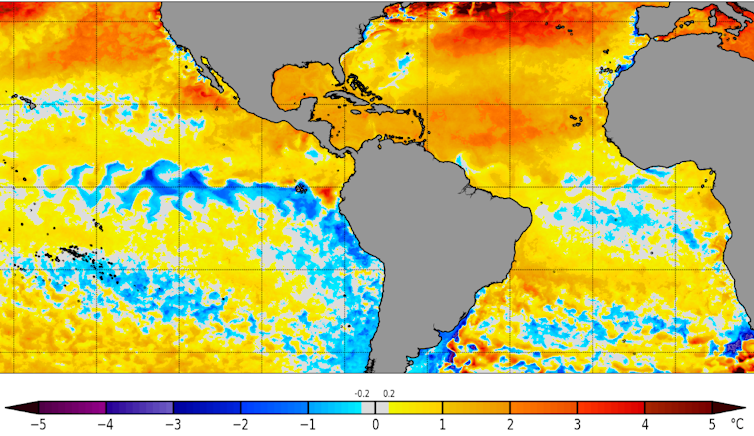
Cooling streaks indicate the potential for two Niña's at once – Pacific and Atlantic, a rare event. NOAA Coral Reef Watch

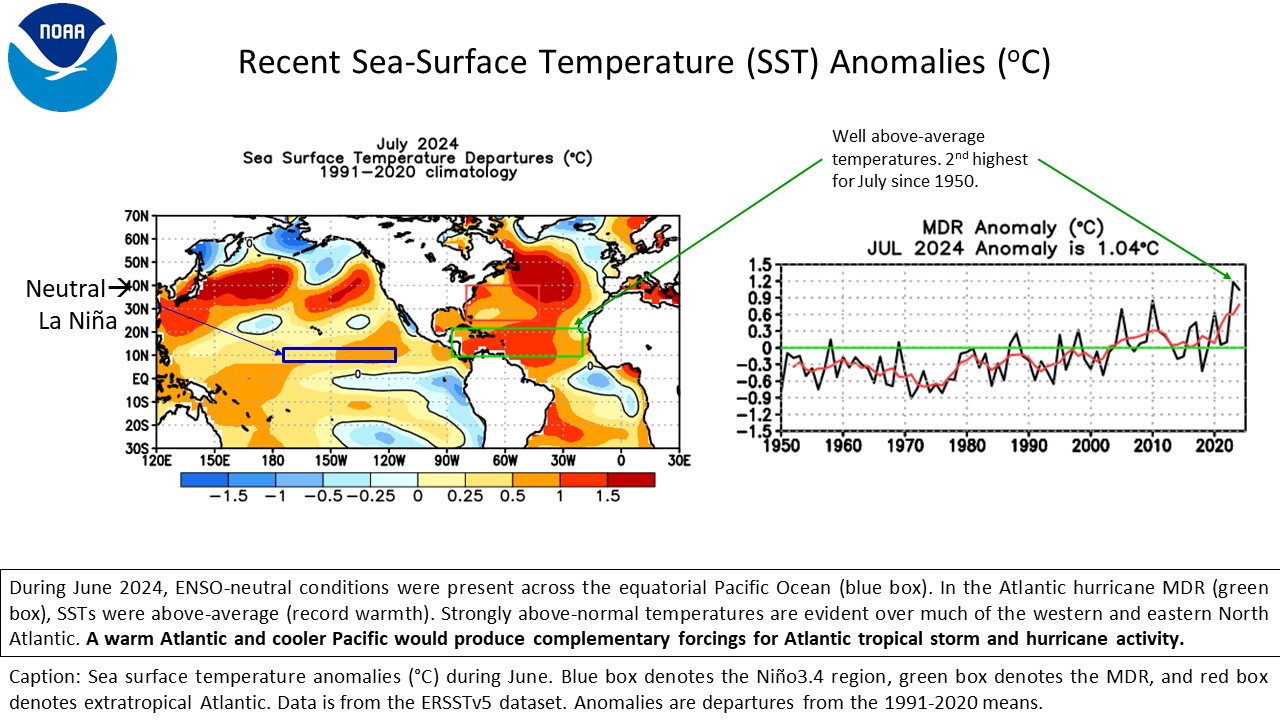
The North Atlantic Ocean has been running a fever for months, with surface temperatures at or near record highs. But cooling along the equator in both the Atlantic and eastern Pacific may finally be starting to bring some relief, particularly for vulnerable coral reef ecosystems.

This cooling comes from two climate phenomena with similar names: La Niña, which forms in the tropical Pacific, and the less well-known Atlantic Niña.

Both can affect the Atlantic hurricane season. While La Niña tends to bring conditions ideal for Atlantic hurricanes, the less powerful Atlantic Niña has the potential to reduce some of the hurricane risk.

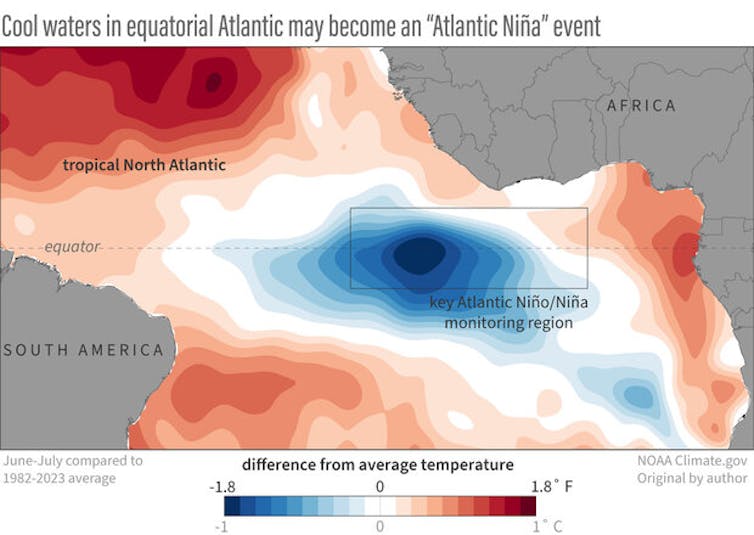
A map shows a cool spot along the equator while temperatures just to the north are well above average.
Cooling in the tropical Atlantic along the equator is a sign an Atlantic Niña may be forming. NOAA Climate.gov

We’re ocean and atmospheric scientists who study this type of climate phenomenon. It’s rare to see both Niñas at the same time, yet in August 2024, both appeared to be developing. Let’s take a closer look at what that means.

La Niña and its cousin, Atlantic Niña

La Niña is part of the El Niño–Southern Oscillation, a well-known climate phenomenon that has widespread effects on climate and weather around the world.

During La Niña, sea surface temperatures in the tropical Pacific dip below normal. Easterly trade winds then strengthen, allowing more cool water to well up along the equator off South America. That cooling affects the atmosphere in ways that reverberate across the planet. Some areas become stormier and others drier during La Niña, and the wind shear that can tear apart Atlantic hurricanes tends to weaken.

La Niña and its warmer opposite, El Niño, oscillate every three to four years or so.

La Niña and its opposite, El Niño, explained. NOAA.

A similar climate phenomenon, Atlantic Niña, occurs in the Atlantic Ocean but at a much smaller scale and amplitude. It typically peaks around July or August and tends to have a shorter duration than its Pacific cousin, and much more modest and local impacts. Atlantic Niñas generally have the opposite effect of Atlantic Niños, which tend to reduce rainfall over Africa’s Sahel region and increase rainfall in Brazil and the countries that surround the Gulf of Guinea, such as Ghana, Nigeria and Cameroon.

While much weaker than their Pacific counterpart, Atlantic Niñas can, however, partially counteract La Niñas by weakening summer winds that help drive the upwelling that cools the eastern Pacific.

Why are both happening now?

In July and August 2024, meteorologists noted cooling that appeared to be the development of an Atlantic Niña along the equator. The winds at the ocean surface had been weak through most of the summer, and sea surface temperatures there were quite warm until early June, so signs of an Atlantic Niña emerging were a surprise.

At the same time, waters along the equator in the eastern Pacific were also cooling, with La Niña conditions expected there by October or November.

A map of sea surface temperature anomalies shows cooling along the tropical Atlantic and eastern Pacific regions, but much warmer than average temperatures in the Caribbean. NOAA Coral Reef Watch

Getting a Pacific-Atlantic Niña combination is rare but not impossible. It’s like finding two different pendulums that are weakly coupled to swing in opposite directions moving together in time. The combinations of La Niña and Atlantic Niño, or El Niño and Atlantic Niña are more common.

Good news or bad for hurricane season?

An Atlantic Niña may initially suggest good news for those living in hurricane-prone areas.

Cooler than average waters off the coast of Africa can suppress the formation of African easterly waves. These are clusters of thunderstorm activity that can form into tropical disturbances and eventually tropical storms or hurricanes.

Tropical storms draw energy from the process of evaporating water associated with warm sea surface temperatures. So, cooling in the tropical Atlantic could weaken this process. That would leave less energy for the thunderstorms, which would reduce the probability of a tropical cyclone forming.

However, NOAA takes all factors into account when it updates its Atlantic hurricane season outlook, released in early August, and it still anticipates an extremely active 2024 season. Tropical storm season typically peaks in early to mid-September.

Two reasons are behind the busy forecast: The near record-breaking warm sea surface temperatures in much of the North Atlantic can strengthen hurricanes. And the expected development of a La Niña in the Pacific tends to weaken wind shear – the change in wind speed with height that can tear apart hurricanes. La Niña’s much stronger effects can override any impacts associated with the Atlantic Niña.

Exacerbating the problem: Global warming

The past two years have seen exceptionally high ocean temperatures in the Atlantic and around much of the world’s oceans. The two Niñas are likely to contribute some cooling relief for certain regions, but it may not last long.

In addition to these cycles, the global warming trend caused by rising greenhouse gas emissions is raising the baseline temperatures and can fuel major hurricanes.

The Conversation

Zachary Handlos receives funding from the National Science Foundation.

Annalisa Bracco does not work for, consult, own shares in or receive funding from any company or organization that would benefit from this article, and has disclosed no relevant affiliations beyond their academic appointment.

28 Aug 16:40

AI was born at a US summer camp 68 years ago. Here’s why that event still matters today

by Sandra Peter, Director of Sydney Executive Plus, University of Sydney
Jon Bilous/Shutterstock

Imagine a group of young men gathered at a picturesque college campus in New England, in the United States, during the northern summer of 1956.

It’s a small casual gathering. But the men are not here for campfires and nature hikes in the surrounding mountains and woods. Instead, these pioneers are about to embark on an experimental journey that will spark countless debates for decades to come and change not just the course of technology – but the course of humanity.

Welcome to the Dartmouth Conference – the birthplace of artificial intelligence (AI) as we know it today.

What transpired here would ultimately lead to ChatGPT and the many other kinds of AI which now help us diagnose disease, detect fraud, put together playlists and write articles (well, not this one). But it would also create some of the many problems the field is still trying to overcome. Perhaps by looking back, we can find a better way forward.

The summer that changed everything

In the mid 1950s, rock’n’roll was taking the world by storm. Elvis’s Heartbreak Hotel was topping the charts, and teenagers started embracing James Dean’s rebellious legacy.

But in 1956, in a quiet corner of New Hampshire, a different kind of revolution was happening.

The Dartmouth Summer Research Project on Artificial Intelligence, often remembered as the Dartmouth Conference, kicked off on June 18 and lasted for about eight weeks. It was the brainchild of four American computer scientists – John McCarthy, Marvin Minsky, Nathaniel Rochester and Claude Shannon – and brought together some of the brightest minds in computer science, mathematics and cognitive psychology at the time.

These scientists, along with some of the 47 people they invited, set out to tackle an ambitious goal: to make intelligent machines.

As McCarthy put it in the conference proposal, they aimed to find out “how to make machines use language, form abstractions and concepts, solve kinds of problems now reserved for humans”.

Five elderly men standing on a stage in front of a commemorative plaque
Trenchard More, John McCarthy, Marvin Minsky, Oliver Selfridge and Ray Solomonoff were among those who attended the Dartmouth Conference on artificial intelligence in 1956. Joe Mehling, CC BY

The birth of a field – and a problematic name

The Dartmouth Conference didn’t just coin the term “artificial intelligence”; it coalesced an entire field of study. It’s like a mythical Big Bang of AI – everything we know about machine learning, neural networks and deep learning now traces its origins back to that summer in New Hampshire.

But the legacy of that summer is complicated.

Artificial intelligence won out as a name over others proposed or in use at the time. Shannon preferred the term “automata studies”, while two other conference participants (and the soon-to-be creators of the first AI program), Allen Newell and Herbert Simon, continued to use “complex information processing” for a few years still.

But here’s the thing: having settled on AI, no matter how much we try, today we can’t seem to get away from comparing AI to human intelligence.

This comparison is both a blessing and a curse.

On the one hand, it drives us to create AI systems that can match or exceed human performance in specific tasks. We celebrate when AI outperforms humans in games such as chess or Go, or when it can detect cancer in medical images with greater accuracy than human doctors.

On the other hand, this constant comparison leads to misconceptions.

When a computer beats a human at Go, it is easy to jump to the conclusion that machines are now smarter than us in all aspects – or that we are at least well on our way to creating such intelligence. But AlphaGo is no closer to writing poetry than a calculator.

And when a large language model sounds human, we start wondering if it is sentient.

But ChatGPT is no more alive than a talking ventriloquist’s dummy.

The overconfidence trap

The scientists at the Dartmouth Conference were incredibly optimistic about the future of AI. They were convinced they could solve the problem of machine intelligence in a single summer.

A commemorative plaque of the Dartmouth Summer Research Project on artificial intelligence
2006 marked the 50th anniversary of the Dartmouth Summer Research Project on artificial intelligence. Joe Mehling, CC BY

This overconfidence has been a recurring theme in AI development, and it has led to several cycles of hype and disappointment.

Simon stated in 1965 that “machines will be capable, within 20 years, of doing any work a man can do”. Minsky predicted in 1967 that “within a generation […] the problem of creating ‘artificial intelligence’ will substantially be solved”.

Popular futurist Ray Kurzweil now predicts it’s only five years away: “we’re not quite there, but we will be there, and by 2029 it will match any person”.

Reframing our thinking: new lessons from Dartmouth

So, how can AI researchers, AI users, governments, employers and the broader public move forward in a more balanced way?

A key step is embracing the difference and utility of machine systems. Instead of focusing on the race to “artificial general intelligence”, we can focus on the unique strengths of the systems we have built – for example, the enormous creative capacity of image models.

Shifting the conversation from automation to augmentation is also important. Rather than pitting humans against machines, let’s focus on how AI can assist and augment human capabilities.

Let’s also emphasise ethical considerations. The Dartmouth participants didn’t spend much time discussing the ethical implications of AI. Today, we know better, and must do better.

We must also refocus research directions. Let’s emphasise research into AI interpretability and robustness, interdisciplinary AI research and explore new paradigms of intelligence that aren’t modelled on human cognition.

Finally, we must manage our expectations about AI. Sure, we can be excited about its potential. But we must also have realistic expectations, so that we can avoid the disappointment cycles of the past.

As we look back at that summer camp 68 years ago, we can celebrate the vision and ambition of the Dartmouth Conference participants. Their work laid the foundation for the AI revolution we’re experiencing today.

By reframing our approach to AI – emphasising utility, augmentation, ethics and realistic expectations – we can honour the legacy of Dartmouth while charting a more balanced and beneficial course for the future of AI.

After all, the real intelligence lies not just in creating smart machines, but in how wisely we choose to use and develop them.

The Conversation

Sandra Peter does not work for, consult, own shares in or receive funding from any company or organisation that would benefit from this article, and has disclosed no relevant affiliations beyond their academic appointment.

28 Aug 16:39

Considering taking Wegovy to lose weight? Here are the risks and benefits – and how it differs from Ozempic

by Lauren Ball, Professor of Community Health and Wellbeing, The University of Queensland
Halfpoint/Shutterstock

The weight-loss drug Wegovy is now available in Australia.

Wegovy is administered as a once-weekly injection and is approved specifically for weight management. It’s intended to be used in combination with a reduced-energy diet and increased physical activity.

So how does Wegovy work and how much weight can you expect to lose while taking it? And what are the potential risks – and costs – for those who use it?

Let’s look at what the science says.

What is Wegovy?

Wegovy is a brand name for the medication semaglutide. Semaglutide is a glucagon-like peptide-1 receptor agonist (GLP-1RA). This means it makes your body’s own glucagon-like peptide-1 hormone, called GLP-1 for short, work better.

Normally when you eat, the body releases the GLP-1 hormone which helps signal to your brain that you are full. Semaglutides enhance this effect, leading to a feeling of fullness, even when you haven’t eaten.

Another role of GLP-1 is to stimulate the body to produce more insulin, a hormone which helps lower the level of glucose (sugar) in the blood. That’s why semaglutides have been used for several years to treat type 2 diabetes.

Pack of Wegovy injections
Wegovy is self-injected once a week. S Becker/Shutterstock

How does Wegovy differ from Ozempic?

Like Wegovy, Ozempic is a semaglutide. The way Wegovy and Ozempic work in the body are essentially the same. They’re made by the same pharmaceutical company, Novo Nordisk.

But there are two differences:

1) They are approved for two different (but related) reasons.

In Australia (and the United States), Ozempic is approved for use to improve blood glucose levels in adults with type 2 diabetes. By managing blood glucose levels effectively, the medication aims to reduce the risk of major complications, such as heart disease.

Wegovy is approved for use alongside diet and exercise for people with a body mass index (BMI) of 30 or greater, or 27 or greater but with other conditions such as high blood pressure.

Wegovy can also be used in people aged 12 years and older. Like Ozempic, Wegovy aims to reduce the risk of future health complications, including heart disease.

2) They are both injected but come in different strengths.

Ozempic is available in pre-loaded single-dose pens with varying dosages of 0.25 mg, 0.5 mg, 1 mg, or 2 mg per injection. The dose can be slowly increased, up to a maximum of 2 mg per week, if needed.

Wegovy is available in prefilled single-dose pens with doses of 0.25 mg, 0.5 mg, 1 mg, 1.7 mg, or 2.4 mg. The treatment starts with a dose of 0.25 mg once weekly for four weeks, after which the dose is gradually increased until reaching a maintenance dose of 2.4 mg weekly.

While it’s unknown what the impact of Wegovy’s introduction will be on Ozempic’s availability, Ozempic is still anticipated to be in low supply for the remainder of 2024.

Is Wegovy effective for weight loss?

Given Wegovy is a semaglutide, there is very strong evidence it can help people lose weight and maintain this weight loss.

A recent study found that over four years, participants taking Wevovy as indicated experienced an average weight loss of 10.2% body weight and a reduction in waist circumference of 7.7cm.

For those who stop taking the medication, analyses have shown that about two-thirds of weight lost is regained.

Man leans against a bridge rail
Wegovy can help people lose weight and maintain their weight loss – while they take the drug. Mladen Mitrinovic/Shutterstock

What are the side effects of Wegovy?

The most common side effects are nausea and vomiting.

However, other serious side effects are also possible because of the whole-of-body impact of the medication. Thyroid tumours and cancer have been detected as a risk in animal studies, yet are rarely seen in human scientific literature.

In the four-year Wegovy trial, 16.6% of participants who received Wegovy (1,461 people) experienced an adverse event that led to them permanently discontinuing their use of the medication. This was higher than the 8.2% of participants (718 people) who received the placebo (with no active ingredient).

Side effects included gastrointestinal disorders (including nausea and vomiting), which affected 10% of people who used Wegovy compared to 2% of people who used the placebo.

Gallbladder-related disorders occurred in 2.8% of people who used Wegovy, and 2.3% of people who received the placebo.

Recently, concerns about suicidal thoughts and behaviours have been raised, after a global analysis reviewed more than 36 million reports of adverse events from semaglutide (Ozempic or Wegovy) since 2000.

There were 107 reports of suicidal thoughts and self-harm among people taking semaglutide, sadly including six actual deaths. When people stopped the medication, 62.5% found the thoughts went away. What we don’t know is whether dose, weight loss, or previous mental health status or use of antidepressants had a role to play.

Finally, concerns are growing about the negative effect of semaglutides on our social and emotional connection with food. Anecdotal and scientific evidence suggests people who use semaglutides significantly reduce their daily dietary intake (as anticipated) by skipping meals and avoiding social occasions – not very enjoyable for people and their loved ones.

How can people access Wegovy?

Wegovy is available for purchase at pharmacists with a prescription from a doctor.

But there is a hefty price tag. Wegovy is not currently subsidised through the Pharmaceutical Benefits Scheme, leaving patients to cover the cost. The current cost is estimated at around A$460 per month dose.

If you’re considering Wegovy, make an appointment with your doctor for individual advice.

The Conversation

Lauren Ball works for The University of Queensland and receives funding from the National Health and Medical Research Council, Queensland Health and Mater Misericordia. She is a Director of Dietitians Australia, a Director of the Darling Downs and West Moreton Primary Health Network and an Associate Member of the Australian Academy of Health and Medical Sciences.

Emily Burch does not work for, consult, own shares in or receive funding from any company or organisation that would benefit from this article, and has disclosed no relevant affiliations beyond their academic appointment.

28 Aug 16:35

People think they are much better at understanding others than they actually are – new research

by Bryony Payne, Postdoctoral Research Associate in Cognitive Psychology - Institute of Psychiatry, Psychology, and Neuroscience, King's College London

The people who took part in riots and counterprotests in England and Northern Ireland this summer are probably very confident that they know the views and beliefs of those they oppose. But they are probably wrong. Our new research shows we struggle to understand the minds of people who differ from us.

People categorise each other socially. Those we think of as similar to ourselves are part of what social scientists call our “in-group” while those we think of as different are deemed an “out-group”. These differences can be based on race, religion, nationality, political beliefs, sexual orientation or class, to name a few.

We understand that there are lots of different types of people with varying beliefs in our in-group. For example, a white person knows that not all white people are alike. Yet people tend to think all members of an out-group are the same, with similar beliefs and views. What’s more, people are often wrong about what these are.

Our research tested this by asking 256 people from the US to predict the social and political beliefs of others. Of these participants, there were 119 men and 137 women, with an average age of 45, and the group was split evenly between those with left- and right-leaning political views. We presented participants with statements such as “immigrants are good for society” and asked them to what extent they agreed. We then showed them the responses of other people who had been asked the same question.

If the participant said they strongly agreed that immigrants are good for society, they would be presented with someone who said they strongly disagreed with this. This would make them out-group to the participant.

Now aware that the other person disagreed with them on one belief, we would then ask them to predict this other person’s opinion on a different topic, such as “everyone should have access to legal abortion” or “it is right that same-sex marriage is now legal and acceptable”. The participant might assume that people who are anti-immigration are also anti-abortion or against same-sex marriage.

We asked people to repeat this task with various beliefs for both in-group and out-group members.

Each time someone predicted what the other person thought, we asked them to state how confident they were that their prediction was correct on a scale from “not at all” to “extremely confident”. We found that people were consistently very confident that their predictions were accurate (75% confident) but, for out-group members, they were wrong more than 60% of the time.

We then assessed how well people’s confidence was aligned with their accuracy. For in-group members who were asked to predict the views of other in-group members, their confidence was well placed: the more confident they were, the more accurate they were. It was a different story for their prediction of the views of out-group members: the more confident they were, the more likely it was that they were wrong.

This shows that people think they are much better at understanding out-groups than they actually are.

Two groups of small, simply wooden figures representing people, one group is led by a figure painted red, the other by a figure painted blue
People are overconfident about what those on the other side of a disagreement believe. Andrii Yalanskyi/Shutterstock

Generally, people are better at understanding in-group members because we interact with them more. We build up a good understanding of the range of people within our in-group, learning that they are all individuals, differing in their thoughts, beliefs and views. We are confident we understand them and, because of our experience with them, we usually can.

In contrast, our understanding of out-group members is often limited to what we’ve heard about them on the news, via word of mouth or on social media. If this information is overly simplistic or not accurate, then much like other disinformation, it gives rise to commonly held misconceptions about the out-group and the views they hold.


Read more: The hypocrisy at the heart of racist riots


We apply the understanding we have of a few out-group members to everyone in the group, meaning we misunderstand a lot of people, but we think we understand them very well.

The consequences of this are, unfortunately, well known and serious. People value the lives of out-group members less. People are less likely to help out-group members as distrust, dislike and hostility towards them increases. People also become less willing to engage with out-groups, preferring not to work with, live near, or even sit near an out-group member. As societies become more polarised in this way, there are fewer chances for incorrect views to be challenged and corrected.

Understanding others better

We conducted a second experiment to try to find a way to counter these incorrect assumptions. This time, we told people whether their predictions were right or wrong.

Encouragingly, we found that by making people aware of their incorrect assumptions about out-group members, people started making better, more accurate predictions. They also became more aware of which people they were more or less likely to be able to understand.

It seems that making people aware of the real views and beliefs of out-group members can change how they think about them.

This is why it is so critical that people are exposed to the views of a diverse range of people. Hearing their stories and gaining insight into who they are as individuals – their personalities, beliefs, desires and emotions – helps us understand that, like our in-group, the out-group is made up of many different types of people. Over time, this makes it more likely that we will treat them with humanity.

The Conversation

Bryony Payne does not work for, consult, own shares in or receive funding from any company or organisation that would benefit from this article, and has disclosed no relevant affiliations beyond their academic appointment. This research was funded by the John Templeton Foundation

Caroline Catmur received funding from the John Templeton Foundation for the research reported here.

28 Aug 16:32

Human oversight of AI systems may not be as effective as we think — especially when it comes to warfare

by Mark Tsagas, Senior Lecturer in Law, Cybercrime & AI Ethics, University of East London
U.S. Air Force Photo / Lt. Col. Leslie Pratt

As artificial intelligence (AI) becomes more powerful – even being used in warfare – there’s an urgent need for governments, tech companies and international bodies to ensure it’s safe. And a common thread in most agreements on AI safety is a need for human oversight of the technology.

In theory, humans can operate as safeguards against misuse and potential hallucinations (where AI generates incorrect information). This could involve, for example, a human reviewing content that the technology generates (its outputs). However, there are inherent challenges to the idea of humans acting as a effective check on computer systems, as a growing body of research and several real-life examples of military use of AI demonstrate.

Across the efforts thus far to create regulations for AI, many already contain language promoting human oversight and involvement. For instance, the EU’s AI act stipulates that high-risk AI systems – for example those already in use that automatically identify people using biometric technology such as a retina scanner – need to be separately verified and confirmed by at least two humans who possess the necessary competence, training and authority.

In the military arena, the importance of human oversight was recognised by the UK government in its February 2024 response to a parliamentary report on AI in weapon systems. The report emphasises “meaningful human control” through the provision of appropriate training for the humans. It also stresses the notion of human accountability and says that decision making in actions by, for instance, armed aerial drones, cannot be shifted to machines.

This principle has largely been kept in place so far. Military drones are currently controlled by human operators and their chain of command, who are responsible for actions taken by an armed aircraft. However, AI has the potential to make drones and the computer systems they use more capable and autonomous.

This includes their target acquisition systems. In these systems, software guided by AI would select and lock onto enemy combatants, allowing the human to approve a strike on them with weapons.

While not thought to be widespread just yet, the war in Gaza appears to have demonstrated how such technology is already being used. The Israeli-Palestinian publication +972 magazine reported described a system called Lavender being used by Israel. This is reportedly an AI-based target recommendation system coupled with other automated systems, that tracks the geographical location of the identified targets.

Target acquisition

In 2017, the US military conceived of a project, named Maven, with the goal of integrating AI into weapons systems. Over the years, it has evolved into a target acquisition system. Reportedly, it has greatly increased the efficiency of the target recommendation process for weapons platforms.

In line with recommendations from academic work on AI ethics, there is a human in place to oversee the outputs of the target acquisition mechanisms as a critical part of the decision-making loop.

Nonetheless, work on the psychology of how humans work with computers raises important issues to consider. In a 2006 peer-reviewed paper, the US academic Mary Cummings summarised how humans can end up putting excessive trust in machine systems and their conclusions – a phenomenon known as automation bias.

This has the potential to interfere with the human role as a check on automated decision-making if operators are less likely to question a machine’s conclusions.

Two men sit at a bank of screens with joysticks
Drone operators should act as checks on decisions taken by AI. U.S. Air Force/Master Sgt. Steve Horton

In another study published in 1992, the researchers Batya Friedman and Peter Kahn argued that humans’ sense of moral agency can be diminished when working with computer systems, to the extent that they consider themselves unaccountable for consequences that arise. Indeed, the paper explains that people can even start to attribute a sense of agency to the computer systems themselves.

Given these tendencies, it would be prudent to consider whether placing excessive trust in computer systems, along with the potential for the erosion of humans’ sense of moral agency, could also affect target acquisition systems. After all, margins of error, while statistically small on paper, take on a horrifying dimension when we consider the potential impact on human lives.

The various resolutions, agreements and legislation on AI help provide assurances that humans will act as an important check on AI. However, it’s important to ask whether, after long periods in the role, a disconnect could occur whereby human operators start to see real people as items on a screen.

The Conversation

Mark Tsagas does not work for, consult, own shares in or receive funding from any company or organisation that would benefit from this article, and has disclosed no relevant affiliations beyond their academic appointment.

27 Aug 16:38

Satisfyingly Gooey Shoofly Pie Recipe

by Rebecca Frey
Overhead view of steps to make shoofly pie
Serious Eats / Deli Studios

Pies are a big part of Pennsylvania Dutch Country culture: In the area around northeastern and south central parts of Pennsylvania as well as the Delaware Valley, which is where my family comes from, you'll find freshly baked pies at markets, farm stores, Amish gift shops, and makeshift stands along the side of the road. There are fruit pies, custard pies, cake pies, and milk pies. Walnut and snitz (dried apple) pies. Savory corn, parsley, and chicken pot pies. And lots and lots of whoopie pies, which aren't really pies at all. But nothing is quite as popular as shoofly pie which, as chef Betty Groff remarks in her 1990 Pennsylvania Dutch Cookbook, has got to be the “best-known pie” from the region.

What Is Shoofly Pie?

Shoofly pie is essentially a molasses pie that’s topped with a cinnamon-spiced crumble. Part of the crumble sinks into the pie gradually as it bakes, creating a cake-like layer in the middle with a gooey molasses bottom. The remaining crumble becomes a crisp, powdery topping, and the result is a confection that delivers sticky, cakey, and crunchy layers in each bite. Though you’ll occasionally see shoofly pie on dessert menus, especially at Lancaster County’s famous smorgasbords, many Pennsylvanians consider it a breakfast pie. (Old cookbooks, including Edna Eby Heller’s 1966 The Dutch Cookbook, describe the pie as “good for dunking” in a cup of morning coffee.)

In his 2013 book As American As Shoofly Pie, historian William Woys Weaver notes that shoofly pie first appeared at the 1876 Centennial Exposition in Philadelphia, where it was called Centennial Cake. The name “shoofly pie” appeared much later; though its quirky name is sometimes attributed to the act of "shooing" insects away from the sticky-sweet dish, it likely stems from the once-popular brand Shoofly Molasses Co., which in turn reportedly took its name from “Shoofly the Boxing Mule,” a circus act that toured Pennsylvania in the late 1800s. (Of course, there's a good chance that Shoofly the mule took his name from the act of shooing flies, taking the name full circle.)

There are numerous variations of shoofly pie. The 1969 Amish-Dutch Cookbook by Ruth Redcay features four shoofly pie recipes, each varying slightly in the amount of sugar, flour, and syrup to produce pies with different textures. Similarly, Heller’s The Dutch Cookbook includes three versions. “There is a shoo-fly pie to suit every taste,” Heller writes. “Dry, moist, and in-between.” Dry shoofly pies typically mix some of the flour topping into the molasses for a more cake-like consistency throughout, while the moist ones—which are commonly referred to as “wet-bottom” pies—have a satisfyingly gooey molasses layer on the bottom.

The recipe I’m sharing below is for my favorite variation: a wet-bottom shoofly pie, which has a thick layer of molasses nestled between the cake and crust after it’s baked, along with a crumbly topping for multiple layers that work beautifully together. Here’s how to make it.

Overhead view of steps to make shoofly pie
Serious Eats / Deli Studios

5 Tips for Making Shoofly Pie

Rub shortening into the sugar and flour for the topping. The best way to prepare the crumble topping is exactly what it sounds like: rubbing flour and fat together until crumbly, just as you would for shortcake. This coats the flour with fat and limits gluten development for a delicate topping and a light, cake-like middle layer. You can use a pastry blender for this step, but I prefer to use my hands, which allows me to get a better feel for the size of the shortening and ensures the crumble has a breadcrumb-like consistency with no large chunks of fat remaining. (Small strands or pea-sized pieces are OK.) 

For the crumble ingredients, I'm a fan of the robust flavor of dark brown sugar, which contains more molasses than light brown sugar and gives the pie an even more molasses-forward flavor. You can, however, substitute with light brown sugar for a subtler tasting and lighter-colored pie. I use vegetable shortening to prepare the topping, as that is what most Pennsylvanians use, but cubes of cold, unsalted butter or lard will work just as well.

Chill the pie crust—and skip the blind bake. One of the most unfortunate things that can happen when making pie is a crust that shrinks as it bakes, leaving you with an unsightly, naked rim around the pie plate. In my recipe below, I call for chilling the crust for at least an hour, followed by a short freeze. This allows the gluten to relax and prevents the crust from contracting as the pie bakes. Freezing also guarantees that the dough remains cold when it comes in contact with the hot molasses filling, reducing the risk of the hot filling melting parts of the unbaked crust and creating a soggy bottom as the pie bakes.

To ensure the crust is crisp and properly cooked, many open-faced pie recipes instruct bakers to blind bake the crust before pouring in the filling. Traditional Pennsylvania Dutch "wet bottom" pies, however, typically do not include a blind baking step. Instead, cooks start baking the filled pie at about 400ºF or 204ºC, before lowering the temperature halfway through. This gives the crust a head start and guarantees it’s properly cooked, while the reduced temperature towards the end of baking helps to set the filling.

Use true molasses. Molasses comes in two varieties: true molasses and blackstrap. While blackstrap is bitter and salty, true molasses is smoky, bittersweet, and slightly acidic. I recommend making shoofly pie filling with true unsulphured molasses. (Sulphured molasses is typically made with green sugarcane; manufacturers often preserve the sugarcane by treating it with sulfur dioxide before the ingredient undergoes the sugar extraction process. Unsulphured molasses, on the other hand, is usually made with ripe sugarcane that’s ready for processing and is not treated with sulfur dioxide.)

Because I live in the UK, where molasses is not as readily available as it is in the US, I also tested with shoofly pie with dark corn syrup, which did not fare well. Because corn syrup is thinner than molasses, it isn’t able to withstand the weight of the crumble. The topping, as a result, sinks to the bottom too quickly, creating an overly cakey filling. 

Corn syrup also lacks the deep caramel notes of molasses, so the pie’s flavor was one dimensional and saccharine. With that in mind, I do not recommend using just corn syrup, but if you’d like a lighter, sweeter pie, you can replace some of the molasses with corn syrup in your filling. If you go that route, I recommend replacing 25% of the molasses (55 grams in my recipe below) with corn syrup. 

Another ingredient I experimented with is treacle syrup, which is slightly sweeter and thicker than molasses. Though the two syrups aren’t identical, treacle is often used in the UK to achieve a similarly sweet and smoky flavor in recipes like gingerbread or gingersnap cookies. My treacle test produced a deliciously rich, dark, and bittersweet pie that was similar enough to molasses to make it a good substitution if you have access to it and want to play with the recipe.

Bake the pie on a rimmed baking sheet. Unless you want to spend an afternoon scrubbing sticky molasses off the floor of your oven, I strongly recommend you bake your pie on a rimmed baking sheet. (Don't ask me how I know.)  A baking sheet allows you to transfer the unbaked pie from the kitchen counter to the oven with minimal sloshing. But more importantly, it will protect your oven from the hot syrup that will bubble and ooze as the pie bakes.

Let the pie cool properly. Though its gingerbread scent is enticing, do your best to resist slicing hot shoofly pie. The filling sets as the pie cools, so it’s crucial to wait until it reaches room temperature. (It's OK if the bottom still feels slightly warm, but no more than that, or you'll find yourself dealing with a liquidy mess.) It's a true test of willpower, but well worth the wait.

Overhead view of steps to make shoofly pie
Serious Eats / Deli Studios

If using homemade pie crust: On a clean, lightly floured work surface, roll pie crust into a 12-inch circle about 1/8-inch thick. Transfer to an 8-inch aluminum pie plate with pie crust. Using a pastry brush, dust off excess flour; nestle dough into corners of pan. With scissors or kitchen shears, trim dough to edge of pie plate. Press a fork into the edges of the dough to create small indents around the entire perimeter of the pie crust. Cover with plastic wrap and refrigerate until cold, at least 1 hour, or up to 24 hours.

Overhead view of steps to make shoofly pie
Serious Eats / Deli Studios

Adjust oven rack to middle position and preheat to 400°F (205°C). Freeze prepared pie crust while you prepare topping and filling, about 15 minutes.

Overhead view of steps to make shoofly pie
Serious Eats / Deli Studios

For the Topping: In a medium bowl, whisk flour, brown sugar, cinnamon, nutmeg, ginger, cloves, and salt to combine. Add shortening and, using your hands, rub shortening into dry ingredients until mixture resembles coarse breadcrumbs and no large pieces of shortening remain; set aside.

Overhead view of steps to make shoofly pie
Serious Eats / Deli Studios

For the Filling: Add baking soda to a spouted 2-cup heat-proof measuring cup. Pour hot water over baking soda and allow soda to dissolve, about 10 seconds. Add molasses and whisk vigorously until molasses dissolves and liquid is foamy and bubbly, about 30 seconds. Add egg yolk and whisk well to thoroughly combine, about 10 seconds more. (The filling will be very liquid with foam on the surface.)

Overhead view of steps to make shoofly pie
Serious Eats / Deli Studios

Set prepared pie plate on rimmed baking sheet. Pour filling over crust. Scatter topping evenly over pie filling to cover completely. (Distribute slightly more of the mixture around the outside edge; this stops the filling from bubbling over the crust and prevents a dry, sunken spot from forming in the middle.)

Overhead view of steps to make shoofly pie
Serious Eats / Deli Studios

Bake 15 minutes. Reduce oven temperature to 350°F (175°C) and bake until crust and topping are golden brown and the center no longer jiggles, 30 to 35 minutes more. Remove from oven and cool on a wire rack to room temperature, about 4 hours. Slice and serve.

Overhead view of steps to make shoofly pie
Serious Eats / Deli Studios

Special Equipment

8-inch pie plate, rolling pin, pastry brush, rimmed baking sheet

Make-Ahead and Storage

Pie plate can be lined with dough up to 24 hours in advance, covered with plastic wrap, and refrigerated. Proceed with the recipe at step 2. 

 Shoofly pie tastes best on the day it's made. Wrap leftovers in plastic wrap and store at room temperature for up to 3 days. To freeze, wrap baked pie, including plate, in foil and freeze for up to 3 months. (Alternatively, wrap individual slices in foil.) Thaw overnight in the fridge and serve at room temperature.

22 Aug 20:02

Do you have knee pain from osteoarthritis? You might not need surgery. Here’s what to try instead

by Belinda Lawford, Postdoctoral research fellow in physiotherapy, The University of Melbourne
Pexels/Kindelmedia

Most people with knee osteoarthritis can control their pain and improve their mobility without surgery, according to updated treatment guidelines from the Australian Commission on Safety and Quality in Health Care.

So what is knee osteoarthritis and what are the best ways to manage it?

More than 2 million Australians have osteoarthritis

Osteoarthritis is the most common joint disease, affecting 2.1 million Australians. It costs the economy A$4.3 billion each year.

Osteoarthritis commonly affects the knees, but can also affect the hips, spine, hands and feet. It impacts the whole joint including bone, cartilage, ligaments and muscles.

Most people with osteoarthritis have persistent pain and find it difficult to perform simple daily tasks, such as walking and climbing stairs.

Is it caused by ‘wear and tear’?

Knee osteoarthritis is most likely to affect older people, those who are overweight or obese, and those with previous knee injuries. But contrary to popular belief, knee osteoarthritis is not caused by “wear and tear”.

Research shows the degree of structural wear and tear visible in the knee joint on an X-ray does not correlate with the level of pain or disability a person experiences. Some people have a low degree of structural wear and tear and very bad symptoms, while others have a high degree of structural wear and tear and minimal symptoms. So X-rays are not required to diagnose knee osteoarthritis or guide treatment decisions.

Telling people they have wear and tear can make them worried about their condition and afraid of damaging their joint. It can also encourage them to try invasive and potentially unnecessary treatments such as surgery. We have shown this in people with osteoarthritis, and other common pain conditions such as back and shoulder pain.

This has led to a global call for a change in the way we think and communicate about osteoarthritis.


Read more: How long does back pain last? And how can learning about pain increase the chance of recovery?


What’s the best way to manage osteoarthritis?

Non-surgical treatments work well for most people with osteoarthritis, regardless of their age or the severity of their symptoms. These include education and self-management, exercise and physical activity, weight management and nutrition, and certain pain medicines.

Education is important to dispel misconceptions about knee osteoarthritis. This includes information about what osteoarthritis is, how it is diagnosed, its prognosis, and the most effective ways to self-manage symptoms.

Health professionals who use positive and reassuring language can improve people’s knowledge and beliefs about osteoarthritis and its management.

Many people believe that exercise and physical activity will cause further damage to their joint. But it’s safe and can reduce pain and disability. Exercise has fewer side effects than commonly used pain medicines such as paracetamol and anti-inflammatories and can prevent or delay the need for joint replacement surgery in the future.

Many types of exercise are effective for knee osteoarthritis, such as strength training, aerobic exercises like walking or cycling, Yoga and Tai chi. So you can do whatever type of exercise best suits you.

Increasing general physical activity is also important, such as taking more steps throughout the day and reducing sedentary time.

Weight management is important for those who are overweight or obese. Weight loss can reduce knee pain and disability, particularly when combined with exercise. Losing as little as 5–10% of your body weight can be beneficial.

Pain medicines should not replace treatments such as exercise and weight management but can be used alongside these treatments to help manage pain. Recommended medicines include paracetamol and non-steroidal anti-inflammatory drugs.

Opioids are not recommended. The risk of harm outweighs any potential benefits.

What about surgery?

People with knee osteoarthritis commonly undergo two types of surgery: knee arthroscopy and knee replacement.

Knee arthroscopy is a type of keyhole surgery used to remove or repair damaged pieces of bone or cartilage that are thought to cause pain.

However, high-quality research has shown arthroscopy is not effective. Arthroscopy should therefore not be used in the management of knee osteoarthritis.

Joint replacement involves replacing the joint surfaces with artificial parts. In 2021–22, 53,500 Australians had a knee replacement for their osteoarthritis.

Joint replacement is often seen as being inevitable and “necessary”. But most people can effectively manage their symptoms through exercise, physical activity and weight management.

The new guidelines (known as “care standard”) recommend joint replacement surgery only be considered for those with severe symptoms who have already tried non-surgical treatments.

I have knee osteoarthritis. What should I do?

The care standard links to free evidence-based resources to support people with osteoarthritis. These include:

If you have osteoarthritis, you can use the care standard to inform discussions with your health-care provider, and to make informed decisions about your care.

The Conversation

Belinda Lawford receives funding from Arthritis Australia, MRFF, and Medibank. She is a Steering Committee Member of the Osteoarthritis Research Society International Rehabilitation Group, and also an Editorial Board member for Journal of Orthopaedic and Sports Physical Therapy. Some of the consumer resources recommended in this article have been developed by her research team.

Giovanni Ferreira receives funding from the NHMRC.

Joshua Zadro receives funding from the NHMRC and MRFF. He is also an Editorial Board member for Journal of Physiotherapy.

Rana Hinman receives funding from NHMRC, MRFF & Medibank. Some of the consumer resources recommended in this article have been developed by her research team. She is also an Editorial Board member for Journal of Physiotherapy.

22 Aug 19:55

A new ‘AI scientist’ can write science papers without any human input. Here’s why that’s a problem

by Karin Verspoor, Dean, School of Computing Technologies, RMIT University, RMIT University
Wes Cockx & Google DeepMind / Better Images of AI, CC BY

Scientific discovery is one of the most sophisticated human activities. First, scientists must understand the existing knowledge and identify a significant gap. Next, they must formulate a research question and design and conduct an experiment in pursuit of an answer. Then, they must analyse and interpret the results of the experiment, which may raise yet another research question.

Can a process this complex be automated? Last week, Sakana AI Labs announced the creation of an “AI scientist” – an artificial intelligence system they claim can make scientific discoveries in the area of machine learning in a fully automated way.

Using generative large language models (LLMs) like those behind ChatGPT and other AI chatbots, the system can brainstorm, select a promising idea, code new algorithms, plot results, and write a paper summarising the experiment and its findings, complete with references. Sakana claims the AI tool can undertake the complete lifecycle of a scientific experiment at a cost of just US$15 per paper – less than the cost of a scientist’s lunch.

These are some big claims. Do they stack up? And even if they do, would an army of AI scientists churning out research papers with inhuman speed really be good news for science?

How a computer can ‘do science’

A lot of science is done in the open, and almost all scientific knowledge has been written down somewhere (or we wouldn’t have a way to “know” it). Millions of scientific papers are freely available online in repositories such as arXiv and PubMed.

LLMs trained with this data capture the language of science and its patterns. It is therefore perhaps not at all surprising that a generative LLM can produce something that looks like a good scientific paper – it has ingested many examples that it can copy.

What is less clear is whether an AI system can produce an interesting scientific paper. Crucially, good science requires novelty.

But is it interesting?

Scientists don’t want to be told about things that are already known. Rather, they want to learn new things, especially new things that are significantly different from what is already known. This requires judgement about the scope and value of a contribution.

The Sakana system tries to address interestingness in two ways. First, it “scores” new paper ideas for similarity to existing research (indexed in the Semantic Scholar repository). Anything too similar is discarded.

Second, Sakana’s system introduces a “peer review” step – using another LLM to judge the quality and novelty of the generated paper. Here again, there are plenty of examples of peer review online on sites such as openreview.net that can guide how to critique a paper. LLMs have ingested these, too.

AI may be a poor judge of AI output

Feedback is mixed on Sakana AI’s output. Some have described it as producing “endless scientific slop”.

Even the system’s own review of its outputs judges the papers weak at best. This is likely to improve as the technology evolves, but the question of whether automated scientific papers are valuable remains.

The ability of LLMs to judge the quality of research is also an open question. My own work (soon to be published in Research Synthesis Methods) shows LLMs are not great at judging the risk of bias in medical research studies, though this too may improve over time.

Sakana’s system automates discoveries in computational research, which is much easier than in other types of science that require physical experiments. Sakana’s experiments are done with code, which is also structured text that LLMs can be trained to generate.

AI tools to support scientists, not replace them

AI researchers have been developing systems to support science for decades. Given the huge volumes of published research, even finding publications relevant to a specific scientific question can be challenging.

Specialised search tools make use of AI to help scientists find and synthesise existing work. These include the above-mentioned Semantic Scholar, but also newer systems such as Elicit, Research Rabbit, scite and Consensus.

Text mining tools such as PubTator dig deeper into papers to identify key points of focus, such as specific genetic mutations and diseases, and their established relationships. This is especially useful for curating and organising scientific information.

Machine learning has also been used to support the synthesis and analysis of medical evidence, in tools such as Robot Reviewer. Summaries that compare and contrast claims in papers from Scholarcy help to perform literature reviews.

All these tools aim to help scientists do their jobs more effectively, not to replace them.

AI research may exacerbate existing problems

While Sakana AI states it doesn’t see the role of human scientists diminishing, the company’s vision of “a fully AI-driven scientific ecosystem” would have major implications for science.

One concern is that, if AI-generated papers flood the scientific literature, future AI systems may be trained on AI output and undergo model collapse. This means they may become increasingly ineffectual at innovating.

However, the implications for science go well beyond impacts on AI science systems themselves.

There are already bad actors in science, including “paper mills” churning out fake papers. This problem will only get worse when a scientific paper can be produced with US$15 and a vague initial prompt.

The need to check for errors in a mountain of automatically generated research could rapidly overwhelm the capacity of actual scientists. The peer review system is arguably already broken, and dumping more research of questionable quality into the system won’t fix it.

Science is fundamentally based on trust. Scientists emphasise the integrity of the scientific process so we can be confident our understanding of the world (and now, the world’s machines) is valid and improving.

A scientific ecosystem where AI systems are key players raises fundamental questions about the meaning and value of this process, and what level of trust we should have in AI scientists. Is this the kind of scientific ecosystem we want?

The Conversation

Karin Verspoor receives funding from the Australian Research Council, the Medical Research Future Fund, the National Health and Medical Research Council, and Elsevier BV. She is affiliated with BioGrid Australia and is a co-founder of the Australian Alliance for Artificial Intelligence in Healthcare.

22 Aug 19:24

Italian teenager Carlo Acutis’ upcoming canonization reflects the Vatican’s desire to appeal to a new generation of Catholics

by Michael A. Di Giovine, Professor of Anthropology, West Chester University of Pennsylvania
Carlo Acutis souvenirs displayed in a shop window in Assisi in June 2023. Michael Di Giovine, CC BY

The Italian teenager Carlo Acutis, who died in 2006 of a rare form of leukemia at age 15, will soon become the Catholic Church’s first “millennial saint.”

Acutis was a computer programmer who created virtual exhibitions and databases on Eucharistic miracles – when the bread and wine are believed to change into the physical body and blood of Jesus – and the reported sightings of the Virgin Mary. Although the specific date has not been announced, the Vatican indicated that his canonization will occur in 2025 when the church celebrates its jubilee, or holy year that occurs every quarter century.

Canonization is the official term for declaring a person a saint. It requires the verification of a faithful life through an often lengthy research process. This includes confirming two miracles. Acutis’ first miracle was attributed to a Brazilian child who could not eat solid food because of a pancreatic disorder, but was inexplicably healed in 2013 after praying to the teenager. The second involved a Costa Rican student who, after suffering a head injury, awoke from her coma after her mother prayed at Acutis’ shrine in 2022.

Described by the bishop of Assisi as an “ordinary” teenager with extraordinary faith, Acutis’ upcoming canonization reflects the Vatican’s interest in making a more modern church that appeals to a new generation of faithful.

This is a trend that began at the turn of the millennium with another charismatic saint, Padre Pio of Pietrelcina – one of the world’s most prayed-to saints – whose devotion I’ve studied for over a decade.

Born in Pietrelcina, Italy, in 1887 and originally named Francesco Forgione, the Capuchin Franciscan priest was hailed by the Vatican as a “saint for the millennium” when he was canonized in 2002. Pio was arguably the first saint of the 21st century to speak to the culture of the time.

Padre Pio: Living saint of the 20th century

A poor friar, Pio was believed to have had the stigmata, or bleeding wounds of Jesus’ crucifixion. Considered a living saint, he reportedly had mystical visions of Jesus and could know beforehand what people came to confess.

In his lifetime, Pio used devotees’ donations to set up a research hospital at the shrine in San Giovanni Rotondo, Italy, to couple medical healing with spiritual healing.

When he died in 1968, the Italian air force dropped flowers on his funeral procession attended by an estimated 100,000 people, and his 2002 canonization ceremony had a record 300,000 attendees. His extraordinary veneration in 2008-2009 drew upward of 9 million pilgrims to the town of San Giovanni Rotondo. That year, he was exhumed and exhibited before being moved into a new ultramodern basilica designed by globally recognized architect Renzo Piano and adorned with work from leading contemporary artists.

A saint's body, dressed in a black robe, lies inside a glass case and visitors extend their hands to touch it.
Children touch the tomb of Padre Pio of Pietrelcina, in San Giovanni Rotondo, Italy, in 2018. Michael A. Di Giovine, CC BY

In 2016, Pope Francis brought his body to Rome to be the centerpiece for his special Jubilee Year of Mercy. Tens of thousands watched his procession through the city of Rome to the Vatican.

Pio’s “rock star” popularity was – and continues to be – fueled by global media that includes over five multilingual magazines, a publishing house, a radio station, a satellite TV station and a website, which together net the shrine over US$150 million per year.

Such modern media was rare for the turn-of-the-millennium, but were considered necessary for circulating photos and videos of his stigmata, something people had to see to believe.

Acutis: An everyday saint

Yet as Pio’s devotees get older, the church seems to be turning to Acutis to appeal to a new, more worldly demographic.

The body of a young boy with black, curly hair, dressed in jeans and sneakers, seen through  a glass-covered opening in a sarcophagus.
The body of Carlo Acutis, dressed in jeans and Nike sneakers, lying in his modern tomb, Church of the Spoliation, Assisi, June 2023. Michael Di Giovine, CC BY

Like Pio, Acutis enjoys widespread appeal among a new generation in search of contemporary models of holiness, according to journalist Rhina Guidos, who interviewed Latin American teens in 2023. The appeal of Acutis lies in being an ordinary person who models everyday faith – whom Pope Francis calls a “saint next door.”

What sets Acutis apart from other saints is that “none of these individuals thus far have used cell phones, played PlayStation videogames, or searched for information on Google,” writes the Rev. Will Conquer in his biography, “A Millennial in Paradise.” Indeed, the media is already lauding Acutis as “God’s influencer” and the “patron saint of the Internet.”

In January 2024, Pope Francis urged young people to use their modern, everyday interests for the church as Acutis did: “Since he was very good at getting around on the internet, he used it in the service of the Gospel, spreading love for prayer, the witness of faith and charity toward others.”

His story is also marketed through media the new generation uses, especially TikTok, Instagram and YouTube. His biographies take the form of comics or young adult novels. Biographies with titles such as “A Saint in Sneakers” and “God’s Computer Genius” mix stories of his holiness with discussions of his love of Nutella and struggle with weight, his interest in soccer, hiking and searching for information on Google, and his passion for Pokémon and Halo video games.

His online exhibitions also have gotten an old-school makeover: A physical version has been created and is exhibited in parishes throughout Europe and the U.S. – a way to bridge younger and older generations. Located in Pennsylvania, the Malvern Retreat House, one of the oldest and largest spiritual centers in the U.S., boasts a permanent exhibition of Acutis’ Eucharistic miracles in its Blessed Carlo Acutis Shrine and Center for Eucharistic Encounter.

A modern pilgrimage

On his deathbed, Acutis asked to be buried in Assisi, Italy – the birthplace of St. Francis, the founder of the Franciscan religious order and the patron saint of Italy, since he was attracted to his teachings.

Acutis was first buried in a cemetery in Assisi, but once his canonization process opened in 2019, his body was exhumed and dressed in jeans and sneakers; it was placed in a modern, see-through sarcophagus in the small church of the Sanctuary of the Spoliation in a little-visited area of the town.

That next year, 2020, over 117,000 pilgrims visited despite COVID-19 pandemic restrictions, according to the Diocese of Assisi. It continues to be popular; when I visited in June 2024, long lines of people, especially children, from as far away as the United States and Sri Lanka were lining up for a chance to pray at his tomb.

A long line of people walking past a sarcophagus, with some touching it.
Visitors from around the world visiting the tomb of Carlo Acutis in Assisi in June 2023. Michael A. Di Giovine, CC BY

Indeed, the town of Assisi has enjoyed a makeover of sorts, thanks to Acutis. A modern chapel holding Acutis’ heart was created in Assisi’s cathedral, San Ruffino. He is given equal billing as St. Francis in guided tours. Even souvenir stands incorporate a modern look, as ubiquitous images of St. Francis now share space with key chains, photos and pictures of Acutis in jeans, Adidas and a backpack.

Acutis is continuing the trend started by the Catholic Church with Padre Pio’s sainthood to modernize devotion. As a perpetual “teenager in heaven,” laid to rest in Nikes, jeans and a warmup jacket, a tech-savvy and socially conscious generation of young Catholics may very well see themselves in him.

The Conversation

Michael A. Di Giovine does not work for, consult, own shares in or receive funding from any company or organization that would benefit from this article, and has disclosed no relevant affiliations beyond their academic appointment.

22 Aug 19:18

Unbundling Profile: MIT leaders describe the experience of not renewing its largest journal contract as overwhelmingly positive

by Blake
This is part of a series of profiles detailing the experiences of institutions that have unbundled or canceled big deal journal contracts. The aim of the...
16 Aug 19:45

Technology is Physical

by Emily Zerrenner

When did we start to forget that computers, and everything they do, are still very much physical? The cobalt in the battery in my iPhone comes from Congo, the wifi starts with a router, cloud storage is stored in physical data farms across the world, and the processing required to run AI models like ChatGPT or Dall-E requires massive amounts of energy and water. Even internet depends on underwater cables stretched across the ocean! These are just a few examples.  

I think understanding the inherent physicality of our technology infrastructure is a critical component of information and digital literacy in this age of consumption and climate change. Particularly, in this moment where AI is seemingly infiltrating everything. As a semi-recent example, the addition of AI summaries to a simple Google search is wholly unnecessary in my opinion (and sometimes, the blurb is flat out wrong!). It’s imperative that we as humans understand that something as simple as a Google search is using real, tangible energy, water, and materials as we deal with climate change.  

This idea plays right back into my previous post this year about digital literacy, as well. Having a baseline understanding of the technology we use on a daily basis is critical. Now, do I know what every single part in my phone or laptop does? No – and I do not profess to be a mechanically minded person. But I am able to do some troubleshooting because I know the basics of how things operate, which is a higher level than I see in my students.  

This concept of all the moving parts required to make our technology usable was just at the forefront of everyone’s mind with the entire Crowdstrike update fiasco. The Microsoft-using world was brought to its knees by faulty code. It wasn’t hard to fix your computer; it required booting your computer in safe mode and deleting a file. However, a lot of people don’t know how to do that, or if they do, a work computer may not allow anyone but admins to do so.  It meant that the repairs had to be done manually by IT departments across the world. Technology is physical.  

A post on this topic has truthfully been rattling around in my brain for months now, and I really want to just get it out into the world to hear what others are thinking about this. What are the ways that you get reminded about how physical technology is? How do you teach your students about this, if you do?  

Update 8/12/24: A previous version of this post said that data farms were disproportionally located in the Global South. That has been corrected, with a link to a map of data farms.

The post Technology is Physical first appeared on ACRLog.

15 Aug 19:59

‘Happened to turn Black’: how Donald Trump evoked a history of white authorities using their power to define race

by Kathryn Schumaker, Senior Lecturer in American Studies, University of Sydney

In late July, former President Donald Trump told a room of Black journalists that Vice President Kamala Harris, his rival in the 2024 presidential election, “happened to turn Black” recently.

“She was Indian all the way, and then all of a sudden she made a turn […] she became a Black person,” Trump said, prompting surprised laughter from the audience. When asked about Trump’s comments, Republican vice presidential nominee J.D. Vance demurred, saying Harris is a “fundamentally fake person”.

Trump’s comments implied that Harris, who is the daughter of a Jamaican father and an Indian mother, is a racial impostor who adapted her racial identity to score political points with Black voters.

While Trump seemed to think he made a novel jab, he inadvertently invoked the long history of how racial classifications have been used to control the lives of people of colour in the United States.

Indeed, the power to police racial classifications was foundational to white supremacy, and the refusal to acknowledge bi- or multiracial identities is a legacy of this history.

Racial identity in the era of slavery

Early laws defining race in the US focused on interracial sex and its relationship to slavery.

For example, a 1662 Virginia law seeking to resolve concerns about whether “children got by any Englishman upon a Negro woman should be slave or free” decreed that such children would follow “the condition of the mother”.

This meant children born to enslaved Black mothers and free English fathers would be enslaved. This also determined the child’s race: only Black people could be enslaved.

After emancipation, more states adopted laws prohibiting interracial marriage, and these laws defined race for all other legal purposes.

In 1890, for example, delegates to the Mississippi constitutional convention forbade a white person from marrying “a negro or mulatto” (an archaic and offensive term for persons of mixed white and Black ancestry) or any person having “one eighth or more” blood quantum of African ancestry.

In other words, a person with seven white grandparents and one Black grandparent was Black, regardless of his or her skin colour – or how that person identified themselves.

Nonetheless, some people challenged these racial classifications.

Homer Plessy, for example, was a member of the free people of colour in New Orleans. These were people of mixed descent whose ancestors were not enslaved and who held a status in Louisiana society that was elevated above that of formerly enslaved Black people.

He was arrested in 1890 for boarding a whites-only train car. In its infamous 1896 decision upholding segregation laws, Plessy v Ferguson, the US Supreme Court brushed away claims that Plessy’s heritage entitled him to special status. Justice Henry Billings Brown wrote:

It is claimed by the plaintiff in error that, in any mixed community, the reputation of belonging to the dominant race, in this instance the white race, is ‘property’.

In other words, Plessy’s African ancestry made him “coloured”. The state need not accommodate any other identities.

Racial identity defined by law

As immigration from Asia increased in the 19th century, many states also discriminated against people of Asian descent, reserving the full suite of civil and political rights for white people alone.

Central to segregation law was the concept that race was determined by others: policemen, judges, juries, county clerks and even bus drivers held the power to determine a person’s race, not the person him or herself.

Other rights were also determined following this legal concept:

  • whether a person could register and vote
  • which school their child could attend
  • whom they could marry
  • where they could sit on a bus.

The power to determine a person’s racial classification was therefore placed in the hands of authorities, almost always a white person. And this authority could define a person’s place in society.

These laws made people of mixed ancestry invisible, even as they did not always avoid acknowledging them.

The US census counted “mulattoes” for many decades, even though such people were subject to the same discriminatory Jim Crow laws as other Black people.

It was not until 1960 that the census allowed individuals to choose their own racial identity. And the census did not offer Americans the option to identify as multiracial until 2000.

A rebuke to this history

As segregation laws were repealed or declared invalid by a series of legislative and judicial acts in the 1960s, Americans finally had the power to publicly determine their own racial identities.

In its 1967 decision, Loving v Virginia, the Supreme Court declared laws prohibiting interracial marriage unconstitutional, leading to more intermarriages.

These legal transformations not only made it possible for interracial couples like Harris’s parents to marry, but they also allowed the children of such unions to embrace and articulate openly their own sense of identity.

More than 33 million Americans now identify as bi- or multiracial – something that white supremacists long sought to deny to anyone.

How such individuals identify is not only their prerogative, it is also a rebuke to the long history of white people policing race in the service of white supremacy.

The Conversation

Kathryn Schumaker works for the University of Sydney. She received funding from the National Endowment for the Humanities.

15 Aug 19:52

Warding off witchcraft with paper: an everyday solution for everyday problems

by Judith Tulfer, PhD Candidate in History, Aberystwyth University

We tend to think that the idea of being cursed by a witch or being a victim of witchcraft was something that people had dispensed with by the 18th century, but it was not. As late as the 1930s, people still tended to believe that their troubles resulted from a witch placing a curse on them. One solution to these problems could be found in something as every day as paper.

In the early 20th century, a variety of objects were used to keep witchcraft and evil at bay, such as horseshoes, bent nails, shoes and boots, and mummified animals. One such objects was paper, which had been used as a charm since at least the early medieval period – particular words written on paper were meant to carry power to ward off witches and defeat evil.

Evil and witchcraft were not seen in terms of sensational or supernatural events. Common problems like illness, sick and dying livestock, the butter not churning properly, or family members becoming involved with unsuitable people could all be attributed to the work of witchcraft.

In many areas of England and Wales, if people experienced a run of misfortune, as well as (or instead of) consulting a doctor or vet they might go to visit the “cunning man” (dyn hysbys in Welsh), who would diagnose their problem. There are some surviving accounts of what would happen when a client went to consult a dyn hysbys.

The dyn hysbys would first engage the client in conversation to establish the nature of the problem that was causing concern and would then withdraw to another room to consult their books. This would usually be a collection of almanacks, astrological charts and magic texts, such as The Key of Solomon – a magic text from the Renaissance period which was widely available in printed form at the time.

Mr Evan Griffiths, a dw from Llangurig, mid-Wales, 1928
Mr Evan Griffiths, a dyn hysbys from Llangurig, mid-Wales, 1928. National Museum of Wales 2024, CC BY-NC

The dyn hysbys would then return and tell the client that their problem was caused by a witch having placed a curse on them, or by someone who wanted their land or property ill-wishing them. Sometimes the solution would be to write them a charm on a small piece of paper for protection. The charm would often be sealed in a bottle or handed over folded with strict instructions that it would not be read. These charms could then be hidden away in the barn with the animals, if it was for their protection, or in the home. The standard rate for a written charm was said to be five shillings (about 25p but around £17 today) around 1918.

Written charms have existed for centuries to ward off evil and bad luck. The ones written around 1840 and 1939 in the mid-Wales areas of Powys, Ceredigion and Meirionnydd had a distinctive style to those found in other parts of the British Isles and Europe. These are slips of paper with closely written lines of text, in English and Latin, from the Christian tradition or astrological symbols. The texts often call on God, Jesus, the Holy Ghost, archangels and other heavenly powers to relieve the person named in the charm from “witchcraft, evil men and women, and hardness of heart.”

We are fortunate that over 30 of these charms are known to survive in collections and there are probably many more in private ownership. In these charms, the dyn hysbys frequently included the name of the client (and sometimes where they were from), and the problem which the charm was intended to solve. This allows us to see who went to the dyn hysbys and why – and tells us some interesting stories.

For example, one farmer from Ceredigion regularly appeared in Welsh newspapers as winning prizes with his livestock at agricultural shows between 1870 and 1900. When one of his prize Welsh Black cows was taken ill, he visited the dyn hysbys and a charm to protect “his cow that is bad” was written out for him.

In the mid-1920s, a miller from Meirionnydd visited the well-known dyn hysbys Evan Griffiths of Llangurig, to try to stop his sister’s relationship with an unsuitable man. Griffiths wrote a charm “to stop her speak to that X, put a stop to it at once”. On this occasion, the charm did not work as the couple were married in 1927.

Where today we might consult Google when faced with everyday problems, less than a century ago we might have put more faith in a charm written on paper.


Looking for something good? Cut through the noise with a carefully curated selection of the latest releases, live events and exhibitions, straight to your inbox every fortnight, on Fridays. Sign up here.


The Conversation

Judith Tulfer does not work for, consult, own shares in or receive funding from any company or organisation that would benefit from this article, and has disclosed no relevant affiliations beyond their academic appointment.

15 Aug 19:21

Americans love free speech, survey finds − until they realize everyone else has it, too

by John G. Geer, Senior Advisor to the Chancellor, Head of Vanderbilt's Project on Unity and American Democracy, and Co-Director of Vanderbilt Poll, Vanderbilt University
Should there be limits on free speech? Westend61/Westend61 via Getty Images

Americans’ views on free speech change directions every so often. One of those times was during the protests at U.S. universities about the Israel-Hamas war. As scholars of free speech and public opinion, we set out to find out what happened and why.

The Supreme Court itself, as recently as 1989, has declared that the “bedrock principle” of the First Amendment is that “the government may not prohibit the expression of an idea simply because society finds the idea itself offensive or disagreeable.”

For years, conservative politicians and commentators have warned that college campuses are not strong enough protectors of free speech. But as demonstrations erupted, these same people complained that the protests were filled with antisemitic hate speech. Leading conservatives declared the demonstrations should be banned and halted, by force if necessary.

Liberals executed a similar reversal. Many of them have supported increased regulation of hate speech against minority groups. But during the campus protests, liberals cautioned that crackdowns by university administrators, state officials and the police violated protestors’ free speech rights.

As researchers at Vanderbilt University’s Project on Unity and American Democracy and The Future of Free Speech, respectively, we sought to determine where Americans stand. We drew inspiration from a poll done in November 1939 in which 3,500 Americans answered questions about free speech. In June 2024, we asked 1,000 Americans the identical questions.

When an abstract concept gets more concrete

We found that the vast majority of Americans – both then and now – agree that democracy requires freedom of speech. That’s in the abstract.

When the questions get more concrete, though, their support wanes.

Only about half of the respondents in both the 1939 and 2024 polls agreed that anybody in America should be allowed to speak on any subject at any time. The rest believed some speech – or certain subjects or speakers – should be prohibited.

This pattern is not unique to Americans. A 2021 survey in 33 countries by The Future of Free Speech, a nonpartisan think tank based at Vanderbilt, similarly found high levels of support for free speech in the abstract across all countries but lower support across the board for specific speech that was offensive to minority groups or religious beliefs.

We dug deeper in surveys in March and June 2024, asking which subjects or speakers should be banned. We thought the public’s appetite for free speech might have weakened amid the campus turmoil. We found the opposite.

When asked whether seven people with widely varied viewpoints should be allowed to speak, the share of people who said “Yes” rose for each one between March and June. Some of the differences were within the surveys’ margins of error, but it’s nevertheless noteworthy that all of them shifted in the same direction.

While showing a slightly increased appetite for free speech, these polls still fit with the overall contradiction: Large majorities of Americans passionately uphold free speech as a cornerstone of democracy. But fewer of them are supportive of free speech when faced with specific controversial speakers or topics.

The First Amendment is not an a la carte menu

Our surveys found that the public has a nuanced view of free speech. For instance, in our June 2024 survey we added some additional categories of potential speakers to the list we had asked about in March. More respondents were comfortable with a pro-Palestinian speaker than a leader of Hamas and with a scientist who believes that IQ varies by race rather than an outright white supremacist.

This pattern suggests that the public distinguishes between extreme and more moderate positions and is less tolerant of the rights of those with more extreme views.

This shift runs against the purpose of the First Amendment, which was intended to protect unpopular speech. The amendment very specifically was not intended to apply only to certain speakers or viewpoints.

Ours is not the only survey to find that many people don’t fully appreciate the logic and principles behind free speech.

In 2020, a Knight Foundation poll found that members of both political parties oppose speech that goes against their values or beliefs.

Later polls, including those conducted by other organizations, found more specifics: For instance, Democrats were more likely to support censorship of racist hate speech or vaccine misinformation.

And Republicans opposed drag shows and kneeling during the playing of the national anthem.

A February 2022 national poll commissioned by The New York Times and Siena College found that 30% of Americans believed that “sometimes you have to shut down speech that is anti-democratic, bigoted, or simply untrue.”

A group of people surround a U.S. flag that has been lit on fire.
Burning the American flag in a protest, as here in Chicago in 2016, has sparked periodic controversies over freedom of speech. AP Photo/Charles Rex Arbogast

A return to fundamentals

With the 2024 election looming and polarization increasing among Americans, some people may want only those who agree with them to be allowed to speak.

But a true commitment to the fundamental principles of free speech requires people to allow space for controversial and even offensive viewpoints to be aired.

History reveals that censorship of hateful ideas is often a cure that is worse than the disease, deepening social divides. James Madison, a key drafter of both the U.S. Constitution and the First Amendment, wrote in 1800:

Some degree of abuse is inseparable from the proper use of every thing … it is better to leave a few of its noxious branches, to their luxuriant growth, than by pruning them away, to injure the vigor of those yielding the proper fruits.”

As the founders knew, a respect for diverse viewpoints and the ability to express those views – good, bad and harmful alike – in the public sphere are essential to a healthy democracy.

The Conversation

The authors do not work for, consult, own shares in or receive funding from any company or organization that would benefit from this article, and have disclosed no relevant affiliations beyond their academic appointment.

15 Aug 19:08

In praise of the weird

by Jeffrey Andrew Weinstock, Professor of English, Central Michigan University
The three witches in 'Macbeth' – also known as the 'weird,' or 'wyrd,' sisters – are prophetesses who often do the opposite of what's expected of them. Royal Shakespeare Company Collection

Republicans, as you’ve probably heard, are being called “weird.”

In a quip that launched a million memes, Minnesota governor-turned-VP candidate Tim Walz referred to his right-wing political opposition as “weird people” in a July 23, 2024, interview on MSNBC.

Since then, the barb has stuck, with leading Democratic party figures, from Senate Majority Leader Chuck Schumer to presidential nominee Kamala Harris, branding their Republican opposition with the moniker.

Of course, in a classic deployment of the “I know you are, but what am I?” retort, the Republicans have tried to flip the script.

“You know what’s really weird?” Donald Trump Jr. opined on X. “Soft on crime politicians like Kamala allowing illegal aliens out of prison so they can violently assault Americans.” And in an interview with conservative radio host Clay Travis, former President Donald Trump said of Democrats, “They’re the weird ones. Nobody’s ever called me weird. I’m a lot of things, but weird I’m not.”

While I get why both sides are hurling weird bombs at each other, I’m nevertheless not on board with all the “weird shaming.” It isn’t just hypocritical for each party to claim to speak on behalf of the forgotten and marginalized while mockingly calling the other side weird. It’s also deeply regressive.

The weird, I would argue, deserve respect. As someone who has spent the past three decades researching, writing about and teaching topics including vampires, ghosts, monsters, cult films and what gets categorized as “weird fiction,” I should know.

‘Wyrd’ history

When politicians use the term weird, they’re trying to depict their opponents as odd or strange. However, the origins of the term are much more expansive and profound.

The Old English “wyrd,” from which the contemporary usage is derived, in fact was a noun corresponding to fate or destiny. “Wyrd” signified the forces directing the course of human affairs – an understanding reflected, for example, by Shakespeare’s three prophetic “weird sisters” in “Macbeth.” An individual’s “weird” was their fate, while use of the term weird as an adjective connoted the supernatural power to manipulate human destiny.

Despite the progressive generalization of the term to refer to all things strange, fantastic and unusual, resonances of the weird’s “wyrd” origins are retained by what has come to be called “weird fiction,” a subgenre of speculative fiction.

The weird tale, explained early 20th-century writer H.P. Lovecraft in his 1927 treatise “Supernatural Horror in Literature,” is one that challenges our taken-for-granted understandings of how the world works. It does this through – to use Lovecraft’s characteristic purple prose – a “malign and particular suspension or defeat of those fixed laws of Nature which are our only safeguards against the assaults of chaos and the daemons of unplumbed space.”

Statue of young man wearing a suit and holding an open book with a tentacle emerging from the pages of the book.
A statue of horror writer H.P. Lovecraft sculpted by the artist Gage Prentiss in Providence, R.I., where the author was born and lived for many years. David Lepage/Wikimedia Commons, CC BY-SA

The weird tale pushes back against human pretensions of grandeur, hinting at just how much we don’t know about the universe and just how precarious our situation truly is.

Meanwhile, the freaks, geeks, outsiders, misfits and mavericks are weirdos who push back in a different way. They are the nonconformists whom, as Ralph Waldo Emerson pointed out in his 1841 essay “Self-Reliance,” “the world whips … with its displeasure.”

Where would we be, I wonder, without the artists and scientists and thinkers developing “weird” ideas and unorthodox ways to see and appreciate the world?

In this sense, nearly all progress is part of weird history, propelled by visionaries frequently misunderstood in their own time.

From denigration to celebration

Of course, not all weirdos change the world through grand gestures and history-altering interventions; sometimes weirdos just do their own thing.

That, too, has been a large part of the story of the past century, as Western culture has increasingly – if reluctantly – made room for once-unorthodox or even taboo forms of self-expression, from tattoos to drag shows.

Proliferating subcultures, gender identities and forms of self-expression – although no doubt propelled by capitalist market forces – nevertheless demonstrate the premium placed today on individualism.

In fact, pop culture has been keen to invite historical weirdos back into the fold – so much so that vampires, ogres and fairy-tale villains such as Maleficent from “Sleeping Beauty” now enlist audiences’ sympathies by telling their side of the story.

The true villains are now often seen as those who demonize difference and insist on straight-jacketing individual freedom of expression. Many contemporary monsters aren’t bad, they’re just misunderstood – and their monstrous behavior results from being bullied, excluded, insulted and rejected for being “weird.”

Reclaiming weird

However sincerely felt, the Democrats’ deployment of the weird characterization is, of course, strategic.

Walz’s barb clearly managed to get under the skin of a crowd for whom the idea of not being “normal” is apparently distressing – and it is for this reason, I believe, that the Democrats have repeatedly tried to make the idea stick.

Historian of political rhetoric Jennifer Mercieca told The Associated Press, “The opposite of normalizing authoritarianism is to make it weird, to call it out and to sort of mock it.” Said another way, to refer to your opposition and their policies as “weird” is to denigrate it as abnormal.

Political expediency, however, comes with consequences – and here, much to my dismay, I find myself agreeing with Vivek Ramaswamy – the conservative entrepreneur who unsuccessfully ran for the Republican presidential nomination.

Ramaswamy wrote on X that the weird insults are “a tad ironic coming from the party that preaches ‘diversity & inclusion.’” Ironic puts it mildly.

While there may well be utility in deploying the term “weird” to frustrate political opponents, I’d prefer to reclaim the weird as something to appreciate, respect and celebrate.

The weird is that which introduces cracks into the edifice of the status quo, liberating possibilities for different futures and forms of expression. There are many different, more specific adjectives politicians and others can use to characterize their rivals.

Let’s keep America weird.

The Conversation

Jeffrey Andrew Weinstock does not work for, consult, own shares in or receive funding from any company or organization that would benefit from this article, and has disclosed no relevant affiliations beyond their academic appointment.

15 Aug 18:52

Baby (Has Finally) Come Home!

by Rich
Listen to Bessie Smith
Dear Rich: I'm trying to determine if a recording of a song from 1923 is in the public domain for use as background music in a film scene. The song is 'Baby Won't You Please Come Home' by Bessie Smith. It was recorded on April 11, 1923, and written by Clarence Williams. My understanding is that this recording is now in the public domain because of the Music Modernization Act of 2018.
You are correct! Both the composition (the song) and the sound recording (the record) are in the public domain. The song was written by Clarence Williams (though others have claimed songwriting credit), and published in 1919. As for the sound recording, the Music Modernization Act retroactively awarded 100 years of copyright protection to pre-1972 recordings (which would place this 1923 recording safely in the public domain).
12 Aug 19:55

Utah outlaws books by Judy Blume and Sarah J Maas in first statewide ban | Books | The Guardian

by Blake
Utah outlaws books by Judy Blume and Sarah J Maas in first statewide ban State has ordered books by 13 authors, 12 of them women, to...
06 Aug 12:40

Democratic Party’s choice of Harris was undemocratic − and the latest evidence of party leaders distrusting party voters

by Daniel Klinghard, Professor of Political Science, College of the Holy Cross
Kamala Harris, at her first public appearance since President Joe Biden endorsed her to be the next Democratic Party presidential nominee. AP Photo/Alex Brandon

Could the primary system – a feature of presidential politics for more than 50 years – be weakened by the Democrats’ choice to elevate Vice President Kamala Harris to the top of the ticket without a competitive nominating process? That may seem unthinkable to voters who have grown up with a democratic primary system, but party nominating contests have, in the past, similarly cut voters out of the process.

Primaries have an inconsistent history in the U.S., as I learned in my research on political parties. When party leaders have seen it as being in their interest to give voters more influence in the primary process, they have done so. When they believed that less-democratic methods could lead to a better chance of victory in the general election, they have done that, too.

You may not know that when you vote in a presidential primary, you aren’t technically voting for the candidate, but for delegates pledged to vote for that candidate at the party’s national convention. Even when a candidate gets enough of these delegates to win, their candidacy becomes official only when the delegates vote at the convention.

This year, something unusual is happening, because almost all of the delegates who were elected in the primaries to vote for Joe Biden are instead voting for Harris – despite the fact that she was not on any primary ballot.

When delegates, not voters, picked the nominee

When the parties adopted the nominating convention as a means of selecting presidential candidates in the early 19th century – the first Democratic National Convention was held in 1832 – delegates to the national conventions were selected at local and state meetings, and then those delegates chose the party’s nominee.

Sometimes, the convention picked candidates with a lot of popular support, as when Republicans selected war hero Ulysses S. Grant in 1868. Sometimes, they picked someone most voters had never heard of, as when Democrats nominated Franklin Pierce in 1852. And sometimes they chose a “favorite son” who was chiefly popular in an influential state, such as Michigan’s Lewis Cass, who won the Democratic nomination and went on to lose the general election in 1848. And often, voters had the sense that the delegates were used as bargaining chips between influential party leaders.

Primaries were based on the idea that voters should have more say in the choice of nominees. Some states and cities experimented with direct primary elections for lower-level offices in the late 19th century, but they were first applied to presidential nominating conventions in 1912.

People in a crowd holding candidate signs.
Delegates to the 1968 Democratic National Convention in Chicago, where a fight was waged between two presidential contenders: Hubert Humphrey and Eugene McCarthy. Humphrey won the nomination and lost the election. Donaldson Collection/Getty Images

For a brief moment during the Progressive Era – approximately 1901-1920 – a growing number of national convention delegates were selected through primaries, while the remaining continued to be selected through traditional party caucuses and conventions.

In 1912, 42% of GOP national convention delegates were selected in primaries, as were 33% of Democratic delegates. In 1916, the figures were 59% for the GOP and 54% for the Democrats – a sign of the growing popularity of this democratic reform.

That moment was short-lived, as 1920 marked the beginning of a long decline. In that year, the GOP percentage of direct primary-elected delegates declined to 58%, and the Democrats’ percentage declined to 45%. By 1932, the numbers had declined to 38% and 40%, respectively, and the party elites had more influence in both parties for the next 36 years.

A little this, a little that

After that, it was “democracy lite” for the presidential nominating system. Parties entered what political scientists call the “mixed system,” which lasted from the 1930s to the 1960s. Some convention delegates were selected in the meetings that had been the norm in the 19th century, even while a few were selected in primaries. Outsider candidates could get attention by competing in primaries, but they could not secure the nomination by doing so.

The friction between these two approaches reached a peak in the embarrassing Democratic National Convention of 1968. Delegates elected in primaries and pledged to vote for Robert Kennedy or Eugene McCarthy were outvoted by delegates who supported Vice President Hubert Humphrey, whom party elites believed was more electable. Humphrey went on to lose the election to Richard Nixon.

To avoid a repeat of that debacle, Democrats appointed a commission to rewrite rules for delegate selection in time for the 1972 convention. The McGovern-Fraser Commission recommended that more delegates be selected by primaries than by caucuses or conventions, making the nominating process more open to voters. In short, they aimed to end the mixed system and ensure that most convention delegates were selected in primary elections.

As they implemented the new rules, giving the choice of the presidential nominee to voters, they rewrote Americans’ understanding of party democracy as popular, open and diverse.

These democratic expectations have been slowly undermined in the years since. Party leaders have often had doubts about the voters’ ability to pick candidates likely to win in the general election.

These doubts, for instance, were behind the Democrats’ creation of superdelegates in 1984. This gave convention votes to Democratic governors, members of Congress and members of the Democratic National Committee – among others – specifically to act as a check on Democratic voters.

While there were never enough superdelegates to outvote the regular delegates pledged to vote for specific candidates, the expectation was that they could provide enough votes to elect a candidate preferred by political elites over a candidate popular among party faithful but likely to lose the general election.

Over time, party elites – officeholders, activists, donors and campaign professionals – have come to figure out ways to assert power in the nominating process. These influential elites throw endorsements, funding and attention to a chosen few.

A lot of political scientists have focused on the way these folks effectively decide which candidates are most likely to succeed, shaping the primary election long before the first voters tune in and the first votes are cast.

To see this in action, look no further than the role that party insiders played in staving off a primary challenge to President Joe Biden ahead of the 2024 election and the role big donors later played in convincing Biden to drop out of the race by threatening to withdraw campaign contributions.

A headline on a New York Times story from July 12, 2024, about wealthy donors using their money to pressure Joe Biden to drop out of the presidential race.
Headline on a New York Times story from July 12, 2024, about wealthy donors using their money to pressure Joe Biden to drop out of the presidential race. Screenshot, New York Times

Democrats less democratic

When Biden announced his decision to drop out of the 2024 race, many delegates who were elected in primaries specifically because they were pledged to vote for him declared their intent to vote for Harris. With Biden out of the race, they are free to vote their conscience, and no other candidate has emerged to challenge Harris.

But for the first time since 1968, the Democratic nominee will win the nomination without winning a single primary vote. This may not be as much of a democratic backslide as that of the previous so-called “mixed period.” But it would be a culmination of the elite-oriented trends that have shaped the nominating process since 1984, in which party elites have played an increasingly large role in shaping the presidential nomination.

This is not to add to the frequently heard concerns that democracy is in decline. It does mean that the Democratic Party’s nomination process this year is less democratic than it was in 2020 when Democrats held a vigorous primary contest, even in the midst of a pandemic, or even the Republican Party’s process this year when Donald Trump was challenged by four opponents, including Nikki Haley’s failed but spirited primary campaign.

If Democrats are committed to a democratic nominating process, they could learn from the experience of the McGovern-Fraser Commission. They could acknowledge the democratic deficit in the 2024 process and revisit the rules by which the primaries are governed.

Otherwise, one lesson of 2024 might well be that a democratic primary system is not essential to successful presidential candidates.

The politicians in smoke-filled rooms will warn that primary challengers weaken incumbents and might cost the party its electoral ambitions in the general election. They’ll worry that acknowledging the glaring undemocratic nature of the 2024 process will weaken Harris against Trump.

But if Democrats truly want to make this election about democracy, they might start by looking at the recent trends in their own house.

The Conversation

Daniel Klinghard does not work for, consult, own shares in or receive funding from any company or organization that would benefit from this article, and has disclosed no relevant affiliations beyond their academic appointment.

06 Aug 12:25

The rise of the ‘machine defendant’ – who’s to blame when an AI makes mistakes?

by Michael Duffy, Associate Professor, Monash Business School, Director Corporate Law, Organisation and Litigation Research Group (CLOL), Monash University
Michael MLPG/Shutterstock

Few industries remain untouched by the potential for transformation through artificial intelligence (AI) – or at least the hype.

For business, the technology’s promise goes far beyond writing emails. It’s already being used to automate a wide range of business processes and interactions, coach employees, and even help doctors analyse medical data.

Competition between the various creators of AI models – including OpenAI, Meta, Anthropic and Google – will continue to drive rapid improvement.

We should expect these systems to get much smarter over time, which means we may begin to trust them with more and more responsibility.

The big question then becomes: what if something goes badly wrong? Who’s ultimately responsible for the decisions made by a machine?

My research has examined this very problem. Worryingly, our current legal frameworks may not be up to scratch.

We seem to have avoided catastrophe – so far

As any technology advances, it is inevitable things will go wrong. We’ve already seen this with the internet, which has delivered enormous benefits to society but also created a host of new problems – such as social media addiction, data breaches and the rise of cybercrime.

So far, we seem to have avoided a global internet catastrophe. Yet the CrowdStrike outage in July – which quickly brought businesses and many other services to a standstill – offered a timely reminder of just how reliant on technology we’ve become, and how quickly things can fall apart in such an interdependent web.


Read more: One small update brought down millions of IT systems around the world. It's a timely warning


Like the early internet, generative AI also promises society immense benefits, but is likely to have some significant and unpredictable downsides.

There’s certainly been no shortage of warnings. At the extreme, some experts believe out-of-control AI could pose a “nuclear-level” threat, and present a major existential risk for humanity.

One of the most obvious risks is that “bad actors” – such as organised crime groups and rogue nation states – use the technology to deliberately cause harm. This could include using deepfakes and other misinformation to influence elections, or to conduct cybercrimes en masse. We’ve already seen examples of such use.

Less dramatic, but still highly problematic, are the risks that arise when we entrust important tasks and responsibilities to AI, particularly in running businesses and other essential services. It’s certainly no stretch of the imagination to envisage a future global tech outage caused by computer code written and shipped entirely by AI.

When these AIs make autonomous decisions that inadvertently cause harm – whether financial loss or actual injury – whom do we hold liable?

Our laws aren’t prepared

Worryingly, our existing theories of legal liability may be ill-equipped for this new reality.

This is because apart from some product liability laws, current theories often require fault through an intention, or at least provable negligence by an individual.

Selective focus on programmer typing code on computer keyboard
AI systems have ‘emergent’ behaviours that often can’t be predicted by their creators. DC Studio/Shutterstock

A claim for negligence, for example, will require that the harm was reasonably foreseeable and actually caused by the conduct of the designer, manufacturer, seller or whoever else might be defendant in a particular case.

But as AI systems continue to advance and become more intelligent, they will almost certainly do things with outcomes that may not have been completely expected or anticipated by their manufacturers, designers, and so on.

This “emergent behaviour” could arise because the AI has become more intelligent than its creators. But it could also reflect self-protective and then self-interested drives or objectives by advanced AI systems.

My own research seeks to highlight a major looming problem in the way we assess liability.

In a hypothetical case in which an AI has caused significant harm, its human and corporate creators may be able to shield themselves from criminal or civil liability.

They could do this by arguing that the damage was not reasonably foreseeable by them, or that the AI’s unexpected actions broke the chain of causation between the conduct of the manufacturer and the loss, damage or harm suffered by the victims.

These would be possible defences to both criminal or civil actions.

So, too, would be the criminal defence argument that what’s called the “fault element” of an offence – intention, knowledge, recklessness or negligence – of the AI system’s designer had not been matched by the necessary “physical element” – which in this instance would have been committed by a machine.

We need to prepare now

Market forces are already driving things rapidly forward in artificial intelligence. To where, exactly, is less certain.

It may turn out that the common law we have now, developed through the courts, is adaptable enough to deal with these new problems. But it’s also possible we’ll find current laws lacking, which could add a sense of injustice to any future disasters.

It will be important to make sure those corporations who have profited most from the development of AI are also made responsible for its costs and consequences if things go wrong.

Preparing to address this problem should be a priority for the courts and governments of all nation states, not just Australia.

The Conversation

Michael Duffy in 2017 received funding from the private legal profession to research issues in connection with access to justice.

02 Aug 13:45

NO FAKES Act: Unpacking the New Bipartisan Bill on Digital Replicas

by C-IP2

The following post was originally published on the Patently-O blog and is cross-posted here with permission from both Patently-O and the author.

Senators aim to rein in digital replicas with the “NO FAKES” Act which proposes a limited federal right to control one’s likeness using some DMCA-like notice-and-takedown elements. Read more

02 Aug 13:42

First Mover Advantage Shows How Copyright Isn’t Necessary To Protect Innovative Creativity

by Mike Masnick

One of the arguments sometimes made in defense of copyright is that without it, creators would be unable to compete with the hordes of copycats that would spring up as soon as their works became popular. Copyright is needed, supporters say, to prevent less innovative creators from producing works that are closely based on new, successful ideas.

However, this approach has led to constant arguments and court cases over how close a “closely based” work can be before it infringes on the copyright of others. A good example of this is the 2022 lawsuit involving Ed Sheeran, where is was argued that using just four notes of a scale constituted copyright infringement of someone else’s song employing the same tiny motif. A fascinating new paper looks at things from a different angle. It draws on the idea of “first-mover advantage”, the fact that:

individuals that move to a new market niche early on (“first movers”) obtain advantages that may lead to larger success, compared to those who move to this niche later. First movers enjoy a temporary near-monopoly: since they enter a niche early, they have little to no competition, and so they can charge larger prices and spend more time building a loyal customer base.

The paper explores the idea in detail for the world of music. Here, first-mover advantage means:

The artists and music producers who recognize the hidden potential of a new artistic technique, genre, or style, have bigger chances of reaching success. Having an artistic innovation that your competitors do not have or cannot quickly acquire may become advantageous on the winner-take-all artistic market.

Analyzing nearly 700,000 songs across 110 different musical genres, the researchers found evidence that first-mover advantage was present in 91 of the genres. The authors point out that there is also anecdotal evidence of first-mover advantage in other arts:

For example, Agatha Christie—one of the recognized founders of “classical” detective novel—is also one of the best-selling authors ever. Similarly, William Gibson’s novel Neuromancer—a canonical work in the genre of cyberpunk—is also one of the earliest books in this strand of science fiction. In films, the cult classic The Blair Witch Project is the first recognized member of the highly successful genre of found-footage horror fiction.

Although copyright may be present, first-mover advantage does not require it to operate – it is simply a function of being early with a new idea, which means that competition is scarce or non-existent. If further research confirms the wider presence of first-mover advantage in the creative world – for example, even where sharing-friendly CC licenses are used – it will knock down yet another flimsy defense of copyright’s flawed and outdated intellectual monopoly.

Follow me @glynmoody on Mastodon and on Bluesky. Originally posted to Walled Culture.

02 Aug 13:40

namesake mcmansion

Howdy folks! Today’s McMansion is very special because a) we’re returning to Maryland after a long time and b) because the street this McMansion is on is the same as my name. (It was not named after me.) Hence, it is my personal McMansion, which I guess is somewhat like when people used to by the name rights to stars even though it was pretty much a scam. (Shout out btw to my patron Andros who submitted this house to be roasted live on the McMansion Hell Patreon Livestream)

As far as namesake McMansions go, this one is pretty good in the sense that it is high up there on the ol’ McMansion scale. Built in 2011, this psuedo-Georgian bad boy boasts 6 bedrooms and 9.5 baths, all totaling around 12,000 square feet. It’ll run you 2.5 million which, safe to say, is exponentially larger than its namesake’s net worth.

Now, 2011 was an anonymous year for home design, lingering in the dead period between the 2008 black hole and 2013 when the market started to actually, finally, steadily recover. As a result a lot of houses from this time basically look like 2000s McMansions but slightly less outrageous in order to quell recession-era shame.

I’m going to be so serious here and say that the crown molding in this room is a crime against architecture, a crime against what humankind is able to accomplish with mass produced millwork, and also a general affront to common sense. I hate it so much that the more I look at it the more angry I become and that’s really not healthy for me so, moving on.

Actually, aside from the fake 2010s distressed polyester rug the rest of this room is literally, basically Windows 98 themed.

I feel like the era of massive, hefty sets of coordinated furniture are over. However, we’re the one’s actually missing out by not wanting this stuff because we will never see furniture made with real wood instead of various shades of MDF or particleboard ever again.

This is a top 10 on the scale of “least logical kitchen I’ve ever seen.” It’s as though the designers engineered this kitchen so that whoever’s cooking has to take the most steps humanly possible.

Do you ever see a window configuration so obviously made up by window companies in the 1980s that you almost have to hand it to them? You’re literally letting all that warmth from the fire just disappear. But whatever I guess it’s fine since we basically just LARP fire now.

Feminism win because women’s spaces are prioritized in a shared area or feminism loss because this is basically the bathroom vanity version of women be shopping? (It’s the latter.)

I couldn’t get to all of this house because there were literally over a hundred photos in the listing but there are so many spaces in here that are basically just half-empty voids, and if not that then actually, literally unfinished. It’s giving recession. Anyway, now for the best part:

Not only is this the NBA Backrooms but it’s also just a nonsensical basketball court. Tile floors? No lines? Just free balling in the void?

Oh, well I bet the rear exterior is totally normal.

Not to be all sincere about it but much like yours truly who has waited until the literal last second to post this McMansion, this house really is the epitome of hubris all around. Except the house’s hubris is specific to this moment in time, a time when gas was like $2/gallon. It’s climate hubris. It’s a testimony to just how much energy the top 1% of income earners make compared to the rest of us. I have a single window unit. This house has four air conditioning condensers. That’s before we get to the monoculture, pesticide-dependent lawn or the three car garage or the asphalt driveway or the roof that’ll cost almost as much as the house to replace. We really did think it would all be endless. Oops.

If you like this post and want more like it, support McMansion Hell on Patreon for as little as $1/month for access to great bonus content including a discord server, extra posts, and livestreams.

Not into recurring payments? Try the tip jar! Student loans just started back up!

01 Aug 19:15

This Supreme Court has redefined the meaning of corruption

by Ciara Torres-Spelliscy, Professor of Law, Stetson University
Recent Supreme Court decisions have made it so that bribing a politician must be cartoonishly blatant to qualify as corruption. DigitalVision Vectors via Getty

The U.S. Supreme Court is deregulating corruption, with arguably grim consequences for American democracy.

The latest example of this troubling trend was the case known as Snyder v. United States. At first glance, this may have seemed like a narrow, wonky case about whether a part of the U.S. criminal code that outlaws bribery also covers “gratuities.”

Yet the court’s decision, issued on June 26, 2024, kneecaps federal prosecutors’ power to go after corrupt government officials.

Snyder follows a pattern of the current Supreme Court I’ve documented in three books. Since John Roberts became its chief justice in 2006, the court has made prosecuting corruption, especially at the state and local level, nearly impossible for federal prosecutors.

Gift, gratuity or bribe?

The Snyder case centered on a former mayor of Portage, Indiana, who was charged with violating federal anti-corruption law while he was mayor. He accepted US$13,000 from a truck company in 2014 after the city had signed a $1.1 million contract to buy trash trucks.

Mayor James Snyder showed up at the trucking business and said, “I need money.” He claimed the payment was a consulting fee, or gratuity.

In a 6-3 decision, along ideological lines, the court’s conservative majority overruled the lower court that convicted Snyder of bribery and the appeals court that had affirmed his conviction. The mayor should not have been prosecuted, the justices said, because federal anti-corruption statute Section 666 in question covers only bribes and not gratuities.

And bribes, it said, are paid before an official action, not after that official action is complete.

In his majority opinion, Justice Brett Kavanaugh explained why it’s not desirable for federal prosecutors to go after small-time local crooks. For one thing, he argued, many states and cities already have their own laws about politicians and gratuities; thus, the Department of Justice need not play Big Brother.

“Section 666 does not supplement those state and local rules by subjecting 19 million state and local officials to up to 10 years in federal prison for accepting even commonplace gratuities,” Kavanaugh wrote.

Deregulating campaign finance

The Supreme Court has also been narrowing what counts as corruption in campaign finance.

In a 2007 case called WRTL II, the court blew a huge hole in a federal campaign finance law called the Bipartisan Campaign Reform Act, also known as McCain-Feingold. Among other regulations, McCain-Feingold had barred “electioneering communication,” when corporations and unions buy campaign ads in the lead-up to voting.

In WRTL II, the court ruled that “corruption” in political campaigns must be “of the ‘quid pro quo’ variety, whereby an individual or entity makes a contribution or expenditure in exchange for some action by an official.”

This definition means that a briber must be cartoonishly bold in demanding a specific vote from a lawmaker in exchange for cash. Most bribery in the real world is more subtle, as the Supreme Court once recognized.

Under Roberts’ predecessor, Chief Justice William Rehnquist, the majority of justices – both left-leaning and right-leaning – saw efforts by political donors to set the agenda for political parties and elected officials as an improper corruption of the political process.

As the Rehnquist Court once concluded, corruption occurs “not only as quid pro quo agreements, but also as undue influence on an officeholder’s judgment, and the appearance of such influence.”

Money in politics

The Roberts Court’s most notorious acquiescence to money in politics was Citizens United. Issued in 2010, the Citizens United decision decided that corporations have a First Amendment right to spend as much money as they want on political ads in any American election.

Illustrated image of a hand tucking some dollar bills into a ballot box
American elections are awash in corporate cash. Dedraw Studio via Getty

Limiting corporate spending on political ads has “a chilling effect” on corporate free speech, Justice Anthony Kennedy wrote, and the government’s “anti-corruption interest” does not trump that concern.

The court reiterated this stance in 2014, when it threw out the federal limit of $123,000 in total donations per person to federal candidates over a two-year election cycle. In McCutcheon v. FEC, the court again insisted that campaign finance regulations must target only quid pro quo corruption – or “dollars for political favors.”

“Campaign finance restrictions that pursue other objectives impermissibly inject the Government” into deciding who wins an election, wrote Roberts in his majority opinion.

The chief justice was unswayed by arguments that strong campaign finance rules ensure rich and poor have an equal say in elections.

“No matter how desirable it may seem, it is not an acceptable governmental objective to ‘level the playing field,’” he wrote in McCutcheon.

Today, individual donors may sink unlimited funds into a federal election.

Redefining fraud

The Roberts Supreme Court has substantially narrowed the definition of corruption in white-collar crime cases, too.

In 2016’s McDonnell v. United States, the justices declared that Virginia Gov. Bob McDonnell did nothing wrong when he touted a dubious health product on behalf of a man who had paid for McDonnell’s wife’s clothes and his daughter’s wedding.

Four years later, the Supreme Court decided that the federal government could not prosecute a woman named Bridget Anne Kelly involved in the 2013 Bridgegate Scandal, when aides to New Jersey Gov. Chris Christie, including Kelly, intentionally caused a stifling traffic jam on the George Washington Bridge to punish one of Christie’s political opponents.

“Not every corrupt act by state or local officials is a federal crime,” wrote Justice Elena Kagan, typically considered a liberal justice, in Kelly v. United States.

The Supreme Court continued this trend in a 2023 case called Percoco v. United States.

Joseph Percoco, an aide to New York Gov. Andrew Cuomo, had been convicted of fraud in 2018 for accepting $315,000 from two New York-based corporations to promote policies that favored their businesses. The Supreme Court threw out the conviction, in large part because the money exchanged hands while he was working on Cuomo’s 2014 election campaign – meaning he was not technically in government.

Joseph Percoco, wearing a trench coat, crosses a Manhattan street with court buildings in the background
Joseph Percoco leaves court in New York City after being convicted of fraud on March 13, 2018. Mary Altaffer/AP

Yet, Percoco used a New York government phone approximately 837 times during that period, suggesting he wanted the outside world to perceive him as a government insider with access to political power.

Traditionally, private individuals found to have “dominated and controlled” government business, as Percoco was alleged to have done, could be guilty under federal law of what’s called “honest-services-fraud.” Since Percoco, that term now covers only bribery and kickbacks.

The Supreme Court’s lax stance on corruption endangers the integrity of American democracy, as I explain in my latest book, “Corporatocracy.” From McDonnell to Kelly to Percoco to Snyder, its rulings have eviscerated anti-corruption law. That sends a message to the corrupt: “You can be venal with few legal consequences.”

Corrupt people get a pass; good government takes another hit.

The Conversation

Ciara Torres-Spelliscy is affiliated with the Brennan Center for Justice at NYU School of Law as a fellow and is a board member of Citizens for Responsibility and Ethics in Washington (CREW).

01 Aug 19:10

Kamala Harris: why does the US struggle with the idea of a woman leader, when other countries don’t?

by Caroline Leicht, Visiting Fellow, Politics and International Relations, University of Southampton

A “childless cat lady”. “Crazy”. “Dumb as a rock.” Those are just some of the insults that have been directed at Kamala Harris since she announced her intention to gain the Democratic nomination for president.

Harris, now the presumptive Democratic nominee, would only be the second woman to gain a major party’s nomination for president of the United States. The first woman in this position, Hillary Clinton, was labelled a “nasty woman” by her opponent Donald Trump in 2016.

If Germany, Serbia, Peru, Barbados, Iceland and Samoa can elect women as leaders, and a third of UN member countries overall, why is it still an issue in the US? And if a woman can be vice president in the US, surely she could also be president? After many other countries have elected women leaders, is the US really not ready for a woman president?

Last week, YouGov data sparked conversations about the US’ “woman problem” again. While more than half of respondents (54%) said the US was ready to elect a woman as president, this number is down from 2015. During the first month of Hillary Clinton’s campaign for the Democratic nomination, 63% said the country was ready to elect a woman to its highest office.

That Americans are feeling less confident about the issue now is hardly surprising and could be explained through cultivation theory. This suggests that when gendered stereotypes and sexist narratives persist in media coverage, voters are more likely to reflect these as well.

For many voters, Hillary Clinton’s loss in 2016 and the defeat of several female candidates in the 2020 and 2024 Democratic and Republican primaries may indicate that the country is simply not ready to elect a woman president. Surveys such as the recent YouGov data further reinforce this perception as journalists report on the declining support for a potential female president. But the issue is significantly more layered than that.

Despite a decrease in sexism against women politicians around the world, the US presidency remains a role which many voters associate with stereotypically “male” characteristics such as power, strength and assertiveness. This makes it more likely that women candidates will face negative gendered coverage and attacks when aspiring to this office.

Many people still associate more stereotypically masculine traits with their views of the ideal president or hold stereotypical, gendered associations about policy issues. For instance, foreign policy and the economy are often seen as issues that men would be better suited to handle.

Indeed, polling data suggests Harris is seen as weaker than Trump on stereotypically masculine issues such as foreign policy, inflation and crime. However, she is seen as the stronger candidate on issues such as abortion rights, tackling climate change, improving education and healthcare.

Those issues are currently at the top of the news agenda and consequently at the forefront of voters’ minds. If she continues to emphasise her experience and policy plans on these issues, Harris could win over a substantial share of the electorate.

Harris seen as stronger debater than Trump

Recent surveys include further promising data for Harris and her campaign team. Among US adults, she is seen as a slightly better debater than Trump. The sentiment has been amplified on social media, where younger voters in particular are expressing excitement over the prospect of a Harris-Trump debate, saying they look forward to seeing Harris outperform Trump.

This has not gone unnoticed by Trump who backtracked on his commitment to a televised debate in September just last week. “It shows that he is afraid,” was Transport Secretary Pete Buttigieg’s assessment in an MSNBC clip shared to X by the Harris HQ account: “It shows that he knows if the two of them are on a stage together, it’s not going to end well for him.”

The younger generation and social media are of high importance for Harris’s campaign, having created positive narratives around her through memes and “fancams” (fan videos) since she announced her campaign. Having noticed the momentum and its potential, Harris officially joined TikTok last week and enjoys her highest approval (favorability) ratings among voters under the age of 30.


Read more: Kamala Harris's 'Brat summer': how memes can change a political campaign


“Just call her Madam President”

For women candidates, however, a significant challenge lies in the stereotypical framing that their opponents use, and how to respond. As research has shown, coverage about women candidates is more likely to focus on their personal lives than it is for men.

This is also true for political attacks. In the few days that Harris has been in the race, attacks from her opponents have included criticising her personal life choices, attacking her family, and mocking her name by only using her first name and intentionally mispronouncing it.

So far, Harris’s team seems prepared to fight where necessary and to take the high road where appropriate. But Harris’s campaign has introduced a middle way as well – addressing comments without explicitly mentioning them, a strong political communication strategy for the digital age.

For instance, when Vance’s comments about Harris as a “childless cat lady” resurfaced, instead of going on the defence, her campaign hinted at the comments in a post about World IVF Day.

“The Harris campaign wishes a happy IVF Day to everyone except for @JDVance,” they captioned the post which included sharp criticism of Vance for “insulting couples struggling with infertility, demeaning women’s choices and their freedoms” before stating Harris’s stance on the issue.

As for mocking her name, Harris’s husband Doug Emhoff presented “good news” for Trump and others: “After the election, you can just call her Madam President.”

The Conversation

Caroline Leicht does not work for, consult, own shares in or receive funding from any company or organisation that would benefit from this article, and has disclosed no relevant affiliations beyond their academic appointment.

01 Aug 17:52

A new ‘guest star’ will appear in the sky in 2024 − a space scientist explains how nova events work and where to look

by Vahe Peroomian, Professor of Physics and Astronomy, USC Dornsife College of Letters, Arts and Sciences

The stars aren’t fixed and unchanging, unlike what many ancient people thought. Once in a while, a star appears where there wasn’t one before, and then it fades away in a matter of days or weeks.

The earliest record of such a “guest star,” named so by ancient Chinese astronomers, is a star that suddenly appeared in skies around the world on July 4, 1054. It quickly brightened, becoming visible even during the day for the next 23 days.

Astronomers in Japan, China and the Middle East observed this event, as did the Anasazi in what is now New Mexico.

In the second half of 2024, a nova explosion in the star system called T Coronae Borealis, or T CrB, will once again be visible to people on Earth. T CrB will appear 1,500 times brighter than usual, but it won’t be as spectacular as the event in 1054.

A medieval illustration of a man looking at and pointing at a star bright in the sky over a town.
Art depicts the Roman Emperor Henry III viewing the supernova explosion of 1054.

I am a space scientist with a passion for teaching physics and astronomy. I love photographing the night sky and astronomical events, including eclipses, meteor showers and once-in-a-lifetime astronomical events such as the T CrB nova. T CrB will become, at best, the 50th brightest star in the night sky – brighter than only half the stars in the Big Dipper. It might take some effort to find, but if you have the time, you’ll witness a rare event.

What is a nova?

In 1572, the famous Danish astronomer Tycho Brahe observed a new star in the constellation Cassiopeia. After reporting the event in his work “De Nova Stella,” or “On the New Star,” astronomers came to associate the word nova with stellar explosions.

Stars, regardless of size, spend 90% of their lives fusing hydrogen into helium in their cores. How a star’s life ends, though, depends on the mass of the star. Very massive stars – those more than eight times the mass of our Sun – explode in dramatic supernova explosions, like the ones people observed in 1054 and 1572.

In lower mass stars, including our Sun, once the hydrogen in the core is exhausted, the star expands into what astronomers call a red giant. The red giant is hundreds of times its original size and more unstable. Eventually, all that is left is a white dwarf – an Earth-sized remnant made up of carbon and oxygen. White dwarves are a hundred thousand times denser than diamond. Unless they’re part of a binary star system, where two stars orbit each other, they slowly fade in brightness over billions of years and eventually disappear from sight.

T CrB is a binary star system – it’s made up of a red giant and a white dwarf, which orbit each other every 228 days at about half the distance between Earth and the Sun. The red giant is nearing the end of its life, so it has expanded dramatically, and it’s feeding material into a rotating disk of matter called an accretion disk, which surrounds the white dwarf.

Matter from the accretion disk, which is made mostly of hydrogen, spirals in and slowly accumulates on the surface of the white dwarf. Over time, this blanket of hydrogen becomes thicker and denser, until its temperature exceeds 18 million degrees Fahrenheit (10 million degrees Celsius).

A nova is a runaway thermonuclear reaction similar to the detonation of a hydrogen bomb. Once the accretion disk gets hot enough, a nova occurs where the hydrogen ignites, gets blown outward and emits bright light.

When will it occur?

Astronomers know of 10 recurrent novae – stars that have undergone nova explosions more than once. T CrB is the most famous of these. It erupts on average every 80 years.

Because T CrB is 2,630 light-years from Earth, it takes light 2,630 years to travel the distance from T CrB to Earth. The nova we will see later this year occurred over 2,000 years ago, but its light will be just reaching us later this year.

The accretion of hydrogen on the surface of the white dwarf is like sand in an 80-year hourglass. Each time a nova occurs and the hydrogen ignites, the white dwarf itself is unaffected, but the surface of the white dwarf is wiped clean of hydrogen. Soon after, hydrogen begins accreting on the surface of the white dwarf again: The hourglass flips, and the 80-year countdown to the next nova begins anew.

Careful observations during its past two novae in 1866 and 1946 showed that T CrB became slightly brighter about 10 years before the nova was visible from Earth. Then, it briefly dimmed. Although scientists aren’t sure what causes these brightness changes, this pattern has repeated, with a brightening in 2015 and a dimming in March 2023.

Based on these observations, scientists predict the nova will be visible to us sometime in 2024.

How bright will it be?

Astronomers use a magnitude system first devised by Hipparchus of Nicaea more than 2,100 years ago to classify the brightness of stars. In this system, a difference of 5 in magnitude signifies a change by a factor of 100 in brightness. The smaller the magnitude, the brighter the star.

In dark skies, the human eye can see stars as dim as magnitude 6. Ordinarily, the visible light we receive from T CrB comes entirely from its red giant, a magnitude 10 star barely visible with binoculars.

During the nova event, the white dwarf’s exploding hydrogen envelope will brighten to a magnitude 2 or 3. It will briefly become the brightest star in its home constellation, Corona Borealis. This maximum brightness will last only several hours, and T CrB will fade from visibility with the naked eye in a matter of days.

A map showing constellations, with T CrB circled above the bright star Arcturus.
What the Los Angeles sky will look like on, as an example, Aug. 15, 2024, at 10 p.m. local time. The view will be very similar across the U.S., but T CrB will get closer and closer to the horizon and will be halfway between where it’s shown here and the horizon by early September. By early October, it will be right on the horizon. Vahé Peroomian/Stellarium

Where to look

Corona Borealis is not a prominent constellation. It’s nestled above Bootes and to the west of Ursa Major, home to the Big Dipper, in northern skies.

To locate the constellation, look due west and find Arcturus, the brightest star in that region of the sky. Then look about halfway between the horizon and zenith – the point directly above you – at 10 p.m. local time in North America.

Corona Borealis is approximately 20 degrees above Arcturus. That’s about the span of one hand, from the tip of the thumb to the tip of the pinky, at arm’s length. At its brightest, T CrB will be brighter than all the stars in Corona Borealis, but not as bright as Arcturus.

To find Corona Borealis, locate Arcturus, and then look about a handspan above.

You can also use an interactive star chart such as Stellarium, or one of the many apps available for smartphones, to locate the constellation. Familiarizing yourself with the stars in this region of the sky before the nova occurs will help identify the new star once T CrB brightens.

Although T CrB is too far from Earth for this event to rival the supernova of 1054, it is nevertheless an opportunity to observe a rare astronomical event with your own eyes. For many of us, this will be a once-in-a-lifetime event.

For children, however, this event could ignite a passion in astronomy. Eighty years in the future, they may look forward to observing it once again.

The Conversation

Vahe Peroomian has previously received funding from the National Science Foundation (NSF) and from the National Aeronautics and Space Administration (NASA) for work on space weather and geomagnetic storms.