Here’s a funny backstory from GOT co-creators David Benioff and D.B. Weiss detailing the tale of when Benioff challenged Jason Momoa to a slap game. Naturally, Momoa won, and Benioff ended up at the hospital.
Did you know that there is a spider that was discovered in Brazil that was named after Smeagol from Lord of the Rings? Here’s what Stephen Colbert had to say about this spider:
A funny IT comedy sketch comparing regular computer users to baby Groot in Guardians of the Galaxy Vol. 2.
Have you ever had a user that couldn’t follow instructions? Even when the instructions were as simple as “push this button, NOT that one”? It’s very simple, THIS button runs maintenance on the database, THAT one corrupts it. So don’t push THAT button!
Boss Logic is an amazingly talented artist. He never fails to impress me with his impressive mashups and original art. Here is one of his latest series of illustration featuring Pikachu impersonating various superheroes. Check ’em all out below!
Respect is important for everyone – people, monsters, even Westworld hosts.
Respect Brings Us Together: As part of Sesame Street’s 50th anniversary celebration, we have a campaign highlighting the importance of respecting one another, even in disagreement—and even in the case of sworn enemies.
A simple tutorial on how to make an Iron Thrones phone charger at home using 2 packs of plastic cocktail swords, a charging/sync cable, some foam, a few pieces of MDF, and some paint.
An example of Crotalus atrox, aka western diamondback rattlesnake. (credit: Wikipedia)
Sometime around 450 CE in the Chihuahuan Desert, one brave soul ate a whole rattlesnake raw. If you think that takes guts, imagine passing an 11mm (0.43 inch) fang afterward. The desiccated coprolite—archaeologists’ term for ancient poop—contained the scales and bones of the snake along with remnants of a small rodent and an assortment of edible desert plants. It’s a great example of how coprolites can give archaeologists a direct (sometimes unnervingly direct) look at what ancient people ate.
The dry desert climate preserves things we don’t always think about. When archaeologists first excavated the layers of sediment in Conejo Shelter, a rock shelter high on the wall of a canyon in Texas’ Lower Pecos Valley, they found nearly 1,000 coprolites buried in a corner near the entrance, which looks like it served as an ancient latrine. Those coprolites provide a valuable record of what ancient indigenous people living in the area ate.
The people who lived at Conejo Shelter were only there seasonally, foraging in the challenging environment of the desert. Their routes through the area would have depended on water sources: the three rivers that meet in the Lower Pecos, along with scattered natural springs and rainwater that collected in reservoirs in the bedrock. They would have eaten desert rodents, rabbits, fish, lizards, and perhaps a very rare deer now and then, along with desert plants like yucca, wild onion, and agave, which they baked in earth ovens. And at least once, someone ate a whole rattlesnake without bothering to skin or cook it first.
Enlarge / A Comcast van in Sunnyvale, California, in November 2018. (credit: Getty Images | Andrei Stanescu)
Comcast said its customers' monthly Internet data usage increased 34 percent between Q1 2018 and Q1 2019, rising to a median of 200GB. The rise is being driven by streaming video, and, in particular, 4K video, Comcast said.
"Our customers' demand for speed and data usage keeps increasing," Comcast CEO Brian Roberts said in a call with investors yesterday (transcript). "Our median broadband home now uses over 200 gigabytes of data per month, an increase of 34 percent year-over-year, which accelerated from the fourth quarter." (Stop the Cap reported on Comcast's remarks earlier.)
The median customer is using only about 20 percent of Comcast's 1TB data cap, which is enforced in 27 of Comcast's 39 states. But the rise in median usage almost certainly means that more Comcast customers are exceeding the 1TB cap.
Cox cable is beginning to charge Internet users an extra $15 a month for a service that reduces lag in online gaming.
Cox's new offer sparked concerns that the ISP is violating net neutrality principles. But the service wouldn't have violated net neutrality rules even if they hadn't been repealed, because Cox is merely reselling a third-party service and not making any changes to its broadband network.
Dubbed "Cox Elite Gamer," the service is a Cox-branded version of Wtfast, which can alternatively be purchased directly from Wtfast and used with other ISPs. Cox says the service "routes your game activity through a dedicated gaming network to provide a reduced latency path between your computer and the game servers of select online games."
One of the ways we measure the age of the Earth is using the half-life of uranium. With a half-life of around four billion years, your typical atom of uranium only has even odds of having decayed during Earth's entire history. But it only takes a few hundred atoms to up the odds for us to see enough decays to be able to accurately measure the age of something, even though the decay itself may be rare. In fact, with enough atoms, it's possible to measure radioactive decays from events that have a half-life longer than the Universe's age.
Now, researchers have used a tank full of two tonnes of liquid xenon, put together to detect dark matter, to identify the rarest decay ever detected. The XENON1T detector picked up some xenon atoms being transformed into tellurium, an event with a half-life measured at 1.8 x 10²² years—or about a trillion times the age of the Universe.
Tonnes of xenon
What's the point of having two tonnes of liquid xenon in the first place? XENON1T was set up to detect a different but also extremely rare event: a dark matter particle bumping into one of the xenon atoms. This would impart enough energy to the atom to allow the event to be picked up by detectors that monitored the xenon tank. For this to work, however, the tank had to be shielded from any events that could also create a signal in the monitoring system. As a result, it was set up deep underground at Italy's Gran Sasso facility, and any potentially radioactive contaminants were eliminated from the liquid xenon.
Here is the doggo version of #GameofThrones featuring Crusoe the dachshund as Jon Snow and Ned Stark, and Oakley the dachshund as the White Wiener, The Hound, and the Dragon! In this cute and funny talking dog video featuring wiener dogs, the character recreations play out the last season of #GoT by saving the kingdom and the realm from the white wieners by defending the wall in an epic battle, sending them back home, north of the wall..
Enlarge / Still photograph of supercooled water turning into snow, shot on an iPhone camera at 120 FPS slow-motion. (credit: Matthew M. Szydagis)
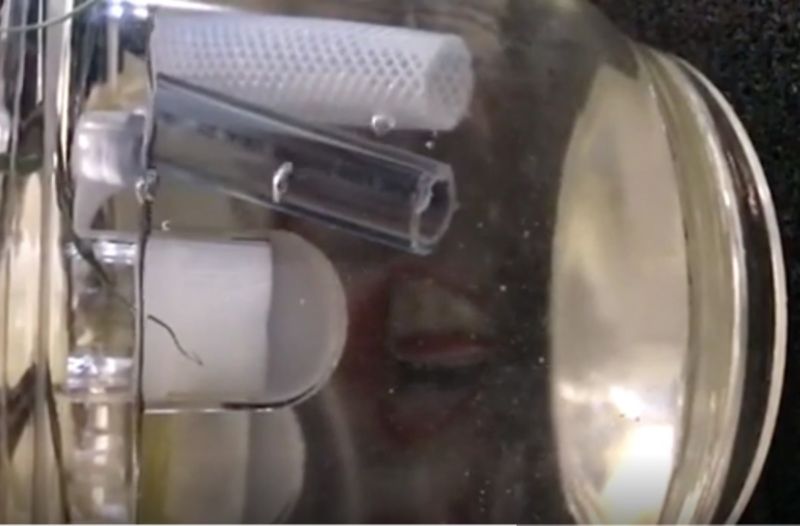
Like many people, physicist Matthew Szydagis has been amused by all those YouTube videos showing people banging on a bottle filled with water, causing it to quickly freeze in response to the blow. The trick is to supercool the water beforehand—that is, cool it below the freezing point without the water actually freezing. (Yes, it's possible.) But when he saw the same phenomenon depicted in Disney's 2013 animated film Frozen, he realized he might be able to exploit the effect to hunt for dark matter, that most elusive of substances.
The result is his so-called "snowball chamber," which relies on a newly discovered property of supercooled water. A professor at SUNY's University of Albany, Szydagis gave an overview of this research at the American Physical Society's annual April meeting, held earlier this month in Washington, DC. A draft paper can be found on arXiv, and a final version is being prepared for journal submission.
“All of my work is motivated by the search for dark matter, a form of matter we’re sure is out there because we can observe its indirect gravitational effects,” Szydagis said. “It makes up a significant fraction of the universe, but we have yet to uncover direct, conclusive and unambiguous evidence of it within the lab.” The detector could also be useful for detecting nuclear weapons in cargo, for understanding cloud formation, and for studying how certain mammals supercool their blood when they hibernate.
Not content with having a Windows-based Internet of Things platform (Windows 10 IoT) and a Linux-based Internet of Things platform (Azure Sphere), Microsoft has added a third option. The company has announced that it has bought Express Logic and its ThreadX real-time operating system for an undisclosed sum.
Real-time operating systems (RTOSes) differ from more conventional platforms in their predictability. With an RTOS, a developer can guarantee that, for example, interrupt handling or switching from one process to another takes a known, bounded amount of time. This gives applications strong guarantees that they'll be able to respond in time to hardware events, timers, or other things that might make an application want to use the CPU. This predictability is essential for control applications; for example, ThreadX was used in NASA's Deep Impact mission that hurled a large object at a comet. ThreadX was also used in the iPhone 4's cellular radio controller, and ThreadX is embedded in the firmware of many Wi-Fi devices. These tasks need the determinism of an RTOS because there are timing constraints on how quickly they need to respond.
Linux can be built with various options to offer more predictable behavior and so can address some similar scenarios. But ThreadX has another big advantage up its sleeve: it's tiny. A minimal ThreadX installation takes 2,000 bytes of storage and needs 1KB of RAM, far less than Linux can use. By way of comparison, Microsoft's Sphere hardware (which uses a custom-designed ARM processor with various security features embedded) has 4MB of RAM for applications and 16MB of storage. There are an estimated 6.2 billion deployments of ThreadX running on several dozen different kinds of processor or microcontroller.
How Super Mario Kart looks under traditional bsnes emulation... [credit:
DerKoun / FrameCompare
]
Gamers of a certain age probably remember being wowed by the quick, smooth scaling and rotation effects of the Super Nintendo's much-ballyhooed "Mode 7" graphics. Looking back, though, those gamers might also notice how chunky and pixelated those background transformations could end up looking, especially when viewed on today's high-end screens.
Emulation to the rescue. A modder going by the handle DerKoun has released an "HD Mode 7" patch for the accuracy-focused SNES emulator bsnes. In their own words, the patch "performs Mode 7 transformations... at up to 4 times the horizontal and vertical resolution" of the original hardware.
The results, as you can see in the above gallery and the below YouTube video, are practically miraculous. Pieces of Mode 7 maps that used to be boxy smears of color far in the distance are now sharp, straight lines with distinct borders and distinguishable features. It's like looking at a brand-new game.