Shared posts

20 Oct 20:27

“Most serious” Linux privilege-escalation bug ever is under active exploit (updated)

by Dan Goodin

(credit: michael)

A serious vulnerability that has been present for nine years in virtually all versions of the Linux operating system is under active exploit, according to researchers who are advising users to install a patch as soon as possible.

While CVE-2016-5195, as the bug is cataloged, amounts to a mere privilege-escalation vulnerability rather than a more serious code-execution vulnerability, there are several reasons many researchers are taking it extremely seriously. For one thing, it's not hard to develop exploits that work reliably. For another, the flaw is located in a section of the Linux kernel that's a part of virtually every distribution of the open-source OS released for almost a decade. What's more, researchers have discovered attack code that indicates the vulnerability is being actively and maliciously exploited in the wild.

"It's probably the most serious Linux local privilege escalation ever," Dan Rosenberg, a senior researcher at Azimuth Security, told Ars. "The nature of the vulnerability lends itself to extremely reliable exploitation. This vulnerability has been present for nine years, which is an extremely long period of time."

Read 6 remaining paragraphs | Comments

20 Oct 18:26

XG.fast DSL does 10Gbps over telephone lines

by Sebastian Anthony

(credit: Bob Dormon / Ars Technica UK)

Nokia has achieved a connection speed of 5Gbps—about 625MB/sec—over 70 metres of conventional twisted-pair copper telephone wire, and 8Gbps over 30 metres. The trial used a relatively new digital subscriber line (DSL) protocol called XG.fast (aka G.fast2).

XG.fast is the probable successor of G.fast, which was successfully trialled in a few countries over the past couple of years and will soon begin to commercially roll out. (In an unusual turn of events, the UK will probably be the first country with G.fast.)

Fundamentally, both G.fast and XG.fast are best described as "VDSL on steroids." Basically, while a VDSL2 signal frequency maxes out around 17MHz, G.fast starts at 106MHz (it can be doubled to 212MHz) and XG.fast uses between 350MHz and 500MHz. This means that there's a lot more bandwidth (the original meaning of the word), which in turn can be used for transferring data at higher speeds.

Read 10 remaining paragraphs | Comments

20 Oct 18:23

Europe will try not to crash its spacecraft into Mars on Wednesday

by Eric Berger

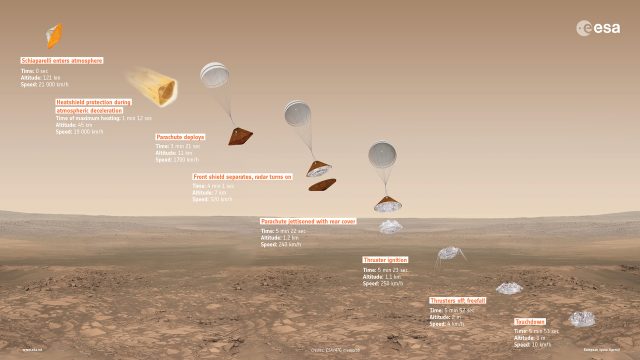
An overview of the Schiaparelli descent module's flight down to the Martian surface. (credit: ESA)

On Monday, the popular "Sarcastic Rover" Twitter account offered a succinct description for how difficult it is to launch a probe from Earth and place it safely on the surface of Mars: "Landing on Mars is like tossing a baseball from New York to Tokyo and having it drop into a can of soup. Also the can still has a lid on."

While we can't vouch for the scientific fidelity of the analogy, it seems apt, as many probes that try to land on Mars find a grave instead of a scientific wonderland. Four of the five Soviet landers sent to Mars failed to reach ground safely, and the one that did, Mars 3 in 1971, survived for only about 15 seconds. In 2003, Europe's Mars Express orbiter released the Beagle 2 lander, but its solar panels never fully deployed, and the vehicle never phoned home. Only NASA has had success; impressively, eight of its nine missions to the surface of Mars have made it.

Now Europe is trying again with its ExoMars mission, consisting of an orbiter and lander. On Wednesday morning at 10:42am ET (15:42 UK), the European Space Agency's 1.65-meter wide Schiaparelli lander will enter the Martian atmosphere and make a harrowing six-minute descent to the red planet's surface.

Read 5 remaining paragraphs | Comments

20 Oct 18:08

We are seeing strange X-ray flares that defy explanation

by Xaq Rzetelny

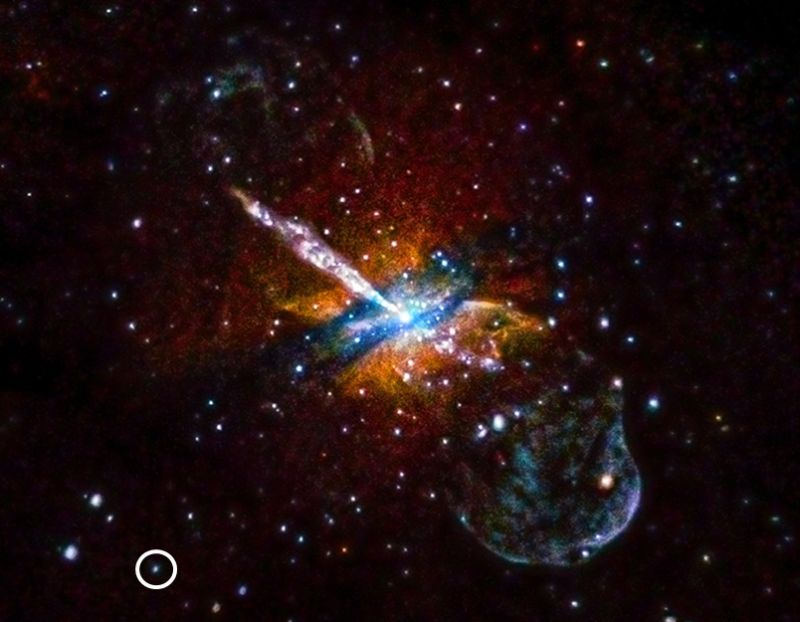
Enlarge / Chandra image shows the flaring object, circled at lower left. (credit: NASA/CXC/U.Birmingham/M.Burke et al.)

In 2005, a very strange event was observed. An unknown object, not detectable through visible light, released an intense flare of X-rays. It took about a minute for the flare to reach its full brightness, about 90 times brighter than its resting output and about a million times as bright as the Sun. The flare lasted for about an hour before petering out. Four years later, it flared up again.

X-ray flares are not unheard of, but this event defied classification. Astronomers normally look at the length of the flares as well as how often they occur to determine what kinds of processes produce them. These flares don’t match any known mechanism, making them mysterious indeed.

To find out more, a team of researchers decided to look over archival data from the Chandra and XMM-Newton space observatories. They wondered if similar phenomena are taking place anywhere else in the Universe. If so, it might provide clues about the nature of these strange flares. And the researchers weren’t disappointed. Their search, which included 70 nearby galaxies, turned up two more such flares.

Read 10 remaining paragraphs | Comments

20 Oct 17:56

Rented PC servers for Battlefield 1 will cost over $300 a year

by Kyle Orland

Enlarge / The expansive dunes of BF1's Sinai level give way to a more populated military outpost.

If you want to rent a fully customizable server for your Battlefield 1 matches, be prepared to pay just over $300 a year. That's how much publisher Electronic Arts will be charging for its rental server program starting in November, according to an announcement on the Battlefield forums today.

The total cost varies by platform (PC players pay a roughly 50 percent premium over console players) and the length of the rental, as follows:

PC
1 day: $2.99
7 days: $11.99
30 days: $42.99
90 days: $99.99
180 days: $149.99

PS4/Xbox One
1 day: $1.99
7 days: $7.99
30 days: $26.99
90 days: $64.99
180 days: $99.99

Battlefield 1 players will still be able to play for free on EA's standard servers, which will host a variety of vanilla game modes for both ranked and unranked play for up to 64 players. Those who shell out to host a rented server will get full control over details like map rotation, game modes, and gameplay settings like bullet damage and weapon availability. While EA says it "might restrict number of game modes available at launch and gradually enable them based on feedback and other circumstances," the company promises additional customization options will be added through 2016 and beyond.

Read 3 remaining paragraphs | Comments

20 Oct 15:36

New antibiotic mined from human gut reverses drug resistance in superbugs

by Beth Mole

Enlarge / Rhodococcus group bacteria (credit: CDC)

For years, scientists have been digging into dirt mounds and mud pits across the globe to uncover new antibiotics. But they may have to look no further than their own pile of poop.

The microbes bustling in our bellies may be gold mines for new antibiotic drugs, researchers report this week in Nature Chemical Biology. As proof of gut-bugs’ potential, the authors dug up a new bacteria-busting drug that can reverse resistance in pathogens and help kill off methicillin-resistant Staphylococcus aureus (MRSA) bacteria. In mice with lethal MRSA infections, the drug helped cure 100 percent of infections.

The finding shouldn’t be surprising; many of modern medicine’s most powerful antibiotics were pilfered from microbes. The tiny critters use the drugs to defend themselves from other microbes and battle for turf and resources. But, as bacteria develop resistance—creating an urgent public health crisis—scientists have been seeking new drugs to usurp. In their search, many scientists turned to sifting through exotic soils and sediments. They assumed that the molecular weaponry of bacteria closest to us had already been tapped. Yet, as more researchers delve into the complex microbial communities within us—our microbiomes—they’re finding new depths to plumb.

Read 5 remaining paragraphs | Comments

20 Oct 15:33

Nintendo’s next console, Switch, is a console/tablet hybrid coming in March

by Kyle Orland

Enlarge

In a three-minute "Preview Trailer" released this morning (and teased last night), Nintendo gave the world the first glimpse of the mysterious "Project NX," over 19 months after the company first mentioned the "dedicated game platform with a brand-new concept." The system is called the Nintendo Switch.

As was widely rumored, that "new concept" involves a console/portable hybrid system with two detachable, one-handed controllers that sit alongside a tablet-style screen. Nintendo is referring to these publicly as "Joy-Con" controllers, which "can be employed by numerous people for a variety of gameplay options. They can easily click back into place or be slipped into a Joy-Con Grip accessory, mirroring a more traditional controller." The system will also support a Nintendo Switch Pro Controller with a more traditional dual-analog stick form factor, and support local multiplayer gaming on multiple Switch tablets at once, according to a press release.

"In addition to providing single and multiplayer thrills at home, the Nintendo Switch system also enables gamers to play the same title wherever, whenever and with whomever they choose," Nintendo said in a press release announcing the system. "The mobility of a handheld is now added to the power of a home gaming system to enable unprecedented new video game play styles."

Read 5 remaining paragraphs | Comments

20 Oct 14:58

You Can Travel Through Space but You Don't Know How to Leave a Review on Amazon?

19 Oct 15:23

Forward to the Past!

Forward to the Past! Works for me.

source: deviantART
via: Cheezburger


See more: Forward to the Past!
19 Oct 14:38

If the Legend of Zelda were Actually About Zelda

Is it wrong that I actually like this version of Ganon?

source: YouTube


See more: If the Legend of Zelda were Actually About Zelda
18 Oct 18:40

You've Turned Him Into a Monster

18 Oct 13:33

Grab a PSL and Snuggle Up, These Web Comics Will Remind You Why You Love Fall

Now that you've ordered your pumpkin spice latte and dug all your scarves out of the closet, it's time to settle down and stare at the warm glow of your screen. These fall flavored web comics are just what you were missing.

17 Oct 21:30

Frozen Meets Dark Souls and I Don't Know How I Feel About This

17 Oct 21:29

Made an Important Discovery in Time for the 100th Comic.

grammar,internet,web comics

I tried single-spacing. I don't want to live in that world.

Submitted by: JosephSim84 (via www.bartenerds.com)

17 Oct 20:23

Photo


17 Oct 16:05

TFW an obituary you wrote five years ago goes viral

by Sean Gallagher

(credit: Photograph by Kevin Marks)

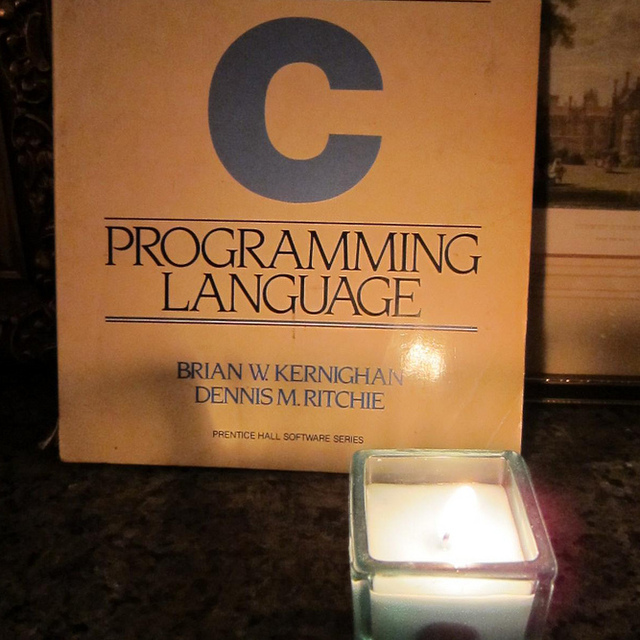
This week, as I was sitting in my father's hospital room, I glanced at my phone and saw something strange going on with my Twitter notifications. A story I wrote five years ago was suddenly exploding across social media. It was my tribute to Dennis Ritchie, the creator of the C programming language and co-creator of Unix, republished from Ars by Wired on October 12, 2011:

I wasn't sure what had set this off. But the deluge began to build even more after this tweet from Om Malik:

Malik later apologized for posting a five-year-old story—one that was perhaps overshadowed at the time by the attention paid to the passing of Steve Jobs a week earlier. But he clearly wasn't the only one who thought the story was fresh news, as my Twitter and Facebook timelines showed.

Read 6 remaining paragraphs | Comments
13 Oct 20:20

Cup of Joe [Comic]

by Geeks are Sexy

joe
joe1

I don’t know about you, but I wouldn’t want my cup of coffee to start talking to me, especially if it has eyes, names itself “Joe” and asks me to put its content inside me. That’s a big no-no.

A comic by artist J. L. Westover from Mr. Lovenstein comics. If you like what the artist does, be sure to follow him wherever he is on Internet. Links are below.

[Source: Mr. Lovenstein Comics | Like Mr. Lovenstein on Facebook | Follow “Mr. Lovenstein” on Twitter]

The post Cup of Joe [Comic] appeared first on Geeks are Sexy Technology News.

12 Oct 21:25

Photo


12 Oct 17:31

Comcast fined $2.3 million by FCC for “negative option billing” practices

by Sam Machkovech

The FCC announced a $2.3 million fine against Comcast on Tuesday after confirming that the company had been billing customers for products and services they had never ordered. After calling the fine "the largest civil penalty assessed from a cable operator by the FCC," the federal agency's announcement detailed exactly how Comcast bilked customers—and new company practices that must be put into place as a result.

According to the FCC's Office of Media Relations, the agency had received "numerous complaints from consumers" about the issue of "negative option billing"—meaning, receiving charges for items that the customers had never affirmatively requested. (The FCC reminds readers that in the telecom world, this practice is known as "cramming.") The listed complaints revolve specifically around items related to cable TV service, including "premium channels, set-top boxes, and DVRs."

“Despite specifically declining service or equipment upgrades”

Though the FCC's statement didn't quote particular complaints or state how many the agency received, it described a range of unsavory reports from customers, including "being billed despite specifically declining service or equipment upgrades offered by Comcast," "having no knowledge of unauthorized charges until they received unordered equipment in the mail," and "expending significant time and energy to attempt to remove unauthorized charges from their bills and obtain refunds." (Ars has reached out to the FCC with questions about specific complaints and the number received; we will update this report if we receive a response.)

Read 7 remaining paragraphs | Comments

12 Oct 16:57

Why Obama’s “giant leap to Mars” is more of a bunny hop right now

by Eric Berger

Enlarge / President Barack Obama delivers a speech at the Operations and Checkout Building at NASA Kennedy Space Center in Cape Canaveral, Florida on Thursday, April 15, 2010. (credit: NASA/Bill Ingalls)

Given how far NASA lies down the food chain of White House priorities, it's always welcome when a president engages in a discussion of space policy. And that's what President Obama did on Tuesday when he authored an op-ed that appeared on CNN.com and called for America to take a "giant leap" by sending humans to Mars in the 2030s.

There wasn't much new in the president's call to action, as it wasn't all that different from a space policy speech he delivered in 2010. The president said then at Kennedy Space Center, "by the mid-2030s, I believe we can send humans to orbit Mars and return them safely to Earth. And a landing on Mars will follow." The similarity of his words, spoken six years apart, gives us a chance to judge his administration's space policy, and the verdict is pretty straightforward: Obama has set NASA and the United States on a course to Mars.

It is an easy thing to say "We are going to Mars," however, and a far more difficult thing to do it. In reality, Obama has put NASA on an unsustainable pathway to Mars given NASA's current resources and approach, and he is leaving the hard work of actually getting to Mars to his successors. In other words, right now, NASA is on a journey to Mars in name only.

Read 21 remaining paragraphs | Comments

12 Oct 16:54

Stargate Sterling Spinner Ring: These Chevrons Encode Manually

by Geeks are Sexy

ring

From Thinkgeek:

This clever ring is hand-cast in solid sterling silver and mimics the Stargate, with two separate, highly detailed components: an outer ring and an inner ring. The outer ring has a three-dimensional design that features the nine chevrons (visible from both sides) and architectural detailing along the top. The inner ring sports a screen-accurate recreation of the glyphs that orient the Stargate, also visible from either side. The best part? The two rings actually spin around each other! The only thing missing is the artificial wormhole, and really that’s probably for the best. We wouldn’t want anyone losing a finger in a mini Chappa’ai. Feel free to give this ring a spin and see if you get to work faster, though!

[Stargate Sterling Spinner Ring]

The post Stargate Sterling Spinner Ring: These Chevrons Encode Manually appeared first on Geeks are Sexy Technology News.

12 Oct 13:36

Man Performs the “Dragon Ball Z” Theme on “The Voice Thailand” [Video]

by Geeks are Sexy

Watch as a contestant at the Thai version of “The Voice” performs a fantastic rendition of the Dragon Ball Z theme, “Cha-La Head-Cha-La.” A little later in the clip, he also sings the theme to Doraemon. This is certainly not something we’d see at the Canadian or American versions of The Voice. This clip has been viewed more than 3.7 million times as I’m writing this, which mean this guy pretty much won the Internet this week.

[The Voice Thailand]

The post Man Performs the “Dragon Ball Z” Theme on “The Voice Thailand” [Video] appeared first on Geeks are Sexy Technology News.

11 Oct 17:32

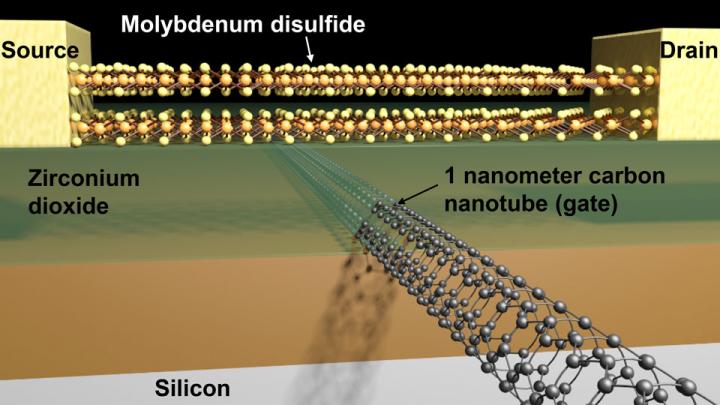
Transistor with a 1nm gate size is the world’s smallest

by John Timmer

Enlarge (credit: Sujay Desai/Berkeley Lab)

Conventional silicon-based electronics are rapidly approaching a fundamental barrier. Below about five nanometers, quantum effects make their behavior unpredictable. That's led to research into alternative materials such as carbon nanotubes. Now, a large collaboration has taken a different material—molybdenum disulfide, or MoS2—and used its distinctive properties to craft a transistor that has a gate size of just one nanometer.

Unfortunately, other parts of the hardware are quite a bit larger than that, and we have no way of producing these in bulk yet. But the work validates that MoS2's properties can allow us to shrink electronics down below silicon's limits.

The idea behind the work is that a property of silicon we normally view as beneficial becomes an issue once things get small enough. That property is the mobility of electrons within silicon. On the positive side, the electrons move with less resistance when we want them to, but they also move more readily when we don't want them to. This unwanted movement causes an increase in current leaking across transistors when they're supposed to be off. Once silicon features get small enough (that 5nm limit mentioned above), leakage becomes large enough that it's impossible to tell whether a transistor is on or off.

Read 7 remaining paragraphs | Comments

10 Oct 18:40

FCC proposes broadband privacy rules despite opposition from ISPs

by Jon Brodkin

Enlarge (credit: Getty Images | Yuri_Arcurs)

The Federal Communications Commission plans to vote on rules protecting the privacy of broadband subscribers later this month despite persistent opposition from Internet service providers.

FCC Chairman Tom Wheeler circulated the proposal to commissioners today and scheduled a vote for October 27. The rules are likely to be approved by a 3-2 vote with the commission’s Democratic majority supporting them.

The proposed rules will put broadband providers under a stricter privacy regime than the one imposed on websites like Google and Facebook, which are regulated separately by the Federal Trade Commission. The rules will require ISPs to get opt-in consent from consumers before sharing Web browsing data and other private information with advertisers and other third parties.

Read 15 remaining paragraphs | Comments

10 Oct 18:38

Blade Runner sequel named Blade Runner 2049, out October 2017… in VR!

by Mark Walton

Enlarge (credit: Alcon Entertainment and Warner Bros.)

Remember that Blade Runner sequel announced earlier this year? It finally has a name—and no, it's not Blade Runner 2. The sequel to one of the greatest science-fiction films of all time is now known as Blade Runner 2049, and it's coming out one year from now on October 6, 2017, not January 2018 as previously announced.

If that wasn't to wet your sci-fi whistle, Oculus has also confirmed that Blade Runner 2049 will be released in virtual reality on the Oculus Rift and other Oculus platforms (read: Samsung Gear VR), as well as in cinemas. Whether that means there will be a simultaneous release is unclear, but Oculus has promised to reveal more details at a later date.

Oh, and a series of experiences about classic Disney characters are also coming to Oculus.

Read 4 remaining paragraphs | Comments

10 Oct 18:38

Comcast gets closer to nationwide data caps with expansion in 18 states

by Jon Brodkin
Talynebear

i have not hit 1tb for a month yet, came close though a few times

Enlarge / A Comcast data cap notification. (credit: Comcast)

Comcast is bringing data caps to a bunch of new cities beginning November 1, roughly doubling the number of markets where it imposes data limits and overage fees. As before, customers will be allowed to use 1TB of data per month before being hit with overage charges of $10 for each additional 50GB. For an extra $50 per month, customers can purchase unlimited data.

Prior to the expansion, Comcast said it was enforcing data caps in 14 percent of the markets in its 39-state territory. Instead of immediately imposing caps nationwide, Comcast has been steadily rolling them out to new markets since 2012, usually adding a few at a time and gauging customer feedback before expanding to more. The caps were originally 300GB a month, but as more customers started exceeding them, they were boosted to 1TB (downloads and uploads combined) this year. Comcast says more than 99 percent of its customers use less than a terabyte of data.

Markets in 18 states will face data caps and overage fees for the first time, though other markets in some of these states were already capped.

Read 6 remaining paragraphs | Comments
07 Oct 13:54

Those Martian settlements sound great, but something important is missing

by Annalee Newitz
Talynebear

.....stellaris pros need apply

Enlarge / Growing food and creating a livable environment are two engineering challenges on Mars that are just as important as making fuel. (credit: The Martian)

While Elon Musk's recent speech about the glories of Martian colonies is still echoing in our ears, we should take a moment to consider what it means to colonize a planet. It's not just about setting up some habitat pods and sucking water out of the regolith. Acquiring food and a livable environment are just as important as manufacturing rocket fuel, which is why it made sense to make a botanist the brave hero of recent colonization epic The Martian. You might say that growing space potatoes is key to the interplanetary survival of our species.

Put another way: we need awesome rockets to get to Mars, but we need environmental science if we're going to stay there. Colonization requires us to settle—actually settle, like my ancestors did in the 19th century wilds of Texas—in an alien ecosystem. For all we know, that ecosystem might be teeming with life. Unfortunately, colonization also requires us to destroy that alien ecosystem and replace it with one we prefer.

This is where we run headlong into the moral quandaries of our future space adventures. We can use existing environmental science to understand the nature of these quandaries. But to prepare for the ethical issues involved, it helps to have some science fiction.

Read 16 remaining paragraphs | Comments

06 Oct 18:10

Blue Origin just validated the new space movement

by Eric Berger
  • The moment of separation during Tuesday's test flight.
    Blue Origin

On Tuesday morning Blue Origin did something no other company, or country, has ever done before. The company launched its rocket, and 45 seconds later, instructed the capsule to fire its engine and abort the flight. The rocket subsequently emerged from a curtain of flames and continued into space, blackened but not broken. Later, both the capsule and rocket safely landed in the West Texas desert.

The dramatic flight of the New Shepard vehicles made for exceptional viewing, and Blue Origin obliged with a webcast from start to finish. But more than that, the dramatic minutes between launch and landing felt like something of a historic turn in human spaceflight.

This particular capsule and rocket have now flown together five times in less than 11 months and passed a succession of ever more rigorous tests. After flying New Shepard twice in late 2015 and early 2016 on nominal missions, the company began pushing the envelope. In April, it held off restarting the rocket’s BE-3 engine until just 3,600 feet above the ground, six seconds before landing. The engine responded by restarting and ramping up quickly. Two months later, the company intentionally had one of the capsule’s three parachutes fail during landing, and it still made a safe touchdown. And on Tuesday, of course, the company conducted its most dramatic test of all, an in-flight abort.

Read 16 remaining paragraphs | Comments

06 Oct 14:08

Great Idea for a Spinoff

ff

05 Oct 20:07

Works Like Magic