Shared posts

20 Mar 00:45

Links & Reviews

- The London International Antiquarian Bookfair (the "Olympia" fair) was held this weekend. On the Economist's Prospero blog, it was hailed as "An antiquarian obsession."

- On bookfairs: don't miss Garrett Scott's "A hasty and discursive meditation on the care and feeding of a book fair," or Lorne Blair's post on the recent inaugural Library of Virginia Book Fair. And definitely don't miss the first part of Lorne's new series on the importance of regional book fairs: "Six Days On the Road & I'm Gonna Make it Home Tonight." At the end of this post he asks some key questions, questions I think all of us concerned with these matters should be thinking about.

- A panel discussion was held at the NYPL this week on the much-debated renovations plan. Caleb Crain has a full rundown, with links to audio/video of the event as well. Robin Pogrebin covered the discussion for the NYT, including in a followup piece the little nugget that former employees of the library believe they've been silenced by "nondisparagement agreements."

- For the culinary codicologist: historiated initial cookies!

- Mt. Vernon's efforts to recreate George Washington's library got a writeup in the Washington Post this weekend. Unfortunately it opens with the line "Gently, gently, the librarian opens the first of the five books displayed on the large wooden table, and age seems to rise up from the pages like a wavy distortion above heated pavement." While I think the recreation is a neat idea (virtual is handy, but real is cooler), I'm not sure how I feel about the idea of Washington's books being "replicated with pages scanned from the Athenaeum's collection and put into an 18th-century-style binding with endpaper and leather and gold tooling." I certainly hope that means that the scans would be made available to all (as with the John Adams library); it just doesn't make much sense, today, to create scanned physical surrogates in bespoke bindings just for the sake of doing so. But, overall, I'm really glad to see the project going forward, and wish them great luck!

- Over at The Collation, Erin Blake examines the difference(s) between a colored print and a color print, and Heather Wolfe explores Shelton's tachygraphy, a common form of early modern shorthand.

- More on the Girolamini library thefts I mentioned last week: the former director, Mario Massimo de Caro, and four others have been arrested.

- Mike Widener notes a book in the Yale Law library's collections with the bookplate and signature of Johann Peter von Ludewig.

- Mary Norris of The New Yorker has a very amusing post about the printing of a thorn (þ) in a recent issue of the magazine.

- Dan Cohen muses on the "blessay." Make sure to read the updates, too.

- Glenn Fleishman posted this week on a recent visit to the Folger Shakespeare Library, where he talked to Sarah Werner about the physicality of books.

- Mark Anderson talked to the CSM about his new book on the Transit of Venus.

- The Russian State Polytechnical Museum Library in Moscow recently discovered some 30,000 pre-Revolutionary books hidden behind a false wall.

- Booksellers Adrian Harrington and Jonathan Kearnes star in a 15-minute video, "The Story of the Book." It's beautifully done. [h/t Book Patrol]

- At Boston 1775, J.L. Bell asks "How did people pronounce 'Faneuil Hall'?"

- A great new acquisition is highlighted on the Houghton Library blog: a 1741 book with a nifty five-ribbon bookmark.

- Queen Victoria's journals have been mounted online, free to the world through the end of June (and in the UK thereafter).

Reviews

- Wesley Stace's Charles Jessold, Considered as a Murderer; review by Miriam Burstein at The Little Professor.

- Peter Carey's The Chemistry of Tears; reviews by Andrew Miller in the NYTimes and Ron Charles in the WaPo.

- Hilary Mantel's Bring Up the Bodies; reviews by Martin Rubin in the LATimes; Charles McGrath in the NYTimes.

- E.O. Wilson's The Social Conquest of Earth; review by Thomas Maugh in the LATimes.

- Pretty much every major American birding field guide; review by Laura Jacobs in the WSJ.
20 Mar 00:45

How-To: Bacteria Battery

Bacteria Battery from MAKE Volume 30

Did you know you can generate electricity from the “metal-breathing” anaerobic bacteria found in ordinary mud? Having no oxygen to breathe, these bacteria produce energy for their growth by transferring electrons to clumps of rust and other metal oxides, in a process called dissimilatory metal reduction. Dr. Ashley Franks, director of K–12 outreach at the Geobacter Project and senior lecturer at Latrobe University, has extensively studied these bacteria, and shared his how-to for creating your own microbial fuel cell to harness this energy on the pages of MAKE Volume 30.

From his intro:

A microbial fuel cell (MFC) does the same thing as a battery: drive electrons from an anode to a cathode through chemical oxidation/reduction reactions. What makes MFCs different is that they run on organic substrate and bacteria.

“Metal-breathing” (Geobacter) bacteria at the anode carry out the oxidation reaction, converting plant and animal debris in the mud into electricity and carbon dioxide. Electrons flow through wires to a cathode sitting in water above the mud, where they combine with oxygen to complete the circuit. The bacteria are highly efficient in this arrangement and can produce electricity continuously for many months or even years.

Experimental MFC-powered buoys now operate in the Potomac River, using naturally occurring bacteria in the mud to measure and transmit meteorological data. These “Benthic Unattended Generators” (BUGs) have worked for several years with no decrease in power output (see http://nrl.navy.mil/code6900/bug). Geobacter species possess other useful abilities, such as the ability to respire radioactive uranium and remove it from ground water. They have proven versatile and effective in cleaning up areas contaminated with uranium or organic pollutants.

Dr. Frank’s full how-to is available for you over on Make: Projects and the Maker Shed even carries the KeegoTech MuddWatt MFC Kit, which includes all the parts you need except for the mud.

From the pages of MAKE Volume 30:

MAKE Volume 30Until recently, home automation was gimmicky, finicky, and user-hostile. But today, thanks to a new crop of devices and technology standards, home automation is useful, fun, and maker-friendly. In the special section of MAKE Volume 30, we’ll show you: how to flip any switch in your home with a smartphone, home automation without programming, controlling your HVAC with an Arduino, a webcam security system, and a wall-mounted Notification Alert Generator (NAG) that plays timely reminders as you walk by. Plus, you’ll build a Yakitori Grill, a robust R/C flying-wing airplane, sturdy furnishings from PVC, and more!

BUY OR SUBSCRIBE!


20 Mar 00:44

Networking 2.0: How to Connect With Your Heroes

I sat down with James Swanwick, cohost of ESPN Sportscenter Australia, where I asked him about his method of networking. I first met James in Colombia, where he emailed asking to meet for coffee. I have a lot of meetings with readers of mine, and I found James very interesting and friendly—he asked ...

Read More
20 Mar 00:44

How-To: Extract and Process Natural Clay

This two-part series from Eddie Starnater of Practical Primitive shows you how to extract the clay from raw soil and process it into a material that can be used for pottery. In the first part, Eddie teaches a simple water extraction process that uses a series of mixing and decanting steps to remove sand and silt, followed by pouch filtration to remove excess water. The handling properties of this material will naturally vary from batch to batch, and part two describes an easy testing protocol for determining how much grog to add to correctly “temper” your clay so that it will best stand up to shrinkage and thermal shock.

Processing Clay the Easy Way: Water Extraction
Primitive Pottery: Adding Temper to Clay

More:
How-To: Knap an Arrowhead from a Beer Bottle


20 Mar 00:44

How-To: Trashcan Raku Kiln

The field of raku pottery is rich and diverse.  The term seems to vary, in use, from a broad catch-all for various low-temperature firing processes to an entire philosophy of art and life.  Without risking oversimplifying the matter, I think I can safely say that one of the many appealing aspects of raku is its accessibility, especially in terms of equipment.  A raku firing need only achieve 1000°C, which is at the low end of the potter’s temperature scale, and easily achieved in a homemade kiln fueled, for instance, by a propane bottle.

The raku kiln pictured here was built by Paul Jessop of the UK from a galvanized steel “dustbin,” a roll of ceramic wool, some wire, a couple of fire bricks, and a few other odds and ends. Paul documented the build in this cool photoessay back in July of 2010, and Popular Mechanics seems to have later adapted and illustrated it to produce the step-by-step tutorial linked below.

Build a Raku Kiln – Popular Mechanics

More:
Incredible Raku-Ware Howl’s Moving Castle


20 Mar 00:44

DETHJUNKIE*

20 Mar 00:44

YOUNG DUMB & FULL OF CUM

20 Mar 00:44

Beautiful Marbled Papers

Jemma Lewis.jpgThe art of paper marbling is not lost to Jemma Lewis, a young professional marbler based in rural Wiltshire, UK. Her small family business (her father assists) opened in April of 2009, after she spent eight months in specialized training following a seven-year apprenticeship at local bookbinders, Chivers-Period. Previously Lewis had studied textiles, but at Chivers, she said, "I became interested in antique books and the beautiful marbled papers that bookbinders used as endpapers."

Lewis provides her wares to bookbinders, publishers, artists, interior designers, fashion designers, and furniture restorers. Her website showcases more than fifty hand-marbled papers in traditional designs, such as the one seen below. She also offers bespoke designs for specific projects and a matching service in which she reproduces historic designs for repair work.

gallery50-large.jpgHer specialty "one-off" art marbled papers, like the one seen here called "Meadow," are amazing. They can be used for bookbinding, of course, or they can be framed as is. She has a Flickr page showing some of her other designs.

speciality-paper.jpgAll images courtesy of Jemma Lewis Marbling & Design
20 Mar 00:43

img_7215_resize.jpg 467×700 pixels

20 Mar 00:43

2_resize.jpg 467×700 pixels

20 Mar 00:43

Lancia TrendVisions - Trend Wall

20 Mar 00:43

Tumblr

20 Mar 00:43

SKINNY

20 Mar 00:42

State of the CDN: More Traffic, Stable Prices, More Products, Profits - Not So Much

CDNs (content delivery networks) are the secret shadow super powers behind the web and Dan Rayburn at streamingmedia.com is the go to investigative reporter for quality information on CDNs. Every year Dan has a Content Delivery Summit on all things CDN and those videos are now available. Dan also gives a kind of state of the industry talk where he does something wonderful, he gives real numbers and prices. Dan really knows his stuff and is an excellent speaker, so watch the video, but here’s my gloss on the state of the CDN so far this year:

  • Massive growth. Large customers are expecting 126% growth in video traffic over last year; medium size customers are seeing 48% traffic growth, small sized customer are seeing 73.3% traffic growth.
  • More traffic != More profit...
20 Mar 00:42

Heineken Cube Concept

Heincubdiel813

Designed to overcome the overly loss of space between the cylinders of beer, Heineken Cube optimizes storage all along the chain: from manufacturer to consumer.

20 Mar 00:39

Shark! | Flickr - Photo Sharing!

20 Mar 00:39

entry2.jpg 670×447 pixels

20 Mar 00:39

tumblr_lyeb12659u1qahug3o1_500.png 500×683 pixels

20 Mar 00:38

Extant Americana

Catalogue Review: Extant Americana, #1

Screen shot 2012-09-13 at 2.13.24 PM.pngIf this is catalogue #1 from the New York City-based Extant Americana, our eyeglasses might be knocked off by forthcoming catalogues. There is so much visual punch on these pages, beginning with the cover illustration of a signed gelatin silver print of Fort Peck Dam by Margaret Bourke-White ($15,000).

How about a piece of watercolor folk-art depicting a black Union soldier holding some playing cards ($1,250). From the same period, a set of "extremely rare" hand-colored prints by Currier and Ives bound into a salesman's sample book, c. 1863 ($10,000). The prints are Civil War scenes, such as the bombardment of Fort Sumter and combat between the Monitor and the Merrimac. They show some foxing, but the colors are amazing.

The red-tinted tintype of a fireman and his dog is a fascinating piece ($2,250), as is (for all the wrong reasons) a real-photo postcard of the public lynching of John Heath in 1885 ($2,250). The rare German Army recruiting poster titled "Und Du?" by Ludwig Hohlwein is another striking image ($6,000).

Bright Buffalo Bill posters and circus posters, advertising broadsides, Civil War medical photos, and election ephemera are also offered throughout, not to mention important letters, presidential autographs, and cool things like an 1872 Skull & Bones Society gold lapel pin (in a group with a yearbook and additional cartes de visit; $2,750).

Nearing the end of this jam-packed catalogue, you'll find an original ink drawing by New Yorker artist Saul Steinberg that has never before been offered ($30,000) as well as a "women's rights" toy figurine depicting a crude caricature version of Sojourner Truth that is quite incredible to see ($10,000).

But's there more, so much more! You can download the full catalogue here: http://extantamericana.com/


20 Mar 00:36

Tweepy

Tweepy:

A Python library for accessing the Twitter API.

20 Mar 00:35

HoRNDIS

HoRNDIS:

HoRNDIS (pronounce: “horrendous”) is a driver for Mac OS X that allows you to use your Android phone’s native USB tethering mode to get Internet access.

Thanks, @ofxartem!

20 Mar 00:35

A Pattern Language

Don’t go to architecture school; devour this book instead and use it to design buildings and places that really work. This 1,000-page encyclopedia contains two hundred design patterns found in the buildings and cities that people love. For instance, pattern number 167: “Balconies and porches less than 6 feet deep are hardly ever used.” Therefore make balconies wider than 6 feet. Each pattern is what computer programmers call a heuristic: a compressed principle that can be unpacked in many ways. Each pattern is illustrated with exemplary examples and photos, and sociological evidence from studies of real places.

Employ this book to design attractive, timeless buildings (or towns) by combining as many of these patterns as can be consistently contained in one project. Does the house have a hat? An obvious central entrance? A transition zone between public and private? All these are eternal patterns that have worked in the past and will make a place better. First published 45 years ago by Christopher Alexander and team, this book has influenced tens of thousands of architects and urban planners who credit it with giving them tools to make buildings and towns that operate at human scale.

I used this pattern language to design our own house and my studio and both are structures that people love to be in. Among the many fancy homes I have visited, my three favorites are houses designed by the owners using Alexander’s pattern wisdom. These spaces are comfortable, humane, inviting, and the structures treat inhabitants intelligently.

-- KK

A Pattern Language

Christopher Alexander, Sara Ishikawa, Murray Silverstein

1977, 1171 pages

$40

Available from Amazon

Sample Excerpts:

In both format (patterns) and content (timeless wisdom) this is a core text for anyone building anything at human scale.

A building cannot be a human building unless it is a complex of still smaller buildings or smaller parts which manifest its own internal social facts.

*

Ceiling Height Variety

A building in which the ceiling heights are all the same is virtually incapable of making people comfortable.

In some fashion, low ceilings make for intimacy, high ceilings for formality. In older buildings which allowed the ceiling heights to vary, this was almost taken for granted.

*

Pools of Light

Uniform illumination–the sweetheart of the lighting engineers–serves no useful purpose whatsoever. In fact, it destroys the social nature of space, and makes people feel disoriented and unbounded.

*

On no account place buildings in the places which are most beautiful. In fact, do the opposite. Consider the site and its buildings as a single living eco-system. Leave those areas that are the most precious, beautiful, comfortable, and healthy as they are, and build new structures in those parts of the site which are least pleasant now.

*

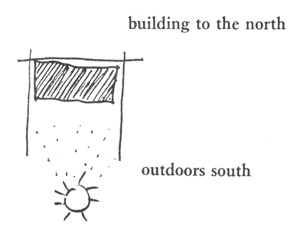
Always place buildings to the north of the outdoor spaces that go with them, and keep the outdoor spaces to the south. Never leave a deep band of shade between the building and the sunny part of the outdoors.


*

 Each creates the transition with a different combination of elements.


*

Make a transition space between the street and the front door. Bring the path which connects street and entrance through this transition space, and mark it with a change of light, a change of sound, a change of direction, a change of surface, a change of level, perhaps by gateways which make a change of enclosure, and above all with a change of view.

*

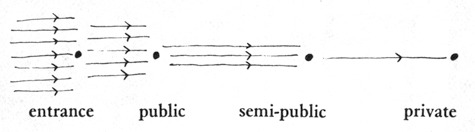
Lay out the space of a building so that they create a sequence which begins with the entrance and the most public parts of the building, then leads into the slightly more private areas, and finally to the most private domains.

 *

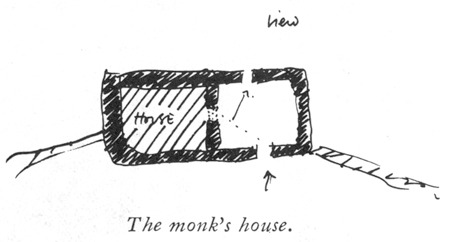
A Buddhist monk lived high in the mountains, in a small stone house. Far, far in the distance was the ocean, visible and beautiful from the mountains. But it was not visible from the monk’s house itself, nor from  the approach road to the house. However, in front of the house there stood a courtyard surrounded by a thick stone wall. As one came to the house, one passed through a gate into this court, and then diagonally across the court to the front door of the house. On the far side of the courtyard there was a slit in the wall, narrow and diagonal, cut through the thickness of the wall. As a person walked across the court, at one spot, where his position lined up with the slit in the wall, for an instant, he could see the ocean. And then he was past it once again, and went into the house.

What is it that happens in this courtyard? The view of the distant sea is so restrained that it stays alive forever. Who, that has ever seen that view, can ever forget it? Its power will never fade. Even for the man who lives there, coming past that view day after day for fifty years, it will still be alive.

This is the essence of the problem with any view. It is a beautiful thing. One wants to enjoy it and drink it in every day. But the more open it is, the more obvious,the more it shouts, the sooner it will fade. Gradually it will become part of the building, like the wallpaper;  and the intensity of its beautify will no longer be accessible to the people who live there.

Therefore:

If there is a beautiful view, don’t spoil it by building huge windows that gape incessantly at it. Instead, put the windows which look onto the view at places of transition–along paths, in hallways, in entry ways, on stairs, between rooms.

If the view window is correctly placed, people will see a glimpse of the distant view as they come up to the window or pass it; but the view is never visible from the places where people stay.

*

Balconies and porches which are less than six feet deep are hardly ever used.

*

 *

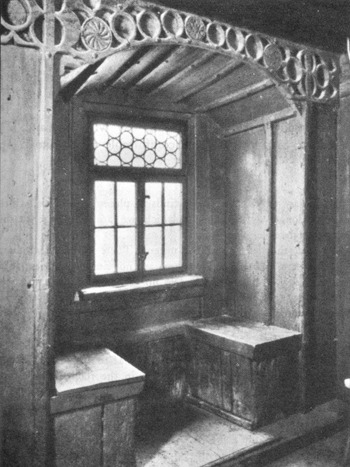
Everybody loves window seats, bay windows, and big windows with low sills and comfortable chairs drawn up to them.

It is easy to think of these kinds of places as luxuries, which can no longer be built, and which we are no longer lucky enough to be able to afford.

In fact, the matter is more urgent. These kinds of windows which create “places” next to them are not simply luxuries; they are necessary. A room which does not have a place like this seldom allows youth feel fully comfortable or perfectly at ease. Indeed, a room without a window place may keep you in a state of perpetual unresolved conflict and tension–slight, perhaps, but definite.

*

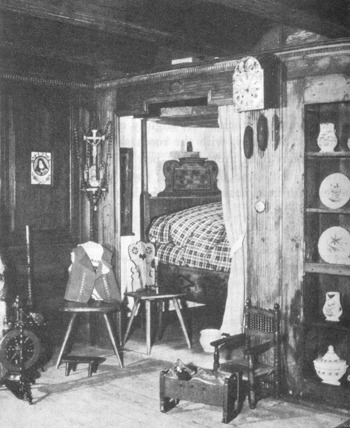
Bed Alcove

Bedrooms make no sense.

Don’t put single beds in empty rooms called bedrooms, but instead put individual bed alcoves off rooms with other non sleeping functions, so the bed itself becomes a tiny private haven.

*

Now, try to imagine how, on your particular site, you can establish this pattern. Stand on the site with your eyes closed. Imagine how things might be, if the pattern, as you have understood it, had suddenly sprung up there overnight. Once you have an image of how it might be, walk about the site, pacing out approximate areas, marking the walls, using string and cardboard, and putting stakes in the ground, or loose stones, to mark the important corners.

While you are imagining how to establish one pattern, consider the other patterns listed with it. Some are larger. Some are smaller. For the larger ones, try to see how they can one day be present in the areas you are working on, and ask yourself how the pattern you are now building can contribute to the repair or formation of these larger patterns.

20 Mar 00:35

Rainbow Connection on Behance

20 Mar 00:34

this isn't happiness.™

20 Mar 00:34

'Lost Girls', Sex & Children

The Taboos of Alan Moore, Conclusion  The topic of sexuality and children elicits justifiably strong reactions. However, as with most strong emotions, it also leads to unjustified, often irrational, responses to non-dangers. Whether this is the over-stated claim that 50,000 paedophiles “prowl ...

Read More
20 Mar 00:34

New school C

Choosing a programming language for that project you’re working on is a fairly straightforward decision: it needs to be fast, easy to use, and it must come with enough bells and whistles to keep you from re-inventing the wheel every time you want to do something.

Looking at this criteria, aside from the fast bit, the C language may not be the first one that pops into your head. After sitting down with Ben Klemens, the author of 21st Century C, I am now looking at C as a more practical and enticing alternative than I would have thought possible.

21st Century C sets a precedent in presenting C as a language that is a lot easier to use, and has more library support than many people think. If you are not up to date on the latest that C has to offer you may not be aware of the simplicity and elegance of the language. These strengths are backed by the C99 and C11 standards, but mainly they are built up on the development of libraries and modern tools for building and multi-threading in C.

In my interview with Ben he talks about the inclusion of libraries and what that means to modern C programming at the 9:53 mark. There is quite simply a vast array of libraries out there that every developer has access to. As Ben points out at the 10:50 mark, looking at GitHub we can find something on the order of 150,000 C projects. It is important to note that packing up many of these projects as libraries can involve a bit more work than just building the project, but just having all those projects as resources can save a lot of time and minimize redundant efforts.

Of course what is new in modern C programming is only half the picture. The other half involves all the parts of C programming that can be largely ignored or at least downplayed. As Ben points out at the 8:03 mark in our discussion, today’s programmer can even go so far as to question the usage of malloc and other time tested memory management techniques.

The full interview with Ben is available in the following video.

Related:

20 Mar 00:34

Pax Vaporizer

This is a portable vaporizer that works, is simple to operate, easy to clean, and looks beautiful. Vaporizers heat leaf material such as tobacco or pot so that they release their active ingredients without burning them. It’s a cleaner, healthier alternative to burning something you intend to inhale. You use your lungs to draw air over a heating element that vaporizes the material. Pax’s biggest draw to me is its electric heating element. I find electric works better than the butane-powered vaporizers, such as the Iolite (their new Wispr is electric, but the original model is butane) because they are a lot smaller and more discreet. I found the Pax fairly easy to figure out and very easy to use. My only criticism is that it needs cleaning frequently. Stickier stuff like weed buds are harder to clean than tobacco. The Pax is very sensitive and prone to malfunction if not cleaned regularly. But is very easy to clean if you use white vinegar.

I have had my Pax for about two weeks now and it’s amazing. The Pax is a portable, battery operated (rechargeable Lithium-ion) vaporizer used for enjoying tobacco or any other loose leaf herb by vaporizing instead of smoking it. A vaporizer works by heating up the plant matter to between 370F and 410F to the vaporization temperature of the active chemicals in the plant without combusting it. The actives come off the plant material as vapor which can be inhaled, leaving behind the cellulose and less volatile chemicals. As a result you get the effect of smoking without the harmful by products such as carbon monoxide, tar and ash particulates that come from burning. It is actually hard to go back to smoking once you are used to using a vaporizer because the vapor is so clean compared to inhaling smoke. I would say that the vaporizer is the cool tool and the Pax is (in my opinion) the best vaporizer on the market.

-- Jason Weisberger

[Note: The Ploom Pax was also found to be the best choice by the folks at Wirecutter.--OH]

Manufactured by and available from Ploom

20 Mar 00:33

This guy's profile pic really throws me off... - Imgur

19 Mar 23:53

Sang Bleu

19 Mar 23:53

Four short links: 25 January 2013

  1. How to Write a Good Bio (Scott Berkun) — something we all have to do, and rarely do well the first time. Excellent advice.
  2. Scumbag Steve’s Advice for Annoying Facebook GirlSome people can’t distinguish the internet from real life. There are people who refuse to believe my name isn’t Steve and that I am not really the scumbag (well not all the time, that is). Just remember who you are. And that you know you’re a decent kid. Blake (the guy whose image was adopted as “Scumbag Steve” by meme-makers) was 21 when he wrote that, and it remains the best advice for anyone dealing with sudden visibility in the public eye.
  3. The Battle for Obama’s Tech (The Verge) — same old story: the software that got Obama elected won’t be released. Instead it’ll atrophy and have to be rewritten in four years’ time. How do I know this? The morons at the Democratic Party did it with Kerry’s run and again for Obama’s first campaign. It’s a choice the OFA developers warn could not only squander the digital advantage the Democrats now hold, but also severely impact their ability to recruit top tech talent in the future.
  4. Precog Software (Wired) — researchers assembled a dataset of more than 60,000 crimes, including homicides, then wrote an algorithm to find the people behind the crimes who were more likely to commit murder when paroled or put on probation. Berk claims the software could identify eight future murderers out of 100. The software parses about two dozen variables, including criminal record and geographic location. The type of crime and the age at which it was committed, however, turned out to be two of the most predictive variables. [...] The software aims to replace the judgments parole officers already make based on a parolee’s criminal record and is currently being used in Baltimore and Philadelphia. I look forward to the study comparing human judgement from parole officers against algorithmic judgement.