Shared posts

20 Mar 01:12

Home Plastic Injection Molding

My first attempt at injection molding with PETE plastic (Mountain Dew bottles). The molded part is the shape of a fishing lure (crankbait). This type of fishing lure needs to have a buoyant body to keep it upright in the water. The PETE plastic used in the video is more dense than water so it is not a functional lure.

Home Plastic Injection Molding

20 Mar 01:04

Mango Food Pairing

We are fascinated by the work that Bernard Lahousse is doing with Food Pairing. From his website:

What exactly is Foodpairing?
Foodpairing is a method for identifying which foods go well together. The method is based on the principle that foods combine well with one another when they share major flavour components. Therefore the Foodpairing process starts with a flavour analysis of a product, that is to be combined. The process results in a Foodpairing tree; a visual aid for chefs and cocktailmakers that indicates which ingredients match from a flavour perspective.

He graciously sent over a copy of the mango Foodpairing tree so that we could share it with you. It's a wonderful tool for looking at an ingredient in different ways and seeing new flavor combinations to work with.

Image001
Years Past:

October 6, 2010

October 6, 2009

October 6, 2008

October 6, 2007

October 6, 2006

October 6, 2005


20 Mar 01:03

How-To: Carve a Wooden Spoon

I love the wooden spoon-carving instructions on this bushcraft knifemaker’s website. Makes me want to whittle one. Our magazine editor-in-chief Mark Frauenfelder is a spoon carver, but I’ve never tried my hand at it. Looks like fun.

Carve a Wooden Spoon

20 Mar 01:03

Scratchbuilt: Vought F4U-D Corsair

Retired dentist Young C. Park built this 1/16 scale replica of the classic WWII-era fighter plane mostly from common aluminum roof flashing, of the type sold in big rolls at most hardware stores. Dr. Park spent considerable time and energy developing special methods for working this material, including an annealing technique that’s a real gem:

After much experimentation I found that using a red “Sharpie” permanent marker pen made by Sanford works well as a heat indicator. Draw lines on both sides of the aluminum. Use a brush flame butane torch and slowly head both sides. The lines will turn brown and disappear completely. At that point it is properly annealed. I sometimes see a dark orange glow. The aluminum returns to its original color after it is correctly annealed. If I over anneal a part it is discarded. When correctly done, the soft metal is now easier to form, drill or carve.

The parts are shaped using a his old dental hand-piece, and joined using small wire rivets. There’s a bunch of additional info about Dr. Park’s process, and many more cool pictures of this and other models he’s made, over at The Internet Craftsmanship Museum. [Thanks, Ken!]

20 Mar 01:03

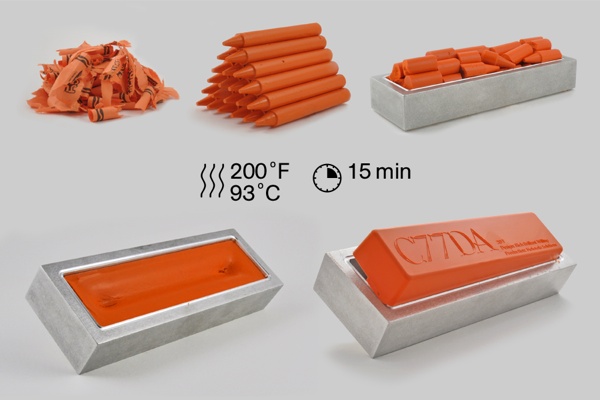
Core77′s Crayon Mold Design Trophy

Clever, clever idea from NY design studio Rich Brilliant Willing (a play on the three founders’ names, FYI), on contract for design blog Core77, which is giving these away to winners of its inaugural Design Awards this year. [via Boing Boing]

20 Mar 01:02

Fire Roasted Tomatoes

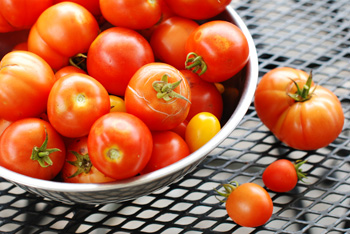
I’d love to tell you that the tomatoes here at Chez Bullhog were wonderful this year, but it just ain’t so. For a true tomato connoisseur, this is one tough admission.

Homegrown tomatoes here at Chez Bullhog

Oh, we put the plants in the sunniest spot in the garden and by turns coddled and abused them at just the right times. We thinned the unproductive shoots and trimmed half the leaves the way we do in the Northwest to get the best crop. But while they looked pretty good on the vines, all those red tomatoes never matured all the way to the center.

(I suspect it has something to do with that old nighttime temperature, which throughout our Seattle summer hovered just above 50 degrees. The poor little darlings got cold at night!)

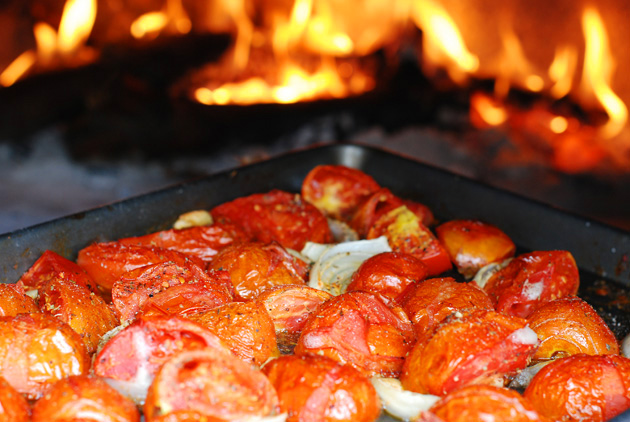
When I had the woodfired oven revved up for pizza the other day, I roasted a bunch of these tomatoes to see what would happen. With the backdrop of a good pile of coals and lots of active flame, it really worked a treat. The tomatoes softened nicely and took on a marvelous flavor tinged with garlic, olive oil and apple wood smoke. And man, are they sweet!

Now while I realize not everyone has a woodfired oven to make these in, you can use your conventional oven to get similar results. Get your oven as hot as it will go, follow the steps below and finish the tomatoes for a minute or two under the broiler. Roasted tomatoes are great over pasta, spread on pizza or turned into a dip for fresh bread. Yum!

Fire Roasted Tomatoes 

3 pounds of red tomatoes (slightly underripe is okay)

¼ of a medium onion

2 large cloves of garlic

3 Tablespoons of olive oil

½ teaspoon of oregano

Salt and pepper to taste


  1. Cut small tomatoes in half, medium ones into quarters and large ones into 6 or 8 pieces. Slice onion into strips. Break or cut garlic cloves into chunks.
  2. Spread 2 Tablespoons of olive oil onto a heavy cookie sheet or jelly roll pan. Distribute tomatoes, onion and garlic chunks evenly in one layer. Drizzle with more oil and sprinkle on the oregano, salt and pepper.
  3. Roast for 15 minutes in a flaming hot pizza oven or 20 minutes in a 475° conventional oven, turning tomatoes over and pan around halfway through to ensure even cooking. Finish for a minute or two under the broiler, if desired.

To make Roasted Tomato Dip: In a food processor, combine a crumbled slice of good day-old bread with a large clove of crushed garlic. Add 1 cup of roasted tomatoes, some grated parmesan and just enough of the roasted tomato juice to make a smooth paste. Serve warm or cold with hunks of fresh bread.


20 Mar 01:01

Four short links: 21 October 2011

  1. What Mozilla is Up To (Luke Wroblewski) -- notes from a talk that Brendan Eich gave at Web 2.0 Summit. The new browser war is between the Web and new walled gardens of native networked apps. Interesting to see the effort Mozilla's putting into native-alike Web apps.
  2. YouTube Insult Generator (Adrian Holovaty) -- mines YouTube for insults of a particular form.
  3. Ultrasound for iPhone (Geekwire) -- this personal sensor is $8000 today, but bound to drop. I want personal ultrasound at least once a month. How long until it's in the $200-500 range? (via BERG London)
  4. Web Applications Class at Stanford OpenClassroom -- a Ruby on Rails class taught by John Ousterhout, creator of TCL/Tk and log-structured filesystems.
20 Mar 00:57

Harvard Food Science Lectures 2011

Education for everyone. The first eight lecture of 2011.


Years Past

October 30, 2010

October 30, 2009 

October 30, 2008

October 30, 2007

October 30, 2006

October 30, 2005

October 30, 2005 (2)

20 Mar 00:56

blockdiag

blockdiag:

Generate diagrams and charts from simply-formatted text files.

20 Mar 00:54

Carrot Blossoms

We love purple carrots because they are tasty and beautiful. There are very few preparations that highlight their unusual hue because once you peel them the purple disappears. We decided to continue playing with our technique of steaming and dehydrating, having used whole carrots and beets thus far, in order to play up the contrasting colors in our sliced carrots. We used the mandoline to slice them and then steamed them for 3 minutes. Then I laid the slices out on a tray for the dehydrator, staining my fingertips purple in the process, and dried them for about an hour. We call these carrot blossoms because as they dried they crinkled and curled up until they looked like small flowers.They are not completely dehydrated, retaining a slightly firm texture that yields instead of crunching. The sweetness of the vegetable comes through nicely and they have a wonderfully intense carrot flavor. The real question is what to do with them next?


CarrotBlossoms


Years Past

January 25, 2011

January 25, 2010

January 25, 2009

January 25, 2008

January 25, 2008 (2)

January 25, 2007

January 25, 2006

January 25, 2005

20 Mar 00:53

The Gun Club

I have a piece in the latest Uncut about the Gun Club, the band fronted by Jeffrey Lee Pierce. The Gun Club trailblazed the kind of killer punk-swamp-country-blues later taken on, more lucratively, by Nick Cave and the White Stripes.

Born in California, Pierce settled in London in 1985. He spent a lot of his time hanging out at the Batcave, the Goth nightclub in Soho’s Dean Street.

Pierce left London in 1995, when he was deported after wielding a samurai sword in a Kensington pub. Which makes this trailer for what appears to be an Italian documentary from 2008 all the more intriguing, as it features Pierce wielding a samurai sword in London in 1992. (I’m not sure if it is the same film as this 2006 documentary, Ghost on the Highway.)

Pierce was a talented enigma, who made some amazing music. They also wrote the best song title ever, in Sex Beat, which pretty much sums up what all rock ‘n’ roll is really about.

o


20 Mar 00:53

Tips for getting a Good IT Contract Rate

IT Contractors are not trained negotiators and are not doing it everyday like IT agents do
20 Mar 00:52

Gyms Near Me

Gyms Near Me:

A site which shows you a map of the UK, highlighting all the gyms nearest to you.

Not the usual OTW fare, perhaps, but this is a side-project by my friend Donny and I thought I’d give it a plug, since it does indeed do one thing well.

The technical underpinnings are interesting. It’s a static site that makes use of Google’s Fusion Tables—a service for storing, querying and visualising data—Maps API and App Engine, plus Twitter’s Bootstrap. In other words, Donny was able to get from ‘I’d quite like to find the gyms near me’ to a working web app in a couple of days, without having to futz around setting up databases, a map tile server, &c..

20 Mar 00:52

What D'you See in Pictures?


In the Picture / Three Cases of Murder (1954) via National Media Museum

Above, the results of a partially successful search: an introductory segment from the seldom-shown 1954 film Three Cases of Murder. This British film, a portmanteau film of a sort no longer made, comprises three murder-themed shorts, all featuring Alan Badel, and all excellent. One, You Killed Elizabeth, is a very English darkly comic whodunit concerning a rivalry between two business partners for the attention of a woman that leads to murder. Another, Lord Mountdrago, features a Somerset Maugham psychological drama with Orson Welles as a high-ranking politician whose thoughts turn to murder when he experiences humiliating dreams involving Owen, a Welsh MP whose career he ruined - dreams whose content Owen seems aware of. However, the third, In the Picture, seems to be the one that people find most memorable.

In the Picture (directed by Wendy Toye from a screenplay by Donald Wilson adapted from a Roderick Wilkinson story), is a wonderful piece of English Gothic that starts in a picture gallery with Badel's character - who is never named -  sitting opposite a painting with broken glass. He accosts a mild-mannered guide, Jarvis, enquiring about the latter's fascination with the painting - a country house in a gloomy landscape titled Landscape - Artist Unknown. After expressing the view that the composition could be improved by a light in a window, "Mr X" proceeds to talk Jarvis closer and closer and into the painting with him. They enter the house to find a draughty expressionist interior and its two other occupants: an unnamed woman and an artist-taxidermist called Mr Snyder. It turns out that the three have been "assigned" to the painting as a kind of purgatory, and Mr X is the artist who painted it. The visit rapidly turns to horror for Jarvis, who finds he's the pawn in a bargain between Mr X and Snyder; Mr X gives him Jarvis as a vivisection victim in exchange for the use of Snyder's coveted candle. We hear a scream from the painting as Mr X lights the candle with Jarvis's matches. The segment ends with Mr X dissatisfied with the composition - he wants another light - and he exits the painting again to sound out another victim, a young woman with a cigarette lighter.


There's been a deal written about this piece: see, for instance, the account at British Horror Films (Three Cases Of Murder); and Drawn and Quartered: Wendy Toye’s In the Picture (Jorge Didaco, Senses of Cinema, Issue 34), which says of it:
British cinema has drawn extensively on these patterns of ghastly horror (from Hammer to Amicus and beyond), but rarely so quietly shocking and perverse as in Wendy Toye’s adaptation of Roderick Wilkinson’s short story “In the Picture” (with a screenplay by Donald Wilson)

I was interested in tracking down the original story, and as I said above, I was partially successful. It was slightly difficult because virtually all accounts get the story name wrong: it's not In the Picture but What D'you See in Pictures?. I managed to trace it, or at least a reprint after the film was made, to a 1964 edition of Short Story International magazine (Google Books snippet view here - though the Google Books metadata is wrong; the edition is Short Story International, Volume 1, No. 11, September 1964). The blurb runs:
What D'you See in Pictures? by Roderick Wilkinson
Have you ever seen a painting that made you want to walk right into it and become a part of the scene? Don't ever wish too hard. What D'you See In Pictures? is reprinted from Courier Magazine, a British Publication.

A trifle annoyingly, this is one of those instances where Google Books snippet view doesn't recover enough to skim the story, and often purports to show snippet view but shows an irrelevant or blank portion of the page. All that was findable was the start and finish of the story. The start is similar to the film, except that the narrator is a draper ...

If I say a word of it to the authorities — or even to my wife — they'll take me away. But I'll tell you.

It was in July. You remember the hot spell we had — lovely summer weather. I was in the park one Tuesday afternoon (I'm a draper by trade and Tuesday's my day off). I felt very warm out there so I came into the Galleries because I thought it would be cooler. The Galleries were very quiet — and I didn't meet anyone until I came in here. And it was here I met him. He was sitting here on this very seat. I sat down beside him. He was a queer-looking type — dressed in a black raincoat with a sort of cape at the shoulders ...

... and at the end, the narrator escapes the painting, failing to rescue another character from it.

another form in front of me — the dark form of the hole in the ground.

"I've found it!" I yelled. "Quick — I've found the hole!"

I threw myself head and shoulders first through the cavity, shouting all the time — "Come through — come through. Give me your stick — your walking stick. I'll pull you through."

I don't know what happened. I think I must have fainted. When I came round to my senses the first thing I saw was the grain of that wooden floor in the art galleries. When I got to my feet I stared at the painting.

He was there — just as you see him now — hanging by the neck from the third gallows.

Sane? Mad? I don't know. I have only one small link in the chain to show me that I must be sane. It must have happened. When I picked myself up from that floor in the galleries I was leaning on his walking stick.

I don't know what happens in between - maybe it's excellent - but the narrator's survival rather puts in the bracket of "cosy" horror. Donald Wilson's screenplay, with the urban and completely amoral Mr X as framing character and chief driver of the plot, makes it a much darker and stronger story; and Wendy Toye's overall visual treatment of the piece, including the stunning chiaroscuro of the best black-and-white films of that era, raises it to perfection.
20 Mar 00:51

Beautiful Broccoli Sformato

You never forget your first sformato. We were in that little trattoria on the north shore of Green Lake, absorbed by an inner glow that transcended the gusts of rain throwing themselves against our window. Inside the restaurant with its fabulous smells, all was candlelit and cozy. 

Our waiter’s humor and his rounded Balkan accent were totally infectious: extra garlic for the head cold, sir? I think we have a quantity of that somewhere. Behind a long low wall, a grizzled man moved about the kitchen with quiet authority. By the time our appetizer arrived, we were practically purring. 

A sformato is a thing of beauty. Somewhere between soufflé and cake, it’s loaded with intense flavor.  My go-to Italian cookbook, The Silver Spoon, lists numerous entries for vegetable infusions – carrot, zucchini, onion, spinach – as well as fishier options. 

Back at our table the waiter hovered. Our first forkful was to die for. Light, assertive, delicious. Even the grizzled man looked up from his pots to smile. We raised our glasses and toasted what we both knew was around the corner: sun-drenched pizza parties, our antipasto platter graced with this new addition. We sat back satisfied. Bellissimo! It’s all good here.

Broccoli Sformato 

Makes 4 small molds, properly called ‘Sformatini’ 

4 8-ounce ramekins or ceramic molds 

2 teaspoons each butter and breadcrumbs 

A rectangular casserole large enough to hold the ramekins 

10 ounces of broccoli florets 

½ cup of vegetable broth 

2 ounces of finely chopped onion 

2 teaspoons of olive oil 

2 ounces of ricotta cheese 

1½ Tablespoons of butter 

2 Tablespoons of flour 

¾ cup of 2% milk 

2 eggs 

2-3 cups of boiling water 


Prepare molds for filling: Spread ½ teaspoon butter on sides and bottoms of 4 ramekins. Dust with seasoned breadcrumbs. Put ramekins into a rectangular casserole large enough to hold them in one layer and set aside. Preheat oven to 375°. 

Pre-cook vegetables and purée: Put broccoli florets and ½ cup veggie broth over medium heat in a 2-quart saucepan. Turn once when boiling; cover and simmer for 4 minutes and then remove broccoli to a bowl to cool slightly. Meanwhile, sauté the onion in oil until it’s translucent; do not brown. 
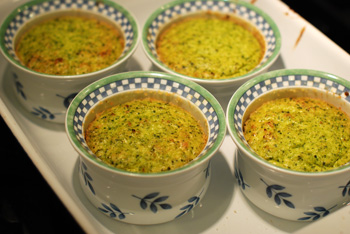
Cooked Sformatini in their ramekins and water bath

Shave ¼ cup of green broccoli buds from the florets and set aside for later. Put the rest of the broccoli, broth, onion and 2 ounces of ricotta cheese into a food processor and pulse for 10 seconds until chopped. 

Make a thick béchamel sauce: Clean out the 2-quart saucepan and melt 1½ Tablespoons of butter in it over medium heat. Add 2 Tablespoons of flour and incorporate. Add the milk in 3 portions, mixing well and allowing to bubble before next addition. 

Finish the filling: Whisk 2 eggs in a bowl. Add hot béchamel to the eggs in 3 portions, whisking quickly, until you have a smooth sauce. Add this to the food processor with the broccoli mixture. Pulse to blend, scraping the sides as necessary. Lastly, add the reserved broccoli buds. Mix them in but don’t purée: these will give a nice texture to your sformato. 

Taste the filling and add salt and pepper if desired. 

Fill and bake: Pour the broccoli sauce evenly into ramekins, to about ¾ full. Add boiling water to the casserole around the ramekins to bring water 1” up the sides. Bake at 375° for 35 minutes, until lightly browned and springy. 

To serve: Let cool for 20 minutes, turn out and serve. Or, you can hold the sformatini in their ramekins for up to 3 days wrapped in plastic and refrigerated. To reheat, turn them out onto a cookie sheet, sprinkle with breadcrumbs and bake for 12 minutes at 350°. 
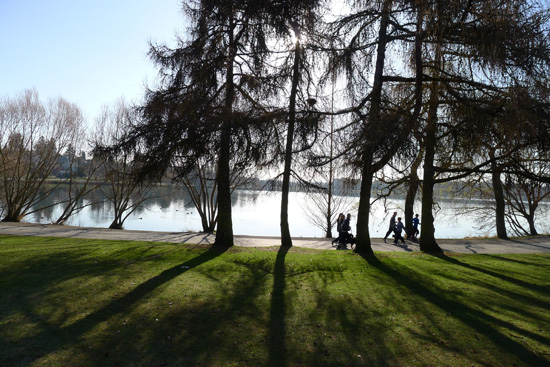
Green Lake, Seattle's favorite park. Trattoria Cioppino is a lovely half mile walk, left along the walking path and across the street.

20 Mar 00:51

VIE and Create: an update - Henri Bergius

It is again time to write an update on the state of IKS's two main components for the semantic editing part of Decoupled Content Management:

  • VIE is the base semantic interaction library that handles the site's content model through RDFa annotations and Backbone.js synchronization
  • Create is a new kind of web editing interface built on top of that.

As the IKS project has entered its fourth year, both of these projects have gained maturity and contributions from many IKS partners and early adopters.

New UI for Create

While Create can be used for building any sort of custom user experiences (as seen in the CMS integration examples below), it also ships with a default user interface. Nemein's Riku Virta has designed a new UI concept that is currently being discussed on the CreateJS mailing list.

This interface builds on top of the original Create UI and Liip's UX work, and aims to provide more area for CMS-specific functionality and better touchscreen support:

create_new_ui.png

See the full UI concept in the slideshow on Google Plus.

We hope that we will be able to land this new UI still within the March-April timeframe.

VIE: 2.0 and onwards

VIE is now nearing the 2.0 release, with the first RC expected for the end of this month. After that we'll have a hackathon in Saarbrucken, Germany where the plan is to focus on things that we've targeted for a 2.1.

The main feature of VIE 2.1 is a new way of handling RDF literals. This will make it easier to interface with services like DBpedia that give us data in multiple different languages. This will enable you to do things like:

var eiffel = vie.entities.get('dbp:Eiffel_Tower');
console.log(eiffel.get('label')); // Eiffel Tower

vie.setLanguage('fi');
console.log(eiffel.get('label')); // Eiffel-torni

The final API for this is still being discussed on the VIE mailing list.

Create and Hallo are now easier to integrate

Both Create and Hallo, our minimalist rich text editing tool now provide merged JavaScript files for easier integration. You can find the merged files, and also minified versions in:

Thanks to contributions from Alkacon, Create's widget selection mechanism is now much more configurable. This allows CMS developers to provide different editing tools for different types of information.

The currently bundled editing interfaces provide integration with Hallo, and also with the 0.20 version of Aloha Editor (though you will need to install Aloha separately to use it due to licensing restrictions).

CMS developers will also benefit from Blogsiple, the new integration testbed for Create and VIE. Blogsiple aims to be a very simple blog system built on top of Node.js that shows all the necessary integration points for supporting the whole range of VIE and Create features.

CMS adoption

As both VIE and Create improve, so does their adoption in different Content Management Systems. For example, here is the new OpenCms user interface built on these tools:

Polymedia's video annotation example is also interesting demonstration of VIE in a completely different kind of CMS environment, as is WordLift by InSideOut10.

The IKS Early Adopter program is still open if you're interested in getting support for using these tools in your CMS. There will also be an IKS event in Salzburg on June 12-13 where we will be able to show more.

20 Mar 00:49

heart shaped box

20 Mar 00:49

RIPS static source code analyser - Gareth Heyes

RIPS is a static source code analyser and is one awesome piece of coding by @fluxreiners. Use it now to scan your PHP files for vulnerabilities. It can detect XSS, SQLi, File disclosure, LFI/RFI, RCE and lots more and it’s free. I’m downloading the current version now 0.52, so should you!

20 Mar 00:48

Conception de logos - Édition - Multimedia - Illustration - Animation

20 Mar 00:48

Don’t you know who I think I am? - but does it float

20 Mar 00:48

How-To: Carve a Stone Bowl

Heirloom Technology Stone Bowl MAKE Volume 24

Want to make a gift to eternity? Nothing says forever quite like a handmade stone bowl. Maker extraordinaire Tim Anderson writes our Heirloom Technology column each issue of MAKE, and for Volume 24, he shared his technique for carving a stone bowl. Head over to Make: Projects for the full tutorial. As Anderson notes, “Fortunately, tools with diamond-studded cutters have become cheap and abundant. They make stone carving amazingly fast and easy. The same techniques seen here can of course be used to make any sort of stone objects you desire. My bowl is heavy and shallow because I plan to use it for a mortar to make nut butter. And I want it to last forever.” What kind of bowl will you make?

Heirloom Technology Stone Bowl MAKE Volume 24

Heirloom Technology Stone Bowl MAKE Volume 24


20 Mar 00:48

Patterned Concrete Tables


Kami of Austin Tinkering School wrote in to share these cool concrete tables that her friend Elena Eidelberg created.

She works in ceramics but has been experimenting a lot with concrete this year and I think she’s been making some amazing stuff. She’s casting into high relief fabrics and then tinting the concrete and even gilding it sometimes.


20 Mar 00:48

Tumblr

20 Mar 00:47

Big List of 20 Common Bottlenecks

In Zen And The Art Of Scaling - A Koan And Epigram Approach, Russell Sullivan offered an interesting conjecture: there are 20 classic bottlenecks. This sounds suspiciously like the idea that there only 20 basic story plots. And depending on how you chunkify things, it may be true, but in practice we all know bottlenecks come in infinite flavors, all tasting of sour and ash.

One day Aurelien Broszniowski from Terracotta emailed me his list of bottlenecks, we cc’ed Russell in on the conversation, he gave me his list, I have a list, and here’s the resulting stone soup.

Russell said this is his “I wish I knew when I was younger" list and I think that’s an enriching way to look at it. The more experience you have, the more different types of projects you tackle, the more lessons you’ll be able add to a list like this. So when you read this list, and when you make your own, you are stepping through years of accumulated experience and more than a little frustration, but in each there is a story worth grokking.

  • Database:
20 Mar 00:47

Mind The Map at the London Transport Museum

Ever since the British Library’s London map exhibition in 2007, London museums have learnt to love cartography. The Museum of London’s Hand-Drawn London was a highlight of 2011, and now the London Transport Museum has joined the cool kids with a brilliant new Mind The Map exhibition.

This traces the relationship between transport and maps over the past 150 years or so and offers a brilliantly edited selection of material from the archives. The exhibition space at the museum isn’t vast, but the way it has been used here is superb. The twin focus is on the work of McDonald Gill and Harry Beck. Gill created the Wonderland map, a gorgeous, highly detailed map of London aimed at transport users. Here’s one of his, for Hyde Park.

The exhibition features a number of maps created by Gill – the brother of sculptor Eric Gill – and also this fascinating unfinished map of Temple, showing his working method. He begins with a serious flat plan of the city, before building up layers of impeccably detailed architectural illustration. Then on top of that go the speech bubbles, puns and references that make his maps so fascinating. Please excuse my poor photography.

In this section there are other decorative maps that were used by LT to promote different areas of London. Here is one featuring Cheam, where I grew up.

The Beck part of the exhibition is also brilliantly done given how much has already been done on the man who created the modern tube map. A personal highlight was this sketch from the London Transport staff newspaper in 1933, in which Beck gently mocks the popular notion that he got the idea for his diagrammatic map from a circuit board. He has redrawn his tube map as the interior of a transistor radio, thus creating the first mash-up/spoof of his iconic design and pre-dating The Great Bear by several decades.

Speaking of which, the LT Museum have commissioned six new pieces of art for the exhibition, and they are all great, which is quite unusual for these things. Simon Patterson has updated The Great Bear as Saptarishi, Jeremy Wood has created a new ghost map, tracing his movements through GPS and there’s a marvellous ‘Proustian’ map of London by Agnes Poitevin-Navarra.

My Ghost

Most exciting of all is Stephen (The Island) Walter’s new epic undertaking, London Subterranea, a stunningly detailed map of the London beneath our feet, executed in stark black and white and crammed with information and folklore.

When I talked to Walter a few years ago, he expressed a keenness to put The Island behind him despite some interesting related projects that had been suggested to him. I’m delighted that he has since decided to return to London mapping, as he is a master at it. I’m told he’s now working on an A-Z, which will incorporate The Island and London Subterranea.

Other highlights include a copy of the infamous 2009 tube map that omitted the Thames, a gorgeous 1932 enamel map from a station wall and a copy of Finchley Central by The New Vaudeville Band. There’s also a brilliant book by curator Claire Dobbin that accompanies the exhibition. Go see it!

Mind The Map opens 18 May until 28 October 2012. 


20 Mar 00:47

Bonnet Hill House / Dock4 Architecture | ArchDaily

20 Mar 00:46

Early Christian manuscripts discovered

Michael Licona interviews Dan Wallace about the new manuscript discoveries related to Early Christianity.

Click here to visit the Pen and Parchment Blog

See also Earliest Manuscript of the New Testament Discovered?
20 Mar 00:46

Proxmate

Proxmate:

A plugin for Firefox and Chrome that unblocks region-restricted web content, including Hulu, YouTube and Grooveshark.

20 Mar 00:46

Automatic

Automatic:

Automatic allows you to set up subscriptions for virtually any content linked in RSS feeds: podcasts, videocasts, torrentcasts… Rule of thumb: if it ends in ‘-cast’, you can get it with Automatic.

Once set up, there’s nothing else to do but sit back and wait. Automatic will fetch and deliver the latest content for your subscriptions right to your download folder…

20 Mar 00:46

Hosts adds a preference pane to your system preferences which...


Hosts adds a preference pane to your system preferences which lets you toggle your host file entries on and off, as well as add and remove them.

Thanks, @rcarmo