Shared posts

19 Mar 15:29

Endless sustainable power at the sea floor

benthic_microbial_fuel_cell.jpg

"Benthic microbial fuel cell" is propeller-head code for the following very interesting fact: If you bury a metal plate a few centimeters beneath the ocean floor, and elevate a parallel plate a few centimeters above the ocean floor, the potential between them (due to ongoing microbial metabolism in the sediment) is enough to generate useful power. 800mV is a typical figure, but if I understand correctly, the current is directly related to the area of the plates, so the amount of power available by this method is theoretically only limited by the size of the plates you can install. Mark Nielsen is a doctoral candidate at Oregon State University under Dr. Clare Reimers, an expert in the field. This page at the OSU website provides a nice general overview of the concept and of Mark's work in particular.

Read more | Permalink | Comments | Read more articles in Science | Digg this!
19 Mar 15:27

Tessellating lizard pavers

geckostone_paver.jpg

You can make these interlocking reptile gecko pavers yourself, by pouring concrete into a mold sold by GeckoStone in Hawaii. Any resemblance to the work of a certain mathematically-inclined Dutch graphic artist is purely coincidental. Besides looking fly, GeckoStones "naturally create their own borders, and thus won't wander off into your garden." Some other cool tessellating patterns are available on the site.

Props to Steve for submitting this.

Read more | Permalink | Comments | Read more articles in Arts | Digg this!
19 Mar 15:26

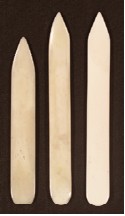
Bone Folder

A classic bone folder is made of real bone, not plastic or Teflon, and resembles a fat, blunt-edged tongue depressor, rounded at one end and pointed at the other. With it, I can turn a digital print, piece of cardstock or watercolor paper into a professional-looking note or greeting card.

Pulling the pointed end alongside a straight edge and across the paper produces a subtle score that facilitates a perfect fold. Next, I fold the card very gently by hand along the score, and then stroke one of the short, straight sides of the bone folder along the score to flatten the rounded fold to a sharp crease.

When sending a letter that I want to look good, I make two quick strokes of the folder along preliminary hand folds to create folded edges that are sharp and square. Bone folders also can be used to burnish paper as it is glued to cardstock, album or scrapbook pages. They produce accurate and sharp folds and creases on origami papers as well as facilitate sculpting, architectural modeling or bookbinding with paper.

I recommend rubbing your bone folder with olive oil from time to time to avoid flaking or brittleness. Folders made of real bone are best, unless you wish to use a Teflon folder to avoid the slight luster sometimes created by the friction of a real bone folder.

-- Clifford Peterson

[I relied on one of these while producing a large batch of homemade invitations and can attest to its utility. Here’s a look at a bone folder in use. -- ES]

Genuine Bone Folder
$8

Manufactured by Brodart

Available from Amazon

Related Entries:
Self-Healing Cutting Mat Alvin Lead Pointer Mini Booklet Stapler

19 Mar 15:26

LED bottle wall

Via Create Digital Motion, this awesome LED bottle wall by Alex Beim:

An illuminated bottle wall. There is a LED controllable light behind each bottle that is controlled from an on board computer. Something missing in the video is that the cavities for the bottles are empty at the beginning and people start filling them with empty containers to reveal the visuals. Everything started when Tom (the client) said, "I want to make a light bright with bottles for Bacardi, is that possible?"

Read more | Permalink | Comments | Read more articles in Arts | Digg this!
19 Mar 15:26

Tabletop Tesla coil

tabletopteslacoilinstructables.jpg

Mr. Apol made a tabletop Tesla coil:

After studying and tinkering with different components for a year, I finally assembled my first Tesla coil. I chose a bipolar design inspired by one in THE BOY ELECTRICIAN by Alfred P. Morgan (first published 1913, reprinted by Lindsay Publications and available at http://www.lindsaybks.com/.) Unlike the more common upright coils, the bipolar coil has a horizontal secondary and primary, and the ends of the secondary coil terminate in vertical electrodes. As I wanted to build a small tabletop model, this appealed to me because the coil would not need an external ground connection. I also decided to build the coil in modular fashion, with easily separated spark gap assembly, tank capacitors, and power supply. This way I could experiment with different components and see what changing these parts did to the overall performance of the coil.

Read more | Permalink | Comments | Read more articles in DIY Projects | Digg this!
19 Mar 15:26

How-To: Halogen to LED conversion

halogenretrofit.jpg

Want to retrofit your 12V bi-pin halogen lamp with LEDs? Look at this tutorial by Instructables user jmengel.

Read more | Permalink | Comments | Read more articles in Electronics | Digg this!
19 Mar 15:26

Coin shrinking with high voltage in slow motion

Recently Hackerbot Labs was invited by Intellectual Ventures to demonstrate their Maker Faire Editor's Choice Award-winning high voltage coin shrinker in front of a Vision Research Phantom 100k fps high-speed camera.

Discharging about 10 kV (15,000 joules!) from enormous 300 µF capacitors the team at Hackerbot Labs "Turn half dollars into quarters! Turn quarters into dimes! Turn dimes into little semi-molten balls of metal!" with their custom built apparatus through a process known as "Magnaforming".

Passing current through a coil of wire produces a magnetic field. In this case, with so much current, the magnetic field produced is gigantic: the coil becomes a magnificently powerful electromagnet.


The creation of a magnetic field in the coil-now-magnet induces a circling current to flow around the coin sitting inside the coil. This current in the coin also produces a magnetic field (i.e., the coin becomes another electromagnet). The kicker is that the coin's magnetic field and the coil's magnetic field point in opposite directions, so the coin and the coil repel each other furiously.

This repulsion creates forces which overcome the strength of the metal; the coil is expanded out and explodes, and the coin is pushed in and shrunk.


shrinker.jpg

Some interesting facts were gathered as a result of the demonstration:


  • Filmed at 100,000 fps, the coin will shrink in just 30-40 microseconds

  • The coin will have shrunk prior to the coil exploding

  • A loud 135 dB shockwave is produced as the coil explodes

  • When shrinking the edge of the coin moves at about 400 mph

quarters.jpg

High Speed Coin Shrinking
[via Intellectual Ventures]

Read more | Permalink | Comments | Read more articles in Science | Digg this!
19 Mar 15:26

Sameer Borate's Blog: Creating custom stream filters

In a new post to his blog Sameer takes a look at streams and filters in PHP applications, specifically how to set up a custom filter to attach to any stream.

In this post we will see how to create a custom stream filter. Streams, first introduced in PHP 4.3, provide an abstration layer for file access. A number of different resources besides files - like network connections, compression protocols etc. can be regarded as "streams" of data which can be serially read and written to.

Streams are the method "behind the scenes" for several of the PHP functions you already use (like fsockopen and file_get_contents). His example shows you how you can manually create a stream and attach a filter to it to replace URLs in the contents of the stream with the "[---URL---]" string and push it back to the standard output.

19 Mar 15:25

Book Review: Caveman Chemistry by Kevin Dunn

cavemanchemistrycover.jpg

My recent post on glassknapping mentioned Kevin Dunn's 2003 book Caveman Chemistry, and I've received many requests for a dedicated review. So here goes!

Caveman Chemistry came to my attention a few years ago through the Lindsay Technical Books catalog. I'm a chemist by profession and a hacker by calling, with a long-standing interest in garage science, so the book's title was basically irresistible to me. I plunked down my nickel and twiddled my thumbs for a week while the snails carried it to my doorstep.

Read more | Permalink | Comments | Read more articles in Reviews | Digg this!
19 Mar 15:25

Opening ellipse chaos table

ellipsechaostable.jpg

Peter Marigold designed this ellipse "chaos" table that slides open to accept a number of different leaves. Looks great for backyard buffets and ripe for a remake. Via NOTCOT.

Read more | Permalink | Comments | Read more articles in Furniture | Digg this!
19 Mar 15:25

11-layer stencil graffiti

TO-DIE-FOR2-thumb.jpg

Street artist Boxi made this 11-layer greyscale stencil piece called "To die for." Check out the process video. Via Wooster Collective.

Read more | Permalink | Comments | Read more articles in Arts | Digg this!
19 Mar 14:24

Larking about

by Ray Girvan
Portsmouth Harbour: HMS Warriors, with Gosport's 1960s flats beyond
On Friday we were in Portsmouth, en route to the Isle of Wight, and despite it being a dismally overcast day, we had a brief look at The Hard (Portmouth's harbour frontage).


View Larger Map
Pan left/right to compare to 1925 image below.
click to enlarge
It's an area of strange contrasts: on one side, huge amounts of money have gone into the adjacent Gunwharf Quays; and on the other, the Dockyard has undergone a deal of development as a heritage site around the Mary Rose, HMS Victory, and HMS Warrior. But in between, The Hard remains distinctly downmarket: an anodyne paved harbour frontage adjacent to the Hard Interchange, opposite a rather shabby frontage with a few folksy traditional pubs set among businesses of an extremely mundane flavour, such as a betting shop, a Co-Op, a car rental, a Chinese restaurant, a chip shop, and (weirdly) a Creationist museum.

There are undoubtedly commercial and practical reasons why it's this way; particularly, piecemeal rebuilding in gaps created by World War 2 bombing damage. But I feel it could be redeveloped now in a way that melds upmarket and traditional - as has been done at the Gunwharf Quays - without killing the Hard's use as a working harbour and transport interchange. Portsmouth does have plans, but nothing very rapid seems to be happening.


I did spot one evocative and fairly new feature: Michael Peacock's bronze sculpture commemorating the Portsmouth Mudlarks, children and adults who traditionally foraged for coins thrown from the pier. I just about remember seeing the Portsmouth Mudlarks in the very early 1960s, when I used to go to Portsmouth with my grandmother (the same trips we went to Verrecchia's - see Lime milkshake and Kunzle cake). From the descriptive sign:
The nearby statue commemorates the generations of Portsea children who enjoyed mudlarking here - entertaining travellers by retrieving coins they threw into the mud below the bridge to the harbour station and Gosport Ferry. Boys and girls would scramble to find the money tossed down, sometimes diving into the mud, performing handstands or dipping their heads in it. Many Portsea families lived in poverty, so the small change was welcomed. Usually, what the children did not spend on sweets or pie and chips was given to mum to help out the family finances.

Most parents disapproved of their children's activities, while the police regarded mudlarking as begging and tried to stop it. Mudlarking supplemented other ways of earning a few shillings, such as carrying passengers' bags or finding drivers parking spaces. The building of the new bus terminus in 1976-7 put an end to mudlarking.
Michael Peacock's website has more pictures, and background on the commissioning and construction of the sculpture: Portsmouth Mudlarks.

Mudlarks, depicted less glamorously, from The Headington Magazine, 1871
"Mudlarking" does have a much darker story than its final 20th-century incarnation as a form of begging / street entertainment. The original mudlarks were general scavengers, particularly of muddy foreshores adjacent to busy commercial harbours. As the Wikipedia entry for "mudlark" mentions, Mayhew's 1851 London Labour and the London Poor features an interview with a young mudlark (see digitaldickens.com), and Richard Rowe's Episodes in an Obscure Life (volume 3) has a chapter on the subject, A Brood of Mudlarks, which interestingly opens with an allusion to the Victorian urban myth of Thames mud being converted to butter substitute (see previously Pure bosh: a media scare):
A factory, the newspapers say, has been started for the extraction of grease out of Thames mud — grease to be exported to Holland, and thence brought back as Dutch butter. Whether any poor Londoners do really get their butter from the river's slimy bed I cannot state, but there is a little army of poor Londoners who pick their bread out of those steaming mudbanks.
- Episodes in an Obscure Life
 There have also been a number of fictional accounts, such as Captain Marryat's 1840 Poor Jack (which goes into the illegal aspects of mudlarking, where mudlarks actively connived in fencing goods and materials thrown off ships by sailors).

State-of-the-art ships in Portsmouth Harbour:
left, a Type 45 destroyer; right, HMS Warrior
- Ray
19 Mar 00:02

Taking Daylight Saving Time to Extremes

by gleick

This is the weekend when the clocks do something—spring forward, it must be—and from now on Daylight Saving Time will always remind me of Marcel Aymé, born 111 years ago this month, a writer of “fantastic” stories, not much translated into English.

I stumbled onto Aymé not via Twitter nor word of mouth nor any of the Intertubes but browsing in a bookstore, the kind with tables, on which were displayed neat stacks of books lovingly chosen by the staff. I picked up a collection titled The Man Who Walked through Walls, put out by an independent London publisher, the Pushkin Press. The beautiful translation is by Sophie Lewis.

“Le passe-muraille,” monument to Marcel Aymé by Jean Marais

Aymé is the kind of writer who makes you think of Borges (but that’s too easy, of course; it’s almost worrisome how often I’m put in mind of Borges). “The Man Who Walked through Walls”—”Le passe-muraille“—is his most famous story, the referent for his monument in Montmartre.  The story that made me gasp with pleasure is the fourth, “The Problem of Summertime” (1943). For Americans, I think that should be “The Problem of Daylight Saving Time.” It’s about— well, never mind what it’s “about.” Let’s just say it expresses something about the nature of time that could not have been expressed, could not have been seen, until the invention of Daylight Saving Time (in French, l’heure d’été), along with time zones and the International Date Line and the other chronometric paraphernalia of modernity. The story is set in wartime. “At the height of the war, the warring powers’ attention was distracted by the problem of summertime, which it seemed had not been comprehensively examined. Already it was felt that no serious work had been carried out in this field and that, as often happens, human genius had allowed itself to be overruled by habit.”

How easily, the narrator remarks, time can be moved forward an hour or two! (His readers knew well that their German occupiers had just changed France’s time zone by decree.)

On reflection, nothing prevented its being moved forward by twelve or twenty-four hours, or indeed by any multiple of twenty-four. Little by little, the realisation spread that time was under man’s control. In every continent and in every country, the heads of state and their ministers began to consult philosophical treatises. In government meetings there was much talk of relative time, physiological time, subjective time and even compressible time. It became obvious that the notion of time, as our ancestors had transmitted it down the millennia, was in fact absurd claptrap.

So the authorities decide to do something dramatic. Never mind what. Something Borgesian. You could say that time travel occurs, if you construe the term time travel as broadly, as flexibly, as possible.


18 Mar 13:44

Gutter gardens

guttergardens.jpg

Patti at New World Geek sent us a link to this post showing a clever use of rain gutter as a wall-borne gardening system.


Repurposed rain gutters

Read more | Permalink | Comments | Read more articles in Green | Digg this!
18 Mar 13:44

Knife wire inlay tutorial

inlayBlade1.jpginlayBlade4.jpginlayBlade2.jpginlayBlade3.jpg

In this tutorial, bladesmith Ben Potter shows how he inlays a Celto-Norse design in non-ferrous metals into a steel blade. You can see one of the tutorials of him making one of his incredible blades and hilt here.


Celto-Norse Wire Inlay Tutorial
[Sent by MAKE subscriber David DelaGardelle. Thanks, David!]

More:
HOW TO - Make a machete from a leaf spring

Read more | Permalink | Comments | Read more articles in Made On Earth | Digg this!
18 Mar 13:43

Margaret Gelling: authority on the origins of English place names


Margaret Gelling made important contributions to the study of English place names, showing that many English villages and towns were named with remarkable precision after topographical landmarks. Thanks in large part to her work it is now thought that some of the earliest English place names were coined with reference to the geographical landscape. Gelling also popularised the subject, was an accomplished lecturer, and served as president of the English Place-Name Society for 12 years.

Read the rest of this article...
18 Mar 13:43

Frank Lloyd Wright Lego

Two more for the wish list. The Guggenheim and Falling Water. Spotted on Boing Boing.
18 Mar 13:42

Hunting strange waves with hacked circuits

radiolariaxlisteners_cc.jpg

The Electromagnetic waves sent out by modern living can make for some decidedly eerie soundscapes - and some very interesting exploration. Radiolariax uses a variety of devices to listen in on the otherwise unheard -

The hunt for weird radio signals and other electromagnetic waves with small, cheap modified radios, cassette players, walkie-talkies, dictaphones, babyphones, pc speakers,... and simple circuits.
Check out the collection of devices used and relevant audio samples on the signal and wave hunting site.

Read more | Permalink | Comments | Digg this!
18 Mar 13:42

Knot reference wallet card

knotcard1.png
knotcard2.png

This maker was inspired by an old post here on Make: Online, of the "Top Ten Most Useful Knots," to create a wallet card of several useful knots.

Infocard: Useful Knots


More:

Top Ten Most Useful Knots

Read more | Permalink | Comments | Read more articles in Toolbox | Digg this!
18 Mar 13:42

Hanging gutter gardens

gutterGardens.jpg

Rutland Copper Gutter Supply has an entry on their blog (and a link to a Martha Stewart how-to) on using copper box gutters to create a hanging garden. This is an interesting follow-up to our earlier post of installing gutters on the outside walls of your house as a gardening option.


Gutter Garden - Copper Gutter Garden


More:
Gutter gardens

Read more | Permalink | Comments | Read more articles in Green | Digg this!
18 Mar 13:41

Create Stunning Diagrams On The Web With LovelyCharts

If you’ve ever looked for an easy, intuitive online diagram creation tool, you know how hard it is to find one. LovelyCharts is a brand new application poised to become the default online drawing tool for amazing flowcharts, sitemaps and wireframes.

Like Gliffy, Flowchart.com, and AutoDesk’s experimental Draw project, the app enables you to create diagrams and more in your browser with drag-and-drop functionality. The main differentiator between LovelyCharts and other online services is that it actually makes your complex processes look incredibly good. Better yet, it’s completely free and since last week, out of beta and available to anyone.

In terms of features, LovelyCharts has pretty much all the basics covered, but you really need to try it out to get a feel of how rich the web-based app really is even with its relatively simple feature set. You can draw, align, insert symbols and icons, snap, zoom, import & export, and so on - for a good overview, check the tour and the (non-embeddable for some reason) screencast. My only gripes are that the app is not always as fast as I would like it to be at times, and there’s no way to upload and insert custom symbols, although the latter feature is underway.

There’s also a professional version of LovelyCharts available for €29 a year, which allows users to maintain and collaborate on as many diagrams as they wish and features full history management, sharing functionality and a notification setup.

LovelyCharts is mostly a one-man show, created by RIA developer and user architect Jérôme Cordiez from This Is Lovely!. The project is completely bootstrapped, which is awesome.

Crunch Network: MobileCrunch Mobile Gadgets and Applications, Delivered Daily.

18 Mar 13:38

Building a "ball mill" from junk

ballMill1.jpgballMill2.jpg

Spatula Tzar, who brought us the controversial fly plane, offers a number of other interested projects, including this ball mill (a device used to crush metals and chemicals into a fine powder), made from mainly junk lying around the lab.

Ball Mill

Read more | Permalink | Comments | Read more articles in Science | Digg this!
18 Mar 13:37

Axe handles dredged from North Sea win archaeology award


Prehistoric hand axes discovered in sand and gravel dredged from the North Sea by Hanson Aggregates Marine, have won the Best Archaeological Discovery Award at the prestigious British Archaeology Awards.

Twenty eight flint hand-axes, which may be more than 100,000-years-old, were discovered in marine sand and gravel delivered by Hanson to a Dutch wharf at Flushing, south west Netherlands in February this year.

Read the rest of this article...
18 Mar 13:37

SuperMagnetMan

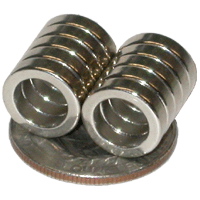
I have been buying Neodymium Iron Boron (NIB) super magnets for years. Back then, the previously-reviewed Wondermagnets was the only source for hobbyists and they had quite a selection. But times have changed. For the past five years, I have been ordering my magnets from "Mr. George the SuperMagnetMan," unequivocally the best source today. His prices are the best on the net. His selection is vast: no one else has the stock he has or the variations in size of commonly available shapes. This is no exaggeration or hype. He's got stuff you can't get anywhere else and is constantly adding new items, like axially- and diametrically-magnetized NIB wedding rings and radially-magnetized ring magnets. He has magnets so large they are dangerous (fortunately he has put videos on YouTube that show you how to safely handle these monsters -- with large leather welding gloves and a special wooden wedge and a 2x4!). He also sells magnetic hooks, pyramid shaped magnets, magnetic jewelry, teflon coated magnets, heart, star, and triangle magnets. You can even get powdered magnets that act like iron filings on steroids! You name it he's got it. Most magnets are N45-N50 grade, the highest strength you can buy.

Some of the products I have ordered are the magnet powders, radially-magnetized ring magnet, various size sphere magnets, conical magnets, large rectangular magnets, cubes, and many others. Shipping charges are reasonable. Service is great. One time I ordered a bunch of stuff and never completely checked what I got. I went to use one of the magnets months later and found out it was the wrong size. He sent me the right size in the mail a few days after I emailed him.

Mr. George seems like a pretty cool dude, too. An electrical engineer, Mr. George develops magnet products himself and caters to other engineers, inventors, and hobbyists. He can have custom magnets made to order. He has also put up a series of educational videos on YouTube and has done a lot of work with kids. He has a saying, something like, "Give a kid a magnet and you have a friend for life."

Separating magnets:

SuperMagnetMan

Related Entries:
NeoCube Lindsay Publications Transmaterial

18 Mar 13:37

5¢ architectural advice

architecture5cents.jpg

From Genteel Recessionista comes this curious strategy for dealing with hard times. Two Seattle architects have set up a Lucy from Peanuts-like 5¢ advice booth in a Seattle farmer's market. Their mission:

Architecture 5¢ is about starting conversations, it's that simple. People have questions about how they want to live in their home; whether it is a simple kitchen remodel or adding a second story on their house, it all starts with a conversation.


When you talk to people in your neighborhood about architecture you can start a ripple effect that can impact your local economy. One local nickel turns into one conversation, which could turn into one local design job, built by a local contractor, who hires a local painter, who buys from a local supplier.....

If we all start conversations, and start ripples across the nation, we can start a wave of hope and prosperity that can get us out of these tough times. I'm looking for like minded individuals to join me in this movement. Maybe you were laid off and not found work, or are just feeling the pinch of the economy.

I'm looking for people who want to help their local neighborhood, and in turn help themselves out of a tough situation.

Not really sure if this is an effective strategy, but it sure is a creative and magnanimous one.

Creative marketing for new times


Read more | Permalink | Comments | Read more articles in Remake | Digg this!
18 Mar 13:37

Free, unlimited IP address geolocation with MySQL

There are a lot of services and datasets that provide IP address geolocation, allowing you to detect a web user's city of origin based on their incoming IP. Unfortunately, most of these services cost quite a bit of money, impose limits on how many lookups you can do over a period of time, or aren't kept up to date with accurate information.

I came across a great resource today, put together by Marc-Andre Caron. He's done all the necessary legwork to solve this problem, putting together a free, monthly-updated MySQL dataset that will allow you to derive country, region, city, zip, latitude, and longitude from an IP address.

The IP addresses are listed in table ip_group_city. The data is not in the 1.1.1.1 format since it would need to be stored as text and we dont want that for obvious reasons.


Let say for ip A.B.C.D, the formula is
ip = (A*256+B)*256+C
(I assume A.B.C.0 is at the same location than A.B.C.255)

For example, if you have an ip of 74.125.45.100 (google.com)

The formula would give a result of :
ip = (74*256+125)*256+45 = 4881709

You would search for the IP address using MySQL by doing :
SELECT * FROM `ip_group_city` where `ip_start` <= 4881709 order by ip_start desc limit 1;

Keep in mind that the accuracy of the data is usually down to the location of a user's ISP. Don't expect this to get you down to a street address, but if you want to display relevant content at a city, state, or country level, this will do the trick the vast majority of the time.

IP address geolocation SQL database

Read more | Permalink | Comments | Read more articles in hacks | Digg this!
18 Mar 13:36

Flashback: Easy Backyard Graywater System

flashback_backyard_graywater.jpg

With gardening season upon us, it's time to revisit the "Easy Backyard Graywater System" by Tim Drew from MAKE Volume 13. Everyone has to do laundry, so why not use your laundry water to get a lush garden. Better for the environment and better for your pocketbook. Basically, the prerequisites are that you have to have a proper recycling system and use biodegradable detergent (and not be washing diapers). Tim was retrofitting his basement and moved the laundry machines to the back carport, which was conveniently at a slightly higher elevation than their adjacent garden.

From the article:
"The basic design involves a 2"ABS standpipe that runs down from the washer and connects to a gently sloping horizontal pipe buried under a garden path. At the other end, the water splits and travels a bit farther in 2 directions, then flows out through perforated pots and bark chip mulch, and into the soil beneath some water-loving plants and trees."

Here's the left branch and irrigation terminal before Tim buried it:
flashback_graywater_system_leftbranch.jpg

The irrigation outlet with the cover off:
flashback_graywater_system_outlet.jpg

And Tim's lovely plants near the irrigation outlet:
flashback_graywater_newplants.jpg

Here's the full article in our Digital Edition so you can get started. Pick up Volume 13 in the Maker Shed for tons more projects, including the Boom Stick, Toy Music Sequencer, a Smart Structure, growing giant pumpkins, raising chickens, tons of magic tricks and props, a car camera mount, internal explosion engine, analog meter clock, and more.

Keep your eyes peeled for Volume 18, due out in mid-May, our DIY Energy issue!

Read more | Permalink | Comments | Read more articles in Green | Digg this!
18 Mar 13:36

Links to Bookbinding Blogs

18 Mar 13:20

Electronics in limpet shells

limpetshellLED.jpg

Hannah Perner-Wilson put a small push button, battery holder, and LED/vibrating motor inside these little limpet shell. She writes:

I've always liked collecting seashells, and have always wanted to do something more with them than accumulate them in my parent's garden. So now I want to see how far I can go to integrate small electronic circuits inside them. Limpits are nice to work with because they are totally open on one side and the bigger ones even offer some depth.

The limpit buttons are very simple, they use a push-button to trigger LED light or a vibration motor. I decided to use a push-button rather than a switch so that they are only active when touched/pushed.

Limpet push-button

Read more | Permalink | Comments | Read more articles in Electronics | Digg this!
18 Mar 13:20

Homegrown laser crystals

KDP_3.jpg
KDP_1.jpg
KDP_2.jpg

My Dorkbot DC cohort Jon Singer sent me a link to a webpage of a buddy of his, a Croatian laser-hacker, who grew his own KDP (Monopotassium phosphate) crystals for use in a Nd:YAG laser. He had a time getting the crystals to grow, but was able to finally get some suitable growth and to find the right angle and alignment to get decent SHG and a pretty green beam. Apparently, this is not commonly and easily done with KDP, so it's a bit of a triumph on this fellow's part.


Homegrown KDP crystal and successful SHG attempt [Thanks, Jon!]

Read more | Permalink | Comments | Read more articles in Science | Digg this!