Shared posts

18 Mar 13:20

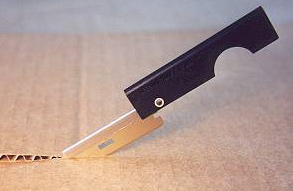
Derma-Safe Folding Utility Knife

A modern replacement for the classic pen knife, this pocketknife has a thin, 1.5-inch, razor-sharp blade that cuts boxes, cord, tape and tough plastic wrap without effort. Half the charm is its disposability: It costs about as much as a can of soda, so if you get to the airport and have forgotten it's in your pocket, ditching it is trauma-free. I've found the handle grip to be excellent. The slipjoint blade stays in position open or closed. The slim, short design packs a lot of cutting power into a package with about half the volume of a pack of gum. A functional design with aesthetics worthy of MOMA. Derma-Safe also produce a hacksaw version they say will cut through metal as well as wood, which I've not tried.

Derma-Safe Folding Utility Knife
$1.50/each
Available from Gut Hook

Or $60 for 100 from Derma-Safe

Related Entries:
Snap Blade Knife Myerchin Lightknife Unger Trim Scraper

18 Mar 13:20

HOW TO - Make a machete from a leaf spring

finished_knife.JPG

MAKE subscriber FrankG sent us this nice, sort of mesmerizing, video tutorial on turning an old truck leaf spring into a basic, but effective machete. Kind of a long and involved process, but I can only imagine how gratifying it would be to forge/machine your own tools and then use them on a regular basis.


Theworkshop.ca


Read more | Permalink | Comments | Read more articles in DIY Projects | Digg this!
18 Mar 13:18

Rainwater catchment basics

rainwater_cfh.jpg

Here's a useful primer on whole-house rainwater catchment systems:

In many areas of the country, a water-conserving household can provide for all its water needs from what it can catch off its roof. If the graywater and potentially the blackwater/humanure is also recycled for landscaping, each home can become an independent and sustainable part of the local ecology. We often speak of living off our annual income of solar energy, so it makes sense that we should try to live off our annual income of rainwater as well.

Does anyone have documentation on DIY blackwater systems?

Read more | Permalink | Comments | Read more articles in Green | Digg this!
18 Mar 13:18

Time out of mind

At a former company, a cow-orker of mine had cobbled up a set of date and time classes that he declared “general purpose” and “bug free.” About three months later, and after he had left the company, I had to do an 11th hour re-write of the code, just prior to releasing our company’s first product.

Some of the bugs I found:

  • The classes had a pretty interface with lots and lots of range, but internally the code used the Unix epoch of 1970 (so no birthdays before then, for instance). It was round-tripping the 1970 epoch through the standard Unix 1970-based routines as well
  • Didn’t handle 400-year cycle of leap years
  • Fell apart in 2038, like everything else will (Unix epoch, natch)
  • Fell apart in 2008, 2010, 2012, and some other years, as I recall. One failure was like some random day in March 2007, I forget why
  • Obviously didn’t handle screw cases like the calendar skipping that happened in 1582
  • Forget about supporting astronomy or geology applications…

… and other things.

I recall writing unit tests that stepped through the ranges that we definitely cared about (several tens of thousands of years around the current epoch), and also stepped plus-and-minus in the billions of years ranges (by millions or thousands, I think). Random tests, too.

I also recall spending a lot of time reconciling OLE’s idea of date-and-time. (Don’t ever let me catch you using floats for something like this. Really. I’ll find you).

This stuff is not easy to get right, but everyone thinks that it is. Maybe that’s why people get it wrong so often (”Oh, it’s just same date/time code, I’ll just whip this out and go to lunch.  Umm, ‘30 days hath November, except September, May, and, uh…’”)

Required reading: Calendrical Calculations. Unless you write stuff used by archeologists can probably ignore the Mayan (etc.) calendars, but they’re fun to read about.

18 Mar 13:18

Alpha radiation visualizer

alpha_visualizer_20090117.jpg

Using a standard webcam and some Americium 241 from a fire detector, Jared Bouck created a PC interface for visualizing alpha radiation.

The basic idea behind this project is using the built in CCD in a USB web camera as a medium for alpha radiation to interact with. The result is a visual presentation of pops and streaks of light as the partials interact with individual pixels of the CCD. While this has a very nice effect and makes for a fantastic "screen saver", there are more practical and important possibilities with this project.


One of the applications I have envisioned for this project is a cheap and easy genuine random number generator. True random numbers in computing are nearly impossible, and successful solutions are very expensive systems based on radioactive decay or atmospheric measurements, for example. Using a small / relatively safe radioactive source and a high res CCD or CMOS sensor and assigning a value to each pixel and perhaps mixing in an algorithm or two with an inexpensive practical PCI card that is capable of generating genuine random numbers.

I dig the idea of this being used as a true random number generator. On this note, Jared mentions that you could use this in Linux with video_entropyd to add entropy data to the kernel's random number generator.

Alpha Radiation Visualizer
video_entropyd

Read more | Permalink | Comments | Read more articles in hacks | Digg this!
18 Mar 13:18

Editing sound with Photoshop

photosound_20090127.jpg

Over at Audio Cookbook, John Keston has been running a few experiments with using image filters in Photoshop to process sound. Running the audio data through a Gaussian blur or Spherize filter, he was able to create some incredibly diverse effects from a simple electric piano input.

To test this concept I created a simple pattern with an electric piano patch and opened it in Photosounder. Without changing any settings I immediately saved the sound as a bitmap image. Next I opened the image in Photoshop and started experimenting with filters. Once I had some filtered images I loaded them back into Photosounder to see how they sounded. Gaussian blur and Liquefy created some unique effects, but my favorite of the bunch was Glowing Edges. This filter seems to transform the electric piano into a haunting choral passage.

John has a number of MP3 samples on his site. To get the audio in and out of Photoshop, he's using a tool called Photosounder which translates a waveform into bitmap data and vice-versa. I've never used the app, but from looking at the output images, time is represented on the x dimension, y represents the frequency, and the brightness of the pixel is determined by the amplitude at that frequency/time coordinate.

Anyone interested in writing a sound to image converter in Perl?

Processing Sound Using Photoshop
Audio Cookbook
Photosounder

Read more | Permalink | Comments | Read more articles in hacks | Digg this!
18 Mar 13:18

Algae bioreactor from recycled water bottles

Here's a really neat energy project:

In this instructable, we describe how to build a photo-bioreactor that uses algae to convert carbon dioxide and sunlight into energy. The energy that is produced is in the form of algae biomass. The photo-bioreactor is built from plastic recycled water bottles. By using algae as a biofuel, we can increase the world's supply of oil while at the same time we decrease the amount of atmospheric carbon dioxide used during its production. The resulting product is a sustainable biofuel whose carbon footprint is neutral inasmuch as the CO2 produced on consumption is essentially balanced by the CO2 used in its production. In this instructable, we first make the carbon dioxide delivery system, then mount the water bottles on a rack, and then inoculate the bottles with algae. After letting the algae grow for a week, we extract the biomass.

Read more | Permalink | Comments | Read more articles in Green | Digg this!
18 Mar 13:18

Hardcover hard drive with moleskine enclosure

moleskinehd_upsize.jpgmoleskinehd_2-up.jpg From the MAKE Flickr pool Moleskine modding is certainly alive and well these days - Flickr member SHoXCoRp made this stealthily portable drive enclosure from one of the popular note/sketchbooks - an interesting option for those who can't squeeze in any handwriting between laptop sessions - moleskine hard drive mod Read more | Permalink | Comments | Read more articles in DIY Projects | Digg this!
18 Mar 13:18

DIY Rust removal

3242926712 95D7803Eff B
DIY Rust removal, Mikey writes-

I was looking around instructables the other day and saw a great howto about rust removal using electricity. "Hmm", I thought to myself. I sure like to electrocute things. My neighbor gave me a rusty pipe wrench which came out impressively rust free after a few hours of soaking. I used a 12V .5A power supply and attached the negative end to the pipe wrench and the positive end to a old piece of steel remesh. Both pipe wrench and remesh were put in a bucket of water that had some baking soda. After a few hours of bubbling I removed the pipe wrench and let it sit for a hour in a vinegar bath.


Read more | Permalink | Comments | Read more articles in DIY Projects | Digg this!
18 Mar 13:17

Lost Knowledge: Manual Typewriters


This week, we start a new regular column in search of the technology of the future in the forgotten ideas of the past (and those slightly off the beaten track). Each Tuesday, we'll look at retro-tech, "lost" tech, and the make-do, improvised "street tech" of village artisans and tradespeople from around the globe.

Today, we look at antique manual typewriters. Typewriters are enjoying something of a resurgence these days. They have obvious antique/collectors appeal, they're amazingly cool machines (as the photos below can attest), and in these increasingly cash-tight times, a manual typewriter requires no electricity, there's no subscription fee, it's relatively cheap and easy to keep running, and it doesn't come with its own bundle of distractions and time-suck black holes like the PC I'm typing this on (while fielding IMs, Twitter feeds, and Facebook updates).


To get started on repairing a manual, or if you want to start shopping for one, the place to begin your journey is the Classic Typewriter Page.


From their "Typewriter Parts" page:

typeWriterPage_1.gif


From their "Brief History of Typewriters" page: typeWriterPage_4.jpg
The effort to create a visible rather than "blind" machine led to many ingenious ways of getting the typebars to the platen. Examples of early visible writers include the Williams and the Oliver. The Daugherty Visible of 1891 was the first frontstroke typewriter to go into production: the typebars rest below the platen and hit the front of it. With the Underwood of 1895, this style of typewriter began to gain ascendancy. By the 1920s, virtually all typewriters were "look-alikes": frontstroke, QWERTY, typebar machines printing through a ribbon, using one shift key and four banks of keys. The most popular model of early Underwoods, the #5, is still to be found everywhere.


From their "Typewriter Spotlight" gallery typeWriterPage_2.jpg
American index typewriter No. 2 The American is a charming and attractive index typewriter (a writing machine in which the action of selecting a letter is separate from the action of printing that letter). Index typewriters were popular alternatives to keyboard typewriters in the 19th century, as you can understand when you compare prices: a Remington cost $100, an American index $5.


Two models of the American are known; on the #1, the index plate is slightly smaller and does not curve around as far as on the #2. The American was patented in 1893 and was marketed as late as 1912. It contains only 35 parts and prints from a strip of rubber type. In England it was sold as the Globe -- and on the continent as the Champignon!

typeWriterPage_3.jpg
Franklin The Franklin is a delightful typewriter that is always a favorite with collectors -- its curvy lines are irresistible. This handsome machine was invented by Wellington P. Kidder and patented in 1891. Kidder went on to invent the popular Wellington (patented 1892), a thrust-action machine. Later, Kidder developed the thrust-action principle by contributing to the Noiseless and inventing a small thrust-action portable, the Rochester, in 1923.


The Franklin is a downstroke-from-the-front machine with a curved keyboard. At least three British typewriters, the Salter, English and Imperial, have similar designs. This configuration offered visible writing (at least to a typist who craned her neck forward). Many nineteenth-century typewriter designers viewed the curved keyboard as ergonomically superior to the straight.

Most typebar typewriters use complicated series of linkages to join the key to the typebar. But the Franklin is amazingly simple: each key is on a lever whose geared teeth mesh directly with those of a typebar. Remington portables of the 1920s and 1930s use a similar mechanism, made only slightly more complex through adaptation to a straight keyboard and a frontstroke mechanism.


More:Read more | Permalink | Comments | Read more articles in Retro | Digg this!
18 Mar 13:17

Web designer sketch book

Sketchbook News
Hyper6 0
I really like this Web designer sketch book via BBG. Paranaiv writes -

I'm glad to announce that the Norwegian design store, Hunting Lodge, are now selling the Web Design sketchbook. Their online store is currently down, but if you send them an e-mail I'm sure they'll help you out. I will also be selling the book from my own upcoming Merchline store, but it might take a few weeks before that is up and running. The book contains 60 pages. 45 with normal browser windows and 15 of web ad formats. I often use it in client meetings for sketching and mock-ups and the clients love it.
Read more | Permalink | Comments | Digg this!
18 Mar 13:17

Weekend Project: Cosmic Night Light


Make a glittering LED constellation jammed in resin. This is Part 1 of this two-week project.
Thanks go to Kris DeGraeve for the original article in Make: Volume 14.
To download The Cosmic Night Light MP4 click here or subscribe in iTunes.

Check out the complete Cosmic Night Light article in MAKE: Volume 14 "Cosmic Night Light"
and you can see that in our digital edition.
Here is a link for the LED Art Kit shown in the beginning of the video.

Read more | Permalink | Comments | Read more articles in Weekend Projects | Digg this!
18 Mar 13:16

Lost Knowledge: Reanimating Dead Media

This is our new weekly column exploring the possible technology of the future in the forgotten ideas of the past (and those slightly off to the side). Each Tuesday, we'll look at retro-tech, "lost" technology, and the make-do, improvised "street tech" of village artisans and tradespeople from around the globe. "Lost Knowledge" is also the theme of MAKE Volume 17 (due on newsstands March 10, 2009)


Back in the Internet Pleistocene of the mid-1990s, sci-fi author (and now MAKE columnist) Bruce Sterling launched something, in bOING bOING print and online, called the Dead Media Project. The idea started in response to all of the tech hype of the time (over virtual reality, multimedia, the Internet, CD-ROM) and the likelihood that a lot of today's tech would turn into tomorrow's landfill catch of the day. In a Dead Media modest proposal, Bruce outlined a book he wasn't in a place to write but he challenged others to write it, a Dead Media Handbook of all the media tech that had gone the way of the dodo bird, a "naturalist's field guide for the communications paleontologist." He even offered a "crisp fifty dollar bill" to the first person to publish such a book. Nobody took him up on the challenge of a book, but a lot of people joined the Dead Media mailing list and began helping Bruce and fellow sci-fi author (also a MAKE contributor) Richard Kadrey collect "Dead Media Working Notes," virtual 3 x 5card/screen-size morsels of research on everything from Incan quipo knot tying to pigeon post to dead Internet hardware and computer formats.

The Dead Media Project itself died in 2001, but the archives are still online, stowed on a number of servers. One Dead Medianaut, Garnet Hertz, hosts a contemporary site called Dead Media Research Lab. He's working on a Dead Media Handbook as a doctoral dissertation in Visual Studies (Media Theory & History) at the University of California Irvine. He hopes to have a publishable tome by next year. So maybe Bruce will finally have to fork over that fifty. A crying shame it's taking so long.

deadmedia1.jpg

Here is a brief sampling of material from the Archives, followed by links to Dead Media resources. Sadly, at least one of the Dead Media sites has itself been trammeled by the Jack-booted march of progress, built upon an early multimedia plug-in no longer supported. Others are 404. Soon we'll need a meta-Dead Media Project to discuss all of the dead formats in which Dead Media Project resources are trapped.


Inca_Quipu.jpg

00.1 : Dead medium: The Inca Quipo
From: Bruce Sterling
Source(s): History of the Inca Empire: An account of the Indians' customs and their origin together with a treatise on Inca legends, history and social institutions by Father Bernabe Cobo Translated and edited by Roland Hamilton University of Texas Press 1979 Third reprinting 1991. This book is an excerpt from "Historia del Nuevo Mundo" a much larger manuscript completed in 1653 by Bernabe Cobo, a Peruvian Jesuit

p 252:

"In place of writing they used some strands of cord or thin wool strings, like the ones we use to string rosaries; and these strings were called *quipos.* By these recording devices and registers they conserved the memory of their acts, and the Inca's overseers and accountants used them to remember what had been received or consumed. A bunch of these *quipos* served them as a ledger or notebook. The *quipos* consisted of diverse strings of different colors, and on each string there were several knots. These were figures and numbers that meant various things. Today many bunches of very ancient *quipos* of diverse colors with an infinite number of knots are found. On explaining their meaning, the Indians that know them relate many things about ancient times that are contained in them. There were people designated for this job of accounting. These officials were called *quipos camayos,* and they were like our historians, scribes, and accountants, and the Incas had great confidence in them."


talkingViewmaster_1.jpg

07.4 Dead medium: The Talking View-Master
From: Dan Howland
Source(s): personal observation; thrifted one this past weekend. TALKING VIEW-MASTER. Manufactured by GAF (General Aniline & Film). Circa 197?. Two-tone beige plastic. 125mm X 125mm X 200 mm. Power supply: two C batteries.

While the View-Master is not a dead medium, this 1970s variation certainly is. The Talking View-Master uses a special disc set consisting of a standard View-Master disc (fourteen 10mm X 12mm [16mm film?] slides making up seven stereoscopic views, sandwiched between two 9cm cardboard discs) and a smaller, free-spinning phonorecord behind it.

The two discs are inserted into the viewer/player, the first scene is located by pressing and releasing a lever, and a red reset button is pushed. Then a Sound Bar on the front of the machine is pushed, which activates the "turntable" motor and presses the stylus into the first track. Thereafter, the stylus will advance to each subsequent track with every press of the Scene Change Lever.

On this model, only the motor which spins the phonorecord is electrical; the sound is transmitted mechanically from the stylus to a speaker cone. In order to allow enough light to reach the slides through the translucent record, there is a single sheet of clear plastic (65mm X 100mm) molded into two fresnel lenses on the side facing the light source. This is not an entirely successful solution; with common household light sources like lamps, it is difficult to get an equal amount of light to each eye.


pneumaticMail.jpg

34.6 Dead medium: Pneumatic mail (Part One)
From: Dan Howland
Source(s): Scientific American, December 11, 1897

(((Dan Howland remarks: The following essay, in true Victorian style, is more than a bit windy, but this very specific article could aid in exhuming many early pneumatic mail systems. Some paragraphs have been re- arranged for clarity.)))

The transmission of matter through closed tubes by means of a current of air flowing therein is not by any means a novel idea, although its successful application to commercial purposes is of recent date. For the earliest suggestion of pneumatic transmission we must go back to the seventeenth century and search among the records of that venerable institution, the Royal Society of London.

Here we find that Denis Papin presented to the society in the year 1667 a paper entitled the 'Double Pneumatic Pump.' He exhausted the air from a long metal tube, in which was a traveling piston which drew after it a carriage attached to it by means of a cord.

At the close of the eighteenth century a certain M. Van Estin propelled a hollow ball containing a package through a tube several hundred feet long by means of a blast of air; the device, however, was regarded more as a toy than a useful invention.

Of more practical value were the plans of Medhurst, a London engineer, who published pamphlets in 1810 and 1812 and again in 1832, when he proposed to connect a carriage running inside the tube with a passenger carriage running above it.

(((Jules Verne's recently unearthed 1863 novel, *Paris in the 20th Century* proposed a similar transit system, in which a train would be pulled by magnetic attraction to a metal object in a pneumatic tube.)))


nipkowDisk.jpg
11.8 Dead medium: Baird Mechanical Television, Part One: Technical Introduction

From: Trevor Blake

...Television achieves the illusion of motion in a similar but unique fashion. Rather than refresh the entire image at once, as film does with each cell that passes in front of the projector's light, television refreshes an image one line at a time in a scanning process. Within the cathode ray tube, an electron gun scans a single line of an image from one side to the other, then scans the line underneath it, until it has scanned an entire image.

The Nipkow disk is an earlier, mechanical means of achieving the same side-to-side, top-to-bottom scan process. It consists of a disk that rotates on its axis. A series of evenly spaced, uniformly sized holes are cut into the disk, spiraling in toward the center. The disk is housed in a box with a small viewing window: the outermost hole of the disk will form the outermost scan line visible in the viewing window, and each additional hole will form additional scan lines.

The rotation of the disk as seen through the viewing window provides scanning from side to side, and the spiral placement of the holes provides scanning from outermost to innermost scan line. A light source which can be varied in intensity is placed on the opposite side of the disk behind the viewing window. As the light flickers and the disk rotates, television is achieved.

Mechanical television cameras and receivers alike use the Nipkow disk, but where the receiver uses a flickering light to produce an image, the camera uses a photosensitive cell to generate an image. The rotation of the disks is synchronized by part of the transmission signal (which has included radio, short wave and telephone) or direct wiring. The disks rotate at around 900 rpm and initially produced television two inches square...


Dead Media Resources

The original Dead Media Proposal
The Official Dead Media Archives
Dead Media Research Lab

More:
Lost Knowledge: Manual typewriters

Read more | Permalink | Comments | Read more articles in Retro | Digg this!
18 Mar 13:15

Highest Paid Person's Opinion: Slaying the HiPPO (with science!)

18 Mar 13:15

Four short links: 11.5 Feb 2009

This second Feb 11 post was brought to you by the intersection of timezones and technology. If there's a third Feb 11 post, I'm changing my name to Bill Murray.

  1. Hacking the Earth -- an environmental futurist looks at "geoengineering", deliberately interfering with the Earth's systems to terraform the planet. Radical solution to global warming, unwise hubris and immoral act of the highest folly, or all of the above? (via Matt Jones)
  2. Reinvention Draws Near for Newsweek -- fascinating look at how Newsweek are refocusing their magazine. "If we don't have something original to say, we won't. The drill of chasing the week's news to add a couple of hard-fought new details is not sustainable." gives me hope. Newsweek are hoping to target fewer but richer advertisers, essentially a business strategy of tapping existing customers for more. This feels like they're ceding the contested parts of their business (commodity news stories) and doubling down on the bits that nobody else is fighting for yet (their columnists, pictures, whitespace). What else could they do? Possibly nothing (see Innovator's Dilemma), but the alternative is figuring out something new that people want and giving them that. Easy to say, hard for anyone to do.
  3. Tinkerkit - a physical computing kit for designers. Arduino-compatible components for rapid prototyping. Sweet!
  4. Stanford University YouTube Channel -- short interesting talks by Stanford researchers. Brains on chips, stem cells to fight deafness, and brain imagery are some of the first up there. The talks aren't condescending or vague, they're aimed at "a bright and curious audience", as the Mind Hacks blog post about them put it.
18 Mar 13:14

Peter Norvig is the Man: An Exercise in Species Barcoding

18 Mar 13:14

Weekend Project: Cosmic Night Light (PDF)

cosmiclight.jpg
Make a glittering LED constellation jammed in resin. This is Part 1 of this two-week project.
Thanks go to Kris DeGraeve for the original article in Make: Volume 14.

View the PDF of this project and then pick up Make: Volume 14 here for other great projects
you can do over the weekend.

Read more | Permalink | Comments | Read more articles in MAKE PDF | Digg this!
18 Mar 10:53

Create tag cloud for inbound search terms via Wordle

Following a suggestion at the Enterprise SEO session of PubCon, I’ve been using Wordle.net to create a tag cloud from inbound search terms.

Will this actually help me evangelize SEO to the rest of the team? This remains to be seen. Perhaps the real value comes in comparing clouds from multiple data points over time, to visualize the change.

Included here is a sample tag cloud, generated for an old personal blog, just to illustrate the result. Read on for tips and a special tool for Omniture users.

There are a couple tricks to using Wordle to graph search terms effectively:

  1. Replace spaces in multi-term phrases with tilde characters (because Wordle expects space-delimited lists)
  2. For enterprise use, divide term frequency by something between 2 and the minimum count represented in your sample, unless you really want to wait while Wordle’s browser-hosted Java applet tries to process your 3MB list of search terms
  3. And maybe just strip all the branding terms entirely. (I would hope you’re getting a ton of search traffic for your domain name.)

The other trick for enterprise use is getting the search terms in the first place. It isn’t practical to process tens of millions of lines of CLF (webserver log) data frequently. If you have Omniture, try the “Natural Search Keywords Report;” you can request a CSV file of the top 500 items. The CSV data looks like this:

474.,,no on prop 8 petition,1010,0.3%
475.,,acne diet,374,0.1%
476.,,puffy under eyes,215,0.0%
477.,,mac izle,167,0.0%

(Note: contrived data.)

Converting this CSV data into something you can drop into Wordle is as easy as submitting it to this tool. This is a PHP script I put together to optionally strip branding terms, add tildes, expand term counts, and so on.

If you don’t use Omniture, and it is reasonable to process Apache log files directly, you can simply extract the search terms from the log files. This requires a bit of processing too, and I have a tool that as well. But it will have to wait for another day.

18 Mar 10:52

Sticks find their own alignment over time

sticks.jpg

"Sticks" by Doug Back consists of a number of geared down stepper motors with fiberglass sticks mounted on shafts. If a stick touches another, it reverses directions as if they are shy to the touch, ultimately resulting in a common pattern that allows them to rotate freely. Pretty cool idea for a simple autonomous interactive bot.

Sticks at Electrohype Festival

Read more | Permalink | Comments | Read more articles in Arts | Digg this!
18 Mar 10:52

Garbage as a resource

bigdump.jpg
(Image via ABC)

Tom Szaky sells people worm feces in thrown-away bottles. At Treehugger, he writes:


Garbage is America's #1 export and possibly the biggest raw material source we have.

...

Waste is also a new idea - probably no more than 100 years old. It is an idea that came about with the birth of complex polymers and consumerism (brought on by the fad for disposable products in the 1950s). If necessity breeds innovation, then we are long overdue to find innovative ways to solve the waste issue

...

If enough businesses begin to use this undervalued material the demand for garbage will skyrocket. As we all know, when demand goes up then supply goes down, which in the case of garbage, is a very good thing!

For more on building with "garbage," check out:

Read more | Permalink | Comments | Read more articles in Green | Digg this!
18 Mar 10:52

Caught in the ring flash

Lina Scheynius I like her loose, ethereal snapshot style, and the playful sexuality. Nudity.
18 Mar 10:50

Uni-ball Kuru Toga

The Kuru Toga is a self-sharpening mechanical pencil that solves a problem that's inherent with normal mechanical pencils. After just a couple of lines of writing with a typical mechanical pencil, the lead becomes a blunt irregular chisel shape, leading to clumsier and more smeary writing. Experienced pencil users try to counteract this by rotating their pencil every few words, a tactic that works very imperfectly.

The Kuru Toga, however, writes as precisely and evenly as a high quality gel pen by automatically counteracting this problem. An internal ratchet mechanism rotates the lead minutely with every stroke you make, constantly sharpening and rounding the lead against the paper. The resulting writing is noticeably more legible and can be much finer than with a standard pencil - ideal for tasks like coding, diagramming, annotating and general note taking.

The Kuro Toga is not retractable, but it is highly ergonomic, and my 0.5mm specimen (the Kuru Toga also comes in 0.3mm) seems never to suffer from broken leads (I've used both HB and 2B leads). Looking at my notebooks, I've written about 150 A4 pages with about 30,000 words and diagrams. No sign of wear. It's surprisingly cheap for being the best pencil I've ever found.

-- Jonathan Coupe

Uni-ball Kuru Toga
$7
(black - 0.5mm)
Previously available from JetPens.com*

Other colors and 0.3mm also previously from JetPens.com

Manufactured by Mitsubishi Pencil Co., Ltd.

*this item is currently out of stock

Related Entries:
Gorilla Tape Derwent 3B Dynamism.com

18 Mar 10:50

Evolutionary computation is popular in the holidays

It seems to me that so-called exotic computer science topics become popular each holiday season, at least in the context of the news sources I consume. I eluded to this in a recent post, in particular computational intelligence. Now it seems the trend is evolutionary computation. Some highlights that have cropped up recently include:
  • Genetic algorithm for building a car: A flash program that begins execution on page load toward evolving a two-wheeled car in a two-dimensional landscape. The objective function appears to based on keeping the red circles from touching the ground, time, and perhaps distance travelled.
  • Genetic Programming: Evolution of Mona Lisa: Example by Roger Alsing of using genetic programming to evolve a set of 50 polygons to represent a source image, specifically the Mona Lisa. A FAQ is provided that comments that the objective function is the sum error between the generated image and the source image, meaning the result is an approximation of the source.
  • Image Evolution: A web application that uses simulated annealing to optimize the color, number of vertices, and orientation of a set of 50 polygons on an HTML canvas element to represent a given image, the default of which is Mona Lisa. Inspired by the popularity of the above approach.
  • Statistics vs. Machine Learning, fight! A great overview comparing and contrasting machine learning and statistics. This argument crops up every year or so, some good points though.
  • Application of Genetic Programming to the "Snake Game": The resurgence of this 2000 tutorial on using genetic programming to evolve a controller to successfully play snake.
Give the theme, there have been a number of recent requests for good tutorials, frameworks, and resources for learning about evolutionary computation and machine learning. Most are pretty crap, I'm sure this represents an opportunity, now that sites like ai-depot and generation5 are defunct.
18 Mar 10:50

Bathtub to DIY worm farm

worm_farm_finished.jpg

worm_farm_mesh.jpg

worm_farm_tap.jpg

This worm farm is a wonderful reuse of an old bathtub. I especially like how the drain was plumbed for serving up that rich, fertilizing "worm tea". My wife and I did some worm composting a few years ago in a much less attractive plastic bin. Next time we'll build a stylish, bathtub-based worm mansion.

Lifeboat Farm DIY Worm Farm

Read more | Permalink | Comments | Read more articles in Green | Digg this!
18 Mar 10:50

Murder Your Darlings

This article on writing by James Patrick Kelly should be required reading for anyone involved in any creative activity. I read it years ago, and though I forgot the exact phrase, I’ve followed its basic principles ever since; whenever I’m stuck on a design I remove the thing I like the most and continue to develop the design without it. Almost every time it’s that thing, that darling, that is holding me back, distracting me from the design. I find that what I’m doing is trying to adapt the rest of the design to fit with this thing, rather than than developing the design as a whole. Even if it wasn’t that thing, the act of removing something from the design, that act of subtraction is what frees up my thinking again. The article addresses this nicely, and you can see how it applies to more than writing:

Some writers like to fix problems by addition rather than subtraction. First they layer in just a little more complexity to develop a rounder Aunt Penelope. And then they expand the garage scene, so it will foreshadow the car chase. Last they have Biff’s lawyer explain the rules of evidence to his secretary after the trial so that slow readers will get the end. If these writers worry about wordiness at all, they might tighten a few lines here and there. Drop a “he said,” on page two. Major surgery is for beginners, right?

Nowadays it’s become (almost) a natural process and I find myself peering suspiciously at something that’s just too shiny, too perfect, too lovely, too early in the process. This isn’t to say I remove everything that’s nice from my designs, far from it, but what I tend to do is to move through versions very quickly. Version 1 of a design might have some text treatment I’m fond of, version 2 might have some aspect of a layout I like, version 3 something else, until I think I’ve got the ideas recorded and I can develop the design without them distracting me. Since I’m moving to a new version whenever I get stuck, these early versions are rarely complete designs; they’re more like rough sketches. While I’m working I’ll return to these sketches and use the ideas from them if they’re suitable, which is a far more pleasing way to work, and ends up being much more successful. Usually, of course, after I’ve got the final design (or a clientworthy version) I’ll look back at the ‘darlings’ I’ve saved and decide that they’re not all that special anymore, that they’ve been surpassed by what I’ve done while free from distractions. The ones that I still like I keep around for future inspiration. Sometimes, I even remember to look at them.

18 Mar 10:50

Four short links: 7 Jan 2009

Draw closer around the flickering firescreen, and hear four tales of brains, words, medical improvement, and the sharp ache of the wisdom teeth of the future poking through the soft gum of the 21st century as diagnosed by Dr Sterling.

  1. Mind Bites - Flickr set of findings from neuroscience on top of beautiful photos. Mind candy meets eye candy.
  2. Dr Johnson's Dictionary - the original dictionary of the English language, reborn as a word a day blog. Love the old citations, e.g.
    A’DAGE. n.s. [adagium, Lat.] A maxim handed down from antiquity; a proverb.
    Shallow, unimproved intellects, that are confident pretenders
    to certainty; as if, contrary to the adage, science had no friend
    but ignorance. Glanville’s Scepsis Scientifica, c.2.
    Fine fruits of learning! old ambitious fool,
    Dar’st apply that adage of the school;
    As if ’tis nothing worth that lies conceal’d;
    And science is not science ’til reveal’d? Dryd. Pers. Sat. i.
  3. Peter Provonost - prevented untold infections in hospital procedures by instituting a simple checklist. This is a long article, but worth reading as it shows how to institute change. He was diligent, scientific, and worked with the teams instead of against them. For more like this, read The Best Practice: How the New Quality Movement is Transforming MedicineThe Best Practice by Charles Kenney, a fascinating look at the quality movement in healthcare.
  4. Bruce Sterling's State of the World 2009 - I'm just skipping through reading Bruce's responses. Some fabulous zingers that make me look forward to his presence at Webstock in February: "The Americans don't have a place to offshore their money. They can offshore their LABOR, that's dead easy, but their money? If the American dollar goes, finance as an industry gets the blue screen of death.. On urban reinvention: "Suppose you found some dead James Howard Kunstler strip-mall burg, bought it for a dollar, and turned it into "OpenSource-opolis" where every possible object and service was creatively commonized. Would that be heaven, hell -- or what we've got now only different?" On netbooks + cloud slowing the upgrade cycle: "I've been a computer "consumer" for decades now, in the sense that I follow the trade press and buy computers regularly, but I dunno: if a $300 netbook running freeware lets me get the job done, 2009 may be the year when I just plain vanish off the radar.". Oh forget it, as is always the way with Sterling every damn sentence is quotable—go read the whole thing yourself and enjoy.
18 Mar 10:48

Toys from Trash

The recycling, reuse and reppropriation of common household goods, trash and miscellany into functional and/or amusing items is something Cool Tools readers know well. No matter where you fall on the spectrum of tinkerers, whether you have children or not, it's near impossible to visit Arvind Gupta's Toys From Trash without wanting to attempt at least one of his many projects.

His web site boasts a fantastic range of educational experiments like how to fashion a potato battery and a bottle barometer, as well as a section called "Pumps from the Dump" which includes a stellar-looking Syringe Pump. Granted there's an array of light experiments akin to the ones you'll find in the previously-reviewed Science Toys You Can Make With Your Kids. But in addition to the nerdy, educational stuff, Gupta's site features quick and easy one-offs that aren't the least bit science-y, like how to fold six types of newspaper hat.

I first perused Toys From Trash a couple years ago, but found myself diving back in recently after a friend reminded me just how much cool stuff Gupta's published. Many of us already tinker, create, deconstruct and build stuff back up for fun, work, education, etc. -- or at the very least we're partial to blogs and publications which show us what's possible. I'm guessing one of the biproducts of the economic downturn in the U.S. will be an increase in DIY and, therefore, even more kids raised on transforming what could be discarded into treasures.

-- Steven Leckart

Toys From Trash

Related Entries:
Gonzo Gizmos Crystal Set Projects The Amateur Biologist
18 Mar 10:48

Strange signal on 14.250 MHz

Drdeak writes -

This is a video I took on the 2nd of January 2009 at my amateur radio station. I first heard it on New Year's eve early afternoon. It was on all day today and other ham operators across the country have reported receiving the signal; a very strong signal as well. The frequency of the signal is at 14.250 to 14.255 MHz. It seems to be on at all hours and no one has yet to decipher or explain it. Any theories? Anyone?
Curious, anyone know of a good explanation? Please share in the comments. Read more | Permalink | Comments | Read more articles in Telecommunications | Digg this!
18 Mar 10:48

Fractal woodburning reveals hidden aesthetic

Fractalwoodburning
From the MAKE: Flickr pool

Æther uses electricity to draw patterns in wood, with beautiful results -

did some experiments last night: wood + saline + high voltage supply + variac = fractal burn patterns. tried different kinds of wood with various effects. unfortunately my recollection of which types of wood are displayed are spotty. will update later. stay tuned for photos of my fractal wood burning coat rack.
Surely a technique other wood artists will be very interested in. - fractal wood burning on Flickr Read more | Permalink | Comments | Read more articles in Arts | Digg this!
18 Mar 10:48

Stealing Good Ideas: Transmaterials

humidifier-strip.jpgI read a great article a few years called "Where to Get a Good Idea: Steal It Outside Your Group". Sociologist Ronald Burt argues that creative ideas aren't magically created, but rather, they are well-known concepts re-applied in new arenas. Maybe that cool paper punch found in the stationary store will become the next best thing in pizza cutters - all it takes is someone to connect the two. My favorite quote in the article is "People who live in the intersection of social worlds are at higher risk of having good ideas."

To this end, I enjoy putting myself in that intersection of social worlds. I'll ask my taxidriver about how he does his job; learn the ins and outs of the starting a small business from my hairdresser friend. Matt Blaze famously applied this when he brought techniques that were well-known among the computer security community to the world of physical locks.


So, I come to one of my favorite little websites: Transmaterial. Every two weeks, it describes an innovative new physical material.

Now, you ask, new materials are useful, but how does that website help the DIY hobbyist?

I love it for two reasons:
1. It exposes me to new ideas outside of my usual sphere.
2. A lot of the new materials seemed to have been formed by the same kind of cross-discipline thinking.

For example, the surface of a Lotus leaf has zillions of tiny bumps to repel water more effectively than a flat surface can. Sure, that's interesting, but how is it practical? Kenya Hara created a new kind of humidifier by selectively applying a coating that mimics this response to a sheet of paper. The result is a pattern of thousands of tiny drops of water with a greater surface area than found on other humidifiers -- leading to more effective evaporation without the need for electricity. Biologists knew about this effect; it took a creative leap to find a use for it in the HVAC world.


So, there's my first post. I hope to bring you lots of other cool information, but I probably just gave up some of my favorite ideas.

Read more | Permalink | Comments | Read more articles in News from the Future | Digg this!