Shared posts

17 May 12:57

Eight Things You Probably Didn't Know You Could Stream On Spotify

by Patrick Allan
Eight Things You Probably Didn't Know You Could Stream On Spotify

Spotify is essential for music lovers, but it’s got a lot more to offer than good tunes. You can stream audiobooks, radio dramas, language lessons, famous speeches, and more for free.

http://lifehacker.com/11-more-awesom...

Audiobooks

If you like listening to your literature, Spotify has you covered. You won’t find new releases, but there’s a decent selection of classics that make it easy to catch up on all those books the new releases are based off of anyway.

For example, you can listen to almost every one of William Shakespeare’s plays, including tragedies like Hamlet and Julius Caesar, comedies like Much Ado About Nothing and Taming of the Shrew, and historical dramas like Henry V and Richard III. You can also listen to F. Scott Fitzgerald’s American classic, The Great Gatsby in its entirety, The Adventures of Huckleberry Finn by Mark Twain, Pride and Prejudice by Jane Austen, H.P. Lovecraft’s terrifying Shadow Over Innsmouth, and Brave New World read by the author, Aldous Huxley, himself.

It’s worth mentioning, however, that the free tier of Spotify allows on-demand, ad-supported listening on your computer or tablet, but shuffle-only on your smartphone. That means audiobooks are probably not ideal for smartphone listening if you don’t have a Spotify Premium account.

Radio Dramas

Before TV, there was radio drama, and it was glorious. Fortunately, a lot of old radio shows have been saved and are still available for your listening pleasure. You can listen to some sci-fi greats like George Orwell’s radio version of 1984, multiple volumes of the Twilight Zone radio show, and some of Isaac Asimov’s best radio works, like Hostess and Pebble In the Sky. You can also find some great mystery shows like Dragnet, and some vintage superhero stories from the likes of the Blue Beetle. If you’re looking to laugh, I personally recommend the Baby Snooks show.

Language Lessons

You don’t need to fork over $150 for Rosetta Stone to get started learning a language. Spotify has lesson playlists for several popular languages, including:

You’re not going to become fluent just by listening to these lessons, but they’ll give you a solid groundwork to build on.

http://lifehacker.com/top-10-tips-an...

Short Stories and Poetry

The short story is where true literary genius shines, and there’s a lot of genius buried in Spotify’s spoken word section. You can listen to horror classics, like The Raven by Edgar Allan Poe and The Signalman by Charles Dickens. Or dive into the mythology of ancient Greece and Rome. You’ll even find short stories read by Benedict Cumberbatch, Cillian Murphy, and Neil Gaiman with Amanda Palmer. And the Once Upon a Time playlist has tons of classic fairy tales for kids and grownups alike.

If you’re jonesing to go to a poetry reading, you can almost get the full experience at home with readings from D.H. Lawrence, Jack Kerouac, Walt Whitman, Sylvia Plath, Emily Dickinson, and more. For the full experience, however, check out this playlist of poetry read by the poets themselves. All you need now is a good cup of coffee.

Famous Speeches

If you want to get better at public speaking, it helps to emulate the great speakers of history. Spotify has famous speeches from Martin Luther King, Jr., lecturer Joseph Campbell, and astronaut Neil Armstrong. You can also find original recordings of U.S. presidents like Theodore Roosevelt, Harry S. Truman, and Barack Obama.

http://lifehacker.com/how-to-speak-i...

Guided Meditation and Self-Help

Meditation can be difficult to get into, but guided meditation tracks might help you relax and focus. There’s a wide variety of meditation guides to choose from, but in general, they’ll each lead you through calming stretches and breathing exercises, as well as provide helpful mantras to center on. Many are short, and perfect for a busy workday, or a relaxation session at home after work.

But what if you want to, say, learn how to study more efficiently, or get tips for training your cat? Spotify has you covered there too. You’ll also find helpful tips for managing stress and anxiety, taking strokes off your golf game, and you can even listen to Dale Carnegie’s radio version of How to Win Friends & Influence People.

http://lifehacker.com/why-meditation...

Photo by Daniel Kneckt.

17 May 12:52

24 New And Notable (And 1 WTF) Android Apps And Live Wallpapers From The Last 2 Weeks (5/3/16 - 5/16/16)

by Michael Crider

roundup_icon_largeWelcome to the roundup of the best new Android applications, games, and live wallpapers that went live in the Play Store or were spotted by us in the previous 2 weeks or so.

Please wait for this page to load in full in order to see the widgets, which include ratings and pricing info.

Looking for the previous roundup editions? Find them here.

Featured App

DashLinQ Car Driving Mode App

This week's roundup is brought to you by DashLinkQ Car Driving Mode from GROM Audio.

Read More

24 New And Notable (And 1 WTF) Android Apps And Live Wallpapers From The Last 2 Weeks (5/3/16 - 5/16/16) was written by the awesome team at Android Police.

17 May 12:52

Sony launches Xperia XA Ultra with 16MP front camera, 6-inch display

by Andrew Martonik

Sony is building on the launch of three mid-range Xperia X series phones at MWC with a new model, the Xperia XA Ultra. As the name would lead you to believe, this is a big phone, with a 6-inch display that is dramatically larger than the 5-inch display of the standard XA though it retains the same looks as its smaller sibling.

That 6-inch display is still just 1920x1080 resolution, which will still be respectable but won't touch the QHD offerings out there on other big displays. Despite the big screen Sony is still claiming its usual "two days" of battery from the 2700 mAh battery. It's powered by a MediaTek MT6755 processor and 3GB of RAM, running Android 6.0 Marshmallow. There's 16GB of storage, with a microSD card slot offering 200GB of expansion.

More: Sony Xperia XA Ultra specs

Though it's easy to focus on the huge display, Sony is positioning the XA Ultra has a selfie-focused device, with some huge upgrades to the front-facing camera. The front-facer received a boost to 16MP, up from 8MP on the standard XA, and it also incorporates OIS (optical image stabilization) and a selfie flash. Thankfully, it also keeps the rear camera intact at a full 21.5MP for the majority of your photos.

The Xperia XA Ultra is set to hit "select markets" starting in July, coming in black, white and "lime gold" color variants. We'll have a better idea of specific launch plans as we get closer to that time frame, but right now it's a safe bet to look at where the current Xperia X and XA are available for a glimpse of where the XA Ultra will be available.

See at Sony

Press release:

Create the Perfect Night-time Selfie with the New Sony Xperia XA Ultra

  • Become the master of selfies with the 16MP front camera with super low-light capabilities for any situation
  • See more clearly with a super narrow smartphone thanks to a stunning borderless 6inch display
  • Stay powered for longer with up to two days battery life*

London, 17th May 2016, Sony Mobile Communications today announced a new addition to the revamped Xperia X series with the stylish selfie-cam masterpiece, Xperia XA Ultra.

With its large 6" screen, 16MP front camera, low-light sensor, up to two days battery life* and stylish thin design with borderless screen it is a fantastic mid-range smartphone for your every need.

Boasting an advanced selfie cam, you can create the perfect pose day or night, made possible by its 16MP front camera and Sony's renowned low-light sensors. Sony camera technology used in the Xperia XA Ultra helps you achieve sharp, bright, blur-free shots every time, it features a smart selfie flash to naturally illuminate your face for night scene selfies plus Optical Image Stabilisation to counter hand shake for both photos and videos. Taking your selfie is made even easier with the Hand Shutter feature, just raise a hand and the shutter timer will start to count down, leaving you time to make the perfect pout and strike a pose. Capturing the perfect spontaneous shot is also possible with the super-fast main camera featuring 21.5 megapixels, Hybrid Autofocus and quick launch and capture so you can go from standby to capture in a fraction of a second.

Fitting beautifully in your hand, the infinity-feel borderless 6-inch Full HD display with curved glass is encased by a metal surround that creates a seamless feel in your hand.

Despite the large screen its razor thin design and One-handed Operation Mode means you can still use it comfortably in one hand.

Xperia XA Ultra might have a big, bright display, but that doesn't compromise the Sony battery standard. You still get up to 2-days of battery life* from a single charge, leaving you more time to chat, snap and watch. Need a quick battery top-up? Use XA Ultra together with Quick Charger UCH12 ** and get 5.5 hours of battery life in just 10 minutes. Additionally, with integrated Qnovo adaptive charging technology the lifetime of your battery is extended so over time you get much more use out of your device.

Xperia XA Ultra is available in Graphite Black, White, or stunning Lime Gold from July in selected markets (please check with you local operators and retailers). A choice of stylish covers are available to complement and protect Xperia XA Ultra, including Style Cover Flip which offers an auto on/off for the screen when opening and closing the case in corresponding colours.

17 May 12:49

Firefox overtakes Microsoft’s IE and Edge browsers, but Chrome continues to dominate

by Jon Russell
firefox mug Microsoft may have built a new web browser that is befitting of today’s Internet, but its decision to develop Edge and deprioritize Internet Explorer might be benefitting its rivals. Read More
17 May 12:44

Moto G and Moto G Plus announced: bigger and pricier

by Vlad Savov

In an event over in India today, Lenovo revealed the oft-leaked and widely anticipated fourth-generation Moto G, accompanying it with a new Moto G Plus variant. Both new handsets have a 5.5-inch 1080p display, Snapdragon 617 processor with Adreno 405 graphics, and run Android Marshmallow with Moto Display and Moto Actions enhancements. Storage options include 16GB, 32GB, and 64GB, while RAM can be specced from 2GB to 4GB. There's a 3,000mAh battery inside each and Lenovo will offer Moto Maker customization options.

The Plus difference between Lenovo's two new smartphones is down to two features: a fingerprint sensor integrated into a new physical home button and a more sophisticated camera. The regular Moto G has a 13-megapixel camera,...

Continue reading…

16 May 20:07

Twitter will reportedly stop counting photos and links in 140-character limit

by Nick Statt

Twitter is planning on letting users craft longer tweets by not counting photos and links toward its 140-character limit, according to a report from Bloomberg today. The change may happen in the coming weeks, and it would remove one of the more annoying product hurdles that has persisted on Twitter for years. Links and photos currently hog 23 and 24 characters respectively. That makes the process of saying what you mean — while providing visual or referenced context — a much reviled brain teaser.

The change sounds subtle, and like something only journalists and the people who run brand accounts care about. While those are both true, any tinkering to how effectively Twitter's users can communicate on its platform is a significant shift....

Continue reading…

16 May 20:01

Apple updates iTunes with a 'simpler' design that doesn't really help

by Jacob Kastrenakes

Apple knows that the iTunes interface is extremely confusing and needs work. But apparently its solution is to add even more menus.

Apple released an update to iTunes today that's supposed to give it "a simpler design," supposedly making it easier to navigate between sections to find what you're looking for. To do that, it brings back an old iTunes standby: the lefthand navigation bar, which disappeared a while back.

Continue reading…

16 May 17:18

Do you ever just go for a walk?

by Rob Beschizza

c30313534cdfcb1691b79c9e523f9bd99c564b1f

The BBC's Finlo Rohrer laments the "slow death of the purposeless walk," an activity replaced by modern transit and planned, regimented leisure/exercise activities. But there's hope!

Across the West, people are still choosing to walk. Nearly every journey in the UK involves a little walking, and nearly a quarter of all journeys are made entirely on foot, according to one survey. But the same study found that a mere 17% of trips were "just to walk". And that included dog-walking. It is that "just to walk" category that is so beloved of creative thinkers.

"There is something about the pace of walking and the pace of thinking that goes together. Walking requires a certain amount of attention but it leaves great parts of the time open to thinking. I do believe once you get the blood flowing through the brain it does start working more creatively," says Geoff Nicholson, author of The Lost Art of Walking.

"Your senses are sharpened. As a writer, I also use it as a form of problem solving. I'm far more likely to find a solution by going for a walk than sitting at my desk and 'thinking'."

I suspect there is an element of benign self-deception in the idea of a purposeless walk. I walked a lot when I lived in the city, apparently without purpose, but there was concealed purpose in the rhythms and pressures of urban living. You walk to manage your environment, even when there is no destination. Walkable cities subtly help you do this.

If the "purposeless walk" seems unattainable or irrelevant, well, it might simply be because your environment doesn't permit it. I'm not saying you have to leave LA or anything, but we do get to pick our priorities.

16 May 17:15

Introducing Spaces, a tool for small group sharing

by noreply@blogger.com (Google Blogs)
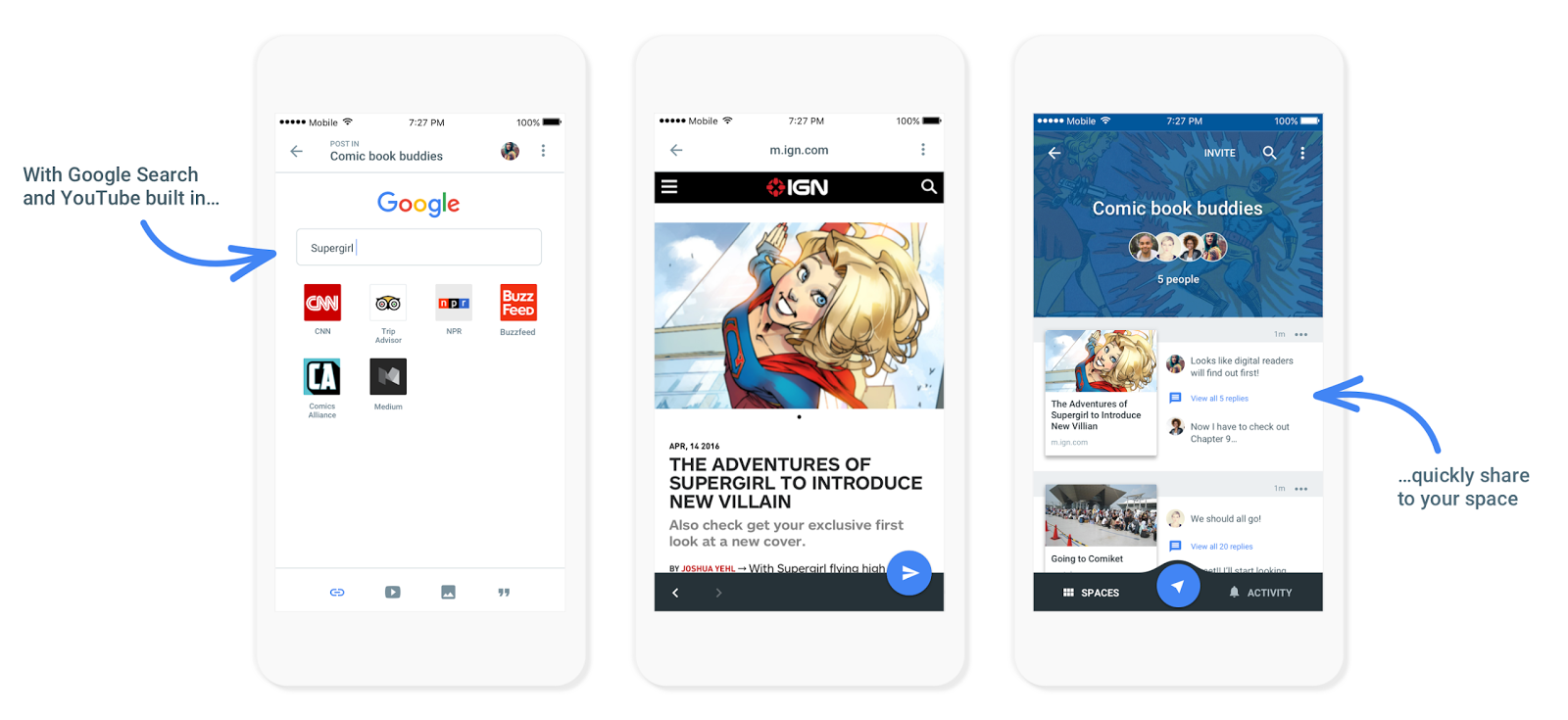
Group sharing isn’t easy. From book clubs to house hunts to weekend trips and more, getting friends into the same app can be challenging. Sharing things typically involves hopping between apps to copy and paste links. Group conversations often don’t stay on topic, and things get lost in endless threads that you can’t easily get back to when you need them.

We wanted to build a better group sharing experience, so we made a new app called Spaces that lets people get people together instantly to share around any topic.

With Spaces, it’s simple to find and share articles, videos and images without leaving the app, since Google Search, YouTube, and Chrome come built in.
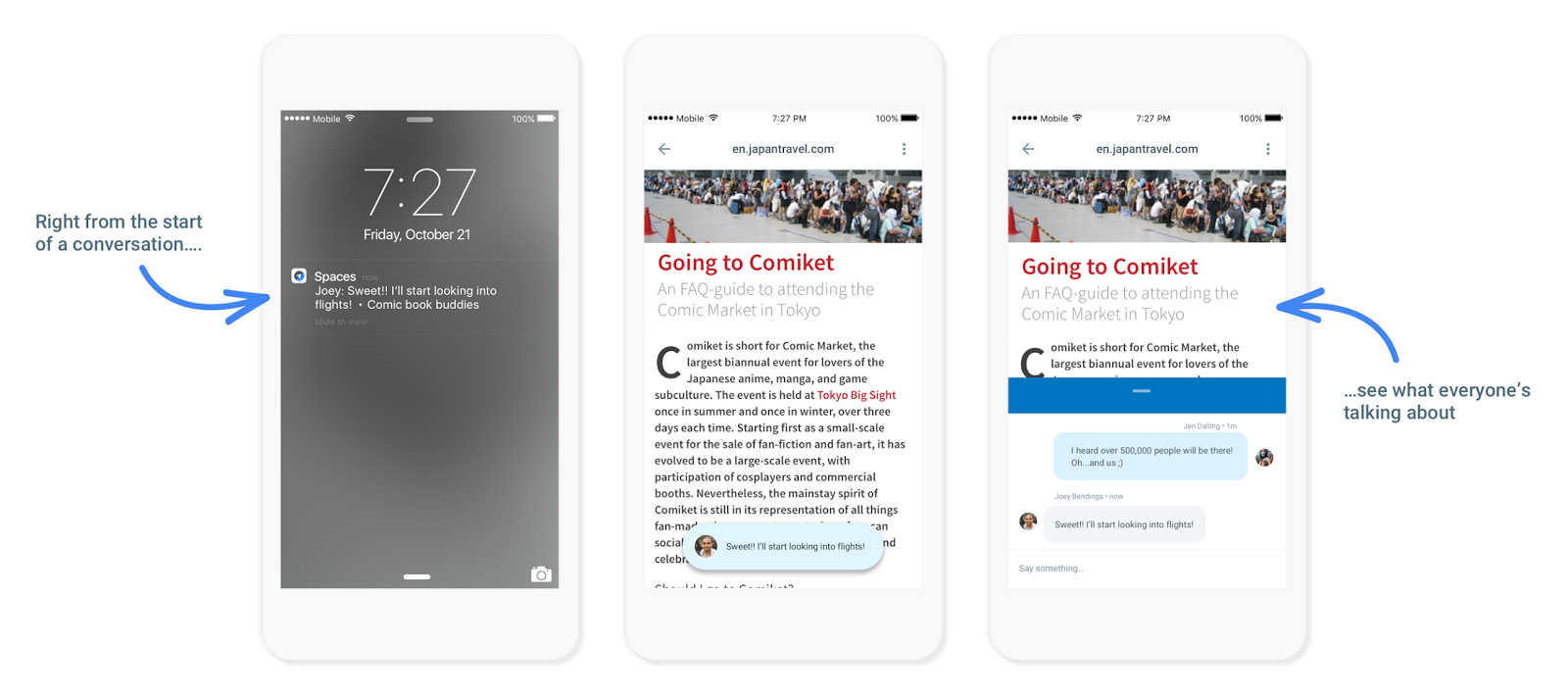
When someone shares something new to a space, the conversational view lets you see what the group is talking about without missing a beat.
And if you ever want to find something that was shared earlier—articles, videos, comments or even images—a quick search lets you pull it up in a snap.
You can create a space with just one tap for any topic and invite anyone via messaging, email, a social network, or whatever way you like.

We’ll also be experimenting with Spaces this week at Google I/O. We’ve created a space for each session so that developers can connect with each other and Googlers around topics at I/O, and we've got a few surprises too. If you’re joining us in person at I/O, make sure you install Spaces on Android or iOS before you arrive!

Spaces is rolling out today on Android, iOS, desktop, and mobile web for all Gmail addresses. Give it a try and create your first space today.

Posted by Luke Wroblewski, Product Director Luke Wroblewski Product Director
16 May 17:12

Google's latest app, Spaces, aims to simplify group sharing

by Chris Welch

Even before kicking off its I/O 2016 conference, Google is introducing a new app. Today the company announced Spaces, an app for Android, iOS, and the web that's designed to make it easier to share, well, stuff from the web in group conversations. "Sharing things typically involves hopping between apps to copy and paste links," Luke Wroblewski, the product director for Spaces, wrote in a blog post. "Group conversations often don’t stay on topic, and things get lost in endless threads that you can’t easily get back to when you need them."

To avoid all that hopping around, Spaces comes with built-in Google Search, YouTube, and Chrome — so you'll never really have to exit the app to check out whatever other people in the conversation are...

Continue reading…

16 May 13:23

The audio enhancing BoomStick is now available at Sprint Stores

by Brian Heater
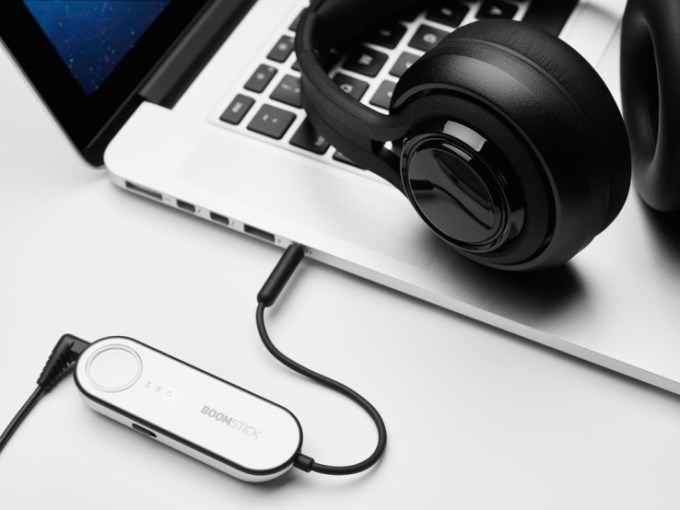
Boomcloud Boomstick We first took a look (or, rather, a listen) at the BoomStick right around CES of this year. The unassuming plug-in promised a peculiar sort of magic, souping up the sound quality of existing audio hardware with the press of a button. The little device is essentially a way of incorporating a piece of software with an algorithm that works to fill in the gaps of poor sound quality, making… Read More
16 May 13:22

The BBC is reportedly planning a 'Britflix' competitor to Netflix

by Jamieson Cox

The BBC is pushing forward with plans for a subscription streaming service that'd rival offerings from Netflix and Amazon, and it has an adorable working title: Britflix. According to The Telegraph, the broadcasting corporation and its commercial rival ITV are collaborating on the Brit-centric service after receiving permission from the UK government. The BBC unveiled a 10-year plan for its future last week, one that noted the corporation would develop "some form of additional subscription services" in the coming years as a means of generating increased revenue.

"If they want to explore that kind of thing, we'd encourage them"

While Britflix is still early in the development process, the BBC has both the technology and the catalog to...

Continue reading…

16 May 12:23

UK Newspaper Says Google Is Facing An Unprecedented 3 Billion Euro Fine From The European Commission Over Antitrust Allegations

by Michael Crider

EC logoGoogle is no stranger to legal conflict in Europe: between accusations of monopolistic practices with Android and web search tools, to a forced implementation of the European Union's "right to be forgotten" laws, to butting heads with German privacy advocates over Street View data, it's safe to say that the company's relationship with the continent is... complicated. The latest complication comes from the European Commission, the executive arm of the European Union, which will reportedly hand down an unprecedented fine over Google's alleged violations of antitrust laws.

Read More

UK Newspaper Says Google Is Facing An Unprecedented 3 Billion Euro Fine From The European Commission Over Antitrust Allegations was written by the awesome team at Android Police.

16 May 12:22

Amazon will reportedly soon sell its own private-label groceries

by Fitz Tepper
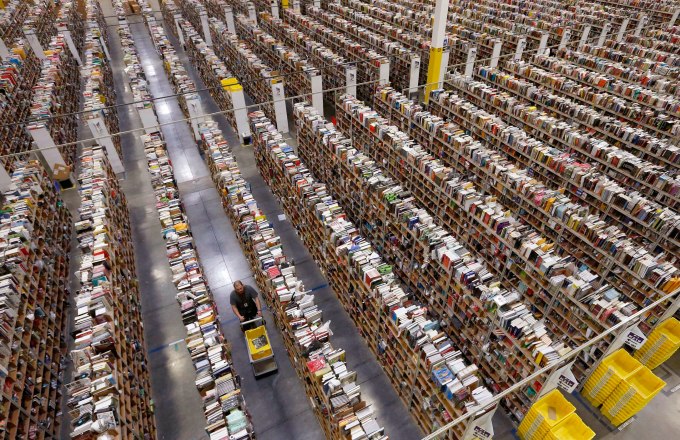
amazon.com cyber monday warehouse Amazon will soon roll out its own private-label brands of common household items like coffee, diapers, and other perishable groceries, according to a report from The Wall Street Journal. The offerings will consist of perishable goods like baby food, tea, coffee, spices, and non-perishables like laundry detergent. These products will live under brand names like Happy Belly, Wickedly Prime,… Read More
16 May 12:22

After spying on social media, UK spy agency GCHQ officially joins Twitter

by Natasha Lomas
gchq-logo GCHQ, the UK spy agency which specializes in garnering intelligence from communications, has officially joined Twitter — posting a “Hello, world” inaugural tweet from its blue check verified account. Read More
16 May 12:21

Google plans to start blocking Flash in Chrome this year

by Jacob Kastrenakes

Flash's death has been slow and painful, and now Google is planning to deal it another blow. Google has detailed plans to start blocking most Flash content with Chrome, with the change targeted toward the end of this year.

Under its current vision, nearly every website would have Flash content blocked by default. Visitors would still be able to enable Flash content on a site-by-site basis, but they would have to specifically choose to do so. Chrome would display a prompt offering to enable Flash; if chosen, Chrome would remember to run Flash on that site for all future visits.

Continue reading…

16 May 12:20

Microsoft is adding more ads to the Windows 10 Start menu

by Tom Warren

Microsoft is planning to double the amount of promoted apps in the Start menu with the upcoming Anniversary Update to Windows 10. The software maker revealed at its WinHEC conference last week that the amount will increase from five currently up to 10 in the Anniversary Update that's due to roll out in July. Promoted apps are typically used on new PCs as links to encourage Windows 10 users to download Store apps, and different apps are promoted in different countries.

Some promoted apps are pre-installed, but Microsoft notes that they can be fully uninstalled and any promoted items removed from the Start menu. Microsoft has not revealed exactly why the number of promoted apps is doubling, but it's likely that the company is using it as...

Continue reading…

15 May 17:09

Phoenix airport threatens to kick out TSA, hire private (unaccountable) contractors

by Cory Doctorow

animation (1)

The administrators of the Phoenix Sky Harbor airport are apparently considering getting rid of the TSA and replacing them with private contractors, similar to the setup at San Francisco International Airport. (more…)

15 May 10:54

Copyright Holders Try To Remove BBC iPlayer From Google

by Andy

bbcThe controversy over the prevalence of copyrighted material appearing online without rightsholder permission has ramped up to new levels this year, with a somewhat predictable twist.

Apparently in no position to tackle the hundreds of ‘pirate’ sites online today, organizations including the MPAA and RIAA have turned almost entirely on Google, complaining that the search giant does little to stop infringing content appearing in its results.

With the recent Copyright Office DMCA efficacy consultation ringing in everyone’s ears, fresh attacks on Google are conveyed on an almost daily via friendly blogs run by industry supporters. Meanwhile, Google continues to silently process millions of takedown requests every week, precisely none of which relate to infringements carried out by the company.

But as the public criticism of Google mounts, what is less well reported is how impressively the company continues to deal with the abuses of the DMCA carried out by hundreds if not thousands of copyright holders and their hopeless automated bots. Case in point, recent attacks on the BBC.

As one of the world’s most famous and responsible broadcasters the BBC takes copyright infringement and indeed all aspects of the law extremely seriously. However, according to a whole bunch of copyright holders the company’s website is a hive of infringement.

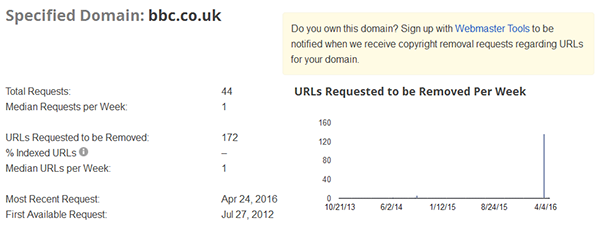
As illustrated in the image below, the BBC has recently been subjected to a wave of copyright infringement allegations from several copyright holders, none of which appear to have any merit.

bbc-1

One of the worst blunders comes from Indian anti-piracy outfit Markscan who on their homepage refer to themselves as a “knowledge partner” of the MPAA.

In a notice sent to Google aiming to protect the rightsholders behind the 2016 Paris ePrix (electric Formula E racing) Markscan demanded the takedown of several hundred links supposedly showing the event live without a license.

Unfortunately the company’s bots fingered the wrong suspect, first trying to take down the BBC iPlayer version of BBC News and later the BBC’s flagship entertainment channel, BBC1.

bbc-2

bbc-3

We didn’t examine in detail all 574 links sent by Markscan but the Yahoo one shown above is also bogus. Furthermore, most of the links appear to reference live streams of the Paris race which took place on April 23, 2016. The notice wasn’t sent until the day after, long after the race had finished. Overall, Google rejected 97% of the Markscan claims.

But the fun doesn’t end there. Waves of notices sent by anti-piracy outfit Topple Track targeted the BBC late March, each informing Google that the broadcaster is infringing on the rights of recording labels. One demanded the takedown of 38 BBC pages, another 40 pages, and sundry others in between.

What all of these takedowns have in common is that they’re all bogus, they’re all abuses of the DMCA, and every single one was somehow spotted by Google and rejected. As outlined earlier, copyright holders are often extremely critical of Google but it appears that far from accepting every notice coming in, Google is actually taking the time to do the right thing and is regularly saving copyright holders from each other.

Some argue that the relatively small percentage of incorrect notices sent is hardly worth mentioning in the overall scheme of things, but when they are your URLs being removed from search, things take on a different light. Thanks to Google’s vigilance BBC iPlayer remains in its indexes, no doubt the Corporation will be grateful for that.

Source: TF, for the latest info on copyright, file-sharing, torrent sites and ANONYMOUS VPN services.

14 May 19:42

What we're hoping to see at Google I/O 2016

by Phil Nickinson

It's good to set expectations before a show, but it's also okay to dream a little bit.

Google I/O is nearly here. Just days away. And while it's important to remember that I/O is, first and foremost, a developer event, those of us who don't code for a living have a few thoughts on what we'd like to see come out of this year's conference.

There's a lot to cover in three days. Android. Chrome. Chrome on Android. And, of course, virtual reality, maybe some stuff on connected homes, automotive, wearables — and who knows, maybe Google will surprise us with something nobody thought of.

There's going to be a world of stuff to absorb over three days in in Mountain View. We've already heard about what you want to see. Now it's our turn. This is just a smattering of what we're hoping to find at Google I/O, as told by the Mobile Nations folks who will be there this year.

First, some background

Moscone West for Google I/O in 2010.

Give us your Google I/O background. Are you a total noob? Or a veteran?

Phil Nickinson: I remember being pretty new at this Android thing still and hearing about Google's annual developer conference. It was definitely still a spectacle back in 2010, but I was in way over my head. I have few pictures from that event — and fewer that are good. But it served as the basis for what we do now — covering the heck out of one of the most awesome developer conferences there is. It's so great to meet some of the folks who make the apps and devices and services we use every day.

Jerry Hildenbrand: I went to Google I/O in 2009 through a prior employer (we were interested in the Google App Engine) and have been every year since I started working for Mobile Nations in late 2010. It's one of the highlights of my year.

Alex Dobie: This will be the second Google I/O for me, my first being way back in 2012 in the days of Jelly Beans, Google Glasses, Nexus 7s, blimps and Vic Gundotra

It was the first Google dev conference since Android really started to take off, and that was reflected in the OS's prominence at I/O 2012 — and by the level of pomp and pageantry at the conference. Glass-equipped skydivers parachuted into the keynote. A giant robotic Nexus Q stalked the halls outside. Hell, the real, actual Nexus Q was crazy enough — a Chromecast trapped inside a bowling ball that Google planned to sell for $300.

This year's I/O is going to be a bit different, with a new and upgraded venue — and a different Google along with it. I'm expecting the atmosphere at Shoreline Amphitheater to be quite unlike anything we've seen at Moscone.

Michael Fisher: For years I've experienced Google I/O from across the continent, consigned to watch the live stream from rainy Boston while friends and colleagues cavorted with life-sized Androids and super-scale confections in the bright California sun. Well NOT THIS YEAR, Universe! There might not be a new Nexus in sight and MrMobile might not even be halfway through his soft launch, but I'm going to I/O for the first time ever and dammit, I'm gonna find me a walking Nutella and I'ma hug it. Hard.

Daniel Bader: My first I/O was in 2012, when Sergey Brin fell from the sky like a peregrine falcon to drop Nexus 7s on our laps like an ultra-fit Santa Claus (I'm remembering that correctly, right?), and I've been every year since. It's my favorite conference (and I attend a lot of them), with content considerably more accessible to the average person than Microsoft Build, and less manicured pomp than Apple's WWDC. Google always makes it interesting, and there is a palpable sense of whimsy that only it can achieve.

Andrew Martonik: I'm happy to say this will be my first in-person experience of Google I/O, as the past few years have been spent steering the ship from back at home and watching all of the shenanigans unfold over the internet. Google is really great about live streaming the big keynotes and sessions, which has made it super easy to follow along remotely, but after going to plenty of other conferences I know there's nothing like actually being there in person.

On Android

Android M got its start at Google I/O 2015.

What are you looking forward to in terms of Android at the conference?

Phil: It's important to keep Google I/O in perspective, I think. We're going to see a lot of great platform-level stuff. And that's super important. But that's not the same as consumer-level. The little details we've see in the Android N preview might or might not look the same by the time they hit the Samsung Galaxy S8, for example. Nexus is awesome, but still niche. (Which is a shame.) Hopefully we'll see N do more to change that.

Jerry: I'm looking forward to hearing about what's in store for the long term. Android N is going to be nice, but I really dig it when the people building Android start talking about their ideas for the next version, and the version after that. You can see the excitement when someone is telling you about things that can be done to improve the user experience with their part of a giant piece of software, and how it will fit together with all the other ideas to make things better, more efficient and easier. What we're using in Marshmallow is based on ideas we first started hearing about in 2012. Watching Android morph over time and seeing how it all takes shape is a big part of how I get my nerd on.

Alex: Google set the ball rolling a lot earlier in the year with Android N compared to previous cycles. So while I'm expecting interesting announcements around the future of VR in Android, and the Android runtime in Chrome OS, I'm not holding out for any big product reveals. Those will come later in the summer when N is ready to ship.

Split-screen multitasking has been taking shape in the first couple of N Preview builds, and I'm curious to see how Google sells this to devs as a complete idea. What's more, rumors have swirled about pressure-sensitive screen support in the next version of the OS (something that's actually been around at a low level for years if you go digging in the code). And while I can definitely see that being A Thing in future Android versions, if 3D Touch on the iPhone is any indicator, it's going to take a while to grow beyond a neat piece of technology looking for its killer app.

Michael: I seldom run beta or preview builds on my devices, so I'll be using Android N for the very first time at I/O. On the smartphone side I can't say I'm terribly excited – I'm quite happy with Marshmallow in its current state – but as the (sorta) proud owner of a Pixel C, I'm dying to see what split-screen implementation Google has come up with to make the most of tablet displays. Also, it sure would be nice to see improvement in areas like background memory management and audio handling, small but still unfortunate pain points in my Android experience thus far.

Daniel: I think we can all agree that the proliferation of exciting, whiz-bang achievements within the Android operating system itself has slowed. As we near the middle of the alphabet, there is a middle-aged maturity in each new version, a logical progression that, to my eyes, is more about refinement than revolution. Still, with Android growing up, it begins to enable everything, like cars, VR, and everything in between, that were traditionally marginalized while Google got the smartphone experience just right.

While I'm excited to see what Google does with split-screen multitasking, I'm more interested in how developers will respond to the new APIs built into Android N, since apps make Android what it is.

Andrew: Google let the cat out of the bag early again this year with the Android N Developer Preview, which is a great thing for enthusiasts but most importantly developers. All of the smart people who make the devices and apps we all use can go into I/O with early versions of the code already in their hands, and that makes a huge difference when you only have three days to collaborate in person.

Having the basic features of Android N out in the wild already also means that Google doesn't have to spend time re-hashing it, and can move on to announcing truly new features and getting into the specifics of the operating system. We also haven't heard much about how Android N is going to work with non-phone platforms, including the ultimate vision for tablets, wearables, embedded systems and more that all run on or interact with Android.

On virtual reality

.

Google took us by surprise with Cardboard, but it's time for something new. What are your expectations for VR?

Phil: I'm all about 360-degree cameras these days. That's not quite the same as virtual reality, but it's definitely in the same ballpark. The ability to have a small, handheld camera capture still and video of the entire world around me at any given time is huge. And Google is basically turning us all into Street View photographers in the process. I really want to see some improvements from Google in sharing. YouTube is great (and easy) for video, but still images definitely need some work.

Jerry: We need an inexpensive, stand alone VR headset. Google is the right company to do this, and I have no doubt that someone is thinking about it. There's a huge gap between Google Cardboard and something like the HTC Vive, and while Samsung is filling it their way with the Gear VR, a unit that doesn't need specific hardware but can provide a similar experience would be awesome.

Alex: I think we can all agree that Cardboard needs to grow beyond Cardboard. Google can't necessarily manufacture a more premium plastic, gasket-fitted headset that'll fit all Android phones. But it can build an ecosystem around VR content and common hardware characteristics to make it easier for Android to offer a Gear VR-class experience across a wide range of handsets and headsets. That, I think, will be the focus of Google's VR efforts at I/O.

Google Play VR, anyone?

Michael: I recently introduced a family friend to Gear VR, which had him so convinced he was about to be eaten by a Great White that his panicked flailing knocked a table lamp to the floor (along with his drink). I also recently bought an HTC Vive, whose VR experience has utterly flabbergasted every friend who's come over during the past week. Google Cardboard is impressive and important mainly thanks to its accessibility (it doesn't get much easier or cheaper than folding some card stock into a visor and sticking your phone into it) but I've never seen it evoke the kind of visceral awe that its higher-end competitors do. It's going to be fun to see what Google does to take Cardboard to the next level; while it's execution hasn't always wowed, the company's vision has never been wanting.

Daniel: I am so, so excited about what Google does with VR this year. I remember the profound confusion spreading through the crowd of media and developers as they were handed the first version of Cardboard upon exiting the keynote in 2014. Unwrapping the plastic, figuring out how to insert my phone, watching the few pieces of content available for it (on my Nexus 5, no less!). It was a fun ride. Since then, VR has become more mainstream (though, in retrospect, not that much more), but it is the perfect time to introduce a standalone VR headset a la Gear VR — just better! With projects like Tango and Ara already in the works, it wouldn't be surprising to see Google take the standalone VR headset game to the next level — whatever that is.

Andrew: It'd be hard to say that the Cardboard initiative hasn't been a huge success for Google, and it's been a huge driver in the general understanding of virtual reality and immersive video. Now, it's time for the industry to go beyond $15 Cardboard viewers and onto something more substantial.

I would be extremely surprised to see Google unveil its own next-generation higher-end VR experience to compete with the likes of the Gear VR, as that doesn't really seem like a business it needs to be involved in. But I do think it's very much in Google's interest to foster development of such devices — whether that's by offering reference hardware on an open design platform, or just further fostering VR content development in Google Play and YouTube.

On wearables

Android Wear was announced ahead of Google I/O in 2014, but the devcon is where we got our first good look.

Android Wear has kind of stagnated — what's next for Google in wearables?

Phil: I can't help but have the feeling that I'm only using about 2% of what my Android Wear watch is capable of. I archive email on the go. That's about it. Is that my fault? Is that Android Wear's fault? Both? What I'd really love to see is proper NFC payment support. The only thing easier than whipping out your phone to make a purchase is to just tap your watch, right?

Jerry: There has to be more that can be done in this space. Android Wear is handy, but mostly as a second-screen experience. I'm not really sure how wearables can be improved and made indispensable, or even if they can, but I know Google isn't afraid to throw money and ideas at anything. There are some smart people working at Google who aren't going to give up on wearables.

Alex: Qualcomm announced Snapdragon Wear 2100 — its new chip for wearables — back at Mobile World Congress in February, but we've yet to see any actual watches using the new chip. Android Wear has always more-or-less been on a different software track to other device types, so it's possible we may see new hardware teased at I/O.

Put it this way: Almost every Android Wear device ever released so far has used the now ancient Snapdragon 400 SoC. This will be the first major silicon upgrade the platform has seen. So it's to be expected that new software of some sort might go along with it. Whether it'll make Android Wear any more useful (or popular) remains to be seen.

Michael: I still think there's a lot of potential in Google's smartwatch platform, but the major updates thus far have done little more than plug functionality gaps (and introduce gestures that make you look like you're trying to flick a fly off your forearm). Which is a shame, because while it's not the best interface I still much prefer Android Wear to nearly all of its competitors; the hardware selection is diverse and often quite beautiful, and even running on outdated silicon the software is usually zippy enough for the brief interactions the platform was designed for. This year I'm hoping Google applies that "zip" at a more fundamental level, by trimming and tightening the UX. In 2016, there's really no reason it should take me seven swipes and taps to activate something as simple as a countdown timer.

Daniel: I'm not holding out my wrist for much news from the Android Wear space. I've never particularly warmed to Android Wear: the card-based interface still feels clumsy, and even with the recently-added gesture-based navigation I don't feel like Google has done much to improve it. What I'd love to hear is an acquisition of Pebble by Google, combining the ruthless e-paper efficiency of the Pebble Time Steel with the power of Google Now. A man can dream!

Andrew: I've really lost faith in the power of Android Wear at this point, but I'd love to be proven wrong by seeing Google come out with some substantial updates to the platform. It's so clear that Android Wear has potential, but it needs a lot more focus and especially an improvement in hardware. Obviously these wheels are going to turn a bit slower when Google has to work so tightly with manufacturing partners to get the platform moving together, but any sort of improvement would be welcomed here.

On another note, a funny thing happened this week: I took out my Google Glass and powered it up for the first time in over a year. Wearing it around the house for a few hours, I was reminded of how many great ideas were built into Google Glass that still amaze me today. We clearly see some tidbits of that experience in Android Wear, and I hope many of the innovations from Glass aren't completely lost inside of Google.

On the connected home

What about Google's connected home initiatives?

Phil: Google has to have something to compete with Amazon Echo. Alexa's great, but she's not as smart as Google Now. Sonos is killer for easy setup, but it's pretty stagnant. Same goes for Nest. I've got some huge hopes for (former Motorola CEO) Rick Osterloh taking over hardware for Google. We might not see a lot on that front at I/O, but it's a huge re-hire.

Jerry: OnHub 2. Don't let Amazon have this space as their own!

Google Now on my router, which is also a smart hub and gateway between IoT devices and my phone would be sick. OK Google, what's the weather? Oh, and please start my car and turn on the kitchen lights while you're looking. Thanks.

In 2020, I want Google to be cutting my grass.

Alex: The rumor mill seems to have collectively decided we'll get some kind of Amazon Echo competitor from Google, which could be a very big deal. Google's international reach — in terms of its own hardware and services, at least — is far greater than Amazon's. And the same goes for the range of services it offers. The possibilities of such a device connected to Google Now, Play Music, Inbox, Calendar, Android Pay and Google Maps, to name just a few, are phenomenal. It's entirely possible it'll be a continuation of the OnHub project, which could mean not just one device, but several from a wide range of partners. It'd be a very Google approach to that problem.

But if Google is serious about effectively putting its voice search engine in a box and selling it, it'll need more than just routers. Maybe a series of mic/speaker boxes could be offered for multi-room support, or it could simultaneously hook into the audio hardware of your Android phones. In any case, given the privacy concerns already swirling in some parts of the world, selling consumers on an always-listening Google box in your living room could be another challenge altogether.

Michael: MrMobile is all about staying on the road, so he doesn't spend much time thinking about technology to use on the homefront. Still, an Alexa competitor from Google would be compelling; despite its excellent reviews I've managed to avoid adopting Alexa because I just don't spend enough time in Amazon's ecosystem to make it worthwhile. Google, on the other hand, knows every step I've taken (and every move I've made/bond I've broken/game I've played) since 2006, and it knows me pretty well as a result. Having that kind of familiarity at my beck and call when I'm fiddling around the house could be very interesting indeed.

Daniel: Google's parent company, Alphabet, already owns Nest, so let's see that side of the business step up. Sure, Nest is an executive tire fire with a bevy of internal problems, but that doesn't discount Tony Fadell's theory of the unified home needed a central platform — such as a thermostat or router — to excel. Like Jerry, I'm a fan of the OnHub, and hope Google does more than just attach IFTTT support and call it a day.

Andrew: Connected home products just haven't caught my interest up to this point, and Google has had a limited set of successes in this arena so far. Products like OnHub and Chromecast are great in their own respects, but Google's attempt at unifying all of your connected home products hasn't really gone anywhere.

I want to hear Google talk more about Brillo and Weave if only to reassure partners and independent companies working with the technologies that Google is still invested in them … at this point we haven't heard enough to make that case.

On Chrome and Chrome OS

Sundar Pichai at Google I/O in 2011. Then, in charge of Chrome. Now, CEO of Google.

One of the most-hyped areas is Chrome and Chrome OS — what are you expecting?

Phil: More Chromebooks. And better, cheaper Chromebooks. At this point I can't think of anything else I'd ever have my kids use. No applications to install. Easily managed by my Google Apps account. It's an underrated product, for sure.

Jerry: Android runtime. Merging Android and Chrome is a silly idea and I'm glad that everyone addressing it is saying it's not going to happen. Chrome is a better and stronger platform than Android and used for different purposes. We need to remember that the idea behind Android wasn't to kill the mobile market and take it over, but to build a platform for applications that anyone can use. Let's take that application layer (and its 1,000,000+ apps) and get them on Google's other consumer product.

Alex: I've said it before and I'll say it again here: Android apps on Chrome OS could be huge, if Google handles it right. As Android apps grow ever feature-rich, and the platform expands to incorporate resizeable apps, the Google Play Store could become an important destination for things that just aren't convenient to do in a browser window. It's also an important insurance policy against any long-term move away from the open web from rivals like Apple, Facebook and Microsoft. And that could all start at I/O 2016.

Even more tantalizing: if Android apps on Google Play come not just to Chromebooks but Windows and Mac machines running the Chrome browser, well that's just an even bigger audience for Android developers — and more eyeballs for the Google ecosystem.

Michael: I've never laid hands on Chrome OS, and I've never felt a compelling urge to do so. Given how well Android works for my needs on most screen sizes (remember, I'm a Pixel C weirdo), I don't see how exciting Chrome OS could possibly be – even with the much-ballyhooed Android app compatibility speculation. Being able to run Android apps in Bluestacks on a Windows machine didn't make it any less cumbersome to do so, nor did it save BlackBerry or Sailfish from the rubbish bin. More to the point: these days, when I want a notebook experience and don't have a notebook handy, I throw a keyboard on a tablet and nine times out of ten I can get work done pretty comfortably. When I'm done, I can toss the keyboard and have a tablet again – something I can't do with Chrome OS. So while I'm interested to see what's new for the platform, I can't say I'm expecting wonders from Google in this regard.

Daniel: Chrome is in an interesting spot. As we've learned from Microsoft's considerable Universal App Platform growing pains, it takes more than correct scaling to bring a smartphone application to the laptop form factor (and vice versa), so merely offering a universal Android runtime for Chrome OS is not a catch-all solution. As Jerry pointed out, Chrome is an incredibly powerful and robust operating system, and I'd like to see more done with it than pawn it off to Windows OEMs to sell at bargain-basement prices for the purposes of education or low-friction home use.

Andrew: This could perhaps be the most important year for Chromebooks, as their widespread appeal is creating a market that demands higher quality and a more diverse set of computer options. The benefits of Chrome OS are as clear today as they were at the start, but now we need better hardware and performance on the average Chromebook so they can appeal to even more people.

That's especially true if Google decides to go all-in with bringing Android apps (and the Play Store) to Chromebooks, as the demands for resources will just keep going up. Google can only do so much when it's the manufacturers who ultimately decide to make the devices, but as the platform leader it can do a lot to push them in the right direction.

On anything else you'd like to see

A giant Nexus Q in 2012 — only the coolest thing at Google I/O EVER.

Any other outliers you want to see covered this year?

Phil: I'd really like to see more on Android Auto. Getting folks to put down their phones while driving may be one of the most important things the mobile industry can do. And Android Auto is a killer product. But it's still a little rough around the edges.

Jerry: Google Codsworth, please.

Alex: It's basically an open secret that Google is working on bringing a subset of its services, including the Play Store, to China, a country from which it's currently all but excluded. The major challenges there are likely political, not technological. Nevertheless, a developer conference would be the ideal location to announce a major new market for Android apps.

Michael: Project Ara — and really, the concept of a modular phone in general– has always seemed like kind of a long shot, at least in terms of widespread adoption. Nevertheless, I hope Google hasn't given up on making it a reality, even on a small scale. The concept of a smartphone that can be repaired or upgraded piecemeal is exactly the kind of sci-fi stuff that flips my pancake, so I'm really hoping to hear that Google hasn't left it to evaporate down at the far end of the Alphabet.

Daniel: Methinks it's more than just population management why Google relocated this year's I/O to its home campus of Mountain View. Self-driving cars are, of course, a big deal right now, and it wouldn't surprise me to see Google spend a lot of time talking up its leadership in this area, especially as Tesla is slowing encroaching on that space with continued updates to its Model S.

I'd also love to hear more about Project Ara, which I hope has not been shelved as was rumoured earlier this year.

Andrew: Over the few days of Google I/O we're always expecting a few oddball announcements, but one of the big things I'd like to see is a better explanation of where Google's hardware efforts are headed under Rick Osterloh. The former Motorola exec certainly knows a thing or two about all of this, and I'd love to see what his vision is for Nexus, Chromecast, Pixel and more.


Google I/O 2016 kicks off on May 18th, and you can follow all of the Android Central coverage from the show right here!

14 May 16:19

FBI Director: viral videos make cops afraid to do their jobs

by Cory Doctorow

animation

FBI Director James Comey told reporters that "viral video effect" (which is his latest term for what used to be called the "Ferguson effect") is responsible for increased violent crime in some US cities, in that police are scared to do their jobs because they might end up on Youtube in an unflattering video. (more…)

14 May 12:09

Petition to Bring 'Agent Carter' to Netflix

https://www.change.org/p/netflix-save-agent-carter-bring-her-to-netflix

Various news outlets are spreading the petition around.

13 May 22:47

Android Pay could be headed to the UK soon

by Joseph Keller

Android Pay could be on its way to the UK quite soon, at least according to one fast food chain. Pret A Manger is now advertising that it accepts the contactless payment service on its payment terminals at its London locations, suggesting that Android Pay will arrive in the country shortly.

From The Telegraph:

According to employees at this particular Pret store, the "We now accept Android Pay" tags arrived overnight and have been displayed in stores from this morning, suggesting Android Pay will be imminently available to UK customers.

Google had previously announced its intention to launch Android Pay in the UK back in March.

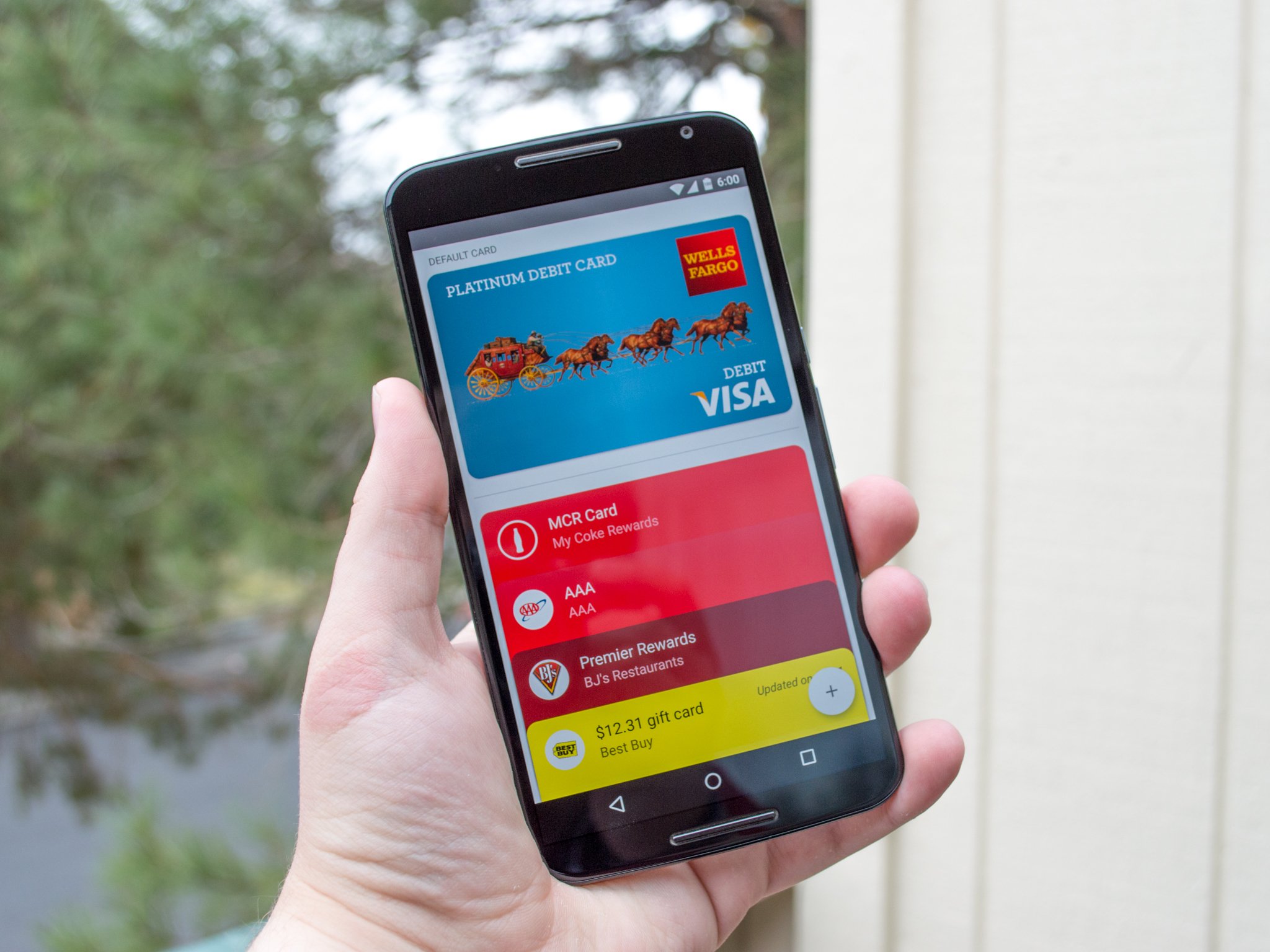
Android Pay launched in the United States last fall, and is Google's latest attempt at building a mobile payment solution. It allows you to connect your credit and debit cards to your Android phone and pay for items securely with just a tap at an NFC-equipped payment terminal.

13 May 20:06

Attach Your Spending Desire to a Financial Goal

by Kristin Wong on Two Cents, shared by Andy Orin to Lifehacker
Attach Your Spending Desire to a Financial Goal

If you want to buy a home, most experts suggest saving at least 20% for the down payment. It’s a simple goal for a big purchase, but it’s meant to protect you financially. You can use the same concept for other purchases, too.

Money site Financial Samurai explains the concept:

By tethering your desires, you force yourself to achieve certain financial goals before wasting money. You might just find that after spending all that time earning or pursuing a goal, you’ll lose your desire to splurge! I’ve already created a mid-life crisis investment fund for a fancy car that I doubt I’ll buy.

There are a few advantages to this strategy. First, it makes your spending more mindful. You’re not just spending impulsively—you have time to think about your purchase. Second, it helps you achieve whatever goal you’re working toward. For example, I’m terrible at negotiating. As an incentive, I once put off buying a new phone until I asked for a raise. This motivated me to get up the courage to ask. Finally, you get to enjoy your spending.

While Financial Samurai mostly discusses the rule in terms of big-ticket items, like a car, I think it works well for smaller splurges, too. I used this strategy when I was in student loan debt. If I wanted to enjoy a nice restaurant meal, for example, I used it as a reward once I paid off X amount. Those rewards can keep you from burning out on your goal, too.

http://twocents.lifehacker.com/money-saving-h...

For more on this strategy, head to the link below.

Easy Ways To Boost Savings And Control Spending | Financial Samurai

Photo by Tony.

13 May 20:04

The best equalizer apps for Android

by Jerry Hildenbrand

There's a pretty good chance you use your Android to listen to music. Some folks really get into it, but most of us enjoy a tune playing when we're on the train, or at the gym or even just chilling. There are a lot of ways to get music from your phone (or the internet) to your ears, because humans are musical animals.

A big part of enjoying your music is fiddling with settings to make it sound better. For some of us, that's as simple as adjusting the volume. Other folks want to adjust sliders or enable settings that boost the bass or enable a pseudo-surround sound wrapper effect. Others also get a little more extreme and micromanage every setting they can find to tune their tunes. No matter which category you fall into, a good equalizer app will help you find just the right sound. Let's take a look at what's out there that fits the bill.

Why is this list so short?

You noticed that, huh? Good, because I really want to talk about that for a minute.

For starters, every single equalizer app you can download and install without having a rooted phone is basically the same. They all tap into the Android AudioEffects class to use the Equalizer, BassBoost, Virtualizer, PresetReverb and EnvironmentalReverb derived classes to apply audio effects to a specific instance of an audio session, and system-wide effects to the global audio mix are depreciated and no longer work. This means two very important things — the only differences between all these apps are the user interface and features, and that an equalizer app can't control the sound from more than one app at a time. Experience tells us that this means every app won't work with every music player, too.

Every equalizer app uses the same Android API, so the difference is in the interface and feature list.

None of this applies to apps with system-level permission, like the ones the folks who built your phone added (think JBL audio or the HTC Beats of olde), system wide audio effects provided by the operating system, like we see in the CyanogenMod AudioFX settings, or root-specific apps like Viper4Android.

Basically, every equalizer app you install does the same thing as the rest — moving a slider does the same thing, enabling Bass Boost does the same thing, and what matters is how easy it is to do it all. But that still doesn't explain why I only picked three apps from a list of a hundred or more in Google Play. That's because these are the three that don't suck suck the least.

I started by installing the 20 equalizer apps with the highest rating in Google Play. I deleted all the apps that crash and burn on Marshmallow. I then deleted all the apps that did bad things like try to trick you into installing other apps with vague wording and promises of a new version. Then I deleted all the apps with horrible ads that capture your screen and make you watch 10 seconds or so of some shitty game you never wanted to install anytime you move between screens or apply changes. That leaves us with three apps, because I'm just not going to point you at apps that I wouldn't install myself. I can't do it, and I won't do it.

You might already have an equalizer

Google Play Music equalizer

Some companies that build Android phones have their own audio enhancements built into the settings. And plenty of music apps have a built-in equalizer in their settings.

Built-in audio effects from the folks who built your phone can and will do more to the sound than any app you install from Google Play, because of the things we talked about above. They aren't restricted to use the same API, and often have companies like JBL or Harmon Kardon help them tune the audio output. If your phone has anything like this, use those options first. The HTC 10 (for example) has a much better surround virtualizer built in than anything you can download and install, and it's worth trying what you already have before you try anything else.

If your music player has an equalizer in the settings, use it

If your music player app has it's own equalizer — like Google Play Music or PowerAmp — it will give you the same exact results as anything you can download. The app is already running, so you'll not have anything adding overhead or latency to the audio stream, and you'll not need to use up any space by installing another app. Some of the worst offenders that didn't make my list also want to try and start at boot, and keep running forever — even when the audio effects aren't active. That's OK if you're using an older version of Android that lets an app adjust the sound mix globally, but not an efficient use of resources if you're using something running KitKat or newer.

If you already have an equalizer or audio effects settings, save yourself the hassle and use what you have. If you don't like it, then try something else — but be sure to disable what's there because only one app can apply effects to one audio stream at a time.

Now, on to the short list.

Equalizer & Bass Booster

Once installed on your phone, you see it listed as Bass EQ. Don't be fooled by the name, because Bass EQ is more than just a bass booster. It leverages the API to provide a volume boost with 15 levels of adjustment, 12 settings for bass boost and 12 settings for sound virtualization as well as a five channel equalizer (60 Hz, 230 Hz, 910 Hz, 3.6 kHz and 14 kHz) is a spiffy "mini" ui that acts like a floating window. One really cool feature is a visualizer in both the compact interface as well as full-screen with pretty cool visual effects in time with the music. It's a trippy throwback to WinAmp, minus the llamas.

A dip into the settings allows you to enable or disable a persistent notification (as well as use the notification to toggle the app on and off), vibration on a change so you know you're adjusting things and the option to choose which screen — the volume booster or the equalizer — is shown at start up.

The free version has ads, and you will get a full screen ad from time to time — but always with a way to close it so you're not a hostage to a shifty app developer. If you like the way Bass EQ works, the Pro version is $2.99 and kills the ads, as well as gives you the ability to use and store reverb presets.

Download Equalizer & Bass Booster (Free)

Download Equalizer & Bass Booster Pro ($2.99)

Music Volume EQ

Another equalizer app with a nifty mini interface, Music Volume EQ would be my pick from this list.

You get the standard 5 band equalizer (60 Hz, 230 Hz, 910 Hz, 3 kHz and 14 kHz), bass boost and virtualizer settings and a master gain control with a vu meter that has green-to-red indicators — exactly what you're used to from a hardware eq. Pretty standard stuff, but what I really like is what you'll find in the settings.

Jump in and you'll see a quick toggle between a standard stereo-looking skin and a material theme, a full screen mode setting, transparency options for a static widget and some settings to control the behavior of the app. You can lock the system media volume setting so that only the gain slider in the app controls audio output levels, and set the background service to stop if you set the volume to zero. These are both pretty cool options for when you're using your phone to do nothing but play you some songs.

The app is free with an ad banner at the bottom of the main screen, and there's no paid option to kill it off. But you are given a choice to opt-out of usage analytics, which makes me want to enable them and help the developers out. Good show, devs.

Download Music Volume EQ (Free)

Equalizer

This is probably the most full-featured equalizer app in Google Play, and one of the first. I've used in on and off through several Android versions, and it works exactly (almost) as stated and does it without being silly with permissions or scammy ads.

It has the standard settings — a five band equalizer with presets, a bass booster, virtualizer and reverb presets. The user interface is simple and easy to understand while being unique and not looking like the old Blaupunkt stereo I had in my VW bus. Equalizer also can hook into certain music apps (Google Play Music and Omich Player are two examples) and automatically enable itself when you start playing a song, then go back to sleep when you're done. That's a nifty trick. It claims to be a global equalizer, and probably was at one time (I think it was) but that's part of the reason it's not my top pick — it's in dire need of an update.

You have skins for both the app and the widget, but the service that hosts them is no longer running and you get an error when you try to find them. I don't mind the interface the way it is, and I don't need an equalizer widget so this isn't that big of a deal, but if you haven't updated your app since 2014 and have let hosting services disappear, I can't say you're the best.

Equalizer is free, but you can buy an unlock key for $1.99 that lets you save custom presets, delete, edit and rename presets, put a preset shortcut on your home screen and backup or restore settings from your phone storage or SD card. If you don't mind using an app that may have been abandoned, it works well and the unlock key is worth the two bucks.

Download Equalizer (Free)

Download Equalizer unlock key ($1.99)

Tell me what I missed!

I use PowerAmp almost exclusively when I get serious about listening to music, and use the built in EQ and tone controls, so I'm not looking for a good equalizer app. But I'm sure some of us do have a favorite here, and I want to hear about it. Shout out in the comments and tell me what I need to add to this list, and as long as it doesn't kill me by trapping me in ads or crash on my phone, I'll give it a shot. I'm always looking for things to make my music sound better.

13 May 20:04

Google Play Carrier Billing Expands To Vodafone In The UK And Italy, Sunrise In Switzerland, And More

by Ryan Whitwam

playGoogle Play supports all manner of payment options these days, but for many, carrier billing is still the easiest. You don't have to input any payment details or log into an external account. You just buy things and pay for them on your monthly bill. However, it requires carrier support. Customers on five more carriers will have the option now, according to Google's support site.


The newly added carriers on the Google Play carrier billing list include the following.

Read More

Google Play Carrier Billing Expands To Vodafone In The UK And Italy, Sunrise In Switzerland, And More was written by the awesome team at Android Police.

13 May 20:00

Personal data of China’s elite, including Alibaba founder, leaked on Twitter

by Ananya Bhattacharya

On Thursday, a Twitter account publicly released the personal information of China's rich and powerful, Tech In Asia reported. Photos and screenshots posted by the account @shenfenzheng — which means "personal identification" in Chinese — revealed sensitive data like national identification numbers, birth dates, addresses, educational attainment and marital status.

Leaked data included national identification numbers, birth dates, and addresses.

Among the victims are two of China's richest businessmen, Alibaba founder and chairman Jack Ma, and Wang Jianlin, chairman of real estate company Dalian Wan Group, according to The New York Times. Jianlin's wife and son's identification numbers were also exposed. Ironically, Fang Binxing, the...

Continue reading…

13 May 20:00

UK drivers may be able to store their driving license in Apple's Wallet

by Ananya Bhattacharya

The UK's equivalent of the DMV is considering making digital driving licenses that could be stored in the Apple Wallet, Slashgear reports. Today, Oliver Morley, the CEO of the Driver and Vehicle Licensing Agency (DVLA), tweeted an image showing what the digital driver’s licenses could look like, along with the caption, "So here's a little prototype of something we're working on #drivinglicense."

An add-on to the physical license

Typically, the iPhone's virtual wallet is associated with Apple Pay, but it can also store multiple credit cards, memberships cards, and tickets. In this case, the Apple Wallet would store the driving license information on a person's phone. There is no timeline for when the digital license will go live in the...

Continue reading…

13 May 14:17

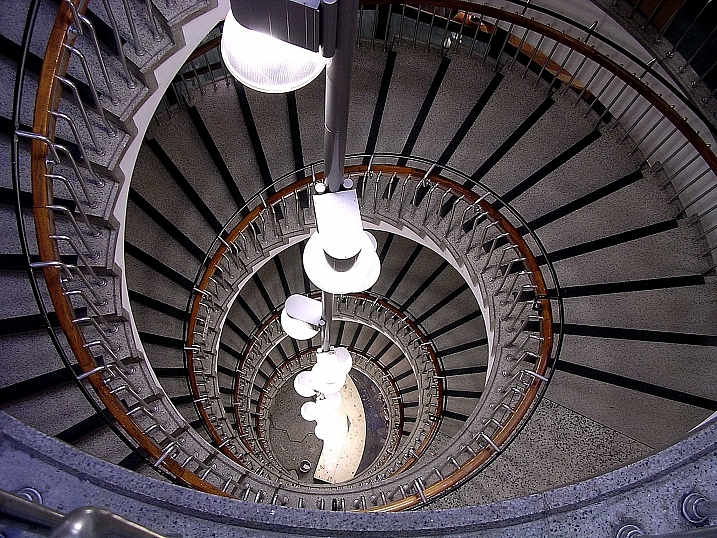
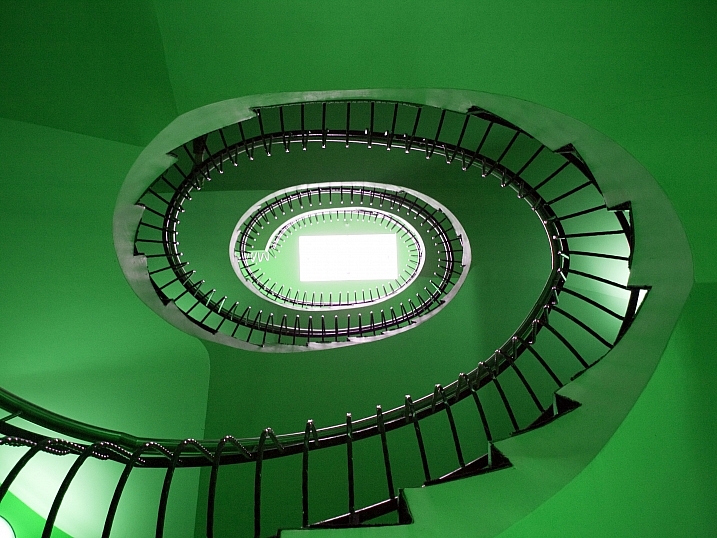
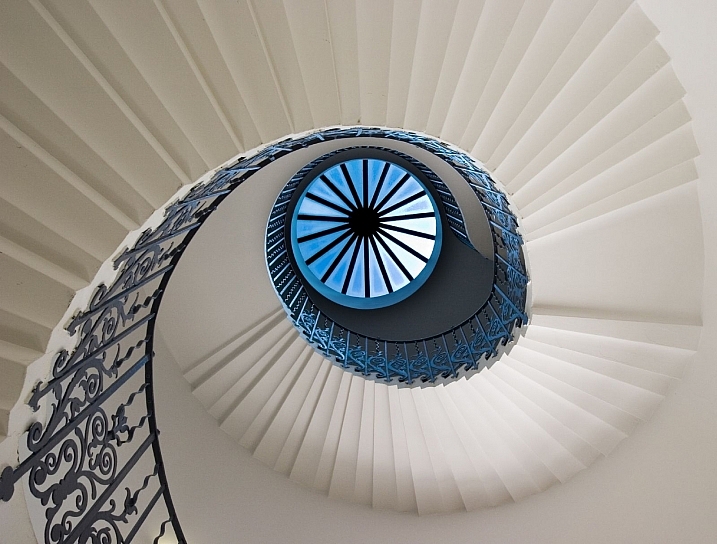
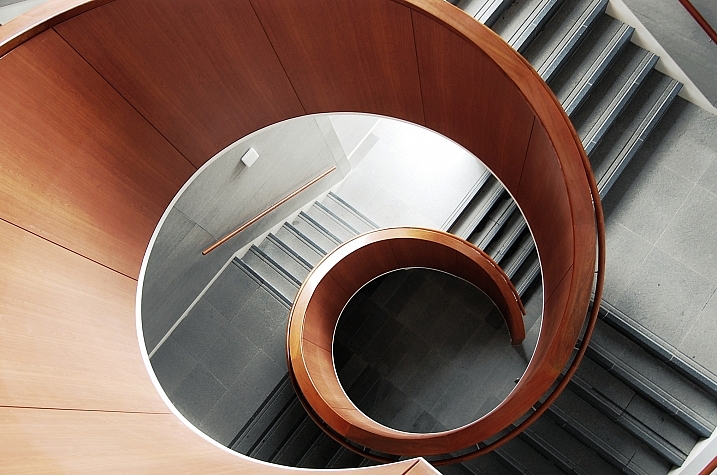
32 Dizzying Images of Spiral Staircases

by Darlene Hildebrandt

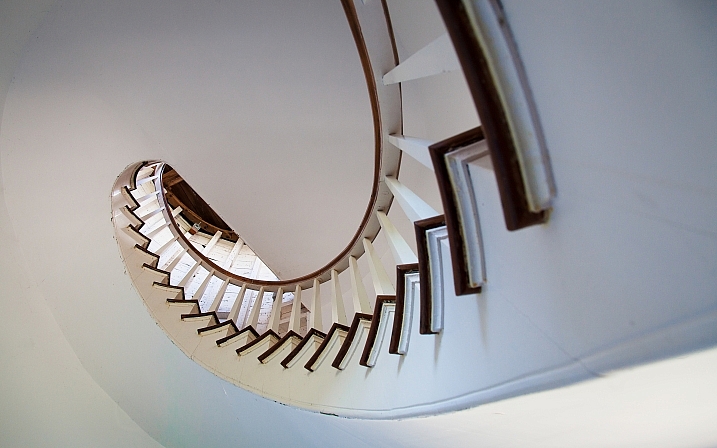
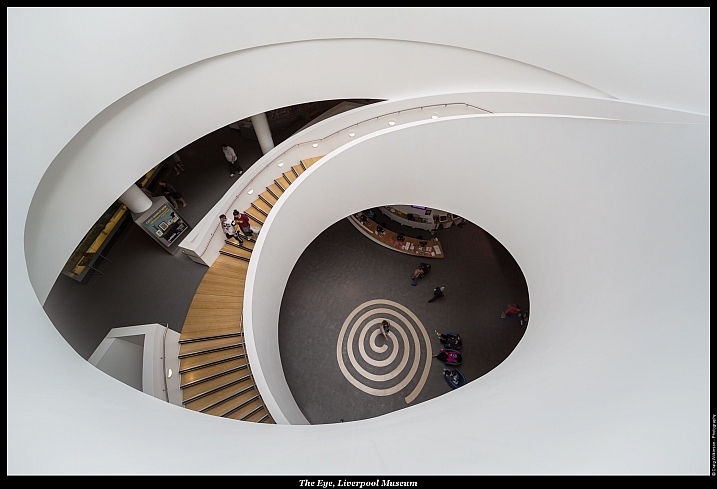
Composition is an important part of photography. You may have heard of the Rule of Thirds, or even the Fibonacci sequence (aka the golden mean). It is something that appears in nature often (think spiral sea shells) and which man imitates almost instinctively.

Check out some of these images of grand spiral staircases and see if you can’t see similarities. The symmetry, and unique properties, the math!

Howard Ignatius

By Howard Ignatius

Christopher Chan

By Christopher Chan

Shawn Harquail

By Shawn Harquail

Don McCullough

By Don McCullough

Riccardo Cuppini

By Riccardo Cuppini

Capture99

By Capture99

János Korom Dr.

By János Korom Dr.

Thomas Hawk

By Thomas Hawk

Jeremy Brooks

By Jeremy Brooks

Roger Jones

By Roger Jones

Frank Kehren

By Frank Kehren

Robin Jaffray

By Robin Jaffray

Artur Salisz

By Artur Salisz

Simon Holliday

By Simon Holliday

Gert Swillens

By Gert Swillens

VanessaC (EY)

By VanessaC (EY)

ReflectedSerendipity

By ReflectedSerendipity

Craig Wilkinson

By Craig Wilkinson

Freaktography

By Freaktography

Timothy Neesam

By Timothy Neesam

Garen M.

By Garen M.

Scott Schiller

By Scott Schiller

Jeff Oliver

By Jeff Oliver

Dustin Gaffke

By Dustin Gaffke

Gabriel Caparó

By Gabriel Caparó

Thomas Hawk

By Thomas Hawk

Bernd Thaller

By Bernd Thaller

Lhongchou's Photography

By lhongchou’s photography

Jeremy Brooks

By Jeremy Brooks

Kosala Bandara

By Kosala Bandara

Pim Stouten

By Pim Stouten

Thomas Hawk

By Thomas Hawk

The post 32 Dizzying Images of Spiral Staircases by Darlene Hildebrandt appeared first on Digital Photography School.

13 May 13:21

Supergirl moves to The CW for its second season

by James Vincent

Supergirl has been renewed for a second season and is moving from CBS to its sibling-network The CW, according to The Hollywood Reporter. The show will join fellow DC superhero-series The Flash, Arrow, and Legends of Tomorrow, with production moving from Los Angeles to Vancouver to cut costs. (The show was CBS's most expensive first-year show.)

The exact reasons for the move haven't been spelled out by CBS, but it's possible the network wants to double down onSupergirl's young audience. Although the show hasn't been the unmitigated success some were expecting, it ranked as the top new drama on CBS, pulling in plenty of younger viewers and attracting an average audience of 10 million across its 18-episode first season. The CW's audience...

Continue reading…