Shared posts

04 May 21:37

How A Smartphone Kill Switch Could Save Consumers A Ton Of Money

by Dave Smith

Lawmakers and carriers alike are pushing for a “kill switch” standard for all smartphones, which would render stolen phones useless to thieves. And if bills guarding against smartphone theft didn’t have enough support already, one statistics professor found that such a measure would save money for everyone—especially consumers.

William Duckworth, an associate professor of data science and analytics at Creighton University, found that American consumers would save millions, if not billions of dollars, from a smartphone “kill switch,” thanks in large part to reduced insurance premiums.

According to Duckworth, U.S. consumers spend roughly $580 million replacing stolen phones each year, but that’s just a small fraction compared to what those consumers pay for insurance on those handsets: $4.8 billion each year.

A kill switch, which would also destroy the business of reselling stolen smartphones, would save consumers most of the $580 million they spend each year on replacing their stolen phones. But Duckworth estimates consumers could save a further $2 billion if they could switch to cheaper insurance plans that didn’t cover theft.

Duckworth said not all customers would buy an insurance plan that doesn’t cover theft—even with a “kill switch” in place—but through a survey of 1,200 smartphone users in February, he found the vast majority of smartphone owners would indeed support this measure. According to the survey, a whopping 99% of consumers thought carriers should be able to disable a stolen phone via “kill switch,” and 83% of respondents thought a kill switch would help reduce smartphone theft.

“I thought a high percentage would say yes, but it was a little surprising and maybe a bigger number than I would have guessed,” Duckworth said in an interview with PCWorld. He continued:

I view losing a credit card as a similar frame of reference. If it is stolen or lost, I can call the credit card company and get it canceled and they can issue a new one. There is safety there. My smartphone has tons of information and accounts in there, so the idea that I could call and say "kill it" is a very reasonable thing.

Will A Smartphone Kill Switch Actually Happen?

Though Duckworth’s report should help the case for a kill switch, lawmakers will still face some pushback from the CTIA, the lobbying group that represents the telecom industry—which has two executives from companies that sell insurance to smartphone owners on its board of directors.

The CTIA has a different idea on how to handle smartphone theft. Instead of shutting down stolen phones individually, the CTIA has offered up a database that can block stolen phones from being reactivated by the phone’s new owner. Unfortunately, the database has a few weaknesses, including the fact that it only works with a handful of countries; in other words, if you steal a phone and travel to the right country, the CTIA can’t block those stolen phones from getting reactivated.

Though the CTIA said a greater international reach should help nullify the weaknesses in its system, it’s clear that smartphone and mobile device robberies are on the rise. San Francisco District Attorney George Gascon, citing “data from law enforcement agencies,” says that about 20% of all robberies in New York City targeted a smartphone, while in San Francisco, that percentage grew to 50%. It’s also a problem internationally, with a reported 10,000 smartphones stolen in London each month.

“Overall, it seems clear that Americans want the Kill Switch and that an industry-wide implementation of the technology could significantly improve public safety and save consumers billions of dollars a year,” Duckworth concluded in his study.

Still, if lawmakers approve the kill switch for all smartphones, people don’t want the “kill switch” to be an extra feature they pay for. Fully 93% of those surveyed by Duckworth said the kill switch shouldn’t come at an extra cost.

Supporters of the kill switch like Gascon believe it to be a necessary measure that can save money, but also lives. According to Consumer Reports, 1.6 million Americans were victimized for their smartphones in 2012, and some even lost their lives. A kill switch would be a strong deterrent to theft and violence, as well as an extra safety measure so consumers can feel safe with their smartphones.

“[Duckworth’s] survey confirms what we already knew to be the case, that wireless consumers would benefit tremendously from the implementation of theft deterrent technology on all smartphones,” Gascon said. “Beyond the financial benefits to consumers, however, the human costs of not implementing this technology on all smartphones are simply too great.”

02 Apr 14:25

7 Tips For A Rocking Social Media Strategy

by Helen Nesterenko

7 Tips For A Rocking Social Media Strategy image Fotolia 62652032 S

An estimated 88% of brands today are using social media for marketing. If you’re not on Twitter, Facebook, Google+, or other major platforms, you risk getting left behind. However, the truth is, it’s getting much harder to stand out. How can your organization differentiate, and build relationships on noisy platforms?

Whether you’re just starting out or trying to hack your low engagement or small fan base, we’ve compiled a highly tactical guide to building (or improving!) your social media strategy:

7 Tips For A Rocking Social Media Strategy image emarketer us social advertising 2014

Image source

1. Define Your Goals

As expert Jay Baer humorously puts it, “what’s the point?” What are you trying to do with social media, anyway? There is few right or wrong answers to this question, but the following chart lists some of the most common:

7 Tips For A Rocking Social Media Strategy image social media marketing goals

Image source

The study illustrated above indicates that today’s marketers are most likely to use social media for brand recognition, customer loyalty, driving sales, and improving their SEO. Once you’ve defined these objectives, it’s crucial to get tactical, and commit to ways you’ll make these goals a reality. If you hope to use social media to boost your SEO, these steps might look like the following:

  • Provide social media managers with training on social media optimization.
  • Ensure social media posts include the most important keywords.
  • Create incentives for my audience to share, like, and comment on my content.

While defining larger goals is certainly a start, it’s not enough. You’ve got to create implementable ways you’ll reach these objectives.

2. Research Your Audience

Most marketers are familiar with the idea of customer and prospect research, and many others have read up on buyer personas. However, do you understand the context of the platforms you’ll be using? Different types of consumers approach social media platforms in different ways. While your B2B buyers might view Facebook as a friends-and-family only platform, they might perform product research using LinkedIn company pages. Knowing how your buyers use social media is what Gary Vaynerchuk calls “respecting the rooms we tell stories in.”

To learn more about buyer personas, check out Building an Epic Buyer Persona: a Totally Comprehensive Guide.

3. Research Your Competitors

Competitive analysis isn’t a one-and-done deal. It’s important to not only work through this when you’re building a social media strategy, but also on an ongoing basis. There are a number of tools that can make this easier for you, like SimplyMeasured’s paid reports, or SocialBakers, which offers a paid trial. Your analysis should look at the following factors:

  • Followers
  • Engagement
  • Platforms Used
  • Keyword Strategy
  • Response Times
  • Percentage of Curated vs. Original Content
  • Visual content, and types

4. Map Your Topics

What is your brand’s unique value proposition? Why do your customers choose you instead of your competitors? Knowing the answer to this question is a crucial starting point to defining the topics that will fuel your social media. Choose one or two topics that fit your brand’s primary purpose, and 3 or 4 concepts that fit closely. For Writtent, this would probably look like the following:

Primary:

  • Content marketing
  • Small business content marketing

Secondary:

  • Content promotion
  • SEO and Keyword Research
  • Effective copywriting tactics
  • Smart social media

5. Prepare to Curate

7 Tips For A Rocking Social Media Strategy image percentage of marketers who curate content curata

Image credit

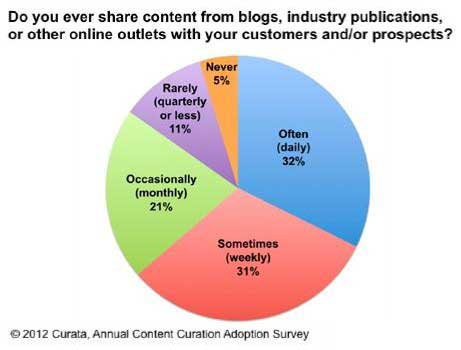
The majority of content marketers share curated content on a daily basis. It’s crucial to achieve the right balance of curated and create content on your social media channels. To make things easier for your social media team, define a list of approved, high-quality resources for content sharing. Optimally, these should be bloggers and brands with an audience that closely mirrors your own. Go beyond sharing to relationship building, so you can enjoy the benefits of having your gesture reciprocated.

6. Create an Editorial Calendar

Your editorial calendar should be much more than a list of dates, blog title ideas, and keywords. It should be a document that manages the flow of information between your content and social teams, increasing transparency and collaboration. Create a document that’s clear enough that your social team can incorporate keywords, themes, and campaigns.

For tips on picking the best tool for this task, I recommend The 15 Most Life-Changing Editorial Calendar Tools.

7. Measure and Improve

While you shouldn’t skip any step on this list, this one is undoubtedly the most important. Your social media strategy is a living document, so you’ve got to revisit it on a regular basis, and determine ways to improve. Reviewing your metrics with a tool like Sprout Social can reveal hard truths about what is and isn’t working. Want to do even better? An agile approach is at the core of what we do at Writtent, which is why we’re constantly reevaluating, typically on a weekly basis.

Love the insights here? For more ideas on how you can successfully promote your content marketing, check out Content Promotion Strategy: 23 Proven Ways to Explode Website Traffic.

02 Apr 14:25

To Gate or Not to Gate – The Marketplace Will Decide

by David Dodd

One of the long-running debates among B2B marketing experts and practitioners is whether companies should require registration for access to content resources like white papers, research reports, or case studies, or whether they should make such resources freely available. We usually say the issue is whether to use “gated” or “ungated” content.

Many marketing experts and thought leaders have chimed in on this issue, and there are reasonable arguments supporting both approaches. I won’t repeat all the arguments in this article, but below is a sample of the opinions you can easily find on this topic.

Over the past few years, I’ve seen the views on this issue shift. Five years ago, I think most marketers believed that virtually all content resources should be gated, although a few marketing experts like David Meerman Scott have been arguing for some time that most content should be freely available. My sense is, most marketing experts now believe that companies should make a significant amount of content available without requiring registration.
In my view, the marketplace will ultimately resolve this issue, probably in favor of making most content resources freely available, but this won’t happen overnight.
In the 2013 B2B Content Preferences Survey by DemandGen Report, participants were asked:  ”Which type of content assets are you willing to register for and share information about you and/or your company?” The table below shows how the survey participants responded.
To Gate or Not to Gate   The Marketplace Will Decide image Table for Blog Willingness to Register3
These findings demonstrate that a majority of business buyers are still willing to register and share basic information to gain access to most “long-form” content resources. The results also show, however, that most buyers are not willing to share detailed information to gain access to content. Even in the case of webinars, which are usually viewed as high-value content resources, only 20% of survey respondents said they are willing to provide more than basic information.
Many companies are now making a substantial amount of content freely available, and as this practice becomes more prevalent, potential buyers will expect to get access to content without registration. This expectation will likely make buyers more selective about the content they are willing to “pay for” with contact information. They will still be willing to register if they believe that a content resource will be particularly valuable, but if the resource looks or sounds like others that are freely available, they will be much more likely to ignore it.
For marketers, the fundamental question is:  Would you prefer that business buyers consume your branded content anonymously, or would you prefer them not to consume it at all? I believe the answer to this question is clear.
02 Apr 14:21

What Wikipedia Doesn’t Tell You About CRM

by Katrina Manning

What Wikipedia Doesn’t Tell You About CRM image social crm

In order to build relationships with clients, the customer service role has to encompass a series of services that corresponds to pre-sales, sales, and after sales care. Upselling of your products and services is also a part of these blanketed obligations. The core responsibility of the customer service agent lies at the front line. They are the chosen ones who are in direct contact with customers.

Nonetheless, the ability to build relationships with customers is the key to success for any form of business. The quality of customer service care and the experience that it brings about to potential and current customers are what make your clients come back for more.

Having people skills is a must in any sales or customer service organization. The way your company moves in order to adjust and adopt new communication methods and channels help set the tone for the essence of your customer’s experience. Apart from training, customer service agents should be empowered with tools that enable troubleshooting and decision making in the quickest and most efficient manner. This is where Client Relationship Management (CRM) tools come in. Because customers are the lifeblood of your organization, you need the right systems to handle all of their data.

The Importance of CRM Tools

Through CRM platforms and data applications, you can provide a seamless integration of all channels of communication that your company utilizes. These platforms are capable of sending and consolidating data in real time regardless of location. Analysis becomes easier; you can personalize communication, segment contacts and resolve any outstanding cases much more quickly to the benefit of your customers’ satisfaction.

Field-based company representatives benefit from CRM platforms because the processing times of inquiries, requests, and purchase orders are sped up-significantly. Tracking your orders becomes simpler, while managing customers becomes more tailored.

At the same time, the elements of communication between company representatives and customers correlates to your chosen CRM platform design. Although it does not have to be extremely sophisticated, the system should have the capacity to integrate multiple devices within a single access point.

Furthermore, CRM data tools and applications should be lightweight with lowered bandwidth use and fewer data storage requirements. This is because they increase accessibility and portability. User-friendly CRM platforms require less training, as well.

Types of CRM Platforms

Start-up business ventures, small businesses, and enterprise businesses all benefit from CRM tools. They create a process flow specific to various department levels. This helps in tracking business leads and converting leads into sales, which is what you want. It also enables a smooth transition of requests from one department to the other, making sales processes, work flow, follow-ups, and customer feedback less complex.

Mobile CRM

The most prominent theme of 2014 will be mobile CRM. Most companies equip employees with a mobile device that run on SMS and/or GPRS. The biggest benefit is that voice and data communications allow real time collaboration. It also gives your customers direct access to representatives, anytime, anywhere.

Social CRM

Social CRM conveys a more complex process flow, but one that is a standout in the CRM world. This type does not simply deal with accessibility that goes from point A or point B or business-to-business. Instead, it encompasses a larger audience and focuses more on content rather than a defined process flow. For example, Social CRM uses outlets such as forums, Twitter and Facebook to appeal to the more emotional side of customers.

Basic CRM is predictive in nature. Steps and processes can easily be determined, and cases can be treated independently. On the other hand, Social CRM, is highly unpredictable, and capabilities depend on the end user. These facets of Social CRM require content management geared toward customer relationship building to be fruitful.

With Social CRM being a new and evolving technology for customer experience management, out of the box solutions that feature new software and applications are now in demand. CRM tools that come with features that are intuitive and responsive may perhaps be the answer to this need.

Cloud-based CRM

Cloud-based CRM is a cost efficient alternative to standard platforms. These enable companies to save on data storage costs since they are taken care of for you. Accessibility to data is also increased because this platform is not device specific. With no more than Internet access, you can reach your client accounts. You don’t need any built-in software or applications to run it either.

There are even cloud-based CRM platforms that can be implemented free of charge for a limited number of users with a minimal storage capacity. This type of platform is ideal for start-up companies and small businesses. Larger companies with multiple remote offices can also find cloud-based CRM platforms more convenient to use.

Current CRM Trends

Today, intelligent CRM technologies allow access to various types of data in real time. Additionally, these trends specifically offer the following key features that enable a user-friendly experience within the following aspects:

  • Seamless integration of various communication channels both in the platform and network.
  • Faster and easier consolidation of data with real time analysis.
  • Increased data storage at a lower cost.
  • Enhanced productivity.
  • Real time online collaboration with customers and potential customers.
  • Decreased training requirements.
  • Online presence management.
  • Augmented personalized customer interaction.

With the expected progression and evolving technologies designed around multiple CRM platforms as well as its usability in various processes within and outside an organization, the line between customer service relations and marketing and the corresponding responsibilities are now blurred or even overlapping. This now poses the question of which department holds the responsibility for Social CRM? Moreover, is there a need to come up with an entirely new department to manage a company’s or a brand’s online presence in social media?

There is no question that traditional customer service programs, which analyze sales and customer actions for predictive results will also be crucial to marketing, sales and customer service. The new CRM platforms such as social and mobile CRM do not replace these methodologies, but they empower and add to their capabilities instead. In order to attain company prosperity, you need both client data, such as sales, along with feedback. So, how do you plan to update your CRM systems this year?

02 Apr 14:20

Use Call Tracking Insights to Answer These 8 Business Questions

by Jeanne Landau

Does this sound familiar?

Track the results of every marketing initiative; all incoming leads, every sales call, and each customer experience.Use Call Tracking Insights to Answer These 8 Business Questions image Track Response Arrow 300x225

Most likely, your company, and possibly even you, are crunching data every day trying to get to the bottom of who your customers are, where they live, how much spending power they have, and what they’re looking for.

If so, then you’re on the right track because today it is expected that companies are compiling masses of data to be categorized, analyzed, digested, and relayed back to executive teams and boards of directors in every imaginable form.  But, is it really happening?  Are companies today able to take on the enormous undertaking of compiling the right data, analyzing that data correctly, and then making sound business decisions based on all of that data?

We don’t think so.  Not to toot our own horn, but as a company that thoroughly tracks every lead, sale, and marketing program to the finest detail, we know it’s extremely time-consuming.  Given that perspective, we suspect there are many small to medium-sized companies that are not able to put the right amount of resources on the mission to track where very incoming lead can be credited to, where every call is coming from, and the results of those leads and calls, as far as conversions go.

This is where call tracking technology comes in handy. Using a solution that tracks all inbound phone calls, so calls where the customer is contacting your business for some reason, and what got them to call you, will help you gather the necessary and accurate data they need to answer the following:

  1. Are we missing potential sales calls?
  2. Are we spending our marketing and advertising dollars most effectively?
  3. How can we improve employee training programs to reduce turn-over?
  4. How many unique, new leads do we get each month, as a result of advertising and/or promotions?
  5. What are our customers telling us they need and want from our service?
  6. What markets are we most successful in, and where are our advertising not being effective?
  7. What is our busiest times of day, and days of week?
  8. What are the competitors are doing, and how much are there services?

The good news – you can answer these questions rather easily if you have a call tracking system in place to measure and monitor your calls, along with call recording technology.  For example, tracking and recording services will alert you of missed calls,  can provide data on the cost-per-lead of an advertising campaign, and will capture customer conversations and provide key insights into how well front line employees are handling calls and if they are following a company sales script.

Call data to address these business challenges is available to companies of all sizes, not just large contact centers or global businesses.  To ensure you get the critical business data you need without the high costs of hardware and software installation, start by identifying a service provider with a solid reputation – one that takes advantage of today’s technology to provide robust and cost effective business solutions. Additionally, businesses should seek a provider with a track record of developing forward-thinking technology enhancements, and keeps a pulse on what companies need in order to address customer-facing business challenges.

Today, small to medium-sized businesses have even greater access to call tracking data.  Make sure your business stays competitive by having the ability to track every lead, sales and customer experience in order to answer these seven questions about your business.

02 Apr 14:20

Why Your Lame Subject Lines are Killing Your Email Marketing Strategy

by Craig Klein

Why Your Lame Subject Lines are Killing Your Email Marketing Strategy image Why Your Lame Subject Lines are Killing Your Email Marketing Strategy

Your bulging email inbox is full of boring subject lines that cannot begin to muster your attention. Sometimes it is because the sender is simply lazy and has given no thought about what is built on the high value digital real estate.

Other times, the email marketer is so focused on SEO that the subject line is stuffed with precise keywords every single time. These types of SEO tactics are as overdone as cheap steak. Everyone is tired of them – including Google.

Damage from Bad Subject Lines

If you are struggling for a good subject line, take a few minutes in the grocery store line to see what the pros use to get your attention. Don’t be tempted to go overboard with “7 Absolutely Horrible Hidden Email Mistakes You Must Avoid”. First, it sounds like a sleazy circus barker. Second, for those readers who take the bait, you have got a lot to deliver to keep your reader from viewing you as a downright liar.

Never lie. Don’t over promise.

Instead, be intriguing, compelling and interesting. Be valuable most of all.

The purpose of an email marketing campaign is to deepen the relationship with your client. Bad subject lines can easily have the direct opposite effect.

Abstract or Clever

If the reader sees your subject line as a secret code to be revealed in the final paragraph, they will quickly lose patience with you. Clever concepts may help with your open rates, but an abstract or overly clever subject line shortens the time the readers will spend reading.

Quickly tell the reader what the email is about. Trust that they will decide to read it. When clever leads to unclear, the reader will not stick around to figure it out. Today’s email readers are often on their mobile devices and they scan email quickly to decide what to delete.

Exact Match Keywords

Google is moving its focus to larger, brandable topics rather than exact match keywords. The search engines now recognize synonyms. The spiders are learning what words mean and notice when you are sticking with the overall topic. Google is keeping up with the race for quality content. Exact match keywords are losing power.

Lists Posts

When you make your trip to the grocery store’s checkout line to study headlines, notice that many headlines offer a list of something. Lists are everywhere and you would think that the use of them is way overused.

Readers like lists. Otherwise, the big publishers like Cosmopolitan magazine would dispense with their use. Headlines like “5 Hot Tricks to Get His Engine Started” or “12 Super-Foods that Cause Real Weight Loss” have been around since the 1960’s.

The reason they are still used is because they cause women (and some men) to buy magazines. These publishers know what drives an impulse purchase.

Informative Hooks

When you know your ideal client well, you can develop subject lines that promise answers to their questions or information they will find valuable. Not only is that what your email recipient wants to see, it is what Google’s Hummingbird algorithm rewards.

Your subject line is a useful tools to increase readership and eventually sales. The creation of them is not a trivial thing. Exercise your subject line writing skills to make them creative and informative – compelling and useful.

Image via Shutterstock

02 Apr 14:20

Overview of Today’s Digital Marketing Landscape – Lauren Vaccarello #czlny

by Lee Odden

Lauren Vaccarello

It’s April Fools day today but there was no fooling attendees of the first ClickZ Live conference in New York who attended the pre-keynote presentation offering an overview of the current digital marketing landscape given by Lauren Vaccarello, VP of Marketing of AdRoll.

A surprising number of attendees showed up at 8am for this preview of digital marketing and Lauren did a great job giving introductory information on everything from Paid Search to Email to Retargeting. If you’re not sure whether mobile makes sense or what retargeting is, read on.

Looking back on the history of digital marketing from the first clickable ad in 1993 to the founding of Google in 1998 to the start of Facebook in 2004, few people could have guessed how big and influential they would turn out to be. And who would have predicted the popularity of  Snapchat or What’sApp being purchased for $19 billion?

The thing is, with digital marketing, we’re still just getting started

The media and advertising industries are evolving. Print journalists leaving for digital used to get chided, but now it’s normal. But there’s still some disparity when it comes to print and digital budgets. We’re spending 6% of our time on print but spending nearly 25% of our budget on print

Machines and data are taking over – real time bidding is taking over media buying. Data is at the center of the digital ecosystem. Big Data!

Digital Marketing 101:

Search is still the #1 source used in purchasing decisions (Compete). Consumers, small and large companies all use search. Your visibility in search results is some of the most valuable real estate on the web. The act of searching is a clear indication of intent. What better time to connect with buyers than at the moment of need?

Paid Search vs. Organic
Paid search visibility is not just how much you’re willing to pay per click, but also the click through rate that determines your ad placement. Of course, a high CPC and high CTR equals maximum profit for Google. Google also cares about users, so relevancy is also a factor in ad placement.

Paid search gets about 1/3 of the clicks, organic search gets 2/3 – but paid search gets a higher click through rate.

Organic visibility is important – the higher the better. If your page is #1 or #2, you can expect 4X higher clicks and traffic than lower positions. If you’re on page 2, it’s dramatically lower.

Email isn’t dead! And it needs to be Mobile

  • 838 billion marketing messages sent out in 2013.
  • 66% of consumers have made an online purchase because of email
  • 48% of all emails are opened on mobile devices (Litmus)

Marketing Automation (Especially for B2B Marketing)

  • Produces leads in less time
  • Engage with contacts and leads
  • Convert leads faster
  • Provides a more personalized experience

Retargeting -Targeting based on first party data.

  • The most valuable type of data for search marketing? Intent!
  • Intent data can come from a variety of sources. That first party data can help you deliver precisely targeted ads.
  • Retargeting helps your brand be everywhere your audience is – other websites, not just yours.
  • Data can help you create a more personalized experience for your customers
  • Adroll is a retargeting platform

Social Media Marketing

  • Social advertising offers amazing data and insights about target audiences.
  • It’s important for brands to be human, relevant, engaging and complete in the information about your company.

Content Marketing

  • Think of it as owning media vs. renting it. If done well, you can own space on sites for a much longer period of time. It’s relevant, useful content for your specific audience.
  • Interesting content is a top 3 reason why users follow brands on social media.
  • Sites with blogs get 55% more visitors.
  • Considerations for content marketing: Who is the audience and is your content adding value? Is it visual? Is it long or short form? Is it optimized?

The Year of Mobile (10th edition)

  • This might actually be the year for mobile in 2014. Marketers are becoming better educated about what’s possible with mobile – from engagement to driving sales.
  • In 2011 smartphone and tablet sales were same as PC. Today, smartphone and tablet sales grossly outnumber PC sales.
  • 90% of consumer transactions are started on one device and finished on another. (Neil Mohan, Google)

Of course there’s a lot more to know, books in fact, on each of these topics. But it was a nice introduction for the attendees, as evidenced by all the questions Lauren received. Speaking of books, Lauren has just co-authored a book on retargeting: The Retargeting Playbook: How to Turn Web-Window Shoppers into Customers.


Email Newsletter Gain a competitive advantage by subscribing to the
TopRank® Online Marketing Newsletter.

© Online Marketing Blog, 2014. | Overview of Today’s Digital Marketing Landscape – Lauren Vaccarello #czlny | http://www.toprankblog.com

02 Apr 14:20

12 Ways To Be Happier At Work In Less Than 10 Minutes

by Drake Baer

zappos happy employees

What’s the key to workplace happiness?

If you ask bestselling author Sharon Salzberg, she'll tell you that it's a combination of knowing what you're doing in the moment and feeling like your work is meaningful.

At the intersection of that in-the-moment awareness and overall meaning is mindfulness, Salzberg argues in her new book, "Real Happiness at Work." As one of America's leading meditation teachers, the book is a toolkit for incorporating mindfulness — and thus real happiness — into our daily working lives. 

Don't worry, "mindfulness" doesn't require sitting cross-legged in your conference room. As Salzberg explains, it's about having a "balanced awareness" of what's happening around you, so that you can understand it rather than just react to it. 

With that in mind, here are a dozen simple ways to be happier at work, in less than 10 minutes each: 

1. Remember that happiness at work comes from having a sense of meaning. 

"People say that the largest contributing factor in happiness at work is meaning, which you sometimes find in the job description or sometimes outside of it," Salzberg says, "and one of the largest sources (of unhappiness) is feeling unappreciated."

Research backs it up. Harvard professor Teresa Amabile has found that feeling like you're making even incremental progress in your career leads to happiness at work, while experiments by Wharton professor Adam Grant have shown that people are more engaged when they feel appreciated — and they perform better, too. 

2. Take note of how many people you rely on — and how many rely on you.  

"One of the reflections I ask people to do is: How many people need to do their jobs well for you to do your job well?" Salzberg says. It helps you realize how much you rely on everybody else.

A programmer can't make the next great app without a designer, and that product won't move without a sales team. In this way, you get a greater sense of how much your work is linked to others, and it feels more meaningful as a result. 

3. Before a big meeting, think about the outcome. 

Before you have a major conversation or get on an important phone call, Salzberg says to think about what you want to get out of the encounter. 

"You can just ask, 'Do I want to be harmful? Do I want to be helpful? Do I want to put the other person down? Do I want to find a resolution?'" Salzberg says. Then you'll have an idea of the outcome you're hoping for, which will make the day feel much more under your control. 

4. Find ways to "break the momentum" of the day. 

Our workdays are full of emails, meetings, spreadsheets, presentations, and more. That can lead to feeling out of control. A lot of the work of injecting happiness into our days is stopping that momentum, which you could do by pausing to breathe for a few seconds before you talk to, call, or email someone. 

"Without some breathing space in the face of constant demands, we won't be creative, competent, or cheerful," she writes. "We won't get along with others, take criticism without imploding, or control the level of our daily stress." 

Sharon Salzberg

5. Don't pick up the phone on the first ring. 

"Instead of picking up the phone on the first ring, breathe and wait until the third ring," Salzberg says.

By waiting for those two rings, you're adding in much-needed breathing space into an action that would otherwise just be a reaction. 

6. Wait to click send...

"Don't click send on the email right away — breathe and reread it," she says. "The classic example would be getting irate and sending something with hostility. Although Gmail gives you a few seconds, life doesn't give us that many unsend buttons, so give some space to see if we've crafted a conversation we actually want."

To Salzberg, much of real happiness is a matter of being aware of what you're doing while you're doing it — and enraged people aren't typically conscious of their actions.

7. ...Or send the email to yourself first. 

Receiving your own email gives you the experience of being the recipient. Instead of getting into an energy-sapping misunderstanding, you can actually get a sense of how your message will be read. 

8. Monotask at least once a day. 

When you get halfway through your day, drink a cup of coffee, and only drink the coffee. 

"Just drink the coffee — rather than being on a conference call, checking your email, and having a TV on mute so you can read the crawl," she says. "It's another way of breaking that high-pressured momentum."

Even though multitasking might feel more effective, it's not

9. Remember that the people in your meetings are people, too. 

When you sit down for a meeting, look around. Salzberg says it's a great way to remember that each person wants to be happy, even if they have different ideas of what that might look like.

This helps build compassion for others' experiences, Salzberg says, which makes you better able to relate to people — a major source of meaning — and be patient when they have an idea you disagree with. 

10. Schedule a one-minute meditation session. 

As Salzberg says, a meditation practice is really just paying attention to physical sensations. And doing it for a little bit every day has major affects on anxiety, stress, and depression. How do you do it? Here are the instructions she gave us: 

"Use the body and breathe. You don't even have to close your eyes. Tune into the actual sensations of the breath so you can feel it come in and go out. Notice the thoughts and emotions that come, and try your best to have an interest in them as experiences in the moment. Mindfulness is all about relationships. It's not about stopping the thoughts and blanking out; it's relating to them and watching them, rather than being taken over by them. Then we have a choice: I'm going to let that thought go, or I'm going to act on it." 

11. At the end of the day, reflect on both the positive and the negative. 

Most of the time, heading out of the office is the time for rehearsing everything that went wrong that day. Salzberg suggests also reflecting on what went well. That way you're not denying that some things went poorly, but you're getting a richer picture of what happened.

12. Throughout the day, set a reminder. 

When you start a task, you can set a timer on your phone or in your browser to ding every 25 minutes or so, giving a little reminder to clear out any distractions. This allows you to be more aware of whether you're on task or if you're lost in an Internet rabbit hole. In this way, you can enlist your phone to help you be more focused, more conscientious, and ultimately happier. 

"Mindfulness isn't hard to accomplish," Salzberg says. "It just tends to be increasingly hard to remember."

SEE ALSO: The 20 Happiest Jobs In America

Join the conversation about this story »

02 Apr 14:20

Guest Blog - Lead Nurturing from a Sales Perspective

by Bob Sullivan

Sales_Marketing_ResourcesSales and marketing teams are often at loggerheads, each complaining that the other has not played its part in lead nurturing and qualification. The marketing team might accuse the sales team of not acting on qualified leads passed to them. On the other hand, the sales team usually accuses their marketing counterparts of passing on unqualified leads. This blame games goes on in most organization with no end in sight.

To eliminate distress in the business, sales and marketing teams should be encouraged to work together. Lead nurturing is the duty of the marketing department. However, there are several ways in which the sales team can contribute to help the business achieve revenue objectives faster and more effectively.  Below is an overview of how the sales team can partner with their marketing counterparts for better lead nurturing.

Research on buying cycle

The marketing department can get useful insights on the buying cycle from the sales team. Sales and marketing should work together to segment the buying cycle in the top, middle and bottom of the funnel. The marketing team can then proceed to match lead nurturing content to prospects in the different buyer levels. The sales team will come in handy in identifying the offers that convert the prospects. The marketing team can use this information to align the content they use to nurture leads.

Develop campaign goals

Marketing can develop campaign goals but it is the sales team that will be in a position to see if the goals are being achieved. Campaign goals provide an opportunity for the two teams to work together. Instead of marketing developing campaign goals on their own, they should involve sales so that the objectives set are realistic and backed by past results.

Writing and proofing emails

A lead nurturing campaign may involve a series of emails to be sent out at different stages. Marketing is at liberty to design the format of the emails because they are the most knowledgeable in that area. It is good practice to write all the emails that will be sent beforehand. After writing, the marketing department can invite the sales team to review the emails to gauge their effectiveness. The sales team will be able to provide insight on the emails as they will be viewing them from the lead’s point of view. Their contribution can add valuable content which marketing had missed out on.

Measure results

Marketing and sales need to work together to determine if the goals and objectives set for a campaign are being met. The sales team can provide marketing with information on leads that have trickled down to the bottom of the sales funnel. This information will help the marketing department determine if the campaign is as effective as it was meant to be or if it needs to be revised for better performance.

Optimize the campaign content

When a campaign is not hitting the numbers projected, it is time for it to be reviewed. Perhaps the goals and objectives set were too high or there are some aspects that can be improved to get the numbers. Marketing and sales have yet another opportunity to bring their brains together to identify why a campaign is performing as it is. Revising lead nurturing content can also include the sales team to identify why they are not effective as they should be.

Lead nurturing is more effective when sales and marketing pull their weight behind the campaign. Most lead nurturing activities are the priority of the marketing department but it is evident that the input of the sales team adds value. Click here to download the Lead Gen Survival Guide to gain more tips to bettering your lead gen process.

Chris is the Owner and President of SyncShow Interactive and has 15 years of experience in Digital Communications. Chris is an outdoor enthusiast regularly hiking, camping, and scuba diving.

 
Related articles
02 Apr 14:20

Social Media Marketing Strategies: Where We Stand March 2014

by Jason Jay Sharma

At the end and/or beginning of each year, marketers usually get inundated by articles & blog posts about “trends to watch in the coming new year,” related to social media and how it can be utilized for online marketing. And every year brings “trends” that sound very familiar (to the year before): data-driven marketing, brands will start listening to the customer, social media is a necessity—not a luxury, brands are becoming publishers, deliver your content at the right time, etc. These are no longer trends, but rather best practices.

I’ve taken the approach to wait one quarter, see what has developed in this early stage of the year, and strategize which top three social media trends will be most effective through the remainder of 2014.

1. Mobile: Revenue is on the Rise

Social Media Marketing Strategies: Where We Stand March 2014 image picjumbo.com IMG 3683

Not long ago, predictions surfaced that mobile internet would take over desktop internet usage between 2014 and 2015. Early this year, it finally happened with mobile apps alone. With that prediction already being met, optimizing social media content—including pictures and video—to be consumed via mobile devices is no longer just a convenience for an audience, but a mandatory step for brands to not fall behind the pack.

Expect to see brands that haven’t taken the leap to “mobilize” do so before the end of the year in a variety of ways including responsive design, mobile enhanced, or standalone apps. These mobilized sites will need to be of the highest quality when it comes functionality and service—33% of mobile users will quickly abandon non-loading sites within 5 seconds.

Adobe found 71% of people are accessing social media via mobile and will increasingly be the main device to access this kind of content going forward. Nielsen further confirmed that social media networks are ranked amongst the most used mobile apps (Facebook leading the pack). As social media networks begin implementing mobile-centric updates, brands should follow suite. Specifically because social media marketing allows for a quick and easy way to connect with your mobile presence—connecting directly to apps and mobile optimized sites.

What does this all mean? Think of the demand for instant gratification with regards to online shopping. While Amazon Prime and Google Shopping Express are attacking delivery, ordering needs to become more instant. Imagine a female mobile user could find a brand’s dress on social media, clicks through to land on the item’s mobile page within an app, and purchases it in a matter of minutes. This behavior seems to already be strong with mobile revenue from Pinterest up by 224%!

Mobile isn’t simply a trend though—it’s the next level of social commerce—the evolution of driving traffic and revenue, too. With the increasing number of smartphone and tablet users, brands should be prepared to cater to these quick turnaround customers.

2. UGC: User Generated Content

Social Media Marketing Strategies: Where We Stand March 2014 image picjumbo.com IMG 3945

By default, we trust those we are familiar with over strangers. So when it comes to content in the social media posts we see online, we are more interested in what our friends, family—people we can relate to—are posting about. In March, Crowdtap found that millennials are more focused on user generated content (UGC) than other forms of content spending 30% of their entire media consumption on UGC alone. Fortunately for brands, UGC is becoming readily available even before brands request it. People enjoy posting about their purchases, their experiences, their desires—and there are three reasons why this is important and you will see UGC embraced this year:

Free Content From Users

Brands aren’t interested in spending more money than they have to—and luckily UGC is free! To build a content database, brands can easily encourage customers to share pictures on social networks like Instagram using hashtags. Marketers can then easily filter through the photos and repurpose it for their own use whether it be on social media or websites—directly on product pages, for example.

Will people bother submitting? Creating and sharing is the nature of social media—those wearing products or interacting with the brand are excited by promises of potential features, mentions, likes, or reposts. Similarly, brands can drive further UGC creation with promotions increasing followers and engagement. With more than 79 million photos currently floating around Instagram under the #selfie hashtag, we can make the assumption that today’s social media users enjoy the vanity and attention.

Trusted Content From Ambassadors and Influencers

Again, we trust our networks—their recommendations and suggestions are important to us. How can we expect brands to exploit this? By reaching out to key players in their following—those individuals in a customer base that are a bit more… let’s say enthusiastic. They make up a “fandom” that will market for you out of passion. Have you ever watched Supernatural on the CW? Maybe not, but if you’re surfed the web, you’ve definitely come across a GIF produced by their fandom somewhere, I’m sure (Tumblr and Buzzfeed are full of them, FYI).

So what can we expect brands to do? Reach out to these passionate fans to make them brand ambassadors. Then have them post directly to their network and influence their connections and followers—those people who trust this ambassador. It makes for an excellent alternative to celebrity endorsements on social media.

UGC is Money

The bottom line is UGC leads to revenue for brands. More than any other media type, 53% claim it bares influence on their purchase decisions. Monetizing this content is the next step—brands linking UGC to products and services make it instantly shoppable. Without the worry of spend and budgets, brands can utilize UGC to analyze and measure their social media ROI and effectiveness for free.

It’s now up to brands to find ways to make sure to maintain mutually beneficial relationships for all the parties involved including the UGC creator and the brand itself. This could include anything from republishing content to awarding prizes to compensation—all of which is worth the price of UGC, and the trust and interest it builds.

3. Worldwide Visual Web: Images Trump Words for Engagement

Social Media Marketing Strategies: Where We Stand March 2014 image picjumbo.com IMG 7925 1

There really isn’t a better way to put this except with the old saying “A picture is worth a thousand words.” Pictorial content will continue to be a major trend in social media for not just the remainder of 2014, but also the foreseeable future. Brands are dropping their words in favor of image heavy redesigns on their sites to convey messaging and further solidifying the visual web. As early as 2012, we were already aware of photo appeal—pictures received significantly more engagement on social media including Facebook (53% more likes and 104% more comments) and Twitter (18% more clicks, 89% more favorites, and 150% more retweets).

With newer image-based social networks booming, the visual web is expected to only continue growing. In March, Citrix confirmed that 63% of social media is NOW made up of images, alone! As of today:

It’s not too difficult to understand the picture appeal—we are visual creatures, after all. We have 70% of our sensory receptors in our eyes and use 50% of our brains for visual processing. And even with lightning-fast scrolling of a mouse or our thumbs, it’s easy to consume and engage the content without the need for prolonged stops (to read a post, for example) before moving on the next photo. To further that, 90% of the information conveyed to our brains is visual—which the brain processes at an alarming 60,000x faster than text! The goal for brands is simple—create posts that are eye-catching and visually appealing with minimal text. Even Facebook is helping with this transformation, pushing brands with their 20% text rule for ads as of late last year.

Make no mistake, brands are already aware of this—you’ll find them pinning both item and lifestyle pictures to Pinterest, sponsoring visual lists on Buzzfeed, and sharing an alarming amount of GIFs on Tumblr. And before long, we’ll begin seeing more “flash sales” discounts on Snapchat—mark my words.

Could I have said all of this with pictures? Probably.

02 Apr 14:20

How Dell Increased Pipeline Revenue 10X in One Quarter: The Secret to Their SMarketing Sauce

by gsoskey@hubspot.com (Ginny Soskey)

bryan-shaw-quote-large-1In almost any organization, Sales and Marketing have the same arguments. Sales wants more leads -- they have quotas to hit, after all. Marketing believes they're sending Sales plenty -- they just want Sales to actually work the leads they're sending.

Every company handles this struggle differently. Most establish a service-level agreement (SLA) where Marketing agrees to deliver X number of leads and Sales agrees to work Y percent of them. Some just let the problem fester, hoping it'll work itself out. Others completely overhaul their organizational process to make Sales and Marketing work together like a well-oiled machine. 

One Fortune 500 company has done the latter. After years of the established SLA that seemed to be working okay, Dell introduced a brand new step into the lead rotation process that helped increase pipeline revenue by 10X. To get an inside scoop on how they've solved a Sales and Marketing dilemma and made customers happier with the Lead Concierge Program, I spoke with Bryan Shaw, Marketing Operations Manager at Dell. Here's what we learned.

Q: Tell us about the Lead Concierge Program. What is it and how does it work? 

BS: In the Sirius Decisions funnel, you look at the top-of-the-funnel stuff, then marketing qualified leads sent over to Sales, then the next step is a "sales accepted lead." But just because Sales has accepted a lead, doesn't really mean that they've worked that lead.

There's a lot of research to support that it takes multiple attempts to contact a lead. Think about yourself -- when you receive a phone call from a sales rep, you probably hang up your phone immediately. So how do you make sure Sales is actually contacting a lead?

What I'm trying to focus on at Dell is bringing in full-blown lead qualification called the Lead Concierge Program. Every single online inbound lead -- regardless of whether it's a lead-gen form or customer support -- will get some love from a person on my team. Anytime someone fills out a form on our website, someone on my team responds personally and immediately to that person and says, "I'm here, I'm talking to you. I received your request. You can talk to me about anything you want as I further qualify you."

So let's say the customer has filled out a form that says they want to buy 10 laptops. About an hour after they've filled out that form, someone on my team will respond and say, "Hey, I saw you filled out a form. I'm forwarding you on to a sales rep -- here's their name. While you're waiting for Sales to contact you, keep talking to me about what you're look for from us." We're getting more information to qualify that lead and continue the conversation so we're handing off warm, legitimate conversations for Sales to follow up on. 

Q: How did you end up with this approach? These must be automated emails ... right?

BS: We went for the all-or-nothing approach. The first approach was everyone who filled out a form on Dell.com gets these automated emails and then automatically go to Sales. A couple things happened when we went the automated way. A lot of junk got through since about a third of our online leads are irrelevant or invalid emails. They're often tech support or consumers, not commercial-type leads. When those leads would go directly to Sales, Sales would say "These are junk." They wouldn't follow up.

In the second approach, we decided to not automatically rotate the leads and cleanse the lists before sending them to sales reps. But then it'd a take a couple of days before a sales rep would even see these leads -- the leads had decayed. 

Now, we've found a happy medium. We automate all of those leads in rotation, but we don't send them straight to Sales -- we send them to the Concierge first. The Lead Concierge Program brings manual touches to automation before being routed to Sales. 

Q: How's the process working for you so far?

BS: The concierge program was implemented in 2011, and our pipeline was very very low for online leads. By implementing the Lead Concierge Program, we saw immediate, ridiculous improvements. We're talking pipeline revenue in one quarter was ~$3 million, the next ~$20 million. Since then, we've been expanding the program globally. For example, we've expanded to Latin America and seen instant success. We've seen that region's pipeline revenue increase by over 100% for online inbound leads. I know correlations don't always mean causation ... but damn. The ROI was obviously very big here if your pipeline is increasing by 10X. This little bit of investment had a huge increase to the business. 

The Lead Concierge Program is beautiful, but it still needs improvement. It's been a progression over years for online, global leads, and I'm going to be pushing more to do this for offline, event leads. We're trying to accomplish a holistic customer experience from end to end. The program itself is easy -- obviously the people we're talking to are interested in talking with us, and we're interested in talking to them, and delivering the conversation to Sales. 

But there are other things we can look at before sending the lead off to Sales. Let's track their web presence. Let's look at which events they've attended, which emails they've received. Do they raise their hand or not to hear from us? All those types of things that promote a holistic view of the customer. We want to deliver that information to Sales and say here's the conversation you should have instead of saying here's a bunch of names, call 'em, and here's some stuff we think they may be interested in. 

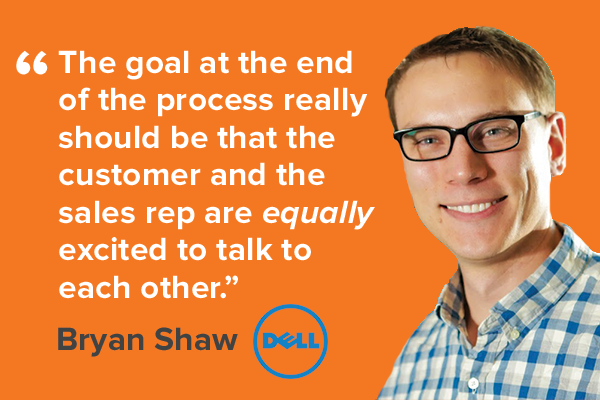
The goal at the end of the process really should be that the customer and the sales rep are equally excited to talk to each other. If the sales rep isn't willing to make six phone calls, they're not as excited to talk to that person as a customer. Throwing in the Lead Concierge program drives a positive customer experience and supports a better bottom line.

What do you think of Dell's lead rotation process? Would it work at your organization? 

unifying sales and marketing ebook

subscribe to the hubspot marketing blog

02 Apr 14:19

Costs of Top B2B Lead Generation Tactics

by Varuna Vaswani

Through their recent research, Marketing Profs uncovered the top challenges for B2B marketers this year:

  • 78% of respondents needed to generate more leads
  • 60% believe the biggest challenge is to generate quality leads

Of course, the race to generate leads is always on! But budgets are stringent, and in most cases, not that big, with 46% of marketers find working within budgets to be the top challenge.

Therefore a business leader’s job is to invest in the tactics that will yield the greatest returns. Before determining the mix of tactics to invest on for a specific budget, a business leader should first be aware of the costs inbound and outbound generation tactics and how well they work.

Costs of Top B2B Lead Generation Tactics image coins growth resized 600

Outbound

In their research, Marketing Profs pointed out that outbound tactics were most effective in delivering quality leads, with 39% of respondents citing it as the most effective.

Sales team

Internal salespeople were believed to be most effective in lead generation, through the use of referrals. As you would expect, this is also the most expensive tactic. Salespeople rarely only receive their basic compensation, they generally receive commission on the sales they make. MyCareer.com.au notes that on average, Sydney sales consultants receive AUD $75,000 annually, while sales managers receive AUD $100,000 annually.

Telemarketing

The second most effective lead generation tactic, according to Marketing Profs is telemarketing, due to its direct and interactive nature. But again it is one of the most expensive lead generation tactics, given the costs of professional telemarketers. External telemarketers charge between AUD $20 – $25 / hour or more depending on the work they’re expected to do and the quality of the list. The other option is to have telemarketing done in-house, which means the cost you incur is training the staff in telemarketing, in addition to their compensation which depends on the role selected for the job (higher for salespeople, lower for admin staff).

Events

The second most effective set of tactics was events, according to 27% of the survey respondents.

Trade Shows

Trade shows bring businesses and buyers together and allow business owners and their salespeople to establish personal connections with their buyers. They are also able to filter out contacts from genuine leads at the event (if they ask the right questions), making it a highly effective source of qualified leads. At a trade show, a business can choose to sponsor and speak, exhibit or just attend, so the investment that is entailed for each participation phase differs. It also generally differs by scale of event and industry type. But it is not uncommon for businesses to pay about AUD $1,000 – $2,000 to attend the event, AUD $8,000 – $10,000 to exhibit and above AUD $10,000 for sponsorship and speaking opportunities.

Executive events

Executive events are generally of smaller scale than trade shows. If conferences can have hundreds or thousands of people, executive events tend to have less than 50, and some events are more intimate with less than 10 people. With the smaller group, the conversations become more targeted and you can easily identify a genuine lead. Of course, these come with an investment for rent and meals, but not as much as trade shows. Typically, the cost of these events range from AUD $2,000 to $4000 for a small-scale event, and above AUD $5,000 for a larger event.

Webinars

One of the top inbound marketing tactics believed to be one of the most effective is webinars. The ability to engage through video and audio has proven to be popular amongst B2B marketers and buyers alike. The cost to do a webinar is relatively low, compared to the costs associated with the aforementioned tactics. You need the right content as well as the voice conferencing capabilities. Companies like Citrix have made this easier with their tool GoToWebinar, that is delivered on-demand for AUD $49 / month for up to 50 attendees, and goes up to AUD $499 / month for 1000 attendees.

Online

Online marketing tactics were also believed to be effective as noted by 17% of respondents, with a mix of email marketing, content marketing and website SEO and social media.

Email marketing

As one of a direct marketing tactics, email marketing has been successful in generating qualified leads. Some businesses shy away from it, for fear of being labeled as SPAM, but those who still leverage it believe it is valuable. The main cost associated with email marketing is the marketing automation tool. There are some inexpensive tools such as Vision6 or MailChimp that provide basic email marketing functionalities and list management, and there are those that are full scale inbound marketing tools like HubSpot. The monthly cost of these inbound tools can range from AUD $10 to $800.

Website SEO

Google search is perhaps the most used search tool in the world. To be on the first position for your keyword is what every company strives to achieve or maintain. Organic search has been a key source of qualified leads, and that is why many companies invest in SEO experts and consultants. The costs of these vary greatly since there are freelance SEO consultants overseas that charge less than AUD $10 / hour, while there are specialised SEO agencies whose fees are AUD $3000 a month.

Content marketing

An overarching tactic that is also believed to be rising in effectiveness is content marketing. It comprises of the two above and many others including website content, blog posts, whitepapers, case studies, infographics, videos, etc. Case studies and customer testimonials were highlighted as the two most effective content marketing tactics in lead generation. The costs for content marketing overall mainly involve freelance writers / internal marketers costs, freelance designer / design agency costs, and marketing automation which could potentially cost between AUD $1000 – $5000 every month.

Social Media

According to the research by Marketing Profs, social media was perceived to be the least effective lead generation tactic, with only 5% of respondents believing it to be effective. What has been established is that social media is a good channel to maintain brand presence and increase brand exposure. The costs involved with social media tactics are next to nothing since social networks are free. However, you may want to use scheduling tools to be more efficient with your social media posts, and these cost AUD $7 – $18 per month.

Cost comparison

Overall, the costs of inbound and online lead generation tactics are much less than outbound or events, even though it is perceived to deliver better results. It is important to note that no category of tactics will work as absolutes. These depend on your buyers, their needs and their buying behaviour.

The best way to navigate through the challenges of lead generation is to use a mix of outbound and inbound, perhaps leverage content marketing with a quarterly executive event or a trade show once a year. After all, if you leverage the right inbound and outbound tactics that suit your buyers, the results you receive will outweigh the costs.

To learn more, refer to our whitepaper on measuring marketing ROI.

Costs of Top B2B Lead Generation Tactics image c7789391 cd6f 427d ba77 0ff64a63c6041

02 Apr 14:19

Content Is Marketing’s DNA

by Remington Begg

Content Is Marketing’s DNA image contentDNAIf you paid attention in science class, you know that DNA is the biological molecule that’s responsible for coding the functioning and development of every living creature. Metaphorically speaking, in the world of online advertising, the content is necessary to the functioning and development of an effective marketing strategy. The inbound marketing explosion over the past couple of years shows no sign of fading, so the importance of delivering engaging content at every stage of the sales funnel will continue for the foreseeable future.

Content is the Key to Grabbing Attention

The majority of your potential customers aren’t ready to buy, so it’s up to you to be discovered by them in advance. They may not be looking at products, but they are engaging in searches on certain areas of interest. It is up to you to be where they’re hanging out and grab their attention via marketing and content that coincides with these interests. Blog posts on hot topics in their field are effective, as is sharing content through your social media profile.

Turn Strangers into Friends

Once you’ve gotten their attention, you can use content to transition a lead into a friend. They’re already on your blog or are following you on social media because of your interesting material, so now it’s time to draw them in. You not only want to drive traffic to your site, but you also want their contact information for follow-up. Leaving their name and email address is a small price for them to pay when you’re delivering educational, interesting material.

You Need Content to Nurture Leads

While your lead may not be ready to purchase, you still need to be consistent with your marketing and content message. You want to be helpful, but not sales-y. You want to be their ally, not their vendor. Content at this point in the sales funnel should be properly targeted to educate them, keep them engaged and earn their trust. You want them to see your company as an authority, so deliver content that proves it.

Convert Customers Through Engaging Content

The end is in sight and your lead is now this close to buying. You’ve established yourself as a trusted source, so you’ve made the short list along with a few competitors. How can you use marketing and content to ink the deal? Keep in mind that content isn’t always text; it can be a customer testimonial, free onsite demonstration of your product, or product quote. Now might be the time to issue a coupon or offer a “short time only” discount.

Sharable Content Makes Satisfied Customers Your Biggest Promoters

A satisfied customer is your best asset, so there are still marketing and content sharing opportunities even after you’ve closed the deal. Encourage your customers to communicate their experience with social media followers or post comments on consumer review sites. Incentives can be effective here, too. A bonus or freebie will encourage repeat business from customers, and it’s a small price to pay for the publicity.

02 Apr 14:19

3 Cutting-Edge Examples of Website Personalization

by manderson@hubspot.com (Meghan Keaney Anderson)

customizeLast year, research from Aberdeen's Trip Kucera projected 2013 to be the year of personalized content. 86% of the marketing executives studied by Aberdeen said they planned to develop a process to map content assets to buyer personas that year.

For the vast majority of companies we talk to, however, personalization has stayed largely in the realm of email marketing. Using marketing automation tools, companies have become adept at triggering emails based on behavior, interests, and demographics.  

If you're a marketer today you probably know that targeted emails are effective. But what happens when someone clicks through that targeted email only to end up on a static, generic website? The natural progression of personalized emails should lead to a personalized website, but limitations in technology and strategy have delayed this realization so far. There are signs, however, that the time for more personalization across the online experience has come:

  • According to Janrain, nearly three-fourths (74%) of online consumers get frustrated with websites when content appears that has nothing to do with their interests. Tweet This Stat
  • After looking at data from more than 93,000 calls-to-action over a 12 month period, HubSpot found that CTAs targeted to the user had a 42% higher view-to-submission rate than calls-to-action that were the same for all visitors. Tweet This Stat
  • A 2013 Monetate/eConsultancy Study found that in-house marketers who are personalizing their web experiences (and able to quantify the improvement) see on average a 19% uplift in sales. Tweet This Stat

Given these figures, getting started with a multi-channel personalization strategy in the next few years should be among CMOs' top priorities. Let's look at a few examples of companies at the forefront of this strategy and leading the way with personalized content, blogs, and websites.

Intuit QuickBase Keeps Their Blog Fresh With Adaptive Calls-to-Action

Content offers like ebooks and webinars are a mainstay of good inbound marketing. Someone comes to your site, sees an interesting piece of content, converts on a landing page, and downloads it to become a lead. But what happens when a lead comes back to your site and sees the exact same content offered again? Odds are, they're going to ignore it. The relationship between a company and its prospective customer is a living, breathing thing. It should evolve over time. Every time you show your leads content they've already consumed, you're missing an opportunity to move them further down the funnel.  

Intuit QuickBase, a cloud-based workspace for customizable business apps, recognizes the role fresh content plays in developing relationships and is one company at the forefront of creating a blog that evolves along with the customer. Here's one example of this strategy in action.

When a visitor is new to their blog and hasn't converted yet, Intuit QuickBase offers them a helpful ebook on effective change management. This ebook is perfectly matched to where they are in their research process. It's not pushing a sale. It understands that at this point the visitor may just be gathering information.

IntuitCTA1

Once a lead has read that ebook, they're probably not interested in downloading it again, so Intuit QuickBase uses "Smart Content" -- a dynamic content feature within HubSpot -- to replace that call-to-action banner on their blog with a new piece of content. You can see below, they've set a rule that whenever a website visitor is a member of the "Change Management ebook Submissions" list, meaning they've already downloaded that piece of content, they should be presented with a new CTA  banner for an on-demand webinar series on effective project planning

IntuitCTA2

This personalization strategy helps Intuit QuickBase to keep their blog relevant to returning visitors. As a result, they're enjoying clickthrough rates higher than 10% on personalized CTAs and click-to-submission rates of close to 100%.

Lynton Web Adapts Their Homepage to Reflect Visitors' Readiness and Needs

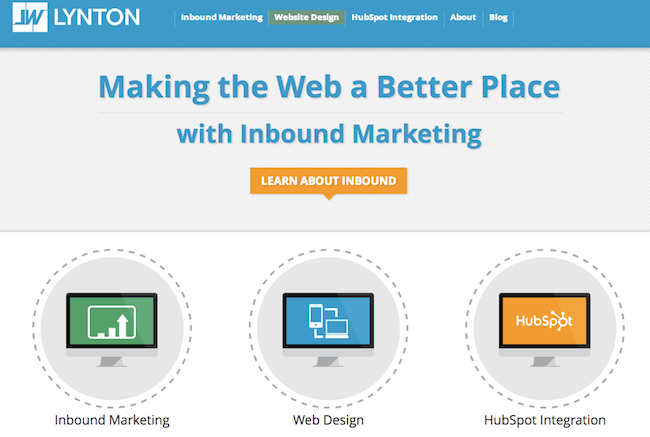
Lynton Web is an inbound marketing agency and HubSpot partner headquartered in Houston, Texas. They understand that the interests and needs of their website visitors are going to evolve the more they get to know the agency. So, when a visitor first arrives at their site, the call-to-action is a bit softer and more educational. They don't push first-time visitors to sign on right away -- instead, they invite them to "Learn About Inbound."  

The Default, Impersonal Homepage

Lynton-first-time

When the visitor then returns to the website as a lead, the CTA becomes more direct and points to services Lynton Web offers. They encourage the now-educated website visitor to "Start Your Project Today."  Lynton even adjusts the text for returning visitors who have mentioned in a previous form submission that they use HubSpot software. Now the homepage is tailored both to the visitors' interests and to better fit where they are in their decision process.

Personalized Homepage (After Converting as a Lead)

The personalization on Lynton's website doesn't stop at the homepage. They also personalize content to reflect a visitor's company name and other characteristics. Throughout these efforts however they are very careful to use personalization in places where it can be most helpful to the website visitor.  You can read a thoughtful breakdown of Lynton's personalization strategy over on their blog.

Sales Benchmark Index Personalizes the Whole Experience

One of my favorite examples of personalization beyond email comes from Sales Benchmark Index. Sales Benchmark Index helps B2B companies master sales and marketing processes. In their work, they deal with a number of different roles from HR to Marketing. They had a challenge: How do you speak to each different persona without giving your website a personality disorder?

They worked with New Breed Marketing, a HubSpot partner, to redesign their website, develop personas, and create a personalization strategy that spoke to each one. The result is much more than dropping a company name into a page, it's an entire personalized experience from email to webpage to blog. Let's take a look.

The Default, Impersonal Homepage

When you arrive at Sales Benchmark Index for the first time, you're asked to choose a role that best describes you. In personalizing content on your site you can either be ascribed or elective. Ascribed personalization takes a visitors past behavior and characteristics to ascribe content you think will be relevant to them. Elective puts that choice in the visitors' hands. There are cases for each approach, but wanting to give control to its visitors, Sales Benchmark Index took an elective approach.  

SBI_Home

Personalized Homepage (After Converting as a "Marketing Leader")

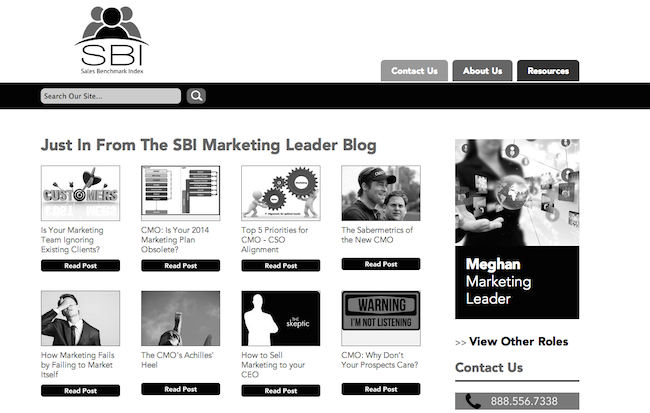
Once you choose a role, the next time you return to Sales Benchmark Index the entire experience is personalized. Note below that the content is now all relevant to marketers and the site recognizes me by name and persona.

Personalized_SBI

But wait, there's more to the strategy ...

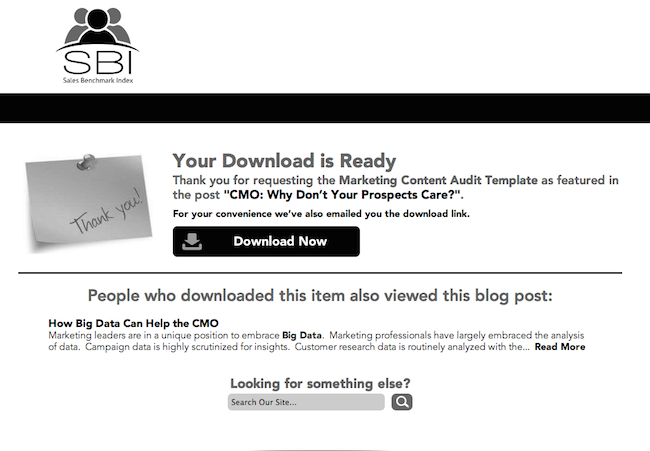
When I download a piece of content, not only does the thank-you page continue to recognize me, the email it triggers also suggests content based on my interests and what's commonly liked by marketers on their site.

Relevant_Thank_You_SBI

SBI_Automated_Email-1

As a visitor learning about Sales Benchmark Index, I get an experience that stays consistent across channels and gets more relevant over time. I'm no longer having to weed through materials targeted for other roles to find what has the most resonance for me. 

Sales Benchmark Index is clearly an advanced example of running the thread of relevant content throughout the online experience, but you can get started by identifying one or two useful places to target your content. For example, Prestige Resorts, a travel site selection firm, has started off with personalization on a single page -- their events listing -- to alert people to events in their region. They're experimenting to see if geographic personalization makes the research experience easier for their website visitors. 

Whatever you try, think primarily about the goals of your site and the way your visitors use it. Then identify a targeted place where personalization could help ease friction. Website personalization shouldn't be a parlor trick. Each of the examples above had a clear purpose and moved the website visitor down the marketing funnel in a meaningful way. Understand the points of friction in your marketing funnel, and you'll understand where to begin with your personalization strategy.

  download free dynamic content ebook

subscribe to the hubspot marketing blog

02 Apr 14:18

Does Your B2B Marketing Pitter Patter Match the B2B Sales Chitter Chatter?

by Ed Marsh

Does that sound backwards?

Does Your B2B Marketing Pitter Patter Match the B2B Sales Chitter Chatter? image B2B business development walk the talkWhen you read that you probably wondered whether I didn’t really mean the opposite – is the B2B Marketing chitter chatter keeping up with the B2B Sales pitter patter.

And you’d have been wrong….

See, here’s the thing.  The reality is that you can’t really sell anymore.  Folks may buy from you, and they will do it on their terms, at their pace, according to their requirements.  (Before you scroll down to leave a comment about sales being as important as ever….I get it.  Obviously you must have direct sales people.  But their role is changing and they must adapt!)

Virtual sales process

Great B2B sales people have always had an extraordinary ability to help buyers recast their understanding of their problems, needs, requirements and desired solution.  They help buyers through that process by first establishing credibility and authority, and then drawing on extensive experience to , psychologist style, accompany the buyer on a path of discovery and exploration of their real needs.

And that happened through conversation, back in the day, when someone would call to request information or answer the phone to entertain a cold call.

We all know that neither happens any more.  (OK, again you amped up B2B sales types, I know you’re cold calling heroes.  But all you business owners?  When did you last buy something based on a cold call?  That’s my point.)

That means that the conversation; the creation of credibility and demonstration of authority; and the assisted self-discovery with buyers increasingly occurs virtually.

And that means that your B2B Marketing now really must walk the sales talk.

And how?

Accept the fact that people are looking for you online.  Note I didn’t say they’re looking for your product.  By the time they are looking for a specific set of specs or services you’ll be mired in a competitive squabble.  That’s neither productive nor profitable in most cases.

But before they started searching for a specific product, they began to search for folks that had the same challenges as them – who could make suggestions and recommendations.  They were searching for resources to help them understand how to overcome their challenges.

Specific product or service ideas flowed eventually from that initial search – they didn’t drive it.

Bottom line? I can guarantee that people are searching online for help with problems which your product could fix.

Answering questions

The best place to start?  Just like you would in a dialog belly button to belly button.  Prospects have questions.  (In fact there are lots of people with questions who aren’t prospects yet.  Want to make it easy for them?  Provide answers!)  You know what they’re asking, or should be, early on in the process.  You can probably keep yourself busy for months, collecting great leads, by merely answering those questions.

Want to see what I mean?  Check out this great video of the @SalesLion talking about creating content that moves the needle.  (Just skip the first 40 seconds, and then buckle up.)

Taking it to the next level

Good stuff, right?  Absolutely.  Now clearly there’s more to it.  Inbound marketing to create sales qualified leads for B2B manufacturers requires strategy, precise execution, evolving methodology, tools like marketing automation, and tons of great content that speaks to your specific personas at each stage in their buying journey.  (Get all that industry lingo?)

But you don’t have to do it yourself.  Here’s more on how we help.

B2B manufacturing internet marketing video 1 of 3 series

image credit

01 Apr 14:50

Your Content is the New Cold Call

by Craig Rosenberg

Editor’s note: Today’s post is from myDocket CEO Jason Wesbecher. Jason did a previous post on the Funnelholic: The “3 Ps” of Killer Drip Campaigns. The post absolutely blew up — tons of traffic, lots of compliments. So when Jason had another idea for the post — I jumped on it. Jason and the team at MyDocket are taking on a challenge that is near and dear  to my heart — helping sales leverage content when selling. This is a great post…enjoy.

content selling, prospectingA few weeks ago I had the opportunity to attend Forrester’s Sales Enablement Forum and talk with peers in the industry about how thoroughly B2B sales is changing (the phrase “tectonic shift” was not overused).  The facts support the narrative that selling today is radically different than it was a mere decade ago: 80% of customers prefer getting their info from content rather than sales reps; there are 5+ stakeholders now involved in every purchase decision; and less than half of the deals in the forecast close today.  In other words, it’s a mess.  And sales reps & managers are left trying to sort it out.

One of the things that struck me is how outreach has changed.  If buyers want to conduct research at the time and pace of their choosing, then what is the role of the cold call?  While I hate to reopen the “cold calling is dead” debate, I do have a strong opinion that it simply isn’t an effective or productive tool in this new selling environment.  Your content is.

What Works for Me

In the past year as a venture-backed CEO, I have gotten sold to a lot.  This was new to me, since the previous 17 years I was the one doing the selling.  I did a very unscientific analysis of some of the stuff I purchased and the stuff I ignored and found that inbound cold calls generated zero purchases from us.  Here is a quick look at what worked:

  • InsideView – we purchased licenses for the CRM intelligence tool as a result of a lunch & learn they held at their office (which were conveniently located a few blocks from our HQ).  They served great food, shared some relevant case studies & best practices and then after 1 sales call we signed a deal.
  • Michael – Michael is a sales rep who wanted a job.  Instead of cold calling me, he sent me an email with a personalized video embedded in it where he talked about how he could help grow our customer base.  I was transfixed.  This was really quality content.  We hired Michael.
  • Corporate Executive Board – we sponsored their Sales & Marketing Summit last year.  They arguably have the greatest sales content going right now with their book The Challenger Sale.  We have a strong affinity for the book and contacted them after reading it & researching their events.
  • Pardot – after attending a webinar and then speaking with a couple of people locally who are marketing automation experts, we determined that Pardot was the right solution for us.  Then we called them.

Now, sure, this is just a small sample size.  But in each instance, content was the pivotal tool that the seller used to move us to a first step.  The dozen or so cold calls I receive each week have little chance to influence me because they force me to stop what I am doing and give priority to the sales rep rather than allowing me to “self serve” on my schedule.  Plus, I can spend 20 seconds scanning a relevant content piece in what seems like it takes a cold caller several minutes to deliver a similar message.  And unlike the cold call, content doesn’t come packaged with contrived chitchat.

The Problem with Cold Calls Today

Prospecting, content selling, sales 2.0Ten years from now we will look back at cold calling much in the same way that today we look back at door-to-door selling.  It was the thing that salespeople did because it was the only way to get the job done.  It’s just so totally different now.  Aside from the fact that customers have become fatigued by years of poorly executed cold calls, there are two foundational aspects at play: (1) customers want to consume vendor info at their own pace, not at the pace of the sales rep, and (2) people often don’t use their phones for calls anymore.

Has anyone actually enjoyed giving or receiving a cold call?  Ever?  It’s an awkward business practice that, these days, borders on intrusion.  Given how people actually buy things now, cold calling is an anachronistic method of engagement.  And besides, people don’t use their phones like they used to.  The explosion of smartphones has paradoxically reduced people’s use of the phone itself.  People check their cell phones on average 110 times per day.  They use mail, maps, social apps, games, and the browser.  But unless it’s your mother or the nurse at your kid’s school, fewer and fewer people actually use the phone to talk with someone.

Content is the Currency of B2B

content selling, sales 2.0, cold callThere are far more effective alternatives for sellers today than cold calling.  Sales managers over the age of 40 collectively gasp.  If a warm referral isn’t possible, use content.  Use rich media (videos, photos, infographics, animations).  Use thought leadership (analyst reports, blog posts by luminaries, news items).  Or use something more homegrown and personalized (research their interests and appeal to that).  Remember, it doesn’t have to be content from your marketing department.  In many cases, content that you source from third parties is often superior.  Focus on teaching the customer something that they otherwise would not have known.  Let them take this content and pass it around internally as their own.  It will have a massive impact.

The implications of this change in B2B sales are nothing short of staggering.  The rigid, transaction based mindset that has sustained sales & marketing organizations for the last several decades doesn’t translate today.  We simply can’t use 20th century approaches to solve 21st century problems.  Content is the new currency of B2B sales.  Start taking spending it today!

Editor’s Note: Don’t forget to sign up for the Funnelholic Virtual Sales Summit April 17 – it will be awesome — Jill Rowley, Jill Konrath, Dan Waldschmidt, and Matt Heinz. Sign up here

mydocket.com, content selling, sales, modern salesAuthor: Jason Wesbecher is the CEO & co-founder of myDocket, a tool that helps salespeople measure the intent of customers based on how they engage with their sales collateral.

01 Apr 14:50

B2Bs: How Important is Personal Value? | Strategic Digital Marketing Agency

by Oneupweb

Your individual consumers are craving you to act a little like your B2C cousins—reach the personal interests of your audience. You’re not meeting your customer expectations; you’re talking too much about an “honest and open dialog” or “supply chain responsibility.” Your customers want you to empathize with their pain and be confident in your ability to ease that pain. After all: Perceived Unique Benefits Don’t Matter—80% of B2B customers won’t purchase from a B2B company on perceived unique benefits alone Your B2B Buyers Are More Personally Invested—their career is on the line; the credibility of their business is on the line Personal Value Is Two-Times Greater Than Business Value If you enjoyed the infographic and you’re looking to learn more about how you can bring a little personality back into your B2B, download our paper: B2B: http://go.oneupweb.com/b2b_sexy
01 Apr 14:49

Who’ll Make Marketing Tech’s Big Dance?

by Kelly Cooper

In the spirit of good fun that the annual NCAA college tourney brings, I thought it would be fun to engage in some bracket-calling that’s a little closer to home.  So, I sat down with Matt Compton, marketing technology expert and ShopIgniter CEO, to get his thoughts on who’s leading at social media marketing, who might be the ultimate winner in the marketing cloud game, and what marketing spectators can learn from the constant up and down court action.

Social marketing vendors have seen their share of investment so will there be a few big winners or many players?

Anyone who has been in tech for a while has seen the ebb and flow of innovation and consolidation. Social marketing and the broader marketing cloud are no different.  While we’ve seen a great deal of innovation, we’re also starting to see consolidation both from enterprise marketing clouds and the social platforms. Oracle and BlueKai, Facebook and WhatsApp, being the latest examples. As traditional enterprise vendors see the pendulum swing from IT buyers holding the purse strings to CMOs having greater buying power, we will see more acquisitions from traditional Enterprise IT vendors as well as continued investments from Facebook and Twitter who now have significant IPO-driven war chests AND a pool of investors to please. Having said that, I do think there’s room for multiple players as social media marketing, mobile marketing and the desktop website worlds all collide. Frankly, it’s a long and messy process to build a full marketing suite, which will give independent companies needed time to thrive and grow.

What are your thoughts on the enterprise marketing clouds?  Any clear leaders? 

The product strategy framework across marketing clouds is fairly consistent: to deliver to the CMO a mechanism for both delivery and post-click landing experience for every marketing channel – from email, to display, search, social and mobile. To succeed, these companies need delivery and destination for most every channel available to marketers.

Today’s marketing clouds offer email and CRM, but hadn’t until recently focused on ad tech.  It absolutely has to be addressed since advertising is the single biggest line item in the CMO budget. Realizing this, some of these companies have taken that next step. Salesforce and Adobe were the first with Social.com and EfficientFrontier, respectively. Oracle was the furthest from having ad buying capabilities but they recently took an aggressive step with the BlueKai acquisition.

Where are we with Social Marketing – Sweet Sixteen or Final Four? 

We’re still in regular season but we’ve begun to see how this landscape is shaping up. The general players are known but major, disruptive changes still occur on a quarterly basis. Social advertising is now mainstream and viewed as one of the best mobile advertising channels.  However, smart marketers are just now moving off fan acquisition campaigns of questionable value to high value tangible objectives such as content consumption, lead gen and purchase intent.

Where do you stand on Facebook and Twitter’s future potential? What will influence their results most?

To maximize their potential, each really needs to play to their strengths. For Twitter, that means connecting advertisers to real time events and scaling its ‘second screen’ capabilities.  For Facebook, its transitioning brands from fan acquisition to higher-value outcomes via the combination of targeting, ad optimization and landing page optimization.

Just as important is the mobile opportunity.  Today, there are really only two players in mobile advertising: Facebook and Google. With Google’s mobile CPCs low and falling, it is important that Facebook is headed in the other direction. However, despite this positive news, Facebook is not very subtly weaning brands off free reach and it’s painful. The decrease of organic reach has made Facebook advertising no longer an option – it is mandatory. In order to compete, brands will have to embrace paid social. And, this is good news for Facebook’s bottom line.

Both are fast followers, able to effect change quickly, and yet both are young companies trying to quickly maximize opportunity. I expect to see continued investment in improving their ad tools and offerings.  The road will not be without bumps, but with some of the biggest concentrated audiences in marketing history, there will undoubtedly be growth in their future.

Should spectators expect platforms like Pinterest, SnapChat, and Whatsapp to make the Big Dance or sit it out?

The short answer is that they’ve already made it to the dance through function of audience size, or acquisition amount.  Whether their consumer scale and engagement allows for advertising revenue or a subscription model is a tertiary point to the role they’ll end up playing for social mobile consumers.  Which is the point: the take-all winner will be the platform that figures out how to effectively and efficiently maximize marketing outcomes from consumers who are now predominantly social AND mobile.

Don’t you just love vendor tourneys? Who do you think will make it to the marketing tech Big Dance and why?

01 Apr 14:49

Light It Up: The Connected Home’s Battle Of The Bulbs

by Adriana Lee

ReadWriteHome is an ongoing series exploring the implications of living in connected homes.

Lighting is a key ingredient in the connected home, and the benefits of smartening it up are obvious. Practically everyone has forgotten to turn off a light or fumbled around for the switch. And some find coming back to a dark house creepy. But with smart lights, you can use your smartphone to control or set automations for your lamps and bulbs, and a lot more.

The leader in smart lights is Philips Hue Wi-Fi-enabled bulbs. But the competition just heated up last week, with both LG and Samsung unveiling new smart bulbs.

Not that Philips is sitting idly by. This boss of intelligent bulbs also unveiled two new products: the Hue Lux LED bulb, a cheaper, stripped-down version of its pricey original, and the Philips Hue Tap, an add-on that lets you trigger lights by touch

A Range Of Hues

Controllable via mobile device, Philips Hue is able to illuminate in multiple colors from a single disco-worthy light and hub. Hue practically started the smart lighting trend and inspired numerous knock-offs. 

The issue with Hue is price. A starter kit of three bulbs and a bridge (or hub) will set you back $200. As if to answer the critics, Philips has just announced its new $40 Hue Lux, a smart white lightbulb that swaps features for savings. 

Lux works the same as the original, lacking only the color-changing feature. That may seem a bit boring; on the other hand, consider that the original Hue costs $60 per bulb. The Lux starter kit also goes for less, at half the amount of the original starter kit. To help bring the price down, the company stuffed only two bulbs in the kit, along with the bridge, for $100.

Somewhat more interesting is the Hue Tap, a wireless accessory for controlling Hue smartlights that's designed for wall mounting in a convenient location.

The Hue Tap provides an alternative to digging out your phone, waking it up, navigating to the app, etc. just to switch the lights on or off. And since you add it to your Hue Bridge as a wireless controller, it doesn't interfere with the system. When you shut off a lamp manually, Hue may not know what state the light is in. Turn it off with the Tap, and it knows the lights are off.

At first, this $60 accessory seemed a bit silly to me. If you’re going to reach over to touch it, why not save your money and just hit the actual light switch? But the way it draws power changes everything. The juice comes from kinetic energy—when you tap the device, you’re actually charging it. There are no batteries to mess around with, and that absence of cords means that you can put it anywhere—your coffee table, nightstand, or even the side of your fridge. 

It’s easy to see the appeal of Hue Tap. If you’ve ever found your light switch’s location inconvenient (or even stupefying—my old apartment inexplicably had a light switch near the ceiling), you’ll be glad to know you don’t have to be bound to the confines of your home’s wiring. The downside, however, is that it relies on your Wi-Fi network to function. So you won’t want to place this anywhere with a weak signal.

Who Will Light The Way? 

For connected home companies like SmartThings, Revolv and Zonoff, which powers Staples Connect, as well as services like “If This Then That,” Philips Hue has become the belle of the ball. Numerous parties have flocked to it, making the smart lights compatible with their own systems. 

Now LG and Samsung want a piece of the action too. 

Last week, LG announced its latest, the LED Smart Lamp. (Google translation here.) These $32 bulbs promise a 10-year life, can be controlled or automated via smartphones, and use Wi-Fi and Bluetooth. The company also pointed out that its lamp can groove to music or blink for smartphone notifications. (Though these have become rather standard features for smart lights. Philips Hue, for example, can do the same.) 

Like LG, Samsung’s new Smart Bulb shines a white light and promises a 10-year life, but it does away with Wi-Fi entirely, relying solely on Bluetooth. The communication approaches are interesting, because they both connect directly to phones, which means no costly hubs required, like with Philips Hue. 

Samsung hasn’t announced availability or pricing yet, but the latter will likely fall somewhere around $30 to $40. LG’s Smart Lamp is destined for its native South Korea, at least to start. But if it succeeds there, the company will probably consider extending the bulbs to international distribution. Philips, meanwhile, plans to roll out the Hue Tap and Hue Lux in North America and Europe in the latter half of 2014.

None of these options are rock-bottom cheap, especially compared to standard incandescents. Their long life and smart features, though, might tempt some buyers. And with prices starting to come down, we could see an influx of new users setting foot on the smart home path. This is undoubtedly the goal. 

Though they may lack Philips Hue’s integrations and partnerships, both LG and Samsung run a variety of businesses across consumer electronics, appliances and smart devices. They could essentially fit lighting like a piece in their broader connected-home puzzles. 

If those smart lights act like gateway products, whoever dominates that first entry point may light the entire way to their entire eco-system of smart home products.

Feature image courtesy of Flickr user André Mouraux. All others courtesy of respective companies. 

Correction: The original draft errantly stated that the Philips Hue starter kit costs $200 for four smart bulbs and the bridge. There are only three bulbs in this kit. 

01 Apr 14:48

Questions for the End of Quarter

by S. Anthony Iannarino

Questions for the End of Quarter is a post from: The Sales Blog | S. Anthony Iannarino

End of quarter. I know.

Is Your Problem Above the Funnel

Do you have enough hunters? Are you giving them enough time to hunt? Or are your hunters really farmers? Do they do more order taking than they do opportunity creating?

Do you have a hunter’s culture? Do you emphasize, reward, and recognize new client and new opportunity creation? Or do you reward (or tolerate) a lack of opportunity creating activities?

Is your pipeline providing you enough coverage? Can you make your numbers when the big deal you’re counting on falls out? Or are you exposed?

How much of a typical day is spent on opportunity creation? How much time is spent face-to-face or on the telephone pursuing opportunities? As an overall percentage, how much time is spent on opportunity creation and how much is spent on email? How do you change the emphasis?

Is Your Problem In the Middle of the Funnel

Is your process being followed? Is it being followed well enough that you can predict with any certainty when deals will be won? Who determines what date an opportunity will close?

Do you go from commitment to commitment, always creating or advancing an opportunity during every interaction with a client or prospect? Do you release yourself from calls where no value is being created?

Do know at what stage your buyers are in their process? Do you know what they need or expect from you in the way of value in order to agree to the commitment you are asking for?

Do you have all of the stakeholders you need in every opportunity to get to a decision? Have you helped your power sponsors build consensus?

End Game

There isn’t any reason to write about the end of the funnel. If you get the answers to the above questions right, you won’t find yourself in a bad position during the end game. But if you get the answer to these questions wrong, the end of quarter can be a difficult time.

The truth is that you can’t get there without enough opportunities. And you can’t get there without doing what is necessary once you have the opportunities.

01 Apr 14:48

The Cheat Sheet on Content Marketing

by Susan Poirier

The Cheat Sheet on Content Marketing image Content Marketing Cheat Sheet

Marketing has drastically changed over the past several decades in terms of the delivery methods but no matter how you look it, it is still content driven and always will be. It used to be solely about print media and ad space but now it is more about vying for attention from your online audience. This can be the biggest constraint but with the right content, geared toward the right market, you have an opportunity to be seen and heard.

Organizations are pumping up their online efforts to write compelling content and devour a piece of the market share, the hungry consumer. If you are not part of this bandwidth, churning out and feeding the insatiable, then you are doing a great disservice to your brand and your buyers. Content marketing offers the potential to communicate, engage and acquire new customers as well as to continue deepening relationships by adding value to your customers and prospects lives. For your efforts to be effective, your content must deliver an impact: a result to drive readership, sharing and interest. It isn’t merely finding an article and pushing it out. It should resonate with your company, your mission, your solutions and YOUR followers.

Your customers and prospects are searching for relevant data to help them in their buying decisions. You want to be that driver. You want to stay one step ahead of your competition, even industry colleagues, but to do this, you must be distributing value. Meeting pain points. Making sure your content conveys the information your audience is chasing.

When creating your content, think about some of the common questions you have been asked.

  • What problems does your product or service solve?
  • How will your product or service help them improve their career, their daily lives?
  • What makes it difficult for them to do what they need to do on a daily basis?
  • What are their obstacles to success?

Your solution based content can produce reactions and needs to your offerings. Help your readers thrive and flourish.

Content marketing is a strong leader in your social media channels. The Content Marketing Institute said:

“Content marketing is a marketing technique of creating and distributing relevant and valuable content to attract, acquire, and engage a clearly defined and understood target audience – with the objective of driving profitable customer action.”

Inspire!

Don’t focus on what you have to say; understand what your target market wants to read. Your content marketing strategy should serve and deliver based upon the needs of your target market, offering solutions and viable outcomes for their greatest pain points.

Get inspired with the top 8 daily habits of some of the world’s most effective content marketers.

“Traditional marketing talks at people. Content marketing talks with them.” – Doug Kessler

In a recent study by MarketingProfs and the Content Marketing Institute their results demonstrated that 93% of B2B organizations now use content-based tactics for their marketing promotions and 73% specified they now produce more content than the previous year.

Peg Fitzpatrick’s post: Feed the Content Monster defines the industry social terms and helps you to understand the what, where, why and how of content marketing. It answers all of your questions, providing you guidance and suggestions to jump in the content ring. Get ready. Research. Curate. Write. Share.

What is the content monster? This is the void for content marketers between content creation and content sharing. The content monster needs to be fed consistently. Content marketing is a great way for brands and small businesses to reach their clients and prospective clients. If you are creating your own media or blog content, content creation is a time-consuming and important task. Most blogs and businesses aren’t producing an original video or blog article each day. If you do have the time and talent to produce great quality content, you still need to share more than one thing per day on social media. So, how can you feed the content monster and curate amazing content to share?

Click to read more: pegfitzpatrick.com

01 Apr 14:48

Facts vs. Insights: How To Know You Have Truly Profound Customer Insights

by Tony Zambito
Facts vs. Insights:  How To Know You Have Truly Profound Customer Insights image 4114425465 84181c3307 n

Archeological dig continues to discover new artifacts on USACE construction site in Wiesbaden (Photo credit: USACE Europe District)

The edge. When you have it, it is powerful. It is what many B2B organizations are seeking today. What is sought is an edge over competitors, which translates into more wins. How to get the edge is what perplexes many marketing and sales leaders today in B2B organizations.

Gaining an edge usually involves uncovering a level of customer insights, which are so profound; it endears you to customers like no other competitor can. The question many ask when helping marketing leaders recently is – how do we know we truly have profound insights?

The Difference From Facts Matters

Where many B2B organizations are struggling is in knowing the difference between finding facts and what truly represents profound insights. It is a difference, which matters greatly. Buying attributes, experiences, and behaviors are undergoing their biggest upheavals in decades. Making the need for profound insights more important than ever before.

When it comes to allocating resources, the difference can be huge. What marketing and sales leaders need to avoid is duplicating use of resources on finding facts alone. The challenge here, however, is there is much confusion on what represents facts and what represents profound insights.

Buyer Insights Tell The Future

Understanding how buyers will make decisions in the future is a key aspect of buyer and customer insights. Having insights into how future decisions will affect attitudes, emotions, perceptions, and behaviors can guide the direction of an organization’s own future strategies. Thus, we have one of the main attributes of customer insights being defined as future-oriented.

This is a very important principle. Many B2B organizations are engaged in finding facts about their buyer’s current or past processes. Mainly, gathering facts on what buyers are doing now. Where duplicity is occurring is when you have marketing and sales engaged in finding facts – and not talking to each other. For example:

A B2B organization I helped adopted a specific sales methodology a few years ago. Part of this consultative methodology was aimed at gathering sales intelligence data on their buyer’s buying criteria, key factors of success, pain points, buying process, and strategic initiatives. At a different time, their global marketing team undertook an effort on finding similar facts, which existed unbeknownst to them in sales. Duplicating spending of resources towards finding facts and not true buyer insights. In the end, both marketing and sales had an exercise in finding facts as well as buyer profiling, which are helpful but offer neither truly profound insights nor true buyer personas.

A Profound Buyer Insight

Within the context of insights being defined as future oriented, a B2B organization can gain an edge when it is able to discover deep and revealing insights, which helps them to shape their brand, marketing, sales, and product strategies in ways, which are truly meaningful to its’ customers. What makes a true profound buyer insight? Here is how I have answered this question for the past fifteen years or more:

A buyer insight is the discovery of a profound truth associated with an unarticulated and no-so-obvious set of behaviors and attitudes, which illuminate the why behind buying decisions and behaviors.

A Comparison

In most cases, profound insights transition from the not-so-obvious to obvious when they have qualitative research lenses shined on them. The skilled and experienced qualitative researcher pulls together patterns of insights on a canvas to paint the story of buyers.

What follows is a comparison between finding facts and uncovering profound insights:

Facts vs. Insights:  How To Know You Have Truly Profound Customer Insights image facts vs insights comparison.001

In this comparison, evident is finding facts deals with conventional thinking on roles, functions, processes, and in general on what buyers can say they do. Profound insights go beyond this extensively and shed light on future behaviors and choices not easily articulated by buyers. Uncovering the “why” takes skilled deep diving.

Changing Directions

A base of profound insights can help an organization change its’ course of direction in a positive way. Guiding renewed positioning of strategies related to brand, communications, and products, which helps them distinguish themselves in the marketplace. And, give them the edge over competitors. For example:

A Fortune 500 firm I helped produced high quality video technologies used in sophisticated situations such as homeland security. Much of their positioning and communications focused on the quality behind the technology. Marketing and sales executing campaigns focused on demonstrating superior quality. At some point, sales stagnated for this firm. Undertaking buyer insights research to get a handle on what was happening in the marketplace, they uncovered a profound insight. In certain OEM situations, while high quality was a basic buying “criteria” expectation, their technologies were viewed as “accelerators” in product development and engineering efforts. Significantly reducing development time and making the build vs. buy decision economical. This particular division shifted positioning to representing themselves as accelerators, which meant something to potential buyers. Boosting sales with OEM’s and uncovering a new growth trajectory.

Getting The Edge

The approach an organization takes in deeply understanding its’ potential buyers and existing customers makes a big difference. It has to take care to not duplicate resources expended on the basic profiling of buyers. Instead, as in the example just mentioned, companies can focus on finding true insights with game-changing potential.

The ability to create insights-based and actionable strategies is helped when aligned with profound insights in the comparison chart above. Helping companies to gain the edge they need in the marketplace. The edge is what B2B organizations are after – this is one way to get it.

01 Apr 14:38

50 Ways to Find Co-founders

by Bill Murphy Jr.

What's worse than starting a business without a co-founder? Try starting it with the wrong co-founder. Here are 50 ways to try to find the right one.

"I'm all alone," the innovator said to me.
Starting a business can sometimes be so lonely.
Team up with others? Seek success, and be happy.
There must be 50 ways to find co-founders.

Maybe you need to imagine that rhyme as if Paul Simon were singing it, but when I give talks about entrepreneurship, the No. 1 question I'm asked is, "How do I find a co-founder?" Among former liberal arts majors, it's a bit more specific: "How do I find a technical co-founder?"

My most basic advice is simply to tell a lot of people that you're looking for a co-founder, cast a wide net and ultimately team up with someone you trust who has compatible skills (in that order). To dig a bit deeper, however, I reached out to a huge group of successful entrepreneurs for their experiences. I received hundreds replied. In no particular order, here are 50 of the best ways they told me they found a co-founder.

(Got another idea? Let us know in the comments below.)

1. Friends from college

It worked for the guys at Facebook, and so many others. Take Gautam Gupta and Ken Chen, for example, co-founders of NatureBox, an online snack food service, who met at Babson College, or John Crepezzi and Kenny Katzgrau, who started Broadstreet Ads.

2. Friends from high school

It's another very common story--for example, co-founders Zalmi Duchman and Yos Schwartz, who founded FreshDiet.com in 2006. They got to know each other when they roomed together in boarding school.

3. Friends from kindergarten

Some people get started early. Zach Schau and his co-founders at Pure Fix Cycles met when they were little kids, and "couldn't imagine starting a successful business with anyone else."

4. People you meet over drinks

Switching gears, sometimes you just have to do the legwork. Alison Johnston Rue, CEO of InstaEdu, an online tutoring marketplace, "reached out to and had drinks with dozens and dozens of engineers" before she met Joey Shurtleff, who eventually became her technical co-founder.

5. People you meet over coffee

Dean Wright of Voytech Products, which makes Snack Spout, said he met his eventual co-founders when he overheard them "chatting in my local Starbucks ... about my [area of] expertise: consumer products."

6. Your siblings

That's another common response. For example, twin brothers Sam and Andy Prochazka started Novosbed, a memory foam mattress company. Then, they recruited their sister, Helenka.

7. Your parents

I can imagine this might work differently for different people, but a few talked about starting businesses with their mothers or fathers.

8. Former co-founders in another venture

Granted, this presents a chicken-and-egg problem if you're a first-time founder, but if it's an option, it's worth considering. There's probably no better person to launch with than someone you've started a company with before.

9. Former co-workers

If you've worked together as employees, you might be able to work together as co-founders. I heard from dozens of people with this story, for example Ari Tulla and his co-founder at BetterDoctor.com, who had worked together at Nokia.

10. Your spouse

Sometimes the business comes first, sometimes the romance. Two of the three co-founders of Skin Authority, Celeste and Ted Hilling are married now, but they first met years ago when he saved her from a guy who was hitting on her after she ran a marathon. Or else, there's Guesterly, whose husband-and-wife co-founders came up with their company idea while planning their wedding.

11. Former competitors

If you're watching your competitors, you might find someone worth working with. Co-founders Michael Sterko and Barry Wise, who started KnowEm.com together, met when they were competitors trying to dominate the same SEO terms.

12. Founder dating

This is sort of the rage right now, with quite a number of founder "dating" sites, like FounderDating, Co-FoundersLab and several others.

13. Regular dating

Louisa Eyler and Eric Jackson met on the dating site PlentyofFish in 2009. A few years later, they were running Lock Laces together, which sells elastic, no-tie, bungee performance shoelaces.

14. At school reunions

I've written about this before, but just because you didn't meet your co-founder during school doesn't mean you can't later meet him or her at a school-related event. Go to your reunions.

15. Accelerators

Related to some of the other co-working suggestions, simply applying to a startup accelerator can lead to finding a co-founder. Kevin Leneway and Adam Tratt, co-founders of Haiku Deck, said they met at a Seattle startup accelerator called Techstars. "We joined forces and within weeks we had closed our $600,000 seed round," Tratt told me.

16. At church

Oddly, I don't think any co-founders who contacted me cited meeting each other through religion. It might make sense, though; you probably have some shared values.

17. At meet-ups

Tech Meetups are great places to find co-founders. "Startup events pull in both kinds of people [technical and business-minded]," reminded Nishank Khanna, founder of Bright Journey. "They're a good way to connect to other startup fanatics."

18. Playing sports together

I heard a lot of stories of former teammates working together. Similarly, Lucas Kovalcik and Tim Walsh met through a mutual friend in high school and grew a friendship based on a love of rock climbing. Now they run Gravity Vault, a franchised, indoor rock climbing business.

19. Playing sports against each other

Sam Hodges gave Alex Tonelli a black eye the first time they met, during a Dartmouth-Brown rugby match. Later, they ran into each other at business school at Stanford, started a chain of fitness centers and now run the U.S. business of Funding Circle.

20. Through mutual introductions

This seems like the heart of networking. For example, co-founders David Donner Chait and Chris Davis lived 1300 miles away, but were introduced by a mutual friend and thought they were a perfect match. They launched an online travel planner called Travefy in 2012.

21. Through cold-calls

London-based brothers Nick and Anthony von Christierson quit their finance jobs to build a parenting mobile app, but as unmarried entrepreneurs in their 20s without children, they knew they needed someone more established in the space. They cold-called Dr. Jen Trachtenberg, a nationally recognized pediatrician, and convinced her to join their company, Baby Bundle, which launches next month.

22. Through pure chutzpa

Art Booppanon walked up to Nick Warnock, who had been a contestant on The Apprentice, after a speaking engagement. Years later, the two have launched several products and companies, including the Wellograph wellness watch.

23. Through weekend hackathons

Maybe even better than founder dating--why not team up with strangers and try to build a product or a company in a weekend? At least if you fail, you'll fail fast.

24. On LinkedIn

Here's why LinkedIn can be so important. Cofounders John Steinberg and Scott Hublou of EcoFactor met through the networking site.

25. By entering business plan contests

Maybe you won't leave with a prize, but a partner. Chris Hulls of Life360, an app designed to help keep families connected, met his co-founder Alex Haro as the result of contacts he made at a business plan competition at the University of California, Berkeley.

26. By entering totally nonbusiness contests

Co-founders Brian Estes and Nate McVicker, who came up with an app for police and school emergencies called Hero911, told me they met in a Texas Hold'em tournament.

27. By taking a class

You didn't meet your ideal co-founder during college? Try taking another course in a relevant field, this time with your eyes open for someone great to work with.

28. Your siblings' friends

Who has your back like your siblings do? (If that's a complicated answer, just move on to No. 29.) If your brother or sister trusts someone who has the skills you need, maybe that suggests you'll be able to trust them as well.

29. Former vendors

This worked Claire Cullen, who started branding and marketing firm idfive with a former vendor, Rob Beal. However, she advised, "Date before you marry. Do a couple of projects together before you make a full commitment."

30. A former boss

If you liked working with each other in a hierarchical arrangement, maybe you can work together as peers.

31. Starting on your own, while you keep looking.

David Morken, CEO of Bandwidth, started his company in 1999 by himself, although he was "literally praying at his desk to find someone that he could work with." He survived, however, and the company now has 300 employees and $160 million in revenue.

32. Family friends

If you're telling family and friends that you're looking for a co-founder, you might find that they're close with someone you never even thought of. Your dad's buddy from crochet class, maybe? Your mom's friend from the rifle range? I'm trying to use unusual examples here; the point is to think broadly and creatively. Who do they know that you should want to know?

33. Online forums

Hey, if people can having Internet dating relationships, why couldn't they find co-founders that way? Giancarlo Massaro of ViralSweep met his co-founder a decade ago when they were teenagers on a forum called Sitepoint.

34. Going to parties.

Socialize. That's how Desiree Vargas Wrigley and her co-founder Ethan Austin met--at a Super Bowl party. They went on to found GiveForward, which provides "free online fundraising pages allowing friends and family to raise money directly for a loved one" in need.

35. Tapping your network

Michael Ivey said he met his co-founder in Dallas at the suggestion of mutual contacts. "Everyone said we should meet. Three months later we formed Modern Message," he said, although he added, "For you article though, I can't stress the importance of working under pressure with someone BEFORE formalizing a partnership."

36. Hiring an intern

Jason Lucash started out as Mike Szymczak's intern at Major League Soccer in California, but when Lucash moved on to take a job at Jansport, he recruited Szymczak to work with him. Years later they started OrigAudio, and they say they're making $5 million a year.

37. Hiring freelancers

If you can envision founding something with a former employee or boss, why not a former freelancer? Scott Barlow, a UK-based salesman, told me he launched a small marketing business with a co-founder named Michal in Serbia, whom he'd first hired as an animator on the freelance site, oDesk.

38. Working in a co-working space

I'm partial to this one, having had a great experience in a co-working space, and I can definitely see how this would work. For example less than a year after Frank Muscarello and Ben Blair started working separately at Chicago startup center 1871, they'd teamed up and launched MarkItx, an online exchange for buying and selling used IT hardware.

39. Running a video ad

This one is unusual, but why not? About seven years ago, Deena Varshavskaya, founder and CEO of Wanelo, posted a four-minute YouTube video looking for a technical co-founder. In truth, it wasn't a successful search, but it did get her a lot of free press.

40. Your friends' college friends

Agnieszka Wilk was also looking for a technical co-founder to help launch her interior design website, Decorilla, and wound up going with the classmate of a friend who had graduated from MIT. "Once he was on board it was much easier recruiting the rest of our technical founding team," she told me.

41. Just start pitching.

Rob Daley and Henry Thorne, co-founders of 4moms, which makes robotic baby gear, teamed up after Daley pitched the venture capital firm where Thorne was working at the time. He didn't get the investment, but he did gain a partner.

42. While traveling abroad

Josh Rosenwald and Jojo Hedaya, the co-founders of Unroll.Me, met during a gap year between high school and college, while they were studying abroad in 2008. Their email-taming system has 700,000 users in two years.

43. With a BFF

Cofounders Scott Hill and Andy Medley of PERQ, a marketing and promotions company that they say did $30 million last year, were college roommates and best friends before getting into their first business, developing sales leads for auto dealerships. Now, I have to ask: Would I still be best friends with my best friends, if I ran a business with them? Hill and Medley suggest it works for them, anyway.

44. Teaming up with a customer

You can turn some of these people-you've-worked-with models around by recruiting a customer. As an example, Dee Dee Shaw had a store called Monkee's in Wilmington, N.C.; a customer named Brenda Maready wound up working with her to establish a franchising system.

45. By volunteering

Co-founders Michael Marshall and Paola Moya didn't meet while they were in school. Instead, they got together when Marshal volunteered to be an advisor for their shared alma mater's architecture program. Impressed by Moya's work, he teamed up with her and launched Marshall Moya Design in Washington.

46. At a trade show

Where better to find someone else interested in your industry than at a trade show? It worked for Melony Miller Bradley, who met her co-founder and launched a marketing consulting firm specializing in the DIY products industry.

47. As a result of your good fashion

When they worked together at Living Social in Washington, Ricky Choi noticed that Phil Moldavski was a pretty snazzy dresser, but that he always wore regular white athletic socks. More than a few sock-related conversations later, their startup Nice Laundry was born.

48. From hiring a professional

A decade ago, when Steve Anderson was struggling with behavior issues with his son, he met therapists James and Janet Lehman. He was so impressed with their results that he convinced them to team up and launch the Total Transformation child behavior improvement program.

49. At industry alumni events

Why not combine that advice about working with fellow industry veterans and alumni events? Co-founders Matt Galligan and Ben Huh of Circa, a mobile news organization, met each other at an alumni event for Techstars.

50. Pitch a columnist for a popular entrepreneurship website.

Hey, why not? I'm always looking for an interesting new venture.

Want to read more, make a suggestion, or be featured in a future column? Contact me or sign up for my weekly email.


01 Apr 14:38

Social Selling for Small and Medium Business: Effective?

by Dave Auten

I first read the term “social selling” on my daily morning browse of social media. The post described a utopian world where B2B sales people could use the might of social media big data to target prospects and cozy them into warm leads without ever leaving the comfort of our ergonomic office chairs.

Social selling is utilizing social media as a B2B sales prospecting tool.

The concept seems almost too easy. By using the search power and depth of big data you can easily identify the most promising sales prospects. Within your own professional network you can reach out directly with a personal message that offers a very high response rate. At the very least your own network can help introduce or refer you to even more ideal prospects.

An entire LinkedIn business division provides all the details of a perfect social selling world. The power of this process relies on the depth of your network; the leveraging of many connections, ideally a collective network of connections such as those in an enterprise wide organization. Add an integrated CRM and your entire organization can effectively search their collective network for an almost endless supply of warm introductions. The possibilities of this colleague knowing that person can provide an enterprise with lots of introductions and referrals.

A lot of big companies are on board. Can social selling for small and medium business be effective?

Social Selling for Small and Medium Business: Effective? image 4764963151

Yes, SMBs are after the same leads as large business so it can be equally effective. Primarily, social selling is a process that requires effort but it “costs” less than traditional cold calling techniques. This is why the big dogs are adapting; to lower sales costs. The result is better qualified leads from introductions and referrals. Social selling can work for SMBs just like it works for large business, perhaps with even better results than large businesses! Consider the following SMB advantages:

Passion

Entrepreneurs and their crews are extremely passionate about what they sell. This is a great quality that transfers well to social selling. Social selling requires a lot of sincerity, which comes from a foundation of passion for what you offer. SMB can brand themselves as subject experts and passionate engagement.

Determination

Social selling isn’t a causal way to sell. SMBs don’t have the culture or history of old school selling tactics. They are looking for an edge to achieve specific lead generation goals. Social selling helps to flatten the playing field with the big dogs to allow those with the greatest determination to lead!

Agility

An important component of social selling is social listening, such as gathering info on what is important to your prospects. SMB can be far ahead of big business in agility to change or refocus as necessary. The immediacy of social media can be a real advantage to an agile SMB.

Focus

In social selling you must engage based on the value you offer your prospects. Ever hear a 30 second elevator speech from a salesperson from “Megacorporation X”? SMBs usually have a simpler story to tell, that can be specific and to the point.

It is likely harder for SMBs to adapt social selling than the big guns. Social selling is dependent on professional social profiles for the sellers and the companies they represent. Although a number of social media channels can be used, the most effective is LinkedIn. These profiles are technically free although you may want to make a minimal investment in some help to set them up to a professional standard. You may also consider a paid LinkedIn subscription to access their full complement of search and communication tools. In an evolving business landscape your social profile, be it personal or company, is your brand. It can be as strong as any large company brand.

All businesses, regardless of size should look at social media from an ROI perspective. What is the sense of social media for any business unless it actually helps you sell?

01 Apr 14:38

A Lot of Top Journalists Don't Look at Traffic Numbers. Here's Why.

by dlyons@hubspot.com (Dan Lyons)

man-rubbing-eyesA version of this post originally appeared on the Opinion section of Inbound Hub. For more content like this, subscribe to Opinion.

The Verge is one of the biggest and most influential technology news sites in the world, with 8.6 million monthly unique visitors and a staff of top-notch tech reporters. These are some internet-savvy editors and writers who probably know as much if not more about how to build an audience online than anyone in the business.

Yet the editors at The Verge have a policy that seems a little bit odd and anachronistic: They don’t let writers see how much traffic their stories generate. Ever.

As the American Journalism Review reported, in a piece called “No Analytics for You: Why The Verge Declines To Share Detailed Metrics With Reporters,” the editors at The Verge simply don’t want their writers thinking about traffic.

What’s more, The Verge is not alone in this practice. Re/code, a tech site run by Kara Swisher and Walt Mossberg, the longtime Wall Street Journal tech columnist, also won’t share traffic stats with writers. MIT Technology Review holds numbers back, too.

"We used to show the writers and editors traffic, and told them to grow it; but it had the wrong effect. So we stopped," says Jason Pontin, CEO, editor in chief, and publisher of MIT Technology Review. "The unintended consequence of showing them traffic, and encouraging them to work to grow total audience, is that they became traffic whores. Whereas I really wanted them to focus on insight, storytelling, and scoops: quality."

That phrase -- “traffic whore” -- tells you everything you need to know about why some journalists have an aversion to chasing traffic. They fear it creates an incentive to do the wrong things.

“As a general rule, we do not judge writers by numbers,” says Kara Swisher, the co-executive editor at Re/code, the new name for the former AllThingsD team. “In fact, we discourage it and urge them to cover what they think is right. We do not ignore traffic -- we pay attention to what works in headlines -- but we don’t put press on reporters to hit numbers.”

The sentiment holds across a lot of other places, at least according to an informal poll of journalist friends:

Quentin Hardy, deputy tech editor at the New York Times notes, via email, that reporters can find traffic data if they do some digging, but “the real question is how it drives thinking. Here it would not be considered something useful to over-obsess about. I have certainly never seen anyone write a story strictly because of the traffic it would get. To do so might arguably seem corrosive. We are much more focused on securing and growing a certain type of readership, usually educated and curious, which values accuracy, depth of knowledge, and reliability as much as speed.”

Bruce Upbin, the managing editor at Forbes, says traffic info “is instructive but it shouldn’t override taste.”

A reporter at a leading business newspaper says her editor stopped providing traffic stats, and she's glad. She can tell which stories resonate based on comments and social shares. But “very rarely” does anyone in editorial actually talk about traffic.

Those Who Look

Not everyone in the media business agrees. Sites like Gawker and Business Insider measure everything, and argue that to do otherwise would be either naive or ridiculous or both.

Gawker founder Nick Denton displays traffic info on the wall of the Gawker newsroom showing Chartbeat info for the whole Gawker network as well as data on individual writers. Denton knows that most newspapers still keep writers in the dark about traffic, but “I don’t really care what they do. We find that numbers keeps a writer conscious of an audience; and managers alert to the motivation of the writer.”

Also, Denton points out, “Not every reader is created equal. Some are worth 100x or 1000x as much, if they also contribute, for instance, or promote us on social media or the traditional press. So we’re working to improve our measure of readership, to weight certain readers more heavily.”

blodget_200x250Henry Blodget, CEO and editor of Business Insider, says: "We write for our readers, and our analytics allow us to do a much better job serving them. We cover what we think is important. And the moment we hit ‘publish,' we get to see whether our readers agree that it’s important.

"If they don’t -- if they’re not reading or sharing our stories -- we ask ourselves whether they’re not reading or sharing them because we’ve done a bad job explaining why they’re important, or whether we were just wrong and they actually aren’t that important.

“On a personal note, not knowing or caring about readership just seems bizarre to me,” Blodget adds. “After a decade of working in this medium, I could not imagine writing without knowing how well I was connecting with my readers. That’s one of the joys of digital -- the fact that you know that instantly. Back when I was writing for magazines, I had no idea how many people read my stories or whether they liked them or found them helpful or meaningful. I can’t imagine going back to that.”

The Rush 

When I worked at Forbes and Newsweek we could see the numbers on our stories if we wanted to see them. Most of the time I didn’t ask, but if something was really taking off I’d check in to see what the total was. Even when I ran my own blog, The Secret Diary of Steve Jobs, I didn’t obsess about traffic. Sometimes I had advertisers, so I needed to tell them how many people they were reaching. But I never set out to "get traffic." I just wrote what I wanted to write. Whatever happened, happened.

That said, I’ll be honest -- when something really does take off, it’s exhilarating. And it's addictive. You get that rush, and you want it again and again. I agree with Henry Blodget that one of the best things about writing for the web rather than writing for print is that you can actually see a story taking off. It’s a rush watching those numbers skyrocket. Any writer who says he or she doesn’t get off on that is just flat-out lying.

What About Marketers?

Some of my colleagues on the HubSpot blogging team were shocked by the story about The Verge and almost couldn’t believe it was true. “This just seems CRAZY,” one wrote on email.

Of course at HubSpot we measure everything. There’s a relentless focus on numbers. This is our gospel, after all. This one thing HubSpot’s product helps you do; it lets you publish content and track how well that content is performing.

Our bloggers don’t just look at traffic data; they study that data (and plenty of other data), and analyze it, and slice and dice it, and pore through it. We even have someone whose main job is to stay on top of the analytics around our blog.

Moreover, and most important: Unlike journalists, our bloggers absolutely set out to get traffic and openly cop to doing so, without apology and without any sense of stigma. We consciously set out to create blog posts that we think will capture lots of views.

We have to watch the numbers. We’re under pressure to hit our traffic and leads numbers every month. We have an SLA with our sales department, a number of leads we’ve committed to deliver every month. And we’re expected to keep those numbers going up.

When you're operating a lead gen blog, content is a means to an end, not an end in itself. A “win” for us is totally different than a “win” for the New York Times. In our world, the idea of never looking at traffic numbers seems quaint, or snooty, or maybe even hopelessly outdated, a sign that you’ve lost touch with reality.

A Middle Ground

It seems to me that even in a marketing setting, even if the goal is lead generation, there may be something to be learned from those snooty editors who keep their writers in the dark. Maybe it's just because I've been a journalist all my life, and I can't get those old values out of my bloodstream. But I believe that there may be a middle ground, one where you watch the numbers and are aware of them without becoming a slave to them.

Oddly enough when I did the reporting for a recent ebook titled The CMO’s Guide to Brand Journalism, most of the brand journalists I spoke to said they keep an eye on traffic stats, but aren’t driven by them and don’t feel any pressure to boost uniques and page views from month to month.

These were people working at IBM, GE, and Intel, among other places. Of course they’re not trying to sell ads, and they’re not trying to generate leads, so raw traffic doesn't matter much to them.

But also they are betting that they are better off trying to focus on doing quality work, because quality is what will enable content to stand out in a world that gets noisier every day.

There's another reason that some journalists don't get obsessed with traffic, and it has nothing to do with snobbery and everything to do with business. It's that they've learned that chasing traffic for the sake of traffic can be a fool's errand.

Finally, in case you're wondering: Yes, I wrote this story hoping that it would get a lot of traffic. 

How does your organization look at traffic? What kind of pressure are you under? Let me know what you think in the comments below, and we can continue the conversation.

guide to intermediate marketing analytics

subscribe to the hubspot marketing blog

01 Apr 14:37

The 6 Greatest Sales Management Lessons from Hubspot’s SVP of Sales, Mark Roberge

by Lauren Licata

The 6 Greatest Sales Management Lessons from Hubspot’s SVP of Sales, Mark Roberge image rsz hubspots mark roberge 6 great sales management lessons copy 600x322

When you grow a sales team like Mark Roberge did – from 1 to 450 employees – you’re going to learn a lot. At a Forecast fireside chat in Boston, Roberge and Base CEO Uzi Shmilovici discussed scaling sales teams, the future of sales, and what Roberge learned in his role as SVP of Sales at Hubspot. We’ve broken it down to Roberge’s 6 most important sales management lessons.

1. Put Marketing On A Quota

It’s important for the marketing team to take accountability for the lead generation portion of the sales process. To eliminate as much subjectivity as possible between the sales and marketing teams, it’s crucial to have a very defined relationship.

“I’ll give you an example of what we did,” said Roberge. “We knew, for the first year or so, if I gave my mid-market reps a hundred leads, it will result in about $800 of monthly recurring revenue (MRR). It’s like clockwork.”

As you scale, you can start to see how many leads you need to hit your revenue goals each month.

Mike Volpe (VP of Marketing), my counterpart, stepped up and delivered those leads. I’d love all companies to get there. But still, there’s a hole in that, and the hole is that some of those leads we got were VP’s of marketing who downloaded a white paper and others requested demo’s.”

Roberge figured out that those who requested a product demo closed at five times the rate as a white paper download, but that demo requests were much harder to come by than a great ebook about Twitter marketing.

“So we rethought the process and what we did was – we segmented those leads. We knew that ebook and white paper leads closed at 1% and demo request close at 5%. So if you multiply the conversion rate of those leads times the average spend of those leads, you reverse engineered a lead value. So, the ebook leads were worth a dollar, and the demo requests leads were worth 5 dollars. Now instead of telling Volpe that I need 1,500 mid-market leads, I told him that I needed $25,000 dollars of lead value, and he can get there through whatever the math is, like 5,000 demo requests or 25,000 ebook downloads – either way I’m getting to my number.”

What he’s done is essentially put marketing on a quota. “How cool is that? Instead of just sales, marketing is on a quota too,” chuckled Roberge. 

2. Interview Strategically For Your Industry

When growing the team at Hubspot, Roberge developed criteria for the hiring process specific to the technology sales industry. It’s important to understand your context. Someone who may not be successful at technology sales, could excel in higher volume, lower value markets. Roberge called out 5 indicators of future success when hiring at Hubspot:

  • Coachability
  • Prior success
  • Work ethic
  • Curiosity
  • Intelligence

He added, “Prior success doesn’t have to be in sales. We’ve got an Olympic gold medalist on our team. We’ve got a guy who’s a professional comic who made it to Comedy Central. These are people who went after something and achieved it. That’s what you’re looking for.”

3. Coaching Is Key To Sales Productivity

According to Roberge, “The biggest lever that you’re going to get to drive sales productivity is the effectiveness of your managers in developing and coaching your frontline sales people.”

Hubspot uses a matrix-driven sales coaching model. On the second day of every month Roberge meets with the sales directors, who each oversee a few managers and have about 40 sales reps underneath them.

These meetings force a coaching culture to the whole organization. And good coaching is really about trying to find out the one thing that’s going to make the biggest difference.

4. Don’t Organize Your Sales Team By Territory

Roberge warns against organizing sales teams by territory. “If you think about territories, they grew out sales teams who knocked on doors. That’s the whole point. Put your people where the doors are. For whatever reason it is still around. Either way you should organize your sales team by the buyer persona.”

As you grow your team, it’s better to specialize your sales person in health care than say, New York, for example.

And Mike Gamson, SVP of Sales at LinkedIn agrees with him. Their sales team uses a social proximity index, where they look at the data provided by LinkedIn and assign the prospect to the sales person most likely to close the deal based on relationships – not territories. 

5. Specialize Your Sales Team Early

“The biggest mistake I made was not specializing the sales team early enough,” said Roberge.

“For example, I had some sales people who were like, “Man, I hate these Fortune 5000 guys, I can never get them on the phone, but I love those plumbers, they pick up. I know they don’t have a lot of money, but I can get them to make a decision in an hour and be done.” And other reps were like, “I hate these plumbers, they don’t have any money. I’m a strategic seller and I just want to deal with people who have better business acumen, and who will spend a little bit more.”

For Roberge, it eventually became logical to specialize, but he wishes he would have done it in the first year of scaling the team instead of the second.

6. Focus On Inbound Inside Sales

Sales as a profession is going inside. “20 years ago, you had to actually talk to a sales person. They had information that you needed, and the best reps were very skilled at withholding that information in exchange for the information they wanted from you, like – who’s the decision maker? How much budget do you have? What are your needs?”

But today, we can be in our slippers on Saturday night, and find the top vendors in any space. We can find out what they do, how they’re different from each other, and how much they are. We can often try the product for free. So why do we even need sales?

“In sales, we have to step up our game to add value to that whole new ecosystem. We need to be there as consultants and advisors to our buyers. We need to do a better job when we engage with someone, to engage with them in their context. We need to do a better job understanding their specific goals, the specific challenges they’re trying to solve and translate that generic marketing that’s on our website to their business. We need to tell the story from their perspective, that’s the best reps that we have, that’s the skill that they actually possess.”

You can watch the entire interview here.

If you liked this post, you can subscribe to the Base blog for more posts like this.

This post originally appeared on the Base blog.

01 Apr 14:37

6 Benefits of Integrating WordPress with Salesforce

by Brad Decker

6 Benefits of Integrating WordPress with Salesforce image wordpress salesforceSalesforce is one of the most well known CRMs on the market. This CRM offers many tools for storing and organizing your company’s sales and prospecting data. Yet this data could be even more valuable when integrated with your corporate WordPress website. Below we offer six valuable ways to synchronize your Salesforce and WordPress data.

1. User Management Made Easy

Synching your WordPress users to your Salesforce CRM is crucial for maintaining a cohesive user database. You can setup core WordPress functions, like site registration, to create new leads in your Salesforce database that come from WordPress. You can also sync fields between the two applications so that your company departments all have access to the same data set.

Do you run a membership related website or host specific data on your website that is only visible to your customers? With a Salesforce to WordPress integration you can keep your users’ account status synced dynamically. This lets you tag your leads as customers in Salesforce and have them automatically updated with a customer tag.  In turn, giving them access to ‘customer only’ areas of your website. Automated prospect to customer updates lessen your sales teams’ workload (no more manual updates) and they’ll look like geniuses to their newest customers.

2. Convert Form Submissions into Leads

If you need to convert WordPress form submissions into leads, you’ll need to integrate your site more fully with Salesforce. WordPress hooks and filters let you send form data to Salesforce and track your form’s performance in your CRM. Knowing the forms that convert better will help your inbound marketing team tune the forms that don’t work as well.

3. Track ‘Logged-In’ User Activity

To identify the most trafficked areas of your website, you can set up ‘logged-in’ user page tracking to push user page history into a custom Salesforce Object. If you’re hosting your WordPress site, be warned that tracking users at this detailed level requires a good deal of computing resources. And depending on how your web hosting provider charges you – could turn into an expensive proposition. A more reliable and efficient way to track customer activity – and a way to gather intelligence about a visitor before they become a lead – is through HubSpot and a HubSpot Salesforce Integration.

4. Build a Product Catalog or Ecommerce Store

There are many ways to import your product database into your Salesforce CRM, but there are few ways to keep that data synced up with an external eCommerce store. There are some out of the box solutions available, which are products designed to work with as many Salesforce setups as possible. Yet these off-the-shelf solutions may nullify any customizations to your eCommerce workflow or database. A custom integration solution could include a product catalog. It could even include a full eCommerce solution that records all stock quantities, sales and other sales data in your Salesforce database. Having previous purchase data in Salesforce is helpful when targeting customers for new products, promotions or marketing campaigns.

5. Tack on Campaign IDs to WordPress Actions

Do you want to associate any core or custom WordPress actions with your Salesforce campaigns? Attaching WordPress actions to Salesforce lets you associate users who register on your WordPress site with a sales campaign. You can also add anyone who submits a specific form to a given Salesforce campaign ID. You can even target specific website activities you want tracked. For example, you can add a WordPress action that keeps track of the number of blog posts a user views in each product or service category. If they hit a certain metric (i.e. number of blog posts read) you can associate them with a campaign ID that corresponds to that category. The number of custom actions you can create and track in this manner is endless. So be sure you have a specific marketing or sales goal in mind you can align these custom actions to.

6. Custom Object Integration

Salesforce is extremely extensible with the right developer on your team. You can create entire Salesforce objects dedicated to your website (isn’t that sexy?). Another example – if you want to build a website that helps keep track of your rental properties and store their data in Salesforce, then a custom integration with custom Salesforce objects and tracking is what you need. You can even keep track of tenant rent due dates, amounts and payments right inside of your Salesforce database but allow your tenants to pay their bills on your WordPress website.

There certainly is a lot you can do with Salesforce and WordPress and even HubSpot. Just be sure you have all your customizations and configurations tied to your business goals and priorities. Otherwise you’ll just be spinning your wheels on cool tech that ultimately has no benefit to the bottom line and proves little ROI.

If you need help integrating your WordPress site and Salesforce portal, click here to speak to an expert now.

6 Benefits of Integrating WordPress with Salesforce image 3e462c8e 7edc 449b 9ce7 036a594620f31

Photo Credit: ZERGE_VIOLATOR via Compfight cc

01 Apr 14:36

20 Bad Ass Chicks You Need to Know

by Keenan

In the ever accelerating world of lead management, there is a crew of women who are making a name for themselves by changing how sales and revenue are driven through leads. Those of us in sales, we like that, right? Good leads frickin’ rock!

These bad ass ladies were just recently announced by the SLMA (Sales Lead Management Association) on their 20 Women to Watch in Sales Lead Management. I dig working with chicks, more so than dudes in many cases. I’ve find their presence brings greater unity, more innovation, creativity and empath to teams. So, I was stoked to see this list.

I believe the presence of women in sales is grossly under represented. Women are bad ass sales people and I personally want to see more making their mark. We (A Sales Guy Recruiting) were recently engaged in a number of high-profile sales people searches, when my lead recruiter asked; “Where are all the women? I can’t find any.” Her question hit me hard, because I knew she right. It’s hard to find women in sales, especially technology sales.

This list makes me happy and I hope to see more lists and exposure for woman like this one.  (Hmmm, idea swimming in my head.)

Check out these bad ass ladies, they do good stuff and deserve the recognition they’re getting.  And a little extra love to my girl Nancy Nardin. Way to go sister, way to go!

Winners (Twitter Account)  Company/Accomplishments

Lisa Arthur    Teradata

Marge Bieler RareAgent

Karla Blalock PointClear

Lisa Cramer   LeadLife Solutions

Robyn Davis  When I Need Help

Jeanne Hopkins Continuum Managed Services

Jocelyn King Altera

Janet Lee  Lattice Engines

Liz McClellan PGi

Laura McGuire Saligent, Inc.

Barbara Morris Laser Image

Margery Murphy Acadia Lead Management

Simone Nabers ReadyTalk

Ellie Mirman HubSpot

Nancy Nardin Smart Selling Tools

Hila Nir ZoomInfo

Genie Parker VanillaSoft

Laura Patterson  VisionEdge Marketing, Inc.

Beki Scarbrough CA Technologies

Mari Anne Vanella The Vanella Group

Keep your eyes on these ladies, they are making things happen.

01 Apr 14:34

Turkey is losing where it counts

by macleans.ca
OZAN KOSE/AFP/Getty Images

OZAN KOSE/AFP/Getty Images

Over the past three months, dozens of taped telephone conversations between senior members of Turkey’s ruling Justice and Development Party (AKP) have dominated headlines. The revelations range from millions of dollars in bribes paid by foreign businessmen, to what appears to be one politician soliciting the services of a prostitute to, most recently, a senior adviser to Turkish Prime Minister Recep Tayyip Erdogan poking fun at the Quran. Call it the Turkish version of WikiLeaks. All this from a party that has fashioned itself as a model of religious ethics and morality.

As this latest drama unfolds, Turks are preparing to go to the polls for municipal elections on March 30 that many consider a litmus test of AKP support. Erdogan, with his usual bravado, has called the taped conversations—or at least the most damaging ones— forgeries, and blocked Twitter and Facebook in Turkey last week.

Turks, on the other hand, are having a blast. Smartphones are chattering away with the latest releases; young Turks, who only a few days earlier were being pummelled by water cannons and rubber bullets in ongoing street protests against the AKP’s increasingly authoritarian governing style, have taken to gathering at private homes, cracking open a few beers and listening to what appears to be the implosion of their enemy. They howl when Erdogan’s son, Bilal, is apparently heard telling his father that he has removed all of the money hidden in the family home, as instructed—but when pressed explains there is still about $1 million left. His father tells him to hide that money, too.

“This is just amazing,” says Tuncay Karatas, a lawyer and political activist. “Do we need to do this fighting on the street anymore? Erdogan is digging his own grave.”

Or is he? Turkey is no stranger to political scandals. In early 2011, leaked spy-cam videos of politicians with the nationalist-leaning MHP made the Internet rounds. They showed senior party members in the company of young, beautiful women. It was election season, prompting accusations of below-the-belt political tactics. The usual suspects were accused: Islamists from the AKP or followers of Fethullah Gulen, who leads a rival Islamic movement, though no evidence was ever produced to link them to the scandal. Regardless, the tactic failed. The MHP fared as well in the election as they were expected to, surpassing the 10 per cent vote threshold required by Turkish law for parties to secure representation in the parliament.

Polls suggest the impact of the current scandal will be minimal, too. An analysis of opinion polls over the past six months compiled by Ali Çarkoglu, a professor of political science at Koç University in Istanbul, indicates AKP support has remained relatively stable.

Its resilience is part of a disturbing trend emerging in this part of the world: young liberal movements appear unable to convert the energy of street protests into ballot-box successes. Turkey looks set to follow the lead of Egypt and Tunisia: their youth, so successful at resistance and confrontation, have failed at political mobilization. “It just feels like we’re protesting for the sake of protesting now. We stopped the AKP from destroying Gezi Park but they’ve gone ahead with other megaprojects,” says 42-year-old activist Tolga Baysal, referring to the AKP’s plans last year to uproot one of Istanbul’s last green spaces and replace it with a military barracks and a mosque. “These phone scandals show just how corrupt they are but still we don’t know what to do. Who do we vote for in the next election?”

The options are slim. After nearly a year of demanding political change, Turkey’s protest movement has managed little in terms of political organization. One party, the Gezi Party, has emerged but remains largely disconnected from the bulk of youth voters and appears destined to fade away in the face of the much more powerful electioneering machine run by the AKP. “It’s strange,” says Ezgi Icoz, a 35-year-old art therapist and political activist. “People go out and protest for a few days and then they stop. They go on with their lives while this election campaign plays out around them, with all the same politicians we’ve seen for years. It all feels too familiar. It all feels very surreal.”

The liberal youth in Egypt spoke along similar lines following the military coup that brought down the democratically elected Muslim Brotherhood government. “We just can’t believe this is happening,” one activist said in August last year. “We didn’t want the Muslim Brotherhood in power but we also didn’t want this military intervention. We feel like we’ve lost control of what we started.”

Indeed, control, in Cairo as well as Ankara, remains firmly in the hands of an old guard of politicians. How they maintain their grip varies: in Egypt, military authorities have resorted to fear tactics, warning of the threat of Islamic militancy to justify their actions.  In Turkey, it’s the economy. Despite the ongoing turmoil, Turkey’s economic indicators remain strong.  Growth rates are robust and unemployment relatively low. Çarkoglu suggests that Turks, who have suffered through severe economic crises in the past, will be more forgiving of political corruption and authoritarianism as long as the economy chugs along. Though Erdogan and his crew should not feel too secure, he adds. “The political preferences of younger voters are of utmost importance,” he says. “Before the Gezi Park protests, the AKP was dominant among the younger voters as well, but that influence has now been called into question.”

Playing in the AKP’s favour is a general apathy toward elections among Turkey’s youth. Voter turnout has never been high for their generation. Will it be different this time?  “We’ll have to do something,” says Baysal, the activist. “These scandals may be fun to watch but if we don’t act, we’ll never get these corrupt people out of power. And then all of this, everything we’ve done, all the sacrifices and the spilled blood, will be for nothing.”

The post Turkey is losing where it counts appeared first on Macleans.ca.

31 Mar 16:07

Post Smarter: The Best Times to Use Social Platforms (Infographic)

Having the right content is great, but knowing the time of day when people are most receptive to posts is invaluable.