Shared posts

26 May 15:44

How to Achieve Awesomeness Without Being A Jerk.

by Dan Waldschmidt

Being driven isn’t a valid excuse for not being grateful. When you are all consumed with a purpose and a big goal it comes naturally  to focus only on what is best for you. You wake up in the morning thinking about what you need to get done for the day and work tirelessly getting

The post How to Achieve Awesomeness Without Being A Jerk. appeared first on Dan Waldschmidt: Author of EDGY Conversations.

16 May 15:30

Video: Vancouver’s beauty shown in spectacular time-lapse video

Ryan Emond has made a number of beautiful videos, but for his latest project the time-lapse photographer turned his lens on Vancouver — and the results are stunning.
16 May 15:30

Saturday alert issued for peak cruise volumes in Vancouver

Port Metro Vancouver has issued an alert for Saturday, with cruise passenger volumes at Canada Place and Ballantyne Pier cruise terminals expected to peak at over 14,500 embarking and disembarking passengers between 7 a.m. and 5 p.m.
16 May 15:27

5 things Google Inc will conquer in the future (according to Larry Page)

by Jim Edwards, Business Insider

Google CEO Larry Page just published his annual founder’s letter for shareholders and, as usual, it’s a fascinating glimpse into where Page thinks Google is going, how it’s going to get there, and what the company will conquer in the future.

Sure, he mentions the usual things: search and email and being always logged in through Chrome so that your stuff can be seamlessly accessed on a laptop, phone, or even on your TV.

But there are also a couple of surprises in there. Here we quote five of them.

1. Same-day delivery shopping: “We’re excited about our new Google Shopping Express service, which is a  great way to get deliveries the same day you order them.” Shopping Express hasn’t been rolled out nationally yet. You can look at the San Francisco version here. It looks like a straight-up threat to Amazon.

2. Curing death: “In healthcare we have Calico — a new company led by the former CEO of Genentech, Art Levinson, that’s focused on health, well being and longevity — and Iris, a smart contact lens designed to transform the lives of people with diabetes.” The keyword there is “longevity.” Page really believes that there is no need for humans to start dying “naturally” once they hit their 80s.

3. Good design: “Now, none of this matters without good design. I remember taking a class at the University of Michigan on usability.  Students had to pick a program they knew really well (I chose an email program) and estimate how long it would take experts to perform different tasks.  It really helped me understand that building good, efficient interfaces is hard, and a bit more like engineering than you might think. Another tab here, another drop-down menu there.  The more choices you throw at people (even if they never use them), the longer it takes them to get stuff done. People still talk about the simplicity of the Google homepage, and that was a huge part of our original success. There’s no reason the same principles can’t apply across our products, especially now, with so many devices and options, and so much opportunity for distraction.” This is interesting because often, Google’s products are ugly (think about Drive for instance). It’s also a page from Apple’s book. When people think about tech design, they tend to think about Apple rather than Google — Page seems to be aware design is an area Google needs to improve.

4. Conversational, artificially intelligent search: “Improved context will also help make search more natural, and not a series of keywords you artificially type into a computer.  We’re getting closer: ask how tall the Eiffel Tower is, and then when ‘it’ was built. By understanding what ‘it’ means in different contexts, we can make search conversational” For most people this isn’t going to seem like much, but making computers handle human-style search requests in natural language patterns would be a huge step forward in artificial intelligence and machine learning. Business Insider has more context on the future of search here and here.

5. The 5 billion people who are not online: “Of course, this all assumes you are one of the 2 billion people who have access to the Internet.  That leaves five billion other people.  It’s a tragedy that with so much information available today, two-thirds of the world’s population lack even the most basic Internet connection.” Google is a $60 billion-a-year company. To move that needle, it needs to find new businesses that will generate billions, not millions, of new dollars. And that seems to mean finding billions of new customers in developing countries where the internet doesn’t yet exist.

16 May 15:21

How Do Conversion Paths Work? [FAQs]

by rmoore@hubspot.com (Rachel Goodman Moore)

pathAs a marketer, a big part of your job is to convert qualified website visitors into leads. Simple enough.

But as an inbound marketer, your job is to convert qualified website visitors (aka your buyer personas) into leads by offering remarkable content for which they’ll want to trade their contact information in exchange. Ideally, those leads turn into opportunities, who turn into customers and even promoters.

Clearly, conversions are a big deal. So how can you optimize yours? By creating conversion paths optimized to most effectively convert your ideal visitors into leads.

What's a Conversion Path?

A conversion path is the process by which an anonymous website visitor becomes a known lead. A conversion path is comprised of a remarkable content offer, call-to-action, landing page, and thank you page. In order to convert into a lead, a visitor sees a content offer of interest to them (that’s your remarkable content), clicks on the call-to-action button to access that content, and is then taken to a landing page. On that landing page, the visitor can provide their information on a form in exchange for access to the offer itself. Upon submitting that form, the now-lead is taken to a thank you page where they receive the offer.

Voila! Conversion path complete.

By designing and implementing the right conversion paths, you can most effectively move website visitors through the buyer’s journey and help them become customers and promoters.

What Makes a Good Conversion Path?

Well as you might have guessed, you need content, a call-to-action, a landing page, and a thank you page. But with so any conversion paths out there on the internet for your potential customers to explore, it’s now more important than ever to create the RIGHT paths -- paths that your ideal customers are drawn to and most effectively convert the right visitors into leads.

Let’s explore the four items you need in your inbound toolkit to create effective conversion paths.

1) Context-Appropriate Content

Content is the fuel that powers effective inbound strategies -- and it’s what you’ll use to convert those website visitors into leads. The good news is that content is everywhere! Content is what your website pages are filled with, what goes into your emails, and what’s hosted on your blog -- your website pages, emails, and blog are just vehicles to deliver that content.

Although content is in no short supply, in order for it to act as your inbound rocket fuel, you need to create the right content. As you can probably guess, the right content is optimized to appeal specifically to your buyer personas. It should focus on the challenges they’re trying to overcome and the goals they're looking to hit. Most of all, it should be relevant and interesting to them.

But here’s the kicker -- it’s not enough to just create persona-specific content. That content needs to be relevant to your persona based on where they are in the buyer’s journey.

The Buyer’s Journey is the active research process your personas go through leading up to making a purchase -- and specific content is more relevant to your personas at different stages of that journey. This is where the “context” piece comes in: It’s not enough to just create content for your personas. You have to make sure that content is relevant to what they’re interested in and hoping to learn more about.

Most visitors to your site are still at the very beginning stages of that journey -- they might not even know what your product does or how it can help them. All they may know is that they have a problem or there’s an opportunity at hand. So, the content that will most appeal to your personas when they’re first visiting your website and converting a lead will generally be high-level and educational in nature.

In order to be an effective tool in your conversion path toolkit, make sure you have remarkable content tailored to your buyer personas and where they are in the buyer’s journey.

2) Landing Pages That Speak to Your Personas

After you’ve developed a remarkable content offer that speaks to both who your personas are and where they are in the buyer’s journey, the next step is to leverage that piece of content to convert website visitors into leads. That’s where landing pages come in.

Landing pages are specialized website pages whose sole purpose is to collect visitors’ contact information in exchange for something of value to them. Landing pages contain forms that potential leads must fill out and submit before getting access to your remarkable content offer. And like that offer, great landing pages must also be tailored to both who your personas are and where they are in the buyer’s journey.

In order to most effectively convert website visitors into leads, your landing pages must present the benefits of your offer that are most relevant to the particular problem your persona is experiencing -- and discuss the aspects of that problem that are most important to where your persona is in the buyer’s journey.

Imagine, for example, you work at a pet store and have created an ebook on raising a puppy. Someone who’s at the beginning of the buyer’s journey probably won’t be too interested in downloading your ebook if your landing page talks all about how your ebook contains the best techniques for housebreaking. Instead, an effective landing page for this persona might highlight how your ebook discusses how to choose the right dog breed for you.

Great landing pages focus on both who your personas are and where they are in the buyer’s journey.

3) Attention-Grabbing Calls-to-Action

While having a remarkable content offer and great landing page are key to creating a successful conversion path, your website visitors needs a way to actually access that landing page in the first place. That’s where calls-to-action come in.

Calls-to-action are buttons you can embed throughout your website that advertise your content offers. When a user clicks on one of these calls-to-action, they’ll be taken to your landing page. In effect, every call-to-action you have on your website is the beginning of a conversion path.

To create calls-to-action that get those clicks and act as key steps within your conversion paths, you must ensure that the message displayed on your call-to-action aligns with the message on your landing page -- and the content itself.

Great calls-to-action should be just that: action-oriented. Since their main objective is to garner clicks and direct people to landing pages, ensure that they’re click-worthy by using actionable language and colors that help them stand out from the rest of your website.

4) Optimized Thank You Pages

If a call-to-action is the beginning of a conversion path, a thank you page marks its end. Thank you pages are the final item you need in your inbound toolkit to lead your website visitors down a conversion path to become, well, a lead.

Thank you pages are specialized website pages from which your now-leads can download the offer promised by your call-to-action and landing page. They’re also an opportunity to move people further along in the buyer’s journey, by including things like additional calls-to-action that complement the offer you've just provided your lead.

Conversion paths are the process by which anonymous, unknown website visitors become leads. When done right, your conversion paths can go beyond the first conversion to help move your now-leads through the buyer’s journey to become customers. To learn more about this stuff -- creating remarkable content, optimizing landing pages, designing stand-out calls-to-action, and setting up great thank you pages, check out HubSpot Academy’s Inbound Certification program and pay special attention to the “convert” series of classes.

hubspot academy inbound certification

subscribe to the hubspot marketing blog

16 May 15:21

Make Every Sales Call Matter

by Donal Daly

So here’s the thing. There are really only two things that a salesperson controls; (1) who they call on, and (2) what they say when they get there. Ideally a seller is spending as much time preparing for and executing on the ‘what’ as he is deciding on the ‘who’. After all, no matter how well you have refined your target market, figured out the ideal buyer persona, and sharpened your competitive positioning, nothing happens until you engage with the customer.

But the research shows that very few of these engagements are planned. It is all too rare that a sales person has a detailed plan of what he wants to achieve on the call. What are the desired outcomes? Why might you fail? In the absence of a Call Plan many sales interactions leave a lot to be desired. In fact, 64% of all sales calls are ineffective.

Making every sales call matter – matters. This is where the magic is supposed to happen. It is the salesperson’s opportunity to progress the sale, to deepen relationships and to uncover and address vulnerabilities in the deal. It is his opportunity to show that he is a credible individual who can bring his own insight to the conversation, and create – not just communicate – value, all the time advancing the deal.

Unfortunately, most of the time, there is no value created by the salesperson. Only 25% of senior business executives are prepared to take a second meeting. Two-thirds of the time business executives are turned off by the lack of preparation by the sales person. They say that they don’t find a lot of value in sales conversations. We should not find it surprising that business executives who are being pursued by sales people play hard to get, using their executive assistants to screen callers, interrupt meetings, or delegating the entire interaction to a subordinate.

The harsh truth is that most sellers are not adequately prepared for sales calls. The consequences go further than you might think. If you waste an executive’s time – the most precious currency she has – your stock has fallen. The likelihood of progressing the sale has been damaged. Your value is questioned. Any business you win will be on price alone. Research suggests that the purchase experience is the most significant arbiter of customer loyalty. Now your customer loyalty is damaged even before you start. You have a steep hill to climb if you ever want to use this executive to refer you to her colleagues. You have just wasted her time – so why would she subject her treasured relationships to an ineffective sales call?

After every meeting, you always want the customer to feel that the meeting was a good use of her time, that she got more from the meeting than she expected. Satisfaction or quality is always a function of expectation and performance. If you don’t perform to the customer’s expectations then she will be disappointed, and that’s not good. You, your colleagues, and the customer, should all be clear as to the customer’s expectation of the call. That’s a good place to start. Here’s a short video that might paint a picture.

Making every sales call matter – matters.

16 May 15:21

4 Ways Business Strategy Should Drive Hiring

by Lou Adler

Does your company's business strategy and CEO drive talent needs, or does HR?

I was recently talking with a CEO of a small- to mid-sized business the other day about how to build out her executive team. She contacted me based on my Inc. post regarding the four work types: thinkers, builders, improvers and producers.

In the post I contended that these four work types needed to be considered as a company grows and matures. In this case thinkers and builders are needed to dominate the types of people hired during start-up and rapid growth, with a shift to more improvers and producers as growth stabilizes.

She then asked how business strategy impacts the hiring decision, since she sensed that this needed to be integrated with the company's growth phase.

This prompted a discussion around the following four primary business strategies:

1. Product excellence

This is comparable to Apple's strategy driven by Steve Jobs to be a market leader at the product level. This strategy allows for high prices and higher margins.

Based on this point alone, she suggested that maybe putting Steve Ballmer as the head of Microsoft was a bad strategy decision, since he wasn't product-focused enough, and as a result, the company lost its way. True or not, from a talent selection standpoint, if a company's strategy is driven by product excellence it can't compromise on the quality of the people hired who lead this effort, whether it's the CEO or the product designer.

2. Operational efficiency

Consider UPS, Costco, Lenovo and any company that needs to watch its margins closely to see this strategy in action. It means being great at execution, cost control and process efficiency. These companies require Six Sigma thinking at every step, even during startup. Obamacare is a perfect example of this strategy gone awry. It didn't take much hiring insight to know what was going to happen from day No. 1, with the wrong people selected to lead and implement the effort. Now consider the people who came in to fix the problem: They all have a proven operational efficiency mindset.

3. Customer focus

This strategy emphasizes meeting customer needs in some way with the emphasis on market share and sales growth. I suggested Twitter, LinkedIn and Amazon as prime examples of this business strategy. We debated whether Amazon should be in the group, since it also has an operational efficiency component as part of its business strategy. Sometimes a customer driven strategy requires giving up margin to gain share, but eventually the variable costs need to be big enough to cover fix costs. Marketing, advertising, and sales leaders need to drive this type of strategy.

4. Financial maximization

Think private equity, venture capital or turnaround groups who invest in companies with the prime goal of receiving a huge return on investment. The CEO I was speaking with took it a step further, suggesting that for some companies this is a prime strategy. For others, like hers, it would be the result of successfully delivering on one of the other strategies.

However, when this is the driving strategy, the people hired need to immediately consider what it takes to deliver significant financial rewards in the short term. If it's a secondary strategy, the people hired need to think about building long-term value as part of their ongoing decision-making.

While most companies have a blend of all of these core strategies, one or two usually dominate. And selecting great people to build and lead a company is a strategic decision that few hiring managers and human resources leaders fully appreciate.

I suggested this might be the fault of CEOs, since most only give its importance lip service. The CEO I was speaking with pondered this point, and then asked me for a suggestion on how CEOs like her might operationalize it.

"What about making hiring great people the No. 1 performance objective each manager is measured on, rather than having it implied?" I said.

And she agreed, that it might even be the most most important thing she could do grow her company within the next few years.

No doubt she'll make it. While many business leaders understand the importance of hiring the best, most delegate the process and the strategy to their HR group. While many good people will be hired as a result, their focus is on avoiding mistakes, not hiring the best.

This is a big shift in thinking, but this is where the CEO needs to get involved and make sure everyone walks the talk, not just talks about it.


16 May 15:21

That Mad Men Computer, Explained by HBR in 1969

by Andrea Ovans

It’s 1969 on this season’s Mad Men, and a glass-enclosed climate-controlled room is being built to house Sterling Cooper’s first computer — a soon-to-be-iconic IBM System/360 – in the space where the copywriters used to meet.

That same year, in an article entitled “Computer Graphics for Decision Making,” IBM engineer Irvin Miller introduced HBR’s readers to a potent new computing technology that was part of the 360 — the interactive graphical display terminal.

i-97sGSpZ-X2

Punch cards and tapes were being replaced by virtual data displays on glass-screened teletypes, but those devices still displayed mainly text. Now the convergence of long-standing cathode-ray-tube and light-pen hardware with software that would accept English language commands was about to create a revolution in data analysis.

Previously, if executives had wanted to investigate, say, the relationship of plant capacity to the cost of production, marginal costs to quantity produced, or marginal revenues to quantities sold, they’d have to fill out a requisition, wait for a data analyst to run a query through the machine, using some computer language like Fortran, and then generate a written report. That could take months.

But interactive graphics offered the possibility of providing realistic answers quickly and directly. As Miller explains: “With such a console in his office, an executive can call for the curves that he needs on the screen; then, by touching the screen with the light pen, he can order the computer to calculate new values and redraw the graphs, which it does almost instantaneously.”

Screen Shot 2014-05-14 at 10.54.25 AM

To read Miller’s tutorial is to return to some first principles that may still be worth bearing in mind, even in today’s world of vastly greater amounts of data and computing power (the largest mainframe Miller refers to has a capacity of two megabytes). The first is his almost off-hand initial stipulation that the factors affecting a business that a computer can process are quantitative.

The second is his explanation (or, for us, reminder) of what the computer does when it delivers up the graphs: “To solve business problems requiring executive decisions, one must define the total problem and then assign a mathematical equation to each aspect of the problem. A composite of all equations yields a mathematical model representing the problem confronting the executive.”  Miller suggests, as an example, that a system programmed with data on quantities produced and sold, plant capacity, marginal cost, marginal revenues, total cost, total revenue, price, price for renting, and price for selling could enable businesspeople to make informed decisions about whether to hold inventory; expand plant production; rent, buy, or borrow; increase production; and examine the effects of anomalies on demand or the effects of constraints.

Even in this simple example it’s easy to see how hard it is to “define the total problem” — how, for instance, decisions might be skewed by the absence of, say, information on interest rates (which in 1969 were on the threshold of skyrocketing to epic proportions) or of any data on competitors,  or on substitutes (a concept Michael Porter wouldn’t introduce until 1979).

Miller is hardly oblivious to the dangers (the term “garbage in; garbage out” had been coined in 1963); and in answer to the question of why an executive should rely on the differential calculus and linear programming that underpins the models (interestingly, Miller assumes senior business executives haven’t had calculus), he replies that the point of the equations is only to “anticipate and verify intuitive guesses which are expected to be forthcoming from the businessman” [italics original]. In other words, the mathematics are essentially meant to serve as an amplification of the executive’s judgment, not as a substitute.

Exhibit Andrea Ovans

Intuition-support is, in fact, the point for Miller. For him, the real benefit of the new technology isn’t just the ability to perform what-if analyses on current data, as powerful as that is, but that executives could do it in the privacy of their own offices, which would afford them the time for the private reflection from which intuition springs. “The executive needs a quiet method whereby he alone can anticipate, develop, and test the consequences of following various of his intuitive hunches before publicly committing himself to a course of action,” Miller says, before he even begins to explain how the technology works.

In this it’s enlightening to revisit Miller’s estimates of how much time the entire process was supposed to take: a few weeks to construct the model, five minutes to conduct each what-if scenario – and then two full hours for the executive to consider the implications of the answers. In this, HBR’s first examination of data visualization, it is in those two hours of solitary quiet time that the real value of interactive computing lies.

Persuading with Data
An HBR Insight Center
16 May 15:21

This smart lock will protect your bike and alert a friend if you’ve had an accident

by Kia Kokalitcheva
This smart lock will protect your bike and alert a friend if you’ve had an accident
Image Credit: Velo Labs

What's next in mobile? Find out at MobileBeat, VentureBeat's 7th annual event on the future of mobile, on July 8-9 in San Francisco. Register now and save $400!

Imagine a Lockitron for your bicycle instead of your door. You could unlock and lock it with an app, no key required, and receive alerts when something fishy is going on.

Well, that’s about to become a reality thanks to Velo Labs and the connected bike lock, Skylock, it’s launching today. The company is opening up a crowdfunding campaign which will help get the campaign’s preorders released.

“We are targeting the urban commuter who uses their bike to get to and from work,” Velo Labs cofounder Jack Al-Kahwati told VentureBeat in an interview.

Making the lock secure and a real tool to help with theft prevention is Velo Labs’ main goal right now, and the lock was designed specifically with this goal in mind.

“The value proposition we’re trying to bring is that this is going to be easier to lock than your usual lock, but we want to make it more secure,” said Al-Kahwati.

The lock has a proprietary dual-lock design that makes it twice as difficult to cut. It is also designed to detect if a thief is jostling it, presumably in an attempt to get it off the bike, and notifies the owner that someone is potentially attempting to steal the bike.

On the rider safety front, Skylock has a number of features aimed to help. The lock’s built-in accelerometer helps it determine if a rider has likely been in a crash. If it thinks that’s the case, the mobile app prompts the rider to respond whether he or she is alright, and, if needed, alerts emergency contacts the lock’s owner has put in during the initial setup.

“A lot of bike riders are getting hit now on the road,” said Al-Kahwati. He added that the company is working on implementing alerts to emergency first responders who would then call the rider to verify the situation.

To counter smartphone battery death or phone loss, the team has added a keypad on the lock that the owner can use as a backup. And to ensure continuous battery life for the lock itself, a solar panel keeps the battery charged.

But all the hardware and features aside, what’s really interesting here are the economic implications the Velo Labs sees. Bike-sharing is the fastest growing segment of the “sharing economy,” according to the company.

“There’s a billion bikes in the world,” said Al-Kahwati. “The denser cities get, the less cars are useful.”

While Velo Labs is first marketing Skylock to consumers, it plans to eventually approach bike-sharing organizations such as New York City’s Citi Bike Share and the Bay Area Bike Share, or even internal corporate bike-share programs such as Google’s. It believes that the shared controls and increased security of the lock itself will be an asset to such programs.

Spinlister, for example, a service that enables bike owners to loan out their bikes to people who would like to rent one, would be a perfect target for this second phase of Skylock’s marketing. Currently, Spinlister takes care of the marketplace piece but can give owners no guarantees on how renters will store and secure their bikes, according to the company website.

The Skylock could also give rise to informal bike-sharing networks, such as groups of friends or roommates wanting to share bikes, or even neighborhood residents forming their own.

For now, the company claims it has no direct competitors, although traditional U-locks are the closest alternatives. Kryptonite for example, offers a range of locks running all the way up to several thousands of dollars. And while Velo Labs is pricing preordered locks at $149 before bumping the price to $249, there will still be a demographic of consumers for which the price is too high.

The Velo Labs team didn’t seem too concerned about their pricing when we spoke with them.

The Skylock is now available for preorder and the company plans to start shipping its first units by December 2014.


16 May 15:20

Here's Why You Should Always Make The First Offer In A Negotiation


It pays to be aggressive--literally.

Contrary to the commonly held wisdom, people who make the opening offer in a negotiation have the upper hand.

The advantage is owed to something psychologists call the anchoring principle. It's a cognitive bias where people rely too much on the first piece of information they have.

In a salary negotiation, for example, whoever makes the first offer establishes the range of possible variation from that anchor. If you start high, the hiring manager may adjust the figure down slightly. But that's typically a stronger position than starting low and trying to negotiate up.

"Most people come with the very strong belief they should never make an opening offer," says Northwestern University management professor Leigh Thompson. "Our research and lots of corroborating research shows that's completely backwards. The guy or gal who makes a first offer is better off."

Marketers use the anchoring principle to trick you into thinking something is cheaper than it actually is. A "discount" tag that still shows the original price on a pair of pants is a prime example, since you tend to focus on the deal you're getting rather than the price you're paying.

In a negotiation, you can use that bias to your advantage. "Whoever makes the first offer essentially drops an anchor on the table," Thompson says. "I might say that your opening offer is ridiculous, but nevertheless, unconsciously, I've been anchored."

What's more, the opening offer helps orient the other person's perception of the value of what's being negotiated for. An aggressive opening offer makes people consider the positive qualities of an object, since it forces them to decide whether it's worth the cost, says Columbia Business School professor Adam Galinsky. On the other hand, a low opening offer makes people stingily consider what might go wrong, since lower prices are associated with negative qualities.

"My own research suggests that first offers should be quite aggressive but not absurdly so," Galinsky says. "Many negotiators fear that an aggressive first offer will scare or annoy the other side and perhaps even cause him to walk away in disgust. However, research shows that this fear is typically exaggerated. In fact, most negotiators make first offers that are not aggressive enough."

To start with a high but not overly aggressive offer, you could just introduce a number--rather than explicitly ask for it.

Harvard Law School's Program on Negotiation details why:

"The most effective anchors further reduce risk because, rather than placing firm offers on the table, they merely introduce relevant numbers. A job applicant may state his belief that people with his qualifications tend to be paid between $85,000 and $95,000 annually, or he might mention that a former colleague just received an offer of $92,000. This assertion is not an offer; it’s an anchor that affects the other side’s perceptions of the zone of possible agreement."

The next time you enter a negotiation, don't play coy. Put your offer on the table first.


16 May 15:19

3 Ways to Unlock PR Success for Content Promotion

by Beth Corneglio

3 Ways to Unlock PR Success for Content Promotion image pr success outreach 2

Content promotion is the most critical component to getting any content marketing strategy off the ground and landing it in front of the intended audience. Any strategic content marketer worth his weight will have already considered how the content being created will be messaged to media outlets for additional exposure.

But getting content in front of the right media outlets is easier said than done. So, for those of you just starting out, consider the following content promotion tips:

Pitch genuinely interesting content

This goes without saying; the content or subject matter you’re offering has to be fresh. Make sure that you understand the outlet you are approaching, as well as that outlet’s needs. The most effective content helps solve the problems of the reader or fills a void, so take that into consideration and communicate the value of your content when you promote.

Native is key

Get in where you fit in. The content you promote should fit in with its potential surroundings—so make sure you’re pitching content that will connect directly with the media outlet’s readership. Craft your pitch so that it speaks to the relevant value it can provide to the outlet and its audience,and not the other way around. The more effectively you can connect with an outlet’s readers, the more likely the outlet will be to incorporate your content into its next article.

Keep it simple

This is my personal favorite: “tell the joke backwards.” Lead with the punchline in your pitch. You already know the content needs to be genuinely interesting, so the punchline should speak for itself. The little details can be saved until after you’ve captured a media outlet’s attention. If you feel like you have to oversell it, you’re probably trying to offer the wrong thing to the wrong outlet.

Each of the preceding steps is important to the overall process: pitch genuinely interesting content, put their audience first and keep it simple. And if you are not doing it already, collaborate with your brand’s PR team before you begin your next big piece of content creation. This is really the key to unlocking content promotion success.

To learn more about how you can use digital PR and SEO to capture your target audience, check out our webinar, The Not-So-Odd Couple: The Union of PR and SEO.

Image credit: Niuton May

16 May 15:18

Swarm, the new app from Foursquare, is done with games

by Lauren Hockenson

Does anyone even care about badges anymore? What seemed like an unavoidable trend just a few years ago is now fading into the sunset. Perhaps this is no better felt than in the release of Foursquare’s new app, Swarm (which is, funny enough, named after a badge on Foursquare). While it does a great job of spinning out the friend-focused elements of Foursquare’s check-in system, Swarm is shockingly devoid of any gamification features — especially ones that arguably put the company on the map in the first place.

Swarm_ScreenWhen logging in to Swarm for the first time, users with a history on Foursquare will see their data — including friends and past check-ins — seamlessly port to the new interface. You can check in with the same ease as the original Foursquare app, but the app encourages users to update their general location with its “neighborhoods” designation.

For example, if I’m sitting in my home drinking a coffee, I can check in to Bernal Heights generally to tell my friends I am in the area. Swarm also passively updates that data upon opening the app, to give users the most accurate general reading of where their friends are.

That said, Swarm really shows its value in interacting with friends. When opening the app, users will immediately see who is nearby based on their recent check-ins — from 500 feet away to “Far Far Away” for friends more than 20 miles away. The goal is to create those “people discovery” moments that encourage friends to interact in real life — similar to the way Facebook is doing with its “Nearby Friends” feature on mobile — and it achieves that in this feature, as well as pushing notifications for nearby friends.

Another new feature is “Plans,” which allows friends to post their upcoming whereabouts, such as a bar for happy hour, and let others know that they’re interested in what’s been posted. It’s a simple, easy way to connect with friends in advance, but it doesn’t unseat traditional texting in terms of making plans. Rather, it’s like a permanent open invitation for company, designed to connect people that maybe would not have otherwise interacted.

Swarm is a useful tool to help users see who is around them when they check-in, but its lack of the traditional Foursquare gamified experience means that it’s missing that little something extra. In Swarm, Foursquare has abolished public mayorships and badges — the two big features that enticed users to play the “game” of checking in. Without those little rewards, like the satisfaction of unseating a long-entrenched mayor of a coffee shop, Swarm doesn’t feel immediately satisfying. Whether the lack of those rewards hinders the rate that users check-in remains to be seen.

Overall, Swarm is a neat, lightweight, and smart way to dip your toes into the world of people discovery — it doesn’t play around and it gives very helpful information about friends that you want to see. But in stripping those fun and games, users who get that thrill of being top dog at a location or getting a new, unseen badge will be sorely disappointed that they are gone.

Related research and analysis from Gigaom Research:
Subscriber content. Sign up for a free trial.

16 May 15:18

How an endless loop of consultation and opposition is threatening Canada’s energy growth

by Yadullah Hussain

Municipal councillor Chuck Puchmayr doesn’t want to see British Columbia’s pristine waters and postcard scenery besmirched by pipelines and tankers. And as president of B.C.’s Lower Mainland Local Government Association, which represents 50% of the province’s population, 33 local governments and three regional districts, he passed a new resolution last week to oppose Kinder Morgan’s plan to expand the crude-carrying Trans Mountain pipeline system between Edmonton and Burnaby, B.C.

“The resolution is fairly clear: we don’t want this [project] at all,” Mr. Puchmayr said from the city of New Westminster, east of Vancouver. “The resolution also talks about future projects of this type to have more public involvement. At the moment there is no public discussion beyond legal filings.”

A spate of municipal objections to pipeline developments has added a fresh layer of uncertainty for companies already dealing with intense opposition from some First Nations and environmental groups.

But as companies with iron resolve lock horns with unyielding stakeholders, many observers believe Canada is losing out as projects of national importance are caught in an endless loop of consultation, opposition and procrastination.

“Our social decision-making process is so weak,” said Leo De Bever, chief executive of Alberta Investment Management Corp., the largest wealth fund in the country with assets under management of $63-billion. “We find it easier to pay somebody not to build something rather than actually build it. There has been a shortage of resolve to build projects.”

Even as  hungrier, middle-income economies move quickly, Canada and other high-income countries believe they have the “luxury of temporizing,” Mr. De Bever said in an interview in Toronto.

Canadian provincial and federal regulatory regimes are often held out as examples of models of governance internationally, but in reality the slow decision-making process is hurting the country’s long-term future growth, he said.

As projects stall, Canadian producers have lost as much as $30-billion annually due to discounts on their blend of crude in the past few years. While spreads have narrowed over the past 12 months there is much more at stake.

If oil sands production reaches 3.8 million barrels per day in 2025, the bitumen’s contribution to Canadian GDP could nearly double, and a third more jobs could be expected, according to energy consultancy IHS CERA.

“Between 2012 and 2025, oil sands’ contribution to Canadian GDP could grow from $91-billion to $171-billion,” the IHS estimated in a report published this year. “This would be like adding an economy the size of Saskatchewan today to Canada by 2025. Oil sands could also add over one-quarter of a million more jobs, contributing to 753,000 jobs in Canada in 2025.”

Canada may not hit those targets if key projects continue to remain in an endless cycle of consultations.

“It is a fiercely competitive globalized world,” Peter Tertzakian, chief energy economist and managing director at ARC Financial Corp. told a Toronto business audience this week. “We as Canadians need to recognize we do not have a birth right to prosperity unless we start to compete.”

Canadians are used to dealing with a single market in the U.S. and still believe they can afford to take a very long time to make development decisions, says Dylan Jones, president of the Canada West Foundation.

Handout/Kinder Morgan
Handout/Kinder MorganAs projects stall, Canadian producers have lost as much as $30-billion annually due to discounts on their blend of crude in the past few years. While spreads have narrowed over the past 12 months there is much more at stake.

“But the reality is that there are far more competitive and alternatives suppliers, most of whom are hungrier to make sales and are prepared to move more quickly,” Mr. Jones said, adding that “there will be very significant economic consequences” to delays in infrastructure projects.

A number of key oil infrastructure projects are caught in regulations and unable to secure a “social license” to proceed from communities, environmental groups and First Nations.

In the past week, Ottawa has issued new regulations to tighten marine and pipeline safety to soothe community concerns, but a social licence remains elusive from many local communities.

“I am not in love with the phrase ‘social licence’,” Mr. Jones said. “The concept of social licence is unhelpful, first of all as it suggests it’s a box you can tick. Secondly, because it is confuses public support with regulatory approval.”

Last month, Kitimat residents rejected the Northern Gateway pipeline in a non-building plebiscite after the regulator National Energy Board approved it. The federal government is expected to take a final decision on the project in June.

Meanwhile, the  city of Burnaby, which is leading municipal opposition against Kinder Morgan, noted that “if Trans Mountain does not have social licence and consent from Burnaby, those services may not be made available.”

The concept of social licence is unhelpful, first of all as it suggests it’s a box you can tick. Secondly, because it is confuses public support with regulatory approval

Mr. De Bever says the industry should share some of the blame as it has long viewed the issue of social licence primarily as a “PR exercise”.

Indeed, the industry and communities often appear to talk in different tongues. Engineering and technical companies that can competently address the legal and technical requirements of the most stringent regulators, frequently stumble when it comes to dealing with inquiries from the general public.

“In fairness there is really a radical change in the level of public interest around public infrastructure,” Mr. Jones said. “There has not been a lot of time for regulatory bodies and companies to respond to that.”

TransCanada Corp. CEO Russ Girling, who is up against a legal challenge in Nebraska on the Keystone XL pipeline, said he was “caught off guard” by the opposition in the state, but argues that the company can’t do much against folks “who want to keep our resources in the ground.”

The company is spending more time talking to communities about its Energy East pipeline project which, if approved, would run from Alberta all the way to the East Coast.

“On Energy East, we have got there really early, even before we have drawn a line on the map,” Mr. Girling said at Bloomberg conference this week. “[We are] sitting down with thousands of aboriginal communities across Canada and understanding what their concerns are.”

Indeed, it would be difficult to run roughshod over community concerns that often go beyond individual projects. They also involve convincing  local leaders such as Mr. Puchmayr that his town of 15 square kilometres is part of a global value chain that feeds overseas markets and bring in revenues and investments for the wider economy.

“People who are in the business of growing the economy and creating jobs will have to local issues than whether ever have in the past,” Mr. Jones said.

Mr. De Bever is hopeful that deep-pocketed investors such as AIMCO are experimenting with ‘radical’ technologies that can make transportation much safer and ease community anxieties.

“From Co2 emissions, water to energy intensity — [they] can be addressed,” he said. “It is a matter of time, money and resolve.”

16 May 15:17

A Few Quick SEO Wins Your Google+ Page Needs

by mhibma@hubspot.com (Maggie Hibma)

plus-signsThis post originally appeared on the Customer section of Inbound Hub. To read more content like this, subscribe to the Customer section.

The recent departure of Google+ creator Vic Gundotra from Google has led to speculation that the social network will be undergoing some changes in the coming year. According to Google however, these changes will build off of the foundation of Google+ rather than uproot it entirely.

As the world learns more about exactly how Google+ will evolve, it's a good time to make sure you have the foundational elements right so you're ready for any change. This post will give you some strategies for optimizing your Google+ page and some news about publishing to Google+ from HubSpot. 

First, let's start off with some good news. Beginning today, HubSpot customers will be able to publish directly to their Google+ pages using Social Inbox. Why publish to Google+? Your Google+ page is more than just another channel for your content. There have been a lot of changes in the last two years to the way Google finds and prioritizes content in search results, and it's no surprise that Google's search results are becoming more and more influenced by content published within their own platform. Regardless of how Google+ changes in the future, content published to Google+ today is crawled just like other pages and served up as search results. Beyond the content you publish to them, your profiles and pages on Google+ are ripe with opportunities to improve your SEO. 

Whether you already have a page or you're ready to create one, here are some quick ways to boost the SEO value of your Google+ page.

1) Bulk up the "Links" section.

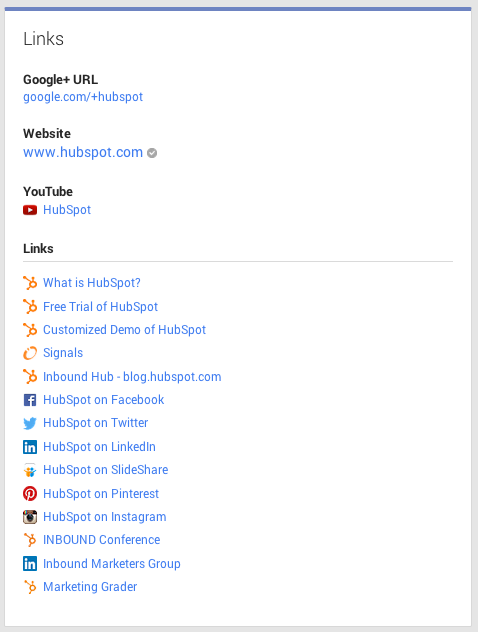
Every Google+ page gives you the opportunity to add links that are important to your business in the "Links" section, which you can find under the About menu in the middle of your page:

Your_Business_Name_-_Google__2

Starting with your website URL is an obvious choice, but you should also include other important links such as your blog, other social profiles, or any page to which you want to drive traffic. Here's what HubSpot's Google+ Links section looks like:

HubSpot_-_Google_

The SEO Benefit

Embedding these links directly into your page will not only increase visibility for these sites -- it'll provide Google with information that helps determine how relevant this particular page could be to a user searching for you on Google. Those links will also help users that stumble on your Google+ page with the information they need to identify who you are, and possibly click through to your site pages. 

2) Get your "Story" straight.

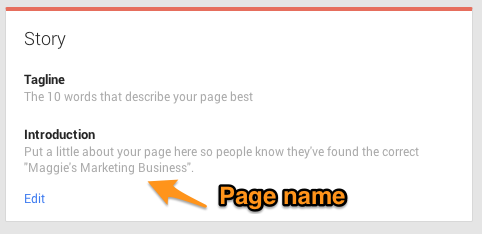
Also found under the About menu is your page's story, where you can add a tagline and an introduction to your business.

Test_-_Google__2

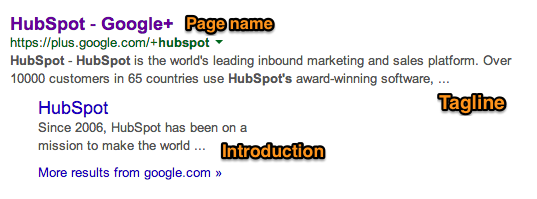
The content in your Story directly affects your page's meta description. When your page shows up on a search engine results page (SERP), it will include your page name, followed by your page's tagline and the first part of your introduction. Here's an example of what HubSpot's Google+ page looks like on a SERP:

hubspot_on_google__-_Google_Search

The SEO Benefit

Meta descriptions are present on SERPs to convince the reader that yes, this is what they are looking for and yes, they should click through to your page. Creating a meta description using both keywords you already rank for and search terms you know your target audience uses to find a solution like yours will increase the chances of the reader clicking through to your Google+ page.

Be careful, though: It can be enticing to stuff this with more keywords than necessary. If you read it aloud and it doesn't sound natural, consider revising and using only 2-3 relevant keywords.

Need some help with this? Check out our post on writing effective meta descriptions.

3) Link your Google+ page to your website.

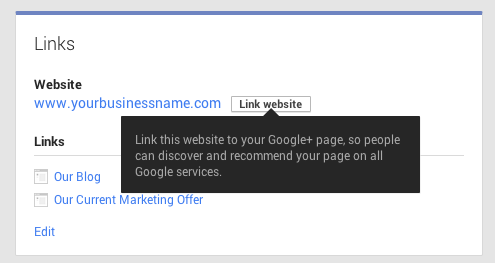
If you haven't already, you'll want to link your Google+ page to your website. Wondering if you've done that already? If you have, you'll see little gray checkmark next to your website link on your Google+ page (you can see it in the screenshot in section #1). If you haven't, you'll see this "Link website" button: 

Fullscreen_5_12_14__12_42_PM

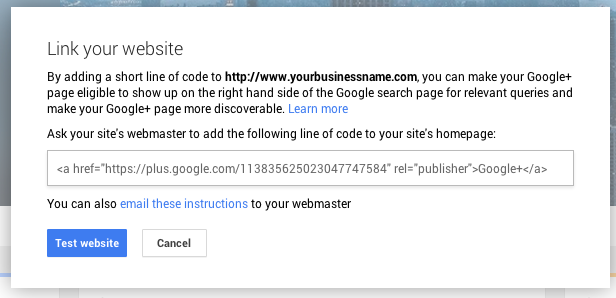
Google gives you simple instructions on how to do this, and even provides an easy way to send this to the person that manages your website:

Your_Business_Name_-_Google_

The SEO Benefit

When you link your Google+ page to your website, you're creating inbound links, which helps your website naturally rank better in search results. Inbound links are key to how Google determines your Page Rank. So, if you've filled out the Link section on your Google+ page to include multiple links back to your site, you're increasing the chances for visibility in the SERPs.

How else can I optimize my Google+ page for SEO?

Beyond the quick wins above, there are a few other ways you can bump up the SEO value of your Google+ page. If you've got more than 10 followers on your page, a profile photo and a page older than 30 days, you can claim a custom URL that matches your brand and increases visibility in the SERPs for your brand name.

Google Authorship is another important SEO win for your company, and something you can take advantage of if the Google profile that powers the page account publishes content regularly.

What questions do you have about optimizing your Google+ page for search? Let us know in the comments!

Improve SEO with G+

subscribe to the hubspot marketing blog

16 May 15:16

7 Disruptive Businesses Changing Their Industries – 3 Ways You Can Too

by Steve Faber

Disruptive; like “reach out”, “new paradigm”, or “out of the box”, it’s one of those business buzzwords we’d probably all like to kill. Then again, it does say something. What does being a disruptive business get you? Unlike the workplace, classroom, or any other societal bastion, where disruption will get you a swift kick in the ass, in business, disruption often moves you to the head of the class.

Disruptive companies redefine who other businesses look to for inspiration and make their organization one to emulate. Innovative execution is the order of the day here. It’s having a better idea, technology, or strategy, and pulling it off, too. That second part is the kicker. There have been many better ideas throughout time that never made any waves, simply because the requisite folks never executed.

So, redefining products, service, or business, coupled with a user experience that’s beyond expectations, because no one thought to expect anything like it before. Worthy goals, to be sure… That being said, who’s considered disruptive, why, and more importantly, how can YOU get there?

Disruptive Business 1 – Virgin

Surely I’m not the first to point to Richard Branson’s Virgin as a disruptive force. Virgin is disruptive across a broad business spectrum, as they have their fingers in such disparate industries as travel (even the outer space variety), mobile communications, and music, all of which they’ve brought their own brand of different to. Now, they even have a website dedicated to “identify and engage with the disruptive innovators of tomorrow”; Virgin Disruptors.

In a recent Forbes article Alison Coleman points out Virgin’s Galactic space travel business is, in Branson’s own words “….as disruptive as it gets.” It’s SOP for the Brit, who’s proven time and again “we’ve always done it that way” is more a reason to strike out anew, than to maintain present course and speed.

Disruptive Business 2 -Amazon.com

Proving that all disruptive businesses didn’t just fall off the turnip truck, the 800lb Magila of eCommerce fits the disruptive bill perfectly. Amazon redefines the customer e-commerce experience at every turn, and if that takes little, flying robots, so much the better! Just keep your dog chained up, please.

From deploying one of the first affiliate sales organizations, to developing revolutionary fulfillment techniques, Amazon has consistently redefined the e-commerce experience, and proven their disruptive tendencies along the way.

They are highly user experience focused, and have built a fanatical following when it comes to online shopping. Along the way, they’ve turned into one of the largest product and user experience search engines on the Internet. According to Forester Research, by 2012 more people started at Amazon when searching for products or info about them than anywhere else. That trend has continued.

In another disruptive move, they’ve let other consumer goods providers leverage their infrastructure and website, for a cut of the sales, of course. That gives little guys a chance to make it big in e-commerce, and gives the giant a way to deliver a more varied product selection to their customers. In true disruptive fashion, it’s a win-win for all sides.

The company has morphed from simply the world’s largest e-commerce company into a business services and cloud computing giant as well. Thousands of small and large organizations use Amazon to cloud host videos, podcasts, and other content. They were one of the first on that score, too. Now their massive data centers populate the rural landscape like so many Costcos. Not really, but the company has distributed them throughout the world to boost user efficiency, due to access proximity.

Disruptive Business 3 – NEST

I’m not alone naming NEST as a disruptive business. Ethan Howland named NEST on his list of Disruptive Energy Companies to Watch for 2014 NEST founder Tony Fadell has a disruptive business history, leading the iPOD creation team at Apple that redefined how we listen to music, and creating the Kleenex of MP3 players (sorry, Zune).

Disruptive Business 4 – Comcast / Xfinity

Oh, shut up and get back on hold! They’re not on my disruptive company list for the reasons you may think. Sure, they’re getting into the home automation and security business, but they’ve aimed to do that for over a decade.

I tabbed Comcast for this list not for their customer service, which many love to hate, but because of the way they’re “borrowing” real estate in their customers’ homes and businesses to deploy neighborhood WiFi hot spots. You have to admire their chutzpah. Are they sacrificing your bandwidth to do it?

Really, it makes sense though. The company’s cable infrastructure is everywhere, and so are their wireless routers. Why not use the surplus capacity to deliver wireless hotspots throughout the nation? That’s how they are able to advertise 500,000 wireless hot spots. Since most of their high speed Internet customers use far less than the available connection bandwidth at any given time, Comcast can use the surplus capacity to provide others with WiFi Internet services.

Think about it. Are you signed up for 100 Meg service? Probably not, but your connection is likely ready for it anyway. If you signed up for 25 Meg service, why let those other 75 go to waste? The community could use them. No, the general public will not be able to log on to your WiFi, unless your password is of the 12345 variety. The new gateways use 2 separate WiFI networks and share the available bandwidth.

By leveraging their resources more effectively, the company is delivering more WiFi to more people, for less. Comcast is disrupting the your WiFi, and we’ll all get to use it, or will if we’re Comcast customers.

Disruptive Business 5 – Tesla Motors

Tesla is one of those companies that’s spun an industry on its head. They introduced radically new products, but didn’t stop there. Their distribution model flies in the face of industry norms, much to the auto industry’s chagrin. If you’re going to be disruptive, why go halfway?

Tesla founder Elon Musk is well acquainted with business disruption. The finances he used get Tesla off the ground stemmed from co-founding PayPal, another company that gave the status quo a beat down. When Musk decides to shake things up, half-assed isn’t his MO.

Not only did Tesla show the world that electric cars should take a back seat to no one, particularly with the swanky Model S sedan, they turned the traditional sales model on its head, preferring to sell cars directly to consumers, rather than use the standard practice of independent, franchised dealers. The stodgy auto industry hates him.

If you think you can hear wailing and teeth gnashing emanating out of boardrooms from Detroit to Stuttgart, it’s not your imagination. Auto industry lawyers are queuing up for their shot at the California -based (Really, where else would they be located?) electric car company as we speak.

It’s not only the product they’re concerned about. Local dealers are concerned that should this new paradigm spread, automakers could end up competing against them in some markets using company owned stores. If you’ve invested millions to secure and grow your GM, Ford, or Chrysler franchise, it’s something to think about.

So, Tesla scores big on the disruptive business chart, hitting on two counts. They revolutionized electric vehicles from a product perspective, cranking out seriously sexy sedans that compete favorably on most counts with the best from Benz, Jaguar, Lexus, and Cadillac….. and let you fill up for $7.

They also decided the distribution model that’s has held for a century should go the way of the dodo. From their impressive Model S sales figures, it looks like they’re really on to something. The company sold roughly 21,500 Model S sedans in 2013. Seeing as Lexus sold 19,742 GS sport sedans, and just over half as many LS luxury sedans in the U.S. for 2013 (official Toyota sales figures), that’s saying quite a bit.

Their Model S sedan is only the latest shot across the auto industry’s bow. Not content to stop there, they’ve got an all electric SUV nearly ready for introduction; the Model X. It should be silently gliding around middle class neighborhoods by the end of the year.

Disruptive Business 6 – NRG Energy

Also on Howland’s List, NRG is disruptive in a big way. They’re looking to redefine an electric utility market that’s been basically unchanged for a century. The company’s CEO, David Crane, is aiming for a complete power reversal; putting it in the hands of consumers instead of the mega-watt electric utilities… literally!

Disruptive Business 7 – OneMedPlace

OneMedPlace is a company that looks to help upstart health care businesses get off the ground. They’re hoping to facilitate disruption on an industry wide scale. What could be more disruptive than that? They’re an enabler, and this case, it’s a great thing.

By using their media and info platform to connect disparate resources, from human to financial, and giving them a place to connect and tell their stories, they give small companies a chance to succeed. The “little guys” are typically lost in a sea of resource heavy organizations who force their way to forefront of conversation.

Now, using OneMedPlace’s media channels, these pint-sized powerhouses have a chance to communicate their research and ideas to prospective investors, executives, and employees who can help make their company dreams a reality. Whether through research and development or new business models, it’s precisely these small companies who are going to create the next wave of change in health care, and OneMedPlace is facilitating the revolution.

Common Threads to Business Disruption

Webster’s defines disruptive as “to cause (something) to be unable to continue in the normal way: to interrupt the normal progress or activity of (something).” If you’re talking business, that can be pretty powerful.

What do these disruptive organizations have in common?

Most of them do all of the following, and they all hit at least some of these:

1) They weren’t satisfied with the status quo. They delivered a user experience that customers didn’t even know they wanted….. until they got it.

2) They broke the business model mold. Just because everyone else markets a certain way doesn’t mean its the only, or best way to do it. Look for new ones.

3) They created a blazing value proposition.

How Can Your Organization Be Disruptive?

There’s really no set plan for disruption. In fact, that’s the point. It’s about doing things differently.

Be Disuptive By: Putting Value Through the Roof

Look at how these disruptive companies deliver value to their customers. How can you redefine the value paradigm in your industry or vertical? When your value proposition is huge, you have the ability to disrupt things.

Don’t confuse high value with low cost, although it certainly can be that. Successful organizations find ways to compete and boost value other ways. Only one provider can be the lowest cost, while there are many ways to deliver high value.

What can you do that will peg the value meter at 11? At WELD2, we decided that an insane value proposition for our customers would be making their sales faster, easier, and more profitable, by marketing one of our customers’ oft-neglected customer segments. We then dropped the price through the floor. Low cost and highly effective…. that creates a, as one of our founders put it, “stupidly good value”.

In point of fact though, it’s rarely about price. It doesn’t have to be. Look at the disruptive companies listed here. They’re rarely the lowest price, yet all deliver extremely high value in one way or another. That means your company doesn’t have to drop your shorts (or your prices) to be disruptive.

For example, if you’re a small A/V contracting firm, do things differently. Redefine your customer experience. Look at your product offerings. Are they just like everyone else’s in your market? Why? How can you change the to be different, and become a market leader? Take a step back, and look at things from a new perspective. What could you offer that will deliver a superb user experience from start to finish?

Here’s where I get a bit heretical…

Do this even if you seem to be making less money up front.

Yes, I said less money! Don’t just make less money for nothing, though. (Wasn’t that a line from a Dire Straits song back in the ’80′s?) Do it if it streamlines your entire operation, so you’re getting in and out sooner, and the results are better for the client. They’ll get an end product they love and have fewer people in their home for less time. You KNOW they’ll like that.

You’ll have satisfied clients that give you more referrals (See my post on how to get more referrals here), and waste less on non-billable labor and logistical expenses. Your staff will be happier and work more efficiently, because they’re not fighting so many battles in the trenches, and dealing with unhappy clients.

Be Disruptive By: Redefining the User Experience

What can you do to make your customers fiercely brand loyal? Deliver a user experience like no other. From a business standpoint, this has a massive advantage; you can keep prices and margins high. If users love the experience you give, they will pay more for it, even if it doesn’t cost you more to deliver. BAM, higher profits!

Yes, UEX part of the value equation, but it goes beyond that. Think of Tesla and Apple. Their products are certainly not inexpensive. It could be argued they don’t even deliver more value than several other luxury brands. The entire user experience however, from the products to the way they’re presented and sold, has resonated with consumers. That’s created customer love that’s hard to put a price on.

Your challenge is to bring a user experience revolution to your customers. You can aim for this, whether you’re a small custom audio/video installation contractor, mid-sized accounting firm, or multinational food brand.

Be Disruptive By: Asking the Big Question – What Does It Mean For You (and your Customer?)

Simple, there is a way to grow your business that is extremely powerful, and it’s within your grasp. Examine your entire organization from top to bottom. What do you deliver, really?

Okay, what COULD you deliver, and how? What does your business, and more importantly your offerings, mean to your customers? Then check this: What do you stand for, and do your customers and prospects know it? Are you clearly communicating what you stand for. Wait, do you stand for anything?

Look at everything through the “What Does It Mean for the Customer” prism. Actually, that’s probably the question to ask first. What’s it all mean for your customer?

What are your favorite disruptive companies?

How have you incorporated these principles into your business (or begged your c-suiters to adopt them)? Let me know, thanks!

16 May 15:16

Pinterest raises $200 million in new funding to invest in discovery, monetization

by Lauren Hockenson

In 2014, Pinterest has been heads-down in product development, refining its search capabilities on mobile and rolling out revenue-generating Promoted Pins, but it seems that it also had some time to raise a bit of extra cash. The company has confirmed to ReadWrite that it raised a $200 million Series F round, which boosts its valuation to $5 billion.

CEO Ben Silbermann said:

“Pinterest has a vision of solving discovery and helping everyone find things they’ll love. This new investment gives us additional resources to realize our vision.”

To date, Pinterest has raised $764 million since its launch in 2009. This latest round of funding comes a little more than half a year from the company’s massive Series E — which totaled $225 million and placed the company’s value at $3.8 billion. That round included many of Pinterest’s previous investors, including First Round and Andreessen Horowitz.

A spokesperson for Pinterest confirmed that participating firms included Andreessen as well as SV Angel, Bessemer Venture Partners, Fidelity, FirstMark Capital and Valiant Capital Partners. The money will go towards investing technology to build upon the company’s new Guided Search platform, as well as global personnel expansion and building up the company’s advertising program.

Pinterest is setting up to have quite the stockpile of cash as it plans to grow both its search functionality and ad revenue. The company announced on Monday that it would be running a paid limited test with Promoted Pins, including participation from places like Target and Old Navy. Rumors have long swirled that the company is on the verge of going public, and with plenty of cash in the bank and new products around the corner, Pinterest could set itself up for a well-timed IPO.

This article was updated several times Thursday afternoon as more information became available. The headline has also been corrected to reflect accurate funding information.

Related research and analysis from Gigaom Research:
Subscriber content. Sign up for a free trial.

16 May 15:14

How to shine in a meeting

by Penelope Trunk

First of all you’d be surprised how many meetings I attend given that I live on a farm and I hate to leave. And, to be honest, every time I’ve written advice about how to handle yourself in a meeting, I’ve actually written about how not to handle yourself.

Like, how to gross out investors. How to disrupt a board meeting by tweeting about a miscarriage. How to look crazy in a parent-teacher conference.

For me, each meeting begins with trying on every outfit I have and sending Melissa a picture to ask if it is okay for a meeting. The pinnacle of each meeting is when I wow people with my ideas, which is immediately mitigated by my insanely terrible social skills.

Speaking of my brilliant ideas, I am great at identifying my weaknesses.

Did I ever tell you the secret to writing a good sex scene? Or did I ever tell you that I got into a top creative writing program because the head of the program said I am the best sex writer he’s ever read?

The secret is to write about bad sex. So for example, you don’t want to write about giving the perfect blow job. You want to write about the blow job you start and then in the middle you decide you’re having a fat day and you can’t finish. The guy will tell you he doesn’t care that you’re fat. And you will say, “See? Even you admit that I’m fat.”

This is all to say that people are way more interested in what is going wrong in your life than what you’re great at. Which is why it’s really important to know your weaknesses. Because that’s what’s most interesting about you.

This also means, though, that at some point this blog is going to have to be a little more useful about how to shine in a meeting. So someone else is going to have to write the post, instead of me.

And that someone is Geoffrey James, author of Business Without the Bullsh*t.

I got his book in the mail along with the ten other career books that I get every week. It’s insane, really, how many career books I get. I want to tell you just forget it, don’t ever send me another. But now I am going to curse myself to receive more terrible career books when I tell you that his is the most useful, snappy career book I have seen in maybe five years.

So I am publishing an excerpt of one of Geoffrey’s chapters because now there will be something online that links competent meeting skills to Penelope Trunk. And also, now there will be something online that links how to do great sex writing to Geoffrey James, which I know he will appreciate.

So here’s the excerpt, and you should buy his book. Seriously, I don’t even know this guy. So it’s not like I did him a favor because he was nice to me at a conference or something. (Well, it’s not like I’d even go to a conference because probably conference skills stem from meeting skills. Which means, actually, that you should keep reading because you will shine at a conference as well.) So anyway, I have no obligation to say I love this book.  But you should buy this book. It’s good. And here’s what he says about meetings:

1. Know your agenda.
A business meeting consumes time, and since you have a limited amount of time, you want to attend only those business meetings that move you closer to your goals. Therefore, when confronted with the opportunity to attend a meeting, first review your personal and career goals so you can assess whether it will be time well spent, and how you’ll spend the time if you attend.

2. Know why the meeting was called.
People call business meetings for seven reasons, so plan accordingly:

  1. To get you to decide something. (Probably useful to you.)
  2. To hone their own ideas. (Maybe useful to you.)
  3. To convey information. (Probably not useful; ask for a document instead)
  4. To test out a presentation. (Probably not useful unless it’s your boss.)
  5. To accomplish group writing. (Never useful to anybody.)
  6. To prove their own importance. (Never useful to anybody.)
  7. To fulfill a process step. (Never useful to anybody.)

3. Limit your meeting attendance.
If there’s any question as to whether your presence is required, compare your own goals to the meeting’s reason and decide whether the benefit of attending is greater than the benefit of doing something else. To make this decision, ask yourself two questions: “What’s in it for me?” and “What bad thing would happen if I pass on it?”

If the answer is close to “nothing” and “nothing,” find a reason not to attend.  Skip the next steps; you’re done.

4. Prepare yourself well.
Since you’ve decided to attend the meeting, your goal is contribute to the meeting in a way that reinforces your own agenda. Research the background of the topics that will be discussed. Ask whoever called the meeting what will be discussed and how you should best prepare.

5. Gather your ideas.
As the meeting progresses, take notes about what’s said. Look for areas of discussion where you might be able to either add value, burnish your reputation, or push your own agenda.  When you do say something, prepare to express it as a complete thought, rather than a half-prepared remark that peters out in the middle.

6. Read the room, then contribute.
The trick to contributing to a meeting (and looking good in the process) is to make your remarks toward the end of that part of the discussion. When you express your own view, speak confidently and in complete sentences. Then, if appropriate, ask a question that you feel will move the discussion in a direction in which you’d like to see the meeting go.

So that’s the excerpt, and at the end of each chapter Geoffrey has these snippets at the end of each chapter that are little summaries. Check this out.

SHORTCUT: ATTENDING MEETINGS

  • TREAT meetings as a possible way to advance your agenda.
  • SOME types of meetings can be useful; others are usually not.
  • DECIDE whether each meeting will be useful or useless.
  • EITHER decline to attend or prepare well; no in‑between.
  • TAKE notes so you can speak coherently when it’s your turn.
  • SPEAK confidently and, when appropriate, segue into your agenda.

I like that summary. Don’t you? Which makes me think the real advice should be to pay someone to summarize everything for you all the time. Then you don’t have to go to any meetings.

16 May 15:11

Ten Tips for Creating a Buyer Persona Template

by Trent Dyrsmid

Ten Tips for Creating a Buyer Persona Template image ten tips for creating a buyer persona template 0

You may have heard how important it is to create a buyer persona, but haven’t gotten around to creating one. (Hubspot has a really great template for you to use in creation of your buyer persona.)

Well, if you’re creating content for your blog, now is the time to do so. If you don’t take the time to define exactly who you’re writing for, and who you want to attract to your blog, ultimately you’re going to fail in three really important areas.

Here are some important considerations as you go about filling in that template.

If you prefer to watch me explain these buyer persona template tips, click here for a video version of this post.

Why a Buyer Persona is So Important

Personas are a well-established marketing technique to help produce more customer-focused communications. @SmartInsights

1. Relevancy

If you don’t consider your buyer persona, your content is not going to be as relevant to your audience.

Miss out on relevancy and you’ll miss out on a couple of other things too: Engagement and Social Sharing.

2. Engagement

If your content is not relevant, your audience is not going to be very engaged.

3. Sharing

Your audience is not going to share content that isn’t relevant.

Don’t Underestimate the Power of Social Networks

When you produce copies of content (be that a video, or a podcast, or a written piece of content), if you provide truly relevant content, it will be shared and will attract more of your audience.

So how do you best complete your buyer persona template?

How To Research Your Buyer

Start with research. You need to have a crystal clear picture of who you’re talking to so that you can speak to them in a way that resonates. There are a number of places to research your buyers.

4. Talk To Your Existing Customers

If you have customers already, the best way to do your research is to pick up the phone and call them. Since they have purchased from you, they are the type of customer you want more of.

5. Audience JackingTen Tips for Creating a Buyer Persona Template image Audience Jacking

If you don’t have many customers yet, you can use what I call audience jacking.

Basically, this involves visiting your competitors’ blogs and delving into the people who are commenting on the posts. You can click through to their websites and learn a lot about them.

6. Research Facebook Profiles

Your audience’s social profiles also provide clues as to who they are. Check out pages they like.

7. Look at Twitter Streams

When looking at their Twitter profile and Twitter Stream, note who they are following and retweeting. This will tell you a lot about their interests.

8. Research LinkedIn Profiles

LinkedIn also has a ton of data available for you to mine, as far as interests, groups, connections, etc.


9. Quantcast

This is a free resource that gives you insight into your competitors and their traffic.

Quantcast provides a ton of demographic information about a site’s visitors, and is a great way to check basic demographic data.

10. Quicksprout

This tool is also great to find out what your audience is most interested in.

Simply enter your competitor’s website on Quicksprout, and you’ll get a list of the most shared pieces of content on that site. This will tell you not only what your audience is interested in, but will give you ideas of what you should be writing about!

Questions?

Have you created a buyer persona for your target market yet? What questions do you have about getting started? Ask your questions below.

Ten Tips for Creating a Buyer Persona Template image fe0f7669 09ea 4b67 90a4 a0b059f8f97f6

16 May 15:10

Battling the 57%: From Sex to Romance – The Ultimate Flank

by Donal Daly

Don’t be put off by the title. This might not be what you expect. And sometimes that’s the point.

There is a lot of nuance behind the 57% statistic – the CEB research that says buyers are 57% through their purchase cycle before they contact a supplier – and there are things you should do before, during, and after, the 57% point, if indeed this applies to your business. (I promise I will get to the romance shortly.)

I think it is important to reflect on what the 57% really means and the limit of its impact. It is getting a little out of control. What is obvious is that you want to be in a position where you can educate the customer before they get to the 57% point. But let’s say that your buyer has indeed progressed 57% through their buying process before they contact you. What do you do?

If the buyer is 57% through the cycle, then they will most likely have a preference for someone. If it is you then you might have a short sales cycle. Perhaps their search has been truly unbiased and you are now part of a short-list. But if their preference is for a competitor, you will need to change the criteria they have used to get this far. Redefining customers’ purchase criteria is one of the most powerful ways you can wrest leadership from a competitor. In the TAS methodology we refer to this a Flanking Strategy – and that gets me to a story I read in the December 2013 issue of Harvard Business Review.

From Sex to Romance – The Ultimate Flank.

Pfizer launched Viagra (the erectile dysfunction drug) in April 1998, with a record 600,000 prescriptions in that month alone at a price of $10 per dose. Pfizer created an entirely new market on the basis of one key criterion of purchase: efficacy. The drug got the job done! By 2001 annual sales had reached $1.5 billion.

Not long after that Cialis entered the market. Whereas Viagra was effective for four to five hours, Cialis lasted up to 36 hours, making it potentially much more convenient for customers to use.

At the time, the key criteria that physicians considered when prescribing were efficacy and safety with a combined relative importance of 70%. Duration had a relative importance of 10%.

The marketing team behind Cialis decided to emphasize the benefits of duration—being able to choose a time for intimacy in a 36-hour window, and set the price higher than Viagra to underscore its superiority. The new criterion of purchase – marketed as romance and intimacy rather than sex – caught on. A BusinessWeek article reporting on an early positioning study stated, “Viagra users who had been informed of the attributes of both drugs were given a stack of objects and asked to sort them into two groups, one for Viagra and the other for Cialis. Red lace teddies, stiletto-heeled shoes, and champagne glasses were assigned to Viagra, while fluffy bathrobes and down pillows belonged to Cialis. In 2012 Cialis passed Viagra’s $1.9 billion in annual sales, with duration supplanting efficacy as the key criterion of purchase.

Flanking – redefining customers’ purchase criteria – is one of the most powerful ways you can wrest leadership from a competitor; you will undoubtedly have a powerful competitor if you truly only enter the deal 57% of the way through the process. To flank successfully you need something to flank to (i.e. your competitive UBV that the customer cares about) and someone to flank with (i.e. a supporter with the buyer’s organization who will help you navigate the last 43%).

16 May 15:09

How To Create A Content Marketing Blueprint In 5 Easy Steps

by Winston Chenery

How To Create A Content Marketing Blueprint In 5 Easy Steps image content marketing blueprint

A high-quality, frequently updated blog catches more than just the eye of Google. In fact, the purpose behind blogging is more than SEO.

Effective blogging campaigns attract prospective customers in the throes of researching their problems and possible solutions. The blog posts themselves provide valuable information and insight, and — most important of all — establish trust and credibility with your prospective clients.

Sounds good, right?

Unfortunately, it’s not enough to put “blog writing” on your weekly to-do list. To attract new clients, your blogging plan needs to be well-researched and thoughtfully executed. Here are five distinctive phases of a powerful six-month content marketing blueprint:

1. Set clear, measurable goals.

Successful plans require clear, measurable goals. Not only will these goals inform changes to your strategy as you go, but you can monitor your progress to stay motivated along the way.

In this case, how will know that you’ve succeeded? What numbers will you be able to tie to your content marketing efforts? These are your performance metrics. Here are a few you might want to make note of:

  • Organic, referral & social media visits
  • Call to action (CTA) click-through rate
  • New Leads generated
  • Quality of lead generated
  • Leads marked as “opportunities” by sales.
  • Opportunities converted to customers
  • Revenue

Have a few final, ultimate goals for six months and twelve months out, but also monthly or quarterly goals to monitor as you go. You’ll reassess at six months and decide whether or not to tweak your approach.

2. Identify relevant triggers.

What causes your prospective customers to search for information online about your industry?

These are marketing triggers — realizations that they need to do something or find out information about something. You can also do keyword research to find out what these triggers might be. After all, people don’t sit down at a computer and Google things for no reason.

Brainstorm a list of these triggers — as many as you can — and write them down. You’ll probably start to see a pattern emerge, or see that several can be rolled up into a larger goal. When you start to slow down, turn to other strategies to identify relevant topics.

Use these topics as your keywords and as your topics for content you plan to develop.

3. Brainstorm and develop content assets.

Once you have identified a set of marketing triggers, it’s time to turn it into clickable content.

Next, write down several questions your prospective customer asks you and group them under the corresponding trigger. These will be your blog topics.

You’ll want to blog at least once a week with well-written, 400-600 word blog posts that speak to your buyer’s questions and awareness.

Create an editorial calendar based on how often you need to update your blog and begin filling out topics.

There are several ways you can develop this calendar. You can base it by season, on your own product releases, or on popular events in your industry. Or you can build your calendar in monthly sets according to topic depth (increasingly more specific on a topic) or timeliness (increasingly more acute to an event).

4. Optimize each piece of the content.

Optimization refers to the process of making your content more digestible to search engines. When you’re developing a content marketing blueprint, both the headline and the content itself needs to be optimized.

There’s no rule that says you can’t make your blog post’s title the actual question your customer asks you.

If you’re stuck, though, use tools like Hubspot’s Blog Topic Generator or Portent’s Title Maker to fill out titles for your editorial calendar. Or, create titles using a formula that is sure to interest your prospective audience.

Make sure that your marketing trigger keywords are included in both the title and in the content of your blog post. If you mention your product or service, be sure to link people to it in the body of the blog post. Optimizing your content could take up a whole post, so start there.

One last tip on organizing thoughts as you write. We’re experimenting with Trello to organize topics. When we think of blog ideas, we write the post title in a “Submitted Ideas” bucket. Here, we can research the topics and make notes on them. When they are being written, they move into an “In Production” bucket, then in an “Under Review” bucket. We’ve found this helpful in blog post development because it gives us a central place to organize ideas.

How To Create A Content Marketing Blueprint In 5 Easy Steps image rwc trello

Here’s a screenshot from our own Trello board. Each topic is a “card” where we can comment on ideas and add research as we outline each blog post.

5. Execute and promote.

Once you’ve set deadlines and implemented your editorial calendar, zero in on promoting your content. On social media platforms, link to other people in your updates and use hashtags and topic tags, especially on Twitter and Google Plus. Include recent blog posts and content releases in your company newsletter and use your personal network to get the word out.

For a twist, keep an eye out for other people’s social media, too. Set up social media monitoring for competitors and partners. If a certain topic in your industry gains popularity because of a recent news update, review your content assets and move your schedule around to catch the news cycle. To automate this process more, look into tools like SocialEars and Social Mention. We use HubSpot’s social monitoring tool to monitor industry topics and news sources for clients. Aim to capitalize on trends whenever possible.

Developing an effective content marketing blueprint requires advanced planning, but the payoff might astonish you. Invest time and energy in these five phases to turn your target audience into happy customers.

Do you need help with content planning?

If all of this seems too daunting, we offer a service where we work with you to develop a 6-month content marketing blueprint for your business based on your ideal customer profiles. If you are having a hard time thinking of blog topics, or think that your industry is “too boring” to sustain a blog, we can develop this for you. Find out if it’s right for you here.

How To Create A Content Marketing Blueprint In 5 Easy Steps image de8db335 7d37 482c 984f 403e54b952b9

16 May 15:09

9 Ways To Measure Content Marketing Success

by Jasmine Henry

9 Ways To Measure Content Marketing Success image Fotolia 60948760 S

Are you reaching your content marketing goals?

I’d be lying if I said this question didn’t keep many of our peers and colleagues awake at night. Despite the explosion of metrics and analytics tools over the past several years, many marketers still think that a data-driven approach to marketing is best left to the nerds. We’ll clue you in on a little secret. Agile, metrics-focused marketing isn’t for the faint of heart, but it’s not too hard for anyone. We’ve compiled a list of the most important measures, tools, and tactics, so you can begin gaining a comprehensive view of how well your work is performing:

1. Website Metrics

Assuming the majority of your content is web-based, the backbone of your content measurement should revolve around your website analytics. Take a deep breath, and hear us out. You don’t need to memorize and obsess over every single measurement in Google Analytics. On the opposite end of the spectrum, be careful that you’re not too short-sighted and focus on single measures like page views. Instead, we recommend that you track, analyze, and respond to a number of success measures, including the following:

  • Page views
  • Time on site
  • Crawl rate
  • Bounce rate
  • Inbound links

Once you’re comfortable with these five, you can expand to look at other measures of content engagement and user experience.

2. Social Media Metrics
9 Ways To Measure Content Marketing Success image Buddy Media SOcial media metrics results

It’s pretty easy to start drowning in social media metrics. Between engagement, reach, and more vague measures like share of voice, the truth is that social media is one of the largest sources of big data in the world. Due to the fact that social signals are increasingly tied to SEO, you can’t ignore these numbers as a measure of how well your content is received.

The good news is, there’s nearly as many social media tools to help you measure success as there are ways to approach this. We delve into a few of our favorites here.

3. Qualitative Data

What do your readers have to say about your content? Does your comment section sound like a bunch of crickets? Every marketer’s goal should be to turn their website into a vibrant community, foster discussions, and listen to their readers. Pay close attention to the qualitative feedback you receive, and do your best to apply it.

Remember, even the world’s best writers get critical or even mean-spirited feedback from time to time. Don’t take a single disparaging comment as a sure sign that it’s time to pivot your content strategy. Instead, aim to increase your feedback, and maintain a high ratio of positive-to-negative?

4. Leads Generated

The purpose of a content marketing department is to attract qualified prospects who might one day become customers. That’s just a fact. If you’re not focusing on SEO and conversion-optimized landing pages and lead generation content like eBooks in addition to blogging, it’s time to expand your repertoire. Some content case studies have shown as high as a 35% web conversion rate based on generating more and better-quality whitepapers and other offers.

5. Subscribers

What’s the secret to taking your little business blog, and transforming it into a content powerhouse? Subscribers. Building a list of loyal readers is the most effective way to gain repeat visits, and convert these readers into community members.

If your subscriber list is stagnated or shrinking, take this as a pretty clear indicator that your quality, depth, or value aren’t what they used to be. While subscribers shouldn’t be the only measure of your content success, they’re a pretty darn important one to watch closely.

6. Email Newsletter Metrics

9 Ways To Measure Content Marketing Success image email ROI

Image source

The truth is email marketing still has the highest ROI of any form of marketing. Using your email newsletter to deliver your best content marketing to your prospects is almost a surefire recipe for success. The following email metrics can help you gauge just how well your work is resonating:

  • Email opens
  • Email click-throughs
  • Conversions
  • Sender score

If your content is relevant, high-quality and tailored to the needs of your prospects, you’ll see outstanding results.

For an in-depth look at this topic, we recommend 10 Metrics to Track Your Newsletter Content Success.

7. SEO Metrics

To be honest, there’s an immense amount of overlap between website metrics, social media metrics, and SEO metrics. That won’t be changing anytime soon, as search engines continue to include a wide array of factors in ranking web pages. The chart below is an effective, high-level overview of what you should use to gauge success:
9 Ways To Measure Content Marketing Success image seo metrics

Image source

How do you know if your content marketing is working? In addition to the KPIs listed above, it should help you:

  • Increase page authority
  • Improve keyword rankings
  • Generate increased click-throughs from search results

The secret is a combination of quality, originality, and using keyword research to get your content right. To learn a bit more about how we do that, check out this blog.

8. Thought Leaders

Wait, is it possible to quantify thought leadership, and is it even an effective measure of content marketing success? According to some, the answer is “most definitely!” As Interbrand points out, the value of your company probably isn’t measured in physical assets any more. Over the past 30 years, an organization’s true market value has shifted to include factors like web presence, reach, and digital influence.

Is your organization a respected presence in your niche? Are you enjoying invitations to speak at industry events, Google authorship, or some of the other hallmarks of earning a coveted spot as a thought leader? While these are measures, we recommend using a tool like Klout or the Peer Index to determine how you’re really stacking up against your competitors when it comes to shaping thought.

9. Sales or Closed-Loop Analytics

“Show me the ROI.”

Whether or not you’ve actually heard this, every content marketer has felt pressure to prove the value of their work at one point or another. And studies show that Chief Executives really do care about sales and closed-loop analytics, which are measures of which content marketing materials lead to closed customers, and the value of these sales.

Trust us; you probably don’t want to attempt this one with pure spreadsheets, unless you’ve got a load of time on your hands. Instead, we recommend a hybrid content management/relationship management system like HubSpot, Marketo or Pardot, which makes it super easy to track each of your customers’ journey from their first visit to your website.

How do you measure your content marketing success? Are there any additional measures you’d include in this list? Share your thoughts in the comments!

15 May 17:09

How essential-skills training unlocks business value

by CB Insights

abc-lit-main

Businesses increasingly require employees to have strong literacy, numeracy and essential skills. But almost half of Canadians are ill-equipped to be their best at their jobs. Companies continue to devote little money to supporting and training them. This is a strategic oversight by companies like yours. New research shows that, when executed well, workplace literacy, essential-skills training and other initiatives can actually make you money.

One study, which looked at Canada’s hotel industry, found a 25% average return on investment for training programs, with some participating companies reporting returns as high as 300%. The research, conducted by Social Research and Demonstration Corp. (SRDC) for the federal government’s Employee and Social Development Canada, looked at direct benefits to business, particularly in improved oral communication and customer service. It found far-reaching benefits. “What’s surprising,” says David Gyarmati, research director at SRDC, “is that even adequately skilled people saw performance gains they wouldn’t have otherwise had.”

Essential Skills Training Provides Solutions for:

  1. fundamental change in the business
  2. health & safety concerns
  3. paperwork & document-use problems
  4. communication, teamwork or leadership needs
  5. errors & waste

Source: Advancing Workplace Learning Project: a joint initiative of Canadian Literacy and Learning Network & ABC Life Literacy Canada

There are additional indirect benefits to businesses that undertake training in workplace literacy and essential skills (WLES): more customer satisfaction, productivity gains and fewer production mistakes. WLES underpins other, more complex skills, so if you organize formal or informal higher levels of training—such as quality-assurance systems or computer use—you could be missing out on the full value of those programs if your employees don’t have foundational literacy and numeracy skills.

What are workplace literacy and essential skills? Literacy and essential skills are the foundation for all learning, and involves not only reading but interpreting information in all forms.

What’s the problem here? According to the OECD, about 13% of workers are under-qualified for their jobs, significantly affecting productivity at your firm. Low literacy and essential skills is a compounding problem because low-skilled adults benefit less from other training that sits atop basic skills—and their skills remain weak or deteriorate over time. “Differences in the average use of reading skills explain around 30% of the variation in labour productivity across countries,” states the OECD study Skills Outlook 2013. In Canada, the opportunity to improve is immense—the number of people with inadequate literacy skills has increased to almost one in two the past decade. If you are facing challenges with WLES in your workplace, you are not alone, but you can profit from available resources.

Growth in the size of the national labour force—expected to increase by as much as four million people by 2031—won’t solve the problem. By that time, one worker in three may be foreign born, and many others will be 55 years or older. Both groups have special WLES needs. Skills proficiency falls off steadily for those in their 30s and older.

Why should you invest in WLES? Whether training is formal, extensive and delivered in a classroom, or modest, brief and embedded in the workplace, results have been impressive. In the SRDC study, the performance of 1,500 hotel-industry workers who received 20 hours of WLES training, was measured against workers who didn’t receive training. Where employers paid the entire cost of WLES training—$2,300 per employee, plus the cost of covering missed shifts—they enjoyed an average return on investment of about 27%. That includes both revenue gains of more than $2,000, and savings from improved productivity adding up to about $1,900. Employers saw increased customer satisfaction, room occupancy and food-and-beverage sales.

The 9 Essential Skills

  1. reading text
  2. document use
  3. writing
  4. numeracy
  5. oral communication
  6. computer use
  7. thinking skills
  8. working with others
  9. continuous learning

Source: Government of Canada

The study demonstrated impressive returns on investment and showed how to maximize benefits. Essential-skills training undertaken by engaged employers and employees, made just 20 hours of training effective for most participating businesses. “You can get short-term gain from modest intervention,” says Gyarmati.

While the SRDC findings translate most easily to companies in the service sector, bottom-line benefits from WLES training have been observed in other sectors too. A project by BuildForce Canada found that if employers spent $132.90 per newly engaged apprentice on essential-skills training, the return was $26.34 for every dollar invested, based on at least 80% of apprentices completing their employment requirements. (Results vary depending on the number of apprentices who finish their work periods.) One study suggested apprenticeship programs across a number of trades are more successful when tied to essential-skills training.

Are there other benefits? Rather than increasing the risk of losing skilled employees to competitors, research shows that WLES makes employees more likely to stay. A Wendy’s restaurant in Fredericton, N.B., credited WLES training for reducing staff turnover to between 65% and 80%, down from between 125% and 150% two year earlier, saving the franchisee $5,000 annually in new staff training. The SRDC study confirms that employees who had undergone WLES training were more likely to stay with their current employer, even a year later. And they continued to perform at a higher level than untrained peers; WLES-trained staff were 35% more likely to meet or exceed industry standards, could work with less supervision and made fewer errors.

In an increasingly competitive global marketplace, essential-skills training is not nice-to-have, it’s a must-have. “Employers don’t just want their employees to do the same job faster, they want them to do a different job due to changing technology, materials and structures,” says Nancy Jackson, a recently retired associate professor in Adult Education at the Ontario Institute for Studies in Education. “The majority of workplaces are now running quality assurance, whether it’s a hospital or a hotel or manufacturing operation, and they’re all done on paper or computer. You can argue that you don’t have to be able to read or write to clean a hotel room, but you do have to be able to read and write in order to document that work.”


The Need to Take Action

Four excuses for not investing in essential skills training that don’t add up

“The schools should be teaching essential skills, not me.” True or not, that argument comes 20 or 30 years too late. “The education system cannot solve the problem for the current population of working-aged adults,” says Gillian Mason, president of ABC Life Literacy Canada (ABC). Nor can the nation’s school systems account for foreign-educated adult immigrants, the dated skills of older workers and the changing needs of workplaces, which are often driven by technological change.

“If I train them, they’ll just get another job.” “But what if you don’t train them and they stay?” asks Lindsay Kennedy, president and CEO of Canadian Literacy and Learning Network (CLLN). The much greater danger is from not developing employee skills and providing supports to match the performance requirements of a business. This impedes business objects and thwarts growth opportunities. Although poaching does happen, Alan Middleton, professor of marketing at the Schulich School of Business at York University and former board chair of ABC Life Literacy Canada, says employees feel a greater commitment to workplaces that have invested in them. Companies that have offered WLES training typically report lower employee turnover, higher commitment and increased engagement.

“I’m not convinced skills upgrades will make any difference.” It is true that many of the benefits of WLES training are indirect. But companies report many bottom-line positive outcomes too. The Getting to Yes report prepared for the CLLN and ABC under the joint Advancing Workplace Learning Project, found that employers who offered WLES training and integrated WLES into their businesses reported improved employee confidence, better communication and teamwork, new or improved skills, greater interest in further learning, improved morale and employees who can take on other jobs. And there were knock-on benefits in the form of improved health and safety performance, higher rates of employee retention and internal promotion of employees, improved productivity, reduced mistakes and waste, and improved customer service and satisfaction.

“I can’t afford to hire trainers.” Even though professional trainers can be hired for less than $100 per hour of training, government funding can make WLES free or at least more affordable through grants, tax credits and other means. Provincial programs in Manitoba, New Brunswick, Quebec and Prince Edward Island are equipped not only to provide advice, but can provide the training itself.  The new Canada Job Grant program will see federal and provincial governments together pick up two-thirds of training costs of up to $15,000 per worker.


workplace-literacy-infographic

Sources: OECD, Statistics Canada, IPOS Reid 2013, Canadian Chamber of Commerce


Reducing Mistakes  & Costs

How one company profited from essential-skills training

Convey-All Industries, based in Winkler, Man., makes custom conveyors for agriculture and other industries. A few years ago, the company learned it was incurring high costs from employees having to rebuild faulty assemblies. It realized that its workers were making mistakes because they had trouble reading and communicating in English. Winkler is a magnet for immigrants from Europe and Latin America who have good trade skills and apprenticeship certification, but their English is often inadequate. Convey-All needed them to get things done right the first time.

While some local businesses simply hired expensive interpreters to accommodate foreign-trained workers, Convey-All tried WLES training instead. In 2009 the company accepted an offer by Workplace Education Manitoba, the provincial agency tasked with improving labour skills, to provide 20 weeks of free WLES to all 16 of its welders. The company supplied a room and two hours’ paid time per week for the workers. Provincial instructors focused on two main areas: document use, aimed at helping workers better understand specialized blueprints, and numeracy, aimed at reducing the measurement errors caused by metric-trained employees working in an imperial-measurement environment. Topics included vocabulary and abbreviations, trade math, fractions, decimals, percentages, geometry, bill of materials (the list of raw goods needed to make a product) and oral communication.

When human resources manager Gloria Lee interviewed the welders after the program, she found their ability to understand instructions and ask questions had dramatically improved. Time spent fixing mistakes “dwindled right down,” she says. The improved literacy skills also fed into the company’s efforts to achieve higher health-and-safety standards. Since 2004 the company’s workers’ compensation premiums dropped to 95¢ per $100 of payroll, down from $3.52. Lee attributes that to better employee understanding of workplace hazards and safety procedures. Retention among the 16 employees who took the training has been almost 100%, impressive given the competition from other manufacturing firms in Winkler.


Building a Better Worker

How to put together a WLES program in seven easy steps

Workplace literacy and essential skills (WLES) strategies can range from as simple as a company supporting an employee’s voluntary skills upgrading at a local literacy centre to more sophisticated efforts, such as a custom-made WLES program delivered in-house by staff educators. A few simple steps will help you maximize return on investment.

Learn about available resources. Because cost often influences a company’s embrace of WLES initiatives, you should start by talking to provincial governments and literacy organizations. Some provinces have agencies that can provide employers with free one-stop-shopping for WLES services. First Nations, Métis, Inuit, immigrants, apprentices, lower-skilled workers and official-language minority communities may be eligible for funding. If your province doesn’t provide funding, there are provincial and local organizations that can help.

Assess your needs and goals. Literacy organizations can point you to educators or services who can help you identify your needs and assist in making a strategy.  They may interview staff, analyze tasks and processes or administer standardized tests.

Establish a WLES team. It should include someone from management, union and non-union staff. A government representative or educator might also take part if the training is funded by a government program. Among small to medium-size enterprises, management might work directly with a WLES service to help set up a team.

Determine the approach. Services that do assessments usually can also design your firm’s WLES program. Design is often included in the cost of instruction itself. The most common way to teach essential skills is through classes, small groups or workshops taught by instructors from outside your company. Embedding WLES curriculum in other training has become increasingly popular, providing instruction that meets your specific needs while avoiding the embarrassment of singling out employees with low skills.

Understand the costs. Even when the government is paying, employers are expected to contribute, usually paying employees for some or all of their time in the classroom, as well as providing space and other resources. Total costs vary, depending, for example, on whether the needs assessment, program design and delivery are purchased as a package or sourced individually. Is the curriculum generic or custom? Does it last a few weeks or a year? Quebec and Manitoba have developed training approaches for smaller firms in the same industry to pool resources. Indeed, SRDC has found that a curriculum customized for your industry gets better results than generic training.

Get employee buy-in. Involve your employees from the very start. Needs assessments should not single out individual employees but should be aggregated. When employees ask for training, keep their requests confidential. It’s important that employees see this as a potential benefit and not a personal shortcoming. WLES is a tough sell when employees worry that training means their jobs are on the line.

Make a learning culture your business culture. Improving employees’ essential skills makes it easier for them to learn new ones and helps them innovate. Your learning culture is a foundation for creating better products and services, and fostering a new competitiveness and profitability. “Creating a learning culture in your business is imperative for innovation, growth and economic success” says Gillian Mason of ABC. The corporate return on your investment in essential skills is real and attainable.


Resources & Information

Workplace training benefits health and safety, productivity, job satisfaction and profitability. Successful workplace education programs are built on good partnerships: they help to lower costs, facilitate knowledge-sharing and provide access to resources. Partners can come from government, industry associations, sector councils, unions, colleges, essential-skills organizations and literacy groups.

Visit Advancing Workplace Learning for resources to successfully implement workplace training programs. Advancing Workplace Learning is a joint project between Canadian Literacy and Learning Network and ABC Life Literacy Canada, and is funded by the Government of Canada’s Adult Learning, Literacy and Essential Skills Program (ALLESP).

ABC Life Literacy Canada is a non-profit organization that inspires Canadians to increase their literacy skills. Through leadership in programs, communications and partnerships, ABC mobilizes business, government and communities to support lifelong learning.

Canadian Literacy and Learning Network is the national hub for research, information and knowledge exchange, increasing literacies and essential skills across Canada. CLLN, a non-profit charitable organization, represents literacy coalitions, organizations and individuals across Canada.

cloud-download Download this report as a PDF


The opinions and interpretations in this publication are those of the authors and do not necessarily reflect those of the Government of Canada.

This report was produced by CB Insights in association with ABC and CLLN’s joint project, Advancing Workplace Learning

CB Insights

The post How essential-skills training unlocks business value appeared first on Canadian Business.

15 May 17:08

Three Simple Ways LinkedIn Helps Sales Grow

by Lori Richardson

use LinkedIn to grow salesThere are dozens and dozens of resources showing ways to use LinkedIn to help sales grow. Just like anything, though – having resources does not mean you are actually taking action each week to help you improve your online presence.  Here is a page I created to help sales professionals with a variety or resources.

Here is a simple idea to think of this in three areas:

1. Improve Your Profile – take 10 minutes today to do any of the following -

Upload a better profile photo

Change the words under your name – these should show more about who you work with or what you do instead of your job title. [example: instead of “Account Manager” list how you help others in the geographic territory, such as “Data Specialist for Multi-Location Companies, Atlanta”. This helps anyone scanning to better understand what you do, and is entirely searchable in Google.  I know dozens of business professionals who have gained new clients because of this one idea.

Create a buyer-focused summary that tells how you help buyers rather than what looks like your resume. Now that you have your sales position, change your summary to attract buyers or those who can refer buyers your way, not recruiters.  Koka Sexton, Sr. Social Marketing Manager at LinkedIn, rated the #1 Social Sales Influencer offers a good example with his profile.  Notice one of the first things he shares in his summary is a link for sales professionals to learn how to better use LinkedIn in selling. How can you do something like that for your buyers?

2. Create a search that will help you weekly

New executives at your prospect companies are some of the best people to know because they are able and willing to make changes. One search we do lists new VPs of Sales in mid-market companies – our target decision maker. Who are your prospective buyers and what roles are they in?  You can save the search and get a reminder from LinkedIn by email weekly about any new people who fit your search.

3. Find Strategic Referral Partners

Searching for buyers is great, but why not also make an investment in finding 10 or 20 people who can refer you on an ongoing basis? Rather than one prospect here, and one prospect there, a strategic referer does not do what you do but they know who your buyer is. They can refer multiple times so this is a person to know, value, thank, and help. Start by finding one person who could be key to your growth success and ask them how YOU can help THEM. Later you can tell them more about what you do and who your best customers are.

If you just work on these three areas, you can see new business opportunities happening. None of this takes more than 30 minutes a day collectively – and it could be 10 minutes a day once you have your profile maximized.

Need more help on this? Have your sales leader contact us and we can show you or your whole team how to win using LinkedIn strategies that work. From a single, simple webinar on the basics for sellers, to a custom program for you or the team – we make it easy to learn and hard to fail.

Lori Richardson - Score More SalesLori Richardson is recognized on Forbes as one of the “Top 30 Social Sales Influencers” worldwide. Lori speaks, writes, trains, and consults with inside sales teams in mid-sized companies. Subscribe to the award-winning blog and the “Sales Ideas In A Minute” newsletter for sales strategies, tactics, and tips in selling. Increase Opportunities. Expand Your Pipeline. Close More Deals.

email lori@scoremoresales.com | My LinkedIn Profile | twitter | Visit us on google+

The post Three Simple Ways LinkedIn Helps Sales Grow appeared first on Score More Sales.

15 May 16:56

Differentiate By Being Useful To Your Buyers

by Lori Richardson

Jay BaerI had a chance to catch up with best-selling author and modern marketing expert Jay Baer who has been the host of the IBM Smarter Commerce Global Summit 2014 Tampa this week. Jay hosted last year and really brought value to the conversations.

Jay was an early adopter of social media  - an early explainer, and now is a highly respected marketing and social expert in addition to being a pretty darned good emcee. I believe it is because he lives what he talks about and is very genuine.

My questions to him focused around social selling.

LR: People talk about social platforms for business, about social business, social selling, and digital business. What are businesses doing right that you are seeing when it comes to growing a positive image online?

JB: We’re certainly starting to see more businesses focus on being useful. Companies of all sizes are awakening to the fact that in this hyper-competitive messaging environment, being truly and inherently useful breaks through the noise in a way that shouting louder does not.

LR: That’s right – Sally Hogshead talked today about how people now have the attention span of a goldfish. Useful messaging has never been more important.

LR:What is a big mistake you see a lot of brands doing?

JB: In their zeal to embrace content marketing, many brands are creating content that is wholly self-referential. It’s content that is solely about themselves and their products. We have another name for that kind of information: a brochure.

LR: In the mid-market space, what companies are leading the way – not giant brands, but larger SMBs and smaller mid-sized companies?

JB: Hubspot continues to be great at helping marketers improve through the provision of sharp content, much of it not related to their core product set. In fact, the SaaS business is perhaps universally the best at this type of marketing, although some B2C brands like Lowe’s are really excelling with it, too.

LR: Do you believe sales professionals can be online influencers, or is that role better for the face of a company – a C level leader? (in other words, is this one strategy for growth in an SMB or smaller mid-market company? )

JB: Today, every employee is theoretically in marketing, whether they are in marketing or not. That’s even more true for salespeople, who often have the expertise and relationships to educate and inform in real-time. What they often lack is permission, and proper training.

LR: What’s next in social?

JB: We’re seeing a real revolution in visual storytelling, and a huge emphasis on paid amplification.

Jay’s newest book is called Youtility – Why Smart Marketing is about Help, not Hype. You can find out more about it and download a chapter here. 

IBMThis post was written as part of the IBM for Midsize Business program, which provides midsize businesses with the tools, expertise and solutions they need to become engines of a smarter planet. I’ve been compensated to contribute to this program, but the opinions expressed in this post are my own and don’t necessarily represent IBM’s positions, strategies or opinions.

Lori Richardson - Score More SalesLori Richardson is recognized on Forbes as one of the “Top 30 Social Sales Influencers” worldwide. Lori speaks, writes, trains, and consults with inside sales teams in mid-sized companies. Subscribe to the award-winning blog and the “Sales Ideas In A Minute” newsletter for sales strategies, tactics, and tips. Increase Opportunities. Expand Your Pipeline. Close More Deals.

The post Differentiate By Being Useful To Your Buyers appeared first on Score More Sales.

15 May 16:55

Leadership Lessons from the Battlefield

by Paul Sloane

Leadership Lessons from the Battlefield image ww1Business is not war. But if you are operating in a fierce marketplace then it can feel like it. Many of the methods we use in our sales campaigns, marketing strategies and competitive tactics are based on military analogies. So what lessons can business leaders today learn from the history of warfare? Here are some that seem particularly relevant.
1. David vs Goliath – 1000 BC?

Goliath was a giant and the Philistine’s champion at man to man combat. David was a young shepherd boy. Goliath expected to overwhelm his opponent in a sword fight but David chose to fight on different terms. He defeated Goliath by using an unusual weapon, the sling, with pinpoint accuracy.

Lessons: It is no use going up against someone who has an 8-ft spear with a 4-ft spear. You need a different weapon. If you are smaller you have to be agile and different. If your competitor is the giant in the market – you need a radical approach so that you can strike rapidly and accurately. This is what Direct Line did when they used telephone technology to sell motor insurance directly while the major players where using brokers.

2. Battle of Crecy – 1346

The English army of about 14,000 men under Edward III had ravaged northern France. They were finally confronted on August 26th 1346 by an army of some 40,000 Frenchmen under Philip VI. Battles were normally fought by knights on horseback and the French, with such a numerical advantage, felt confident. But the English had a new and superior technology, the longbow. Their archers were trained in rapid fire and could sustain a rate of over 10 arrows per minute. Each arrow could penetrate armour. It was the first time that such a mass volley of arrows had been used in warfare. The French attacked in waves and they were cut down relentlessly by the power, speed and range of their opponents’ archers.

Lessons: One of the best ways to beat an established competitor is with a new technology. Innovation can overcome a strong opponent. Focus your firepower on the target. Amazon used internet technology to directly address the needs of book buyers and to run rings around the established high street vendors.

3. Battle of Trafalgar – 1805

Traditionally, naval battles were fought by lining up two fleets in parallel line so that they could deploy the maximum fire power from their canons. At the battle of Trafalgar, Villeneuve, the French admiral, formed his fleet of 33 ships into a line. But Nelson did not line up in parallel. He split his 27 ships into two squadrons and attacked at right angles to the French line. In the hectic battle that ensued Nelson died but the British were victorious and established a naval supremacy that lasted over 100 years.

Lessons: If you do not have a superior force or superior technology then try a different tactic. Surprise your opponent with a fresh approach. Virgin, Benetton and Body Shop are examples of businesses that used surprise tactics to disrupt incumbent market leaders.

4. First World War – 1914 to 1918

The scale of the slaughter of soldiers in World War I was appalling. Over 8 million military personnel died. The main tactic on the western front was to repeatedly attack strong defensive positions with waves of men. They were massacred. It was believed that with sufficient artillery bombardment and pure weight of numbers a breakthrough could be achieved. But the way to overcome barbed wire defences and machine gun posts is not with lines of infantrymen. What was needed was the rapid development and effective deployment of the tank.

Lessons: Effort, courage and hard work are not enough. If you are competing with a well-entrenched opponent who has a strong defensive position then you need a new technology or approach to achieve a breakthrough. A long war of attrition debilitates both sides. Retail banking was a stodgy business until Egg, First Direct and Cahoot came along to shake it up and take millions of accounts away from the big players.

5. Maginot line – 1940

The British and French high commands assumed that the new war with Germany would be similar to the First World War, with huge static armies facing each other. The French built a massive defensive line along the entire border between France the Germany, the Maginot line, consisting of enormous fortifications. But when the Germans attacked in May 1940 they did some lateral thinking. They used fast-moving armoured divisions and paratroops. They swept through Holland and Belgium and around the Maginot line. The British and French were outmaneuvered and France fell in five weeks.

Lessons: Assuming that new contests will be similar to previous ones is dangerous. The best way to combat an opponent who has a strong defensive position and barriers to entry in a market is to go around those barriers and find a new way to the market. This is what Direct line, Amazon, Netscape and Easyjet did.

6. Battle of Britain – 1940

After the fall of France the British retreated across the Channel leaving most of their equipment behind. The German army, having raced across Europe was rampant while the British army was demoralised and under-equipped. The Germans planned an aerial assault followed by an invasion and many thought that Britain would fall as quickly as France, Holland or Poland. But the British had some things that the others had not – the channel, the Spitfire, radar and Winston Churchill. Churchill gave the people a vision, purpose and belief that enabled them to sustain the blitz, oppose the might of Germany and eventually triumph.

Lessons: In tough environments, winning CEOs are those who have a clear vision, can communicate it to their people and motivate them to achieve the goal. Sir Arnold Weinstock, Bill Gates and Jack Welch are recognised as this type of visionary leader.

7. Defeat of Hitler – 1945

After his great successes in the early part of the war Hitler was convinced that he was a military genius and the German Wehrmacht could overcome any obstacle. When he attacked Russia in the summer of 1941, he was so confident of victory that there were no plans for a winter campaign; no winter coats for the soldiers and no winter oil for the tanks. He ignored the advice of his Generals and pushed his forces down towards Stalingrad and then refused to allow them to withdraw or regroup when the communication lines became overextended. His arrogance and overconfidence built a barrier to criticism and meant that he never used the full talents of his team. Eventually Germany was overwhelmed by the weight of Russian, American and British forces.

Lessons: A narcissist CEO will lead the business to disaster. Plan a fallback scenario. Strong vision and belief are essential but a leader who blocks constructive criticism, ignores the input of his team and fails to build consensus is doomed. Take your pick from the CEOs who have led mighty companies to disaster in recent times.

15 May 16:46

7 Principles for Individual Sales Success

by Donal Daly

You should only read this if you believe that your level of success is largely up to you. Yes, it’s impacted and influenced by external events, but it’s not your sales manager, employer, customer, product, partner, bank manager or religious leader who ultimately determines your destiny. It’s you, and in difficult selling times, that’s the first principle that you have to accept.

There are few professions where the inner strength of the individual protagonist is as critical as that of an individual salesperson. During each sales call, you put your own credibility – and that of your company – on the line. Most likely, you are the primary arbiter of success or failure, and you always face the risk of failure or rejection. But when you win, the sense of achievement and personal gratification are amplified just because you are always putting yourself out there.

There are 7 principles that winners exhibit more frequently than others. These are not best practices, processes, methodology, or selling skills – but rather personal choices that you control to define your personal purpose – the ‘why’ you do what you do.

1. Ambition: To achieve your ambition, you first need to be very clear as to what it is. There are two main questions you should ask yourself;

  1. “Do I know what I really want to achieve?” and
  2. “Is my goal ambitious enough?”

A ‘shoot for the moon’ goal is a wonderful motivator. By figuring out your personal outrageous goal – conceived in a moment of suspended reality – you see what might be possible. Then you can plan to achieve that ambition by breaking it down into attainable and realistic steps. Winning sales professionals do this in small ways every day as they strategize how to maximize revenue from an account, or win a specific deal. Then it is the art of the possible, planning the realization of the ambition.

2. Commitment and Resilience: How badly do you want it? Will you stay the course? Invariably you will see seemingly ‘lucky’ people for whom everything just works out. Evidence of their hard work is sometimes hard to see. Enduring hardship is frequently the bedfellow of success, so you’ve got to be committed to your goal and both resilient and relentless in its pursuit. When you continue to do the right thing, and stick with it, good things invariably happen.

3. Honesty and Integrity: These are two of the least understood, and most under-valued, personal and business assets. A reputation for being honest or having high integrity is priceless. It brings trust and openness, deeper relationships and more productive engagement. Trust is ‘truth delivered over time’. It is hard to win but easy to lose. The sustained value of these assets cannot be overstated.

4. Inquisitiveness and Learning: In sales, as in life, it is better to be interested than it is to be interesting. You need to be inquisitive and curious about what matters to others and less focused on what ‘interesting’ stuff you have to say. When you have earned the right – you can then be interesting.

If you are in the right job/company/industry, being interested in your customers’ business/industry/market comes easily to you. You have a natural passion for what you do, choosing to continuously self-improve. Without this passion to learn, you will find it hard to be naturally inquisitive. Then you’re possibly in the wrong job/company/ industry – and probably stuck in mediocrity.

5. Empathy and Perspective: Without Empathy you can’t possibly appreciate what’s important to your customer or your own support team. Remember the last time you complained about your marketing / product department, ‘I just don’t understand why we never seem to get … [Insert leads, new features, competitive analysis, better pricing]. Usually when you start a sentence with ‘I just don’t under stand why …’, it’s usually just that – you don’t understand. Arrogance is usually bred from ignorance, and that’s never pretty or productive. Consider the other Perspective.

6. Vision: Innovation and Leadership: Ambition without vision is dangerous and usually counter-productive. Vision elevates ambition to a higher place, one where your insight, founded on innovative thinking and thought leadership (informed through Inquisitiveness and Learning), propels you to the front. (There is another V for Velocity – click here to learn more)

7. Enterprise: You’ve got to work hard, really hard, no really, really hard. Come up with the right strategy to fulfill your ambition, and then through your own initiative and resourcefulness, determine how you best execute your plan. Unless you have the requisite Commitment and Resilience you won’t reach the uncommon heights you’ve visualized in your ambition.

When you put these principles together – Ambition, Commitment, Honesty, Inquisitiveness, Empathy, Vision, Innovation, and Enterprise – you can choose to A.C.H.I.E.V.E. your goals.

It really is up to you.

15 May 15:53

The future of integrated selling is now

by Mark

duct tape selling

If you need a guide to selling in the digital age, it has arrived.

I received an advance copy of John Jantch’s new book Duct Tape Selling: Think Like a Marketer, Sell Like a Superstar and this is a very important book. It’s not just about updating your CRM system or catching the “social” selling wave, this is an entirely new, integrated framework for the sales professional.

And it’s a little scary.

John does not pull any punches in this book. It’s direct, honest and even in your face about what it is going to take to sell successfully in a world where your biggest competitor might be inbound leads from Hubspot.

I was lucky enough to be able to interview the author about this important new book …

Mark Schaefer: John, I love the new book. It’s a bold manifesto for radical change in the sales mindset, techniques and leadership. And although this is a natural extension of the Duct Tape brand, there is nothing really simple in what you’re proposing, is there?

John Jantsch: Is anything about sales really simple? I guess it comes down to how you look at what your end game is. If the long view is the make a sale, then this might seem like a big commitment, but if you recognize that you’re building an asset, one that serves your clients and your organization, then you just might view this as an investment in your business or career.

Mark: You’re unequivocal in your position that a salesperson today must take a leadership role in content creation, social media engagement and even public speaking. As I think about the sales people and sales teams I grew up with, I would say 90 percent or more would actively resist these changes. Am I wrong?

john jantsch

John Jantsch

John: I’m hoping you’re off by a bit! There’s no question that a cultural shift in both the sales and marketing leadership must occur for this change to manifest in the best possible form, but there are signs that organizations and individual sales professionals are waking up to the power of this approach.

Obviously it is much harder for a salesperson who is measured solely on dials to take this longer term view, but as this change occurs so too will compensation models and sales metrics. Eventually this may lead to hiring that is based in some new skillsets.

Mark: You’re pretty bold in your claims that unless salespeople change dramatically and change now, they are at risk of being a commodity order taker in a world of inbound, content-related leads. One thing you don’t directly address in the book is the raw skillsets required for the new social seller. Would we better off hiring natural content creators and social media fanatics and then teaching them to sell?

John: The book’s final section addresses the role of the new sales coach or leader. Chapter 17, Rethink Hiring, addresses the need to think far outside the traditional sales closer model but stops short of suggesting that you hire journalists and social media fanatics. The answer is somewhere in between.

Flexibility, analytical thinking and a knack for service are the traits that just might define today’s salesperson.

Mark: I have been brought in to do a lot of social sales training. I certainly teach (and even preach) about the ideas you have here. And although the initial reception might be enthusiastic, I find change is difficult to sustain when the training is over. What steps should a leader take to actually sustain the recommendations in your book?

John: The first thing you have to realize is that this isn’t training – this is a mindset shift and that happens over time through consistent reinforcement and adoption at the highest level.

If this mindset shift is stuffed into the can of “social selling” it will simply perform as this week’s new tactic and lose its luster quickly. Integrated selling means fully integrated across the entire customer journey involving every element of marketing, sales, and service.

Mark: Writing a book is difficult work, especially one like this with so much original insight. How are you different after writing this book?

John: I think it’s hard to know for sure as it’s a gradual growth but I do certainly acknowledge that I have a renewed appreciation for the need to think, act, market and sell on a more personal level once again.

The post The future of integrated selling is now appeared first on Schaefer Marketing Solutions: We Help Businesses {grow}.

15 May 15:53

The Newbie’s Guide to CRM: Do You Need a CRM and How Will it Help Your Business?

by Nadia Finer

There’s a lot of talk about CRM systems – often by people trying to sell them, but is it just a load of ol’ rubbish, or could a CRM system help you grow your business?

The Newbie’s Guide to CRM: Do You Need a CRM and How Will it Help Your Business? image CRM small

First up, let’s get clear on what a CRM system is.

WHAT IS A CRM?

CRM stands for Customer/ Client Relationship Management. A CRM is an online system which allows you to store information about your leads, customers, clients and contacts and the interactions you have with them, in one central easily accessible place. A CRM allows you to share information with your team and ensures information is not duplicated or lost.

The Newbie’s Guide to CRM: Do You Need a CRM and How Will it Help Your Business? image CRM clients small

A CRM system can help you to keep track of valuable customer information such as:

  • Names and addresses
  • Contact information
  • Purchase history
  • Payment history
  • Phone or email conversations
  • Tasks relating to each client

Whether you’re in the office or out and about, your CRM system should allow you to access and update information about your clients.

The other main function of a CRM is as a sales tool. By recording the value and potential value to your business of each lead and client, you will make more intelligent decisions as a business. A CRM makes it easier to grow your business. By keeping track of who’s who, how far along the buying process they are and what you need to do to convert them – a CRM can help you make more money.

A CRM is more intelligent than a spreadsheet, because of its multiple layers of information and the fact that it can synchronise immediately ensuring that everyone in your team and in different teams can access and update important information instantly.

A CRM system will also integrates with your team’s diaries, and allocates tasks relating to individual clients to different team members, helping everyone deliver a great experience to your clients.

Basically, a CRM helps you put your customers where they should be – at the heart of everything you do.

WHAT ARE THE BENEFITS OF USING A CRM SYSTEM?

Here are some very good reasons why using a CRM system is a jolly good idea.

1. Get Organised

The Newbie’s Guide to CRM: Do You Need a CRM and How Will it Help Your Business? image filing system smallAs your business grows, and your network of contacts expands, the amount of information you will need to handle is going to explode. Social media info, email addresses, birthdays, phone numbers, names of different team members, not to mention notes on the conversations you’ve had, the products they’re interested in, when they’re on holiday- the list goes on! The sheer volume of useful info about each and every lead and client is ridiculous!

Losing information, asking clients to repeat stuff, and making silly mistakes is not a good look.

Keeping all your information in one place is the most efficient way to work. Rather than chopping and changing, switching and swapping between files, documents and systems – find one good CRM and save yourself a ton of time and ensure you’re as organised as the champion of organisation at the organised Olympics.

2. Free your brain cells

Attempting to remember everything about your clients is impossible. If you’re busy running your business – and you want to focus your brainpower on important stuff rather than trying to remember every little tiny detail about your clients and the conversations you’ve had with them, a CRM system can help take the pressure off. I don’t know about you, but we have enough trouble remembering our own phone numbers, let alone everyone else’s. Don’t limit the potential growth of your business by relying on your brain cells – they’re much better at doing other things.

The Newbie’s Guide to CRM: Do You Need a CRM and How Will it Help Your Business? image smartli video 30

3. Stronger relationships = More Money

Building strong relationships with clients is fundamental to the success of your business. A CRM system will help you to do this, in the most efficient way possible. At any given moment, having a clear view of who is waiting to hear from you, who needs chasing and who might have an issue that needs resolving will enable you to nurture your clients. If you’ve ever lost a client because they felt neglected, you need a CRM!

By keeping track of the important information relating to your clients it becomes easier to give them a great experience. It’s the little touches, like remembering the names of their kids, making reference to their last holiday, asking after their poorly dog, and of course remembering the products they expressed an interest in, will show them you care.

4. Close the deal

A CRM system will help you improve your sales process. Knowing exactly where each of your leads or potential clients is along this line makes it easier to allocate your time. Nobody will fall through the cracks, get forgotten or get too many calls when they’re not interested. Most CRM systems should literally allow you to move people along a sales process in a systematic way until the deal is done. Working in a methodical way like this, ensures your business grows in a sustainable fashion .

The Newbie’s Guide to CRM: Do You Need a CRM and How Will it Help Your Business? image smartli video 23

5. Save time, automate

Some of our favourite CRM systems allow you to set up automated emails. It’s a genius way to nurture your clients without you having to lift a finger. You can choose to send welcome emails, useful tips, reminders, interesting articles and even email courses– after a certain amount of time has elapsed. We don’t recommend relying on automated emails all the time, but combined with a more personal approach, they can make a real difference.

If you end up repeating the same tasks over and over again for every new client – a CRM will allow you to set up a pre-defined set of tasks that kick in and are allocated automatically every time a new lead or client is created. Obviously the CRM system can’t do all the tasks for you (!) but this can shave valuable minutes off your workload.

6. Keep it safe

The Newbie’s Guide to CRM: Do You Need a CRM and How Will it Help Your Business? image phone book small

If you’ve ever had your phone stolen, lost your laptop, spilled coffee over an important client document, left your address book in the back of a cab or watched as the dog ate your Filofax, you’ll agree that there has to be a better way. If your business is built around your clients, which it totally should be, protecting this precious information is of the utmost importance.

A CRM can store your information in the cloud, where it is backed up on a regular basis and stored on powerful servers – safe from kids, dogs and glasses of wine. And if you like to carry bits of paper around with you, you can always download reports on a regular basis and print them off.

7. Get sharing

Remember when you chased chased up that awesome potential client, only to discover your colleague just rang them. Awkward! Needless to say, they didn’t choose to work with you.

Rather than a bunch of scribbles on the back of your hand, a CRM enables you to share information with your team. Using one centralised system that everyone can access and update helps you work effectively as a team. If someone leaves or you’ll still have access to their contacts and once they’ve departed, you can simply revoke their access to your system. As your team grows, you’ll be able to share this information easily – because key facts on the back of your hand are not that useful to the rest of the team, and besides nobody can read your writing.

Being able to see quickly what’s going on in your business and who’s doing what and when will help keep your team aligned. Rather than everyone in your team working from their own to do list, a CRM will allow this information to be based around your customers, and shared with the team. Tasks are allocated to different members of your team, but can always be viewed on a per client basis. Most CRM systems have a dashboard which gives you instant access to key updates and most systems can be set up to send email or even text notifications – thus ensuring that the important stuff gets done on time and your clients are kept happy.

8. Beyond the mail

Have you ever wasted hours searching for a particularly important client email? Nobody is sure who kept it or where it’s filed. Then, it turns out, after three phone calls to the Caribbean that Brian, who’s on a three week cruise, had saved it in his unfathomable email filing system. Finally, six hours later, after much swearing and panicking, you find it. Argh!

Filing emails in your personal folders is not ideal. And keeping track of conversations becomes crazy complicated as your inbox expands, and the moment you stop working alone and start growing your team, all hell breaks loose. A CRM system that integrates with your email is the perfect way to ensure everyone can keep track of conversations with clients.

9. Run the numbers!

The Newbie’s Guide to CRM: Do You Need a CRM and How Will it Help Your Business? image Dollarphotoclub 62012094

It’s weekly review time and you need to pull off a report detailing your pipeline as it stands right now. Who’s warm, who’s been approached and who’s signed off? Without a CRM, chances are you won’t really have a clue.

Rather than spending valuable time scrabbling around pulling data together, using a CRM will make your life a breeze. You’ll have a clear view at any given moment of your business’ situation, making it much easier to make decisions and focus your efforts in the right place. Plus, knowing more about the past and present, will make it easier for you to make forecasts and plan for the future.

And imagine how impressed everyone will be when you present them (having, like, literally just pressed one button and turned on the printer) with a beautiful report. Brownie points for you!

10. Just in case

Monitor interactions and keeping emails, documents and recording calls in one place could come in handy if you face a difficult client or situation. Knowing who did and said what when, without having to trawl through everyone’s emails and files, could help you resolve issues with minimal time or fuss.

According to the folks at Lantern CRM, the main reason a business needs a CRM is “because it’s not possible to remember every person and every situation. Providing better service requires, one place of truth.” We couldn’t agree more.

A CRM allows you to look back on conversations that you and your team had with each individual client quickly and easily. You can monitor progress of each client and understand if they have reason to be pissed off, and what you can do about it, before things escalate, or you lose them all together.

So, it does seem there are a whole bunch of reasons why a CRM is a jolly good idea! In case you’re still not sure, we thought this might help:

You know you need a CRM when……

  1. Your meeting notes and to do lists are spread all over the place – from spreadsheets, notebooks, and word documents to the back of a fag packet to the bottom of your bag, or the door of the fridge.
  2. You have loads of clients, but don’t really know who is your most lucrative – so you tend to spend most time with the ones you like best.
  3. You don’t have time to worry about which clients are unhappy – you’re too busy rushing around trying to win new business
  4. A key contact at a potentially huge client is fired. You don’t have any other information about the company or other contacts there. Nuts.
  5. When you leave the office you rely on scraps of paper or the contacts on your phone to find info about your clients. Bit of a nightmare when you’re late for a meeting with them.
  6. If a client leaves, you often don’t notice, let alone understand why they left.
  7. Clients get shirty when you ask them the same questions for the third time. They get furious when another member of your team calls them to ask the same thing for a fourth time.
  8. You don’t always remember to take client contact information with you when you’re out of the office and usually end up calling the office to ask someone to text it to you.
  9. One of your team has just left, taking loads of client contacts with her. Nobody else in the team has access to her handwritten notes, so nobody knows what she was working on or who she was speaking to.
  10. Your job involves remembering so much detailed information relating to each client that at night you have nightmares about forgetting something important (instead of dreaming about Bradley Cooper/ Jennifer Lawrence – delete as appropriate)

The Newbie’s Guide to CRM: Do You Need a CRM and How Will it Help Your Business? image CRM small

If you’re thinking of giving dipping your toe into the world of CRM systems, why not read about our hand-picked favourites HERE.

HOW MUCH DOES A CRM COST?

Given all the amazing benefits to using a CRM, you’d be forgiven for thinking that a good system could cost you a load of money. The good news is that, depending on the size of your business, CRM’s start at a few quid per month, and some are even free. So, there’s no excuse!

If you have any questions about CRM systems, please feel free to ask them here, and we’ll see if we can help.

15 May 15:53

Why Best-of-Breed Marketing Solutions are Sweeter than Suite

by Maggie Jones
sweeter than suite feature image

Author: Maggie Jones

If you’re considering the move to marketing automation – or a switch from your current solution – there are a lot of factors to consider. After all, the decision to adopt a marketing platform is actually about the best decision for your entire company – everyone from the sales team to the IT department will be affected by your choice.

Because of this, your team might be tempted to simply choose a “suite” solution – a marketing solution offered by a large software stack provider – instead of the best solution for marketing’s needs. And as we discuss in our new ebook, Sweeter than Suite Solutions: Choose Your Own Marketing Automation Platform, marketers often pay a high price for choosing stack solutions.

A Brief History Lesson: The Best-of-Breed versus Suite Debate

To briefly back up, let’s revisit the origins of the “best-of-breed versus software suite” debate. You see, before open-architecture made it easy to add, upgrade, and swap software components, if you chose one piece of a provider’s software for your business, you had to adopt all of that’s provider’s software. For example, if that provider’s financial applications were amazing but their operations tools were terrible, you were still stuck with both.

This frequently meant that while some departments were thrilled about their software, other departments were left pining for better software from other companies – often from companies who were truly focused on that specific department’s needs. This was especially the case with marketing.

Because the buyer-seller relationship has evolved so dramatically in recent years, the role of the marketer has evolved dramatically as well. And to stay competitive, marketers need technology solutions that have also evolved – in fact, they need solutions that are continuously evolving. Big technology suite providers, who divide their attention and innovation between every department at once, simply can’t keep pace with the modern marketing department’s needs.

So when APIs (application programming interfaces) made it possible to individually select and combine the best software for every department’s need, the marketing department was one of the biggest benefactors. Here’s why:

The Six Biggest Benefits of a Best-of-Breed Solution

When it comes to marketing platforms, here are the six major advantages of a best-of-breed solution. If you’re looking at a solution that can’t do all six…keep looking.

1. Streamlined, Repeatable Processes

If you can’t clone existing programs, you’re wasting valuable time – and resources. Look for a marketing platform that makes it easy to edit all program parameters in one place and automatically update all the underlying assets (such as emails, landing pages, campaigns, and lists). Once you input information into a program or campaign, your platform should be able to auto-populate fields in every relevant asset—no copy and pasting required.

2. Smart, Responsive, Adaptive Systems

Today, marketers recognize that batch-and-blast email campaigns are the quickest route to the spam folder. Best-of-breed solutions will give you a way to guide leads through the sales funnel with highly relevant, responsive, personalized messaging – even as your database scales.

3. A Library of Resources

A wealth of expertise is one of the biggest advantages of best-of-breed providers – after all, they eat, live, and breathe your department’s needs. Look for a solution with a large library of constantly updated and comprehensive best practices, thought leadership from industry experts, email and landing page templates, and program examples.

4. Email Programs that Learn With You

As you become adept at using your marketing platform, you’ll quickly need less guidance to complete individual tasks. You want a platform that can provide that initial guidance, but will give you shortcuts as your comfort level increases.

5. An Eye Toward the Future

The role of the marketer won’t stop evolving any time soon – will your platform keep evolving with it? Marketers need technology that puts them ahead of the competition, which means anticipating necessary functionality before you even need it. Best-of-breed solution providers have the bandwidth and the knowledge to be truly innovative, continuously adapting and improving.

6. Support

When you need help thinking through a program or solving a creative challenge, who better to ask than another marketer? Best-of-breed solutions attract the kind of experts who can support you through both your professional career and your company’s growth. For example, Marketo’s customers benefit from a 100,000-member user community, the Marketing Nation, and the 250+ partners in our LaunchPoint ecosystem.

Want to dive deeper into the benefits of best-of-breed solutions? Download our new ebook, Sweeter than Suite Solutions: Choose Your Own Marketing Automation Platform.

best of breed sweeter than sweet thumbnail


Why Best-of-Breed Marketing Solutions are Sweeter than Suite was posted at Marketo Marketing Blog - Best Practices and Thought Leadership. | http://blog.marketo.com

15 May 15:53

Does Content Equal Revenue?

by Mark Lerner
Does Content Equal Revenue? image contentrevenue e1400149303448

Image: TaxCredits.net

Did you know that 70% of technology buyers start their buying process prior to ever speaking with a sales person? This concept would have been unheard of previously, but with the advent of modern content marketing, it is now very much a reality.

Content marketing, for our company, is the number one driver of lead generation – and, as a result, the number one source of paying customers. In reality, we could be paying a lot more money for “qualified” leads. However, given the blurring lines between marketing and sales, our marketing lead generation tactics have successfully produced incredibly valuable leads.

So how does a company like ours (and other similar companies) leverage content and turn it into revenue?

Does Content Equal Revenue? image funnel e1387388354357

The key is to have a real strategy; “spray and pray” is not an option in content marketing. The first thing to consider when planning your content marketing strategy is the Universal Marketing Funnel. This new marketing funnel, compared to the more detailed “traditional” funnel, has three sections that can easily be followed by content marketers in all industries. Content that you create for the top of this funnel – namely the “awareness” stage, is focused on making your potential customer aware of your existence and the problem that your product or service solves. The next steps are “evaluation,” where you write content highlighting why your product or service is better than the competition. After evaluation, its time for a hard sell to push your prospects to the decision stage.

Content marketing is not about getting; it’s about giving. In the digital age, potential buyers are hungry for knowledge. Providing valuable content to your target market will help you achieve top of mind preference when it comes to decision-making time. In order to stay in the mind of your target market, you have to nurture a relationship by building trust and friendship.

Does Content Equal Revenue? image B2B Sale e13992974101171

So how does a content marketer build a trusting relationship with a potential customer? The ultimate goal of content marketing is to establish thought-leadership – however, attaining the status of thought-leader is easier said then done.

So what type of content should content marketers focus on? Here are some suggestions:

  • Blog posts
  • White papers
  • Case-studies
  • Testimonials
  • Newsletters
  • Social media

As mentioned earlier, content marketing requires you to have a solid strategy. Understanding things like who your audience is, where they spend their time online, and what their needs and wants are will help you get a better understanding of the type of content that will pique their interest.

Once you have done your research, it’s time to come up with ideas. Since two brains are better than one, it’s best to tap the potential of your team and throw out ideas on how to go about creating and distributing content.

Speaking of distribution, it is important to note that creating the best content in the world will be useless without a successful distribution channel for that content. For our company, our number one channel for content distribution is social media, and we are not alone; 87% of B2B content marketers use social media as a distribution channel for their content. The problem is, most of them have no way to gauge the effectiveness of this type of distribution. Using a powerful social media marketing platform like Oktopost allows B2B marketers to not only efficiently and effectively distribute their content across social channels, it also allows them to measure the actual leads that were generated from this type of distribution.

To find out more about how to turn your content into revenue, check out the upcoming webinar “How Great Content Can Increase Your Revenue.