Shared posts

15 Jul 16:23

6 Sales Compensation Secrets That Lead to Great Sales Hires

by Eliot Burdett

sales compensationGreat sales people are comfortable dealing with money matters, but negotiating compensation is also a very personal matter and since egos are involved it can be an emotional experience. After having spent many years hiring and recruiting sales people and negotiating sales compensation plans, I offer these tips to help you land the sales person that will contribute to your sales goals.

1. Don’t Be Shy – Sale people are money driven, so it is important to address compensation expectations early in engaging any candidate, to make sure that their comp goals are in line is with your budget and/or to find out what it will cost to add that sales person to your team. Without making the conversation purely about money (because that is only one component of assessing fit), ask the rep what they are currently making and what base and commission at target would be required for them to consider a move.

2. Focus on the Target Income – Great sales people do not work for their base. They meet or exceed their sales goals and in turn take home considerable compensation in the form of commissions. While it might be easier to focus on the base salary when making an offer to a prospective sales hire, the assumption is that you have properly vetted the candidate, that they will be achieving their quota and that they will be earning their full commissions at target, so the conversation during the compensation negotiation should revolve around the Total Target Income (TTI).

3. Offer Proof – It is one thing to tell a prospective sales hire about the high income they will make selling on your team, but the potential TTI has more credibility when you can show that other reps already on your team are making the same level of income. This sends a strong message to the sales person that you are trying to recruit.

4. Never Lowball – We were recently recruiting a high performing sales person who was fielding employment offers from two competing employers, one of which was our customer. During the compensation negotiations, the other employer offered the candidate a base salary of $75k, which was $45k lower than their current base! The employer justified their offer on the grounds that the target income was in line with the candidate’s expectations. I am not sure how the employer expected their offer to be received, but predictably, the candidate was incensed by the offer, feeling that it was an insult and that they had been misled by the other employer who claimed to offer “market” compensation.  Fortunately for us, the candidate accepted our offer almost immediately after receiving the other offer.

5. Don’t Go Quiet – Some employers will make employment offers and then not be available for questions afterwards. During any compensation negotiation, particularly after the first presentation of the offer, there will be questions and since the negotiation can be emotional it makes sense to be available and responsive in providing answers. This keeps the negotiation positive and moving forward. And don’t forget the adage – “time kills deals.”

6. Negotiate Live – As the old saying goes “you can’t close in an email” yet many employers send an employment offer with compensation details by email. The downside of not negotiating compensation either in person or on the phone is that there is limited opportunity to gauge the candidate’s response to the offer. And it could be disastrous if the response is negative since there is no opportunity for recovery. The candidate may simply go silent, so it is always better to negotiate live, answer any questions in real time and confront any show stoppers before they become show stoppers.

To your success!


The post 6 Sales Compensation Secrets That Lead to Great Sales Hires appeared first on Peak Sales Recruiting | Sales Recruiter.

15 Jul 16:23

How is Your Sales On-Boarding Program Working (or not working)?

by Eliot Burdett

onboarding successManagement consultants Mark Stein and Lilith Christiansen, studied the hiring practices and staff retention rates at Fortune 500 companies and authored the book, Successful Onboarding, in which some startling observations were made about hiring:

  • Almost a third of employees employed in their current job for less than 6 months are already job searching
  • Almost a third of executives who join organizations as an external hire miss expectations in the first 2 years
  • With 10% to 15% annual attrition, companies turn over upwards of 60% of their entire talent base within 4 years

The authors argue (and we agree) that effective on-boarding programs achieve the following benefits:

  • reduce new hire time-to-productivity
  • improve overall level of productivity
  • increase satisfaction levels of peers and managers
  • raise staff retention rates
  • transfer corporate knowledge from legacy staff to new hires
  • improve reputation as an employer of choice by top candidates

That’s a pretty impressive list of benefits and yet in many companies we see, if there are on-boarding programs at all, they centrally driven by HR with limited involvement and or accountability associated with business units and departments, which in effect means that on-boarding is not a strategic priority. Furthermore, the programs are often one-size-fits-all programs, with a very short term-focus.

This raises some important questions about sales force development and the return on sales recruiting investment in many companies:

  • Does your organization have the buy-in for on-boarding programs at both the executive and department level?
  • Can your organization afford to lose 1/3 of the sales hires that required considerable effort and expense to recruit in the first place?
  • Can your sales department absorb that kind of turnover and still meet its goals?
  • Can you afford sales production from new reps to be less than optimal?
  • Can you afford new reps to hit their stride later than they otherwise could with proper on-boarding?

Important questions indeed.

Find Peak’s prescription for an effective new sales hire on-boarding program here:  The First 90 Days – Your Guide to Making New Sales Hires Produce Fast

Click here to read more about Stein and Christiansen’s book: Successful Onboarding


The post How is Your Sales On-Boarding Program Working (or not working)? appeared first on Peak Sales Recruiting | Sales Recruiter.

26 May 15:44

Why Things Have To Get A Little Bit Tougher For You.

by Dan Waldschmidt

It’s easy for you to stay positive when things are looking good. You can quickly smile and stay focused when there are no problems. No frustrations in your life. But it’s harder to do what needs to be done when the pressure of problems is weighing you down. When all you can think about is finding a way

The post Why Things Have To Get A Little Bit Tougher For You. appeared first on Dan Waldschmidt: Author of EDGY Conversations.

19 May 16:34

How far will students go for a discount? Survey says…

by Angela Modzelewski

How far would you go to get a discount? If you’ve watched Extreme Couponing on TLC or read how-to articles about extreme couponing, you’ve seen the extraordinary measures some thrifty folks will go to in order to save a few bucks. Behind the scenes at SheerID, we’ve also seen some less industrious individuals lie and cheat in an attempt to access exclusive offers that they don’t actually deserve, like academic pricing on software or free vouchers to military appreciation events. Foiling dishonest dirt bags is one of the things we do best. In the last couple of years, we’ve noticed that some daily deal sites and online membership communities require members to input their full or partial social security numbers to sign up. Now, I expect to give out my social security number when I’m doing my taxes or applying for a mortgage, but not necessarily when I’m trying to get 10% off compression capris and stretch mesh tank tops that I want to buy online. I mean, sure, that racer back top is cute, but do I really want to release personally identifiable information to save a couple of dollars?

Back when I was a college student, my social security number was also my student ID number. In the past few years, more and more universities are moving away from this practice, as cyber-attacks, data breaches, and identity theft have become more commonplace. We recently hit campuses and surveyed 585 college students to find out just how concerned they are with protecting their social security numbers and other personally identifiable information.

How far will students go for a discount? Survey says… image Students Would You provide Full SSN

  • 53% said they would never give out the last 4 digits of their social security to get a discount
  • 88% of students said they would not give out their full social security to get a discount

Of the 9% of students who said they would consider giving out their SSN if the discount was good enough, 86% said retailers would have to give them at least 50% off their purchase.

We also asked them what information they are willing to disclose in exchange for special offers, discounts, and academic pricing. Here’s what they said.

How far will students go for a discount? Survey says… image Students what info will you provide1 600x347

The craziest thing is that there is no reason a retailer needs to ask for a social security number to confirm whether or not you are a student. SheerID can instantly verify college enrollment with just a first name, last name, and birthday.

Our surveys have also revealed some fascinating results like:

  • 73% of students say they would be more likely to buy from a company who offers student discounts online compared to a competitor that does not·
  • 86% of students say that they would shop at their favorite stores more often if they offered student discounts
  • 72% say they would use a student discount more often if they were easier to use


15 May 17:10

6 Sales Compensation Secrets That Lead to Great Sales Hires

by Eliot Burdett - Peak Sales Recruiting

sales compensationGreat sales people are comfortable dealing with money matters, but negotiating compensation is also a very personal matter and since egos are involved it can be an emotional experience. After having spent many years hiring and recruiting sales people and negotiating sales compensation plans, I offer these tips to help you land the sales person that will contribute to your sales goals.

1. Don’t Be Shy – Sale people are money driven, so it is important to address compensation expectations early in engaging any candidate, to make sure that their comp goals are in line is with your budget and/or to find out what it will cost to add that sales person to your team. Without making the conversation purely about money (because that is only one component of assessing fit), ask the rep what they are currently making and what base and commission at target would be required for them to consider a move.

2. Focus on the Target Income – Great sales people do not work for their base. They meet or exceed their sales goals and in turn take home considerable compensation in the form of commissions. While it might be easier to focus on the base salary when making an offer to a prospective sales hire, the assumption is that you have properly vetted the candidate, that they will be achieving their quota and that they will be earning their full commissions at target, so the conversation during the compensation negotiation should revolve around the Total Target Income (TTI).

3. Offer Proof – It is one thing to tell a prospective sales hire about the high income they will make selling on your team, but the potential TTI has more credibility when you can show that other reps already on your team are making the same level of income. This sends a strong message to the sales person that you are trying to recruit.

4. Never Lowball – We were recently recruiting a high performing sales person who was fielding employment offers from two competing employers, one of which was our customer. During the compensation negotiations, the other employer offered the candidate a base salary of $75k, which was $45k lower than their current base! The employer justified their offer on the grounds that the target income was in line with the candidate’s expectations. I am not sure how the employer expected their offer to be received, but predictably, the candidate was incensed by the offer, feeling that it was an insult and that they had been misled by the other employer who claimed to offer “market” compensation.  Fortunately for us, the candidate accepted our offer almost immediately after receiving the other offer.

5. Don’t Go Quiet – Some employers will make employment offers and then not be available for questions afterwards. During any compensation negotiation, particularly after the first presentation of the offer, there will be questions and since the negotiation can be emotional it makes sense to be available and responsive in providing answers. This keeps the negotiation positive and moving forward. And don’t forget the adage – “time kills deals.”

6. Negotiate Live – As the old saying goes “you can’t close in an email” yet many employers send an employment offer with compensation details by email. The downside of not negotiating compensation either in person or on the phone is that there is limited opportunity to gauge the candidate’s response to the offer. And it could be disastrous if the response is negative since there is no opportunity for recovery. The candidate may simply go silent, so it is always better to negotiate live, answer any questions in real time and confront any show stoppers before they become show stoppers.

To your success!


The post 6 Sales Compensation Secrets That Lead to Great Sales Hires appeared first on Peak Sales Recruiting | Sales Recruiter.

15 May 17:05

5 Key Ingredients In an Integrated Selling World

by John Jantsch

5 Key Ingredients In an Integrated Selling World written by John Jantsch read more at Small Business Marketing Blog from Duct Tape Marketing

The term “integrated marketing” has been with us for many years. I’ve written about it in the classic sense and about how it’s evolved in the digital age as I believe integration is the key to consistency, momentum and systems thinking – all good things.

integrated selling

photo credit: fdecomite via photopin cc

While integration is a concept that is often applied broadly to a companies’ strategic approach, I believe it can and should be applied specifically to the more individual process of sales and selling.

On the organizational level sales and marketing must be fully integrated and the individual salesperson must become adept at using an “integrated selling” approach.

While terms like integrated marketing and integrated selling are often so abused they come to have mixed or confused meaning, the real power of this view is that it allows you to focus on making the sales experience a personalized extension of the marketing experience in a way that benefits the customer – and that’s what is so lacking in the traditional marketing and sales funnel world.

Today the term “social selling” is all the rage, but simply bolting on more tools or looking at social media as some new extension or tactic is as misguided in sales as it was several years ago in marketing. (I can picture the social selling experts lining up as I write this.) It’s all just fodder for creating the best possible customer integrated experience.

Below are five key ingredients to an integrated selling approach

Define ideal leads

Today salespeople must get very good at defining and attracting leads that are ideal or perfectly suited to receive the value of the products and services that offer. This is not a market or even a segment, this is a prospect with the right characteristics, behavior and needs and this may differ from salesperson to salesperson.

Focus on insights

If a salesperson waits to be invited to solve a problem they are essentially going to be asked to bid some work. An integrated approach calls for getting involved in a prospect’s world long before they have identified and quantified their problem. In this approach you’re job is to demonstrate your value rather than sell.

Guide the journey

Sales and marketing today is less about demand creation and conversion and more about organizing buyer behavior – buyers embark on journeys today that have no straight path or funnel. In order to guide a journey like that you have to be prepared to focus on creating awareness, educating and building trust over selling.

Personalize content

You’ve heard it a million time – content is king – but the king has been overfed and is bloated. An integrated selling approach looks for ways to filter, aggregate and personalize content to the level of the individual client or prospect. An individual salesperson may see blogging as a way to build authority but simply extracting and sharing golden nuggets from the companies’ blog, research and white papers is an equally powerful way to use content in sales.

Always be connecting

I know salespeople have been taught, measured and compensated for their ability to close, but superstar salespeople seem to close more business without the focus on selling at all. The master sales skill has always been one of connecting – connecting networks, stakeholders, opportunities, referrals and influence. The toolset available for mining and making connections gets better with each passing day.

Yes, the act of selling has changed dramatically because the act of buying has changed dramatically and business owners, marketers and salespeople alike must adapt their approach accordingly.

My friend Mark Schaefer author of Social Media Explained kindly pointed out in a review of my book Duct Tape Selling that I had indeed written one of the first books on integrated selling. So, if this post resonated – you might have a look – Duct Tape Selling: Think Like a Marketer – Sell Like a Superstar goes on sale May 15th

Related posts:

  1. 5 Ways That Content Marketing Has Changed The Art Of Selling Forever I’ve often said the difference between sales and marketing is...
  2. The Greatest Opportunity In Social Media Marketing Today In my forthcoming book Duct Tape Selling (Portfolio May 15th)...
  3. Marketing Is the New Selling In order to thrive in today’s digitally driven business environment,...
15 May 17:02

Has Professional Selling Undergone A Personality Bypass?

by Jonathan Farrington

If you are a regular visitor here, you will know that for sometime I have been increasingly alarmed at the apparent “greyness”within the selling environment.

For greyness, you can also read blandness; or stereotype; or unoriginal; or if there were such a word “samey”

The assumption made by so many young salesmen and women is that every customer is the same and every sale is the same – which of course, simply is not true – and if it were, logic defines that we wouldn’t need those salesmen and women, we could just have the entire sales process handled online by “order takers”

Along with all this greyness and blandness and “sameyness” I have noticed something else, individual personality has also all but disappeared, to be replaced by an almost robotic- like seriousness.

What happened to warmth? What happened to enthusiasm? What happened to humor?

Let’s just pick up on that last one, humor. I challenge you to find the vaguest hint of humor amongst the plethora of blog posts made today; or the articles re-published anywhere; or in the whitepapers – you will not (in fact you could be forgiven for thinking that you have seen more life in a soluble aspirin) why?

Is it because times have been tough and actually remain so in many sectors and we think it is inappropriate to enjoy ourselves? Is it because these days we spend more time communicating with our PC than we do with real human beings and we have lost the art? Or is it now considered uncool to be amusing?

Whatever it is, I am deeply concerned.

You’ve probably heard me say it many times before, but it really is true – people buy people first, and solutions/products/services second.

In most market sectors, product uniqueness is now rare it never lasted for very long anyway; international barriers have disappeared, almost overnight; thanks to the internet, buyers have never been so well informed and had so many choices.

So in this world that I have just described, where the playing field has never been more level, what is the one distinguishing factor that sellers can use to differentiate themselves – and no, it isn’t Sales 2.0 tools or social media – it is of course, our personality, our personal skills, our unique character.

Let’s be clear, nobody is going to buy from you just because they like you, but given the choice between two sellers, with the same solution, at the same price, with the same features/benefits/value, you know who they will pick every time.

This then is my next tip for improving yourself in 2014 – don’t be afraid to be yourself.

A word that I love is “Salespersonability” I did not just make that up, in fact I read it somewhere years ago, but it accurately sums up what I have been talking about. It means combining ability with personality.

And you know, the most successful people in the business world have it – just think about that for a moment.


15 May 17:02

B2B Sales & Marketing Smoke Signals – What Can You Tease From Trends

by Ed Marsh

What wasn’t

Having spent the weekend at one of the world’s largest industrial trade shows (Interpack), I am struck most strongly by what wasn’t.

Traditionally industrial equipment shows are characterized by the loud background clanging and clanking of machines ‘doing their thing.’  Manufacturers assume that B2B buyers want to see the machines in action – after all, what they are buying is a machine, right?  So machines run, and the stuff they make/process cycles through.  It’s a colorfully carpeted, well lit factory of sorts.

And just as the air at printing industry shows traditionally smelled of ink and solvent, the air at packaging shows smelled of sealing plastic – an acrid and distinctive odor.

But this year at Interpack there was far less noise and almost no burning plastic smell.

Why?

B2B Sales & Marketing Smoke Signals   What Can You Tease From Trends image b2b sales marketing smoke signals 300x173Certainly there are more servo based machines with less mechanical function – but many machines were cycling (to create attention grabbing motion) without actually operating.  So that’s not it.

Likely cost is a factor.  Costs for power supply, shipping production products to a show, paying for waste removal during the event and even having samples brought to a booth during a show are all quite expensive.

But I would wager that’s not the real reason.  What is?

Nobody buys a machine.

Certainly they exchange payment for bent, bolted steel – but what they buy is a capability, and the value that represents to their business.

Businesses used to buy the ability to make stuff.  Then they began to buy the ability to make it faster, with less embedded cost, and with higher quality.

But those capabilities today are assumed.  If you can’t do XXX reliably, consistently and with near zero defects don’t even bother trying to market a mediocre machine.  And by extension, therefore, there’s no longer a need to demonstrate the operation of something which is assumed.

Buyers are looking for their business advantage; the capability that will vault them ahead of their competitors.  And that is discovered through conceptual conversation.

And so at Interpack there was no plastic smoke hanging under the ceiling of the exhibit hall.

Interpreting the NO smoke signals

What does this mean for manufacturers?  There are some key implications:

  • You must understand your buyers’ businesses almost better than they, so that you can interpolate their requirements and provide proactive solutions
  • Your sale is far more complex than you have traditionally considered – it’s no longer about horse power, watts or degrees, but rather about consumer lifestyle and how you help your customers satisfy unmet needs
  • Marketing around technical capabilities is only relevant for certain personas – and not the ones who buy (although they influence and champion.)  Likely you must address different audiences including engineering, maintenance, finance, purchasing, general management and maybe even marketing – and ultimately finance & general management make the call.  Have you ever met a CFO who cared about how many axis of servo you boast?
  • Sales teams must be adept at initiating and guiding conversations with each group.  That requires a business perspective which is uncommon – and which must be combined with an intuitive ability to create and close business with social selling approaches

But most significantly the entire fabric of your B2B Sales & Marketing must change – or said differently, if you are intent on growth and success you must start to market and sell in a way that mirrors how your prospects buy.

Reengineering biz dev

Before you dismiss that just think for a moment about the time and energy you put into the following:

  • implementing ERP
  • new product R&D
  • lean manufacturing
  • HR compliance and programs

and now compare that to the creative time and energy you commit to:

  • sales & marketing

In the former group you manage people and processes actively and with attention to minute detail.  In the latter you may update your sell sheets with a qr code, perhaps have a YouTube channel with a couple videos of machines in action, and you tweak your pipeline reports from a CRM system that most refuse to use.  Comparing the two it’s almost certain that sales & marketing is on autopilot compared to how you manage other aspects of your enterprise.

And what about “Where” you sell?  On the one hand it was great to see a number of US companies exhibiting to the world in Duesseldorf – and it was a testament to the work that PMMI (@PMMIorg) does supporting those.  But on the other, many, many more could have benefited by doing so!  Global sales growth offers huge benefit to American industrial manufacturers.

Isn’t it time you adapt your business development to the 21st century just as you do your other internal disciplines?  Want more insight into what’s changing and how to prepare?  Check out our book on the evolution of B2B Sales & Marketing.

B2B Sales & Marketing Smoke Signals   What Can You Tease From Trends image 267ae2d9 7f5a 42b1 ac38 53b8d506a2901

image – inc

15 May 17:02

Sales Training Article: Maintain Key Player Access

by CustomerCentric Selling

Sales Training Article: Maintain Access to Key Players

By John Holland, Chief Content Officer, CustomerCentric Selling® - The Sales Training Company

Image courtesy of StockImages at FreeDigitalPhotos.net

sales training workshopSome people fantasize about getting into the ring with a professional boxer. Most fail to realize the "fight" would likely last about 15 seconds. The same concept applies to sellers wanting to gain access to Key Players. Executive calls scheduled for 30 minutes can end abruptly if sellers don't relate to buyers as stated in a CustomerCentric Selling® core concept: You get delegated to people you sound like.

If a seller's offering were CRM software, a reasonable approach would be to call on someone in finance by leading with the potential issues of missed earnings caused by over-optimistic sales forecasts. This is likely to have a better outcome than calling on other Key Players in that:

  • IT may not be open to considering a new software initiative that isn't in their plan
  • A sales executive might be defensive rather than admit forecasting is an issue
  • If there is no budget a CFO would likely have to approve any expenditure
  • A cost vs. benefit would have to be developed and presented to someone in finance

Sellers should be prepared to have executives share business outcomes they'd like to improve through the use of their offering. Once shared, the seller can begin to diagnose the reasons goals can't be achieved and hopefully create a high level vision so the buyer gets a conceptual idea of what capabilities are needed.

In order to do so sellers must ask questions that executive buyers can answer. Calls on CFO's should be different than calls on VP's of Sales or CIO's. Sellers should avoid asking questions that may elicit the dreaded response: "Why don't I have you talk with (someone in IT or Sales) that would be able to address your questions." Ideally a seller would take the person in Finance to a vision before gaining access to other committee members.

If a question may be difficult to answer, sellers can "tee them up" by offering industry facts. For example, rather than ask what % of opportunities don't close as forecasted, a seller could preface the question with: "According to CSO Insights, about 10% of opportunities in sales forecasts close as forecasted (timing and amounts). How often do you face issues with line items in the sales forecast?"

When with senior executives, a rule of thumb to strive for is not asking questions they will struggle to answer. If sellers can get through calls successfully they should also make sure they keep senior executives apprised of calls that are made on other people that will be involved in the decision making process. Access to decision maker levels early and throughout the buying process will maximize the chance of favorable outcomes.


Need some help with your sales performance? Take a look at the sales training workshops available to you and improve sales performance. Your Roadmap to Revenue Growth® awaits!

Read more sales training articles from CustomerCentric Selling® - The Sales Training Company.

15 May 17:02

Successful salespeople educate and inform

by David Meerman Scott

Our ongoing communications revolution has profoundly affected how salespeople achieve success.

Buyers are now in charge!

Referencing blogs, Twitter, LinkedIn, YouTube, Facebook and other Web-based tools, buyers often bypass the traditional selling model altogether – learning for themselves about your products and services, your competitors, and what customers say about you (whether true or not!).

Don’t struggle to adjust to this new environment — be agile and master it. You win hearts and minds by creating low-cost (and no-cost!) measurable strategies and tactics that help buyers you don’t yet know discover you!

The best salespeople have become information brokers — communicating by delivering the precise information that buyers need at just the right time and in just the right way.

Successful salespeople educate and inform

You have the power to elevate yourself on the web to a position of importance. In the e-marketplace of ideas, successful salespeople educate and inform. They highlight their expertise by sharing videos, content-rich websites, social streams, blogs, e-books, and images rather than using the old sales playbook of information hoarding and letting it drip it out. Now you’ve got to be on the buyers’ timetable. Not yours.

We also have the ability to interact and participate in conversations that other people begin on social media sites including Twitter, Facebook, LinkedIn, forums, and review sites.

The key is to focus on the buyer’s needs, not your own ego

Stop hyping your products and services. Don't rely on interruption techniques. You'll regret taking advantage of people’s time and attention with unwanted communications.

Instead you need to deliver the right information to buyers, right at the point when they are most receptive.

15 May 17:01

How Long Does it Take to Break an Old Sales Habit and Develop a New One?

by Dario Priolo

How Long Does it Take to Break an Old Sales Habit and Develop a New One?

In his book Outliers: The Story of Success, author Malcolm Gladwell famously purported the notion that it takes 10,000 hours of practice to truly master something. He cited The Beatles’ early days of non-stop rehearsal and touring as an example.

In business circles, there are very few versions of The Beatles. These ranks are largely filled out by investors and innovators (think Warren Buffet and Steve Jobs). We more commonly relate to sports figures and their stories of ascent. How many drives and putts did Tiger Woods make growing up? How many hours did Michael Jordan spend taking shots and practicing lay-ups and dunks? How many swings of the bat did Hank Aaron take on his way to dethroning Babe Ruth as the home run king?

Some have questioned the accuracy of the claim; but whether it takes 7,000 or 10,000 hours, the point is that effort, repetition, and dedication over time cannot be denied as necessary ingredients for success. As the book title notes, however, these are extreme instances — the outliers of success. For most other roles and capacities, “good enough” is more acceptable than being at the absolute top of their field.

So what about the masses? Consider a standard bell curve of achievers:

  • the leading edge (top ~15%) are doing well on their own — tamper with them at your peril
  • as for those lagging behind (bottom 15%), they need serious help, which could include letting them go or finding roles that might better suit their talents
  • the middle 70% is where the majority of your people are, which means that’s where your biggest opportunity (or challenge) lies

Many sales organizations fail in their attempts to effectively move the middle of their sales rep ranks, which is holding them back from achieving their potential. Here’s why.

The Problem: Two-day Training Events ≠ 10,000 Hours of Skills Mastery

Too many sales leaders and training managers are mired in the old way of thinking that two-day sales training events are enough. Sorry, but that’s no longer true (if it ever was). It’s great that you’ve set aside time and budget to bring your reps together. Event-based training might work in the moment, but it’s not effective for lasting behavioral change.

You’ve assembled your reps to teach them new skills or concepts to enhance or replace what they’re already doing. Perhaps you’re focused on better closing, negotiating, or prospecting. Maybe you’re selling something new to the same buyers or trying to break into new markets with the same offering. But the bottom line is, you want your people to do something different as a result.

Here comes the hard question …

How long does it actually take for someone to learn, remember, recall, and flawlessly execute new skills and behaviors until they are essentially habits? The answer is somewhere between Gladwell’s 10,000 hours and the 16 hours your sales reps are likely to spend in a hotel conference room for training.

There’s a lot at stake. Few companies are guilty of overtraining their employees and sales reps. Most don’t devote enough time and effort, which undermines their original objective of changing behaviors. The longer it takes for you to move your middle, the longer it will take for you to achieve your business and sales goals. In the meantime, you’ve reduced the ROI on your training, and your competitors might be doing it better.

Supporting Research: How Long Does It Take to Form a Habit?

Training events and programs are useful to teach new skills, but it’s unreasonable to expect participants to walk away with engrained, muscle memory-driven habits to replace the old ones. Just how long does that take?

In the research article “How are habits formed: Modelling habit formation in the real world” published in the European Journal of Social Psychology in July 20091, the authors examined this very subject.

The authors note that “… there is consensus that habits are acquired through incremental strengthening of the association between a situation (cue) and an action, i.e. repetition of a behavior in a consistent context progressively increases the automaticity with which the behaviour is performed when the situation is encountered (Verplanken, 2006;Wood & Neal, 2007). ‘Automaticity’ is evidenced by the behaviour displaying some or all of the following features: efficiency, lack of awareness, unintentionality and uncontrollability (Bargh, 1994).”

“Automaticity” is the goal in which your sales reps can do what you expect of them without prompting. The challenge is getting your reps to react like Pavlov’s Dog without the need to refer to a manual or use a hybrid of old habits as a crutch for not having mastered the new.

In following a group of individuals trying to form new habits, the researchers found that “performing the behaviour more consistently was associated with better model fit. The time it took participants to reach 95% of their asymptote of automaticity ranged from 18 to 254 days; indicating considerable variation in how long it takes people to reach their limit of automaticity and highlighting that it can take a very long time. Missing one opportunity to perform the behaviour did not materially affect the habit formation process. With repetition of a behaviour in a consistent context, automaticity increases following an asymptotic curve which can be modelled at the individual level.”

You can read more about the study to dive into the details, but the range of time (from 2.5 weeks to more than 8 months!) is alarming and should give sales leaders and training managers pause when setting expectations for their training goals. Here are the major takeaways:

  • It’s not impossible. The good news is that you can teach your sales reps new skills, techniques, and behaviors.
  • It takes time. Are your expectations realistic as for what you hope your reps to adopt and practice following the sales training? Will it happen within a week of the event? Probably not.

Knowing that forming habits takes time, what should you do to foster them? We’ll answer that question in an upcoming blog post!

—————————————

Richardson and SAVO have partnered together to bring you  SAVO Sales Process Pro Richardson Edition™, an CRM-enabled application that allows sales and marketing leaders to reinforce training and execute best practices through coaching at each stage of the sales cycle. To learn more, click on the link above or the image below.

savo-launch-Adversarial-Negotiation

Citation:

1How are habits formed: Modelling habit formation in the real world

PHILLIPPA LALLY*, CORNELIA H. M. VAN JAARSVELD, HENRY W. W. POTTS AND JANE WARDLE

University College London, London, UK

European Journal of Social Psychology

Eur. J. Soc. Psychol. 40, 998–1009 (2010)

Published online 16 July 2009 in Wiley Online Library

http://onlinelibrary.wiley.com/doi/10.1002/ejsp.674/abstract


The post How Long Does it Take to Break an Old Sales Habit and Develop a New One? appeared first on The Richardson Sales Excellence Review™.

15 May 17:00

How to Create Content with Agility: 3 Easy Steps

by Liz Pate

How to Create Content with Agility: 3 Easy Steps image content withagility

B2B marketing is always in flux—evolving to meet the demands of consumers, technologies, market conditions, you name it. And since it has come a long way in the last few years, it’s likely change will continue. However, one thing that’s sure to remain is the need for marketers to be agile in every aspect of their roles, especially content. By its very definition, agile means “marked by an ability to think quickly; mentally acute or aware,” all of which are qualities your stakeholders will appreciate.

And though agile marketing can be impactful, there are still numerous obstacles to overcome: today, many marketing organizations are forced to do more with less. They’re dealing with self-educated buyers and often have multiple messages (or goals) and sometimes more than one audience, all of which want or need something different. Not to mention, things change in B2B marketing so fast that news goes viral before we even have a chance to read the full story or get an accurate update of the latest scoop.

Remember content shock? Content marketing was hailed king for the last couple of years, but, in a matter of a few hundred words, it became a topic some argued would see a swift demise. Then the expert rebuttals began and the myth was put to rest. Things happen and change quickly—and content should be created accordingly. This is why it’s crucial for content marketers to be agile—responding to the changing needs of their customers.

Moreover, since content specifically is at the center of inbound marketing, one can see why it’s crucial it’s created with agility in mind. Marketers must be able to produce content that’s responsive, laser-focused and relevant. When content is fresh, the engagement is ripe.

Don’t get me wrong; it’s important to take time to plan your content strategy and schedule based on predetermined needs, topics, events, etc. But marketers must be able to jump into real-time conversations to ensure they capture as many prospects as possible—with as much relevant content as needed to keep their brand top of mind.

Being front and center of any industry’s latest news and trends demonstrates an organization’s ability to drive instant thought leadership—which is key to successful content and inbound marketing.

To ensure your content is responsive, focused and timely, hone it on these three steps:

1. Know What’s Going on by Reading About What’s Going On

A good writer is a good reader. If you want to produce quality content, you have to read or watch a lot of it. But, it’s arguable that your day-to-day work routine has you busy enough. So leverage what’s already at your fingertips. Start with social media. Your Twitter stream is probably flooded with bitly links just begging to be clicked. Oblige them and read the articles and posts that seem relevant to your work. You might just find your next source.

Next, to be agile, you must listen and engage with content that’s being published in your “space.” I suggest building a feedly report that consolidates news and information from the organizations, clients and media outlets you already check on a regular basis. A content stream (or feed) saves time because you have a centralized location for everything you need, rather than having to visit numerous sites each day.

Second, visit the feed as often as you can—you never know when that next ground breaking story is coming. Lastly, share news and articles you think might interest your readers. This will show your ability to stay in-tune with what’s going on in your industry, while positioning you as a thought leader.

2. Build Your Editorial Calendar with “Extra” Space AND a Plan to Repurpose

When planning your editorial calendar, whether it’s monthly, quarterly or yearly, it’s important to always save room for extra content (i.e., news, booming trends, new technologies). Not only will this demonstrate your organization’s ability to produce consistent and frequent content, but it will also show timely thought leadership.

Also of key importance is your ability to repurpose content. If you plan to develop an eBook and it has a designated spot on your editorial calendar, go ahead and plan for ways you can repurpose some or all of the eBook for additional content such as blog posts, Tweets, LinkedIn posts, etc. Not only will this ensure you have a consistent stream of content ready to deliver, but you’ll get the most bang for your buck (in this case your content creators’ time). This will allow you to spend time to staying abreast of industry research, engaging in timely conversations, and figuring out your next content move.

3. Build and/or Re-organize your Content Team to Focus on Their Strengths

At a recent Kapost event (Content Austin), a common theme throughout the presentations was the importance of building your content team. Not from the literal sense of hiring each individual, but rather building a team based on their strengths, passions and expertise. Your existing team may have an infographic guru, an eBook expert or a case study savant, and knowing who’s who can do wonders for your content strategy because it will point you in the right direction when you need various types of content.

According to Bryan Urioste, vice president of Demand Generation at SolarWinds and the keynote presenter at Content Austin, knowing the strengths and passions of your content team might be the key to finding your secret weapon and leveraging your team’s full potential. So take a skills audit and ask them what they’re passionate about. When you’re happy, you’re productive.

What’s your take on the need for creating content with agility? Do you see the power behind it? Perhaps you’ve seen success with this approach before. Either way, we’d love to hear what you have to say.

How to Create Content with Agility: 3 Easy Steps image 7dd02b1c c0ae 49fb 867c 790a990eaf0d

photo credit: United States Marine Corps Official Page How to Create Content with Agility: 3 Easy Steps image

15 May 17:00

Breaking News: Buyers Have Changed

by Amanda Wilson

Is anyone else tired of hearing “the buying journey has changed?” It seems like every article or blog I read about shifting the sales and marketing approach all begins with that statement. We then go through a myriad of data points that support that statement to prove its right. And I’m part of the problem – guarantee you can pull up a few of my old blog posts or bylines and pull that line from one or two.

But you know why I know that statement is true? Because I’m a buyer. We all are. Whether we’re buying a car, marketing automation software, life insurance, TVs, or sales automation solutions, we are all a buyer at some point. We know inherently that we expect more from the buying process. None of us want to be sold to, we want to be enabled to make the right decisions for ourselves. And we want peace of mind to know that if something goes wrong, if we make the wrong choice, someone will be there to help us fix it.

Why on earth can’t we do that when talking about sales execution? Somehow when we talk about enabling sales reps to sell more, deliver value, and shorten sales cycles, we talk in words like “mapping journeys” or “insight selling” or some other buzzword-jargon. We don’t just put ourselves in the buyer’s shoes. Think about the experience, not just the information or steps involved. When we talk about communicating value or providing insight – that’s what it means. Providing an experience that allows the buyer to make the right decision for them, not you.

Every sale is different. It just is. Our CEO Lewie Miller, who was a sales rep by trade, has stated this a thousand times: As many deals as he’s been a part of, not two have been the same. As much as organizations try to categorize sales transactions (SMB vs. Enterprise vs. Industry, etc.), it just doesn’t matter. Each one has a different person on the other end of the deal, new market pressures impacting decisions, or external considerations that a sales rep must consider.

This fact of sales, along with the focus on improving the overall buying experience, demands we think about sales in a whole new way. Stop talking about mapping content, communicating value, or any other buzzword that helps us sleep at night feeling like we’re doing our jobs. This is about the human on the other end of the phone, table or internet – put yourself in their shoes. What is the experience they are expecting?

Stop talking about the “mind shift” that’s needed, and just do it. As a sales rep, just make it happen. Demand tools and resources from your organization that allows you to sell how people want to buy – not how its more efficient or profitable for your organization.

I encourage you to share your thoughts below – agree or disagree, but offer your opinion. Just please don’t remind me buyers have changed. :-)

Breaking News: Buyers Have Changed image ron burgandy breaking news 600x303

15 May 16:59

8 Companies Totally Rocking Their LinkedIn Company Pages

by lazer@contently.com (Joe Lazauskas)

rock-n-rollOver the past two years, LinkedIn has quickly evolved from a cocktail party for recruiters and job seekers to something much more substantial: an epicenter for content -- particularly branded content.

LinkedIn's evolution began in May 2012 with the acquisition of SlideShare, and it continued with the purchase of news-reader app Pulse. And last year, the social network got into the original content game with the launch of the LinkedIn Influencer Program, which features posts from the likes of Richard Branson and Suze Orman.

All of those moves have turned LinkedIn into a place where people come to consume professional content. That's been great news for brands, since it's given them a new audience to reach with their content, via their Company Pages on LinkedIn. Let's look at eight that are capitalizing on the opportunity and rocking it -- I think you might be surprised to find that both B2B and B2C companies are working to get the most out of their pages.

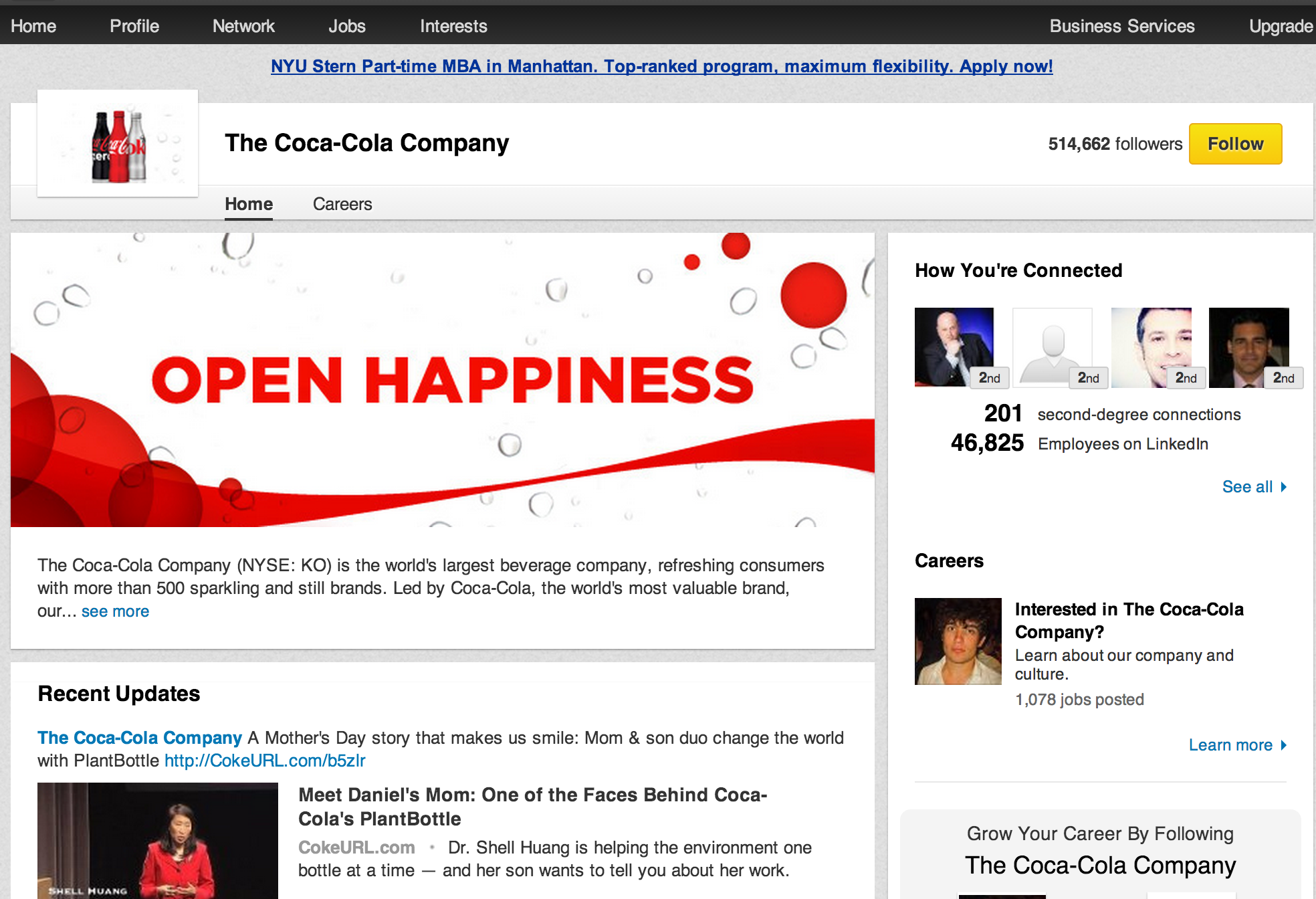
1) Coca-Cola

coke-1

Coca-Cola's LinkedIn Page regularly shares content from Coca-Cola Journey, the company's digital magazine that attracted over 13 million readers last year. Though two-thirds of Journey's audience is in the 18-35 year-old demographic -- with the largest subsegment 18-25 -- they see a lot of interaction from the company's 514,562 followers on LinkedIn.

"LinkedIn is a huge traffic driver for us," explains Journey Co-Managing Editor Jay Moye. "That's obviously a different audience. It's a professional audience. It's professional social network versus more of a social network. We see great clickthrough rates on story links that we publish on LinkedIn. The percentage of clickthroughs is markedly higher than it is on Facebook, and to a degree, Twitter."

Moye and the Coca-Cola team choose which content to share on LinkedIn with that professional audience in mind.

"You'll see more consumer-focused content go up on our Facebook page," explains Moye, "whereas you'll see more business innovation, jobs, workplace stuff go up on LinkedIn. That's kind of a no-brainer. It's obviously an older, more professional audience on LinkedIn."

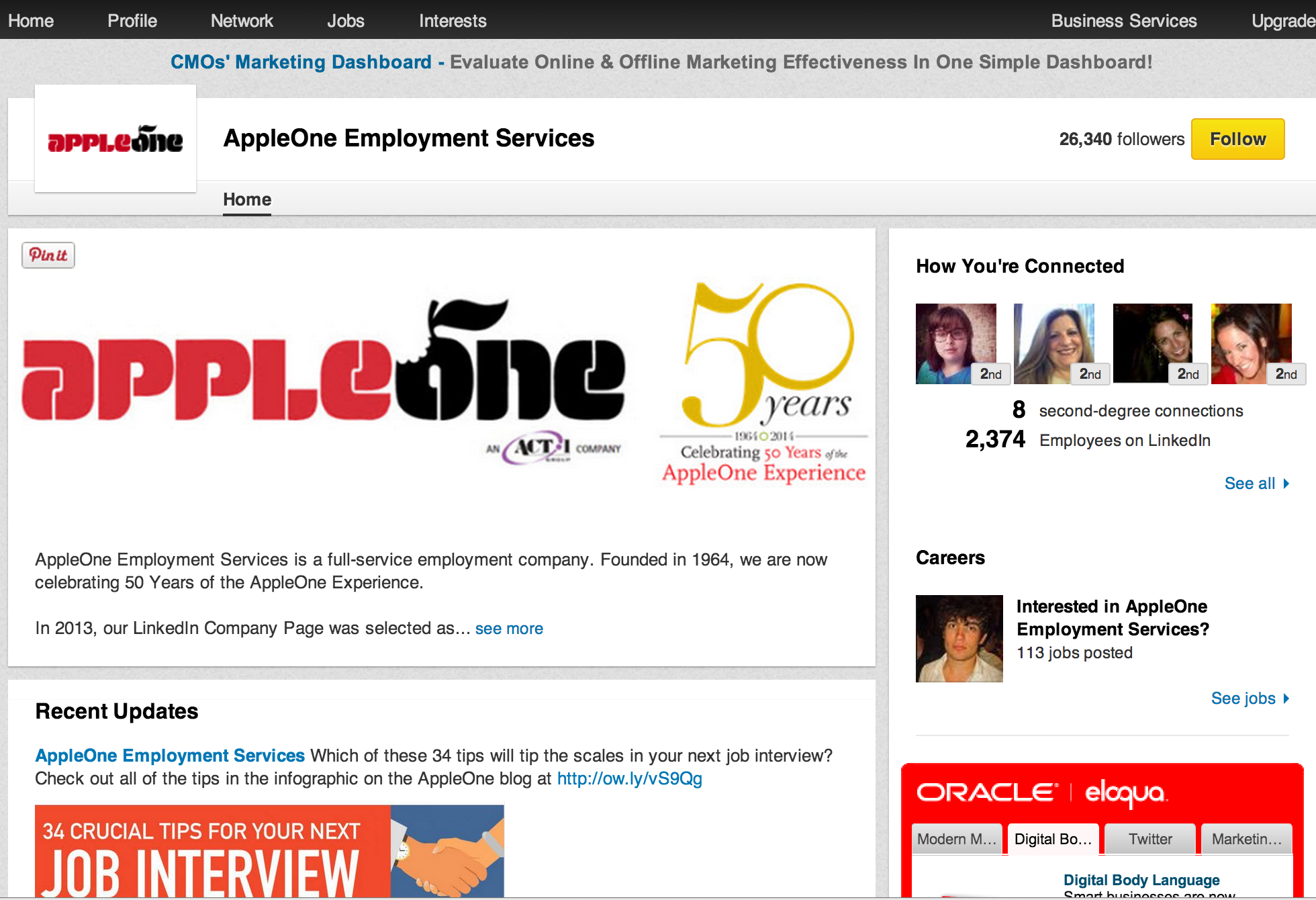
2) AppleOne

appleone

As an employment agency, AppleOne could simply push their job openings on LinkedIn and call it a day. Instead, they share awesome advice for job seekers, and all of their posts feature some sort of meme-like image that grabs your attention. Sometimes, a little Photoshop goes a long way.

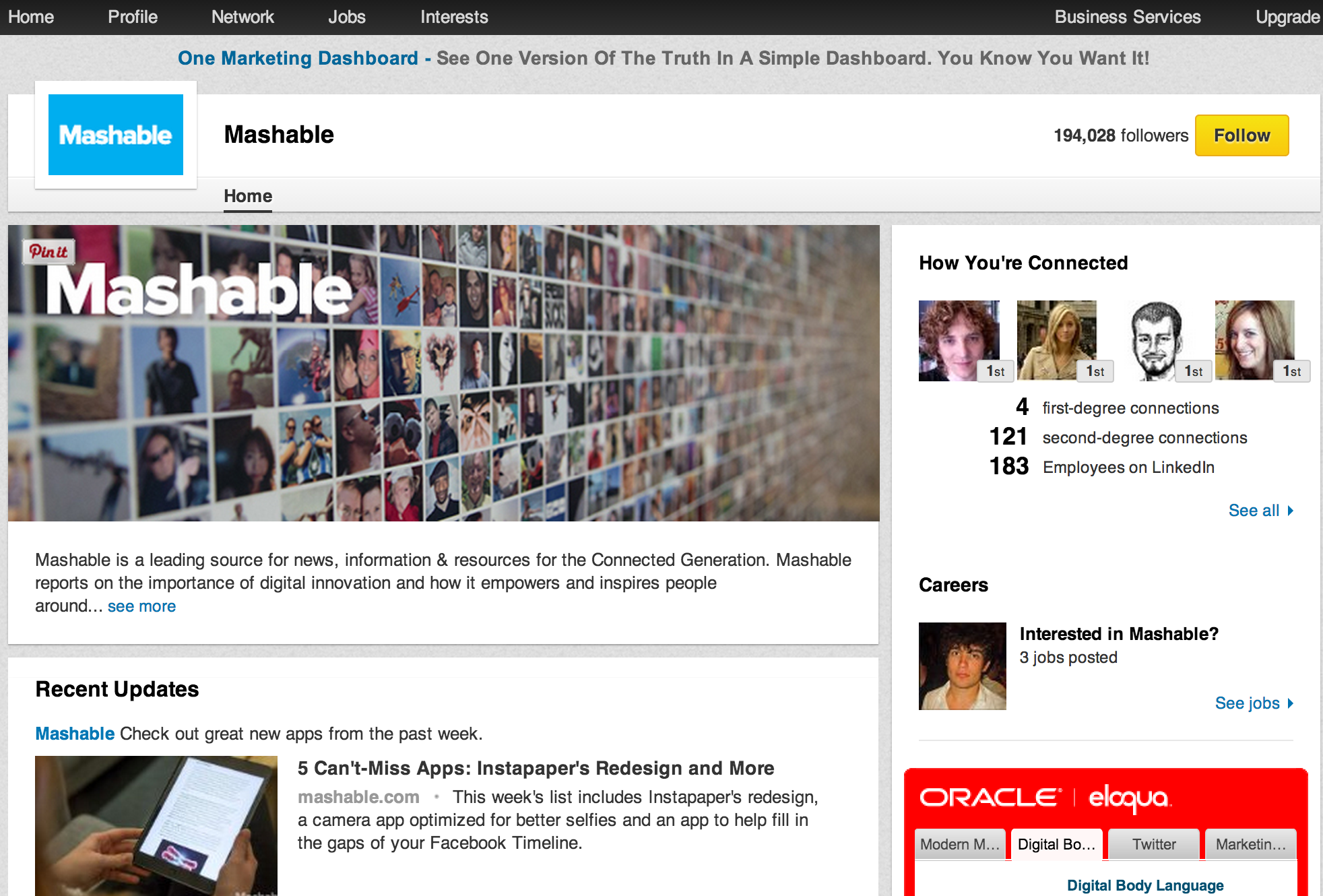
3) Mashable

mashable

Mashable made LinkedIn's list of the Best LinkedIn Company Pages of 2013 (which was presented, of course, in a SlideShare) and it's easy to see why. Mashable has tons of potential content to share, but on LinkedIn, they primarily dish out business and productivity tips, such as "How to Succeed at Business Without Becoming a Workaholic."

Their social media-focused content generates a lot of engagement, too; "If 'House of Cards' Characters Used LinkedIn," for example, hits all the right notes.

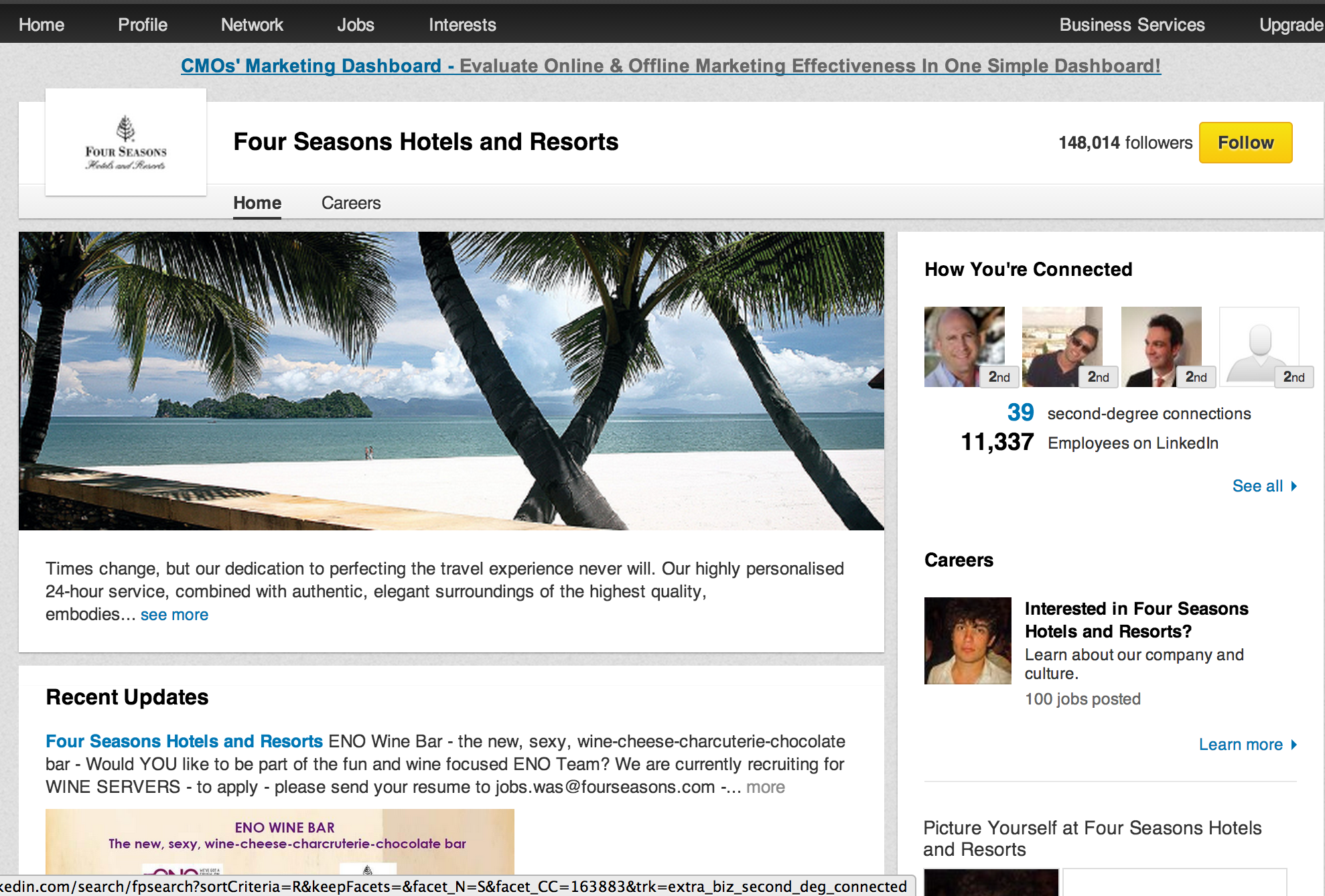
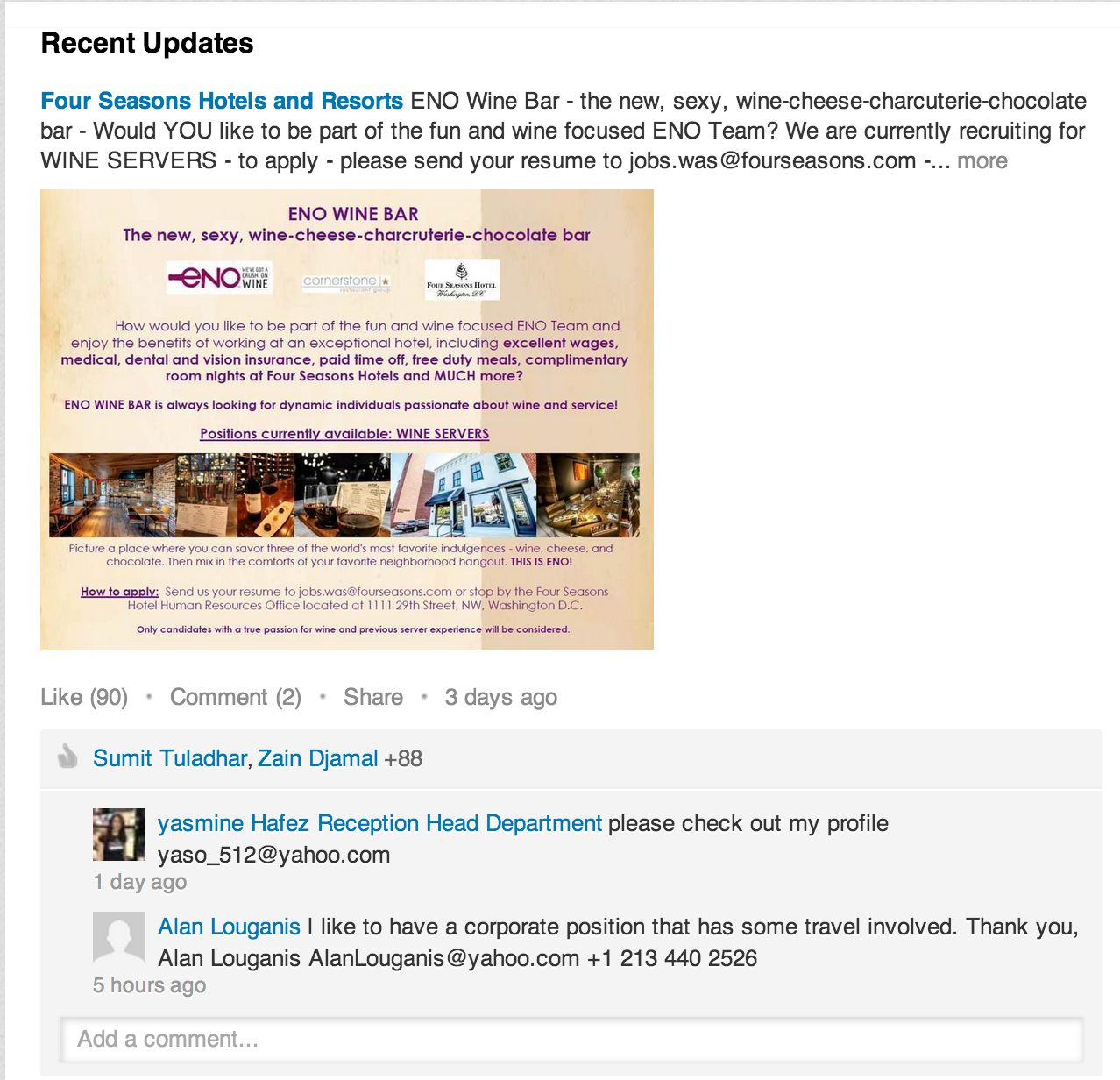
4) Four Seasons Hotels and Resorts

fourseasons

The purpose of the Four Seasons Hotels and Resorts LinkedIn Page seems to be to make me really regret studying writing in college instead of studying hotel and restaurant management. Yes, Four Seasons, I do wish that I could work at your sexy new wine, cheese, and chocolate bar on the beach.

recentupdates

Overall, the Four Seasons goal on LinkedIn is pretty obvious: Make the hotel chain look both like a company that you'd like to work for, and a place you want to stay. They achieve the latter goal with videos like this preview of their new Private Jet service.

Warning: This video might compel you to rob a bank.

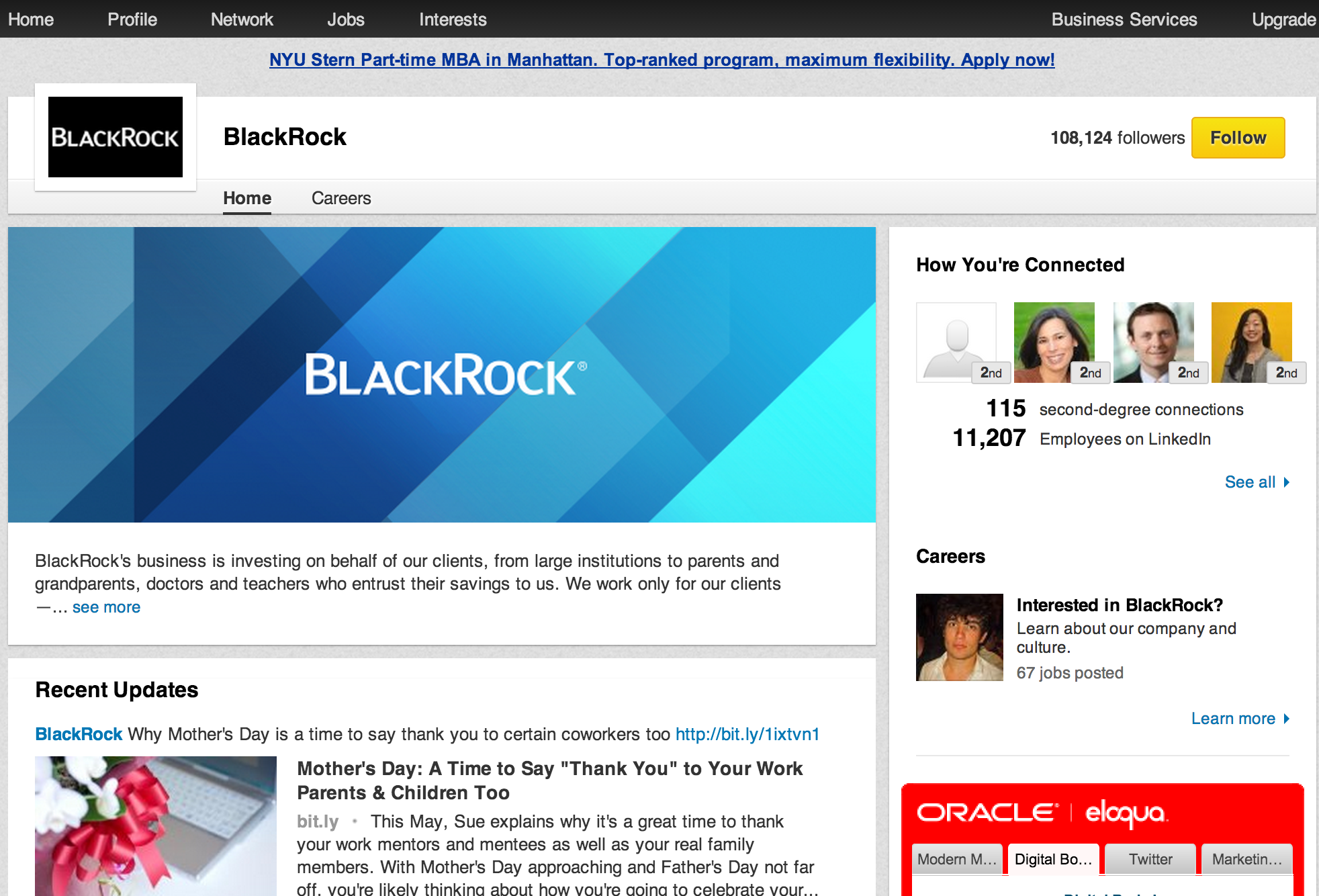
5) BlackRock

blackrock

At a LinkedIn conference last year, Eileen Loustau, BlackRock's Global Director of Social Media, estimated that LinkedIn was driving $17-18 million dollars of revenue for the financial investment company. That's because of the sophisticated pieces of investment advice that BlackRock shares on their LinkedIn Page, such as "Your Core Portfolio: The Case for ETFs."

“We sometimes call it chapter four,” Loustau said of the investment company's strategy and skipping the basics and focusing on more complex content.

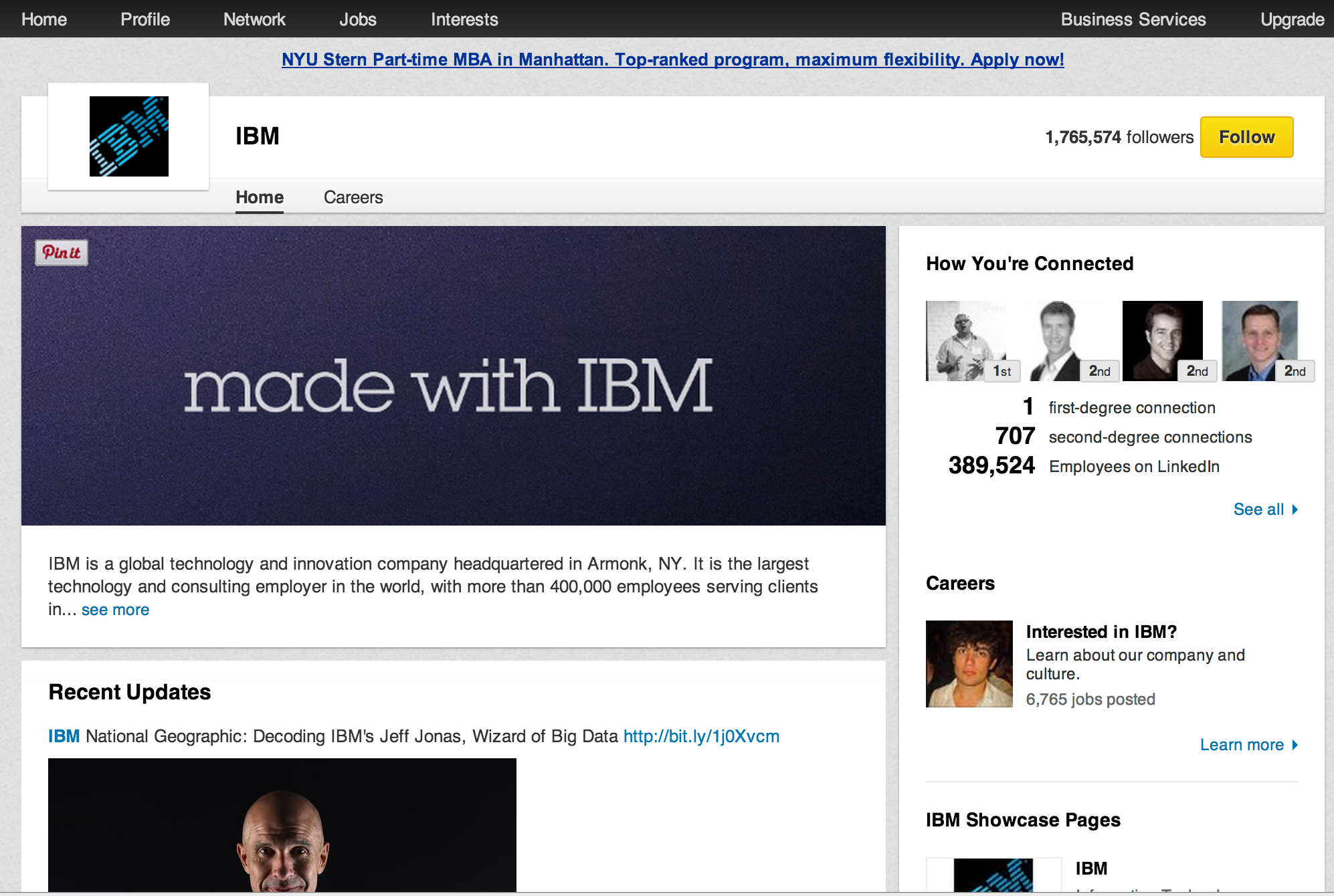
6) IBM

ibm

In 2012, IBM topped the LinkedIn rankings with 1.8 million interactions, and they haven't slowed down since. They've added nearly a million followers, and over 1.75 million people now subscribe to the company's updates. The technology giant shares a nice mix of stories from around the web and their own content hub; this past week, for example, they shared both this National Geographic feature about IBM's Wizard of Big Data, as well as this incredible film that the company created, "A Boy and His Atom: The World's Smallest Movie."

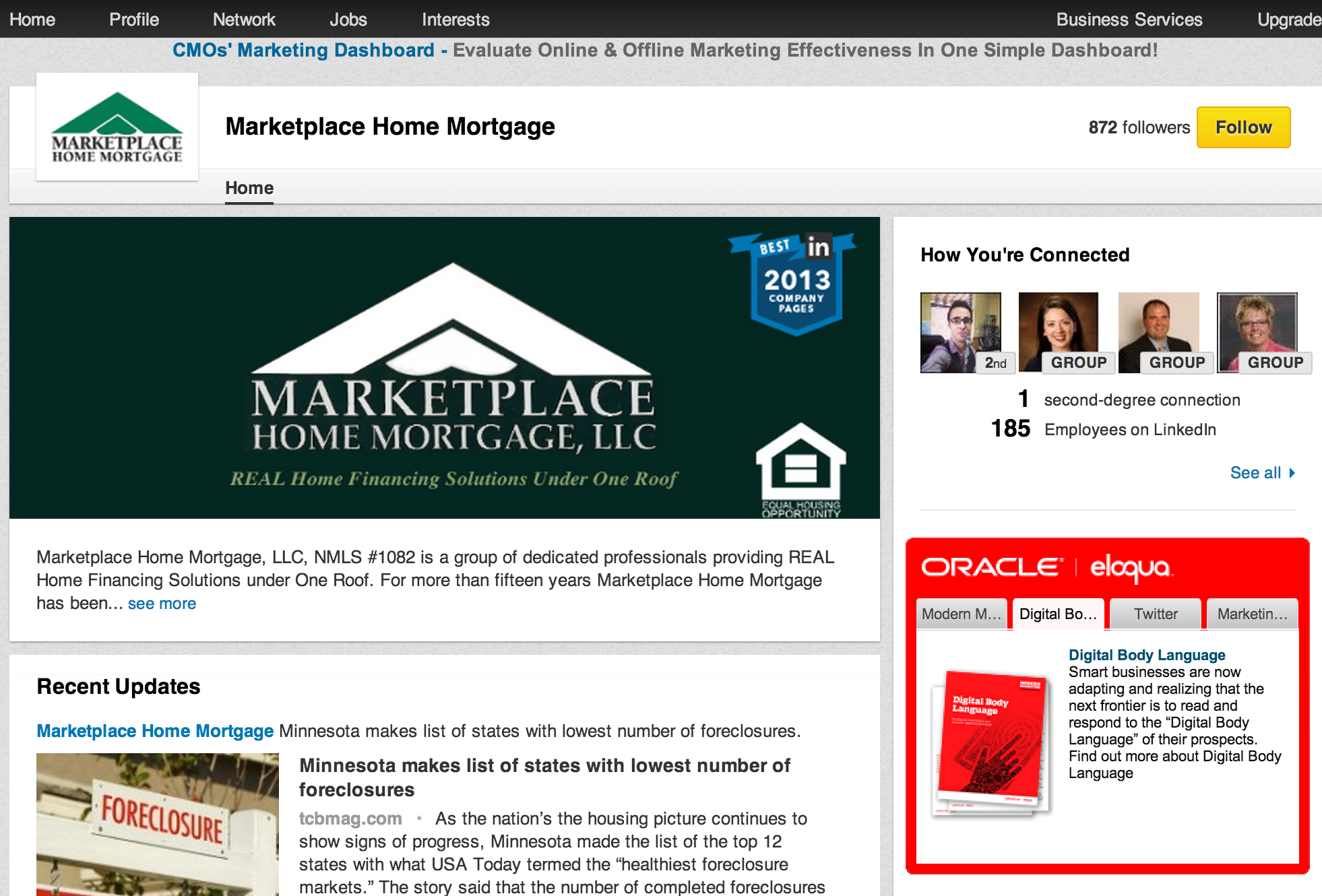
7) Marketplace Home Mortgage

marketplace

Despite having just 872 followers, Marketplace Home Mortgage made LinkedIn's list of best company pages of 2013. Why? Because the relatively small company does a great job of curating useful and interesting content for home buyers, and curating it with strong hooks -- evidence that small businesses can excel on LinkedIn, too.

8) Hewlett-Packard

Hewlett-Packard rocks LinkedIn with a pretty fascinating and diverse array of content: thought leadership, big data analysis, and even memes.

hp

Their posts consistently draw hundreds of interactions from their 1.6 million-plus followers, and their Career tab is chock-full of videos and testimonials from current employees. This is LinkedIn done right.

free guide to linkedin company pages

subscribe to the hubspot marketing blog

15 May 16:59

Why Business Executives are the New IT Buying Center

by Kathleen Schaub
Several times a week the IDC CMO Advisory Service gets inquiries from tech company clients about how to shift their company mindset to a new and different buyer.  IDC's IT Buyer Experience Study shows that business buyers have 53% of buying influence in the earliest part of buyer's journey and their influence stays high throughout the entire process.  The tech buyer's influence, while still important, is comparatively waning.

A successful shift to a business-buyer approach will accelerate if you understand what's behind it.

Front office automation has more business risk than back office automation.  The 2nd Wave (as IDC calls the client-server era) was mainly about automating things inside your company.  The 3rd Wave (as IDC calls the current era of cloud, mobile, social, and big data) is about automating your connections to the outside world (I call it the company "skin").  When tech problems happened deep in inside your company, it was frustrating but not devastating.  The worst business tech problem of the 2nd Wave was being too slow to adopt new technology leaving competitors or upstarts to sail past you with business process advances.  That problem is still a concern today.  However, add the horror of screwing up in front of customers, investors, influencers, indeed, the whole world!  Just ask the CEO of Target.  Business executives are forced to pay attention to technology today – whether they want to or not. IDC forecasts that business executive budgets for technology will outstrip IT budgets.


Technology is easier and prettier now. Back in the day it took a real expert to understand the ins and outs of information technology products.  The products were intimidatingly gray and beige and filled with exposed wires and chips.  They hummed, got hot, and sparked out with regularity.  No wonder the finance and marketing execs wanted to leave those suckers alone.  Now most of those wires and chips are moving to the "cloud".  Doesn't that sound nicer?  Devices you touch are smooth and have pictures. Better design makes technology 99% invisible (to quote the title of one of my favorite podcasts).

Business executives are smarter and more confident about technology.  Back in the day, technology was a startling thing that business people in the prime of their careers had never seen, much less used.  I remember one intelligent, capable, and admired, C-suite executive who used to have his administrative assistant print out his email because he wasn't quite sure how to use it.  Now, anyone younger than 60 came of age with PCs and programmable everything.  Information about technology is available at everyone's fingertips and accessing opinions from your professional network is incredibly easy. While a portion of the population will always be skeptical or frightened about the next new thing – it's not likely to be IT that they are scared of (drones, anyone?).

Here are some steps you can take to accelerate the shift to a business-buyer focus:
  • Bring focus on the business decision-maker up to par with the technology decision-maker.  This is the Goldilocks strategy – not too much but not too little. For most new tech installations, IT will no longer instigate nor approve nor pay.  However, at some point the business executives will want to bring in their IT partner to take over some aspects of the decision.  Keeping adjusting your investments in content, campaigns, training, etc. until you've reached a balance in results.  Because this is a change you will have to overinvest in activity to achieve new results.
  • Take clues from the shifts described above. Focus value propositions on front office business problems.  Build in cloud, mobile, social, and big data messages and capabilities (IDC says 90% of IT growth is coming from these areas). Make the "ugly" of tech 99% invisible – in your customer engagement, your sales discussions, and in the products themselves.  But that doesn't mean be fluffy. Much of what is called "thought leadership" is astonishingly useless.  People are trying to solve real business problems.
The worm has turned as the saying goes. We are never going back to the old way.  Tech companies who succeed will be the ones to step up to investments they need to make to serve the empowered business buyer.
Copyright 2011 IDC. Complete articles may be reposted. Reproduction in part is forbidden unless specifically authorized. All rights reserved. Please contact IDC for information on republishing or web rights.
15 May 16:58

Sales Coaching – An Emerging Challenge

by Richard Ruff
Sales Coaching – An Emerging Challenge image Sales People 2

Sales Coaching Challenge

Today, across industries, there appears to be little doubt that companies are changing what they buy, how they buy and what they are will to pay for it.

Regarding how they buy, a contradiction has emerged that deserves a place on the sales coaching priority list. Let’s take a look at the contradiction and then explore some best practices managers can use to coach their sales teams to deal with the consequences.

The contradiction is driven in part by the advent of technology. Buyers today have more information available about the products they wish to purchase than ever before. They know about your product and they can quickly acquire the information about how you stack up against the competition. This is one of the reasons why today buyers may be 50% through their buying cycle before they even contact selling organizations.

On the other hand, that does not mean that customers expect less from sales reps. They simply expect something different. They want real expertise for helping them formulate creative cost effective solutions. The expectation is: “I already know about your product, what I want to know now is how we can work with you to create a innovative solution to our problems using your product.”

Can sales reps bring new perspectives to defining the problem? Do they have experience and insights about innovative solution configurations? Do they have the authority and political clout to marshal the right resources when they are needed? That is not a set of expectations that a standard product pitch can adequately address.

If sales reps are going to develop the skills to meet this new set of expectations, most sales reps are going to need some help. Will they learn on their own? Some will, but most will either take too long or not make the shift at all. This a sales performance challenge that lends itself to a sales coaching answer. With that thought in mind let’s review some sales coaching best practices.

  • Establish a sales coaching priority. Jointly establish with the sales rep that adjusting to the new expectations is important for their success. Then focus your sales coaching effort on the knowledge and skills to make that happen – make sure you describe what the end-state looks like.
  • Minimize the risks of failure. Trying something different involves a lot of risks like: perhaps initially reduced commission to negative feedback from customers and peers. Where possible the sales manager needs to help the sales rep manage and minimize these risks.
  • Reward behavior not just results. Successful change is best-accomplished one step at a time – over time. It is important to provide positive feedback all along the way as new behaviors are learned and applied, as opposed to, waiting until the final results are achieved for providing the proverbial pat on the back.
  • Document and broadcast success. Usually when someone tries something new, the failures tend to be well documented. Sales manager need to make sure the same is true for successes – this is helpful to the sales rep and to other sales reps that might be taking the same journey in the future.
  • Collect best practices. As sales coaching efforts unfold, good ideas will emerge relative to what sales reps looking to change need to learn. Document these best practices!

Looking ahead five years, there are few markets where top sales performance will be achieved simply by selling to the same people, in the same way, with the same message as yesteryear. So, “this how do we help sales rep skillfully adjust to a new set of buyer expectations” problem is likely to more than just – a nice to do. The major challenge for sales managers is finding the time to help.

15 May 16:57

Deep Dive into Buyer-Centric Content Marketing and Personas with Ardath Albee

by J-P De Clerck
Deep Dive into Buyer Centric Content Marketing and Personas with Ardath Albee  image Ardath Albee

Ardath Albee

With the Content Marketing Conference Europe approaching fast, we started a series of interviews with content marketers, marketing execs and content marketing thought leaders – on top of interviews with the speakers at the event such as this eye-opening interview with Doug Kessler. We’re kicking off with Ardath Albee whom, as a B2B marketer, I’ve been following for quite some time. With Ardath you just know she’ll bring value to the table.

By way of introduction: on top of being a B2B Marketing Strategist, Ardath Albee is also author of eMarketing Strategies for the Complex Sale. Ardath worked for companies such as Cisco, Adobe and Teradata.

Regarding content marketing, Ardath has an absolute buyer-centric approach. She’s also a buyer persona expert and has launched Up Close & Persona, a tool developed to help B2B marketers develop target personas to assist them with content development and strategy. Quite an introduction. Time for those questions. It’s a long read but every insight shared is a nugget of gold!

Ardath, let me start with a buyer-centric approach to content marketing. How does one start and what are the essential things to take into consideration?

Deep Dive into Buyer Centric Content Marketing and Personas with Ardath Albee  image eMarketing Strategies for the Complex Sale by Ardath Albee12

eMarketing Strategies for the Complex Sale by Ardath Albee

Ardath Albee: The foundation for any marketing – content or otherwise – is your target audiences, buyer personas, customer profiles, industry segments – whatever you want to call this directed and in-depth research and depiction of who buys what from you and why.

Unless you know very intimately who gains value from your products, why they think so and how they do so, how the heck do you know what to say to them. Think about the anxiety you experience when going to a party where you don’t know anyone. You wonder what to say, whether or not they’ll care and if you’ll look good (smart, likeable, impressive, etc.). Why don’t we care as much about what our buyers and customers think of their experiences with our company and our brand?

The process of building relationships is long and requires commitment. I’m just unclear how you can produce, publish and distribute content that attracts and keeps attention if you have no freaking idea what your buyers and customers think and care about. More misleading is thinking that our assumptions are correct without any validation, nor constant refinement given the rapid rate of change.

Buyer personas and archetypes: defining who to impact in B2B and B2C

What should people really know about how to develop buyer personas?

Ardath Albee: What you need to know about personas is a few things. The most important is that personas are composite sketches of target audiences/segments. They are not real people. One of the hardest things is to resist the urge to modify them if the research and interviews are painting a different picture than you’d expected or believed to be true. Don’t invalidate the research based on your beliefs or even a conversation you’ve had with one customer that turned out differently. There will always be differences. What you base personas on is the commonalities that can be identified.

Personas must be active tools that contributes to digital strategy and execution plans. This means they should include:

  • First person scenarios – the persona speaking directly to you about a day in their lives – including their views about priorities, challenges and their interactions with the other personas that must reach consensus to make a buying decision.
  • In depth objectives. For example, “grow revenues” is not helpful. What does this mean to this specific persona? How does their responsibility for that priority play out given their job role? Get down in the weeds on these. For example, perhaps a team lead for a contact center must help her agents improve empathy and the way they show customers they’re “owning” getting the issue resolved in order to earn the right to make more successful cross and up sell offers.
  • Problems – these are the flip side of objectives. What’s getting in the way of your persona’s objectives? How does this manifest? Is it caused by something outside of their control?
  • Buyer questions – what are all the questions the persona will need to have answered to build the confidence to make a buying decision? How do they fall into the stages of the buyers’ experience? Can you see the informational flow develop?
  • Channels in use and levels of participation. We need to know where our buyers are sourcing information and where we need to go to get their attention. Instead of chasing every new channel that comes out, we need to first make sure those we need to reach are using them.
  • Engagement scenarios should be part of every persona. This means taking the time to walk through how you’ll engage them. There’s a big difference between emailing a contact in your database and generating a net new lead. And, once you’ve engaged them, then what? How do you get them to take next steps. What will it take to get them to engage enough to agree to have a conversation with a salesperson? What combination of channels might end up in play? How will other personas become part of this persona’s buying process?

As for developing them, you need to talk to people representative of each persona. Don’t just interview the executive overseeing the project, speak with those who played parts in the decision process. Speak to the people you need to engage. If you can, speak to people involved in “lost” deals as well as new and existing customers.

When interviewing – don’t lead the witness. Ask guiding questions and sit back and let them say what they want to say. If you plant seeds, they’ll say what they think you want them to say and then you don’t have the truth. Therefore, your personas won’t be effective foundations for marketing programs.

Deep Dive into Buyer Centric Content Marketing and Personas with Ardath Albee  image Ardath Albee on content marketing112

Research – don’t stop at interviews. Get over to LinkedIn and search for people who could be your personas. Read a bunch of their profiles and you’ll start getting a feel for patterns of commonalities. Where else can you go and actually see what people like your personas are doing and look like? Look at job listings, analyst reports, and industry publications. Get familiar with the hot topics and what’s attracting the attention of the personas you need to attract. Attend a few webinars that they’d attend and wait to the end to see what questions they ask the speaker.

All of this will feed your thinking and the development of personas.

Are there differences in the ways we used to look at buyer personas before content marketing became more important and today where some people also talk about content marketing personas?

Ardath Albee: You bet. Before, we were looking for ways to pitch them. Now (hopefully) we’re looking for ways to engage them, be more relevant and add value.

If you look at content marketing in a more B2C branding and social context, some people advice not to work with buyer personas but with audiences, sometimes even archetypes? What are your thoughts on that?

Ardath Albee: B2C is a different animal. I know some people will argue with this, but (depending on what you’re selling) demographics data can be infinitely more helpful in being relevant to B2C than B2B. For example, if you know your consumer has two kids, lives in an upscale zip code in the suburbs, and drives a Porsche Cayenne, you would tell a different story than you would to a young couple in a studio apartment in the city who don’t own a car. This type of information can be easily gathered for B2C segments. However, it means nothing in a B2B setting.

In B2C, archetypes like the “over achiever” or “the environmentalist” make sense because you can back them up with population or census or household data which allows you to segment in that way. Tell me how you’d segment for an “over achiever” in a B2B setting.

Then again, we also get caught up in the labels more than we do what they mean. I don’t really care what you call them as long as you do the work to learn what you need to know and choose segments that you can define and impact with the story you tell them.

Branding and up close and personal

Just like Doug Kessler and many of our other speakers in June, you pay a lot of attention to the brand component. A brand needs to be strong, stand for something, have a narrative and so on. In this regard you talk about ““the company’s distinct value, defined as the intersection of a company’s strengths with customer needs“. Can you elaborate on that?

Ardath Albee: Sure. What I’m trying to impress upon marketers is that our companies usually base brand positioning on what competitors are doing. It makes all of us either “also rans” or copy cats. What we need is differentiation. We can get this—even in a crowded marketplace—if we focus on the value we deliver as recognized by our customers. In a world where your buyers have lots of options to buy what you sell, you need to find unique qualities that aren’t obviously available somewhere else. Modeling our brands in relation to competitors doesn’t even have the customer in the picture. Forget about your competitors and focus on your customers.

On your company blog Marketing Interactions you recently wrote a post called “B2B marketers need a fresh perspective“. Why is that?

Ardath Albee: Because marketers pay a lot of lip service to change, but are pretty bad at doing it. For some reason, traditional marketing techniques seem to remain, even though there’s tremendous evidence for change. One of those constructs is the campaign. The problem with campaigns is that they run on marketers’ schedules, not those of buyers or customers. But yet, we still do them. One-off efforts that bring short-term, diminishing rewards and then require that we reinvent the wheel each time we launch a new one. Why?

What are the top 5 tips you would give to any company wanting to make a difference with content marketing today?

  • Start with your buyers
  • Find your distinct value
  • Build the buyers’ story across the continuum of the buying experience – then extend it to serve the customer lifecycle
  • Make sure to connect the dots in a way that orchestrates progression
  • Enable salespeople to step into the conversation seamlessly

I always ask people to complete a few sentences. Here are some I picked for you…

  • For the B2B buyer, choice is…what puts them in control of the buying process.
  • To Ardath Albee, content marketing means…being so damn relevant to your target audiences that they can’t help but pursue you to help them achieve critical business objectives.
  • An Australian Shepherd…is the best dog ever, even if often too smart for their own good.
  • As someone who loves to cook from scratch…Italian is the way to go. Homemade pasta, sauce, meatballs…you get the idea. Being married to an Italian might be a giveaway on this one.
  • Ardath Albee is interested in gamification because...attention is fragmented and interactive engagement is golden.
  • The next event Ardath Albee will be talking at…by the time most people read this, Content Marketing World in Cleveland in September.
  • In the next five years Ardath Albee would love to…teach marketers how to embrace a continuum approach to digital marketing.
  • The main evolutions in marketing automation…will help marketers to become increasingly more relevant and predictive.
  • Ardath Albee rarely rants but when she does…she’s usually frustrated by the SOS (Same Old Shit).
  • The most overused term in marketing today is…content – How the heck do you market without it?
  • At Content Marketing World 2013 Ardath Albee focused on customer retention because…the customers we have are way more important than the resources we attribute to keeping them.
  • Ardath Albee’s best friends sometimes tell her that…she’s too much of a perfectionist – true, drives me nuts at times.
  • Ardath Albee would love people to read…my upcoming book, tentatively titled Digital Relevance, coming out next spring from Palgrave Macmillan.
  • In the marketing industry, women…kick butt!

Stay in touch with Ardath by following her on Twitter and reading her blog Marketing Interactions.

This article originally appeared on Fusion Marketing Experience and has been republished with permission.

15 May 16:51

Selling Smartly, Selling Well – Optimizing the Best Sales Tactics

by Shiwen Yap

Sales is critical to any business, and in an evolving world of multiple businesses, competing across multiple markets, with multiple products, it is necessary to adopt tactics that optimize the effectiveness and reach of sales.

There is an enormous amount of material on sales strategies and tactics, ranging from the technical knowledge and experience of How to Win Friends and Influence People by Dale Carnegie, to the rigor of Influence: The Psychology of Persuasion by the social psychologist Robert Cialdini.

Selling Smartly, Selling Well – Optimizing the Best Sales Tactics image selling smart

Learn how to sell.

As much as sales is about hard work and industry, it is also about working smart and finding ways to multiply the force of your efforts. Using certain tactics can make the entire sales process much easier and less frustrating, as well as help turn a “No” into a positive “Yes”.

1. Don’t Be Boring

David Ogilvy, the legendary advertising executive who founded Ogilvy & Mather and one of Inc’s 10 Greatests Salespeople of All Time, created iconic campaigns for Hathaway, Schweppes and Rolls-Royce. He began his career in sales, selling cooking stoves door to door in Scotland.

He was sufficiently successful that the company he worked for, AGA, commissioned him to write an instruction manual titled “The Theory and Practice of Selling the AGA Cooker”, distributing it to their sales force. Amongst it’s pearls of wisdom was this little chestnut:

Selling Smartly, Selling Well – Optimizing the Best Sales Tactics image ogilvy dont be a bore

The wisdom of David Ogilvy

What Ogilvy is saying is that you need to attract and maintain your customers’ attention because you’re not just selling a product or service. You’re selling an experience. You’re justifying a customer’s attention and time, and the easiest way to justify it is through entertaining them.

The easiest thing a salesperson can do is to ask a customer about themselves. Once you get people talking about themselves and their own interests, it’s less likely you’ll be boring them.

2. Be a Sales Consultant

Many salespeople start with the goal of selling the product, ignoring the customer and their needs in the process. But what a customer wants is for you to listen to them, understand their problem and help them solve it! Zig Ziglar, a legendary salesman and motivational speaker, shared that:

You can get everything in life you want if you will just help enough other people get what they want”.

You are there to be a consultant, selling them a solution to a problem. You’re there to listen to their problems, understand them and fix it. Listen to and know your customer, then present the solution to that problem. Why sell them a vacuum cleaner when all they want is a broom?

3. You’re a Sales Processor & Problem Solver

The Founder & CEO of the National Cash Register Company, John H. Patterson, is most famous for firing Thomas Watson Sr,, the GM and then President of IBM. But, John H Patterson was also renowned for his famous his micromanagement style, as well as being the founder of modern sales training.

The first industrialist to conduct sales training programs, he also established the world’s first sales training school at Dayton, Ohio on NCR’s factory campus in the early 20th Century. NCR provided salespeople with scripts, encouraging them to view the sales cycle as a process with key segments:

  1. the initial approach
  2. the proposition
  3. the product demonstration
  4. closing the deal.

Contemporary consumers are more sophisticated. So, you now have to add on two extra steps: solution implementation and the follow-up. This ensures that the solution you sold them is implemented, serving their needs and laying the ground for potential new sales. A salesperson is a problem solver, there to manage the solution. And you need to be there all the way through the process with the customer.

4. Identify leads clearly, spend time wisely

Time is a finite resource. To gain the best returns, you need to identify the best opportunities for a sale. This requires clarity and collaboration between marketing and sales.

A lead is a potential buyer with the means, inclination, and need to buy a solution from you. Marketers providing leads to salespeople who have neither expressed an interest nor given contact information are simply wasting time that’s better spent.

Consumers who respond to email marketing, roadshows and other outreach forms are leads, so prioritize them, rather than non-customers who have expressed no interest. Cold calling is old-fashioned and still works, but its’ inefficient. Rather than cold calling, follow up with warm leads that potentially generate a sale. Why bother the random person on the street when you can sell to the individual on the phone who called you?

In Summary

Selling products intelligently and providing excellent service is more crucial than ever. Being aware of the best sales knowledge and applying it makes your job that much easier. It is the duty of sales managers to seek out and apply this knowledge, because in an ever-competitive and constantly evolving marketplace, the rule of the game is survival of the fittest. And the fittest to survive are the ones that know how to be intelligent about how they sell.

15 May 16:51

The Most Important Force for Increasing Leads and Sales

by Tom Pick

There’s been a raft of articles recently proclaiming the “consumerization” of all things business: the consumerization of sales, of IT, and of business-to-business (b2b) marketing most prominently. McKinsey’s David Edelman has referred to the consumerization of b2b marketing and sales as a “massive disruption” on the horizon.

The Most Important Force for Increasing Leads and Sales image Consumerization of b2b marketing

Photo Credit: LGEPR via Compfight cc

While there’s no questioning these trends, it may be more powerful from an analytical standpoint to step back and ask exactly what “consumerization” means in a business context: what is it precisely about consumer marketing and sales that b2b professionals are seeking to emulate?

Clearly it’s not that enterprise software vendors should start running print ads in Vogue magazine, or that machine tool manufacturers should invest in splashy TV commercials on The Golf Channel. Upon closer examination, the move toward consumerization seems to come down to embracing one key concept long pursued by b2c brands: minimizing friction across the promotion and buying process.

In the physical world, minimizing friction is how Elon Musk’s proposed hyperloop could transport commuters at speeds approaching 600 miles per hour. Using pods inside a low-pressure tube eliminates not only the friction of rolling wheels but also that of air pressure against the vehicles.

In the consumer products world, minimizing friction explains why soup is sold in microwavable single-serving containers, and why a convenience store can thrive within blocks of a nearby supermarket, despite charging much higher prices.

Arguably the ultimate in friction-free consumer commerce, though, is Amazon.com’s 1-Click ordering. Once a site visitor has searched for and filled their online shopping cart with desired items, competing the purchase requires literally one click: Amazon knows the customer’s preferred method of payment, credit card details, shipping address, even preferred shipping mode. Compared to the typical b2b purchase—there is no comparison.

The Amazon experience is clearly starting to impact the world of b2b purchasing. Within the past year, nearly half of b2b buyers have purchased common business items from Amazon Supply, the web giant’s online store for business and industry, because their regular suppliers don’t offer an online purchase channel.

Business suppliers who want to survive the coming “massive disruption” need to find ways to compete with Amazon, likely beyond price: through flexible payment options, volume discounts, deep product expertise, or value-added services perhaps. But for low-value commodity items, as other online retailers have learned, Amazon will make the landscape increasingly challenging for b2b suppliers.

Beyond online purchasing, however, friction comes in many forms. While many high-value, complex b2b products aren’t suitable for ecommerce, there are nevertheless other sources of friction that vendors need to minimize in order to improve their competitiveness. These other sources of friction include:

Marketing/Sales Friction

  • Low online visibility. With more than 90% of b2b purchases beginning with research on the Web, maximizing online presence is crucial for b2b vendors. Business buyers won’t buy from vendors who lack visibility in search and social media.
  • Insufficient or difficult to find information. B2b websites need to provide different types of information based on buyer personas, specific concerns or topics of interest, and different formats (text, images, video). Each member of the buying team has his or her own questions and unique information needs. Friction is created when such information is missing or hard to find on the vendor website.
  • Mixed messages. Friction arises when, as your grandmother may have put it, “the left hand doesn’t know what the right hand is doing.” Prospects are unlikely to buy if they get different answers and inconsistent messages from different employees or departments within your organization. This was less of a danger in the old days when public interaction was limited to official “company spokespeople,” but social media now makes virtually every employee “client-facing.” Avoiding such confusion therefore requires strong leadership from the top, effective training, and use of internal social communication tools like Chatter or Yammer.
  • High initial price point.It’s often easier to sell a customer a basic system at a low price point upfront and add options later than to sell a high-priced, full-featured offering right out of the gate. Not only does this make price less of an objection, it also reduces risk for the buyer. Many types of subscription-based software offerings are now sold this way. Taking this idea to the ultimate “no brainer” price point—free—many vendors in categories like email services and social media monitoring employ a “freemium” pricing model in which customers can sign up to use a stripped-down, low-volume service for free, then upgrade to various levels of higher usage volume, added-function, fee-based services down the road.

Customer Service Friction

  • Limited contact information. A “contact us” button should be one of the most prominent items on every page of a b2b website, and the contact page should include physical/mailing address, fax and phone numbers, email address (or addresses—preferably multiple, by department), and social media accounts. Consider an online chat option as well (but make it visitor-initiated, not an annoying pop-up box). Reduce friction by making it as easy as possible for prospective buyers to get in touch with you, using their preferred communication method.
  • Poor responsiveness (or non-responsiveness) to questions. More than 80% of Twitter users say they expect a same-day response to tweets aimed at brands, yet many b2b vendors fail to meet this standard. That is clearly an opportunity being missed, as 71% of buyers also say that receiving a quick brand response on social media would make them more likely to recommend that brand to others. Response time matters regardless of the communication channel (social, email, phone, etc.); responding quickly builds confidence in your company. A slow response creates friction.
  • Automated phone answering systems. While efficient and convenient for vendors, these are universally annoying to callers. Provide both a main contact number and department-specific phone numbers instead. A human voice on the other end of the line can be both a powerful differentiator and friction-reducer.

Product/Service Friction

  • Partial solutions. The ability to purchase a “whole product” (e.g., software, equipment, installation, and training services) from a single supplier, a.k.a. one-stop shopping, reduces friction. This is why all-in-one travel sites like Kayak, Orbitz, Expedia, TravelZoo, and Travelocity are popular. When the buyer is forced to piece together a solution from multiple vendors, friction is increased. B2b suppliers can address this through building, buying, or bundling strategies to create and support a whole product.
  • Complex implementation. While there is no way around expert on-site installation for certain types of products (e.g., machine tools or conveyor systems), “products” should be delivered online whenever possible. Cloud computing, projected to grow at a 26% annual rate through 2016, is essentially delivering a server online. Software is increasingly being delivered as a service, along with integrated consulting; this model is nearly universal in the marketing automation software market, for example.
  • Business disruption. The less disruption or interruption of business activities that a purchase entails, the less assistance or support needed from other departments like IT, and the less integration with other systems required, the easier a buying decision is to make. This is why software vendors are increasingly delivering their applications online, and including pre-built connectors, where required, to other popular software suites.
  • Complexity in use. While many b2b products in areas like technology, communications, industrial automation, and transportation are necessarily complex, that doesn’t mean they have to be difficult to use. Good example: a modern automobile is unquestionably a complex piece of equipment, yet one that can be operated by any teenager with a modicum of training. Better example: while the vast majority of us have only a rudimentary understanding (at best) of the inner workings of a smart phone, any moderately bright grade-schooler can use one. B2b products should be as complex as they need to be, but as simple to use as possible.

Organizational (Business Level) Friction

  • High perceived risk. Vendor websites must not only provide the information various buyers need in order to make a decision, they must also build trust. Unless your company is a “household name,” your website needs to reduce perceived risk and position your company as a safe choice by including complete contact information, certifications (such as Better Business Bureau membership), awards, customer testimonials, big-name client lists, and/or money-back guarantees.
  • Employees aren’t empowered to resolve issues. When a customer or prospect has an problem, they want it fixed. They don’t care about an employee’s job description or your company’s organizational chart. When those things get in the way of solving problems, they become friction. Companies like Nordstrom, Zappos, and Southwest Airlines are known for empowering their employees to resolve customer complaints, no matter what they are, precisely to eliminate this type of friction.
  • Lack of organizational transparency. In sales situations where vendors are unfamiliar and product differentiation is unclear or insignificant, buyers will seek broader information about the companies in order to arrive at a decision. In these situations, purchase decisions can be strongly influenced by the vendors’ level of executive participation in social media. According to recent research, 82% of buyers say they trust a company more—and 77% of buyers are more likely to buy from that company—if its CEO and senior leadership team are active in social media.

Recognizing the importance of minimizing friction, some vendors are now creating a “Chief Experience Officer” position to help those companies “not only develop services and products that are pleasing and useful but also curate…experiences with their people and their products to create (what they hope is) a unique brand.”

As b2b competition becomes more global and intense, products become commoditized, quality is assumed, margins are squeezed, and “unique value propositions” become less unique, the overall customer experience will increasingly be what separates successful companies from column fodder. And identifying and minimizing friction, at all its potential points, optimizes the customer experience.

A version of this post previously appeared on MarketingProfs.

15 May 16:50

Let’s Talk Sales and Marketing: Cruisin’ Communication PART II

by John Fakatselis

Let’s Talk Sales and Marketing: Cruisin’ Communication PART II image 452416697So your sales and marketing teams aren’t speaking the same language? Don’t worry, you’re not alone. The communication clog stopping up sales and marketing alignment is quite common. But it’s certainly not irreparable.

Get talking for smooth sailing.

Your sales and marketing teams may be working in different “chambers” on that B2B buyer vessel, but that doesn’t mean they have to speak different languages.

Your teams must be able to communicate in order to keep the sales process in poised-and-placid motion:

  • Decipher the slang.
    Have sales and marketing create a list of profession-specific “babble,” and then clarify each term and phrase. Make an interactive presentation so it’s easily adaptable and accessible for everyone.
  • Get to know each other.
    Connecting your internal teams keeps everyone on the same page. You need to walk and talk a fine line: allow for tailored communication in each department while ensuring that it’s intelligible and transparent for organization-wide collaboration.
  • Help technology help you.
    Get a Sales Enablement Platform and the right tools in place for smooth and seamless communication – both internally and with leads, prospects and customers:
    • Internal messaging (IM) system: quick-and-easy chatting when times call for a swift kick in communication.
    • Sales portal: not only connecting sales reps and buyers, but also opening up insight, information, resources and communications for all players in the sales and marketing game – accessible from anywhere, anytime.
    • Sales presentations: presentation management software that lets you add sticky notes and voice annotations to effectively communicate the right message and tone.
  • Open the door and let people breathe.
    Communication is most effective when it’s personal. People want to be treated and talked to like people. This means speaking directly, clearly and with respect. But using the right personalization tools and practices is also key:
    • Use the information and insights you gather to tailor communication, grouping individuals and businesses with similar pains so you’re able to reach out to them more seamlessly with the right information and appropriate tone.
    • Give your customers, prospects and internal teams access to a library of information, resources and collaboration tools specifically tailored to communicate their needs, pains, questions and solutions.
    • Provide complete visibility of all engagement with powerful sales analytics that tell you what’s been viewed, downloaded, reported on and shared – by whom, to whom and when.
  • Make alignment a must.
    Sales and marketing alignment not only improves internal communication, knowledge and resource sharing, but also creates a more effective conversion cycle and sales process.
    • Your marketing department must communicate the marketing plan and timeline to the sales team to allow for precision targeting, accurate tracking, timely support and smooth transitions.
    • With knowledge of the marketing process, sales reps are better equipped to monitor results and keep marketing in the loop. With better insight into what’s working and what’s not, marketing is able to produce better leads and content for sales.
    • Open communication between the two teams allows for actionable discussions on process improvement and tactic effectiveness, updates on pains and solutions, critical customer behavior shifts and strategies to seize those rare market opportunities for innovation.
    • Your sales team has the insight into your customers’ needs and why they came to you. Communicating this information enables the marketing department to optimize its messaging, effectively converting questioning prospects and hesitant leads into delighted clients and customers.
    • Marketing must not keep the information to themselves, either, but rather open up all marketing content and messaging to the sales team. This way, reps are able to seamlessly and autonomously integrate the right materials into their sales presentations for consistent and cogent brand representation.

Optimized communication between sales and marketing culminates in a more efficient sales process, both inside and out: high internal morale and consistent external communication that gets your teams fusing and cruising together … and converting with unified force.

Let’s Talk Sales and Marketing: Cruisin’ Communication PART II image

15 May 16:48

Do You Want to Be Cute, or Make Sales as a Trade Show Exhibitor?

by Denise Graziano

The trade show is over. You think the show was successful. You certainly hope it was since you’ve just invested a lot of money to exhibit. But did you just throw away part of your budget, and the tangible connection to your prospects? Attendees are lugging all the giveaway items they collected on the show floor back to their hotel rooms. Some they will bring back to their offices. Some they will bring home…to their kids. Many will go in the trash. Clearly the trash is not where you want yours to go, yet many convention trash bins are full of them. The promotions that were selected wisely, will stay with the prospect (not their kids). Your promotional item is your means of continuing the dialog with those qualified prospects you met. The purpose of these products is to keep your company top of mind with potential clients until the sale is made. (Sometimes they are a thank you for existing clients who visit your booth). Your goal is to give them a gift that is useful and functional, so it continues to remind them of your company after the show has ended.

To make sure your promotional item makes it into the prospect’s luggage and into their office, ask yourself these questions before you purchase promotional products for your next show:

1) What is your goal at the show? Is it to introduce a new product? Generate brand buzz? Attract new clients or touch base with existing ones? Whatever your show goal is, your promotional items should reflect that goal. View them as marketing tools, not an after thought. If you don’t tie these tools to your goal, it is a missed opportunity and a waste of money. If you consider them to be tchotchkes, you may just as well leave a pile of dollar bills in your booth for people to take. For example, some very large companies still give out cute toys, and while they may be fun for the moment, they are irrelevant and do not accomplish anything strategic. If your giveaway item is something for people to bring home to their kids, will that item keep you top of mind with your business contacts? The answer is no. The kids will play with the cute little trinket for a day – maybe – and then it will get lost amongst all the other toys. But if your item ties into your pre-show promotion, connects to your booth message or theme, and is referenced in your post-show follow up, then your item reinforces your trade show message with everyone who stopped by your booth.

2) Who is attending the show? Make sure your items will appeal to your desired audience at the show. According to CEIR: The Role and Value of Face to Face, 46% of trade show attendees are Executives or in Upper Management. Know your demographics and your audience. Perspective is everything when attracting clients. Choose appropriately.

3) Is the item reflective of the caliber of your company? Giving out cheap items that break easily for example reflect poorly on your company. Quality decorating is as important as the quality of the gift. All promotional items are not identical, despite what online shopping implies. Work with a reputable company to order your gifts to achieve the best results and peace of mind.

4) Is your item useful and functional? Will it make it onto your prospect’s desk? With all the items that people pick up on the show floor, the ones that stand out are the meaningful, high quality items which are useful and functional. They are meant to continue a dialog for you, not fill the tote bags of adult “trick or treaters” who meander down the aisles.

5) How many separate tiers of gifts will you have on hand? For example, consider a lower cost item for unqualified, casual prospects. A second tier of better items are for those interested prospects who engage you at the show. Also have a higher tier for hot prospects or to thank your current clients who visit the booth. In every case, keep these gifts out of site until you are ready to use them. If you insist on having something on the table, use candy.

For the ill-prepared, trade shows are a big investment with few leads and sales as a result. However they can be a money-generating event when your approach is a continuous strategy for conveying your message to qualified prospects and ultimately making sales. Each aspect of the strategy is equally important to your bottom line. Spend as much time on choosing effective promotional products as you do with all other aspects of trade show preparation. Selecting a memorable item will get keep you in the prospect’s mind and get you one step closer to that sale.

15 May 16:48

Is It Time You Took a Sales Health Check ?

by Lucy Hardaker

When it comes to business growth and marketing strategy, us marketers love to create great content, engage with our prospects on social media and get creative – And it’s no secret that we love lead generation!

But what happens to those precious leads once they have been passed over to the sales team? We worked hard for them, and we know that the bottom line is what really matters.

Whether you’ve got the best sales team in the industry, or you’re an SME building your empire, it could be time to take a sales pipeline health check to ensure it’s not leaking leads.

Sales gurus – here’s 3 steps to check your pipeline is in the best shape.

Step  #1: “Let’s talk about you.”

Forrester Research discovered in a recent survey that 80% of executive buyers feel the sales agenda focuses not on their needs, but on the seller’s objectives instead. It’s time to say “enough about me”, lose the sales pitch and really get to know your buyers. Like it or not they expect you to read their minds, fully understand their business challenges and engage on a level that’s meaningful to them - before you talk about your product.

And when you do get to know your prospect, make sure your approach is personalised. How did your product help similar clients with the same challenges? How will your product help them achieve their personal goals? Get to know your prospect on a personal level and you’ll create a loyalty and trust that will help you beat your competitor every time. 

TIP: With Lead Forensics you’ll discover when your prospect visits your website and exactly what they looked at whilst there, so you’ll know what they’re really interested in. These clues will help you get to know your prospect and nurture them to the next stage of the sales pipeline.

Step #2: Prioritising Opportunities

 On average, companies that nurture leads experience a 45% increase in lead generation ROI. Great, but now you’re wondering how you can possibly spend all this time building relationships with your entire pipeline, right?

We know your time is precious and investing time in the wrong prospect is not just damaging, but really, really frustrating too. It’s time to prioritise and pick out those opportunities that deserve your extra attention.

Scoring leads will help you make fast and effective decisions about lead strength. Is the prospect really the key decision making contact? What is the potential sales and lifetime value of the prospect?

Make note of their behaviour. Do you notice anything that changes, increases or decreases in each phase of the buying cycle? Spend some time turning your learnings into hard metrics and you’ll have the power to manage your pipeline according to behaviour rather than hoping for a win. In turn, you’ll be able to evolve your sales pipeline, shorten the sales cycle and increase win rates.

Step #3: Getting pipeline proactive

If you’re reading this blog, it’s likely you’re already being smart about your pipeline management and you’ll know what your common objections are. Whether it’s “no budget”, “no current need” or a lack of authority, you’ll know exactly what to do to win those prospects back. But what about the dreaded “no decision”?

According to a CSO Insights research report, sales don’t close 53% of their forecasted deals and a staggering 26% are attributed to “no decision”. But “not right now” doesn’t always mean “no”.

It’s easy for prospects to decide not to decide but whilst winning the deal is sales priority number one, getting to a conclusive “no” fast is crucial to your pipeline management. Remember that feedback is gold dust, and it’s crucial to ask yourself “why did a no decision happen?” to avoid investing your time on non- movers in the future.

TIP: Consider using Lead Forensics to be alerted when a prospect re-engages with your website. You might be surprised when a “no decision” prospect comes back to life.

 Read more in the full white paper “Building a healthy sales pipeline

15 May 16:48

How to Make the Most of Your Trade Show Exhibition

by Pete Symonds
How to Make the Most of Your Trade Show Exhibition image displaywizard.co .uk 01 300x200

Trade shows are great opportunities to grow your business. Image: Flickr

Is your business preparing for a trade show? With the right mix of sales skills and planning, trade shows are excellent opportunities to expand your business, meet new customers and learn more about the future of your industry.

Without the right strategy, however, a trade show can be an expensive exercise in sales frustration. In this guide, the trade show experts at Display Wizard share six tips that you can use to make your next trade show a cost-effective success.

Set clear, actionable goals for the event

American management expert Peter Drucker had a simple saying that guided every aspect of his business strategy: “What gets measured, gets managed.”

Without measurable goals, it’s hard to tell if a trade show was a success or a failure for your business. Set clear, actionable goals before every event so that you can plan ahead of time and monitor your progress at the how itself.

“Improve branding” isn’t an actionable, measurable goal. “Generate 500 leads from companies with annual revenue of at least $5 million” is. Set goals that you can track and measure and you’ll have a concrete target to aim for during the trade show.

Prepare a detailed budget in advance

Trade shows are far from cheap, and without an itemized budget prepared ahead of the event it’s easy to spend more than you intended to. Prepare a detailed budget for your next trade show with sections for travel, logistics, floor space, and other costs.

In addition to budgeting for the unavoidable costs of your next trade show, it’s also worth preparing an event budget that gives your sales team a reasonable degree of flexibility. From lunches with prospects to last-minute expenses, an event budget is often the key to impressing prospects and closing lucrative deals on the spot.

Know the event before you exhibit

How to Make the Most of Your Trade Show Exhibition image displaywizard.co .uk 02 300x200

Learning about a trade show before you exhibit makes success more likely. Image: Flickr

Just because an event is related to your industry, it doesn’t mean it will be a good fit for your business. Trade shows often have a culture, and two trade shows aimed at the same industry might range from formal and focused to relaxed and jovial.

Before you exhibit at any event, it pays to research the event’s atmosphere, audience and culture. Learn about the type of people that attend, the presentations scheduled to occur and the post-show events to learn more about what you should expect.

Target prospects before the show begins

There’s more to trade show success than foot traffic. Focus on bringing the highest quality people to your booth by researching your audience and targeting prospects before the show begins.

Using advertising platforms like Adwords and Facebook Ads, you can connect with your target audience before the show and tell them that you’ll be there. If you have an email list or social media audience, let them know that you’ll be exhibiting.

This way, you’ll have an audience of prospects that knows you’ll be at the event and actively seeks out your exhibition. As well as boosting foot traffic to your exhibition, this gives you an immediate audience to connect with when the trade show starts.

Design an exhibit that attracts attention

How to Make the Most of Your Trade Show Exhibition image displaywizard.co .uk 03 300x239

High quality exhibits attract high quality prospects. Image Flickr

Many trade show marketers take the wrong approach to designing their exhibit. The purpose of your booth isn’t to sell your latest product or service for you, but to make prospects visit your exhibition and interact with your sales team.

Focus on attracting attention to your exhibition by listing the benefits of your latest product or service, instead of just repeating the features. The closer your exhibition matches the needs of your audience, the more foot traffic you’ll generate.

Stay active on social media at the show

Social media platforms like Twitter and LinkedIn are great tools for connecting with prospects during trade shows. Big shows attract tens of thousands of attendees, a lot of whom love to tweet and write status updates during the event.

Search for the trade show name or your company name on Twitter during the show and get in touch with good prospects. Offering a special bonus or discount for social media users is a great way to attract them to your exhibition.

Ready to rock your next trade show?

With the right combination of planning, marketing savvy and sales experience, it’s easy to grow your business at a trade show. Apply the six tactics in this guide and you’ll have no problem finding prospects and making sales at your next event.

15 May 16:48

Why Social Media Isn’t Great at Lead Generation

by Christopher Penn

We were asked recently, how do you use social media to generate in-store retail traffic? On the surface, this is a great question because it speaks to the perceived usefulness of social media as a way to solve real business problems. However, once you dig in a little, you realize that this question isn’t going to deliver a satisfactory answer. Here’s why.

Why Social Media Isn’t Great at Lead Generation image 8329005619 6db393cf351 300x289

If we look at the simplicity of the marketing funnel, we realize that the point of media is to generate audience, to generate awareness. The point of marketing is to take that audience and turn it into leads. The point of sales is to take the leads and turn them into revenue. Each discipline specializes in these practice areas and the tools of each discipline reflect this specialization.

The hint about social media is output is in its name, social, meaning people and conversations, and media. Social media is about engaging people in conversations for the purposes of creating and distributing content, which is what media does. Social media, as a form of media, logically has a primary output of more audience. As a form of media, it creates awareness, trust, and engagement that help people talk more about you, become more aware of you, and tell their friends about you.

This also means that social media, like advertising and traditional media, isn’t necessarily great at direct response. Direct response is a marketing tactic, and occurs further down the funnel, once media has done the job of creating awareness.

Think of the difference this way:

Media gets people talking to each other.
Marketing gets people talking to you.

If you do a good enough job of creating a product or service that people desperately want, once people talk to each other, they will seek you out in order to talk to you about how to obtain it. If you try to get people to talk to you first and foremost, then not only do you lose the amplification effect of talking to someone else, you also don’t have their awareness or trust.

Use social media for what it’s best at: getting people talking to each other about you. If your product or service is worth talking about, people will engage you in the conversation as the next logical step. That’s not to say you can’t ask for direct response activity from your audience using social media, but be prepared for it to not deliver the same quality of results you would normally expect from pure direct response marketing methods.

Why Social Media Isn’t Great at Lead Generation image blog banner2 540 pixels9

15 May 16:47

How to Start Optimizing Your Content For Conversions [Podcast + Webinar]

by Hunter Boyle

Conversion rate optimization takes time to master — usually more than most entrepreneurs and small business marketers can muster.

And while there are plenty of tools to make the testing and optimization process more simple, even veteran marketers often get stumped deciding what to test next.

Whatever level you’re at, one rule holds true: All the testing tips and tricks in the book won’t get you very far if they’re built on a shaky content strategy.

Put People First With Content

No matter what you’re selling, you’re doing business with real people.

And just like you and me, those people want to trust the other party, whether it’s giving an email address or their credit card digits.

They’re not just data points, like unique site visitors, sales leads or email list names to be “blasted” (ugh). They’re us. We need to put their needs ahead of our own, and content is the vehicle that helps us do that.

This was summed up nicely in a new post by Marcus Sheridan, who wrote, “the businesses that see themselves as teachers and problem solvers, and then take the time to tell the world what they know, are going to earn the most trust and ultimately the most business.”

Are You Building A List, An Audience, Or A Community?

We all know the content “arms race” is heating up, and quantity alone won’t win, so how can you crank up the quality and create content that builds a legion of fans and friends?

The answer to that question (and more) plus several examples, is what I explored with Alex Harris of MarketingOptimization.tv on his latest optimization podcast.


Content That Converts – Podcast with Hunter Boyle on MarketingOptimization.TV

In this 23-minute episode, we discuss:

  • The importance of audience-driven content
  • Multichannel formats
  • Taking interaction seriously
  • Building authority
  • Projecting your personality and expertise

If you’re trying to grow your business with content marketing, we’d love to hear what you think of the ideas and examples in the podcast. Have you applied any of the concepts yet? Have they worked? What challenges have you run into?

Drop a comment below and let us know your thoughts.

New Optimization Unwebinar: May 20th

Want more guidance with this topic? We’ve got you covered there, too.

If you’re ready to delve into conversion optimization further, join me for a free, live webinar with our friends at Unbounce.

We’ll dig into tests and campaigns that produced double- and triple-digit conversion lifts.

In this interactive session, you’ll learn:

  • Surprisingly simple ways to boost conversion & response rates
  • Why it’s time to rethink your marketing funnel
  • A proven action plan for growing your customer base with email

Spots are limited, so grab yours here and let’s elevate your results!


15 May 16:47

Marketing Automation Quick Win: Lead Scoring

by Bill Cozadd

Marketing Automation Quick Win: Lead Scoring image lead scoring podium

This is a brief intro to what lead scoring is and why you should do it. If you are already using lead scoring, I suggest you read 5 Reasons You Need a Lead Score Refresh.

If you are using Marketing Automation, you’ve probably heard the phrase ‘lead scoring’ tossed about. Sure, a good MA platform will allow you to score your leads, but what is lead scoring and why should you do it?

Understanding the customer life cycle is more critical to marketers today than ever before. Thankfully, it’s also easier than ever before and lead scoring is one of the tools you can use in your quest to align your marketing to the needs of your prospects.

At a foundational level, lead scoring helps you identify when a lead is ready to buy. It accomplishes this by allowing you to evaluate your prospects in two primary areas: behavioral and demographic. Within those two areas are any number of potential metrics. For example, some common behavioral measures include web site visits, email clicks, webinar attendance, etc. Demographic measures could include number of employees, revenue, job title and more. The beauty of MA is that it is up to you to decide what measures are important to you. You can also be very specific and nuanced in your definition of these measures. For example, you may assign many points to a lead who visits a ‘Pricing’ page, but a lesser value for someone who visits a different page. What is important here is identifying the kind of behavior that shows someone is ready to buy, as opposed to someone who just really likes your website. Someone could be doing a lot, but if it isn’t the right kind of activity, it isn’t worth counting!

While the open-endedness may seem daunting at first, it’s likely that your Sales and Marketing teams already have a pretty good idea of some of the criteria that make for a good lead. You may even have some of this information formally written up in buyer or user personas.

By applying a scoring framework to these measures, you enable yourself to, at a quick glance, get an idea of how ready to buy any given prospect may be. Further, you can set a score value at which point a lead is deemed Marketing Qualified. This sets you up for great success in your dealings with your sales team. Now, instead of passing to them any lead with a pulse, you can rely on a score to gauge their readiness and pass them to Sales only then.

I think of lead scoring as a quick win when it comes to making the most of your Marketing Automation platform. By making use of knowledge that likely already exists in your organization, you can quickly bring tangible benefit to both the Sales and Marketing teams. For some tips and considerations for setting up lead scoring the first time, check out Emily Salus’ blog post A Practical Guide to Starting with Marketo – Part 3. Or, if you’re ready to start right now, check out Marketo’s Definitive Guide to Lead Scoring, a great resource.

15 May 16:47

Productivity – It’s What Makes Software Leads Valuable

by Lawrence Anderson

Ever had a moment when sudden power outages or server maintenance gave you a few extra hours off work? Sounds convenient eh?

What happens though when it occurs too frequently for comfort? Sure, you get a lot of free time but you don’t get a lot of work done either. It’s the same when you don’t get a lot of software leads.

Productivity – It’s What Makes Software Leads Valuable image productivity long hoursIt’s almost like the most deceptive disease. The first few days you think you’re fine. No signs of any symptoms whatsoever. But in the next few days, you see your revenue drop little by little. In less than a month, your balance sheet is looking bleak. Salespeople are actually screaming for work because their paycheck’s on the line. All the signs point to a grievous and near-fatal lack of software leads.

Fortunately, it’s not always too late to start. Loss of productivity is the first and only symptom you need to start running a check-up.

  • Find any immediate cause – Call a meeting with your marketers and ask them about any changes in the market. News. Competitors. Any trend that could possibly shift attention away from your business. You can and should do this even if you’ve outsourced your lead generation services elsewhere. Ask for recordings or transcripts from dead leads. See if there’s anything the rejections have in common.
  • Check frequency – As you already noticed, frequency is the biggest cause for alarm. Maybe a slow sales period is expected every now and then. But if the time between them gets too short, now is as good a time as any to investigate why.
  • Adjust quickly – If you have to offset some hours, then don’t waste any more time. If you need a new source of software leads, start working on it right away. Whatever you do, you shouldn’t just sit around during yet another slow period of lead and sales production. Better yet, don’t just sit around waiting for the next one either! Boost your production or find a way around it to make for lost numbers!

A sudden cause for break can be a good thing when you’ve been working hard all week. But what’s the point of a little rest when you’re no longer doing the thing you’re resting from? What will you do with all the energy or more importantly, how will it maintain your productivity?

15 May 16:47

Account Profiling: The Key to Building a Valuable B2B Marketing List

by Jeff Kalter

Account Profiling: The Key to Building a Valuable B2B Marketing List image 500a44935c8320008f1c713a63e32b8e S

Even the best tele-services agency cannot generate leads from a bad marketing list. Whether you’re using email, direct mail or telemarketing, the list is the foundation for your marketing initiatives. So, while it may be time consuming, it’s essential to build out the details of your list and keep it up-to-date.

The Complex Web of Decision Making

If you’re marketing a complex product or service with a high price tag, you’re likely selling to a web of decision makers within an organization, each analyzing your offering from a distinct perspective and interjecting their opinions at different times in the buying cycle. You need to understand as much as possible about the prospect’s decision-making process and who is involved so you can move forward with your marketing outreach in an intelligent way.

In addition, because it’s an ever-changing world, companies are constantly adapting to survive and thrive. That means roles, titles, email addresses, phone numbers and more shift as people move to meet today’s challenges. So, a large percentage of your account information is likely to become flawed quickly.

Account Profiling – A Map to Creating the Sale

For these reasons, we’re strong proponents of profiling accounts before launching a campaign. With accurate, fleshed-out account profiles you have a map to help you reach your destination rather than wandering around aimlessly in the dark.

Creating an Account Profile

An account profile should include everything you know about an account. But because you probably don’t know as much as you’d like to, you need to do some research. You’ll likely need to do some online research, for example, checking out a company’s website as well as profiles of the company and employees on LinkedIn. You should also see if the company is making the news and how that may impact your sales strategy. But you need to go further to gain the information that will give you a competitive advantage. To fill in knowledge gaps, you need to pick up the phone and talk to decision makers, as well as lower-level employees who are often the gateway to valuable information.

Once you make contact with an associate at an account, establish rapport and let them know the value your company and solutions can provide. As you engage in conversation, try to fill in some of the blanks in the account’s profile. While the first person you talk with may not have all the answers, they can act as a stepping stone, helping you to move further into the organization by providing names and information about others with whom you should talk.

At the end of a diligent research process, you should know who the key players are, their titles, contact information and roles in the buying decision. But to be truly successful you want to go deeper. Ask about the competitors they may be considering to solve the problem your solution or product addresses. Discover the decision makers’ hot buttons so you can effectively differentiate your product or service in your sales messaging. Find out if there are other problems business leaders are facing with which you can help; this can lead to up-selling and cross-selling opportunities.

If you take account profiling seriously, you’ll have at your fingertips a “cheat sheet” for how and when to approach an account with a solution that can help them right when decision makers are looking for answers.

15 May 15:53

How to Get Your eMails Opened – Increase Open Rates, Increase Sales

by Steve Faber

When it comes to eMail marketing, not much is more important than how to get your emails opened. If you increase open rates, you’ll boost conversion rates too. After all, if they don’t get opened, they won’t convert, even if you’re giving away free condos.

Email is an integral part of the way we grow clients’ businesses at WELD2. It’s vital to maximize open rates. We’ve discovered the way we use email is extremely effective, but only if our clients’ emails get opened!

Through experience here and in past marketing lives, we’ve discovered what works, and just as importantly, what falls flat. If you’re using email marketing or plan to, here are some strategies to help you maximize email open rates.

The Email Open Final 4

There are 4 main components that determine if get your emails opened. Louse up even one, and your CMO will be all up in your grill, because your campaign’s going nowhere. Here they are, in all their glory….

Targeting

Is your email exactly what the subscriber’s looking for? If you’re sending an email on boat building to a list of flower arrangers, an epic fail is in store. The more closely aligned your content is with your subscribers’ interest, the more likely your email gets opened. Why did they subscribe to your list in the first place? Are they current customers, or opt-in leads?

That’s why segmentation is so important. It lets you align content more accurately, driving up your email’s perceived value. That leads directly to the next stop on our 2014 eMail Opening Tour.

Value History

Do you have a history of sending high quality, valuable, and engaging content? If readers loved your last email, chances are they’re opening your next one. That’s a powerful incentive to always put your best foot forward. Become an anticipated part of your readers’ life and you’re scoring points on many fronts.

In his Wired Magazine post “Why eMail Newsletters Won’t Die”, Ryan Tate wrote “….the right content can make the newsletter into a daily habit. And nothing excites a business like the chance to create a profitable compulsion” Your email needs to create that sense in your readers. Hit that target, and you’ve done yourself proud.

There is another, tech based reason to ensure your emails have a high value history. “Smart” in-boxes are now evolving that can look at a recipient’s interaction history and prioritize emails from different senders. If your organization’s emails have been favorably received and interacted with in the past, there is an option that brings them to the top, and more likely seen.

Send Time

When you send emails impacts opens, too. Sending B2B emails on Sunday morning, for example, can leave them buried under a hundred others when the recipient shows up at the office Monday.

Similarly, most emails are sent on Wednesday and Thursday, Avoiding those days can leave your release facing less competition for eyeballs. Thanks to technology, this is changing somewhat. However, while many business owners and execs keep a mobile device chained to their wrist and read emails even on Sundays, many do not. They prefer to keep some separation between work and personal lives. Even if they do check their emails on Sundays, they often reserve their attention for emergencies only.

In the end, all audiences are different. Test yours extensively to discover what send times work best. Always be testing.

Subject Line

This is the 800lb, lowland gorilla. Don’t get body slammed by an 800lb lowland gorilla. Those other factors make a difference, but the subject line is where the rubber meets the road.

The big question; is your subject line compelling? Does it make the reader feel they must open it, or spend the rest of the day wondering “what if??” If not, you’re leaving money on the table. There are several ways to pull it off, and make readers click.

Curiosity

This is a powerful open inducing technique. It works well in copy headlines too, for the same reasons. Make your readers feel like they’re missing something if they don’t open your email. Knowing your audience is key here. The better you know them and what they find important, the more effectively you can stimulate their curiosity.

TIP1 – Put your company name in the subject line. Research has shown a major open rate bump from this addition.

TIP2 – Create curiosity, but tell what your email is, don’t be pitchy. If it’s the XYZ Company Newsletter, put that in the subject line. The trick is creating curiosity, while maintaining transparency. Here’s a study on subject lines with real data.

Urgency / Time Sensitivity –

If readers fear missing something, they’re more likely to open your email. Some words are highly effective at conveying time sensitivity. A recent study from email the marketing platform Mail Chimp revealed that doing so brings significantly higher open rates. The words “urgent”, “breaking”, “important”, and “alert” in subject lines were all found to have a positive effect on open rates. They are listed in order of effectiveness.

Relevance

Just as the subject matter relevance of the email itself has a huge effect on the unsubscribe rate, the headline relevance has a massive effect on open rates.

Example: Sending an email to a Porsche owners’ group on real estate transactions may generate some interest, given Porsche owners’ demographic. A subject line “3 Real Estate Transaction Mistakes That Can Sink You” will probably generate some opens. However, the subject line, “Porsche OG Newsletter – 911 Suspension Secrets That Win Autocross” will really get Porsche owners salivating.

Timeliness

Not to be confused with the send time, this refers to the timeliness of your information. For example, the subject line “Thanksgiving Dinner Secrets From Famous Chefs” may covert extremely well in mid-November, but is likely met with ambivalence in July.

Personalization

Is the subject specifically addressed to them? Dedicated Email marketing platforms such as Mail Chimp, iContact, GetResponse, and so on have that ability built in. Add the recipient’s first name as a merge field in the subject line. The application pulls their first name from the database and includes it in the subject line. Now, the subject line “3 Training Secrets From Superbowl Winners” becomes “Mike Johnson, Check These 3 Training Secrets From Superbowl Winners”.

People respond positively to their names, and subject line personalization is a proven open rate enhancer. Why use bot names? A Mail Chimp study of 24 million emails sent by their subscribers showed that personalization with a first name delivered a significant open rate boost. Using both first and last name was nearly 4 times more effective. I can see the flood of first and last name emails going out already.

Makes sense, but is there empirical data to back it up? Yes, Experian found personalized emails sent during 2013 had 29% higher unique open rates and 41% higher unique click rates than non-personalized mailings. They looked at promotional emails, so I suspect email newsletters would probably see a tighter spread between personalized and non-personalized. Even a few points is significant when it comes to your bottom line, though.

How To NOT Get Your eMails Opened

If there are ways to make sure your emails get opened, you can bet your ass there are ways to make sure they don’t. Here are some:

Get Blocked by Spam Filters

One of the best is to get them blocked by a spam filter. That’s a surefire “Do not pass go, do not collect $200” way to bring everything to a grinding halt. All isn’t lost, though.

Here are a few ways to avoid triggering those filters:

Get on the Whitelist

It’s good practice to ask your subscribers to white list your email address when they subscribe to your list. That lets their email client’s spam filter know you’re safe.

Avoid Known Trigger Words

Spam filters are algorithmically based, like search engines. They’re just looking for different things. Spam filter triggers are words often found in spammy emails. They look at both the subject lines and email bodies. You know them: porn, Cialis, Viagra, Luxury Watches, etc.

Here’s a surprising one; email marketing provider MailChimp discovered that personalizing the salutation and using “Dear” adds significant spam points. Given that personalizing is known to increase both opens and conversion, that’s still a go, just no “Dear”in the subject line.

Don’t Use a Recognized eMail Marketing Platform

The usual suspects, Mail Chimp, Get Response, iContact, Constant Contact, etc, typically see higher delivery rates than if you just sent emails from your company’s email server. There are many other reasons to use a dedicated platform, but for this open rate discussion, deliverability is what’s important. If it doesn’t get there; no open for you!

How can a dedicated platform help boost deliverability rates? To keep you from running afoul of spam filters, they run each of your emails through a spam check before it’s sent, allowing you to correct any dubious additions that be spam triggers.

Another reason the dedicated platforms can help ensure your emails get through is sender reputation. Email clients check different metrics to determine if the email may have been sent from a shady character. The dedicated email marketing platforms have a vested interest in keeping everything on the up and up, so their reputation stays high.

What’s the Deal With Getting Your eMail Opened?

Hitting the “Final 4” points of:

  • Targeting Subject Line and Content
  • Value History
  • Compelling Subject Line
  • Send Time Optimization

go a long way to ensuring your emails get opened. High open rates are the first step to an email marketing campaign that works to drive revenue for your organization.

What have you found to deliver the best open results from your email marketing campaigns?
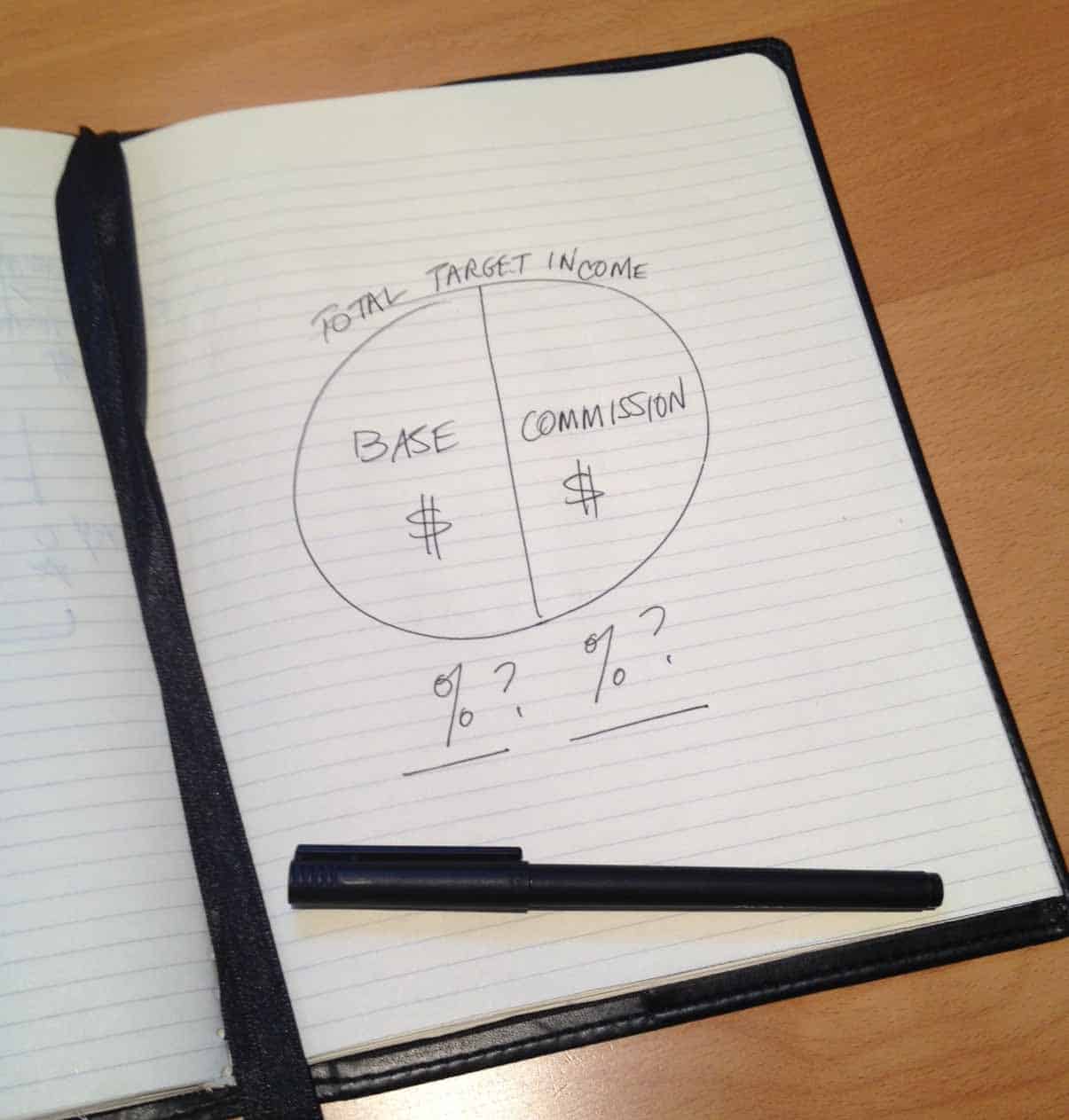
15 May 15:53

3 B’s Of Pipeline Success

by Tibor Shanto

By Tibor Shanto - tibor.shanto@sellbetter.ca

3Bs

How you manage and stage your pipeline can be the difference between an OK year or career, or a consistently great one. To use a sport analogy, your pipeline is your core, no matter what sport you are in hockey, tennis, or running, a strong core, a well exercised and maintained core adds to athletic performance and lifts one competitor to victory over a comparably talented athlete with a less conditioned core.

Below are three things every seller should consider and do, no matter which methodology they use to sell, to lift their execution and results.

Bold – This speaks to who or which opportunities you choose to peruse, there is the element of pursuing ALL REAL potential prospects that others either ignore, or completely miss due to personal or corporate blinders. There are many potential buyers that are overlooked by a large number of sales people. Some don’t see the dots and as a result can’t connect them; others see the dot’s but fail to or are afraid to connect them. There is a lack of imagination and boldness in their approach.

Some will overlook things that fall beyond conventional qualification measures, an over reliance on BANT if you will. The key here is that they be REAL, meaning given the right circumstances they would buy your offering, and qualifying comes down to how you view your market, and choose to align your offering. Are you limiting your sights and pursuits to those people that have the pains or other mundane signals, those your product has traditionally addressed? If so, you’ll likely miss many REAL prospects or opportunities.

But if instead you look to see how you may help someone achieve their business objectives, your universe of REAL potential expands considerably. This is huge from a pipeline perspective, the more REAL potential prospect you’ll be able to identify, the more REAL opportunities you can fill your pipeline with. Since sales is to a degree a numbers game from a conversion ratio perspectives, more opportunities translate to more and or better sales, and at the minimum more options for you as a seller.

Binary – Leveraging the above, being binary becomes easier and more productive. Let’s explain what I mean by binary. Your pipeline should contain only active opportunities, those prospects you are engaged with now, and in turn they are engaged with you and the sales process; it should not contain anything else. All those potential “prospects” you are not currently engaged with, as great as they may be, are leads, and should be managed in your leads funnel, not your active opportunities funnel or pipeline. But many sales people, and by extension their sales organizations, hold all kinds of inactive opportunities in their active pipeline, distracting time and resources. There are some common examples of this: former prospects who you met once or twice, who smiled, told you they were “really” interested but have not met with you or returned your call in weeks. Sure, they send you e-mails, saying they are still interested, they are just tied up, or on another project, or are waiting for some event, or maybe just waiting for Godot.

These are not engaged prospects and need to be moved out of your pipeline. This is not to say that they are not worth pursuing at some point in the future, but in popular vernacular, they are in the nurturing phase, not active selling phase of a pipeline. Alongside these are those “prospects” who are talking to you, but are doing less than nothing to move the process forward, move them out, they are just filler, and you can’t have that. The only opportunities that should be in your pipeline are those where the buyer is taking reciprocal action, executing their buying process as you are executing your selling process, and together you move to a mutual agreement. Binary – active – not active; taking action – avoiding action; on or off; keep the on’s and get rid of the off’s. Don’t clog up your pipeline with crap, not a place for a heart attack.

Many fool themselves by looking at their pipeline and thinking, “wow, look at all the stuff I have in there”. Exactly, stuff not opportunities. This false sense of doing, just messes you up, and most importantly sucks up your time for a number of reasons, and most deadly, prevents you from prospecting. When we are stuffed we don’t eat, when the pipeline feels stuffed, you don’t prospect.

If you want to see this clearly, just look at any pipeline using the 90 – 60 – 30 method and watch how it piles up, what happens in the last 30 days; for validation just look at how many times opportunities are recast in the 30 day segment.

Blended & Balanced – I remember learning this lesson the hard way, I fancied myself an elephant hunter, and ignore many smaller and shorter cycle opportunities. Till one year the elephants went to a different field, and I was left short on my target. My friend on the other hand, she focused on the small and easy, didn’t over extend. Interestingly enough we both came in behind someone who had a nice blend in their pipeline, big, small, short, long, and everything in between. Seems obvious, but not always easy to execute. There are a lot of distractions, things to entice you, being a home run hitter has its appeal. But with planning and discipline, you can map out a prospecting regimen that helps you balance the pipeline just so. I now use a Plan P approach, P being for pursuit, this allows me to continuously balance things, think of it like balancing and rebalancing a portfolio actively to maintain the optimal mix for you requirements. This allows you to be Bold in you pursuits, forces you to remove the inactive opportunities clogging up your revenue artery, and maintain a productive and profitable pipeline.

What’s in Your Pipeline?
Tibor Shanto