Shared posts

10 Jul 16:55

Uber says it loves public transport and has the data to prove it

by Derrick Harris

On-demand car service Uber published a blog post on Tuesday calling for Boston (and presumably all large cities) to increase late-night public transportation options. The post displays weekend ridership data from certain areas that shows a decrease in Uber rides after the Massachusetts Bay Transportation Authority began testing in March rail service that runs until 2:30 a.m. — 30 minutes after Boston bars close.

The effect seems to be city-wide, but is most prominent in areas with more public transportation options. Uber’s take on this data, according to the blog, is that “late night MBTA service should be extended past its initial pilot period of one year. It’s a critical component of late night Boston, and it makes the city – and all of the other transportation options, as well as businesses and residential areas in the Boston ecosystem – that much better.”

MBTAUber_ParkandSeaport_AfterHours


Increased mass-transit ridership is certainly better for the city’s coffers and businesses, and is probably good for Uber’s public relations if not directly for its bottom line. As the blog notes, a decrease in demand around bar-close time will mean less surge pricing and happier riders. And presenting Uber as just one piece of a greater transportation ecosystem — and a piece that’s affected significantly its peers, no less — makes it seem less like the unregulated, unchecked pariah that some like to paint it as.

There’s no word on how extended train service has affected taxi ridership, although the MBTA has released a trove of transit data, as part of a hackathon, that should help answer that question.

Regardless how you choose to interpret its data, though, Uber certainly appears to see data as an important arrow in its quiver as it fights for legitimacy in cities around the world. The Boston mass-transit data comes a few months after Uber released a handful of analyses highlighting (arguably) that it’s providing a great service in Chicago, even in low-income areas, and has even resulted in a decrease in taxi cab crime — a claim that some (at least to me and on Twitter) dispute.

Uber’s app collects detailed data about where people are riding and how long it takes, and the company is using that not just to improve its service but also, where possible, to argue that it’s better for everyone if cities work with Uber rather try to shut it down.

Related research and analysis from Gigaom Research:
Subscriber content. Sign up for a free trial.

10 Jul 16:51

How Customers Can Improve Your Pricing

by Ilan Mochari
Their insights, gleaned through negotiation, can help you convert product differentiation into paying customers.


10 Jul 16:51

How to Get Your Ducks in a Row for Effective Team Selling

by Dario Priolo

How to Get Your Ducks in a Row for Effective Team Selling

Team selling has become a way of life today. Because of the increasing complexity of business, the need for specialists, and the need to match up with players on the client’s team, you will often find yourself involved in team selling. I have been discussing various aspects of team selling in other articles. This article is about selecting the team.

There are clear advantages to team selling: bringing in expertise, balancing the numbers, matching client levels and types, pro viding a learning ground for juniors, and increasing resources since two (or more) heads are better than one. Additionally, team selling can shift some of the pressure off you and demonstrate to your client the depth of your company.

However, there are risks in team selling. During the sales presentation, everyone on the team (junior associates, colleagues, specialists, and seniors) will be under scrutiny. Almost nothing can be more damaging to your sale than letting your team show lack of unity. Clients will not only be evaluating you, they will also be judging each team member.

So, if you are selling with a team, in order to reap the benefits and avoid the perils, demonstrate teamwork. And this takes work. Since nearly everything gets done informally in most organizations, you need to build an internal network to ensure the support you need when you need it. By establishing a positive, personal (not email-based) network across divisional lines throughout your organization and in your own department before you need your colleagues, you will be positioned to mobilize resources to achieve and get the support you need.

First and foremost, there should be one team leader ultimately responsible for “calling the shots.” One salesperson describing how his firm won an important contract said the real challenge came from inside his organization, not outside. Initially, the product specialist refused to participate if the sales generalist— a buffoon, is his opinion— participated. The team leader finally said, “I’ve worked hard for this and I’m calling the shots. I know what we need and we need both of you. I’ll talk with him but I need your support. I’ve been there in the past for you!” This unified team won the deal.

One pressing problem organizations face is deciding who should and who should not participate on the team. Too often political and territorial considerations interfere with assembling the best team. Teams with too many players or the wrong players are at a disadvantage. How many should be on your team should be determined by what skills are needed.

  • What resources and skill you need on the team?
  • Who is on the client team? What skills/people do you need to match the client?
  • Whom do you think is best qualified to make the sale?

You don’t want to overwhelm your clients by sheer numbers or make them feel you are ganging up on them. A group of three clients is apt to feel overwhelmed if seven of you descend — unless each of you is essential to the deal. In addition to this, if you include unnecessary people on your team, you could inadvertently communicate to the client you are insecure.

Do not allow internal pressures to weaken the team you ultimately put together. Some say that you should not worry about hurt feelings in picking your team. But you should be able to avoid this by having a good reason for each person included on the team. Make sure those who don’t “make the cut” understand it is nothing personal. You need to find ways to convince all involved parties what is best for a particular presentation.

Coordinating your team on the plane, in the cab, or in the elevator simply is not good enough today. As a team you need to agree on a strategy, concur on your objective, and define functions and roles. Everyone—generalists, specialists, seniors, associates, operations people, and anyone else you need to include — needs to know what is going on and what will be expected of him or her.

Once you organize who will lead and who will be on team, involve them early to help you formulate your proposal. Decide before you head out to the meeting, well before, actually,

  • Who will lead?
  • Who will make introductions?
  • Who will open?
  • Who will present technical information?
  • Who will handle the broad issues or political questions?
  • Who will discuss pricing?
  • Who will close?
  • Who will take notes? (This is not the lead presenter’s responsibility, but may well be a good role for a junior associate otherwise there just to observe.)
  • How and when will you signal or correct one another?
  • Where will team members sit/stand?
  • Who will write the follow-up letter?

If the meeting is to be held at your site, plan:

  • Who will schedule the conference room?
  • Who will make sure all players know what, where, and when?
  • For out-of-town clients who want to come to your home office— what entertainment—dinner, theatre, sports events— should be planned? With whom? When?

Carefully pick a team designed to augment and strengthen what you personally can offer. Give everyone a role of some sort, so it does not seem you are trying to overwhelm the client with sheer numbers. Find out whom the client will have present, and match them with the appropriate members of your company. Remember that your team represents your company to the same degree that you represent your company.

——————————

Download our newest E-book,  A Financial Services Leader Guide for Sales Success. 

Leaders-guide-team-selling-post

The post How to Get Your Ducks in a Row for Effective Team Selling appeared first on The Richardson Sales Excellence Review™.

10 Jul 16:41

Why Content Is The New Sales Call

by Dan Newman

When Google came out with their Zero Moment of Truth reports, there was a lot of highly compelling data points that made CEOs, CMOs and sales heads have to stop and reconsider almost everything they are doing; at least as it pertains to marketing.

For those less familiar with the Zero Moment of Truth (ZMOT), it can best be defined as “the invisible moment by which a consumer makes a decision about a brand.” It can occur on their mobile device, while chatting on a social network or when they search for information and the results that ensue.

Some of the highlight reel data points of the ZMOT study were:

  • 84% of buyers engage in Zero Moment Activities (Online Information/Education)
  • 10.4 Pieces of Information in the Buyer’s Journey Prior to Purchase

The ZMOT isn’t a new discussion point. In fact it has been written about thousands of times with as many different perspectives, but for businesses that are slow to adopt or that still think digital and social are fads, the takeaways are becoming more and more important.

Content Is The New Sales Call

When Forrester Forrester Study that showed on average customers are 70%+ through the sales cycle prior to engaging a vendor, they were basically announcing a shift of massive proportion that affects nearly every company. The more complex your product and service the more this number should resonate because what this study was saying is that people want to do their own research.

No longer are we in the days of consumers (B2B or B2C) picking up the phone or calling in their trusted advisor to gain more insights or information on what we are looking for. We have taken that role on ourselves and that is why we seek to do everything from diagnose our physical ailments to procuring major business software packages without so much as a single meeting with a vendor.

While a blanket statement that every business must replace their sales efforts with content would be a reach, if not just an irresponsible statement, what the facts are saying are truths that most businesses cannot afford to ignore; imploring business leaders to ask themselves this question.

If not from us, then where are our customers getting their information?

For companies that are not creating low touch, easily accessible content in the form of blogs, articles, white papers, infographics, videos and more – how are they providing the 1:1 marketing experience that entices, educates and engages customers to move along the buyer’s journey with their brand?

Chances are the prospective buyers are garnering their insights somewhere, and many times those resources become the new trusted advisor, the sales person of the past and the influencer of the future. This in turn means companies that are waiting for the phone to ring or even those with a proactive sales force may be missing out on a significant opportunity by ignoring the invisible (to them) portion of the buying process.

Data That Cannot Be Ignored

The paramount shift from 1:1 marketing that took place between a sales rep and a buyer has gone by the wayside. Even brands that still see this as a viable channel must realize that clients are more informed than ever and it is the boundless volume of content that is creating information parity that at the very least realigns the sales professionals role from informer and educator to creator and innovator.

If nothing else, brands must recognize that by the moment the prospect has landed at your door, the process has long been underway. The companies that “get it” will recognize and prescribe content as a means to be more involved and engaged in creating those moments, those zero moments of truth and those that don’t “get it” will be left on the outside looking in with little more than hope to guide them to their next cycle of growth.

10 Jul 16:37

Separating Inbound & Outbound SDR Roles [LESSONS LEARNED]

by tbertuzzi@bridgegroupinc.com (Trish Bertuzzi)

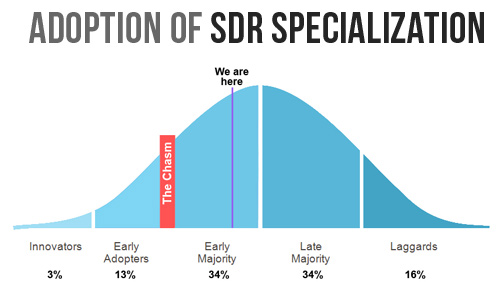
SDR specializationThe strategy of dividing inbound qualification and outbound prospecting into separate roles has crossed the chasm. In our 2014 SDR Metrics report, we identified that nearly 40% of companies have implemented SDR role specialization.

On paper, I love this approach as it creates focus and accountability. In practice, it takes careful planning and diligent monitoring to reap the full benefits.

I recently chatted with 3 high-growth companies on their lessons learned.

GoodData: Distinct Model, Distinct Goals

Casey Corrigan, Director of Inside Sales at GoodData, segmented roles for three reasons. 1) Lead routing rules had become complicated to the point of being cumbersome. 2) Constant shifting of gears between inbound and outbound was impacting momentum. 3) Reps followed the money when the comp plan paid at different rates for inbound vs. outbound.

Here is how Casey addressed these issues.

For Inbound: Leads are picked up on a first-come, first-served basis to whichever Inbound Rep is available with priority on speed of engagement. Since it is easier to set an 'inbound appointment,' Inbound Reps are chartered with doing a deeper level of qualification. They're measured on more qualified ‘SALs.'

For Outbound: Territories are delineated by geography and product. The reps are measured on 'appointments set' with less strict qualification criteria than their inbound counterparts, but the team charter is migrating from appointment setting to qualified opportunity creation.

Casey shared:

Each model is not without its challenges. The inbound team lacks the deep relationship with the field that the teamed outbound reps enjoy. Further, staffing an inbound team perfectly is a challenge due to the ebb and flow of leads. At the end of the day, since moving to this model overall production has increased 20-30%.

Hootsuite: More Structure vs. More Freedom

Peter Barton, Senior Manager, Enterprise Development at Hootsuite, took an interesting approach. The desire for a quick and aggressive response to inbound leads necessitated separating the roles.

For Inbound: For contact us leads, reps reach out with a phone call in under 5 minutes.  Additionally, the process is very service oriented with specific SLAs with Marketing (speed, number of attempts, media, etc.). A challenge is responding to peaks in lead volume while keeping the quality of qualification (data collection) and the speed of response high.

For Outbound: These reps have more leeway in their execution.  To a degree, the reps are able to ‘run their own business’ with their territories. This room for entrepreneurial selling leads to more variation and experimentation.

Peter shared:

The Inbound role can be a bit repetitive which can be a challenge. By not having any walls within the company (literally and figuratively) we’ve enabled reps to find a career path within the organization.

Ping Identity: Focused on a Contact vs. Deep and Wide

Carlos Garcia, Manager of Opportunity Generation at Ping Identity, built an Inbound team to work Marketing leads and an Outbound group to fill in the gaps.

For Inbound: Leads are assigned round-robin with a goal of reaching every lead in under 1 business day. A downside of this commitment is that reps are often ‘shackled to what comes in’ – meaning there is no control over the next name on their prospecting list.

For Outbound: This group goes wide and deep with target accounts. They are able to more deeply qualify accounts before passing to Sales counterparts. Also, without the (often distracting) flow of inbound leads, reps can be more strategic about planning their days.

Carlos shared:

The inbound reps are exposed to many more conversations and situations than those in outbound. They ramp much more quickly and this helps to build a great foundation for future success in outbound and later closing.

A few points on commonality jump out.

  1. If speed to contact is your goal, you need a specialized inbound team.
    Territory, routing, process, etc. all need to be oriented towards this goal.
  2. Inbound is often tasked with processing the lead vs. qualifying the opportunity.
    It is no easy feat to balance a) meeting SLAs with Marketing and b) give reps the latitude to decide who/who not to call.
  3. Outbound prospecting requires more autonomy
    Inbound qualification and outbound prospecting are fundamentally different. Yes, outbound reps need supporting direction, process, and tools. But they also need a degree more freedom and room for entrepreneurial spirit.

There is no one size fits all model for building an SDR group. Many variables are in play here. However, role specialization has certainly emerged as a “trend with benefits.”

Less and less often will top-of-the-funnel reps wear many hats. They are focused. They are accountable. And they are driving bigger and better pipelines with their efforts.
----

New Call-to-action

authorTB

About Trish Bertuzzi

Trish writes about emerging inside sales trends. She is author of
Motivating & Retaining Sales Reps and Inside Sales Oboarding.

Connect on Twitter and Google+.


09 Jul 17:31

Should Salespeople Be Able to Offer Discount?

by TheSalesHunter
What is the right level of authority a salesperson should have when it comes to price? This question comes up frequently when I’m meeting with sales managers. What they are wondering is when does it make sense for salespeople to have control of the prices they charge customers and how much flexibility should they have? […]
09 Jul 17:31

Amazon Wants to Bury Hachette by Offering 100% of E-Book Sales to Authors

by Jason Abbruzzese
Bezos-fire
Feed-twFeed-fb

Amazon has thrown down the Hachette.

The online retailer has offered to give authors 100% of the sales price of all Hachette e-books sold until its standoff with the publisher is resolved, according to a source who confirmed the authenticity of a letter sent to authors.

The proposal, from David Naggar, vice-president of Amazon Publishing, claims that Hachette has been slow to respond to Amazon's attempts to negotiate, and shines some light on the standoff that eventually led to the now-public issue. The dispute between Amazon and Hachette came to the media's attention in May when Amazon began blocking preorders for upcoming books from the publisher. Read more...

More about Amazon, Ebooks, Hachette, Business, and Media
09 Jul 17:26

Where Should I Get Music for My Marketing Video (And Does It Really Matter)?

by Jen Edds

Music and sound are one of the most impactful elements of any video production. Just ask Martin Scorsese. His movies are full of ear candy, and the music plays its own role in the storytelling. You might not have a Scorsese budget, but that doesn’t mean you can’t get your message across just as clearly as Joe Pesci with a baseball bat. With a little planning and thought about what you ultimately wish to accomplish with your video, you can utilize music to make a lasting impression and emotional connection. Capisce?

Questions to Ask Yourself IN THE PLANNING STAGES

• What is my music budget?

• How do I want my audience to feel when watching this video?

• How quickly do I need the music?

• Do I want custom music that I can use at other customer touchpoints like radio/tv ads or on-hold music to create a consistent brand sound?

• Do I want to determine what music is being used to represent my brand, or will I leave that decision to the video production company?

When doing a series of videos:

• Is the same music bed appropriate for all videos in the series?

• Would an audio logo be a better way to tie all of the videos together with sound?

Sources for Music

The most common ways to go about getting music for your video include licensing existing songs, production music libraries (also called stock music libraries), and custom music. For our Where Should I Get Music for My Marketing Video (And Does It Really Matter)? image 10369401 1389920961250034 901224589 n 300x300purposes, we will focus on determining if production music or custom music will be a better fit for your project and goals.

There are a number of online stock music libraries that provide “royalty free” music at a reasonable price. Broadcast quality tracks can be found starting around $40 -$50 and go up from there. YouTube even has it’s own production music library to make music available to users at no cost.

There is an abundance of composers that also work with agencies and production companies to create custom music for projects. When working directly with the composer, you have input into the creation of your brand soundtrack, allowing you to ensure that the work is truly representative of your brand. Cost will vary based on the licensing terms you agree upon, but it is probably more reasonable than you think over the long term.

Should I Use Production or Custom Music for My Project?

There are valid arguments for both. Time frame and budget will often be the primary determining factors. When your decision is based on “fast and cheap”, production music is usually the best way to go. It’s available for immediate download and will often be less expensive for a one-off or short-term project.

Warning: Production music libraries are the musical equivalent of Pinterest wedding boards for a bride-to-be. They are a total time suck when you keep clicking to hear the next track. Don’t wait to “know it when you hear it.” Have key words and emotional descriptions of what you want in place before you start searching.

When your goal is to cultivate a brand experience and create a consistent brand sound, custom music is the way to go. Working directly with a composer gives you more input in determining your brand sound, and allows you to negotiate exclusivity for the music. Both of these are key when creating a branded audio experience. Would you share your visual logo with another company, or use one that looked like your competitor? Brand sound is another opportunity for differentiation.

Determining the need for alternate versions of the same music bed or audio logo for various campaigns is also beneficial in the planning stages. Ideally, the music will be simple enough to be played in a variety of genres for longevity.

The bottom line is that music and sound play a key role in telling your story. Regardless of the method you choose for obtaining the music used in your video, be always mindful of the story you want to tell. Use the power of music to engage your audience and create an emotional connection. Capisce?

09 Jul 17:25

Rising Affluence Boosted Foreign Purchases Of American Homes By 35% Last Year (ITB, XHB)

by Mamta Badkar

suburb

Foreign buyers purchased $92.2 billion worth of real estate in the period from April 2013 to March 2014, according to a new report from the National Association of Realtors

This is up 35% from $68.2 billion for the previous period. And both the volume of sales and prices were up in this period. 

International buyers typically buy higher-priced homes according to the report, with the mean purchase price of international clients doing to $396 million. This was up from $354 million in 2013, but down from $405 million in 2012.

“International buying activity apparently was bolstered by continued rising affluence in China, Canada, India, Mexico, and the United Kingdom, according to the report. “In addition, the appreciation of the Chinese yuan and the British pound also made the purchase of U.S. property increasingly affordable for residents of those countries.”

The Chinese and Canadians were the biggest players

Those five countries accounted for 54% of real estate purchases. Canada was the biggest buyer in terms of transaction volume, but China was the biggest buyer in terms of dollar volume. 

Sales from Chinese buyers climbed to $22 billion, accounting for a 24% share, up from $12.8 billion (19% share) the previous period. Meanwhile, sales from Canadians accounted for $13.8 billion of 15% share, compared with $11.8 billion (17% share) a year ago. 

Chinese buyers also bought properties in more expensive markets like New York, California, and Washington, while Canadians bought homes in lower-priced markets like Florida and Arizona. 

For the U.S. which is just starting to see housing supply expand this is a double-edged sword. The report finds that most purchases by foreign buyers tend to be cash purchases, and this can be an obstacle for traditional first time homebuyers. But increased demand could help boost prices and push more homebuilding and prompt more homeowners to list their properties.

Here's a look at which states were most attractive to foreign buyers:

distribution by state

Here's a look at foreign purchases by country of origin and how the trend has changed since 2010:

chart

SEE ALSO: Here Are The Most Overvalued And Undervalued Housing Markets In America

Join the conversation about this story »

09 Jul 17:25

Budget to test new Indian government’s ability to deliver on ambitious vow to reboot economy

by CB Staff

MUMBAI, India – India’s new government presents its inaugural budget this week in the first substantive test of whether Prime Minister Narendra Modi will deliver on ambitious promises to revive stalled economic growth.

Modi’s Hindu nationalist Bharatiya Janata Party swept into power in May after the most decisive election victory India has witnessed in three decades, ousting the long-dominant Congress party. Voters were fed up with Congress’ failure to curb runaway inflation and the wilting of growth rates to below 5 per cent.

The prime minister has warned “bitter medicine” is needed to heal Asia’s third-largest economy and improve battered government finances. Expectations of bold policies have been sky high, with the Sensex stock index in Mumbai hitting a series of record highs in the past several weeks. But the prospect of reduced harvests this year due to weak monsoon rains may forestall immediate cuts to fiscally ruinous subsidies for fuel, food and fertilizer.

“I don’t think we are going to see something that is completely path-breaking and transformational,” said Anjalika Bardalai, an India analyst for the Eurasia Group. “But I do think there will be enough in the budget that is going to be perceived as business friendly and good for the economy.”

India’s economic growth has slowed to less than 5 per cent for the last two years after a decade of expanding by an average of 8 per cent, which is the minimum the government says is necessary to provide jobs for the 13 million young Indians who enter the workforce each year.

Big spending on subsidies has limited the government’s ability to use its budget to make productive investments that could boost the economy’s productivity in the long run. A chronic current account deficit has contributed to weakness in India’s currency, worsening consumer inflation that has touched double digits in the last year.

The BJP campaign promised pro-business policies similar to those in the Gujarat state where Modi was chief minister for years and focused on clearing obstacles to building roads and other infrastructure and offering incentives for large-scale investment.

Critics accuse Modi of promoting a more free-wheeling capitalism with less of a social safety net, but the overwhelming victory in May indicated Indian voters, especially the young, are more concerned with the faltering economy.

The election result was a “pretty clear vote” for more jobs and other changes to get the economy moving again, said Glenn Levine, a senior economist for Moody’s Analytics. “Modi should and appears to be utilizing this honeymoon period to push through some changes.”

Finance Minister Arun Jaitley’s budget speech Thursday may go beyond traditional subjects like spending priorities and deficit-reduction targets and also touch on at least broad outlines of policies such as a more selling off state-owned industries, tax reform and allowing more foreign investment in key industries.

Government steel, coal and petroleum companies are seen as prime targets for sale, which would replenish the government’s coffers and help to make inefficient industries more productive. Jaitley could also announce increases in caps on foreign direct investment in areas including defence and e-commerce.

Still, inflation and the high price of oil, India’s biggest import, will make it difficult to reduce the fiscal deficit that is a both a symptom and a cause of many of the country’s economy woes.

Many of the measures Modi’s party sees as ultimately necessary to curb the deficit are likely to be deeply unpopular.

Tens of millions of Indians have become accustomed to subsidized food, fuel and fertilizer that cost the government some $40 billion per year. Modi’s party would like to redirect that spending to areas such as building roads, railways and power plants, but any cut in social spending could provoke a backlash.

One of the Modi government’s first acts when it took office was to raise rail passenger fares, an unpopular move that was partially rolled back after a public outcry.

The back down demonstrated that cuts to entitlements will be deeply contentious and unpopular, said Bardalai, the Eurasia Group analyst.

The post Budget to test new Indian government’s ability to deliver on ambitious vow to reboot economy appeared first on Canadian Business.

09 Jul 17:25

Understanding Value

by Chris Brogan

Inside the Grand Bazaar My friend, Anthony is one of the best salesmen I’ve ever met. Whenever I ask him the key to selling, he says the same thing every time without hesitation: “Sales is about creating value.”

Understanding Value

My universe has shifted into amazing alignment lately. Ever since ferreting out what I REALLY know how to help people do better, and how that will add value to their lives, I’ve been on fire. And even then, I started like I usually do: with a bad first attempt. But now, my Owner’s Path course is going to really be my best ability to add value back to your life.

Continue Reading

09 Jul 17:22

5 Reasons for Online Businesses to Seriously Consider Google’s Domain Service

by Dave Wheeler

5 Reasons for Online Businesses to Seriously Consider Google’s Domain Service image NumeroUno 07 08 14 300x200In late June 2014, Google announced plans to launch its own domain registration service for business web sites, offering a competitive option against the likes of GoDaddy and Wix.com.

While this hasn’t fully come to fruition and is still in the development process, it’s news worth keeping up to date on, as this service could be very beneficial to online businesses. Here’s why:

1.  Price

When announced, Google listed the price for its web site registration at a budget-friendly US$12.00 per year. This is a very competitive price when compared with other domain registration sites; some online businesses may even be able to save some money by switching to Google’s domain service.

2.  Transferability

If you’re familiar with creating content online and using meta tags, you know that it can be a very cumbersome task. However, Google’s new domain registration service is offering transferable media, allowing you to easily move your meta data from your current provider to Google’s interface, stress-free.

3.  Connections

This new service will work in tandem with Google Panda, which monitors business web sites so that they operate legitimately. The new Google domain registration will solicit feedback from certain registrants and keep users updated on developments in the service as it potentially develops into an invaluable part of today’s online business.

4.  Perks

Google claims its domains will also offer registrants extra services that they might not get elsewhere, such as domain forwarding and the ability to choose up to one hundred domain addresses. And there may be further benefits announced in the future—another reason to keep tabs on the service’s development.

5.  Quality

The critics of Google’s new domain service argue that it’s just another way for Google to force out competition by offering users an additional service. While this may turn you off from the service, know that with the amount of information Google provides and their solid regulations on everything from keyword density to PPC, you could be doing a disservice to your online business by not using Google’s new domain service.

This article 5 Reasons for Online Businesses to Seriously Consider Google’s Domain Service was originally published at Numero Uno Web Solutions and has been republished with permission.

09 Jul 17:22

Google Cloud now offering 2TB of free storage for a year to compete with Amazon and Microsoft (Alistair Barr/Wall Street Journal)

Alistair Barr / Wall Street Journal:
Google Cloud now offering 2TB of free storage for a year to compete with Amazon and Microsoft  —  With Google Offer, Cloud Storage Gets Closer to Free  —  Google Wednesday fired another shot in the price wars for cloud-computing services, offering businesses more free storage in an effort …

09 Jul 17:15

9 Ways to Measure Your Social Media Success

by Emma Pauw

Albert Einstein once said “not everything that counts can be counted, and not everything that can be counted counts” this is a hugely compelling statement, but who knew it would still be so relevant today.

In a sense, Einstein has hit the social media nail on the head. Integrating social media into your overall marketing strategy can bring huge business benefits, yet, these are both tangible and intangible and as a result, not every aspect of your social media success can be measured. It’s easy to get lost in social media but how can you really ensure you’re getting a clear ROI? With regards to social media, we like to term this ‘Return on Involvement’; and it’s vital that you ensure you’re seeing a return on all your social media time and efforts.

There are many ways to measure your social media success, though it’s worth keeping in mind that as well as bringing tangible benefits, social media can also prove (intangibly) priceless! Getting praise or mention from an industry expert, or getting your content in front of the relevant people may not look that successful on paper, but to you this may be invaluable. Social media allows you easy access to these individuals and provides a real time, personable way to communicate and network with those business professionals on your radar.

So, before we outline these success measures, let us first give you this nugget of advice; if you’re using social media for business purposes, ensure you’re fishing in the right pond! There are an array of different social media sites, all with different purposes and audiences; therefore there’s no point focusing all your efforts into one platform if it’s just going to fall on deaf ears. Ensure you do your research to find out where your audience is lurking, and then focus your efforts here to start reeling them in!

How to measure social media success?

  • Set clear and realistic goals and targets: Social media is not the answer to all of your business prayers, however it is a brilliant means to an end goal.  In order to measure the success of your social activity, ensure you set clear objectives and realistic goals to aim for, as well as understanding why each is being hailed as a success measure. This may be reaching a certain number of new followers, lead conversions, re-tweets etc. If you’re hitting these then you’ll know your social activity is working, and if you’re not, look at where you’re focusing your efforts. Keep pushing yourself by gradually making these objectives harder to achieve and as your social media skills increase so will your business success.  One easy measure to employ is ‘where were we able to start this conversation that lead to the sale?’…and what was the process from there.

  •  Social media measuring tools: There’s an array of different social media management tools out there to enable you to monitor every aspect of your social activity. These include measuring your click-through stats, likes, retweets, follower growth, post shares…the list really is endless! The platforms themselves also offer great monitoring tools.

Here’s just a few:

 - Facebook’s metrics are great for showing you how successful your social media activity is, audience make-up, peak traffic etc.

- Twitter search your company name, this allows you to monitor your Twitter rep by bringing up potential news, pictures and tweets that your brand has been mentioned in. If you’re a big enough brand, adding the # before your name will allow you to see all tweets that directly reference you, allowing you to gage sentiment.

- Technorati - Technorati will notify your brand has been mentioned in the blogosphere.

- Monitor This - ‘MonitorThis’ is a little more technical, but worth it. You can have it watch over 20 different search engine feeds and make an .opml file that you can put into your RSS Feeder to display any results.

- Hootsuite, Tweetdeck, Sprout Social, Meltwater Buzz etc. there are an array of ‘social media dashboards’  that  allow you to post and monitor the success of all your social media posts, showing you amongst others, conversation volume and the sentiment of mentions. These platforms can flag up all mentions of search queries you enter, the good, bad and indifferent, allowing you to gain a great overview of your social media success

  • Cost savings: social media allows cost effective access to powerful marketing, networking and lead generation tools by giving you access to free and low-cost platforms to reach customers on a global scale. There is no other free/low cost and instant marketing form like it and therefore allowing you to compete with big brands and budgets.  Social media has truly ‘levelled the playing field’ and no longer is it just the big budget brands that get their activities winning accolade and business.  A strategy and plan is a must though! You just need to be smart with your application of simple yet effective activities and by following a strategy and plan so you can measure success, and adapt and modify as you go.  Any fool can make something complicated; yet making something simple takes a lot hard work and talent!

  •  Time savings: By measuring how much time your business has saved by using social media to achieve it’s goals quicker, you are able to see a clear ‘Return on Involvement’. If you are spending hours on social media with very little to show for it, then you are most certainly doing something wrong. One quick and easy time saving exercise is to schedule ‘proactive’ tweets and posts (without looking like a robot!);   you are able to mitigate the need to be sat for hours on end on social networking sites day-in day-out, and ultimately save yourself a lot of time, dealing only ‘reactively’ when required.
  •  Analysing brand recognition: Social media is a great way for a business to raise brand awareness. Use monitor tools to search for your brand name, e.g. Meltwater Buzz will give you an n overview of the sentiment from posts mentioning your brand, allowing you to see how you are being perceived. Whilst monitoring your Twitter mentions allows you to see when and why people are talking about you. If you’re getting lots of positive mentions then you’ll know your social media activity is paying off!
  • Mentions by influencers:  These mentions can be priceless, yet difficult to measure tangibly; if you are being retweeted and discussed by industry expert then you know you’re ‘doing’ social media right. This shows that you’re sharing engaging and interesting content and reveals others are finding your social media feeds useful. Ensure you set clear goals for who you would like to interact with online and if your content is being picked up by these people then this is a clear measurement of your social success.

  • Follower growth/industry expert positioning: After you post content about a specific subject, you may see your followers (from this industry), likes and favourites increase. This is because people follow those feeds and people who provide value and insight to them, providing them with rich and interesting online content. If your followers/connections are continually increasing and if you’re getting lots of new industry professionals look at (in the case of LinkedIn) or engage with your feed then your social media activity is clearly proving a big success. Ensure you continue posting engaging content, a mixture of both your company blogs and news and 3rd party content to give people a reason to follow you.

  • Better internal collaboration: if you’re seeing better employee engagement and better communication between internal departments then this is a great way to measure the success of your social media use. Businesses that use social media are proven to have a better collaborative working environment as they reap the rewards of the cost and time efficiencies that social media can bring. Through better internal communications you will soon see better external comms.

09 Jul 17:15

How To Use LinkedIn’s Publishing Platform for B2B Marketing

by Jawad Khan

How To Use LinkedIn’s Publishing Platform for B2B Marketing image linked

With more than 300 million registered users, LinkedIn is one of the largest social networking websites in the world. But unlike Facebook and Twitter, which are more suited to B2C selling, LinkedIn is any B2B marketers dream platform. And its effectiveness has only increased with the launch of its own publishing platform earlier this year. This move has massively changed the way organizations could use content to boost their B2B marketing efforts and drive more sales.

Having worked with leading B2B ecommerce portals like  Quality Trade, TradeKey and AliBaba, I can clearly see a steep rise in the number of small businesses worldwide that are preferring  LinkedIn publishing for strengthening their brand and acquiring more customers.  Not only does LinkedIn publishing platform allow businesses to approach the most relevant audience with their content, but also attracts much higher engagement on every post. LinkedIn’s own statistics suggest that its influencer posts have attracted an average of 31,000 views, 250 likes and 80 comments per post.

But if you’re a business owner, what exactly should you do to benefit from this powerful and emerging platform? Here are 11 tips to help you.

11 Ways B2B Marketers Can Benefit From LinkedIn’s Publishing Platform

  1. Regularly Publish High Value Content

Like any other content marketing platform, LinkedIn publishing requires consistency. You need to publish high quality content regularly for maximum impact. There’s no ideal frequency, but posting once every 15 days should be your minimum target. Follow the standard blogging format for your posts with short paragraphs, headings, images and bulleted points.

  1. Find Ideas From Group Discussions

In order to post regularly on LinkedIn, you’ll need to come up with new content ideas and identify topics that can provide value to your readers. LinkedIn discussion groups are the perfect places to do that. Join the most relevant groups of your industry, become a part of the discussions over there and create your posts around the questions people are asking.

  1. Create Targeted Content for Your Prospects

Be specific in your post topics. Identify the needs of your target readers and develop your content around them. Your posts should neither be self-promotional nor should they solely focus on your company matters. Write each post with the objective of helping your readers. For example, if you’re a digital marketing agency, share tips on different digital marketing topics and demonstrate your expertise. This is an ideal platform to build your credibility with high value content.

  1. Strengthen Your Brand With Storytelling

Storytelling is one of the most effective ways of emotionally connecting readers with your brand. Some of the most inspirational pieces of content marketing are based on storytelling. LinkedIn publishing platform provides you the perfect opportunity to share your story with your target audience and engage them with your brand. Such posts also tend to attract much higher social sharing as compared to standard blog posts.

  1. Route Traffic From LinkedIn To Your Website

LinkedIn is a vibrant social network where the engagement levels are quite high. Using the strength of this platform, you can route visitors back to your blog or website. Include relevant links of your company blog in each of your posts on LinkedIn’s publishing platform. But make sure not to use keyword rich anchor text or too many links in one post.

  1. Cross Reference Your Content Through Links

Cross referencing and linking between posts is a great way to boost post views. Over a period of time, when you have several posts on LinkedIn, you’ll notice a decline in the readership of your older posts. You can counter this decline by extensively linking and cross linking between the new and older posts. This will help the new readers to locate your older content much more easily.

  1. Engage Industry Influencers Through Your Content

Every industry has certain influencers who enjoy massive followings and attract thousands of visitors every time they publish a blog post. On LinkedIn, such people are known as LinkedIn influencers. You can use the strength and reach of these influencers to promote your content by citing their examples in your posts and tagging them within the content. Once you publish the post, message the relevant influencers, or their assistants, and tell them about the post and how you’ve tagged them in it. Do not ask for a share. If your content is good enough, and does not harm the credibility of the influencer in question, it will be shared most of the times.

  1. Maximize Your Reach Through Partnerships

Just like blogging partnerships, where different influential bloggers promote each other’s work and drive traffic, LinkedIn publishing can also be used to create partnerships to increase the reach of your content. But for this, instead of focusing on LinkedIn Influencers, try to engage other users who regularly publish on LinkedIn and enjoy a large following in your niche. You can work out different partnerships with these users depending on what you can offer in return. Strategies like guest blogging can also work very well on LinkedIn publishing where you can offer free content to other influential users and drive traffic back to your profile.

  1. Aggressively Promote Your LinkedIn Posts

No matter how regularly you post, you’d still need to aggressively promote your content in order to attract regular readership. A great starting point is your own LinkedIn company page and the profile of your company employees. Ask all of them to share your official content on their profiles. Similarly, join different discussion groups and share your post link where relevant. You should also promote your LinkedIn posts on other social networks like Facebook, Twitter, Google+ and your official mailing list.

      10. Engage With Readers Through Comments

Comments on LinkedIn posts are much more powerful and effective than the usual blog post comments. When a user comments on your LinkedIn post, it becomes visible in the timeline of all his connections as well, which can drive more readers to your post. So the more comments you attract the more traffic you’ll generate as well. Similarly, when you respond to different comments on your post, it not only increases the possibility of more responses from the same commenters, but also helps you connect with new users on LinkedIn and increase your network.

      11. Boost Your Mailing List Through LinkedIn

No matter how powerful any social network becomes, the direct ticket to a user’s email inbox still lies with the conventional mailing list. LinkedIn publishing can help you boost your mailing list with highly targeted readers. You can add links to your opt-in landing page within the post content or ask your users to subscribe to your mailing list at the end of your posts. Either way, since most of your readers are potential B2B contacts, LinkedIn’s publishing platform can prove to be vital in your list building efforts.

Conclusion

By introducing its very own publishing platform, LinkedIn has become much bigger than a simple professional networking website. With this move, they’re on track to attracting thousands of high quality and industry specific blog posts by skilled professionals, and millions of potential readers every month. This provides businesses on LinkedIn a powerful opportunity to differentiate themselves through high value content and get closer to their potential B2B clients.

09 Jul 17:14

The Great Content Checklist: Tips, Tools, and Examples

by Mike Murray

fortune cookie-rewarded for effortsIf you want to produce great content, it’s time to leave ordinary in the dust.

By the time you’re ready to promote your latest creation, you may distribute it in a popular medium like a PDF or a deck that makes its way to SlideShare. But the content itself also needs to be so exceptional that it commands attention — even in a crowded and competitive environment.

Does that mean you need to spend four months and $1 million on video everyone will talk about for the next year?

Not at all.

Great content is about what you say, how it works to express who you are as a company, and how well it functions as a means for connecting with your audience. Great content means you can captivate readers just as well with a 1,500-word blog post as you can with a 140-character tweet, or a 5-minute video because your audience members value your perspective, feel you have an original voice, and consider your messages to always be relevant to their lives and needs.

Enjoy your past successes and don’t fret over content that fell way short. It’s time to gear up for the future. Use the following checklist to affirm your current best practices for producing great content and try out some new ideas you can use to increase your content marketing success right away.

Launching points for great content

Take time to size up your content and put it to the test. Be a tough critic and decide whether it’s really ready by answering questions like:

  • Is it informative?
  • How likely is it that someone will share it?
  • Is it well organized (i.e., will it be easy for readers to follow the logic and make their way through the conversation)?
  • Do you avoid industry jargon?
  • Does the content reflect your brand voice?
  • Is it well written (i.e., free of typos and in a format that will appeal to your audience)?
  • Do your visuals help the content pop?

In the midst of all of those questions, you should weigh whether the content is authoritative. Does it repeatedly convey that you know what you are talking about and are sharing insight that should be valued and trusted?

For example: The Other C Word: What Makes Great Content Marketing Great from the Velocity Partners agency succeeds on multiple levels. After an effective buildup, the presentation focuses on a central theme: confidence.

confidence-white word-red background

confidence says-white words-red splashAs an expert, you should be producing content that allows you to freely share your knowledge. It’s not difficult to be candid and helpful without resorting to sales pitches that won’t resonate with your target audience. However, you can still shape the content so it speaks to where your viewer might be in the buying cycle. B2B and B2C consumers are more likely to warm up to your great content — and stay engaged — if you speak their language.

Here are some critical questions to ask when tailoring your content to a particular stage in the purchasing process:

  • Which buyer persona are you referencing for this particular piece of content?
  • Are you using a clear call-to-action that moves readers down the funnel?
  • How will your visuals and text win over readers or viewers and keep them coming back to you for more?

For example: Paolo Mottola, Manager of Content Planning for REI, details a funny example in CMI and TopRank’s eBook, 36 Content Marketers Who Rock:

For supporting an urban cycling campaign, we didn’t just create an infographic, we created one that depicted the proper etiquette for releasing a snot rocket. We know we can rise above the noise when our content makes our brand relatable to the customer. In the case of clearing your nose while riding, snot rockets were our disruptive, relatable angle and it worked!

The form and function of great content

Whether it’s print or digital content, the format you choose will be just as critical to success as the message itself. For example, a single graphic accented by a statistic or quote can get an important point across in a few seconds — perfect for on-the-go audiences who are likely to view your content on a mobile device.

What format will work best for members of your audience and the ways they prefer to engage with your messages? Options include:

  • Text (e.g., articles, blog posts)
  • Comic-style presentations
  • Infographics
  • Videos
  • Audio
  • Photos
  • Webinars

Here are some examples of great content created in various formats:

For more ideas, be sure to look through CMI’s Ultimate eBook: 100 Content Marketing Examples.

Measuring and marketing great content for optimal performance

How will you know whether the content you create is worth the development resources spent if you don’t have a way to track and measure its performance? Who will monitor and analyze the data? Are you going to track social shares, time spent on your website, a spike in subscriptions, downloads, or another primary indicator to measure the value of the content you are producing? These are just some of the metrics questions you will need to answer as you strive to create great content. (You’ll find some more useful guidance in CMI’s eBook, A Field Guide to the Four Types of Content Marketing Metrics.)

Similarly, you can’t expect great content to provide optimal value if you aren’t doing everything you can to ensure that it reaches the widest — and most relevant —audience possible. For this reason, you need to consider what your marketing strategy will be for each piece of content you develop. Some marketers say you should amplify your content everywhere possible — including repurposing it or linking to it on all your owned media channels — while others feel a more targeted, precise distribution plan is a more effective use of your content marketing resources. But regardless of which strategy you prefer, the important thing is that you know, in advance, what the purpose is for developing that content, and how you can deliver it to best serve that purpose.

In his blog post, These are the 6 Steps I Use for Great Content Marketing, Jay Baer cautions businesses about how they approach content:

Far too many companies are creating content just to be able to check that box on their marketing tactics chart. ‘Let’s do content marketing’ is replacing ‘let’s do social media’ and ‘let’s try to go viral’ as the most commonly heard — yet utterly rudderless — corporate mandate. Content can serve different purposes within a company, and the best content marketing programs define the role of content beforehand, not after the fact.

Tools to support great content ideas

Sometimes your best content ideas can stem from what you’re discovering elsewhere. Several tools can help you get a pulse on a specific topic or industry:

  • Topsy is a tool for analyzing the value of specific links, tweets, videos, and more all across the social web.
  • Reference Reddit to find precise topics that your audience cares about.
  • Subscribe to the Daily Digg email to see the day’s top stories that have a strong viral potential or are likely to be a good conversation starter.
  • Buzzsumo will help you find the most shared content on relevant topics and discover which ones are gaining traction so you can decide whether or not it would be worthwhile to add your brand perspective to the conversation.
  • Pocket saves and organizes articles, and allows you to set up customized alerts for trending stories.

It takes time and the right resources to produce great content. Mostly, you must be creative and impress your audience with something fresh and compelling. You need them to trust you as they begin to invest part of their time to consume your content. Hopefully they will contact your business or at least share your content with others.

How do you ensure that you’re developing great content? We would like to hear from you.

For more insight on how to create and distribute great content marketing, join Mike Murray as he takes the stage at Content Marketing World 2014. Register today!

Cover image via George GrimmHowell

09 Jul 17:14

LinkedIn Misconnects Show that Automated Matching is Hard

by Seth Grimes

I’ll report here on a LinkedIn error — it’s not a bug, it’s a flawed algorithm, significant although far from earth-shattering — that shows how difficult automated matching can be. I’ll then offer practical steps LinkedIn could take toward accurate matching.

Why should you read on? Not only because (I’m guessing) you have a LinkedIn profile, but also because in an “omni-channel” world, data matching — also known as data integration, data fusion, record linkage, and synthesis — is central to meeting everyday social and enterprise business challenges.

Two Mismatches

Check out the snippet to the right, from my own hand-entered LinkedIn profile. You’ll see that I wrote for Intelligent Enterprise magazine for quite few years. (Jeannette Boyne, thanks again for the recommendation!)

But what’s with the Intel Corporation information that appears when I hover over “Intelligent Enterprise magazine (CMP)”? It’s a LinkedIn-generated misconnection. Intelligent Enterprise magazine was folded into InformationWeek a few years back. IE ceased to exist as a free-standing brand. LinkedIn must have taken the first five characters of the magazine’s name and decided that Intel is the best match.

This matching error is significant because for LinkedIn, a connections company, social-graph accuracy is gold. Members hand-craft their networks based on past, current, and hoped-for future business relationships. LinkedIn derives People You May Know recommendations from our employment histories and interests, but recommendations are only suggestions. We see that when LinkedIn asserts connections, as the platform does in the example I show, the company gets into trouble.

(LinkedIn also misses certain computable connections, more on which later.)

LinkedIn actually mismatches a second of my former employers, Magnet Interactive. I didn’t work for the company you’ll see in the mouseover pop-up when you visit my profile, or for any company related to it. Just because two company names look the same, doesn’t mean they’re the same company!

So we have two examples of “entity resolution” false positives in just my profile. (LinkedIn should pay me a product-quality bounty. See also My Search for Relevance on LinkedIn, posted in March; my April via-Twitter reporting of incorrect rendering of HTML character entities, here and here; a February 2013 Twitter thread about the lack of needed LinkedIn profile spell-checking; and my July 2012 LinkedIn, Please Take on Group Spammers.)

Hyperion was acquired by Arbor was acquired by Oracle... but LinkedIn doesn't know that?

I found additional examples by looking at profiles of others who were formerly employed by now-defunct companies. Here’s one such example, in the image to the right. Hyperion Software was acquired by Arbor Software — as this person’s profile states! — which in turn was acquired by IBM.

Funny thing: Somehow, as you can see toward the top of the image, LinkedIn did get right that PeopleSoft was acquired by Oracle.

Automated Matching is Hard

Yup, automated matching is hard. Direct marketers and others have been working the problem for years, for instance, in order to merge and deduplicate mailing lists. Software tools may declare record matches when the values of several fields in pairs of records line up — for instance, first initial + last name + address — and they may tolerate abbreviations, misspellings, and data variations (PA = Penna. = Pennsylvania = Pennslvania) or even exploit phonetic similarity in names. Some even determine that fields in different databases have the same meaning, despite different field names, based on data profiling, based on a scans of the fields’ values. The matches are sometimes fuzzy, decided based on a probability judgment.

Check out database-systems wizard Mike Stonebraker’s latest, Tamr, which aims to overcome the data disconnect.

FirstRain, which extracts, aggregates, and organizes business information from online and social sources, provides an even better example of semantic matching done right. As described in words pulled from FirstRain’s Web site: “Selling to GE Locomotives? You won’t want to read a generic newsfeed on GE Aviation or GE Capital — and with FirstRain, you won’t. You will only see what’s relevant based on how you sell and market to each specific business line within a company.” That is, the company (claims it) has successfully addressed the semantic-matching problem, at a level of granularity, the division level, that exceeds the LinkedIn matching need’s.

I wrote about FirstRain and a number of other semantic-matching successes — Tableau, Attivio, Google, and the now-defunct Extractiv — in my 2011 InformationWeek article, 5 Paths To The New Data Integration. (I’m linking you to page 2, which features Attivio and FirstRain.)

A Company Graph

My prescription for LinkedIn: Create a company graph, an ontology that recognizes factors that include:

  1. naming variations (e.g., General Motors = General Motors Corporation = (sometimes) GM);
  2. hierarchy (Chevrolet is a GM division);
  3. temporality and geography (Digital Equipment Corporation was founded in Massachusetts in 1957 and existed under that name through 1998, with a first international office opening in West Germany (now just Germany, of course) in 1963);
  4. transactions (Arbor Software merged with Hyperion Software, formerly IMRS, to form Hyperion Solutions Corporation, which was in turn acquired by IBM);
  5. multiple uses of a single name (polysemy) (SAS is both an enterprise software company and an airline); and
  6. identity shifts (SAS, as in the software company, once stood for Statistical Analysis System, and the company was called SAS Institute; SAS, the airline, was once Scandinavian Airlines System).

LinkedIn has the data to create just such a company graph, via text mining, and surely employees have the data-science smarts. How-to examples? Two:

That profile pictured above that lists Hyperion Software as an employer: It explicitly states, “Company acquired by Arbor Software.” Text analytics will identify “Company” as a contextual anaphoric reference to Hyperion Software. (Sorry about the jargon. Pronouns such as he and she are other commonly found anaphora.) Text analytics will identify Arbor Software as a named entity and will discern and extract the “acquired by” relationship. Further, I’d bet there are other LinkedIn profiles that corroborate this particular corporate acquisition.

Now refer back to my first image, above. Jeannette Boyne, who recommended me, lists in her profile that she worked as “Senior Editor, Intelligent Enterprise” for “CMP Media (div of United Business Media) from September 1998 to September 2005, overlapping the years I list for my “Intelligent Enterprise magazine (CMP)” association. Our profiles, and profiles of other former associates with whom we’re both linked, provide data that supports high-confidence entity (company name) and subsidiary-relationship resolution. LinkedIn, lacking sufficient semantic smarts, despite Jeannette’s and my first-degree connection and her recommendation and the similarity of the employer names, failed to infer an obvious connection.

The Unreasonable Effectiveness of Data… and Analytics

Consider this column a call to action, for LinkedIn and for other data-rich, capable organizations.

Do you want to lead in digital? Simplistic approaches — Assuming associations based only on a match in the first few characters of two names!? — don’t cut it. Use your data. Create and apply knowledge structures — graphs, ontologies, semantic networks — to resolve and disambiguate names and extract relationships. Apply multiple methods, performing cross-checks until you’re reasonably certain about inferences.

LinkedIn, if you’re not going to take these steps: Better to provide no results — skip the possibly mis-inferred connections — rather than erroneous ones. But consider that high-quality data, and high-value results, are worth the extra effort. Users will thank you.


Related Stories

09 Jul 17:09

How to Grow Your Email List Using Quizzes

by Josh Haynam

How to Grow Your Email List Using Quizzes image quiz 11On June 20, 2014, Worth Global Style Network (WGSN) released a fun ten-question quiz called “What’s Your Customer Type?” By June 22nd — just 48 hours later — they had gained 233 new subscribers for their email list.

The success achieved by WGSN can be replicated by any business. Here’s a guide for how to do that, along with some real-life examples that don’t suck.

How to Create a Quiz to Generate Leads and Build Your Email List

Coming up with quiz topics. To get started, you’ll need an idea for your quiz. When coming up with concepts, here are the things to remember:

  1. Make the topic relevant. Being in sync with your readers is much more powerful than creating a quiz that appeals to the masses. For example, Faquier Now, a newspaper in Faquier County, Virginia (population 60,000), created an on-target quiz for its community. The result? A full 15% (more than 10,000) of the community members took the quiz.
  2. Make the topic fun. No business is too cool to be fun. I’ve seen law firms create enjoyable quizzes. You don’t have the right to deprive your audience of fun.

Writing the quiz questions. This is where you get to have a conversation with every single person who takes your quiz. It’s an opportunity to prime every visitor and prepare them to enter their contact information. Here are my top tips for writing quiz questions:

  1. Keep it short. 8-12 questions is the optimal amount — any more and you risk losing customers, any less and you don’t have enough time to make your quiz believable.
  2. Inject some personality. Pick a tone and use it to endear your readers. Be goofy, be oddball, whatever you have to do to establish a connection. A study found that people who feel comfortable are more willing to share personal information, so make people comfortable by sharing your personality.

Writing the quiz call to action. When it comes time to ask for an email address in return for showing the results of your quiz, it’s your time to shine. Follow these two steps to nail it.

  1. Keep it in context. A quiz provides you the unique opportunity to present an offer that makes perfect sense in context. For example, if your quiz is about losing weight, your call to action could say “Enter your email to get weekly weight-loss tips.”
  2. Make it compelling. You are already trading the quiz results for the quiz taker’s email address, but you can do even better by offering additional value. Even if it’s just a newsletter, pose it as a valuable product. For example, “Get weekly tips from industry experts.”

Writing the quiz results. After you’ve collected an email address from your quiz taker, you can ask that person share your quiz. That’s where the quiz results come in. Here’s how to create share-able results.

  1. Prepare for sharing. Don’t write embarrassing or strange things in your quiz results. Quiz traffic is primarily driven by social media, so sharing is what you need.
  2. Stay positive. Be honest, but be upbeat. Make sure your quiz results make the quiz taker look good so they’ll be more likely to share.

Three Examples of Using Quizzes to Build an Email List

How to Grow Your Email List Using Quizzes image quiz skilledup

Example 1. Skilledup uses a quiz to spice up content. Skilledup was receiving thousands of hits per week on an old piece of content that covers Microsoft Excel in depth. The problem? All that traffic only drove about 60 new email subscribers each month.

They introduced a quiz within the content and connected it up to their email list to collect leads before showing quiz takers how they did. The result was an increase from 60 to more than 700 new subscribers each month.

How to Grow Your Email List Using Quizzes image quiz coffeeExample 2. Death Wish Coffee uses a quiz to provide product recommendations. Death Wish Coffee has created a cult following of people who crave the strongest, most delicious coffee in the world. They speak candidly and have a great brand personality.

They translated that candor into a quiz, asking people, “Do You Need a Death Wish?”

Example 3. Worth Global Style Network uses a quiz to help customers with their businesses. WGSN helps big fashion brands make data-based decisions — I really don’t know what that means exactly. What I do know is their customers are interested in topics related to market research.

That’s why WGSN created a quiz to help their customers discover who their customers were (customerception). It was a smash hit — while running for just a couple of days, it generated 233 new email subscribers and over 1300 total views.

How to Grow Your Email List Using Quizzes image quiz results

When done right, quizzes can be a great tool for growing your email list. Just follow the simple steps above and you’ll be gaining tons of new subscribers in no time!

09 Jul 17:09

Should Marketing or R&D Have More Power?

by Andrew O’Connell

R&D and marketing typically come at product development from different angles, and R&D’s “things” approach is often at odds with marketing’s “people” focus. In companies where R&D is very powerful, marketers can sometimes be heard complaining about products that are hard to understand and use. Where marketing is more in charge, R&D’s complaints tend to be about a lack of imagination, of too many incremental innovations.

So when it comes to new-product development, which function should have greater influence with the senior management team, R&D or marketing?

Researchers have strong feelings about this. First, a comment from Ruth Maria Stock, a professor of marking, innovation, and HR at Technische Universität Darmstadt in Germany, and PhD candidate Ines Reiferscheid, also at Technische Universität Darmstadt. Their recent research on this subject got me thinking about it.

110-Ruth-Maria-Stock110-Ines-Reiferscheid
Ruth Maria Stock and Ines Reiferscheid

This is a crucial dilemma for many companies. In the ideal firm, R&D and marketing inform and counterbalance each other, with R&D providing brilliant technical solutions and marketers injecting equally brilliant creative ideas and customer insights into the new-product-development process. It’s sort of like the human brain—the left side and the right side are supposed to work together in perfect harmony.

But that doesn’t usually happen. Just as some people seem to be more left-brained and others more right-brained, certain companies favor the R&D lobe, some the marketing lobe of the corporate brain. And sometimes the power shifts back and forth.

Our research shows that especially in highly competitive industries, executives should resist making R&D too dominant in order to dazzle customers with a steady stream of new products and the latest technologies. Studies have shown that offering cutting-edge products isn’t enough to increase a firm’s performance. You need marketing’s input.

Microsoft discovered that after it eliminated the “Start” button in Windows 8. Consumers found the new technology so much more cumbersome that Microsoft restored the button in Windows 8.1.

Every company makes missteps like these. But our research shows that the problem of R&D dominance can sometimes go even deeper. Overly powerful and visible R&D units can have a chilling effect on marketers, marginalizing their inputs and demotivating them. The consequence: Firms’ newly developed products provide less value for their customers, and sales drop.

Our advice for senior corporate leaders: Beware of giving R&D too much power. Allow marketing to contribute—and contribute visibly—to your firm’s newly developed products.

Next, a very different point of view from Ram Mudambi, a professor and the Perelman Senior Research Fellow in Strategic Management at the Fox School of Business of Temple University, and Tim Swift, an associate professor in management at St. Joseph’s University. They’ve studied the role of strategic innovation in corporate performance.

110-Ram-Mudambi110-Tim-Swift
Ram Mudambi and Tim Swift

The answer to the question depends on where a company is in its cycle of exploitation and exploration. When a company’s products are fresh to the marketplace, a dominant marketing department can help the company exploit them, boosting sales and building up the brand. But over the long term, marketing doesn’t drive company performance—breakthrough innovation does. If your existing products are mature, the returns on them and on incremental innovations to those products will inevitably fall and margins will shrink, no matter how good your marketing. At some point, you’re going to need radical innovation to get your company back in the game.

Our research shows that certain companies have a knack for knowing when to stop exploiting their existing products and start refocusing on exploring for new ideas, either through ramped-up R&D or a quest for entirely new business models. Those that make this switch increase their performance after the transition.

But because searching for new ideas requires a significant investment, and thus a diversion of resources from lucrative short-term revenue sources, corporate leaders are often thwarted by powerful forces in their attempts to shift into exploration mode. Marketing, even in forward-looking companies, is often one of those powerful forces.

That’s because marketing is all about reinforcing and extending the existing brand. No disrespect to marketers, but they’re unable to imagine, much less measure, consumer responses to breakthrough products and business models that don’t yet exist. If marketing continues to dominate even when products are mature, you’ll get relentless pressure for incremental innovations that are ultimately pointless, and too little support for the hunt for radical ideas.

Companies often need what we call “boundary spanners” to bridge the gap between R&D and the managers who are focused on short-term returns.

A number of corporate leaders excel at overcoming corporate inertia and adopting radical ideas. John Chambers is one. In his early years as CEO of Cisco, the company dominated the market for low-cost internet routers, but once that business became commoditized, it switched to home network solutions. That’s a commodity business now too, and—surprise—Cisco isn’t in it anymore. The company is now into multimedia web conferencing, which represents at least its third major episode of exploration. In fact, if you look at the company’s R&D spending, you can see three distinct peaks, each apparently corresponding to a period of intense exploration. Cisco also appears to be very good at acquiring small companies that are developing radical ideas: It has acquired about one company a month over the past decade. Integrating acquisitions is one of its core competencies.

Sometimes Cisco has been punished on Wall Street for poor earnings performance. Indeed, it’s probably not a coincidence that companies with good track records of making timely transitions from exploitation to exploration tend not to have stellar stock performance. They’re not the media darlings.

But in the long run, they develop new visions for the future—a role that is far beyond the abilities of marketing. These new visions lead to innovations that support superior performance. Such firms are still churning out profits long after their media-darling competitors are gone.

The New Marketing Organization
An HBR Insight Center
09 Jul 17:09

Alberta fails for years to monitor greenhouse gas reduction plan:auditor general

by By Dean Bennett, Canadian Press

EDMONTON — Six years after Alberta announced targets for cutting greenhouse gas emissions it has yet to present an effective plan or report on making it happen, the auditor general said Tuesday.

“This is amazing,” Merwan Saher told reporters on a conference call.

“We’re in 2014 and there hasn’t yet been a public report on the success or otherwise of the 2008 (greenhouse gas) reduction strategy.”

He said responsibility lies with Environment Minister Robin Campbell and his predecessors.

“Ministerial oversight has been lacking because good oversight would have insisted on there being good results reporting,” said Saher.

Cutting greenhouse gas emissions has been a cornerstone pledge of the province as it battles critics both at home and abroad who accuse it and its energy industry of economic exploitation with little regard for the environment.

In 2008, the province set specific emission reduction targets for 2020 and 2050.

As part of the strategy, large polluters are required by law to reduce emissions intensity by 12%  and pay $15 per tonne for emissions that exceed that target.

But Saher said the strategy stalled out of the starting gate and stayed there for four years, with no monitoring publicly reported between 2008 and 2012.

In 2012, he said, when the government determined it would miss its 2020 targets, it drew up an implementation plan.

Saher said that while the plan set targets, it used flawed data and lacked the information needed to effectively monitor progress.

The plan was supposed to be reviewed last year, but that didn’t happen.

In 2013, said Saher, the province set up a governance model for reviewing and revising its climate change strategy that includes working groups organized by key greenhouse-gas emitting sectors.

The group’s work setting up timelines and targets is ongoing.

But Saher said so far it has been hampered by patchwork administrative oversight and instances of meetings not taking place or being held, but with no written account of decisions taken.

Campbell, in a statement, said the province can do better.

“We agree the process used to decide on and evaluate actions to address climate change can be improved,” said Campbell.

But Campbell said there has been success reporting on large greenhouse-gas emitters and in investing in clean technology projects.

“To date those investments have totalled over $234 million into over 90 clean energy projects. Our actions on climate change are providing real results,” he said.
Lack of monitoring is a theme throughout Saher’s report.

Saher said the government’s annual reports are too fuzzy.

They have long lists of what’s to be done, but little clarity on what has actually been carried out to meet specific goals.

He said there are also yawning gaps in monitoring of private-health clinics to make sure taxpayers are getting value for money.

Saher said taxpayers paid $23 million in 2012-13 for 50 clinics to perform minor surgeries, like fixing cataracts.

But he said analysis of the clinics indicates Alberta Health Services needs to clarify who is in charge of monitoring performance, set up consistent benchmarks, and establish a formal follow-up procedure.

NDP critic David Eggen said the underlying theme of the report is that the governing Tories can’t be trusted.

“Albertans believe in protecting our air and our water,” he said in a statement.
“Albertans want a public health care system that is closely monitored to ensure safety and quality. And Albertans want a government that ensures that they are clearly communicating their spending, their priorities and analyzing what’s working.”

09 Jul 17:07

What You Need to Know About Segmentation

by Gretchen Gavett

The marketers of Clearblue Advanced Pregnancy Test, a product that can tell you if you’re one-week, two-weeks, or three-plus weeks pregnant, asked a couple of D-list celebrities to tweet out their positive tests back in 2013. As Businessweek’s Jessica Grose reported, the maker of the test, Swiss Precision Diagnostics, has a 25% share of the at-home pregnancy-testing industry and is targeting its marketing efforts at Millennials. Grose quotes IbisWorld researcher Jocelyn Phillips as pointing to the high-tech aspects of Clearblue’s test, also noting that young women might be more willing to shell out more money for such technology — the digital version costs about $5 more than the boring old blue and pink line version.

There is nothing new about this kind of segmenting in the pregnancy test market, however. And it’s actually a really useful (if not slightly unsettling) example of how you might segment potential customers with very different needs and behaviors.

For example, you could segment the market for early pregnancy tests based on demographics such as age and income, or you could segment the market based on consumers’ price sensitivity. But in this situation, it is useful to ask why: Why would a woman want to take a pregnancy test? And are these reasons the same for everyone? A little bit of thought would suggest that there are two groups of women: hopefuls, those who want to be pregnant, and fearfuls, those who are afraid that they might be pregnant.

How would you identify these two segments and market to them differently? Often companies offer multiple products that appeal to different market segments and let customers self-select. That is, the firm does not identify customers in various market segments; instead, the customers reveal their market segment identity by choosing different products. Quidol, a company based in San Diego, California, created two different products to appeal to two segments in the market for early pregnancy tests: the hopefuls and the fearfuls. The actual test products were almost identical, but the two products were given different names and package designs, were placed in different aisles of a drugstore, and were priced differently.

Segmenting, at its most basic, is the separation of a group of customers with different needs into subgroups of customers with similar needs and preferences. By doing this, a company can better tailor and target its products and services to meet each segment’s needs. This isn’t, as McKinsey’s John Forsyth says, simply for marketing or retail firms. “We see many, many companies saying, ‘I want to get more consumer-driven and customer-facing. But sometimes the organizations don’t know how to start. I’d say you really start with a basic understanding of your consumers or customers, right? And that’s segmentation.”

It sounds straightforward but often it isn’t. Here are a few pitfalls that many companies fall into when they start thinking about segmentation. One, companies rarely create a segment  — more often they uncover one. Two, segmentation and demographics are very different things. “You have two people, we know they’re the same age, we know they’re British citizens, and we know they’re of royal blood,” explains Forsyth. “One of them is Prince Charles. The other is Ozzy Osbourne, the Prince of Darkness. They’re in the same demographic segment, but I can’t imagine marketing to them the same way.”

And three: you have to ask yourself why you want to segment and what decisions you’ll make based on the information. “Many companies say, well, I think I just need a segmentation,” says Forsyth. “But before you even start the segmentation, you need to really understand why you’re doing it and what some of the actions are that you’re planning to take, based on what you think you might see. It helps you understand what’s actionable in terms of driving a company’s business.”

Once you’ve answered these questions, you have to decide whether you want to start segmenting by needs or behaviors. “If you’re doing something strategic and you’re trying to figure out if you have the right brands, the right value proposition, the right product line, then I would say you should start with needs or attitude segmentation,” explains Forsyth. This is basically trying to identify what needs your product or service is or could meet.

“But if you think you’ve got that pretty much under control,” he continues, “and you need to understand how to go to market or target your digital and TV spending, then I would start with behavior.” This involves trying to identify differences in customer groups based on their buying and lifestyle patterns, for example.

Regardless of your approach, a useful segmentation should include these six characteristics:

1) Identifiable. You should be able to identify customers in each segment and measure their characteristics, like demographics or usage behavior.

2) Substantial. It’s usually not cost-effective to target small segments — a segment, therefore, must be large enough to be potentially profitable.

3) Accessible. It sounds obvious, but your company should be able to reach its segments via communication and distribution channels. When it comes to young people, for example, your company should have access to Twitter and Tumblr and know how to use them authentically — or, as Clearblue smartly did, reach out to celebrities with active Twitter presences to do some of your marketing for you.

4) Stable. In order for a marketing effort to be successful, a segment should be stable enough for a long enough period of time to be marketed to strategically. For example, lifestyle is often used as a way to segment. But research has found that, internationally, lifestyle is dynamic and constantly evolving. Thus, segmenting based on that variable globally might not be wise.

5) Differentiable. The people (or organizations, in B2B marketing) in a segment should have similar needs that are clearly different from the needs of other people in other segments.

6) Actionable. You have to be able to provide products or services to your segments. One U.S. insurance company, for example, spent a lot of time and money identifying a segment, only to discover that it couldn’t find any customers for its insurance product in that segment, nor was the organization able to design any actions to target them.

Now you can start breaking down segments by who buys, what they buy, and why they buy (or use or view, etc.) it. The pregnancy test interactive above is a great example of how this works.

There are also prominent failures that companies should heed. One of the most infamous is when Bic decided to segment its young female consumers. The “Bic Cristal for Her” writing utensils were thinner, designed with more pastel colors, and priced higher than other pens. Women, in general, were offended, taking to Amazon to write some very creative reviews. The pen market, in other words, was not as heterogeneous along gender lines as Bic had thought.

When thinking about how you segment, John Forsyth has several suggestions. For one, he notes, “focus groups are dead. If you’re still using focus groups, you’re using 30-year-old technology.” A much better way to understand customer needs and behaviors is to spend time with people in their homes, stores, or health clubs. “You watch them, you talk to them while they’re doing the kinds of things we want to be observing.”

This type of qualitative research is all the more important because it showcases real stories that are key to convincing stakeholders. “When we illustrate things with qualitative research, we get CEOs going, ‘Wow, you’re really telling me my marketing strategy is all wrong and I need to change it,’” says Forsyth. “It’s very powerful, and it’s really exploded in the last 10 years.”

Big Data and technology have changed how companies approach segmenting. “The old model, particularly in the market research world was, ‘I understand people’s needs and attitudes, and behaviors will come from that,’” Forsyth explains. “Today, in many situations, [marketers] have flipped it to say, ‘I’m going to do segmentation based on their behaviors, and then I’m going to try to understand the needs that drive behavioral differences.”

He warns, however, that this type of segmentation is “a lot harder to do than people think, and I don’t think we’re anywhere near being good at it yet.”

Forsyth’s also seeing a lot of movement in the area of segmenting emerging markets worldwide, which poses a number of challenges. For one, scales marketers use to measure needs or behaviors in one country may be way off in another due to different cultural norms.

He also notes that affordability is still a huge factor in developing countries, too, whereas it may not be elsewhere — as the $20 pack of digital pregnancy tests demonstrates nicely.

This post includes material adapted and reprinted from ​Core Reading: Segmentation and Targeting, HBP. No. 8219, by Sunil Gupta, which is part of Harvard Business Publishing’s Core Curriculum in Marketing. Copyright © 2014 by the Harvard Business School Publishing Corporation; all rights reserved.​  The segmentation characteristics are adapted from Philip Kotler and Kevin Lane Keller, Marketing Management, 14th ed. (Upper Saddle River, NJ: Prentice Hall, 2012). 

09 Jul 17:06

The Best Career Advice You Never Hear

by Emmie Martin

job,advice,business

There's plenty of stale career advice out there: Go the extra mile. Do what you love. Always be the first one there and the last to leave.

But a recent Quora thread, "What are a few pieces of unique career advice that nobody ever mentions?", provides something different: valuable career advice that we haven't heard a million times before. 

Here are 13 of the best responses:

1. "In a new job, accept those first few invitations to lunch or happy hour. If you decline them, for whatever reason, they will stop, and you may find yourself an inadvertent outsider." —Laura Cooke

2. "Don't look too busy. I've seen smart and dedicated employees fail to get promoted, because they have taken on too much, working too hard, and appeared too frazzled. If you appear stressed, people will think you aren't prepared to take on more, and you'll miss opportunities for new and innovative projects." —Mira Zaslove

3. "Never, ever cook fish in the office microwave."Ryan Harvey

4. "As you move up, your future success depends on doing unassigned work and responsibilities. Anyone who made it past the hiring process can do the assigned job at the company, but it takes a lot more to deliver value to the company that wasn't assigned or even thought of." —Victor Wong

5. "Understand when people see you check your phone at every call, then don't answer when they call, they then know you put them on a low priority." —Mike Leary

6. "Help others even if there is no direct benefit to yourself. It takes so little energy to answer questions, provide referrals, open doors, etc., for people who need your help, even if doing so offers you nothing immediate in return. Your efforts will be rewarded in the future in wholly unexpected ways." —Scott Wainner

7. "The network of people you know who leave your current company are often times more valuable to you than those with your company."James Schek

8. "The weaknesses that you're unaware of will hurt you the most. This is your blind spot. You must determine your hidden weaknesses and work to overcome them, and you're going to need the help from others to do this." —David Osborne

9. "When you want to learn some skill, look around for someone who is already good at it. Then just watch what they do, and copy it. Find what works for you, and modify it to your own abilities and style." —John Caprani

10. "Ask your boss what his biggest problem is, and make it go away."Victoria Backaitis

11. "Don't just look up — look laterally as well, because people with diverse experience usually progress faster than people with more experience." —Vikrant Vaidya

12. "Entitlement is a career killer. Focus on staying grateful and working hard rather than feeling that things are owed to you." —Scott Miker

13. "Try to make the next person's job down the line easier. For example, if you are working on a project that goes through different hands, see what kinds of things you can do on your end that will make the process flow easier for the next person who performs the next step." —Richard Gary Butler

SEE ALSO: 4 Pieces Of Career Advice You Should Never Take

Join the conversation about this story »

09 Jul 17:06

It’s Time for Boards to Cross the Digital Divide

by Didier Bonnet

Is there any aspect of your daily life and business that is not significantly affected by digital technology? Not likely. Just think about all the ways that digital is integrated into your own daily routine. The ever-growing digital wave is washing over just about every facet of our personal and organizational lives, our consumer experiences, and across every industry and sector in its impact on business models and processes.

So one would think that, in light of this, boards of directors would be actively steering their organizations through the digital revolution, right? According to recent research, it appears not. This is disturbing. Despite prominent calls to action, and despite digital’s ubiquity in the press and in many discussions of strategy and tactics across organizational functions, it appears that boards are still not seeing the value of digital. Why?

One possible reason is that the financial crisis and the recessionary period that followed have driven corporations to skew their board appointments towards including more risk management and conventional corporate experience, at the expense of more tech-savvy and digital knowledge. In this view, with renewed economic activity, boards will soon catch up with the C-suite’s enthusiasm for all things digital.

Don’t bet on it. A more likely explanation for the continuing disconnect is that this is a different and particularly pernicious variety of digital divide. Data supports the fact that this digital divide is more pronounced at board level than in other organizational echelon, and that it is generational in nature. A 2012 survey of board practices reported that almost none of the large-cap companies had a director under the age of 40. Though several digitally-savvy board appointments have been well publicized recently — for example, Walmart inducted Marissa Mayer; Disney nominated Sheryl Sandberg; and Starbucks recruited Clara Shih — if the data is right, such examples would appear to be exceptions rather than the rule.

What’s more, this digital divide seems to be evolving in the wrong direction. Research indicates that the average age of independent directors in the S&P 500 companies inched up to 62.9 years in 2013 from 60.3 in 2003, an all-time high. (Of course, age isn’t everything; nor is having a digitally-savvy non-executive director a guarantee of success for your digital transformation.)

The continuing gap between the magnitude of the digital challenge and the digital awareness of many corporate boards matters for at least two big reasons. First, with the rise of the digital economy, we are entering a new era of managerial innovation with both opportunities and major risks. Boards cannot remain isolated from this fundamental change. Second, our research at Capgemini Consulting with MIT has shown that successful digital transformation is a top-down leadership exercise. Boards must play a strong leadership role, fully integrating digital into their strategy-formulation and ongoing monitoring activities.

Digital transformation is about a careful transition between the old and the new, balancing risk management, value creation and long-term sustainability, which are precisely the key roles of boards. As with any significant shift in the larger business and economic context, it is the duty of the board to exert the required pressure on the CEO and the management of the company to understand and address the impact of digitization on the operations and the long term position of the organization. Senior executives have, for the most part, been making the necessary progress in their understanding of the need for digital transformation in their own companies. If, as the data indicate, boards have not, then it is time for boards to perform their own digital transformation.

So what should boards focus on to overcome this harmful digital divide? Here is a litmus test:

First, boards should ensure that they recognize the scale and the pace of the digital impact on the corporation. Finding the right tempo is an art form.  The digital transition needs to both protect profitable operations and assets, while making the transition to a new digital business or digitally enhancing part of the existing business.

Second, boards should step up their understanding of the digital risk profile of the organization. This means they will need to more fully understand how digitization impacts the company’s business model and the part of the value chain that it operates in. Board members need to ask themselves: Where are the vulnerabilities with regard to digital? Are there opportunities for new entrants and competitors to disrupt the existing business model?

Third, boards also need to understand how digital can help the organization create more value. Again, board members need to ask themselves: Do we understand how customer experience can be enhanced through digitization? Can we use the possibilities of these new digital technologies to drive innovation? What step changes in productivity are possible through digitizing our operations and connecting our workforce more efficiently?

Finally, boards also need to ensure that the digital transition is being adequately funded for successful implementation.

If you, as a board chairman or member, have a hard time raising these issues or getting your board colleagues to discuss them in any depth, the company could be at risk. What to do? Start a process of digital education for the board. Go outside of your company and industry to see how other companies (and not just tech-related companies) have used digital technology to transform their performance. Get closer to the executive team leading the change to understand the strategy, the priorities and the expected benefits. Ensure that the interactions between the board and the management are more frequent around the topic of digital transformation. And, finally look closely at your board composition. The addition of the right digitally-savvy board members could make a crucial difference.

With digital technology and its impact on business growing exponentially, corporations cannot afford a massive digital divide between the board and executive management.

09 Jul 16:37

8 Original Content Ideas for Your Business Blog

by Louise Dickens

Content is slowly taking over the world.

Blogging, hailed as one the easiest ways to produce original content for your site, is something marketers everywhere have been shouting about for a while now.

But the process of producing, publishing and promoting your content isn’t always easy. In fact, it can be outright challenging. With your team, you must come up with original, shareworthy ideas, identify and recruit a talented writer, and then market your content as if your life depended on it.

Oh, and then repeat.

Indeed, blogging is no walk in the park. To simplify the way you do content, here a few tips that will help with one of the hardest initial processes: coming up with ideas.

1. Visual Content

Remember that old saying, “a picture is worth a thousand words”?

Photographs, while excellent, offer only one opportunity to provide compelling visuals for your readers.

Video, custom images and infographics also help you engage your audience.

Check out this infographic by ChairOffice. ChairOffice sell chairs and office furniture — easily a “boring” niche (sorry CO!). But the infographic made its way onto Mashable and Entrepreneur and has been shared over 20k times.

Why was it so successful? There are two reasons:

  1. First is because the content had nothing to do with office chairs. It was called 12 World Records You Can Break In Your Lunch Hour – a KILLER headline that instantly grabs readers’ attention.
  2. Second, it was visually engaging. The CO team condensed all the information into an easily read ‘fact file’ — which made it wildly shareable. If your blog is post-after-post of long prose and the occasional stock image, you’ll want to consider adding an occasional infographic into the mix.

Some ideas:

  • Use real people in your videos to create intimacy and a connection with your audience.
  • Use infographics or comic-strips to present information differently.
  • Use photographs to tell a story. Try a “How to” post using predominantly photos (or gifs), or use a gallery to share your brand’s story of growth.

8 Original Content Ideas for Your Business Blog image Twelve World Records You Can Break In Your Lunch Hour

2. Helpful Tools and Resources

Everyone craves information, whether they consciously think it or not! We are driven by a thirst for knowledge — whether to get better at what we do or simply to show off in front of peers!

And someone, somewhere, wants to know more about your industry or niche. It doesn’t matter what product or service you offer — you will always have a potential audience and customer in mind.

Think about your customer, and brainstorm things they want to know. If you sell a product, don’t just tell people about that product. Instead, tell a story about the entire process.

Provide a checklist, a resource, or a guide. Give your buyers the opportunity to become ‘experts’ in the niche too.

Some ideas:

  • “The first time buyers guide to [insert your service/product here]”
  • “Aftercare/cleaning advice for your [product]”
  • Remember to think outside the box. MyBedFrames sells beds and mattresses. That’s it. But they wrote this blog post about decorating because they realized their target audience is interested in interior design.

3. Answer Common Questions

People always want to learn more. Check your support page and FAQs for ideas about topics that concern your customers. Compose a detailed and well-researched answer for each of their biggest questions, and turn each one into a new blog post.

Soon enough, you’ll find yourself blogging about genuinely helpful and useful information.

But, more importantly than that, it will show your clients that you are actively listening to them.

Answer the right questions:

  • Talk to your customer relations and sales team, and find out what questions you get asked the most.
  • Use sites like Quora to search for questions people are asking. Once you have written a blog post, you can respond to those questions and link back to your newly published article (and drive targeted traffic).
  • Create small surveys and get your clients to answer them. Use that data and feedback to produce killer content your readers will love.

4. Reviews

There is nothing wrong with highlighting some of your best customer reviews on your company’s blog. Just try not get into the habit of ONLY featuring positive reviews. No business is perfect (admit it!), and you will come across as self-indulgent and spammy.

Some ideas:

  • Invite customers to write a detailed review of their experience. That way you are actively engaging them while demonstrating that you value their opinion.
  • Pick out quotes or ratings and turn them into images. Perhaps you can create a monthly ‘review board’ where you post a handful of mixed customer reviews. With any negative feedback, be smart about how you respond.
  • If you do receive a bad review — and you have done something wrong — author a public apology. As intimidating as it can be, it will work in your favor (Officevibe did it and they came out on top).

8 Original Content Ideas for Your Business Blog image Apologizing and Making Amends

5. Revisit and Update Old Posts

Go through your old blog posts and freshen them up. When you’re done, re-distribute them letting everyone know they’re still relevant.

Revisit old topics and discuss how much things have changed in that space of time — or how things have actually stayed exactly the same.

Some examples:

  • “Look at this predication we made back in 2008 — we weren’t far off!”
  • Updated: [Insert old blog post title here]
  • If you have old survey statistics, consider making a new survey and compare the old and new data in an interesting way.

6. Evergreen Content

When thinking of a blog topic, ask yourself: Will people still read this and think it is interesting a year from now?

Ideally, you’d like the answer to be yes. That’s evergreen content, content that doesn’t have a ‘time limit’ and won’t suddenly become old and outdated after a few months.

Of course, content like this is much harder to produce. But if you can manage it, it’ll work wonders for your blog (and traffic).

Some ideas:

  • Consider subtopics within your niche that are consistently talked about.
  • Try writing a beginner’s guide — there will always be people new to your industry.

7. Give Away Free Stuff

There seems to be a reluctancy in every business when it comes to giving away free value and insight.

If your blog is relatively new, then a competition is a great way to build up an initial subscriber and follower list since no-one can resist free stuff (especially if it’s something really, really good).

Some ideas:

  • Give away a new or popular product or service in a competition — but make people sign up to your newsletter to enter.
  • Offer up a product or service in exchange for a review.

8. Follow My Lead

Share your expertise and assert yourself as a reputable and authoritative source.

Divulge some of your best secrets. There is a huge theory that giving away free advice is detrimental to your business — that people won’t pay for your products or services if you give them away for free.

To that, I say, it depends on your business. People are always going to use a digital agency like the one I work for, because they do not have the appropriate in-house resources to do it themselves.

By sharing my knowledge with you, do you think you would be more or less likely to use my services in the future?

Some ideas:

  • Guest blog on influential sites within your niche.
  • Write an incredibly useful guide. Be specific, don’t be too general.
  • Share industry secrets — especially if your competitors haven’t been talking about it. You’ll come across as honest, authoritative and more professional.

BONUS: Remember, at least, this one tip when it comes to blogging for your business!

You are not writing for you. You are writing for a specific audience. Identify who that is and then put yourself in your reader’s shoes.

  • What would you want to read about?
  • What would you want to know?
  • What are you likely to share and why?

Think through these questions every time you write a new blog post. You’ll have SEOs telling you to think of keywords first. DON’T.

Place your audience on a pedestal and write with them in mind. When you’re done, pass the post along to an SEO expert to read it over. Soon enough you’ll be able to produce world-class content — and that’s how you’ll stay ahead of competitors in the long run.

09 Jul 16:37

Why Social Selling Is A Must-Have Skill

by Ross Simmonds

Why Social Selling Is A Must Have Skill image 1 closed deal 600x366

Long before the internet and social media, people bought and sold products and services in social ways. Consumers asked their friends, families and neighbors for advice and recommendations before they made big purchases over the phone or in person. Distraught customers found solace in drafting firm letters of disappointment for manufacturers and community papers. Sales professionals needed sharp “people skills” and the confidence to knock on strangers’ doors, drum up conversations, make the prospects kid like them and convince people that they needed whatever it was they were selling.

Sales has always been social at its core. Or at least, those who understood how to sell effectively knew that social played a key role in their success. If you look at companies like Mary Kay or Tupperware, the backbone of their billion dollar empires is built on the idea of social selling. It’s the idea that people want to do business with people they have relationships with and these brands facilitate that to happen by arming their sellers with the tools they need to succeed.

Sales has always been social but the landscape for professional sellers has shifted from going door to door to digital. The emergence of social media has added a new layer of customer expectations and unveils new opportunities for sales pros to fill their sales pipeline with even more prospects.

Today’s sales professionals need to incorporate social selling into their repertoire in order to remain relevant. Why? I’m glad you asked…Here are a few reasons why social selling is a must have skill in today’s world:

Because it puts the power back in the seller’s hands

Technology – specifically the Internet – has put most, if not all, of the power directly into the hands of the consumer. As a buyer you likely do a significant amount of online research such as product reviews, peer recommendations, and product comparisons before you make a purchase. You probably ask your social network for their opinion too. In fact, studies show that 92% of B2B buyers start their search for a solution to their problem online.

Social selling is all about using social media to discover relevant information that helps brands better understand a prospect’s influences and buying behaviors. These insights are then used to inform decisions, such as who on your team is most appropriate to follow up with a qualified lead to close the deal, or what marketing messages are most effective, or how to initiate and build a relationship with a prospect. Understanding who your prospects and customers are, who they’re connecting to, and what opinions they hold will give you the power to effectively connect with and convert prospects into customers.

Because today’s customers expect more from you than just the sale alone

Today’s customers are especially needy, and they have every right to be. As I outlined above, they hold most of the power in this buying relationship. It’s up to you to do your part and prove your worth.

In order to meet the ever-growing expectations of today’s buyer, you need to offer value outside of the sale. Focus on providing value through content and conversation, and be less focused on going in for a hard sell. Social selling works best when sales pros engage authentically and help prospects with their pains, problems and frustrations by offering free content such as white papers or e-books with useful resources that help prospects solve problems. If you don’t meet these expectations, you’ll unintentionally improve your competitors’ advantage while further establishing your brand as irrelevant.

Because relationships are more important than ever

Many of today’s thriving sales pros use social media to strategically build deeper relationships with prospects and existing clients. Sales is a business built on relationships and social selling is all about relationships. Social media makes it easier than ever for brands to connect with and build relationships with existing and potential customers.

Today’s consumers have the power of choice right at their fingertips. They buy from people they like, companies they believe in, and organizations that share similar worldviews and values. The best sales pros use social media to engage with existing and potential customers by answering questions, sharing relevant content, helping them solve problems, and build relationships by providing value in a space where they are already looking for information.

Because it helps you establish credibility and trust

You are an expert in your industry and know your product or service inside and out. Through social media, you can establish your credibility by becoming a go-to resource for existing and new customers. Social media gives you the platform to publicly demonstrate your expertise by sharing relevant information that will help your customers be successful.

Because it works…No really, it works

Social selling works. It’s that simple. It improves sales performance and increases revenue.

Jim Keenan, one of the top sales and marketing influencers on the web today, recently joined forces with Social Centered Selling to survey sales professionals to determine what impact social selling had on revenue and quota attainment.

As expected, the results indicated that social selling increased both revenue and quota attainment.

  • 78% of sales people using social media to sell, outperformed those who don’t use social media;
  • 54% of salespeople who use social media can track social media usage to at least 1 closed deal; and
  • 40% report closing 2-5 deals as a result.

So what does all of this mean?

It’s clear that social selling is here to stay and it’s a skill you need to fine tune if you plan on sticking around. If you currently don’t have social selling integrated into your sales strategy, I recommend that you get started now.

09 Jul 16:34

Want contracts with corporations and the government? Be aggressive, CEO of women’s group says

by CB Staff

NEW YORK, N.Y. – Pamela Prince-Eason isn’t letting women business owners off the hook — if they want more contracts with big corporations or the government, they have to work harder to get them than they do now.

The CEO of the Women’s Business Enterprise National Council, an organization that helps women-owned companies win those contracts, says it’s not just corporations standing in women’s way. These owners, even some of WBENC’s members, need to be more aggressive.

“There are still many people who join our organization and say, now that I’m part of the network, that means so-and-so is just going to do business with me. That’s just absolutely not so,” Prince-Eason says.

WBENC was founded in 1997 to help women business owners get government and big corporate contracts. It was at a time when major corporations and the government didn’t believe that women, like minorities, had a hard time getting such contracts, Prince-Eason says — whether because of a lack of relationships or because their companies were seen as too small or inexperienced. While there were groups and government programs to help minorities, women were on their own.

The organization’s members include 12,000 women-owned businessses and nearly 300 corporations and government agencies. WBENC certifies businesses as being majority owned by women, or at least 51 per cent, a credential big companies and the government are looking for. It provides training, mentoring and networking events, and also helps owners find companies to partner with on large contracts.

Women need to actively pursue networking and partnering if they want to work with big business and government, Prince-Eason says.

Prince-Eason sees progress in getting corporate and government contracting officers to work with women-owned businesses, especially in the last three to four years. But there’s still much work to be done, she recently told The Associated Press. Here are excerpts from the interview, edited for brevity and clarity:

Q. Why should big corporations care about doing business with women-owned companies?

A. Women make the vast majority of decisions in consumer industries, and in industries you’d think of as male-dominated, like the automotive industry. Corporations have come to realize the people who buy from them are not only white males. They’re recognizing in order to create better products they have to have the right input from the people who use them. The decision maker is changing. It’s no longer the male of the household making decisions. That’s what I believe has opened the door for corporations to be more interested in doing business with suppliers that are headed by women. The way in which we think and provide feedback and options will be different by virtue of the fact we’re female.

Look at the history of buying cars. It used to be men were the only ones who could even get loans to buy cars. Now 85 per cent of the decisions to buy a car are done by females. That’s because more children are getting cars. When parents go out to look, it’s the woman who cares about the safety of the child.

Q. How far are you from your goals for WBENC?

A. When WBENC formed, a handful of companies really “got it.” Probably in the 1 per cent range — and that’s being gracious. Today in corporate America, I’d say only about 20 per cent get it.

Q. Does the growing number of women executives in big corporations help women get corporate contracts?

A. Corporations are doing a very good job of advancing women but they’re not represented enough in all the companies to make changes that would significantly help women suppliers. At our annual conference, about 40 per cent to 50 per cent of the individuals attending will be male. That’s still who the chief procurement officers are, the buyers. I definitely see the advancement, but for all the corporations we deal with, it’s still predominantly male.

Q. Do some women stand in their own way when it comes to getting contracts?

A. When you look at the overall characteristics of females when they approach males in the workplace, they can tend to take a subservient position. We tend to also be warmer, so approaching a meeting in a straightforward professional manner would feel kind of weird for some women. One of the things we try to promote is the recognition that you need to approach the marketplace on its terms. You want to be as authentic as you can be, but you also need to realize you have to go into every single engagement as a business transaction. There’s a business case you need to make; you’re providing a better value or service.

Q. How is the government doing on giving contracts to women-owned businesses?

A. I don’t feel the government has done anywhere near as good a job as the private sector. Only recently have they had their specific contract set-asides (allotments) for women. The buyers, the contracting officers that are in the government, are back where our corporate buyers were at least 10 years ago, saying, I don’t know how to find women-owned businesses, I don’t know where they are, they’re not big enough. We continuously watch the contracting scorecards for each department. We do our part in making the government aware of how many women-owned businesses are out there. And there’s more interest in buying from women-owned businesses overall, but the individual buyer in the government, it still feels like a very old problem to me.

_____

Online:

www.wbenc.org

_____

Follow Joyce Rosenberg at www.twitter.com/JoyceMRosenberg

The post Want contracts with corporations and the government? Be aggressive, CEO of women’s group says appeared first on Canadian Business.

09 Jul 16:34

How to Get the Most Out of Trade Shows

by Jim Lobaito

Problem: Companies invest thousands of dollars attending trade shows annually, but the results are often disappointing. When asked why they continue to attend, we hear things like, “if we don’t attend our customers will think we’re in trouble” and “our competitors are there, so we need to be.” Hardly an offensive strategy, wouldn’t you agree? If you’re wondering why the results aren’t so hot, at least part of the answer lies in this story.

Analysis: A close friend of ours attended a trade show recently. He’s semi-retired and was there primarily because he was thinking about developing content for a computer-based training program and wanted to see what the latest and greatest was in streaming media technology. He reported the following back to us:

“I was somewhat apprehensive about attending this show since I’m not a very technically oriented person. I wanted to see what was out there for streaming media that I could utilize for a program I was thinking about creating. After I stopped at the first booth that looked interesting, my worst fears were realized. I asked a fellow named Chuck, the West Coast Regional Sales Manager, what his company did as it was the only question I could think to ask without exposing my ignorance. He immediately took me to a computer and launched into a demo of the software and hardware his company offered. Of course, I asked very few questions which seemed only to encourage Chuck to show me more features of the product. I assume he was trying to find something that I’d get excited about. After about 10 minutes he asked me if I had any questions. The only one I could think to ask was whether or not he had a brochure I could take with me. It was the only way I could think of to get out of there.

After I left Chuck’s booth it occurred to me that he had never once asked me any questions about what I did, what I was looking for or why I had stopped by his booth. I was not a prospect for him and yet he had invested considerable time with me without ever finding this out. It was unbelievable. How much sense does that make? I couldn’t help wondering how many people who might have been good prospects walked by the booth without stopping because Chuck and his associates were busy talking to non-prospects like myself.”

Our friend went on to say that his experience at this booth was hardly unusual. In fact, it was the norm. Nobody asked any questions, preferring instead to provide comprehensive technical demonstrations of their products and services.

Solution: If this sounds familiar to you, then no wonder you are frustrated about the results you receive vs. the time, money and toll it takes on you and your sales force to attend trade shows.  

To help end your frustration the question you must ask yourself before you attend a trade show is, “What is the objective of us attending?”

There are generally only four primary objectives:

  1. To promote ourselves. This is a marketing objective not a sales objective.
  2. To get orders at the show. This is a sales objective.
  3. To generate leads.  This is a marketing objective.
  4. To generate qualified leads. This is a marketing objective that requires a sales discipline. The selling part is having salespeople that are able to ask probing questions in order to qualify the show attendee as to where they are in their buying process and their compelling reasons for looking at new solutions.

There can be only one primary objective when attending a trade show. Get clear on what that is and then focus your messaging and sales efforts around that.

For example, if your objective is number 1 or 3 then, taking a show attendee though a product demo may be the thing to do.  However, if your objective is number 2 or 4 then, a product demo has to include qualifying questions as you do the demonstration such as:

  1. Before I take you through this demo, can I ask what where you hoping to walk away from this trade show with?  I mean your attending for a reason so what were you hoping to learn or see?
  2. As you do your demonstration stop at key points and ask, “Do you see where this might fit into what your were looking for?”

Good Selling!!

09 Jul 16:33

20 Stunning Inbound Marketing Statistics

by Douglas Burdett

Looking for some inbound marketing statistics that will blow you away? Here are 20 to get you inspired.

20 Stunning Inbound Marketing Statistics image inbound marketing statistics resized 600
“Lies, damned lies, and statistics” is a phrase often attributed to Mark Twain about the persuasive power of numbers, particularly the use of statistics to make a weak argument.

That’s not the case with inbound marketing. Far from it. Inbound marketing is a proven methodology that is gaining widespread acceptance.

Inbound marketing is a philosophy rooted in the idea that people value personalized, relevant content – not interruptive messages.

20 Stunning Inbound Marketing Statistics image inbound marketing philosophy resized 6001

The inbound methodology is about helping brands attract, convert, close and delight visitors, leads and customers through a variety of channels like social media, blogging, SEO and email. In essence, inbound marketing pulls customers to your company instead of shouting at them with interruptive messages.

There are lots of statistics to prove the effectiveness of inbound marketing. To develop this list I started with over 150 statistics, and boiled them down to these 20. I am particularly intrigued by statistics that demonstrate how positive results can begin to occur even in the early stages of inbound marketing.

Now on to the good stuff. Let’s start with one of my favorites based on a study by the Corporate Executive Board.

20 Stunning Inbound Marketing Statistics image screen shot 2014 05 26 at 3.13.53 pm resized 600

1.) B2B buyers are 57%-70% through their buying research before first contacting the seller. (Source: Corporate Executive Board)

SEO

2.) 94% of the links search users click on are organic, not paid. (eConsultancy)

3.) 68% of all organic clicks go to the top three search results. (eConsultancy)

4.) 75% of search engine users never scroll past the first page of search results. (MarketShareHitsLink.com)

5.) Websites with 51 to 100 pages generate 48% more traffic than websites with 1 to 50 pages. (HubSpot)

Blogging

6.) B2B companies that blog only 1-2x/month generate 70% more leads than those who don’t blog. (HubSpot)

7.) Companies that increase blogging from 3-5x/month to 6-8x/month almost double their leads. (HubSpot)

8.) An average company will see a 45% growth in traffic when increasing total blog articles from 11-20 to 21-50. (HubSpot)

Social Media

9.) Companies with 51-100 Twitter followers generate 106% more traffic than those with 25 or fewer. (HubSpot)

10.) 87% of B2B marketers use social media in some form. (Content Marketing Institute/MarketingProfs)

11.) Social media has a 100% higher lead-to-close rate than outbound marketing. (HubSpot)

Lead Generation

12.) Companies see a 55% increase in leads from increasing landing pages from 10 to 15. (HubSpot)

Marketing Automation

13.) Businesses that use marketing automation to nurture prospects experience a 451% increase in qualified leads. (The Annuitas Group)

Lead Nurturing

14.) Companies that excel at lead nurturing generate 50% more sales ready leads at 33% lower cost. (Forrester Research)

15.) Nurtured leads make 47% larger purchases than non-nurtured leads. (The Annuitas Group)

16.) Nurtured leads produce, on average, a 20% increase in sales opportunities versus non-nurtured leads. (DemandGen Report)

17.) 95% of qualified prospects on your website are there to research and are not yet ready to talk with a sales rep, but as many as 70% will eventually buy from you or one of your competitors. (Brian Carroll)

18.) 50% of leads are qualified but not yet ready to buy. (Gleanster Research)

Email

19.) The average email list deteriorates 25% per year. (HubSpot)

20.) 65% prefer emails that contain mostly images vs. 35% who prefer mostly text. (HubSpot)

Your turn: what inbound marketing statistics would you add to this list?

20 Stunning Inbound Marketing Statistics image 5e088544 a61d 4f87 b899 1743e2e2145e 300x190

photo credit: Mike Licht, NotionsCapital.com via photopin cc 20 Stunning Inbound Marketing Statistics image

09 Jul 16:33

6 Principles of Influence Within Your Inbound Marketing

by Kevin Page

6 Principles of Influence Within Your Inbound Marketing image 460330537 resized 600 300x300Inbound marketing is becoming more and more popular as an effective and analytical way to reach your desired audience. With that being said, it is still difficult for many executives of companies to see the benefits clearly enough to take action.

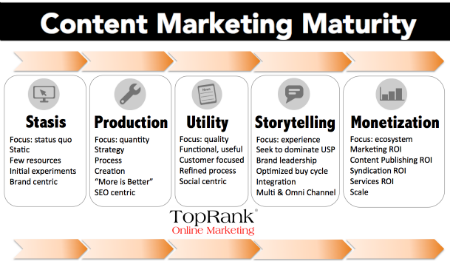
The methodology behind inbound marketing has been presented in many different ways, and in an attempt to illustrate the wide variety of benefits I’m taking a new angle on the matter.

I would like to introduce you to Influence: Science and Practice – Fifth Edition by Robert B. Cialdini (2009).  To provide a brief summary, Cialdini (Professor of Psychology at Arizona State University) takes the reader on a journey through the six principles of influence:

  • Reciprocation
  • Commitment & Consistency
  • Social Proof
  • Liking
  • Authority
  • Scarcity

These principles are examined from both a psychology perspective as well as a consumer behavior perspective. More or less, the principles are six impactful areas to leverage during a brand’s marketing and sales processes.

In this blog, I’d like to share how inbound marketing methodology can allow you to use these six principles to increase sales and assist towards developing the growth of your company.

Keep in mind, none of the principles of influence guarantee increased sales, although they can be very effective due to their reliance on the psychological perspective of basic human nature.

Reciprocation

One of the most widespread basic norms of human culture is embodied in the rule for reciprocation.  The rule requires that one person try to repay what another person has provided.  Cialdini explained that the rule of reciprocation is particularly effective due to three characteristics:

  • First, the rule is extremely powerful, often overwhelming the influence of other factors that normally determine compliance with a request.
  • Second, the rule applies even to uninvited first favors, thereby reducing our ability to decide whom we wish to owe.
  • Third, the rule can spur unequal exchanges; to be rid of the uncomfortable feeling of indebtedness, an individual will often agree to a request for a substantially larger favor than the one he or she received (Cialdini, 49).

A great way to implement the rule of reciprocation into your online marketing strategy is through the use of downloadable content and other offers. With that being said, offer your website visitors free resources such as eBooks, whitepapers, consultations, etc.

Providing prospects with free resources will establish a sense of indebtedness and increase the likelihood that they will reciprocate the gesture with a gesture of their own; generally leading to the purchase of a product or service.

Commitment & Consistency

The second principle is made up of commitment and consistency; the reason for influence can be traced to our basic human nature.  “After making a commitment (that is, taking a stand or position), people are more willing to agree to requests that are in keeping with the prior commitment” (Cialdini, 95).  Therefore, if someone makes a commitment, it will contradict their human nature to change their stance or be inconsistent with their words, beliefs, attitudes, and deeds.

Simply asking, “Are you interested in product/service XYZ?” as one of the required fields to download a particular resource, can secure an initial commitment.  Commitments are especially powerful because people often add new reasons and justifications to support the commitments make.  This plays hand in hand with the desire in most people to be and look consistent as mentioned above.

Keep in mind however, not all commitments are equally effective in producing consistent future action.  Either way, it is a strong influential tactic.

Social Proof

“The principle of social proof states that one important means that people use to decide what to believe or how to act in a situation is to look at what other people are believing or doing there” (Cialdini, 138).  Essentially, people often rely on the actions of others to make decisions.  For example, consistently keeping money in a tip jar actually increases customers’ likelihood to leave a tip.

Social proof can be very effective throughout online marketing through the use of testimonials, case studies, past work, etc.  Illustrate to your web visitors that numerous people have purchased your products/services and were very happy with their purchase.

Often times, the monitoring of review sites are necessary to maintain effective social proof as a principle of influence.  If you have poor reviews about your company living on the internet, especially high traffic, high credibility websites, it is wise to respond to the negative reviews to maintain the integrity of your brand.

Liking

It is no surprise that people prefer to say yes to individuals they know and like.  There are many ways to increase overall attractiveness and likeability through digital marketing.

Increase your online attractiveness through your company’s website and social channels.  Ensure that your website has an inspiring design, is easily navigable, and provides your visitors with all of the resources they need to help them with your purchasing decision.  Transform your website from an outdated brochure site into a confident, charismatic, intelligent sales repthat answers your questions before you have the chance to ask them.

Remember to overlap that same mentality into your social channels as well; maintaining transparency on all digital platforms will be help to further build your online likability.

In addition to the attractiveness of your online presence, work to build a relationship with your leads.  Cialdini states, “Increased familiarity through repeated contact with a person or thing is yet another factor that normally facilitates liking” (172).

This aspect of the principle can be achieved through lead nurturing.  After a lead converts, they should be provided with more resources that will assist them in their decision making process.  Keep in mind, It is important to focus on increasing your likability and providing them with helpful tools and resources, as opposed to shoving a sale down their throat.

Authority

People respect authority! Establish your brand as a credible company built on expertise in the respective industry. You are an expert in your field of work – so tell people! There are great ways to establish your company as a credible source of expert information and thought leadership online.

One of the best ways to do this is to create relevant content and deliver it to your target audience.  Write blogs that will help your target audience solve their problems and learn from you.  As I mentioned above, create downloadable pieces of premium content that your visitors can absorb.  Allow for confidence to bleed into your content and project the voice of a thought leader within your industry.

Scarcity

“According to the scarcity principle, people assign more value to opportunities when they are less available.  The use of this principle for profit can be seen in such compliance techniques as the ‘limited number’ and ‘deadline’ tactics, wherein practitioners try to convince us that access to what they are offering is restricted by amount or time” (Cialdini, 225).

It isn’t difficult to understand the influential aspects the scarcity principle brings to fruition.  There are a lot of companies that could find success by promoting limited time or number offers online.   Such as:

  • 10% off for the month of August!
  • Weekend Sale!
  • First 10 purchases of the month will receive 10% off!

Takeaway

I urge you to look more into these principles and determine the best ones to implement throughout your company’s digital presence. You may find that embracing inbound marketing as a methodology could take your brand to the next level entirely.

Again, none of the principles of influence guarantee increased sales, although they do rely on basic human nature – something I’m willing to adhere to.  Are you?

09 Jul 16:32

Attract, Engage, Convert – How to Better Measure and Optimize Content Marketing Performance

by Lee Odden

Safe is Risky - Tom Fishburne Cartoon

The obstacle in front of most large, or mature companies of any size when it comes to digital and content marketing, is the battle with status quo. From strategy to tactics and especially measurement, change is often seen as interruptive and risky vs. adaptive. But without adaptation, we can hardly evolve, can we?

As Tom Fishburne implies in the cartoon above, change isn’t risky, safe is risky.

Companies evolving from Stasis to Production and into Utility and Storytelling modes of content marketing maturity begin to broaden the scope of what business goals content can deliver for a company.

Because content touches all aspects of business communications, measurement amongst channels, between departments and across target audiences can get complex and even confusing. Part of my job is to simplify the explanation of the chaos that is digital and content marketing. For our readers that are in the midst of evolving their content marketing efforts from quantity to quality to creating better content experiences, here is an easy to understand model for keeping content marketing accountable and measurable.

And heck, if Justin Cutroni, Analytics Evangelist at Google, likes it, it must be good right?

Usually with content marketing, you get goals and measurement lists like this:

Goals:

  • Brand awareness
  • Engagement
  • Lead Generation
  • Lead Nurturing
  • Sales
  • Customer Retention & Loyalty
  • Customer Evangelism
  • Upsell and Cross-Sell

Measurement:

  • Benchmark lift of company awareness
  • Benchmark lift of product/service awareness
  • Cost savings
  • Higher conversion rates
  • Inbound links
  • Customer renewal rates
  • Qualitative feedback from customers
  • Sales
  • Sales lead quality (e.g., sales accepted leads)
  • Sales lead quantity
  • SEO ranking
  • Subscriber growth
  • Time spent on website
  • Website traffic

These are great and certainly better than not knowing exactly what you’re trying to achieve with content marketing efforts beyond making more content to see what sticks. The thing about lists like those above is that they are not really organized according to the experience most companies are trying to create in combination with how buyers discover, consume and act on digital content.

It’s not really a right or wrong thing, but I think organizing measurement closer to the activities that best represent buyer and brand interactions through content will help us better measure content performance. Such organization will also help keep content accountable and reveal performance indicators that allow us to optimize performance at any given time.

Attract Engage Convert - TopRank Marketing

That model I’m talking about is Attract, Engage Convert and it’s a way of seeing content marketing that I first introduced in the book Optimize back in 2012.  It’s like a simplified sales cycle really, because there are three essential questions that need to be answered whenever content is created with marketing intentions.

  1. How will our marketing attract the right audience, right time, right place?
  2. How will we engage members of that audience with the right message, right types of content, media, channels and devices as well as to interact and share?
  3. How will we convert engaged members of that audience to the next stage in the buying cycle, to a lead, a customer, an advocate?

Organizing content marketing programs to be accountable through an Attract, Engage, Convert model answers these questions and empowers content marketers to be far more effective at achieving and communicating program results. What do I mean by Attract, Engage and Convert measurement?

Attract: Any discovery touchpoint: search ranking, search referred traffic, social mentions, topic affinity with social references (concur + expense software or just “concur”), social referred traffic, direct link traffic, mentions on blogs, mentions on media, share of voice for target topics on search and social.

Engage: Content consumption & interaction: page views, media views (image, video, audio), content of a certain type viewed, views of content segmented by topic, number of pages viewed, time on site, return visitors, comments on blog posts, social shares.

Convert: Subscriptions, Sign ups, trials, inquiries – any micro conversion or explicit conversion involving a form that captures information.

By organizing measurement of content marketing performance in this way, there’s a level of accountability and increased contribution that emerges – things that often get lost with content marketing operations with numerous moving parts, stakeholders and objectives.

How are you organizing your content marketing performance? How far have you evolved through the content marketing maturity model?

Content Marketing Maturity

TopRank’s Content Marketing Maturity Model


Email Newsletter Gain a competitive advantage by subscribing to the
TopRank® Online Marketing Newsletter.

© Online Marketing Blog - TopRank®, 2014. | Attract, Engage, Convert – How to Better Measure and Optimize Content Marketing Performance | http://www.toprankblog.com