Shared posts

24 Jul 14:10

What are the cheapest days to fly in Canada? Kayak.com looks at data

by CB Staff

TORONTO – Canadians should look to fly on a Tuesday if they’re travelling domestically or on a Thursday if they’re leaving the country, suggests data from the travel website Kayak, which is looking back on its first year in Canada.

The search engine for flight, hotel and car rental deals crunched the numbers behind how Canadians searched for travel since it launched here last May and found there were fairly consistent trends in pricing.

On average, domestic flights in Canada were cheapest if departing on a Tuesday and returning on a Friday. Flights leaving on a Thursday and returning on a Sunday tended to be most expensive.

International flights taking off from Canada were typically best priced on Thursdays with a return flight on a Monday. Departing on a Monday and returning on a Friday resulted in the most expensive tickets.

“These trends we’re seeing in Canada are not that different from the trends we’re seeing in other countries,” said Debby Soo, a vice president with Kayak, which handles 100 million searches a month.

“Often times you hear that flights departing on Tuesdays are the cheapest and I’ve seen that trend in the U.S. and in some markets in Europe.”

For Canadians looking to squeeze in a trip before the summer is through, Soo said flights to New York, Washington, D.C. and Chicago are all cheaper on average than they were last year, as are flights to Montreal and Halifax.

Flights to Asian destinations including Beijing, Tokyo, Hong Kong, Shanghai and Seoul are up 20 to 27 per cent on average compared to last year, she added.

For those looking for hotel deals this summer, average prices are cheapest for the U.S. in Orlando and Fort Lauderdale, in Edmonton and Ottawa in Canada, and in Prague and Istanbul overseas.

Since Kayak launched in Canada last year, users have most commonly searched for flights to London, followed by Paris, Fort Lauderdale, Las Vegas and New York. Top searches for domestic flights were for trips to Vancouver, followed by Toronto, Calgary, Montreal and Edmonton.

Other tips for booking flights based on Kayak’s data:

— Flying on Saturdays or Sundays can be 15 per cent more expensive

— January is, on average, the cheapest month to fly with fares that can be almost 20 per cent less expensive

— If travelling in the summer, June and July usually have better deals available than in August

— For European travel, look to book a flight between eight to 10 weeks in advance for best pricing. For travel to Asia, booking nine to 10 months out offers the best chance of a good deal

The post What are the cheapest days to fly in Canada? Kayak.com looks at data appeared first on Canadian Business.

24 Jul 14:09

How to Push Down Your Negative Reviews

by TaeWoo Kim

It takes 20 years to build a reputation and five minutes to ruin it. If you think about that, you’ll do things differently.

- Warren Buffett

Let me tell you a little story. Actually TWO.

So korean people have this thing called “gae”.

How to Push Down Your Negative Reviews image rosca diagram 600x331

Gae is basically rotating savins plan. (Also known as tanda among hispanic community).

Here’s how it works.

Say you need $10,000 to start a business or make a big financial investment.

You only have $9,000, but you have 9 other friends who really want to do the same… and they ALSO happen to have $1,000 each.

Ten of you chip in $1k each into a large, one pot of $10k.

You collet the $10k and do your business thing with the implicit agreement that the 10 of you will do this for 9 other times (with each event spanning X months/years), so that all 10 people will eventually get their money back.

This basic form of peer-to-peer crowdfunding has existed HUNDREDS of years even before companies like KickStarter and Prosper has ever existed, because it removes the need for people to rely on banks or have to pay interest just to get help starting a business.

And if done right, it can spur lots of great business because the sum of the few can result in lots of GREAT investments.

HOWEVER… there is a huge problem of trust.

If I can’t trust that everyone ELSE will live up to their financial commitment each and every month, everyone else will back out. Of course, your risk is reduced if you get to collect first.

How to Push Down Your Negative Reviews image broken trust

Let me tell you a 2nd story.

My cousin belonged to one of these “gae” in NYC with a fairly large group of influential korean american NYC business owners.

The organizer, as her/his reward for organizing a tight knit of the group, usually gets to call the 1st shot on when he/she can collect. And of course, people often vote for someone who’s been in business for long time, has good reputation, and is trustworthy because he/she usually chooses to go first.

But this gae was sorta adhoc and they happen to choose a lady that wasn’t very well known, but had best organizational leadership.

And surprisingly enough, this organizer did NOT take first dibs, but not last either. So that made them trust her more.

In a group of 30 contributing $1,000 per turn, the organizer chose to go 4th.

First one, great.

Second one, great.

Third one, great.

Fourth one (when it was the organizer’s turn), great.

Fifth: No one showed up. In fact, all hell broke loose. The circle of blue trust now became the circle of bloody wrath. All that money (in CASH by the way).. GONE.

How to Push Down Your Negative Reviews image funny armageddon

Surprise surprise.. the organizer took the money and ran. Nowhere to be found.. and yes, people wanted blood. People were bitching and complaining.. and most people just accepted the loss of $4k.

The ring of trust was now burned up. So who they go after?

Mr. Lee, owner of many dry cleaning locations who needed money to expand his next operation, was also part of this gae… and was the one who insisted this lady become the organizer.

Even though his dry cleaning business had NOTHING to do with this breach of trust, people started talking.. a LOT.

By default business owners are people of influence. Imagine if 30 influencers in your 3 mile radius talk smack about your business.

Did Mr. Lee’s business survive?

Of course, no one knows scientifically if his bad mouthing really was the source, but Mr.Lee’s dry cleaning (once doing 6 figure revenue each) was eventually sold for pennies to his competitor. I never heard from him again, but last time I heard, he’s at a government senior housing in Queens somewhere.

So what’s the MORAL of the story?

Sometimes SHIT happens to your business and your reputation gets tarnished. And it ain’t your fault.

But with social media, reviews sites, and search engines, that effect can be amplified exponentially.

Just go on Yelp and look at these people’s reviews

1) complaints about things that owners can’t possibly control (like lack of parking.. or prices even when the price sheet listed blatantly against the wall)
2) filtered positive reviews because these online sites at their discretion deemed that they were “untrustworthy” (i.e. paid or biased reviews)
3) completely anonymous, negative reviews that obviously is fabricated (usually from users complaining but afraid of retribution, or their direct competitors)

The list goes on and on. I even interviewed one pissed off dentist Mal Braverman who’s suing Yelp and Tiffany Benitez, bounce house rentals owner who has the worst / stupidest customer complaint story ever.

When someone google’s your business and your business has nothing but 1 star reviews ALL over the search engine results page, the odds of that person becoming a customer, or let alone a lead, is crazy talk.

Sad reality? Indeed.

How to Push Down Your Negative Reviews image speechless jesus

So how do you fight this?

I know this is going to sound hypocritical because I said

1) digital sharecropping sucks and why you should NEVER build up other people’s sites (but only use them as way to generate inbound traffic to your site), but… reviews don’t work if they live on your site

2) some businesses should NOT spend too much time on social media… but see you have a problem to solve, and this is probably a good time to use all possible options

People will assume you made them up if you don’t have nice pretty pictures to validate who they really are. Plus they’re more credible on online review sites because well, that’s what they specialize in.

There are exceptions to every rule, and here are FEW ideas where I am suggesting that you invest into other people’s property.

But remember there are NO guarantees that this will work. You can try and only influence the information gate keepers and in fact, it does work a lot of times… but as with any marketing, no one can guarantee results unless you OWN yelp.com or Google.com

1) Leverage social media profiles

Suppose your business name is “Acme Widgets”.

If you Google “Acme Widgets”, you’ll notice that your website is probably up there somewhere.. along with other sites that have high public visibility.

Usually they are sites owned by Google (don’t be evil *cough cough*) or social media sites like Facebook, Twitter, and LinkedIn.

Make sure you have a “review” section there and ask your past and current customers to leave you on those sites.

  • Twitter
  • Facebook
  • Google Profile
  • Quora
  • LinkedIn

They all have a channel for you to voice YOUR opinion, not just some pissed off customer who’s complaining because their lives are so worthless and meaninglyess that they need to feel good about their pathetic lives by hurting hard working small businesses who actually create value in society (i digress).

2) Leverage Youtube

I separated out Youtube from the list in #1 because YouTube is a monster on it’s own.

Did you know YouTube is now the second largest search engine on the web?

It ranks really high on search engines like Google (*do no evil again, cough cough*) and people actually do watch them when they are relevant.

Here are some topics you should film about:

  • discuss some of the reviews that were negative and what REALLY happened
  • how Yelp and other online review companies are skewing results
  • what other online review sites they should read

On the description, don’t just put random description.

Link out to a page on your website where you talk more about this.

Remember, you can’t “beat” negative reviews, but you can at least shed the light on your side of the story.

Bonus: if you can’t get a celebrity (national, local, or online) to speak on your behalf, the more credibility as well.

(Mr.T and Oprah won’t probably do it, but you can ask anyway.)

3) Encourage your customers to write reviews but don’t blatantly bribe

Yelp says that you should not encourage people to write reviews because it somehow “skews” the reality.

On their blog, they wrote

“Paid Reviews Don’t Have a Place on Yelp”

Or that no one should pay for reviews, because that’s somehow unethical. But how did Yelp grow in the first place?

Though Yelp strives to maintain the purity of its reviews, the company has in the past paid people to write them. CEO Jeremy Stoppelman told The New York Times in 2007 that “there was a time in our earlier days where we experimented with paying for reviews directly in cities outside of San Francisco to help get the ball rolling in our otherwise empty site.”

So… i say this with the utmost disdain & zero respect for these hypocritical “do-good-while-you’re-small-because-that’s-good-PR-but-once-we-get-big-F-U-ALL” and “do-whatever-it-takes-but-you-can’t-do-what-we-do-because-we’re-big” companies…

SCREW their guidelines.

Remember, TOS is made by corporations for the benefit of their shareholders, not us or anyone else.

These aren’t rules. God didn’t come out of the sky and said “obey these laws”.

You’re not hurting anyone by getting legit reviews, so why shouldn’t you? Besides, their supposed “helpful” TOS is killing businesses. If they won’t live up to their code of honor, why should anyone else?

But be careful about “bribing” or “gifting” people to write you reviews because some people (like those losers mentioned above) will STILL complain that you tried to incentivize people to take action.

What works best?

Reward people that you know personally and they LIKE your product or service.

4) Actually ANSWER your messages, tweets, emails & phone calls

Nothing says “i don’t give a shit” more than automated messages.. or worse, NON-replied messages.

If a customer was complaining in front of you, you listen right?

What makes you think you can ignore customer’s messages just because you are separated by computer screens?

5) Meditate

There will come a time when you will WANT to smack someone across the face.

Instead of using that energy to do something stupid, meditate & channel that energy to do something constructive…. like the 4 things I mentioned above.

>>> What NOT to do <<<

1) Start “microsites”

Do NOT start sites like “AcmeWidgetsReview.com”.

First of all, unless you know what you’re doing in terms of SEO, those sites will RARELY rank.

Just because there’s the words “acme”, “widget”, and “review” are there does NOT mean search engines will favor them.

Leverage existing social media sites

2)  Never link to bad reviews

Hopefully if you never ever mention them, they will go away, right?

Wrong.

Instead, have a section on your website (if you have  wordpress installed, use a page, not a post) that use  the keywords ”acme widget review”.

Why?

Because the odds of this page ranking is FAIRLY high since it is relevant to the search query, and it gives you a chance to explain what really happened.

3) Create fake reviews

Come on.. seriously?

4) “Grease” social media influencers to get positive reviews

Actually this tactic works really well, except most social media influencers don’t understand the art of writing and the odds of them sounding normal is fairly low.

How do I know this?

I tried this tactic.

One business I was attempting to “rectify” bad reviews told me that they would try giving away freebies to influencers.

So we gave freebies to few of their customer’s friends who happened to have awesome social media profiles.

Not only did they start out by saying … “let me start this review with the fact that this was a family & friends event” (i.e. they were trying to cover their ass in case Yelp/review sites decide to ban their accounts => as if losing social media accounts is losing something actually meaningful in their life)… their reviews sounded like used car salesmen pitching horse manure.

Conclusion

I don’t have a witty conclusion for this post, because I’m a bit riled up.

But you can tell i’m quite passionate about this… so I’ll end with two notes

1) I’m working on a software service solution to automate a lot of this customer review feedback stuff real time via SMS and email. If you are a business owner / operator / marketer interested in this, PLEASE CONTACT me. I’d love to show you how it works.

2) Most “bad” business owners don’t suffer from bad reviews.. but rather bad integrity. And likewise, good business owners are good because they have good integrity, and this negative review thing is more of a reputation nuisance. As John Wooden said:

Be more concerned with your character than your reputation, because your character is what you really are, while your reputation is merely what others think you are.

– John Wooden

24 Jul 14:08

7 Ways to Guarantee Your Online Success

by Warren Knight

7 Ways to Guarantee Your Online Success image Add subtitle text 300x150

For any online business, you need to always have more traffic to make sure your business is thriving online. Some businesses struggle to plan how they are actually going to achieve online success and through what avenues they will achieve this. Here are 7 ways that will help you guarantee your online success.

1. Have a Sales and Marketing Plan

Having a plan is the first place you need to start when looking at what you want to achieve for your business online. Firstly, you need to look at how many sales you wish to achieve for your business in it’s first year online e.g. £150,000. You then divide that by your potential average order value (e.g. £50) which would mean around 3,000 orders over the year.

You then need to look at how many visitors you would need to achieves these sales, using conversion rates expected for eCommerce (ranges from 0.5% to 10%). Lets say 2%, which means you will need around 400 visitors per day.

Once you have your business model, you can look at your figures to devise a sensible and achievable plan to hit your financial target. Don’t forget to include a list of traffic sources, as you never really know where a customer may find your business online.

2. SEO

Your Search Engine Optimisation is a huge part of achieving sales, especially when it comes to your potential customers finding you through google based on your keywords. There are two types of SEO; Onsite and Off-site.

  • Onsite – Everything on your website including product descriptions, keywords used on your web pages. You will need to write up all of the research that goes into setting up all of this onsite SEO.

  • Off-Site – This will include driving traffic from competitors to social media channels, researching relevant sites to build links, engaging with audiences, bookmarking and article submission. You can hire someone for just €4 per hour to do this for you.

3. Social Media

Having all of your social media accounts sharing the same brand consistency that your website has is vital. As I have said before, you never know where your customer is going to come from so make sure your social media is in check. Set up all of your social networks but focus on one or two until you have mastered them, listen to what your customers are saying, deliver competitions to keep them engaged and don’t forget to use hashtags.

4. PR

PR always has and always will be important to your online business. You first need to approach a PR agency that have the necessary contacts for you to share your business with and have a press release written professionally. Your brand and the campaign message need to be in tune with each other.

You then need to design a strategy to send a press release to a specific journalist to write about in online and offline magazines/newspapers ect.

5. Digital Marketing

Digital Marketing is a huge part of online businesses and without constant work, you may lose touch with your customers. Blogging, email marketing, auto-responders, live chats, surveys are all crucial parts of digital marketing and generating more leads.

If you don’t know whether your digital marketing is successful, make sure you analyse your traffic to see where it’s coming from by using a Social Media Dashboard and also looking at your email marketing analytics (especially if you use Mailchimp)

6. PPC

Pay Per Click is now an important part of online success and if you have some spare cash, I would suggest investing it in PPC but first, make sure you understand how to do it. Make sure you look at Google’s PPC software in detail so you know exactly how to use it. If you are still struggling to master PPC, look at those around you who may know a PPC expert that could be introduced to you on recommendation (like me).

7. Affiliate Marketing

You will now need to look at affiliate marketing as a way to drive more sales. You will need to look at various affiliate marketing companies and chose one that is best suited to your business and the sector it works in. Once you have done this, design and implement a strategy for affiliate marketing and utilise bloggers and online portals with targeted traffic that you can utilise.

Are you ready to guarantee online success for your business?

24 Jul 14:08

Using Referrals and Affiliate Links in Online Business

by Tibor Shanto
CC July 14

The Pipeline Guest Post - Megan Totka

In the past, word of mouth was always considered the best form of advertising for business. The same is absolutely true now, but I’d say that the definition of word of mouth has shifted significantly. Word of mouth now consists of online reviews and ratings rather than actually talking to your neighbor (though that certainly does still happen). Another way that companies have been able to generate revenue from word of mouth type advertising is through referral and affiliate programs.

While affiliate programs are probably what you would think of a more typical sales pattern, referrals are person to person advertising at its finest. Many, many different companies and websites have referral programs now. Studies have shown that people who become customers through referrals go on to be more loyal and profitable than customers that are acquired through other sales channels.

There are really very few downsides to referral marketing. Typically, both an existing customer and their refer-ee are rewarded for giving your company business. Online referral links tend to be more one-sided. The person whose link is followed typically reaps all of the rewards. Some companies that have used referral links really successfully include Ebates, StitchFix, and DropBox.

Affiliate marketing is different from referral marketing, but the two types of marketing to increase sales share several similar qualities. Affiliate marketing allows a business to reward people who drive traffic to their site and purchase their products. For lack of a better term, affiliate marketing can be a little sneakier. Affiliates can bury links to products inside just about anything, from blog posts to paid advertisements. There are even entire “review” sites that are nothing but product plugs and affiliate links. Affiliate links can be great, though, if used the right way. Think of affiliate marketing as earning commission by promoting another company’s product.

Both affiliate marketing and referral programs are good ways to gain new customers – as long as you’re following sales referral etiquette. Referral programs have been popular for years and years, and have a great track record when it comes to acquiring and keeping new customers. Affiliate marketing is a somewhat newer tactic, but can also be considered successful when done right.

Image via Shutterstock

About Megan Totka

Megan Totka is the Chief Editor for ChamberofCommerce.com. She specializes on the topic of small business tips and resources. ChamberofCommerce.com helps small businesses grow their business on the web and facilitates connectivity between local businesses and more than 7,000 Chambers of Commerce worldwide.

24 Jul 14:08

The Latest and the Greatest Advice on Successful Headline Creation

by Michael Bird

How often have you read a headline, deduced the content and moved on? Sadly, that’s something you have in common with about 80% of people who read through articles. Writers put a lot of thought and time into writing articles, but it’s the headline that should be able to hook the readers in. In fact, without a good headline, the contents you’re promoting may be left neglected and ignored, lost in a sea of Google results.

These days, you’ll find that there are a lot of trends when it comes to headline creation. These trends evolve and change based on how the readers respond. It’s important to keep up with these trends, lest you get left behind in yesterday’s passé headline trends. One day, long exaggerated headlines are in, and the next, they’re clichéd and overused. You never know when the tide will turn and all those catchy headlines you came up with become boring.

There are several types of headlines. You’ve probably seen the traditional high-level headline types, whether online or offline. However, as with the theme of changing trends in headlines, there has been a new addition into the field of headline creation that may be more eye-catching.

  • Normal headlines are those that are typical in many printed magazines and in newspapers. They’re straightforward. Examples are “Eggs Benedict Recipe” and “A Recipe for Eggs Benedict.”
  • Question headlines are also standard in many traditional prints, and even online. The question makes the viewer think of how he and she would do something. He or she would then be curious if the article has something new to offer. Examples are “What Are the Most Effective Household Cleaners?” or “What’s the Best Japanese Restaurant in Sydney?”
The Latest and the Greatest Advice on Successful Headline Creation image lifehacker 600x240

Lifehacker‘s how-to headlines on Twitter.

  • How-to headlines make use of the problem-solution approach. It presents the reader with a problem that the article can solve through instructions or detailed explanations. Examples are “How to Get Rid of Pimples” or “How to Create a Pinterest Account.”
  • Number headlines are list-style headlines. They’re very easy to read, which is why they have become so popular. The number gives you an idea of how many items you need to read through. Examples include “10 Items Every Man Should Have in His Closet” or “32 Movies with Hidden Symbols.”
The Latest and the Greatest Advice on Successful Headline Creation image buzzfeed 600x240

Buzzfeed‘s number headlines.

  • Reader-addressing headlines directly address the reader to tell them of something that they need. They usually start with the word “why” such as “Why You Need More Baking Soda in Your Kitchen.” Another example is “Simple Tools You Need to Have in the Garden.”
  • Intrigue headlines are relatively new, and they seek to intrigue readers in order to make them click on a link and read their content. These headlines seek to pique your interest with shock-value language and direct statements. They can question, humor or even offend readers enough in order to make readers so unbearably curious. Sites like viralnova.com and viralquake.com are just some sites that use these types of headlines:
    — These Houses May Seem Perfectly Normal… But Wait Until You Find Their Amazing Secret!
    — You’ve Probably Seen the Human Barbie… But Nothing Can Prepare You For this Picture!
    — 8 Things You’d Never Believe About the Game of Thrones Cast!
    — This Woman Thought She Could Get Away with Cheating… Watch as Her Husband Proves Her Wrong!
    — This Heartbreaking Photo Hides a Sinister Secret… Can You Find Out What it Is?
The Latest and the Greatest Advice on Successful Headline Creation image upworthy 600x240

Intrigue headlines on Upworthy.


Creating Your Headlines

Do you think your site would benefit more from intrigue headlines? Or do you think your audience would respond better to how-to headlines? In order to create the headlines that your audience would click through and read, keep these guidelines in mind:

  • Use your own words. Of course, you’re aiming for unique headlines, but what really matters in the way you use your words in order to express yourself when writing the headlines. Try different combinations of different words. Consult a thesaurus. Write out tons of headline ideas and ask your friends for their opinions. Is your brand image the type that would say the word “delightful” as opposed to “awesome” or “insane?” Does the article call for list-type or how-to type content?
  • Be a leader in your niche. Intrigue headlines are great, but your audience may not respond well to it, particularly if you’re in the more professional field. As with the language you use, you should also find out what your audience thinks is interesting. If you have long-form content, you need to think of ways to make your audience interested. If your content is short, you’d need to come up with a headline that doesn’t reveal too much of what’s in the content.
The Latest and the Greatest Advice on Successful Headline Creation image cern 600x240

CERN‘s own blog on their research.

  • Test out your headlines. A/B testing allows you to check if one headline would perform better than all the others. Oftentimes, you’d have to come up with at least 10 headlines to choose from so that you can use software to determine which of them performed the best out of all of them. In the case of your brand, you can choose numerous combinations, headline types and headline lengths in order to find out which one is the most effective at generating traffic to your site.
  • Imitate the pros. Find out what other people in the same industry are doing with their headlines. Check if they’re using product names, list style content, direct headlines or even intrigue headlines to market their content. See if the headlines you thought would be effective actually generate a lot of engagement when used by other brands. Use the same techniques and you just might beat them at their own game.
  • Keep SEO in mind. Only the first 70 characters of your headline will be displayed when they show up on Google SERPs. With that said, it’s better to keep your headline short. In addition, it would also be easier for you to promote your content via Twitter if your headline can fit into a tweet with an additional call to action phrase.
The Latest and the Greatest Advice on Successful Headline Creation image fastcompany 600x240

Trending articles on Co.Design

24 Jul 14:07

4 Steps to Content Curation for Inside Sales Reps

by Dave Howe

4 Steps to Content Curation for Inside Sales Reps image content curation resized 600

As social sellers, it is imperative that we constantly share valuable information and insights with our networks. This is essentially what separates us from the rest of the sales community. However, clearly there is not enough time in the day for us to be constantly creating brand new content from scratch, nor is it necessarily beneficial to do so.

A healthy content marketing mix involves a significant portion of 3rd party content sharing in addition to original thought-leadership pieces. By sharing content from other sources, you are not only showing your network that you respect the opinions of others in your industry, you are also showing them that you’re well informed on topics that are important to them. For these reasons, it is important that you master some basic content curation skills to ensure you always have an ample amount of information to share with your community of prospective buyers.

Step 1: Create a List

As with many processes in life, gathering a good list of content sources requires a bit of initial brainstorming. Take 15 minutes to compile a list of topics and keywords that relate to the type of content your buyer community will find valuable. These can include product names, trends, industry buzzwords, etc.

Don’t worry about racking your brain for every single possibility. Just focus on creating an initial list of 5-10 topics/keywords to start with. You will be able to easily add new items to this list as you go.

Step 2: Find Content

Now that you have your list of topics/keywords, you’re ready to start finding content sources related to them. The easiest place to start is typically with a search engine like Google or Yahoo. Search for content sources by entering in your topics/keywords one by one along with words like “Blog,” “RSS,” “Newsletter” and “Feed” behind them. That will look something like this: “Commercial Real Estate Blog,” “Cloud Computing RSS,” “Corporate Finance Newsletter” and so on.

Once your search engine begins to return desired results, click on the links that appear to be regularly updated with valuable information and bookmark them in your browser for future use. It is also helpful at this stage to setup Google Alerts for your topics/keywords to make sure you catch any important content sources you did not find in your initial search.

Step 3: Content Delivery

Once you have found your information sources it’s time to setup an easy way of browsing the content. It is important to use content aggregator tools for this process to ensure you don’t spend too much time searching through all this content for a good article. I personally use Feedly because it is very user-friendly but there are lots of other options out there. Choose a content aggregator that you like and add your content sources to it from the bookmarks that you saved in Step 2.

Most aggregators will let you sort your content by topic, which is very helpful if you want to share content on several different topic focuses. Once you have all of your content sources loaded into your aggregator tool, you will be able to easily review tons of topic-specific content from multiple sources in one view.

Step 4: Content Sharing

Here is the easy part: SHARE CONTENT. Now that you have all this amazingly valuable content at your fingertips, share it with your buyer community. This can be done in a number of ways. By sharing through LinkedIn, you can publish to both your LinkedIn and Twitter networks simultaneously.

You can also use social publishing tools like Hootsuite to help you schedule and disseminate your content throughout the week in multiple networks. The important thing is to make sure that you’re sharing content where your buyers will find it. If your buyers aren’t on Facebook, then don’t bother sharing your content there.

Don’t forget to add some insights to your posts as well. It is one thing to share valuable content with your online community, but it is even better to provide some additional insight. Let your network know how you feel about a certain article. This will help humanize your online persona and potentially start conversations within your community. Also, don’t be afraid to be a little controversial from time to time. People often enjoy a good debate, and it can help spark additional visibility.

You’re ready to start sharing! Be sure to add in some original content along with your 3rd party curated content. We recommend the 4-1-1 strategy to anyone starting off in content sharing; that means each week you should share 4 pieces of 3rd party content, 1 piece of original content, and 1 piece of content that displays your personality, such as a favorite quote or funny picture.

4 Steps to Content Curation for Inside Sales Reps image c3dde820 9bca 4f20 af16 ffafeb4db17d

24 Jul 14:06

Three ‘unusual’ reasons you should have sympathy for Canada’s housing doomsters

by Pamela Heaven

BMO chief economist Douglas Porter wants us to spare some sympathy for Canada’s housing bears, who for years have been calling for a crash that has not come.

After all, it’s not that their logic is unsound; the signs are there, says Porter in his note “Sympathy for the Doomster,” which includes a rather clever rendition of the Stones’ classic.

Over the past 11 years average housing prices have doubled despite the recession, mortgage debt has topped $1.23-trillion (a record 60% of GDP) and Canada’s housing market is fully valued by price to rent and price to income measures.

BMO Capital Markets
BMO Capital Markets

But Porter points out three “unusual — and possibly temporary — factors” working to undermine the  doomsters’ predictions.

Extremely easy monetary policy: The lengthy stretch of low rates in Canada has helped offset the increase in prices and keep affordability close to its long-run average, Porter says. “Even some of the housing beats allow that the bubble will not pop until interest rates start rising meaningfully.”

Demographics: Canada’s echo boom has hit the home-buying age (20 to 38 years old), an influx of buyers which Porter says could fend off a much deeper housing correction than feared. But he points out that this remedy has a short shelf life. BMO economists expect demographics to turn against the housing market by the turn of the decade, just when rising interest rates really begin to bite, creating a “potential double-whammy” for housing.

Foreign Buying: Canadian real estate is attractive to global investors on the hunt for safe havens. Though it is hard to say how long this trend will last, a rise in both the BRICS wealth and geopolitical risks means foreign buying could play a big role in pumping up housing prices here for some time to come, especially in Toronto and Vancouver, says Porter.

Not that Porter is about to join the bearish ranks. BMO remains unconvinced the housing market is in a true bubble. Nor does it think policy makers need to step in with a rate hike or more changes to mortgage rules.

“Much like the weather,” Porter writes, “It seems everyone is talking about how hot the housing market is, but (appropriately) no one is doing anything about it.”

24 Jul 14:06

Fresh Insights in Selling to SMBs

by Ruth Stevens

Fresh Insights in Selling to SMBs image yes 238373 1280

Despite the attention given to large enterprise marketing, it’s small and medium businesses (SMB) where the bulk of marketing investments go. SMB is where there’s enough volume to do plenty of testing. You’ve got a tighter decision-making unit and shorter sales cycles. And you’ve got a lot of company. Plenty of agencies, research firms, and other marketers are focused on SMB, and willing to share their insights. One new set comes from Bredin, Inc., a Boston-based agency that just published a new study on how SMBs buy today.

Kudos to Bredin for figuring out how to persuade 532 busy business owners to take a 15-minute survey online, in May 2014. Respondents were asked all kinds of questions about their buying, influences, media preferences, resources, the works. Here are the nuggets that were most revealing to me.

  • These buyers trust their peers more than any other information source, across the spectrum from awareness, to researching product details, to the buying decision.
  • They still rely on trade shows and events for product information–second only to peers and colleagues.
  • They like print materials, for brochures, checklists, handbooks, case studies. When it comes to tablets, they expect to see quotes, order confirmations, videos, interactive tools, and presentations.
  • They want to hear from their vendors, regularly. Not just when they are ready to make a purchase. Encouraging, isn’t it?
  • They welcome email, phone, and face-to-face contact from vendors in the period when they are researching, but not ready to buy—what we marketers call “nurturing.” But the number of nurturing contacts they want varies widely, from weekly, to monthly, to every six months.
  • Most of the time (74%), the business owner himself or herself is the person investigating the new products and solutions, and this is among businesses with up to 500 employees.
  • The vendor website is a top resource when conducting product research and honing in on a purchase decision.

What should marketers take away from these observations?

Thought leadership. Establishing your executives and your company as trusted advisors in your field is hugely important in this market. This means networking, content marketing, PR outreach, speaking engagements, and trade/industry professional activities.

Block and tackle. There are always shiny objects out there, but make sure you have the basics covered. A well-trained sales force, enabled with informative materials, both digital and print, email, phone and trade show support.

Content-rich website. Intuitive navigation, clarity of design, benefit-oriented copy–loaded with explanatory tools like case studies, product comparisons, testimonials, how-to guides, video demonstrations—this is how to attract and serve the SMB buyer.

This fresh data confirms my long-held view that business owners value the help they get from their vendors. Ours is a relationship of mutual benefit, as long as we do our part to help them solve their business problems.

24 Jul 14:05

Is Today’s Definition of Sales Enablement Turning Reps into Paper Pushers?

by Louise Stafford

Your sales enablement program is limiting your reps success. Yep, I said it. Recently, Sales Benchmark Index wrote a blog on the topic of Sales Enablement. In their blog, they reference the following definition:

From the SBI Blog

Here is our more formal definition, broken into 5 Key Components:Is Today’s Definition of Sales Enablement Turning Reps into Paper Pushers? image dreamstime xxl 22009368

  1. Get the right sales content…
  2. into the hands of the right sellers…
  3. at the right time…
  4. through the right channel…
  5. to move a sales opportunity forward.

While they go on to break out these items in more detail, most – if not all – of the pieces came down to content and the various ways to provide that content. Pieces of paper (PDFs), audio recordings, ROI calculators, and then of course a shiny tablet for presentation. This was considered enabling sales to “move a sales opportunity forward.”

Sounds to me like the only thing that is moving forward is your reps ability to inundate prospects with information. Here’s the stark reality – buyers already have access to the majority of the information they need to determine if they have a problem, what that problem is, and what options they have for solving it. There is an assumption that giving a rep the perfect content at the perfect time is enabling them to be successful – and it’s wrong.

You see, the problem with aligning sales enablement strictly with content and content delivery vehicles is that you’re having a one-sided conversation and ultimately reducing your sales reps to paper pushers. The good ones will listen to prospects well enough to put the best piece of paper forward, but what about the art of the conversation? What about the critical thinking that is necessary to really provide value to potential customers?

Let’s go back to the definition of enablement. The dictionary defines the word enablement as:

  1. the act of providing someone with adequate power, means, opportunity, or authority to do something
  2. the act of making something possible

I don’t know about you, but I’ve yet to find a piece of paper that gives me access to power. I’ve yet to find a white paper that provides authority or opportunity. To adequately enable your reps (per the dictionary definition) they will need a variety of other tools, such as scorecards or qualification checklists to ensure that they are investing in the right deals, relationship maps to make sure they’ve gotten access to decision makers and various other items to monitor the health of a deal and really make sure it can be forecasted to close.

This requires critical thinking – and it requires companies to enable reps with dynamic tools to truly assess their sales situations.

And while it is possible that the tools necessary to enable critical thinking CAN be content – that is, pieces of paper or files if you will – organizations then open themselves up to the problem of where to store and keep current this information and how to give visibility of the information quickly and easily to the rest of the people involved in the deal. This only furthers the limitation of success when your reps are tasked with constantly maintaining, searching and pushing files.

So let this blog to be a cautionary tale, if your company’s definition of sales enablement includes the word content – perhaps it’s time to rethink the limitations of your program, because it ultimately means the limitation of your reps to have the meaningful interactions necessary to get deals done.

24 Jul 14:05

How to re-engage lapsed customers using email marketing?

by Expert commentator

A case study of re-activation of lapsed customers with Marketing Automation and Gamification: An email marketing case study from CarDelMar

The well-known marketing rule that investing in acquisition of new customers is six to seven times costlier than re-activating past customers suggests the value of investing in reactivation campaigns. In the omnichannel world we live in,  a wide range of possible methods are available to re-engage those who have lapsed, or if you prefer, are ‘churned’ buyers. Among the most effective methods is surely re-activation by email marketing. In this case study we present how optivo helped the German online car hire broker CarDelMar with an automated reactivation campaign, which was designed and carried out using the software of email marketing service provider optivo.

The challenge of inactivity

Previously, CarDelMar had been sending out fortnightly newsletters with information on exclusive discount campaigns, useful tips on booking reservations and introductions of new rental agencies. As is usually the case with new relationships, the beginning is “all roses”. Subscribers are excited about pretty much anything that was sent their way and the opening and click-through rates are correspondingly satisfying. But the honeymoon period is soon over, the spark is gone and the interest begins to wane. More and more subscribers simply stopped opening the newsletter after some months of subscription. Sounds familiar? This is a rather common occurrence in the email marketing industry; the opens naturally trail off and clicks fade away over time. However, with a well thought-out re-activation strategy you can prevent growing apart from your customers and remind them again that you are truly unique.

An automated project with a conceptual approach

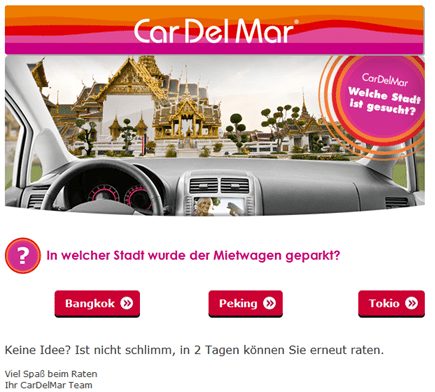
The main objective for the project was to re-engage no longer active subscribers. We developed a campaign with three main areas of focus, that is: visibility of the campaign in the inbox, a multilevel approach and some attractive content. The resulting idea was a multilevel gamified campaign that picked up on the company’s slogan “Compare Cheap Car Hire Worldwide” and is called “CarDelMar world-tour”. In this case subscribers are invited to choose one of three continents to travel to. After choosing the continent of choice, the subscriber sees a photo of a tourist attraction and has to guess which city it is located in.

CarDelMar_Bangkok

Sprucing up the campaign with the mechanics of fun

Strategically implemented game mechanics can help to engage both enthusiastic and even passive subscribers better. The concept of adding some fun to communications in order to grow user interaction of course is not new, but the idea of “gamification” takes reward-based engagement to a higher level. Ideally, a nice incentive is included, to make your customers’ efforts worthwhile. CarDelMar’s reward for correctly guessing the city the car is travelling through, was a chance to win a free car rental for one week – an attractive prize, which ensures a higher likelihood of customer engagement.

A multilevel approach for optimal results

The car hire broker’s campaign includes altogether seven mailings, depending on the reaction of the subscriber as well as automatically sent reminders, follow-up mails and a confirmation mail for the participation in the sweepstake for the free car rental. That way you can assure that the subscriber will notice not only the game-related mailings but also the following regular newsletters.

CarDelMar managed to run a highly targeted and automated campaign parallel to regular communication. A five month inactivity period can be used to switch the subscriber from receiving regular communication to receiving the re-activation campaign. Thanks to transaction emails and target groups the only effort that needs to be done is to regularly announce a winner of the prize, everything else runs automatically.

Immediate effect through targeted emails and regular testings

The re-activation campaign from CarDelMar proved to be a success right from the start: With the correct approach, a clever email marketing software and the right incentive, CarDelMar was able to reactivate 7% of all initially inactive subscribers. Furthermore, the gamification emails achieved an opening rate of up to 62%, which shows the effectively implemented playful component, the value of using an attractive incentive and the effect of a multilevel approach.

Kristina Sievers’, Online Marketing Manager at CarDelMar, commented on the successful campaign saying: “We are very pleased to have been able to re-engage so many inactive recipients using an automated re-activation campaign. optivo provided us with first-rate support, in the form of the crucial and precisely tailored marketing automation software.”

International acknowledgement

Besides achieving remarkable results in numbers, CarDelMar’s campaign also attracted attention from the renowned US-based marketing research firm MarketingSherpa. They awarded it with the top prize in the category “Build and Cleanse-Ecommerce” as part of the prestigious “MarketingSherpa Email Award”.

Thanks to Ulf Richter for sharing their advice and opinions in this post. Ulf is co-founder of email marketing software provider optivo and is responsible for the divisions Sales, Marketing, Support and International. He founded optivo together with Peter Romianowski in 2001. Stints at multimedia service provider Aperto and Bertelsmann also count among his previous professional experience. You can follow optivo on Twitter or LinkedIn.
24 Jul 14:05

9 Pillars for a Killer Content Marketing Strategy

by Nelson Dias

9 Pillars for a Killer Content Marketing Strategy image upload 1405323122 77866447868610a4fb91o 600x409

Image source

Would you like to generate more leads, sales, and business? Want to improve conversions and effectively establish your brand? Two words: content marketing.

Maybe these stats will help convince you…

  • 80% of American Internet users interact with blogs and social media.
  • 70% of people would rather learn about a company through articles than through ads.
  • 90% of consumers find custom content useful.

Oh, and let’s not forget that marketing with content costs you about 62% less than traditional marketing (you can see all the statistics here).

Here’s the thing about content marketing, though… you need a killer strategy! Here are nine steps to cementing one that empowers both your customers and your brand.

1. Zoom in on the Audience You Want to Attract

When marketing with content, the goal is usually to preserve your current customer base and reel in new consumers. Knowing how to connect with these intended audiences is the foundation of an effective content strategy.

The best approach is to view your audience as people, rather than statistics. What are they interested in learning? What are they specifically searching for online? What problems do they have? Answering these questions is the first step to success.

2. Identify the Relationship Between What You’re Teaching and Selling

To expand the reach of your products or services, the content you deploy must be interesting and relevant. The information should strike a chord with readers emotionally, intellectually, and/or in terms of practicality.

For example, if you sell a culinary product, the content could reflect the many meals that could be prepared using it. You could include recipes for nostalgic comfort foods, engaging emotions and intellect and presenting the product as uniquely useful.

3. Focus on Content Integrity

Consumers are smart and can differentiate solid information from spam. The latter can hurt your business. Consumers will avoid spammy material, whereas they will hold your company in high esteem if you prove to be authentic.

Your best bet is to hire subject matter experts who can shape your message into one that reflects your brand while educating readers. If you can’t afford to outsource to professionals, make the time and create high-quality content yourself.

4. Define the Voice of Your Content

Your content marketing strategy should be just one layer of your overall marketing campaign, which can include anything from television commercials to ads on social media. Everything under the umbrella of your campaign should be synchronized.

The content pieces you put out should never contradict any other brand messaging, or your main objective. Rather, each promotional aspect should strengthen the other by reaffirming your company’s overarching purpose.

5. Be Consistent

When creating your content strategy, be sure to decide on the frequency of your content and stick to it. Your readers, once engaged, will expect to receive information from you on a steady basis. If this doesn’t occur, they will disengage.

Being consistent is the hallmark of a successful business in general. Everything from the quality of your products to the production of your content should be reliable. This will give you credibility needed to position your brand as an industry authority.

6. Use the Right Channels

The best channels to utilize tie back to your audience. If your services are geared toward senior citizens, a hard copy newsletter might be their preferred medium. If you are focused on a younger crowd, social media may be best.

Promoting your content on social sites like Twitter can make it go viral. If the content is what readers are looking for, they won’t hesitate to share. Quick Sprout’s guide to content marketing offers more details.

7. Plan Way Ahead

To be consistent, you will need a long-term editorial calendar. Once you establish the frequency of your efforts, determine the topics you want to tackle as far ahead as possible. This gives your subject matter experts time to gather information.

One should bear in mind, though, that it is impossible to fully predict the future. You may have to change a topic at the last minute based on a current event. Trends might change in a way not forecasted. Be prepared, yet flexible.

8. Leverage SEO

A solid content marketing strategy geared toward the right audience is pointless if it doesn’t reach this audience. Search Engine Optimization (SEO) is one of the best free ways to get valuable prospects to your web pages.

SEO involves incorporating keywords that consumers search for into your material. This way, your content will show up in search engine results and reach the computer/tablet/smartphone screens of your target audience.

9. Never Stop Collecting Data

Intelligence gathering doesn’t stop when you identify your audience. The world keeps evolving, and so should your business. Keeping abreast of trends and stats ensures that your content is relevant at all times.

Additionally, it’s important to track what the competition is doing. After all, they could be rounding up your customers. To measure content metrics, you can use programs like Google Analytics. Use online tools to see what competitors are up to.

Does your business have a content marketing strategy? Which pillar has had the most profound effect on your success? Share your thoughts below.

24 Jul 14:04

LinkedIn Adding Location-based Updates in New Mobile App

by Leah Weisman

While LinkedIn is a great social networking channel for professionals, it isn’t quite as feature rich as some of its counterparts, like Facebook or Twitter.

One feature that LinkedIn designers Mauroof Ahmed and Moses Ting are planning to add is a location alert not unlike that of Foursquare. This comes on the heels of the release of LinkedIn’s more interactive-focused app, Connected.

What’s the Real World Application?

There is a lot of potential in this feature. Ahmed said that “one of the things that we’re going to be looking into is the idea of conferences.”

If two connected users who use the new LinkedIn mobile app are in the same vicinity, they will both receive a notification. This could enable them to reach out each other and build their relationship.

Location alerts can be powerful for sales teams who are looking for introductions to certain leads. If you’re at a conference, for example, you could find out which of your LinkedIn connections are there and then plan meetings or outings.

Connected is currently only available on iOS right now. The goal of Connected is to further push users to engage on LinkedIn. The app has everything LinkedIn normally sports: a news feed highlighting articles, job changes, work anniversaries, and birthdays.

What makes Connected different is that users can sync their contacts and calendar, and Connected will send push notifications with “intelligence” and reminders prior to meetings. This intelligence could soon also contain location-based information.

LinkedIn Adding Location based Updates in New Mobile App image linkedin connected 100355597 orig

LinkedIn can be a great marketing and sales tool, but it’s all based on personal relationships that you form. Find out more about how to get the most out of LinkedIn.

What do you think of LinkedIn’s new push notification app, Connected? Do you think location-based notifications will bring value?

24 Jul 14:04

5 Ways to Add Interactive Content to Marketing

by William Comcowich

5 Ways to Add Interactive Content to Marketing image Magnum Pleasure Hunt6 600x374

Content marketing is becoming less about the words you put on a page, and more about the experiences you create for the consumer.

As more brands realize this, they’re working with tools that foster real interaction from page visitors. Interactive content doesn’t just encourage action from visitors — it responds to them.

What is Interactive Content?

Interactive content is anything that requires participants’ active engagement – something more than simply reading or watching.  In return for their engagement, participants receive real-time responses and information.

Early adopters of interactive content marketing have used online quizzes, calculators, surveys, white papers and infographics. The power of interactive content marketing lies in its ability to engage and involve the consumer — and leave them wanting more. According to SnapApp’s white paper, What Is Interactive Content and Why It Works, interactive content is proven to generate leads, build prospect profiles and drive more sales. It’s a tactic both B2Bs and B2Cs can employ.

Types of Interactive Content

The goal of interactive content is to deliver a unique personal experience, Nicolette Beard explains in Content Marketing with Interactive Tools: Pros, Cons, Examples & Best Practices. Content that enables user input and produces customized output can be very effective — as can content that simply answers questions or facilitates a process.

Consider the following types of interactive content and determine which may be most effective for your brand’s audience and budget:

Calculators

Allowing prospects to calculate the value of using your products can help them move to the next step of the buyers’ journey. Calculators can also capture important customer data that contributes to your target audience’s profile. They’re a tool that keeps customers coming back to your website.

One of the earliest custom calculators was a handheld Oncology Dosage Calculator, developed by UltiTech, Inc. for Burroughs Welcome Co. in 1993. (Full disclosure: CyberAlert Blog editor William J. Comcowich is CEO of UltiTech, Inc. as well as CyberAlert.)

The calculator enabled physicians to select an oncology regimen and then easily calculate the dosages of individual drugs in the multidrug protocols based on the individual patient’s height, weight and body mass. The physician could also store the regimen for future reference. Similar medical calculators are now available online or in smartphone apps.

The financial services company Bankrate developed a refinancing calculator to help consumers determine whether they should refinance their mortgage (and use Bankrate’s services down the line to help them do so).

5 Ways to Add Interactive Content to Marketing image Bankrate Calculator3 537x600

Brackets

Brackets pit consumers against each other in a set of rounds until a winner is announced. They competitive games build long periods of engagement — and motivate customers to “beat” the other teams.

While brackets are most effective during major sporting events, brands can use them at any time of the year. Tools like Brackify enable brands to create interactive voting brackets and customize other voting details. Here’s an example from BostInno, a local tech news site in Boston, which encouraged Bostonians to vote for the company they thought would be the most valuable in five years:

5 Ways to Add Interactive Content to Marketing image BostInno Bracket3 553x600

Quizzes

Tests and quizzes both educate and entertain your audiences. They also provide information about your target audience and encourage the audience to share their results with friends and family.

Quizzes are becoming increasingly popular on viral sites like BuzzFeed — in fact, “Quizzes” now have their own category on the listicle website. Check out this quiz from BuzzFeed that enables visitors to find out which X-Men villain they are most related to:

5 Ways to Add Interactive Content to Marketing image X Men Quiz3 453x600

The key to an effective quiz is to relate the content to a timely topic, well-known places or celebrities. For more tips on creating quizzes, visit Marketing Tips for Creating Quizzes That Engage Your Audience.

Games

Gamifying content requires a larger marketing investment, but the engagement and attention it gains is usually worth it. Consider Magnum Ice Cream’s Magnum Pleasure Hunt, a flash-based interactive game that went viral. More than 7 million people visited Magnum’s website to play the game, prompting two sequels and tons of reach.

5 Ways to Add Interactive Content to Marketing image Magnum Pleasure Hunt7 600x374

Tip: keeping track of gamers’ scores and allowing them to share scores with friends can help the simplest of games drive extraordinary reach.

Infographics

Infographics are always effective — even more so when they respond to the users viewing them. One of our favorite examples is The Scale of the Universe, which illustrates the vastly different dimensions of animals and objects in the universe. Visitors can scroll in and out to see how the size of a grain of salt compares to an ant, to a human, to a Boeing 747, to the State of California, to the Earth, to the Milky Way…and so on.

5 Ways to Add Interactive Content to Marketing image The Scale of the Universe3 600x335

One of the most difficult challenges for content marketers is to attract — and keep — consumers’ attention. Interactive content stands out from “passive content” and transforms content into a memorable experience.

This article originally appeared on the CyberAlert Blog.

24 Jul 14:04

Ten of the Best Marketing Time-Savers

by GetApp

Ten of the Best Marketing Time Savers image Marketing Automation Is It a Sales Or Marketing Tool 600x317

How do I find the time to manage all my online marketing campaigns I hear you cry? Planning an adventurous, multi-level, fast-paced online marketing campaign is essential to your business success, but how do you find the time to manage it all? That is where marketing automation software comes in. Platforms that allow you to complete repetitive jobs in no time at all, plus the ability to:

  • Increase employee efficiency
  • Improve brand continuity
  • Manage your customers and your staff
  • Generate leads and nurture those leads to your advantage
  • Manage your email and social media campaigns with ease
  • Keep on top of your analytics
  • Measure your ROI
  • Predict your future revenue.

Here are ten fabulous marketing time-savers for you to choose from:

Ten of the Best Marketing Time Savers image infusionsoftInfusionsoft

Infusionsoft is a sales and marketing automation platform rolled into one. It allows you to manage your social media marketing across several networks including: Facebook, Twitter and Google+. You can create, manage and automate your email marketing. Create E-Commerce shopping carts. Use lead-scoring and analytics to measure your success.

Special Features:

  • Marketing automation
  • E-Commerce
  • Social sharing
  • Web forms and landing pages
  • Email marketing
  • Marketing reports
  • Payment processing
  • Lead scoring

You can register for a FREE demo to try them out.

Ten of the Best Marketing Time Savers image infusionsoft screenshot


Ten of the Best Marketing Time Savers image exacttarget2ExactTarget

ExactTarget is marketing cloud based software, part of the Salesforce platform. With ExactTarget you can manage and monitor your web, mobile, social media and email campaigns all on one simple-to-use platform. As a customer focused app, it allows you to connect, engage and optimize your customer experience.

Special Features:

  • Intuitive interface
  • Advanced content management
  • CRM and cross-channel integration
  • Sophisticated automation solutions
  • Pre-built templates and themes
  • Predictive analysis

Request a demo for ExactTarget.

Ten of the Best Marketing Time Savers image exact target screenshot


Ten of the Best Marketing Time Savers image pardot1Pardot

Pardot is another sales and marketing focused software platform, also part of the Salesforce ecosystem. It enables you to bring in line your marketing and sales automation to drive your brand, track your interactions and prioritize your time. With automated lead nurturing, fabulous analytics and easy-to-understand reports you can truly keep on top of your marketing campaigns.

Special Features:

  • Lead nurturing
  • Landing page and form builder
  • Salesforce, SugarCRM, Netsuite and Microsoft Dynamics integrated
  • ROI reporting
  • Prospect tracking
  • Social post scheduling
  • Social share buttons
  • Google analytics connector

Ask Pardot for a FREE demo.

Ten of the Best Marketing Time Savers image pardot screenshot


Ten of the Best Marketing Time Savers image evergageEvergage

Evergage is a little different. It allows you create personalized user experience on your website to generate conversation. You have the ability to track your customers and respond to them in real-time. It automatically creates responses based on customer behavior on your website or app.

Special Features:

  • Measurement of customer engagement
  • Personalize lifestyle marketing
  • Real-time in-app messaging
  • Salesforce integration
  • Action analysis

Ask Evergage for a FREE demo.

Ten of the Best Marketing Time Savers image evergage screenshot


Ten of the Best Marketing Time Savers image salesformicsSalesformics

Salesformics is a simple-to-use system merging a great CRM with automated marketing. It only takes minutes to set up and you can be up and running with no training or tutorials. It allows you to manage your accounts, social media networks, online marketing and automate your sales. It is integrated with Twitter, LinkedIn, Buffer, Dropbox and many more.

Special Features:

  • Sales and marketing automation
  • Instant feedback and insights
  • Easy set-up
  • Unlimited contacts
  • Unlimited accounts
  • Point-and-click segment marketing

Sign up for a FREE trial of Salesformics.

Ten of the Best Marketing Time Savers image salesformics screenshot


Ten of the Best Marketing Time Savers image OktopostOktopost

Oktopost is a social-driven, social media marketing app which allows you to share your content in multiple platforms on a large scale. It is designed specifically for a B2B market which makes it unique. You can measure your ROI of your social media marketing by following your leads back to a specific post.

Special Features:

  • Campaign calendar
  • Campaign analytics
  • LinkedIn group insights and multiple posting
  • CRM integrations
  • Web browser plug-in
  • Post scheduling (one-time or repeating)
  • Social monitoring

Check out Oktopost’s FREE trial.

Ten of the Best Marketing Time Savers image oktopost screenshot


Ten of the Best Marketing Time Savers image sales and marketing proSales and Marketing Pro

Sales and Marketing Pro is a CRM platform which enables you to create sales plans, marketing strategies and measure your success. You can create web pages and design logos alongside making a great marketing plan. You can also manage your email marketing campaign from this platform.

Special Features:

  • Sales forecast calculator
  • Online CRM
  • Sales plan creator
  • Social media guide
  • Marketing plan creator
  • Logo design
  • Email marketing

Ask for a free Sales and Marketing Pro trial.

Ten of the Best Marketing Time Savers image sales and marketing screenshot


Ten of the Best Marketing Time Savers image hubspot1HubSpot

Hubspot has a strong SEO optimized system which allows you to be found by more people. With amazing lead conversion it helps to convert those leads into sales and is an easy to use system for those without any tech knowledge. It includes easy-to-use tools to channel your online marketing campaigns and automate your content sharing.

Special Features:

  • Blogging tools
  • SEO tools
  • Social Media tools
  • Multi-channel analytics
  • Behavior-driven communications
  • Lead-nurturing
  • Webinars and e-books

Watch a FREE trial of HubSpot‘s services.

Ten of the Best Marketing Time Savers image HubSpot Product Overview screenshot


Ten of the Best Marketing Time Savers image ion interactiveion interactive marketing apps platform

ion interactive marketing apps platform does what it says on the tin pretty much. It is a marketing app making platform which helps you to manage your marketing campaign by generating leads and revenue. It is an easy-to-use app maker, with no coding needed to provide shareable content for your customer base.

Special Features:

  • Cost-effective app creation
  • Logic engine for targeting and personalization
  • Responsive web design
  • Mobile optimization
  • Code-free form builder
  • Real-time reporting and analytics

Have a look at what Ion does.

Ten of the Best Marketing Time Savers image ion screenshot


Ten of the Best Marketing Time Savers image simplycastSimplyCast

SimplyCast covers all bases for any marketing campaign. It is a multi-channel platform covering all the usual marketing platforms plus quite a few more. With form builders, landing page generation and online survey creation as part of a long list of tools, it is a serious platform for serious marketers.

Special Features:

  • Facebook and Twitter integration
  • Survey marketing
  • Event marketing
  • Fax marketing
  • Email marketing and list management
  • Landing page generator
  • Survey creator
  • Blacklist monitoring

Request a demo of SimplyCast.

Ten of the Best Marketing Time Savers image SimplyCast screenshot


Don’t see exactly what you want above? The GetApp marketplace helps you to find the marketing automation software platform to suit your business needs. Our fantastic directory lets you search for your priority requirements such as operating system, platform, price etc. You can even compare these apps side by side or read real user reviews from folks like you!

24 Jul 14:04

What To Do When Your LinkedIn Ads Aren’t Producing Leads!

by Cody Goolsby

What To Do When Your LinkedIn Ads Arent Producing Leads! image help my linkedin ads arent perfoming

So you’ve set up your LinkedIn ads and you realize they aren’t producing leads. But why? There could be a number of reasons why and in this article we will discuss how to find the hole in your strategy. We will cover some strategies around writing your landing page and building your audience, but first let’s start with ad creation.

Advertisements

Fear is an excellent opportunity for marketers to profit on. How, you ask? Fear is what drives us all. It is what makes people step out from the norm and do something different. It’s what pushes people to look for answers. And it’s what marketers can use to attract clicks.

Maybe your ads aren’t offering what your target audience is looking for. They are looking for solutions to their fear (or problems). Does your ad offer a resolution to a problem? If not, then maybe that’s why your ads aren’t performing. You need to be offering something your audience finds valuable and then you can build your ads around these pains. Hit the pain-points and you might just strike a chord that causes your audience to click an ad. Know the fears of your audience and capitalize on them.

Landing Page

Anybody can get clicks on LinkedIn, but can you get conversions? Everybody hates the ol’ bait and switch marketing tactic and it just doesn’t work when it comes to online marketing. Why am I talking about this strategy? Because many people create LinkedIn ads that don’t match their landing pages. This is a strategy for disasters… Disasters called bounces! They create a great ad, but then when the user reaches the landing page, the visitor feels as if it isn’t the offer they bargained for. So are your LinkedIn Ads and landing pages cohesive? If not, then this might be the main reason your clicks are not converting. If the audience feels as if the page doesn’t match the ad, they’ll just leave your page without a second thought. Then you just paid for a click that didn’t even convert. Not very cost effective!

Audience

Hopefully you have already taken a deep dive into your target audience and decided who they are and what they want. If you haven’t done this, then this is problem #1 as to why your LinkedIn Ads are not performing. Make a list of the types of clients you want and the decision makers of these clients. This is a great place to start when creating ads for LinkedIn.

Now that you know the potential clients you are targeting and their decision makers, start building out a plan around them. There are a couple different strategies you can use when filling out your LinkedIn plan. First, let’s take a look at how you target the right companies and then we can look into the positions.

LinkedIn gives you two options for targeting companies. First you can target companies by the industry they fall under. This is an effective strategy if you have a broad industry and don’t have any specific client targets.  And the second strategy is to target specific companies by name. This works when you have a list of top clients you want to target. Test both of these strategies, if you can, and see which one works the best. Remember it’s not about clicks…. It’s about conversions.

Next you need to decide who you want to target within that company. LinkedIn gives you the ability to place specific job titles to advertise to or you can choose a range of titles by either the function they fall under or their seniority.

The more specific you go, the smaller the size of your potential audience. This will only become a problem when you are not getting the click throughs you want. So maybe your LinkedIn advertisements have no impressions, this is when you may need to adjust your advertising to include a broader range of titles or companies. This will increase your overall audience, which leads to more impressions and hopefully more clicks!

Improving LinkedIn Ads

Creating the perfect LinkedIn ads can be difficult, but possible! Due to the unique targeting options, LinkedIn is great for B2B businesses, but that is only if your ads perform. So make sure you are targeting the right audience with the perfect ad and a matching landing page. If just one of these three factors are wrong, it could lead to an epic LinkedIn advertising fail!

What To Do When Your LinkedIn Ads Arent Producing Leads! image a30a9a4c 607b 41ae aaf6 b49a6f31e1b72 600x194

24 Jul 14:04

6 Tips To Be A Successful SDR (From The Head SDR At A Company Focused On SDRs)

by Sean Kester

SuccessfulSDRheader

I’ve on-boarded plenty of new sales development reps. They’re all motivated, willing to learn, and usually full of questions about how to succeed.

I always share the same sales development tips.

If you can master the list below, you will undoubtedly become the best rep in the world- in all of humanity :).

Here are the six most important things you can do to improve:

1. Be An Expert Of Your Product

You should know, live, and breathe best practices.

If it means messaging your CEO with product questions at 10 PM, do it. It will help you learn more about your product and your space so you can help other people.

I think about it this way:

You can’t sell something until you are sold on it.

You need to have a confident explanation for purpose and benefit of your product. To believe in its value 100%.

You’ll never be able to get someone else to buy something if you aren’t convinced yourself.

2. Implement A Strong Process

Sales development is repetitive. Reps spend their time building lists, calling and emailing, and scheduling demos with closers.

As with any task that demands repetition, it is centered around having a killer process. I introduced a 7×7 strategy to SalesLoft, using 7 defined touches (via email or phone) over seven days.

7x7CadenceGraphic

Using a specific strategy allows reps to increase their efficiency and remove monotony from their day-to-day tasks.

3. Ask The Hard “Off-The-Wall” Questions

If you haven’t reached a point where you feel as though you’ve pushed the limits, you’re not asking the right questions. Rick Roberge does a great job of explaining it.

The essence of the idea, is to make sure you understand a company’s goals, with questions like:

  • Are you not trying to grow your team?
  • I noticed you didn’t hit all of your key goals last quarter, what will you do to change this one?

While they’re personal, questions like this give you the opportunity to say:

QuotesGraphic

Even more so, it helps you understand what you can do to help. Whether or not they agree, you now get to say:

“I didn’t mean to cross the line (or upset you or make you angry).

If we continue to talk, you’ll figure out that I’m not a slick salesman and I really love what I do. I’m passionate about it, good at it, and my clients learn to trust my advice. If I see it, I typically say it and we don’t waste time. I apologize. We don’t know each other well enough and I went too fast.

Should we not talk anymore?”

4. Listen!

Listening is your greatest ally. You can uncover the “keys to the castle” by asking smart directed questions.

The best advice I give new reps is to ask planned, direct questions and then stop. Let your prospect’s talk the rest of the time, only injecting questions to help them realize your product has value.

Most people think “selling” is the same as “talking”. But the most effective salespeople know that listening is the most important part of their job. -Roy Bartell

5. Use Professional-ish Creativity

Inject humor as you provide value.

Using humor right can have great results (seriously, there’s psychology behind it). The email below gets the most responses of any of my outreach.

ASDF

Whatever you do, stay conversational. Don’t start out pitching your pushing your product.

6. Realize The Importance Of Timing

Stay on top of new leads and be dedicated to following up in a timely manner. If they’re inbound leads, respond as quickly as you can to when they’re generated. Even when they do not respond the first time, be consistent and persistent in making sure you get the prospect on the line.

Be careful not to push too hard when the timing is not right.

There’s a fine line between challenging and pushing, and you need to own it.
-

Is there anything else you believe should be on this list?

As always, let me know how I can help.

24 Jul 14:04

Sales and Marketing Alignment Equals More Revenue

by Brian Serino

Sales and Marketing Alignment Equals More Revenue image marketing and sales alignment resized 600

We’re all familiar with the deep-rooted battle between sales and marketing. It goes something like this: sales blames marketing for their inability to produce quality leads, while marketers fault sales for their lack of lead management skills. In this battle, however, there is no winner, because when sales and marketing teams work individually, poor lead management results on both sides.

In fact, organizations that establish strong alignment between their sales and marketing teams achieved 20 percent annual revenue growth compared to companies with poor alignment, which experienced a 4 percent decline in revenue, according to a HubSpot report titled, “The Complete Guide to Unifying Your Sales & Marketing Efforts.”

It’s no secret that your inside sales team will close more deals when funneled high quality leads. However, in order to create an effective lead generation process, the two departments must be on the same page from the very beginning. Below are some tips to help better align sales and marketing.

  1. Set a common end goal: While each department has its own set of goals, it’s important to establish a common end objective. Revenue is an important metric to measure, but also focus on engagement, connections, and quality conversations. At the end of the day, the goal for both marketing and sales is to drive more success for their company.
  2. Define your ideal prospect: Before marketing can deliver quality leads to sales, both departments must work together to define what constitutes an ideal lead and how leads are scored. Doing so helps ensure that the marketing team is attracting the type of leads your sales team wants.
  3. Make lead scoring a collaborative process: A lead scoring model is very flexible; therefore it should be consistently tested to make sure that it is accurately sending over the best MQLS. However, this can only happen when there’s an open line of communication between the marketing and inside sales teams.

Sales and marketing alignment is crucial to organization success. So take off the boxing gloves, make nice, and follow the tips above. Trust me, your bottom line with thank you.

Sales and Marketing Alignment Equals More Revenue image 69c62658 77fa 4737 a984 8789b256e91e2

24 Jul 14:03

Sales Pipeline: What it Is, Why You Need it and How to Start

by Didi Zheleva

If you want a nicely polished article full of fluff about Sales Pipelines, this is not it. It is polished and pleasing to the eye, but this is a no muss no fuss, straight forward, answering-your-questions-directly article. So if you need a quick rundown of what is a Sales Pipeline, keep on reading.

What is it?

In simplest terms, a Sales Pipeline is a systematized approach to selling which has clearly defined steps and it looks to estimate our upcoming revenue and sales you are looking to close.

To expand a little bit, a Sales Pipeline (or sales funnel or sales cycle) is a method of navigating leads through the different stages from the first contact (either when they show interest in your product or when you approach them first) to closing the deal or sale.

Sales Pipeline: What it Is, Why You Need it and How to Start image PIPELINE VIEW EDIT 600x378

A Sales Pipeline

Do I need it?

Absolutely, 100% a very firm YES.

Sales Pipeline: What it Is, Why You Need it and How to Start image shutterstock 154308860 300x200Why do I need it?

Very rarely would a customer approach you and buy from you straight away. Depending on your product or service, your business and the industry in which you operate, the whole process can take anything from a week to a few months. A research conducted by the National Sales Executive Association concluded that it takes between five and twelve interactions with a prospect before they buy.

A Sales Pipeline fully integrates this concept by having different stages and providing a clear view for the sales team where a lead is in their process. Every stage is clearly defined and it has a set of actions thus making the sale process more systematized and efficient.

For example, during the first stage of the process when the prospect first approaches your business, what do you do? Do you hope for them to buy or do you have an approach that would pull them further down the sales funnel? For example, you can send them a white paper outlining the benefits of using your product, invite them to a webinar, follow up with them and answer any possible questions. This is what a Sales Pipeline is all about, having a better working systematized selling strategy.

Some of the benefits of having a Sales Pipeline include:

  • Better understanding of the sales process
  • More efficient and effective sales strategy
  • A clear view of all your leads and where they are in the sales funnel
  • Closing deals in less time with less effort for less money

How do I start?

You can follow this useful guide, but here are some brief instructions:

  • Invest in a good CRM tool that will house a database, email marketing, reports, a Sales Pipeline and many more features. Make the most of a fully integrated tool for a guaranteed efficiency and effectiveness
  • Look at your sales process objectively and clearly define the different stages of your sales cycle. What can you do to facilitate the customer journey in terms of follow up and content?
  • Evaluate – even the best Sales Pipelines could be optimized. Every few months take a step back and look at your Pipeline and think of ways you can optimize it (make it more efficient, more effective and the customer transition from one stage to another smoother).

I hope the answers to the above questions would help you with your own Sales Pipeline. Need a software to do the job? Why not try InTouh (our Sales Pipeline feature is coming very soon! Exclusive sneak peak above).

24 Jul 14:03

How to Build Your Email List [Guide]

by VerticalResponse

Building a quality, responsive email list is one of the most crucial steps for effective email marketing. So, VerticalResponse is here with some ideas to help you create an effective and engaged email list. We’ll run you through the best ways to get started, recommend some tips and tactics, and show you how to avoid a few pitfalls.

Got a mailing list for snail mail?

If you’ve already compiled a list of mailing addresses, you’ve got a bit of a head start. Send postcards to people on your list, inviting them to sign up for your email list on your website or blog. Just make sure to give them a reason to sign up, whether it’s monthly updates or exclusive online discounts. You should provide them something of value in exchange for their email address.

How to Build Your Email List [Guide] image address book 2

If your business involves physical products that are shipped, you can even include an insert in each package with instructions on how to subscribe to your email list.

Collect email addresses offline

If you’ve got a brick-and-mortar store, set up a fishbowl to collect business cards for special offers available by signing up for your email list. You can also have a simple clipboard or sign-up book to collect email addresses. (If you’ve got an iPad, you can use that for people to enter their email addresses directly.) Once a week, enter any new email addresses you’ve collected in your content management system or ESP. Voila!

How to Build Your Email List [Guide] image fishbowl

Events are a great place to get email addresses as well, whether you’re collecting business cards or having people fill out a form to join your list, or simply displaying a sign-up book during an event you host yourself.

S&S Brand sells barbecue sauces and spice rubs. The owners collect email addresses at the frequent appearances they make at cooking demonstrations, fundraisers, food and drink festivals, artisan markets, and private parties. “Every time we have an event, we’ll put out a pad of paper and ask people to leave their email addresses,” says co-owner Sarah Bruchard. “We’ll usually get a handful or so from that.” Those email addresses add up over time.

On your website

The easiest way for your readers to join your email list is through a sign up form or opt-in form, like our widget. You can even have multiple forms on different sections of your site, if you want to track where people are signing up. We recommend putting a link or sign-up box on multiple pages within your site. (It can be tempting to ask readers to fill out many details about themselves, but it’s best at first to simply collect their name and email address).

In addition to your opt-in page, consider using a pop-up window when people leave your site. It can ask them to sign up for your offers or newsletter, which many of your readers are likely to do on their way out if your information is compelling.

How to Build Your Email List [Guide] image sign up optin

Don’t Buy a List

Building an email list can seem difficult and time-consuming, but it’s well worth the effort to collect email addresses from people who love your brand and are willing to sign up for information from you in their inbox. They’re choosing to engage with your company, so you’re building a relationship and gaining trust. Purchasing a list can feel invasive to those you email, and therefore often leads to a very high number of complaints, bounced addresses and unsubscribes. Plus, any reputable ESP will not allow you to mail to a purchased, rented or scraped list. It can hurt their reputation and yours. This is one area where it’s worth it to do things the right way, even if it’s slower.

Survey your friends

You can’t just add people to your email list willy nilly, but there’s nothing to stop you from sending personal emails to your friends and colleagues, letting them know about your list and sending a link to an opt-in form.

Bruchard also uses word of mouth. “I’ll be somewhere talking to someone, and they’ll ask to hear about our next popup [store] or our sauces, so I’ll take down their email address and put it on my email list,” she says.

But Bruchard doesn’t just use the list to sell products. Readers can easily feel bombarded if too many sales pitches are sent their way. That’s why Bruchard sometimes sends emails that are “just about fun things like barbecue and events that are coming up, so it’s not just about our product and trying to sell our product all the time,” she says. She’ll include information like recipes and cooking tips, and keep her readers informed about any popup, or temporary restaurants.

Leverage online sales

You don’t want to add every customer who has made an online purchase to your email list without their permission. However, you can direct them to a page with your sign-up form after they’ve bought something.

“Every time somebody buys something on my website, it asks them at the end, ‘Would you like to sign up for a newsletter or receive emails from us?’ You can either click yes or no. Most people who buy, sign up for the list, and we capture a lot of emails that way,” says Bruchard.

How to Build Your Email List [Guide] image thankyou email signup

A percentage of people who have had a great experience buying from you will want to hear from you via email about special offers, how-tos and tips, or other news. You can even include a link to your sign-up page on each of the invoices sent out.

Use social media

Add an opt-in/sign-up form to your Facebook page, or include a link to your hosted opt-in form and write a Facebook status to your fans every now and again, asking them to join your email list. Promoting your status will also ensure that the post is seen by more people. Add information about subscribing directly onto the page as well, with a link to your opt-in form. Use discounts or other offers as an incentive. Follow up with new subscribers by sending them a coupon by email, or send them to a page with an offer or coupon code.

Feel free to message your friends from your personal Facebook account as well to notify them of the email list. Creating Facebook ads around an offer or incentive, or simply your newsletter is also an excellent way to grow your email list. Link people back to your opt-in form/sign up landing from that ad. Here’s a step-by-step process.

Tweet out a link to your opt-in form as well, and post it on LinkedIn. If you have a blog, include a link or embed your opt-in form at the top, side and/or bottom of each page. And, last but not least, create a compelling image with a call to cation (to sign up for your email list) and an incentive, and post the image on Pinterest and Instagram.

Update your email signature

Include a link to your opt-in page in your email signature, so people emailing with questions can learn about your list.

23 Jul 15:12

Review: Amazon Fire offers new ways to use phones, needs more outside apps

by CB Staff

NEW YORK, N.Y. – What I find fascinating about Amazon’s Fire phone isn’t the gizmos such as the 3-D imagery or the camera scanner that helps you get more information about products.

Rather, I like that Amazon is thinking a lot about how phones ought to work.

The iPhone and its Android smartphone rivals are so much alike that companies have been suing each other for stealing ideas. The Fire phone uses Android, but Amazon has modified it to the point that it’s barely recognizable.

That means the phone offers new ways to navigate, discover and, of course, shop — all enabled by new features from the world’s largest online retailer.

That doesn’t mean everyone should rush out to get a Fire phone.

Many apps available for iPhones, Android and even Windows phones aren’t available for the Fire yet. Some features didn’t work as well as I anticipated. I couldn’t use the Fire’s Siri-like voice search to get weather or directions, for instance. And when I used Amazon’s Maps app to get directions to the U.S. Capitol, I got the town of Capitol, Montana. Talk about getting lost.

Amazon may fix some of these issues by the time the phone ships Thursday, and other fixes will likely come through future software updates, but consider that it took Amazon’s tablet computer two years to become a strong contender to Apple’s iPad.

The Fire has a 13-megapixel camera and a screen that measures 4.7 inches diagonally, a comfortable size for one-handed use.

It’s available in the U.S. through AT&T starting at $200 with a two-year contract and $650 without one. That’s on par with other high-end phones, plus you get double the storage and a free year of Amazon’s Prime membership with Fire. Still, Amazon.com Inc. has typically undercut rivals on just about anything else sold on this planet.

Price parity could make it tough for Amazon to compete in a crowded smartphone market, despite these features:

— Dynamic Perspective.

Using four infrared cameras, the phone gauges where your head is and redraws images on the screen continually so they appear 3-D.

Beyond esthetics, the technology lets you tilt the phone slightly for more information, such as Yelp ratings on nearby restaurants. If the information is covering up, say, a street name on a map, just tilt it away.

With tilts, you can scroll down as you read news articles or switch between the front and back of dresses when shopping. You can control game characters without touching the screen. Swivel the phone as though you’re turning a doorknob to unveil a menu of options or supplemental information such as song lyrics.

Developers of non-Amazon apps will have to enable the feature, so with eBay’s shopping app, you still need to swipe to see the other side of a dress.

The gestures also take getting used to. I got frustrated when the swivels didn’t work; turned out my motion was too slow. And in testing out the gestures, I somehow placed separate orders for a $109 camera and a $150 hard drive accessory, thanks to a one-click shopping feature. It took an hour to notice the first errant order. Fortunately, I was able to cancel both in time.

— Firefly.

A side button launches the Firefly scanning app, which recognizes bar codes, business cards and various products. Firefly also recognizes sound, including songs and scenes in movies and TV shows.

Once there’s a match, you can swivel the phone to buy an item through Amazon, add a phone number to your contacts app or learn more about a movie through Amazon’s IMDb.

I found only four non-Amazon apps that have enabled Firefly. So after scanning the movie poster for “Stranger by the Lake,” I could launch the Flixster app for more information, but I couldn’t go directly to Netflix because that app hasn’t enabled the feature yet.

Firefly is more comprehensive and reliable than other scanning apps I’ve tried. I was surprised it managed to identify the model of the landline phone on my desk. For magazines, it identified specific issues, not just the title. But there are still mistakes, such as my laptop’s keyboard being identified as headphone amplifiers.

— Mayday help.

Introduced with the Kindle Fire HDX tablets last fall, Mayday provides live technical support around the clock. The tech adviser who appears on your phone can hear you, see your screen and draw marks to show you where to press or swipe.

This feature works well on the tablet, but as helpful as the advisers try to be, they are still getting used to the phone. One directed me to Apple’s support forums to figure out how to transfer iPhone contacts even though Amazon’s website had step-by-step instructions. The advisers are also learning how to guide you on tilting or swiveling.

Once these are worked out, though, it should reduce requests for help you get from tech-challenged friends.

— The carousel.

Most phones have home pages filled with icons to various apps. The Fire shows just one at a time, based on what you’ve recently done. Swipe left or right to get the others.

These icons do more than take you to apps. Some are for specific content, such as a recent book or video. Some app icons also preview content underneath, so you can delete an email or see a news headline without opening the app.

Apps for various Amazon services, such as e-books, audiobooks, music and video, have been designed to work with the carousel, so watching one movie will give you recommendations for others.

The Fire is a good start at offering a fresh approach to smartphones. More outside apps will need to take advantage of the innovations for the phone to be useful beyond people who already use Amazon services extensively.

The post Review: Amazon Fire offers new ways to use phones, needs more outside apps appeared first on Canadian Business.

23 Jul 15:10

Economic Development Needs a New Business Model – Part 3

by Mark Lautman

Recalibrate your economic development plan

Mark Lautman CEcD, Lautman Economic Architecture LLC


Understanding how many and what kinds of jobs a community expects to have in the future is predicate to any discussion about a workforce development. Unless you are one of the rare communities with a detailed and truly strategic economic base strategy, you are probably going to have to do much deeper economic base assessment and write a much more detailed strategic plan than you have before.

  • How many people will be living in the community in ten years?
  • How many will need jobs?
  • How many of the total jobs, needed in the future, will have to be economic base?
  • How many jobs in each industry sector?
  • What factor of production gaps must be cured before those new jobs can materialize?

Understanding the community’s workforce dynamics

Coming up with a methodology, for predicting and managing the future mix of qualified workers, could end up being considerably more difficult than predicting the future economy. We know even less about how workers make decisions to choose careers, jobs or communities to live. This makes developing proactive program approaches to growing, attracting and retaining qualified workers that much more daunting.

A quick look at the Community Workforce Demographics Map below reveals a complex mix of forces at work on the scale, nature and quality of a local labor market.

article 3 graphic


The workforce planning process

A talent-attraction strategy needs to mirror the community’s job-creation strategy, or they are both likely to fail. In essence, you have to run two back-to-back strategic planning efforts: a jobs assessment and plan, followed by another for a workforce strategy.

Unlike the economic development planning process of iterating the number of jobs that must be created in each industry sector, a workforce strategy will fall out of deliberations focused on estimating how many qualified workers in what occupations in what industries will be needed to fully staff the economy that the community wants to have in the future.

How many extra workers will be needed for growth of the economy and to fill existing vacancies and leakage?  Estimating how many workers will be leaked from the local labor market from retirement, skill obsolescence, out-migration, disincentives to work, health and family issues is going to be a major focus of inquiry.

Finally, the process will have to focus on the sources of new talent: the local P-20 school system, training up mid-career-change candidates, recruiting talent from other communities and mining talent from the community’s underclass of hard-to-employ and chronically poor residents.

Raising economic, workforce and community development strategies from tactical to strategic isn’t going to be the major obstacle to finding a new business model. The obstacle will be convincing educators, workforce developers and social service providers to bend their priorities to satisfy the needs of corporate interests. Additionally, employers and economic developers will have to bend to the needs of the workforce and community-quality champions.

23 Jul 15:07

5 Reasons LinkedIn Has Lost Its Luster

by Eric Wittlake

LinkedIn

By Eric Wittlake, {grow} Contributing Columnist

Twitter may be my favorite social network, but LinkedIn was always the network I valued the most. LinkedIn is where I connected with colleagues, clients and business partners. I knew when they moved, when they were promoted and sometimes even what they were working on.

In comparison to the constant ping of tag (or even poke!) notifications on Facebook and the firehose of updates on Twitter, LinkedIn was a quiet and peaceful place. And that was good! You were able to see career changes that would otherwise be lost amid the memes, links and quotes.

Unfortunately, that is all changing. Here are five reasons why …

1. LinkedIn gamified the recommendation

Remember when people actually gave long-form recommendations on LinkedIn, back before relatives started endorsing you for skills they didn’t even understand? Now LinkedIn prompts us to endorse people for skills they don’t even have, but it’s far easier to click “Endorse” than it is to actually edit what you are endorsing someone for!

Adding to the confusion, many social media experts jumped on endorsements as a way to get someone’s attention. Endorse them for a few skills and show up in their notification stream as a way to engage them. Gah!

I was one of the early opponents of endorsements, and LinkedIn has done very little to change my view of endorsements in the nearly two years since it was rolled out.

But LinkedIn is seeing dollar signs. Endorsements are behind the ability to target ads to people based on their skills. So the next time someone endorses you, remember this: your connections are now choosing what information LinkedIn has about you, and advertisers are using that information to market to you. In today’s age of advertising data collection and privacy concerns, how do you feel about that?

2. Profile views became the new vanity metric

Remember in 2012 when LinkedIn notified users that they were in the top 10%, 5% or 1% of profiles based on how frequently their profiles were viewed? More recently, LinkedIn has expanded the “who has viewed your profile” to include how you rank versus your network and your colleagues.

Nothing like seeding a little competitive spirit behind a vanity metric to drive behavior!

3. LinkedIn belittled the connection

In the past, connections on LinkedIn represented a real connection, someone that could make an introduction or even provide a reference. LIONs (LinkedIn Open Networkers, individuals who connect with anyone) and weak connections were the exception. While LinkedIn still includes the message below on the desktop, it has been dropped from mobile versions of the site.

"only invite people you know well" suggestion from LinkedIn

Now LinkedIn encourages you to connect with people you don’t know (or claim skills you don’t have) because “profile views matter.”

LinkedIn Profile Views Matter

4. LinkedIn started pushing content on you

LinkedIn Signal and LinkedIn Today were once great ways to discover interesting content. But now almost all I see in LinkedIn Pulse is content published on LinkedIn. Gone is the variety, the original content and the opportunity to discover new and interesting source. Chad Pollitt nailed the issue a year ago in Why LinkedIn Just Got Less Appealing.

With an open publishing platform, it is even worse. I recently had five notifications of new posts on LinkedIn. Three were cross-posted (I’d already seen the originals) and two were posts I had no interest in, from connections I value professionally but I never would subscribe to read their blog.

Yes, I know I can unsubscribe from a user’s posts now, but that unsubscribe function is one-by-one. It is almost like opting out of spam emails as they come in instead of using a spam filter.

5. LinkedIn is going Facebook now!

With large header images, the ability to tag users and even prompts to share your birthdate and marital status, there are more and more similarities between LinkedIn and Facebook.

Users are responding by acting more and more like LinkedIn is Facebook, with “Eye Test” and “98% of people got this math problem wrong” updates invading the stream. Make. It. Stop!

I feel like I’ve been manipulated

LinkedIn is successfully manipulating me. I’m spending more and more time on the site, viewing more pages, contributing more data (including data about other people) and ultimately driving up LinkedIn’s advertising revenue. At the same time though, LinkedIn is delivering less and less of what made it valuable to me in the first place.

This may be working for LinkedIn and for LinkedIn marketers, but for me personally, LinkedIn has lost its luster. What about you?

Eric WittlakeEric Wittlake spends his days working with B2B marketers and shares his marketing views on his personal blog, B2B Digital Marketing. You can find him on Twitter (@wittlake) when he hasn’t been sucked into the vortex of LinkedIn’s latest scheme.

Image Credit: Tom Fishburne

The post 5 Reasons LinkedIn Has Lost Its Luster appeared first on Schaefer Marketing Solutions: We Help Businesses {grow}.

23 Jul 15:07

The 6 most important questions to ask about raising capital for your startup

by -

SPONSORED POST

The 6 most important questions to ask about raising capital for your startup
Image Credit: Shutterstock

This sponsored post is produced  by Lighter Capital. 

At Lighter Capital we spend a lot of time talking to early stage technology entrepreneurs about what kind of funding makes the most sense for them at their current growth stage.

With the proliferation of cloud-hosting platforms, the funding pinch points have changed considerably.

In the past, Series A venture rounds were considered critical for developing and launching products. But today, most companies are launching viable products after seed rounds or simply post-bootstrapping. As a result, moving from launch and initial traction to growth has become the most challenging part of the funding question.

Making the right funding choices when you are starting to grow greatly affects the future trajectory of your company. What’s important — from launch to sustainable growth — is to make sure you are aware of all the funding options and figure out what is right for you.

For example, if you start by only asking how to raise money from VCs, you’ll miss the fundamental step of asking whether venture capital is actually the best fit for your business.

Starting with your long-term goals for the business, ask yourself these critical questions:

  1. What do you want the business to look like in 1, 5, and 10 years? (Is your motto “go big or go home” or “built to last”?)
  2. Who do you want as partners, beyond your co-founders? These are the people who will be owning and controlling the business with you. (Who controls the big decisions, the co-founders or the investors?)
  3. What do you want your role to be? (Will co-founders run the business for the long haul, or will “professional” management be brought in before long?)
  4. How much capital do you need to take advantage of the opportunity in front of you?
  5. What are you willing to give up for that capital?
  6. Can you convince investors your company will have enough value for the investor meet their desired return? For example, if you’re willing to sell 25 percent of your company to VCs for $5 million, and they want a 10X return ($50 million), the VCs need to believe you can sell the business for at least $250 million or they can’t meet their investing goal.

Only after answering these six questions should you then examine your financing options:

  1. What financing fits your goals?
  2. What’s realistically available to you now? What funding sources will help you through future stages of company development?
  3. How long and how much distraction will raising funds be? Can the business survive having the CEO focused only on raising funds for several months?

All forms of funding have consequences and will impact the future shape of your business and your personal wealth — including how much control or equity you will retain, what types of capital you can raise in the future, and ultimately the value you will extract from it.

So don’t be hasty, don’t see raising funds as the final goal, and make sure you’ve researched all the options and understand different investors’ goals and desires.


Sponsored posts are content that has been produced by a company that is either paying for the post or has a business relationship with VentureBeat, and they’re always clearly marked. The content of news stories produced by our editorial team is never influenced by advertisers or sponsors in any way. For more information, contact sales@venturebeat.com.


At Lighter Capital, we're breaking down barriers to small business growth funding. Our revenue-based finance model exchanges growth capital for a fixed percentage of the company's revenues. This structure is more flexible, easier, and ... read more »


23 Jul 15:06

Increase Your Productivity: Declutter

by Susan Poirier

Increase Your Productivity: Declutter image Declutter to increase your productivity

We have all heard that time and again, but it holds true. If you live and work in disorganization, your mindset and output will reflect your surroundings. Sure, we have some disorder or “organized piles” of stuff, but when there is overload, it overflows.

Clutter influences the way you work and the way you live. It impacts your brain. Learn to effectively manage versus just restyling the mountains of possessions, papers, contracts, or whatever lurks in your office or home. Streamline your physical and digital environment for success and focus.

“A recent survey says a disorganized workspace can lead to decreased productivity and unprofessional behavior.” Inc Magazine.

When you create a more structured environment you become more efficient and effective. You are no longer scrambling to locate important papers, files, emails or even your keys. Your time management increases as does your personal and professional productivity. Your setting is not just about physical space but mental as well. If you reside in chaos or mayhem, it does transmit into your work habits and daily living.

Your surrounding clutter competes for your attention, distracting your focus and thought process. I personally must have a clean and organized environment or I will only be thinking of what may be in the sink or if laundry needs folding. Everything has a place and it must be there when I work. Sure, a little OCD but I run my business the same way.

“When your environment is cluttered, the chaos restricts your ability to focus. The clutter also limits your brain’s ability to process information. Clutter makes you distracted and unable to process information as well as you do in an uncluttered, organized, and serene environment.” Princeton University

According to the National Association of Professional Organizations, paper clutter is the No. 1 hindrance for most businesses. Some studies conclude that the average person wastes 4.3 hours per week searching for papers, which adds stress and frustration to the workplace while reducing concentration and creative thinking. Clutter creates chaos, untidiness and ineffectiveness in every aspect your life and has the great potential significantly influence your personal productivity.

When personal productivity declines, every aspect of your life will be impacted.

Fired up and ready to reclaim your productivity?

  • Set aside time weekly to manage and organize information
  • Clean out your inbox
  • Use cloud storage
  • Put things in their proper place when you are finished – don’t merely move away. Put it away
  • Always organize your desk at the end of the day
  • Establish routines for clearing the mind overload
  • If you must file, then do it. Don’t let items sit on your desk, counter or inbox. It is disrupting
  • Don’t keep things that aren’t necessary or vital to your existence. Aunt Betty’s tattered hair ribbon won’t garner money on on the open market. Loving memories last longer
  • “More” doesn’t mean more – it translates into jumble and disorder which means distractions. Clear off counter tops and desk space so you can function.
  • Donate to charity
  • When you bring in one new item, throw out two
  • Work on one room at a time until it “feels” good
  • If you haven’t used or viewed it in 6 months, do you really need it?
  • Know that your value is not your stuff. It does not define you
  • Create deadlines to ensure you stick to your toss it and organize program
  • Once you have cleaned and decluttered a room or space, maintain it

Decluttering and clearing out the chaos, both physically and spiritually will help you gain clarity toward a more productive life. Make the time to invest in yourself.

23 Jul 14:58

Getting Lean in Education – By Getting Out of the Classroom

by steveblank

This week the National Science Foundation goes Lean on education by providing $1.2 million to educators who want to bring their classroom innovations to a wider audience.

shutterstock_157439453——–

The I-Corps program started when the U.S. National Science Foundation adopted my Lean LaunchPad class. Their goal was to train University scientists and researchers to use Lean Startup methods (business model design, customer development and agile engineering) to commercialize their science. Earlier this month the National Institutes of Health announced I-Corps @ NIH, to help scientists doing medical research take their innovations from the lab-bench to the bedside and accelerate translational medicine.

This week, the NSF is announcing the next step in the I-Corps program– I-Corps for Learning  (I-Corps L).  This version of I-Corps is for STEM educators – anyone  who teaches Science, Technology, Engineering and Math from kindergarten to graduate school, and wants to learn how to bring an innovative teaching strategy, technology, or set of curriculum materials to a wider audience. Following a successful pilot program, the NSF is backing the class with $1.2 million to fund the next 24 teams.

The Problem in the Classroom
A frustration common to both educators and policymakers is how difficult it has been to get new, innovative, education approaches into widespread use in classrooms where they can influence large numbers of students. While the federal government and corporations have dumped a ton of money into STEM education research, a disappointing few of these brave new ideas have made it into practice. These classroom innovations often remain effectively a secret – unknown to most STEM educators or the research community at large.

It turns out that on the whole educators are great innovators but have had a hard time translating their ideas into widespread adoption. What we had was a very slow classroom innovation diffusion rate.  Was there any was to speed this up?

A year ago Don Millard of the National Science Foundation (who in a previous life had been a STEM Educator) approached me with a hypothesis that possibly could solve this problem. Don observed that educators with innovative ideas who actively got out of their classrooms and tested their innovations with other educators/institutions/students had a much better adoption rate.

Up until now there was no formal way to replicate the skills of the educators who successfully evangelized their new concepts. Don’s insight was that the I-Corps model being rolled out for scientists might work equally well for educators/teachers. He pointed out that there was a close analogy between scientists trying to bring product discoveries to market and educators getting learning innovations into broad practice. Don thought that a formal Lean LaunchPad/I-Corps methodology might be exactly what educators needed to understand how their classroom innovations could be used, how to get other educators and institutions to adopt them, and how to articulate their value to potential investors .

Don then recruited Karl Smith from the University of Minnesota to pilot a class of 9 teams made up of STEM educators. Karl recruited a teaching team (Ann McKenna, Chris Swan, Russ Korte, Shawn Jordan, Micah Lande and Bob MacNeal) and Jerry Engel trained them. The team ran their first I-Corps for Learning class earlier this year.

Karl and his teaching team really nailed it. So much so that the NSF is now rolling out I-Corps for Learning on a larger scale.

I-Corps for Learning Details
NSF will provide up to $1.2 million to support 24 teams. The I-Corps L cohort teams will receive additional support — in the form of mentoring and funding — to accelerate innovation in learning that can be successfully scaled, in a sustainable manner.

To be eligible to pursue funding, applicants must have received a prior award from NSF (in a STEM education field relevant to the proposed innovation) that is currently active or that has been active within five years from the date of the proposal submission. Consideration will be given to projects that address K-12, undergraduate, graduate, and postdoctoral research, as well as learning in informal science education environments.

Each team will consist of:

  • The principal investigator (who received the prior award);
  • An entrepreneurial lead (who is committed to investigate the landscape surrounding the innovation); and
  • A mentor (who understands the evidence concerning promise, e.g., from an institutional education-focused center or commercial background that will help inform the efforts)

The outcomes of the pilot projects are expected to be threefold:

  • A clear go/no go decision concerning the viability and effectiveness of the learning-oriented resources/products, practices and services,
  • An implementation “product” and process for potential partners/adopters, and
  • A transition plan to move the effort forward and bring the innovation to scale

Proposals from potential I-Corps L teams will be accepted through September 30, 2014. Class starts January 2015.

Check out the I-Corps for Learning website here.

Lessons Learned

  • The diffusion of STEM classroom innovations is excruciatingly slow
  • The Lean LaunchPad/I-Corps model may accelerate that process
  • I-Corps for Learning is accepting applications

Filed under: Lean LaunchPad, NSF (National Science Foundation), Teaching
23 Jul 14:57

The 3 Types of Links that Send Legit Referral Traffic

by Elisa Gabbert

I know for most of the year I’ve been telling you that links are going to lose value – and I still think it’s true. However, I’ve been careful to point out that for now, links are still pretty powerful stuff in SEO.

Further, even if links eventually lost all their (direct) power to move your rankings, they’d still have value for you as a marketer, because links are great for exposure and branding.

But the ultimate link is not just good for SEO and branding, it also sends referral traffic.

The 3 Types of Links that Send Legit Referral Traffic image referral traffic seems legit 600x358

What’s so great about referral traffic? Do you really have to ask?! Referral traffic is great because it gets your content in front of new audiences, creating new opportunities for audience engagement and conversions.

A recent survey of MozCon attendees showed that after organic search, referral traffic is the channel marketers most want to grab more of (social media is a form of referral traffic too):

The 3 Types of Links that Send Legit Referral Traffic image referral traffic channel links 600x518

Image via LinkedIn

But do all links naturally lead to referral traffic?

I Got a Sweet Link! That Means I’ll Get Referral Traffic Too, Right?

Sorry, dude. The fact is, not all editorial links – even links from big domains that gets tons of traffic – translate into referral traffic. That’s because people aren’t necessarily going to follow every link they see in an article.

Sometimes a link is just there as a kind of hat tip (as in, this is where we got this information) but there’s no need to actually follow the link, because the site you’re on provides all the context you really need. Similarly, some links are there only if you’re looking for more information (as in, “Hey, if you’re unclear on this concept I just mentioned, you can read more about it here”), and a lot of readers won’t be in “further research” mode.

To drive real referral traffic, there has to be a compelling reason for the reader to click through to your site. And if that traffic is going to be ongoing for you, the linking page also needs its own source of ongoing traffic – for example, if it ranks highly in a high-volume keyword search, it will continue to get evergreen traffic, so the link will drive evergreen traffic your way as well.

With this in mind, here are three types of links that will cause a noticeable bump in your referral traffic numbers.

#1: Links from news aggregators

News aggregators like Reddit, Hacker News, Inbound.org, Growth Hackers etc. usually use a submission and upvoting system where users can submit cool links and vote on their favorites. Other times, a single editor or editorial board is making the call on what’s worth sharing (see the Boing Boing model). When a link makes its way to the top of the front page, it has high visibility and attention, since the assumption is that it’s already been vetted as high-quality by other users in the community or by a trusted source.

Why these links drive referral traffic

The aggregators just aggregate links, they don’t reproduce the content. So you have to actually visit the site to get the value and see what all the fuss is about. Hence, the incentive to click through is extremely high.

Example of a news aggregator link

Back in May, Larry wrote an article analyzing why eBay got slammed so hard by Panda 4.0. The stars aligned and we got a ton of pickups, including great placement on several major news aggregators (including Inbound.org and Hacker News). But the biggest spike in referrals was driven by Ars Technica – they gave us a link in the “Editor’s Picks” box on the home page, real estate we shared with the New York Times and National Geographic. Not bad, right?

The 3 Types of Links that Send Legit Referral Traffic image referral traffic link ars technica

Plenty of other sites (Search Engine Land, Forbes, etc.) wrote up the story and gave us credit and a link, but most of those sites wrote a summary of our findings, so the incentive to click the link was low. Incentive to click an “Editor’s Pick” link is high.

The 3 Types of Links that Send Legit Referral Traffic image referral traffic big spike aggregator link 600x146

That Ars Technica link was responsible for a lot of this huge spike in referrals

Note: The downside to this kind of traffic is that it is a spike, not an ongoing stream. News aggregators are constantly refreshing, so your link isn’t likely to stay on top for long. (It was lonely up there anyway, right?)

Similarly, a share on a social network from someone with a huge following will drive a spike of social referrals, but once your link falls away from the top of the stream, that traffic will die off. C’est la vie.

Since these traffic spikes aren’t evergreen, it’s awesome if you’ve already got something in place to capture some of those visitors and turn them into return traffic – for example a prominent blog or newsletter signup prompt.

How to get news aggregator links

Create awesome content and then promote the shit out of it. It’s helpful if you’re already active on some of these communities, because then it’s more likely that other users are already reading and interested in your stuff. Also, check out these data-driven tips on how to get more upvotes on Inbound.org:


6 Tips on How To Get More Upvotes on Inbound.org from Automated Insights

#2: Links in lists of resources

Getting a link like the one on Ars Technica is a major win for an SEO; you’ll feel that link buzz all day. But it’s potentially even more valuable to your business to score a link in a list of resources. That’s because the incentive to click through to your site is equally strong – and you have the added bonus of evergreen value.

Why these links drive referral traffic

Let’s say a user googles “best keyword tools” and finds a list from a reputable site, ranking near the top of the SERP. They are obviously looking for a keyword tool, so intent is really high. They don’t just want the list of tools, they want to check out the tools themselves. If your keyword tool is on that list, they’re highly likely to click through. And “best keyword tools” is an evergreen keyword with steady traffic month over month, so as long as that list maintains its ranking, it’s going to keep sending clicks your way.

Example of a resource list link

We get thousands of page views every month from this one link:

The 3 Types of Links that Send Legit Referral Traffic image resource link referral traffic 533x600

As of today it’s the #4 organic result in Google for the keyword “SEO tools,” so no wonder!

The 3 Types of Links that Send Legit Referral Traffic image seo tools search volume trends 600x212

(And can’t hurt that we’re #1 on the list.)

How to get resource list links

Create link-worthy resources, of course! These could be tools or high-quality learning guides, like Moz’s SEO Beginner’s Guide or our own PPC University.

#3: Links in third-party reviews

This is a pretty similar scenario to the one above, but if you’re lucky, instead of a spot on a list, you’ve got a whole article dedicated to a review of your offering alone.

Why these links drive referral traffic

Again, the process works like this:

Step 1: Person who is curious about products like yours searches for more information

Step 2: Person finds positive review and clicks through to your site to try it or learn more

Once again intent is high, and a third-party endorsement increases trust, so they’re all the more likely to click to your site and hopefully take the next step (i.e. buying your stuff or signing up for a free trial).

Example of a review link

Another solid source of month-over-month referral traffic is this review in Search Engine Land of our AdWords Performance Grader.

How to get review links

First you need something reviewable, but if you’re a business you should already have this (duh). If the reviews aren’t coming naturally, look for sites that review similar products or services, then create a pitch list. Offer free demos or a free extended trial (if it’s a software product) or send out samples if it’s a physical product – if you get a review and it sends referral traffic, the giveaway should pay for itself. But make sure you wait until you have a stellar product before you do outreach. Negative reviews aren’t going to help you much.

What Kinds of Links DON’T Send Referrals?

There are plenty of other kinds of links that won’t be referral traffic goldmines. Here are a few types that generally don’t send much referral traffic:

  • Links in guest posts and contributed articles – Contextual links in contributed articles can send traffic – if there’s a really good reason for the user to leave the article they’re currently reading and if it’s a blog with a big readership, but they won’t always. Likewise bio links are a best practice (see Rand’s “Mad Scientist” slides for the reasons why) but they probably won’t send you much actual traffic.
  • Image credit links – Again, nice to have for branding and a few people will click through. This is why “linkable assets” are, well, an asset. The vast majority won’t care, won’t click.
  • Blog comment links – Just DUH. It’s 2014. You’ve gotta have a better link building strategy than this. We went ahead and killed all the links in our comments, in fact. They were always no-follow, but we decided recently that spammers don’t even deserve a no-follow link. (The exception: You’re a proven, respected member of a community and you share a truly relevant link; we got quite a bit of referral traffic when Gianluca Fiorelli, a Moz regular, left a link to our blog in a comment on a Whiteboard Friday post.)

I’m not saying links that don’t get clicked are worthless, of course – links from authoritative domains are still influential in the ranking algorithm and they can still be great for branding. But if your manager is on you to increase referral traffic – not just links – focus on the types of links that actually get clicked.

23 Jul 14:57

9 Informative Infographics To Guide Your Visual Content Marketing

by Kevan Lee

Since visual content arrived on the scene back in 2012, it has showed no signs of stopping.

Best practices on social media sites like Facebook and Twitter always reference images and videos as key elements for driving engagement. Graphics and visuals on blog posts are one of the best ways to get the most value and deliver the best experience for your content.

Visuals are a big deal. If you need any more convincing, or if you’d simply like to hear the argument in a beautiful visual form, I rounded up nine of the best-looking and most informative infographics focusing on visual content marketing. Take a look at the list below, and feel free to share a snippet of your favorite.

1. Why visual content is better than text

Infographic by Ragan

We’ve sung the praises of visual content on the Buffer blog before, and we’re trying to practice what we preach: Each of our posts contains at least one original, creative image that can be easily shared along with the article. Ragan’s infographic does an incredible job of explaining why visual content is as popular as it is, and provides a series of useful visual tools that you can act on today.

9 Informative Infographics To Guide Your Visual Content Marketing image Screen Shot 2014 07 18 at 1.54.02 PM

The full infographic:

9 Informative Infographics To Guide Your Visual Content Marketing image Visual Content Infographic

2. Why our brains love visual content

Infographic by Column Five

Column Five specializes in creating visual content for companies, so they’ve done plenty of research into why visuals make such an impact. Their infographic covers the neuroscience of visuals: not only why visual content works, but also how.

9 Informative Infographics To Guide Your Visual Content Marketing image Screen Shot 2014 07 18 at 1.59.41 PM 600x425

The full infographic:

9 Informative Infographics To Guide Your Visual Content Marketing image 050815 Visage visual KF C5 01

3. What is visual communication?

Infographic by Wyzowl

When did our love affair with visuals begin? Wyzowl tackles this question and more in its infographic on visual communication. The graphic shows an explanation of visual content, its history, and its acceptance into online marketing and modern culture.

9 Informative Infographics To Guide Your Visual Content Marketing image Screen Shot 2014 07 18 at 2.06.32 PM

The full infographic:

9 Informative Infographics To Guide Your Visual Content Marketing image the power of visual communication infographic

4. The visual web: A love story

Infographic by Bandwagon Digital Media

This graphic by Bandwagon Digital Media is jam-packed with stats and numbers on why visual content deserves the full focus of online marketers. From the seconds it takes make an impression to the clicks and views of visual content, the graphic covers it all—with a really fun visual style to boot.

9 Informative Infographics To Guide Your Visual Content Marketing image Screen Shot 2014 07 18 at 2.29.35 PM 250x300

The full infographic:

9 Informative Infographics To Guide Your Visual Content Marketing image Visual Web Infographic Large

5. The ultimate social media cheat sheet for image sizes

Infographic by Omnicore

If you’re going to do visuals on social media, it can help to know the specific sizes and shapes for cover photos, featured images, inline images, and more. Omnicore’s infographic on social media sizes covers just about every network you’d need: Facebook, Twitter, LinkedIn, Google+, Pinterest, Instagram, and YouTube. (The infographic is regularly refreshed, too, whenever a social network changes an image size.)

9 Informative Infographics To Guide Your Visual Content Marketing image Screen Shot 2014 07 18 at 2.11.21 PM 300x219

The full infographic:

9 Informative Infographics To Guide Your Visual Content Marketing image Social Media Design Cheat Sheet Infographic

6. Visual storytelling: One frame at a time

Infographic by M Booth

This infographic by M Booth shows how storytelling and visual content—via photos and video—are some of the best options for brands to get their message out online. The graphic, originally made in 2012, covers the rise of visual content on social media, and the message behind the stats is as relevant today as when it was first created.

9 Informative Infographics To Guide Your Visual Content Marketing image Screen Shot 2014 07 18 at 2.19.16 PM 300x180

The full infographic:

9 Informative Infographics To Guide Your Visual Content Marketing image Framed VisualStorytelling

7. The importance of visual content

Infographic by kwikturn media

This graphic covers the many amazing stats behind the rise of visual content. There are some classic numbers here (e.g., how fast the brain processes visuals) as well as some lesser-known ones (e.g., video stats and web design).

9 Informative Infographics To Guide Your Visual Content Marketing image Screen Shot 2014 07 21 at 6.11.56 AM

The full infographic:

9 Informative Infographics To Guide Your Visual Content Marketing image bae7b5ffca92b98d3f173b9cd5011af0

8. 13 reasons why your brain craves infographics

Infographic by NeoMam

The full-page view of this infographic over on the NeoMam website is a pure joy—graphic elements move and animate as you scroll. The content of the infographic is on point, too. NeoMam shares a number of unique visual content insights, including notes on persuasion, adoption, and engagement.

9 Informative Infographics To Guide Your Visual Content Marketing image Screen Shot 2014 07 21 at 6.28.16 AM 300x221

The full infographic:

9 Informative Infographics To Guide Your Visual Content Marketing image 620x5190xbrain infographics.jpg.png.pagespeed.ic .ygQ34P6KkQ@2x

9. The infographic of infographics

Infographic by Wired

We’re getting into very meta territory here. What’s one of the best types of visual content you can create? An infographic (see No. 8 above). And what makes for an incredible infographic? Well, you can check out this infographic for details. Wired’s infographic covers a wide range of possible routes you can take when you create an infographic, from chart type to colors and everything in between.

9 Informative Infographics To Guide Your Visual Content Marketing image Screen Shot 2014 07 21 at 6.06.11 AM 300x182

The full infographic:

(click to enlarge)

9 Informative Infographics To Guide Your Visual Content Marketing image infographic of infographics 600x388

Over to you: Which of these graphics do you like best?

I’ve tried to make each of these graphics as easy to share as possible—after all, sharing images on social media is a great way to help your content spread.

Which one of these infographics resonated with you? Did you learn anything new from this data?

I’d love to hear your thoughts in the comments, and I’ll keep an eye out on social media for the infographics you liked best!

Featured image source: Scott Beale

23 Jul 14:56

Why Internal Links are Essential in Your Blog Posts

by Carly Murphy

Why Internal Links are Essential in Your Blog Posts image Why Internal Links are Essential in Your Blog Posts 600x450

You’ve heard the term “internal links” before. You know they do something for your website and that a linking strategy is highly recommended. But what are they and why are they so important? Below is a simple guide that explains why internal links are essential to your blog posts.

Internal Linking Defined

First things first, what is internal linking? These are links that connect from one page to another within the same domain. Unlike inbound links where you have to depend on other reputable sources linking to your site, internal links are entirely within your control, so there aren’t any excuses to not implement a strategy for them. If you’re ready to promote your most recent blog post, you’ll naturally want to make sure that you are doing everything in your power to drive as much traffic as you can to it. Developing internal links should be a part of this strategy.

Why Internal Links Are Important

An obvious reason internal linking is important is that they assist your visitors with site navigation, directing them to the most important pages on your site. This isn’t the only perk for internal links, however. These links can contribute greatly to your search engine optimization success.

The goal of a search engine is to find the best pages about a topic on the web and promote it to the top of the search results. You’ve probably heard how important inbound link building is for your site SEO because it’s a way for others to vote for the popularity of your site. Internal links aren’t any different. You’re basically just voting for yourself and showing search engines how great you are. Not only do internal links show the importance of your page, but they actually pass along their own link authority. Basically, the more links you have, the more authority you get. Which will help your search engine rank and help you rank higher for keywords.

Bottom line, the more blog posts you have with links directing to other pages within your site, the better your odds are for search engines to find you and in turn, gain more traffic to your site.

Tips to Get Started

There are so many tips and tricks to develop a smart internal linking strategy. Below are 5 tips to help get you started.

1. Identify the Most Important Pages on Your Site

Don’t just go on an internal link building spree throughout your website without a strategic approach. Identify which pages on your site provide the most value, and have links drive to those pages. For example, if you have a page with useful information about a certain topic on your site, have all blog posts about that topic contain links to that page to help build its authority. You may find it useful to draw out a site map to see how pages and blog posts can connect and cross link to one another with internal links to best optimize your pages.

2. Be Strategic with Your Anchor Text

Not only is it important to include internal links on your blogs, it’s also important where you put them within the post. Anchor text is the textual representation of your link. Search engines will use anchor text to help identify keywords for your page that can assist in page rank. Since anchor text highlights keywords, it’s best to have it include between 1-3 words. However, if there are certain long-tail keywords you’d like to highlight, you can include more.

Be careful though, while you want to highlight the keywords and phrases, you want the links to flow naturally. You’ll want to try to avoid using exact match anchor text since you don’t want a link to look like it’s built solely for the purpose of link building. Since we’re talking about internal links, an example of an exact match anchor text would be hyperlinking the words “internal links” throughout the post. If you were to do that, it would look unnatural and could be misinterpreted as spam.

3. Include the Appropriate Number of Links

There is a fine line of how many internal links you should include. If you post too few, search engines may not acknowledge them but if you post too many, it can come off as spam. A general rule of thumb is to post four internal links on a page. With that, try to post the most important links near the top of your content. If for some reason people stop reading your content halfway through a post, at least including your important links near the top can help ensure they see them before they stop.

4. Opening a Link in a the Same Window vs A New Window

You may be sitting there thinking “who cares?” but there are best practices for this and when it comes to deciding whether or not you should have the internal links open in a new window or same window, you should choose the latter. Don’t force new browser windows on a user. Having them open the link in the same window will help to keep the visitors on your site.

5. Where to Avoid Internal Linking

As you know by now, internal linking can be extremely beneficial. However, they shouldn’t go on every single page of your site. Remember this, you should never include internal links on landing pages. The only purpose of that page is to get your visitor to convert. Remove all navigation that can link to other pages and make sure the only action they can take, is the one indicated on the landing page.

There are a lot of factors that go into an SEO strategy, and it can be easy to forget about your internal linking strategy…but don’t. They are essential to your plan. You do not want to lose to your competitors because you forgot to give yourself a vote.

23 Jul 14:53

3 reasons your sales team needs data science

by Michael Howard, C9 Inc.

GUEST POST


Sales forecasts are often one part guesswork, one part analysis, and three parts wishful thinking.

And yet, sales forecasts are critical business tools used to make big decisions on everything from hiring to budgets to expansion plans. Basing pivotal business decisions on a wish-cast is insanity — yet companies do it every day. NASDAQ and NYSE are littered with stock dives from “surprising” revenue results. Even the most respected companies in the Fortune 20 sometimes get their forecasts dead wrong.

As New Yorker journalist James Surowiecki points out, experts in any given field “are prone to making daring and confident forecasts, even at the risk of being wrong, because when they’re right the rewards are immense.” But when you’re wrong about a sales forecast and then use that “data” to make critical business decisions, the results can be disastrous.

There is a better way: Use software to move sales forecasting out of the land of wishful thinking and into the measured, metrics-driven world of big data. Sales forecasting algorithms can serve as a pair of unbiased eyes analyzing every aspect of your forecast — like a business consultant, but without the fees, ramp time, and 30 slides of endless abstraction. Algorithms can score your numbers, leads, and opportunities and compare them to petabytes of industry sales data to make the “call” on a forecast.


NOTE: VentureBeat’s upcoming GrowthBeat event — August 5-6 in San Francisco — is exploring the data, apps, and science of successful marketing. Get the scoop here, and grab your tickets now to save $200!


Software-driven sales forecasting facilitates a new type of culture within a company, one where action, facts, and clarity become the tenets of your business, instead of wishful thinking.

Here are three reasons your sales department needs to embrace data science now.

Reason No. 1: Improve clarity in sales communications

Sales people speak a different language — and few outside of sales seem to understand what they’re talking about. Other teams in the office often struggle to interpret what sales people say into actionable strategies to improve business outcomes.

Case in point: “It will close tomorrow” could mean “the deal will close tomorrow” or “it will probably never close.” This is why a vice president of sales hires “his” guys because he trusts them, understands them, knows their language, and can translate their language back into the C-suite.

A data-driven approach, using methods like opportunity scoring and forecasts generated by machine learning, takes sales out of the realm of sales-speak and into the land of measurable, metrics-driven business culture. A high, medium, or low score is a something everyone in the office can understand and use to make the right business decisions in their departments.

Reason No. 2: Reduce complexity in forecasting

Algorithms don’t try to think outside the box. They just crunch data and spit out numbers. But sales managers often do try to think outside the box when making forecasts. They are human, so they usually consider too much or not the right kind of information when making predictions and thus come to non-valid conclusions. Complexity more often than not reduces validity.

Several studies (described in Daniel Kahneman’s book “Thinking Fast and Slow”) have shown humans will make inaccurate predictions even when told what the correct outcome is before making a decision. They feel they can overrule a proven finding by analyzing additional information about a case, but this additional research is actually anecdotal, not empirical, and does nothing to change the final outcome.

Reason No. 3: Rein in inconsistency

Not only does over-analysis and complex thinking get in the way of creating accurate sales forecasts; so, too, does inconsistency. People, unlike computers, are inconsistent. Their thoughts, feelings, and judgments change all the time in response to internal and external circumstances.

Companies depend on people to come up with accurate sales forecasts, but people are by nature inconsistent in how they approach data collection and analysis. One day a sales rep may be feeling excited and happy and will look at data and see a wildly positive forecast. The next day, feeling negative or tired, he may see an entirely different nuance. (Sales forecasts can even change depending on the time of day they’re created; fueled up on coffee, sales reps tend to create more positive forecasts in the morning, compared to more metered forecasts in the afternoon.)

Algorithms don’t have feelings, so they approach data analysis and forecasting with complete consistency. When you’re looking for an accurate sales forecast, a computer will always deliver the more reliable report over its human counterpart.

Of course, until now, applying data science to sales forecasting didn’t make much sense, because companies didn’t have the data, expertise, or software needed to infuse data science into the sales cycle, namely into weekly pipeline or forecast meetings. On top of that, there was a lack of will and, to a certain extent, fear and disdain toward using software to forecast sales. Many professionals still argue sales is an art, not a science.

But the availability of cloud-based sales applications leveraging data science have changed all that. To get accurate sales forecasts, there’s no longer any need to hire high-priced data scientists, no more lengthy processes to gather up company and industry-wide data, and no more questions about how to interpret the results.

Software will never replace the magic a great salesperson brings to closing a deal, but then again, it will never present wish-casts just to make executives happy.

Michael Howard is chief executive of C9 and who brings over 20 years of experience in the analytics industry, including at companies such as Greenplum/EMC, Ingrian Networks, Oracle, Outerbay and Veritas. 


Screen Shot 2014-07-15 at 10.53.56 AMOur upcoming GrowthBeat event — August 5-6 in San Francisco — is exploring the data, apps, and science of successful marketing. Get the scoop here, and grab your tickets before they're gone!  


23 Jul 14:53

Modern Marketing is Inbound Marketing

by Jessica Lunk

Maybe you have tried outbound marketing methods such as cold calling, direct mail or advertising to reach prospective customers and haven’t seen the results you would like. While these outbound methods have their place, they are becoming less effective as a stand-alone strategy.

Outbound marketing methods used to work. Consumers had fewer choices of what they could purchase and how they could purchase it. They couldn’t go to Amazon to buy organic toothpaste in bulk. Instead they were restricted to the choices at the corner store.

In traditional scenarios, marketers drove the conversation. They controlled the market, the message, and the channels.

But things have changed…

Today, consumers are driving the conversation and have a plethora of options when it comes to buying products and services. There are infinite channels through which we get information. We are no longer limited to traditional media, like television, print ads and radio. Because of the explosion of channels, it’s more and more difficult for marketers to interject their message without getting tuned out.

Voltier Digital recently reported that, on average:

  • 86% of people skip through television commercials
  • 44% of direct mail is never opened
  • 200 million Americans have registered their phone numbers on the FTC’s “Do Not Call List”

Why? First, people don’t want to be interrupted in the middle of their busy day with pushy sales and marketing tactics from a business they don’t know or trust.

Secondly, the growth of the internet has changed the game, forever. Did you know that 9 out of 10 people research online prior to making any significant buying decision? In their research they will visit your website, your competitor’s site, industry portals, social media and online review sites. People want to buy; they don’t want to be sold.

So with all the static and noise your prospects hear every day and their ability to tune you out so easily, what is a busy small business like you to do?

It’s time to turn up the dial on Inbound Marketing.

Inbound marketing or “Permission Marketing”, as best-selling author and marketing guru Seth Godin has coined, has quickly become one of the most effective ways for small business to drive new business.

Inbound marketing is based on attracting prospective customers to your website by having a strong presence on search engines (like Google), your blog, and social media. Inbound marketing is about making it easy for prospective customers to find you online and the value your products or services offer them. Contrast this to outbound marketing, which is about pushing your products and services to a mass audience and interrupting them to sell them.

The Bottom Line:

Modern marketing is all about attracting new and repeat customers through inbound channels. Inbound leads are often more qualified and the most inexpensive cost per lead because they found you based on their own research and buying path. In fact, inbound marketing costs on average 62% less than traditional outbound marketing (Source: Voltier Digital Infographic).

So what are the next steps to generating leads through inbound marketing? Check out our guide, “Getting Found: The Small Business Guide to Online Marketing” to learn how to use your website, blog and social media to attract more customers.