Shared posts

28 Jul 15:07

Hong Kong fights for its future in the face of growing Chinese influence

by Kelvin Chan And Jack Chang, Associated Press

HONG KONG — As skyscrapers around Hong Kong harbour erupted into a reverie of laser beams and giant digital displays during their synchronized nightly light show, one innocuous 28-story building near the water’s edge had stayed dark for months, clad in bamboo scaffolding for a face-lift.

Then, in June, the renovated tower came to life, flashing giant Chinese characters that some in Hong Kong saw as a warning.

“People’s Liberation Army,” it said.

Many in this prosperous city had already feared that Hong Kong’s future as an open society as well as a semiautonomous part of China was in jeopardy in the face of perceived growing intervention from Beijing. Tens of thousands of people had turned out days earlier for an annual vigil to commemorate victims of the 1989 Tiananmen Square massacre, while an unprecedented policy “white paper” declaring Beijing’s irrevocable control over the territory had generated furious debate about Hong Kong’s future.

AP Photo/Vincent Yu
AP Photo/Vincent YuIn this Oct. 2, 2013 photo, a Chinese tourist walks after shopping at a down town street in Hong Kong. Many in this prosperous city-state had already feared that Hong Kong's future as an open society as well as a semiautonomous part of China was in jeopardy in the face of growing intervention from Beijing.

Now, after the Chinese military building had kept a low profile for years, its brief debut in the city’s beloved “Symphony of Lights” felt like nothing less than a show of force 17 years after the British handed the territory back to Chinese control.

“It’s a logo of red Chinese colonization,” said Billy Chiu Hin-chung, one of four people arrested last year after storming the army building while waving Hong Kong’s colonial British-era flag.

“If Hong Kong people don’t obey the Communist Party,” Chiu predicted, “the army will come and fight us.”

From the sweltering streets of this legendary port city of 7.2 million people to its air-conditioned office towers, Hong Kongers are indeed picking sides in a looming battle over their city.

People here have long prided themselves as providing a stable, sophisticated alternative to Communist China that despite its small population enjoys the world’s 36th-biggest economy and runs the globe’s sixth-richest stock exchange.

But now, Hong Kongers say the soul of their society is coming under attack as they see the flood of cross-border Chinese shoppers (dubbed “locusts” for their voracious buying habits and supposed bad manners) and grow wary of the Communist Party’s rising sway with top officials.

AP Photo/Kin Cheung
AP Photo/Kin CheungIn this July 1, 2014 photo, tens of thousands of residents gather to march in downtown streets during an annual pro-democracy protest in Hong Kong to push for greater democracy.

One significant fear is that Beijing is breaking promises to let voters elect their leaders for the first time starting in 2017. Chief Executive Leung Chun-ying, who was hand-picked by a committee of mostly pro-Beijing elites, recently asked China’s legislature for constitutional changes to allow the territory to pick its own leader. However, his report said “mainstream opinion” wanted the committee to again pick candidates, setting the stage for a confrontation with democracy groups.

Already, the pro-Beijing influence is threatening a disciplined civil service corps traditionally untainted by political corruption, says Anson Chan, a democracy activist who was Hong Kong’s chief secretary and No. 2 official from 1993 to 2001.

“If the government gives the community the impression that it doesn’t listen,” she says, “then the community feels that the only way of making this government listen is to take to the streets.”

In the eyes of Chan and others, Beijing’s influence has also hit the city’s media industry. Most newspapers no longer run stories critical of the Chinese government, and in February an outspoken former editor at the Ming Pao newspaper was attacked by cleaver-wielding men.

Hong Kong’s journalists’ association called the past 12 months “the darkest for press freedom for several decades,” citing the attack and advertising boycotts. Last year, the French press watchdog group Reporters Without Borders ranked Hong Kong 61st in press freedom, down from No. 18 in 2002.

AP Photo/Kin Cheung
AP Photo/Kin CheungIn this June 27, 2014 photo, hundreds of Hong Kong lawyers dressed in black march in silence in Hong Kong to protest a recent Beijing policy statement which they say undermines the Asian financial hub's rule of law.

“For someone who is used to an open society, that is something really alarming and concerning,” says Shirley Yam, the journalists’ association’s vice chairwoman. “Hong Kong is a major financial centre, and the reason that Hong Kong has been able to become a major financial centre is freedom of information and press freedom.”

The most troubling blow came last month with the white paper, which argued that Hong Kong’s high degree of autonomy, famously dubbed “one country, two systems,” was entirely at Beijing’s discretion. It added that “loving the country is the basic political requirement for Hong Kong’s administrators,” including its judges.

Even Hong Kong’s lawyers, a reserved group who dress for court in wigs and black robes, hit the streets by the hundreds to protest the white paper.

“We are definitely at a crossroads,” Chan says. “Hong Kong people are growing increasingly angry and frustrated, and I think something has to give.”

But not everyone agrees.

“I think Beijing is doing a good job in China. And the Communist government in Beijing is doing all the right things about Hong Kong that it’s supposed to be doing,” said Robert Chow, spokesman for the group Silent Majority, which opposes a plan by pro-democracy protesters to paralyze the city’s financial centre.

AP Photo/Kin Cheung
AP Photo/Kin CheungIn this July 17, 2014 photo, a star ferry sails across Chinese People's Liberation Army Forces Hong Kong Building, centre in the background, at the Hong Kong's Victoria Harbour.

“Hong Kong is the proverbial rabbit who thinks he’s going to beat the tortoise forever, but they forget that’s not the tortoise. It’s a super tortoise that runs fast or faster,” he said.

Hong Kong Justice Secretary Rimsky Yuen Kwok-keung said that Beijing wouldn’t require judges to make any “political or other inappropriate” considerations while deciding cases. Pro-government Hong Kong legislators also say critics are overdramatizing the Chinese threat. Instead, they warn that protesters who plan to shut down the city centre are the real danger.

In one sign of Beijing’s sensitivities, the People’s Liberation Army stopped flashing its name across its building after the test run in June unleashed online outcry.

“Democrats should not use fighting means to achieve their own purposes,” says Christopher Cheung Wah-fung, a legislator and businessman who runs a stock brokerage firm.

“Keeping the dialogue,” he says, “is better than confrontation.”

Some, however, are already looking to use foreign passports and move away, evoking the scene before the 1997 handover when hundreds of thousands left in fear of Chinese rule.

“‘One country, two systems’ is collapsing,” says Ray Kwan, a 23-year old engineering graduate from Hong Kong University who wants to emigrate to the United States. “You have to compete with 1.3 billion people, with all of China. So my way of helping myself is just to leave.

AP Photo/Vincent Yu
AP Photo/Vincent YuIn this June 29, 2014 photo, a girl runs with a Chinese national flag and a Hong Kong flag at a military base during an open day event of the Chinese People's Liberation Army (PLA) in Hong Kong.

Yet amid the despair, thousands of people are taking action. As many as 800,000 Hong Kongers voted in an activist-sponsored online referendum last month on electoral reform, which Beijing called illegal. Massive protests filled the city days later in the biggest march in years held on the anniversary of the city’s return to Chinese rule.

“I think I will stay in Hong Kong until the last minute,” said Joshua Wong, a 17-year-old who has opposed attempts to introduce pro-Beijing education in schools. “But if we stay silent, the situation will only get worse.”

On the street, Hong Kongers notice the everyday signs of China’s expanding influence.

Housewife Chan Man-yin, who lives in the city’s northern suburbs, said she’s had a hard time finding milk power because mainlanders from across the border buy up all the stock, fearful of tainted formula in China.

Chan admitted that like many of her neighbours, she’s watched Hong Kong change in ways she fears are irreversible.

“We’re all scared,” she said. “I’d be lying if I said I wasn’t. I’m afraid for my free speech rights. My personal rights are very important to me.”

For Roger Chen, who moved from the mainland a year ago for a job at a hedge fund, Hong Kongers are only feeling insecure in the face of China’s booming economy, which has eclipsed the territory’s importance as a commercial gateway to the mainland.

“Beijing has no intention to break their deal,” Chen said at a Starbucks cafe as his pregnant wife nodded. “Hong Kong is more like a child of Beijing. It’s a very cherished child of China.”

28 Jul 14:59

Building a More Flexible Business

by Tirrell Payton

Building a More Flexible Business image Building%20a%20More%20Flexible%20BusinessRunning a business is a constant ebb and flow. Nothing stays the same. And while it is difficult to prepare for unexpected situations — like the economy going sour or losing a key employee — being ready for anything and having the right tools can go a long way to making changes easier to handle.

Let’s look at some common changes a business may experience and the tools that can help mitigate each situation.

The Economy Falls on its Face

This is an all-too-real example for many of us. The last few years have tested even the most solid businesses, and have, sadly, weeded out those who weren’t prepared for the economic downturn.

What do you do when business grinds to a halt? Shut your doors or keep going?

If you’ve been marketing your business steadily, you may be less negatively affected by a recession than others. That means blogging, sending email newsletters, connecting with customers via social media long before you’re in crisis mode. Can’t tell when crisis mode is about to hit? It shouldn’t matter if you’re consistently putting effort into marketing.

And fortunately, these are all free or low-cost marketing tools, so even if your budget is nil, you can afford to market.

Your Biggest Customer Just Left

One customer made up 50% of your revenue, and now you’re scrambling to figure out how to replace the income. Again, marketing will come in handy, but what if you could have seen this coming? Using a tool like a customizable online CRM can show you the warning signs before the customer gives you the boot.

For example, let’s say you log every conversation with this client and keep track of each project. If you look at the contact’s history, you notice that initially, you spoke with the client weekly, and all his orders were about the same size. But a few months ago, your conversations dropped to once or twice a month, and his orders were cut in half. If you also track his social accounts, you might notice that he’s talking about cutting back at his business.

With this information, you might have been able to prevent him leaving your company completely. You might have kept this customer by offering special pricing or cutting him a break on payment terms.

Your Star Employee Quit

You’ve come to rely completely on one individual, and now he’s leaving you with a mound of work you don’t have time to take on. He managed all your social accounts, and you have no idea where those passwords are.

This demonstrates why documenting everything is so important. Using a cloud-based system like Google Drive can help you easily find documents your ex-employee was working on. You can share files that include passwords or employee handbooks with your next employee so you don’t have to dig around on a computer to find them.

And speaking of handbooks: make sure you have a solid process to train your staff so that if and when an employee leaves, you have an easy way to help the new hire ramp up.

Your Computers Die in a Flood/Fire/Dragon Attack

If you were to lose access to your computers today, could your company survive? Is all your sensitive data stored on actual computers, versus in the cloud?

Cloud-based storage is no longer the future. It’s now. And it’s critical for backing up everything that exists on your company computers. That way, in case of dragon attack, you can still access your data.

While you can’t prevent crises and bumps in the road, you can at least feel somewhat prepared for disaster when you have a plan and the right tools.

Image via Shutterstock

28 Jul 14:57

3 reasons why Tesla can scale where others have failed

by Mira Inbar, Mira Inbar Consulting

GUEST POST

3 reasons why Tesla can scale where others have failed

Above: Two Tesla Model S cars on a cross-country rally drive.

Image Credit: Tesla Motors Blog

NOTE: GrowthBeat is less than 2 weeks out! VentureBeat is gathering the best and brightest in modern digital marketing to help declutter the landscape, simplify the functions, clarify the goals, and point the way to success. Get the full scoop here, and buy your tickets while they last.

Tesla rocked the automotive world last month with news that it plans to build a 5 GW lithium ion battery plant in the United States. That’s huge: 5 GW is equivalent to all of the world’s current battery production, so, Tesla will basically double global battery manufacturing.

This alone is not staggering; companies and industries scale rapidly all the time. What makes Tesla’s announcement so important is that it comes just a few years after battery companies such as A123 and Valence Technology filed for bankruptcy; big corporates such as Bosch and Dow Chemical left the industry, and electric car manufacturers Fisker and Bright Automotive closed their doors.

The battery business is a tough place to make money: capital is expensive, engineering costs are high, supplier qualification periods are long, supply chain economics are tight, and there never seems to be enough electric vehicle demand to get to production capacity. There are plenty of reasons why so many battery companies have struggled. And, since batteries are a sizable chunk of the cost of an electric vehicle (EV), EV manufacturers tend to flounder alongside their battery suppliers.

So, why can Tesla scale in an industry that was considered all but dead in the United States just a few years ago?

3 Reasons:

1.  Know and own your most expensive part

Tesla made the early decision to assemble its own battery packs. It struck a deal with Panasonic to buy small cylindrical battery cells and then assembled the cells and develop the thermal management system, software, electronics, and mechanical enclosure, on its own.

Around a quarter of the cost of a battery pack is in those non-cell components that Tesla is assembling. As volumes rise and designs mature, Tesla is able to directly benefit from any cost optimization.

Integrating a new third party battery pack into a vehicle can take at least 9 months of engineering time and resources. There are often communication hiccups between the battery management system and the vehicle system. Because Tesla designs its vehicles from the ground-up, it is able to optimize the battery pack with the vehicle design, thereby eliminating the time and resources involved in battery integration.

2. Don’t aim for radical technology disruption

New battery cell technology takes years of R&D and testing. Often results that are groundbreaking on a lab scale are not corroborated when the technology is scaled to production. It is very hard to scale new battery technology and maintain the performance, quality, and safety targets.

The Panasonic 18650 cells, which Tesla purchases, are standard small cells, about the size of those used in laptop computers. They are used widely across multiple industries and are already at production capacity. Tesla therefore benefits from volume pricing and logistics security. It has not had to go through the painful process of scaling a new technology and manufacturing plant to production capacity.

Now, Tesla is reported to be working on a second-generation cell design with Panasonic, but this will hit production after the company has already established its brand and has the flexibility to test a new product. Unlike its competitors, Tesla opted for a known technology that was already produced at volume, which lowered their technology risk, allowed volume pricing early on, and reduced the risk of supply chain disruptions.

3. Secure patient capital with a long-term view

The electric vehicle market is no place to make a quick buck. Although the market is growing, it takes five to eight years for most battery and vehicle platforms to see profitability. Indeed, it took Tesla 10 years.

Many investors in battery companies have had unrealistic expectations that stifled organic growth. Fisker Automotive, A123 and others received upwards of $130 million each in loans from the DOE to support their production. Many hailed these funds as the gateway to manufacture and get to market. However, these loans were chump change in such a capital-intensive industry. Fisker needed closer to $2 billion to be successful.

Tesla’s CEO, Elon Musk, has had no such illusions. In 2007, he spent his last $20 million to keep Tesla afloat, even when he was rumored to be living off of personal loans from friends. His strategy in fundraising was to set expectations on par with automotive industry standards, where everything – especially new technologies takes time, lots of time. Patience allowed Tesla to grow steadily with the market’s growth and bequeathed it the time it needed to optimize its production.

Shortly after Tesla announced its plans to build a 5 GW factory, the company opened up its patents to competitors, allowing any other car company to use the Tesla technology. These patents specify Tesla’s batteries, so Tesla was in effect catalyzing more demand for their batteries. This was another smart move, which simultaneously scales the electric vehicle ecosystem alongside the company’s own topline growth. Indeed, 5 GW may just be the beginning.

Mira Inbar is a business development consultant, specializing in bringing new technologies to market in the energy and advanced materials sectors. She was one of the founding member’s of Dow Chemical’s lithium ion battery business.


We're studying digital marketing compensation: how much companies pay CMOs, CDOs, VPs of marketing, and more, with ChiefDigitalOfficer. Help us out by filling out the survey, and we'll share the results with you.


Tesla's goal is to accelerate the world's transition to electric mobility with a full range of increasingly affordable electric cars. Palo Alto, California-based Tesla designs and manufactures EVs and EV powertrain components. Tesla ha... read more »


28 Jul 14:57

Canada’s trucking sector may face ‘inflection point’ in 2015, say observers

by CB Staff

MONTREAL – High personal debt levels and rising taxes in Ontario and Quebec are constraining Canadian economic growth needed to support a recovery of the trucking sector, says the chief executive officer of TransForce, the country’s largest trucking company.

Alain Bedard also said the industry was hit by plant closures in the manufacturing heartland of Ontario and Quebec, but he is hopeful that a recovery will begin next year.

“At best, we will probably see some improvement in 2015, slowly, very slowly in Canada,” he said in an interview.

It’s a viewpoint shared by David Bradley, president of the Canadian Trucking Alliance, which represents carriers, owner-operators and industry suppliers.

“I think it’s approaching our time,” said Bradley who estimates the industry is “probably 90 to 95 per cent” back from its low point, with some parts of the country and customers doing better than others.

The sector has been under pressure since 2006 when a rise in the Canadian dollar choked off southbound demand that had been growing for 20 years. The industry then moved into “unchartered waters” in 2008 when the financial collapse caused a 30 per cent reduction in volumes, forcing many drivers to flee their rigs.

The Canadian industry generally tracks the economy, so the outlook this year is for “modest choppy growth,” said Bradley.

“Increases in volumes have been modest but sustainable and I think that people are generally optimistic,” he said in an interview from Ottawa. “People have long memories and it wasn’t too long ago that we were in a multi-year great recession.”

Analyst Walter Spracklin of RBC Capital Markets recently raised his estimates for Canadian trucking companies on evidence pointing to improved industry fundamentals.

“We believe the industry is approaching an inflection point where demand (via higher volumes) is beginning to overtake supply, affording carriers greater pricing power that should translate into improved financial results going forward,” he wrote in a report.

Spracklin said private trucking companies have a more positive assessment of current freight activity than public carriers.

“We see the positive commentary from the private carriers as a precursor to what we believe will be a formal shift in guidance by public company executives, possibly as early as this quarter.”

He said TransForce and Ontario-based Contrans (TSX:CSS), the largest specialty trucker in Ontario, are best-positioned to profit from the improving outlook. The two companies agreed on a friendly deal Thursday that would see TransForce (TSX:TFI) become a dominant player in the country’s specialized trucking sector.

Bedard said TransForce’s goal is to increase its pre-tax operating income (EBIT) by one percentage point annually through internal cost cutting.

The Canadian dollar hovering around 94 cents US may also provide a little boost to exports, he added.

Edward Malysa, president and chief operating officer of Trimac Corp. (TSX:TMA) has another concern. He says a shortage of drivers is the biggest challenge facing trucking industry during the next decade.

“We can see some pricing increases (but) I don’t think that we’re overly optimistic that tomorrow the prices are going to go up 10 per cent, because we can’t get drivers,” he said in an interview.

The Conference Board of Canada says the country is headed for a severe truck driver shortage because many drivers are set to retire and few candidates waiting in the wings.

Its study released last March said Canada could experience a shortage of about 30,000 truck drivers by 2020.

It said a change in policy to recognize trucking as a skilled trade could attract more domestic and immigrant entrants into the industry.

Malysa also said salaries will need to increase, perhaps by 10 per cent, to help offset the lifestyle hardship facing long-haul drivers who spend long periods of time away from their families.

Trimac is short about 100 drivers, or a little less than 10 per cent of its workforce of 1,200.

Malysa said the improving U.S. economy has exposed challenges because so many drivers left the field during the downturn.

Follow @RossMarowits on Twitter

The post Canada’s trucking sector may face ‘inflection point’ in 2015, say observers appeared first on Canadian Business.

28 Jul 14:46

Content Shock: Why The Content Marketing Party Is Over

by Sarah Mitchell

Not long ago, Mark Schaefer dropped a bomb with a blog post called Content Shock: Why content marketing is not a sustainable strategy. The marketing community is still reeling from the aftershock. As I write this, the post currently has 376 comments with many content marketing heavyweights weighing in. Most of them are pretty angry but I think Schaefer makes a good point.

 Content Shock: Why The Content Marketing Party Is Over image Empty Champagne Bottles6

The economics of content marketing
Schaefer applies economic theory to the practice of content marketing and surmises the glut of content outstrips anyone’s ability to read it. It’s simple supply and demand logic that Schaefer has based on his own experience and observations in the industry. He says it’s become too expensive and too competitive for most businesses to gain advantage using content. I say he’s absolutely right.

Like Schaefer, I started blogging in 2009 and enjoyed a big boost to my business. No one in Australia was talking about content marketing then. The returns were almost immediate and generated qualified leads and speaking engagements much quicker than I expected. My blog was included on lists all over the world concerning content marketing and social media. It was very encouraging. But I spent five years in competitive sales and knew it was only a matter of time before competition showed up.

We’re in a content vortex
Fast forward to 2014 and not only has the Content Marketing Revolution arrived, it’s become more like a Content Vortex. It seems everyone is in content marketing. People with no background in publishing or journalism are publishing every day. Public relations, advertising, and SEO professionals are re-inventing themselves as content marketers. There’s a LOT of content being produced. I, for one, am exhausted by it all. My own saturation point was surpassed some time ago – not only in what I’m reading but also in what I’m writing. Believe it or not, that doesn’t really worry me.

In my first post, I fretted about relevance and the need for another voice in the blogosphere. As more voices entered this space – many of them vastly more talented than I am – I find there isn’t as much to say, as much new ground to break. It’s harder to write a post that can cut through the noise. Instead, I focus most of my time on client work and putting experience into practice for my customers.

Producing epic content
The simple truth across all industries is that more people are producing content so your content has to be better than your competitors. Joe Pulizzi says your content has to be epic. (Get his book; it’s worth every word.) You’re going to be competing with large corporations that have very deep pockets. That doesn’t mean they’re producing epic content. We’ve all seen expensive junk. I doubt Schaefer spent much money on his post but he’s enjoying fabulous returns.

So how can you produce epic content? It’s not that hard. Keep a tight focus on your target audience. Produce content that supports your business objectives. Play to the locals. Publish less often and make sure everything you publish is worth reading. Above all else, create a voice that belongs to your business.

If you haven’t read the Content Shock post yet, grab a cuppa, as we say in Australia, and dig in. The comments are essential reading because you’ll see exactly how the thought leaders in content marketing are reacting to a prediction that the party is over for early adopters. That’s all Schaefer is saying, in my opinion. Schaefer’s post is proof that great content is just as effective as ever.

What’s your view on Content Shock? Is the party over for content marketers?

Image credit: Empty bottles in the rain by tanakawho, on Flickr

This post originally appeared on the Global Copywriting blog and is used with permission.

28 Jul 14:46

Old Customers Influence New Sales Leads

by Matt Ford

You’ve heard of using other customers to influence the rest of the market. It’s a common element in social media marketing strategies. However, what about old customers specifically? Can they really make a difference in your sales leads? Sometimes differences of opinion can vary across generations of different prospects (especially when you’ve managed to stay in business for so long).

Old Customers Influence New Sales Leads image salesman 288x288Ever see someone say that they used to remember when “Company Z used to sell this and that”? That’s a mark of a really old customer. These are the people who have done business with a company since its earliest days and could have an unsung status that rivals even investors. Why? Because, like the elderly in general, these are the people who can pass on the story of your brand, your products, and your business.

This is handy when you make moves that don’t seem popular or at least familiar to a younger segment of your target market. Your oldest customers become your asset because they have the historical knowledge as well as the reach to explain your moves when your own marketers cannot. Situations like this include:

Social media buzz

Sometimes unveiling a new product could result in a far more mixed reaction than you wanted. And often times, this is reflected in social media. While your lead generation process will eventually lead you to one-on-one conversations with prospects, they will be carrying a lot of this influence into the conversations. This can put a lot of pressure on your lead generators and sales reps to keep misconceptions under control. On the other hand, your older customers can take the heat off (if not indirectly) by being the ones doing most of the clarifying.

Leading communities

In social network communities, it’s often the oldest members that tend to lead and hold sway. Same thing applies if you’re trying to apply social influence in your marketing strategy. Trying to micromanage and control customer opinion by yourself can be taxing on your resources. Your older customers on the other hand can act as part of an informal chain of command. Influencing them can lead to that influence carrying on to younger, newer customers.

Extra customer service

Sometimes the smallest problems are best solved without running to your customer service. This allows you to have more time addressing the bigger ones. But who is the one solving them? The same people who had the same problem but now know the standard fix. You can see this in online forums as well as Q&A boards.

Every marketer will tell you to never take customers for granted. But your older customers? They deserve an extra special mention for all the work they save up on your part.

28 Jul 14:46

Lead Generation and the Secret R&D Lab

by Max Stinson

In the spirit of Comic-Con, here’s a little trope that’s often recognized but not openly talked about: Research, Inc. Technically, every company has its own version of the R&D department. But when it comes to seeing it in movies, it’s usually the department that’s often shrouded in mystery (even to other employees). They’re the guys holed either underground or in their own office. Rarely do they come out and most often comments about their work are cryptic. Nobody knows what they’re doing except it is top secret and uber important at the same time.

That’s kind of frustrating when transparency and authenticity win big points in today’s marketing. These same points could make a huge difference in your lead generation campaign. Should you build this much-needed trust or are some things really just best kept secret?

Using the Mystery for Marketing Appeal

What’s the middle road for this? Perhaps it’s in the appeal of mystery. Mystery may breed mistrust but it can also breed fascination, curiosity, the very things that make up genuine interest (and high-value sales leads). Apple certainly doesn’t need to tell everyone what they’re working on to show that they’re really working on it.

Lead Generation and the Secret R&D Lab image maxresdefault1Likewise, you don’t have to spill all the beans on your R&D to win the amount of trust necessary for good marketing and lead generation. What it really depends on is this:

  • Your track record – Companies like Google and Apple already have a proven track record which more than justify the investments they make into research. The unfortunate case of Facebook’s psych experiment also proves this point in its own way. (It doesn’t take much Googling to research the social network’s tumultuous relationship with privacy.) You don’t necessarily have to announce to the whole world if the whole world already knows you’re up to inventing something they’d want to buy.
  • Trust is still more important – There are situations when it’s really time to give some straight answers. McDonald’s did this long ago with the alleged pink goop scandal. You can do the same when secrecy is starting to seriously damage the trust your prospects and customers have. Take note, this still doesn’t mean you have to reveal the whole operation (just enough of it to prove you’re not doing something that would destroy the rapport).
  • Set release dates – Comic-Con itself is a popular venue for teaser materials, meaning they don’t show everything but enough to keep generating buzz about upcoming movies and TV series. This isn’t something exclusive to just the entertainment industry though. Release dates gives your target market a reason to both anticipate something while respecting your need to keep it secret.

Good marketing and guarding trade secrets don’t always have to be at odds. What matters is the trust and satisfaction of your customers. This is what really scores your marketing points.

28 Jul 14:46

Social Media is Not a Place for Broadcasting

by Lynne Murray

Social Media is not a place for broadcasting. It’s a place to network, research your market, other companies, and find out about the people who make the companies and the marketplace happen.

Similar to attending an exhibition or trade event, social media allows you to meet new people, form business relationships, nurture those relationships, identify prospects and leads, and nurture your buyers through their buying process.

Other people on Social Media are the other people at this massive virtual exhibition. If you use social media to broadcast to them, it is similar to shoving a brochure in their face at an exhibition. What about doing this during the post-exhibition cocktails? Would this approach establish you as a thought-leader or a potential business partner? Or just a pest making a noise?

Social Media is simply the marketplace online – imagine people stopping to chat about daily life, human experiences, funny incidents, and also being open for business and ready to identify and act on buying signals without shoving it in your face or down your throat.

Contrary to the assumptions some people still make, Social Media is not faffing about on Facebook posting selfies and trying to get as many “friends” as you can possibly get, even though you have not met, nor are likely to meet these “friends” ever in real life, and, in fact, as an aside, it would actually be really embarrassing for you to meet these “friends” in real life ‘cause, let’s face it, you’re not really in any kind of a relationship social, business, semi-social or otherwise, you’re actually using each other to make yourself look or feel more popular.

A further point is Social Media is not for people operating in isolation of the real marketplace issues of a business or for someone who does not understand that this is a marketplace and that buying and selling are key to keeping the whole place going.

So, taking all this into account, Social Media is a highly valuable tool for sales people. Social Media is how they can go about their business online. However, to return to the exhibition analogy, if you go to an exhibition and try to sell to someone without building a relationship, identifying need, understanding your buyer’s process and mapping your whole sales process to satisfy your buyer, then news will travel fast that you’re not someone people want to deal with. This kind of news you can broadcast.

A final thought is, as with inside selling, or face2face at an exhibition, if you talk at people, make it all about you and what you want, people will simply switch off to you, unless you are a truly fascinating person and are looking to engage with people who have nothing to say for themselves or no desire to have a conversation. If you do enjoy a two-way conversation and see real business value in engaging with prospects and leads like this, then the following does not apply to you: if you are super fascinating remember to be on your toes at all times; if your social media ever makes your followers snooze then you will ultimately lose.

You don’t have to believe me, of course. Here is a link to a research brief from the Aberdeeen Group which “examines the value of utilizing social relationships and user-generated content to improve the quality of B2B sales pipeline content, maximise deal closure rates, and avoid a quota-miss at the end of a selling period”.

The Aberdeen Group identified 57% of Best-in-Class sellers closed a deal that originated though social media and 38% closed a deal that was heavily influenced by social media.

28 Jul 14:46

How to Convert Visitors into Customers?

by Govind Agarwal

The secret to the success of online business is conversions- converting the potential customers into buying customers. You have your SEO in place and so are getting steady visitors to your website, but then how can you make them actually buy your products or services? How could you prompt them into visiting a particular page; subscribe to your periodic newsletter; sign up for a particular offer or just convert into positive leads? What could you do to convert these potential customers into buying ones?

How to Convert Visitors into Customers? image How to Convert Visitors into Customers

Here are some tips to try and get your target audience hooked onto your website and its products and services:

First thing to ensure is that you should have a simple and well-designed website. The navigation should be easy such that the visitors are able to find their way through. An easy to download site without too many images to slow it down will be most welcome as a site that takes ages to download is often dissuading and increases your bounce rate; consequently leading to low conversion rates.

Most important thing to remember is leave them with a call to action. Prompt them to the next step; but take care not to be too pushy. If you keep pushing them into sales then it can backfire and they may be put-off. So even if your ultimate goal is sales, do not be too blatant about it as pushing them may just prove to dissuade them. Leave the visitors with a choice; let them make their own decisions without feeling cornered or pressurized.

Take actions to ensure that the visitors place their trust in your business. It is sure that the audience will prefer to buy only from people who they trust; that is why you need to mention your complete address and contact details, make all the dealings transparent, provide complete information about the business and products so that the customers do not have any queries and are in a better position to make a decision in your favour. Once the viewers gets a feel that yours is a genuine business with real people who are committed to it, they will be willing to trust you and once they are convinced about your product or services they would be willing to buy it too.

Another important aspect you need to consider is to give excellent customer service. Customer is king and this cannot be overlooked. Always make it a point to answer their queries, their emails or respond to their comments. Do not ignore any kind of correspondence from your customer; treat it with the due importance and cordially answer it. Your brand needs to be established for the customer to take notice of it.

You can make good use of the social media to connect with your audience and establish your business as a brand. Try and give something extra from your competition as that will help you draw audience and then conversion rates can also increase.

28 Jul 14:46

How to Determine the Exact Number of Leads You Need to Hit Next Month’s Sales Target

by Trent Dyrsmid

How to Determine the Exact Number of Leads You Need to Hit Next Month’s Sales Target image How to Determine the Exact Number of Leads You Need to Hit Next Months Sales Target

Do you stress each month about your team meeting its sales goals? Are you confident that the targets you’ve set are the most rational based on past performance and future company goals? Or, do you just periodically raise your numbers by a set percent?

The five steps below will help you calculate the number of leads you need to meet your goals next month. The steps are simple to implement based on a few metrics you probably already have in place. Best of all, consistently using this process and reviewing and tracking progress will help your predictions become more accurate with time.

Working backwards from your existing data is the best way to get an accurate picture of where you need to be. Here are the steps to take:

1. Determine Your Team’s Revenue Goal

Input: Next Month’s Sales Revenue Target

Check with the Sales team to find out their monthly revenue targets and what percentage they predict should be coming from inbound marketing. If Sales has a revenue target next month of $150,000 and they predict that 70% of overall sales should come from your department, then your team will need to contribute $105,000 next month (150,000 * 0.70).

Monthly Sales Revenue Target * Percentage of Sales Allocated to Inbound Marketing

Output: Monthly Inbound Revenue Goal

2. Find out How Many Customers You’ll NeedHow to Determine the Exact Number of Leads You Need to Hit Next Month’s Sales Target image LookingForCustomers

Input: Average per-Customer Revenue, Monthly Inbound Revenue Goal (Step 1)

You can use your company’s statistics on the average revenue generated per customer to come up with a monthly customer goal. Simply divide the inbound revenue goal from Step 1 by this per-Customer figure. So if your average customer generates $7,000, you’ll need 15 customers to reach your Inbound Revenue Goal (105,000 / 7,000).

Monthly Inbound Revenue Goal / Average per-Customer Revenue

Output: Needed Customers per Month

3. Calculate Your Required Leads Number

Input: Needed Customers per Month (Step 2), Lead Conversion Rate

You can predict how many leads your team will need to generate next month based on the percentage of your leads that convert to customers. If your lead conversion rate is 2 percent and you need 15 customers (Step 2), you’ll need 750 leads on average to reach your target (15 / 0.02)

Needed Customers per Month / Lead Conversion Rate

Output: Required Leads Number

4. Adjust Based on Past Statistics (Optional)

Whether you choose to stick with your Step 3 calculations or adjust your figures based on past performance is up to you. Some managers believe in adjusting numbers to avoid damaging employee morale if the team hasn’t hit its leads number from last month. This is a valid strategy sometimes. Just don’t use adjustments to provide a false sense of security or mask an ongoing problem.

5. Create a Waterfall Graph

Chart your targeted leads number (Step 3) on a graph that gets updated daily, so everyone on the team can track overall progress throughout the month. Hubspot provides a reporting tool that makes this simple, or you can use this guide to creating a daily leads waterfall graph.

These simple but powerful steps can help your team develop accurate projections that take the guesswork out of measuring and meeting targets. By this time next month you could be feeling more relaxed and in control of your sales goals.

How to Determine the Exact Number of Leads You Need to Hit Next Month’s Sales Target image 6ea6617a 216d 4302 a674 5173021c748f2

26 Jul 17:48

The Art of the Long-Form Instagram Caption

by Bob Hutchins

The Art of the Long Form Instagram Caption image Instagram Captions

A picture’s worth a thousand words, but why stop there? Mastering the art of the long-form caption can help you tap into an Instagram marketing strategy that’s oftentimes ignored. Sure, Instagram is the photogenic cousin of Twitter: short, snappy, and easy to digest. But flipping that model on its head has been proven successful by a number of professional accounts.

Below, we’ve included five examples of long-form captions with suggestions for how you can incorporate this Instagram strategy into your own daily practices.

63mph: Storytelling

63mph is the story of “finding your own speed and following it,” as told by Matt, traveler and proud owner of a 1986 Volkswagen Westfalia Vanagon – whose top speed, as you may surmise, is 63 miles per hour. Many of @63mph’s photos provide a backstory to support the snapshot. Quotes, characters, and anecdotes all come together in Matt’s long-form Instagram captions.

The Takeaway: Give the backstory to the snapshot.

Crema: The Blogger’s Instagram

Crema, a favorite coffee shop here in Nashville, does a great job of using their Instagram account to direct users back to their blog. Their creative, thoughtfully composed images are a large part of what makes this Instagram strategy tick. However, including an excerpt from the post and finishing with a yes/no or agree/disagree question also helps!

The Takeaway: Borrow a quote from your blog post to drive traffic to the blog. Note: Instagram captions do not support hyperlinks. Use a very short and memorable URL, or write “Link in Profile,” and include a link to your blog in your user profile. You can also include your website link as a fake geo-tagged location (see an example here).

National Geographic: Information Dense

National Geographic’s long-form Instagram captions take full advantage of the 2200 character limit. Many Nat Geo posts are like reading downsized magazine articles, complete with the who, what, where, why, and how.

The Takeaway: If you have a fascinating image that needs some explaining, take a moment in your caption to answer the questions you think people may have. This is a great opportunity to showcase yourself as a leader in your field.

Jon Krakauer: Words As Art

Jon Krakauer, author of bestsellers Into the Wild and Into Thin Air, posts some fine paragraphs via his humorously and ironically titled account, @krakauernotwriting. If you consider yourself a writer, don’t be shy about flexing those talents in your Instagram captions.

The Takeaway: Love to write? Experiment with your prose as you hone your Instagram strategy.

ThisWildIdea: Statement of Purpose

Photographer Theron Humphrey is known for his impeccably well-behaved and patient dog, Maddie, who famously strikes poses all around the United States. This photo (not of Maddie) tells a heartstring-tugging story that the photographer uses to reaffirm his statement of purpose before the audience.

The Takeaway: Every now and then, select an image that reminds your followers who you are and why you do what you do.

Have your own long-form caption Instagram marketing tips? Share them in the comments below.

26 Jul 17:46

Sales Metrics That Matter

by Donal Daly

The best sales professionals are constantly looking for help. Winners are honest in their self-assessment of the skills and competencies – or at least as honest as they can be.

  1. Only 61% of sales reps think they are good at uncovering customer problems. Until they can do that they can’t know how to apply their solutions to help.
  2. Just over half (54%) know how to access Key Players in the buyer’s organizations. The Key Players are critical in the buying decision.
  3. 80% of sales reps think are good at qualification. But 51% of forecasted deals don’t close. Sellers who qualify effectively are 58% more likely to make quota.

Here’s an infographic based on some research we did.

Sales Metrics That Matter image Sales Metrics That Matter smallJ

26 Jul 17:46

Four Aspects of a Killer Tweet

by Justin Wong

Four Aspects of a Killer Tweet image killer tweet blog header final

On the surface, Twitter appears to be an easy social media platform to learn. People might think that the 140 character limitations means Twitter is easier compared to social media networks like Facebook or LinkedIn.

Not necessarily.

There’s no doubt that Twitter is different from other social networks, but that doesn’t make it any simpler. At Curve, we believe that putting thought into your tweets will lead to higher engagement, clickthrough rates, and Twitter followers. To help you get started, here are four common aspects of a killer tweet.

1. Keep your tweets short

It goes without saying that people skim through their Twitter feeds without reading everything, so you need to make your tweets short and digestible. If possible, make sure to leave around 20 characters so people can easily retweet your content without having to reword your original message.

According to Twitter’s business page, tweets with less than 100 characters see a 17% increase in engagement.

2. Keep your tweets relevant

The most popular tweets are all about trending topics and providing updated information. A good way to make sure your tweets get noticed is to keep a close eye on what’s happening in the news. Looking up popular #hashtags and putting them in your tweets will help you gain access to a wider audience.

Make sure to talk about stories in your community that are related to your business or industry. Having a local connection makes you much more relevant to your audience.

3. Keep your tweets visual

Adding a photo or a video to your tweet adds some visibility to your content that will help set it apart from the clutter. If you want people to actually look at your tweet, give them something engaging that will grab their attention.

4. Keep your tweets constant

Although this doesn’t have anything to do with the tweet itself, be sure to have a constant stream of tweets lined up. Tweets are short-lived and quickly forgotten, so be sure to stay in the forefront of your audience by tweeting at least three to four times a day.

26 Jul 17:46

What Exactly is “Online Hiring?”

by Bill Wilson

What Exactly is “Online Hiring?” image BW Online Hiring Blog Image 600x278

We’ve all heard the phrases “online hiring” and “hiring automation” tossed around in Human Resources conversations.  But what exactly do they mean?  In reality, online hiring means different things to different people, and there are a wide range of activities and services that fall under the umbrella of hiring automation.  Whether your company utilizes a full suite of HR productivity software, or only occasionally accepts resumes via email, chances are you’re doing at least some part of your hiring online.  So let’s talk about what online hiring means for applicants as well as employers.

Applicants

Online recruiting and hiring have revolutionized the search process for job-seekers.  Gone are the days of “pounding pavement” to find open opportunities.  Today’s job seekers have a variety of online resources at their fingertips that give them access to countless opportunities.  Job aggregators like Indeed.com search through thousands of online job boards and employer websites, filtering results by keyword, location, and even salary. Many services generate email alerts to notify job seekers when a new position becomes available that might be a good fit.  Some services even allow applicants to post their resumes publically and create profiles that can be searched by employers.

Once the candidate finds their perfect job, many employers offer them the option of applying online.  This can be as simple as uploading a copy of their resume, or as comprehensive as filling out a detailed online application for employment.  Job seekers can choose to receive notifications and updates by email (and even by text message) as their application moves through the various stages of the process.  These technologies are easy and convenient for the applicant, and increase the chances they’ll find the “best-fit” position they’re seeking.

Employers

But what happens to all those applications once they’re submitted?  Many employers utilize “applicant tracking systems” to help them sort and manage the hundreds of applications they receive for a single opening.  These systems often utilize a technology called “resume parsing” which can search the text of a resume for specific keywords that are relevant to the job opening, quickly highlighting top applicants for that position.  Some systems offer embedded questionnaires and assessments, adding an additional layer of qualification and effectively “prescreening” applicants before the hiring managers even see their resume.

Once an employer has identified their top candidates for a position, they must then walk these candidates through the various steps in the pre-hire process.  Modern online hiring systems automate many of these tasks –interview scheduling, reference checks, background checks, and more can be initiated, tracked and completed online.  Reports and analytics help measure results, giving hiring managers and executives the tools necessary to understand their hiring process.  Bottlenecks and areas for improvement can be identified, and changes can be made quickly.

Some companies even send out their offer letters electronically, and let new hires begin the onboarding process online, allowing employees to complete their paperwork from the comfort of their keyboard.

As you can see, online hiring has become a part of daily life for employers and job seekers, and offers numerous benefits to both parties by creating a better experience for all involved.  Some might argue that automation threatens to remove or diminish the “human element” in the hiring process.  Perhaps that’s true, but few would advocate for the complete removal of human input in the decision process.  Instead, online hiring technologies are meant to supplement the process, creating efficiencies through automation and giving hiring managers more time to focus on what they do best – interacting with high quality candidates.

What Exactly is “Online Hiring?” image 8e5054cf 1b3a 44e8 8263 4fd166f2c41a

26 Jul 17:46

Jawbone Exec: Here's Why It's Better To Buy A Fitness Tracker Without A Screen

by Lisa Eadicicco

Jawbone

Jawbone's UP bracelets are different from other fitness trackers.

Unlike the Fitbit Flex and Nike FuelBand, Jawbone's UP bands don't have small screens on them, which means you can't glance down and look at how many calories you've burned, check the time, or see if you've missed any calls.

But, according to one Jawbone executive, that's part of what makes the Jawbone platform work so well.

Travis Bogard, vice president of product management and strategy at Jawbone, explained that it's really the advice and feedback you get from a fitness app that matters, not just the sheer number of calories burned or steps taken.

"Although we like to distill everything down to a single number, it's more complicated than that," Bogard said in an interview with Business Insider. "So the ability to get things like insights ends up becoming really important to actually driving behavioral change."

The information you can get from a larger screen like the one on your smartphone is more valuable than the small bits of data you can glean by looking down at your watch, Bogard explained.

If a person already sees their progress by looking down at their fitness tracker, he or she may not be motivated to open the full app and view that deeper information and feedback.

"People get bored of the data after a while," Bogard said. "They know how many steps they take. That's because people [competitors] aren't focused on the 'so what.'"

The "so what" that Bogard refers to is the actual interpretation of the data obtained by these fitness trackers, not just the presentation of it.

Jawbone's most recent 3.2 update for its UP app places a much larger emphasis on this "so what" aspect. For example, rather than just being able to log your food more easily to keep track of your diet, the app's Common Pairings feature also suggests sides for you to make the process quicker. 

Its revamped Insights engine, which provide daily tips, now cater those bits of advice based on your lifestyle and the information you log.

"It starts to help people really make sense of their day," Bogard said. "I think that ultimately becomes the differentiator."

SEE ALSO: Jawbone Just Solved One Of The Biggest Problems With Most Food Logging Apps

Join the conversation about this story »

26 Jul 17:45

4 Ways to Keep Your Customers Looking Forward to Your Emails

by Scott Lambert

4 Ways to Keep Your Customers Looking Forward to Your Emails image sending emails to your customersIn spite of the well-publicized rise of social media marketing, local search campaigns and other new online marketing tools, email marketing remains a powerful arrow in your brand’s digital outreach quiver.

In addition to being one of the most cost effective marketing channels on any platform, it’s also easy to customize and even easier to automate.

Email marketing does have one perennial drawback however: Marketers can’t force their prospects to actually read the emails that they send. So here are four ways you can keep your customers looking forward to your emails.

#1 Get to the Point

Great marketing emails begin with great subject lines. This might sound obvious, but you’d be surprised at the number of emails that feature generic headings like “Open this message for savings” or “Check out these cool deals.” Many sub-par messages lack the “hooks” that are crucial for encouraging clicks, and some have no identifying characteristics at all.

Use powerful, punchy copywriting to create memorable subject lines that get right to the point. Don’t insult your prospects by attempting to disguise the commercial nature of a marketing email. Instead, do them a favor and let them know exactly what you’re after.

#2 Offer Something Irresistible

Before you compose a new message, brainstorm a compelling topic or thesis to discuss. You don’t have to defend your assertions before a Ph.D. committee, but they should be more in-depth than the “buy from us because we’re the best” messages that your prospects get by the bucketful.

In your subject line, offer something specific like “Get 30% more when you use this coupon” or “Shipping is free between noon and midnight.” In the email’s body, outline the specifics of the deal or product.

Since it sounds more genuine, always speak from your business’s point of view. If appropriate, don’t hesitate to talk in frank, non-promotional terms about your company’s rationale for putting on a sale or highlighting a particular offering.

#3 Know What Your Audience Wants

Don’t neglect to commission market demand analyses and other consulting services that can uncover key attributes of your audience. These are great for improving the efficiency of your overall outreach campaign and are also important in the narrower context of email marketing.

If you market to a broad audience, use the demographic, purchasing, traffic and analytic data that you collect to segment your prospects and develop targeted email campaigns for specific subgroups. The upfront investment that this requires will pay off in the form of increased ROI.

#4 Be a Friend, Not a Salesperson

Your prospects have lives too, so it’s important to keep your marketing emails short and sweet. While it can be tempting to use overtly salesy copy to get your money’s worth out of short emails, this is almost always counterproductive.

Instead, speak in a conversational or matter-of-fact tone about the promotion, product or campaign that you’re highlighting. Avoid cheap, sideways marketing language and win your audience’s trust with verifiable facts and straight talk.

When it comes to crafting an effective marketing campaign, there’s no substitute for a comprehensive approach. No matter how fond you are of pins, posts and sponsored content, email marketing remains a key piece of any consumer-facing sales push.

Get started by crafting concise marketing emails that make irresistible offers to discrete, carefully targeted audiences without being pushy. Even if you don’t close every sale on the first try, you’ll surely get some notice from your Web-savvy prospects.

26 Jul 17:45

9 Ways to Give Your Infographic a New Life

by Nicole Karlis

9 Ways to Give Your Infographic a New Life image Recycle Content from a Time Consuming Infographic

There are many ways content marketers can reincarnate an infographic because it shouldn’t just have one life to live. Most marketers say that time is the biggest roadblock to creating high-quality content, let alone infographics. Building an infographic is a big investment financially; it also takes a lot of time and resources from your content team. For these very reasons, it shouldn’t only have one life to live. An infographic should be the gift that keeps on giving for your content strategy. So, how do you maximize its potential and increase its shelf life?

1. Invest in Quality

In order to repurpose and break down your infographics, they need to be deep enough so that you don’t repeat yourself. It’s well worth the extra time to invest in it and make it flawless.

2. Save Extra Research

When researching to create an infographic you will inevitably find some pieces which don’t quite fit your thesis. Set these aside for future infographics or blog posts.

3. Turn Images Into Facebook or Pinterest Posts

Typically, infographics are a list of facts with images to represent them. Consider dividing those facts into individual pictures, making it incredibly easy to later use each as a stand-alone graphic on visually-driven social media channels.

4. Blog About Each Fact & Data Point

Another great idea is to expand on each point of the infographic with a full blog post surrounding that particular fact. Elaborate on each fact with additional research and new angles to add depth and new context.

5. Tweet Each Fact & Data Point

What are the most salient points and facts from your infographic? Tweet them and drive traffic back to the full infographic with a link.

6. Convert Your Infographic Into a Slideshow

Infographics might miss members of your audience who get most of their content through video. Put the facts from your infographic on separate slides and engage a new audience on a new medium.

7. Write an Opinionated Blog Post

Repost the infographic and write commentary on major points and findings. Inject your personality or add another perspective — it breathes new life and relevance to your original post. You can also add information on the back story of your infographic. Tell your audience why you created it and what the process entailed.

8. Follow-Up on News Surrounding the Infographic

Monitor news around the topic of your infographic. If the story advances significantly revisit the original post with additional context. You can also make it an annual piece of content that your audience will grow to expect from your brand.

9. Repurpose as an eBook

Use the stats and other data on your infographic to build a short eBook. You can use it as a giveaway when readers register at your site or list it for free on the Kindle store to drive site traffic. Repurposing high-quality content not only saves you time, but gives your imagination a good workout. The more you find creative ways to organize your content, the better you are at developing great ideas. How do you repurpose infographics? Share your thoughts with us below.

26 Jul 17:45

Municipal nets, municipal electric power, and learning from history

by davidw

The debate over whether municipalities should be allowed to provide Internet access has been heating up. Twenty states ban it. Tom Wheeler, the chair of the FCC, has said he wants to “preempt” those laws. Congress is maneuvering to extend the ban nationwide.

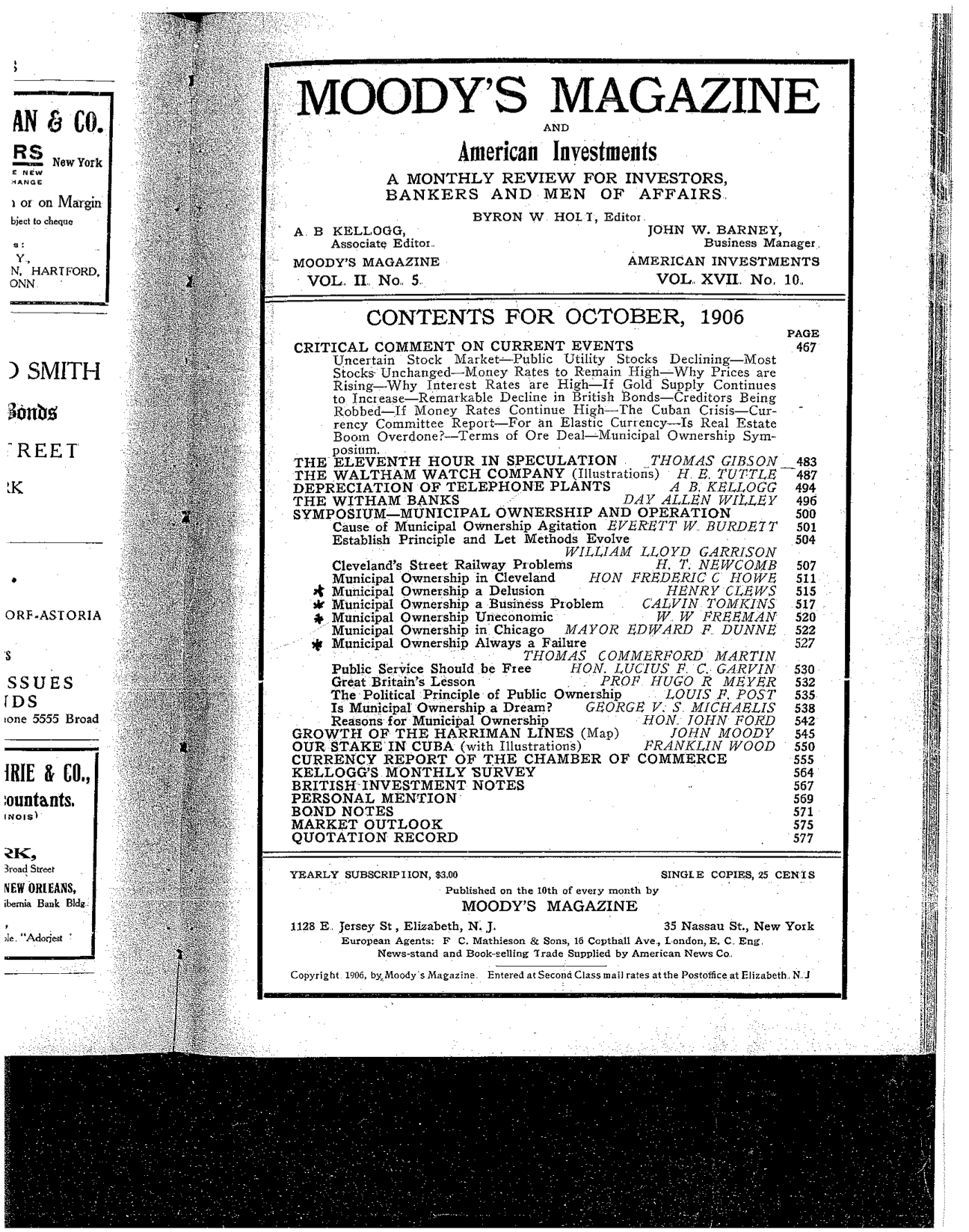
Jim Baller, who has been writing about the laws, policies, and economics of network deployment for decades, has found an eerie resonance of this contemporary debate. Here’s a scan of the table of contents of a 1906 (yes, 1906) issue of Moody’s that features a symposium on “Municipal Ownership and Operation.”

Scan of 1906 Moody's

Click image to enlarge

The Moody’s articles are obviously not talking about the Internet. They’re talking about the electric grid.

In a 1994 (yes, 1994) article published just as the Clinton administration (yes, Clinton) was developing principles for the deployment of the “information superhighway,” Jim wrote that if we want the far-reaching benefits foreseen by the National Telecommunications and Information Administration (and they were amazingly prescient (but why can’t I find the report online??)), then we ought to learn four things from the deployment of the electric grid in the 1880s and 1890s:

First, the history of the electric power industry teaches that one cannot expect private profit-maximizing firms to provide “universal service” or anything like it in the early years (or decades) of their operations, when the allure of the most profitable markets is most compelling.

Second, the history of the electric power industry teaches that opening the doors to anyone willing to provide critical public services can be counterproductive and that it is essential to watch carefully the growth of private firms that enter the field. If such growth is left unchecked, the firms may become so large and complex that government institutions can no longer control or even understand them. Until government eventually catches up, the public may suffer incalculable injury.

Third, the history of the electric power industry teaches that monopolists will use all means available to influence the opinions of lawmakers and the public in their favor and will sometimes have frightening success

Fourth, and most important, the history of the electric power industry teaches that the presence or threat of competition from the public sector is one of the best and surest ways to secure quality service and reasonable prices from private enterprises involved in the delivery of critical public services.

Learn from history? Repeat it? Or intervene as citizens to get the history we want? I’ll take door number 3, please.

26 Jul 17:42

Stand Out on Social Media: Building a Brand Personality

by Brittney Ervin

Setting Your Brand Apart in the Social Media Sea

Stand Out on Social Media: Building a Brand Personality image small  6025250165You’ve heard it all before: differentiating your brand from its competitors is vital to your success on social media. Find an audience, and speak their language. Build a brand personality, and your followers will become brand advocates. Of course, this is all much easier said than done. After all, building a brand personality takes a concerted effort, and when you’re new to social media anyway, that effort can miss the mark.

One thing is for sure: if you want to be visible in your industry, you must be visible on social media because that’s where consumers will find you. 92% of polled business owners agree that in 2014, social media is simply a must if you want your company to get found.

Simply being visible, however, is no longer enough. You have to offer consumers something your competitors don’t. Often times, it’s a brand personality that they connect to, a social media presence that resonates with them.

But how do you accomplish that feat, you ask? Keep reading for a few ways to build your brand’s personality on social media.

Have a Vision

If you don’t know who you want your brand to be on social media, your followers (and potential followers) aren’t likely to know, either. Sit down with some of your trusted advisors (those who know your company and brand best) and ask some or all of the following questions:

  • What do we want to be known for?
  • Who is our target audience?
  • Which social media networks is that target audience most likely to be using?
  • Which types of content is that target audience most likely to find interesting?

Get to know your brand before trying to establish a personality on social media. With a more defined strategy, hiring the right manager is far less of a headache.

Hire the Right Manager

First things first: if you want your brand’s social media presence to achieve the desired effects, you must leave the reigns in capable hands. If you don’t have time to manage your company’s social media accounts on your own, you’ll be depending on a manager to get the job done.

When social media was still a relatively new practice for businesses looking to reach a wider audience, a social media manager was usually someone who was active on and familiar with several social networks and knew how to post a variety of content. Nowadays, that kind of simplicity just doesn’t cut it. A social media manager needs to have a variety of skills and an array of knowledge to help your brand establish a personality and stand out from its competitors.

“To succeed in the field, you must be forward-thinking, demonstrate you can understand and interpret consumer data and marketing strategies and write effectively for your target audience,” says Jason Miller, social content manager for Jim Beam.

It appears that the ability to interpret data is among the most important skills to look for in your social media manager. Date interpretation, however, still doesn’t trump the most important skill: communication. A snappy, effective communicator managing your social media accounts is vital to building a brand personality that will last. Look for a manager who speaks well and has plenty of experiencing in writing and producing content.

Utilize Humor

Many companies undervalue and under-utilize humor in their social media personalities, choosing instead to showcase the “many benefits” of their product or service in every single post. When you forgo humor so you can stump for your product every time you get on Twitter or Facebook, your followers are going to feel alienated, possibly get annoyed, and will probably lose interest in your company altogether.

The key is to establish a personal connection, and humor plays beautifully in that capacity. After all, what is more human than finding something funny? Even babies have a sense of humor, and they can’t form actual words yet. Taco Bell, for example, can get pretty saucy (pun intended) with their Twitter humor, as evidenced below:

Stand Out on Social Media: Building a Brand Personality image taco bell old spice revised

Of course, there are discrepancies in the types and amounts of humor that will be successful for different companies. A deodorant company, like Old Spice, that has built their brand personality around irreverent, whimsical, and humorous ads can push the boundaries of humor in their social media presence far more fluidly than, say, a company that manufactures propellers for small engine planes.

Regardless of those discrepancies, however, the fact remains: humor is a plus on social media. It is, after all, the emotion second-most likely (behind awe) to inspire a share of content on social media.

Stand Out on Social Media: Building a Brand Personality image Popular Emotions 600x403

Infographic Credit: OkDork

Read More: How to Use Humor to Build Brand Personality

So there you have it: a few tips to get you started down the road towards brand personality on social media. Whether you’re a complete beginner or you’ve been Facebooking since 2005, the importance of building a solid brand among your followers is ever increasing. With a little research, a great manager, and a great sense of humor, you could have a gaggle of loyal brand advocates in no time.

photo credit: Nina Matthews Photography via photopin cc Stand Out on Social Media: Building a Brand Personality image

26 Jul 17:17

Why You Need to Focus A Little Bit More of Your Time On Google Plus Communities

by Michael Bird

When Google Plus opened its doors to all users in 2011, social media marketers and enthusiasts expected it to overtake Facebook’s hold on the social media market.

That, however, didn’t quite happen, but nevertheless, Google Plus remains a strong contender for social media attention . With over 500 million users on the site, the social platform continues to grow and expand its reach to users and especially businesses.

Google Plus offers several unique features, including Google Plus Communities, that Facebook and Twitter can’t quite give you. Still unsure about how to successfully market yourself on Google Plus or what its Google Plus Communities can offer you? Read more below.

Google Plus at a glance

There are several major advantages that Google Plus business pages have over their counterparts on Facebook. While you shouldn’t neglect your Facebook page entirely, it is important to remain active and engaging on both pages. Take advantage of some of these great Google Plus features.

Authorship: It’s often difficult to maintain a sense of authorship, authority, and authenticity on the Internet because it’s so easy to simply copy, paste and claim a blog post as your own. To prevent people from infringing on your work, Google Plus allows you to claim your authorship.

  • On your profile, upload a great picture of yourself and fill out the necessary information for your profile.
  • Head to plus.google.com/authorship and sign up using your email. Google will send you a verification link

Now when people go to search for content related to your industry, they’ll pull up your Google Plus profile and be able to read your bio and see your pictures. As more people see and interact with your content, they’ll more than likely add you to their circles, opening your business up to a wider market.

Google Plus Local: Google Plus Local is one of the best ways to attract local consumers to your store. It’s especially beneficial to restaurants and stores in busy shopping districts as users can easily search and get directions your store. Google indexes these stores and ranks them higher in search results above those who do not have Google Plus Local. Reviews and recommendations will also be made available to searchers. Make sure all of your relevant information (store hours, address, phone number) is available to help users find you.

Better SEO: Obviously, Google Plus is part of the larger Google family, and as a result, Google ranks its pages just a bit higher than other pages.

Why You Need to Focus A Little Bit More of Your Time On Google Plus Communities image google search with pages 600x240

Searching for Organic Angels brings up their results with Google Reviews and their Google page.

Google Plus also provides several great tools for its business users to help track their progress and better assess their social media standings.

  • The Plus 1 button and widgets: With these buttons, Google Plus users can easily share content from your blog and website as well as add you to their circles. Google estimates that about five million people use these buttons and widgets per day, so they’re worth an investment.
  • Social media reports: Wondering if what you’re doing on Google is really helping your social media marketing efforts? Google’s social reports help you monitor what is going on with your brand on social media , which can tell you how well your digital marketing efforts are working. Now that you know what you’re doing wrong or right, you can adjust you strategy.
  • Google Hangouts: Thinking of giving an online lecture or opening up a discussion about a certain topic? Google Hangouts allows you to host public and private conversations, share ideas and present product demos. The hangouts can be recorded and viewed at later dates, and they’re a great way to generate buzz within your industry.
  • Do Share: For the social media marketer with seemingly endless accounts, Do Share lets you put together a schedule of updates and posts. You’ll be able to share more consistently online, which leaves you time to create better quality content.

Why You Need to Focus A Little Bit More of Your Time On Google Plus Communities image google hangouts for business 600x240

The importance of Google Plus Communities

Now that you know why having Google Plus is such a leg-up in the world of social media, it’s time to look at how its unique communities can enhance this great platform.

These online communities are a little more interactive than Facebook fan pages. Rather than interacting with a person or business, these communities rally around a topic or specific interest, such as hiking, cooking, science fiction literature and many others. Both people and businesses can join in discussions about the topic, post photos and videos and start a Google Hangout together.

Why You Need to Focus A Little Bit More of Your Time On Google Plus Communities image google communities for health and fitness 600x240

Listed Google+ communities for health and fitness

As a business, it’s important to get involved with the communities pertaining to your industry. Your audience has already shown its passion for your topic. Now you just need to approach them and show them you are equally as passionate and as knowledgeable as they are. You can join in discussions, offer your own insights and answer any questions that come your way. Your network will grow in no time.

As you come across more and more questions, you’ll see how people interested in your topic or industry are struggling and what they’re really interested in. You can focus your marketing strategies on providing solutions to these problems or creating content that speaks to these interests. It’s like getting an inside scoop on what your market likes directly from the horse’s mouth.

Why You Need to Focus A Little Bit More of Your Time On Google Plus Communities image digital marketing google community 600x240

Digital Marketing Community on Google+

Community members will come to value your insights and opinions as you engage with them and show off your talents. You’ll become an authority figure in your industry, and you’ll have a better chance of getting people to share your content with their friends, thus opening you up to a whole new market.

Don’t forget to post your website to help your SEO standings. By posting it on Google, you’ll not only put it right where your target audience can find it, but you’ll also improve your own link profile by creating healthy backlinks that propel your company site up in search results as Google usually pushes its own pages up above others. Remember not to post the site too much, or your community members will think you’re spamming the community.

Though Google Plus didn’t quite get all of Facebook’s audience, it still maintains a healthy following, and Google Plus Communities have helped cultivate that community. Your audience is talking with one another and sharing their passion for your industry all in one place. It’s up to you to tap into that market, illustrate your talents and remind consumers of your expertise. Get involved with your audience and show them why they need your business.

26 Jul 17:16

6 Tips For Optimizing Your Content Publishing On LinkedIn

by Jay Palter

6 Tips For Optimizing Your Content Publishing On LinkedIn image linkedin thought leaderLinkedIn recently introduced an important new feature: long-form publishing. Now, all account holders (paid and free) can publish articles on LinkedIn.

Empowering users to publish their content on the LinkedIn site is part of a broad strategy to position the business networking site at the centre of news and information distribution. LinkedIn’s Pulse news service already delivers business and financial news to users daily via their activity stream. And with long-form publishing, LinkedIn is vying for more of the user-generated content that is currently finding its way onto blogs and other media sites.

Why publish on LinkedIn?

Why publish your articles on LinkedIn when you already have a blog? The best answer is: you should do both.

There are many good reasons to own your blog publishing platform, including growing your own audience, developing an email list, building thought leadership, etc. Depending where you are in that process, LinkedIn publishing could look like a very helpful tool.

LinkedIn may be attractive to content creators because of the nature of its audience and reach. For most professionals, the few hundred connections you have on LinkedIn are important to your business: they are your clients, your peers and your prospects. Publishing on LinkedIn will make your content readily available to these high-value members of your network. And if you create remarkable content, it will reach a wider audience on LinkedIn than you might be able to reach on your blog.

6 Tips For Optimizing Your Content Publishing On LinkedIn image linkedin publishing by jaypalter 521x600

In my own experience with LinkedIn publishing over the past several months, I’ve seen promising results. The total number of views some articles have received is in the low hundreds, while other articles have reached three to four thousand readers. LinkedIn is not revealing exactly how this user-generated content is distributed on its system, but it’s clear that good articles can make their way into notifications displayed on the site, emails sent to your connections and even to the Pulse home page.

Tips for Using LinkedIn Publishing

If any of the foregoing has convinced you to give LinkedIn publishing a try, here are some tips worth following:

  1. Write for your reader, not yourself. In other words, don’t publish marketing drivel. No one wants to read all the reasons why they should do business with you. People have real questions that need answering, they are struggling with issues and could use some help. Readers enjoy being entertained. Give real value, and you’ll get far more out of your efforts.
  2. Write a good headline. Everyone scans before reading because there is too much information out there. Your headline needs to capture readers’ attention because it’s also how your article will appear in the notification for all of your LinkedIn connections. Be compelling.
  3. Include at least one image. LinkedIn displays summaries of your articles in 3 little boxes under your basic contact information on your profile and those summaries are designed for having an image. Omitting an image or choosing a bad image is a sure fire way to make your article less visible.
  4. Put a footer on your article. At the end of your article, write a few lines about who you are and what you do. Add an HTML link to your website, or even your blog, so your LinkedIn readers can connect with you on your site. Once you write a footer for one article, you can paste onto any subsequent articles.
  5. Use HTML style formatting. LinkedIn’s publishing interface is rudimentary, however, it does include some styles. Most important for search optimization is to use HTML tags for sub-headings in your article – same as if you were publishing your article on your WordPress blog site.
  6. Respond to comments. When someone takes the time to comment on your article, you should darn well respond to them in a timely manner. Even if they just say “great article”, you should thank them and take a moment to find out who they are. It is in these small engagement opportunities that the real value of social networks exists.

The roll-out for LinkedIn publishing was announced several months back and seems to be taking longer than many expected. You’ll know if you have publishing turned on for your account because a small pencil icon will appear next to the paperclip icon in the “share an update” field at the top of your profile.

6 Tips For Optimizing Your Content Publishing On LinkedIn image linkedin pencil 600x270

If you haven’t got LinkedIn publishing turned on yet and really want it, you can apply for early access or send me a note and I can try and help.

Or, if you are using it now, I’d be interested in hearing about your experience.

26 Jul 17:13

5 Tips for Creating a Stellar Welcome Email Campaign

by Erez Zukerman

5 Tips for Creating a Stellar Welcome Email Campaign image welcome emailA welcome email campaign is one of the best ways to start off on the right foot with a new customer or reader. The best campaigns create compelling stories readers want to tune into. Not every campaign will leave your readers on the edge of their seats, but here are five solid ways to create a great welcome drip campaign.

Offer Real Value

Telling your new readers once more how awesome your service is, is nice. But they already know that: They’ve agreed to get mailings and updates from you. So update them. Give them information that’s not highly visible on your website. Offer them tips that will make them the envy of their non-subscriber friends.

If you can, send them an email-only coupon code offering a discount on a great product. But whatever it is, make it count — make it worth forwarding.

Leverage Intimacy With Humor and Emotion

Your email subscribers are your inner circle. They represent a fraction of your total visitors and of everyone who knows about you via social media. Your welcome email campaign should make them feel they signed up for something special. It starts with valuable information (see above), but it’s also a matter of tone.

If your website is somewhat buttoned-down, your emails can be a bit more informal. No need to go crazy here, but you’re writing to your friends. You’re addressing people who already believe in you and your product. So connect. Tell a joke, share a personal anecdote, include a fun customer success story.

Be Clear About Your Timelines

When you’re done watching an episode of “Game of Thrones,” there’s no question in your mind about when the next one’s coming. This sense of continuity is important when crafting a story. Make it clear when your readers can expect the next episode in your welcome campaign. Better yet, offer a small taste of what’s to come — a little teaser.

Be Brief and Focused

Brevity is the soul of email. Oh, that’s not how the saying goes? Well, had Polonius been into email marketing, I’m sure he would agree.

Your readers have many other emails overfilling their inboxes. Yours is worth reading, because it offers real value — but it should also be quick and easy to digest. Keep each email in your welcome email campaign focused around a single message, and try to keep the word count as low as you can.

Listen

One of the cool things about email is that people can reply. Write from an address you’re monitoring. Invite their replies. This is a great opportunity to form real relationships.

Are there any other tips for writing a great welcome drip campaign? Was there some exceptional campaign you got and really liked? Share your thoughts in the comments.

26 Jul 17:13

Best Practices for Selling a Service

by Prialto

One of the biggest challenges of selling a service is that services can’t be mass-produced in the way that products are. Services are typically tailored to meet the needs of a particular customer. Additionally, because services are dependent on time and your time is limited, there’s a limit to the amount of services you can ultimately sell.

Below are five best practices to use to overcome some of the challenges associated with selling a service.

1. Sell yourself – Services depend on people in a way that products don’t. When purchasing a service, a customer is getting the skills and competence of the person providing that service. When selling a service, you and your team are the product. You are selling your time, with the promise of a particular result. So don’t just sell a generic service, sell yourself as the provider of that service by highlighting the experience and expertise of your team.

2. Productize your service – Services are intangible–you can’t see them, touch them or demonstrate them. The key is to make your service more like a product by literally turning your service into a product, offering packages of different service levels or packaging your process for delivering that service. This helps to outline the total value that you offer your customers, while differentiating you from the competition.

3. Market your customers – The best way to market services is by marketing your satisfied clients, through the use of case studies and customer testimonials. This can be a challenge for some businesses if your clients don’t want to publicize the fact that they use your services as it may highlight the problems that they are having within their organization.

A way to combat this issue is by developing customer personas that give a detailed description of who your customers are, without divulging their name. It’s also important to highlight the importance of privacy in your pitch, convincing the prospect that they would get the same level of discretion should they become your customer.

4. Maintain a year-round marketing program – The sales process often takes longer for service-based businesses than for product-based organizations. Therefore, it’s important to maintain a well-stocked pipeline of prospects to lean on should any of your deals fall through.

5. Focus on relationships – Services are more difficult to price than products. The only way to define the quality of a service is whether the customer is satisfied with the service they are getting at that price. Maintaining quality relationships with your customers is the best way to make that determination. Be sure to regularly ask your customers “How am I doing?” and really listen to their answers, making adjustments when needed.

26 Jul 17:13

9 Ways to Develop Credibility on Your Landing Page

by Elisa Silverman

Credibility is the online world’s most potent currency. Only this is the currency you use to sell, not to buy. Your 20-point bullet list of features and benefits? Your unique selling proposition? They’re all meaningless if your landing page visitors don’t believe you. The critical differentiator that gets people to give you their money in today’s digital marketplace is how credible you are.

Weave these credibility-builders throughout your landing page copy and design to increase your conversion rate.

Social Proof

Nothing supports your own claims on your landing page like having those with no financial interest in your business saying the same thing. According to a 2013 BrightLocal.com survey, 73% of respondents said a positive online review increases their trust in a business. The two most effective forms of social proof you can include directly on your landing page are testimonials and influencer validation.

Testimonials: Actual success stories from actual users of your product or service! What could be better? Nothing. Really – nothing is better. As long as they’re done right. The best practices you want to follow for using testimonials are

  • Make it unassailable that the testimonial is from a real person. We’ve all seen testimonials from “M.Y., local shop owner in upstate New York,” and we’re all too savvy now to buy the testimonial OR the product this M.Y. loves so much. Your testimonials should include a full name, perhaps their business title and/or location if that’s relevant, and ideally a photo – a happy, smiley photo.
  • Keep each testimonial short, targeted, and specific. Use separate testimonials to support your various feature/benefit claims. Five testimonials that each rave about a different feature or benefit have greater impact than one long testimonial that makes all the same points. Taking this approach also lets you strategically drop each testimonial near the part of the landing page copy most relevant to it.
  • Use a consistent design element to make each testimonial stand out. Your design options are endless, a different colored background, alternative font and/or typeface, a speaker bubble or callout brackets. Whatever design element you use, it should contrast nicely with the rest of your landing page design so the testimonials stand out, and use this design element for every testimonial on the page and ONLY for testimonials.

9 Ways to Develop Credibility on Your Landing Page image Credibility on Your Landing Page Testimonials

Influencer validation: Influencer validation is social proof that’s enhanced by the credibility of the person or entity providing the validation. This could be a testimonial from a recognizable name. In which case, follow the testimonial rules above plus make it really, really big and place it towards the top of your landing page! Co-branding with a trusted company is another way to bask in someone else’s well-earned credibility.

However, influencer validation also includes displaying the logos of media that have covered your product or service, badges showing any industry honors and awards it may have won, and logos of relevant, trusted industry organizations to which your business belongs.

Exhibiting these logos and badges benefits your landing page in both form and function. In addition to showing influencer validation, they’re appealing visual aids that break up the landing page copy.

The personal is credible

A truism of good copy is that it speaks directly to the reader. Your landing page visitor should feel understood when they read your copy. When he or she feels like you genuinely understand their pain or challenges, then it’s more likely he or she will believe that you offer a credible solution.

How do you personalize your landing page? So glad you asked. The general answer is “be specific.” Here’s how:

  • Create a different landing page for each buying audience you’ve identified, and for each feeder source into your landing page. If you’re writing to everyone, no one gets the specific message that resonates most strongly with them.
  • Include quantifiable facts. First, cite verifiable facts from outside sources when quantifying the pain point you’re addressing. Second, use success statistics from your internal research to quantify your product/service’s value. Statistics augment an individual testimonial as well. So if one of your customers shares that your organic seeds sprouted 5x faster than another brand she bought – use that!

Make everything easy

If you’ve read any of my other blog posts here, you know one of my main themes is: Don’t make your reader work that hard!

9 Ways to Develop Credibility on Your Landing Page image Credibility on Your Landing Page We Make It Easy

Make it easy for your landing page visitor to trust you, contact you, buy from you, and yes – even return their purchase to you.

  • Include security seals, like VeriSign or PayPal Verified, to give the buyer comfort that it’s safe and secure to buy on your page.
  • Provide complete contact information that’s easy to find, including a phone number, email address, and your social media badges. Build their trust that they can reach you if they need to.
  • In the same vein, keep both your buying and return process simple. At the buying stage, don’t ask for more information than you need. Explain your simple return process in your landing page copy.
  • Use a simple privacy statement that’s prominently placed. Let people know you respect their privacy.

Stay Honest

I trust that I needn’t belabor this point. None of the rest of this matters if you’re not being honest.

Credibility is More Valuable Than Bitcoin

Think of your digital credibility as a type of cryptocurrency, but without the volatility. Because once your credibility goes down, you’re unlikely to regain it. However, you can use these tools to build up your credibility reserves and boost your conversion rates.

9 Ways to Develop Credibility on Your Landing Page image banners04 600 2507

26 Jul 17:13

5 More Things to A/B Test on your Landing Page

by The Wishpond Blog

5 More Things to A/B Test on your Landing Page image 6bsjc1hrb6ip CzoqcBYPlZX4tfVgotNAwCVD72z1 4NIHVmo3DTSOkIfMmmkDuRz9N9SP9kvEJj28ANOuTPKzH  oqrqW03A 1vMqq2Ivx2EiiiOA2LuDwHgbUmd1Q8kg

Are you satisfied with how your landing pages are converting traffic?

Are you happy with your 8%, and ready to move on to other marketing stuff?

Well stop!

Increasing our page’s conversion rates (even from 8% to 9%) can mean thousands of dollars in increased revenue for your business.

Maybe you’ve just run out of ideas for things to test on your pages.

That’s why bloggers like myself write articles like this one.

Here’s “5 More Things to A/B Test on your Landing Pages”.

Because you should never be satisfied.

 Video


Let’s make this short. If you’re not convinced that video can help your landing page’s conversion rates, here are five reasons you need to hear:

  1. Your landing page visitors are lazy (thus why we recommend bullet-points over long paragraphs). Even better than text, however, is a video explaining what they stand to gain from a conversion.
  2. Your landing page visitors are hasty. A video encourages your landing page traffic to stick around for that little extra time your page needs to encourage a conversion. People make their initial decision about your brand or offer in the first 5 seconds. Videos mean they stay on your page for longer.
  3. Your landing page visitors don’t trust you. A video communicates personality and the idea of a “real person” far better than language ever can. Your landing page traffic needs to know (immediately) that they’re dealing with a brand made up of real people, not robots (see “Tone” below).
  4. The face of your business is interesting. Whether you use your CEO, CMO or a recognized brand representative, the face of a real person is far more interesting than text, a model, or a picture of your product or content.
  5. Videos are multi-faceted. You can test the length of your videos, internal CTA’s, directional cues (see below) as well as use your videos for SEO and brand awareness on YouTube.

Here’s what a video might look like on your landing page (from Wishpond’s landing page templates):

5 More Things to A/B Test on your Landing Page image jBBd2K I7fPzui9l lAM3TCHu5WtFQDYAwG9j4GPJzGyCCqyT dAa327rkvjcy OkUbciUv5FVd5Aclfbygk2tlBDTH6p5R2smKQv1ZNsO4k2yr bwAVarGDTuxIIVQzQw

 Short-Form vs Long-Form


This is one worth testing for yourself, because there are case studies that go either way. Many businesses have found up to 20% increases in their conversion rates when they cut the fluff, bullet-point their value and condense their description into a single, above-the-fold screen.

However, an equal number of businesses have found the same 20% increases when they re-iterate, expand, and elucidate their landing page traffic with landing pages that never seem to end.

I’m not going to mess you about by telling you either strategy will absolutely work for your business. However, this is 100% a strategy worth testing for your own business and particular campaigns.

Here are a few guidelines:

  • If you’re going the long-form route, include multiple CTA’s so your landing page traffic doesn’t have to scroll back up to the top to convert
  • If you’re going the short-form route, test including other links to pertinent information within the page. Theoretically traffic that is sold by your short-form page will engage and traffic that isn’t quite satisfied will click further.
  • If you’re going long-form, include many different USPs and header fonts to encourage our traffic to continue scrolling. The same font size will make for an extremely boring and low-performing landing page.
  • If you’re going short-form, consider using a video (above) that communicates the value of engagement in an interesting way.

 Directional Cues


The design of your landing page is important (you know this already). You know that placing your USP at the top and in the center is better than placing it low and to the right. You know that a CTA button generally elicits higher conversions on the right than it does on the left.

What you may not know is how to encourage people to look where you want them to look, and this is where directional cues come into the picture.

Here are the four primary directional cues you can use in your landing pages:

5 More Things to A/B Test on your Landing Page image qfsWFA5LIdoSCryRairu7BHNLKmN1u kvAZ2NJQRv3AcuJozKLdzX2ktUlGtkJ FdeDO43QTWOJYpCLEVSvKT3PeQrRiZrJX4 F8RDR7Tn1j4H2QJiBe8uu1jrCcZEqujQ

  •  Perspective Cues: One of the least obvious (but most effective) strategies within directional cues, perspective is a subtle way of bringing something front and center or dropping it back. Characterised primarily by angled lines, boxes or shapes, perspective cues can draw attention away from secondary landing page elements and toward your primary focus-points.
  • Arrows/Linear Cues: Also including pointing, arrows and linear cues are the most common we see. They’re often used with Facebook Landing Pages to show people how to become a Fan or where to click.
  • Eye-Direction Cues: My favorite directional cue, eye-direction uses a bit of psychology to get your business conversions. People have a strong tendency to follow the eye-direction of people they see – something they do completely unconsciously. We have an even stronger tendency to look at people’s faces (equally unconsciously). Attract the eye of your landing page visitor with a real-looking person (non-model) and then send that eye to where you want it (your USP or CTA button).
  • Whitespace Cues: The blue box within my example above could be your CTA button. If we hadn’t placed the whitespace around that box, it would stand out far less. This is because a lack of color (or landing page elements) can be just as eye-catching as a presence of color. Consider this strategy for your USPs, benefit lists, customer testimonials and CTA buttons.

 Color Scheme


Choosing the right color scheme for your landing page means you have to know your target audience well – thus it’s something you need to test.

Color matters to us, even if we never consciously notice it. We see different colors and they have different connotations for us. Some represent solemnity, others excitement. Some represent youth and naivete while others communicate professionalism.

Using the wrong color can drop your conversion rates, and (unless you test it) you wouldn’t necessarily know what’s going on. You could change every other variable and see no effect.

So here are some general rules of thumb:

  • Black, grey and white: Professionalism, sincerity, sophistication. Think IBM.
  • Light blue, dark blue, grey and orange (for CTA): The startup look. Up-and-coming. Seriously, after you finish this article, go check out how many startup websites are blue and white with an orange CTA.
  • Green, brown, beige: Environmentalism, health, wellbeing. Think Greens+.
  • Purple and white: Female-friendly, womanhood, comfort. Think International Women’s Day.
  • Black, red, gold: Male-friendly, masculinity, strength, permanence. Think every online betting site, ESPN, and others.

 Tone of Landing Page Copy


Is your business professional and sincere or fun and animated? Do you have a different tone on social media than you do in your marketing emails? Perhaps you’ve found success with a blogging mascot but the tone hasn’t translated into your landing pages.

Well, test it.

How?

  • Test intriguing titles for your lead generating content, like “This took us 6 months to make and analyzes 200 individual case studies in our sector. Want to know what it’s about?”
  • Test casual CTA button copy, like “Woohoo!”, “Boom!” or “Make money money, make money money money!”
  • Test a fun and humorous “thank you” landing page for after your lead converts. Try something like “Thanks for downloading our ebook! So… we were wondering… Would you like to go on a date with us? It’d only be half an hour and we could tell you all about ourselves.” Include a “yes” box and a “no” box and frame the entire thing as a note passed in class.
  • Get creative with images and other visuals. Test an introductory video from your whole company. Introduce your customer service team in funny hats or a mascot.

Tone is something you need to test for yourself. Many businesses will already have a recognized business persona on social media, but haven’t yet considered incorporating it into their sales funnel. Test it within different verticals, among different demographics, and for different objectives.

And if you want a refresher course on A/B testing: how it works, when to do it, and what elements you should be testing first, check out my article “How to A/B test your Landing Page to Maximize Conversions.”

 Conclusion


I could go on an on with landing page elements and variables for you to test, but let’s get started with these five. Hopefully I’ve given you some ideas and inspiration to take forward and maximize your page’s potential for conversions.

By James Scherer

5 More Things to A/B Test on your Landing Page image o0GtMJZBgHCO4aELv8iFK28V3STJ8zzhdWNYGFUtSykVy7k411tgFgnS7 codzuEMpiAHkpmo6 zjRWYKOIPE8XjZptpjhlB YjkujY9YLm6zrIUOvvb7BEgGg3EgjZUoQ

26 Jul 17:12

A Six-Part Framework for Writing Better Sales Copy

by Ray Edwards
Editor’s note: This is a guest post by Ray Edwards, who is a world-renowned copywriter and communications strategist, writing for some of the most powerful voices in business. You can find him on his website, Twitter, and Facebook.

If you want to sell more of your products and services, or even simply sell more people on your ideas, you must learn the basics of the art of copywriting.

A Six-Part Framework for Writing Better Sales Copy

But what is copywriting, really? One of my favorite definitions was given by a man named John E. Kennedy, back in 1904. Kennedy defined advertising (and copywriting) as: “salesmanship in print.”

If you can write effective sales copy, you can literally write your own paycheck. There really should be no such thing as a “broke copywriter”. By definition, good copywriters can create money out of thin air. So why does copy so often fail?

Copywriting fails when you ignore the principles

There are universal psychological triggers that help you sell more effectively. The problem is, the field of copywriting is strewn with misleading, manipulative, and even in some cases malicious techniques.

You can hardly “swing a cat” without hitting a copywriter who has a “formula” for writing copy. Most of these formulas are actually quite good. Many however, are based on tricks of manipulation and psychology that are more than a bit morally wonky.

The framework I’m going to share with you today, though, is intentionally based on universal principles that are focused on doing good, and helping people make decisions that are in their own best interest.

To sell more, P.A.S.T.O.R. your customers

Most people associate the term “pastor” with the preacher at church. While this is certainly true in most cases, the original meaning of the word “pastor” was actually “to shepherd.” And what does the shepherd do? He or she cares for, feeds, and protects the flock.

Now, before we go any further, I should address the habit that some marketers have of referring to their customers as their “herd.” It seems to paint an unflattering picture.

This kind of imagery is not what I am invoking here. The actual role of a shepherd is a loving, caring, and protective one. In fact, Jesus, who called himself the “good Shepherd” actually laid down his life for his flock.

I am not suggesting any religious overtones for your copy: what I am suggesting is that you adopt the same loving, caring, and protective role as you write copy for your prospects and customers.

And, as you might’ve guessed, P.A.S.T.O.R. is also an acronym for the major sections of your copy. Here is the explanation:

“P” is for PROBLEM

You must begin by identifying the problem that you are solving. The simplest, most effective way to do this is to describe the problem in great detail.

It’s a psychological principle: the more accurately you can describe your reader’s problem in terms they relate to, the more they instinctively feel that you must have an answer to that problem. Use the reader’s own language, the very words and phrases they use to describe the problem they want to solve.

For instance, if you are writing about fitness and weight loss, you might begin by describing their current situation this way:

You’ve tried every fad diet that’s come along. You’ve started and stopped a dozen different exercise programs, perhaps joined several different gyms, but the truth is you just can’t seem to take the weight off (or keep it off.) Perhaps you’re even feeling a little disgusted with yourself and your inability to control your eating and your weight. You feel like no matter what you try, it’s not going to work.

Remember, you’re not judging their behavior, rather you are describing their experience as it currently is. This means you have to understand their experience as it currently is. You have to know your audience and what they are thinking.

As the great copywriting legend Robert Collier said, you have to “join the conversation that is already taking place in the reader’s mind.”

“A” is for AMPLIFY

The next step is to amplify the consequences of not solving the problem. This is really the key to making sales, and it is probably the most neglected step in the process.

What will motivate people to buy your product, invest in your service, or accept your idea is usually not the beautiful outcome framed in a positive light. It is rather, realizing the cost of not attaining that outcome. In other words: what is it costing them to not solve this problem?

When I’m writing copy about a business improvement program, for instance, I may have the reader walk through a simple exercise like this:

Write down your average monthly income over the last 12 months. Then write down what you want your average monthly income to be. Let’s say that your average income is $5000 per month, and your goal is actually to make $15,000 per month in your business. That means the gap between where you are and where you want to be is $10,000 per month. You’re paying a cost of $10,000 every month you don’t solve this problem.

“S” is for STORY and SOLUTION

Once you have described the problem and amplified the consequences of not solving it, it’s time to share the story of how the problem can be solved.

This will be different depending on your situation. It might be the story of how you yourself finally solved this persistent problem. It might be the story of how you helped a client or customer discover the solution on their own.

It does need to be more than simply a description of what the solution is: telling the story of Bob, the frustrated business owner who was on the edge of bankruptcy, whose family had lost faith in him, and who, out of desperation tried one last idea that saved his business, is infinitely more powerful than simply saying, “One day, Bob figured out the answer.”

It should go without saying, but I will say it just in case: the story must absolutely be true. Don’t make these things up. And if you’re thinking, “But what if there is no story?” I would suggest you just haven’t looked closely enough.

There is always a story to tell.

“T” is for TRANSFORMATION and TESTIMONY

The next key step in writing your copy is to remember that whatever you’re selling, whether it’s a home study program, a book, a seminar, your consulting services — anything at all — what people are buying is not the “stuff,” it’s the transformation.

When people buy the P90X workout program, they did not wake up one morning and say to themselves, “I sure hope today somebody tries to sell me a bunch of DVDs and a wall chart.”

Those things (the DVD’s, charts, etc) are the stuff. What buyers of P90X are actually purchasing is that lean, healthy, youthful physique they want for themselves. The transformation.

It’s also important that you offer testimony, real-life stories of people who have made the transformation that you are teaching, and who have done so successfully. Study the most successful infomercials, and you’ll discover that they consist of about 70% testimonials.

And while most of us will not be writing infomercials, it’s important to remember there are three questions people are asking when you sell them coaching, consulting, or instruction about anything. The questions are:

  • Has this person been able to do what they are describing for themselves?
  • Has this person been able to teach other people to achieve the results they are describing?
  • Will this person be able to teach me how to achieve these results?

“O” is for OFFER

So far, you have defined the problem, clarified the cost of not solving it, told the story of the solution, and helped your reader visualize the transformation through testimonials from others just like themselves.

Now is the time to describe exactly what you are offering for sale.

This is the section of your copy where you lay out your offer. You can even create a subheading for the section called something clever like, “Here’s Exactly What You Get.”

Make certain that you focus 80% of your copy on the transformation itself. You do have to talk about the deliverables (the class schedule, the DVDs, etc.), but that should only occupy about 20% of your copy in this section.

Just remember that as you describe the deliverables in the offer section, you must keep tying them back to the transformation and benefits your buyers will receive.

So instead of simply writing that the buyer will receive “8 DVDs, each containing a 45 minute workout session”, you might instead write that they will receive “8 DVDs that each contain a body-sculpting, fat-burning transformational work out that will help you craft the lean muscle you really want.”

“R” is for RESPONSE

This is one of the areas where copy tends to often be the weakest: the response request. We are asking the customer to buy.

At this point, you should not be shy about making this request. You should tell the customer exactly what to do in order to get your program, your consulting, your book, etc. You should remind them why it’s important o do so.

I often write copy similar to this:

You’re at the point of decision. You can either continue down the path of least resistance, the path you have already been traveling, or you can choose the road less traveled. The path of least resistance will probably result in you getting the same outcomes you’ve always received. But if you want something different to happen, if you want to change the direction of your health (or your relationships, or your finances, etc.) you’re going to have to do something different. Make a new choice, and pursue your new outcome.

And then I will write very specific, directive copy telling them exactly what to do next: “Click the button below, fill out the order form, and we will immediately ship your entire package to you. It will contain everything you need to get started.”

Some people shy away from strong language like this, but the fact is, if you truly believe that you have a solution that will solve a problem for people, why on earth would you not be as direct as possible in telling them how to get that solution? In fact, aren’t you doing them a disservice by not making the strongest case possible?

What to do now

My suggestion is that you use this framework to write or rewrite your sales copy. The key to making this approach to writing sales copy successful is the having the mindset of being a “pastor”.

If you apply the principles of being a shepherd to your readers, and you follow the sequence of the P.A.S.T.O.R formula, my prediction is you will experience more sales, more profits, and more happy customers… more often.

Ray has a special eBook for you where he details the power of copywriting to create a $2 billion dollar sales letter. Click here to get your free copy.

What area do you struggle with most when writing copy? Share in the comments.

26 Jul 17:09

12 experts define Key Performance Indicators (KPIs)

by Rob Petersen

12 experts define Key Performance Indicators (KPIs) image key 96233 1280

Key Performance Indicators (KPI’s) are one of the most over-used and little understood terms in business development and management. They are too often taken to mean any metric or data used to measure business performance.

The role KPI’s play is much bigger and more important. In fact, KPI’s are one of the most important guideposts for any business. Every business should have them.

Here’s one of the best definitions I’ve heard: KPI’s are an actionable scorecard that keeps your strategy on track. They enable you to manage, control, and achieve desired business results.

You don’t need a lot of metrics, but you do need to carefully select, report, and take action from the handful you choose. Let’s break down this definition so it’s useful for your business, especially considering the guideposts available on the internet.

Desired Business Result

Always begin the construction of KPI’s with a clear understanding of the desired results. There’s nothing wrong with starting by saying you want to sell more of what you make. But try to be a little more specific. How will you do it? Will you:

  1. Shorten the sales cycle by half
  2. Generate 50% more leads
  3. Create a new usage occasion
  4. Get loyal customers to buy 30% or more

If you are clear about where you are going, you can construct KPI’s that get you there.

An Actionable Scorecard

Pick the handful of measurements (generally no more a half dozen or so) that you believe are most important to the achievement of this goal. For example, if you wanted to shorten the sales cycle by half, you could measure:

  1. Keyword search for the term(s) that describe the need your brand meets
  2. Unique visitors to your website
  3. “Bounce Rate” to determine if your site is relevant and people view more than one page
  4. Sales (if products are sold on your site)
  5. “Average Shopper Value,” since buying more can help determine if you’re meeting your goals

Keep your strategy on track

(The rest of the Whiteboard):

Figure out the “Source” for the “Raw #’s” and how frequently (“Freq”) you report. Then, in the second column, set goals to measure “Progress” that seems realistic to the achievement of the desired results. Finally, in the third column, pick a comparison period like the previous year, or the previous month if you are a start up. Now, the key measurements are more than raw data; they are actionable metrics.

Of course, that’s one opinion, but there are others.

Here’s how 12 experts define Key Performance Indicators (KPI’s).

  • “A metric that helps you understand how you are doing against your objectives.” – Avinash Kaishik
  • “Measures that help decision makers define and measure progress toward business goals. KPI metrics translate complex measures into a simple indicator that allows decision makers to assess the current situation and act quickly.” – KAIZEN Analytics
  • “A KPI: 1) Echoes organization goals, 2) is decided by management, 3) provides context, 4) creates meaning on all levels of the all organizational levels, 5) is based on legitimate data, 6) is easy to understand and 7) leads to action!” – Dennis Mortensen
  • ”The most important performance information that enables organizations or their stakeholders to understand whether the organization is on track or not.” – Bernard Marr
  • “The selected measures that provide visibility into the performance of a business and enable decision makers to take action in achieving the desired outcomes.” – Aurel Brudan
  • “The data necessary to understand the implications of whatever he/she sees and the wherewithal to take appropriate action.” – Shalin Shah
  • “Measurable industry, department, or task relevant performance metrics that are evaluated over a specified time period, and compared against acceptable norms, past performance or targets.” – Allan Willie
  • “Measurements of activity that is a vital gear in your business machine.” -John Standaloft
  • “Help organizations achieve organizational goals through the definition and measurement of progress. The key indicators are agreed upon by an organisation and are indicators which can be measured that will reflect success factors.” – Bruce Clay
  • “A set of quantifiable measures that a company or industry uses to gauge or compare performance in terms of meeting their strategic and operational goals.” – James Oh
  • “High-level snapshots of a business or organization based on specific predefined measures.” – (Avinash)
  • “Should not constitute every company metric for analysis and evlaution. Rather, KPI’s should reflect the most important objectives of the business.” – (Avinash)

Do these definitions help explain KPI’s to you? Have you thought about what is the actionable scorecard for your business?

26 Jul 17:09

What Not to Do, Part 2: Social Media Content Marketing Mistakes

by Olsy Sorokina

On the day of the Malaysian Airlines crash over eastern Ukraine, the following Tweet appeared on actor Jason Biggs’ account, “Anyone wanna buy my Malaysian Airlines frequent flier miles?” While Biggs is known for his controversial Twitter presence, the timing and the content of the Tweet resulted in a violent backlash against the actor. He later deleted the post and issued a public apology.

We often talk about how the right use of social media can be an immense help to your brand, and in the first part of this series, we discussed how a poorly thought-out social media strategy can do significant damage. This time, instead of focusing on possible strategy shortcomings, take a look at what matters most—the content itself. Do you really know your audience? Are you selling too much and engaging too littel? In this post, we go over five common social media content mistakes to avoid, and ways to remedy them.

5 Social Media Content Mistakes You Should Avoid

Mistake #1: Selling too much

Establishing a smart selling strategy is difficult enough; then comes an added challenge to translate these strategies into social media channels. A crucial point to keep in mind is how to avoid making your audience feel like walking wallets. One might argue that there is no other reason for people to seek out your brand except for your products and services.

While that may be true in some cases, it helps to remember that a person may first come for the product, but later become a loyal customer as a result of the relationship you build with them.

Let your sales team do the magic on generating leads, and focus your social media content on building rapport with your audiences. There’s no need to become overly familiar (see Mistake #2) or overbearing (#4); taking a genuine interest will pay off, and not just financially.

Mistake #2: Posting content that doesn’t align with your brand

What Not to Do, Part 2: Social Media Content Marketing Mistakes image us airways tweet social media content mistakes

If you don’t stay on-brand, you may have to face the consequences. US Airways dealt with the backlash of the infamous inappropriate picture in response to a customer’s Tweet.

It’s important for your brand to have a recognizable voice. In order to do that, you have to ensure that your voice stays consistent throughout your social media content. Ask yourself or your social media management team before you post: “How does this help our brand and our customers?” If it’s a humorous post, keep it classy; if you share news items, make sure it’s something your audience will care about (see Mistake #3).

Mistake #3: Not defining your brand’s social media audience

Are you still using your brand’s social media channels as a megaphone? It has been shown in research and confirmed in practice that the best social media reach is achieved by clearly defining your audience before you start posting. There are lots of social media analytics tools designed to help you get started; some of them, such as Facebook Insights and Twitter Analytics, come free of charge along with your profiles, so there’s really no excuse not to be using them. Provide your audience with content tailored to their interests; that will provide the initial spark to start a conversation between with your brand and your customers on social media.

Mistake #4: Not setting up a social media scheduling process

We don’t have to tell you how social media channels are the fastest and most efficient way to amplify your content. Chances are, you found this post by following a link that showed up on your Twitter or Facebook feed. Nowadays, behind every content marketing success is a strong social media manager, or management team: all social media posts are composed and scheduled with the purpose of reaching the biggest audiences at the most optimal times. Without a social media schedule, your brand’s social media accounts may seem abandoned, lack proper audience engagement, or run the risk of posting too much.

Mistake #5: Not profreading your social media content

What Not to Do, Part 2: Social Media Content Marketing Mistakes image poor grammer

This Tweet may be funny, but you don’t want your followers to be entertained by your (unintentional) spelling mistakes.

Social media is full of word crimes, so who cares if you make a few little mistakes here and there, right? You should care. Sloppy spelling and grammar hurt your brand’s credibility. While most social media networks require messages to be succinct, it doesn’t mean you should abandon proper spelling or punctuation for brevity in your posts.

(By the way, did you notice the missing ‘o’ in the title? If not, it may be a good time to hone your proofreading skills!)

Have someone on your team look over your content before you hit ‘Post’; ideally, you’d want at least two pair of eyes after you compose it. Double-check everything, including the @mentions in your Tweet: it’s common to skip Twitter usernames during the proofreading process, only to realize that the post mentions the incorrect or nonexistent Twitter handle!

If no one is available and the post needs to be sent out immediately, a good technique is to read your composed messages out loud, and look up any spellings you’re not certain about in an online dictionary.

26 Jul 17:08

The Magic Of Content Marketing – An Interview With Joe Pulizzi

by Simon Dunant

The Magic Of Content Marketing – An Interview With Joe Pulizzi image Joe Pulizzi

How do we get found in search engines? How do we get people to talk about us on social? We better be interesting and helpful, and we better do this on a consistent basis.

Joe Pulizzi Founder, Content Marketing Institute

The Content Marketing Institute was founded by Joe Pulizzi, the leading evangelist for content marketing. Joe, an entrepreneur, speaker, and author on content marketing, believes passionately that there is a better way for brands to market than how they’ve done it in the past.

New Rise Digital’s Simon Dunant asked Joe to explain to small business owners what content marketing is, and why they should be embracing content to build trust and connect with their customers.

Many small businesses may have heard the term Content Marketing but don’t fully understand what it means, how would you define content marketing?

Instead of interrupting our customers and prospects with advertising or promotions they don’t want, we develop valuable, relevant, compelling and consistent content to attract and retain customers.

It’s very similar to thinking and acting like a publisher, and could take the form of blog posts, e-newsletters, print magazines, social media content, in-person events and more, but unlike a publisher, instead of generating revenue through paid content or advertising, we drive new sales, cost savings or keep our customers happier in some way.

Why should a small business owner consider using content as a marketing channel, and what are the opportunities?

First thing, you have to ask the question “why?” What business objective are we trying to solve. Content may or may not be a solution.

That said, our customers are inundated with over 10,000 marketing messages per day. They are also in control of what they take in. How do we break through all the clutter and get customers’ attention on a regular basis?

How do we get found in search engines? How do we get people to talk about us on social? We better be interesting and helpful, and we better do that on a consistent basis. The opportunity is to become the leading, go-to expert in your particular niche. There are no barriers to entry for doing this today.

What do you consider to be the biggest misunderstandings that businesses have when considering using content as a marketing channel for their products and services?

The content isn’t about us; it’s focused on the customer. Our audience doesn’t care about us, our products or our services. They care about themselves. Most businesses lack consistency. Content marketing is not a campaign, its forever. Timetables for success take much longer than 6 months (for the most part). If your timetable is less, just buy advertising.

Content marketing isn’t just for lead generation. Actually, from a historical standpoint, the majority of content marketing programs are focused on loyalty and retention goals.

It’s important to set expectations when using any digital marketing channel, so what goals should a small business be setting, what metrics should they be measuring and what tools should they be using when creating content marketing campaigns?

There are many metrics that will help you show increase in sales, lower costs or happier customers. But my favorite metric is subscription. If there is a holy grail to content marketing measurement, it may be to show the difference between those that subscribe to my content versus those that don’t. Do they buy more? Buy quicker? Talk more about us? Stay longer?

Most businesses focus so much on lead generation. It’s so much better to grow your audience first, and look to sell to your audience second.

Are there particular markets or demographics that you think fit particularly well with content marketing campaigns and any that don’t?

Honestly, I haven’t found an area where there couldn’t be a content solution. That said, healthcare is huge right now because education is critical to patient satisfaction rates. Manufacturing has taken a little bit longer to catch up, so there are still some content niches there for the taking, especially as some B2B decision makers are just starting to use social media channels.

Which types of content tend to create more engagement?

If you mean sharable content, blog posts and eBooks are probably right there at the top. Video is starting to take off as well, although, it’s less about the content types and more about the content and consistency. Also, some of these programs need some paid distribution behind them if we don’t have our audiences built up yet. There’s no sense in spending a lot on content creation without an audience.

Are there any upcoming trends in terms of type of content you’ve seen that small businesses should be investing their time and budgets into?

Small businesses are notorious for starting programs and stopping. The biggest issue right now is actually choosing a channel to master and consistently publishing in that channel. We’ve seen so many small businesses start a blog or webinar program or e-newsletter and then stop altogether or erratically publish.

If you are just getting started, the blog/e-newsletter combo works really well for small businesses and doesn’t take a large budget.

Creating content for a campaign can be time consuming, and in small businesses particularly, time is at a premium. What advice would you give to a small business owner reading this that thinks they don’t have the time to devote to a content marketing campaign?

There are amazing storytellers, journalists and writers out there willing to help you. Look at the contributing writers in your industry niche trade magazine and approach those people. They usually are not part of the payroll and are looking for opportunities.

Are there any particular online tools you’ve found useful for creating content?

WordPress is our content management system. For email, MailChimp is great for smaller companies. Tools like KaPost, AtTask, and DivvyHQ are great for content production. To distribute eBooks, we love Slideshare.

Creating great content is only valuable if it’s actually seen. What are some of the best ways that small businesses can effectively distribute their content and gain visibility?

It takes time, but the best method is to build relationships with industry influencers. First, create the list of influencers (where your customers are hanging out online). Then, start sharing their content. Then, bake them into your content. After a while, you may start to communicate with them, and they may start sharing your content. Become an active member of their sites and blogs.

Again, focus on building your audience first by attracting subscribers. If you create a blog, your goal might possibly be to get and keep a subscriber.

In your experience how successful do you think Content Marketing has been so far at delivering conversions against other forms of digital marketing?

There are a lot of ways to get conversions; content marketing is one of them. But what content marketing can do that most other forms can’t is it can create better customers. If you get the conversion and then nurture that subscriber with epic content on a regular basis, odds are they do something different that will help your business.

That’s the magic of content. It helps you position yourself as a trusted resource; the other conversion methods probably can’t do that.

What are your top 3 tips for converting customers with content marketing?

  • Limit the calls-to-action on your content site to subscription only.
  • Consider using Pippity or another popover tool to drive subscriber rates to a special content offer.
  • Leverage Slideshare Pro to generate leads directly on SlideShare.net.
26 Jul 17:08

The Biggest Misconception About Sales & Marketing

by Neil Eneix

As an internet marketing company, we’ve been able to work with a wide variety of companies in the Seattle area and abroad whose internet marketing problems have been all over the board.

Now, from my comment there, you may be thinking that the list of possible problems on the marketing problem board is quite large – actually, it’s not.

The Biggest Misconception About Sales & Marketing image BiggestMarketingProblems01

In fact, when everything is boiled down, there are really only three primary issues

  1. Not Enough Traffic (Top of the funnel problem)
  2. Not Enough Leads (Middle of the funnel problem)
  3. Not Enough Sales (Bottom of the funnel problem)

Usually, when companies come to us they are focused on variations of problem number 3.

Is this the answer to their problem, though?

The sequence of thought usually goes something like this…

  • We aren’t making as much money as we’d like
  • The reason we aren’t making enough money is because we don’t have the amount of sales we need
  • We don’t have enough sales, so the way to fix that is to do more marketing (Just as an FYI, usually when companies are looking at doing more marketing, they’re considering promotional)

This process of thought isn’t a negative thing. I believe that it’s a good starting point when it comes to assessing one’s company, because it demonstrates that one is being intentional about solving their sales problems.

The only problem is that the application in solving that sales equation is quite a bit more involved. Read on to learn more.

The Biggest Misconception About Sales & Marketing image BiggestMarketingProblems02

Solving For Sale

When it comes to the problem of not having enough sales, it’s important that companies not automatically solve for that bottom of the funnel bottleneck with promotional marketing (standard marketing). The reason is that there are quite a few potential issues that open up at this end of the equation.

Here are the questions that must be asked.

  1. Is there a problem with my sales team or the ecommerce checkout solution?

We’ve seen several companies working to solve for sale, who immediately arrive at the conclusion that they need more promotional marketing, when the issue is a sales/ checkout one.

Upon analysis, we would find out that they had plenty of the right traffic and leads, but the final stage needed to be fixed – the handling of the potential sale.

In this case, there may be training and refinement needed for the sales team. Or, in the case of the ecommerce solution, the checkout process may need conversion rate optimization and testing.

Next question.

  1. Is there a problem with the way I ask for the sale online?

Some companies will have plenty of traffic, leads, and a good sales team, but don’t ASK for the sale correctly online.

This is a bottom of the funnel problem that could be causing your entire sales volume issue – in spite of the fact that other aspects of your company’s marketing system are healthy.

We address these issues with a process I mentioned in the previous section – conversion rate optimization.

  1. Am I getting the right type of visitors on my website?

There are times when you may be asking all the right questions on your website to make the sale.

The problem may be your traffic.

There is an entire target market out there for your company that is willing to purchase your product or services. But, if they aren’t reaching your site, you’re putting the wrong effort into your marketing.

This is a pretty hefty topic, but it involves both: A) Persona development (understanding who your best clients are and targeting them, and B) optimizing the stage of interest you use to put your company in front of them.

Make sure to read more about persona development if you’re not familiar with it, but, in the meantime, let’s look at part B.

There are basically three different ways you can appeal to your target audience.

You can:

  1. Hope that you reach them by putting your brand in front of them with a call to action, but no context for them to be interested in your product.

A great example of this would be billboards.

  1. Put your brand in front of them with a call to action that’s only relevant because your product or service is part of an industry or subject they’ve displayed interest in.

A great example of this would be display advertising on Facebook or another network.

In this case, users have given you some context of interest. For Facebook, perhaps their habit data has shown an interest in mechanics in general – and you offer mechanical services. So, your advertisement gets shown to them.

If they’re on another network, the theme of the website they are on can give context for what they may be interested in (If they are on a site about sleeping, they may be interested in products having to do with better sleep).

You can make sales from both of these advertising networks, but neither of them are as efficient, or focused, as the next example…

  1. Put your brand in front of your target audience when they’ve asked for something you offer.

We often refer to this as marketing to someone’s point of interest or intent – and we’re not talking about a general interest. We’re talking about marketing to your target demographic when they show intent to buy or learn more.

This is the power of search engine marketing.

Whether it’s search engine optimization or Pay Per Click advertising, the power of proper search engine marketing is that it allows you to put your company’s services or products in front of people who display intent about what you offer – whether it’s purchase intent, or information related intent.

This process still takes refinement as not all keywords or phrases have equal purchase intent, but this resource, I believe, is one of the most powerful mediums most companies have when it comes to growing in sales, starting to make sales, or proving a business model.

Let’s take a look at practical application.

The Biggest Misconception About Sales & Marketing image package plans and pricing

Practical Application

Because solving for sales issues can vary so much between companies, it’s important that a tactical analysis of the problem, followed by testing and implementation, is on your marketing radar for your company’s next stage of promotion.

The great thing about this process is that companies have seen bottlenecks freed up in a relatively short amount of time that wouldn’t have occurred if solving sales volume was only being done via promotion based marketing.

Once your sales funnel is freed up from major bottlenecks, the opportunity for expanding is much smoother and scalability is on the horizon.

Of course, not all cases are solved quite this easy. For some companies, solving for sale is actually a problem with all three parts of the funnel – no traffic, no leads, and no sales.

This requires more work, but there’s a lot of opportunity moving forward by using a data based marketing solution for your company.

Learn more about what our company can do for you by downloading our free ebook on How To Solve Your Biggest Marketing Problems.

The Biggest Misconception About Sales & Marketing image 4b692206 1b42 4ca2 b65a 012379228b64