Shared posts

29 Jul 14:41

32 Free (& Almost Free) Content Marketing Tools

by Megan Marrs

Marketers get by with a little help from their friends – well let us introduce you to 32 new content marketing friends to help make your job a little easier.

Note: The aim was to only list free content marketing tools, but there are a few paid ones in the mix as well (freebies only get you so far). Unless marked as a paid tool, all content tools listed here have at least some kind of free offering.

Content Curation Tools

Tools to help you discover great content to read and share across the web

Storify: Storify is a great content curating tool that lets you collect various social media elements on a chosen topic and present them all in one sleek format. Alternatively, you can search a topic on Storify and see what other users have created.

32 Free (& Almost Free) Content Marketing Tools image content creation tools 600x178

Feedly: Feedly is a great RSS reader that lets you stay updated on the latest and greatest blog content. Feedly is stylish and streamlined, making it easy to add, sort, and organize content.

32 Free (& Almost Free) Content Marketing Tools image free content curation tools

EverPost: EverPost is another great content curating tool, letting you find new stories based on your pre-selected favorite topics.

32 Free (& Almost Free) Content Marketing Tools image content curation tools 600x249

Content Creation Tools

Tools to help you create awesome, original content pieces

Visual.ly: Browse their massive collection of infographics for inspiration, then enlist top-notch talent to create your own high-quality, customized infographic content pieces.

32 Free (& Almost Free) Content Marketing Tools image custom content creation 600x249

Prezi: Elegant visual presentations that can be edited and shared in the cloud. Free version allows for public presentations smaller than 100MB. Paid options allow offer more features and space.

Powtoon: Powtoon is an animated content creation tool to help you make custom animated videos – great for explainer videos. The paid version offers more images to use, HD quality, and the ability to create animations longer than 5 minutes.

32 Free (& Almost Free) Content Marketing Tools image content marketing tools 2014 600x190

SlideShare: View, upload, and share slide deck presentations with audiences across the web.

GoToMeeting: An online meeting/webinar platform with support for most popular desktop and mobile devices. A host of easy-to-use features makes GoToMeeting one of the most popular webinar platforms around. Recording webinars allows users to create and share video resources that can be used as valuable content pieces. [Free Alternative: Google Hangouts]

PlaceIt: PlaceIt lets you upload images of your product or website and insert them into high-quality photos. Small image downloads are free, larger files will cost you.

32 Free (& Almost Free) Content Marketing Tools image content marketing tools

Skitch: Skitch is a free markup tool for Evernote. Easily add shapes, highlights, and call outs to your photos to create super sharable content.

32 Free (& Almost Free) Content Marketing Tools image top content marketing tools 600x419

Image from AndroidNova

Tawkers: Tawkers lets users host live web chats. Once the live chat is ended, conversations can be embedded and published on websites.

Listly: Create custom lists and have visitors vote on items. Very easy way to create fun, engaging pieces of content that can easily be shared.

Quora: Quora lets users ask questions and receive answers. Content marketers can use it to discover what kind of questions their audiences are asking. Use Quora for blogging inspiration – answer Quora questions through a high-quality blog post and you’ve got yourself some content gold.

Paper.li: Create your own custom online newspaper featuring articles, photos, and videos from all across the web based on topics of your choosing. Share and promote your online newspaper via social media (sorry paper boy, you’re fired).

ThingLink – ThinkLink lets you create custom interactive images by adding clickable icons to links, video, text, music, other images, you name it!

32 Free (& Almost Free) Content Marketing Tools image content tools 600x338

Tools for Finding Content Creators

Help for finding and hiring content creators

Contently: Contently helps businesses find and collaborate with quality freelance writers.

oDesk: An easy-to-use platform that helps you find the right freelancer for the job. See a freelancer’s work history, portfolio, and reviews before hiring them. oDesk helps you confidently hire content creators, guiding and helping you along the way.

Content Promotion & Management Tools

Tools for sharing and promoting your content

Buffer: Buffer lets you mark articles you want to share and puts them into your queue. Those articles are then shared across your social media accounts at various times spread throughout the day.

32 Free (& Almost Free) Content Marketing Tools image content organizing tools 600x237

HootSuite: Manage all your social media accounts, track mentions, respond to fan interaction, and schedule posts with this social media management tool.

Tweetdeck: Manage multiple Twitter accounts, schedule Tweets, and track mentions and hashtags. Basically, your number one Twitter hot spot.

Mail Chimp: One of the most popular platforms for email marketing management, Mail Chimp lets you organize contacts, send emails, and track results.

DivvyHQ: An editorial calendar management system to help keep you stay organized and on task while collaborating with team members. [Paid. Free Alternative: Google Drive]

TrackMaven: Track all your content pieces across organic, paid, and social mediums, and easily compare your results to competitors. Plus, their logo is a really, really adorable corgi. [Paid]

32 Free (& Almost Free) Content Marketing Tools image content management tools

Click to Tweet: Click to Tweet lets you easily create clickable, tweetable links with customized text.

PR Newswire: Send out press releases to a global database of over 700,000 journalists and bloggers. [Paid]

Content Analytics & Measuring

Measure and analyze content marketing performance

Google Analytics: Track your website traffic, measure social media efforts, create customized reports, and much more. A free analytics powerhouse.

Buzzsumo: Lets users analyze content performance across social mediums. Just search a keyword or topic and see which articles on the web are getting it right. Observe the successful posts and replicate for your own benefit.

32 Free (& Almost Free) Content Marketing Tools image content analytic tools 600x227

Other Content Marketing Tools

Ubbersuggest: A free keyword suggestion tool that gives you a very healthy assortment of keyword suggestions based on your input.

Addvocate: Measure and track your own employees and how they share your content. Lets you prioritize content you want employees to focus on sharing, and see which of your employees is having the biggest impact on customers. [Paid]

Optimizely: A tool that lets users easily A/B test any number of variables. [Paid]

Creative Commons: Search and discover creative commons licensed media (images, video, etc.) to use for your marketing purposes.

32 Free (& Almost Free) Content Marketing Tools image best content marketing tools 600x184

Gravity: Keeps track of what topics are hot on the web, and makes it easy for you to see which articles and topics will resonate with your audience. [Paid]

29 Jul 14:32

Why Aren’t Buyers With Needs Buying?

by info@sharondrewmorgen.com (Sharon Drew Morgen)

disconnectDo you know why so many prospects that need your solution don’t buy?  If ‘need’ were the only buying criteria, you’d be closing a lot more.

First of all, buyers don’t want to purchase a solution – they merely want to resolve a business problem. The last thing they consider is purchasing an external fix and will do all they can to avoid the money, time, resource expenditure.

Next, regardless of the type of solution or cost, buyers have an idiosyncratic, private, and confusing process of decision making that includes assembling the right folks for buy-in/consensus, considering all potential options, and discerning the change they face when adopting something new. Obviously they must first try to fix their problem with their regular vendors or discover a simple workaround. And they must hear from all who will touch the ultimate solution to ensure they understand the full complement of needs or potential fallout of any change.

Unfortunately, some folks in your pipeline either contacted you as part of their discovery process, or were very interested but couldn’t get the requisite buy-in. Rarely is a failure to buy because of your solution or their need. Your problem is that because the sales model focuses on ‘need’ rather than first facilitating choice or consensus, you naturally assume that those with an apparent need are buyers.

I developed Buying Facilitation® as an add-on to the sales model, to begin the selling/buying process by facilitating the change, choice, assembly, and discovery buyers must go through.  Using Buying Facilitation® you and your prospect will quickly discover how to assemble the right folks for buy-in and if the change your solution brings is viable – and only then engage with those who CAN/WILL buy, not just those who need you. You will increase the number of real prospects, and decrease the number who won’t buy.

Sales puts the cart before the horse and sells into need rather than first facilitating the change. Do you want to sell? Or have someone buy? I’ll help you add Buying Facilitation® to your sales, marketing, and social efforts. sharondrew@sharondrewmorgen.com orwww.buyingfacilitation.com

Why Aren’t Buyers With Needs Buying? is a post from: SharonDrewMorgen.com

29 Jul 14:21

Don’t Just Gamify the Sales Funnel. Gamify the Employee Engagement Funnel

by Gal Rimon

Using the employee engagement funnel and gamification for business transformation

Don’t Just Gamify the Sales Funnel. Gamify the Employee Engagement Funnel image engagement funnel color1 300x247

Employee engagement funnel

When have you last used a real funnel?  A funnel with a conical mouth and narrow stem which is then inserted into a bottle and used to transfer liquid? I used one last week to transfer some olive oil from a gallon container into a smaller bottle I can use when cooking.  As I took the funnel out of the utensil drawer it struck me how rarely is it used in the kitchen and how often it is used (and abused) as a business term.

Real funnels are used to moderate the flow of a liquid into a container. But as a business term they are used as a metaphor for a sales process where leads come in, go through a sales process and hopefully emerge at the bottom as actual sales. Managers are tasked with optimizing sales funnels and driving employees to sell more. As employees, sales opportunities or anything else passes from phase to phase on the funnel, their value to the organization becomes higher.

I’d like to introduce the concept of the employee engagement funnel.  I believe that it is closely tied to sales success.

The employee engagement funnel doesn’t have a lot of employees coming in and less qualified and able employees coming out of the other side. It is not a turnover funnel nor a funnel made to find and select top performing employees. This funnel symbolizes how employees are made aware of corporate goals, learn about the corporation and change the way they do their job. Eventually they make more employees aware and help them do better. As employees go through the engagement funnel, the organization needs offer different tools for each stage in order to optimize the process.

Even simple awareness of the engagement process makes employees better. Employees learn what the organization wants and what they need to do to take part in it. They will know, for instance, that the company wants to sell products, know the company’s products, and how to execute the sales strategy. As they travel through the funnel employees become leaders that will create engagement for others, and ambassadors that will help other employees become better.

The employee engagement funnel begins with awareness – making the employee know what corporate goals are (such as growing sales for a certain product). This leads the employee into the second phase – onboarding – training or learning (e.g. about the potential customer benefits of a product).  If both these phases are completed successfully, the employee is able to do a better job – he is engaged.  However, this doesn’t signify the end of the process. Employee engagement can go further – into becoming a leader (leading employees as they go through the engagement funnel) and even becoming an ambassador (bringing new employees into the funnel).

Gamification accelerates the engagement funnel

Gamification should take center stage in driving the employee engagement funnel.  Gamification is going through a process that is making it richer and better suited to make sustainable change in enterprises. This new era of enterprise gamification goes beyond badges and leaderboards and using compelling game mechanics such as narratives. Here’s how gamification plays out in each phase of the employee engagement funnel:

  1. Awareness (Know):  although no one will admit it, many companies don’t do a great job of making employees aligned with corporate goals. While management is measured through key performance indicators (KPIs) that are aligned with business goals, employees are often forgotten. Therefore, the first goal is to make sure that employees are aware of the corporate goals and how they relate to their day to day job. One of the best ways to do this is to use gamification to drive specific calls to action and communicate behavioral goals to employees.
  2. Onboarding employees (Learn). Good onboarding and corporate training practices give the employee the tools required to do a good job. Gamification used during this process should focus on completion rather than competition, so the sense of a job well done will pervade the employee’s self-esteem rather than unnecessary competition that is sometimes overly encouraged with the false sense it may create performance improvement (actually it can alienate employees)
  3. Engagement (Act/Do). This is where thoughtful gamification comes in, taking employees across all enterprise systems and motivating them to do well through clear calls to action and encouragement of improvement and individual goals. At the end of each period, further awareness of how employee activities are tied to company goals is encouraged.
  4. Internal Leadership development (Lead). At this point employees know their job and are rewarded for doing well relatively to themselves, and not a disconnected sales goal. At this stage, employees can evolve into local leader-heros. Leaders help others improve and lead their teams.
  5. Corporate ambassadors (Viral expansion)– these employees become corporate ambassadors, communicating and acting upon the company vision both internally and externally, resulting is better customer interactions, customer satisfaction and better business for the company. Typically, ambassadors pull new employees into the employee engagement funnel, growing the ranks of engaged employees, in a viral expansion.


In this sense, perhaps not all employees can become ambassadors. But thinking of the employee engagement funnel as a process in which employees are not “lost” like leads that don’t end is sales, but rather employee energy is redirected (like liquid) into becoming a company ambassador empowers employees and promises better outcomes for all.

This is a first post of three on the employee engagement funnel. The next posts will discuss gamifying lead generation program and how to optimize the transition inside the funnel.

28 Jul 15:32

Press Releases You Should Never Write

by Mickie E Kennedy

While press releases are still a great way to gain exposure through traditional media, sometimes PR pros take them a little too far. In fact, it’s easy to make even the toughest editor (or an intern) weep when they see yet another press release that should’ve never been written, much less actually sent out.

Press Releases You Should Never Write image person writing notebookBefore you waste your time writing something that will never see the day, it’s important to consider if what you want to send out is actually news. Yes, everything about your company is important news to YOU – but it’s not to everyone else, I’m afraid. Most events that happen with your company are just not interesting to the average reader so you’re better off waiting until something major comes along.

Company Shuffling

Did one executive move to another department? When the CEO left did someone below step up or did they bring in somebody else? Did a long time employee finally make it to the esteemed title of Assistant to the Regional Manager?

No matter what you sit down and write for the press release it always helps to stop and think: “Would I read this in the paper over breakfast?” If the answer is anything less than “absolutely!” than you’re better off waiting for something else.

Employees moving around is in that area. Did a huge celebrity just take over the company, or does the new executive mean to drastically take the company in a new direction? If so, write about it. Otherwise readers, outside of the most specialized industry publications, probably will not care.

Moving Locations

Has a customer ever visited your location since you set up shop? If you sell items from your store or have a regular flow of people through your doors who aren’t direct customers (like a brewery, perhaps) then you may want to make an announcement.

Everyone else, though, should stay away. I’ve seen ecommerce shops try to announce a move before. What’s the point? Nobody cares because they’ve never gone there and they never will. Editors will just roll their eyes and put another local robbery or inspiring high school age resident doing good story in its place. Again, if it doesn’t directly affect the readers, they will just pass it over.

Attacks

It’s fun to take digs at our rivals – almost cathartic. However, when it comes to your press releases, this is not something you want to get involved with. Not only does it come off as petty, you could end up sparking an increasingly negative series of press releases that will end up hurting your brand in the long run.

Besides, press releases have a fairly strict form. Get all the relevant info you can in there, spice it up a bit, and send it out. Throwing in digs about your competitors doesn’t really go in there. If the editor even allows the press release to go into the paper that section could be edited out anyway.

Besides, everyone knows taking digs at your competition is perfect fodder for a white paper!

Prove us wrong. Have you ever made one of these press release topics work for you?

28 Jul 15:31

5 Killer Resources To Help You Dominate LinkedIn

by Bill Faeth

Optimize Your LinkedIn Personal Profile and Business Page 5 Killer Resources To Help You Dominate LinkedIn image small  7466072046 2

Each time I get a connection request via LinkedIn, the first thing I look at is the sender’s profile, especially if I don’t know them personally. One thing I see all too often is that the person has not optimized either their profile or their business page. Now, you may be wondering why this profile optimization is important, even when you aren’t looking for a new job.

For starters, LinkedIn is used for more than just recruiting; it’s an extremely valuable platform when it comes to search engine optimization, for both your and your business. This can be especially important when you’re trying to acquire customers online. And really, who isn’t nowadays?

Even if you don’t think LinkedIn is valuable for your business, taking a few moments to optimize your profile could pay impressive dividends in the long run, for both acquiring new customers and maintaining a solid professional profile online. It really doesn’t matter if your an employee at a bank or the owner of a pizza shop.

Once you’ve optimized your personal profile, moving on to your business profile is the obvious next step. Here’s some advice for building the profile that will benefit you (and your business) most.

The 13 Sneakiest LinkedIn SEO Tips To Boost Your Profile Views  

If you’re an SEO, you’ve probably already got the down-low on this list of tips. However, if you’re among the 71% of LinkedIn users whose profiles are incomplete, this list could change the way you use the social media giant.

One thing many LinkedIn users don’t consider is the benefit of using your name as a vanity URL and asking for recommendations. Think of recommendations like reviews on Yelp!; the more positive the recommendations you acquire on your profile, the better your optimization will be. You can even use them on your profile as social proof.

5 Killer Resources To Help You Dominate LinkedIn image LinkedIn Profile Optimization

You will see in the above screenshot of my personal profile that I have placed my title as “CEO at Inbound Marketing Agents,” first in my job description, and then also in four additional keyword phrases that are relevant to my business.  Secondly, you can see in the bottom left corner that I have claimed my vanity URL, which is great for marketing purposing and sharing.

With this fully optimized profile, I have averaged over 35 profile views per day in the last three months. That’s over 1,000 profile views per month.

Putting Your Company Page Through LinkedIn Bootcamp 

This article is useful for a plethora of LinkedIn profile tune-ups, from building out your services page to attaching your blog posts and acquiring recommendations.

Because LinkedIn is one of the first social media networks that a savvy prospective client or even recruiter will visit before contacting your company, having a fully fleshed-out services page will help you present the most complete version of your company.

When you think about the process of meeting a new contact at a networking event, convention or luncheon, you know there are two places that contact will search for further information about both you and your company: your website and your LinkedIn profile. This is another reason it’s so important to have an accurate, complete profile available to all potential contacts.

7 Tips For Using LinkedIn Groups

Although this article deals more in prospecting, marketing and sales than in optimizing your profile, Groups is another aspect of LinkedIn that is often under-utilized by users unless they happen to be content marketers or experienced salespeople.

Rememebr: every LinkedIn member can join up to 50 groups, so you’ll need to maximize this feature by joining groups that are both relevant to your business and that contain opportunities for prospective customers.

Groups are a fantastic resource to make new connections, share your content, and build authority by engaging and answering questions that are asked within the Groups. Sharing content is another important part of LinkedIn groups that can provide your company with many benefits. Before you share content in a specific group, however, you’ll need to read into that group’s specific rules, otherwise your content could end up labeled as spam and get you ghosted by LinkedIn altogether.

We’ve attached a screen cast below to help walk you through the process of targeting LinkedIn groups for your company.

5 Killer Resources To Help You Dominate LinkedIn image 94171c29 be13 4e41 8d3f 41ab08221bf2

4 Mintues To Optimize A LinkedIn Profile For SEO

Mike Volpe, the CMO of Hubspot, has produced this great little video on optimizing your LinkedIn profile for SEO. While it is less than four-minutes in duration, it is packed with great insights and nuggets of information to help increase the impact of your SEO efforts on LinkedIn.

10 Tips For The Perfect LinkedIn Profile

This is a fantastic infographic from LinkHumans.com posted on Business Insider. The visual information contained in the infographic helps drive home the points listed in the article.

5 Killer Resources To Help You Dominate LinkedIn image LinkedIn infographic resized 600

Now that you’ve got a wealth of information at your fingertips, optimizing your LinkedIn profile should be easier than ever. If you still have questions, take a look at our free eBook below.

5 Killer Resources To Help You Dominate LinkedIn image a307608a f7df 4bad a0f6 67e171cc9ca2

28 Jul 15:31

SMS Versus Email Marketing

by Aine Doherty

Both SMS and Email marketing are important tools in today’s marketing mix. While both are valuable they serve different purposes, and it is important to know which tool to use for which type of information, then you can decide who wins the SMS versus Email Marketing war!

There are nearly 7 billion mobile subscriptions worldwide; this is equivalent to 95.5% of the world’s population. Many people have several subscriptions so that gives us 4.5 billion reported mobile users in the world (Ericsson, 2014). That’s a lot of people with the capability to receive an SMS text message. Radicati Group projected there are just 2.5 billion email users worldwide in 2014 (Radicati, 2012). These figures illustrate the usage of SMS versus email marketing.

The popularity of email marketing meant that it very quickly became over populated with spam, thus reducing the chance that your email will be interpreted as a legitimate one and actually opened and read. SMS Marketing alternatively is 99% legitimate, with only 1% spam text messaging, this communication tool is still highly regarding by mobile phone users.

SMS text messages have a phenomenal open rate of 98%. No other marketing tool can offer a similar rate, making SMS Marketing one of the most effective ways to get your message to your customer. In contrast email marketing reports a 22% open rate, this significantly reduces your chance of success.

Consider the amount of time and effort put into each tool too. A text message can be crafted and sent in a matter of minutes, compare that to the amount of design and production time that goes into each email sent…

Business, groups, charities and sport clubs of all kinds are using SMS Marketing to deliver short sharp sales or information text messages to their relevant, opted in databases. Even Barack Obama used SMS Marketing in his 2008 campaign which secured his term in government.

We’re not saying that Email marketing doesn’t work, but we are proclaiming SMS Marketing’s superiority over it! If you don’t believe us, try it out! Send a text message to 100 customers and an email to 100 customers and see which gives you the most return!

28 Jul 15:30

Henry Kissinger: World War I Was 'Structurally Unavoidable'

by Jeremy Bender

Medical WWI marines

In July, Reuters held a panel to discuss the underlying causes of World War I. The war, which began one hundred years ago today, was the end result of the assassination of Hapsburg archduke Franz Ferdinand on June 28, 1914.

Even a century later, its cause is a topic of raging debate among historians and policy makers. There is still no consensus over who caused the war or if it was avoidable, even among some of the brightest minds in the modern history of American foreign policy.

The panel, which involved former U.S. Secretaries of State Madeleine Albright and Henry Kissinger, among others, did ultimately agree that the failure of politicians to oversee their entrenched bureaucracies and militaries led to Europe to a continent-wide tipping point. 

"I don't think the politicians understood the nature of the military plans," Kissinger said. The politicians fully understood the political ramifications of going to war, but none of the politicians "understood the military ramifications."  

"There are a lot of incremental decisions and then they add up to something that you have not thought through the unintended consequences of," Albright agreed. 

The assassination of the Austro-Hungarian Archduke Franz Ferdinand, heir to the throne, by Serbian nationalist Gavrilo Princip is generally seen as the starting point of the war. Following the assassination, Austro-Hungary gave the Kingdom of Serbia an ultimatum, which led to mobilization of armies and invocations of defensive treaties around Europe. 

However, even after the assassination, the war was not inevitable. 

"I always believe every war is avoidable," Albright told the panel. "Every military has contingency plans," but the right people in power would have been able to stop military machinations before they had progressed too far. 

Kissinger had a darker view of the run up to World War I. Although he thought that the war was avoidable at the moment of Franz Ferdinand's assassination, he believed that we war was "structurally unavoidable because these countries were tied together with a system of alliances and their war plans depended on mobilization schedules."

"Any trivial event, as long as it could trigger an alliance, was likely to produce a general war," Kissinger said.  

The chief lesson of World War I, according to Kissinger, was for nations to learn to reflect upon the possible consequences before they embarked on a series of policy actions. 

"None of the leaders, who if they had foreseen the world in 1917, would have gone to war," Kissinger said. 

World War I ended with the dissolution of the Russian, Prussian, Austro-Hungarian, and Ottoman Empires. Nine million combatants died during the war, and much of continental Europe was left in ruins. The Treaty of Versailles, which ended the war, is often also blamed with sowing the seeds for World War II. 

SEE ALSO: Never-before-published photos show what WWI trench warfare really looked like

Join the conversation about this story »

28 Jul 15:27

Google converting tracked changes to suggested edits between Word and Docs

Google recently launched Suggested Edits allowing you to make changes which can be accepted or not by the owner of
28 Jul 15:27

The Essential Keys to Proactive Sales Pipeline Management

by Bob Apollo

Talk to almost any CEO of a technology-based, B2B-focused business and you’re likely to hear concerns about the size of their sales pipeline, the accuracy of their sales forecasts and their ability to grow market share.

The Essential Keys to Proactive Sales Pipeline Management image Pipeline Knotted 2Bigger isn’t always better…

But the obvious conclusion – “we need to grow our pipeline” – isn’t always the right answer. Far too many sales pipelines are clogged with inadequately qualified opportunities that are going nowhere slowly.

These poorly qualified opportunities serve to confuse, to obfuscate the true value of the pipeline, and to divert scarce sales and marketing resources from identifying, engaging qualifying and winning more of the right sort of prospects.

The consequences are uncomfortable. Revenue targets get missed. A minority of sales people end up generating a majority of the revenues. Investors get frustrated, reputations get tarnished, jobs get lost and potential remains unfulfilled.

Painful consequences can be avoided

But it doesn’t have to be that way. A growing minority of successful sales and marketing organisations are taking a systematic, data-driven and proactive approach to managing their sales pipelines – with impressive consequences.

The results are not restricted to improved revenue performance – the associated benefits often include an increased return on marketing investment, more sales people above quota and the elimination of a great deal of avoidable wasted effort.

Introducing the Revenue Accelerator’s Guide to Proactive Pipeline Management

We cover the key principles in our latest Revenue Accelerator’s Guide to Proactive Sales Pipeline Management. But in the meantime, here’s a preview of some of our key recommendations:

  • You’ve got to think like a buyer and base the key stages and milestones in your marketing and sales pipeline around the key phases in your prospect’s buying decision process
  • You’ve got to anticipate the likely issues, concerns and motivations of your prospect at each step along the way – and align your marketing messages and materials and your sales actions and conversations accordingly
  • Opportunity qualification should never be a one-time event – you need to regularly requalify against increasingly stringent criteria at each stage
  • Get out early. If you are unlikely to win, you had better lose early, before a great deal of time, energy and effort is wasted
  • Momentum is critical. On average, it takes more than twice as long to lose a deal (or recognise it has been lost) than it does to win one
  • Data is key. You can’t manage pipelines effectively or create accurate sales forecasts without good data and informed judgement
  • Structured win-loss analysis is essential. You’ve got to learn from your wins, losses and no decisions

Because it’s worth it

You might be wondering whether all the effort involved is going to be worth it. Firstly, it’s probably less challenging than you might think to set up – this is an exercise we’ve completed numerous times with clients, with universally positive outcomes.

But second, and probably more important, what about the risks of carrying on with the typically inadequate approach to pipeline management that we see so often at the start of a client engagement?

Can you afford the possibility that you might continue to waste a significant amount of your marketing investment, or to run the run the risk of relying on the same minority of your sales force to bring in the bulk of your revenues?

Can you, or anyone on your team, afford the possibility that you might miss your next revenue forecast because of an undiscovered issue with one of your key deals for the quarter, or to allow a sales person’s unjustified exuberance to inflate your revenue forecast?

I thought not.

The Essential Keys to Proactive Sales Pipeline Management image d7bde0cc 371b 43df a3ca aa09405f2a49

28 Jul 15:27

How to Use the New Twitter Analytics for Business

by Karolina Nowak

Businesses are using social media to increase customer engagement and drive business goals. As social media efforts increase, so does the need to measure ROI, which means understanding the analytics tools available. Knowing how you’re doing and reporting on social media success is important, however, understanding what to measure and how to use analytics can challenging. Twitter has just updated its analytics offering, and it’s a powerful tool if you know how to use it. This post is going to focus on what are Twitter Analytics, how to use them, and provide you with some Twitter Analytics tips.

What are Twitter Analytics?

Twitter Analytics is a free analytics platform found natively on Twitter. It provides Twitter users with information that can be used to tell how promoted and normal Tweets are performing. Inside the platform, reports showcase how engaging Tweets have been over the last 28 days. That engagement is captured by tracking the amount of link clicks, Tweet impressions, retweets, favorites and replies each Tweet produced.

Businesses can use this data to determine whether or not their current social media strategy is working by reviewing if their Tweets are resonating with their Twitter audience. This information can be used to quickly change initiatives that aren’t working or can be used to plan out future content strategies.

Twitter Analytics is not accessible to every Twitter user. In a recent update, Twitter announced that the updated platform is available for Advertisers, Twitter Card Users, and Verified Users.

Twitter Analytics dashboards for business

1. Tweet Activity

As a business owner using social media, there are several metrics that can be looked at to gauge success. Retweets, mentions, link clicks and the amount of times a Tweet was seen are all good metrics to view.

How to Use the New Twitter Analytics for Business image Twitter Activity 600x307

The Tweet Activity dashboard provides basic stats for normal and promoted Tweets. One can compare how Tweets have performed month over month or how each individual Tweet has performed in real time. Users can click on any Tweet in the dashboard and view how many link clicks there were, how many people saw that specific Tweet, and how many retweets or favorites it got. This information can be used to see what kind of content elicits the biggest reaction from your audience.

How to Use the New Twitter Analytics for Business image Individual Tweet activity 600x473

2. Followers

Providing the right content to the right people is a recipe for high engagement. Therefore, knowing exactly who you are engaging online is crucial to the success of any social media strategy.

Twitter Analytics has a dashboard specifically dedicated to provide information for a brand’s current audience. Brands can see their followers broken down by demographics, by location and even by interests. The Followers dashboard also provides a graph measuring follower growth over the last year. Businesses can use this information to curate content tailored specifically for a given audience in order to maximize the probability for engagement.

3. Twitter Cards

Twitter Cards are exclusive to Twitter. By using Twitter Cards, businesses can control how the content being shared is displayed in Tweets. This increases the opportunity for higher click-through rates. Adding Twitter cards also increases the amount of space each Tweet uses. With more Twitter feed real estate, the probability of a Tweet being seen increases.

How to Use the New Twitter Analytics for Business image Twitter Card Analytics 600x270

Twitter Card analytics allow users to track how Twitter Cards have affected click rates, retweets and even app installs. These insights can help shape alterations to a social media strategy.

Twitter Analytics tips

Twitter Analytics provide great insights into how one can measure success from a Twitter profile. Here are some tips to get you started:

Tip #1: Find the most engaging Tweets. Do the Tweets include pictures or videos or maybe links? Are they funny or serious? Using this data will help ease the process of composing future Tweets that will have a bigger reach on social.

Tip #2: Gain knowledge about your audience. Use this information to generate content that your audience will like. Appealing to a specific audience with the right content will ensure an increase in retweets, replies, and mentions.

Tip #3: Compare how your Tweets are performing over time. Keeping an eye on these insights can prove that your social media efforts really do pay off!

Take tracking Twitter Analytics to the next level with Hootsuite Pro!

Free Trial

Want to learn more about Hootsuite Analytics check out this on-demand webinar HERE!

28 Jul 15:03

Hamas negotiating secret arms deal with North Korea to replenish missile stocks

by Con Coughlin, The Telegraph

Hamas is attempting to negotiate a new arms deal with North Korea for missiles and communications commitment that will allow it to maintain its offensive against Israel, according to Western security sources.

National Post Graphics
National Post GraphicsA total (and extensive) accounting of all of North Korea's conventional arms. Click through to see the full list.

Security officials say the deal between Hamas and North Korea is worth hundreds of thousands of dollars and is being handled by a Lebanese-based trading company with ties to the militant Palestinian organization.

Hamas officials are believed to have already made an initial cash downpayment to secure the deal and are hoping that North Korea will soon begin shipping extra supplies of weapons to Gaza.

“Hamas is looking for ways to replenish its stocks of missiles because of the large numbers it has fired at Israel in recent weeks,” said a security official. “North Korea is an obvious place to seek supplies because Pyongyang already has close ties with a number of militant Islamist groups in the Middle East.”

Using intermediaries based in Lebanon, Hamas officials are said to be intensifying their efforts to sign a new agreement with Pyongyang to provide hundreds of missiles together with communications equipment that will improve the ability of Hamas fighters to coordinate operations against Israeli forces.

Like other Islamist terrorist groups in the region such as Hezbollah, Hamas has forged close links with North Korea, which is keen to support groups opposed to Western interests in the region.

The relationship between Hamas and North Korea first became public in 2009 when 35 tons of arms, including surface-to-surface missiles and rocket-propelled grenades, were seized after a cargo plane carrying the equipment was forced to make an emergency landing at Bangkok airport. Investigators later confirmed that the arms had been destined for Iran, which then planned to smuggle them to Hezbollah in Lebanon and Hamas in Gaza.

AP Photo/Ashraf Amra
AP Photo/Ashraf AmraIn this Dec. 20, 2008, file photo, masked Palestinian militants from Islamic Jihad place homemade rockets before later firing them into Israel on the outskirts of Gaza City.

Israeli military commanders supervising operations against Gaza believe North Korean experts have given Hamas advice on building the extensive network of tunnels in Gaza that has enabled fighters to move weapons without detection by Israeli drones.

The North Koreans have one of the world’s most sophisticated network of tunnels beneath the demilitarized zone with South Korea, and Israeli commanders believe Hamas has used this expertise to improve their own.

The Hamas arsenal has become increasingly sophisticated with foreign assistance and now boasts five variants of rockets and missiles.

Its basic weapon is the Iranian-designed Qassam rocket with a range of less than 10 miles, but it also has a large stockpile of the 122mm Katyushas, which boast a range of up to 30 miles. The introduction of the M-75 and Syrian-made M0302 missiles means Hamas has offensive weapons with a longer range of up to 100 miles and a much greater explosive impact.

Since 2012 – when the Israeli Defence Forces conducted an eight-day offensive codenamed Operation Pillar of Defence against the Islamist militants – Hamas has increased the size and strength of its arsenal. Israeli military intelligence puts its stockpile at around 10,000 rockets and mortars, including long-range rockets capable of reaching Jerusalem, Tel Aviv and the northern port city of Haifa.

AFP PHOTO / KCNA via KNS
AFP PHOTO / KCNA via KNS This picture released by North Korea's official Korean Central News Agency (KCNA) on July 27, 2014 shows North Korean leader Kim Jong-Un (C) inspecting a "rocket-firing drill" on July 26.
28 Jul 15:00

Here’s half a billion reasons we should build a renminbi trading hub in Vancouver

by Murad Hemmadi
(Photo: Teh Eng Koon/AFP/Getty Images)

(Teh Eng Koon/AFP/Getty)

Establishing a Canadian offshore trading hub for the renminbi (RMB) could boost trade with China by $500 million a year, according to the Asia Pacific Foundation of Canada. British Columbia has enthusiastically welcomed the prospect of such a centre being built in Vancouver.

The U.S. dollar is the currency of choice for most of the trading world, but China is increasingly looking to internationalize the RMB, also called the yuan. The government is encouraging foreign investors to hold RMB-denominated assets, and dealing in the country’s domestic currency allows businesses operating in or trading there to minimize transaction costs.

The “redback” is the world’s fastest-growing currency, and Deborah Stokes says the Chinese government is paving the way:

Beginning in earnest around four years ago, Beijing engineered a series of liberalization moves to allow the renminbi to catch up to the economic status of its homeland, now the world’s second-largest economy. For example, most of the restrictions on cross-border buying and selling goods in RMB have now been lifted. Renminbi investing options have also opened up. Foreign banks now offer an array of RMB products and services; you can open an RMB account in Canada today.

READ: The Renminbi goes mainstream »

A Canadian RMB currency hub would allow banks and businesses to use the renminbi in China, a potentially significant saving to importers with local suppliers. And it could help attract more Chinese money to Canada, according to the Foundation’s report:

China has a large and expanding pool of savings from its household, private, and government sectors. As capital controls are slowly removed, an important amount of those savings will be invested offshore. Canada has an opportunity to present itself as a destination of choice for Chinese investment.

Vancouver is the logical place to host a renminbi hub in Canada. The city has a large Chinese-speaking population and has long been regarded as a gateway to the Pacific. With no offshore hubs yet established in North America, a Vancouver centre could attract a sizeable chunk of the international yuan market, which currently mostly runs through Hong Kong.

READ: Edmonton and Calgary put Vancouver’s economic development efforts to shame »

But Vancouver will need to act quickly: San Francisco is angling to be the first North American RMB hub as well, and recent entrants Frankfurt and London will not give up their newfound share of the currency market easily. If the city is successful, expect to see a little more red in Canadian wallets in the near future.

The post Here’s half a billion reasons we should build a renminbi trading hub in Vancouver appeared first on Canadian Business.

28 Jul 14:57

Amazon takes a cue from Shapeways with its own 3D printing store

by Ruth Reader
Amazon takes a cue from Shapeways with its own 3D printing store

Above: Sculpteo prints your 3D models, and now can do so in batches with variable pricing. #CES2014

Image Credit: Dean Takahashi

NOTE: GrowthBeat is less than 2 weeks out! VentureBeat is gathering the best and brightest in modern digital marketing to help declutter the landscape, simplify the functions, clarify the goals, and point the way to success. Get the full scoop here, and buy your tickets while they last.

Amazon just entered the 3D printing market with a new Shapeways-like store.

The new marketplace will give customers access to 3D printing tools like filament, computer aided design software, and printer accessories, as well as more than 200 3D printed products, many of which are customizable.

The market place also features a 3D product preview that will allow customers to see a virtual product from all angles before placing their order — a feature similar to the 3D function on Amazon’s Fire phone.

Amazon continues to position itself as the store of the future: first with its drone delivery service; then with the Amazon Fire phone’s “Firefly” augmented reality feature (that lets customers see what a product will look like in their home before purchasing it); and now with 3D manufacturing. The Everything Store’s latest storefront is a place where you can review a product as if it were in front of you, have it printed to your specification, and then get it delivered as quickly as possible.

It’s a smart move too. While a number of 3D printed product markets exist, they’re still pretty niche; only people in the growing maker community seek out these sites and use them. Selling 3D printed products and services on Amazon’s ubiquitous online market may finally propel 3D printing and its products into the mainstream. At the very least, the average Internet shopper is now more likely to stumble upon 3D printed products.

So far it looks like Sculpteo is working with Amazon on this project as well as the Brooklyn-based Mixee Labs. However, there’s no doubt that Amazon’s list of 3D sellers will soon expand.


We're studying digital marketing compensation: how much companies pay CMOs, CDOs, VPs of marketing, and more, with ChiefDigitalOfficer. Help us out by filling out the survey, and we'll share the results with you.


Amazon.com, Inc. (NASDAQ: AMZN), a Fortune 500 company based in Seattle, opened on the World Wide Web in July 1995 and today offers Earth's Biggest Selection. Amazon.com, Inc. seeks to be Earth's most customer-centric company, where cu... read more »


28 Jul 14:56

5 Essentials for Recruiting Success

by Mel Lester
Before the financial crisis, the biggest challenge facing A/E firm executives was finding enough qualified staff to meet growing workload demands. The resulting recession solved that problem temporarily. Now firms are hiring again, even though the economic recovery is hardly robust. Some of my clients are scrambling to add a sizable number of new staff.

So recruiting is a hot issue again and, barring another recession, will be for the foreseeable future given the projected shortage of technical professionals. Perhaps it's time to rethink your approach to competing for top talent. Here are five steps that I think are essential to getting the edge in recruiting:

1. Define your value proposition. Why should someone consider working for your firm? The better candidates have options these days, so you need to determine how to differentiate your firm from the competition. Can your firm pass the comparison test?

You need to understand your value proposition. What can your firm offer that the others cannot? Tough question? Well, in a tough talent market you can bet candidates will be asking it. So you need to come up with the answer. At a minimum, you should address the following factors that today's workers value most:
  • Workplace environment. Do you offer personal attention, flexible hours, a supportive boss, effective teamwork, interesting work? Can you provide any evidence (e.g., employee surveys, workplace awards) that yours is a special place to work?
  • Career development. Does your firm have a strong training program, clear career paths, active mentoring, ongoing performance feedback, meaningful incentive compensation? Can you make a compelling case for your firm being a great place to build a career?
Yes, the standard is high. That's why the process of developing your value proposition is so important. You need to determine what your firm can realistically do to distinguish itself in the competition for talent.

2. Create recruiting-oriented marketing materials. With your value proposition in hand, you now need to communicate it effectively. There are two primary audiences for your message: (1) specific candidates you are pursuing and (2) unidentified prospective candidates out in the marketplace. Both can be served by targeted marketing assets such as your website, brochures, fact sheets, social media, and videos.

One reason firms struggle in this area is because the HR department is handling it versus the marketing department. What's needed is a cooperative venture between the two functions—or the use of an outside consultant if necessary. Keep in mind that promoting your firm to prospective clients and to prospective employees involves much the same messaging. So it shouldn't be viewed as diverting the marketing department from its primary task.

Committing a portion of your website to recruiting or having materials on hand for job fairs are no-brainers. But here's another option to consider: Take recruiting materials to conferences and trade shows where you are exhibiting. While clients are the usual targets at these venues, many of the attendees are also potential employees. And your firm may be the only one there that is marketing for candidates as well as clients.

3. Commit to a "we find them" approach. There are two basic recruiting strategies: (1) the traditional "they find us" approach that amounts to placing your ad in various places hoping to attract qualified candidates, and (2) the "we find them" approach that involves identifying and actively pursuing the people you want. Many firms in our business use the latter approach in part when they hire a headhunter. But they are often uncomfortable with doing direct recruiting themselves, especially from competitors (see this post exploring the ethics of recruiting). 

I'm convinced that the passive "they find us" approach will be increasingly inadequate as the talent market in our business tightens. So how will you find the people you need? Much the same way that you find clients. With clients, you identify who you'd like to work for and actively pursue them through a sales process. A fundamental difference with prospective employees, of course, is that most aren't advertising their availability like clients do through solicitations for proposals.

In fact, most potential employees aren't even looking. One study found that 54% of all workers are passive job seekers, meaning they would seriously consider another job offer. But only 16% are actively looking. That means only a small percentage of potential candidates are going to see your ad no matter how widely you broadcast it. If they're not looking for you, you need to go look for them. The best place to start is to leverage existing relationships.

4. Leverage relationships for recruiting purposes. Your greatest recruiting asset is your employees who know people. They all have former colleagues and classmates, friends, neighbors, and family members among whom some could become a valuable addition to your firm—or a valuable resource in identifying candidates. The secret is getting employees actively engaged in the recruiting process. I know, most firms offer a referral bonus for this purpose. But most lack a true "recruiting culture" where everyone is constantly looking for candidates to join the firm.

This gets back to having a genuine value proposition. Are your employees passionate about your firm? That naturally spills over in their active engagement in recruiting (with a little direction). At my last place of employment, I felt I was working with the best firm in the business. So without prompting, I pursued friends and former colleagues who I thought not only would be great hires, but would be grateful for the opportunity to join our firm. We were successful in hiring some of them. Now imagine multiplying that effect by the number of your current staff.

The important point is this: Begin transitioning from activity-driven to relationship-driven recruiting. Sure, there's a lot of things you should be doing. But the ultimate goal of all your activity, as it should be in business development, is to develop strategic relationships. 

5. Offer a competitive compensation package. This one's pretty obvious. I only mention it because many firms, for various reasons, struggle to keep pace on salaries and benefits. Small firms often find it difficult to compete. Same for firms that provide mostly cost-sensitive commodity services. Other firms are constrained by high overhead. The problem of salary compression will resume once the economy recovers, driving up the cost of labor and throwing existing pay scales out of whack.

Solutions to these problems are elusive and beyond the scope of this post. But you'll have to deal with the challenge nonetheless. Here are some suggestions:
  • Pay for high value. In other words, be willing to invest above the norm for special talent. This is particularly true for those who have a demonstrated ability to bring work in the door or who are dynamic leaders (where their impact is multiplied among those they lead). Focus on ROI, not just qualifications and pay scales.
  • Deal with underperforming employees. What does this have to do with recruiting? Paying for underperforming employees limits your ability to pay for better performers. Plus they occupy positions that could be more capably filled by others. Of course, one of the reasons we don't let poor performers go is we're afraid we won't be able to find suitable replacements. That's another reason to be continually recruiting, regardless of openings. Keep the pipeline full and you'll have more options.
  • Hire more non-degreed professionals. Many of these individuals represent some of the best values for the money you can find. They generally command lower pay than degreed professionals, but can perform most of the same functions (assuming a similar level of experience). They also are less likely to be wooed away by a competitor because they tend to be undervalued. Finding good non-degreed professionals isn't necessarily easier than finding degreed ones, but they are certainly an option worth your attention.
  • Close the gap with incentive compensation. This involves offering a lower base salary with the opportunity to earn above-average compensation through performance-based incentives. Generally, this option appeals only to a small segment of prospective employees, but they tend to be top performers who are confident of their ability to maximize their pay. For this option to gain traction, you usually need to meet the following criteria: (1) the base salary is within the median range of the industry, (2) the earning potential through incentives is substantially above the norm, and (3) the performance metrics are clear, objective, and reasonable.
While compensation is not the most important factor in hiring and retaining talent, it is still important. If you simply cannot compete on salary, you'll have to compensate with a compelling value proposition. In that case, you want to have the candidate "hooked" on the advantages of joining your firm before the subject of compensation even comes up.
28 Jul 14:56

Vertical Markets Driving Big Data

by Luc Burgelman

I came across David Linthicum’s article in Datamation this week that examines how vertical markets will drive big data, and it got me thinking about why some industry markets are flourishing with big data. It’s interesting to me especially because nowadays, companies can no longer ignore the [big] data at their disposal. Well, they can’t—and shouldn’t—ignore their data if they want to deliver good customer experiences, keep valuable customers and increase revenues, that is.

As David points out, big data adoption grows at different rates in each vertical industry because big data delivers different values for each vertical. At NGDATA, we’re seeing markets such as financial services, telcos, and media/publishing taking the first steps to effectively use their data to drive value.

Why? Well, what are the two things these industries have in common? They have a lot of customers generating plenty of (operational) data, and a continuous need to keep customers happy so as to not lose them.

Financial services, telcos, and media/publishing companies are very customer-facing and data-driven as seen through these examples of how they’re putting big data to work.

For banks, they are sitting on a gold mine (literally), with billions of data points on their customers that can help them better understand their needs. With big data technologies, banks obtain the real-time investment history of their customers and monitor all of their interactions (i.e. payments, mobile and online activity, credit card, calls, etc.) to uncover new investment opportunities.

Telcos’ measure of success is all about the customer—satisfaction, profitability, retention, and advocacy. Understanding customers and the elements that go into their decision-making is a direct correlation to increasing loyalty and revenue. Our telecom customers are targeting their customers at the individual level to learn about their usage, network, context-based interactions and product preferences in order to deliver the services customers want and to improve the overall success of their marketing campaigns.

Publishing and media companies are also becoming great examples for effective big data adoption. Our large international media group customers are using our big data platform, Lily, to gain a single, centralized, and real-time customer view to drive personalized content and marketing.

IDC predicts the market for big data will reach $16.1 billion in 2014, growing six times faster than the overall IT market. That’s a lot of data…and a lot of potential for companies across all industries to gain a smarter, deeper understanding of their customers.

Which industries are you seeing drive big data?

28 Jul 14:56

Social Media Is Teamwork. Agree?

by Ishita Ganguly
Every employee plays a part in your business. Letting themselves brand on social media would give you an extra point as an employer. It’s a simple math. Your company’s social value = Your company’s official social media accounts + Each one of your employees’ social score.
28 Jul 14:56

A new Page Analytics Chrome Extension for Google Analytics

by Dave Chaffey

A review of the in-page Chrome extension for Google Analytics

Value: ★★★

Recommended link: Google Analytics InPage Extension for Chrome

This tool came out at the end of June, so it’s not brand new, but we think it’s still worth an alert since although it has been released for a month, it’s had fewer than 60,000 downloads – not many considering the number of people that use Google Analytics… Maybe this is because it doesn’t add much to the existing Google Analytics In-Page Analytics feature which you access from the bottom of the “Behaviour” menu in Google Analytics.

How to setup the Page Analytics Chrome extension

To setup the tool simply:

  1. Download the Chrome extension and enable the extension by clicking on the button in your toolbar.
  2. Make sure you are signed-in with the relevant Google Analytics account with a profile for the site you want to review.
  3. Load up the page you want to review clicks for into your browser.

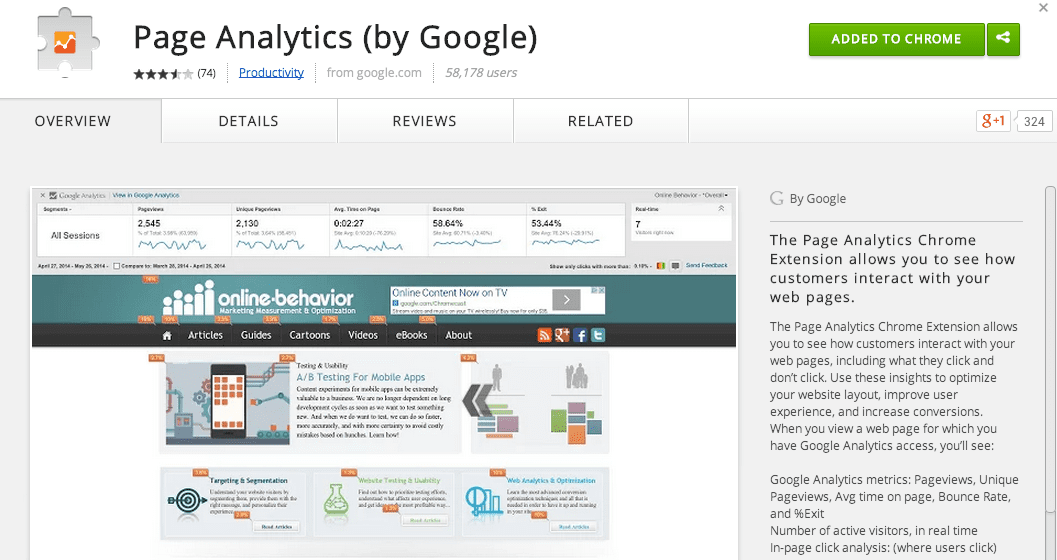
You will then see this panel and bubbles overlaid over your page showing the number of clicks on each link.

page-analytics-google-chrome

What does the new tool offer?

The tool offers convenience as an extension if you use this type of function often, but I don’t think most will. However, there are a couple of new ways of filtering the data which aren’t available in the standard In-Page analytics. These are:

    1. Show certain segments only e.g. New visitors
    1. Select date ranges and compare date ranges
    1. Show real-time users

Limitations of the tool

The tool shares limitations with the existing In-Page analytics:

  • It only shows the Number and % of clicks on each link – not value or conversion rates from links unlike tools like Adobe Analytics (Omniture). The In-Page tool does enable you to select Revenue or transactions, but it has never updated the report for me – frustrating! Let me know if you have got this to work!
  • Doesn’t show where visitors are clicking, especially where there isn’t a hyperlink – tools like Crazyegg can shows you this
  • Doesn’t show clicks wrapped in Javascript or any which aren’t wrapped in a standard HTML “<a href=”link””>
  • Doesn’t show difference between links to the same destination page (although this can be fixed if you upgrade your tagging to use advanced link attribution)

I hope this alerts a few more people to this tool – do share this post if you plan to download the tool, or to help spread the word about this handy tool.

I think anyone who writes copy or who specifies or designs page templates should make the time to use this tool to make their pages more persuasive!

28 Jul 14:55

9 Content Curation Ideas for Bulking Up Your Editorial Calendar

by Heidi Cohen

person visiting museum2014 is the year of content curation — the most “rad” format of content marketing right now.

While 93 percent of B2B marketers use content marketing, they’re encountering significant challenges when it comes to creating the quality content needed to satisfy prospects and customers, according to Content Marketing Institute and MarketingProfs 2014 market research. Specifically, they suffer from a lack of adequate time, have trouble producing sufficient amounts of content, and struggle to get budget.

Creating original content on a consistent basis can require a lot of dedicated resources, both human and financial. So what’s a resource-constrained marketer to do?

Incorporate content curation into the content marketing mix! According to 2014 Curata research, curated content should account for one-quarter of the content marketing your business produces.

pie chart-content marketing mix

Appreciate that content curation is NOT free!!! Content curation requires resources — in terms of employees and budget. In fact, CMI is considering adding a role that’s solely focused on curation.

By definition, content curation incorporates original content — not unlike a museum curator would. Often, but not always, this original information comes in the form of commentary; though in some cases curation efforts can be drawn completely from your company’s own original content.

Top content curation ideas

For content curation to be effective and drive measurable content marketing results, it’s best to use a variety of curation techniques.

Here are nine options for filling your editorial calendar with quality curated content.

  1. Share on social media: This is curated content in its starkest form. It simply involves sharing a few words and a relevant link on your favorite social media channel — a technique that is especially popular on Twitter. For example, Christopher S. Penn has shared his top 5 favorite pieces of content on Twitter since 2009, often including one of his own pieces in his list (though not always). In addition, he uses the hashtag #The5 to help his followers find these social content curation efforts.

web page-smiling guy with glasses

  1. Create new content by adding your own commentary to relevant third-party content: This format is what most people think of when they hear the term curated content, and is an easy way to associate your business with news, trends, and smart conversations that are taking place in your industry.

Taking a page from popular sites like BuzzFeed and Upworthy that have perfected this approach (in fact, they have practically built their brands around it), this technique works particularly well when you craft an amazing title to draw people in.

For example, when Upworthy’s Adam Mordecai curated a video on a 17-year-old with a rare form of bone cancer, he recast the title from My Last Days: Zach Sobiech to This Amazing Kid Got To Enjoy 19 Awesome Years On This Planet. What He Left Behind Is Wondtacular. With the attention-grabbing new title, Upworthy helped the video attract 17 million viewers, reach the #1 spot on iTunes, and raise $750,000 for cancer research.

young man with arms raised-upworthy

  1. Ask experts to contribute to a round-up post or panel discussion: Ask a group of people for their answers to one specific question. Generally, this content is entirely original, in that the responses have not been published elsewhere.

It’s a personal content curation favorite of mine. In fact, I used it to see how 21 experts defined content marketing, asking pros like Lee Odden, Joe Pulizzi, and David Meerman Scott to share their thoughts. As the curator, I crafted the question, and added an original introduction and conclusion.

excerpt-cohen-roundup post

  1. Aggregate curated lists: Lists are a very specific content format; for a list to qualify as content curation, it must collect information from a variety of sources.

Further, the curator must add value to the information by categorizing it and adding commentary where appropriate. This form of curation is great for attracting social media shares.

For example, Jonathon Colman built an epic list of content strategy resources. Like many curated lists, it’s attracted a ton of social love across platforms.

epic list-post example

  1. Work with others to co-create social content: This is a form of user-generated content (UGC) that removes the risks because you, the curator, are in charge of the content and presentation. 

Ask your target audience — including prospects, customers, influencers, social media followers, and the public — to contribute original material to your content. Add a title and commentary to the input.

Lion Brand Yarn Studio is using this kind of curated content in both its online and offline marketing efforts. For example, take a look at the company’s recent blog post regarding an upcoming event highlighting the creativity of its customers:

woman-white cardigan-lion brand yarn example

  1. Invite your fans and customers to help with community-created social content: Rating sites like TripAdvisor use this model to provide and encourage its community to interact on its platform. Unlike other curated content types, this technique isn’t done when the content is published — it continues to evolve and gather new commentary over time.

Here’s an example of Kuychi Rumi. It includes customer ratings and photos!

customer ratings-photos-kuychi rumi

  1. Rank the best: Think Top-10 lists and the like. This type of content curation is golden because it’s a form of ego-bait — the people included on lists like these are personally driven to tell everyone they know about them! 

This isn’t solely an online phenomenon, either. Billboard has done this for years, updating its technique over time to include social sharing and purchasing. 

billboard list example

  1. Select the best tidbits for your audience: The key to content curation success with this format is knowing what will matter most to your readers. The objective is to save your audience time by choosing the best of what’s available and providing one-stop access to it. 

Who’s Blogging What is a good example of this type of content curation. Jeff Ente cuts through the clutter to deliver must-reads to his audience. 

example-most useful posts

  1. Create a gallery: Don’t limit your content curation to text. Say cheese to creating photo galleries that spotlight your products, customers, or employees — remember, we all want our 15 seconds of fame. You should also think beyond your own publishing platform, and create galleries on your social media platforms, such as Facebook and Instagram.

Clothing site, Dolls Kill encourages its customers to share their Instagram photos by featuring them on its website:

girl holding cell phone selfie-be a doll

The content curation bottom line

Don’t just publish only one form of curated content! You don’t want your target audience to think your curated content is dull, so mix it up with a combination of the techniques described above.

Remember to allocate adequate resources for your content curation to ensure that your curated information provides value to your readers.

What’s your favorite form of content curation and why?

Need help giving your content curation strategy a boost? Join Heidi Cohen as she presents a pre-conference workshop on How to Develop a Content Curation Strategy for Your Organization at Content Marketing World 2014. Register today. 

Cover image by Ryan McGuire-Bells Design, via Gratisography

28 Jul 14:55

5 Major SMS Marketing Mistakes Never to be Made!

by Aine Doherty

Bulk SMS marketing is permission based marketing, taking advantage of the ubiquity of mobile devices and the prevalence of texting as a form of communication. SMS marketing has gained, and is continuing to gain recognition as one of the most immediate and powerful ways to reach today’s digitally-connected consumer. Utilised and implemented correctly, this essential marketing tool will instantly boost sales and increase ROI.  However, there are 5 major SMS marketing mistakes that can easily be made, particularly when starting out.

5 Major SMS Marketing Mistakes

1. Texting without Permission

This is, for sure, the number one to be avoided.  By law, Bulk SMS is permission based.  You must have permission from each and every subscriber before you implement your campaigns.  Legal penalties can be colossal, not to mention the severe damage your brand would suffer.

2. Complicated Opt-in Process

Be mindful some folk are still using feature phones.  QR codes can be complicated and not everyone will have a QR scanner on their phone.  Keep it simple, with no room for error. Do not use specialised characters and avoid using zero and ‘o’ as they can be difficult to decipher in your opt out option. Your goal is to capture ALL prospective subscribers.

3. Message Overload

The frequency of campaigns will differ from industry to industry. Try putting yourself in your customers’ shoes. How many text messages would you want to receive on a monthly basis? Never be intrusive. Sending too many messages can not only increase customer opt outs but it can also severely damage your brand’s image. It’s worth considering, from time to time, giving your subscribers a breather; it will help to keep campaigns fresh and enticing.

4. Lengthy, ‘non-value’ Campaigns

The three essential ‘C’s must be applied; Clear, Concise with a strong Call to action. Ensure your campaigns are succinct, free of ambiguity and full of value! Keep them short and sweet, and above all, difficult to resist! Avoid “non-promotional” messages. Remember, customers have signed up to be notified of; special deals, offers, promotions, and essential alerts.

5. Inappropriate Timing

Always be respectful. Know your customers and categorise your database accordingly.  Remember your entire customer base won’t want to receive messages from all of your campaigns.  The golden rule is …. do not disturb! Never text too early or too late!  Schedule your messages in advance to suit your customers.

With a little effort and experimentation, Bulk SMS WILL work! Avoid these 5 major SMS marketing mistakes and you’ll find yourself on a guaranteed, sure-fire path to success.

28 Jul 14:55

The Battle Of The Block: How LinkedIn Finally Stopped The Stalkers

by Selena Larson

When a San Francisco-based tech recruiter—we'll call her "Sally," a pseudonym—filed a restraining order against an ex-boyfriend, the court documents listed Facebook, Pinterest, and even Etsy as no-go zones for him. But it was LinkedIn that Sally was worried about.

“He started following what I was doing on LinkedIn,” Sally told me. “Who I was connecting with. He was trying to track what I was doing professionally. Every day I was seeing his face on my profile."

LinkedIn's basic features for connecting people became ways for Sally's stalker to remind her of his presence. 

"He started referring people to me, and connecting to people I was connecting with," she said.

Sally had no way of stopping him, short of a court order. Neither did any of LinkedIn's 300 million members, until LinkedIn finally rolled out a block feature in February of this year.

Why did it take so long?

Blocked On Blocking

The notion of blocking users is far from new. Instant-messaging systems like AIM and Yahoo Messenger have long had blocking systems to prevent users from contacting each other or even seeing whether another user was online.

Facebook had blocking since its earliest days; while the company's press office couldn't pin down an official date, Ezra Callahan, an early employee, believes it was present in 2004 or 2005, when the site was a simpler college-only network.

Twitter implemented blocking back in 2007 when the service was just a year old.

LinkedIn is actually older than Twitter and Facebook. When it was founded in 2003, it "started off with a big value of public profile information,” said Madhu Gupta, LinkedIn's head of security, privacy and customer-service products. That was the big innovation of LinkedIn: It took something formerly viewed as private and personal, the professional resume, and turned it into something public. 

It seems that LinkedIn's founders, intending the service for professional networking, never anticipated that its members might use it for darker purposes. But as it added feature after feature, stalking became a reality.

In Sally’s case, her ex harassed her for two years on LinkedIn—sometimes in violation of the court order—before the new function allowed her to stop him for good.

Growing Pains

People had been asking LinkedIn to implement blocking for a long time. But LinkedIn had other problems to solve.

One was keeping up with the service's explosive growth. In the last year alone, it's added 100 million users. 

Another was updating LinkedIn's technical architecture, which was hobbling efforts to evolve the site.

After the company went public in 2011, the engineering team "struggled to hold the site together with the digital equivalent of chewing gum and duct tape," Bloomberg wrote. To get back on track, LinkedIn's engineering boss launched Project InVersion, an effort to rebuild the site from top to bottom. For months, the company froze development of new features. After InVersion was done, LinkedIn's engineers could move much more quickly—but they had a massive backlog of projects to work on.

LinkedIn's fast-growing member base meant more and more people on the site—and more problems, as the site became a must-visit for professionals who couldn't avoid stalkers if they wanted to keep up with colleagues and stay relevant in their careers.

According to LinkedIn, the company was aware that users occasionally requested a block function. One of those users was Anna R., a LinkedIn member from Columbus, Ohio, who launched a Change.org petition in April 2013. That summer, LinkedIn executives learned about the petition, in which Anna R. related how a man who she said had sexually assaulted her in her workplace used LinkedIn to view her profile, an action which LinkedIn's interface notified her of. The petition became a catalyst for change. 

The frustration over this gaping hole in the company's privacy settings was reasonable: Anna R. pointed out that every major social site allowed for blocking—even Pinterest.

But the expectations held by some users were not. 

"To allow members to block stalkers would take ONE of your developers about ONE man-hour to implement. So why haven't you done it?" one disgruntled member wrote.

In fact, it took six months, and hundreds of engineers across LinkedIn—a massive, companywide effort. Work began in earnest in August 2013.

Tackling Blocking

Blocking is far easier said than done. For one thing, what does it mean to "block" a user? Not everyone has the same answer.

Twitter faced its own blocking controversy last year when it announced it would change its blocking feature to “mute” a person. In the new version of blocking, the person could still follow the blocker. The idea was that it would reduce antagonism and the prospect of retaliation if people didn’t realize they’d been blocked.

It took outraged users less than a day to convince Twitter to reinstate the block function it just got rid of. (It has since introduced a mute function alongside the older block function.) Even so, Twitter's blocking is imperfect: Because Twitter is a mostly public social network, anyone can see public tweets. The only way to prevent people from seeing your posts is to keep your account private.

One of the biggest challenges for LinkedIn was figuring out what, exactly, happens when someone is blocked.

“There are a lot of nuances as you start thinking about," said Gupta, the LinkedIn security and privacy head who oversaw the project. "What happens when you block the member? What should that experience be when you come to my profile page?” 

LinkedIn ultimately decided that when you block someone, they should be unable to see your profile or any content you publish. That includes any comments in groups you both might be a part of, or blog posts you publish to the site. It removes them entirely from your LinkedIn experience.

That product decision set the stage for the technical challenge.

“Every one of our applications like search, messaging, recommendations, all needed to implement their own version of how to filter out and how to filter out blocked members and not showing their content,” Gupta said.

Virtually every team at LinkedIn—26 product and service groups—had to be involved to make sure it worked correctly.

Putting LinkedIn To The Test

When one member blocks another, the two form a "blocking pair." On nearly every page of the site, LinkedIn is looking at content from and relationships with dozens, maybe hundreds of other members. Looking through LinkedIn's database of 300 million members for every interaction would bring the site crashing to a halt.

And to live up to Gupta's vision of how blocking should work, every thing a member sees and does on LinkedIn has to respect any blocks other members had put in place.

"When we do a feature like member blocking, we have to touch more than 60 different front- and backend services—all the member-facing products you see," Vicente Silveira, Director of Engineering Security Infrastructure at LinkedIn, said in an interview. "Profile, search, inbox—all those things are different features powered by a set of services that have to be changed to honor member blocking."

The good news was that LinkedIn's growing complexity of functions, like its new tools for publishing, also required quick ways to look up relationships and evaluate how closely two members are connected. The system for looking up "blocking pairs" could rely on some of that architectural work.

Rather than pinging a centralized database of blocked members every time, LinkedIn stored the information close to each service.

"We found a space-efficient manner to pretty much keep all the blocking info and all the services that needed it so they could do a local lookup," Silveira said. "We provide the services these lists, so they can have a local copy they can check." That approach provides "low latency," Silveira said—meaning users don't have to wait a long time for pages to load.

There was one more technical challenge: LinkedIn normally rolls out new features gradually to a small set of users to test response and catch bugs. With blocking, the team decided it couldn't do that: Everyone should have blocking at the same time, and it needed to work across the service immediately.

The engineering team had to develop 50 new tests just to make sure member blocking worked across various versions of LinkedIn, including desktop and mobile websites and LinkedIn's various apps. The engineering team also ran 18,000 existing tests to make sure the introduction of blocking didn't break other functions.

The work LinkedIn did on blocking dovetailed into other development.  One example is LinkedIn's new publishing tools. The day before LinkedIn introduced blocking, the company opened up its publishing platform to a small set of LinkedIn users. (Previously, it had only be available to a few hundred famous business leaders like Richard Branson and Jack Welch.) These posts hit a customized audience, so LinkedIn needs to make sure it shows up for the right people in someone's network—and doesn't show up to someone who's blocked.

LinkedIn may have been late to the game, but it arguably built a block feature that's more sophisticated and sensitive than Twitter's.

(For people still concerned about privacy even after they've blocked a user, it's possible to tailor your public profile to prevent anyone outside of your network—including people who search for you online and don't have a LinkedIn account—to see your name or profile.)

When Getting A Job Leaves You Exposed

When you sign up for a social network, you’re making yourself visible to the world in a way that was rarely possible before the rise of social media. And while there are many benefits—in LinkedIn’s case, it can help you get a job—the downside is that visibility can mean vulnerability.

Harassment and bullying are problems many social networks have, and ones that law enforcement is ill-equipped to deal with. It’s especially bad for women.

As feminist writer Amanda Hess writes:

“Ignore the barrage of violent threats and harassing messages that confront you online every day.” That’s what women are told. But these relentless messages are an assault on women’s careers, their psychological bandwidth, and their freedom to live online.

Our online lives have become just as important as our offline ones—and social media companies need to take steps to prevent online harassment that can affect us in the real world.

LinkedIn faced a lot of criticism, deservedly, for being late to introduce blocking. But from what ReadWrite has learned, after the company decided to make the feature a priority, it moved swiftly to solve a complex technical problem in a way that made blocking a meaningful safety measure—not just a quickly implemented, face-saving gesture to appease critics.

For Sally, the block function provides some sense of security, though she doesn’t think her ex-boyfriend has stopped stalking her online.

“I think [blocking] has anonymized it," she said. "Do I think he’s still doing it? Absolutely. The good news is, I don’t have to see his face.”

Illustration by Bill Strain

28 Jul 14:54

5 Things Digital CMOs Do Better

by Jake Sorofman

If you’re a mid- or late-career marketer, chances are your job today is mostly unrecognizable from what you signed on for. Perhaps no other business function has changed as dramatically over the past decade.

Why? Following a silent coup, the coronation is complete: the customer is king. With an abundance of information and choice, customers now guide their own self-directed decision journey as they traverse connected experiences that blur the lines between physical and virtual and scramble marketers’ signals for targeting.

Many marketers are left behind, simply tuned in to the wrong frequencies. In response, capturing the right data has become the key capability in finding and engaging audiences. But data, alone, isn’t enough; search and social marketing, for example, are content hungry disciplines. Marketers must also become publishers.

For marketing leaders, this has forced some serious soul searching on how to meet these challenges. Last April, I wrote “The Rise of the Digital CMO” to lend some perspective to this exercise. Subsequently, Gartner turned this into an ongoing research series designed to identify the patterns and exemplars behind the chief marketing officer (CMO) transformation — in effect, what digital CMOs do differently and what they look like incarnate. We found that digital CMOs do the following things better than their peers.

1. Shift from finding customers to getting found

The best digital CMOs don’t just shout from the hilltops, demanding attention on their terms. They orchestrate content marketing tactics that situate their brands at the moments that matter to their audiences. They do this by publishing brand-aligned, but audience-centric content that inspires, delights and, most importantly, engages customers on a self-directed decision journey where earned and owned often trump paid.

Hubspot CMO Mike Volpe is an exemplar of this pattern. He and his team publish a daily diet of blog posts, ebooks, infographics, videos and other content that lend insight to the digital marketing discipline. In doing so, Hubspot has become a go-to destination for insight on this topic. American Express does this, too, with its Open Forum site, which publishes editorial-style content for managers and operators of small and mid-sized businesses. Both of these are examples of brands that look and act like publishers, not carnival barkers.

But, as Hubspot’s Volpe says, it’s rarely just one thing alone that works well — it’s the right blend of activities. Inbound is about grassroots experimentation. Without proper measurement, these varied activities can turn into a fragmented mess.

Today, customers are inundated by pleas for their attention. As a marketer, the onus is on you to meet these customers on their terms with something of extraordinary value. That’s how your brand gets found.

2. Shelve the commercial pitch in favor of authentic storytelling

Digital CMOs have moved well beyond better-faster-cheaper; problem-solution-impact; features, feeds and speeds; and other self-referential brand-forward conceits, which are now rejected by audiences like a foreign body in the bloodstream. Instead, they tell stories — and, most importantly, they find others to tell stories for them.

These stories often follow the traditional narrative arc of exposition, rising action, climax, falling action and resolution. These stories are told with images, video and data. They inspire. They enlighten. They amuse.

Tami Cannizzaro is a brand storyteller. As IBM’s VP of marketing for social business, Tami leads a team that uses IBM’s celebrated “Smarter Planet” theme as the baseline for selling software. She says, “We’re not selling software, we’re building a smarter planet.” Nike marketing doesn’t sell footwear so much as it sells an aspirational point of view. Nike tells stories that ask audiences to reach for their personal best. National Football League franchise Atlanta Falcons’ CMO Jim Smith asks fans to “Rise Up”—and they do. To sell carbonated beverages, Coca-Cola tells stories designed to inspire nostalgia and happiness. More importantly, they ask consumers to tell their story on their behalf by cultivating user-generated content.

According to IBM’s Cannizzaro, today, people’s perceptions of the IBM brand are more likely to be formed by their community, not the message coming from IBM. The best digital CMOs now get this intuitively.

3. Break through silos to erase seams between channels and experiences

Digital CMOs recognize that customers are channel-blind. Channels, after all, are an artificial construct designed, first, to support corporate goals and organizational structures; and, second, to support the needs of customers. Today, customers expect the inverse: brand interactions that hide the seams between channels, where stories, experiences and services serve their needs first and the brand’s second.

Sharon Osen, SVP of global marketing at Swiss luxury beauty brand La Prairie starts with the customer, developing customer archetypes and personas that guide the design of multichannel experience that deliver on real customer needs. This begins with a deep understanding of customer habits and preferences, and how La Prairie can add value in their daily lives. Beauty retailer Sephora blends in-store and mobile channels to create ensemble experiences that make shopping easier and more engaging.

But La Prairie’s Osen makes it clear that the goal isn’t transformation for its own sake. She says it’s about enhancing brand experiences customers have come to expect with new digital extensions.

4. Use data to target precisely and measure relentlessly

Digital CMOs have learned to “close the loop,” turning their marketing efforts into a data-centric, performance-driven discipline. Here, the goal is to trace the thread from investments to outcomes, directly attributing marketing dollars with business outcomes. These CMOs use first- and third-party data to target contextually relevant offers and experiences guided by predictive analytics and algorithms that learn and adapt as customers traverse a meandering purchase path. These marketers then close the loop by combining this data-driven targeting with a process for continuous measurement. The result is a performance-driven discipline where marketing investments can be optimized to highest yield.

eBay’s CMO Richelle Parham is an example of a performance marketer. Her company collects more than 50 petabytes of data a day that it can use to target offers and experiences. For example, products that were browsed but not purchased become an opportunity for remarketing and the insight for collaborative filters in the form of recommendations that aid — and guide — customers’ decision making.

But, Parham warns, if this sort of personalization is handled clumsily, it can be intrusive. She’s right. Personalization can cross the line to creepy. Her advice is to balance head and heart: “In the end, we’re selling to human beings. To drive behavior change, we need to understand who the customers are and what they care about.”

5. Experiment aggressively, and challenge business model assumptions

Digital CMOs are agile marketers who embrace the mantra “test and fail to learn and scale.” Gartner finds that, today, 83% of enterprise marketing organizations have an innovation budget that reflects, on average, 9.4% of marketing spend. What do they use this for? Exploration. Experimentation. Learning by doing in recognition of the fact that sustainable competitive advantage is a quaint vestige of another time. These CMOs seek to create pipelines of innovations that they test and validate in rapid succession.

Delta Airlines, for example, has applied this technique to its websites, kiosks, in-flight Wi-Fi and entertainment, resulting in what it describes as a holistic set of touchpoints that inform the customers’ opinion about the brand. Here, a series of continuous experiments guide innovations that improve customer experience. The results? A 20-second reduction in kiosk check-in times, a substantial increase in check-ins via digital channels and improvements in overall customer satisfaction and brand sentiment.

But digital CMOs can’t go it alone. Digital CMOs need to hire the right people to lead and execute. As my colleague Laura McLellan and Scott Brinker wrote in their July-August 2014 Harvard Business Review article “The Rise of the Chief Marketing Technologist,” Gartner finds that 81% of enterprises have a chief marketing officer in place today, up from 70% last year. Seventy-seven percent have a chief customer officer as the primary advocate for the customer and final arbiter on customer experience. Forty-eight percent of the time, this role reports into the CMO, which supports yet another finding: the CMO is on the rise in strategic importance.

Other roles to watch: data architects, corporate journalists, data storytellers and chief content officers. They are all emerging to fill the gaps that stand between marketing from a decade ago and marketing for today.

A year later, digital CMOs are still on the rise. Only now, their secrets are coming into focus.

28 Jul 14:52

Smart B2B Video: A Killer Tactic for Hitting 2014 Revenue Goals

by Kathy Cabrera

A recent marketing study found that 93 percent of b2b marketers use content marketing, and 73 percent of that content is video. If you’re a b2b company with revenue goals that you’re still struggling to achieve by the end of the year, there’s a key question you need to ask yourself:

>> How can video convert more of my prospects into customers? 

It’s a fact – companies consider video a crucial type of content at both the early and mid-stages of the buying cycle. Investing in compelling web-based videos that tell your company’s unique story can help to improve conversion rates by as much as 80 percent. Here are some valuable tips for content creation, as well as engaging b2b video examples from companies whose success you can learn from:

1) Don’t sell your product – instead, emotionally engage your targeted buyers by relating to their everyday challenges and showing the positive results they can achieve by utilizing your product or service. Case in point: This video reveals the strain developers continually face, then presents a workable solution to the problem:

2) A peer-to-peer reference is a powerful form of sales referral, since it engages prospects from the unbiased, yet likeminded, perspective of someone who’s just like them. Here’s a savvy healthcare services technology video that engages patients and healthcare providers alike:

3) For less than 5 percent of the typical cost of participation in a major trade show, you can create a video that can do the marketing for you on a 24/7, continuous basis. This video can provide targeted lead nurturing via its use in sponsored social media campaigns, paid and organic SEO tactics, drip marketing and more. This attention-getting video helped a security technology company achieve buzz for its new product long after it launched at a trade show:

You do the math. How much of your annual business comes out of that one big trade show you attend every year? How many of your sales are generated from your website? Multiply that by some of the rocket-boosting improvement metrics that engaging b2b video can deliver – and you’ll be that much closer to hitting your revenue mark come year-end 2014.

28 Jul 14:52

Money Monday How to Focus on Buyers

by Lori Richardson

keep track of buyers with a  sales processIt is easy to get distracted in a sales career. One of the worst things that can happen is that you don’t keep an eye on your “more probable” buyers – those buyers who seem close to making a decision, have an eminent need, and are qualified buyers.

Have you lost track of a pending sales opportunity?  Does your focus shift?

On one hand, I’d like to say that there is no excuse for this, however, I know it happens all the time because of poor tracking.

You have this “lead” in a spreadsheet, not a CRM system, and you can’t set a next action in a spreadsheet. Even if you use a spreadsheet and calendar combo, there are still ways the opportunity can miss getting transferred to the calendar.

Regardless of whether you have a sophisticated CRM system or manila file folders at your desk (I hope not), one way to keep track of upcoming potential sales opportunities is to have a Hit List. Think Top Hits rather than a Mob Hit List – but either way, you jot down / type in those top sales opportunities that are probable and qualified. along with who your contacts are and their contact information. With your CRM system, you should be able to print a report showing all of your 30-60 day potential deals. They should be moving forward. Help your buyer to make a decision and bring the opportunity to closure through more conversations and by showing them the return (ROI) their company will likely gain by making this decision.

I like to print out my list and keep it on my desk where I can see it. By doing this I’m reminded visually of those who are interested in our services and stay top of mind. We will check their social posts and see what they are talking about, tying that into a conversation when possible.  Check this every day.

The other list I like to keep is either a list of industry counterparts of my clients, if I am an industry rep, or a geographic list if I’m a regional rep. If you always have that on hand, there is someone to contact, research, and propose to.

Other lists you should have if you are a newer sales rep:

  • List what sets our company apart from others in the industry. This is a confidence builder
  • List all the objections that can come up when speaking with buyers. (it’s a finite list)
  • List the buyer types that you and your peers call on regularly and their habits, wants, issues, and aspirations
  • list showing the steps in your sales process if it is not clear to you

The main point is that you need to plan, strategize, and stay organized in order to excel in a sales career. It is too easy to get distracted and to move so quickly that you don’t take time to plan ahead – you simply react. Reacting only works so long, and then you start missing out on opportunities.

What other lists and tools do you use to keep on top of all of your sales opportunities and the system you go about moving deals forward?

Lori Richardson - Score More SalesLori Richardson is recognized on Forbes as one of the “Top 30 Social Sales Influencers” worldwide. Lori speaks, writes, trains, and consults with inside sales teams in mid-sized companies. Subscribe to the award-winning blog and the “Sales Ideas In A Minute” newsletter for sales strategies, tactics, and tips in selling. Increase Opportunities. Expand Your Pipeline. Close More Deals.

email lori@scoremoresales.com | My LinkedIn Profile | twitter | Visit us on google+

The post Money Monday How to Focus on Buyers appeared first on Score More Sales.

28 Jul 14:52

Got CRM? Why You Need Marketing Automation Too

by Sherry Lamoreaux

Got CRM? Why You Need Marketing Automation Too image May I speak to.....7001 300x300A few decades ago, when I was a green B2B inside sales rep, we kept customer histories by hand on 3×5 cards and kept them in a “tickle” file organized by date. You’d have a conversation with a prospect, make notes on the card, jot down when next to call the prospect, and then slot the card in the file. Your next call would be a second or third call to the name on the next card up, or a blind call into a department within an organization noted on a list, on a piece of paper.

CRM changed sales…

All this changed when we got an early version of a CRM system. Suddenly my computer got friendly and helpful. Prospects’ names popped up to be called at the right time, and all my notes were there. It was more efficient. It was easier to make more calls, and easier to remember the thread of my conversations. My sales did go up (and so did the other reps’).

…but not marketing

Marketing, however, was still in the dark ages. They were very proud of the catalog they created, which they mailed to lists of companies of a certain size. We salespeople got those lists too, which were nothing more than sheets of paper with the names of departments and organizations. We spent our days calling into hospitals and corporations, asking who purchased health education materials, hoping against hope to find a genuine prospect.

CRM had made us more efficient. But marketing was handing us the same old, same old. The only way to qualify a lead was to call and spend the time going through the most basic things, just to determine need and interest. It was time-consuming, and when the lists were old or inaccurate (which was most of the time) it was soul-sucking.

The digital commons

You take my beaten-to-death point: Making sales more efficient is great, but salespeople need leads that have some kind of qualification. Now that digital interaction is our lingua franca, marketing can go beyond sending out catalogs and going to trade shows. The Internet has given us a new kind of commons, one in which buyers search for what they want – and marketers can meet them there.

But the commons can be the Wild West, unless you have a destination and a map to help you get there. That’s where your goals and process come in. Marketing automation takes you even further, giving you the infrastructure to get to your destination. To continue this (rather tortured) metaphor, it provides the train tracks, the engine to drive you along so you can get where you’re going faster, the box cars to carry your campaigns, the compass so you know which direction you’re going, and the stopwatches so you know how fast you’re going.

CRM and marketing automation are complementary

CRM systems transform sales through organization; marketing automation completes the picture by generating leads and managing lead engagement. As Matt Heinz of Heinz Marketing says:

In a nutshell, the only thing CRM systems do is organize your information…They keep track of your sales, but they don’t engage your prospects…They capture your sales process, but they don’t execute it.

“…Sales CRM is strategy. Even the sales process embodied within your CRM system is just strategy. Marketing automation embeds strategy but also drives execution. And the only way you’re going to sell something is to execute.”

A chart of complementary capabilities

Different CRM or marketing automation systems will have different capabilities, so this chart won’t be accurate for every comparison, but it can serve as a general guide.

Got CRM? Why You Need Marketing Automation Too image MA CRM chart 600x590

Stated simply, marketing automation is the marketing counterpart to CRM. They have different, complementary sets of capabilities, which intersect at critical points and augment each other. Together they support the entire sales and marketing process, from creating interest to educating the buyer to closing the sale – all while keeping the buyer at the center of the process.

To return to the issue of qualified leads

MarketingSherpa found that not all leads are ready for sales right away. In fact, while 61% of B2B marketers send all leads directly to sales, only 27% of those leads are actually qualified or ready to talk to sales. (“Do you really want your sales team spinning their wheels making dial after dial where nearly three-quarters of those leads are not ready?” asks Jen Doyle of MarketingSherpa.)

Managing leads to sales-ready qualification may be the most important capability marketing automation offers, and it’s the one that dovetails most with CRM. Marketing automation:

  • Supports early-stage lead generation
  • Enables you to deliver and scale personalized, stage-appropriate nurturing outreach
  • Incorporates and uses your CRM database to execute on marketing tasks
  • Gives sales access to personalized data collected through prospect and visitor tracking, which in turn becomes intelligence that guides the sales call
  • Tracks campaign results and lead conversions through the funnel so you can analyze what’s working (and what’s not) so you can refine your process and amplify productive efforts
  • Gives sales and marketing a formal structure to align around

Got CRM? Why You Need Marketing Automation Too image Got CRM eBook cover.shear  300x233

It boils down to this: Marketing automation is your backbone for developing and delivering sales-ready leads, connecting the dots and completing the picture that CRM draws.

Want to learn more about how CRM and marketing automation are complementary? Read Act-On’s new eBook, Got CRM? Why you Need Marketing Automation, Too.

28 Jul 14:45

The Everyday Pipelines You Never Think About

by Nate Sullivan

The things you do over, and over… and over… and over…

If you don’t work in sales, you may not even know what the term “pipeline” refers to, but don’t worry — it’s not complicated.

The Everyday Pipelines You Never Think About image Mario Warp Pipe McDonalds Toy

No, not that kind of pipeline.

A pipeline is usually just a process; almost always one with identifiable steps, and something you (or your organization) will repeat multiple times. In many fields, we just call this “work”. When I used to make salads in the crowded kitchen of an overpriced steakhouse (there, I said it!), we had a lots of pipelines. We made every shellfish platter the same way, with the same ingredients, the same presentation, and the same process. In fact, most of our mistakes and slowdowns came from someone freelancing or improvising. If you open those oysters before the ice is on the tray, you have to stash them somewhere on your tiny counter, your cousin knocks them over with a serving tray, and before you know it the two of you are screaming at each other and washing dishes for half the money.

We should have had a pipeline.

Sales organizations usually have a lot more at stake than a few heads of lettuce and an angry sous chef, so most of the time they have a pretty established process. Leads are collected, organized, contacted, and then classified based on how close they are to closing. Whatever industry specific steps (assessments, paperwork, financing, etc.) are necessary get inserted somewhere along the line, and viola, there you go. Pipelines help you predict what’s going to happen in the future — this is always useful — and can often help you tweak and improve your most common procedures.

I’ve mentioned this before, but not enough people think of their repeated procedures this way, because life feels funny and random and riddled with too many variables and shifting circumstances. Often times, though, we give these variables too much weight. The basic process underneath it all really DOES have clear stages and repeatable steps, and thinking about them in those terms can reduce stress, simplify planning, and increase efficiency.

Don’t believe me? Fine, I’ll show you. Here are some pipelines almost anybody can relate to.

Hiring Somebody / Getting Hired

Ever needed to find a job?

The Everyday Pipelines You Never Think About image tumblr inline mn97uzzQmS1qz4rgp

Better warm up the Hiring Pipeline.

I mean, really NEEDED to find one? If you’re properly motivated, it’s very likely that you’re working on multiple opportunities with similar requirements; initial contact, resume, phone screens, interviews, negotiating, and your eventual glorious return the workforce. Hiring somebody is pretty much the same thing. You have your initial candidates, your first phone screen, your in-person interview, and several points where you decide whether to proceed or not. Each stage is basically a gate — if someone makes it through all the gates, they become your co-worker. And then you do it all again!

Attending a Conference

I’ve never had to do a lot of conference planning, but I have helped out here or there. If you’re in an industry with a lot of trade shows (read : any industry), you’re likely to be bombarded with conference opportunities, all of which require answering slightly different versions of the same questions. Have you figured out what it’s going to cost? Have you decided to go? Have team members been assigned? Is travel booked? Is the booth ready? These are all stages, and they basically occur in order (although your order may vary). Realizing that all these steps are required — and often contingent on each other — can make the whole process run a lot smoother, especially if you’re going through it multiple times a year.

Contracting a Service

The Everyday Pipelines You Never Think About image Bad 278f89 2856080

Insert “vetting” pun.

Ever hire a contractor, or pay a vendor to perform some kind of service? What does that process look like? First, you have to define what you need done. Then, you figure out how much you’re willing to pay to fix it. Next, you have vet potential solutions, make a decision, and pay somebody. You’ll need to supervise the work while it’s being done, and then make sure whoever you hired gets paid, and properly evaluated. Whether you’re building a website or a man-cave, having a good purchasing process makes sure you get good results, and better yet, avoid making mistakes twice.

Passing a Law

I admit it — I was a political science major in college, so I have a pretty good sense of what’s involved in passing a law here in the United States. Lots of people, however, do not. Every once in a while, someone will breathlessly email me about some “law they’re passing”, only to reveal later that this person has no idea who “they” are, what the status of the proposed law is, or whether it has any change of getting through the legislative pipeline. Does it have cosponsors? Is it coming from the House or Senate? Is there a similar bill on the other side, with similar support? Can it survive a potential veto? These are all basically procedural steps every law has to pass one by one, before anything actually changes. Understand the pipeline, and you’ll understand what matters, and when you need to start bugging your representative.

Having / raising a kid

Some of my friends have one kid, and are firmly ensconced in the “special snowflake” phase of parenting. My sister, on the other hand, just had her third, and they’ve turned the whole process into a science. Dust off the old toys and hand-me-downs. Re-child-proof the same old things. Schedule parental leave. Move some money around. Plan vacation time. It all goes in stages, and when you’re done, you have a 25 year old living in what was supposed to be your sewing room. Just kidding! He’ll totally be an astronaut.

Pipelines are everywhere; work, home, and everyday life. Figuring out what they are, and what the steps are, is the first step towards understanding them and ultimately making them run more smoothly.

28 Jul 14:45

Grouping Sales Leads – How Attitudes towards Google+ Demonstrate a Diverse Market

by Max Stinson

You’ve heard of buyer profiles before. It’s not only a staple for generating sales leads. It symbolizes a solid reality in B2B marketing: No customer is the same as any other. But with differences, there often comes conflicts. How can you maintain a steady flow of sales leads while knowing that you’re doing business with people who have major disagreements with each other?

If you want an example, look no further than attitudes towards Google+. On one hand, some marketers say it’s a ghost town. Yet for others, it’s a social media haven. When you somehow end up catering to both demographics, how do you keep your entire customer base together?

Grouping Sales Leads – How Attitudes towards Google+ Demonstrate a Diverse Market image 01First, here’s an infographic that has a very flowery view on Google+’s capacity to improve marketing. Focus is on gaining more SEO visibility, sharing content, and connecting with influencers.

In contrast, you have critics like Chris Abraham who regard Google+ as the ‘antisocial network.’ Among his reasons include the very fact the people who prefer G+ are the types who don’t really prefer the kind of traditional engagement one prefers on a social network.

Say you’re a social media consultant that offers support to G+ marketing as well as other social networks. These represent two different kinds of prospects for you.

It’s clear that they both have very differing views on how to succeed in online marketing. One thinks that G+ is a great way to boost SEO while another claims G+ caters only to those who don’t value engagement. Do you think there’s a way for prospects like these to get along? Will this eventually mean you’ll have to choose one over the other or will you eventually just start contradicting yourself by agreeing with everything they say?

  • Understand that one approach may not work for the other – This all goes back to the purpose of having different customer profiles. The social media strategy of one organization could have a history that led up to the way they currently view it. On the other hand, those who disagree may claim a different experience. That’s why it’s better that you yourself approach them on their own terms. There is no need for either party to impose their strategies upon one another.
  • Understand the history of preferences – Sometimes it’s just not a matter of effective strategy. The most effective strategies are those done with a certain level of affinity. Some prefer a direct, aggressive marketing approach because it just suits their business culture. Others prefer a more passive, inbound approach because it suits theirs.
  • You have diverse offerings for a reason – Finally, a good way to demonstrate your capacity to serve different customers is to showcase your diverse offerings. There may times in your lead generation campaign that you tend to focus on what’s selling most. However, don’t ever leave out prospects who might be interested in other solutions or products.

As you continue to grow as a business, the number of customers you acquire and retain eventually grows with you. That could mean encountering a lot of people with directly opposing views on how to get things done. That’s why you need buyer profiles. They’re not just means of organizing data. They’re means to help you get along with all of them.

28 Jul 14:45

The Only 4 Marketing Activities You Need to Worry About

by Sonja Jobson

Raise your hand if you wish marketing your business could go on auto pilot – something you could set and forget so you could get back to doing what you really love.

If marketing stresses you out and makes you feel like you have no idea where to start, you are in good company. It’s a problem a lot of entrepreneurs face. And it’s not because marketing is just naturally overly complex and hard to master – in fact, marketing can be very simple and straight-forward. A lot of the overwhelm and confusion surrounding marketing for small business owners comes from the simple fact that there is just so much information and advice surrounding the topic.

One casual scan through your favorite marketing and business blogs will land you with a marketing “must-do” list the length of your arm.

You just have to start hosting webinars. If you you’re not active on Google+, you might as well give up now. Podcasting is in. Video marketing is essential. Have you started using images on Twitter? Infographics should be a part of your blogging strategy. Are you joining online networking groups? And please, for goodness sake, get on top of your SEO as soon as possible…and on and on.

With commentary like that, no wonder we procrastinate when it comes to marketing. All that information coming at us is enough to freeze us in place, panicking over where we should start.

Here’s the deal: there are hundreds of ways to market your business online. Most of them are legitimate and profitable. But none of them matter if you don’t have a solid framework in place first. You must have a basic, repeatable, easy-to-understand marketing plan in place before you can expect results for your business.

So if you regularly feel confused, overwhelmed, or unsure when it comes to marketing your business, that’s a clear sign that you don’t have a solid marketing foundation in place. Now isn’t the time to worry about keeping up with all the newest marketing fads – now’s the time to take a step back and focus on the basics.

This is great news for you, because it means your marketing life is about to get a whole lot simpler. Below are the only 4 marketing pieces you need to worry about.


Marketing Piece #1 – A website

Most of you probably already have a website, which means right off the bat you’re already a quarter way through your new marketing checklist. If you don’t have a website up and running, don’t panic. Setting up a website is super easy these days. Keep things simple and focus on the necessary pages only: a home page, and About page so people can learn about you and your business, a “shop” or “services” page so people can learn about what you sell, a page with contact info so people can get in touch, and a landing page to collect email addresses for your list.


Marketing Piece #2 – An email list

Email marketing is alive and well, and it’s also an essential part of your new, simple marketing plan. Email marketing is one of the most effective ways for staying in touch with leads, building a loyal audience, and making sales. If you’re not currently collecting email address, you can get started quickly and easily with an email service provider like MailChimp or AWeber. Once you have an account set up, add opt-in forms to your website and start building your list!

Marketing Piece #3 – Content

You need to create free content on your website – usually in the form of a blog, though you can choose to host your free content any way you want – and free content attached to your email list to entice people to sign up. This free content is important, because without it your prospects wouldn’t have a good reason to come check out what you do.

Keep this simple: you could create a short eBook or report, put together a checklist, or record a few short videos and package them as a mini-course for your opt-in content. For your website, you could choose to write traditional written blog posts, or start a podcast, a vlog, or share graphics and photos. Just focus on creating something that your ideal clients or customers would find valuable.

Marketing Piece #4 – Traffic

Now that you have everything set up (your website, email list, and free content), it’s time to get people to check it all out. You do this by generating traffic. In order to drive traffic back to your website, email list, and content you need to find an existing audience to tap into. Some great ways to do this is with social networking platforms (like Facebook, Twitter, Pinterest, etc), publishing guest posts on popular blogs, or getting interviewed on someones podcast, webshow, or live event. You can choose the mediums you like best, but just remember: you have to find a way to get your message in front of a pre-existing audience that is interested in the types of things you do.

Put it together

That’s it! This marketing framework is dead-simple. There are only 4 piece of the puzzle, and when put together they create a complete marketing system that will attract new leads, build an audience, and sell your stuff. And because this is a marketing framework, and not a one-size-fits-all marketing plan, you can adapt it to compliment your business and your style. Once you’re comfortable with this basic plan, you’ll be confident in trying out new marketing techniques, because you’ll know exactly where they fit into the overall plan (does it create free content for your audience? Does it drive traffic? Does it improve your website? Etc.).

Want step-by-step guidance on creating your own stress-free marketing plan? Join the Free 5-Day Marketing Dare!

28 Jul 14:45

How to Build Trust with Your Customers on Pinterest

by Vincent Ng

How to Build Trust with Your Customers on Pinterest image Build Consumer Trust9

Pinterest can be amazing when it comes to driving traffic. For me it’s my number one social media traffic source, and for others like Mike Alton, it’s helped him add another 1000 visitors to his site a month, which for a social media blog is excellent. As Pinterest continues to grow and starts becoming more part of the mainstream, it’s important not to forget a vital lesson. Are you using Pinterest to solve the main problems your customers are having?

I’ve consulted and worked with clients in the past on their Pinterest strategy, only to go back and tell them how difficult it is to use Pinterest for their business because they often try to run with the network before they learn how to walk. People who are often most successful at using Pinterest, in terms of increased sales, brand power, sponsorship opportunities and trust  do it through one thing – by helping their customers solve a problem they are having.

Sometimes I feel that I can get too attached to a network and BELIEVE that the problem that my clients and customers have is understanding what Pinterest is about, but for my clients the problems they have are about finding the right traffic to generate more leads (e-mail sign ups), generating more sales for their products, and increasing their reach  with a buying audience.  This helps me stay focused in building trust with the right audience.

Running Before Walking On Pinterest

I’m often surprised how much money is pumped into social media marketing because it’s the hot thing to do. I used to do marketing consultations for restaurants and I’m always surprised to hear owner’s friends tell them that they have to be on social media.  Often, if a restaurant isn’t doing so well it’s because they aren’t solving the expected pain problem of their customer.

When people go to a restaurant, they expect good food and good service for the price they pay. It’s that simple. If the food is delicious and priced at what consumers are willing to pay, then people will tell others about the restaurant over the months, but what they experience in the restaurants is important when it comes to building consumer trust. No amount of marketing can cover bad service and bad food.

As a matter of fact, doing social media marketing in that case only makes it worse.

The point of the story is to make sure that you’re covering the fundamental problems your customers have and to provide them with what they expect so that trusting relationship can be buit.

Customers Want to Trust You. Give Them Reasons To.

Okay, I admit, some customers are expecting you to be on social media. But what they’re really looking from you is guidance. They’re hoping to build a relationship with your business, but they need to know that you’re willing to commit to their well being first.

Keeping this in mind, Pinterest and social media aren’t always the answer. For many people, including myself, having a blogging platform is crucial when it comes to building trust.  Though you can also build on other platforms to build trust such as having your own audio podcast like Smart Passive Income’s Pat Flynn, or a video podcast like Jaime Tardy from Eventual Millionaire. 

Some clients want to jump into Pinterest because they’ve heard how much traffic it drives to a website, and in many cases I know professional bloggers and small business owners that state that it drives more traffic for them than Google.

Jenae from Icanteachmychild.com is a good example, where Pinterest is her number one traffic driver, and she receives over 75,000 visits from Pinterest.  But for those that have been most successful at using Pinterest to drive targeted traffic back to their site, it’s because they have valuable articles and blog posts to share. They’ve been providing excellent resources, just like a restaurant would provide excellent food. And when you can consistently provide excellent resources, both on Pinterest and on your own site, you increase that trust.

With a great blogging platform you have the opportunity to help address customer issues and take the initial steps into a customer trusting you enough to buy your product. Not only to buy your product but for becoming an ambassador.

If you create pins and it does is lead back to the homepage – well that’s fine and dandy like sour candy. And most people are not big fans of sour candy.

Do E-commerce sites Need a Blog or Educational Platform?

You may look at the success of sites like Etsy, Amazon, and e-bay and think to yourself that you don’t need a blog to be successful, but keep in mind that these e-commerce platforms built their reputation through blood, sweat and tears for years to get where they are now.  Amazon lost hundreds of millions of dollars when they first started. But they built an empire based on what customers wanted in an e-commerce platform.

There’s no doubt in my mind that if you a blog that it will help build your e-commerce business much faster.

While Pinterest purchasers tend to be the most spontaneous when it comes to social shoppers, meaning that they do the least amount of research online before buying a product, being able to provide a blog to help be a resource and drive additional traffic can create a strong brand affinity.

How to Build Trust with Your Customers on Pinterest image Pinterest Spontaneous9

A good example of a company that sells retail products, has a strong command on Pinterest, and has a strong blog is Lululemon. They write articles to help solve every day problems that their customers face. Lululemon had a great post, 10 Tricks to Sleep in the Heat.  

Even Pinterest itself has a blog to help be a resource for businesses, and people who personally enjoy using Pinterest.

Think Outside the Blog

Think of practical ways to be of help to customers, and they will love you for it. Of course don’t forget to make a featured blog image that’s pinnable. I’ve always believed in the power of evergreen content, content that can last for years. Think about all the different problems that seem to come up again and again that you can help address through your blog or educational platform.

Let’s say that you’re in the business of selling Christmas ornaments. I think it would be a great idea to be able to do a webinar on “How to Create the Best Looking Christmas Tree Ever.” A short 20 minute presentation that could be of value and that could be auto played. This type of video or webinar content can then be shared again and again every single year on Pinterest. It’s brilliant.

At the end of what I’m trying to say is this. If you’re hoping to get more traffic to your site with Pinterest, it can do that. There’s no doubt it will. But here’s something you need to keep in mind, if two new and competing retail brands are on Pinterest, and the fundamentals are all equal such as quality of clothing, great customer service, which one are you more likely to do business with over time? The one that provides you the goods, or the one that provides you the goods that also solves your problems every time you visit their website?

Dedicate time to creating great resources that will solve your customers’ problems, and use that to help grow your Pinterest following.

Find out how to grow your your traffic and sales with Pinterest at the Pintalysis Academy. Discover how get your pins to rank number one for search terms on Pinterest, and how to use it for local business marketing. Get notified about the early bird special.

28 Jul 14:45

IBM on its agile marketing strategy: the theory and the practice

by Ashley Friedlein

I have written a lot about the opportunities of adopting an agile marketing approach.

However, it is quite hard to find many examples of this being practiced yet, particularly at any kind of scale, and even more particularly by organisations that are not start-ups. IBM is one such example and it is great to see B2B marketing leading the way here. 

Ben Edwards is VP, Global Communications & Digital Marketing at IBM. He leads the company's global communications function, global advertising & media, brand strategy & design, digital strategy and IBM Marketing Labs.

Following is a transcript of an interview I did with him to understand IBM's thinking around agile marketing and how this is playing out in practice. 

What do you understand by agile marketing and can you describe how your marketing operations run in an agile way?

There’s a broad answer and a narrow answer to that question.

The broad answer is it’s a way of collapsing planning and execution cycles into something much more continuous and available to be adjusted.

So, in software development you have a so-called waterfall approach where you do a lot of planning up front and then you execute or build based on a set of fixed requirements that are difficult to change (or involve a large change management process).

There’s an equivalent in marketing as well.

Traditional marketing has involved complex, heavy, expensive things like advertising and direct mail via print inserts. That sort of thing has used long upfront planning cycles and fixed execution.

As we move to digital marketing, just as we moved to digital products and digital product development, the cost of change and failure drops dramatically and there’s a great opportunity to collapse those upfront planning cycles into something much smaller and then iterate rapidly based on what you learn through short periods of execution, measured for outcomes.

So that’s the broad answer - collapsed upfront planning, iterative cycles of planning and execution based on continuous improvement.

The narrower answer is that marketing itself is becoming a technology-intensive business and the stuff we build in marketing, increasingly, is in software. So, we’re simply adopting best practice in software development.

What is it that we make in marketing? We make websites, web services, web applications, mobile applications. Those are the materials we use, so if we’re making that stuff we really ought to be following best practices in software development. And those best practices are agile.

Agile seems well-suited to production and delivery but are you able to apply to marketing strategy, planning and creative, too?

Agile can be done in many different ways. My view is one wants strategy itself to be a just-in-time type of exercise - pragmatic, adjustable and consumable by the teams that are building.

So, it’s not that you must put strategy into an agile process but it needs to accommodate an agile process.

It’s the same with design. It may or may not be in the agile process but it needs to accommodate an agile process. I need to be able to do just-in-time design that I can feed into a build team and help them with their next iteration of whatever they are building.

Ideally though, you want to put all of those things together. Think about what a marketer needs to do. A marketer needs to bring creativity to the challenge of engagement. Engagement is an increasingly complex and difficult proposition given the fierce competition for your attention.

The way we’re going to engage is through technology and analytics, increasingly though websites and mobile apps. What we need to do is bring the creativity of marketing together with the technology that we’re building in, in order to try to design and develop creative solutions.

Where I see the marketing industry going wrong, and where it continues to go wrong again and again, is it holds these processes separately. To think, somehow, that strategy and design is upfront from building is wrong. Technology and the materials you use have to be considered as a constraint to the design process.

What are you designing in? Are you going to design in paper then ask a technologist to build it? Well, the web isn’t made out of paper. The web’s made of data and applications.

So it’s really dysfunctional to hold planning and design separately from build and implementation.

How do you get agencies and staff working together in an agile way?

Agile is about collapsing cycle times between strategy and execution and collapsing handoff points.

The key principles of agile:  you build an integrated, dedicated cross functional team and you give them everything they need and you empower them to go and solve that problem.

So, the traditional agency model of a client briefing an account manager, who then goes and briefs an internal team, who then goes and briefs the creatives, who then go and do work for four months and then come back – that’s not agile. That doesn’t suit the model, it breaks the model.

As part of our exploration of agile marketing we’re pioneering how we work differently with our agency partners.

The model we have is to forget about, for the moment, organisational boundaries and functional boundaries.

Forget about whether you sit in the technology organisation in a client or the marketing organisation in a client, or in product or R&D, or the creative organisation in the agency or in account planning and strategy – forget all that, park it for now and accept a simple set of rules: 

  • We need a dedicated team to be on the work full time.
  • The team needs everything they need to do their work.
  • The team has to be cross functional (we need designers, developers, content strategists, marketing strategists, UX etc). 

Who do we staff that team with? Quite quickly if you start looking through that lens, the problem doesn’t become ‘how do we work with our agency’, the problem becomes ‘how do we get great talent?’

How do we cast great talent into a dedicated team? All you need is a physical space and a table and access to great talent. So, when I look at our agencies, I see companies that can attract, retain, motivate and engage great talent.

If we hold them as strategic partners and we retain them, versus treating them as labour to be squeezed, then they become a key source of that talent for staffing these agile teams.

So let’s look at agencies. Where in particular are they strong? That depends, agency to agency. Some of them are really good at information architecture and user experience, some of them are really good at visual design, some of them are really good at content strategy and marketing strategy and we need all of those things for this model to work.

So, it’s a very disruptive model for agencies as well as for us. But the proposition is ‘be our strategic partner, bring your best and brightest, we’ll engage them in really cutting edge work, we’ll help them grow their skills and we’ll bring you into our most important and most strategic work and you’ll learn with us.’

Given agile reprioritises all the time, how do you budget for agile marketing? How do you remunerate your agencies and suppliers when the deliverables are continually changing?

This is another key disruption point and a difficult point and frankly we haven’t quite got to the bottom of this one yet.

It’s a different model, which is the problem. The traditional model is ‘you tell me what you’re going to do and I’ll pay you for it’, whether that’s an agency or me and my CFO.

With agile, you don’t know what you’re going to do, not to that sort of level of specificity. You get clear on the goal or the mission for a team or teams, which is like a North Star.

You get clear on how they’re going to measure that, some quantifiable indicator of whether they’re heading towards the North Star or in some other direction, and then you let them figure out how to get there.

So, let’s take an example. You’re going to build me a website and it’s going to do X, Y and Z and it’s going to look like this. This isn’t how agile works. Instead, you’re going to help me engage this set of customers around this proposition and help me convert them to leads.

Figuring this out is a challenging notion for the traditional model because I don’t know what I’m getting. What I’m actually getting is a fixed capacity to do work. That’s basically what it is and that’s how one thinks about software development.

My goal is to make the fixed capacity as productive as possible by engaging the team in the right way, with the right methods, and providing them with the right environment and the right tools, as well as giving them the right opportunities for learning.

My second goal is to prioritise the work I put through that fixed capacity so that I deliver the most business value, the fastest.

That takes continuous engagement with project stakeholders, the part of the business that is funding the work. So, what the CFO is buying now from me is a fixed capacity to do work. The work I’m going to do is whatever needs doing.

And it’s the same with the agencies. We’re going to retain them to do work. We don’t exactly know what yet, we have an idea but that might change. And it always does of course, which is the irony, the non-agile model doesn’t work because what we said we’d build, we didn’t build and by the way we had to change what we were doing halfway through the year in difficult circumstances and do something else instead because the boss changed his view or the market changed etc.

So, it’s a difficult thing, prioritising work in the right way to increase productivity of a fixed capacity to do work.

What are your views on the nature and importance of the working environment in order to get agile working?

I’m very strongly in favour of physical co-location and that’s our model. And it’s expensive. We are physically co-locating a lot of people in downtown Manhattan at a high expense. I’m a big investor in that model because I see – and can count - instant productivity as a result.

If you’re not going to do anything else, get all the people you need to solve your problem and sit them facing each other at one table. And a lot of the people we need to do the work we do want to live and work in cities like New York and London. Once they are all round the same table, they’ll figure it out! Even without guidance and methods and tools – although those things will help them go faster.

The head of our growth markets business once told me about a problem of delivering hardware in China. There was an invoicing problem, a finance problem and a sales process problem i.e. a whole bunch of dependencies that different parts of the organisation had to fix in order to get this very important mechanical piece right so we could start fulfilling demand in the market.

He tried many ways to fix the problems but ended up getting a room in Beijing and getting everyone needed to fix the problem into that room. He put a bank of telephones in the middle of the room and he said to the sellers ‘call this number if you have a problem’. That’s all he needed to do. The team figured it out together.

What about virtual collaboration tools?

You can extend the physical into the virtual. Humans tend to treat virtual representations of humans as objects and not humans, if they’re anything less than 70% of real-life size. So those windows in Google Hangouts are no good. You don’t get that connection you need.

Secondly, and this is our anecdotal experience as well, if you get that human into a physical connection with the team first – fly them in for two weeks, have them sit on the team and bond – and then go back to virtual, the response is much better.

That person will be treated as a human, not as simply an email. We do that as a best practice.

All of our lab teams have 60 inch screens, and then we fly people into the lab and then fly them back out.

Does agile marketing fit with the IBM culture? How important do you think culture is in getting agile marketing to work?

It’s the most important piece. One way of defining culture in the workplace is ‘how we work’. And agile is how we work. So, agile instantly runs smack into culture, which is an emotional thing and a very difficult thing to change.

What I’ve noticed is that when you start talking to people directly about how they work, and try to change the way someone works, you often get the reaction that you’re actually insulting them at a very deep level, like you’re telling them they don’t know how to do their job and questioning their professionalism.

That’s obviously massively counter-productive, so I’ve learnt not to talk about it. What I’m looking for is risk-takers and innovators who were born with the desire to do things differently. Invite them to work with us in different ways. Everyone who has given it a go in some serious way becomes passionately in favour of it. It’s more productive, more enjoyable, more empowering, you get better momentum and better results.

Once you get over the hump of talking about it and not wanting to change the way you work and you actually do it, then things start to change.

That’s how we’ve been working on it, literally one by one. One team at a time we’re inviting people in. At some point it reaches a tipping point where everyone starts talking about this thing that we’re doing, then you get the next wave of people coming in who are following that first crowd of early adopters.

So, it’s very challenging. Most companies I’ve worked with haven’t had this culture. It requires high degrees of trust for the teams. You’re giving them a lot of autonomy and you’re making a lot of change to existing practices. To get started you have to create a protected space for that to happen and shelter that space from the prevailing culture.

Find those early adopters, get them on board, allow them to tell the organisation why it’s great, make yourself pretty much invisible to the organisation because it’ll otherwise reject you, and build momentum that way.

How do people react to this way of working? Does it appeal to certain personality types, or marketing disciplines, more than others?

I’m not sure if it applies to certain marketing disciplines or not. There are certainly people who want to work in this way and there are people who don’t. The dividing line can be described in different ways but one of them is an aptitude for, or a thirst, for learning.

You’re asking people to step out of a mentality of ‘I do this’ e.g. ‘all I do is development, I don’t do design and I don’t do content and all these other things, I just do development. I’m just sat here at my desk waiting for the design to come, then I’m just going to code it quietly myself then pass it on to whoever needs it’.

We find there are people like that and they don’t do well in this lab environment. It’s messy and cross-functional and we’re asking the teams collectively to sign up to a business objective not to be responsible for just making a widget (as an example).

And the same is true of designers. Some say ‘I don’t get involved in production, I do design, a much more elevated thing. I am a creative.’

I don’t understand this agency language of creative. They have creative departments. So everyone else is not creative? Who comes into work everyday to be uncreative? 

You have to agree with this proposition that creativity emerges from collaboration across many different types of skill sets. You need to be able to learn. If you’re an advertiser creating short films you should learn about what it takes to build a website – wouldn’t that knowledge allow you to be able to be more creative on the web?

You have to want to learn, to want to operate where the boundaries of functional silos are blurred. Ultimately we’d like to staff every team member with the skills they need, that’s the ultimate, we need generalists.

How do you scale agile marketing?

Scaling is difficult. But we’re cracking the problem. I think of these teams like racehorses, and they’ve got blinkers on because you’ve set them up with this singular purpose of achieving a goal and then you give them everything they need and they’re fully empowered.

They are very exotic creatures. You unleash some real athleticism there but they’ve just got that single goal in mind and they’re running for the line very fast.

The challenge becomes if you’ve got more than one team, how do you start to create peripheral vision and integration across those teams? At what points do you need integration – tech level, platform level, services level, API level, design level and integration with scaled production capabilities.

Ultimately, integration has to come together at the customer experience level, it has to come together, if you’re building tools for marketers, in the marketing user experience.

So how do we achieve that? That’s tricky and that’s the scaling problem. One of the things we’ve done, we have a group of teams in our lab in New York that are actually working with our technology office to create tools and services for our marketing and communications professionals to accelerate the digital transformation of our marketing function.

There are eight of those teams building things like content authoring tools, content APIs, content services, nurture services, interfaces for inside sellers and direct sales teams and so on. And we’ve taken that shared table philosophy and used that, we’ve sat them all together and they all talk together, those teams.

Another thing is how you create a just-in-time design function that looks across these teams integrating and synthesizing the customer experience, the marketing user experience, the API and service layer etc, but then takes the output of that synthesis and drops it into the individual teams for work they need to do. That’s a delicate and difficult thing to do.

Scale is probably the biggest challenge of agile.

What have you learnt from doing agile marketing?

My first transformation was a technology transformation not a marketing one. I ran The Economist digital media business, did an agile transformation of the technology team that built the website and associated functionality for the advertising network.

The reason we adopted agile there wasn’t anything to do with planning cycles, we had a chronic quality problem. So the quality of code was poor, our website kept falling over, the availability of our web applications was poor, our ad network was failing, the tech platform was failing. At its core, we had acquired a bad quality problem.

If you think of project work as the iron triangle of time, quality and scope, something has to vary in that equation and what was varying was quality, because time and resources were fixed and scope wasn’t being managed, it just kept going up.

So what agile does is it strictly time-boxes work and forces adherence to quality standards. The quality transformation is about negotiating with the teams, over time, higher and higher levels of quality in the definition of what work is actually “done”. Scope is what we allow to vary – it’s whatever next-most valuable work we can get done during the next time box at that fixed level of quality.

That was the first transformation and we had some success from that. We learned that the agile method can absolutely fix a quality problem if top management is committed to doing that and recognises that’s at the core of the business problem.

And absolutely, agile can be applied more broadly to different types of planning processes to break down those processes into iterative cycles of development (in the broad sense of the word). That releases a lot of momentum, productivity and value. Marketing is one category we’ve applied it to.

I’ve also at one point applied it to my management team. We got to the stage where we would tee up these giant problems that we had and then we would stare at them and then talk about them and they got bigger and bigger and we wouldn’t do anything. The mountain gets bigger and bigger and you’re paralysed and you go back to what you were doing before.

I said, look, I’m done with these conversations, we all know the problems in the organisation, we’re all very familiar with them, put them to one side, the only thing we’re going to talk about is what we’re going to get done in the next two weeks, and we’re going to run an agile cycle. Then we will decompose our management work into things we can get done in the next two weeks. And we’ll hold ourselves to account for the things we’ll get done in the next two weeks. Run a backlog and go through it. It was very energising. We started taking small steps towards making things better, and we began delivering progress.

Turns out, people feel better about the work they do when they work that way – and you get more engaged employees.

On the management front, my views of what I do and should do have changed a lot in the last six to seven years. I guess I was guilty seven years ago of this idea that we only get more out of an organisation by pushing harder.

Think of water flowing through a pipe. How do I get more out, do I increase the pressure? That’s not my view now. You look at the pipe and find and remove the biggest blockages. This is a core principle of agile, it comes from lean manufacturing and the Toyota Production System in the 1950s – the people on the line were the ones with the most knowledge about making things more efficient, so listen to them, fix it and improve the flow.

You tell me what your blockers are, I might push them back, but some of them I can see you can’t fix and I’ll help you with them. It’s my core management activity. Build the right environment, find great talent, unblock the teams, give them what they need, clarify where they’re going and how they are going to measure progress and let them at it.

28 Jul 14:45

4 Big Questions to Ask When Outsourcing Inside Sales Teleprospecting

by Allison Tetreault
Rnordman

Equally important are the questions the outsourcer asks you.

4 Big Questions to Ask When Outsourcing Inside Sales Teleprospecting image outsource resized 600

The decision to outsource part of your sales team – whether you’re revamping an insourced team or whether you don’t have on insourced team – can be a very tough one to make. What are the most crucial factors to look for in an outsourced teleprospecting team? Most people’s answer would be: cost. While cost of service is a very important factor when considering an inside sales teleprospecting partner, there are numerous other questions to ask to determine whether the company you’re researching is well-run, successful, and most important, trustworthy. In a discovery call about that company, ask these 4 questions to get a real feel for the way they conduct their business.

1. What kinds of clients do you serve?

Identify the specialist and generalist outsourcing companies. Generalists will take any type of client, but their processes won’t be specific to your industry. Many generalists only see a 20-30% conversion rate to next steps in the sales process. However, with a specialized teleprospecting firm, you should see a 60-70% conversion rate. Specialists will make a point to say that they specialize in the tech industry. Specialists will also have an army of advocates for their service, and are happy to provide you with client references and/or case studies specific to your industry, product or service, or perhaps even share how they solved a similar challenge to the one your company is facing. If you want a more streamlined sales process with people who have experience selling products and services similar to yours, steer clear of the generalists and only consider specialist sales providers.

2. How exactly will leads be qualified andtransferred?

The qualification conversation is very important to have before implementation. Understand the outsourced partner’s criteria for quality leads and ensure that it is communicated well. Will the quality leads passed over express a business pain that can be solved by your product or service? Are they interested in the next step? What exactly defines a “next step?” Not only will these questions give you a glimpse into the best practices the company uses to deliver quality leads to their clients, it also helps you understand the necessary criteria your insourced team might have to look for as well.

3. Do you have a feedback process? If so, what type?

It’s important to know the kind of feedback process your outsourced partner provides. Closed-loop feedback allows for communication between everyone involved, including the outsourced team and your own team, on each opportunity. After a lead is passed from your outsourced team to your internal team, the movement of that lead should be documented and reported on by each partner. The outsourced team would like to understand if that lead was converted to an opportunity and is being pushed further down the sales funnel. On the other hand, the outsourced team should also receive feedback if the lead did not convert to an opportunity, complete with reasons why the lead was stalled in the process. This information keeps both teams on track with their metrics and allows for better communication on what’s working and what’s not, as well as more insightful conversations on how to serve your sales numbers.

4. What metrics should we use to gauge progress?

With customized reporting dashboards for their clients, your outsourced teleprospecting provider can suggest what metrics are best to focus on when measuring lead qualification progress and offer explanations as to why some metrics are better than others to track. For example, call volume isn’t as important as positive lead feedback percentage, or passed leads that agreed to the next step. With some recommendations from your teleprospecting partner, agree early on what both of you will be tracking to ensure success, and agree together when or if those metrics need to be changed.

Interested in reading more about outsourcing inside sales functions? Our new guide contains even more questions to ask the company you’re considering as well as advice for successful implementation and proven benefits to outsourcing teleprospecting to the perfect team for your company. 

4 Big Questions to Ask When Outsourcing Inside Sales Teleprospecting image f669dd85 1e12 4c4f a266 065afe5e68b9