Shared posts

10 Dec 23:27

The Young Turks Interview


I recently sat down with Cenk Uygur of The Young Turks to discuss my most controversial views about Islam, the war on terror, and related topics. It was, of necessity, a defensive performance on my part—more like a deposition than an ordinary conversation. Although it was a friendly exchange, there were times when Cenk appeared to be trying very hard to miss my point. Rather than rebut my actual views (or accept them), he often focused on how a misunderstanding of what I was saying could lead to bad outcomes—as though this were an argument against my views themselves. However, he did provide a forum in which we could have an unusually full discussion about difficult issues. I hope viewers find it useful.

Having now watched the full exchange, I feel the need to expand on a couple of points:

Journalistic Ethics
The passage of journalism into its digital future is proving more than a little perilous. We seem to be circling a vortex, at the bottom of which lies the perennial problem of money: How can writers, editors, and publishers get paid for their work? I can’t help but feel that a reliance on advertising is encouraging the worst instincts in everyone involved. There is comedy to be found here, of course. I recently came across an article accusing me of “sexism” that was paid for by ads promising access to “Sexy Asian Brides.” However, the results of any system of bad incentives are rarely amusing. We must find some way to correct course.

I began my conversation with Cenk by complaining about how he had treated me on his show in the previous weeks. I think his unwillingness to acknowledge the difference between valid criticism and misrepresentation was a missed opportunity (for him). He seems to believe that allowing a target of defamation to give his or her side of the story provides the necessary balance. He also detects an ethical symmetry where none exists: If writer X has been spreading malicious lies about writer Y, and Y accurately describes X as “a liar,” that does not give each party an equivalent grievance against the other. Cenk seems to view most claims of misrepresentation as a he-said-she-said stalemate that is, in principle, impossible to resolve.

This is a growing problem in journalism. In my conversation with Cenk, I briefly discussed Salon’s unethical treatment of me, but I’ve had many other encounters with journalists and editors that should trouble readers.

For instance, I recently discussed an incident in which Glenn Greenwald forwarded a tweet describing me as “genocidal fascist maniac” (Reza Aslan did the same). Feeling that these attacks had gone on long enough, I decided to call John Cook, the editor in chief at the Intercept.

Here is a snippet of our conversation:

Me: My criticism of Islam is not racist.

Cook: It is racist.

Me: John, Islam is not a race. You can’t convert to a race. And my criticism of Islam applies to white converts just as much as it does to Arabs or anyone else born in a Muslim country. In fact, it applies to converts more because they weren’t brainwashed into the faith from birth.

Cook: So all Arabs are brainwashed?

Me: What?

Cook: You just said “Arabs are brainwashed.” That’s racist.

Me: I was just making a point about the difference between having an ideology drummed into you from birth and converting to it as an adult who may have had the benefit of an Oxford education! These are different cases. And I am less judgmental of the former.

The conversation continued like this for 40 minutes. I felt like I was talking to a robot programmed to run a reason-destroying, political-correctness routine until the end of the world. It was, in fact, the most maddening encounter I’ve had with another human being in decades. I actually hung up on the man. (I haven’t done that since high school.)

I have no idea what Cook’s background is, but this is not a person who should be guiding journalism into its digital future. The only ethical defense he could give me for Greenwald’s retweeting defamatory nonsense about me (again, calling me a “genocidal fascist maniac”) was that “everyone knows that retweets don’t equal endorsements”—as if this were some high principle of journalistic ethics. Of course, in this case it was an endorsement. Greenwald has repeatedly described me as a dangerous bigot in print and on social media—and reaffirming this negative impression of me was the whole point of his passing this tweet along to his 420,000 followers.

What makes Cook’s precarious hold on journalistic integrity so ominous is that he, Greenwald, and colleagues have been given $250 million in funding from Pierre Omidyar. This is a fantastic sum of money—indeed, it is the same amount that Jeff Bezos recently paid for the Washington Post. It is difficult to see how this bodes well for the future of journalism.

It is also important to observe how social media is facilitating this race to the bottom. For instance, one of my critics on Twitter recently misrepresented my views about the distinction between what is “natural” and what is “good.” When discussing this difference, I often say things like “There is nothing more natural than rape: orangutans do it; dolphins do it; and people do it.” But the next words out of my mouth are always something like, “But no one would argue that rape is good, or compatible with a civil society, because it may have had evolutionary advantages for certain species. Rape is one of the most immoral behaviors there is.” Perhaps you can guess how this person summarized my views about rape for his 10,000 followers: In a series of tweets he represented me as someone who sees no moral problem with rape at all, because it is a perfectly “natural,” biological imperative.

When I complained about this on Twitter, here is what Murtaza Hussain, Greenwald’s colleague at the Intercept, tweeted: “You’re going to have to come to grips w/ the fact that no ones misinterpreting you—you just have monstrous views.” Needless to say, Hussain has written multiple articles attacking me as a racist, warmonger, and “Islamophobe.”

Here is the most charitable interpretation I can make of this behavior: People like Greenwald and Hussain are so sure that they are on the right side of important issues that, when they see someone whom they imagine to be on the wrong side, they feel justified in distorting his views in an effort to destroy his credibility. This is an all-too-human impulse, of course, but it is extraordinarily destructive behavior in “journalists.”


Correcting an Error of My Own
Given how maliciously he has misrepresented me (and how much I have complained about it), it is very unfortunate that I seem to have spoken misleadingly about Greenwald’s attitude toward collateral damage at the end of my conversation with Cenk.

I did not mean to suggest that Greenwald is insensitive to the reality of collateral damage. I meant to say that in his vilification of me for my discussion of torture, he has ignored that my argument is based on my own concern for collateral damage. Given his penchant for defamation and his disinclination to follow careful arguments, he has helped make it nearly impossible to discuss these issues in a public forum. But my point did not come across at all well, and I seemed to suggest either that Greenwald is, like many people, unaware of how horrible collateral damage is or that he does not care about it. Anyone familiar with Greenwald’s work will know that either charge is ludicrous. (If anything, he is too sensitive to collateral damage, and this clouds his thinking about U.S. foreign policy, jihadism, and related matters.) 


27 Oct 17:08

Five definitions of multichannel marketing (including obligachannel)

by Ben Davis

I'm currently undertaking a project where I ask people what multichannel marketing is.

Part of the time I wonder if it's a distraction or even a siren, beautiful but dangerous to pursue.

Many a company has been successful through conservatism or even through making bold decisions about how a customer can't engage with the company - think of GiffGaff choosing not to have a call centre but rely on online communities for support. Think of Primark refusing to sell online.

These are my definitions. They're ordered in increasing sophistication. Definition five represents the holy grail and I think we all know the very few companies we suspect have achieved some form of it (nada).

NB: The whole thing is complicated by the differences between comms and commerce, size of business, number of audiences, product or service sold and provided etc. But I thought I would nail my colours to the mast.

1. Marketing in more than one channel

You have a store where you advertise your products and you also send emails to customers, for example.

2. Meeting the customer at each marketing and communication channel she touches

churchill

In doing this, a company directs the customer to a preferred transaction channel.

3. Meeting a known customer at each marketing and communication channel

de la soul

This is like point two but for a known customer, i.e with knowledge of what has been happening in other channels.

This means a company's CRM system allows it to communicate by email, for example, knowing what a customer has been doing on a website when logged in. This is sometimes done with marketing automation software.

It's commonly done with direct mail, search, email, SMS and web, but rarer to include social or mobile app activity, though programmatic trading is changing this.

Social is a challenge when it comes to service and support (rather than advertising) because context is difficult to decipher automatically, along with identity. Many companies have a call centre as an important channel within this mix, though it's not always integrated with digital channels. When the customer is known in each channel and the message personalised where possible, this is often referred to as omnichannel marketing. Oh yes, the single customer view!

4. Full attribution of sales and cost saving 

kitkat

Number three but with full attribution of sales and cost saving (for example cost saved by redirecting support to livechat) which allows marketing and sales teams to invest in activity proportionally and track trends in customer behaviour.

5. Obligachannel

Automation, personalisation, attribution and (crucially but most difficult) resolution/transaction achieved in every marketing and communications channel. Scrap omnichannel, let's call this obligachannel.

This means allowing people to buy via Amazon and a mobile app but, more ambitiously, from within a tweet or a Facebook page.

Whilst I place myself in the brace position on the toilet in my underground bunker in an effort to avoid the harsh spotlight of fame shone on the coiners of such business jargon, why not let me know what you think, below.

27 Oct 17:07

How 7 Brands Are Creating A Variety Of Engaging, Consistent Content

by Brianne Rush

How 7 Brands Are Creating A Variety Of Engaging, Consistent Content image content marketing wisdom2.jpg 600x353Content marketing is hard. There, I said it. We can all breathe a sigh of relief now that we’ve admitted the truth. Unfortunately, though, that doesn’t relieve us of our duty to create fresh, engaging and conversion-worthy content. That means we have to come up with a plan—a good plan—for creating not just quality content, but content that improves our bottom lines. Content we can be proud of.

If the first step is admitting the problem, the second step should be identifying the culprits. According to the 2015 B2B Content Marketing Benchmarks, Budgets and Trends report, content marketers, like all of us here, still struggle with creating top-notch content. Top content marketing challenges for B2B companies include:

  • Producing engaging content (54 percent)
  • Producing content consistently (50 percent)
  • Producing a variety of content (42 percent)

Overcoming these challenges boils down to one thing: good ideas. When the creativity is flowing, it is easy (well, easier) to create a range of engaging content consistently.

To that end, let’s take a look at some companies—big and small, B2B and B2C—getting content right. Perhaps it will spark some ideas of our own.

KISSmetrics—Giving Away Actionable Informartion

Even if you haven’t heard of KISSmetrics, you’ve likely heard of Neil Patel, the software’s founder. He is a one-man brand with clients we’d kill for. It seems like all of his content is downright amazing. But here’s (one of) the reasons readers keep coming back: the content on KISSmetrics is insanely actionable.

Check out some of these headlines:

  • Using Interactive Content to Increase Conversions: 4 Examples from Top Companies (And How You Can Do it Too!)
  • 11 Words that Enhance Trust in a Blog Post
  • Four Hacks for Writing an Article that Sounds Genius (And Actually Is)

How 7 Brands Are Creating A Variety Of Engaging, Consistent Content image KISSmetrics.png 600x367

You can read these articles, and then apply actual tips and ideas to your work. Remember, engaging content isn’t a megaphone for your thoughts; it is a resource your buyers can use to make their jobs easier, their work stronger or their lives better, as KISSmetrics does here.

HP—Making Boring Topics Pause-Worthy

I hate watching television shows without using my DVR to fast-forward past commercials. So when I paused the other night to watch a commercial about printer ink, I knew it had to be good. For a product so mundane as ink, HP really took an emotional approach to its marketing, and it worked. Check it out for yourself:

It is so important to think bigger than your product or service. Find out how you can truly impact your buyers’ lives and run with it. They will be more than willing to pause to take a look.

GoToMeeting—Utilizing Video Content

I must admit, I am a little jealous of GoToMeeting’s “Meeting is Believing” video series. These videos feature real GTM customers rather than just a “talking heads” approach. Engaging B-roll and upbeat music certainly add to the viewer experience, but the real magic comes from the messaging.

How 7 Brands Are Creating A Variety Of Engaging, Consistent Content image GoToMeeting.png 600x480

The videos showcase the GTM platform in use, but it’s not the focus of the videos. Instead, the benefits the software provides—better meeting dynamics, face-to-face interactions, happy customers—are at the heart of these 1-minute stories. Focus your video content (better yet, a consistent series!) on how lives are improved and, if possible, let your customers do the talking.

Moz—Depending on Data

While Moz may be best known for its Whiteboard Friday videos, the brand should also be recognized for its skill incorporating data into its content. Blog posts, such as “How Big Was Penguin 3.0?” and “Eye Tracking in 2014: How Users View and Interact with Today’s Google SERPs” were chock-full of useful data.

How 7 Brands Are Creating A Variety Of Engaging, Consistent Content image Moz.png 600x573

Data helps thought leaders back up their points, so include research, surveys and statistics whenever possible. But don’t fall into the trap of data-vomit; your readers don’t want to be overwhelmed with numbers, they just want to know why and how things they care about work. Additionally, don’t hesitate to dig through your own data for nuggets of information your buyers will find helpful—a constant supply of fresh data means consistent new content topics.

IBM—Re-imaging How Content is Packaged

Big data is a big topic as of late, and for a lot of professionals, it can simply be overwhelming. To combat that, IBM created The Big Data & Analytics Hub. It’s like a huge online library where everything you ever wanted to know about big data lives. More than just a blog, the company segments the content into areas of expertise as well as types of content, including infographics, presentations, reports and events.

How 7 Brands Are Creating A Variety Of Engaging, Consistent Content image IBM 1.png 600x311

To get noticed in world of content overload, we must experiment with new ways to package and present our content. How can you make your content stand out to your audience? Find out how your buyers want to interact with your content, then strategize around those insights.

HubSpot—Highlighting Accomplishments

HubSpot is perhaps one of the top companies when it comes to producing non-promotional content (the brand has a handful of different blogs for goodness sake!). However, HubSpot does not shy away from sharing its accomplishments. Click here—you’ll be greeted by a seemingly never-ending display of customer success stories.

How 7 Brands Are Creating A Variety Of Engaging, Consistent Content image HubSpot 2.png 600x421

Now don’t misinterpret what I am saying; plastering case studies all over your blog will not help with your engagement factor. But including this type of content in your strategy will help diversify the types of content you are putting out there, as well as keep a steady flow of content going. And the truth is, at some point in the buying process, your buyers will want to see how your solution has helped others. Why not provide that information in black in white?

Cole Haan—Forging New Paths

Grit and Grace” is nothing short of a native advertising masterpiece. Cole Haan truly took its paid post in The New York Times to another level. Through a compelling essay and gorgeous videos, readers are taken behind the scenes to the world of ballet they were never before given access to.

The multimedia project was a first in many ways: It is the first NYTimes.com paid post to feature full-bleed images, and it’s the first paid post from a fashion brand that was produced by T Brand Studio. It was a full production effort with a writer out in the field, video, photography, illustration and technology—one of the first native advertising content efforts of this magnitude.

How 7 Brands Are Creating A Variety Of Engaging, Consistent Content image Cole Haan.png

Don’t be afraid to be the first to try something—instead, strive to be the first. To stand out from the crowd, you must create unique, fresh content; you can’t copy what other brands are doing. Become inspired? Yes. But your ideas must develop into new ways to engage your target audience.

I hope these examples were a jumping off point for your own variety of engaging content produced on a regular basis. What brands have inspired fresh content ideas for you? Share with us in the comment section below.

How 7 Brands Are Creating A Variety Of Engaging, Consistent Content image 015069d1 6e84 402a 8167 6f00211a13ac1.png1 600x113

27 Oct 17:06

4 Ways To GoPro Your Social Media To Inspire Brand Fans

by Marie Alonso

Everyone knows GoPro. It’s the product that allows us to see the world and share what we see with the world. Ever wonder what it’s like to be in a rock band infront of 50,000 screaming fans, or ice climb your way up an iceberg in Alaska? How about riding climbing the side of a rocky mountain, exploring an active volcano, rescuing a killer whale from a commercial fishing line or skydiving? Imagine no more…the world has GoPro.

Ever see the action camera innovator’s social media – it’s beyond engaging! Fresh, consistent updates with incredible videos and ‘capture your imagination‘ imagery. GoPro takes full advantage of its ‘most versatile cam4 Ways To GoPro Your Social Media To Inspire Brand Fans image 1898663 10152322245956919 8387923815578803918 o 300x225era in the world’ branding to mount, share and promote vibrant visuals that not only support the product, but win over brand ambassadors in the process.

GoPro intelligently and creatively leverages its own technology to nourish, foster, entertain, enthrall and inform its social community. With nearly 8 million GoPro Facebook followers, over 3.2 million Instagram fans and over 1 million Twitter followers @GoPro, the company’s strategy of letting images speak its brand is working.

If leveraging GoPro’s technology is working for GoPro’s branding and social media engagement, what about yours?

How can you GoPro your own social platforms – to bring images to life for an increasingly hooked flock of social followers? What can you do to take GoPro’s creativity and create an engaging approach to incorporating entertaining imagery in your social updates? Here’s 4 tips that may bring your GoPro ideas into view.

4 Ways To GoPro Your Social Media To Inspire Brand Fans image GoProPizzaGuy2 300x188Embrace Your Imagination. GoPro challenges itself, and the world, to think about capturing images differently. Own a pizza shop? Show your team flipping pizza dough – or shoving it into a flaming brick oven. Or your best customers eating pizza with long stings of cheese and ripe, zesty tomatoes in full view. Your ability to promote your brand and leverage your social media imagery is only limited by your imagination. Pizza shops, bakeries, salons, car dealerships, bridal shops, sporting goods stores, art galleries, engineering firms, manufacturing businesses, IT enterprises – there is imagery everywhere and fresh ways to share new views on what you do. Let your imagination soar. Then, social share!

Share Your Vision. No risk. No reward. GoPro powers its social media by inspiring its employees to share their own GoPro experiences – and they do. Guess what? GoPro asks the same of its buyers – and they do! GoPro’s social media is loaded with epic imagery that captures everything from adventures in sailboating and surfing to skate boarding, fishing, rollercoaster screaming and horseback riding. Take a chance and encourage your employees – and customers – to share images that reflect your business and branding in some way – or simply share images to build a social unity throughout your social community.

4 Ways To GoPro Your Social Media To Inspire Brand Fans image 12274 10152513853221919 3775576437829238923 n 225x300Show Off. GoPro has no problem showing off the coolness of its technology – and branding. GoPro’s social media platforms offer a bounty of unique, vibrant and even emotion evoking imagery. Mixed in with images of dolphins, brave construction workers spanning bridges and soaring pilots are clever images of the GoPro team riding GoPro cars, jumping out of airplanes, navigating rapids – big smiles abound. Go Pro knows it’s best marketing is the degree to which it allows itself to have fun with what it is selling to the world – the ability to take unique images. What does your business do that is unique? Determine what you most want to promote, and show it off with a creative visual campaign that brings you one step closer to social media genius.

Don’t Be Afraid To Ask. GoPro leverages its social media platforms to feature photos and videos by employees and brand enthusiasts. Invite your own social connections to participate in sharing images that express their interests, expertise, hobbies, families, friends, passions and knowledge. What inspires your buyers? What interests your buyers? Invite your community to share images that relate to your business in some way, but also allow them to share their individuality. For example, you own a salon. Invite a bride you served to be featured on your social platforms with an image gallery or even ask your stylist to wear a GoPro for the bride’s beauty experience. You own a tea shop. Ask your chef to wear a GoPro for a day to capture a culinary creation, and fix a GoPro to a serving tray to capture the visual of presenting an elegant English tea experience. Don’t be afraid to ask people – employees, loyal customers, friends, family, fans – to get involved in helping to create amazingly exhilarating, exciting, inspirational and even beautifully serene imagery. Your social platforms – and branding – will gain fresh visual perspectives that will bring a whole new level of social engagement into view.

24 Oct 23:48

Elon Musk Solar Scaling plans could enable solar power to go from unsubsidized 18 cents per kwh to 9 cents

by noreply@blogger.com (brian wang)
Solar panel costs are not as important now, it is balance of system costs. Although having higher efficiency panels reduces the size of the solar installation which reduces balance of system costs.

Home solar is dominated by Solar City and Vivint which together are half of the US residential market SolarCity climbed from 28% to a record 36% share of the U.S. residential installer market from the first to the second quarter of 2014, according to new data from GTM Research. Over the same period, Vivint Solar nearly doubled its market share to 15%

Solar City scaling from unsubsidized 18 cents per kwh to 9 cents per kwh

In sunny states like California, solar power from Solar City is at an unsubsidized 18 cents per kwh. However, is subsidized which brings it down to 12-15 cents per kwh for many locations. This is cheaper than the lowest tier of PG and E electricity at 15.5 cents. There are four pricing tiers and they increase and usage increases and go up to about 25 cents per kwh. In 15 years, Solar Cities scaling and technology plans could bring the unsubsidized price of home solar electricity down to about 9 cents per kwh. This would be lower than the average price of US electricity at 12 cents per kwh. Elon Musk also plans to provide batteries for power storage so that the solar power does not burn off as heat at the feeder stations on the one way power grid.


Read more »
24 Oct 23:48

A Tale Of Two Tech Giants: Why You Can’t Always Trust The Buzz Alone

by Phillip Agnew

A Tale Of Two Tech Giants: Why You Can’t Always Trust The Buzz Alone image xboxps4.jpg 300x168

Estimating how a product will fare in its market before its release is vital to every product launch, allowing you to work out ROI, stock levels, distribution, pricing strategies, and so on and so forth.

Traditionally, companies went to potential customers to test their shiny new products and gauge how they would field in the real world. For example, Google Glass allowed fans to buy their beta product for £1,000. That’s right, £1,000 for an unfinished product.

A Tale Of Two Tech Giants: Why You Can’t Always Trust The Buzz Alone image Google Glass1.jpg 600x304

Gaming gossip

Today, you don’t have to go and pick a customer’s brain in order to see what they think of an idea. You can listen to their opinions online.

Our Consumer Tech Report talks through some analysis we compiled on two video games released earlier this year. We monitored both for the 20 weeks between announcement and the product launch.

However, we didn’t just look at the amount of conversation surrounding the games, we also looked at the how much of that conversation expressed an interest in buying the product – an intent to purchase mention.

A Tale Of Two Tech Giants: Why You Can’t Always Trust The Buzz Alone image Screen Shot 2014 10 15 at 10.10.25 AM.png 600x386

During the 20 week run-up from announcement to launch, Game 1 generated the majority of mentions.

It received huge spikes in buzz following the announcement, trailers and demo launch, culminating in a total of 70,143 online mention about the game.

Game 2, on the other hand, struggled to conjure the same quantity of conversation.

Relatively small spikes were generated by trailers and IGN previews culminating in a total of 30,456 pre launch mentions – a shortfall of 39,687 when compared to Game 1.


The intent to purchase

However, the data also revealed that while Game 2 was discussed far less online, the intent to purchase language within those mentions was actually far higher than Game 1.

Despite the intense media coverage, press reviews, and general interest surrounding Game 1, it only generated a total of 1295 intent to purchase mentions.

Game 2, with less coverage and less general discussion, managed to generate almost triple Game 1′s chatter with 4012 intent to purchase mentions.

A Tale Of Two Tech Giants: Why You Can’t Always Trust The Buzz Alone image Zohair Ali is first in the queue to pick up a copy of Grand Theft Auto V at the GAME store in Westfield London.jpg 600x399

Achievements

After carefully monitoring the sales of both games during the first week after release, we saw that the intent to purchase mentions gave a reliable indication to the actual sales.

  • Game 1 – generated 300,000 sales (1295 intent to purchase mentions).
  • Game 2 – generated 650,000 sales (4012 intent to purchase mentions).

Evidently, simply monitoring buzz was not enough to make confident predictions of a product’s success.

This type of data can be invaluable to those brands planning on releasing a new product. If intent to purchase mentions are low, then they have a chance to adapt and react before the product is released.


The Microsoft mistake

Microsoft proved covering your ears from customers online opinions can be extremely damaging with its management of the Xbox One release.

When the console was originally announced back in May 2013, many conflicting reports about DRM from Microsoft executives during interviews throughout the day gave an extremely unclear message.

Some execs said the console required an online check-in once every 24 hours, some said you could no longer sell used games, others said you could sell used games but for a fee.

There wasn’t a clear message, and the reaction from the most vocal of consumers was overwhelmingly negative.

A Tale Of Two Tech Giants: Why You Can’t Always Trust The Buzz Alone image Screen Shot 2014 10 15 at 11.31.31 AM.png 600x313

Sony – developer of Xbox One’s prominent rival Playstation – added fuel to the already burning fire by bragging about their own policies for the PS4, which Sony said would not restrict the sale of used games or require an internet connection.

Microsoft eventually reversed their DRM strategy, canned many of the features and rewrote a clear message.

By this time, plenty of damage had been done, and with just months until its release, Microsoft had delayed so long that Sony had generated a significant reputational advantage.

A Tale Of Two Tech Giants: Why You Can’t Always Trust The Buzz Alone image 2354995 xboxoneps4.jpg 600x337

What can we learn from this?

Similarly to the video game example – sales figures for Xbox One have been bad reading for Microsoft executives with the numbers suggesting that the PS4 had sold almost double the number of Xbox One units.

Both of these example show that listening early and digging deep when analyzing online conversation is vital to successful product launch. Moreover, setting up a flexible strategy that adapts to any insights of this kind, will shield brands from causing this irreversible damage.

24 Oct 23:47

What I Learned from Frank Perdue, a Wonderful Marketer

by Richard Guha

I have been lucky enough to work with some of the most successful entrepreneurs in the world. Each of them has been idiosyncratic and quite amazing.

In January 1984, I started working as a consultant with Frank Perdue. I continued working with him and his company for almost twelve years. While my task was to bring the kind of sophisticated business processes that I had learned in fifteen years at Procter & Gamble and Mars, Inc. to Perdue Farms, I also learned a lot from him. Perdue Farms was, at the time, a marketer of raw, refrigerated chicken only. My objective was to develop and launch new added value products and businesses.

Frank Perdue had inherited a modest poultry, primarily egg business from his father, Arthur Perdue. He had the idea of creating differentiation, ensuring the highest quality, maintaining strict quality control, and spending heavily on advertising to successfully build the first poultry brand in the world. Since I had only recently headed up the marketing of Uncle Ben’s Rice, the approach was very familiar to me.

Frank Perdue, Problem Solver

Even though he ran a huge business, Frank was very hands-on. I had a lot of interaction with Frank and Don Mabe, his alter ego in operations. While I have had a great deal of experience with people who had personally built very large businesses —both before and since—Frank Perdue had a lot in common with each of them. However, he also had his own unique spin on them.

I have learned that even when the keys to their success are encapsulated and written down, it can be very difficult to copy them. So, whether it is Steve Jobs or Richard Branson, each has a unique combination of characteristics that make them succeed. Frank’s were very clear and anyone can learn from them:

  1. He focused intensely on the task at hand. When there was an issue, Frank became determined to fix it immediately. He became personally engaged and followed the solution all the way to the end with total involvement in all the details.
  2. He listened to people because he was genuinely interested in hearing what they had to say. While he was quite capable of expressing his opinion at length, he also wanted to know all the details. He would not only listen but also ask questions and take notes. This was not only in business, and he took a real interest in people. He wanted to know about them, what they did, how they did it, and how they thought.
  3. He was passionate about quality. He wanted to make sure that the product was perfect and left it to Don Mabe to make it happen and worry about cost. This is a characteristic I have found in all the successful entrepreneurs I have worked with, whatever the product.
  4. He genuinely had no patience. Once, when he overshot his exit on the New Jersey Turnpike, he drove his S-class Mercedes Benz over the central divider to go back to it. As far as he was concerned, anything worth doing should be done immediately.
  5. He had faith in consumers. While he worked with the trade, he believed that they were there to serve the consumer. When a major retailer refused to take his products, he carpet bombed homes close to each of their stores with printed leaflets extolling the benefits of his chicken and high value coupons and increased advertising until the chain took his products.

Working with Frank Perdue was fascinating. He lacked the patience to actively teach but was delighted to help anyone who was interested in learning if they observed, listened, and asked intelligent questions.

24 Oct 23:46

4 Uses For Mind Mapping In Business That You Need to Know About

by Jamie MacDonald

1. Planning and Analysis

Planning out a marketing strategy on a whiteboard can at times become a confusing (and messy) process, leaving no room for analysis afterwards, resulting in all ideas and plans becoming lost in the disorder. Mind Mapping allows you to quickly capture and visualize the various strands of your plan, clearly and concise.

The parent and child branch relationships, together with the drill-down methodology, provides a visual and highly effective methodology for dividing topics, layering each level of detail, ordering or grouping and getting structure and hierarchy in terms of analysing the information.
The engaging and visual process of Mapping provides structure, flow and aids clarity and understanding of the captured information.

2. Capturing Knowledge and Information

One of the major strengths of using Mind Mapping for capturing knowledge and information around any given topic is the clarity and focus that the capture and visualisation interface provides.

Mind mapping methodology provides structure, linkages, relationships, as well as the ability to tackle the initial capture stage from a ‘blank sheet’ perspective, or map out a skeleton structure to guide the process.
Maps are a great way to read, assimilate and gain understanding on a range of topics, plans, problems, projects, research work, learning and revision.

Mapping also helps with reducing information overload that sometimes gets in the way of understanding, decision-making and generally moving forward.

3. Project Management

The mapping methodology really excels at the crucial front-end planning stage of Project Management by providing an ideal format and layout for capturing the hierarchy, structure and order of all tasks and activities that form the project requirements or work breakdown structure.

Mind mapping software provides the platform to go further than planning, and actually provides the functionality to schedule, monitor, manage and report. It enables you to brainstorm the project requirements in a highly engaging and visual way. Integral Gantt functionality provides the easy and intuitive format to allocate resources, start dates, durations, end dates, interdependencies and constraints.

4. Task Management & Effective Meetings

The rather nifty task management feature brings clarity and focus to meetings,  where the what/who/when details needs to be clear, well-defined and communicated – this is where the use of mind mapping really does add value!

Easily and quickly mapping out the actions, assigning ownership and committing to timescales, all contributing to a visual representation of agreed actions and outcomes. The further advantage of being able to communicate tasks through the synchronisation with MS Outlook, combined with filtering capability for resources and dates, provide a truly beneficial method for agreeing, allocating and managing tasks – another example of  a more efficient and productive way of working!

Mind mapping software provides the intuitive and easy-to-use interface to map and manage the whole end-to-end meeting management process – the purpose, planning, and execution stage, follow-up , and close out.

4 Uses For Mind Mapping In Business That You Need to Know About image 4 ways 1 300x154

Project Management

4 Uses For Mind Mapping In Business That You Need to Know About image

Whiteboard or MindMap?

24 Oct 23:46

How Do I Create Value Using Social Media?

by Brent Pohlman

How Do I Create Value Using Social Media? image ValueAdded 300x265.jpgLast week I received a lot of comments as to why I was so negative with respect to a “Stop Engaging on Social Media” article I wrote.

With input from the comments, I decided to step up and share some information on how to create value on social media.

Here are some ways I have found that add value to information being shared on social media sites.

Share more from your experience

Twitter Example One tip on Twitter I have found that helps attract new people. Instead of just retweeting someone’s information. Add your message at the beginning of the Tweet and let more people into your discussions. Most people share their comments at the end of a tweet. Put your comments about a tweet at the beginning and take a stand on a subject.

Use images more in articles and shares on social media sites

People connect with pictures. Find an image online or create one yourself that helps you make your point to others. Consider sharing those same pictures on different sites like Google Plus, Linkedin, Twitter. It will help your message stand out from the hundreds of articles that are posted each day. By the way, I have seen this happen the most on Twitter where very few people take the time to add an image to their posted information

Respond to people, even people who disagree with your information

Everyone has a right to an opinion, but you will gain more respect when you take time to think out your response to a negative comment. Always be respectful, even if it kills you. It’s the best way to interact with others online.

Don’t get so caught up about numbers to your blog site

I have found this especially true on Linkedin. If more people are connecting to information shared on Linkedin, go to where the action is. Continue posting information on your own website, but understand that people do not always have the time to search you out and learn more about you. Maintain your presence online through different locations: website, social media site, phone, email. All of these places work together to produce your brand exposure. (Discover tools that help tie all of these sites together. This is my focus for 2014 and into 2015!)

Summary

You can create value on social media everyday with a little planning, testing, and execution of basic functions. Start learning some new tips and tricks each day and look for ways to maximize your return using social media.

24 Oct 23:46

The Business Model Canvas Gets Even Better – Value Proposition Design

by steveblank

Product/Market fit now has its own book. Alexander Osterwalder wrote it. Buy it.

——

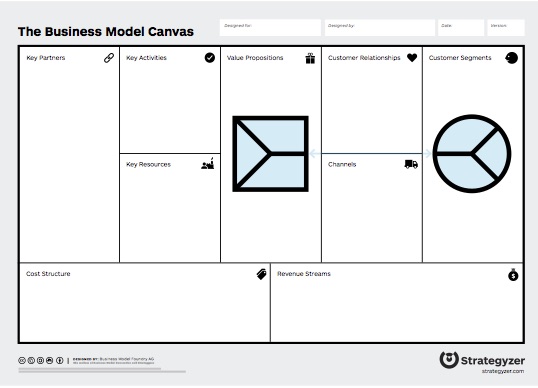
The Lean Startup process builds new ventures more efficiently. It has three parts: a business model canvas to frame hypotheses, customer development to get out of the building to test those hypotheses and agile engineering to build minimum viable products.

This week the author of the business model canvas, my friend Alexander Osterwalder, launched his new book Value Proposition Design, the sequel to his million copy best seller, Business Model Generation.

His new book does three things:
1. Introduces the Value Proposition Canvas
2. Tells you how to design new ventures with it
3. Teaches you how to use Customer Development to test it.

Value Proposition Design is a “must have” for anyone creating a new venture. It captures the core issues around understanding and finding  customer problems and designing and validating potential solutions.

Value prop design

Product/Market fit

Product/Market Fit
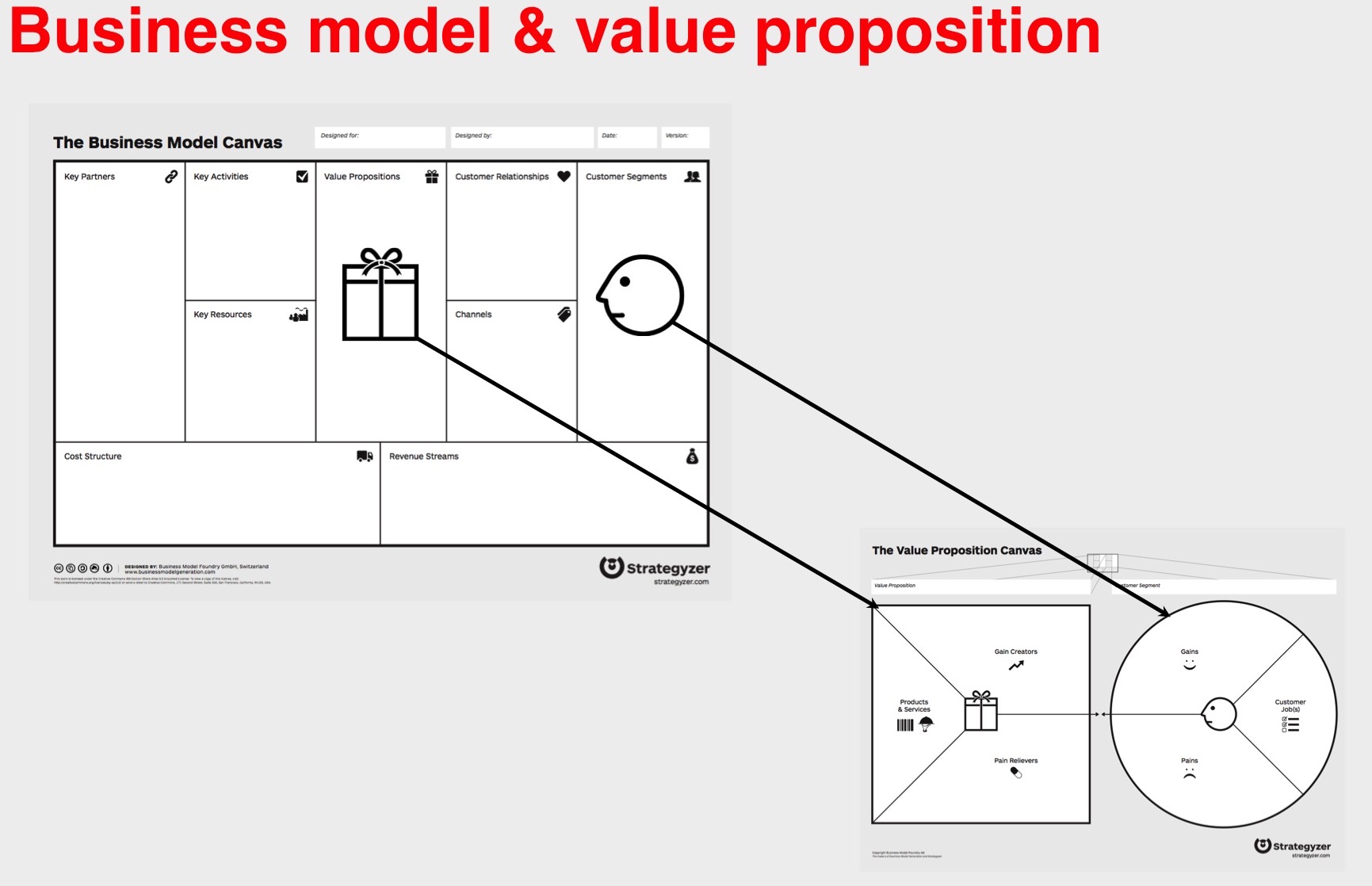
If you’re familiar with the Lean Startup you know that the Business Model Canvas is the tool to frame all the hypotheses of your startup. Of all the 9 boxes of the canvas, the two most important parts of the business model are the relationship between the Value Proposition (what you’re building) and the Customer Segment. These two components of the business model are so important we give them their own name, “Product/Market Fit.”

The Value Proposition Canvas functions like a plug-in to the Business Model Canvas and zooms into the value proposition and customer segment to describe the interactions between customers and product more explicitly and in more detail. This keeps things simple by giving you the big picture at the business model level and the detailed picture at the “product/market fit” level.

bus model and value prop mapvalue prop map

Integration with Customer Development and Lean Startup
Alexander and I met after he published Business Model Generation. We both realized that we had each invented one of the two parts that define the Lean Startup. In his new book he’s integrated Customer Development with the Business Model and Value Proposition Canvas and added some new tools to the mix.

Now an integral part of Value Proposition Design, several of his new tools help with testing and validation of hypotheses. These testing tools match the first two of the four steps of Customer Development. The diagram below is one of my favorites of the book and provides a simple overview of how to conduct customer discovery and customer validation in combination with the Business Model and Value Proposition Canvas. You start by extracting and prioritizing your hypotheses, then design your tests with Test Cards and finally, you conduct your tests and capture your learning. To make this all actionable Osterwalder added an Experiment Library to the book that equips you with ideas on how to test your assumptions.

3_Value_Proposition_Design_Testing_Process

Tracking Customer Development with the Value Proposition Canvas
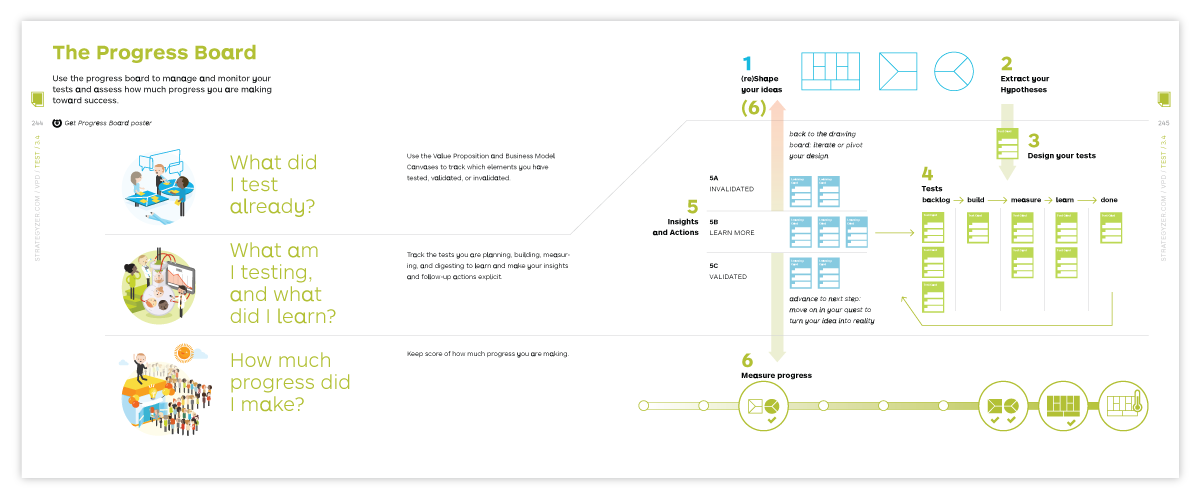
With Customer Development you’re constantly talking to customers and partners and conducting a ton of experiments to validate and invalidate your hypotheses. All these activities, the evidence of what works and what doesn’t, and your progress towards finding a successful value proposition and business model need to be tracked. In Value Proposition Design Osterwalder shows how to do this with the Progress Board, a tool that includes a version of my investment readiness level thermometer to track progress.

5_Value_Proposition_Design_Progress_Board

Online Tools
Doing all the above together with your team is not easy when you “just” use poster-sized Canvases, sticky notes, and PowerPoint. There are simply too many Canvases you will design and trash (after rejecting and pivoting from your early tested ones), too many experiments you will conduct, and too much evidence you will produce. Keeping track of all this requires software support.

So the Value Proposition Design comes with a series of exercises that you can complete online with assessment tools that show you how you are using the Value Proposition Canvas. And last, but not least, you get access to a whole series of checklists, templates, and incredibly awesome posters that you can immediately use in your work.

Lessons Learned

  • The Value Proposition Canvas describes the details of how the value proposition and customer segments interact
  • It integrates the Customer Development process in the book
  • Product/Market fit now has its own book. Buy it

Filed under: Business Model versus Business Plan, Customer Development
24 Oct 23:43

My Dentist 3D Printed My Crown

by Saul Kaplan

As a tech junkie and geek wannabe I’ve been paying attention to 3D printing and the exploding maker movement. When I say paying attention, I mean reading about it, watching hackers and hobbyists make stuff, and wondering if there is more to the technology than the brightly colored plastic tchotchkes cluttering my desk. 3D printing really hasn’t affected me yet. That is until I recently chipped a tooth and had no choice but to visit my family dentist. It was the dentist’s chair that more than any article or demo converted me to the potential of 3D printing. Sometimes disruption has to hit you right in the mouth before you pay attention.

Now, I was no stranger to restorative dentistry. About seven years ago I had chipped another tooth that required a crown and didn’t remember the process fondly. It required multiple drawn out — not to mention expensive — visits to my dentist. He first had to make a physical mold of my damaged tooth. The mold was sent out to a local dental lab to manufacture a permanent crown. In the meantime, I was sent home with the inconvenience of a temporary crown made of a cured composite secured with temporary cement. Weeks later when the permanent mold was back from the lab I was summoned to the dentist for another lengthy visit to secure the new crown in place.

I wasn’t a happy camper, facing the same fate seven years later.. However, this time instead of a physical mold my dentist inserted a digital camera in my mouth and the next thing I knew a digital image of my damaged tooth immediately appeared on a computer screen positioned right next to my dental chair. My dentist knows I’m a tech junkie so he went out of his way to demonstrate his new high tech capability. I watched my damaged tooth rotating in all of its 3D glory when he ran the design software to quickly and magically fit a digital crown on top of my chipped digital tooth. Voila! He even made a few manual tweaks to the digital crown using the computer aided design software, a little bit off the side here and a little smoothing there.

It’s what happened next that blew me away and convinced me that 3D printing is a big deal. My dentist pushed send on his keyboard, then took me into another room in his dental office where he proudly pointed to a piece of equipment the size of a large microwave. The digital design of my new crown had been transmitted to a CNC (computer numerical control) milling machine. There are two basic approaches to 3D printing: printers that deposit layer after layer of materials to build an object from the ground up, and CNC milling machines which takes a block of material and carve out the desired object. I watched in awe as my crown was sculpted from a block of dental composite right before my eyes.

In about ten minutes, with my new crown in hand, it was back to the dental chair where it was expertly put in place permanently. I asked my dentist if this new capability put the dental lab that used to make routine crowns out of business. He told me he had just reviewed his budget and that he had actually increased his spending at the lab. It turns out the lab is busier than ever focusing on non-routine, higher value restorative work. At the same time, my dentist is busy delivering better value to his patients, and I got a new crown in a single visit and a life lesson in innovation.

Sometimes the most compelling use for a new technology isn’t the one that gets showed off in the expo hall or makes it onto YouTube. The plastic toys that can now be printed on demand may not matter much, but for the dentist, as for any number of other professions, the chance to design and manufacture products in house with 3D printing is already revolutionizing business.

24 Oct 23:43

The Internet of Things Will Change Your Company, Not Just Your Products

by Joey Fitts

I have had a front row seat as companies have struggled to enter the emerging world of the Internet of Things — first, 10 years ago as a vice president at Ambient Devices, an MIT Media Lab spinoff that was a pioneer in commercializing IoT devices, and then as a consultant.

One of the biggest obstacles is that traditional functional departments often can’t meet the needs of IoT business models and have to evolve. Here are some of the challenges that I’ve observed:

Product management. Successful IoT plays require more than simply adding connectivity to a product and charging for service — something many companies don’t immediately understand. Building an IoT offering requires design thinking from the get-go. Specifically, it requires reimagining the business you are in, empathizing with your target customers and their challenges, and creatively determining how to most effectively solve their problems.

A company that understood this was Vitality, which reimagined the pill box as a smart service to get patients to take their medications in accordance with their physicians’ instructions. So instead of creating another pill dispenser, it launched a compliance-enhancing system.

In addressing the billion-dollar adherence problem, Vitality (since acquired by NANTHEALTH) considered the interests of the players in the diverse ecosystem, including pharmaceutical companies, retail pharmacies, and health care providers. It also took into account their roles in changing patient behavior.

The resulting GlowCap offering provides continuous, real-time communication to users and caregivers via a wireless connection. Changes in light and sound indicate when it’s time to take medication. Weight sensors in the pill cylinders indicate when the medication has been removed. Accounts can be set so that text notifications or a phone call are sent if a dose is missed. By pushing a button on the device, an individual can easily order a refill from his or her pharmacy. Weekly e-mails with detailed reports can also be set up, creating a comprehensive system of medication management.

Finance. Finance teams, which are not known for their flexibility to begin with, often have trouble changing their traditional planning, budgeting, and forecasting processes to accommodate radically new IoT business models. I saw this when traditional manufacturers tried to build internet intelligence into products like refrigerators, office products, and health management devices. The finance departments of these companies struggled to account in the same set of books for both one-time revenues for product sales and the recurring subscription revenues for IoT-related services.

Finance departments also had trouble dealing with the fact that the cost of services and the resulting subscription revenues can accrue in a complex manner. Prices for IoT-related services may be based on utilization, thus creating a sliding scale of costs and revenues based on bandwidth utilization, volume of API calls, or changing hosting costs.

Forecasting and planning for product upsells, service additions, increased utilization, and churn across both products and services can also be difficult. Finally, changes in the focus of the business can quickly upend long-held key performance indicators (such as average revenue per unit or customer lifetime value) that may be core to the company’s management culture and how the business is understood.

Operations. When product-based companies add services and connectivity, operational requirements increase. The resulting challenges may include new contract-manufacturing relationships, which can be a complicated and disorienting process for the uninitiated.

The addition of third-party services and shared customer ownership can introduce tiers of customer-support challenges. Inventory requirements, warranties, and returns may change. In addition, companies may suddenly find themselves having to comply with unfamiliar laws and regulations, including those related to the U.S. Federal Communications Commission, the U.S. Health Insurance Portability and Accountability Act (HIPAA),  and customer “Personally Identifiable Information” (confidential data such as names, addresses, contact information).

Sales. In IoT businesses, sales departments often struggle to determine how to best take a combined product and service to market. New skills may be required, new distribution options may emerge, and field conflict (direct and channel) is not uncommon. Sales operations must consider changes to market segmentation, territory management, and resource allocation. Numerous opportunities may arise for distribution partnerships, and determining how best to approach partnerships and compensation can be complicated. (Channel compensation for subscription services with recurring revenue can be a particular challenge.)

Human resources. HR has the job of developing the human capabilities needed to capture the IoT opportunity. These may involve new areas for the company (e.g., telemetry, communications and connectivity protocols, electrical hardware engineering). Building them can be an especially daunting task when the business itself is unsure of what capabilities are required.

Sometimes in IoT businesses, the answer is actually less tech and more traditional execution. My favorite example of this is iRobot, the maker of the innovative Roomba vacuum.

Rodney Brooks, a former director of the MIT Computer Science & Artificial Intelligence Lab and the co-founder of iRobot, told me that the company initially believed that robotics specialists could best explain its robotics-based offerings to the market. But it then discovered that the folks who could best distribute the offerings were vacuum industry veterans who knew the industry lingo, had existing relationships, and understood and managed the channels of distribution.

Engineering. It is rare for a single company to have all the required engineering capabilities under one roof. Consider the breadth and scope that may involve communications and connectivity technologies (telemetry, WiFi, Bluetooth, Zigbee), electrical hardware engineering (sensor technologies, chips, firmware, etc.), and design and user experience. Developing these engineering skills is one big challenge; integrating them into a functional, integrated engineering effort is another.

Since new companies built from the ground up as IoT businesses lack the departmental baggage of older firms trying to make the transition into the IoT world, the former’s learning curve is often shorter. However, the immaturity of the IoT industry means that the practices and capabilities that suffice today will not tomorrow. An ability to evolve — and to do so quickly — is a prerequisite for success.

24 Oct 23:42

4 app monetization strategies for free apps

by Lou Orfanos, VP of Product, Localytics

SPONSORED POST

4 app monetization strategies for free apps

This sponsored post is produced by Localytics. 

There are over a million apps currently in the App Store, and an overwhelming majority of them are free. What does this mean for your app monetization plan? Going after revenue with a paid app can be a risky endeavor — you’re betting that users will be willing to fork over money when there are so many free alternatives.

With a free app you’re likely to get more installs, but then you have to be smart about monetizing. And in many ways, monetization models for free apps are superior to paid apps, allowing more room for creativity and the possibility of improving the app experience (and making it easier for users to make purchases).

In this post, we highlight four of the models you can use to drive app revenue, and help you discern which model best suits your app.

1. In-App Advertising

Mobile ads are appearing more and more in apps because they allow you to monetize without asking for money directly from users. With in-app advertising, you remove the cost-barrier to purchasing your app and allow free downloads. Your goal is to create a large (and stable) user base and gather relevant information about those users to sell to other brands and app publishers, who pay you to place targeted ads in your app. And, because your app is completely free, you have a better chance of gaining (and retaining) new users.

When done correctly, ads are a smart choice, because they don’t distract from the user experience. In-app advertising is done in a highly-targeted, personalized way to attract users to relevant offers — they turn bad when they cross the line by creating privacy concerns. This model requires care and attention to ensure that it doesn’t overrun your native app value and dissuade otherwise engaged users.

This model might be right for you if:

  • There are no organic opportunities for in-app purchases in your app
  • You regularly collect preference data about users
  • Ads won’t take away from your app UX (or take up too much screen space)
  • You want to be part of a lucrative and growing ad industry

2. Freemium (Gated Features)

As with the in-app advertising model, a freemium app is also offered for free. However, certain “advanced” or “premium” features are gated and cost money to be unlocked. In other words, people have access to your app’s basic functionality and features, but there is a charge to then access everything. The goal is to accumulate and engage app users until they see the value of the app and are willing to pay to access additional in-app tools.

Many successful gaming apps fall into this category— they have found success by making basic game versions free to all users, but requiring the user to purchase additional levels or premium options. From Angry Birds to the shockingly successful Kim Kardashian: Hollywood game, freemium apps allow people to easily play and become fans without hesitating at the initial price. Once app users have conquered a few levels or want to up their status, they’re engaged enough to pay for the full-fledged version for more hours of fun.

One note of caution: be upfront in your App Store listing and other appropriate places that your app requires purchases to unlock advanced features, levels or other features. If users don’t realize that’s what’s in store, it could turn them off permanently.

This model might be right for you if:

  • You’re a gaming app
  • You have levels or advanced features already in your app
  • You have long session lengths and highly-engaged users
  • Can provide a great free app experience (and don’t just save the good stuff for paying users)

3. In-App Purchases

In-app purchases are exactly what they sound like.The goal of this model is to turn your app into another sales channel (for physical products that are used in the real world) or a mobile storefront (for virtual goods which can only be used inside the app) and retain the profits. In-app purchases can include a wide variety of consumer goods, and aren’t limited to retail apps.

This model can help youPost2.Image2 make comfortable profits with the lowest amount of risk, plus, buying virtual goods can lead to deeper levels of engagement (growing monetization strategy).

One way to utilize this model is to sell virtual goods such as extra lives or in-game currency. Dating apps, such as MeetMe, allow you to freely browse profiles and chat with other users, but also offer credits to enhance your visibility and gain new ways to interact with people. MeetMe’s purchase model is lucrative because the app is able to clearly highlight the benefits of in-app currency. Your takeaway: whatever your app is selling, make sure the in-app purchases feel like a natural part of the app experience (and have an easy checkout process). Also, make sure you clearly and resolutely market that your app has in-app purchases, to keep things honest.

This model might be right for you if:

  • You’re a retail or services app
  • You provide goods with clearly-defined value
  • You have a clear opportunity to introduce goods into your app (such as Keep, an app that allows you to “keep,” or add items of interest to your various boards, and recently integrated a shopping cart feature)
  • You don’t mind that App Stores usually take a cut of the revenue for virtual goods (but not physical goods or services) purchased inside your app

exclam

  Get the Localytics case study showing how one app publisher increased session length and in-app purchases by 35%!


4. Sponsorships (Incentivized Advertising)

Sponsorships are easily the newest (and greenest) monetization model. With sponsorships, you partner with advertisers who provide your users with rewards when they complete certain actions within your app. In this model, your app earns money by taking a share of the revenue from redeemed rewards, and simultaneously allows you to incorporate advertising that actually enhances your app’s ability to engage users. This model can be adapted for almost any vertical, and can be better received by app users because it is relevant and related to an app’s purpose.

An early adopter of this app business model is RunKeeper. RunKeeper motivates users to track their running activity in-app by offering “rewards” upon completion. These exclusive rewards and promotions come from advertisers, hence, incentivized advertising. The user feels rewarded for having used the app, and the advertiser gains impressions, click throughs and conversions. Using this strategy, RunKeeper can monetize their app without disrupting the user experience with potentially intrusive banner ads.

This model might be right for you if:

  • You prefer a behind-the-scenes (and rewards-driven) monetization plan
  • You have an app that makes it easy to reward in-app activity
  • You want to try something new and different (and don’t mind taking a chance on a relatively new model)
  • You can be careful about what actions you incentivize within their app (Apple has been cracking down on incentivizing downloads and social sharing)

Finding the model that fits your app is all about assessing your mobile goals and determining which will please users and improve the business outcome. Have you used other monetization models that have worked well for your apps? Let us know in the comments!


Sponsored posts are content that has been produced by a company, which is either paying for the post or has a business relationship with VentureBeat, and they’re always clearly marked. The content of news stories produced by our editorial team is never influenced by advertisers or sponsors in any way. For more information, contact sales@venturebeat.com.


24 Oct 23:38

Did Google Just Re-Invent E-mail With Inbox?

by David Armano

While Google Glass appears to be in its death throes, Google is quietly if not systematically re-inventing the digital work horse many of us have a love hate relationship with (mostly hate these days)—E-mail. I've been spending some time with Google's recently released app simply called "Inbox" and after five minutes of use the only thing that kept popping up in my head was this:

Is it possible that Google is making e-mail enjoyable again?

That's a lofty goal because right now for many of us, e-mail has become a second and third full time job. We use it so much at work that we're often exhausted by the time it comes to dealing with our "personal" e-mail. SPAM management is one of the key culprits which has also taken the joy away from e-mail. And while e-mail is ultimately mobile friendly—it can become a mammoth effort to keep it all neatly organized, while trying to ensure you didn't miss anything. 

Inbox works pretty hard at all of this, organizing messages in bundles (some are already created for you such as travel, purchases forums etc.) The design is highly visual, using photos of other gmail users or abbreviations of names so you can visually keep track of threads etc. It surfaces up media elements attached to e-mails like pictures and videos so you can preview them and know what's in an e-mail before you click on it. 

In short—it makes e-mail more useful, usable, desirable and shareable. 

Screen Shot 2014-10-24 at 11.30.12 AM

Implications For Users
For the average user of digital technology, it's a great step forward in giving us a tool that we've needed for a while and optimizing it for the mobile experience. Sure it will mean that we may be toggling back and forth a little between our native e-mail program on our mobile devices, but we're already getting used to doing that with other apps. Given the time I've spent with it—I think it's designed to take on the challenges of e-mail that so many of us grapple with. It turns our inbox into more of what we are getting used to with social—a "newsfeed" in many regards. 

Implications For Brands & Organizations
For many organizations—having a sophisticated CRM system in place in which e-mail is already a workhorse, this is great news as the app may get Gmail users more engaged with e-mail again. But there's also the added opportunity to make e-mail more compelling—more visual and media rich and more useful. If people start coming back to e-mail again, brands and organizations will have a window of opportunity to re-capture and keep their attention. 

Google Inbox may be one of the great quiet innovations of our time despite the fact that we are still intrigued by flashier trends such as wearables. A return to e-mail beyond work could translate to new opportunities for brands and organizations to provide value in the value exchange they have with their consumers, customers and people who are important to them. 

Related articles
24 Oct 23:37

5 Ways The Internet Of Things Will Change Social Media

by Lawrence Ampofo

The Internet of Things will change the what it means to be social. Everyday objects, data, systems and people will be connected to create an intelligent network, creating value for those choose to be a part of it. Evidence of this shift can be seen first hand in the mobile traffic application, Waze,  now a part of Google; by linking internet connected smartphones to other connected objects (traffic signals and cameras for example), people, data (real-time traffic information), and systems, the network helps drivers optimise their journeys in real time.

The social network of things is the interconnection of hybrid services, objects and people where ordinary users will eventually have the ability to create their own personalised social services easily and conveniently through the use of a network-wide API or Web passport that is both secure and convenient. In order for there to be a true social internet of things, data needs to be liberated from walled gardens and shared across multiple platforms (or one universal platform) if it is to be as useful and impactful as many predict.

This interconnected hybrid network will lay the foundation for entirely new approaches to creating meaningful online and offline social experiences.  When everything is interconnected and able to communicate in useful and timely ways, it will represent a quantum leap forward in how organisations interact with the people they exist to serve.

Perhaps televisions and cars will not possess a Twitter or Pinterest account but, they will interact with other such devices centred around one or many shared purposes. Creating products and services that leverage the intelligence of networks of people and other connected objects also requires a change in thinking from connecting products to connecting platforms. Wearables and other connected products in particular are simultaneously experience, emotion and data devices and for them to produce maximum value to people, the ability to combine sports data with health data, for example, will be indispensable.

How the Internet of Things will Change Social Media

1. Conscious Privacy: You don’t have to look very far to see respected commentators and industry leaders proclaiming that privacy in the digital age is an anachronism, to be cast aside as we increasingly place our personal data online using digital devices and services. I think that these statements only tell half the story. Privacy as we know it will probably cease to exist but something else will take its place. In the age of the social internet of things, we will have the ability to share every aspect of our lives no matter how small, no matter how insignificant. Beacons will be able to share highly targeted messages to our connected device wherever we are. Connected objects will be able to communicate with one another and ‘connect’ to other people or devices in the same vicinity based on the behaviour of the person. Privacy will not die, people’s conception of privacy will simply become more sophisticated in the digital age. People will gradually learn to make highly nuanced decisions as to when, where and to whom they want to be connected and based on the right information  served to them at the right time. As people become more aware of when and where they want to be connected, the opportunities to engage with the right people at specific places and times will become a highly lucrative art and science for both companies as well as people.

2. Health: The internet of things will change the bring social media firmly into the realm of health care; patients will be able to connect easily and conveniently to the best doctors and health professionals using social media tools. The health professionals in turn will be well informed of our physical state by accessing our health data that we share with them and be able to provide expert health advice quickly and reliably. The ability to not only connect with the best health professionals from across the world but securely capturing and sharing our health data will enable us to live healthier and happier lives.

3. Community: Perhaps the most exciting development of all is the changing notion of community in the internet of things age. As our digital devices and other internet connected objects can connect everywhere we go, we will be able to enter into micro-level, context-focused communities which we interact with for short periods of time and then engage with others. Such context-dependent micro communities will provide a richer experience of life and more accurately reflect the complex personalities of human beings as they go about their daily lives. Imagine a tourist’s smart devices automatically suggesting engaging experiences for people based on their established activities and social interactions. The internet of things allows people to be more social in a safe and secure manner, rather than less.

4. Corporate Relations: As more devices and services become part of the digital ecosystem, people will generate ever-increasing amounts of data, providing companies the unique opportunity to understand in unprecedented detail people’s attitudes and behaviours. The opportunity for companies lies not in being omnipotent in knowing more about their customers. Rather, companies now have the opportunity to understand how people interact with their physical environment and design unique and truly valuable experiences around their products and services that genuinely add value to people’s lives.

5. Competition between Companies: The social internet of things allows companies that specialise in specific products to evolve into data-driven digital organisations. Entire business models are set to change as products that were once inert become contributors to and beneficiaries of the digital ecosystem. As a result, companies can now develop meaningful businesses in entirely different industries because of the connections that exist between their products and their customers.

It is impossible to predict with any certainty what will happen when internet connected objects become social. In spite of this, industry leaders are convinced that the internet of things will make a significant impact in the realm of social media. The internet of things and wearables are a new touchpoint for companies to engage with people and people to engage more profoundly with one another as the digital device becomes a natural extension of the online. It encourages people to engage with content and services in real time because it acts as a natural extension of the mobile and online experience.

24 Oct 23:37

Here's How To Land A Meeting With Anyone

by Emmie Martin

Meeting room

Whether you want to pitch an idea, score a high-profile interview, or pick someone's brain for advice, meetings with successful, powerful people offer tons of benefits. Unfortunately, though, these people are usually the hardest to get a hold of. 

"Time is the new money — no one can afford to give it away carelessly these days," writes Dorie Clark, a marketing strategist who teaches at Duke's Fuqua School of Business, in a blog post for the Harvard Business Review. Even asking for a mere 10 minutes needs to be planned and calculated, she says.

In the post, Clark shares her tried-and-true strategies for landing meetings with important people. Here are her top three:

Give them a reason.

Everyone's insanely busy, especially important, powerful people. While some may wish they could meet with everyone who contacts them, it's just not possible, so you need to show why you'd be worth their time. "Make clear the value proposition of getting to know you," Clark says. "Otherwise, it's far too easy for them to underestimate you and assume you don't have anything to offer." 

Whether you can offer "good press" or teach them how to optimize their business, you need to show them exactly why they can't miss an opportunity to meet with you in your initial contact. 

Start small.

It's not enough to simply pique someone's interest — you need to pitch a meeting that's easy to fit into their schedule. While it might not seem like much to ask for one lunch or an hour out of someone's day, those seemingly small chunks of time can quickly add up, especially for professionals who receive 20 to 50 similar requests each week, Clark warns.

Instead of lunch, ask to grab coffee. Or, rather than asking to meet up in person, promise to fit everything into a 10-minute phone call. If they like you or your idea, they'll be more likely to offer more of their time, Clark says. 

Find a connection. 

Once you've made contact with an important person, get on their level. "The challenge is to break through and ensure they view you as a colleague — someone 'like them' — rather than a stranger impinging on their time," Clark says. Scour Facebook and LinkedIn for mutual friends and connections, anything to give you a starting point to build your relationship. Powerful people are much more likely to want to meet if they know someone who can vouch for you. 

Click here to read the full HBR post.

Want your business advice featured in Instant MBA? Submit your tips to tipoftheday@businessinsider.com. Be sure to include your name, your job title, and a photo of yourself in your email.

SEE ALSO: 14 Meeting Etiquette Rules Every Professional Needs To Know

Join the conversation about this story »

24 Oct 23:37

Things That Go “Blog” In The Night: 6 Terrifying Blogging Blunders

by Allison VanNest

It’s almost Halloween, so gather round and hear the tale of these spine-tingling terrors from the blogosphere! Don’t worry, we have plenty of tricks (and a few treats) to fix them.

Missing Magic Words

Have you forgotten the magic words? If you’ve neglected to include a “call to action” in your blog post, you’ve missed out on an important opportunity. Write each post with a specific outcome in mind, such as encouraging mailing list sign-ups or persuading readers to try a new product, and conclude with a call to action that encourages readers in the direction you want them to go.

A Swarm of Keywords

Keyword stuffing is an outdated blogging practice designed to trick search engines into displaying your pages. However, the technique simply doesn’t work. According to marketing expert Bill Faeth, “Google realizes that people want great content, and the main way it determines value is through volume of inbound links. Write information, tutorials and articles that people want to link to by including a distinct voice, style, humor and fresh statistics.”

Lack of a Hook

You’ve probably heard the urban legend of the terrifying Hook Man, but in writing, having a hook is a good thing. Professional writer Danny Iny advises, “The hook is the few paragraphs at the top of the post, whose job it is to get the reader interested enough to keep reading through to the end.” Pose a question, make a provocative statement, or challenge your reader in some way so that they will keep reading.

The Never-Ending Blog Stream

According to pro blogger Henneke Duistermaat, “Don’t waste people’s time with an endless stream of blog posts. Only write when you have something to say. Your audience would rather read one post that inspires them than 20 crappy posts with recycled content.” With that in mind, it’s still a good idea to post consistently. Plan an editorial calendar three to six months in advance to help keep your blog on track.

The Invisible Audience

Too often, bloggers focus on themselves instead of their readers. “If you use ‘I’ too much, people think you’re self-absorbed and feel disconnected,” cautions marketing guru Dan Stetler. “If you change it to third person and use forms of ‘they’ too much, your content reads like a report.” Remember that although your blog exists to bolster your business, your primary goal should be to help your readers in some way. Solve a problem, teach them something, or simply brighten their day—but most importantly, keep the focus on them.

Grammar (T)Errors

It’s no secret that Grammarly is passionate about combating spelling, grammar, and punctuation errors. These mistakes can have a profound impact on your credibility as a business blog—and on your bottom line. Blogging expert Corina Mackay sees far too many errors in online content. “Not only do these mistakes make a post difficult and unpleasant to read, they make the point harder to get across, and ultimately leave the reader with a less-than-professional opinion of the blogger,” she writes.

Luckily, this is the easiest fix of all. Proofread everything you write before posting. If it’s a particularly important or impactful piece, let it rest for a day or two and then reread it with fresh eyes.

When you’re responsible for a business blog, you may be afraid that you’re not doing it correctly. Maybe you’re not able to see the ROI right away, or maybe you’re just not getting the reader engagement you wanted. The good news is that for every blogging fear, there’s a solution.

What’s your biggest blogging fear? Share it in the comments!

24 Oct 23:37

3 Key Findings From The Content Marketing Institute’s B2B Research

by Jen Cohen Crompton

3 Key Findings From The Content Marketing Institute’s B2B Research image b2b.jpgOne year ago, the content marketing industry looked just a little different. While brands were creating content, it seemed that it was really only the big brands, or those who had focused on content marketing a few years back, that executed based on any sort of strategy and were making the splash. Other companies trying to grapple with this “new” concept (really, just a new term) were approaching content on an ad-hoc basis throwing things out there just to see what would stick.

Now, one year later, things have absolutely changed in a notable way.  So says the Content Marketing Institute/Marketing Profs B2B Research report.

1. B2B marketers are creating more content

This year, it seems that B2B has finally found the value in content marketing and hopped on the content marketing wagon. According to the report, “70% of B2B marketers are creating more content than they did one year ago, even those who say they are least effective (58%) and those without any type of strategy (56%).” That is a huge jump in the amount of content being produced!

But do B2B marketers have any idea where they’re headed? The report shows that 83 percent of marketers have a marketing strategy, albeit with 48 percent stating it is an undocumented strategy. But, what is still an issue is that these increased efforts seem to fall flat in producing results (mainly because marketers are still struggling to understand a content marketing ROI) and more have an undocumented strategy than those who have it documented.

3 Key Findings From The Content Marketing Institute’s B2B Research image CM Strategy stats.png 600x472

If there is one thing in marketing that hurts my heart, it’s wasting time and resources on efforts that lack a clear strategy. B2B marketers are trying, but seem to be unclear as to where they are going because they lack a defined roadmap with benchmarks and clear KPIs.

Which leads to the next stat.

2. B2B marketers can’t find trained professionals

3 Key Findings From The Content Marketing Institute’s B2B Research image B2B Challenges.png 512x600One statistic that is a true sign of the times and a reason why efforts are lacking measurement and a very clear strategy is that, “More B2B marketers say they are challenged with finding trained marketing professionals this year (32%) than last year (10%).”

While the creation of engaging content has been at the top of marketers’ list for the past five years, finding trained professionals has now jumped into the top three. So, what does that mean? It means there’s a shortage of talent. Brands really need skilled marketers who know how to plan and create engaging content, and those who can also think strategically and contribute to marketing initiatives with the right content.

Maybe content marketer is the new social media manager?

3. Visual content is king and LinkedIn is where it’s at

Personally, I appreciate a really great infographic. It’s one of the best types of content because, when it is beautifully designed and produced, it’s educational, visually appealing, and can be used within blog posts, whitepapers, reports, websites, etc. Basically, it’s one piece of content that is easily consumed and can be repurposed to fit various formats.

The report showed that marketers are embracing the benefits of infographics since, “Once again, infographics was the tactic that had the greatest increase in usage (from 51% last year to 62% this year.” The tactic is either working, or we all just like seeing pretty pictures to consume content instead of actually reading content.

And, when it comes to platforms, LinkedIn is absolutely making a splash. With its newer publishing function, marketers were given an easy-to-use platform for publishing content that is distributed within the professional network.

The key term there is “professional network.” LinkedIn is where most of us find our colleagues; posting a review of a marketing report on Facebook will most likely only be relevant to a small percentage of contacts. The report showed that marketers are adopting LinkedIn and that “95% of B2B marketers use LinkedIn to distribute content, making it the social media platform used most often (they also say it’s the most effective social media platform).” If you aren’t publishing on LinkedIn, start doing it, but be sure it’s the right content for your audience. Oh, and make it good.

The content marketing industry into the future

To me (and I am sure to many others) the content marketing industry pattern is similar to what we experienced in 2008-2011 in the world of social media – although this industry seems to be evolving and maturing even faster. As of now, most companies understand that they need a content marketing component of their marketing initiative, but they also need the right resources (people or agencies who know strategy and measurement) and the bandwidth or budget.

As the industry continues to evolve, adoption rates will rise and it would be great to see the number of brands deeming their efforts inefficient or without a documented strategy decrease.

24 Oct 23:35

What 33 Successful Entrepreneurs Learned From Failure

by Richard Feloni

slideshow river

There's certainly value to studying the insight of some of the world's greatest CEOs like Elon Musk and the late Steve Jobs, but sometimes their massive success seems far out of reach for the entrepreneur who's just starting out.

That's why marketing consultant, writer, and speaker Brian Honigman gathered advice from entrepreneurs like Levo League's Caroline Ghosn and Buffer's Leo Widrich. They're still involved in the nitty-gritty of building successful companies, and they have plenty of wisdom to offer from persevering through hard times.

Honigman first published these lessons on the Huffington Post as "33 Entrepreneurs Share Their Biggest Lessons Learned from Failure." Marketing software company ReferralCandy took the lessons and packed them into a presentation with additional context.

We've published the presentation, illustrated by Jon Tan, here with both ReferralCandy's and Honigman's permission.


See the rest of the story at Business Insider


24 Oct 23:33

Inbound Marketing: Bound For Success

by Brooke Oliveri

Inbound Marketing: Bound For Success image IL3oSV0M 820x326.png 600x238

Ever had a lazy Sunday morning? I have, and let me tell you, they’re awesome. Picture this: sitting in a big comfy chair, sipping on a hot cup of brain fuel (coffee, of course), and browsing your favorite social networks without a care in the world.

But all good things must come to an end. In the midst of your blissful scrolling, you decide to click on a link to a cute cat video that your friend posted. Before you know it, bam, you’re bombarded with an ad (insert ominous sound effect here).

Get this: you have to watch at least five seconds of the ad before you are allowed to watch this clip of a cat getting lost inside a paper bag. Way to totally kill my vibe, ads.

No one likes to be assaulted with unwanted advertisements. It makes people feel like they’re being sold to, not to mention that they are annoying in general.

So what gives? There’s got to be a less annoying, more effective way to advertise our products or services, right?

Heck yes, there is, and it’s called inbound marketing.

Traditional Marketing vs. Inbound Marketing

Interruption Marketing

Inbound marketing is a new way of advertising. But before we get there, let’s take a moment to think about that obnoxious pre-roll ad we were talking about before. Heck, let’s think about a whole bunch of annoying advertising tactics while we’re at it.

SPAM email, telemarketing, and even commercials all interrupt what a user is doing. That’s why it’s fitting that they all fall under the category of traditional, interruption marketing.

How are you supposed to appeal to a potential customer if all you’re doing is bothering them? If they weren’t looking for your product in the first place, it’s unlikely that an unexpected, uncalled for ad will do the trick.

Inbound Marketing

That’s where the inbound method comes in. Why go to the customer, interrupting what they’re doing, when you can get them to come to you? This is what inbound marketing is all about.

Its goals are to first attract strangers, then turn them into visitors. The next step is to convert those visitors into leads, and turn them into customers. The final hope is to eventually turn these customers into promoters by delighting them with your content (check out HubSpot Academy’s Inbound Marketing Certification course for more info).

How To Do It

Since inbound marketing is all about having your customers come to you, you need something to attract them with, right? Two words: creative content. People don’t want to be sold to, they want to be educated. When they’re on the hunt for information, you want to be the source they find, remember, and come back to.

Let’s talk about some of the tactics we can use to go inbound:

PPC

Even though many people categorize PPC as a traditional form of advertising, it’s a big part of inbound strategy. A PPC ad is not only based on a user’s query, but they can either click or ignore your ad (that’s why it’s so important to write great copy).

They key here is to know where your potential customers are spending their time online and advertising to them there. A well thought-out PPC campaign meets the user in the middle (at the search engine), instead of making them do all the work.

SEO

Say a potential customer is searching for an article on a given topic, and your company has a blog post on this given topic, wouldn’t you want your post to rank highly in the user’s search results? This is where search engine optimization comes in. SEO is basically increasing your rank in search engine results.

Social Media

Social media is where we go to build and maintain relationships.This can be very helpful at the top and bottom of the inbound marketing funnel: attracting newcomers and delighting your promoters.

Content Matters!

It’s up to you to determine the right balance of these advertising tactics that works for your company. But let’s keep in mind that none of the tactics I’ve been talking about would be possible without great content.

Your content should be relevant to your business. More importantly, it needs to be relevant to the people who could potentially want to become your customers. You need to get inside their heads.

Now this is where ESP would really come in handy. But for those unable to read minds, there are buyer personas.

Buyer Personas

One of the most important parts of inbound marketing is knowing who you’re trying to attract. Buyer personas represent a fictional, general profile of one of the people you are trying to appeal to with your content.

First, you need to do research. A good buyer persona should be a culmination of demographics, the goals and challenges of your persona, and how you can help with some of those goals and challenges.

Example Persona

Imagine a press release software company that targets medium-sized businesses. They’re bound to have multiple buyer personas, but let’s focus on one. Many medium-sized businesses have public relations professionals that work in-house who are looking for somewhere to host and distribute the company’s press releases.

With the inbound strategy, the company might write a blog post like “4 Free PR Tools for Your Small Business Toolkit”. If someone fitting the persona found and liked the post, they may continue to use the company’s content as a resource, building a relationship that would come in handy when the persona started shopping for PR software.

Potential buyers have all the power and they will make their buying choices with or without you. Let’s empower our potential customers with valuable knowledge. When they’re making their buying decisions, they are likely to remember who empowered them with that valuable knowledge needed to choose.

24 Oct 23:33

Mapping Content to the Buyer Journey

by Jean Moncrieff

Mapping Content to the Buyer Journey image The Buyers Journey.jpg 600x400

[Image Source: Andrew Bowden]

Your online presence has become the hub for all your marketing efforts. It’s the place were prospective customers engage with your business. So how do you make sure that, when they arrive at your website, you deliver the best possible experience for them?

What’s the buyer journey all about?

It’s the steps we all take, just about everyday, on the path to making a purchase. It all starts with the realization that you have a need for something, then transitions into the process of investigating possible solutions for solving that need and ultimately goes to selecting a vendor to fulfill it.

Let’s take a closer look at the 3 stages a potential buyer goes through on the way to selecting a vendor:

Mapping Content to the Buyer Journey image Awareness Stage 2.png 600x98

  • Awareness – The person realizes they have an issue that needs to be resolved, so they start researching.
  • Consideration – They have a clear idea of the problem they are trying to solve. Additionally, they’ve researched a number of possible solutions to the challenge.
  • Decision – Once all the possible solutions have been researched, it’s time to choose a vendor to help them solve their problem.

Why’s it so important?

In our times, when most companies are trying hard to be more customer-centric, you have to make sure that you’re making the buying process more enjoyable for prospective customers. And that you’re targeting the right audience.

You’ve probably taken the time to create 2 or 3 buyer personas to help create content that really resonates with your target market. Now it’s time to take it a step further and get it to them at the right time in the buying process.

56% of U.S. email users unsubscribe from a business or nonprofit email subscription because of content that is no longer relevant. (Source: ChadwickMartinBaily)

How do you make sure your content stays relevant?

Keep thinking about how you can make the journey more enjoyable for your potential buyer.

How you can give them information that is relevant at each stage of their journey?
how do you know which piece of content to put in front of them at each stage of the cycle?

Here’s what you have to do: by mapping relevant content offers to each stage of the buyer’s journey based on the research they are doing, the type of terms and keywords they’re using, you’ll accompany your potential buyers every step of their way to deciding you’re the right fit for them.

Mapping Content to the Buyer Journey image Buying Cycle Stage 1.png 600x450

During the Awareness Stage a person starts experiencing symptoms of a problem or need.

Mapping Content to the Buyer Journey image Awareness Stage AW.png 600x98

Perhaps they travel often and want to take movies, music and photos along on every trip. However, each trip they seem to run out of things to watch. They can’t seem to get enough movies onto their MacBook Air – the problem, disk space.

At this point our traveler isn’t likely to be interested in an hour long webinar explaining the benefits of a Citrix ShareFile solution. I use this as an example because I got a call, about a week ago, from a Citrix sales person, out of the blue wanting me to attend his demo. I don’t have the need for this service or solution. It’s just another one of many irritating sales calls. Block that number.

Our buyer is still trying to understand the exact nature of their problem. Their research is focused on vendor neutral 3rd party information, using content such as:

  • eGuide / eBook
  • Expert content (blogs on storage options for travel)
  • Research reports
  • Analyst reports
  • White papers

They’re using terms relevant to that stage of their purchasing journey – during the Awareness Stage they focus on issue and opportunity type terms.

  • Troubleshoot
  • Issue
  • Resolve
  • Risks
  • Upgrade
  • Improve
  • Optimize
  • Prevent

Once they’ve clearly defined their need or problem, they’re able to put a name to it and can start researching and understanding all their options. They’ve transitioned into the Consideration Stage of their journey.

Mapping Content to the Buyer Journey image Awareness Stage CS.png 600x98

At this stage, our buyer knows that an external drive is likely to be the best solution to their problem. But what kind of external drive? As a travel writer, something rugged makes most sense, so they’re going to search for content like something that makes a comparison on the available portable solutions.

  • Comparison white papers
  • Expert guides
  • Live interactions
  • Webcast/podcast/video

The kind of terms they’re going to use include:

  • Solution
  • Tool
  • Provider
  • Device
  • Service
  • Software
  • Supplier
  • Appliance

Finally a buyer enters the Decision Stage of their journey.

Mapping Content to the Buyer Journey image Awareness Stage DS.png 600x98

They’ve picked out their solution and have started listing all the possible options. In this case perhaps they’ve come up with:

  • Western Digital My Passport hard drive
  • LaCie Rugged All-Terrain
  • Silicon Power 1TB Rugged Armor
  • Transcend 1 TB USB 3.0 External Hard Drive

Now it’s time for vendor comparisons, product demos, trial downloads and live demos. In their search, our buyer is going to be using terms like:

  • Compare
  • versus
  • vs.
  • comparison
  • Pros and Cons
  • Benchmarks
  • Review
  • Test

In our example, the buyer went for the LaCie Rugged All-Terrain drive. Why? Because he likes the color orange and it looks like the drive could be dropped from the 21st floor and still survive.

Mapping Content to the Buyer Journey image LaCie Rugged Drive.jpg 600x450

To help you get started organizing content for your buyers journey, download a copy of our free eBook on How to create Buyer Personas for your Business.

Mapping Content to the Buyer Journey image 535a137b 2b6e 4bec 945a 2fbb25146f31.png 300x149

24 Oct 23:32

The Very Simple System For Picking Your Trade Shows

by Elizabeth Williams

Last time we established that trade shows are many things, among them giant cash-sucking machines, that are terrible at lead generation.

Before we dive into the Very Simple System, let’s remember that trade shows exist for one reason: to make money for someone who isn’t you. It can be a private event company or, in B2B, it’s often an association that uses the trade show as a way to offset the costs of the talking bits of their conference and to give Bill Clinton something to do.

Why do we bother? Brand is why we bother. The right events have the people whose faces we want to be all up in. This is good news if you are trying to break into a market space, and it’s great news if you are already there and plan to stay.

So how do we pick which shows to go to? In the first place, ignore your Sales Squirrels. They want to go to all of them since it beats picking up the phone. Next, you will need a few dry erase markers, one of those giant year-at-a-glance laminated calendars from Staples and your stack of emails, brochures, and post-it notes with all the events you’re considering.

Now stick your calendar to the wall (yes, I know you can do this on your iPad, but it’s more fun on the wall). Using a blue pen mark out all the product things you are doing next year – releases,refreshes, announcements etc. If you are a service company, plot out your thouThe Very Simple System For Picking Your Trade Shows image no long dresses royal york hotel e1413471800154.jpgght leadership and research timelines. If you are opening new offices, working on an acquisition or spinning off a division, plot those too.

Use a black marker to block off sales training dates, sales kick off events, trips, boondoggles, golf tournaments and all that stuff that Squirrels do when they aren’t selling. In my experience, events that fall during these times will see you and the summer student all alone on booth duty.

Using your red marker put all the events in your giant pile on the same calendar (even if you think they’re stupid, put them up there). Be sure to include all the “must-do” events you receive from the Squirrels.

Where you have red and blue overlapping, you have hope, so start there. Are any of the events in and around your product release dates a good place to make a major announcement? Can you shift a release announcement over a little (remember, the announcement can precede or trail the actual release by a few weeks if needed)? Where you can manage to make an event and a bit of news overlap, these are your best bets to do some brand-building. These are your must-go shows for the year and the places you should allocate some decent budget and some good exhibit staff. Make sure you have it on the calendars of your Corporate Overlords so they can be available to meet with media, influencers and analysts at the events.

In a good year you might get two such events, so you’ll probably need a few others to prop up your visibility. Looking at your red scribbles, flag a few events that are in key segments or locations where you could improve your awareness or competitiveness. These are your second tier events, and in some ways they are much trickier to get value from than the big ones. This is where you need to do a bit of analysis (that’s MBA-speak for reading the brochure or website). You’re looking for the events where you can snag a speaking opportunity, a sponsorship that gives you the attendee list before and after, or do a unique customer event. You should have a few of these on your list when you’re finished.

Now the fun part: take your green marker and circle the remaining events that your company considers to be essential. The ones you’ve been attending for so long nobody can even remember signing the contract. The ones you attend reflexively when your competitors sign up. The ones your past CEOs signed you up for when they were on some committee or another. If you’ve been around the industry a while, you’ll be hearing a lot of sacred cows mooing in the corner. Time to make some burgers, people. Remove one or, if you’re feeling cocky, two from your list for next year.

As some of our comments from the last post reminded us, it’s perfectly okay to stop attending an event. IBM, Microsoft, Netscape and other big fish have walked away from big events because they were not producing the results they needed. You can do the same thing and the world will not end. It will be, briefly, a bit noisier. With all the mooing and the Squirrel chatter and the raised eyebrows in the C-suite, you’ll be doing some explaining and you may even be doing some recanting but stick with it.

By stepping away from even one event you’ve “always” attended, a few cool things happen. First, you get some budget back to spend on the events that will actually produce some value. This should make the CFO go away. Second, you are sending a very strong message to the show’s organizers that they can’t take you (or anyone) for granted and they had better start coming up with new ways to add value. Third, you are going to freak out your competition, especially if they’ve already signed a big, fat platinum sponsorship deal.

Remember, trade shows are terrible places for leads so your absence really doesn’t confer any benefit on your competition, but it will certainly have them wondering what you know that they don’t know. If they have done the same exercise as you and have stayed in the event, chances are they are going to use it to launch something or make other noise, in which case, you were probably going to be out-shouted anyway.

Fourth, you still get to attend the event. If your Squirrels are insisting that some venerable industry get-together is crucial to their ability to eat, then buy them all-access passes and tell them get in there and mingle with their customers and prospects instead of sitting on their arses in your booth. Remind them of all the quality facetime they’ll have now that they are attendees and not exhibitors.

When dry erase marker buzz wears off, you should have one or two signature events to support product launches or announcements, two or three solid brand-building events to support your existing base, one shiny new event to take out for a test drive and maybe a handful of little regional shows just to wave the flag.

Next week we’ll look at events that actually deliver revenue, piss off your competitors, thrill the heck out of your prospects and make your customers feel loved.

24 Oct 23:32

Three reasons your website contact forms are not converting

by Syed Balkhi, WPBeginner

GUEST POST

Three reasons your website contact forms are not converting
Image Credit: Pixabay

Contact forms have become such a common part of the website that it is easy to overlook them and their importance. People tend to choose the first solution they find for their site, not realizing that they are potentially hurting the growth of their business.

With over 66 million websites being powered by WordPress, there is a good chance that you have a site that exists thanks to the world’s most popular content management system (CMS). Everyone from the blogger next door to Variety, BBC America, and MTV News make use of the tool.

As a result, it seems all too easy to browse the plugin directory, finding a form and data-collection solution that will “do the job.” But that is not the best way forward if you want to grow your business and capture real, bona fide prospective customers. (The same can be said of contact-form add-ons for sites built on Drupal, Joomla, and others.)

Here are three reasons why you should carefully evaluate the form solution on your website.

wordpress-pluginsYou have too many fields

When a customer wants to learn more about your product or order your services, they want to cut through to the most targeted point person, whether it is sales, customer support, or the like. So why do you make every customer fill out unnecessary fields, such as address or phone number, when usually all you need to get in touch is their name and email address?

A HubSpot case study showed that conversions — that is, when someone fills in your form on your website and therefore becomes a potential lead — would increase by 50 percent when you go from four fields to three. That’s doubling your conversion rate just by removing one field.

But what if you want to ask different questions for different departments? You don’t want to ask a sales question to someone who needs technical support. In a situation such as this, conditional logic comes into play.

Conditional formatting simplifies the process of filling out your form by presenting only the questions your visitor needs to answer and no more. When you have a solution that uses conditional logic, you can simplify complex questions and route the inquiry to the best department.

To quote Steve Jobs: “Simple can be harder than complex; you have to work hard to get your thinking clean to make it simple.” Putting this rationale to work means that, in order to get functional conditional formatting, you need to think through your workflow and ask the questions that each member of your team requires.

You’re not integrating with your CRM and marketing automation tools

Most contact form leads go unanswered, because there is a communication breakdown between the website admin in charge of the contact form and the sales/marketing teams. But what if your contact form could automatically pass the lead directly to your customer relationship management (CRM) solution for qualification and handover?


Syed Balkhi’s full buyer’s guide is available on VB Insight:
WordPress Forms and Data Collection – every major plug-in rated and explained


Automatic syncing would help you improve your sales workflow and increase your overall conversion rate. Often the reason businesses don’t integrate their CRM systems with their contact forms is because it requires a lot of coding. However, there are certain form solutions, like Gravity Forms and WuFoo, that offer built-in integration with providers like Salesforce.

Choosing a form solution that integrates with your CRM can save you a lot of time and money.

Similarly, good leads can get lost even after you make contact because of a lack of trust. To address this, you can integrate your form solution with your email marketing software. If you are in a position to email a useful bundle of resources to customers that showed interest but lost touch, it not only builds trust with these leads but also keeps them in the loop.

wordpress-spamYou don’t have proper SPAM protection

With the increase of spam every day, legitimate leads can get tagged incorrectly as having come from a bot rather than a human. Likewise, bots can flood your contact forms with useless data.

Having the right spam protection helps mark the bad leads and allows legitimate leads come through, saving you time and frustration.

There are a variety of anti-spam options such as CAPTCHA and “honeypot” that will help you combat the problem, but implementing the wrong solution may hurt your overall conversion. Conversely, adding the right technology may save you a lot of the hassle.

When choosing a form solution, it is important that you look at the spam control technology it uses or integrates with, as it can go a long way in protecting you from rubbish leads.

Knowing three of the reasons why your WordPress forms and data collection solutions might not be converting for you is the first step in choosing the right plugin. It is tempting to pick a plugin based on the installation numbers and user ratings shown in the WordPress Directory, but don’t be enticed. Do your homework, and make sure you choose the right solution for your needs.


syed-balkhiSyed Balkhi is a serial online entrepreneur, an online marketer with development experience. He’s the founder of the largest free WordPress resource site, WPBeginner and the co-founder of the popular lead-generation solution, OptinMonster.


VentureBeat is studying mobile marketing automation. Chime in, and we’ll share the data.


WordPress is a free and open source blogging tool and a content management system (CMS) based on PHP and MySQL. It has many features including a plug-in architecture and a template system. WordPress is used by over 16.7% of Alexa Inter... read more »


24 Oct 23:31

It’s Not You, It’s Them: Teaching Customers How to Buy

by Nick Toman

In many ways the single biggest challenge in B2B sales today isn’t so much a selling problem as it is a buying problem. Today’s sales rep must deal with an increasing number of customer stakeholders involved in purchase decisions. While it’s the new reality – building consensus amongst an ever-increasing list of stakeholders – it’s, not a new challenge. We have been dealing with a dramatic rise in decision-makers and influencers for a while now.

In a recent poll of CEB members, nearly 80 percent of sales leaders report that the number of customer stakeholders involved in a typical deal continues to rise. The average B2B decision-making group includes 5.4 buyers. And salespeople need to get a “yes” from each of these stakeholders to be able to close a deal. In some cases, we don’t know who all of those stakeholders are or what they care about.

To make matters worse, these stakeholder groups are now more diverse than ever before. Seventy-five percent of respondents indicate that in any given purchase decision, the stakeholders involved come from a wide variety of roles, teams and locations. This means that each of the 5.4 people involved have different perspectives that we have to consider.

The Psychology of Persuasion

To put this into context, consider the following: if you sell IT solutions, you used to sell to the CIO and his or her team. But as most IT solutions today touch other parts of the business, your reps now have to sell to CMOs, COOs, Heads of HR, and more, depending on who’s using the system. Plus, the broader scope and bigger footprint of your solution probably means talking to the CFO, Procurement, and almost certainly legal. Each of these stakeholders is different from each other in terms of their priorities, goals, perspectives and even has different levels of knowledge about your proposed solution.

This is creating a greater level of uncertainty for customers when they’re faced with making purchase decisions. According to Dr. Robert Cialdini, author of the well-known book “Influence: The Psychology of Persuasion,” people exhibit several possible responses when faced with decisional uncertainty:

  • Freezing—a reluctance to act or make a choice until the uncertainty is resolved
  • Loss Aversion—a tendency to prefer choices designed to prevent losses over choices designed to obtain gains
  • Heuristic Choices—when choices are made, they are based on a single, relevant factor rather than a set of relevant factors

Each of these responses leads to what we’ve come to call “buyer dysfunction,” the inability of a diverse buying group to agree on anything beyond the lowest common denominator of minimal change at minimal cost. Marked by divergent mental models, dysfunctional groups are unable to agree on little more than “avoid risk,” “move cautiously,” “reduce disruption,” and “save money.” And we all know what it feels like as a supplier to be on the receiving end of that kind of customer consensus.

So, what does this mean exactly for sales reps? Our research shows that coping with increasing consensus requirements is less about helping reps sell differently and more about helping your customers buy differently. At the end of the day, individuals who are part of a buying process need to connect with each other and agree on shared priorities and interests in order to address broad challenges and pursue big opportunities. It’s the inability of stakeholders to align on a problem to solve that leads decision groups to default to the basic common desire to either save their company money or avoid organizational risk.

We also found that buying groups that manage to create greater overlap in terms of individuals’ goals, priorities, means and metrics are more likely to interact in a functional manner and therefore purchase more ambitious offerings. So while stakeholders in dysfunctional buying groups have diverging mental models, stakeholders in functional buying groups have converging mental models.

Encouraging Convergence

This led us to ask, how can sales reps encourage convergence among otherwise diverse stakeholders? Specifically, we found that there are three things that can drive stakeholder alignment:

  1. A common language. Building communication bridges between stakeholders who speak IT or speak Marketing is crucial for identifying common objectives and creating greater overlap between stakeholders.
  2. Collective understanding of individual perspectives. Alignment will not be reached without ensuring that everyone understands not only what each stakeholder wants but why.
  3. Overcoming biases. Being open to consider new ideas requires abandoning both individual biases (e.g., my team is not agile enough for this change) and company biases (e.g., internally built solutions always meet our needs better).

In the end, much of our current work features a detailed examination of the specific steps sales and marketing can take to make those things happen in order to create a kind of purchase environment more conducive to growth. One where everyone involved in the purchase process learns from one another in order to establish common ground and collective expectations well beyond simply avoiding risk and saving money.

A version of this post originally appeared on CEB’s Sales & Service blog.

By Nick Toman and Brent Adamson

24 Oct 23:31

How to Fix the Bad Habits That Turn Your Pipeline Management Into a Mess

by Gal Rimon

Is your CRM perfect? Can you click a button and get a pipeline that will easily turn into an accurate sales forecast? If your answer is yes, you’re one of the lucky few.

Managing the sales pipeline based on the data present in your CRM is tricky, and it’s not because your sales people do a bad job or because something is amiss in your CRM. It is because of these 6 bad habits that wreck your ability to manage the sales pipeline based on the data in the CRM system alone.

1: over or under forecasting

One of the great issues with pipeline management is an over or under statement of the size of the sales opportunity. There are a ton of reasons for this. A sales person may be inexperienced, may want to buffer their forecasts, fudge them or aggrandize their importance. They may also just forget to update the number.

2: no lead housekeeping

Many sales people, when happening on a duplicate lead, gingerly skip over it. They don’t think they should do anything about it.  In a perverse way, this actually makes sense. The sales person wants to sell and not be a data entry person. The lack of the ability to do tabular data entry in some CRM systems also means that fixing duplicate leads is time consuming. But duplicate leads skew estimates, don’t give the right data about your lead generation efforts (did the last campaign generate 40 or 80 leads?) and generally mess things up…

3: Letting information become stale

Clean up dead leads, contacts, create meeting and opportunity updates? Many sales people skip this altogether, making data go stale.

4: Keeping leads where they are

Even if a sales person can’t make use of a lead, they may not act to share with a colleague that can serve that lead. The lead is then effectively lost.

5: Deals are never lost

When an opportunity cannot close, its status should be changed to “closed-lost”. Sales people will avoid doing this. They may want to hide failure or be overly optimistic.

6: “updating the CRM isn’t for me”

Most CRM systems don’t support tabular data entry – and no one likes the repetitive task of updating records one by one.  Remember: sales people hate data entry.

The bad news is that CRM pipelines obey the law of “garbage in – garbage out”.

CRM is a data repository for anything customer – prospective customers, current customers and customer issues post-sale. But if the data isn’t good, pipelines aren’t either.

Ask a sales person about this and they will have one answer: I was hired to sell, not to enter data and clean up records on a CRM. And even if they do all the data maintenance jobs they need to do, they still lack the buzz that drives their actual sales activities, where they are going for the rush after the deal is closed.

The good news is that you can fix this

The trick? Use gamification to ensure that data is good – and that pipeline management is easier.

This isn’t about “classic” sales gamification – leaderboards for top sellers. Gamification today isn’t just about sales competitions – it is about creating a sense of completion and mastery (think the profile completion bar in LinkedIn). Enterprise gamification today is used to implement processes – on top of enterprise applications such as CRM.

What’s more, gamification works best to encourage the less complex, simpler tasks, like data entry. You can use it to encourage lead sharing, information updates and correct forecasting. You can even give out points for prompt notification when a deal dies.  Think about gamificationfor good housekeeping – good CRM housekeeping.  Don’t use it to “encourage better use of CRM”. Set game rules that reward and drive people for changing the bad habits that matter – be they stale information or lead sharing. If correct forecasting is a pain point, set game rules that can fix it. The game rules you choose should communicate what’s important (read this post about whether gamification is the new corporate performance management). Take care to think about balance when you set game rules – good housekeepers that are bad at selling shouldn’t “win” the game.

Whatever points people collect can be translated into a fantasy sports game or song contest. Points can also be rewarded on a team basis, if team work needs to be improved.

The main lesson here is that gamification can fix bad CRM habits, but for it to succeed, set the goals that matter and game rules and mechanics to reflect them. Hopefully your next pipeline forecast will improve.

24 Oct 23:31

Getting Down to Business: Nurturing Leads

by Sherry Lamoreaux

Serial entrepreneur and small business expert David Weatherholt is the host of Getting Down to Business®, a radio talk show focused on the small business. Recently he interviewed Aaron Bolshaw, Act-On’s Group Manager of Database Marketing, about the fine art of lead nurturing. This blog post is an edited transcript of their conversation.

Getting Down to Business: Nurturing Leads image David Weatherholt.jpgDAVID: Welcome back. We’re going to be talking lead generation a little bit, but we’re going to focus on nurturing, how to turn a lead into dollars and cents – that’s where it becomes the lifeblood of the business.

Aaron, I appreciate you taking your time today to talk to us. This is an important topic to every business.

AARON: Thanks for having me aboard.

DAVID: Lead nurturing sometimes gets confused with generating leads. In the past, I had a business where I was the primary sales rep, and I worked as a sales rep for other companies. I’m old school; we’d go out and make cold calls, trying to identify and generate leads. I used to refer to it as “getting my teeth kicked in.” Nowadays we don’t necessarily have to do that.

AARON: I think a lot of sales people and small business owners in your audience very much relate to that. I’ve been there myself too, being on the sales side in my past as well. In a situation where you’re going in and “getting your teeth kicked in,” that person may not be a lead – they may or may not know you, or want to know you.

A lead is, first, somebody who really does know who you are. That’s where it starts. There’s obviously going to be varying degrees of how qualified a lead is, especially when it comes to pulling that sales function into the picture.

Gone are the days when marketing just handed sales a list of names and phone numbers of unknown folks. Ask any salesperson how they really feel about those kinds of “leads,” and you’ll hear some serious frustration. A true lead is a person who in some way, shape, or form said, “Yeah, I’m interested in what your business does or how your business can help me.”

DAVID: The cold call process is one way of winnowing that down – it becomes a real numbers game. The more people you talk to, the more people you can eliminate. [LAUGHTER] It was a tough process.

AARON: But it worked. You generated leads. And through that process, didn’t you eventually get somebody interested in your product, and you maybe did a demo or showed them how it could benefit their business? And then ultimately you sold some people that way. Am I wrong?

DAVID: I made a living, so it must have been effective. My kids had shoes and I never missed any meals. [LAUGHTER] You’re saying is a lead is somebody that knows or is aware of your company, and has a need for that service. That’s what I call a really qualified lead. But that’s just where we’re starting from. How you convert that lead into a sale, that’s a whole ‘nother process, isn’t it?

The sales process and the buyer’s journey

AARON: That’s when we start talking about that lead nurture process. What are the steps that lead takes before purchasing your goods or service? You can develop a good map of what that looks like, and then nurture those leads to naturally pull them through that sales cycle, or what they look at it as their buyer’s journey. It’s not a sale to them. They’re just buying something and they’re going to go through a process, make a journey, to do that. Helping them along that journey is nurturing. This happens after that lead is created, after you’ve got somebody that knows who you are and they’re interested.

DAVID: Here’s a difficulty I used to have: I could qualify a lead, get somebody I knew had a need, but they may not have needed it right at that moment. So it’s necessary to figure out the way of staying in touch or nurturing them, I guess you’re calling it “touching.” I saw someplace where it takes 10 touches to convert a lead into a sale.

AARON: It’s going to take anywhere from seven to 13 touches or nurturing steps to get that sale. If you’re in sales, it’s hard to provide all those touches. You’ve got to make every touch something of value, or your prospect is just going to say, “Hey, enough is enough, I don’t want to hear about your product anymore, I’m busy doing my thing.”

It also depends on how long a particular sales cycle is. Think about someone purchasing a Boeing 747. Their buying time is probably I don’t know, three years maybe, longer?

DAVID: I want to say 10 years.

AARON: And some other companies can have a shorter cycle, maybe three months or so. You’ve got to take that into consideration. But you can’t just call them up and if they don’t buy, you don’t call them back. You have to nurture them, do some sort of programmatic approach to keep their interest level high.

DAVID: So in sales parlance, you’re “touching” them. Staying in touch. Every morning I get up, turn on my computer, and go through all of my emails. It’s just delete, delete, delete, oh keep that one, delete, delete, delete. I’ve put out a newsletter and I’ve had people at different networking events come up to me and say, “You’re the guy that puts out the newsletter.” I really appreciate that. I’ve found that’s a pretty good way of touching. But is email overused or underused?

The enduring value of email

AARON: I think it depends on what kind of email you’re getting. I do the same thing. I’m guilty as charged. I am an email marketer by trade; I also get those emails and go delete, delete, delete. The problem, the disconnect, is that I don’t know those people, and they haven’t shown me any value. We’re all far too busy to take the time to investigate everything. So marketers can rely on those nurture touch points, those things that really add value to our day, rather than just keeping top of mind.

I’ll give you an example. We were at a live event in Atlanta. People who came by our booth could register to win a really nice Pebble Smart Watch. Once they enter their information, we know that they’ve stopped by our booth, they’ve had a conversation with our staff. Automatically, without anybody having to touch anything, the system sent them an email later in the day that said, “Here are some things happening in Atlanta tonight. If you don’t have any plans, check these things out, they’re highly rated, here are Yelp reviews on places to eat or places to go have fun.” That kind of value isn’t necessarily connecting with our business, but it’s connecting us with that person. And that’s really important.

DAVID: So they’re going to remember Aaron Bolshaw with Act-On, the guy who gave them a great lead on dinner.

AARON: Yes. It’s not always about defining value in the business prospect sense, but how you can help a person.

DAVID: That’s a key point, thinking in terms of nurturing and helping that person. ‘Cause if you say buy, buy, buy all the time, they’ll be turned off after the first one.

AARON: Absolutely.

The lead to revenue equation, and ROI

DAVID: Aaron, does nurturing really turn leads into revenue?

AARON: I’ve got gigs of data to back that up. It does work and the return on investment is continuing to be a huge focus for marketers. As a marketer you have to justify your existence to a certain degree. In sales you’re able to say “I had those conversations, I landed this deal, here’s the revenue.”

But for marketers, if you are capturing leads and nurturing leads, you’re going to get to that conversion and be able to say, “I know what kind of leads and what kind of marketing activities are providing the best return for our dollars.” And hands down, we’re absolutely still seeing that email marketing, when done properly, still provides the number one ROI for marketing activities.

DAVID: I think we can compare email and direct mail. I do the same thing with my mailbox: delete, delete, delete. But they do work, right?

AARON: It’s a part of the whole. It’s a part of that nurturing process. I’m certainly not suggesting that email is the only way to nurture. We do nurturing a variety of ways. We invite our own leads, those I would call not ready for sales, to online presentations. They know who we are, but they’re not in a buying state yet, so we’re going to invite them to online presentations – about how to get better at specific activities – that really help them. We also look at what they’ve done in their online behavior to suggest other possible activities to nurture them with.

Of course email is a huge, huge win for us, always has been. But we also provide direct mail. We want to get something on the desktop of that business owner or that sales and marketing professional.

DAVID: If you’re touching somebody seven to 13 times, that’s generally over a period of time. If you touch them 13 times, and they actually buy, that could be several months. You may forget [LAUGHTER] how that started out.

How nurturing benefits sales

Getting Down to Business: Nurturing Leads image Aaron Bolshaw.jpgAARON: Sales works best when they’re able to focus on one conversation at a time. You don’t want to put a lot of tasks on a salesperson, you don’t want them to have to remember all of these touches and where they are in the process. At Act-On we lean very heavily on technology to help with that. That’s our DNA. It helps sales understand where the lead is in the journey, and see the behavior that lead is showing.

DAVID: From a sales aspect, you need to be able to manage that whole process. If you’ve been through the process a number of times, it may become automatic. But if you haven’t been through it before, it’s not automatic. So in either case you’ve got to pay attention, right?

AARON: Any good salesperson will take a somewhat interested lead and actually nurture it themselves, with conversations. That’s got to happen along with the emails that are going out. It’s going to show the right time for a salesperson to make that close. You don’t want to close too early, you certainly don’t want to close too late.

DAVID: We’re getting back to sales 101 here, aren’t we?

AARON: Yes, but alongside of sales can be this nurturing process that they don’t have to manage. That’s where the point of marketing automation really comes in, which is you can have these activities that go on in sync with your sales team’s activities that help to provide value in that sales cycle – and before the sales cycle even becomes active.

Essentially the marketer is saying, “This person is somewhat interested in our product, let’s get them more interested.” The marketer nurtures that lead to the point where we can give it over to sales.

DAVID: If you’re going to touch somebody 13 times, you really need to know that “the last time I touched them we did this, got this kind of response.” Am I barking up the right tree here?

AARON: Oh absolutely. It’s more than execution; a lot of these nurturing steps are tactical. Understanding who you’re targeting is very, very fundamental. If you talk to CFOs a lot in your sales cycle, you need to have content ready to specifically nurture a CFO. You need to consider how you can pull that CFO from “I’m kind of interested” to “I have a pain digitally” all the way through to “I have a real need for a product now.” That’s the strategy side – having something laid out between those 7 and 13 steps so you’re not just making something up on the fly.

DAVID: I think some salespeople, again this is old school stuff, were proud of flying by the seat of their pants.

AARON: But sales is really good at that. They’re able to because they’re having a live discussion with a prospect, to understand exactly how qualified they are. I’m sure you’ve talked maybe on this program about BANT: the budget, authority, need, timeline, qualification. The rep can decipher that quickly in a phone call. The salesperson’s job is to get off the phone, and they want to do it with a positive result – a sale. But if they can’t get a positive result, they’ve got to get a continuance.

What we’re talking about is making sure that outside of that live discussion, you’re able to understand who someone is and where they are in the buying process. That’s where behavior data really kicks in and is an extremely important part of marketing automation.

DAVID: I always hate it when somebody tells me, “We haven’t got it in the budget this year, but next year we’d really like to talk about that.” [LAUGHTER]

AARON: Oh it’s the worst, yeah. [LAUGHTER]

DAVID: I take that as, “We’re not really interested and I can’t tell you no. But I’ll string you along.” But sometimes that could be the truth, correct?

AARON: It might not be that perfect time. But after they give you that polite answer, “Not now, call me next quarter or call me next year,” then we begin that nurture process again. We make sure that we’re staying in touch with them without taking a lot (or any) of sales’ precious time, because that’s a more expensive resource. We keep in touch with the lead in a cadence that really meets and matches what they’re looking for. Staying top of mind in these digital channels is important. Because 70 percent of people who are going to say no to you right now will go on to purchase within the next 12 months. Are they coming to you?

DAVID: Sometimes I say no ’cause I just don’t want to be hassled right now, but I do think I’m going to buy that product sometime. So you’re betting that 70 percent are thinking, “I do need the service, but I don’t want to talk about it today.”

AARON: Yes. It’s really critical to have those lead nurturing strategies in place to cover both areas: Before that conversion, before a sales person is talking with them; and also after they say “No, not now, sorry.”

DAVID: I’m old school. I remember having 3×5 cards on leads and making little comments as I contacted them. It wasn’t easily managed. Does marketing automation help you manage this whole process?

AARON: That’s the next step. When you start putting all of the things in place it takes to do effective lead nurturing, so that you’re really focused on the right thing, which is revenue, it becomes pretty complex. Marketing automation really helps businesses guide a prospect, do that nurturing, guide that prospect through a full “lead to revenue” cycle, and makes it much easier. It’s all in one place. You can manage your campaigns and all your reporting through one platform.

I think that’s really why this technology space has continued to flourish. It actually provides very real, very reportable business results such as revenue increase, sales velocity increase. This really helps small businesses grow faster.

DAVID: I noticed an ROI calculator on your website. In old-school sales we used to look at what’s the average sale price, and how many contacts you need to make a sale. All of that is contained in this calculator.

AARON: We wanted to make it very simple for people with rudimentary metrics, because not everybody knows the four components that we’re asking for on the ROI calculator. We wanted to make sure they understood the results they could expect to see using marketing automation.

Take a look and see what the ROI of marketing automation could be for you. If nothing else, it’s a fun little graphic, and you can learn about some of the numbers that really drive this market.

DAVID: My background’s marketing and accounting, so I always knew that we could take total sales and divide that by customers. If nothing else that’s kind of your average sale. [LAUGHTER]

AARON: That’s the easiest way to get that ASP.

DAVID: I know that if you have a retail store you could have items costing from a dollar to $1,200. Your average ticket is going to come out somehow, by taking your total sales and divide it by the total transactions. It always amazes me, the number of clients that I’ve dealt with that don’t know what that is.

AARON: Some people are so busy working that they rarely have that moment to sit back and consider how things are going. It’s not uncommon that business owners lack critical key performance metrics like this. But understanding some of these things is critical to future growth.

DAVID: I’ve run small businesses; I know it’s enormous pressure. It may sound daunting to calculate the average cost. That’s basic stuff, but that’s what it takes.

AARON: I’ve never talked with anybody that said, “Nope, we’ve got our market covered, we are the gorilla in the room and we don’t have to fight for sales at all.” That just doesn’t happen. A lot of marketing is finding some unique ways to stand out. But more and more it’s about making sure that you manage that journey that a buyer takes before they hand over that check or sign that contract. Make sure it’s done right and it’s pulling them towards the result that they should expect when they get engaged with your business.

DAVID: Aaron, we’re about out of time. We appreciate you taking your time today to share with us.

AARON: David, it was a pleasure.

Getting Down to Business® with David Weatherholt is Business Talk Radio, focused on small businesses. Every program features interviews with special guests who are small business owners, experts, authors, entrepreneurs, or product/service providers. David likes to say: “Not every business start-up is wildly successful, but every start-up is rich in lessons. Get the advantage of these lessons – minus the hard knocks!” Tune in to hear Getting Down to Business on KOAN and KVNT in Alaska or KSBN in Spokane, Washington; or get the podcasts.

Want to see what marketing automation might do for your business? Give Act-On’s ROI calculator a spin:

Getting Down to Business: Nurturing Leads image Act On ROI.border.png 600x578

24 Oct 23:31

Sustainable Lead Generation – The One Obstacle To Quality Over Quantity

by Matt Ford

It’s easy to believe that quality is better than quantity when it comes to lead generation. Usually, it’s because the quantity, despite great numbers, ultimately create less value compared to a single, quality lead. It’s also based on the assumption that you can’t have both or at least presumes you have to choose one over the other most of the time.

And while lead quality will inevitably win out, it does have one particular obstacle before proving the concept: Sustainability.

Sustainable Lead Generation – The One Obstacle To Quality Over Quantity image WalkingDead102010.jpg 300x169Sustainability is a multi-faceted concept among those who do it best. But in its simplest form, it’s the idea of keeping the business running.

So when it comes to your leads at least, you have to make sure it contributes to that objective. For all you Walking Dead fans, here’s some examples using zombies and firearms. Say you can kill one zombie with one bullet. You think you’re a good shot right? You don’t want to waste all your ammo stuffing just a couple walkers full of lead.

Yet, suppose you’re facing a bigger horde. You’re pressed for time. Do you think sniping them all one by one is going to save you? It might’ve just made you wish you brought along that AK back there.

That’s how sustainability works from the perspective of B2B sales and marketing. Even if you could produce a couple of high quality leads per three months, it could be just as bad if you were producing a bunch of low quality ones en masse in that same span of time. You can argue that going for quality saves up on unnecessary marketing, but is that enough to keep you from running low on revenue?

The good news is that this by no means justify quantity over quality. It’s just a matter of understanding your lead generation campaign in light of sustainability.

  • Remember the purpose of quality opportunities – Why are you looking for these opportunities? It’s to keep everything going. The moment it stops keeping things from going is the moment you’re in trouble, regardless of how qualified your leads are.
  • Everything is relative to sustainability – It can really depend on your business model you know. Sometimes you can survive on weeks without a lead. Other times you need this much leads in order to survive each coming quarter. The balance between quality and quantity is determined by sustainability.
  • Others have to see your efforts from a sustainability perspective – You have to do your part in bringing down siloes in your organization. That includes communicating to everyone what role you play keeping it alive. Quality and quantity may not matter much if the bottom line isn’t served.
24 Oct 23:31

5 Roles Influencers Can Play In A Content Marketing Strategy

by Arnaud Roy

The terms “influencer marketing” and “content marketing” seem to overlap more and more frequently, and you’d be hard-pressed to find an article talking about one in which the other is not referenced. In a survey we conducted earlier this year with over 600 marketing and PR professionals, 57 percent deemed it to be “highly strategic” to achieve influencer involvement in the content creation and amplification process.

Modern marketers and communicators have grasped the idea that generating great content that’s shareable is absolutely necessary, yet far from being sufficient enough to ensure the overall success of their campaigns. If content is still king – and there is little doubt that it still is – then influencers should be considered the superheroes who are capable of raising a brand’s content strategy to the next level. Influencers have the power to boost credibility and extend your content’s reach into new communities, as well as be critical partners in generating content.

What exactly are the various roles that an Influencer may have within the scope of your company’s content strategy? Most likely there will be a wide array of options depending on the level of creativity that your own brand’s content creation team has. At Augure, we have defined five separate roles (bear in mind that any influencer may play several roles) that influencers may fulfil within our own content strategy.

5 Roles Influencers Can Play In A Content Marketing Strategy image influencers content marketing strategy.png 516x600

Inspiration

Beyond their visibility and the relative size of their community, the prime attribute for an influencer is to be a true expert in a concrete subject. An influencer is capable of grasping all of the factors surrounding and affecting your target audiences, and knows how to add a thoughtful response to their concerns through his or her own content.

As a brand, it is fundamental to know how to both identify and listen to those influencers who have achieved credibility within a community. The content that they post (or share) is an ideal observatory for detecting market trends, understanding consumers’ real interests, and thus inspiring a brand’s content strategy.

Collaborator

The next step is to co-create content. A co-branded eBook, webinar collaboration, a series of video-interviews, or setting up a joint event can be key in laying the foundation for a stable relationship with opinion leaders online. Including influencers in these kinds of activities has the potential to convert them into your best brand in proponents.

44 percent of marketing and communication professionals are already working directly with influencers to co-create content. Furthermore, 64 percent of these marketers stated that including influencers in content creation is a major stepping stone when the time comes to broaden the exposure for their content.

You may be thinking, “How am I supposed to get a well-known influencer within my sector to be willing to collaborate in creating my content?”

The fact is that unless you ask him or her directly you’ll never know what their response may be. Based on our own experience at Augure, we have been pleasantly surprised by the way that many influencers have been more than willing to participate in our content creation, although in some cases it may hardly be more than a simple quote. The key is to propose ways to collaborate that provides them a means to broaden the exposure of their own knowledge and expertise without necessarily forcing them to promote or endorse your products.

Leading Star

Let’s not fool ourselves; all of us have an ego when the time comes to interact and enhance our public image online. This has been proven time and time again by sociologists in numerous research projects. Go-Gulf, a leading research firm, found that 68 percent of all people share online content with the main goal being to let others know what they are doing and what themes they are really interested in.

Influencers – like all of us – are also seeking the benefits of this type of recognition, not simply for being an influencer, but rather to strengthen their role as being a recognized thought leader, to promote their own specific expertise and to build their own personal brand.

It may even be worthwhile to generate original content inspired by an influencer’s own content and experience. Let’s look at an example where this approach was used utilizing SalesLoft, an American lead generation tool.

Mark Suster is a partner in Upfront Ventures, a venture capital firm, and is also a high-spirited entrepreneur, well known expert in sales & marketing and an active blogger. Mark Suster meets all of the requirements for being an excellent influencer in his sector. In fact, when we ran a keyword search based on the keywords “entrepreneur”, “startup” and “sales”, Mark’s profile poped up in every case.

In June, 2013, Mark posted an article on his blog about the ideal profile for a “born salesperson” – one who is able to increase sales for any company. SalesLoft decided to use that post to generate recognition content: infographics that visually represented the profile that Suster had described in his blog.

Amplifier

The role of Amplifier – broadening the scope of content’s exposure – is surely the first one that pops into anyone’s mind when we start talking about getting influencers involved in content strategy.

Many brands have made major mistakes in seeking the attention of those influencers who have the largest number of followers, fans or readers. This is a grave error for two basic reasons:

  1. Even though he or she may be wildly popular, a influencer will only get a valid echo in those themes in which they have achieved credibility and trust.
  2. It is worthless for a brand to push their content towards an audience that is not aligned with their target audience. Not only does it not benefit them, it may even trigger unneeded costs as they generate non-productive, low quality sales leads.

Knowing how to accurately identify the true key influencers for a brand plays a vital role in measuring the effectiveness of your content strategy. The influence should be defined as being contextually applicable to one single theme and you must be careful to not confuse the terms “influence” and “popularity”.

Critic

Marketing and communication departments tend to generate a vast amount of content on a weekly basis, so why not ask for your closest influencers ‘s opinions and get their feedback on the content being created? You need not send them each and every blog post that you publish, but you should get them involved in special content production, eBooks, infographics related to their specific sector and any other situation in which they are qualified to provide feedback that will enhance your own content.

In turn, they will appreciate this gesture and recognize that you really do value their opinion and expertise, increasing the likelihood that they will actively help the content gain greater exposure through their networks.

Leveraging influencers in these five critical roles can do wonders for your content’s visibility. Find inspiration for content topics from the trends they are participating in. Get them involved early on in the development of content, but be sure to keep it easy for them to participate. Help them enhance their own image and status by holding their input with high regard. And, finally, let them know how much you value their opinion by strategically asking for their constructive criticism on your most important content pieces.

Influencer marketing takes time and requires a clear plan for execution. When done purposefully with defined goals for success, influencers can be pivotal in helping your content receive the attention it deserves.

23 Oct 17:29

How Does the Buying Process Affect Qualified Lead Generation?

by Amber Kemmis

How Does the Buying Process Affect Qualified Lead Generation? image lead generation next exit.jpg

The buying process is typically broken up into five stages: problem awareness, research, evaluation/consideration, purchasing decision/intent and finally, evaluation after the purchase to determine if they will buy from you again. In recent years, we’ve seen the buying process have a significant effect on qualified lead generation. To better understand this shift, let’s first explore how the buying process has changed.

Buying Process, Then and Now

Traditionally, our marketing and sales teams both approached leads who fit their ideal profile regardless of their stage in the buying process. In other words, what made a lead qualified was someone with the right budget, company name, and a phone number.  The buying process didn’t matter because we either tried to make them feel they needed us or kept our doors open 24/7 so that we’d be there when the time came that we could solve their problem.  Essentially, the buying process was more dictated by the one selling than the one actually buying. However, with the power of technology at the buyer’s hand, the buyer will go through the typical stages above to solve their problems.

Today, many companies are adopting inbound marketing methodologies making it much more apparent that a qualified lead isn’t just a profile in your database. With the help of marketing automation tools like HubSpot, we’re now able to dive deeper into our prospects buying process; thus, completely changing the true definition of a qualified lead and using that insight to rev up your lead generation machine. In other words, the buying process, with the help of inbound marketing, is allowing us to get a lot better at qualified lead generation.

More Intel to Qualify Leads

Knowing the specific behaviors and motivators behind our prospect at each stage of the buying process allows us to deliver the content they are looking for at the right time.  Considering the majority of purchases start with an online search, we can utilize search and content marketing to help qualified leads find us, not us find them.

Although the buying process isn’t always linear, we can identify how qualified a lead is by the content they are consuming.  How do you know what type of content is relevant to their stage?

Dolly Howard, SmartBug Media’s Director of Marketing, lays it out well in her post “How to Use The 5 Lead Stages to Map Your Lead Nurturing Content”, but here is a summary of what she shares:

  1. Problem/Awareness: Attract those who are still identifying if they have a problem through blog posts, social media CTAs, and other noncommital offers Then, get them to convert once you have them on your website with offers that help them learn more about their problem/need like ebooks, white papers, introductory webinars and other offers that help to educate

  2. Evaluation/Consideration: Case studies, trail offers, video product demos, announcements of awards and recognitions, and any other content that helps to set your company apart from the competition will work well in this stage

  3. Purchase/Intent: Customer testimonials, consultations, advanced webinars and other content that ensures the lead they are making the right decision by purchasing your product or service is your best bet in this stage of the buying cycle

  4. Delight/After the Purchase: Your lead nurturing campaigns shouldn’t end with a sell. Use workflows to upsell your customers, send additonal discounts and offers for upgrades. This is also a good time to use referral discounts and use your customers as your advocates!

Sales Appreciates the “Less Is More” Philosophy

When you deliver very few leads to your sales team that are not qualified, they aren’t too happy.  However, when you deliver less leads that are all your ideal profile and at the stage where they are ready to purchase, less is so much more because they can skip past educating the prospect(you’ve already done that with content) and get straight to the sale.

How Does the Buying Process Affect Qualified Lead Generation? image 75c075f9 fe0e 4b74 a81e 382ad3c81ecd2.png2 600x170

23 Oct 17:29

Understand Your Customers & Use Unorthodox Ways to Develop New Content Ideas

by Lilian Sue

OK, I know that I’ve been focusing on content development a lot lately-from talking about user-generated content (UGC) can really improve your marketing campaigns to last week’s post on Part 1 of awesome content tricks. But there’s just so many different ways to generate great, shareable content that I want you to know about as many of the tools and tricks as possible.

After all, no matter whether you have a bricks-and-mortar company or an online business, don’t we all deserve to know how to develop amazing content that generates customer loyalty from fans and brand interest from people all over the world? (PS. After this, I promise I’ll be focusing on other creative aspects of marketing, including infographics and Instagram to give you a sneak peek at what’s coming up next).

So, what are some of these OTHER useful tools and tricks that can help you understand your customers better and make it a little easier to generate some great content? Read the list below to familiarize yourself with some of the best OTHER tools and tips for content development out there!

How to Understand Your Customers Better

Understand Your Customers & Use Unorthodox Ways to Develop New Content Ideas image wedlovetohearyouthoughtsform 249.jpg

Whether you can see it or not, there are probably thousands of potential customers searching for your company right now. While they may not know your brand or company name personally, they’re definitely searching for and comparing products and services online that you offer. So how do you find out what they’re looking for? With these tools, of course.

Google Keyword Planner

Understand Your Customers & Use Unorthodox Ways to Develop New Content Ideas image google keyword planner.png

Remember Google’s old keyword tool? Well, the keyword planner is Google Keyword Tool 2.0. You can use it to search for keyword and ad group ideas. Type in a keyword or phrase, website URL and/or and Adwords category and the Keyword Planner will return potentially relevant keywords. Each keyword will also be accompanied by the average # of times it’s been searched, its competitive score and the cost per click.

Once you know what words and phrases your potential customers have been searching for, it gives you the ability to create content that contains those keywords, so the next time a customer searches for said keywords, your company will be found. The keyword planner also gives you every combination of keywords you provide it with, which gives you endless possibilities of keyword phrases you can use in articles and blog posts!

Google Suggest

Understand Your Customers & Use Unorthodox Ways to Develop New Content Ideas image google suggest.png

It’s often overlooked, but it can be really useful for finding keywords that your audience is searching for. Simply type in a search term on Google and look at the suggestions that pop up underneath the search bar. Scroll to the bottom of the search results page and you’ll see other awesome keyword phrases that you can use in your content.

UberSuggest

Understand Your Customers & Use Unorthodox Ways to Develop New Content Ideas image ubersuggest.png

It’s like Google Suggest on a power trip! Here’s how it works: you write a term in the box, choose a language and a source, including regular Web search or from search verticals like Shopping, News or Video. Then Übersuggest takes your base term, add a letter or a digit in front of it, and extracts suggestions for it and you can click on each word to get further suggestions based on that term.

You can get thousands of keyword ideas from real user search queries instantly and use those as inspiration for your next hundred or so blog posts! For example, if you search ‘wine’, you will get results for wine + every letter in the alphabet!

Using Social Tools & Real-Time Trends to Generate Ideas

Understand Your Customers & Use Unorthodox Ways to Develop New Content Ideas image social media tools expert.jpg

Looking up what’s popular in your area and what stories make the news could help you generate content ideas. It can also show you seasonal trends on topics you want to write on and how popular related terms may be.

Google Trends

Understand Your Customers & Use Unorthodox Ways to Develop New Content Ideas image google trend 1 25 08.png

Google Trends is a tool that helps you to discover what topics are relevant in your country. It can also show you how popular related search terms are and how many people are searching for it. By having a clearer picture of popular topics, you can also use them to newsjack stories for your blog posts. Don’t remember what that is? Check out last week’s post on 34 Content Hacks & Tricks.

SocialCrawlytics

Understand Your Customers & Use Unorthodox Ways to Develop New Content Ideas image social crawlytics 1.png

SocialCrawlytics is an awesome tool that gives you the inside track on how content your competitors produce is being received-it crawls a site and shows how many social shares by platform that a URL has gotten.

SEOGadget’s Content Ideas Generator

Understand Your Customers & Use Unorthodox Ways to Develop New Content Ideas image content idea generator 1024x463.png

This handy tool is an extensive Google Doc that’s populated with news stories, articles and tweets related to a certain topic. If you want to brainstorm content for blog post ideas, simply type in the keyword and the generator will give you a whole treasure chest of ideas with just one click.

Quora

Understand Your Customers & Use Unorthodox Ways to Develop New Content Ideas image quora.jpg

Quora is a great social FAQ platform. Type in any query and you can look at the top trending topics and questions and questions that are currently being unanswered. If there’s an unanswered question that you feel you can answer, you’ve got the setup for a great blog post!

Social Inbox

Understand Your Customers & Use Unorthodox Ways to Develop New Content Ideas image hubspot social inbox.png

Hubspot’s Social Inbox allows you to take monitoring further than keywords. You can view social activity by customers and leads and set up monitoring streams by Twitter handles and get email notifications as soon as anyone on Twitter mentions them. It gives you the ability to see what customers and leads are saying about your keywords, giving you the inside track to customer insight and generating content ideas.

Getting Ideas from Internal Resources

Many businesses have a tendency to forget that their own employees can be great sources of content ideas. The most effective is to put out a questionnaire to your staff to get insight from them and you’ll have content ideas for a long-term editorial calendar.

Sales Team Questionnaire

Understand Your Customers & Use Unorthodox Ways to Develop New Content Ideas image illustration for team presentation training.jpg

Asking your sales team about current trends in the market is a great place to get content ideas. They’re in the field firsthand, listening to challenges and issues that prospective customers are facing. They hear the common objections as to why prospective customers aren’t buying, so getting them to complete the questionnaire will give you a ton of content ideas.

Sample Questions:

What are the main objections to why prospects don’t buy?

What are some of the goals your prospects are trying to achieve?

What are some of the biggest challenges your prospects are facing, leading them to find a solution?

Customer Questionnaire

Understand Your Customers & Use Unorthodox Ways to Develop New Content Ideas image signpost.jpg

You can leverage customer stories for case studies and testimonials, but you can also use their answers to questionnaires as lead generating content.

Sample Questions:

How did you find us?

What problems have we solved for you?

What problems are you still facing?

What do we provide for you that you find the most valuable?

Get Creative With Different Content Formats

Great content doesn’t just have to be written, you know. By experimenting and mixing up different formats in your content strategy, you can have fun with developing it, give your prospective customers new and exciting content to grab their attention and not be boggled down with writing all the time.

SnapApp

Understand Your Customers & Use Unorthodox Ways to Develop New Content Ideas image 17501800 snapapp slide 2.jpg

SnapApp allows you to easily create branded interactive content like contests, quizzes and polls. There’s more than 40 different customizable content types for web, mobile, social and email marketing campaigns.

GoAnimate

GoAnimate for Business allows you to make an unlimited number of marketing videos in the cloud using easy drag-and-drop tools. Much more than slideshows, it can help you create awesome videos your clients can’t resist.

You can use it to create a product or service demo and post it to your blog and social media channels or turn industry stats into compelling animations.

HipCast

Understand Your Customers & Use Unorthodox Ways to Develop New Content Ideas image hipcast.png

HipCast is a podcast tool that lets you manage and create audio and video podcasts from the cloud and post them to your blog. All the tools and tutorials you need are on their website. You can interview industry leaders & trendsetters to create a cool interview series or report live from an event and broadcast it on your blog.

Glossi

Understand Your Customers & Use Unorthodox Ways to Develop New Content Ideas image 1 glossi devices.jpg

Glossi lets you create your own digital magazines. It’s free and the DIY aspect lets you present info, objects and ideas in an elegant format that’s easy to use and read. To make things even easier on your audience, you can turn blog posts into a digital magazine that are easy to flip through and share. It’s also a great way to share videos and photos from events.

Stay tuned for posts on more awesome tools for your marketing toolbox, advice on how to master different social media platforms AND news on some of the coolest campaigns that I find. Until then, check out my previous post on 21 Online Tools to Make Your Business More Efficient!