
With most business being done digitally, you might think that business cards don't matter anymore. But they can offer a lot. Here's why they're still important for business and how you can get the most out of yours.
With most business being done digitally, you might think that business cards don't matter anymore. But they can offer a lot. Here's why they're still important for business and how you can get the most out of yours.

(Graham Roumieu)
At watercoolers the world over, money—specifically, how much of it you’re making—is the one topic you don’t talk about. For decades, if not centuries, talking about one’s salary has been the biggest taboo in capitalism, which is why the idea of salary transparency—the current “it” strategy among progressive young private companies—makes so many people uncomfortable. To skeptics, revealing who earns what (on an employee-by-employee basis, no less!) seems like a recipe for resentment, apathy and a degree of ruthless scheming that would make The Hunger Games seem downright harmonious. But there’s ample evidence to demonstrate that open-pay schemes—once the purview of union shops and governments—really do make businesses better.
First and foremost, salary transparency appears to make organizations more productive. A 2013 University of California, Berkeley, study involving participants in an online job market suggests that employees who know exactly how their pay compares to their peers’ exert “significantly more” effort than those who are kept in the dark. Without proof to the contrary, most employees assume they’re underpaid relative to their peers, says Travor Brown, who teaches labour relations and HR at Memorial University in St. John’s, Nfld., and that tends to breed disengagement and mediocre work: “By giving clear pay information, that disconnect disappears.”
MORE: Networking the wrong way makes you feel physically dirty »
Dane Atkinson, CEO of New York–based e-commerce and social media analytics firm SumAll—whose open-book management ethos extends to salary information—says better work is an “amazing byproduct” of pay transparency. “When every team member knows what everyone else is making, they become much more meritocracy-oriented,” he explains. “It helps people better understand what the company values and rewards. They then focus on doing great work that delivers on that.” Another perk of the policy? Atkinson says SumAll has a lower employee turnover rate than the industry average, “by an order of magnitude.”
It’s possible that salary transparency also forces you to be a better employer—at least, if you believe people should be compensated fairly for their contributions. Open-pay systems work best when there are no blatant outliers (think: the sales rep who negotiated a comp deal far higher than he’s worth or the underpaid workhorse in IT who’s too timid to ask for the raise she most certainly deserves). Successful adopters of salary transparency audit their payrolls and adjust any inconsistencies first, making for a much more accurate (and less arbitrary) allocation of compensation. Joel Gascoigne, CEO of San Francisco-based Buffer, says this is a key reason his firm publicizes its pay: “It keeps us very honest and helps us reflect on the things we need to change,” such as out-of-whack pay structures, “sooner than we would otherwise,” he said in a recent video post.
MORE: Why hiring the right employee is about to get even harder »
Finally, there’s a Machiavellian element at play, too. In the post-Enron information age, transparency is in vogue. Data-hungry millennials, in particular, tend to be suspicious of firms that aren’t forthcoming about things like salary (especially since unfiltered employer reviews are just a Glassdoor.com search away). If you keep mum about what you pay, there’s a good chance bright, young job candidates will gravitate toward a competitor that has a more open approach. “In the past few years, the business community as a whole has started to account for the cost of secrecy,” says Atkinson. “Withholding salary information can damage a company. That kind of entrenched thinking doesn’t lead to greatness.”
The post The case for knowing how much everyone in the office gets paid appeared first on Canadian Business.
Bottom line: mobile, digital, and social brands continue to exhibit loyalty supremacy. New brands and categories make up more than a third of this year’s Top-100 leaders list.
Apple, Amazon, What’s App, Google, YouTube, and Kindle head of our 2014 Brand Keys Loyalty Leaders List. This is the 18th year aggregating brand loyalty leaders, and the seismic shifts in loyalty leadership in terms of new categories and brands making appearances in the Top-100 continues.
As we’ve always said – and the marketplace has proven – brand loyalty has always been driven by emotional engagement, and the rankings on this year’s list make it abundantly clear that connection, meaning, and differentiation is still everything to consumers. With 721 brands in 65 categories for consumers to rate, there’s a lot of competition for the top-100 spots. This year certain categories rose to the top because of their high levels of consumer emotional engagement. Oh, and their abilities to deliver against consumers’ increased expectations – in virtually any category you care to name.
Thirty-six of the top-100 Loyalty Leaders are new brands or categories. Most new arrivals facilitate communication and social outreach: tablets, smartphones, and social networks, with What’s App (instant messaging), Netflix, and Amazon (video streaming), Instagram, and PayPal (online payments) now representing that trend.
Other, new, non-digital/social categories include Fast-Casual Restaurants (Chipotle, Panera, Chick-fil-A), Insurance (USAA), Credit Cards (Discover, American Express), and Beer (Sam Adams). Dunkin’ Donuts was the only non-digital/social brand in the top-10, up 7 spots since last year, but not surprising when you realize their customers have rated them #1 in the out-of-home coffee category for years.
This year, the top-10 on the Brand Keys Loyalty Leaders rank as follows:
Forty-five percent (45%) of the top-100 brands account for consumer outreach and engagement via cellular and social networks, and the phones, smartphones, computers, and tablets needed to meet ever-increasing expectations related to outreach and personal connectivity the consumer uses as a yardstick to measure brands.
Last year beauty and personal care brands accounted for nearly a fifth of the top-100 but this year represent only 13%. The emotional engagement that women share with their beauty brands can be very powerful, but again, consumers are looking harder for a reason to believe and a reason to engage with – and buy – one brand versus myriad ‘me-too’ products. Check out who were among the brands to show the greatest positive loyalty increases.
Traditional retail brands were down 50%. The inability for many retailers to provide meaningful differentiation – beyond low-lower-lowest pricing strategies – has seriously eroded loyalty levels in the retail category. That, and a shift to buying online and via mobile devices. Retail brands that remain among this year’s Loyalty Leaders include J. Crew (#50), The Gap (#80), Macy’s (#88), Victoria’s Secret (#75) and T.J. Maxx (#92).
Six (6) automotive brands made the top-100, including: Hyundai (#23), Ford (#26), Toyota (#48), Jeep (#70), Nissan (#94), and KIA (#99). Ford and Toyota moved up the list +12 spots each, Jeep +11, and Nissan appears on the list for the first time
Biggest Winners
The brands that showed the greatest loyalty gains this year were:
Netflix (+79)
Estee Lauder (+31)
MAC Cosmetics (+28)
HTC smartphones (+26)
Cover Girl (+25)
The Biggest Losers
With minor exceptions, it turns out that the biggest Loyalty Leader losers were primarily categories. Certain categories just disappeared.
These included Breakfast Cereal, which shouldn’t surprise anyone. The category has seen dramatic shifts over the past few years in how and what is consumed for breakfast. And anyway, and how much loyalty can you expect when “differentiation” is defined as which flavor marshmallow is in this particular box?
Major brands – perennial Loyalty Leaders – but absent from this year’s list, included:
Pepsi and Coke. Sure, the category has shifted there too, but they’re both cold, refreshing, come in a bottle or a can, have ubiquitous brand awareness and distribution, and are each on sale alternate weeks. What is there to be loyal about?
ABC News, CBS News, NBC News, and the Today Show didn’t report this year list, some accounted for by the ascendancy of mobile. Today a tablet screen and a TV screen are regarded as two entirely different platforms engendering different loyalty and engagement levels for different programming. Certainly broadcast news is watched, but not considered an important first-source to be loyal to.
And you can search all you want, but you won’t find Bing or Yahoo on this year’s list either. When it comes to search, Google (#7) is the only one in that category that that appears.
Not surprisingly General Motors didn’t make the list this year. Where loyalty exists, consumers are six times more likely to give a brand the benefit of the doubt in uncertain circumstances. But that well of forgiveness isn’t bottomless, especially in the face of seventy-five GM recalls (more than 30 million vehicles) this year alone. Loyalty is about the strongest bond you can create between customer and brand, but even loyalty has its limits!
McDonald’s, which up till this year had appeared since the List’s 1996 inception, dropped off the top-100 list too. In another study conducted earlier this year by Brand Keys, Millennials, a critical audience for fast food chains, reported a 20% decrease in visits to them, with 42% reporting increased visits to fast-casual restaurants, a category whose brands have shown up for the first time on this year’s list. When asked to characterize traditional fast food brands, including McDonalds, 53% of this group called it “dollar food,” the result of a habituated fast food brand reliance on the ‘Dollar Menu’ to boost sales. The thing is, you can’t build loyalty on the basis of price. In the absence of brand meaning, stuff for a dollar, a new wrap, or new app, and all the social networks in the digital universe isn’t going to change things for them.
Other brands not appearing on the Loyalty Leaders List this year included Ben & Jerry’s, Canon (point-and-shoot cameras), H&M, Haagen-Daz, Skechers, Skype, Southwest Airlines, Walgreens, and Walmart.
Which brands had the greatest loyalty and engagement erosion?
Max Factor (-20)
Clinique (-16)
Grey Goose (-13)
Revlon (-13)
Apple Computers (-11)
Costco (-11)
Sam’s Club (-11)
OK, it’s true that some of the shifts are certainly due to the creation and adoption of new categories and brands that better meet – even exceed – customer expectations. But brands that understand that real emotional connections can serve as a surrogate for added-value, and the brands that have made loyalty and emotional engagement one of their real strategic priorities and KPIs will always show up at the top of a consumer’s list.
For the complete top-100 2014 Brand Keys Loyalty Leaders List, please visit here.
Goldman Sachs has slashed its 2015 oil price forecasts, making it the most bearish among major financial institutions, following a near 25% fall in crude prices over the past five months.
The U.S. investment bank said rising output will outstrip demand – and its new numbers weighed further on benchmark Brent crude prices – as forecasters generally pare back estimates for oil due to slowing global growth, a strengthening dollar and ample supplies.
Goldman analysts said in a report released late on Sunday that they expect U.S. benchmark West Texas Intermediate (WTI)crude to fall to $75 a barrel and Brent to $85 a barrel in the first quarter of 2015, both down $15 a barrel from their previous forecast.
WTI could fall as low as $70 in the second quarter and Brent as low as $80, when oversupply would be the most pronounced, before returning to first-quarter levels, Goldman said.
Goldman’s projections contrast with those of Standard Chartered Bank’s oil analyst Paul Horsnell, known for having called the market’s long rally a decade ago. He is sticking with a more bullish bias.
Last week, Horsnell and his team cut their first quarter Brent forecast to $98 but pared back their forecast for calendar 2015 by just $5, to $105 a barrel.
Brent crude futures dipped 0.3% on Monday to less than $86 a barrel, extending their decline despite a continued easing of worries over the global economic recovery, said Tomomichi Akuta, senior economist at Mitsubishi UFJ Research & Consulting.
“I personally think prices have room for declines though not as steep as Goldman,” Akuta said.
NYMEX crude for December delivery was up 4 cents at $81.05 a barrel by 0848 GMT, after settling down $1.08 on Friday following a spike up on Thursday.
If WTI fell to $70 a barrel next year, as Goldman Sachs is forecasting, it would be the U.S. benchmark’s lowest level since mid-2010.
Goldman said production outside OPEC countries was expected to accelerate, led by Brazil and drilling in the Gulf of Mexico with the end of extensive deep-water maintenance following the 2010 Macondo disaster.
Non OPEC-production outside the U.S. lower 48 states is forecast to increase by 412,000 barrels per day this year, 573,000 bpd in 2015 and 505,000 bpd in 2016.
Output from Brazil’s Santos basin is forecast to start to pick up, increasing Brazilian output by 206,000 bpd in 2014 and 325,000 bpd next year. Gulf of Mexico production is expected to increase by 155,000 bpd in 2015.
Among OPEC countries, Iraqi production is seen increasing by 200,000 bpd and Libya’s output stabilizing at about 700,000 bpd, compared with recent production of about 900,000 bpd.
Iranian production and exports are unlikely to see further growth because Goldman analysts do not expect a resolution to the country’s nuclear dispute with the West by the Nov. 24 deadline, meaning sanctions on Tehran will not be lifted.
On the demand side, growth has only averaged 630,000 barrels per day year-on-year so far, less than half Goldman’s initial forecast for 2014, the report said.
Global economic growth is forecast by Goldman analysts to increase to 3.5% next year but there is a “risk that the historical relationship between global GDP growth and oil demand has weakened,” the report said.
In the United States, rising shale production is increasingly affecting global energy flows and eroding OPEC’s pricing power, Goldman said.
Anthony Jude, a senior adviser on energy and sustainable development matters for the Asian Development Bank, cited falling U.S. oil imports as the primary reason for lower global oil prices.
The United States is “producing an additional 3 million barrels per day because of shale oil,” he said on Monday on the sidelines of Singapore International Energy Week.
U.S. crude oil imports have fallen to 7.0 million-7.6 million bpd from peaks above 10 million bpd in 2005 and 2006 since the advent of the shale oil and gas boom, according to data posted on the website of the U.S. Energy Information Administration.
“U.S. shale is the marginal swing barrel in the new order,” Goldman said, adding that a slowdown in production will happen when WTI falls to $75 per barrel.
“U.S. shale oil production has continued to surprise to the upside with U.S. domestic oil prices incentivising strong investment,” the report said.
Once prices fall and U.S. production slows, Goldman expects cutbacks among OPEC producers including Saudi Arabia, which has been content to let prices fall in the hope of forcing U.S. shale producers out of the market.
“Any near-term OPEC production cut will be modest until there is sufficient evidence of a slowdown in U.S. shale oil production growth,” the report said.
© Thomson Reuters 2014


We’ll get to content marketing in a second, but first let’s talk about human interaction. Think about the last cocktail party or networking event or kid’s birthday party you went to.
You probably engaged in several conversations and met some new people. You probably saw some people you knew that you couldn’t wait to speak with. You probably saw at least one person you knew that you wanted no part of.
When we go to events, we like talking to people we like. We enjoy having conversations with inquisitive people who seem genuinely interested in what we have to say. And we avoid the folks that can’t stop talking about themselves.
It’s human nature.
And it should be a blueprint for your content marketing. Because people go searching for information looking for the same type of give-and-take; we want to engage with brands that are offering help and that seem to have genuine interest in our success. We avoid loudmouth brands that can’t stop broadcasting how awesome they are.
And yet, that seems to be what most B2B firms are doing: Talking about themselves. Writing about their awesome services. Tweeting about their best-of-breed solutions. News Flash: Nobody gives a crap. In fact, it’s been reported that 86 percent of consulting professionals ignore thought leadership content that is sent to them. Oof.
What professionals want is help doing their job. They’re seeking information that will help them. And while a given brands pride in its work may make it think that its products and services are exactly what the audience needs, the audience doesn’t agree. At least not yet. Because if all you’ve done is talk about your own brand, you haven’t earned the trust of the audience yet.
Inward-looking, product-centric content is what marketing departments have traditionally churned out; just because you call it “content marketing” doesn’t make it something new. At Scribewise, we define content marketing as “The creation and distribution of journalistic, audience-focused content that helps people do their jobs or live their lives.”
It seems easy in theory to change the content your organization is producing to be customer-centric, but in practice it is very difficult. Sirius Decisions recently quoted an EMEA CMO as saying ““Often the natural DNA of an organization is to revert back to its common denominator – a product-out view.”
That is, when push comes to shove and the head of sales is pounding on marketing’s door, marketing folds and delivers product-oriented content. Which the prospect has virtually no interest in, at least not until late in the sales cycle.
Brands need to flip themselves around and face the other direction.
They need to drop the vanity content, and provide value into the marketplace. They need to stir the conversation and provide a gift to the audience – their thinking. By delivering thought leadership content into the market, helping people to do their jobs and making them smarter about how they do those jobs, B2B firms can win.
It’s a give and take, but first you have to give.
To paraphrase the Beatles, “… and in the end, the sales you take, is equal to the content you make.”
In innovation circles, empowerment is now a familiar theme; project teams working highly autonomously have been behind many of the world’s most innovative offerings. But my work with colleagues studying successful firms suggests that maximum innovative output occurs when contributors believe that they have absolute freedom to contribute and pursue innovative ideas, while at the same time, top management believes that it remains in complete control.
This, I believe, is why creating innovation platforms is so valuable. You can think of platform management as an alternative to portfolio management in innovation – a popular approach right now. The idea that an enterprise should carefully construct a portfolio of innovation initiatives holds great appeal strategically, but in practice it has the downside of centralizing decision-making power, and therefore slowing down innovation. By contrast, creating a platform for innovation means allowing for, even depending upon autonomy – and yet not sacrificing the benefits of having a sound strategy.
There are many paths to innovation platforms, but what they all share is the emphasis on downstream independence without sacrificing upstream economies. They promise a degree of freedom and entrepreneurship in delivery, while maintaining many of the advantages of scale and scope.
If you need a better sense of what I mean by platform, think about Apple’s iPad, a mass-produced consumer electronics product which also offers a base on which other parties can create and capture value with their independently-produced apps. Apple has maintained a relatively high degree of control over how something is developed, and over how value can be captured from it, but the use and utility of its platform far exceeds anything that anyone at Apple could ever have imagined. In a sense, Apple has become the mass producer of a commodity item that liberates the imaginations of a developer community, and a good part of its customer base as well.
Inside many companies, particularly in B2B settings, the notion of “liberation” remains challenging. Yet it also matters to these businesses to keep launching innovative new offerings. Among such companies I’ve recently seen two very different approaches to building innovation platforms – one by Dutch life sciences and materials science giant DSM, and the other by the Chinese home-appliance global leader Haier.
DSM’s objective is unabashedly to build an “intrinsically innovative company” and in its innovation portfolios, platforms – rather than single projects – now figure prominently. This results in both a “clearer front end” of innovation and better defined opportunities at the market end of the effort. By clustering its projects in well-defined platforms, DSM believes that it is creating portfolios of options and is more likely to build leadership positions in large opportunity spaces as a result. After all, explains DSM’s Chief Innovation Officer ” Rob van Leen, “projects can fail, but you can’t kill an opportunity.”
According to DSM innovation owners, they now “treat the pipeline as a bowling alley of related opportunities” side by side. Pursuing adjacent projects has led to an appreciation of how platforms “share the burden for innovating.” They also see that innovation success requires: “passion, ownership, and drive” and that these are more natural in a platform environment, where many individuals are participating in key decisions. In at least one instance, a promising collection of projects “had no visibility” in the pre-platform approach, because the projects “were insufficiently large enough to gain attention on their own in the budget process.” Collecting these same projects into a platform has not only given them visibility, but legitimacy as an innovation focus for the firm.
By emphasizing opportunities rather than projects, platforms have encouraged innovators to think more broadly across the value chain in which DSM participates. This has been particularly liberating in markets where DSM has historically been relegated to being an OEM supplier of commodity products. Platforms are even credited with increasing an organization’s receptivity to open-source innovation, as project choices are being made by many more actors, who are closer to the action and feel as if they are running their own businesses rather than protecting their own projects. In the words of one DSM innovation community member: “Platforms always bring choices back to the big picture, making everyone involved in a part of the dream and [inspiring] them to rally around it.”
At Haier, there has been a growing awareness of the wisdom found in the ancient Chinese saying: “When things have attained their strong maturity, they become old.” CEO Zhang Ruimin is highly attuned to major trends sweeping across the global economic landscape, compelling organizations to respond. In particular, he has recognized pathetic strategic potential inherent in such contemporary debates as: whether having access to assets might be more desirable than owning them; whether who and what you know is increasingly more important than what you make; what problems might arise as people live their private lives on internet time, but not their organizational lives; and what the ramifications might be of living in a world of endless and abundant interconnectivity. .
Given such developments, Zhang believes that organizations should pursue speed, openness, boundarylessness, and value-ecosystem opportunity. And he sees organizational platforms as the natural way to do this.
Haier’s first step towards creating a platform organization was facilitated by its earlier adoption of self-organizing work units and internal labor markets as essential structural elements – which, in Zhang’s words, “created equal opportunities for everyone, even in a large organization.” The next step, however, was even more ambitious: the decision to remove all organizational barriers. This has taken the form of encouraging the “de-Haierization” of major parts of the organization, moving them from Strategic Business Units to Platforms.
In the case of Goodaymart, an integrated logistics arm of Haier, its ability to deliver products anywhere in China within a 24-hour promise time was always seen as a big proprietary advantage for Haier. Once it became a platform, however, it could offer that same advantage to anyone in the marketplace – competitors included. This hugely leveraged what had previously been a solely exclusive advantage. But the only way to do it was to liberate it from its only customer, Haier, and allow it to act independently.
Platform organizations are the mirror-image of open- and crowd-sourcing approaches, by which organizations benefit from innovators outside their corporate boundaries. Like those activities, platforms offer us a big step towards the democratization of work itself; but instead of opening up to outsiders, platforms operate internally. Rather than inviting others in, to get the next generation of ideas to fuel a business, platform organizations invite insiders out.
Today, the plan at Haier is for Goodaymart Logistics to operate as an independent business, in partnership with Alibaba, with the objective of creating “industry-leading standards for the logistics, installation, and servicing of household appliances” across China.” My interviews with Goodaymart people, such as drivers and warehouse operators, revealed a genuine desire to become real entrepreneurs.
Zhang Ruimin was long ago inspired by Peter Drucker’s admonition:
An effective leader is one who can make ordinary men do extraordinary things, make common people do uncommon things. Leadership is a lifting of a man’s sights to a higher vision, the raising of man’s standard to a higher performance, the building of a man’s personality beyond its normal limitations.
When I asked Zhang how he felt about the delight his employees took in being “de-Haiered” – Was that surprising to him, or disappointing? — his response was: “Of course not!” It was exactly the sort of entrepreneurial energy that he hoped a platform organization would unleash. “We are now facing the age of losing control,” he explained. Again with reference to Drucker, the point of the business is to create customers, and in the course of doing that, Zhang says, “we believe that we will lose control, step by step.”
This post is part of a series leading up to the 2014 Global Drucker Forum, taking place November 13-14 in Vienna, Austria. See the rest of the series here.
GUEST POST

As marketplaces within the sharing economy continue to emerge all over the globe — Bridj and Kinnek are a couple of the most recent — their management teams will find themselves consistently challenged by a handful of key performance indicators. They include:
One of the most difficult challenges of a sharing-marketplace business is generating the coveted “hockey stick growth curve” like an Airbnb or Uber, but the way to achieve said growth is oftentimes the result of mastering these five concentrated areas of focus.
1. Balancing supply and demand
All marketplaces have buyers and sellers, and a core challenge is balancing the two sides. If you have too much supply, your suppliers will be less likely to engage consistently. Too much demand though, and your customers won’t be satisfied with their experience.
To channel my inner “Field of Dreams,” what the industry has found is that if you can successfully grow one side of a marketplace, the other side will come (they will come, Ray, they will come). For some businesses, that means growing your supply side, and for other it’s demand. For instance, Handy is in exceptionally high demand; however, an area of opportunity for them continues to be supplying a large enough workforce to meet said demand faster. Conversely, take a newer marketplace that might have plenty of supply but only nascent demand. The challenge there then becomes implementing a user acquisition model to keep up with supply.
2. Speed of engagement
The opportunity for marketplaces is providing on-demand services to potential customers. Selling and delivering on the promise of “on-demand,” however, is quite real, and user behavior reflects the importance of delivery. At HourlyNerd for instance, we see engagement trends change drastically when customer projects are bid on by our consultants within 5 or 10 minutes, same day, same week, etc.
Another example of this is when I recently needed a ride to the airport, and the only thing that mattered to me was the time it would take to get from my home to the airport. I checked both Lyft and Uber. The wait time for Lyft was 15 minutes compared to Uber, which was 5 minutes. I opted for Uber. Now, had Uber taken more than 5 minutes to arrive (without notifying me) and I’d missed my flight, I would have unleashed verbal backlash and, moving forward, would have tested other services like Lyft or EasyTaxi for their ability to deliver on promise.
3. Gross profits and 80/20
Marketplaces often generate revenue by charging a percentage of the transaction fee between the supply and demand sides. Most often, we see this number between 10% and 25%, depending on the value of access being provided and the customer willingness to pay for supply. The best advice is for marketplaces to test price elasticity within these percentages. The goal for price testing is, of course, to find the right balance between the supply-side compensation rate satisfaction and the demand-side satisfaction rate dependent on value.
Pricing implementation needs to be either flexible or customizable and based around choice in order to avoid the dreaded 80/20 rule. Marketplaces by nature try to be everything to as many people or businesses as possible within a target market, so the more evenly dispersed the activity, the better.
For instance, here at HourlyNerd we offer consulting on-demand. If we had 20% of our consultant base executing 80% of the demand, that wouldn’t be scalable and also shifts the pricing leverage too much in the favor of a few suppliers. On the other hand, if 80% of our demand-side revenue is coming from 20% of customers, then we’ll be at too high of a monthly revenue growth risk and may not have found the right mix.
4. Retention rate
Acquiring customers is a challenge every marketplace faces. Whether it’s growing to your first 1,000 customers, 10,000 customers, or your next million customers, it’s a challenge for marketing teams everywhere. Once users have been acquired, managing retention rate becomes crucial to revenue forecasting and company growth. For instance, if you acquire 1,000 new customers per month, understanding what percentage of that 1,000 will be repeat business and at what frequency will substantially help you set realistic growth goals.
Retention rates are evaluated by management teams but are impacted by various teams, including marketing, sales, and product, and stem from keeping both sides of a marketplace interested, engaged, and satisfied. One nice example of delighting customers on the supply-side comes from Uber: The company rewarded its top 7 drivers by sending them to the World Cup in Brazil earlier this year. On the demand-side, it’s important to consider customer councils, trust and quality assurance, badges/gamification, product automation, and a rock star hire to run your product marketing (one of the harder hires to make).
5. Correlation and dependence
In the most simplistic form of a question, what impacts what? That’s the question to ask consistently and about every aspect of a marketplace.
There’s a reason Airbnb offers professional photography to its supply-side. The reason is that when users are searching for places to stay, they’re more likely to engage with high quality imagery than they are with amateur photos (usually taken by the owner with a smartphone and zero knowledge of photography) of someone’s apartment. While this is a seemingly obvious insight, it wasn’t so obvious when Airbnb was trying to grow. Paying attention to the smallest details and making calculated shifts can often lead to the most sizable results.
The only way to identify trends around correlation and dependence is to consistently present data and have open cross-departmental discussions. Presenting insights and thoughts, no matter how small or seemingly trivial, is a culture trend that is a staple for growth. The literal ideas won’t always be beneficial and at times will seem amateurish, however, it’s the mindset of questioning, exploring, and identifying that you want to instill in your company culture.
The Bottom Line
Are these the ONLY five metrics that management teams focus on? Of course not. They are, however, trends that we are continuing to see arise time and time again in meetings, at industry events, and across the media. They represent core areas of growth as well as challenges that can determine the success or failure of a sharing-marketplace business.
Always keep in mind and evaluate what’s going on behind the curtain to make the trains run on time and how you can improve process. This is the behavior that separates the elite teams from the mediocre. As always, it’s an exciting time in the sharing economy!
Dan Slagen is currently the CMO of HourlyNerd, a marketplace that connects MBA alumni and students directly to businesses all across the globe.


 It’s conference season. I’m back from our Miller Heiman Client Summit in Denver, the Sales Force Productivity Conference in Atlanta and Dreamforce in San Francisco. In Atlanta, Bob Kelley, chairman of the Sales Management Association, invited me to attend a panel discussion with the provocative headline, “Is sales enablement making salespeople stupid?” Without hesitating, I accepted the invitation. I love controversial and thought-provoking topics, and that’s one of those.
This blog post will be the first blog post of a series to cover the questions we discussed on this panel with Joe Gustavson, CEO and Founder Brainshark, and Joe Gruttadauria, VP Worldwide Sales at QStream, led by Bob Kelley. I will share my perspective, based on my experience and based on the latest research we have done at the MHI Research Institute. And please – feel free to chime in and share your thoughts!
Before we start this “after panel blog post series,” let me quickly define what we are talking about, as we did in Atlanta. We define sales enablement as a cross-functional discipline to drive sales performance and sales force transformation. Therefore, sales force enablement equips salespeople with all relevant skills and competencies, and provides content, messages and strategies for every stage of the entire customer’s journey, tailored to different buyer roles, with the aim of generating more valuable conversations and developing more and better business. Additionally, sales force enablement provides coaching guidelines for frontline sales managers to reinforce the enablement approach systematically.
Today, we discuss the first question of the panel.
Are reps relying too much on the organization to get things right at the expense of strategic thinking?
This question touches one of the most essential issues regarding sales enablement: How much can sales enablement ever prepare for salespeople and what will always be each salesperson’s responsibility to adjust, tailor or customize? The degree of what can be prepared in a “ready to use” way is very different in transactional and complex selling environments. In theory (and it happens in practice), selling situations can be scripted. But put yourself in your buyer’s shoes: Who wants to talk to a person who sounds like a robot that has learned the text? If this idea was successful, we wouldn’t need salespeople in the first place. We could record the message beforehand.
What happens in reality, salespeople in transactional sales environments have become an endangered species. Buyers can find what they need online, and make their purchases online. But in complex selling environments where various different stakeholders from different levels and functions are involved in buying decisions, conversations don’t follow a script. Critical, strategic thinking and adaptive competencies are key elements for sales success. Mapping a provider’s capabilities to the customer’s context and to their concepts requires a thoughtful, strategic and tailored approach.
Sales force enablement, set up the right way, provides content and messaging tailored along the entire customer’s journey and tailored to different buyer roles. Ideally, training on selling competencies and “how to use content assets” is provided as well. But tools and training do not equip salespeople to function on auto-pilot. They must always be responsive to the customer’s specific situation and the stakeholders’ different concepts about how to approach that specific situation.
Every customer makes every decision differently, every time, so there is always a need to adjust, to customize and to tailor content, messages and strategies. Examples include adjusting the content wording to fit the customer’s terminology, and helping the customer clarify or even redefine the objectives and desired results they want to achieve. Sales force enablement can only design content and messages for pre-defined buying situations and buyer roles. Mapping to the real buying situations and mapping to the real buyers, the individuals – that makes the difference. That requires adaptive competencies, and that is always a sales professional’s responsibility. That’s living a customer core approach.
Now, sales methodologies come into play. They guide salespeople to create and manage opportunities, and they help them prepare conversations in a structured way and to develop deal strategies by analyzing and synthesizing all different aspects of situational knowledge. Sales methodologies are based on principles and values. They explain the process behind sequences of activities and force salespeople to think strategically about how to approach a specific opportunity. World-class sales force enablement teams connect the dots between content, training and sales methodologies.
Once the dots have been connected – in other words, once sales enablement has done its job –each salesperson must make effective use of the content, training, etc. This is the route to sales success. Applying sales enablement services effectively requires a certain level of adaptive competencies. It requires the ability to adapt quickly to a new, changing or complex situation. Sales force enablement can also help with adaptive competencies as part of training.
But sales force enablement is not responsible for sales professionals’ ability to think critically and strategically. In complex sales, critical and strategic thinking can never be replaced by sales enablement.
There are no shortcuts to success.
Related blog posts:
Sales Force Enablement – See you in Atlanta, Sept 17
Enabling Principles To Develop Salespeople’s Adaptive Skills
Sales Enablement: Customer Core Framework to Provide Perspectives
This is part 1 of a three-part series.
Part 1 – What’s at Stake
If your organization offers multiple service offerings, you may find this series of interest.
Definition: Cross-selling refers to two kinds of sales relationships with an existing customer client:
a. Selling the same service to new buyers within the existing client organization,
b. Selling new services to the same buyer within the existing client organization.
Too many B2B and services companies don’t pay attention to cross-selling. Some think it is too advanced a concept for them to grasp. Others think it smacks of selfish, unprofessional “salesiness.” Still others think they already understand it.
So it’s worthwhile being clear about the “why” of cross-selling.
Yes, the lowest cost. You’ve probably heard estimates to the effect of “the cost of a dollar of sales to a new client is 4 – 7 times higher than the cost of a dollar of sales to an existing client.” (Or, read here.)
These points are usually made with respect to customer loyalty. But cross-selling falls within the “existing client” part of that formula as well. Just envision all the parts of the sale that disappear if you can quickly engage in a conversation with parts of an organization you’re already involved with.
Take a second to comprehend the scope of that statement: if your cost of sales (in aggregate, not per project or sale) amounts to 25% of revenue, think what dividing that number by 4 to 7 means for your bottom line.
For example: Assume you have four service offerings – A, B, C and D. . Assume your client is currently using only A, but could benefit from B and D. Your cost of selling B to a new client might be 25%. But your cost of selling B to your existing client might be only 6%. How much is that worth to you?
On top of the lower cost of sales, existing-client sales typically take less time to develop; they can hit your income statement this year, not next. And, sales to existing clients are frequently larger than those to new clients.
But the real clincher is on the client side. Clients buying from previously-known sellers are more likely to take your advice; more likely to provide you with relevant information and to open up about pitfalls; more likely to implement your recommendations, and to do so sooner. In other words: cross-sold clients are more likely to benefit from your offerings.
Bottom line: cross-selling is a huge opportunity for a win-win with your clients. You make more money, and grow, faster and more profitably. Your client gets time-tested advice, customized by a provider who already knows them, and in whom they already have some trust. Solutions are more likely to work, to be accepted, and to be implemented.
So why isn’t there a rush to try cross-selling? Because of fears it’ll go wrong. Fears which are not unfounded.
I’ll deal with that in the next post in the series.
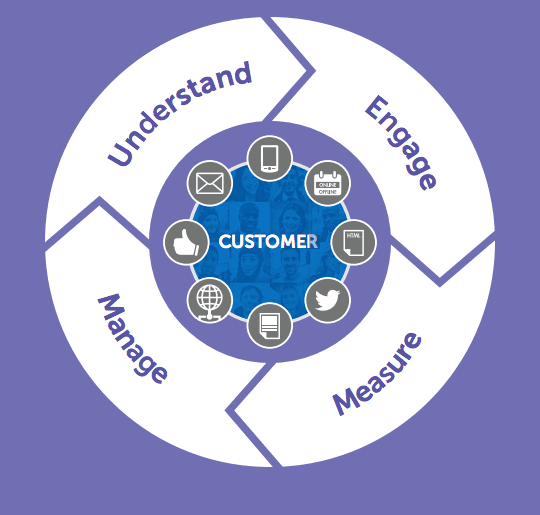 Just a few generations ago, the world of doing business was driven by face-to-face relationships. Many of us have heard stories from grandparents who talked about their butcher or baker as if they were old friends. These unique and intimate relationships were powerful, built strong relationships with customers and ultimately drove customer loyalty.
This concept was one of the main casualties of the digital revolution – as buying moved into online channels and a plethora of new tools and channels became available to marketers to help them to communicate with customers in a digital world. Databases were blasted, demand was generated and victory was achieved – in the short-term at least.
But in today’s digital world, buyers are more becoming ever more empowered. Steadily, buyers have acquired the power to define their own buying process so the days of marketers interrupting customers and prospects with their own agendas seem out-of-place in an ever-more information rich world.
That’s why it’s up to marketers to become the stewards of the customer journey and build a bond with customers wherever they are – whether that means engaging on social media, presenting a unified experience across devices, or personalising content and communications. We call this ‘engagement marketing‘.
Here are the seven distinct principles of Engagement Marketing;
Today’s buyers demand ultra-relevant communications that speak to them as individuals not personas – and regardless of what industry you are in; you’re marketing to individuals at the end of the day. Think people-to-people rather than business-to-business or business-to-consumer.
So whether you’re talking to a CIO about hardware, or parents about the right savings plans for their children’s future, you’ll need to know their preferences, history, relationship with your company, stage in the buying journey, and more. While persona-based marketing defines and speaks to your ‘typical’ buyers, engagement marketing speaks to individuals, on their own terms.
Engagement marketing bases communications on behaviours, not demographics. While demographics can tell you what a customer might be interested in; behaviours tell you what they are actually interested in.
Rather than assuming that, because a buyer fits a certain profile, he will be interested in a certain product, we can now target individuals based on how they actually behave.
You can also use behaviours on one channel – say, an interaction on your company’s Twitter feed – to inform marketing on another channel – such as the message that appears when that person visits your website.
Today’s customer is everywhere – online and offline. They move seamlessly from one channel to the next, jumping from email, to Facebook, to their favourite blog, to your website, then back to social media – all without losing momentum, and from whatever device they are using.
Marketing is no longer about being ‘multi-channel'; it’s about being omni-channel. To meet your customers wherever they are, you need to deliver an integrated customer experience across every single platform. That’s why an engagement approach requires you to create a consistent experience for your customers – one that acknowledges the nuances of individual channels, yet still presents a unified message.
True engagement marketing is a not about points in time – it is a continuous process. We now have the opportunity to listen and respond to every customer at every stage of his purchase, keeping him engaged and helping to drive purchase decisions. It’s not about individual messages, or even individual campaigns – every interaction asks for another interaction, and is part of a longer chain.
Engagement marketing isn’t about relationship-building for its own sake – it’s about relationship-building toward a goal.
At each phase of the buyer’s journey – from acquisition to advocacy – your goal is to move those buyers into the next phase. And to do so, you need a clear understanding of that journey, and a clear call-to-action in all of your marketing.
Unfortunately, the idea that marketing is an ‘arts and crafts’ function persists today – even as marketing is increasingly the function responsible for driving customer engagement (and therefore profits).
While the success of marketing activities was once difficult – if not impossible – to measure, modern marketing technology empowers marketers to do just that. The right platform, combined with smart organisational and process alignment, makes it possible to connect the dots between that email you sent last month, that event you hosted last year, and the revenue your CEO reports in an earnings call.
When practising engagement marketing, marketers now coordinate dizzying numbers of campaigns across multiple channels and teams. An engagement marketing platform allows marketers to do the work with the biggest impact faster and more efficiently, making the assets which compose a given program – emails, landing pages, forms, segmentations, and workflows – easy to replicate and complete. Using an engagement marketing platform, marketers can complete these often-tedious tasks in minutes, freeing them up to focus on what matters most – engaging with buyers.
You can download the ebook of the 7 Principles of Engagement Marketing, to find out how to create a successful engagement marketing strategy for acquiring new buyers, growing their lifetime value, and converting them into advocates!

Changing sales process because of online information
Whether it’s checking a review on Amazon, Yelp, CNET or Zagat or posting a question on Facebook or Twitter – consumers can do comparative shopping as long as they have a keyboard within reach. They can learn about a product’s functionality, quality, and pricing before they even go to your web site, let alone talk to a salesperson.
As reported in a strategy+business article – in 2012, 70% of consumers surveyed by Nielsen indicated that they trusted online reviews—which represented an increase of 15% in four years. We doubt the number has decreased in the last two years.
But consumers are not alone. This is not just a B2C market trend. Corporate buyers are also increasingly seeking information and insights from online sources. Just look at LinkedIn group discussions and you’ll find recommendations about products, as well as, insights about solving particular business problems.
Since buyers now are able to easily gather in-depth information about you and your competitors, they’re more knowledgeable about your company and its products than ever before.
So what does this mean for B2B sales reps? Well, one thing we know for sure is when buyers change how they buy; it’s a good idea for salespeople to rethink how they sell. Let’s take a look.
Seamless Experiences
In a Bloomberg Businessweek Research Services report titled “Six Essentials for a Strong Customer Experience,” it states, “No matter how customers choose to transact or engage with a business, they now expect and deserve to get the same answers, information and treatment wherever they go.” This finding holds true for business-to-consumer as well as business-to-business buyers.
However, creating these omnichannel experiences is still a significant challenge. One complication is not having the insights into what the targeted buyers want or need. Without the insights, crafting meaningful communications is hit or miss at best.
In addition, as marketers, we often don’t know the profile of the current customer base; who are the good, the better and the best buyers? How can we use current customer insights to drive communications to new customers? The hurdle to understanding existing customers is often the result of the arm’s-length relationship between sales and marketing.
The Long Road to Omnichannel Marketing
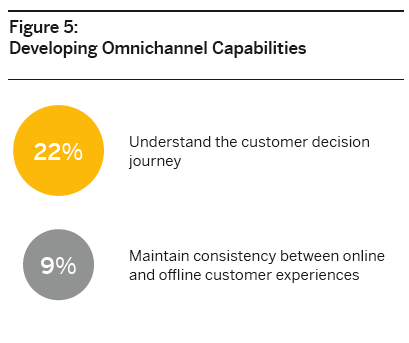
According to SAP, in its study titled “The DNA of a Growth CMO,” growth CMOs are focused on overcoming the lack of customer insight and improving omnichannel communications. However, reaching these goals is going to take time, since only 22 percent of the CMOs surveyed felt they understood the customer decision journey, and even fewer, 9 percent, were able to maintain consistency between online and offline customer experiences. The obvious challenge is how to get there faster.
Source: The DNA of a Growth CMO
Jump-start Customer Insights
All prospects and current customers are not created equal. Most companies report the 80/20 rule when it comes to the value different customers bring to the table; about 20 percent of the customers contribute to 80 percent of the revenue. So our challenge as marketers is less about getting more prospects any way we can. Rather, it is how to get more of those high-value 20 percent customers.
Loyalty Research Center has a model to tackle the problem for better understanding the current customer base and how to use the insights to drive better experiences for customers. The model is particularly helpful for marketers. At its core is the segmentation of the customer base by strength of relationship – aka “loyalty” – that, in turn, is driven by the total customer experience.
This means that the stronger the relationship, the more valuable the customer. Insights into what makes for a strong relationship helps marketers create communications to attract new customers, retain existing high-value/best customers and move the good/better customers into more valued customer segments.
As opposed to the Net Promoter Score, the power of Loyalty Research Center’s model lies in its cognition of the competitive environment in which the relationship thrives. Loyalty is then an acid-test measure of what is driving the choice among multiple offerings. The Loyalty Research Center has further developed customized financial impact models that accurately measure the likely implications of strategic choices buyers are making. Insights from the research can empower marketers to develop targeted messaging for current customers and prospects.
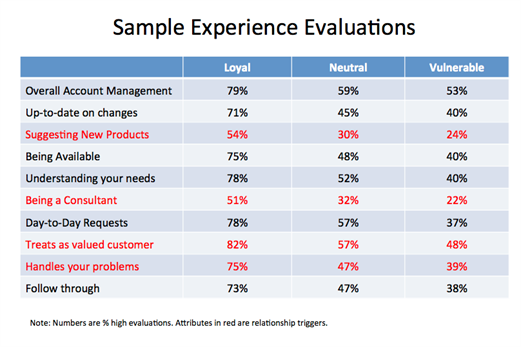
The table below serves as an example of the type of insights the model reveals and the accompanying analytics. A research program at this company identified “New Products” and “Consultative Services” as critical relationship triggers that were essential to growth. However, it also revealed that client performance fell short in both areas. This discovery was creating poor customer experiences and holding back the company from realizing its full growth potential. It was important to make improvements in those areas before more completely incorporating them in marketing programs.
Choose Your Channels
The final piece of the puzzle is learning where buyers seek information as well as the type/format of the information they prefer. This information is used to craft the buyer journey. Communications are created and executed using insights from the financial models. Analysis of the programs/communications are conducted on a regular basis and changes/modifications made to optimize results.
These combined efforts of financial insights and buyer behavior can help any marketer get a head start on executing and managing successful omnichannel programs.
Learn more must-haves to B-to-B success. Register for the October 29 gyro/Loyalty Research Center webinar, “The Path of the Growth CMO: From Insights to Tangible Results,” to learn about a customer valuation model using customer intelligence data you may already have available to drive insights that can make lead generation and customer retention measurable.
 This post is sponsored by Pillsbury Winthrop Shaw Pittman LLP.
You dream of starting the next Apple, Google, or Twitter. And you're sure that your innovative idea will be a world-changing venture.
But then what?
If you make the right opening moves, your company has a chance. Take the wrong path, and that enterprise could be doomed.
These six startup tips and traps come from Pillsbury Winthrop Shaw Pittman LLP, a leading global law firm that focuses on the representation of entrepreneurs and their financiers, including venture capitalists and strategic investors.
Starting a company requires far more than just the information below, but bear it in mind before you take that big step.
Let's say you get together with three or four entrepreneurs and come up with a business concept. You'll often make the natural mistake of sharing your company's ownership and management equally. While you can all be friends, you'll still need a leader — otherwise, you'll quickly discover that you can't govern by committee.
Chances are, your device, widget, app, or big idea is at least partly made up of intellectual property. And while it’s helpful to bounce ideas off different people, you'll still want to protect your IP. That most likely means you'll need to keep your idea confidential (and share it under a nondisclosure agreement only), at least until you file for a provisional patent. And of course it makes sense to talk through the costs and benefits of different approaches with your lawyer. Make sure to do it early in the life of your startup.
No matter where a technology startup might be located, it's great advice to form a Delaware C corporation. Delaware offers two compelling advantages for the startup entrepreneur. The first one is trust: When you tell potential investors or strategic partners that you're incorporated in Delaware, they'll probably be comforted, because they'll know the environment (and in fact will probably be organized there themselves). The second advantage is cost. Most industry standard forms are based on Delaware corporation law. When you’re working with law firms or with investors, everyone will be on the same page.
Any obligation that you can’t get rid of easily is a tattoo. You should view everything your enterprise does through the view of a potential acquirer. Entering into a three- or four-year contract with a vendor might not seem like a big deal to you, but it could end up being a deal breaker for your startup’s would-be buyer. Generally, buyers don’t want to be tied into long-term relationships that aren't of their own making. In other words, not everyone is going to be into your tattoos.
Company founders need to view their capitalization table as a precious asset. Often in the developmental phase when founders don't have any money and need to outsource IP development, they'll ask a developer for a discount in exchange for a percentage of the new company. That's a dangerous (and ultimately expensive) thing to do because, down the line, having that minority shareholder can become a serious impediment to a subsequent financing or acquisition.
A founder’s willingness to “give it away” can also signal a lack of confidence in the startup's prospects — how else to explain the tolerance for dilution? Bottom line: Anytime you’re awarding equity to a third-party service provider, it should be done on an objective basis where the provider has to earn it over time.
If you don’t already have a track record of successfully launching a business, raising funding from sophisticated investors will be challenging. And raising it from the unsophisticated is a big mistake. An experienced investor — or the founder's friends and family — will probably understand if the company has to change direction or simply doesn’t make it. That chiropractor you met on the airplane probably won’t.
Contact Pillsbury Winthrop Shaw Pittman LLP for more information.
Find out more about Sponsored Content.
Join the conversation about this story »


This weekend I had the good fortune to present at the Minnesota Blogger Conference where nearly 300 local bloggers gathered to learn, get inspired and network.
For my part, I gave a presentation on how blogs are still an incredibly useful tool for marketing. Keeping the reason for blogging top of mind as well as empathy for reader preferences in how they find, consume and act on information are essential if a blog author expects marketing outcomes from their efforts.
When a blog or any content hub can become “the best answer” for the topics that are important for buyers, the return on blogging goes way, way up. One way to execute a content plan to become known as an authority is through topic targeting.
For experienced multi-channel and integrated marketing pros, this kind of approach is going to be fairly common. But for the vast majority of bloggers, whether they be corporate or enthusiasts, the shift from writing for yourself (or your brand) to writing to satisfy specific audience needs is a fundamental shift.
Topic targeting starts by answering a few key questions:
As you come to find the sweet spot between how you want to be known and what customers care about, that’s the focus of your topic targeting plan.
Topic targeting is an approach that involves creating resources, experiences and connections that result in an undisputed affinity between a target topic and your brand.
On a large scale for large companies, this is essentially brand marketing. For a small or medium business without massive budgets or resources, these 3 phases below represent a practical approach to becoming the “best answer” wherever customers are looking.
When starting out from a position without prominent authority on your desired topic, one of the most effective ways to close the gap between where you are and where you want your brand to be is to connect with those that already have the authority and community you desire. Recognizing topical influencers in a creative and qualitative way with an emphasis on inspiring readers to think in new ways about the topic is a good start. Co-creating content with topic influencers is also particularly effective. Your target topic will drive which influencers you engage with, the questions and interactions you have, and the titling of the resulting content.
Additional inspire tactics include speaking events that are “on topic” in the conference scope, track and/or title of your presentation. Social engagement promoting target topic content and events should also align. Comments made on industry articles (blogs and online magazines) are also opportunities to create affinity. Blogging about the target topic from different perspectives (what would a buyer need to know from start to finish) is also an effective directed content effort that will contribute to becoming the best answer.
Lastly, a limited number of guest posts on relevant, high profile blogs and contributed articles to industry magazines and websites on your target topic will provided added support for your brand and the target topic.
Anticipation is a gateway to topical authority. Continuing to blog on the target topic and growing influencer relationships will lead to even more community engagement opportunities. Consistent creation of useful and entertaining blog content as well as alignment with industry influencers will create a very powerful mental state amongst your blog readers: anticipation. A community that can’t wait to see what you’re going to publish next will be instrumental for amplifying content and stimulating new perspectives on your target topic. That desire leads to advocacy, evangelism and scale for reaching a target audience in a highly credible way.
Demand for information and expertise leads to demand for your solutions. As authority is built on your target topic represented by the content you create on your own websites, third party references to your brand as an authority, growth of your community around the topic and advertising activities, there are several opportunities to show more tangible evidence of expertise: Some examples include:
All of these tactics provide opportunities for readers to move from awareness and learning about the topic (with your brand at the forefront) to consideration and action – leads and transactions. Consumers increasingly expect to be able to educate themselves to a purchase decision and making it easy to find, experience and act on your content isn’t just good content marketing, it’s what buyers want.
Specificity is essential with topic targeting as are patience and persistence. This is an earned achievement that also needs to be maintained. But once consensus and momentum are achieved, the ability to attract those actively seeking what you have to offer will expand the value of your content beyond lead generation and sales to other means of monetization – sponsorships, advertising, syndication.
To apply the approach mentioned in this post will require some homework – research in your market or industry to see what kinds of content and messages resonate with the target audience. That’s where the audience Discovery, Consumption and Action model for understanding your audience comes in to play. It is also a continuous effort that can start simply and scale based on what works and what doesn’t.
But the most important thing if all, is to start: How do you want to be known? How does that fit with what your customers want to know?
 Gain a competitive advantage by subscribing to the
TopRank® Online Marketing Newsletter.
© Online Marketing Blog - TopRank®, 2014. | How to Be the Best Answer with Topic Targeting | http://www.toprankblog.com

Admittedly, I am a salesperson for Marketing Software, but I’m also a consumer just like you, so I have a feel for what works and what doesn’t on the internet. Recently I spoke with a company that insisted they were successfully implementing the “conversations, not campaigns” approach with their customers.
So, I decided to check out what it looked like in action. I subscribed to their loyalty program; I jumped around their site; I opted-in any and every way possible in order to learn how they would market to me. To my surprise, I received only one email, four days later, and it was a newsletter (that felt random to me). So, I went to the site, and put a $2000 item in my shopping cart, and then, I abandoned it. Almost instantly, I started getting newsletters daily, sometimes even twice a day, but none of them had anything to do with my poor abandoned item, the most expensive thing I could buy.
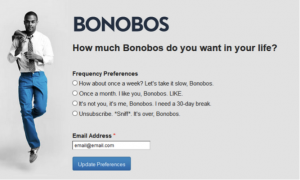
Finally, I decided to unsubscribe. I mean, I really believed it when they said they had the conversation approach down. So I was disappointed to see:

That was the extent of the unsubscribe preferences. Yes, or no.
I picked yes, but it didn’t have to end that way! We could have been friends; I could have been persuaded to buy the big-ticket item (maybe)! I mean we didn’t have to be best friends, but we could have been social friends or something.
According to Marketo Co-founder, Jon Miller, “One of the best ways to manage your list – and simultaneously establish trust with your audience – is to allow them to take control of the communications they receive.”
I did a little research and found some great examples of companies trying to engage their buyers and establish trust by allowing them to pick their form of communication:
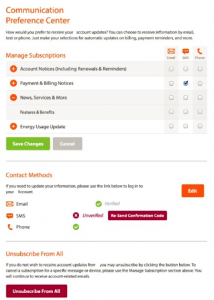
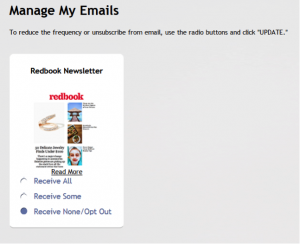
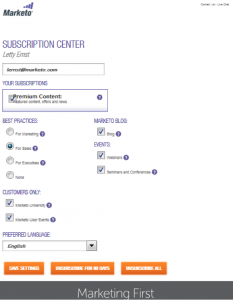
And here is an example of Marketo’s preference center:
“Consider all the money you dedicate to acquiring new customers, and the database you’ve built as the result of your investment in acquisition. Now picture that money flying out the window when your customers disengage—either explicitly through an opt-out or subtly by withdrawing their interest.
When you “lose permission” to interact with those customers, you are left unable to approach them about additional products or services.”- from Marketo’s Improve Customer Acquisition with an Engagement Strategy ebook
It is vital that you engage with your customers based on the preferences and channels that they choose. View and treat your customer database as your most valuable asset. Don’t make it a breakup; give your customers a preference center, and they will stay your friends.
How do you think about having conversations, not campaigns? Do you have a customer preference center? Share your experience and thoughts in the comments below.
If you've got a solution that could benefit customers of different sizes, how do you go about developing a B2B sales strategy? The worst thing you can do is to not make a decision, and instead try to sell to everybody.
Should you sell to small business customers? Fortune 500 companies? Medium-sized businesses? Solopreneurs? Micro-enterprises? Startups? Only restaurants, or restaurants and groceries and office supply stores? There are many ways to slice and dice it, and how you go about it can be the difference between success and failure.
First of all, let's be clear there are no universally accepted exact definitions of these terms. Different industries and different people will draw different distinctions.
These are the whale customers. Fortune 500 companies that are many times larger than your own company.
Benefits:
Downsides:
Companies that do many millions in revenues and have thousands of employees, but are a step below Fortune 500 companies.
Benefits:
Downsides:
Can be anything from a local design shop to a restaurant. Small businesses are typically run by the owner and have less than 100 employees, most of them are in the range of 5 to 25 employees.
Benefits:
Downsides:
These are professionals who mostly run a one-person business, solopreneurs, maybe with the help of one or two people. Freelancers, single-practice doctors, consultants and so on.
Benefits:
Downsides:
When you're selling to a highly-specific businesses that are not necessarily defined by industry, but by the stage of their company. Selling to startups is one common hyper-niche
Benefits:
Downsides:
If you've got one of these products that could be valuable to different-sized businesses, which one should you focus on first?
First and foremost, let your decision be guided by your own understanding of the audience. Pick a market you know really well.
Look for things that give you an unfair competitive advantage:
What if you don't have any of these competitive advantages?
Start small. Map out the spectrum for which your product could be a good fit, and then pick the smallest kind of business to sell to. You want to sign up your first paying customers as quickly as possible, and build momentum, gain traction as fast as you can.
You want a high frequency of closed deals, even if they are small deals. As you build a steady stream of sales, look for signals that you're ready to move upstream.
At Close.io we're mostly selling to small companies with less than 100 users of our software (100 sales people or less), and initially we were focused on startups only.
As we gained momentum, build out our product and our ability to provide value to our customers and serve them, we started seeing medium-sized businesses or enterprises sign up for our product. Somehow they heard about us (this happened organically, mostly by word of mouth from our customers who knew people within those larger companies and talked with them about our product). Initially, these larger companies signed up, but mostly stopped using us after the free trial.
The more mature our product became though, the higher our win-rate with these large customers became.
This is the kind of signal you want to look out for.
This indicates that you're ready to start dedicating a certain amount of your sales efforts on selling these higher-level customers. You
This isn't the only way to grow, but it's what I advise you to do. Why? Because we see startups going this route have a much higher success rate than those who try to sell to enterprises from the get-go.
Prefer to listen? Here's the audio-only version of the video:

Peyton Manning just passed Brett Favre for the all-time pro football touchdown passes record. Rafael Nadal has only one loss at the French Open in the last 10 years…ONE! Wayne Gretzky has the most career points ever in pro hockey, at 2,857. Lionel Messi scored 79 goals for his club team in 2012, the most ever by one player in one year. Martina Navratilova won six Wimbledon singles titles in a row.
 What’s with all the sports stats? Well, it’s easier to talk about top performers in sports than in the B2B business world. We don’t often get a glimpse into their inner workings and stats, so it’s hard to compare them.
Top performers however, always know where they stack up against their competitors. They may SAY they don’t care about the records, or that they don’t KNOW where they are in the chase, but don’t believe them. These athletes know EXACTLY where they are in the chase. They’re not driven by them, but they certainly know how they stack up against their fellow athletes.
This is one of the reasons that they are the best at what they do. Sure, they’ve got natural talent or skill, but they work hard to make sure they’re ready to take on all comers. They want to ensure that in any competition, THEY come out on top.
Translate this idea of “measuring up” in the B2B business world, and you end up with metrics. To understand how your business is doing, look at your metrics.

Let’s take a look at lead generation metrics. In order to know if your marketing programs are effective, you’ve got to start measuring them.
In sports it’s much easier to get those metrics, as there are times, scores, and championship wins. It’s obvious who the top performers are. In the B2B world, it’s a little more challenging to get that information. While you may not know what your competitors are up to, you can definitely take a look at your own programs and see how you’re doing.
The Lenskold Group recently did a survey where they asked B2B marketers about their programs’ effectiveness. What they found out about the top performers was interesting.
Top performers measure their marketing ROI more than the rest
By a margin of almost three to one, the top performing B2B companies in the survey measured the return on investment (ROI) of their marketing programs more often than the rest. They wanted to see how much they were earning for every marketing dollar they spent.
To use the sports analogy, they wanted to see how much they improved for every hour of training they spent. Did all of that training time r esult in more wins, goals, or championships?
For a marketing team, it’s the same thing. You want to know if your efforts are being rewarded with more leads and sales. Whether it’s by using modelling and statistical analysis of your numbers, a comparison of pre-campaign numbers and post-campaign results, or just basic tracking of open and click rates, the fact is START MEASURING.
B2B companies that track their marketing stats are growing more than those who don’t
The top performers are acutely aware of their marketing stats, and how it’s affecting their business (41% vs 19%). In fact, the numbers show that these companies are growing at a faster rate than their non-measuring competitors.
They understand how their marketing activities affect the company’s bottom line. This gives them a greater investment in their work and planning, so that they truly believe in their actions. This belief has a tremendous impact on their individual work, and if everyone’s pulling in the same direction, then the company grows more easily.
Top performers use both traditional tracking methods, as well as marketing automation apps
In order to save time and effort, the top performing companies are using marketing automation (MA) apps to track their efforts. Everything from content views to response inquiries and participation in consuming content like webinars. They’re tracking it all through their MA apps and are saving a ton of time doing it.
 The one area that these tools are helping is mainly in the tracking of sales conversion. Often it’s difficult to track the conversion from initial engagement to lead to final sales conversion, as these metrics can be held by different teams in your company. An MA app helps with this as everyone’s looking at a centralized repository of those metrics, and upper management can pull reports from them at any time.
Start tracking your marketing efforts now, and see your B2B business grow
Marketing in today’s B2B world is changing. First it was simply a matter of getting a website out there. Then it was using social media for customer service. Now it’s content marketing and lead management. The evolution continues. And just like those pro athletes who compare themselves to their competitors in order to see how well they’re doing, you can do the same. Use those stats and metrics to evolve and change your B2B marketing programs to maximize their effectiveness. Grow your business by measuring.
What stats are you using to determine your marketing effectiveness? ROI? Lead conversions? Hit the comments and let me know.

Oracle Eloqua has been a long-standing leader in the world of marketing but what alternatives to Eloqua are there out there? Marketing Automation Software is huge and can change the face of your business. There can’t be too many businesses who don’t use marketing and marketing automation apps in one form or another, but who is king of the hill?
Eloqua is an enterprise-level sales and marketing automation software. It has all the tools you need to create a sales and marketing campaign, including providing data and analytics to build better campaigns. Create a marketing content calendar with SEO ready content to automatically share with your customer base. Eloqua is also revenue performance management for measuring sales and marketing.
Eloqua is designed for large enterprises, although it is suitable for any sized business. The basic package is designed for up to 10 users and starts at $2000 per month, the standard package is $4000 per month for up to 50 users. If your business is smaller and has less requirements than this, there are other marketing automation apps that may be more suitable for you.
 Infusionsoft
Infusionsoft is sales and marketing automation which includes a CRM and eCommerce tools. You can use the automation function to nurture leads and manage your sales. Its integrated eCommerce tool means you don’t need to use different software for your marketing and online shop.
Infusionsoft is designed for small to mid-sized businesses. The built in CRM means you can access your customer data and manage relationships in the same place as your automation. The eCommerce function is perfect for online sellers, it is an all-in-one platform.
 ExactTarget
ExactTarget is a Salesforce digital marketing app. It is designed around managing your customer journeys on a 1:1 basis. It is software to create marketing, email marketing and content marketing campaigns with great real-time tracking and reporting to measure your successes.
It is powered by Salesforce which makes it the world’s most powerful digital marketing platform. It is designed by marketers for marketers so is the perfect solution for any company’s marketing campaign. It makes your life easier with its Salesforce integration so perfect for existing Salesforce customers.
 ActiveCampaign
ActiveCampaign is an email and marketing automation suite to help you to grow your business. It is centered around email marketing and allows you to monitor and listen to your customer’s reactions to hone your campaigns. You can also track your customers to develop relationships and create custom campaigns.
For freelancers and smaller businesses the freemium option gives you a free platform while you build your business and the paid subscriptions start at a super-low cost so you can increase as your needs grow. The free training and free online support are a great asset for those just starting out.
 Salesformics
Salesformics is a CRM and marketing automation platform all-in-one. It integrates with Twitter, LinkedIn, Buffer, Constant Contact, Evenbrite, Dropbox, Campaign Monitor and more to seamlessly manage your existing marketing efforts. It is regarded as one of the easiest to use tools.
Salesformics is a low-cost marketing and CRM platform to manage your customer relationships and marketing in one place. Its many integrations make it easy for you to leverage social media to create campaigns that really work for your business.
In the end it is the person or company behind the amazing marketing automation software that can make or break a successful campaign. Try out some alternatives to your usual app to find the one that fits like a glove. Do any of those apps rock your world? There are tons of alternatives to Eloqua, just check out our GetApp marketplace for more fabulous ideas.
Main image courtesy of Wikimedia.
The ultimate goal of B2B marketing and lead generation is to help the sales team sell. Marketers spend a lot of time and effort creating inbound leads but struggle getting those leads to convert into customers after they hand them off to sales.
As I talk to marketers about their lead generation results, I often hear statements like, “We’re generating lots of leads, but they aren’t converting” or “We need to increase lead quantity” or “We need to generate more qualified leads.” Does this sound like you or someone you know? I’m going to share 10 levers you can use to improve your lead conversion right now:
1. Shorten your follow-up time and do it personally.
The velocity of following up matters. When people ask for information, they expect a rapid and personal response. Numerous studies show that swift follow-ups increase conversion. Make sure your email reply has a real person’s name on it. Remember, people buy from people. The more you can humanize your lead follow-up the better. Use your manners. Read, call or email? That’s the question.
2. Go beyond what they expect.
The way you treat your leads tells them about how you’ll serve as customers (from generating interest, through nurturing and into your sales team). Go above and beyond, especially when it comes to those leads that fit your ideal customer profile. It can be things like giving them extra relevant content they didn’t expect or, if they attended a webinar, giving them a follow-up executive summary or an extra white paper that’s relevant. Serve them.
3. Qualify leads with teleprospecting to help maximize the sales team’s effective selling time
80% of marketing leads are lost or discarded, according to a MarketingSherpa presentation delivered at B2b Marketing Summit 2009. The biggest reason? They’re not ready to talk to a salesperson. The prospect may have responded to marketing campaigns and provided basic contact information, but sales professionals need much more than that. They need a valid business reason to talk to them, and you’re not going to get that on a web form. Improve your lead qualification process to increase “sales ready” lead conversion rates. Delivering leads that your sales team really wants based on your universal lead definition.
4. Understand buyer motivation to help you share content that helps them convert.
Without being annoying, you need to stay in their radar until they’re ready to talk to you. It’s critical in lead nurturing to know where a prospect is in their buying cycle so that helpful information relevant to the need at a specific point in time can be delivered. Knowing when to provide a case study versus a technical white paper versus a product demo can make a huge difference in converting a lead to a sale.
5. Create content geared toward lead progression, not lead capture.
Invest as much in creating creative and content for lead progression as you do for lead capture. I’ve seen companies spend most of their budget getting people to raise their hands but not enough toward progression. The goal of lead nurturing is to help progress leads from initial interest toward purchase intent. It’s about progression. Sales people often struggle with developing nurturing content without support. If you’re wondering what kinds of content helps progress leads further faster, ask your sales team. Start by asking your sales team questions like, “What’s the content you share with leads that helps them convert?” or “What’s the content you use to help take people to the next level?”
6. Focus on increasing relevance with your lead nurturing.
Relevance is critical lead nurturing. Like most marketers, you’ll start with a more general focus, but the key as you begin learning about your prospects’ unique needs lies in tailoring your lead-nurturing content. This is where using marketing automation can help you understand more about your customers based on what content they’re engaging. As you learn more, you can move from more general content toward content you’d share in a one-to-one relationship.
7. Leverage and test lead scoring to focus the human touch, not replace it
Most marketers use lead scoring as the only means of lead qualification before they route leads to their sales team. Lead scoring should prioritize the human touch, not replace it. Develop your lead scoring system to be consistent with opportunity potential. Not all leads are equal in value and shouldn’t be treated the same. Leverage your ideal customer profile and build segmentation to look at which leads converted into customers. Then, use this information to begin predicting those that will become future customers. Also, leverage lead scoring to help you track engagement. By focusing more on the best prospects, your conversion rates will rise.
8. Improve Sales, marketing systems and process alignment.
Make sure your entire team knows how you generate and qualify leads, where they’re stored, how to follow-up and engage them, what’s expected of them, how to use the CRM and how to convert leads correctly. Let your entire company know you’re past conversion rates and current outcomes. You can make a huge impact by focusing first on creating an Ideal Customer Profile (company-wide, for each product, service or solution). Then, create the Universal Lead Definition of a “sales-ready lead.” Finally, connect the marketing and sales process to the customer’s buying process.
9. Re-engage past leads and get more out your investment.
The year-end push is on, and I know you may be wondering, “What else can I do to drive more revenue with little or no remaining budget?” I’ve found the best way is to focus on the leads you already have. Get your sales team to hand leads back to marketing for re-engagement. Lead reengagement is one of the most powerful ROI tools marketers have available to them. Why? You’re getting more out of the money you’ve already spent by going deeper within the opportunities you already have. It seems like common sense, but the reality is, very few companies think about it because they assume it’s Sales’ job.
10. Engage in lots of testing beyond lead capture.
It’s important to think of lead generation as a process that can be continually improved through ongoing testing and refinement. Most marketers stop testing after the first step of lead capture (getting people to raise their hand). However, testing hot to increase conversion after they leads respond can have a huge impact on results. One of the most important things you can test is your messaging.
I look forward to hearing how these ideas work to help you increase lead conversion.
You might also like
B2B Content Marketing: 100% increase in lead gen for customer service software company [MarkeingSherpa case study]
B2B Email Marketing: How a global information company transformed from batch-and-blast to persona-driven email marketing [MarketingSherpa video replay]
Ecommerce Research Chart: Overall conversion rates [MarketingSherpa Chart of the Week]
Marketing and sales teams rely heavily on one another to drive business. After all, it’s the marketing department that generates leads, and the sales team that converts those leads to paying customers.
It’s not intuitive, then, that these two functions often exist in silos, each having their own systems and processes. Sales collaboration dramatically improves results, but bringing it to fruition can be more complex than it sounds.
In this article, we discuss how sales and marketing collaboration makes a difference and provide tips and tools for making this collaboration more efficient.
![Download Now: 2024 Sales Trends Report [New Data]](https://no-cache.hubspot.com/cta/default/53/9cdc68ed-d735-4161-8fea-0de2bab95cef.png)
Table of Contents
Sales and marketing teams today must break away from traditional silos and forge powerful, collaborative alliances. Meeting goals requires CSOs and CMOs to intertwine their unique roles and focus on unified, revenue-generating activities that support both go-to-market strategy and operational execution.
How? Let’s have a look at five key areas where these two departments should collaborate.
One of the most obvious signs of misalignment between sales and marketing teams is during direct customer interactions.
Customers pick up on disparities in how the brand is presented or inconsistencies in responses from both teams. This gap confuses the customer and dilutes the brand’s image and credibility.
Marketing teams, with their rich industry insights, often take the lead in crafting the messaging platform. But relying on this alone misses the mark.
Customer interaction allows sales teams to gain first-hand feedback and insights into what resonates. They understand the intricacies of customer pain points, their desires, and the terminologies of the most impactful content.
Blending an industry-centric approach with on-ground, practical insights sculpts a sales messaging playbook that’s consistent and engaging. Collaboration makes it possible for messaging to evolve based on real-time feedback.
A joint effort in shaping customer messaging ensures brand consistency and harnesses the voice of the customer. The result? Messages hit home every time.
Enablement content sits at the crux of successful sales and marketing alignment. It bridges the knowledge and tools that sellers need with the creative and informational prowess of marketers.
Let’s take a closer look with some examples:
The secret sauce? Pre- and post-deployment feedback on materials. Feedback ensures enablement content is as effective and relevant as possible.
A continuous feedback loop allows marketing to iterate upon and refine content, focusing on what sellers need to know, articulate, display, and execute in their roles.
Sales and marketing teams can develop and refine a lead scoring system that identifies and prioritizes potential customers based on specific criteria. A joint effort attracts the right kind of leads, with the sales team focusing its energy on prospects with the highest likelihood of conversion.
Consistent communication and feedback loops fine-tune criteria and scoring mechanisms to optimize the quality and conversion rates of leads. Start with these criteria.
A collaborative lead-scoring approach ensures high-quality lead generation. Sales also prioritizes its efforts on leads with the highest conversion potential. A joint strategy streamlines operations, reduces resource waste, and boosts the overall efficiency of the sales funnel.
Sales collaboration manifests in various forms, each with its own purpose and benefit. Teams can better use their collective potential by understanding the different types of collaboration. Let’s delve into some prominent types:
Vertical collaboration is the interaction and alignment between different hierarchical levels within an organization. A management–frontline sales team or a senior leadership–middle management relationship are great examples of sales collaborations.
Suppose a regional sales manager collaborates with individual sales reps to understand ground-level challenges and provide tailored strategies and resources.
A top-down collaboration allows insights from the field to inform higher-level decision-making.
Horizontal collaboration happens between teams or individuals of the same hierarchical level but across different departments or functions. It’s all about breaking down silos and making sure peer teams work together, like sales and marketing.
For example, the sales team collaborates with the product team to understand new features.
Sales reps communicate the benefits of this feature to potential clients and ensure consistency in messaging and better customer understanding.
Our survey offered some juicy insights from salespeople on how transformational their collaboration with marketing is.
.webp)
Let’s discuss some of these insights below:
Customer experience is the impression your customers have of your brand as a whole throughout all aspects of the buyer’s journey. It influences their perceptions and feelings about your business.
When there’s alignment between sales and marketing, they create consistent messaging that provides value at each touchpoint. Our survey shows that 28% of salespeople stated that the most significant advantage of sales and marketing alignment is the improved customer experience it brings.
The sales team also conveys real-time feedback to the marketing team, ensuring campaigns and content are timely, relevant, and resonate with customers.
And why is this seamless experience essential? It makes the sales process smoother and leaves a lasting positive impression on the customer. This impression has tangible benefits — after all, consumers are 5.1 times more likely to recommend an organization after a positive customer experience.
Such advocacy boosts brand reputation and plays a crucial role in driving organic growth through word-of-mouth referrals. When teams collaborate, customers win — and so does the business.
Lead quality refers to the potential of a lead, or a prospective customer, to become a paying customer based on various indicators such as their engagement, fit, and buying intent.
The importance of lead quality cannot be overstated — high-quality leads are more likely to convert into actual sales, ensuring efficient use of resources and higher revenue generation.
As many as 44% of sales reps express concerns about the quality of leads they receive. This substantial percentage underscores a major pain point within many organizations.
But when sales and marketing teams find alignment, things take a turn for the better. A significant 26% of professionals have noted an increase in lead quality when these two crucial departments collaborate effectively.
When both teams are on the same page regarding the ideal customer profile, marketing generates campaigns that attract the right audience, ensuring sales focuses on genuinely promising prospects.
The bottom line, or revenue, is the lifeblood of any organization. It’s a direct reflection of the business’s health, sustainability, and growth potential.
While numerous factors influence revenue, so does the alignment of sales and marketing teams. In fact, 32% of respondents in our survey said that revenue growth was the most significant benefit of such alignment.
Here’s how alignment boosts profits:
Understanding customers is like possessing the compass that guides a business in its journey.
It determines product development, marketing strategies, and sales tactics. The deeper and more nuanced this understanding, the better equipped a business is to meet and exceed customer expectations.
According to our survey, 21% of salespeople said that a cohesive marketing and sales team enhances understanding of customers. Clearly, collaboration is key to figuring out customer needs, behavior, and preferences.
Brands find themselves disconnected from their consumers. A survey revealed that less than half of the brands feel they have successfully integrated the necessary elements — tech, metrics, customer journey mapping, team alignment, data, and channels — for optimal digital engagement.
By aligning sales and marketing:
The right tools facilitate collaboration between teams. Streamlining processes, fostering communication, and providing insightful analytics, these tools work together and work smarter. The following tools can help sales and marketing teams collaborate better:
.webp)
Best for: Businesses looking for an all-in-one solution to align their sales and marketing teams and strategies.
HubSpot is a comprehensive platform that integrates CRM, sales, marketing, and customer service functionalities. It offers a comprehensive set of inbound marketing tools, including email automation, SEO tools, and social media management tools.
As part of the sales features, it has a dedicated dashboard, precise deal tracking, and seamless lead management.
These tools come together under a unified analytics framework that allows teams to monitor and evaluate performance across both sales and marketing domains. This cohesion ensures every user accesses and uses insights, fostering collaboration and strategic alignment.
Pricing: Free; Starter, $18/mo; Professional, starts at $1,600/mo.
Best for: Small to medium-sized teams seeking an intuitive and flexible tool to streamline task management and enhance team collaboration.
Trello is an intuitive visual project management system, which uses cards and boards to track and organize tasks. It offers customizable workflows with an easy-to-use drag-and-drop interface that allows teams to tailor their processes to specific project needs.
With Trello, integrate a variety of popular tools, including Slack and Google Drive.
It also encourages team collaboration by allowing users to attach files, add comments, and build comprehensive checklists directly onto cards. This functionality simplifies task management and promotes communication and transparency among team members.
Pricing: Free; Standard, $5 per user/month if billed annually; Premium, $10 per user/month if billed annually; Enterprise, $17.50 per user/month if billed annually.
.webp)
Best for: Teams looking for seamless communication and integration with other collaboration tools.
Slack’s real-time messaging capabilities have revolutionized team communication. It enables seamless file sharing and allows integrations with various productivity tools.
The platform organizes conversations through channels, allowing for both team-specific and project-specific discussions. Direct messaging facilitates private one-on-one chats, perfect for quick clarifications or personal conversations.
Slack also incorporates voice and video call functionalities that provide teams with diverse means to connect and collaborate. This holistic approach ensures communication flows smoothly, regardless of the team size or project complexity.
Pricing: Pro, $7.25 per person/month, when billed yearly; Business+, $12.50 per person/month, when billed yearly; Enterprise Grid: Custom.
Best for: Remote sales and marketing teams looking for an easy way to communicate product demos, feedback, or quick updates without requiring live meetings.
Loom simplifies asynchronous communication and allows teams to convey information more personally and vividly than through text alone. Its ease of use and quick video-sharing functionality make it a favorite for many remote teams.
Users can choose from different recording modes: camera-only, screen and camera, or just the screen. Loom provides simple editing tools like trimming for refining videos. Plus, it integrates well with tools such as Slack, Trello, and Notion.
Pricing: Starter, Free; Business, $12.50 user/month; Enterprise, Custom
We asked five thought leaders for their top tips on sales and marketing collaboration. Let’s have a look:
“Stop ‘tossing leads over the fence’ or ‘handing them off’ to sales. It’s just the funnel, and conversion can require marketing and sales touches at every step.”
—Brian Zang, Senior Vice President of Revenue at Cloverly
Here’s the truth: Sales and marketing aren’t two separate entities, but rather two interconnected phases in the customer journey.
The funnel, from awareness to conversion, isn’t linear and, instead, is a continuum where marketing efforts feed into sales, and feedback from sales loops back into marketing.
Considering the funnel holistically means that both sales and marketing teams understand the entire process, not just their part of it.
This broader perspective ensures that marketing activities align with what the sales team needs and vice versa.
“When do you want a salesperson to engage? When should marketing own the lead? How can sales automatically adjust paths after a phone conversation? Put practices in place that understand sales and marketing will have to work together to maximize conversion.”
—Brian Zang, Senior Vice President of Revenue at Cloverly
MQLs (Marketing Qualified Leads) and SQLs (Sales Qualified Leads) are crucial distinctions. Define these to bridge the gap between marketing’s lead generation and sales’ conversion efforts.
An MQL is typically a lead that’s engaged with the company’s marketing initiatives but hasn’t yet shown the buying intent. An SQL, on the other hand, has displayed a clear interest in purchasing and is ready for the sales team’s direct outreach.
Setting clear criteria for MQLs and SQLs requires an understanding of the circumstances under which a lead progresses through the funnel. Both teams should address questions like:
Addressing these questions and setting specific criteria ensures smoother transitions and better alignment.
“We have implemented monthly Smarketing (Sales + Marketing) meetings in order to get everyone on the same page. This gives the two teams a chance to be in the same room and discuss what has or has not been working and what each team needs from the other in order to be successful. Understanding the functionality of a well-oiled ‘smarketing’ machine can be the one factor between a company that fails and one that succeeds.”
—Erin Fradelos, Senior Director, Global eCommerce and Digital Marketing at Owl Labs
Clarity in roles and responsibilities facilitates effective collaboration. Understand what each department is held accountable to prevent overlaps, fill gaps, and streamline efforts.
Regular meetings where both teams discuss their objectives, KPIs, and deliverables are great for this. These meetings foster open dialogue, enabling team members to ask questions, provide feedback, and share insights.
Marketing then tailors their campaigns to feed the sales pipeline, while sales offers on-the-ground feedback to fine-tune marketing strategies. When each side knows what the other is accountable for, it enhances teamwork and drives toward a unified company goal.
“In order to closer align these efforts, marketing teams need to provide sales with increased visibility into how prospects are interacting with marketing collateral and next-generation analytics that can let sales teams know when and how to reach out to leads.”
—Joe Moriarty, VP of Sales and Marketing at Raven360
Conventionally, sales teams may be left in the dark until a marketing campaign concludes. However, prospects often show their peak interest during these campaigns. This is the opportune moment for sales teams to strike.
Establishing a system where sales gets real-time alerts about lead interactions with marketing collateral ensures they engage prospects when the iron is hot.
The real-time lead notification system may include:
Reduce the lag between a lead’s interaction and the sales team’s outreach to get a better chance of converting interest into tangible business opportunities.
“It’s important to have measurement criteria tied to their respective incentives. True collaboration can only exist between marketing and sales if they both have goals and incentives tied to the performance of each other’s camp.”
—Rob Nance, Communications at JPMorgan Chase & Co.
Have defined metrics that reflect both teams’ goals and incentives. Create measurement criteria that are specific, measurable, attainable, relevant, and time-bound. For example, marketing might measure lead generation numbers or the quality of leads (like MQLs), while sales focuses on conversion rates and revenue targets.
Regular evaluation identifies areas for improvement and ensures both teams are on track. But it’s also essential that the measurement criteria align with incentives.
If a marketing team’s incentive is solely on the quantity of leads, but sales require quality, a disconnect can arise. Measuring and aligning goals and incentives helps both departments work in harmony towards shared company objectives.
“Marketing is all about knowing your audience, and taking sales calls allows you to get to know them first hand. After a week of taking the occasional call, I felt like I knew our clients personally and that I could better target their needs in our initial online touches.
—Alex Avritch, Sr. Brand Engagement Manager, LaunchDarkly
Having marketing team members participate in sales calls can offer invaluable insights into the customer’s journey and decision-making process. Here’s why this tip is significant.
Incorporating marketers into sales calls, even if occasionally, can bridge the understanding gap, making collaboration between the two departments even more effective.
Fostering collaboration ensures a synchronized approach that amplifies their efforts, rather than diluting them. The key is to prioritize open communication, shared objectives, and real-time data-sharing.
When both teams operate with a unified vision, it enhances the customer’s experience, from the first touchpoint to the final sale. The result? A more efficient pipeline, better conversion rates, and a stronger bottom line.


With automotive purchase journeys increasingly taking place online, manufacturers and dealerships have a reason to place greater focus on digital channels to pick up customers in the early phases of their research.
An AutoTrader.com study from last year found that new and used buyers spend 75% of their car research time online, while Google stats suggest that these customers take an average of 2.7 months to decide on a purchase.
This presents a challenge for automotive marketers to grab the attention of these researchers and eventually move them offline for a test drive or a visit to a local dealership.
There’s also the challenge of measuring online marketing efforts when customers use so many channels, as tracking leads from website to dealership isn’t always simple.
In this article, I'll look at the purchase journey, some examples of automotive brands online, and that tricky transition from web to dealership.
There are, of course, many variations on this. Some customers may just stick with the same brand or dealer they used the last time, while others may be genuinely more open-minded about the vehicle they want.
One common trend over the last few years has been the movement of car research from offline to online. It seems that many prefer to use the internet for the early phases of their research.
Here are a few stats:


Automotive adverts have become a kind of cliché over the years. Imagine a sleek car cruising through open highways and mountain roads to an adrenaline-pumping soundtrack, and you have the idea.
This kind of content, often produced at great expense, does have its place on TV ads and can be displayed very effectively on the web, from online videos to interactive websites. Indeed, there are some very creative and impressive examples.
However, automotive marketers also need to think about the nuts and bolts of online and how they can most effectively convert online interest into offline sales.
While digital is clearly a valuable channel for the automotive sector, it differs from others such as retail and financial in that the purchase is far more likely to take place offline.
Volvo recently decided to make the first edition of its XC90 model available to buy exclusivey online, and the fact that it sold all 1,927 cars within 48 hours may show an appetite for more online purchases.

However, this is rare and the focus, for the moment at least, is on lead generation. This means bringing online researchers into dealerships via test drive request forms and contact details for local dealers.
The challenge for automotive brands lies in the often-fragmented marketing and sales processes they operate. Creative ad teams, social media, and websites often operate within silos, with no one ‘owning’ the potential customer until they are well along the sales funnel.
Take social for example. To be effective it needs to work with other teams in the business, so that social media content is aligned with the needs of the business as a whole, and that lessons learned via social channels are fed back to the relevant departments.
Ford’s social strategy has been celebrated, and the brand has been ahead of the curve in this respect.
According to its former Global Digital & Multimedia Communications Manager Scott Monty:
It’s always been important to us to put social where it can integrate with the rest of the business: we have corporate social strategy within communications; consumer-facing social within marketing; and customer-centric social response in customer service. From there, it’s key that we interface with other members of the Ford team, such as HR, legal, product development, IT and more.
Stats quoted in a recent study from the CMO Council underline how important social already is for automotive brands, for retention as well as acquisition.
38% of consumers said they will consult social media before making their next car purchase, while 23% of car buyers use social channels to talk about their experience when making a purchase.
Auto brands are making strides here. For example, Mini has been innovative in its use of social channels to increase engagement with its followers and provide a fun experience which matches the brand’s characteristics.
It's NOT NORMAL campaign was a huge success, helping to re-establish its identity as a friendly and innovative brand.
Mini scoured the internet looking for its most loyal brand ambassadors and discovered hundreds of images and videos on social media that it then used for its campaign.
Followers could upload a creation to its Tumblr hub or by sharing it with #MININOTNORMAL, then within hours could see it on a digital poster or billboard anywhere in the UK.
As reported in The Guardian, within six weeks 230,000 people engaged with the campaign via social media. 2,217 pieces of consumer content were shared. 29,420 new fans and followers were recruited.
Mini’s Twitter following tripled and 3,853 visitors to the campaign hub went on to look for a new MINI on mini.co.uk. 11% of which became qualified dealership leads.
Brands also need to learn from what works for other sectors online. One of the success stories of the internet has been the power of consumer reviews in driving sales. Indeed, Amazon can attribute many of its own sales to its ground-breaking use of consumer reviews.
Of course, reviews are nothing new and recommendations from ‘real’ people were always likely to be more trusted than the opinions of marketers and sales people, but the internet has allowed them to be used more widely.
It’s also an area which offers great potential for automotive brands, though they have been slow to adapt, perhaps due to the fear of negative reviews of cars and dealerships.
Kia took a different view of this, recognising that reviews play an important role in the car research process, and decided to make them the focus of its marketing.
Its TV ad campaign which started last year focused on reviews, inviting viewers to see what others thought of their cars.
In what was a relatively brave move for an auto brand, Kia invited detailed reviews of its vehicles from buyers before displaying them on its website. This alone was significant, as it meant that customers could conduct their research with less need to visit third party sites.

After all, consumer reviews are, after recommendations from family and friends, the most trusted source of information online. Providing reviews on the site meant that a greater number of potential buyers could be kept within the purchase funnel from this stage.
To add to this, Kia then made reviews the focus of its marketing efforts both online and offline. Its TV ads invited viewers to head online to see what its customers thought of the cars, while the same principle was applied to print and outdoor advertising, as well as its showrooms.
As Kia’s Head of Customer Communications John Bache explained:
With customer research moving online, we wanted to adapt to that. We knew that customers were happy with our products, and we wanted to harness that. It was a leap of faith to some extent, but if people want to find reviews online they are there somewhere. We'd rather provide them and keep people on our site.
It worked too, with traffic to the Kia website up by 21% year-on-year as a result of the campaign, while visits to dealer websites rose by 72%. In addition, new vehicle registrations rose by 12% in the same period.
This is vital for automotive, as great content can catch the attention of potential car buyers in the research phase, answering key questions and providing inspiration.
Ben Davis has provided some very good examples of automotive content marketing, and I particularly like the Nissan Leaf Q&A pages, which use existing customers to explain the benefits of the car:

The transition from web to showroom is a key area, and one that many automotive brands could improve upon. Once customers are showing real purchase intent, such as using car configurator tools on websites, looking at details for finding dealers and booking test drives, then it’s vital that sales people at dealerships are ready to respond.
For example, an Arthur D Little study looking at online transformation in the automotive industry found that 60% of new car buyers see configurator tools, which allow them to test different combinations of models, colour, equipment and accessories, as very important in making a purchase decision.

If the processes are joined up, these tools also offer useful insight into a customer’s preference which should be useful for sales people.
Another vital factor is the speed of response to test drive and contact requests made online.
Online marketing can be effective for delivering leads, but this effort is wasted if sales processes aren’t joined up with offline. This is where dealerships and manufacturers need to work together.

In the BMW example above, I can select my car and configure it to my tastes and needs, before sending the details to my local dealer.
This is great, but the key will be how quickly the dealer responds, and whether the information I have already submitted online is used by the salespeople offline.
67% of all respondents expect a confirmation within eight hours of sending a request for a test drive, 22% are prepared to wait 24 hours but only 10% of consumers would consider waiting more than 24 hours for a confirmation as acceptable.
A closer link between the website and the forecourt means that brands can turn more car researchers into test drivers and purchasers. Ideally, they should arrive at the forecourt to meet a car salesman who already has an idea of the car they are considering, their needs and their budget.
Essentially, dealerships and manufacturers need to work together to join up the online and offline experiences. The ideal would be a great online car research experience, followed by a smooth transition to the forecourt, which means more sales for both, as well as more effective measurement of online marketing and how it can translate into offline sales.
Car buyers are now using the internet for research in huge numbers, and in conjunction with more traditional channels such as magazines, TV and the dealerships themselves.
This does present challenges for automotive marketers but it also opens up possibilities for the automotive brands which can provide this joined up experience for customers.
A version of this article was previously published on Marketing Week.
Come along to Econsultancy's Festival of Marketing in November. It's a two-day celebration of the modern marketing industry, featuring speakers from brands including Airbnb, LEGO, Tesco, Barclays, FT.com and more.
Increasing profit is an ongoing mission for most businesses. Content marketing can be leveraged to help your business increase profits in more than one way that people don’t always think about or may overlook.
Here we are going to briefly cover five different ways that your business can increase profit by implementing a solid content marketing strategy.
The first thing that people think of when it comes to increasing profits is to get more customers.
When you turn your website into a content hub of valuable information that your prospects and customers are looking for, you will begin attracting your ideal customers from a variety of different channels.
Content marketing will give you more website pages, which means
Make no mistake, although content marketing can help you attract more prospects, acquiring new customers is hard work.
Another route to increase your profits that doesn’t require increasing your new customer growth, is to increase the value of your existing customers.
With content marketing, you are consistently publishing new information that allows you to touch your customer database more often. When you publish a new article, you can send an email to your customer segments that it would be most relevant to and keep you front of mind and bring your products/services back to the forefront for them as well.
For someone who may purchase from you once every six months, content marketing can help you inspire them to buy every three months instead. That increases their purchasing from twice a year to four times a year, doubling their value as a customer.
A lot of times people are in need of their next purchase but it gets pushed aside or forgotten for a little while. This lag time is costing you money. Touching base with them will help reduce that lag time in purchasing frequency and increase your profits. How long do you wait between dentist appointments? Even when you know you should go every 6 months, that quickly turns into every 9 or 10 months.
Don’t let your customers treat you like a trip to the dentist!
When you start communicating more frequently (and with more value) with your customers, they are going to feel a stronger connection with you. Make your customers feel like they are part of your conversation. Building that kind of connection can extend your customer relationships from one purchase to multiple purchases, from months to years, you get the idea.
By increasing your Customer Lifetime Value, you can also now afford to spend more on acquiring new customers, which will cyclically drive your overall profits.
Do you want your customers talking about you with their friends, family, and colleagues?
Give them something to talk about.
Create content that they are going to love and want to send to someone else.
If you aren’t giving them something to talk about, then you are just crossing your fingers and hoping that your name comes up over coffee one day.
So how can you be more proactive about getting more word of mouth buzz for your business?
Profits are not just tied to revenue, but also to your expenses.
There are several ways that you can leverage content marketing to actually cut down on your expenses, like the time spent by your sales and customer support teams.
Employee time costs money. Employee’s wasting time on low quality prospects or drudging through the educational process of prospects who are not yet ready to buy is not only a waste of money, but will lower their morale and productivity.
What if your sales team was delivered higher quality leads that took less time for them to close?
What if prospects came to your sales team further along their decision making process? And what if prospects that aren’t qualified were weeded out ahead of time?
Content marketing can help with all of these aspects that your sales team would appreciate as well as save your business money.
When you publish content that’s mapped to the customer’s decision making process, you are creating assets one time that are then educating and nurturing prospects to allow them to qualify (or disqualify) themselves as realistic leads, and be more ready to purchase when they contact a sales rep.
Marketing automation technology, like Hubspot, allows you to build these sequences one time and have them running without taking the time of anyone on your team.
Combining your content and technology in this way can be invaluable to your bottom line.
A workflow can be set up to nurture your prospects, and you can communicate with someone automatically until they either contact you directly to make a purchase or their engagement and behaviors trigger a notification to a sales rep that they are a hot lead and should be proactively contacted.
Imagine someone visits your website and likes what they are seeing. They download a lead magnet to learn more about the topic. Now they start getting emails over time that continue to educate them, help them, and position your business as a leader in the industry.
When it comes time to buy, who do you think is going to get that call? That’s right, you are icon smile 5 Ways To Increase Your Profit With Content Marketing
The key to content marketing is providing information that your prospects and customers find educational, entertaining, or valuable in some way. A good starting point for where to create content for your company is to make a long list of frequently asked questions of prospects and customers.
Again, this content becomes a recurring asset that saves you time. Instead of writing a full email response every time a different client asks you a similar question, you can send them a link to your blog post that has already been written.
If it takes 20 minutes for a customer support rep to field a phone call or your account rep to reply to an email, then you can trim that down to 3 minutes of hitting reply and getting the link to the article on your website.
Having these content assets available on your website will also reduce the amount of support phone calls that come in. Customers are likely to search on Google or browse your website (especially if you actively communicate that you have support answers on your site) for answers before they dial the phone. If you can give them answers that save them the time of calling, then they’ll appreciate it themselves as well.
Content marketing can and should be customized for every business, just like any other marketing strategy. In fact, integrating content marketing into your overall marketing strategy is the best way to get the most impact.

Last year around this time, I wrote a post about How Much You Should Budget for Inbound Marketing. In the post, I recommended a range of annual inbound marketing budgets based on company size, anywhere from $100-150K for small businesses up to $5-20 million for enterprises with $500+ million in annual sales. I’m sure many small businesses shrugged off my recommendations, opting instead for much smaller budgets they could afford or putting off the decision until things are looking better. When I have a conversation with a CEO or owner along those lines, I always say, “Well, if you’re not going to invest in inbound marketing, what are you going to do instead to grow revenues?” This usually leads to more discussion about ROI. They want to see some proof inbound will work before the work is done. That’s when I pull out my trump card.
Yes, there’s a very real cost of failing to invest in inbound or delaying action indefinitely. This has to do with brand visibility, competition, sales efficiency and top line revenue. Let’s take them one at a time.
How will you find new buyers? It isn’t easy. There are a lot of competitive forces, both online and off. Let’s start with your website: By not having a website that is attractive, relevant to your buyers and optimized for inbound marketing, you risk a number of opportunity costs:
If you compound the problem by not consistently publishing blog posts and other content that interests your buyers and brings them back to the website or prompts them to share with friends, now you’re facing:
If you fail to distribute your content to relevant channels, i.e. get it in front of your buyers using various forms of digital advertising and relationship building with industry influencers, your goose is effectively cooked. You have virtually no shot at competing with other companies that are “all in” with inbound marketing.
What happens when your competitors beat you to the inbound marketing punch? There are lots of potential impacts including:
By using inbound marketing methodology and technology, companies are consistently reducing customer acquisition costs and increasing customer lifetime value. Inbound marketing works by identifying and reaching out to qualified buyers with content they want. This means the sales team gets more qualified leads and spends less time prospecting with methods that rarely work, like cold-calling, or expensive means like tradeshows. With the right marketing technology solutions and an aligned sales and marketing team, sales reps spend far more of their time talking with qualified buyers and finding ways to help them. That is how sales are won these days.
The largest cost of not doing inbound marketing is top line revenue. If your brand isn’t visible, you can’t get qualified leads except by traditional methods, such as cold-calling, or by referrals. How well are those working for you? If your website doesn’t convert visits into leads and you can’t track your leads through the sales funnel, how will you get new customers? If your sales team isn’t aligned with marketing and using sales and marketing technology, how will you win in competitive situations with lead intelligence and insights that convince and convert customers?
All of these aspects of inbound marketing impact top line revenue, and the beauty of inbound is you can calculate ROI on your marketing budget. Now, let’s get personal: What happens if revenues drop on your watch? Yeah, things start to get ugly pretty quickly, so you have a personal stake in this decision. Just sayin…
So I ask you, can you really afford NOT to do inbound marketing? Can you even afford to wait to get started? If the answer is no, give us a shout.

 For over 30 years, LEGO® Education has been working with teachers and educational specialists to provide solutions and resources that bring subjects to life in the classroom – and make learning fun. Brandee Johnson, Senior Marketing Manager at LEGO Education North America, recently had a conversation with Leo Merle, Marketing Programs Manager at Act-On Software, to talk about how LEGO Education has been using Act-On solutions to improve their productivity and boost the effectiveness of their campaigns. Read on to learn how all the pieces fit together as the LEGO Education team went through the process of finding and adopting a technology solution for their unique needs.
LEO: Tell me why you decided to implement marketing automation. What specific issues needed to be addressed?
BRANDEE: About three years ago, LEGO Education was using a marketing tool that allowed us to do basic email marketing. It was designed for smaller companies just getting started, and it served its purpose for a period of time. But we were growing, and we wanted to do more scalable campaigns. We didn’t have the capacity to manually execute all of the email marketing that we wanted to accomplish.
We also needed a better way of handling and managing our marketing lists. I started looking at marketing automation programs and doing research to gain a better understanding of what they had to offer. And really, I felt that some of those issues that we were facing could be solved by a marketing automation program.
LEO: What were the criteria you used to evaluate systems?
BRANDEE: As I began looking into different marketing automation programs, I wanted to make sure that I was purchasing a tool that would meet the requirements of our business to give us the functionality and flexibility that we were looking for. That included automated emails, reporting on email results, and list management that was easy to use. As I started learning more about marketing automation programs, I also realized that lead scoring was a gap that I really hadn’t pinpointed, so I started to look for a tool that had lead scoring. So, functionality was definitely one of the criteria.
 A second criterion was ease of use. At the time, our group was smaller than it is today, and there are a lot of programs out there with a ton of bells and whistles that might require a small team just to get up and running. I needed something that had a low floor and a high ceiling. Something that was easy to get started with that didn’t require two or three full-time employees to manage it. But it also had to have scalability that could grow with us as we grew, or that we could grow into. So I looked for a tool that was easy to use, easy to get started with, but also had a lot of functionality that we could use as we expanded and grew in the future.
And a third criterion, of course, was pricing. Finding a solution that had the functionality that we were looking for, the ease of use and scalability, and also the right price to fit into my budget was important.
LEO: What were your most critical or most stubborn marketing challenges prior to implementing? After implementation, did marketing automation address those challenges?
BRANDEE: Prior to implementing marketing automation, we lacked visibility; we never really knew how our touch points were driving leads down our buyer’s funnel into our marketing funnel – what was effectively moving them, and which ones were staying stagnant. It was like a black hole for us.
Another challenge was that we didn’t have a way to direct our customer’s journey based on the behaviors they demonstrated, or the relationship they had with us. You could say we were treating all of our targets as if they were the same person. We lacked personalization and we lacked customized paths that allowed us to watch behavior and then send targets down a path that delivered the right message at the right time based on their demonstrated interests.
Marketing automation really helped us to solve these challenges. By implementing Act-On Software, and having the lead scoring component as well as the automation component, we were able to gain visibility into where our leads are in our funnel. And not only can we now see where they’re at and how they’re progressing, we can drill in and point out what’s working and what’s not. So we can invest more of our budget in areas that are working and effectively move leads through the funnel. We can also pinpoint things that are not working as effectively and analyze those to determine if we need to modify them, or maybe stop doing them.
Marketing automation also allowed us to address the problem of not being able to direct the customer’s journey through their interactions with LEGO Education. With Act-On, we’re able to do a variety of different things that really allow us to speak to our customer or to the target audience in a very personalized and customized way.
At this time we’re running multiple campaigns. Some are trigger campaigns, some are drip campaigns, and some are a combination of both. They allow us to make sure that we’re sending the appropriate message to our customers based on their interactions with us. Have they opened our emails? Have they visited our web pages? What forms are they downloading? All of those activities and behaviors give us feedback as to what they’re interested in, and we can then follow up with additional touch points that are really customized to that individual target’s need. No longer is every person being treated the same – each person has their own customized journey.
LEO: Since adoption, what has changed for your company?
BRANDEE: Our company hasn’t yet implemented a full CRM that’s integrated with Act-On, so I’m very excited that we’re going to be doing that in the upcoming year. That’s going to give us more exposure to some of the ROI that we may not be able to fully see yet.
 Since we’ve implemented Act-On, we’ve realized some very substantial changes within our marketing. I can say they’ve probably been the single biggest driver of some pretty significant changes that we started introducing in North America. About a year later, we’ve since chosen to implement them globally because they’re working so well.
Some of the tangible things that we’ve noticed are that we can achieve much greater reach – and a more personalized reach. So, prior to having marketing automation, we might have tried one or two campaigns a year. This year, we are running 14 different campaigns, and next year we will be running a similar number and maybe a few more. Our campaigns are better – they’re more customized to the individual target. Maybe that’s based on their title, or on the activity that they have demonstrated with us. It may be based on web pages that they visited. Often times it’s a combination of all of those things.
We’re getting more leads and we’re able to nurture those leads in a better and faster way, which then shortens the sales cycle. We’re able to hand over hot leads to our sales team to generate sales more quickly. And just the sheer visibility into the results of our marketing efforts has really helped us hone in on what’s working and what’s not.
LEO: Can you attribute ROI to the system? If so, what results have you experienced.
BRANDEE: We’ve significantly increased our ability to reach more targets and to move them through the buyer’s cycle faster. We also nurture leads, and the leads we turn over to our sales force are ready to purchase and ready to talk to a sales representative. And so this has really optimized use of our sales force. Rather than calling on cold leads, they’re getting a plethora of warm, nurtured leads from the marketing team.
LEO: Do you have advice for other marketing professionals evaluating marketing automation platforms?
BRANDEE: My advice to other marketers who are considering marketing automation is to first take time to understand and identify what your needs are, the problems you’re trying to solve, and to document those. Get a firm understanding of what you’re trying to accomplish. Based on that, then I would suggest that you look for a solution that addresses those needs.
Some of these tools require large teams to implement, while others can be implemented with one person, maybe not even a full-time individual. It’s a capacity thing to consider, making sure that you have the resources to put behind the tool. Just to understand the tool and understand all that it can do for you and then kind of parlay that back onto your marketing activities and think, “Okay. What can we do differently? How can we utilize this tool to really help us grow?”
I also strongly suggest reaching out to peers in your industry or in marketing who have implemented these programs. Getting feedback and advice from them as I was going through the process was really helpful for me.
Read the case study to learn more about the many ways LEGO Education North America has continued to build on the success of their automated marketing campaigns.

Imagine if you had a sales funnel system that generated…
-48% email optin rates to grow your list fast
-20% sales page conversion for new buyers to bring in daily new customers
-Repeat sales of up to $5000.00 from new leads
-$25.48 of revenue from $6 of paid traffic (4x multiplication of your money)
Even if you...
For a limited time we’re taking you behind the curtain in a new video to show you every step of a real-world sales system that does all of this.
What impact would that have on your business to have this system growing your income month after month?
This system works whether your are just starting out, trying to make your first income online or whether you are ready to grow your income to the next level.
Take this system, copy it, use it and profit from it.
Watch it now. The video will be removed Wednesday night at midnight Pacific Time US.
NOTE: When you see the screen that says, Big Take Away, play close attention. That’s when we give you the secret to growing your business income fast.
Check out the video now:
http://www.internetbusinessmastery.com/2landing/aim/steal-this-funnel-and-profit/
Steal this and Profit is a post from: Internet Business Mastery | Escape the 9-to-5. Make More Money. Start an Internet Business, Now!
The post Steal this and Profit appeared first on Internet Business Mastery | Escape the 9-to-5. Make More Money. Start an Internet Business, Now!.
Twitter remains, to this day, one of the fastest growing and most widely used social media platforms and you’d be hard-pushed to find a business in any industry who would claim “none of my customers is on Twitter”. In fact, for virtually all the clients we work with, Twitter is by far the most powerful and effective tool we have at our disposal. If you or someone responsible for your Twitter account, be very aware that Twitter for business use is far more complex than for personal use and simply knowing how to distribute content isn’t going to cut it.
Truly effective Twitter for business involves numerous techniques in order to generate leads and sales, many of which are almost never used by individuals in their personal use of the platform. But even before we reach the realms of advanced Twitter for business, there is the matter of conveying your brand exactly how is needed to generate interest and achieve your goals. Some of the key elements of Twitter for business which you don’t have to consider when using Twitter for personal use. These include:

Branding – making sure you Twitter profile fits in with you branding, website and other social media accounts.
Voice – what is the ‘voice’ of your brand? How does this make your followers and potential clients feel? Is it consistent?
Content – you can’t post daily updates on boring topics or anything irrelevant to your company. How are you engaging your followers with your content?
Call to action – what are you, ultimately trying to get your audience to do?
Strategy – how is all of your activity going to contribute towards your overall business goals?
To ensure you’re getting some return on all your hard work, you need to be clear on all of the above. Of course, the other major pitfall is being too self-promotional and using Twitter to simply broadcast corporate, salesy messages. Remember over social media you are in a conversation with your audience on their time – they’re not going to be receptive to push social media tactics.

First, what is the goal of a landing page? Simply put, it is to convert a website visitor into a lead by capturing contact information in a form. When it comes to landing page optimization, there’s no end in sight. You can always optimize, A/B test, and optimize some more. But the truth is, there will still be something else you can improve.
After a few months of collecting conversion analytics, you might start to notice room for improvement. Start by analyzing your most visited landing pages and work your way down. Let’s dig a little deeper than the basics.
As you can see, there are many tactics you can use to improve your landing page performance after its initial creation. Once you start gathering lead intelligence and analytics, you can start making minor tweaks based on your marketing and sales goals. Practice makes perfect, and always remember, with landing pages, less is more!
What other landing page best practices – beyond the basics – would you share with marketers?

With social media as steadfast cornerstone of nearly all marketing (regardless of industry), there’s cutthroat competition for attention across all social networks.
You need all the help you can get to promote your content on social media and be noticed. We’re singling out 24 tools, recommended by industry experts and marketing mavericks, that are promised to supercharge your social endeavors.

A sweet tool to help you make snazzy looking infographics in a matter of minutes.

While you won’t be able to have ultimate customization, with plenty of graphics to choose from and some great drag-and-drop vector art, it’s a fine place for those who want a simple, high-quality looking infographic.
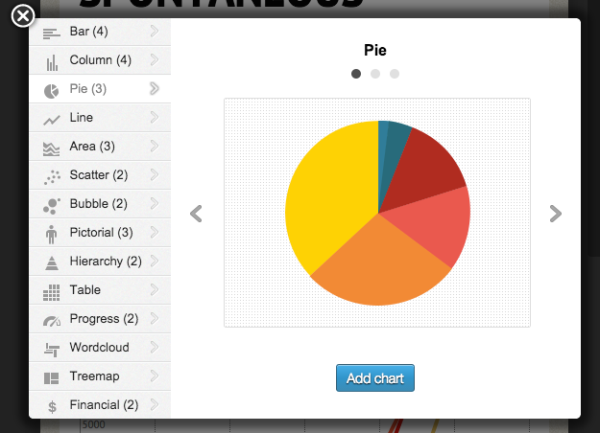
The free version lets you share your infographic and embed it on your website. To download your infographic, you’ll need the paid version.
Other similar tools include: Piktochart and Easel.ly. Give them a shot too!
One of the big names in social media management, Hoot Suite is a tried and true champion. Schedule posts across various social networks, set up feed streams to see what’s happening on different networks, and analyze the results.
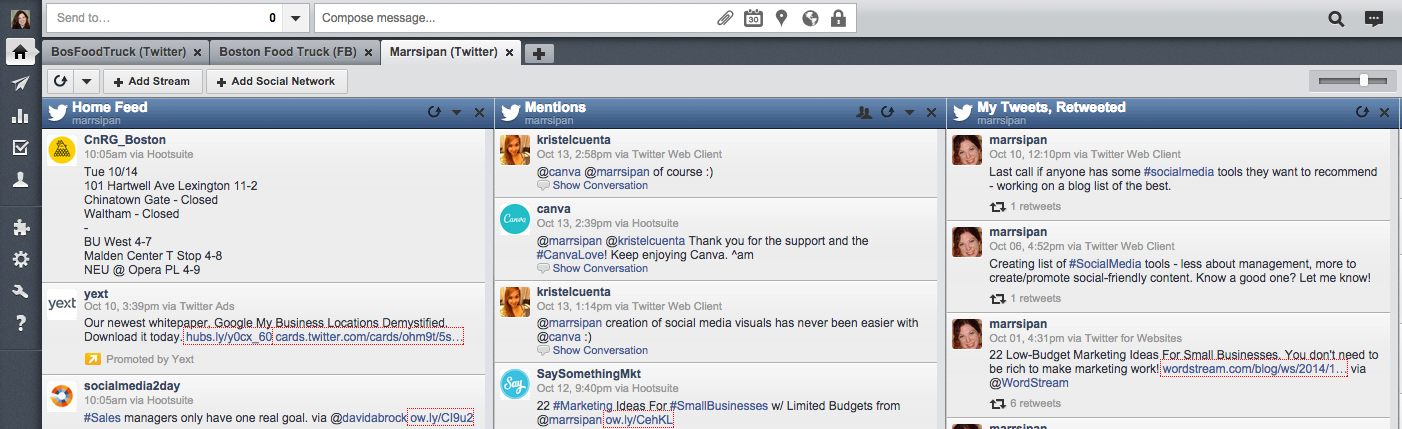
In essence, bit.ly is a URL shortener, transforming ugly eyesore URL strings into cute little clickables. However, it can be a heck of lot more if you let it. Sign up for a free account, and Bit.ly will save your “bitlinks,” let you organize your bitlinks into “bundles,” and even track click analytics.

Mention is a handy tool that lets you monitor keywords across various sites. You can ask Mention to track references to your brand name or other specific keywords, and it will populate a feed with mentions from the web.
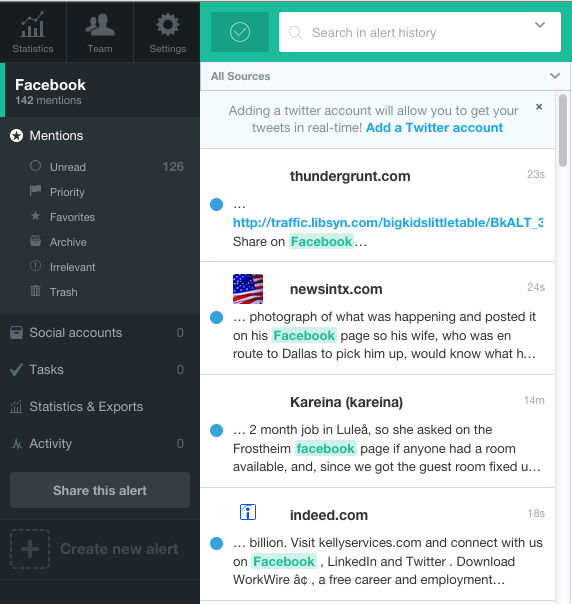
Hook up your own social media account info, and Mention makes it easy to take action and respond to your brand/keyword mentions. Mention offers a 14 day free trial, and starts at $30/month.
For a cheaper, less comprehensive alternative, consider Google Alerts, which will aggregate keyword and brand mentions across the web.
Buzzsumo is pretty darn cool – it lets you discover the “most shared content and key influencers” on the web. Search a keyword and see which related articles performed the best, complete with social media shares.

There’s a perfectly useful free option, plus paid options, which add the ability to set up alerts, export data, and access content analysis and domain reports.
Rebel Mouse is a digital publishing platform that functions as a social content aggregator, displaying your posted and shared content in a customizable layout. Rebel Mouse is similar to Paper.li, but with more customization.
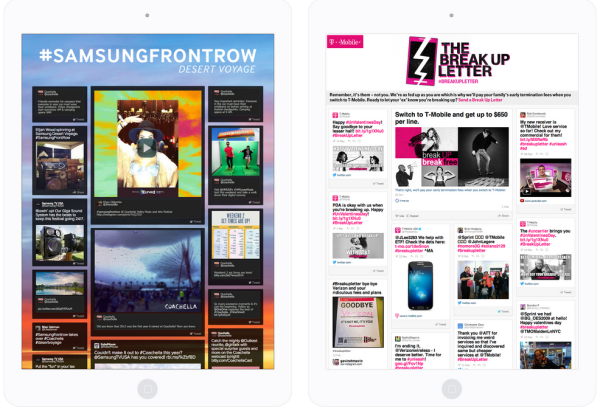
My issue with Rebel Mouse is that I didn’t find its functionality instantly apparent. You’re abandoned to figure things on your own and, at least for me, it all felt quite complicated and overwhelming. Even after spending half an hour exploring it, I still wasn’t exactly sure what it was supposed to be used for.
The real value with Rebel Mouse seems to be in creating very stylish looking, high-quality pages composed of various content pieces (video, images, articles, etc.). These pages can be used as part of a blog, in a webpage as part of a campaign, or as a newsletter.
If that sounds up your alley, I suggest reading up on the various ways you can use and make the most of Rebel Mouse. I can definitely see the opportunity to do some really cool stuff with Rebel Mouse, so long as you’re willing to put in the time to figure out how it all works. I could see Rebel Mouse being great for specific campaigns. [Free and Paid Versions]
Tint is very similar to Rebel Mouse, but quite a bit easier to wrap your head around, especially thanks to their quick explainer video.
Tint — Social Engagement Anywhere from Tint on Vimeo.
Nothing revolutionary here, but it’s a great tool to aggregate all the conversations happening about your brand. If you’re a big brand or hosting a major event, this could be a pretty cool way to set up a one-stop hub to see all the conversations.
For example, some of our WordStream folks attended the Inbound 2014 conference recently – if you threw the #Inbound2014 hashtag into a tool like Tint, it would be pretty cool to see all the different conversations, pics, and postings.
Of course, you can just type a hashtag into Twitter and see something similar, but tools like Tint and Rebel Mouse aggregate posts from a collection of social networks of your choosing, not just one source. Plus, these tools look aesthetically great, and isn’t style everything when it comes to attracting and engaging?
Tint ain’t cheap though – even the most basic account will cost you $250/month (with the most expensive plan being $1000/month). There’s a free version, but it’s pretty limited – you can aggregate content you’ve posted and not much else (for example, you can’t aggregate based on hashtags, which is a paid feature).
This easy-to-use text photo overlay tool is a social media slammer. Just find an image (or use the built-in stock photo collection for pro uses), hit the Chrome extension tool, and you’ll find an assortment of text overlay options to create a one-of-a-kind compilation.

Currently knee-deep in a online visual economy, text overlay images like these are hugely valuable. Tweak the text, add filters, and then share your creation on social sites (or save it to use later). As Share As Image notes, photo tweets are 94% more likely to be share than text-based tweets! So go ahead, make the most of this awesome tool.
This automation tool lets you link up your various social tools and channels in extraordinary ways. These automation connections, dubbed “recipes,” allow for an infinite number of combinations – have your Pinterest posts automatically update onto your Twitter feed, let your Instagram pics get scheduled in Buffer. With endless possibilities, it’s best if you go check it out for yourself!
Buffer is a super simple and easy tool to queue and schedule social media updates across various platforms (Facebook, Twitter, LinkedIn, Google+, and App.Net).
Buffer also offers story suggestions, and can be hooked up with various RSS feeds for even easier sharing. There’s a nice analytics feature, and with Buffer for Business you can collaborate with team members and moderate contributors too. Buffer has been a long time favorite app of mine, and I can’t recommend it enough!
Slide Share is a great way to repurpose your existing Power Point presentations into awesome slide decks to share with social media followers.
Slide Share is the perfect tool for rehashing and recycling your content for different audiences and channels.
Pixabay is an awesome spot for finding free quality photos for commercial use that don’t need attribution.

While you can scour Flickr for Creative Commons licensed photos, it can be pretty annoying to have to source every photo, and can make your website or blog feel less professional. With Pixabay, all you need to do is type in your keyword, and you can go to town on photos, no credit card required.
There are actually a few sites like this, where photos don’t need attribution. In addition to Pixabay, check out:
The only downside to these sites is that you usually don’t have a ton of images to choose from, but that’s the price for pro bono photos.
Topsy is a handy social media tool for your arsenal, allowing for some awesome social search options. Type in a keyword and sort by links, tweets, photos, videos, and users. Couple that search function with some nifty social analytics and social trends (all free), and Topy is looking pretty top-notch.

Canva is a bit like Share As Image, but has a ton of extra stickers and stylish text accessories you can use. Canva is the perfect tool for creating bright, colorful text overlay images to compliment your social media posts. Canva really makes it easy to create class act images that will wow your audiences.
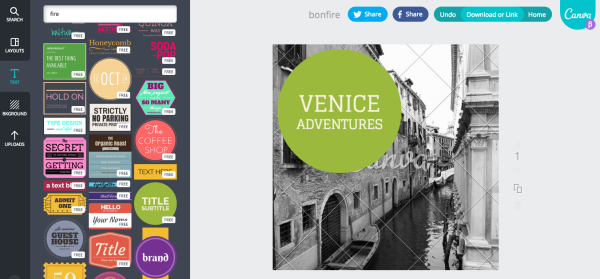
The coolest thing about Canva? You can choose from different size setups customized for different social network designs – for example, you can create an artsy cover image for your Twitter account, with the perfect dimensions already built in.

Canva is all kinds of fun and super useful. My only gripe is that it’s very easy to cross over into the paid categories (free options have a small marker showing them as free, while paid elements are unlabeled). Still, this is one sweet tool you need to check out.
I mentioned Click to Tweet in an earlier post detailing a list of 32 Content Marketing Tools, and it’s worth mentioning here too. Click to Tweet makes it easy to create links that prompt users to tweet customized text, selected by you.
You can do most of what you want for free. There’s a limited number of click to tweet links you can make, in which case you can upgrade to the paid unlimited plan.
Nutshell Mail is a free tool from Constant Contact that delivers a summary of your social media activity across various networks straight to your inbox. It’s nothing revolutionary, but it is definitely a helpful monitoring tool, especially for those with hefty workloads who want a nice summary of their social media action dished up to them.
Pocket’s premise is simple – the place to save the stuff you don’t feel like reading right now. You see a cool article about detailing the new iPhone 6, but you’re about to head over to a meeting – pocket that baby!
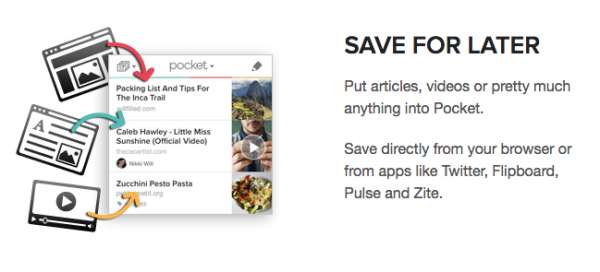
There are lots of tools like this on the web, but what sets Pocket apart is that it’s compatible with everything from Buffer to Flipboard (Pocket is integrated with 500+ apps). Pocket makes it easy to find a ton of great articles relating to your industry, save them, and then organize them into social posts and schedules at a later date.
Circloscope helps you find and follow the big Google+ influencers in your niche. Find those users that engage, get your Google+ content in front of them, and Circleoscope promises big improvements. [Price: $47/year]

Cayzu is designed to make customer service a breeze. Instantly be notified of a customer complaint, whether voiced on Facebook or Twitter, so you can solve the issue ASAP.

Cayzu also can aid you in creating a self-service portal to help customers solve their issues themselves. Get customer service metrics to ensure your customers are being cared for and become a stellar service star. [Free and Paid versions]
PowToon lets you easily create animated videos, which you can then use on your website, YouTube, or share on other social networks.
Video content is highly valuable, so PowToon is definitely worth checking out if you want to take a shot at creating the next Gangnam Style (ok, that probably won’t happen, but you could still create an awesome video!) Go for informative how-to videos, or a quick explainer video that gives a rundown of your product or service.
Manage Flitter is a Twitter tool to help you cut out your followers that aren’t pulling their weight. Unfollow users who don’t follow you back, filter out users who never customized their profile photo (a good sign of a bot), and remove followers whose accounts remain inactive. [limited free options and paid options]
Write up social media posts, categorize them based on subject matter, and then Edgar shoots out your posts, based on your customized schedule.
The big thing Edgar emphasizes is the automation of repeat posts – Edgar will cycle through your library of category-based posts, ensuring that your past posts don’t go to waste. Let’s face it – these days you’re lucky if a post reaches even a small fraction of your total audience. With Edgar, you can re-use those past posts to make sure they don’t go to waste and get seen by the ultimate number of followers. [starts at $50/month]
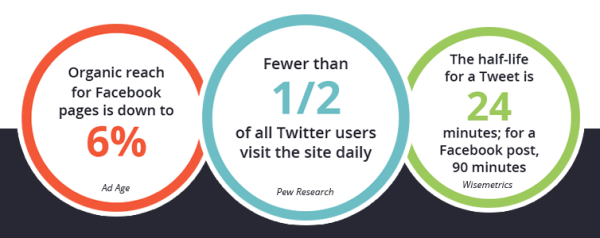
Tweriod tracts you tweets and gives you a report detailing the best times for you to tweet you content for optimal exposure and engagement. This is great info to have, especially when used in conjunction with a social media post scheduling tool like Edgar. And yup – it’s totally free.

NeedTagger is another useful Twitter tool that uses custom filters and keyword digging to show you which Twitter users are the most likely to be interested in your service or product offering. A very informed way to hunt down new Twitter contacts!
Feedly is probably the most popular RSS reader around these days, and no wonder – it looks great, contains a host of handy features, and works across various platforms and devices.
Follow relevant industry blogs and discover cool stories to share on social media.

Rapportive is a Gmail tool that syncs up your contacts’ email addresses with their social accounts. Once you’ve established a new Gmail contact, you can see a contact’s Twitter handle, LinkedIn account, Skype info, etc. Rapportive makes it easy to broaden your connections with contacts throughout the web.
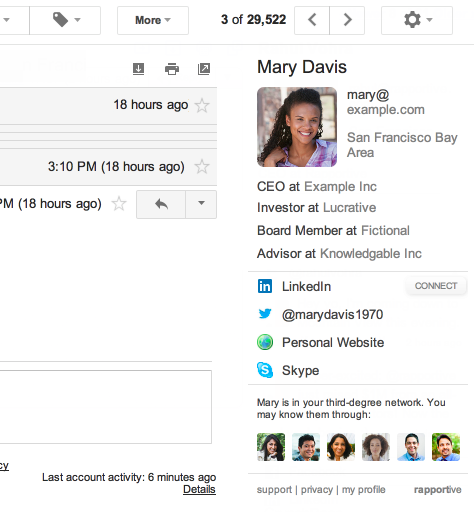
We’ve created a hefty collection of social media tools, but is there anything we’re missing? Share your favorite social media tools in the comments!
I was watching the video for the second roundtable video that I participated in at Content Marketing World and Nick Panayi from CSC said, "the funnel is more like a pinball machine, with leads bouncing everywhere" - I'm not sure that's verbatim, so go watch it.
Anyway it got me to thinking about one of the big concepts in my next book that I call The Continuum Experience. It's actually a continuation or extension of the concept of natural nurturing that I presented in my first book a few years back.
Essentially the gist is that the funnel has constraints as a process of elimination based on the limited set of prospects in your database. A bunch go in at the top and a few come out the bottom. If you think about it, it's like setting yourself up for failure.
Instead, if marketers are willing to look at nurturing as a function that works both with and outside of your database, you then have a construct based on infinite potential–rather than reduced possibilities.
The other thing that the continuum experience does is to eliminate standalone, start and stop campaigns that just halt momentum in its tracks. Why do we ever want to do that?
Creating a Continuum Experience makes sense when you consider that modern marketing is about:
In marketing, we've created a lot of issues for ourselves by naming stuff and then separating it. Marketers have a bunch of functions, including:
We segment our activities to address each one separately. But we don't need to.
In any of these situations, should we be sorry that it happened? Or should we be facilitating these types of occurrences as a matter of course?
I'm voting for the latter.
But the only way this works is if our content and communications are consistent and relevant across all the channels we and our audiences use. And it means that we need to be sharing all the pieces of the story across those channels. We can't just reserve the good stuff for the nurture programs that are only shared with those in our database.
Well, you can, but why would you want to limit potential?
I would stipulate that the pinball thing has always been there, only we now have the technology to see it happening as we engage with prospects in various channels.
So what does it take to adopt The Continuum Experience as a new construct for nurturing?
You can wait for my new book, Digital Relevance, to come out in January, or you can get a preview deep dive by listening to my session on PowerViews Live with Dan McDade on demand through the link below.
Persona-Based Continuum Marketing - It's the New Nurturing
Dan and I discuss the above points and how personas can help you to speed up the buying process through alignment and progression strategies that resonate with buyers.
If you're feeling the pinball fatigue, maybe it's time to change your perspective about nurturing. It's really about smart marketing that can help you accomplish a variety of tasks in an integrated way that will resonate with more of your prospects.
 Follow Us
 Like Us
