Shared posts

03 Dec 21:53

The incredibly bizarre experience of teaching in North Korea, where critical thinking is unimaginable

by Suki Kim, Slate

Adapted from Without You, There Is No Us: My Time With the Sons of North Korea’s Elite by Suki Kim. Out now from Crown Publishers.

Essay was a much-dreaded word among my students. It was the fall of 2011, and I was teaching English at Pyongyang University of Science and Technology in North Korea. Two hundred and seventy young men, and about 30 teachers, all Christian evangelicals besides me, were isolated together in a guarded compound, where our classes and movements were watched round the clock. Each lesson had to be approved by a group of North Korean staff known to us as the “counterparts.” Hoping to slip in information about the outside world, which we were not allowed to discuss, I had devised a lesson on essay writing, and it had been approved.

I had told my students that the essay would be as important as the final exam in calculating their grades for the semester, and they were very stressed. Each student was supposed to come up with his own topic and hand in a thesis and outline. When I asked them how it was going, they would sigh and say, “Disaster.”

I emphasized the importance of essays since, as scientists, they would one day have to write papers to prove their theories. But in reality, nothing was ever proven in their world, since everything was at the whim of the Great Leader. Their writing skills were as stunted as their research skills. Writing inevitably consisted of an endless repetition of his achievements, none of which was ever verified, since they lacked the concept of backing up a claim with evidence. A quick look at the articles in the daily newspaper revealed the exact same tone from start to finish, with neither progression nor pacing. There was no beginning and no end.

So the basic three- or five-paragraph essay—with a thesis, an introduction, a body paragraph with supporting details, and a conclusion—was entirely foreign to them. The idea they had the most difficulty comprehending was the introduction. I would tell them that it was like waving hello. How do you say hello in an interesting way, so that the reader is “hooked”? I offered many different examples, but still they would show up during office hours, shaking their heads and asking, “So this hook … what is it?”

One morning, they shouted, “We beat Japan!” in unison as I walked into the classroom. Their national soccer team, Chollima, had just beaten Japan’s Samurai Blue team in a World Cup qualifying match. The match had taken place at Kim Il-sung Stadium and had been televised live.

Here, the rage against Japan remained as vivid as when Japan had colonized Korea more than half a century before. The students were exuberant, proudly telling me about Jong Tae-se, their national team’s striker, and another one of their players who had been scouted by Manchester United. They did not acknowledge the fact that Jong was in fact a third-generation Zainichi Korean, a term used for ethnic Koreans born, raised, and living in Japan whose loyalty lie with North Korea. In their eyes, Zainichi Koreans were Japanese, their sworn enemy, and yet at opportune moments they considered them North Koreans. I knew better than to comment on that.

“How exciting!” I said brightly. “Wouldn’t it be great if Chollima makes it to Brazil for the World Cup?” They all nodded, smiling.

It was not until later that day that I looked on the Internet (to which only the teachers were allowed access; the students were not aware of its existence) and learned that North Korea had already been knocked out, and the results had been announced some time ago. The match against Japan had to be played simply because it was a game owed. Either the students would not admit this, or they did not know the truth. Not only that, I learned that the game had not actually been televised live. Rather, it had been broadcast as soon as it ended, when the regime could be certain that their team had won. One student told me that it was very boring to watch only winning games. Moreover, no matter how hard I searched online, there was no mention of a North Korean footballer playing for Manchester United. As always, their government had sown misinformation, and my students’ claims lacked any basis in reality, so I could hardly expect them to back up their theses.

Instead of a lesson on sources, which was not possible there, I asked that they read a simple essay from 1997 that quoted President Bill Clinton on how important it was to make all schools wired. The counterparts had approved it because it related to our current textbook theme of college education. I hoped that they would grasp the significance of the Internet and how behind they were. I also gave them four recent articles—from the Princeton Review, the New York Times, the Financial Times, and Harvard Magazine—that mentioned Mark Zuckerberg, Facebook, and Twitter. None of the pieces evoked a response. Not even the sentence about Zuckerberg earning $100 billion from something he dreamed up in his college dorm seemed to interest them. It was possible that they viewed the reading as lies. Or perhaps the capitalist angle repelled them.

The next day, several students stopped by during office hours. They all wanted to change their essay topics. Curiously, the new topics they proposed all had to do with the ills of American society. One said he wanted to write about corporal punishment in American and Japanese middle schools. Another wanted to argue that the American government’s policy of deciding a baby’s future based on IQ tests should be forbidden. A third student wanted to write about the evils of allowing people to own guns so freely in America. A fourth student said biofuel was toxic and America was the biggest producer of it. A fifth wanted to change his topic to divorce. There was no divorce in the DPRK, but in America the rate was more than 50 percent, and divorce led to crime and mental illness, according to him. “So what happens when people are unhappy here after being married for a while?” I asked. The student looked at me blankly. Still another student wanted to write about how McDonald’s was horrible. The same student then asked me, “So what kind of food does McDonald’s make?”

One student asked me which country produced the most computer hackers; he had been taught that it was America. This question stumped me, especially since I had just seen a news item on CNN Asia about cybercrime by North Korea. Instead, I told him that computer crimes could be committed anywhere, by anyone, even a visitor, so it would be hard to pinpoint one country as the source.

Their collective decision to switch their essay topics to condemn America seemed to have been compelled by the articles about Zuckerberg. What I had intended as inspirational, they must have viewed as boasting and felt slighted. The nationalism that had been instilled in them for so many generations had produced a citizenry whose ego was so fragile that they refused to acknowledge the rest of the world.

Handout
HandoutThis undated photo released by North Korea's official Korean Central News Agency (KCNA) on November 23, 2014 shows North Korean leader Kim Jong-Un (C) inspecting a combined joint military drill of the units under North Korean People's Army Combined Units 572 and 630 at an undisclosed location.

My efforts to expand their awareness kept backfiring. When I had them write a paragraph about kimjang (the annual kimchi-making tradition), I was handed a pile of preachy, self-righteous tirades. Almost half the students claimed that kimchi was the most famous food in the world, and that all other nations were envious of it. One student wrote that the American government had named it the official food of the 1996 Atlanta Olympics. When I questioned him, he said everyone knew this fact and that he could even prove it since his Korean textbook said so. A quick Internet search revealed that a Japanese manufacturer had claimed that kimchi was a Japanese dish and proposed it as an official Olympic food but had been denied. Somehow this news item had been relayed to them in twisted form and was now treated as general knowledge.

To correct my students on each bit of misinformation was taxing and sometimes meant straying into dangerous territory. A colleague said to me, “No way. Don’t touch that. If their book said it was true, you can’t tell them that it’s a lie.”

Sometimes they would ask why I never ate much white rice. They piled their trays with huge heaps of it at every meal, whereas I always put just a little on my tray. I explained that I liked white rice but did not care for it all the time. They asked what kinds of food I ate other than rice and naengmyun, their national dish. I couldn’t exactly go on about fresh fruit smoothies and eggs Benedict, so I named two Western dishes I knew they had heard of: spaghetti and hot dogs. I knew that North Koreans enjoyed their own version of sausage because I had seen them lining up for it at the International Trade Fair. One of the students then wrote in his kimjang homework, “Those Koreans who prefer hot dogs and spaghetti over kimchi bring shame on their motherland by forgetting the superiority of kimchi.” Nothing, it seemed, could break through their belligerent isolation; moreover, this attitude left no room for any argument, since all roads led to just one conclusion. I returned the paper to him with a comment: “Why is it not possible to like both spaghetti and kimchi?”

After several lessons on the essay, a student said to me at dinner, “A strange thing happened during our social science class this afternoon.”

They never volunteered information about their Juche class, so I listened intently.

The student continued, “We had to write an essay!” He explained that they normally wrote short compositions in Korean, and he had never thought of them as essays before, but now he did, and it made him feel strange.

“What was so strange?” I asked.

“I don’t know,” he said, pausing thoughtfully. “I looked at it as an essay, and I realized that it was different now. Writing in English and writing in Korean are so different, but then it is also the same, and I kept thinking of the essay structure as I was writing it, and it made me feel strange.”

Why is it not possible to like both spaghetti and kimchi?

I did not question him further, but I thought I understood. It must have been deeply confusing to approach his writing on Juche like an essay. In his country there was no proof, no checks and balances—unless, of course, they wanted to prove that the Great Leader had single-handedly written hundreds of operas and thousands of books and saved the nation and done a miraculous number of things. Their entire system was designed not to be questioned and to squash critical thinking. So the form of an essay, in which a thesis had to be proven, was antithetical to their entire system. The writer of an essay acknowledges the arguments opposing his thesis and refutes them. Here, opposition was not an option.

I stared across at him and felt a familiar sick feeling. Perhaps this was only the beginning. The questions they would have. The questions they should be asking. The questions they would realize they had not been asking because they did not imagine they could, or because asking meant that they could no longer exist in their system.

03 Dec 21:21

Beware Of Creating A Bigger Gap

by Amanda Wilson

As a marketer, I read a LOT of content. I’m an uber-consumer of blogs, whitepapers, guides, infographics, videos, and anything else you put out there. I’m reading to not only find nuggets of good intel to help me do my job tactically and challenge my thinking, but also to learn about our customers, prospects, and general market environment to drive our marketing strategy. Oh, and I also read the occasional real-world content – you know, news and such.

I’m also guilty of being a content creator. All those things I read – I might create almost as much. So Demand Gen’s Kim Zimmerman’s recent article on “Interactive Content Driving Next Generation Sales Enablement” was particularly intriguing to me. However, it left me hanging…

It was great for Kim to reach out to different vendors to get their perspective on the topic. The article was not short of quotes from these companies to state their two cents. Let me save you some reading time and sum it up in one sentence: Everyone agrees that content needs to be more interactive and personalized.

Okay great, but so what? I don’t think anyone would disagree with that statement, and it didn’t really offer me anything new to consider. There is, however, one critical point that I feel was lacking. If anyone reads that and nods in agreement, then they are setting themselves up to create a greater divide between sales and marketing.

ITS CONTEXT

Marketing has a stereotype of “creating content in a vacuum” or “tossing content over the wall.” Sales is often stereotyped as unable to effectively use the content. So when great content goes unused, it’s a waste of everyone’s time. One thing I’ve learned as a software marketer is no matter how cool your widget is, if people don’t know how to use it, it won’t sell. The same goes for content: no matter how cool or interactive the piece is, if people don’t know how or when to use it, it will be lost to the abyss of really cool widgets no one is using.

Beware Of Creating A Bigger Gap image contextual selling.jpg

So how can marketing can really enable sales? Go beyond creating cool and interactive content by providing the context in which to use it. Video is great, but if sales shares a video testimonial to a prospect before they understand the business value you provide, the message has no meaning. If sales provides an ROI calculator before the prospect understands what is it you do, your value will drop to zero.

I’m sure many of you are thinking, “of course – we wouldn’t toss sales a new tool without telling them how to use it.” But ask yourself – are you really? If by emailing them the fancy new widget with a couple bullets explaining how and when to use it you think they are internalizing that and using it at the appropriate time with the appropriate people, then you’re kidding yourself.

We need to be far more advanced (and helpful) for sales to effectively use the high volume of content we create appropriately in a selling situation. Tools and platforms – like Qvidian – exist so your sellers smartly present your compelling/fancy/interactive/multimedia/cool content to prospects at the right time.

Qvidian leverages existing data in your CRM to provide that context for sales to proactively serve up the right content at the right time. This intelligently guides your reps to use all your existing resources – not just the cool new content – to have valuable conversations with your buyers.

What’s more, context provides the analysis marketers need, not just tracking metrics that they typically get.

“As they develop more content to help support the sales conversations, B2B marketers also want to gather more information on how that content is performing.”

Tracking is great, but how useful is knowing that this content was used 53 times in the past month? What if you could know that it was used 53 out of 102 times where it was appropriate, and out of those 53 times, 28 resulted in a closed deal. Out of those 28, 24 were when it was used with people in a Product Marketing role. Those are analytics marketers can really use.

So I beg you – please don’t create a larger divide between sales and marketing by focusing on the content type versus how sales can effectively use it. If you do, you’re sure to end up a stereotype. Content without context is meaningless, and in a headline-driven, 140-character world, we have to help prospects understand importance and relevance immediately or risk losing their attention. By contrast, you will stop a buyer in his/her tracks when importance and relevance is clear. Your buyer has evolved and your window is short; tapping into their challenges and understanding their goals will create the context you need to build loyalty. And just remember, the right thing at the wrong time is the wrong thing.

03 Dec 21:07

Apple: the customer journey from search to checkout

by Christopher Ratcliff

In which we take a look at the experience of searching for a product, clicking-through to an ecommerce store and purchasing the item, all from a customer’s point of view.

Much like previous investigations on UK retailers John Lewis and Halfords this explores the customer journey in a nutshell, looking at visibility, relevancy, ease-of-use and speed of experience.

This time however we’ll be looking at a retailer through its US search results and ecommerce store. In this edition: Apple.

Search

Apple has absolutely no problem dominating organic listings in the SERP for its various products and to be absolutely 100% confident in its dominance, Apple is a constant presence in the paid-for listings.

Searching purely for the generic ‘iPhone’ term serves up the above ad from Apple, replete with subheadings that all lead to their relevant pages. ‘Buy Now’ indeed leads to a product landing page, and ‘Cameras’ leads to a page detailing the phone’s camera functionality.

When specifying a model, by searching for ‘iPhone 6’, the ad that appears is minimalist to say the least.

“Bigger than bigger”. It’s quite the assumption that this will be enough to encourage click-throughs. “Learn more” however clearly tells unsure searchers they will be able to find out more information on the phone via this link, and the retention of the ‘Buy Now’ link also clarifies that you can buy one here too.

Apple can also be confident in the strength of its own brand that searchers will naturally gravitate towards its own ad. Which means that other retailers bidding for the same term have to work a lot harder in their ad copy.

As you can see below, Best Buy has gone all out with day-specific Cyber Monday messaging, Free shipping information and the offer of store pickup.

When it comes to refining the search to ‘iPhone 6 Plus’, Apple doesn’t bother running a PPC ad at all.

If you do some keyword analysis in Google AdWords you’ll see the average monthly searches for ‘iPhone 6’ and ‘iPhone 6 Plus’…

With 5.8m searches a month less for ‘iPhone 6 Plus’, it’s clear why Apple doesn’t bother.

Landing page

For the search term ‘iPhone 6’ a searcher will click through to a relevant landing page, full of product information for the phone.

It’s a beautiful, responsive page, absolutely full of massive images and clearly presented technical information. The price of the phone and link to compare models appears at the bottom of the page, however a blue ‘buy now’ button remains at the top right of the screen as you scroll down.

It’s a very persuasive page that either takes a customer on a journey to learn more about the product without a hard sell, or for the already knowledgeable there is quick and easy access to buy it straight away.

For the search term ‘iPhone’ a searcher can click straight through to the product page from a ‘Buy Now’ link in the ad.

It’s a gorgeous product page that’s a pleasure to navigate. As you click your way through the numbered options in order, the image alters accordingly.

As this is a product with many variations as well as options for different carriers, I thought this would be an understandably detailed and possibly complicated page. It’s not. It flows really smoothly, in a logical and simple to understand way.

Once everything’s completed, a final total appears at the bottom along with a green ‘select’ button. You’ll notice the wording avoids the phrase ‘buy it now’, again Apple takes the soft, subtle approach.

This is also where Apple states its free shipping and pickup services. If there’s one criticism about the page, it’s the small text of the free shopping message at the top of the page. 

It’s on the next page, where you can add accessories to your phone where you can ‘add to cart.

All of the accessories and insurance plans are automatically checked ‘none’ so you don’t have to worry about any nasty surprises in the checkout. If you need assistance, there is also a live chat tool. 

Cart and checkout 

Cart is straightforward and distraction free, with clear buttons to ‘continue shopping’ and ‘check out’.

Next you’ll see that a guest checkout is in full effect. 

The page is very clear page with an option to sign-in if returning. There’s no forced registration, as creating an Apple ID is presented as an option.

Forcing users to register their details before they checkout is an unfortunate way to lower your conversion rate. Once a customer is ready to buy, they don’t want to have to fill out pages and pages of personal details and create an account before they can make a purchase.

Especially as I’m currently looking at this experience on Cyber Monday (a peak day of pre-Christmas online sales), a faster checkout is necessary for customer satisfaction.

The following personal details form has autofill turned off, which would have saved a little time, however the beauty of the final page in the checkout is that it’s all done on a single screen.

Single page checkouts not only provide an uplift conversion, but also improves the experience for mobile users.

In conclusion…

Apple’s paid search strategy is faultless, appearing exactly where it should be in the listings and providing relevant landing pages, optimised for the user depending on their search term. 

The ecommerce experience is a joy, with progression fluid, logical and best of all quick. It also works for multiple devices and screen sizes. Without sounding too gushing, this is a masterclass in providing a brilliant customer journey.

03 Dec 20:58

3 Social Selling Templates For LinkedIn And Twitter Messaging

by Allison Tetreault

3 Social Selling Templates For LinkedIn And Twitter Messaging image icons 368716 1280.jpg

With social selling gaining momentum for sales professionals, inside sales reps are making their presence known in the digital sphere, specifically on LinkedIn and Twitter. Unfortunately, that presence isn’t always positive. Many social selling guides tout real tips and strategies for sales reps to stand out in their prospects’ busy social feeds, but unfortunately often don’t give away social selling templates which sales reps can customize for their own needs.

The result? Sales reps appear to overly curate content, never share their personal opinions, and if they ever reach out to someone one-to-one, they lead with their pitch and immediately turn off potential prospects.

It’s a common occurrence. You may think that a “How can I help you?” message to specific followers will aid you in getting more sales on LinkedIn and Twitter, but actually, that question assumes that your buyer needs your help; it’s leading.

Instead, try these types of messages from our Inside Sales Messaging Toolkit to send to your specific followers or connections. Remember, social selling is less selling and more social.Think of yourself as a marketer as well as a salesperson.

The Introduction Template

The first message you send to a potential prospect should be informative. When you’re getting to know someone on social media, it’s good to incorporate social listening as well. Find out if they publish on LinkedIn, or what kinds of tweets they post, to connect with them that way.

LinkedIn

Edit your request to connect to include a relevant message, such as:

Hi Dan,

I saw your most recent LinkedIn post on how to prevent security breaches for businesses. I’m an inside sales rep at XYZ Company, and I shared that post with my colleagues. They were floored; there’s so much we could be doing to protect our company! I’d love to connect with you so I can follow more of your insights. Hoping to hear from you,

Alex

Twitter

A first interaction with a prospect one-on-one does not have to involve messaging them like on LinkedIn. Instead, favorite or RT their recent tweets; you will show up in their notification center. However, be sure not to RT all of their tweets, as it will look like you’re mindlessly hitting the RT button.

The Call-To-Action Template

The next message you send can be more educational and helpful, but you still should not sell your product or service. You do want more information from your prospects, however, so lead them to a landing page on your website that might interest them..

LinkedIn

Hi Dan,

I was reading through your most recent posts about security breaches, and I realized that we have a report regarding security analytics that might interest you and provide some interesting statistics for your next post. Here is the link. Hope you find that helpful!

Alex

Twitter

Hi Dan! I see that you’re a #security expert at @ABCCompany. This security report from my company might help give you a boost! → bit.ly link

The Thank You Template

If your prospect does interact with you via a comment on LinkedIn or an RT and mention on Twitter, it’s pertinent to be polite and thank him or her. If the conversation is leaning more towards the utilization of your service and product, after three or four times interacting, you can now ask to move the conversation over to the phone if they’re ready.

LinkedIn

Dan,

Thanks for sharing our article on the 10 Most Important Things to Remember When Selecting a Security Provider! I really appreciate it. It’d be great if we could schedule a phone conversation. As I mentioned before, I’m an inside sales rep at ABCCompany, and I actually think you’d be a great fit for our service. I’m available tomorrow at 10:30 a.m. if that works for you; I’ll send you over a calendar invite and you can change the timing if necessary.

Thanks,

Alex

Twitter

This can be sent in a DM:

Thanks for sharing our article, Dan! I’d love to speak to you about how our businesses can help each other. You can find me at alex@ABCCompany.com.

These one-to-one messages to prospects who are active on LinkedIn and Twitter are effective in cultivating relationships that will benefit you in the long run – either through sales, inbound leads, or simple connections or referrals you can leverage going forward. Customize these templates for your initiatives, and try them out today!

What other inside sales messaging tips would you add for social selling?

If you liked these templates, see more in our Inside Sales Messaging Toolkit, which also includes sales prospecting strategies for email and voicemail. Click here to download!

03 Dec 20:58

Effective Content Promotion Strategies to Increase Your Content’s Reach – Part 1

by Gyles Seward

Content marketing isn’t just about content creation. It’s about implementing effective strategies to allow you to publish, promote and share your content far and wide.

If you have a good promotion strategy, it will:

  • Help you build communities of your target audience, with people more likely to share your content through social media.
  • Increase the chance of bloggers linking to your posts.
  • Bring you to the attention of local and niche media outlets that will be more likely to cover stories about your brand.
  • Generate leads and sales through the connections you build with people outside your business.

Here are some key things to consider when investing time and effort into your content promotion strategies.

  1. Multiple-effect email outreach

Outreach generally involves a one-to-one exchange. However, if you use generic branded emails, such as:

team@brand.com

info@brand.com

support@brand.com…

Your email will be seen by more people and therefore will have more chance to be shared.

Make sure you say something along the lines of:

I saw your team shared a tweet about [subject] on [site name].

Would love some feedback from you guys.

Use the subject line:

A post your team could want to see.

This open invitation to everyone on the team means more people are likely to read it.

  1. Schedule your emails wisely

Remember, there are peak hours for business. If you are sending out content that arrives in the middle of a rush, there’s a chance it will be overlooked. Instead, schedule the email to go out later on in the day when things are less frantic.

If it’s your second exchange with a client, try to send the email around the time that the first one was replied to.

  1. Hashtags

Getting to grips with hashtags can be a bit of a pain, but once you’ve mastered it, your posts will be seen by a much larger audience.

Visit hashtag.org and take a look at the popular hashtag section. Figure out which ones you can use, and do it every single time you share a post.

  1. Round up on Google+

Google+ has been somewhat forced on businesses, but those that aren’t using it are missing out. After all, we’re trying to get businesses to the top of Google rankings, so we also need to use their social network to do that.

If you create a post which rounds up all of the content you’ve found relating to your industry, you can:

  • Increase Google+ followers
  • Build connections with influencers
  • Amplify your content

Write a post which summarises the latest news from your sector, including your own, breaking it down into easily digestible pieces. Use hashtags to help boost the post. At the bottom, create a call to action which gets people invested in the next post, telling them to keep an eye out for it.

Promote the round up via email and across other social media networks like Twitter.

  1. Invest in interview opportunities

If you are an expert in something, take the opportunity to show off that expertise. Create a page on your website which details what you’d love to talk about, who you are happy to talk to and add a contact form so that people can get in touch. Promote this across social media and voila, more readers!

These are just a few tips that can help your content to spread further, letting more potential customers see your brand and building up trust from the get go.

Post originally appeared on Elementary Digital.

03 Dec 20:58

How Nagging Reviews REALLY Reduce Sales Leads

by Lawrence Anderson

People think that negative feedback can come at the cost of generating more sales leads because of the damage it does to credibility. On the other hand, they say it can also generate more sales leads if you receive it with grace and use the information to improve products, business models, as well the marketing campaign itself.

However, there is a cap to how constructive negative reception can be until it starts to really nag. If you understand where this threshold lies, you’ll know how to balance between taking criticism and telling the critics to just stop.

How Nagging Reviews REALLY Reduce Sales Leads image nagging boss.jpgIf you want to look at some light examples, here are two reviews on two very popular, long-anticipated video games: Pokemon Omega Ruby/Alpha Sapphire and Dragon Age: Inquisition.

You don’t have to be a gamer to really see what they have in common: They tackle what seems to be a ‘core’ problem (whether it’s a problem that’s at the DNA of a franchise or even at the heart of entire genre).

But in all seriousness, this is actually where negative feedback can get really tiresome. I mean, imagine your medical software or your CRM system in the same boat as those two video games. Someone says that in spite of the wonderful features you’ve introduced, they claim that you haven’t done anything about the ‘core’ problem. They’ll claim that your tech initiative once again touches on the same old issues on privacy. Or in other cases, they’ll talk about information only creating more, more stress, and less productivity.

See complaints like this can really reduce sales leads but not in the way you might think.

  • Addressing them is repetitive – When someone reintroduces the same old issue, the same old rebuttal gets brought in too. Now ask yourself, just how important really is this exchange to the rest of the conversation? Couldn’t you have disqualified/qualified a lead even without it?
  • Your tech is what it’s supposed to be – Other times a core ‘problem’ really is a core feature. For example, the fact that you need better information for better sales could only mean better work. But if your prospect doesn’t even want to work, what’s the point?
  • Best customers don’t complain (much) – Your best customers are the ones who see nothing wrong with the ‘core’ flaws in your product and are happy to even indulge in it. (In the same way, those who value the information produced by a comprehensive CRM solution aren’t afraid of the workload it entails.)

So in short, when a nag tries to pass off as constructive criticism, you now know that it isn’t all that constructive. It wastes time when you could be generating sales leads from customers who have bigger concerns and bigger pain points.

03 Dec 20:58

3 Ways to Sort Out Qualified Leads from the Rest of the Pack

by Carly Murphy

3 Ways to Sort Out Qualified Leads from the Rest of the Pack image Sorting out MQLs with legos.jpg

No pressure, but when it comes to inbound marketing, the success of your sales team is dependent on your ability to sort out qualified leads from the rest of the pack. Does that make you nervous? It shouldn’t as there are many tactics you can use to sort through these leads.

Before reviewing these tactics, it’s important to understand what a qualified lead is. A marketing qualified lead (MQL) is a lead perceived more likely to become a customer compared to other leads based on lead intelligence and activity before converting.

The tips below can help you sort through your leads and pull out the ones with the most potential to buy.

1. Remember, Sometimes Less Is More

The thought process of “the more leads I send to the sales team, the more chances they have to close a deal” isn’t the mindset you should have when going through your leads. In fact, sending mass amounts of leads can often make the sales team unproductive. The problem with marketers just sending as many leads as possible to the sales team, is that often times the leads aren’t ready to buy, or aren’t even familiar with the product. This just wastes the sales team’s time that could have been spent talking to a qualified lead that a marketer sends their way. Why blindly go into a bunch of sales calls when you can talk to significantly less people who all have an interest in what you’re selling and are more likely to buy?

2. Analyze Your Data and Implement an MQL Strategy

MQLs differ from company to company, so you must ensure that you analyze your data when defining who the MQLs are for your company. Follow these tips:

  • Look at the activities a lead can complete, such as a consultation request or white paper download, and see which activities have the highest close rate. Closed loop marketing, whether you’re looking at analytical data discussing with the sales team, can help determine which of the activities is most successful.
  • Once you get a good idea for your close rates across the board, compare them against one another to develop a threshold for your company. Once you determine a threshold level, any lead that meets or exceeds this level will be considered an MQL for your company.
  • Start tracking the leads that meet the MQL levels. If they are coming in at a sustainable frequency for your company, you should aim to only send those leads to the sales team, rather than the entire lead database.

Consider Lead Scoring

Lead scoring allows you to attach values to your leads based off professional information and behavior on your site. To decide if lead scoring is right for you, which it isn’t for everybody as it takes time and software requirements, ask yourself the questions below:

  • How many leads does your marketing team send your sales team? Is it enough?
  • Does your sales team actually follow up with the leads the marketing team sends them?
  • Does your team have enough data to implement lead scoring?

If your answer is “yes” to all three questions, you should consider lead scoring, otherwise, it may be a waste of your time, for now.

If lead scoring is right for you, you can develop a points system and assign points values to each criteria that defines an MQL (stick to a 0-100 scale). By establishing which score makes a lead sales-ready, you can compare the points of each activity and characteristic of the lead, and you’ll be able to gauge who is ready to talk to sales, and who isn’t.

In order to truly separate the MQLs from those who aren’t, it is critical that the sales and marketing team are on the same page from the beginning and are in agreement with the criteria set for the MQLs. Open communication is necessaryl between the teams so that marketing knows what’s working and what isn’t to help the sales team moving forward.

Have you started implementing the strategies above? What other tactics have worked for your company? Please leave your comments below.

3 Ways to Sort Out Qualified Leads from the Rest of the Pack image 2d206576 b752 4b2d 909d a64c78989af6.png

03 Dec 20:58

104 Fascinating Social Media and Marketing Statistics for 2014 (and 2015)

by Tom Pick

Looking at marketing surveys and studies from the past year, a few trends are clear, among them that buyers are firmly (and increasingly) in control of the purchase cycle. They prefer searching to being found, and will often be close to their final decision point before talking to a salesperson.

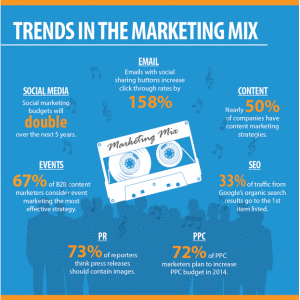
104 Fascinating Social Media and Marketing Statistics for 2014 (and 2015) image Trends in Marketing Mix 300x300.gifIn response, marketers are producing an increasing amount and variety of content to support all stages of the decision process. They’re distributing and promoting this content through all channels in the web presence optimization (WPO) model, to maximize their opportunities to be “found” online when buyers are looking.

And although digital is taking an increasing share of marketing budgets, the move to online is paradoxically making some old-school tactics even more valuable.

What do buyers say is the most important signal of vendor credibility? What type of content is most effective? What do marketers rate as the single most valuable SEO tactic? What are the top barriers to adopting social business practices?

Find the answers to these questions and many others in more than 100 social and online marketing stats from 20+ different sources.

9 General Marketing Stats

1. People want to be in control of the content they receive:

  • • 86% of people skip TV commercials.
  • • 44% of direct mail is never opened.
  • • 91% of people have unsubscribed from company emails they previously opted into.

(NewsCred)

2. 72% of marketers think branded content is more effective than advertising in a magazine; 69% say it is superior to direct mail and PR. (NewsCred)

3. Nearly half (46%) of people say a website’s design is their number one criterion for determining the credibility of a company. (NewsCred)

4. 71% of companies planned to increase their digital marketing budgets this year, by an average of 27%. (Econsultancy)

5. 67 percent of marketers say increasing sales directly attributable to digital marketing campaigns is a top priority this year. (Forbes)

6. Internet advertising will make up 25% of the entire ad market in 2015. (Social Fresh)

7. Despite all the hype about online, 67% of B2B content marketers consider event marketing to be their most effective strategy. (Social Fresh)

8. Videos on landing pages increase conversions by 86%. (Social Fresh)

9. As one would suspect, Facebook is the most popular method for sharing interesting content. Surprisingly though, the fifth-most popular sharing method is offline (print) shares. (Heidi Cohen)

5 Online Demographics Stats

10. The Google+ platform has 67 percent male users. (Rocket Post)

11. There are 76 million millennials (born between 1981 and 2000) in the U.S. — 27% of the total population. (leaderswest Digital Marketing Journal)

12. 63% of millennials have at least a bachelors degree. (leaderswest Digital Marketing Journal)

13. 63% of millennials say they stay updated on brands through social networks; 51% say social opinions influence their purchase decisions; and 46% “count on social media” when buying online. (leaderswest Digital Marketing Journal)

14. 89% of 18-29 year-olds are active on social media, as are 43% of adults 65 and older. (Jeff Bullas)

13 Content Marketing Stats

15. B2B content matters. 57% of a typical purchase decision is made before a customer even talks to a supplier. (Corporate Executive Board)

16. By 2020, customers will manage 85 percent of their relationship with an enterprise without interacting with a human. (Target Marketing)

17. Not all content has to be original. 48% of marketers curate noteworthy content from third-party sources weekly (this post is an example). (Design & Promote)

18. 62% of companies outsource their content marketing. (Iconsive)

19. $118 billion was spend on content marketing last year. (NewsCred)

20. 70% of consumers say they prefer getting to know a company via articles rather than ads. (NewsCred)

21. 90% of organizations market with content. 86% of B2C marketers and 91% of B2B marketers use content marketing. (NewsCred)

22. Or maybe 93% of B2B marketers use content marketing. (Iconsive)

23. And yet…54% of brands don’t have an onsite, dedicated content director. (NewsCred)

24. There are 27 million pieces of content shared each day. (NewsCred)

25. Companies will spend $135 billion on digital marketing collateral this year. (Social Fresh)

26. Customer testimonials have the highest effectiveness rating for content marketing at 89%. (Social Fresh)

27. 17% of marketers plan to increase efforts on SlideShare this year. (Forbes)

7 Blogging Stats

28. 34% of Fortune 500 companies now maintain active blogs – the largest share since 2008. (Forbes)

29. Each month, 329 million people read blogs. (NewsCred)

30. 37% of marketers say blogs are the most valuable content type for marketing. (NewsCred)

31. Companies that publish new blog posts 15+ times per month (3-4 posts per week) generate five times more traffic than companies that don’t blog at all. (NewsCred)

32. 17% of marketers plan to increase blogging efforts this year. (Forbes)

33. Blogging increases web traffic by 55% for brands. (Rocket Post)

34. B2B companies that blog generate 67% more leads than those without blogs. (Social Fresh)

7 Visual and Video Marketing Stats

35. Pinterest grabs 41% of the ecommerce traffic compared to Facebook’s 37%. Food is the top category of content on Pinterest with 57% of its user base sharing food-related content. (Rocket Post)

36. 16% of marketers plan to increase efforts on Pinterest this year. (Forbes)

37. The use of video content for marketing increased 73% this year; use of infographics grew 51%. (Digital Marketing Philippines)

38. Articles with images get 94% more views than those without. (NewsCred)

39. Posts with videos attract three times as many inbound links as plain text posts. (NewsCred)

40. 62% of marketers use video in their content marketing. (NewsCred)

41. Two-thirds of firms plan to increase spending on video marketing in the coming year. (Heidi Cohen)

5 SEO Stats

42. 81% of B2B purchase cycles start with web search, and 90% of buyers say when they are ready to buy, “they’ll find you.” (Earnest Agency)

43. More than half (53%) of marketers rank content creation as the single most effective SEO tactic. (NewsCred)

44. 57% of B2B marketers say SEO has the biggest impact on lead generation. (NewsCred)

45. Organic search leads have a 14.6% close rate, compared to 1.7% for outbound marketing leads. (NewsCred)

46. 33% of clicks from organic search results go to the top listing on Google. (Social Fresh)

15 Social Media Marketing Stats

47. 85% of B2B buyers believe companies should present information via social networks. (Iconsive)

48. And yet – only 20% of CMOs leverage social networks to engage with customers. (Marketing Land)

49. Marketers will spend $8.3 billion on social media advertising in 2015. (NewsCred)

50. “Interesting content” is one of the top three reasons people follow brands on social media. (NewsCred)

51. 87% of B2B marketers use social media to distribute content. (NewsCred)

52. 17% of marketers plan to increase podcasting efforts this year. (Forbes)

53. As consumer use of social media for brand comments and complaints continues to increase, brands are having a hard time keeping up. Only about 20% of consumer comments generate brand responses, and the average response time is over 11 hours. (eMarketer)

54. Nearly three-quarters of US marketers believe customer response management on digital channels is important (so…25% think it’s okay to ignore consumers?); however, just one-third say their company does a good job at this. (eMarketer)

55. Social media marketing budgets are projected to double over the next five years (Social Fresh)

56. 66% of marketers claim that social indirectly impacts their business performance but only 9%t claim that it can be directly linked to revenue. (Forbes)

57. Over 70% of US online adults use some form of social media networking. (Heidi Cohen)

58. 72% of all internet users are now active on social media. (Jeff Bullas)

59. The top two barriers impeding adoption of social business within organizations are lack of overall strategy and competing priorities. Just 11% of marketers cite legal or regulatory concerns. (i-SCOOP)

60. 78% of companies now say they have dedicated social media teams, up from 67% in 2012. (i-SCOOP)

61. By department, companies most often have dedicated social media staff (not surprisingly) in marketing (73%), communications/PR (66%) and customer support (40%). At the other end of the scale are legal (9%) and market research (8%). (i-SCOOP)

7 Facebook Marketing stats

62. Facebook accounts for 15.8% of total time spent on the Internet. (Rocket Post)

63. 71% of online adults use Facebook. 63% of Facebook users visit daily and 40% visit multiple times per day. (Heidi Cohen)

64. More than a third (36%) of online adults use only one social networking site. Of these, 83% use Facebook. 8% use LinkedIn. (Heidi Cohen)

65. One million web pages are accessed using the “Login with Facebook” feature. (Jeff Bullas)

66. Nearly a quarter (232%) of Facebook users login at least five times per day. (Jeff Bullas)

67. 47% of Americans say Facebook is their #1 influencer of purchases. (Jeff Bullas)

68. 70% of marketers used Facebook to gain new customers. (Jeff Bullas)

3 LinkedIn Marketing Stats

69. LinkedIn is the top social network for B2B marketing (not a shock). 83% of marketers say they prefer to use LinkedIn for distributing B2B content, and more than half of vendors say they have generated sales through LinkedIn. (Real Business Rescue)

70. The average time spent on LinkedIn per month is 17 minutes. (Rocket Post)

71. 91 of the Fortune 100 companies use LinkedIn for candidate searches. (Rocket Post)

7 Twitter Marketing Stats

72. The average time per month spent by users on Twitter is 170 minutes. (Rocket Post)

73. Only about half of the people who log in to Twitter once a month are actually taking the time to tweet. The rest are lurkers. (Rocket Post)

74. Ironically, the most-followed brand on Twitter is…Facebook, with more than 13 million followers. Google is #3. (AllTwitter)

75. eBay is the most engaging brand on Twitter. Starbucks is the fourth-most-engaging, and also has the fourth highest number of followers of any major brand. (AllTwitter)

76. Not a shock: retailers and restaurants are the most engaging industries on Twtitter. Surprising: apparel brands are the least engaging. (AllTwitter)

77. Twitter now has over 550 million registered users, and 215 million active monthly users. (Jeff Bullas)

78. 34% of marketers use Twitter to successfully generate leads. (Jeff Bullas)

3 Google+ Stats

79. 18% of marketers plan to increase efforts on Google+ this year. (Forbes)

80. There are now over 1 billion Google+ accounts, and that figure is growing 33% per year. (Jeff Bullas)

81. Google+ has 359 million monthly active users. (Jeff Bullas)

13 Email Marketing Stats

82. There are nine times as many marketing emails sent each year as direct mail pieces delivered by the U.S. Postal Service. (Mark the Marketer)

83. Email marketing delivers the highest ROI (about $44 per dollar spent, on average) of any digital marketing tactic. SEO is #2. Banner ads have the lowest ROI. (Mark the Marketer)

84. 66% of consumers have made a purchase online as a result of an e-mail marketing message. (Mark the Marketer)

85. Email subject lines matter. Really. 64% of people say they open an e-mail because of the subject line. (Mark the Marketer)

86. Personalized subject lines are 22.2% more likely to be opened. For B2C emails, the words “Alert,” “New,” “News,” “Bulletin,” “Sale,” “Video,” “Daily,” or “Weekly” (though not “Monthly”) all increase open and click-through rates. (Mark the Marketer)

87. For B2B companies, subject lines that contained “money,” “revenue,” and “profit” performed the best. (Mark the Marketer)

88. Timing is important too. 76% of e-mail opens occur in the first two days after an e-mail is sent. E-mail open rates are noticeably lower on weekends than on weekdays. (Mark the Marketer)

89. Only 8% of companies and agencies have an e-mail marketing team. E-mail marketing responsibilities usually fall on one person as a part of her wider range of marketing responsibilities. (Mark the Marketer)

90. 72% of B2B buyers are most likely to share useful content via e-mail. (Mark the Marketer)

91. Still, the average click-through rate for B2B marketing e-mails is just 1.7%. (Mark the Marketer)

92. Emails with social sharing buttons increase click-through rates by 158%. (Social Fresh)

93. 64 percent of marketers say increasing email click-throughs and open rates is among their top priorities this year. (Forbes)

94. 67 percent of marketers say that email is ke3y for attracting and engaging prospects, and the best path to increase marketing ROI. (Forbes)

10 Mobile Marketing Stats

95. 94% of CMOs plan to use mobile applications within the next 3-5 years. (Marketing Land)

96. 75% of smartphone owners watch videos on their phones; 26% at least once per day. (NewsCred)

97. Over half of all mobile searches lead to a purchase. (Rocket Post)

98. 78% of Facebook users are mobile-only. (Rocket Post)

99. E-mail is the most popular activity on smartphones among users ages 18-44. (Mark the Marketer)

100. 64% of decision-makers read their e-mail via mobile devices. (Mark the Marketer)

101. Almost half–48%–of all emails are opened on mobile devices. Yet 39% of marketers say they have no strategy for mobile email, and only 11% of e-mails are optimized for mobile. (Mark the Marketer)

102. Mobile is the channel of choice for keep relationships with existing customers alive because it cuts through the clutter of email and social. (Forbes)

103. 71% of users access social media from a mobile device. (Jeff Bullas)

104. 50% of millennials use their smartphones to research products or services while shopping, and 41% have made purchases using their phones. (leaderswest Digital Marketing Journal)

03 Dec 20:57

Why small business owners are ignoring your social media ads

by debrasharp
26_blah-blah-blah_165013097
SPONSORED:

This sponsored post is produced by Radius.

If your social media ads haven’t been performing as well as anticipated, a new study published by CEB and Radius might have the answer. Small business owners who have been slow to join the social media train are finally jumping aboard. However, marketers aren’t making the most of this new constituent of targets.

The study found that small business owners cite social media adoption as a high priority in 2015 — providing an essential channel to reach this business target. And B2B marketers have readily demonstrated their willingness to open their pocketbooks for social media advertising.

Facebook, for instance, continues to drive brands towards its paid solutions. On the tail end of an algorithm change that made it harder for marketers to achieve organic reach, Facebook announced a 61% surge in revenue. Facebook recently added even more restrictions to News Feed content posted by brands, which forces brands to pay ever greater sums to reach their audience on the social network.

However, small businesses are still largely ignoring the content and ads that B2B marketers are posting on social media.

CEB’s 2014 Social Media Report pinpoints the three top reasons small business owners ignore suppliers on social media:

Your content is boring.

80% of marketers are posting the same helpful small business tips and tricks on social channels, but only 25% of small business owners are interested in reading this type of content.

To stand out to small business owners, marketers will have to move beyond standard listicle tips and general business best practices. Only a minority of small business owners even want this type of content on social media, so while it might be easy to produce, most small business owners aren’t interested in reading it.

You’re not offering enough deals.

Main street merchants may not want your tips and tricks articles, but they definitely want your deals. The majority of small business owners cited that if they could see any type of content from suppliers on social media, they’d want to see more deals. CEB also reported that though owners seek discounts, they don’t just buy the cheapest option possible; rather, they prefer to buy the best they can afford. This finding suggests that small business owners are more likely to hunt for deals on products they already love than search for cheaper alternatives.


clipart_bubble_32Learn more about how to reach small business owners on social media — download the full report.


You’re not segmenting effectively.

Only 32% of marketers mine social media data to find new opportunities. Worse yet, only 4% of marketers gather owner data for lead generation purposes. This means that marketers aren’t using social media data about small business prospects to target advertisements on social channels.

Smallbiz_social_media

Facebook offers a great targeting tool, but if marketers aren’t targeting pre-defined prospects in segments with a high likelihood to perform, they’re not using Facebook to its highest potential. You could rely on organic social posts or paid ads solely to generate new leads, or you could nurture a targeted audience with content and ads you know will resonate– such as the deal offers small business owners covet. Imagine running a deal offer to an audience of prospects who had refused to buy your products because of price. That’s smart marketing, and it’s not something a lot of companies are doing.

New access to data allows us to unearth historically elusive insights about the small business economy, and CEB’s 2014 Social Media Study implies that marketers remain out of touch with their small business prospects.


Sponsored posts are content that has been produced by a company that is either paying for the post or has a business relationship with VentureBeat, and they’re always clearly marked. The content of news stories produced by our editorial team is never influenced by advertisers or sponsors in any way. For more information, contact sales@venturebeat.com.


We're studying conversion rate optimization. Take our quick survey and we'll share the results with you.


01 Dec 19:34

For The First Time Ever, Mobile Is Dominating The Online Shopping Season

by Julie Bort

afp japans smartphone zombies wreak havoc on the streets

Over the Thanksgiving weekend, for the first time ever, more people used mobile devices than PCs to browse the online shops, according to IBM.

On Thanksgiving weekend, 52% of traffic to ecommerce sites came from mobile devices, a 22 percent jump from 2013, according to IBM's Digital Analytics Benchmark survey. However, people were mostly only looking at the deals on their devices.

When it came to making a sale, mobile devices accounted for 32% percent of transactions tracked by IBM. That means that 68% of sales were still taking place on PCs. 

Specifically, smartphones were used 36% of the time to browse but accounted for only 14% of total online sales. Tablets were used 15% of the time to browse but accounted for almost 18% of online sales.

That's mostly because shopping is still a pretty miserable experience on a smartphone, writes Jay Henderson, Strategy Director, IBM Smarter Commerce, "Many companies struggle with delivering a seamless mobile browse-to-buy experience."

As people increasingly use smartphones to shop, we expect ecommerce sites to start doing a better job catering to buying, not just browsing. Maybe by 2015?

Join the conversation about this story »

01 Dec 19:18

11 Expectations To Have From A Great SEO Proposal

by Rob Petersen

11 Expectations To Have From A Great SEO Proposal image seo 441400 1280 150x150.jpg

  • 54% of consumers find a website through natural search (source: Forrester)
  • 31% click through to the websites in the first position of natural search (source:MOZ)
  • 95% of clicks to a website occur on the first page of nature search (source: MOZ)

This facts indicates, if your business is on the internet, Search Engine Optimization (SEO) is an important part of doing business. SEO is the approach to optimizing a brand’s web presence for organic search including the website, social channels, blogs, articles, and press releases.

Finding a good resource that achieves results is like hiring a good electrician, plumber, or auto mechanic. Find the right one and and you’ve found an invaluable asset.

How do you know? One way is to ask for a proposal. Fortunately, there are ingredients that distinguish great SEO proposals.

What makes a great SEO proposal? Here are 11 expectations to have.

STRATEGY: SEO is a business building activity. So a strategy that spells out how business is built should be spelled out. It should be results-oriented and measurable. Here are key strategy ingredients.

  1. DESIRED RESULTS: An increase in search rank as measured on Search Engine Rank Page (SERP) is usually the #1 result most people expect. But an increase in rank doesn’t translate to an increase in business unless specific increases in web traffic and conversions occur. A good SEO program should take into account how this is going to occur.
  2. SITE AUDIT: To understand how to drive business, the way people use your site now should be examined. In an SEO proposal, a Site Audit should be included that evaluates: 1) Top Keywords, 2) Number of Inbound Links, 3) Unique Visitors, 4) Bounce Rate, 5) Traffic Sources (including percent of Visits from Organic Search), 6) Key Pages, and 7) Conversion Activities. A Site Audit also specifies any errors or pages not found, as well as if a site map is available. A Site Audit sets up activities that need to occur and benchmarks what is realistic to expect and when.
  3. KEYWORD RESEARCH: Search engines look for a relevant match to the keywords that a consumer writes in a search query. Words are the most important ingredient in SEO. Keyword Research is a foundation to an SEO proposal. Search volumes, keyword search trends, competitiveness, CPC (Cost Per Click – what others pay) leading to keyword recommendations are a key phase in an SEO proposal.
  4. COMPETITIVE ANALYSIS: Your business isn’t likely to be the only one competing for the same consumer. So an analysis of competitor’s keywords, web traffic, and links should be present. A Competitive Analysis informs keyword decisions and desired results. It’s also a valuable source for ideas.
  5. INBOUND LINK ASSESSMENT: Search engines look for other websites that mention yours for a consumer’s keyword query. These occur by Inbound Links from other websites that reference your website. This has a high value to the search engine because it signals your business is an “authority” on those keywords. A Link Assessment specifies the number of links you currently have and should spell out the plan for securing more. Inbound Links are a timely topic. If done in a disreputable way, your site can get discredited. Authentic or “White Hat” ways are important to understand. HubSpot offer some sound advice.

EXECUTION: With a strategy for building business in hand, here is what should be included in the execution.

  1. SITE ARCHITECTURE: To take advantage of priority keywords, every page should represent one. When search engines crawl your site, Site Architecture ensures a comprehensive overview of what the site is about. Search engines and visitors understand better if you focus on one keyword per page rather than put them all together in “keyword stuffing.”
  2. OPTIMIZATION STRATEGY: There are a number of places search engines go to understand the reason for being for a website. They are: 1) URL, 2) Page Title, 3) Body Copy, 4) Meta Description, and 5) Links. The proposal should specify that this work is going to be performed on every page of your site.
  3. ON-PAGE IMPLEMENTATION: A good SEO person performs these services. However, at some organizations, there is a company webmaster or IT department that oversees website development. How the On-Page Implementation is to occur should be worked out beforehand as it can impact price and timing. There should also be a check of the activities to make sure they have occurred on site as they should.
  4. CONTENT MARKETING PROGRAM: Reputation matters in business and in SEO. In the latter, a good reputation occurs if a website continually put out good content reinforcing the keywords and providing links to other websites (which are ofter reciprocated back). This occurs through a blog, newsletter, PR releases, and social media sharing. It should be specified how this occurs, how often, and who does it.
  5. MEASUREMENT AND REPORTING: Monthly reporting against the desired results should be a part of the program. The impact of SEO generally occurs in the range of 2 to 6 months. Once desired results are achieved, they generally stay with the content marketing program. The reward of a good SEO program are substantial.
  6. PRICING: Pricing for SEO occurs on a: 1) Retained monthly amount, 2) project, or 3) hourly basis. If a retainer is used, the initial months are usually higher as there is strategy and research work involved. According to MOZ in a survey of 600 agencies, Project Pricing was the most commonly used and ranged from $1,000 to $7,500. Hourly costs, which are the common denominator for all types, ranged from $76/hour to $200/hour depending on who did the work and what country it was performed in.

Did this help you understand what makes a great SEO proposal? Would your business benefit from this type of SEO program?

01 Dec 19:18

How Long Can Cloud Storage Keep Breaking the Rules of Business?

briefcases

Any business person will tell you. You can only get away with “free” for so long. Afterwards there are salaries to be paid, bills to be settled and resources to be renewed. So how much longer will online file storage providers continue to give away space for nothing? The trend if anything seems to be accelerating. Free terabytes are now on offer from several operators. But be honest – would you even be able to usefully fill up just one terabyte? The online file storage provider is unlikely to make any money out of you in that case. If so, providing more free space will cost a provider more money and exacerbate a loss-making situation.

Cloud Storage Wars

In other industry sectors, some enterprises deliberately set out to be the low-cost leader. They rely typically on high-volume high-efficiency operations to make overheads a correspondingly smaller fraction of turnover. This allows them to offer products or services at low or even the lowest prices, while making a profit. Note those two vitally important points: low-cost (not zero); and profitably (sustainable). Now look at the cloud storage sector. Free is not low-cost and as such there’s no possibility for profit. Internet business models are not always easy to understand. Some loss-making businesses go on to huge IPO success notwithstanding. But most unprofitable enterprises simply cannot survive.

A Change is Gonna Come

For the reasons above, things can’t stay the way they are. This will doubtless be regretted by many users and also some cloud storage aggregator operations that offer users the possibility to leverage free space from multiple providers. But some of the players are already moving towards other modes of business. They are not forsaking online file storage. Rather, they are using it as a basis for more lucrative business selling other services to their customers. It’s somewhat like the time-honored marketing model of the razor (low profit) and the razor-blades (more profitable and continuing revenue stream).

Where Do We Go From Here?

That depends on the provider and its strategy. Box for instance is moving to target the value-added market. It aims to help developers and organizations with closer integration with other apps and with industry compliance. Dropbox recently acquired email operator Mailbox and currently looks set to continue in competition with the likes of Google. Other providers were already charging for storage, but may also need to introduce added value to avoid being squeezed out of business. Yet others have identified private and hybrid cloud storage as sectors where they can reasonably expect customers to pay for storage services or functionality provided.

Will the Loss-Leader Survive?

If cyberspace was divided by physical, geographical boundaries, online file storage providers would have a tougher time with their loss-leader strategies. Below-cost pricing is banned in certain countries and restricted in others. This includes product and service strategies that are globally designed to be profitable, but that have stand-alone loss-making components. Still, Darwin’s Law applies to all businesses sooner or later, with the survival of the fittest (profitable companies) and extinction of the rest (loss-makers).

The post How Long Can Cloud Storage Keep Breaking the Rules of Business? appeared first on CloudWedge.

01 Dec 19:18

Why Your Proposals Aren’t Landing You Business

by John Jantsch

Why Your Proposals Aren’t Landing You Business written by John Jantsch read more at Small Business Marketing Blog from Duct Tape Marketing

Do you know why so many consultants spin their wheels writing proposal after proposal without getting any results?

proposals

photo credit: legdog via photopin cc

It’s because most view a proposal as a sales tool when it should simply be a restatement of what the client already agreed they needed.

Most proposals are filled with big concepts and game changing language because the author of the proposal has no idea what the client is ready to buy.

For years I’ve used the sales process as a full-blown discovery process aimed at getting the client to tell me exactly what to put in a proposal. It’s for that reason that responding to traditional RFPs is such a waste of time.

Now I don’t mean I simply give them what they want to hear. But I do mean you must ask enough questions to know if they even understand why they think they need what they might be asking me to propose. If you don’t do this the proposal becomes more of a shield to ward off a sales person then to move business forward.

When I meet with a prospective client to discuss how I might help them I’ve not done my job unless I walk away knowing (or helping them know) exactly what their goals are, how they think we could measure progress towards achieving those goals and what it would mean in terms of overall value should we achieve those goals.

Armed with this information any proposal is as Alan Weiss, author of The Consulting Bible, calls it a summation of an already established objective.

When you come to that realization, your sales calls, discovery meeting and proposals will never be the same.

Ask the hard questions before

Before you ever write a proposal you must fully understand in great detail what a successful outcome looks like. How do you do that – simply ask something like – Why do you want to do this project? What would a successful outcome look like?

You’ll be surprised how often the answers to those kinds of questions are different than you might have assumed and can greatly impact what you might have proposed.

You also want to understand up front how they will measure success. What metrics will we use to measure progress? Or, even, how will we know we’ve achieved your goal?

Finally, get at what value a positive result will have. This is a great point when it comes to establishing why they might view what you do as an investment rather than a cost. Help them understand that by investing $50,000 in you they might realize $250,000 in value.

Spell out the agreement

When you focus your discussion on establishing agreement you can then use your proposals to restate goals, metrics and value in context of deliverables and methodology for getting there.

Now when you propose a specific approach or project you can tie it to achieving a goal in very specific terms.

You can also propose optional approaches that give flexibility in terms of pricing and timelines.

Nail down the terms

Use your proposal to also spell out exactly how you will work, what you expect of them – down to the amount of CEO or department time and resources you’ll need.

And, don’t forget to state very clearly how you expect to be paid!

When you start to look at proposals as a tool to simply document your already agreed upon objectives, you’ll start to close more of the right deals on your terms.

Related posts:

  1. I Love Small Businesses I’ve spent a great deal of my life (almost half)...
  2. RFEs vs RFPs Something dawned on me today as I was answering questions...
  3. A Change This Idea Percolates Change This is a clever project, originated by Seth Godin...
01 Dec 19:17

Is Honesty Still the Best Policy? Walking the Talk of Customer Centricity

by Denyse Drummond-Dunn
I got an email today that irritated me, I mean it really insulted me, and prompted this post on customer centricity. I am sure it would have annoyed you too; in fact you have probably already received it or at least something similar yourself in the past.

It announced a “massive 46-page eBook” that I had been chosen to receive for free. It sounded as if I should be happy and feel privileged to receive it. I wasn’t. I don’t know about you, but I don’t call 46 pages massive. A jumbo jet is massive; War and Peace by Leo Tolstoy is massive; not a measly 46 pages – even if it was for free.

Is Honesty Still the Best Policy? Walking the Talk of Customer Centricity image ASA Logo13.jpg13Why do companies continue to think that they can treat people like idiots? In my opinion, it can only be a very short-lived business strategy. People will quickly learn the truth, especially in today’s connected world. Or should I blame the advertising agencies for coming up with these “lies”? However, it seems to me to be just a little too close for comfort to the “misleading claims” from which the Advertising Standards Authority in most countries should be protecting us.

If you are looking to be truly customer centric, here are some other examples that you are hopefully NOT doing.

Claims

The above illustration is just one example of many exaggerated claims which seem to have become prevalent these days. This is most probably because the internet makes it so easy to reach new, “naive” customers, who still trust organisations to do the right thing. Why do so many companies use overly attractive adjectives that their product or service can’t live up to? They are setting themselves up to disappoint their potential customers, especially if they don’t register what comes after that word before buying.

Massive, mouth-watering, heart-stopping, mind-blowing, huge discount, best price ever; most of the time the products are not, which is probably why they feel they have to use such words. Customer centric companies don’t use these claims unless they can substantiate them.

Packaging

One area that often suffers from exaggeration is packaging. How many packs have you opened to find the product sitting miserably in the lower half of it? What a disappointment from the promise of the packaging. Or worse still in my opinion, are companies whose packs have been discretely reduced in contents over time. Companies may print the weight of the product that is inside the pack, but customers recognise and buy the pack without checking its weight each time they buy.

What is particularly offensive in this example is that it is the company’s most loyal customers who are being cheated. The company reduces the pack’s quantity but not its price; they are getting a price increase without informing their customers. That isn’t customer centric.

Value

Is Honesty Still the Best Policy? Walking the Talk of Customer Centricity image dreamstime xs 25917969 300x22513.jpg13Another area that often suffers from exaggerated claims is price value. I was recently offered access online to a video “worth more than US$ 997” for just US$49.99. I don’t know any videos, even those of the classics or Oscar-winning films, that are worth that amount, and certainly no such offers proposed on the internet.

To paraphrase the infamous quote of Oliver Platt:

 “Value is in the eye of the beholder, not the seller” 

How are you pricing your own product and service offerings? Do you base it on company cost or customer value? If not the latter, you may also be leaving a lot of money on the table, as your offer might actually be worth more than you are charging for it. The most important information you need to decide on your price is what your customer is prepared to pay for it; that is what value is all about. Customer centric companies know and apply this on a daily basis

Promising but not delivering

Airlines are renowned for this, especially the low-cost ones. They advertise flights at ridiculously low prices that few, if any, end up paying, since you need to add on the cost of paying by credit card, booking your seat, taking a bag on board etc. etc. Yes the advertised price attracts attention, but once you have made a few attempts at reserving these low prices, you understand the “game” and compare before buying. And most of the time the “normal” airlines are cheaper. As I’m sure you’re heard many times and to quote Thomas (Tom) J. Peters:

“The formula for success is to under-promise and over-deliver” 

Is Honesty Still the Best Policy? Walking the Talk of Customer Centricity image Zappos13.png13

Amazon and Zappos are two companies who regularly do this; in fact it’s a part of their business model. They occasionally provide priority delivery at no extra cost, as a delightful surprise for their customers. Amazon also proposes useful suggestions of other books, music or other products to buy whilst you are surfing their website to purchase something. Yes, I know it is in their interest to get you to buy something else, but it is a service and highly valued by most people. Customer centric behaviour is always a win-win for both the customer and the company.

Hidden renewals

You subscribe to a service on a free trial basis, or a one-off monthly fee as many Telecom companies now offer. What you don’t notice or remember, is that it is automatically renewed at the end of the trial period unless cancelled. Yes I know it’s written in the terms and conditions or at the very bottom of the online page if you scroll down, but I don’t read font 8 very easily, even with my glasses! And be honest, none of us reads to the very end of the terms and conditions, and the companies that use this tactic are counting on it.

Of course, when you are informed that your subscription has been renewed, you realise what has happened and immediately cancel, with hopefully only a one month and not an annual unwanted payment. Yes the company has gotten a payment it probably wouldn’t have gotten otherwise, but they certainly didn’t make us a loyal and happy customer, did they?

If you are using this type of “hidden selling” to get customers, please stop. Customer centric companies invite people to continue their subscription, perhaps at a special price. In this way they will get almost as many customers, but they will most certainly be happier and more likely to continue to purchase from them.

These are just a few examples of how companies are intentionally aiming to get customers to buy something that is not worth the money being asked in many cases. If the product or service they propose did offer true value, then people would buy or repurchase without the need for such tricks. As Peter Drucker said:

“The aim of marketing is to know and understand the customer so well the product or service fits him and sells itself”

I would go one step further and say that it is the aim of customer centric businesses.

With today’s ease of sharing experiences on the web, why do companies continue to try to cheat unsuspecting customers? It is most definitely a short-term business strategy. Unhappy customers used to tell ten people, now they tell tens of millions, with a simple Tweet. And if there are several unhappy customers who Tweet about similar experiences, then others will start to see the trend and become wary. Whilst there will always be a few disgruntled customers who complain, more than that will highlight a real issue.

This reminds me; I hate doing it but I am one of the people who have tweeted about poor customer service because I am not getting an answer when using the provided phone and email contacts. Customer service is all about taking the customers’ perspective and offering multiple ways to be contacted and then responding quickly. Companies do respond to negative tweets, usually in record time and certainly faster than connections by other means. Why are companies forcing their customers to go public with their dissatisfaction to get heard? Most would be happy and would probably prefer to share their complaints with the company in private – IF they get a quick response.

So coming back to my question, the answer is a resounding yes. Most companies now speak about the importance of being customer centric, but so many of them are still doing many of the practices mentioned above, which are most definitely NOT customer centric behaviour. Are you one of them? Do you have other examples that you yourself have experienced? Why not share them here?

C³Centricity used images from the ASA in the UK, Dreamstime and Microsoft in this post.

01 Dec 19:16

A Strategic Checklist for Growing Your Business in the New Year

by David Lund

As we approach the holidays, marketers shift their focus to their plans for the New Year. Have you made a final review of next year’s marketing plan and budget? Have you started your planning for next year? Do you have a strategic checklist?

Every organization has a different planning process and objectives. At the end of the day, your marketing plan execution is likely tasked with creating demand for your products, building your brand, and driving earnings and new business growth. A well-thought out plan will help you achieve these results. To assist in your year-end planning preparation, I am sharing a strategic checklist of key planning steps that can help align and focus your team on achieving your strategic goals. While you may have already completed all or most of these steps, this strategic checklist may prompt an opportunity to enhance your current planning and preparation.

Understand Your Market and Your Competitive Position in the Market

  • Define and assess your market, your competitors, and competitive position. Many companies use a SWOT analysis for this step. Another method is to use market data to prepare an assessment of recent market performance versus competitors and market share trends among your target customers.
  • Define your primary and secondary target customer. Know why they do and do not buy from you. You cannot effectively plan if you do not understand your customers. If you do not know your target customers and their motivators, an earlier priority in 2015 should be to conduct research on who they are, what they value, and why they choose you or your competitor’s products or services.

Ensure You Are Focused on the Right Goals

  • Define what success looks like in the new year. It is likely that different members of your team have different objectives and a different idea of what a successful new year should look like. Hold a discussion with your leadership team to define what success should look like for your organization by the end of next year.
  • Define, align on, and approve your SMART goals. The term SMART for goal setting has been used for many years. SMART stands for specific, measurable, attainable, realistic, and timely. It is often good to also consider goals that are challenging and specifically grow your business. Build on the previously step to “define success” and turn your definition into your SMART goals. When setting goals, make both earnings and new business growth top priorities—you cannot grow your business if your only focus for next year is on cost reduction.

Along with setting goals with your leadership team, make sure your strategic checklist covers the success metrics and measurement system you will use to track progress to your goals.

Ensure Your Team Is Truly Aligned to Your Goals—and with Each Other

  • Stop to make sure your leadership team is truly aligned to these goals. If your leaders are not fully aligned on a single vision of success and the same goals for the next year, the odds are they will spend more time on their own priorities than working to achieve the organization’s goals.
    • Specifically discuss how you will respond to risk in growth initiatives. New growth initiatives will seldom succeed if all are not aligned on risk tolerance and how your team will respond to failure. Take time to talk to make sure everyone is really on board—resolve concerns if they are not.

Ensure You Are Working on the Right Initiatives

  • Identify the strategies that will likely be most effective to achieve your goals.
    • Select your top 3 strategic initiatives. These initiatives should tie to the achievement of a company strategic goal. Focus your strategies on leveraging the purchase drivers of your customers. Develop strategies for your goals that drive both existing business and new business growth. Abandon strategies that have not been productive in prior years.
    • Identify what you will NOT do next year. If an initiative does not sell more, cut costs and/or tie to a strategic goal, you are likely wasting your time putting it on your to-do list. This could be the year to stop working on legacy initiatives. Don’t repeat an initiative just because it is something you have always done.

Ensure You Have the Right Resources to Win—and Invest Them in the Right Place

  • Ensure you have enough of the right people and funding to do the job. Every team wants more resources. Every team believes they could be more effective with more people and funding. Realistically assess your resources. Plan your year to succeed with the resources you have vs. creating a plan that will overtax your team all year. Do fewer things better.
  • Put the right people in the right jobs. If you want to achieve new results, sometimes that means changing who is leading key initiatives. It can be especially important to put the right team leaders in place leading new growth initiatives. Align the skills, experience, and relationships with the jobs to be done and then empower your team to lead and achieve.
  • When possible, budget to task and not to a number. Identify what your strategic initiatives will cost in order to succeed. If budget cuts are needed, trim entire initiatives rather than trimming quality and effectiveness of each to keep everything on the project list.
  • Build your budget using three categories: strategic initiatives, new venture initiatives, and tactical initiatives.
    • Strategic initiatives are top priority initiatives that grow your existing business and enable you to achieve your strategic goals. This is a strategic investment in the near-term health, growth, and competitiveness of your organization. These investments should not be cut except in extreme circumstances.
    • New venture initiatives are investments in entering new markets, launching new products, or testing new marketing approaches. These are the strategic initiatives that drive long-term growth of your organization. It is important to always include funding for testing and development in this area to promote long-term growth opportunities. These should not be cut if possible, but could be delayed in timing if there is a strong need to reduce spending.
    • Tactical initiatives are programs or events that have only short term volume impact. Every budget likely includes some of these. Often, these can be cut or reduced in cost and not have a material impact in achieving your organization’s goals. This should be the first place to cut costs if spending must be reduced when budgeting or during a mid-year spending cut.

If you allocate your budget across these three categories, you are more likely to focus your resources on the most strategic programs and initiatives and limit investment in areas that have little impact.

  • Develop a budget milestone review process for continued funding of new venture initiatives. Make success criteria and timing for milestones realistic to support new business growth. Review progress at key milestones and do not add significant new investment if key success criteria cannot be met.

Is Your Team Implementing Its Strategic Checklist?

Hopefully, your organization is already implementing most of these planning steps on your strategic checklist. If not, consider adding new steps to your process. If needed, an outside advisor can help you boost the effectiveness and impact of your planning process. With thoughtful planning and great execution, you will have a very prosperous New Year.


01 Dec 19:08

Leftist Vazquez wins Uruguay presidential runoff

by Ana Inés Cibils

Uruguayan presidential candidate Tabare Vazquez, of the leftist coalition Frente Amplio (Broad Front) party, celebrates with a national flag after the presidential runoff election in Montevideo on November 30, 2014

Montevideo (AFP) - Uruguay's ex-president Tabare Vazquez won a new term in a runoff election Sunday, extending the left's decade in power, though not necessarily his predecessor Jose Mujica's groundbreaking marijuana law.

Vazquez, a 74-year-old cancer doctor who previously served as president from 2005 to 2010, had won 55.5 percent of the vote with almost 72 percent of the ballots counted.

His center-right opponent, 41-year-old lawmaker Luis Lacalle Pou, conceded defeat after three exit polls showed him losing by a margin of more than 10 percentage points.

Lacalle Pou, a former president's son and a passionate surfer, had 44.5 percent of the vote in the official count, according to results released by the national electoral court.

In a victory speech before cheering supporters undaunted by a rain-soaked election day, Vazquez called for a new approach to face the country's "new challenges."

"It won't be just more of the same, because Uruguay today isn't the same as in 2005 or 2010," he told the crowd.

He vowed "more freedoms and more rights," as well as "more economic, social and cultural development."

The win consolidates the leftist Broad Front (FA) coalition's hold on power and returns Vazquez, who swept them to office 10 years ago, to the helm in a game of political leapfrog for this country that bars presidents from serving consecutive terms.

The FA retained its legislative majority in the first-round vote on October 26, including a senate seat for Mujica.

The small South American country will now watch to see how Vazquez, a straight-laced politician with a formal style, handles the take-over from Mujica, a former guerrilla fighter famous for living in a run-down farmhouse and donating most of his salary to charity.

- Marijuana law in doubt -

Vazquez, who starts his new term on March 1, has at times clashed with Mujica within the FA.

The president-elect cuts a much more sober figure than his popular predecessor, who still drives around in his beat-up Volkswagen Beetle and is known as "the world's poorest president."

Mujica legalized abortion, gay marriage and marijuana sales during his administration.

But the marijuana law, his landmark initiative, may face an uncertain future in Vazquez's hands.

Under the law, the first of its kind in the world, marijuana users were supposed to be able to choose a supply source -- pharmacies, cannabis clubs or home-grown plants -- and buy or grow the drug in a regulated, fully legal market.

Vazquez, who made strict anti-tobacco legislation one of his top priorities in his first term, has spoken out forcefully against smoking pot, called the idea of pharmacy sales "incredible" and said that if elected he would make "any corrections necessary" to the law.

Though the legislation officially came on the books in April, implementation is still in the very early stages.

One of the law's key components is a national registry of marijuana users to ensure that buyers have fulfilled the licensing procedures and do not exceed the monthly maximum purchase of 40 grams (1.4 ounces).

But users have been reluctant to sign up, fearing the anonymity promised in the legislation may not protect them if the government changes policy someday.

- Five more years -

Vazquez will also face the challenge of governing in an increasingly difficult regional economic climate.

When he first won election in 2004, he cruised to victory in a single round as voters punished Uruguay's two traditional parties for the region's 2002 economic crisis.

That victory was a historic first for Uruguay after 174 years of dominance by two parties: the "Colorados" (Reds) and Lacalle Pou's "Blancos" (Whites, now officially called the National Party).

Vazquez presided over five years of economic growth, boosted by a favorable global climate that unleashed Latin America's so-called "golden decade."

The economy has continued growing under Mujica -- registering 4.4-percent growth last year -- and poverty has fallen by two-thirds during the FA's decade in power.

But Vazquez will likely have to make tougher decisions on economic policy this time around.

Uruguay's two giant neighbors, Brazil and Argentina, are suffering severe slowdowns. And Latin America as a whole is struggling with the end of its commodities-fueled boom.

Join the conversation about this story »

01 Dec 19:07

Ego And Confidence In Sales Success – Sales eXecution 278

by Tibor Shanto

By Tibor Shanto - tibor.shanto@sellbetter.ca 

Clone not

Successful sales people share certain attributes, some can be learned and developed, some we come by naturally, and if we have less of those than other, we can spend time and effort developing them, and improving our sales habits and results in the process. Two that are common to many successful sales people are ego and confidence. The question and challenge is proportions and dominance, and as always, intent.

Some sales people tend to confuse ego with confidence, and fall victim to this trait. When I was a young rep I had the fortune to learn the difference between the two, and learned to balance one with the other. My mentor kept telling me that if I have to tell people how great I am, rather than demonstrating it through my actions, ability and knowledge, I was letting my ego lead, and likely costing myself sales and friends. Demonstrating capabilities is confidence, a sign of security, attracting people and their confidence in me, and helping my sales success. Telling it to people signaled insecurity, thus causing them to pause before acting with me, and buying form me. Confidence is something you can build and more importantly share with others, bringing them into you process. An ego driven by insecurity is often sustained by having an air of superiority, expressed or implied, or both. Neither adding to ones sales success.

Let’s be clear there is nothing wrong with sales people having an ego, the question again is intent, and the risk of an unchecked ego. I remember once telling a director that I could not imagine or fathom going to our annual sales meeting and going up on stage to receive an award other than the one for making quota. This drove my activities, and gave her a great tool to motivate me when needed. I remember having a slow start to a fourth quarter, all she had to do was to remind me that I need X dollars to put me into the Platinum Club. No doubt it helped her bonus, but it was the reminder, the nudge I needed to get my act in gear; ego served a good purpose.

If confidence is a sign of ability and security, no doubt that is more than partly supported by knowledge and how to best apply that knowledge. In the case of sales how do we help buyers achieve their objectives, so they buy our product, pay their invoices and help us achieve Platinum or some such club. Some sale people are too lazy to acquire knowledge, after all it does take work, it often takes more than what your company will spoon feed you. Face with the choice of putting in the effort or faking it, many sales people opt for the latter. This is often manifested in some sales people compensating for knowledge with ego, or more accurately their lack of knowledge. As Einstein pointed out, the relationship is invers, Ego = 1/ Knowledge. By extension, the more knowledge the greater the confidence and less leading with ego. Buyers aren’t stupid, they can tell the difference, and their buying decisions reflect that. Leading to bruised egos and missed sales and numbers.

In the end the elements that make for a confident rep are usually the ones that make for a successful rep. When you find the balance tipping to ego, step back and ask what you need to do to re-calibrate, not only will it make you a better person, but a more successful seller.

What’s in Your Pipeline?
Tibor Shanto 

01 Dec 19:07

Clients Don’t Buy Solutions, They Buy Problem Definitions

by Charles H. Green

I read an awful lot written about the role of value creation in sales, and I think it’s often misconstrued. So here’s a provocative statement: People don’t buy your value proposition – they buy your problem statement, and give you the sale as a reward.

Value: The Usual Suspect

If sales were like the movie Casablanca, and you rounded up “the usual suspects” for getting the sale, at the top of the list might be “demonstrated value.” Salespeople like to think that the reason they got the job was they did a better job at “adding value,” “demonstrating value,”  convincing customers of the “value proposition” they put forth. “Go with us,” salespeople say, “and you’ll get the greatest expected value.”

We impute this decision-making process to our customers, too. If they bought from us, it must be because we did the best job of creating potential value – maybe modified just a bit by their confidence in our ability to deliver on the value we promised.

This value-centric view of selling confirms all the biases of today’s salespeople: it’s a matter of producing challenging ideas, grand scopes, clearly articulated solutions. The winners are those who conjure up the right mixture of smarts, expertise, and hard work.

So we like to believe.

The Truth: It’s the Problem Definition

My old colleague David Maister once said, “The problem is never what the client said it was in the first meeting.” And while at the time I thought he was being slightly hyperbolic, I came to believe he was, in the real world, exactly right. A perfectly defined problem rarely requires outside expertise – it just needs a purchase order.

Consultative sellers get called in for other reasons.

The reason is, buyers – consciously or unconsciously – want the benefit of sellers’ expertise. They are open – more, or less (often less) – to learning from the seller. Yet arguably the most common error of sellers in consultative sales situations is – they blindly accept the customer’s definition of the problem.

If the problem definition is wrong, then a solution based on it is going to be wrong as well. Worse yet, a fully worked out proposal grounded on a faulty problem definition becomes increasingly tenuous. Buyers acutely and painfully recognize this, and this fact explains why so many consultant CRM systems are full of entries that say “died” instead of “lost.”

Clients don’t want to admit the definition was wrong from the get-go, so they simply stop returning calls, the sellers get resentful – and everyone goes off to try the same thing all over again, getting, of course, the same results.

The problem definition is the heart of the matter, for two reasons. The obvious reason is if you don’t solve the right problem, you’ll just make things worse, and as noted above, that becomes increasingly clear to all concerned.

But there’s a deeper, psychological reason.  If you as a seller can truly engage a buyer in a joint process of discovery, you then trigger something magical: a willingness to explore openly the true issue, and a willingness to engage your expertise in the pursuit.

The result is huge: an expertise-based joint journey of discovery, with a greatly enhanced likelihood of a better problem definition, and a vastly higher level of acceptance of that problem definition.

Getting There is Way More Than Half the Battle

A joint discovery of problem definition requires an openness and a willingness to collaborate on the part of the client. No client I’ve ever met starts out that way – no client has ever come to me and said, “Gee, Charlie, we’re really not sure what’s wrong here, but we kind of hope that maybe if you talk to us, things might get better.”

Instead, clients come to sellers with the usual set of highly defined problem definitions, desired solutions, and specifications for how those solutions must be tailored to their organization. It takes a great deal of skill to get to the point where you can mutually confess imperfection, and go on a joint journey.

It’s the opposite of that old “I’m OK, You’re OK” paradigm – it’s more like “I’m a Fool, You’re a Fool, Let’s Figure This Sucker Out Together.”  (And you don’t get there by quoting Maister about how their problem definition is wrong, either).

Having gotten to a point of mutually confessed imperfection, the best problem definition begins.  And when you do get to a great problem definition, the amazing thing happens.

The client doesn’t buy the best solution: instead, they reward the firm that did the best job of helping them define the problem. You’re not getting paid to do the job – you’re getting rewarded for having created the best ah-ha for the client – the ah-ha that says, “Ah, yes – that is indeed precisely the issue that we’ve been having all along here. That’s the heart of the matter.”

Having gotten that ah-ha, why in the world would a customer then hire someone else to deliver on the vision you’ve jointly created?  Why would you trust anyone but the ones who created the bond with you to develop the insight to actually get you over the river?   You just wouldn’t, that’s all.

Clients don’t buy value: they buy the people they have come to trust. In particular, they hire those who have helped them define their problem in a way that they can finally see their way clear to a resolution of their issues. The project, the sale, is not “the thing” – it is simply the currency of reward for having best-defined the problem.

01 Dec 19:07

Advocacy Marketing Part 2: Building Your Plan in 5 Steps

by Monique Torres

Welcome to part deux of our 2-part series on advocacy marketing. In part 1 we answered two burning questions about the practice: What is advocacy marketing? and Why is it awesome? This installment will unpack the How (as in How is it done?) and provide some nuts and bolts that will help you build a solid advocacy marketing strategy.

Let’s start with …

A brief recap of part 1

What is advocacy marketing?

Advocacy marketing is a centuries-old (at least) practice commonly known as word-of-mouth (WOM) advertising. If you’re of a certain age, you might harken back to the Faberge Organics Shampoo commercials of the 1970s and 80s:

If you tell two friends, then they’ll tell two friends, and so on, and so on, and so on …

Advocacy Marketing Part 2: Building Your Plan in 5 Steps image FabergeOrganicsShampoocommercial.jpg

Ring a bell?

If not, suffice it to say that advocacy marketing is a strategy whereby people who like you (e.g., happy customers, employees, and partners) spread the word about your company, products, and services via their networks and communities.

In the digital age, the opportunities for tapping into the power of advocacy marketing are enormous. And that might be an understatement.

Why should you care?

Because buyers trust friends, family, colleagues, peers, and other respected influencers far more than they trust your brand.

  • According to a new DemandGen study on B2B buyer behavior:
    • 97% of B2B buyers give more credence to content that includes peer reviews.
    • 72% of them use social media to research a purchase.
    • 53% rely on peer recommendations to make a purchase.
  • A Sprout Social survey says that 74% of consumers rely on their social networks to guide purchase decisions, and Lithium says the same percentage, 74%, use social media to encourage friends to try new products.
  • Forrester Research reports that 85% of B2B decision-makers rely on online communities when researching business technologies.

The value of advocacy marketing comes down to the psychology of trust – simple as that. And if you can identify and strategically (and authentically) engage your advocates, you can leapfrog your current success metrics and milestones, including increasing demand, traffic, qualified leads, sales (both quantity and transaction size) and, by extension, revenue.

5 steps to building an advocacy marketing program

A caveat: The following steps are specifically focused on customer advocates; however, these steps can certainly be followed when creating other types of advocacy marketing, such as programs for employees, partners, fellow travelers, alumni, and investors.

Step 1: plan and get consensus

Advocacy Marketing Part 2: Building Your Plan in 5 Steps image Iceberg 256x371.jpgThis is the infamous 80% of the iceberg that’s hidden, bulky, cumbersome … and hugely critical. Planning focuses on defining, coordinating, and documenting the objectives, processes, people, and technologies that are involved in creating great opportunities and experiences that will turn customers into advocates.

It’s a big and necessary first step; without planning, there is no execution.

Here are key elements to consider when creating your plan:

  • Who are your advocate personas?
  • What are your strategic objectives for an advocacy program? For example:
    • Increased revenue via customer referrals
    • Shorter sales cycles
    • Bigger deal sizes
    • Increased web traffic
    • Lower lead acquisition costs
  • What are your operational objectives? For example:
    • Total number of advocates in the program
    • Total number who engage on a defined regular basis
    • Total number of communications or “asks” completed in a defined timeframe
    • Percentage of advocates who redeem rewards
    • Percentage of advocates who opt out
  • What deliverables do you want to get out of the program? For example:
    • References
    • Recommendations
    • Reviews
    • Social shares
    • Case studies
  • What are your viable campaign ideas (and how do they work and which objectives do they serve)? For example:
    • Refer new customers
    • Review products and services
    • Participate in surveys/research
    • Participate in beta programs
    • Contribute content
  • What are you going to measure and track? How?

Step 2: identify and onboard

After you’ve got a plan crafted and agreed to, the next step is to recruit your advocates. You should already have their personas nailed down, so now it’s a matter of finding them, and then making them an offer they can’t refuse.

Identify

How do you find them? According to Judy Logan, Act-On’s Director of Customer and Partner Marketing, “Start by talking to the people in your organization. Who talks to your customers most? It’s probably sales, and customer success and customer support. Leverage their knowledge and expertise. They’ll know who to contact.”

Onboard

Once you identify who you want to target, you need to reach out with one or more appealing opportunities/offers that will compel them to get on board with your program.

Your outreach plan should answer questions such as:

  • What’s in it for our advocates?
  • How can we position the program to appeal to/entice our target advocates?
  • Which channels should be used to recruit and onboard them?
  • How many advocates do we want from each channel in total? Per month? Per quarter?

NOTE: It’s important to launch an advocacy program with as many advocates on board as possible, rather than taking a cautious and incremental approach to program growth. Similar to a restaurant or store that has few (or zero) customers inside, people are less likely to enter a program that isn’t attracting a crowd. Conversely, if it’s bustling with members and activity, they’ll be more inclined to want a piece of the action.

Advocacy Marketing Part 2: Building Your Plan in 5 Steps image ActOnALUV casestudy.jpgNext, create your outreach schedule. This includes:

  • Teaching internal teams (e.g., sales, customer success, customer support, etc.) the value of the program so they can have effective conversations when they communicate with potential or current advocates.
  • Drafting the introductory pitch and invitations, ensuring the value is crystal clear, and the process for joining is quick, easy, and glitch-free.
  • Creating at least 10 campaigns (e.g., complete this survey or review this product or become a subject matter expert in our forum) for your early advocates that allow them to engage immediately and, by extension, experience the program’s value.
  • Soliciting feedback often. This is essential because feedback allows you to gauge the program’s performance and make improvements quickly. It also demonstrates that you are listening and responding to your advocates’ opinions and inputs. They won’t want to stay if you aren’t there too.

After a few iterations of the above tactics, your program will be increasingly positioned to scale up – more invitations, more campaigns, more advocates.

Step 3: engage

Engaging your advocates is just like engaging your prospects and leads: you use campaigns. In advocacy marketing, campaigns are often called “asks” because they’re used to request specific action from your pool of advocates. (Many of these might be on the list you brainstormed in Step 1.) For example, your campaigns may ask advocates to:

  • Refer a new customer
  • Take a survey
  • Beta test a product or process
  • Follow us
  • Mention us
  • Comment on blog posts

Advocacy Marketing Part 2: Building Your Plan in 5 Steps image Ektron casestudy.jpgDon’t get complacent here; that is, don’t assume your advocates are forever interested in and committed to your program merely because they signed up. If you don’t keep the romance alive, they’ll eventually grow bored and disengage, or walk away entirely.

Keep it fresh. Mix it up. Here are some ways:

  • Motivate engagement by creating a sense of urgency. For example, add an expiration date (e.g., “Limited Time!”) coupled with the promise of a great gift or opportunity to spur higher (and quicker) advocate participation.
  • Spice up the campaign variety. Don’t get into a rut of always asking for the same thing (take a survey is a common “ask” that can become tedious in a hurry). Vary your campaigns – both the “asks” and the designs/modes/channels – so they stay fresh. Incorporate the fun (videos, puzzles, trivia) with the serious (news, product information, and yes … surveys).
  • Don’t make every campaign an “ask.” Think about it: It becomes deflating and annoying when someone you like contacts you only when they need a favor, right? It’s the same thing for your advocates. Make it a two-way relationship.

Step 4: recognize and reward

There’s a wonderful economics term that summarizes this step: incentive compatibility.

In other words, what motivates your advocates to stay in your program and, more importantly, to spend time and energy engaging with you and with their networks on your behalf?

For the most part, your advocates stick around because they like you, believe in your brand or products or values, and enjoy a sense of connection and partnership. But like all of us, they also want to know they’re appreciated.

Advocacy Marketing Part 2: Building Your Plan in 5 Steps image Folica casestudy.jpgAmong the many incentives that drive people to action, the following four are considered the most important and should be the basis of your program’s recognition and rewards:

  1. Status. This is public recognition for one’s efforts and it’s the most desired incentive. Examples of how to use status as a level of reward include recognizing an advocate at a customer event, offering them speaking opportunities, showcasing them on your website, or including them in high-value content (e.g., a case study).
  2. Access. Getting unique access to something that most others don’t get is a mighty appealing incentive that can be a successful driver of continued advocate engagement. Some ideas include the opportunity to take part in a new initiative, receive a “backstage pass” at a key event, or be invited to cocktails or dinner with the C-suite.
  3. Power. In the case of advocacy marketing, power means having a higher level of impact than merely providing feedback. For example, an advocate might contribute to the product roadmap, be a guest blogger, or become a go-to consultant.
  4. Stuff. This is the bling, the swag, the giveaways – from t-shirts and pens to discounts and gift cards to solid-state drives and tablets – that can drive a lot participation in a short amount of time. They should be used in moderation, otherwise you risk attracting and keeping a lower value of advocate than you want.

Step 5: measure and analyze

You can’t improve, fix, or optimize what you don’t measure. Like every other type of marketing strategy, you should measure your advocacy programs and always tie it back to your business objectives.

Here are some essentials metrics:

  • Advocate conversion rates
  • Participation rates per campaign, channel
  • Engagement rates
  • Number of advocate-referred leads
  • Conversion rate of advocate-referred leads
  • Average value of advocate-referred deals
  • Revenue influence/attribution (set up a scoring system that gauges the impact each advocate has on your revenue streams)
  • Rate of renewals, repurchases, upsells by advocates
  • Number of deliverables from your advocates, e.g.:
    • References
    • Reviews
    • Testimonials
    • Recommendations
    • Social shares

With good data in at your disposal, you can optimize your campaigns, continually improve and expand your program, and definitively see the value your advocates contribute to revenue.

68% say advocacy is integral to company success

That’s according to a Forbes study wherein 300 marketing leaders answered this question: Which of the following results are integral to your definition of successful customer engagement?

Here’s the chart:

Advocacy Marketing Part 2: Building Your Plan in 5 Steps image ForbesStudyOnAdvocates 700x282.jpg

Advocacy marketing is a proven strategy for gaining tremendous business upside. If you haven’t entertained the option, do. If you have an advocacy program in place, keep it going. The power of advocacy marketing has worked in business’s favor for centuries. In the digital age, the potential is that much greater.

“Iceberg photomontage” by Uwe Kils, used under GNU free documentation license.

01 Dec 18:36

Winning Wallets Versus Winning Hearts

by Mickie E Kennedy

When it comes to bringing in new customers, you can think of it in two ways. You can either treat everyone as a walking wallet where you come up with campaigns that try to grab as much money from them as you can. Or you can view them as human beings, with their own loves, likes, fears, and hopes.

Essentially, the latter is what it means to be in the world of public relations. However, even PR pros can forget this and accidentally hop into the world of marketing which is focused more on simply drawing sales. We’ve all been there at one point or another.

Winning Wallets Versus Winning Hearts image Money bag icon 300x300.jpgSo what’s the difference? Here’s how to tell if your current campaign is focused more on winning hearts or simply reaching for wallets.

A Real Connection

The main difference between winning wallets and winning hearts is establishing a real connection between the company and its customers. Running a campaign that gets a sale is nice for the bottom line, but you want something that brings people back again and again.

For example, your current campaign is to send out guest blog posts to relevant blogs to announce an exciting new product. That’s great and will definitely get your company noticed. However, what about this is a real connection? You need to go a step further in some way to ensure people will come back for more.

So in the guest post you include a contest or promotion that leads to your social media profiles. Now you have a real crowd coming in. To keep it going, you make sure to respond to all the posts from these new people. Then you send them over to your blog posts on your website and respond to comments there.

Ongoing

The last paragraph shows what the other big difference is between going after wallets versus connecting with people’s hearts. The guest post method mentioned above is a means to an end – you’re announcing to the world, “hey, go check out my new stuff.” It’s a one way street where the customer is the end of the road.

A PR campaign that truly connects with your customers, though, is a two way street: you on one end and your customers on the other, both able to travel back and forth. It’s also an ongoing, busy street, one that can never shut down lest you lose the connection with that customer.

As mentioned above in the example, you have the guest blog post that leads to social media that leads to a new engagement which leads to customers for your other products and so on and so forth. It’s a never-ending cycle of pumping out new material and talking to new customers and reconnecting with old customers.

And that’s the difference – once you establish a connection, neither party will want to give it up. The customer becomes a fan of a company that cares about its fans. They appreciate you’re not just after their wallet, you care how they’re getting along in life. In return, you never want to let them get away after investing so much time into them and their well-being.

How do you connect with your customers on a serious level?

01 Dec 18:35

The Complete Guide to Closing a Deal

by VennDigital

Following on from Pareto's first interactive on how to generate quality leads, they have produced this interactive which shows you how to successfully close on a sales pitch.
01 Dec 18:35

Why Your Content Is Sabotaging Your Lead Generation

by Mike Nierengarten

15077053849_778cfd720b_oWhen a lead-generation campaign performs poorly, the main culprit often is an irrelevant or non-compelling offer – an industry-analyst report or follow-up phone call offered in exchange for the recipient’s contact information. In a rush to launch lead-generation campaigns, brands mistakenly repurpose content from sales-enablement or product marketing, creating a gap between the offer and what their targeted audience wants.

Sales-enablement and lead-nurturing collateral is valuable, but it is meant for prospects familiar with the brand’s solution. Content for sales enablement is focused on closing the deal. In contrast, lead-generation campaigns are focused on getting contact information. Successful lead-generation campaigns exchange useful, relevant and compelling content for permission to contact a qualified individual.

Paid-search campaigns are effective because brands have the opportunity to reach users at the point of intent – when they are actively searching for a solution. Brands waste this opportunity when they direct users to a contact-us form or some tangentially relevant on-demand webinar. Take the paid-search campaign opportunity to offer them content that provides a solution that is highly relevant to their search query.

Let’s look at this what-not-to-do example – BambooHR’s lead-generation campaign for its human-resource software. Bamboo’s offer (below) of a white paper, Stop Using Spreadsheets, requires visitors searching keywords relevant to HR software to make a jump in relevancy. (The offer is a better fit for a lead-nurturing campaign focused on reinforcing the Bamboo solution.)

For a lead-generation campaign, Bamboo would have done better by offering information that would help the user select an HR-software solution, such as an HR-software buyer’s guide or an industry-analyst report reviewing top HR-software vendors.

Bamboo HR Screenshot

In social advertising, you know key details about your target audience. You may know job titles, to which user groups they belong, or the skills they include on their LinkedIn profiles. In a Twitter campaign, you may know what technology they use or publications they read. Use this information to dictate the content you create, such as an informational guide around software your target customers use.

Identify content gaps

Create a table that includes the lead-generation campaign in one column and the offer(s) in another. Highlight campaigns where the offer is not directly relevant to the keywords or audience targeted. Here’s a hint: Product features, case studies, and on-demand webinars tend to perform poorly in top-of-funnel lead-generation campaigns. Industry-analyst reports (e.g., Gartner, Forrester, SiriusDecisions), buyer’s guides, and strategy guides tend to perform well.

Measure the campaign’s success because underperformance is a good indicator of a content gap. Using the lead-generation campaign table, highlight the underperformers – the campaigns with low click-through rates (below 1% in search campaigns, below 0.02% in display campaigns) or low conversion rates (generally below 5%).

This example shows the table of lead-generation campaigns for an enterprise resource planning software company. Offers highlighted in orange are underperforming, indicating where new offers should be created and tested for these campaigns.

Content Roadmap Image 2

Create new content to fill gaps

Once you have identified the offers that need to be replaced, prioritize new content based on impact – those areas with the greatest opportunity for new qualified leads or cost reduction. Look first at your lead-generation campaigns with the highest click volume and highest cost because they have the largest impact on performance.

With your priorities in place, brainstorm content ideas. Again, pay special attention to your targeting options for the ad network. If you are running paid search, the new offer needs to be highly relevant to the targeted keywords. Similarly, audience-targeted campaigns need to be highly relevant to the audience you are targeting. Be confident that the new content is beneficial and useful to the user by considering the buyer persona and the stage of the buying cycle. In addition, evaluate how a new offer may be used effectively across multiple campaigns to maximize its value.

Test new content

Determining whether your content is compelling can be tough without testing. Making pilot offers in social advertising is a powerful, inexpensive evaluation method. Run LinkedIn Sponsored Updates and Twitter Sponsored Tweet campaigns testing multiple offers. I recommend running a test of four sponsored updates or tweets – the click-through rate (CTR) will indicate whether your audience is interested in your content.

In a recent test, Obility offered a different strategy guide in four LinkedIn Sponsored Updates campaigns: Targeting Competitors, SEO for the AppExchange, Online Marketing with Marketing Automation, and Promoting B2B Events. After a month, we found that Targeting Competitors significantly outpaced the other guides’ CTRs by four times. The message was clear: Our target audience of online marketing managers was most interested in reaching competitors’ prospects and customers. After the test, we continued to run the Targeting Competitors offer in our LinkedIn campaigns and maintained a high CTR with low cost per lead.

As you fill the content gaps in your lead-generation campaigns, you will see notable improvements in click-through rate, conversion rate, and cost per lead, and those gains can be quite substantial. By identifying content gaps and creating more relevant, compelling offers, you can more effectively reach your target audience.

Want more insight into how to improve the content for your sales funnel? Check out all the fantastic CMW sessions that are available through our Video on Demand portal.

Cover image by Benjamin Miller, Free Stock Photos.biz, via pixabay

The post Why Your Content Is Sabotaging Your Lead Generation appeared first on Content Marketing Institute.

01 Dec 18:35

Honoring the Great Zig Ziglar

by Keith Rosen
Become a better sales coach and sales manager today.

Become a better sales coach and sales manager today.

It’s been 2 years since the passing of Zig Ziglar, but his message continues to be a timeless reminder of what it means to be extraordinary.

When Zig died two years ago, the world suffered a great loss  – and I lost a mentor, a role model and a friend.

It was a privilege and honor to spend a day with Zig Ziglar, one on one at his corporate office in Dallas. We did this series of interviews back in 2009, which I never aired until last year.

In honor of Zig Ziglar, I’m dedicating these ten videos in his memory. We are forever grateful for Zig’s wisdom and the gifts he has given to all of us over the years. His words and inspiration will continue to impact us today and for many generations to come.

The holiday season is the time to be deeply appreciative of what we have around us; to acknowledge and appreciate what we have and more important, who we have in our lives. It seems appropriate to honor a great man and the contributions he has made.

For me, I’m grateful to have had those precious moments with Zig. His message goes beyond what it means to be a sales champion but a champion of humanity. Zig has given me the greatest gift of all – his time, which I’m fortunate enough to have captured on video and why I want to share it with you. I am eternally grateful to have known Zig Ziglar. He will forever be missed.

I hope these interviews have the positive impact on you as they did on me. Zig was and will continue to be a model of inspiration for millions of people and evidence that personal success comes from helping others succeed.  I look forward to sharing his wisdom with my children and the generations to come, as there will never be another Zig Ziglar.

#1 Social Accountability Starts in the Home


Zig Ziglar talks to Keith Rosen about accountability, parenting and raising children to be contributing and responsible members of society and how it all starts in the home. Watch Now

#2 True Sales Champions


Zig Ziglar talks to Keith Rosen about the cornerstone of  professional selling and challenging the status quo. Zig shares what it takes to thrive as a salesperson in an ever-changing economy. Watch Now

#3 What Makes a Great Leader


Zig Ziglar talks to Keith Rosen about leadership and what makes a great leader today. Watch Now

#4 Truth Leads to Success in Selling


Zig Ziglar talks to Keith Rosen about how authenticity rules and of the importance of making it clear who you are in a truthful manner and not just what you do. Watch Now

#5 Spirituality in Selling?


Zig Ziglar shares with Keith Rosen why he believes there is a place for spirituality in the sales profession. Watch Now

#6 Leaders Who Zig Admired that Made an Impact On Him


Zig Ziglar talks to Keith Rosen about who his mentors and heroes were growing up and the impact they made on him. Watch Now

#7 Always Be Learning


Zig Ziglar talks to Keith Rosen about the importance of being a lifelong learner. Watch Now

#8 Secret to a Successful Marriage – Part 1


Zig Ziglar talks to Keith Rosen about how he met his wife and how they remained so close over decades of a blissfully wonderful marriage. A.B.C. – Always Be Courting! Watch Now

#9 Secret to a Successful Marriage – Part 2


Zig Ziglar talks to Keith Rosen about his eternal courtship with his wife. Watch Now

#10 Your Career is in Your Hands


Zig Ziglar shares with Keith Rosen his core philosophy and mantra for living a successful life in this final previously unreleased interview. Watch Now

In loving memory of Zig Ziglar.
01 Dec 18:35

7 Inside Sales Lessons Learned On The Football Field

by Megan Tonzi

Working in inside sales, we’re able to rediscover and uncover value from past experiences that help us prospect better. For Mike and I, playing football was something that surrounded all aspects of our lives during our tenure on the field. Now, a few years removed from the game and beginning a career in inside sales, all the messages and tips we were so accustomed to hearing every day from coaches and teammates have found resonance in our daily work.7 Inside Sales Lessons Learned On The Football Field image Untitled design 2.png 300x251

Here are 7 pieces of inside sales advice lessons we’ve learned from playing football:

1. Make the first contact to get the “jitters” out.

In football, there is only one way to get rid of the pre-game jitters: Make your first contact of the day. Sales, like football, is a “contact” sport. You may not be ramming into people on the field, but you are calling people day in and day out, making “touches” with your accounts. Many sales professionals have a tendency towards call reluctance; however, great salespeople and great football players look forward to that contact and love it. Any inside sales or business development rep will tell you that they were nervous the first time they made a dial or had a quality conversation with a prospect. They would also tell you that they still get some of those jitters each morning before the first call of the day. However, they barrel through their first calls and eventually, the jitters go away, and they’re focused on the task at hand.

2. Repetition will help you improve.

Every time you strap on the pads for practice, you have the opportunity to become a better player. Every practice, game and film session is on opportunity to improve. In sales, each time we make a call or send out an email is an opportunity for us to learn what works, what doesn’t, and how to be more effective. Repetition allows us to fine-tune our skills and learn from our mistakes. If a call doesn’t go the way you planned, think about why and adjust. Cadence is a term that applies to both football and inside sales alike: follow your tempo and rhythm, and be regimented and systematic to achieve the best results.

3. Have a “short memory” when it counts.

When you get burned on defense or commit a penalty on offense, you need to have a “short memory.” Short memories help us mentally survive and then perform at our peak a few seconds later. Immediately forget your stumble, and move on to the next task. The same can be said on the phone when handling objections or encountering rude contacts. Instead of obsessing over this one conversation, reflect on it and learn from yourself to improve upon the next. When you are successfully qualifying, you are learning from yourself. What are you doing that is currently working? When you are struggling to pass leads and opportunities, think about what you are doing that isn’t working and try to correct it.

4. Keep moving the chains.

In football, moving the chains means that the ball is moving down the field towards a touchdown. However slow and incremental that progress is, it’s still pointed towards your goal. In inside sales, that philosophy also stands. Whether it be something as subtle as a referral email or a call to someone you know isn’t the correct contact, you need to use each contact to build a big picture of your prospect company. Don’t be the inside sales rep or business development rep that writes off contacts who don’t have target titles; instead, turn those influencers into something positive. Being able to extract referrals is one of the most vital tools any sales professional could use, and often the most overlooked.

5. Play big.

In football, undersized people can play a big game. In inside sales, you can also play big by being confident and motivated. Don’t be afraid to call the CEO of that Fortune-500 firm. Hard work and desire beat talent every time. When you do cross the goal line and make the sale, act like you’ve been there before, and put your best foot forward. Confidence is everything in inside sales.

6. Play all four quarters.

In football, there are four quarters that you can play in; and you need to give it your best in every one in order to win the game. All it takes is all you’ve got. In B2B inside sales, there are also quarters, and each quarter counts. While we are in the fourth quarter especially, the pressure is on.  But don’t forget, as we move into Q1 of 2015, to continue to make your best effort throughout the rest of the year, too.

7. Someone out there is working harder than you.

Long-term success and long-term failure are both habits. In sales and football, it is important to remember that there is always a competitor out there working harder than you, and when you two meet, the harder worker will win. Therefore, continue to work hard and hone your abilities: take a sales class or workshop, attend a webinar, or download a helpful sales guide that could help you prospect better.

We’ve learned a lot from our football coaching and from the coaches at AG Salesworks. What are some sales prospecting tips you’ve learned from outside influences?

01 Dec 18:35

As Mobile Conversions Climb, Ensure You’re On Track To Optimize The Right Channels And Devices

by Katherine Buchholz

As Mobile Conversions Climb, Ensure You’re On Track To Optimize The Right Channels And Devices image Woman on stairs 300x199.jpgLooks like it’s time to get some new hiking boots because mobile is climbing yet again! 2014 marked the first time that mobile surpassed desktop Internet usage, and we’re now witnessing a new way it continues to grow: in conversions.


People are spending more time with the Internet on their smartphones than ever before: 34 hours per month vs. only 27 hours on their desktop computers (Nielsen). A recent report by Marin highlighted that as traffic continues to grow, so too will the way people engage with their mobile devices: not only in impressions, but also clicks, conversions, and (we’d like to add) phone calls. The report studied Q3 2014 metrics and year-over-year changes in key performance indicators (KPIs) by channel and device, offering marketers insight into how we can optimize marketing ROI by platform.

While desktop remains the most popular source of online conversions for now, mobile has experienced double-digit growth in conversions where desktop has seen the opposite. The key is to understand which channels and devices are best suited for mobile and how to optimize to drive valuable conversions.

Online Channel Investments Are Shifting

It’s not surprising that people engage with search, display, and social advertising in distinctly different ways – each serves a different function for us in our daily lives. Yet the Marin study found that all three channels have seen growth from mobile for nearly all metrics measured (impressions, clicks, spend, and conversions) at the expense of desktop engagement. As a result, consumer behavior has impacted advertiser investment for:

  • Search: Smartphone spend outpaces clicks, indicating marketers still need to work on optimizing for mobile.
  • Display: More focus on mobile display from advertisers has led to half of display investment being spent on mobile devices.
  • Social: As the channel with the fastest mobile user growth, advertisers hurried to spend ad dollars in social, yet consumer intent on this channel is less tied to conversions.

The changes advertisers have made to their digital strategy make us reevaluate the metrics we need to analyze to measure success. The study found that:

  • Click-Through Rate (CTR): Search drives the highest CTR of all channels, and smartphones are the leader within search.
  • Conversion Rate: Search again leads in conversion rates, but desktop has much higher conversion rates than on mobile.
  • Cost-Per-Click (CPC): Similar to conversions, desktop leads the pack in CPC, and CPCs in general are much higher for search.

We said we’re adding it as a measure to consider: don’t forget about phone calls. While the study did not measure inbound calls, BIA/Kelsey estimates that inbound calls to U.S. businesses from mobile search alone will reach 75 billion by 2018. Being able to track calls back to your business is yet another tool to help you attribute your mobile marketing and optimize for what is working.

Mobile Conversions See Largest Growth

For many, the ultimate goal is conversions – a.k.a money for your business. Here’s where we get back on the mobile trail Marin put forth: the study found that, of any device, mobile experienced the highest year-over-year growth in conversions. Sure, desktop still dominates the actual share of total conversions, but this growth is significant. It offers further evidence that we need to optimize for mobile conversions. And because phone calls have been found to convert to revenue 10 to 15 times more frequently than web leads, it’s imperative to measure these conversions from phone calls to get the full picture of your marketing efforts.

Channel And Device: It Requires A Holistic View

By looking at the differences in both channel and platform engagement, we can be smarter when investing our marketing dollars – optimizing for precisely what is driving conversions. Including phone calls will close the loop on your reporting and help you recognize all the ways your marketing is driving conversions.

As Mobile Conversions Climb, Ensure You’re On Track To Optimize The Right Channels And Devices image Screen Shot 2014 11 19 at 10.30.43 AM.png

We as marketers know that as mobile device usage continues to grow, the above statement from Marin’s study will no longer even be a thought. Thanks to the growing sophistication of lead management tools, we are able to follow them through the sales cycle all the way to conversion.

And with more inbound calls to businesses from marketing than ever before, if we’re not tracking calls to our business, how are we attributing the conversions that happen over the phone? The answer is that we’re not able to. Not unless we’re using call tracking technology to understand which ad, web page, search keyword, or marketing campaign is driving calls. Only then will we have the full picture of our marketing and be able to optimize for what is driving conversions; from any mobile channel that is driving conversions, be it search, display, or social.

01 Dec 18:35

The Leadership Playbook: Five Cool Things Leaders Do

by S. Anthony Iannarino

The Leadership Playbook: Five Cool Things Leaders Do is a post from: The Sales Blog | S. Anthony Iannarino

  1. Find and fund cool projects: Leaders get to find cool projects. When leaders are open to listening to the people inside their organization (often deep, deep inside their organization), they can often find ideas that allow them to create something new, something better, or something that makes a difference for their clients. One of the great things about being a leader is having the checkbook and the ability to put the resources behind those cool ideas.
  2. Building leaders: There aren’t too many things cooler than building the next generation of leaders. As a leader, you can help hire future leaders. And when you spot talent, you can give that talent increasing levels of responsibility to help them develop into the leader your organization is going to need. This is your legacy.
  3. Helping others to grow. A leader doesn’t only make a difference in the life of future leaders. If she is at her best, she gets to do the work of helping the people she leads grow and develop into their full potential. This work is one of the things that separates the leader from the manager (and a good manager is almost always a good leader).
  4. Focusing on the future. So much of what you do in business is about the here and now. There are always urgent issues requiring your attention. But one of the coolest things about being a leader is being able to focus on the future. As a leader you need to spend your time exercising your imagination, and deciding what the future is going to look like. You get to focus on the big picture strategy.
  5. Go to war with the status quo. There are plenty of people inside an organization who will do everything in their power to defend the status quo, much of it worth defending. But it takes a leader to decide to make change and overthrow the status quo. Leaders don’t make change for the sake of change. But they do make the changes necessary to help the people and the organization they lead reach its full potential. And what could be cooler than that?

Leadership is challenging, difficult work. But is also rewarding and full of cool things to do.

01 Dec 18:35

How to Build a Validated Sales Process

by Tim Bertrand

*Editors Note: Recap post of the Deck presented at Sales Hacker Series in Boston on November 18th, 2014 by Tim Bertrand, SVP of Worldwide Sales at Acquia.

Acquia is the fastest growing private company in the United States from 2009 to 2013, and I had the pleasure of joining when we were 20 people back in 2009. We’ve grown from about $2M in bookings in 2009 to about $120M at the end of this year.

This is a really nice segue from what Steve McKenzie presented on. I’m going to give you some real world tactics that we use to move deals through the funnel faster, on how to manage the funnel, and how to build a validated sales process.

At Acquia we have SDRs, and our ISR & SDR team globally is about 45 people. SDRs are responsible for outbound pipeline generation and ISR are responsible for all of our inbound leads, which is somewhere between 18-25K inbound leads per quarter. Too, our business is seasonal so we find that in the Web Dev business that Q1 & Q3 are our slower quarters while Q2 & Q4 tend to be the quarters where customers spend money.

Our AE team, from a prospecting perspective are focused on target accounts. We had the same situation with marketing that InsightSquared had where they were saying – “The leads are green, the leads are green, the leads are green” but we’re coming back and saying “The pipeline is red, the pipeline is red, the pipeline is red”

Again, similar to InsightSquared, our marketing team is measured on MQLs, raw pipeline, sales qualified pipeline, and bottom-line bookings. So we are absolutely joined at the hip and that our ISR and BDR teams are goaled on the same things. Our teams have a shared responsibility to make sure that we get to our pipeline goals.

We know based upon pipeline metrics that we track where we need to be stepping into a quarter in order to meet our number.

Sales Accountability: Set SLAs

Once we sat down with marketing and decided that we all would be measured on the same metrics, everyone “put their money where there mouth is.” We have SLAs that we’ve agreed to between Sales and Marketing, so when we get an MQL we know to call them back within an hour and as you move through our funnel we agreed to SLAs between Sales and Marketing.

Sales Execution

We know that over the last 12 quarters, based upon the pipeline that we’ve generated, the results have been within 5% of our pipeline metric. So when we walk into a quarter, unless a miracle happens, that is we were 20% off on our pipeline goal we know that we have a risk for that particular quarter.

So the first that we do before the opportunity even goes into Salesforce, we have to do what is called a discovery letter. We do deep discovery over the phone and then we send the prospect a discovery letter, and that letter then has to actually be validated by the prospect.  It’s not a situation where we had a conversation and I sent you something and then I put the opportunity in Salesforce. Instead, the prospect has to respond back and say – “Yup. You’ve heard me correctly” or “Oops. You have this part wrong” – this way you have an interaction with the prospect.

The first thing we did to prevent reps from jamming up the pipeline is put the discovery letter process in place. Prospects have to be validated.

The second thing we do is before you can move an opportunity from the prospect stage into one of our forecast categories is that they have to pass The Qualifying Test.

Next step is that before you move an opportunity from best case (deals that are qualified) you have to do a Pursuit Drill which has to be validated with a Sales Manager. These are “The 15 Things You Have To Know About a Deal” in order to discover where the holes are in the deal. Once the deal moves into a “Likely” forecast category, and with someone in sales management you have to do “A Vision to Close” and that is what you think every step that needs to happen from today until the day they will close. Again, that process is validated with the customer. It covers everything from –  “Here’s the legal stuff that needs to happen, Here’s who has to be involved with the decision making process, etc.”

The Discovery Letter

A “Discovery Letter” should be sent within 24 hours of a possible opportunity interaction. It typically contains the essence of the conversation that occurred during the sales call along with a proposed set of next steps. A common structure is:

  • A detailed description of the sales person’s understanding of the need and what is driving the need
  • A description of the timetable, budget, and approval process
  • Re-cap of any recommendation you made
  • A list of open questions that were not answered (and may have been tabled for off line discussion during the meeting)
  • A list of agreed upon next steps and owners. This list is one of the best ways to push things forward, especially if there are due dates attached to each next step.
  • A discovery letter MUST BE VALIDATED / ACKNOWLEDGED by prospect

Example of a Discovery Letter

James,

Thank you for your time today. I now have a much better understanding of your data needs.
I have summarized my notes from our conversation. Please let me know if you have any comments / clarifications.

CURRENT SITUATION

  • ABC company is currently hosting their Drupal site at RackSpace
  • Significant user growth has crashed the site five times in the past two months
  • The site outages are tarnishing ABC’s brand and the CEO has mandated a fix ASAP
  • RackSpace nor ABC have the Drupal expertise to troubleshoot / manage this environment. There is a concern that the site has security flaws
  • ABC is looking for a company to provide hosting and application support 7/24
  • The annual budget for hosting and support is $75k. James and his boss will make the vendor decision.

NEXT STEPS

  • James will complete the hosting questionnaire by …..
  • James and his boss will participate in a 60 minute requirements gathering / validation call with Acquia on ______
  • After this call, Joe will turn a proposal around in 24 hours
  • Joe and James walk through the proposal on ______

James, I look forward to working with you on this project.

Regards,

Joe Salesperson

If you put an opportunity in and it doesn’t have a discovery letter, Sales Ops will go in and zero out the dollar value on that opportunity, they email you and CC your Sales Manager and say “You created this opportunity but don’t have a discovery letter. Once you’ve gone back and validated the opportunity you can go back and enter in a dollar amount.”

The Qualifying Test

This is something that someone on the Sales Management team sits down with each rep before they move an opportunity into one of forecast categories and they answer these particular questions:

  • Do they have a problem?
    • Be able to identify the pain
    • Be able to identify the business impact of the pain
  • Can we provide a solution that solves this problem?
    • Be able to identify the solution
  • Is the problem compelling and are they planning to take action?
    • Be able to determine timeframe for a decision
  • Do we have access to key decision makers?
    • Identify key decision makers
  • Do they have a realistic budget? (is it big enough for Acquia?)

The Pursuit Drill

When we first started out, we did these in an ad-hoc fashion but now they’re religion in the company. Every deal that gets into the “Best Case” forecast category and above has to have a pursuit drill done.

The template should be completed by a sales rep and VALIDATED by a sales manager / deal team for any deal that makes into QUALIFIED/BEST. It should also be used as a “gut check” before investing in a formal proposal.

The pursuit drill ensures we answer these kinds of questions:

  • Does the customer have a need?
  • Do we have the right solution?
  • 
Is this a closable opportunity?
  • 
Where do we have red flags?
  • What pro-active strategies should we deploy?

Vision to Close

A vision to close MUST be done AND Validated by a manager prior to moving a deal into Likely/ Commit. Answering theses 3 quick questions can create a roadmap on how to get a deal to closure

  • How do we get business buy-in?
Person / what they care about / how we will get them bought in
  • How do we get technical buy-in?
Person / what they care about / how we will get them bought in
  • What is the procurement / legal process and how do we navigate?

Other Key Tricks to Closing Deals Faster

The “Dear John”

  • You MUST act with edge to understand which deals to focus on
  • A “Dear John” will force the customer to confirm that can execute by your target date OR tell you no
  • Should be sent
  • Beginning of each Q
  • At the end of week 7
  • You all should have an example on google docs (Dear John example) “Yes is great, No is ok, maybe is unacceptable”

Internal Selling Documents

Many times, your contact will need to get approval for your proposal from the decision makers that you cannot get access to. In these situations, you need to help your champion sell your proposal internally. Never assume, however, that your customer can “sell” this initiative with any degree of competence.

Customers who have to go in front of the Executive Committee to get the decision will typically need to put a document together (one or two pages) for the committee. If necessary, volunteer to help your champion create an internal selling document for the decision makers that briefly outlines:

  • The need
  • Why this need should be addressed now
  • The options we evaluated
  • The solution we recommend, and why
  • The details of the initiative (cost, time frame, etc.)
  • How this initiative will support the company goals (save money, improve control and visibility, etc.)

If your customers are willing to sit down and create the document with you, they have really brought you in!

Questions? Comments? Tweet them at @SalesHackerConf or leave them in the comments below!

The post How to Build a Validated Sales Process appeared first on Sales Hacker.

01 Dec 18:33

The Content Distribution Matrix [#infographic]

by Dave Chaffey

Use our matrix to review your use of media channels to improve content visibility and impact across the customer journey If you’re a regular reader of Smart Insights, it’s likely you’ve seen - or even better, used - our Content …..

The post The Content Distribution Matrix [#infographic] appeared first on Smart Insights.

01 Dec 18:24

Marketing Automation: Lessons from 4 case studies

by bcarroll@startwithalead.com (Brian Carroll, MECLABS)

Marketing automation technology has become an indispensable tool in the complex sale marketer’s arsenal. Lead generation, lead nurturing and determining the time for the handoff to Sales would be extremely difficult without that technology. Add lead scoring and tracking through that final conversion to sale and the task is flat out impossible without automation.

Luckily, for B2B marketers there is a wide range of marketing automation options out there from relatively simple solutions that help streamline email marketing to full-blown packages that seem like they do everything but automate the lights and thermostat at the office.

To help illustrate how some of your peers are utilizing marketing automation, in this B2B Lead Roundtable Blog post, I’m sharing four MarketingSherpa case studies that cover everything from how automation improved lead gen to how that tech directly impacted the bottom line.

Case Study #1 – Marketing Automation: 200% increase in lead volume for software company after implementation

SmartBear Software, a B2B cloud mobile software company, was rapidly growing and decided to implement CRM software and marketing automation software as a single process to ensure the two technology pieces would be easily integrated.

When choosing the automation vendor, Keith Lincoln, Vice President of Marketing, SmartBear, said three main criteria were considered:

  • Ease of use
  • Scalability
  • Integration with the new CRM system

Once an automation vendor was chosen, the team decided to bring in an outside consultant to expedite the implementation. Keith said this consultant helped speed up the learning curve through training and was able to get the automation solution up and running within a five-day workweek.

Automation in place, the team started slow with a few email campaigns, faced some internal challenges, but then quickly began to implement lead nurturing to handle a high volume of leads in different product groups. Lincoln said the automation solution was even integrated with SmartBear’s webinar platform.

Results? Lead volume grew 200%, 80% of global leads were generated with automated trial downloads, and 85% of SmartBear’s revenue was generated by the trial download leads.


Case Study #2 – Lead Generation: Revamped marketing automation and CRM technology drives 75% more leads

In this case study, Managed Maintenance Inc. (MMI), a provider of management services for technology assets, faced a different problem than SmartBear from the case study above.

Where SmartBear implemented automation and a CRM solution together to ensure those pieces were integrated, MMI had marketing automation and a CRM in place, but the two were siloed and weren’t synched – Marketing’s and Sales’ activities and data were completely separate.

The solution was to audit the current technology setup, and it was determined that MMI needed to replace both the automation and CRM tools together and, similar to SmartBear, implement the new software pieces together to ensure they would be integrated.

Once that occurred, Marketing at MMI was able to begin lead scoring and lead nurturing, and maybe even more importantly in terms of company culture, Sales and Marketing became more aligned because the new technology implementation allowed visibility from lead gen to conversion to sale for everyone involved in the whole pipeline.

After completely revamping marketing automation and CRM technology at MMI, lead generation was up 75% over the previous year.


Case Study #3 – Marketing Automation: Implementation drives $550,000 in net new revenue at Crain’s

Crain’s Business Insurance is a trade publication that faced the challenge all publications are undergoing right now with declining advertising revenue, but at the same time, its industry customers began buying up-front research and content.

Because the company has reporters with more than 300 years of combined writing and editorial experience, it was positioned to take advantage of this opportunity.

In order to do so, Crain’s implemented marketing automation, revamped and integrated its databases. The company had three databases: print subscribers, online registrants and the newly created marketing automation database – and integrated its content creation process into the marketing automation system.

Integrating content creation into the automation solution meant creating content categories and segmenting the database into those different groups to align content creation with certain reader segments.

From there, Crain’s implemented lead scoring, and even utilized analytics coming from marketing automation to influence the ongoing marketing strategy.

This campaign led to:

  • Nearly $550,000 in brand-new advertising revenue for demand generation services
  • A 43% increase in registered online newsletter subscribers
  • A 2% increase in paid print subscribers
  • Conversion rate of 2.6% from anonymous website visitors


Case Study #4 – Marketing Automation: IT company boosts leads 59%, generates $1.5 million with system implementation

This case study combines a dramatic lift in lead gen along with an impressive impact on the bottom line after CentricsIT, at data center solutions provider, implemented marketing automation.

Mandy Hauck, Manager of Marketing Communications, CentricsIT, was the company’s first marketing employee, and walked into what could be called a fairly unsophisticated marketing strategy largely consisting of email blasts.

Her background was email marketing, but early on she reached out to marketing automation vendor based on a coworker’s connection with that vendor’s CEO.

After a call with the vendor’s sales rep, Mandy knew she wanted to implement automation at CentricsIT and conducted internal marketing to get both Sales and company leadership buy-in.

Part of this process included attending a conference on the automation solution in place and learning ways to get Sales involved in planning how automation would be used at CentricsIT.

Before automation, the company didn’t have a refined method of tracking its leads or nurturing them. Leads were thrown into Mandy’s inbox for her to manually forward to Sales. After implementation, leads were automatically directed from landing pages to sales reps. In the first year of marketing automation at CentricsIT, lead gen increased 59% and $1.5 million in revenue was directly attributed to the new technology


For even more value

Hopefully you have found something of interest that might help your marketing automation implementation, optimization or pain points.

The title of each of these summaries links to the full MarketingSherpa B2B Newsletter article with detailed steps and creative samples, so if any of the case studies shared in this post grabbed you, do click through so you can get the full value of the information and campaigns your marketing peers shared with us.


You might also like

B2B Marketing: 7 tactics for implementing marketing automation from a fellow brand-side marketer [More from the blogs]

B2B Marketing: 5 privacy factors to consider when using marketing automation [MarketingSherpa how-to]

B2B Email Marketing: How a publishing company used marketing automation to increase CTR 1,112% [MarketingSherpa case study]

Marketing Automation: 25% more engagement, 0% unsubscribe in 4-email series [MarketingSherpa case study]

01 Dec 18:23

What to Do BEFORE You Launch A Product On Your Blog

by Darren Rowse

Over the last 5 years there has been a shift in the way that many bloggers try to monetise their blogs.

Rather than relying upon advertising and working with brands to make money – many have started to develop their own products to sell directly to readers (whether it be by selling virtual products or physical ones).

There are many reasons why selling your own product is a good thing to do. No longer will you be sending people away from your site – but they’ll be staying with you. You can also ensure that the quality of what you’re selling is high and you end up taking 100% of the profits of sale – not just a small part of it for the traffic you send.

Of course selling products on your blog takes a lot of work – more than many bloggers realise when they dream of doing so.

If you’re thinking of creating your first product – get ready to get focused!

Tumblr mwjlmfJ1vx1rkiuhro1 500

For one you need to develop your product. At dPS our photography eBooks take a minimum of 3-6 months to write, edit, proof, design and launch (and we have a team working on it around the clock).

But it isn’t just a matter of creating a product. There’s a lot more that you should be working on BEFORE you launch a product that will help to ensure it is profitable.

The Sad Tale of a Blogger with a Great eBook and No Sales

NewImage

I spoke recently to an eBook author/blogger who couldn’t work out why her eBook hadn’t sold well. She’d read of the success of other eBook authors making big money with eBooks and decided to create one of her own.

She worked hard for months on producing the best eBook that she could. Her problem was that she focused so much upon creating the eBook that other things too a back seat for the months it took to produce it.

  • Rather than publishing five high-quality weekly blog posts, she slipped to being lucky to publish one mediocre one
  • Her twitter account became a ghost town
  • She stopped emailing her newsletter list
  • Her Facebook page posting dropped away
  • She stopped interacting with other bloggers in her niche

On the day she launched her eBook she did so with a fantastic product but a blog with very little engagement or reader goodwill. Her eBook barely made any sales as a result.

The Other Scenario I See - the other situation I’ve seen many times are people who create products and then when they’re ready to launch start researching how to find people to buy it which results in them starting a blog, email list, social media accounts the day they want to launch their product!

Believe it or not I’ve had quite a few confused emails from people in this boat over the years!

NewImage

They end up starting out even further behind than someone with a blog that they’ve ignored to develop a product.

Having a Great Product Is Only Half Of the Profitable Product Puzzle

I’ve heard these kinds of story from bloggers many times in the last few years – in fact it is a challenge I faced in producing my own first eBooks (when I had to do it all myself).

There’s so much work involved in producing a product like an eBook – writing, editing, designing, marketing – that it is easy to let everything else slip.

The problem is that having a great product to sell is only half of the profitable product puzzle. The other half is having people ready to buy it.

Non profit for profit blend 45793589 © Sergey Nivens

If the sacrifice you make to create a product is looking after your readership then your efforts will be wasted.

If anything – in the lead up to launching your product you should INCREASE your efforts in serving your readership, deepening engagement and growing a positive relationship with those who could potentially buy what you’re developing.

Here’s what to Focus on BEFORE you Launch a Product on your Blog

Before I suggest some areas to work on before you launch a product let me say that this is always a juggle and it’s hard to get perfect.

Not only are we working on creating a product, keeping a blog running and engaging readers – on top of that there’s ‘life’ (family, other work etc).

It’s not easy but being prepared is so important!

NewImage

Other than creating the product itself, here are four things I’d be working on to help me be ready for a profitable product launch.

1. Growing a ‘Warm’ Email List

NewImageBy far the biggest source of sales for our eBooks have been email. Yes your blog and social media will product drive sales too – but email is likely to convert better. I’d estimate over 90% of our eBook sales come from the emails we send to our list.

There’s two parts of this task.

A. having people sign up to your list – promoting your email list is really important.

B. keeping your list warm – don’t just email when you’ve got something to sell. Keep your list ‘warm’ by sending them regular useful information. On dPS this means we send them a weekly newsletter with all our latest tutorials every Thursday night.

Regularly emailing your list with useful content grows the relationship, builds trust and gets them used to hearing from you.

It’s so important!

2. Growing Your Blog Archives

NewImageMost of the people who subscribe to your email list (and social media accounts) will have found you as a result of reading a post on your blog. Keep producing great content on your blog to keep them engaged.

This will give you content that you can email to your list but also will help you to keep growing that list (fresh content gives people more to share on social and via word of mouth).

Also use your blog to take your readers on a journey towards your product launch. For example:

  • Telling your readers that you’re working on something for them
  • Involving them in the journey of creating your product
  • Using blog posts to research and test ideas in your product and building anticipation of your launch

3. Building Your Social Presence

NewImageWhile I’ve not seen a heap of sales coming directly from social media for our eBooks I do find social media to be a great way to keep our readership engaged and to build our brand – all of which can help when it comes time to email our list and launch a product.

I also love using social media to understand our readers and research products.

In the lead up to a product launch I quite often ask questions that relate to our product to help me understand what our readers needs and problems are and what might trigger their interest. This is golden information when creating sales/marketing material (sales pages, emails etc).

I don’t tend to sell too hard on social at the time of a product launch but do include a little messaging on our social accounts to support our emails.

NewImage4. Grow Your Network and Affiliate Relationships

Your readership, list and social network is probably where most of your sales will come from but there’s also potential to go beyond that if you have relationships with other influencers.

This might simply be friendship type relationships (another blogger who simply wants to support you) or commercial relationships (where you offer commissions to those who sign up as your affiliates).

Either approach works best if those relationships are warm and engaging ones.

Think about when you would promote what another blogger is doing? If you’re like me you’re more likely to promote then if they are engaging, friendly and communicating regularly with you.

So keep interacting with other bloggers in your niche in natural ways (don’t overwhelm them). This might simply be by engaging on social media but it could also be private industry groups on Facebook or LinkedIn.

Also consider promoting what they are doing to help grow trust and relationships. Find win/win ways to benefit from supporting each other.

How to Get your Dreams Into Reality

Again – I understand the juggle it takes to create a product without letting your blog suffer. It isn’t easy but let me finish with two pieces of advice from my own personal experience.

1. Take Action

I’ve lost count of the times I’ve met bloggers with a dream to create a product that they’ve not actioned.

Get that dream out of your head! I spoke at World Domination Summit on how to do this (the video is below) but the #1 thing you need to do is ‘take action’ – even small actions.

I put off creating my first eBooks for over two years because I couldn’t see how I could keep my blogs running AND create those products. I was juggling a lot (we were also starting a family and newborns/sleep deprivation didn’t help).

So for over two years I took no action on my dream and in doing so missed out on two years of a new income stream and learning.

When I finally did take action and launched my product my first feeling was one of regret that I didn’t find a way to do it earlier.

Don’t allow yourself to be paralysed – you need to take action, even if it is very small steps. Which leads me to my next point.

2. Take Your Time: Small Steps Can Still Get You There

NewImage

Telling your to ‘take your time’ might seem at odds with my last point of ‘taking action’ but I think it can co-exist. Let me explain.

If creating product means you need to sacrifice the relationship with your readers – don’t do it. Find a way to take action that doesn’t cost you that relationship.

After two years of taking no action on my dream of creating my first eBooks I decided I needed to do something – anything – or give up the dream.

The only way I could do it was to get up 15 minutes a day earlier every day and get it done.

15 minutes a day isn’t much (although when you’ve been up settling babies in the night it feels like a sacrifice) but it is more than 0 minutes a day. Over time it adds up – 15 minutes a day over a month is 7.5 hours (an extra work day a month) and over 3-4 months you’ll be amazed what you can achieve!

In 15 minutes a day I took small but steady steps toward my goal of launching an eBook. I initially spent it on writing, then on editing, then on design, then on researching and setting up shopping carts, then on writing sales copy etc.

It took me months to get there but in 15 minutes a day steps I launched that first product WITHOUT sacrificing the relationship I had with my readers.

In fact I grew the relationship I had with my readers even stronger – so when those first eBooks launched (here on ProBlogger with 31 Days to Build a Better Blog and on dPS with a Portrait eBook) they blew my mind with the sales that they achieved.

You don’t need to make a choice between creating a product and looking after your readers!

Originally at: Blog Tips at ProBlogger
Build a Better Blog in 31 Days

What to Do BEFORE You Launch A Product On Your Blog