Shared posts

01 Dec 19:18

The Ultimate Bait: Attracting Retailers Via Price Incentives

by Nancy Chen

The Ultimate Bait: Attracting Retailers Via Price Incentives image Dollar blue.pngWanting to get your product on the shelf and actually getting your product on the shelf are two very different things. Many entrepreneurs know this after pitching to numerous retailers and hearing the same thing over and over again: no. You know you have a great product that belongs on the shelves, so why isn’t anyone saying yes?

The answer: you need to differentiate yourself. To do this, you have to show that you can provide retailers with value. One way to do this is by offering price incentives. Retailers look to generate the largest profit margin they can, so if you can offer your product at a lower cost than your competitors, then you have an advantage. However, it’s understandable if you don’t want to cut prices too much. You’ve worked hard on your perfecting your product, and you know its value. These price incentives are a tool to use if you need additional leverage when negotiating with a retailer, but are not necessarily the only way to get your product on store shelves. If used in combination with thorough market research, an engaging pitch, and proof that your product is a value-add to the retailer, these price incentives can help you turn that “no” into a “yes.”

1. Offer discounts

Any reduction in your initial price makes it seem like you are offering the retailer a good deal, no matter how small the reduction is. There are a couple of different discounts you can offer:

  • Trade discount: This is your basic discount. For example, you give the retailer 20% off, without any volume restrictions.
  • Volume (quantity) discounts: This is key to using reduced prices without incurring a loss for your own business. If the retailer buys over a certain amount, then they can get a discount on the product. This encourages retailers to purchase a specific quantity in order to qualify for the discount, which they will happily engage in because it allows them economies of buying.
  • Cumulative quantity discounts: This is a type of volume discount on an aggregate purchase over a period of time. The discount increases with the amount of product purchased. Since it is a continuous purchase, it discourages retailers from buying goods from other sellers.
  • Lump sum and per-unit discounts: Offering a lump sum discount can equate to the same effect as a per-unit discount. These discounts are not quantity based but are often used to supplement quantity discounts. For example, a manufacturer may offer a volume discount and a lump sum bonus payment as an incentive.

Before deciding on the type of discounts, you should choose a pricing strategy based on your pricing objectives. You can choose to offer steep discounts or low prices in order to beat out your competition, or you can offer a higher initial price to convey an image of high quality (psychological pricing). When setting an initial price, keep in mind that it’s easier to lower your price than to raise it. Once you select a pricing strategy, then you can develop a pricing structure and select the types of discounts to offer. Here are some examples of typical pricing methods:

  • Cost-plus pricing: The most basic method of pricing- set the price at production cost plus desired profit margin.
  • Target return pricing: Set the price based on the desired return from the product.
  • Value-based pricing: The price depends on how much value your product will give customers.

One final note about pricing and discounts- when discounting your products, be careful not to discount your product below its value. If a retailer is still complaining about high prices after your discount offer, it may be time to walk away. You don’t want to undercut the value of your product and you don’t want to lose too much money. Thus it is important to know your margins and what markup you want to retain.

2. Provide additional rebates

Offer the retailer compensation for the merchandising of your product. For example, a rebate can cover the cost of additional advertising, additional positioning, and special marketing. If there are any other costs you are able to cover, mention so to the retailer. The more support you can provide them and the more money you can save a retailer, the more likely they are to say yes to you. If you plan on offering in-store promotions and say you will cover all the costs, the retailer will get free promotion and you will get a potential boost in sales and also prove to the retailer that there is ample demand for your product. It’s a win-win situation.

3. Free-of-charge goods

There may be no such thing as “free lunch” in economics, but in this case, providing free goods to the retailer is an incentive that reaches beyond the scope of the retailer to its employees. You can combine this with the volume discount- for example, you can offer additional goods for purchasing a specific quantity. You can also offer free goods for purchasing a new product or an additional product line. This encourages both the retailer and their employees to become more involved in the active selling of your products due to the incentive of free goods, samples, or gifts

Ultimately, these price incentives work in tandem with other strategies to combat retailer objections. It is important to remember the value of your product and to know when to walk away from a potentially harmful deal. In order to make the most convincing argument, it is imperative that you do your research on the retailer beforehand. With thorough research, you can also better gauge which price incentive will work best on the retailer, increasing your chances of securing the deal.

01 Dec 19:18

9 Benefits of Making the Switch to Cloud-Based POS Software

by Drew Hendricks

9 Benefits of Making the Switch to Cloud Based POS Software image HiRes.320by2802.png2

Whether you’re totally new to the idea or have been considering it for months, switching from traditional sales technology to highly intuitive point-of-sale, or POS, software is one of the smartest moves a small business can make.

Take a look at some of the reasons your competitors have chosen to go there … and why you should as well.

1. Accuracy

Many small businesses have struggled with unrecorded sales and inaccurate inventory. Your staff ends up spending more time trying to track down these mistakes than helping customers and closing new sales, and that inhibits business growth and profit. A POS system can fix this. Traditional cash registers rely too much on human input. Especially at busy times, mistakes are bound to happen. POS systems take the guesswork out of making sales, and allow your company to achieve a level of accuracy that’s otherwise unattainable.

2. Insights

Vend POS observes that a high-quality POS system does more than scan items quickly. A good POS system also gives your business the data it needs to grow and maximize profits. All purchases are tracked and recorded, which means any customer’s past purchases are available for viewing, including purchases in person and online. Businesses can track their successful products and services and create targeted marketing based on demographics, individual customer buying habits, and more.

3. Remote control

POS systems can be controlled on your mobile device and through the Cloud. You don’t have to be present in the store to know what’s happening when you have a good POS system in place. If you’re a manager, you’ve probably noticed your business suffers when you’re away. Employees aren’t as motivated when you’re not watching them. A solid POS system does some of your work for you, and allows you to leave the premises. Since you can’t be there all the time, a POS system updates you on what’s happening as it performs some of the important tasks for you.

4. Consistency

Due to human error and other factors, a product may end up costing more at one store location than another. POS systems eliminate this problem, thus guaranteeing improved customer care and a reputation for integrity. Maintaining consistent pricing is a professional function, and a POS system is the best way to achieve it.

5. Ease of managing promotions

Promotions are essential to many small businesses for both attracting and retaining customers. Especially when it comes to short-term promotions, many businesses struggle to keep track of the terms, duration, and specifications. Most businesses have multiple promotions occurring at the same time. Failing to keep track of promotions leads to lost sales and lost patrons because customer care suffers. POS systems allow small businesses to track the promotions and profits of any offer with ease. If you have good POS software, you can determine what kinds of promotions make a profit and provide the best customer care.

6. Inventory

Managing inventory without a POS system can be a nightmare. Especially for companies that have both an online and physical store, consistency in inventory is incredibly important. Quality POS software allows for accurate, efficient inventory. Without POS software, many businesses are unable to keep track of their inventory or sort it in a useful way. With POS software, you can sort your merchandise by type, class, item description, and more, depending on the product.

POS software also keeps track of data related to each product. This means you know the suppliers, parent relationships, substitutes, and sales rates for every item in your inventory. It also leads to improved customer care: The days of offering customer goods that happen to be sold out may be over.

7. Trends

POS software empowers you to identify trends in your products’ sales. You can find out which demographic groups are interested in particular products. These trends can be tracked by any characteristic of the product.

8. Speed

Small businesses in particular suffer from slow checkout lines. Customers don’t enjoy having to wait in line while a cashier types in the description of what the person ahead of them is buying. With a good POS system, cashiers can ring up customers quickly. They also have access to product information much more swiftly, which enables them to help customers efficiently.

Among today’s consumers, a lot of shopping takes place online due to the desire for efficiency. Having a solid POS system sets up an efficient in-person shopping experience, which encourages more customers to visit your business in the physical world and increases sales.

9. One package, many tools

Business and marketing technologies are advancing rapidly. Keeping up with the competition often means buying the newest advancement in a particular area, but this can get expensive. Buying a POS system cuts costs because it provides many essential business tools in a single package. It also saves time, because you don’t have to shop around for the best in each particular area. One high-quality POS system can perform all the functions you need.

These are only a few of the benefits of a quality POS system. In many retail industries, investment in POS systems has become the norm.

Don’t let your company fall behind the competition. If you buy a good POS system, you maximize profits, eliminate waste, and improve customer service throughout your company.

01 Dec 19:09

The Minimalist Guide to Evolving E-Commerce Checkout

by Kristen Gramigna

The Minimalist Guide to Evolving E Commerce Checkout image HiRes.281by2802.png2

Offering customers a seamless e-commerce checkout experience is one of the key aspects of converting prospects into buyers, particularly when you implement new features to stay current with changing technology trends. Here’s a look at how to evolve your e-commerce checkout without overcomplicating the customer experience.

Empower global customers to self-serve

Customers have come to expect help when they need it, including on e-commerce, but to remain competitive, e-commerce merchants must be mindful of the fact that the new customer opportunity includes global buyers. As such, an e-commerce site and its checkout processes must be equipped to serve users in different time zones, languages and using currencies. Select payment processors and payment gateways that are designed to serve a multifaceted audience, including forms that support multiple currencies, and prompt for the appropriate information required for shipping and billing information, based on the customer’s language and location.

If you don’t have the manpower to do so, outsource live chat and customer service functions to a third-party provider that is equipped to help you address global customers’ questions and issues in a time-sensitive manner. (Though eDigital’s Customer Service Benchmark survey involving 2,000 consumers revealed that nearly 73 percent of those who were offered “live chat” customer service had a positive experience, they expected the inquiry to be responded to within a minute.) Likewise, equip consumers with the ability to self-serve where possible, including estimating shipping fees, viewing real-time inventory levels, and transit and delivery information.

Accommodate Emerging Payments

Javelin Strategy & Research estimates that more than 40 percent of all online transactions take place by credit card, and forecasts the trend will hold steady through 2017. As consumers become increasingly comfortable with new payment technologies including mobile wallets (like Apple Pay, Google Wallet and PayPal), digital banking tools offered by “neobanks” like Moven and even virtual currency like Bitcoin, consumer payment behaviors will shift.

Online retailers must be prepared to meet the new modes of payment, and update the checkout experience accordingly. For example, many mobile wallets allow users to use a touch sensor to pay, while others offer login and checkout with a few clicks. Requiring that customers enter shipping, billing and credit card information when using such payment methods will soon be a thing of the past.

Proactively address purchase hesitancy. Industry leaders like Amazon and Zappos have set the gold standard for consumer expectations around return policies, and smaller retailers must do the same to compete.

Provide clear and visible explanations of return and exchange policies on your site, and again in the checkout experience. Include one-click return label requests, and consider sending the information a customer needs to complete a return with the package (and notifying them of that policy at checkout).

Serve the mobile user

Predictive analytics provider Custora estimates that nearly $50 billion in e-commerce revenue will originate from users shopping on a mobile device in 2014 in the United States alone. E-commerce sellers must provide a mobile website that is responsive in both look, feel and functionality, favoring images over heavy, non-essential copy, and avoiding the use of Flash and similar technology that isn’t supported on many mobile devices.

Likewise, the checkout process should be catered to the mobile experience: Limit forms to “must know” information, include the ability for guest checkout, one-click login for past customers and the ability to log in using social media credentials. Integrate touch controls into forms that result in the fastest output on a mobile device. For example, incremental selectors (using + and – signs) are easier to operate on a mobile device than drop down menus.

01 Dec 19:09

The Importance of Closed-Loop Marketing and Reporting

by Jessica Bowers

Using Metrics to Determine Marketing ROI

The Importance of Closed Loop Marketing and Reporting image Fruit Loops for Closed Loop Marketing.jpg 300x187Do you know where your customers are coming from? Can you easily calculate the ROI of your campaigns?

If you can’t answer these questions, you certainly should. Research indicates that 77% of CEOs believe that marketers are focused on the wrong things. The perception is that instead of tracking revenue and ROI, marketers are far too focused on things like brand equity and value.

It’s certainly not a flattering perception. It’s enough to make even the most data-driven marketer wince, really. Perhaps most importantly, a complete lack of ROI tracking is downright shameful in a world where access to user-friendly technologies is abundant. Fortunately, there’s a tool that can completely change how your leadership perceives marketing, even if numbers are your kryptonite: closed loop analytics and reporting.

What is Closed-Loop Marketing?

Closed loop marketing tells you how your customers found your organization. It tracks their journey from the first time they visited your website to their final customer conversion. It’s the practice of compiling a massive amount of data into easy-to-consume reports that profile your organization’s customers. This process is fully automated, so even the most math-averse marketers can turn into ROI-focused number nerds.

As marketers, we can benefit immensely from closed-loop reporting. By tracking our buyer’s journeys, we can determine the campaigns that are yielding the best results. It’s possible to discover whether your company’s social media or content efforts are most fruitful; and adjust your inbound marketing strategy accordingly.

If you’re bold enough to make the leap from implementing closed loop marketing to applying the intelligence, it can change everything. Closed loop reporting can completely revolutionize your company’s close rate, and allow you to better understand your ideal customers. Knowing your buyer personas more intimately means that each campaign you create closes more customers, and earns more revenue for your organization.

Benefits of Closing the Loop

Closed loop marketing may seem too good to be true. However, the benefits are well-documented, and touted by some of the sharpest brands out there. Adobe reports that brands that employ closed-loop marketing and reporting can see the following benefits:

  • Increased conversion rates
  • Lower marketing costs
  • Improved customer experience
  • Better lead management practices
  • Improved ROI analysis

When you understand the campaigns, channels, and workflows that convert, you can focus your efforts on emulating these in your marketing. Instead of pouring time and resources into concepts your buyers couldn’t care less about, you’re able to refine your approach effectively.

The Importance of Closed-Loop Reporting

As marketers, we should all be tracking our customer’s referral sources, and drilling down the ROI of each marketing campaign we launch. We should be determining the social media channels, forms of content marketing, and email lead nurturing campaigns that provide the best results. However, crunching these numbers manually would be an exhausting task.

Closed-Loop reporting is really only possible with the right marketing technologies. Instead of trying to trace each new buyer’s path towards becoming a customer, your software can track each click, CTA conversion, and email opened. This massive volume of data is summarized, compiled, and turned into marketing intelligence you can apply in real-time.

Besides, closed loop marketing works for everyone. You can apply these technologies even if your company has a complex, multi-channel approach to customer acquisition. It’s possible to drill-down success rates in your reporting even if you have multiple buyer personas, or an extremely wide range of products.

What to Do With These Insights

Most organizations never revisit their buyer persona profiles. They draft up profiles of their ideal customers, and assume they’ll remain stagnant. This can be a downright dangerous approach, even if you’re marketing within a very well-defined vertical. Consumer habits change drastically. 5 years ago, who even owned a smartphone? It was definitely a select few, instead of the major cultural phenomenon it’s become today.

Closed loop analytics should be first and foremost a tool for continually refining and adjusting your buyer personas. Instead of basing your customer profiles off a few interviews, you’ll be able to apply insights from your entire website visitor base to your marketing. You’ll discover actual data about how your customers engage with product research and sales. It’s crucial to fully embrace this new knowledge.

Closing the loop will also provide you with the opportunity to see some real weaknesses in your marketing assets. The social media posts and workflows that simply fail to lead to paying customers? These should be subject to careful assessment, and probable revision. Closed loop reporting is a powerful way to learn what’s working, and where you need some serious improvement.

There are virtually no downsides to deciding to close the loop. In fact, this inbound marketing tactic can completely revolutionize the way your organization does business. It’s a crucial way to really understand your customers, and where your revenue is really coming from.

Have you closed the loop on your inbound marketing? How have you applied the results?

Image credit: vox/flickr (via creative commons search)

01 Dec 18:37

16 movies for sales people

by steli@close.io (Steli Efti)

Happy holidays - kick back and enjoy a movie with your loved ones. Here's a bunch of movies for sales people where you could almost justify the movie tickets as a company expense ;-)

Jerry Maguire

"Show me the moneeyyyyyy!"

That's really all that needs to be said about this movie.


Wolf of Wall Street

Martin Scorsese directs the story of New York stockbroker Jordan Belfort. From the American dream to corporate greed, Belfort goes from penny stocks and righteousness to IPOs and a life of corruption in the late 80s. Excess success and affluence in his early twenties as founder of the brokerage firm Stratton Oakmont warranted Belfort the title "The Wolf of Wall Street." 


Moneyball

Billy Beane, general manager of the Oakland A's, one day has an epiphany: Baseball's conventional wisdom is all wrong. Faced with a tight budget, Beane must reinvent his team by outsmarting the richer ball clubs. Joining forces with Ivy League graduate Peter Brand, Beane prepares to challenge old-school traditions. He recruits bargain-bin players whom the scouts have labeled as flawed, but have game-winning potential. 


In Pursuit of Happyness

Chris Gardner is a bright and talented, but marginally employed salesman. Struggling to make ends meet, Gardner finds himself and his five-year-old son evicted from their San Francisco apartment with nowhere to go. When Gardner lands an internship at a prestigious stock brokerage firm, he and his son endure many hardships, including living in shelters, in pursuit of his dream of a better life for the two of them.


Rogue Trader

This drama, based on a true story, follows a young British man working at Barings, a major investment bank. Sent to Singapore and placed in a position of authority at the bank's branch there, he takes advantage of the thriving Asian market to make risky trades. Before long, he's in over his head and tries to hide the losses. If you ever wonder how some people seem to be able to handle high stakes so self-assured and confidently, watch this...


Glengarry Glen Ross 

When an office full of New York City real estate salesmen is given the news that all but the top two will be fired at the end of the week, the atmosphere begins to heat up. Shelley Levene, who has a sick daughter, does everything in his power to get better leads from his boss, John Williamson, but to no avail. When his coworker Dave Moss comes up with a plan to steal the leads, things get complicated for the tough-talking salesmen. The ultimate ABC movie. You'll be glad to not work in that office.


Tommy Boy

After his beloved father dies, dimwitted Tommy Callahan inherits a near-bankrupt automobile parts factory in Sandusky, Ohio. His brand new stepmother, Beverly, wants to cash out and close, but Tommy's sentimental attachment to his father's employees spurs him to make one last-ditch effort to find someone who will buy their products. With his father's tightly wound assistant in tow, Tommy hits the road to scare up some new clients.


Boiler Room

Welcome to the infamous "boiler room" -- where twenty something millionaires are made overnight. Here, in the inner sanctum of a fly-by-night brokerage firm, hyper-aggressive young stock jocks peddle to unsuspecting buyers over the phone -- and are rewarded with mansions, Ferraris and more luxury toys than they know what to do with. In this unassuming Long Island enclave, Gen Xers chase the green at breakneck speeds, sometimes one step ahead of the law.


Thank You For Smoking

Nick Naylor, a lobbyist for big tobacco, finds it difficult to balance his duties defending the dangerous substance with those of being a good role model for his young son. Nick's life gets even more complicated when a liberal senator mounts an anti-smoking campaign that he must counter.


Tin Men

Door-to-door aluminum-siding salesmen Bill "B.B." Babowsky and Ernest Tilley are professional rivals in an industry known for shady dealings and high-pressure sales. But their rivalry goes from professional to personal after a minor car accident that neither are willing to take the blame for. As the hatred between the two men grows to near insane levels, B.B. decides to take it even further by seducing and having an affair with Tilley's wife.


The Big Kahuna

Three salesmen for a foundering industrial lubricant manufacturer hang out in their company's hospitality suite at a major convention, waiting for the arrival of a prospective customer they've privately dubbed "The Big Kahuna," whose potential sales would turn the struggling company around. Phil plays peacemaker between the cynical, argumentative huckster, Larry, and Bob, the company's newest hire, whose religious sanctimony irritates Larry.


Salesman

This documentary from Albert and David Maysles follows the bitter rivalry of four door-to-door salesmen working for the Mid-American Bible Company: Paul "The Badger" Brennan, Charles "The Gipper" McDevitt, James "The Rabbit" Baker and Raymond "The Bull" Martos. Times are tough for this hard-living quartet, who spend their days traveling through small-town America, trying their best to peddle gold-leaf Bibles to an apathetic crowd of lower-middle-class housewives and elderly couples.


The Goods: Live Hard, Sell Hard

Don Ready is many things, but he is best-known as an extraordinary salesman. When a car dealership in Temecula teeters on the brink of bankruptcy, he and his ragtag team dive in to save the day. But what Ready doesn't count on is falling in love and finding his soul.


Cadillac Man

Car dealer Joey O'Brien is spread as thin financially as he is in his love life. He's dating more women than he can remember, and the local toughs he's borrowed money from want it back. In a last-ditch effort to get out of debt, Joey struggles to sell a dozen cars in two days -- a task that becomes difficult when the husband of Joey's secretary barges into the dealership with a semi-automatic weapon and takes everyone hostage.


Two For The Money


After suffering a career-ending injury, a former college football star aligns himself with one of the most renowned touts in the sports-gambling business. Another great Al Pacino movie.


Wall Street

On the Wall Street of the 1980s, Bud Fox is a stockbroker full of ambition, doing whatever he can to make his way to the top. Admiring the power of the unsparing corporate raider Gordon Gekko, Fox entices Gekko into mentoring him by providing insider trading. As Fox becomes embroiled in greed and underhanded schemes, his decisions eventually threaten the livelihood of his scrupulous father. Faced with this dilemma, Fox questions his loyalties.


And last but not least, the "Italian mafia boss" close isn't probably something you want to try:


What are some of your favorite sales movies?

01 Dec 18:36

3 Ways to Convince Your C-Suite to Love Your Content Marketing Strategy

by Alana Horn

You live in a world where “content is king” and the digital space is more relevant and powerful than ever before. Brands can make products look enticing in advertisements on both TV and online but it is ultimately the audience that requires reassurance and trust in order to buy-in to whatever it is you are selling.

Experts on content marketing would argue that it is actually the audience that drives a brand or product’s success in this era of “digital rules”. Therefore, if you do not have a well thought out plan to authentically engage with your audience and provide true value then you are not doing your job well to market your brand in today’s world.

What does properly marketing your brand look like?

I believe various executional tasks is a great beginning to your journey into the content landscape. Blog content is a great way to educate the consumer throughout the sales cycle. You can understand how to communicate with your audience and provide them with targeted content at the right place and time to effectively reach them. This ensures that you create value so that your audience chooses you when they need something, understanding your offerings without the feeling of the sales pitch.

Now that you understand the advantages and value of a content marketing strategy, you need to convince and navigate your way up to the top leaders in your organization to get them to comply with your recommendations moving forward and I am going to provide some rock-solid suggestions to help you achieve your objectives which is to get the “buy-in”.

Develop Your Baseline, Your Starting Point and Test.

It is imperative that you produce the metrics to support these tactics and strategic initiatives. At this years Mesh Marketing Conference in Toronto, brilliant and successful Canadian entrepreneur Dan Martel who co-founded Flotown, acquired by Demandforce and now runs a venture backed start-up, Clarity, said:

“Before you start, develop a baseline, measure and test sh*t”

Become an expert in content marketing. Do your homework, and your research so when you present your case you look like you are the expert. This means submit a blueprint of what this looks like and map it all out with a fine-tooth comb. Provide examples of your competitors that have exemplary content marketing programs. Demonstrate value depending on your company’s goals.

Your goal is to help your c-suite understand how doing A, will result in B. By consistently communicating with your audience on your website and social media platforms,you demonstrate that you care about your audience.

Inspire Change to Achieve Success but Do It With Data:

There is nothing, I mean absolutely nothing better than demonstrating how your plan leads directly to cash flow. By way of doing this, you must collect data and do the number crunching before you share your game plan.

Create What-If Scenarios:

What if resources and money are no object? What would success in your content marketing efforts do for you? Examples of best in class content marketers are important to note.

Create a tangible, visually appealing and digestible document which will articlulate the value of content marketing for your business. An infographic is the perfect way to showcase your presentation. Jeff Bullas wrote a post about why infographics are so powerful: 9 Awesome Reasons to Use Infographics in your Content Marketing.

3 Ways to Convince Your C Suite to Love Your Content Marketing Strategy image infographics 282x300.jpg

In fact, Jeff, listed as top content marketer, is number one on Michael Brenner’s Top 200 Marketing Brands and Influencers List. Oh, Michael Brenner is very influential as well. A well known successful marketer in the content marketing landscape.

Become a content marketer when educating your C-Suite executives about the facts and figures of a successful content marketing strategy. In other words, provide an environment where increased lead generation, thought leadership and increased sales is the result. Here is a handy blog post by Salesforce listing 50 Awesome Content Marketing Stats.

3 Ways to Convince Your C Suite to Love Your Content Marketing Strategy image salesforce.png

Develop a baseline, collect data, and create what-if scenarios to convince your leadership team to love your content marketing strategy.

01 Dec 18:36

3 Reasons Why Websites Fail (to Meet Objectives)

by Alexandra Heseltine

3 Reasons Why Websites Fail (to Meet Objectives) image TreesArch 234x300According to Google Analytics, your website is getting plenty of traffic, but you still have a big problem: not enough business. You ask, “Why aren’t prospects emailing, calling or coming in? What’s the deal?”

When I talk with business owners, I often hear these and similar questions. If you’re asking these questions, you’re not alone. Many people are confused about why some websites succeed while others fail. They figured if they built a website, prospects would come. And prospects would have come if they had created a strategic marketing strategy and built a properly structured website.

To drive leads, your website needs to do much more than just look good. Kind of like the really good-looking salesperson. Looking good is fine, but to stay on your payroll, a salesperson has to close sales. Same with a website. A website that performs well and adds to the bottom line is certainly more than a good-looking homepage with a few supporting pages and a contact form. It’s built with a clear web strategy, designed to rank at the top of the page for your chosen keywords, and ultimately, to drive leads to your sales funnel.

Web Strategy
Developing a strategy is critical for creating a successful website.  The first step is to clearly outline business goals for the website such as increasing qualified leads or streamlining internal processes.

Stakeholders also need to delineate their target market, discover how their market makes buying decisions, and find out where their target market gets their news. Messaging, design, and graphics are created to resonate with the target market. While websites are becoming more complicated, social media have made connecting with potential customers easier than ever before. A solid content strategy that addresses prospects’ need for more information and that can consistently be created and shared is an important part of your business’ web strategy.

Without taking the time to develop a strategy, building your website is like taking a trip without knowing where you’re going, who you should be talking to, how to reach your contact, and what to say when you arrive.

Sales Funnel
Businesses should have a well-defined sales funnel that encourages prospects to provide the right information at the right time for each phase of the sales process.  The sales funnel uses a number of tactics to move a potential customer from initial discovery of your product or service through a series of informational engagements to the making a buying decision.

Understand that customers need to develop trust for your product, service and company before they buy, and only 2-5% of the potential customers who start down the sales funnel will ultimately become a buying customer.

Studies show that 60% of the buying process is complete before the customer contacts the company to make a purchase. Each company defines its own sales funnel based on their target market and may use email marketing, articles, case studies, e-books, white papers, social media and pricing to bring potential customers through the sales funnel.  If you don’t have a sales funnel then your marketing efforts will be unfocused, sporadic or disorganized  ~ and potential customers will know it.

SEO
If you have a strong web strategy and sales funnel, search engine optimization (SEO) is the final step.  SEO makes it possible for your website to be found online. SEO is a complicated topic and includes identifying and using keywords strategically within a website, fine-tuning the navigation structure, getting links back to your website and many other elements.  When done well, SEO will help your website to list in the top three spots for your selected keywords. Without strong SEO, your website will be lost under a pile of other websites and not get the expected traffic or conversions.

The good news is that, if you take the time to invest in a website with a properly designed web strategy, sales funnel, and SEO, just like a top salesperson or sales team, the website can drive your company to ever higher levels of profitability and success.

01 Dec 18:36

How to Make Your Confirmation Emails Not Suck (and Make Money)

by Aviva Pinchas

How to Make Your Confirmation Emails Not Suck (and Make Money) image order.jpg

Confirmation emails may be the least developed customer touchpoint. These standard, expected emails are often as delightful as your typical in-store receipt (read: not at all delightful). Because confirmation emails are triggered by the user’s actions, your customers are expecting something – which means they open, notice and engage with them.

How to Make Your Confirmation Emails Not Suck (and Make Money) image CXL confirmation ConfirmationVsReceipts 1024x614.png

Experian found that confirmation emails had average click-through rates from 12 to 20 percent, approximately five times the rate of bulk mailings. The same trend held across any email metric including open rates, revenue-per-email and transaction rate.

Uninspired confirmation emails are a missed opportunity to upsell, provide great customer service and generally do something memorable while your customer is already paying attention.

That’s the principle that drove Isabella, a health and wellness retail company, to change their text-only receipts to an HTML-rich email leveraging their recommendation feature. The new emails saw a 111 percent higher conversion rate than existing sales or alerts emails.

How to Make Your Confirmation Emails Not Suck (and Make Money) image html.png

Image from MarketingSherpa.

Isabella did quite a bit to get these results – they launched the recommendations feature, moved to an HTML rich format and aligned their web and email experiences.

Essentially, Isabella leveraged the online-version of the moment when you’re asked “Would you like fries with that?” They paired what they knew about their customers intent and their own goals as a company to deliver relevant offers.

More simply, they simply looked at an under-developed touchpoint and thought about how to better serve their customer. At their core, confirmation emails are one-on-one communications triggered by the customer at critical stages in their lifecycle and we can all learn from Isabella.

Users Trigger Confirmation Emails at Critical Stages in the Customer Lifecycle

Users essentially ask for confirmation emails by submitting fresh data when they subscribe, sign up for an event, download an information product or purchase – all of which are potentially key steps in their lifecycle.

1. Confirmation Emails Provide the Opportunity to and Challenge of Having a One-on-one Conversation

Unlike any other digital medium (except maybe text or direct messages), email is a one-on-one conversation, which means it has unique potential to drive sales through relevant, personal offers.

In their 2014 Email Marketing Census, Econsultancy found that just over half (55 percent) of respondents achieved more than 10 percent of their sales from email. But when asked what they’d like to improve, 64 percent of email marketers said personalization.

That’s likely because effective one-on-one conversations require tailoring your communications to a specific individual, which requires data, which can be a challenge.

To some degree, confirmation emails solve the data challenge because they come at these critical moments and are triggered by users.

2. Confirmation Emails Happen at Critical Moments in the Lifecycle

How to Make Your Confirmation Emails Not Suck (and Make Money) image CXL confirmation v2 LifeCycle.png

By triggering a confirmation email, the user is sharing some important information:

  • They’re telling you where in the lifecycle they are
  • They’re telling you what they want

When you know what your customer is thinking, you can more easily meet and exceed it. What’s more: because you know exactly where they are, you also know how you want them to advance in their lifecycle. Based on that, you can send more relevant offers.

3. Confirmation Emails Come with Valuable Data

With confirmation emails, you have a wealth of recent data from your customer because they triggered the email. Depending on the form, the user could have updated data fields, inputted new data or passively given you data through what they purchased or signed up for.

As an added bonus, experimenting with confirmation emails can give you valuable data about the gap between what your customer is thinking and where you want them to go. As you test changes, you can find mistaken assumptions and get a clearer picture of your customer.

Step 1: Use Sign-up Confirmations to Clarify the Terms of Your Customer Relationship

Depending on your sales process, a newsletter or other email sign-up confirmation can be the first one-on-one message you send, so it sets the tone and expectations for your relationship. At the same time, it’s early, so you might not know much about your customer.

What user just did What user expects to see Questions to ask yourself How you might add value while moving down sales funnel Signed up for on-going communication through a webform Details about their subscription
Button to confirm their subscription
Ability to edit email preferences Do we have enough information to qualify this lead?
Is this prospect ready to make a purchase? What kind of offer could we make? Provide links to a few pieces of content – depending what they click, you’ll know more about their interests
Special offers for new customers

Tip #1: Consider YOUR Sales Funnel

As you’re crafting this critical touchpoint, consider your overall sales funnel and whether you and your customer have enough information to move to the next step. Depending on the length of your funnel, the email could look very different:

How to Make Your Confirmation Emails Not Suck (and Make Money) image CXL confirmation B2BvB2c.png

Tip #2: Set Clear Expectations

Beyond having the right message at the right time, this first one-on-one touchpoint can shape your customers expectations for how they’ll be treated overall – including expectations about the type of content they’ll receive and how frequently they’ll receive it.

Forrester found 77 percent of consumers say they should be able to decide how, when, and where marketers communicate with them, yet according to Experian, 60 percent of marketers do not give customers the option to communicate their preferences.

The sign-up confirmation email is an opportunity to close this gap. Here’s an example from American Eagle of a customer re-engagement program:


How to Make Your Confirmation Emails Not Suck (and Make Money) image lady 1.jpg

Image from Experian.

This re-engagement email gives the user the opportunity to confirm their subscription and preferences, but that request doesn’t have to wait until a customer has lost interest.

Research shows 54% of users unsubscribe because of emails received too frequently. By asking and then respecting how a user would like to be communicated with early on, you can continue a positive relationship with them through purchase and beyond.

Why It Matters: Clarity Reduces Friction

AWeber conducted a study to determine what kinds of email subject lines performed best. They tested 20 subject lines, sent to a list of over 45,000 subscribers and found that clear subject lines out performed catchy ones by 366 percent.

Overall, maintaining clarity is a good policy for any experience, and the principle holds true for confirmation emails from the subject line, to the CTAs and everything in between.

Be clear with your new subscribers (potential customers) about how you’ll communicate with them, what they’ve subscribed to and what value you hope to add with your email communications.

Step 2: Show Micro-conversion Actions (Trial Sign-up, Event or Info Product) as Progress Towards a Goal

Micro-conversions are the tricky steps between the introduction and the final sale where users could be interested in a lot of different offers.

What user just did What user expects to see Questions to ask yourself How you might add value while moving down sales funnel Signed up for a trial Login information and trial data What else do they need to know to convert?
What are the big things they need to accomplish in the trial? How can we make that easier? Make yourself available
Provide an info product that walks them through the process
Provide rewards for the steps already taken Registered for an event Event details, including time & location
“Add to calendar option” What’s the next step for this customer?
What information are they looking for? Provide an info product that builds on their inquiry Requested an information product Link to the information product How do we help this customer further his/her goals? Serve them the next logical info product based on their initial request

Tip: Customers May be Taking a Step Into New terrain – Show Them How Far They’ve Come

While the specific actions differ by industry, these middle-of-the-funnel steps are all attempts by the user to educate themselves more on your product or a relevant topic area. Showing their progress towards the goal can motivate them to move forward.

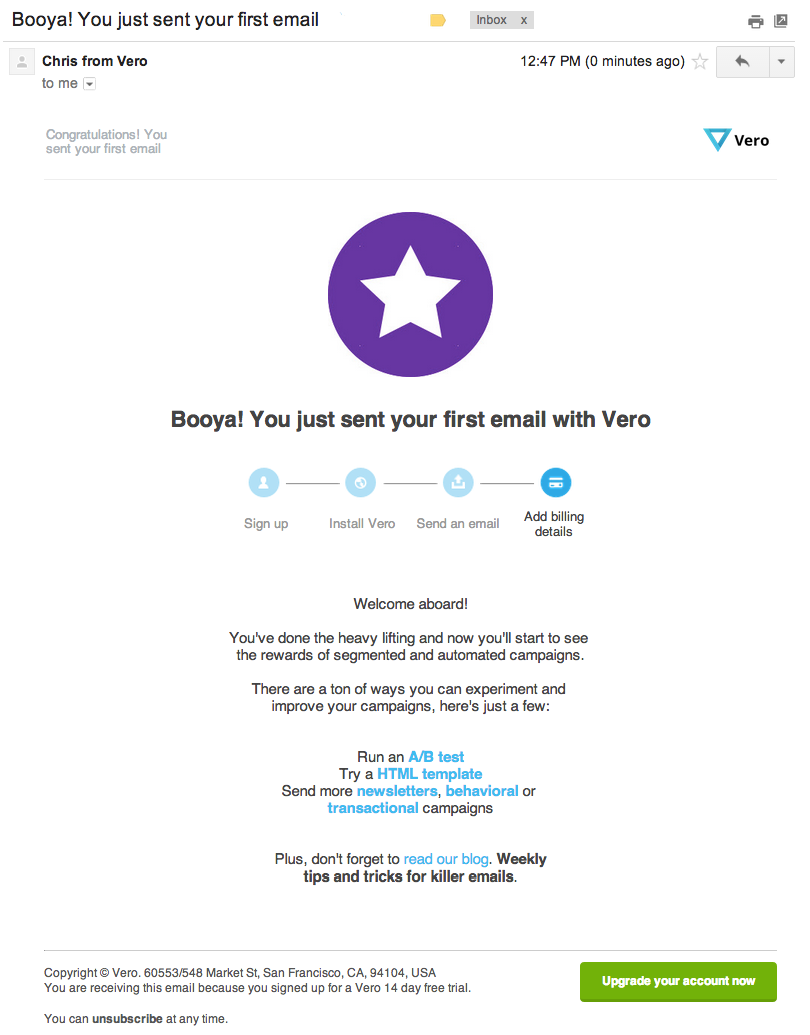
Take for example this email from Vero, an email marketing software, that users receive once they’ve sent an initial email through the tool:

How to Make Your Confirmation Emails Not Suck (and Make Money) image vero.png

Image from Vero.

Vero explicitly shows users how far they’ve come in the process (they’ve already sent one email_ and then seamlessly leads users to the next step (running an A/B test or sending a newsletter). This email averages a 72 percent open rate.

Vero is tapping into an important insight: confirmation emails sent for micro-conversions act like part of an onboarding process. In the same way that user onboarding flows make the process of becoming a user easier, your confirmation email is a step in the customer onboarding flow where you make the process of becoming a customer easier.

How to Make Your Confirmation Emails Not Suck (and Make Money) image vero2.png

Here, Vero borrows the user onboarding convention of the showing the steps of using the product in a linear graphic to make users feel like becoming a customer is manageable. They also show how far down the path you’ve already come, giving you momentum to finish..

Depending on your product and sales funnel, you can show how close a prospect is to receiving a loyalty program deal or play with showing progress to a certain level of expertise by downloading particular information products.

Why It Works: Artificial Advancement Drives Effort

Researchers at the USC Marshall School of Business describe the ‘endowed progress effect,’ whereby individuals put greater effort into completing a task they think they have already begun, even if that process is constructed artificially.

Through a series of studies, Nunes and Dreze found that the illusion of progress was a powerful motivator – as users felt they’d already started a task, they gained momentum towards completing it.

They give examples of customers who are loyal to an airline brand because they’ve already gained mileage points towards a reward, even though that happens ambiently whenever a passenger books a flight.

Step 3: Reward Customers in Purchase Confirmations to Create a Reciprocal Relationship

When existing customers repurchase, they save retailers the cost of acquiring a new customer, yet online retailers focus their marketing dollars on acquiring new customers rather than delighting existing ones.

The purchase confirmation email is a key opportunity to drive repeat purchases because its the first impression for a customer of how they’ll be treated in the new post-purchase relationship.

What user just did What user expects to see Questions to ask yourself How you might add value while moving down sales funnel Purchased a product Receipt with order information
Shipping information What could they buy next?
What did similar customers do next? Suggest similar useful product
Reward customers for loyalty Set up a subscription Receipt with order information
Login information What makes customers cancel their subscription? How do I avoid that?
What add-on or higher level would come next? Provide an info product with benefits of an add-on product
Reward customers for loyalty

Tip #1: Confirmation Emails Aren’t Built to Drive Traffic

Typical e-commerce receipts are ‘dead ends’ – emails that provide information but don’t offer a next step for users to drive them back to your site. They simply aren’t built to create repeat engagement.

Which is why it’s not surprising that receipts with cross-sell opportunities show a higher click through rate, on average, than those without:

How to Make Your Confirmation Emails Not Suck (and Make Money) image Screen Shot 2014 11 05 at 5.30.20 PM1.png

Image from Experian.

These types of emails are exactly what Isabella tapped into when they leveraged their website recommendations engine in their receipts. By offering related products, companies can provide value to their customer by doing the recommendation research for them.

Cross-selling is just one form of personalization, which is 68% of those surveyed by Edgell Knowledge Network said was a strategy for driving loyalty:

How to Make Your Confirmation Emails Not Suck (and Make Money) image pngbase648c408dbbc6177e24.png

Image from eMarketer.

Research also backs up the idea that personalization drives traffic from email – one MarketingSherpa case study found a 17.36 percent higher click-through rate on emails where the subject line included the customer’s name.

Tip #2: Existing Customers are the Best Brand Advocates – Incentivize Them with Rewards

Another factor that many respondents in the previously mentioned Edgell Knowledge Network study felt drove customer loyalty was rewards and another survey by ClickFox found that the action customers were most willing to take for brands they loved was spreading the word.

Of course, customers also said that first impressions are key to gaining the loyalty needed to get this kind of positive buzz:

How to Make Your Confirmation Emails Not Suck (and Make Money) image Screen Shot 2014 11 06 at 8.38.21 PM.png

Image from ClickFox.

Uber taps into both of these insights by incentivizing users to refer others in this receipt:

How to Make Your Confirmation Emails Not Suck (and Make Money) image pngbase6466dbfce06fb24073 1.jpg

Image from Vero.

For Uber, word-of-mouth is the most effective marketing strategy and for every seven rides, they get a new rider from WOM. This strategy taps into their existing success with brand advocates.

By thinking of the purchase as another step in the customer lifecycle, you can craft the appropriate offer to drive loyalty and repeat purchases.

Why It Works: Rewards Create Mutually Beneficial Behavior

Studies suggest that customer satisfaction just isn’t enough to drive repeat purchases or loyalty. As surprising as it sounds, it simply might not occur to customers that their loyalty is valuable to you unless you reward it.

Reward programs are persuasive because they can increase the motivation, one of the three elements of behavior outlined in the Fogg Behavior Method. It’s a two-for-one – customers feel rewarded for their actions and you can get more leads.

A Word of Caution: Filtering is Still an Issue

In their research into mobile email behaviors, MailChimp found that users exhibit a behavior called filtering where they review an email quickly and mark it as unread to go back to later, save it somewhere to read later or delete it.

Because they contain standard information, some types of confirmation emails are at risk of getting deleted without reading. Looking specifically at these, MailChimp found that the type of email often determined its fate:

  • Acted on right away – sign-up or registration emails
  • Saved for later – order confirmations, event tickets

This essentially presents an extra challenge for marketers to grab users in the short period before they delete it. Even if they open the email, there’s still a small window between when your customer gets the info they are looking for and before they move away.

As MailChimp also noted, users rarely read every word of an email and instead tend to skim for the relevant information. This means that overall good email design and information hierarchy is particularly critical in confirmation emails.

Conclusion

Confirmation emails are a unique opportunity for marketers because they are a one-on-one conversation, triggered by the user when they submit fresh data at critical stages in the lifecycle.

These often under-developed touchpoints can be an opportunity to do something remarkable while your user is paying attention, and to take advantage of them, marketers must consider their user’s mindset:

  • With sign-up confirmation, users are just starting their relationship with you – clarify expectations and set the tone for the relationship (clarify reduces friction)
  • With micro-conversion confirmations, users are educating themselves about your or your industry – show users progress towards their goal (perceived progress increases likelihood of completion)
  • With receipts, users have completed their purchase – reward their efforts with relevant offers or rewards for referrals (rewards motivate future behavior)
01 Dec 18:36

How to Use Twitter as a Sales Tool

by Jodie Cook

Social media is seen as this new and exciting digital marketing tool. All we hear about is social media marketing. But what about social media selling? Social media is revolutionary because of the conversations it facilitates between people and brands. Before social media, brands were simply broadcasting corporate (and occasional value-adding) messages through any means possible, but now social media and, in particular, Twitter opens up a whole new channel. But most companies are still missing the point when it comes to using social media to not only market to but to convert their audience.

Let’s use a really clear example. Think about how a car company does its marketing and sales. Big car companies use very traditional marketing methods and ones we to which can all relate. They use billboards on motorway bridges, expensive TV and radio ads and adverts in glossy magazines. These are all mass market tactics involving huge budgets and expense on design, production and advertising space. Their return on investment on each of these channels? Anyone’s guess I suppose.

How do they make sales? Sales generally occur on the forecourt and in the showrooms. Prospects may have made telephone enquiries or scoured the internet first, but they’re going to make their buying decision when? When they’ve got someone to talk to; a human they can have a two-way conversation with and build a degree of understanding and trust. People buy from people. In the How to Use Twitter as a Sales Tool image Screen Shot 2014 11 21 at 12.43.44.png 300x135automotive industry sales are made by salespeople and the marketing is an entirely different process. This is an obvious example to use because cars are a significant purchase for most people and a distinct sales process is required as opposed to what might be required to make a small online purchase, for example. However, this example still effectively demonstrates how different the two processes are.

What makes social media so great from a business perspective is that it combines both the marketing and sales process if used correctly.

How to use Twitter as a sales tool

The ‘social media marketing’ element consists of the compelling, value-adding content you’re putting out regularly and in the voice of your brand. You’re staying clear of self-promotion and boring waffle to really engage your audience and portray your business positively to them. You’ve even posted some sharable content and grown your Facebook, LinkedIn and Twitter reach, which will be contributing to some of the digital marketing goals you’ve outlined for your social media campaign. Now for the sale.

We’re not just talking about the ‘hook’, here; the occasional “buy now and get 10% off with this voucher code” or the “check out our new range of overpriced novelty socks”. We’re talking about a sales process. This all begins on Twitter with a conversation driver. Conversation drivers are what makes Twitter such a marketer’s dream. Conversation drivers mark a wilful, public indication of an individual’s needs or wants at a given moment in time. That individual is also probably giving you lots of information to you about their location, family status, age and interests based on their Twitter bio and the content of their timeline.

Now you’re entering the realms of using Twitter as a sales tool rather than strictly a marketing tool. We created a blog on exactly How to Use Twitter as a Sales Tool image Screen Shot 2014 11 21 at 12.43.34.pngwhat conversation drivers are and how you might use them and it’s worth giving that a read. These conversation drivers are named as such because not only are they an identification tool, but they signal an opportunity to start interacting with this individual. This is where the Twitter sales process can begin but be mindful that the Twitter sales process is not as simple as a traditional sales process.

Comparing Twitter as a sales tool

Some similarities between traditional sales and Twitter:

Customers have a want or need for a product or service

You have identified this individual or company as having this need

This customer shares similar attributes with other members of your target audience (age, gender, geography, etc.)

Some differences:

Over Twitter we don’t know this customer is actually in your target audience (budget, timing etc.)

This person may not know they need your product or service; they might not even be aware your business exists!

They may not have realised that they identified themselves as a member of your target audience

Twitter is not obviously a sales platform and therefore the relationship between buyer and seller is less defined (this is both the largest advantage and largest potential pitfall!)

Twitter gives people the opportunity to show off to their networks online

Directing customers to online resources, points of sale and reviews is simple and instantaneous

There are obviously some fundamental differences between Twitter and traditional sales tactics so these must be addressed and considered when using this approach. These differences can be used to your advantage and most companies are still not utilising it fully. One of the other major benefits is that one social media manager may be communicating with hundreds of leads during a day, rather than a single customer for 20 minutes or longer face to face or over the phone.

For e-commerce sites, sales can be made online and the sharing of links to products with these people will secure the sale. If your product or service requires an ‘offline’ sales element (a call or a meeting) creating a sales pipeline involving the handing over of social media leads will be vital to converting. The key is to already have created a personal relationship so the lead is warm whilst gaining information about the customer. Using the conversation drivers effectively involves an expert approach and online conversation skills as well as some experience of how this works in the real Twitter world. Once you’ve got the hang of it, you’ll really start to see some tangible return on your time with Twitter.

28 Nov 17:43

Alberta big oil to feel the squeeze as world’s cheapest oil gets cheaper

by Jeremy van Loon and Rebecca Penty, Bloomberg News

Canada’s biggest energy producers now face the same prospects of shrinking budgets and declining profit as their smaller rivals as prices drop for what’s already the world’s cheapest oil.

Producers including Suncor Energy Inc. and Canadian Natural Resources Ltd., which each fell the most in at least three years Thursday, operate in one of the most expensive places on earth to produce oil. If crude prices continue sinking following OPEC’s decision not to cut global oil supplies, Canada’s producers big and small will have to tighten their belts to prepare for declining profits.

“This is a pretty big shock,” said Justin Bouchard, an analyst at Desjardins Securities Inc. in Calgary. “There’s no question there’s going to be a slowdown. Even the big guys will have to look at their capital spending plans.”

Western Canada Select, the Canadian benchmark, has lost more than a third of its value since June, in step with declines for West Texas Intermediate and the international gauge Brent. WCS traded Thursday at US$55.94 a barrel, the lowest in the world.

Investors reacted by sending the 69-company Standard & Poor’s/TSX Composite Index Energy Sector Index down 5.1%, the most since August 2011. WTI sank as much as 8.1% and Brent fell as much as 8.4% after the announcement from the Organization of Petroleum Exporting Countries.

Lower Spending

Large Canadian energy producers will probably trim capital spending with WTI below US$70 a barrel, which reduces cash flow about 30%, Matthew Kolodzie, a Toronto-based credit analyst at RBC Dominion Securities Inc., said in a note Thursday. If oil falls to US$60 a barrel and natural gas prices decline as well, Canadian Natural will probably have to lower spending plans by $2 billion, Kolodzie said.

Canadian Natural, which has a budget of $8.6 billion for 2015, may trim spending if oil prices approach US$70 a barrel and stay there, President Steve Laut said in an interview earlier this month.

There are factors working in the Canadian producers’ favour.

To offset low prices, as well as the high cost of mining and steaming bitumen from northern Alberta, Suncor, Cenovus Energy Inc. and some competitors own refineries and use trains to move their products to coastal markets, where they get better prices.

Reduced Costs

The Canadian dollar was worth about 88 U.S. cents Thursday, compared with about US$1.01 in December 2012 when the discount on Canadian heavy crude to the U.S. benchmark was at its widest of US$42.50 a barrel. A lower loonie relative to the greenback reduces costs for Canadian producers and helps boost exports priced in U.S. dollars.

The spread between Canadian heavy crude and WTI has also narrowed, to US$17.75.

Suncor lowered its cash operating costs in the third quarter to $31 a barrel and realized prices of $89 a barrel, Chief Executive Officer Steve Williams said on Oct. 30 during a conference call with analysts. The Calgary-based company operates four refineries in North America, which allows it to take advantage of low oil prices.

“Price volatility is a fact of life in our industry, which is why we maintain a very strong balance sheet that allows us to fund our capital programs through the price cycle,” Williams said Thursday in an e-mailed response to questions. “Our long- term expectation is for an average oil price in the US$90 to US$100 range, but we fully expect that from time to time, the global supply-demand situation will drive the price well outside that envelope.”

‘Not a Holiday’

Stocks tied to oil-sands growth are falling less than Canadian producers focused on delivering output growth from shale, as well as those carrying high levels of debt, said Jennifer Stevenson, who helps oversee CUS$5.5 billion at Dynamic Funds in Calgary. That’s because investors consider oil-sands developers based on long-term prices for decades-long projects, she said.

Still, all producers will see their cash flow crimped.

“It’s not a holiday today for anyone in the oil business,” Stevenson said.

Bloomberg.com

28 Nov 17:41

Creating Buyer Personas: What Every Start-up Needs to Know

by Shelley Pringle

You want your start-up to be successful, right?

Then it is absolutely crucial to understand your customers and their motivations for buying your products or services

The more you know about your customers, the better equipped you’ll be to make informed decisions across a host of critical business fronts, including pricing, brand image, promotions, distribution and product development.

In many cases, entrepreneurs are inspired to develop products after experiencing a need in their own lives. In other words, the company founder IS a customer.

But even if you see yourself as an ideal customer, it still makes sense to undertake the disciplined process of developing formal buyer personas.

What are buyer personas?

Buyer personas (also called a customer persona or marketing persona) are profiles of ideal customers based on input from a range of sources. It’s a tool that gets everyone in the company on the same page and helps your marketing programs stay on track.

Further, as you expand your business, your buyer personas will serve as valuable learning for new recruits to ensure they fully understand your customer’s goals and motivations.

It’s important to note that an ideal customer in this sense means a fictional customer with an ideal set of characteristics. You should avoid basing your buyer personas on individual customers as it can lead to profiles that are poorly drawn.

The development process involves analyzing hard customer data and making educated guesses when data is unavailable. In the case of start-ups with only a small number of customers, there may not be much real data to work with, so you’ll need to rely more heavily on educated guesswork.

If you already have a substantial number of customers, you can collect data by talking to the frontline people who interact with them. It’s also a good idea to speak to customers directly to get additional feedback right from the source.

And be sure to interview people who weren’t so happy with your product or service to get a complete perspective.

7 Steps To Creating Buyer Personas

Let’s assume your start-up sells glow-in-the-dark bicycles. The following 7 steps detail the key things you need to create your buyer personas.

1: Give your buyer personas a name and a headshot
As your personas take shape, it’s a good idea to give them a name and a headshot. Some may think it’s corny, but the name and picture bring the persona to life, especially for others on your team not involved in the process. Use alliteration when naming your personas . . . it makes them more memorable.

Example: Carl the commuter

2: The Bare Essentials
Begin by establishing a broad-brushed picture of your customers. Are they male or female? Married or single? Young or old? High net worth or middle class? Urban, suburban, or rural? University or high school grad?

Example: Carl is male, single, aged 25 to 35, has an undergraduate degree and lives in Vancouver. He has a household income of $85,000 and commutes 15 kilometres to work every workday, year round, by bicycle. On weekends, he spends time with his girlfriend and races road bikes competitively.

3: Goals
What are Carl’s goals when shopping for your product? Is he most interested in finding a bike with the lowest price? Does he need to purchase a bike quickly? Are there specific features important to Carl for his commuting bike?

Example: Carl wants a safe and utilitarian bike for commuting: one with fenders and a chain guard to protect him when it’s raining, a rack for panniers so it’s easy to carry a change of clothes, a bell, a light and so on. Price is also important. Carl only invests a lot of money in his racing bikes.

4: Common Objections
What are the most common objections your personas might make about your product or service? Is your product truly unique? Can they find a similar solution for a better price?

Example: In the case of the glow-in-the-dark bike, be prepared to address why your product is better than simply adding a light or reflective tape to your bike.

5: Favorite Websites
If you want to sell or promote your product online, you need to understand where your personas spend their time online.

Example: Carl gets cycling news and reviews from a number of sites, including: bicycling.com, bikemag.com, and roadbikeaction.com.

6: Social Media Expertise
Where do your personas hang out on social media? Are they using Facebook, Pinterest, or some other platform?

Example: Carl is on Facebook but also dedicates time to Instagram to share pictures of his friends and cycling team.

7: Real Quotes
Include a few quotes from actual customers to help ensure your buyer personas reflect real life. The quotes should feel natural coming from your personas. Get the quotes during interviews conducted either with real customers or people who represent your target market.

Example: “Public transit isn’t really an option for my commute since it’s not convenient. I prefer to cycle to work since it gives me a bit of exercise every day and is less stressful than driving. Plus, parking is expensive in downtown Vancouver, so a bike is really a better option for me right now. Cycling is better for the environment than driving.”

Buyer personas combine both science and art

Creating buyer personas is part art and part science; it definitely takes time to master this aspect of the marketing mix.

Despite being fabrications, buyer personas are effective tools that help start-ups be more targeted, specific and concrete in their messaging. Marketing strategies and tactics developed without the benefit of buyer personas are likely to be generic.

And less likely to encourage purchase.

If you need help creating buyer personas for your business, we invite you to check out our easy-to-use buyer-persona template. Download it for free HERE.

28 Nov 17:41

Sony Is Secretly Creating A Watch Made Of Electronic Paper That Changes With Your Gestures

by Lisa Eadicicco

SonyWatch

Sony is working on a new smartwatch made of electronic paper that can change it's appearance depending on how you use it, The Wall Street Journal reports.

The device, called the Fes Watch, is part of Sony's new project called Fashion Entertainments, which examines how electronic paper can be used to create fashionable wearable tech products.

Sony has been hiding its name from the project — a strategy that those working on the product think is key to its success.

"We hid Sony's name because we wanted to test the real value of the product," a person involved in the project told The Wall Street Journal.

The electronic paper concept isn't restricted to watches, as the company is also said to be working on a bow tie made of the same material. The watch has been advertised on a Japanese crowdfunding website since September, where it's raised about $23,000 so far (2.7 million yen). Those who have backed the watch will be able to order it after May of next year, although Sony hasn't commented on pricing or availability.

In the video posted on Fashion Entertainments' YouTube page (via The Verge), you can get an idea of how the watch changes. 

SonyWatch1

It looks like the watch's color and design slightly changes when you raise your hand to look at the time, according to the video posted on the watch's crowdfunding website.

SonyWatch2

The Wall Street Journal's report comes two days after Bloomberg first reported that Sony is working on an e-paper watch. It looks like the watch's main selling point will be its flexible design that changes depending on your gestures and movements, and we haven't heard about any additional features just yet. The watch is expected to last for about 60 days on a single charge. 

Check out the full videos below. 

Join the conversation about this story »

28 Nov 17:40

We Just Learned A Little More About How The Apple Watch Will Work (AAPL)

by Lisa Eadicicco

Apple Watch

The Apple Watch won't be released until 2015, but the company is already giving us a few new details on how its first smartwatch will work.

Apple's marketing page has just been updated to provide a bit more clarity as to how the watch will integrate with your iPhone and Apple's various apps and services.

Apple has updated the parts of its Apple Watch product page that talk about its timekeeping, messaging, and health and fitness features. We saw the changes reported earlier today by 9to5Mac

On the timekeeping front, Apple has added a new blurb that explains its Complications feature. (Yes, it's really called "Complications.") This shows you how information such as your alarms, the weather, and when the sun rises and sets will appear on your Apple Watch's home screen. It looks like each icon will appear in a corner of the main watch face, according to the rendering on Apple's website:

AppleWatch.PNG

Apple also emphasizes how tightly the watch will integrate with your calendar and contacts, so that it shows you context-based reminders.

The Continuity feature Apple introduced in iOS 8.1 will also work with the Apple Watch. In the "New Ways To Connect" portion of the Apple Watch product page, Apple shows how you'd be able to start reading email on your watch and then launch your full inbox on your phone.

AppleWatch2.PNG

When it comes to health and fitness, we already knew the Apple Watch would be able to measure how long you've been standing versus sitting throughout the day. However, Apple has added in some other scenarios that illustrate how its watch will monitor your physical activity in everyday life. The Apple Watch will be able to detect when you're climbing a flight of stairs or lifting up your kids, for example. There will also be a Workout app that will suggest workouts and help you track them.

Over the past few weeks, we've been learning more about what to expect when Apple's first smartwatch launches in 2015. After Apple officially released its WatchKit toolset for developers last week, we were able to get an idea of the various ways you can interact with the watch. Based on what we've seen, it sounds fairly complicated — there are 15 different gestures you can input to carry out tasks using the watch.

We're expecting to learn more as 2015 approaches, as there are still a few burning questions Apple has yet to answer such as pricing for different models. 

SEE ALSO: Sony Is Secretly Creating A Watch Made Of Electronic Paper

Join the conversation about this story »

28 Nov 17:40

Uber Is Destroying The Value Of Taxi Monopolies In A Bunch Of American Cities

by Jim Edwards

Travis Kalanick Uber CEO.JPG

Uber is destroying the value of taxi monopolies and cartels in various American cities, The New York Times' Josh Barro reports.

This is a huge part of Uber's entire business model: That cities have these artificial, rent-taking taxi commissions that license a limited number of operators for taxis. Because licensing creates a cartel or local monopoly, taxi company "medallions" (a badge that gives you the right to drive a taxi) can sell for astonishing sums of money. Up to $1 million in some cases.

Uber — by allowing anyone to drive and pick up anyone who wants a ride — renders these medallions pointless. At least, that's the long-running theory. CEO Travis Kalanick has repeatedly railed against the way taxi cartels end up in control of cities, fixing prices, reducing competition and not letting competing companies offer rides.

The theory is coming true, the Times says, giving these data:

  • Recently traded prices of taxi medallions in US cities:
  • New York City: $872,000, down 17 percent
  • Chicago: $298,000, down 17 percent.
  • Boston: $561,000, down 20 percent.
  • Philadelphia: medallion auction scrapped.

It's anecdotal, sure.

But it underlines a key trend for Uber. Both its revenue and ridership are growing, and municipalities — and taxi lobbyists — are failing in their efforts to stop  it. Plus, despite the company's awful PR issues, the fact is that once people use Uber once, they tend to want to keep using it because taxis — especially in America where almost zero qualifications are required in order to become a taxi driver — are generally worse than Uber cars.

Join the conversation about this story »

28 Nov 17:39

Our crystal ball says the top-selling smartwatch this season will be …

by Barry Levine
Crystal Ball

‘Tis the first big season for smartwatches. Since this is also the season of predictions, VentureBeat teamed up with consumer analytics firm First Insight to crystal-ball smartwatch winners in the U.S. this holiday season.

The crystal ball was actually First Insight’s online quiz that collected feedback from nearly 1,000 randomly chosen people, asking them about eight prominent smartwatches. The raw data was then processed through First Insight’s predictive analytics to create a product analysis.

The winning smartwatch overall? The Asus Zenwatch.

And if Apple is reading this: There could be one very interesting insight. (More on that below.)

One thing that popped out from the results is that smartwatches as a category could be a hit. An overwhelming 73 percent of the 966 respondents, for example, indicated they are considering the purchase of a smartwatch for themselves or as a gift.

But they appear to be overpriced. First Insight discovered that respondents were willing to pay an average of 19 percent less than the list prices for the watches.

Except for the Asus. It was so well received, respondents were ready to pay 3 percent more for that model than the list price.

The eight watches, in order

The smartwatches were ranked in order of Value Score, First Insight’s combination of how much people liked them and how close respondents’ expected price was to the actual price. In other words, a composite of popularity and accurate pricing.

As revealed, the top watch was the Asus Zenwatch. Expected average price: $206, compared to the list price of $199. A downside for some people is that it doesn’t work with the iPhone.

The Asus Zenwatch

Above: The Asus Zenwatch

Image Credit: Asus

The second most popular? The Apple Watch. That second-place finish was a surprise, First Insight’s chief marketing officer Jim Shea told VentureBeat, given all the publicity the product has had and Apple’s reputation for killer new devices. Expected average price: $305, compared to the list price of $349. Apple’s reputation was the key driver here.

But the real surprise, he said, was that, “for women who voted to buy a smartwatch for themselves, Apple was number one.” Women buying it for themselves were willing to pay $397, or $50 more than list. For men, the Apple smartwatch was their second choice, behind the Asus Zenwatch.

“If I was Apple,” Shea told us, “I’d make a watch specifically for women.”

Are you listening, Apple?

The other six watches, in order:

3. Pebble Steel. Expected average price of $171 versus list of $199. No. 2 choice for women. Its ability to work with the iPhone or Android phones makes it popular.

4. Motorola Moto 360. Expected average price: $192, compared to a list of $250. Some people liked that it looks like a “normal watch,” while others thought a smartwatch should look more special.

5. LG G Watch R. Expected average price: $225, versus list of $299. Again, a “regular”-looking watch, which generated pros and cons. One respondent: “Love that it is voice activated, and it looks like a NORMAL watch.”

6. Sony Smartwatch 3 SWR50. Expected average price: $188. List: $250.

7. Samsung Gear S. It turns out this watch actually received the highest positive sentiment of any of the eight watches, but the deal-killer was the price of $399. Respondents picked $287 as the price they expected people to pay.

8. Meta M1 Smartwatch. Expected average price: $177. List: $249. “Not very functional for the money,” one person said.

Behind the results

To get these results, First Insight created an online game-like quiz of eight prominent smartwatches. There were 966 respondents, randomly chosen from emailing lists of people who had opted in for consumer surveys, for which they received a fee.

There were two product questions: “What do you think [of this smartwatch]?” and “What would they pay?” A slider allowed the respondent to choose between “hate,” “love,” and points in-between for the first question, and another slider showed a range of prices for the second, which asked the respondent what other people would pay for the model.

A screen from First Insight's "What would they pay?" game/survey

Above: A screen from First Insight’s “What would they pay?” game-like quiz

Image Credit: First Insight

The results were run through predictive analytics to give a bit more weight to respondents who had shown, in preliminary questions, a better understanding of this product category. First Insight has found this gives better predictive results when dealing with new products.

All of the eight target watches turned out to be strong performers, getting Value Scores from First Insight ranging from 5 to 9 on a 10-point scale.

As it turned out in this random pull of respondents, most were female — 74 percent. Shea said this was just a luck of the draw but that it didn’t matter, since the predictive analytics keeps results on track.

The respondents were not that far apart between Early Adopters (53.2 percent) and Late Adopters (46.8 percent). Age spread was fairly balanced: 18-34 (33.5 percent), 35-49 (26.6 percent), and 50-68 (32.9 percent), plus 6.9 percent 69 or older.

[Thanks to Mark Sullivan for smartwatch suggestions.]


Mobile developer or publisher? VentureBeat is studying mobile marketing automation. Fill out our 5-minute survey, and we'll share the data with you.


28 Nov 17:39

Common Email Marketing Mistakes: Why Your Emails Aren’t Getting Results

by Kristen Dunleavy

Picture this: You’ve just hit the send button on a new email campaign for your business. You’ve got killer content, a great call to action, and an attention-grabbing subject line… or so you think. As you watch your analytics, it becomes clear that your email isn’t getting the results you want.

What went wrong?

Whether your open rates are suffering or you’re not getting enough click-throughs, there are lots of common email marketing mistakes that even experienced marketers make. The good news is that they can be easily fixed to increase engagement.

The mistake: Your content is too self-promotional.

If you send an email announcing your new software update, who cares? But if you send an email announcing that it’s possible to cut video upload time in half because of your software update, people will pay attention. It’s all about showing the value of your services while promoting your business.

So, how can you do both?

The solution: First, identify your audience’s biggest problems. Let’s say you work with a recruiting agency. Your subscribers need resume help, so why not give them a checklist to help them fix common resume faux pas? Brainstorm content ideas based on real problems your customers are having, then show how your services can fix them. From there, you can create an editorial calendar for your email campaign that will help create focused, useful emails.

The mistake: Your readers think you’re a robot.

What does your From address say? Is it from your own name, your business’s name, or something else? If your open rates are suffering, it could be because your emails lack a personal touch. Your email’s content plays a key role here too. Are you speaking directly to your target audience, or are you using jargony, impersonal industry terms?

The solution: One easy way to make your brand more human is to personalize your From address – no one wants to talk to donotreply@email.com. To sound less robotic and more human, write in plain terms. For example, you wouldn’t described someone as economically marginalized, you would say they’re unemployed. Uncomplicated, easy-to-understand language wins over pretentious buzzwords any day.

The mistake: Your call to action isn’t very… actionable.

Take a look at this email from Studio Fitness.

Common Email Marketing Mistakes: Why Your Emails Aren’t Getting Results image studio fitness.png

There is no link to the nutritionist or personal trainer they introduce us to, and while they encourage us to sign up for a plan, there is no link to help us do that either. Oh, and we can’t access the Studio Fitness website from this email. Since there could be any number of gyms named Studio Fitness, leaving subscribers to find their website on their own is probably not a great idea.

The solution: What do you want people to do when they read your email? Should they visit your website, sign up for a trial, take a survey? Your call to action needs to be strong and authoritative – people need to be told what to do! Make your call to action loud and clear.

The mistake: You’re inconsistent.

How would you feel if you received a weekly newsletter and then, without warning, weekly emails turned into 10 emails a day? You wouldn’t be very happy, would you? It sounds a little ridiculous, but it happens more often than you think. Readers tune out and unsubscribe when they don’t receive what they signed up for.

The solution: Deliver the emails you promised in your sign up form and stick to an editorial calendar if possible.

The mistake: Your follow up series is nonexistent.

Let’s say you have a customer who starts a free trial of your software service, but they never follow through and make a purchase. Sad story, right? It certainly will be if you don’t have a triggered-based follow up series in place.

The solution: While you can’t control a customer’s behavior, you can control how you react to it. If you set up a follow up email that will automatically send to that customer at the end of their free trial, you have a better shot at keeping them engaged. If they had a question about your service, the email could prompt them to contact you, giving you another opportunity to make the sale.

The mistake: Your subject lines are boring.

Look at the subject line below. What does it tell us about what lies within the email?

Common Email Marketing Mistakes: Why Your Emails Aren’t Getting Results image subject line.png

Absolutely nothing. It’s not creative or relevant to the content inside, so there’s nothing about it that would make someone feel compelled to open it. And see that preview text after the subject line? (“If you’re having trouble…”) That space could’ve been used to tease the email too.

The solution: You have about 35 characters to work with in your subject line, so make them count! Your subject line needs to grab attention and tell the reader something about the email itself, because that what will sell them on opening your email.

The mistake: You’re not using personalization.

What’s the best way to get someone’s attention? You address them by their name! It works the same way with email. If you’re not using personalization on your most important messages, you’re missing a real opportunity.

The solution: Just like adjusting your From address to your real name, using personalization in your emails is another way to make your business more human. Notice how the email below uses personalization and takes advantage of preview text.

Common Email Marketing Mistakes: Why Your Emails Aren’t Getting Results image personalization1.png

The mistake: You’re sending to the wrong people.

If you own a burger joint in Philadelphia, you wouldn’t send newsletters to vegetarians in San Francisco, right? This is why segmenting and list management is key, especially for those with growing email lists.

The solution: Tell people exactly what they’re signing up for on your sign up form and stick to it. You can also use your form to segment people based on location, interests, or any other preference. If you only want to send emails to those who opened a particular message, you can segment based on open rates too. Once you’ve hit your sweet spot of segmentation, ask your readers for feedback so you can continue sending them content they want.

Chances are, you’re guilty of at least one of these mistakes. But don’t sweat it! Put our solutions to work and readjust what you send to your readers. Then let us know what your email marketing results look like.

What tips do you have for driving engagement in your emails? Share them with us in the comments section!

28 Nov 17:39

The 7 Social Insights That Will Help Your Brand Win Today And Thrive In The Future (Part 2 of 2)

by Jordan Con

The 7 Social Insights That Will Help Your Brand Win Today And Thrive In The Future (Part 2 of 2) image 7 Social Insights to Win Today.jpg 900x534

(Read Part 1: Why You Need Better Social Analytics)

In part 1, we discussed why businesses need better social analytics. Search marketing was transformed a decade ago by Google Analytics because it gave companies better insights to prove and improve the value of their investment in search ads. Now, businesses need the same for social.

Here are the seven social insights that every business needs:

1. Conversions Per Share

This is the single most must-have metric every business that is seriously investing in social needs to be measuring. Google Analytics brought conversion metrics to web analytics; conversion metrics need to be brought to social, and this is it.

Social media boils down to sharing (posting, tweeting, pinning, etc.). Sharing happens in a variety of ways: consumer-to-consumer, consumer-brand, one-to-one, one-to-many, re-sharing, etc., and ultimately this is what social is about. All the other actions on social media just complement it. People can ‘like’ on Facebook or ‘favorite’ on Twitter, but it all happens to some type of share. On social media, the key actionable unit–the atomic unit–is the share.

Because it’s the atomic unit, social’s conversion metric needs to use sharing as the denominator. Conversions Per Share gives true insight into your social efficiency, and every other key social insight is grounded on it.

Additionally, it’s important to note that, like traditional media marketing, social media marketing comprises three elements: 1) Earned: what your fans share about you, 2) Owned: your non-paid posting, and 3) Paid: your social ads. Therefore, every brand really has three conversion metrics: Earned Conversions Per Share, Owned Conversions Per Share, and Paid Conversions Per Share.

2. Revenue Per Share

Similar to Conversions Per Share, Revenue Per Share is integral now that social, especially Facebook, is a pay-to-play channel. Every ecommerce brand that’s investing in social (and they should be) needs to be tracking how social impacts revenue. With the targeting capabilities of the big social channels, social can and should absolutely be driving revenue for your company. And if you’re tracking Revenue Per Share, you can optimize your ad buy to target the most likely people to buy with the content (products) that they’re most likely to purchase on the social channel that they’re most likely to convert from.

One of the most used social strategies is to leverage key influencers, and the biggest names on social command huge amounts of money to post for brands. By tracking Revenue Per Share for the influencers’ posts, you can truly measure the ROI of your social influencer investment.

3. Most Social Content

While there’s often a positive correlation, your most popular content in general isn’t necessarily your most social content. Your Most Social Content is the content that has the most number of conversions from social. If you’re not tracking how your content is performing (again, preferably based on conversions), you will be wasting a lot of time, effort, and money on sharing sub-optimal content.

Google Analytics conversion-tracking, or similar web-based conversion-tracking, will partially capture this insight. Because GA uses last-click attribution, you will be able to see what conversions were referred directly from a social channel.

4. Most Social Influencers

Leveraging social influencers is a pretty common social marketing strategy. Services like Klout that identify people who have huge audiences within particular interest categories. But it’s also important for brand’s to identify their own natural influencers, who are typically smaller-scale. While they may not have millions or even hundreds of thousands of followers, they have high social efficiency. That is, they have a high Conversions Per Share ratio–when they share, their audience acts. Alone, they might not significantly move the needle, but when these high efficiency social influencers are aggregated, they can be extremely powerful. Combined with the power of large-scale influencers, brands are able to do the most effective social influencer marketing.

5. Most Social Converters

The flipside of Most Social Influencers is Most Social Converters: the people who are responding best to social sharing. With how sophisticated targeting is for social ads, especially Facebook, it’s important to know not only who your influencers are, but also who is converting on social. People who respond well to their friends’ recommendations on social have a higher likelihood of converting from social ads, as well. Therefore, if you know who converts at a high conversion/share rate organically, you can more efficiently target your paid social ads.

6. Fastest Channel to Convert

Because every brand has different customers and different customer behaviors, brands need to figure out the efficiency of their social channels. The Fastest Channel to Convert insight helps brands do just that. For example, if the average time to convert on Facebook is two weeks, while Twitter and Pinterest are 2 hours, Facebook is a top-of-the-funnel channel, while Twitter and Pinterest are a lot lower. This insight helps brands more effectively prioritize and distribute their social advertising budget social in accordance with their customer behavior.

7. Social Average Order Value

For most retailers, average order value is a staple KPI. As companies increase their investment in social, it’s critical for marketers to be able to compare AOV across channels, including social. More specifically, the ability to compare their digital banner AOV to their Pinterest AOV to their Facebook AOV. And even more granularly, organic Facebook AOV versus paid Facebook AOV, etc. With these specific social AOV insights, marketers can do things like refine their paid social targeting strategies. They also help marketers more effectively allocate their social budget to the channels that are most effective.

The social analytics space beyond likes, follows, RTs, and comments can be daunting. With these seven social insights, you’ll be able to have a clear business perspective of where your social efforts stand. You’ll be able to prove that they are driving business as well as improve. Don’t be satisfied with surface-level engagement metrics. With these seven next-generation social insights, you’ll be able to win today and thrive in the future.

28 Nov 17:37

The 16 Best Snacks To Eat At Your Desk

by Jacquelyn Smith

lunch desk eating workWhat you eat all day doesn't just impact your health and weight; it affects your productivity, too.

"If you eat high fat, high sugar meals and snacks you will be sleepy and have low energy overall," says Lisa De Fazio, a healthy lifestyle expert and registered dietitian. "High fat foods take more work to digest. Candy causes sugar to spike in your blood stream then crash, and you also may have an upset stomach. Who can be productive with all of this going on?"

But, unfortunately, she says, many people tend to make bad eating decisions during the workday.

"Boredom and stress often lead to mindless snacking on things like sweets and chips," De Fazio explains. "Also, there may be limited healthy food choices or too many temptations around the office, like candy dishes on your colleagues' desks, cupcakes for birthdays, or greasy pizza during lunch meetings." 

Time — or lack thereof — also plays a part. "One of the reasons people don't stick to their healthy eating resolutions of bringing their own homemade prepared food, rather than ordering or eating out, is because of a lack of time," explains Nicole Maftoum, a Lebanese clinical dietitian. "In a fast-paced world, fast food comes as the optimum solution."

Maftoum says sleep deprivation also affects appetite and pushes one to eat twice the amount of calories that they'd typically consume in a day.

The experts say all of these factors make it easy for us to develop bad eating habits at work — but they're terrible excuses.

Luckily, there are plenty of quick, easy, and inexpensive healthy snack options.

Almonds

Almonds are a great source of protein and healthy fat that is satisfying. "They contain nine essential nutrients; have the highest rate of proteins when compared to other nuts; have the highest rate of fiber (3.5g per 23 pieces) when compared to other nuts; are rich in Vitamin E (23 pieces provide 35% of the daily value of Vitamin E); and contain monounsaturated fats that help increase HDL levels," Maftoum says.


Low-fat popcorn

This low-calorie snack will satisfy your craving for something salty and crunchy, and it’s also a good source of fiber, De Fazio says. 


Fresh fruit

Fruits are packed with vitamins and minerals, and are full of great natural sweetness, Maftoum says. "They are also a great source of antioxidants needed for a stronger immune system and a better performance at work."


See the rest of the story at Business Insider
28 Nov 17:37

Ready, Set, Connect: Seven Social Media Tools That Make an Impression

by Inklyo

Level up your brand by getting social

Ready, Set, Connect: Seven Social Media Tools That Make an Impression image Social media tools for web.jpgTwenty years ago, GeoCities made its online debut. As one of the world’s first social media communities, GeoCities set the benchmark for future sites like Twitter and Facebook.

Today, there are hundreds of similar platforms from which to choose. To make the most of them, you’ll need to learn how to leverage their unique services, from microblogging to photo sharing.

It’s a lot to master, but the end result is worth the initial investment. These seven social media tools will help you get started.

1) Facebook

Facebook is a classic and for good reason. By the end of 2013, over 750 million users were logging onto the site each day, making it one of the most popular social media sites in the world.

Setting up a Facebook page is the perfect way to create an online community around your business. Think of your page as a dynamic newsletter with different sections and interactive content. It should contain news and updates as well as encourage customers to leave comments and to “like” your services. Facebook is also a great place to share media-rich content, such as videos, podcasts, or Instagram photos showcasing your latest products.

2) Twitter

Most people know Twitter as the social media site that popularized the hashtag. For businesses, Twitter provides a fast-paced way to keep in touch with your target audience.

If customers have any questions or concerns, you can quickly respond with a tweet. Twitter’s mobile-friendly interface makes it ideal for on-the-go businesses. You can provide updates on new products and services as well as conduct contests or polls. Twitter’s 270 million users value messages that are short—140 characters or less—and sweet. It’s a great platform to hone your brand presentation and increase your visibility by tweeting about trending topics.

3) LinkedIn

LinkedIn is the go-to social media tool for job seekers and recruiters. It’s a fantastic platform for professional brand management whether your business has only a few or several hundred connections.

If you’re looking for fresh talent, LinkedIn has you covered with over 300 million registered users. By creating a company page, you can easily advertise job openings or post updates on products and services. A company page is also a logical place to share articles or blog posts that will appeal to others in your industry. Browsing the content posted by your connections can help you stay on top of recent trends in employment or business news.

4) Instagram

Since 2010, Instagram has been the top platform for photo sharing. If you’re looking for a memorable way to tell your company’s story, then Instagram could be the ideal social media tool.

Instagram gives you the ability to construct a visually stunning web presence quickly and easily. You can post shareable images and 15-second videos, which is a great way to highlight products or services that aren’t shown on your website. Another unique idea is to give your followers a behind-the-scenes look at your office culture.

Using Instagram filters, you can easily tweak any image so that it matches your brand. Within minutes, you can also link your Instagram page to Facebook and Twitter so that your videos and photographs will reach a wider audience. By adding relevant hashtags to your images, it’s even more likely that they’ll be seen by the customers and followers who matter most.

5) Mention

Many businesses simply don’t have the time to monitor all of their social media accounts. Mention makes it simple by aggregating activity from the platforms you use most, such as Twitter, Facebook, and Instagram.

With Mention, you can find out who’s talking about your business in real time and react to mentions by instantly posting a response, or if you’re tied up with work, you can save your mentions to share later on another social media platform. Mention also lets you export stats about your online activity as an Excel spreadsheet. This is useful for comparing your business with competitors and tracking your popularity on social media over time.

6) eGrabber

Imagine having the contact information for the top professionals in your industry right at your fingertips. With eGrabber’s Account Researcher tool, you can easily track down the email address and phone number of anyone you’re interested in contacting. As a natural complement to LinkedIn, eGrabber helps you build your professional network and find new business partners.

Being the best in your industry means knowing who your competition is. eGrabber can provide a profile of any small- to medium-sized company even if it doesn’t have a website or digital footprint. This is helpful for discovering the revenue, number of employees, and services of other businesses in your field. You can depend on the eGrabber research tool since it works in real time, meaning you’ll always have the most up-to-date information about potential contacts.

7) Tagboard

Hashtags are a powerful way to communicate your brand. Tagboard makes it easy to track hashtags across different social media platforms, including Tumblr, Twitter, and Instagram.

This well-reviewed service is a seamless way to merge marketing with your social media activity. With Tagboard, you can create a stunning display board based on a specific hashtag, which is useful for promoting a new product or business idea. The boards are interactive, meaning customers can instantly like, retweet, or comment on items you’ve posted. Best of all, it’s easy to embed your tagboard elsewhere on the web, including your company website or a WordPress blog.

Social media tools help you inspire customers and make an impact

Why are businesses flocking to social media? The answer is simple: They love having a genuine connection with their clients.

With the right tools, it’s easier than ever to reach your ideal audience and make an impression. Whether your business has been online for years or is new to the web, now is the time to make your social media presence count.

28 Nov 17:37

5 Useful Tips To Safeguard Your Online Reputation

by Vatsala Pisharody

Painstakingly you build up the reputation of your business and all it takes is just one negative comment to bring it crashing down. Often, businesses wait till some negative publicity crops up and then take efforts to mend it. But why let things come to that! Put in remedial efforts so that negativity will not spread in the first place. Reputation once lost cannot be salvaged easily, so you cannot afford to go slack on your reputation management strategies.

5 Useful Tips To Safeguard Your Online Reputation image 5 Useful tips to Safeguard your Online Reputation.jpg

Let us look at some tips to safeguard your online reputation:

• Build a non-penetrative shield of credibility for your business such that no negative comment will be able to harm it. Credible and relevant information about your business should top any searches made; so that no negative comment will ever surface. And if you have worked on the goodwill of your customers, then they will never believe any negative comment, even if it arises; such should be the trust and credibility that you create for your business.

• Unfortunately, despite all precautions taken by you, if some negative comment is circulating, then what should be your approach? Never ignore the comment and think it will disappear just like it appeared. The best way is to approach it head-on. If it is an unsatisfied customer, then look into the grievance and take remedial actions to rectify the problem. Never treat it as a pointless exercise as it will only help you in building up your reputation. Instead of taking the feedback negatively, consider it as a scope for improvement.

• With the social media gaining precedence, there is no control over people’s coments. Keep a constant watch over what people can see when they search for your business. That will help you monitor any negative feedback that shows up against your business. Use the social media to your advantage as you can reach out to a larger audience and maintain a clean image of your business and work on its brand-building.

• Leave the customer with a feeling that they are being served. Be in constant communication with your clients, so that they know that you are serious about your business and value customer satisfaction. A prompt response from your end will work in your favor as the clients will feel served. If there has been any lapse on your side, be ready to accept it as that will work in your favor, than a denial. Even if you cannot solve their problem immediately, the very point that you have noted it and are willing to look into it will surely appease the customers.

• Convey to your customers through your actions that you don’t just say it; you actually mean it and will deliver what you promise. You can put up testimonials of your satisfied customers to boost the trust factor for your business. Endorsements and case studies of earlier clients will help build up credibility for your product and services.

Patience and persistence will alone help you gain online reputation for your business. So keep working at it and do not give up…

28 Nov 17:37

What It Means To Be Social In Sales and Business

by Lori Richardson

being social in salesSocial is a state of mind, not a platform.

Social is a way of doing business, not a trend to jump on the bandwagon with.

Social is how we did business years ago. My grandmother was a larger-than-life social figure in the geographic community she lived in. She was my role model. We called her Mimi, and I’ve written about her over the years because she was such a big influence on me in business. (read about Mimi here http://blog.hubspot.com/sales/lessons-from-my-grandmother-to-sales )

Mimi owned a women’s apparel shop carrying the best brands and top quality accessories. If you bought from Mimi’s shop, you could trust that there was a limited quantity of your particular garment sold – so not everyone would have one like you – and you knew that if there was any problem you could come back to the shop.

We used to pick up the phone to call customers when something came in that they would like. We kept lists of sizes and favorite colors for when husbands and fiancés wanted to pick up a surprise gift. It was community based selling at its finest – based on “small data” and based on crowdsourcing, because we polled our customers and shoppers in person in real-time as they were in the shop.

Although I write about new trends and social platforms  – and really love what I’m seeing with technology reaching mid-market and SMB companies – it’s important to realize that selling socially is not a new concept. We have been doing it for hundreds of years.

If you need a refresher, find an old shopkeeper and ask them how they have stayed in business for many years. Ask them how they know what their customers want?

Use social platforms to build your company’s and your personal brand. You can grow your visibility and be like a non-stop trade show by creating a strong presence online. It is one of the most important things your company needs to think about if they have not put a planned effort in place yet online. Don’t feel bad – many midsized and SMB companies are in the same boat. Now is the time to sit down and think about how you want your company to be represented online.

Not sure how you show up online? Do some experimenting with search. Use Google and Bing to see if you rank at all for any of the topics you should. For example, if you have a marketing company that specifically helps dental practices, if you search for “marketing company” dental or various derivatives of this you’ll see if you come up at all or not. If not, or if you rank far down below the “fold” or on a second or third page, you need to improve this to be found by buyers who are looking for you.

As you are doing this experiment and subsequent visibility improvement, you can use social platforms to engage and start conversations. Search for potential buyers and learn about them. Don’t sell them! See what they are talking about. Find insight about them that you can turn into a conversation over the phone This is all while you are working to build your online presence.

What I’m saying is that you can create as you go – rather than doing nothing until it is perfect. Your online presence will never be perfect. It is a living changing being.

What can you accomplish before the end of the year?

How can you be ready for the New Year with your improved online presence?

What could that mean in new revenues?

IBMThis post was written as part of the IBM for Midsize Business program, which provides midsize businesses with the tools, expertise and solutions they need to become engines of a smarter planet. I’ve been compensated to contribute to this program, but the opinions expressed in this post are my own and don’t necessarily represent IBM’s positions, strategies or opinions.

Lori Richardson - Score More SalesLori Richardson is recognized on Forbes as one of the “Top 30 Social Sales Influencers” worldwide. Lori speaks, writes, trains, and consults with inside sales teams in mid-sized companies. Subscribe to the award-winning blog and the “Sales Ideas In A Minute” newsletter for sales strategies, tactics, and tips. Increase Opportunities. Expand Your Pipeline. Close More Deals.

email lori@scoremoresales.com | View My LinkedIn Profile | twitter |Visit us on google+

The post What It Means To Be Social In Sales and Business appeared first on Score More Sales.

28 Nov 17:36

Digital Marketing Trends for 2015

by Dr. Mark Camilleri

Digital Marketing Trends for 2015 image social 300x241

As 2014 is winding down, it’s time for businesses to start planning their marketing strategy for next year, in a context where the business scenario is continuously changing at the speed of technology. Firms ought to adapt themselves to online marketing, whether they like it or not . Many marketers are already chasing their daily meanderings in terms of “likes”, “shares”, “tweets”, click-through rates and ever more immediate metrics. All these interesting developments on internet are allowing businesses to differentiate themselves to get ahead of their rivals. Smart marketers are regularly collecting social data to offer more personalised, relevant and wanted content toward customers. As a matter of fact, 78% of marketers believe that data-driven marketing via digital channels is the path to new growth (American Marketing Association, 2014). In a sense, web 2.0 has helped businesses to share relevant information about their branded products, service features and propositions that may have generated leads and conversions. Nowadays, some of the best businesses are focusing their attention on inbound marketing techniques as they diligently segment their audiences and target them with online marketing endeavours through different social platforms:

  1. Social Media Marketing: It is in the businesses’ interest to get to know about the demographic profile of customers. In addition they should be aware of the latest contemporary trends and conversations that are happening on social networks. Businesses ought to present themselves in a way that feels native and endemic to customers. One of the main ways that companies are establishing authority and trust among their consumers is by consistently creating high quality content that may provide useful and interesting insights to audiences. Through integrated marketing communications involving social media channels, companies are steadily building a strong rapport with customers, which will inevitably help them to develop brand equity.
  2. Ad Re-Targeting: Today, businesses use content marketing tactics by producing valuable, engaging content that is designed for specific customers. Content on social media is becoming more conversational in nature. Consumers value those brands that show their human face. They consider them as trustworthy and authentic. Therefore, businesses communicate with their targeted audiences to build fruitful relationships with loyal followers. Several marketers are increasingly becoming quite proficient in re-targeting customers. Retargeting works by utilising browser cookies that track websites that are visited by internet users. Once the users leave these sites, the products or services they viewed will be shown to them again in advertisements, across different websites. Therefore, ad retargeting works to increase the overall conversion rate by reminding consumers of the product or service they had viewed. This keeps the brand and the product at the top of the consumers’ minds. Many studies have indicated that simple exposure to brand names and logos may ultimately lead to purchase decisions. Even if there’s no instantaneous purchase, an increased brand awareness can really pay off in the long run.
  3. Search Engine Optimisation: The goal of Google, Bing and other search engines is to provide their users with the most relevant and highest quality content. It goes without saying that, these days social signals may play a key role in organic search rankings. As more people share content through social media channels, it is very likely that the most popular content will be featured in search engine results. It’s no coincidence that the top-ranking search results tend to have lots of social shares, while those ranked lower have fewer. Moreover, social shares may often serve as a stamp of approval or can be considered as a trust signal for visitors. That’s why so many businesses are installing social share plugins and encouraging consumers to share their content, as much as possible.
  4. Mobile Marketing: We are living in an era that is characterised by mobile readiness, responsive designs as well as the revival of ‘going local,’ Businesses are encouraged to produce content that “scales down” on mobiles. Such content may include marketing emails, eNewsletters, websites, social posts and the like. According to (Forbes, 2013), “87% of connected devices sales by 2017 will be tablets and smartphones”. Whether businesses opt to create an alternative mobile version of a website or decide to utilise responsive web design, it’s important for them to provide a positive experience for those internet users that are browsing via mobile devices.
  5. Video Marketing: When it comes to potential reach, video is peerless. YouTube is currently receiving more than one billion unique visitors every month – that’s more than any other channel, apart from Facebook. For the record, “one out of three Britons view at least one online video a week – that’s a weekly audience of more than 20 million people in the UK alone” (Guardian, 2014). Of course, it’s vital for businesses to offer content that is easy to digest; if not, consumers will simply move on. Apps such as Twitter’s Vine (with its six-second maximum clip length) have dramatically increased the opportunity for businesses to upload social videos having authentic content.

In a nutshell, this contribution suggests that next year many businesses will increasingly resort to digital marketing tactics to reach their individual consumers. eMarketer (2014) anticipates that in the next 12 months, the marketing budget that is allocated to social media will rise to 13.2% (from 9.4%). It is imperative that marketers learn how to engage with online visitors through effective, relevant content. Notwithstanding, it may appear that electronic marketing has changed consumers’ mindsets and their behavioural attitudes toward businesses. Perhaps, there’s an opportunity for businesses to leverage themselves through faster adaptations, shorter lead times and always-on, real-time marketing.

28 Nov 17:35

Selling Strategy: How To Become A Trusted Advisor To The C-Suite

by Trent Dyrsmid

Selling Strategy: How To Become A Trusted Advisor To The C Suite image trust1.jpg1

The key to understanding how to sell into the C-suite doesn’t come from understanding how to sell to c-level executives, as much as it does from understanding how they buy.

C-level executives don’t care about the features, advantages, and benefits of your product.

Instead, they care about how much of an impact your product or service will have on helping them to solve their biggest problems.

Think Like A C-Level Executive

To understand what is important to the C-suite, you need to think like them.

For example, below is a small sample of some of the top problems that many of today’s top C-level executives face:

  • How do we increase market share?
  • How can we ensure that we continue to meet earnings expectations?
  • How can we increase our profit margin?
  • How can we create a sustainable competitive advantage?
  • How can we increase operational efficiency?
  • How can we ensure that we keep our investors happy?
  • How are we going to stay compliant with regulatory requirements?
  • How can we lower the cost of a service call?
  • How can we lower the cost of acquiring new customers?
  • How can we attract more of the right talent for our team?

Making A Positive First Impression

Selling Strategy: How To Become A Trusted Advisor To The C Suite image no idiots 300x300.jpgThe C-suite is not looking to be sold on why your product or service is the best/cheapest/fastest, etc…

If you begin your conversation with them by talking about your how awesome your company and product is, the chances that you will be referred to one of their staff, or ignored altogether, is extremely high.

The key to making a positive first impression with the C-suite is to show them that you are genuinely interested in helping them solve their business problems, regardless of whether or not you have a product or service to fit the bill.

While it’s true that you probably do have a solution of some kind (which they also realize), making your stuff the topic of early conversations is a huge mistake.

Focus On Building Trust

The best way to build trust with someone is to focus on helping instead of selling. This is where the field of sales has drastically changed in recent years.

Thanks to the internet, today’s buyer has easy access to more information about your company, your products, and your competitors than ever before.

The days of the sales rep holding all the power are long gone.

Today, the customer has the power, and they know it. As a result, positioning yourself as their most trusted advisor has never been more important.

What hasn’t changed is that every executive still has just 24 hours in a day, and as a result, they need to ensure that they get the maximum benefit from every hour of every day.

As a buyer, I don’t have time (or interest) in hearing you tell me all about why your product is the best.

Blah…blah…blah…

I can read all I want online and I can easily see what other users are saying on sites like G2Crowd.

However, it’s unlikely that I know about the vast array of helpful resources that are available to me to help me solve my most important problems.

If you selflessly help me to solve my greatest problems, I’m much more likely to trust you…and (eventually) I will become interested enough in your products and services to want to buy from you.

Step 1: Starting The Conversation

Whenever I’m talking with a new prospect or existing account for the first time, I have only one objective: to learn as much as I can about the problems they are most interested in solving.

Selling Strategy: How To Become A Trusted Advisor To The C Suite image Helloweb 285x300.jpgAs a result, I spend the vast majority of my time asking questions that will help me to understand their problems and top priorities.

These are the things that they are most likely to allocate resources to solving.

So that you better understand how to do this, let’s suppose that I work for a large software company, and I’m tasked with selling their CRM product.

If my conversation started at the C-level, I sure as heck wouldn’t be asking them about what kind of features they are looking for in a CRM! (If my conversation started with a user, then I might ask about features they need.)

If I did start by asking about features, they would see me as just another CRM sales rep and would have little interest in talking with me again in the future. At best, they’d refer me to someone lower down the totem pole.

Instead, I’d be asking them things like:

  • How much revenue do you need to produce to hit your numbers this year?
  • How many new customers do you need for that?
  • What is a customer worth?
  • Do you have customers like this now?
  • Where did they come from?
  • What does it currently cost you to acquire a customer like this?
  • How many sales reps do you have?
  • What does each one cost you?
  • What percentage of your reps achieve quota?
  • Will you be hiring more reps this year?
  • How many?
  • How will you find them?
  • Besides hiring more reps, what else are you planning on doing to increase the number of leads into the top of your funnel?
  • What does the current sales process look like?
  • Do you have insights (from data) into which parts of your sales funnel are working and which aren’t?
  • Is repeat business going to play a big role in hitting this year’s revenue targets?
  • What does customer retention look like?
  • Do your sales and services teams have access to the same pieces of customer data?
  • How does your team handle support?
  • Do you have field support reps?
  • How do you manage them?
  • How do they get access to the information they need while on the road?
  • Have you investigated any technologies that could help to improve customer service?
  • What have you looked at?
  • What is working best for you now?

The list of questions above is only just a fraction of the questions that, over time, I need to ask the customer if I’m to truly understand what their greatest challenges are.

As I work my way through these questions, some of them will provide me with the opportunity to ask more detailed follow up questions, and it’s these “2nd and 3rd layer” questions that are most likely going to give me the really deep understanding of a problem that I’m going to need to understand if I’m going to be helpful.

Remember: asking questions isn’t about just completing a checklist. Instead, it’s about ensuring that your customer gets the impression that you are genuinely interested in helping them to find a solution to their problems….even if that solution isn’t something you sell.

When a customer sees you asking this many questions instead of talking about your own products, two things are going to happen:

  1. They are going to appreciate your interest in their problems
  2. They are going to start trusting that you are putting their needs ahead of your own

Step 2: Focus On Helping (Not Selling) To Build More Trust

If you take the approach I’ve described above from the start, you will have taken the first step towards becoming a trusted advisor.

What you do next will either move you closer to that goal or further way.

Selling Strategy: How To Become A Trusted Advisor To The C Suite image keyboard help 300x225.jpgLet’s assume that in your first conversation with your customer, you learned that they had the following priorities and problems:

  • They need to hire 50 more sales reps this year
  • They don’t have enough insight (data) into which parts of their sales process is working / not working
  • There is a disconnect between sales and customers service
  • They need to increase revenue by $100,000,000 (each new rep will have a $2M quota)

Is now the right time to start talking about a demo for your CRM product?

Definitely not.

If you immediately start trying to sell them on why your CRM is going to make life easy for their sales reps, you will erode trust.

If you continue to focus on helping find solutions to their problems, you will build more trust.

The great thing about helping is that it’s actually not very difficult to do…once you clearly understand what your customer actually wants help with.

In this case, you know that your customer needs 50 new sales reps.

If you were smart, you would have also asked them if they thought finding 50 sales reps was going to be hard to do. If they said no, then they likely won’t really value any help you might offer.

However, if they said yes, you have a terrific opportunity to build trust by offering help.

What kind of help can you offer if you are a CRM sales rep? Plenty.

For example, you could:

  • Offer to connect them with another of your customers that has already built a very large sales team so that they could learn what has worked for them and what mistakes to avoid.
  • Interview a number of HR professionals that have proven expertise at hiring sales reps and then provide them with a recording of your interview or an article that summarizes your findings (or you could just point them to content created by others that provides similar insights)
  • Send them links to helpful content (blog posts, eBooks, webinars, books, etc…). The content needn’t be created by your company. It need only be helpful.

As you are sending your customer this information, it would also be a good idea to continue to talk with them to learn whether or not the information you are sending is actually helping. If so, how? If not, what could you be doing better?

If you needed to hire 50 sales reps, do you think you might value receiving help like this? Do you think that you might see the person who provided the help in a more positive light?

You bet you would.

Step 3: Be Reliable

When you go away on vacation and need someone to look after your pets, who do you call? Do you call your friend Dave, who sometimes forgets to call you back or make good on his promises? Probably not.

Instead, you call Kate because you know you can absolutely count on Kate not to drop the ball.

Being reliable (doing what you say, when you say you are going to) is a major part of building trust with people.

When you are in meetings with your customers, take notes. They will notice it. If you don’t, they will notice that, too.

When you say you are going to send a link to an article this afternoon, do it. Sure, you could send it tomorrow, but that isn’t what you said you were going to do…and not keeping your word, even on something that is seemingly trivial, will erode trust.

Remember, reliable people are trustworthy people.

Step 4: Be Personable And Connect Emotionally

Not every person in the world is going to become your new BFF; however, that doesn’t mean that you shouldn’t strive to make personal connections with your customers.

To do this, don’t start asking them a bunch of questions about their family on your first encounter…unless, of course, they start asking you questions about yours.

Instead, at the appropriate time, volunteer some information about your family. Maybe your daughter just got her first tooth (mine just did), or maybe your wife loves to rock climb and had recently shared some wonderful photos with you.

By offering up your personal stories first, you are opening the door for them to do the same, and if they do, you then have their permission to ask more about their life outside of work…and when you start to connect on non-business issues like family, you build more trust and rapport.

Remember, we are more likely to trust people we feel a connection with.

Step 5: Write

These days, having your own blog is dead simple, and you can be up and running in 10 minutes or less. Once you have a blog, start writing.

Selling Strategy: How To Become A Trusted Advisor To The C Suite image PlaneRide 225x300.jpg

Kiana’s first plane ride!

Why write, you ask? Simple, it allows you to position yourself as a thought leader in your industry by demonstrating your expertise on topics that your customers are interested in.

Why do you think so many people think being an author is such a big deal?

When you write well, and people like what you’ve written, they will also develop an affinity for you.

If you want to be a trusted advisor, you must continually be on the lookout for ways to help your clients and the best way to learn about new things is to write about them.

Additionally, if you give them access to parts of your personal life by sharing personal stories and photos in your writing, you will also be giving your readers even more ways to feel an emotional connection with you.

For example, if you are reading this post and you’ve never met me, what do you think so far? If you’ve read this far, chances are you’ve enjoyed my post.

Chances are also pretty good that you might like to read a few more. Heck, maybe you’d even like to watch one of my videos.

Remember, writing is an excellent way to demonstrate your expertise on a topic, which builds credibility and trust.

Step 6: Build Long-Term Relationships

You cannot become the trusted advisor over night. It will probably take months or even years.

One article, or one conversation is not going to be enough.

Building trust requires you to take consistent action over the long term.

Let’s Recap

Trusted advisors are the people whom the C-suite wants to talk to, and as a result, trusted advisors are continually exceeding their quotas. They get more referrals, manage the best accounts, win the most awards, get the best job offers, and keep their customers for the long haul.

If you want to become one of the elite salespeople in your organization, decide today to do what it takes to become your client’s trusted advisor.

27 Nov 19:57

Sales Leaders: The Next Step Is Most Important In The Sales Process

by Gretchen Gordon

Sales Leaders: The Next Step Is Most Important In The Sales Process image wishful thinking doesnt close deals.png

I was working with a sales team last week that we have been working with for just a few months. They have, on the whole, a pretty strong group of salespeople. We were discussing certain deals in their pipeline and where they were in the process. Many of the conversations were similar. “They really liked what we had. They need to talk to their boss and then they are supposed to call me back tomorrow.” Or worse, “They were supposed to call me back last Wednesday and I have called but they don’t call me back.”

There are two common flaws here that we see over and over again:

1. The salesperson believes what they want to believe. (“They really liked what we had.”)

2. No definitive agreed-to next step was established. (“They were supposed to call me back…” doesn’t cut it.)

Your role as sales leader should be to help break the cycle of wishful thinking that leads to wasted time, overstated pipelines and reduced activity. Unfortunately, most salespeople believe that prospects are 100% honest and genuine at all times. They believe this because it is easier than not believing.

For instance, if I believe that they liked what I had to say and they just need to get approval from their boss, then I can leave that deal in the pipeline a little longer. My pipeline looks nice and full and my boss is happy with me. I also don’t have to make as many proactive calls because I have enough business in my pipeline to predict success. That is the vicious cycle that our salespeople get stuck in if you, as the sales manager, don’t challenge them.

The fix:

An easy fix is to require that every single interaction and every single opportunity in the pipeline has an AGREED TO next step. Rather than “they will call me tomorrow,” set an appointment for 2:00 PM tomorrow to discuss it. And if they can’t make it, be sure to let them know that you will be calling every hour on the hour until you hear back– either good or bad news.

Oh yeah, that’s the other thing. You have to encourage your salespeople to get decisions, either good or bad. Dissuade them from trying to pressure or back people into a corner. When they do that, the prospect runs and hides rather than simply telling the salesperson “no,” because they are fearful of getting sucked into an attack by the salesperson who is trying to overcome their objection. When a prospect won’t say “no,” salespeople go into chase mode and waste a lot of time and energy chasing after deals that won’t happen rather than going and getting new deals that will happen.

Sales Leaders: The Next Step Is Most Important In The Sales Process image tough love sales strategy.png

Help your salespeople improve their success rates and reduce their wasted time on deals that aren’t going to close by making sure they can always articulate what the next step is, and that it has been agreed upon by the other party. After all, the next step is most important in the sales process!

Try honing in on the next step of your sales process with these tips and let us know how it works for you!

27 Nov 17:22

How to Calculate the Value of Your Blog

by Guest Blogger

This is a guest contribution from Tom Fanelli.

For most businesses, blogs are marketing tools. And while most take the time to measure their ROI from other marketing avenues, I’m surprised by how many don’t truly understand how their blog is (or is not) benefiting their bottom line.

Understanding your blog’s value can help you determine if you want to invest more on its development, adjust your blogging strategy to make it more effective, or simply cut back on your investment entirely.

Sound good? Here’s a guide on how to figure out your blog’s value.

Track the cost of content development.

This isn’t as easy of a task as it may initially seem. If you work with freelancers to create and upload content, their fees are the most obvious direct cost, but it’s likely that there’s still someone in-house who reviews the content – and their time is a cost to your business.

Be sure to account for time spent by all full-time employees who contribute to the blog as part of their responsibilities. Ask them to track how much time they spend working on blog-related tasks for a month.

Calculate your cost per visit. 

Okay, you know how much it costs to keep your blog going, but you want to consider that in the context of how much traffic your blog generates. If you spend money promoting your blog posts, through PPC, Outbrain, or outreach, factor this in. Don’t forget to include any associated labor costs.

Now add the cost of content development and promotion, and divide it by the number of visits over the same period. This is your blog’s “cost per visit”. It can also be valuable to determine the cost per unique visitor.

Determine the revenue of each visit. 

What direct returns do you get from your blog? You may earn money from advertising or affiliate sales. If that’s the case, calculate your total profits on a monthly basis and divide it by the number of visits during the same period.

However, many business blogs don’t have ads or support affiliate sales. Instead, your goal is likely to convert blog visitors into sales of your products or services. For product sales, you can use analytics to determine how many visitors on your blog ultimately completed a shopping transaction as well as the exact revenue from each transaction. But for most services (and some products), it may still take a phone call before they actually convert into a sale. Accounting for your blog’s influence on sales in this way is a little trickier but not impossible:

  • Track how many blog visitors end up on your “Contact” page. Figure out the average value of a new customer, and use this figure to assign a value to these “conversions”.
  • For a month, have your sales team ask new clients if they visited your blog. If the answer is yes, include that sale as part of the return you earn on your blog.
  • Use call tracking. Provide a unique phone number for those who visit your blog, so you’ll be able to say definitively that the customer was acquired in that manner.

There is also another business blogging goal that shouldn’t be overlooked, though it is not as easy to quantify: establishing your brand or expertise. The best way to account for this type of value is focus on the cost per visitor. From there, you can better determine if your investment is worth the reach you’re achieving.

Don’t forget the value of the content itself.

Many businesses reuse blog content in other ways, such as eBooks, marketing materials, social media updates, and newsletters. It’s worth calculating the cost and value of these other uses to get a more complete picture of how your blog fits into your marketing success.

If you find that your blog’s ROI isn’t bad but also isn’t where you’d like it, this is also one way that you can improve it without blowing up your entire strategy.

Now What?

So you’ve subtracted your cost per visit from your gross revenue per visit, and you now have the value of each visit. Armed with this data, you can evaluate your overall content strategy. Do you need to make adjustments? Should you double-down on your current success? Can you grow your business by driving more blog traffic through PPC ads? This figure is also important if you’re calculating the value of your domain name or website for sale.

Tom Fanelli is one of the nation’s leading experts on website development, SEO, SEM, and social media marketing. For nearly two decades, Tom has built both world-class marketing solutions and leading global marketing teams in corporate and small business environments across many industries. He has shared his insight on online customer acquisition, lead generation, and business optimization in both print and web publications, as a presenter of over 50 webinars, and as a featured speaker for companies like Intuit, Microsoft, Sage Software, and the Small Business Administration.

Follow Tom on Twitter at @tfanelli, purchase his ebook Infographics in Action, or learn more on TomFanelli.com.

Originally at: Blog Tips at ProBlogger
Build a Better Blog in 31 Days

How to Calculate the Value of Your Blog

27 Nov 17:14

10 Stats On The Awesome Power Of Corporate Blogging

by Katrina Pfannkuch

There’s no way around it. Corporate blogging has a well-earned place in digital marketing strategy, and is one of the most effective ways to grab the attention of customers and build credibility for your brand.

Some businesses are still figuring out how to get more from blogging, but when consistently cultivated and mapped to larger business objectives, the benefits of corporate blogging are hard to ignore.

Keep in mind, good corporate blogging isn’t posting once a month about the achievements of your business.

Real value derives from a consistent publishing schedule that covers topics of interest to potential customers, offers insight and education, and keeps people engaged with your brand. When fed with fresh and relevant content, blogs give people a reason to trust a business, learn about its values, and lay the groundwork for future purchase decisions.

But don’t let me sway you. Here are 10 stats that highlight why blogs are extremely valuable for business.

10 Stats On The Awesome Power Of Corporate Blogging image blog calendar.jpg

1. Brands that create 15 blog posts per month average 1,200 new leads per month.

Original content is a major lead driver, and corporate blogging offers plenty of opportunities to attract the hungry minds of potential customers. Blog content can include videos, infographics, infoGIFs, written text, podcasts, or a combination of media types. And there are lots of different formats to play around with. The important part is creating something useful, engaging, and “share-worthy” to your audience.

2. Blogs give websites 434% more indexed pages and 97% more indexed links.

If you want to rank for certain keywords or be seen as an industry thought leader, blogging helps with both goals. The more frequently a business blogs, the more “findable” the site becomes for specific topics and queries. Publishing quality posts means you’re providing content worth linking to and sharing, which signals value to search engines and helps you rank higher. And by keeping SEO in mind, you’re helping search engines categorize and index your content so they can serve it up to interested users.

10 Stats On The Awesome Power Of Corporate Blogging image blog traffic.jpg

3. Blogs on company sites result in 55% more visitors.

The first step to building a relationship with a buyer is earning their attention. Well, corporate blogging helps businesses do just that. Aside from the reasons already listed, blogs drive traffic for your company without spending a lot of money. If you can leverage the knowledge of the people within your business and create content from those resources, you are generating marketable content without spending big marketing dollars.

4. Companies with blogs get 97% more inbound links.

Providing clear, useful information on a blog turns it into a reliable resource that others actually want to link back to from their websites. While inbound links aren’t always the biggest goal for a corporate blog, it does help increase web traffic organically—and it’s free! It also shows that potential customers think a brand is “link-worthy” and that they appreciate your position is a thought leader.

Keep in mind that blog posts incorporating video attract 3X as many inbound links as blog posts without video, and posts with all three media types (videos, images, and lists) will attract almost 6X more ILDs than a plain text post.

5. Social media sites and blogs reach 8 out of 10 of all U.S. Internet users and account for 23% of all time spent online.

People spend a lot time online, so why not give them a reason to allocate some browsing to your blog? Combining a social media strategy to support and promote a blog is a key factor in helping drive traffic to it. Great, engaging content is another.

Which leads to the next stat on corporate blogging…

10 Stats On The Awesome Power Of Corporate Blogging image crowd of people.jpg

6. Interesting content is a top 3 reason people follow brands on social media.

Offering content on the blog that instantly grabs people’s attention or gives them something to “chew on” makes a blog worth reading. Posting content that is entertaining, topical, educational, and caters to your niche is the best way to keep things interesting and on point. However, keep in mind that shock-value is short-lived as a traffic generator, so create a solid content strategy that will support long-term benefits.

7. Of consumers who said they have a relationship with a brand, 64% cited shared values as the primary reason. Only 13% cited frequent interactions with the brand as a reason.

When developing your blog strategy, it’s important to identify your company’s mission, focus on content that’s aligned with that mission, and tap into the values of your target audience. Emotion trumps reason in a purchase decisions, especially when it comes to the personal value a business can provide to a customer. By understanding and speaking to the personal, your blog will help you come out above the competition.

8. B2B companies that blog generate 67% more leads per month than those that do not blog.

If you think ignoring your blog is still an option, think again. You are losing potential leads to any competition that does blog, and passing over significant opportunities to demonstrate expertise. Use your corporate blog to attract the right buyers to your brand, provide better information than your competitors, and convert visitors into leads.

10 Stats On The Awesome Power Of Corporate Blogging image blog images.jpg

9. Articles with images get 94% more views.

As the stat above shows, images in blogging have been shown to attract more views and, when paired with text, visuals even improve learning. Clear, well-crafted, relevant images are a key part of standing out in the corporate crowd and help pump up organic SEO. People want to follow the “eye-candy” but they also want substance—so use images that support the main idea of the blog post.

10. 68% of marketers are planning to increase blogging activity.

Here’s one of the most important reasons for businesses to get blogging—it’s a real area of growth across all markets. Corporate blogging is a key aspect of social media outreach, a proven way for companies to attract and convert leads, and impact the bottom line of their business. So if you’re not on the blogging train, you can’t stop it from carrying customers to the competition.

As you look ahead to improving your marketing strategy, consider the power of the corporate blog. It can serve as a content hub for your organization, and attract the eyes and trust of your target audience.

27 Nov 17:14

An Email Marketing Horror Story To Learn From

by George Passwater

An Email Marketing Horror Story To Learn From image shocked businesswoman.jpgOnce upon a time, there was a business owner who couldn’t figure out why his email marketing campaigns were not performing like he thought they should. He thought he did everything right, from writing the email to sending it out through his fancy email provider.

Yes, to him, it was perfect, but unknown to the business owner, there was an underlying darkness that was the cause of his ill performing email campaigns. It stayed in the shadows, lurking and sabotaging the business owner’s efforts.

The name of this vile and disturbing entity was poor planning.

AHHHHHHH!!

Don’t sound evil to you? Oh, but it is, my friend.

Without proper planning, anything can fall flat and fail. Especially someone who doesn’t know enough or thinks they know enough about the subject at hand.

For instance, if you fail to plan your content marketing efforts and instead, just write out everything and hope it works, well, that could cost you time, resources, funds and yes, possible clients.

Now doesn’t poor planning sound more EVIL than you thought?

So, how could the poor business owner not fail prey to the evil of poor planning? Simple, he should have created a solid email marketing plan and got some help putting it all together.

Mistakes and How to Over Come Them

You see, first, he just wrote emails talking about how great his product is and how the reader should buy it.

Now, if he had planned out the message, he would know not every reader would buy or even click on your emails right away. They take nurturing and a reason to trust you. Not to mention, you have to convince them your product will solve a problem they have.

I mean, think about it, if you have a product that doesn’t help me, why should I buy it? Today, buyers are more skeptical and very rarely buy with a bunch of hype and sales pressure.

Another reason the business owner failed was he kept sending the same message, over and over again. This makes the evil entity happy, indeed.

Instead, the business owner should have planned out a series of emails that connected with the reader and used different topics to put the reader at ease; not hard sell to them, over and over again.

Try special reports, tips and resources that specify on the problem and how your product will fix it. It’s selling, without selling.

When the business owner sent out his email, he didn’t really think about the subject line. Instead, he said sale and something cheesy, which he thought would motivate readers to open his email. This had the opposite impact and might have caused his email to go into their spam boxes.

Here is where he should have consulted with an experienced email copywriter and had them write his emails, with the right message for each. Sure, professional copywriters cost, but they make it all worth it.

The Moral of the Story

What did the business owner learn? He learned poor planning could cause your marketing efforts to fail and sometimes, cost more than what you thought it would. For him, it cost him valuable time, possible revenues and much more.

Now, this is just the tip of iceberg, as far as what you should do when planning out an email marketing campaign, but it’s where many business owners fail and then, wonder why no one buys their products. Instead, to avoid the dark, evil of poor planning, step back, and take time to plan and you will be well rewarded.

Do you lay awake at night dreading the evil called poor planning? Or, do you take the extra time to plan things out; avoiding the throw it and see if it sticks method?

27 Nov 17:13

3 Case Studies That Prove The Value Of A Customer-Focused Content Strategy

by Liz O'Neill

3 Case Studies That Prove The Value Of A Customer Focused Content Strategy image customercentriccontent 600x450.png

The majority of B2B marketers believe in the value of content marketing. 93% have incorporated it into their strategy, and 51% rate their content marketing practices as “very mature.” But very few are seeing the return on their investment.

According to Forrester, an overwhelming 85% of marketers fail to connect content marketing activity to business value.

This major disconnect stems from the difficulty most marketers have shifting their messaging focus away from the product and toward the buyer.

“The majority of marketers find producing content that engages buyers to be a major challenge,” said Forrester’s Business Marketing Association Chair, Steve Liguori. “To create content that attracts and builds customer relationships…B2B marketers must make a fundamental shift from writing about features and benefits to delivering valuable information that drives business results.”

The following 3 case studies are proof that this shift to buyer-focused content is worth making.

1. UrbanBound

3 Case Studies That Prove The Value Of A Customer Focused Content Strategy image urbanbound.png

The Problem: UrbanBound, a B2B relocation management software company, wasn’t seeing the value of their broad, scattered content efforts. So, they decided to develop a content-rich, customer-focused campaign instead.

The Approach: To find out what topics to focus on, UrbanBound tapped information from sales to learn about customer pain points, and frequently asked questions. The top customer concern? Creating a streamlined process and benefits package for relocating employees. They had their topic. So, they set out to create a variety of different content surrounding it, including:

  • Multiple blog posts
  • EBook
  • Webinar (with slides posted to SlideShare
  • Infographics
  • Social messages

The Results:

  • 37% increase in blog traffic
  • 35% increase in leads
  • 102% increase in marketing-qualified leads
  • 66% increase in interactions (when someone reconverts and submits multiple forms)

2. Five9

3 Case Studies That Prove The Value Of A Customer Focused Content Strategy image practical tactical2.jpg

The Problem: When Five9, providers of cloud contact center software, first started investing in content, they went with a product-centered approach that didn’t provide much value. The two videos they made, which were oriented around detailing the benefits of Five9 products, stopped producing leads and engagement after two or three weeks, when the promotion budget died off.

The Approach: Five9 knew they needed to stop making content in a vacuum and start listening to what their customers actually wanted. And listening, it turned out, wasn’t so hard. In a survey, they asked their audience what kind of content they were most interested in receiving from Five9.

The results were conclusive. Buyers wanted help improving contact center agent efficiency. Once they had a theme, Five9 produced their first-ever content pillar: “Practical/Tactical: A Guide to the Process, Technology, and Tactics of Agent Efficiency.”

The Results:

The eBook drove:

  • 4X the leads
  • 4X the closed wins

3. ShipServ

3 Case Studies That Prove The Value Of A Customer Focused Content Strategy image shipservblog.png

The Problem: ShipServ, an e-marketplace for the marine industry, connects more than 8,000 ships, 200 ship owners, managers, and yards with upwards of 45,000 marine suppliers. In 2008, they realized their brand image was in trouble: their customers, who weren’t very tech-savvy, deemed them too impersonal and opaque.

The Approach: To help shake this perception, ShipServ dedicated the entirety of their small marketing budget toward customer-focused content. They revamped their website, launched a blog, published a series of whitepapers, created a LinkedIn group to build community, and worked on search engine optimization.

The Results:

  • Website visitors increased by 59%
  • LinkedIn and Twitter went from zero to the top 20 traffic sources
  • Contact-to-lead (landing page contact) conversions increased by 150%
  • Lead-to-opportunity conversions increased by 50%
  • Campaign management costs decreased by 80%
  • Number of sales-ready leads increased by 400%
  • Measurable increase in brand awareness

Dedicating resources, budget, and manpower to content development is a great first step for B2B companies entering the content marketing space. But it’s not enough.

To see real business value, the content must be rooted in the customer.

27 Nov 17:13

SEO 101 For Your Web Page

by Mike Gingerich

SEO 101 For Your Web Page image SEO.png

“Why doesn’t my website come up in Google when you type the term ??”

If I had a dollar for every time I’ve been asked that, I’d be a wealthy man! Every business wants to come up first, or at least on the first page when a search for their key product or service is typed into a search engine like Google. This is, in fact, important because web searchers typically scan no lower than the first 6 results given for any search before making a decision on one of those web pages to visit.

It’s all about keeping it practical, doable, and leading edge so you can grow more leads and sales online!

Search Engine Optimization Key

The key is in knowing what helps a page rank well and what should be done on every web page for search engine optimization (SEO). Since Google is the most dominant Search Engine with average monthly search shares of 63-70% (of all searches done on the web in a search engine), it makes sense to pay attention to what Google outlines and to changes in their algorithm that impacts search rankings.

“Algor” what?

Yes, that’s right. Google has a very in-depth programmatic method that helps them evaluate any web page or blog post and ultimately determine its ranking for keyword phrases.

Google’s Search Engine Algorithm

I’ll keep it simple by saying that Google is most interested in returning the best quality, relevant results for the searches that users input into their search engine. It makes sense. Google wants people to find the best answer for the question they type in. Since “Search Engine Optimization” started years ago, the role of SEO specialists was to help their clients come up on top for searches of key terms they wanted to rank for. This led to some SEO work that tried to manipulate Google’s search ranking method, and Google subsequently would modify the search method based on their new technology and to overcome and punish sites that were trying to “game” the system.

Google wants to combat methods that try to artificially increase the rank of content when the content on a web page is not worthy of that ranking. It’s an ongoing challenge and Google has made multiple shifts in the past couple of years with algorithm changes to keep things pure. Each time they do, some SEO tactics need to shift, while some core “quality content” items remain. We’ll leave the more in-depth SEO tactics that are current to another time and focus on the more timeless search ranking keys that every website owner and Internet marketer should implement.

SEO Basics For Web Pages Cheat Sheet

SEO 101 For Your Web Page image seo basics for 2014 content matters.jpg

SEO Keys For Blog Posts

When trying to have your website and a web pages rank for certain keyword phrases, the most basic key is regularly adding new, quality pages or blog posts to your site. Google is looking for active sites that are regularly updated. Second, when you post a new web page or blog article, the key items to focus on are:

  1. Write for the intended audience, not a search engine. This means writing content that is quality, helpful, and a valuable resource.
  2. Determine the keyword phrase you want to target. Do you know what actual phrase that web users are typing into Google related to your product/service? You can! Use tools like Google Correlate, io, or paid services like SEMrush and MOZ to learn the exact phrase that are searched the most for key terms.
  3. Then, when you write your post, make sure to write titles for search engines, and yet make sure that they read well to the audience. This means including your targeted keyword phrase in the title, typically within the first few words of the title.
  4. Be sure to incorporate the keyword phrase within the first few sentences of the web page or blog post, typically as part of the introductory paragraph.
  5. After this be sure to include the keyword in the meta description. I recommend it is in the form of a question, such as: “Interested in ? Discover the key points here..” Why do this? It’s because search engine results include the title of the article, the meta description, and the URL to the page. They also “bold” the keyword phrase match so this brings more visual focus to your search result and the question can invite the use to click through to learn more.
  6. Customize your web page url to include the keyword phrase. Search Engines will skip pronouns and articles so leave out “the”, “of” etc., in your URL’s but include your keyword terms.
  7. Create article sub-headers that are related keyword terms and make these sub-headers stand out. Typically, website and blog readers are skimmers so by including headlines for different sections you help visitors skim and understand the article content as well as you help inform search engines about the topical focus for your post.

Keeping these seven SEO basics in mind when writing web pages and blog posts can help your content rank well in search engines. Search ranking is a ever-changing arena, but these keys have remained constant for years and serve as the foundation that every page should start from.

27 Nov 17:13

How Does Colour Affect Conversion?

by Jamie Cook

Subtle language cues and the structure of landing pages can play a huge part in boosting conversion rates. Every inch of landing page copy should be optimised to give the visitor the right information in the right way, and ultimately convert them to a lead. A recent post from Lead Pages is indicative of how much research has been put into understand the role of language cues in conversion.

Little research has been done however into the effect of colour on conversion, and whether a carefully tailored colour palette really can encourage a user to take a specific action. There has however been significant research done into brand colouring, and the emotions they attempt to evoke. By looking into some of this in a little more detail, we might be able to extract some lessons for marketers attempting to improve their conversion rates.

Most of us have come across similar visuals like the one below that generalise and categorise brands and emotions into fairly distinct colour groups.

How Does Colour Affect Conversion? image Color Emotion.png

[Image source: Silkweb]

Almost immediately, a couple of brands jump out at me as misplaced.

  1. Monster Energy Drinks – Although in a ‘peace/growth/health/’ based colour, Monster as a brand instantly makes me think of something hyper-active, youthful, and not particularly healthy. ‘Radioactive’ even springs to mind!
  2. SYFY – The channel for all things Sci-Fi. Although I do somewhat agree with the ‘creative/imaginative/wise’ description, the colour purple doesn’t quite have that connotation for me, making the logo feel odd and a little confusing. Purple and silver may have been the colours of the millennium, but now feel dated.

The truth is, that when it comes to brands, our own experiences, preferences, cultures and even upbringing can play a huge role in our association. Less than a hundred years ago for example, the colours pink and blue were still very much interchangeable for boys and girls. Our more recent interpretation of assigned colours didn’t take hold until the latter part of the 20th century.

Colours can also prompt entirely different responses depending on the part of the world you’re in. Red in the West for example, symbolises energy, excitement, danger, passion, a warning, anger or even Christmas! Far Eastern countries tend to associate it with weddings, good fortune, prosperity, joy, vitality or luck.

So ‘Colour Psychology’, as it is known, is too broad a church to determine and evoke specific feelings, despite many attempts to prove otherwise.

Interestingly though, there are some ways in which colour can affect branding and purchases in a more general way. A 2006 paper titled ‘The Impact of Colour on Marketing’ found that up to 90% of snap judgements about a product could be based on colour alone (with some dependence on the type of product).

There’s also a great infographic from Kissmetrics with some great stats around colour, branding and purchase intent.

Being ‘Colour Appropriate’

Other studies have found the relationship between brands and their colours can depend heavily on whether the colour ‘fits’ what is being sold. Brands that were perceived to be colour appropriate tended to be more successful.

In essence, the ‘fit’ of the colour to the product, or in an inbound setting, the piece of content, could prove far more important that the colour itself.

Let’s take Apple, one of the most successful re-branding and marketing efforts of the last twenty-five years. Apple today uses an almost entirely white/silver/black colour scheme in its hardware to evoke a sense of futuristic simplicity, sharpness, and high quality. It also contrasts heavily with the colour and depth of the experience on one of their devices.

Now, if we take those same colours and design choices, and imagine them in a different context – say a small child’s play-set – we can see the monochromatic style might be far less effective.

Applying lessons in colour to conversion

So if context is the most important element to consider, perhaps we can extrapolate that to apply to content as well.

It’s likely your company branding will be fairly locked-in, but most organisations have a host of brand colours that they can use in various contexts. It’s worth first exploring the options available to you within your current palette.

Next, consider your offer. Are you trying to get people to sign up to a highly authoritative webinar? It may make sense to use more assured, confident colours, to convince people this is something worth attending.

Are you running a multimedia competition in an effort to engage and activate your existing audience? Using a more vibrant colour scheme could flip the creative switch in a visitor’s head, giving them the extra incentive to take part.

One of the few tests on the effects of colour on conversion came from Performable (now a part of HubSpot). They tested green against red on an identical landing page promoting Performable’s software. All of their hypotheses and research pointed towards green yielding a higher conversion.

How Does Colour Affect Conversion? image performable graphic.png

[Source: HubSpot]

…So naturally the red button outperformed the green by 21%. Certainly there are no hard and fast rules, and the ultimate arbiter of your efforts will be your audience.

Not always so scientific

If you’re feeling a little overwhelmed with all the possibility around colour, it’s worth remembering that some of the most famous colour choices have been made just as much for pragmatic reasons as for marketing ones. Facebook’s distinct blue branding? A product of Mark Zuckerberg’s red/green colour blindness. Blues were the richest for him, and an obvious choice for the branding of Facebook.

And have you ever wondered why Hyperlinks are blue by default? Tim Berners-Lee chose it due to the enforced grey background on web pages using the Moasic browser. It offered the darkest, high-contrast colour experience for distinguishing links from regular text.

Test, test…and test again.

It’s clear that colour choice can be a conscious process for many brands, and one that requires a great deal of thought and process to get right. For others, sometimes stumbling into an effective colour strategy can be as much through a lack of options as anything else.

Whilst we understand the world of colour psychology to some extent, we still don’t fully understand how to best use that knowledge in the world of marketing, to drive users towards conversion.

Marketers already use A/B testing to optimise landing pages by alternating imagery, structure and language. Why not do the same with colour schemes?

Every type of audience, not to mention every customer, will be different, and just like when optimising conversion in other ways, there likely won’t be any one best way for your organisation.

As more research continues to be done into ‘Colour Psychology’ we’ll be watching closely for anything that might give marketers clues for better conversion, in what remains an exciting field.

You can learn how to streamline your marketing-sales processes and generate more leads when interruptive methods no longer work with our Essential Guide to Online Lead Generation.