Shared posts

26 Apr 19:47

15 email etiquette rules every professional should know

by Allana Akhtar

Woman searching email on laptop

Summary List Placement


Whether we like it or not, responding to emails consumes much of our time on the job. And amid the coronavirus pandemic, when millions of workers are working from home and corresponding by email, it's probably taking up even up more time than usual. 

Since more Americans began working from home amid the coronavirus pandemic, workers are sending out more emails and spending more time at work, per the National Bureau of Economic Research.

Despite the fact that we're sending so many emails, career coach Barbara Pachter said plenty of professionals still don't know how to write them properly.

Because of the sheer volume of messages we're reading and writing, we may be more prone to making embarrassing errors, and those mistakes can have serious consequences.

Pachter outlines the basics of modern email etiquette in her book "The Essentials of Business Etiquette." We pulled out the most essential rules you need to know.

Jacquelyn Smith, Caroline Hroncich, Vivian Giang, and Rachel Sugar contributed to earlier versions of this article.

SEE ALSO: The perfect way to start an email — and 29 greetings you should avoid

Include a clear, direct subject line.

Examples of a good subject line include "Meeting date changed," "Quick question about your presentation," or "Suggestions for the proposal."

"People often decide whether to open an email based on the subject line," Pachter said. "Choose one that lets readers know you are addressing their concerns or business issues."


Use a professional email address.

If you work for a company, you should use your company email address. But if you use a personal email account — whether you are self-employed or just like using it occasionally for work-related correspondences — you should be careful when choosing that address, Pachter said.

You should always have an email address that conveys your name so that the recipient knows exactly who is sending the email. Never use email addresses (perhaps remnants of your grade-school days) that are not appropriate for use in the workplace, such as "babygirl@..." or "beerlover@..." — no matter how much you love a cold brew.


Think twice before hitting 'reply all.'

No one wants to read emails from 20 people that have nothing to do with them. Ignoring the emails can be difficult, with many workers getting notifications of new messages on their smartphones or distracting pop-up messages on their computer screens. Refrain from hitting "reply all" unless you really think everyone on the list needs to receive the email, Pachter said.


Include a signature block.

Provide your reader with some information about you, Pachter suggested. "Generally, this would state your full name, title, the company name, and your contact information, including a phone number. You also can add a little publicity for yourself, but don't go overboard with any sayings or artwork."

Use the same font, type size, and color as the rest of the email, she said.


Use professional salutations.

Don't use laid-back, colloquial expressions like, "Hey you guys," "Yo," or "Hi folks."

"The relaxed nature of our writings should not affect the salutation in an email," she said. "Hey is a very informal salutation and generally it should not be used in the workplace. And Yo is not OK either. Use Hi or Hello instead."

She also advises against shortening anyone's name. Say "Hi Michael," unless you're certain he prefers to be called "Mike."


Use exclamation points sparingly.

If you choose to use an exclamation point, use only one to convey excitement, Pachter said.

"People sometimes get carried away and put a number of exclamation points at the end of their sentences. The result can appear too emotional or immature," she wrote. "Exclamation points should be used sparingly in writing." 


Be cautious with humor.

Humor can easily get lost in translation without the right tone or facial expressions. In a professional exchange, it's better to leave humor out of emails unless you know the recipient well. Also, something that you think is funny might not be funny to someone else.

Pachter said: "Something perceived as funny when spoken may come across very differently when written. When in doubt, leave it out."


Know that people from different cultures speak and write differently.

Miscommunication can easily occur because of cultural differences, especially in the writing form when we can't see one another's body language. Tailor your message to the receiver's cultural background or how well you know them.

A good rule to keep in mind, Pachter said, is that high-context cultures (Japanese, Arab, or Chinese) want to get to know you before doing business with you. Therefore, it may be common for business associates from these countries to be more personal in their writings. On the other hand, people from low-context cultures (German, American, or Scandinavia) prefer to get to the point very quickly.


Reply to your emails — even if the email wasn't intended for you.

It's difficult to reply to every email message ever sent to you, but you should try to, Pachter said. This includes when the email was accidentally sent to you, especially if the sender is expecting a reply. A reply isn't necessary but serves as good email etiquette, especially if this person works in the same company or industry as you.

Here's an example reply: "I know you're very busy, but I don't think you meant to send this email to me. And I wanted to let you know so you can send it to the correct person."


Proofread every message.

Your mistakes won't go unnoticed by the recipients of your email. "And, depending upon the recipient, you may be judged for making them," Pachter said.

Don't rely on spell-check. Read and reread your email a few times, preferably aloud, before sending it off.

"One supervisor intended to write 'Sorry for the inconvenience,'" Pachter said. "But he relied on his spell-check and ended up writing 'Sorry for the incontinence.'"


Add the email address last.

"You don't want to send an email accidentally before you have finished writing and proofing the message," Pachter said. "Even when you are replying to a message, it's a good precaution to delete the recipient's address and insert it only when you are sure the message is ready to be sent."


Double-check that you've selected the correct recipient.

Pachter said to pay careful attention when typing a name from your address book on the email's "To" line. "It's easy to select the wrong name, which can be embarrassing to you and to the person who receives the email by mistake."


Keep your fonts classic.

Purple Comic Sans has a time and a place (maybe?) but for business correspondence, keep your fonts, colors, and sizes classic.

The cardinal rule: Your emails should be easy for other people to read.

"Generally, it is best to use 10- or 12-point type and an easy-to-read font such as Arial, Calibri, or Times New Roman," Pachter advised. As for color, black is the safest choice.


Keep tabs on your tone.

Just as jokes get lost in translation, tone is easy to misconstrue without the context you'd get from vocal cues and facial expressions. Accordingly, it's easy to come off as more abrupt that you might have intended. You meant "straightforward"; they read "angry and curt."

To avoid misunderstandings, Pachter recommended you read your message out loud before hitting send. "If it sounds harsh to you, it will sound harsh to the reader," she said.

For best results, avoid using unequivocally negative words ("failure," "wrong," or "neglected"), and always say "please" and "thank you."


Nothing is confidential — so write accordingly.

Always remember what former former CIA Director David Petraeus apparently forgot, warns Pachter: Every electronic message leaves a trail.

"A basic guideline is to assume that others will see what you write," she said. "So don't write anything you wouldn't want everyone to see." A more liberal interpretation: Don't write anything that would be ruinous to you or hurtful to others. After all, email is dangerously easy to forward, and it's better to be safe than sorry.



26 Apr 19:41

Floating Cell Towers Are the Next Step for 5G

by Jeremy Hsu
Terrestrial 5G networks will support high-altitude balloons and drones, and could someday merge with them
5G report logo, link to report landing page

As the world races to deploy speedy 5G mobile networks on the ground, some companies remain focused on floating cell towers in the sky. During the final session of the sixth annual Brooklyn 5G Summit on Thursday, Silicon Valley and telecom leaders discussed whether aerial drones and balloons could finally begin providing commercial mobile phone and Internet service from the air.

That same day, Alphabet subsidiary Loon, a balloon-focused graduate of the Google X research lab, unveiled a strategic partnership with Softbank’s HAPSMobile to leverage both solar-powered balloons and drones to expand mobile Internet coverage and aid in deploying 5G networks. No high-altitude network connectivity services have taken off commercially so far, but some Brooklyn 5G Summit speakers were optimistic that it would happen soon. 

“The opportunity is in our hands in terms of truly leveraging 5G in conjunction with the massive paradigm shift when it comes to UAS—drones—and also satellites,” said Volker Ziegler, CTO at Nokia Bell Labs.

Nobody expects the high-flying Loon balloons and HAPSMobile’s drones to compete directly with ground-based 5G networks in the near future. Until recently, it hasn’t been easy to develop a balloon or drone platform that is cost-effective enough to even consider using for telecommunications, said Salvatore Candido, principal engineer at Alphabet and CTO of Loon. But such high-flying platforms may help fill the gaps when coverage is lacking in rural or otherwise under-served communities. (Even rural parts of the United States may miss out under current 5G network deployment plans.)

Fleets of balloons and drones could also provide coverage on a temporary basis, such as during a major pre-planned event like the Super Bowl or in the wake of a natural disaster. Nokia previously partnered with Alphabet’s Loon when the latter deployed its experimental balloon fleet to provide basic Internet service to 200,000 people in Puerto Rico after the U.S. island territory was left devastated by Hurricane Maria in 2017. The balloons carried LTE technology from Nokia as part of a broader coalition involving AT&T and T-Mobile. 

“There’s a billion people in the world who don’t have sufficient connectivity, whether that’s temporary because of a hurricane or just because of where they live,” Candido said. “I think all these new technologies coming together makes it possible to create networks that might begin to cover huge numbers of those people.”

Loon has not yet begun deploying 5G equipment on its balloons—though the partnership with Softbank’s HAPSMobile suggests that could someday be possible. But the advent of terrestrial 5G networks could also make it easier for companies to deploy Internet drones or Internet balloons. Nokia’s Ziegler pointed out that 5G offers advantages over 4G LTE when implementing a relay system that bounces the signal around between groups of balloons or drones to extend coverage well beyond the ground station where the signal originates.

“There’s a billion people in the world who don’t have sufficient connectivity.”  —Salvatore Candido, Loon

The availability of 5G network technology could also make it easier from an air traffic control standpoint, to track and manage a large group of drones, said Giuseppe Loinno, an assistant professor in electrical and computer engineering at the New York University and director of the Agile Robotics and Perception Lab.

When the time comes, it will be important for telecommunications companies to create demand for high-flying mobile phone and Internet services by showing what they can do for communities or customers, said Dallas Brooks, director of the Raspet Flight Research Laboratory at Mississippi State University and associate director of the ASSURE FAA UAS Center of Excellence. He invited Brooklyn 5G Summit attendees to collaborate with him and other universities participating in the Federal Aviation Administration’s research and testing program for integrating drones into U.S. national airspace.

Loon may be among the first to take that advice with its balloons—even if they won’t deliver 5G service in the beginning. The company’s stratospheric balloons have already won their first commercial contract with Telkom Kenya to provide mobile phone service for some of Kenya’s almost 50 million citizens. But Loon certainly won’t be alone in trying to make such projects work in the 5G era. “There is no shortage of people trying to create pseudosatellites in the stratosphere,” Candido said.

26 Apr 19:41

Sales Strategy: 2 Ways to Determine if You’re Already Behind on Your 2012 Sales Plan

by Adam Sheehan
26 Apr 19:25

Owning the Client More Directly

by Matt Harris

Customer data is your company’s most valuable asset. It helps you improve your business operations by providing insight into your best customers. To get the most out of the data you’re collecting and more directly own your clients, you need to understand what information you’re collecting and how that data can best provide value to both your business and your customers. Putting data to work will lead to better customer experiences that cement loyalty and increase revenue. But you must also understand the reasons consumers choose to share data, the reasons they hesitate, and how privacy regulations can impact the way you collect, use, and store the data.

First-Party Data Drivers

First-party data is data the customer provides to you directly. It includes everything from purchase patterns to browsing behavior, from email subscription preferences to account information, from online searches to social media and email engagements.

First-party data provides a wealth of information about your customers and it is also less expensive to collect, making it more profitable in the long term. This is the data you’re already collecting. (At least you should be — if you’re not, you’re probably spending way too much on second- or third-party data and missing out on huge opportunities.)

Your first-party data is the biggest (and best) driver for:

Mapping the customer journey:

How and where do your customers discover your brand? What actions (and interactions) lead to a purchase decision? What post-purchase steps lead to loyalty and evangelism? How do customers at different stages of the journey prefer to interact with you? With a well-mapped journey, you can target customers based on where they are, using their preferred channel of interaction, whether that’s on your website, in your mobile app, or via email.

Calculating lifetime value:

Some customers are more valuable than others, based on how often they interact with your company. With first-party data, you can calculate a customer’s lifetime value, using your own, unique formula. That formula will be based on your specific business model but can include things such as how long it takes a customer to move from ‘discovery’ to ‘first purchase’, how often they purchase, their average order value, and the average rate of purchases over a specific timeframe.

Creating relevant personalization:

The more you know about the customer’s journey and their lifetime value, the better you’ll be able to provide personalized offers that will encourage new customers to make a first-time purchase or entice existing customers to spend more time and money. All that data about existing customers is hugely valuable intelligence that can be put to use attracting and converting more like them. And whether new or existing, customers don’t just appreciate personalized content and curated product offers that are unique to their browsing or buying habits, they’ve come to expect them.

Don’t Underestimate Brand Trust

While first-party data is an important driver in making connections with your customers, it’s imperative to never underestimate the importance of brand trust, both its impact on your customers’ willingness to share their data and on how they choose to allow you to use it.

“Understanding what consumers think and feel about their personal data — including the confidence level the customer has placed in a company’s ability to protect that information, has also become part of the definition of big data,” writes Steve Olenski in Forbes.

Consumers will trust brands with their data but there are a variety of factors that will play into their decision. First and foremost, the value received in return for shared data must be clear. For example, two grocery store chains offer discounts for rewards club members, all while collecting data on those customers’ buying habits. The first store uses that information to send customers occasional discount coupons based recent spend amounts, i.e. spend $200 this week, get a $5.00 coupon next. The second store, on the other hand, uses the information to send personalized ‘members only’ specials based on past purchases and related items.

At which grocery store will the customer be more willing to use their rewards card, and thus share additional data, on future purchases? A lazy marketer would say the first — providing a cash discount is fast, easy, and it’s what customers want. But a savvy marketer will know that the more personalized experience offered by the second store is the kind of value-exchange customers expect, one that will drive longer-term loyalty, and which will translate into a higher lifetime value.

Going a few steps further, Amazon Go lets you make purchases by just by scanning their app upon entering and leaving the store. Order details are compiled based on the personal information on file with the company and cameras that track your every move within the store, the items you select, and those you put back. The app will suggest items while you’re shopping and direct you to their in-store location. But except to say it ‘may’ be used to improve the technology going forward, they don’t fully disclose how that data is used beyond providing that level of personalization, calculating your order, and processing your payment.

Is the convenience of such a store worth the surrender of that much personal data and privacy? Apparently so — the success of Amazon Go in its first year of operation already has competitors scrambling to catch up.

As consumers understand more about the value of their personal data, as well as the risks to its privacy and security, they will begin to make decisions based on both the trust they have in a particular brand and the value of the exchange. The more value you can provide in exchange for that data, the more data consumers are willing to share

Understanding the Data You Have and Using It for Optimum Value

The thing with data is that the flow of information never ends. You’ll collect data that is useful to your marketing efforts and customer relationships, and you’ll collect data that has little to no value. Here are the places you are most likely to collect first-person data and the types of information you should be looking for:

  • Website/browsing behavior (cookie data):
    • IP address/user location, items saved in a shopping cart, pages and products browsed, etc.
  • Customer and account info:
    • User name, location, birthdate
  • Purchase data (or usage data, if you’re a service or app):
    • Purchase frequency, purchase similarity, time spent on app
  • Email engagement data (opens, clicks, etc.):
    • Level of interest
  • Loyalty program data:
    • Types and frequency of purchases, unique interests, reward redemption patterns

Once the data is collected, use it to provide value to your customers in the form of personalized experiences across all channels and devices, including:

  • Website content
  • Retargeted advertising
  • Email content and offers, both promotional and transactional
  • In-app content and messaging
  • In-store offers and promotions

To achieve optimum value, consolidate your data to provide a full picture of the customer. In other words, siloed data does not serve you well. Rather, you want to use data from all sources to cross-pollinate your marketing efforts, adding layers of personalization by using one data source to inform another. For example, loyalty data can be used to personalize email, purchase history to personalize loyalty offers, or browsing behavior to personalize ad retargeting.

Privacy First

Your customers might be willing to share their personal information in exchange for value, but your ability to meet the expectation of privacy and security plays a huge role in that willingness.

It isn’t just consumers demanding that privacy. Governments are enacting privacy regulations with very specific requirements. CAN-SPAM was just the beginning, with the GDPR taking effect earlier this year and California’s Consumer Privacy Act (CCPA) soon to follow, effective January 1, 2020. Many states, from Colorado to New York, have passed similar privacy regulations.

Regardless of government regulation, your customers’ expectations should be your primary concern. The best way to meet those expectations is to establish compliance for all your customers, regardless of where they are, and even for laws that may not apply to you. Doing so will demonstrate your commitment to privacy and security and will go a long way towards reassuring both current and future customers that their data is safe with you.

  • Make your compliance apparent to customers through clear and transparent terms of service and privacy policies
  • Include details about what information is collected, how it is used, how it is stored, and how customers can opt out or ask for their information to be deleted
  • Make your policies easy to find, in plain language that anyone can understand

By clearly communicating both your compliance and your commitment to data protection you will both reduce opt-outs and encourage new customers to share their data.

First-party data is a boon for your marketing team, allowing for highly personalized experiences that will result in more loyal customers with greater lifetime value. But data should always be collected and used with the goal of providing value to those customers and with privacy protections at the forefront, so your customers feel both secure and well-served.

26 Apr 19:25

Meet the startup founders bringing edtech back into the classroom and into teachers' hands

by Megan Hernbroth

Students work laptops library university computer internet

  • Education Technology, or ed-tech, is experiencing a resurgence thanks to a new crop of startups building powerful tools for the millions of teachers in classrooms.
  • Some of these startups are graduates of prestigious Silicon Valley startup programs like Y Combinator. or have won the backing of the Chan Zuckerberg initiative.
  • Business Insider spoke with the growing field of "teacher tech" startups to learn why designing with teachers in mind is crucial to the next wave of ed-tech innovation.
  • Visit Business Insider's homepage for more stories.

After disrupting taxis and hotels, Silicon Valley set its sights on the classroom.

On Tuesday, a pension fund in Canada announced a new investment group focused solely on startups creating tech for teachers. Although the Ontario Teachers' Pension Plan hasn't' yet set an allocation target for its Teachers Innovation Platform, the move is a sign of growing momentum in a new "ed-tech" boom.

Education technology took off years ago with products to help parents bolster their children's education, especially in areas where schools sometimes fell short like science and engineering. Parents used these apps to gamify learning and supplement what their children were taught in the classroom.

Read More: Slow Ventures, the VC firm started by ex-Facebook employees, is losing 2 partners but spreading its bets on bigger companies

But the ed-tech industry, now in its adolescence, is working its way back into classrooms and into teachers' hands. The idea is to enhance teaching, as much as learning. Business Insider caught up with some of these new "teacher tech" startups to learn about the latest trends and innovations.

Here are some of the hottest startups designing tech products for the millions of teachers in the US and throughout the world. 

SEE ALSO: Apple's newest iPad Pro tablet is its most powerful yet, but it will never replace my laptop until Apple makes these four changes

Education Modified

Melissa Corto founded Education Modified in 2011 to improve instruction for students with special needs. Education Modified uses verified research to back up its approach and provides teachers with instant access to learning-needs information, strategies, data collection & workflow tools to support them in the classroom

"As a former special educator for 9 years, it was important for us to build technology for teachers — specifically special education teachers — because as professionals they need it," said Corto in an email statement to Business Insider. "We know more about special needs and neuro-diversity than we ever have before, but teachers don't have easy access to this information, nor are there workflow solutions to tie this content to students and track what works for student progress."


Brightwheel

In 2014, Dave Vasen founded Brightwheel to provide an all-in-one software platform to help teachers manage their preschool classrooms. The platform, backed by the Chan Zuckerberg Initiative in 2018, also allows preschool administrators to run the school in addition to helping on the business side of things.

"Our focus is on teachers," Vasen wrote to Business Insider. "We have spent hundreds of hours observing, shadowing, and listening to teachers in order to build a product that is intuitive and adds real value. As we take feedback from teachers every day, we rapidly make improvements and launch new features. The result is a product that is built for them. We're proud that Brightwheel saves as much as one hour per staff member per day — time that goes back to young students and making life easier for teachers."


Tailor-ED

Tailor-ED launched out of Silicon Valley incubator Y-Combinator in March 2019. Founder and CEO Maayan Yavne started Tailor-ED to take on the "one size fits all" approach of matching students and teachers in the classroom. Her company assesses student needs via short quizzes and groups them based on the results. Tailor-ED then matches teachers to personalized lesson plans based on the groups' needs.

"Teachers are almost always overlooked and undervalued, yet have the greatest impact on student achievement," Yavne told Business Insider. "The key to unlocking the potential in every student is empowering teachers with the tools and resources to do so."


See the rest of the story at Business Insider
26 Apr 19:24

Venmo's 40 million US users show its dominance in the P2P space (PYPL)

by Jaime Toplin
  • This is an excerpt from a story delivered exclusively to Business Insider Intelligence Payments Briefing subscribers.
  • To receive the full story plus other insights each morning, click here.

PayPal's strong Q1 2019 was highlighted by results from Venmo that indicate the service's dominance in the US peer-to-peer (P2P) payments space. Additionally, bank-owned P2P service Zelle announced its Q1 2019 numbers, which shed some new light on the industry's competitive dynamic.

Venmo

Here's what it means: Venmo is a force to be reckoned with in the P2P space — but it isn't without competition.

  • Venmo counts 40 million active accounts in the US. That figure, which equates to roughly 14.5% of PayPal's total user base, puts it among the largest platforms in the US: For context, Venmo's user base is comparable to Uber's US user base. The service also posted $21 billion in volume last quarter, marking growth of 73% annually — a slight deceleration from Q1 2018's 80% growth rate, but still a massive gain. The service is on track to hit $100 billion in volume this year as PayPal continues adding use cases like debit cards and in-app payments to the platform.
  • Zelle's volume continues to surpass Venmo as the P2P service keeps growing. Zelle grew 54% to reach $39 billion in volume in Q1 2019 — almost double Venmo's quarterly volume. Zelle's network, which counts hundreds of banks and boasts an addressable base of over 95 million, has the potential to eclipse Venmo.

The bigger picture: PayPal needs to continue to expand Venmo's monetization and commerce initiatives to ensure the service has maximum value.

  • There's likely room for both Venmo and Zelle to coexist, given their distinct use cases. Zelle's volume is still nearly double that of Venmo, but as the two firms have grown, their use cases have become more distinct: Venmo's average transaction size is $50, while Zelle's is much larger at $265. These figures indicate that customers are using Venmo for one-off, lower-value social payments, and Zelle for larger, less frequent transfers. This differentiation could mean customers will integrate both into their financial habits, allowing the growth of both services to continue. 
  • But PayPal needs to accelerate its monetization push for the service before Venmo further erodes its bottom line. Major P2P gains have been the leading cause of PayPal's declining take rate, as P2P is free for customers and therefore hard to monetize. Venmo's new commerce initiatives are helping the service to generate revenue through fees: In Q4 2018, 29% of customers had used these offerings, and Venmo is expected to generate $300 million in revenue (+50% sequentially) this year. Still, it won't be profitable for several quarters. A continued push into this space, which CEO Bill Ready highlighted in the firm's earnings call, and new ways to deepen engagement, will be necessary to help PayPal make Venmo as lucrative as possible.

Interested in getting the full story? Here are two ways to get access:

1. Sign up for the Payments Briefing to get it delivered to your inbox 6x a week. >> Get Started

2. Subscribe to a Premium pass to Business Insider Intelligence and gain immediate access to the Payments Briefing, plus more than 250 other expertly researched reports. As an added bonus, you'll also gain access to all future reports and daily newsletters to ensure you stay ahead of the curve and benefit personally and professionally. >> Learn More Now

SEE ALSO: THE PAYMENTS INDUSTRY ECOSYSTEM: The trend towards digital payments and key players moving markets

Join the conversation about this story »

26 Apr 19:23

Maximizing Your Negotiation Leverage with Power Sources

by rmakela@salesreadinessgroup.com (Ray Makela)

Learn how to develop a stronger value proposition. These reasons will help you improve your negotiation leverage to sell on value rather than price.

26 Apr 19:09

How to Price a Product That Your Sales Team Can Sell

by Sean Higgins

A good sales team is like a high-powered engine, but pricing your product poorly is like sticking that engine in a lawnmower instead of a Lamborghini.

Finding the right price for a new company can seem like a daunting task, but knowing how to price a product is fundamental to your success. Here are some tips that you can use to get your team the deal flow they’ll need to hit their numbers. Let's dive in.

Download Now: Free Sales Pricing Strategy Calculator

Product Pricing Formula

Given the range of potential pricing strategies businesses can employ, there's no definitive method for pricing a product. Any "formula" you leverage will hinge upon several factors — including your industry, business size, structure, and broader business model.

That said, there are a few elements that consistently play into how most products are priced — components that have a place in almost every pricing "formula". Here's a look at those key points to consider.


1. Understand your fixed and variable costs.

Cost might be the most fundamental factor in pricing a product. No matter what the industry standards, trends, or competition around your product might be, your objective will always be to make money. To do that, you need to know what costs you incur when you produce your product.

Consider your variable costs — the ones that change with your level of output. These could include the prices of packaging, raw materials, or shipping. Also, assign a dollar value to the time you spend on producing your product and factor that in as well. Time is money — know how much yours is worth.

Then, consider your fixed costs — the ones that remain the same no matter what your volume of production is. This could include the rent you pay for your facilities, the costs of any permits your business might need to make your product, or your employees' fixed salaries.

Take all these costs together to identify what producing your product costs on a monthly or annual basis. Use that figure to understand what it will take to consistently make a profit.

2. Get a feel for your industry and competition.

It's important to remain mindful of the competition. Find out what people are willing to pay for comparable products and use those industry standards as a reference point.

That sets the stage for a process that takes critical thought and self-awareness — identifying what differentiates your product from the competition and factoring that into your price.

If you're looking to sell at a higher price point, be prepared to convince consumers that your product is first-rate. If you're trying to sell at lower price points, be ready to show prospects they won't be compromising quality for value if they purchase your product.

If you believe you can pull off one of those kinds of messaging, then price your products higher or lower than your competition. No matter how you plan to price relative to your competitors, always understand where your product stands in its space. That means taking the time and effort to determine both your and your competition's public perception.

3. Get to know who's buying.

Every product has a target market. There are specific buyer personas who will be more receptive to what you have to offer than others. These personas will have different interests, sensitivities, values, backgrounds, and — most importantly — purchasing habits. Get to know who's most inclined to buy your product, and that into consideration when pricing.

Surveys, buyer persona interviews, social media, and several other tools and tactics can be leveraged to get a picture of who you're appealing to. Understand their priorities. Are they willing to pay more for premium quality? Are they looking for deals? Do you think they'll be loyal to your brand?

It won't be easy, and it might take a lot of trial, error, and effort to land on definitive buyer personas to consider when pricing. Still, if you stick with it, you'll put yourself in the best position possible to hit the optimal price point for your product.

4. Identify a profit margin and a revenue target.

The most attractive, exciting figure when pricing a product is profit. In all likelihood, that's why your business exists in the first place. After you've conducted extensive competitive research, determined your product's place in your industry, and gotten a feel for who you're selling to, you'll come up with an ideal profit margin for your business.

That process can be tough. You have to choose a grounded, realistic figure that still allows you to operate, expand, and live comfortably — a margin that you are content with and capable of reaching.

Once you have that figure, add it to your estimated fixed and variable costs, and you have a revenue target. After you have that target, it's relatively easy to figure out how it plays into the overall pricing equation.

Estimate how many units of your product you realistically believe you can ship over the next year. Take your annual revenue target and divide it by that number. Now, you have a rough picture of what you have to charge for your product.

5. Be ready for some trial, error, and volatility.

There's no exact science to pricing a product, so there's no guarantee you'll nail it on the first try. You shouldn't be reluctant to change your price if it's not working for you.

Just make sure you're consistently running a profit and covering your expenses. Make some tweaks here and there as you go, and you'll eventually land on that optimal price point.

That being said, there are some potentially volatile scenarios you should always be mindful of. Different, often-shifting external factors can force you to change prices.

That could include the volume of product you can ship, your competitors' prices, the efficacy of your marketing efforts, or the public perception of your product. Your price will probably be fluid. It will take some testing to get it right, and you might find yourself adjusting it consistently.

How to Price a Product for Retail

How to Price a Product for Retail

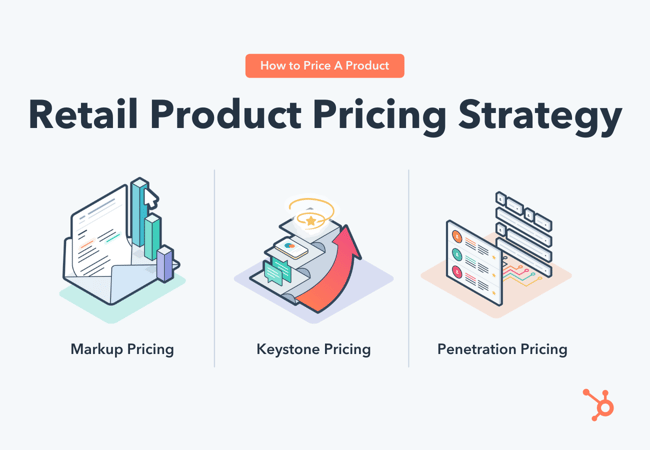
There are a variety of methods you can use to price your physical product for retail. The pricing method that's best for your business will depend on the industry, market conditions, and the type of product you're selling. Here are a few of the most common retail pricing methods.

1. Markup Pricing

Markup pricing, or cost-plus pricing, is a simple pricing method where a fixed percentage is added on top of the production cost for one unit of product (unit cost). It's most often used by companies who sell retail products.

2. Keystone Pricing

Keystone pricing is where you sell your product at double the cost of goods sold. This is a simple pricing method. But, depending on what type of product you sell, the price could be too high for the value customers expect to receive from the product.

3. Penetration Pricing

A penetration pricing strategy is used by new companies who enter the market and price their product at an extremely low price. The goal of this strategy is to disrupt businesses in the market and entice customers with a price that's much lower than the competition.

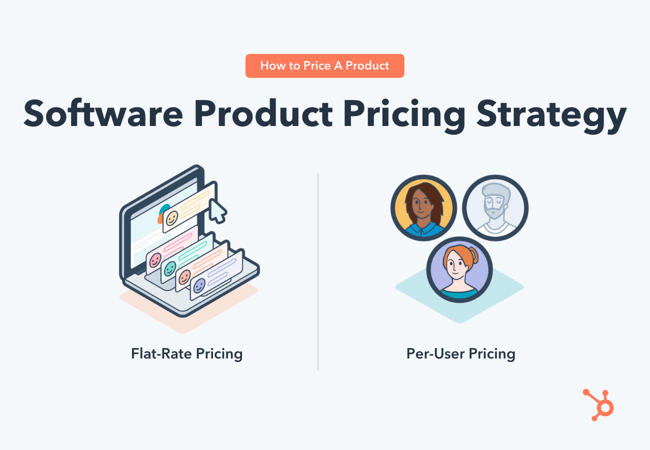
How to Price a Software Product

How to Price a Software Product

1. Flat-Rate Pricing

Flat-rate pricing is probably the most straightforward software pricing method. As you can probably assume, it's the practice of charging a single price for your solution. It generally applies to SaaS products with a single set of features.

This pricing model has its share of perks and drawbacks. On the plus side, these kinds of prices are simple for you to communicate and easy for customers to understand. That said, flat-rate pricing interferes with your ability to appeal to and extract value from a wider range of customers.

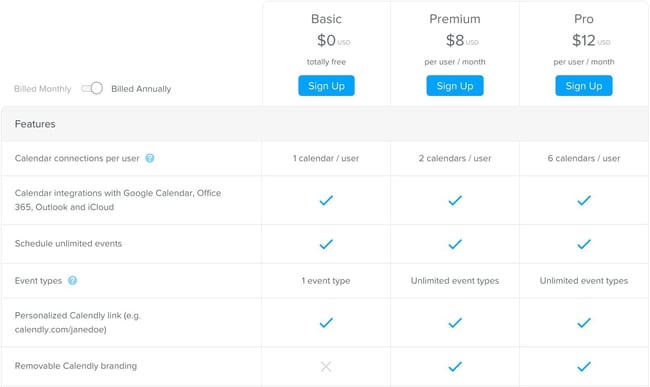
2. Per-User Pricing

Per-user pricing is one of the more popular pricing strategies for SaaS products that can be leveraged by multiple users within an organization. Plans that follow this pricing structure feature incremental price hikes based on how many individuals within a company use the product in question.

Like flat-rate pricing, the per-user model is straightforward and simple. It also allows your business to scale with adoption — the more users you bring on, the more revenue you generate. But the structure comes with its share of drawbacks.

Charging per user often incentivizes businesses to find ways to game your system to accommodate more users without paying accordingly. It can also encourage churn — once a company's volume of users hits a critical point, your solution might stop being financially viable. That might lead them to explore other options with different pricing structures.

Here's an example of what that looks like from Calendly.

How to Price a Product: Per-User Pricing Strategy

Image Source

3. Tiered Pricing

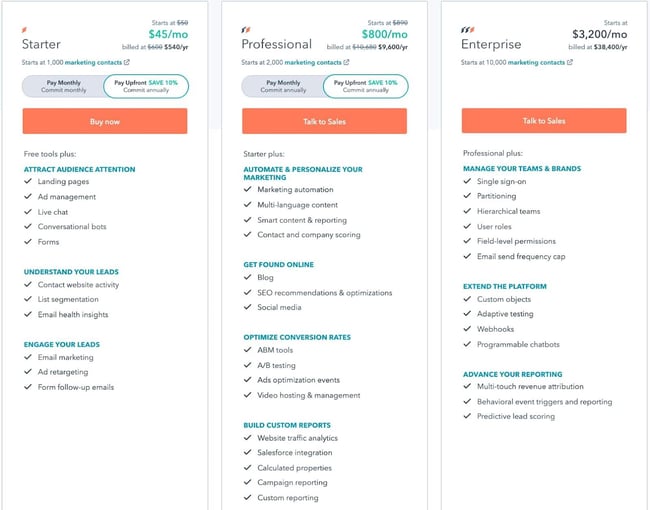
Tiered pricing is another prominent strategy for pricing software products. With this model, businesses offer multiple pricing options — with varying degrees of available features and functionality — to suit a variety of prospects with different needs and budgets.

Tiered pricing is effective in its ability to reach a diverse array of customers. It rests on a solid understanding of buyer personas and considers prospects' interests on a more personal level. Still, businesses might run into trouble when leveraging the strategy.

In some cases, companies struggle with creating distinct enough options to capitalize on prospects' unique preferences. Additionally, having too many options might be confusing and frustrating for prospects — potentially undermining sales.

Here's an example of what the strategy looks like in practice:

How to Price a Product: Tiered Pricing Strategy

Image Source

When it comes to pricing we aren’t aiming for perfection. In fact, charging the correct price out of the gate rarely happens. Instead, with these tips, you can find an initial price that will help your sales team get the product to the customer and create a lot of value in the process. You already put in the time to make a good product, so go ahead, set that price, and start your engines.

Editor’s note: This post was originally published in March 2021 and has been updated for comprehensiveness.

sales pricing strategy calculator


26 Apr 19:09

3 Mindsets You Need to Adopt to Successfully Increase Your Rates

by Taylor Gordon

Increasing your freelancing or consulting rates is the key to generating more income. In a service-based business, there are only so many hours in a day that we can work.

Eventually, you hit a point where there’s a limit to your income unless you’re interested in sacrificing work-life balance. The answer to this is increasing your rates. Increasing your rates can be life-changing. It reduces the amount of work you need to do to make the income you desire.

If you’re hesitant to increase your rates, mental roadblocks could be the reason. Here are some mindsets to help you increase your rates:

The Expert Mindset

Clients usually pay you for “doing a job,” or they pay you for “expertise that you can bring to the job.” These two sound similar, but are slightly different. Many people can do a job or specific tasks. However, only certain people may be able to bring a level of knowledge or expertise to the job at hand. Experts bring in more money and can back up rate increases.

For example, almost anyone can create a website. Just look around for a simple website builder, follow a few steps, and the job is done. But an expert at web design knows more.

They can make a site from scratch. They know how to structure a site soundly for SEO purposes. They can make recommendations on where to put design elements to grab the attention, money, and email of website visitors.

Don’t think of yourself as just a “doer.” You’re doing more than putting a website together when assisting clients. You should charge more than a low hourly rate to cover your labor costs. Take on the cost of the value you’re providing.

The Confident Mindset

To raise your prices, you have to stand firm. You have to be confident in your pricing if you want your prospects to take you seriously. There will be questions about why you charge more than the next guy. There will be times when people will say that you’re charging more than they think you’re worth. You will fold if you’re not confident.

Slowly increase your rates and take note of how it makes you feel each time. You don’t need to triple your prices overnight. Increase them by a few percentage points and then list out everything you bring to the table that backs up the price.

The Abundance Mindset

The abundant mindset is absolutely key. The abundant mindset is when you believe that there are unlimited opportunities. Pricing very conservatively could mean that you have a scarcity mindset where you believe there’s not enough work or clients out there that believe your value. As a reaction to this, you’re trying to beat out everyone in price.

Trying to beat people with the price is a race to the bottom, especially in the freelancing world where there are so many people who charge next to nothing for work. Adopting an abundant mindset can be challenging. It’s something that you’ll have to work on. I’ve worked on my mindset by coming from a place of gratitude.

I take notice when I’m having negative thoughts about scarcity and try to uncover where they’re coming from. I debunk my thoughts or fears with evidence when I have been able to attract abundance into my life. It takes practice, but you need an abundant mindset to attract higher paying clients.

Final Word

Coming up with pricing is nerve-wracking. Ultimately, a business transaction is one where you’re trading value for money, and both sides of the deal should feel satisfied with what they got. Not feeling satisfied will eventually leave you bitter and overworked. Start working on improving your mindset so you can ask for the amount of money that will help your business succeed.

26 Apr 19:03

8 Sales Role Play Exercises to Prepare Your Team for the Win

by Adam Clark
8 Sales Role Play Exercises

No one loves practice. No medals are won on the practice field.

But all around the world, the brightest and best make time for it. They push themselves to be better every day and strain against their perceived limits –– all to make their performance as close to excellence as possible.

Many of these people make their living playing sports… but sales isn’t so different. You may not sweat as much (unless you’re a week 1 SDR), and there may be less risk of injury (unless you count caffeine addiction), but you’re still expected to show up at game time and perform to the zenith of your abilities… or beyond!

So why isn’t practice an important part of our sales careers?

Why aren’t we spending hours honing our conversational tactics, perfecting our pitches and learning to guide buyers through the sales journey?

Wouldn’t we prefer our coaching and scripts to be worked out and perfected in a controlled, and risk-free environment?

It just doesn’t make sense to practice on prospects anymore. A professional sales person needs a place to take “batting practice” before getting out there and trying to hit the 90 MPH curve balls being hurled at them by prospects.

That place is role play.

Most of us have experienced sales role play at some point in our careers. The manager gathers the team and exclaims (with just a bit too much excitement) the plan to do some role playing. What follows is a poorly structured, incredibly awkward, and minimally effective goof-off session.

As crucial as this practice is to develop strong conversational tactics and messaging delivery, it’s mind-blowing how little attention is paid to doing it right.

It’s time to make practice as critical to sales as cold calling. What follows are exercises and tips proven to level up not only your practice sessions, but your performance at game time.

8 Highly Effective Sales Role Play Exercises

  1. Learning is Listening
  2. Objection Island
  3. Persona Mixed Bag
  4. Extreme Conditions (Hot Seat)
  5. Role Reversal
  6. Boardroom Brawl
  7. The Ringer
  8. Pay the Pros

Learning is Listening

Before we can help anyone on the other end of our sales efforts, we must become expert listeners. That’s why this exercise needs to be repeated regularly!

It can be performed in a large group, or with as few as 2 people. If in a group, either segment into smaller groups, or play with the whole group, “telephone” style.

  1. One person will begin by making a statement. It can be directly related to your organization or something entirely abstract.
  2. The next person in line will begin their statement using the last three words of the previous person’s statement.
  3. Continue until you have circled the entire group, or for a specified period of time.

This improv comedy technique will help reps learn to pay attention to what others are saying, instead of living within their own agendas and planned responses.

Objection Island

This is a great game to play anytime your team is together. It not only provides a great field for practicing rapid fire objection response, but allows team members to hear ideas, engage in peer coaching, and shake off some nerves through a shared experience.

Here’s how it works:

  1. Begin by calling out a rep, then hurling a common objection heard during your team’s calls.
  2. The rep has 5 seconds to respond, and do so in a way that will allow the conversation to progress positively, or they are voted off Objection Island.
  3. If the rep is successful, the rep then calls out a person of their choice and repeats the process.

Each time, the objection and response must be unique. Typically the sales leader is the final judgement for timing, response quality, and originality versus other responses.

If you want to vary things a bit, the sales leader can throw out the same objection to every team member sequentially, following the same response guidelines.

RELATED: Four Types of Sales Objections and How to Overcome Them

Persona Mixed Bag

This role play exercise helps a rep sharpen many tools at once –– in particular, the ability to interact successfully with the many personas they’ll work with within your target organizations.

Begin this exercise with a list of personas typically targeted and encountered. Examples of these can be CXO, Director of X, or gatekeeper. Additionally, you can get creative by adding personality traits such as “super direct,” “in a hurry,” “analytical,” or “distracted.”

  1. Write each one down on a small sheet of paper, fold, and place into a bowl or hat.
  2. At the beginning of the role play (once goal of session is defined), the person playing the prospect will draw a piece of paper from the hat and adopt the qualities written on it.
  3. Now perform the role play, provide the feedback, and start from the top.
  4. After at least 2 passes with that persona and/or trait, grab a new one.

Keep in mind, the goal and tactics for the rep should largely remain the same, save for any tweaks from feedback.

Extreme Conditions (Hot Seat)

This exercise isn’t for the faint of heart and should definitely be reserved for those strong teams that can handle a bit of heat. It will add an edge of difficulty that (hopefully) won’t exist in real-world calling.

The idea is exactly the same as warming up before an inning at bat: A batter will swing a weighted bat before stepping up to the plate. Once they drop the weighted bat and pick up the normal one, it feels incredibly light and can be moved through the swing plane at an incredible rate.

  1. To begin, the sales leader will outline the rules.
  2. Pitches must be perfect. Any deviation to the ideal will result in a “buzzer” or “gong” sounding, and the rep will be moved to the back of the line.
  3. If the rep nails it, the role play continues, leading to objections and other opportunities for the rep to get it just right, or get out of the hot seat.
  4. This can continue for many cycles if the sales leader really wants to turn the heat up.

A variation on this is to require the next rep in line to pick up exactly where the last rep left off.

Role Reversal

This should be an obvious one: Turn the role play around for the rep, allowing them to assume the position of prospect.

  1. The sales leader conducts the ideal role play, objection responses, conversational tactics, and closing techniques.
  2. Allow the rep to provide feedback, or comment on what they thought worked well or not at all.
  3. After a round or two, compile the items that worked well and switch seats again.
  4. Using the list of winning tactics, help the rep develop their own comfort level with them. Work on wordsmithing and delivery until the rep has a strong grasp of the skills.

This also works very well with top sellers demonstrating as the sales leader would.

Boardroom Brawl

This is another exercise best left to culturally strong, performance-oriented teams.

  1. Gather the team in your boardroom. Come prepared with some recorded calls that could have gone better. Make sure you have at least one for all reps present so the field is level, and they all experience this together.
  2. If you have a large team, break them up into manageable chunks, letting everyone know that their time will come.
  3. Now, play the call for all to hear.
  4. Once it is over, immediately adopt the persona from the prospect on the exposed call (make sure you have studied the call, and prepared a transcript to work from).
  5. Have the rep begin a role play based on the exact scenario just played for the team. The goal here is to help the rep correct their own mistakes. It gives them a mulligan of sorts, and also applies a bit of pressure as the entire team is witnessing the process.

Variations:

  • Encourage peer coaching during these brawls, and even to add a competitive twist by rewarding points and prizes to reps who can successfully correct the call.
  • Have a different rep take over after the call is played and handle it in their way.

NOTE: A great side effect of “Boardroom Brawl” and “Extreme Conditions (Hot Seat)” is the softening of Ego that can wreck a salesperson’s ability to improve their skills and natural talents.

RELATED: Sales Call Script for SDRs: 5 Questions You Absolutely Must Ask Your Prospect

The Ringer

It is one thing to act out a persona during a role play. It’s an entirely different thing to seek out the exact persona within your organization and invite them to participate.

If your team targets C-Level prospects regularly, go grab your C-Suite (they probably aren’t very busy anyway…) and bring them into your sales training!

  • Have them simply be who they are, and treat your sales team as they would the numerous sales people who are attempting to connect with them every single day.
  • Solicit their feedback on the tactics and have them detail what is important to them with respect to their position, demands, goals and motivators.

If you can draw on this wealth of experience and knowledge within your own organization, you can bet it will pay dividends as you target these folks in other orgs.

Yes, everyone is different. But never forget the Normal Curve. The majority of C-Level executives face similar challenges and demands, have similar thought processes and certainly similar motivators. There are always outliers, but you’ll be far better prepared if you focus your improvement efforts on the majority.

Pay the Pros

Anytime a leader has to consider implementing a new idea, they come to the build versus buy conundrum. If you are at this crossroad and tend to follow the buy approach, reach out to the guys over at Roleplay.co.

At Roleplay’s “sales gym,” your team can participate in real-world-based sales role play training led by industry experts –– and receive feedback from the best in the game today. They can also help you build out your own programs to maximize your time and effort spent training your teams.

RELATED: Winning Sales Training Advice from a Long-Time Test Prep Instructor

Tips for Better Sales Role Play

Set a Practice Schedule

Proper sales practice is not a once-a-week or once-a-month activity. It is at least a 2–3 times-per-week directed effort to improve highly specific parts of your sales attack.

It not only works out the “what” you say, but the “how” and “why” as well.

Set your team up for maximum success by planning practice time in advance. You should front-load your practice time and stretch it out as you improve your targets.

For example, if your company launches a new product line, role play every day for 2 weeks. As reps improve, reduce role plays to 3 times per week, then 2, then 1 if they are really getting dialed in.

Prepare Your Scouting Report

Build your role play routine based on real-world interactions. Leveraging technology is your best play here.

Tools such as Gong.io and Chorus.ai can provide insights into trouble spots in your reps’ talk tracks, tactics and delivery. It can also line up some fantastic objections to practice against.

  • Begin collecting popular objections while reviewing call recordings.
  • Then use them to test your reps rapid-response abilities and train their skills in overcoming them.

Expand Your Training Focus

Positioning statements and objection responses are definitely important parts of role plays, but far from the only parts. Crank up the effectiveness of practice sessions by keying on other important parts of successful sales conversations.

Intonation, energy and articulation are vital to successful talk tracks, as well as pace and vocabulary. Even the best messages and objection responses can be done in by a lack of enthusiasm, speaking too fast/slow, and using words that are insider-speak or used to boost the perceived intelligence of the rep.

An excellent way to ensure you are listening closely for these characteristics is to create a scorecard for each session.

  • Use a scale of 1-10 for each category.
  • As you work through your role play schedule, look for a pattern of positive improvement (or negative). Trust me, it will emerge.
  • You can also aggregate these scores and create an overall performance matrix to classify capabilities. This also provides opportunities for competitions and incentives tied to intentional improvement.

No Surprises

Provide your reps (or have your reps provide you) with the framework and intended goals for each practice session. This produces more creative thinking for the reps, helping them to develop quality delivery in their own voice.

As you grow your practice routine, reps will begin identifying their own areas in need of improvement, and set goals they want you to help them with.

Since keeping your role play as close to the real-world as possible is key to its success, having a rep prepare for the role play as they would a real sales call is in line with this directive.

Be the Buyer

It’s time to role play! Typically, role plays are conducted between rep and rep, or rep and manager. In either scenario, the player in the buyer’s seat has to lay down the team-member hat and put on the buyer hat.

Even the most accomplished salesperson or sales leader has been a customer at some point. Use this experience to become the customer for your training partner.

  • Truly consider the persona and scenario you are working within.
  • Think of the daily challenges faced by the persona/role, what is important to their business, and how they may react to this particular call.
  • It can be difficult, especially in the rep-to-rep role plays, but try to keep the wild and crazy responses to a minimum to maximize effectiveness of the training session.

If you provide feedback, they will come

This is the gold… the secret sauce… where the rep finally steps into the cage for batting practice.

Feedback is how role plays create behavioral change in reps, and there is a “right way” to do it.

ALWAYS keep your feedback kind and encouraging. Sales is difficult. We all know that. Practice is for improving, so let the prospects dish out the beatings.

Provide real-time coaching. Don’t allow a rep to continue past a real hiccup. Stop the role play, provide the feedback, then begin the role play again. This will ensure the rep develops along the correct pathways and with proper timing.

If the rep is progressing nicely with the role play, provide positive reinforcement by allowing the session to progress towards a win for the rep. Don’t be afraid to pepper in some objections as necessary, but again, reinforce positively by allowing progression if the rep deftly overcomes them.

Finally, debrief the session with the rep. Provide the rep with their scores, discuss goal attainment, and follow up for effectiveness of sales objectives.

Wrap up

There has never been a championship team, gold medal olympian, or Greatest Of All Time that achieved winning status without practice and training.

In fact, a case could be made that far more of their time was spent in practice and training than actually competing.

If your goal is to equip your sales teams with the highest ability to convert calls and close deals, there is no better way to achieve this than regular, reality-based, and highly structured practice.

Make the time for it, build your practice facilities, and transform your teams into a well-oiled closing machine!

The post 8 Sales Role Play Exercises to Prepare Your Team for the Win appeared first on Sales Hacker.

26 Apr 19:02

LinkedIn: 3 Marketing Tips to Grow Your Business

by JoAnne Funch

How to use LinkedIn for business marketing requires a strategy more than just shooting from the hip to grow your business!

Did you know that as many as 50 percent of B2B buyers use LinkedIn when making purchasing decisions? And yet, the biggest mistake most people make on LinkedIn is ignoring the network of people they have connected with thinking that those connections will just pick-up the phone when they want to do business with you.

Unfortunately, the only thing this mindset does is turn you into a name collector and not a leader and we know that those who are active and leading in their industry are driving business opportunities.

If you continue to only be a name collector, you can end up with a large network that is useless because you don’t make the effort to get to know people and uncover the opportunities.


We’ve become a global economy and that means we are often connecting and engaging with people from other cities, states and countries. So how do we build and nurture those digital relationships?

Here are 3 key tips for being found and becoming a leader in your niche:

1. BE INTENTIONAL

You must become more intentional about building and nurturing those digital relationships, otherwise out of sight, out of mind. Employing a top of mind strategy to those most important connections builds your relationship so your name is top of mind when there is a need.

There many ways to adopt a top of mind strategy, start by considering these:

– Endorse the skills of your most important connections and be specific as to what you know about
them.
– Comment on a post or article they write and engage them in a meaningful way that is authentic.
– Share an article of value through the messaging feature. Not self-promotional, but something that you
know they would find value in receiving.
– Introduce your most important connections to someone that you believe could again add value.

2. INVEST TIME

Would you ask someone to marry you on the first date? No, you invest the time and effort to get to know each other. How many times have you gotten pitched immediately on LinkedIn before that person took time to know you and build trust?

We all know that LinkedIn is a great resource for growing your network. But that network has little value if you don’t invest time.

I recommend allocating 15 minutes per day to building and nurturing your relationships creating trust, credibility, and goodwill. This is what will grow your brand and business. Here are some steps, the key to your success will be consistency.

• Invite and accept 5-10 invitations to connect a week
• Post 2 status updates per week
• Endorse 5 clients and 1-2 key prospects
• Write 1 recommendation per week
• Respond to communications daily
• Ask for a recommendation after every sale
• Teach past clients how to refer you

3. THINK ABOUT RELATIONSHIPS CRITICAL TO YOUR SUCCESS

Create a short list of people who you want to know on a deeper level. Follow them, learn from their comments and posts.

Add value with all your interactions…”here’s a book, article, podcast I thought you would be interested in.”
Obviously before you send this information you should have asked enough questions and done the research to know what they might be interested in so you can add value.

(Refer back to #2 – you have to invest the time).

Are you relational or transactional?

Are you operating on a transactional basis? If you are, this type of sales approach is not personalized. It may work for low-cost, commoditized products where it may not be necessary for you to get to know the buyer.

Relationship selling on the other hand, requires research and effort. It’s a long-term solution and wellworth the effort for service-based businesses and high-cost products.

CONCLUSION

Consider what is the lifetime value of a client? Relationship-focused people understand this value.

->>Download our free reference sheet

https://linkedinforbusiness.net/LinkedIn-marketing-tips-grow-brand

26 Apr 19:00

10 Email Marketing Mistakes You’re Making — How to Avoid Them

by Kayla Matthews

10 Email Marketing Mistakes You're Making

Today’s marketers are in a whole new world, as technology allows you to gather fresh leads online while also improving customer retention. However, poorly designed email campaigns damage reputations and send pitches straight to the spam folder. 

Many newbies (and even seasoned marketers) commit common faux pas when deploying emails.

Avoid making 10 of the following common email marketing mistakes to get more people to open your messages and, more importantly, take action that results in increased revenue.

1. Penning Poor Subject Lines 

We all receive a ton of email. As a result, many readers simply scan each email subject line for mere microseconds before performing a mass deletion of unwanted sales pitches.

Everyone has seen grandiose subject lines promising the reader they can drop 20 pounds in two weeks or generate six-figure incomes within the next month. Hyped-up email subjects scream spam, and readers often mark them as such to marketers’ dismay. Even when readers avoid labeling a particular sender as spam, proclaiming the impossible makes them roll their eyes and tick the delete box.

Subject lines that compel readers to open them and take action share several characteristics:

  • They don’t trick people into opening — they provide value
  • They’re short, sweet and to the point
  • They focus on the subject while avoiding fluff and filler words
  • They’re professional sounding, not sensational
  • They’re personalized
  • They avoid yelling at the reader in all caps

Busy professionals eschew emails whose subject lines offer no perceived value. Emails deleted unopened due to lackluster titles waste marketers’ time while creating no additional revenue for their efforts.

Your subject lines shouldn't trick people into opening — they should provide value

2. Failing to Utilize Message Previews

Most email programs feature previews that briefly introduce readers to the topics covered in the correspondence. The email preview works a bit like a lead in a news story: Readers want to know if the rest of the content will make for worthwhile reading. 

Just as the first line of an article needs to grab the readers’ interest, message previews let prospects know if they want to read further.

Keep this one rule in mind: The first line of any email ranks highest in attention to quality. Even if the content that follows the first line resembles direct mail on par with David Ogilvy’s creative talent, words no one reads sell no products or services.

3. Not Letting Readers Reply 

No one looks forward to email correspondence from their apparent good friend named Do Not Reply. Emails that fail to let readers respond and ask any questions they may have lead them to look for more personable organizations to conduct business with. An email from Marisol.Martinez@mybusiness.com gets opened more often than those from an anonymous “Contact.”

Always provide readers with a way to get in touch. If allowing replies grows too overwhelming, integrate a “Contact Us” link that leads potential clients to a well-designed landing page where they can pose inquiries or request further info. 

Such pages can also capture additional information from prospects — for example, real estate agents can require contacts to indicate their timeline for buying or selling a home.

4. Coming Across As Shady 

Readers today avoid opening emails that contain even a hint of a phishing scam for good reason. Far too many have already fallen prey to scams, while others have read of the dangers in the media. Once a company gains a reputation for misleading marketing messages, repairing the damage can take years, if it happens at all.

Avoid too much hyperbole in email campaigns. Always keep the tone professional and courteous, and go the extra mile by including a privacy notice in each email letting readers know how to unsubscribe. 

While no marketer wants to lose even one prospect, the consequences of gaining a reputation as an untrustworthy organization impacts revenue more than a handful of folks unsubscribing for their own personal reasons.

5. Going Crazy With Graphics and Stock Photos 

Many consumers today own computers capable of loading image-heavy content quickly, but designing a campaign around nothing but graphics alienates readers and makes the correspondence appear irrelevant. 

While the correct use of charts and highlighted sale graphics can increase conversion rates, consider them the spices you add to the main dish of quality content. A little goes a long way, and too much spoils the entire meal.

6. Falling Out of Touch 

Far too many marketers either grind too hard with unwanted emails or neglect keeping up contact altogether after launching one or two successful campaigns. 

As much as some may love your informative content, letting too much time pass between correspondence distracts their attention elsewhere, and bombarding readers with daily emails when they’ve only signed up for a monthly newsletter exasperates otherwise loyal followers.

Ideally, allow site visitors to indicate their desired update frequency when signing up, and honor their wishes. Automate emails to send at regular intervals even while on vacation or leave to avoid communication gaps.

7. Neglecting Mobile Users 

Almost all Americans now own cellphones, and 77 percent utilize smart devices daily. Failing to tailor email campaigns to load properly in iPhone windows results in lost customers and income.

Always beta test email campaigns across a variety of devices to eliminate quality and load time issues. While marketers cannot completely control speed issues caused by older devices or poor network quality, they can design layouts that allow the majority of users to view their content more quickly.

8. Failing to Track Campaigns

Email campaigns need to incorporate tracking programs to identify what messages get potential customers to take action and which ones get sent straight to the computerized recycling bin. Establish a tracking system to continually improve marketing measures and increase conversion rates.

Many CRM software systems include email tracking tools, and savvy marketers utilize the full suite to evaluate campaign effectiveness. It also allows them to target those customers most likely to open their correspondence and entice them with special offers to grow sales.

9. Not Pruning the Branches

Keeping paying customers coming back for more content shares importance with avoiding wasting time on those who never open emails, or worse, report them as spam. Evaluate your customer list on a quarterly basis and delete contacts who never convert.

While eliminating leads seems a dangerous proposition to many marketers, in the long run, those who focus primarily on engaged customers reap higher returns on their email campaign investment. Email unsubscribes are actually a good thing. Each subscriber costs a bit of money, and while the individual amount may seem small, why waste a dime on customers who consistently delete carefully crafted messages?

10. Forgetting a Call to Action 

The most important aspect of email marketing campaigns is getting readers to take action and invest in products and services. Effective calls to action focus on the customer, not the product.


Effective calls to action focus on the customer, not the product.
Click To Tweet


Create calls to action that center on readers’ needs. Do they need more time in the day? Are they researching the best tax software to prepare a return with several Schedule Cs? Offer solutions without relying on hyperbolic claims.

Creating Email Campaigns That Sell 

Email offers an inexpensive way to reach prospective customers, but ill-designed campaigns give would-be clients the impression that a business only wants to take their money while offering little value in return. 

Successful campaigns keep customer needs paramount when scripting marketing content and offer real solutions to everyday problems without promising the moon. 

By avoiding common mistakes, marketers can target their audience far more effectively than they can with traditional radio and TV spots alone.

The post 10 Email Marketing Mistakes You’re Making — How to Avoid Them appeared first on Convince and Convert: Social Media Consulting and Content Marketing Consulting.

26 Apr 18:59

In-House vs. Outsourced Sales: A Case for NOT Hiring SDRs

by Kevin Warner
in-house vs. outsourced sales image

I get hassled for this all the time, but I am proud to admit that I am a cost evaluating, penny-pinching, profit-margin-analyzing geek to the core.

Early in my career, I saw firsthand how a $20M funded company went from startup to NASDAQ IPO to being delisted in the span of three years due to frivolous spending (but that’s a story for another day).

My cost-conscious lens (plus our proven outbound sales program) has served my company, Leadium, well. We grew over 600% last year and hold steady at a 40% profit margin. I attribute a lot of that success to evaluating the value of every dollar we spend for every decision we make.

I am passionate about helping small to medium-sized businesses (SMBs) accelerate their growth with outbound sales. And while strategy is incredibly important, considering the cost of every piece of that strategy can be a game-changer to your bottom line.

The SMB Decision: In-House vs. Outsourced Sales Development

As a high-growth SMB, your number-one focus is consistent sales. Customer acquisition drives revenue, and revenue becomes your means of growth. Therefore, you are (hopefully) constantly evaluating how you will get your next customer.

Without enough high-quality leads, your sales pipeline dries up fast. Without a sales development team, you can find yourself struggling when it comes to pipeline generation. You can use lead-sourcing technology and sales automation, but you still need people to power those tools.

Based on my experience working with hundreds of SMBs across the country, 65% just aren’t at the size or run-rate to allow for the economic investment required to establish a successful in-house sales development team.

For business owners and margin-focused executives deciding on how to structure their outbound sales program, it comes down to one thing: cost.

Can you confidently invest in every component that goes into building a solid, supported, in-house sales development program, knowing (and honestly evaluating) the current infrastructure that currently exists at your organization? Especially considering that outbound prospecting will not work consistently unless you have reps who are dedicated (at least 90%) to prospecting.

For SMBs, this is a pivotal decision: Do you hire an in-house sales development team or work with an outbound partner?

Sales Hacker has already covered the do’s and don’ts on hiring outsourced sales professionals, tips for how to know when it makes sense for your organization, and the pros and cons of outsourcing sales development. And at Leadium, we continue to shine a light on the true costs associated with in-house sales development teams.

But why does nobody talk about the cost considerations?

Here are four key costs you should evaluate when deciding whether to build an in-house outbound sales team or outsource to an outbound sales agency partner.

The Four Costs of In-House Sales Development

  1. Salary and benefits costs
  2. Software costs
  3. Data costs
  4. Hidden costs

1) Salary and Benefits

Personnel cost is a major factor in choosing between building your own in-house team and using an outsourced sales agency. And the difference can be significant. Let’s use the Sales Development Rep (SDR) role as an example.

Many would argue that an SDR is one of the most integral hires attributed to the success of any B2B company. They reach decision makers long before inbound marketing campaigns. Their contribution to the bottom line is visible and trackable. They’re usually young, hardworking, and eager to hit goals. And if trained correctly, they’re trusted to be the face and first-contact of your company.

Glassdoor says that a typical SDR gets paid around $74,000 with salary and bonuses.

in-house vs. outsourced sales sdr cost

But that’s not the entire picture. Companies pay a lot more than that. Some of the other expenses you’ll incur with each SDR hire are:

  • Human Resource Expenditures
  • Employer Payroll Taxes
  • Benefit Costs
  • Software Licenses
  • Training Costs
  • Administration & Management

We’ll talk more in depth about some of these expenses in a minute, but suffice it to say that an SDR could end up costing your company double their salary. That means the average SDR could come with a price tag of up to $150,000 per year.

Now, that’s just one SDR. Who will manage them? Do you need more than one? Think about this cost x5.

What does it cost to get all of this from an outbound sales outsourcer? With an agency, it can cost the equivalent of $42,000 per YEAR for the entire outsourced program.

That’s a third of the cost of doing it in house. And depending on the details of your contract, you could get a lot more for each dollar you spend. Not only will you get trained SDRs, you’ll likely get sales specialists, researchers, account executives, and sales managers, all contributing to the effectiveness of your team, as well.

2) Software Cost

Software is a big part of sales development. Your reps will need a powerful CRM, as well as other tools like LinkedIn Sales Navigator, an Outreach tool, an email validation tool, business email accounts, and more. Those costs add up fast.

Because every company uses a unique suite of tools, there’s no way to predict exactly how much you could save. But here are an example of some of the annual fees you might pay for sales software:

  • Hubspot: $14K+ (10 users)
  • InfusionSoft: $3500+ (10K contacts)
  • SAP: up to $1400+ (per user)
  • Salesforce: up to $3500+ (per user)
  • LinkedIn Sales Navigator: $1100+ (per user)
  • Outreach: $1200 (per user)

You might use three of these tools, as well as G Suite, ZeroBounce, cloud storage, and more. But even streamlining your choices, the costs will continue to add up, especially when you start scaling beyond a very small team.

And don’t forget the costs of implementation or training, which may be necessary for complicated systems (there are organizations that offer Salesforce training for $250 per employee).

Combining those software costs with the high turnover of an in-house sales development team drives the cost up even further.

According to Mercer, the average American company has a turnover rate of 22% — while the average in-house sales development team sees turnover of 39%.

All of these types of software are included in your outsourcing fee with an agency. You get industry-leading technology and the expertise to put it to use without paying thousands of dollars extra.

3) Data Cost

The most talented sales teams and the best technology still need input to generate sales. And that input comes in the form of data. If an SDR makes 50 calls in a day, they’re going to need a lot of prospects to build momentum.

When you have multiple SDRs on your team, you need a robust solution for filling your pipeline with prospects. There are three potential solutions:

  1. SDRs find all of their own leads
  2. Dedicated research team finds all leads for SDRs
  3. Combining the two approaches

It’s with the third option, when leads are found by the SDRs and a dedicated research team, that SDRs become more efficient. With this approach, SDRs can run defined sales campaigns and not get bogged down in researching their prospects.

But is it realistic for SMBs to have a dedicated research team for finding leads to pass to SDRs? In many cases, it’s not. Which means you have to count the cost.

Even having a single full-time researcher can cost $50,000. Then, factor in subscriptions to lead databases and validation services –– which, depending on the number of contacts you source, can cost more than $30K per year.

Outsourced sales agencies have their own research teams on staff. They use databases, real-time research, validation software, and other human-led resources to ensure sales teams are getting the most accurate leads possible. And the cost for each of these resources is spread across hundreds of clients –– making it incredibly affordable to offer these services as a standard within a client’s monthly agreement.

4) The Hidden Costs of Hiring & Ramping

Hiring is a resource-intensive process. You need to create job posts, interview candidates, and negotiate salaries with a constant stream of sales team members. It takes a lot of time and money. In fact, according to Glassdoor, you’ll spend an average of $4,000 per new hire.

in-house vs. outsourced sales hidden cost

But those are just the HR costs. If a rep doesn’t have much experience, you’ll also need to invest in getting them up to speed.

Almost 75% of high-growth companies hire sales reps with a year of experience or less. And it takes an average sales rep three months to ramp up to full quota.

That doesn’t sound so bad until you realize the average SDR tenure is only 14.2 months. So you’re putting in all that work for 11 months of full-quota sales. And then you need to start

again with a new hire. You also take a risk on each new hire. Not every sales rep is going to fit

in well with your company culture. And a bad fit can mean an even shorter tenure.

Outsourced reps are already prepared to ramp up as quickly as possible –– usually, it takes less than a month before the SDRs are launching campaigns. And the hiring is taken care of for you.

A Final Takeaway

As Scott Barker mentioned in this Sales Hacker Webinar (where I was lucky enough to chat about my favorite subject, the ROI of using an outsourced sales development partner) engineering teams at large companies consistently hire off-shore developers and marketing teams across industries hire creative agencies to lead their advertising campaigns. Why do sales professionals still consistently think it has to be all in-house or nothing at all?

Remember, the question of whether hiring in-house or outsourcing your sales development is a personal one. What’s right for another business may not be right for you.

Furthermore, if you do choose outsourcing, the level of outsourced commitment is totally up to you. It depends on what’s right for your company and the structure you have in place. We’ve observed that 35% of companies that choose outsourcing typically use a combination of an in-house sales and/or marketing team with outsourced sales agency services.

SMBs come in all different shapes and sizes and are walking at many different points along the path to growth. But there is one universal truth for every B2B company: more meetings = more sales. How you get those meetings –– and keep profit margins high at the same time –– is up to you.

The post In-House vs. Outsourced Sales: A Case for NOT Hiring SDRs appeared first on Sales Hacker.

26 Apr 18:59

Why Personalization is the Natural Evolution of eCommerce

by Joyce Qian

The competition in eCommerce is growing more intense with each passing year. For online marketers, this means identifying and strategizing the key to sustainable competitive advantage for your eCommerce brand. You’ve probably heard it before: personalization is the future of eCommerce. And, if you’re a savvy marketer, you realize that the future is now.

Say hello to eCommerce Personalization

What exactly is eCommerce personalization? eCommerce personalization means presenting relevant, actionable suggestions to consumers in such a way that enhances the online shopping journey to be a more efficient, enjoyable and rewarding experience. Another fun fact: nearly half of US consumers say they’re more likely to make purchases with companies that personalize experiences, according to Accenture. That’s a lot of sales opportunities that online marketers cannot afford to miss out on by not offering their customers personalized shopping experience. Amazon excelled suggesting products relevant to visitor search by offering cross-selling and alternative products.

amazon-personalized- product-recommendations-screenshot
Example of Amazon’s personalized product recommendations

Personalization of shopping experience

When it comes to competing against the largest retailers, such as Amazon, all is not lost for small to medium business online marketers. Fortunately, you can use a sophisticated marketing automation platform that can easily transform your marketing campaigns into responsive, cutting edge eCommerce personalization campaigns. It’s estimated that by 2020, eCommerce businesses who use a smart personalization software will see as much as a 15% increase in their profits, according to Gartner. It requires harnessing the power of marketing automation and segmentation to gather, analyze, and react to data regarding shoppers’ web behaviors, demographics, and other relevant inputs.

The bottom line is that personalization makes the shopping journey easier and hassle-free for users. And, satisfied customers spend more money.

jeff-bezos-quote

Personalization of Delivery

  1. The Smart Home Trend:

    It’s 2019 and Smart Home is almost here. This trend can personalize your order delivery like never before — allowing delivery services to enter homes via smart systems to provide in-home delivery. Although letting delivery people who are complete strangers into your home might seem like something that most people would say “no” to — or, more likely, “No way. Not in a million years”, actually, there is a growing trend that shows an increasing amount of people are likely to give it a try, and it might even soon become a deciding factor in purchasing.

    stux / Pixabay

    Following a recent 3-month long in-home delivery pilot program launched by smart lock maker August, 90% of clients who participated later said that if the service of in-house deliveries from merchants would continue to be available, they were happy enough with it to want to continue using the service. On the other hand, only 10% of participants didn’t wish to continue using the in-house delivery service after the pilot ended

  2. Green eCommerce

    Although eCommerce brands should put time and energy into offering an increasingly personalized experience to customers, this doesn’t mean that you should be selfish and only invest where you see an automatic boost in your ROI. One example of where brands can create a platform where they stand out from the crowd and win over customers resulting in boosting their ROI in a less direct strategy is by implementing green eCommerce practices.In 2019, Etsy became the first global eCommerce company to completely offset their shipping emissions — since shipping accounted for 98% of the company’s carbon footprint. They are accomplishing this ambitious goal by looking to help international green causes from giving resources to protect a forest in Minnesota, to building wind and solar farms in India. This pulls at shoppers emotional strings and unites over a cause. Who doesn’t want to save the planet?

etsy-green-ecommerce
Etsy is the world’s 1st ecommerce company oferring green shipping

Personalization of Customer Support

Customer support is a key factor in building customer loyalty. Here are some awesome examples and tips on how the personalization of customer support can enhance shoppers’ experiences and build a brand’s trust:

  1. AI Bots for customer service

    chatbot-messenger-example

    Artificial Intelligence (AI) is paving the way for the next generation of customer service in eCommerce. This breakthrough technology allows marketers the ability to automatically answer questions based on frequently encountered issues, and suggest relevant information based on customer inquiries. Some of the benefits of using AI for customer service are:

    • Data processing: AI has the ability to collect and process large amounts of data at speeds and accuracy humans cannot
    • Communication: AI can understand Natural Language
    • Predictions: Based on detected patterns, AI can accurately predict behaviors
    • Provides resolutions: AI can calculate risks and solve problems resulting in marketers providing faster, most relevant customer service solutions

    With 42% of B2C customers being influenced to purchase following a good customer service experience, according to Zendesk, it’s no surprise that eCommerce is looking to AI bots to help convert users. The benefits for using AI is that it allows businesses to deliver faster more accurate resolutions to customer issues by implementing solutions learned from repeated issues that are frequently resolved successfully. In fact, Gartner predicted that by 2020, over 85% of all customer support communications for online businesses will be done using AI, not customer service representatives.

  2. 360 view of the customer

    personalized-shopping-experience

    The benefits of combining AI with an integrated CRM solution to build a holistic profile of your customer are endless. The result is a dynamic 360 view of your customers, allowing your customer representatives to see recent interactions and previous complaints and well as open inquiries in order to best tailor support.

    • Understanding your customer personas: How is a 360 view of your customers obtainable? Simple. AI helps eCommerce brands process and sort large volumes of data from your CRM solution and therefore, you enhance customer relations by better understanding your customers and offering them a more personalized experience. ECommerce marketers can use AI and CRM to identify and create uber-accurate personas of your users. In turn, you’ll have a more efficient data management system, enabling you to respond faster and more accurately to your customers’ specific requirements.
    • More personalized experiences with predicted behavior: Ecommerce marketers can use the information gathered by the CRM solution and analyzed by AI to make customer service uber-personalized and relevant to each and every individual customer by predicting behavior.

    An example is redirecting customers to provide them the greatest values in their shopping journey. This works by gathering data from social networks and digital interfaces with an integrated CRM solution and allowing AI to interpret customer behaviors based on analytics. The result? Marketers are able to provide greater value by improving their brand’s marketing strategy resulting in boosting leads and conversions. Example of Chat Bot used within Facebook Messenger.

    You should take it personally.

    There’s no denying that the landscape of eCommerce is evolving as a result of the growing global eCommerce marketplace and implementing personalization. The biggest companies are setting the pace and trends. However, every marketer can use eCommerce personalization to influence shoppers’ entire buying journey — from the product research phase, to whether they purchase or not, and more — all in real-time. The future is today. What does your marketing plan hold?

26 Apr 18:59

Amazon Prime’s dominance is spurring new startup opportunities

by David Riggs
John (Jiang) Lin Contributor
John Lin is an associate partner at Trinity Ventures supporting investments in developer tools, artificial intelligence and real estate.
More posts by this contributor

E-commerce is one of the economy’s bright spots; U.S. e-commerce sales have nearly doubled in five years, and now exceed $500 billion. Unsurprisingly, Amazon has swooped in to claim a disproportionate share of the riches, gobbling up nearly 50 percent of the market share, driving competitors out of business and solidifying its position as one of the world’s most valuable companies.

As part of its complete transformation of the e-commerce landscape, Amazon has made two-day shipping the new industry standard — a standard which most would-be competitors can’t meet on their own without either investing millions in infrastructure or partnering with their greatest competitive threat. Fortunately for merchants, some exciting new logistics startups are emerging to help them compete with Amazon.

Amazon’s chokehold

In classic coopetition form, Amazon now enables more than a million merchants to sell through  Amazon Marketplace. It offers these merchants two-day shipping via a cheap flat fee per package — a fee so cheap, in fact, that no shipping provider can come close to matching it. Amazon is doubling down on its advanced fulfillment network by investing $700 million in Rivian, an electric truck company; augmenting its fleet of 50+ delivery planes; and rolling out 20,000 Mercedes-Benz delivery vans.

Two-day delivery is so compelling, often doubling sales, that many merchants are becoming increasingly dependent on Amazon despite the obvious risks of partnering with the juggernaut. This in itself is spurring startups that help merchants thrive on Amazon. Amazon forces those merchants who work with them to compete side-by-side with other brands, including the company’s own private-label collection that it promotes aggressively. Amazon also pressures merchants to provide their lowest prices on Amazon — despite the fact that Amazon takes a significant revenue percentage. Even then, Amazon still might suddenly kick merchants off its platform without prior notice.

Once merchants sell on Amazon, they often find it impossible to diversify to other platforms with higher margins and more control because they become reliant on Amazon’s unbeatable two-day delivery price. This pressure is making merchants increasingly nervous as Amazon squeezes them from all sides. Merchants are desperately seeking solutions to help them get out of Amazon’s chokehold. A new batch of startups is seizing the opportunity to provide just that.

Aggregated delivery routes

Transportation accounts for more than 75 percent of delivery costs. Merchants can save millions by pooling together their shipping, trucking and last-mile delivery costs. Traditionally, this pooling was done by expensive freight brokers on pen and paper. Today, companies like Flexport, which just raised $1 billion, and Convoy, which was just valued at more than $1 billion, can more effectively match shippers and carriers to combine packages and lower costs.

Addicted to convenience, consumers keep demanding that their merchandise arrive ever more quickly.

Last-mile delivery companies like ShipBob, which recently closed a $40 million investment round, are also beginning to offer Amazon-like two-day shipping solutions. Deliv* takes an even more aggressive approach by offering same-day shipping for retailers via its couriers. By combining volume, these startups allow merchants to save more than 20 percent by negotiating for larger bulk discounts with carriers and by optimizing routes.

Distributed warehousing

To deliver within two days, merchants must have access to warehouses located near their customers. While companies like Walmart and Amazon might be able to invest billions in multiple distribution centers located throughout the U.S., smaller merchants and distributors can rely on startups like Flexe and Darkstore to provide on-demand storage in pooled warehouses across the country. Rather than keeping everything in a central warehouse thousands of miles away, merchants can use artificial intelligence to predict consumer demand and ship inventory to nearby distribution centers. These startups will become increasingly important as retailers seek to go beyond two-day shipping and offer one-day and even same-day shipping.

Robotics and automation

Despite the heavy upfront costs, robotics offer a cheaper long-term alternative to manual labor in many distribution centers. RightHand Robotics, which just landed $23 million, uses a robotic arm to help pick and place items at warehouses. Each arm can operate at the same speed as an experienced packer, while working around the clock. Other startups use automation to reduce last-mile delivery costs through a variety of methods, ranging from self-driving cars to delivery drones. Starship Technologies, for instance, is building a fleet of small self-driving robots to deliver locally. Although individual merchants may not purchase robotic arms, they can leverage logistics startups to reduce costs and improve efficiencies via these new automation techniques.

Addicted to convenience, consumers keep demanding that their merchandise arrive ever more quickly. Amazon is king of convenience and is constantly pushing the bar higher — or faster in this case. Merchants are struggling to keep up. Fortunately for them, a new generation of logistics startups are helping them compete. By creating solutions for the logistics infrastructure of the future, these startups are helping merchants stay in the race against Amazon.

* Denotes Trinity portfolio company

26 Apr 18:59

How to Avoid the Most Common Lead Generation Roadblocks

by Sam Holzman

There’s no way around it: lead generation can be a frustrating process. You work tirelessly to craft the perfect lead generation campaigns— and often end up scratching your head, wondering how your results ended up falling short of the expectations you set for yourself.

If it’s any consolation, you’re not alone in your lead generation struggles. Believe it or not, lead generation is the #1 challenge facing B2B marketers.

Lead generation success is dependent on many different factors, and unfortunately, there’s no one-size-fits-all solution to your lead generation woes. But, we can tell you this: there are several common problems plaguing many companies’ lead generation efforts.

Roadblock #1: Misalignment between sales and marketing

You may think of lead generation as a marketing strategy— but if your sales and marketing departments don’t agree on the definition of a qualified lead, you’ll end up generating leads your sales team can’t use. Unfortunately, this problem is rampant in the business world— 61% of B2B marketers send all leads directly to sales, but only 27% of those leads are qualified. And, sales reps ignore 50% of all marketing leads.

Solution: Prioritize sales and marketing alignment

Prioritize sales and marketing alignment to avoid inefficiencies in your lead generation program. Here are a few steps we recommend:

      • Set shared definitions: Work with your sales department to set clear and universal definitions for a Marketing Qualified Lead (MQL) and a Sales Qualified Lead (SQL). These shared definitions should be detailed and specific to avoid any future misunderstanding. With these shared definitions, your marketing team won’t waste time sending unqualified leads to sales, and your sales team will trust that the leads they receive are worth contacting.
      • Maintain open communication: Hold regular meetings with your sales and marketing departments to discuss goals, campaign results, and any concerns either department may have. Your definition of a qualified lead— and your overall lead generation strategy— will likely change over time, so keep your lines of communication open to ensure both departments grow and develop together.
      • Get executive buy-in: Here’s the hard truth: no matter how much your sales and marketing departments want to work together, you won’t achieve long-term alignment unless it’s a company-wide priority. Communicate with your executive teams and ensure that they understand the importance of sales and marketing alignment.

A strong lead generation strategy relies on quality more so than quantity— and sales and marketing alignment facilitates higher quality leads and higher quality sales outreach.

Roadblock #2: Poor targeting

Pretend you’re taking a road trip. You’ve filled your car with gas and packed everything you need… except for a map or directions to the place you’re going. Surely, in this scenario, you could never expect to reach your destination— and the same logic applies to your lead generation strategy. A large budget and top-of-the-line technology won’t yield positive results if you don’t know where to look for qualified leads. When you focus your efforts on the wrong channels, you fail to reach your target prospects and negatively impact both the quantity and quality of the leads you generate.

Solution: Deepen your buyer personas

Proper targeting, and lead generation as a whole, depend on a comprehensive understanding of your target customers. You need to know how they act and where they live, so to speak— so you can prioritize the channels they use most regularly. For this purpose and more, buyer personas are a marketer’s most valuable tool. If you’re unfamiliar with the concept, buyer personas are profiles of your ideal buyers, based on customer data, quantitative research, and anecdotal observation.

The more sophisticated your buyer personas are, the more informed your lead generation strategy will be. For example— past customer data may reveal a large number of your top buyers attended an online webinar during their buyer’s journey. When you dig deeper into webinar analytics, you discover the majority of webinar registrants signed up after clicking on a paid Facebook advertising. This leads you to prioritize webinars in your lead generation strategy and increase your budget for paid Facebook ads— which results in more qualified leads.

Roadblock #3: Low-quality data

Without question, poor data quality is one of the biggest roadblocks to successful lead generation. In fact, studies show 40% of all leads generated have poor data quality. Missing data points, duplicates, inactive email addresses, and other inconsistencies can wreak havoc on your lead generation strategy if you don’t take measures to prevent them.

Solution: Invest in ongoing data maintenance

On an immediate level, you can address the issue of poor data quality by examining your lead collection methods. For example, if you receive a number of leads with invalid email addresses, you can then use form validation to prevent incorrect addresses before they enter your system.

But, there’s no one-stop fix when it comes to data hygiene. Even if leads enter your CRM correctly, data decays at a rapid rate— meaning many of the leads you generate will inevitably decay over time. To solve this common issue, we recommend you implement ongoing data maintenance. Instead of manually auditing your database when you get around to it, invest in an automated data management tool that can regularly perform data audits and clean up any inaccuracies in the leads you generate.

Not only will ongoing data maintenance improve sales outreach, but it will also keep your buyer personas more accurate, your reporting more reliable, and so much more!

Roadblock #4: Lack of personalized content

The modern buyer demands a personalized experience throughout the buying journey – otherwise, you risk losing their attention to a company who better speaks to their particular wants and needs. Unfortunately, 83% of marketers say creating personalized content is their biggest challenge.

Solution: Map content to the buyer’s journey

Content mapping is the best way to start solving the roadblock of one-size-fits-all content. If you’re new to this term, content mapping is the strategy of aligning content to each stage of the buyer’s journey. Through the process of content mapping, you can deliver content to the right people at the right time, whether they’re in the earliest stages of the buying journey or they’re ready to make a purchase.

Here’s a brief look at the traditional stages of a buyer’s journey, and the types of content you’ll need to appeal to each one:

      • Pre-awareness: Prospects in this stage haven’t recognized their problem, so they’ll require more engaging, digestible content that doesn’t push a specific product or company. Social media images and infographics are great examples of content that will catch the attention of these prospects and potentially nurture them along in their journey.
      • Awareness: The prospect knows they have a problem but doesn’t fully understand it yet. So, they will engage with more informational, yet still vendor-neutral, content. Examples of useful content for this stage include helpful how-to blog posts, eBooks, or guides.
      • Consideration: Prospects at this stage are looking for a solution to their problem. They will now respond to more salesy content that explains the benefits of a specific product or company.
      • Decision: The prospect is ready to make a purchase— and may have already reached out to specific vendors. In this stage content containing testimonials or case studies can provide the final push and convince the prospect to choose your service.

Content mapping might seem like a lot of work, especially when your top-of-the-funnel content might not result in new leads right away. But, by tailoring your content to fit the buyer’s journey, you’ll nurture prospects along the funnel faster and end up with more high-quality leads in the long run.

Final Thoughts

As is the case with most business objectives, lead generation strategies that work for one company might not work for yours, and vice versa. But, if you don’t understand why your lead generation strategy is falling short, take a step back and consider which of these potential roadblocks may be holding you back. Make solving these problems a priority, and you’ll soon be able to reach and exceed your lead generation goals.

The post How to Avoid the Most Common Lead Generation Roadblocks appeared first on OpenView Labs.

26 Apr 18:59

Sales Leadership Lessons from OutBound

by Mark Hunter

Many of you reading this blog post are aware of one of the largest sales event that I have the honor to co-host each year called OutBound. Today is the last day of the conference and just like in years past, the response has been amazing. Thank you from the bottom of my heart for your support. I am humbled by your comments.

Let me share a few of my thoughts from what I’ve learned learned this week:

First, we never know who we will impact. We may feel like what we’re doing isn’t resonating with anyone around us, but it is. I’ve realized how much you can impact a multitude of people by just starting to impact one.

Both good and bad leadership has a compound effect in impacting others. We have to constantly be mindful of what we do and say and its direct impact on those around us. The compounding effect happens when those we affect then impact others based on how we impacted them. Leadership and sales have a lot in common, and it begins with compounding impact.

The second lesson I learned is that we must remember that what people take away from what we do or say can often be vastly different than our intentions. We all hear and absorb information based on our own personal context which can significantly impact what we think about someone. As a sales leader, you may say one thing only to have the person on the receiving end interpret it completely different. This is what makes assumptions so fatal. It’s easy for us to assume the message is heard but how the message is interpreted can be a different story. This is another reason why I see sales and leadership as very similar: both cannot survive merely on assumptions. It’s essential to slow down and ensure clarity.

Over the coming weeks, I’ll share more of my lessons from OutBound. I’m also looking forward to hearing from those of you that attended and what lessons you learned. Sales is not a solo activity; sales is a team sport and the same is true of leadership. The more we share, the stronger we will become.

Copyright 2019, Mark Hunter “The Sales Hunter.” Sales Motivation Blog. Mark Hunter is the author of High-Profit Prospecting: Powerful Strategies to Find the Best Leads and Drive Breakthrough Sales Results

26 Apr 18:58

Has Conversational Marketing Killed Email?

by Remington Begg

Sure we all dream of a day where we reach #inboxzero. We say we’re tired of email. We move to communication channels and tools like Slack, Flock, Facebook Messenger, Whatsapp and others. And we see the calls that “email is dead.”

But the truth is, email is still a powerful marketing tool. According to Campaign Monitor, email marketing performs better, year-over-year, than any other channel. In fact, studies show that for every $1 spent on email marketing, companies make $38.

But has a new idea begun to ring the death knells of email marketing? Has Conversational Marketing delivered the killing blow to Email Marketing?

Sword fight between knights of the conversational and email realms

According to David Cancel, Co-founder of conversational marketing leader Drift, it has not. In fact in his interview with Douglas Burdett on The Marketing Book Podcast, David proposes that chatbots and a conversational experience have brought about a new era of email marketing.

At one point he even proposes that the real KPI we ought to measure with email marketing isn’t clicks, but replies. As soon as someone replies to you, it’s now a conversation!

How does a conversational experience add to your marketing strategy? Which direction do you go?

Chatbots Versus Email

Sometimes we just want a quick answer. Have you ever texted someone a question, and they call you? What’s your first reaction? If you’re anything like me, it’s a combination of wanting to throw your phone and a huge eye roll.

For your potential buyers, an email with great resources can certainly help earn their trust. And you can certainly write it in a conversational tone. But sometimes, they just want to ask a question and move on. When to use email, and when to let the chatbot do the work, is your decision.

AI Versus Humans

In the same vein as deciding which channel to use, you’ll have to decide which resource to put to work. Artificial intelligence (AI) can help filter users between those just browsing, your competition, current clients and prospects.

drift-vs-hubspot-conversations-book-meeting-in-chat-drift

By setting up the paths ahead of time with leading questions and specific parameters for the answers, you’ll help craft a journey that feels personal, even if they know it’s a bot.

Then, if the user asks a question that your bot can’t answer or they’re ready to make a decision, you can quickly and seamlessly make an introduction to a human.

Of course, it takes humans to first set up the journey for the user, so really you’re putting human knowledge, skills and personality to work from the beginning.

The key to remember is this: Just be ready to talk when your prospects are ready. Don’t keep putting obstacles in their way when they’re showing intent or asking for an appointment.

Chatbots Versus Forms

While forms aren’t inherently an email tool, they often connect to emails. And we had to include it as a question, because it comes up often in this greater conversation.

So, how many times have you wanted to look at some material, only to be turned off by a long form?

Forms aren’t dead, but what if you could walk your prospects through the questions conversationally? Much like advertising has lost effectiveness, even in social, forms have begun to lose their appeal. If someone wants something from you in person, you don’t have a clipboard. You have a conversation.

A chatbot could actually increase conversions by complementing your more traditional landing page + form approach.

In our webinar with Drift, we talked about the myth that chatbots are cannibalizing form submissions. It’s simply not true, I shared that we’ve started using a chatbot to book meetings and we have not lost any leads. It becomes, as Mark Kilens at Drift called it, a second net. If they’re ready to talk, talk!

We took one landing page that was converting at around 40%, added a chatbot as an option to the on-page form, and turned conversions up to over 60%. It didn’t cannibalize conversions… it turned up the heat!

You can watch that on-demand video here: 3 Secrets of Creating a Conversational Experience.

MQL Versus SQL Versus CQL

As an industry, we’ve become pretty adept at segmenting people with intent into buckets. A marketing qualified lead (MQL) is someone who’s ready to receive your message. When they’re ready to talk more in-depth and go into the sales process, they’re a sales qualified lead (SQL).

But there’s a new designation in play now. What if someone is ready to have a conversation and connect with you, but they aren’t interested in marketing messages in the traditional sense? Maybe they’re looking for specific answers at a specific time, and they aren’t interested in hearing about everything? If they’re ready, and they’re a good fit, they’re now a Conversation Qualified Lead (CQL). Or a Chat Qualified Lead if you prefer fewer syllables.

What does that look like? Let’s go back to David’s interview with Douglas. In his book Conversational Marketing: How the World’s Fastest Growing Companies Use Chatbots to Generate Leads 24/7/365 (and How You Can Too), David and co-author Dave Gerhardt propose this new world of CQL and explain it well.

A CQL goes around the traditional funnel journey, because it’s how we do it in the real world. You ask the prospect some questions, they ask you some questions and you both decide if this all might work out. It feels more real world. David and his team found that CQLs are the most qualified, because they “want to take the fast lane” and move forward.

conversational marketing versus email

Is it time for an Email Funeral?

With each new evolution in marketing, we think that what’s worked in the past is now dead. However, that’s not always the case. Email continues to kill it in ROI for marketers.

But if you’re ignoring conversational marketing, chatbots and messaging, you’re missing out. It’s time to implement a conversational experience for your audience, even if email comes along for the ride.

25 Apr 16:39

How To Create A Business Game Plan For Your Personal Brand

by Personal Branding Blog

Your personal brand needs to have a plan in place for your projected growth, regardless of whether you’re new to Internet marketing and branding, or a seasoned participant. Ask yourself, where do you see your business going in the next few years?

Having a passion for what you do is essential to success along with perseverance and a well planned business strategy. Here are several ways your brand can overcome obstacles and build a successful online business:

  • Keep brand development first place – Once you know how you want to be defined by your audience, work on identifying your key competitors. What are they better than you at? What do you do differently when it comes to marketing? Be on the lookout for cutting edge tactics that are sustainable for the long haul. You want to steer clear of flash in the pan strategies or fly by night trends. As small business entrepreneurs take their ideas online it’s vital that you are doing the same with motivation and enthusiasm to win over your target market in a way that is unique to you.
  • Change up your content marketing – Content is becoming more shareable than ever. Social media has the power to generate word of mouth through social signals. As you create your schedule you’ll need to think less about keywords and more about getting your readers engaged. This all begins with an understanding of your target audience. People are looking for a brand that actually understands the problem they’re going through and how to motivate and walk them through a viable solution.
  • Spread your message on multiple channels Your business should be developing a following in multiple channels in order to effectively reach your target market. As you grow your brand you should be building trust with a loyal audience that converts much higher than just a visitor landing on a website or visiting a social network.
  • Educate yourself and learn new skills – There are plenty of low cost or even free resources that will help build your knowledge in your industry. Take advantage of seminars, webinars and live streaming events, which is also a great way to network and attract more clients. Seek the advice of high influencer connections, and be open to adjust your strategy as trends change.

Today’s online business is moving quickly as technology advances and people demand more transparency from brands before making a purchase. Create a game plan that best reaches your existing followers and then focus on what needs to change in order to attract more interested brand followers.

25 Apr 16:38

Use These Sales Manager Resume Tips & Templates to Get the Job

by mhart@hubspot.com (Meredith Hart)

Ready for a career pivot to a sales manager position?

You've spent hours searching job boards, identified the ideal job, and now it's time to apply. Then the panic sets in …

You begin to question everything: How do I begin writing my sales manager resume? Do my skills even apply to this role? What does the employer want to know?

Not to fear! Here are some sales manager resume tips and templates to calm your nerves and help you get the job of your dreams.

→ Download Now: 12 Resume Templates [Free Download]

Sales Manager Resume Tips

After reading your resume, a potential employer should understand the impact you had in your previous roles and how well those experiences and skills will translate to the new role you're applying to.

I spoke with Pratik 'Tiki' Biswal, Director of Sales at HubSpot, and he provided some resume writing tips. He recommends highlighting:

  • Coaching experience or your passion for coaching.
  • Projects you worked on to elevate the entire division (especially ones that are outside the scope of your normal job).
  • How you helped others progress their career.
  • How you led from the seat you're in: explain how you mastered your sales job and took on leadership opportunities.

Next, we'll discuss how to organize all of your career highlights into a resume format that's clear and concise.

Featured Resource: 12 Free Resume Templates

HubSpot free resume templates Download Now

Best Resume Format for Sales Manager

So, you brainstormed some of your highlights and you're ready to write your resume. But, what should you include? For starters, your resume should have a strong objective to get the reader’s attention. Let’s break down what that should look like.

Sales Manager Resume Objective

The resume objective, also known as an executive or professional summary, is the first thing that a recruiter or hiring manager will read on your resume. This is where you'll provide a brief, one to two-sentence summary of your experience which should demonstrate to the employer that you're qualified for the position.

When applying for sales manager roles, here are some elements you’ll want to include in your objective section:

  • A summary of your experience, including years of experience in sales, relevant skills, and high-level qualifications.
  • How you will add value to the organization you’re applying to work for.
  • Your career goals related to obtaining the position.

For example, if you are a seasoned sales rep who is ready to take on a position in management your objective could say:

"High-performing sales professional who sold $200K in B2B software products using data-driven sales strategies. Seeking a sales manager position to use my coaching, analytical, and relationship-building skills to motivate and develop a winning sales team at XYZ Company."

Now that you have a well-written objective, let’s complete the rest of your resume. Here are the key elements of a resume that a recruiter or hiring manager will be looking for.

1. Contact Information

How will a recruiter get in touch with you? Include your name, phone number, and email address at the top of your resume so they can reach out.

While you do not need to put your full physical address on your resume, you may want to include your city and state if you want the recruiter to know you are a local candidate.

2. Work Experience

This is where you highlight the specific jobs that helped you gain your sales and managerial experience. List your most recent jobs first and include action words to emphasize your impact in each role:

  • Achieved
  • Established
  • Coached
  • Influenced
  • Expanded
  • Improved
  • Collaborated
  • Trained

Bold any keywords, numbers, or statistics that highlight your impact so they stand out from the rest of the text. Many resume templates and builders allow you to add links as well. Add a link to your LinkedIn profile, a piece of content you wrote, or a project you worked on to provide additional context.

Include keywords that were used in the job description for the role you're applying to. If you upload your resume to a website, the keywords make it more likely to appear in search engines. And applicant tracking systems (ATS) will scan your resume for keywords to help recruiters see if you'd be a good fit.

3. Education

Include your education experience and academic achievements. If there are any specific leadership roles you took on during that time (e.g., team captain of a sports team or president of a club), add them to your resume. And don't forget to list any sales training or managerial courses you participated in.

4. Skills and Qualifications

There should be keywords from the job description used throughout your resume. This section of the resume should highlight specific skills and qualifications the employer is looking for.

Add any certificates you earned and any skills that match the qualifications from the job description. Here are a few common sales manager skills and qualifications that sales professionals will list on their resumes:

  • Coaching skills
  • Ability to observe, evaluate, and give meaningful feedback
  • Strong analytical skills
  • Strategic planning abilities
  • Strong communication skills
  • Collaboration and motivation skills
  • Delegation skills
  • Ability to remain calm under pressure

Looking to build up your skill stack? HubSpot Academy’s Sales Management Training can help you learn the skills it takes to be successful. Now that you have a better idea of what to include in your resume, let's explore some examples.

Sales Manager Resume Examples

If you're ready to see what a great resume looks like, check out these sales manager resume examples next.

1. Sales Manager Resume Example

This example is relevant to all sales managers, regardless of industry. Whether you’re in industrial sales, retail sales, or both, the professional summary allows you to synthesize your skills and identify how you’ll use them to succeed in your new position.

general sales manager resume example

Image Source

2. Regional Sales Manager Resume Example

Regional sales managers lead different teams across their regions, from sales development representatives to account managers. The skills section in this example highlights the skills you’ve developed from managing cross-functional teams in your previous positions.

regional sales Manager resume example

Image Source

3. Technical Sales Manager Resume Example

Technical sales managers have specialized skills that set them apart from the rest of the sales org, such as engineering experience and the ability to explain complex technical concepts in an easy-to-understand way. The core qualifications section in this example helps highlight the unique technical skills that set you apart from the competition.

Technical sales manager resume example

Image Source

4. B2B Sales Manager Resume Example

Business-to-business (B2B) selling skills can vary by sector, such as those required for healthcare services or financial technology. The list of skills in this example helps you get specific with your industry-related qualifications.

B2B sales manager resume example

Image Source

5. Senior Sales Manager Resume Example

Senior sales managers are expected to have spent years in their respective fields. The emphasis on work history in this example allows you to highlight your experience, knowledge, and skills.

Senior Sales Manager Resume Example

Image Source

6. National Sales Manager Resume Example

National sales managers will benefit from using the skills summary in this example. It allows you to emphasize your expertise in managing a national sales team.

National sales manager resume example

Image Source

7. Channel Sales Manager Resume Example

Channel sales managers focus on maintaining relationships with existing clients and keeping them satisfied. The accomplishments section allows you to provide quantitative statistics detailing your client retention rates.

Channel Sales Manager resume example

Image Source

8. Outside Sales Manager Resume Example

Outside sales managers are unique in that they manage sales representatives who meet prospects in the field and are therefore more autonomous than other inside sales reps. You can use the accomplishments section of this resume example to detail the successes your teams have achieved under your remote-management style.

outside sales manager resume example

Image Source

9. Sales Development Manager Resume Example

The highlights section of this resume example is a great fit for sales development managers who want to list statistics that prove their successes in identifying growth opportunities and reaching new markets.

sales development resume example

Image Source

10. Sales Operations Manager Resume Example

Although sales operations managers aren’t necessarily involved in the act of selling, the success of the greater sales team does hinge on their efforts. The skills section in this example can be used to emphasize how you have successfully supported the teams you work with.

Senior sales manager resume example

Image Source

Sales Manager Resume Templates

Need some extra help and inspiration? Use these sales manager resume templates and examples to help you get started.

1. Sales Manager Resume Template from Resume Companion

This simple, sales manager template includes all the key elements you should have in your resume and allows you to customize each section.

Sales Manager Resume Template from Resume Companion

Image Source

2. Sales Manager Resume Template from Resume Genius

Not only is this resume visually appealing, but it also includes a sidebar on the left of the page that highlights your key skills and achievements. It can be downloaded for Microsoft Word.

Sales Manager Resume Template from Resume Genius

Image Source

3. Sales Manager Resume Template from Zety

This sales manager resume template is well-organized and can be customized to your liking. If this style isn't right for you, choose a different resume design that suits your needs.

Sales Manager Resume Template From Zety

Image Source

4. Sales Manager Resume Template from resume.io

This straightforward template is well-formatted and easy to use for a quick resume update. Simply add your personal and job-specific information, and you’re good to go.

resume.io Sales Manager Resume Template

Image Source

Get Started Writing Your Sales Management Resume

With a well-written resume, you'll be prepared to apply to any and all sales manager opportunities that might come your way. Master our tips above and with a little help from a ready-made template, you’ll have a professional resume that stands out from the crowd

This article was originally published in November, 2020 and has been updated for comprehensiveness.

New Call-to-Action

25 Apr 16:34

33 Best Sales Books: 2019 Edition

by calvert.renee@gmail.com (PFPS)

Which books will help you create more conversations and close more sales in 2019? According to a new list of the best sales books, Stop Selling & Start Leading is one of them!

25 Apr 16:29

Is WhatsApp Safe? 5 Security Threats Users Need to Know About

by James Frew
whatsapp-threats

WhatsApp, the Facebook-owned messaging platform, is one of the world’s most popular messaging apps. It is estimated that over one billion people use the app, sending over 65 billion messages per day.

It’s no surprise then that security concerns, malware threats, and spam have begun to appear. Here’s everything you need to know about WhatsApp’s security issues.

1. WhatsApp Web Malware

Screenshot of the WhatsApp Web login page

WhatsApp’s enormous user base make it an obvious target for cybercriminals, many of which center around WhatsApp Web. For years, WhatsApp has allowed you to open a website, or download a desktop app, scan a code with the app on your phone, and use WhatsApp on your computer.

The app store on your phone—the App Store on iOS and Google Play on Android—are more carefully regulated than the internet at large. When you search for WhatsApp on those stores, it’s generally clear which app is the official one. That isn’t true of the wider internet.

Criminals, hackers, and scammers have all taken advantage of this. There have been instances of attackers passing off malicious software as WhatsApp desktop applications. If you are unfortunate enough to have downloaded one of these, the installation can distribute malware or otherwise compromise your computer.

Others tried a different approach, creating phishing websites to trick you into handing over personal information. Some of these websites masquerade as WhatsApp Web, asking for you to enter your phone number to connect to the service. However, they actually use that number to bombard you with spam or correlate with other leaked or hacked data on the internet.

To be on the safe side, the best way to stay secure is to use only apps and services from official sources. WhatsApp offers a web client for you to use on any computer, known as WhatsApp Web. There are also official apps for Android, iPhone, macOS, and Windows devices.

Download: WhatsApp for Android | iOS | macOS | Windows (Free)

2. Unencrypted Backups

Screenshot of WhatsApp's backup settings on Android

The messages you send on WhatsApp are end-to-end encrypted. This means that only your device, and that of the recipient, can decode them. The feature prevents your messages from being intercepted during transmission, even by Facebook themselves. However, this doesn’t secure them once they are decrypted on your device.

WhatsApp allows you to back up your messages and media on Android and iOS. This is an essential feature as it allows you to recover accidentally deleted WhatsApp messages. There is a local backup on your device in addition to a cloud-based backup. On Android, you can back up your WhatsApp data to Google Drive. If you are using an iPhone, then your backup destination is iCloud. These backups contain the decrypted messages from your device.

The backup file stored on iCloud or Google Drive is not encrypted. As this file contains decrypted versions of all your messages, it is theoretically vulnerable and undermines WhatsApp’s end-to-end encryption.

As you have no choice in backup location, you are at the mercy of the cloud providers to keep your data secure. Although no large-scale hacks have affected iCloud or Google Drive to date, that doesn’t mean that it isn’t possible. There are  other means that attackers could use to gain access to your cloud storage accounts too.

One of the supposed benefits of encryption is, for better or worse, being able to prevent government and law enforcement from accessing your data. As the unencrypted backup is stored on one of two U.S.-based cloud storage providers, all it would take is a warrant, and they would have unfettered access to your messages. If you do choose to back up your WhatsApp data to the cloud, it largely undermines the service’s end-to-end encryption.

3. Facebook Data Sharing

Screenshot of the Facebook news release annoucing the WhatsApp aquisition

Facebook has been the subject of much criticism in recent years. One of those criticisms is of Facebook’s effective market monopoly and anti-competitive actions. Regulators attempt to minimize anti-competitive behavior by evaluating any takeover attempts.

So, when Facebook decided that it wanted to add WhatsApp to the ‘Facebook Family,’ the European Union (EU) only approved the deal after Facebook assured them that the two companies, and their data, would be kept separate.

It didn’t take long for Facebook to go back on this agreement. In 2016, WhatsApp updated its Privacy Policy to allow sharing of data from WhatsApp to Facebook. Although they didn’t reveal the full extent of this data transfer, it included your phone number and your usage data, like when you last used the service.

They also stated that none of your information would publicly visible on Facebook, implying that it would instead be hidden in Facebook’s inaccessible profile of you. Following the backlash to this announcement, WhatsApp allowed users to opt-out of this data sharing arrangement. However, in the intervening years, they quietly removed this option.

This is likely in preparation for Facebook’s future plans. According to a January 2019 report in the New York Times, Facebook is starting to create one unified infrastructure for all of their messaging platforms. This would incorporate Facebook, Instagram, and WhatsApp. So, while each service would continue as a standalone app, the messages would all be sent on the same network.

4. Hoaxes and Fake News

Screenshot of a Guardian news story on WhatsApp's fake news problem in India

In recent years, social media companies have been criticized for allowing fake news and misinformation to spread on their platforms. Facebook, in particular, has been condemned for its role in spreading misinformation throughout the 2016 U.S. Presidential campaign. WhatsApp has also been subject to those same forces.

Two of the most notable cases have been in India and Brazil. WhatsApp was implicated in the widespread violence that occurred in India during 2017 and 2018. Messages containing details of fabricated child abductions were forwarded and spread across the platform, customized with local information. These messages were widely shared across people’s networks and resulted in the lynching of those accused of these fake crimes.

In Brazil, WhatsApp was the primary source of fake news throughout the 2018 elections. As this kind of misinformation was so easy to spread, business people in Brazil set up companies that created illegal WhatsApp misinformation campaigns against candidates. They were able to do this as your phone number is your username on WhatsApp, so they purchased lists of phone numbers to target.

Both issues were ongoing through 2018, a year that was infamously terrible for Facebook. Digital misinformation is a difficult problem to deal with, but many viewed WhatsApp’s response to these events as apathetic.

However, the company did implement a few changes. WhatsApp put limits on forwarding so you can only forward to five groups, rather than the previous limit of 250. The company also removed the forwarding shortcut button in a number of regions too.

5. WhatsApp Status

For many years, WhatsApp’s status feature, a brief line of text, was the only way for you to broadcast what you were doing at the time. This morphed into WhatsApp Status, a clone of the popular Instagram Stories feature.

Instagram is a platform that is designed to be public, although you can make your profile private if you choose. WhatsApp, on the other hand, is a more intimate service, used for communicating with friends and family. So, you may assume that sharing a Status on WhatsApp is private too.

However, that isn’t the case. Anyone in your WhatsApp contacts can view your Status. Fortunately, it is quite easy to control who you share your Status with.

Navigate to Settings > Account > Privacy > Status and you’ll be shown three privacy choices for your Status updates:

  • My contacts
  • My contacts except…
  • Only share with…

Despite this simplicity, WhatsApp doesn’t make it clear if your blocked contacts can view your Status. However, the company has done the sensible thing, and your blocked contacts are unable to view your Status regardless of your privacy settings. As with Instagram Stories, any videos and photos added to your Status will disappear after 24 hours.

Is WhatsApp Safe?

WhatsApp is a confusing platform. On the one hand, the company implemented end-to-end encryption in one of the world’s most popular apps; a definite security upside.

However, there are many WhatsApp security concerns. One of the primary issues is that it is owned by Facebook, and suffers many of the same privacy dangers and misinformation campaigns as their parent company.

If these reasons challenge your messaging app allegiance, there are WhatsApp alternatives that guard your privacy. However, if you decide to stick with WhatsApp, check out these tips to chat efficiently on WhatsApp Desktop.

Read the full article: Is WhatsApp Safe? 5 Security Threats Users Need to Know About

25 Apr 16:28

How to source hard-to-fill programming positions

by Arman Tabatabai
Zack Burt Contributor
Zack Burt is an American computer programmer. He founded Code For Cash, the tech recruiting firm.

The competition is intense for great tech talent, and it’s even harder to find the most qualified people who are also the right fit for your company

This article shares some practical processes that you can add to your human resources function in order to accelerate the programmer pipeline, based on the years I have spent as a hiring focused software engineer at growing startups and now running my own recruiting firm.

Our recruiting strategy is surprisingly simple, and boils down to optimizing various segments of the sourcing funnel: awareness, pageviews, and application submits.

What ties these tactics together, though, is you, your company, what you’re offering, and how you approach the people you want to hire. If you want to build a strong, diverse team, you need to develop a thoughtful, empathetic and proactive approach before you can optimize.

Within the article we cover:

In the article’s appendix, I also provide our company’s 2019 checklist process — eighteen steps that we delegate to manage our sourcing process.

25 Apr 16:28

Parking is Important and Not Important

by Kevin Klinkenberg

Kevin Klinkenberg (Twitter: @kevinklink ) is a Strong Towns member who is Principal at K2 Urban Design and blogs at The Messy City. This article is reposted from his blog with permission.


Who doesn’t want to talk about parking? Is there a topic that comes up more frequently, among both laypeople and planning/development professionals? I’ll always remember a “painfully funny because it’s true,” tweet in 2016 that essentially said, “The presidential debates erred by not asking a question about parking, which is clearly the #1 issue most on the minds of Americans.”

Parking is almost always emotional, confusing and a flash point. It’s also possibly the single most important topic that any of us will deal with professionally or as advocates, and critical to understand if we want our cities to urbanize successfully.

I hope to clear up some confusion with this post, and give some guidance especially to professionals in planning and economic development. I’ve written and read dozens and dozens of posts about parking, as have many of you, so I aim to distill my current thinking to be helpful.

In a nutshell, I’d offer two key points that may seem contradictory at first blush.

  1. Regulating off-street parking truly is counter-productive. We would be wise to work toward complete elimination of minimum off-street parking requirements in walkable, urban neighborhoods.

  2. The need for parking, though, does not magically disappear. We would also be wise to plan for smart parking solutions, so our cities can incrementally urbanize.

Background: Progress Toward Recognizing the High Cost of Too Much Parking

It’s been heartening the last 10 or 15 years to see more understanding of the issue of parking, and some tangible change in many cities. Places as different as Buffalo, Minneapolis, Atlanta and Miami have all made major strides in removing unhelpful parking requirements. More leaders are beginning to recognize the real tradeoffs that happen when off-street parking is required for any development.

But there’s still a lot of confusion around the issue. That confusion is made more difficult because urbanists tend to talk about the 6 or 8 big transit metros a great deal, and the rest of America is still largely driving everywhere for everything. We need a little nuance, especially since unlocking parking from development is a key priority for allowing places to urbanize more successfully, more equitably and more authentically.

“When ideas or theories meet the real world, you can either a) dig an ideological hole and appear to be virtuous, or b) try to solve actual problems of actual human beings and places.”

The first point I noted above is that requiring off-street parking is counter-productive for virtually every city’s goals. Period. It’s a statement of values that says: “Parking for cars is more important than housing for humans, the economic success of our city, public space, access to economic opportunity for all or climate change.” People who advocate for off-street parking requirements are saying, “My personal convenience trumps other issues, or the greater good.” Provision of parking requires land—whether at-grade, above or below—and that land comes at a cost. It means the same land can’t be used for any other human uses, from housing to shops to outdoor space.

This is setting aside the practical, real-world issue that it’s impossible for any of us to truly guess what the demand is for parking, any more than the demand for avocados. It’s dynamic, especially today with an increasing array of mobility options. We need to move beyond these requirements for anywhere that is walkable or trying to be walkable, and it’s exciting to see so many people working in this direction.

But… (And There’s Always a “But”)

But this is not to say there’s no demand for parking or for accommodating parking. It also doesn’t mean that redevelopment will just magically happen if there are no parking rules. That’s not true, either. It’s still important to plan for parking. I’d argue that it’s especially important to enable the kind of messy urbanism I’m often describing on this site. I wish it weren’t the case, but it is. This is how nuance works versus rigid ideology. When ideas or theories meet the real world, you can either a) dig an ideological hole and appear to be virtuous, or b) try to solve actual problems of actual human beings and places.

Part of the reality of American cities is that we are very, very car-dependent. Most of you know this. It’s been written about ad nauseam. But in our current excitement for urbanism, we tend to want to wish that away. I certainly wish it weren’t true. But I’m faced with reality every day, and so are most of you. We can and should continue to strive to make our walkable places more walkable, and to have first-class options for getting around: biking, transit, TNC’s, and scooters. But the other side of the coin is that most of our built environment is designed around cars, and a huge amount of the public is going to drive to your walkable neighborhood. If we ignore that and don’t plan for it, we will limit the opportunity for urban places to be successful in 2019, and to attract more residents. If we over-regulate or plan poorly, we run the risk of super-charging affordability problems and creating economic fragility by only making large projects viable.

There’s a delicate balance, of which we need to be mindful.

A big-picture, 15-year plan for Savannah, showing strategic location of new garages to facilitate incremental redevelopment. Garages are also tied to a free transit shuttle system in the greater downtown, and to high-quality active transportation routes. (Click to view larger.)

A big-picture, 15-year plan for Savannah, showing strategic location of new garages to facilitate incremental redevelopment. Garages are also tied to a free transit shuttle system in the greater downtown, and to high-quality active transportation routes. (Click to view larger.)

As one example, here’s how we suggested handling neighborhood change in the Downtown Savannah 2033 Plan. The key proposals were:

  • Eliminate or change regulations that don’t allow for the historic pattern to be built today.

  • Continue to manage curb parking according to Donald Shoup’s typical suggestions.

  • Plan for new, shared parking structures in emerging growth areas.

  • Tie those structures to other mobility options: free transit shuttles and better biking.

  • Continue to manage the garages as shared, publicly owned and operated facilities.

  • Design them so that the garages can be easily “pulled out” if parking demand craters in the future, or when they’ve past their useful life. 

The good thing about the Savannah example is the City has been utilizing a similar parking-management strategy for a couple of decades. It’s not a crazy, new idea. It’s how much of the historic downtown has been able to accommodate parking needs, while also accommodating new growth and development. The City built several garages, and leases space to private developments. The parking fund is an enterprise fund, and spins off a profit. Some of that profit is used to fund a free circulator shuttle. So the City already has an effective foundation for moving forward.

Your city might not—many don’t. But it’s not difficult to implement, and there are numerous good examples to model. This is a far better place to begin than trying to solve parking and urban design issues on a project-by-project basis.

Here’s a “before and after” illustration of one location of a potential garage. A one-story, former grocery and its parking is the site in the middle. Building a new, shared garage enables the immediate vacant properties to develop, as well as several highlighted parcels that have the option of leasing space and incrementally upgrading.

  Before (click to view larger)
Before (click to view larger) After (click to view larger)
After (click to view larger)  

How Does This Help “Messy” Cities and Missing Middle Buildings?

At the scale of most missing middle housing and residential construction, off-street parking requirements are largely irrelevant. If alleys or lanes are present, there’s an ability to handle some off-street parking quite easily. The rest can be accommodated on the street. If there’s no alley, often it’s still possible to swing a drive around to the back and have a modest amount of off-street parking.

messy1.jpeg
messy2.jpeg
messy3.jpeg
messy4.jpeg

Even without any off-street parking, the demand is so low that it’s simply a non-factor for most residential development. Yes, middle-class tenants and owners will likely own cars. But street parking can absorb a great deal of parking demand. There’s definitely amenity value in having garages and off-street spaces, but it’s still highly probable that a developer can make the numbers work without it. We typically over-estimate the importance of off-street parking as an amenity for many renters and urban homeowners. It’s nice to have, but often not critical. With improving neighborhoods and more transportation options, it’s getting less and less important over time.

Say no to this type of garage/parking placement [which destroys value by ruining the integrity of the streetscape].

Say no to this type of garage/parking placement [which destroys value by ruining the integrity of the streetscape].

So that is all to say, it’s not necessary for a local government to require off-street parking for urban residential. In fact, it’s counter-productive to require it. The market will sort out what is needed and what isn’t. Just make sure any parking that is provided is not provided in value-destroying front-loaded garages.

Where we start to see issues that need some planning and foresight are in places that are above the density scale of small apartment buildings, and in walkable commercial corridors. If your neighborhood is predominantly composed of apartment buildings, (typically over 10,000 people per square mile) you’re likely going to need a shared, off-street parking solution. That is, unless you’re already well-served by frequent public transit and other options. In that case, this might not matter. But in most of the country, my experience is that condition is rare.

On many commercial corridors, the numbers simply don’t work if you have to provide parking for new or existing buildings. Even a very low requirement can kill a deal quickly. And yet parking is still needed—people do have cars, and will for quite some time. Don’t get over-excited by the AV hype.

Vacant lot across from a single-story commercial strip
Vacant lot across from a single-story commercial strip Direct shot of the vacant lot, next to a 6-plex apartment building
Direct shot of the vacant lot, next to a 6-plex apartment building

To put this into practical terms, let’s look at doing a new building in a walkable corridor. If I want to build a small mixed-use building on the 40’x100’ lot shown here, my tenants still need parking. Whether they are office or residential tenants, they are almost certainly going to have cars and need parking. Even retail tenants are likely to need some customer and employee parking. I repeat: I wish it weren’t the case, but in order to get rents that support new construction or significant renovation, this is the reality in most of America.

One solution? Plan for district parking that can be leased by small developers and properties. Having a nearby structure that allows the option of leasing market-rate spaces turns a project from unlikely to potentially viable. It responds to a real-world need, but not by imposing a requirement on all manner of projects that simply can’t fulfill it. And in this particular case, there’s a large parcel one block away that could be very attractively planned and designed for such a shared facility.

My hypothetical 3-story mixed use building on a small lot is what most planners and urban advocates say we want. It’s locally-owned. It’s urban and walkable. It’s more affordable than the big project down the street. It provides more customers to a walkable area, which ultimately makes other options for getting around, besides private cars, more viable.

But as the developer, I can’t get the rents I need if there’s no parking solution. Most of my tenants are still going to have cars. Street parking isn’t the right solution for them in more commercial or mixed-use areas. That space is best reserved for turnover [customers coming and going more frequently from businesses] and proper curb management.

Being able to offer leased spaces close-by is ideal. It uncouples the parking, making it a choice. But, the choice is a good choice, and safe and desirable as an amenity. For those who actually can rely on transit, biking, etc, they don’t have to pay. But in truth, that’ll be a small percentage for now and for a while in most places in the US. I hope it changes, and believe it will change, but it’s reality today. Let’s accept and work with reality, in order to nudge our communities into a better future.

A parking minimum requirement in this situation is unproductive and prevents improvements. The requirements can never be met on-site, so the most common result is no new development, or a developer assembling multiple lots into one very large project. In a few super-hot markets, people may persist anyway at the small scale. Their path is often a tortured lease arrangement for a remote lot, and constantly managing tenants that fight for limited parking. The rules are bent because they are arbitrary. Residents and business owners alike get frustrated. Progress often stalls, or only happens for very upscale owners that can afford a confusing process.

“Uncouple the parking, making it a choice. For those who actually can rely on transit, biking, etc, they don’t have to pay. But in truth, that’ll be a small percentage for now and for a while in most places in the US. Let’s accept and work with reality, in order to nudge our communities into a better future.”

Cities and their partners can help this real-world issue with some smart, targeted solutions. Eliminate unproductive requirements, but plan for shared, well-managed assets.

Yes, many neighbors will oppose change to loosen or eliminate parking. But we all need to be prepared to explain the tradeoffs. Accommodating the interest for hassle-free parking would mean less affordability, less sustainability, less customers for local shops and services, and ultimately less choice for residents. I’m not saying this is true of every neighborhood everywhere—but it’s definitely true of basically every American urban neighborhood that existed prior to the Great Depression.

The reality of most American cities and places is the vast majority of people drive from a distance, and need parking. Let’s be welcoming, but smart. Don’t ever, ever prioritize speed of traffic for the cars, but welcome them into slow-speed environments with easily-located parking. Price curb parking for demand, as Donald Shoup advises. Plan to be able to “unplug” garages if demand for parking craters 20 or 30 years from now. That recovered land can be opened up for public space or more development. But let’s not stick our heads in the sand, since doing so will not help in our desire for more incremental improvement and more successful urban neighborhoods.


25 Apr 16:27

Why Collaboration Is the Key to Building Better Products

by kniemisto

It’s no secret that working together in a team to achieve one common goal leads to a smoother and faster process. After all, two minds are always better than one, wouldn’t you agree?

Just as it sounds, collaboration is a practice that brings together the whole team to achieve a specific goal. Working in a collaborative environment opens the doors to creating a product that offers real value in a fast and efficient manner and maintains a strong team. Essentially, this practice can significantly enhance the group as a whole and will enable them to create highly successful products. Although this practice is very natural and clear, surprisingly, it’s still far from the norm in most organizations.

Here are a few reasons why collaboration is a critical component in creating better products—and better employees.

Brings alignment

To collaborate successfully, individuals must come to the table with their own fully developed skills such as motivation, organization, engagement, and so on. Only then can they can use them effectively alongside their peers to create a value-added product.

Working in a collaborative team doesn’t necessarily mean that you will agree with everyone at all times. Because of this it’s important to establish ground rules and clearly define the collaborative process within your team. Once the team is aligned, then peers can come together to ideate, generate ideas, and hold feedback sessions, to learn where to improve and how to solve issues together.

This practice opens up an individuals ability to communicate with each other and their end users. Ultimately, collaborative teams that listen to each other are more likely to create products that are functional, reliable, and usable.

Increases productivity

Have you ever found yourself in a creative slump? Being unable to propel your work forwards is not only wasteful but, can drive anyone crazy.  Share unfinished work with a fresh set of eyes is a surefire way of getting out of a slump and finalizing the product.

At the end of the day, you want to have the product in the end user’s hands as fast as possible. Therefore, collaborating with others not only provides you with the opportunity to think in another way but also, gain critique and feedback that will help you let go of your internal struggles, and prevent your work from going off the rails. Tools such as Slack, Trello, and Dropbox are great collaborative tools that help keep teams in the loop at all times. They facilitate swift and secure communication to help organizations address the issues they need openly and directly.

It should come as no surprise that exposing your work to critique won’t be easy, but in the long run, it’ll be beneficial to your product and its overall success.

Removes roadblocks

From culture to internal politics to capabilities, your employees are all different. When it comes to collaborating, they may not agree on all issues. This can create roadblocks that may negatively impact your momentum. If you want collaboration to happen in a team, you can’t just expect it to happen—or force it!

To ensure there is no friction between the team, it’s essential to build trust between all members. This will help when it comes to initiatives such as breaking down silos, driving engagement, facilitating change, and fostering collaboration. Finding a way to form strong employee relationships is essential to collaboration success. Once you have a strong collaborative team, the creation process will become a whole lot smoother.

How to create a collaborative environment for your team

There are countless ways to build a collaborative culture in your company. Here are the most important initiatives to develop the best environment for creativity:

Become a role model

Motivate your employees to participate in a collaborative culture by demonstrating the behavior you’d like to see with company leaders and executives. It’s essential to walk the walk and not just talk the talk. The key is to try to open communication on all levels so that your employees understand all that you are trying to achieve and they feel comfortable sharing their ideas.

Define ground rules

All members of your team won’t always see eye to eye. It’s essential to establish norms and define good behavior to clearly demonstrate how your organization should conduct themselves. Ground rules will enable individual members to learn from each other and express important things without it disturbing the overall work culture and project.

Facilitate communication

Efficient communication is key for a truly successful collaborative environment. Develop a communication strategy that scales for your team, whether it be sending out notifications to all team members via Slack or holding regular meetings to address operational issues.

Build trust

Open communication can nurture a collaborative culture. Consider team building events to drive relationships based on trust. If your budget doesn’t allow for an elaborate event, something as simple as stepping away from your desks to take lunch will really make all the difference when it comes to forming stronger relationships within the team.

Organize

Without order, it’s impossible to maintain a collaborative culture. Ensure all operations and processes are running smoothly and, if needed, enlist the help of a project management platform such as Trello. A tool such as this will facilitate the quick sharing of documents, open communication, and ensure every team member is on the same page at all times.

Collaboration as a strategy

When it comes down to it, collaboration helps individuals think outside the box, open communication to others, align around a common purpose, and work honestly. By turning to others, your team will be able to deliver more successful products with a high value to the end-users, thereby, satisfying their needs in a faster and more efficient manner.

The post Why Collaboration Is the Key to Building Better Products appeared first on Marketo Marketing Blog - Best Practices and Thought Leadership.

25 Apr 16:23

Exploration Not Interrogation

by Alan Weiss

I believe in asking a few pertinent questions (such as, “What prompted you to meet with me today?”) but I find too many consultants placing the buyers at a metaphorical bare table under a glaring light bulb and interrogating them (“How long have you worked here?” “What did you do before that?” “What are your current priorities?” “What keeps you up at night?”)

Establish a peer-level, trusting relationship through discussion. No one is going to answer your questions completely or accurately if they don’t trust you to begin with.

25 Apr 16:22

Penetration Pricing: Meaning, Goals, Top Tips, & Examples

by Meg Prater

It’s hard to resist a good bargain, right? That’s the philosophy behind penetration pricing, which starts off with lower-than-market rates to draw consumers to choose a particular brand.

It’s partly how Redbox — those DVD kiosks in front of your local grocery store — competed with Blockbuster. When Redbox entered the movie rental market in 2002, they led with an aggressively competitive price of $1.00 per day for DVD rentals and no late fees.

It was drastically cheaper than Blockbuster’s $2.99 to $4.99 per rental, plus late fees. Around the same period, a DVD subscription service called Netflix started gaining popularity, and the rest is history.

So, what does penetration pricing mean exactly? And is it right for your business? Let’s take a closer look:

Download Now: Free Sales Pricing Strategy Calculator

Goals of Penetration Pricing

The primary goal of this pricing model is evident from the name itself — market penetration. It’s tough for new entrants to tussle with the big whales and make a name for themselves in the industry. But what can they quickly compete on? Price.

PWC’s February 2023 Global Consumer Insights Pulse Survey of over 9,000 consumers reveals that 96% of shoppers intend to take up cost-saving behaviors over the coming six months. Having the right price likely matters.

Penetration pricing offers an effective way to win over more cost-conscious customers by providing them with a greater bang for their buck.

This strategy requires companies to slash prices to almost below market value, so it’s usually employed by new businesses in a high-growth phase that are prepared to absorb initial losses. These losses are viewed as a necessary sacrifice to gain market share and entice customers away from competitors.

For example, Dunder Mifflin, an established Scranton paper company, sells reams of paper for $12.00 per ream. If new startup Michael Scott Paper Company enters the market at $4.00 per ream — when it costs $3.50 to produce a ream of paper — this would be considered penetration pricing.

Michael Scott Paper Company can’t possibly enjoy sustainable growth by selling their paper at $4.00 per ream. But they can use their initial low prices to disrupt the Scranton paper market, earn a few customers away from Dunder Mifflin, and boost brand recognition.

penetration pricing advantages, how penetration pricing works

If you’re thinking about leveraging penetration pricing, there are some key points you need to consider.

What to Have in Mind When Creating a Penetration Pricing Strategy

Is your product price-elastic?

Price-elastic products — ones with demand that fluctuates with price changes — can typically play into effective penetration pricing strategies.

If your product is released during a crucial launch period, higher prices could hurt sales and limit your growth. In many cases, a low price can provide a foot in the door for new businesses with price-elastic offerings.

Is your strategy legal?

The line between penetration pricing and shadier practices like loss leader pricing and predatory pricing can often be muddled.

Loss leader pricing is when a company sells certain products at a loss to sway customers to buy its higher-priced, more profitable offerings.

How much faith do you have in your product or service?

A penetration pricing strategy rests on the assumption that consumers will be willing to eventually pay more than the lower price you breach the market at. If you want to leverage the tactic, you need to believe that your value proposition will hold up in the future.

Advantages and Disadvantages of a Penetration Pricing Strategy

As with all strategies, leveraging penetration pricing has pros and cons. Explore the table below before you move forward with this pricing strategy.

Penetration Pricing Advantages

Penetration Pricing Disadvantages

New customers. Everyone will like you … for a minute, at least. Consumers love a good deal, so companies offering penetration pricing are often adored and flocked to when they break onto the scene with steeply discounted offers.

Customer dissatisfaction. Eventually, you must raise prices to grow your business. This can cause frustration for customers and bring about retention issues.

Long-term gains. The economies of scale come into play here. Employing penetration pricing nets a high volume of sales that may offset the lower price tag.

Loss of brand value. When you price and market yourself like a discount brand, you earn a lot of business. But people also start to think of you as a discount brand, causing pushback when you try to price your product or service higher.

Market disruption. Offering a product/service at such a low price gives your business a Robin Hood persona. Customers wonder why they’ve been paying so much for the same product or service elsewhere. You win their business and dominate the marketplace.

Price war. The gamble with implementing a penetration pricing strategy is that your competitors might retaliate. A pricing war leads to decreased profitability for the market as a whole and benefits no one.

Turnover. This is especially key if you run a retail business. The low price and market disruption mean your product or service flies off the shelves, which benefits retail companies and distributors.

Inability to raise prices. There’s also the chance that when you try to raise prices, customers just won’t accept it and will take their business elsewhere.

The proof is in the numbers. And we’ve got a resource to keep things simple. HubSpot’s Sales Pricing Strategy Calculator can help you evaluate if penetration pricing is the ideal fit for you or if another pricing technique might be better suited.

Penetration Pricing Examples

Now that you know the basics of penetration pricing, let’s dive into the companies that have successfully leveraged the strategy. Check out our favorite examples below.

Netflix

Do you grumble when you receive an email that says your Netflix monthly subscription is going up? Me too. But I also close the email and go back to what I was doing without giving it a second thought. Netflix is a great example of penetration pricing done right.

Netflix opened shop in 1997, five years before Redbox became a threat to Blockbuster. It took a little while to build buzz, but they used low prices (a subscription fee as low as $1.00) to distract consumers from the fact they had to wait up to two days to receive their DVDs in the mail.

In 2007, they introduced a streaming service, and we all know how that success story goes.

Internet and Cable Providers

Free HBO for six months? 150 extra channels? Complimentary DVR? These are just a few ways internet and cable providers practice penetration pricing.

They offer impossibly low introductory pricing to tempt customers away from competitors. Once that introductory period is over, the prices will gradually — or sometimes very steeply — increase to catch up to the rest of the market.

Fabletics

This athletic clothing brand offers you access to a two-piece outfit valued at around $100 for only $59.95. This is cheaper than other popular athleisure brands like Lululemon or Athleta, which typically sell a single pair of full-length tights starting at around $100.

The hook? Fabletics is a subscription service. You join their VIP program and receive one “member credit” every month unless you hit the “skip a month” feature before the fifth. This credit can be used to redeem a two-piece outfit.

Prices this low would likely not be sustainable for the brand without the sheer volume of recurring monthly subscription prices and one-off purchases from its members.

Lay’s Stax

In 2003, Frito Lay introduced Lay’s Stax, a brand of baked potato chips tailored to compete with Pringles brand chips — with a similar shape, texture, taste, and packaging.

Initially, Frito Lay radically undercut its competition by selling cans of Stax for as low as $0.69. Once the chips got traction, the company raised its price to reflect what its competition charged.

Costco

Costco leverages a penetration pricing strategy with its organic grocery products.

Generally speaking, the margin on typical groceries isn’t particularly high — but that’s not the case for organic foods, which have more impressive returns. In turn, many grocers sell their organic products with a high markup.

On the other hand, Costco sells organic foods at lower prices — slightly undercutting the market with its own penetration pricing strategy. That said, this is a very specific brand of penetration pricing that not every company can sustainably employ. Since the corporation is as massive as it is, it has more leeway to use this strategy than a smaller, growing grocer.

Tips for Successful Penetration Pricing

Setting a low price isn’t enough. Your penetration pricing strategy needs to factor in consumer behavior, promotional prices, and your resourcing. We’ll explore helpful tips to guide you below.

Tips for Successful Penetration Pricing. Ensure you have adequate resources for penetration pricing. Remember: The customer is royalty. Combine penetration pricing with promotions. Track results and make pricing adjustments as necessary.

Ensure you have adequate resources for penetration pricing.

It’s sink or swim — especially when trying to penetrate the market and lure business away from the competition.

Before taking the leap and implementing penetration pricing, be certain that you have the resources (financial, operational, legal, and marketing, among others) to keep you afloat during this time.

If this model will force your company to get into deep debt or you don’t have a solid roadmap to ensure continual growth, it’s critical to reevaluate whether this pricing strategy is for you.

Remember: The customer is royalty.

Without customers, you’d have no one to sell to and, thus, no revenue. So, don’t resort to underhand tactics that can put off your trusted customers or spoil your reputation. Customer satisfaction matters when playing the long game.

A survey of over 17,000 consumers revealed that a positive customer experience makes consumers 3.5 times more likely to buy again and 5.1 times more likely to recommend an organization.

So, it’s important to have a sound strategy to move customers up the value ladder once they’ve bought from you or a concrete path to boost profitability — without making your existing customers feel like they’re forced to upgrade.

Combine penetration pricing with promotions.

Explore applying a penetration pricing strategy in conjunction with certain promotions such as limited-time deals, festive offers, and so on.

Offering low prices in the form of promotions has three distinct advantages:

  • Customers feel like they’re getting a great deal (at a steal!) and thus associate positive feelings with the brand.
  • Improved profitability as the business has to contend with lower margins only for the duration of the promotion.
  • No disgruntled prospects or customers when prices go up, as it’s clear that these low rates were only valid for the promotional period.

Track results and make pricing adjustments as necessary.

This is not a set-it-and-forget-it situation. It’s critical to monitor the revenue coming in, profitability, customer response, competitor movement, and other factors to modify pricing when needed.

Just like a basketball player adjusts his shot based on external variables, it’s essential to refine pricing to ensure sustained success.

Before you go…

Penetration pricing can be an effective pricing strategy for some businesses, but it could just as easily fall flat for others. If you’re interested in leveraging the tactic, make sure you understand how it will affect your business plan before implementing it.

Price can directly impact company growth, so it’s vital to invest time to get it right.

Editor’s note: This post was originally published in April 2019 and has been updated for comprehensiveness.

sales pricing strategy calculator

25 Apr 16:22

PLG and Product Management: Tips from SendGrid’s VP of Product

by Scott Williamson

There are a lot of moving parts to manage a product. In addition to building the actual product and figuring out the best way to get it to market, you also have to prioritize your roadmap, understand the tradeoffs between building new features and optimizing for growth, wrangle pricing, and—as your business and user base evolves—potentially figure out how to successfully launch a new product inside your existing company.

It’s a lot to juggle.

I’ve had the benefit in my career of working with two distinctly different kinds of companies, one that used a more traditional sales- and marketing-led go-to-market strategy, and one that employed a strongly product-led approach to growth (PLG). At CA (which acquired a startup called Wily Technology), I worked on a single, complex and costly product that was sold to enterprise IT shops with heavy direct-sales involvement. At SendGrid (recently acquired by Twilio), the approach is the exact opposite—a product-led, self-serve model with a much lower price point.

Over the years—10 with Wily/CA and 6 at SendGrid/Twilio—my various roles within these organizations taught me some invaluable lessons on a wide range of product-related topics.

PLG – Not Just About Growth

PLG is an enormously effective (and increasingly popular) way to sell a SaaS product, but it only works in certain circumstances and with certain kinds of products. The complexity and price point of the CA product, for instance, required us to engage in a long sales cycle that involved partnering a highly-paid sales rep with a highly-paid sales engineer who could talk about integration into the client’s environment. SendGrid, however, was designed to sell itself, and this was possible because the product was much simpler and the price point was much lower.

The dynamics of each scenario create a ripple effect into other areas of the company including things like R&D spend, staff allocation and your product road map.

R&D

If your go-to-market strategy requires a heavy direct sales investment, then the envelope you have to work with for R&D spend tends to be smaller. At CA we spent approximately 15% of revenue on R&D for my particular product line (Application Performance Management), while at SendGrid (where the PLG approach kept us from needing to make such a steep investment in sales) we were able to invest approximately 25%+ of revenue on R&D.

Staffing Allocation

There was also a corresponding difference in the ratio of engineers to product managers based on the demands of each go-to-market strategy. At CA, the ratio of engineers to product managers was 20:1 and we had to share a pool of designers. At SendGrid, we have a 6:1 ratio of engineers to product managers and a 1:1 ratio between designers and product managers. As you can imagine, the variance between the makeup of these two teams creates two very different product development experiences.

Product Road Map

Another area in which these two models vary greatly is who has influence on the product road map, and to what extent. At CA, where the client roster was relatively small, but comprised of very large companies, a single customer could have an inordinate amount of influence over which features we added to the product. When you have a single customer that’s paying you $60 million over the course of 8 to 10 years, you tend to listen to that customer and feel obligated to cater to their needs. The problem with this is that it can very quickly lead to feature bloat, which ultimately leads to long-term subpar product results.

SendGrid, on the other hand, has about 80,000 paying customers, and even our Top 10 largest customers represent only a small percentage of our total revenue. Because revenue is spread out over a large number of smaller clients, no one customer can tank our quarterly financial performance. Just as importantly, having a widely distributed customer base means that we can listen broadly and focus on implementing features that benefit the masses instead of the few.

While it’s natural to pay more attention to your larger customers, best practice is to focus your efforts on doing things that the majority of your customers will understand and appreciate. We’re pretty ruthless at SendGrid about fighting unnecessary complexity. Our self-serve audience needs to be able to grasp the user experience immediately without the support of a sales team, so we need to be very careful about any changes we make. One way we’ve found to compromise in situations where a larger customer is insistent about a particular feature is to turn it into a service offering for high-end customers. This allows us to keep the core product free of feature bloat that would confuse and annoy our primary audience. It also gives us the opportunity to monetize more complex services.

Development Priorities – Product versus PLG Engine

A question that often comes up for PLG companies is how to prioritize product development against development of the PLG engine that drives acquisition. It’s a question that can feel a little like a chicken-and-egg quandary, but if you look at it through a different lens, things clear up pretty quickly.

At SendGrid, because 98% of our customers come in through our self-service engine, we view the website and signup flow as part of the product, not separate from it. We have core engineering teams that focus on those parts of the customer experience and how they roll up through the product. This holistic approach allows us to consider all aspects of the user experience together—from the time someone visits the website or looks at our docs all the way through to purchase and engagement. And at each step in that journey, our primary goal is to remove friction.

Overall, we prioritize tasks and projects within this holistic view using the RICE system—reach, impact, confidence, and effort. And we look at projects in terms of potential outcomes, comparing potential project-to-project results. This gives us an objective method by which to rank importance. Using this approach, we consistently prioritize smoothing out the onboarding process at least as highly as adding new features. We also invest heavily in foundational things like scaling up and making sure we have the security, availability, and APIs, etc. we need to be able to deliver on our original brand promise. We know both these areas have very strong ROI for the company.

Our formal growth team is comprised of three teams that together manage our acquisition funnel.

      • Our revenue marketing team handles demand generation to fill the top of the funnel. They’re involved in SEM, SEO, and brand building through various web channels to ensure our customers can find us.
      • Our website team is in charge of the initial experience—how we present the product including pricing and our signup page. This is where the whole flow and customer experience begins, so it’s critical to have a team focused on these areas.
      • And then our growth engineering team manages the signup funnel and things like in-app messaging and running tests and experiments to reduce friction as people move through the funnel.

The three teams meet on a weekly basis, review funnel metrics, and prioritize tasks. They define and drive small projects to make incremental improvements at each stage of the customer journey, and consistently chip away at those objectives.

New Products – When and Why to Build Them

Another common question—and a super hard one—is whether it’s a good idea to build a new product and, if it is, how to do that. It’s an inevitable question because, at some point, any fast-growing company is going to need to expand.

Though every case is unique, in general you need to be really careful about this question because any time you introduce a new product, it distracts from your original one. You need to pick your moment. And you need to realize that the question is going to open a Pandora’s box of other debates, such as whether you’re building a platform or an application.

The platform versus application debate was in full swing when I joined SendGrid. More precisely, leadership was asking whether we wanted multiple developer tools sitting next to email, or to be an email communications company. Those are very different paths, and each one had the support of about 50% of the company. Ultimately, we zeroed in on being an email communications company, and that drove the decisions that followed.

In terms of new products, we built two: Marketing Campaigns and Services. The decision to develop Marketing Campaigns was driven by customer needs. Like our core product, our email API is targeted at technical developer types, but we saw a need for a way to enable the nontechnical part of the company to also be able to use SendGrid. Companies wanted to aggregate all their email functions into SendGrid, so we needed to give them a way to do that.

Market dynamics also played a role in our decision to move ahead with Marketing Campaigns. Our core email infrastructure market is modestly sized, and we knew it couldn’t continue to sustain 30%, 40%, or 50% growth rates. Marketing Campaigns allowed us to tap into an adjacent market called email marketing, which is five to six times larger than email infrastructure. The combination of filling a customer need and simultaneously giving ourselves more market headroom to accommodate rapid growth made this decision a no brainer.

The other product we developed was Services, and it came about for different reasons. Rather than increasing market size, Services allowed us to improve customer outcomes for clients in our existing market. As an added business benefit, customers who use Services tend to be stickier and have better retention. They spend more with us over time and tend to have a higher NPS. Before implementing Services, we were essentially giving a lot of that away via our support and our customer success teams. The approach we chose allowed us to improve customer outcomes and our incremental revenue run rate at the same time.

New Product Build – Four Big-picture Strategy Tips

If you do decide that it’s the right time to build a new product, you can save yourself a lot of trouble if you keep a few things in mind.

Make the project a priority.

First things first, when you make the decision to move forward, make sure that everyone—from the CEO down—knows the project is a priority. In our case, SendGrid’s CEO made it very clear that we needed to invest “disproportionate energy” on the project in order to succeed. If you aren’t really clear about this, people will be unsure if they should divert resources. We actually created a company within the company, kind of like a mini business unit. This helped give people a shared sense of purpose, ensured better lines of communication between all the key players, and gave us a familiar way to hold everyone accountable.

Invest in high-end project leads.

Take care to invest heavily in a really high-end architect, engineering manager and PM. You want people who have experience on the kind of project you’re working on. It doesn’t have to be the exact same thing, but at least something of a similar scale and level of technical challenge. You want to be sure that your team has the expertise to be able to guide you through the process and help you avoid the pitfalls.

Use an iterative launch strategy.

Instead of trying to do everything in one go, break things down into iterative developmental milestones and create a plan that clearly defines what you want to accomplish during each phase. This way, you’ll know how big the task is, you can hire the right size team (with the right skills), and make sure you have an appropriate checkpoint to review whether you’ve done what you intended, are getting the traction you expected, and so forth. Having these incremental check points allows you to manage the build, testing and release processes much more effectively.

Get everyone on board with the launch.

Finally, once you reach the go-to-market phase, you need to circle back to the idea of making the product a priority across your entire organization. Failing to do this can leave your new product floundering. In one case, we didn’t know the new target user or market well enough, and we didn’t do a great job of convincing the company that this was an effort we needed to prioritize. As a result, in the early days our sales team was afraid to sell the product and our customer success team was afraid to recommend it. Everyone was tiptoeing around it because it was new and we didn’t have the information and training we needed to put it out there with confidence.

Once you’ve launched the product, there are two success indicators you can always rely on to let you know how things are going. First, money talks. If the market is responding well to the product—signing up, sticking around—and you’re hitting your projected milestones, you’re likely in good shape.

The other signal is internal buy-in. At SendGrid, we developed a multi-hat marketer target persona for Marketing Campaigns named Olivia. We knew things were coming together when we started hearing people in customer support or sales talking about Olivia. When your teams begin internalizing the target user, market and competitors, you know things are clicking.

Pricing – Something to Invest In

Finally, you can’t talk about product without talking about pricing. And yet, it’s often one of the most underappreciated levers, almost an afterthought. Sometimes, this is because people get so wrapped up in product features that pricing just gets overlooked. Other times, it’s because people are risk averse and worried about making a bad move. Either way, pricing is something you need to address head on. Even small pricing changes can have a huge impact on your bottom line. If you miss on pricing, it can cost you in a big way.

I think about pricing as part of the product experience. With the vast majority of our customers in the self-serve bucket, we have to make sure our pricing is self explanatory. A new user has to get it right away, understand the value, and be convinced that they should buy.

At SendGrid, we decided several years ago that it was important to build a pricing function that would be responsible for doing the necessary homework to get pricing right. We engaged a director, who owns several functions, and we hired two pricing professionals whose job it is to think about pricing all day every day. That might seem like a big investment, but it’s been worth every penny.

We treat these pricing experts like product managers. They are trained on the same skills as product people—customer interviewing, problem and solution validation, and so forth. They often ride along with PMs to make sure they understand the product, the solution, and the target user.

Just like with so many other aspects of product development and management, it’s critical to avoid guessing as much as possible. Talk to your customers, understand the value you’re delivering. Do all the homework to make sure that you’re getting all the details right.

The post PLG and Product Management: Tips from SendGrid’s VP of Product appeared first on OpenView Labs.

25 Apr 16:22

7 Reasons Why Proposal Software Will Boost Your Sales

by John Jantsch

7 Reasons Why Proposal Software Will Boost Your Sales written by John Jantsch read more at Duct Tape Marketing

You’re probably well aware of how important business proposals are to getting clients and winning new business. If you’ve been writing a lot of them, you may have thought about investing in proposal software to make the process easier.

However, is proposal software really all that great compared to writing the proposals yourself? It turns out that there are quite a few reasons why you would want dedicated software for proposal writing.

It will make writing a whole lot quicker

Here’s the thing – writing isn’t as easy as it seems. For sales purposes, writing can be extremely daunting. If you’re great at closing sales, you don’t necessarily need to be a good writer. On the other hand, hiring a writer every time you need to send out a proposal (or having someone in-house) is just not practical.

Proposal software ensures you spend less time writing, as it comes with pre-made templates. Some apps, such as Better Proposals, come with templates for different industries, such as marketing or website design. All you have to do is fill in the blanks. Alternatively, you can create your own template based on a proposal that worked for you and edit the main information every time you create a new proposal.

By spending less time on writing, you will be able to spend more time learning about your clients and getting new leads.

Integrations make everything easier

One of the biggest issues with proposals in document format is that their use is very much limited. Modern proposal software comes with a range of different integrations that ensure your proposal is embedded into your sales process.

For example, you can pull data from your CRM into your proposal software, making it easier to fill out your proposal template. Moreover, your proposal will be added to the sales pipeline. Once the proposal goes out, you can integrate it with your project management tool to have a birds’ eye view of the progress of the deal.

In essence, integrations save you time, make creating proposals easier and let you be in full control of the sales process. If your chosen proposal software doesn’t have native integrations, you can hook it up with Zapier and the possibilities are endless.

You won’t have to worry about design either

Besides writing, another thing that sales professionals aren’t always skilled at is design. Who’s to guess which color goes well with blue and where you need to put your logo to make the proposal look aesthetically pleasing?

Proposal software eliminates this problem by giving you visual templates and all you have to do is edit the written content. Besides the general appearance, you can change font colors, headers, insert your company logo and much more.

Why does all of this matter? Proposals with a cover convert better than those without one. Even if you think appearance doesn’t matter, first impressions are crucial to getting your proposals signed.

Your proposals will be optimized for all devices

When writing proposals in word processing apps, you usually save them as text or PDF files. Unfortunately, that doesn’t always end up looking all that great. 34% of all proposals are first opened on mobile platforms. Proposal software makes all your proposals optimized across devices, so you make a great impression, no matter the device the client is using.

You can guide the client through the proposal

One of the recent developments in the world of business proposals is live chat. You can use a live chat app to communicate with the client as they are reading the proposal and answer any questions they may have. It turns out that it makes a difference – you’re 13.2% more likely to win the deal if you use this feature in your proposals.

You will get paid more quickly

For anyone working in B2B, you probably know the struggles with unpaid invoices. According to research, the average company has invoices unpaid for up to 90 days. However, it doesn’t have to be this way.

When research was done on over 180,000 signed proposals, the average proposal was paid about 12 hours from the moment it was signed. There are several reasons for this. First, you can pay directly from the proposal, which reduces friction and makes payment simpler and easier. Second, half of all payments (52%) were made through credit cards (using integrations with Stripe, Paypal and similar).

The remainder was paid either directly or through invoices. This means that a large portion of your clients may be delaying payment through invoices simply because they find credit cards more convenient – which is an option you can set up in your proposal software.

You will avoid the death trap of PDFs

It’s fairly common to send out your proposals as PDFs. It’s what your clients are used to – you just attach them and send out in your emails. The clients print them out to review them and hopefully sign. Well, research has shown that PDFs are the number one conversion killer for business proposals.

On a fairly large sample, we discovered that sending your proposal as a PDF means decreasing the chances of the proposal being signed by as much as 78%. It’s not that something is inherently bad about PDFs, it’s just they tend to get printed. And once a proposal gets printed, the likelihood of signing plummets. The reasoning behind this may be that a proposal printed on paper gets shared among several stakeholders, decreasing the chances of being signed.

Conclusion

There are plenty of reasons to incorporate proposal software in your sales systems. Not only will you write proposals more quickly, but you will also get paid more quickly, have your proposals optimized across devices, have the option of live chat within the proposal and much more.

If you’re still sending out proposals in PDFs as email attachments, it’s high time you jump on board the proposal software revolution – your business will thank you for it.

About the Author

Adam Hempenstall

Adam Hempenstall is the CEO and Founder of Better Proposals, simple proposal software for creating beautiful, high-impact proposals in minutes. Having helped his customers at Better Proposals win $120,000,000+ in one year only, he has launched the first Proposal Writing University where he shares business proposal best practices.


25 Apr 16:21

There is an Easy Button to Success, but Can You Afford It?

by Brian Basilico

One of the things in business that people are always looking for is an easier way to do things. The better way to do things. They’re always looking for something new, but what they really what most is an easy button. Well guess what? I have one sitting right on my desk, and here it is…

“That was easy”.

Yeah. So all you have to do is go on Amazon, and for $15, you press that button, and boom! Everything is easy, right? That’s what we want, but reality is a little bit more complex than that. If all we had to do was …

“That was easy”.

… and everything would work out great, then everybody would be buying these buttons and nobody would have to work, right?

An Easy Perspective

Let’s start out by looking at what I consider to be one of the biggest challenges, and that is, how do we think differently? How do we do things differently? It starts with the definition of insanity. You’ve heard this before. The definition of insanity is doing the same thing over and over and expecting different results. Now, this has been attributed to people like Albert Einstein, Benjamin Franklin, and Mark Twain. It’s one of the core things that people think about: if you’re doing the same thing over and over and expecting different results, you’re crazy.

Well yeah, but what I see is people trying to do what everybody else is doing, and expecting better or different results. So, you can buy a course where you’re going learn from a person who says they can make you a million dollars and all of a sudden… *EASY BUTTON* I’m gonna make a million dollars. Not really, because it’s a little more complex than that.

Tell Me What You Want… What You Really, Really Want?

If you break it down into what you really want to achieve — and that’s obviously to make more money, to make more sales, to have more free time, whatever those things are — it really boils down to something pretty simple.

What you’re trying to do is you’re trying to get the right people to pay attention to what you’re doing and to take action on it. Let me say that again, what you really want, is the right people to pay attention to what you are doing to take action.

Now there are three business slogans that really kind of define that. These are…

  • Apple – Think different
  • Verizon – Can you hear me now?
  • Nike – Just do it

Let’s go back. What I really want is the right people, think different, to pay attention, can you hear me now, to what you are doing and take action, just do it.

T.R.Y. – Time (to) Reinvent Yourself

So, you’re really trying to reinvent the way that you’re thinking about things, and I have an acronym for that: TRY. TRY stands for Time (to) Reinvent Yourself. So reinvention means you have to think differently, right? You have to be heard, and you have to do something about it. So if you sit down and take an inventory of the assets that you have in business, and I’m not talking about physical assets or financial assets, I’m talking about your assets.

Time, Treasure, Talents

There are three core ones that you need to pay attention to, and they’re often referred to in the spiritual orb or religious vein as time, treasure, and talent. So, you have time, you have treasure, you have talent.

What’s the goal of time in business? The goal of time in business is to turn time into money, right? Hours for dollars. You don’t necessarily want to do that, but ultimately you want to turn your time into money.

The next one is treasure, and that is where you want to turn money into time. You want money to grow. If you’re in the financial industry, you’re taking your treasure and you’re trying to leverage that to make more money, right? Or you’re taking money and turn it into something where you can have more free time.

The last piece of this puzzle is kind of the key, and the key is talent. Now, you have strengths and you have weaknesses. I always say, you need to work to your strengths and hire to your weaknesses. So let’s break this down a little further and talk about what I consider to be the goal, the cost of time, and the cost of money.

Traffic, Training, Transaction

I’ve got three goals I want to talk about.

Traffic

The first one is to get more traffic or engagement, or create more awareness about your business online. Now, the cost in time is you have to figure out a way to generate something that is going to attract more attention, and there are two different ways that you can do that. You can either pay for it in the form of advertising, or you can create content that is going to draw people in. So, the question becomes what are you willing to pay for? You’re either going to pay for somebody to create the content, or you’re going to pay for the time for yourself to do it, or you’re going to hire somebody to do it for you.

Training

The next goal is to try to convince people to choose you, and the way that you do that is educate them. Are you creating articles? Are you creating blog posts? Are you creating ebooks? You want to create content that people can learn from, and again. It boils down to generating content that attracts those people. So, are you willing to pay with your time to generate that stuff yourself or to manage people within your business, or do you need to hire outside of your business to get that done?

Transaction

The final piece of this is we want to get engagement, we want people to chose you, and we want to generate more sales. We’re trying to convince people that what we’re selling is the right thing for them at the right time. So, the cost in time comes in relationships. Are you ready to invest in the relationships that it takes to meet people where they’re at? Can you go out and network? Can you meet them online in places like LinkedIn or maybe Facebook?

Pay To Play

What time are you willing to invest in trying to generate those more sales? Now, you may say, “Well, I’ve got a sales team to do that.” Yes, but you as an owner, as a manager, still need to invest time in that. Either creating the content and showing people in your business how to utilize it, or utilizing it yourself.

The cost in money is whether you’re paying your staff to do this, or you can try hiring a firm to generate leads for you, but we all know how that works out. There’s no relationship in there, so there’s not the kind of solid business plan that you’re going to get out of leads, and even if you do get leads, you still have to create content and do something to get them on the phone. To have a meeting with them, you have to convince them. So those other two things don’t go away; you still have to create engagement and you still have to educate them. So even if you get the leads, there’s still a process.

Final Thoughts

So let me leave you with this final thought. We’re not trying to redefine insanity. We’re trying to redefine results. So, it’s time to reinvent yourself. Think different. Can you hear me now, and just do it. Follow that advice.

I would love to hear your thoughts on this. Comment below and share your thoughts, ideas or questions about showing the concepts presented. Have you had to overcome any of the presented concepts? What worked and what did not live up to expectations? Do you have any ideas or advice you could share?