Shared posts

24 Apr 19:44

5 Tips for Maximizing Productivity While Working on the Move

by Holger Reisinger

Like many others, I spend a significant portion of my time, over 50 percent, on the road traveling to other offices, seeing clients and attending events. We’re in an age where executives are increasingly expected to maintain a presence across multiple markets and must create an office environment wherever they are, be it the airport or a meeting room. And while open office formats come with their own challenges, as I’ve previously discussed, working remotely presents unique challenges as well.

We know that technology has given us a connected workplace that enables autonomy and the ability to work productively from anywhere. Yet, in reality, mobile employees are battling foreign and disruptive working environments. While they may be well intentioned to maintain maximum productivity on the road, distractions and unfamiliar surroundings can get in the way. I encountered these challenges early in my career, and as my travel time has only increased, I’ve had to find ways to adapt my behavior and make the most of my mobile hours. Here are my recommendations for maintaining productivity and making the most out of a work trip.

Change your mindset

I used to see travel as something that either interrupted work or was an added layer on top of my actual job. It took me a while to understand how much this mindset was hindering me. It’s better to view “work” as an activity rather than a location. If you limit work to your physical office, then travel is going to severely affect your productivity. Instead, focus on how you can continue your work rhythm throughout travel.

Plan and prioritize your tasks ahead of travel

As you’d prioritize any other tasks, look at your calendar ahead of any trip and cover some basic prep for it. I always wrap up any pending tasks before I leave, and make sure that anything that needs delegating in order to continue is done. This is what’s proven most effective for my sense of routine maintenance while on the road and is the best way to avoid pile-ups.

Show up the right way

When I first began flying frequently, I thought that the most effective way through an airport was to arrive as late as possible, hurtle through security and make it onto my flight. That way I would be offline for as limited a time as possible. The problem with this is that it still takes up a lot of time, and the gaps you might buy yourself are never enough to do any work. I started to arrive much earlier, giving myself 45-minute windows to work at the gate. It removed a heap of stress and I could block off solid work time.

What to include in your carry-on

Turning an airport into an office does require a few tools. I always make sure I pack a battery pack or two, universal adapters and wireless Bluetooth headphones to take calls while on the move. Making sure key projects are accessible via cloud-based collaboration platforms is also incredibly helpful in staying on top of work while out of the office.

Leverage the flow of travel to your advantage

Those 45 minutes when I’m at the gate? Perfect to hammer out a batch of mail replies before I go offline. The quiet hours during the flight allow me to focus on presentation slides without interruption. The commute I make on touchdown; I can always dial in some calls over a cab ride. Yes, travel is abrasive to your routine, but plan projects for the skies that are actually bettered by your being able to focus on them for a stretch of time or suited to quicker bursts and lower mental energy.

At the end of the day, travel throws random things at you, and so your resilience and reactions to the unexpected also count. While these tips have helped me stay productive on the road, it’s still important to find time for rest during and after a trip.

I always go for a run to explore a new city I’m in, or just clear my head and get some fresh air. Your version could be going on a tour, catching a movie or simply taking yourself out for a dinner. Traveling for work is tiring, but it is also a privilege, and setting aside that time will always make sure you’re reminded of it in the little ways.

Originally published here.

24 Apr 19:27

4 Essential Templates to Jumpstart Your Email Marketing

by Aastha Sirohi

Four Essential Templates to Jumpstart Your Email Marketing

Email marketing provides an opportunity for businesses to create a bridge of communication with their customers. Sending valuable information and updates, tailored to meet personal needs right to their inbox, is a surefire way to get noticed and do more business with them.

The key to writing a marketing email is to follow the 3 Cs — Clear, Concise and Compelling.

But how do you write powerful emails? How do you write the right message? How do you make each email stand out, and drive action? Writing strong emails is not always easy, especially when you are sending out emails regularly (which is what you must do!).

If you are like the many small business owners and marketers looking for ideas and inspirations on how to write effective emails and are constantly asking yourself, ‘What do I write in my emails?’ — we’ve created some great examples to get you started.

The email content examples in this post can simply be picked up, tweaked to match your needs, inserted into your template, and they are ready to send. We have chosen the four must-have email types that every business needs to send. They each feature a simple yet strong message that allows for personalization without a lot of ‘writing.’

Let’s get started.

4 Email content templates every business needs

Marketing emails allow you to maintain an ongoing relationship with your customer. The four email templates that you definitely want to include in your email marketing calendar are: a Welcome email for when someone joins your list; an Invitation to Connect on social media channels; an Event Invitation series that you can customize throughout the year; and a Holiday email that you can use to send greetings and appreciation to your customers.

To get started, build a master email template for your brand that includes your logo, your brand colors, and matches all your marketing assets. Then use the content ideas below to fill them in.

1. Welcome email

As the name suggests, a welcome email is one you send soon after someone signs up for your newsletter, registers on your website, makes the first purchase, or shares their contact information in exchange for an incentive, like a discount code. People are more excited to sign up for an email list when they receive something in return. For example, people are more likely to respond to an ad that says ‘Sign up and get 50% off your first purchase’, than a simple ‘Sign up now.’

The most important thing to keep in mind is that the welcome email you send must always fulfill the incentive you promised. In addition, you can use this email to introduce your business, your products and services, and you can set expectations with your new subscriber about what type of information they will get and often they will hear from you.

Welcome email example

You can personalize, the headline, message body, and call-to-action to cater to your brand tone, and add more information accordingly. You can vary the call-to-action texts, based on the email message or incentive you are offering:

CTA Map

2. Invitation to connect

To keep communication flowing right from the start, send an email that invites your customers to connect with your organization on social channels within two days of sending the welcome email. This email is important as it creates more ways for you to stay connected and stay top of mind. Additionally, when customers start engaging with you outside their inbox, on social media, you also have the chance to be exposed to people within their networks. Here’s a template inviting customers to connect with you on social media:

Social connect email example

You can personalize the invitation to connect by adding all the ways customers can connect with you. Let them know which social channels you are available on, your physical address, phone numbers, customer support email information, and any other way a customer can reach out and connect. This demonstrates that your business is willing to connect and communicate, whenever and however a customer wants.

3. Event invites

Whether you’re hosting an event online, like a webinar or a Facebook live chat, or offline like a pop-up sale or a business conference, you can use email to invite people, and get RSVPs to boost attendance for the event. Promotion for an event is typically broken down into a three-email series — the first invite, a sneak-peek, and a reminder.

The first invite email is sent out three weeks before your event to everyone you want to invite, and its purpose is to introduce the event. The email could read something like:

Event email example

Send a confirmation email to those who RSVP immediately after the first email thanking them for showing their support. The email could read:

Event email example

If people haven’t responded after the initial email, send a second email, a week later to give them a sneak-peek into the event details to pique curiosity and boost attendance. The email could be something like:

Event email example

The second email could also include images from previous similar events, a trailer video, or snippets from social media conversations around the event to generate curiosity.

Three or four days before your event, send the third email as a reminder. There are two versions — one you send to everyone who has registered for the event and one that serves as a ‘last call’ for people who still haven’t registered. The email for registrants should receive an email that says:

Event email example

The email content for people who still haven’t registered could read something like this:

Event email example

The objective of the event email series is to tell what the event is about, generate some excitement, and create a sense of urgency for people to attend.

4. Holiday emails

Holidays are an excellent time to get your customer’s attention with emails promoting holiday sales, events, and other offers that ensure a good holiday season. People are looking for gift ideas, shopping for gifts, making reservations at restaurants, planning vacations, and engaging with brands that can give them holiday inspiration. Plan your holiday emails to promote your products and services, and create content that evokes emotions, and compels customers to act. Here’s a holiday template to drive more sales:

Holiday email example

Here’s another holiday email template that offers a downloadable gift guide:

Holiday email example

Inspire action and build communication with email marketing

Email marketing allows you to stay in touch with your customers and offer them relevant and personalized content. Thinking about all the types of emails and messages might seem overwhelming. Relax. We have done the work for you. You can use the templated email examples above to build out your marketing campaigns.

Send welcome emails and an email that invites customers to connect on social media channels to build a long and fruitful relationship. Use emails to offer free downloadable guides, ebooks, or other relevant content to show your customers the value of receiving your emails and staying in touch.

Host online or offline events is another good opportunity to offer more value to your customers, generate revenue for your business, and bring people together to learn more about your organization. Send a three-email series to introduce the event, generate curiosity, and boost attendance for your events. Finally, use email to maximize holiday excitement throughout the year and boost sales and engagement for your business.

Start creating clear, concise and compelling email content that inspires action, and builds communication with those who matter the most — your customers.

24 Apr 19:26

4 Copywriting Mistakes That Hurt Your Sales

by Zak Mustapha

It’s really a waste you know…

Sending all that traffic to a landing page only to have people not buying who would have bought if only the copy was compelling enough.

It hurts like hell I know… not just emotionally but also hurts your sales which also hurts you emotionally especially when you know that most people you visit your page will probably never come back again.

You want to know how most businesses mess it up? Here’s how…

Trying to Sell from the First Line

Let me write a headline that sells they say. If only that were true…

Sure, you could write a headline compelling enough that gets someone who’s in a rush to buy but that’s not the purpose for the headline.

Your headline’s purpose is to get people to read the first paragraph.

And your first paragraph is to get people to read the second paragraph.

And so on.

Writing in the First & Third Person

When you write copy, you want to write in the second person. Address the person like they’re in front of you. Don’t address them like they’re a crowd. It alienates them so use more “You” in your copy.

Just imagine your prospect is standing right in front of you. Then write.

You Try to Sound Professional

Honestly you just sound like a robot who’s trying to be smart. It’s funny how people change the words they use as soon when they come to write copy.

They start to use all these big technical words and start to show off their vocabulary. But if they were to speak with their prospect face to face, they wouldn’t sound anything like that. Why?

What’s difference between talking to them on the internet or face to face? I mean it’s the same person so why the change? Same person, same speaking… therefore same writing too.

Hesitating with the CTA

When you write a Call to Action (CTA) such as “Grab Your Copy Now” you want to make sure you include more than one for a few reasons:

  • Not everyone will read your copy from top to bottom. A lot of people will just skim through it – so it’s good to place more than one CTA
  • Everyone is different and not everyone is ready to buy from the first CTA. So, sprinkle them throughout your copy – but not too early.
  • You may want to test what CTA works best and which one got the most clicks. That will get you to understand what works best with your audience for the future.

Don’t be afraid appearing like a pushy salesperson when you include a few CTA’s on your page… but also don’t overdo it.

For most pages, 2 or 3 will usually do the trick.

Conclusion

Remember you’re helping them when you sell to them. You’re exchanging value.

But you can only do that if you hone your selling skills, whether that be on the web, in print or face to face. It’s all about knowing how to communicate that value effectively.

Otherwise, how else will they know that what you’re offering can help them?

24 Apr 19:26

Sales Results: Principles Versus Techniques/Tactics

by David Brock

How do we create sustained results as sales professionals? After all, our jobs are:

  • Create differentiated value with our customers.
  • Execute our company business strategies with our customers.
  • Achieve/exceed our goals and objectives.

There are thousands of “experts” providing advice to sales people on how to best do our jobs. Thousands of posts and books, give the latest insights, techniques, principles to “help” sales people.

The web is loaded with titles like:

  • “20 [choose the number you want] tips/techniques to get the customer to……”
  • “Just do this one thing for guaranteed sales success…..”
  • “Here’s the quota busting playbook for success in…..”
  • “Get prospects to return [insert your calls, emails, outreach] for success….”
  • “Just say these words ……. for guaranteed success.”
  • “Using this tool/technique will increase your results by [insert whatever preposterous multiplier you want]….”
  • ….and the claims go on and on.

It seems with just the right techniques or tactics, plus some wishful thinking we can always find a certain path to achieving our goals. And if the one’s we have chosen don’t work, there are thousands more to try out.

There’s no end to advice on tactics and techniques, and I suppose they have all worked—perhaps at least one time in one situations. But those presenting them seem to have discovered the secret to sustained sales success.

The problem with techniques and tactics is they are situational and only address a single issue–perhaps the issue we are confronted with right now. Stated differently, they only help us in a very specific situation or under certain circumstances. But as the situations or circumstances change, the tactics and techniques fail us.

Additionally, techniques and tactics don’t help us with the whole customer engagement process. We end up having to search for techniques and tasks for prospecting, different ones for qualification, discovery, objection handling, managing deals, making sales calls, presenting solutions, creating value, closing, and on and on…….

Those who rely on techniques and tactics, must continually search for just the right one, for this situation, thie customer, these types of products, and this part of the buying cycle.

Alternatively, we keep applying the same tactics and techniques with decreasing success to every situation, with declining results until we are forced to look for new tactics and techniques.

Overlaying all of this are constant changes in our customers, markets, products, and the things critical to success in engaging customers.

How do we break out of this conundrum? How do we start to understand how to be more successful, time after time, customer after customer, situation after situation, month after month?

It’s to focus on the basic principles underlying customer buying processes and how we successfully engage them in moving through their buying process. The problem is principles are boring—there’s nothing new, exciting, or sexy about principles. There is no “latest, greatest, technology enabled” secret to basic principles.

They are the same things that have served as the foundation to sales success for decades.

Perhaps the problem with principles is they don’t give us the answers, rather they provide us a framework from which we can develop the answers that are most relevant to the specific situation we face.

For example, we know the principles that we have to be customer focused, put the customer at the center of our engagement strategies, and create value in every interchange. Those principles have been around for at least decades, if not centuries.

But we are confronted with, “What does that mean for this situation or what I need to do now?”

In applying principles we have to think about the situation, we have to assess what might be best, based on our past experience in applying the principles in similar situations. We have to adapt those approaches, based on what we’ve learned and what we believe works best now.

In complex B2B buying and selling, there is no one right way, there is no single answer. There are, inevitably, choices we make that may or may not work for a situation, and changes/adaptations we must leverage as we engage customers.

Buying and selling in complex B2B situations requires critical thinking, problem solving, and the ability to figure things out–which is why, inevitably, tactic and techniques consistently fail.

Stop the wishful thinking! Stop looking for someone else to give you the answers! Make sure you understand the underlying principles to buying/selling success, take the time to figure out (with your customer) what’s the best path forward to achieving your shared goals.


24 Apr 19:25

Compressing Our Customers’ Buying Process

by Dave Brock

I read a post about influencing and accelerating our customers’ buying decisions. The author thought trying to acclerate or “move in” the buying decision was wrong.

I don’t disagree–usually, our motives for trying to do this is getting an order and making out numbers. Toward the end of a month or quarter, managers seem to always focus on, “What can we move in?”

Often, we provide “incentives,” to accelerate a customers decision, usually those are some form of discount (Ironically, we are training our customers on behaviors that get the discounts. If I were a customer, out of principle, I would wait until the end of quarters and possibly “slip” the decision only to get the discount.”

Inevitably, our push to accelerate the customer decision making process, bringing in the order is self serving and creates no value for the customer.

Having said that, I think there is a powerful argument for compressing the customer buying process and helping accelerate their buying decision. A side benefit of this is getting the PO sooner.

But the real reason is to accelerate the value the customer gets from the implementation of the solution.

The only reason a customer is buying is to solve a problem or address an opportunity. The longer it takes, the more they defer making a decision, the longer it takes for them to realize the results they hope to achieve. This results in lost opportunity. It could be lost revenues, deferred cost savings, lost growth opportunity, loss of share/customers.

Whatever it is, there is a “cost” to not making a decision and implementing a solution as aggressively as possible.

Too often, our customers may get lost in their buying process, not realizing these costs or losses resulting from not making a decision. They may get caught up in “buying,” becoming distracted by the buying process, forgetting why they are buying in the first place.

Or we know our customers struggle to buy, they wander through the buying process, bouncing back and forth, changing their minds, getting lost. They simply don’t know how to buy, as a result their buying process becomes longer and longer. Or the ultimate tragedy for the customer–over 50% of these buying journeys end in no decision made.

Our obligation is to help the customers achieve their goals. We need to help them navigate their buying journey, we need to help them recognize why they are buying and the implications of slowing that buying decision–or not making a buying decision.

When we make consequences of slips in buying decisions about the customer, we are creating value for them. When we make it about ourselves, we are acting selfishly.

24 Apr 19:23

What Good is Agility Without Alignment?

by David Dame

One of the biggest misconceptions of agile is that it focuses on speed. How fast can we deliver? How fast can we deliver on this project/product?

This short-sighted view of agile is causing a bigger problem — misalignment. Focusing on individual team velocity is causing misalignment both vertically and horizontally within organizations reducing their overall agility.

Vertical Misalignment

I define vertical misalignment as getting out of sync on whether we validated if we are building the ‘right’ thing. Too often in the pursuit of greater ‘delivery’ velocity, teams are siloed from interaction with the customer and/or business to develop/code stories authored from someone who was in those discovery meetings, based on that author’s single perspective. Isolating those teams from hearing directly from those discovery meetings does not let them witness first-hand to truly spend time understanding the problem or outcome that is trying to be achieved. Instead, they execute on acceptance criteria. This disconnect causes a huge gap for the product teams to understand their purpose for doing the work. This causes frustration from upper management that the team does not understand the customer and makes the teams feel disengaged, as they do not see their true purpose besides turning someone else’s stories into code.

Many leaders propose that they crave bottom-up innovation. You will never get that bottom up innovation until the Product Development Teams are invited to customer discovery meetings. We have to move from the perception that Product Development teams are just ‘techy’ people who produce code. These Product Development teams are great at problem-solving. They went into engineering to solve problems with creative solutions. Having them in the customer discovery meetings allows for direct communication and diverse perspectives and multiple options. Agile has proved what cross-functional teams can do in terms of producing high-quality releases. Taking it a step further, and having them involved in the whole journey allows for better vertical alignment.

Horizontal Misalignment

I define horizontal misalignment as getting out of sync with parallel development working on the same product/product area or supporting control functions like audits, etc. Too often when we are siloed in individual teams, we forget to make sure our work is aligned with other development teams in the same areas or that we’re aligned on work needed in conjunction with development like regulatory compliance. Teams can be siloed from each other by untransparent backlogs, by exclusion to other team events, and by missing connections to outside groups needs. This all accelerates this horizontal misalignment.

Aligning these teams in the end to end value streams sharing a single product backlog helps combat this misalignment. Reducing the teams to 10 or so per value stream can help keep the focus targeted. If no one team can release anything in isolation, then the way they work should not be isolated. Inviting in outside groups like auditing can ensure they all collaborate — inspect and adapt together.

Agility without alignment is simply getting you to nowhere quicker. Focus on ways to stay continually aligned. This continuous alignment will make you faster than delivery agility alone.

I would like to leave you with 3 things:

  1. Ensure you plan the project with the whole product development team involved from discovery to release. This way you can ensure vertical alignment to better deliver the right thing and improve employee engagement.
  2. Setup teams in value streams. Tools like Scrum.org’s Nexus can ensure you align teams who work in the same area to work better together by including shared events and artifacts. Also, including dependent work that needs to be done for regulatory compliance helps keep your organization in horizontal alignment.
  3. Use tools like the Lean UX canvas to allow the team to explore the problem space, the actors, and ideate together. Allow for the divergence of ideas and possibilities to be generated. Then you can choose the best option, not the first option.

Every keystroke is precious so I will end here.

Watch my video below.

24 Apr 19:20

Sandler Enterprise Selling: Focus on Business Value

by Sandler Training

In enterprise selling, there is a heavy focus on business value. Watch to see how Brian Sullivan, VP of Sandler Enterprise Selling, addresses this challenge through the Sandler Enterprise Selling Program.

Watch Time: 2 Minutes

24 Apr 19:20

LinkedIn Voice Messages

by John Barrows

You may have heard about the benefits of LinkedIn voice messages. Many sales reps, including Morgan, are using them with great success. Of the 125 Morgan has sent, he’s seen 50 responses and booked 25 meetings. That’s a 40% response rate, and 20% success rate in getting next steps.

Here’s how you can get started with LinkedIn voice messages.

Who you can send them to

Currently, you can only send a LinkedIn voice message to anyone that is a first-degree connection. That means you can’t send them through an Inmail or through Sales Navigator. We don’t know if (or when) that will change, but currently, you have to be connected.

Tip: Connect with your prospects after a meeting while you’re still fresh in their mind. This will make it much easier to send them a voice message down the road. Also, try to include personalized Linkedin invitations as part of your cadence to cold prospects.

How to send them

From the LinkedIn app, go to your messages, and find the person you’d like to send the voice message to. From there, click the microphone; this brings you to the voice screen. Hold down the microphone button while you want to record. If you want to take a breath and pause, slide your finger away. If you let go, it will cancel the message. To send the message, keep your thumb or finger on the button and release it. You’ll be prompted before the message is actually sent.

Make them efficient

LinkedIn voice messages are limited to 60 seconds, which means you have to use your time wisely. 60 seconds can go by fast as you’re recording, and feel like an eternity when you’re listening to them. We actually recommend keeping your voicemails to about 30 seconds, if possible.

Before sending any voice messages, try them on your coworkers and people you know well first. This will help you find out what sounds good, and build your confidence to use them as part of the sales process.

The Structure of your message

Make sure you have a solid structure for your call that includes a powerful intro, the reason for your call and the call to action.

Your intro should get right to the point and focus on getting their attention. We like to start with some personalized information we found out about them on their Linkedin profile to make it relevant. For instance, if we see someone was hiring SDRs, the intro might sound something like “Hi Sara, I see you’ve posted recently about hiring SDRs to help XYZ company achieve their aggressive growth goals.”

Then have a strong reason or value prop that is associated with what you saw on their profile and say something like: “the reason I wanted to connect is because we’re working with other sales leaders who are hiring SDRs to help them ramp new hires by giving them the structure, tools and techniques they need to drive high-quality meetings with your target prospects.”

Finally the Call to Action. What do you want? Be specific.

Have you experimented with LinkedIn’s voice messages? Let me know in the comments if you’ve found them to be successful.

Make it Happen!

Want to be more effective at voice messages, cold calls, and emails? Join Morgan J Ingram for the Sales Ready messaging webinar. May 9th at noon EST.

The post LinkedIn Voice Messages appeared first on JBarrows.

24 Apr 19:15

How Much Should You Invest In Channel Rewards?

by Ingrid Catlin

If your company has never tried channel incentive programs, you may have several questions about the logistics—and especially the cost of such an initiative. But if you’re already thinking of such programs as investments rather than expenses, you’re well on the way to success.

With smart planning and execution, the system of using monetary and other rewards to get channel partners to sell more can produce a very favorable ROI, whether your target metrics involve revenues in general, sales of specific products, add-on sales, repeat sales, better market share or other goals. Even better, your investment will be low risk, since the majority won’t be paid out until you’ve realized the goals you wish to attain.

Research has repeatedly shown that such programs work. In one recent WorkStride study, 80 percent of North American manufacturers surveyed were seeing a positive ROI on their channel incentives programs all or most of the time, and 18 percent reported significant increases over year-to-year sales.

“Getting the most out of your sales team is essential for staying ahead in a competitive business environment,” advises Greg Kriza on IncentiveMag.com. “If you give a highly reward-motivated employee multiple hoops to jump through to earn rewards worth $5,000 to $10,000 more, they will learn how to jump through those hoops.”

How can you estimate how much to invest—and/or present those numbers to your C-suite or accounting department—when you’ve never tried running a multi-layered channel incentive program, or have been running them on an ad hoc basis on spreadsheets? Here are some guidelines for coming up with a reasonable financial plan.

  • Evaluate your firm’s current revenue, growth targets, gross profit margins and marketing plan and consider how channel rewards will fit in. Will they be a major or minor element of your overall strategy? How else will you drive sales increases, and how well do you expect those programs to perform in comparison? Based on those factors, determine a level of investment that makes sense in light of the fact most money set aside won’t be spent until the program works.
  • As part of your evaluation, look at similar incentives being provided by your competitors. How much do they seem to be spending, and do their programs seem effective? You might use their programs as a starting template. It may be helpful to know that, in general, companies in North America budget an average 2 percent of their payrolls to engage their sales personnel.
  • Establish sales goals that are challenging, but not so lofty as to discourage participants from even trying. Their salary and commission levels can help you determine the dollar or value amounts likely to motivate them. While every industry is different, a rule of thumb might be to establish minimum-level rewards equal to 5 percent of the normal compensation participants would receive from their employers over the life of your campaign.
  • Setting tiered levels of achievement (i.e., better rewards at higher sales thresholds) can generate loyalty, limit money spent on mediocre performers and spur enthusiasm over longer-term campaigns. “It saves your business thousands of dollars by not rewarding ordinary behavior, so you can spend those dollars on the performers who truly deserve it,” Kriza explains.
  • When in doubt, launch a promotion for a small segment of partners so you can test the waters, gather data, gauge partner responses and make changes that will help you achieve even greater results in your next campaign.
24 Apr 19:15

Zipline Expands Medical Drone-Delivery Service to Ghana

by Evan Ackerman
With today’s official launch in Ghana, Zipline has vastly expanded the largest drone-delivery network in the world

Today, Zipline is officially opening the first of four distribution centers in Ghana, inaugurating a drone-delivery network that will eventually serve 2,000 hospitals and clinics covering 12 million people. We’re very familiar with Zipline’s dropping-packages-of-blood-from-the-sky operations in Rwanda, but Ghana will be on a much larger scale, with more drones flying more frequently delivering more items.

Here’s what Zipline says in a press release about the new operation:

The revolutionary new service will use drones to make on-demand, emergency deliveries of 148 different vaccines, blood products, and life-saving medications. The service will operate 24 hours a day, seven days a week, from 4 distribution centers—each equipped with 30 drones—and deliver to 2,000 health facilities serving 12 million people across the country. Together, all four distribution centers will make up to 600 on-demand delivery flights a day on behalf of the Government of Ghana. Each Zipline distribution center has the capacity to make up to 500 flights per day.

Zipline Ghana map
Image: Zipline
Zipline says its drones will make national-scale, on-demand deliveries of 12 routine and emergency vaccines as well as 148 blood products and critical medicines.

Zipline’s contract with the government of Ghana is worth US $12.5 million, but there has been significant criticism over the deal from the minority party in the Ghanaian government (backed by the Ghana Medical Association) arguing that funding was urgently needed for basic services rather than for medical drone delivery. The contract was approved, though, and Zipline will be scaling up its operations to meet demand.

While it’s certainly useful that Zipline will have the capability of delivering many different medicines, we should point out that what makes its delivery service cost effective is primarily blood and blood products. Fundamentally, Zipline’s drones are more expensive than making routine deliveries by road, but they’re much faster, which is worth paying for when you’re delivering something perishable that’s needed immediately. Zipline often highlights the value of its services with the example of providing blood for patients who are hemorrhaging, and we’ve heard that antivenin delivery is also a critical, time-sensitive product that drone delivery could make available when needed. It’s less clear whether using drones to deliver routine vaccines or shelf-stable medicines is actually better than using more established means of transport, but we’ll see how it works out in Ghana. The Zipline release continues, saying,

Zipline is hard at work catching up to demand to expand drone delivery services to developed and developing countries across Africa, South Asia, Southeast Asia and the Americas throughout 2019, including the United States. Zipline is working with the U.S. state of North Carolina to launch its medical drone delivery as a part of the U.S. Federal Aviation Administration’s (FAA) UAS Integration Pilot Program (UASIPP) in Q2 of 2019.

We knew about the North Carolina plans, but Asia is a new one, and the fact that Zipline bothers to differentiate between “south” and “southeast” suggests that there are at least two projects that the company is at least considering. We’re looking forward to covering those projects in person, just as soon as they invite us out.

[ Zipline ]

24 Apr 19:10

Top Takeaways from LinkedIn’s New ‘Enlightened Tech Buyer’ Report

by Nick Nelson

Key Takewaways from LinkedIn's Enlightened Tech Buyer Report

Key Takewaways from LinkedIn's Enlightened Tech Buyer Report Technology is one of the fastest-growing B2B sectors, for reasons that are self-evident. As new solutions and innovations continue to enhance the way businesses operate across every industry, every key department has increasing tech needs and buying power these days. The folks at LinkedIn* recently released a 2019 global report, The Enlightened Tech Buyer: Powering Customer Decisions from Acquisition to Renewal, and it merits attention from marketers of all stripes. As the “enlightened” descriptor implies, tech buyers (for reasons that are also self-evident) tend to be ahead of the curve when it comes to research, consumption, and purchase behaviors. Today we’ll take a deeper look at LinkedIn’s new data around this trendsetting cohort, breaking down five key revelations within.

5 Telling Trends Revealed in LinkedIn’s Tech Buyer Report

Here are some of the most eye-opening tidbits we saw based on LinkedIn’s survey of “5,241 global professionals who participated in or influenced the purchase of various hardware or software solutions at their organization within the last three months.”

#1 - Tech Buying Committees are Expansive and Diverse

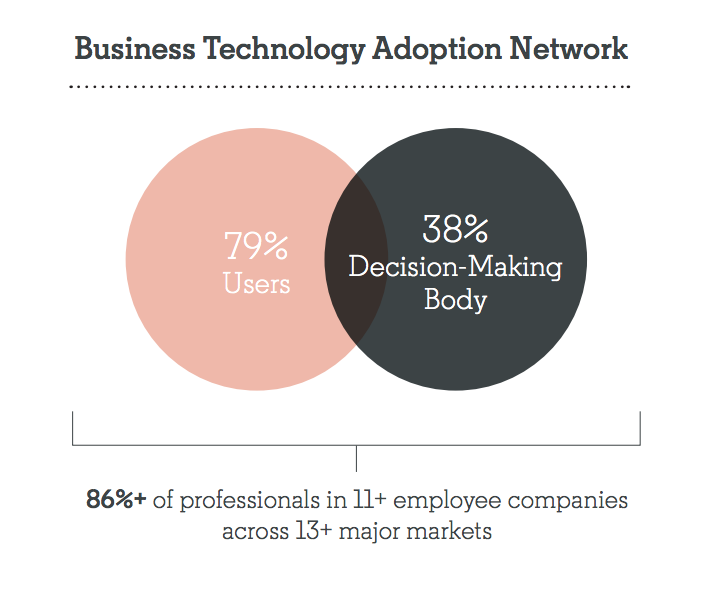
We all know that, in general, B2B buying committees are expanding faster than the Night King’s army of wights. This dynamic is especially pronounced in the tech space. “Where previously 3/4 of enterprise employees were part of technology decision-making,” LinkedIn reports, “today the total universe of end-users and decision-makers who impact business technology investments encompasses 4/5 of employees (roughly 86%).” Tech Buying Decision-Making As tech products and services become increasingly integrated with every aspect of an organization, more voices are coming into play. End users, external influencers, and cross-functional stakeholders all tend to have a role. This reinforces the imperative of establishing strong brand awareness throughout a business, which is a central focus of account-based marketing.  

#2 - The Purchase Cycle is Shortening

The report notes that the process of reviewing, selecting, and implementing new tech solutions has accelerated over the past few years, with the average purchase cycle now checking in at about 25 months. This could be viewed as good news or bad news, depending on how you look at it. On the one hand, that’s still a fairly long timespan, providing plenty of opportunity for marketing content to make an impact. Meanwhile, the increase in velocity could suggest buyers are becoming more deliberate and urgent in identifying solutions. But on the other hand, this also means that we as marketers have a smaller window than before to engage and persuade. We now need to make each interaction count more than ever — especially if we’re pursuing a new account. LinkedIn’s study shows that shortlists are becoming more competitive than ever for vendors.

#3 - Vendor Websites Are a Prime Resource

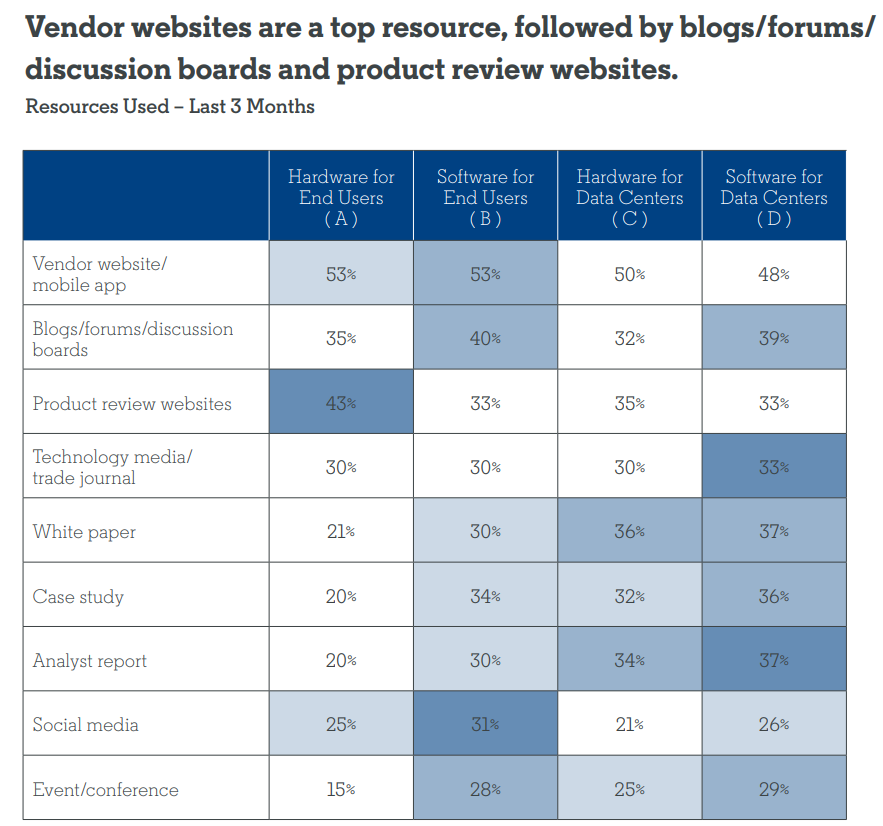
Across every B2B tech category, vendor website/mobile app is the top research destination for buyers. In aggregate, this source is followed by blogs/forums/discussion boards, product review websites, and technology media/trade journals: In short, buyers are seeking out trustworthy information — be it from a company’s own website or from unbiased third party resources. This accentuates the importance of building credibility with best-answer content, which can satisfy a decision maker’s questions during research while also positioning your brand as helpful and knowledgeable.

#4 - Buyers Want Partners, Not Sellers

Above all, tech buyers value the overall quality of a product or service above all when choosing a vendor. (Duh.) But the next two factors are interesting: both the ability to consistently meet a buyer’s needs, and the ability to answer questions to a buyer’s satisfaction, rank above affordability/pricing in importance: Choosing a Vendor This is why the customer experience is becoming such an overarching imperative. Effective marketing now goes beyond the scope of traditional functions. Brands need to be readily available, with the right content at the right time. Strategies must account for every touch point. Always-on approaches are becoming the norm. And this level of attentiveness should go beyond the actual purchase itself...  

#5 - Smooth Implementation is Essential

Per LinkedIn, “The #1 indicator of customer renewal success is successful adoption and product satisfaction.” No surprise there. But it’s another reminder of why the full customer experience needs to be addressed. “The data shows direct vendor engagement among buyers dropping off in later stages of purchase, meaning that there’s an opportunity to be more present and engaged with customers post-sale,” according to the report. “Marketers need to play an active role in the implementation and adoption process of new technology. A seamless customer experience also demands alignment with customer support in activities, training and key education resources.” How can marketing continue to shape experiences in these later stages and after the sale? It’s a vital consideration for profitability, since we all know the relative cost of acquiring new customers compared to retaining existing ones.

Follow the Tech Buyers

None of the nuggets revealed in LinkedIn’s “Enlightened Tech Buyer” report are especially surprising, but they do reinforce some of the trends we see playing out at large:
  • Buying committees are becoming more distributed
  • Researchers seek out objective information and best-answer content
  • We need to help, not sell
  • Marketing is starting to impact more parts of the customer experience
To get the full scoop on today’s B2B tech buyer preferences, check out LinkedIn’s report. *Disclosure: LinkedIn is a TopRank Marketing client.

The post Top Takeaways from LinkedIn’s New ‘Enlightened Tech Buyer’ Report appeared first on Online Marketing Blog - TopRank®.

24 Apr 19:04

This Week’s Big Deal: Crafting the Perfect Outreach Email

by Amanda Bulat
Sales Outreach Email

Editor's Note: As 2020 approaches, we're looking back at some of 2019's most popular posts on the LinkedIn Sales Blog. This one ranked No. 6.

Twelve million.

That’s how many outreach emails were analyzed by Backlinko and Pitchbox for their new study, designed to determine what’s working and what is not in today’s environment.

“We looked at subject lines. We looked at personalization. We even looked at follow-up sequences,” says Backlinko Founder Brian Dean.

What did this deep dive uncover? We pored over the findings and pulled six takeaways that modern B2B sellers need to know. Use these data-driven insights to take your sales outreach emails to the next level.

6 Key Findings About Sales Outreach Emails

In the digital era, email has become one of the primary methods for getting in touch with a new prospect. We all know how important it is to get it right with that initial outreach. Here’s what the voluminous data from Backlinko and Pitchbox showed.

Longer Subject Lines Get More Responses
This is somewhat counterintuitive. “The shorter, the better” is a mantra that has always been impressed upon me, in this age of short attention spans and crowded inboxes. But the new research casts doubt on this presumption. Super-quick subject lines actually get lower response rates than more robust ones.

This is likely due to specificity. People want to have a clear idea of what’s inside an email before they open it. I know some salespeople have a tendency to run with brief and cryptic subject lines in order to capture a recipient’s intrigue, but the data suggests we’re better off providing a fuller description. One illustrative example shared by Dean in the article is using “Quick Question About Your Latest Blog Post” instead of “Quick Question.” Per the study, the sweet spot for subject line length falls into the 36-50 character range.

On LinkedIn, we recently shared tips for optimizing InMail subject lines for better response rates.

Following Up Greatly Improves Response Rates
Meanwhile, another commonly held perception was reaffirmed by the new analysis: following up makes a big difference. Findings show that a single follow-up email can boost response rates by up to 65.8%, and sending three or more messages further helps your chances.

“With 100+ emails to sift through per day, the chances of your single outreach email getting seen, opened and replied to is pretty slim,” writes Dean. “But when you send more than one message, you have yet another chance to stand out and push through the noise in someone’s inbox.”

Of course, there is always a delicate balance between being persistent and pesky, so be mindful of that. Ideally, you’ll always have a distinct reason for following up. Instead of “Just checking in,” it’s better to have a legitimate driver for the new email, such as, “Found another piece of content you might love,” or “Hoping to connect before I leave town for a week.”

Personalization is Essential
No one should be too surprised by this. We’ve known for some time now that B2B buyers don’t just expect personalization; they demand it. The research shows that personalized subject lines boost response rates by 30.5% and personalized message bodies improve them by 32.7%.

We’re not doing ourselves any favors by sending out the same canned outreach to a bunch of people. It’ll take a little more time to add personalization elements when drafting emails. But the effort is worth your while, and there are ways to become more efficient. For example, you can use Sales Navigator for Gmail to pull up a contact’s LinkedIn profile within the Gmail app, making it easy to tailor your outreach beyond simply including the person’s name.

Links to Social Profiles are Helpful
One interesting finding was that links to one or more of your social media profiles in the email signature seem to have a positive effect on response rates. “Messages that contained links to social profiles in the sender’s signature had a 9.8% higher average response rate compared to messages without them,” reports Dean. This includes an 11.5% increase with LinkedIn profile links specifically.

Recipients want to know that the person reaching out to them is, in fact, a real person. Linking to your social media profile makes it easy for someone to click through and learn a little more about you. Even if they don’t click the links, there’s a certain level of reassurance in simply seeing them there.

This is a nice benefit of using InMail on LinkedIn. When someone receives a message from you, they can see your face and click your name to go straight to your profile page. And if you’ve optimized your LinkedIn profile for B2B selling, you may want them to do just that.

Wednesday is the Best Day for Outreach
In the chart below, we see there wasn’t a huge difference in response rates based on day of the week, but Wednesday had a slight lead, followed by Thursday. As I think about my own inbox habits, this makes sense. Early in the week, I’m often catching up on emails and trying to get my arms around my tasks, while later in the week I’m tying things up (and maybe thinking about the weekend already). The middle is when an outreach message is most likely to catch my attention.

Expanding Your Outreach Increases Your Odds
“We looked at the effect that reaching out to several contacts at the same organization had on outreach conversions,” writes Dean. “And we found that, compared to a single contact, sending emails to more than one contact improves response rates by 93%.”

As buying committees become larger and more distributed, we need to expand our reach. Identify numerous key stakeholders within an organization, and try to get in touch with all of them. One handy tactic is to send the same PointDrive link to each of them; you can consult the tool’s analytics to see who engaged with what content, and who they shared it with. This, in turn, can help you identify other strategic contacts.

Increase Your B2B Sales Outreach Success

The patterns that emerged from this analysis of 12 million emails are hard to ignore. If you find the data interesting, I recommend checking out Dean’s full post on the email outreach study, as there’s plenty more to sort through. But start with the six we’ve highlighted: These few small considerations can make a big difference when it comes to driving responses.
 

Subscribe to the LinkedIn Sales Blog and never miss out on the latest big deal in B2B sales.


24 Apr 19:03

We Asked 11 Sales Influencers about How to Build Trust in the Sales Process. Their Responses May Surprise You

by Sean Callahan
Building Trust in the Sales Process

Editor's Note: As 2020 approaches, we're looking back at some of 2019's most popular posts on the LinkedIn Sales Blog. This one ranked No. 12.

The LinkedIn State of Sales report confirms that the trust factor is a key to closing deals. In the most recent report, sales professionals in the United States rank trust as the No. 1 factor in closing deals (40 percent) — above ROI and price. More important, 51% percent of decision makers rank trust as the top factor they desire in a salesperson.

Other findings in the State of Sales report indicate that professional and social networks are helping sales professionals better understand buyers’ needs and establish trust early on. For instance, 62 percent of decision makers look for an informative LinkedIn profile when deciding whether to work with a sales professional

To gain further insight into how trust impacts the buyer’s journey, we asked a cross-section of sales industry experts this question: “What are some critical ways that a salesperson can establish trust with prospects?”

Read on for their insightful answers... 

"You can’t outsource trust. Humans beings are literally wired to build trust with each other —that’s why we have big brains! Salespeople need to focus on building the human-to-human relationship with prospects and customers before asking for business. Although it’s important to meet your audience across a variety of different channels and media, if you hide behind digital communication it will be much harder. Getting face-to-face with someone, whether in person or video will be increasingly important. Ironically, as technology’s presence increases, our desire for human engagement also increases. The smart salesperson will leverage our interpersonal capacities to build trust and find success." — David J.P. Fisher, President, RockStar Consulting

One of the very best ways to establish trust with a buyer is to be referred to them through someone the buyer trusts — especially if outside of the their organization. The challenge for many sellers is that they don't develop a process to connect with strategic referrers who could make these great introductions on an ongoing basis. Otherwise to build trust without being referred in, be credible, authentic, and share stories on ways you've solved issues similar to those you are proposing to your buyer to solve. — Lori Richardson, CEO, Score More Sales/President, Women Sales Pros

"There are 4 key elements or trust:

  • Capability — are you good at what you do? Can I trust you with the work output?
  • Dependability — will you show up and meet your commitments? Can I trust you will do what you say?
  • Integrity — do you have virtue of purpose? Can I trust you will do the right thing by me even when it might be in your self-interest not to?
  • Intimacy — how well do I know you? Can I trust the strength and depth of our relationship?

To this last point, just getting to know someone builds trust. The RAIN Group Center for Sales Research conducted a survey and asked how many people in general were trustworthy. The most common response was 30 percent. Of the people you know, how many are trustworthy? The answer more than doubled to 70 percent. Intimacy is getting to know people well. Do that and you’ll build trust. However, they all work together. There are people I know well and deep relationships with (I ‘trust’ the strength of our relationship), and they have high integrity (they’ll do the right thing) and they are good at their work (they’re capable) but they don’t meet their commitments and never show up on time (they aren’t dependable). So, I trust them in some ways and not others. — Mike Schultz, President, RAIN Group

"It’s all about research and preparation. Sellers need to know their buyers’ industries as well, if not better, than the buyers themselves. That comes down to taking the time to research. Read the company’s press releases. Study them on social media. Take a deep dive into their website messaging, and what analysts are saying about them. If you don’t enter a sales pursuit with a deep understanding of the business problem and the ability to prove that you can solve it — you will lose a lot more than you will win.It ultimately comes down to confidence: Modern sellers must always prove they understand the business problem, prove that they have solved it for other buyers and prove that if the prospect makes an investment they will get a hard ROI. Research, preparation, and focus helps instill that confidence, which in turn instills trust in the buyer." — Ed Calnan, Founder-President, Seismic

I think the easiest way to establish trust is to align the natural strengths of the seller with the buyer’s conversation, and to enable this with tools to get the message out. Far too often sales leaders do not hire with this in mind. They think in terms of skills rather than alignment of the marketplace. This is important for trust. Salespeople can capitalize on their strengths in simple ways. By doing what they say by when they say it will be done. By being able to deliver the resources of their firm in ways that matter to the client. And by anticipating obstacles that may arise before the customer encounters them. —  Tracey Wik, President, GrowthPlay

"Adding value outside of the sales process is the number one way. Help people. Genuinely care about them, and show it. If you are a tech company, provide cybersecurity advice, or provide free tech to help for your customers for example. If you are in finance, provide helpful banking advice, for example, around saving, compound interest, free webinars and tools. Steady streams of this kind of content and tech will set certain companies apart from others, and it’s already happening. At the end of the day, you don’t want to be a sale rep, you want to be someone’s trusted business partner — their buddy. Because when they need something (or have assets under management to invest), they are not going to call a sales rep, they’re going to call their buddy, whom they trust. And help in the community! Not because you want the PR, but because you genuinely want to help people. It goes a long way to building trust as well." — Robert Knop, CEO, Assist You Today

Trust is the X-factor in sales as it accelerates client time-frames and increases commitment. Salespeople can best build trust by showing they undertsand the buyer and that they have shared values. Value and trust go hand-in-hand for sales success. To rapidly built trust, every seller should provide value in a conversation before seeking to position the value of what they sell. They can do this by focusing on doing research and showing insight in a ‘point-of-view’ highly relevant to the customer’s business results. This then earns the right to ask the right questions to then truly listen, take notes, and use relevant stories and examples. They should also display shared values of professionalism in respecting time, having an agenda, focusing on the customer’s business case, tangible results, managing risks, securing consensus, achieving the customer’s KPIs. The way we engage the buyer, by providing value and building trust, is the strongest way to differentiate and increase the probability of success. Lead with 'them and their outcomes', rather than 'you and your solutions'. — Tony Hughes, Managing Director, RSVPselling

"Salespeople should be sharing valuable content/insights driven by business acumen. They should understand the ecosystem that their product/service operates in and be willing to refer the prospects outside their own company to increase the value of the total solution." — Kurt Shaver, Chief Sales Officer, Vengreso

"Talk about yourself last.  Prioritize the customer’s story first.  Literally wait as long into the sales process and conversation as possible to talk about your product and services.  Establish and ground the buying journey on the customer’s needs, pain and objectives.  Recognize and respect that the buying journey trumps your sales process." — Matt Heinz, President, Heinz Marketing

Do your homework, the buyer is generally more informed than you give them credit for. Listen, learn and earn the right sell. Start having conversations and stop giving presentations. — Roderick Jefferson, CEO, Roderick Jefferson & Associates

"Trust is built when a buyer believes that the sales rep is interested in the buyer’s best interest. The challenge is, how does a sales rep demonstrate that to a buyer? There are a couple of key things that must take place:

  1. Show the buyer that you know them.  Tailoring communication and researching the buyer is critical to communicate effectively and demonstrate your knowledge of the potential buyer.
  2. Listen! So many sales reps are so busy talking, or waiting to talk, that they don’t actually listen to understand.
  3. Add value. Don’t waste your prospect’s time with your agenda. Make sure you add value to their time and meet and exceed their expectations." — Julie Thomas, President-CEO, ValueSelling Associates

For more insight into trust’s crucial role in the sales process, download the State of Sales Report today.

Photo: Lars Plougmann

24 Apr 19:02

7 Sales Prospecting Tips and Tricks to Share With Your Team

by Katy Kendeall

We all know that the rise of the internet has changed the way people do business in about a million different ways. It has changed the way that buyers buy, and therefore, the way salespeople sell. A salesperson’s Rolodex used to be their most important asset. Although relationships are still a key ingredient of sales, they are no longer the only ingredient. Technology has become entrenched in the sales process, changing sales from just an art to both an art and a science.

I would argue that prospecting, specifically, is an art and a science, and if there is one thing that I’ve learned so far in my career in sales, it’s that there is no magic bullet.

However, there are some prospecting tips and tricks that can help your sales.

1. Consistency Is Key

It’s easy for prospecting to fall to the wayside when you are further along in the buying process and in closing business. Sending out contracts and finalizing paperwork are high priorities, and prospecting can be the last thing on your mind. However, if you want to see consistent results in your prospecting efforts, you need to be consistent yourself. Prospecting is something that should be done each and every day. Make a weekly plan when it comes to prospecting. Blocking time on your calendar for prospecting efforts will help remind you daily to get it done.

2. Eliminate All Distractions

During your designated prospecting blocks that you’ve put in your calendar, go on “do not disturb” mode so that you aren’t distracted by the tasks you tend to get buried by each and every day. Try not to answer any other emails or calls. Hang a sign outside of your door or cubicle. Do whatever you need to do to ensure that you are free of distractions.

3. Prospect in Chunks

You will be much more efficient if you do all of your outreach in chunks. For example, you could start your prospecting block by making all of your outreach calls in a row. Not only will you feel more comfortable on the phone after making calls repeatedly, but it is more time-effective as well. You will get a lot more out of your time than if you were to make a call, jump on LinkedIn, prep for a demo, and then go back to make another call. Getting all of your prospecting done in chunks will help you stay in the prospecting mindset.

4. Use Every Channel Available

It takes 18 calls or touches to connect with a buyer, so utilizing all of the different methods available to you is key. Even if you are really good on the phone or write stunning emails, you should include all of the different outreach methods in your arsenal. There are many ways you can get in front of your prospects, including phone calls, emails, social networks, videos, voicemails, networking events, trade shows, and direct mail (never underestimate the power of a handwritten letter) to name a few. There are some amazing free tools that can help you stand out like Vidyard’s GoVideo Chrome extension and LinkedIn’s voice messaging feature. Alternating between different methods and using unique messaging for each touch point allows your prospects to consider your offer and respond at a time that is convenient for them.

5. Use Technology

There are so many ways technology can help your prospecting efforts. I know updating your CRM can be tedious, but your CRM is your friend. Use the tasks feature within your CRM to stay organized and keep you on track. There is a sense of gratification when you are able to cross a task off of your to-do list! You can use Datanyze to learn more about your prospects’ companies and the technologies they are using. Google Alerts allow you to track keywords that are relevant to your prospects. HubSpot’s technology makes it easy for you to automate your follow-up emails by sending a series of timed, tailored emails to your prospects. When I first found out about sequences within HubSpot, my mind was blown! It’s a prospecting game changer.

6. Don’t Dwell on Mistakes

Selling is hard! Even the best and most tenured salespeople fumble their words from time to time and don’t have the answers to every question. We are all human, and mistakes happen. Not only are mistakes inevitable, but they also help us grow. Your prospects don’t expect you to be perfect—you shouldn’t expect yourself to be either. Acknowledge your mistakes and move forward.

7. Celebrate the Wins

In sales, you are faced with a lot of rejection. Learning to celebrate the small wins can help you stay level on the roller coaster ride that a career in sales can be. Did you hit all of your prospecting goals this week? Did a prospect compliment you on your knowledge? Did your colleague give you a shout-out? Pat yourself on the back. Like I already mentioned, selling is hard and reminding yourself of your victories can be crucial to finding balance.

Prospecting is the lifeblood of selling. With these tips, you can get more out of your prospecting efforts, stay even keel, and find ways to stand out from the crowd.

24 Apr 19:01

3 Alternatives to Email That Drive As Many MQLs (Or More)

by Jessie Coan

Traditional email marketing is a rinse-and-repeat process that we’re all familiar with: you get a list of target accounts, validate their contact information, send emails, review results and repeat until you get your desired results. The rinse-and-repeat email method can work to generate MQLs, but it’s costly — both financially and in terms of the amount of time and effort spent. And putting your time and efforts in the right direction makes a tangible difference.

When was the last time you reviewed email marketing process and its effectiveness in terms of driving MQLs?

Earlier this month I presented a webinar with our friends over at Drift that delved into just that. It was filled with tips and tricks that are useful for marketers everywhere who are looking to take their strategy to the next level — specifically three intent-driven alternatives to email that are just as (if not more) effective.

Managing the Customer Journey

Based on our research from 2018, only about 50% of the Best-In-Class create models of customer buying behavior processes to map the customer journey — but what does this mean?

Well, it tell us that people aren’t actually diving into their processes to figure out which ones work or if their current processes even make sense.

Utilizing quality intent data gives marketers clear visibility into the customer journey, ridding marketers of any sort of trial-and-error and offering:

  1. The ability to capture a broad set of behavior data
  2. The highest accuracy of keywords
  3. The ability to compare past activity with present activity and narrow down location of intent

By using the right intent data, we’ve seen 2-5x the increase in landing page conversions with campaigns. It allows marketers to see when a need arises based on buyer behavior. As seen in the chart below, the customer journey starts with a pain point — and the marketers journey historically has started in helping customers identify the pain.

With intent data, Marketers can get ahead of that identification point — based on buyer behavior, the marketer can tell before the customer really even knows they have an issue.

Using intent data to identify when a prospect may have a pain that they’re trying to solve as early as possible is the first trick that gives the marketer the upper hand when building their messaging and attracting that prospect.

Thinking Dynamically About Your Account List

With the rise of ABM, how often do you update and review your target account list? Maybe twice a year?

Static account lists are just that — static. They don’t take any sort of intent signals or buying signals into consideration.

With intent data, you’re able to focus on the folks who actually have a need at this point in time, while still nurturing and creating content for all stages of the funnel. Taking into account the buying intent signals, you can see who is actually in market, evaluate what websites they’re visiting, and identify look-a-like com panies on a rolling basis to expand your options for targeting.

The key to thinking dynamically is around intent qualified demand. Hammering the same accounts and contacts over and over may not yield the best results. With a process like intent-qualified demand, you use the dynamic account list to target your outreach efforts to folks who are currently in-market or showing intent.

Alternatives to Display Advertising

Many of you are probably using display ads and paid search for your campaigns, but do you know how much of your budget is really reaching your target audience?

Use your money wisely and target not only based off firmographic data, but also buyer behavior, location information, intent signals. Intent data to shows you where buyers behavior signals are spiking or increasing, allowing you to create ads for the right location at the right time .

Or, if there are niche communities across the web discussing a particular topic, intent ads can be pointed to show up on those websites – saving you money and targeting the right prospects rather than spending big bucks on the main, standard sites where you’re competing with everyone for a small slice of the pie.

The table below reveals main differences between intent targeted ads and current display ads:

Take Your Strategy to the Next Level

The three main takeaways from the webinar boiled down to this: Using intent data to put the message where the audience takes your strategy to the next level and gives you just as many MQLs (if not more) as traditional email marketing – in a more efficient manner.

So when you review if your email marketing strategy is working to drive as many MQLs as possible in a cost and time efficient manner, remember that intent data is what keeps you one step ahead of your prospects at all times. Think about your ABM lists in terms of needs dynamically changing who’s in-market, and don’t underestimate the power of display ads.


Do you know which specific companies are currently in-market to buy your product?

Wouldn’t it be easier to sell to them if you already knew who they were, what they thought of you, and what they thought of your competitors?

Good news – It is now possible to know this, with up to 91% accuracy. Check out Aberdeen’s comprehensive report Demystifying B2B Purchase Intent Data to learn more.

24 Apr 19:01

Top 10 Marketing Automation Benefits for B2B Firms

by Elizabeth Harr

As a leader in your professional services organization, you know you need to continually improve the way you attract and nurture new leads, as well as grow existing business accounts. And the automation of such tasks and decisions that can be so central to the growth of a firm, yet so painstakingly manual, is alluring for sure.

Yet new automation capabilities borne out of AI and machine learning seem to emerge daily just as you think you’ve determined your ultimate strategy. There are literally thousands of products out there with overlapping capabilities, complex functionality, and constantly evolving features.

In this article, I’ll present six marketing automation use-cases to help you as you consider your own martech stack. I’ll also address the top benefits of marketing automation. I’d like to start first, though, with a definition of professional services marketing automation (MA).

Marketing Automation Defined

As the name implies, marketing automation platforms take the labor and drudgery out of several marketing tasks and workflows, making it easier to engage and convert key buyers of your services. They also can be used to measure the effectiveness of different tasks to give you a better sense of what works, what doesn’t, and why.

More formally, marketing automation is the use of sophisticated software platforms to automate both routine and complex marketing processes, reducing costs and improving effectiveness. It allows firms to simultaneously personalize andscale their marketing programs.

The feature sets in marketing automation platforms vary widely. Some of the most common features include:

  • Email marketing
  • Forms, landing page, & microsite creation
  • Campaign management and cross-platform integration
  • Lead scoring and management
  • Social media marketing
  • Search engine optimization support
  • Content marketing
  • Analytics

Lastly, while marketing automation software is often compared to customer relationship management (CRM) software because of their overlapping functionality, the core function of CRM is to capture, track and analyze leads, prospects, and clients for sales departments. Marketing automation platforms, on the other hand, are built to deliver, accelerate and scale marketing program — making each touch more personalized and focused.

Marketing automation works across multiple marketing channels, including your website, social media networks, and offline channels including direct mail. As a comprehensive marketing solution, it also helps identify, track and nurture key leads and measure your marketing return on investment (ROI).

That’s the what. Let’s explore the why. What’s the use-case for marketing automation?

6 Marketing Automation Use-Cases

1. Marketing automation adoption is growing fast.

The marketplace for B2B marketing automation has experienced rapid growth over recent years. As the figure below shows, it is reasonable to expect that trend to continue. That growth is clearly impacting professional services. Our most recent High Growth Study shows that 84% of professional services firms see marketing automation as a part of their strategy. Further, 22% of firms see MA as one of their top priorities for this year.

Figure 1. Global marketing automation software market, by enterprise size, 2014 – 2025 (USD Million)

Source: Grand View Research

This trend is not surprising given the importance of nurturing relationships and building trust in the professional services business development process. Increasing the visibility of one’s expertise is a key way to nurture prospects and win new clients — and marketing automation is ideally suited to support these goals.

2. The sophistication of the underlying technology is rapidly increasing and creating a knowledge gap.

As advanced technologies such as speech recognition, predictive analytics, sophisticated testing and artificial intelligence become more integrated into marketing automation software, these platforms will become more and more capable. Even today, these advanced systems often offer more functionality than most firms know how to apply. And this trend is only likely to get worse as more advanced features are added in the coming years.

This situation has created something of a knowledge gap — and many professional services firms understand they need to address it. Well over half of firms (57%) are planning to tackle this need with additional training or by engaging an outside resource. Firms that fail to make the most of their MA investment, however, are likely to experience disappointing results.

3. Industry-focused marketing automation platforms and applications are likely to proliferate.

As new marketing automation vendors enter the market and competition intensifies, we expect to see the introduction of more systems and applications targeted at a particular industry (or other niche) as a strategy. For example, Cosential offers a system designed specifically for the needs of AEC firms. And Higher Logic has built a platform to serve the unique needs of membership organizations. This movement toward specialization makes sense for the platform developers, who want to differentiate their products from the tidal wave of competing products, and it makes it easy for professional services firms to find a suitable MA platform for their clientele. We expect to see this trend toward specialization to continue.

4. Firms that do not embrace digital marketing are falling behind.

Marketing automation has grown out of the digital transformation of communications and evolving buyer expectations. As you might expect, professional services firms that embrace digital techniques tend to outperform those that do not.

The fastest growing firms are much more likely to embrace digital marketing strategies. And those that do not are at a competitive disadvantage. Their marketing activity is likely to be more costly, less effective and reach a smaller audience. In a highly competitive marketplace this is not an enviable position.

5. Hyper-personalization is the new normal.

When many people hear the word “automation,” they think “impersonal,” “rote” and “canned.” In fact, automated marketing solutions can be highly effective at hyper-personalization.

With MA platforms, you can create emails that are personalized well beyond adding the recipient’s name in the greeting. According to Chadwick Martin Bailey, a full 56% of people will unsubscribe from emails because the content is no longer relevant. To combat this, you need to send information that is germane to individual prospects. Of course, you need to keep up with what you know about each lead, and what you know will likely change over time. Marketing automation manages this information so that you send only information that is likely to be of interest to a lead or client. This way, you remain visible to leads without wasting your time, seeming pushy, or becoming irrelevant.

Take, for example, Prospect A. You first make contact with Prospect A when she subscribes to your email newsletter. After a month of receiving emails, she registers for—and attends—a webinar, “How to Build the Perfect Professional Services Website,” which was promoted in your email. The logical follow-up to the webinar is an email with a link to a related guide, such as “The Lead Generating Website Guide.” You set up your marketing automation platform to send out that guide offer within a day or week of the webinar. All of these interactions pull Prospect A deeper into the funnel. At some point your business development team takes over, and the engagements go offline.

The automation platform creates each of these multiple customer touch points, deepening the relationship over time. Automation gives your firm the opportunity to stay visible to your target audience and dramatically improves the odds of sending the right message to the right person at the right time.

6. Marketing budgets will increasingly include marketing automation platforms.

Spending for marketing automation tools will grow vigorously over the next few years, reaching $25.1 billion annually by 2023 from $11.4 billion in 2017 according to a 2018 Forrester report, “Marketing Automation Technology Forecast, 2017 to 2023 (Global)”.

Before investing in a marketing automation platform, make sure you have buy-in from your firm, a website that captures leads, and a CRM or prospect list. And you’ll have a leg up if your firm is already producing high-quality educational content. However, some firms begin creating content and using automated marketing at the same time.

Marketing automation platforms are typically cloud-based, software as a service (SaaS) subscriptions. Each offers different automation and analytics tools, but many are bundled into automation suites. Don’t be intimidated by expensive automation platforms. There are systems that cost thousands of dollars a month, but you can get started with leaner systems, like Drip & Automizy, for just $50. The key to success with these elementary options is to stay client-focused and don’t go on autopilot.

10 Marketing Automation Benefits

Marketing automation can help you accomplish many of your strategic marketing goals. The trick is to understand which strategies make sense for your firm. Understanding your strategic goals also helps you identify what metrics to track and optimize. Here are the strategies most aligned with the needs of professional services.

1. Attracting more new leads. A very common goal for many firms, developing a flow of new leads is something that most marketing automation systems are well suited for. Often this involves some combination of SEO-optimized content, social media and guest posting to drive visibility. With the ability to automate implementation and track sourcing across platforms, you can measure success and optimize your program accordingly.

2. Better qualifying new leads. As you attract more prospects, some will be qualified and ready to engage. Others are far from it. How can you tell the difference? Part of the answer is in the content you are sharing. If it is well targeted, you will find that your better prospects will be naturally attracted to it because it speaks directly to their needs. You can also try lead scoring. Most systems with CRM capabilities will automatically assign leads a readiness score based on predetermined behavioral criteria. These two mechanisms work together to accomplish your strategic objective of cultivating better-qualified leads.

Imagine knowing which of the 5,000 leads in your CRM are hot and which have become cold. With marketing automation platforms, you can rank each lead by lead scoring—a point system used to calculate the value of a prospect based on behaviors and qualifications.

For example, a person that attends a webinar gets more points than a contact that registers but doesn’t attend. Lead scores can also decay over time if a contact does not stay engaged.

The goal when using marketing automation is to not hand off a prospect to the business development team until he or she becomes a hot prospect and is ready to talk. At this point, the prospect has a relationship with the firm (and in some cases, your experts). With content and marketing automation, your business developers can usually close deals faster because they do not need to explain your firm’s offerings and the prospective client sees the value in your firm.

3. Segmenting your database for better targeting and more personalization. All prospects have different needs. It doesn’t make sense to treat them the same. However, when you have a single gigantic list, it can be hard not to. That’s why these systems provide tools to automatically segment your list by demographic or behavioral criteria. When you layer criteria like these, your marketing strategy effectively becomes “personalized.”

The key, of course, to getting the right message to the right audience is segmentation. You want to segment your list as much as possible and tailor the journey from there. Marketing automation allows you to segment nearly any data point, including location, job title, job responsibilities, business revenue, status (lead, prospect, RFP/proposal, active client, past client), or the last time on your website.

Depending on the platform, segmentation can be highly dynamic, adjusting (adding or subtracting people) for a series of data or conditions. There are several benefits to dynamic segmentation.

  • Keep messages relevant to a particular lead based on where they are within your sales funnel.
  • Remove a person from a business development list once they have become a client.
  • Send offers based on several different characteristics (e.g., location, revenue, or industry). For example, if you’re presenting at a conference in New York, you can email a personalized invite to leads within 100 miles. With segmentation, you will not bother a prospect in California with a useless invite. This is why sending relevant content is so compelling. In fact, relevant emails delivered through marketing automation drive far more revenue than generic email blasts!
  • If done manually, such dynamic segmentation would be overly time consuming and prone to error. A well-designed marketing automation platform lets you set it and forget it.

4. Nurturing your leads to develop better opportunities. Some professional services industries work on very long closing cycles. You could easily spend years waiting for a potential client to need your services. Professional services are not impulse purchases. Fortunately, managing a nurture or “drip” campaign is something these systems do well — so much of your middle-funnel nurturing can be automated. The timing and content of these “touches” can be programmed in advance so that little ongoing attention is required.

Many marketers create amazing guides, webinars, infographics, and other content. Unfortunately, they promote each piece of content once and move on to the next piece. It may be more effective to use that content sequentially based on behaviors and segmentation. Using sequences, you can deliberately move a lead through your pipeline, from cold lead to hot prospect, giving them the education they need to trust and prefer you along the way. If they don’t respond to something in the sequence, resend that item. (They won’t know you’re resending it.)

The relationship with your firm’s content is vital because clients are doing more due diligence online. We know that 80.8% of referrals look at your website. This is a great opportunity to start a relationship with your firm by supplying them with great content — distributed through an automated marketing solution.

5. Identifying sales-ready opportunities. At some point, many of the leads you have been nurturing will need the services you provide. If these individuals have been well nurtured, they will know how you can help them, and your firm will be top of mind. They may even prefer you over other firms. When the time is right, they will reach out to you. In the meantime, there are a number of techniques to probe for interest. For example, you can configure the system to send out a free consultation offer from time to time. In this way, you can look for opportunities while minimizing your time investment.

6. Making your expertise more visible. In the professional services we have a major marketing challenge. We sell expertise. As valuable as that is, however, expertise is invisible. So how can a prospective client learn about your expertise? The best way is to demonstrate it — to make it visible and tangible. This can be done by educating your audience, using blog posts, webinars, videos, public speaking, social media and the like to show people who are interested in your area of expertise how you solve problems like theirs. Marketing automation is an ideal tool for delivering this information to the right prospect at the right time.

7. Improving client retention. Many professional services are episodic. Clients need a firm from time to time, but not continuously. From a firm’s perspective, maintaining an on-and-off client relationship when you are busy working with other clients can be difficult. Further, many past clients may not realize the full range of your firm’s expertise and seek out someone else to do work you could easily handle. Marketing automation, however, provides some relief by automating many of these ongoing interactions. Good programing outperforms good intentions.

8. Tracking and optimizing marketing investment. Figuring out what works in a marketing context has always been challenging. The tracking capabilities of today’s modern marketing automation platforms help answer that eternal question. Cross-channel integration allows you to track and optimize your strategies, providing the insights you need to improve your ROI.

9. Increasing productivity of your marketing team. This is an easy one to score as a win. By their design and functionality, professional services marketing automation systems almost always have a dramatic impact on marketing team productivity. That’s what they were designed to do: take the repetitive drudgery out of marketing campaigns. Of course, they need to be set up initially — a laborious process — but after that, the time savings accrue every day.

10. Saving billable time. The battle between billable time and business development has long been a fixture of the “seller-doer” model. Potential clients want to meet and get to know whom they will be working with. As the person with the expertise, you are the product. So if a prospect is screened, qualified and nurtured in advance of interacting with the billable professional, that saves a lot of non-billable business development hours. Better-qualified, better-educated prospects maximize billable time.

And on that note…

When you reflect on this list of marketing automation benefits, it is easy to see why marketing automation as part of the martech stack has enjoyed so much growth and innovation. Marketing automation is here to stay, and before long it will be a standard part of all professional services marketing programs. When properly implemented, it is a way to both personalize and scale your marketing strategy. It is also well suited to building the awareness of your firm and establishing trust over time, which makes it a great match for any professional services firm.

Of course, there are challenges and pitfalls. No marketing automation system will turn bad messaging into good leads. Your strategy must be built on a solid understanding of your target audiences and your firm’s strengths and weaknesses. And there is that yawning skills gap. Platforms are only as effective as the wisdom and skills of the team that sets up and operates them. But as as your skills, understanding of your target audience and messages align, marketing automation becomes an increasingly powerful — even essential — tool.

24 Apr 19:01

9 Things Terribly Wrong With Sales Today: Lack of Coaching

by Keenan


Sales is suffering from 9 brutal ills:

  1. The Bro Culture
  2. Lack of Coaching


  • Too Product-Centric
  • Not enough salespeople understand the game/rules of sales
  • Too much reliance on selling tools.
  • Not enough training in the industry/space
  • Too much activity management
  • Little respect for prospects and buyers time
  • Not enough humility

I tackled the Bro-Culture in the first of this series because I feel culture is critical to change. But as important to eradicating the “bro culture” in sales it’s equally important that we elevate our coaching game.

I see coaching from two angles, the ability of the rep or salesperson to be coached and accept the coaching and from the ability of sales management to coach effectively.

Coaching is the biggest, non-financial way for sales organizations to improve their number and grow. Look it like maximizing your existing resources. It’s like getting the most out of what you already have. And that’s how it should be perceived.

People are the most valuable resources in an organization, and therefore the organizations should be built to maximize the output of those resources, via coaching.

Unfortunately, the lack of coaching in sales today is atrocious. According to our recent Sales Coaching and Quota attainment report, although 80% of sales managers/leaders believe they coach. less than 50% of sales people feel they are actually getting coached. This is a major disparity.

Whatever sales leaders and managers are doing, it’s not being perceived as coaching and therefore it’s not working.

This wasn’t the only powerful coaching data we uncovered.  We also found that there is a direct correlation to coaching salespeople AND quota attainment. You can download it here: 

As I said earlier, sales coaching is a two-way street and I’m not going to lay the abysmal state of sales coaching solely on sales managers and sales leaders. Salespeople are just as culpable.

For whatever particular reason, although they say they want to be coached, salespeople have a tendency to resist coaching. That is, they feel that if they are being coached it implies they are not good or are not-performing and this couldn’t be any further from the truth. Over-achievers know that they can always get better and are constantly looking for ways to improve their skills and coaching is a critical part of that.

It’s time salespeople and sales leaders come together and work to create a coaching culture within their sales organization.

It’s time leaders learn to effectively coach and recognize coaching isn’t a monthly performance review or providing overly critical feedback. But rather, a productive opportunity to develop and support their salespeople.

It’s time salespeople let go of their ego and start self-reflecting in an effort to understand where they can improve and how improvement will elevate their sales game.

Strong coaching cultures underpin strong sales organizations. They establish fantastic working relationships. They promote improved communication. They create better employees and most important to a badass sales organization, they foster a safe working environment.

Let’s elevate our coaching games and stop treating each other like cogs in a wheel, but rather like the valuable assets we are. Remember, we’re all on the same team.

Next, I tackle how product-centric we are and how it kills our deals. 

The post 9 Things Terribly Wrong With Sales Today: Lack of Coaching appeared first on A Sales Guy.

24 Apr 18:59

Do People Want to Buy or be Sold?

by Mark Hunter

Would you rather be sold something or would you rather buy something? Nobody wants to be sold something but they do want to buy. The question is, why do they want to buy? The answer-they want to gain something. Breaking this down more means customers are really looking to make an investment. They are willing to give you money in exchange for a product or a service that will help them.

In my book, High-Profit Selling, I write a lot about the concept of shifting our thinking to help us better understand why the customer would want to invest with us. It does not matter if it is business to business or business to consumer, the concept is still the same. The purchase is an investment.

Ask yourself if the questions you ask your customers are focused on getting the customer to see what you’re asking them to do as an investment. The immediate shift is to get away from talking product features and getting the customer to talk about the benefits or outcomes they are looking to achieve. Once the customer sees the value in the outcome they can achieve, then we are in a position to have them buy.

In my book, High-Profit Selling: Win the Sale Without Compromising on Price, I talk a lot about this issue. If you have not read my book, High-Profit Selling, I strongly suggest you get a copy today.

Right now you can grab a Kindle copy of the book High-Profit Selling for only $2.99. This is a special offer for the month of April only. Once April is over, so is the low price.

Give it a read, leave a review, and let me know how it helps you and your company. I know it will!

Copyright 2019, Mark Hunter “The Sales Hunter.” Sales Motivation Blog. Mark Hunter is the author of High-Profit Prospecting: Powerful Strategies to Find the Best Leads and Drive Breakthrough Sales Results

24 Apr 18:59

Skills Every Sales Development Rep Needs to Master — Advice Directly from a Sales Professional

by jrichman@hubspot.com (Jason Richman)

I worked as a sales development representative (SDR) at IBM for the first five years of my sales career. I learned then (and appreciated even more as an account executive) that SDRs are often the unsung heroes of high-performance sales teams. I still appreciate the critical role that SDRs play in gathering account intelligence and building credibility with campaign responders when they call or email me when my research crosses paths with their campaigns.

My experience in this role provided me with a sales development process and a foundation of sales skills. As my career progressed, I often applied the ice-breaking and credibility-building skills I learned as an SDR to be a more successful inside sales and field sales rep. I learned how to build rapport and engagement with prospects, use value-based selling techniques, actively listen to prospects and customers for signals, ask questions, and handle objections.

Download Now: Free Sales Prospecting Guide + Templates

In this post, I’ll define SDR sales and what an SDR is. Next, I’ll dive into the skills every sales development rep needs to master and, finally, how to succeed as an SDR.

Table of Contents

Next, let’s review what SDRs do and how their responsibilities differ from other sales roles.

What is an SDR?

A sales development representative is a sales or marketing team member who is responsible for prospect outreach and lead qualification related to inbound marketing campaigns. They are often confused with business development representatives (BDRs) who develop leads through outbound prospecting within a defined territory or industry.

As an inside sales team member, an SDR focuses on inbound prospecting, moving leads through the pipeline, and qualifying the leads they connect with. While SDRs don’t close deals, they help sales reps by determining whether a lead will be an ideal customer fit.

what does a sales development representative do, sales development representative skills

What does an SDR do?

According to Orum’s 2024 State of Sales Development, which surveyed 1,000 sales leaders, 70% expect to add more SDRs to their team in the next year. The field appears to be growing, but what exactly does the role entail?

SDRs are measured on their ability to move leads through the sales pipeline. They focus on qualifying, contacting, and nurturing quality leads — strengthening relationships with the right people by offering value.

Yechiel Gartenhaus, co-founder at Clavaa, says, “SDRs are the real engine behind any company’s pipeline — they figure out who’s actually worth the sales team’s time. Their channels? Grinding through cold calls, firing off emails, and sliding into LinkedIn DMs.”

According to Gartenhaus, SDRs need research chops, a thick skin for rejection, and the ability to talk to strangers “without sounding like a robot.”

“ At the end of the day, their paycheck depends on setting up meetings and making connections that stick,” Gartenhaus says.

He adds that he isn’t looking for order-takers or script-readers at his company. “The SDRs who crush it aren’t just playing the numbers game — they’re studying their data, crafting messages that feel like they were written just for you, and constantly tweaking their approach based on what actually works,” he explains.

And what does the 9-5 of an SDR involve?

Marty Bauer, director of sales and partnerships at Omnisend, talks about a general day in the life of an SDR at the organization he works at.

  • 9-10 a.m. Catching up on emails and responses from prospects, as well as following up while the leads are still warm. On Monday, the company-wide all-hands meeting takes place.
  • 10 a.m.–12 p.m. Proactively reaching out to potential customers (either through cold-calling, email, WhatsApp, pre-booked meetings, or any other channel the prospect prefers). If it’s Monday, we’ll have our weekly sales team meeting before lunch. At 12 pm, we have our lunch break.
  • 1 p.m.–5 p.m. More meetings and follow-ups. Any team meetings we had planned in advance usually happen around this time. Depending on the day of the week, a weekly one-on-one meeting takes place between an SDR and their manager. At the end of the day, we encourage planning for the next day or week to ensure a smooth start. On Fridays, the sales team catches up on their weekly metrics and quarterly OKRs, and prepares for the following week.

While SDRs qualify and cultivate leads, sales reps are measured on their ability to close deals that meet or exceed their quota for a given time period. Although the two are different, these roles rely on each other to meet their individual and business goals.

From start to finish, the inside sales team structure functions like this:

  1. The marketing team sends lead information to the SDRs.
  2. The SDRs are responsible for qualifying and nurturing leads until they’re ready to purchase.
  3. Sales reps or account executives take over at this stage to position the right products at the right time to close the deal.

This workflow is simple and serves as the foundation for most sales operations.

There are eleven essential skills that will help you succeed as an SDR. If you’re an SDR, bookmark this list for reference. If you’re a manager, you’ll want to share this list with your team in your next sales meeting.

1. Video Prospecting

Video prospecting has gained popularity over the last few years, and for good reason.

Simply put, video prospecting is customized outreach in a short video clip, usually lasting less than two minutes. Unlike a phone call or an email, the prospect can connect with you on a more personal level without the time commitment of scheduling a Zoom call. An SDR doesn’t need to be a technical master or Oscar-worthy movie star to create effective videos — you just need to be comfortable on screen.

At HubSpot, we’ve seen great results with video prospecting. Our team uses Vidyard — an easy-to-use tool that lets you quickly create videos using your webcam and screen share function. You can embed video clips in your emails, LinkedIn posts, Google Slides decks, and it also integrates with HubSpot.

If you are experiencing on-camera fatigue or camera shyness or want to perfect your video delivery at scale, you can even create an AI avatar that (according to Vidyard) looks and sounds like you.

There are many more software options for video prospecting, including Loom and Wistia. I’ve tried these apps for giving guided demo tours and sharing recorded presentations. I find they enrich emails and LinkedIn posts with more humanity.

Pro tip: Practice your video skills by creating short, engaging clips to interview yourself, deliver value with a quick tip, and ask to schedule a call. Review the video and take note of your delivery and how it might come across to a viewer.

You can also optimize your process by monitoring the performance of different types of videos to see what prospects prefer best. The more videos you make, the more efficient your workflow will be. In time, you’ll be able to whip up customized videos like they’re emails.

pro tip for video prospecting, sales development representative skills

2. Highly Customized Outreach

As an SDR, balancing quantity and quality when prospecting can be tricky. You want to build a healthy pipeline for your sales reps, but you know that connecting with qualified leads takes time.

Brandon Kirsch, a sales manager at HubSpot, balanced quality and quantity in his outreach efforts. Emails were personalized and timely for the prospect and addressed an immediate need. Here’s an example he shared with me:

Hi Michael,

I hope this email finds you well! Based on my research on LinkedIn, you seem to be heading marketing initiatives that focus on Dunder Mifflin’s overall growth strategy.

After doing some research on Dunder Mifflin, a bunch of things stood out to me as reasons to have a timely conversation about how inbound marketing HubSpot could help:

  • Employees at Dunder Mifflin have explored our all-in-one solution before. However, the timing wasn’t right.
  • You’re currently using a few different marketing tools — A, B, C, D, and E. I’m curious how things are going with them and if you’d be open to a conversation about HubSpot and using an all-in-one marketing automation platform.
  • Looks like you understand the importance of content marketing inbound marketing based on the blogs, white papers, & testimonials — but there’s a huge missed opportunity because it doesn’t seem to be gated.
  • You’ve got “buy now” and “order” options on the site, but you’re missing out on converting at least 90% of your total website traffic to the site.
  • Here at HubSpot, we’ve had some exciting product updates to the marketing & sales platforms as of January 2025.

Are you interested in connecting sometime this week? Feel free to book 15 minutes with me here [insert link].

Thanks in advance,

Brandon

Pro tip: Develop a scalable process for writing customized emails and prospect research. LinkedIn Sales Navigator can help you gather important information about a business in one glance. Once your prospecting blitz is underway, a tool like HubSpot’s free meeting scheduler can help you plan calls to connect.

pro tip for customized outreach, sales development representative skills

3. Active Listening

How can SDRs continue to add value to a sales process that is becoming more automated every year — especially in the prospecting stages?

In my opinion, the best way for an SDR to demonstrate their value-add is to adopt active listening techniques. A chatbot might be able to qualify a lead, but it can’t ask layered sales questions or listen to information as well as a human being (at least not yet). The interaction between a prospect and an SDR should be genuine and helpful — not robotic and forced.

No matter what your company sells, you must be highly attuned to phrases that indicate a prospect could be a good fit for your company’s products or services. This is where active listening comes in. An adaptable and empathetic SDR focuses on gathering valuable information that will help them move a prospect further down the pipeline rather than checking lead qualification boxes.

For example, my sales team had a weekly SDR “film club” where we would review a seasoned SDR’s recorded call. In one of the call reviews, this SDR discovered that the prospect’s company offered a freemium version of its product. The prospect confirmed the annual value of an average new customer, and the SDR immediately moved on to the next topic.

Swing … and miss. The SDR could have explored the following with his prospect:

  • How many new freemium users do you generate a month?
  • How do you nurture relationships with freemium users? Customers?
  • What percentage of freemium users convert to paid users?
  • What are common triggers for freemium users to upgrade?
  • How do you re-engage users who used the free product once several months ago?

The answers to these questions would have been crucial to understanding how to solve a major pain point for the prospect. In general, these questions can uncover a wealth of information about virtually any business that offers a free or reduced-price trial of their product.

These questions help an SDR understand the opportunities within the prospect’s company. Plus the prospect can reflect on things they may have been putting off for another time simply because no solution existed yet.

I remember working on an outbound campaign, connecting with customers who my company wanted to migrate off their legacy platform to the modern SaaS technology. I called the CTO of a government agency, who surprisingly answered the phone on the second ring. We had several interesting conversations, and I used active listening skills that I had just learned in sales methodology training.

The customer was very interested in migrating to the latest technology and had managed the modern platform in his former job. Yet he had some public sector procurement policies to follow before he could invest in the migration.

We built a strong relationship, and fortunately for me, I moved to a field sales role where I could close this deal, which ended up being a seven-figure sale, including services and applications.

The CTO told me that I was the only person he liked working with at my company because I listened to his needs and was responsive and proactive in meeting his expectations. He also said he realized he could be demanding to work with and had been voted the most difficult customer by another IT firm. I think I learned more from working with this customer than any other throughout my sales career.

As you can see from my story above, practicing active listening means being adaptable. That means straying away from a prepared checklist and recognizing when an opportunity to dig deeper presents itself. A successful SDR understands the value of being present and having a real conversation.

Pro tip: To improve your active listening skills, level up your sales conversations by:

  • Taking notes and telling the prospect you are doing so.
  • Regularly confirming important statements the prospect makes.
  • Monitoring your body language so you’re not signaling boredom or lack of attention.

Active listening means knowing when it’s time for you to speak up and when it’s time to sit back and listen.

When you’re an active listener, you engage with the prospect/lead and gather the pivotal information you need before you send them further down the sales pipeline.

pro tip for active listening, sales development representative skills

4. Strong Follow-Up

According to sales professionals, the most effective sales channels are meeting in person and phone calls. Ideally, SDRs want to speak with a prospect on the phone, but sometimes, a voicemail is the next best option.

But leaving a good voicemail is harder than it sounds.

In a short amount of time, you have to entice a prospect you’ve never spoken with to call you back. Some people like to be concise: “Hi, I’m [Salesperson] from [Company]. I would like to speak with you about X strategy. Give me a call back at XXX-XXX-XXXX.”

Personally, I like to add a snippet of value to this equation: “I saw you are building a new manufacturing facility in X. I would like to tell you how we helped our customer, Dunder Mifflin, manage their production and distribution growth.”

Leaving a good voicemail is an indispensable skill for an SDR and thus requires practice.

What other channels are there? For the Orum report, 1,000 sales leaders were asked what KPIs their SDRs are tracked on. The results were:

  • 75% said calls.
  • 70% said emails.
  • 41% said LinkedIn messages.
  • 40% said texts.

Pro tip: Don’t simply go through the motions so you can log activity in your CRM — be committed to quality touchpoints across all the activities you complete to move a prospect through the pipeline.

pro tip for having a strong follow-up, sales development representative skills

5. Coachability

Coachability is one of the most essential traits an SDR can have. Confidence is important, but an SDR’s ego can cloud their ability to receive and implement candid feedback.

The best SDRs proactively seek out coaching from high-performing peers and crave honest feedback from their managers. Getting real-time feedback is best, but you can also build out a list of all the questions or challenges you faced in a given week and debrief them with your manager during a scheduled one-on-one.

Feedback is crucial as it offers a third-person perspective on your performance and areas of improvement. People often have certain biases that shape how they view themselves — an external viewpoint helps counteract these biases and provides a more objective approach.

I had some great managers as an SDR, yet I admit there were times when I wasn’t as receptive to their coaching guidance as I should have been. I remember times when it was difficult to connect with someone on the phone, which made getting into a coachable mindset challenging. It felt like the only coaching I could apply was voicemail etiquette. Yet, on the occasions I did speak with a live prospect, I was more confident navigating through discovery calls to qualify leads.

Pro tip: A great way to champion coachability is to seek coaching and development opportunities. You can attend sales training and ask others (like mentors or coworkers) for feedback on your performance to evaluate your skills and better your processes. If it’s challenging to receive feedback, consider that you and the person giving it have one common goal: improving the sales process as a whole.

pro tip to develop coachability skills, sales development representative skills

6. Self-Awareness

As an SDR, you should be aware of your strengths and weaknesses and let them guide the technical depth or business breadth of your calls. It makes the prospect feel they are speaking with an advisor who wants to understand their business challenges — not just a telemarketer. When you know what you’re amazing at and where you can grow, you can create strategies for dealing with a bad call or rejection.

For example:

  • An SDR who lacks organization skills might create a physical checklist they can keep handy for every call so they don’t miss any steps.
  • An SDR who is really good at building rapport might need to set a timer for each call so they don’t spend too much time with a single prospect and get off track.
  • An SDR who finds themselves interrupting prospects when on call might keep a sticky note on their desk with a reminder to briefly pause before responding.

Pro tip: Self-awareness will help you and your sales manager analyze your performance, including the wins and setbacks, and reflect on what went well and what didn't.

Self-aware SDRs will ask for feedback from managers and colleagues to understand their strengths, weaknesses, and areas for growth. They’ll also take the time to review their past performance, like sales call transcripts, to understand their strengths, weaknesses, and areas for growth.

benefits of self-awareness, sales development representative skills

7. Organization

Sales processes vary from person to person, but adopting and sticking with them is critical to staying organized. Schedule management helps SDRs manage their days and prioritize the activities that are key to their success (e.g., email outreach, calls, and meetings.)

When you’re organized, it’s easier to keep track of your leads, qualify your pipeline, and design a workflow that helps you nurture important relationships that lead to closed deals down the road.

Pro tip: Organizing your day-to-day sales processes will help you master your outreach cadence so you can have thoughtful and meaningful prospect interactions.

You could write out a to-do list to prioritize your tasks for the day and plan for upcoming ones. Or integrate your Google or Outlook calendar and use the meeting scheduling function of your CRM to keep track of key dates in your process.

benefits of organization skills, sales development representative skills

8. Curiosity

Successful SDRs are curious and eager to learn. Being curious about learning a new product, industry, or organizational knowledge can help them in their current role, but it will also help them as they grow in their career.

SDRs should initially have a solid foundation of their company’s products and services and clearly understand their buyer personas and the everyday challenges prospects face. This helps them to position the strengths of their company and its solutions relative to prospect needs and competitive solutions in the marketplace. However, they should be guided on how deep they dive into customer needs and solution details before passing an opportunity to a more senior salesperson.

When I was an SDR at IBM, I always asked lots of questions in meetings and training sessions. My colleagues relied on me to ask the questions they wanted to but were concerned they might look silly for asking them. I probably tested the adage, “There’s no such thing as a stupid question,” several times. However, my curiosity was an asset as an SDR, and I think it is today as an avid researcher and writer.

Pro tip: Curiosity is something that you can build, and you can remain curious as an SDR if you:

  • Continuously seek out new leads to broaden your pipeline.
  • Take the time to prospect and learn about leads.
  • Ask questions during conversations.
  • Commit to continuous learning on the job.

Gathering new information is relatively easy and often free through internal resources offered by your organization, online research through blogs (like HubSpot), training sessions from sales professionals, industry events, and meetings with colleagues. Learning is a continual process that great SDRs should prioritize.

pro tip for building curiosity, sales development representative skills

9. Relationship-Building

82% of sales professionals say that building relationships and connecting with people is the most important part of selling.

Effective SDRs are able to build genuine, trusted relationships with prospects. They should prepare them for your company’s multi-tiered sales process before turning them over to your account manager for deal closure.

I found the best way to build relationships with prospects was to help them understand what an SDR’s role and responsibilities are and to assure them that I would be their advocate.

To be a successful relationship-builder, you must be able to communicate with a wide variety of people across multiple channels. Whether you are connecting with a contact over email, presenting to a prospect in a virtual meeting, or sending them a pre-recorded video, you’ll want to clearly communicate your points and ideas that keep them engaged.

It’s also important for SDRs to have sufficient emotional intelligence to connect and empathize with prospects and understand their goals and needs.

Pro tip: A great way to become an effective relationship builder is to build rapport with prospects. It’s easier to do so if you’ve researched their business and their role within it so you can have conversations centered entirely around them and their needs. Finding common ground during your research can help you break the ice with casual conversations about your shared interests.

pro tip on building effective relationships, sales development representative skills

10. Resilience

There’s no doubt that SDRs have a tough job. Unlike sales reps, whose main goal is to close deals, most SDRs don’t get that type of glory.

I remember challenging days from my time as an SDR when it was difficult to get prospects on the phone or respond to voicemails or emails. I was doing A/B testing on my voicemail scripts, icebreaker lines, and emails before I knew what A/B testing was.

In addition to the hard skills we’ve reviewed, maintaining a positive mindset is a soft skill that — for many people — can’t be learned in a book. Resilience takes practice. If you’re flat or discouraged one day, it can resonate over the phone. Your prospect will pick up on your low energy and may consider it a red flag about working with your company.

At the same time, bad calls happen to the best of us. Recovering and learning from them is challenging yet necessary for progressing in your sales career. Whether a prospect was rude or you made a mistake, it’s okay to feel frustrated. However, allowing those feelings to derail your motivation for the rest of the day will negatively impact your next batch of calls.

Pro tip: Resilience is not necessarily something that can be taught, but becoming more resilient as an SDR means:

  • Understanding that a “no” isn’t personal.
  • Knowing that having a bad day doesn’t define your skills.
  • Reframing setbacks as an opportunity to figure out how to improve the situation instead of getting stuck in it.
  • Practicing objection handling.

Don’t let these temporary roadblocks ruin your day — or the prospect’s day, either. Resilience is crucial for keeping your head in the game. Developing this ability now will also be invaluable down the road when you have to recover from losing a big deal without skipping a beat.

pro tip for building resilience, sales development representative skills

11. Overcoming Objections

This last skill is critical to sales development rep success: objection handling. It’s true that 35% of sales reps say that overcoming price objections is their biggest challenge — but that doesn’t have to include you.

Overcoming objections is a skill that most reps develop over time. They learn the solutions their business offers and develop an understanding of their value and how they work. When you can position these solutions to eliminate a pain point for the prospect, you start to develop trust — which is a key factor that influences whether they’ll buy or not.

I discovered that my best discovery calls were when I asked open-ended questions in the beginning and allowed prospects to describe their current state and challenges. I would wait for the prospect to fully describe their needs and priorities before describing how my company could address their needs.

I found that a better understanding of the big picture helped me to thoroughly address objections and how my company (and possibly its partners) could help them address their business challenges. Interrupting to discuss product features and functions often could take the conversation off on a tangent that wasn’t an effective use of the prospect’s time (or mine).

Pro tip: Handling objections can be one of the biggest obstacles sales reps overcome in their careers. Our free guide on prospecting and objection handling offers templates and best practices you can start using today in your calls and emails.

You can also implement the practices I’ve mentioned on this list, like gathering peer feedback on how you handled objections or even partnering with more experienced SDRs and salespeople to learn more about how they handle objections and move on from them.

pro tip for overcoming objections, sales development representative skills

How to Succeed as a Sales Development Rep

I spoke to former SDRs along with sales and marketing leaders on tips to succeed as a sales development rep. Here’s what they advise:

1. Keep the focus on the prospect, not on you.

Scott Ramey, a former Fortune 500 C-Suite executive who now helps sales leaders become better at authentic selling tactics, says that fear is often the biggest obstacle to success for business development.

He thinks the key to overcoming that fear is to focus on the prospect, their needs, and how you can help them — not on yourself.

“It shows up as sales reluctance, even in the most experienced rep. We tend to learn our lessons a little too well, both good and bad. The bad experiences stick with us, making us hesitant. The good experiences make us comfortable and potentially complacent. The key to long-term success is committing fully to an outcome that genuinely benefits your client or prospect,” Ramey says.

He adds that when you shift your focus outward, fear takes a backseat, and authentic connections drive results. “When it is no longer about you, the pressure is no longer on you,” explains Ramey.

2. Master the art of efficient follow-ups.

Chris Sorensen, CEO of PhoneBurner, a sales SaaS platform, who also has a background in enterprise sales, says, “It’s normal for sales reps to focus more on the first touchpoint but fail to engage prospects consistently going forward. I find that reps who create a structured follow-up cadence (calls, emails, even SMS) tend to see better results.”

He’s seen firsthand how persistence separates top SDRs from the rest in his company. For example, one rep recently helped close a high-value deal after seven touchpoints over two weeks — something that wouldn’t have happened if they had stopped after one or two attempts.

“The key is to add value at each interaction rather than just ‘checking in.’ Whether it’s sharing a relevant case study or addressing an objection, every touchpoint should move the conversation forward,” he mentions.

3. Remain flexible and adaptable.

“Adaptability is one of the most important qualities of a successful SDR. Every prospect and deal is different, so you can’t always trust one script, however perfectly thought-out it might be. So, read the room and adjust your approach based on the conversation,” says Marty Bauer from Omnisend, who specializes in tech sales in SaaS companies across his decade-plus sales career.

He mentions that his willingness to adapt shaped his whole career. For example, when he first joined his current company, he initially aimed for a partnership role. However, after discussing with the team, Bauer realized that sales fit better.

Additionally, he advises that sticking to the basics of your company’s onboarding plan might yield only average results.

“But if you’re curious enough to find answers to questions and customer pains yourself, you’ll accomplish more and move ahead faster because you’ll naturally look for out-of-the-box solutions. This won’t just set you apart — it will also allow you to quickly adapt to different prospects, situations, and the constantly changing market,” Bauer says.

4. Get buyer-side exposure from the start to truly understand the other perspective.

Peter Lewis, CEO at Strategic Pete, an agency specializing in growth strategy, SDR acceleration, and marketing systems that drive pipeline, says, “Ask any sales manager what they do to onboard SDRs, and they’ll give you the same responses: cold call scripts, email cadences, CRM training. The problem? None of those are going to teach how to sell.”

His agency handled the process a bit differently for a client. Instead of putting new SDRs into outbound directly, the agency had them reverse-engineer the sales process first. How?

  • Hearing real sales calls.
  • Breaking down objections.
  • Rewriting email pitches from lost deals.

They learned sales from the buyer’s side first, then started prospecting.

“SDR ramp time dropped from six months to 45 days. Their first cold calls were warm because they already knew the conversations buyers were having,” he adds.

5. Having the right mindset matters.

Patrick Hutchinson, a former SDR manager, says that he stepped into tech without ever making cold calls, sending a cold email, or ever using or knowing what a CRM was. Seven months later, he had already surpassed the senior SDR role and was promoted to SDR manager over a team of 12-13 SDRs.

How did Hutchinson do this?

He credits positive self-talk and vivid imagery. “I truly convinced myself that becoming a top rep and making a massive impact was inevitable, and that’s exactly what happened,” says Hutchinson.

The biggest piece of advice he would give to anyone who wants to perform at a high level as an SDR and find long-term success (not just in software sales but in life) is learning to “see” and “feel” the end from the beginning. But what does that mean?

“It means your perception truly does shape your reality. If, on day one as an SDR, you are already vividly imagining yourself as a top SDR manager or account executive, whatever path you want to take, your actions naturally begin to align with those thought patterns, and what you once considered a dream starts to materialize into your reality,” he explains.

Improve Your SDR Skills

In my opinion, consistent practice is key to mastering SDR skills. Rome wasn’t built in a day, and continuous learning (and taking action) will help as you grow in your career. For me, the most foundational skill is self-awareness. If you are aware of your strengths and weaknesses, you will be more open to coaching and improvement, and you will be more attentive to the needs of your prospects.

24 Apr 18:59

Tethering Your Content Marketing Strategy with Sales Funnels for Maximum Conversions

by Stephen Seifert

Maximizing conversions is the name of the game for marketers in just about every industry. However, this is of course easier said than done. To be successful, you need to really drill down your content marketing campaigns with sales funnels for every step.

Noble Crawford, CEO of Video Social Creative, found a few content marketing assets a bit more valuable than others, such as social media marketing, blogs, newsletters, case studies, videos, infographics, white papers, and the the list goes on.

All of the mentioned marketing assets have value, but only when applied correctly at different stages of the sales funnel . . .

  • Top of the Funnel (TOFU)
  • Middle of the Funnel (MOFU)
  • Bottom of the Funnel (BOFU)

Not all marketing assets can be tethered blindly throughout the sales funnel, since some assets work better in specific scenarios. It’s like pairing wine with the perfect complimentary cheeses.

What goes best together? The following can serve as your sales funnel quick guide for maximum conversions. Let’s dive in!

TOFU Sales Funnel Content Marketing

Top of the funnel, or TOFU is where the sales journey begins for most consumers. Knowing what content marketing assets to leverage for TOFU customers is essential, because this is the first touch point. The following is the content types you can employ at the top of the sales funnel.

  • Video Content: Videos are now a must-do for marketers and businesses, mainly due to higher customer engagement. For instance, video use in emails have up to 300 percent open rates. And 73 percent of B2B marketers see serious ROI from videos.
  • Blog Content: Blogs are pretty common marketing assets at the TOFU sales funnel, since they are easy to create and share online. Blog content is also lighter, since the aim of blogs is to simply connect and raise brand awareness with your target audience.
  • Authoritative Content: One of the best ways to churn a potential customer or lead down the top of the sales funnel is authoritative content. This is often an executive in your company writing and publishing high quality content on high authority sites. It is great social proof that showcases your company in a positive, knowledgeable way.

MOFU Sales Funnel Content Marketing

If your top of the funnel content strategy was effective, your potential customers and leads will move down to the middle of the funnel, or MOFU. MOFU is a pretty important moment in the sales funnel, because this is where consumers are seeking a solution.

The main objective during MOFU is to bring your product or service under the spotlight for consumers to realize that you have a solution, and that solution is best. In this moment of the sales funnel, you are nurturing and educating your target audience using the following content marketing strategies.

  • Ebooks: To educate potential customers in the middle of your sales funnel, deploy an ebook that is informational and useful. The ebook can cover your industry, identify the common problem among your target audience, and showcase your company’s solution. You can also set up an email opt-in for people to download the ebook to further your lead generation efforts.
  • White Papers: Another great way to educate and nurture your potential customers mi sales funnel is with white papers. White papers can cover a number of topics, but the key is to highlight the product or service you want to sell. It could be data and stats on how your product helps.
  • Webinars: Lastly, webinars can be useful to educate your audience about how your company’s solution/product can have a significant impact on a problem. The best part about webinars is that they can live forever online, on your website, on your social media channels, and more.

BOFU Sales Funnel Content Marketing

By the time potential customers reach the bottom of your sales funnel, or BOFU, they should be conversion ready. They have been made aware of your brand from blogs and authoritative content in high authority publications, they had the chance to evaluate your products and/or services via white papers and webinars, and now it’s time to make the sale using a number of content marketing assets like the following.

  • Video Demos: You used video content to raise brand awareness, but now it is time to tailor a few videos for conversions. Videos that demo your solution and show social proof can be the last bit of content needed to tip a consumer’s confidence to buy. Be sure your demo videos are exciting and concise with a clear call to action to drive a potential customer to your sales page or checkout.
  • Influencers: Influencer marketing is a strategy you can combine with your overall content marketing strategy to close potential customers at the bottom of the sales funnel. Research has shown that consumers trust influencer recommendations more than marketing messages blasted out by brands.
  • Comparison Content: If you are in a competitive industry, there is probably a lot of noise surrounding products and/or solutions like yours. This makes objective comparisons a must-do to convert potential customers at the BOFU stage. Highlight your solution and showcase how it’s better than your competitors’ solutions.

Is Your Content Marketing Strategy and Sales Funnel on the Same Page?

Mapping out your content marketing strategy and sales funnel is an important step in order to maximize conversions. Tailor your content for each stage of the sales funnel; Awareness, Evaluation, and Conversion to quickly churn your target audience down the funnel for a sale in the most non-intrusive way. What’s your top content marketing tip for building out the perfect sales funnel? We want to hear from you.

24 Apr 18:59

Bridging the Gap Between Lead Gen and ABM with Intent Data

by Nicole Bernier

One of the biggest reasons there’s a gap between so many sales and marketing teams is that they’re speaking different languages. You’re looking for any way to improve your lead gen capabilities while sales is trying to win accounts.

“Salespeople talk about accounts, they talk about customers… they don’t talk about leads. Salespeople think about how they’re going to win accounts in the first place, then how they’re going to keep and grow those accounts.”Megan Heuer, VP of Research at SiriusDecisions

Account-based marketing (ABM) is supposed to be the great equalizer. It’s the strategy that can replace lead generation and get your team on the same page as sales.

But do we really need to pit one against the other? With the right approach and the right data, your lead gen engine can play an important role in ABM.

The Role of Lead Gen in ABM

There’s a fundamental difference between lead-based and account-based marketing.

Proponents of ABM say that because sales teams want to win accounts, you can’t focus on selling to individual leads in the B2B world. When you look at ABM and lead gen as separate entities, it seems like filling the funnel with high volumes of leads is a recipe for sales inefficiency, low levels of engagement, and sub-par conversion rates.

However, unless you’re focused on one-to-one ABM where you target just a handful of known accounts worth millions of dollars in annual revenue, lead gen should be viewed as one piece of the larger ABM puzzle.

Whether you pursue dozens, hundreds, or thousands of accounts in your ABM practice, it’s important to remember that execution is about communicating with the right contacts.

The average B2B purchase involves 16 unique contacts from both the IT and line-of-business sides of the account. In a perfect world, you could identify all of these contacts on your own and work with sales to start building closer relationships. However, the reality is that filling out an account profile with all the necessary contact information can be a real challenge.

And that’s where lead gen plays its part. The inbound marketing and lead gen tactics that you’ve focused on for years lay the foundation for collecting first-party data that will fuel ABM. Instead of taking those leads and passing them to sales individually, you can focus on mapping contacts to accounts before working with sales to close a deal.

As individual leads show more intent signals, you can get a better understanding of the role they play in the overall purchase decision of a target account. That’s how you get on the same page with sales—not by eliminating lead gen, but by refocusing it for account-based marketing.

However, the data you generate from lead gen tactics won’t always create a complete profile of account contacts. Working with third-party intent data can fill the gaps and help you collect the lead, contact, and account information necessary to close deals.

How Intent Data Turns Leads into ABM Insights

The main concern with lead-based marketing focuses on filling the funnel with as many contacts as possible as opposed to focusing on those that are part of your total addressable market.

Third-party intent data helps you sort through high-volume lead-gen data to determine not just who is in the market for your products and services, but also how they prefer to be sold to and whether or not they fit your target demographics.

By working with the right intent data provider, you can bridge the gap between lead gen and ABM strategy. Third-party providers can take your leads a step further in two key ways:

  • Predictive Intent Signal Scoring: Bringing data science to contact information gives you a more efficient and accurate way to predict how an individual contact and an overall account will move from research to meetings, vendor sorting, and purchase decision. And with a third-party provider, you get the benefit of pulling data from many different web properties to ensure contact information is accurate and diversified.
  • Accurate Firmographic Insights: Firmographic data alone won’t help fuel your ABM practice. However, when it’s part of a package that includes contextual intent data, you can fill out contact profiles that are more valuable to sales.

Intent data is the unifying piece of successful ABM strategies. Traditional lead gen may not fit into the ABM equation on its own but bringing intent data into the fold changes that. Having the right data can make lead generation a critical component of ABM and fuel your ability to work hand-in-hand with sales to close new business.

But working with intent data can be a new challenge for many marketers. If you want to learn more about getting the most out of it, download our free report, Demystifying B2B Purchase Intent Data.

24 Apr 18:59

7 Steps to Drive Sales and Marketing Alignment

by Ryan Ruud

Sales and Marketing Alignment, also known as Smarketing , has been found to raise the likelihood of deals closing by 67% and drive revenue from marketing-generated leads up by 209%. Along with closing deals and gaining revenue, Smarketing efforts have also been found to lead to more accurate targeting, increases in sales productivity, and builds up morale and job satisfaction. If that sounds like a win to you, here’s a few steps you can take towards aligning your revenue teams.

1. Become One

One team, one path, one message, one goal. Alright, so you will still technically have two teams and many goals, but the path and messaging for both teams should be the same.

Perhaps NFL legend Vince Lombardi said it best, “Individual commitment to a group effort–that is what makes a team work, a company work, a society work, a civilization work.”

Maybe the work from your smarketing team won’t affect an entire civilization, but with proper alignment, chances are you’ll reach a few more of its civilians than if you worked separately. This movement starts at the very top with the initiative being driven by the CEO. It involves getting all of the VP’s and Executive level management for both teams together in one room until there is agreement and enthusiasm to operate the two teams more closely than ever before.

If management is hesitant or resistant, it will show, and that attitude will leak down into the wider team and could sabotage the efforts. It may be necessary to bring in an outside professional that has direct experience with sales and marketing alignment to help guide the endeavor.

team alignment
truthseeker08 / Pixabay

Next will be bringing in all of mid-level and direct management and tasking them with being the everyday eyes, ears, and guiding hands in the operation. They know their teams best and it will be their responsibility to keep everyone focused and enthusiastic, or at least open-minded and cooperative, about the alignment efforts.

2. Create a playbook

Now that you have buy-in, you’ll need to figure out exactly how you’re going to set your new aligned smarketing team up for success. Put your entire strategy from top to bottom in a playbook.

It’s critical to involve your teams in this process as they are the ones with the direct experience with prospects. This also encourages participation and buy-in. Here are a few things to make sure to include in your playbook:

  • Shared Terminology – Without alignment, sales and marketing speak similar languages but with terminology and phrasing that may be different or hard to understand between them. Your playbook will set the tone with the overall voice and language that the entire team will utilize moving forward.
  • Aligned funnel – It’s common for both departments to work off of their own version of a funnel with their own interpretations of the prospect’s journey through the funnel. Your playbook should combine those separate funnels into one and outline responsibilities and owners along with each stage in the funnel.
  • Common goals – There will still be marketing-specific and sales-specific goals, but they should be striving along the same path toward one ultimate goal. It’s a good idea to also include combined goals that are based specifically on collaborative efforts.

3. Have a kick-off

Now that you have your playbook, it’s time to set the wheels in motion. Your smarketing kick-off meeting should include an intro of the reasoning behind the effort from your top-level management so everyone in the room understands this is a company-wide effort.

Direct management can take over to run through the playbook in its entirety and answer any questions or respond to any concerns from team members. Individual contributors should have a voice in this meeting. If there are grievances, you should get them out on the table and handle them right away.

Make sure in this meeting that joint incentives and expected impact (such as higher and faster conversion rates, i.e. higher comp attainment) are highlighted to get people really excited about working together.

4. Weren’t you taught to share? Work from the same data

Every day, marketing receives loads of implicit (actions prospects take) and explicit (demographic) data to consider around leads. How many people have visited a certain webpage, who filled out a form to gain access to a gated white paper, how many people clicked on a link in an email?

Marketers use all of this data to make informed decisions on things like ideal customer personas, targeting, content development, the data drives a majority of the action they take and strategies they develop.

On the other end of the spectrum, salespeople are in direct communication with prospects all day long. They know exactly which questions prospects are asking or what kind of information they are requesting. They could be driving prospects to marketing content and will be able to gauge their reactions to that information.

Marketing may also receive some feedback from prospects and leads through surveys, focus groups, and specific requests for information, but sales is engulfed in that world every day. The amount of feedback they are receiving far outweighs what the marketing department could collect from a survey.

data analytics
PhotoMIX-Company / Pixabay

Both teams have access to extremely valuable information about prospects that can and should guide your overall strategy when it comes to engaging with prospects. Combining these powerful data sets will help develop a more complete and clearer picture of your ideal customers and customer journeys.

5. Develop content together

Speaking of feedback and data, all of this can be extremely useful when deciding what kind of content to develop next. Use that direct feedback from sales on what questions prospects are asking, how they are receiving content, and about what they are requesting more information.

Chances are, if prospects weren’t finding the information they needed, their salesperson probably didn’t know there was an existing white paper about that so they were creating something on their own to win that opportunity.

Using the combination of incoming data and direct feedback, bring your smarketing team together to brainstorm ideas for topics, types of content, and even timing for delivery of things like automated emails.

This should create higher utilization rates because content will be more specifically targeted and also sales will be aware of and excited to share it with their leads directly.

6. Trade jobs for a day

OK, maybe not for an entire day, but humans have a way of understanding the perspective of someone else once they have walked in their shoes. Have your marketing reps pair up with a salesperson 1-to-1.

The goal of this exercise will be to learn how the “other half” lives. It will be important that they go in curious, ask questions, figure out what kind of tasks their counterpart is responsible for, what they struggle within a day, and what they get really excited about.

Marketing can sit with sales for a couple of hours, listen to calls and voicemails, watch a live demo, and if they get really brave, maybe jump into a live chat or call with a prospect.

Sales can hang out with marketing to see all of the data channels they have constantly coming in and how the marketer analyzes and handles it all. They could watch how an ad is developed and strategically placed, or help write an article.

Don’t instruct anyone to do anything out of the ordinary, the goal is to see what a normal day looks like. Everyone should walk away from this experience with a better understanding of the human aspect of each department, along with a little fresh knowledge or even some new skills.

7. Huddle up – Open up the channels of communication

Once there is a level of understanding and empathy between the teams, it will be extremely important they have communication channels to continue to develop those relationships as well as provide important information and feedback in real time.

First, there should be a regular rhythm for meetings with the entire team. Most likely you could do this once a month. In this meeting you should discuss results, successes, and any struggles people are having or changes to be made.

Another good idea is to pair this meeting day with a social gathering of some kind for all team members. It’s important they get to know each other in and outside of work to develop the strongest, most collaborative relationship.

It is also a good idea to have smaller groups meet from time to time, focus groups. Sometimes people are hesitant to talk in front of an entire group but do well in a smaller, more focused setting. These groups can be extremely useful for brainstorming and problem solving.

Finally, you’ll need to make sure to provide a solution to allow everyone to easily communicate and collaborate throughout the work day. This should include a chat function but also have a hub where documentation (like your playbook) can be stored, shared, and updated regularly.

This level of collaboration allows for real-time feedback, ability to ask questions while a prospect is on the line, and a central source of truth and instruction to free management from needing to constantly handle everyone’s questions.

24 Apr 18:58

Why We recommend 5 Lead Stages

by Stephanie Carrillo

By Stephanie Carrillo, Senior Marketing Consultant at Heinz Marketing

It would be a perfect world if everyone you spoke with at your last event was ready to buy today.  Over the course of a week your company may have collected a few hundred leads, but chances are only one or two of those prospects are ready to make a purchase.

At Heinz marketing, we recommend five lead stages to our customers to help guide a prospect through the sales funnel to make a purchase.   Our goal is to generate demand for each of our clients and create a dialog between them and their prospects.

When we develop the lead stages, this process works in tandem with defining the buying committees and building out the personas.  We spend a fair amount of time developing those items because it is the fundamental framework for building Nurture and ABM campaigns.

The five lead stages we recommend are:

  1. Name  Here is where a bulk of your leads enters your pipeline.  The uploaded list might be from a source like DiscoverOrg or a badge scan at an event.  We don’t know much of anything about these prospects, and they have little to no engagement with your company.
  2. In-profile Leads  These leads might have arrived on your website and subscribed to an email list or possibly looked at some content on the site. In this case, they have shown some mild interest in your company.
  3. Marketing Qualified Leads  Once a lead has shown some buying intent, through the download of a whitepaper, asking for additional information, or attending a webinar. These leads start to develop a lead score, which will define the next course of action.  Although it is tempting to pass these leads on to sales, these leads are not ready for hand-off just yet, these companies are still at the top of the buying funnel.
  4. Sales Qualified Leads  Prospects who enter this stage have a high lead score based on interacting with middle funnel content or taken a high-level action. These leads should be passed to your sales team to determine if the prospect is worth pursuing.
  5. Sales Accepted Leads  Sales focus is on qualifying the leads at this stage, before moving them into the sales funnel. A discovery meeting is a great place to ask questions to determine if the potential customer meets the BANT guidelines.  If these leads are not ready to move to an opportunity stage, we recommend sending them to a top of funnel email Nurture program to keep your company top of mind until they meet a qualifying lead score.

We start every journey with upper funnel content, then slowly build up to the product offerings.  This content is to help educate customers about the industry you serve.  It provides industry insights, statistics, and general education to help establish a relationship by giving the buying committee useful information to make an informed decision.  As the journey continues through the lead stages, we slowly introduce product information, case studies, and other industry insights to continue building a relationship.

It is always best practice to evaluate your buyers’ journey and lead stages from time to time to make sure they are in alignment with your buying committee map.  It will ensure your prospects are receiving the most up to date information to address their customers decision making  process.    To learn more about Lead stages and lead scoring here are some past blog post by Heinz Marketing.

The post Why We recommend 5 Lead Stages appeared first on Heinz Marketing.

24 Apr 18:58

How to Drive Your Sales Funnel with Social Media Marketing

by Chris Christoff

Business owners around the world have flocked to social media to increase conversions and build great customer experiences. When you look at the statistics, it’s not hard to figure out why. On Facebook alone, 78 percent of adults with Facebook accounts living in the United States purchased a product they found on the social media giant.

Part of increasing your conversion rate involves building awareness with your sales funnel. We are going to take a look at some tips and tricks for drawing more potential leads to your website through social media.

Build Awareness

A primary goal of social media marketing is to make potential customers aware that you exist. Below is an example of a sales funnel with an illustration. The point of this image is to show the process involved in getting your leads through the sales funnel and down to advocacy.

Source

The best way to make customers aware of your product is through targeted advertising. You can use a tool like Facebook Ads to create custom ads that appear to the audience you hope to reach.

As you’re developing your ad, think about what questions, concerns, or objections potential customers might have. When you’re cold calling, it’s easy to overcome objections because you’re talking to the person you want to convert. In this case, you have to draw in their interest enough to visit your social media page or in a best-case scenario, your website.

They are now in the consideration stage of the sales funnel.

Retarget Leads

We would all love to think that as soon as a lead sees our website they are going to make a purchase and our job is done. Anyone who has been in business for any longer than a second knows that this is seldom the case.

Leads will flow to your website, but many will leave. How to do you sway customers who leave into coming back and converting? You can use retargeting pixels, which are also known as browser cookies.

When a customer visits your website, a retargeting pixel will hit their device. You can design your pixel on your website’s back end to work in several ways. In most cases, the lead generation process involves tracking the customers’ behavior on your site. You may want to take note of what they were looking at, whether they added items to their cart, and so forth.

Once the lead leaves and goes back to browsing social media, they will receive ads (and exposure to your business) through retargeted ads from the browser cookie left on their device. Here’s an illustration depicting retargeting.

Source

The goal here is to convince them that your product or service is worth their time, and becomes their preference. You can offer discounts to first-time customers, a gift, and much more to try and get leads to come back and take another look at your website and hopefully complete their purchase.

Engage with Customers

Once someone makes it down to the purchase section, your job still isn’t finished. You now can use your social media channel to build loyalty, and eventually advocacy.

The loyalty phase can occur in several ways, though it all boils down to engagement. If you get a message from a customer in your private messages, answer them and address their concerns and thank them for their business. Little gestures like this go a long way in ensuring that customers become loyal and tell their friends about you.

You can also increase loyalty and advocacy by engaging with customers on your status updates and new content. If someone takes the time to tell you that they loved your content or product, a public thank you will go a long way. This tactic can also be used to sway others who are in the consideration phase of the sales funnel. Here’s a simple question. Would you be more likely to buy from a business who has an active and public social media account, or one who hasn’t posted a status update or comment since 2013? Spoiler: We already know the answer.

Conclusion

There’s no doubt room for unlimited growth on social media. You have to think carefully about your marketing strategy and how you want to bring leads through your sales funnel. These tips will help you get started and give you the framework you need to push for your next big social media campaign.

24 Apr 18:58

Singapore’s Saleswhale raises $5.3M to bring AI to sales and marketing teams

by Jon Russell

Saleswhale, a Singapore-based startup that uses AI to help marketers and salespeople close deals, has announced a Series A round worth $5.3 million.

The investment is led by Monk’s Hill Ventures — the Southeast Asia-focused firm that took part in Saleswhale’s seed round in 2017 — with participation from existing backers GREE Ventures, Wavemaker Partners and Y Combinator. That’s right, Saleswhale is one a select few Southeast Asian startups to have been through YC, it graduated back in summer 2016.

Saleswhale — which calls itself “a conversational email marketing platform” — uses AI-powered “bots” to handle email. In this case, its digital workforce is trained for sales leads. That means both covering the menial parts of arranging meetings and coordination, and the more proactive side of engaging existing leads.

Back when we last wrote about the startup in 2017, it had just half a dozen staff. Fast-forward two years and that number has grown to 28, CEO Gabriel Lim explained in an interview. The company is going after more growth with this Series A money, and Lim expects headcount to jump past 70; Saleswhale is deliberating opening an office in California. That location would be primarily to encourage new business and increase communication and support for existing clients, most of whom are located in the U.S., according to Lim. Other hires will be tasked with increasing integration with third-party platforms, and particularly sales and enterprise services.

The past two years have also seen Saleswhale switch gears and go from targeting startups as customers, to working with mid-market and enterprise firms. Saleswhale has over one hundred customers that include recruiter Randstad, educational company General Assembly and enterprise service business Unit4. As it has added greater complexity to its service, so the income has jumped from an initial $39-$99 per seat all those years ago to more than $1,000 per month for enterprise customers.

SalesWhale’s founding team (left to right): Venus Wong, Ethan Lee and Gabriel Lim

While AI is a (genuine) threat to many human jobs, SalesWhale sits on the opposite side of that problem in that it actually helps human employees get more work done. That’s to say that SalesWhale’s service can get stuck into a pile (or spreadsheet) of leads that human staff don’t have time for, begin reaching out, qualifying leads and sending them on to living and breathing colleagues to take forward.

“A lot of potential leads aren’t touched” by existing human teams, Lim reflected.

But when SalesWhale reps do get involved, they are often not recognized as the bots they are.

“Customers are often so convinced they are chatting with a human — who is sending collateral, PDFs and arranging meetings — that they’ll say things like ‘I’d love to come by and visit someday,’ ” Lim joked in an interview.

“Indeed, a lot of times, sales team refer to [Saleswhale-powered] sales assistant like they are a real human colleague,” he added.

24 Apr 18:58

10 Reasons Why I Love Sales

by Mark Hunter

Not many people dream of having a career in sales. Let’s be real here: sales was probably not your first choice. For many of you, although afraid to admit, sales wasn’t even your second, third or fourth choice.

Some of you reading this are thinking to yourself, “Mark you’re smoking something funny.” Calm down. Although I used to live in Oregon, I haven’t smoked anything. You see, sales was not my first or second choice. Frankly, I first wanted to be a radio DJ but assuming that that wouldn’t go well for me, I decided to go into advertising.

Sales is what I fell into. I’m glad I did, though. My professional journey in sales began decades ago. With each passing year, I become more and more enamored with the profession. Here are the 10 reasons why I love sales:

1. Sales is about helping people. It’s an occupation where you spend your time helping those around you.

2. Sales is about helping people see and achieve what they didn’t think was possible. It about helping, but it’s more than that. As a salesperson, you must help people see and achieve what they didn’t think was possible.

3. Sales is about continuous learning. Not a day goes by where I don’t learn something new. When you’re in sales, school is always in session. You could say that that analogy applies to everyone, but when you have the opportunity to sell to many different people and entities, the learning just comes naturally.

4. Sales is about the unexpected. I’ll be the first to admit that I don’t always appreciate the unexpected but over the years, I’ve learned to embrace and expect it. When the unexpected becomes the expected, it is amazing how that can change a person’s outlook on life. I’ve learned to roll with things and understand what I can impact and what I cannot.

5. Sales is about unlimited opportunities. There are no limits in sales; it is a profession that offers an unlimited number of opportunities. The only limits in sales are self-imposed.

6. Sales is about being an optimist. I viewed myself as an optimist long before I got into sales, but being rejected as often as you do in this profession, you become an even bigger optimist. Call me a sick child for thinking that way. I’ve been called far worse, but it is amazing what happens when you view everything optimistically.

7. Sales creates relationships. Throughout my sales journey, I have been able to meet so many different people from all walks of life, each with their own, unique story. The long-term relationships that have developed because of them has been a huge benefit. This is one I never would have seen coming or realized how impactful it is until now.

8. Sales is about overcoming obstacles. I am thankful that sales is not for the timid or the weak. The issues I’ve had to deal over the years and what I’ve learned from each one has without a doubt made me a better person. I have no doubt that my project management / process development skills are much better today than they were years ago. The pressure of sales has helped me refine those skills.

9. Sales offers unlimited rewards. I’ve been able to do and achieve far more than I ever would thanks to being in sales. From Super Bowls to remote islands in the Philippines to speaking in front of thousands, sales has provided me with amazing rewards.

10. Sales provides personal satisfaction. I cannot imagine spending numerous years in sales just sitting behind a desk punching numbers or anything else. The personal satisfaction I’ve gained has shaped my outlook on life and how I view everything.

Sales is not a solo activity; sales is a team sport. So, these are my 10 reasons why I love sales. I trust that they are yours too.

Hey, do yourself a favor – grab my book, High-Profit Selling, if you haven’t read it yet. Amazon has it on sale for  $2.99 all through April, so now is the time to get yours! Grab a copy, read it and let me know what you think by leaving me a review on Amazon. Thanks!

Copyright 2019, Mark Hunter “The Sales Hunter.” Sales Motivation Blog. Mark Hunter is the author of High-Profit Prospecting: Powerful Strategies to Find the Best Leads and Drive Breakthrough Sales Results

24 Apr 18:57

How to Build Effective Customer Personas for your Niche

by Thomas Griffin

If you want to run a successful business, it’s vital that you understand your target audience. Your target audience encompasses all of the different types of people who would likely benefit from your product or service.

Figuring out your target audience starts with developing one, or more, customer personas. In essence, a customer persona is your ‘dream customer,’ the person who needs what you’re offering more than anyone else.

Developing this semi-fictional character takes time and effort, but there are ways you can fine-tune the process to establish an accurate and helpful idea of who you should target in your marketing campaigns. Here’s the layout of a standard customer persona.

Source

Begin with the Basics

After you’ve determined the viability of your website, you should break down the basic demographics of your target customer. Think about the following traits when you start:

  • Age – Is your perfect customer is their 20s? Or are they in their 60s?
  • Gender – Does your product appeal to men, women, or both?
  • Average income – What is the target income of your customer persona? This will depend on the purpose, price, and availability of your product.
  • Location – Can someone order your product from around the world? Or is your product or service only useful in certain parts of the county/world?

Here is an excellent example from Dollar Shave Club of how you can use some basic customer information to build targeted content.

Source

Dollar Shave Club knows that their ideal customer is young, male, and looking for an easier way to get razors. They use content featuring urinals and a reference to the ‘point’ of their article above the picture. This is the type of content their primary customer enjoys, and that is reflected in their popularity and content.

It’s also beneficial to add a face and name to your customer persona. Adding details like a name can make discussing and evaluating this person easier on your team.

Personal Values

The next step in building your customer persona is figuring out their personal values. Think about the type of things your persona may believe, feel, or relate to in their lives.

For example, if you’re selling a product that is designed to help business owners, you can assume that the fictional character you created believes in hard work. Odds are, they want their business to be successful. It’s also safe to assume that they are ritualistic in their day to day schedule, but enjoy things that make life a little bit easier.

You can take this strategy and weave it through your marketing campaign. Once you understand personal values, you’ll gain valuable insight into the next section, pain points.

Identify Pain Points

Everyone is looking for a product that solves a problem. When you’re thinking up your dream customer, consider the pain points they might have and how your product or service can solve their problems.

Individual pain points are going to depend on your niche. But every niche has its own set of problems that business owners try to solve. Dollar Shave Club customers likely were tired of going to the department store for their shaving supplies or were just sick of paying premium prices for an average product. Miracle Grow, a gardening product, is designed for people who have a problem growing a vibrant and healthy garden. The list goes on and on.

Think about the product you’re selling, and consider how your dream customer could solve a problem with your product. If you’re not sure what challenges your leads are facing, offer a customer survey form on your website and directly ask hurdles they are facing. Many businesses use the problems their customers face to create new personas and develop new products.

Conclusion

Developing a customer persona has many challenges, but once you have a perfect persona, you will likely have happier customers, generate quality leads, and see more conversions.

Take a careful look at your traffic and demographics on Google Analytics, brainstorm with your marketing team, and before long you’ll have a compelling customer persona for your niche.

24 Apr 18:57

Is It Time for You to Cast a Narrower Net?

by Julie Thomas

Editor’s Note: This guest post was contributed by Julie Thomas, CEO of ValueSelling Associates.

So much of lead generation traditionally focuses on sales and marketing teams casting the widest nets possible in hopes of snagging a few qualified prospects. One problem with that approach is the time it takes to sift and remove all the debris that is also collected — time that could be better spent focused on the true targets of the ‘fishing expedition’, or in other words, the qualified leads.

One way to reduce that resource waste is through Account-Based Marketing (ABM), a concept that has existed for several years and been practiced for far longer. ABM aligns B2B sales with marketing teams in order to plan and execute highly personalized campaigns around select targeted accounts.

With ABM, there are fewer prospects in the working pipeline, so you are now devoting resources to prospects who have been identified as more likely qualified – bigger fish if you will – and those that have a greater potential to close.

Even with this expectation of higher conversion rates, many organizations struggle to reframe the pipeline mindset to focus on quality over quantity and are reluctant to try ABM. A recent SiriusDecisions survey, however, found 91% of respondents using ABM saw their average deals increase anywhere from 10% to 200% and beyond. Almost a third reported 20% to 50% larger deal size. Those are significant successes.

Finding the right targets—together

Depending on a company’s corporate structure, the first step toward building ABM campaigns may be bringing sales and marketing teams together and providing each with an equal voice in identifying target accounts. Typically, those selections are culled from account lists and the feedback provided by sales.  And then together with marketing, the quality leads to include in an ABM campaign are selected.

Technology can provide a great assist in both finding ideal ABM candidates and creating highly targeted campaigns. Tool such as LinkedIn Sales Navigator can help in this process. So can our cloud-based  eValuePrompter®, which integrates with popular customer relationship management (CRM) software to better manage opportunities and cross-accounts. By using sales automation technology to capture accurate information and glean insights on specific companies, sales and marketing teams can develop strong credibility statements and get through more quickly to the right buyers.

Taking individual profiles into account

Effective ABM campaigns are executed with customized messaging for specific individuals within targeted organizations. This requires sales and marketing teams to collaborate and develop personas so that the outreach, regardless of the medium, remains relevant to recipients. Marketers understand how to define specific personas that sales can then further develop by aligning known business issues these individuals likely face.

Creating campaigns that spark conversations

ABM is dedicated to developing a strong marketing plan and sales cadence to improve the likelihood of capturing someone’s attention and encourage a call to action.  Sales and marketing teams working together ensure that the value in these outbound campaigns comes from addressing a specific problem that an executive or director currently faces. This intel requires keeping up with current events and understanding industry shifts, which is usually sales’ forte. Engagement is the goal and ABM might incorporate an event or custom content—such as a white paper, eBook, or webinar—to create the interest to return a call, request more information and ultimately, to further the conversation with a meeting.

Determining what ‘success’ looks like

By focusing on very specific accounts, it is easier to access early results and make messaging adjustments as needed. Sales and marketing camps must regularly compare and collectively interpret open and click-through rates, and other key performance indicators in order to determine next steps.

Regardless of a chosen account-based marketing strategy, success ultimately relies on sales and marketing teams unifying behind a new line of thinking. By working in tandem to deploy smaller-scale, targeted tactics, like spearfishing in an overstocked stream instead of dragging the net in open waters – the ultimate outcome is higher conversation rates and larger deal sizes. Win-Win! 

For insight into the latest thinking in sales, subscribe to the LinkedIn Sales Blog today.

24 Apr 18:57

Customer Interviews: Voice of the Customer and Jobs-to-Be-Done

by Nikki Elbaz

Conversations with prospects or customers can improve practically every metric or user state model you’re aiming for.

As Jen Havice noted here on the CXL blog, insights from customer interviews can:

To do that, you don’t need to reinvent the customer interviewing wheel. You can use proven frameworks, like the Jobs-to-Be-Done (JTBD) approach. The JTBD approach is a simple but powerful way to extract ultra-valuable Voice of Customer (VoC) data.

That data, in turn, can help optimize copy throughout your site—as long as you know what you’re looking for before you start your interviews.

With that in mind, this post has three parts:

  1. How to define needs and goals for customer interviews;
  2. What Voice of Customer data from interviews will and won’t accomplish;
  3. How to run Jobs-to-Be-Done interviews to gather Voice of Customer data.

1. Before you start interviewing, define your goals

The goals for a customer interview help structure your questions. They also help you understand what to look for as you dig through interview transcripts.

Any of three methods can help you define those needs and goals before you start talking to prospects or customers.

Method #1: The four helpful lists

The Four Helpful Lists is a deceptively simple planning method developed by Tom Paterson, strategist and creator of The Paterson Process.

How deceptively simple? Pick a problem or opportunity facing your organization and answer the following four questions:

  1. What’s right?
  2. What’s wrong?
  3. What’s missing?
  4. What’s confused?

Similar to a brainstorming session, the more you answer, the more you’ll clarify and uncover. Genuinely (formerly Mack Web) ran a Four Helpful Lists exercise to improve reporting:

(Image source)

Their resulting flip chart was a mess, but the scribbles and arrows created a clear roadmap for improvements.

Under “What’s Missing?,” they felt they needed to survey their customers. And from other columns, they were able to define exactly what they needed to ask those clients:

  • Preferred reporting format and length;
  • What they found valuable from the reports;
  • What they need from their reports.

Method #2: Use the stages of awareness

Messaging needs to meet your prospects where they are, or as Eugene Schwartz broke it down, at their respective “stage of awareness.”

When a prospect encounters your copy, they’re at one of five stages of awareness:

  1. Unaware. They don’t know they have a pain.
  2. Pain Aware. They’ve identified a pain.
  3. Solution Aware. They’ve found options to solve their pain.
  4. Product Aware. They’re aware that your product can solve their pain.
  5. Most Aware. They understand exactly why your product is a choice solution to their pain.

If you’re working to align your copy with the buying journey, you can set up your interviews to discover the journey:

  • What is the pain you solve?
  • How do prospects discover their pain?
  • What solutions do they consider?
  • Why do they choose your product, etc.?

Method #3: Plug in to a formula

If you already have a copywriting formula, you can run interviews that mine the data you need to fill that formula.

Let’s say you’re using the Pain, Agitation, Solution copywriting formula to structure your copy (and you probably should).

First, you introduce the pain your prospect is experiencing. Then, you dig in the knife. Finally, you present the solution, which happens to be your product.

Here’s how you find holes that customer interviews can fill:

  • Pain. What’s the problem—not the product they’re looking for, but why they’re looking for one?
  • Agitation. How does that pain present in specific, gory detail?
  • Solution. How does your solution solve their problem? What is the exact tipping point that convinced them?

Once you understand what you need to fill your formula, you can create an interview script that addresses the key points.

Which words do you really need? Those that come directly from interviewees’ mouths.

2. What Voice of Customer data will (and won’t) accomplish

In a groundbreaking report in Marketing Science, Abbie Griffin and John Hauser institutionalized the Voice of Customer methodology and gave it four aspects:

  1. Customers’ wants and needs—expressed in their own words;
  2. Organized by hierarchy;
  3. Organized by priority;
  4. Organized by customer segment.

Though Griffen and Hauser gave VoC research clear parameters, many misunderstand it to mean asking the customer what they want. As Gerry Katz of Applied Marketing Science notes,

A common amateur mistake, ironically, is to ask the customer, ”What do you want?” [. . .] the customer assumes that they are supposed to describe the exact feature or solution they want. This approach confuses needs with solutions to those needs.

Contrary to popular belief, VoC does not intend to turn over innovation to the customer. Katz continues:

[A]ny researcher or product developer who has ever tried this approach understands its futility. Why? Because most customers aren’t very good at coming up with innovative solutions. And frankly, that’s not their job – it’s yours!

VoC research isn’t about asking your customers what they want but digging to find that answer yourself. Customers may not know what they want in a product, but they do know what they want in business or life.

By asking customers about their pain, motivations, objections, etc., you discover what they need in a product. Incidentally, these insights give you the exact copy and hierarchy to help other prospects decide to purchase.

VoC data has won conversion lifts over and over again—for Beachway rehab center, Sweatblock, LearnVisualStudio.net, and others. Some even argue that VoC research is the only way to write high-converting copy.

Why does it work so well? It speaks the words that often go unspoken.

VoC copy taps into (unspoken) consumer emotions

When I wrote the evergreen funnel for the Copy Hackers 10x Freelance Copywriter course, I hesitated over the last email. The subject line? “You are a weirdo.”

Not exactly a safe subject line. But it came from the customer. It came from a social anxiety. And it was a powerful driver. Here’s the quote from the customer interview:

So I do think it would be just really cool to meet other people who have that same like connotation of like the weirdos, but they’re not. Or if they are, it’s in a good way. It’s because there’s something right with us, not wrong with us.

There’s a reason we squirm when we imagine someone reading our mind. In our minds, we’re safe to be vulnerable, weak, doubtful. When you put all this onto the screen—in conjunction with your product—it feels risky.

But risky copy is usually a sign you’re doing something right. Taking a risk differentiates you in the customer’s mind—and shows that you have a unique way to solve their problem.

As Joanna Wiebe noted in her talk at CXL Live, a “breakthrough or bust” approach to copywriting encourages risk-taking. (The campaign with “You are a weirdo,” isn’t live yet, but it has that “breakthrough or bust” potential.)

Ultimately, when you use VoC data, you help the prospect feel understood. And when the prospect feels understood, you earn loyalty: validation motivates connection.

How do you get that VoC data from interviews? The Jobs-to-Be-Done framework is an effective approach.

3. How to run Jobs-to-Be-Done interviews to gather VoC data

Job theory is the belief that people “hire” products to fulfill a “job.” The classic Jobs-to-Be-Done case is the prospect who walks into Home Depot to find a power drill.

If you look at her search through the lens of a product as a job, you understand that she’s not looking for a drill. She’s looking for a way to make a hole in her wall. Which means she’s really looking to hang a picture. Which means she’s looking to make her house look nice.

Where you’d once focus on power tools, jobs theory instead focuses you on hanging solutions. That’s allowed for massive disruption and innovation. Because when you let go of the traditional theory of “the prospect wants to buy a drill,” you let go of “traditional competitors.”

Now, suddenly, you can introduce this prospect to other hanging solutions like self-adhesive heavy-load hooks, or even a kitschy spread of yarn and binder clips.

(Image source)

JTBD interviewers don’t start an interview with questions about the product but instead ask to hear about the journey behind the purchase. (If you want sample scripts for JTBD interviews, see this one or this one.)

They’ll often ask the interviewee to imagine themselves as a subject in a documentary—to give the full, vivid story surrounding the decision and purchase experience.

This method allows for a more truthful—and thorough—account. It dives into the decision-making process instead of focusing solely on the customer’s satisfaction or dissatisfaction with the product.

The JTBD framework is essential to uncovering VoC data. But remember, the full method is all about the job. Not the motivations, not the backstory. When you run a JTBD interview, you uncover those things, but according to the traditional model, their only importance is getting you to the job.

So, when interviewing for VoC insights and copy optimization, use (most of) the framework, but shift the focus. Here are five elements of the framework to follow—and three to avoid.

5 essential elements of the JTBD interview framework

Five elements of the JTBD framework fit perfectly into a customer interview that’s focused on uncovering qualitative insights to improve copy and increase conversions:

1. Be human. Use natural language—this is a conversation. You’re uncovering a story, not an academic thesis. You’re also looking to uncover sensitive information. Your interviewee needs to feel comfortable being vulnerable.

2. Be curious. Curiosity encourages authenticity and storytelling. Curiosity is what allows for discovery. NYU Professor Carol Gilliagan explains:

Students always ask me: “So when I do the interview, what should I ask?” And I say: “That’s the wrong question.” I always say: “You have to have a question that you are really interested in. Not make it up, but find out what you are really interested in.”

3. Be biased. When you agree with your customer, when you egg her on, you make her comfortable. You allow her to trust you and open up to you. Be careful not to ask leading questions, but don’t be a completely impartial, detached interviewer.

4. Use context reinstatement. Originally used by detectives to allow witnesses to better remember crime scenes, context reinstatement is a Cognitive Interviewing method that takes the interviewee back to a moment in time.

Questions surrounding the senses of the moment—what was the weather like, what you were wearing, who were you with—allow the interviewee to re-experience the moment and give a more accurate (and emotional) account.

5. Stay factual. JTBD interviews are centered on true accounts only. There is no room for speculation or theoreticals when discussing decisions, features, or outcomes. Speculative “data” won’t lead to higher conversions.

3 elements of the JTBD framework to ignore (or use sparingly)

There are three elements in the JTBD framework that are less effective for uncovering copy insights:

1. Notetaking. JTBD interviewers take unique notes. They draw a customer journey map and note each statement in the corresponding slot of the customer’s journey. They do this during the interview to help direct their line of questioning.

(Image source)

The challenge with notetaking is that it can easily become a distraction. For marketers hoping to improve copy (rather than develop products), we should focus on the conversation and take only margin notes.

Remember: We’re digging for exact customer language. Yes, information about the journey can be useful, but the goal is the rich VoC language that will resonate in the prospect’s head.

There’s no way we can note exact language and focus on the conversation. Instead, record the interview (with permission), get it transcribed, and then organize the notes, post call.

2. Two-on-one interviews. The JTBD framework also suggests interviewing in pairs, for two reasons:

  1. Two sets of notes. But you’re not taking detailed notes, remember?
  2. Faster pace. When one interviewee is processing information shared, or developing the next line of questioning, the other interviewer can jump in with more questions. But silence is an incredible way to access vulnerable, deeper insights. As Michael Bungay Stainer suggests,

Silence is often a measure of success… it means [your interviewee is] thinking, searching for the answer. He’s creating new neural pathways, and in doing so literally increasing his potential and capacity.

Asking “Why?” JTBD interviewers love asking, “Why?” They need to dig, dig, dig to the bottom. But you don’t need to ask “Why?” to learn why. And in fact, according to neuroscience, you shouldn’t. Kay White explains:

Why [. . .] does two things very quickly, immediately in fact; two things you want to avoid: 1) it sends people straight to the word “because” which is justifying their actions or decisions; and 2) it closes down information-gathering in the request for “the reason.”

There are a few other reasons, too:

  1. We buy on emotion and justify with logic. Ask “Why?” and you’ll get a justified, logical reason—which may be inaccurate.
  2. Asking “Why?” moves a customer from an emotional space to a cognitive space. Barriers and motivations are backed by emotion. We want to stay in the emotional space because we want our prospects to tap into those same emotions.
  3. Why puts us on the defensive. Again, we need the interviewee to feel as comfortable as possible, so turn “Why?” questions into “What?”questions:
  1. Why did you do that? What was the thought process behind that decision?
  2. Why did you feel that way? What was feeding into those emotions?
  3. Why were you looking for an X product? What was going on in your life that led you to search for an X product?

Conclusion

Conversations with customers are a rich resource that reach beyond product development. The JTBD framework can help customer interviews deliver rich VoC data to improve low-converting areas of your copy.

To get started:

  1. Pick a method to define what you hope to gain from your customer interviews.
  2. Set up interviews with customers who will help you get that information.
  3. Listen for their story—really listen—and record their insights (digitally) to review later.
  4. Identify emotionally charged language that relates to the pain they’re experiencing—and the “job” they need to “hire” a product to do.
  5. Apply those insights in their raw, exact language to your weakest copy sections.
22 Apr 18:39

This Is What Happens When a Leadership Team Falls Out of Alignment

by Liz Kislik

Misaligned leadership eventually disrupts teams and their work, putting employees at cross purposes, log-jamming initiatives, and making people at all levels feel stalemated or overwhelmed with negotiating daily details. Even misaligned leaders themselves can feel disconcerted and annoyed.

It’s obvious that when people have to fight their way through their jobs every day, they’re not likely to have any energy or headspace for new ideas or improvements. So why do so many organizations tolerate this situation?

Is Your Leadership Misaligned? Here’s How to Tell

If team members are on edge, not trusting each other and feeling uncomfortable about which steps to take, it’s the leaders’ responsibility to sort things out. So if you suspect that your work group or organization is suffering from leadership misalignment, ask these questions:

  • Are we following our agreed-upon strategy and plan?
  • Do we have agreement about the goals we’re trying to achieve and the outcomes we want?
  • Do we have agreement about roles and responsibilities down to the task level?

If the answer to any or all of these questions is no, don’t panic. That scenario is perfectly common — after all, smart people should have divergent plans and ideas from time to time or based on their responsibilities and perspectives, and many of them work out their differences amicably. But if the leadership overlooks or tolerates the incongruities, or lacks the skill to bring everyone back together when things fall out of sync, then organizational dynamics can gradually spin out of control.

It’s not enough for leaders to agree upon the desired results, since they often use the same conceptual language but envision different outcomes. Also, their beliefs about operating conditions and how to achieve their goals may be completely different. So get down to specifics, asking questions like: “What are the next steps you would take?” Or “Please describe the next few months’ worth of activities, and how you’ll dovetail with other departments’ work.”

It’s Not About You, It’s About Us

The biggest leading question can’t be asked often enough: “Do we see this the same way?” Because if you don’t, it’s too easy for an individual or group to declare, “This is my part, and that’s your part.” Not only might those parts overlap and cause conflict, but there could also be a significant gap between them.

In contrast, when a team sees a problem as “our problem,” members are more likely to work together on deciding which pieces really do belong to one party or the other.

It’s much better to include the leadership in these debates rather than just the people experiencing the difficulty. That way, the leaders will maintain a realistic understanding of how the organization’s innards work, and can continue to provide guidance.

To Bring the Team Together, Align Goals with Reality

To reunite the team, participants must be willing to address each other’s positions and concerns, both conceptually and at the level of practical operational reality. But leaders who aren’t personally dealing with the concrete reality of who-does-what-to-whom typically are unaware of what happens at the lower levels.

For example, when a team member expressed concerns and requested clarity about alignment from a senior leader I worked with, my client answered, “Oh, no — we have clarity, whether you see it or not. Just do what I tell you and it will be clear.” Indeed, it was quite clear what this leader wanted the outcomes to be, but because he was neither familiar with nor interested in the details of how various work groups were trying to accomplish those results, he couldn’t understand why they were in daily conflict, or how much damage that conflict was doing.

Give Everyone a Hand in the Action

Sadly, it’s not enough to specify a goal clearly and assume that attitudes and work processes will fall into place. If colleagues aren’t aligned, leaders may have to spell out how the work is to be done — so long as they understand the implications of their directives.

These requirements should be communicated to everyone who has a hand in the action — preferably multiple times and with as many people as possible gathered together to hear them. There also should be room for employees’ lived experience of the job to bubble back up to the leaders, informing their future thinking, and prompting them to reconsider any inaccurate directives or assumptions.

Getting team members on the same page — about the plan and its implications, expectations for goal achievement, and who gets to take which shots and shoulder which responsibilities — will go a long way toward reducing the natural friction and inefficiencies common in organizations today.