Shared posts

06 Nov 16:50

The best performing CEOs in the world

by tmirchan

Harvard Business Review

The power of momentum is evident in our 2017 ranking of the world’s best-performing CEOs, a list that is remarkably consistent with last year’s tally. Two of this year’s top three CEOs were among the top three leaders in 2016, and 16 of the top 25 were in the top quartile. Seventy-two of last year’s 100 leaders are repeats, and 23 are appearing for the fourth straight year. Of the 28 CEOs who fell off the list after last year, 11 retired from their companies. (Most of the rest, including the CEOs of Heineken and Vodafone, dropped off because of a significant decline in stock price.) On average, these 100 CEOs generated a 2,507% return on stock (adjusted for exchange-rate effects) during a 17-year tenure, for a 21% average annual return.

Here are the top 10

HBR Best performing CEOs

06 Nov 16:49

Stalled Negotiations: Why They Happen & 4 Tactics to Handle Them

by jeff@mjhoffman.com (Jeff Hoffman)

Some deals are slam dunks and others just aren't meant to be, but every now and then, a negotiation lands somewhere in the middle and plateaus for a while — and knowing how to navigate those kinds of stalled negotiations serves anyone expected to engage with finicky prospects.

Here, we'll take a closer look at why deals stall and review some stalled negotiation tactics you can leverage to keep your deals moving.

Free Download: Sales Plan Template

Negotiating is a delicate art. Prospects can be picky and unpredictable — and there's no single, definitive reason why one might pump the brakes on a potential deal. Still, some common themes tend to pop up when reluctant negotiators decide to take a step back.

Why do deals stall?

Your prospect's problem isn't urgent.

A deal only goes as far as the momentum behind it will take it. If there's no pressing need for your prospect to buy, they'll be less inclined to prioritize your deal — stalling negotiations and making the process that much more painstaking and frustrating for you.

You haven't been talking with the right stakeholders.

There's a chance that you'll touch base with contacts at companies who have varying degrees of influence and decision-making authority. That means you might wind up sinking considerable time and effort into a negotiation with a company representative who needs to touch base with higher-ups before they can buy.

Your contact is waiting on more information from within their organization.

In a similar vein to the point above, you might wind up corresponding with a contact at a company who doesn't have the full picture of their company's position in the negotiation. They might not know all of the details about key information like budget, approval for a solution like yours, or any other necessary context that can frame a productive conversation with you.

You haven't built enough trust with your prospect.

At its core, sales is the process of developing and capitalizing on immediate trust with prospects. If they're not sold on you, they won't buy from you. Sometimes, your prospect might still be feeling you or your business out by the time you're ready to close. In those cases, your deal is almost bound to stall.

stall tactics why do deals stall

Stall Tactics

1. Reframe your product's value.

Prospects often stall negotiations when they struggle to see the merit in your solution. As a deal progresses, they might start looking into similar products or services or begin believing that their need for your solution might not be as pressing as they'd initially assumed.

In those cases, you might need to find a new angle and reframe your value proposition accordingly. For instance, let's say you've been pushing increased revenue as the main selling point for your solution in a negotiation — only to find that your prospect's interest in that benefit is waning.

In that case, you might want to reframe your product's value from an exceptional revenue driver to a solid efficiency booster. You'd shift from a "You can expect to see an X increase in gross revenue from Y channel" angle to something like, "Our solution has been known to nearly double productivity from individual engineers in just X months."

2. Use social proof.

Sometimes, a prospect gets skittish as a deal approaches the finish line, and they lose some faith in your solution. As we touched on earlier, trust is central to any successful sales effort — and trust can be delicate.

When your prospect gets cold feet, they might need some reassurance to end the negotiation productively. One of the better ways to set them at ease is leveraging social proof — show them that their peers have seen success with your solution.

Passing along collateral like case studies, press mentions, positive third-party reviews, testimonials from influencers, or names of prominent companies who use your product or service can often be enough to set stalled negotiations in motion again.

3. Employ "risk reversal" tactics.

Negotiations can put virtually any prospect on edge. They can be contentious, confusing, and stressful at points — especially if the purchase is particularly high stakes. Naturally, the strain a tough negotiation puts on a prospect can often stop a deal in its tracks.

Cushioning the perceived risk associated with a deal is one of the more effective ways to set a prospect at ease and keep deals moving. "Risk reversal" language — reminders that prospects have the option to opt out, get a refund, or request support as a deal progresses — can take some stress out of a negotiation.

Some examples of this kind of language include:

  • "You have three months to cancel and get all your money back if you’re not seeing the results you’d like … "
  • "It takes two minutes to quit, and you can do everything online."
  • "Our support team is available 24/7 to answer your questions during the installation process."

Keeping prospects relaxed and comfortable is often enough to keep a negotiation fluid and productive — using "risk reversal" language is one of the better ways to get there.

4. Close something light, first.

Flex your selling muscles. Start every deal by closing for a phone number, an intro, or a meeting. This introduces the idea of the customer saying yes to you. Once you've made a small "sale," move on to bigger asks like asking to speak with a decision-maker.

Remember, never close the same thing twice. If you ask, "Could you connect me with your boss?" and don't receive an answer, ask, "Who's going to be the primary contact after the sale?"

You've followed an unsuccessful close with a lighter ask, and you've avoided asking the same question twice. Once you receive a successful answer to this light request, you can continue asking questions to lead the prospect back to your initial question.

Stalled negotiations can be major headaches, but they're hardly ever insurmountable. If you know the proper tactics, remain patient, stay persistent, and approach these situations with the right disposition, you'll be able to consistently bring seemingly dead deals back to life.

sales plan

06 Nov 16:48

Disruptive Innovations Highlight a Specific Dilemma for Legacy Financial Institutions

by Ralf Haack

The innovator’s dilemma, across industries, is that in order to become great, a company has to do many things right. It must listen to its customers, direct its investments to the highest-return opportunities, improve the quality of its products, manage its relationships with suppliers, correctly assess and cope with competitive threats, all amongst many other time and resource consuming activities. Sometimes, however, doing everything right and, thus, moving too far up the market chain can lead to failure, especially in the financial services industry.

Let’s first take a step back and put financial services companies in context. Like every company, these firms exist as part of a value network. They create products and services, sell them to customers, incur costs, and compete in the context of their specific value network. Typically, they all measure quality and performance in an extremely similar and often identical way.

For example, in today’s digital world, these companies may place the same emphasis on technical excellence or service quality. They often have comparable performance and profit margins. Their capabilities usually suit them to working within their specific value network and make it difficult for them to work in a different value network. Their cost structure allows them to make money at one level of margin, but not at another.

How Disruptive Financial Innovations Disrupt

There are two kinds of innovations:

  1. Disruptive innovations– these innovations improve existing products and offer better performance against established, mainstream metrics.
  1. Sustaining innovations– these innovations typically offer less performance than established products, but are smaller, easier to implement and cheaper.

Disruptive innovations cause problems for established financial companies because they change the value proposition. They usually find their first market foothold among the least profitable segments of the market, or among people for whom a cheap, substandard product is better than nothing, such as the unbanked, underbanked, or the digitally-savvy cost-conscious consumer segment looking for an alternative to existing banks.

The new disruptive financial innovations establish, as it were, a new value network. Ironically, those who discover disruptive innovations are usually the employees of established companies whose ideas go unreported, unnoticed or unappreciated; hence unacted upon. This is because their novel ideas seemingly make little or no sense within the context of the long-established financial services value network.

Justified Neglect?

Financial companies that ignore disruptive innovations do not do so because they are poorly managed, out of touch with mainstream customer realities or unable to prioritize investments correctly. They ignore disruptive innovations precisely because they do not have these faults.

Disruptive innovations typically offer lower quality in the exact product/service traits that the typical customers value, and they promise lower profit margins to the provider. It makes little sense for a legacy company to invest in an innovation that its customers do not want and on which it cannot make its usual returns. Thus, when such a company chooses to ignore a disruptive innovation, it is making a perfectly rational choice – a good business decision. Only with hindsight will it prove disastrous.

Leveraging Feedback and Ideas

Typically, when an established financial company encounters a disruptive innovation, it tells its most important customers what it has found and asks for their feedback. But because the innovation offers less quality than the existing products, mainstream customers have no use for it.

steinbeis_blog_technology_gap

The technology gap between Traditional business and Disruptive Innovations

For example, banks’ most loyal, long-term customers belong to a generation that tends to prefer traditional wire transfer over alternative methods, or prefer in-person advice over robo-advisors. Hence, these people provide only a limited window into the wider market reality.

The company thus goes on to refocus its efforts on improving quality in the dimensions that the loyal customers value. Often, the company improves the existing product so much that it outstrips the market’s needs. Technology supply exceeds technology demand, and further quality improvements become irrelevant to customers.

Meanwhile, precisely because of these efforts, a vacuum opens at the low end of the market, where less demanding, more price-conscious customers are forced to buy more functionality and performance than they need. So instead, they choose to stay away from that product and look for alternatives. Disruptive financial innovators fill this vacuum with new types of payments and remittances, reg-techs, insur-techs, digital banks, alternative currencies, and more.

This is why good innovation management is so important for all companies. With a comprehensive custom idea management platform, financial institutions can gather better customer intelligence, reach digitally-savvy generations, encourage intrapreneurship within the company, and improve processes.

Discover how Steinbeis and Qmarkets are helping financial organizations across the globe to become more innovative in an increasingly competitive market. With speakers from Unicredit & Airbus, the Frankfurt Finance Innovation Leader Tour will cover all of this and much more – click here to request a complimentary ticket to attend!

06 Nov 16:47

Your Product Is Not Enough – Episode 216

by Anthony Iannarino

Unless there is a line of people outside your building in the morning, your product is not compelling enough by itself. You are a large part of the value proposition.

The post Your Product Is Not Enough – Episode 216 appeared first on The Sales Blog.

06 Nov 16:47

Email Marketing automation: what’s all the fuss about?

by Content Partner

How email automation can create better results for your email marketing strategy

At Communicator, we are trusted partners in email marketing. We work in partnership with our customers, which are all ambitious brands to make sure that they are achieving breakthrough results using our software suite. As part of our focus to help you to achieve email sophistication, we wanted to share with you what email automation is and how it can help your email marketing.

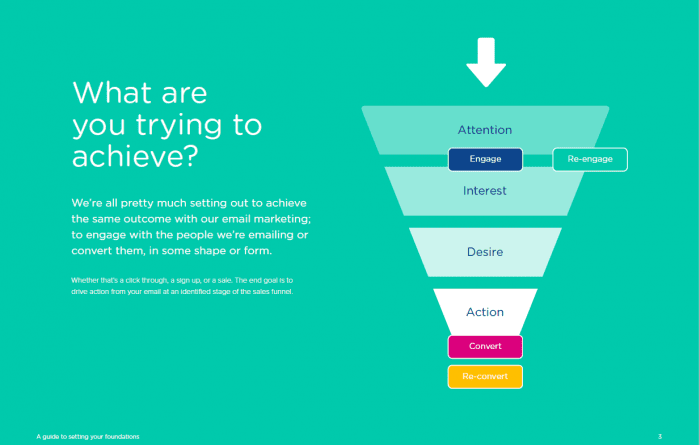
a guide to setting your foundations

First things first, what is email automation?

Automation by definition is where you introduce systems that will generate actions due to certain triggers that you set up. Applying this to email marketing, it means that once a customer subscribes to a certain email journey, they will automatically receive your emails without you having to do anything else. This is a brilliant function for you, an email marketer, as it means once you’ve set these up – they can run themselves and you can spend your time on other tasks.

But don’t just take our word for it. Our most recent Email Marketing Benchmark Report found that the average open rate of automated emails is 75% higher than non-recurring emails. Automation continues to dominate one-off messages when looking at average unique open rates. However, moving beyond overall averages and looking specifically at the upper and lower 50% of the dataset, highlights the same key trend; automated messages perform better across the board. One-off campaigns will always have their place in your email marketing strategy, but these days, more and more companies are starting to set up automated email campaigns that can trigger based on a user's journey.

The barriers to setting up automated campaigns include; time, technology and data. But once you’ve got these sorted and your systems in place, they will pretty much run themselves and you will just need to keep an eye on them every now and then. Automated emails are personalized, timely and relevant to the reader and because they work on a basic trigger and action system (when a trigger occurs, send a specific email). From this point onwards, you're only really limited by your creativity, business needs, and technology.

a guide to setting your foundations 2

Benefits of marketing automation

So, what are the benefits?

We appreciate that chunks of time are often hard to come by to dedicate towards one task. However, we’ve found that it takes on average 4 hours to create, test and dispatch an email, therefore if you’re doing one email dispatch a week – that’s quite a considerable amount of time that automation could give you back.

Give yourself your time back

Get your stakeholders to take a step back, look at the bigger picture. Getting the buy-in to invest your time in creating automated emails will only save you time, in the long run, to put towards other forms of marketing by eliminating the manual effort of single dispatches. Who doesn’t want more time?!

Improve your performance with automated emails.

The very nature of automated emails means that they are personalized and relevant to every recipient, meaning that they are increasing your engagement. As well as your automated messages increasing engagement, they are also driving your messaging and reinforcing your brand with your recipients. The more that you positively reinforce these, you build the relationship with your recipient. This is constantly adding to the customer’s journey and increasing their lifetime value. After all, we all have our favourite retailers don’t we, and nice emails can help us to decide who these are.

Drive up your ROI

By using these timely and relevant emails you can really increase your ROI. We have found that automated emails are opened and clicked more than non-automated emails. By increasing your opens and clicks, you’re therefore driving more traffic to your website and generating more revenue. What’s the average value of a purchase on your website?

If you compare how much your automated emails will outperform non-automated emails in clicks and opens, you can imagine the amount of additional revenue you could receive from them. Automated emails also provide additional revenue opportunities in the form of abandoned basket emails that will recover previously lost business. With automated emails, you can make your emails work harder to make your ROI larger.

Start with the basics

So, we’ve talked about the benefits of using automated email. But what automated emails could you send? Our advice would be don’t try and run before you can walk. Why not start with Welcome & Birthday emails? These should be key tools when embarking on an email automation quest – so this is a great place to start.

In your welcome emails, you can explain the benefits of signing up to your mailing list, and ask for subscription preferences – giving you a one-off chance to get even more information about the subscriber to use in your future campaigns. A birthday email is another no-brainer – if it suits your brand and your proposition, this is a great opportunity to get your customers thinking positively about you. It is also a great way to upsell/cross-sell, for example, a retailer can encourage a recipient to buy their new birthday dress or shoes! With the added bonus of free delivery.

Give it a go!

When setting up your automated emails, the biggest challenge that you come across is the time to get it done. Get buy-in from management and free up some resource, saving yourself much more time in the future.

Start basic – you don’t want to jump into the deep end. Use the data that you already you have, like the point at which someone signs-up, and welcome them. Once you’re up and running, think outside of the box – what new segments can you explore? Think of innovative ways to capture further details and personalize more of your messages.

Why not take our Sophistication Scale test to see where you line up and where you could be. See where you are now and where you could be, then we’ll help you with the in between.

Thanks to Ben Tomlinson for sharing his advice and opinions in this post. Ben is the Product Marketing and Partnerships Manager at Communicator and focuses on the technology behind what makes great email marketing. Keeping a close eye on industry and software developments, Ben covers any updates in his blogs. To find out more, visit the Communicator website or follow them on Twitter
06 Nov 16:47

Listening Is a Lost Art in Medicine. Here’s How to Rediscover It

by Prabhjot Singh, MD
nov17-03-668662237-Aaron-Tilley
Aaron Tilley/Getty Images

William Osler, often called the father of modern medicine, famously advised his students: “Just listen to your patient; he is telling you the diagnosis.” A century later, clinicians and health system leaders started tuning out the patient’s voice, turning instead to electronic health records and the latest care protocols to manage their most complicated and high-need patients. We believe it’s time for an urgent and strategic reset. The factors that lead people to become our nation’s costliest are complex. But they call for, at the start, the simplest intervention: listening.

According to the National Academy of Medicine (NAM), “High-need individuals are disproportionately older, female, white, and less educated. They are also more likely to be publicly insured, have fair-to-poor self-reported health, and be susceptible to lack of coordination within the health care system.” Overall, these patients make up just 5% of the patient population, but account for nearly half the spending on health care in the United States. Over the past several years at Mount Sinai Health System, we’ve focused on developing a new generation of clinical services for high-need patients by drawing heavily on strategies pioneered by others across the nation, guided by the recommendations in the newly released NAM report, “Effective Care for High-Need Patients“ (one of us, Dr. Singh, helped develop the report).

Here are the three lessons we’ve learned:

Tune into your patients. Sometimes, the same shortcuts that help physicians save lives can also lead to grave errors. In his groundbreaking book, How Doctors Think, Jerome Groopman provides harrowing examples of misdiagnoses and other negative consequences of tuning out the patient’s voice. In one case, an emergency room doctor failed to recognize a patient was having an acute heart attack because he appeared fit and healthy and did not have any typical risk factors — even though the patient told the doctors he was having sharp chest pains.

Groopman’s book is widely recognized as a clarion call for doctors to listen more deeply to their patients and to make them active participants in their care. This same concept must be applied to designing health systems and care models.

When we began planning for a new high-need-patient clinical service at Mount Sinai called Peak Health, one of the care team’s first steps was to set up an ongoing advisory group made up of patients. Over and over, we heard a clear need expressed for familiar faces on the care team so that patients could build lasting relationships, rather than seeing “all kinds of different doctors giving you all different medications.” We took this feedback to heart and shifted our staffing model from one that depended on part-time clinicians and staff, who might see patients only in “snapshots,” to a model based on full-time, dedicated clinicians and staff committed to knowing all the clinic’s patients. One of our current patients recently said, “Once they get to know you, they know you like a book and always make sure we’re on the same page.”

Insight Center

This relationship building has translated into net promoter scores consistently above 85, well above the norm for health care, along with early indications of improved adherence to treatment plans and reductions in hospital utilization. By listening, the team prioritized important elements of the clinical service design that they may have otherwise overlooked. Based on our early experience, Stella Safo, a physician leader, and Bruno Silva, an interaction designer, collaborated to build a real-time patient engagement tool that we are replicating in other settings.

Listen to other organizations. As the NAM report points out, caring for high-need patients extends beyond their physical ailments, and into behavioral and social services they need in the neighborhoods where they live. While this makes sense in theory, how do you address these broad needs in practice? In designing our program, we made a point of visiting exemplary organizations including Oak Street Health, CareMore Health System, and Iora Health to find out how they handled this challenge.

Each one asked their care teams to, in essence, shift their mindset from “the person in front of you” to “the people reliant on you.” This resulted in operating models built to manage patients longitudinally rather than from visit to visit. The teams redesigned their workflows to support this model and developed simple tools to focus the team’s time on the patients who need it the most.

For example, Iora Health uses an intuitive and powerful “worry score” to identify patients that anyone on the team believes need more attention. The system scores patients on a 1-to-10 scale based on risk-adjustment data, risk factors such as recent hospitalizations, and any relevant changes in patients’ lives that a member of the care team learns about through conversation.

We’ve adapted what we heard at these institutions to develop and implement new models for high-need patients. We now use a similar worry-score system in our Peak Health clinical service so that the entire team spends more time focusing on the people who require the most attention on any given day, rather than just those who came to the clinic that day. We have early data showing that applying what we have learned from our top-performing peer organizations is translating into better care, lower costs, and higher patient and provider engagement.

Listen to colleagues. To tap expertise throughout Mount Sinai Health System, over the past year Natalie Privett, a colleague with an industrial engineering and learning background, has created a learning network called the Ambulatory Care Transformation (ACT) Network. She identifies evangelist “doers” across the system who recognize that the traditional fee-for-service system is hindering their ability to develop new care models; that we need workflows that support proactive, rather than reactive, care; and that care teams need to include significantly more nonclinical workers.

As the ACT network began to form, both online and offline, members found that familiar themes — such as focusing on culture in the hiring and training process, using nontraditional care-team members to integrate behavioral health, and deploying home-based care services creatively — emerged and continue to be incorporated as they transform clinical programs. It would have been much harder to go the other way around, trying to implement textbook care models from the top down, rather than allowing them to be developed from the bottom up through a learning network.

In a fast-paced health care system, it is clear that patients will benefit from the work of researchers and technologists focused on data-driven technologies to improve care. However, the clinical insights and strategies these technologies can give rise to are most useful when they’re incorporated into clinical care by providers who listen carefully to their patients, their colleagues, and the exemplary organizations around them.

06 Nov 16:39

The 11 Most Awe-Inspiring Sales Talks From 2017

by Alli McKee

In the past year, I’ve visualized over 100 talks in real-time at 20+ conferences and events on a range of topics.

But no topic has inspired and challenged me like this one…

Sales.

To share some of what I’ve learned from the experts, I’ve pulled together my Top 11 from the past 12 months for you. I hope that they inspire and challenge you, too.

1. The Art of Making Love by Jacco van der Kooij (Winning by Design)

Change your language to change your mindset. You’re not “spearfishing” (which would imply you’re killing your customers… Nice one, guys). Instead, you’re Educating, Committing, and Assisting them.

It’s about “You” not “Me.” By putting your customer truly in the center, you’re making your job easier —  and more fulfilling. Win win.

Learn more about Winning By Design 

2. Sales Under Pressure with Erika Shumate (Pinrose) and Harrison Metal

Preparation trumps personality. When she decided to sell her product Pinrose on QVC, Erika Shumate learned that sales was about relentless practice and preparation more than her personality.

When you’re selling perfume to strangers through a (scent-free) screen, you’ve got three key levers:

  1. Language: turn a “perfume sample pack” into “fragrance wardrobe”,
  2. Demo: touch the product, use it, show your love for it, so the customer can follow and
  3. Power of “Yes”: taking a page out of the improv playbook, always be building. Replace that “no” with a “yes, and!” so you never shut it down.

3. The XYZs of Selling with Jeffrey Gitomer

The New Sales is about Relationships. Jeffrey Gitomer offered dozens of tactical tips in this rapid-fire session, but what left the deepest impact was his infectious obsession with constant learning. “Base everything off of the person you want to become.”

Build relationships by finding the pleasure, not the pain. Make your questions emotional: replace “Where are you from?” with “Where do you grow up?” Relationships first, and sales will follow.

Watch: Jeffrey Gitomer, XYZ’s of Selling

4. How to close $X00,000 [BIG] Deals with Amy Pressman (Medallia), Andy Byrne (Clari) and Aaref Hilaly (Sequoia Capital) 

#1 thing? Be fearless. Just because selling big deals as a small startup might be scary for you, doesn’t mean that it scares your customers. So be confident.

As Amy Pressman put it, the core here is intellectual honesty. Is your product really worth it? Until you believe that, selling those zeros will be hard. But when you have that conviction, you can do anything.

Watch: SaaStr summer social sessions

5. How to Prospect with John Barrows

The death of the (average) salesman. The average salesman is dead because AI is killing — has already killed — him. With insanely rapid advances in technology, AI is replacing more and more SDRs’ jobs.

So if you’re a SDR what do you do to fight for your job against the Tech? Be more human. What can AI still not do? Tell a story. Pick up the phone and tell them a story. Be human, and keep getting better if you want to survive.

Watch: How To Prospect Like Salesforce, Marketo, Box, and LinkedIn

6. Using AI to Beat Competition with Jensen Harris (Textio), Puneet Mehta (msg.ai), Derik Pridmore (Osaro), and Matthew Zeiler (Clarifai)

AI’s potential is in augmentation, not automation.

A year ago I wouldn’t have tagged this as a “sales” talk, but on the heels of JBarrows… you can’t think about sales without looking at technological advances in the tools we use everyday to sell.

And things are changing. Quickly. Jensen Harris, CTO of Textio, described just how broad this reaches.

“If you don’t have learning loops in your software in five years, it’s defunct. It’s dead. It’s like not having internet connectivity.”

So as salespeople, we have to prepare for — and embrace — this new normalWhile AI won’t automate our jobs, it’s going to augment our work every day.

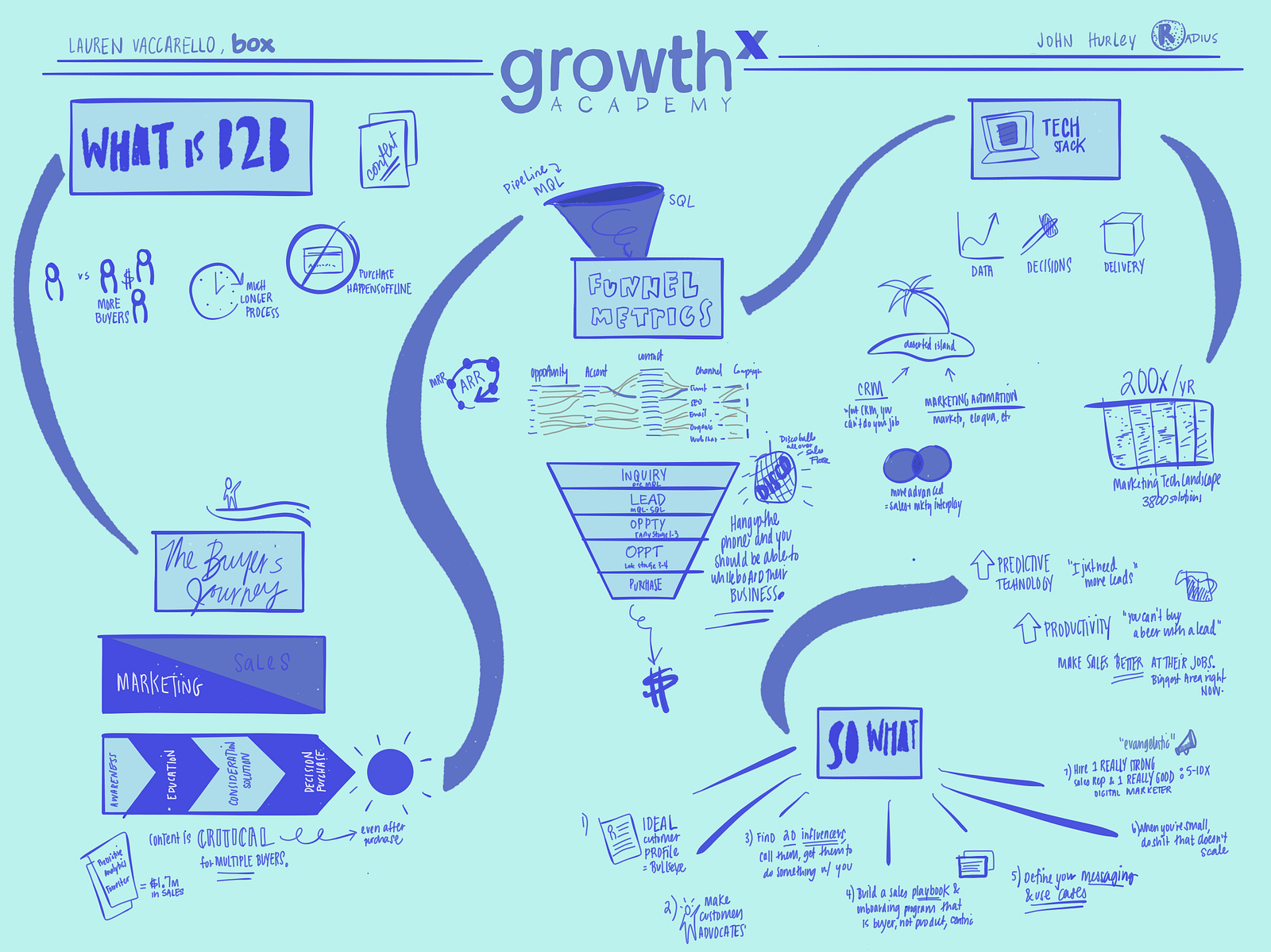
7. B2C vs. B2B Growth by Lauren Vaccarello (Box) and John Hurley (Radius)

Content is critical… especially when you have multiple buyers.

The more complex the sale, the more Marketing and Sales are blending. With a shifting funnel, content becomes the job of your sales reps, too. And that’s why you need a robust playbook that’s buyer centric.

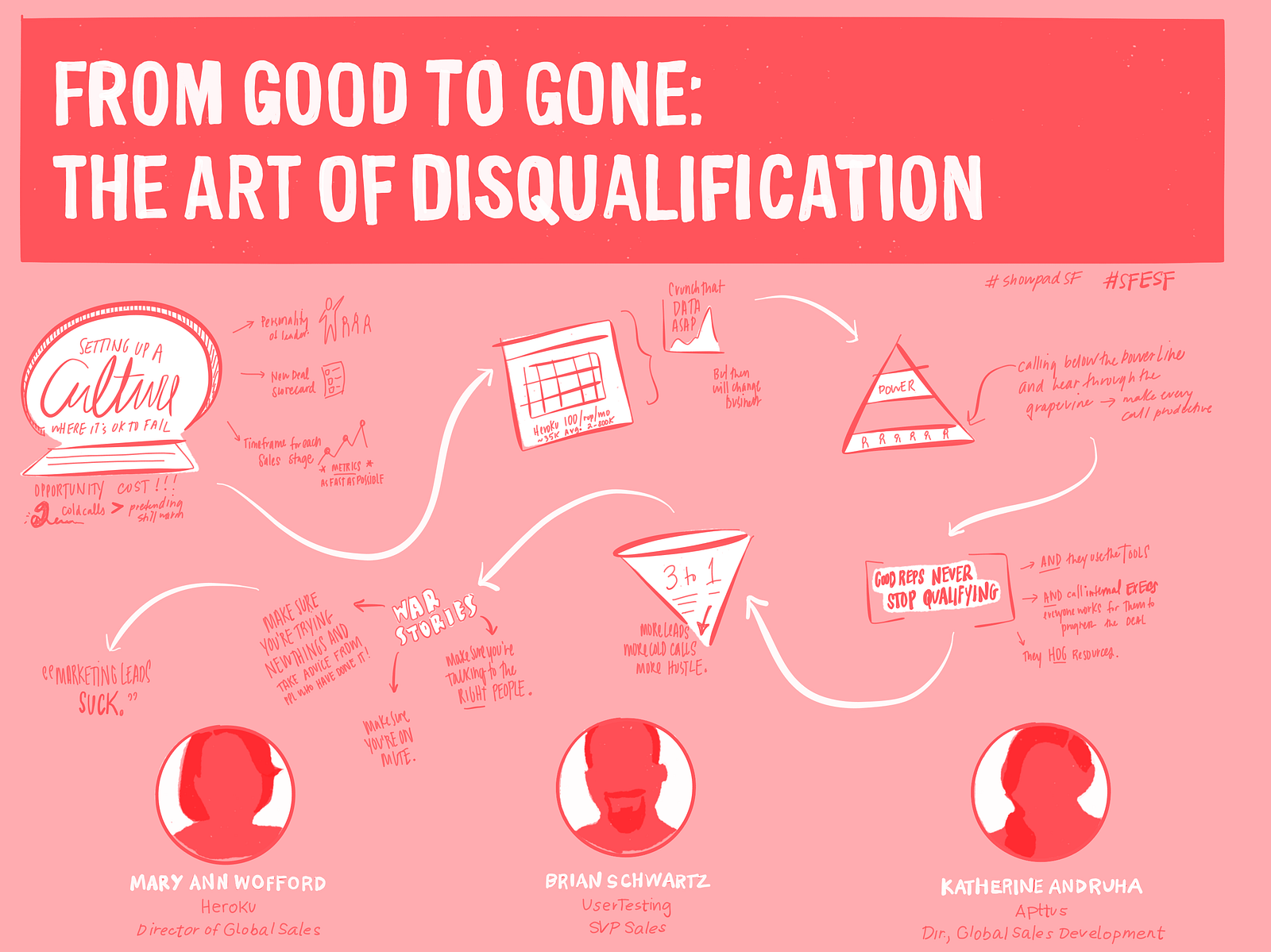
8. The Art of Disqualification with Mary Ann Wofford (Heroku), Katherine Andruha (Apttus), and Brian Schwartz (UserTesting)

Disqualification > Qualification.

Setting up a culture where it’s ok to fail matters if you don’t want to waste time on bad customers or bad leads. Good reps are always qualifying, not just closing.

Unqualified Customers = Unhappy Customers = Detractors.

Qualified customers = Happy Customers = Referrals.

9. How Pirates, Dreamers and Innovators Create and Dominate Markets with Al Ramadan

Don’t sell a product, create a category. 

Use the grocery story metaphor to frame your approach. Are you selling a product in the aisle? Or are you creating a new aisle altogether?

Winners do the latter.

10. Secrets of the 100M Club, Dan Levin (Box), Dave Girouard (Google Enterprise) and Marc Diouane (Zuora)

“You can’t feed an army hunting squirrels.” 

If you want to make it big, you’re going to have to go big. While “hunting squirrels” might get you to $10M in ARR, it won’t get you to $100M. Going big is hard, but you’ve got to do it.

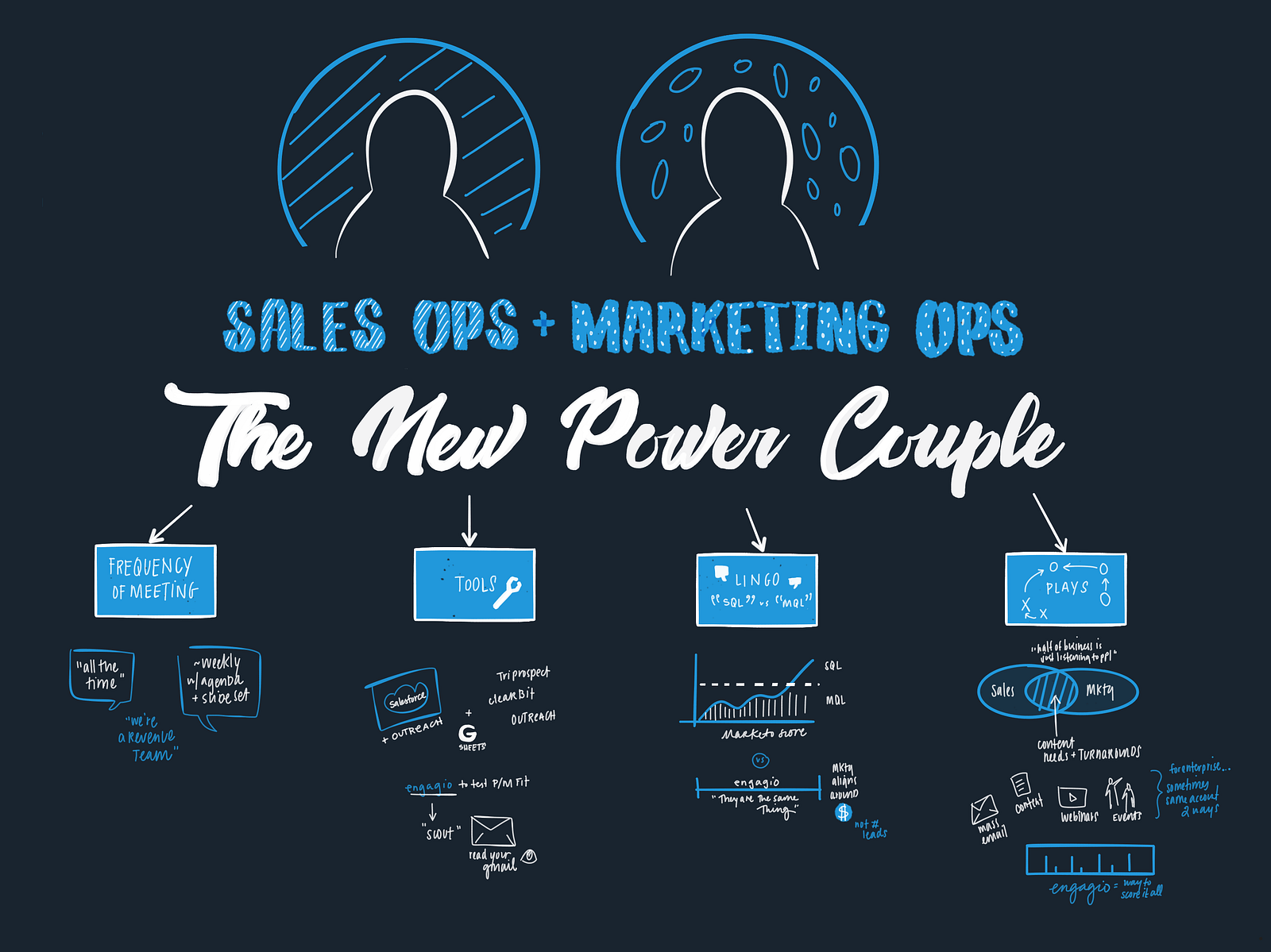
11. The New Power Couple, with Kristen Malkovich (Mktg @ Chorus) + Rob Perez (Sales @ Chorus) and Dayna Rothman (Mktg @ Brightfunnel) + Zack Kass (Sales @ Brightfunnel)

What you measure = what you value.

If those are different across departments, don’t expect the departments to work well together. Think about that scorecard: MQLs or SQLs? Metrics matters. The more you can close the gap, the better.


Who has taught you the most about Sales this year? Give them a shout out.

The post The 11 Most Awe-Inspiring Sales Talks From 2017 appeared first on Sales Hacker.

06 Nov 16:39

Personal Branding for Sales Professionals: Climbing the Maturity Scale

by Alex Hisaka
  • personal-branding-for-sales

You could argue that personal branding is the foundation of social selling. Without a strong online brand, it’s simply more difficult to engage sales prospects. Even if you excel at growing relationships, every sales relationship starts with a successful engagement.

While there’s no one-size-fits-all, step-by-step method for personal branding, I’ve found that you can plot your course along a three-step maturity spectrum: basic, intermediate, and advanced.

Read on to see where you currently sit within the personal branding maturity spectrum, and discover actionable recommendations for taking your personal brand to the next level.

Basic: Complete Your LinkedIn Profile

At the bottom of the personal branding spectrum is a complete LinkedIn profile. It’s not enough to publish a bare-bones profile. Our research has found that 50% of buyers will avoid sales professionals with incomplete profiles.

The easiest way to exude professionalism, helpfulness, and competence online is by completing your LinkedIn profile. Your profile shapes how sales prospects perceive you when you’re not around to defend yourself.

A strong LinkedIn presence doesn’t need to be difficult. There’s more than one way to increase the comfort level of your sales prospects at the very moment they ask themselves: “Can I see myself working with this salesperson?” 

Feature a professional photo, strong headline, and a summary that invite engagement. In addition to being professional, the photo should be friendly and representative of you in a face-to-face sales setting. Customize your headline to describe your experience and vision in a way that emphasizes your value to clients. Get to the gist by explaining who you help and how.

Then, populate the summary and experience sections to showcase how your approach and experience benefits your customers. Maximize your real estate to explain what makes you different. Sell yourself the same way you’d sell anything else – buyers aren’t interested in your “features” – they are only interested in how they will personally benefit from working with you. 

As an example, here’s a LinkedIn profile that serves as an example of a strong social selling presence: Carly Wennogle. Her photo is professional yet warm, she highlights her value in the headline and summary, she publishes content relevant to her target audience, and has compiled an impressive number of endorsements (more on endorsements below).

  • carly-wennogle-profile

An often-overlooked bit of prime real estate is the “Background Photo” (the space above and slightly behind your headline and picture). If you haven’t already, update a visually pleasing image that relates to you in some way. You can also capitalize on that space with an image that conveys your value. Social media expert Neal Schaffer does just that by highlighting images of his books.

  • neal-schaffer-profile

Jill Konrath accomplishes this by highlighting her public speaking experience with a photo from LinkedIn Sales Connect. These background photos provide Neal and Jill with instant credibility. 

  • jill-konrath-profile

Speaking of credibility, to support what you say about yourself, ask for recommendations and endorsements from satisfied clients. Remember to give to get. In other words, offer to provide recommendations to others before soliciting recommendations from them.

When it is time to request a recommendation, from your profile page:

  1. Click the Me icon at the top of your LinkedIn homepage.
  2. Select View profile.
  3. Scroll down to the Recommendations section and click Ask to be recommended.
  4. Type the name of the connection you'd like to ask for a recommendation in the Who do you want to ask? field.
  5. Select the name from the dropdown that appears.
  6. Fill out the Relationship and Position at the time fields of the recommendations pop-up window, and click Next.
  7. You can change the text in the message field, and then click Send.

As you ask for recommendations, write a personalized message to accompany the official recommendation request. A solid recommendation describes how you collaborated and includes specific examples of how the client benefited by working with you, so don’t be shy about asking your client to include those in the write-up.

Finally, LinkedIn assigns a generic URL to your profile, but a custom URL looks more professional. In addition, adding your custom URL to your email signature will increase the likelihood of others engaging with you on LinkedIn.

Boost the likelihood of being found by personalizing your LinkedIn web address to match your name or what you do. For example, your URL could be “LinkedIn.com/in/yourname” or “LinkedIn.com/in/crmautomationguy.” If you’re thinking about customizing your profile URL to describe what you do, make sure it will stand the test of time. If you’re not sure, it’s safer to customize your URL using your name.

To change your public profile URL:

  1. Click the Me icon at the top of your LinkedIn homepage.
  2. Click View profile.
  3. On your profile page, click Edit your public profile in the right rail. Update your public profile settings will show up if you don't have a public profile. Learn how to enable your public profile visibility.
  4. Under the section Edit public profile URL in the right rail, click the Edit icon next to your public profile URL. It'll be an address that looks like www.linkedin.com/in/yourname.
  5. Type the last part of your new custom URL in the text box.
  6. Click Save.

See this LinkedIn Help page for additional tips.

Intermediate: Turn Your Profile into a Resource

To provide the ultimate value, your profile should do more than list your work history and accomplishments. It should be a valuable resource for the people you’re trying to engage. Imagine a qualified sales prospect thinking, I’m glad I found this salesperson’s profile. That’s what you’re shooting for.

The most successful social sales reps design their profiles to attract and engage sales prospects rather than recruiters. You can do the same by establishing credibility with your audience through stories, content, and ideas that deliver value. Possibilities include:

  • Recounting a compelling example of helping a client solve a problem
  • Posting helpful, insightful content
  • Liking, sharing, and commenting on client and buyer updates

The key is to balance a buyer focus with your personality so your profile is distinct from other sales professionals. Possible ways you can convey this include describing how you:

  • Have helped multiple customers achieve an admirable business goal
  • Help others come together to solve tough problems
  • Have a trusted team and process to assist with the entire customer experience
  • Remain involved with buyers at every stage – even after the purchase
  • What you like to do when you’re not helping buyers, including charitable organizations you support

Think of ways to incorporate multimedia as it tends to attract more attention and thus, more sales opportunities. Our eyes can glaze over when we’re staring at a screen full of copy. Multimedia breaks up the copy and offers an interactive way to engage your audience. Plus, every human is a visual thinker: 75% of the neurons in our brains process visual information. In fact, we process visuals 60,000 times faster than text. Here’s another way to think about it: 40% of people will respond better (and faster) to visual information than with plain text. Simply put, if you don’t tap into your audience’s visual side, you are missing huge opportunities to engage.

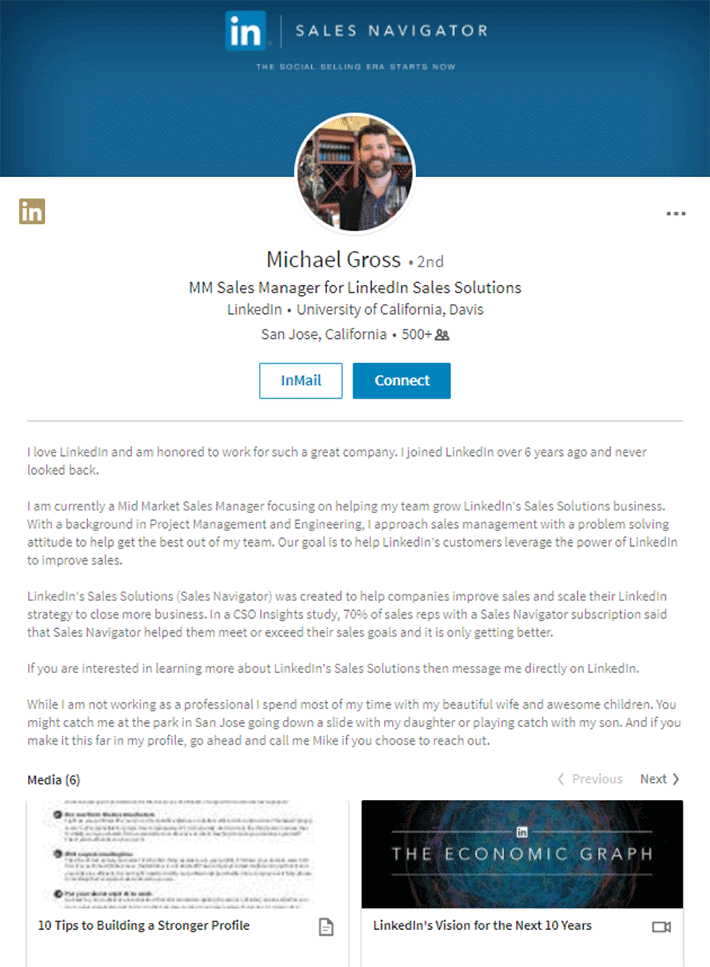
One option for adding multimedia is to include videos produced by your company (about topics of interest or ones featuring you discussing top-of-mind issues and trends). You can also take advantage of SlideShare to convey your story. Over 80% of SlideShare’s 80 million visitors come through search. That means when they find your content, they’re interested in it. This can help you build your reputation with the right audience and cultivate more professional opportunities. Here’s an example of a sales professional who uses multimedia to his advantage.

  • michael-gross-profile

Here you will find instructions for adding, editing, and removing work samples on your LinkedIn profile, along with the supported file formats and sizes for uploading content to your profile.

Advanced: Achieve an Edge with Thought Leadership

Does it get any better than people valuing your opinion before your first interaction? When your online presence exudes thought leadership, buyers are naturally drawn to you. As you gradually figure out how “you do you” in a professional, online setting, here are some practical steps for becoming a thought leader and gradually building credibility.

Start by immersing yourself in your space. Follow the companies and experts you admire on LinkedIn. Keep up with industry happenings. Follow topics you’re passionate about and, when you feel like you can contribute to the discussion, add your perspective to the mix. Continue the conversation, so to speak, by engaging in online discussions on your topic of interest. Even if you never publish content, staying up on your industry helps you engage intelligently.

By publishing a variety of content on LinkedIn, you can quickly grow your audience and network. Accumulating followers has a multiplying effect by extending your reach and influence over time. Think of it this way: every single person you are connected to has an extended network of connections. When they share your content with their networks, you instantly and exponentially increase your reach. People in those extended networks may decide in turn to follow you based on the quality of content you’re publishing, offering you more opportunities to connect, engage, and possibly convert.

Don’t forget to use your network as a way to further amplify your influence by sharing industry information and articles that add value. The more you share content that matters to your ecosystem – even if you didn’t author it – the more people will view you as a subject matter expert.

Personal branding is a critical component of the modern seller’s skillset. Make a concentrated effort to improve it, even if it’s slow and steady, and the results will follow.

For more ways to shine up your social selling presence, download LinkedIn’s Professional Profile Kit and get the tools you need to make a good impression this year.  

06 Nov 16:36

How to structure an effective multichannel marketing plan

by Expert commentator

What are the essential parts of a multichannel marketing plan template? Multichannel marketing, or omnichannel marketing, is the process of utilizing online and offline marketing communications channels to target and engage with your customers. As outlined in our popular Learning …..

The post How to structure an effective multichannel marketing plan appeared first on Smart Insights.

04 Nov 18:10

10 Quick Tips for Sales Analytics

by Hanna Dodd

kulinetto / Pixabay

We all know that having sales analytics is important, but are you sure they’re applied properly? We’ve compiled a list of quick tips that will help you understand and utilize your data better.

Goal-Setting

You must set realistic goals for the year. That’s a given. But, you also need to check in frequently and be willing to make proper adjustments to meet them. Your sales analytics contain a plethora of information; you just need to apply them where they’re needed.

Look to the Future

Sales force investment must recognize their multi-year impact. Resource allocation analytics prove that sales force efforts this year affect future years. Prepare your business for the future by using analytics to optimize your sales team.

Pick Up Trends

Sales analytics work their best over time. If you collect data for longer time periods and compare them frequently, you’ll be able to see trends in your win rates, conversion rates, and adjust your sales strategies accordingly. The more data, the better!

Rinse, Wash, and Repeat

Your sales team should have a repeatable and, preferably, quantifiable process. Their sales metrics should result from similar actions that you can use to compare the data. Additionally, using an automated platform makes it that much easier.

Sales Analytics Support

Design your sales team around analytics. The size, structure, and allocation of resources should reflect your customer need frameworks and analytics. These changes have the potential disrupt the sales process and customer relationship management if implemented improperly. Using analytics to make rational decisions alleviates the disturbance.

Audit the Process

Sales analytics provide direct feedback for your sales team’s performance. Don’t assume everything is perfect, and use your analytics to review and adjust the current process you have in place. Keep opportunities from getting lost in your pipeline.

Record Your Predictions

When you’re projecting goals or predictions for the future, make note of them. Use your resulting data to compare with your predictions side by side. This will allow you to see the direct effects of your actions and where you need to improve to further your results.

Customer and Account Potential

Each customer and account has unique needs and values. Develop analytics that identifies the potential (what they could buy from the company) for the opportunity. Doing so allows you to tailor your sales process around your customers’ needs.

Retention Versus Customer Acquisition Cost (CAC)

Growth requires both new accounts and customer retention. Compare your retention with your CAC to determine who to target at specific times throughout the year. Keep in mind, though new market segments may seem intriguing, CAC is expensive and returning customers are more likely to buy.

Generalist or Specialist Roles

Identify the needs of your customers reflected in your sales analytics to determine how to place your salesforce. Sometimes a specialist role enhances your sales process whereas a generalist role may be better suited for your product line. It all depends on your company strategy and account management.

Make it Happen!

Use analytics to your advantage. Here at ORM Technologies, we promote informed interactions with sales data and analytics.

04 Nov 18:06

6 Ways to Drive More Sales with Mobile on Black Friday

by Maura Canavan

Happy Friday, everyone. Speaking of Friday–we’re officially 4 weeks out from the big day: Black Friday 2017. You’ll probably be more surprised by the remarks your relatives come up with around the Thanksgiving table than this prediction: People expect mobile to drive huge Black Friday sales this year.

In 2017, mobile sales are expected to increase 51.9%, with sales resulting in more than $100 billion for the first time ever. In fact, Cyber Monday sales are predicted to be even greater than Black Friday sales for the first time ever.

Unless your customers love the adrenaline rush of battling the crowds in-store, the ability of mobile to let you capitalize on the many, many consumers who love the convenience and ease of mobile is going to translate to better sales. But you also have the chance to launch campaigns that catch the eye of new users, too, and with a compelling mobile experience, build relationships with new users that increase sales way beyond the Black Friday/Cyber Monday weekend.

1. Kick off your user acquisition campaigns now.

Get your acquisition campaigns going before new potential users are inundated with offers. We’re in between post-summer sales and the holiday rush, so it’ll be easier to start building a connection to new users now. At the same time, the early birds are already trying to get some shopping done, so there’s a market to be tapped there, too.

Instagram + Facebook.

Create ad campaigns around the special perks and content available to app users for campaigns on Instagram and Facebook. Target both current customers who don’t yet have your app and prospects who might be ready to try you out.

Spring_InstagramAd.png

Email.

Customers who have already signed up for your email list are perfect candidates for an app acquisition campaign. You’ve already established a relationship with them, and you know it’s positive–otherwise, they wouldn’t have give you access to some of the most precious real estate on the internet: email inboxes.

App Store Optimization (ASO).

There’s over 2.2 million apps in the App Store and over 2.5 million in Google Play Store, but properly optimizing your app is proven to make it more discoverable.

  • App name. Is it unique?
  • Keywords. Include relevant keywords but be careful not to ‘keyword stuff’
  • Description. Does your description clearly articulate your app’s value and is it frequently updated with app update descriptions and release notes?
  • Screenshots/Video. Do you have 2-3 feature screenshots or a video tutorial highlighting what users love about your app?
  • Ratings. Is your app rating positive? A good rating increases downloads.
2. Make sure you have an onboarding flow in place, too.

Cool stuff like Black Friday geofencing or personalized rich push notifications aren’t going to be possible unless you establish trust with these new users and get them engaged in your app right from the beginning. Make sure you have an onboarding experience that directs them toward the features/actions that are proven to contribute to the long-term engagement and happiness of your most valuable users.

3. Check up on your checkout.

It’s not an easy time for retailers right now, for sure. But while it can be tough to stand out when every brand is offering discounts, an easy, user-friendly mobile app experience can be what differentiates the user experience to avoid every retailer’s nightmare: an abandoned cart.

Make sure it’s easy for users to check out via your app:

  1. Can users easily apply promo codes and discounts?
  2. Do you have a mobile wallet solution integrated into your app?
  3. Do you force users to create an account to check out, or do offer guest access?

Athleta-Shell-MobileWallets.png

Athleta’s streamlined mobile checkout makes it easy for users to access rewards and offers across all Gap brands–functionality that will certainly be handy for users over Thanksgiving weekend.

4. Integrate mobile into your in-store experience.

For the users who love the day-of Black Friday adrenaline rush, your app can be a valuable tool. Use location-based marketing tools like geofences to remind users about special offers as soon as they walk into your store, and remind them about offers or limited quantities as they get oriented. You can even create geofences around competitor’s storefronts so you can specifically target users who might be doing a little comparison shopping.

5. Get creative with your messaging campaigns.

If you’re putting out your best offers of the year, they’re definitely worth a push notification. But yours won’t be the only message users get this year, so make sure both your push notifications and in app messages are:

  • Targeted. As much as you can, target messages to users based on their own actions and behavior in your app. Highlight offers for services and products similar to what they’ve bought or checked out before.
  • Eye-catching. Create rich push notifications and in-app messages with video, imagery, and sounds to help your messages stand out. Localytics users who sent rich push notifications saw a 30% increase in engagement, so we know they’re working.
  • Conversational. Users like to engage with brands that feel like they’re run by real people.

Wayfair’s push notification last year makes it clear why their users will want to take advantage of the offers on their app: you don’t have to miss out on your hard-earned relaxation to take advantage of the deals (pretty much the dream for all of us). Relatable, subtle, and effective.

6. Don’t limit yourself to one day.

Like we mentioned before, it’s not just about Black Friday anymore–and Cyber Monday’s expected to exceed sales this year. The entire weekend represents a big opportunity now, so take advantage. After all, mobile marketing works because it adapts to people’s lives, and the continuous access they have to brands via their mobile devices. Stretch your campaigns from Thanksgiving to Cyber Monday, so your users have the chance to take advantage of what you have to offer.

Last year, mobile sales easily topped $3 billion, exceeding predictions and marking an increase of over 13% from 2015. This year, those 4 days that span Thanksgiving to Cyber Monday are expected to reach sales over $3.52 billion. There’s no question that your users expect to connect with your brand on mobile. But plenty of brands, of all sizes, haven’t optimized their app strategy to provide the experience users expect–and that’s costing them the opportunity to stand out and make the sale.

04 Nov 18:05

How Machine Learning Scales One-to-One Personalization

by Katie Sweet

machine learning scales personalization

The world of marketing is no stranger to buzzwords. While many marketing buzzwords words start off as real strategies or tactics that can improve a company’s marketing efforts, their meanings often become diluted the more they are used. Over the years, we’ve seen words like “sales enablement,” “social media,” “account-based marketing,” and even “personalization” become buzzwords that marketers can throw around without actually incorporating them deeply into their marketing strategies.

“Machine learning” is on its way to becoming one of those buzzwords too. Marketers are talking about it a lot and working out the best way to implement it in their marketing strategies, but many are not truly using it in a way that has a real impact on their business.

Machine learning isn’t just something for marketers to pay lip service to, however. It has enormous potential for generating benefits to organizations in many ways and is already paying dividends for those who’ve begun applying it effectively. With that in mind, Karl Wirth (co-founder and CEO of Evergage), recently presented a Digital Summit webinar entitled Personalization in the Age of Machine Learning. His goal was to demystify machine learning and help marketers understand how it can be used to truly individualize the customer experience — rather than relegate it to a minor website marketing tactic. In this blog post, I’ll outline how machine learning can improve three main components of personalization: understanding, engaging and learning. But while this blog post is a good start to demystifying machine learning, you will definitely want to check out the full webinar replay for more detail.

Understanding

Before you can personalize an experience to an individual, you have to understand that person. Who is she? Where is she from? What are her likes and dislikes? What is she interested in at this moment? This means that you need to a collect a large amount of deep data: not just attributes and clicks, but engagement and contextual data as well. You need a central place to store all of this data and combine it with any other customer data sources you have (such as a CRM, ESP, data warehouse, etc.). Then, of course, you need the ability to act on all of this data in real time — because the data does not do you any good if you can’t do anything with it.

Machine learning helps you to synthesize all of that customer data at scale. Machines can make sense of what the data actually means, drawing conclusions about each individual person — such as identifying a person’s persona, interests, attributes, intent, or stage in the journey. For example, machines can make sense of a shopper’s haphazard browsing behavior through a home improvement site to uncover that she is likely looking to remodel her kitchen. Without that insight, the retailer may deduce that she is simply looking for microwaves because she viewed slightly more microwave product pages than pages in other categories. Understanding her deeper purpose on the site can lead to far more meaningful and successful personalized experiences, as we’ll see in the next section.

Engaging

After you understand who a person is and what she is looking for, you have to effectively engage her. You need to decide what to say to her, where and when to say it, and then actually deliver the message in the form of a tailored, relevant experience. Without machine learning, the most common way to provide a personalized experience is through rules. Rules are certainly effective, but they require manual intervention from the marketer and are primarily used to target segments, rather than individual people.

Machine learning helps you sift through all the different options you could display to her and select the best one. Whether it’s selecting the best products, categories, brands, promotions, etc. to recommend to her; reordering or changing the navigation to help her find what she’s looking for; sorting the search results to be relevant to her, etc., machine learning can make it possible.

So returning to the shopper on the home improvement site, the site can recognize that she is looking to remodel her kitchen and can then recommend the appropriate content around remodeling for her, as well as products, categories and brands that meet her preferences. This can be done by building your own custom algorithm or “recipe,” combining all the elements of machine-learning personalization.

Learning

The last critical component of personalization is learning. After you understand and engage a person, you need to assess whether your customer experience was helpful and identify how you could do better. To accomplish that, you probably use A/B testing. Statistically comparing a personalized experience against a control can show you if the campaign delivered a lift in engagement, conversion rate, and more. This is immensely valuable information and should be analyzed for every personalization campaign you run.

But machine learning can take learning a step further than A/B testing to help you make sense of the complexities of the real world. It can help you compare how a campaign is performing against its past performance, and the goals you outlined for it, as well as your other campaigns. Machines can predict what the expected range of performance should be and alert you when it is not performing as anticipated — and even show you areas to improve (such as when a campaign is underperforming for specific segments). Essentially, machine learning can take a wealth of data and synthesize it to draw your attention to potential opportunities or problem areas.

Final Thoughts

Don’t let “machine learning” become another buzzword that loses its meaning and value. Instead, use it to power your customer experience and speak to each person at the one-to-one level. To learn more about machine learning and the critical role it plays in the main components of personalization (understanding, engaging and learning), watch the full webinar replay.

04 Nov 18:05

How to Keep Your Branding, Voice, and Style Intact No Matter Where You’re Selling

by William Harris

Maklay62 / Pixabay

As the world of ecommerce continues to get more and more competitive, companies are finding it increasingly difficult to differentiate from competitors, connect with their target audience, and convince people to actually buy from them. Without clear and established guidelines about brand personality, voice, and style in place, new ecommerce companies seem to struggle to survive past even the first few months of operation.

In addition, thanks to the widespread use and popularity of the internet, social media communities, and mobile apps, ecommerce brands now have the opportunity to interact with customers in more places and through more channels than ever before. Gone are the days when you only had to worry about the impression you made on online consumers when they land on your website for the first time. Now, there’s many more places that people are going to find and interact with your brand—Facebook, Instagram, Amazon, eBay, Twitter, email, third-party websites and blogs, mobile apps, etc. To make the right first impression on online consumers no matter where they find you, you have to be consistent when it comes to your brand voice and overall presentation.

If you haven’t taken enough time to think strategically about your brand strategy, or how you want your prospective customers to perceive your brand when they interact with it anywhere online, now is the time. Online consumers are interacting with more ecommerce brands than ever. Unless you already have a well-established brand with a rich history like Nike, Coke, or Apple, you’ve got some serious work to do.

To help put you on the right path, I recently talked with a handful of business leaders and marketers about the importance of branding and the value of consistency. Specifically, I wanted to get actionable recommendations from them on how ecommerce companies can keep their branding voice, and style intact no matter where they are selling online.

With the help of their answers, I was able to put together these eight tips:

Tip #1: Understand Who You Are (and Who You Serve)

When it comes to differentiating as an ecommerce store, everyone I talked with agreed that if you want to survive and grow, you first need to understand who you are, and who you serve. It’s not enough to have the drive and skills to build an ecommerce store, you also have to master the art of branding.

To succeed in ecommerce today, you need a brand that people can relate to, rally behind, and love.

So where do you start? Here are three tips and three resources that can help you better understand what your company is all about (your brand personality, voice, and style), and who your company serves (your customers).

  • Tip #1: Think about who your ideal customer is and what they care about. Remember: you’re not building your brand for yourself, you’re building it for your the people you want to ultimately buy your products. When you’re trying to make decisions about your brand voice, style, and personality, think about how your customer talks and prefers to be talked to. What gets them excited? What will help them relate to you? What impression do you want them to get from you when they interact with you for the first time.
  • Tip #2: Think about what makes your company or your products different. When you’re developing your branding and your voice, think about your competitors. What makes you different from them? What about them to do like or not like, and how can you use that information to build a brand that looks and feels different to your ideal customer?
  • Tip #3: Think about other more well-established brands that you love. It’s also helpful to think of the big, well-known brands when developing your own. For example, how does Coke look and feel, and how do they communicate with people? What about Apple? Starbucks? Nike? Find your heroes and build parts of your brand based on what you love most about them.

Once you have your branding in place, you can leverage the rest of the tips outlined below.

Tip #2: Create Documentation

As you work to develop clear guidelines about your brand and the voice, style, and personality you want to use, make sure to document it. “To ensure brand consistency, it’s important to create a style guide,” says Shayla Price, a B2B Marketer. “This document will outline your brand’s standards for tone, voice, and style. With an up-to-date style guide, it doesn’t matter where you sell because your team has specific guidelines to steer the brand direction.”

If you’ve never put together a brand style guide before, there are a number of resources, examples, and templates available online that you can leverage. Here are a few worth exploring first:

As your ecommerce business grows, make sure every employee and partner who helps you understands and has easy access to your style guide.

Tip #3: Stay True No Matter What

Once you have your brand style guide and your standards about voice, style, and personality established, refer to them when working on new projects, no matter the channel.

According to Derric Haynie, CEO at Vulpine Interactive, you can stay true to these standards by remembering one word: authenticity. “It sounds like a buzzword, and all it really means is “Stay true to yourself,” says Haynie. “A brand is simply how you define yourself to the world (and then retroactively how the world – or each individual therein – perceives you). Changing product lines, offers, copy, and creative should not bring into question the core of who you are and what you stand for. If you find that it is, then you have to question your authenticity and consider changing your brand to better reflect your “true identity.””

To build a strong ecommerce brand, make a habit of always questioning the words, phrases, visuals, and other components that you use for every campaign you work on and for every website you develop a presence on for your company. Never deviate from the standards you set in the branding and style guide you create.

Tip #4: Put Your Customers First

For Tracey Wallace, Editor-in-Chief at BigCommerce, keeping your branding, voice, and style intact no matter where you sell is all about putting your customers first. “Ultimately, it’s about keeping the customer in mind,” Wallace says. “Is this [copy] helpful? Is it too long? Does it give enough background? Does it tell it as simply as it can? Will this really help them –– do I have proof that it will? What examples can I show them? Who can I ask to make sure this works? Who else can I ask? Those questions guide every single piece of work I do. As a marketer at a SaaS company, it isn’t lost on me that my company serves as an extension of our customers. They hire us for a job. The best I can do to win their loyalty is help them do theirs better.”

As mentioned earlier in this articles, your success is very dependent upon your customers understanding who you are, and what makes you different from your competitors. By thinking about your customers at every turn, you can build a brand and leverage a style that they can easily relate to, trust, and actively want to support.

Tip #5: Put Someone in Charge

Another great way to keep your branding, voice, and style standards intact no matter where you’re selling is to literally put someone on your team in charge of keeping everyone accountable.

“All teams need a keeper of the brand,” says Jack Appleby, Director Of Creative Strategy at PETROL Advertising. Sometimes that’s a strategist, serving as a de facto brand manager of sorts. Sometimes that’s a creative director, ensuring their team meets established quality & style necessities. The big mistake is assuming someone will take those responsibilities – clearly assign the role ahead of projects to make sure you nail it.”

The person you hire for this role should essentially take on the role of quality assurance manager. They should be the one who knows your brand and your guidelines best—better than yourself even. Their job is to work with team members when campaigns are being created, sign off on projects before they go live, and bring attention to examples where projects missed the mark.

Tip #6: Create Sources of Truth

For Ryan Kopperud, Brand Marketing Manager at Drip, keeping branding intact is all about creating what he calls ‘sources of truth’. “At Drip, we’ve prepared branded examples for nearly every occasion, and we try to maintain a single source of truth for those examples,” Kopperud says. “Our brand book is a bible to us, and has sample copy and style instances for web, social, customer interactions, advertising, and more. That way, when we need to speak in a specific place or time, everyone has, at a minimum, a unified compass for what that should look, sound, or feel like.”

Approaching consistency in this way is a great option if you find that you’re scaling your business and hiring more people to help a lot faster than you thought you would.

You can save and share examples with your team in a number of ways: you could create a Google Drive or Dropbox folder, a Pinterest board, a Slack channel, a private Facebook group, or an email chain. The key is to make it as easy as possible for your team members to pull up good, relevant examples that they can refer to when they are getting ready to build, QA, or launch a new campaign.

Tip #7: Be Consistent Everywhere

The best and strongest ecommerce brands are the ones that leave no stone unturned when it comes to leveraging branding voice, style, and personality standards. They take every opportunity possible to let their branding voice shine through. Not just on product pages or social media updates, but in email footers, About Us sections, and even career pages.

“For a fast growing startup, “selling” includes recruiting the best talent to your team,” says Laura Roeder, Founder at MeetEdgar. “We are highly strategic with our careers page, painting the picture of what it feels like to work here just as we paint the picture for customers of what it’s like to experience our product. We have photos, videos and even go in-depth on the philosophy and strategy of how each department is run. We had a marketing copywriter finalize the page instead of our ops department to make sure it is on-brand and shows off our personality.”

As the owner of your ecommerce company, think of all the places you could be inserting your brand voice and style standards. The more places you can think of and update, the stronger your brand will ultimately become.

Tip #8: Reinforce Standards

Finally, make sure to always reinforce and remind your employees, contractors, and partners of the standards you created. This goes back to the importance of creating a document that people can easily find and refer to when they have questions about your brand. “The best way to keep your branding consistent is to document it,” says Cara Hogan, Content Strategist at Zaius. Create a brand guidelines document where you outline and clarify your brand’s voice, style, and more. Then, share that document with the team and reference it often. If you see an email go out that doesn’t follow the brand rules, call it out and make sure it is updated accordingly. Branding takes constant reinforcement and effort, but it is possible to keep it consistent if you carefully define it.”

As Hogan mentions, look for inconsistencies and help your team improve. Update your branding guidelines document accordingly and often in order to boost consistency and strengthen your brand over time.

Over to You

What steps do you take to ensure your branding stays intact across all channels and campaigns? Tell me in the comments below.

04 Nov 18:04

The Best Payment Platforms: Stripe vs Paypal vs Square vs Braintree

by Adam Henshall

stripe_vs_paypal_vs_square_vs_braintree best payment platform

In the first quarter of 2017, the AppStore and Playstore saw record revenues yet again with a whopping total of $15 billion worldwide, representing a year over year growth of 45%.

Add in other online sales and the amount of money being spent is astronomical.

But how do we process all these sales? And what means of processing is best for your company?

We’ve pondered the question and decided to write up our findings. In this article, we’ll compare Stripe, Paypal, Square, and Braintree to see what each do and how they do it. We’ll analyze those findings and suggest which might be better for different kinds of businesses.

The key areas we’ll compare are:

  • Features – what do they offer and what can’t they do?
  • Pricing – where can we find those small gains which make a difference at scale?
  • Ease of use – can a regular person integrate it into their business, or is a developer needed?

But first, let’s look at some of the different use cases for these payment platforms to contextualize our investigation.

When might we need a payment platform?

stripe paypal square braintree payment platform

One of the most obvious times when you’ll consider which platform to use will be when establishing an online business, or transitioning your current business to online sales.

Many digital startups use platforms like WordPress or Shopify for their web presence and online sales. In our article on MVP apps we highlighted the use cases and potential of these products for entrepreneurs starting a business, and a lot of money can be made. Shopify, for example, have a total gross merchandise volume of over $40 billion and make enough sales for Shopify to cream off $151m per year in revenue.

If you’re starting an ecommerce site, you’ll have to deal with payment methods and you will need to make sure you’re giving your audience the right options to choose from.

You don’t need to be using out of the box software to want to integrate a payment platform. Developers hook up their websites to the APIs of different providers all the time and rely on third parties to manage their payments. Huge digital businesses like Uber and Airbnb rely on the providers we’ll cover.

But there are added elements.

You need to make sure your payment provider gives an adequate range of payment options for your customers. You need to know you can run recurring payments if needed. Do you need to be able to operate an escrow service? Is your payment method going to have to act like a business bank account? What about dashboards to manage payments? Accounting? Legal?

There are a lot of variables to consider.

A lot of use cases.

Fortunately, the market has matured nicely and there are plenty of services which make payment quick and easy for the consumer while also hitting the features you need along the way.

Quick review!

Stripe – An excellent option for a brand new digital startup. Stripe helps you establish the business and grow it.

Paypal – A useful addition to have on your site. It’s 12% of the US market’s preferred payment method. Doesn’t excel in any category, though.

Square – If you’re a small business with both online and offline sales, Square is made for you. They offer a good loans package to companies looking to expand. Be wary of the high transaction rates when your revenue increases.

Braintree – Enterprise customers should navigate here. It provides all the payment services of Stripe while also delivering Paypal and low currency conversion rates. Probably not the option for non-techies.

Payment platform features

Stripe

stripe paypal square braintree stripe home

Stripe is a well known platform and does a lot of the things you would expect.

It accepts the major credit cards and debit cards while also accepting some more obscure forms of payment like:

  • AliPay
  • Android Pay
  • Apple Pay
  • Bitcoin
  • ACH

I know Apple Pay and Android Pay aren’t exactly obscure, but they are part of the modern payment system which makes payment providers more than simply online credit card readers. The inclusion of Bitcoin shows the edge of this willingness to explore new areas.

Given that Bitcoin is the first cryptocurrency to effectively break into the mainstream, it’s no surprise that companies are jumping on board to try to facilitate payment with it. In our article on organizational structure, we noted that certain innovative companies like Buffer were even paying their staff with it. The question will be whether more cryptocurrencies like Etherium, LiteCoin, or others start being adopted by existing payment platforms also. Only time will tell.

Beyond this, Stripe accepts ACH payments – which might be a novel concept if you’re just starting out. ACH, or Automated Clearing House, is an electronic network for bulk financial transactions across the US. It’s primarily used for large volumes of business transactions all carried out in big batches. Think of a company paying 1000 staff on the same day. Likely ACH.

These additions, Bitcoin and ACH, show the role these payment platforms are taking in the market: they’re looking to do everything. From cutting edge technological changes to servicing huge corporate clients, Stripe and – as we’ll see – Braintree are laying strong foundations.

Stripe are also often commended for their API, which is one of the factors which gave them an early edge over competitors like Paypal. Now, one big area where Stripe seem to be leading the pack is with their value added services.

Stripe offer assistance with a whole range of business operations as part of their services. Their Stripe Atlas allows a company (even one outside the US) to incorporate as a US business and provides them with a digital US bank account. They sell themselves on being able to provide this service to companies all over the world, complete in just a couple of days.

If you’ve ever started a business before, you will know how much hassle can be involved. The claim is that they can take all that effort and just standardize the process for you; automating aspects. For a flat fee of $500 they offer:

  • C Corporation incorporated in Delaware
  • Signed Certificate of Incorporation, Bylaws, and Board Consent
  • IRS Employer Identification Number (EIN)
  • Free templates for common startup post-incorporation legal needs

And also provide:

$5,000 of free credits from Amazon Web Services, a free conversation with a lawyer and an accountant, and flat-rate packages for additional legal and tax advice.

All in all, you have to commend them for an innovative onboarding strategy.

Beyond this, they offer the aforementioned legal and accounting services which we’ll give a closer look at later on.

Paypal

stripe paypal square braintree paypal home

Combine Elon Musk and Peter Thiel and what do you get?

Paypal, apparently.

The real innovator in the payment platform game, Paypal, was the company which took digital payment processing mainstream. Since then, the audience for Paypal has grown significantly, and according to the 2016 US Consumer Payment study from TSYS it is the preferred mode of online payment for 12% of the US market.

Paypal provides a very streamlined and frictionless payment experience. Simply enter your email and password and you’re able to make a purchase.

This removes having to get your card out and fiddle around tapping in digits, and it also provides a level of security – knowing that you’re not entering your card information into a website you don’t know.

Paypal has a full service approach, giving you the ability to track and monitor your money coming in and out. However, it targets a lot of its business services at small or medium sized businesses while it pushes enterprises over to Braintree – similar to the old relationship between Mailchimp and Mandrill. As a result, the reporting and tracking features may not alway be top of the market.

One area where Paypal are looking to provide added value is in the provision of company loans. Paypal understand your incoming and outgoing payments to some extent and therefore are willing to offer you more money which they think you’ll be able to pay off in future. Paypal are providing loans worth up to 18% of your through-Paypal revenue.

This service may be particularly useful for Paypal’s offline customers who are processing payments through Paypal and want to expand – adding physical space is often harder than adding digital.

It’s a good reason to consider keeping a Paypal portal on your website, at the very least.

Square

stripe paypal square braintree squareup home

This option is a little different to the rest. While Square perform most of the same services as Stripe or Braintree, the real unique selling point of Square is their point of sale (POS) system.

Square sends you a card reader on signing up (contactless readers come at a fee) and provides you with the software you need to manage an offline store. Yes, that’s right, people still use physical shops!

This allows for all your sales, both online and off, to navigate through the same payment platform; making it easier to track and manage your company’s performance. Square accept all the normal credit and debit cards you would expect

They structure their service so that it can manage physical sales of goods and things like professional services.

Their calendar and booking system is geared for service provision, allowing a customer to book and pay online easily and simply. These elements distinguish Square from other providers and open up the potential use cases.

More than this, Square also has added value services geared towards assisting entrepreneurs which are not too dissimilar to the Paypal loans system we mentioned above.

Square offers virtual loans based on your business performance. Considering all your sales activity is being routed through their platform, they are able to leverage machine learning to calculate what kind of loan they could offer you – and that you could afford to pay.

On your Square dashboard, you would be able to click to see if there are loans offered to you. As your business grows, these loans will automatically change to reflect your improved performance. The application takes only a few clicks and, if approved, the money drops into your account on the next business day.

Square then takes loan repayments directly from your sales, so you don’t have to worry about missing payments and risking dropping into hot water. This improves the accounting process and lets small business owners focus on selling and the things they’re good at. You can also pre-pay at no additional cost.

So far, Square claim to have given out $1.5 billion in funds to over 130,000 small businesses, with funding amounts ranging from $500 to $100k.

Like regular loans, but automated and better. A very tempting offer for small businesses.

Braintree

stripe paypal square braintree braintreepayments home

Braintree is very much a Stripe competitor.

First, Braintree bought Venmo, then Paypal bought Braintree. Being owned by Paypal, which is in turn owned by Ebay, has helped catapult Braintree into larger and larger market shares.

In terms of features, Braintree has a number of similarities to Stripe. All the major credit and debit cards, plus:

  • Paypal
  • Android Pay
  • Apple Pay
  • Bitcoin
  • ACH
  • and Venmo

Braintree’s original goal was to have a service which was geared to developers and providing high touch customer support. This has led to its strong performance in the enterprise space, though Braintree works equally well for small businesses too.

Other elements like fraud protection and support for recurring billing all fall under the remit of provided services, too. The fact that they operate in almost double the countries Stripe do gives them an edge, but their array of value added services is lower.

Stripe’s use of business support could put it ahead for startups but with clients like Airbnb and Uber, Braintree still have the edge when it comes to operating at scale.

Pricing

Stripe

stripe paypal square braintree stripe pricing

The pricing options for these platforms don’t seem to be much different from one another at first glance. However, when processing large volume, small margins quickly add up.

Stripe charge no monthly fee for their service, instead taking a transaction fee of 2.9% + $0.30. The lack of a set monthly fee means you won’t be losing money if you’re not selling, and this flexible model seems to be becoming increasingly prevalent across providers.

When it comes to international sales, however, Stripe charge a 2% conversion fee per transaction. One of the higher rates for currency conversion.

Their rate of $15 per chargeback is competitive.

The Stripe Atlas package – to start a new business – costs a flat rate of $500 with additional costs for extra services, shown in the image below.

stripe paypal square braintree atlas pricing

Paypal

stripe paypal square braintree paypal pricing

Paypal has three different tiers of pricing, depending on what you’re looking for from the product.

The first tier is based around adding a portal to your website through HTML. This sends your customer into Paypal’s window to complete the transaction.

For this portal, there is no monthly cost and a variable transaction rate depending on your monthly volume; ranging from 3.4% + $0.30 for monthly revenues below $1500, to 1.9% + $0.30 for revenue between $15,000 and $55,000. Above that, they recommend a custom quote.

The second tier product is an API integration which comes in at $30 per month and allows the checkout process to be custom integrated into your website. This requires a custom quote for transaction fees, but we can assume they won’t be a million miles away from the fees listed previously given their advertising copy in the image above.

The final product is aimed at customers who have an existing credit card processing system in place and just want to add Paypal to that. This is a free API access with the same transaction rates as the free portal.

For chip and pin or contactless physical sales, there is no monthly fee and Paypal list the pricing as:

Pay from 2.75% to as low as 1.5% per Chip and PIN and contactless transaction based on your total sales volume.
3.4% + 20p for card payments made by swiping the magnetic strip or manually entering the card details.

Square

stripe paypal square braintree squareup pricing

Square’s pricing depends on how you’re paying. There are no monthly fees, but you’ll find transaction costs which aren’t as flexible at scale as other providers.

For contactless payments, you’re looking at a transaction fee of 2.75% with chip and pin at 3.5% + $0.15.

Online payments are 2.9% + $0.30, which is a fairly standard starting point.

Square sends you a magstripe reader for free, but upgrading your equipment comes with a little add on cost:

  • Chip Card Reader: $29
  • Contactless + Chip Reader: $49
  • Stand: $99

According to calculations done by ValuePenguin, the transaction rates offered by Square are fine and competitive until you’re earning more than $17,647 in monthly transactions – at which point another service provider could possibly begin saving you money.

Of course, Square provide software and loans based on your sales volumes through their system, so there is an argument to say that sticking with Square past that point could be a wise decision also.

Braintree

stripe paypal square braintree braintreepayments pricing

Yet again, Braintree come in at the same price points as Stripe:

However, Braintree have a couple of distinguishing factors. Remember, they’re geared towards the enterprise market.

Stripe offer discounts for large volume sales, but customers are paying the transaction fees from the first sale. Braintree decided instead to charge no transaction fees on the first $50,000 with an advertized 1.9% rate for new businesses.

The real killer, though, is the currency conversion rates. Given that Braintree operates in 45 countries, it makes sense that they would want to try to be more price-friendly to international sales. Instead of matching Stripe’s 2% conversion fee per transaction, Braintree have priced their conversion fee at only 1%.

For an enterprise company with huge volume, that saving of an entire percentage point could prove very lucrative indeed.

Ease of use

Stripe

stripe paypal square braintree atlas

Stripe make everything easy.

Their Stripe Atlas service is possibly the easiest way to start a US corporation, and certainly the easiest way to do it for a non-US citizen.

Stripe’s additional services like Sigma, which provides an innovative way of tracking your data, and Relay, which lets you sell other people’s products through your app, give business owners the ability to understand and expand their business in ways which are as accessible as possible.

They have integrations for:

Plus a number more. As a result, non-techies can employ Stripe on their websites and small businesses too. Even if the API gives a great degree more custom opportunities…

Paypal

stripe paypal square braintree paypal simplicity

When it comes to ease of use, Paypal has a number of advantages.

It is super easy to set up an account and you can employ it in your website through either HTML or via the API. Additionally, it has a large number of integrations and partners; not limited to:

Given how established Paypal is in the industry, it should be no surprise that almost everything gives you a way to integrate with it.

For small businesses, the UX and UI of the Paypal platform makes it easy to navigate and understand how your business is ticking over. The whole process presents a simple way for non technical folk to engage with it.

Also, it has to be reiterated that Paypal’s OneTouch method is one of the easiest ways to pay available to the end consumer.

Square

stripe paypal square braintree squareup pos

Square market themselves to companies which aren’t employing tech to a high level in their business, so it should come as no surprise that they aim for simplicity throughout their product.

The point of sale software is designed to be as easy as possible for a user as the staff who interact with it will be waiters and shopkeepers, not developers.

Square’s Retail product is a little more complex, as it provides essentially a CMS for running your entire operations. Think managing inventory, vendors, and wages. This doesn’t strictly come under the payment processing but does add another extra service to help you manage the flow of your business.

Square integrates with:

Braintree

stripe paypal square braintree braintreepayments enterprise

Given that Braintree are geared towards enterprises and developers, ease of use may not score highly.

However, it depends on what we mean by ease of use. With the other examples, I’ve focused on getting started or how accessible it is for business owners looking to transition to digital. With Braintree, it’s probably best to think about the complex heavy lifting it is capable of doing simply – even if that involves some dense code.

Braintree accepts payments in 130+ different currencies so that certainly makes things easier for your business!

For native mobile integration, it also gives you not just the ability to customize the UI of the checkout experience, but assistance in doing so. Developers may want to check out their Custom UI, Hosted Fields, or their DropIn UI for a streamlined way to integrate the payment platform stylishly into your application.

The control panel gives you complete oversight over what is coming in and out, with the ability to create webhooks to deliver notifications regarding certain activities.

Braintree can still be integrated with:

As far as ease of use goes, as long as you have a dedicated developer on staff then the platform can give you everything with no problem.

Which payment platform is right for your business?

stripe paypal square braintree We-must-all-face-choice-between-what-right-what-easy

Stripe is a great option for a range of use cases and the API allows for a well customized ecommerce process. Stripe is not great for companies looking to make offline sales or companies that want to accept Paypal through the same system. Stripe is a very powerful solution to many business needs and could be a very good option for a new business just starting up and wanting an infrastructure in which to scale. This is particularly true if you want to operate as a legal business entity in the US, and you’re based abroad. For me, this is one of Stripe’s huge selling points.

Paypal is a full payment platform which accepts payments online and off with a much more frictionless experience for the customer. However, only 12% of people in the TSYS study cited it as their preferred payment option. Paypal is willing to support businesses who use its payment service, so it is wise to have it as an option on in your business, yet I doubt I would recommend unless you’re looking for the simplest option.

Square provides similar services to Stripe and Braintree but is a little less cost effective at scale. Where Square excels is in offline sales – it’s POS software is a powerful tool. Square is a very good option for a small business which has an offline and online component, so all payment processing can be centralized. For this kind of small business, I certainly advocate for Square.

Braintree has almost all the features of Stripe but available to 45 countries instead of Stripe’s 25. Being part of the Paypal network adds an additional benefit by opening up a further 12% of the market’s preferred payment method. Braintree is likely the best option for an enterprise company as evidenced by counting Uber and Airbnb as its customers. Braintree is an overall great option and other than the administrative help Stripe give customers starting a new business, Braintree may in fact edge ahead of Stripe overall.

Our recommendations?

Ultimately, it depends on the needs of your business.

Braintree for Enterprise, Square for existing physical outlets, and Stripe for brand new startups.

That’s my summary. What’s yours?

Have you played with these different services? Maybe you’ve implemented more than one? Let me know your experiences with them in the comments!

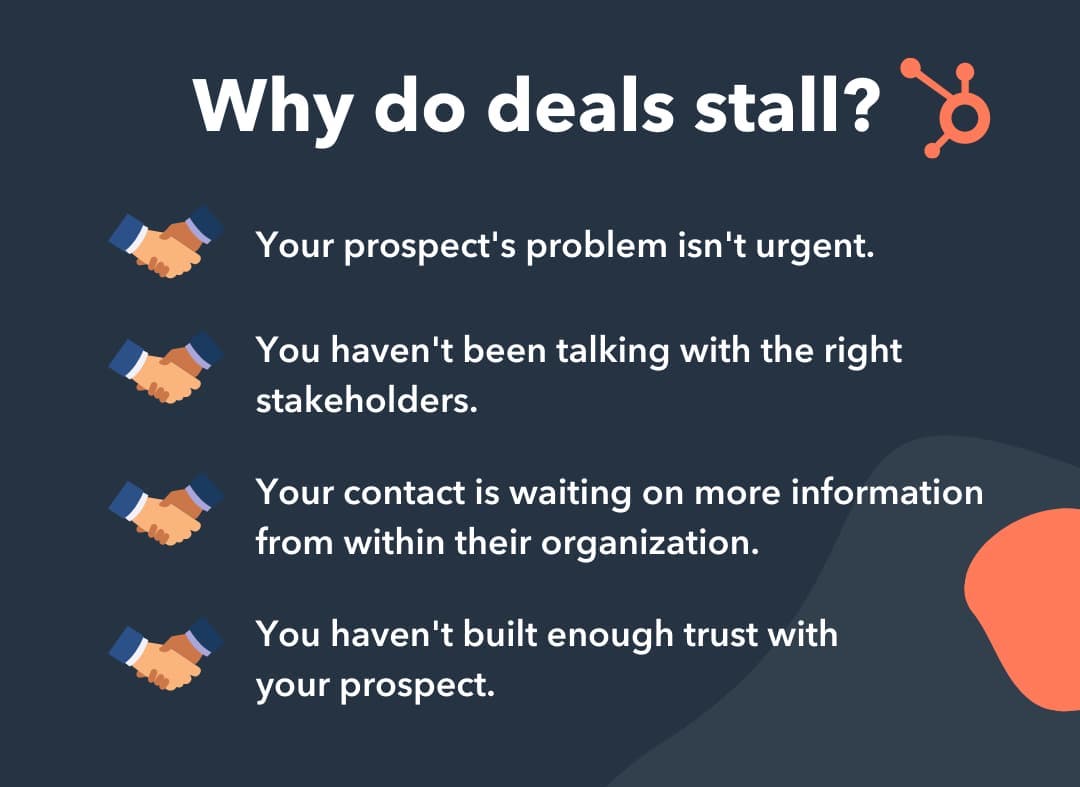
04 Nov 18:03

Opinion: An economics lesson on ride-hailing in B.C.

by Harvey Enchin

The current contest between B.C.’s taxi industry and incipient ride-hailing services provides a good lesson in some key economic concepts. On economic grounds and the public interest, the case for permitting ride-hailing competition is strong.

Oligopoly profits. Monopoly is a familiar concept — a market with just a single supplier. Protected from competition, a monopolist typically sets a high price and earns “monopoly profits.” At the other pole is a firm with many competitors and free entry by others; this process bids down prices to cover actual costs of production, so that profits are minimal. Lying between those market types is the oligopoly, characterized by few firms with limited entry by potential competitors. Oligopoly firms often cooperate to increase industry profits at the expense of the consumer.

B.C.’s taxi industry is clearly an oligopoly, as witnessed by the small number of companies in each municipality. For example, the City of Vancouver has just four taxi firms licensed to provide service. The companies behave more like collaborators than competitors. Under their umbrella Vancouver Taxi Association they file joint applications to add licences proportionate to their existing market shares, support moratoriums on new competition and make substantial political donations.  

Capitalization. Taxi-licence values offer direct evidence of the extent of the industry’s oligopoly profits. A B.C. taxi company needs a government licence to operate each vehicle legally. Licences are restricted in number, but can be traded in the marketplace. If the market were competitive, each taxi would generate little profit beyond its operating costs, and licences would have little value. In fact, taxi licences in B.C.’s major cities have huge values; a licence to operate a single taxi in Vancouver at times has been worth nearly $1 million.

The value of a taxi licence reflects the stream of all expected future profits. Pricing operates like a bond or a rental property; the anticipated future returns to the asset are capitalized into the price that a buyer is willing to pay. High licence prices reflect current and future above-normal profits expected by taxi operators. This value is influenced by the supply of new licences, regulated fare levels, and expectations about future events.

Regulatory capture. When an industry is naturally uncompetitive, the public interest demands some form of regulation to ensure that price and service levels are reasonable. However, B.C.’s taxi industry is oligopolistic only because the public authority limits the number of licences; with free entry, the industry would become far more competitive. As a result, the current oligopoly profits would vanish, wait times for taxis would decrease and passenger fares would decline.

The prohibition of ride-hailing in B.C. is a textbook example of regulatory capture — a situation where the public authority becomes “captured” by the interests of the group it’s supposed to regulate. Capture can occur via group voting, lobbying, campaign contributions, corruption and other means.

Regulatory capture is further exhibited by the near-exclusive issuance of new licences to incumbent firms — and at virtually no charge. Case in point is the April 7 decision to allow Vancouver’s four companies to add 175 taxis to their fleets. If each licence is valued at a reported $800,000, this was a windfall transfer of $140 million. In contrast, provincial fees to add the 175 taxis totalled less than $10,000.

Labour market. Media reports insinuate that the big losers from ride-hailing competition would be B.C. taxi drivers. This picture is highly misleading. Most drivers rent the use of vehicles from licence owners and must pay stiff fees for that privilege. For example, paying a typical $120 lease fee for a 12-hour shift plus gas costs, drivers may at times net less than minimum wage. Much like the million-dollar Tim Hortons franchisee pays the barista a modest salary, licence owners and not drivers reap the oligopoly profits.

The introduction of ride-hailing is unlikely to affect a driver’s income, as the loss of taxi passengers will lower the lease rates charged by taxi owners; otherwise drivers themselves will shift over to the ride-hailing sector. While hourly earnings are likely to remain flat, industry employment could increase significantly as service improvements and fare reductions encourage greater use of hired-car services. 

Externality. An economic externality occurs when a producer or consumer doesn’t bear the full costs of their own actions. If B.C.’s regulated taxi transport is overly costly and unreliable, more individuals will buy private vehicles, imposing traffic congestion and air-pollution costs on others. Greener trips like using public transit are also discouraged since paying a taxi for the “last leg” of a commute is prohibitive.

An even more striking negative externality results from rules that forbid B.C. taxis from picking up riders outside their home municipality. For example, a Surrey metro taxicab can only take passengers into Vancouver; absurdly, it must return home empty. This “dead-heading” raises taxi operating costs, congestion and pollution.

Consumer sovereignty. Surveys of the B.C. public indicate a strong preference for allowing ride-hailing services. A key concept in economics is consumer sovereignty — the notion that consumers know best their own wants, and that they should be allowed choice unless that creates significant adverse effects. Even with basic vehicle and driver-safety regulation, ride-hailing would provide the public with faster service and lower fares.

We don’t compel consumers to dine in expensive high-end restaurants; they’re also free to choose mid-level or even “hole-in-the-wall” options, so long as all meet basic food-safety standards. Similarly, sovereignty suggests that consumers should be able to choose their desired mode, level and cost of travel services.

Compensation. A policy change is deemed to be economically efficient if the gains exceed the losses to various parties. Sometimes this notion is construed to support compensation for the losing parties. Opening up B.C. to ride-hailing services would decrease the values of taxi licences for the incumbent holders; the extent of these losses hinges on the regulatory costs imposed on the new ride-hailing services.

Whether compensation should be paid to taxi-licence-holders losing value with the entry of ride-hailing is both a political and ethical issue. However, those who have held their licences a long time have gained massively by persuading politicians to limit competition. Those who have bought existing taxi licences at inflated prices in recent years, sometimes with financing, would be most harmed.

The policy challenge. The only substantive obstacles to permitting ride-hailing services in B.C. are the opposition of licence-holders and their claims for compensation. The worst outcome for passengers would be to so burden the ride-hailing industry with costly rules that their fares weren’t much below taxis, such that few drivers would join the new sector.

Rather than accede to the taxi industry’s attempts to obstruct an active ride-hailing industry in B.C. by calling for a “level playing field” that would increase costs for the new entrants, public policy should find ways to decrease costs for the incumbents. An attractive first step would be to phase out the senseless dead-heading caused by the home-area, pick-up restrictions. Time and fuel savings would improve taxi productivity and enable taxis to better compete with ride-hailing vehicles.

Overcoming the entrenched interests and opposition of current taxi-licence-holders — and their allies in and out of government — may require further forms of compensation or “sweeteners.” Nevertheless, keeping the status quo with the B.C. taxi industry protected from ride-hailing competition is unjustifiable on elementary economic grounds and adverse to the public interest.

Benn Proctor is a program associate with the Wilson Centre’s Canada Institute, Washington, D.C., and Rhys Kesselman is a Canada research chair with Simon Fraser University’s School of Public Policy. Proctor’s SFU Masters of Public Policy thesis is available online.

CLICK HERE to report a typo.

Is there more to this story? We’d like to hear from you about this or any other stories you think we should know about. Email vantips@postmedia.com.</p

04 Nov 17:56

Six Powerful B2B Marketing Tactics You May Be Missing

by Ruth Stevens

There are so many great new techniques in B2B marketing today, it’s hard to keep up. I hereby offer a roundup of ideas that you may have overlooked: IP address identification, a customer-driven content marketing strategy, better lead qualification, a renewed focus on customer and prospect data, account-based marketing, and linking consumer data with your business records. If any of these is new to you, I urge you to try them today!

IP address identification

A technique unavailable to consumer marketers, this one’s extremely valuable for B2B. And its cost is going down, as more marketing automation systems bake the functionality into their systems. But even using good old Google Analytics, you can see what companies have visited your website and develop strategies for how to take advantage of this information. I don’t suggest that you tell the customer directly that you notice they stopped by, of course. But any sales person who is already working the account will want to know about the fresh activity. And for entirely new prospects, you can design an outbound message strategy to prospects in the newly visiting firm, to describe your solutions and offer to help.

Arrange your content by buyer role and buying journey

The Content Marketing Institute tells us that a developing a sound content strategy is still a challenge for B2B marketers. One very effective approach is to audit existing content based on the buyer role (like specifier, decision-maker, end user) and the stage of the buying process (like need recognition, researching solutions, vendor comparison). Then you can evaluate what you have on hand and fill in the gaps based on the real customer needs.

Upgrade your lead qualification

I still run across B2B marketers who are handing inquiries off to their sales counterparts without effective qualification. You know what’s going to happen: sales will find the leads unproductive and they’ll complain—with reason—that marketing is giving them junk. So get your qualification criteria developed—in concert with sales—and ensure that you’re only passing leads that meet the specified criteria. In B2B, it’s about quality, not quantity.

Embrace your data

B2B marketers work with limited prospect universes, where the value of each account is huge, and we need to know everything we can about them. But many marketers still behave as if the content of their databases is someone else’s job. I say get close to your data. Inspect it. Assess its value. Fill in the gaps with data append or discovery. Don’t shy away or delegate. Make it your friend and your marketing asset.

Adopt account-based marketing

ABM isn’t new. This is how businesses have gone to market forever. But it’s getting renewed attention today and deserves a fresh look. Properly done, ABM can work wonders at bridging the gulf between sales and marketing teams. You can also develop highly relevant communications into targeted account segments. And it has the added benefit of focusing on key accounts, where the bulk of your profits lie.

Expand your customer insight by adding consumer data to your business customer record

Your B2B buyer is a person, with a personal life and a lot of interests outside of business. You can gain a lot of fresh insight into what makes these people tick and how to reach them effectively if you add their consumer data record to your marketing database. Companies like Stirista make this easy—and the payoff can be huge.

04 Nov 17:56

64 (Mostly) Clean Pump Up Songs for Motivation at Work

by lye@hubspot.com (Leslie Ye)

The right pump-up track can keep you inspired. Even Spiderman needs music to stay motivated while swinging around New York. The right motivational songs can make all the difference while you’re trying to be productive.

With that in mind, we’ve put together the ultimate pump-up playlist to keep you sharp and motivated while you’re at work. We even asked members of our sales team to share suggestions. Let’s dive in!

Subscribe to "The Pipeline" — The Weekly 5-Minute Read to Help You Crush Quota 

Pump Up Songs

1. “Tightrope (feat. Big Boi)” – Janelle Monáe

Go ahead, dance up on them haters ... there are enough of them.

2. “Lose Yourself” – Eminem

This track is great for both a jog and to get you pumped at the office.

“Sales it's a space where you can lose yourself really easily if you don’t have a clear motivation of why you are doing what you are doing,” says Diego Tibamoso Flechas, a senior manager of sales at HubSpot. “You need to have concrete KPIs and…a clear long-term vision and short-term goals.”

Flechas parts out the following line as a favorite: “Look, if you had one shot or one opportunity/To seize everything you ever wanted. One moment, would you capture it?/Or just let it slip.”

3. “The Final Countdown” – Europe

According to the Pomodoro technique, you're most productive when you work in blocks — typically 25 minutes long — then take a five-minute break. Blast this tune during the first or last five minutes of your work sprints to get your energy levels up.

4. “Bright Future in Sales” – Fountains of Wayne

Every salesperson's anthem, celebrating that victorious moment when the deal is closed.

(It'd be a shame if you had to interrupt your flow to log all of your prospecting activity. If you need a sales tool that works for you and not the other way around, try HubSpot's free CRM today.)

5. “Hungry Like the Wolf” – Duran Duran

Because when you're prospecting, you should be on the hunt - just like a wolf.

6. “Livin' On a Prayer” – Bon Jovi

For the last few days of the month when you need to close deals and create new opportunities at the same time.

7. “Won’t Back Down” – Tom Petty and the Heart Breakers

You won’t close every deal. You may lose clients or face a tough sell. No matter what, it’s essential to keep your head up.

That’s why Eoghan O’Neill, a CMS and operations sales specialist, suggests “Won’t Back Down.”

“Tech Sales can be tough you come across difficult customers, competitors, technical questions, the dreaded ‘no’ word, and many other challenges. But, I won‘t back down. I’ll keep going and get through it,” O’Niell says.

8. “Can't Hold Us (feat. Ray Dalton)” – Macklemore & Ryan Lewis

Nothing can stop you — not even the ceiling.

9. “Survivor” – Destiny's Child

You‘re a survivor, and you’ll make it through this week!

10. “Celebration” – Kool & the Gang

Sometimes your prospects will pick up the phone, want to talk to you, and be a great fit. After you hang up the phone, play this song. You deserve it.

11. “Welcome to the Jungle” – Guns N' Roses

Growth is a team sport, but prospecting isn‘t. It’s every salesperson for themselves in the jungle of leads ... unless you find one that's not in your territory.

12. “Good as Hell” – Lizzo

Note: Explicit lyrics

Boss up and change your life. This one might be explicit, but pop your headphones in and welcome those feel-good tunes.

13. “Harder, Better, Faster, Stronger” – Daft Punk

Great motivational songs have catchy beats — a formula that Daft Punk has mastered.

“It's a speedy vibe that gets me moving,” says Rebecca Philipps, a sales manager for HubSpot’s Solutions Partner Program, of the song. “Our work as sales reps is ‘never over,’ as we start with a clean slate every month and constantly look for ways to be ‘better, faster’ (a.k.a more efficient) with our time.”

14. “Honey, I'm Good” – Andy Grammer

Because it‘s okay to walk away from a prospect that just isn’t a good fit.

15. “No Sleep Till Brooklyn” – Beastie Boys

Note: Explicit lyrics

More like, “No Sleep Till a Discovery Call Gets Scheduled.”

16. “Hall of Fame” – The Script ft. will.i.am

Work every day like you want to be in the hall of fame.

17. “Build Me Up Buttercup” – The Foundations

Sometimes your prospects just won't get back to you, and The Foundations know how you feel.

18. “Pump It Up” – Endor

Ivan Flores’ song says it all in the title.

“This song combines my two worlds, selling HubSpot and trading equities I love when both MRR and profits ‘pump it up,” says the HubSpot senior sales manager.

19. “Cheerleader (Felix Jaehn Remix)” – Omi

Replace “cheerleader” with “champion” and imagine yourself finding one. The Secret works, right?

20. “Feel It Still” – Portugal. The Man

This unapologetically upbeat track will make you feel just a little bit less like a desk jockey.

21. “Life Itself” – Glass Animals

I‘ll admit it. This one has nothing to do with sales. But it’s an energetic jam that's been on repeat all summer and always gives me an energy boost when I need it.

22. “Feel Good ft. Daya” – Gryffin, Illenium

The title says it all. This track will never fail to put you in a good mood and mentally reset after a hard day.

23. “The Business” – Tiësto

Looking for great motivational songs? Ask your team members for their favorites. You can even play the song at the top of your meetings.

Nina Robinett, a sales manager at HubSpot, says her team drops their favorite songs in a Slack channel. “The Business” is one suggestion from her team.
24. “Power” – Kanye West

Turn up this track as you tap into your unstoppable power to close those tough sales deals. Let the rhythm fuel your confidence during your sales pitches.

25. “The Middle” – Jimmy Eat World

Remember the times when you felt overlooked or underestimated in your workplace? People telling you that you can’t close deals?

Well, don’t write yourself out.

This song motivates you to do your best, be authentic and not let others’ judgment affect you.

26. “B.O.B. (Bombs Over Baghdad)” – Outkast

When the sales floor feels like a battlefield, let this explosive track be your anthem. Let its high-energy vibes fuel your determination to meet those targets.

27. “Get Up 10” – Cardi B

Cardi B‘s journey to success mirrors the grind of sales. It pushes you to keep going even when the leads aren’t rolling in.

28. “Believer” – Imagine Dragons

This track is for when you need that extra boost to believe in your ability to close that big deal. Turn this up when you need a reminder that you've got this.

29. “Champion” – Clement Marfo & The Frontline

The name says it all. You’re a champion, and you know it. Don’t let anyone tell you otherwise.

30. “Zombified” – Falling in Reverse

Don’t let the pressure consume you, but instead, use it to fuel your determination and push you towards closing more deals.

31. “Billionaire ft. Bruno Mars” – Travie McCoy

The name says it all. Let’s work so hard that we all become billionaires one day and buy everything that we’ve always desired.

Songs About Teamwork

32. “We Are the Champions” – Queen

Do I need to say more?

33. “We Are Family” – Sister Sledge

Sales can be tough. But remember you and your team are in it together.

34. “We Can Work it Out” – The Beatles

Sometimes you'll run into roadblocks. But you and your team can and will work it out.

35. “Ain't No Mountain High Enough” – Marvin Gaye & Tammi Terrell

Mountains and valleys and rivers weren‘t enough to stop Tammi and Marvin from getting in touch, so what’s your excuse? There are salespeople out there willing to go in a dunk tank for a sale, so pick up the phone and start calling your prospects!

36. “Whatever it Takes” – Imagine Dragons

You and your team have got what it takes and will do whatever it takes to reach your goals.

37. “The Sound” – The 1975

The 1975 frontman Matty Healy uses this song as a bombastic end to the group's live performances for a reason — the sheer energy will wake you right up.

38. “Just What I Needed” – The Cars

The perfect jam for when you find that perfect teammate.

39. “Omen” – The Prodigy

When the energy on the sales floor needs a boost, this intense track can do just that. Let it electrify your team and push everyone towards hitting those targets.

40. “We Are One (Ole Ola)” – Pitbull

Remember the iconic 2014 FIFA World Cup? If the answer is yes, you probably love this electrifying song already. This power-packed track by Pitbull will unite your sales team, driving everyone toward their targets with relentless energy.

41. “With a Little Help From My Friends” – The Beatles

A classic reminder for every sales team that teamwork is key to success. Don’t let tough times pull you down. With a little help from your friends (team members), you can overcome the toughest challenges.

42. “We Will Rock You” – Queen

Every sales team should use this as their anthem - prove me wrong. This timeless classic will drive your team members to crush their quotas and triumph over their targets.

Songs About Leadership

43. “The Greatest” – Sia

You‘re the greatest! Don’t let anyone tell you otherwise.

44. “Don't Stop Believin'” – Journey

Self-explanatory.

45. “BO$$” – Fifth Harmony

Note: Explicit lyrics

A modern-day girl-power anthem.

46. “It's a Long Way To the Top (If You Wanna Rock ‘n' Roll)” – AC/DC

If you wanna rock ‘n‘ roll get into President’s Club, this song is a good reminder that it won't be an easy road.

47. “Guiding Light” – Mumford and Sons

Be the guiding light for your team.

48. “My Shot (feat. Busta Rhymes, Joell Ortiz & Nate Ruess) – Rise Up Remix” – The Roots

Don't throw away your shot — help your team rise up.

49. “Eye of the Tiger” – Survivor

No pump-up playlist is complete without this classic.

50. “Run the World (Girls)” – Beyoncé

Who runs the world? You do.

51. “Brave” – Sara Bareilles

To win, you need to be brave enough to say what you want to say without fear of judgment from others. This track motivates you to do just that.

52. “Hey Brother” – Avicii

Sales is tough. Your team members need a big brother they can look up to.

Give them what they want.

Songs to Make You Happy

53. “Bang Bang Bang” – BigBang

Is it even a roundup without some addictive K-pop?

54. “The Adventure” – Angels & Airwaves

Every day in sales is an adventure. Don't lose sight of that and remember to enjoy the ride.

55. “All Things” – Betty Who

Because even on your worst of days on the sales floor, things will get better.

56. “Let Go” – The Very Best

What do you need to let go of today?

57. “Seventeen Years” – Ratatat

Whether you've been in sales for 17 years or 17 seconds, we all need some beats to pump us up.

58. “Run Boy Run” – Woodkid

Because sometimes you just need to hustle.

59. “Radio” – Santigold

Ambush that sales scene and show them who's boss.

60. “Elevate” – DJ Khalil

A timeless classic. This feel-good track serves as a constant reminder to be relentless, improve, stay agile, and outpace your competition.

61. “Try Everything” – Shakira

Feeling down? Having second thoughts? Thinking of quitting?

A single verse from Shakira’s hit is enough to motivate you and make you feel good - “I won’t give up. No, I won’t give in till I reach the end. Then I’ll start again.”

62. “Best Day of My Life” – American Authors

Bring positivity by listening to this track every morning. You’re going to have the best day of your life.

63. “Blueprint” – Tyla Jane

Sets the stage for an unstoppable workday. The perfect jam to get the much-needed motivation to crush your quotas.

64. “Better When I’m Dancin’” – Meghan Trainor

No matter what, keep dancing!

Subscribe to "The Pipeline" — The Weekly 5-Minute Read to Help You Crush Quota 

04 Nov 17:55

Make Your Website a Tool to Grow Your Business

by Sally Falkow

how to grow your business with a website

There are 28.8 million small businesses in the US, which account for 99.7% of US businesses. (Source: SBA Gov 2016) Just over half of them (54%) have a website. (Hard to imagine why the other half don’t!) There are thousands of web design companies out there offering to make or update your site.

If your company has a website, or is considering making changes, ask yourself these questions:

Do I know what I want the website to accomplish? Does the site help me grow my business?

Setting Goals

Your website is not just a pretty brochure online. It should have a definite purpose and it should drive visitors to take certain actions that will advance your bottom line. And you should have a way to track and measure progress and success, so if things are not working you can make adjustments.

It’s so easy to say “over to the web design firm.” After all, what do you know about creating a website?

Well, the more important question is, what do they know about your business? Building a website needs to be a collaborative effort and you should be the one who decides what the site should accomplish.

Every business is different and you will have to figure out what your goals are. That way you can work with your web designer and create an effective tool that will get real business results. Start with a wire frame of the site and put all the pieces in place to lead your visitors to the take the actions you want them to take.

A non-profit might want more volunteers signing up and more donations. A local business, like a bakery or a dentist, will need more people calling or looking for directions to the store. An e-commerce site will want purchases and payment.

Once the site is live you can use Google Analytics to discover what’s working and what needs further tweaking.

The ABC’s of Google Analytics

The first report to watch is Acquisition. Where are your visitors coming from? You need to know how they find your website, so you can incorporate this into your strategy.

  • Do you need to do more SEO (Search Engine Optimization) so you get more traffic from search?
  • Are there sites or blogs sending you traffic that you did not know about? Build or strengthen relationships with them. Create content partnerships.
  • Figure out which social channels are sending the most traffic and adjust your social media programs based on what you find.

Behavior reports will tell you what your visitors do once they are on the site. Did they visit more than one page, did they view a video or download a whitepaper? What path did they follow through the site?

And finally, Conversion. You have to set up your goals in Google Analytics based on the goals you set for the website.

You can set destination goals – did they reach a certain page? Or you can make a duration goal – how long did they stay on the site? You can also make an event goal – did they take a specific action while on that page?

And all goals can be given a revenue value. You might not be an e-commerce site making sales on your website, but you can assign a value to certain actions.

For example, if you know that it takes on average 100 leads to make a sale, and the average sale is worth $1000, you can assign a value of $10 to each lead you get from a whitepaper download.

Take a critical look at your current website. If it was built without any idea of what it should be doing to grow your business, perhaps it’s time to consider updating it and making it an integral part of your business strategy.

If you don’t know how it’s performing, get Google Analytics installed. If you already have it, learn to read the reports so you can get the data you need. Then start making changes based on valid data and get start to get real value from your website.

03 Nov 21:10

These Reps Will Destroy Your Sales

by Colleen Francis
As a sales professional, you have the privilege of coming into contact with a variety of different people and personality types. And, let’s be honest, not every personality type is exactly a piece of cake to work, interact with, and …
Read More »
03 Nov 21:09

This is why that stupid way to multiply isn't so stupid after all

by Mark Frauenfelder

https://youtu.be/A4e8ojX5U2I

High school math teacher Joe Howard wrote to me about his latest video. He said:

A recent video has been circulating of a 4th grade teacher showing a method of multiplication and let me tell you--the parents who commented freaked out. Some went as far to say that this is what is wrong with our country these days.

In this video, I show a couple ways of approaching a two digit multiplication and talk about how the method she shows actually could help students with some high school math concepts. I also offer four pieces of advice for how parents can talk to their elementary school students about math.

Not sure if this is the type of content you would share, but I think it's extremely important. We are losing kids at the elementary level. We need to have positive, encouraging messages coming in early.

03 Nov 21:08

Alan Turing: How His Universal Machine Became a Musical Instrument

by Jack Copeland and Jason Long
The computing pioneer gave his computer the ability to play notes
Photo: SSPL/Getty Images
f1
Photo: Archivio GBB/Contrasto/Redux
Pictured here aged 35, Alan Turing was one of the most important figures in early computing.

Alan Turing is one of the great pioneers of the digital age, establishing the mathematical foundations of computing and using electromechanical digital machines to break German ciphers at Bletchley Park, in England, during World War II. But one of his contributions that has been largely overlooked is his pioneering work on transforming the computer into a musical instrument.

It’s often said that computer-generated musical notes were first heard in 1957, at Bell Labs, in the United States. In fact, the computer in Turing’s Computing Machine Laboratory at the University of Manchester, in England, was playing musical notes many years before that.

f2
Photo: University of Manchester/Press Association/AP
Tom Kilburn and Freddie Williams created “Baby,” the first general-purpose electronic computer designed to run programs stored in its internal memory.

It was in the Manchester lab, in June 1948, that the first electronic all-purpose, stored-program computer ran its first program. Nicknamed “Baby,” this prototype was rough and ready. Programs were entered into memory, bit by bit, via a panel of hand-operated switches. Bright dots and dashes on a tiny glass screen formed the output. Baby was created by two brilliant engineers—Freddie Williams and Tom Kilburn—as a test bed for their new groundbreaking, high-speed electronic memory, the Williams-Kilburn tube (a type of cathode-ray tube). Although Baby ran its first program a few weeks before Turing arrived at the Manchester lab, Turing’s ideas had heavily influenced Kilburn as he designed the computer. (Kilburn didn’t like giving Turing credit, but the historical evidence on this point is clear.)

f3
Photo: SSPL/Getty Images
Baby’s memory was built out of cathode-ray tubes. Bombarding the tube’s screen with electrons at a given point had the effect of storing a small area of charge there; this represented one bit, which could be read out by a metal pickup plate.

After his arrival, Turing improved on the bare-bones nature of Baby, designing an input-output system that was based on the wartime technology used at Bletchley Park. Williams and Kilburn themselves knew nothing of Bletchley Park and its nine gigantic Colossus computers. These secret machines were the world’s first large-scale electronic computers, although they were not all-purpose and did not incorporate the concept of the stored program. Instead, each Colossus was controlled by switches and a patch panel. The war ended before a plan to use a program punched into a teleprinter tape to control the computer could be tested.

Turing used the same punched tape as the basis of his input-output punch and reader. As with Colossus, a row of light-sensitive cells converted the tape’s patterns of holes into electrical pulses and fed these pulses to the computer. What made Baby unique was that rather than running the program directly from a tape, it stored the program in memory for execution. (Once programs are stored in internal memory, a computer can edit them before—or even while—they run.)

img  
Photo: SSPL/Getty Images
The Manchester Mark I at Manchester University’s Computer Machine Laboratory. A cathode-ray tube [circular object right of center] was used to monitor the contents of the Mark I’s memory.

Soon, a larger computer took shape in the laboratory. Turing called it the Mark I. Kilburn and Williams worked primarily on the hardware and Turing on the software. Williams developed a new form of supplementary memory—a rotating magnetic drum—while Kilburn took the lead in developing the guts of the computer, such as the central processor. Turing designed the Mark I’s programming system and went on to write the world’s first computer programming manual. The Mark I was operational in April 1949, with refinements continuing as the year progressed. Ferranti, a Manchester engineering firm, was contracted to build a marketable version of the computer, and the basic designs for the new machine were handed over to Ferranti in July 1949. The first Ferranti computer was installed in Turing’s Manchester lab in February 1951 (a few weeks before the earliest American-built commercial computer, the UNIVAC I, became available).

Turing referred to the new machine as the Manchester Electronic Computer Mark II, while others called it the Ferranti Mark 1. (Turing’s nomenclature will be followed here.) He wrote the programming manual in anticipation of the Mark II’s arrival and titled it Programmers’ Handbook for Manchester Electronic Computer Mark II , but it was based on his programming design work for the Mark I.

f5
Photo: SSPL/Getty Images
The Manchester computer was commercialized in the form of the Ferranti Mark I, the world’s first electronic general-purpose computer to go on the  market, released in early 1951.

How did Turing turn the Manchester computer into a musical instrument? His Programmers’ Handbook spelled it out. As far as we know, the Handbook contains the earliest written tutorial on how to program an electronic computer to play musical notes.

The Manchester computer had a loudspeaker—called a “hooter”—which served as an alarm when the machine needed attention. With some additional programming, the hooter could be made to emit a range of musical notes.

This was quite a trick. To produce a tone from a loudspeaker, you have to send it an oscillating electrical signal. The frequency of the oscillations gives the frequency of the tone. Modern digital sound equipment can generate all sorts of complex oscillating waveforms, but all the builders of the Mark II could manage was to send sequences of on/off digital pulses to the loudspeaker. And this is exactly what the computer’s hoot instruction did; executing the instruction once sent one pulse to the hooter. But one pulse on its own would just make a sound that Turing described as “something between a tap, a click, and a thump.” One could produce a recognizable tone by using a program loop that repeatedly executed the hoot command, sending a train of pulses to the hooter. The frequency of the tone was fixed by the length of time between pulses.

Now here’s the clever part. The length of time a computer uses to execute an instruction is measured by programmers in clock cycles: To keep all its circuits working in sync, a computer has a master clock, and only at each tick of this clock are the results from one set of circuits accepted by the next. (Modern computers have clock speeds measured in gigahertz—that is, billions of cycles per second. The Mark II chugged along at a little over 4 kilohertz, that is, four thousand cycles per second.) The hoot instruction took four cycles to complete, sending a one-cycle-long pulse to the loudspeaker on the fourth cycle. The instruction to loop also took four cycles, so when looping, the pulse would be sent every eight cycles, or at a frequency of 521 hertz, which is very close to the note C5. (The subscript indicates the octave; middle C is C4.) Turing realized that by using multiple hoot instructions inside the loop and/or “dummy” instructions that the computer would “waste” cycles in executing, he could vary the time between pulses, creating notes with different frequencies. For example, two hoots in a row followed by the loop instruction would produce F4.

Turing himself seems not to have been particularly interested in programming the machine to play conventional pieces of music. Instead he conceived of the different musical notes as aural indicators of the computer’s internal states—one note might play for “job finished,” another for “error when transferring data from the magnetic drum” or “digits overflowing in memory,” and so on. Running one of Turing’s programs must have been a noisy business, with different musical notes and rhythms of clicks enabling the user to “listen in” (as Turing put it) to what the program was doing.

It is not known precisely when the Manchester computer played its first programmed note. Geoff Tootill was one of the electrical engineers charged with building the hardware, and his laboratory notebook is one of the few surviving documents relating to the transition from Baby to the Mark I. In the notebook the Mark I’s 5-digit instruction code for “hoot”—11110—is listed in an October 1948 entry but is not yet matched up with any instruction (even today, computer processor designers will set aside codes that don’t actually do anything, so as to easily add new instructions later). But at the end of November an entry in the notebook showed that by then, 11110 had been matched up with an instruction.

The notebook labeled this new instruction simply as “stop,” but the computer already had an instruction for stopping (00010), so it seems likely the new instruction was the special kind of stop that was later called “hoot-stop.” The programmer would use this for debugging purposes: He or she would insert a hoot-stop instruction into a program to cause the computer to pause at that point in the execution. The hoot—a steady, continuous note of middle C sharp—alerted the Mark I’s operators that the computer had paused as instructed. Of course, we can’t now conclude for certain that the hoot-stop idea was actually tried out on the computer in November 1948, but if it wasn’t put into practice then, it doubtless wasn’t long before Turing and Tootill had the computer piping out its first note.

It took several more years before someone strung together these groundbreaking notes to create a complete piece of digital music on the Mark II.

f8
Photo: Barbara Halpern
Christopher Strachey actualized the potential of the Manchester computer to play melodies, not just individual tones for software diagnostics.

That someone was Christopher Strachey, who turned up at the Computing Machine Laboratory one summer’s day in 1951. Strachey soon emerged as one of Britain’s most talented programmers, and he would eventually direct Oxford University’s Programming Research Group. But when he first walked into the Manchester lab, he was a mathematics and physics teacher, albeit at Harrow School, one of Britain’s foremost bastions of upper-class education.

Strachey felt drawn to digital computers as soon as he heard about them, in January 1951, or thereabouts. Before the war, he had known Turing at King’s College, Cambridge, and in April 1951 he wrote to Turing about the Manchester computer. Turing sent him a copy of his Handbook, and Strachey studied it assiduously. The Handbook was “famed in those days for its incomprehensibility,” Strachey said.

This incomprehensibility was in no small part due to the way Turing had incorporated the conventions of the tape reader into the system software. Turing used a variant of the international teleprinter code to abbreviate the computer’s machine code instructions.

Teleprinter code, in use for decades by that time, associates letters, numbers, and other characters with strings of five bits; for example, A is 11000 and B is 10011 (it’s the ancestor of the ASCII and UTF-8 codes, which are used today to store text digitally). Teleprinter code was well known to engineers in that era; Turing was very familiar with it from his wartime work at Bletchley Park breaking the “Tunny” teleprinter cipher used by Hitler and his generals.

At the most basic level, computer instructions are, of course, simply strings of bits. The Mark II machine code instruction that commanded the hooter to click was 0000001111. Strings of bits are hard to remember and easy to mistype, so Turing chopped up his machine code instructions into blocks of five digits, and he wrote out his programs using the corresponding teleprinter characters as abbreviations for the machine code instructions. In teleprinter code, 00000 is “/” and 01111 is “V”; thus, “/V” is the teleprinter code abbreviation of the Mark II’s 10-digit hoot instruction 0000001111. (The teleprinter abbreviation of the earlier Mark I’s 5-digit hoot instruction, 11110, was simply K.)

In this scheme, unfortunately, the abbreviation gave no hint as to the nature of the instruction it represented. Even worse, numbers—such as memory addresses—had to be encoded the same way. For example, “B@” would correspond  to 1001101000 in binary. (The use of “@” to abbreviate 01000 is in fact a Turing idiosyncracy: His  Handbook  noted that in “true” teleprinter code, 01000 corresponds to a line-feed instruction.) Thus, where today a programmer might write “JMP 0616” as a way to tell a computer to “jump” to memory address 616, a Mark II programmer would write “X /P,” where “/P” is the Mark II’s version of a jump instruction and “X” is a memory address expressed in teleprinter code. The cheerful embrace of such nightmarish notation seems to have been a Turing hallmark—his pioneering 1936 paper establishing the foundations of computing relied heavily on a hard-to-read German gothic typeface.

Strachey was motivated to persist, however. He had made his first visit to the Manchester lab in July 1951, during which Turing suggested to him that he write a program to make the computer check itself. That Turing viewed this suggestion as the computer programming equivalent of a hazing can be seen by his remark to his friend Robin Gandy after Strachey had left: “That will keep him busy!”

As Strachey dived into learning what he needed for his task, his background as a pianist primed him to pick up on the page in the manual devoted to the hooter and how it could be made to produce different notes. When Strachey returned to Manchester a few months later, he brought with him the main program he’d been working on—called “Checksheet”—and a little something extra. Checksheet ran to 20 pages or so of code, which made it the longest program yet attempted. “Turing came in and gave me a typical high-speed, high-pitched description of how to use the machine,” recalled Strachey, and then Turing left him to his own devices at the console for the night. It was an intimidating moment: “I sat in front of this enormous machine,” said Strachey, “with four or five rows of 20 switches and things, in a room that felt like the control room of a battleship.”

Soon, Strachey had Checksheet up and running to show Turing—as well as his little something extra: The computer hooted out a performance of the British national anthem, “God Save the King.”

A budding programmer could have hardly thought of a better way to get attention. A few weeks later, Max Newman, founder of the Computing Machine Laboratory and professor of mathematics at Manchester—and in effect Turing’s boss—heard the computer grinding through the anthem. Newman quickly wrote to Strachey suggesting he might like a programming job in the lab. But Strachey had other irons in the fire and took up a position with a government department.

A patriotic musical computer did not go unnoticed by the press; headlines such as “Electronic Brain Can Sing Now” started appearing. The BBC got in on the action early by sending a recording team from the popular radio program “Children’s Hour.” The Mark II’s repertoire had expanded by this point, and in addition to the anthem it was recorded performing “Baa Baa Black Sheep” and Glenn Miller’s “In the Mood,” although it crashed halfway through the latter. “The machine’s obviously not in the mood,” exclaimed the BBC’s presenter. It seems that the BBC may have made a return visit to the Manchester computer lab later that year, to record some Christmas music. Ferranti’s marketing supremo Vivian Bowden reported that a BBC broadcast in December 1951 included the computer’s renditions of “Jingle Bells” and “Good King Wenceslas.”

The Manchester Mark II was not the only zeroth-generation electronic stored-program computer to play music. Trevor Pearcey’s Sydney-built CSIRAC (pronounced “sigh-rack”) first ran a test program in about November 1949. The computer seems to have been partially operational from late 1950 onward (a few months after the note-playing Manchester Mark I was switched off for the last time) and was in regular operation starting in about mid-1951. CSIRAC belted out tunes at the first Australian Conference on Automatic Computing Machines, held at the University of Sydney in August 1951.

f9
Photo: William West/AFP/Getty Images
The Australian CSIRAC (Council for Scientific and Industrial Research Automatic Computer) was also programmed to play music.

Exactly when CSIRAC first played musical notes is unrecorded; presumably it was in late 1950 or in 1951. A 2008 BBC News article, based on Australian sources, stated that CSIRAC was the first computer to play music, saying CSIRAC’s performance at the Sydney conference preceded the date of the BBC recording of the Manchester computer. Unfortunately, The Oxford Handbook of Computer Music also states that CSIRAC was “the first computer to play music.” However, this most certainly was not the case.

Before CSIRAC ran so much as a test program, the American BINAC [PDF], built by the Eckert-Mauchly Computer Corporation, was making music. BINAC was completed in August 1949. The team celebrated with a party that included a musical contribution from BINAC itself. One of the Eckert-Mauchly engineers present at the celebration, Herman Lukoff, explained: “Someone had discovered that, by programming the right number of cycles, a predictable tone could be produced. So BINAC was outfitted with a loudspeaker … and tunes were played for the first time by program control.” Although Lukoff does not mention the name of the person who created this pioneering music-playing program—the first in the world, so far as we know—she was in fact the veteran ENIAC programmer Betty Snyder [PDF], later Betty Holberton, and in 1997 the winner of the IEEE Computer Pioneer Award. Like Strachey, Holberton wrote her music-playing program during the night hours. Reminiscing about her time programming BINAC, she said, “I was on the machine 16 hours [with] 8 hours off and I slept in the ladies room.” Holberton recollected that, at the celebration, her program played the congratulatory “For He’s a Jolly Good Fellow.” So the timeline looks like this: At Manchester, an experimental computer-generated musical note (middle C sharp) was produced in the Computing Machine Laboratory, possibly before the end of 1948, and at Eckert-Mauchly in Philadelphia, during the summer of 1949, BINAC played different notes strung together into actual melodies. (For more information about the early ENIAC programmers, including Betty Snyder, the Eniac Progammers Project website is an excellent resource).

f10
Photo: PhotoQuest/Getty Images
The American BINAC, programmed by Betty Synder, jumped ahead of the Manchester computer to play the first computer-generated music in 1949.

Listening to the surviving unedited BBC recording of the Mark II playing music in 1951, one has a sense of people interacting with something entirely new. “The machine resented that,” Muriel Levy, the presenter, observed at one point. The idea of a thinking machine, an electronic brain, was in the air at Manchester. Turing merrily fanned the flames. He provocatively told a reporter from the British Times newspaper that he saw no reason why the computer should not “enter any one of the fields normally covered by the human intellect, and eventually compete on equal terms.” Computers taking on the artistic field of musical performance powerfully illustrated that these machines were more than just number crunchers. (Turing poked fun at fear of out-of-control AI, though he expected machines to outsmart us in the end.)

© Kathryn A. Kleiman 1997

Both the promise—and the limitations—of the new technology were captured by Max Newman in a 1952 lecture. Speaking to the annual conference of the Incorporated Society of Musicians, he discussed the advent of computer music. He detailed how the Manchester computer reproduced melodies stored in its memory, and then went on to explain that they had figured out how to make the computer compose new tunes. Just how this was done isn’t recorded, but it’s likely the compositions relied on a random-number generator of Turing’s creation that was built into the Mark II.

As to their musical quality, Newman noted they were “very bad tunes.”

Some portions of this article are based on material previously published in Turing, Pioneer of the Information Age (Jack Copeland, Oxford University Press, 2012).

About the Authors

Jack Copeland is Distinguished Professor of Philosophy at the University of Canterbury in Christchurch, New Zealand. He is also the director of the online Turing Archive for the History of Computing. Jason Long is a composer and sound artist currently pursuing a doctorate at the Victoria University of Wellington, also in New Zealand.

03 Nov 19:41

How to make your business card your best marketing tool

by Content Partner

12 easy steps to making your business card a successful offline marketing strategy that integrates online marketing

At Smart Insights we focus on digital marketing channels, and how we can help our members plan, manage and optimize their marketing strategies. However, we also look at the effects of offline and online marketing integration to create a holistic strategy which leads to business success. Our lifecycle marketing model shows the integration of offline and online marketing across RACE planning framework.

Lifecycle-Marketing-Model

Do you give much thought on how your business cards are going to impact people before you give them out? You probably just place an order for a standardized one from your local office supplies store. What you may not realize is that you are sitting on potentially the most potent weapon in your marketing arsenal.

Maybe it is time you start thinking of your business cards as marketing tools and not just a way to give out your contact information. Here are 5 ways you can transform your business card into your best marketing tool before sending it out for business card printing.

1. Include testimonials

Potential customers are always interested to know what your previous customers have to say about your products or services through testimonials. Testimonials are included on brand websites to increase credibility and reliability so why not include some on your business card. Including one or two of the best testimonials, you have received on the back of your business card will speak volumes about your brand and receivers don't need to go online to check your credibility.

2. Make your cards multi-functional

The end goal of making your business cards multi-functional is to make the recipients interact with them more times than they would interact with a typical business card. The more the interaction, the more your brand is memorable.

Ideas for a multi-functional business card are designing it as a bookmark, a sticker that they can put in their car or on their desk, a note card where they can write something they need to remember, and so on. Make sure your card can be used in more ways than one, or else you risk them looking at it once and either losing it or throwing it away.

3. Provide links to online marketing

Is your brand present online? Your business card can be the best tool to link your offline marketing efforts to your online initiatives. If you have a website, provide a link. Also important are links to your social media pages. Most people receiving your cards are on social media and social media is arguably the best lead generation tool.

4. Put your face on your card

Can you remember all the faces behind the business cards on your desk? It is difficult to put faces on business cards long after you met them. The same applies to them putting your face on your cards. How about putting a photo of yourself on your cards? Your potential customers will remember you many months after your brief interaction and feel familiar to your brand. This can give you an edge against your competitors who cards are not recognizable.

5. Mention a cause you support           

Letting people know about the causes you support can be great for your business. For instance, your brand can have an immediate impact on a potential customer because they are passionate about the very cause you support. It also gives people a glimpse of what drives you and what you and your business stand for. Examples of causes that will resonate with your target audience are charitable causes and environmental conservation causes, especially against climate change.

6. Give recipients a challenge              

Everybody likes to test themselves and surprising recipients with something to tease their mind can go a long way. Be creative about it but make it related to your business. It could be a tricky question or a fun fact that will amuse them.

7. Give special offers

Your business card is likely to have a bigger impact when accompanied with a special offer. You could offer a free gift or a coupon for products on your site. Although costly, this will make recipients think highly of you and your brand.

8. Monitor your business card

Track your business card’s conversion rate. You can do this by plastering SKU or QR code on it. And whenever you distribute the cards, promise the recipients some impressive discounts or coupons for heading to your business website. This technique can give you a benchmark to improve things. For example, if the business card doesn’t convert as required, you can use another strategy.

9. Increase your business card’s recall value using beautiful design

Make use of design to curate a business card that beats the competition. You don’t have to pay a web designer to create a beautiful business card design for you. There are free websites out there that offer beautiful templates to create business cards. All you have to do is choose the style, color, and size of font. However, if you don’t want to spend time doing it yourself, you can get a good web design out at a really reasonable price.

10. Keep your business card simple

The primary reason for creating business cards is to get prospects to contact you. That’s why you need to put more emphasis on the information that will enable that. A long time ago, information such as fax number, address and the business name was the main aspects required for a business card.

These days, there is a bit of a shift. Business cards give you the freedom to customize them. So you may include information such as your name, your title, your business name, your email address, your phone number and your website URL on the front of your business card. Prospects can find other information such as fax, landline phone numbers, and address when they check out your URL.

11. Include your social media handles

According to Isentia, Social media is without a doubt, a valuable marketing tool today. So it’s prudent that you include your social media handles such as Twitter and Facebook, so that prospects can follow you there. Prospects can get a lot more information about your business on your social media pages. So together with your business card and your online marketing channels, potential customers can see a much broader look at yourself and your company.

12. Use quality material to make your business card

Although the information you include on your business card is the most important for generating leads and customers, it is also important to think about the physicality of the business card.

Many business people try to cut costs by using low-quality materials to make business cards. That’s only going to ruin your business reputation. A big percentage of mediocre quality business cards end up in the dustbin. Prospects will also judge you by the quality of business cards you give out. They will conclude that your products and services will not be any different if you give out poor quality business cards.

These tips show that making minor changes to a typical business card can transform it into a powerful marketing tool. The key to unlocking this untapped potential is to use your cards to achieve two things. Firstly, foster deeper connections between recipients and your brand. Secondly, make yourself and your brand memorable.

Katherine width= Thanks to Katherine Mitchell for sharing their advice and opinion in this post. Katherine is a full-time digital marketing professional who helps to increase online visibility on search engine by proper implementation and with white hat Technics. She is also technically sounded and can grab the challenge, She is a resistant believer of hard work and patience, and like to explore the nature. You can follow her on Facebook or connect on LinkedIn.

03 Nov 19:41

One grocery store is successfully fighting back against Amazon (SFM, AMZN)

by Seth Archer

Whole Foods

  • The stock price of many grocers was hit hard after Amazon bought Whole Foods. 
  • Sprouts Farmers Market was included in the group affected by Amazon, but lower prices and a focus on produce may save it from Amazon's death grip.
  • Sprouts is one of the best-positioned grocers right now, according to one analyst.
  • Watch Sprouts Farmers Market's stock price move in real time here. 


The day Amazon's $13.7 billion acquisition of Whole Foods went through, grocery stores across the nation watched their share prices tank as the disruptive giant officially entered their domain.

Sprouts Farmers Market was among those grocers affected by the deal. It dropped 17.21% in three days as the Whole Foods deal was finalized and completed. But, the company isn't standing still. It reported its third-quarter earnings on Thursday, and beat Wall Street's expectations for earnings and revenue by a wide margin.

Mark Carden, an analyst at UBS, called Sprouts' report "straight up fresh" and is bullish on the future of the company.

"While one can attribute some of its beat to cycling a very promotional environment last year, we don't think the improvement was a one-off," Carden said in a note to clients.

When Carden started his coverage of Sprouts in March, he said that the company's produce, low prices, and ability to convert the occasional shopper into a regular is driving growth at the company, and he reiterated the importance of those strengths after the company's report.

Sprouts saw a boost from a stronger than anticipated produce growing season in the third quarter, and in general, the company has a strong produce section that is consistently priced lower than the competition, according to Carden. 

Sprouts' low prices in produce and across the rest of the store strikes at the heart of Whole Foods' biggest weakness. The minute Amazon took over, it lowered prices for many popular items at Whole Foods, but Sprouts' competitive price advantage will stay until Amazon can lower prices more aggressively across the entire store, Carden said.

Lower prices allow Sprouts to compete, not only against its organic competitors like Whole Foods, but also against regular grocery stores. It's what helps Sprouts attract customers from a wide geographic area and convert them to regulars, said Carden.

"We believe its differentiated model supports double digit revenue growth for the next 5 years," Carden said. He rates the company a "buy" and has a price target of $26, which is 26% higher than the company's current price of around $20.71 on Friday morning.

Sprouts is up 6.21% this year.

Read about how Amazon is bringing its biggest weapon to Whole Foods to ensure its success here.

sprouts farmers market stock pirce

SEE ALSO: Amazon is bringing its biggest weapon to Whole Foods to make sure it succeeds

Join the conversation about this story »

NOW WATCH: THE BOTTOM LINE: Chipotle's earnings disaster, Amazon's new headquarters, and the unstoppable stock market

03 Nov 19:40

A new Jeff Bezos-backed warehouse farm will grow enough produce to feed over 180,000 people per year

by Leanna Garfield

Plenty

  • Vertical farming startup Plenty — which has raised $260 million to date — is opening a 100,000-square-foot farm in the greater Seattle, Washington area.
  • The company, which grows fruits and veggies under LEDs and without soil, hopes to sell its organic produce for the same price as traditional produce.
  • Plenty plans to drive down operational costs by automating its growing processes as much as possible.


Following a $200 million investment this summer — the largest agriculture-tech funding round in history — vertical farming startup Plenty is expanding beyond its Bay Area roots.

The company is opening a second farm in the greater Seattle area, Plenty CEO Matt Barnard told Business Insider. Located in Kent, Washington, the 100,000-square-foot warehouse facility will grow 4.5 million pounds of greens annually, which is enough to feed around 183,600 Americans, according to the USDA.

The new farm will officially start production in spring 2018. Instead of growing outdoors, Plenty grows its crops on glowing, LED-lit 20-foot-tall towers inside a former electronics distribution center in South San Francisco. The towers do not require soil, pesticides, or even natural sunlight.

The technique is called indoor vertical farming. It's a type of agriculture in which food grows on trays or hanging modules in a climate-controlled, indoor facility. The process allows certain types of produce to be grown year-round in small spaces. 

Plenty's farm will be nearly twice the size as its original one in California. The company also has a smaller non-production facility in Wyoming, where it has tested different growing processes for over 300 crops.

The new Seattle-based farm will grow leafy greens and herbs first, but will later expand to fruits, including strawberries, tomatoes, and watermelons. Barnard said that Plenty's strawberries will be smaller, less pulpy, and higher in sugar and acidity levels than the ones most consumers are used to.

Plenty is aiming to lower produce costs by automating parts of its farms

Plenty, which received organic certification earlier this year, will start selling its produce in 2018. Though the company is not ready to announce exactly how it will distribute, Barnard hinted that delivery may be an option. 

To date, Plenty has raised $226 million. In July, $200 million came from a Series B funding round led by SoftBank Vision. The round included DCM Ventures as well as funds that invest on behalf of Alphabet’s Eric Schmidt and Amazon’s Jeff Bezos. 

With the new investment, Barnard said Plenty plans to build more farms around the world. The team ultimately aims to drive down operational costs so that Plenty can sell its produce for prices that match traditionally grown fruits and veggies.

Plenty is working toward that goal by automating its farm processes "as much as possible," Barnard said. For example, the company uses small robots, called the Schleppers, to transplant seedlings. 

"We grow very densely," Barnard said. "And that means you get to a limit where it's hard to have a person in there."

SEE ALSO: A growing battle in the $47 billion organic food industry could fundamentally change the program — and some farmers are worried

Join the conversation about this story »

NOW WATCH: This 'crazy, irrational decision' Apple made 20 years ago turned out to be the key to its outrageous success over Samsung

03 Nov 19:33

Do Customers Really Want A Frictionless Buying Experience?

by Dave Brock

It seems to be fashionable to talk about creating “frictionless buying experiences?” I suppose the concept draws readers, perhaps it’s an extreme expression of removing barriers to the customer buying process.

But does the concept make sense? Is it what customers want? And if we looked at the concept of “friction in the buying process, what is the greatest source of friction?

Long time readers will recognize when I ponder questions like this, sometimes I revert back to my background in physics.

If I look at an object in motion in a frictionless environment, they become impossible to stop. it is impossible to change direction. For an object not in motion, in a frictionless environment, we could never get them moving.

As we start to look at the consequences of this in the real world, virtually everything we do to make things work require friction. Cars, planes, trains transporting us require friction to get us from one place to another. Our swipes right or left on Tinder would not work, but for friction. It’s difficult to conceive of getting things done in the physical world without friction.

Friction is simply the result of object interacting with each other.

Too much friction requires more energy to get things done. But the opposite is also true, in a frictionless or low friction environment, we can expend a huge amount of energy and not move. Just think of sitting in your car on a frozen lake and flooring the accelerator. A lot of energy will be wasted as your wheels just spin.

So in the world of physical objects friction is terribly useful. Too much friction and we have to exert too much energy, too little friction and we can’t move or change–even though we may expend a lot of energy trying to do so.

Now let’s look at friction a little more figuratively, how do we develop new ideas, how do we innovate, how do we change without some form of friction?

I suppose there is some innovation that comes from people sitting in a dark room contemplating their navels, but even for them, to communicate their ideas, they have to write them down or type them into a keyboard which, at least technically involves friction.

But innovation, creativity, developing new ideas are seldom developed in isolation, they are actually developed through interactions we have with each other. It’s the different ideas, different belief systems, differing values, different approaches that drive us to learn, debate, create.

In the absence of this friction, we might never move forward if we aren’t moving, or we might never change what we are doing without someone giving us new ideas and helping us recognize the need to change.

Even the figurative concept of friction is very important in any progress, growth, change we want to make individually or organizationally.

Again, in this figurative concept of friction, it is what happen when we interact with each other.

Perhaps there are those that would argue they want a frictionless environment. In reality, their argument is they don’t want to change. They want to stay motionless or keep doing what they are currently doing. They aren’t our prospect or customers.

There are those that get tired of the amount of energy they have to invest or waste to buy or change. They want to reduce the amount of friction. They don’t want to eliminate friction, but they want to make it more manageable.

At this point, it makes sense to think, what’s the biggest source of friction in the buying process?

Guess what, it’s not sales people—even bad sales people.

The greatest source of friction in the buying process is the friction generated within the buying group itself. Look at the data on no decision made. Look at the data around where buying processes “blow up,” it’s long before that magical 57% number (I’m sorry, but that is so misunderstood–but that’s another post). There an abundance of data about buying or the failure rate of internal projects that point to the greatest source of friction—it’s within the buying group itself.

So if we wanted to reduce the friction, if we wanted to help the customer move forward but reducing the “energy expended,” the greatest value we can create is reducing the friction within the customer buying group.

Great sales people recognize this, helping the customer align their agenda and priorities and helping them focus on the most critical issues in buying.

Yes, sales people create friction, we make it more difficult for customers to buy. Bad sales people create a lot of friction. Fortunately, customers are pretty astute in recognizing this and are effective in eliminating that source of friction that wastes their time (uses too much energy).

Even the best of organizations create too much friction–we impose our complexity on the customer, making it difficult for them to buy. For example, endless handoffs, SDR to BDR to AE to Demo Specialist back to AE to Order Entry to Customer success. We do this to reduce friction for ourselves, but we increase the friction for the customer.

Or it may just be our internal complexity which we inflict on the customer.

These are sources of friction that require both our customers and us to expend more energy than we should. So we want to continually identify those areas where we are creating too much friction, reducing or eliminating them.

There are some that argue that the web creates the frictionless environment–seeing more and more customers completing more of their buying process through web research. There’s a lot of good data about the percent of the time they invest in web research, internal meetings, meetings with sales people, and other research. The web is very powerful–it’s one of those things that reduces friction, but doesn’t eliminate it. Consciously or unconsciously, customer seek the friction that great sales people bring in helping them understand what it takes to be successful, challenging their thinking, facilitating their buying process.

I think smart customers will continue to appreciate and demand the friction great sales people create. After all, it’s that friction that drives change and where would any of us be without that?

03 Nov 19:33

What Gets Executive Buyers To Act Now?

by Leif Kothe

how to sell to c level executives

Stalled proposals and lost deals are arguably a value communication problem—one that stems from an inability to understand how to sell to c level executives by creating enough urgency, and showing enough business impact to make a decision now.

So what kind of message is most effective in this pivotal “why now” moment—when you need to deliver a message that’s able to justify a decision? In other words, how do you make an impression with executive and financial buyers who might not care so much how your products and services work, but want to know how you can drive business value?

These are the questions addressed in our latest State of the Conversation Report. And make no mistake: These are important questions, given that 80 percent of your deals require a VP- or higher-level signoff, according to analyst data.

In the report, you’ll learn what type of story is most effective at moving executive-level buyers to act now—to decide instead of defer.

The best part? You’ll also get brand new academic research that aims to better understand the factors that move executives to action. You’ll learn about a “why now” messaging framework that’s tested and proven by the research to help you make the biggest impact in this key moment.

Get your copy of the report.

The post What Gets Executive Buyers To Act Now? appeared first on Corporate Visions.

03 Nov 19:32

Can Content Automation End the Quarterly Update Crisis?

by Chris Monaco

With average industry margins falling from 34 to 31 percent over the past decade, and most experts forecasting a continued slide to 20 percent over the next five years, it’s critical for asset management firms to foster productivity in conjunction with improving operational efficiency. Last year Seismic surveyed over 100 individuals from 37 asset management firms with the goal of learning not only what makes improving operational efficiency so attractive, but also why firms want to adopt content automation solutions in the first place. The results of the survey were overwhelmingly supportive of eliminating manual processes, especially where quarterly updates were concerned, and implementing technologies that could streamline workflows and lower costs, thereby delivering a higher return for firms.

Respondents believed that reducing the time it takes to build a fact sheet or pitchbook allows for the reallocation of resources that would otherwise be dedicated to such time-consuming, cyclical tasks. With this additional free time, managers are then open to pursue value-add activities, like prospecting new clients or strengthening relationships with current ones. Firms that had already adopted a content automation platform were experiencing the manifestation of such intangible benefits and found themselves gaining a competitive edge in the asset management space.

Because of these uniform results, Seismic decided to conduct a comparative analysis on the operational differences between manual and automated update methods–old school versus new school, if you will. The following table outlines the main steps a marketing person takes to produce a finalized, client-ready, PowerPoint pitchbook. Also included are estimated times for each step based on input from industry experts and Seismic customers. The data speaks for itself.

Item / Data Element Number of Steps Est. Time: Without Automation Est. Time: With Automation
Gathering Baseline

Materials

3 6.5 Hours 34 Minutes
Collecting Corporate

Information

6 8 Hours 13 Minutes
Describing Firm’s

Investment Approach

1 0.5 Hours 1 Minute
Detailing Firm’s

Management Process

and Investment

Offerings

2 28 Hours 62 Minutes
Communicating

Credibility, Proof Points

and Client Successes

2 12 Hours 4 Minutes
The Marketing

Operations / Production

Process

7 43 Hours 510 Minutes
Subtotals 98 Hours 10.4 Hours
Adjustment for

Concurrent Activities

< 33 Hours > < 3.4 Hours >
Total 65 Hours or Approx. 8 Days 7 Hours or Less than 1 Day

03 Nov 19:32

Operationalize Account-Based Marketing with Fit, Intent, & Engagement Data

by Peter Herbert

Fit, intent, and engagement provide the core data you need to be successful with your account-based marketing program.

In my previous blog on “The Formula for Account-Based Marketing Success”, I outlined the importance of taking a data-driven approach in your account-based marketing program and introduced a model I refer to as Fit + Intent + Engagement.

Formula for account-based marketing - fit, intent, engagement

In short, the first rule of account-based marketing is: know your target accounts.

The second rule is: know which of your target accounts are actively researching or buying so you can prioritize those accounts.

The third rule is: you must create engagement with the right people at these accounts before anything good like pipeline and revenue happens.

In other words, use the Fit + Intent + Engagement model to start operationalizing ABM. Below, I will describe some of the use cases for the model.

ABM Success Is the Path to Efficient Growth

The account-based way of approaching the market is fundamentally different than the lead-based approach. With the lead-based approach, you spend time, energy, and money metaphorically putting up billboards all over the highways of your market and then seeing who fills out a form on your website.

With an account-based approach, you already know who is likely to buy and who has the highest value, so you can select your tactics, proactively engage, and efficiently progress your target accounts and target buyers through their buying journeys.

With ABM, the first goal of marketing is to engage high-quality target accounts, not increase the overall quantity of individuals who fill in forms on your website or stop by your booth at an event.

This process, whether you call it ABM or just plain great B2B marketing, leads to efficient growth. The days of squandering marketing budget are gone. High-performing marketing teams focus on efficiently creating an impact on predictable pipeline and revenue.

The Key Isn’t Just Getting the Data, It’s Operationalizing the Data

Once you get started with ABM and implement the tools you need to get data-driven, you must operationalize the data. I talk to marketers at great companies every day, and the greatest barrier they face as they try to orchestrate engagement at target accounts is truly operationalizing account-based marketing.

Let’s go through the Top 3 scenarios where you can use the Fit + Intent + Engagement model to operationalize and succeed with ABM.

1. Identify Your Qualified Market

Before you select your target accounts, you need to identify the pool of accounts that marketing, sales, and sales development would potentially work on because they are a “fit” for your business. You need to know whether you have 20,000 accounts that are really a good fit to your ideal customer profile (ICP), or only 1,000. This requires data tools to build accounts in your CRM, build out contacts for your target buyer personas at each account, and, ideally, use AI-assisted or “predictive” scoring that allows you to score the fit of accounts so you can prioritize.

I’ve seen companies get too focused on their inbound-powered databases. When you rely solely on inbound, your database likely represents only a fraction of your potential market. You think you are making noise with your marketing, but no one can hear you. Build your database of high-fit accounts and engage!

Most companies can benefit from creating a master pool of accounts in their databases that are fair game if they show the right intent and engagement signals, or if they come in through inbound. Fit is always the filter. In other words, if the account doesn’t fit in this pool, don’t spend any time, energy, or money on it — period. (Any CFOs and CEOs getting excited yet?)

2. Select Your Target Accounts

Once you know your target pool of accounts that represent your qualified market, you can use the fit, intent, and engagement data to help you create a tiered set of target accounts. Since you are looking for accounts that are most likely to buy, the combination of these signals should give you direction on which accounts:

  • Fit your ICP and which are the highest fit
  • Are active in the market for information or a solution
  • Are currently engaged with your company, primarily on your website

target account selection account-based marketing ABM

Rank your target accounts according to data signals. Then consult sales to finalize your target list.

Use your data to rank your accounts based on their fit, intent, and engagement to decide whether to target them and which tier they belong in. Remember, if it’s not a fit to begin with, then don’t work it!

3. Dynamically Target and Prioritize Accounts

One potential hazard for some businesses is focusing on static target account lists and not using data to dynamically prioritize. Since you have identified your qualified market, or master pool of high-fit accounts, you can dynamically trigger marketing and sales activity based on emerging intent signals or engagement on your website.

For example, if a high-fit account has three people suddenly spending time on my product pages and I receive a signal that they are searching for “Account-Based Marketing” on the internet — BOOM, I trigger an SDR to start outreach to our target buyer personas. I also activate my marketing team to drop that account into marketing tactics such as account-based ads. I didn’t need anyone to fill in a white paper download form on my site to inform me that I should do this. I can remove the gate and the friction to consuming this valuable content if that is the best path.

In fact, a dynamic account-based approach may be the most effective path for many companies to increase their chances of success. And with the ABM tools we have available today, it’s not that hard to operationalize.

Account-Based Marketing Target Accounts

Use intent and engagement signals to move your high-fit accounts into a working status.

Even for companies that have well-known, very large strategic accounts to land and expand for their top tier, there’s still room in an account-based program for actively prioritizing tier 2 or tier 3 accounts to create greater scale.

Next Steps: Operationalizing Sales and Marketing Teams with Fit + Intent + Engagement

Operationalizing account-based marketing requires moving to a data-driven approach. Implementing data-driven processes and platforms is easier than ever, so you can streamline your marketing, sales development, and sales processes in pursuit of your revenue goals.

It’s all about creating a system that drives efficient growth. Data and tech enable the account-based marketing teams, who are now in the driver’s seat in the race to create predictable pipeline and revenue.

I’ll post soon on how you can use the Fit + Intent + Engagement model to operationalize:

  • Data-driven, smart account-based marketing campaigns, and
  • Sales and sales development insights for your hot accounts

03 Nov 19:30

8 Best Practices That Will Improve Your A/E/C Firm’s Email Marketing

by Tim Asimos

Email marketing remains to be a powerful online marketing tool when properly executed. And while most A/E/C firms are using email marketing to communicate with clients and prospects, many aren’t necessarily seeing results and could use a boost.

Does your A/E/C firm suffer from low open and click-through rates for your email “blasts”? Do you receive a high number of unsubscribes with every email you send out, even emails sent specifically to clients? If so, you’re not alone! The good news is, by following some simple best practices you’ll see unsubscribes go down and your click-through rates go up. Best of all, your emails will have much more impact on clients and prospects alike. Here are 8 best practices to consider.

1. Grow your contact list organically

With email marketing lists, quality is preferred to quantity. While quantity is still important, you should aim to grow your lists organically, as purchased and rented lists (e.g. the conference attendee lists provided to exhibitors and sponsors) can often lead to a negative impact on your email sender reputation, deliverability issues and less than stellar results. (See this article on improving email deliverability) Your contact list should be populated with people who want and expect to receive your emails, such as clients, teaming partners, leads and other contacts that you’ve established some level of relationship with.

Here are some tips to help you grow your contact list organically:

• Include an email subscription form on your website
• Promote the subscription form with calls-to-action throughout your website and blog
• Add a link in your employees’ email signature that leads to the subscription form
• Regularly update your contact list with contacts in your CRM database
• Establish a process to regularly acquire new contacts from BD staff and “seller-doers”
• Collect email addresses at in-person events such as tradeshows, conferences and networking events
• Capture new contacts through webinar, whitepaper and eBook registrations

2. Segment your contacts

Many A/E/C firms send their entire list of contacts the same email blast, often in the form of a company eNewsletter or press release. Unfortunately, this approach creates what I call the “boy who cried wolf” syndrome, because it’s highly unlikely that the content of the newsletter is relevant to the entire list. And if your emails are consistently irrelevant to many of your contacts, they’re likely to grow accustomed to ignoring your emails altogether. This means when you do actually send them something valuable and relevant, they’ll ignore it because of your previous track record of sending them irrelevant emails.

So don’t make this mistake! Instead, segment your email contacts to target different groups so you can send them more relevant information. Consider segmenting your lists by category (clients, teaming partners, prospects, etc.), market (Commercial, Healthcare, Higher Ed, Municipal, etc.), service (site engineering, landscape architecture, interior design, etc.) or buyer persona (owners, influencers, etc.).

3. Match content to contact

For each segment, create email content that speaks directly to their interests and provides them with value. Perhaps you’ll want to educate them on a new industry trend, make them aware of a recent regulatory issue or speak about best practices related to their business challenges or needs. Your email content shouldn’t be one-size-fits-all; rather you should create specific content that is matched to specific contacts. The goal is to make your messages highly relevant and not only worth their time, but something they actually enjoy receiving and reading.

4. Design read-worthy emails

Your clients and prospects receive a ton of emails every day (probably many from other A/E/C firms like yours) so you have just mere seconds to persuade them to open and read your email. Needless to say, email design—everything from the subject line, to the graphics and the text—plays a big role in making or preventing that from happening.

Here are some tips to consider when creating your emails:

• Make sure your email is mobile-friendly
• Craft a compelling subject line that gets your emails opened
• Stick to your brand standards
• Keep your design clean, simple and uncluttered
• Less is more—don’t overwhelm with text
• Put key information at the top
• Include a call-to-action in every email
• Test your email in various platforms and proofread thoroughly

5. Rethink your company eNewsletter

A/E/C email marketing primarily consists of sending out monthly or quarterly firm eNewsletters. The problem with many company eNewsletters is they talk way too much about your firm, your accomplishments, your employees and your other clients! While this may be of interest to some, it’s likely not interesting to most, especially considering the “busyness” of business.

Thought leadership is really important in the A/E/C industry, so your eNewsletter should be more focused on educating and informing your clients and positioning your firm as a subject-matter expert in your field. And considering the need to segment your lists and be highly targeted with your messages, it might be best to move past the eNewsletter altogether and send shorter, more frequent, and more targeted emails to your various segments focused on one specific, relevant topic instead of the longer and less frequent eNewsletter.

6. Graduate to marketing automation software

The use of entry-level email marketing solutions like Constant Contact is pervasive across the A/E/C industry. While these programs offer decent features and an affordable price tag, they’re geared towards small businesses and their capabilities fall short for firms that want to get serious about email marketing. So perhaps the time has come for you to graduate to a more powerful email marketing solution and consider adopting a marketing automation platform.

Marketing automation software brings all your digital marketing tools—email marketing, social media monitoring, landing pages, web forms, lead management, conversion optimization, analytics, SEO and more—into one integrated platform. And it can greatly impact your A/E/C email marketing efforts by providing advanced features and tools (not found in basic email solutions) that help you easily create, test, optimize, deploy and measure your email campaigns.

7. Leverage drip campaigns for nurturing prospects and leads

According to a Genius.com study, 66% of B2B buyers indicate that “consistent and relevant communication” is a key influence in choosing a solution provider. The sales cycle in the A/E/C industry can last an extended period of time, often lasting several months to several years. So it’s important for your marketing (in addition to your business development efforts) to help your firm to stay engaged and top-of-mind throughout the “buyer’s journey.” And that’s where drip campaigns can be helpful.

Unlike batch-and-blast email marketing, drip programs offer an effective way to stay engaged with your targeted audience over an extended period of time. Email marketing drip programs (also known as drip campaigns, drip marketing, or automated programs) leverage marketing automation software to send a targeted list of contacts a set of email messages based on predefined time intervals, actions taken by the contact (such as website visits, content downloads, etc.) or a combination of both. They allow marketers to stay connected to their contacts, provide those contacts with targeted and relevant content, while also reducing the time and effort needed by the marketing department to manage the program.

8. Monitor, measure and optimize

Keeping a close eye on the results of your email marketing campaigns is critical to the success of your ongoing efforts. You should be looking for insights into what contributed to the success (or failure) of each email and apply those insights to future efforts. You’ll want to keep a close eye on the following metrics:

• Delivery rate / bounce rate
• Open rate
• Click-through rate
• Unsubscribes / spam reports / hard bounces
• Opens / clicks by device type

Based on insights gleaned from campaign results, your approach should be optimized and tweaked moving forward. Consider using A/B (split) testing to experiment with different email options (i.e. subject lines, time of day, from address, colors, call-to-action) and determine which will be the most effective. Email marketing success is a moving target and your approach should be in a mode of continuous improvement.

Leverage the power of email marketing

There’s a lot more that A/E/C firms can do to leverage the power of email marketing. While certainly not an exhaustive list, these 8 best practices should provide you with some ideas to start improving your firm’s email marketing efforts today.

03 Nov 19:30

E-Commerce Customs Clearance: What You Need to Know

by Analisa Sande

moritz320 / Pixabay

Expanding across borders has become one of the best ways for eCommerce business to pursue business growth.

As the global eCommerce landscape grows, sellers have access to a market that is predicted to grow to $130 billion by 2020.

Many sellers soon find that cross-border eCommerce is plagued by a myriad of legal and financial regulations. These regulations differ from country to country, meaning merchants must stay informed of the laws in the country they plan to export to.

In June 2015, the Brazilian government mandated that all imports must carry a label marked with a CPF. The CPF is an individual’s (i.e. your customer) tax ID number. Packages sent without a CPF are returned or destroyed; and the seller also gets fined by the Brazilian Customs.

This was a blow for eCommerce sellers, as we all know how hard it is to get customers to give up basic information in the first place. By adding the extra step of adding their tax ID, the Brazilian government seems to have made closing a sale harder.

But the CPF (and other data gathering issues) are only a few of the many hoops that cross-border sellers must conquer.

To some sellers, challenges like Customs fees, dealing with damaged goods and handling returns, are much more difficult to address.

Every country has its own regulations concerning imported goods. Customs agencies use the commodity type, quantity and other factors to determine duties & taxes charges.

These duties and taxes are based on a combination of product price, shipping costs and the product’s harmonization system (HS) code.

With the fees calculated, there are two options for paying them, either Delivery Duties Paid or Delivery Duties Unpaid.

By default, these fees are often passed on to the customers to pay the duties & taxes:

In using the DDU option, customers must pay the Customs charge due or they will not receive their package. Passing the extra charges to unsuspecting buyers may reduce your costs. But if they are not expecting any extra charge, they can also decline receipt of the package.

To avoid this, provide clear and visible instructions on the cost and timeframe of shipping goods to overseas customers. Your site can display a notice stating the taxes and Customs restrictions of the importing (customers) country.

In the case of a DDP, the merchant works out all Customs charges and offers an all-inclusive shipping cost, to the customer. This is also a double-edged sword, as charging too much will lead to cart abandonment. Charge too little and you’ll struggle to make a profit.

These fees used to be hard to calculate, but with the adoption of the HS code by almost every country, sellers can quickly see what shipping that thingamajig will cost.

To calculate the Customs charges required for the goods to be delivered to the customer, here are two accurate tools:

  1. The Duty Calculator by Pitney Bowes helps you determine a ballpark figure for any Customs fees.
  2. The UPS site has a more comprehensive tool to help merchants understand country-specific Customs rules.

The UPS site also offers great country-specific information to help you prepare for international selling.

For example, what merchants thinking of shipping baby quilts from a Chinese supplier to a buyer in Mexico, ought to consider.

Due to anti-dumping laws, certain goods must carry an original Certificate of Origin to verify that the commodity is not manufactured in China. Those that don’t will be hit with extra anti-dumping duties; which for that baby blanket, may be up to 379 % of the merchandise value!

Getting it wrong with Customs duties can lead to:

  • Destruction or seizure of goods by Customs.
  • Customer refusing to pay Customs charges, and possibly requesting a refund.
  • Having to pay a fine to Customs.
  • Losing money by under-charging for shipping.

Despite these hiccups, profitable cross-border eCommerce doesn’t have to be so difficult.

Knowing the cost of getting your products into the hands of international customers, can even help eCommerce sellers decide if a market is worth entering in the first place.

To maximize compliance and still satisfy their customers, eCommerce sellers should partner with a fulfillment provider that is familiar with international regulations and Customs fees.

If you are dazed by the complexities of VAT or stumped by the intricacies of Customs regulations of different countries, it’s time you had a chat with an experienced fulfillment provider.