Shared posts

03 Nov 19:35

The Enduring Relevance of “Crossing the Chasm”

by Bob Apollo

hesalzmanngmailcom / Pixabay

With over a million copies sold, Geoffrey Moore’s “Crossing the Chasm” guide to marketing and selling disruptive products to mainstream customers is still one of the must-read books for B2B-focused sales and marketing leaders.

One of Inc. magazine’s Top 10 Marketing Books of All Time, its core principles are still enduringly relevant, more than 20 years after its first publication. Now in its third edition, it has of course been regularly revised to reflect the realities of modern high-tech marketing.

For me, the core of the book has always been its simple but effective framework for establishing a compelling and clearly differentiated value proposition, and I’d like to share some of the lessons I’ve learned in reinterpreting Moore’s format for a contemporary audience…

Here’s Moore’s original 6-step value proposition formula:

  • For (target customer)
  • Who (statement of need or opportunity)
  • The (product name) is a (product category)
  • That (statement of key benefit – that is, compelling reason to buy)
  • Unlike (primary competitive alternative)
  • Our product (statement of primary differentiation)

It has a simple, elegance, doesn’t it? This framework must have been used to position and launch thousands of successful new disruptive products and solutions. But in applying the formula in a series of recent positioning projects with clients, I’ve found that a few simple redefinitions and extensions can make it an even more powerful and effective tool.

Here are my changes:

  • For (targeted roles) in (targeted organisations)
  • Who are seeking to (targeted issues)
  • But are struggling with (typical constraints)
  • (Solution name) is a (category)
  • That (compelling reason to act)
  • Unlike (key alternative options)
  • We (our unique differentiators)

Allow me to break down these changes and explain my rationale in a little more detail:

For (targeted roles) in (targeted organisations)

I’ve found that the best way of accurately describing target customers is through a combination of targeted roles and targeted organizations. The targeted roles are the business problem owners that we can expect to be most concerned about the business issues we have chosen to target – these may include a number of related job titles.

The targeted organizations are the ones that align with our Ideal Customer Profile. Without a clear understanding of both the roles and job title we are targeting and the characteristics of our ideal target organizations, it will always be harder than it ought to be to either position what we do or to conduct effective outreach campaigns.

Who are seeking to (targeted critical issues)

It’s equally important to be clear about the specific business issues we have chosen to address. These targeted issues can either be problems that our prospective customer needs to solve or opportunities that our prospective customer feels that they have to achieve.

Whether these issues may already be obvious to the prospective customer, or whether we have to draw their attention to them through our actions, the common factor is that once recognized, the issues are significant enough to force the customer to take action.

But are struggling with (typical constraints)

This element was missing in Moore’s original formula, but I’ve found it to be critically important in shaping a compelling value proposition. Even once they have recognized a critical issue, many prospective customers will be held back by some form of constraint.

These constraints might, for example, take the form of skills deficiencies, incompatible systems or inadequate budgets and by identifying them, we can work out how we can take steps to help them eliminate them.

(Solution name) is a (category)

Moore’s original formula talked about “products” – but we live in a world where our solutions to the customer’s issues could take the form of products, services or a combination of the two. Most importantly, our solutions need to fall into a recognizable category.

This was a critical and often ignored element of Moore’s framework – if our prospect customers are to be able to easily comprehend what we do, they must be able to relate our solution to a category that they are already familiar with.

That (compelling reason to act)

This is another area where I’ve reinterpreted Moore’s original approach. He referred to a “statement of key benefit/compelling reason to buy” and many have taken this to mean the reason for choosing our product or service – but we can and will deal with this later.

I’ve found it more helpful to try and identify why our prospective customer should decide to do anything at all. In a world where the most common outcome of a buying process is now a decision to do nothing and stick with the status quo, it’s incredibly important that we identify what the prospective customer’s compelling reason to act is – whether they end up buying from us or a competitor.

Unlike (key alternative options)

Many people had a narrow interpretation of what Moore described as the “primary competitive alternative”, assuming it to mean only their most obvious direct competitors. But I’ve found it much more useful to broaden this focus to include all the alternative ways of addressing the targeted issue.

Your strongest competition may not come from the most obvious competitive vendors – it may come from radically different ways of confronting the problem or opportunity. Artificially restricting your perspective in this area could blindside you to who your real challenges are!

We (our unique differentiators)

Finally, I wrap up the positioning statement in broadly the same way that Moore originally intended – by focusing on our unique differentiators. But I’ve also learned that a handful of powerful differentiators are far more powerful (and way more memorable) than a laundry-list of everything that is different about you.

Keep it simple. Never forget that people remember (and respond) to short and simple themes, and not to lengthy or complicated lists.

03 Nov 19:34

5 Stupid Ways a Business Loses Sales

by Grant Cardone

2017 is going down as the year retailers are going bankrupt. Toys R Us, Abercrombie & Fitch, American Apparel, RadioShack, Payless, and hhgregg are just a few of the names going under. The retail bloodbath is going to continue. It doesn’t necessarily need to continue, but it will because these businesses refuse to learn to sell. Here are 5 typical ways retailers everywhere are losing easy sales:

Stupid Lost Sale #1:

The salesperson is rude or condescending—42% of customers will go elsewhere over a rude staff.  I’m not just talking about salespeople, everyone in an organization has the potential to have contact with customers and be rude and condescending. Someone comes to the showroom and people don’t even tell him hi. 

If you come to my office in Miami my staff will greet you. If any of my staff didn’t greet you they’d be fired on the spot. Can you imagine going to a party, walking in and nobody even acknowledges that you’re there?  That would be rude.  A lot of people don’t realize they are condescending—maybe because there’s no awareness of your obligation to provide customer service. 

You know what condescending is, right? 

“Sir, the number is on the website”

“It says it right there in the contract”

“Did you download it?  It’s right there”

“The warranty is in your glove box”

Really you’re just saying “You’re stupid”.  You can’t afford to lose customers over rudeness and condescending attitudes.  Rude and condescending communication should never be allowed.  Have zero tolerance for it.  Have also a commitment for no negativity in the office.  Your culture should have no negativity, no gossip, and no criticizing of customers. 

Where there is no demand, there is no value.  When customers want something from you, there is a way to exchange value with them.  Complaints and problems are opportunities.  If the customer is ridiculous, even impossible, still try and make it happen.  That’s when you start becoming positive and empathetic.  You start saying things like “I understand”, “I’m with you”, “I agree”, “You deserve it”, and “I want to solve that for you”. Commit first and handle it later!

Stupid Lost Sale #2:

Your solution is useless—When someone reaches out to you to solve their problem, your job is to solve their problem. You either solve the problem or you don’t solve the problem. 82% of customers said that the #1 factor to great customer service is solving problems quickly. 50% of dissatisfied customers will tell 10+people about their experience. You don’t tell people about the times they do great work for you, you usually just tell people about that one bad experience, right?

I once had a dentist in LA that always did a good job, was friendly, and got the job done. I went in to fix a tooth that was cracked and the next day I ate a gummy bear or something and part of the tooth fell out. I was in the process of moving to Miami so I called her about it and she said the next time I’m in LA come to her. I didn’t make it back to LA for 3 years. She didn’t solve the problem or even make an effort to solve it. Although she was a good dentist and did good work, she disconnected from the problem. She didn’t solve that last problem for me, so in my mind, she isn’t on that unbelievable, great, super satisfaction list. You have to help solve problems!

Stupid Lost Sale #3:

The customer is ignored—Look for the critical customer touch points to make sure that you are not ignoring your customer. As a policy, every customer should be greeted, acknowledged, and addressed immediately upon arriving, calling, or emailing your business. At a big department store, you can often walk through 10 different departments without anybody talking to you—probably with nobody even looking at you. Make it a priority to have a greeter to be sure to acknowledge everyone who walks through your doors. Direct them early on!

Stupid Lost Sale #4:

Can’t speak with a supervisor—First off, a customer should never have to ask to speak to a supervisor. The supervisor should intervene before there is ever a problem. It’s called being proactive, not reactive. It’s called before the problem, not after the divorce. You see, a lawyer gets involved at that point. You don’t want to act as a lawyer. Someone that really cares about a relationship will intervene earlier.

Warren Buffett said, “if you got a problem tell me about it quick”. If a customer calls in at 4:30 with a problem and I call back at 4:31, that tells them I’m serving them and willing to confront the problem. If I wait a few days, what does that communicate? I had an email on a Sunday with a client telling me about a proposal he had been waiting on for 2 months, and he said, “Come on guys!”

I didn’t wait until Monday morning to reply, I replied seconds later, on a Sunday afternoon, that the problem would be handled first thing Monday morning. Take the heat out of the fire by reducing time. Have management, executives, or a supervisor intervene when there’s a problem beyond the control of an agent.

Stupid Lost Sale #5:

The salesperson is too pushy—Most people are not pushy enough, trust me. Most companies don’t greet, don’t write, ignore customers, and don’t follow up. Most never get in the realm of being too pushy. Only an unskilled salesperson would come across as pushy. True professionals, highly interested, heavily trained people who are enthusiastic will not appear to be pushy. Roleplaying, handling customer issues, and pivoting into a sales process is what your team should be doing.


The bottom line is that too many retailers are making too many simple mistakes to deserve to stay in business. There’s a fine line between profit and just breaking even or losing money. You need every sale you can get, so don’t be making stupid sales mistakes—or your small business will follow Toys R Us and the others into bankruptcy.

My 7 figure sales certification is on sale today, it will show you everything to do in business that most people aren’t doing in business. Stop losing sales! 

Be great,

GC 

03 Nov 19:33

Closed Door Productivity

by Anthony Iannarino

Yesterday I spoke with my friend, Dan Waldschmidt. We were talking about productivity and some of the rules. He said that his “open door policy” had become an “open distractions policy.”

The idea of an open door policy is that people can come to you for help anytime they need it. But it doesn’t mean “anytime.” The openness to helping is not supposed to mean that you are free to be interrupted at any time. Interruptions are the destroyers of productivity and quality work.

Productivity isn’t measured by how busy you are or how many tasks you complete in a day. That form of Taylorism, objective counting and measuring time, does nothing to measure the value of the work you have done. Those are Industrial Age Measurements and are increasingly less valuable in the Information Age.

The real measurement of productivity is the value of the work you have completed. The more important the work completed, the more productive you are. The higher the quality of the most important work, the greater your productivity. These are not objective measurements. They’re subjective; they are value judgments.

What this means is that someone who spends 90 minutes completing a project that is critically important and of very high quality is more productive than someone who, say, spent 8 hours reacting to the interruptions that showed up in their office or their inbox (assuming that work was not nearly as important). It may feel good to be busy, but busyness is not a measurement of productivity. It is more likely that these two concepts are negativity correlated.

Yes, But Not Now

Being productive doesn’t mean you have to say no when other people ask for your help. You can say, “Yes, but not now.” You can close your door, the browser, and the inbox for 90 minutes at a time and do meaningful work. Three of these blocks in an 8-hour day will give you 4.5 hours to be productive and leave you with 3.5 hours to react to what other people need.

Close the door. Do good work.

The post Closed Door Productivity appeared first on The Sales Blog.

03 Nov 19:28

8 B2B Scarcity Examples That Are Working Right Now

by Josh Slone

Scarcity examples primarily occur in a B2C environment, but here are 8 winning B2B scarcity examples you can use.

Certain sales tactics are more powerful than others. Like any tool, they should always be used properly. Today’s post has several scarcity examples. This is perhaps one of the most powerful tools in the bag of business owners and reps.

Proceed with caution :).

Anyhoo. Yes, there are people who use scarcity to corral people and even manipulate them into spending money. Nearly every American big box retailer uses certain tactics this during the holiday season. Most notably the day after Thanksgiving.

If you’ve been to one, you may know what I mean. If you haven’t, take a look at this gif.

b2b scarcity examples

The examples we’re going over today do not (in any way) resemble this, but they should be used honestly and tactfully.

you may be wondering, “What is scarcity?” In the sales world, it’s creating an atmosphere of limited timing or availability of a product/service.

So let’s look at eight B2B scarcity examples working today.

B2B Scarcity Example 1: Limited Stock

Most of our readers either don’t have a limited number of items or don’t have physical products at all. You’re either a consultant, and agency, or other service-based business. But this tactic IS for B2Bs and service businesses, too!

If you don’t have “stock”, the quality of your work and the availability of your team (or yourself) could be grounds enough to produce scarcity.

Our friends at Explainify do just that. They’re a custom explainer video producer that works with some of the biggest companies in the world.

They also have a close-knit, busy crew of talented folks. This creates a natural scarcity. Their own explainer video gives us one of the best scarcity examples. You can watch the video on their homepage, but here’s the line that makes it happen at about 40 seconds in;

Oh, by the way. We only take a few clients at a time.” — Explainify

It doesn’t always take complex timers and email sequences to produce scarcity. Sometimes it just takes a good product.

Who It’s For:

  • Low Volume, High-Price Products: If you happen to have a custom, or limited product that is slow to produce — there is no reason you shouldn’t be using scarcity in your copy and sales presentations.
  • Marketing Agencies: If you’re aggressively using outbound, it may not be a good idea. It’s kinda like saying, “Hey, you wanna go out Friday?” Then, the other person responds with a “Yea!” And then, you say, “Well, let me check my calendar.” BUT, your inbound leads or leads you get via another type of promotion (like a webinar) would be perfect for scarcity.
  • Consultants, Skilled Agents: Let’s say you’re fantastic at PPC. You have people contacting you all the time via referrals, but few are pulling the trigger. Scarcity could be your example. Tell them (in a polite, yet direct way) that you are very quickly booked up and the quote and availability you have given will only be good until [insert reasonable date here]. Then, follow up closer to that date.

B2B Scarcity Example 2: Price Increase

This is one of the easier scarcity examples to implement. Anybody can increase their prices. As Ramit Sethi has said;

Price is a mere triviality.” — Ramit Sethi

However, it may not be the best idea to send cold emails to people about how you’re about to increase the price of your goods and services. Using this scarcity example is for a different reason than most of the others.

Our other examples help convince people who are slower in their decision making to pull the trigger faster. Increasing the price can help with this, but this tactic is best used for long-time fence sitters. Those people hanging around your social profiles and laying around your email list.

You know. The ones who’ve consumed all your content, kicked every tire, and maybe even spoken with you directly — but have yet to say yes OR no.

In order to move these prospects and suspects, it’s time to put the scare back into scarcity.

b2b scarcity examples

Price Increase Best Practices

Don’t Increase Current Customers

This is for companies like SaaS and other subscription-type services (e.g. SEO monthly services). But if you can provide multiple contracts to the same client over the course of many years, it may be ok to bump up the cost with current rates.

Increasing fees of current buyers will likely cost you business in the short term. Netflix just announced another price hike for active subscribers — even though it caused poor growth last year (when they did the same).

b2b scarcity examples

(Source: Forbes)

Set a Date

It’s all talk until it has a date. None of this, “We don’t know how long we’ll be able to keep X at these prices”. Put a price tag and a date on your increase, it’s the most effective way to put a clear call-to-action in front of your slow moving pipeline.

Let Everyone Know

Once you’ve set the date, you’ll have to tell everyone who’s aware of your brand. First, current customers. Tell them that;

  • Their prices will stay the same, and
  • To tell their friends and colleagues that aren’t clients

After that, you’ll want to alert your email list, social media accounts, and even previous clients who didn’t stick around.

B2B Scarcity Example 3: Limited-Time Opening

This one is most commonly used by content and course creators. People we’ve all heard of like Pat Flynn, John Lee Dumas, and others, use this with great success. B2Bs have a lot to learn from the method, even if you have your products open full-time.

The cadence typically works like this:

  1. Create course, make it open for registration for a limited time, and close it down.
  2. Take care of the students/enrollees, improve the content as more people move through it, and get testimonials for the next time the course is open.
  3. Re-open the new and improved course (usually with a higher price than last time).

The good side and the bad side of this method go hand in hand. The scarcity it creates is top notch. People are motivated to move. But the reason they move is a potential downside. Once it’s closed, it’s closed.

Take a look at Pat Flynn’s Power Up Podcasting Course. It was closed at the time of screenshot, but here’s a link to see if it’s open (we’re NOT an Affiliate).

b2b scarcity examples b2b scarcity examples

How can B2Bs best use it? It may require thinking outside the box, but here are a couple ideas:

Lead Gen/Starting Conversations

One thing we always recommend to our clients is to use a Calendly link in their cold emails. Basically, it allows leads to schedule a time to talk on their terms. But it also creates a little mini-scarcity.

If you limit your time well enough, it should seem like there are only a few slots available—creating the impression of value and scarcity.

I know this is one of the scarcity examples we are using currently. Our CEO, Justin McGill, actually gets on calls with new customers to get them onboarded and to kickstart their campaign. However, there are only so many time slots per week where he can do this.

Seasonality

If your business helps other industries that have certain things happen at set times, you could have some good scarcity. For instance, the end of the month is busy for mortgage and loan companies.

Open enrollment is crazy for anyone attached to HR. Holidays are huge for retail and hospitality. Use this to say things like, “Get X done before [insert scary/busy time] is here” or “[Scary time] is almost upon us again.”

To best use seasonality:

  • Pre-Plan well and time it right. Not too soon to where leads aren’t thinking about it, but enough time for them to react and decide.
  • Communicate it well. Use it in your cold email sequence to warm up leads. It will tell them you understand their industry. Use a subject line like, Question about [scare time], {First.name}.
  • Understand why it’s a busy/scary time. Don’t just know about it. Know why it’s crazy and what to do about it. It’ll help you build rapport with your responses.

B2B Scarcity Example 4: Combination Offer

Nowadays, it seems, the more segmented and complex the sales process is—the more deals are closed. At least when it’s done right.

Many of us don’t want to limit our stock. Our prices are good to go at the moment so that one is a “meh” too. And, like us, don’t want to shut down the product/service just to get people to buy only to have to significantly revamp the product and re-release later.

If that’s you, it’s ok. Our last one is one that we actually use (at the time of this writing) and it’s a combo-style offer involving a webinar with bonuses.

We’ve made a lot of positive changes to the product, but none of which used scarcity. In order to do that we created a few offers exclusively for clients who came in via a webinar. But only if they bought within a certain amount of time (i.e. scarcity).

Here’s how to do it:

  • Create an Incredible Webinar: It’s gotta be valuable enough to pay for in and of itself to get the right people to show up.
  • Come up with your extras: You can use a kick-off consultation call, extra services, joint venture with other products/services—the sky is the limit, just make them good. The better your bonus offers, the more is on the line. Thus, increasing the power of your scarcity.
  • Get People to Your Webinar: Use FB ads, partnerships, even cold email to do this. Fill up the seats, give them tons of value and pitch them with all the bonuses—exclusively for attendees.
  • Put a Date to It: A week from the webinar seems to be best, but experiment to find the right fit for your offers. You’ll have a significant percentage (again, if done right) sign up right away. Then, email them a few times. You should notice another chunk come in at the last minute.

B2B Scarcity Example 5: Removing Features/Services

This was another of the scarcity examples we ran recently with great success.

It’s akin to upping your price. When restructuring your plans, you can also test the feature set available in each plan. For instance, if you’re a SaaS and have always included a certain feature in your lowest plan—it may be time to bump it up to premium.

Doing this with much communication to those aware of your brand should prompt some action.

Or, if you’re an agency that bundles services together, this could work (if it makes business sense). Let’s say that you lump in 3 months of SEO services with every new web design and it’s not very cost effective. Switch it to one month.

Here’s the thing;

The key isn’t what you change, it’s how well you tell your world about it.

B2B Scarcity Example 6: Expired Bonuses

A lot of times you might get extra bonuses if you sign up within a certain timeframe. It could be ebooks, guides, videos, etc. From time-to-time, we’ve used this scarcity example by adding an allotment of extra leads per month to plans if they ordered by a certain deadline.

This tip is great to use in conjunction with others. It could be during a promotion with a partner, celebrating a new integration or launch, you name it.

It can be like launching your product a couple times a year.

Retailers, to their credit, use this tactic often. Go to a mall, and every once and a while you’ll see “Semi-Annual” sale. It’s usually not just a sale, but bonus offers and such that are only good for a limited time.

B2B’s can use this to constantly be cleaning out their list.

Bonus Tip: One of the best ways to do it is via partnerships. Other companies in similar industries want more business and will likely offer a discount on their services for those who buy yours. It’s a win-win-win for the right leads.

B2B Scarcity Example 7: Invite Only

This is one of the scarcity examples MeetEdgar did with their launch to much success. The Edgar team sought out influential marketers who were already working very hard on their social profiles. This allowed for promotional time, beta testing, and some great buzz.

For a large chunk of time, you could only get into Edgar if they chose you—creating some intense loyalty amongst those fewer users.

But it doesn’t just have to be at launch, you can use this same tactic for:

  • New Beta Releases
  • New Services
  • Limited Offers

Send an invite to your list and let them know there are a limited number of spots and a limited number of people who were invited. Make sure to clearly outline the terms of the deal, your part and theirs to avoid confusion.

B2B Scarcity Example 8: Competitions and/or Contests

One of the last scarcity examples you can use in B2B is competitions or contests. After all, there can only be so many winners.

There are tons of great resources online showing how to run a great contest. I’ll link to a few updated favorites.

Using Scarcity the Right Way

b2b scarcity examples

Every day, “As Seen on TV” products, retailers, and others are using scarcity poorly, but don’t let that turn you off.

It can be a fantastic tool to help:

  1. Accelerate the buying cycle
  2. Motivate lazy leads
  3. Clear out suspects
  4. Increase conversions

What are some scarcity examples you’ve seen (or used)?

03 Nov 19:28

17 Must-Read Sales Books For Beginners

by afrost@hubspot.com (Aja Frost)

If you're in sales, and this is your first year on the job, you should make it a priority to read the following 17 books. That's a book or two a month -- meaning you'll be fully ramped and selling like a pro by your one-year anniversary.

Check out our key takeaways from the best sales books of all time

Best Sales Books for Beginners

  1. The 7 Habits of Highly Effective People
  2. The 25 Sales Habits of Highly Successful People
  3. The Little Red Book of Selling
  4. The Sales Acceleration Formula
  5. Secrets of Closing the Sale
  6. Presentation Zen
  7. The Best Damn Sales Book Ever: 16 Rock-Solid Rules for Achieving Sales Success!
  8. The Psychology of Selling: Increase Your Sales Faster and Easier Than You Ever Thought Possible
  9. Sales Blazers: 8 Goal-Shattering Strategies from the World's Top Sales Leaders
  10. The Sales Bible: The Ultimate Sales Resource
  11. The Challenger Sale
  12. The Sales Survival Handbook
  13. More Sales, Less Time
  14. Emotional Intelligence for Sales Success
  15. The Sales Development Playbook
  16. Car Sharks and Closers: A Master's Closer's Secrets for Closing Car Deals
  17. The Evolving Sales Engineer

1. The 7 Habits of Highly Effective People

Stephen Covey

Stephen Covey's life-changing book is a great place to start. To be fair, I'm a little biased here -- this is one of my favorites. Inside this 384-page book, Covey reveals the secrets to developing the habits we need to be successful. Although it was published more than 20 years ago, the book's productivity tips and techniques are still highly relevant. As a salesperson, you'll appreciate the different approaches Covey suggests for mastering your day.

2. The 25 Sales Habits of Highly Successful Salespeople

Stephen Schiffman

Keeping with the theme of habits, this book by Stephen Schiffman helps salespeople amp up their motivation -- and ultimately, their success.

Readers will learn how to convert leads into customers, dominate presentations, stay motivated, and inspire those around them, while remembering to have fun and enjoy the journey. Schiffman has written more than 50 books and worked with IBM, AT&T, and Motorola, among others. His knowledge of the field is excellent.

3. Little Red Book Of Selling

Jeffrey Gitomer

Jeffrey Gitomer wrote The Little Red Book of Selling back in 2004, diving into what he believes are the 12.5 principles of sales greatness. Throughout the book, Gitomer reveals the reasoning behind why people buy. He teaches readers how to pick up on the small details to infer what prospects are thinking. More than half a million copies sold, lending credence to his ideas and principles. You'll appreciate Gitomer's straightforward, no-B.S. style.

4. The Sales Acceleration Formula

Mark Roberge

Mark Roberge joined HubSpot as employee number four and helped take the company from $0 to $100 million in revenue. Inside his debut book, Roberge tells readers how to use data, technology, and inbound selling to grow revenue at an unbelievable rate. This book is particularly valuable for entrepreneurial sales reps who'd like to understand the hiring, scaling, and analytical aspects of a sales organization. Although you might not put the knowledge to use right away, these strategies will come in handy as you progress in your sales career.

5. Secrets of Closing the Sale

Zig Ziglar

Look up "Sales quotes" in Google, and it's almost guaranteed you'll find some Zig Ziglar gems. Ziglar's advice for building strong relationships with prospects still hold true today. The book focuses on the principle that has become more prevalent than any other in sales: Build a strong relationship with the prospect. Inside this book, first-time reps will discover how to enthusiastically approach a client while projecting warmth and overcome the reasons people don't want to buy. Ziglar also shares 700-plus sales questions applicable to every part of the sales process.

6. Presentation Zen

Garr Reynolds

Effective communication continues to be one of the most important parts of selling. After all, if you can't clearly and concisely share your thoughts and paint a compelling vision for your prospects, they'll have little reason to buy your product.

In Garr Reynolds' Presentation Zen, readers learn how to present to any audience and make a lasting impact on potential buyers.

7. The Best Damn Sales Book Ever: 16 Rock-Solid Rules for Achieving Sales Success!

Warren Greshes

Does the title give away what this book is all about? For more than 25 years, Warren Greshes has been teaching salespeople how to find inspiration, stay focused, and become goal-oriented. Greshes gives us the keys to maintaining motivation, developing a positive self-image, and performing thorough preparation.

8. The Psychology of Selling: Increase Your Sales Faster and Easier Than You Ever Thought Possible

Brian Tracy

Brian Tracy clues us in to the role our subconscious plays in every purchasing decision we make, and reveals how to influence a customer's decision to buy. Over the course of 240 pages, Tracy gives his readers the ins and outs of the sales process and teaches them how to use psychological tricks to truly connect with and influence their prospect. This is a great primer before your first day on the job.

9. Sales Blazers: 8 Goal-Shattering Strategies from the World's Top Sales Leaders

Mark Cook

Mark Cook spent a significant amount of time and effort working with sales forces at Fortune 500 companies. During his research, he compiled eight different strategies used by the top salespeople at each company. These are the tactics behind dramatic growth -- and the best part is they can be learned and iterated by individual salespeople.

10. The Sales Bible: The Ultimate Sales Resource

Jeffrey Gitomer

Gitomer published the original Sales Bible in 1994 and came out with a revised edition in 2003. This easy-to-read book provides reps with the techniques to start conversations, maintain relationships, and eventually turn each prospect into a customer. In addition, Gitomer teaches readers the basics of the sales process by providing glimpses from his own experiences. Clear, concise, and full of great suggestions, this book is a fantastic primer for first-time reps.

11. The Challenger Sale

Matthew Dixon and Brent Adams

Traditional relationship-building strategies are no longer enough to win deals. These days, you can't just make friends with your prospect -- you have to challenge them. In their best-selling book The Challenger Sale, Matthew Dixon and Brent Adams lead you through the step-by-step process of crafting compelling insights and shaking up the buyer's worldview. This book is a crucial part of learning how to sell; in fact, your sales manager will probably recommend it during your first few months on the job. You'll be ahead of the game if you've already picked it up.

12. The Sales Survival Handbook

Ken Kupchik

Need a break from the more traditional sales advice? This funny book is perfect. Written by Ken Kupchik, who manages the hilarious and insanely popular Sales Humor Facebook and Instagram accounts.

You'll laugh, you'll cry, you'll wonder just what you've gotten yourself into ... and then you'll start the next chapter, and the cycle will repeat itself.

13. More Sales, Less Time: Surprisingly Simple Strategies for Today's Crazy-Busy Sellers

Jill Konrath

Most sellers are overwhelmed -- especially if they're new. In the digital age, buyers expect quick answers and results, and sales veteran Jill Konrath has the cutting-edge research and battle-tested strategies you need to meet that demand.

From reclaiming an hour of every day to optimizing your sales process and focusing on high-impact activities, you'll find this book a helpful guide to speeding up and gaining control.

14. Emotional Intelligence for Sales Success: Connect with Customers and Get Results

Colleen Stanley

Ever find yourself getting a little defensive in a demo or caving too quickly on a prospect's pricing demands? Colleen Stanley's book is exactly what you need.

Hone your emotional intelligence -- which studies find has a strong correlation to success -- and maximize your results. You'll learn how to increase impulse control for better questioning, develop empathy to close bigger sales, and even how to improve your prospecting efforts.

15. The Sales Development Playbook: Build Repeatable Pipeline and Accelerate Growth with Inside Sales

Trish Bertuzzi

Trish Bertuzzi is a sales legend and this book encapsulates her three decades of experience into six elements for building a strong pipeline and turbo-charging revenue growth.

Strategy, specialization, recruiting, retention, execution, and leadership are the areas you'll work on -- and a lucrative sales career is what you'll get in return. 

16. Car Sharks and Closers: A Master Closer's Secrets for Closing Car Deals

Gary Swanson

Author Gary Swanson knows what he's talking about, having closed more than 18,000 car sales deals over the course of his career. After working in everything position in the industry, from a car sales rep on a lot to become the owner of a dealership, Swanson shares his learnings that are helpful for anyone starting out in the car sales industry.

17. The Evolving Sales Engineer

Edward S. Levine

Sales engineers have a hard job -- they're expected to be both technical experts and effective salespeople. What's more, the sales engineering field is relatively new, so there isn't as much sales engineering-specific career advice out there. This book provides a clear roadmap for sales engineers that includes tips, training, and advice for every level of advancement in the field. It even includes a section for sales engineering management, for those who are managing sales engineers while working alongside sales reps.

If you're just entering the sales world, and aren't exactly sure how the venture is going to pan out, check out these books. Learning the strategies used by some of the world's most successful salespeople is sure to have a positive impact on the way you begin your sales career.

Want more? Read our list of top books for aspiring entrepreneurs.

download free sales book summaries

03 Nov 19:24

Personal Touch Email: How to Personalize Your B2B Campaigns

by Josh Slone

Having a personal touch email sequence is NOT knowing everything about your leads. It’s also not just using their name over and over again.

So, what is it? Data.

Too many times we boil down personalization into [First Name] and [Company Name], but that’s not how you’re going to hack cold email. If you really want to see gains in your response rate and the number of conversations—it’s going to take more data.

But we’re not just going to talk about the kinds of data you need on your leads going forward. We’ll also be taking a look at the best ways to apply and use the intel in order to really entice people to open, read and respond.

Specifically we’ll give actionable advice for:

  • Using Industry Data in Your Subject Line
  • Understanding the Company in the Message
  • Using CAN-SPAM to open a window into the office of your leads

Let’s get into it.

First, A Word on Form

In our “best practices” for cold email (that come from thousands upon thousands of emails sent), we break down the email into its three most important parts:

  1. Subject Line
  2. One (and only one) call-to-action
  3. Reiterate that one call-to-action

The reason I feel it necessary to include this is simple. All the personalization in the world won’t fix a poorly constructed cold email.

We’ve put together a lot of content on these topics, but here are a few that can help you construct a fantastic email and offer to put in said email.

Personal Touch Email: Subject Line

Ah, the subject line.

It’s quite possible the most talked about item in the email sphere. Why? Because it’s the gate keeper to the mind of your leads.

personal touch email

If you can’t entice the person seeing your email to open up and take a look at what’s inside, you can’t get them to respond. No response means no conversation; which means no opportunity to close. Pretty sure you get the idea.

We’ll be spending a lot of time on this particular aspect of cold email.

Personalizing the subject line in the B2B space is NOT about using the lead’s first name.

In fact, you’ll likely want to email a few contacts within the same brand—which means you should use something related to the company or industry they’re in. Here’s what to do instead.

Tactic One: Use Company Name + Pain Point

We’ve used this to generate some decent open rates. Instead of something that relates to the contact, make it relate to the needs of the role or business. Here’s an example that an agency may use.

Bad Subject Line: Having trouble with your website, [first name]?

Better Subject Line: An issue with the [Company Name] website.

In this case, not using the name of the contact is MORE personal than if we had. Why? Context.

It’s likely that this person is the owner of the business. Someone noticing an issue with their website is going to generate more curiosity (pressure, really) to take a look and correct the issues.

From a copywriting standpoint, this gets the lead in the mindset to find and squash issues — making it an easy transition for our example to give them a checklist of common website issues.

But that’s another story entirely.

Tactic Two: Use Industry Data to Generate Trust

Sometimes you don’t need specific data points to get an open.

Yes, names of contacts, companies, and competitors are entirely necessary for the email. However, it may not be what you need to get them into the email itself.

Sometimes, it takes understanding what your leads are thinking about and speaking to those thoughts.

One way we’ve seen this work?

Pain Points

personal touch email

Using the common issues (e.g. pain points) and spinning them in a way that either:

  • Highlights the problem
  • Gets your leads worried about it
  • Or, shows a potential solution

Imagine if you’re a HR exec and you get an email that says, Open Enrollment Violations. And inside, it’s not that your company has a violation, but there is a comprehensive look at new violations in the upcoming open enrollment period—along with tips to train your reps.

That would likely get a click.

Seasonality

Ok, so my pain point example included a little bit of seasonality. You wouldn’t send an open enrollment email in April, but it would go nicely from September (before it starts) all the way into the New Year.

Using certain times of the year to peak your open rate can be a good idea, depending on your target market. For instance, local agencies could speak to small businesses about how to improve their digital outreach during festivals, busy times, and peak tourist seasons.

Say you’re an agency that can help improve the online reviews of local small businesses in a touristy area.

Using a bit of personalized data, the subject line could read: Is [Company Name] a tourist trap?

Personal Touch Email: The Body of Your Email

If your personalized subject line does the job, you’re not quite there yet.

Nowadays, most email providers give the user (your leads) a one-sentence preview into your email. If your subject line is the guy standing outside the circus tent, this one sentence is a sneak peak behind the curtain of your main attraction (e.g. the email body).

If your subject line is writing checks that your email can’t cash, this one-liner will let leads know.

You don’t want to promise them something as awesome as say, a Jean-Claude Van Damme movie only to have them find out it’s Hard Target and old Jean-Claude is punching a snake.

personal touch email

What To Do With The First Sentence

After you alert and entice them with the subject line, it’s important to follow it up in the first sentence. Let’s break down that HR example from earlier.

Business: It’s a consultant who helps HR execs train and update their reps to ensure that legal errors don’t occur.

Resource: The consultant puts together a really snazzy PDF with all of the updated requirements for the current year along with tips for training reps.

Subject Line: Open Enrollment Violations

First Sentence: Hi, [First Name]. I was looking at the Human Resources information on the [company name] website… (the preview pane likely won’t include more than this).

Many B2B’s will absolutely nail the subject line, but have abysmal open rates. Why? The first sentence is usually off.

Instead of our example, it’s like: My name is John Doe and I help HR execs get ready for Open Enrollment.

See the difference?

The Rest of the Message

The subject line breaks the ice, the first sentence creates a bridge over the icy waters to your offer. If we’ve said it once, we’ve said it a dozen times:

What You offer in your email should NOT be what you sell.

That’s why I put the “Resource” in our example. To finish out this section of the post, I’ll give you a template a full template for our example.

Subject: Open Enrollment Violations

Hi, [First Name].

I was looking at the Human Resources information on the [Company Name] website and was wondering if you’ve made the updates for this year’s new regulations?

If not, I’ve put together a quick reference resource for companies just like [Company Name] that explains each new procedure and regulation along with 7 tips to help your HR reps better understand how it will effect their roles in the upcoming enrollment.

Here’s a link.

I’d love to hear your feedback, [First Name]. Just hit reply and let me know your thoughts.

Best,

[Email Signature]

P.S. Don’t want to receive any further emails? Let me know! Should I be speaking to [Alternate Company Contact] instead? Let me know that, too!

Personal Touch Email: Ending Things Off Right

According to article number five of the CAN-SPAM Act:

Tell recipients how to opt out of receiving future email from you. Your message must include a clear and conspicuous explanation of how the recipient can opt out of getting email from you in the future. Craft the notice in a way that’s easy for an ordinary person to recognize, read, and understand. Creative use of type size, color, and location can improve clarity. Give a return email address or another easy Internet-based way to allow people to communicate their choice to you. You may create a menu to allow a recipient to opt out of certain types of messages, but you must include the option to stop all commercial messages from you. Make sure your spam filter doesn’t block these opt-out requests.

You absolutely want to heed these instructions. Also from the Act:

Each separate email in violation of the CAN-SPAM Act is subject to penalties of up to $40,654, so non-compliance can be costly.

Ok, you have to include an opt-out in the first email you send.

personal touch email

But, it’s not all bad. Most people use the Post Script (aka P.S.) of their emails to pitch a whole other offer. If your body was a HR guide pitch, the P.S. is a webinar invite or something.

This doesn’t work. Instead, use this area for the required opt-out + a potential internal referral.

Internal Referral?

If your lead data is good, you should have alternate contacts within a brand. Obviously, if you’re dealing with small businesses—this might not be the case. However, if you’re dealing with our HR example, you very well could have the wrong person.

You know the saying, “You never know until you ask”? It’s true.

Notice the P.S. I included in the example template above.

P.S. Don’t want to receive any further emails? Let me know! Should I be speaking to [Alternate Company Contact] instead? Let me know that, too!

If you don’t have that data, you can use the following alternative to help you.

P.S. Don’t want to receive any further emails? Let me know! Not the right person to speak with? Let me know that, too!

Essentially, you’re avoiding a $40k+ fine, but also turning lemons into lemonade.

Ready to Include a Personal Touch in Your Email Sequence?

I really hope these tactics are useful. We’ve found them to be genuinely effective in our (our clients’) outreach and fully believe they can help anyone with the right offer and email copy.

Remember to test these and other personalization strategies and hone in your outbound efforts until you’re seeing the gains you know you should be.

Let us know which strategy you like best, or any tips you’re using for a personal touch email that’s getting results.

03 Nov 19:23

Align Incentives with Company Goals

by Zach Heller

incentivize.jpg

Some examples of employee incentives that I have come across in the recent past:

  1. A social media manager who receives a bonus based on growth in total followership
  2. A search engine marketer who receives a bonus based on lowering cost per lead
  3. An email marketing specialist who receives a bonus based on open and click thru rate improvements
  4. A sales team leader who receives a bonus based on conversion rate of leads to sales on outbound sales calls

From the list above, do any of the incentives stand out to you? Can you think of any reason why those incentives should not be in place?

On first look, they all seem to make sense. A social media manager should aim to grow the reach of the brand. A search engine marketer should take efforts to lower marginal costs. An email marketer should push for higher engagement. And a sales manager should value his team’s ability to close more sales.

But remember, what you measure matters. And if an employee at any level of the organization has all or part of their pay tied to certain metrics, those are the metrics that will matter to them. Even if they are not metrics that are tied back to the overall performance of the company.

That in mind, let’s find the problem with each of the above incentives.

  1. A social media manager who receives a bonus based on growth in total followership. This is all well and good except that how do we know that followership helps the business? You can increase followership by spending money to promote the brand page, or by buying lists. But that doesn’t mean it’s going to lead to an increase in brand engagement, loyalty or sales. Wouldn’t it be better to measure something that ties revenue back to social media activities?
  2. A search engine marketer who receives a bonus based on lowering cost per lead. While it might be good if a business drove more leads for the same amount of money, who is to say that those leads will be of the same quality. You can drive down lead cost by bidding on weaker terms, or spending more money on lesser search engines or content networks. That doesn’t mean that sales and revenue will go up as a result. Wouldn’t it be better to measure profitability of the advertising dollars over time?
  3. An email marketing specialist who receives a bonus based on open and click thru rate improvements. One might assume that more people opening and clicking on your emails is a good thing, but not if those people don’t end up becoming customers. The ultimate goal of any email campaign is not just an open and a click. It’s something else – a donation, a sale, a referral, greater loyalty or retention. Wouldn’t it be better to measure those outcomes?
  4. A sales team leader who receives a bonus based on conversion rate of leads to sales on outbound sales calls. This one seems like the most reasonable at first blush, but it too has its issues. One way to get to a higher conversion rate would be to pre-sort prospects and call only the easy sales. Another way would be to apply aggressive tactics over the phone in an attempt to pressure more people to purchase. These efforts can lead to lower sales and satisfaction, and higher cancels and refunds down the road. Wouldn’t it be better to measure a lifetime revenue metric and aim for higher total revenue per dollar spent on selling/calling?

Aligning individual incentives to the larger company goals is the only way to make sure everyone is working toward the same mission.

02 Nov 16:38

Three Creative Cold-Email Templates That Will Get Replies

You worry that members of your sales team are not following the right messaging guidelines in their cold outreach to prospects. The solution: you give them email templates proven to work. Read the full article at MarketingProfs
02 Nov 16:34

New Greenland Maps Show More Glaciers at Risk

by University of California, Irvine
New maps of Greenland's coastal seafloor and bedrock beneath its massive ice sheet show that two to four times as many coastal glaciers are at risk of accelerated melting as had previously been thought.
02 Nov 16:34

Fifty Years of Vision Research Opens Window Into the Brain

by NIH, National Eye Institute (NEI)
Newswise imageThe eye is more than a window to the soul; it is a window to the brain. To highlight the important connection between vision science and neuroscience, the NIH's National Eye Institute is kicking off its 50th anniversary celebration with the symposium "Vision and the Brain," Friday, November 10, 2017, at the Marriott Marquis in Washington, D.C. The event takes place in conjunction with the annual meeting of the Society for Neuroscience and is the first in series of symposia scheduled through 2018.
02 Nov 16:25

10 Email Marketing Do’s and Don’ts for Bloggers

by Tim Bourquin

As bloggers and site owners, we are continually focused on content creation and giving our audience the most value possible. While this is something we can all agree on, if you aren’t focusing on email and building up your newsletter size, you are simply missing out. The reason for this is simple. More than 70% of the people that visit your site for the first time are going to leave and never come back. The sad thing is that this really doesn’t have much to do with the content you are creating, but simply that there are way too many

The post 10 Email Marketing Do’s and Don’ts for Bloggers appeared first on Blogging Tips.

02 Nov 16:24

How to Introduce Yourself in an Email in [Almost] Every Situation

by afrost@hubspot.com (Aja Frost)

Have you ever started writing a new email, only to find yourself in a staring contest with a blinking cursor? I know I have.

Introducing yourself by email can be awkward and challenging for all of us. Unlike in-person social settings, you can’t rely on tone of voice and body language to strike up a natural conversation. So, how do you even start an email to a stranger? And how do you write one that will get you an actual reply?

Download Now: 25 Sales Email Templates  [Free Access]

Luckily, at HubSpot, we know a lot about writing effective emails. Today, I’m going to teach you how to introduce yourself over email in (almost) any situation.

Table of Contents

1. Write a compelling subject line.

47% of email recipients open an email based on the subject line alone. You need to pique their curiosity so they’ll open the email to learn more. Put a question in the subject line or make a bold statement that they’ll want to explore.

Two other tried-and-true methods? Numbers increase the average open rate by 57%. Personalizing subject lines is powerful, too: Adding someone’s name to the subject line increases the open rate by at least 50%.

Here are some examples of compelling subject lines for introductory emails.

Networking Subject Lines

  • “Coffee on me?”
  • “Can I buy you lunch?”
  • “No such thing as a free lunch (until now?)”
  • “Long-time [listener, reader, fan], first-time emailer”

Sales Subject Lines

  • “Do you have an online course for [book]?”
  • “40% growth in 3 months — wow”
  • “Have you considered Pinterest ads?”
  • “Hello from [company]”
  • “Something you might like…”
  • “I’m not the problem [biggest challenge] is”
  • Biggest mistake ever

Job Search Subject Lines

  • “Curious what working at [company] is like?”
  • “Are you looking for a [job title]?”
  • “Saw [company's] hiring a [job title]”

“Crafting the perfect introduction email to a prospect is an art form we've refined over the years at Wytlabs. For subject lines, clarity beats cleverness,” advises Director Marc Bishop.

“Be direct about the value you’re offering, such as ‘Quick tip to improve [specific issue] for [company name].’ Crafting a subject line that mentions a mutual connection or a recent achievement by the prospect’s company can instantly warm up your introduction.”

Creating an interesting subject line is the most important aspect of getting a prospect to engage. If it’s something you wouldn’t want to read, chances are, the prospect won’t open it either.

2. Tailor your email greeting to the industry and situation.

It might be one word, but the email greeting you choose makes a difference. For example, if you're emailing someone in a conservative industry, like finance or government, go with the professional email greeting “Dear.”

On the other hand, if you're emailing someone in a more relaxed industry like tech, media, travel, or fashion, use “Hi,” “Hello,” or even “Hey.”

Picking an email greeting they’re familiar with shows you’ve done your research.

Now for the second part of the salutation: their name. I recommend referring to your recipients by their first names. It shows you’ve made an effort not to copy-paste from one message to the next and that you’re taking the time to get to know them.

Good morning/afternoon/evening’ are all safe and appropriate options if you’re unsure what to do. Also, if you're addressing multiple people in the same email, consider “Hello, team” or “Hey everyone” if you're emailing three or more people.

Steer clear of “[First name] [Last name],” which sounds stilted and robotic, and "Mr./Mrs./Ms. [Last name]", which can make you seem too young.

3. Personalize your email introduction.

The email intro, or first line, is one of the most important parts of an introduction email. Here's where you establish relevance and give your recipient a reason to keep reading.

Even though your first instinct is probably saying something about you — such as “My name is X, and I'm reaching out because …” — this will quickly cause their eyes to glaze over.

Here are some equally bad first sentences:

  • “We've never met, but …”
  • “You don't know me, but …”
  • “I'm a complete stranger, but …”

Never highlight the fact you’re a stranger — it’s like telling your recipient your email will probably be irrelevant.

Start by mentioning something they’ve accomplished or their credentials — maybe they’re a guest speaker at an event you recently attended, or they’re a top-ranking expert in their field. Personalization boosts reply rates by up to 142% — acknowledging recipients' work up front shows them you did your research and puts them at ease that you’re not a stranger.

HubSpotters loved these openers:

  • “I noticed you manage one of the software teams at HubSpot.”
  • “Just saw your post at the HubSpot blog about organizing a content calendar in terms of topic clusters.”
  • “Have you ever thought about turning your book into an online course? Or creating an online course based on the same topic as your book?”
  • “I‘m inspired by the work you’ve done, not to mention your unique career.”
  • “I've never learned so much from a single piece of content.”

LinkedIn is an excellent resource for researching your prospects. There you can view their accomplishments, any articles they’ve published, and often a link to their website if they have one. Additionally, you can view any connections you have in common and use that as an entry point.

Personalization can also extend to challenges or pain points. You can lead with something like, “Are you currently facing [insert popular industry challenge]?”

4. Provide value for them.

First rule of email introduction etiquette: Before you ask for anything, you need to provide value. Thanks to the principle of reciprocity, receiving value makes people want to return the favor.

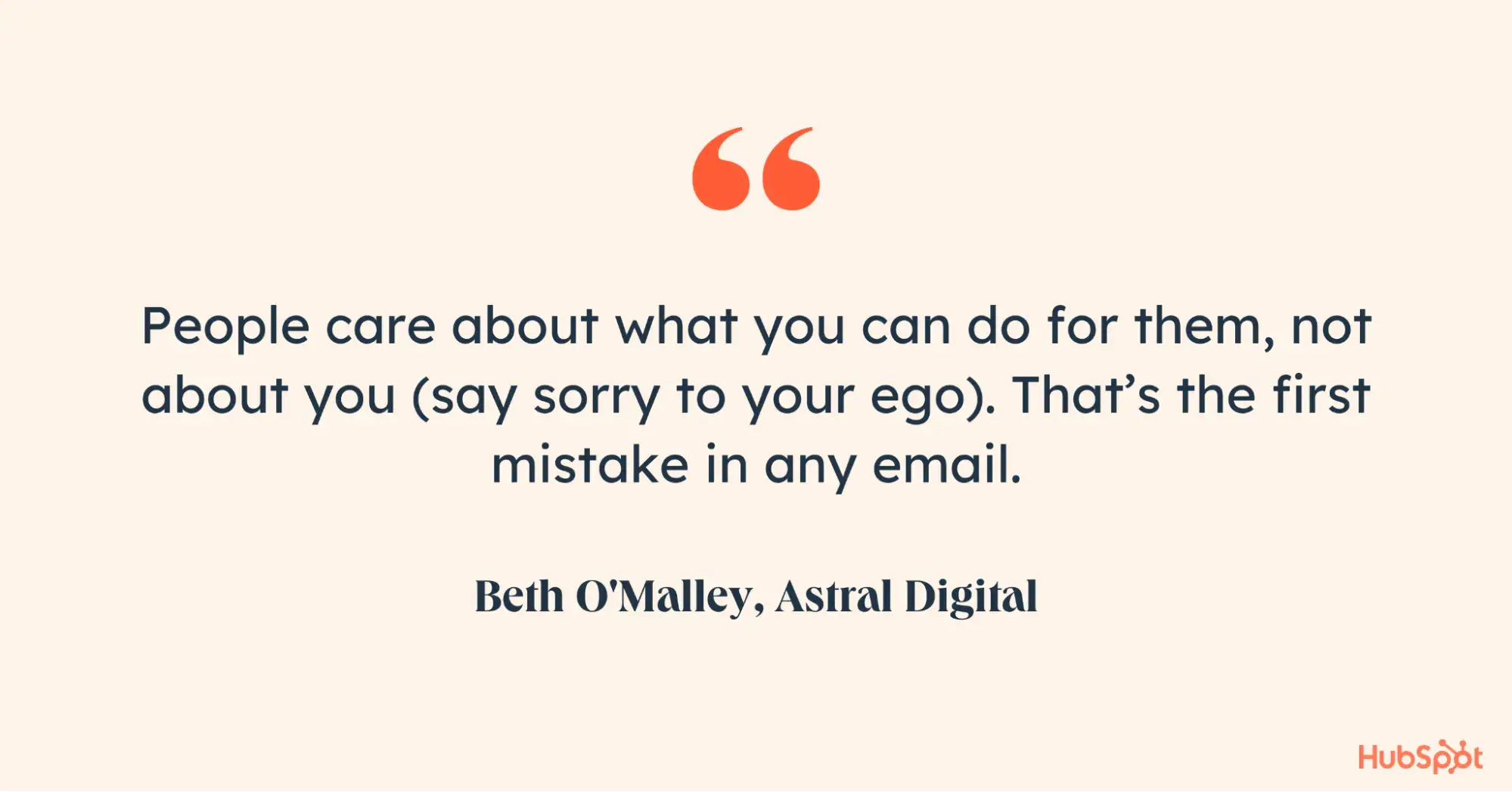
“People care about what you can do for them, not about you (say sorry to your ego). That’s the first mistake in any email,” shares Beth O'Malley, director of Astral Digital, who has sent over 100,000 cold emails in her career. “Be human about it. These are people, after all, too. Use a bit of humor or something that will connect you past the professional part of your email.”

A thoughtful, authentic compliment can provide value, so you don't need to do more if you’ve already said something nice in your first few lines. However, it doesn’t hurt to go a little further. Here are some ideas:

  • Review their book on Amazon, Goodreads, etc., and share the link.
  • Recommend an article they might find helpful.
  • Suggest a useful app or tool.
  • Offer to introduce them to someone who they'd benefit from knowing.
  • Use data to demonstrate how your product could benefit them.

If you’re selling a product or service, using data to make a case for why the prospect should consider your services doesn't hurt.

What successful outcome do you provide? More traffic? More conversions? Increased engagement? Whatever the benefit, provide proof by including a case study or other data backing up your claims.
5. Explain why you're reaching out.

Now that you have their interest, it’s time to connect the dots.

For example, let’s say you’re hoping to set up a networking meeting so you can learn more about their role (and potentially get a job referral).

If your first line is “You've done an impressive job at [company] building [X strategy] and revamping [Y program],” your second line might be, “I’m considering a career in [person’s field] and would love to buy you coffee so I can learn more about it from an expert.”

Or perhaps your goal is to book a sales call. Your first line might be, “I see you host several campus events per year,” and your second could be, “I work with companies like Facebook and Google to help promote their college recruitment events.”

The key is making your explanation as relevant to your recipient and brief as possible.

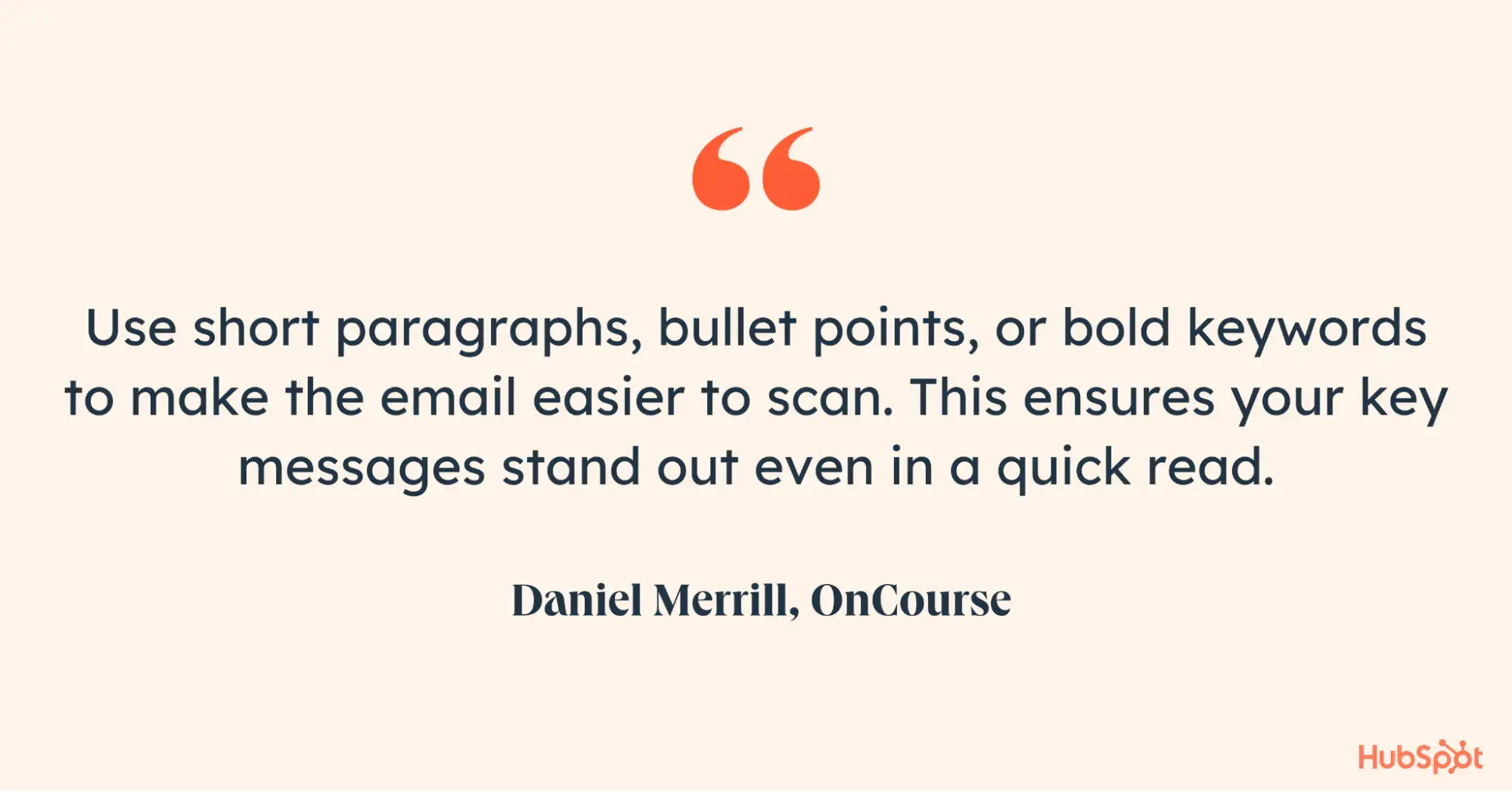
“The ideal length is around 100-200 words for an email body,” says Daniel Merrill, founder of sales and marketing for OnCourse CRM.

“Your goal is to respect the prospect's time while providing enough context to spark interest. Use short paragraphs, bullet points, or bold keywords to make the email easier to scan. This ensures your key messages stand out even in a quick read.”

Check out five sales email best practices to ensure you write sales emails that prospects want to read.

6. Include a call-to-action.

The final piece of the puzzle? Your call-to-action (CTA).

“End with a clear call to action,” advises Lyn Collanto, marketing specialist at KBA web. What do you want your prospect to do next? Do you want them to schedule a call with you, visit your website, or reply to your email with more information? Make it easy for them to take the next step.

“By focusing on the benefits you can offer, personalizing your message, and ending with a clear call to action, you can increase your chances of making a great first impression and starting a conversation with your prospect,” says Collanto.

Take a look at these sample call-to-action lines:

  • “Would you be willing to comment on the LinkedIn post I wrote? It would be great to have your unique perspective (and hopefully get some discussion going).”
  • “If you‘re thinking about how Greener could apply the concepts in the guide, I have some ideas I’d love to share. Here's the link to my calendar: [Link].”
  • “Are you open to answering a few questions about your experience working at HubSpot? Happy to chat over the phone or email, whatever's more convenient.”

Try to strike a balance between politeness and confidence. Phrases like, “I know you're busy, but …”, “I'd normally never ask, however …”, “You probably don't have time, so …”, “It would mean the world to me …” and “I'll be forever in your debt if …” make you seem desperate — and suggest your recipient would be massively inconveniencing themselves by saying yes.

Because you’re reaching out to a stranger, your request shouldn’t be excessive or unreasonable. If it is, that’s an entirely separate issue. Don’t hurt your chances of a “yes” by sounding insecure.
7. Say “thanks” and sign off.

No need to write anything more. The best emails are short, sweet, and concise. After all, extra information or unnecessary details lessen the probability your recipient will read the email — its length will put them off too. You also run the risk of distracting them from what matters.

With that in mind, say “thanks,” “thank you,” or “thanks so much” (depending on the size of your request), and add your name. Looking for more sign-off ideas? Try one of these powerful email closing lines that'll intrigue your recipients and prompt responses.

8. Follow up with them.

If you send this incredible introduction email and the unthinkable happens (i.e., they don’t respond), send a follow-up email they won’t be able to ignore.

Here are a few things to try:

  1. Send them actionable advice.
  2. Send a how-to guide and offer to follow up in person.
  3. Share weaknesses in their business and solutions you've identified.
  4. Share relevant industry articles/news.
  5. Respond to a social media message, then follow up with more.
  6. Reference a blog they wrote and ask a question about it.
  7. Invite them to an upcoming event.
  8. Bring up a pain point your buyers face and present a solution.

IMG: howto

Our email template tool can greatly enhance the effectiveness of your email communication. With a library of customizable templates and intuitive drag-and-drop editing features, you can quickly create professional-looking introduction emails tailored to different recipients and scenarios. Whether you’re reaching out to prospects, clients, or colleagues, this tool helps to craft compelling emails that capture attention and drive engagement.

Want more tips on great follow-up? Here’s a guide to sending a follow-up email after no response. And if you’re looking for more email tips, check out these less pushy alternatives to saying "as soon as possible.”

Introduction Email Examples

Now that I’ve covered what you should include in your introduction email, let’s see what that looks like in practice. These three cold emails hit the mark with their creative intros.

Example 1

Looking for Direction

Hello Kimberly,

I am writing in hopes of a bit of direction.

MarketBloom helps marketing teams at companies similar to HubSpot optimize their performance on digital channels and quickly understand what does and doesn't resonate with customers.

Using our strategies, customers have increased conversions by as much as 30%.

Feel free to put some time on my calendar here. If there is someone more appropriate at HubSpot I should be speaking with, who could direct me?

All the Best,

Jeff

What I like: This note is simple and to the point. It tells the recipient why the rep reached out and the value they can provide right at the beginning. Additionally, adding a calendar link makes it easy for the recipient to take the next steps.

Example 2
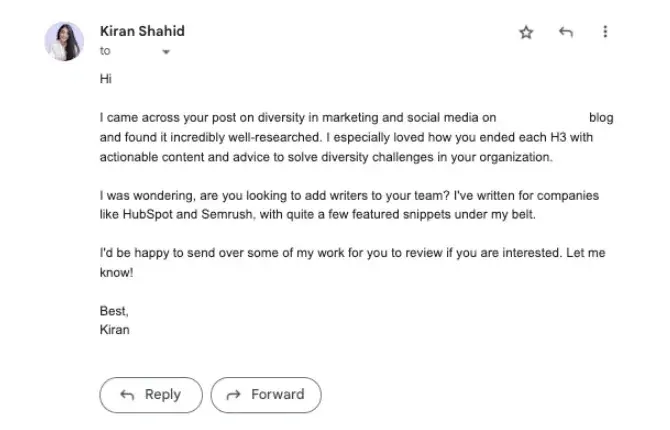
What I like: The author compliments the recipient and shows that she’s read the article, which builds trust and rapport. From there, she moves to her goal — to join their team of writers. She also provides social proof through well-known clients and shows how a partnership could benefit the recipient. This is a great way to get the attention of potential employers or clients.

Example 3
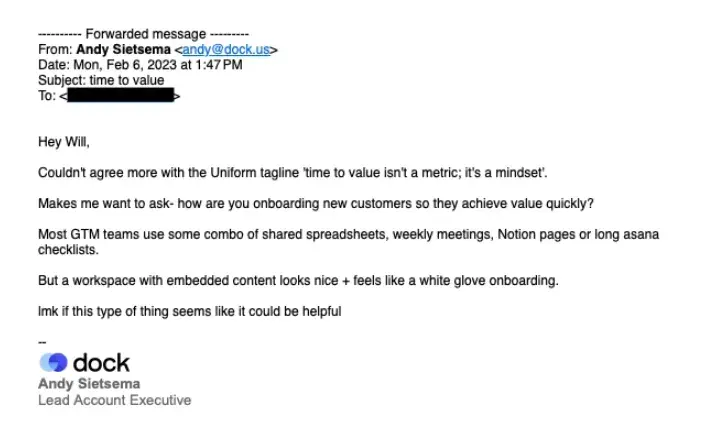
What I like: Andy Sietsema ties Dock’s value proposition to the prospect’s pain points. He also starts the email with the target company’s tagline and includes that in the subject line to draw a connection. Casual phrases such as “lmk if this type of thing” and “content looks nice + feels like a white glove” create a friendly connection.

Introduction Email Templates for 12 Workplace Scenarios

Our email template tool can enhance the effectiveness of your email communication. With a library of customizable templates and intuitive drag-and-drop editing features, you can quickly create professional-looking introduction emails tailored to different recipients and scenarios.

Whether you‘re reaching out to prospects, clients, or colleagues, this tool helps to craft compelling emails that capture attention and drive engagement. Once you have the building blocks, let’s see how each section works together as a full introduction email.

1. How to Introduce Yourself to a Cold Lead

A cold lead is someone you have no prior connection to. Essentially, you need to work hard to compel someone to open your email in the first place and give you a moment’s consideration. The best cold emails aren’t cold in any sense of the word. If you nail your self-introduction, you just might get a response.

Congrats on [Accomplishment]

Hi [Name],

Congrats on [Recent event/accomplishment]! I heard good feedback and want to congratulate your team for your creativity and hard work.

I'm [Your Name] from [Company]. I’ve planned several events throughout my career and know how exhausting and exhilarating it can be. I work with brands to reclaim their time by [list two major benefits/functions].

Our software has helped clients like [Client Name] cut staff planning time by 20%. You can read their story here [Link to Customer Testimonials].

While this event is fresh in your mind, could we chat about how our tools can streamline your processes? I'm available on [Day, Date, Time 1] or [Day, Date, Time 2]. Which one would work best for you?

Best,

[Your Name]

Why I Think This Template Works

The author has taken some time to research a recent accomplishment or event they can comment on, even though they don’t know the contact personally. Next, he keeps his personal details short and sweet and references the contact’s pain points and intangible benefits they can offer. He supports the introduction with social proof and a clear CTA for the next step.

https://www.youtube.com/watch?v=S9KUMwrbQb8

2. How to Introduce Yourself to a Warm Lead

If you have a referral or existing connection with someone, you have a warm lead. Lead with your mutual connection point to stand out from the clutter of that person’s inbox.

Contacting you at [Referral]’s suggestion

Hello [Name],

I was speaking to our mutual colleague [Name] from [Company/Organization] about the work you’re doing [Mention a specific area, product launch or event] and he recommended I reach out.

I’m inspired by the work you’ve done, not to mention your unique career path. I've helped companies like yours easily manage accelerated support tickets, which has contributed toward as much as 40% growth in as few as three months — this case study illustrates how.

If you’re interested in learning how to implement some of these strategies in your team, I’d love to share more. Here's a link to my calendar [Insert link].

Thank you,

[Your Name]

Why I Think This Template Works

The email leads with a mutual connection to distinguish it from a cold email and stays conversational. The author explains the value she can provide with quantitative proof and a relevant case study.

3. How to Introduce Yourself to a New Team

Perhaps you just started a new job or joined a different team, and you need to introduce yourself to a group of people. If you’re the manager, take this moment to set the right tone for your new team. Use this template to create your email introduction.

Hi all,

I'm the new [Position/Role] for the [Team Name]. I wanted to take a moment to say an official hello.

The work you’ve done and the numbers you’ve hit have been key factors in our successful year. And I'm thrilled to work with you more closely over the coming months.

In the future weeks, I’ll be reaching out to everyone so I can meet you all and say hello. Should you have any questions or concerns during this time, don’t hesitate to reach out to me directly — my door's always open.

Looking forward to working with you all.

Thank you,

[Your Name]

Why I Think This Template Works

In the email above, the sender starts things off on the right foot by acknowledging all of the accomplishments and hard work the team has put in. Additionally, she adds how excited she is to work with them and makes it easy for her team to reach out. It’s a simple introduction that sets the tone for the team.

4. How to Introduce Yourself to a New Client

Introducing yourself to a client is easier than a lead since the hard work of landing the contract or landing a new job is behind you. You can share more about yourself than you would in other types of introductory emails. When done well, an email introduction to a client sets the tone for a good working relationship.

Excited to work with you!

Hi [Name],

I’m [Name], your new contact at [Company name]. I’m thrilled to begin collaborating with [Company name] soon! I’m thankful for the chance to work with a company known for [positive attribute like innovation or industry leadership].

Here are three quick things you should know about me:

  • I've been in [industry/role] for [number] years, focusing on [specific skills or areas of expertise].
  • I'm really into [relevant topic/interest].
  • I'm all about [mention a core value or approach that guides your work, such as collaboration or creativity].

Please feel free to reach out to me at [Your Contact Information] for any questions or to discuss our upcoming projects further. I look forward to a successful partnership with [Client's Company Name]!

[Name]

Why I Think This Template Works

This email expresses enthusiasm and respect. It gives some background about the person’s qualifications and relevant experience, and a personal connection point to give them something to chat about next time they talk. The author also brings up values, setting the stage for healthy client management down the road.

5. How to Introduce Yourself to a Potential Client

Reaching new clients isn’t easy– but a little personalization goes a long way.

Hi Kristie,

Love the branding on your website! As an animal-lover, I love that you donate to animal shelters.

I build X (Twitter) audiences that turn into clients for SaaS entrepreneurs.

X is currently an untapped goldmine. I recently helped a SaaS consultant double his revenue in 30 days while growing his audience from scratch.

Would you be opposed to chatting about how I can land more clients for you while growing your X audience?

Thanks,

Why I Think This Template Works

The casual intro and compliment make Kristie Holden feel appreciated and more likely to respond positively. The email also quickly gets to what the sender wants from her, which is great for keeping the reader’s attention. Most importantly, he provides social proof in his email, which is always a great addition.

6. How to Introduce Yourself for a Collaboration

Sometimes you aren’t trying to win new business, but you want to meet a person you admire to explore collaborating. Here’s what that could look like.

Hi Adam,

Want to know how to get featured on SurferSEO, Zapier, and Wordstream?

So pumped that I almost forgot to introduce myself. Hey, Antonio from Hunter here.

You are building quite impressive backlinks, so I am sure we can work together.

Here's a collab idea:

  1. We’ll share a spreadsheet with all domains (DR70+) where we’ve published guest posts (more than 80 opportunities).
  2. You choose the ones you‘re interested in, and we’ll share the editors' contact details with you.
  3. You do the same.

What do you get from this?

  • No need for prospecting.
  • No need to find the right people to reach out.
  • Get websites that allow a few external links.

Are you in?

P.S. Here is an explainer video just in case you have questions.

Thanks,

Antonio

“We didn’t go crazy with personalizing opening lines as we put much effort into targeting the right people,” shared Antonio Gabrić at Hunter, the email author.

“We knew all our prospects were active link builders and guest bloggers. We knew they publish many guest posts, but haven’t published them on the websites we mentioned in the opener.”

Why I Think This Template Works

While the email copy isn't personalized, Gabrić speaks directly to the recipient’s needs and interests by offering a mutually beneficial collaboration. It also provides an explainer video for clarity. All of these elements work together to create a compelling introduction.

7. How to Introduce Yourself to a Hiring Manager or Recruiter

Sure, you might spend hours polishing your resume and cover letter for a job — but do you give the submission email any love before hitting send?

When recruiters sort through applications, you want to do everything you can to stand out. The first step is sending a thoughtful introduction email. Don't write a novel, but do write a friendly and professional “Hello” note.

In the example below, I state the reason for my email, share one sentence explaining why I'd be a good fit for the role, and offer to provide more information upon request.

It's concise and gives my application a little extra shine.

[Your Name] — Candidate for [role]

Hello [Name],

I‘m pleased to share my resume and cover letter for the position of [Position/Role] at [Company name]. I’m confident my background as a [Role/Industry] for [Previous company] has equipped me to succeed in this position, and I'm excited to submit my application.

If I can provide you with any further materials to illustrate my fit for this role, please don't hesitate to reach out.

I appreciate your time.

Regards,

[Your Name]

Why I Think This Template Works

This template shows that the candidate is interested in the role and excited about it. They offer a bit of background about why they would be a good fit and keep the relationship open by offering additional materials.

8. How to Introduce Yourself to an Executive

Getting a response from a CEO or executive is tough. But your introduction can make all the difference. Remember a few things when crafting your email.

First, make your ask gentle and advice-driven. Executives are great with people and usually love helping others. Open your email with a request for information or advice instead of a request to sell.

Another great tip: compose your email to them on your phone. Executives are busy and often check emails while they’re on the go. Compose your email on the phone to ensure you’re providing them with a good reader experience.

And don't forget to put your email signature to work.

Have time for a rebrand geek?

Hello [Name],

I noticed you recently unveiled a shiny, new rebrand for [Company]. It looks fantastic, congratulations!

My name is [Your name], and I’m interested in learning more about what drives executive teams to determine when it’s time to rebrand. Would you have time for a 15-minute phone call to walk me through your decision to rebrand?

Regards,

[Your name]

[Company name]

[Company tagline]

[Website link]

Why I Think This Template Works

This short note explains why the executive is being contacted (for their rebrand expertise) and discloses the time commitment. Asking for a short time frame of 10 to 15 minutes makes it more likely that the executive will say yes to the call.

9. How to Introduce Yourself to a Gatekeeper

Never underestimate the gatekeeper. Set yourself apart by offering to help them before you help yourself. In the example below, the writer provides value to the gatekeeper and explains that they want to “earn” the introduction to the recipient's boss.

Can I make your week easier?

Hi [Name],

I know you likely get a lot of emails from salespeople trying to get through to your boss. I'm no different — except that I want to earn the right to be passed along to [Name].

My name is [Name], and I help companies like yours decrease hiring time by up to 25%. So, that marketing coordinator your team is currently hiring? I can get a top candidate in that role faster.

Have I earned a few minutes with [Name]? If so, feel free to book time on my calendar, here: [Insert calendar link]

If not, I've got more up my sleeve.

Regards,

[Your Name]

Why I Think This Template Works

Rather than simply asking to speak to the recipient’s boss, the writer opts to provide value first. How? By offering to decrease their hiring time and offering a top candidate for their open marketing role. It puts the ball in the recipient’s court. If he likes the candidate and finds value in the offer, they can make the introduction. If not, they can move along without commitment.

10. How to Introduce Yourself Professionally

The email you send to a former colleague making an introduction on a contact’s behalf has a different tone than an email sent to a LinkedIn connection you’re hoping to convert into a customer.

When sending an introductory email to a professional contact (such as a LinkedIn connection), you want to ensure you state how you’re connected and why you’re contacting them. As you approach a new contact, keep your email concise so they can quickly decide if and how to respond. You’ll want to provide just enough information to prompt the next steps.

For example, if you want to reach out to someone you're familiar with from LinkedIn, here’s a seamless introduction.

Love your LinkedIn content

Hi [Name],

My name is [Name], and I’m a sales enablement specialist at [Company]. I have loved following the insightful pieces you share on LinkedIn. Since we connected last summer, I have implemented several of the strategies you’ve shared through your content and have seen excellent results.

Our company has recently conducted ground-breaking sales enablement research that could be an excellent addition to your content. Do you have time to hop on a brief call next week to discuss?

Regards,

[Your Name]

Why I Think This Template Works

The sender quickly explains how they met the recipient and acknowledges they’ve been following their work via LinkedIn. They also explain how they’ve gotten value from strategies shared. The knowledge of the recipient’s expertise helps to make the pitch to collaborate on content seamless.

11. How to Re-introduce Yourself

When sending a casual email to a previous contact you're getting back in touch with or for an informational meeting, your message can be more casual. Here’s an example:

Connecting brilliant minds

Hi [Name],

I hope your new position with [Company] is treating you well! You are surely missed on our team.

I would like to introduce you to [Name], the new account manager who backfilled your role. [They/He/She] are interested in pursuing the sales enablement specialist certification program you completed last year.

I’ve copied [Name] on this email so you can connect and discuss the program. You two can take it from here.

Regards,

[Your Name]

Why I Think This Template Works

Since the sender and recipient already know each other, this introduction takes a more casual tone. It’s concise and lines up an ask — the writer wants to connect his old contact with someone for advice. Just like an earlier example, the sender copies the appropriate contact so that they can connect.

12. How to Introduce Someone via Email

We have reviewed many ways and scenarios in which to introduce yourself, but what if you have to introduce someone else?

Let’s say you have a contact who would benefit from connecting with a friend or colleague of yours. Well, use this template to introduce them via email. Include reasoning for the introduction and make sure the connection will be valuable for both individuals. “By way of introduction” is a phrase you can use when introducing a new person.

Introduction — Kelly Davis and Rob Cortez

Hi [Name],

By way of introduction, meet [Name], a [Position/Role] for our top-performing, mid-market [Team/Organization]. She previously managed sales operations at a tech startup, [Company name], and has insight into new sales ops technology. She’s interested in our sales operations and would love to learn more.

[Name] is a [Position/Role] on the sales [Team name], and she’s reviewing the tools and software the team’s using for the next year.

I‘ve copied [Name] on this email so you can connect about sales operations and technology — and I’ll let you two take it from here.

Best,

[Name]

Why I Think This Template Works

This template works because it succinctly explains the reasoning for the introduction, giving a bit of background on what each person specializes in. It then makes it easy for the two to connect by copying the contact on the email.

Send Introductions Prospects Can't Ignore

Introducing yourself by email isn’t rocket science, but it can be tricky to find the right words when you’re staring at a blank email message. Follow these email principles and templates for the best chance of a genuine connection.
sales email templates

02 Nov 16:24

Explore Ideas You Disagree With

by Anthony Iannarino

When I was a teenager I fronted a rock-n-roll band. At 17 years old, I was playing in bars that I would not have been allowed in otherwise. In many cases, the bands that my band opened for were much older—and much better—than we were. It was there that I was infected with a negative belief structure.

When a band was playing, the members of other bands would stand at the back of the bar and criticize the band that was playing. They would find something wrong with the singer, or the guitarist wasn’t really a shredder (as if that is even important when it comes to rock-n-roll, which is really more attitude than it is a competency). This was especially true for big, national acts who were experiencing the success that everyone else believed they deserved. Hanging around for a while, I learned to do the same thing. Like the others, I’d stand around being jealous.

At some point, my competitive nature took over, and I started to look at the bands that were playing through a different lens. First and foremost, they were better than we were. Second, and more importantly, they drew bigger crowds. We were opening for them, and not the other way around. It struck me that instead of trying to find reasons to criticize other bands, I should be trying to discover why so many people like them—even though I didn’t particularly like them. This massively improved our results by helping my little outfit make changes, whereas criticizing other bands produced no measurable benefit.

There are people who you may not like because you disagree with them on ideas or issues, and you may avoid looking at what they believe and why they believe it because you couldn’t be further apart in certain areas. This is a mistake because it prevents you from another perspective, a perspective that can improve your own. Instead of looking at what is wrong with what someone else does or what they believe, look instead to see if you can understand the value in their ideas, their beliefs, or their actions—or at least look to understand why they believe what they believe.

When you don’t like something, it is worth your time and effort to explore it. If an idea makes you uncomfortable, that is almost always an idea that is valuable for you to explore.

The post Explore Ideas You Disagree With appeared first on The Sales Blog.

02 Nov 16:23

4 Traits of Fast-growing SaaS Companies

by Kyle Poyar

Editor’s Note: This article first appeared on VentureBeat here.

You can find fast-growing software companies in almost any vertical, but there are certain characteristics they all share. To find out which of these features are most common, OpenView surveyed over 500 SaaS companies ranging from pre-revenue to $100 million in ARR. Here’s what we learned:

1. Fast-growers are extremely efficient at acquiring new customers

As investors, we keep a close eye on customer acquisition cost (CAC) payback. This metric represents how long it takes, in months, to pay off the costs of acquiring a given customer on a gross margin basis. We use it as an indicator that a company has the right fundamentals in place to effectively ramp up customer acquisition.

Despite how important it is to properly understand CAC payback, our data shows that companies consistently underestimate this number. All too often, companies omit certain acquisition costs, over-inflate recurring revenue by failing to strip out one-time revenue, and/or leave out some of the ongoing costs of serving a customer.

Despite disparities in reporting, self-reported data on CAC payback does reveal a clear trend: The fastest growing SaaS companies report a median CAC payback period of only 8 months. That’s nearly half that of slower-growing SaaS companies (15 months).


Clearly, getting this number down is crucial for your bottom line. OpenView’s Blake Bartlett advises that continuous experimentation can drive down CAC.

2. Fast growers are much more likely to employ a usage-based model

Usage-based pricing (UBP), also known as consumption-based pricing, allows customers to pay for products according to how much they use. AWS and other infrastructure providers have been using UBP for nearly a decade. However, we continue to see more and more business in the middleware and application layer jump on the UBP bandwagon—and for good reason:

  • Lower barrier to entry: Customers pay nothing until they start using the product and can try the product at a much lower cost with no commitment.
  • Closer connection to value: UBP allows users to pay based on the value that they receive from the product (e.g. Hubspot charges based on leads, linking a customer GTM success with the cost of Hubspot).
  • Wider internal reach: Because adding an additional employee tends to not incur an additional cost, more employees can interact with the product and explore other use cases leading to natural expansion in usage within an account.
  • Simpler segmentation approach: By bucking the good, better, best seat-based pricing model, a single price point can be used to satisfy cost-conscious SMB customers as well as mid-market/enterprise businesses.

In 2021, we saw that fast growers were nearly 3x as likely to use a largely usage-based pricing model versus slow-growing peers.

OpenView_4 Traits Traits of Fast Growing Companies_2022_Adoption of Usage-Based Pricing

It’s clear that faster-growing businesses are taking advantage of more creative pricing models, however, the switch to usage-based pricing can represent a host of challenges from revenue recognition to sales compensation. For more information on how to make the shift and who to learn from, check out our Usage-Based Pricing Playbook.

3. Fast growers retain and expand new customers, resulting in net negative churn

Understanding customer and revenue retention is an extremely attractive growth signal for a SaaS company. These metrics are an indicator of product-market fit. Low churn shows the product is sticky, hard to replace, and truly generating value for customers. In our experience, most SaaS companies spend far more time on acquiring new logos than they do on the less sexy task of retaining existing customers.

But our data shows that the fastest-growing companies can walk and chew gum at the same time. In other words, they don’t just efficiently acquire new customers, they also retain and expand those customers at far higher rates than slower growers.

Fast growers see on average 114% net dollar retention, which means that every $100 in ARR they acquire from new cohorts actually turns into $114 in ARR the next year (and likely even more the year following). By comparison, slow growers see only 98 percent net dollar retention and consequently have to keep adding new customers just to maintain their run rate, let alone grow year-over-year.

OpenView_4 Traits Traits of Fast Growing Companies_2022_Retention Rates

To improve net dollar retention, examine just how you’ve designed your product packages, pricing model, customer onboarding, and sales compensation. In the near term, help your customer success team focus their time and attention where they can actually make a difference to the lifetime value of an account, rather than just where it has good relationships. This should include both customers that show leading signs of potential churn (i.e. low usage, no relationship with decision-makers) as well as potential growth in spend (i.e. high usage, growing usage month-to-month).

4. Fast growers require less spend on services and support 

The employee distribution of fast-growing businesses and slow-growing businesses is largely the same. What seems to be more important is how you’re putting those departments to work to execute your go-to-market strategy. 

However, despite the similarities in org structure, there is one department that varies considerably: professional services and support. The fastest-growing startups allocate only 7% of their headcount to services and supporting their customers (half that of slower-growing startups). 

OpenView_4 Traits Traits of Fast Growing Companies_2022_Employee Distribution

This suggests that products that require more help to adopt and navigate struggle to achieve +150% growth. Companies that have been able to build intuitive, self-serve products reap the rewards of a lower headcount devoted to installing and supporting their product. In turn, these headcount costs can go directly towards building and selling the product. 

If you’re searching for ways to reduce costs associated with support and professional services, the first place to start is the product itself. Focus on nailing your onboarding experience to create happy self-sufficient customers from the start. We’ve also seen startups have success keeping these costs down by developing community-based support and/or adopting intelligent search tooling like Coveo. 

The takeaway

“Land and expand” is a cliché for a reason—it works! To improve your growth rate, you need to hone both the efficiency of your customer acquisition and the ongoing health of your existing customer relationships. Then, and only then, you’re ready to invest more resources to truly become a market leader.

The post 4 Traits of Fast-growing SaaS Companies appeared first on OpenView.

02 Nov 16:23

3 Tech Trends Shaping the Future of Account-Based Marketing (ABM)

by kniemisto

It’s easy to see why the technology-fueled resurgence of account-based marketing (ABM) is taking hold. B2B marketers are:

  • Driving bigger deals, higher close rates, and more revenue
  • Winning strategic accounts in specific industries or regions, or with other significance
  • Getting higher ROI vs. other marketing strategies

The 2017 State of Account-Based Marketing Study by SiriusDecisions validates this trend in ABM results and adoption:

  • 91% of the B2B companies surveyed are realizing higher deal sizes through ABM
  • 92% see a higher percentage of closed deals from qualified opportunities for ABM accounts vs. non-ABM accounts
  • More B2B marketers are moving from pilot programs to full ABM programs: 62% in 2017 compared to 40% in 2016
  • ABM as a percentage of overall marketing budget is increasing

Sirius Decisions

Source: 2017 State of Account-Based Marketing, SiriusDecisions

Simply put, the proven value of ABM is driving more investments within B2B organizations.

Technologies Fueling ABM Growth

So then why haven’t we always been practicing ABM? With the rise of the internet and digital marketing, it was challenging enough to make sense of individual behavior. Now, marketers are empowered with account-centric targeting, personalization, and measurement across their digital channels. Technology is playing a significant role in making ABM scalable in the Engagement Economy.

As marketers dedicate more budget to their ABM programs, the winning marketers are upgrading their marketing technology stacks to help operationalize and optimize their efforts. Let’s explore the key technology trends propelling ABM today and shaping its future.

Digital Channels

Digital Channels

          Source: The State of Engagement, Marketo

Automation Scales ABM and Reduces Risk

Ten years ago, ABM was centered on picking top “whale” accounts and pursuing them via outbound programs and tactics. To execute ABM effectively, marketers only needed to engage with accounts through a handful of channels, but without marketing automation, they could only focus on so many accounts.

Now, marketing automation enables marketers to pursue a blend of ABM strategies at scale. In addition to the top 10, 20 or 50 strategic accounts, marketers can engage all of the sales team’s named accounts, plus the longer tail of target accounts. This allows marketing to partner with sales to create demand in the accounts they’re pursuing, plus mitigate the risk of “putting all your eggs in one basket” by continuing to generate demand among the broader set of target accounts using less expensive channels (and alerting sales to new accounts that are engaged).

Going forward, we’ll see further automation of accounts throughout the customer lifecycle, and more consistent and coordinated engagement of accounts between sales and marketing.

Artificial Intelligence (AI) Introduces Intimate Customer Understanding

We’re also witnessing the transformational impact of AI throughout businesses, particularly in marketing. While marketers can get started with ABM with just a list of accounts their sales organization is targeting, AI puts more power in their hands, enabling them to confidently and precisely identify and justify the accounts to pursue.

With AI, marketers can understand their ideal customer profile (ICP) at an incredibly granular level. Savvy marketers are using AI to go beyond industry, revenue, and other firmographics to also analyze their historical sales, technologies accounts have implemented, company news, business clues on social media channels, and more. In other words, AI helps marketers leverage significantly more information from both internal and external sources to draw more precise models of their ideal customer. 6sense, Leadspace, and Mintigo are just a few of the Marketo partners helping marketers gain an intimate understanding of their ICP in this way.

Another area AI is enhancing is engagement. According to our report, The State of Engagement, 72% of marketers are expected to prioritize the use of personalized messages and content to engage with their customers. To that end, nearly 40% of them plan to leverage emerging technologies, such as AI and machine learning, to enhance content used throughout the customer journey.

AI enables marketers to personalize communications in a one-to-one way to and scale personalization beyond rules-based approaches. Marketo ContentAI is an artificial intelligence-powered solution that empowers marketers to personalize their content and offers at this next level. With ContentAI, marketers can predict the content most likely to convert each individual and target that individual across channels.

As the potential of AI for marketers continues to be realized, we’ll see more rules-based ABM activities enhanced by AI to make it easier for marketers to target the right accounts (and people within them), engage accounts across channels and get insights to optimize their programs.

Advanced Analytics Provide Attribution in an ABM Context

Is my ABM strategy working? Only one way to find out—measure its impact on the business. In the past, marketers performed spreadsheet gymnastics to pull together data and create models that showed that impact, or avoided it altogether. With automated attribution reporting, marketers can tie their efforts to opportunities, pipeline and revenue, and that’s even more important in an ABM context.

Here are 3 reasons why:

First, ABM is about partnering with sales to land target accounts. Marketers need to be able to show that the partnership is working.

Second, most marketers have more than one target account list. Attribution reporting will allow you to compare the efforts and results for one account list vs. another so you can optimize your ABM program.

Third, most marketers practice multiple or blended marketing strategies. Marketers running an ABM pilot or practicing a blend of ABM and inbound marketing, for example, need to know which investments are working, so they know how to allocate budget—especially as they are proving out hypotheses or transitioning between strategies.

In the future, expect to see more touchpoints and data brought into attribution models to make them more comprehensive and attribution analytics becoming increasingly easier for marketers to consume.

How Marketers Can Harness This Potential

It’s clear from the results of the SiriusDecisions survey that more marketers are doubling down on their budgets and moving forward on their ABM journey. Regardless of where you are on your journey, you’ll want to make sure you’re always in a position to move ahead.

When it’s time to consider technology, be sure to select an ABM platform that can support your ABM journey now and into the future. That may mean supporting multiple marketing strategies or hybrid strategies that give you the flexibility to adapt and discover what works best for your organization. To keep pace with rapid innovation, be confident this platform will continue to bring new capabilities and efficiencies to ABM.

And finally, look for a platform that can serve as the hub of your ABM technology stack. A single vendor rarely provides all of the technology you need, so the best place to start is with a platform that will give you the essentials for ABM and connect a wide range of technologies to help you grow and adapt over time.

This is how you can best shape your future in account-based marketing. Have other thoughts on where ABM is going or ideas on how to plan for the future? Let’s continue the discussion in the comments section.

The post 3 Tech Trends Shaping the Future of Account-Based Marketing (ABM) appeared first on Marketo Marketing Blog - Best Practices and Thought Leadership.

02 Nov 16:23

Decrease Days Between Orders with One Simple Email Marketing Strategy

by Lianna Patch

Most of the time as an ecommerce store owner, you’re focused on pushing your metrics UP.

More sales.

More customers.

Higher average order value.

But there’s one number that every store owner wants to see plummet — and that’s Days Between Orders.

Whittling this number down means quicker turnaround of your inventory, higher visibility on social media (since naturally, your customers will be snapping photos of your products), and obviously, more spendable $$$ in the pocket of your snazzy custom-tailored zoot suit.

Now, you could email customers every single day and just tell them to come back.

However, that that kind of one-note “BUY BUY BUY” outreach gets old preeeeetty fast.

Warning: Swansonesque reactions may occur.

So how can you stay top-of-mind without bothering your list? What kind of content should you send, if it’s not always 100% sales-focused?

The answer lies in keeping the cardinal rule of inbound marketing in mind.

The #1 rule of inbound marketing: Always provide value

You’re a store owner. You sell things.

But to your customers, you COULD be so much more:

  • A source of inspiration
  • A place to learn new things
  • A representation and reflection of their beliefs

… as long as you create emails that reach past simply advertising your own products and into real value for your customers.

Yes, you can still sell while you do all of the above

I’m not saying that you shouldn’t try to sell your products in email. That’d be lunacy.

No matter what you sell, there are lots of ways to tie your products into your email newsletters in a way that feels genuinely valuable to your readers.

So instead of focusing on selling and only selling in every email, aim to entertain, educate, and inspire your subscribers.

You’ll find that your regular email marketing messages actually become stronger when you temper them with a little something more.

Not sure where to start? Here are 5 approaches to take:

5 types of content to complement your marketing messages

1. Teach or educate

I love the way skincare maker Deciem reveals a little-known fact about vitamin C serum — that in fact, it’s not supposed to be orange:

This useful info is a natural tie-in to Deciem’s latest product: a vitamin C serum that, with my new knowledge, I now feel like I can trust.

2. Entertain or provide visual delight

It’s not every day that an ecommerce store ups the ante on making its emails a delightful experience, from the subject line to the closing.

There are lots of ways to entertain inside your emails, from the copy you write (why not punch it up?) to the design and graphics you use (aim to show instead of tell).

You could try cracking a joke! Using a splash of color! Including an animated GIF! ← my personal favorite, for obvious reasons.

For example, here’s Paravel offering a new hand-painted personalization service for its high-end bags. Instead of just telling readers about the new service, though, they show it with a playful, cartoony background and a GIF:

Feature a new item

If you recently added a new product, or you’re planning to do that soon — well, there’s your next email topic. It doesn’t have to be more complicated than that.

Featuring a new product isn’t just another way to make sales. It also shows your readers that your store is actively coming up with new ideas and creating new products. It keeps them interested.

Here’s Harry’s showing off its new travel kit with a few simple lines of copy about the materials used to create the kit:

3. Check in or say thanks

I can’t tell you how rare it is that an ecommerce store sends a simple email to its long-term subscribers saying, “Hey, how are you? Thanks for being a fan.”

You know that’s exactly what this cat is thinking.

Checking in to ensure product satisfaction (and encourage your buyers to leave reviews) should absolutely be part of your post-purchase email campaign. But it should also be part of your overarching customer satisfaction strategy, even when folks haven’t bought in a while.

It’s also a wonderful idea to write to customers to simply say thanks. Along with keeping your brand top of mind, sending a message of gratitude can make customers feel heard and appreciated.

TIP: Plan to send this kind of email if you’ll soon be updating your branding, expanding your product line, or making another significant change in your store.

4. Reveal your process or technology

Give your subscribers a behind-the-scenes look at how and where your products are made.

If you don’t create your items in-house, you could feature your packaging in a mock “unboxing” video, interview one of your designers, or feature a day in the life of a (real, breathing, human) happy customer.

I love the way footwear company On offers a video product tour “from the On labs” for their latest shoe, the Cloudflash:

As buyers become more and more connected with the provenance of their purchases, it pays to pull back the curtain.

(You might also remember me suggesting going behind the scenes in your welcome emails. Why am I repeating myself? Because compelling stories don’t get old.)

Mixing & matching is highly encouraged

Take another look at the emails above. None of them is doing just ONE thing at a time.

For example, here’s Nisolo sending a direct email from the founder that 1) thanks me for being on the list, 2) introduces a new product, and 3) tells me more about the company.

Bing, bang, boom:

Also, notice how this is formatted like a direct email from the company co-founder. It was sent via a mailing list — but it sure feels personal, doesn’t it?

So temper your sales emails with something more. You’ll end up with a more engaged, stronger list in the end — which is great news when you DO want to sell hard.

02 Nov 16:23

Mining for Content: How to Dig for Derivative Content Gems

by Brenda Caine

Brett_Hondow / Pixabay

Stuck on creative ideas for new content? Need to create content for a multi-touch nurture campaign, fast? Have a new product or campaign and no content to support it? Or maybe you just have lofty content creation goals on a limited budget?

No matter your reason creating compelling content can feel overwhelming. But what if we told you that pure content gold was hiding right under your nose? All you have to do is dig for it! It may sound crazy, but there are a few best practices you can follow to turn a single asset into a treasure-trove of powerful and cost-effective derivative content. Here are some standard steps our content strategy team follows when we work on repurposing projects:

Don’t Start Digging Without a Plan!

Like a skilled gold miner, you can’t begin your journey for content treasure without a plan. Your plan will vary depending on whether you’re attempting to uncover content ideas from existing pieces or if you’re creating net-new assets with the intent to create derivative assets.

If you’re starting from scratch, think of ways to design your foundational asset so you can easily extract and reuse content. Can you incorporate data-driven callouts or bulleted lists? Are there different sections or chapters that can be promoted on their own? Designing with repurposing in mind is key to ensuring you’re not creating content that doesn’t serve your broader marketing goals and needs. Even better: this content is already reviewed by your team internally and approved! All you have to do is place it in a new design template or format. That’s right: shorter timelines, faster approvals and efficient investment!

If you want to venture into your content library to discovery any unchartered territory, we find there are a few formats that are pure content marketing gold.

Derivative Content Goldmine: Our Favorite Formats

We believe with the right strategy and a little bit of creative brainpower, you can create derivative content from essentially any piece. But there are a few top formats we consider our go-to’s:

Survey Reports

Survey reports similar to the 2017 Content Preferences Survey Report published by Demand Gen Report (DGR) are fantastic candidates for repurposing content. Why? Because you can easily collect quantitative results that are easily adapted — straight from the survey — into graphically oriented short-form content. Trends or insights discovered provide a rich vein of potential longer-form content, thought leadership pieces and practical guides.

“Hero” or “Pillar” Assets

“Hero” assets (or some call them “Big Rock” assets) should be central to any organization’s content strategy. Typically, any long-form asset, such as an E-book, white paper or comprehensive guide, hero assets are extremely detailed, meaty and chock-full of great content! Chapters or sections of your asset of choice can be extracted and restructured for different formats. Or, you can pull out key data points and transform them into a compelling infographic.

The possibilities are practically endless. If you want to have some fun, test the approach on one of your top-performing assets. We think you’d be surprised by how many ideas you will find.

Derivative Content Gems

Just like there are go-to formats chock-full of great content, there are a few staple formats that can serve you extremely well as you create your derivative content. Here are a few of our favorites:

Infographics

Infographics are always an obvious and logical choice when you have lots of data at your disposal. Make yours come alive by exploring ways to embrace creative themes and storylines, or by making them interactive. For example, we helped a client transform a white paper on cloud-based supply chain management into a roadmap-themed infographic highlighting the key data points and best practices.

Listicles

Listicles are pretty much what they sound like — short-form, list-based assets. Websites like BuzzFeed come to mind as proponents for listicles. But we bring the format to the next level by making them interactive and structuring them so they tease readers by giving them just a taste of information. Highlighting only three to seven items, listicles encourage further exploration through links to longer-form assets, videos, podcasts or other content.

Look for a theme within your larger asset that ties into a broader story or narrative. Are there keys to success that you can highlight? Are there any challenges or pitfalls your buyers should take note of? Key trends they should know? This is all valuable fodder for a great listicle. You can check out an example here.

Blog Posts

By standard best practice, you should be able to create at least two derivative blog posts from every piece of content you create. The great thing about blogs, though, is there are no restrictions as far as how to structure or organize your pieces! You can create blogs focused on the sub-topics highlighted in your foundational content, or you can focus on key trends and data points. Even better: you can spotlight success stories included as case study side bars.

Your brand messaging, tone, style and editorial guidelines will dictate the best approach. However, we recommend having some fun when you can. Is there a way to tap current events, popular culture or holidays for an underlying blog theme? And if you want to get the best bang for your content buck, experiment with different blog lengths. Pieces can be anywhere from 400 words to 2,000. Try different things and see how your audience responds.

Checklists

Checklists are great because they can serve both your middle-stage and late-stage content needs. It all depends on the angle you take. For example, you can focus on ways buyers can embrace trends and disruptions highlighted in your foundational content. Or, you can highlight “top things to remember” for brands as they research and compare different solutions. Ideally, you want to include some information from your foundational asset — whether it’s data, examples or quotes from thought leaders — and integrate more objective insights and best practices that align with your brand’s key value propositions.

Get Ready to Dig

Content repurposing doesn’t stop with content derivatives. Keep in mind that you can reversion both modular and derivative content for different personas, industry verticals, and even for specific accounts. Tweak and personalize titles, images and other small components to see an increase in your content inventory and get more value from your content investments (without breaking the bank).

02 Nov 16:22

Stop Wasting Your Time On Networking Events

by John Rampton

I’m going to say something that’s probably not very popular; I can’t stand networking. It’s not that I’m antisocial or hate attending networking events. As long as they have a purpose, like an awesome speaker or training sessions, I’m game.

If people will be there that have great ideas and energy to share, I’m game. But attending an event just to hand out business cards and get a stack in return with the hopes of landing a new client or important connection.

Business Networking

Ask yourself honestly how many meaningful connections did you actually make at the last networking event? If you can truthfully say you benefited greatly, then go. If not, don’t.

Greg McKeown, author of Essentialism: The Disciplined Pursuit of Less, writes in Harvard Business Review (via Inc.) about his interview with venture capitalist and entrepreneur Rich Stromback. Stromback earned the nickname of “Mr. Davos” for being able to broker meetings between influential contacts at the World Economic Forum. Stromback said, “99 percent of networking events are a waste of time.”

Why Networking Events Can be a Waste of Time

For many people, networking events are ineffective because:

  • You don’t really understand what networking is. It’s about exchanging of value, like a piece of content or referral, and not just a business card.
  • You’re focused on selling rather than building a relationship.
  • You don’t follow-up with new acquaintances.
  • You’re attending the wrong types of networking events.
  • You attend networking events with the wrong mindset – you may view it as a work-related task or something that you really don’t want to do.

However, as Alex Turnbull the CEO & Founder of Groove further explains, networking events aren’t really the best places to network in the first place.

“Yes, networking events bring people together. But then what happens?,” asks Turnbull.

“Noise.”

“The people that everyone wants to connect with get bombarded with noise from all directions, and everyone else is slowly picked off by those who are only there to pitch their products or services to anyone who will listen.”

“I’ve often found myself leaving startup mixers with a pile of business cards printed with names that I couldn’t put a face to if I tried.”

Stop Networking

Going back to Stromback, he believes that first impressions are overrated.”Everyone gets this wrong. They try to look right and sound right and end up being completely forgettable.

“I’m having a ball just being myself. I don’t wear suits or anything like that. I do not care about first impressions. I’d almost rather make a bad first impression and let people discover me over time than go for an immediate positive response,” he says.

“Curiously, research I read years ago suggests that you build a stronger bond over time with someone who doesn’t like you immediately compared to someone who does. Everything about Jack Nicholson is wrong, but all of the wrong together makes something very cool.”

Stromback adds that the most important networking opportunities happen during less formal moments. “The opportune moments happen while dancing at one of the nightcaps or at a chateau where only a select group of people is invited. The conversations there can go on until the early morning hours.”

His final words of advice was to stop networking altogether. “Nobody wants to have a ‘networking conversation,’ especially those who are at the highest levels of business and politics.”

“They are hungry for real conversations and real relationships. It just has to be authentic, genuine, and sincere. I don’t look at people’s badges to decide if they are worth my time.”

Davos has about 3,000 influential people. He says, “I need to be selective, yet authentic–focused, yet open to possibilities. In the end, I put myself in the most target-rich area and then just go with the flow and spend time with who I enjoy.”

What You Should Do Instead

Don’t get me wrong. Connections are important. Like really important if you want to grow your business. But, there are better ways than just attending networking events.

Turnbull suggest that you start by “doing something notable that makes people want to network with you. Build something that creates value for people.

Publish something that helps your market for free. Or simply do something valuable for the people you want to connect with.”

“In my experience, that means letting your work speak of itself. I’ve been consistent, reliable, and delivered quality work. As a result, people have shared the articles that I’ve written and the connections that I’ve have, are referred me to by others. In short, make an awesome product, create top-notch content, and go above-and-beyond for your customers. If you do, a solid network of people will follow.”

Networking around the world

After that, you should “target the influencers that you want to connect with on a personal level, away from all of the noise.”

The best way to start connecting with influencers is by sharing their content and looking for ways that you can help them. Is there an article that addresses their pain points? Can you refer them to a colleague that can help them with an upcoming social media campaign?

Just remember, don’t expect anything in return. Be genuine in your assistance.

Ways to Build Connections

Here are other ideas to make an impact and get connected:

1. Host your own event. This is a great option if you’re looking to strengthen the relationships with your current clients or existing clients. Have your invitation be to a product launch or an exclusive party at the hottest bar/restaurant in town.

Allowing them to bring a guest can introduce you to a new contact, but the main goal is provide additional value to the connections you already have.

2. Double dating. Let’s say that you have four tickets to sporting event or concert. Invite a current client, connection, or strategic partner. Ask them to bring someone they think you should meet – and vice versa.

You either have a new connection or have just strengthen the relationships that you have with your existing clients.

3. Reconnecting with dormant ties. This is when you follow up with professionals, like former classmates.

Connect with former co-workers, or any contacts from a previous career, that you haven’t talked to in sometime.

Even if you have a similar inner circle, these contacts should definitely have connections outside of that circle.

4. Build relationships online. Thanks to social media, it’s never been easier to build authentic relationships online without having to waste your time attending a networking event.

How have networking events treated you? Have they been valuable or a waste of time? How have you made them valuable?

02 Nov 16:22

The Best Companies Know How to Balance Strategy and Purpose

by Laurent Chevreux
nov17-02-106540137-Skeezer
Skeezer/Getty Images

Most companies have articulated their purpose — the reason they exist. But very few have made that purpose a reality for their organizations.

Consider Nokia. Before the iPhone was introduced, in 2007, Nokia was the dominant mobile phone maker with a clearly stated purpose — “Connecting people” — and an aggressive strategy for sustaining market dominance. Seeking to extend its technological edge (particularly in miniaturization), it acquired more than 100 startup companies while pursuing a vast portfolio of research and product development projects. In 2006 alone, Nokia introduced 39 new mobile-device models. Few imagined that this juggernaut, brandishing vast resources with such steely determination, could be quickly brought down.

In retrospect, it seems inevitable. Nokia was so immersed in executing its strategy that it lost sight of its purpose. When Steve Jobs introduced the first iPhone as “a leapfrog product that is way smarter than any mobile device has ever been, and super-easy to use,” Apple started “connecting people” at astounding new levels. Nokia’s purpose had been co-opted, making its myriad strengths irrelevant. The once-dominant Nokia soon lost much of its market cap and was eventually acquired by Microsoft.

Insight center

Nokia is far from alone. In fact, history is filled with similar stories. The pepper trade, for example, was disrupted not by a better spice but by refrigeration. It hardly mattered anymore if your pepper supply chain was the best designed and most efficiently run, if your customer base was elite, or if the quality of your pepper was second to none. Your purpose — preserving food — had been co-opted. All the strengths you had worked so hard to build no longer mattered. Today, broadcast and cable television, print journalism, taxi cabs, and (over the longer term) oil and gas are among the industries facing formidable challengers determined to co-opt their purpose.

To safeguard your company at the level of purpose, you must make strategy the servant rather than the master. Strategies are time-bound and target specific results. Your purpose, in contrast, is what makes you durably relevant to the world. Strategy is but one of several important means to operationalize your purpose. Intrinsic human connection to your purpose is even more important.

The human capacity to operationalize a purpose is evident in the sublime unspoken synergy of a great athletic team, the interplay of a fine symphony orchestra, or the vibrant functionality of a healthy community. Even so, very few companies excel at operationalizing their purpose, which organizes human effort at a deeper level. A company fully operationalizing its purpose would be quintessentially attuned to its world, moving continually toward opportunity, systematically challenging the obvious, and wordlessly yet synchronously making the minute adjustments each situation demands. We can cite no pure examples of such companies, as few seem to grasp the fundamental importance of truly operationalizing their purpose. But we can highlight some ways to get there:

Know your purpose. What companies have achieved such clarity of purpose? SpaceX comes close. Serial entrepreneur Elon Musk (whose ventures include Tesla, and formerly PayPal) lamented the slow recent progress of humans into space and concluded that the big hurdle was cost. “If one can figure out how to effectively reuse rockets just like airplanes, the cost of access to space could be reduced by a factor of a hundred,” Musk explains on the SpaceX website. Everyone at SpaceX knows their company exists to make space radically more accessible. That purpose is bigger than the company itself, providing natural cohesion, and it demands expansive thinking, driving innovation and progress.

For your declared purpose to have authentic relevance and power, it must ring true not just on the surface but down to the marrow. We have observed companies doing this to a certain degree. At Nestlé, Peter Brabeck-Letmathe introduced Creating Shared Value (CSV) as the operationalization model for fulfilling Nestlé’s Corporate Social Responsibility commitments. Counseled by Harvard professor Michael Porter, Brabeck-Letmathe engaged the organization in designing the “CSV pyramid,” with three overarching ambitions: (1) Enable healthier and happier lives (focusing on nutrition, water, and rural development); (2) develop thriving, resilient communities (focusing on sustainability); and (3) steward resources for future generations (with a focus on having zero environmental impact in operations). As Brabeck-Letmathe declared in Nestlé’s 2016 CSV report, which quantifies the company’s annual progress across a comprehensive set of key performance indicators: “Creating Shared Value is our way of delivering a long-term positive impact for shareholders and society, through everything that we do as a company.”

Aim for the golden mean. As your people embrace and internalize your company’s purpose, they will face many choices that feel irresolvable. But you can’t make trade-offs when it comes to purpose. This is, instead, the time to aim for the golden mean. In Aristotle’s philosophy, the golden mean is the desirable middle between the extremes of excess and deficiency. In operationalization, this means focusing on the “and” rather than the “or,” such as asset building and enhanced dividends; long-term performance and short-term cash; empathy and authority. Unilever CEO Paul Polman, for example, was rising above a trade-off mindset when he told us: “We see that sustainability drives growth, cuts costs, reduces risk, and helps us serve a multitude of stakeholders.”

Develop corporate plasticity. Corporate plasticity is the ability to collaborate in the pursuit of a common objective and rapidly reconfigure to face new challenges — which is of course essential to operationalizing purpose in the real world, where conditions constantly change and people’s actions may yield unintended as well as intended consequences. Plasticity needs to be actively nurtured by leaders who free people to be guided not solely by management dictates but also by the company’s clarity of purpose. Jorgen Vig Knudstorp, the CEO who revitalized the Lego brand, often told his employees, “Thank you for doing all the things I never told you to do.”

Actively lead operationalization. Personal leadership is indispensable to operationalizing your purpose. You must consistently and authentically voice an inspiring external ambition, be the principal architect of a master plan to engage and align your organization, and provide your people all the means necessary to fulfill your shared purpose. Much is required of you and your company to make your purpose real. And nothing is more fundamental to your success.

02 Nov 16:18

'Old school' B.C. ski resort sets crowdfunding record in quest to fend off Vail

by Bloomberg News

A tiny Canadian ski resort forged by Scandinavian miners chasing an 1890s gold rush has become the unlikely recipient of a record equity crowdfunding raise, tapping into powder hounds’ quest to fend off a wave of consolidation led by Vail Resorts Inc.

Investors are lining up to buy a piece of Red Mountain Resort in Rossland, B.C., drawn by its rebellious pitch of “Fight the Man, Own the Mountain.” The web-based campaign, the first by a ski resort, appears to have struck a chord with skiers anxious about a flurry of acquisitions that has put 39 resorts in the hands of just three corporations.

“Consolidation sometimes has the potential of stripping the soul and heritage out of these old-school resorts,” says Howard Katkov, chief executive officer of Red Mountain Ventures, who’s publicly taken jibes at the purpose-built villages and ubiquitous clock towers found at resorts like Vail and Whistler Blackcomb. “It’s about preserving what we consider an endangered species.” Vail didn’t immediately respond to a request for comment.

On the first day of its Canadian fundraising in August, Red drew pledges for $508,500, the largest single-day amount for an equity crowdfunding campaign in the nation, according to Sean Burke, chief operating officer of FrontFundr, the online investment platform in Canada. As of Tuesday, it had raised $455,050 with an additional $530,800 in process.


Heavy Powder

Ahead of its U.S. launch, it had received more than 3,500 reservations for as much as $13.3 million — 12 times the annual maximum permitted under U.S. regulations. The campaign is set to close on Dec. 1 and has set a minimum target of $1.5 million for the offering to close.

Red has more to offer than hype.

Western Canada’s oldest ski resort is legendary among powder hounds for steep, long runs that have groomed national team racers and Olympic champions, including Nancy Greene and Kerrin Lee-Gartner. Located in eastern British Columbia’s Kootenay Rockies, just miles from the Washington and Montana borders, it boasts 300 inches of snow a year that’s dry and light.

Red’s fabled roots stretch back to Norwegian miner Olaus Jeldness, who arrived in the area in 1896 following the discovery of a massive vein of ore on Red Mountain named Le Roi. Jeldness, who’d set a world record by ski jumping 92 feet at the age of 15 in his homeland, enthralled local townspeople hurtling down the hill on 10-foot long wooden skis with only a single leather strap to hold them in place. Within a year, he organized Canada’s first ski race — a 2.5-kilometre free-for-all from the summit, beating his lone rival by five minutes.


‘The Beauty’

“The beauty of Red is that we have Rossland, a real, historic, gold rush-era town at the bottom of the hill,” says Katkov. That town at its peak teemed with 7,000 people, 42 saloons, and the likes of “Popcorn Kate” and “Scrap Iron Nelly,” according to historical records at the local museum. Rossland’s one main street has preserved the architecture of that era but now sports a sushi restaurant, a trendy cafe and a gourmet supermarket.

“It’s this little gem of a place that no one really knows about,” says Jason Davies, a 45-year-old British snowboarder who invested in Red and has visited slopes all over North America and Europe.

fp1101-gs-rossland

“I can still find pockets of untracked snow 10 days after a blizzard,” Davies says. Of course, one can also experience that at Colorado’s Silverton Mountain — by renting out the whole hill for $14,000 per day, the latest trend among the wealthy jet set seeking to escape crowds at the big resorts.

Crowdfunding investments in Red are tiered from as low as $1,000 up to $25,000. Along with the shares come perks like free lift tickets, custom-designed skis and, for those in the top tiers, free overnight stays in new mountain cabins to be built by the money that’s raised.

Red in recent years has worked to expand its offerings for beginner and intermediate skiers and to upgrade infrastructure to appeal to a broader clientele. This season, a renovated mountain-side lodge re-opens with heated flush toilets (goodbye pit latrines), a gleaming new kitchen and expanded seating. At its base, a Texas developer is building a 106-room luxury boutique hotel. The Josie is set to open in late January just steps from the chairlift, featuring a head chef nabbed from one of Canada’s top restaurants.

On a recent conference call with potential investors, Katkov parried a question about whether such luxury could alienate the resort’s core base. Plans are also in the works for a 92-bed youth hostel that would offer what Katkov calls “the young dirtbag skier” a place for $40 a night that’s a two-minute walk to the chairlift.

fp1101-gs-whistler

Whistler Runs

On average, Red’s 4,200 acres of terrain gets 150,000 visitors a season; Whistler Blackcomb’s 8,171 acres, north of Vancouver, attracts about 2 million people. The Red Chair, the region’s oldest, was built by mining engineers from Cominco Ltd. who’d never actually laid eyes on one but mercifully began tugging skiers safely up the slopes in 1948 for $1.25 a day. Adjusted for inflation, that’s less than what Red charges today for those going off-piste, hauling them 12 at a time on an oversized snowmobile, known as a cat, for backcountry skiing on gladed slopes for $10 a ride.

“That’s one of the things we obsess about — how to keep the sport accessible to people,” says Don Thompson, Red’s president and general manager.

Vail has been credited with a strategy that’s helped drive down the cost of season passes and increased visitor numbers. Until Oct. 8, its Epic Pass was available for US$879 for the season — offering unlimited access to 15 resorts in North America and Australia — for roughly the price of a week at many independent resorts.

It’s a good deal for those with the means to travel multiple times in a season chasing the best conditions around the planet, “but it doesn’t reduce all the other expenses one incurs — lessons, food, lodging, rentals,” says Katkov, who estimates visitors at Red would spend about a quarter of what they would at a larger rival.

Red’s two-day lift pass sells for $184, compared with about $270 for Whistler at peak season.

“Vail is speaking to a certain demographic, I’m speaking to a different one,” Katkov says. “The Whistlers, Vails, Jackson Holes, they’re catering to the 1 per cent. There’s nothing wrong with that, but a young family can’t go to those resorts.”

Bloomberg News


02 Nov 16:16

There’s a global butter boom, but supply management has Canada stuck on the sidelines

by Joe Chidley

Butter, as the saying goes, makes everything better. Just ask a high-end restaurant chef: they cook everything in the stuff. Or ask the French: they consume an average of eight kilos of butter every year, the highest consumption level in the world and more than twice as much as we milk-fat-starved Canucks do. And why not? C’est delicieux, after all. And somehow the French, even with all those buttery croissants and pastries and buerre montée, enjoy one of the lowest rates of heart disease in the world.

Lately, however, their beloved butter has become a pain for French consumers. According to a recent Bloomberg report, grocery stores in France have been unable to stock shelves fast enough, to the point that in mid-October retail supply fell 30 per cent short of consumer demand. In response, shoppers have taken to hoarding bricks of butter, which of course has only aggravated the problem.

This isn’t happening because French shoppers are suddenly more in love with butter than they used to be. Instead, it has something to do with the removal of European Union milk production quotas in 2015, and something else to do with soaring global demand for butter. And lest you think it’s just a French thing, it also serves as an object lesson in the limitations of Canada’s own dairy regulatory regime — one that’s a stumbling block in the current renegotiation of NAFTA with the U.S. and Mexico.

In one way, the shortage in France is a uniquely French problem, because the country’s retailers and producers agree to prices once a year, leaving little flexibility to pass on price fluctuations to consumers. Recently, those fluctuations have been something to behold, with prices nearly tripling from last year. Unable to get capitalize on that in France, producers have started selling more butter on the open market. The result: empty shelves in the local dairy section.

Dairy market

As local as its causes are, the French butter crisis is also a flashpoint for the changing global dynamics in the dairy market. After the EU — whose members collectively produce twice as much milk as India, the world’s largest single-country producer — eliminated production quotas more than two years ago, a predictable glut of milk products ensued.

Global prices swooned. (For instance, U.S. milk futures were nearly cut in half between late 2014 and mid-2016.) Last year, farmers cut back production in response to lower prices; a wave of bad weather further reduced output. So prices rose. In fact, between July of last year and this past September, the average price paid to EU producers has risen by nearly 40 per cent.

Those developments explain part of the price increase for butter, but not all of it. The supply fluctuations are taking place against the backdrop of rising demand globally.

China, for instance, has ramped up demand — which might come as something of a surprise, since Chinese cuisine is not exactly redolent with butter. But as incomes have grown, so has the Chinese appetite for proteins and western-style foods. Butter is no exception: per capita consumption has doubled since China’s accession to the World Trade Organization in 2001. Compared with other markets, butter still comprises a tiny portion of China’s diet. But in a country of 1.4 billion people, even a little bit can be a lot. In fact, the Organisation for Economic Co-Operation and Development expects China’s overall butter consumption to increase by a third between 2016 and 2026.

It’s a similar story, by the way, in India, which already is the world’s largest consumer of butter, where the OECD expects a 35 per cent increase in overall consumption to 2026.

Consumption

Growing demand isn’t just coming from developing countries. In the U.S., butter consumption has been forecast to jump eight per cent this year. That’s in part because of more sanguine consumer perceptions of butter’s health effects. Meanwhile, more and restaurants (like McDonald’s) have started to use and promote butter in their products.

In short, the world is coming to think — and eat — like the French, at least when it comes to butter. And this is obviously good news for the world’s farmers.

Unless they’re Canadian, of course. Our supply managed dairy industry can’t even keep up with domestic demand. We imported $970 million of dairy products last year, including $130 million worth of butter, along with other fats and oils. Canada’s dairy exports were a paltry $235 million.

Compare that with New Zealand, which adopted a free market-based system years ago: it exported a billion dollars in dairy products in May 2017 alone. Or compare the dairy numbers to the (non-supply-managed) Canadian pork industry: exported $3.8 billion of pig last year, including more than half a billion dollars worth to China, where pork demand is strong. In fact, in the first quarter, Canadians exported more pork to China than U.S. producers did.

As it stands, it’s hard to imagine a Canadian dairy industry that could do likewise under the supply management system. And at the NAFTA renegotiations as elsewhere, our legislators have shown no willingness to take a real, hard, honest rethink of a system that limits Canadian access to global markets and whose production quotas comprise huge barriers to entry.

The butter crunch might be small, and it might be French. But it also represents a global opportunity — one that Canadians are sadly unprepared to capitalize on.

02 Nov 16:12

Why Use Professionals When Job Searching

by Personal Branding Blog

A recent visit to a public restroom made me smile. I was hoping nobody saw me smiling, but it was quite humorous. In this recently remodeled restroom, everything was automated. To wash my hands, I placed one hand under a U-shaped pipe, which squirted soap. I then moved my hand under the faucet, and water flowed out. When I then needed towels, I waved a hand in front of a paper towel dispenser, and a towel rolled out. Yes, I could have placed my hands under an automatic dryer too. Such advanced automation made me smile and started me thinking, Why can’t the job search be so simple? And indeed, when searching for a job, we find that almost everything is still done manually.

Yes, you need to create a résumé. Yes, most people ask their friends to just “look at it” and suggest improvements. No, your friends are not professionals, but they can still offer you advice. My suggestion is that you get a professional resume writer to assist you. It will cost you some money, but would you have your car repaired by your friend who’s an amateur? And when you get really sick, would you consult your friend who typically gives you health-related advice? If you post your résumé and nobody calls, that means your résumé is lacking. A well-written résumé that highlights years of significant accomplishments will get reaction. If your résumé is written in an intriguing way that arouses curiosity about how you achieved your results and how you could do the same for others, then your phone will ring. When passing billboards on the highway, do you notice them? Some of them you may still remember.

And then comes interview preparation. So you think that since you’ve gotten jobs in past, you can be good at it again? Really? Today’s extraordinarily competitive job market rewards only the very best. There’s no gold, silver, and bronze here. Gold or nothing! So think again about your need of a professional for preparing for that interview. As a career coach, I help job seekers every single day. In the past I used to think that the more senior an executive is, the less preparation the person needs. Not so, I found out. At times even though executives might be more articulate than average, many of them—just like nonexecutives—still neither understand nor know how to apply the strategy of convincing an interviewer that they represent the ideal candidate.

The only automation within a job search consists of the various alerts one can set up so that when certain keywords appear in a job posting, the job seeker gets alerted. Try setting up an e-mail alert via indeed.com. You can also use Google Alert for specific keywords etc. I’m hopeful that technology will evolve to make the job search easier and more automated. Until then, job seekers have to do things manually, and my advice is to get professional help. Those of you associated with the real estate industry know the expression FISBO. This is the pronunciation for the acronym FSBO which means for sale by owner. These are the do it yourselfers. People not using real estate agents do save on commission. But how long is their house on the market? Do you know the tactics how to negotiate for a better price? Be smart in whatever you decide doing.

02 Nov 16:12

How I make money: My 18 sources of online revenue

by Mark Schaefer

sources of online revenue

By Mark Schaefer

Today I thought I would do something unusual by peeling back the curtains of my business and explaining how I make money. I suppose I am a poster child for the gig economy since I have no fewer than 18 different sources of online-generated revenue!

It’s important to note that since I founded my business nearly 10 years ago I have spent almost nothing on advertising, paid promotion, or business development in a traditional sense. The key to my success is content marketing in a manner that has allowed me to become a trusted authority that people want to hire.

More than 95 percent of my company income is indirect, meaning I never sell you a product through an ad or a pitch. My income comes to me because I am “known” and I am the person a company wants to bring in for a speech or consulting engagement.

Here are my income sources in descending order of importance:

1. Consulting

Depending on the year, consulting and speaking flip-flop between number one and number two in the revenue stream but marketing consulting is my passion. My gift is being able to see things that others don’t, to be able to find that key point of leverage that can propel a business above competitors. I’ve been fortunate to work with some of the finest brands and most talented marketing people in the world.

2. Speaking

I love being a keynote speaker because I can have an impact on a large number of people in a short period of time. It has allows me to travel to many interesting places in the world (like Poland, Scotland, Russia, and the Czech Republic this year). This part of my business has grown steadily for eight consecutive years.


3. Workshops

There aren’t that many people in the world who can stand and deliver 4-8 hours of original insights on social media, content, and digital marketing strategy, so this has been a great niche for me. It takes a lot of preparation but I enjoy the intellectual challenge. For example, I did a half-day workshop for Carlsberg Brewing in Russia that pushed me to the limit. It required an intense amount of preparation and research … And that is fun!

4. Book sales

Most people will tell you that you can’t make money off the sales of a business book and they are correct. However, you can make a little income if you have many books and that’s what’s happening as people discover the six helpful marketing books I’ve written. Once they love one book, they tend to buy others. It took me seven years to make a notable amount of money from book sales. Also, moving from a traditional publisher to self-publishing significantly increases profits. I don’t have a “master plan” to write books and can only grow this area if I have supremely good ideas worthy of a new book. I can’t ever let a reader down so I’m not going to write just to write. It has to be great.

5. Teaching

I’m a faculty member of Rutgers University and I love being associated with this wonderful institution. Teaching normally doesn’t pay well but Rutgers has the finest digital marketing programs in the world because they pay enough to attract premier instructors. This revenue stream has grown a small amount over the last few years as the university has introduced more online options.

6. Coaching

Providing personal branding advice to executives is my fastest-growing revenue stream. This growth has been generated by the success of my book KNOWN. People have certainly bought in to the value of developing a personal brand and I am really enjoying my new work as an executive branding coach. Current clients include executives in high tech, CPG, agencies, and health care.

7. Training

Over the past few years I’ve been hired to develop training programs for marketing staffs. For example I recently did a series of training videos on emerging marketing trends for Microsoft.

8. Retainer income

I only do a small amount of retainer work. The reason that I don’t have more long-term contracts is that at this point in my life I usually don’t prefer to have a team dedicated to a long-term execution of a strategy. I do not intend to grow this part of my business. I am more interested in focusing on strategy.

9. Referral fees

I receive business development fees when I refer business to a few select strategic partners.

10. Podcast host

I am being paid to co-host and develop Dell’s first podcast called Luminaries. I enjoy this work because it introduces me to a lot of new ideas and I normally won’t have to travel to do the job. The program has been successful for Dell and I’m optimistic the program will grow in the future.

11. Original content

Beginning with this item there is a large drop-off in importance to my overall revenue stream. When I started my business nearly 10 years ago I developed a lot of content (like blog posts) for clients but the fact is that now the time/value trade-off usually doesn’t match and most companies can’t afford for me to create content for them. But when I choose to do a project it is something momentous. A recent example of a very successful paid content assignment is the influence marketing research I helped create for Traackr.

12. Webinars

Occasionally companies hire me to do webinars for them. I’m open to doing more of that kind of work and I usually have a lot of relevant content prepared and ready to go.

13. Instant marketing advice

A lot of people want to “pick my brain” which means they want my time for free. I simply can’t afford to do that a lot but I’m a nice guy and don’t want to say no, so I created a function where people can sign up for an hour of my time for $200. Turns out, I do quite a few of these — probably more than a 150 now over the years.. It helps me stay in touch with small business marketing challenges and I have a 100 percent success rate so far. I won’t raise the price because the whole idea is to remain accessible to any one, not make a lot of money. It’s a fun intellectual challenge and it helps people.

14. Advisor

I’ve taken on a few advisory positions to start-ups. Not a lot of money now but potential for the future.

15. Influencer

It’s a tricky business taking money to be an “influencer” because I’m not going to turn around and sell other people’s stuff. However, I have had a few nice relationships with large companies who compensate me for my time. I know a lot of people want to be an “influencer” but I am not actively seeking this as big piece of my income. I will work with a few companies I believe in.

16. Sponsorships

Tom Webster and I have sponsorship money coming in for The Marketing Companion podcast. I have also had sponsors for some of my books. I could do a better job in this area but I frankly don’t like spending the time courting sponsors. An opportunity.

17. Licensed content

I get a very small amount of revenue from blog content licensed through Written.com. I support this primarily because I love their business model and I see they are sincerely trying to help authors get paid for their work. Essentially I “rent” content to big companies.

18. Affiliate links

I don’t normally participate in affiliate marketing programs but I might make a few bucks from linking to a book or from promoting my participation in a conference like Social Media Marketing World. The income stream from this type of promotion is generally not worth my time and I hate bugging my readers with a lot of salesy-stuff.

The stuff I don’t do …

If you’ve read through this list carefully, you might be surprised by what’s NOT in there. So I thought I would explain that, too.

Sponsored content — I have never taken money for companies to post content on my blog and I never will. I have turned down many thousands of dollars but I look at it this way … If I turn my content into an ad, it is the beginning of the end of your trust. I will not publish sponsored content because I will never let you down. It’s that simple.

Sponsored links — Likewise, I have never traded, sold, or bartered for links. It’s just not worth it to cross that line.

Online classes — I’ve had many requests to turn my content and ideas into online classes, or perhaps a master mind group. I’ve resisted this opportunity for the simple reason that the grind of creating, maintaining, and promoting this online content would not be fun for me. I have too much going on to take on these regular time commitments, even though there is probably a good source of income there. I also hate the idea of the constant self-promotion needed to make it work.

So there you have it. What surprises you about my business model?

Mark Schaefer is the chief blogger for this site, executive director of Schaefer Marketing Solutions, and the author of several best-selling digital marketing books. He is an acclaimed keynote speaker, college educator, and business consultant.  The Marketing Companion podcast is among the top business podcasts in the world.  Contact Mark to have him speak to your company event or conference soon.

Illustration courtesy Unsplash.com

The post How I make money: My 18 sources of online revenue appeared first on Schaefer Marketing Solutions: We Help Businesses {grow}.

02 Nov 16:12

How one genius product feature got 1 million people to check out Zillow the day it launched — now it's a $7 billion company (ZG)

by Shana Lebowitz and Alyson Shontell

zestimate screenshot

  • Real-estate website Zillow launched in February 2006.
  • The day it launched, the Zestimate feature — which allows you to see a price estimate for a specific home — drew about 1 million people to the site.
  • Today, Zillow is worth $7 billion and has a contest going to see who can best improve the Zestimate algorithm.


Real-estate website Zillow launched in beta in February 2006. Six hours later, the site crashed because it couldn't handle the amount of traffic it was getting.

The draw? An unprecedented feature called the "Zestimate," an estimate of how much a specific house is worth.

On an episode of Business Insider's podcast, "Success! How I Did It," Zillow's CEO, Spencer Rascoff, told Business Insider US editor-in-chief Alyson Shontell that Zillow attracted about a million visitors within the first day. (The timeline on Zillow's website says "more than one million visitors in the first three days.")

Listen to the full episode here, or listen later with the buttons below:

Most of the traffic came from the slew of media coverage. Rascoff told Shontell reporters couldn't wait to Zillow the price of their homes, which made them excited to write about the startup's launch:

"We briefed [reporters], under embargo, and they were Zillowing their house and they were Zillowing the houses they grew up in on the test site.

"Then, the day we launched, there was this huge media explosion, and it brought the site down. So the good of this huge amount of traffic was, well, we launched with a bang, but about six hours later, the website crashed and was down for about four or five hours before we could scramble to get it back up."

Amy Bohutinsky, COO at Zillow Group,  tweeted that Walter Mossberg's Wall Street Journal article on the Zestimate was what ultimately caused the traffic overload and the crash.

Rascoff told Business Insider, "It's so cool and so innovative to say, 'Oh, my god, I can grab my kid's school roster and I can Zillow everybody at my kid's school and see what everyone's house is worth, see what everyone paid for the home.' That was just, like, this, 'Oh, my god' kind of thing that launched the company in 2006."

Rascoff also explained how the Zestimate came to be. He told Business Insider:

"We said: 'OK, let's try to figure out what every house in the country is worth. Great. OK. How do we do that? Well I know — let's call Stan,' and literally we called Dr. Stan Humphries, who was running analytics and personalization at Expedia, and we called him up and we said, 'Stan, we finally figured out what we want to do. We want to figure out what every house in the country is worth, and we want you to be the person who helps us do that.'

"And he said, 'Well, I don't know anything about real estate.' And we say: 'It's OK, this is not about real estate. This is a math problem. It has nothing to do with real estate.'

"And we went about the task of assembling all this data from county sources. So most of this information — bed, bath, square footage, tax assessment, sale history — is available in county courthouses, but we had to go acquire it, digitize it, and then build the data layer, the Zestimate, that sits on top of that."

Today, Zillow is worth upwards of $7 billion.

The Zestimate has been a recent point of controversy — in May 2017, homeowners sued Zillow, saying that the Zestimate undervalued their homes and made them harder to sell, according to Reuters. In August, Reuters reported that Zillow won the dismissal of the lawsuit.

A contest is currently underway for a $1 million "Zillow Prize," which will be given to the person or team who can best improve the Zestimate algorithm.

SEE ALSO: How the founder of Zillow and Hotwire led his startups through major crises, layoffs, and a down round to massive exits

Join the conversation about this story »

NOW WATCH: Scott Galloway correctly predicted Amazon would buy Whole Foods — here's who he thinks Amazon should acquire next

02 Nov 16:08

Is Your Sales Cadence Off-Kilter?

by Jeff Kalter

“When your timing is off, so is your stride. When your cadence is off, you’re in deep trouble as a hurdler.” – Rod Millburn

In all likelihood, you’re not a hurdler. However, if you’re in sales and marketing, you know you have to overcome a lot of obstacles to land a deal. And cadence is as important for conquering sales hurdles as it is for leaping over a series of high jumps. Get it wrong, and you could fall flat on your face with little to show for your efforts.

So what is a sales cadence?

A sales cadence is a well-defined process that business development reps use when following up on leads. It’s not simply the number of times a sales person should reach out; it also includes the timing of the outreach and the format — usually a mix of phone calls, emails and interactions via social media. Because what reps do naturally and what they should do to be successful are usually two different animals, a delineated sales cadence is necessary.

So how do you know if your sales cadence is off kilter? According to The Sales Cadence Report 2017, there are several signs that it’s out of whack.

First of all, if you’re only talking to leads once, you have no cadence. Like striking a note once it gains little attention. The opposite of that, a barrage of non-stop contacts, can be equally discordant. Also, you don’t want to overdo one means of communication. Just as variety is the spice of life, so too, mixed media (phone calls, emails, social outreach and more) is more likely to be successful. Another issue is not adjusting your cadence for your customer’s buying cycle. A low-priced, low-risk SaaS solution, for example, likely has a shorter buying cycle and needs a shorter, less intense sales cadence than a high-end piece of machinery that requires a capital expense. Finally, if you haven’t tested your cadence, it’s unlikely that you’ve optimized it.

How to Create a Sales Cadence that Generates Revenues

So here are four things you can do to build a sales cadence that helps you leap over the bar to the sales finish line.

Build Persistence into Your Schedule

Selling requires persistence. Although reps are most successful when they make contact with prospects eight to twelve times, on average, they reach out to them twice. Rather than relying on salespeople to determine how tenacious they should be, you should provide a schedule that lays out when they should call or email prospects.

It’s Not Just About the Numbers

Making your outreach work is about more than the number of touch points between your client and the lead. You also need to consider the nature of them. Each time you start a conversation with a prospect, you want to provide new insight. So think about who you’re creating a dialogue with, the questions they are likely to ask during the buying cycle and the content you have that can answer those queries. Then create a coherent timing for sharing that information and also building a one-to-one human relationship with them. After all, in the end, people buy from people.

Bottom line: You’re not just trying to think up eight to twelve touch points to get your company’s name in front of your audience. You’re endeavoring to provide useful information that helps your prospects decide to buy from you.

Let Your Prospects Trigger the Timing

Prospects are individuals. They all have different priorities and levels of urgency related to solving the problem with which your product can help. Thus, when possible, you need to follow their lead. Use your marketing automation solution to monitor how they interact with your brand. If they download an ebook or read a couple of your latest blog posts, it’s likely that they are becoming more interested in your advice and solutions. Their lead score should reflect that and trigger another outreach … just when they’re ready for it.

Then the momentum builds to a crescendo as the lead warms up and becomes qualified. Now you likely want more outreach to them — phone calls, emails and, perhaps, an invitation to a free demo or trial.

Of course, you’ll also have to decide what to do if a prospect does not respond to your outreach. Perhaps you want to put less active leads on a different track, nurturing them more slowly because it does not appear that finding a solution is of high importance to them right now. At the same time, it doesn’t mean that they won’t become interested later when the issue your product addresses reaches the top of their to-do list.

Test and Optimize

As with everything in sales and marketing, testing can make it better. And with the tools available today, there’s no excuse not to put your sales cadence to the test. Start with a couple of sales and marketing campaigns and conduct an A/B test. Look for engagement levels — click rates, downloads, conversations and, of course, sales. Whichever campaign does best becomes the control campaign for the next test. This process gives you the power to improve your cadence on a continual basis.

So think about whether or not your sales people are persistent enough, whether your outreach is what’s required to move your prospects through their buying cycle, and what should trigger the next touch point in your nurturing campaign. Develop a sales cadence accordingly and then test it out versus another campaign. Find out what works best. In the end, you’ll discover a sales cadence that’s right on track to deliver your revenue goals.

02 Nov 16:08

How to Leverage Your Current Marketing Team to Get Started with ABM Now

by Brandon Redlinger

089photoshootings / Pixabay

Many B2B marketing organizations are investigating Account Based Marketing (ABM). But some don’t know how to get started. Overwhelmed by thoughts of changing their programs and hiring new staff, many marketing leaders put aside their plans.

The reality is that you can get started with ABM right away and increase your team’s involvement over time.

In fact, integrating an ABM strategy into your current way of working doesn’t require a wholesale change. You can call upon your current marketing team to support your strategy. It’s a matter of identifying the required roles, properly structuring your team, and aligning with sales.

Map Your Resources

Don’t think about ABM as a complete transformation of how you generate revenues. Instead, think of it as a new discipline within your existing operations. What you need is a team that applies its existing skills to focus on programs targeted at named accounts.

The in-house skills you harness will depend on the size and makeup of your marketing organization. Many marketing teams include the following roles in some capacity.

map your roles

You know who handles what in your marketing organization – the next step is determining how your team can support your ABM efforts. To start, answer these questions:

  1. Who helps determine your optimal business segments and your Ideal Customer Profile (ICP)? Specifically, who reviews historical, firmographic, technographic and engagement data? Who evaluates the ICP and how it changes over time? Often, this will be Product Marketing.
  2. Who reviews account data on a regular basis? This includes:
  • Matching leads to account
  • Building out accounts for key titles (purchasing and enriching data, and ensuring data accuracy)
  • Mapping parent-child relationships in CRM
  • Labeling accounts by tagging in CRM
  • Ongoing management of data (de-duping, enriching, etc.)

In most companies, Marketing Operations handles these tasks.

  1. Who drives orchestrated play strategy and execution? Namely, who is responsible for driving opt-ins and developing plays, from early to late stage? Who is charged with defining actions for key personas, and creating messaging and content? If your team includes a Revenue Marketing role, that person most likely handles these activities.
  2. Who communicates key information to sales and other stakeholders? In other words, who rolls out target account selection to sales and interfaces with the team regularly on marketing programs? Who works with Sales on account plans and updates them on program impact, where there are opportunities? In many organizations, Revenue Marketing and/or Marketing Operations handles this.

Get Your Team Involved in ABM

Once you’ve mapped your current team to the key activities above, you can figure out where to get people involved in the ABM program. At a high level, the following shows where they could contribute.

get your team involved

Here’s a more explicit overview of the ways your team members can play a role:

  1. Product marketing could help define the Ideal Customer Profile and the segments to pursue, which will in turn inform your predictive scoring model.
  2. Marketing operations can help build out an account foundation, making sure leads and the right information are mapped to accounts so marketing and sales see the same information.
  3. Revenue marketing (e.g., marketing manager or field marketing) and sales can collaborate to get a sense of where target accounts are in their customer journey. For example, are you focused on the right people for these accounts? Are they aware of your products or services, or are you trying to sell them additional products? Understanding this helps define your objective, which in turn informs the types of programs to run.
  4. Revenue marketing (e.g., marketing manager or field marketing) and sales can work on orchestrated programs and examine results.

Here is what a core ABM team might look like once you combine efforts with others from across the organization.

roles and responsibilities
Align Your Involvement With Results

The heart of any ABM initiative is an aligned marketing and sales team that’s dedicated to large accounts. And the more sophisticated your ABM program gets, the more you involve your team.

Apply the crawl, walk, run approach. Start with a pilot, dedicating a certain percentage of your team to the program for a pre-defined amount of time. The goal is to prove that this program will pay off. After racking up some early, meaningful wins, commit a percentage of your team on an ongoing basis so your organization can scale to pursue key segments. Once the ABM program has proven successful in that regard, assign team members to a dedicated ABM team or ABM demand center.

get your team involved

As you look to increase your team’s involvement, make note of individuals with these characteristics:

  • Seasoned, senior marketers
  • Can hold their own with account executives
  • Well-rounded team players
  • Business knowledge and consultative abilities
  • Solution marketing experience (to focus on insight), and/or field marketing experience (to focus on interaction and orchestration)
  • Leadership and relationship skills to pitch and manage campaigns
  • Strong project managers

These are the type of people who will excel in ABM roles.

By taking a methodical, well-paced approach to Account Based Marketing, your team can provide the support and enablement that helps ensure success.

For more on what you need to get up and running, download our ABM Starter Kit.

02 Nov 16:07

How to Meet Your Customers Where They Are

by Alice Heiman

Where Are Your Customers?

We need to meet our customers where they are. That might be at a trade show or event, at their office, on the phone, via email or on social media. Do you know if your salespeople are in the right places? It is possible that your customers and prospects may be using social media platforms that your sales reps are not currently using for business. So, what do we do? We want our sales reps to be in the path of our prospects so they can see us when they need us. That means we need to use all the tools available to do that. But, it’s hard to know where on social media it’s worth having salespeople spend their time.

Each social media channel has a different purpose, audience, and best way to use it. It’s important to think through which channels your customers are most likely using and which are best for you. The Accion U.S. Network put together this useful graphic which shows some key facts and stats about the major social media networks to help you decide.

Clearly, Facebook is the 500 lb.-gorilla, with more users than any other network. But, many people tend not to use Facebook for business. They feel it is more personal. I agree that it is more personal, and that is exactly why I recommend using it for business. I don’t ask prospects to connect on Facebook, but I do use it to research their buying influences and their companies. Once I have established a relationship with someone and I see how they use Facebook and what they post, I may send a friend request. I rarely have a business connection refuse to connect. Once I am connected, I am privy to information that helps me build a stronger relationship. It also gives me opportunities to connect on topics not related to selling them something. For example, if I see they have become a grandparent for the first time I can interact with their post, send a congratulation card in the mail, send a quick email or even pick up the phone if appropriate. This gives me touch points that build the relationship where we are not talking about business.

Two Social Networks You Can’t Ignore

Regardless of your feelings about Facebook, there are two social networks you can’t ignore —Twitter and LinkedIn. According to Social Media Examiner, 94% percent of Inc 500 businesses use LinkedIn and 79% of them use Twitter. So, if you’re looking to meet your customers where they are, then these two networks are a great place to start.

This is a quick and direct guide you can use to help your salespeople to build their personal brand as well as your company brand on these two social channels. First, we’ll cover how to get proficient on LinkedIn and Twitter.

First Things First

Social media can contribute to success in every step of the sales process—not just prospecting. If you follow a process with a strong strategy that includes social media, you will have the best possibility of getting great results. To read more about how to interact with your customers throughout the sales process using social media, check out this guide.

Getting Set Up on LinkedIn

With more than 600 million users in more than 200 countries, LinkedIn is the largest professional social media network, and it is built for growing your business. Did you know that 80% of B2B leads generated from social media come from LinkedIn? So, it’s crucial that your salespeople present themselves well on it. Done right they can build their personal brand and promote your company. Here are some basics you don’t want to miss.

1) Look Good: Make sure each member of your team has a banner that reflects your company or industry and a current headshot that is inviting and friendly.

2) Read: 5 Secrets to Boost Your LinkedIn Presence. Don’t skip watching the video!

3) Check out: The 2 Ways to Fail at Using LinkedIn, and then don’t do them! There is an eBook at the end of that post that includes a ten-step guide to completing your profile.

4) Avoid stranger danger: Read this post before reaching out to connect. Good news, there are new features appearing on the mobile app to improve making personal connection requests.

5) Share: The rest doesn’t matter if you are not sharing great content. There are many ways to share your company’s original content and other great content from experts in your industry. Choose great content, share consistently and amplify your messages by having others in your company clicking like, commenting, and sharing your posts.

Often overlooked, it is critical for everyone on your team to connect to each other, your customers, vendors, referral sources, and prospects. The more connections they have to people who know, like and trust them, the easier it will be to get introductions and amplify your messages.

Building a Profile on Twitter

You may get a lot of pushback here. Most people do not understand Twitter and don’t want to use it. Twitter is a great tool for doing research on your customers and prospects, learning about what’s important to them and of course, sharing great content.

Your sales reps may currently have Twitter accounts for personal use. If they want to continue to use that account for personal use, they should set up another one for business. Again, the idea is for each salesperson to build their personal brand so people get to know them and see them as knowledgeable in the industry. Each salesperson should include your company’s Twitter account in their bio and add the link to the company’s website. Just like LinkedIn, use a current headshot and ask marketing for a banner or create one using a tool like Canva.

One of the best ways to break through the noise on Twitter is to create lists. Here’s a blog post your sales team can read in five minutes or less that will teach them how to use Twitter lists.

Your sales reps need to know how to stand out on Twitter to build their brand. Here are six tips on how to do just that.

What Should They Post?

Once everyone is up and running on these social media platforms, they will need content to post. They should be able to find content from the company blog or social media platforms and then share them. They need to do this consistently.

They should also stay current on your industry, your customers, and your prospects by reading relative industry or business blogs. Some good general resources include Forbes and Inc. They can also set Google Alerts for information on specific companies and industries. Look for other sources of great content on the topics that will engage your customers and prospects.

Once your sales team starts interacting online more, they will also find interesting content posted by their colleges, clients, and prospects. They can share that content and interact with the source when they do. Bonus – this information gives them great conversation points when they have a meeting with the prospect or client.

Finding More Ways to Connect

Once your team members build their LinkedIn and Twitter profiles, have them make a spreadsheet of their customers and prospects. The spreadsheet should include company name, the buyer from that company, and a column for each social platform. Then research to find out where those buyers and brands spend most of their time. That will direct your salespeople to meet their customers and prospects where they are.

If your team finds their customers and prospects are on social platforms you are not currently using, start developing a presence on them!

Using social media as a means to build relationships with your customers and prospects is powerful. It provides insights that you might not be able to find on their websites or during meetings. To be successful and get results, your sales team needs to understand each platform, then meet your customers where they are.

If you need help meeting your customers where they are, we can help! Click here to set a time to talk.

The post How to Meet Your Customers Where They Are appeared first on Alice Heiman, LLC.

02 Nov 16:07

Confusing Journey With Destination

by Tibor Shanto

By Tibor Shanto – tibor.shanto@sellbetter.ca

I spent the weekend with some friends who were planning an overseas vacation next spring.  This is something they have wanted to do for some time, they have been saving up money, vacation days, and sacrificed in other ways, in order to make the trip everything they wanted.  You can sense the energy of anticipation that is going into every element of the planning, and ensuring that the trip lives up to everything they imagined and more.

When speaking to them about the trip, they talk about the unique destinations they plan to visit, food they plan to try, experiences they hope will live up to or exceed expectations.  What was striking is that over the course of the hour or so we talked about their trip, the subject how they were getting to where they were going did not come up.  There was actually one point where they talked about have to traverse a winding mountain side road, but again the focus was not the means of travel, but the experience and life changing experiences and memories.

There is a subtle lesson for sellers in the above example.  Namely that people are much more focused on the outcomes and experiences than how they got to those experiences; simply stated, most people are much more focused on the end than the means.  It is accurate to say that for most business people, as long as the means are ethical and legal, what counts is the outcome.

While it has been a positive that many sellers now spend time and effort on understanding the “buyer’s journey”, there is a risk in relating to the journey strictly through our own filters and needs as sellers, and over emphasising how “our product” is right for the journey.  Sellers need to do a better job of focusing on the outcomes, and the possibilities they deliver for the buyer, rather than the features of our “solution”, how it addresses one or two elements of the journey, while ignoring and confusing what the buyer set out to accomplish on their journey, with the “how” of traveling the journey.

You can look at this in the following way.  We do an exercise with reps of all skills, experience, and offerings.  We ask them a simple question: “what do you sell?”  With all the talk about being customer centric, and being driven by the buyer’s journey, the most typical answers we get, actually contradict their stated intent.  80% of the responses to that question talk to deliverables.  “We sell software”, “we sell hardware, solutions, integration, systems, trucking services, etc.”  All good, all accurate, and for the most part miss speaking to the buyer’s journey.

Buyers set out to buy results, outcomes, specific changes in their business.  This is as true for commodities as it is for so called “complex solutions”.  Look around within your company or even department.  When was the last time you heard your VP of Sales, “I wanna buy me a piece of software that will process leads based on an algorithm designed to….”  No, it is more likely they will talk about the impact that app would have on their pipeline, conversion rates, leading to increased revenues, margins, cash-flows, impact on funding, etc.

Just like my friends, they are more focused on the destination and the experience of that, not the journey.  While in some aspect of life it is more about the journey than the destination, in sales success is measured by the destination.

Become one of the thousands of sales professionals receiving my latest updates on sales execution, tools, tips and more.

The post Confusing Journey With Destination appeared first on Renbor Sales Solutions Inc..

02 Nov 16:06

Get Your Content Marketing Strategy Ready for 2018

by Susan Gilbert

Use the Latest Content Marketing Techniques for Next Year

Get Your Content Marketing Strategy Ready for 2018How effective has your content marketing strategy been so far? Does your brand need a fresh approach in 2018?

According to a report by DemandGen 87 percent of B2B customers rely on content produced by top influencers. They also based their buying decisions upon peer reviews, user-generated feedback, and analysts.

The state of today’s content revolves around transparency and smart measurement based on precise data. Original articles that are useful and best meet your target market’s needs have virtually eliminated the pitch process, as buyers weigh the benefits of a brand’s product or service.

Content marketing is any marketing technique whereby media and published information (content) are used to influence buyer behavior and stimulate action leading to commercial relationships. Optimally executed content marketing delivers useful, relevant information assets that buyers consider a beneficial service rather than an interruption or a “pitch.” ~ IDC

Next year your business should be prepared for more changes to come in a people-driven environment. Social media will still be a dominant factor along with content marketing software, especially in the areas of technology.

Fresh and original content will continue to rise — especially in the realm of video. According the Content Marketing Institute the four largest companies that are investing heavily in this are Apple, Amazon, Google, and Facebook. Any brand that wants to build trust with their audience will need to have “addictive” and original content being produced on a regular basis.

Savvy readers skip over unremarkable content, especially as they gather information from their mobile devices. Your business can stand out from the rest through creative, fresh content that appeals directly to your audiences’ emotional needs and desires. Here are several ways to prepare for the upcoming year:

1. Create a variety of content

Publishing regular blog posts is still essential to growth and visibility of your business, but this alone no longer helps your brand reach your fullest potential online. Your business should also be including informational or storytelling videos that are both live and precorded, infographics that are informative and interactive, podcasts, free reports, eBooks, etc. Throughout the year don’t hesitate to host a giveaway or provide high value information for free such as hosting a Facebook Live video seminar that is exclusive to your subscribers, as this will encourage your community to want to know more and spread the word on your business.

2. Build relationships and the sales will follow

Not only do Twitter chats and Facebook Live videos help you better connect with your community, but interacting in the various social media groups can also expand your reach. People are looking for their pressing questions to be answered from a trusted source. LinkedIn is especially valuable as a place to network, publish, and interact with your connections. It just takes one solid lead to open up the door of opportunity for your business such as consulting, speaking events, publishing opportunities, etc.

3. Modify your content according to user behavior

Conversations online have influenced the way we search and find the content they are looking for on places like Google, Bing, Amazon, and other search engines. Technology has also played a role in this change as mobile users get information from intuitive artificial intelligence to quickly find information they need. Users are clicking a website link less and less to get their answers, which will require content marketers to meet the complex requirements of topics too difficult for these types of search queries to answer.

4. Advertising on social media is growing

Over the last couple of years Twitter, Facebook, Instagram, and Pinterest have expanded more offerings for brands and business to create ads that directly reach a larger number of targeted prospects. In fact, organic growth has declined making purchasing ads that include appealing content almost imperative for any business budget.

5. Email marketing is still important

Businesses are using new and creative ways to nurture their audiences by including personalized videos or tantalizing offers in their messages. This could include exclusive access to programs, webinars, a free eBook, ect. When you provide your readers with exclusive content and offers not found any where else you will be able to attract more subscribers who will become your brand ambassadors. The power of email marketing for your brand is unleashed when you reach out to your community in a personal way that provides something of high value while compelling them to share this with others.

6. Stay active and communicate

If your business has seen a drop in growth online this could be a sign that your communication has fallen behind. Pay attention to comments and feedback on social media and in your blog, and respond quickly to requests. The goal is to show them that you truly care about what they are interested in so that your content best fits their needs and desires. Various ways to accomplish this is by asking questions inside your social media groups or conducting a survey that offers a reward for their feedback.

7. Measure your content marketing strategy results

As you modify your content marketing strategy you will begin to experience varying results or ROI. It’s important to especially pay attention to the number of authentic website subscribers, whether they made a purchase, how many times your content has been shared on social media, your website bounce rate, quality referral links from other websites, etc. Google Analytics, is still one of the best tools to use to track your performance and sales from all of your online properties.

As your business establishes its brand online you should be utilizing multiple methods to spread the word. With mobile and interactive content on the rise there is an increasing demand for original information that solves problems. Videos, podcasts, and live hosting events that speak to your community will especially continue to be an important element to growth, as well as a investing in a paid advertising program that compliments your organic content marketing strategy.

02 Nov 16:06

How to Measure Demand Generation: 13 Expert Tips

by Hannah Swanson

how to measure demand generation

So, you think your marketing is working great? What does that mean, exactly?

From the perspective of your boss’s boss, it means that your organization is meeting or exceeding your key performance indicators (KPIs), such as marketing qualified leads generated, sales pipeline created and possibly new accounts closed. However, marketers in charge of demand generation are tasked with the challenge of understanding marketing and sales performance at a far more granular level. Measuring the right prospect and demand gen program insights, allowing you to optimize programs to generate higher quality leads that converts to new customer and revenue is among the most challenging aspects of demand gen marketing today.

The solution isn’t to spend more time poring over spreadsheets and creating ad hoc analyses that reveal what probably drove last quarter’s performance. It’s to adopt a systemic, automated approach to understanding the demand generation metrics that matter – including lead conversion rates, cost per lead, average deal size and campaign ROI performance. While the core performance metrics can vary between organizations, read on to learn the expert’s perspective on the top ways to measure demand generation.

Measuring Demand Generation

Demand generation is a category of B2B marketing activities focused on generating sales pipeline for your organization. It typically includes a wide range of efforts, including reaching the right leads, nurturing existing contacts and increasing the value of your existing customer accounts. Demand gen is not a single marketing tactic, type of technology, or strategy – it’s a holistic approach to end-to-end optimization of the conversion and sales cycle within an organization.

The goal of a demand generation program is to form relationships with the right prospects, and nurture these contacts into long-term customer relationships. Organizations may achieve these goals through a combination of digital and in-person marketing tactics, including content marketing, social media, automated lead nurturing and live outreach.

In order to maximize the return on investment (ROI) of sales and marketing activities, organizations need data to verify they’re targeting the right types of accounts with the right content, as well as using the optimal criteria to score leads based on firmographic characteristics and real-time behavior.

7 Demand Generation Performance Metrics

Measurement and testing are at the core of effective demand generation.

While demand generation is an inherently data-informed approach, there are certain prerequisites to achieving the “well-greased funnel” that can result from measured demand gen.

Organizations need basic tools for sales and marketing alignment in place, including a shared language for defining a sales-qualified leads (SQL) and a marketing qualified-lead (MQL) to introduce automation into your processes. For organizations with the right tools and processes in place, the following metrics can create new-found transparency and a culture of continual improvement.

1. Closing Percentages

Closing percentages is a classic sales metric that can reveal insight into more than just sales team performance – it’s an important indicator of how effectively your organization is converting, qualifying and nurturing your marketing-qualified leads. Closing percentages can also reveal insight into weaknesses in your demand generation strategy, such as a tendency for leads to drop off in the middle of the funnel.

Tara Belt of Primus is a firm believer that “honest and valuable relations lead to sales. But just because you’ve won the opportunity, doesn’t mean it’s time to close up shop.” Primus encourages organizations to pursue opportunities for continued engagement, including upsells, referrals and existing client feedback.

2. Funnel Conversion Rates

Too often, marketers aggressively focus on the initial number of marketing-qualified leads that can be generated through a campaign. While this is a critical metric, it ignores the middle-of-the-funnel touch points and metrics that determine how effectively your organization is providing content, nurturing relationships and passing qualified leads to sales.

Lindsay Mcgettigan of R2Integrated believes that key funnel conversion metrics should include “the percentage of MQLs that convert to SQLs, percentage of SQLs that turn into meetings, the percentage of meetings that turn into customers,” and more. These insights can inform your organization of weaknesses within the funnel and areas where improvement may be needed.

3. Cost Per Acquisition

Cost of customer acquisition isn’t just an important metric for demand generation marketing; it’s a crucial metric that can define the success of your business. Very simply put, if the cost of customer acquisition (CoCA) exceeds average customer lifetime value, it’s impossible for an organization to achieve profitability. Measuring and tracking

Startup expert Charles Hughes defines CocA measurement as a metric that’s “calculated by simply dividing all the costs spent on acquiring more customers (marketing expenses) by the number of customers acquired in the period the money was spent.” Tracking this metric can help your organization refine campaign goals, including marketing-qualified leads generated, and fine-tune challenges around quality and quantity in your demand generation program.

4. Cost Per Lead

Cost per lead is measured as the cost of advertising divided by conversion rate. This demand generation metric can be used to reveal the average costs per campaign, channel or by buyer persona. Growth Marketer Francois Mathieu believes cost-per-lead measurement can reveal important opportunities for tailoring messaging and content, friction that prevents conversions, and the value of new advertising and channel experiments.

The “right” cost per lead can vary significantly by industry, although B2B organizations marketing to accounts may find their average cost per lead is higher, particularly when using paid channels that translate to fine-tuned targeting.

5. Conversion to MQLs

A marketing qualified lead is a lead that’s qualified for nurturing and retargeting based on meeting pre-defined criteria for lead intelligence. Within a demand generation program, the standards for an MQL should be informed by closed-loop analytics based on total-funnel intelligence.

“An MQL represents a company that we have directly confirmed fits our client profile…[and] has shown engagement” writes Doug Davidoff of Imagine. Measuring the percentage of leads that become MQLs can reveal how effectively your organization is targeting the right prospects on the right channels.

6. Average Deal Size

Average deal size is the average dollar value of each new, closed customer account that completes the sales cycle. Depending on your organization’s products and services, this may or may not reflect customer lifetime value. This metric provides value in both new and mature demand marketing scenarios, allowing organizations to project revenue and closely-manage pipeline health.

Average deal size “gives an idea of the type of sales cycle a company has,” writes Digital Strategist Kerry Hew. “Fewer but larger deals take more time. Higher volume, but lower deal sizes make for a more transactional sales cycle.

Measuring average deal size by buyer persona can also reveal directives into the types of accounts your organization should target and prioritize.

7. Lifetime Customer Value

Customer lifetime value, generally abbreviated as CLV or LTV, is the total profitability of a customer account over the total length of their relationship with your organization. While this demand generation metric reveals insight into how effectively your organization is closing deals, it also reveals insight into the quality of your account management and customer engagement practices.

Jason Compton of DMN believes the value of this metric isn’t limited to determining how much to spend on demand generation initiations “but also to optimize their spending by selecting the right acquisition channels, driving retention decisions, and refining their assumptions.”

6 Considerations When Measuring Demand Generation Performance

1. Campaign Targeting

What percentage of your campaigns were targeted, and how many targeting criteria were used to achieve top-of-the-funnel conversions? This metric can reveal insights to improve lead quality and conversion factors. Brian Hansford, VP at Heinz Marketing, admits that failing to target campaigns in meaningful ways is a demand marketing mistake made by himself and countless others.

By understanding the focus and goals of each campaign, including the buyer personas or accounts targeted and the specific MQL or pipeline goals, organizations can better understand the success of their marketing activities.

2. Campaign Performance

All too often, demand marketers spend too much time focused on the “big” metrics, such as cost-per-lead for an entire quarter, without looking at the granular details of campaign performance. These insights are generally most useful when campaigns are targeted by buyer persona.

CMO Meagen Eisenberg, of MongoDB, is a firm believer that organizations need to look beyond sales-accepted leads (SAL) to gauge true campaign performance. Eisenberg’s team uses a system of full-funnel measurement, including measuring marketing-qualified leads, sales-accepted leads and closed leads, as well as ranking campaign and content based on sales impact.

3. Paid Advertisement Channels

Marketers struggle to balance quality and quantity – needing more MQLs without sacrificing quality based on shared scoring criteria. For many organizations, using paid advertising channels to promote content marketing can be a way to expand the top-of-the-funnel without sacrificing quality.

Triniti Burton of Integrate recommends that organizations establish program parameters prior to adopting paid advertising channels for content syndication, including a close review of targeting options, selecting the right content and discussing allowed marketing channels. Once syndication efforts are in place, marketers should closely monitor for lead data quality and leverage tools for full-lifecycle measurement to ensure maximum value via paid advertising channels.

4. Multi-Touch Attribution

Demand marketers can’t drive much value with single-touch attribution models for closed accounts, which may attribute the entirety of a new customer’s value to one whitepaper or webinar. Instead, there’s a need for multi-touch attribution models that track touch points throughout the sales funnel and assign revenue credit to each of those touchpoints.

Multi-touch attribution involves complex models, which are generally made possible through sales and marketing data integrations and solutions for demand orchestration. Lauren Frye of Bizible writes that multi-touch attribution models “influence how budget is allocated and how strategy is formed, which in turn influence how marketers use their other pieces of martech (marketing automation, optimization tech, ad platforms, and sales outreach).

5. Sales-Marketing Communication

The success of ABM programs is generally heavily influenced by how effectively sales and marketing efforts are aligned. This may occur through weekly meetings or other regular updates, depending on the size and volume of your organization’s demand generation efforts.

“When marketers test a new channel for lead generation, for example, outsourcing cold calling or paid content distribution, sales teams should be informed,” states Andrew Nguyen of Bizible. Frequent communications between sales and marketing can enable understanding and critical conversations about standardized processes and shared language.

6. Opportunity Analysis

On a periodic basis, marketing and sales should perform analysis of closed-won deals to understand the marketing programs and campaigns that are influencing sales performance. The frequency at which opportunity analyses should be performed ultimately depends on your customer lifetime value metrics.

This closed-funnel analysis can enable marketing teams to understand each touch that had an impact, from first to last-converting. Amelia Ibarra of BrightFunnel asks, “Wouldn’t you want to see if your champion in a deal sent around a specific testimonial across his or her team before they became a customer?”

Achieving Data-Informed Demand Generation

Marketers understand the importance of measuring their marketing efforts. However, achieving a sales and marketing program that’s based on closed-loop intelligence requires more than just measuring ROI. Organizations need tools for marketing automation and CRM, sales-marketing alignment, and high-quality insights into their lead data.

While there are barriers to achieving a sales-and-marketing culture of data-driven, continual improvement, there are significant rewards for companies who adopt the right metrics and approach to demand orchestration.

To access an all-in-one tool to assess your current demand marketing efforts and 12 fully-customizable worksheets, check out the free Integrate resource: The B2B Demand Marketing Assessment Guide & Orchestration Workbook!