Shared posts

08 Nov 18:52

Teaching the 4 Basic Skills of Value Selling

by Kevin F. Davis

Learning how to sell value is critical in today’s market. To be effective at this task, salespeople need to be able to connect with customers at a deep level. They have to approach the sale by asking themselves, “Where can our offerings have the greatest impact on this customer’s business?”

The post Teaching the 4 Basic Skills of Value Selling appeared first on TopLine Leadership.

08 Nov 18:52

6 Signs You’re Sending Creepy Emails

by jeff@mjhoffman.com (Jeff Hoffman)

As sales reps, our tendency is to flatter prospects by pointing out their accomplishments. We say things like, "I see you went to Duke," "I understand you were at EMC," and "I saw you were named Marketing VP of the Year!" In addition to buttering up our prospects, these statements make us feel we've done our homework.

The problem is people don’t trust flattery from strangers. Think about a time someone you didn’t know told you what a good [blank] you were. It's uncomfortable -- and it immediately makes you wonder what this person wants.

Avoid the missteps outlined below, and ensure prospects never glance over their shoulder expecting to see you standing in their window wearing a clown suit.

6 Creepy Email Habits to Drop

1) You’re assuming social media engagement = qualified prospect

Viewing your LinkedIn profile or “liking” an article you’ve shared is often enough for someone to be considered a prospect. But how qualified are they? Before sending them an email, consider that this person could have come across your profile by sheer luck or mistake. They might even have viewed your profile incognito -- unaware you have tools that can still decipher who they are.

In these scenarios, sending an email saying “I saw you stumbled across my profile. Can I answer any questions about XYZ Company?” risks creeping out potential prospects or wasting valuable time on someone who was never interested in your product/service to begin with.

Best Practice: When sending outreach emails, don’t indicate a person’s interest on social media. Leave those anonymous actions … anonymous.

The exception to this rule is when someone conspicuously engages with your profile or activity. If they like a post you shared, retweet you, or comment on your status update -- reply in kind. That doesn’t mean you should immediately send them an email saying, “Thanks for sharing my article. Want to schedule a demo?” Instead, leave your thanks in the comment section to mirror their engagement.

2) You’re using email tracking tools with abandon

Calling someone 30 seconds after they’ve opened your email is creepy. Opening an email is not an indicator of qualified interest. And if someone’s on the fence about you or your company, an instant phone call could alienate them.

Want to take the creepiness up five notches? Call someone directly after they’ve opened your email and pretend you have no idea they’re reading it. This is insulting to their intelligence and oozes sleaze.

Avoid this issue by waiting until an email has gained traction with employees at a specific company. Then find out who their executives are and write a message saying, “I sent an email and see there have been several opens amongst your team. Is there a way I can be of help to your company?

It’s in the executive’s best interest to learn what you do and why their employees are experiencing these pain points, so they’ll be more apt to listen. Plus, you’ve avoiding creeping out the innocent administrator who read your email while clearing out her inbox.

Editor’s note: HubSpot sales director Dan Tyre recommends the opposite approach -- calling prospects while they’re on your website. Click here for his take.

3) You’re a conference stalker

If you’re following up with conference attendees who scanned their badges at your booth a week ago, your success rate is probably low.

The week after a prospect returns from a conference or trade show is always busy. They’re answering emails, returning calls, and getting back into their day-to-day workflow.

If you send a generic email saying, “Hi Anna, I know you stopped by our booth at Corporate Conference 2017 last week. I’m sorry I didn’t get a chance to talk to you, but I’d love to follow up this week,” it’s going to be ignored or shelved until the opportunity is cold.

Best Practice: Instead of following up after an event, reach out while it’s still going on. Chances are, your prospect had to justify being at this conference. That means they’re looking for ways to prove they’re working, making valuable connections, and bringing tangible lessons back to the company.

During the event, send your prospect an email or give them a call and say, “Hi Anna, I see you stopped by our booth a few hours ago. I’m not at the event, but I’ve got a question for you. Can you call me back?” You’ll increase the likelihood of a returned call, and if they’re looking for ways to prove the value of their attendance, a demo becomes an easier ask.

4) You know too much about them

Today’s tools and technology make it easy to learn a lot about a person you’ve never met. It’s tempting to call someone armed with the name of their college dorm, birth date, and recent promotion details -- but don’t.

Best Practice: Embrace what you don’t know, and try seeming a little lost. Salespeople are often overconfident. Stop trying to be credible and start trying to be curious. From corporate challenges to their weekend plans, the more questions you can ask, the more natural the conversation will flow and build.

Remember, people naturally want to help others. If you say, “Hi Anna, I understand you’re migrating to a new platform and I’d like to tell you about how I can make that process easier,” there’s nothing for Anna to help you with -- and she might be spending more time wondering how you know that her company’s migrating systems.

Instead, say “Hi Anna. This is my first call to your company and I’m not sure where to start. Can you help me?” This allows Anna to listen to who you are and what you do. It also gives Anna the chance to help you and put you in touch with someone who’s more of a decision maker.

5) You’re focusing on what the prospect’s done, instead of what they’ve said

I see that you went to UNC! Go Tar Heels!” Forget about the school and work history, summary, awards, and references sections on LinkedIn. When I review a prospect’s profile, I go straight to the associations, groups, and network sections.

Best Practice: Once I know what they’re interested in, I research my prospect’s online engagement with those groups. Has this person been interviewed for their organization's magazine or newsletter? Have they shared commentary in a blog or even on their own Twitter account?

That way, when I send them an email, I can say, “I’m not a member of X group, but I saw what you said about Y topic and I had a question for you.” This builds rapport and is a more authentic way of building a relationship than recalling generic information that can easily be found on the web.

6) You’re not citing sources

Cite your sources. Don’t say, "I understand you recently moved jobs," "I'm aware you are looking for new software," or "I heard you also know Bob.” These statements make the prospect question how you know and whether you really understand -- two things they shouldn’t be asking themselves.

Best Practice: Always err on the side of over-citing. Everyone already knows you just plugged his or her name into Google and poked around on LinkedIn. Just say so.

In the example above I said, "I'm actually not a member of that group, but ..." It may sound trivial, but that’s an important phrase to include because it saves you from being a know-it-all and keeps the prospect feeling like the expert.

At some point, you'll need to switch roles and become the one leading the way, but begin the conversation by placing the power in the prospect's hands. You'll find they're far more eager to open up to you when this is the case.

Stop making these creepy email mistakes and say hello to stronger prospect relationships and more deals closed.

HubSpot CRM

08 Nov 18:12

Subject Line for Cold Email – The Art, Science, and Successful Examples

by Josh Slone

Writing cold emails is hard enough. But what if all your effort is wasted because people aren’t even opening your emails? Many people think of the subject line for cold email as an afterthought. Noooooooo!

Nobody will click through to your website if they aren’t first opening the email.

What The Experts Say about Cold Email Subject Lines

The question of cold email subject lines is something that every business owner has had to deal with at some point. Several business owners have laid out their experiences and advice across the web.

Here’s the thing: it’s different for everyone. What works for me may not work for you. With that said, here are some best practices to consider when writing your subject line.

Context is incredibly important when it comes to what works. For instance, at the LeadFuze office, we’ve found that a less personalized subject line has worked better than one that has even the company name in the subject.

But if you’re coming from a local business meeting, you may want a highly personalized networking email subject line. Something like, It was nice to meet you at [XYZ event] Mr. Smith.

Having said that, the tips today will be relatively useful to all. But remember to test everything and keep what works.

Cold Email Subject Line Tip #1: Keep It Short

Most email clients truncate subject lines after a certain number of characters, but if you’re anything like me, you don’t even read all the characters that are shown. Why would your prospects be any different?

Keep your subject line as short as possible. Bryan Harris at Videofruit recommends 3 words or less.

Takeaway: Shorter is better.

Cold Email Subject Line Tip #2: Keep It Real

Most people send out cold emails that are so obviously marketing, it’s a wonder anyone opens them. Don’t be that guy.

“If you wonder if it sounds too much like a ‘marketing email’ then it does sound too much like a marketing email :)” – Steli Efti, Close.io

Cold Email Subject Line: marketing email

One thing that can help make an email look human is actually the lack of capitalized words. Think about it. If you’re writing a quick email to a friend, do you take the time to capitalize the subject? Probably not.

Takeaway: Write your subject line like you are writing an email to someone you actually know.

Cold Email Subject Line Tip #3 : Keep It Personal

Before you email someone, you should have at least done enough research on the company to get the name of the person you are emailing. You may have even come across someone in your network who knows the prospect and can help give you a warm referral.

Takeaway: Use your prospects name or company in the subject line if it makes sense.

Cold Email Subject Line Tip #4: Keep It Relevant

No one likes to be tricked into opening email (or snail mail) that looks like one thing and turns out to be another. Make sure your subject line is appealing, but relevant to the content of the email.

Takeaway: Don’t bait and switch your prospect.

Cold Email Subject Line Tip #5: Keep It Genuine

Ok, so this last tip isn’t directly related to the subject line itself.

That said, it’s incredibly important that you live up to your incredible subject line. There are so many one-liners and hacks online that, sure, they’ll get people to open up your message. But when they see it’s just a cold pitch to your company’s products/services—it’s like they never opened it.

Let’s say you met someone at an event and you used our networking email subject line to peak their curiosity. What if they went into the email and found a warm genuine compliment along with a resource that you thought the person might enjoy?

Don’t go for the hard sell. Rather try to be genuinely helpful by giving a resource. (Either one you’ve created or from another source.)

We’d put that up against a cold pitch any day of the week.

Takeaway: Make sure to genuinely reach out and offer value

Try These Subject Lines for Cold Email

If you are stuck on coming up with a subject line, Steli recommends trying the following variations:

  • “Introduction: {Name}” or “Introduction {your name/company} {their name/company}
  • “quick request”
  • “Trying to connect”
  • “{name of their company}”

He also recommends trying questions in the subject line and making it as specific as possible.

Bryan similarly recommends using the company name along with a very short description of what’s inside the email.

From my end, I have seen good success with simple subject lines such as “quick question” and “proofreading and editing”, i.e. a short description of my service.

Snippets: The Extended Subject Line for Cold Email

An often overlooked part of the subject line for cold email is the snippet. A snippet is the short length of text that is shown as a preview of the email content.

Cold Email Subject Line

When you are working on your cold emails, be sure to think about what your snippet might look like. Encourage your prospects to open the email by making it feel like it could be coming from a customer.

The start of the email is another place to personalize the email and to show your prospect that you have done your homework, without being creepy. Open the email with a casual salutation, and use the prospect’s first name if you have it.

Doing Your Own Experiments

It will take some experimenting to find the best subject line for cold email that will work for you. Even when you find a subject that’s working, remember your ABT’s — Always Be Testing.

When you are first getting started with cold emails, you should try vastly different subject lines to get an idea of what direction you should go. Once you have some initial data, you can start refining a single type of subject line.

Getting input from your prospects can be invaluable at this point. As you are sending your cold emails, think about touching base with your current clients, as well as any prospects who respond to your cold emails.

Try to find out what about your email made them open and respond. Some questions to consider are:

  • Why did you open this email?
  • What did you expect to find inside?
  • What made you respond?
  • Why did you feel this email was relevant to you?
  • Why didn’t you just delete or archive it?

By getting the answers to these questions, you can craft better, more relevant subject lines and copy for your cold emails.

Cold Email Subject Line Conclusion

Don’t let the subject line kill your cold email. Experiment with different types of subjects and refine once you have some data.

Start with some tried-and-true subjects that others have found success with, but don’t be afraid to create your own variations.

The cold email subject lines that work best for your outreach will vary depending on your business and your prospects. By continuously testing, you can make incremental improvements in your open and response rates.

07 Nov 16:27

How Exceptional People Developers Beat Bad Systems

by Julie Winkle Giulioni

A manager who doesn’t appreciate the value of something or simply doesn’t want to do it will always find an excuse not to. And, when it comes to employee development, one doesn’t have to look far for a legitimate one! Organizations unwittingly create impediments to growing people—something that’s recognized as a competitive advantage and requirement for sustainable success.

Which barriers have you witnessed or experienced?

  • A corporate schedule requiring that hours and hours of development planning and conversations be forced into a short window—frequently in the same time frame as budgeting or other mission-critical activities.
  • Unnatural performance management systems and restrictions that result in good people receiving mediocre ratings.
  • Bottlenecks in the organizational chart that result in little opportunity for promotion—and even less for raises or merit pay.

These barriers are real. They’re frustrating. They aren’t likely to go anywhere in the foreseeable future. And they aren’t deal breakers for leaders who are genuinely committed to helping others grow. The best people developers I know live in this same world and grapple with these same limitations. And yet their people thrive.

Exceptional people developers beat bad systems by recognizing that genuine, sustainable, career-driving growth rarely results from formal processes but rather in spite of them. They do what they must to comply and provide the data demanded by the organization; then they get to the real work of development—work that is about people not processes, relationships not remuneration, and opportunity not necessarily organizational moves.

Exceptional people developers embrace four hallmarks that allow them and the people they support to thrive despite conditions that others experience as constraining.

Keep talking

Exceptional people developers keep the lines of communication open all year long, not just when the organization instructs them to. Career development is not a “one and done” activity. It requires ongoing attention throughout the year because employees are changing and transforming every day. Exceptional developers engage in short conversations that tease out evolving interests, strengths and motivators. They find ways to infuse a development focus in routine occurrences and interactions. They keep development alive well beyond the formal conversations that support organizational process.

Build accountability

Leaders who are most effective at helping others learn and grow do less—not more—than others. They appreciate that employees must own their own development; and they help others internalize this idea. They refuse to do the heavy lifting; instead they help others own their goals, actions and results. They insist that employees take the lead (with their support). They might make a networking introduction but then encourage the other persons to take it from there. When confronted with a problem, they help others come to their own solutions versus providing answers. Holding others accountable for their development and related commitments builds ownership and reinforces the employee’s pivotal role in their growth.

Highlight progress

The work of Teresa Amabile, Steven Kramer and others illuminates another key hallmark of “systems-beating” development: progress is a powerful motivator. Small wins and modest steps forward can boost creativity, productivity, engagement and persistence. Exceptional people developers continuously scan the environment for hints of progress. They “catch” people taking action to support their goals and development plans. Simply drawing attention back to development reminds staff members of their intentions and invites them to recommit to them.

Optimize learning

Too frequently development reflects the sentiment of this T.S. Eliot quote: “We had the experience but missed the meaning.” A nearly infinite number of development actions can drive growth objectives and, in the process, offer tremendous opportunities for learning and insights. But for many, these insights will pass unnoticed without help and encouragement. Exceptional people developers support others in extracting maximum benefit from each developmental action or activity by deliberately debriefing it, forcing reflection, and asking a few key questions to unpack the learning it afforded.

When leaders redefine development, they change the rules of the game. When they make it personal, they create connections and motivation that transcend perceived organizational limitations. And when development becomes pervasive rather than periodic, the challenges of organizational processes fade in the light of opportunity and growth. And in this way, bad systems are no match for exceptional people developers.

07 Nov 16:27

How to Build a Marketing Engine That Gets Results

by Patrick McFadden

An essential component of a successful marketing engine is a core marketing strategy. Think of a marketing strategy as a guide or a structure for all the products, services, content, sales, support and messages that will be crafted to deliver on your marketing and business goals.

Myriams-Fotos / Pixabay

In my experience, one of the main reasons cold calling, direct mail, social media, SEO, advertising, email marketing and other tactical activities fail or fall short of meeting business objectives is they aren’t determined by a clear marketing strategy or they veer significantly away from the established marketing strategy. Yes, a marketing strategy is merely a guide and not always set in stone, but it’s like a map where if you stray too far and too often, you will lose time, money and direction altogether.

All that being said, it’s critical to build a marketing engine focused on meeting the objectives of your business. In this article, I’ll explore what you need to do to build a marketing engine that gets results.

#1. Determine your end goals

I believe setting goals is the most important first step. Until you can specifically define the results you want to achieve or the primary reason you’re marketing that supports your overall business goals, your business will fall prey to the “shiny object” syndrome.

When you devote time and energy at the beginning of your marketing engine, with setting your sights and defining the results expected of your marketing, you give yourself a greater opportunity to make frequent deposits at your banking institution.

Before you start choosing markets to target, places to show up, keywords to rank for or topics to produce content about, you must determine the end goal of your marketing engine. It can be as specific as “Realize a 20% increase in organic website traffic in six months” or less specific in the case of “Increase leads by referral, build brand awareness online, and establish thought leadership.”

#2. Do keyword research

There are several types of research you should perform to guarantee your marketing engine gets results. The first is keyword research. Even if improving organic rankings isn’t your end goal, you still want your business – whether in visual, audio, or written form – to show up in search results for prospects. Use tools like Google’s Keyword Planner to find relevant keywords that have strong search volume.

Make a list of twelve to sixteen keywords that you want to focus on with your marketing engine.

#3. Define your ideal customer

A great deal about marketing has changed over the last few years, but mostly what’s changed is the overall way people shop and buy and that’s what you have to understand in order to thrive in the world today.

Building the trust and rapport needed to convert a lead into a client can be a slow and difficult process—especially when you as the owner or your sales team has to adjust to changes in this buying environment. But what if instead of constantly struggling uphill with unqualified leads, every prospect in your pipeline was interested right from the start?

Impossible? Hardly. All you need is a little customer defining.

For marketing, it’s important to continually have the ideal customer at the center of all your activities. Read here how to build your ideal customer profile in 3 easy steps.

#4. Conduct competitive research

Another type of research that helps with building an marketing engine is competitive research. Look at three to five of your closest competitors. Check their website, blog, reviews or any other marketing or educational materials available.

A real secret here is to understand and analyze your competitor’s customer journey. Gain insight by researching every stage of the customer journey they use to interact with and move its prospects to customers.

  • How are our competitors generating awareness among the target market?
  • What does the education about their value proposition look like?
  • What is their offering for prospects to sample their expertise, product or service?
  • What does their new customer gain access to when they say yes: online account log-in, client only events, key personnel, or specific content?
  • How do they encourage or motivate their current customers to refer?

The goal here is not to copy anything that your competition is doing, but to use research as a way to grow, learn, and discover. Ultimately helping you identify opportunities to grow your market share.

#5. Survey existing ideal clients

Hint: If you followed this process so far to build your marketing engine that gets results, you’ve already done this! If not read below.

You know your end goal, identified your target keywords, have a clear picture of your ideal customer and researched what your competition is up to. Now it’s time to ask your existing ideal clients some very important questions. This can be an informal process or a formal email survey. For many small service-based businesses, it simply entails listening closely to clients during all conversations (including emails).

#6. Ask customer-facing employees

The biggest struggle business owners and marketers face when building an marketing engine is getting the real scoop aka the truth. The great news is that you have a wealth of real-life data and insight at your fingertips and all you need to do is turn to your customer-facing employees. I suggest starting with those involved in sales, business development, customer service or service delivery. These folks deal with new clients and long-term clients daily and can typically provide a slew of wonderful insight around messaging, process improvement, marketing channel success, and new offerings.

Often, all you need to ask is “what are some frequent questions you hear?” or “what would help our clients?”

#7. Map it out on a calendar

One of the little secrets of marketing is that it’s a process; it’s NOT an event. It’s a process that has the beginning and the middle, but if you’re going about it right, it does not have an ending. It is a never-ending process.

Every business owner essentially wants to know the one thing they can do to get massive results, the magic pill they can take, the one bit of advice from an expert that will turn the ship around.

Truth is, marketing is mostly a bunch of hard work, done consistently.

Once you build the various elements of your marketing engine you must map it out on a calendar, test, analyze, tweak and improve it continuously.

Go!

At this point, you should have a well-ordered list of keywords to use to get in front of ideal customers, content topics arranged by month to produce content on, a powerful value proposition that will attract customers, insight into improvements that will create happy customers = more referrals, a general idea of what competitors are doing, and direction as to what marketing tactics to spend your resources on.

Congratulations! Now it’s time to get to work. Launch that marketing strategy and keep an eye on the marketing engine throughout the process to ensure you and the marketing stay on track.

07 Nov 16:26

5 Ways Machine Learning Will Transform Your Marketing

by Chris Pitt

GDJ / Pixabay

Earlier this year, we ran an article explaining why machine learning is much bigger than Google and RankBrain. The technology isn’t just making our search engines and devices more intelligent; it’s transforming the way we approach and manage our marketing campaigns.

The machine learning revolution has already begun and things are going to get a lot more exciting over the next few years. So, to give you a taste of what’s to come, here are five ways machine learning will transform your marketing workflow.

#1: Big data becomes usable

As things stand, most marketers are swimming in more data than they can handle. The thing with data though, is that it means nothing without context and manually analysing the stuff takes a lot of time.

The industry leaders like Google, Facebook and Amazon crunch vast amounts of numbers, using machine learning to handle large volumes and apply that all-important ingredient: context. This is the power behind Rank Brain, Google Translate, self-driving cars and the rest of Google’s AI technology. And machine learning isn’t reserved for the tech giants either.

By automating the data collection and analysis process, there’s no limit to the amount you can handle. The trick is knowing what data to collect and the lessons you want your algorithms to “learn”.

#2: Predictive analytics is here

Intel is among the leading tech giants in the predictive analytics part of machine learning

Intel is among the leading tech giants in predictive analytics

Machine learning draws patterns from previous data and applies it to everything it collects further down the line. This allows the technology to make predictions based on the data it’s already handled – for example, Google’s personalized search results or Amazon’s product recommendations.

For marketers, machine learning also opens the door to predictive analytics where consumer trends are spotted before they actually happen. Suddenly, an algorithm that tells us which takeaway is most popular during the X Factor final and automatically targets viewers with personalized ads throughout the day is perfectly feasible.

#3: Customer insights like never before

Part of the predictive analytics package is a more sophisticated level of customer insights. This starts with customer segmentation powered by machine learning, which can automatically create dynamic lists based on shared behaviours and preferences – all you need to do is set the parameters.

Want a list of customers who bought product A and went on to buy product B? No problem. Likewise, if you want a list of customers who bought product A and didn’t buy product B, you’re only one click away. In fact, machine learning can find new opportunities on your behalf and create customer lists you might never otherwise think of.

Once you combine customer insights with predictive analytics, machine learning can help you discover why some customers don’t buy product B. From here you can predict customer churn/drop off and adapt your offer to prevent them slipping away. Alternatively, you can create new campaigns designed to ease the concerns that prevent them from making the all-important second purchase.

Taking this further, you’ll have a more accurate model for predicting the lifetime value of customers. Not just an average lifetime value either, but a range of forecasts for different types of customer, based on their buying habits and interactions with your brand.

#4: Taking the pain out of technical SEO

Most webmasters still manually optimise every image they publish on their site. Setting heights and widths, compressing file sizes, writing alt descriptions and all kinds of other repetitive tasks – for every single image.

Wouldn’t you rather spend that time on creating better content?

Of course you would. And machine learning is taking the hassle out of repetitive technical SEO tasks like these. So why not define your image sizes, alt description format, and compression parameters once and let automation take care of the rest?

It’s not only mundane tasks that machine learning can take out of your technical SEO workflow either. Automated reporting and audits allow you to detect technical issues faster and even predict them before they happen. Notifications and suggested fixes based on the history of your site and other resources mean technical SEO will become more efficient and less painful as your business grows.

#5: Personalised search and universal content

Personalised search is nothing new but machine learning is taking it to new places. Imagine a piece of instructional content showing users how to fix a common issue with the latest iOS update. One problem Google and content producers alike have is knowing which kind of format users prefer.

Some people would rather watch an instructional video while others simply want a list of bullet point instructions. Some users will be in a quiet environment where watching a video is suitable while others might be sitting on a noisy bus without any headphones.

Machine learning makes it easier to understand these preferences. Google can predict which kind of content users prefer based on their history of engaging with instructional content. It can even differentiate between their habits with recipe instructions, digital camera tutorials and solving problems with Windows 10.

This is great for the end user, of course, but it presents a bigger challenge for content publishers.

Do you invest in video content or stick with the simple bullet point lists? Maybe you should go with both. The problem is that it’s difficult to gather data from users who never see your listing in the first place because your content format doesn’t suit their personalised search experience. Definitive answers are difficult to get.

So how do we approach formatting content in a future where every search is personalised and users move from desktop to mobile and smartwatch to any number of other devices?

It’s becoming increasingly apparent that the only sustainable option is a kind of singular, universal content – or “content like water” as Josh Clark put it in 2011.

Content is like water - quote by Josh Clark

Credit: Content Is Like Water by Stéphanie, inspired by the words of Josh Clark and Bruce Lee

As you can see, this isn’t a new concept at all. In fact, it’s one the likes of Josh Clark, Cindy Krum and Brad Frost have been talking about since the dawn of the mobile web. The only long-term solution will be media files that contain video, audio, images and text so search engines and devices can extract the content format that best suits the user in any given environment.

First of all, this solves the personalised search issue because each format is catered for. But it also completes the cross-device experience. Users can take the same content from their 8K TV screens to the headphones wirelessly connected to their smartphone, which they originally found on Google Home or their smartwatch.

Machine learning is already changing the way we manage our marketing campaigns, but this technology hasn’t even experienced its first growth spurt yet. Big things are going to happen over the next few years and the marketers who can get the most out of machine learning will be the ones who win the next phase of data-driven marketing.

07 Nov 16:25

Don’t Get Lost in Big Data; Get Results from the Right Data

by Telmo Silva

geralt / Pixabay

For years, company executives have yearned for more detailed facts and figures that would shed light on the deficiencies, highlights and challenges responsible for fluctuating business metrics. Searching for underlying causes that explain things like decreases in sales numbers, success rates of marketing campaigns and budget deviations seemed nearly impossible. Extracting that level of detail from the multitude of disparate systems used throughout their companies, if possible at all, was much too time-intensive to make the effort worthwhile.

Fortunately, with the prevalence of modern Business Intelligence (BI) tools, this conundrum has largely been resolved. However, in its place is the challenge of how best to use these tools to efficiently manage big data and obtain the precise intelligence desired. The tools enable access to an endless amount of information, however, implementing them with proper focus and purpose can be an overwhelming task without the right preparation.

The good news is that there is a definitive solution to this issue, and it resides with the executive team, not the data team. Effective results from BI and big data are dependent on clearly defined goals, a documented plan, and distinct expectations. A BI project done with proper planning and forethought will produce tangible reports from which you can identify trends and implement actionable change throughout your organization.

Let’s look at a few guiding principles to keep in mind as you prepare for your first BI project.

Start Small

With so much data that can be analyzed, the question becomes what should be analyzed. Better yet, what needs to be analyzed? Don’t try to accomplish everything in your first project. Including too much right out of the gate creates unnecessary challenges and introduces room for error. Instead, focus on the specific data sets that are most imperative to accomplishing your goals.

Define Objectives

Identify clear business objectives and the type of data you need to capture in order to identify opportunities for improvement. Don’t fall into the trap of thinking about the sources from which you will need to pull. That mindset often limits the scope of your project. It is only after you define the data you need to incorporate that you should consider which systems will be best able to provide that information. Be crystal clear on what you intend to uncover and how you plan to use that data to improve your business.

Focus on Results

By starting with a plan and mapping your needs to appropriate data sources, you’re setting yourself up for a successful project. Once you identify the right structure for your BI project and successfully extract the data you require for analysis, the possibilities are endless. This is an iterative process. You can continue to add data sets or modify your current project as often as necessary.

By following best practices for your big data project, you gain a significant competitive advantage. Keep in mind, you must be prepared to act on the data once you have identified needed changes. The value of any great BI project is in the resulting changes that drive enhanced efficiency, improved customer experience or a financial increase to your bottom line.

07 Nov 16:25

How to find hidden gems in Google Analytics for e-commerce

by Content Partner

Learn how to use and transform data into actionable insights to improve your conversions for e-commerce One of the reasons companies fail is that they are unaware of the changes in the economic environment. Statistics are showing that roughly 80% …..

The post How to find hidden gems in Google Analytics for e-commerce appeared first on Smart Insights.

07 Nov 16:24

Charitable Mood: An Altruistic Method for Boosting Your Sales Numbers

by Alex Hisaka
  • how-to-boost-your-numbers

In the past, corporate social responsibility (CSR) has largely been a consideration for the B2C sector, but these days B2B companies are increasingly gravitating toward giving.

Wireless solutions provider Baka Communications teamed with urban farmers Fresh City to donate land for a vegetable greenhouse. Qlik, a business intelligence firm, has a robust CSR initiative called “Change Our World.” Microsoft rallies workers to participate in its Employee Giving Program, and has been for more than 30 years.

These companies have seen the upside of engaging in CSR, but they remain outliers in the B2B space. They likely won’t be for long. We’re already seeing a shift in this regard, and your organization -- or even just you personally -- could see a positive impact by joining the wave.

Benefits of B2B Corporate Social Responsibility

Obviously, it feels good to give back. Helping others is fulfilling and tends to make our jobs more satisfying. But if you’re looking for more concrete business reasons to include CSR in your strategy, here are a few:

Improves Your Company’s Reputation

Research in 2013 found that 82 percent of consumers consider corporate responsibility when they shop. While the number is not as high for businesses, which traditionally have a more myopic focus on the bottom line, CSR is a growing factor in evaluating solutions.

“Companies want companies that have a great reputation,” Baka CEO John Marion told B2B News Network. “If I have a choice, I’d rather deal with a company that’s got a better report card on social responsibility.”

He’s certainly not alone. We see more and more B2B organizations building CSR into their corporate cultures, and demographic trends undoubtedly play a role in that, as we’ll cover next.

Millennials Love CSR

The statistics show that millennials, more than other cohorts, will switch brand allegiances to support those with a cause. As these individuals begin to overtake decision-making business roles, their personal leanings will weigh more heavily in B2B operations. By working to establish your company as a socially conscious entity, you’ll be ahead of the curve when it comes to wooing clients… and talent.

Powerful Recruiting Tool

Not only do millennials prefer doing business with socially responsible companies, they also prefer working for them. A study from Pew Research found that millennials prioritize helping people in need over a higher-paying position.

How to Get B2B CSR Right

It’s easy to see the benefits of jumping on board with CSR, but doing so requires the proper approach. There are two imperatives with this strategy: selecting a cause that resonates, and making your efforts visible but not overt.

Find the Right Cause

There are plenty of deserving nonprofits and charitable organizations out there, but it helps to find one that fits contextually. If your company or CEO is an outspoken advocate for environmentalism, then a sustainability initiative makes sense. If you work in the IT industry, you might donate to a group that teaches tech skills to underprivileged youths, for instance.

Or, you can choose a cause that will strike a chord with your high-value client or prospect. There are often clues within a member’s LinkedIn profile -- checking their personal interests and volunteer experience might uncover a passion. 

Don’t Play It Up Too Much

Corporate social responsibility can certainly carry business advantages, but that shouldn’t be the main reason for doing it and you absolutely don’t want to give that appearance. When companies promote their CSR undertakings too forcefully, it begins to look like a marketing mechanism, which isn’t at all what you want.

“As good as your CSR strategy may be, promoting the fact you have one is often a company’s downfall,” writes B2B Marketing. “Using your CSR activities in your marketing strategy can undermine your work and ultimately be detrimental to your business practices.”

Try to be subtle in communicating this aspect of the business or goodwill can turn the wrong way in a hurry.

Going Solo

If you’re a salesperson in an organization that doesn’t take part in CSR, and isn’t open to it at this time, you can always incorporate it into your personal selling approach. Use the same tactics above individually, and make charitable giving a part of your persona. For example, you could come up with a plan to contribute a certain percentage of your commissions -- or volunteer hours based on hitting milestones -- to a cause with personal significance (e.g. a foundation dedicated to fighting a disease that affected a loved one). Then, mention it at the bottom of your email signature, or somewhere on your LinkedIn profile.

It might help you strengthen your personal brand, but more importantly, the act might help someone else who could really use it.

What else do buyers care about? LinkedIn recently surveyed hundreds of B2B buyers around the globe to better understand their motivations, preferences, and purchasing strategies. To see the results, download Influencing B2B Buyers: New Insights into B2B Purchase Drivers

      
07 Nov 16:24

Private Equity is Your New (and often best) Exit Opportunity

by Kyle Poyar

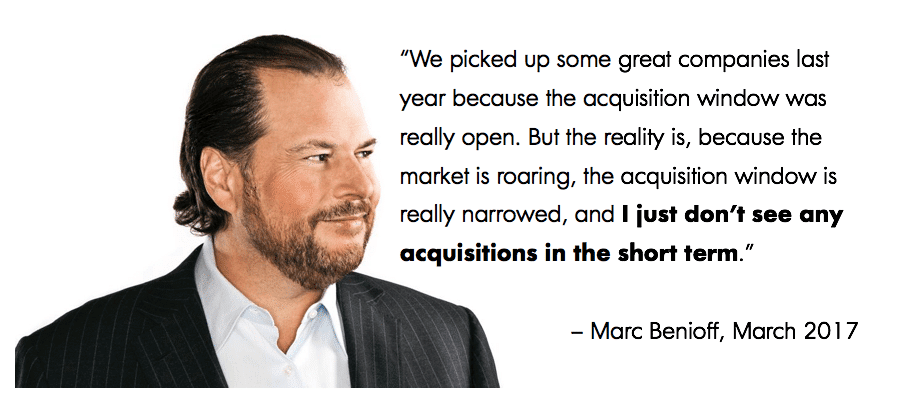
Last year Salesforce went on a SaaS buying spree. The CRM giant gobbled up the likes of Demandware ($2.8B), Krux ($800M), Quip ($750M), Beyondcore ($110M) and at least eight other technology companies. This year, they haven’t made a single notable SaaS acquisition to date.

Marc Benioff And Salesforce isn’t the only major strategic sitting on the sidelines. Oracle made nine acquisitions in 2016, including Netsuite ($9.3B), Textura ($600M) and Dyn ($600M). This year they’re down to only three according to data from Crunchbase. Likewise, IBM went from thirteen acquisitions last year to a measly four in 2017 (at the time of this article’s publication).

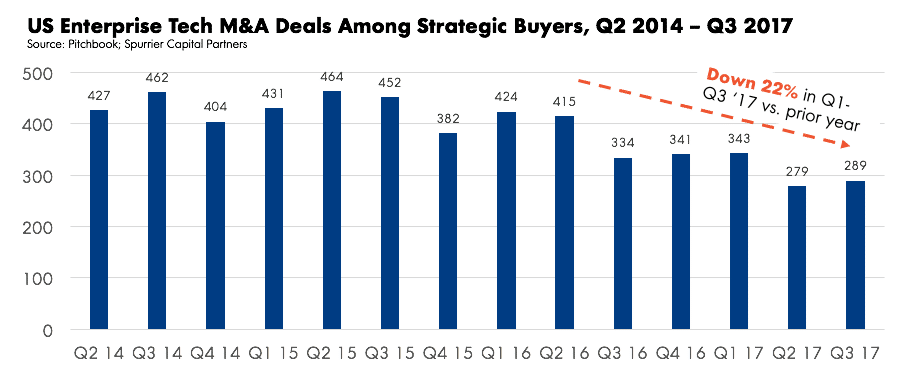
This downturn is more than just an anomaly. While venture funding continues to flow to startups, strategic buyers have done 20% fewer deals, from 1,173 to 911, over the last year.MA tech deal activity

Strategic buyers have hit the pause button for a few reasons. Some, like Oracle and Microsoft, still have to digest their previous acquisitions. Others still might be concerned with high prices and are hoping to wait the market out (possibly predicting an evitable cooling). The rest might be waiting out fiscal and regulatory uncertainty. Regardless of their underlying reasons, the slowed deal pace adds up to troubling news for enterprise technology founders looking to find suitable homes (or exit outcomes) for their businesses.

With strategic buyers sitting on the sidelines, you might look to public markets for liquidity. Unfortunately, despite signals that 2017 would be a banner year, enterprise tech IPOs remain few and far between. There have been some notable successes – Okta, Mulesoft, MongoDB come to mind – but the bar to IPO remains exceedingly high. The median 2017 IPO had $133M in prior year revenue and 55% year-over-year growth. Most venture funded SaaS companies don’t meet such lofty expectations.

Private equity isn’t your enemy; it’s your new exit opportunity

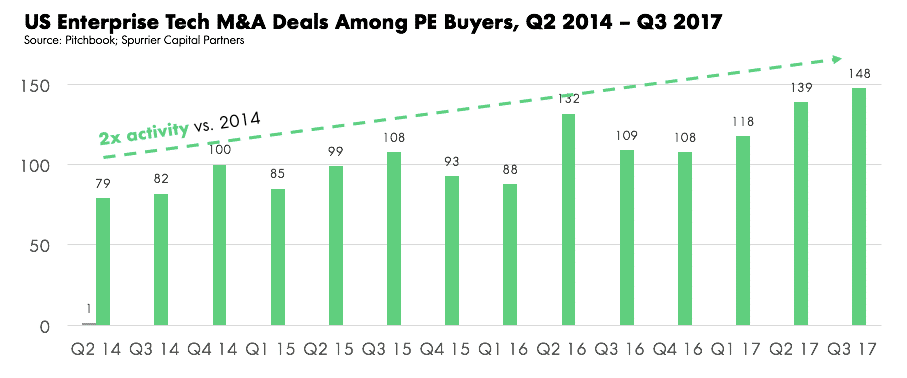
The good news: private equity has stepped into the chasm, doubling enterprise tech deal activity since 2014 – the result of several favorable market trends.

1. Technology-focused private equity firms have raised record-setting sums of money.

The top 20 PE firms now sit on an estimated $349B in dry powder, up from $260B in 2016. Meanwhile, firms like Francisco, Thoma Bravo, Vista and others are increasingly adding lower and midmarket mandates into their investment strategy. Even more favorably, we’re seeing generalist PE firms growing more interested in enterprise tech.

2. There’s an outdated view of private equity firms focusing largely on turnarounds, paying low multiples and ruthlessly cutting costs out of a business.

Today’s enterprise tech PE buyers are different. Given the low cost of capital and competitiveness of deals, they’re willing to pay up for good companies. Take SolarWinds and Cvent for example. Bloomberg reports that they were acquired for 9.1x and 7.1x multiples, respectively.

3. PE firms aren’t just looking purely at EBITDA anymore, either.

The tried and true high EBITDA, low growth and highly levered (i.e. LBO) deal is still part of the PE repertoire; however, they are increasingly open to strategic deals and high growth companies. Take Thoma Bravo’s acquisition of Qlik Technologies last year. They paid $3B, or 200x core earnings, because the company was still growing licensing revenue 20%+ year-over-year (on a constant-currency basis). For these deals, private equity firms want to see an attractive balance between growth and profitability with a favorable ‘Rule of 40’. In other words, it might be okay to be break-even or even still burning cash so long as you’re growing nicely and have a clear path to future profitability.

Let’s not forget, the deal dynamics of selling to PE are also quite attractive. There’s far greater certainty and speed of close compared to corporate M&A. It’s cleaner than an IPO, requiring less preparation, less regulatory burden, no public position to unwind and no dilution. Plus, PE firms’ equity role offers another bite of the apple to accelerate growth.

How to position your company for a successful PE outcome

There are steps that every software company can take to position themselves for a successful outcome, without putting up a for-sale sign. (In fact, we put together a playbook on the topic that you should check out.)

First and foremost, take the necessary steps to ensure that your financials are attractive to PE buyers. That means pursuing balanced, efficient growth and the Rule of 40 rather than a ‘growth at all costs’ mentality. Meanwhile, make smart investments in customer success and retention. Sticky, predictable recurring revenue is of fundamental importance to many PE buyers.

Tailor your story appropriately for what a PE buyer will care about. Your standard corporate deck might fall on deaf ears if you’re not thoughtful. Consider how a PE firm might be able to make a healthy return on their investment post-acquisition. For example, could you be positioned as an attractive platform play, rolling up several smaller companies in your space? Is there an inflection point story for your company, i.e. an opportunity for PE to apply their operations teams, acumen and/or capital to generate value that the existing investors can’t?

As you put the fundamentals in place and craft your story, start meeting with PE firms. Introductory meetings should take place well before you plan to sell. You’ll get to know different PE buyers and give them a chance to get to know your business. You might find that no two PE firms look the same and it’s important to find a firm that fits your culture, shares your objectives and has the right expertise.

And if you’re lucky (and smart), you might just find your ideal exit opportunity.

Looking to up your chances of being acquired by a PE firm? Check out our eBook below.

In this playbook you’ll learn:

  • The key steps you should be taking right now, and in what order
  • How to build a corporate deck that generates buzz around your company
  • How to identify and prioritize the target acquirers for your business
  • Ways to break in, including email templates that have worked for others
  • The right time to engage an investment bank and what to look for

The post Private Equity is Your New (and often best) Exit Opportunity appeared first on OpenView Labs.

07 Nov 16:23

Is Execution Where Good Strategies Go to Die?

by Mark Bonchek
nov17-07-542351668-VCG
VCG/Getty Images

Execution is an odd word. On the one hand, it means “the carrying out of a plan or course of action.” On the other, it means, “the carrying out of a death sentence.” When leaders “execute a strategy,” they usually mean the former — putting an idea into action. But those efforts all too often end up meaning the latter. Execution is often where strategies go to die.

So what determines whether execution brings life or death to your strategy? It’s not what you think. It’s how you think. The mental models that inform strategy are usually different from those that determine implementation. To close the strategy-execution gap, leaders have to close several other, smaller gaps.

First, the thinking styles of the people who create strategy are often different from those of the people who implement it. In my work analyzing the thinking styles of leaders in organizations, I’ve found that strategy is usually developed by people who have a big-picture orientation, while execution is often done by those with a detail orientation. Furthermore, strategy is usually done by people who are focused on ideas and connections, while implementation is done by those who focus on process and action.

This difference in thinking styles creates a problem when strategy turns into execution. Those who create the strategy are often thinking about the destination, particularly the opportunity and intended outcomes. Meanwhile, those responsible for implementation are thinking about the realities of what it will take to get there. When the strategy is presented, they naturally begin to ask questions about risks and roadblocks — a natural consequence of having a detail-oriented thinking style. But to strategists focused on the big picture, this seems like resistance: “Don’t they see the brilliance of the strategy?” So they get defensive and begin working on overcoming the “resistance.” In turn, this makes the implementers feel suspicious: “I was just trying to understand it better. Why are they being so defensive?”

Right from the start, the relationship is adversarial rather than collaborative, not because of a problem with the strategy but because of a difference in thinking styles. The solution is for strategists to expect different kinds of questions from the implementers than from their fellow strategists. Understand that this can just as easily be a sign of engagement as a sign of opposition. Realize that it takes all kinds of thinking styles to turn a vision into a reality: big-picture and detail, ideas and actions, processes and relationships. If you want to change other people’s behaviors, you have to shift their thinking. You also may have to engage in a bit of unlearning yourself.

Insight center

The second gap is a result of the connection between participation and ownership. In a phenomenon dubbed “the Ikea effect,” researchers found that people preferred things they helped make to things that were preassembled, even if their creations were of lower quality. What applies to furniture also applies to strategy. Often stakeholders are kept out of the strategy process out of concern that they will slow things down or compromise the quality of the outcome. But this is a shortsighted view. By involving stakeholders earlier, you give them a sense of ownership that speeds things up when it comes time for execution. Furthermore, the evidence suggests that diversity will actually improve the quality of the strategy. And it’s far more likely the strategy will stick to its flight plan, because those responsible for its execution will have a stake in defending it.

The third gap between strategy and execution is in the narrative around the strategy. The strategy itself may be sound, but what matters for execution isn’t what is said but what is heard. Strategy is inherently about creating something new or getting somewhere new. But the way humans are wired, it’s difficult to process something that is completely unrelated to what we already know. A good narrative helps people move from the past to the future. Steve Jobs’s genius in announcing the iPhone was explaining it as three devices: a touchscreen iPod, a new kind of phone, and an internet communicator. He built a conceptual “horseless carriage” — a bridge between the old and the new.

The lack of narrative is particularly a problem in the relationship between sales and marketing. Too often, marketing puts out a new advertising campaign, a new value proposition, or new messaging for the sales team with the expectation that the sales teams will just start using the new language, almost as if they were changing the content on a web page. This behavior is a result of the underlying mental models of sales and marketing. Marketers see the world as campaigns, messages, channels, and audiences. Salespeople see the world as prospects and products, offers and opportunities. To a marketer, sales is a channel for reaching their audience. But salespeople wants to be treated as customers, not channels.

Here the “Ikea Effect” can be particularly helpful. Too often, salespeople aren’t involved in marketing conversations about messaging and sales enablement strategies. When I conduct workshops with marketing and leadership teams on the design of strategic narratives, I’m often asked, “Should we include the sales teams?” The question itself reveals the mental model at work. Inevitably, the sales leaders make vital contributions to the conversation. In addition, the deployment of the narrative into the field goes far more smoothly, both because the sales leaders have a sense of ownership and because the strategy is framed in a way the sales teams will best understand it.

The fourth gap between strategy and execution is in measurement and metrics. This, too, is a reflection of mental models. You only measure what you can see. And your mental models determine what is visible or invisible. I consistently see measurement as an afterthought in strategy development. The assumption is that financial measures like cost and revenue are sufficient metrics to measure progress. But that would be like a coach only tracking points on the scoreboard. You need metrics that tell you how well your game plan is being executed — metrics that all of your players can organize around. If you’re a basketball coach, those metrics might be focused on rebounds, turnovers, or assists. If you’re managing a new product launch, those metrics might be free trial sign-ups, preorders, or product reviews.

The mismatch between metrics and strategy is common in the digital transformation efforts of many companies. Their strategies are designed to create network efforts through platform-based business models or to leverage advanced technologies like AI or the internet of things. These companies expect the organization to execute exponentially, but their mental models — and therefore metrics — are still incremental. In the beginning of a disruptive innovation, the thing to measure is not ROI.

As an example, from the beginning Amazon was primarily concerned with the number of online reviews per product, the number of affiliates selling on the platform, and the number of Prime members joining the program. Meanwhile, other retailers were still focused on year-over-year same-store sales, treating their e-commerce operations as a “digital store.” Their mental model constrained their metrics, which in turn distorted their behavior.

Focus your metrics instead on learning and the creation of network effects. How many experiments are you able to run per week or even per day? How well are you connecting the various forms of capital across your business? How rapidly is your ecosystem growing? How easily can people share data across the enterprise? These are much better indicators of whether you are truly aligning strategy and execution for digital disruption.

Execution doesn’t have to be the place good strategies go to die. As you are developing your strategy, take into account the thinking styles and mental models of the people who will be responsible for its execution. Involve them to generate a sense of ownership and to tap into their collective wisdom. Craft a narrative that connects the past to the future. And design metrics that focus attention and motivate behavior around what will really make the strategy successful.

07 Nov 16:21

Why Upselling and Cross Selling Are Key To Customer Satisfaction

by John Hawthorne

In the movie Glengarry Glen Ross, there’s an iconic scene in which Alec Baldwin, playing the role of lead salesman, tells those under him (edited to remove expletives):

Because only one thing counts in this life: Get them to sign on the line which is dotted. You hear me? A-B-C. A-Always, B-Be, C-Closing. Always be closing. ALWAYS BE CLOSING. A-I-D-A. Attention, Interest, Decision, Action. Attention – Do I have your attention? Interest – Are you interested?…You close or you hit the bricks.

Baldwin plays the classic role of arrogant, rude, cocky salesman who only cares about getting people to sign on the bottom line. He doesn’t care about the customer. He doesn’t care about his reputation. All he cares about is the cold, hard, cash. You close or you hit the bricks!

stevepb / Pixabay

If you’re in the ecommerce business, it can be easy to take Baldwin’s hardcore, ABC approach. You do everything in your power to get that initial sale. Yes, you care about taking care of your customers, but ultimately you need to make money to keep your business going.

But what if there was a way to combine the two? What if you could simultaneously make more money and take care of your customers? This isn’t some sort of “Made For TV” offer that will expire if you don’t act now. This can be done and is done by the biggest, most successful businesses in the world.

What exactly am I talking about? Upselling and cross-selling.

Both tactics are outstanding ways to increase your bottom line, sell more products, and give your customers exactly what they want.

It’s the ultimate win-win situation.

So let me break down the details of upselling and cross-selling and show you how you can use them to serve your customers.

What’s The Difference Between Upselling and Cross-Selling?

It’s not complicated. Upselling is when you convince a customer to purchase an upgraded or more expensive version of what they’re already purchasing. So, for example, if a customer buys a toothbrush from you, you can upsell them a fancier electronic toothbrush which spins, vibrates, and predicts the stock market. You’re trying to persuade them that they need a better, upgraded toothbrush.

Cross-selling is when you try to sell additional, supplementary products and services based on the initial purchase. When you purchase a mobile phone and they want you to buy a protection plan in case your drop the phone in the toilet, that’s cross selling.

Amazon is all about upselling and cross-selling.

Amazon upselling and cross-selling

The moment you click on a product, they also show you more expensive versions of the product as well as additional things you might want.

Clearly, this works. Not only do the biggest businesses use upselling and cross-selling, the data suggests it works as well. In the book Marketing Metrics, the authors state, “The probability of selling to a new prospect is 5-20%. The probability of selling to an existing customer is 60-70%.”

In other words, the odds of upselling and cross-selling are much higher than making the initial sale.

Upselling and Cross-Selling Don’t Have To Be Slimy

Some sellers feel that upselling and cross-selling are shady tactics, like something a polyester-clad, loudmouthed used car salesman would use. And they can be that if done improperly. If you are trying to take advantage of your customers by selling them something they have zero use for, it’s a bit slimy. If you’re deceiving customers into thinking they need something that they don’t, that’s also slimy.

But if you use upselling and cross-selling to give customers truly useful upgrades and additional items, that’s helping your customers. You’re trying to give them a better experience.

For example, let’s say you sell mobile phone cases. As an upsell, you could offer them a more protective case, which may be exactly what they want. Or you could offer them a screen protector, which they may have been considering anyway. You’re not taking advantage of them or trying to trick them into a purchase they don’t need.

As Len Markidan of GrooveHQ says:

If you can make your customer feel like an upsell is helping them win, then you’ll both win.

Here’s another example: a few months ago, I checked into a hotel on a weekend trip with my wife. As we were checking in, the clerk offered me an upsell: would I like to add breakfast for two — normally $49 — to my room rate for “just” $29? I accepted without hesitation, and I was happy to do so. At $20 cheaper than the standard rate, I felt like taking the upsell offer was an easy win.

The key here is making your customer feel like they’re also winning in the upsell or the cross-sell. You want them to feel like they are getting something of great value. If you’re not doing this, you probably are doing something slimy and shady.

Simple Ways To Use Upselling and Cross-Selling

Now that your conscience feels at ease with upselling and cross-selling, here are some simple, yet effective ways to implement them in your ecommerce business.

Cut Down On The Options

It can be tempting to think that if you give customers dozens upon dozens of additional options, you’ll increase the amount of sales you make. But that’s not the way it works. I can tell you this both from personal experience and the experts.

I’ve waded through page after page of upsells before I was allowed to finally make my purchase. It’s not fun.

The experts support my feelings. Brenda over at WooCommerce notes:

The truth is that product recommendations’ performance depends on how and when you display them. And not everyone gets this right. Cross-selling and upselling are the bane of many customers just because they’re so often done poorly, with the focus put on the business’s aim of selling extra stuff instead of the customer’s aim of making sure the extra stuff will actually benefit them.

Don’t throw everything at the customers. Only present the most relevant items to them – items that will help them win. Combine your upselling with customer service.

Use Those Bundles

Bundling items together is a great way to sell more products and meet your customers needs. Going back to the mobile phone example, bundling a case, a screen protector, and a charger allows your customers to get everything they need in one purchase.

And if you offer a slight discount on the bundle, you may be able to increase your overall number of sales.

Give Your Customers What They Want

Keeping track of customers past purchases allows you to customize upsells and cross-sells based on what you know they already like. For example, after I purchase an item on Amazon, they begin recommending similar items every time I log on. I don’t consider this to be an annoyance. Rather, they know what I gravitate toward and then point me to others similar items.

Keep tabs on what your customers purchase and then guide them toward similar items in the future. Or, if a new, related item comes out, alert them to that release. This can increase their satisfaction and your revenue.

Keep The Price Increases Limited

If someone is buying a $40 pair of shoes from you, don’t recommend a $200 pair of calf leather loafers. It smacks of trying to take advantage of your customers. Generally speaking, upsells and cross-sells shouldn’t be more than 25% more expensive than what they’re already purchasing.

If you stick to this range, you’ll stay in the range of what they’re already purchasing. However, if you go outside this, you risk alienating and frustrating your customers. If they wanted to spend a lot of money, they would have made that initial purchase larger.

When They Win, You Win

You don’t have to be Always Be Closing in order to run a profitable business that makes your customers happy. It’s possible to upsell and cross-sell in a way that serves your customers rather than bleeds them dry.

Again, to quote Len Markidan:

Even if we know that upselling can be extremely valuable, many of us, scarred by scammy upsell offers in the past, still don’t feel “right” doing it.

But with the right timing and upselling techniques, those unpleasant upsells are actually very easy to avoid.

It all comes down to when and how you upsell…

Do you feel offended when a McDonald’s employee asks, “Do you want fries with that?” Probably not. If you do it right, your customers won’t be turned off by your upsells and cross-sells.

07 Nov 16:18

The Pyschology of Price

by valueacceleration

I am continually fascinated by how the mind works, especially when it comes to price. Bundles are often a great way to get people to buy more (up-sell or cross-sell). Making it easy to order often times gets people to buy more. Consider combo meals at fast food restaurants as a simple example.

Of course, we also see the converse where unbundling is used to extract higher prices and/or more money, though this often occurs due to much of the bundle being perceived as “free.” Airline services unbundling is an example here.

I had the good fortune of attending the 6th game of the World Series this year at Dodger Stadium. I am pretty sure I have not been there in a few decades. When I went to order my Dodger Dog (Nathan’s my be the official hot dog of Major League Baseball but it is not even for sale at Dodger Stadium), I noticed the sign in the picture above. Not being much of a beer drinker, I didn’t order the bundle, but my brother-in-law did (though he insists that was his order despite the sign).

I suspect that sign gets a lot of bundle orders given its prominence. I also assume most people believe they are saving money, as my brother-in-law did. They aren’t. Turns out the bundle price is exactly the same as the price if you bought each item individually. The psychology of the sign causes most people to believe they will save on the bundle. They don’t, but sales increase.

As I said in an earlier post, if people were rational, prices would be too.

Mitch

07 Nov 16:16

How to Make the Competitive Landscape Uneven with Creative Business Differentiation

by John Hodge
How to Make the Competitive Landscape Uneven with Creative Business Differentiation

Pexels

Business differentiation is the act of a business positioning itself to stand out from other businesses. This could be highlighting service offerings or maybe the execution of those service offerings.

Now, those two examples aren’t an exhaustive list of what can be used to differentiate one business from another. In fact, there are countless strategies that could be used to differentiate.

As a business, it can be hard to think of ways to stand out, so I’d like to inspire some creative thought with some examples that I really appreciate.

Before we go full-on inspirational example mode, let’s briefly touch on why differentiation even matters.

Why is Business Differentiation Important Anyway?

Quick answer: it diminishes the intensity of competition.

The whole point of differentiation is to make a business seem different from other businesses. This makes the competitive landscape uneven.

By making the competitive landscape uneven, we’ve removed at least some portion of direct competitors.

“Oh, we’re not competing with that company, they’re in a totally different ball game. We’re [doing/attracting/being] this, they’re [doing/attracting/being] that.”

Naturally, this can even lead to an increase in brand equity, which can lead to being less substitutable, resulting in higher price elasticity. This can create room to increase prices without reducing demand.

Let’s look at a couple examples to get the inspiration flowing.

Salted Stone: Full-Service Agency Who Aren’t Jerks

Screenshot of Salted Stone About Page

Salted Stone’s statement on their about page:

We’re a full-service digital agency and we’re not jerks about it.

The phrase “We’re a full-service digital agency” is very much the opposite of a differentiating factor. Just about every agency is a full-service agency.

However, adding “and we’re not jerks about it” turns this statement on its head. It almost makes fun of how many agencies call themselves “Full-Service” only to end up being pushy, and maybe a bit aggressive.

I’m sure there are plenty of business owners who have signed on with a marketing agency, experienced that, and would appreciate this positioning statement.

As an added bonus they have a part of their about us page devoted to the canine department, “Salted Bone”.

Screenshot of Salted Bone

Nice job removing several competitors guys.

Archetype Differences of the Super Similar Paycom and Paychex

Paycom and Paychex have very similar service offerings. Actually, their search result listings are almost identical and feature very similar terminology.

Paychex and Paycom SERP

So, product differentiation is probably not very feasible.

Turn to their websites and we see two very apparently different archetypes. Paychex is the Everyperson and could be described as “in honor of the common man and woman”.

Paychex Screenshot

Meanwhile, Paycom is a Hero and is positioned as software that does more for everyone. They’re working towards a greater good and they show a man whose time is being saved by their application.

Paycom Screenshot

Alright, the idea of Paycom being a hero might seem a little hokey, but then again maybe the Paychex being an Everyperson might be a little bland.

Even though these two positions might fall flat with some, they will resonate with others.

By successfully differentiating themselves, they corner their segment of the market. And then, by default, they aren’t competing for all the same business. Mission accomplished.

That said, they are still competitors, but the competitive landscape with them isn’t the same for every potential customer. Some people will be more attracted to the Hero archetype and others the Everyperson.

Product Differentiation Constraints

Obviously, if a company has a product that is truly unlike anything in the world today, then that can be the differentiation point. Unfortunately, that’s not always feasible.

Hopefully, these examples have created a spark of inspiration to get the differentiation juices flowing.

Happy differentiating!

07 Nov 16:15

The Magic of Buyer Empathy

by Elliot Begoun

Canva.comCanva.com

How does your product impact your buyer? Does it align with his or her goals and objectives? Does it help grow the category, or might it cannibalize the sales of other brands?

One of the least leveraged and most powerful tools of the trade is empathy. It’s especially powerful when applied to the buyer. Food founders are passionate about their brand, excited with how it will impact the lives of their consumers. But, what does it mean for the buyer?

Understanding the buyer impact, making that a key part of a go-to-market strategy is vital to achieving the desired distribution gains. Yet, too often, it is overlooked. A brand will have attributes that are particularly attractive to a buyer and should be used as part of the business case presented. A brand may also have aspects that aren’t aligned with a buyer’s needs or wants. Recognizing those is the first step to overcoming objections.

For the purposes of this article, let’s focus on a conventional retail buyer. Just know that these same principles are applicable to a buyer in any channel.

Let’s start with what a buyer’s key motivators are likely to be. The first is category gross profit. A buyer is trying to create that perfect cocktail of products from commodity to premium. The perfect blend produces the ideal balance of velocity and margin that results in a total category gross profit that meets or exceeds her targets.

Closely related to the above is space. At the end of the day, retail grocery is a real estate business. There is a finite amount of linear feet in each category and the buyer’s responsibility is to maximize the production of that space in both revenue and profit. All of course, while meeting the consumers’ expectations and desires.

A growing focus that many buyers have is the need to create an experiential shopping trip for their customers. They are searching for an opportunity to create a treasure hunt, or for a novel item that supports shopper interruption and entertainment.

Although there are many other buyer motivators, in the interest of brevity, I end with promotions. A buyer is responsible for bringing in, managing, and maximizing the promotional dollars. Often the larger brands have firm promotional calendars and a buyer frequently is expected to fill certain promotional blocks in the weekly circular.

So, how does the magic of buyer empathy play in all the above? Let’s explore it in the same order.

An emerging brand must understand how their product fits into the pricing and gross margin architecture of a category. If the product is a premium product sold at a good margin, it could be attractive to a buyer from a penny profit standpoint. If conversely, it is a value price positioned item that cannibalizes from other premium offerings, it could be a threat. Unless, of course, the potential velocity is great enough to offset the penny profit loss of the premium. It’s so critical to understand this interplay. If you don’t, hire someone who does. Because, if you know it prior to meeting with a buyer and have a plan, it can be very beneficial. If you don’t know, it could derail your entire meeting.

The pack-out of a product, the facings per linear foot, and the flexibility of how it can be merchandised all impact buying decisions. If a brand offers an item that allows for more facings per foot, it could be exciting to a buyer. Similarly, if a brand offers its own merchandising solutions such as shippers, racks, etc., that too can be very appealing. It’s a must to understand how your brand at the shelf fits within in the total set and whether that fit is positive or negative. That information is critical prior to a presentation to a buyer.

If a product comes with its own buzz, a cool story, or even some store-level events beyond just demos, a buyer’s ears are likely to perk up. Consider this newly found need to create an experiential shopping trip and how your brand might support those efforts.

Lastly, every brand dreams to get the key promotional periods; holidays, the Super Bowl, and more. There are a lot of promotional periods in a year and a buyer must fill them all with something from their category. Offering a flexible promotional plan and giving a buyer some discretion on when to promote, could earn you hero status. Yes, you might miss the dream periods, but building a relationship with a buyer is usually a great trade-off.

The real lesson here is that before you approach a buyer, prior to any meeting, know, from behind the eyes of that buyer, their key motivators. That knowledge and understanding can do more for growing your brand than most realize. Buyer empathy is magical.

07 Nov 16:14

Content Consumption Metrics

by Sudhir Kumar

Now, in my short video, I highlighted the fact that marketers like myself and sales professionals focus too much on clicks and form fills when we should be focusing on content consumption. Why? Because surely the prospect will be a warmer lead if you engage with them once they have consumed the content rather than making an assumption they have post form fill or click.

So, as highlighted, content consumption metrics in my eyes are key as they truly show how engaged the prospect is and in return are a much warmer lead, a ‘real’ SQL.

I’m a man of my word, so as promised, let’s talk content. When it comes to content you can focus on many categories, but here are a few I consider to be key.

Consumption and metrics

Whenever you publish content you want to know how it performed right? Has it been read? Has it been downloaded? Has it been shared? Was there any feedback?

If the content hasn’t been consumed how can you achieve your end goal? The whole point of content is to engage your audience, educate them, offer informative and helpful insight, address their pain points and help nurture them as a part of your sales play. So, you need to focus on metrics, but which ones? I would focus on the following categories:

  • Consumption metrics – How many people are consuming your content, what channels are they using and what’s the frequency of the consumption?
  • Sharing metrics – What is being shared, who is doing the sharing, how are they sharing it and how often does sharing take place?
  • Lead metrics – How is the content supporting your demand generation and lead nurturing?
  • Sales metrics – How is the content influencing prospects within your sales funnel at the various different stages?

You can focus on more categories but these are the key ones I would use, but it’s important to focus on the categories that are suitable for you, so feel free to adjust accordingly. Within these categories lie the metrics so let’s take a look at three that I would say are key:

Time

HubSpot reported that more than 50% of website visitors spend less than 15 seconds on a website. This stat clearly focuses on what is on offer to your audience and 15 seconds tells me that it’s poor and not appealing. By tracking the time on pages for specific content, be it a website or landing pages, you can track how engaging it is and make adjustments where you see fit.

You may find that time on a page for a specific piece of content is high but you’re getting a low conversion, this is where you need to test and tweak the supporting copy and calls-to-action. Overall, you want the journey to be consistent and engaging. This can only happen if you continue to refine, review and tailor content for your specific audience, the ‘one size fits all’ doesn’t always work.

Landing Page Views

Always pay close attention to the traffic your landing pages are generating. You want to know if, as pointed out above, the overall journey is consistent and engaging, is the supporting copy directing your audience to your landing page working? Is it strong enough? When they are on the landing page does the content on offer match their expectations? These are all things to consider and focus on as they all play an important part in the conversion journey from a prospect to a lead.

Engagement with you

This is key for me but I always pay attention to see what comments my content generates. This gives me an indication as to how my audience is reacting to my content and how they feel about it- are they finding the topic relevant? Did they find it of use? Should I do more of this? Having a lot of content views is always nice but that’s more catered towards your ego. I would focus on the comments, likes, and shares as these metrics show you have prompted your audience to take action, which in return indicates your content is resonating with your audience.

Ideally, you will have done your research prior to content creation to understand your audiences pain points and to create buyer personas, a tone of voice and a content plan.

Final Word

This was just a brief insight into what content categories and metrics you can use to measure the impact of your content. It’s important to remember the whole journey so without traffic, shares and expanding the reach of your content you’ll never be able to scale the volume of conversions. If you’re not tracking a variety of metrics for your content and your campaigns, it will be extremely difficult to fully understand the ROI of individual content campaigns.

Off the back of the vlog and this follow-up article, I hope you found this insight of use. If you want to know more about content consumption, ABM, Inbound Marketing, Lead Gen or any marketing related matters contact me and I’m happy to help.

07 Nov 16:11

3 Tips to Write a Prospecting Email That Gets a Response

by heather@salesfolk.com (Heather R Morgan)

How much do you really know about your prospects?

Maybe you don’t need to know how they take their coffee, but you do need to know enough about to get in their heads.

If you want to get responses to your outreach emails, you need to offer your prospects value. But before you decide which benefits your emails should focus on, first understand your prospects’ desires and pain points. Then and only then can you craft a relevant and persuasive message.

Check out my new video course on How to Craft Great Sales Emails (with Workbook Activities and Real-Life Examples!)

Although researching 500 prospects one at a time isn’t efficient, make the effort to write targeted, personalized messages. With 10 minutes of research, you can learn enough about your buyer persona to double your email response rate.

Here are three questions about your prospects that you must answer before you write a single sales email.

1) What does your ideal buyer persona care about the most?

Your prospects are not identical, so your emails cannot be one-size-fits-all either. The VP of Sales for a Fortune 500 company and the manager of a restaurant have very different jobs. Different buyer personas require different messages that appeal to their specific pain points and desires.

Discovering what matters most to your prospects is as easy as conducting a simple online search.

LinkedIn profiles offer a treasure trove of valuable information about your prospects’ mindsets and behavior.

For example, if you’re targeting CROs in the Greater Boston area, your LinkedIn results would look something like this:

HubSpot_CRO_.png

Let’s take a closer look at one of the profiles that came up in our search: Mark Roberge, Chief Revenue Officer at HubSpot Sales Division.

HubSpot_Mark_LinkedIn_.png

Understanding your ideal buyer persona is key to crafting highly targeted messages that will engage your prospects on a more personal level. Think about the job of a CRO. What responsibilities do they have? What are their priorities? What are their goals?

HubSpot_Background_.png

Pro Tip #1: A simple Google search reveals CROs are primarily concerned with managing sales and generating revenue. Your message should address relevant pain points. Looking at Mark’s profile for a minute shows he’s focused on accelerating sales. Therefore, your messages should discuss how your product can help improve the quality of HubSpot’s leads and increase sales.

Pro Tip #2: If their LinkedIn summary section is blank, the recommendations they’ve given and received are a great source of information. These show how they see others, how others perceive them, what they value.

Pro Tip #3: Look at your prospect’s featured skills, college major, who they follow, and which associations they belong to.

Piecing together this information helps you understand their personality, talents, and values.

2) What language or keywords resonate best with your prospects?

If you want your prospects to take your emails seriously, you need to speak their language.

Pay close attention to the words in your prospects’ online profiles. Are they using highly technical or industry terms in their About section or role descriptions? Do they use a formal or conversational tone? Formal writing might just be copy and pasted from their marketing team, or it could be the way they like to write. Do they have a sense of humor? How your prospects communicate helps us understand the tone and words that resonate the most with them.

Looking through Mark’s profile we notice a few words that give us better insight into how he thinks.

HubSpot_Engineering_.png
HubSpot_Publications_.png

Mark’s BSE in Mechanical Engineering and his recent publications indicate he probably responds to hard data. He won’t be fooled by salesy jargon and cheesy pitches.

Pro Tip #4: Any message you send Mark should incorporate quantitative proof,such as percentages and dollar figures, illustrating exactly how your product could help HubSpot increase its revenue and make Mark’s life easier.

3) How do your prospects interact with others?

When searching through your prospects’ LinkedIn profiles, make sure to look beyond just their background and experience. Your prospects’ “Recommendation” sections often contain clues to how they do business and work with others.

HubSpot_Actionable_Insights_.png

HubSpot_Case_Studies_.png

We can see from Mark’s recommendations his presentations are “dynamic and full of actionable insights.” From this, we can gather that Mark likes to offer practical solutions to his clients. Gimmicks and fad products probably aren’t going to grab his attention.

People like Mark will respond better to short and concise messages that center on product benefits. Avoid long-winded and self-centered emails. Make sure to include a clear call to action, so that your prospects know exactly what type of action you want them to take next.

Pro Tip #5: Mark’s recommendations also reveal he likes to use case studies in his presentations, telling you he appreciates the promise of value. Including a “case study sentence” pointing to past results will help build credibility with him. This proves your product works, that you haves happy customers, and makes it easier for data-driven prospects like Mark to say yes.

Pro Tip #6: Job search websites are another great place to find useful information on your prospect’s role, objectives, and top-level concerns. Review job posts similar to the titles/roles you’re targeting to see:

  • Which departments they collaborate with and why
  • Where their job fits in the organization
  • Whether they interact with clients or suppliers (and if so, how frequently)

If you’d like more advice on writing better emails to build relationships and close more deals, check out Video Course: How to Write Great Emails That Will Get Prospects to Open, Click and Reply, a free resource brought to you by SalesFolk and HubSpot.

HubSpot CRM

07 Nov 16:10

It’s Not About What Or How We Sell…..

by Dave Brock

rawpixel / Pixabay

How we define a problem inevitably constrains our solutions to the problem. That’s why it’s so important to think about the problem we are trying to solve and defining it in a way that enables us to solve the problem in a meaningful way.

As we address the issue, “How do we drive sales, how do we grow our business, how do we achieve our numbers,” depending on how we frame the issues/problems around revenue growth, we could be seriously constraining the solutions that are available to solve the problem.

Most organizations frame the issue around, “What we sell.” Inevitably, this leads us down a very company/product centric view of our sales strategies. It biases all our thinking to what we do and how we sell. This thinking leads us to a product/solution focused approach to selling, usually, we end up in some variant of, pitching or product centric focus on engaging the customer.

Fewer organizations frame the issue around “How we sell.” This leads us down very different paths. When we focus on this, we tend to look the process of how we engage our customers. This approach may lead us to completely different approaches to selling. It may be more customer centric, in may be more collaborative, it may be more focused on how we create value with the customers. Of course, depending on how we look at it, we could come up with some very self centered, inward-out approaches to selling (much of the high volume/high velocity approaches represent the result of this).

But what if we framed the problem a little differently?

What if we started by asking ourselves, “Why do customers buy, how do they buy?”

Instead of focusing on what and how we sell, what if we inverted the process by starting with the thing that creates revenue—it’s customers buying. How might we change our approaches to selling if we simply started defining the problem in the context of the why and how of what they do, then align all the things that we do around helping them with those processes?

There’s another advantage to changing the way we define and look at solving problems. If we keep defining them in a single way, for example “what we sell,” we limit the potential solutions. Inevitably, we revert to past approaches, but if they are no longer as effective as they had been, we don’t do much to change the outcomes. As many have said, “If the only tool you use is a hammer, pretty soon everything looks like a nail.”

Reframing the way we look at problems can help us move forward in tremendous ways. It can help us look at different solutions and approaches. It enables us to combine a variety of approaches. It enables us to overcome challenges we may encounter in our previous approaches.

We need to continue to look at what we sell and how we sell. But we might be able to move the needle, by expanding our views, reframing how we look at driving revenue growth. Looking at why and how our customers buy, might drive some new success.

07 Nov 16:10

How to Be Ridiculously Memorable in 4 Simple Steps

by dtyre@hubspot.com (Dan Tyre)

How to be memorable

  1. Identify your unique characteristics
  2. Emphasize those traits -- but maintain your professionalism
  3. Incorporate your personal brand into your calls, emails, meetings, and social media
  4. Tweak your persona to the audience and situation

Memorability has a ripple effect across your sales career.

Put yourself in the buyer’s shoes. You’ve almost decided between two similarly priced products with nearly identical features. One of the reps you’re working with has a distinct personality and style, while the other is pretty “meh.” You’ll establish a stronger rapport with the first gal. You’ll give her more information and maybe access to other stakeholders. And when it’s decision time, she’s the one you’ll give your business to.

Over the last 10 years at HubSpot, I’ve witnessed prospects call their salesperson back to re-engage in the sales process -- months and sometimes several years after they first connected with them. The sales rep listened to them, analyzed the situation and likely didn’t push to close, but may have helped the prospect diagnose a problem. For whatever reason, the buyer decided not to finalize the deal or start the relationship, but they absorbed the material. When they moved from educational mode to consideration stage ... BOOM, they called back the person they had been working with.

  • “Do you remember me?”
  • “We talked in 2010?”
  • “This is Chip from Springfield, Ohio.”

That’s the power of being memorable.

So if you can identify and use your memorable attributes to your advantage, you’ll be ahead of the game. This comprehensive guide is designed to help you master the art of memorability and personal branding in the sales process.

Who is this guide for?

Before I jump in, one caveat to our readers. If you’re still ramping up in your sales role, I suggest bookmarking this post and coming back to it in six to nine months. You shouldn’t focus on becoming memorable until you’re comfortable with your company, products, sales process, personas, and typical pain points. Intermediate to advanced salespeople, on the other hand, have already mastered the fundamentals and may be ready to take your game to the next level.

When my editor Aja and I started this blog article, we spent a lot of time noodling on the question:

“What makes a person memorable?”

Memorable people give you a strong reaction. You hear their name, and you have an immediate response: You smile, nod in respect, roll your eyes, or even frown. 

Being memorable requires figuring out which habits and character traits make you unique in a positive sense and showcasing them so that you differentiate yourself.

Figuring out your memorable attributes

Sometimes, it’s easy to figure out what makes you unique. I tend to speak fast and loud, no matter what time of day it is. Hit me up at 5:30 AM and I am already an excitable boy, I’m also reasonably enthusiastic, quick to laugh, and always ready with a relevant story (or two!)

While some people find these traits annoying (just talk to my beautiful wife or my teenage daughter Sally) many people appreciate those qualities and remember me because they are relatively distinctive.

Obviously, you don’t want to be memorable in a negative sense. We’re shooting for the type of memorability that leads to smiles, positive endorphins, and potential deals, rather than scowls.

If you can already come up with three to five quirks that make you memorable, awesome. But if you can’t, here are a few exercises to try.

First, ask your coworkers, friends, and/or family members these questions:

  1. What’s unique about me?
  2. What are the top three things that make me different?
  3. When you say my name, what do you think of?
  4. What are my best characteristics?
  5. Which adjectives would you use to describe me?

Next, read your LinkedIn endorsements, looking for common themes. Maybe two of your former managers mention your willingness to hop on late calls, or how calm you stay in high-pressure situations. Remember, you are simply looking for consistent characteristics that you may be unaware of.

Lastly, think about what you do over and over during your interactions with other people. Are you constantly cracking jokes? Are they the same jokes? (This is not necessarily bad -- I have been telling the same jokes for 10 years.) Sharing interesting facts you read about? Offering an optimistic perspective?

Once you’ve honed in on several unique traits, you’re ready for the next step.

Reinforce your personal brand

Consistency is a major part of being memorable. Now that you know what’s already making you stand out, double down on that habit or trait.

To give you an idea, my former editor Leslie Ye (who now works on HubSpot’s Sales Acquisition team), became known at the company for always sharing updates on our wiki in Slack. Someone would publish a wiki post Leslie thought our team should know about it, and she’d put it on Slack within 10 minutes. Now we call her the Wiki Queen. She also taught me how to binge-watch Netflix, but that's another blog article.

I’m known for my big energy, funny analogies, and fist bumps. The big energy is natural, and the analogies are just humorous things I have made up over the years. And the fist bumps? Back in 2008, I was working with a bunch of millennials. One of them gave me a fist bump. I thought it was cool and adopted it as an unusual thing to do for two weeks. Then I went back to the traditional handshake. But my team was incensed, demanding I bring it back. Now I’ve been fist bumping instead of handshaking for nine years, and people expect it.

The bottom line: Reinforce your quirky habits or traits as often as possible, in as many situations as possible and you have a memorable persona.

How to be memorable throughout the sales process

I know what you’re thinking.

“Okay, that’s great Tyre. But my prospects don’t care about the wiki. How do I use these tips to win more deals?”

I’m glad you asked.

Because you’ll be interacting with a variety of people, it’s important to consider the specific prospect and what THEY are looking for. Selling in 2017 is buyer-centric. Look at their LinkedIn profile and social media to get an idea of the type of person you are working with. Do they seem like a yukkster, or are they relatively straightlaced maybe not attuned to shenanigans? The more personality they express, the more likely they are to appreciate yours. If they look pretty straightlaced, it is probably better to deliver your message with that in mind.

Prospecting

Give your emails some personality to help them stand out. Let’s say your nickname is “The Dude.” Why not sign off your emails as “Richard Doe, a.k.a. The Dude”? Alternatively, use a GIF or meme that expresses your sense of humor -- just keep it work-appropriate, of course.

These days, I also love intro videos. Film a 15-second video talking about who you are and sharing two or three fun facts. To give you an idea, Aja’s might sound like this: “Hi, I’m Aja Frost, and I edit the HubSpot Sales Blog. My hobbies include going to restaurants and trying the weirdest items on the menu, reading articles about business and technology, and asking hypothetical questions.”

You can use GoVideo, Loom, or Soapbox, which are free and easy to use.

Social media is a prime platform for showcasing your personal brand. Add one memorable fact to your bio, such as, “I’m a mixologist on the side” or “I’ve lived in 10 countries.” This lets prospects see you as more than just a salesperson and gives you a talking point when you connect. You can also add commentary when you share content on LinkedIn, Facebook, and Twitter, rather than simply sharing links. You might write, “This article was interesting because of X and Y” or “I could relate to this point.”

Finally, if you still use business cards, consider incorporating your personal brand into their design. I want to add the fist bump emoji to mine. Wouldn’t that be sweet?

Qualifying and Demoing

Play up your professional attributes during your sales calls and meetings. It’s much easier to do this if you’re using a video conferencing tool (we like Zoom at HubSpot), so you can see your prospect and vice versa.

Take Sam Moorhead, who’s memorable thanks to his extreme focus. When prospects get on a Zoom meeting with Sam, he’s very clearly engaged, prepared, and in command. His energy is both impressive and distinctive.

When I’m on a call, I’m typically cheerful and loud (but not so loud I hurt anyone’s ears). I try to make people laugh -- either by telling a story or cracking a joke. I also pay them genuine compliments, which strengthens our rapport and shows them I’ve noticed their strengths.

As you can see, Sam and I have completely different personal brands. During the relationship-building stage of the sales process, it’s important to stick to your own brand.

Negotiating

I recommend toning it down during the negotiation process. You don’t want to turn into an entirely different person, but it’s important to be professional since this is an important business transaction. Even if I began a negotiation by fistbumping my prospect, I probably wouldn’t crack too many jokes while we discussed the terms.

Your gut-check should be: “If my sales manager was listening in on this call, would they think I was taking things too far?”

I’d love to hear how you’ve applied this advice. Tweet at me -- I might buy you a breakfast sandwich. :)

HubSpot Free Sales Training

07 Nov 16:10

Enterprise Marketing Best Practices for 2018

by kniemisto

20% of all market leaders will lose their dominant position to a company founded after the year 2000, due to a lack of digital business advantage. There’s a long way to fall for top companies that don’t adapt to this changing climate, but it’s not too late to take action. If your company is in the precarious position between market leader and losing ground to a competitor, it’s time to push forward.

Consumers and buyers expect to guide themselves through their own purchase decisions, but also to have seamless brand experiences across every channel. In fact, 86% of buyers will actually pay more for a better customer experience, and estimates argue that customer experience will become the key brand differentiator (over price and product) by 2020. Now more than ever, customers expect to be engaged during the purchase process. Gone are the days when mass messaging is enough to increase sales year over year. Customers want to be engaged.

Engagement marketing is the use of strategic, resourceful content to engage your audience and deliver on their expectations. A compelling engagement strategy requires robust content, an omni-channel approach to communication, and a lead scoring partnership with the sales department. These strategies are easier for smaller startups with shorter contact lists, but a sophisticated engagement platform can help scale engagement marketing for enterprise-level organizations.

In this blog, I’ll cover three best practices for enterprise-level companies to win in the Engagement Economy. 

Inbound Marketing: Scaling Content for the Enterprise

Content strategy, SEO, and social media are all elements of inbound marketing that can have a great impact on enterprise marketing as a whole. Let’s break down the critical factors for success for each tactic.

Content Strategy

It’s hard to deny that, in 2018, one of the most critical marketing efforts for businesses to invest will be content marketing, but creating content within an enterprise organization comes with extra challenges:

  • Siloed internal departments—Sometimes, there are just too many cooks in the kitchen. In other cases, the people creating content are too far removed from subject matter experts. In general, enterprise organizations face various difficulties around collaboration.
  • Scaling personalization and targeting efforts—It can be challenging to scale account-based marketing (ABM) or content targeting/personalization. Enterprises either aren’t aware of available tools or don’t invest in them.
  • Maintaining a nimble strategy—Your audience’s needs and pain points will change, and an effective content strategy needs to keep up. Emerging industries especially develop new terms and advance new ideas, and a content library needs to have answers.

Following best practices for enterprise marketing means:

  • Breaking down silos—Using tools and creating a structure around content collaboration, take advantage of all the voices (and expertise) in the company. Collaboration tools mean it doesn’t matter what department or country a contributor is from, and it’s easy to set tasks and communicate next steps for each content piece.
  • Using personalization/targeting—Use a marketing automation platform to assist with ABM and content targeting/personalization. Letting technology do some of the work will free up time for other content needs.
  • Being flexible—Make use of a content calendar that spans several content assets, so each contributor understands how their piece fits in with others. By planning ahead, you’ll be able to adjust to content needs on the fly.

A robust engagement platform can assist with cross-department collaboration, and content delivery to the most relevant audience—both best practices for today’s enterprise marketing.

Search Engine Optimization

Most enterprise-level companies are investing in some kind of SEO, or at least know they need to. Modern SEO is intimately and irreversibly connected to content, but there are also some technical SEO tasks that remain critically important. Large, growing websites can easily become disorganized, and broken SEO factors can quickly become lost.

Best practices for enterprise-level SEO content include:

  • Thorough keyword + user intent research. Make sure you know what your audience really means when they type in a search query.
  • Understanding RankBrain’s preferences for your industry. Google’s new machine learning program is learning to identify which ranking factors are important for different industries.

Best practices for enterprise-level, technical SEO include:

  • Mobile optimization. Big sites are even more cumbersome on small devices. Make sure yours is easy to navigate on a smartphone.
  • Strategic navigation. Growing companies too often tack on new landing pages and website sections without much thought to an overall navigation strategy.

Social Media

Social media is a battleground where SMBs can easily encroach on a big brand’s market share because their efforts tend to be very grassroots and their strength is in engagement. Smaller companies are usually much more nimble about these things, so enterprise organizations need to figure out how to be human on social channels.

Social media has the power to be extremely timely and it inspires interaction, unlike any other content marketing medium. It’s also a great resource for gaining customer insights.

Best practices for social media include:

  • Creating standardized social media guidelines for every employee to follow. If you’re not sure where to start, look through other enterprise company’s social media guidelines.
  • Creating a process for responding to customers on social that loops in any relevant team members so that efforts aren’t duplicated. A tool like Sprout Social’s Smart Inbox makes it simple to collaborate across multiple team members and networks. Mention makes it possible to listen to customers that aren’t directly reaching out. As enterprise companies tend to have more social interactions than most, it becomes necessary to create a system for responding, that the entire team (or company!) has access to.
  • Be painfully human. It might feel contrary to corporate marketing norms, but people like people—not robots. Wendy’s Twitter account, for example, has been making a splash by being unique and human, saying things other brands wish they had the guts to.

An engagement platform that’s connected with your company’s social accounts will make it easier to strike a chord with your followers, paving the way to a continuous dialog.

Omni-Channel Marketing: Understanding Customers Across Touchpoints

Customers interact with brands across multiple mediums on a regular basis. This can be a weakness for an enterprise if handled incorrectly, without structure or strategy.

Even long-standing enterprise companies are having a hard time keeping up with new channels and creating a seamless brand experience across each one. Nobody has the upper hand, which is why the best enterprises work hard to create it.

Best practices for omni-channel marketing in 2018 include:

  • Using all customer touch points to gather data, and storing them in an engagement hub for future communications. Use available data to identify top customers and prospects, and engage with them through marketing and sales efforts.
  • Delivering personalized campaigns considerate of both the current channel and a buyer’s activities for maximum conversions. For example, If an individual downloads an ebook on the website, the platform can make sure they don’t get a separate email offering that same content.

Regardless of the specific application, omni-channel marketing delivers a seamless, omni-channel experience for each audience member. An engagement marketing platform, especially one with native AI capabilities, can be helpful in omni-channel marketing because it can follow each consumer or buyer across email, website, social media, and other channels and predict the best next piece of content or offer.

Lead Scoring: Partnering with Sales to Deliver the Best Leads

Most of the buyer’s journey is now in marketing’s territory because buyers are increasingly self-educating. You probably already have some kind of lead nurturing system, but take it up a notch and start lead scoring.

Small companies can do a lot of lead scoring manually, but scaling that effort requires a strategic engagement platform. An automation tool adjusts a numeric “score” for every lead based on actions taken or seasons of inactivity, sizing up each individual prospect behind the scenes while you concentrate on other tasks, and delivering leads to the sales team when they’re ready. If you focus on one thing for sales in your enterprise organization for 2018, make sure it’s adopting a system for lead scoring.

Here are some lead-scoring features to look for in an engagement platform:

  • Implicit and explicit scoring
  • Demographic and behavioral scoring
  • Lead lifecycle management
  • Advanced features like product scoring, account scoring, and score degradation

Enterprise Marketing for 2018

Audience expectations are making engagement platforms a requirement for serious marketers. Creating and delivering content, communication across various channels, and scoring a long list of leads can all become full-time jobs at the enterprise level without some automation, data, and organization.

Finding the right engagement marketing platform is no easy task, but make sure you’re looking for something that can:

  • Facilitate handle all of your content needs—from distribution to social listening.
  • Smoothly deliver an omni-channel strategy by tracking contacts across platforms.
  • Score leads according to your company’s unique goals and marketing strategies.

Start by reviewing your company’s current capabilities. How flexible is your content strategy? How human is your social engagement? Can you follow and score individuals across multiple channels? Talk to leaders in your marketing team and set some goals for bringing practices up to par by Q1 of 2018.


The post Enterprise Marketing Best Practices for 2018 appeared first on Marketo Marketing Blog - Best Practices and Thought Leadership.

06 Nov 16:47

15 top sales leaders and entrepreneurs share their best sales advice and tips

by Ryan Robinson
Inside Sales Summit: 50+ Interviews with the World's Top Sales Leaders

Over the past two months, we've interviewed 50+ top sales leaders to get their best sales advice, tips, and strategies that have transformed the way we sell today.

From accomplished entrepreneurs who've grown sales organizations that have generated billions of dollars throughout their careers, to executives that have built the sales engines powering companies like LinkedIn, Google, and Box, to the bestselling authors who've literally written the books on how we think about selling today—we're bringing the heat this week.

Introducing...the Inside Sales Summit.

Come join us at our free week-long event, the Inside Sales Summit, debuting next week from November 13-17

When you sign up, you’ll get free lifetime access to over 25 hours of exclusive video interviews with 50+ top sales experts, including Jill Konrath, Grant Cardone, Trish Bertuzzi, Neil Rackham, Aaron Ross, all of the leaders featured in this article, and many more.

Sign up right here to get free access to the Inside Sales Summit today.

Now, let's dive into the best sales advice from the world's top authorities in sales—pulled straight from our interviews in the Inside Sales Summit.

1. View failures as learning opportunities

 — Jill Konrath, bestselling author, speaker, sales consultant

For Konrath, who’s built a long-lasting career for herself as a speaker, author, sales consultant and trainer with Fortune 500 brands, her best piece of sales advice isn’t around learning a specific tactic, technique or sales strategy. Her advice isn’t to pick up a specific book, enroll in a training program, or make one hundred cold calls a day until you’re suddenly an expert, either.

“My best investment in becoming a better salesperson wasn’t in a course or a book—the best investment I ever made was changing my mindset,” shares Konrath.

During her first year selling copiers at Xerox, Konrath had a life-changing moment. After booking a sales meeting with an executive assistant, and then trying to go around the assistant—directly to the CEO based on advice from a sales book she had read, Konrath experienced a very painful failure. 

Once she arrived for her meeting, expecting to see the CEO, Konrath was greeted by the executive assistant who felt disrespected by her attempt to sidestep the assistant’s authority. After being yelled at for a few minutes, Konrath fainted right there in the lobby of her prospect’s office.  

It was time for some soul-searching once she recovered. “I made a decision at that point that I had not failed. I just had a valuable learning experience,” Konrath explains. “Over my career, I’ve had a lot of valuable learning experiences, and not one failure. I’m on a figuring it out journey, and that one choice has made all the difference in my career.”

2. Invest in your own education

 — Grant Cardone, bestselling author, speaker, sales trainer

When it comes to sharing his best sales advice, Cardone, the consultant and multi-bestselling author of books like The 10X Rule and Sell or Be Sold, is a major advocate of continuing education.

“The best investment I ever made was when I was twenty-five years old and I hated sales. I borrowed $3,000 from my mother to buy a sales program—it was twelve cassette tapes and it took ten days for it to arrive,” Cardone shares.

Did you get that? The man who’s built a massive business for himself around sales education, once hated sales. His success in the world of sales hinged on making the difficult decision to stick with it and invest heavily in further educating himself—rather than giving up and changing careers. 

Cardone continues, “I made so much money from those tapes. I went from making $30,000 to making $100,000 a year. Most importantly, not only did I make more money, but for the first time in my life I could say I loved sales. For the first time, I knew what I was doing.”

“Ever since then, I’ve spent hundreds of thousands of dollars investing in myself and my people, in hopes of making us all better, more motivated, more strategic. Some of the programs don’t work, but I keep investing, knowing that it’ll pay off in the long run.”

3. Hire a sales coach

 — Trish Bertuzzi, bestselling author, sales consultant, speaker 

Bertuzzi has been in sales for nearly three decades, having helped more than 320 world-renowned brands build world-class inside sales teams through her consulting company, The Bridge Group.

She’s also the author of the #1 Amazon bestseller, The Sales Development Playbook, and when it comes to sharing her best sales advice, here’s what Bertuzzi has to say.

“I am over the moon excited to be working with a sales coach. I’ve had one session so far, and holy crap. The reason I think coaching works so well for me, is because I record all of my sales calls and coaching helps me realize things I’ve never even thought about.”

Believe it or not, this has been one of the most common recurring themes with just about every speaker I’ve interviewed for the Inside Sales Summit—be it sales leaders, wildly successful entrepreneurs, keynote speakers, bestselling authors—they all see the value in having a coach or a mentor who can help bring a fresh perspective to their selling style.

Here’s an example that Bertuzzi elaborates on, “When I’m talking to someone and they’re telling me what the current state is, I don’t compliment them enough on what they’re doing right—it’s a waste of an opportunity to share empathy and develop a relationship with them.”

Even those at the top of their game (who’ve literally written the books on selling) can still make improvements and become more effective through critical feedback and the sales advice of others who come with their own unique experiences.

4. Have a plan for every sales call

 — Neil Rackham, bestselling author, sales consultant, academic

Rackham, the bestselling author of the book SPIN Selling, which pioneered consultative selling as we know it today, says the best sales advice he could possibly share, is to be adequately prepared before every single sales call or meeting with a prospect. 

“Before I go out on an important sales call, with all the tools that are available, I still just carry around a little notepad and pencil. I’ll write down 3 or 4 good questions I want to ask, make a little plan, and then tear it up so that I’m not pulling it out in front of my prospect,” he shares. 

For Rackham, the act of physically writing down his questions and knowing the rough game plan for how he wants the meeting to go, commits it to memory and he’ll come off as much more on top of his game.

5. Check your ego at the door and learn

 — Aaron Ross, bestselling author, sales consultant, speaker

When it comes to building, scaling and training a sales team, Aaron Ross sits near the top of every list of authorities on the subject. As the author of the bestselling book Predictable Revenue, Ross is well-known for leading Salesforce into the lucrative enterprise market. When asked about his best sales advice, here’s what he has to share. 

“Going from being CEO of an internet company to checking my ego at the door and saying that I just want to learn—I’m going to take a job at Salesforce and the only one they had was answering the 1-800 line, paid shit money, very little equity,” Ross explains.

After shutting down and liquidating his own startup in the dot-com bust, instead of just looking for a job that’d pay him the most, Ross made a conscious decision to remain humble and take a gig where he could build the skills he wanted to perfect.

Ross continues, “I was focused on wanting to learn, and because of that, I treated the job as if I was getting paid to learn. It wasn’t about ego; sure I was frustrated at times, but taking a job purely for the learning experience was the best investment I ever made.”

6. Embrace the challenges that come your way

 — Michele Romanow, co-founder at Clearbanc, serial entrepreneur and investor on Dragon’s Den

 A serial entrepreneur with a relentless drive, Romanow had to learn how to sell at a young age when she launched her first business during college. Gaining traction and learning how to sell with her first side projects set Romanow down a path to eventually selling one of her startups to Groupon. 

When asked to share her absolute best sales advice, Romanow says it was making the  decision to work a tough sales job—because it taught her not to fear rejection

“The best investment I’ve ever made in becoming a better salesperson, was taking a part-time job selling water heaters door-to-door. There was nothing scarier than going door-to-door, convincing people I wasn’t crazy, and actually getting inside of their house to complete the sale,” Romanow explains.

Instead of shying away from a job that was clearly proving to be difficult, Romanow took this experience and turned it into a challenge for herself—one that she knew would help to sharpen a skill set that’d be useful for the rest of her life. It’s safe to say that sure paid off.

“To this day, nothing has taught me more than that job. As an entrepreneur, you should never underestimate how much of your success is based on your ability to sell. You sell to get vendors, customers, employees, investors, partnerships. I’d tell anyone that’s young to take a hard sales job, because you’ll learn so much and become so unafraid.”

7. Focus on being consistent, disciplined, and ditch the “hacks”

 — Steli Efti, CEO at Close.io, author and speaker

Throughout his career as an entrepreneur, Steli has often found himself having to be his #1 salesperson, especially in the early days of getting a new business off the ground

Steli’s experienced up, downs, and through it all, the best sales advice he has to share is to learn early on in your career that the charisma, science-backed negotiation tips and clever sales hacks in the world won’t save you in the long run. If you want to be the best salesperson you know, it’s going to take consistency and discipline.

“The best investment I’ve ever made in becoming a better salesperson, is choosing to focus on consistency over charisma or any other hack. I’ve spent my entire life studying sales, communication, psychology. Every bit of it was worth it, but what really made the biggest  difference was learning how to be consistent and have discipline in sales,” Steli explains.

That’s coming from someone who’s invested hundreds, if not thousands of hours into his own education through sales books, training opportunities, mentors, interviewing experts and more.

Steli adds, “Learning how to perform every single day forever, no matter how I feel was a major breakthrough. That’s what was holding me back and slowing me down during the first part of my career—being very inconsistent with moment so brilliance and moments of total disaster. Relying only on my charisma, and not on my character to sell. My biggest shift was realizing that consistency is king, and character is how you win the long game.”

8. Don’t sell what you don’t believe in

 — Noah Kagan, Chief Sumo at Sumo.com, entrepreneur and marketer

This piece of sales advice coming from serial entrepreneur, Noah Kagan, cuts to the core of a very deep, often difficult to acknowledge problem that many salespeople have—it’s easy to find yourself caught in a job selling something you don’t personally care about (or believe in). 

Time and time again throughout the 50+ interviews I’ve done with the world’s top sales leaders for our Inside Sales Summit, guests have consistently shared that the best salespeople they’ve ever met, are the ones who clearly believe in and care deeply about the product or service they’re selling. 

Kagan explains, “Go find a product that you just believe in. Go out and sell it—practice selling it even if that company doesn’t hire you—just sell it for them. Because if you’re trying to get a job and you came to us and said, hey I’ve signed up four customers for you, I’m ready to take it full-time and now you can start paying me, I’m going to take your call.” 

It’s obvious when you’re being sold a bill of goods that the salesperson isn’t personally invested in. Remember, if the genuine excitement isn’t there, you won’t make the sale.

9. Put in the work and get your 10,000 hours

 — Juliana Crispo, CEO at Provide, sales educator 

When asked to share her best sales advice, Juliana Crispo, the former sales exec that now runs an education-focused network helping high-performing salespeople accelerate their careers, shares something that on the surface may sound plain to see, yet is so often overlooked—experience is your greatest teacher.

“The best investment I’ve ever made is in learning the hard part and taking the time to fail.”

Even the most experienced salespeople have failures, and becoming an expert at selling isn’t about avoiding failure altogether—but rather, choosing to embrace that rejection will be a natural part of your journey and that it can’t ruin your day.

Sure, you should be able to predictably close more deals as you build your skills and get more experience over time, but how you choose to deal with your setbacks will dictate whether or not you’ll stay in the game long enough to achieve mastery. 

Crispo elaborates, “it takes 10,000 hours to become an expert at something—and those 10,000 hours of cold calling, prospecting, rejection is brutal, but it’s that investment of time that’s necessary in order to truly understand sales. It’s the only way to become an expert at selling.”

10. Experiment and don’t make the same mistake twice

 — Jamie Shanks, CEO at Sales for Life, author, speaker, consultant

In the inevitable moments of failure, rejection, doubt that come along with a career in sales or entrepreneurship, having confidence in yourself and your ability to keep pushing forward with experimentation is mandatory in order to succeed.   

Jamie Shanks, a seasoned veteran in the world of inside sales, has this to share when asked about his best sales advice. “The best investment I’ve ever made is in building my own confidence. What I’ve realized is that I’m willing to do things and learn, to get kicked in the teeth as long as I don’t make the same mistake twice.” 

There’s no way around it in sales, you have to be willing to experience rejection. It’s going to happen (multiple times a day), no matter how skilled you are at selling. But it’s in how you react to new information and the results of your experiments that will go on to define your future.

Shanks continues, “experiment, try new things, but don’t do the same thing over and over again if it’s not working, expecting different results. Fail, pick yourself up and become a little better. Invest in your own confidence and realize that you can do this.”

It all starts with having the confidence in giving yourself permission to experiment.

11. Surround yourself with the smartest people you can

 — Max Altschuler, CEO at Sales Hacker, author, speaker

 Entrepreneur, speaker and bestselling author of the book Hacking Sales, Max Altschuler, has worked in and consulted with dozens of high-performing sales organizations over the years. He’s learned first-hand that experience is king when it comes to becoming a better salesperson, but he’s also picked up a clever hack that helped him accelerate his own sales knowledge (and experience) earlier in his career. 

When asked to share his best sales advice, here’s what Altschuler has to say.

“Nothing beats experience, but surrounding yourself with people who are better than you is one of the best investments you can ever make when it comes to building your selling skills,” Altschuler says.

This should come as no surprise. One of the most consistently shared pieces of business advice I’ve gotten from world-renowned entrepreneurs like Tim Ferriss, Richard Branson and Arianna Huffington always tends to come back to surrounding yourself with people you can learn from—people who will push you to become better at your craft.

The mentorship factor is equally as important for a career in sales. Altschuler adds, “if you’re in sales, go track down the smartest person you can find in the area you want to build your expertise in—and disregard how much more money you can make elsewhere. In the long run, you’ll make a lot more money, learn a lot more, and be more fulfilled by going out and working for the smartest person you can find.”

12. Learn from those who’ve gone before you

 — Dorie Clark, marketing consultant, bestselling author, speaker

Dorie Clark, the bestselling author, speaker and sought-after marketing consultant to companies like Google, Microsoft and The World Bank, has learned a lot about what it takes to close high-value contracts with enterprise organizations.

In her latest book, Entrepreneurial You, Clark breaks down her best lessons learned from building a consulting practice and diversifying her income streams.

When it comes to sharing her best piece of sales advice, Clark is a huge proponent of cutting down on her own learning curve and taking the most impactful lessons from those who’ve already achieved exactly what she wants to accomplish.

Clark explains, “when it comes to building my selling skills, I’d actually make a book recommendation. A book that’s been really helpful to me is called Million Dollar Consulting by Alan Weiss and he did a great job in terms of how to structure proposals, how to have good conversations with buyers, and he has a great deal of expertise to share. 

For Clark, whose goal was to build her own million-dollar consulting business when she first got started, the lessons and advice she picked up from this book were directly applicable to accelerating her career. Start with our picks for the best sales books of all-time and find the experts you can learn the most from.

13. Listen to your sales call recordings

 — Neil Patel, co-founder at Crazy Egg, Kissmetrics, Quicksprout 

Whether you’re selling your own product or managing a team of reps, this piece of sales advice from Neil Patel, three-time SaaS co-founder of Quicksprout, Kissmetrics and Crazy Egg, is applicable to anyone who wants to improve their selling abilities.

“The best thing I’ve ever done when it comes to building my selling skills [and that of my team] is listening to recorded calls. Listen to your sales calls and do roleplay. More importantly, don’t do this just once a week or once a month—we do this literally every single day with every salesperson on our team. That’s the reason our team closes so well,” Patel shares. 

If you’re in B2B sales, chances are high that your sales process won’t be able to escape an element of hopping on the phone with prospects on a regular basis. From using cold calling as a strategy to garner interest in your product, to using email for booking warm discovery calls, there will always be room for improvement no matter how skilled you (or your sales team) are—and Patel is no stranger to this reality.

“It’s bullshit to say here’s a script, or you’re already good to go based on past performance, because you’re always going to get edge cases in sales. You have to not only listen to your recorded calls, but have [your reps] admit where they screwed up, get them to understand why, roleplay to help them get better, and then listen to future calls to see if they’ve fixed it. It takes time to break bad habits, so repetition is key.”

14. Be empathetic and listen to your prospect’s pain points

 — Ben Sardella, CRO and co-founder at OutboundWorks, former co-founder at Datanyze

Consistently ranked as one of the world’s most influential salespeople, Ben Sardella started out as the first sales rep at NetSuite back in the day. After making his way into various sales leadership roles and co-founding the technographics company, Datanyze, Sardella is now onto his next adventure at OutboundWorks where he’s helping B2B companies automate their sales development process.

As a constant advocate of testing, experimenting, and iterating with new sales tools that hit the market, when Sardella’s asked to share his best sales advice, he cuts straight to the core of why people buy.

“I love new tools, because they’re exciting. But as we get into the future of sales, we need to take a huge step back and focus on the skills that are not technology-related at all,” Sardella explains. 

When you think about it, this makes perfect sense. With tools doing increasingly more of the average salesperson’s day-to-day responsibilities, the opportunity becomes much larger for skilled practitioners to come in and really show how effective personalization is during the sales process.

Sardella elaborates, “the technology is going to start handling the majority of our tasks, and what’s really going to be meaningful is being empathetic. How able and willing are you to actually listen to your prospect’s pain points? How responsive are you going to be? What are you going to say and commit to? What research will you do to truly understand their business so you can get personalized when you engage your prospects?”

15. Commit to your greater vision

 — Chase Jarvis, CEO at CreativeLive, award-winning photographer

We’ve all been the recipient of a transactional sale at some point. When you can feel that you’re being sold not because the product or service will have a clear, meaningful impact on your life, but purely for the sake of lining the pockets of the person doing the selling.

That’s runs counter to the consultative sale, the belief that you’re a trusted advisor to your prospects—guiding them to the right solution for their specific needs, regardless of whether or not that actually ends up being your solution.

Entrepreneur, photographer and director Chase Jarvis can sniff out the transactional salesperson from a mile away. When asked to share his best sales advice, here’s what Jarvis has to say. 

“Be committed to the big vision. If you’re transactional in your selling, people can feel it and smell it. What’s your why? As soon as I found my why, all of the selling faded away and the authenticity came out. If you’re committed to something for the next two weeks, the next paycheck, be careful because that narrative is a trap—pretty soon that eroding mentality of constantly chasing the next thing will hurt you,” Jarvis explains. 

“Alignment and playing a game that I actually care about has made all the difference in the world. It also provides a level of hunger that can’t be achieved when you’re just working towards a check.”

Want more sales advice from 50+ top experts?

Come join us at our free week-long event debuting next week, the Inside Sales Summit.

When you sign up, you’ll get free lifetime access to over 25 hours of exclusive video interviews with all of the sales leaders and entrepreneurs featured in this article and others—including Mark Roberge, Vanessa Van Edwards, Jim Keenan, Sujan Patel, Hiten Shah, Bastiaan Janmaat, Nathan Barry, Eric Siu, and many more.

Sign up for the Inside Sales Summit

06 Nov 16:46

8 Ways to Get More Eyes on Your Video Content

by Jamichael Mitchell

(Courtesy Pixabay)

Digital video can be a powerful marketing tool, but only if it reaches your target audience. With businesses publishing an average of 18 videos per month, according to the 2017 Video in Business Benchmark Report, it’s clear that brands are recognizing the value of video content.

In order to get the most out of your video marketing efforts, it’s important that your videos are strategically produced and promoted in places where your targeted audience resides online. Whether you’re a small business owner or the marketing director at a fortune 500, getting more eyes on your video content can significantly increase web conversions.

Check out these 8 ways to maximize the reach of your video content.

1. Capture Attention in the First Three Seconds

Research has shown that it’s crucial to capture your audience’s attention within the first three seconds. Social media platforms offer a variety of tools to help you captivate your viewers’ attention quickly and entice them to watch more. On Facebook, choose the auto-play option so that your video plays instantly. YouTube uses thumbnails that attract viewers with colorful photos, animations, or text. Sometimes the title of the video may be compelling enough to encourage viewers to click and watch.

2. Prompt Further Clicks with a Call to Action

The end of a video is just as important as the beginning. Create a call-to-action at the end of each video to prompt viewers to learn more about your brand, shop at your store, or watch another video. You can also use a call-to-action to direct people to your website through a clickable link.

3. Optimize Your Video for Local Search

Video impacts SEO results significantly given the authority of video hosting platforms like Youtube. Just like your website, your videos need to be optimized for search engines to increase viewership. As the video itself cannot be optimized, you’ll need to take an extra step and optimize the video’s text, such as the title, description, and tags. Incorporate keywords into your title (while still making your title captivating) that will help your video gain traction in the SERPs. To make it possible for your audience to contact you directly from search engines, be sure to include important details such as your business name, address, and phone number.

4. Post Your Video at Peak Viewing Hours

Posting your video at the right time of day can make a significant impact on your views. You want to post your video when the majority of your viewers are online to prevent your video from getting lost in a sea of similar content. Video viewing has grown more than 20 percent in recent years with the greatest percent increase in the overnight and early morning hours, according to a report from Nielsen. Opt for an evening post, or publish your video in the morning between 5 AM and 8 AM.

5. Add Captions to Your Videos

An estimated 85 percent of Facebook videos are watched without sound, according to Digiday. While Facebook has an auto-play feature that automatically plays your video to viewers, it does so with the sound off. If your viewers are unable to hear your video, they may miss out on some paramount information. To ensure that your viewers get the information they need, add captions to your videos. Facebook offers the option to upload an SRT file of your captions when uploading your videos. You can also edit your existing Facebook videos to add captions.

6. Embed Your Videos into Blog Posts

While text can still convey a message, adding other forms of media can take your content to a whole new level. Embed your video into your blog posts for viewers who would like additional information or those who prefer to watch instead of reading. Embedding videos into blog posts also allow for cross traffic to your social networking pages like Facebook and YouTube.

7. Focus on a Single Key Point

Too many ideas floating around can make it difficult for viewers to understand what exactly you’re trying to convey. Focus your video on just one key point that is easy to understand and reflects your brand and objectives. Consider an idea that people will want to share, such as a video that makes them laugh, helps them learn something, or evokes feelings about a certain topic.

8. Go Live and Connect With Your Target Audience

Social media outlets like Facebook and YouTube now allow users to stream live. What makes live streams so valuable is that these social networks rank live videos more favorably than non-live content as live videos are more likely to keep viewers engaged. Live videos often include chat functions that allow viewers to communicate with each other and allow your business representative to speak on behalf of your company.

Publishing your video online isn’t enough to get views. If you wish to expose your business and video content to a larger, more relevant audience, you need to take the necessary steps to gain views. Start taking advantage of different online platforms and you’ll begin to see more engagement from your followers and potential customers.

06 Nov 16:46

Recognizing Milestones: 8 Solid Options for Honoring Employees

by Young Entrepreneur Council

How do you celebrate big employee milestones at your company, like 5 or 10 years?

1. Take Them Out to a Nice Meal

I insist on taking team members who achieve a large milestone out for a nice meal. If it’s a larger milestone, we splurge and get them a gift. It doesn’t have to be a paperweight: We prefer finding something that matches their personality. It could be a prepaid day spa, or tickets to a game. It’s an event they will always remember, and in turn, think of us by. – Abhilash Patel, Abhilash.co


2. Collect Personal Thoughts From the Team, Then Share

When employees hit big milestones, we ask all of our employees to write down one or two things that they really appreciate about that person. We then compile the recognition and give it to the employee, along with a present tailored to them. Often the words mean even more than the gift. – Lisa Curtis, Kuli Kuli Inc.


3. Hold Satellite Parties for Remote Workers

With many remote employees, getting together is hard, even for important milestones. As such we’ve had “Satellite Parties,” where everyone will be given, say a 0 bonus, to celebrate. Catch is, everyone needs to send pics of their party. We then vote on the best celebration and award the winner a little something extra. It’s a good way for everyone to have a bit of fun, regardless of location. – Nicolas Gremion,


4. Give Employees a Sabbatical

At five years, and at five-year intervals, we encourage employees to go on a paid, two-week sabbatical. We do insist if they are going to take the time, that they take it all at the same time, so it doesn’t become a series of vacations. We want employees to totally unplug and “get away from it all” to refresh personally and professionally. – Dan Golden, BFO (Be Found Online)


5. Send Them on a Cruise

A cruise trip is fairly inexpensive and highly valued by employees. They have great “wow” value while not costing a tremendous amount. We offer our customers a free cruise trip with a significant other for employees who make the five-year mark. We have offered the option twice and our whole team has found it an impressive gesture. It keeps people motivated to stay with us and see the world. – Diego Orjuela, Cables & Sensors


6. Honor Them With an Award

As a small business engaged in business-to-business sales, doing a million dollars in sales volume is a significant achievement. We established the Million-Dollar Sales Club, which is marked with a nice glass award, etched with the account manager’s name, achievement and date. The award is given at our weekly huddle, an all-hands meeting where we share good news and celebrate achievements. – David Ciccarelli, Voices.com


7. Put Together a Retrospective

Employees will obviously appreciate a bonus for hard work, but nothing is better at making them feel like their time was well spent than a touching retrospective. Something as simple as a photo album or slideshow highlighting some of their past accomplishments will help your employee feel justified in dedicating so much time and effort into your organization. Just try and keep your eyes dry! – Bryce Welker, Beat The CPA


8. Tailor It to the Employee

At EVENTup, we celebrate big milestones in different ways. In the past, we have set up a peanut butter and jelly station with every type of PB&J you can imagine, because the specific employee ate a PB&J every day at work. We’ve also brought in an Elvis impersonator to serenade an employee that was a huge fan of Elvis. Tailoring things to the individual person shows them that they are valued. – Jayna Cooke, EVENTup

06 Nov 16:46

Myth 2: The Sprint Backlog Can’t Change During the Sprint

by Barry Overeem

Myth: The Sprint Backlog can’t change during the Sprint

The myth is that the Sprint Backlog is fixed during the Sprint. The Development Team commits itself to implement all the items on the Sprint Backlog. Changes are not allowed during the Sprint; no work can be added or removed. This offers the team the necessary focus to fulfil their given commitment.

Why is this a myth?

Busting the Myth

The Sprint Backlog represents the work that a Development Team needs to pull from the Product Backlog to achieve the Sprint Goal. The Sprint Goal is an objective set by the Scrum Team during Sprint Planning and captures the hypothesis that the team wants to test, a goal it wants to achieve or an experiment to run. Although the Sprint Goal is fixed during the Sprint, the Sprint Backlog is not. This would be unwise considering the core premise of Scrum: we can’t create detailed plans for the future. Even if that future is a single Sprint, it is entirely possible that new insights or impediments emerge as the Development Team works through the Sprint Backlog.

A team might learn that a technology they picked does not perform as expected. Or a key feature needed to reach the Sprint Goal was missed during the Sprint Planning. As issues emerge, changes to the Sprint Backlog may be warranted in order to reach the Sprint Goal. The Development Team will then re-negotiate the Sprint Backlog with the Product Owner. In short; a Sprint Backlog is flexible, as long as changes do not distract from the focus on the Sprint Goal.

The Daily Scrum presents Development Teams with an excellent opportunity to inspect and adapt upon their progress to the Sprint Goal and make adjustments to the Sprint Backlog when deemed necessary.

About Commitments and Forecasts

Related to this myth, the Scrum Guide has changed a couple of years ago. In the context of the Sprint Backlog, the word “commitment” was replaced by “forecast”. It describes the Sprint Backlog as a forecast by the Development Team about the functionality that will be part of the next Increment and the work needed to deliver that functionality into a “Done” Increment. This underscores that insights and unexpected issues are likely to emerge during development – even within a single Sprint.

However, commitment is still relevant for the Development Team; they commit themselves to:

  • Fulfil the Sprint Goal;
  • Delivering working, high-quality and usable software that meets the expectations of the customers and users;
  • Working only on the Product Backlog items with the highest value;
  • Focus on continuous improvement, learning, and technical excellence;
  • Continuously inspect and adapt, by which empiricism is supported;
  • Collaborate with all the business people involved;
  • The values and elements that build up the Scrum framework.

Where the Sprint Backlog is the expected output, the Sprint Goal is the desired outcome that we want to achieve. Instead of trying to cram as much as we can into a Sprint, our goal should be to reach the desired outcome (the Sprint Goal) with the least amount of output (Sprint Backlog).

Embrace the emerging nature of the Sprint Backlog. Encourage the Development Team to change, modify and improve the Sprint Backlog during the Sprint. If new work is required, the Development Team adds it to the Sprint Backlog. If work proves to be unnecessary, the Development Team removes it from the Sprint Backlog. It’s up to the Development Team to apply these changes and inform the Product Owner if this is considered necessary. Any changes done to the Sprint Backlog are done with achieving the Sprint Goal in mind and building a “Done” Increment.

Closing

In this blog post, we’ve described the myth that the Sprint Backlog is fixed during the Sprint. We’ve busted this myth by offering the perspective from the Scrum Guide and describing the difference between forecast and commitment.

What is your opinion about this myth? We are always eager to learn from your experiences as well!

Co-written by Barry Overeem and Christiaan Verwijs. Illustrations by Theaa Shukken

06 Nov 16:38

The Greatest Sales Pitch I’ve Seen All Year. It’s Drift’s and it’s brilliant. Here’s why.

by Andy Raskin

Editor’s Note: This article was first published on Medium here.

A few weeks ago, I met a CMO named Yvette in the office kitchen at OpenView. She was chewing on a bagel during a lunch break from the VC firm’s all-day speaker event, and she was clearly upset.

“How in the world,” Yvette said, reaching for the cream cheese, “am I going to inform my team that our entire approach to marketing is wrong?”

The CEO of another company, overhearing Yvette, chimed in. “Right? I just texted my VP of sales that the way we’re selling is obsolete.”

In fact, virtually every CEO, sales exec, and marketing VP in attendance seemed suddenly overwhelmed by an urgent desire to change the way they worked.

The reason?

They had just been on the receiving end of the best sales pitch I’ve seen all year.

The 5 Elements of Drift’s Powerful Strategic Narrative

There were many great speakers at OpenView’s Boston headquarters that morning  –  JetBlue’s former VP of Marketing, senior execs from OpenView’s portfolio – yet none moved the crowd quite like Drift director of marketing Dave Gerhardt. By the time Gerhardt was finished, the only attendees who weren’t plotting to secure budget for Drift’s platform were the ones humble-bragging about how they’d already implemented it.

How did Gerhardt do it? For that matter, how has Drift – a web-based, live-chat tool for salespeople and marketers – managed to differentiate itself in a market crowded with similar offerings? (The company recently raised a $32 million round of Series B capital led by General Catalyst, with participation from Sequoia, and boasts over 40,000 businesses on its platform.)

The answer to both starts with a brilliant strategic narrative, championed by Drift CEO David Cancel, that has transformed the company into something more like a movement. In fact, two weeks after hearing Gerhardt speak, I saw Cancel pitch a new feature at Drift’s day-long Hypergrowth event, and he told virtually the same story, to similar effect.

Here, then, are the 5 elements of every compelling strategic story, and how Drift is leveraging them to achieve breakout success. If you’re pitching anything to anyone, lay them out in exactly this order:

(I have no financial stake in Drift. However, I saw Cancel pitch at Hypergrowth because I also spoke at the conference. The images below are a mix of Gerhardt’s OpenView slides and Cancel’s from Hypergrowth.)

#1. Start with a big, undeniable change that creates stakes

No matter what you’re selling, your most formidable obstacle is prospects’ adherence to the status quo. Your primary adversary, in other words, is a voice inside people’s heads that goes, We’ve gotten along just fine without it, and we’ll always be fine without it.

How do you overcome that? By demonstrating that the world has changed in such a fundamental way that prospects have to change, too.

Drift kicks off its strategic narrative with a dramatic change in the life of a typical business buyer. She’s so connected now that she practically sleeps with her phone:

sleeping with your phone

And her preferred way to interact – professionally and socially – is through always-on messaging platforms like Facebook Messenger, SMS, Instagram, and Slack:

preferred communication method

Note that the change Drift talks about is (1) undeniably happening and (2) happening independently of Drift  –  that is, whether Drift exists or not. It also (3) gives rise to stakes. All three must be true if you want prospects’ trust as you lead them down the path of questioning their love for the status quo.

While Drift’s slides don’t name the stakes explicitly, Cancel and Gerhardt’s voiceovers make them clear enough: Interact with prospects through these new channels – in real time – or don’t interact with them at all.

#2. Name the enemy

Luke fought Vader. Moana battled the Lava Monster. Marc Benioff squared off against software.

One of the most powerful ways to turn prospects into aspiring heroes is to pit them against an antagonist. What’s stopping marketers and salespeople – the heroes of Drift’s strategic story – from reaching prospects in the new, changed world?

According to Drift, it’s tools of the trade like lead forms – “fill in your name, company, and title, and maybe we’ll get back to you” – designed for a bygone era:

tools of a bygone era

Drift even steals a page from Salesforce’s “no software” playbook, except here it’s those “forms” that play the role of villain:

no more forms

Naming your customer’s enemy differentiates you  – not directly in relation to competitors (which comes off as “salesy”), but in relation to the old world that your competitors represent. To be sure, “circle-slash” isn’t the only way to do that, but once you indoctrinate audiences with your story, icons like this can serve as a powerful shorthand. (I bet the first time you saw Benioff’s “no software” image, you had no idea what he was talking about; once you heard the story, it spoke volumes.)

Incidentally, both Cancel and Gerhardt execute a total ninja move by including themselves in the legions of marketers and salespeople seduced by the enemy – that is, brought up to believe that phone calls, forms and email are how you reach prospects. (Cancel was, after all, chief product officer at HubSpot, a big enabler of forms.) In their story, it’s not you who needs help, but we:

bygone era

Drift isn’t pointing an accusatory finger at your problem. Instead, they’re inviting you to join them in a revolution, to fight with them against a common foe.

#3. Tease the “Promised Land”

In declaring the old way to be a losing path, Drift plants a question in audiences’ minds: OK, so how do I win?

It‘s tempting to answer that question by jumping right to your product and its capabilities, but you’ll be wise to resist that urge. Otherwise audiences will lack context for why your capabilities matter, and they’ll tune out.

Instead, first present a glimpse of the “Promised Land” – the state of winning in the new world. Remember, winning is not having your product but the future that’s possible thanks to having your product:

pitch the promised land

It’s wildly effective to introduce your Promised Land, as Drift does, so it feels like we’re watching you think it through (“what we realized was”). However you do it, your Promised Land should be both (a) desirable (obviously) and (b) difficult for prospects to reach without you. Otherwise, why do you exist?

#4. Position capabilities as “magic” for slaying “monsters”

Once audiences buy into your Promised Land, they’re ready to hear about your capabilities. It’s the same dynamic that plays out in epic films and fairy tales: We value Obiwan’s gift of a lightsaber precisely because we understand the role it can play in Luke’s struggle to destroy the Death Star.

So yes, you’re Obiwan and your product (service, proposal, whatever) is a lightsaber that helps Luke battle stormtroopers. You’re Moana’s grandmother, Tala, and your product is the ancient wisdom that propels Moana to defeat the Lava Monster.

Drift’s “magic” for annihilating forms is an always-on chat box that prospects see when they visit your website:

always on chat bot

Cancel’s keynote doubled as a launch announcement for a new feature called Drift Email, so he transitioned next to another monster that’s keeping people from reaching Drift’s conversational Promised Land:

email as enemy

Email, obviously, would be a way to facilitate that. But wait, wasn’t email the enemy – or at least an evil henchman?

Well, if the Terminator can be resurrected as a force for good (Terminator 2), then email can be too. Cancel lays out three “mini-monsters” blocking that transformation:

why email doesn't work

Then he introduces Drift Email – not as a set of context-free features or even benefits, but as a collection of magic for slaying the monsters. With Drift Email, your prospects can react to an email instantly by, for instance, booking a demo without waiting for you to email them back:

real time email

After a prospect returns to your website by responding to an email, you can continue the conversation in a relevant way, rather than by bombarding the prospect with more emails:

email the right way

And no matter what channel the prospect wanted to talk through next, the context (history, etc.) persists:

smart email

#5. Present your best evidence

Of course, even if you’ve laid out the story perfectly, audiences will be skeptical. As they should be, since your Promised Land is by definition difficult to reach!

So you must present evidence of your ability to deliver happily-ever-after. The best evidence is stories about people – told in their own voices – who say you helped reach the Promised Land:

case studies

What if you’re so early that you’re not yet blessed with a stack of glowing success stories and testimonials? That must have been the case with Drift Email, so Cancel had his team dogfood it (use it themselves) and showed the results:

dogfood results

Drift’s Story Works Because They Tell It Everywhere – and Commit to Making It Come True

Whether I’m running a strategic messaging and positioning project for a CEO and his/her leadership team, or training larger sales and marketing groups, I use the framework above to help them craft a customer-centric narrative, as Cancel has. But that’s just the first step.

To achieve what Drift has, the CEO (or whatever the leader is called) must commit to telling the story over and over through all-hands talks, recruiting pitches, investor presentations, social channels  –  everywhere –  and to making it come true.

That’s what Cancel does. His entire team seems maniacally focused on getting customers to the Promised Land  –  through sales conversations, customer interactions, marketing collateral, success stories, events, and podcasts. Even product: Once you pinpoint the Promised Land, you see monsters everywhere, each an opportunity for profitable new features. Among the questions Gerhardt received from the audience at OpenView: How do we schedule salespeople for live-chat duty? How do we qualify prospects if every one of them gets to chat with you? If Drift hasn’t already conjured up magic for taming those beasts, I’m guessing it’s on its way.

The Rise of Story-Led Differentiation

If I had any doubt that Cancel believes, as I do, that it’s more important now than ever to differentiate through a customer-centric strategic narrative, it was erased when, a few days later, he posted this on Linkedin:

customer centric narrative

Some commenters disagreed, but most wanted to know what he meant by “act accordingly.” Cancel never responded, but his actions – and Drift’s success – scream his answer.

Product differentiation, by itself, has become indefensible because today’s competitors can copy your better, faster, cheaper features virtually instantly. Now, the only thing they can’t replicate is the trust that customers feel for you and your team. Ultimately, that’s born not of a self-centered mission statement like “We want to be best-in-class X” or “to disrupt Y,” but of a culture whose beating heart is a strategic story that casts your customer as the world-changing hero.

That’s the big, undeniable shift in the world that I spoke about as the final speaker at OpenView that day, several hours after Gerhardt left the stage.

About Andy Raskin

I help CEOs and leadership teams align around a strategic story   to power sales, marketing, fundraising, product, and recruiting. My clients include teams backed by Andreessen Horowitz, KPCB, GV, and other top venture firms. I’ve also led strategic narrative training at Salesforce, Square, Uber, Yelp, VMware and General Assembly.

To learn more or get in touch, visit andyraskin.com.

The post The Greatest Sales Pitch I’ve Seen All Year. It’s Drift’s and it’s brilliant. Here’s why. appeared first on OpenView Labs.

06 Nov 16:36

5 Strategies to Increase Sales Leads for B2B

by Syed Balkhi

increase sales leads Header

No matter how useful your product is, if no one knows about it, no one will purchase it.

So, a crucial part of customer acquisition is getting more people to know about your product. Put your product in front of as many prospective customers and stimulate interest to develop your sales pipeline.

You can develop a continuous relationship with visitors by capturing emails and qualify potential leads before initiating a sales conversation.

Let’s take a look at some strategies to increase sales leads for B2B business.

1. Invest in content marketing

Publishing quality content is one of the best ways to increase sales leads for a B2B business.

When businesses that adopt content marketing are compared with non-adopters, the adopters have conversion rates that are nearly six times higher than non-adopters. Although content marketing requires you to invest your time and resources, it is a proven strategy to attract more high-quality leads than traditional marketing counterparts.

You can start by creating a solid content marketing strategy for your business. Streamline your content creation process and measure the progress of your content strategy to identify how well your content is performing.

2. Add a live chat

According to a Forrester article, online chat use among customers has been rising substantially.

The best thing about adding live chat to your site is that it allows you to provide quick pre-sale support to your prospects. This can improve the customer experience and increases the likelihood of converting your visitors into leads and customers.

Now, pushing a chat session out to everyone will do more harm than good. Instead, invite only those users who are more likely to engage with the live chat tool by detecting user behavior. For example, you can invite to live chat if users view a certain page or spend time on a page for a defined period.

If you’re after an easy solution to install a live chat support tool on your site, you can use Live Chat. It integrates with tons of online applications like email marketing and CRM tools.

3. Segment your email list based on personas

Sending personalized emails is the best way to convert your leads into customers. According to a Marketing Sherpa study, personalizing emails by segmentation can increase sales revenues by 50%.

To send personalized emails, you’ll need to segment your email list into distinct groups based on their common interests, preferences, and more importantly, buyer personas. When you segment your list based on personas, you can better address the concerns of your leads by considering specific roles your leads might have in relation to your business’s buying cycle.

Using OptinMonster is the easiest way to build a hypersegmented email list. OptinMonster integrates seamlessly with Constant Contact and allows you to create beautiful opt-in forms that attract and increase sales leads.

This helps you grow a hypersegmented list based on the user behavior of each lead. For instance, you can segment an email list based on the pages visited, referral source, geographical location and much more.

4. Generate more online reviews

Before making a purchase decision, 87% of B2B decision makers research online to find honest reviews to support their decisions. It shouldn’t come as a surprise because trust is the most important factor that influences your customers’ purchasing decisions. If you want to increase sales leads by gaining the trust of your customers, you have to have reviews of your products or service available online.

Getting honest reviews is not easy if you’re just starting out. In such case, you’ll need to invite influencers or journalists to use your product for free in exchange for an honest review.

A few other ways to foster trust with reviews are:

  • Testimonials: Reach out to existing customers to get some testimonials that you can publish on your site.
  • Case studies: While having some testimonials on your site is a great way to foster trust, detailed case studies explain how your product can help new customers solve their problem.
  • Celebrity endorsement: Network with influencers and ask them to endorse your product online.

5. Monitor your brand for mentions

As your brand grows, you need to monitor for online mentions and jump on opportunities to generate leads.

To monitor your brand mentions online, you can use a free monitoring platform like Google Alerts. Besides monitoring brand mentions, you can also discover what media outlets are saying about your business. The more active you are in monitoring and joining the discussion, the more leads you’ll gain.

To get quality brand mentions and press coverage, you might also want to network with journalists who cover your niche. Understand what they write about and pitch them the story of your business. Even if you have a killer story, chances are you’ll get rejected often.

The key to getting media coverage for your brand is to find the right reporter and pitch them at the right time.

Find what works for your business to increase sales leads

To generate high-quality B2B leads, you need to find a method that works and stick to it. By following the above methods, you can gain some valuable leads in a short amount of time.

What is your favorite trick to increase sales leads? Let us know by commenting below!

06 Nov 16:36

Organizational Gains From a Technology Driven Big Data Strategy

by Mitul Makadia

Big data analytics plays a significant role in organizational efficiency. The benefits that come with big data strategies have allowed companies to gain a competitive advantage over their rivals — generally by virtue of increased awareness which an organization and its workforce gains by using analytics as the basis for decision making. Here is how an organization can benefit by deploying a big data strategy –

Reducing organizational costs

Big data solutions help in setting up efficient manufacturing processes, with demand-driven production and optimum utilization of raw materials. Automation and use of AI to reduce manual work is another way of achieving cost efficiency in production and operations. Further insights into sales and financial departments help managers in developing strategies that promote agile work environments, reducing overall organizational costs.

Increasing workforce efficiency and productivity

Data-driven decision making is helpful in boosting confidence among the employees. People become more pro-active and productive when taking decisions based on quantifiable data instead of when asked to make decisions by themselves. This, in turn, increases the efficiency of the organization as a whole.

Setting up competitive pricing

As evidenced earlier in this post, creating differentiated pricing strategies are known to help develop competitive pricing and bring in the associated revenue benefits. Also, organizations can tackle competing for similar products and services by using big data to gain a price advantage.

Having demographics based sales strategies

Demographics divide most markets, but there are even deeper divides that exist in customer classification. Big data analytics can help categorize customers into distinct tiers based on their likelihood of making a purchase. This gives sales reps more solid leads to follow and helps them convert more. Furthermore, when sales and marketing are based on big data insights, it is likely that the sales reps are intimated with a potential customer’s tendencies and order histories — driving up the rep’s advantage.

Driving brand loyalty

Customers are likely to respond more to relationship-driven marketing. Using data analytics, organizations can leverage their prior knowledge of a client’s needs and expectations and offer services accordingly. Thus, significantly increasing the chances of repeat orders and establishing long-term relationships.

Hiring smarter people for smarter jobs

Using big data technologies has become a useful tool for HR managers to identify candidates by accessing profiled data from social media, business databases and job search engines. This allows companies to hire quickly and more reliably than traditional hiring techniques which always have an element of uncertainty. Also, when organizations are using analytics across all platforms, it becomes imperative for them to hire candidates who are in sync with their policy.

Recalibrating Business Strategies

Big data strategies not only provide better decision-making powers to organizations but also give them the tools to validate the results of these decisions. Organisations can recalibrate their strategies or scale according to newer demands using these tried and tested business strategies.

Conclusion

There is no doubt that Big Data technology will continue to evolve and encompass more fields in the coming years. As the rate of data generation increases, even smaller enterprises will find it hard to maintain data sets using older systems. Analytics more than anything will become the guiding principle behind the business activity. Moreover, companies will need to be more automated and data-driven to compete and survive. The evolution of artificial intelligence with technologies like machine learning and smart personal assistants is also heavily reliant on big data. The role they will play in the future of business management, manufacturing processes, sales and marketing, and overall organizational remains to be seen.

06 Nov 16:36

Why B2C Companies Should Invest in Influencer Marketing

by Cam Secore

kulinetto / Pixabay

Every B2C company needs some quality marketing to stay ahead in this highly competitive world. And marketing is not just the usual standard routine that has been in existence for years, with the advent of technology the way marketing is done has changed considerably. Social media is the new marketing mantra that marketers swear by and if you want to stay ahead of the competition you should jump in.

Social media has been helping companies to create brands and build a presence in the digital world. Information about new products and services are made available to potential and prevailing customers easily. In fact, the company is able to engage with their customers better and even have useful conversations with them. Social media presence and engagement by the company is fine, but what is taking the world by storm now are social media influencers.

Who are social media influencers?

The term social media influencers may make you think of a celebrity endorsing a product or service. Though celebrities can be called social media influencers if they post something about your product or service, we are not exclusively talking about them. We’re talking about people who have a following on social media, the normal people, the bloggers, the groups and forums with dedicated followers etc. The people who have a lot of followers on social media can influence their followers by putting out a tweet or message about a product or service and influence their followers to at least read about it or try the product or service. If what is posted seems like advertising, you won’t be able to generate leads because people distrust advertising and are wired to ignore advertising on most digital platforms. Social media influencing should be a part of your marketing strategy but not your only marketing process.

How to launch your influencer marketing campaigns:

Influencer marketing may be a new term but the concept has been in existence for long. Celebrities endorsing brands can be termed as influencer marketing as people buy the brands because they are influenced by the celebrity endorsing it. But social media influencing is new because social media itself is a new and evolving platform. When you launch an influencer marketing campaign on social media you should:

  • Be clear on what you want to do. First and foremost, you should your marketing team what they are trying to achieve by influencing social media. What is the goal? How will they go about achieving it? How will the normal marketing channels benefit by using the influencer route? Strategize and re-strategize and come out with a clear cut plan.
  • It is essential that you know who your target market is. If you do not know your target market you will never be able to succeed despite the number of marketing campaigns you undertake. Your target customer demographic should be at your fingertips. You should know what they like, how they interact, how they hook up with others on social media, how they purchase, whether they are impulse purchases or do they take their time. Once you know your target market and their behavior you can plan your campaign accordingly. If your targets are impulsive buyers your campaign should be such that they take their decisions immediately and if your targets take their time then your campaign should make them think and let them decide, you can frequently aid them in their thinking with other campaigns too.
  • Once you are clear about what you want to achieve and your target market, the next thing is to find the influencers. Social media influencers are many and there are people with doubtful profiles too, you need to sift the good and the bad and select the right ones for your B2C company. You need to go through profiles of people who are speaking to your target market. You need to check if they have the requisite number of followers. You need to see if they are speaking in the same language as you. You do not want to partner with someone whose ideology is different from yours. In short, you need someone who will help your brand grow and who thinks similar to you and can understand the effectiveness of the product or service you market. Also, it is imperative to have a conversation with the influencers you choose. If an influencer is going to speak about your product or service to his audience then he or she may have some questions, you need to answer those for them. You need to provide them insights so that they are able to tell about your product or service better. If the influencer has some insights, you should be willing to acknowledge and accept them as it will help you significantly in your marketing campaign.

The Advantages:

Today nearly everyone has a smartphone and they are connected always. When your social media influencer puts out something then the target audience is able to view it almost immediately. This is the real power of social media. For example, a group that is fitness oriented and is always on the lookout for fitness gadgets and apps and you come along with a fitness app aimed at this demographic; just think of the reach that you are getting. Just envisage the effect it can have on your sales or downloads or whatever you are aiming at. This is the biggest advantage. From not knowing who your buyer is during standard marketing practices to targeting people waiting for a product or service and giving them their need, this is the advantage. The followers of an influencer will also speak about your product or service in their respective networks and this will create a viral effect and your brand’s reach will increase. Another advantage is the cost-effectiveness of these campaigns. You can save a lot of money doing these campaigns because when you consider other traditional channels these are a lot cheaper.

The Disadvantages:

If your social media influencer is influencing others a lot, and if the messages seem like click bait then it could hamper your brand too. Some influencers may have bots as followers rather than real people and this could mean a hit on your ROI, so you should do some thorough research before selecting an influencer.

Which platforms to use:

There are many social media platforms like Facebook, Pinterest, Twitter etc., and there are the traditional blogs which people visit now and then. So you may be in a dilemma as to which platform to use. A study conducted by Tomoson.com has found that blogs are the best in terms of influencer marketing, followed by Facebook.


(Image Source: https://blog.tomoson.com/influencer-marketing-study/)

The others have a presence but not to the extent of blogs and Facebook. Hence you should concentrate more on blogs and Facebook followed by the rest. You should use the other platforms too because you never know when a small campaign will become viral.

Influencer marketing should be part of your overall marketing strategy and not the only marketing strategy. It is a beneficial process when you give it time and effort.

06 Nov 16:36

Why Your Attribution Reporting is All Messed Up

by Jeff Coveney

Do you own an easy button that instantly provides vision into your company’s marketing impact? If so, bottle it up and sell it.

We all want the pretty charts and graphs that provide insights on how we should run our business. The reality is there is no easy button to attain insights nirvana. Data is often poor. Processes are usually not fully defined. Systems don’t work the way we want.

The Strategy You Put In = The Vision You Get Out

Sure, you can get a new wizbang reporting application but the intelligence you gain is only as good as the data you collect. Like building a house, setting up the structure of your marketing efforts is key to the intelligence you’ll get in the future. Investing in process and systems will help drive those insights for long-term gains.

If your business is having these issues, you are not alone. According to Leadsrx, 56% of marketers say campaign tracking/tagging is a big attribution challenge.

The good news is you have the opportunity to leverage some methods to give your business the vision it needs. Read on to learn some strategies to get your attribution back on track and to create a repeatable process for ongoing intelligence collection.

It’s Hot Out There

How do we know that 134°F is the highest temperature ever recorded in the United States? Because someone measured it in Death Valley in 1913 (Congrats on learning a new party trivia question). What if no one measured the temperature that day or guestimated the temperature–we wouldn’t have an accurate vision into that record.

Gaining insights on marketing investment is very similar in that it’s very difficult to get push-button reports on data you never collected in the first place or collected inaccurately.

Does your data look like this? You can’t report on what you don’t collect (or collected incorrectly). To get this right, you need a mix of strategy, process, technology and special sauce to create an attribution foundation–we call this the Attribution Management System (AMS).

This chart shows a simple example of how data and process challenges can affect the insights. As a test, try running a Lead Source report for the past six months to see what results you get.

What is the Attribution Management? How Does it Benefit our Business?

Attribution Management is a strategy/process that enables organizations to manage and track multiple marketing touch points. Attribution Management helps organizations gain visibility into top marketing investment vehicles while also streamlining marketing efforts.

78% of marketers plan to increase their use of cross channel attribution. Net Imperative Infographic

A comprehensive attribution strategy helps organizations gain insight into marketing investment ROI and answers questions such as:

  • How to did the lead get to us?
  • What did the lead want?
  • How much revenue is influenced by marketing?
  • What is the original touch?
  • What is the last touch that drove an opportunity?
  • How much credit should a given touch receive?

Don’t Forget Efficiencies

Our definition of attribution management is a little different than most definitions in that it also includes the benefits of efficiencies and data management.

With proper setup, an attribution strategy helps marketers maintain consistent data within the system while offering more campaign flexibility. For example, if a Last Lead Source Detail included a partner name, the marketer could trigger an alert to that partner to support the partner channel.

What Can We Do? Introduction to the Attribution Management System (AMS)

As I mentioned previously, there is no easy button but there are crucial steps you can take to get started. Like a home blueprint, this 10-step AMS process is intended to provide organizations with a path to success. Strategy and actions may (and should) vary so please adjust your attribution blueprint accordingly.

This post highlights the high-level points. To go deep, download The Ultimate Guide to Attribution Management.

Step 1 – Map Your Marketing Strategy to Your Reports

The first step (and one of the harder ones) in the process is to determine how you want to track your success. Ask yourself “What do I want the final reports to look like?” The data you collect will lead to the intelligence you get later in the process.

Here, you’ll develop all your buckets for tracking and analysis. When we work with clients on this step, the whiteboard gets put to work. This process will require a lot of discussion and debate within your marketing team (e.g. Is a webinar a lead source or an asset?). If it doesn’t, you are doing it wrong.

There are up to 18 pieces of intelligence you can collect using this system. We call these fields the Attribution18.

To summarize, lead source intelligence provides insights on how leads got to you while asset information provides intelligence on what the leads wanted. Using the below example, Bert Rice entered the system via the website and requested a demo.

Google UTM information provides additional insights on web related referral information. You’ll get the urge to combine some UTM and lead source information. Depending on your situation, we recommend keeping that data separate as each tells a slightly different story. Plus, trying to mix the intelligence can lead to operational challenges.

Step 2 – Nail Down Naming Conventions

Next, document this naming convention and stick with it. Developing a consistent naming convention is the lynchpin to creating consistent intelligence and streamlining operations.

Step 3 – Get Those Fields Created to Collect Intelligence

Step 3 involves getting your Salesforce.com admin on the line to put in your request for the 18 Attribution fields and values defined in the previous step. Just follow your standard process for field creation-no wizardry here.

Step 4 – Create a First and Last Touch System

Unless you see a sign while walking along South Beach that says “Free drinks next hour,” it’s rare that one touch drives the deal. Rather, it usually takes multiple touches and multiple contacts to make the deal happen. They key here is to collect first and last touch intelligence to provide more reporting options.

In this step, ensure that systems are setup properly to allow or to block updates depending on the data requested. Specifically, make sure field updates are set appropriately in your marketing automation system.

Step 5. Capture the Data Like an Assembly Line

Capturing the intelligence consistently is where many organizations struggle. Maybe Sales imported a new list into the system, or maybe a third party application is inserting new records. If your system doesn’t know about the capture method or the data is entered incorrectly, that will lead to intelligence issues.

EVERY input method needs to be documented and adjusted so that intelligence is applied consistently just like a product going on an assembly line. Besides the end results of better intelligence, this step will help build efficiencies for your organization by finding gaps in your lead collection process.

  • Landing pages
  • List Imports
  • Manual one-offs
  • Sales generated records
  • Third-party systems
  • And more

Example: When a lead fills out a form, this action is an excellent opportunity to collect relevant attribution data. One best practice for capturing the Attribution18 fields is to hide the fields within the form itself. Add Attribution18 fields to all forms as hidden fields. Get values from URL parameters or from a cookie.

Step 6. Build New Links

Now that you have setup your forms, it’s time to begin swapping out links in your advertisements, banners and website assets.

When a lead fills out the form with the new link, the values from the link will automatically pass into your system.

Step 7. Associate People to Campaigns

Step 7 is where all the magic happens for both marketing efficiencies and marketing attribution.

This essential step creates marketing efficiencies by making campaigns easier to manage for your marketing team. By leveraging last touch information to associate people with campaigns, this process sets up your data for campaign multi-touch analysis.

  • IF a person fills out a form AND Last Lead Source Detail = a specific value.
    http://go.xyzcompany.com/landingpage.html?LSD=OA-SCMagazine-2018
  • THEN Add to your CRM or Marketing Automation Program/Campaign.

Step 8. Backfill Legacy Data (Or Not)

Step 8 involves developing a strategy around how to deal with existing data. Remember that once the attribution system is turned on, data will immediately start populating into your system.

With up to 18 new fields collecting data, organizations must strategize on what to do with existing leads. Expect to perform a lot of heavy lifting here.

Step 9. Get to the Glory. Create Reports to Gain Insight

With all the hard work put in, organizations can now begin gaining insight into their top assets and sources. You can use reports in Salesforce or Marketo to get intelligence.

A Sample of Basic Reports

  • Leads Created by Quarter by Lead Source. Gain insight into the volume of leads coming in by marketing vehicle.
  • Most Popular Asset. Organizations can see how assets such as white papers are performing against assets like case studies.
  • Top Asset Detail or Top Source Detail. Drill down to see which asset or source drove the most amount of leads. Compare one asset or source against one another to determine which performs the best based on cost per lead.

Or, go deeper and leverage third-party providers like LeanData, FunnelWise, BrightFunnel, Full Circle Insights, Bizible and others.

Step 10 Give Sales Better Intelligence

A Sales rep armed with relevant information can make the difference between a good call and a GREAT call.

In this step, use the added intelligence to improve communications with prospects and customers by offering a more complete view into the lead’s activities.

How?

  • Update Salesforce Lead and Contact records with new attribution data.
  • Integrate attribution fields into various Salesforce Queue views.
  • Build new data into alerts to offer added insight.

Wrap up – Focus on Attribution Management

If there is one thing I hope you take out of this post, understand that there is no easy button. Attribution Management takes strategy and upfront system setup

Developing the Attribution strategy is vital to measuring the success of marketing vehicles and providing Sales with insight into a lead’s actions.

Once strategy is set, organizations should follow this step-by-step guide to develop its own blueprint to success.

06 Nov 16:36

Upselling with Integrity: connecting authentically with your target market

by info@sharondrewmorgen.com (Sharon Drew Morgen)

upsellingI recently took a cold call from Comcast – the first cold call I’ve ever taken. With my two year contract just about up, I was interested in finding cheap deals moving forward. Here was the call:

Comcast: Hi Sharon. I’m Pete from Comcast, wanting to help you sort through your options with your TV programming since your current package expires in December.

SDM: Pete, my first name is Sharon Drew, never Sharon. Always both names, ok? Thanks. I was going to call you anyway. My free HBO and Showtime are expiring. Can you tell me how much will it cost me once they go up? Is there a different 2 year plan I can sign up for that would keep my rate about the same?

Comcast: Well, Sharon, I…

SDM: Excuse me, Pete. Sharon Drew. My first name is Sharon Drew.

Comcast: Um, ok. Well. I’m glad you asked. Given what you’ve got now, I think I can actually upgrade your programs and still save you money. We have a package that does X. It will give you XYZ, similar to what you have now with two added channels, but costs less.

SDM: What’s the downside? What do I gain? Lose?

Comcast: Everything is exactly the same, except you’ll get two more channels and pay less.

SDM: Exactly the same? Cheaper? More programs? Cool.

Comcast: Yup. Exactly the same and cheaper. I can send you the paperwork, and you can see for yourself.

He then texted me a link to a contract to pay; within the contract was another link to details. I clicked and noticed inconsistencies.

SDM: This is more expensive! You’ve unbundled each feature and charged separately, so I’d pay $45 more than if I just let my current deal expire in December.

Comcast: Everyone pays for those things. You couldn’t have Comcast if we didn’t offer those features.

SDM: That’s not what I said; and you’re making the argument murky. You said it would be the same and cheaper with two new channels. But it’s not cheaper; services are unbundled and charged out individually on top of the quoted rate, causing me to pay more than I would with my next contract. Sounds like you’re lying to me or at least trying to muddle the facts so it just appears that I’d be saving money. What am I missing?

Comcast: Silence. Silence. Click.

As my provider, as the company/behemoth to whom I give thousands of dollars annually, Comcast owes me honesty, no? And aren’t they big enough to not try to dupe customers who would have pressed ‘Pay’ without reading the ‘fine print?’ Surely lying can’t be the preferred avenue to successful upselling, although I’m sure sometimes sales folks ‘do whatever it takes’ to get the commission without the sanction of their supervisors. In this case I actually redialed Comcast and said I wanted to renew my plan. When the seller looked up my account, she did exactly what the first guy did – same promise, same spiel, same text/link. Sadly it seems Comcast is training their reps this way.

WHY BUYERS BUY UPSELLS

As vendors, our job is to serve our clients and customers; our products are the path to serving, so we’re a ‘customer service company that provides web design services,’ or a ‘customer service company that provides financial services.’ As such, answering questions and solving problems are part of the promise implicit in a purchase. [PERSONAL NOTE: Any time we betray our clients’ trust and don’t deliver on the promise inherent in their purchase, and any time we lie to our customers, they have the right to choose another provider who will be honest.]

One of our services is letting customers know when we develop an upgrade; our success at upselling depends on how we connect to inform them.

Who is a suitable buyer? There are two inbuilt problems:

  1. The only customers who will buy an upgrade are happy customers who already trust us and have taken us into their daily lives and habits. [Customers who don’t like our solution or don’t trust us will never buy again and aren’t prospects for upselling. Remember that, when designing customer support programs like help desks and call centers.]
  2. In the homes and offices of happy customers, our solution/service has become habituated; clients have developed a system of people, policies, behaviors, or habits that are in place when using the product and they’re doing very well, thanks.The problem is not in convincing them to buy a bigger/better add-on because it’s, well, bigger/better, but to help them figure out how to manage whatever change and disruption the upgrade would require.For example, if users are happily using the software they bought from you, they’d need to… to what? Take additional training and incur downtime? Face disruption that would carry a cost? Maybe buying newer services could cause more downside than upside. By merely focusing on features and functions, the real problem is overlooked: the focus of their objection is change.

The fact that they will be ‘better’ with an upgrade is most likely accurate, but beside the point. We each ‘know’ we’d be better if we stopped smoking/lost weight/jogged/meditated/were kinder, etc. But knowing isn’t the point. The problem is the change – the time, disruption, confusion, political or relationship risks, etc. – involved in altering an established pattern. (Note: I’ve coded the steps to congruent change to help you understand what buyers must do before they can buy.)

When we introduce and describe our new solutions, when we focus on introducing and pitching the value of our solution, we ignore the biggest factor that inhibits buying: as outsiders we can’t know how the purchase would affect the buyer’s environment and use routines – the relationships, politics, time factors, etc. – which may change, or might be perceived to change, with an upgrade. Before they buy, they must understand the extent of any disruption to determine if it’s worth it to them: a trouble-free working environment and nominal cost supersedes need. Remember: they find the current version ‘good-enough’ as it is; they have people and policies in place and have factored in the costs and resource. Habit and status quo may supersede benefits.

I’ve got a story. IBM was seeking local users of an old OS to place a new Beta test version, with a goal of visiting, testing, questioning, etc. There was a possible user right down the road and IBM was eager to enlist them. But three different sales reps tried to engage this user to no avail. Nope, we’re happy. Yes, our current OS is very slow and we understand this new, free, one would make our jobs easier and workflow faster. Nope. We don’t want the beta.

Since I was already there running a Buying Facilitation® training they asked me to try. The phone call follows:

SDM: My name is Sharon Drew Morgen and I’m calling from IBM. Is this a good time to speak?

CUSTOMER: Sure. How can I help you? [Note: I was fascinated that just about everyone took a cold call from IBM.]

SDM: I am following up from my colleague’s call re giving you a free beta OS, and I heard that you’re really happy using the OS you’ve got in place now. Seems it’s working really well for you and you don’t seem to mind its speed.

CUSTOMER: It is slow. But we like it.

SDM: What’s stopping you from considering adding more speed to the one you’re using now?

CUSTOMER: Dad.

SDM: Excuse me? Dad? What does that mean?

CUSTOMER: We’re a Mom and Pop shop. My dad is the Pop. He’s 75, and will be retiring next year. He’s in charge of the technology, and he’s not as sharp as he once was. We’re not going to add anything to his plate, and wait til he retires to upgrade whatever we need to.

SDM: Ah. That makes sense. I wonder how hard our new OS is to learn or use. I could find out. What would you and Dad need to know to be willing to experience whether or not the new OS would be simple enough, just in case there came a time when you wanted to accommodate all your new users?

CUSTOMER: I’d need to know that Dad would have no difficulty or confusion, and it would be easy and seamless to implement with no glitches.

SDM: We happen to have a functioning beta site for this product right down the street from you. Would you and Dad be willing to join me and visit them to try it out? Then, if Dad likes it and you find it more efficient, we could then discuss you being a possible beta site for us?

CUSTOMER: Sure.

It all went well, IBM got a new Beta test site and the customer got a free upgrade. It’s not about an upgrade; it’s about their readiness for change. And as outsiders, we can never know where a ‘Dad’ is and have no opportunity to lead them through a different decision.

Convincer and information strategies close the low hanging fruit. Each customer has unique ‘givens’ that have created and maintained their status quo; they’re not ‘stupid buyers’, they just must manage their own internal integrity. And the conventional sales approach assumes that the features, functions, and benefits will convince them to buy, ignoring the ‘how’ or ‘if’ or ‘why’ or ‘when’ to handle any disruption caused to their system by addiing a new element to their status quo with no route to address change for what’s already in place.

In summation:

  1. The target audience consists only of those who are happy using the solution they purchased (and that those who don’t would most likely never buy anything more);
  2. Conventional sales merely closes the low hanging fruit – those ready, willing, and able to manage any change inherent in an upgrade. Do blanket outreach with questionnaires, surveys, contests, prizes, to find these ready buyers, or find creative ways to target them specifically.
  3. It’s possible tofacilitate buyersthrough their change process, as in the Dad story above, and broaden the buyer base.

What is the suitable vehicle? There are certainly several ways to facilitate upselling with integrity. When customers call in, ensure an integrous connection with someone or something in your company; provide a wonderful opportunity to exhibit respect and care. Each vehicle requires a different approach but includes the goal of facilitating change and managing the change-over to new routines.

OUTGOING UPSELL:

Cold Calling with Integrity: Happy customers have more of a willingness to take a call. Use this as an opportunity to serve them by facilitating change. I designed Buying Facilitation® to specifically facilitate the buyer’s steps of change and decision making; or design your own unique Change Facilitation model that quickly helps them think through routes to managing any disruption, and adds product pitch once the customer is ready. Remember: unless a prospect can positively address their change, use, and habituation issues, they will not buy regardless of need or the strength of your solution.

Email outreach: Current email blasts focus on introducing reasons to buy the upgrade. It’s possible to add ‘implementation features’ or ‘ways to get your cell phone recycled’, or ideas to mitigate whatever change your particular solution might incur. For this I recommend you research the routines and issues current customers face when using your solution. When researching this for my clients, I call several existing happy customers and ask the ‘how’ of their routines, and I include the Facilitative QuestionWhat would keep you from adding an upgrade to what you’re currently doing successfully?

INCOMING UPSELL

Help desk: Currently, help desks suck. With a focus on time rather than service, we get customers enraged and frustrated. This is a wasted opportunity. When working with Quest years ago, we taught the reps to help customers figure out how and if an upgrade would serve them; we brought the help desk upgrade rate from $300 a month to $2100 a month per rep.

Tech support: See above: this is a great opportunity to serve. You’re wasting it by keeping people on hold and passing customers from pillar to post. Have ONE person own the incident to minimize the annoyance factor and use a Change Facilitation approach while on the phone. A great venue for upselling.

On-line chat: Reprogram responses to avoid the disrespect and annoyance that keeps customers from using this feature. Again, it can be a great opportunity for upselling if used correctly.

These are merely an introduction to ideas for more robust upselling. It’s possible to upsell a lot more than you’re now selling. Good luck.

____________

Sharon Drew Morgen is the developer of Change Facilitation models, including Buying Facilitation®, an addon to sales that leads buyers through their Pre-Sales steps to a purchase to enable Buyer Readiness. As an original thinker, she has written 9 books, including the NYTimes Business Bestseller Selling with Integrity and the Amazon bestsellers Dirty Little Secrets: why buyers can’t buy and sellers can’t sell, and What? Did you really say what I think I heard? Sharon Drew trains, speaks, consults, and coaches in the areas of sales, coaching, leadership, communication, change, buy-in, and influencing. She can be reached at sharondrew@sharondrewmorgen.com. Her award winning blog has original articles and essays. www.sharondrewmorgen.com

Upselling with Integrity: connecting authentically with your target market is a post from: SharonDrewMorgen.com