Shared posts

11 Nov 18:34

In Technology Business Videos, Silence Can Be Golden

by Bruce McKenzie

Most explainers and other types of technology business video feature narration, frequently backed by a music track. But there are lots of uses for video where narration may not be desirable or feasible:

  • live presentations
  • video walls in conference rooms
  • trade shows
  • animations repurposed for articles, blog posts, etc.

The power of the unspoken word

I’ve always maintained that a good test of how well a video communicates is to watch it with the sound turned off. If you find yourself wondering what it’s trying to say, it’s probably not saying much you’ll remember. It’s not doing what video is best at: communicating visually.

Holding shorter attention spans

Of course, most of us do follow along with the narration of a short video. Silent films make viewers work harder. That’s why it makes sense to make them shorter.

When we’re asked to create a “silent” version for a trade show or other noisy, distraction-filled environment, we sometimes leave out the “problem statement” that kicks off most technology business videos. At trade shows, especially, people are there to sample what’s new. We figure it’s best to concentrate on the most intriguing features and most salient ideas.

This 2-Minute Explainer overview of the Brocade G620 switch describes the problems it solves, and how it solves them

This silent version of the video skips the “problem setup.” It is used in a video wall and at trade shows.

Capturing cost savings

It’s a good idea to consider repurposing when you plan a video project. Whatever you produce, repurposing adds to its value by reaching more customers at different times and in different contexts.

Producing a new “silent” version—or any other version—is basically just another edit. It’s the same as with messaging strategy documents, which usually contain elevator pitches in 30-second, 60-second, and 90-second versions. Why not use this approach with video? And these edits are most efficiently done when the material is top-of-mind.

Use on-screen text carefully

You’re probably going to need more on-screen text for silent versions of videos. This can take the form of subtitles, crawling text, callouts, or titles (as long as they don’t look like level-1 headlines in PowerPoint).

You definitely want to put compelling text on the opening screen or poster frame, especially if you’re sharing in social media. People are scrolling. You need them to stop.

11 Nov 18:34

8 Reasons Gen Y is More Productive Than Any Other Generation

by Serenity Gibbons

Anemone123 / Pixabay

Millennials (a.k.a. Gen Y) are stereotyped as lazy and entitled. It’s hard to forget all the stories about participation trophies that each youngster received just for signing up and playing on a sports team when they were young. Things like this helped build a concept in people’s minds that just doesn’t end up proving true in most cases. In many ways, Gen Y is more productive than any other generation to have entered the workforce.

Why Gen Y is More Productive Than Any Other Generation

1. They take advantage of technology.

Millennials know technology. They grew up using the Internet and computers. Therefore, they’re very savvy about how to leverage these resources. A young person who doesn’t know how to complete a task will quickly find a YouTube tutorial that explains it, instead of messing around with trial-and-error.

They know which technical resources will enhance their productivity, and use them all the time, whether it’s Wikipedia, an app, or just the timer on their smartphone.

2. They have side hustles.

The economy has forced Millennials – even those with full-time professional jobs – to take on side gigs teaching fitness classes, nannying, or waiting tables. In fact, about one in four Millennials has a side hustle.

These side gigs take up valuable hours in the day. As such, Millennials are forced to balance their time. That way, they can climb the ladder at their day job while succeeding at their side gig. That results in a much-needed secondary paycheck.

There’s nothing better to motivate you to get work done on time than knowing you’ll lose your second job if you don’t make it out the door. That is a key reason why Gen Y is more productive than other generations that had more job security.

3. They highly value productivity.

People tend to do better at those things that they value since they put more effort into them. A recent survey by Microsoft found that 93% of its Gen Y respondents believe productivity is the key to happiness.

Whether it’s finding free meditation apps that help them stay calm, free CRM options for their new sales job, or automation tools for testing apps, this younger generation puts a premium on productivity. Their highly-scheduled childhoods have turned them into a generation of adults who equate being busy and getting things with living well. That’s an excellent sign for employers and anyone else who is eager to find productive employees.

Most are also known for waking up in the more productive hours of the day.

4. They strategize for productivity.

That same survey by Microsoft found that 92% of Millennials keep a to-do list. That helps them know what their priorities and deadlines are, so they can get everything done on time. That to-do list might be on their phone, instead of the notepad of earlier generations, but it’s just as functional.

5. The boundary between work and play is fuzzy.

While their Baby Boomer parents tend to believe that work is for work and home is for home, those lines are much blurrier for Millennials. They might have a little more “play” at work – such as joining the company softball team or attending Friday afternoon happy hour.

However, they’re also much more open to taking their work home with them, and you’ll often find a Millennial on their laptop on their couch at 10pm on a Tuesday night. They’re not on Facebook – they’re working on those reports that are due on Friday. They’re happy to put in the extra hours, as long as they can do it with flexibility. With this always on mentality, Gen Y is more productive than other generations that want a distinct separation between work and play.

6. They learn from failure.

Millennials spent their childhoods playing video games, where a failure just meant a chance to start over and do better the next time. Maybe that’s why they’re so much more open to experimentation and failure than their older coworkers. This generation is okay with diving into a new project, even one they’re unsure of, and doing their best.

Work tends to get done faster this way since they’re less concerned with perfectionism. This can lead some Millennials to work too quickly, and let minor errors slip through – make sure to discuss whether it’s more important for things to be done fast or done well.

7. They have a growth mindset.

Many Millennials watched their parents lose jobs during the 2008 financial crisis. They learned that if you’re not moving up, you could easily get tossed out. So, they’re consistently focused on learning more and doing better. This can be tough for employers since the average Millennials stays in a job only two years. However, they’re more likely to stay longer if they believe their boss is invested in their success and gives them opportunities to grow. If their responsibilities are changing, a young person will remain in a job much longer. They’ll also focus on productivity because they yearn to be seen as improving and providing value.

8. They’re pros at multitasking.

Millennials’ brains live and breathe technology. Therefore, they can respond to dozens of stimuli. If you have a job where people need to be able to handle a dozen tasks coming at them at once, a Millennial will be able to handle it with aplomb. It’s just like Tetris!

Gen Y is More Productive and It Shows

Millennials are a rapidly growing portion of the workforce and are slowly moving into upper management as they age into their 30s. The workplace will need to change to keep up with them as it has for every other generation before them.

If you’re working with or hiring Millennials, you might struggle at first with the different ways that they view work and the office. However, go a little beneath the surface, and you’ll find people who are just as interested in success. You may even find your next great coworker or employee.

11 Nov 18:33

Could Blockchain Help Modernize the Power Grid?

by Miranda Marquit

MichaelWuensch / Pixabay

Blockchain gets a lot of press these days. We like to read about how blockchain currencies like Bitcoin and Litecoin are rocketing higher in value. However, not all the developments are about cryptocurrencies. There are other opportunities.

Blockchain also offers different application possibilities. Smart contracts and other transactions, from financial to real estate, can be accomplished through blockchain platforms. The next step for blockchain might even be to help us modernize the power grid. Distributed energy is becoming a buzzword associated with blockchain technology.

Revamping Energy Systems with Blockchain Help

Around the world, startups, businesses, and governments are looking into ways to use blockchain for different purposes. The potential for blockchain platforms is almost limitless. Plus, companies continue to look for ways to find new applications for blockchain. They tweak platforms to fulfill more purposes.

One of the possibilities is changing the way energy systems work. It’s possible that blockchain could be used to distribute power sources or fund them. In fact, according to a statement from Carl Imhoff, a manager at one of the national labs, blockchain could be great for modernizing the power grid.

“PNNL is currently working with DOE and industry partners to determine the optimal use of such resilient data concepts as blockchain in emerging market constructs such as transactive energy,” he said.

The statement also went on to talk about blockchain as “part of grid modernization efforts.” Imhoff also said blockchain could “encourage distributed power generation and storage systems.”

Not many of us think of the power grid when we think of blockchain. Our government does, though. In fact, the DOE has solicited blockchain research proposals, and there have even been forums and summits on different blockchain topics.

Blockchain is a hot topic for many. And, even as Jamie Dimon derides Bitcoin publicly, the truth is that there are plenty of banks — including Chase — quietly experimenting with blockchain applications and innovations.

Looking for Blockchain Help in Your Own Business

Even if cryptocurrencies don’t even become widespread, the reality is that blockchain can be an interesting part of your business. It can be a great tool for supply chain management, handling real estate transactions, and managing other aspects of a business.

On top of that, it’s important to realize that you don’t have to be using cryptocurrencies to make use of blockchain as a payment system. You can even send other currencies securely using blockchain platforms. There’s a reason Japan is looking into blockchain for transaction settlement.

Don’t get caught up in the hype surrounding cryptocurrencies. They might end up being a good investment. They could even become a regular medium of exchange. But don’t expect miracles.

Instead, the companies that thrive the best, and get the most out of blockchain will be those that look beyond cryptocurrencies. They will be looking at distributed energy systems and trying to figure out how to change the current game. Use blockchain as part of your innovation. You might be surprised at how it could potentially change your business.

11 Nov 18:33

You Have to Sell

by Anthony Iannarino

Your product isn’t going to sell itself. Unless you showed up to work today with a line of clients trying to buy what you sell, your product cannot do the selling for you. Nor should you want it to. That would make you an order taker, and you would create little value and risk being automated.

Your company and its storied history isn’t going to do the selling for you either. It’s nice that you have been in business a long time, and the origin story may have indeed shaped the values that you still hold dear. Very few of your dream clients are going to be compelled to buy from you because of the time your company has been in business.

The logos of all the clients you won are impressive. You work with some of the best-known companies on the planet. This has to be a sure-fire way to prove your bona fides. Your dream client might also think that they are too small to get your attention and that they don’t resemble the clients you serve. Either way, the fact that you have won clients doesn’t create much of a preference for you, and it doesn’t absolve you of having to sell.

This is a short list of the things that salespeople front load in conversations with their prospective clients, mistakenly believing that this improves their credibility. There was a time when this was true. That time, however, has passed. None of these things do enough of the selling alone or combined.

It’s more important now that you are capable of helping your prospective clients learn something about themselves, something that compels them to change, something that nothing on the list above can do for you. It’s also important that you know how to advise your prospective client on how to change, what they need to do, why they need to do it, and what trade-offs they will need to make.

There are better starting places for the conversations you need to have to create value for your dream client and to establish yourself as a trusted advisor. Starting somewhere else establishes you as something less than a peer, and likely positions you to be commoditized.

The post You Have to Sell appeared first on The Sales Blog.

10 Nov 23:16

4 Sales Breakthrough Lessons from Top Sales Pros

by Alex Hisaka
  • sales-breakout-lessons

We’ve all had “aha moments,” those instances of transformative realization where things finally click. It’s an amazing feeling. Top sales pros have them too – It’s how they got where they are. How can we use their experiential insights to our advantage?

With “aha” in mind, we scoured the Web for stories of light-bulb moments in sales – experiences that yielded important revelations for sales professionals as they carved out their paths. Read on for learning opportunities that can help you avoid the same mistakes and flip the light switch yourself.

Don’t Wait for Prospects to Approach You

If you’re still on the fence about the value of social selling, we can provide plenty of evidence to sway you. But perhaps you’d rather hear it directly from a peer.

While Director of Sales at AG Salesworks, Chris Lang realized he needed to start engaging prospects online rather than leaving it entirely in the hands of his marketing team. He started sharing his knowledge and experience in the online marketing and sales community, answering questions, commenting on blogs, and tweeting. Within four months, he noticed an impact.

At the networking events he regularly attends, people would approach him with questions. Prospects opened and replied to his emails more often. He was getting more returned calls from his voicemails.

Understanding that the CEO cares about closed deals, Lang then evaluated his win/loss ratio on proposals and saw that the number of wins was steadily rising. He hadn’t changed anything about his process, other than getting more involved in social media and networking.

Don’t Treat Referrals as a Sure Thing

We all know how valuable a referral is, and we all want them. But there’s even more at stake. Referral partners, like referrals themselves, are gold. If you want to keep getting referrals, you had better impress the heck out of those new connections, otherwise you’ll remain caught in the world of perpetual prospecting.

As the owner of his sales training company, John Barrows is responsible for generating his own business. He learned the hard way not to take a referral for granted.

A good friend of his had joined a company as VP of Sales and wanted to bring Barrows in to train their field reps on prospecting. Before giving it the green light, the CEO wished to meet with John. As Barrows says, “I prepped for the meeting as usual – did my homework, looked on LinkedIn, reviewed their website, came up with some specific questions, set my goals, etc.”

Once face-to-face with the CEO, John says he kicked off the meeting as he often does: “Reviewing what I knew about them and then asking something specific about him, their business and where he wanted to take things.”

John was told he was wasting the CEO’s time by asking questions instead of explaining what he intended to teach the sales team. Barrows tried – unsuccessfully – to recover. The meeting was over in less than 15 minutes, and he didn’t get the business.

John’s main takeaway was this: “Regardless of how strong the referral you have into a prospective client, make sure you don’t take anything for granted. I may have been a little too comfortable walking into this meeting based on my relationship with the VP.”

He also realized that the meeting might have gone very differently if he had sent a shared agenda beforehand and made sure it aligned with the CEO’s expectations.

As John says, “This woke me up a bit. It reminded me that you always need to bring your ‘A’ game, you can’t miss steps."

Trusted Advisor Status Is Gradually Earned

Being seen as a trusted advisor has long been the goal for B2B sales pros. But it’s not a badge of honor you earn overnight.

When Tony Rodoni was senior vice president of commercial sales at Salesforce, he challenged his new sales hires to think about what it takes to be seen as a trusted advisor. It requires discipline and attentiveness to sufficiently understand a prospect’s business. Even once you have reached that coveted position, you need to proceed with caution and carefully guide prospective customers to consider new perspectives and options.

To illustrate the point, Rodoni shared the story of his ski instructor friend. This instructor knows that the best chance of getting good tips and repeat business is taking students just 10 percent past their comfort zones. As Rodoni says, “Customers do not want someone who will make them inhale all of our vision in one breath. Don't be viewed as the most visionary vendor ever."

In other words, make sure you don’t ask your prospect to absorb too much, too quickly by expecting them to go from bunny hill to black diamond in a single session.

It’s Best to Walk Away from Certain Customers

Whether you sell a subscription service or do business through contracts, every sales pro knows it is always far more cost-effective to keep an existing customer than to bring in a new one. Or is it?

Colleen Francis, an award-winning sales strategist and best-selling author who started her career in sales, learned the hard way that you shouldn’t necessarily renew business with every customer.

“It took me too long to realize that not all clients are created equal, and I should not treat them equally,” she said. “My lesson was that there’s no law stating you must sell to everyone, or keep servicing clients that are the wrong fit for your business.”

Francis rightly characterizes poor fits as “lose-lose situations.” If you continue serving a non-profitable customer, you can’t give it your all and that means the customer isn’t achieving their goals in working with you.

She shares two examples of customers her company should have never taken on:

1. The “no one else matters” client. While you certainly want each customer to feel like they’re always your top priority, you can’t practically deliver on that promise for every client. As Francis explains, the relationship is bound to fail if that customer expects you to be available at their beck and call any time, day or night, weekdays and weekends.

2. The “check is in the mail” client. Money, as the saying goes, makes the world go ‘round. Without it, your company ceases to operate. If a customer stops paying, then stop servicing them until they do. This may even require you to disable access to your solution. Maybe that will be enough to get them to settle up. If not, pull the plug for good.

As Francis says, sure, you’ll take a hit in the short term when you get rid of a wrong-fit customer. But that frees you up to focus on finding the right fits for the long term.

For more sage selling advice from those who have been there and done that, download our eBook, Proven Strategies From the World’s Top Sales Professionals.

10 Nov 23:15

Why a Welcome Email Series is Better Than Just One

by Kevin George

Attracted to your profile and what you have displayed on your website, people subscribed to your list. Now is your time to impress them. First impressions last; and a welcome email is your chance at making a good first impression on your subscribers.

Welcome emails are incredibly effective.According to Wordstream, on average, 320% more revenue is attributed to them on a per email basis than other promotional emails.

Welcome emails enjoy higher open rates as compared to newsletters. The obvious reason being, subscribers are more receptive to the information you have to offer at the initial stage.

The exchange that occurs at this time will be more fulfilling and will define the kind of relationship you will have with the subscriber.

However, a single email gives you a one-time window to connect with the subscriber. If the end user does not hear you out in that email, you have lost out on a probable lead for your business. That’s precisely why a welcome email series is a good idea.

A series allows you to connect more often, builds a stronger relationship, and sets the tone for future communication.

Let’s dig into reasons why welcome email series is a better idea for your business.

  • Enhances opportunities: It is not necessary that your subscriber engages with you right at the beginning. There is a likelihood that your subscriber misses or ignores the first email sent to them and it is the second email which piques their interest. You thus get more opportunities to connect and engage.
  • Increases interactions: There are more interactions with series than you can have with a single welcome email. The series gives you an opportunity to know the subscriber. You would know if the resource you sent them was helpful or not. If they ask you questions, you are opening more avenues for interaction. Series gives you better chances at conversion.
  • Encourages action: The welcome emails tend to tell the audience more about the brand and its products/ services. In the emails, you can send in a free resource, a discount or even a gift to encourage action.

With a series, you can connect with the user at an emotional and rational level thus persuading them to convert from a subscriber to your customer.

Let us now take you through how to efficiently build a welcome email series for your business.

The Emails in your Welcome Email Series

How many emails should I send as part of the welcome email series is the first question you would ask. A good 5-7 emails help in building the right amount of engagement. If 5 is a lot, you could probably start out with three emails in your welcome series.

In this article, we will consider a welcome email series with four emails.

You should also define the frequency of the emails right at the start. In a five-email series, the first email will go immediately, the second one a day after sign-up, third one 3 days later, fourth one 5-6 days later.

All set! Let’s find out what goes in each email within the series

The first email

The first welcome email goes immediately after the sign-up process. You will need to thank the subscriber for opting in. A discount on the first buy or something similar is a great way of encouraging action from your subscribers.

In the first email itself, set the expectations for the subscriber. Communicate the frequency at which you would be emailing as well as the things you email about in the first email.

A teaser at the end about a tool or resource you would be sharing soon is a great way to close the email. It is like a cliff-hanger, which helps in ensuring more opens for your next email in the series.

Check out this 1st Welcome Email from Topshop. Along with a warm welcome, they also offer a first-time discount.

first email in welcome email series

The second email

The second email is where you introduce your brand. Keep it very simple and crisp.

You can also share the tool or resource you had promised in the first welcome email. Make sure the tool or resource you are sharing addresses a particular pain area that your subscribers are facing. It will help you win over your audience.

In the next welcome email, Topshop introduces the brand to the new subscriber.

the second email in TopShop welcome series

The third email

The third email in the series is when you start talking about your brand and its story in detail. You can inspire your audience by baring your struggles and the problems you had faced.

They want to listen to your “rags to riches” story, and you can probably fill them in with it through your third email. Inspire them!

The third email from them is about taking the brand introduction one step ahead. They introduce the new subscriber to their social channels:

third email in TopShop welcome email series

The fourth email

A discount, some freebie or even a useful resource is always welcome. They will reciprocate to this gesture and will be compelled to become a part of your brand’s family. The fourth email is where you start converting the subscriber into a lead or a customer.

Start introducing your products or services in this email. Don’t show them everything. Just get them curious about what you have to display.

If you are a service based company, highlight success stories to interest the subscriber.

In their fourth email, Topshop starts to introduce the products:

fourth email in the TopShop welcome email series

Wrapping up

A welcome series creates more engagement as compared to a single email welcoming the subscriber. You will need to think through the problems your subscribers are facing and create the emails accordingly. It is a good idea to automate the welcome email series so that you don’t miss out on sending them and improving your conversions.

Start planning your welcome series!

10 Nov 20:48

Complex Cloud Pricing Models Mean You Need Automated Cost Control

by Jay Chapel

Cloud pricing models can be complex. In fact, it’s often difficult for public cloud users to decipher a) what they’re spending, b) whether they need to be spending that much, and c) how to save on their cloud costs. The good news is that this doesn’t need to be an ongoing battle. Once you get a handle on what you’re spending, you can automate the cost control process to ensure that you only spend what you need to.

By the way, I recently talked about this on The Cloudcast podcast – if you prefer to listen, check out the episode.

All Cloud Pricing Models Require Cost Management

automate cloud cost savingsThe major cloud service providers – Amazon Web Services, Microsoft Azure, and Google Cloud Platform – offer several pricing models for compute services – by usage, Reserved, and Spot pricing.

The basic model is by usage – typically this has been per-hour, although AWS and Google both recently announced per-second billing (more on this next week.) This requires careful cost management, so users can determine whether they’re paying for resources that are running when they’re not actually needed. This could be paying for non-production instances on nights and weekends when no one is using them, or paying for oversized instances that are not optimally utilized.

Then there are Reserved Instances, which allow you to pre-pay partially or entirely. The billing calculation is done on the back end, so it still requires management effort to ensure that the instances you are running are actually eligible for the Reserved Instances you’ve paid for.

As to whether these are actually a good choice for you, see the following blog post: Are AWS Reserved Instances Better Than On-Demand? It’s about AWS Reserved Instances, although similar principles apply to Azure Reserved Instances.

Spot instances allow you to bid on and use spare compute capacity for a cheap price, but their inherent risk means that you have to build fault-tolerant applications in order to take advantage of this cost-saving option.

However You’re Paying, You Need to Automate

The bottom line is that while visibility into the costs incurred by your cloud pricing model is an important first step, in order to actually reduce and optimize your cloud spend, you need to be able to take automated actions to reduce infrastructure costs.

To this end, our customers told us that they would like the ability to park instances based on utilization data. So, we’re currently developing this capability, which will be released in early December. Following that, we will add the ability for ParkMyCloud to give you right sizing recommendations – so not only will you be able to automatically park your idle instances, you’ll also be able to automatically size instances to correctly fit your workloads so you’re not overpaying.

Though cloud pricing can be complicated, with governance and automated savings measures in place, you can put cost worries to the back of your mind and focus on your primary objectives.

10 Nov 20:32

The Value of Having A Transcendent Purpose for Learning

by Art Markman

School is the ultimate marshmallow test.  I’m sure you all remember Walter Mischel’s marshmallow test in which an experimenter gives a child one marshmallow and leaves the room saying that the child will get two marshmallows if he or she doesn’t eat the marshmallow while the experimenter is out.  Resisting the temptation to eat one marshmallow is taken as a measure of self-control.
School requires doing lots of things in the short-term that are less fun than what you could be doing, but lead to better long-term outcomes.  Studying for an exam is less fun than watching YouTube videos or playing video games.  But, people who get a college education typically make more money and have more satisfying careers than those whose education stops at high school.
A paper by David Yeager, Marlone Henderson, David Paunesku, Gregory Walton, Sidney D’Mello, Brian Spitzer, and Angela Duckworth in the October, 2014 issue of the Journal of Personality and Social Psychology explored motivations that would focus students on schoolwork rather than tempting alternatives. 
These researchers distinguish between two kinds of motivations:  self-interested and self-transcendent.  Almost every student has a self-interested motive for education.  They want to learn to make themselves smarter or to help them get a job.  Only a subset of students, though, has a self-transcendent motive in which they also want their education to allow them to help make the broader world a better place and to help others.  The question is whether this added “purpose” would influence students’ motivation to study.
In a field study, over 1,000 high-school seniors from a low SES background were studied.  These students were all planning to go to college the following fall.  The participants were given questionnaires to assess whether they had a self-transcendent motive for their education, or just a self-interested motive.  They were also asked about other motivations for going to college like extrinsic motivations such as being able to move out of their parents house or to make new friends.  Participants filled out a self-control measure that examined their perceptions of how well they control their behavior.  They participated in a task in which they had the chance to either do math problems (which they were told would strengthen their basic skills and help them academically) or to do something tempting like watch videos or play a video game.  Finally, the experimenters measured how many of these students were enrolled in college the next fall. 
Having a transcendent purpose for their learning predicted participants’ scores on the self-control measures.  It also predicted the likelihood that students would do math problems rather than watch videos or play a game.  Finally, the more that students had a purpose, the more likely they were to be enrolled in college in the Fall. 
Of course, it is hard to draw strong conclusions just based on a correlational field study like this.  In a second study, ninth-grade students were given an exercise to get them to think about having a broader purpose to their education.  This exercise had them write about how their education in high school would allow them to help others and make the world a better place.  A control group wrote about differences between middle school and high school.  The researchers then measured the students’ grades in science and math classes at the end of the term.  The students who did the purpose intervention had higher grades at the end of the term than those who did the control manipulation.  This manipulation was most effective for the students with the lowest GPA before the intervention was done.
Two other studies used college students.  These studies encouraged participants to develop a purpose for their education.  One study demonstrated that participants spent more time on study questions if they were told to think about the transcendent purpose for their education than if they were not.  A second study found that students were better able to resist tempting alternatives to work when they thought about the transcendent purpose for their education than when they did not. 
What does all of this mean?
Success in school requires pushing off many enjoyable moments for the future in order to focus on learning.  Certainly, many learning activities are enjoyable.  But, learning new skills and facts also requires a lot of tedious and frustrating activities.  These desirable difficulties are a part of the learning process.  To stay motivated to engage in these tasks for the long-term, it is crucial to have a broader purpose for education.  It is not enough just to want a job or to make money.  It is also important to want to do things for others and to make the world a better place.  As humans, we find these transcendent goals highly motivating.
And, of course, this works for things beyond school.  Work is another aspect of life that can often be tedious and frustrating.  People who succeed in the workplace are also those people who see their work as having a higher calling to help others and to improve the world. 
10 Nov 20:32

Does PR Increase Your Sales or Not?

by Candace Huntly

“Will PR increase my sales?” It’s a loaded question, and one that we get quite often from clients and potential clients. The short answer is: “it depends.”

As a business owner, this type of answer can be hard to hear because you want to be able to directly connect all of your marketing activities to the bottom line. Some marketing initiatives are easy to measure. For example:

  • You ran an ad on Facebook and 100 people clicked through to purchase your product.
  • You did a direct marketing mail out (snail mail is alive and well!) and 300 people used the special code for purchase through your website.
  • You ran a pop up shop and sold out of your new product line.

What about the 10 media features you had? Unless you ask every customer whether they came to you because of your media coverage, it’s a lot harder to measure the direct impact on your sales. PR does not automatically equal sales. That being said, a successful PR strategy will definitely affect your sales success indirectly through 3 factors:

  • Brand awareness & recall
  • Credibility
  • As a secret marketing weapon

Brand Awareness & Recall

No one will buy from you if they have no idea who you are. Seems like a fairly obvious statement. PR will help you gain the visibility you need to make an impact and leave a positive impression on your target audience. PR will help you build a great brand reputation, which will help you build lasting relationships with your target audience.

For many small businesses, it is easy to get lost in the shuffle and overshadowed by large brands with huge marketing and advertising budgets. A great media hit can be more valuable than an expensive ad campagin, but it often takes a lot more effort to accomplish. Rather than calling up an ad rep, you have to build the right narrative to attract editors. Your narrative (the story you pitch) is what will help you step out of the big brands’ shadows because people are generally drawn to stories rather than ads, which are easily ignored.

Credibility

Great PR helps you build credibility and trust among your target audience. Having a third party tell your story is an endorsement in customers’ eyes and can make the difference in a sale. For example, a potential customer is choosing between two brands that offer similar products at similar price points. One of the brand websites has a number of reputable media outlets listed with links to coverage. The other has none. Most customers would think the one with the media coverage is more credible, which means more trustworthy, which makes the customer feel good about investing their money in what they have to offer.

While your regular content marketing is fantastic (keep those blogs coming!) this third party endorsement will almost always be seen as one step higher in the credibility range.

Secret Marketing Weapon

PR is one of your most compelling strategic marketing tools when it comes to your long-term overall strategy. It will help you boost your business growth in many ways that will affect your sales. While it might not directly drive sales conversions, you should be using it to start or enhance your conversations so you can close the deal easier.

One way to ensure your PR strategy is working in tandem with sales (and other departments!) is to target your PR in the same way you would your sales. Align your goals across departments. If your overall business goal is to increase sales, then figure out how to make that the goal of PR. Tie it in with your other marketing initiatives. You should also make sure the media outlets and public opportunities you are securing have the same audience as your target audience profile.

Here are a few ways you can use your PR successes as part of your sales strategy:

  • Include links to articles in sales emails. Does anyone even open PDFs of your sales material? Including a link to your latest media feature is a great way to introduce potential customers to your business in a non-invasive way. Sure you are sending a cold email, but if your article provides value, then they will more likely to want to connect with you for further conversation.
  • Share your PR successes on social media. Obviously, share links to your articles, but you can also share videos of your latest speaking engagements, and visuals live from events and public stunts.
  • Turn the content from the presentation slides from your latest speaking engagement into individual images to share on social media. Highlight stats and unique thoughts.

PR people are not sales people in the traditional sense. We know how to tell a great story to make it interesting to both your target audience as well as media and influencers. A great public relations strategy isn’t meant to act as a sales strategy. It’s meant to help you build credibility and legitimacy as a brand and give you new opportunities for brand exposure that you can turn into sales opportunities.

A version of this article originally appeared on the SongBird Marketing Communications Blog.

10 Nov 20:32

Millennials are breaking the one big salary taboo — here are 5 reasons why

by Chris Weller

millennials

Ask a baby boomer about their salary, and you'll probably get a dirty look. But ask someone in their 20s or 30s, and the response might be different.

According to a survey conducted by The Cashlorette, a personal finance site run by Bankrate, people 18 to 36 years old are far more comfortable discussing their salaries with coworkers, friends, and family than workers in older generations.

The survey found 30% of millennials feel comfortable discussing pay with their coworkers; meanwhile, just 8% of those aged 53 to 71 felt the same. Millennials also discussed pay more with their family and friends.

The reason for this involves a number of factors, including personal values and the economy. Here are a handful to consider.

SEE ALSO: The Texas church shooter was 26 — and it shows a disturbing trend about millennial men and mass murder

Millennials value equality and fairness.

A wealth of evidence has found that millennials broadly put emphasis on the value of fairness, in both life and work. Everything from diversity in the workplace to gender equality reflects the millennial view of what constitutes fairness.

According to a 2016 Deloitte survey, 36% of millennials working in a place with high job satisfaction said there's an emphasis on fairness, compared to 17% of people in low-satisfaction jobs.


Millennials value transparency overall.

The same Deloitte survey found open communication is one of the guiding forces of job satisfaction where millennials work.

"Open and free-flowing communication" was present at work for 47% of millennials who were happy with their jobs. It was present at just 31% for people who were dissatisfied.

Market research firm ORC International has found in its own studies that the average millennial wants to know how they're doing 71 times a year.


Millennials prefer to collaborate, not compete.

If people are focused on one-upping their colleagues, they may be more likely to keep their own salary a secret. But millennials largely prefer to work together with their peers, not compete with them.

In the book "Share or Die: Youth in Recession," authors Malcolm Harris and Neal Gorenflo explain how the mindset applies not just to jobs, but living situations and ride-sharing.


See the rest of the story at Business Insider
10 Nov 20:31

Actionability of Customer Experience Intelligence

by Lynn Hunsaker
customer experience intelligence

Shutterstock

Do intelligence and actionability go hand-in-hand? The basic difference between data and intelligence is this: data are facts, and intelligence is the arrangement of data to convey meaning. In other words, intelligence is a capacity for applying a combination of facts.

Customer experience intelligence, then, is a capacity to apply facts about what customers perceive, with the aim of improving their experience.

Who’s acting on your customer experience intelligence? Most likely your company is applying such intelligence to prioritize or fine-tune marketing investments, adjust your product portfolio, improve user-friendliness of your website or store, make real-time recommendations for customer service paths, customize offers, and proactively influence a customer from the brink of defecting to one of your competitors. This list of applications is largely focused on marketing, service, and sales. It’s typically about touch-points and getting customers to do things for your company.

That’s not necessarily a bad thing. But in some ways, it’s the tip of the iceberg. What if customer intelligence was applied:

1. Upstream in the company to prevent customers from being on the brink of defecting to one of your competitors?

Every functional area’s processes, policies, and handoffs have a ripple effect on customers’ well-being. Continually educate engineering, operations, finance, safety, quality, facilities, HR, IT, etc. Set a cadence for them to digest customer intelligence as part of their ongoing work. Make it easy for them to share their progress so you can close the loop with customers at-large about progress. Aim at preventing issue recurrence. Encourage cross-functional collaboration to tackle the chronic issues. Show all of these work groups what mutual value means, and how to use creativity techniques to innovate any aspect of customer experience.

This customer experience intelligence actionability will enable you reduce costs of service recovery, retention, and enticements. It helps your company do the right things right the first time. You’ll be able to re-channel investments from remedial efforts to value creation. And that’s the recipe to becoming irresistible to customers, making the most of precious resources, and growing organically.

2. Do the rituals of running your company to influence the ways people think and do (read: culture)?

People see through facades these days; they can smell your motives a mile away. Apply customer experience intelligence to staff meetings, ops reviews, performance reviews, criteria for hiring and succession, onboarding, training and development, compensation and recognition, internal and external policies, etc. Many of these things have been shaped by someone’s whim or self-serving factors rather than customers’ well-being. It’s common sense if you acknowledge that your company’s existence is thanks to satisfied customers. Facilitate permeation of customer experience intelligence into the fabric of your company’s DNA.

This customer experience intelligence actionability will enable you to see long-lasting benefits for all of your company’s stakeholders. Employees will perceive stronger purpose in their association with your company, which can be a strong motivation for higher productivity and longer tenure. Purposeful employee engagement centered on customers’ well-being makes your company a well-oiled machine for syncing with customers. As they feel a hand-in-glove sensation when they deal with your company and its solutions, a magnetic attraction will develop. That’s a formula for industry leadership and sustainable growth.

3. To suppliers and alliance and channel partners to get them in-sync with your company in delivering superior customer experience?

You’re only as strong as your weakest link. Garbage-in, garbage-out. Educate suppliers, alliance partners, and channel partners about their contribution to your customers’ well-being. Adjust your policies and processes to help them help you. Streamline information transparency among those you rely upon to create and deliver solutions to your customers. Build shared vision, shared risks, and shared rewards, to unify all the moving parts that collectively create value for customers.

This customer experience intelligence actionability will enable you to reduce costs of rework, scrap, returns, delays, and missed opportunities. Weak-link hurdles are so commonplace for customers that you’re sure to stand out with a differentiated customer experience when you smooth handoffs across your partners. As we increase reliance on partners to reach customers anywhere anytime, that’s a model for future success.

You’ll notice that these 3 applications of customer experience intelligence are behind the touchpoints. They’re about transforming your company, getting the company to do things for the customer, to transform customer experience. They’re about improving customer experience not only at touchpoints, but from the core of your organization, comprehensively. And in so doing, they’ve got staying power for good.

Get full mileage from customer experience intelligence by making it actionable in more ways by more stakeholders. Now that’s intelligence in action.

Image licensed to ClearAction by Shutterstock.

10 Nov 20:30

In early-stage innovation the product manager should drive pricing decisions

by N-Q Chang
manager_pricing_01.png

Who should own pricing decisions? There are as many opinions on this as there are pricing experts. For good reason. The answer to this question depends on the company's goals and organizational structure, and on just where the product is in the lifecycle. Candidates for pricing governance leadership are the CFO, the head of sales or chief revenue officer, product marketing and product management. But for early-stage innovation, in the build up to launch and for the first few years on the market, I believe the answer is clear. The product manager should be responsible for pricing.

Why?

Pricing depends on the differentiated value a product provides to a customer. In most cases it is not practical to craft a price for each customer (that will change) so we tend to price for specific market segments. It is the product manager that is in the best position to understand and deliver value and then connect value to price.

In too many cases, though, product management follows a flow something like the following.

manager_pricing_02.png

The Contentional Process - A Recipe for Failure

One builds a product then figures out the costs. (This is easier said than done when it comes to factoring in the cost of development. It is not usually clear what to divide by. How many units will be sold?). Many companies then add a margin to this (this is called cost-plus pricing), do a reality check against the alternatives and benchmarks out there in the market, and set a price. Sales goes out and tries to sell. In most cases, sales comes back and says, "The product is too expensive. Oh, and by the way, it can only be sold if the following seven features are added." Value? Does the customer get value? Who knows. This is a recipe for failure and it is the reason so many products fail. Let's look at an alternative process.

manager_pricing_03.png

The Value Based Product Development Process

Start by understanding how you can create economic and emotional value for a specific customer segment. See what other segments can get value from your planned product (or service or solution). Connect value to price (this is called value-based pricing). Communicate value (including support for your salesforce in selling value). Target sales on the customer segments that get the most value.

By starting with value, connecting value and price, and then focusing on the targets that get the most value you set up to win.

A few things to remember about value.

  1. Value is relative to the alternative, and there is always an alternative.
  2. Economic and emotional value both matter, even in B2B.
  3. Economic value is the impact your offer has on your customer's business model.
  4. Emotional value impacts willingness to pay (WTP).

When you look at this proposed process, you can see why the product manager needs to own pricing at the beginning of the voyage. The process begins with understanding value in the target market. Then working out how to deliver that value. This is the product manager's job. Coming up with a pricing metric and pricing architecture is technical work, and most product managers have little experience of this. The CFO and sales leadership have even less experience, and they tend to be further away from how the product creates value.

Of course the CFO and head of sales need to be part of the pricing decision making. In offers where there are high delivery of service costs, operations leadership also needs to be involved. The CFO has to provide guidance on revenue recognition. In a SaaS business, she or he will also want to test the pricing model to see how it will impact the Lifetime Value of the Customer (LTV) and Customer Acquisition Costs (CAC). Pricing has a big impact on financial performance. The head of sales, or chief revenue officer for companies that have integrated sales and marketing, is also concerned as she or he will need to build the revenue generation system that can communicate the value (communicating value should be a design goal for revenue generation systems).

manager_pricing_04.png

Over time, responsibility for pricing may shift to the sales leader and later on to the CFO or the head of operations. Once a product is established in the market and the focus is on scaling the head of sales usually takes over pricing leadership. As the market matures and more and more data is available the CFO often takes over and uses the data for pricing optimization (companies should optimize for value creation before they try to optimize pricing). In mature markets, where margins tend to thin out and operating costs become a strategic lever the head of operations needs to be closely involved in any pricing decisions. In many industries, and not just manufacturing, there is a connection between volume - cost -price. Operations optimization and pricing optimization go hand in hand at this stage.

So, as the product matures it is normal for pricing leadership to move across functions.

Product Manager - establishing value

Sales Manager - building scale

CFO - optimizing pricing and its impact on other metrics (LTV and CAC)

Operations - managing demand-volume-delivery

What is the role of the CEO in all this? In a well run company, the CEO is responsible for making sure that winning aspirations are aligned and that the right where to play choices are being made. How to create value is a where to play choice and the CEO needs to be in close contact with value creation and pricing decisions. The market segmentation, target customers, value metrics and pricing metrics should all be reviewed with the CEO. The CFO should work with the CEO and product manager to make sure that the pricing model can support the targeted LTV and CAC. Pricing is part of the brand, and should support the brand attributes and positioning. Sales will often be pushing for lower prices or more aggressive discounting. At the end of the day, it is the CEO who has to bring all of these different views into alignment.

In Vancouver, BC? Join us Wednesday, Nov. 22 at Making Pricing a Strategic Priority in 2018 with the Product Management Association of British Columbia.

In Madison, WI? Join us Tuesday, Nov. 28 for Pricing Your Product for Success with ProductTank.

SUBSCRIBE TO OUR BLOG
10 Nov 20:28

It’s Never Been More Important for Big Companies to Listen to Local Communities

by Sinziana Dorobantu
nov17-10-166836307-Alice Potter
Alice Potter/Getty Images

On paper, the project seemed like it would be a hit: The investment by the mining company would bring jobs and 21st-century technology to an economically poor area and tax revenues to the government. So why were citizens blocking the roads and protesting in the streets, drawing considerable attention from NGOs and the media and delaying the project?

This is a familiar scene for companies building mines, pipelines, oil fields, and, more recently, even renewable energy and large real estate projects. Look no further than the recent protests against the completion of the Keystone and the Dakota Access pipelines, or the opposition that stopped the development of the Cape Wind Associates’ offshore wind farm in Nantucket Sound.

Conflicts like these with local communities are not only divisive, they are expensive. For example, the delays associated with social conflict at large mining operations can run in the vicinity of $20 million per week. According to our calculations, Energy Transfer Partners, the company developing the Dakota Access pipeline, incurred over $800 million in damages as a result of conflict with local indigenous communities that quickly escalated when activists joined the protest and opposition campaign.

Clearly, the failure to recognize the risk of social conflict can cost millions of dollars and set investments back by years. Yet the same companies that spend months and millions tweaking operational details devote only a small fraction of their resources to understanding and addressing the social risks they face. The result is a limited ability to recognize how their decisions affect — and are affected by — local problems and concerns.

From our own experiences in researching numerous companies and managing corporate social investments in several countries, we argue it is time companies recognize the importance of managing the social risks of big capital projects as effectively as they manage their operational risks. Doing so starts with understanding the systemic nature of social risk and the ramifications of each decision a company makes. And it starts by understanding exactly how complex the relationship between companies and communities really is.

The differences between a well-endowed global firm and a community struggling with the problems of underdevelopment (low income, unemployment, poor infrastructure and social services) are striking. And yet most firms fail to recognize them; more commonly, the communities they enter become a brief set of bullet points for decision makers to read without developing a real grasp of the complex environments they are facing. In reality, just like anywhere in the world, these communities are part of a broader social and political system. Conflicts that arise within them are not isolated, can flare up existing tensions and disputes, and, as a recent study shows, can quickly escalate to national or even international proportions.

Ignoring the bigger picture is likely to lead to costly mistakes. Managers who don’t understand the concerns of the communities in which they operate will spend more time defending the company against angry stakeholders than building positive relations with members of the community whose support is critical to their success.

Not surprisingly, a growing number of energy and infrastructure executives argue that, today, successful companies in these industries are set apart not by their technology and expertise but by their ability to generate social and political support for their projects. In 2012, Barrick Gold founder and chair Peter Munk stressed that in today’s environment, “The single most critical factor in growing a mining company is a social consensus — a license to mine.” Building and sustaining local stakeholder support for a major investment is the new frontier of successful management and risk assessment.

New research is pointing in the same direction. A study of 19 publicly traded junior gold-mining companies found that one-third of their market capitalization is a function of their stakeholder relations. Another recent study shows that formal agreements with Canadian indigenous communities can, under certain conditions, more than double the market value of a junior mining firm.

Given these findings, how should executives approach big projects in locations they may not know a whole lot about? It’s important to recognize that relationships are critical for social risk management and that relationship-building is not a task that can be outsourced. Managers need to communicate directly with many stakeholders to build a shared understanding of local needs, issues, and concerns. Too often, these tasks are pushed off to consultants. Firms miss tremendous opportunities to gain visibility and support among their surrounding communities when they ask outside experts to take on their stakeholder analysis and engagement. So, first and foremost, companies need to talk directly to community members.

When doing so, remember that perceptions are more important than polished presentations. Rather than presenting reports commissioned by the company, a common approach, a more effective way to get a local community on board is by discovering facts through collaborative analysis. Small research projects with broad stakeholder participation, for example, can bring together company personnel, local residents, and civil society groups to jointly gather information, analyze issues, and discuss potential solutions. Such engagements, while requiring minimal resources from the company, can build strong relationships in the community, correct misperceptions about the firm, and reduce the conflicts that directly affect operations.

Building multiple direct and inclusive channels of engagement and communication with communities is also critical. Many firms tend to rely exclusively on working with a few leaders who are supportive of their project and to shun the voices of protest, assuming these represent a small, unreasonable minority. Most often, the majority of the community is silent, and their attitudes lie somewhere in between these extreme points of view. Their support for a project will largely depend on how they are affected by it and whether they are regularly informed and engaged. Reaching this silent majority through an inclusive process built on open communication, participation, and collaboration with different stakeholder groups is therefore crucial for obtaining and maintaining community support.

And refusing to engage with disagreeable protesters or activists rarely works as a strategy for managing social risk. It is almost always better to seek to understand the concerns and objectives of those opposing the investment than to withdraw, disengage, or refuse to comment. Yet many companies assume that if they ignore the opposition, it will eventually go away. Often, however, the opposition gains momentum, the conflict escalates, and managers have little choice but to publicly respond to the emerging crisis. Resources that could have been devoted to engaging the whole community in a proactive and inclusive way are spent (sometimes tenfold) to react to the loudest group.

New tools for governing the relationship with local communities — such as community benefit agreements, memoranda of understanding, and multistakeholder agreements designed to document commitments, responsibilities, and benefits surrounding a large investment or resource development project — are becoming more common, too. They can help bring clarity to all involved, and must be reviewed and renegotiated over time.

Finally, keep in mind that rethinking community engagement requires a considerable mindset change for most companies, from an obsession with policies and best practices to a focus on the people who can make them work. Finding the right employees to manage local issues and conflicts is always a challenge and often requires a recognition of the right experience, attitudes, and interpersonal skills needed rather than educational qualifications or prominent connections. And once they’re found, retaining the people who manage local relationships and who can maintain an institutional memory of local issues is vital. We have found that relationships with local stakeholders are very sensitive to personnel turnover and that long tenure is perhaps more important in community relations functions than anywhere else in the firm.

All of these approaches must extend across the firm and be practiced by contractors down the supply chain. When companies have the right people, mindset, and sustained effort to maintain cooperation and continuity, they and their partners can avoid the costly mistakes we see so frequently.

10 Nov 20:28

How Blending Can Boost Your Business

by kniemisto

Until 1991, being lost in a multilevel mall parking garage might have struck you as more frustrating than funny. But Seinfeld took that universal and unpleasant experience and made us laugh about it. Everyone has searched unsuccessfully for his or her car; everyone has had to smile while complimenting an ugly baby. Seinfeld simply showed viewers that these mundane moments could be (and are) profoundly hilarious.

Like many comedians, Jerry Seinfeld tapped into our stored knowledge, fused our differentiated experiences, and helped us realize that funny aha! moment that is widely understood. Although his show professed to be about nothing, it actually pushed viewers to envision themselves and their own lives through its four loopy characters.

By weaving such concrete observations about the world into surreal, witty plots, the show became a master at blending. Marketers can learn a lot about blending from Seinfeld, especially when it comes to navigating a modern marketplace that is as dynamic as it is diverse.

In this blog, I’ll cover why blended experiences benefit both the customer and the marketer, as well as three steps to introduce blended experiences into your marketing plan. 

Why We Want Blended Experiences

Blending is taking two products, services, or experiences and merging them into a new creation. Just like in comedy, much of business is uncovering and realizing insights that consumers haven’t been able to formally articulate or combine yet. And blending uses those ideas to render an innovation that gives brands a competitive edge.

As an adjunct professor, I’ve noticed that my students are increasingly attracted to blended products and experiences. They have smartphone apps to open their garage doors, and they buy food marketed as sustainable or shoes that double as a donation. Even personal experiences—having parents from different cultures, experiencing different cuisines—show how blending is influencing consumer behavior.

Marketers can take advantage of this trend by looking for blending opportunities in their brands’ outreach. Part of consumers’ readiness for blending derives from how global the world has become, especially given the rise of technology. Free apps like Skype, WhatsApp, and Viber make it possible to communicate worldwide in real time, and social media and other sharing sites expose people to events in literally every corner of the globe.

People young and old are no longer thinking or operating in silos, set categories, or boxes. So neither should your marketing.

How to Start Blending

Successful blending hinges on insight into what consumers are looking for and the prevailing technological and cultural trends that could make a blended product, service, or experience desirable. Once marketers have these insights, they can strategically decide how to evolve their brands.

Here are three tips to make blending work for your brand:

Look Before You Leap

Just as Seinfeld’s incisive observations and formulations made the show such a hit, businesses wanting to blend must meticulously study their target markets.

Smashing two concepts together doesn’t automatically make a successful blend and could actually render something your consumers hate. For instance, Frito-Lay created a Cheetos lip balm. Even though there might be a spot on a Venn diagram where lovers of Cheetos and haters of chapped lips cross, an intricate look at the market could’ve predicted that these were products best left apart.

Measuring reactions to a potential innovation before building a concept through efforts like focus groups is essential to successful blending.

Don’t Imitate; Do Understand

We know that consumers are open to blending, but a great way to hone the scope of innovation is to see what other blended products your consumers love. Then, start your development there.

Tesla, for example, set a new standard for the automobile by merging technology with sustainability. Moreover, it created a car that has transformed how consumers think about transportation. If your consumer base aligns with the Tesla market, consider ways you could blend your own technology with environmental-friendliness.

That said, buy-in is easier to achieve these days given consumers’ willingness for blending, which should embolden you to take chances on insight-driven innovations.

Blend What You Know

Blending-based innovations can take your brand to a new level. But new product development is always riskier than revising an existing product, and you may find that your new products, services, or experiences have more footing in the marketplace when those innovations involve uniting concepts your consumers already value.

When Taco Bell and Frito-Lay got together in 2012 to create the Doritos Locos Taco, they sold 100 million units in the first 10 weeks, according to Fast Company. Once the first Doritos Locos Taco was a hit, the companies felt more freedom to variate the theme, creating Cool Ranch Doritos Locos Tacos and Flamas Doritos Locos Tacos. Still, and although a Doritos-based taco shell is novel, the product’s initial success was founded on blending two known and widely popular commodities.

While Seinfeld didn’t discover that low talkers can be painful to endure or that double-dipping chips is gross, it reframed those singularities into global experiences that audiences worldwide find funny. Blended products, services, and experiences help us see the world in a new light and find the familiar in something new. But only when these blends rely on insights into the micro- and macro-level trends driving purchasing behaviors and decisions and consumer conversations do they drive a brand’s success.

What successes have you had with blending? What potential do you see in creating a blended product or experience for your customers? Tell me about what you’re envisioning in the comments.

The post How Blending Can Boost Your Business appeared first on Marketo Marketing Blog - Best Practices and Thought Leadership.

10 Nov 20:28

How-to Guide to Persuasive Writing

by Svitlana Graves

Persuasive writing skills are among the few things in life that can give you massive returns. If you want to know how you can become better at writing persuasively, keep reading.

I have analyzed examples of masterful copy, and identified the 3 core elements they all have in common. They are:

  • What you say
  • How you say it
  • How you structure it

We’ll go through these one-by-one and define what you can do to ace them all, and get your reader to take the desired action.

What you say

Know your audience

The first secret of persuasive writing is knowing your audience and what matters to them.

Talia Wolf believes that customer research is the foundation of persuasive writing.

Talia Wolf, GetUplift.co
“The most important factor in writing persuasively is understanding your customer.

If you understand her motivations, concerns, emotional drivers, and the real reason behind the actions she takes on your site (purchase, subscribe, download etc.), you can write copy that persuades her to take that action.

For example, working with an e-commerce client this year, we noticed a repeating theme in our customer interviews: many customers said they were worried about the durability of our client’s product.

So we asked them to explain what reassured them and convinced them it was a high-quality product. Then we used those answers as featured reviews on the website and as the landing page subtitle.

We used the customers’ words (and their voice) to address a concern many prospects had right from the get-go. Before prospects could even worry about a durability issue, they saw people praising it. And it wasn’t us saying they have a durable product, it was other people – social proof.

This persuasive copy increased revenues by 35%.”

Do you know your audience? Before sitting down to write compelling content, ask yourself these questions:

  • Who is my reader?
  • What drives them?
  • What are their hopes?
  • What are they trying to accomplish?
  • What are they struggling with?
  • What is their biggest fear?
  • What do they worry about?
  • What do they want?
  • Why do they want it?

If you don’t know the answers, you don’t have to figure it all out on your own. All you need to do is ask your customers. Don’t assume that the things your audience needs and wants are the same things that you need and want.

Nic Meliones uses his persuasion skills day in and day out – in his interactions with investors, customers, influencers, and his own team. As a startup CEO, this is his job. Here’s how he crafts high-stakes communications with the audience in mind:

Nic Meliones, BitWall
“I always focus on the outcomes for the other party.

They want to know, as early as possible, what they stand to gain from this interaction. Before starting to write, I thoroughly research my counterpart’s wants and needs.

I define the outcomes that will be beneficial to them, and then I use these outcomes as the driver of the conversation. I always put myself in the recipient’s shoes and fully focus on how they should feel and act upon reading the message.

In my mind, the key skills for persuasive writing are empathy and a clear focus on outcomes.”

Build Trust

Next time you are reading a persuasive piece, ask yourself – do I trust the author? If you don’t – will you take action? I won’t. I wouldn’t even finish reading. That’s why it is critical that we build trust first and foremost.

Trust = Rapport + Credibility

To build rapport, tell a story – either your own or that of your customer. The hero of the story starts out where your readers are – they have a problem, things are not working. Then they try different things – still no luck. And then finally, they arrive at the solution that you are sharing now.

Now is the time to pour in the value. Do research, interview people, and share the most valuable insights with the reader. It becomes obvious to them that you’ve done your homework and you really know what’s going on.

If you are an expert on the subject, watch out for the “curse of knowledge.” Experts tend to get bored with the ABCs, they want to dive deeper and talk about complex things. In my personal experience, this can break rapport. Even though some points may seem trivial to you, they could be invaluable to the reader. Keep it simple.

Agitate the Problem

When we are writing persuasively, our goal is to get the customer so emotionally fired up, so flooded with motivation to solve the problem that they will take action right away. We need to hold their attention long enough to get them engaged, motivated, and finally – committed.

In his book Pitch Anything, Oren Klaff talks about attention as a cocktail of chemicals served to the brain as a result of any interaction – including the interaction with the written word:

Oren Klaff, Pitch Anything

“It comes down to the presence of two neurotransmitters – dopamine and norepinephrine. Dopamine is the chemical of desire. Norepinephrine is the chemical of tension.

If you want someone’s undivided attention, you have to provide these two neurotransmitters, you need them both coursing through their brain. Each chemical has a different triggering mechanism.

To give a dopamine kick – offer a reward. To give a norepinephrine kick – introduce real consequences, make it clear that something will be gained or lost.”

What does it mean for persuasive writing?

It is not enough to talk about the benefits of what we are offering. We need to talk about our readers’ problem in excruciating detail, and really drill down on the negative effect it is having on their life. We can’t be afraid of tension – we have to create it. We have to agitate the problem.

Joanna Wiebe is a master at this:

Joanna Wiebe, CopyHackers and Airstory

“Agitating the problem is all about giving specific examples that bring the problem to life. A big part of great conversion copywriting is making the reader feel their happiness, their loss, their joy and, yes, their pain.

This is where most people pull back but it’s where you should lay it on thick. To agitate well, look through customer stories (often found in product reviews, testimonials, Reddit discussions, forums) and identify the specifics they use. Then just mirror those back on the page.

This works great in email and on landing pages. Our most popular example of ‘mainstream agitation’ is for the Sweatblock home page.”

People are more motivated by fear than desire. If we draw their attention to the massive pain that can happen if they don’t take action – they will be twice as likely to act.

How You Say It

Voice and Tone

Never write something you wouldn’t say to someone in person. The way we are taught to write is usually the opposite.

Karl Blanks from Conversion Rate Experts strongly recommends:

Karl Blanks, Conversion Rate Experts
“Write like a human, write in the same way you would actually speak to someone in real life. Record yourself saying what you would say if you were face to face with someone.

Get it transcribed, tidy it up, but make sure all of the things you would say in real life are the things you would be saying in writing.”

The more similar you feel to the reader, the more they will be influenced by you. With this in mind, write as much as you can in their voice, use the same words and phrases, sentences of the same length.

David Hohl uses this technique to give his writing the most impact:

David Hohl, Screenwriter

“I suggest reading pieces that are from the group you are writing for. Study their language, their goals, and their tone. Then match it in your writing in a subtle way.

Show that you think like they do, and do it in language they are comfortable with.”

Words You Use

Your best friends are the words your readers use to describe their problem and their ideal solution. Surveys, interviews and on-site polls are great ways to learn what those words are.

Talia Wolf believes in taking the time to learn the language of your customers:

Talia Wolf, GetUplift.co

“The most successful persuasive copy uses the customer’s words, language, and voice. The only way to do that is by speaking to them.

The more customers you speak to, the more you’ll understand why they buy from you and will be able to turn those answers into persuasive copy.”

Momoko Price, partner at Kantan Designs, is also a big believer in using customers’ own words:

Momoko Price, Kantan Designs
“The biggest mistake people make when attempting to write persuasively is thinking it’s about ‘coming up’ with a narrative on their own, and then peppering it with copywriting ‘tricks.’

The reality is for most scenarios, you can get big wins simply by sussing out the central conflict and relief related to your product from your customers (i.e. the before and after experience they’ve had with your product), and sticking it on the page in the right order.

The time I optimized the Petdoors.com home page for my course with CXL is a great example of how powerful persuasive copywriting can be, especially because our goal was to optimize an e-commerce home page.

Many people assume that you can’t really use persuasive writing on e-commerce home pages because visitors’ motivations are too varied. People also sometimes assume certain products (like say, pet doors) are “too boring” to build a persuasive sales narrative around, so they don’t bother trying.

For petdoors.com, we did voice-of-customer research and quickly discovered a detailed, engaging narrative that included stressful pain points, deal-breaker needs, and requirements, and an overall strong motivation to keep pets happy while minimizing personal inconveniences.

We put those messages on the page, tested the new page against the control and saw a 92% increase in revenue per visitor and a 51% increase in e-commerce transaction rate.”

Besides high-value words specific to your audience, there are words that are influential in general, like the 21 words identified by Dr. Frank Luntz in his book Words that Work. Here are the top 5:

  • Imagine
  • Hassle-free
  • Lifestyle
  • Accountability
  • Results

This article offers detailed guidance on how to apply Dr. Luntz’ discoveries in your writing.

Grammar and Style

Correct grammar is a must. We don’t want our credibility to take a hit because of a misspelling, so make sure and double-check your work.

At the same time, we are not writing to get a good grade – we are writing to get ideas across, to get them understood, and to get the reader to take action. It’s ok to bend the language a little bit, if that’s what it takes to get the job done.

Make things as clear as possible. Stick to short words and sentences.

Introduce bite-sized ideas and separate them into paragraphs. If a sentence gets longer than 10-15 words, use punctuation to make the ideas distinct.

Make paragraphs short – the piece will look less intimidating. Hemingway App is a useful free tool that will tell you if your sentences are too complex.

Be concise. Cut all unnecessary words. If detail doesn’t add to the message, chop it out. If you ever find yourself putting any filler into your writing – stop and take out that section.

If people see filler, they become programmed very quickly that what you are saying isn’t valuable, and they tune you out. You can’t bore a person into taking action, you have to give real value.

Personality

Should we let our personality show in our persuasive writing?

Nathalie Nahai, Web Psychologist & Author of Webs Of Influence (2nd Ed), says YES:

Nathalie Nahai, Webs of Influence, Web Psychologist
“One of the most important elements of persuasive writing is to allow your personality to shine through.

While people sometimes take this as a carte-blanche to over-share or be overly familiar with an unknown audience, I’ve found that the best connection usually comes when you write in a way that expresses your quirks, values, and warmth.

Whether you’re communicating as an individual or a brand, people tend to prefer engaging with those they consider to be genuine, so if you allow yourself to write in such a way that people can get a sense of who you are, you’re likely to be more favourably received and more persuasive as a result.”

Professional copywriter Brian Lenney strongly believes in the power of vulnerability:

Brian Lenney, Winsome Writing
“Someone told me once that the same sun that melts wax hardens clay.

If you put yourself out there some people will LOVE YOU and some people will literally despise you for the exact same reason… Being vulnerable isn’t easy and brings a lot of risk with it because you’re dealing with the uncertainty that comes with letting others get to know you a bit….”

However, what Brian found was that “when you speak from the heart, people listen. This is true everywhere, in every context. It’s what makes us human.”

Bottom line – don’t be afraid to show your personality. It will make the content more memorable and motivating.

How you Structure It

Information Structure

In order to have impact, information has to be organized. Frameworks can help on this front.
Frameworks are structures you can hang your content on to help your readers relate to what you are saying.

If you are new to frameworks, start with Why? > What? > How? > What if? – a favorite of Eben Pagan, creator of best-selling information products.

Why? > What? > How? > What if? framework speaks to the 4 learning styles all people fall into:

  • Why? people want to know – Why am I doing this? What is the outcome going to be? They need a clear picture of the outcome to get motivated.
  • What? people want to know – What are the concepts behind this? What is the data? They want to see how it all fits together. They need intellectual comprehension of the whole thing before they can take action.
  • How? people want to know – How am I going to get to the outcome? They want a specific set of steps.
  • What if? people want to know – How do I put this into action? They want to translate what they are learning into immediate action.

To give all these people what they want, we start by painting a picture of a great outcome and avoiding the bad outcome (the Why), then we provide a set of key concepts and principles (the What), after that we offer a process to follow (the How), and finally – we say when and where specifically to apply the process (the What If).

Momoko Price follows her own tried and tested approach to structuring copy:

Momoko Price, Kantan Designs

“I tend to approach persuasive writing with a very general mindset I call ‘Why > Try > Buy.’

In other words, open with a relevant, customer-centric desired outcome (Why), then move on to showing/proving to the customer how your product delivers said outcome (Try), and then close with a clear, undeniably valuable, easy-to-acquire offer (Buy).

This overall structure can take on a whole bunch of specific forms across web, email, and ad copy, but the overall flow almost always comes back to a basic Why-Try-Buy backbone.”

Choose the formula that resonates with you and let it guide the flow of your writing.

Visual Structure

Presentation has a big impact on how the readers engage with content and what they take away.

On the web, most people don’t read – they scan. The secret weapon of a persuasive writer is the use of scannable elements that will catch the reader’s eye and communicate key messages.

  • Informative subheads
  • Bulleted lists
  • Relevant Images, charts or graphs.
  • Captions

These “hooks” can help get your message across in a punchy and memorable way.

Nic Meliones pays close attention to the visual structure when he writes high-stakes communications:

Nic Meliones, BitWall
“Paragraphs of text can sound natural while speaking; however, reading content that doesn’t change pace or style leaves the reader without any points of emphasis. To avoid that, I vary my writing between paragraph and bullet-point style, using bold where needed.

Being intentional about how I write helped my company secure a very important partnership. After our initial meeting in which we discussed our potential collaboration, I sent an email to key stakeholders.

In this email, I used several strategies. First, I used bold headlines to outline the key next steps for this partnership. That helped everyone grasp the proposed strategy.

I also included a screenshot from our live product demo, which helped them visualize the opportunity. It was a short email that was easy to understand, and, most importantly, it confirmed that all parties had a shared vision, and showed that we understand our potential partner’s needs.

As a result, we quickly received support from key executives, and turned our ideas into action.”

Conclusion

Writing persuasively is a high-ROI skill. Any effort you put into learning to write with impact will pay tremendous dividends.

If you focus on the key elements of persuasive writing – what you say, how you say it, and how you structure it, you will be rewarded with engagement and a conversion instead of a bounce. Remember, Facebook is just a click away, so everything you write has to be compelling.

Here is a quick 7-point checklist you can use right now to make your next persuasive piece irresistible:

  • Be clear who your audience is. Write about them and what they care about.
  • Write enough to cover everything they care about.
  • Write as if you were talking to them. Use the words they use.
  • Double-check your grammar.
  • Let your personality shine through.
  • Use a framework to structure the content.
  • Make the content scannable.

At the end of the day, writing persuasively is about understanding the needs of the reader, really getting where they are coming from. A persuasive writer is a professional empathizer.

10 Nov 20:28

Companies Ignore The Post-Purchase Experience at Their Peril

by KC Claveria

Why the aftermarket should never be an afterthought

The post-purchase experience is mediocre at best for most consumers, and it’s a missed opportunity for your brand.

The CMO Council’s recent report, Elevate What Consumers Appreciate, found that while most brands identify enhancing the product ownership experience as a key differentiator, there’s a significant gap in their efforts to take advantage of post-purchase revenue, profit and relationship-building opportunities.

Aftermarket service and support is a critical aspect of the customer experience, especially in today’s $12 trillion consumer durables market, notes the CMO Council, particularly in sectors such as automotive, office products, outdoor equipment, power tools and consumer electronics. It represents a significant opportunity to drive incremental revenue for retailers and manufacturers alike.

In the new era of the Internet of Things (IoT) and connected products, the post-purchase experience will become even more important. Supported by their retail and aftermarket service partners, manufacturers will to look to elevate the experience of owning, operating, maintaining, troubleshooting and repairing durable goods.

Consumers are underwhelmed

Although CMOs are paying lip service to the post-purchase experience, consumers aren’t feeling the love. The CMO Council report found 60 percent reported that their post-purchase experience was underwhelming, and 56 percent were disappointed with service from retailers and ecommerce sites. Only 17 percent of consumers believe retailers care about their experience after they make their purchase.

An underserved aftermarket

The poor post-purchase experience is power problem–who’s in charge of the aftermarket?

The CMO Council report found that 93 percent of manufacturers already see the aftermarket as a huge opportunity. The problem is they aren’t in charge of it. More than 52 percent rely on their channel partners for the aftermarket, while 57 percent retailers say manufacturers are totally dependent. In addition, 36 percent of retailers say manufacturer commitment varies by brand.

Retailers also face challenges. Even though 71 percent see the aftermarket as an opportunity to improve customer lifetime value and relationships, their CMOs aren’t responsible for it. In fact, only six percent of retailer CMOs are responsible for the aftermarket, and only seven percent of CMOs at manufacturers. If either wants to seize the aftermarket opportunity, both need to get on the same page.

But right now, only 19 percent of manufacturers make more than 10 percent of their revenue from aftermarket services. Retailers fare better with 65 percent making 10 percent of their revenue from aftermarket services.

Get in front of the aftermarket

Some forward-thinking retailers are already focusing on the post-purchase experience.

Best Buy’s Geek Squad services are well-established to help customers maintain their computing purchases post-sale, and others are following suit. IKEA will provide more than furniture for assembly by buying TaskRabbit, an on-demand marketplace for finding workers to complete specific tasks. The retailer expects to learn from TaskRabbit’s digital expertise while adding a perk for IKEA shoppers.

Office Depot, meanwhile, acquired CompuCom to get into IT services, while Designer Shoe Warehouse is experimenting with in-store shoe repair, something consumers would normally seek from a third-party provider.

CMOs must step up

If companies want to maximize the significant investments they’re putting into customer experience, post-purchase experience merits more attention. CMOs need to be given the responsibility to take ownership of the aftermarket as a revenue and margin opportunity as well as a critical area of customer loyalty-building and brand attachment. Delivering an end-to-end customer experience means putting as much effort into what happens after the purchase to what happens before.

10 Nov 20:26

8 Quintessential Ingredients for Outbound Sales Success

by Martin Weiss

I run a European based sales agency for software and technology companies. In this article, I will summarize what I’ve learned about the most important ingredients for a successful outbound sales process.

1. The Key to Outbound Sales Success – Understand the Problems & Pain You Are Solving With Your Product

Sounds basic and redundant, I know. But we often present our product as a solution. Be frank! What solution? And for what problem/pain/need?

B2B outbound sales Mario

This goes to an idea that Jason Fried, one of the founders of Basecamp, talks about often:

You don’t really sell “product” at the end of the day. You sell people a better version of themselves or their company.

And also remember: buying is about the status quo going away. You need to convince people that your product is going to make them or their company better, and it’s impossible to do that unless you understand the problem.

2. Is Your Product a Vitamin or a Painkiller? Critical vs Nice to Have.

This question largely determines your sales approach and eventual success.

A “painkiller” is a product that serves a critical business need, a problem, a “pain”.

A “vitamin” is essentially a nice-to-have, therefore not urgent.

It won’t necessarily solve a business problem, but it will make some current ways of doing things better or more effective.

A painkiller can be explained with an ROI, there’s a trigger and an immediate relief.  Not true for vitamins. Even if you can come up with an ROI there’s no trigger why to buy NOW.

If a product doesn’t inherently add immediate value, then the salesperson needs to! This has an impact on your sales approach.

Here’s some deeper analysis.

3. Status Quo and Alternative Solutions

How does the target handle the problem today?

You’ll need to know this, or find it out quickly, because it’s an important aspect of smashing the status quo and overcoming the objection — and that’s the crux of how you make a B2B sale.

Many times people make the mistake to compare their solution with “zero” (a paper and a pen, an empty spreadsheet). That is not the reality! They for sure HAVE a way to handle a problem today. In 80% of all cases you don’t compete against a real competitor; you compete against the status quo.

You will always lose this fight if the status quo feels like an OK option compared to what they currently have.

What alternative solutions do they have?

These can be other vendors or tech/products they built in-house. You need to know the whole landscape of how they’re currently trying to solve this problem, because it can help you frame up the advantages of your solution.

For example, if they use 14 different systems to do something and your product can do it all within 1 system, well, that’s likely to be a cost and efficiency (quality) advantage.

Check-writing decision-makers usually enjoy that.

4. Master Your Ideal Customer Profile (ICP) and Buyer Personas

Describe your ideal customer carefully! What are the characteristics (firmographic like size and industry, environmental like 2nd tier cities and behavioral like decentralized org).

Some types of companies are more likely to have the pain and others don’t.  Don’t be afraid to shrink the size of potential targets. Go and “nail your niche” as Aaron Ross would say!

Who in that company benefits most from your product? How would you need to describe the benefits? Too often people root this in “user personas,” which are often extremely worthless.

I mean this as two concepts:

(1) is who has the pain point you’re solving, and

(2) is who among those has the money to pay you what you deserve?

It’s essentially a full list of buyer personas (user, technical buyer, financial buyer).

Today statistically 5.4 people in a business are involved a single decision process. Some of them you are totally aware of, but some of them act from the background. That makes it especially hard for relationship sellers.

There’s another aspect of ICP – early adopters versus mainstream. If you’ve sold your product just a couple of times (most probably to early adopters) be aware that selling to mainstream customers is a completely different animal though!

5. Tailor Your Sales Pitch

Again, statistically 5.4 people are involved in a single decision process.

Someone in Operations (“users”) may care about some functions/features of your product, but not others.

But if it will be deployed company-wide, you also might get an audience with Tech, Product, Strategy, Sales, etc.

They will all have different needs and questions, so the messaging needs to be tailored for how your solution can work for them.

Tailoring your message already starts in lead generation (cold calling, email prospecting).

6. Objection Handling

Record every objection from every call/email ever on one shared document:

Over time, you and your team will maintain a list of objections and can group them into categories.

Surprisingly, the objections repeat a lot!

If you revisit this every month or every quarter, you can craft a few approaches, messages and answers for your sales team to avoid the now-obviously-most-common objections they’re likely to hear.

7. Cost of Selling & ICP Segmentation

What is cost of selling? How much time can you afford to spend on the phone, or crafting emails, or doing cold outreach? How many face-to-face meeting can you afford with a single prospect?

The effort/cost may vary by target segment (i.e. you can spend more time on bigger fish), but you need to know to keep costs in check. Start segmenting your ICP (ideal customer profile) into 3 segments and define a sales strategy (route-to-market) for those 3 segments.

Segment A might include 3 face-to-face meetings but segment C might not even allow you very personalized emails.

We’ve seen so many cases where senior sales executives treat all SQLs (sales qualified lead) similar. No matter if they are segment A or segment C – they ask “when is a good time for you to meet?”

8. You Have a Sales Qualified Lead – Now What?

Most SaaS B2B companies immediately go to a sales demo, but there are other options including a workshop, a second call with more stakeholders on the buyer side, you sending them an eBook/white paper, etc.

Have a plan and be confident in your second step so that the buyer prospect sees you as in charge. Be prepared to be flexible here.

It really depends where in the buyer process your prospect is after your first contact.

He might need to be further educated on the severity of the problem (white paper, etc.) but he could be already in the vendor selection phase (PoC, trial, commercial proposal, etc.). Look here and learn which sales collaterals can help you in which buyer journey phase.

These are some of the major concepts of B2B outbound sales preparation you need to be successful.

The post 8 Quintessential Ingredients for Outbound Sales Success appeared first on Sales Hacker.

10 Nov 20:23

Sell Smarter on Amazon: The Metrics You Need to Be Tracking

by Michael Ugino

Every ecommerce seller knows the rule — utilize your data to increase sales. Though everyone may have heard this rule, not everyone knows how to use data to increase their revenue. With so many metrics to track, it can be difficult to know which ones to focus on and improve.

Sellers on Amazon who want to boost their revenue have to consider a unique set of data. Their account metrics don’t just indicate sales numbers — they also directly impact how these sellers are positioned in Amazon’s marketplace. A high order rate, for example, doesn’t just mean greater revenue — it could also mean more product reviews, better Buy Box placement, and ranking high in product searches. Data determines how buyers perceive sellers and their products on Amazon, so merchants have to track their metrics to ensure that they’re set up to stay successful on the platform.

To help sellers take advantage of their Amazon data, we’ve created a guide to the metrics you need to be tracking on the marketplace. By understanding where to find important data and how to use it, sellers don’t have to guess how their customer engagement and acquisition efforts need improvement. Instead, they can rely on measurements to keep them on track and enable them to grow their Amazon business.

Tracking data starts with identifying your account type

When you sign up to sell on Amazon, you register either as an Individual seller or a Professional seller. The account type you choose determines the data available to you as a seller.

Individual Amazon sellers have less data access than Professional sellers. They can only access the:

  • Payment report
  • Return reports
  • Tax Document Library reports
  • Seller performance metrics

Professional sellers have access to all of these Individual seller metrics in addition to Business and Inventory reports, which provide key insights on sales, traffic, and the stock status of products.

[Source]

The Individual account does cost less upfront than the Professional account. Individual sellers only have to pay a $.99 fee for each item that sells, while Professional sellers have to pay a $39.99 monthly fee.

With this fee structure, Individual accounts are cost-effective for merchants selling less than 40 items. If a merchant sells more than 40 items each month, they should opt for the Professional account. At that point it’s more cost-effective—and also provides data insights from the Business and Inventory reports.

How data impacts growth on Amazon

When buyers visit Amazon, their likelihood of engaging with a seller depends on the merchant’s:

  • product ranking: the point at which the product appears in search results
  • Buy Box placement: whether the seller’s product made the Buy Box or not
  • product reviews and seller ratings: how many product reviews and seller ratings the merchant has and how positive or negative this feedback is.

By knowing which metrics affect each factor, sellers can attract the attention of more customers and build relationships with repeat customers.

Product ranking

According to One Click Retail, over 80% of people never go past the first page search and 64% click one of the top three results. Your product ranking has a huge impact on whether a customer engages with your product or not.

Amazon has not released information on their product ranking algorithm, so no one can definitively say what is needed to rank high on the marketplace. However, the Amazon search engine A9 does provide a few clues on their website. For example, A9 explains how, for the search “Harry Potter in books,” they would break the search down by keywords. In regards to data, A9 offers no clear insights other than stressing that they provide “the most relevant results” to the users.

Most Amazon sellers interpret “relevant” here to mean the results that the buyer is most likely to purchase, leading merchants to believe that their unit session percentage rates (conversion rates) affect product rankings. If many people are buying a product (and the item’s keywords match with the buyer’s interests), there’s a good chance that buyer will want to make a purchase as well.

The two main components of conversion rate are sales and traffic rates, so these two metrics also impact product ranking and should be tracked. Amazon defines sales as the number of units ordered and traffic as the number of sessions. Sessions are visits to your product page within a 24-hour period. Multiple views within 24 hours only count as one session.

Need a quick review? Here are the metrics we covered in this section:

  • Unit session percentage rate
  • Sessions
  • Units ordered

Buy Box placement

When you’re sharing an Amazon listing with a seller offering the same product, winning the sale is all about winning the Buy Box.

The Buy Box is the first price option a buyer sees when they view an Amazon listing. If a buyer clicks “Add to Cart,” they are purchasing the offer in the Buy Box.

The Buy Box’s prime visibility increases sellers’ chances of engaging with customers. To get a sense of the feature’s value, consider that 82% of all Amazon sales happen through the Buy Box.

Buy Box eligibility and winning is determined through a variety of data factors. Eligibility is determined by considering sellers’ performance metrics with Order Defect Rate (ODR) being the most important performance factor. Amazon also considers customers’ shopping experience when determining Buy Box eligibility. Stock statuses are assessed to determine whether products are available for buyers, and seller ratings are reviewed as a measure of customers service. Sellers who want to check whether products are Buy Box eligible can click Manage Inventory, select Preferences, choose “Buy Box Eligible” as a displayed column, and save changes.

[Source]

[Source]

Winning the Buy Box, according to Amazon, mainly depends on product pricing and availability. While there isn’t an Amazon metric for price competitiveness, sellers can view the Buy Box percentage metric to see the percentage of times their product was placed in the Buy Box. Sellers can also improve their chances of winning by reviewing inventory metrics since availability is considered.

Need a quick review? Here are the metrics we covered in this section:

  • Performance metrics
    • Order defect rate
    • Pre-fulfillment cancel rate
    • Late shipment rate
  • Stock status
  • Seller rating

Product reviews and seller ratings

Since online shoppers don’t have the opportunity to meet sellers face-to-face, they seek out product reviews and seller ratings to assess merchant credibility. Buyers rely on social proof and use the experiences and opinions of others to validate their own purchases.

Buyers, however, won’t be convinced by a single five-star review. According to MarketingProfs, 67% of customers read at least 6 reviews before they trust a merchant enough to purchase their product. Sellers need to present a large amount of positive feedback to earn buyers’ trust and encourage them to purchase.

To get a high number of positive product reviews and seller ratings, merchants need to receive a high number of orders. To obtain more feedback, sellers should assess their number of orders by checking their unit session percentage (conversion) rate and units ordered amount. To avoid negative feedback, sellers should frequently check their seller rating and performance metrics to ensure that they’re providing excellent customer service.

Need a quick review? Here are the metrics we covered in this section:

  • Unit session percentage rate
  • Units ordered
  • Seller rating
  • Performance metrics
    • Order defect rate
    • Pre-fulfillment cancel rate
    • Late shipment rate

Tracking data and adhering to benchmarks

Sellers have to know where to find the metrics that impact product ranking, Buy Box placement, and product reviews in order to improve customer engagement and acquisition on Amazon.

This data can be found in three types of Amazon reporting:

  • The Business report includes the:
    • Unit session percentage rate
    • Units ordered amount
    • Sessions amount
    • Buy Box percentage rate
  • Inventory reporting includes the:
    • Stock status of products
  • Seller performance reporting includes the:
    • Seller rating
    • Performance metrics
      • Order defect rate
      • Pre-fulfillment cancel rate
      • Late shipment rate

We’ll explain where to find these reports and metrics, and identify healthy benchmarks for this data to help sellers win new customers and keep repeat buyers loyal.

Business report

As mentioned earlier, the Business report is only available to Professional Amazon sellers, not Individual sellers. Merchants with a professional account can access their Business Report by logging into Seller Central, going to the Reports tab at the top, and clicking Business Reports.

[Source]

From Business Reports, sellers can view the growth metrics for each of their products by clicking on “Sales and traffic by ASIN.”

[Source]

From this page, sellers can view the metrics discussed earlier: unit session percentage rates, units ordered, sessions, and Buy Box percentage rates.

[Source]

Healthy benchmarks for sales and traffic are difficult to pinpoint since they’re pretty relative to the individual seller and their products. For example, $10,000 in monthly Amazon revenue with 2,000 sessions may be great for one merchant and disappointing for another. Instead, it makes sense to start with conversion rate benchmarks and use those reference points to understand your sales and traffic.

The average unit session percentage (conversion) rate on Amazon is 12.3%.

This rate shouldn’t be viewed as a strict conversion benchmark since it does vary by category, but it’s a good starting point for assessing your own rate. If your conversion rate is low, you need to increase your sales, or number of units ordered.

Alternatively, your conversion rate could be low due to low traffic, or a low sessions metric. With less listing visitors, a seller is less likely to receive orders. If the order rate drops at a steeper rate than the traffic, the conversion rate will also decrease.

In the example above, notice how the conversion rate decreases when the number of units ordered decreases by half, and the number of sessions decreases slightly less by a fifth.

For a Buy Box percentage benchmark, this rate should ideally be as close to 100% as possible. However, the level of competition in a listing can make it impossible to get a Buy Box rating this high. If multiple sellers are offering competitive pricing, they may each only win the Buy Box 15-30% of the time. Instead of only aiming to reach 100%, sellers should also evaluate their Buy Box percentage over time to determine average levels for the rate, whether it’s improving or weakening, and what a healthy benchmark might be for the specific listing.

Need a quick review? Here are the benchmarks we covered in this section:

  • Units ordered: no benchmark; relative to the product and seller circumstances
  • Sessions: no benchmark; relative to the product and seller circumstances
  • Unit session percentage: average across Amazon is 12.3%
  • Buy Box percentage: ideally as close to 100% as possible; also relative to the product and seller circumstances

Inventory report

Like the Business Report, the Inventory Report is also only available to Professional Amazon sellers. Merchants with a Professional account can access their Inventory report by logging into Seller Central, going to the Inventory tab at the top, and clicking Manage Inventory.

[Source]

Once you’ve clicked Manage Inventory, you can easily check the stock status of your products. Check off Active Listings and review the Available column to make sure all of your current products are stocked.

[Source]

For healthy restocking benchmarks, don’t wait until your inventory drops to zero to restock your item. Pick a higher number to check for when you review the Available column so that you have time to restock the item.

Need a quick review? Here are the benchmarks we covered in this section:

  • Stock status: Active listings should always be in-stock; the amount available should never hit zero.

Seller Performance report

Performance metrics and seller ratings are accessible to all Amazon seller account types. This data can be accessed by logging into Seller Central, clicking the Performance tab at the top, and clicking Performance Metrics to view the ODR, late shipment, and pre-fulfillment cancellation rate.

Amazon provides the following benchmarks for their three main performance metrics:

  • Order defect rate <1%
  • Pre-fulfillment cancel rate < 2.5%
  • Late shipment rate < 4%

Your Seller Rating can also be viewed by clicking the Performance tab and then clicking Customer Feedback.

The healthy benchmark for seller ratings is 4 stars or above. Ratings that are lower are considered neutral or poor by Amazon, which can cause you to become ineligible to win the Buy Box.

Need a quick review? Here are the benchmarks we covered in this section:

  • Performance metrics:
    • Order defect rate < 1%
    • Pre-fulfillment cancel rate < 2.5%
    • Late shipment rate < 4%
  • Seller rating: 4 stars or higher

Say you’re not meeting these metrics’ benchmarks…

If you’re not meeting the benchmarks for these metrics, there are steps you can take to improve your stats for greater customer engagement and acquisition.

Low conversion rate

When your conversion rate is too low, it often means your sales are too low. Here are a few tips to boost your number of orders:

  • Evaluate your pricing. You may need to lower your price in order to win the Buy Box more and increase your sales. Check your competitors’ rates to see how your prices compare and whether they need to be decreased.
  • Consider offering free shipping. Free shipping not only makes your order more attractive to buyers, but it also makes you more likely to win the Buy Box. Amazon considers shipping as a part of the order price, so offering free shipping will make your price more competitive.
  • Improve your Amazon seller reputation. Whether it’s soliciting more product reviews or making your customer service transparent, boosting your seller reputation will make buyers more likely to trust you and buy your products.

A low conversion rate could also mean your traffic isn’t high enough. The fewer visitors you have, the more likely your orders will drop. Here are a few tips to increase your listing traffic:

  • Use SEO keywords in your listing. Using terms and phrases that are frequently searched will drive traffic to your listing.
  • Use high-quality, clear images. When buyers are going through search listings, they’ll be much more likely to buy your product if they see a good-looking photo.
  • Advertise your listing. Consider using Amazon’s advertising solutions to make it easier for customers to discover your listings and buy your products.

Whether it’s increasing your orders or increasing your traffic, finding a way to boost your conversion rate is critical in encouraging more sales from old and new customers.

Low product availability

If a seller’s active listings are consistently running out of stock, they need to improve their inventory management plan to ensure that their products are always available to order and ship.

For all types of Amazon sellers, FBA or not, inventory management is the merchant’s responsibility. Sellers who don’t feel confident in handling their own inventory management should consider using a tool like Sellbrite.

[Source]

Our software helps you avoid overselling with inventory syncing and customizable inventory rules by channel.

Poor performance metrics

Poor performance metrics can make you ineligible to win the Buy Box and are also usually paired with negative reviews from customers. To avoid these damaging effects, here are a few strategies for improving each metric.

Lower a high order defect rate by:

  • Providing excellent customer service to avoid receiving negative order feedback. If you’ve already received negative order feedback, resolve the customer’s issue and they may potentially remove their feedback.
  • Accurately describing your products on your listings. If you deliver a product that’s not as it was described, a buyer can file an A-to-Z guarantee claim, causing your ODR to increase.
  • Delivering your products on time. Buyers can also file A-to-Z guarantee claims if their orders aren’t delivered on-time, so avoid increasing your ODR with late shipments.

Decrease a high pre-fulfillment cancel rate and a high late shipment rate by:

  • Making sure your items are in-stock and ready to ship. With this preparation, sellers can avoid canceling orders prior to ship-confirmation and sending late shipments. Tools, like Sellbrite, can also assist with inventory management.

Sellers who use these strategies to keep their performance metrics at healthy levels will enjoy the benefit of maintaining Buy Box eligibility.

Low seller rating

A low seller rating can hurt your customer engagement and acquisition efforts by making you ineligible to win the Buy Box. To increase your seller rating, you need to make sure you’re providing excellent customer service by:

  • Responding to all buyer messages and solving all customer issues as they arise.
  • Having an inventory management plan to ensure product availability and on-time deliveries.
  • Working with buyers to remove negative feedback.

Maintaining a high seller rating gives you peace-of-mind in knowing that you’re keeping customers happy and encouraging them to continue engaging with your business.

Metrics and benchmarks wrap-up

Can’t remember each metric and benchmark? Here’s a wrap-up to help you out.

Using numbers to grow your Amazon business

Amazon merchants can’t interact with their customers because they sell online. Unable to give memorable, in-person customer service, these sellers have to monitor and improve their engagement and acquisition efforts with data. By tracking metrics, merchants are able to assess their position in the Amazon environment and encourage both old and new customers to continue doing business. With buyer behavior constantly changing over time, sellers who continuously monitor their data and iterate on their engagement and acquisition efforts will stay successful on the marketplace.

10 Nov 20:23

Sales Content Personalization and Sales Content Automation are Key for 2018

by Matt Ellis

Personalizing sales content for better engagement

It shouldn’t be a surprise as it happens every year—and the earth’s trajectory around the sun has been pretty well established for a few thousand millennia give or take—but the end of the year is right around the corner. As soon as the calendar hits October it seems like everything goes into overdrive and in the blink of an eye everyone is settling down for a turkey dinner.

The calendar seems to shrink in Q4 for a few reasons. The first is the fact that everyone in the world wants to finish off the year strong. With the holiday season occupying a large chunk of the Q4 calendar, the pressure starts early in the quarter to ensure initiatives and processes are in place to meet goals. Marketing teams need to get campaigns built out and targeted to reach their audience in the most effective way. Sales has to push for important meetings early—before Holiday Apathy settles in and a glass of eggnog near the fire sounds much nicer than responding to a seller.

The second reason the days start flying by in Q4—and the reason there’s that gnawing pit in your stomach—is because planning for the new year needs to begin in earnest. Budgets have to be settled upon, content calendars created, sales plans & quotas established, tech stacks evaluated, and any number of other activities that will make an organization successful in the coming year.

Planning for 2018 is no easy task, especially with everything else going on, but there are two steps any organization can take that will set both their sales and marketing teams up for success.

1. Sales Content Personalization

Decision-makers nowadays are deluged with emails and communications on a nonstop basis. The job of a seller is to cut through the noise and prove to a buyer that they can solve their problems. To do this, sellers need to communicate to their buyers on a personal level that as sellers they truly understand the buyer’s specific and individual needs. Enterprise-level organizations with teams spread around the globe will find it difficult to personalize sales content to speak directly to a buyer at scale.

But just because it’s difficult doesn’t mean buyers don’t appreciate it or expect it. Gartner has found that in 2018, personalization will bring 30% higher close rates. And because personalization is a proven tactic for improving communication with buyers, organizations are searching for a way to up their personalized sales content. The Aberdeen Group reports that 45% of best-in-class companies prioritize improving their personalization efforts.

Sales content personalization is a critical initiative organizations can undertake to set themselves up for success in 2018. Personalized sales content gives sellers an avenue for fostering genuine connections with buyers. For large organizations, empowering their sellers with sales content personalization requires a sales experience for sellers that makes creating the content intuitive and easy. A technological solution that lets sellers personalize at scale and reduces the number of one-off requests to Marketing is the best solution for making sales content personalization a priority in 2018.

2. Sales Content Automation

In the same vein as sales content personalization, sales content automation is a great way to set your teams up for success in 2018. SiriusDecisions reports that sellers only spend 18% of their time interacting with buyers. Their attention is increasingly being divided amongst myriad other activities that takes them away from doing what they do best—selling.

The activities that can eat up a lot of sellers’ time includes locating and creating content. RingDNA has found sellers spend around 30 hours each month searching for and creating their own selling materials. From building their own decks, to crafting content that speaks directly to a buyer’s needs, a seller can quickly begin taking on marketing responsibilities. And in the long run, neither Marketing nor Sales wants that.

To ensure that sellers have access to all the content they need, an organization needs to deploy a sales content automation solution that gives Marketing peace-of-mind and sellers the ability to automate content when they need to. Sales enablement personalization – and sales content automation in particular – enables sellers to personalize content at scale and spend their time on selling—something that should be a priority for every organization.

10 Nov 20:22

5 Book Marketing Tips for Indie Authors Promoting Book Series

by Penny Sansevieri

There’s a lot out there about book marketing and book promotion, specifically for indie authors, but I’ve decided there isn’t enough about promoting a series.

Promoting a book series is a different animal. There are different factors to consider.

One is the pressure that comes with the all or nothing aspect of getting readers on board. If they don’t like the first one, you’ve likely lost a reader for all the books.

Another is that even if they like the first book, you’re asking them to potentially invest a lot more in your work if they end up buying them all, and that’s not always an easy task.

So here’s a quick list of ways to take your series from just okay, to a dedicated fan magnet!

Brand Your Covers

As your series evolves, so do your characters, your buyer market, and the competition.

It’s not unusual for an author to get to book 3 before they really have a strong sense for what their brand is, and often times their books don’t match up.

Work with a designer to get a real brand created for your book covers and re-release the entire series with the new imagery.

This is a great book marketing opportunity on top of a great business decision.

Brand Your Titles & Series Title

George R. R. Martin is a great example of this, in his A Song of Ice and Fire series, each title played off a similar branding template: A Game of ThronesA Clash of KingsA Storm of SwordsA Feast for CrowsA Dance with Dragons.

Again, if you didn’t have all this figured out at the beginning, that’s okay!

Promoting a book series often means an overhaul at some point during your success journey.

Use this opportunity to strengthen your brand an re-release your books with a new publication date.

Brand Your Descriptions & Product Pages

The descriptions for each of your books should also follow a template of sorts.

Figure out a tone that works for your story line and your genre.

Decide on some really strong keywords and phrases that make your books stand out and that sell readers on your product.

Zero in on each book’s cliffhanger.

You’ll also want to be sure your series page is set up on Amazon. This is an option when setting up the books via KDP. If your books are already out and you’re not sure how to find this feature after the fact simply contact Amazon support and request a series page. They’ll set one up for you.

Use these elements across your series and you’ll seem like an extremely professional and organized indie author, which are strong selling points all on their own.

Use Call to Actions

These are essential. Each book should end with a link to buy the next one, a link to sign up for your mailing list or newsletter, and a request to leave a review.

If you’re asking people to send you your info consider what you can offer as an incentive.

Compliment your series through a short story or novella. It is your best bet. And most authors that have written a series practically have these lying around on the virtual cutting room floor. Make one now if you don’t have one already.

Make Your First Book Free

Indie authors generally hate the term “free” or “loss leader” but these are proven book marketing tactics that really work.

If you can’t wrap your mind around making it free, make it $.99 or discount the pricing regularly, like monthly, and be sure you’re doing promotions or ads around the price drop to pull in new buyers you’d never normally reach.

Remember, you just need them to like the first one, so make it easy for them to get it!


Book marketing a series can be quite different. Focus on creating a dedicated fan base through…
Click To Tweet


The Takeaway

Promoting a book series can be challenging, but the rewards are also multiplied once things start falling into place.

BONUS TIP

You’ve likely grown as an author as your series developed, and there’s always a chance book one isn’t as strong as it would be if you wrote it today.

Keep in mind that it’s your introduction to new readers. Hook them on the entire series and buying all the consecutive books, consider doing a revamp and re-release.  Use your one chance to achieve this!

There’s no doubt a few elements you could really improve on to make it stronger. Check out your less than positive reviews for inspiration.

10 Nov 20:22

The Way We Buy and Sell Content is Broken

by Patti Podnar

content marketplace

The content marketplace is broken.

Not content marketing itself, but the content marketplace: how content is bought, sold, evaluated, published, attributed, etc.

Or maybe it’s not so much broken as anachronistic. We’re trying to buy and sell digital content by the same rules we used to buy and sell print content. In particular, we’re hamstringing ourselves by clinging to two outdated rules when it comes to finding and hiring writers:

  • Portfolios tell you everything you need to know about a writer
  • Only content directly related to your industry or niche is relevant

In today’s marketplace, both of those rules are more than a few sugars shy of a sweet tea. Here’s the new reality:

Portfolios aren’t as important as you think they are

I graduated from college in 1989 with a degree in Journalism. Back then, your portfolio was everything. Back then, that made sense: There were only so many outlets where your writing could be published, so those clips were worth their weight in gold. They proved that you had what it took to stand out from all the wannabees and convince editors that you could write. But then the internet happened, and everything changed.

Except, that is, the way we find, evaluate, and hire writers. So now it’s 2017, and we’re still playing by the same rules we used back in the 1990’s. And that just doesn’t make sense anymore. Here’s why.

Writers have unlimited opportunities to be published

The internet is an all-you-can-eat buffet for writers. And you don’t even need paying clients, thanks to personal blogs and platforms like Medium. So the fact that you have a portfolio full of links doesn’t mean as much as it used to, because anybody can do it. Since it doesn’t have to be earned, it’s no longer proof of talent.

The lines between writer and editor have blurred

Let’s face it: With the amount of content being published today, having somebody do the grunt work can be a lifesaver. And a great editor can turn crap into Hemingway. As squirmy as it may make you feel, you have absolutely no insight into what happened between the time a writer submitted a piece of content and the time it appeared all polished and sparkly on their site. No. Idea. At. All. Unless you have a personal connection with someone at the site where the content was published, that byline doesn’t mean a whole lot.

Ghostwriting has become the norm

This one is the biggie, and not just because it gives me an opportunity to use my all-time favorite quote:

Absence of evidence is not evidence of absence.” (Carl Sagan)

In other words, thanks to ghostwriting, a lack of bylines cannot be taken as proof that a writer hasn’t been published. Because that’s the thing about ghostwriting: When you sell full rights, that means the buyer can publish it under his or her own name or under no name at all.

My “offline” portfolio — the one where I save links to my ghostwritten content — contains well over 200 published articles, covering approximately 70 topics across six different industries. But you’d never know that by looking at my “real” portfolio.

The proof is in the math

Ghostwriting has been an incredibly disruptive change that has, by and large, stayed under the radar. But it’s obvious once you look at the numbers.

And that begs a question: Who the heck is writing all this content?

I wasn’t able to find statistics on the percentage of marketing content that’s created by ghostwriters, but I can offer some anecdotal evidence. Take a look at some well-known brands that, at least some of the time, don’t use bylines:

  • Starbucks
  • Apple
  • The Home Depot
  • Payless Shoe Source
  • Blue Apron
  • Slack
  • Paychex

Some of these brands undoubtedly use staff writers. Others — and I may or may not know this through personal experience — use ghostwriters. And that’s not even counting the content that does give attribution — just not to the person who actually wrote it. Instead, the person named in the byline is a company executive, industry official, thought leader, etc. As far back as 2012, only 45% of CEOs wrote their own content, and that number is probably higher now.

Don’t get me wrong: Ghostwriters sell a product as much as a service. We know what we’re getting into, and no one is taking advantage of us. I mention this only to illustrate how illogical it is to put so much weight on a writer’s portfolio when there’s evidence staring us right in the face that there are a lot of top-notch content writers out there whose portfolios don’t accurately reflect their talent and experience.

Industry expertise isn’t as important as you think it is, either

If you’ve spent much time on my blog, you already know that this one drives me to distraction.

Back when there was a clear distinction between journalism and marketing, niche expertise made sense: You had sports reporters, political reporters, business reporters, etc. And it worked, because reporters used the knowledge and contacts they gained over decades of experience to explain things in ways that were both accurate and easily consumable. (And also because, without the internet, most people couldn’t do their own research).

But here’s the difference: Those journalists weren’t selling anything. They weren’t attempting to influence behavior. They were objective (or were supposed to be) and had no other goal than to tell the story.

Content marketing couldn’t be more different, and yet we still choose writers as if the only goal is to disseminate information rather than to persuade, engage, earn trust, build a brand, etc. But the ability to dive into technical details of a product and the ability to make customers think they can’t live without a product are two very different things.

Even in content marketing, there are times when you might need a technical expert — if you’re writing content for people who do what you do, for example. Or people who regulate what you do. Or if you’re trying to convince investors to finance what you do.

But if you’re writing for people who might buy what you do, technical expertise is the last thing you want. You want a business expert who understands everything from who your customers are and which of their pain points your product resolves to potential disruptions from regulations, to new technologies and logistics…just everything. Think about it this way:

  • How is subject-matter expertise going to help a writer explain that your prices are going up due to civil unrest in the region where you get your raw materials?
  • Will a subject-matter expert be able to make the leap from describing features to connecting with customers on an emotional level based on benefits?
  • Will a subject-matter expert be able to overcome the curse of knowledge and the resulting tendency to talk to potential customers as if they’re at the bottom of the sales funnel when they actually have no idea what you sell or why they would need it?
  • Will a subject-matter expert be able to focus on keywords that customers would search for, or would they use technical terms that customers may have never even heard of?

Could it simply be a matter of semantics?

CMI recently published a post on how to turn a content writer into an industry expert. But, if you look closely, their recommendations have a lot more to do with business knowledge than industry knowledge. Learning the audience, assessing the competitive landscape, learning about the product from both a features perspective and a benefits perspective…those aren’t specific to a particular industry. They represent a framework for understanding business — one that, once you understand it, can be easily transferred from one niche to another. It’s not the first time I’ve wondered whether, when marketers say they need writers who are industry experts, what they actually mean is that they need business experts.

Now what?

I want to be very clear: I’m not whining that the system is unfair, I’m not casting blame, and I’m not making excuses. What I am doing is shining a spotlight on the the elephant in the room: The internet has already disrupted the business of content creation and distribution, so it’s high time we stop evaluating content marketing writers by the same criteria print publications once used to hire journalists. And it’s gong to take a fundamental shift in thinking from both writers and brands.

What content writers can do

I’m not going to tell you not to ghostwrite. Ghostwriting is in very high demand, and it pays well enough to offset the absence of a byline (which has a capital value when it comes to attracting new clients). But there some concrete things you can do to compensate for the disadvantages inherent in not getting credit for your content:

Ask for permission up front

Some ghostwriters use contracts that include a stipulation that the writer can use the content for marketing purposes. I don’t include that as a default, but I do sometimes offer discounts — one for a byline and another for written permission to include the content in my portfolio. It depends on whether I think that particular piece of content will add something of value to my portfolio.

Disclaimer: Don’t do this without permission. When you provide ghostwriting services, it’s like selling a product. You don’t own it anymore. You wouldn’t sell a car, then go take it from the customer’s driveway to go out for a joyride. So — no cheating.

Ask for testimonials

Testimonials can be almost as tricky as portfolio links. If a well-known thought leader contributes a testimonial to your website, people are going to start wondering what you wrote for them. It’s a credibility risk. What you could do, however, is offer to identify the client only by title and industry rather than by name.

Another hack for collecting good testimonials: Offer to write them yourself (with the client’s permission, of course). If the client agrees, write it up and submit it for approval before you post it.

Be easy to vet

Make the decision process easy: Don’t make clients do a lot of legwork to hire you. Logical or not, editors and marketing managers are used to evaluating writers on things like portfiolos and industry expertise. If you’re asking them to change their criteria, make it as easy as possible:

  • If you can’t link to particular pieces of content, list them (no links) by industry and topic, as I do on my portfolio page.
  • If your portfolio is thin in terms of demonstrating a certain skill or area of expertise, use your blog to fill in the gaps. Just make sure that your blog posts reflect the same kind of quality and insight as the paid work you do for clients. And distribute your posts in a way that underscores your mastery of social promotion.
  • Be clear about what you do — and about what you don’t do. If you know you’re not a good fit for a certain type of client, say so up front so they don’t waste any more time.
  • Use your website’s “Home” and “About” pages to describe your approach to content marketing and to working with clients. Just knowing that you have a process goes a long way toward creating confidence, because it demonstrates that you’ve done enough work to know what works and what doesn’t.

And I’ll toss in one last tip: If you’re like me and have upped your skill level over the years, Google your name every now and then — and then delete any work you’re no longer proud to claim.

What brands, agencies, and clients can do

This isn’t about what you should do for writers. I was raised by Greatest Generation parents who would have smacked me upside the head if they heard me prattling on about what somebody owes me. This is about what you can do to help yourself, your business, and your brand.

Start by questioning your own assumptions

Don’t take my word for it. I encourage you — beg you, in all honesty — to do your own critical thinking:

  • How do you find and evaluate content writers? Are you relying on the tired, old journalistic criteria, or are you using criteria based on your business’s current needs?
  • How are those hiring methods working for you? Are the writers you hire based on your chosen criteria delivering what you need? Or do you always feel a bit disappointed?
  • If there’s a gap, how can you change your recruitment and vetting processes to close it?

Don’t penalize a writer for doing the very same things you’d want a writer to do

If you use ghostwriters, would you be OK with them including your content in their portfolios, or with listing you as a client? If not, then ask yourself how fair it is to reject a writer for failing to provide links when you know good and well you wouldn’t let the writers you hire link to your content.

Acknowledge the ghostwriting corollary

We established earlier that bylines are now more about ownership than authorship. Just as the lack of a byline doesn’t prove that a writer hasn’t been published, the presence of a byline doesn’t mean that the writer has been published. I don’t know of any incidents of this first-hand, but it’s entirely possible that a writer could hire a ghostwriter to help pad their portfolio. Just remember — it works both ways.

Just have a conversation, already

Our assumptions about interview questions are almost as outdated as our assumptions about portfolios. Forget all those stale questions like, “Tell me about a time when you…”. Just talk about what’s going on in the world of content marketing, in business, or in the world at large.

Feeling doubtful? Think about the last time you went to a lame cocktail party or a boring conference. How long did it take you tell whether somebody knew what they were talking about or was just blowing smoke? About 30 seconds, right? Imagine what you could learn about a content writer in a meaningful five-minute conversation.


What do you think? Is it time to have a conversation about whether the traditional ways of evaluating writers make sense for today’s content marketing? I’d love for you to share your insights and experiences below.

10 Nov 20:21

Tag Subscribers Who Open Your Emails – New in Campaigns!

by Tom Tate

Open automations featured image.

Here's the problem. Not every subscriber will open your message. You’ve written a compelling message, formatted it perfectly and crafted a high-converting email. You’ve loaded it into your automated campaign, and some leads and sales start rolling in. But this great email is limited by one thing – your subscribers need to open the message! Making sure your subscribers who open (or didn’t open) your emails receives the perfect follow-up is key to keeping your prospects moving towards a purchase. With the release of Open Automations in AWeber, you can tag subscribers who open your messages in Campaigns (AWeber's automation platform). This opens up new opportunities to segment subscribers, trigger automated re-engagement emails and build the perfect marketing funnel. Using Open Automations, along with the recently launched Click Automations, you can take AWeber to the next level. Keep reading to learn how to use this new feature.

How could I use Open Automations?

There are quite a few valuable use cases for Open Automations, from sending more targeted one-time emails to subscribers who do or don't open automated emails to setting up more advanced re-engagement funnels. Let's take a look.

Send one-time broadcast emails to subscriber segments that did (or didn’t) open

Open Automations allow you to apply or remove tags when an email open is recorded for a subscriber. You can then build a segment of subscribers that do or do not have tags. Then, create and send one-time broadcast emails to these segmented audiences. This is most useful when you wish to manually send relevant promotional or re-engagement emails to subscribers who did or didn't open an email within a welcome series, or another automated campaign. You can build a segment that combines the "open" tag with other criteria, like the date the subscriber was added, the geolocation of the subscriber, custom field values or how they were added to the list.

Stop a campaign when a subscriber opens an email

Click and Open Automations allow you to remove a subscriber from a campaign when they take a certain action. For example, if a subscriber clicks a link in an email, you may wish to use Click Automations to stop the campaign for that subscriber. The same logic can apply if your subscriber opens an email. You can use this functionality to send re-engagement emails to non-openers at the end of a campaign. First, create your automated campaign. At the end of your campaign, create an open automation that stops the campaign if a subscriber opens the final message. Now, add additional re-engagement emails to the same campaign and add Open Automations to them as well. Subscribers will continue to receive your message until they open.
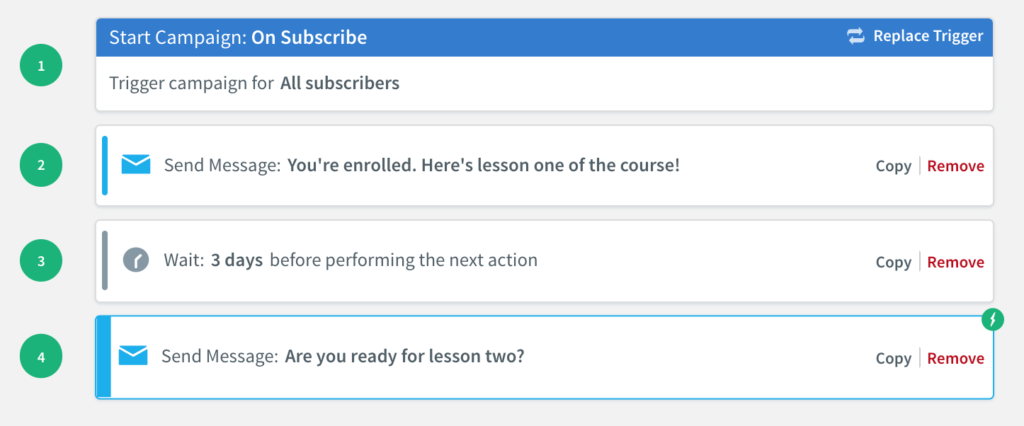
Trigger re-engagement campaigns using Open Automations and the wait action

A more advanced method of sending re-engagement emails is to set up campaigns that are triggered based on multiple tags. By doing this, you can set up more complex, timed re-engagement emails to subscribers. For example, you could send a reminder email to people who didn't open one of the lessons in your email course. To accomplish this, you might send a single welcome email followed by a second message with lesson two: Tag your subscribers “opened-second-email” if they open the second message. Set a wait time of three days and then apply a new tag: “send-to-non-openers.” Create a campaign that is triggered when a subscriber has the tag “send-to-non-openers,” but does not have the tag “opened-second-email.” This will deliver a new campaign to subscribers after that three day wait time if they didn't open the second message. You can also create a variant of this to send a custom email to subscribers who did open the second message, simply by setting your trigger criteria to include the tag applied after the wait, and the tag applied for opening the second email. Keep engaged subscribers happy by delivering more useful and contextual content, and re-engage non-openers with the perfect follow-up message at the right time.

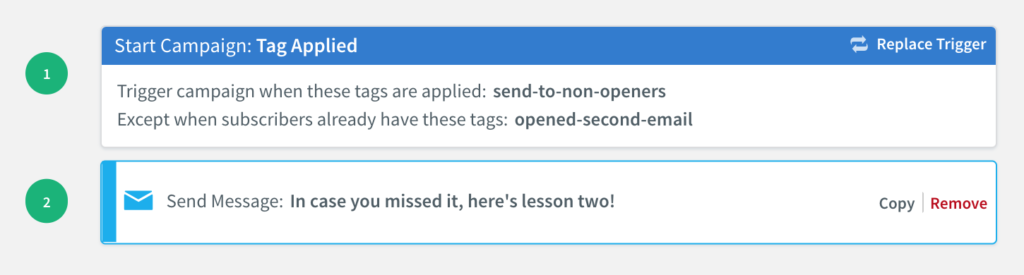
How do I get started?

 
  Using click and Open Automations in AWeber’s Campaigns is simple! When selecting a message within a Campaign, you’ll have the option to add an automation. First, select your automation trigger. (You’ll have the option to select a click or open automation trigger.) Choose “Opens the message.” Now, choose “Apply Tag” as your action. Enter what tags you’d like to add or remove if a subscriber clicks this link. Optionally, you can elect to remove a subscriber from the entire automated campaign if they opened this message. For more detailed instruction, please visit our Knowledge Base.
How are opens tracked in AWeber?

At AWeber and most email service providers, an open is tracked by loading a 1x1 pixel image in your subscriber's email. This is only available when sending HTML emails (as opposed to plain-text only.) For an open to be tracked, the image must be loaded. As a result, certain opens may not be recorded if a subscriber hasn't enabled images within their email client, like Gmail. Some email clients will allow your subscribers to enable images automatically on all emails, while others might require enabling on each individual email. Other email clients might pre-load the email and tracking pixel in a preview pane, or upon receipt. This might record an open in AWeber, when in fact, the message has yet to be opened. At AWeber, we treat clicked links as an implied open, so if an open has yet to be tracked, but a link is clicked, we will then also track the open. Please keep these conditions in mind as your construct your automations and campaigns.

Get started today

Click and Open Automations give you the flexibility and power to send the right message to the right person exactly when they need it. Automations are included for all AWeber customers, at no extra charge. Are you using automations? Let us know! We’d like to share your success stories. Not using AWeber? Now is the best time to take advantage of email automation. Start your free trial and begin automating your marketing funnel today.

The post Tag Subscribers Who Open Your Emails – New in Campaigns! appeared first on Email Marketing Tips.

10 Nov 20:21

Feast or Famine? Not If You Know How To Prospect!

Feast or Famine?  Not If You Know How To Prospect!

By Richard F. Libin, President, Automotive Profit Builders and author of just released book “Who Knew?”

APB.cc, rlibin@apb.cc

Times are tough – but as an old adage reminds us, “when the going gets tough, the tough get going.”  In business, a good salesperson knows how to ride economic waves.  They know exactly how to take a group of leads and build them into a loyal base of customers and clientele who return time and again for products and services; that bring in referrals; and who increase the potential to close a sale by as much as 500%. 

A Positive Mindset Generates Positive Actions

Most salespeople are driven by commissions.  So imagine if they viewed every person they encountered as a prospective client?  Merriam-Webster’s Dictionary defines client as “a person who pays a professional person or organization for products and services, a person who engages the professional advice or services of another, and one that is under the protection of another.”  If salespeople viewed every person they met as a client – someone under their care who seeks professional advice and products or services – the potential for sales would increase dramatically.  This seemingly simple change in mindset and attitudes makes a world of difference in sales, commissions, and profits. 

Creating a mindset that perceives every individual who comes into the showroom as a client is one of the first steps in driving sales and increasing commissions and profits. However, it is a proven fact that when a client comes into a business and specifically asks for a particular salesperson, the closing percentage skyrockets. To achieve this, salespeople must know how to prospect.

Prospecting – Reviving A Lost Art

Prospecting has three primary results:  an appointment for an immediate sale; referrals to new prospects actively looking to buy, and creating future prospects.  Successful prospectors know that while there are many approaches, the best methods are in-person (personal), telephone, and written communication.  Yet today, most salespeople don’t have the first idea about how to prospect successfully. 

This is where managers, as the coaches and leaders come in.  The first step is to focus the team on the overall goal – changing the variables they control, beginning with driving traffic – and then to change their mindset.  Develop a game plan and create opportunities for the team to practice, play, and win. It’s like Vince Lombardi says, “Practice does not make perfect. Only perfect practice makes perfect.”

  • The importance of team.  Think of a professional football team.  They practice for hours at least five days a week to play a single, one-hour game.  The team who wins is not always the biggest, fastest, or best, but the one who goes in with a well-rehearsed game plan and then executes it. Practice, Play, and Win.
  • Change the mindset.  Teach the team to prospect – 24 hours a day, 7 days a week, and yes even in your sleep.  Take them out onto the field and train them.  Then be sure the team views each individual who enters the showroom as a customer with the ability and intent to purchase.
  • Assign a dollar value to each customer. Every potential customer who comes to the business has the power to increase your paycheck along with the company’s gross. 

Salespeople cultivate customers through prospecting and referrals; they convert customers into clients by establishing and maintaining a relationship that allows them to build a sense of trust.  It’s this trust that allows clients to rely on the salesperson for advice, and allows the salesperson to secure more referrals and sales. We have seen over and over again, that when sales managers make the commitment to let APB helps them train their teams, the pay back is tangible and exponential. 

The bottom line is, prospect, prospect, prospect – every single day, not just when the business is bad or down. Prospecting needs to become an automatic reflex, like breathing, an act that happens successfully and continuously. With a positive mindset, a view toward the future, and the right training, salespeople will understand the need and will continue to prospect for opportunities and loyal clientele, regardless of how business is doing.


Richard F. Libin has written two acclaimed books that help people of all walks of life improve their sales skills, because as he says, “Everyone is a selling something.” His most recent book, Who Knew?, and his first book, “Who Stopped the Sale?” (www.whostoppedthesale.com), is now in its second edition. As president of APB-Automotive Profit Builders, Inc., a firm with more than 49 years experience working with both sales and service professionals, he helps his clientele, through personnel development and technology, to build customer satisfaction and maximize gross profits in their businesses. Mr. Libin can be reached at rlibin@apb.cc or 508-626-9200 or www.apb.cc.

10 Nov 20:21

Think Like a Sales Rep. Act Like a Marketer. React Like Customer Service.

by Karri Bishop

Consumers today are surrounded by sales — ads on their computer screen, commercials on TV, sponsors on their podcasts, spam in their inbox. That flood of incoming information has led to fatigue. Nearly half of consumers distrust brands and only 6.7 percent believe information coming from sales is very trustworthy.

As a result, consumers are rebelling. They do their own research via Google, blog posts, and customer reviews. They ask friends on Facebook and colleagues on LinkedIn to weigh in on their buying decisions. By the time a prospect today talks to a sales rep they are already more than halfway done with the buyer journey.

Contrary to apocalyptic-sounding headlines, this doesn’t have to mean the extinction of the sales profession. Instead, as with any environmental shift, survival will require evolution.

The new breed of salesperson will think like a rep, act like a marketer, and react like customer service.

Think Like a Sales Rep

Sales is the oldest profession in the world. While it certainly looks different today than it did even five years ago (not to mention 500), the qualities that make a successful salesperson hold true.

In a personality study of 1,000 salespeople, a few traits stood out as being predictive of who would be the the most successful at the job. First, lack of discouragement — top salespeople bounce back quickly from losses without dwelling on failure. This is a crucial trait when 80 percent of sales require at least five follow-up calls.

They also lack self-consciousness. Offhand, that might sound more like an HR risk than a trait to hire for, but put it in other words — courage — and it sounds much better. Successful sales reps aren’t bashful about calling on a major prospect or making a bold (but true) claim.

Though sales is changing, a courageous mindset is essential to maintain. What needs to shift is how sales reps put those traits on display, which brings us to…

Act Like a Marketer

The hard sell is dead. The cold email is dying. And what those two things have in common in this — they don’t sound very friendly. Do you know what does sound friendly? Lead nurturing. Storytelling. Personalization. Lifestyle marketing.

Where marketers have their act down in comparison to lagging sales teams is with the human side of turning a prospect into a customer. Businesses that nurture leads using marketing automation see a 451 percent increase in qualified leads. Personalized emails increase conversion by 10 percent.

Consumers, particularly younger generations, are increasingly loyal to brands with values that align with their own, that tell the story of why they exist, and make a commitment to the greater good.

The key takeaway for sales reps is to be willing to give before you get — provide valuable content, take the time to personalize, and partner with your marketing team more than ever before.

And if you think these rules just apply to your brand, think again. Consumers are researching you as much as the company you represent, so start building that online presence.

React Like Customer Service

Customer service has one goal — customer satisfaction. And sales reps need to adopt a similar approach for a similar goal — prospect satisfaction.

This may seem at odds with an “always be closing” approach, which would suggest shutting the door on an uninterested lead to prioritize a hotter prospect. However, today’s reps need to think longer term and bigger impact.

On the longer term side, today’s “not interested” could easily be next month’s “I’m in.” Marketing and sales automation tools make it possible to stay in touch with those leads without a huge investment of time. Reach out from time-to-time with a “gift” — content, an introduction, a friendly well-wish — and when circumstances change, they’ll think of you first.

As for bigger impact, today, word-of-mouth spreads further (thanks, social media) and matters more to consumers than other purchasing influences. Recommendations from friends and family are consumers’ most trusted source of information.

Though a prospect may not be the right fit for your product or service, they may very well know someone who is. Treating every prospect like a top-paying customer will help send referrals your way and referred customers stick around longer and spend more than anyone else.

Remember that sales rep personality study? Another trait that it listed as predictive of success in the field is one that may surprise you — humility. It’s a trait that top reps will need to call on to recognize the shifts in the environment, be open to change, and seek out the right team members to emulate.

The post Think Like a Sales Rep. Act Like a Marketer. React Like Customer Service. appeared first on Sales Hacker.

10 Nov 20:21

8 Unexpected Inbound Marketing Facts About B2B Buyers

by Dave Orecchio

Selling to companies and other organizations is still a lot like selling to people. In essence, it is not B2C or B2B it is H2H – Human to Human! In recent years, digital technology such as websites, search engines, and mobile computing has drastically changed the way marketers and sales teams reach buyers.

Consumers and B2B buyers all have access to information that is virtually unlimited now. Buyers can research anything they might wish to buy, rent, or borrow. The following eight points highlight some of the unexpected implications of the changed relationship between sellers and buyers.

1. Everything Is Mobile First Now

The merger of desktop and mobile computing means that your buyers look to their mobile devices first and it’s how they’re most likely to find you initially. The image of corporate buyers sitting in cubicles staring at PC screens is as out of date as CRT monitors in the flat screen age.

This access to unlimited information gives buyers much more power over their purchasing decisions. Mobile first means that your content must be equally accessible to buyers on all browser platforms.

percent-of-website-traffic-from-mobile

Source: Mobile percentage of website traffic 2017 | Statistic

2. It’s A Content Consuming World

We live in a content-consuming world and content is the engine that drives digital sales. It’s content like blogs, videos, and infographics that help your buyers to take you seriously. When buyers respect and trust you, they’ll return to you for additional information and then to purchase your offerings.

According to Hubspot, forty-seven percent of buyers will consume three to five pieces of content before reaching their purchase decisions. So, you’ll convert more of your visitors into buyers if you serve them a consistent flow of compelling content.

How-much-content-before-buy

Source: What Content Has the Most Clout? | Eccolo Media

3. B2B Buyers Are People Too

In practical terms, the real buyers in B2B are the people behind the brands. It’s still humans who make all purchase decisions and not organizations, which are abstract entities. While brands are the collections of features that define a corporate structure, the individual people still make all the choices. B2B buyers make decisions emotionally like all people, and they value experiences at least as much as retail consumers.

how-emotion-affects-b2b-buyers

Source: How Personal Emotions Fuel B2B Purchases

4. Multi-Channel Means Be Consistent

You might think that multi-channel marketing is a different beast from Inbound. However, they’re complimentary enough to consider in your inbound strategy.

Buyers don’t want to be aware of any discontinuities between your channels. Any disruption to the experience is likely to lead to buyers going elsewhere. For best results ensure that your channels are integrated, and your touch points are congruent. If you are implementing Inbound Marketing, then be sure to share the content where the prospects seek it, for example, LinkedIn groups specific to your topic.

nurturing-to-keep-prospects-fresh-for-sales

Marketers must provide a smooth transition between communication channels

5. Buyers Appreciate A Smooth Sales And Marketing Blend

Another boundary that is likely to discourage your buyers is any disconnect between your marketers and sales team. Under the Inbound methodology, your marketers must work as one team with your sellers to convert visitors into qualified leads and then into sales. Buyers are sensitive to any disconnect between the two roles.

If your marketing and sales systems are integrated, then the sales team will have all of the history and the context about a prospect before they do any outreach. The element that is crucial is to be sure your organization looks like one welled oiled machine and the perception of your company with the prospect improves with each an every touch by email, website, content and communication.

6. Technology Reverses Traditional Buyer Behavior

The psychology of modern B2B buyers has reversed in recent years, compared to traditional sales and marketing outreach. Your buyers may not even be conscious of the way that they’ve changed their habits in response to digital technology.

We’ve all changed our buying habits if you think about it. These days, if you need information about anything, you tend to reach for your smartphone reflexively. To reach customers, you have to be present where they’re looking which is now most likely to be the screen of a digital device.

7. Find Pain Points Down In The Org Chart

It’s the subordinates in any organization that feel the pain that drives sales most strongly. Target the managers who make purchasing decisions, they’re always under pressure to solve problems, and they love it when you help them look good to their bosses.

Your buyer personas should reflect the characteristics of the real people whose job is to purchase the products and services you offer. While the executives who take final responsibility are at the top, it’s often the managers and directors lower down who seek out products and services and make the buying decision. Help subordinate managers impress their superiors, and they’ll be yours for life.

8. Millennials Are Stepping Up As B2B Buyers

Finally, B2B buyers include Millennials. The younger set is of-age, building careers, and making purchasing decisions. Millennials are the most entrepreneurial generation in history, and they have the financial muscle to go with it.

Nearly half of all B2B researchers are millennials

b2b-buyer-demographics

Source: The Changing Face of B2B Marketing

Concluding Summary

If you know how to approach them and connect, your B2B buyers will do much of the work for you. Developing the personas that accurately reflect the traits of your buyers is a continuous process. Monitor changes in your buyer personas and watch for new ones that emerge and they’ll reward your Inbound Marketing Strategy by turning your B2B buyers into the most valuable assets of your brand.

10 Nov 20:21

The One and Only Reason Sales Leaders Miss Their Target

by chris.orlob@gong.io (Chris Orlob)

It’s not a lack of leads.

It’s not inefficiency.

It’s not even sales effectiveness (at least, as “sales effectiveness” is generically defined). It’s more specific than that.

It’s the sales performance gap.

This is the (vastly misunderstood) delta that separates the top 20% of your sales force from everyone else, creating a performance bell curve that looks like this:

Middle of the pack sales

This divide wreaks havoc on your ability to make your number, your cost of sale, rep turnover, and even your job tenure as a sales leader.

And here’s the big kick in the pants …

Across most sales organizations, this gap is actually getting wider, not smaller.

The average percentage of B2B sales teams attaining full quota is gradually shrinking each year:

Despite this, annual quotas continue to increase from year to year (7.5% per year for the last two years, according to Sibson Consulting).

Ask yourself: Do you expect next year’s number to be bigger, smaller, or about the same?

Here’s What This “Gap” Is Costing You

This delta between performance echelons has some pretty horrific costs when you examine it more closely.

Opportunity Cost: Hundreds of Lost Deals

The fact that most of your sales force is performing at a “B level” (which is usually around 80% of quota) means hundreds of qualified opportunities are poured into the pipeline but fail to materialize into revenue.

These are all deals that could have closed, should have closed, but didn’t.

Think about the volume of qualified deals that would close if every rep that makes up your “middle of the pack” had just a 5% higher close rate?

As someone with a vested interest in ensuring leads eventually close, thinking about this makes my stomach churn.

Your Cost of Revenue Soars

Middle of the pack performers, of course, do close deals. But they have to wade their way through many more lost deals than star performers before they finally get a win.

And the deals they do win have longer sales cycles and smaller average values.

These factors combined drive up your cost of revenue. More leads are required to get smaller deals over a delayed period of time.

Rep Turnover: The Gap Creates the Dreaded Revolving Door

26% of rep turnover is due to missed quotas.

That becomes an incredibly costly problem when you account for hiring costs, compensation, severance, and the hundreds of wasted, dead-in-the-water deals.

This amounts to an average cost per turnover of $97,690.

That’s a number any VP of Sales or CEO should be concerned about.

Your middle 60% salespeople are, by definition, reps who have high potential but haven’t yet figured out how to operate consistently at that level.

Introduce consistency to your middle-of-the-pack, and you can go anywhere you want.

Sales Leaders Are Getting Fired Over This

The downward quota attainment trends discussed earlier are happening at the same time that the sales leaders’ average tenure is shrinking.

Once standing at a healthy 26 months, it’s now made its way down to just 19 months.

That amounts to a few quarters getting up to speed, a few quarters giving it the old college try, and a few quarters planning your “exit strategy.”

Any seasoned sales leader will admit the widening performance gap and a dwindling sales leader tenure are strongly intertwined.

Here’s Why Shifting the “Middle of the Pack” Solves These Problems

Your ability to consistently grow revenue as a sales leader will rise and fall on how well you can shift the middle of this performance bell curve.

That’s where the leverage lies.

Focusing on your “A players” is important for the sake of retaining them.

But they have much less room for improvement, and they make up a small population of your sales force. As a result, there isn’t much leverage.

The real goal should be to isolate your star performers’ successful behaviors and scale them to the rest of your team.

Focusing on your “C players” is misdirected effort.

It’s a hiring problem, not an effectiveness problem. You can’t coach or train away a poor fit for a job.

If someone is performing significantly below what’s acceptable, the focus should be on placing them in a role that suits them better.

But a 5% performance gain out of your “middle 60%” equates to 70% more revenue than a 5% performance gain out of your top reps.

Getting to the Root of the Sales Performance Gap

The gap is a problem as old as the sales profession itself -- because conventional approaches fail to address the root cause of the problem.

In my next post, I talk about why the gap exists and the single factor that separates your star salespeople from the rest of your team. This will give you the foundational insight to be able to solve the problem.

So, I have a strong recommendation for you as a next step: Read this next post.

We’ve established “the gap” is a glaring problem that needs to be solved.

In this next post, we’ll address the root cause of the problem, which is step one in solving it. Without this knowledge, nothing you do is going to work.

Let me repeat: Conventional solutions will fail if they don’t address the root of the problem. Check out the next post, and I’ll talk to you soon.

Editor's note: This post originally appeared on Gong.io and is republished here with permission.

HubSpot CRM

10 Nov 20:03

Lessons from a Triathlete: Chasing Down Data and Stronger Performance

by Sara Strope

Editor’s Note: This is the fifth article in a 10 part series on how an elite athlete applies the lessons she’s learned from Triathalon training to her role as a Fortune 100 marketing executive. Read the firstsecond, third and fourth article in this series.

In 2008, I saved the little bit of energy I had left in my tank to unleash a huge smile as I crossed the finish line of Ironman Lake Placid. I was overjoyed to have completed racing 140.6 miles — which included my first marathon. For six months, I followed a classic endurance training approach: Base, Build, Peak.

Five years and three Ironman races later, I discovered the difference of power. Threshold tests, max aerobic tests, and sprint tests became a regular part of my Tuesday and Thursday mornings at M2 Revolution Cycling in San Francisco. I knew my average watts. I relished if I could break 330 watts in the sprint test. I talked watts with my friends. And this attention to data paid off. Back on the same cycling course for Ironman Lake Placid in 2013, I finished the bike portion 23 minutes faster. The following year on a flat course at Ironman Maryland, I cut 29 minutes off my cycling time across 112 miles.

I was finally learning to embrace data to drive my performance.

Optimal performance driven by data

IBM recently worked on a project with US Cycling Women’s Team Pursuit to use real-time data collection and wearable devices to feed live performance. While many cyclists (like me) focus on speed, cadence, and power, new data capture mechanisms — like BSXinsight — are allowing the team coaches to collect muscle oxygen information and soon, psychology. They are feeding information back to the cyclists immediately after a workout and in real time during a race through smart glasses.

“They put in what kind of power do we need to produce… it is very simple color coded on whether you are in the red or you are in the green. Did you go too hard? Did you go too easy?” Sarah Hammer, USA Cyclist.

This data and real-time feedback improves the cyclists’ efficiency, guides them on when to push more, and helps them avoid the dreaded “bonk” when your tank just runs out of fuel. The results are impressive so far for Team USA: They took home the gold at the World Championships in 2016 and the silver medal at the 2016 Olympics in Rio.

Applying data driven training to weekend warriors

USA Cycling Coach Neal Henderson believes that most athletes train in the middle range of their actual intensity capacity. With all the data we have now from Garmin watches, fitness apps, wearable devices, and power meters, how could we athletes break out of our rut? How can we focus on the right data and break out of the middle to see real impacts on our performance?

Whether you’re a weekend warrior, a 10k enthusiast, an aspiring Ironman, or a regular podium finisher, there are a few essential tips we can all put into practice thanks to what I learned from IBM and USA Cycling:

  • Focus on what’s critical: “Sport always evolves, sport always changes. That is why records are always being broken. It is not necessarily that you have better athletes. It is that people are learning different methods. And if you are not up on that technology, then you know you are going to fall behind,” says Sarah Hammer, Olympic cyclist. Businesses must react the same way. You can’t be afraid to try a new software or even new vendor just because you’ve grown accustomed to something.
  • Inspect at your individual response: While you can compare your results across communities like Strava, Runkeeper, and Fitbit, you’ll gain the most improvement by focusing on your own response and output. Imagine if we could all have dashboards like the one of USA Cycling — or feedback from our treadmill at the gym to help us meet our targets? Speaking of dashboards – you likely are using Tableau, Looker, Chart.io, Amplitude to monitor your sales, marketing, or product usage.  How could you use those tools to dig deeper into your own impact?
  • Be willing to abandon old models, use data to drive results: According to Sarah Hammer from Team USA, “When you feel like you have the tools that you need it just makes you that much sharper.” I gave up on the traditional “Base, Build, Peak” Ironman training model to focus on improving my cycling watts. At work, I’m just about ready to walk away from measuring leads and building scoring models to examine engagement and conversion.
  • Look for tools that improve your training and racing psychology: Neal Henderson believes that psychology can be trained. Can you become more motivated or more competitive? How can we infuse that mental training into our apps and get actionable insights from the data delivered? At the office, what does it really take to shift your organization’s mentality?  What kind of investments would be needed to adopt a challenger mindset?

I’m more excited than ever to map out my training plan for Ironman Lake Placid 2018 – and work with my team at IBM to find new ways to measure and improve prospect engagement. I can’t wait to see the results 10 years after my first race — once I’ve applied real-time analytics and individual responses to my training program.  And, I can’t wait to see how IBM evolves as we monitor site heat maps and do correlation analysis to determine the overlaps between content viewed and trial conversions.

The post Lessons from a Triathlete: Chasing Down Data and Stronger Performance appeared first on OpenView Labs.

10 Nov 20:03

How to set a perfect sales appointment

by nick@close.io (Nick Persico)
set-appointments.jpg This is a guest post by Alivia Kasumov at Badger Maps.

Every sale starts as a meeting. That’s where the magic happens. You show off your product, the prospect falls in love, and everyone lives happily ever after. But before your fairytale meeting you have to set the appointment. Scheduling appointments, with qualified (non-flaky) prospects, is one of the biggest hurdles in sales.

Depending on your leads, you could make a hundred calls and land one appointment. Frustrating? Absolutely. Worse, it eats up your time and shortchanges your productivity. Shifting your call-to-appointment ratio in your favor should be a priority if you enjoy time and money.

So how do top tier salespeople land consistent appointments? We broke down the entire process, from cold calls to warm meetings, and found the secrets to setting perfect appointments. Apply these tips to your sales process and see for yourself.

Know the lead

Knowledge is power. Never call a lead without doing your homework. Before you introduce yourself, learn some essential information:

  • Who you’re calling
  • Why you’re calling
  • What needs to happen

Cold calling works if you know who you’re calling and why they should listen. You aren’t ready for a conversation until you have a clear idea of how you can help your lead.

Know their name, or the name of a decision maker, in case you meet any operations professionals. Being polite and acting familiar opens doors in organizations.

Research your lead’s company website. How does your solution fit into their process? Personalize your prospecting as much as possible. Leaning on the same script each time is lazy, and leads can hear laziness from a mile away.

Check for common connections and experience on Linkedin. The right mutual connection can bridge the gap between uncertainty and familiarity.

As you research different industries you’ll start to notice patterns. Value A is a hit in industry D. Prospect type X is looking to solve Y.

Badger Maps, for instance, handles mapping and routing for outside salespeople. Reps who sell complex solutions (like medical devices to doctors) to a smaller market are more interested in Badger’s reporting functionality than reps who sell less expensive products to a broader market (they care more about finding leads with Badger). Make a mental note of any features industries care about more than others, they're great to introduce to prospects in similar industries who are less sure of what they're looking for.

You’ll develop a natural ability to position your pitch in any situation. All you have to do is learn how you can help.

Get your foot in the door

“Get your foot in the door” is some of the oldest advice in sales. Legend has it, door-to-door salespeople would block closing doors with their feet to get a few more seconds with a prospect.

It’s less applicable today (if it ever was then). Leads can hang up before you clear your throat, and they have less tolerance for pushy salespeople. Getting your foot into a modern sales door requires a great first impression and plenty of value presented upfront.

On a call (or in an email) there are 3 steps to setting a follow-up appointment. If you approach each step like a professional you’ll create a flood of qualified leads.

Step 1: Create trust

Your lead needs to trust you before they’ll listen to you. Do you really care about their problem, or are you some telemarketer?

Creating trust starts with your tone. Be friendly. Speak slowly so they can hear what you’re saying. Radiate confidence and warmth. No one wants to talk to a robot, so be human from the start.

Build rapport with warm leads through small talk. Make a personal and casual introduction. They’re already interested in your product, make sure they like you too. Keep your introduction short, sweet, and simple. “Hi, I’m ____ with ____. How are you doing today?”

Cold leads are a whole different beast. You have seconds to capture your lead’s attention and keep them from hanging up. Check out Steli’s advice on opening cold leads to learn more.

Listen for any emotion in your prospect’s voice. Are they happy, annoyed, interested? Adjust to their comfort level. Being friendly, confident, and considerate of their time warms them up and establishes trust.

Your goal is to have an introductory conversation, either today or on a set date in the future. Verify that they’re free to talk now. Don’t push for a conversation if they aren’t ready to listen. Empathize with their hectic schedule and find a better time to reach out.

When your prospect is ready to talk, then it’s time for you to listen.

Step 2: Qualify

Now you’ve got a chance to start asking questions. They trust you just enough to hear you out. Don’t mess it up by talking the whole time without letting them speak.

Ask problem-revealing questions. Learn about their daily responsibilities, what pain can you cure? Find their need for your solution early, otherwise you could be wasting time.

Establishing a need qualifies you as well. They suddenly feel a real reason for talking to you. Finally, someone who understands. Don’t we all want someone who’ll listen to our problems?

So what are their challenges? What are they doing to solve them? How can you help? These are details the deal depends on. Get them on the table so you can build your pitch around them.

Step 3: Position value

All your research is for this. It’s time to position your product for the prospect, why should they invest their time learning about your solution? Connect your sales pitch to their daily reality.

Positioning your pitch is an art and a science. It should feel like a natural conversation, but you should touch on all of the ways your product is a fit for your prospect—it should seem like it was personally made for them.

But “positioning” doesn’t mean lying about being able to help. Dragging out discussions with bad-fit customers hurts your sales cycle and your business. But if you can help, it’s your responsibility to educate them on how their life will improve.

And you know exactly how it’ll improve because you took the time to really understand their challenges. Introduce your product’s role as a potential pain-reliever in their life. What will change when they start using your solution?

Once they see the value, offer a follow-up discussion so they can learn more. This is the appointment. You’re setting up the meeting, demo, presentation, etc. that takes them to the next stage of the sales process.

Outline what that meeting requires from them. How fast will it be? What do they need to do to join? Remove as much friction as possible. If the meeting is for multiple people, have a conference line and the capacity for group meetings. If you make it easy to set the appointment, it will be.

Get confirmation (but follow-up anyway)

Once they agree to a follow-up meeting, you ask the big question: When are you free to learn more?

Get the meeting details settled, and then get confirmation. Schedule it over the phone if you can, or send them a link to your calendar. Don’t let your busy prospect slip away without a definite meeting time set.

Being slow to schedule is the worst mistake you can make. Every minute the appointment goes unscheduled increases the odds it won’t happen.

Stay on top of that appointment. Even when a time is set on both calendars, you’ll want to follow-up the day before the meeting. Remind them why you’re meeting and see if they have any questions beforehand.

Your goal is to prevent no-shows by any means possible. People become busy and forgetful. A friendly follow-up is a great way to refocus them on their upcoming appointment.

Hunting leads is tough. But at the end of the day, you’re a person trying to solve problems for other people. Start every conversation with the goal of helping the person on the other end. Everything else falls into place naturally.

Want to solve more problems and help more people? Download this easy-to-use sales strategy template right now:

Get your free sales strategy template


About the Author:
Alivia Kasumov is a Marketing Specialist at Badger Maps, a sales route planner that helps field salespeople be more successful. You can follow Alivia and her team on Facebook or Twitter @BadgerMaps.

10 Nov 20:03

How to Orchestrate Account-Based Interactions Across Marketing & Sales

by Peter Herbert

How to Orchestrate Account-Based Interactions Across Marketing and Sale

Account-based interactions are the tactics and activities orchestrated to engage a target account.

Orchestrating these interactions through multiple digital channels and through the people in your organization is key to the success of account-based marketing (ABM).

After all, you can’t go “account-based” simply by adopting a technology stack, or running a campaign, or even just changing your marketing practices. ABM relies on a go-to-market team transformation to focus your organization on the highest value accounts, and it works best when a spectrum of interactions is deployed across both sales and marketing.

Most B2B marketers now understand the benefits of ABM, at least at a high level. According to the #FlipMyFunnel 2017 State of ABM Survey, 81% of B2B Marketers are adopting ABM. But the question remains: “How do marketing and sales teams actually do ABM?”

At the end of the day, the answer lies in orchestrating engagement through account-based interactions, or coordinated promotion and outreach, to your ideal customers.

How much time, energy, and money you spend promoting to these accounts, personalizing content, and orchestrating people talking to people depends on your business objectives as well as how you are prioritizing, or tiering, your accounts.

I suggest three major priorities to figure out your ABM plan.

Priority #1: Solve Business Problems

First, your account-based program should be designed to address a business challenge, and your goals around pipeline and revenue will drive your strategy. Account-based is so compelling because it helps companies grow more efficiently — not because the tech is sweet!

When I started ABM as a “target account” initiative at a growing software company in 2015, our goal was to grow our average selling price (ASP) and shift from transactional sales to enterprise accounts. We needed to get better at selling larger deals to enterprise IT organizations while keeping an eye on efficiency.

In other words, ideally we would not spend time and money on activities, leads, and accounts that were not a good fit for our business. We wanted to invest less on broad-based marketing that led to distractions for our marketing and sales operations teams, and later to sales development and account executives. We needed to initially focus on pre-targeting and account nurturing to create better sales appointments, and that’s where my team invested first.

To develop a plan to engage your target accounts, you need to know which type of program solves your highest priority business challenges. For examples, consider these approaches and plan for the ones that meet your business’s needs:

7 account-based marketing strategies

  • Pre-targeting – Generate awareness with cold or net-new accounts to create more sales appointments
  • Account Nurture – Engage key stakeholders within accounts to increase awareness, interest, and conversion to sales pipeline
  • Pipeline Acceleration – Engage a wider audience of stakeholders during the sales process to increase pipeline velocity and win rates
  • Wake the Dead – Generate pipeline by reengaging cold, stalled, or dead opportunities
  • Land & Expand – Engage other divisions or business units within an account
  • Renewal & Upsell – Engage key decision-makers beyond the end user in order to increase renewal rates and your average contract value (ACV)

Each of these approaches can include different interactions. You need to know what your goals are to pick the right interactions, messages, content, and people you will target.

Priority #2: Know Your Most Valuable Accounts and Get Personal

One key lesson I have learned doing ABM is that you can’t do everything, and certainly not at scale. It’s hard enough to think about orchestrating high-quality, relevant, personal interactions at ten accounts, never mind at 500 or 3,000. The only way you can scale is to tier your accounts, which is a form of prioritization.

Companies selling to large enterprises may prioritize well-known strategic accounts, for which a long sales cycle is necessary to land a big deal. Other companies may need a more dynamic model to determine which accounts to prioritize, focusing on real-time engagement and intent signals. Either way, adopt a data-driven approach to determining your tiers.

Once you do that, you can focus on investing most of your time, energy, and money for personalizing, promoting, and orchestrating interactions at your highest value accounts and the accounts most likely to buy.

Nobody likes to receive a template email from an SDR anymore, and most importantly, this tactic just isn’t that effective. If I’m your top-tier decision-maker or influencer, I am more likely to respond if receive a personalized piece of content that’s thoughtful, makes me want to learn more, shows me you did your research, and connects with me on some level.

For example, in a tiered approach, your top two tiers can look something like this.

Account tiering for ABM

One of the hardest steps in an account-based program is developing the appropriate content that is personalized or tailored. It’s pretty easy to just target accounts with generic content, but the results when you add relevancy and personalization are so much more compelling.

The most successful account-based advertising campaign my teams have run have been intent-based: one campaign of 100 unengaged accounts showing intent on a topic resulted in 55% of the accounts clicking through our ads to content portals with curated information on the topic.

Priority #3: Make Engagement Actionable

The goal of your account-based interactions must be to create engagement with the people at your target accounts who can influence the purchase of your product. Too many marketing teams are still relying on not only lead-based goals, but also lead-based triggers for sales development to take action. And often, those lead-based actions — for example, having an SDR call a prospect after a webinar — are not focused on the right people at the right accounts.

Account-based interactions can change your operations in some significant ways:

  • Your funnel gets more focused because you aren’t wasting time, energy, and money on efforts that are not of high value to your organization.
  • Within this focused funnel, you can trigger your sales development team to act earlier, and with more insight, to reach out to engaged target accounts. Think of how many companies the team would reach out to if they were waiting for forms to be filled out, versus how many companies they would reach out to if you were operationalizing engagement. There’s a big difference and your connection with the account will occur earlier and will often be more valuable.

With account-based, you are tracking overall engagement and web engagement . Therefore, many of your tactics will be designed to create engagement rather than to direct high-value people to traditional landing pages with forms.

Your priority should be getting the right people to the most relevant content. I have seen great results through directing advertisements or sales development outreach to customized content portals created for a person, a company, a segment of accounts, or a segment based on intent data. Here’s one example that we created with the help of partners like Uberflip and Engagio for Dreamforce attendees:

All these levels of relevancy are more effective than generic landing pages. And because we can use account-based tools to understand which accounts (and even which people at these accounts) are visiting these assets, we can activate our sales development team to reach out at the right time.

Your priorities should be creating engagement through account-based interactions and operationalizing engagement as a trigger for outreach. You no longer need to run your business on form fills.

(Inter)Actions Express Priorities

As you plan to launch or optimize your account-based program and interactions, act on three things:

  1. Define your business problem and create a program that will result in the right kind of impact for your organization, whether that is engaging new accounts, expanding within strategic customer accounts, or some other goal.
  2. Develop a system of prioritizing accounts through tiers, and invest more in your top tier with more relevant and personalized interactions. Then scale your ABM program by tapering off your investment through your tiers. (Here’s a case study on how the team at Invoca does this.)
  3. Finally, create tactics and assets that encourage engagement, and do the work to operationalize engagement as your primary trigger for sales to act and get people talking to people.

By shifting to account-based marketing, you can create a more efficient go-to-market effort that delivers revenue for your business.

Want to learn more about tiering your target accounts and creating smarter ABM campaigns? Download the Blueprint to Account-Based Marketing Campaigns now.

10 Nov 20:03

Dollars and Sense: How We Misthink Money and How to Spend Smarter

by Dylan

Dollars and Sense: How We Misthink Money and How to Spend Smarter by Dr. Dan Ariely & Jeff Kreisler, Harper, 288 pages, Hardcover, November 2017, ISBN 9780062651204 

The image of the human being as homo economicus—a rational actor that optimizes his own economic self-interest in a free market—is one that the field of economics was built upon. It has not only taken a hit in recent years, it is now seen as almost absurd—akin to a geologist believing the Earth is flat. Behavioral economist Dan Ariely’s previous books, especially Predictable Irrational, have been a popular counter to that view of economics. His new book, Dollars and Sense, authored with comedian Jeff Kreisler, makes it more personal. He explains why we—yes, you and I, and everyone—are not rational when it comes to managing our own money. And it all begins with the very simple fact that:


Whenever money is added to any decision, it gets more complex.


Dan Ariely and Jeff Kreisler open their book with the mistakes we make when gambling in a casino. They include issues of Mental Accounting, The Price of Free, The Pain of Paying, Relativity, Expectations, and Self-Control. It is, they admit, perhaps unfair in how extreme an example it is. But:


All of these mistakes may seem like they’re unique to a casino, but in truth, the whole world is a lot more like a casino than we’d like to admit: In 2016, America even elected a casino owner as president, after all.


I think the accounting may have been a little off on that one, but it is a fair point. We walk around with the same mental shortcomings that casinos take advantage of in our everyday lives, as well—and act just as irrationally as we do in a casino because of them. If anything, most of us are at least aware of the fact that the odds are against us in a casino. We like to think we’re more savvy outside of it. But consider the story of JCPenney CEO Ron Johnson, who instituted a “fair and square” pricing system in stores, ending the long-time practice of artificially raising list prices so they could “discount” them to an “on sale” or “bargain” price. How did customers react to this honesty in pricing, when the company essentially decided to stop deceiving them? They revolted. Sales collapsed when the “sales” ended, and Ron Johnson was fired.


Ron Johnson’s JCPenney offered products at more honest prices and was rejected in favor of gimmicks. … Think about that: JCPenney’s customers voted with their wallets and elected to be manipulated. They wanted deals, bargains, and sales, even if it meant bringing back inflated regular prices—which is exactly what JCPenney eventually did.


“Almost immediately after his firing,” the authors tell us, “the list price of most items at JCPenney rose by 60 percent or more.” And everyone celebrated the return of bargains and coupons. This is a problem of relativity. We compare the cost to what we think it used to cost to determine the value, when if we were thinking rationally, what it used to cost shouldn’t matter. All that should matter is what it costs now, because that is what we’re paying for it. There’s another story about one of the authors that illustrates this point perfectly:


Jeff recently had an interesting experience while shopping. For years, his favorite cereal was Optimum Slim. For a man of soft, round middle, advancing years, and limited exercise ambition, it promised just the right amount of slim. The optimum amount.


Yes, the book is more than a little punny, but the point of the story is that, on one visit, he couldn’t find his favorite cereal. It turned out the cereal he had always paid $3.99 a box for had a new box, a new name, and a new price: “Nature’s Path Organic Optimum Slim—Regular $6.69. SALE $3.99.” Nothing had changed about he cereal, and the new price was actually the same as the old, but the way it was presented had changed drastically. The authors explain what happened:


It’s one thing if the company introduced new packaging as a way to raise the price. It’s another thing if the store pretended the regular price was a sale in order to boost orders. But to do both at the same time—that’s using a certain amount of relativity. The optimum amount.


Yeah. Methinks the authors had a certain amount of fun writing this book. The optimum amount. And it can be a bit much at times, but the humor does make the complex psychology around the most anxiety inducing element of our lives—our money—and the way it leads us into irrational decisions go down easier by a certain amount. Just a small amount. Because once we stop laughing at how irrational people are, we realize that those people are us. The good thing is there’s always another laugh around the corner, and something we can do about it. And the first thing we can do is make ourselves aware of it, which is why the book itself is such a good investment.

The authors explain why mental accounting, even the simple act of budgeting, is inherently irrational (a dollar is a dollar is a dollar), but why “just like corporate accounting, [it] can be useful if used judiciously.” They also explain how we can use it to deceive ourselves, how it can lead to a “self-contained Enron” accounting scandal if our mental balance of accounts gets too creative. They inform us that paying for something triggers the same receptors in our brains as those that cause physical pain, and how companies are making paying easier to reduce that pain and more easily separate us from our money. They explain that, basically, when our humanity intervenes, “The invisible hand of the market gets smacked away.” How our experiences are anchored and framed can (and do) affect how much we think they’re worth. Ownership, or our own sense of fairness affects our perception of value. Language and ritual, as well as our own expectations, change the real value of our experience. There are great stories ranging from locksmiths to Picasso to illustrate these points, and a potentially alarming number of anecdotes about wine. They wrap it up with some ideas of what we can do, and what is being done in different places, to “turn our mental shortcomings into tools that work in the service of our financial success.”

Books about personal finance almost always elicit a mixture of boredom, discomfort, and depression. Dollars and Sense is fun, (maybe a little too) funny, and a really easy read. And, in the end, it is also a profound one, because the decisions we make about money are ultimately decisions we make about our life. And that brings it back to the most fundamental, human level of existence: the amount of time we have and the choices we make on this Earth. And to get to that core, Ariely and Kreisler believe that, “a useful financial decision-making strategy is to pretend money doesn’t exist.” Huh?


What if, instead of looking at a vacation [in terms of how much money it costs], we quantified the amount that this vacation would cost us in terms of movies we could attend or wine we could drink? What if we looked at the wardrobe we were going to replace for the winter and we calculated how many tanks of gas or bicycle repairs or days off work it would cost? What if, rather than considering the difference in price between big-screen TVs, we were to think about the difference as a dinner out with friends and fourteen hours of overtime and then decide if it’s worth the upgrade?


In short, instead of what it cost, we should consider the opportunity costs. “This direct-comparison method is not necessarily the most efficient,” they tell us, “or even the most rational, approach.” But we are not homo economicus, and especially with big financial decisions, it is probably the right approach:


No matter our station in life, we believe it is important that instead of thinking about life decisions in terms of money, we think about them in terms of life.


We are all irrational about money. The sooner we realize that, the more rational—or at least reasonably irrational—we can become about life.