Shared posts

14 Nov 17:38

How to integrate successful SEO with other online marketing strategies

by Expert commentator

Why integrating SEO with other marketing channels is imperative for a successful online strategy Having a defined and targeted Search Engine Optimization (SEO) strategy is without a doubt a critical factor in driving traffic to your site. However, for a …..

The post How to integrate successful SEO with other online marketing strategies appeared first on Smart Insights.

14 Nov 17:33

10 Things I Know About Internet Marketing

by Lacy Boggs

I’m going to pull an Oprah on you today, and tell you ten things I know for sure about Internet marketing:

1. Mass marketing is on a downward trend — personalization is in.

Companies that have been around for a while — I’m talking your Coca-Colas and your Procter and Gambles — have long relied on mass marketing to promote their businesses, mainly advertising. Newspaper ads and coupons, TV ads, radio ads, product placement in TV and movies, and so on were the reliable standard for decades. But they’re becoming less reliable and less universal. Think about it: People have DVRs and online streaming in order to skip ads, they use ad blockers on the Internet, and who even takes a newspaper any more?

(OK, I do. But I get the Sunday NYTimes, and it doesn’t come with coupons or ad inserts…)

These old guard companies are realizing (a bit late in the day) that they need to find new ways to reach their customers. I’m sure you’ve seen the really crappy attempts some brands have made at trying to be cool and hip and relevant on social media.

And then there are other brands that are unexpectedly killing it. Have you ever looked at Denny’s blog on Tumblr? No. Why would you? You should. It’s straight up surrealist amazing. Why does this work? I have no idea. But it does.

And were you aware that the infamous Pumpkin Spice Latte has its own official Instagram account? With more than 37,000 followers? (And that they made a Stranger Things video starring a latte?)Well now you know.

Barb?

A post shared by Pumpkin Spice Latte (@therealpsl) on

The point is that this kind of marketing that Denny’s and Starbucks are doing here almost certainly would not work as a commercial on Monday night football, or as an insert in your local paper. But it works for these people, on these channels. They’ve personalized their message to reach a smaller segment of their fans.

2. Formulas are failing.

What worked last year almost certainly will not work next year, or the year after that. I wrote about this a bit last week, but audiences are getting savvier. And once they’ve figured out your formula, it stops working as well. Just the facts of life.

Look at the examples above. Nothing formulaic about weirdo Denny’s out-weirding Tumblr.

But this goes beyond launch formulas and affiliate swipe files, too. A year or two ago, I was seeing a lot of “7 blog post templates that will generate tons of traffic!” posts and freebies — and those are getting tired, too. When’s the last time you saw a round-up post of images get much traction that wasn’t written by Buzzfeed? It’s overdone. Time for something new.

3. Different types of content work for different goals.

Expanding on the “7 templates” idea, you can’t just plug and play any old kind of content and expect to reach your goals.

And I’m talking about both format and topics here.

For example, everybody and their dog seem to be starting a podcast right now. I have nothing against podcasts. But I think too often people start them without a clear vision of why or how the podcast will help their goals. (Myself included!)

The interview podcast is an awesome excuse to talk to smart people about a topic you want to talk about. It’s a great way to network, and if you play your cards right, it can be a good way to get yourself in front of some of those smart people’s audiences.

You know what it’s not good for? Getting leads. Making sales. Becoming a thought leader (because if you’re doing the interviewing and not most of the talking, nobody really knows what your thoughts are).

This is not to say that podcasts aren’t a really great content marketing channel for some people and some goals — but they’re not right for all people or all goals.

With topic, it’s a similar story. Mark Shaefer wrote a great article on Medium recently in which he described a matrix of the types of content you might create versus your goals for content marketing:

Notice that if your goal is thought leadership or selling something, what he calls “hygiene” or how-to posts are NOT your best bet! Yet how many of us stick to a regular routine of writing posts about how to do things — regardless of what our goals for that content might be? (Believe me; I’ve been there.)

4. Quality matters

There is so much content available to us every second of every day, if yours isn’t quality, it’s not going to have an impact.

From the Pricenomics Content Marketing Handbook:

If you’re going to spend time and effort blogging, there is no point in writing things that aren’t good. Instead, spend a little more time and write something great. Just because almost every company has a boring corporate blog that no one reads doesn’t mean you need to emulate them. Trust us: they should not be your role models.

Couldn’t agree more.

5. Voice and individuality matter.

Guess what? Sharing funny memes and pictures on your social media channels isn’t really going to get your brand much traction if your brand voice isn’t funny.

Seriously. I don’t care how cute that cat meme is.

Too often we try to emulate what works for others because we admire them, because we want what they have, because it works for them.

But what works for them isn’t going to work for you.

I had a client recently that kept asking me to rewrite parts of our project together over and over and over again, and she kept pointing me to a VERY well known coach in her industry. Only problem? That coach used words and phrases on her website that I couldn’t even imagine my client saying. Ever. They were totally different! And yet she was desperate to sound like this person she wanted to be like.

It’s OK. We all have moments like that.

But you don’t get to take a shortcut in finding your voice, or outsource your individuality.

6. Value matters.

How often are you providing value when you post something? REAL value?

My friend Randi Buckley often posts quote images of her own writings, her own advice — and they are always thought provoking and valuable to me.

randi_buckley_healthy_boundaries_for_kind_people

Yet there are plenty of other brands that share quote images of “inspirational” quotes that are just fluff and come across as so much more noise — no matter how pretty the picture or how nice the fonts.

Before you post your next tweet, update, photo, video, blog post or podcast, ask yourself: Is this valuable?

7. 1:1 is taking over 1:many

Did you know the most used app by teenagers is iMessenger? Younger people show a clear preference for Whatsapp, SnapChat, and other messenger apps over posting things publicly, and the so-called grown ups are catching up. People are using Instagram stories, groups, and messenger bots to communicate to smaller groups, more personally.

This is not to say that Facebook is going anywhere, but rather that the way in which we use it is changing. The trend is toward less broadcasting and more conversation.

8. Everyone in business should be paying attention to Internet marketing…

I don’t care what kind of business you run. I don’t care if you’re a real estate agent, or a dentist, or an accountant — I don’t care how “traditional” or “bricks and mortar” your business is: you need to be paying attention to what’s going on with Internet marketing.

Why?

Because that’s where your customers are. And if you can figure out how to use content that they’re already consuming to your advantage, you will be head and shoulders ahead of your competition.

9. …But each business should carefully consider how to participate.

That does NOT mean that you should run out and start an Instagram feed or get a SnapChat account for your business if you don’t have a plan for what to do with it or how it will help you reach your goals. Blindly adding more work to your plate without any reward is just dumb.

Instead, you as a business owner should carefully consider a lot of factors — including where your audience is hanging out, what valuable content you have to share, what you enjoy, and what makes the most sense for your goals — and then pour your heart and soul into doing that thing really, really well.

10. More is not always more.

The days of just churning out as much content as possible, across every existing channel, are over. (Thank god!) Going into a crowded room and trying to scream the loudest and longest to get attention is not a very attractive look.

As a content strategist, I don’t want you to be creating more content necessarily. I want you to create better content and do more valuable things with it.

That’s where the strategy part comes in.

What do you know for sure about Internet marketing? Got questions about one of these? Let me know in the comments.

14 Nov 17:33

Five numbers that show just how strong big tech is right now

by Bloomberg News

Everyone knows how dominant Facebook, Apple, Amazon, Microsoft and Google are in the stock market. They top the list of the world’s largest companies, the first time all five have belonged to the same industry. They’re up an average of 46 per cent in 2017, three times the S&P 500’s. Were they a market by themselves, their US$3.3 trillion combined worth would make it the sixth-biggest among countries, between the U.K. and France.

As impressive as their shares are, the discussion isn’t complete without mention of their profit prospects. For bears who see a parallel to the dot-com bubble, an often-missing piece in the debate is their arguably more impressive recent record of earnings. 

Here are some key data points compiled by Goldman Sachs that put into perspective just how dominant tech profitability is:

The FAAMG group saw collective sales expanding 21 per cent in the third quarter, the fastest pace in more than five years and three times the growth rate in S&P 500 revenue.

Tech strength is not limited to just FAAMG. Overall industry profit grew 22 per cent, beating all other sectors except for energy.

More than 80 per cent of tech firms beat earnings estimates by more than one standard deviation, the best performance in at least 19 years; Apple, Microsoft, Facebook and Google accounted for half of the S&P 500’s index-level surprise.

Tech profit margins expanded by 72 basis points, countering a decline expected by analysts.

FAAMG growth supremacy will continue in 2018, with sales seen increasing 20 per cent, versus 11 per cent for S&P 500.

Thanks to solid earnings, FAAMG valuations aren’t particularly out of whack with history, even with their outsize returns. The group’s enterprise value sits at 4.9 times sales, versus 2.3 for the S&P 500, in line with the 10-year average, data from Goldman showed.  

Bloomberg.com

14 Nov 17:28

How to run a healthy conversion rate optimization process

by Content Partner

Conversion rate optimization (CRO) has generated a lot of hype and it is seen as a silver bullet that will solve all the problems the ecommerce business has. The truth is there are two sides of the same coin. The …..

The post How to run a healthy conversion rate optimization process appeared first on Smart Insights.

14 Nov 17:28

17 Questions to Break Free From Competitive Content Issues

by Joe Pulizzi

competitive-contentIn 1998, I became the investment club guide for About.com. My responsibilities included the creation of at least one original article per week on the topic of investing or investment clubs, as well as development of the e-newsletter for the subscribers of that channel.

I absolutely loved it. Every piece of content I created scored more traffic. The formula seemed so easy … just create article after article answering questions about investment clubs and the audience grew and grew.

About.com had hundreds of guides like me covering almost every topic imaginable. By the early 2000s, About.com was one of the largest websites (by audience traffic) in the world. At that time, it was all about scale … creating content for everybody. Yahoo did it. Microsoft did it. Excite.com did it (I owned stock in that little disaster).

It was about scale until it wasn’t about scale.

As more and more publishers and brands entered the market, About.com’s market share started to disintegrate. About.com realized, like many others, that if your content is for everybody, it’s for nobody.

For years About.com continued to languish, changing ownership multiple times, until a new strategy was hatched a few years ago.


If your #content is for everybody, it’s for nobody, says @JoePulizzi.
Click To Tweet


About.com, renamed Dotdash, focused on verticals where it could become a go-to resource for particular audiences. Instead of creating content for practically everyone, Dotdash believed it had a competitive advantage in six verticals in which it would go narrow and deep on each topic. Today these include Verywell (health), The Spruce (home), Lifewire (tech), The Balance (personal finance), Tripsavvy (travel), and ThoughtCo (life hacking).

According to CEO Neil Vogel, the change in strategy is working, and at a faster rate than expected.

Are you niche enough?

I presented a workshop to a group of students in Des Moines a few weeks back. One student asked if I would launch CMI the same way today as we did almost 10 years ago. My answer: absolutely not. If CMI launched today, there is no way it could compete as a broad education and training site for content marketing. There is simply too much competition now. We would have to focus on a niche like nonprofit content marketing or content marketing for financial services companies. Or, perhaps, we’d have to change the audience.

The question you need to start with is, “Are you niche enough?” How do you know?

My litmus test is this. Answer these first two questions.

  1. If you employ the resources you have for the strategy, can you be the leading informational provider in that niche to that audience? If the answer is yes, move to Question 2.

Can you be the leading information provider in your niche to your audience, asks @JoePulizzi.
Click To Tweet


  1. In this niche to this audience, are there fewer than 10 legitimate competitors? That includes your real competitors (who sell your products and services), media companies, bloggers, influencers, and anyone else who covers the niche.

If there are more than 10 competitors, your niche isn’t niche enough. It will be incredibly difficult to break through with so much competition in that area, unless you are truly able to differentiate yourself.

For example, when John Lee Dumas started his podcast EntrepreneurOnFire (EOF), hundreds of competitors were going after the startup crowd with real-world advice. Most of those competitors had bigger budgets. But, no competitor created its platform as a daily podcast. That was John’s “content tilt.” John has never missed a day in over four years. Today, he’s a multimillionaire.

Audience questions

To start, everything should be focused on your specific audience … and there should be only one audience. If you target more than one audience group (or persona), you will fail (sorry to be so blunt). Here are the questions to answer before selecting your niche(s):


If you target more than one audience group (or persona), you will fail, says @JoePulizzi. #contentmarketing
Click To Tweet


  • Who’s the target audience? (only one)
  • What’s the audience (content or informational) need(s) as it pertains to your strategy?
  • How will your content marketing strategy help your audience members with their job or life in some way?
  • Why does he or she care about this? (Does the audience care?)
  • What unique value proposition (UVP) do you offer this audience? What differentiating value do you bring to the table?

Content questions

Highly scrutinize your content. If the information isn’t truly differentiated, with limited competition, there is little chance you will break through and garner attention.

  • What is the content niche you are planning to cover?
  • What other companies are providing this kind of information? Do you even have an opportunity to become a leading resource in this area? How do you find out?
  • Is there a possibility to purchase an existing external asset instead of developing a new one?
  • Where will these stories be found? Who in the company has the expertise to help? What internal assets and other content do you have?
  • What resources (staffing and otherwise) will you need that you do not have?
  • How will the stories mainly be told (audio, video, textual)? Remember, focus on one key content type and one key distribution platform (a blog, a magazine, an event series, a podcast, a video series, etc.).
  • What key design issues will make or break the program?
  • What platform makes the most sense to distribute the content?
  • Are you creating a new content brand, or weaving into your existing product or company brand?

Content marketing mission statement

I talk about this concept so much that even I’m tiring of it. But the truth is (and even CMI/MarketingProfs research bears this out), most organizations don’t develop a content marketing mission statement (like an editorial mission) as their guiding light. Why is this so important? It not only gives you focus, but it gives you the power to say no. When your CEO or CMO walks into your office or emails some great idea, the first thing you do is run it by your mission statement. Does it fit? If not, sorry … that content is just not going to fly.


A #contentmarketing mission statement gives you focus AND the power to say no, says @JoePulizzi.
Click To Tweet


There are three parts to the mission statement:

  1. Core target audience
  2. Material to be delivered to the audience
  3. Outcome for the audience

Let’s look at Digital Photography School’s content mission: “Welcome to Digital Photography School – a website with simple tips to help digital camera owners get the most out of their cameras.”

Let’s dissect the mission statement:

  1. Core target audience – digital camera owners
  2. Material to be delivered to the audience – simple tips
  3. Outcome for audience members – get the most out of their camera

As you can see, a content mission statement is not rocket science. The content tilt is more than just telling a different story. It’s about finding an educational or informational area of little to no competition where you have a chance to break through all the clutter.

In thinking about Digital Photography School, with thousands of websites available that talk about photography, how did DPS break through with little to no promotional budget?

It believed that the majority of photography content on the web was 1) focused on the photography professional or 2) in a long textual form that was hard to engage in. DPS’s content tilt – the reason it separated itself – was its insight and ability to turn the focus on a beginner audience with helpful, consistent tips that its readers could use easily and immediately.

No one was doing that in that way … and that is the main reason DPS has been successful.

Most likely, you already started your company’s content marketing journey. No problem … just go back and adjust the strategy based on the answers to these questions. You may find that you are indeed targeting multiple audiences or you really aren’t niche enough with your content. No time like the present to make a change.

As you develop and grow your niche, let CMI be a helping hand. Subscribe to the daily newsletter (or weekly digest) today. 

Cover image by Joseph Kalinowski/Content Marketing Institute

The post 17 Questions to Break Free From Competitive Content Issues appeared first on Content Marketing Institute.

14 Nov 17:26

10 Case Studies: Using Interactive Content in Social Media

by Kaleigh Moore

For many marketing teams, much of their time is devoted to content development. They focus on creating blog posts, interactive videos, quizzes–all of these different online experiences to give their target audience what they’re looking for at every stage of the journey.

But sometimes when it comes to the promotion phase for those assets, they run out of steam. The follow-through is lacking, and as a result, only a small portion of the potential audience for this stellar content is reached.

This can easily be remedied, however. With a social media promotion strategy for interactive content, these pieces of content can reach the interested audience you’ve already built – plus there’s endless opportunity for reaching new people with the organic sharing possibilities on most social platforms.

To get inspired, let’s look at some examples from brands that do a nice job of integrating interactive content with social media.

The New York Times

The New York Times has been experimenting with interactive content on social media for several years now. In fact, back in 2013, of all the pieces they shared over the course of the year, the most-clicked story was an interactive assessment on country-wide dialects.

Since then, interactive quizzes and assessments have become an integral part of the publication’s content strategy–and they regularly share them on different social channels like Facebook and Twitter. For example: Take a look at the romantic relationships quiz that was recently posted on NYT’s Facebook page below.

NYTImes-social.png

Image source

What’s effective about this approach is that it drives engagement with the audience, which is evidenced by the reactions, comments, and shares on this specific post. But what’s more: It also drives social media click-throughs, getting readers from the Facebook page to the company website. Once the user is there, he or she can complete the quiz, and is presented additional relevant content that keeps them on the company site (which increases value and interest).

Boston Content

Marketers behind the scenes at Boston Content know that contests have the highest conversion rate of all content types–so when it comes to event promotion, they create interactive experiences with contests. Leading up to the Annual Bash event, they launched a voting contest for “Boston Content Marketer to Watch” to drive engagement and awareness around the upcoming event.

2boscon.png

They also made another smart move with this campaign: By including photos with the names of nominees, they made the contest feel more personal and memorable. According to Buffer data, images with faces are more memorable than images without them.

BuzzFeed

BuzzFeed has almost become synonymous with the online quiz. We see their pop-culture quizzes circulating Facebook and Twitter on a regular basis…and they’re just, well, kind of irresistible.

But their approach with interactive quizzes shared on social media is founded in reason: Data shows they get more than 75% of traffic via social media. In fact, one of their quizzes has been viewed more than 22 million times.

BuzzFeed-social.png

Image source

When we see these pieces of interactive content on Twitter (like in the example above) the something very strategic is happening: They’re leveraging a curiosity gap and the promise of greater self-understanding. This drives social media from point A (social platforms) to point B (the company website.) Once the user is on the website, there’s a greater opportunity for lead conversion, data-gathering, etc.

Alabama Outdoors

Adventure-loving brand Alabama Outdoors uses interactive content on social media to foster an engaged digital community. Featuring the best parks and gear reviews, they’ve become a go-to source of information for those who love being outdoors.

They kicked up their social media engagement efforts with an interactive contest promoted on Twitter. 10 True Grit pullovers were offered up as prizes for those who shared where they’d wear the cozy sweater.

1alo.png

Image source

The benefit of this for the brand was that it helped them learn about the preferences and habits of their Twitter followers while also sparking a conversation about products available through their site. It also drove some nice lead gen efforts, too–which grew their consumer database.

Freshbooks

Freshbooks, a cloud-based accounting software, promotes interactive content on social media with a slightly different approach.

In the example below that was posted on Facebook, you can see how they’ve integrated a blog post with an interactive assessment that helps both the customer and the brand better understand pain points and available solutions.

Freshbooks-social-1.png

Image source

Once the user clicks through on the Facebook post and gets to the blog post, they can complete the assessment that helps them identify the right FreshBooks plan based on their needs.

This educates the reader and provides lead gen data on the back end to Freshbooks, which can help them better understand their audience demographic, common needs, etc.

Freshbooks-social.png

Image source

TrackMaven

TrackMaven is a brand focused on data for optimization. They help marketers quantify their most successful material (and that of their competitors) to ensure their efforts are as successful as possible.

To reach that audience, they use interactive content paired with social media to interact with potential leads. In one instance (seen below), they created a quiz to source leads. It worked, too: The quiz had a 5% share rate and reinvigorated their sales funnel.

3trackmaven.png

Image source

What’s great about this particular example? They customized the quiz and graphics to perfectly reflect their branding–and they paired it with a short form at the end that allowed for additional follow-up.

Rosetta Stone

Language software Rosetta Stone took the interactive contest element a step further when they partnered with Refinery29 and SheFinds. By adding collaborators to this effort, they were able to reach new, but still highly relevant, audiences.

In this post from Instagram, we can see that those interested in entering simply had to go to the link and enter their contact details to be entered to win.

rosettaStone-social.png

Image source

This helped all three companies gain new lead information while offering up an incredible prize opportunity to participants: A trip for two to Budapest. Their strategy for social media promotion was simple here: By promoting it on Instagram, they were able to reach the wanderlust crowd who were searching for the hashtags #RosettaStone and #Budapest.

Paycor

Paycor combined utility with curiosity in the interactive calculator they promoted on various social media channels, as seen in the example below from Twitter.

By regularly sharing this interactive tool on different channels, they were able to raise awareness around an audience-relevant issue at the time (FLSA changes) and drive lead gen efforts at the same time.

Paycor-social.png

Image source

For Paycor, this interactive calculator was part of a multi-pronged approach over a set period of time, and it ultimately drove 25x ROI after 9 months. Not bad, right?

Boston Globe

Publisher Boston Globe isn’t missing out on the engagement opportunities presented by interactive content, either. On the company Facebook page, they regularly share quizzes related to their stories that test readers’ knowledge and present an irresistible challenge for the news-savvy.

Boston-globe.png

Image source

To entice readers a bit more, they use a preview image of the actual assessment within the post (rather than a stock image.) This helps eliminate some of the uncertainty that could keep a reader from clicking through by showing him/her exactly what’s on the other side of the link.

SnapApp

With expert status in all things interactive content, SnapApp regularly experiments with different tools like calculators, quizzes, assessments, and more. In the example below, you’ll see one quiz that was shared on LinkedIn that helps users plan a seasonal marketing campaign when they answer four simple questions.

SnapApp-social-1.png

Image source

Once users clicks through, they’re directed to a landing page with four simple questions and clickable answers that help determine the best plan of action for a seasonal marketing campaign.

SnapApp-social-2.png

Image source

What’s great about this: The tool helps marketers formulate a plan, but it also helps SnapApp better understand its audience and collect key data about the pain points and objective of its core audience.

ServiceNow

On Twitter, ServiceNow promoted an interactive quiz around their business offering–IT security. Not only did users participate, but they also retweeted the quiz–meaning their reach organically expanded with just a few quick clicks.

ServiceNow-social.png

Image source

Including interactive content in their mix of regular posts and updates creates more opportunities for them to have real conversations with their audience members. Which is what social media is about, after all.

Target

Target knows that style is a core concern for its shoppers. So when they tweeted out a college style quiz, they were able to help promote dorm products, educate shoppers, and stir up excitement around a key shopping period: pre-college move-in day.

6target.png

Image source

As you can see from the social shares–the quiz took off, and garnered social shares and commentary from their following. So while it promoted products and drove sales to a specific buyer persona, it also helped them reach new audiences, too.

Interactive Content + Social Media: A Match Made in Heaven

As you can see from the examples we explored, brands of all sizes and industries are already realizing the power of pairing social media with interactive content. It makes sense: If you’re investing resources into creating quizzes — it’s only logical to distribute them through your social channels so they reach as many people as possible.

Want to learn a little more about interactive content?

14 Nov 17:26

Why Product Qualified Leads Are Rapidly Being Adopted in SaaS  

by Mickey Alon

Leveraging in-product behavior as a leading indicator of buyer intent

To date, B2B software companies have relied on marketing qualified leads (MQLs) as a way to determine when someone shows buying intent. As a key qualifier for passing leads along to sales, MQLs have long held a prominent spot in the metrics that matter. But the MQL is giving way to a new, more relevant metric that promises to provide Software as a Service (SaaS) companies in particular with a meaningful way to measure and track their success: product qualified leads (PQLs).

Evolving the Customer Acquisition Process

As we discussed in our book – “Mastering Product Experience in SaaS” – a number of factors have converged to elevate PQLs to the top of the heap for SaaS companies:

  • Economic realities of the SaaS business model
  • The rise of the empowered buyer
  • The consumerization of business software
  • The ability to track and analyze buyer intent during a trial or proof of concept

Before the introduction of the SaaS business model, enterprise software businesses called upon a high-touch, sales-led approach to developing leads. They relied on customer meetings, demos, proof-of-concept deployments and the like to convert prospects to customers.

The SaaS model enabled companies to ship software more often, iterate faster, and develop a more effective customer acquisition strategy. However, after the introduction of the SaaS model,  customer expectations changed because of the confluence of two new realities:

  1. Their ability to validate it’s the right solution for them by simply trying the software using only a web browser
  2. The lower risk associated with SaaS because of the smaller upfront investment and the customer’s ability to opt-out without taking a big financial hit

Combined, these factors led to a rapid uptake of self-service options for buyers of business software.

These realities forced SaaS companies to rethink their sales-centric customer acquisition model because it wasn’t delivering the necessary margin to balance customer acquisition cost (CAC) and Customer Lifetime Value (CLV). Hiring an army of enterprise sales reps would not make economic sense as their salaries would trump the income they generated for the company. As a result, we saw the rise of the marketing-centric customer acquisition model.

SaaS companies started using digital marketing strategies as a new way of reaching out and qualifying leads. enabling them to effectively raise awareness and create demand at scale. To ensure lead prioritization, marketing has to nurture those hundreds of potential leads and effectively qualify their buyer intent before passing them to sales reps. This became known as the marketing-led approach.

This new customer acquisition process drives prospects through a sequence of inbound and outbound engagements to fill out lead forms in exchange for content such as white papers, webinars, and the like meant to educate buyers about the product. This model fits nicely with the rise of empowered, self-educated B2B buyers who hold sales at arm’s length until they are far along in their research process. Essentially, marketing and content took the place of the interactions these prospects would have had with sales professionals.

Once a lead has satisfied certain criteria, marketing passes it to sales as a marketing qualified lead (MQL). Only at this point are buyers given initial access to the product in the form of a demo. However, even this approach has been upended by the growing desire prospects express for trying products before buying.

Spoiled by their experiences using consumer applications, B2B buyers prefer access to business software earlier in the buying cycle via free trials or freemium pricing models. It’s no wonder so many of the fastest growing enterprise companies – including Slack, Zenefits, Dropbox, inVision, Github, Atlassian, and many others – rely on free trials or freemiums.

The MQL Model Mismatch

Before we further explore this new approach to customer acquisition, let’s dissect the shortcomings of MQLs.

The MQL scoring model is meant to try and identify which prospect actions are considered indicative of buying intent. The model is highly subjective, rule-based and relies on basic activities such as website visits, email opens, webinars and gated content downloads. It is missing a critical element when it comes to SaaS companies, whereby potential customers expect to educate themselves by experiencing the product firsthand. By overlooking this component of the buying experience, SaaS companies are effectively robbing themselves of the chance to gain greater visibility into buyer intent through product usage.

Using the generic MQL model, companies might miss out on highly qualified leads as indicated by clear product usage signals. That’s because the MQL model would overlook leads that didn’t respond to a specific marketing program or are marked as “unqualified” in their database. No wonder SaaS companies find themselves generating conversions on average conversion just 5 to 15 percent of the time.

In fact, while the research findings vary, the average SaaS conversion rate from lead to won deal tends to be anywhere from 1 to 10 percent. Simply put, marketing and sales spends a majority of its resources on leads that will never convert. To drive enough revenues from these conversion rates, marketing works hard to pump even more leads into the funnel. It is largely these ineffective lead generation strategies emphasizing quantity over quality that lie at the heart of sales and marketing misalignment.

Essentially, this added a step to the qualification process, giving the sales team a chance to validate that MQLs were truly qualified leads from their perspective. However, even sales qualified leads (SQLs) fall short because the process for marking a lead as an SQL also relies on vetting the prospective buyer against a set of criteria that varies by organization. For instance, a sales development rep (SDR) might be required to call an MQL to determine the buyer’s BANT (Budget, Authority, Needs and Timeline). Or it may be a matter of checking to see whether the lead has visited the pricing page.

While these activities may be more closely associated with the product in question, none truly confirm that someone is likely to buy the product.

All those signals might fall short in predicting if prospects will actually find the SaaS solution relevant, simply because they are not given an opportunity to assess the solution firsthand. In fact, in many  cases, leads are drawn in by strong marketing messages and the right buzzwords, only to realize the solution isn’t a good fit once they get a chance to see a demo  or start using it.

The best indicator that someone is strongly interested in buying software is that they are actively using it. That is why the product channel is becoming the main communication channel and a key part of the marketing strategy for SaaS companies.

Enter the Product-Led Go-to-Market Strategy

SaaS companies are focused on driving prospects to see a demo or try their products through free trials and freemium models to accelerate their customer acquisition process. By skipping the cumbersome MQL/SQL process and instead generating high-quality leads with strong and clear product usage signals associated with demographics and firmographic data, they can deliver initial value to those prospects and close deals faster. This is known as a Product Qualified Lead (PQL),i.e., a prospect that signed up and demonstrated buying intent based on product interest, usage, and fits your target customer criteria.

We strongly believe that a PQL it is the key metric and model for SaaS companies going forward. Moreover, it’s highly applicable to the self-service model at the heart of the B2B “try-before-you-buy” movement.

To support this new approach, SaaS companies have replaced their market-led go-to-market (GTM) strategy with a product-led go-to-market (GTM) strategy. In a product-led GTM strategy, the product becomes a crucial and irreplaceable part of every step of how a company prepares to reach and engage prospective customers. In fact, OpenView, a venture capital firm, says a product is a key part of a company’s marketing.

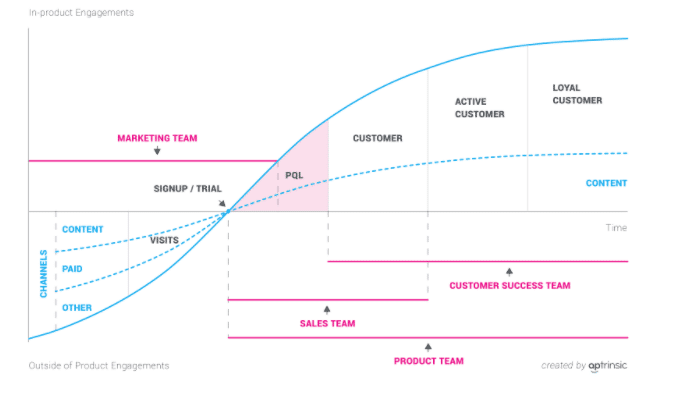
To understand how a product-led GTM changes the customer acquisition process, consider the customer lifecycle in a marketing-led GTM. As shown below, a good portion of that process occurs outside of the product.

In product enagements

Now contrast this with the process often used by companies that embrace a product-led GTM approach, as shown below. In this approach, the majority of the process revolves around in-product engagements.

In product enagements

In the product-led approach, the customer lifecycle shifts more into the elevated axis area where product behavior becomes essential in guiding users and customers through the lifecycle. In fact, sales, marketing, product, and customer success can call upon product usage data to efficiently move prospects through the customer acquisition process. Furthermore, it is easier for these teams to agree on the definition of a PQL. That’s because this metric calls upon more concrete data compared with the way that MQLs/SQLs are defined. Whenever prospects realize initial value and reach PQL status, there is a high chance they will convert into paying customers or qualify for up-sell/cross-sell opportunities.

Ready to master the SaaS product experience? Access the free guide here.

Your success as a Software-as-a-Service (SaaS) company is completely dependent on acquiring and keeping users in your product. But if you’re using traditional marketing tactics, you’re likely struggling to scale your business quickly. That’s because conventional marketing techniques focus on engaging prospects and users outside of the product.

The post Why Product Qualified Leads Are Rapidly Being Adopted in SaaS   appeared first on OpenView Labs.

13 Nov 17:47

The secretive wealthy family behind the opiod epidemic are using the same tactics to kill public education

by Cory Doctorow

The Sackler Family are best known for philanthropy, but their real legacy is the opiod epidemic, which they engineered through their family firm, Purdue Pharmaceutical, which used a variety of front organizations that paved the way for massive overprescription of the company's painkillers, while covering up the flaws in the drug-testing for Purdue's products and the false claims about their safety and efficacy.

Sackler philanthropy sometimes supports research, museums, and other traditional "good causes," but the family's philanthropic efforts also include titanic sums of cash spent to promote pet political causes, including the destruction of public education and its replacement by charter schools.

Jonathan Sackler is the nephew of Arthur Sackler, a Medical Advertising Hall of Famer who effectively invented modern pharmaceutical advertising and marketing. Jonathan Sackler uses the family money to fund an ecosystem of organizations that spread critical messages about teachers' unions and public schools and promote private charter schools in their places.

These include "nonpartisan" news sources that are uniformly critical of public schools and teachers' unions.

This is the kind of vertical integration that made Purdue's opiod marketing so devastatingly effective. By fronting advocacy organizations, media organizations, lobbyists, and astroturf operations, the super-rich are able to turn their self-serving ideological projects into reality the rest of the world.

In Massachusetts, Families for Excellent Schools-Advocacy (FESA) recently had to cough up more than $425,000 to the Massachusetts general fund as part of a legal settlement with the Office of Campaign and Political Finance, the largest civil forfeiture in the agency’s 44-year history. Massachusetts officials concluded that FESA violated the campaign finance law by receiving contributions from individuals and then contributing those funds to the Great Schools Massachusetts Ballot Question Committee, which sought to lift the cap on the number of charter schools in the state, in a manner intended to disguise the true source of the money. As part of the settlement, the group was ordered to reveal the names of its secret donors. Jonathan Sackler was one of them.

Patrick Riccards, a former CEO of ConnCan, the pro-charter group that Sackler founded in 2005, told me, “Jon went to Berkeley and in many ways fits into that idealistic mold. But at the same time it was he who made it clear to me that one of the reasons ConnCan existed was to leverage the investment in the charter community, in Achievement First, which is still the dominant charter school network in the state. [CT] The venture capital community ... has put tons of money into seeing Achievement First grow, first in Connecticut, then in New York, then in Rhode Island.”

The Super Wealthy Oxycontin Family Supports School Privatization With Tactics Similar to Those That Fueled the Opioid Epidemic [Sarah Darer Littman/Alternet]

(Image: Dean, CC-BY)

(via Naked Capitalism)

13 Nov 17:32

The A to Z of Mindful Presenting – High Impact Public Speaking & Presentation Skills: B – Brevity

by Maurice DeCastro

Man presenting at a conference

A couple of years ago I wrote and published an article called, ‘Most presentations are far too long – less really is more!’ The key message within that article was that ‘We need to cut out the superfluous noise’ and I offered some insights into how to achieve that. The A to Z of Mindful Presenting expands on that premise by endorsing the belief that when it comes to high impact presenting ‘less is definitely more’. Our watchword for that principle is brevity.

Most professionals spend a great deal of time crafting a presentation which contains a wealth of detail designed to impress their audience. Unfortunately, most of that detail is forgotten by the time they return to their desk or their car. Think about the last business presentation you attended and ask yourself how much you remember. It’s likely that it will be very little, and whatever you do remember will be of little relevance and value to you personally in helping you to move towards something positive or away from something negative.

Many people believe that TED talks are leading the way in high impact presenting and public speaking and one of the reasons for this is that they limit the length of their talks to 18 minutes.

When was the last time you heard anyone complain because a speaker finished what they had to say ahead of the time they were scheduled to speak?

The reality is that we live in a world where we are all overwhelmed with information and have far less time to understand and absorb it than we would like to. The paradox is that many professionals believe that the key to success in presenting in business is giving their audience ‘everything they’ve got’. The reality is that your audience are only interested in what will make a tangible difference to them.

Despite popular belief, your audience will be eternally grateful if you finish speaking earlier than scheduled, no matter how good your presentation is.

So how do you do it?

  • Make your presentation entirely about your audience, not you.
  • Be absolutely clear on what your message is and what value it offers to your audience.
  • Don’t be like a comedian and save the punchline to the end. Get straight to the point.
  • Tell them only what they need to know.
  • Don’t keep repeating yourself.
  • If you are asked to speak for 40 minutes and know you only need 20 then have the courage to push back.
  • With everything you say, show and do, imagine how you would respond if someone asks you ‘So what? Why should I care about that?’
  • Do your homework; find out well in advance how much they know and what they need from you.
  • Don’t set out to impress, set out to make a difference.
  • Remember the pain other presenters have made you feel and commit to not replicate it.
  • Have the courage to challenge the status quo and dare to be different.
  • Put yourself in your audience’s shoes.
  • Remember, most presentations are too long and too boring.
  • If you are using visuals make sure that each slide contains only one idea.
  • If it doesn’t support your message or add significant value leave it out.
  • Have the courage to tell your audience that’s all they need to know, you’ve finished early and the rest of the time is theirs to do as they please.

As presenters we have an obligation to filter the noise and do the hard work of organizing our thoughts and delivering our message in a way that our audience will easily understand, won’t have to work for and be thankful for.

13 Nov 17:32

How to Reduce Primary Care Doctors’ Workloads While Improving Care

by David A. Asch, MD
nov17-13-200140286-001-Reza-Estakhrian
HBR Staff/Reza Estakhrian/Getty Images

Not long ago, many services such as tax accounting were delivered episodically and in-person, as most health care still is today. Periodically, a client and accountant would meet, review financial materials and status and, at the end of the encounter, make an appointment for the next meeting. Increasingly, in-person accountant visits have been replaced by phone or web meetings and do-it-yourself software like TurboTax. There is still a need for accountants and face-to-face meetings, but typically accountants now require such visits for only the more complicated cases that can’t be managed with software or a call.

Health care has proved resistant to a similar transition, although everyone would benefit. While some aspects of care clearly require doctor and patient to be in the same place at the same time, many demonstrably don’t. Nonetheless, even those parts of care that could be freed from the doctor’s office remain tied to it, with schedules optimized for doctors’ productivity rather than what’s best for the patient.

In this article, we identify the barriers slowing the transition of episodic, in-person primary care to innovative models that separate care from location and that empower patients to take on more of their own care. And we describe steps needed to overcome these obstacles, lowering costs and improving quality.

Barriers to Transformation

With the rapid expansion of information connectivity, health care requires much less hands-on work than it used to. Every now and then an examination or a procedure requires physical contact between provider and patient, but many of the important elements of health care have always occurred through oral communication alone and some others — like getting your blood pressure measured or your blood tested — can now just as easily and accurately happen at home or elsewhere outside of a doctor’s office. Much of what used to be restricted to clinical settings can now, from a purely technical perspective, be handled remotely.

But let’s imagine that you are ready to video or phone chat with your doctor, recognizing the convenience of never having to leave your house or wait in a waiting room. Unfortunately, your doctor may not be that eager to chat with you. Three forces keep telemedicine from achieving its potential to transform care delivery: the excess workload created for the care provider, the likely change in patients’ health-care-use behavior, and the economics of reimbursement.

Provider workload. Much of the current thinking about new service-delivery models is based on the notion that cost and efficiency of care delivery can be enhanced by directing more patients to primary care. Enthusiasm for this approach largely derives from the appealing and perhaps nostalgic notion that more comprehensive and coordinated primary care could provide better outcomes at lower costs. Indeed, many efforts at health care transformation are built on tying patients more closely to primary care providers. The primary care community has largely embraced these ideas, perhaps because they reinforce the community’s value and centrality to the health care enterprise. The ideas have also been embraced by public policy makers, health plans, and the general public.

Insight Center

Primary care physicians are used to being responsible for all aspects of patients’ care. They are also among the lowest-cost physicians available. For perhaps these same reasons, there aren’t a lot of them. As a result, they are already overworked. In contrast to cardiologists or orthopedists who can limit their responsibility to heart disease or joint- and bone-related issues and triage all other issues back to primary care providers, those providers have no safe harbor. The lower reimbursement and need to provide 24/7 coverage that makes a primary-care-based system so appealing to policy makers and others has long been shown to be a source of burnout and challenges in getting medical students to choose careers in primary care. The last thing that this group of providers desires is more responsibility. Just imagine the operational demand if primary care providers also had to actively monitor their patients’ health data between office visits.

From this perspective, the enthusiasm of policy makers and health plans to simply increase access to primary care as a way to address delivery challenges is a cop-out. Rather than do the conceptually hard and convention-challenging reorganizations of systems and finances required to truly transform care, it is easier to suggest tweaking the system and encouraging patients to use more primary care — and let primary care take it from there. That cannot be the solution if, in fact, primary care providers simply can’t take it from there — either because there aren’t enough of them or because they don’t have the support to do one more thing beyond what they are already doing.

Overconsumption. The workload problem is further increased by patients’ likely response to enhanced availability, such as what tax accounting and retail customers have enjoyed through digital channels.

The old care model creates friction between the practice and the patient: the difficulties and delays in scheduling visits, the hassle of traveling to the practice and waiting in the waiting room, and the penalty of copays and coinsurance make patients think twice before seeking in-person care.

In our recent studies of how patients responded to the introduction of a portal allowing them to e-mail health concerns to their care team, we found that the e-mail system that was expected to substitute for face-to-face visits actually increased them. Once patients began using the portal, many started sharing health updates and personal news with their care teams. These new channels did not keep the patients out of the office; rather, they encouraged patients to visit the office more frequently. What doctor would dismiss a patient’s e-mail that mentioned chest pain without calling the patient for an in-person visit? Everyone has ups and downs in how they feel. As those downs become easier to report, physicians are alerted to more symptoms. The disease burden is unchanged — but now the aches and pains are given greater voice.

Without the barriers to in-person care, every skin blemish that can be photographed and sent electronically risks turning from something that patients used to ignore into a demand for medical attention. That’s good if what gets brought to attention is serious and would otherwise have been overlooked. But there is an adage in clinical medicine: “The great secret, known to internists…but still hidden from the general public is that most things get better by themselves. Most things, in fact, are better in the morning.”

Third-party reimbursement. A central challenge in designing new delivery models that rely less on face-to-face encounters is that so much of the payment system that funds existing health-care-delivery models is built around such encounters — often requiring in-person contact as a condition of payment.

Health insurers have long believed that making face-to-face visits a requirement for reimbursement could protect them from overuse. If you make health care too easy to get — and it would certainly be easier to get if it were just a phone call or an app away — then you’d have to develop tighter controls to ensure that the care that was delivered was actually necessary. Otherwise, the fear goes, every minor ailment shifts from something that would likely resolve on its own into an encounter that creates a reimbursable insurance claim. Historically, health insurers did not have tools necessary to identify and act on the difference between care that is worth it and care that isn’t. Instead, they relied on past inefficiencies that made all health care harder to get — for example, by requiring in-person visits even when the goals of care might be more easily achieved by a phone call. This approach has had the secondary consequence of limiting innovation in delivery methods.

Requiring such contact not only reduces access and adds transactional friction, it also creates some perverse incentives that actually discourage using the most efficient routes to improved health. For example, we recently reviewed the payments to be received by ophthalmologists for performing eye exams for patients with diabetes. These are recommended annually to prevent diabetes-related blindness. Patients don’t particularly like these examinations because they require a separate visit and having their pupils dilated. The dilation itself takes some time but worse, it leads to a half day of bright lights and blurry vision. Adherence rates are low — no doubt contributing to blindness that could have been prevented if more people got screened.

Now, new cameras with special lenses can provide a nearly equivalent view of the retina without dilating the pupils. Patients don’t have to visit the ophthalmologist. They just put their chin on the device at a convenient location and in a few minutes high-quality images can be transmitted to the very same ophthalmologists for review. With the new “visit,” there are few waits and no blurry vision. It’s no wonder that screening rates are substantially higher using the new method compared to the old. Should the payments for these two “visits” be the same or different? And if they are different, which one should be higher?

In our review, a commercial insurer would typically reimburse about $254 for an in-office examination involving retinal photographs — about $26 of that for the photographs themselves, plus some facility and professional service fees. The same insurer would reimburse a total of only $16 (for the photographs) if the service were performed remotely, with no payment allowed for the interpretation of the images. Thus, the current third-party-payment model actually discourages physicians from providing convenient, high-quality, low-cost care. This is a paradoxical result of the payment scheme, since the remote process increases screening rates, preserves vision, and insurance companies are rated on their ability to serve this need. It doesn’t serve any stakeholder well to maintain that reimbursement differential between in-office and remote examinations.

A Way Forward

Our view is that early conceptions of connected health and the patient-centered medical home (PCMH) traveled a flawed path. These models were largely premised on the idea that gains could be achieved by increasing the connections between patient and provider — through frequent engagement between patient and clinical staff in a PCMH or similar initiatives. However, this approach piled more responsibility on an already-taxed primary care system and was inefficient because it didn’t reflect the do-it-yourself trends observed in retail, travel, and finance. A better model might have aimed to decrease connections between patient and provider, substituting other forms of support to assure equivalent or enhanced outcomes. We propose that health care systems need to reimagine their relationship with their patients, which includes thoughtfully triaging the increasing amounts of data they produce and engaging them in their own monitoring and care. This means using technology to handle the simpler needs, escalating to the doctor only what can’t be delegated.

Getting the right data to the right recipient. The cycle of patient care involves feedback loops: A change in blood sugar, weight, blood pressure, or some other sign is detected, and that information triggers an action. Consider the power of mobile devices in such loops. A showcase for this has been the Parkinson App developed by researchers at the University of Rochester. Using the sensors built into smart phones, patient movements can be tracked 24/7. Slowed movement or gait asymmetries can be relayed to the care team, providing indications of care needs far more easily, and perhaps more systematically, than those based on semi-annual physical evaluations.

Technologic innovations such as these are exciting, but is the care team really the right recipient for all of the information they provide? And just because the information is collected at all hours, does it really have to be analyzed in (close to) real time? Imagine the work of a primary care physician receiving data feeds from all of his or her 2,300 patients.

Mightn’t we delegate some of the screening work to patients themselves? Empowering customers with easy-to-use tools transformed the tax reporting and travel industries. While we don’t expect patients to select what blood-pressure medications to be on, we probably can offload considerable amounts of the monitoring and perhaps even some of the treatment adjustment to them. Diabetes has long been managed this way, using forms of self-care that have advanced as self-monitoring technology has improved.

Some of the common thinking about new monitoring technologies assumes that the doctors need the same level of involvement with the new data streams as they’ve had with patient information all along — as if the goal of remote monitoring is to direct more and more information to the clinician rather than use it to empower others to take on activities that previously only clinicians could do. Under the old system, the patient’s gait was assessed in the office, and the doctor decided whether treatment adjustments were indicated based on that. Now that gait can be assessed elsewhere, we should consider whether the information still has to go right to the doctor. Probably only some of it does.

Detecting a change in gait rarely needs to trigger a 911 call. It is sufficient if that information is integrated into a report that is periodically made available to the patient and the care team. Patient monitoring and provider work hence can happen asynchronously, dramatically simplifying the work-flow.

Similarly, when an otherwise-healthy person shows a three-pound weight gain from one day to the next, it might reflect some combination of measurement differences and extra eating. However, if a patient with heart failure shows the same signs, the clinical response should be different. Twenty-four/seven surveillance of a chronically sick patient who already requires high vigilance from the care team makes a lot more sense than doing the same for a patient in good health.

Which incoming data streams can be batched into a six-month report and which data warrant an emergency visit with the provider shouldn’t be decided according to how technically easy it is to port the information to the doctor, but rather by clinical needs. The biggest opportunities come from applying clinical, not technical, sensibilities to these challenges: Future primary care providers need protocols and rules that automate ongoing triage and interpretation of incoming data. They also need to define workflows in which baseline care is first handled by the patient, perhaps with automated support; simple exceptions are then handled by technicians and physician extenders such as PAs and nurses; and more complex exceptions are escalated to the doctor. That doesn’t mean that all doctors are working at the top of their license at all times, but it does mean that the default recipient for information is not the doctor and the default for the timing is not right now.

Engaging patients in their own care. One reason patients’ involvement in their own care has not been made more central to health care is that simply making medical information easy to understand and act on is often insufficient. For example, we recently completed a study among patients with poorly controlled diabetes in our clinics and found that even those with diabetes for many years could not correctly interpret the meaning of hemoglobin A1c levels, the most commonly used measure of glycemic control. Diabetes guidelines define good control as having an A1c around 7 or less. But our patients who thought they had “good control” had average A1cs of 9.8, and those who thought they had “poor control” had an average of 10.2. The two readings are close to each other, and neither one is particularly good. Similarly, national calorie-labeling efforts have been largely unsuccessful, perhaps because the reasons consumers fail to control calorie intake are complex and have only partly to do with misunderstanding calorie information.

The assumption has been that an essential early step towards empowering patients is to provide feedback in ways that are easy to understand and that give guidance on what to do with the information. Such approaches grow from models of rational patient behavior in which patients, once informed about how to improve their health, naturally do what’s needed. But the numbers of people injured in car crashes because they weren’t wearing seat belts, who take up smoking even though they know tobacco kills, or who fail to take once-a-day medications that can prevent a second heart attack reveal the limitations of this kind of reasoning. Even if it were easy to provide patients with clear feedback and education, it might not get us far.

Rather than trying to simply educate patients to encourage health-promoting decisions, better to also change the context or architecture of their lives — making good choices more automatic such as with well-chosen defaults. Better to offer carrots with an option to switch to fries, for example, than the other way around. In that way, the decision processes that often lead people toward worse health instead lead them toward better.

It might also seem sensible to simply make it easier or more fun for patients to take better care of themselves. But while an app to manage one’s care may initially seem like fun, the novelty (and effectiveness) wears off quickly. In one pilot in our clinics, we gave patients with poorly controlled diabetes and high blood pressure free wireless devices to measure their blood pressure and blood sugars and asked them to use them each day. Within three months, patients used them only 50% of the time; within six months only 30% of the time.

One proven way of keep patients engaged is by using financial incentives. For many chronic illnesses with effective treatments (such as hypertension, hyperlipidemia, asthma, diabetes, coronary artery disease, heart failure, and chronic lung disease), the cost savings derived from improved medication adherence can be substantial — enough to justify giving patients large incentives. These are most effective in inducing desirable behaviors when patients participate in lotteries. For example, we found that a daily lottery incentive worth only $1.40 increased the daily use rate of glycemic monitoring devices from 58% to 81% over the first three months and was associated with better glycemic control.

Tapping into patients’ social networks can also be an effective engagement tool. Many patients have at least one friend or family member who would be willing or even eager to help them improve their health and support them in their goals. There is lots of evidence that people are influenced by what those around them do, and successful models like Alcoholics Anonymous and a variety of different types of peer mentoring programs suggest that even strangers may be willing to help others improve their health.

Less Time, Better Care

There is a large advice industry about time management, designed for busy executives seeking control over the relentless demands they face. Much of the advice aims to help them reallocate fragments of otherwise wasted time toward work — time between meetings, at the airport, in the shower. It’s a Sisyphean task. The real solution comes from learning how to work less, not more, and yet still achieve objectives.

That reframing may be a cliché, but it is directly relevant to delivering care. It’s backwards to think that the solution to the primary care problem is for patients spend more time with primary care providers. As we’ve argued, the solution is for them to spend less time with their providers. New, value-based-payment arrangements that shift financial risk to providers are enabling such innovation in care delivery. Providers have incentive to drive efficiency-enhancing improvements when they are financially accountable for the total cost of their patients’ care. Such payment arrangements can also reduce insurer’s incentives to create obstacles to care such as requiring face-to-face visits. Indeed, the new payment models should incline insurers to support the sorts of innovations we describe here as these reduce patients’ demands on primary care providers.

Health care will never be like tax accounting, but that does not mean it cannot learn from it. New solutions will almost certainly require some form of demand management: replacing things that take a long time with things that take less, and offloading demand for care first to patients and their support networks, then to mid-level professional support, and last to primary care physicians. A vision for the future casts the visit to the primary care doctor not as the solution but as a kind of failure—an inability to accommodate patient needs by any of the less-expensive levels of support.

In this vision, primary care is the new tertiary care. We see this as the kind of oxymoron required for rhetorical emphasis to move us beyond tinkering around the edges of health care delivery toward more sustainable approaches for population health.

This article is based in part on a paper originally published in Annals of Internal Medicine.

13 Nov 17:31

Organizational Artifacts And The Reshaping Of History

by Chris Cancialosi

As Winston Churchill once proclaimed, “History is written by the victors.” While this sentiment may hold a bit less weight in today’s society where even the “losers” can shape the collective narrative with the help of things like the internet, the “winners” do tend to hold quite a bit of power over shaping how future generations interpret the events of the past.

One way to shape peoples’ interpretation of the past is to remove and replace the physical artifacts of a people. The statues, monuments, images, the schoolbooks and stories that do not align with the version of history that you wish to promote.

The destruction of cultural artifacts by invading forces, for example, is nothing new. These acts have been an effective way to exert control and power over groups of people and to shape the telling of history to promote one’s own goals. To reinforce one’s own values.

By replacing existing artifacts of opposing ideologies, invaders are able to construct new ones; ones that align with and reinforce their own beliefs, thus, changing peoples’ shared understanding of history over time.

Most recently, reports of ISIS fighters razing ancient structures and antiquities in an effort to erase ideologies that conflict with their own have made headlines. Their destructive efforts aimed to wipe out history in an effort to replace it with their own narrative.

Last month, White House Chief of Staff John Kelly caught some heat in the press stemming from some comments he made during a recent interview on Fox News. He was discussing efforts around the country to dismantle memorials commemorating leaders of the Confederacy.

During the interview, General Kelly suggested that an inability to compromise, from parties in both the North and the South, played a significant part in the slide toward war. Kelly referred to Confederate general, Robert E. Lee, as an honorable man- his way of suggesting, I imagine, that memorials in honor of Confederates were acceptable as a way of acknowledging honorable men rather than focusing on the philosophies of what they represented.

In a following press briefing led by White House press secretary, Sarah Sanders, the narrative quickly turned to the notion that history can’t be erased. Simply removing Confederate monuments would not change history. Specifically, Ms. Sanders responded to a reporter’s question by saying, “… because you don’t like history doesn’t mean that you can erase it and pretend that it didn’t happen.”

While, in a literal sense, Ms. Sanders is correct that actions today cannot change the events of the past. That said, history has shown that the destruction of artifacts can certainly have a tremendous impact on the course of the collective narrative in the future.

Organizational Artifacts.

Organizations in the business world also acquire unique histories over time. Values and beliefs about what is right and wrong develop and become solidified in the collective unconscious as the members of the group learn what works and what doesn’t. These beliefs then become immortalized in a variety of artifacts within the organization that serve to reinforce those beliefs.

As your organizational journey becomes etched in the annals of history and your culture develops and embeds throughout the team, inevitably, the artifacts of the organization will evolve to support and reinforce what is valued in that particular culture.

Artifacts can take many forms across your organization. Physical artifacts like the way space is utilized in the office, the building décor, the layout of the parking lot and the way in which people dress all convey subtle (or not so subtle) messages to people about what is acceptable and what is not in your organization.

What topics get the lion’s share of focus during meetings, the way in which people are compensated and the way in which performance is managed represent physical manifestations of what is valued as well. All of these processes reinforce the beliefs and assumptions about the “right” way to do things.

The stories that are told within your organization can serve as artifacts to help people understand what is acceptable (or not) in your organization. These stories perpetuate a perceived reality from person to person and shape collective beliefs over time. These stories can have a tremendous impact on behavior within your organization and can serve as enablers to driving performance or can serve to derail you- depending on what values are conveyed through those stories.

So, how do leaders create a narrative that can serve to enable behavior change in ways that support the intended direction of the organization?

Rewriting the History of Your Organization.

In even the most dysfunctional organizations there are certain things that work well. I have never encountered a group where absolutely no glimmer of hope existed. So, when I talk about rewriting the history of your organization, this is not to be interpreted as needing to completely wipe away everything that got you to the place you are today.

Wiping everything away would imply that everything that people did in the past was wrong and that it should be devalued. It also implies that nothing could possibly be learned from the past.

What I mean to suggest is that, if used intentionally, leaders have the ability to shape the events and stories of the past to drive behavior change in the future. In fact, what I’m suggesting, is that leaders must consider the ways that the artifacts of the organization should evolve in order to support and reinforce the new values that must be present in order to drive performance in the current operating environment.

Take, for example, an organization that has always compensated its sales force for individual performance, for example, it might not be a surprise to find that people do not value teaming behavior. Even if the future success of the organization requires teaming behavior to drive performance, the history of focus (and reward) based on individual success is going to continue to be the default behavior people go to, making sustainable change a challenge.

In order to help change behavior in this example, not only would the organization’s compensation model need to adapt to reward teaming behaviors but many other aspects of the organizational system would also likely need to evolve as well.

For example, the leadership narrative would need to evolve to help people understand why this change is essential to the future success of the organization. Employees might require education or training on what this new way of operating looks like so that they can perform successfully in the new environment. Internal processes may need to evolve to reinforce these new ways or working. The feedback that supervisors provide would need to change as well.

And, finally, as people begin to experiment with these new behaviors, they would need tangible proof that these new ways of working actually yield positive results. If this happens, then these new ways of operating, over time, will begin to replace the old narrative as the right way to do things in the organization.

This is a process that takes time and collective experience. Leaders who understand their role in this process and who take the time to proactively shape the various support systems within their organizations to reinforce new behaviors are those who can make these transitions more quickly and sustainably than those who leave it to chance. Some organizations make intentional efforts to create organizational artifacts like culture books to help make a certain set of beliefs tangible and explicit to members of their organizations.

Application and Summary.

While the history of a people cannot literally change, the values that are reinforced by the artifacts within the organization can be evolved to reshape what members of the collective value. Over time, new values and behaviors can be promoted and reinforced. In practice, this does not have to be a process that just erases the past. Those leaders who are most effective are those who are able to honor the past and who are able to use the lessons of the past to help the organization learn.

So, General Kelly, you may have a point that applying today’s beliefs about what is right and wrong and trying to apply them to the past can be, “very dangerous.” In a business context, the past is the past and applying our sense of what is right and wrong to the past can be just as dangerous.

Rather than condemning the past as something that was wrong and trying to erase it altogether, we may take a play from the history books, endeavor to understand it in its context, and attempt to learn from it as it may apply in our current situation. The real challenge in situations like this is that artifacts memorialize ideas and ideals and those ideas that either no longer serve our needs or that possibly never should have been valued in the first place should not continue to be honored with physical memorials.

Image credit: Pixabay

13 Nov 17:29

Sales Motivation Video: Giving Your Price and the Art of Silence

by Mark Hunter
As salespeople, we have this tendency to talk sometimes when we shouldn’t. One of those times you need to practice the art of silence is after you give your price.  The more disciplined you become in this, the greater your sales motivation and the less tendency you will have to discount your price. Check out […]
13 Nov 17:29

AI-Powered Microscope Counts Malaria Parasites in Blood Samples

by Jeremy Hsu
Silicon Valley teams up with a Chinese microscope manufacturer to deploy deep learning to diagnose malaria
Photo: Andrew H. Kim/Intellectual Ventures
Roxanne Rees-Channer, a research biochemist, inserts a cassette into the EasyScan GO at the Hospital for Tropical Diseases in London, where the AI-powered microscope is being tested.
Webvamp

Today, a Chinese manufacturer and a venture backed by Bill Gates will announce plans to commercialize a microscope that uses deep learning algorithms to automatically identify and count malaria parasites in a blood smear within 20 minutes. AI-powered microscopes could speed up diagnosis and standardize detection of malaria at a time when the mosquito-borne disease kills almost half a million people per year.

An experimental version of the AI-powered microscope has already shown that it can detect malaria parasites well enough to meet the highest World Health Organization microscopy standard, known as competence level 1. That rating means that it performs on par with well-trained microscopists, although the researchers note that some expert microscopists can still outperform the automated system.

That previous research, presented at the International Conference on Computer Vision [pdf] in October, has inspired the Global Good Fund—a partnership between the company Intellectual Ventures and Bill Gates—and a Chinese microscope manufacturer called Motic to take the next big commercialization step.

Such microscopes could prove especially helpful in tracking the treatment of multidrug-resistant strains of malaria spreading in Southeast Asia. “This multidrug resistance monitoring relies on very reliable microscopy to see how quickly the malaria drugs  have reduced the amount of parasites in the blood,” says David Bell, director of global health technology at the Global Good Fund. “We saw that machine learning could bring more accuracy and standardization in this area and allow countries to implement monitoring more effectively.”

The EasyScan GO  microscope under development would combine bright-field microscope technology with a laptop computer running deep learning software that can automatically identify parasites that cause malaria. Human lab workers would mostly focus on preparing the slides of blood samples to view under the microscope and verifying the results. The Global Good Fund announcement was made during the  MEDICA 2017  trade fair being held in Düsseldorf, Germany from 13 to 16 November 2017.

Malaria parasites present a tricky “rare object problem” for deep learning algorithms that typically require huge amounts of training data to accurately identify objects, says  Ben Wilson, a principal investigator at Intellectual Ventures in Bellevue, Wash. The tiny malaria parasites may only show up a handful of times within hundreds of microscope images of blood smears.

In cases of very low infection levels, just a single malaria parasite might appear among 100,000 red blood cells. Sebastian Nunnendorf, general manager of Motic in China, compared the challenge to “finding marbles in a standard football pitch.”

Global Good researchers work on the EasyScan GO AI-powered microscope. To train the algorithm, the team collected and annotated thousands of malaria slides from all over the world.
Photo: Andrew H. Kim/Intellectual Ventures
Global Good researchers work on the EasyScan GO AI-powered microscope. To train its algorithm to detect malaria, the team collected and annotated thousands of slides of blood smears from all over the world.

The solution required a combination of both deep learning and traditional computer algorithms used for segmenting things of interest within images. It also required a lot of training data based on prepared microscope slides. Wilson and his colleagues even asked a few labs to intentionally prepare slides poorly so that they could train the deep learning AI to do its job under less-than-ideal circumstances. “As far as machine learning for microscopy, this is pretty unique in terms of malaria and infectious diseases in general,” Wilson says.

The speed at which the prototype microscopes scan each slide is about on par with expert human microscopists, at 20 minutes per slide. But Wilson anticipates being able to eventually cut that scanning time in half to just 10 minutes per slide. More importantly, even existing versions of the microscope can supplement the very limited number of trained microscopists available to identify malaria and track multidrug-resistant malaria. “Essentially it is a massive efficiency gain, not a robotic replacement for lab technicians,” says Nunnendorf at Motic.

If EasyScan GO microscopes become widespread, they could also benefit researchers who monitor the spread of infectious diseases and the effectiveness of drug treatments. That’s because the automated microscopes could provide standardized detection results that allow for direct comparisons between different regions and across many years.

2 open views of the EasyScan GO AI-powered microscope.
Photo: Andrew H. Kim/Intellectual Ventures

Early testing with the deep learning algorithms relied upon custom-built microscope hardware. The Global Good researchers are currently working with Motic to ensure that the commercial versions of the EasyScan GO microscopes—based in part on a pre-existing “Motic EasyScan” product line—can still meet the highest standard for expert microscopists set by the World Health Organization.

The final price tag and timeline for market rollout has not yet been determined. But Global Good and Motic anticipate a fairly inexpensive microscope closer in price to a base model rather than a high-end digital slide scanner. The cost will be key for many countries struggling to combat the spread of malaria and other infectious diseases. “In order to make a real impact on this problem, the pricing is specially adapted for low income and middle-income countries,” Nunnendorf says.

Motic also plans to update the EasyScan GO system software down the line so that it can diagnose other diseases such as dengue fever, Chagas disease, microfilaria, and sickle cell anemia. That would build on the early successes of using deep learning AI to accurately recognize malaria parasites.

“Success with the most difficult-to-identify disease, malaria, paves the way for it to excel at almost any bright-field microscopy task, including other parasites and traits commonly found on a blood film, as well as other sample types, such as sputum and feces,” Nunnendorf says.

Editor’s Note: The original version of this story incorrectly stated that Global Good is funded by the Bill & Melinda Gates Foundation. Global Good is directly funded by Bill Gates as part of a shared vision with Nathan Myhrvold, CEO and founder of Intellectual Ventures.

13 Nov 17:27

How to create a killer startup pitch

by steli@close.io (Steli Efti)
killer-startup-pitch.jpg

Why do most startup pitches suck? Because they follow a flawed formula.

They start at the top with some grand vision—“Here’s where we’ll be in 10 years”—and then work backwards to today. But that timeline doesn't make sense for most startup pitches. 

Here’s a quick example:

It's 1998 and you, Sergey Brin, and Larry Page have started a little company called Google. One day, I run into you at a party and ask, “So what’s your new startup doing?”

And you say, “Glad you asked, Steli. We’re basically trying to capture the world’s information, organize it, and make it universally accessible to everybody.”

What the fuck does that even mean?

Remember, it’s 1998. Phones looked like this:

nokia-5110.jpg

Unfortunately, this is how most startup pitches go. They start with some grand vision that’s nearly impossible to imagine. This pitch, while concise and aspirational, doesn’t help me understand what it is that you actually do. Are you creating an on-demand library? A worldwide book sharing service? You’ve created zero concrete images in my mind.

Instead, you need to begin your pitch at the bottom. Start with your current situation and add layers until you arrive at that grand vision.

Here’s what the bottom-up framework looks like in action:

Explain what you do

When you create your pitch, start by telling me exactly what it is that you do. Tell me in the most concrete, least sexy way possible.

Back in 1998, here’s what I’d want you to say about Google:

“We’re a website with a text box that lets you search for things on the internet. It’s a search engine. When you enter a word, phrase, or question in that text box, we’ll deliver the content that’s most relevant to you.”

You’ve started with a clear image that I can reference throughout your pitch. At this point, I'm ready for the next step...

Demonstrate value

Show me why your idea is better than what exists right now. Explain why your particular product or service is valuable to me.

If you were pitching Google, you could say:

“Other sites out there already do this, but the problem with most search engines is that they don’t really provide relevant results. You end up with content that’s tangentially-related at best. Many times, the results don’t even answer your questions. So you’re left searching over and over to find what you’re looking for, which can be incredibly frustrating. Have you had a similar experience with search engines?”

I was definitely experiencing these sorts of problems in 1998—most search engines were awful. So now I understand what you do and why your product could be valuable to me.

Create credibility

My next question will be: “Can I trust you?”

Which means it’s time to create credibility. You might start by saying:

“We’re Stanford students, and we’ve developed an algorithm with a professor who happens to be an expert in this field. We launched our search engine on campus and every day—simply through word of mouth—we add another thousand students. They’re currently using Google multiple times a day, and they’ve switched from other search engines because we’re finding them more relevant results.”

You’re building a lot of credibility with this response. For one thing, you guys are students at a reputable university. You’re also working with a known expert. You have tons of power users. And you have plenty of user traction.

Other ways to build credibility include:

  • Press (We’ve been covered in CNN…)
  • Investments (We just received $10 million in funding…)
  • Data (Tests show that we’re 35% faster than the competition…)

For many of you, establishing credibility is a difficult step. You may not be Stanford students. You’re probably not working with other well-known experts. You don’t have explosive growth...yet. But this is a crucial step, so you need to find some way—any way—to create credibility. Run tests, conduct a study, do press outreach, ask for testimonials. Do anything you can to convince me that you’re not the only one who believes in your startup.

Build understanding and rapport

After you create credibility, it’s important to build some understanding and rapport. You need to show that you understand who the customer is and why they need your product or service.

What’s the easiest way to do that? Ask questions:

“Have you used a search engine? What do you normally search for? Have you ever had trouble finding the information you need?”

An effective startup pitch needs to be a two-way exchange. You can’t just talk your way through the entire conversation. When you ask me the right questions, not only do you better understand my problem, but you also build rapport. I know you’re listening, and I know you care about my answers.

This is also a great way to qualify me—so this step actually accomplishes two goals.

Manage objections

Typically, most people will have objections, like “I don’t have time,” “I don’t have the money,” or “We’re probably going to use someone else.”

People will always have reasons for why they don’t want to change their behavior. But it’s your job to manage these objections, so that you ultimately get to the final step in your startup pitch...

Go for the close

Once you’ve managed their objections, go for the close. Here's all you have to say, “What would it take for you to become a customer?”

What would it take for you to start using Google today?

And no matter how I respond—even if I say, “Thanks, but I’m sticking with Ask Jeeves”—you know it’s not the end. It’s the beginning.

This is your chance to say, “Everything you just told me seems like a perfect match for Google. So you saying no right now means I’ve missed some critical information. What am I missing? Help me out there.”

Or, if you’ve done a convincing job in these previous steps, there’s a good chance I’ll say, “This sounds great. I’ll give Google a try.”

When you’re crafting your next startup pitch, remember this bottom-up framework

Most founders think your pitch needs to be fancy, but it doesn’t. All you have to do is:

  • Explain what you do
  • Demonstrate value
  • Create credibility
  • Build understanding and rapport
  • Manage objections
  • Go for the close

When you follow this bottom-up framework, you create a stronger user experience for me. I understand where you’re coming from. I get what you’re trying to do. I feel comfortable with you and your product. I start believing what you say and, before I realize it, I want to become a customer of yours. Follow this framework and I guarantee your startup pitches will be a lot more successful, especially with me.

Ready to start pitching your product? Download a free copy of Product Demos That Sell. It's the no-B.S. guide to presenting software like a pro.

Get your free ebook

13 Nov 17:26

CEOs Should Think Like Founders, Not Just Managers

by David Kidder
nov17-13-iStock-481941060-TodUdom
TodUdom/iStock

In 2001 the list of companies with the highest market caps was dominated by blue chips. General Electric, Microsoft, ExxonMobil, Walmart, and CitiGroup — all were businesses led by managers who were experts in efficiency and optimization and who grew their businesses by making them work better than they had previously.

Fast forward to the present, and the list looks strikingly different. Apple, Alphabet, Microsoft, Amazon, and Berkshire Hathaway now top the list, with Alibaba, Facebook, and Tencent close behind. They are for the most part young firms led by founders and their teams, bold leaders who continually prioritize new growth over efficiencies to their core businesses.

Many things have happened in the intervening years to contribute to this shift, but the signal is undeniable. The market now rewards the long-term vision and continual investment in new growth represented by these younger enterprises.

Large enterprises have been responding to these developments for some time, mainly by applying the methods of startups such as lean experimentation, design thinking, and agile development. While these tactics are necessary and useful, when used alone they serve merely as Band-Aids to the problem.

The change that enterprises need to undergo in order to regain their growth trajectories is more profound, and it must start at the very top. To generate new growth, CEOs must stop thinking of themselves as chief managers and start thinking of themselves as refounders.

Refounders are leaders who, despite not having started the company, think with the mindset of a founder. They do not focus their energies on incremental growth through endless optimization, but instead look to leverage their company’s assets to build new offerings, move into new markets, and create next-generation solutions.

Satya Nadella of Microsoft is a great example of a refounder. When Nadella took over the CEO role in 2014, he immediately began refocusing the company on growth. “If you don’t jump on the new,” he proclaimed, “you don’t survive.” Nadella challenged the company to see beyond its legacy products like Windows, invested heavily in new technologies like AI and SaaS, purchased LinkedIn to plug Microsoft services into the company’s social graph, and more. Through it all, he has emphasized the importance of long-term thinking, taking a test-and-learn approach, and obsessing over customer satisfaction, among other values. The market has rewarded Nadella’s moves and his mindset: Since he took the helm, the company’s share price has more than doubled, and in 2016, after years of stagnation, Microsoft regained its place on the top-five market cap list.

You don’t need to be Satya Nadella to be a refounder, though. We work with CEOs of large enterprises who are in the process of refounding their companies, and while coaching them on this process we’ve seen firsthand what works best for them. Based on these experiences, here are five actions that leaders can take to move from a manager mindset to a refounder one.

Shift Your Mindset

Strategists in mature businesses think in terms of total addressable markets (TAM), which allows them to size a potential business and plan accordingly; refounders think in terms of total addressable problems (TAP). They ask, How many people have a problem that this solution could address? Besides exposing existing markets, a TAP mindset uncovers potential opportunities before there’s a market for them.

For example, in the 1980s a standard TAM view of cell phones would have suggested a modest market consisting of mainly lawyers, business leaders, and doctors — after all, they were the demographic using the first generation of phones. A TAP view, by comparison — asking “Who has problems that a mobile phone could address?” — would have suggested larger potential markets, ranging from everyone trying to make ad hoc plans with friends to entire populations without landlines looking to get their first phone connections. A TAP worldview allows you to discover future markets instead of playing only in developed ones.

Don’t Seek Consensus

When it comes to decision making, big-to-bigger enterprises look to gain consensus as a way of minimizing the risk of failure; in contrast, refounders recognize that new opportunities lie outside of the realm of consensus. As Marc Andreessen, of venture capital firm Andreessen Horowitz, says, “If something is already consensus, then money will have already flooded in and the profit opportunity is gone.”

Knowing that, refounders seek, as Jeff Bezos says, to disagree and commit — acknowledge differences of opinion and move forward together anyway, recognizing they are making a bet on a conviction and may ultimately be wrong. Grounding decisions in evidence-based conviction allows them to move faster while arriving at potentially great ideas before the rest of the consensus-driven world.

Embrace Productive Failure

The mantra “fail fast” is everywhere. But this mantra misses the point entirely: Failure isn’t something to be aimed for or celebrated; it’s a tool for getting to the truth.

Refounders who think in terms of TAP and who bet on their convictions use productive failure to guide them to the right solutions. As Eric Ries teaches in his books The Lean Startup and The Startup Way, productive failure entails moving forward quickly, understanding that you will be wrong part of the time, learning from your failures, and then using those learnings to correct course and move forward to success.

With a productive failure approach, decision making becomes less about being right and more about learning the right path forward — as quickly as possible. And refounders understand that whoever learns the fastest wins. (Refounders also reward those who learn fast through productive failure, rather than firing them and letting those learnings walk out the door.)

Use New Metrics

A typical way that mature companies kill new initiatives is by holding them to the standards of their existing businesses. But new, growth-minded initiatives are fundamentally different from big businesses trying to get bigger. New initiatives are not businesses per se; they’re hypotheses about future businesses. As such, it is deadly to hold them to standard big-to-bigger growth metrics. They require their own set of metrics that will enable them to grow and flourish.

Metrics for new businesses should focus on growth, user engagement, and user satisfaction. As Nadella says, customer love is the leading indicator of success. Refounders grasp this and shield their new growth initiatives from core-business metrics until the time is right.

Develop a Portfolio Strategy

Finally, in contrast to the typical big-company “Hail Mary” approach to new growth, in which all hopes are pinned to a single initiative, refounders apply a portfolio strategy. This involves thinking like a venture capitalist more than a builder, by articulating a solid growth thesis. For example, they ask what the future looks like five years out and where their business should thrive in that future. Then, after answering those questions, they place a number of simultaneous bets, which leads to deep and rapid learning.

As their learnings multiply, refounders are able to make better-informed bets. When applied continually, the approach both increases the odds of a once-in-a-decade miracle success and supplies a pipeline of regular, sustained successes.

In order to refound their organizations, CEOs must be strong and bold and use their influence to reset the permissions and boundaries of their teams to work and think differently. Without these changes, efforts to reignite growth capabilities at large enterprises will ultimately collapse back into big-company thinking and consensus-driven risk aversion.

13 Nov 17:25

Charging More for a Better Customer Service Experience

by Shep Hyken

It’s almost a given that every company has some form of a customer service department. Even the smallest companies – with just one solo entrepreneur – will act as if they have a customer service department. Why do people reach out to the customer service department? Because they need help, have a question, or want to make a complaint.

So, understanding that, why would a company choose to deliver an amazing customer service experience to just some of their customers and not to every customer? (That’s a rhetorical question, by the way.) This question comes on the heels of reading the customer service policies of some companies. Unless you’re willing to pay for better support, all you’ll receive is minimal and mediocre support.

There are some companies that will only give you email support – unless you pay more and upgrade your customer service experience to phone support. Or, there’s the company that wants more money to speak to a U.S. based customer support rep. Then, there are the companies that make their customers pay for each and every support call. I recently read about a cable company that charged a customer to resolve an issue with a monthly bill that had an error on it.

The offer to get better support usually has promises like less wait time, extended hours and, as mentioned earlier, a support rep that is based in the U.S. (or from whatever country you’re calling from). Why should that be an option or an add-on feature? This should be automatic.

Customer service can make, or break, your reputation. Being known for your service earns you a reputation in the marketplace that can give you a competitive edge. Charging for these services can erode that positive experience. And you really don’t have to charge more, because customers are willing to pay more for good service. The stats and facts prove that a large majority of customers – as high as 90 % – would be willing to pay more if the company provided better service. So, rather than charge for each time a customer calls, build it into the price of your product.

Finally, you want and need feedback. Charging extra for customer service may cause a customer to be unlikely or unwilling to call you with a problem. Even if they resolve the problem on their own, there is likely a level of stress and frustration the customer will experience in doing so, which may cause them to buy elsewhere in the future. And if they don’t call you, you won’t hear about the complaint or get feedback that you need to fix problems and create a better experience for future customers.

Customer support should not be a feature your customer must pay more for. It should be baked into the price of a product, and be part of the total positive experience the customer has with you and your company.

13 Nov 17:24

How to Be Professionally Persistent

by Anthony Iannarino

If you are going to win your dream clients, you are going to have to pursue them over time. This means that you are also going to have to communicate with them at a cadence that keeps you top of mind, and it means you are going to need to do so without being a nuisance or a time-waster. Here are a few values-based ideas to help you persist while maintaining your professionalism.

Relationships Are More Important Than Transactions: You have a choice to make as you persist. If you decide to push hard for what you want, being overly-aggressive and pushy to gain the commitment you want, you will be proving that what you want is more important to you than the relationship. The “whatever it takes” mentality is useful, but it should not include the lack of integrity and caring that underpin all great relationships—including commercial relationships. If you must choose between having what you want now and having the relationship, choose the relationship. This is how you play the long game, and it is what allows you to persist.

Always Trade in Every Interaction: In every communication, you have the ability to create value for the other person. You can share some idea that may help them—even if they don’t do business with you right now. You have a chance to learn something about your prospective client that will allow you to better serve them in the future. You are not only shaping their view of what they are doing and how they might do better, you are also shaping their preference to work with you by shaping the relationship. If every call and every email is a straight ask and nothing else, you are not trading value.

Persistency Requires Consistency: One of the major differences between people who professionally persist and those who don’t is that they don’t think of it as developing a relationship. You’ll want to pay attention here if this is something you need to do. If you call your dream client every January, you really aren’t being persistent. If you call every quarter with nothing to say, you are checking the box, and that means there is no real interest. Professional persistence requires consistency of communication over time. If there are long stretches of time where you disappear and go dark, the lack of consistency makes it easy to reduce your request for time, or some other commitment.

Being professionally persistent isn’t tactical; it’s strategic. It is an operating principle when it comes to producing the results you want, and especially as it relates to winning your dream clients. And it’s how you play the long game.

The post How to Be Professionally Persistent appeared first on The Sales Blog.

13 Nov 17:24

Customer Experience Vision Silos Dictate Value

by Lynn Hunsaker

Does your vision for customer experience match your customers’ vision? If yes, then you’re on your way to customer-centricity, and the growth touted by customer experience management. If your answer is “kinda”, then you’ll be leaving money on the table. Customers are the source of paychecks, budgets and dividends. Being in-sync with the hand that feeds you is common sense that may not be common practice.

Inconsistent vision means inconsistent value:

  • Does your customer experience vision, as a facilitator within your company, match the C-team’s customer experience vision? Are they on the same page with you?
  • Furthermore, is everyone on the same page about customer experience within the C-suite?
  • Different visions for customer experience at different locations of your company presents a variety of problems.
  • And sometimes customer-facing staff has a distinct customer experience vision that is at odds with their upstream value chain (engineering, IT, finance, production, marketing, supplier management, etc.).

Consistency is the key. Jumbled perspectives translate to jumbled outcomes. Shared vision is the first step to minimizing chaos, building trust, and maximizing value.

Shared Vision
A common way of establishing shared vision for customer experience is to declare a target Net Promoter ScoreTM or First Contact Resolution percentage or customer retention rate. The risk with this approach is pursuit of the target by any means. What’s needed over and above a number target is a clear description of how you hope customers will feel and think — throughout the customer life cycle and the customer experience journey. This becomes your brand promise. In turn, this description becomes a guide for how your whole company needs to think and do. This is your blueprint for customer-centric culture.

In fact, instead of starting off your customer experience strategic planning with voice-of-the-customer targets and methodologies, you’ll gain more value by starting off with defining what’s needed from every part of your company to consistently deliver your brand promise.

Customer experience context should be crystal clear for every job role. A free pass to any group, including suppliers and alliance and channel partners, is a doorway to inconsistency and lost value. Giving free passes is skin-deep outside-in culture. Everyone has a ripple effect on customer experience. Inconsistencies cause your customer-facing staff to act as a buffer. This takes a toll on morale and staff turnover, which erodes value financially and strategically (e.g. knowledge management and relationship-building).

Customer experience vision silos are perpetuated by assumptions, metrics, and processes that aren’t in-sync with the customer experience journey and life cycle. Customer experience goals should inform corporate strategy, organizational structure, and culture-building. Why? Because customers pay for everything you are. It’s about getting in-sync with the hand that feeds you. Mis-matches between your customer experience vision and your company’s overall strategy and structure perpetuate weaknesses in shared vision — and limit growth.

Customer Experience Management Vision Silos
An important reality-check is an assessment of whether the way customer experience is managed is a contributor or limiter of customer experience excellence.

  • Do your surveys interrupt customers or allow them to give feedback however and whenever they prefer?
  • Does your voice of the customer (VoC) portfolio require customers to step into your shoes or the shoes of your supervisor to evaluate you, or does it allow them to talk about their own world?
  • Does your customer relationship management (CRM) software focus on upselling and cross-selling or does it minimize repetition for customers and strengthen relationships?
  • Does your customer loyalty and engagement programs emphasize volume purchases and evangelizing your brand or creating mutual value?
  • Does your employee engagement strategy reward busy-work or emphasize employer affinity, or does it meaningfully engage employees in making a difference for customers’ well-being?

This reality-check answers the first question in this article: Does your vision for customer experience match your customers’ vision? If your answer is “yes” to the first option in any of these assessment questions, you’re limiting the value you could otherwise be reaping.

Create shared vision between your customers’ definition of customer-centricity and your customer experience management practices. Bridge silos across everyone’s vision of customer experience excellence throughout your company and beyond. Consistency will propel the growth you’re seeking.

Images purchased under license from Shutterstock.

13 Nov 17:23

If Your Strategy is High Trust, High Value, High Caring – Episode 219

by Anthony Iannarino

There are two business strategies right now. High trust, high value, and high caring. And transactional. One is differentiation, the other a race to the bottom.

The post If Your Strategy is High Trust, High Value, High Caring – Episode 219 appeared first on The Sales Blog.

13 Nov 17:23

The Silent Rise of LinkedIn to 500M Members: What Marketers Need to Know for 2018 [Podcast]

by Brian Peters

What if I told you that LinkedIn, a social media platform that is now 14 years old, is the next big opportunity for marketers and brands?

While much of the focus over the last few years has been on perfecting our Facebook and Instagram marketing strategies, LinkedIn has been silently growing their user base to more than 500 million users.

The reason for this sudden growth?

LinkedIn is no longer known only for their résumé and job searching capabilities. It’s evolving into a thriving network of incredible content, influencers, and networking opportunities unmatched by other social media platforms.

In episode #69 of The Science of Social Media, we explore the many features that make LinkedIn such a powerful platform for brands and what marketers need to know going into 2018.

Let’s dive in!

The Silent Rise of LinkedIn Marketing: What Marketers Need to Know for 2018

The silent rise of LinkedIn: What marketers need to know

The LinkedIn journey to 500M members

If you were to ask me to describe LinkedIn in 2015, I might have said something along the lines of, “a great professional network” or “the perfect place to find a job.” Now, as we close out 2017, it’s clear that LinkedIn is quickly becoming a force to be reckoned with in the world of B2C and B2B marketing.

Microsoft must have seen something in the rising star as well – officially acquiring LinkedIn for $26.2 billion at the end of 2016 in one of the largest social media deals in history.

A quick look at LinkedIn’s journey to 500 million members:

  • 2003 (0 members): Launch
  • 2005 (1.6M members): Introduction of Jobs & Subscriptions
  • 2006 (4.2M members): Launch of public profiles for members
  • 2009 (33M members): Jeff Weiner joins LinkedIn as president
  • 2011 (140M members): LinkedIn goes public
  • 2013 (250M members): 10th anniversary of LinkedIn
  • 2015 (330M members): $1.5B acquisition of Lynda.com. Launch of Pulse
  • 2016 (400M members): Microsoft acquires LinkedIn for $26.2B
  • 2017 (500M members): 100,000 new articles published weekly

What’s most astonishing is how fast LinkedIn has grown over the last six years. Between 2011 and 2017, LinkedIn’s user base grew from 140 million to 500 million – shattering the growth rate in previous periods.

Section separator

LinkedIn demographics

One of the more intriguing aspects of LinkedIn is the demographics of their users.

  • Twenty-nine percent of online adults use LinkedIn
  • Fifty-six percent of users are male and 44 percent are female
  • Fifty-one percent of users have a college degree
  • Thirteen percent of millennials (15 to 34-year-olds) use LinkedIn
  • Forty-four percent of users earn more than $75,000 a year
  • Forty-one percent of millionaires use LinkedIn
  • The average CEO has 930 connections
  • Statistical Analysis and Data Mining are the top skills on LinkedIn

CEO Jeff Weiner plans to “develop the world’s first economic graph” with the hopes of “digitally mapping out the global economy.” A goal not far from reach seeing how LinkedIn has an in-depth dataset of company, industry, and individual contact information for more than 500 million members.

In the long-term, this will be a game-changer for marketers and brands in the B2B space.

Section separator

Becoming a content-first platform

Written content

Did you know that LinkedIn Pulse started as the Pulse app – a class project at Stanford University in 2010? It wasn’t until 2015 that LinkedIn fully integrated Pulse into the platform and established themselves as a content-first social media network.

LinkedIn Pulse Acquisition

Before Pulse, LinkedIn didn’t offer users or influencers much in the form of organic content. When they announced that they’d be opening up their Pulse publishing platform to the public in February 2014, it opened the floodgates to a world of content.

Today, Pulse no longer operates as a separate application within LinkedIn. It’s seamlessly integrated into members’ feeds as articles to help enhance the content-first experience.

It’s working, too! More than 100,000 organic articles are published weekly on LinkedIn, many of which are written by top-level executives at brands around the world. Startup Founder, Gretta van Riel, explains just how powerful LinkedIn has been for her content:

Gretta van Riel LinkedIn Post

Video content

On August 22, 2017, LinkedIn launched what might be their biggest update since Pulse – native LinkedIn video.

Just a few months after launch, the evidence seems to be pointing towards videos performing extremely well on LinkedIn. Videos from the limited release are getting shared 20+ times more than any other content. Our team has been hearing the same sentiment from marketers everywhere.

We also had the wonderful opportunity to speak with the LinkedIn team at MarketingProfs B2B Marketing Forum this year. LinkedIn plans to roll out the native video feature to brands and businesses in the near future — an update that we’re all excited for!

Our teammate, Paul Thomson, has been experimenting with native LinkedIn video with great success.

Paul Thomson LinkedIn Video Example

Several of his videos are performing two to three times better on LinkedIn than they are on other social media platforms. A great sign for LinkedIn as a video publishing platform.

Section separator

Becoming a platform for influencers

An interesting trend that we’ve been keeping a close eye on is LinkedIn’s development of their invite-only Influencer Program.

As Daniel Roth, Editor in Chief at LinkedIn writes, “LinkedIn’s Influencers — an invite-only group of some of the top minds in business — have access to briefings, data, and experts that the rest of us can only dream about.”

Offering Influencers an exclusive platform to publish content was a brilliant move on the part of LinkedIn. One, because it offers Influencers a guaranteed way to get their content in front of hundreds of thousands of members. Two, because naturally, Influencers will bring their own audience to the LinkedIn platform by simply sharing their content with their followers. And three, it bolsters LinkedIn’s reputation as a thought-leader in multiple sectors.

LinkedIn Influencer Program

The Influencers so far include Bill Gates, Richard Branson, Sallie Krawcheck, James Altucher, and more.

In fact, 36 percent of LinkedIn members now read interesting articles they find in their feed, an increase of 20 percent since 2014. Activating influencers to write great content gives LinkedIn a unique advantage over other social media networks.

Section separator

Becoming a platform for personal branding & networking

Personal branding

Ultimately, LinkedIn’s biggest value proposition and its reason for growth lie in the ability for members to develop a strong personal brand.

  • Seventy-nine percent of professionals say that networking is valuable for career growth
  • Sixty-one percent of professionals say that regular online interactions with networks can lead to job opportunities

But what does this mean for B2C and B2B companies?

When brands have employees that feel empowered to build a brand and start side projects outside of their traditional work, it’s a win-win for both the individual and the brand.

Having creative hobbies has been shown to make people more helpful, collaborative, and creative in their job performance.

Networking

I can’t tell you how many relationships I’ve made by simply reaching out to someone on LinkedIn and saying hello.

Many of the guests we’ve featured on The Science of Social Media were first introduced to us via a private LinkedIn message.

Whenever I have a question about social media or marketing, one of the first places I turn to is LinkedIn.

Check out this incredible infographic put together by the folks over at Number Sleuth showing just how important LinkedIn has become for personal brand and networking:

The New LinkedIn

Where we go from here

We predict that 2018 will be an amazing year for LinkedIn – both as a social media platform and a marketing channel for brands and businesses.

It’s a fast-growing network with exciting features being released regularly. These features will continue to open up lots of great opportunities for marketers to connect with highly-targeted audiences in new and engaging ways.

Keep an eye on the growth of written and video content as well as an increased focus on activating influencers by brands within their community.

It’s a great time to be on LinkedIn!

Section separator

More awesome resources from the show

13 Nov 17:23

Social video app Musical.ly acquired for up to $1 billion

by Kevin Tran

favorite teen social platform

This story was delivered to BI Intelligence "Digital Media Briefing" subscribers. To learn more and subscribe, please click here.

Musical.ly, a teen-focused lip-syncing app with 60 million monthly active users (MAU), has been acquired by Chinese media company Bytedance, The Wall Street Journal reports. Financial terms weren’t disclosed, though the deal is reportedly worth between $800 million and $1 billion.

Bytedance is well known for its news app Toutiao, which has over 120 million daily active users (DAU) and is China’s largest artificial intelligence (AI)-powered content platform, according to Variety. The Chinese company plans to integrate its AI technology into Musical.ly, which will continue to run as a stand-alone app. The AI integration is may result in new Muscial.ly functionality that makes the app more attractive.

Musical.ly will likely also benefit from Bytedance’s international reach for its expansion. The app could leverage Bytedance’s clout in China as a content aggregation platform to grow its user base in the region. Additionally, Musical.ly will be able to access Bytedance’s massive user base in Asian markets, including Japan and Korea, according to Musical.ly co-CEO Alex Zhu, per Variety.

This presents a significant growth opportunity for Musical.ly — its growth in the US, where most of its users are based, has likely been stagnant for the past two years, according to Recode. Moreover, expanding overseas could position Musical.ly to capitalize on the growing digital ad spend in Asia-Pacific (APAC). In-app ad spend is set to reach $77 billion in 2021 for the APAC region, roughly tripling in size from $26 billion in 2016, according to App Annie. Boosting ad revenue is likely a priority for Musical.ly, as its ad offerings reportedly haven’t been gaining much traction, according to Digiday

Bytedance’s acquisition is the latest example of a Chinese company looking to leverage a US digital platform’s young user base. Chinese gaming giant Tencent announced Wednesday that it paid $2 billion for a 12% stake in Snap, which boasts a millennial-heavy user base via Snapchat. Tencent intends to develop games for the platform, likely in effort to increase usage among the app’s young user base, and attract more ad spend. 

Chinese companies value platforms with young, engaged user bases because the teen demographic is highly attractive to advertisers — they're early adopters, often determine modern trends, and represent potential long-term customers. Meanwhile, by choosing burgeoning US-based platforms for such investments, they're also gaining a foothold in a lucrative target market.

Robert Elder, research analyst for BI Intelligence, Business Insider's premium research service, has put together a detailed report on social video that:

  • Assesses the evolving social video landscape, with attention to Facebook, YouTube, Snap, and Instagram.
  • Analyzes the relative strengths of each platform from a product, distribution, audience, and monetization perspective.
  • Looks at what’s next for the industry, so that media creators and brands can invest for the future.

To get the full report, subscribe to BI Intelligence and gain immediate access to this report and over 100 other expertly researched reports. As an added bonus, you'll also gain access to all future reports and daily newsletters to ensure you stay ahead of the curve and benefit personally and professionally. » Learn More Now

Join the conversation about this story »

13 Nov 17:18

The Truth About Making ABM Part of Your Integrated Marketing Mix

by Rich Miller, Senior Martech Strategist

FotografieLink / Pixabay

You’ve seen hundreds of articles and hours of conference sessions on why B2B marketers need to add an account-based approach (ABM) to their integrated strategy, and with new technology platforms touting an ability to transform marketing with ABM, it can give the impression that ABM is the latest passing fad.

But it isn’t.

ABM is simply a way of focusing your marketing activities on the accounts that matter most to you and using your martech, adtech, CRM, and content in support of that effort—it’s a way you can do more with less.

It can seem overwhelming to launch your company’s ABM play. But you’re probably already halfway there.

The first thing you need is a documented integrated strategy. If you haven’t got yours mapped out, use our strategy template to get it down.

The next thing to understand is that your sales team probably is already doing it—they know how many decision makers it takes to sell your solution, and if they don’t already have a target list, they know what a good potential account looks like—so you’ve already got a ready partner.

And, pivoting from a demand-generation strategy to an ABM strategy isn’t that difficult because, if you’ve got a good partnership with sales, you can count on them to give you good supporting information you can use to augment your own data.

The result is an account-based approach that is more targeted and wastes fewer marketing dollars while putting more leads in your pipeline.

The data supports it. The ABM Leadership Alliance in its “State of the Market” report found:

  • ABM is more effective than non-account-focused strategies across major KPIs—opportunity creation, cross-sell and upsell, and customer retention.
  • Average opportunity values are 171% higher.
  • ABM drives better sales and marketing collaboration.

We’re convinced.

At Yesler, we’ve been using a model to build, test, iterate, and scale ABM so that we first achieve success in a few key areas before scaling to build larger, more comprehensive marketing programs. Here are few things we’ve learned that might help you plan.

Your key metric is revenue

If you’ve been reading about ABM even a little bit, you’ve heard the term “flip the funnel.” It means that rather than starting at the top of the funnel and applying conversion rates to arrive at an estimate of revenue production or influence, ABM strategy begins by figuring out the percentage of the total addressable market you can expect to capture and then translating it into a likely estimate of revenue per account. With this number in mind, you can set goals and measure against them.

When you select a goal for your ABM program, think obsessively about the kind of revenue you can drive, even if your sales cycle is 12 months or longer. Other metrics matter (like the number of contacts you can interact with or reach in a targeted account), but they shouldn’t be your key metric. Instead, work with your sales team to choose a revenue goal—maybe adopt a goal they already have—and go from there.

ABM is an integrated effort

Whether your company is ready for ABM could hinge on how much you know about what your revenue teams are doing. Ask yourself: Do you know the big sales initiatives for the quarter? Can you name your sales team’s goals? Do you know the road map for your martech stack? Do you understand how your CRM integrations help enable your sales team?

If your sales, marketing, and operations teams are running cohesively, you’re probably in good shape to start ABM. But if you’re feeling like your own marketing island without a lot of support from those teams, you’ll have to get everyone—sales, marketing, and operations—working together toward the same goals first.

ABM is a journey, not a destination

Again, we’ve had success starting with a pilot ABM program for a specific set of target accounts, and we recommend you try that approach, too.

A good place to begin is with your existing customers. Think about designing your pilot to help your account managers cross-sell and upsell an offering or new product. You’ll have the best and most relevant data on your existing customer set, so it’s a good place to try tactics like direct mail or retargeting that might be new to you.

If you’ve set revenue goals for the pilot, you’ll measure against it throughout the program. If you meet those goals, you can work on iterating and scaling. If you don’t meet them or learn partway through that your goals are unattainable, take a step back and change tactics—don’t abandon ABM altogether.

Buy tech, don’t build it

You’re out of the pilot when ABM is a part of your overall strategy, and then it’s time to scale. That means, it’s time to think about technology.

The introduction of new technology to support ABM is one of the big reasons it gets talked about so much. There are nearly 5,000 martech vendors in the market today, up from 150 just 6 years ago. It’s hard to imagine any aspect of demand generation that isn’t served by technology, including specific platforms that will help scale your ABM program. The opportunities for rapidly deploying new capabilities have never been greater, and in general, you’ll want to acquire new tech rather than building it in house. Some scenarios still exist where custom applications are the best choice, but they are the exception. More often, taking a custom path puts you behind the competition.

Buying tech fuels shiny-object syndrome, so tread carefully. Understand where you’re lacking in tech and start there. For example, predictive analytics solutions claim to be able to help with ABM by better analyzing your data, but unless you’ve got at least 100 companies on your target account list (and preferably more), you don’t need a predictive analytics platform.

Conclusion

ABM tactics are similar to those you’re already doing. But because ABM is more focused on revenue and customer experience, and needs both organizational and technical support to be successful, it requires a much more holistic and coordinated approach than traditional demand generation did. But the payoffs are worth it.

13 Nov 17:18

5 Tips to Win With Deep Linking

by James Haslam — Content Manager at Adjust

deep link

Deep linking technology is a great way to make users’ lives easy, but can it be used as an engagement tool, as much as it is to do with acquisition? In this article, we explore the question and come up with five tips to use deep links for engagement.

What Are Deep Links?

Let’s take a quick definition straight from Adjust’s Mobile Measurement Glossary, “Deep links are a type of link that, when clicked on or redirected to, send users directly to an app instead of a website or a store.”

You likely interact with a deep link on a daily basis, pretty much whenever you tap on a link that leads to an app (or an app store), or even vice versa. For example, if you click a Yelp link from a search in Google for “best restaurants,” it may open the Yelp app — or take you to the App Store to download the Yelp app if you don’t already have it — rather than having you view Yelp’s page on a mobile site.

Essentially, deep links provide the ability to move between one type of experience to another.

Can Deep Links Boost Engagement?

deep link setup

While this seamless transition between web and app mainly functions to remove unnecessary clicks (reducing friction and improving a user’s experience), deep linking means less drop offs — right up until a significant conversion.

But that’s not all. Deep links can also be used as a tool to improve engagement, keeping people interested, and your retention rates up. Let’s look at the techniques below.

Conversion Retargeting

Deep links are all about clever retargeting. With the right special parameters, you can direct users anywhere within the experience, such as to certain offers or reward pages. For e-commerce especially, the chance to send users directly to preferred destinations, such as a shopping cart, could mean more sales made through the app.

Getting to the users who already have an app installed means more power when it comes to shaping their mobile experience. Deferred deep links allow you to send them where you want to go, without worrying they’ll end up in an app store instead.

Referral Benefits

Whether your users are new, or if you’re targeting specific users to return, using deep links combined with incentives and a great creative can become a quick hit that brings users back to your app. Or, deep links remind them of your app experience that might one day lead to a return.

Incentives can be used to great effect for gaming apps, as well as e-commerce platforms. Thinking beyond the two, in verticals such as publications and entertainment could also work with clever subsidies — from offers to early access, and to new content.

So what kind of incentives? Facebook reckons using promo codes combined with invitations (deep linking to key content) is a smart way to do things. For example, this means giving users $5 credit if they’ve installed the app due to a referral from a friend. Uber is a famous example of this. Complex deep links also retrieve the promo code for users, meaning there’s no additional copy-pasting, which breaks the deep linking flow.

deep linking ideas

Performance Tracking Emails

Common for educational, fitness, and food and drink applications, performance tracking is a popular means to keep your users aware of both how they’re doing, and of your product and brand.

Commonly, fitness apps such as Google Fit and Runtastic often track your weekly performance, providing a summary of a single user’s performance over a week (miles run, workouts completed, etc.) and often compare users against each other with anonymized rankings. These, combined with deep links, often lead to a boost in sessions on the day they’re sent out.

Combining emails with a deep link strategy helps retention rates and re-engagement, as you could see a jump in users returning for every new email that goes out. If you’re not already implementing deep links in your email campaigns, it might be worth setting up a test.

Social Sharing

There are few tools as powerful for driving re-engagement as positive reinforcement from friends. By making it easy for people to share — and rewarding them for doing so — you embed your app into a user’s social circle.

The data backs this up. Research by Crowdtap shows that people are increasingly influenced by social media when it comes to Christmas shopping (from discovery to eventual purchase). Over two-thirds of survey respondents use social media for gift inspiration alone, and 70 percent believe that social media has an influence over purchase decisions.

Create a message from a successful event completion, complete with links to social media profiles. With significant uptake, you may not only see your engagement increase, but also the number of new users trying your app for the first time.

Cross-App Promotion

There’s a powerful example of cross-promotion that we always mention when talking about deep links.

When Spotify partnered with Shazam, deep links from Shazam were placed from one app to the other. Whenever a user tapped the “listen now” button to find out the artist to a song that was playing, a user could then play that song within Spotify, add it to playlists, and so on.

This tactic improved engagement with a potentially high-value userbase. In the context of music-lovers, this partnership meant that music-lovers came back to Spotify to curate their playlists, and listened longer on the app.

And that’s our five. For much more on deep linking, download our deep dive to deep links, which is one of the most comprehensive downloadable resources on the planet dedicated to deep links. You may also want to check out a few more ideas on dos and don’ts with deep links, here.

deep linking tips

13 Nov 17:18

10 reasons why you need a 360 degree Content Marketing Audit

by Dave Chaffey

Increase leads and sales by using our full range of recommended tools and techniques to audit your content marketing effectiveness Many content audits are limited by just reviewing SEO or making an inventory of existing content. These are both important, …..

The post 10 reasons why you need a 360 degree Content Marketing Audit appeared first on Smart Insights.

13 Nov 17:17

Be Easier To Believe

by Tibor Shanto

By Tibor Shanto

No one is saying you are lying, I know you are not, but not lying and being believable are two different things.  For sellers, it is less about telling the truth, and more about believability; if the buyer doesn’t buy the information and materials to support your offering, no matter how accurate or factual, they aren’t buying.

I understand the challenge for proud marketing and sales professionals, especially those who may be breaking new ground, truly innovative, and driving measurable results for the clients.  This leads to bold statement, “Big and Audacious” claims, attention grabbing, but maybe not the attention you are looking for.  But if the buyers don’t trust the statement, not only do these statements lose impact, but they could work against you.

Read on…

MoversHey – We’re moving

Yes, all the same great content and more!
Our new home: www.TiborShanto.com. We’ll still keep things here for a while, but this same great post is also available at www.TiborShanto.com

The post Be Easier To Believe appeared first on Renbor Sales Solutions Inc..

13 Nov 17:17

Looking to Land an Executive Role? Make Sure Your Career Story Focuses on These 3 Areas

by Virginia Franco

geralt / Pixabay

Because everyone’s career stories are unique, the answer to “how to write an executive resume” is not simple. What I can say definitively is my clients hired into SVP and C-Suite roles are able to successfully convey that their experience ticks off these 5 boxes:

  • They are leaders
  • They think strategically
  • They partner across organizations
  • They produce results
  • In one way or another, they are regarded as experts in their field or industry

To articulate that your experience ticks off these boxes, it’s likely that the resume you used to land your last role, or series of middle-management jobs, won’t cut it.

Why? Competition at the top is steep — and a resume that is generic in how it describes you and focuses on your responsibilities rather than your bottom-line impact – is not likely to bubble to the top. When I write resumes for the Executive or C-Suite, I focus on 3 primary areas.

#1 Branding Paragraph or Executive Summary

When exploring the idea of how to write an executive resume, ponder this. If the reader has only enough time to read this paragraph – and nothing else — will they walk away with a strong sense of what you bring to the table? Or will they think you sound like everyone else?

In this section, you need to show the reader that you are a PERFECT FIT FOR THE ROLE – by weaving in a handful of details UNIQUE TO YOU that show the reader you have ticked off the 5 above-mentioned boxes.

For example, when showing leadership and results, spell out that you’ve led teams from “50 to 200 people that have propelled companies to achieve 30% YOY growth,” or that you’ve “led teams at Fortune 500s and startups alike throughout acquisitions and consolidations.”

This level of detail is unique to you, and will differentiate you from a sea of folks who will simply say “Proven results leading teams.”

#2 Results

At the end of the day – people hiring for top roles are interested in the bottom line impact of your work – not the responsibilities you performed to get there. More importantly, executive leaders are expected to create and execute strategies that propel the company forward toward a common vision or goal.

You must show this bottom line impact by showcasing your strategy along with quantifiable results and context. Here’s an example that shows the impact of an achievement that spells out a bit of strategy, and backs it up with impressive stats:

  • BAD: Grew revenues exponentially.
  • BETTER: Grew revenues 40% in 18 months.
  • BEST: Grew revenues 40% to $15M in 18 months by instituting company’s first sales performance KPIs – accounting for 20% of total corporate revenues.

When considering which achievements to include –think through how you have ticked off the 5 boxes outlined at the beginning of this article (leadership, strategy, collaboration, results, expertise).

#3 Thought Leadership

By the time you’ve hit, or are ready to hit, the upper echelons of a company – there’s a good chance you’ve shared your expertise in some fashion with others beyond your team of direct reports.

Have you contributed to an industry or internal publication? Been a guest speaker or part of a panel discussion at a conference? Invited to join a board or serve on a special committee for an industry association or a special internal initiative?

Articulating these accomplishments show readers you are someone regarded as an expert in your field or industry – and are a hallmark of success.

Ready to Rise

If your resume:

1) leads off with a paragraph that connects the dots for the reader as to how you are a perfect fit

2) offers insight into your strategy and the results it produced, AND

3) identifies you as a thought leader

. . . then you will no longer have to ask yourself “how to write an executive resume,” as yours will be prepared to position you optimally for that next-level executive or C-Suite role.

13 Nov 17:17

Sales Velocity: The Critical Sales Metric Your Team Probably Isn’t Measuring

by kniemisto

The more quickly you can convert leads into paying customers, the more successful your business. Time is money, after all. Yet, the sales metric that reveals the most about both time and money—sales velocity—is commonly overlooked.

What is Sales Velocity?

Sales velocity is a measurement of how fast you’re making money. It looks at how quickly leads are moving through your pipeline and how much value new customers provide over a given period.

Why is it so Important to Track Sales Velocity?

Sales velocity plays a huge role in your business’ ability to thrive and grow. The less time it takes for prospects to move through your pipeline, the faster you can close more deals. So, a higher sales velocity means you’re bringing in more revenue in less time. Tracking sales velocity over time allows you to benchmark your own sales velocity against other teams, compare the effectiveness of individual reps or regions, and see how changes to the sales processes impact your business, for better or worse. Understanding sales velocity can also help you forecast more accurately and determine how your sales process can be optimized for faster sales and higher conversion rates at each stage.

This blog will show you how to measure sales velocity and identify any bottlenecks that might be slowing down your sales process so you can start bringing in more revenue, faster.

The 4 Key Variables That Impact Sales Velocity

Sales Velocity 1

There are four factors that affect sales velocity: the number of opportunities in your pipeline, average deal size, conversion rate, and how long it takes to complete a sale. Together, these metrics can be used to calculate sales velocity so you can track how it changes over time and, hopefully, figure out how to optimize your operations to make money faster.

1. Number of Opportunities

How many leads can your team work through in a given period? If you want to compare sales velocity internally, you can also break down opportunities by sales rep, region, or product.

2. Average Deal Size

For many businesses, this is simply the dollar value of an average sale. For SaaS companies or subscription-based products, average customer lifetime value is more relevant.

3. Win Rate or Conversion Rate

How many leads turn into paying customers over a given period? If you start with 100 leads and 40 of them become paying customers, you’ve got a win rate of 40%. Pretty straightforward.

4. Pipeline Length or Sales Cycle Length

How many days does it take for prospects to move through your pipeline? The answer depends on how many steps are in your sales cycle, how complex your product is, and the cost of your offering.

The Sales Velocity Formula

Figuring out your sales velocity requires taking a good hard look at your pipeline, sales cycle, lead nurturing processes, and average deal size.

The sales velocity formula requires the following pieces of data:

  • Number of opportunities in your pipeline
  • Dollar value of your average deal size
  • Customer conversion rate as a percentage of wins vs. losses
  • Average sales cycle in number of days

Calculate your sales velocity by multiplying the number of opportunities in your pipeline by dollar value of your average deal size and your win rate. Divide the result by the number of days in your typical sales cycle.

Sales Velocity 2


Let’s say your business has 50 opportunities, an average win rate of 25%, an average deal size of $10,000, and a sales cycle that typically lasts 60 days. Here’s how you could use the formula to determine sales velocity:

Sales velocity = (50 * .25 * $10,000) / 60

= $125,000 / 60

= $2083.33

This tells us that your sales velocity is $2083.33, which means you’re bringing in roughly that much revenue each day. Knowing this, you can either strive to increase the numerator (in this case, $125,000) or decrease the denominator (60 days)—or both, if possible.

That said, a one-off calculation doesn’t actually reveal much about the health of your business. To get the full picture, you need to put these numbers into context. The true value comes from consistently tracking sales velocity at regular intervals and using it to compare the effects of changes in your sales process.

How to Unblock Bottlenecks and Boost Your Sales Velocity

If you want to increase your sales velocity (and, really, what business doesn’t?), there are several approaches you can take. You can either increase your opportunities, conversion rate, or average deal size—or decrease the time it takes prospects to move through your pipeline. Ideally, you should continue with your current lead generation strategies while optimizing the other three factors.

  • Improve Your Conversion Rate: Increasing conversions requires finding, targeting, and nurturing sales-ready leads. In addition to refining your marketing and honing your lead qualification process, take some time to analyze your pipeline for leaks that need patching. For instance, are conversions dropping off or stalling at a certain step?
  • Optimize Your Average Deal Size: There are obvious benefits to landing high-value deals. However, bigger sales tend to take longer to close, so the real key to improving your sales velocity balancing high-value and low-value opportunities that allow your reps to manage their time effectively. Try to increase deal value using a combination of strategic discounts, tiered offerings, and cross-selling.
  • Shorten Your Sales Cycle: If deals are taking too long to close, try breaking down your sales process by step and keep an eye out for bottlenecks. Is there a particular stage slowing things down or taking too long? Is there software available to automate part of the process? Fixing up that problematic stage could shorten your entire sales cycle.

Use Sales Velocity to Accelerate Your Growth

If you ignore sales velocity and blindly focus on keeping your pipeline full, you’ll have tons of leads but not enough resources to move them through the pipeline, negotiate high-value deals, or convert prospects into customers. However, once you start measuring sales velocity, you’ll have the data and insights necessary to optimize your sales process from start to finish.

Have you been measuring sales velocity in your company? How has it helped you in winning sales? If you haven’t been measuring sales velocity, how might this change your plans for 2018? Let’s keep the discussion going in the comments.

The post Sales Velocity: The Critical Sales Metric Your Team Probably Isn’t Measuring appeared first on Marketo Marketing Blog - Best Practices and Thought Leadership.

13 Nov 17:17

Cadence—Multi-touch, Multi-media, Multi-cycle Marketing Multiplies Results

by dan.mcdade@pointclear.com (Dan McDade)

For one client, it takes 9.82 touches to engage with a prospect. The result of these touches is what we call a disposition: PointClear's term for completing contact with a decision maker or company (some programs lend themselves to dispositioning by contact and some by company).

This approach yields a 5% lead rate. Our leads are equivalent to what SiriusDecisions calls a Level 4 or 5 lead—well-qualified leads.

We invest about 10,000 touches to generate 50 leads.

To put these numbers into perspective, in 2017 we will complete over 500,000 touches to disposition roughly 50,000 companies on behalf of our clients.

These dispositions will drive over 2,000 highly qualified leads, and another 2,000 pipeline accounts (which are companies where, with a scheduled next step, consistently deliver a 20% to 30% lead rate) and 15,000 nurture accounts (which are qualified companies where the timing is not right for a sales follow-up—but they stay on this filtered list which yields a high lead rate on future touches).

What Is Multi-Touch?

To reduce sales lead generation cost, you need to optimize the value of each prospect. One way to do this is to avoid under-touching your targets.

Touches are a combination of dials, voicemails, emails and in some cases direct mail (multiple media). They are orchestrated by our proprietary CRM (PinPoint), but executed by highly qualified business development reps. We strongly believe that great technology, while necessary, does not replace great conversations.

A couple of analogies: Is it the horse that wins the race regardless of the jockey? Of course not. Does the bat hit home runs or is it the hitter? A great horse, or the world’s best bat, are useless without the jockey or hitter. Great technology is useless without someone with the skills and experience to have great conversations. The technology prompts the best next touch. The human executes that direction with excellent conversations (based on call flow, not scripts), well-crafted voicemails and carefully written emails.

Here is a sample touch cycle, or cadence, for one client:

multi blog iimage.jpg

Recently we delivered a lead to a client’s sales rep and he replied: “How did you ever get to this executive? I have been trying to get to that person for two years. How did you do it?” Well, the individual responded to voicemail #3. Persistence (across multiple cycles), with professionalism, works.

We dial at different times of the day (which is why we might dial twice or more in one day, but zero out and only leave one voicemail on any given day) and our voicemails and emails are educational in nature and build on one another. They are not salesy.

Know When to Move On

Each cycle of contact reaches the point of diminishing return after 3 to 4 cycles of contact. You should experiment with touch cycles and media mix for your solution or service. However, persistence and a mix of media pay off. A combination of proactive, strategic outbound in addition to taking advantage of reactive inbound ensures that you are at the table in strategic deals rather than becoming column fodder in a deal already won by a competitor (or missing out on the deal completely).

Lastly, we find that senior executives are 2.5 times more responsive to quality multi-touch campaigns than are junior executives. Executives tell me frequently that they would have talked to a sales rep (who left a great message) if they had just called back again. Remember, persistence, with professionalism. Make it your mantra (like PointClear associates do).

I welcome your questions and feedback.


11 Nov 18:40

1 million software companies by 2027? We’re gonna need a bigger chart

by Scott Brinker

1,000,000 Software Companies

I love the channel software landscape graphic below produced by Jay McBain of Forrester. It’s accompanied by a fantastic article, The Channel Software Stack – A Comprehensive (And Critical) Look At The Future Of The Industry that I highly recommend reading.

Channel Software Landscape

There’s a whole cottage industry of technology landscapes with little logos out there. (And who am I to throw stones?) Heck, there’s even a software solution for making logo landscapes of other software solutions — Logo Intern — which could get really meta if you were to map out all of their competitors with it.

There are easily hundreds if not thousands of different technology landscape graphics just a Google search away. While some might consider that a bizarre techno-fetish (logo-fetish?) cultural hiccup, I think it’s simply an artifact of software eating the world.

At some level, all these different blossoming landscapes signal something remarkable: the explosion of software companies and broad interest in them in almost every profession, industry, and technology sector in the world. Love ’em or hate ’em, these landscapes are collectively a reflection of our reality.

Jay made the following statement in his post that I want to highlight in big letters:

I estimate there are more than 100,000 software companies (ISVs) today around the world — up from 10,000 only 10 years ago.

I wouldn’t be surprised, with the level of hyperspecialization new buyers are demanding, to see that number grow to 1 million by 2027.

One million software companies.

That might sound astounding at first. But when you think about it, it’s actually pretty logical. In an ever-more-digital world — and I do believe that the digitalization of life as we know it is still in its earliest stages — a lot of companies are going to be software companies. Everything digital is run by software.

Apple from 1984 to 2024

And while there will certainly be giants, like the current Frightful Five — Amazon, Apple, Facebook, Google, and Microsoft — I’m skeptical that the world will condense down to half a dozen mega-corps and nothing else.

(Although the irony of Apple becoming its own 1984 nightmare in the span of 30 years is a fascinating narrative.)

Agility and innovation favor start-ups. They always have.

The two ends of that spectrum are not necessarily incompatible. You can have a small number of giants and a plethora of smaller start-ups and specialists. In fact, as Joseph Flaherty recently argued in an article on TechCrunch pushing back on the supposed end of the startup era:

“If we define startup success as building cornerstone companies that will go down in history and be worth hundreds of billions of dollars, we may, in fact, be entering a lean period. If we define success as building an ever wider assortment of products, shipping them to tens of millions of users and earning hundreds of millions, or even billions of dollars in short time frames, the good times may just be getting started.”

In many ways, large “market makers” who offer stable platforms can catalyze the perfect environment for an ecosystem of entrepreneurs to thrive. (That’s one of the reasons I’m so passionate about the role I took at HubSpot earlier this fall.)

Joseph demonstrated this across several other industry examples:

“The kind of industry consolidation we see with the ‘Frightful Five’ isn’t new to tech, it’s the norm in most industries and can actually spur innovation. The pharmaceutical and packaged food industries are heavily consolidated, have thriving startup scenes, are hyperactive in M&A and provide a glimpse of how the future of tech may unfold.”

Entrepreneurs may have to settle for acquiring mere generational wealth, rather than becoming ‘pledge to cure all diseases’ wealthy, but the death of startups has been greatly exaggerated.

Which brings me back to Jay’s article on the channel software stack.

“Platform winners have now emerged across each [line of business],” he writes. “This has created the next battleground — competing within these ecosystems for horizontal and vertical technology opportunity. Firms are increasingly achieving business outcomes by stitching together several ISV solutions on top of the business application platform.”

Of course, there will be consolidation. The larger fish will eat smaller fish — this is a necessary dynamic for them to acquire the fruits of small-firm agility and innovation. But, as in nature, the population of small fish keeps rejuvenating.

This is exactly what happened with the marketing technology landscape from 2010 to 2017. 61% of the martech companies I found in 2010 were acquired over the past 7 years — many serving as key components in today’s major “marketing clouds.”

But that didn’t stop the explosion of 5,000 marketing technologies from arising at the same time. Consolidation can actually be a phenomenal catalyst for entrepreneurship.

So hats off to both Jay and Joseph for looking beyond the headlines of the big acquisitions to recognize that all those little logos on all these crazy landscapes actually have important roles to play — and that narrative is arguably much more exciting and full of possibilities than the tired cry of “Consolidation!”

The cry “One Million!” is a much more future-forward outlook.

The post 1 million software companies by 2027? We’re gonna need a bigger chart appeared first on Chief Marketing Technologist.

11 Nov 18:32

LinkedIn founder Reid Hoffman reveals what it was like building PayPal with Elon Musk and Peter Thiel and what it takes to make an $26.2 billion company

by Anna Mazarakis and Richard Feloni

BI Graphics_Success! How I did it_Banner

Reid Hoffman

  • Reid Hoffman is the billionaire cofounder of LinkedIn and served as its CEO for four years.
  • He's also an investing partner at Greylock Partners.
  • Hoffman was on the early executive team at PayPal and created web-based social networks in the 1990s.


People talk about Reid Hoffman as a philosopher of Silicon Valley. That's by design.

Before he was the billionaire cofounder of LinkedIn and a partner at Greylock, he planned to be a "public intellectual." Hoffman says his philosophical training guides his business and investment strategies every day.

"Formulating what your investment thesis is, what the strategy is, what the risks with the approach are, what kinds of things you would be doing with it, are all greatly aided by the crispness of thinking that comes with philosophical training," Hoffman said on Business Insider's podcast, "Success! How I Did It."

He's now one of the foremost experts on entrepreneurship and careers, sharing his theories through his podcast "Masters of Scale," presentations, essays, and books. He's built one of the most robust networks in Silicon Valley — Tesla/SpaceX's Elon Musk and Facebook's Mark Zuckerberg and Sheryl Sandberg are among his many friends — and he's always gathering insights from them.

On this episode of "Success! How I Did It," Hoffman talks about how he sees his place in the world, his 30-year friendship with his political opposite Peter Thiel, and his love of playing board games.

You can listen to the podcast below:

Subscribe to "Success! How I Did It" on Apple Podcasts, RadioPublic, or your favorite app. Check out previous episodes with:

Following is a transcript of the podcast; it has been lightly edited for clarity and length.

reid hoffman archive

Rich Feloni: Let’s start at the beginning — a young Reid Hoffman playing board games.

Reid Hoffman: Probably my younger self would be embarrassed about how less good my older self would be. But, like, in Settlers of Catan, I think it's one of the most entrepreneurial of the kind of social board games because it involves trading — you trade resources and so forth — and that kind of dynamic actually makes it much more entrepreneurial than your typical kind of board game slash war game.

There's nothing obsessive like a kid. I spent literally days and days and days and days just doing that, and that led me to a sense of strategy, which was then, of course, very helpful when I later got to my entrepreneurial and business life.

Feloni: So we have that experience from your childhood carrying over into adulthood. You grew up in California, but you persuaded your parents to send you to a boarding school, Putney School in Vermont. That's far from your typical school, right?

Hoffman: It is. I got bitten by the independence, to be out of the house a little earlier than your average kid. And part of what appealed to me about Putney was that, in addition to having academics, it was doing blacksmithing and woodworking and working on the farm and art and a bunch of things that I wouldn't otherwise had experience to do.

I think it really led me to the view that you could, in fact, construct your own path because there were lots of paths available, and then the second was almost like a very pragmatic kind of "work on solving the problem" versus "being an expert within a discipline." This kind of entrepreneurial focus on a personal life — not necessarily on building companies — but on the how you take risks and how you cut your own path and how you think about just solving the problem versus identifying yourself as, "Oh, I'm a member of this discipline" — like, "I'm a product manager," or "I'm an artist," or "I'm a lawyer," but rather, "These are the problems I'm working on. This is how I'm making a serious difference in the world."

Meeting Peter Thiel

reid hoffman archive peter thiel

Feloni: Your next stop was Stanford, and that's where you met Peter Thiel.

So Thiel, the billionaire investor — he's quite controversial. He's as much known today as being the first investor of Facebook as he is for being President Donald Trump's connection to Silicon Valley. On the surface, you guys can seem to be total opposites, but you've had a long running friendship. How did the two of you even end up becoming friends?

Hoffman: Peter had heard about me as this really lefty person, and I'd heard about him as this really right-wing person, and we ended up being in the same philosophy class. And we heard about each other — "Oh, we need to talk" — and then we started talking and arguing, and the first umpteen conversations were all literally discovering all of the areas where we disagreed. Part of the reason that our friendship formed was that in those discussions we both realized that we had a real strong belief in truth; we had a real strong belief in discourse as the way of getting there; we had a strong belief in kind of listening to alternative perspectives. And I know that he certainly made my thinking a lot sharper, and I hope I did the same for him.

Feloni: Yeah, and didn't you guys have a public-access show together where you debated politics?

Hoffman: We did that very briefly — I think it was 1996. This was actually a Peter idea. He said, "You know what we should do is we should do a public-access TV show with this," and so we would invite on guests, and through a set of topics around the guest, we would argue with each other, and I think the guest was, like, "Huh, I guess I'm here to be kind of dodging between the two of you."

Becoming a public intellectual

reid hoffman archive

Feloni: As you continued your education, you got your master's in philosophy at Oxford. I think a lot of people would probably joke that someone who is getting their master's in philosophy would be setting themselves up for a life of poverty, but clearly things didn't go that way. How do you think that studying philosophy — studying abstract thought — helped get you to where you are today?

Hoffman: So a couple of ways. A simple one is that philosophy is a study of how to think very clearly and, for example, when I'm being an investor, which includes being an entrepreneur, because as an entrepreneur you're kind of an all-in investor: formulating what your investment thesis is, what the strategy is, what the risks with the approach are, what kinds of things you would be doing with it — are all greatly aided by the crispness of thinking that comes with philosophical training.

One thing every entrepreneur in consumer internet is doing is essentially embodying a theory of human nature as individuals and as a group for how they'll react to the service, especially if it's community or network properties, how they'll interact with each other, how this will fit in their landscape of how they identify themselves and how they communicate or transact with other people. That's particularly of course part of the reason why, at Greylock, I tend to look at networks and marketplaces centrally in my investment thesis, and these kinds of things are the concepts that actually come out of philosophy. There's almost a sense in which part of being an entrepreneur or being an investor is being an applied philosopher or an applied anthropologist.

Feloni: Before you went the business route, you were thinking that you were going to be a public intellectual, but then you ended up going into tech. Could you kind of give me the moment when you realized that you needed to really have this shift in the plan that you had set out for yourself?

Hoffman: Well, my goal was, how do I help humanity evolve? And what that means is, how are we better as individuals and as a society — as a group?

And my original thought was, I could become an academic and then be a public intellectual as an academic, writing essays and books that would cause people to reflect and grow in this direction and I myself grow and discover through those books. And then what I realized from my experience with academia is that academia is, kind of default, fairly hostile to academics being public intellectuals. They want them to be scholars, they want them to be in the narrow focus of that discipline, and I realized very quickly that that wasn't me. I didn't have the interest — perhaps I didn't have the talent — and it was just something that I didn't really want to do.

And so that was what started me thinking about, like, well, if what a public intellectual is doing is writing essays and books in order to help humanity scale, what are other ways to possibly do that? And I realized that software was another form of media, and so if you actually work on the software as the media object, that's something that could then in fact have a similar kind of impact, which is kind of helping humanity at scale, and helping humanity both the individuals and the group think about, like, who are we and who should we be and how do we get there?

Stanford is such a central part of Silicon Valley that helped me encounter those thoughts and think about them as an option, where, if I hadn't gone to Stanford, it's unclear I would have thought of that.

Feloni: That's a tremendously big goal, trying to impact humanity as a whole. Was that ambition something that drove you throughout your career and still is driving you?

Hoffman: Yeah, and very much so.

I tend to think that you should always have a fairly big goal, and I, of course, know that the likelihood that I'm going to make big changes for the billions of people on the earth is very difficult. Luck will play a huge component of it, but as you think about it, you go, OK, well, maybe I won't get the billions. Maybe I'll only get to hundreds of millions or tens of millions, as the impact that comes out from the kind of work that I'm doing and I help improve how a very large number of people live. How, in the case of LinkedIn, their economic career transforms, and what kind of economic opportunities they have.

Feloni: How much do you think success is a matter of effort and hard work, and how much do you think would be luck in terms of where you were born, who your parents are, gender, race, et cetera?

Hoffman: So this is one of those false-dichotomy questions because the answer is massively both, right?

Some people who are successful like to say, "It's all skill! It was my capabilities!" And it's, like, "No, no."

Like, I was lucky to have been born in the Stanford Hospital, to have gone to Stanford, to know about the network, to participate in it, to make some great friends and connections that kind of helped me along with it. All of that stuff is hugely serendipitous. On the other hand, you also try to think and act as strategic as you could, you try to learn constantly, you work hundred-hour weeks, are constantly kind of trading lessons and information with each other in order to make it happen.

So the short answer is, it's both massively luck and massively hard work. Sometimes it's more luck than hard work, and sometimes it's more hard work than luck. But every success requires both.

Starting a social network: part one

reid hoffman archive

Feloni: So back to this notion of your aspiring to be a public intellectual. You essentially became one for entrepreneurs. You founded your first company in 1997, SocialNet.com, which was an early social network. Do you consider being an entrepreneur foundational to your identity, and, if so, was it always there? Or when did you realize that?

Hoffman: I actually never really thought about myself as an entrepreneur until years into LinkedIn, which is after I had founded my second company. What I had been focused on, almost from those early days at Putney, was just building stuff, being a public intellectual, making something happen, and then what's the way you do that?

Oh, well, you raise some money, you hire some people, you launch your product. It's what an entrepreneur does, but it wasn't like my identity was: "I aspire to be an entrepreneur. I think of myself as an entrepreneur." I was more thinking of myself as, "I'm a person who is helping create ecosystems, and what's the way that I can do that?" And I realized that one of the pieces of progress that we're making as a society and as a world is realizing that entrepreneurship isn't just the odd kid at school or the occasional or random thing, but, at least in some areas of the world like Silicon Valley and China — but also a number of others; entrepreneurship is spreading — to almost be a pattern that's a choice, not for everybody, but for a number of people. And the creation of these companies and these products and services is part of how we're going to create more products and services. We're going to create more jobs.

And so then I became an advocate for entrepreneurship, and, exactly, as you mentioned, in some sense, a substantial part of my kind of current expressions as a public intellectual is about why entrepreneurship is key, how to do it well, what are the key lessons for it, how to think about it from everything from as a government or as a corporation, but also entrepreneurs building new, interesting companies.

Feloni: You essentially saw the rise of social networks before that even became a thing. Maybe you were a bit too early there. But when you had a chance a few years later to be the first investor in Facebook, you turned it down. How do you figure that?

Hoffman: Oh, actually, I didn't turn down that investment. Because I was worried about the appearance of conflict with LinkedIn, I sourced it to Peter and then I co-invested a small amount of dollars along with Peter. So it was financially very expensive, but it's always good to act first and foremost with a sense of ethics and integrity, and what I had been worried about was that people would say, "Oh, well, you're both invested in Facebook as a lead investor and you're doing LinkedIn," and I said, "OK, well, Peter has no conflict, so he can lead and then I can essentially co-invest."

So I would say that as part of the social revolution on the web, in addition to my very first company being SocialNet — which kind of lacked some key components — starting LinkedIn, investing in Friendster, investing in Facebook, investing in Flickr, right? There was a wide variety of these social movements.

Feloni: What do you think that SocialNet was missing?

Hoffman: I had had this notion of having a network be a platform, and what a platform is, is a number of applications are built on top of it. But a network is a platform primarily when it has your real identity and real relationships. When it is, in fact, Reid Hoffman and Reid Hoffman's colleagues and friends and so forth.

SocialNet still used what was very prevalent in the first stage of the internet: pseudonyms. Right? So you would choose a fake name so that you could hide behind it because quote, unquote cyberspace was dangerous. And there were good things in SocialNet: It had a really good "how do you match two people together who might share interests, how do you make a platform of that in terms of profiles and micro profiles for matching together, how do you allow two people to be anonymous to each other and start communicating and then reveal identity?" All of that was you know useful and interesting early work, but it lacked this identity and relationships as a network platform, which I think is key to part of the reason why we've had the entire social web revolution, or web 2.0.

Joining the PayPal Mafia
peter thiel elon musk early paypal

Feloni: You ended up at PayPal. Thiel was one of the founders. And you started off on the board and then ended up working full-time as an executive there from 2000 to 2002. This was the age when — and I know you hate the term — what a lot of people like to refer to as the "PayPal Mafia," which was just an intense collection of very talented people, including Thiel, yourself, Elon Musk, the founders of YouTube, the founders of Yelp. What was the energy like at its peak, and how do you manage so many alpha personalities all at once?

Hoffman: Well, fortunately, this is a little bit more Peter's problem than mine, but PayPal did hire very entrepreneurial, very high analytic, clock-speed-IQ folks who were very focused on succeeding, and part of what allowed us to kind of naturally pull together and be and work pretty intensely was that PayPal got started kind of in late '99 — it got started a little earlier than that, but it got launched in late '99 — and then as we kind of went to market, the internet crash, the bust, started to happen, and so pretty quickly PayPal was one of the very few companies that had really interesting prospects that it could still create something that was big and valuable. It wasn't the only one — Google was there, et cetera — but it was one of the companies that had that kind of unique characteristic and so everyone had a tendency to put aside their own tendency to say, "Well, it's my idea — I want to be in command" to "Boy, this is a really valuable company, and I want to make it work. OK, let's work together to make this work." But there was a tremendous amount of, like, very strong personalities. I think it was partially circumstances, partially love of the mission, and partially the difficulties of the time that kept the ship together.

Starting a social network: part two

Reid Hoffman, LinkedIn IPO

Feloni: You began a new chapter in your career when you cofounded LinkedIn, in 2002, and that was after PayPal sold to eBay and everyone in that executive group — that high-powered group — kind of went off, started their own companies, became really influential in Silicon Valley. You've said that when you cofounded LinkedIn, you weren't exactly passionate about professional networks themselves the same way that you weren't really passionate about online banking at PayPal. So do you recommend that people prioritize market opportunity over passion? Or is there a way to find balance?

Hoffman: Well, the good news is it wasn't that I didn't care about them; they just weren't the top thing in the world for me. So actually, in fact, the answer to your question is, you do a cross product, an intersection of market opportunity for building something new, entrepreneurial, et cetera, the teams and resources and assets available to you, and the things that you're passionate about.

And so the notion of getting everybody better enabled through their network, to maximize your economic opportunity, is part of how you really advance society. And so that form of it really interested me. Now, some people approach it as professional networking. For example, I walk up to people at cocktail parties and hand people my business card and try to explain — kind of cold-calling them — why it's great to do business with me, and that's not something that I'm passionate about, and we enable that, too.

But the thing that I was kind of looking at was, "How do you essentially enable everybody to share information and connectivity to other people in order to best realize their economic opportunity?" And that's something that's important to me — maybe not the top thing in the world, but definitely important to me.

And then, similarly, with PayPal, part of PayPal was saying, "We'll actually in fact enable a swath of entrepreneurship because participating in electronic payments is extremely important for the acceleration of your business." And if you're an individual person, or you're a small business, being able to participate in electronic payments is really important and that actually unlocks a lot of entrepreneurship. And that is also something that is super important. So it isn't that I didn't care about them — it was that they were like, "Oh, they're important things, just maybe not the most important things." But they were important things that had the right product market fit and the right opportunity at the right time.

Feloni: So at LinkedIn you served as CEO for four years and then eventually you found your perfect CEO with Jeff Weiner in 2009. When did you know that it was time to step back, and when did you know that Jeff was going to be the person you were going to stick with?

Hoffman: So I knew that my best capabilities are around being a strategist, a product-strategy person, a business-strategy person, a collaborator, and not, per se, in the CEO job. Because the CEO job as you scale becomes very much a "How do you build a high-performance organization?" — which I appreciate, which I have learned a great deal of things about, but which is not the kind of core thing that I focus on.

And so I knew from a fairly early day that I would want to hand over the CEO reins. I wouldn't want to go through my whole professional career being a CEO at all, let alone, like, by the way, a CEO of LinkedIn, but I just didn't want to be a CEO. And so I was looking for: When do you have the right kind of raw acceleration and value in the network that bringing somebody in so that they would then be essentially a later-stage cofounder? Because they so much valued the mission, valued the progress that you're making, your inertia, your kind of default momentum? Part of what made it very clear very early that Jeff was the right CEO is that he had actually really started embodying, acting as a founder. For example: "I have a vision for what the company is doing," but it's like, "I have a vision for how I'm transforming the world, I have a different way of thinking about this product and thinking about their transformation." And then that together, with recruiting some great executives, you know, being a very sharp product person, which is important in the consumer internet, all those things led me to go, "Oh, yes, Jeff is the right guy."

Feloni: Then last year, Microsoft acquired LinkedIn for $26.2 billion and you joined the board of Microsoft. How did you decide to make that decision?

Hoffman: Well, any of these kinds of decisions are, in fact, very difficult. I mean, one of the things that Jeff and I and the exec team at LinkedIn share is, we're in service to the mission. So the mission is: How do you enable as many people to have as many transformative economic opportunities as possible? How do you allow them to take control over their own career progress, their own economic progress? And what the decision, fundamentally, came down to is, is that better in combination with another company or is it better solo? And we basically said, "OK, let's take a look at that." And with Microsoft, and that fact that it's already focused on, as a mission, how do you make organizations more productive, how do you make individuals more productive? There was a natural alignment of those missions, and we realized that we could better reach our mission combined.

Making a difference through investments

reid hoffman

Feloni: Parallel to LinkedIn, you've had a career as an investor, and today you're a partner at the venture-capital firm Greylock. Can you use the example of your decision to invest in Airbnb in 2009 as an example of what you look for in an investment — and what that meeting was like?

Hoffman: At Greylock we tend to have a depth of expertise in both consumer internet software and enterprise software, and, in both cases, we tend to say, "Look, we ourselves have been company builders, we've built products like this, we've built companies like this." And so we have a very good pattern for both recognizing what's interesting, and also we aim to be the best possible help to entrepreneurs within these two areas.

And for me, as I had mentioned a little earlier, that tends to be networks and marketplaces, and obviously Airbnb is a marketplace for space. Brian and Nate and Joe sat down with me on a weekend and started running me through their pitch, and I think it was only a couple minutes in that I said, "Hold on. I personally would like to invest, and I'd like to bring you into the partnership. This could be rapidly huge. It could be industry-transforming." And that's almost always what I look for in investments. We went from that meeting to a partner meeting — I think a few days hence — to an offer for investment the next day.

Feloni: Do you typically work that quickly when investing?

Hoffman: Sometimes you do. Sometimes you might meet with an entrepreneur on the weekend, bring them in partnership on Monday, and give them an offer that afternoon. Sometimes it may take a few weeks, doing due diligence, thinking about it, trying to understand the entrepreneur and the business. It all depends both on the idea, and how much information you have on the company and the entrepreneurs going into the first meeting.

Feloni: And as you've grown your network, you've gotten connections in politics, you've backed Hillary Clinton and were an initial investor in the entrepreneur Mark Pincus' "Win the Future" movement, which is a grassroots movement for progressive politicians. How do you think you can effectively wield influence in a public way as someone who's coming from a position of power and with a lot of money to invest if Americans are increasingly wary of money's influence on politics?

Hoffman: Well, just because it's money doesn't necessarily mean it's corrupting or challenging. I think with power comes responsibility; it's essentially "Spider-Man" ethics. And money is, essentially, reification of assets, of essentially power, and so for me, what I try to do is I try to do a set of investments and things that really enhance human potential, including within political or other arenas. Overall, I would say that I kind of take a Silicon Valley investing approach to the whole thing, which is, I look for where I can invest money, time, support, and a project could make a really big difference in the world, including potentially a really big difference in providing the right sort of governance for the society that we all live in.

Feloni: What would you advise to some of the listeners who are wondering how they can improve their professional network and kind of want to avoid that whole just-passing-along-business-cards sort of deal?

Hoffman: I mean, this is part of the LinkedIn design, which is: It's much better to get an introduction, a warm connection, than it is to cold call. Sometimes a cold call is all that's available to you, but when I'm introduced through somebody, it's like, "Oh, this person's known this person for a while, they're trustworthy, they're good to do business with, they're really committed to the long game, and playing it out," and all that stuff is really helpful in knowing, "Well, should I really dig into and really understand this business?" And so the general advice to entrepreneurs is figure out how to get a good, warm introduction. And of course you don't have to use LinkedIn, but LinkedIn is a good way to figuring out what that possible mutual connection might be.

Feloni: Thank you so much, Reid. I really appreciate the time.

Hoffman: Likewise.

SEE ALSO: Shark Tank star Barbara Corcoran reveals how getting dumped for her secretary and sending 1 gutsy email helped turn her into a business mogul

Join the conversation about this story »

NOW WATCH: Tony Robbins came from a broken household to build a $6 billion empire as a life and business coach