Shared posts

15 Nov 18:14

3 Email Hacks That Can Save You An Hour Per Day

by Peter Szanto

w23-email

Let’s talk about your time-management and productivity hacks. Like those, you can save 30-60 mins by using them, and you might even enjoy this monotonic and boring task. Instead of annoying intros, let’s see some statistics and hacks:

Half of the people usually give up after one email follow up. However, the average number of successful emails is 8, which means eight follow-ups!

It doesn’t matter that you are using Outlook, Gmail or any other clients, here are 3 hacks, what you can introduce to your daily emailing to save you 1-hour per day:

1. Reminder

This is a function with I can save hours and important deals. By using this, I have so many opportunities to attend conferences for free, even as a speaker. I had new customers, and I could also talk with some busy people, who are usually unreachable. This little action is sending you a notification if your email hasn’t been answered within a certain time you set earlier.

Here is an example: you would like to work on a new project with your old customer, but he is really busy. However he promised, he will come back to you by the end of next week, something came up, and he didn’t. Luckily you have set a reminder for 2 weeks for this email, so your notification arrived. You don’t need to keep it in your head, write down in your diary or making Excel files because this program is doing this job for you. Magic!

2. Send Later

I’m sure you have been in a situation where you received an email from your manager or partner, and you had to work on it. You might even send one of those in the past. One of the greatest advise from a big company’s management I heard was that schedule your emails in working hours. There is a big chance your college or customer will answer it with more motivation if you send it in the morning instead of 1 am. The other story: I learned that one of my partner doing emails on Sunday evenings so I can schedule my sendings to him for that time. Since I follow this, the ratio of answering has increased. It`s nothing to do with his willingness to answer; he is just really busy. This function can delay sendings with a time defined by you. You can learn another awesome trick, which I share in my video. That also saves me tons of time.

3. Shortcuts and Templates

Often times you have to write the same reply: when should we meet, sending intros or weekly report. If you are advanced, you already have templates for those in a Word file or on Google Drive. But the real professionals set up a combination of the keyboard and paste the needed information. Yesware provides a template section within their Gmail plugin.

What are your best hacks? Which one of those above will you start using?

15 Nov 18:13

Prospecting is About Conversations, Not Apps and Hacks

by Mark Hunter
Your success in prospecting is not going to be based solely on the app or hack you buy or download and spend too many hours learning how to use. Your success is going to be based on the conversations you have with prospects.  It’s time to quit thinking one more tool is going to bring […]
15 Nov 18:13

Top 3 LinkedIn Mobile App Hacks

by Lindsey Stemann

Since LinkedIn is constantly tweaking its web and mobile-based platforms, its global network of members is not always notified when new features roll out. The following hacks are unique to LinkedIn’s flagship mobile app and fall in line with three critical areas: Engaging with insights, your network and your profile. All three of these tricks are key components that are impacting your Social Selling Index score.

#1 SAVE ARTICLES

Do you find yourself reading published articles on LinkedIn most often from your phone? If so, when your time is running short you can save articles to come back to later. This feature (as of the publishing of this article) is only available on the LinkedIn mobile app.

Take for example, my friend Ty Hardee’s article that I want to read again later. In the top right corner of the article, click the flag icon to save the item.

To access it later, simply go to the LinkedIn mobile app, click your picture in the top left corner to go to your profile, scroll down and click on the Saved Items to view all of the articles you have saved.

From the list of saved articles you can share via other online platforms, email the articles and text the articles to other individuals. It is an easy and powerful way to stay engaged with insights you are reading on LinkedIn.

#2 PERSONALIZE EVERY OUTBOUND INVITATION

While we all inevitably still receive invitations that are not personalized on LinkedIn (especially from people we don’t know, right?), it bears repeating the importance of personalizing every outbound invitation that you send. Your invitation acceptance rate will skyrocket when you take a few extra moments to intentionally build your network.

Here is the important distinction between LinkedIn.com and the mobile app when sending personalized invitations:

  • LinkedIn.com – The only blue connect button you should click is within someone’s LinkedIn profile because we will always be able to add a custom note to the recipient.
  • LinkedIn Mobile App – You must click the three dots below or to the right of your recipients profile picture and then click “Personalize Invite” to add a custom note.

#3 EXPAND YOUR PROFILE HEADLINE

The default LinkedIn headline is your current title at your current employer. Don’t settle for this bland template, but instead customize it to stand out. Even when your name appears in a search result within LinkedIn, you are not guaranteed the click through to your profile. Consider your headline to be a combination of your current position, your networking purpose, mission statement, keywords that describe your role, industry, who you are targeting, etc.

Here is the important distinction between LinkedIn.com and the mobile app when customizing your LinkedIn headline:

  • LinkedIn.com – You have 120 characters including spaces
  • LinkedIn Mobile App – While the exact number is uncertain, we know that you have more than 200 characters including spaces

Remember: There is no draft version of your profile. Always type out your headline in another tool (i.e. blank email) to catch any misspellings or other errors.

When you are ready to update it, click the pencil tool to the right of your picture and then copy and paste it into your LinkedIn mobile app headline.

Important Note: Anything else you want to update in this Intro section of your profile from LinkedIn.com will get hung up because it will say you are over the character limit on your headline. If this is too frustrating for you, stick with the 120 characters available via LinkedIn.com.

To recap the three LinkedIn mobile app hacks:

  1. Save articles to read and engage with later
  2. Personalize every outbound invitation
  3. Expand your profile headline

What other LinkedIn mobile app tricks do you know?

15 Nov 18:11

The retail apocalypse is killing jobs, and it's left 'the economy vulnerable to an adverse shock'

by Matt Turner
snowy deserted empty mall
  • The retail apocalypse has led to a flurry of retail store closures and bankruptcies. 
  • Retail trade employment has dropped by 65,000 in the last 12 months, and stores which compete with online retailers are experiencing sizeable declines in employment. 
  • That's impacting some corners of the subprime loan market, and could leave the economy vulnerable. 


The retail apocalypse is real. Hundreds of stores across the US have closed, as the rise of ecommerce and a surplus of mall space have combined to bring multiple retailers to their knees.

And in a big research report out November 13, UBS economist Seth Carpenter and his team undertook a deep dive on the impact of these retail struggles on the broader economy. The takeaway: retail job losses are accelerating, consumer delinquencies are spiking in certain corners of the market, and while this doesn't likely pose a risk to the financial system, it could "leave the economy vulnerable to an adverse shock."

Job losses are accelerating

"In the 12- months ending in October, the US economy added roughly 162k jobs per month, a pace almost 40k below the average pace for most of the expansion," UBS notes. "Almost all of this slowing in employment growth over the past year is from retail employment."

For example, retail trade employment added 25,000 jobs per month on average for much of the expansion, but by early 2017, the category reversed and has shed 65,000 jobs in the past 12 months. And the rise of ecommerce is at least partly to blame, according to UBS. 

"The stores suffering the most direct competition from online sales — electronics stores, sporting goods stores, clothing retailers, and department stores — are all experiencing sizable declines in employment with those declines accelerating over the last year," UBS said. 

Screen Shot 2017 11 14 at 2.16.23 PM

Consumer delinquencies are spiking

Meanwhile, consumer delinquencies are picking up. According to new research from the New York Federal Reserve, the delinquency rate for subprime loans originated by auto finance companies is spiking, for example. And there has been a spike in mobile home delinquencies too, according to UBS. 

"We look to consumer delinquencies only because we believe they provide a window into the health of the consumer sector and as evidence that the frictions of labor market reallocation are real," UBS said. "That the delinquent groups align well with the income brackets for retail workers indicates to us that the decline in retail is not a positive outcome for these workers."

To be sure, this uptick in consumer delinquencies likely doesn't pose a risk to the financial system as a whole. But UBS says the "worsening repayment behavior by households is strong evidence that the economic security for a subset of US consumers has deteriorated."

Screen Shot 2017 11 14 at 2.21.26 PM

"Vulnerable to an adverse shock"

The question then is: how big of a risk is this for the broader economy? 

UBS notes that disruption happens. Manufacturing, for example, shed 5 million jobs between 2000 and 2015, but many of those individuals found work in other sectors, including retail. UBS expects the economy to withstand the disruption brought about by the rise of ecommerce and the struggles of traditional brick-and-mortar. And in the long run, a shift from stores to lower cost, labor-light online sales could be positive for the economy.  

"That said, transitions are hard and rapid transitions can lead to temporary economic dislocations," UBS said.

SEE ALSO: These haunting photos of the retail apocalypse reveal a new normal in America

Join the conversation about this story »

NOW WATCH: We talked to the chief investment strategist at $920 billion fund giant Invesco about where you should invest right now

15 Nov 18:11

The 22 best apps for business travelers

by Mary Hanbury

Long Flight

Traveling for business doesn't need to be a chore. 

In light of that, we've come up with a list of apps that could help make your work trip go more smoothly. 

From planning the route, to staying organized while you're away, to keeping in touch with colleagues when you don't have a computer on hand, these apps will help you to have the most stress-free trip possible.

SEE ALSO: We tested the high-tech suitcase meant to make business travel less stressful — here's the verdict

DON'T MISS: This is the best watch to have if you travel often for work

Google Maps

Avoid getting lost en route to a meeting and find your way with Google Maps. Enter the destination before you leave Internet service, and the app will keep your route on screen. 

Available on: Android and iOS.

Cost: Free


Oanda Currency Converter

Currency converter Oanda is a useful tool for international travelers. The app allows you to convert between currencies using up-to-date rates. 

Available on: Android and iOS.

Cost: Free


Hopper

Hopper tells you "when to fly and when to buy." The app will track your route and alert you when the best price becomes available.

Available on: Android and iOS.

Cost: Free


See the rest of the story at Business Insider
15 Nov 18:06

The Power of Your Beliefs and Disciplines

by Anthony Iannarino

It is hard to describe the power of beliefs, the lens through which you view the world.

Most people reflexively defend their beliefs, much of them making up their identity, even if they don’t recognize that they didn’t choose them but were in fact infected with them. They mistake their beliefs as a universal reality for which there can be no alternative. The results they produce, or more accurately, that they don’t produce are the result of an unawareness of alternatives or a stubborn instance that their beliefs are true.

One looks at the world through their beliefs. That view creates a sort of filter that identifies conflicting beliefs as wrong or finds reasons to suggest that the results someone else produces are unavailable to them because of some other intractable difference.

It is equally difficult to describe the power of disciplines, those things that you do without fail because they are foundational to long-term results.

The reason some people fail to produce the result they want in some area is that they fail to take disciplined action over time. They’re inconsistent in their actions and they dabble instead of committing. Those who struggle to produce some result they want so not take consistent action to create the outcome they want.

The results one produces are generated by the consistent actions they take, not the occasional action. The reason that others seem to have an easier time producing that same may in part be a different level of skill or some natural attribute, but that will count for less than their disciplines over time.

If you want the recipe for producing the result you want faster and with greater certainty of outcome, you first must be willing to believe something different. A stubborn resistance to looking through a new lens is a commitment to stagnation and frustration. Looking through a new lens provides new opportunities, new possibilities, and with them, new potential.

You also need to behave differently. The actions that you take consistently now are responsible for the outcomes you are producing now. If you want different results, you must take a different set of actions consistently over time.

If you want something different, you are the only thing that has to change, and thankfully, this is within your control, should you decide what you want is worth the price of change. This is the power of your beliefs and your disciplines.

The post The Power of Your Beliefs and Disciplines appeared first on The Sales Blog.

15 Nov 18:04

Strategy, Execution And the Role of Leadership

by Craig Padoa

Free-Photos / Pixabay

If you don’t yet subscribe to strategy+business by global management consulting firm Booz & Company, you are missing out on some impressive management and thought leadership pieces.

Two articles that recently caught my attention are:

  1. The Thought Leader Interview: Cynthia Montgomery by Ken Favaro and Art Kleiner
  2. How Leaders Mistake Execution for Strategy (and Why That Damages Both) by Ken Favaro

I am in complete agreement with Ken Favaro when he says that, “If the corporate five are the cart and strategy is the horse, leaders who put the cart first often end up with no horse at all.

Before they get to the corporate five, companies need to address five much more fundamental, and difficult, questions. Let’s call them the “the strategic five”:

1. What business or businesses should you be in?
2. How do you add value to your businesses? (in the comments section of the article, Ken elaborates stating “how a company contributes to the performance of its businesses relative to their respective markets)
3. Who are the target customers for your businesses?
4. What are your value propositions to those target customers?
5. What capabilities are essential to adding value to your businesses and differentiating their value propositions?

Source: http://www.strategy-business.com/article/cs00006?pg=all

I recall being involved in a big strategy presentation to around 100 execs of $Billion (revenue) sized company. The CEO was presenting and the slides appeared to have been put together by a major consulting firm. A number of slides talked about vision and provided data of where the company was versus where it needed to be. Unbelievably the majority of the examples used in the session were large retail company turnarounds. Why was this unbelievable? Because this company in question was a wholesaler. In a nutshell, they nailed The Corporate Five but ignored The Strategic Five. Many of the executives left the session utterly perplexed with a very senior exec commenting to me “Do they even know what business we are in?“. Long story short, what followed was years of loses including major market share erosion.

Cynthia Montgomery, the Timken Professor of Business Administration and former chair of the strategy unit at Harvard Business School has a resume many could only dream of, whether it be in the world of academia co-editoring with Michael Porter of the influential anthology Strategy: Seeking and Securing Competitive Advantage (Harvard Business School Press, 1991) or in the corporate world as Director at companies such as Newell Rubbermaid. Her insights into strategy are outstanding but it is how she defines the role of leadership in terms of the Chief Strategist that resonated so much with me when I thought of Ken Favaro’s “The Strategic Five”. Cynthia states, “When I think about a leader being the chief strategist what I mean is ultimately bearing responsibility for the choices that fundamentally determine what a business is and why it will matter…..Having a compelling answer to “Who are we and why do we matter?”, that’s where leadership starts. And for me that is what strategy is all about…

As I have written before, building a solid fact base is critical in helping to devise a substantive strategy but as Cynthia points out “A leader builds a strategy through in-depth conversations with a group of his or her peers, testing the ideas against a variety of situations. Knowing how to do that well will serve the graduates better as leaders than any particular plan they develop at Harvard Business School.

When someone next starts talking to you about the strategic direction of the company you work for, at, in or own, ask yourself whether the conversation is centred on The Corporate Five or The Strategic Five. If the conversation is focused more on The Corporate Five then remember Cynthia’s words, “Having a compelling answer to “Who are we and why do we matter?”, that’s where leadership starts.”

If you are in a leadership role, or aspire to be in one, the last thing you want is executives leaving your meetings asking “Do they even know what business we are in?”

15 Nov 18:04

How to Better Utilize Data and Analytics

by Laura Patterson

Yet another study, this one by PAN Communications, continues to lament the challenge Marketing organizations face for measuring success. This particular study found that “76% of marketers are lacking the confidence to measure the success of their content programs.” Despite this statistic, every CMO we’ve worked with admits how important it is to be able to select the right metrics and to measure and report on Marketing’s value and contribution. In an age where data and tools are plentiful, why does this challenge persist? That seems to be a multi-million-dollar question. Some data suggests that Marketers are increasing their budget on data and analytics by as much as 49%! Expect your leadership team to ask the proverbial questions, “What did we get for this investment? How do we use this data?” This article offers two areas to guide your successful use of data and analytics.

Before we launch into the steps, let’s take a moment to review the usage of analytics in business. As you can see, the fundamental business purpose of the data analytics insights process has remained fairly consistent for over 30 years – enable smarter decisions and drive/improve performance.

data timeline figure 1

Figure 1: Created by VisionEdge Marketing, Inc.

Despite the increasing amount of data and tools, or maybe because of them, Marketers still struggle to make their data relevant to the C-Suite. You may recall that as a result of VisionEdge Marketing’s research since 2001 we are now able to classify Marketing organizations into three primary personas: Value Creators (those who earn the highest marks from the C-Suite), Sales Enablers (the middle of the pack) and Campaign Producers (the laggards). All these groups need to improve the ability to use Marketing’s data to improve performance and make Marketing’s data relevant to the business.

Data Ability Satisfaction figure 2

Data Persona figure 3

Relevancy Data figure 4

Source: Cook Up Your Best Marketing Performance, 2017 MPM Benchmark Study

Are you prepared to make your data more relevant?

The key to making your data relevant is to use it to answer questions that matter to the business decision makers. In conversations over the years with members of the C-Suite, we’ve learned that nearly everyone wants to know the answers to these five questions:

  1. Which markets and segments to pursue? How to gain access?
  2. How to best acquire new customers? How to keep existing customers?
  3. Which existing markets and customers should we grow?
  4. What new products should we develop? How do we accelerate adoption?
  5. Which channels create the greatest response lift and engagement?

You’ll need to dig into your customer data, structured and unstructured, possibly gather additional data using primary research, and talk with your customer advisory boards.

The answers to these questions will lay the groundwork for your personas, messaging, content, and channel decisions.

Want to improve your performance management? Start here.

With integrated analytics and the right tools, such as a dashboard, showcasing the ROI of Marketing has become more achievable. Even so, this continues to be a struggle for many teams. Performance management is about far more than today’s ROI on a campaign. It entails being able to

A conversation with your leadership team that encompasses the questions below will help you achieve the above goals, including fine-tuning your metrics.

  1. What are the quantifiable customer-centric business outcomes we need to achieve?
  2. Which of these do you expect Marketing to impact?
  3. How will you know that Marketing accomplished each outcome?

Next Steps

Read the case study Customer and Market Data Provide Marketing and Sales Direction to see how VisionEdge Marketing enabled a Marketing team to gain scientific data and metrics related to buying criteria and how their company and the competition stacked up to that criteria. Our customer says: “We are using this kind of data to help identify new business opportunities and reduce our sales cycle.”

15 Nov 18:02

StructureCraft expands B.C.'s base for engineered timber production with new plant

by Derrick Penner

StructureCraft built its business designing and constructing beautiful timber buildings, but is now taking a bigger leap into manufacturing its own engineered wood material, which it unveiled Tuesday at a major conference on wood design in Vancouver.

StructureCraft has always made its own custom-designed components, such as the unique wood-wave panels in the Richmond Olympic speedskating oval or the distinctive roof trusses of the Guildford Aquatic Centre in Surrey.

The idea of manufacturing more of a mass-produced product, in this case dowel-laminated timber, was to expand the business with a more consistent stream of revenue, said Lucas Epp, engineering and 3D manager at StructureCraft.

And the company is leaping forward, with a new facility in Abbotsford, double the size of StructureCraft’s original location in Delta that it’s moving from, at the same time the province is trying to nudge its forest industry into just such value-added, engineered wood products.

Epp said the company has gained in size in the past couple of years with a renewed interest in mass-timber construction techniques to start with, and as it ramps up manufacturing they will need more employees.

“What we’ve seen in construction, is you have big ups-and-downs,” Epp said of the business cycles. “In 2008, we took a big hit (during the recession) with many of our construction products stopping or slowing down.”

So manufacturing dowel-laminated timber would give it a product that StructureCraft could use in its own projects, but also sell to generate that “more steady bottom line of revenue,” Epp said, but it also fits in with the firm’s core values with respect to building in wood.

“Getting into dowel-laminated timber is a big deal for our company,” said Epp, who is the son of StructureCraft founder Gerald Epp, who is one of B.C.’s pioneers in modern mass-timber construction. StructureCraft is holding an official grand opening Thursday.

Basically, dowel-laminated timber is made by laying strands of softwood lumber on their edges, drilling holes in them and inserting dried, hardwood dowels under pressure.

Related

Then as the moisture between the dried dowels and less dry softwood reaches equilibrium, Epp said the process creates a friction bond that holds the lumber together in solid panels that can be made up to 12-feet (3.7-metres) wide, 60-feet (18.3-m) long and 12-inches (30-centimetres) deep.

The resulting material is different from cross-laminated-timber panels, which are also produced in B.C., but Epp said it’s highly efficient for use in one-direction spans in floors or roof applications.

Epp was reluctant to say how big an investment the new plant is for the company, other than to say it’s significant, and couldn’t get into specifics about its capacity to produce panels, but it will turn them out quickly.

And the new product will be welcome in the construction industry, said Lynn Embury-Williams, executive director of Wood WORKS! B.C., a not-for-profit agency that promotes the use of wood in construction.

“The more supply (of engineered-wood) supply, and the more diverse supply you have with another player, just opens up the market,” Embury-Williams said.

Having another manufacturer helps give building designers the confidence they will have locally sourced material to work with, which will result in more mass-timber buildings being built.

And it fits in with Premier John Horgan’s strategy of encouraging the manufacturing of higher-value engineered wood products as a way of wringing more out of B.C.’s timber supplies as they shrink over the next several decades while forests recover from the mountain pine beetle epidemic.

“Value-added wood products are very important for the success of our forest industry,” Epp said. “Just shipping raw logs to China is not giving us the best bang for the buck, so secondary wood products like (dowel-laminated timber) or (cross-laminated timber) allows for wood to be used at much higher value, and also to be used here in North America as opposed to shipping it abroad.”

Engineering and construction firm StructureCraft Builders Inc.’s new offices and production plant in Abbotsford.

Production equipment at StructureCraft Builders Inc.’s plant in Abbotsford.

Production equipment at StructureCraft Builders Inc.’s plant in Abbotsford, where the company has started to manufacture engineered wood components along with custom timber components for the construction of wood buildings.

StructureCraft Builders — Richmond Olympic Oval.

depenner@postmedia.com

twitter.com/derrickpenner

CLICK HERE to report a typo.

Is there more to this story? We’d like to hear from you about this or any other stories you think we should know about. Email vantips@postmedia.com.</p

15 Nov 18:02

4 Industries Poised to Benefit from AI

by Daniel Burrus

geralt / Pixabay

For many of us, our experience with artificial intelligence (AI) may be, for lack of a better way to put it, “helpfully cool.” That can mean asking Amazon’s Alexa to play a particular song or querying Google’s Home to see if butter is a suitable replacement for vegetable shortening.

But the potential for AI goes far beyond cool. Its application in businesses and industries of all sorts will exponentially revolutionize how we both think and work. And that sort of change is coming faster than you might expect. Organizations that anticipate the most effective ways to leverage AI will profit handsomely.

A Hard Trend That’s Gaining Speed

I first identified AI way back in 1983 as one of 20 Core Technologies that would become powerful drivers of exponential economic value creation.

Looked at in the context of my overall Anticipatory Organization Model, AI is an ideal example of a Hard Trend—a future certainty—in this case, our overall increasing use of this technology in a broad array of applications. Further, this Hard Trend is not just a future fact, but one that’s accelerating in power and application at a predictable, exponential speed.

The issue of disruption is another central element that pertains to the potential of AI As I repeatedly stress in my books, presentations and consulting work, a broad array of products and services haven’t merely changed their markets or industries—they’ve thoroughly disrupted them, completely shattering the status quo.

Further, there are only two sides to this particular fence—either you’re the one causing the disruption or you’re the one forced to react as best as you can to this powerful disruptive force.

That’s the kind of disruptive opportunity that AI affords organizations of all sorts.

Other Areas Poised for AI Opportunity & Disruption

Optimism about the potential of AI is pervasive—as this article points out, a recent survey of 2,500 U.S. consumers and business decision makers identified widespread confidence in the role of AI in the future. In fact, more than 72 percent of survey participants labeled AI a decided “business advantage.” If they understood the concepts I teach of Hard and Soft Trends, that percent would be 100.

That raises the question: Where else will AI effectively transform entire industries?

Here’s just a sampling of some other industries positioned to leverage AI:

  • Health care. Major medical and pharmaceutical companies are already using AI in a broad array of applications. One example is AI health assistants that can be used to streamline clinical processes. Rather than doctors earmarking time for rudimentary tasks such as getting information from a patient and checking vital signs, medical assistants augmented with AI instructions, insights and actions can cover a large part of those sorts of clinical and outpatient services, freeing up doctors’, as well as nurses’, time to attend to more serious cases and patients.
  • Transportation. Most everyone is aware of the growing use of AI in autonomous and semi-autonomous cars. The overall result will be a decreased number of accidents, less traffic congestion and significantly lower energy costs.
  • Education. AI is fast taking hold in a broad array of uses in education. For example, there’s “smart content” creation, including chatbot guides of textbooks and customizable learning interfaces. Add to that intelligent tutoring systems that provide personalized tutoring and real-time feedback.
  • Legal. AI’s impact isn’t limited just to fields with an overriding focus on tech. With regard to the law, AI is poised to streamline and improve efficiency in legal work. Additionally, with regard to litigation, natural language processing (or text analytics) can summarize thousands of pages of legal documents within seconds as opposed to several days for a human employee—not to mention reducing the probability of error. Further, as AI devices such as Watson learn from all of those legal books, lawyers and the entire legal community, including their clients, stand to benefit greatly.

A variety of major players see the game-changing opportunities afforded by AI So, consider: How might you and your organization benefit from the potential—both realized and anticipated—that AI affords?

If you’d like some guidance on how to think about AI in your career or business, read The Anticipatory Organization.

15 Nov 18:01

7 Steps to Successfully Manage Your Online Reputation

by Sameer Somal

“The will to win is worthless if you do not have the will to prepare” – Thane Yost

Implementing reputation management to manage an organization’s online reputation is like saving a computer from malicious Trojans, which intend to gain access to an operating system and cause havoc. The most proactive step to prevent the devastation is installing authentic anti-virus in the system. Similarly, an organization needs an authentic and prominent digital presence in order to protect against unforeseen circumstances that require Online Reputation Management (ORM) repair.

These seven proactive steps will help ensure you build a positive presence and mitigate the adverse effects of negative links.

(1) Google your website: Google your organization’s name and negative keywords associated with it to obtain the very first reflection of your online image. Reputation management and digital marketing experts concur that that Google’s algorithm often favors negative press and even mugshots, which naturally puts any individual or company at a severe disadvantage. Negative content, such as a rogue employee or crisis, can have an adverse effect on a company’s reputation and ability to attract new clients.

Google now processes over 40,000 search queries every second on average, (visualize them here) which translates to over 3.5 billion searches per day and 1.2 trillion searches per year worldwide.”

(2) Alert Notification: Utilize proactive keyword monitoring tools that will notify you of any activity or information posted about your organization. Google Alerts, a free service provided by Google, will send an email notification when your organization’s name or news about key employees appear on the internet.

(3) Google Local Listings: This service provides a Google dashboard with the exact name, website link, contact details and reviews posted about your business. The platform allows for editing of profiles and feedback ratings for a particular business. A local consumer review survey has verified that “84% of people trust online reviews as much as a personal recommendation, and 58% of consumers say that the star rating of a business is most important”.

(4) Active Social Media Presence: Social media has become one of, if not the most effect tool for sharing information, and creating word of mouth buzz. Active posting of pictures or links across popular social media communities such as LinkedIn, Facebook, Twitter, and Google+ will help direct traffic to your website. According to a survey, “54% of people will visit the website after reading positive reviews and 73% of consumers think that reviews older than 3 months are no longer relevant. Social media plays a very crucial role for B2B companies to combat negative reviews.

(5) Positive Blogs: Consistently post positive blogs that share how your business is creating value and helping people is a key pillar of a positive digital presence. Telling your story not only reinforces a positive digital footprint, but it also can protect against the effects of future negative press or customer reviews.

(6) Zero-hour Response: Engaging responses to consumer feedback and quick responses to complaints allow a business to turn the proverbial lemon into lemonade. Success requires an internal process and awareness by employees of the importance of addressing negative reviews. A value addition will be a consumer coming back reporting resolution of the concern or complaint. Also, do not forget to thank the consumers who have posted positive feedback.

(7) Allocate Resources: A positive reputation management and crisis budget is important to communicate effectively. Updates, including press releases, promotional advertising, and digital assets that can be found on search engine results naturally require a conscious investment time and resources. Your online reputation is a strategic asset.

15 Nov 18:01

Wearable Technology Statistics and Trends 2018

by Jessica Wade

What can we expect from the wearables market in 2018? These are the top wearable statistics to inform your 2018 technology and media innovations strategy

The wearable technology market is a hot topic of discussion among many marketers. But it still feels unclear for some brands how they can adapt their marketing strategy to this new trend. According to a report from Juniper Research, wearable advertising spend is estimated to reach $68.7 million by 2019. opening up new opportunities for marketers.

Download Business Resource – Marketing Technology and Media Innovations guide

The guide outlines 6 of the most important new technologies marketers should consider when planning for future investment in customer-facing marketing experiences and communications to encourage brand engagement and purchase. At the start of the guide, we also explain different planning techniques that will help you take the right strategic decisions when evaluating new technology investments.

Access the Marketing technology and media innovation guide 2017

Digital marketing trends 2018

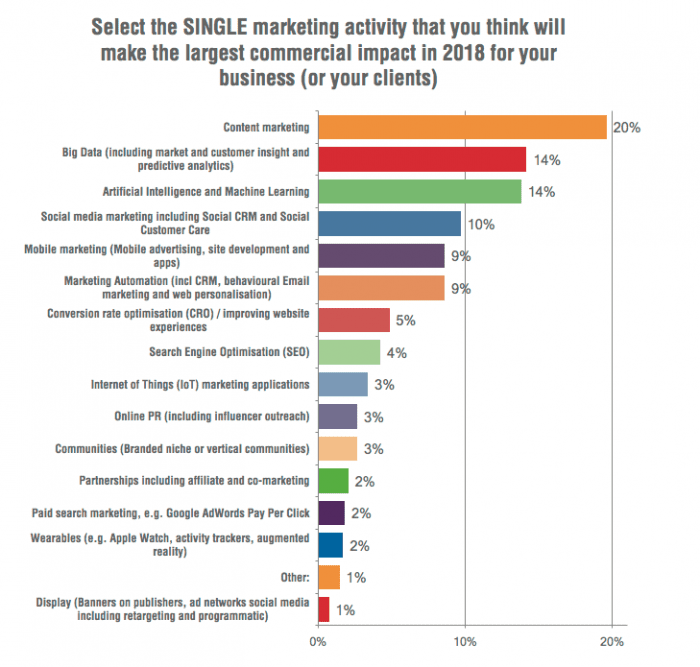
Which marketing trend will be most important to you and your business in 2018?

We have asked this question over the past few years and it's been really interesting to see what 'rocks your digital world' since there are some common themes amongst the top 3 and some activities surprisingly low. The question we asked was around the most important commercial trends. We had around 850 votes from marketers in different types of business from around the world. Only 2% of respondents answered that wearables will have the largest commercial impact on their business in 2018. Respondents preferred to focus on content marketing and big data - overlooking the potential that wearable technology can achieve.

Top 10 stats from 2017 to inform your marketing strategy for 2018

  1. The worldwide wearables market reached a new all-time high as shipments reached 33.9 million units in the fourth quarter of 2016 (4Q16), growing 16.9% year over year (Buisness Wire, 2017)
  2. Tractica also forecasts an increase of the wearables devices until 2021, with total shipments for all wearable devices to 560 million in 2021, which means an estimated device revenue of  $95.3 billion in 2021 (wearable technologies, 2017)
  3. Its forecast projects sales of 310.4M wearable devices worldwide this year, generating a total of $30.5BN in revenue — of which it expects $9.3BN to come from the smartwatch category specifically (Techcrunch, 2017)
  4. By 2021, Gartner estimates that sales of smartwatches will total nearly 81M units — representing 16% of total wearable device sales, according to its forecast (Techcrunch, 2017)
  5. The market for wearable technology will reach accelerated growth with a yearly growth of 23 percent through to over $100bn by 2023 and, reach over $150bn by 2026 (IDTechEx, 2016)
  6. 102.4 million wearable devices were sold in 2016, a 25% increase over the year before, growth that was driven primarily by higher sales for Xiaomi and other budget wearables makers (Relate, 2017)
  7. Just under 50 million wearable devices were shipped in in 2015 and over 125 million units are expected to ship in 2019 (Forbes, 2016)
  8. By 2020, smart eyewear will account for 40% of total revenue of the wearables market (i-scoop, 2016)
  9. This vibrant market is expected to grow in value from just over $10 billion in 2017 to almost $17 billion by 2021 (wearable technologies, 2017)
  10. Gartner says it expects a total of 41.5M smartwatches to be sold this year, adding that the device type is “on pace” to account for the highest unit sales of all wearable form factors from 2019 to 2021, with the exception of Bluetooth headsets (Techcrunch, 2017)

Key trends to watch out for in 2018?

More wearable devices

As more money is spent on wearable devices and consumers start to adapt there will be an increase in the range of devices available to consumers. The range available will increase to different ranges, body parts and needs. According to i-scoop wearable technologies will shift to new markets and areas of the human body by 2026 (i-scoop, 2016). This year we have seen Fitbit, Alexa, Google home and Apple Watch 2 take off, people are increasingly using them more as part of their everyday lives.

Reshaping healthcare

Wearable technology is evolving to help solve some of the healthcare’s biggest problems. Healthcare providers can collect data from patients, as well as use wearable technology to keep doctors connected to co-workers and data without the hassle of a pager or phone system. There have been a number of advancements in the healthcare sector such as introducing hearables, or wireless computing earpieces, and brainwave-reading technology.

New data for retailers

As we adapt to new technologies retailers will be able to collect ‘super data’  such as a user’s in-store shopping frequency, their basket size, value per item, length of stay etc – meaning that online advertising placements and scheduling can become more acutely defined. it will also allow retailers to access personality traits about the customer, such as what you listen to, what you “like”, and what you like to browse.

Once the industry has made advancements in the data wearables collect about their customers, retailers will be able to build a fully personalized experience of the entire browsing and buying journey.

Fitness tech will continue to grow

The boom in wearable technology has been mainly fueled by fitness, such as wearable gadgets’ that monitor your heart rate or track your exercise. These gadgets have been successful because they are helpful to the user and easy to integrate into everyday life. According to IDC, the market’s growth will be fuelled almost exclusively by smartwatches and wrist-worn fitness trackers. Having tech on your wrist, the smartwatch allows for precise data to be collected about the user. This is likely to radically impact the retail experience as hyper-personalized offerings become commonplace.

What does this mean for marketers?

Although wearables might not have fully taken off this doesn't mean that wearables are dead. Some business maybe seeing significant success - especially those in the health and fitness sector.

But if you have been unsure of the transition to wearables brand should be doing something with wearables maybe start thinking about whether or not you have the tools, tactics, and support in places to be successful in this industry.

You also need to ensure you use cross-platform marketing. As technology evolves, it would be foolish to focus all your marketing efforts one single technology. embrace the new and look to adapt and change in the future. TechCrunch reported 'Current low adoption by mainstream consumers shows that the market is still in its infancy, not that it lacks longer-term potential'.

If you are unsure how to prioritize marketing investments in innovative marketing technology use our marketing technology and media innovations guide to help you make informed decisions for 2018. It works through planning frameworks to will help your business think strategically and make the right decisions about how to invest. The guide also outlines the key technologies marketers need to consider when planning for the future.

Download Business Resource – Marketing Technology and Media Innovations guide

The guide outlines 6 of the most important new technologies marketers should consider when planning for future investment in customer-facing marketing experiences and communications to encourage brand engagement and purchase. At the start of the guide, we also explain different planning techniques that will help you take the right strategic decisions when evaluating new technology investments.

Access the Marketing technology and media innovation guide 2017

15 Nov 18:01

Secrets to Creating a Visual Brand Identity That Sets You Apart

by Susan Friesen

8 Key Areas You Want to Keep Your Visual Brand Consistent

Have you ever wondered what your social media followers think about you?

Is it possible you are sending mixed messages to your prospects?

This month we’re talking about the importance of personal branding and how it helps your business. This article ties closely in with that regarding your visual brand – essentially how you come across to others.

Over the years I have seen a lot of business owners who haven’t taken time to define their brand. They don’t understand when businesses stray from their brand, it dilutes their brand power and impact. Or worse, they have nothing about them that sets them apart.

As a result, they complain they are attracting the wrong customers or hardly getting any leads at all…

This “me too” method of marketing that mimics what competitors are doing isn’t effective.

That’s why I feel compelled to share more what a visual brand is and how to build a strong one online.

Whether you’re creating a new brand or updating your existing one, your brand’s visual identity is the most important factor in your marketing.

Your brand is so much more than a website and a logo. It’s a user’s total experience and perception of you.

So every touchpoint a prospect has with you should have one consistent look and theme. This includes your logo, website, stationery, social media, videos, brochures, business cards, and of course your personal brand in how you dress and present yourself to the world.

Watch: Here’s how Dana J. Smithers integrates her personal branding with her business brand.

A solid visual brand:

  • Helps people know what to expect from you.
  • Promotes professionalism and purpose.
  • Draws prospects who align with your ideas, attitudes and values.
  • Enhances confidence, trust and rapport with your followers.
  • Builds upon the existing brand experience they have with you in a positive (or a negative) way.

Visual branding adds real power to your marketing. It increases engagement and understanding.

With all these benefits to personal and professional branding, it’s more important than ever to brand your visual content and images so you stand out from competitors.

How Can You Keep Your Brand Consistent?

You write blog articles and posts every day. You are working back and forth on projects. How can you be certain that all the marketing you do resonates with your core brand?

Creating a style guide makes it easier to keep your marketing pieces consistent.

Firstly, ensure your brand is consistent in the following areas:

  • Headshot – Having a professional headshot goes a long way in developing brand trust.
  • Logo– your logo is the nucleus of your brand, everything else stems from that. Ensure it’s designed properly that includes the psychology of what it represents.
  • Colour Palette – Colours that will resonate with your target market and be meaningful to your brand.
  • Brand Message – This is the essence of your business that includes your slogan or tagline of who you are, what you do, and how you deliver value.
  • Fonts – Being consistent with the same one or two typefaces throughout all written materials as well as graphics
  • Design Elements – The use of borders, lines, shadows and filters should all become familiar to being associated with your visual brand.
  • Tone – Set the tone of your business presence and stick to it – whether serious, high-tech, sarcastic or soulful, this is a big part of building a solid brand presence.

For example: our eVision Media colours are purple and green. Our typeface is: Asap. Our logo is: a mother Emperor Penguin and her baby chick. Our slogan is “creating your brand, showcasing your business, nurturing your dream to reality” as seen here in our website header:

creating your brand, showcasing your business, nurturing your dream to reality

We have also created a template that we use for our marketing eTips and inspirational messages, so people instantly recognize them:

Visual Branding of eVision Media Social Media posts

Create a Style Guide as Your Road Map

A style guide acts like a map that helps your team to stay on track. Sharing your style guide with key members of your team can ensure everyone knows the style guidelines and can follow them.

  • Your copywriter and social media manager will understand how to write with your brand voice.
  • Your graphic designer will stick to the fonts and colours your brand is known for.
  • Your web design team can make sure your website and landing pages all have the same look and feel.

This is especially important for companies with virtual employees spanning in multiple geographic regions. Make it easy for your team to access your logo, fonts and templates. Always protect your brand. Double check when new marketing pieces come in that they conform to brand guidelines.

Here is a snapshot of our current style guide:

Visual Brand style guide for eVision Media

With this style guide in mind, here are 8 areas you will want to keep your brand consistent in everything you do in your business marketing and social media efforts:

  1. Website

    Your website is the biggest brand statement your business has. It serves as a reference to make sure all other brand elements are in alignment.

    That’s why I am so against people who use cookie-cutter template sites. They may look polished, but they lack the warmth, connection and personality of a branded website (not to mention how badly they are built.)

    Make sure the images you use are reflective of your ideal client. Use language that resonates with your target audience. Create an about page that helps your visitors understand your backstory and why you are passionate and good at what you do.

    The more your website looks and feels like you, the stronger attraction tool it will be for potential clients.

  2. Professional Headshot

    Professional headshot before and after of Susan Friesen

    I was very camera shy when I first started my business. So when it came time to get some updated headshots, I dreaded it. But I found that going through the process brought me confidence.

    My new headshots are used as a personal and business branding tool that help me to be more recognized online. They are on all my social media profiles and on our website. As a result, people recognize me when I attend local networking events.

    Investing in new headshots can truly jump start your brand and success.

  3. Sharing Photos

    visual branding with Dana Smithers, Julie Salisbury and Susan Friesen
    Sharing photos makes your marketing more personable and showcases your personal brand. Consumers love seeing the real person behind the business.

    So be mindful of when you are working or in group situations and see how you can snap pictures to show followers what you are up to.

    Take a picture holding your new book. Grab a shot with a new friend you met while networking. Show the resort you are staying at for your business mastermind.

    Here’s Dana Smithers, Julie Salisbury and myself while at a recent WOW (Woman of Worth) event in Harrison Hot Springs.

  4. Video

    Creating videos helps build a strong following online. It’s important to have your videos match your brand too. Dress in a manner that is consistent with your brand.

    You could also shoot it in similar places or locations. Whether that’s sitting at your desk, cooking in the kitchen, or standing in front of a green screen with a projected background, that consistent setting helps build familiarity.

    Be warm, friendly and connective. If you promise to offer weekly video tips, then get them out on the same day each week so viewers can anticipate them. Create a custom hashtag for your video tips too – we created our eVision video eTips with the hashtag #eTip for consistency.

  5. Branded Images

    Kick up the interest of your blog articles and social media with images. There are loads of free tools to help you make graphic quotes, infographics, and other visuals to add impact.

    Make sure all your graphic images are consistent with your brand. Adding your logo makes it easy for people to instantly recognize the content is from you.

    For instance, the other day we re-posted an older article about “6 Steps to Nurturing A Profitable Business”. We featured an image of an Emperor Penguin family. It suggested the idea of nurturing but also tied into our brand with the Penguin theme.

  6. Social Media

    Social media provides so many opportunities for visual branding. From Facebook cover images to profile pics, to graphics, there are endless opportunities for people to learn more about what you do.

    The images you use can evoke the feelings and emotions you want your brand to convey. The goal is for someone to look at your social media account and get an impression that helps them understand your unique vibe.

  7. Free Giveaways

    When you are offering free reports, tools, and other goodies to visitors, make sure they have the same colours, logos, and visual feel as your other materials.

    eVision Ultimate Guide Report CoverWhen it looks professional and makes a great impression, it builds credibility. Plus, it’s just one more piece of the brand puzzle that helps them understand what you do.

    For example, our free giveaway is “The Ultimate Guide to Improving Your Website’s Profitability”.

    The cover features a headshot of me for familiarity, (mind you, this is an old photo so fixing up this free report is a priority of mine.) It has our brand colour of purple and includes our logo.

    So it looks and feels like eVision Media. If someone forwarded a copy of this to a friend, they would get an accurate sense of our brand.

  8. Email Signature

    Susan Friesen eSignature
    A graphic email signature can add visual impact to every message you send. Services like Wisestamp make it easy to add your logo, picture, and social media links to your email signature.

    We have designed many eSignatures for clients that exactly match their brand and it’s an effective way to enhance their brand with every email they send out.

    Have your virtual team members set up a signature too so you come across as a professional team to your customers.

Are You a Wanna Be or a Real Brand?

It’s really important to take a look at your brand as a whole to make sure everything is in alignment.

Is your visual brand:

  • Clear,
  • consistent,
  • authentic,
  • memorable, and
  • in alignment with changes in the marketplace, your offerings, or your success

Even if your brand was on target 3 years ago, the nature of your business may have changed where your brand no longer accurately reflects what you do or who you serve.

You have become more specialized. You may have new product offerings. Maybe you are now the host of a new podcast.

Take a look at your brand with the eyes of an outsider and ask yourself if what you see truly reflect who you are now as a company.

15 Nov 17:57

Here’s how one company is helping farmers get more from their land

by Sponsor Post

Rabobank_Boer_Drones2 (1)

Building a food-secure future is a huge challenge. It requires a radical rethink of how we produce, process, and consume our food. Rabobank has launched Kickstart Food — a three-year programme focusing on four areas considered key to addressing the world’s sustainable food challenge. Earth: restoring the soil quality of the current arable land around the world. Waste: reducing food waste throughout the entire food production chain. Stability: promoting and stimulating a more stable and resilient food market. Nutrition: ensuring everyone has access to diets with balanced nutritional value.

Smarter use of agricultural land

United Nations forecasts suggest that by 2050 the world population will be almost 9.8 billion people — a rise of more than 2 billion on current levels. A challenge is posed by both the increasing number of mouths to feed, and also by the number of people shifting to a “Western” diet — consuming more calories from meat and dairy products.

“Meeting the growing need for food while reducing environmental pressure is one of the biggest challenges of this century,” says Gilles Boumeester, head of Rabobank’s Research Food and Agribusiness. “We need to make smarter use of the available agricultural land. Currently, about 30% of the land in use is degraded to some extent. Even more problematic is that the most rapid deterioration in soil fertility is in Asia and Africa, two continents where the population will grow the fastest. We must reverse this trend.”

High-tech agriculture

Luckily, farms are increasingly becoming high-tech environments making use of real-time information. Scanners provide comprehensive information on the chemical composition of a farmer’s soil, without requiring a laboratory. Sensors in potato fields check that harvesting machinery is properly set. Drones enable farmers to monitor their crops and precisely target fertilizers or pesticides. These smart agricultural technologies, combined with data-driven precision agriculture, help reduce costs, maximize profits, and minimize ecological impact.

Financial advice and more

Innovation doesn’t come cheap. It often requires substantial up-front investment. This is where Rabobank comes in, explains Boumeester. “Our long history in the agricultural sector means we’re uniquely placed to understand the funding needs of entrepreneurs in the food and agricultural sector. We don’t just grant loans, we also advise farmers on risk management and help pre-finance seeds, fertilizer, or machinery.”

A lot of what the bank does goes beyond banking. GlobalFarmers.com is an online network where Rabobank’s farming customers exchange knowledge in a trusted environment. FoodBytes! is the bank’s own pitching platform, connecting food and agricultural start-ups with investors. Recently Arable raised $4.25 million via FoodBytes! to further develop solar-powered sensors, which automatically transmits up to 40 different types of data to the farmer. “These technologies help raise the quality of agricultural production and with it the quality of the soil,” Boumeester comments.

Innovation is pivotal in producing more with less, in reducing waste, in balancing the nutritional value of our diets, and in stimulating stable and resilient food markets.

Discover more: www.rabobank.com.

This post is sponsored by Rabobank. | Content written and provided by Rabobank.

Join the conversation about this story »

15 Nov 17:42

10 Key Technologies That Enable Big Data Analytics for Businesses

by Mitul Makadia

Companies have started adopting an optimised method for the optimal distribution of resources to carve the path of a company’s growth rather than relying on a trial and error method. The best method of implementation has been incorporating techniques of big data analysis. The business data acquired by large corporations over large periods of time is too complex to be processed by conventional data processing applications. There are better ways to extract useful information which can support proper decision making and help uncover patterns in an otherwise random looking data. These techniques form the core of big data analytics. There are many ways in which small and medium businesses are leveraging big data to obtain the best possible outcomes for their firms.

Key big data analytics technologies

The big data analytics technology is a combination of several techniques and processing methods. What makes them effective is their collective use by enterprises to obtain relevant results for strategic management and implementation. Here is a brief on the big data technologies used by both small enterprises and large-scale corporations.

1) Predictive Analytics

One of the prime tools for businesses to avoid risks in decision making, predictive analytics can help businesses. Predictive analytics hardware and software solutions can be utilized for discovery, evaluation, and deployment of predictive scenarios by processing big data.

2) NoSQL Databases

These databases are utilized for reliable and efficient data management across a scalable number of storage nodes. NoSQL databases store data as relational database tables, JSON docs or key-value pairings.

3) Knowledge Discovery Tools

These are tools that allow businesses to mine big data (structured and unstructured) which is stored in multiple sources. These sources can be different file systems, APIs, DBMS or similar platforms. With search and knowledge discovery tools, businesses can isolate and utilize the information to their benefit.

4) Stream Analytics

Sometimes the data an organization needs to process can be stored on multiple platforms and in multiple formats. Stream analytics software is highly useful for filtering, aggregation, and analysis of such big data. Stream analytics also allows connection to external data sources and their integration into the application flow.

5) In-memory Data Fabric

This technology helps in distribution of large quantities of data across system resources such as Dynamic RAM, Flash Storage or Solid State Storage Drives. Which in turn enables low latency access and processing of big data on the connected nodes.

6) Distributed Storage

A way to counter independent node failures and loss or corruption of big data sources, distributed file stores contain replicated data. Sometimes the data is also replicated for low latency quick access on large computer networks. These are generally non-relational databases.

7) Data Virtualization

It enables applications to retrieve data without implementing technical restrictions such as data formats, the physical location of data, etc. Used by Apache Hadoop and other distributed data stores for real-time or near real-time access to data stored on various platforms, data virtualization is one of the most used big data technologies.

8) Data Integration

A key operational challenge for most organizations handling big data is to process terabytes (or petabytes) of data in a way that can be useful for customer deliverables. Data integration tools allow businesses to streamline data across a number of big data solutions such as Amazon EMR, Apache Hive, Apache Pig, Apache Spark, Hadoop, MapReduce, MongoDB, and Couchbase.

9) Data Preprocessing

These software solutions are used for manipulation of data into a format that is consistent and can be used for further analysis. The data preparation tools accelerate the data sharing process by formatting and cleansing unstructured data sets. A limitation of data preprocessing is that all its tasks cannot be automated and require human oversight, which can be tedious and time-consuming.

10) Data Quality

An important parameter for big data processing is the data quality. The data quality software can conduct cleansing and enrichment of large data sets by utilizing parallel processing. This software is widely used for getting consistent and reliable outputs from big data processing.

In conclusion, data will be the new oil in the years to come. You will see a lot of companies making use of big data and analytical techniques to make deep understanding and provide their customers with even better products and services. And as Forbes has said, “Data Scientists will be the hottest job of the 21st Century”. Even chatbots will dominate the market with a more intelligent and smart thinking abilities due to the presence of such huge amounts of data.

15 Nov 17:39

Your Small Business Marketing System Starts with This

by Jen Phillips April
small business marketing system

Pexels

Is your calendar as booked with great clients as you’d like? If your answer is “no.” Don’t beat yourself up.

Most likely, the reason why has little to do with your experience (or lack of it). It also doesn’t matter whether you’re doing podcasts or running solid Facebook ads or over scheduling your “to do” list with one-shot marketing tasks

No, it’s far simpler (and therefore more complicated) than figuring out software or complicated funnels.

In fact, if I were a betting person, I’d bet that you’re overthinking this.

By a LOT.

And yes, you may think I’m crazy after I share this tidbit with you but if you think about it, you’ll see that I’m on to something.

After all, we’re all creatures of habit.

Here’s the deal.

Have you ever heard the expression, “Sell to a starving crowd?” I forget where it comes from but the idea is that if were selling…anything…you’d do best to sell to people who want it.

Take selling hot dogs. Do you think you’d make more money selling hot dogs on New Orleans’ Bourbon Street where there are hordes of hungry (and often over-served tourists) or on the street in your suburban neighborhood?

(I hope you said Bourbon Street. It’s not a bad place if you’re a hot dog vendor.)

The same applies whether you sell t-shirts, planners, or business services. Look to where the people gather who buy what you sell. Then, get to know some of those people by showing them how they can look hip, get organized, make more money, etc.

Show enough of them that you have the goods and can help and you’re going to make sales. It’s the law of averages. (Not that you’re average.)

Let’s look at an example.

Free stock photo of hands, water, smartphone, laptop

Pexels

The end of the year is approaching and lots of people (maybe you!) will go into “Planner buying mode.

You might buy one. You might buy three. I don’t know.

What I DO know is that people who buy planners, rarely only buy one through the year. We buy different ones. We buy that one because it’s pretty. We buy this one because it’s going to help us to set goals (AND ACHIEVE THEM!) within 90 days.

And on and on.

Now here’s a funny question, who do you think is MOST likely to buy a planner? The person who hasn’t bought one in 3 years or the person who just bought one last week?

I hope you said the one who bought one last week.

We are creatures of habit.

The non-planner buyer has figured out some other system for themselves.

The planner buyer, gravitates toward organizational systems.

It’s a well-known piece of marketing wisdom that our habits show up in the things we buy.

How many pairs of black shoes do you own?

Thought so.

It applies to everything.

Are you ready to apply this to your marketing?

It’s simple.

Go where the people are who ALREADY buy the type of thing you sell.

You’ll experience success that much faster.

15 Nov 17:39

8 Statements That Make Salespeople Sound Insecure

by afrost@hubspot.com (Aja Frost)

The delivery of your message often matters just as much as its content -- making confidence crucial to sales success. If you sound calm, collected, and self-assured, your prospects will implicitly trust you more. But if you sound anxious or insecure, they’ll probably doubt what you’re telling them.

In other words, your confidence will inspire their faith in you, your advice, and your ability to improve their business.

One of the simplest ways to sound more confident? Steering clear of these eight credibility-harming statements.

1) “If you could give me a call back, I’d really appreciate it.”

This phrase can throw off the tone of your entire voicemail, especially since it’s usually one of the last things the prospect hears.

First, you sound unsure she’ll return your call. Does every voicemail result in a callback? No. But you should act like you’re confident you’ll be hearing from the buyer soon: Don’t plant the seed she shouldn’t call you before she’s made a decision.

Second, this line makes you sound desperate. You’re the buyer’s peer, not her inferior, so expressing extreme appreciation for her time sends the wrong message. She’s giving up a slot in her schedule in return for your insights and advice.

2) “Would you mind doing X?”

Avoid asking the prospect if she’d “mind” doing anything, whether it’s answering a pre-call survey or looking over your proposal. You’re technically asking if she’d be willing to take an action, not if she’ll actually do it.

This question is also unnecessary. Assume that when your prospect doesn’t want to do something, she’ll tell you so.

Change the tone of this question by rephrasing questions as statements. For example, you could say, “I’m sending you a few questions I’d like you to answer before our Skype meeting so I can tailor the agenda to your situation,” or “Look over the proposal by Saturday and let me know if you have any thoughts.”

3) “Thanks again for speaking to me [yesterday, on X day, last week].”

While the intent behind this line is good, it skews the balance of power. You’re essentially telling the prospect she’s doing you a favor by taking your calls.

If you were spending the entire conversation rattling off product specs, she probably would be doing you a favor. But if you’re spending this time digging into her objectives and challenges, providing relevant, helpful suggestions, answering her questions, and/or guiding her through the decision making process -- in other words, using a consultative approach -- she’s gaining just as much from the call as you are, if not more.

Some reps use this as a convenient segue into a summary of their last conversation. A good alternative is, “Let’s recap what we talked about on X. First, we … ”

If you typically use this line to begin a follow-up email, instead write:

“We had a productive conversation today. Here are the main things we discussed … ”

Then include two to four bullet points summarizing the conversation.

4) “Does that make sense?”

When sales conversations become fairly technical or detailed, well-intentioned reps use this question to make sure their prospects aren’t confused.

Unfortunately, this question is loaded with three negative assumptions:

  1. The salesperson isn’t explaining things clearly
  2. The salesperson doubts their prospect’s intelligence
  3. The salesperson isn’t confident about the accuracy of their content

Not only does this question damage a rep’s credibility, it’s rarely helpful. The buyer might be embarrassed to admit her confusion -- especially when her peers are present -- so she’ll say, “Yes, makes sense,” even when it doesn’t.

The salesperson should instead ask, “What are your thoughts on X?” If his prospect doesn’t understand, she’ll usually say, “I didn’t completely grasp Y,” or “Honestly, I’m not getting the value of Z.”

5) “I know you’re busy … ”

I see this line pop up in sales emails and calls all the time. The rep tries to indicate respect for the buyer’s packed schedule by saying, “I know you’re busy, so let’s jump in,” or “I know you’re busy, so I’ll keep this under 10 minutes.”

This qualifier sounds silly. If the prospect wasn’t busy, would the salesperson be happy to waste her time? Brevity is important no matter whom you’re talking to.

In addition, the rep is implying he doesn’t have a full schedule. This implication can lower his authority in his prospect’s eyes.

6) “Is now still a good time?”

There’s simply no reason to start a sales call with this question. If the salesperson has sent a email to confirm the meeting’s date and time and provided an agenda, he already knows his prospect is free. Checking her availability for the second or third time communicates insecurity.

The rep should also take it for granted his prospect will speak up if there’s been an emergency or unexpected change of plans and she can’t speak anymore.

Asking this question is even worse when your prospect isn’t expecting your call. Not only does it give them an easy excuse to hang up, but it reminds them of their workload and makes you sound like every other salesperson out there.

The takeaway: Skip this question and go straight into building rapport or setting the agenda.

7) "I'm no expert, but ..."

This typically prefaces a suggestion or opinion, like, "I'm no expert, but offering 30-day free returns can help convert on-the-fence buyers," or "I'm no expert, but my customers often say the issue lies with their process."

The problem with "I'm no expert"? You are an expert. You talk to people in your prospect's position all day, every day. You have unparallelled access into their pain points, goals, and professional responsibilities. You know your industry. You know your product. You've earned the right to call yourself an expert, and denouncing that hard-won experience and knowledge doesn't just harm your credibility -- it's simply not true.

8) "Frankly, we're seeing a paradigm shift, and if your organization can get ahead of this unprecedented change in consumer behavior, the ROI will be astronomical."

This is one example of an unfortunate trend -- using jargon to make yourself seem smarter. As Mark Twain said, "Don't use a five-dollar word where a fifty-cent one would do." 

SAT vocabulary suggests you're compensating. Ironically, you'll seem less intelligent. 

If you want to impress the buyer, speak as simply and plainly as possible. An added benefit? It'll be easier for them to get your point.

Your words have a tremendous impact on how buyers perceive you. Once you’ve eliminated these eight statements from your repertoire, you’ll sound more confident -- and ultimately, more trustworthy.

HubSpot CRM

15 Nov 17:39

4 Ways Sales Can Win Over Buyers By Selling ROI

by Alex Hisaka
  • buyers-with-ROI

Our new State of Sales report surfaced an interesting insight: B2B sales pros find return on investment (ROI) to be far more important than price in closing a deal. While buyers might not say they agree, that’s likely because ROI is more nuanced than a simple price point.

By putting ROI at the forefront of sales calls and meetings, your sales team can get buyers to recognize and prioritize the ultimate return over cost. In the process, your reps will overcome a common sales momentum barrier. Here are four ways to change the conversation in your favor.

Lead With Numbers

Businesspeople are accustomed to thinking in data-driven terms, so your sales team shouldn’t be afraid to lead with numbers. Numbers speak volumes, especially when it comes to helping your buyers make their internal business case. With statistics and metrics more readily available than ever before, there’s no excuse for leaving them out of conversations and pitches.

If your organization has figured out the aggregate return on investment across its customer base, encourage your reps to share that number. Or perhaps they can cherry-pick the ROI stats of companies in the same industry as their prospects. Better yet, if possible, task your dev team with creating an ROI calculator that allows your team to plug in numbers so reps can show the potential ROI for their specific buyers and their companies.

Personalize Pitches

Continuing with this theme, it’s a must for your sales professionals to customize their pitches to each prospect’s specific business. Today’s buyers expect personalization at every turn and outright reject most things generic. It’s a real turnoff when reps deliver cookie-cutter presentations to prospects who have advanced past the initial research stage.

Knowledgeable, prepared buyers expect today’s sellers to be just as knowledgeable and prepared, so your reps need to make sure their meetings stand up to scrutiny. Based on the buyer’s situation, needs, and priorities, they should dig up relevant industry benchmarks and other real-life numbers to frame their examples and discussion points.

Let Marketing Enable Your Team

As your reps seek ways to tell a compelling ROI story, check with your marketing colleagues for messaging. They should be able to supply a customizable narrative that position your reps to deliver stronger economic insights.

These value messages might be contained in existing decks, or conveyed in written and video case studies. Marketing might even be able to provide an interactive benchmark survey that prospects can fill out to determine how they compare to their peers – and how much they stand to gain by abandoning the status quo. Simply put, marketing should be able to equip your team with messages that clearly convey the value of investing in your solution.

When your reps are preparing to share ROI-laden content with prospects, tell them to take advantage of PointDrive. The integrated PointDrive functionality in LinkedIn Sales Navigator allows them to professionally package up and seamlessly deliver content. Rather than send an email with a bunch of attachments, they can send a link to relevant documents, PDFs, videos, testimonials, articles, and more housed on landing pages unique to each prospect. This makes it easy for buyers to access the information they find most relevant, whether they are on a desktop computer, smartphone, or tablet. Plus, it means you and your reps can track the recipient’s consumption and sharing of that content.

Optimize Your Content Strategy

Ideally your marketing team calls upon SEO best practices to influence prospects at every stage of the buying cycle. You can pave the way for ROI-focused conversations by working with your marketing department to ensure buyers realize the importance of ROI before they reach sales.

Specifically, marketing should customize your company’s SEO and content strategy to target buyers focusing more on ROI than on price. It should also develop content that “trains” buyers to be less sensitive to price. And don’t forget: sharing and distributing content through social channels helps boost visibility and rankings in the search engines. So be sure your reps share that ROI-focused content on their LinkedIn profiles and in other relevant online channels.

Emotions at Play

Lastly, as your team focuses on conveying return over cost, remind them that emotion still plays into the buying process. When they show how a prospect’s company will realize ROI, they should paint the buyer as the hero of the story. If they do so, their pitches will strike a chord – and be more likely to find their way into the prospect’s business case for your solution.

For more ways to work the odds in your favor, download Proof Positive: Easily Measure and Maximize Sales ROI. 

15 Nov 17:37

The Role of Your Marketing Department — And What You Should Expect From It

by Lee Frederiksen

Professional services firms have, at times, had rocky relationships with their marketing functions. Too often, this has led to unrealistic expectations, disappointment and the marginalization of the marketing function.

This is a tragedy. An effective marketing team can have a profound impact on a modern professional services firm. When well staffed and well functioning, a marketing department can drive growth, profitability and a premium valuation. In short, the role of your marketing department in your firm’s success cannot be understated.

What’s the best way to build such a valuable function? We believe it’s built upon a clear understanding of what to expect from your marketing department and what resources and support it will require. But first, we need distinguish marketing from the sales function.

Marketing vs. Sales in Professional Services

One of the first steps is to be clear about the language we use to describe a marketing department and how it differs from a sales function. The reason that this distinction is so tricky is that many firms do not use traditional language to talk about these concepts. Sometimes the term business development is used to refer to the sales function. In other firms, business development refers to both the marketing and sales function. In this article, we are going to use the traditional definitions.

Marketing is the process of understanding your marketplace and competitors, defining your firm’s market positioning, pricing and services, promoting the firm to your target audience and explaining how they might benefit by working with you. Put another way, marketing is about offering the right services with the right benefits to the right prospects.

Sales is the process of qualifying your prospects and convincing the right ones to buy your services. It’s about turning business opportunities into clients.

While this difference seems pretty simple on the surface, there are a few areas that can cause confusion. In some organizations, for instance, the sales function is also responsible for generating and nurturing leads until they become viable business opportunities. As you will see below, we have some strong opinions about this practice.

Marketing Department Functions

So what exactly should be the role of your marketing department? What should you expect from your marketing team?

Whether your team is in-house, entirely outsourced or a combination of the two, your marketing team has five core functions.

1. An understanding of your target market and competitors

Marketing should always start with the market. You should expect Marketing to be able to give you detailed and specific descriptions of your target markets and your key competitors in those markets.

But you already know all about your competitors and clients, right? Wrong. Unless you are already doing systematic, structured research, you are kidding yourself. Anecdotal experiences can lead you astray.

Our research shows that internal staff almost always inaccurately perceive their market and their clients’ true feelings and priorities. In fact, firms that do objective research on their markets and clients grow faster and are more profitable.

A professional marketing function can commission this research and allow you to make decisions based on marketplace reality, rather than hunches and wishful thinking.

2. A strategy to drive growth and profitability

Once you have a research-based understanding of your firm and its place in the market, your marketing department should be able to help craft a compelling strategy to drive growth and profitability. That strategy may require adjustments in your target market, service offerings (see the next point, below) and marketing plans.

Your strategy should clearly identify compelling competitive advantages (your differentiators) and a clear market positioning (are you the premium-priced leader or a value-driven alternative?). Think of these as tools to describe your brand. How do you want to be known in the marketplace? As you wrestle with your options, expect to be challenged with new thinking and bold choices.

You will also need a marketing plan. This plan will map out exactly how you are going to build the visibility of your brand and generate the new opportunities your business development (sales) team will convert into new clients.

3. Which services to offer and how to price them

Historically, many firms have left the key decisions about what services to offer and how to price them to individual operating executives or the finance and accounting function.

Decisions about service lines and pricing are important elements of a growth plan. They should be informed by an overall research-based strategy, not individual client requests. Why? It is too easy to get over-extended trying to be everything to every client. You will soon lose focus and experience, increasing costs as you struggle to provide an ever-expanding array of services.

Innovation and client responsiveness can all too easily become undisciplined dabbling. A strong marketing department plays a leading role in maintaining that balance.

4. A steady flow of new leads and opportunities

More leads! Better opportunities! Who doesn’t want a steady flow of well-qualified new business prospects? Fortunately, that is exactly what you should expect from marketing. While some firms assign lead generation and nurturing to the sales (business development) function, we think that is a bad idea in most cases. The time horizon for lead generation and nurturing can be long. Nurturing leads can take months, even years. Sales are almost always placed on a much shorter operational cycle (“what can you close this month?”).

Your marketing team should turn your overall strategy into a formal plan to generate new leads and nurture your existing prospects until they become well-qualified opportunities. This plan should look ahead at least a year and be guided by clear, trackable metrics (more on this below).

Be careful that you do not continually add new “marketing ideas,” underfunding campaigns or other unplanned initiatives that may derail the plan. If you fall into any of these traps, you cannot expect the plan to work, nor can you hold your marketing team accountable.

Also, be patient. Lead nurturing can take time — sometimes a very long time. Don’t focus only on immediate results. You will need new clients next year, and the year after as well.

5. The ability to monitor and optimize implementation

This is the piece that makes everything else possible. If you can’t measure your results, you are likely to lose sight of your progress during the marketing process. Building a strong brand and full pipeline takes time.

With the appropriate tools and cooperation from the Business Development team, Marketing should be able to track lead generation, nurturing, opportunities, proposals and closes. The entire pipeline can then be optimized over time.

If you are not tracking results, it is too easy to continue unproductive programs or unwittingly discontinue efforts that are working. Tracking keeps you honest and allows you to make the most of your limited resources.

What you need to provide

At this point, we have identified what benefits Marketing can provide to your firm. But what do they need to be able to deliver these results? The answer is straightforward. They need four basic things:

  1. Talented people. Your marketing team must include people with the right skill sets and experience. If you don’t have these talents in house, you may need to outsource parts of the process or do some hiring. We’ll discuss these options when we cover how to structure your
    marketing department, below. A word of caution here: marketing professional services is its own specialty. Don’t expect someone with general marketing expertise to understand the unique rules and dynamics of the professional services marketplace.
  2. Adequate resources. Your team must have sufficient resources to do the job right. Underfund the effort and you will not get the results you deserve. The requirements are not excessive. Our research shows that high-growth firms spend no more than average on marketing — and yet they are still able to deliver outstanding results. But don’t expect superior results with stingy resources.
  3. A seat at the decision-maker’s table. The kiss of death is investing in your marketing then ignoring your team’s advice. It happens more often than you would think, especially in flat organizations, such as partnerships, where decision making is diffused over many people. If your decisions are broadly consensus-based, you may be better off delegating marketing decisions to a single partner or a small committee.
  4. Patience and cooperation. Once the previous three considerations are in place, you will see impressive progress. But there is a catch. Just like any other functional area of your organization, Marketing needs cooperation and a bit of patience from the firm. Support your marketing team’s efforts over time and you will reap the rewards.

These four basic requirements lay the foundation for marketing success. But what does an effective marketing department look like?

Marketing Department Structure

Structuring a modern professional services marketing team is not easy. At many firms, marketing is a relatively new function — one, regrettably, that is not always highly regarded. In addition, many firms are working in a very competitive and rapidly evolving marketplace. When they lack marketing agility, firms put themselves at risk.

To keep things simple, let’s focus on the three aspects of departmental structure that are most relevant to professional services firms: the Role of marketing, selecting the right Resources and Reporting Relationships.

  1. Role of Marketing

At different firms, marketing comes in different guises — from a low-level support function charged with basic implementation responsibilities to a comprehensive team of specialists who deliver the full spectrum of strategic and operational skills. In our experience, the more comprehensive its marketing function, the more success a firm enjoys. (Keep in mind that marketing expertise does not necessarily need to reside in-house. See Resource Requirements below for the details.)

At many firms, a key decision revolves around lead generation and nurturing. Do these functions belong to marketing or sales? We believe that marketing is their proper home.

Why? Many, many firms today employ the Seller-Doer Strategy, so their busy professionals lack the time and focus to carry out a long-term program. Better to leave these tasks to individuals whose attention is not divided between business development and project delivery. Make lead generation and lead nurturing a prime role of the marketing department.

  1. Resource Requirements

Where will you find the people with the specialized skill sets and experience needed to pull off the comprehensive vision we believe is so important? Well, you have two choices: staff up your in-house team or outsource the skills you need.

The in-house approach is appealing from an accessibility perspective. And if a person is fully utilized there can be some cost savings. Of course, no single person is likely to possess the full range of skills you need to implement a modern marketing program. So you are faced with the challenge of filling in the gaps. But how?

One avenue is training. This is, or should be, a given. Technology is always evolving and new research findings continually challenge our long-held beliefs and assumptions — what worked five years ago may not be what is most effective today. That means ongoing education is a must.

But even if you scrupulously train your marketing team, you’ll still need outside help on occasion. In fact, our recent research has shown that high-growth firms tend to spend more on outsourced resources than their slow-growth peers.

How do you decide whether to outsource a marketing function? Ask yourself a series of five questions about each function that is a candidate for potential outsourcing (see Figure 1).

Figure 1. Questions to determine whether you should outsource a marketing function.

A few firms outsource all of their marketing so that they can concentrate their internal resources on core functions only. However, most firms employ a mixed model in which some functions are handled internally and others are outsourced. Specialized services that are not used on a regular basis are often the best candidates for outsourcing. Examples include research, strategy development, analytics or the development of a new website.

  1. Reporting Relationships

Whom should the marketing department report to? Many firms struggle with this question. The answer may depend on the role and resources choices you make.

At firms with limited marketing personnel, it makes sense to have the department report to the head of Administration or Sales (Business Development). The latter situation works particularly well when Marketing’s primary role is to support Sales. In neither of these cases, however, is Marketing in a position to make a major contribution.

As the marketing Role increases in sophistication, it should be allowed to influence major strategic decisions. This can be accomplished by having Marketing report to a senior partner who has responsibility for both Marketing and Sales. Having a single point of decision making minimizes conflict and makes it easier to align goals and priorities. It also gives Marketing a seat at the table when major decisions are being made.

A variation on this theme is to have the Marketing leader report directly to the CEO or Managing Partner. This gives him or her visibility into the firm’s strategy, which can only make marketing more effective. This reporting relationship is also well suited to our vision of Marketing as a key function that can drive growth and profitability of the firm as a whole.

A Final Thought

In many consumer-facing industries, marketing is a core function that the rest of the organization is built around. These companies evolved in that direction because it gives them an advantage in financial performance. Perhaps there was a time when professional services firms did not need the perspective and discipline that marketing offers. No longer.

With the rise of digital communications, the collapse of geography and the proliferation of new competitors and business models the pressure is on. The advantage will go to the firm with the greatest marketplace visibility and the best value proposition. And that is exactly the promise that marketing can deliver.

What role is your marketing department playing in your firm’s success?

15 Nov 17:37

The B2B Sales Pipeline Is Like a Box of Chocolates. You Never Know What You’re Gonna Get

by Sudhir Kumar

Traditional lead generation is still a useful tool and I’ve used this in the past. But times have evolved, we now live in a digital world where the consumer is firmly in the driving seat. By this, I mean consumers are well armed with information and used to a service that is personalised. As a marketer, it’s my job to fill the pipeline. I touched upon this in my first vlog at BPI ROK, if you didn’t see it please view it here.

The main point I was trying to get across without spilling any coffee was for B2B marketers to consider the difference between the traditional lead gen pipeline and an Account Based Marketing (ABM) pipeline. Lead generation, as mentioned earlier, is a powerful tool, but it draws in all sorts of leads and sales tend to be individual and unconnected so you could say it’s good for reaching small businesses. Larger accounts demand a more structured approach, which is why ABM makes sense, as it’s a targeted approach to identify key accounts and all of the key decision makers involved in that account.

Demandbase found that the average contract value for targeted accounts was 40% higher for mid-market and 35% higher for enterprise accounts.

I know my whiteboard drawing wasn’t the best so let’s review a better diagram version below.

As mentioned in the vlog my biggest issues with lead-based marketing is the 1% conversion rate (Forrester), for me that’s not good enough. As a marketer, I can fill the pipeline full of as many leads as you need to hit your target but the quality of those leads will be questionable and you can bet that the sales team won’t appreciate a pipeline that lacks quality and is more focused on quantity.

Now there has never been a one size fits all marketing strategy. No Industry is the same, every industry has different pain points, needs, and target audience. Which is why fundamentally you need to decide which is best for your business.

Below, I’ve given just one simple example of how you could compare the two through the use of metrics versus influence.

Metrics or Influence

Let’s be honest when it comes to lead-based marketing the metrics look good on paper, but when you actually look into the detail it’s often not that impressive.

Clicks & Page Views

I’ve spoken about this in the past I feel that we place too much emphasis on them, we automatically assume that form fills or downloads are leads. Now, this may look great on paper and high in numbers but that’s not taking into consideration is whether these leads are the right people from the right companies.

Conversions

Conversions are seen as a potential action e.g. when a prospect downloads a piece of content they have converted from a prospect (cold lead) to an MQL (warm lead) as they have taken action to interact with your business. What you don’t know is if they have consumed that content and again if they are the right people from the right accounts. If your conversions are coming from anywhere, then that’s a clear sign your lead gen is unfocused and your wasting time and money.

Leads

Now let’s get real. If you want leads you can buy a database and import that into your pipeline to get your numbers up and have a pipeline that looks great. But its quality you want not quantity. You may have a lot of leads at the top of your pipeline but how many will make it to the bottom? Remember, Forester reported a 1% conversion rate when it comes to traditional lead gen.

Don’t focus on the number of leads you have, focus on what matters, which is are you engaging with the key individuals in the accounts that matter.

Account Based Marketing is more targeted and personalized versus spray and pray, where you’re just trying to capture anyone in your net. You’re being very specific about whom you want to talk with, and it’s a way for sales and marketing to align on the target. – Meagen Eisenberg, CMO, MongoDB

Account Based Marketing is not as simple as a mass email campaign, it’s a long-term strategy where measurement is key, so regular reports and analysis is done to find out what is driving engagement and how can we improve on this. ABM Metrics include coverage, reach, awareness, engagement, and influence, to name a few. These metrics will help you improve ROI but also to improve and refine your ABM strategies moving forward so there is constant development.

Final Word

This was just one example of how you can compare the two B2B lead generation approaches. I could go on, but I wanted to give you some food for thought and get your feedback on the above. What are your thoughts now? Can you see when you compare the two why I would say traditional lead generation is like a box of chocolates?

Off the back of the vlog and this follow-up article, I hope you found this insight of use. If you want to know more about traditional lead generation, ABM or any marketing related matters contact me and I’m happy to help.

15 Nov 17:37

Why You Must Insist Your Sales Team Manage For Sales Activities (Not Revenue)

by Deborah Holstein

Marketing’s adoption of metrics, attribution, analytics and ROI has been transformational for the business and we’ve all seen the stats from Gartner indicating that CMO’s will soon spend more on technology than CIO’s. Marketing leaders are continuously striving for increased precision around our team’s impact, and a recent study on Marketing attribution and Measurement indicated that 89% of Marketing leaders still have improving their ability to measure and analyze marketing impact as a top priority. We strive for total accountability of each dollar or resource invested, meticulously tracking and concretely linking every effort to leads, qualified/target accounts, new pipeline and, ideally, the revenue generated.

With this level of transparency in Marketing execution, why do so many Sales teams still remain opaque about their sales activity metrics? This lack of visibility hurts rep performance, marketing/sales alignment and, ultimately, growth.

Sales teams cannot be managed to revenue

First, let’s agree on what is meant by “managing”. A Harvard Business Review study on sales metrics, used this definition: “[the] criteria for managing [is] that a frontline sales manager could directly influence the metric by asking someone to do something differently and experience the desired change in the metric.” So, can you ask your sales team to simply “close more deals” and expect it to happen? No, of course not. If you are attempting to manage your sales team to revenue, it’s like a coach asking his sprinter to “just run faster” in order to win the race or her basketball player to “just sink more shots”.

Coaches understand that an athlete or team winning any given competition is a lagging indicator, not a leading one. So they work with their athletes on form, technique, strength-building and flexibility — all things they can see and measure, and where achievement is 100% within the athlete’s control.

It’s the same with where each of your sales reps will end their quarter – it is a lagging metric they can’t don’t have control over. This is why the best sales leaders manage their teams to activities where achievement is wholly within the control of each rep.

It’s not micromanagement, it’s modern sales management

Too many sales leaders balk at the idea of managing to sales activities because it feels like “telling reps how to do their jobs”. And, it is definitely more work for sales leaders to understand the key selling activities, train reps on it, and proactively manage all them to these metrics versus allowing each rep to wing-it through trial and error.

Salesforce reported that 56% of sales teams were already using sales activity metrics with another 19% planning to adopt them in the next year. And, in a subsequent survey, it showed that high performing sales teams – who have significantly exceeded revenue growth goals yoy – were 2.4x more likely to rate their sales analytics as outstanding or very good.

These results speak for themselves – solid sales analytics drives solid performance. Managing to a sales team’s activities shines a light on what each individual rep can do each day, week, month and quarter. And it is this visibility into the productivity of key selling actions which allows for more proactive, directed and effective sales management. Sales leaders no longer are simply providing generic coaching across their whole team, rather, each 1:1 can be focused and highly relevant to each individual rep.

Transparency breeds Sales and Marketing alignment

Eavesdrop on any sales and marketing team at a happy hour and you’ll hear the most common Marketing gripe is that sales “isn’t doing enough” with the leads, accounts and opportunities handed to them. And on the other side, Sales gripes “we just need more quality leads”.

While Marketing has invested and built the skills to significantly increase the visibility into the volume, quality and impact of what it brings to Sales; needed visibility into the “last mile” activities of sales teams is often missing. Far too often the funnel is plagued by accounts going dark and the Sales response is “we did everything we could” – yet the majority of the time, a manual review into the activities on these “ghosted” accounts generally shows generic email follow-ups and little to no account development.

Without visibility into the desired sales activities, there is no way for sales leadership to proactively see where each rep may need personalized training and coaching. Plus increased visibility into sales activities will both increase Marketing team confidence in the sales effort and will help to identify ways where marketing can help to optimize sales’ efforts.

In my experience, sales teams that aren’t managed to activities consistently underperform while those that do utilize sales analytics continuously improve and are far better partners with their marketing teams. Marketing leaders, let’s stand together on this, shall we? Let’s insist our sales partners manage sales activities because visibility into every part of the funnel is what’s necessary for growth.

15 Nov 17:37

The Key to Successful ABM: Marketing and Sales Alignment

by kniemisto

Account-based marketing (ABM) is a game-changer, but it’s not uncommon for sales to push back against implementing it as a new strategy. It’s understandable. On the surface, it appears that ABM is asking sales to work with fewer leads, and that kind of change can be a scary proposition. In my previous blog post, I touched on this very subject when discussing outbound prospecting. The reality is, the sales team is not only holding marketing back from a necessary evolution, they are holding themselves back if they’re not getting on-board with ABM. Account-based strategies require input from across the organization because they work for, and benefit, the entire organization.

Alignment needs to happen across the board and if your B2B brand is targeting named accounts but hasn’t yet implemented an ABM strategy—your competition is getting a head start on your customers. ABM’s popularity has been rising and for good reason: coordinating your resources to focus on pursuing and converting specific accounts works.

So, Why ABM? 

  • 80% of marketers who track ROI say that ABM outperforms other marketing strategies, often significantly.
  • 97% of marketers agree that ABM has a “somewhat” or “much” higher ROI than other marketing initiatives.

Inverting the traditional B2B strategy of lead generation-based marketing brings in bigger, more valuable accounts and increases engagement with target and existing accounts. But what do marketers and salespeople need to do in order to ensure ABM success? Align. 

In this blog, I’ll cover the key to successful ABM as well as how to get your sales team on board and how to achieve alignment.

Sales and Marketing Alignment is Crucial

Alignment between sales and marketing is beneficial for any organization, but if you want to get the most out of ABM (and what marketer doesn’t?), it’s crucial.

The good news is that ABM by its very nature brings the two teams together—as long as both sales and marketing can agree to work together. If you’re finding it challenging to get sales to buy-in at first, you’re not alone. Ultimately, you are working toward a sales and marketing partnership but the first step is, of course, alignment.

How to Get Sales on Board

So, you’re a marketing team leader who needs to convince sales to buy in or a sales team leader who needs to get the rest of the sales team on-board. Where do you start? First, make sure the sales team understands the dramatic benefit that ABM brings to their lives. Then, demonstrate how a successful ABM strategy hinges on their input.

1. ABM is Good for the Sales Team

Whether you’re meeting one-on-one with the director of sales, writing an email, or pitching the entire sales department, ask a few questions:

  • How satisfied is sales with the leads they currently get from marketing?
  • Does the sales team always have the content/resources they need for closing an account?

Most honest sales reps will take the opportunity to express their frustrations because it’s just statistics that sales departments are commonly frustrated by what they feel are unqualified leads and by not being able to find the content resources they need.

But those are two of the best reasons that sales should be excited about an account-based strategy.

ABM starts with selecting target accounts, which is very much like qualifying leads at the beginning. There is almost no chance for an unqualified lead to land on a sales rep’s proverbial desk because sales and marketing have selected target accounts together from the very beginning. How would the sales team like to only talk to highly qualified, ready-to-buy leads?

After selecting target accounts, account-based marketing hinges on strategic, personalized content that marketing develops for specific personas, accounts, and even—sometimes—individuals. How would the sales team like to be able to deliver a case study in the same industry as a prospect, or a report generated especially for his/her company?

It might force sales out of their comfort zones at the beginning, and it might be a little longer before they start seeing new ABM-generated leads, but most sales reps won’t turn down a much greater percentage of qualified leads, at much bigger accounts, and the content they need to close the deals.

2. ABM Needs Sales’ Input

Everyone wants to be needed, right? Even though it’s called, “account-based marketing,” ABM involves more than just the marketing department. Alignment between sales and marketing is both a prerequisite for and a product of an effective ABM strategy.

Consider the five basic steps of account-based marketing. Almost all depend on input and insights from experienced sales reps:

  1. Identify Target Accounts—Sales knows who the big dogs are and probably already has a short list of dream accounts they would love to close.
  2. Develop Personas—Sales reps know who clients actually are, and can lend all kinds of detailed insights into the development of really robust personas.
  3. Find the Right Content—Marketing will take over a little bit here, but this exercise is based on the previous two steps.
  4. Integrate ABM into Your Multi-Channel Strategy—Marketing and sales will both execute this step in different ways and on different channels, but, again, the content and the strategy are built on the insights developed in the first two steps.
  5. Measure and Optimize—In an ABM model, sales gets to help define the KPIs as well. Broad-based marketing looks at a set of metrics that aren’t all, necessarily, the right fit for ABM and/or don’t help sales. As part of an ABM team, sales reps help marketers identify the metrics that will help optimize an account-based strategy.

Account-based marketing is not a new marketing trick that sales needs to deal with or help implement. It’s the natural evolution of marketing, sales, customer service, etc., but doesn’t work unless the whole organization grows together—and there is plenty of incentive for sales to be on-board.

How Does Alignment Work?

With a broad-based marketing strategy, the marketing team attracts leads through avenues such as advertising, email, and social media. Leads come in, and then sales takes over to work to convert them. With ABM, sales and marketing work together throughout the process, but that alignment has to be strategically planned—at least for a little while. Two teams who have worked in separate silos for generations won’t suddenly start playing as one team just because an executive tells them to be aligned. Even the most well-intentioned team members need to break a lot of old habits.

So once both teams are on-board, look at those five steps again, and plan how alignment needs to happen at each one.

  1. Identify Target Accounts—This should only be done with the whole ABM team at the table. Sales and marketing can bring their own initial lists to the meeting, but everyone should leave with the same short list. Look for overlaps between the two lists first. Then, agree on a system of lead scoring, and score the remaining potential target accounts to see which are more likely to close.
  2. Develop Personas—Even if sales and marketing have been poorly aligned until now, they’ve still been working on targeting and converting the same set of prospects. Developing personas together isn’t as much about overlap as it is about details. Marketing’s personas will identify companies, titles/positions, business priorities, etc. Sales’ insights will add FAQs, pain points that only come out in conversation, and favorite sports teams. All of it is important for ABM.
  3. Find the Right Content—If personas change drastically in step two, there might need to be an intermission in ABM meetings while the marketing team retools some existing content pieces. If not, or if your marketers have unusually thick skins, start reviewing core content pieces together. Begin with the ones most commonly clicked or used by sales, and make sure each piece aligns with a persona and a particular stage in the buyer’s journey. Marketing with have data that demonstrates which pieces have the best digital responses; sales will know which ones work best with real people when it’s time to close an account.
  4. Integrate ABM into Your Multi-Channel Strategy—Sales and marketing both participate here, on different channels. Marketing will probably have the bigger piece of this pie—pushing out content on the website, social channels, email, etc. Sales, however, will still be integrating content into personal emails, phone calls, and meetings. Keeping this organized so that no target account receives the same content twice, or irrelevant content for their stage requires a sophisticated marketing automation platform and CRM.
  5. Measure and Optimize—It might be up to marketing to prepare this data, but it should be shared and reviewed with the entire ABM team on a regular basis. Marketing’s engagement metrics and sales’ pipeline metrics both crossover to ABM. Account-based strategies will also need to monitor and measure new contacts identified and mapped to accounts, and new leads engaged.

What’s happening here is that both sales and marketing have a stake in every step, but it has to be intentional. That alignment makes for a stronger strategy that, combined with a focus on targeted accounts, can make a big difference in conversions.

Bottom Line

ABM has proven its effectiveness for a growing number of businesses, but it can only be truly successful if both marketing and sales buy-in. This can seem like a hard sell for sales teams that are set in their ways and feel that what they’re already doing works. You need to drive home that a shift to ABM can work better. Ultimately, you are working toward a marketing sales partnership, but alignment is essential to reach partnership.

Your first step? Sell your internal customer first–the sales team. Write a pitch they can’t resist and present it with confidence. When they see the real potential of ABM, they’ll get on board without hesitation.

The post The Key to Successful ABM: Marketing and Sales Alignment appeared first on Marketo Marketing Blog - Best Practices and Thought Leadership.

15 Nov 17:37

4 things inside sales managers should know before building their team

by steli@close.io (Steli Efti)
4-things-inside-sales.jpg

You’ll hear tons of horror stories from inside sales managers who made bad decisions when they built their very first sales team. From hiring to training, there are many opportunities to slip up when trying to put together a scalable and successful inside sales team.

Over the years, we’ve chatted with inside sales managers from companies big and small on their approaches to building a team. A few tactics have come up again and again in these conversations—steps that have proven critical in putting together a successful team and equipping new hires with the tools they need to drive results.

Let’s look at some of these key tactics that can help inside sales managers build more effective sales teams.

Identify key metrics & realistic sales goals

There’s nothing more demotivating for a sales team than not having a clear, specific goal to achieve.

If you’re creating an inside sales team, the first thing you need to do is figure out what you want your team to achieve. Start by looking at the number of leads in your funnel along with the value of those leads. Then review your close rate from the last few months and determine what you can expect in terms of new sales once the team is on board.

Platforms like Close.io are great for inside sales managers because they offer the ability to track lead value, confidence rates, and projections.

Furthermore, this data can help you understand what it will take from a tactical perspective to generate appointments, calls, and closed deals.

Establish a process for lead nurturing & closing

You need to show your new sales team the process they should take with prospects. In fact, understanding the process is as important as understanding the product. Every sales professional is different and may have their own method, but giving them a starting point is a smart move. The process will show them how to deal with difficult questions, navigate excuses given by prospects and overcome obstacles.

You’ll need to spend a significant amount of time explaining the process—including mistakes you’ve made in the past—so your team will be equipped to win.

That means if you don’t already have your process documented, you have some work to do. You’ll need to explain in detail the steps you take to get on a lead’s radar. Gather the various cold email templates you’ve used successfully in the past and the follow-up emails that have turned cold leads into clients. And record yourself giving demos to leads so that you can explain to your team what went right and what went wrong in these engagements.

Establish an onboarding & training plan

If there's one mistake I've seen far too many SaaS companies make when building their sales team, it's underestimating the role of a quality onboarding experience. As the inside sales manager, it’s your job to ensure that the team is equipped with the tools and resources they need to do their job well.

In the first week with your new team, make sure they have everything they need to hit the ground running. You want your team to become product experts, but to do that they need support. Educate them on how to sell your product and answer potential customers’ most popular questions. Check out this video for more on equipping your team to become product experts: 

Also show your team how to use the tools of the trade. What inside sales CRM software are you using? What tools do you use to identify leads? Does your team need to know how to use LinkedIn Sales Navigator? What internal communications tools will they to use?

One of the more interesting ideas I’ve heard is to start your team on a Saturday. The rationale behind this strategy is that you’re going to be just as busy when these hires start as you were the week before—but now you’re also tasked with training a new team. Thus, starting on a Saturday lets you avoid the chaos of Monday so you can give your new team the attention they need to succeed. In a great blog post about training your sales team, our Head of Growth, Nick Persico, explains the ideal Day One if you start on a Saturday:

  • 9:00 a.m.: Have breakfast, make introductions, and fill out legal paperwork.
  • 9:30 a.m.: Give a fun presentation on your company’s history and how you got to this point. Don’t forget to take questions!
  • 10:30 a.m.: Tell your new team about your industry. Who are they selling to? Who are the players? Why are we doing this?
  • 11:00 a.m.: Go over your email and phone scripts and what they’ll be expected to accomplish by the end of their first week.
  • 12:00 p.m.: Have lunch.
  • 1:00 p.m.: Train them on basic CRM and sales tools, like how to contact people and use lead lists.
  • 2:00 p.m.: Review the scripts and make mock calls so your team can start making calls and sending emails Monday morning.
  • 3:00 p.m.: Get drinks as a team, and invite investors and even customers, if possible.

For even more strategies, here’s a great, in-depth blog post on how to onboard your sales team.

Know how your sales team will generate leads

Just as it’s important for your team to know how to close a deal, it’s important for you as the inside sales manager to know where the leads are coming from. Far too many inside sales managers keep their heads down to focus on cold calls, cold emails and referrals. Instead, you should be collaborating with the marketing team so that you know where your leads are coming from and what messages brought them in.

This connection to marketing will help you ensure that your team is getting quality leads, as well as help you estimate how many leads you’re going to need to land a client. Insights like these will allow you to better understand how well your team is doing and who is under- and overperforming.

Understanding the past success of your marketing team in terms of lead generation will also improve your ability to conduct sales forecasting. As an inside sales manager, the ability to take a high level look at what marketing is doing and how it impacts the leads your team must close will arm you with the ability to think strategically rather than being focused solely on tactics.

Wrapping things up

Making sure that your team is equipped with what they need to succeed should be the priority of every inside sales manager. From pushing for the right sales tools to pushing for better leads, it’s your job to give your team an environment where they can thrive.

If you’re an inside sales manager looking to ensure that your team gets started on the right foot, download our Ultimate Sales Management Toolkit. Get free email templates, sales scripts, a hiring checklist, and more:

Download the Ultimate Sales Management Toolkit

15 Nov 17:37

LinkedIn, a B2B marketer’s dream?

by Carolanne Mangles

Having trained hundreds of people over the years on how to get the most from LinkedIn, today I’ve shared some quick tips which you should find immediately actionable.

LinkedIn has had some bad press over the last few years. Too many recruiters, too many people spamming it with innocuous posts and too many people treating it like a more personal social network, which it simply isn’t. My experience of the platform has been far from that reality. I’ve had nothing but success from leveraging this corporate stage but I believe that has far more to do with my mind-set towards it and how I use it for the B2B business environment I operate in.

Download FREE Resource – 10 common social media marketing mistakes guide

Our actionable guide to avoiding common social media marketing mistakes to help you avoid the pitfalls that limit engagement with your target audience.

Access the 10 Common Social Media Marketing Mistakes

Just a recruitment site? I don't think so

Over the last 5 years, I’ve been delivering LinkedIn training courses to everyone from students wanting to improve their employability, to salespeople looking to build leads to CEO’s looking to position themselves on. In this article, I’ll share some of the reasons I believe LinkedIn is worth your time and investment as well as a few quick tips for supercharging your usage.

linkedin

Why is social networking in the B2B world even a thing?

Let’s start with a few fundamentals and reasons why I believe this platform stands head and shoulders above the rest in the B2B world

1. It’s not what you know

You’ve heard the saying a thousand times. LinkedIn is the social network that makes this come true, but only if you’re prepared to put the time in to build connections and work those connections to increase your business.

2. People are there to do business

The main reason people are on LinkedIn is that of business (ok there is the job hunting element as well but let’s put that aside for a moment). It’s your boardroom of connections not the coffee shop connections of Twitter, Facebook or Instagram. And if that is true then it’s the place you need to be for business. The challenge is, you can’t just expect to sign up a profile and for business to flood in.

3. Thought Leadership is the modern marketing

It’s all well and good saying you can help people. It’s all well and good saying you’re the best in the business, but can you prove it? Social commentary and thought leadership pieces prove you know what you’re talking about. LinkedIn provides one of the best platforms to showcase this.

4. People WILL be Googling you

Google has billions of searches a month conducted on it. LinkedIn is well respected and will show up in results for keywords, particularly your name. The next time someone is thinking of doing business with you they will probably google you. If you’ve got a cracking LinkedIn profile they will find it and you’ll stand more chance of securing their business. Conversely, if your profile is out there but unloved it's not going to paint you in the best light.

5. There are no gatekeepers

I remember when I started my business (1999). The first challenge to getting to decision makers was getting past the gatekeeper. There were even strategies for this and rebuttals you practiced. It was a dark world where rejection ruled supreme. LinkedIn cuts all that out. It puts you in direct contact with the people you want to be connected to. The question is though, are you making the most from it? Are you adopting strategies that help open doors, create conversations or are you trying to sell to people straight away and cold? Oh god please don’t tell me you are one of those.

Five tips for supercharging your LinkedIn usage

There are many ways of making use of this popular platform but here are my favourite five:

Tip 1. Ensuring you have the edge over your competitors

Think of your profile like a beauty parade, your potential prospects putting it up on screen alongside your biggest competitors. Does it set you apart, does it give you the edge? Ensure you cover off the basics, like having a quality photo and using the line below your name to say something a bit more about you than simply your job title. Unlike the rest of the population don’t use the summary section as a CV, think like the person reading your profile – what value can you bring them? How have you helped others? Use Rich media to help you stand out – you can upload PDF’s, Video and Slide Decks to position yourself as a real expert in your field.

Tip 2. Start building your connections

LinkedIn is going to be of more use if your numbers are larger. I don’t say that for vanity reasons, I say it because it’s true. Larger connection numbers mean greater reach for your content and a higher likelihood you’ll be able to ask for introductions from the mutual contacts you share with people. I’m not advocating adding your mother just to get your numbers up (unless perhaps she’s important to your business dealings in which case I hope you’re connected already!) I just mean that you need to get into a routine of adding people you meet at events, networking opportunities, and even sales meetings. Quick pause for a thought. How many of your current client base are you connected with? First, place you should probably start getting connected before your competitors do.

Tip 3. Speak up

Got something valuable to say? Say it. Use the update section on the homepage to keep people up-to-date with your relevant business news and when you’re ready to step up, start using the articles section to publish longer-form content. You’ll almost certainly find, as I have, that you get a decent amount of engagement from the business community if you take the time to create educational, interesting and valuable content which helps others. This is true thought leadership we’re talking about here.

Tip 4. Say hello

It’s called social for a reason but I think we forget that sometimes. The number of people I know who have a LinkedIn account but never check or login baffles me. If someone takes the time to send you an invitation to connect then perhaps it’s worth you reaching out. I’m not suggesting you have to do this with everyone but a simple conversation starter has been the impetus for creating business opportunities for me time and time again.

Tip 5. Running a group

Groups are great but there are so many and it’s hard to keep track of them. My best advice, if you can make it work for you, is to consider creating your own group. Perhaps you could look to create a space where your prospects gather and debate their industry? Maybe it’s a space for clients or strategic business partners. The best thing about being head honcho on a group is that you get to see who’s joining (and if they might be a good contact for you) but even better you can email them all once a week. What power. If your group has big numbers then this could be a real winner.

And lastly if you want to know how well you’re doing on this platform then check out your Social Selling Index (SSI), an algorithm LinkedIn have created to measure how you perform when it comes to four activities:

  1. Your Personal Brand
  2. Your ability to find the right people
  3. Your engagement with insights
  4. Your relationship building skills

You can find out your score and a bit more about it if you visit this article on LinkedIn’s Social Selling Index (SSI)

Good luck on your journey and I wish you every success in making LinkedIn work for you more effectively.

Thanks to Alistair Banks for sharing their advice and opinion in this post. Alistair has run Optix Solutions for 18 years out of Exeter in Devon. He has a personal blog over at I am Banksy, a YouTube channel at Alistair Banks and has recently launched a course of the effective use of LinkedIn for building your sales leads on Udemy.
14 Nov 17:30

Your Strategy Has to Be Flexible — But So Does Your Execution

by Martin Reeves
nov17-14-665813492-Morsa-Images
Morsa Images/Getty Images

Peter Drucker said: “Plans are only good intentions unless they immediately degenerate into hard work.”  This and a slew of similar maxims reflect a common view of strategy execution: that it’s distinct from strategy, harder to pull off than defining a strategy, and therefore more critical to success — underpinned by seemingly indisputable virtues such as diligence, discipline, consistency, alignment, and focus. But such a simplistic view of execution can be misleading and can reduce actual impact.

In fact, several frequently observed traps result from such a view of execution:

  1. Losing the plot. Action plans and Gantt charts can span many pages in pursuit of precision and concreteness. But excessive complexity can undermine thoughtful execution as much as a failure to specify tactics. In the worst case, busyness can become an implicit goal or cultural norm, and the original strategic intent can be lost in a frenzy of detail and activity. Execution must be insightfully focused on the most critical aspects of a challenge, or those which unlock other critical actions. For example, if category expansion is critical to value creation in a particular strategy, plans should focus disproportionally on how to achieve this. For example, former Mars’ president Paul Michaels shares in Your Strategy Needs a Strategy: “The job of strategy for a segment leader like us is to drive category growth, and that’s the thing you should be thinking about all the time.”
  1. Metric obsession. Drucker’s exhortation, “What gets measured gets managed” is often invoked when approaching execution. In the sense that results count, and their quantification is desirable, it seems irrefutable. But the worst way to achieve a goal can sometimes be to pursue it directly. For example, new drugs are not discovered by pursuing a target number of new drugs, but rather by exploring new areas of chemistry and biology. It is also be a mistake to restrict ourselves to managing what we can easily measure. Few would deny the importance of corporate culture, for example, even though it is not easily quantifiable.

Insight center

  1. Planning myopia. Emphasizing compliance with a plan can, under stable conditions, accelerate fruition of a strategy. But under the changing conditions of a nascent or recently disrupted industry, a rigid plan can become a straitjacket for the flexibility and adaptation which is required to succeed. To take a historical example, centrally-planned economies in the Eastern Bloc left no space for adaptation to even the simplest types of change, like variation in demand. This inevitably created shortages and over-supply of goods.
  1. Missed learning opportunities. The value of execution can, in the simplest cases, be boiled down to the successful accomplishment of specific tasks. But where a high degree of uncertainty and change is involved, the value can instead reside in the learning which accompanies execution, whether or not the immediate outcome is successful. A famous example is YouTube, which began as a video dating site back in 2005. The site failed to gain traction so the founders, leveraging what they learned while building the original platform, launched another version of the website focusing on sharing videos online, with significantly more success.
  1. Tyranny of intermediate goals. When goals and tasks are broken down several times into lower level ones, it can clarify what is required of an individual or department and can therefore help scale the job of execution. But often the intermediate goal or task becomes an end in itself. A famous example is Hoover’s free flights promotion. In 1992, to free-up warehouse space, the UK team promised free airline tickets to customers who purchased more than £100 worth of its products. A little later, the U.S. marketing team offered the same promotion to U.S. customers in order to boost sales. The offer was implemented so “successfully” that the company could meet neither the demand for vacuum cleaners, nor the cost of the flights. As a consequence, after the courts settled customer complaints, the U.S.-based company had lost £48 million and had to sell its UK branch a few years later.
  1. Missing the forest for the trees. Strategic plans are often broken down into different modules for execution by different parts of an organization. Yet sometimes optimization of the parts does not lead to optimization of the whole. To take a biological example, the  U.S. National Parks policy used to be to extinguish all forest fires. This led to an increase in the severity of fires. Why? Because most fires are small and stop by themselves, while creating natural firebreaks and eliminating the undergrowth which can fuel larger fires. In 1972, the policy was therefore adjusted so that only man-made fires were fought. Businesses can be equally complex: a diversity initiative, for example, might include some compulsory training, but if this triggers sentiments of resistance and skepticism, it can be self-defeating. Every action can change perceptions, motivations and actions, such that a list of individually plausible actions can easily create the opposite of the intended effect. In such cases, a holistic perspective to strategy and execution is required.
  1. Execution as a thing. We often treat strategy and execution as being separable disciplines, each with its own distinct, and constant character. But as we have shown in Your Strategy Needs a Strategy, different strategic environments require different approaches to strategy and execution. A nascent technology business might require an adaptive approach and a stable commodity business might require a classical, planning-based approach. In predictable classical environments, strategy formulation can be separated from execution. But in adaptive environments, it cannot, since “strategy” continually emergences from amplifying the results of success experiments, i.e. execution. Furthermore, the nature of execution is also very different for each case. In the first, it centers on compliance to a pre-determined plan, in the latter on decentralized initiative taking and experimentation.
  1. Tyranny of practicality. That an execution plan be “practical” – simple, concrete, familiar and unchanging – seems incontrovertible. Execution is praxis, after all. But when dealing with new or changing situations, familiar, plausible actions can easily fail to achieve the desired effect. Polaroid, for example, was a pioneer in digital photography. Yet, it tried to sell its digital cameras using the same business model as its film-based cameras – by aiming to make high margins on instant film sales. Believing that users would want hard copies, they added digital technology to instant cameras, instead of creating a new product not requiring film. As we now know, the company lost to rivals. Former Polaroid CEO DiCamillo summarizes the company’s failure well: “The reason we couldn’t stop the engine was that instant film was the core of the financial model of this company.” More broadly, a mature business can often create its own increasingly questionable reality by focusing on the part of the market where its own beliefs about how things work still apply, creating a double opportunity for disrupters – one physical and one mental. Indeed, entrepreneurs and disrupters often refer to this double inertia of incumbents as their greatest asset in taking on incumbents.

We should not let the simplistic but comforting dualism of strategy and execution deceive us. Execution should be as varied, as thoughtful, as subtle, as diverse and as intertwined with strategy as is necessary to get the job done, and that will vary according to the specific challenge at hand. In short, your execution needs a strategy.

14 Nov 17:30

Growing Your Business with An Effective Partner Advisory Board. Here’s How.

by Lisa Masiello

Stock photo

A partner advisory board provides leadership in identifying, cultivating, and strengthening a technology vendor’s relationship and business interactions with the rest of their channel partner community, industry leaders and influencers, other IT vendors and potential clients. It also provides external guidance to a vendor’s leadership team on their corporate strategy, go-to-market plans, reseller channel programs, marketing activities, and product or service portfolio.

As the name implies, the partner advisory board includes representatives from your channel community. These members are on the front lines of your industry on a daily basis, meeting with customers and observing changes up close. The objective is for them to share their knowledge and expertise with you as your strategic business advisors.

When organized and managed correctly, a partner advisory board can be one of your most successful tools for growth, enabling you to expand your partner community; increase partner retention, loyalty, and engagement; significantly widen your sales footprint; obtain market insights; and quickly adapt to changing customer needs.

Benefits of a Partner Advisory Board to Your Organization

  • Strategic Direction
    It is beneficial for you to receive insights on the strategic direction of your business from “outsiders” who can objectively assess your product/service portfolio, pricing, growth plans including organic growth and possible M&A opportunities, go to market strategy and internal operations.
  • Increase in Sales and Revenue
    Partner advisory board members believe they have a greater stake in the success of your business and will champion your organization within their own companies, to their clients, and across the industry. This relationship can enable you to sell additional services to existing customers, engage new prospects, increase referrals, and more quickly adapt to customer and industry requirements.
  • Positioning and Strategic Marketing
    Channel partners are in the trenches on a daily basis working with and listening to their clients. Advisory board members understand firsthand the changing needs of their individual clients, as well as the market as a whole, and are able to recommend messaging and product positioning changes.
  • Product Development
    Since your board members are on the front lines of the sales process, they can also be your trusted advisors for new product validation, successful market penetration, beta testing and in-depth user and technical feedback.
  • Partner Satisfaction and Engagement
    Who knows more about the challenges, needs, and objectives of your channel partners than their peers? Board members will give you the honest, unvarnished truth about the state of your channel program and what you need to do to make it a success.

Building Your Advisory Board

How can you ensure that your advisory board will be successful in supporting your organization and helping your management team to achieve your business goals? Here are four key steps.

Select the Right Board Members

  • The Right Mix of Partners
    It is important to select a diverse mix of partners who represent a cross-section of your channel community. This is not a popularity contest, nor should you select only those partners who sell the most. Select partners based on what is important to your business goals. Some criteria might include geographic reach, company size, growth potential, industry focus, technical expertise, or breadth of product offering.
  • Partner Participation
    Remember that the goal of an advisory board is for its members to actively participate and communicate freely, driving actions which are beneficial to both your business as well as all channel partners. It should be a win-win for both sides. Therefore, it is imperative that you select partners who are vocal and express their expertise, industry knowledge, and suggestions without hesitation.
  • Yes-Men vs Truth-Speakers
    Urge your board members to always speak the truth no matter how awkward it may be for your team. If all you are interested in is having your channel partners agree with every suggestion or plan you have, simply telling you what you want to hear, then don’t waste your team’s time or your partners’ time by convening an advisory board. Nothing will change.
  • The Ideal Number of Partners
    The value of your advisory board is realized in its individual members and their expertise, willingness to actively participate and honesty in sharing their beliefs, rather than the group’s overall size. Six or seven well-chosen channel partners may deliver greater value to your business than a larger group of twelve or fifteen members.

Define How You Would Like Board Members to Participate

The purpose of an advisory board is not just to talk among yourselves. It is to take action, helping to drive change in both your company and your partners’ companies to achieve increased sales, revenue growth, and customer acquisition. Action requires active participation. But, depending on the location of your board members, frequent in-person meetings may not be possible.

When establishing member guidelines, consider the following:

  • Will you conduct in-person meetings quarterly, bi-annually or annually?
  • Will all in-person meetings be held at your corporate office or at an offsite location?
  • As an alternative to quarterly in-person meetings, could you conduct more frequent Skype calls and meet in person once or twice per year?
  • How long will each meeting last? 1 to 1.5 hours for a Skype call? A half day for a bi-annual in-person meeting?
  • How will you solicit member feedback at other times of the year? Opinion surveys or questionnaires?
  • What are your expectations for your partners’ participation? Should they verbally provide expertise, input, and ideas as needed? Speak on your behalf at events? Participate in vendor recruitment activities to onboard new partners? Raise the profile of your company across your industry? Represent the partner community at your vendor events?

The answers to these questions will be different for every vendor based on your individual requirements. No matter your answers, it is important to also remember to:

  • Establish an agenda that is specifically focused on the needs and challenges of both you and your channel partners, program updates, identifying and achieving future goals and an action oriented strategy for implementation.
  • Inform members of the next meeting date and location well in advance and do not cancel the meeting unless it is absolutely necessary.
  • Include in the invitation a copy of the upcoming meeting’s agenda as well as any other pertinent information they should review before they arrive.
  • Provide printed copies of all presentations or other materials used during the meeting.
  • Have respect for everyone’s time by concluding the meeting on schedule.

Role of Your Advisory Board

Providing a set of clearly defined roles and responsibilities is critical to ensuring that expectations are set up-front. Here are just a few examples of items to be included:

  • Length of Term
    A term of two years is most common. This gives members enough time to achieve specific goals but not too long that they become complacent. However, you can make member changes at any time should you require different types of expertise or if a member is not attending meetings or actively participating.
  • Grounds for Dismissal
    Advisory board members can be removed from their position for a number of different reasons including:
    • Missing a specified number of virtual or in person meetings
    • Actively speaking or working against the best interest of your business
    • Acting inappropriately when representing your company at public events
    • Not meeting the business requirements or financial obligations of all channel partners
  • Partnership Status
    There should be no requirement that a channel partner must meet a specific revenue threshold to be considered for your board. However, maintaining standard business and financial obligations and adhering to your channel “rules of engagement” must be a requirement. If an advisory board member’s company is no longer considered a partner in good standing then the member must be removed from the board. Remember that not only are these partners representing the other members of their channel community to your company, but, by your selection of them, they are also presented as leaders and companies your other channel partners can look up to or aspire to be like.
  • Reimbursement Policy
    If the first question from a potential advisory board member is “what is your reimbursement policy,” they might not be the right person for you to select. Other than your company picking up the cost of lunch or dinner for meetings occurring during those times, board members are not usually reimbursed for hotels, transportation, phone or other expenses when attending regularly scheduled meetings. If you request a board member to attend a special industry conference and speak on your behalf, then some financial reimbursement would be appropriate.

Promote Your Advisory Board to the Greater Partner Community

Do not keep your advisory board a secret. This will foster mistrust in your company by your other channel partners. Be straightforward and honest. Let them know that you are forming an advisory board of their peers and explain your company’s objectives and long-term goals. Promote the activities of your board to the broader partner community, demonstrating that you are actively listening to their needs and challenges. The addition of this advisory board will stand as a confirmation that you are committed to their success.

The Last Word

A partner advisory board is not a one-way conversation where the vendor pushes out new management directives or uses each meeting as a sales platform.

A well planned, properly implemented, and effectively managed partner advisory board has the opportunity to do more for business growth and positive partner engagement than the most successful marketing campaign. It requires a commitment to active listening on your part and true collaboration from both parties. These hand-selected channel partners are your strategic advisors. They are there to challenge you, educate you, and inspire you. An active and engaged board will drive an active and engaged partner community, resulting in more support for your products and steady sales growth.

14 Nov 17:29

Mergers and Acquisitions: Picking the Right Growth Strategy for Your Business

by Lisa Masiello

Pixabay

The topic of mergers and acquisitions in the IT industry is dominating conversations at vendor conferences, channel partner events, industry association meetings, and in online trade publications. It shows no indications of slowing down.

The acquisition and continued growth of larger managed service, cloud, and SaaS providers like mindSHIFT Technologies, All Covered, SoftLayer Technologies, and NetSuite over the last few years, and the continuous consolidation of small regional firms, has become a beacon to many MSPs, CSPs, SIs and VARs that a strategic plan with an acquisition end goal is the best growth strategy. But is that true?

These acquisitions primarily fall into two categories:

  • Entrepreneurial Exit Strategy – A large percentage of small MSPs have been born of engineers or other technical professionals leaving their jobs at larger technology companies and striking out on their own. They’ve started their own IT reseller or managed services business with the goal of growing the company to a size large enough to command top dollar upon its sale.
  • Growth Through Competitive Buyout – Larger, more established VARs, MSPs, CSPs, and SIs who want to increase their market share, industry penetration, product portfolio, or cloud services offering, may first consider how to achieve rapid growth internally – organically growing their customer base, product offering, geographical footprint, or vertical focus. However, this organic growth takes time and money and many mid-size firms determine that their speed and level of growth can be significantly increased by acquiring smaller IT competitors who already have the customers, industries, geographies, or services they need.

Change for those VARs, MSPs, CSPs, and SIs is a given. Technology and the IT industry as a whole are changing so fast that mergers and acquisitions seem to be the quickest and easiest road to growth.

It is important for you to evaluate what is best for your business – assessing whether to transform your organization internally, acquire another company, sell out to another firm, or divest your underperforming services and business units.

The Current M&A Landscape

2015 was a record year for tech firms making 4,416 acquisitions valued at $587 billion. Although the M&A landscape was just so-so in the first half of 2016, the acquisition switch was flipped again in October which became the busiest month ever for M&A deals in the United States. Industry survey’s report that 2017 could be even bigger than 2015.

What has caused this feeding frenzy of M&A activity over the last few years?

MSPs, CSPs, VARs, and SIs are involved in a 21st-century gold rush and land grab which can be summed up in two words – Cloud Computing.

Unlike other technology advances, the growth in cloud adoption has been enormous because it enables businesses of all sizes to overcome significant financial and resource intensive hurdles between their business needs and IT capabilities.

Small and mid-size businesses (SMBs) were the early adopters of cloud technology, primarily Software-as-a-Service (SaaS). First using business-class email, like hosted Microsoft Exchange and Outlook as well as data backup and archiving solutions, these companies are now seeking out more specialized solutions like line of business applications.

SaaS and other online services enabled companies who were previously unable to afford enterprise-grade infrastructure and software solutions to use them on a subscription basis – paying only a small predictable monthly fee. This ability to pay for only the services they needed and quickly scale their organization leveled the playing field for small businesses, enabling them to compete with larger companies that had more resources and deeper pockets.

The more recent adoption of public, private, and hybrid cloud solutions by large enterprises has also accelerated the pace of cloud spending and usage.

According to IT industry analyst firm IDC, cloud computing spending has grown at 4.5 times the rate of IT spending since 2009 and is expected to grow at better than 6 times the rate of IT spending from 2015 through 2020.


The Rapid Growth of Cloud Computing

Worldwide Spending on Public Cloud Computing, 2015-2020 ($bn)
Average Compound Growth Rate, YE2015-YE2020, 19%
IT Spending Average Compound Growth Rate,
YE2015-YE2020, 3%

Source: The Salesforce Economy - IDC

Source: The Salesforce Economy – IDC


In addition, technology is no longer the domain of the IT department. Internal corporate silos are collapsing and technology sales opportunities can be uncovered across organizations – in sales, marketing, accounting, customer care and other corporate departments.

Growth Strategy Options: Mergers, Acquisitions, Divestitures and Organic Growth.

The transition that the technology industry underwent over the last 10-15 years has helped to shape the transformation that is happening today. Traditional hardware and software resellers became Value Added Resellers. VARs and System Integrators are now turning themselves into Managed Service Providers. Some MSPs are even building their own IT solutions and launching indirect reseller channels, becoming technology vendors in addition to traditional MSPs.

As cloud computing is embraced by everyone from small businesses to large enterprises, technology providers are assessing their growth strategy options. There is no right or wrong answer to this. The answer depends on your business goals, growth strategy, position in the market, and how you want to transform your business.

Let’s first take a quick look at the distinctions between mergers, acquisitions, divestitures and organic growth.

Merger Definition

A merger is like an acquisition in that it unites to independent companies into one. It is different than an acquisition in that a merger is the coming together of two similarly sized businesses which agree to move forward as one new entity, usually with a new name. A merger is commonly completed to add value to both companies by expanding into new market segments, gain market share, or grow a company’s geographic reach.

The merger of two MSPs can enable the newly formed company to benefit from the best of expertise, personnel, products or services, and market penetration/differentiation that each brings to the relationship. A “merger of equals” enables the companies to more quickly and easily overcome the issues of capital outlay that would be required as part of an acquisition as well as the issue of time-to-market which can be dramatically shortened with a strategic merger rather than organic growth.

Acquisition Definition

An acquisition is different than a merger in that one company buys a 51-100% stake in another company, taking control of the acquired company and all company assets.

The acquisition could bring with it a large established customer base, additional technical talent, geographic diversification, an expanded portfolio of complementary services, and immediate growth opportunities that could take years or even decades to achieve if it was managed organically.

Divestiture Definition

In a divestiture, specific assets of the company are sold. This could include the sale of a business unit, products and services, or other pieces of the company. The company’s management often chooses to divest itself of certain assets because they are no longer of strategic value or are a drain on other resources.

The divestiture may help to refocus the business on its core objectives and business goals. It should not necessarily be seen as something negative or that the company has been mismanaging its business. Rather, it is often a way to enable a company to grow even more quickly.

Organic Growth Definition

Organic growth is that growth which a company achieves though the increased production of products and services and an increase in sales. The company’s goal is to meet and exceed their revenue and earnings objectives on a yearly basis.

Organic growth is achieved through growth in the existing business with an increase in output, an expanding customer base and new product development. As a result, organic growth takes time to achieve – much more time than if the company was acquired, merged with another firm or acquired other businesses in order to grow.

So, if your ultimate end goal is the continued growth of your business, there are several ways you can achieve this. However, deciding on which one is appropriate for your IT business will depend on things like your market position, cash on hand, competitive landscape, staff expertise, service and product portfolio.

Your Business Strategy: Be Acquired?

Are you interested in being acquired?
Selling your business seems the easiest, cleanest and fastest of all solutions – especially if all you are interested in is getting as much money as you can so you can start another business or travel off into the sunset to enjoy life. Since this is presumably a company you have nurtured from the beginning and given your blood, sweat and tears to, consider what will happen to the business once you have left. This will help to determine if a strategic acquisition is in line with your goals.

Here are 5 guidelines to follow:

1. What is Your Real Reason for Selling?

As you know, some owners bake the sale of their company into their strategic plan before they have even acquired their first customer. The goal may be to retire early, receive a cash windfall or move on to start another company. But there may be things you are overlooking.

Do you have a passion for technology, the industry, and working with customers to help them achieve their goals or are you simply focused on the dollar signs at the end of the rainbow?

Are you interested in stepping away from the daily management of the company but want to maintain some ownership stake so you will continue to receive payments over time?

Have you considered the effect that the sale will have on your staff? Will they be offered an ownership share in the new company? Are the new owners considering moving or consolidating your company’s location which may require your employees to relocate or lose their jobs?

Thoughtful consideration of why you want to sell the business will help provide the answers to when, how and to whom you sell.

2. Differentiate.

Let’s be honest, a new MSP business offering the same IT management and cloud services as everyone else seems to open daily and dozens of them can be found in virtually every city. What makes your company different from the rest? Why should you be singled out as a potential acquisition candidate and one that will command top dollar? What is your differentiator?

Do you have the largest percentage of MSP business in San Francisco, Dallas or other large metropolitan area? Have you developed a unique cloud-based IT solution for the legal industry that is being used by hundreds of law firms across the country?

Differentiators like a unique service, geography, industry or other area of focus will not only enable your business to stand out but add significant value.

In addition, if you are an MSP, CSP, VAR, or SI looking to be acquired, having an expansive client list is no longer enough to help you stand out. Product/service differentiation and diversification will now be the primary driver for interest in your company.


With Respect to Your Company’s M&A Strategy Over the Next 12 Months, What Is the Most Important?

Source: Mergers and Acquisitions Year-End Trends Report - Deloitte

Source: Mergers and Acquisitions Year-End Trends Report – Deloitte


3. Sales Reigns Supreme.

It may seem unnecessary to say that sales reigns supreme. Doesn’t it reign supreme in every business?

Remember that many small MSPs and VARs are often run by owners or executives who started their careers as engineers or other technical professionals and they pride themselves on their knowledgeable support teams and breadth of engineering expertise.

Although these are important components of a successful business, a potential suitor is looking elsewhere. Things like ARPU (Average Revenue Per User), churn rate (number of customers who have stopped using your products or services over a specific period), MRR (Monthly Recurring Revenue), and CLV (Customer Lifetime Value) are at the forefront of an acquisition discussion to demonstrate company value and generate top dollar for the business.

4. Don’t Slow Down Marketing. Rev It Up.

It can be tempting to pull back on marketing spend when you have decided to sell your company. You may want to reallocate the funds to another area of the business or hold onto it to show more cash on the books.

Any company interested in acquiring your business will do their due diligence, researching your position in the market, your strategy, and success in acquiring new customers. Their interest will quickly wain if you do not have a healthy online (and offline) marketing presence and a well-known, well respected reputation. It is important to maintain the market perception of your business as assertive, dynamic and strong.

5. 80% of Success is Just Showing Up.

This well-known quote, “80% of success is just showing up,” sums up how important it is to take advantage of every opportunity that comes along, no matter how small or insignificant it may seem. IT companies known to be shopping their business around for sale are on the radars of industry analysts, potential corporate suitors, and others who have their finger on the pulse of the market.

Accept their meeting requests. The buyout offer may not be one that you are interested in considering but you may gain industry insights or competitive and market intelligence. It can help you flush out the true value of your business on the open market and potential companies who may be interested in doing a deal.

Your Business Strategy: Buy A Business?

Ok, so maybe your goal is not to have your business acquired by another company but to be the company doing the acquiring.

Some CEOs take a long time to decide to pull the trigger on possibly acquiring another organization. What holds them back? It’s certainly not laziness or lack of ambition. It is actually the concern that if they take their eye off the ball which is right in front of them (their current business) to pursue an acquisition, their existing business will suffer. Acquiring a new company can be a full-time job, requiring them to not only conduct all the preliminary due diligence but to establish a team that will carry out the integration.

When purchasing a business, it is important to first ask yourself these questions.

  • Where will the money come from? Do you have the funds to finance this deal? Will you be funding it yourself, using personal assets, or will you take on outside investors?
  • What will happen to the senior management team of both organizations? Will your current team be responsible for managing all acquired assets? Will you require the acquired team to leave after a period of time or will some be incorporated into your current team?
  • Are you going to set up a formal integration team whose primary responsibility will be the successful integration of the acquired company into your organization? Is this the only acquisition you will be doing or does your strategic plan include additional acquisitions? If so, how will you continue to run your company on a daily basis as its CEO and, at the same time, manage the acquisition and successful integration of additional businesses?

According to Deloitte’s Mergers and Acquisitions Year-End Report, effective integration is the top-ranked factor by corporate respondents in achieving a successful M&A transaction. On the flip side, insufficient due diligence is the biggest impediment to achieving a successful M&A transaction.


What Is The Most Important Factor in Achieving A Successful M&A Transaction for Your Company?

Source: Mergers and Acquisitions Year-End Trends Report - Deloitte

Source: Mergers and Acquisitions Year-End Trends Report – Deloitte


What Is The Biggest Impediment to Achieving A Successful M&A Transaction for Your Company?

Source: Mergers and Acquisitions Year-End Trends Report - Deloitte

Source: Mergers and Acquisitions Year-End Trends Report – Deloitte


Conclusion

Even if you have not formally decided that your goal is to sell your business, buy another company or divest underperforming pieces, it’s important to include an M&A line item in your strategic growth plan from the beginning. This will give you a complete picture of all of your available options as your company grows and changes.

However, whether you ultimately choose to take one of these roads or not, remember that the decision is as individual and unique as your organization. Never let any industry analyst, financial firm, author, or other executive tell you that one option is better than the rest. Only you know what is best for your business based on your goals, priorities, readiness, resources, employees, and corporate culture.

14 Nov 17:28

Meaningful Work: A Quest to Do Great Business, Find Your Calling, and Feed Your Soul

by News

One of the great things about being known for our expertise in business books is the ability to work with truly extraordinary businesspeople when they turn their attention to putting the lessons they've learned in a book. And we've been really fortunate and pleased lately to help get copies of Meaningful Work: A Quest to Do Great Business, Find Your Calling, and Feed Your Soul by Shawn Askinosie, with Lawren Askinosie, out into the world. 

So, what is the book about?


In 2005, Shawn Askinosie left a successful career as a criminal defense lawyer to start a bean-to-bar chocolate factory and never looked back. Askinosie Chocolate is a small batch, award-winning chocolate factory located in Springfield, Missouri, sourcing 100% of their cocoa beans directly from farmers across the globe.

Recently named “One of the 25 Best Small Companies in America” by Forbes, Askinosie Chocolate was founded at the forefront of the American craft chocolate revolution and is regarded by many as a vanguard in the industry. But other than the honestly sourced cocoa, what’s the secret of Askinosie Chocolate’s success, and is there more to it than creating some of the best chocolate in the world? 

According to Shawn Askinosie, writing with his daughter and Askinosie chief marketing officer Lawren Askinosie, there is a lot more, as revealed in Meaningful Work: A Quest to Do Great Business, Find Your Calling, and Feed Your Soul (being released today, November 14, 2017, by TarcherPerigee—an imprint of Penguin Random House).


You can find more information on the book on the publisher's website, and to give you a taste of Askinosie (sorry, pun intended), they were kind enough to provide the following excerpt about their approach to corporate responsibility.


Throw Out Dualism—It’s Time for Unity

In this day and age, most large companies have “corporate social responsibility” (CSR) departments charged with directing philanthropy and other community benefits. This team often operates independently among the typical accounting, marketing, and sales departments. We’re accustomed to this organizational compartmentalization because western thought teaches us to keep the parts separate. This dualistic perspective is pervasive in western society: black or white; this or that; and never the two shall meet. CSR departments came to life in the 1960s, mostly staffed by lawyers as risk managers, to anticipate and take action on regulatory and compliance issues before they became a problem. Today, many modern CSR departments act as the “soul” of the company, advancing the mission and engaging in activities that benefit mankind. Criticism of CSR is widespread. There’s a business ideology that posits that profit and shareholder value are sacrificed and degraded by CSR activities, while other detractors see CSR as mere window dressing.

We think differently about this kind of compartmentalizing; namely, we disagree with it as it relates to our business. Dualism takes two things and says that they are not related at all; we say they’re interdependent. Follow this circle: our chocolate business supports our vocation, and our vocation supports our chocolate business, which supports our vocation. Our aim is to transcend the limiting belief prevalent in traditional business that says “doing good” exists only at the expense of profit. It’s not either/or. For us they drive each other and are inseparable. We integrate the notions of our vocation into every department and decision in the company.

What is great chocolate? Is it the chocolate bar itself, or is it something more? We believe great chocolate is the embodiment of a lot of other things. We believe our chocolate is great because of our vocation, which is both our dedication to practicing our craft with excellence and our dedication to serving our team, neighborhood, and origin communities. We want people to buy our chocolate because it tastes good and it tastes good because of our vocation.

Businesses become great or meaningful when they are informed by a vocation that gives their product or service, and their employees, purpose. The vocation is not window dressing for the business. If we pull our “business” apart from our vocation, then it ceases to be great. Great chocolate is a state of character, a way of being, as opposed to a piece of food. If someone mimicked our chocolate bar, with the exact same physical qualities but lacking intention, then I believe it would not be great chocolate.

We are a company resisting the traditional dualistic view that life and business are separate. Instead, they are integrally connected. The quality of our chocolate bar will suffer if we do not recognize this interconnectedness.

We aren’t looking to eradicate all imperfection from our product or business, but rather to harmonize the imperfections into our way of being as a company. Also, it’s not about striking an exactly equal balance between business and vocation, but about finding harmony in the two concerns, even when they are asymmetrical.


Excerpted from Meaningful Work by Shawn Askinosie with Lawren Askinosie.
Published by TarcherPerigee, an imprint of Penguin Publishing Group, a division of Penguin Random House LLC.
Copyright © 2017 by Shawn Askinosie and Lawren Askinosie.
All rights reserved.


ABOUT THE AUTHORS

Shawn Askinosie is the founder of Askinosie Chocolate. Lawren Askinosie, his daughter, is the Chief Marketing Officer. Askinosie Chocolate practices direct trade, and profit shares with farmers in Tanzania, Ecuador, and the Philippines. The company also partners with schools in their origin communities to provide lunch to 2,600 children every day with no outside donations. Their business model has been featured in the New York Times, the Wall Street Journal, and on Bloomberg and numerous other media outlets. Shawn was named by O, The Oprah Magazine, as "One of 15 Guys Who Are Saving the World." He is a Family Brother at Assumption Abbey, a Trappist monastery near Ava, Missouri.

14 Nov 17:26

What Fantasy Football Can Teach You About Sales Management

by Alex Hisaka
  • sales-fantasy-football

From the start of September through the end of December, it’s an inescapable topic of conversation around the water cooler:

“How’d your fantasy football team do this week?”

For some, it’s a hobby. For others, it’s an obsession. But these days, almost everyone has some type of investment.

Statistics show that, in 2017, 59 million people in North America are playing fantasy sports, with football easily the most popular version. Whether traditional or daily leagues, folks of all stripes are increasingly trying their hands at managing a virtual roster of real-life players, lamenting the devastating injuries and celebrating the narrow victories.

For sales managers, fantasy football can occasionally be an unwelcome distraction in the office, but there’s good news.

For one thing, the season will be over soon enough (for plenty of unfortunate owners, it basically already is). But more importantly, there are a few lessons to be learned from the infectious pastime that we can apply in our sales careers:

Stay on Top of the News

The most effective fantasy football managers are those that stay tuned into breaking news developments and updates. Your wide receiver isn’t practicing this week? Better make alternative plans for Sunday. Coach Belichick was quoted in the media while complimenting the opponent’s ability to stop the run? Maybe you should consider benching your Patriots running back.

Sales professionals, too, can set themselves apart from the competition by keeping a finger on the pulse. Just got an alert on Sales Navigator that a prospect switched jobs? Perfect opportunity to reach out with a friendly congrats, and perhaps an inquiry. Target account in the news for receiving new funding? They just might be open to spending some of it on your solution -- if you can get in front of them before others. 

Don’t Rush Yourself

In fantasy football drafts, it’s important to collect as much data as possible before making a selection. When committing a valuable early pick to a certain player, you’ll want to know what the experts are saying about him, and where he ranks on various lists. The more informed your decision, the better it is likely to work out.

The same principles are at play for a sales rep. Heading into a call, email, or meeting without taking the time to research and prepare is a losing proposition. If we can’t offer specific insights on a case-by-case basis, then most buyers aren’t going to be interested in what we have to say. The more informed your pitch, the better it is likely to work out.

But Act Fast When Needed

Fantasy football is also opportunistic. Succeeding over the course of a season requires quick reactions and an attentive nature. When a player is announced out for the week, the fantasy manager who grabs his backup off waivers and plugs him into the lineup will benefit. Meanwhile, the sales rep who beats another to the punch when a buying intent signal arises frequently gets the business.

One analysis found that when online leads are reached within the first hour, they are seven times more likely to become qualified than those contacted even an hour later.

Use the Latest Tools and Resources

Analytics and advanced metrics are changing the game for just about every industry, from fantasy football to sales and beyond. We all have that person in our league who is making decisions based on horribly outdated info. Hopefully it’s not you.

Plenty of sales teams are lagging in terms of adopting technologies and innovations. Almost invariably, their numbers are suffering because of it. Are you embracing the latest sales technology to modernize your squad?

Be Adaptive

It’s good to find an approach and stick with it. You drafted that tight end for a reason; just because he had a couple bad games doesn’t mean you should abandon him. How is it going to look when you drop him and he winds up finding his groove with another team in the league?

But at the same time, there is such a thing as being stubborn to a fault. Maybe that player isn’t putting up points because he just doesn’t have it this year. In that case, you’re only hurting yourself by continuing to plug him into your lineup.

While tenacity is an admirable trait, sales pros need to recognize when a tactic isn’t working and make the necessary pivots to get on track. If your go-to email script isn’t getting any responses, you should consider altering your message or refining your list. If you’ve been reluctant to give social selling a try, you may want to take a look at the numbers and find a way to incorporate it.

Following these guidelines will put you on a path to success both with your fantasy football team and your sales career. Here’s to many wins in your future on both ends.

For more selling inspiration and guidance from every source, make sure you subscribe to the LinkedIn Sales Solutions blog.

      
14 Nov 17:26

4 Savvy Interview Questions to Ask Superstar Sales Candidates

by SalesDrive, LLC

Top Questions to Ask Sales Candidates in an Intervew

Interviewing candidates for sales positions within your company is one of the most important things you will do as a sales VP.

It is also one of the most challenging things you will do.

There is much more to the sales hiring process than a simple resume/cover letter review and basic interview.

Establishing a successful hiring process is going to make or break your position as sales VP, and your company.

After all, your salespeople play a vital role in determining the amount of sales your company is able to do, and if your sales reps are a far cry from top-notch, then it is all downhill from there.

So, how do you ensure that your sales team is going to bring you and your company the success you are after?

Conducting a thorough behavioral interview is an important part of the process.


Common Mistakes to Avoid When Interviewing Sales Candidates

Sales Interview Question Mistakes to Avoid

We have discussed in the past what not to do in an interview with a potential salesperson.

The top no-no’s include:

  • Not clarifying job requirements and responsibilities
  • Asking the candidate hypothetical situation questions (such as “If you were in X situation, how would you handle it?”)
  • Treating the interview too much like an interview, and not enough like a conversation
  • Not determining whether your candidate has Drive
  • Failing to truly listen to the candidate

Keeping these things in the front of your mind during the interview is going to keep you from making some major hiring mistakes that will come back and bite you down the line.


The 4 Savvy Interview Questions to Ask All-Star Sales Candidates

You have spent hours weeding through resumes, cover letters, references, assessment results − the works − for a number of sales candidates.

You have pared your list down to a handful of superstar candidates and now comes the time to prepare for the interview.

With such fabulous candidates on your docket, it can feel a bit overwhelming to ensure that the interviews go without a hitch, that the candidates are all you ever wanted and more and that they feel the same way about you and your company.

The key to preparing for sales interviews with such first-rate candidates is to ensure you have the right questions on hand to ask them.

By crafting your interview questions in the right way, you will be able to successfully bring these superstar candidates into your company as employees, and allow everyone to reap the benefits.


1. What is your idea of an ideal work culture?

Sales Interview Questions Should Ask about Candidate's Idea of a Perfect Work Culture

According to a State of the American Workplace Report, 70% of workers in the United States are unhappy with their jobs.

As you know, the job of a salesperson often involves spending a great deal of time on the phone and emailing, leaving your sales reps lacking the incorporation of much person-to-person interaction.

This often leads salespeople to feel somewhat disconnected from their colleagues and gives them reason to be displeased with their job.

In order to avoid putting your salespeople in this position, it is important that you strive to create a workplace that brings them some happiness.

And, creating this pleasant company culture is something that stands to benefit you immensely when it comes to interviewing new potential salespeople.

During the sales interview, be sure to ask your candidates what their ideal company culture is like.

If their responses are not already implemented in your company, but you feel they would be beneficial, you may want to start thinking about how you could start implementing them.

Here are some tactics to use in creating an environment for your current and future salespeople to enjoy and thus, thrive in:

  • Make the company mission clear
  • Establish the value of the individual candidate to the company’s overall goals
  • Highlight benefits of the company online and in job advertisements
  • Promote creativity and innovation with your employees
  • Ensure the culture is 100% authentic
  • Cater your management structure to each individual employee so they feel like a person, rather than just a number


2. What style of sales coaching benefits you the most?

As stated above, it is crucial to cater your managing structure and styles to each individual salesperson.

Some will want to be in regular communication and receive input from you on a constant basis.

Others, however, may do their best work if they are left alone.

To help these all-star candidates become top-tier salespeople, ensure that you have a full grasp on and understanding of how you can help them achieve their goals.


3. What are your career path goals at this company?

Sales Interview Questions Should Include Asking about Their Career Paths

In order to keep your premium salespeople in your company for as long as possible, it is vital that you ask them what their goals are in terms of a career path.

Do they hope to move up to a sales manager position in the next few years? 

Are they not interested at all in moving up to a different position and only interested in increasing their sales earnings?

The candidates’ answers to this question will allow you to know what it will take to keep them happy working for your company.

If you are not helping them work towards their long-term goals, they may end up moving to a company who is willing to do that.


4. Which tasks do you hope to delegate, in order for you to focus and succeed on sales?

There is no denying that being a salesperson involves much more than making calls and sales.

Paperwork, follow-up, data entry, account management and more are major pieces to a salesperson’s position.

However, if your top-notch sales candidates are looking to become superstar salespeople within your company, they will want to be able to focus their attention on what will provide them with the greatest ROI.

Thus, they are likely going to need some help and resources in order to maximize their time.

Knowing what tasks these candidates would love handing off to someone else will guide you in knowing what tools and resources to provide them with to accommodate their needs and reach (and hopefully exceed) their sales goals, and yours as well.


Making the most of your interview with superstar sales candidates will help you in building a sales team that will bring you and your company great success.

By asking the right questions, and truly listening to the answers, chances are good you will find yourself building a stellar sales team that ensures a bright future for your salespeople, yourself and your company.

The post 4 Savvy Interview Questions to Ask Superstar Sales Candidates appeared first on SalesDrive, LLC.