Shared posts

17 Nov 16:55

5 Reasons Emails Will Dominate Marketing Channels in 2018

by Naman Kapur

Ever since online marketing began, emails were the most effective means of marketing channel until push notifications arrived and changed everything few years ago. But over these years, apps have become overcrowded and people get too many notifications on their devices to notice important ones. Most of the times people kill all the unread notifications in one go when the number goes beyond management. People are now starting to opt out of notifications as they don’t prefer too many short notifications, they are now going back to the traditional way of taking to go through the content they would like to go through when they are relatively free. Here are five reasons why email marketing will dominate in 2018:

  1. Better ROI: In marketing, everything is about ROI. Everything that requires an investment is expected to produce an outcome that not only justifies the investment but also results in profit. Nothing is cheaper than email marketing—no postage fees, no advertisement fees, no mobile app, no printing costs—in fact sometime back Direct Marketing Association rolled out a stat that email marketing brings in $40 for every $1 spent. All it requires a good marketing acumen that can plan a right email with the right graphics and the right content for the right people and a platform that can be used to send emails.
    Important stat: Welcome emails are incredibly effective: on average, 320% more revenue is attributed to them on a per email basis than other promotional emails.
  2. Easily Sharable: Unlike other forms of communications such as in-app messages, push notifications, etc. an email can be easily shared with any number of people along with all the important links, images, and content as it is. If your content and information resonate with your subscribers, they can turn into your brand advocates who will let others know about your brand and you might even gain customers. Social media has been known to do wonders!
    Important stat: Nearly 105 billion emails are sent each day; this number is expected to reach 246 billion before 2020.
  3. Easy Creation: As mentioned in the first point, you don’t require a large team to create an email draft for you nor you are dependent on technical team to setup the campaign. All you need is a platform that will enable you to create emails using a simple editor and even setup triggers on which you would be able to send automated emails. Drip campaigns are a good example of influencing your customers to convert, eventually driving your business forward.
    Important stat: People SAY they prefer HTML emails, but plain-text emails actually get higher open rates.
  4. Completely Measurable: Throw in as many CTAs as you like, as many links you like and send to as many subscribers you like. The email marketing tool will let you know all possible metrics with all the details such as total link clicks, unique link clicks, people who unsubscribed, number of mails that bounced, time which saw most opens, subscribers that opened the emails most number of times and most popular links from emails. Deep analysis like this will enable you to take well balanced, strategized, and researched decisions to ensure effectiveness is maximized and results are achieved.
    Important stat: A study of 1 billion emails revealed that video emails see CTRs 96% higher than non-video emails.
  5. Contextually Personalized: Gone are the days when you would blast your emails to anybody and everybody hoping a bunch of people would like your offers and content and would come running to you for more details. Pin pointed information to the right people at the right time would result in much better results simply because they are so specific. It is extremely important to segment your users according to their demographics, interests, and behavior so that they always value your emails and act on them every time they are sent information. For example, if you sell shoes, you can find people in your database that have like camping boots and you can send them offers when the peak season of camping begins for higher sales and conversions.
    Important stat: Click-throughs are 100.95% higher in segmented email campaigns than non-segmented campaigns.

Other forms of marketing channels did impact email marketing for a while but now that they are getting overcrowded, email marketing is sure to dominate the marketing channels in the times to come. If used properly, the results that email marketing will bring will sure be any marketer’s delight. Feel free to comment below if you have anything to add, or have a query or suggestion.

Originally published on ShepHertz blog.

17 Nov 16:50

How to Increase Your Win Rate 2X with a Buyer-Aligned Sales Strategy

by Joan
17 Nov 16:47

12 Repeatable Demand Generation Activities that Drive Results

by Triniti Burton

The Integrate marketing team is neck deep in 2018 planning. We’re building a demand marketing strategy that will contribute to the company’s revenue goals for the year ahead. If you’re a B2B marketer, you likely understand the magnitude of this work. It’s an extensive process that requires you to step back and look at the big picture – document your lead, demand, pipeline and revenue goals; and identify the demand generation activities and programs that will get you there.

Often, there’s more on the list than hours in the month. It’s important to understand which demand gen activities drive the most results so you can invest your energy where it matters most.

Demand Generation Activities That Have the Biggest Payoff

Each year, our marketing team gets a little bit smarter. We’re constantly evaluating the performance of our demand generation programs and weighing it against our investments. And while results can vary from program to program, there are a handful of demand gen efforts that we always rely on to create new opportunities and drive revenue.

1. Define marketing and demand generation goals

In our work with thousands of B2B marketing teams, we’ve found that goals can vary greatly depending on the maturity of the marketing organization.

Demand gen goals range from:

  • Driving set numbers of leads, MQLs and SQLs
  • Reaching certain conversion rates between various funnel stages (i.e. lead-to-opportunity, or MQL-to-SAL)
  • Impacting or creating x% of revenue
  • Generating brand awareness
  • Engaging new contacts or impacting opportunities at target accounts

While documenting annual goals to guide your demand strategy is important, it’s essential to define target outcomes for all core demand generation activities and programs. You’ll never get anywhere if you don’t know where you’re going.

This demand marketing assessment guide contains a fillable goal setting worksheet (plus 11 other templates) that you can use to document your demand generation goals including revenue, pipeline value and leads. Grab your copy here.

2. Create helpful content

Content is the foundation of demand generation. It’s one of our most powerful tools to engage audiences and create demand. Your content tool box can include things like: blog posts, contributed articles, infographics, whitepapers, eBooks, research reports, guides, webinars, videos, case studies, nurture emails, landing pages and more.

resource center.png

Given the vast amount of content people must sort through, it’s important that you avoid churning out low quality content just to fill space. A well-defined content strategy should start with your buyer personas – understanding their needs, goals and challenges – and then align your content and messaging to the various buying stages for each of those personas.

3. Repurpose High-Performing demand generation content

Creating great content takes times and resources, so it’s important to get as much mileage out of your investments as possible. When we identify pieces of demand generation content that are particularly effective at engaging new contacts or moving prospects through specific stages in the funnel, we look for ways to repurpose that content.

For instance, my colleague David Crane has led the development of two versions of an Account-Based Marketing Workbook that helps B2B marketers develop and implement ABM strategies. These workbooks have been among our top-performing pieces of content, creating thousands of new contacts. But they’ve also taken hundreds of hours to develop, and that kind of time isn’t easy to come by.

However, with much smaller time investments, we’ve broken these workbooks up into various blog posts, infographics, checklists and templates, allowing us to connect with more marketers through numerous channels.

ABM Content.png

4. Amplify and Distribute Your Content

All too often demand generation marketers put forth the energy to develop content, and then it sits on the proverbial shelf waiting for people to find it. That approach is all well and good for libraries, but not for marketers. If you want your content to drive results, your strategy must include a variety of promotional tactics to get your work in front of the people who will benefit from it.

At Integrate, our distribution plans incorporate various demand generation tactics, including:

  • Regular sharing on social media – This is particularly effective with short form, easily digestible content, as well as visual and multi-media assets.
  • Emailing to known prospects and customers – This can be instrumental in deepening relationships with people. Sometimes as much as 50% of our program participation comes from contacts who are already in our database.
  • Syndicate through third-party sources – It’s short sighted to wait for all your potential prospects to stumble upon your latest eBook. Working with trusted media partners who have relationships with your target audiences can be an effective way to scale demand generation results.

5. Get face-to-face with your prospects

Nothing replaces the value of face-to-face connection. A regular cadence of field events and industry conferences are a worthwhile addition to any demand generation plan.

event tip.png

If you’re investing heavily in events, you’re likely collecting copious amounts of data on your event registrants and attendees. Manually processing that data is not a demand gen activity that drives results. It drains productivity and destroys event ROI.

Check out this webinar for tips on how to streamline your event marketing processes so you can get more out of your event leads. Watch it here.

6. Refine contact- and account-targeting

It’s unwise for demand generation marketers to take a “set it and forget it” approach to audience targeting. While your core buyer and account personas may largely remain the same, you can often obtain new insights by taking a deep dive into sales processes and customer data that, when acted upon, will improve your demand generation performance.

Whether contact- and account-targeting is something you revisit annually or quarterly, it’s a good idea to regularly:

  • Ensure your target account list is in sync with your sales team’s evolving targets.
  • Evaluate the buying committee. Are you still engaging with the same participants in the sales process? Develop new personas as needed.
  • Analyze demographic and firmographic data of your highest value customers to better inform your campaign targeting.

7. Always be testing

Demand generation marketers must be agile and creative. It’s important to always test new demand gen tactics, strategies, channels, sources, content, creative and more.

Some things our marketing team regularly tests are:

  • CTA design and text
  • Landing and website page layouts
  • Headlines and subject lines
  • Blog posting or email sending times

You can test a plethora of program elements – from simple factors like button colors to more complex areas like workflow sequences. We encourage you to set up regular A/B tests and most importantly to…

8. Dive into your demand generation data

All the testing, content development and creative marketing in the world won’t be good enough if instinct is your only guide. Today’s marketers must be guided by data. There’s no shortage of metrics to measure. My colleague, Hannah Swanson, recently wrote a post that contains some solid tips to guide your demand generation measurement efforts. report.png

Whether you’re monitoring click-through rates on ads or CTAs, conversion rates on landing pages, or which pieces of content are driving the most new leads – it’s imperative that you take action on key insights once you uncover them.

9. Keep marketing and sales in sync

Demand generation goes beyond just generating new contacts. It requires a full-funnel approach to guiding prospects through discovery, consideration and purchase. This means marketers and sales pros must work together to:

  • Execute towards revenue goals – Successful organizations define revenue targets collectively. While each team may have its own plan to reach those goals, coming together on a regular cadence (whether weekly, monthly or quarterly) to review progress and identify areas for improvement can greatly impact results.
  • Identify and engage the right prospects – When developing buyer personas and target account lists, you need to work with sales to identify the right attributes. So every time you go back to demand generation activity #6 (refine contact- and account-targeting), be sure to loop in some members from your sales team for feedback.
  • Deliver the right message at the right time – Sales can benefit heavily from all the great content that marketing creates. But sometimes it can be a lot to sort through. Marketing needs to make it easy for sales to access content – and identify which content to apply with which prospects at specific stages in the sales cycle. It’s also important for marketing to understand how and when sales pros use content and the impact that it has. There are numerous sales enablement tools that can help with this. If you don’t have a tool in place, consider putting a weekly call on the calendar with your sales team to keep them in the loop on the content and programs available to them.

10. Work with partners

Some of our best demand generation results stem from our work with great industry partners. It can be a worthwhile effort to identify non-competitive companies with complementary products or solutions, that are targeting the same prospects as your organization, preferably with overlapping target-account strategies. Regularly plan events, webinars and co-created content with these partners.

Partner marketing typically reduces the effort and investment for all involved parties, while increasing the potential audience for your demand generation efforts. The results speak for themselves.

11. Nurture, nurture, nurture

While there can be numerous reasons behind low conversion rates, lack of lead nurturing is the leading cause of failure to convert leads into opportunities and revenue. At the same time, leads that are nurtured effectively show a 50% increase in conversion to sales-ready leads. It’s vital that marketers continue to engage with and provide helpful content for contacts who are in early stages of the buying cycle. Persona-, pain- and stage-based nurture tracks are valuable strategies to drive demand generation results.

nurture.png

This is another area where you will yield significant gains from paying close attention to the data. Monitor the open, click through and conversion rates on your nurture emails. Seek to identify any elements from high-performing nurture content that can be pulled through the rest of your workflow. If you don’t yet have a tool in place to automate lead nurturing, it’s time to evaluate marketing automation.

12. Use templates for demand generation projects and programs

Last but not least, with all the demand generation activities that need your attention, it’s important to streamline where possible. This might mean automating manual demand gen tasks, implementing new processes to save time or identifying new tools that will help increase organizational efficiency.

We’ve created numerous marketing templates that our team uses regularly to make it easier to break big projects and programs up into executable tasks.

This workbook contains 12 worksheets and templates that you can use to assess and up-level your demand generation strategy. Grab your free copy now.

16 Nov 18:39

4 Examples of “Boring” Businesses Crushing It On Social Media

by Ana Gotter

“Show your personality,” brands are told, “Find a way to make yourself unique.”

We’re shown examples from professional comedians and TV shows and even restaurants with to-die-for, drool-inducing photos when we’re told this.

Sure, anyone can create a great brand with a lot of personality on social media. What a lot of blog posts and resources fail to mention is that this is much harder to do if you’re in a “boring” industry. Of course it will be easier for a famous comedian to get more engagement on social media than it would be for an accounting firm. Of course that popular restaurant with the gorgeous plating will have an easier time than the small bookstore down the street.

This doesn’t mean, however, that doing so is impossible. There are plenty of brands in “boring” industries that have gotten a little creative and found ways to kill it on social media. In this post, we’re going to look at four of those examples and see how you can emulate their strategies for yourself.

1. Rev Transcription Services

There are plenty of individuals and small businesses (and large businesses) that offer transcription services. It’s not a particularly thrilling industry overall, but Rev has managed to create social media content that shows a ton of personality and draws users in.

Their social media content is alright, with a few exceptional posts that demonstrate brand personality like the “bring your dog to work day” post below. What they’ve managed to do incredibly well, however, is their PPC and Facebook Ad campaigns.

boring businesses social media

Rev has used pop culture references and wit to capture user attention and get their point across incredibly effectively in their Facebook Ads. In the example below, they use the Kermit Sipping Tea meme, which is an extremely popular one on social media to throw some shade at someone. This immediately jumps out in feeds, and actually got my attention enough that I hired them for a project.

businesses in boring industries killing it on social media

They also used the ever-popular cat video meme to capture attention in a separate ad. By utilizing pop culture content and a sense of humor, they make themselves stand out quickly.

2. Wendy’s

Restaurants in general have it a little easier on social media than some other brands. Fast food, I’d argue in many ways, does not; the food isn’t quite as picture-perfect, and the menus are pretty set and limited. Big name brands typically take fewer risks with social personality, because it’s hard to maintain and can be risky. Wendy’s has found a way to be the exception.

Wendy’s Twitter account has actually gone viral several times thanks to the account managers’ quick wit. They actively roast both other users and their competitors, nd let the UGC and shares carry them to social infamy in the best possible way.

boring businesses killing it on social media

Admittedly, roasting customers isn’t something that is advisable for every single brand (and they still take customer service seriously when they need to). But the brand’s one-liners and zingers keep users actively coming back to Wendy’s; they’re excited to interact with the brand and see what they come up with next. That’s a pretty great place to be.

3. Purple Furniture & Mattresses

This is one of those businesses that everyone should think about. I mean really, what could be more boring that mattress shopping? Purple, however, is a furniture and mattress store that is bursting at the seams with so much brand personality that they’re killing it on social media.

They use diverse, fascinating characters and a wacky sense of humor that make you want to keep watching. These characters come to life thanks to their liberal use of video marketing, which they both post on social media and actively promote through PPC campaigns.

They also incorporate pop culture references, trending topics, and timely events like holidays with their quirky sense of humor to create an endless source of great, entertaining content that users are excited to see. And the majority of this content somehow includes mattresses, seat cushions, and bed frames. No one else has much of an excuse when you think about it.

4. Gainesville Police Department

Police departments are not known for their overwhelming personalities; they’re often extraordinarily official and to-the-point. This makes sense. But whoever runs Gainesville Police Department’s social media has proven that this doesn’t have to be the case.

They use an incredible sense of humor and on-going jokes to win people over. A great example of this is how they embraced that one of their photos of three good looking officers went viral. The department continued to post pictures of attractive, single cops to show off their sense of humor.

They also use video marketing and share pictures that feature charismatic, personal cops from the department to humanize the department. This helps to establish more trust, which is essential to the well-being of the community.

What We Can Learn From These Brands

There’s a lot we can learn from these brands, each of which has found a way to show their personality to bond with followers despite having “boring businesses.” They use humor, wit, trending topics, pop-culture, and unique characters to set themselves apart. They’ve incorporated these characters and storytelling into their content on social media to help humanize the brand, and keep users watching about what was going to come from the account next.

You can use these strategies for your own brand, helping you to gain social traction. This will allow you to get more followers, build engagement, and grow your business organically.

What do you think? Do you know of any brands that have “boring businesses” but killer social media? Share your thoughts in the comments below!

16 Nov 18:37

Uploading a Resume to Your LinkedIn Profile

by Erin Dore Miller

In working with job seekers regularly, I see lots of resumes; so much time, thought and hard work that has been lovingly poured into one document that’s supposed to sum up your entire career. No big deal, right?

I recently realized that it’s been quite a while since I saw a resume on anyone’s Profile. I did some investigating and found my answer in LinkedIn’s Help Center:

Being able to view someone’s resume on their LinkedIn Profile was often a very helpful feature for me, and I’m sure, many other recruiters as well. We could take a look, download, screenshot or simply pull up to review someone’s background thoroughly and share with a hiring manager. So, I was a little disappointed to find out that they’d done away with this feature. But then it dawned on me – it’s not really “gone.” It’s just not as obvious!

Let’s take a look:

We are always able to include links and “media” on our Profiles. This can include videos about our business, one-pagers, a recent interview we did… endless possibilities. All you have to do is include a link or upload a file from your computer.

You can start by going to your Profile and clicking on the pencil icon in the top portion to edit your Profile.

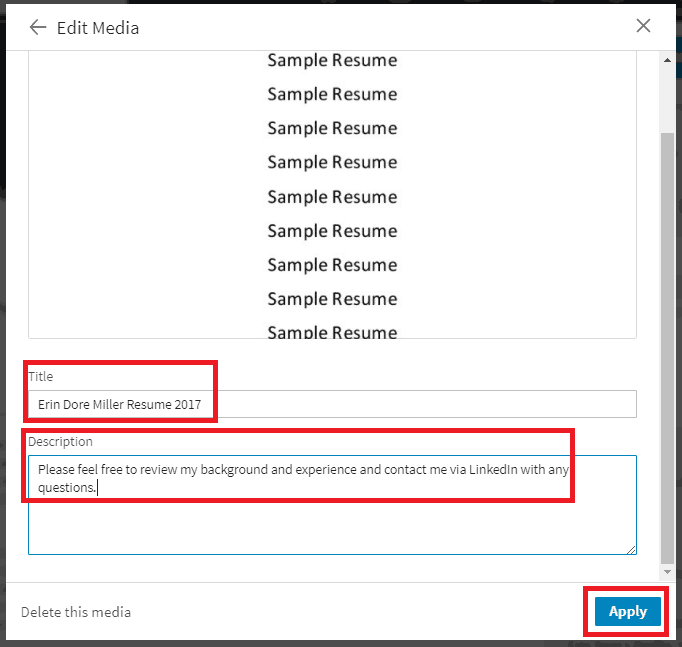
A dialog box will open, including the edit fields for the entire top portion of your Profile. When you scroll to the bottom of this box, you’ll see a “Media” section. In this particular case, you’ll want to click on “Upload” in order to upload your resume:

A new dialog box appears that will show you a thumbnail image of the file that you’ve uploaded.

From here, you can modify the Title and Description fields. These two fields are important because they are what anyone viewing your Profile will see when they find the thumbnail view of your resume:

Don’t forget to click on “Apply” when you’re finished editing these fields.

LinkedIn will then take you back to the original dialog box where you will need to click “Save” in order to ensure that your resume is posted to your Profile. They will see the thumbnail directly under your Profile Summary, like this:

If you’re actively seeking a new position, and have no concerns about being bold and putting that information out there, this is a great way to take an extra step and make the process just a little bit easier for recruiters, HR representatives and hiring managers. It also allows you to proudly share the work that you did in perfecting your resume!

Upcoming and recent college graduates – this is an excellent detail for you to include on your LinkedIn profile as you prepare to enter the job market. Your potential employers will eat this up, I promise.

16 Nov 18:20

Top 10 Business Start-Up Tools

by Samantha Martin

Having the right tools for your start-up can be invaluable to helping you get started. So here are 10 business start-up tools that I couldn't manage without

I’ve written before about the business start-up distractions you need to avoid. So I thought it was about time I shared with you the tools I could not live without in my business. Tools I wish I had known about from the start.

As my own businesses primarily operate online, most of the tools I use are based on content creation and social media management. But given that everything in business now is being geared towards being internet friendly, it’s even more imperative that business owners master not just these these tools but the online digital world in general.

MAILCHIMP

The key to growing your business is to start building your email list from day one. Amassing huge audiences on social media is great. Until said social media platform shuts down, boots you off or reduces your reach to about 0.1% of your following. If someone is brave enough to sign up to your email list then they have already made a significant investment in you/your business. You have a far higher chance of converting them into loyal customers. If you treat them well. Don’t go abusing the trust they have placed in you by handing over their email address for you to them spam the living daylights out of it. Do that and they’ll eventually unsubscribe.

There are all sorts of laws and rules when it comes to emails and some of these laws are set to get tougher next year. Personally, I’m hoping it will stop or at least reduce the huge amounts of spam I get every single day so I’m all for it. But when you start building your email list make sure you use a service such as MailChimp and ensure that every single person on that list has opted in correctly. Spam anyone at your own peril.

BUFFER/HOOTSUITE/SOCIAL JUKEBOX

The biggest excuse I hear for not maintaining social media accounts is that you don’t have time. I’m sorry but that excuse stopped being viable years ago. With tools such as Buffer and Hootsuite you can pre-schedule all your social media posts, curate a ton of content ready to go out and then just do the social bits. I use all 3 tools in different ways to ensure that my social accounts remain active and have a constant flow of relevant material.

I use Buffer to curate other people’s content to share with my audience. This will be blog posts and articles from trustworthy sources and reliable publications. With buffers queuing system it means that I can just click on something I like to add it to my Buffer.

I use Hootsuite to set up time specific posts. For example, if I post a new blog on a Monday I’ll then set up specific times that I want that blog post shared again to my social accounts, in 1 week, 1 month, 2 months, 3 months time etc. I also use it to set up my Instagram posts.

Both HootSuite and Buffer offer a free service if you are a light user with a couple of accounts.

Another great tool is Social Jukebox. I use this primarily for Twitter and only for my own evergreen content. I load up my own blog posts and nice motivational quotes (with my own images, not the contrived rubbish some pre-programmed tools offer) and it tweets them out at the rate per day that I set it to. Just remember to turn off the setting that sends out auto thank you’s and how many people followed and unfollowed you tweets. It makes you look like an amateur and it’s a social faux pas you should avoid.

Using these tools means that my business content is taken care of and I can then deal with replies and tweet about the stuff I’m interested in, like what’s on the tv or football.

CANVA

I love Canva. It’s probably the best £10 I spend in my business every month. I do use the upgraded version but there is a free version too. I am useless at using Photoshop but Canva makes it super easy to produce great images, size everything perfectly to each social media platform and create lovely downloads. Just everything. It’s really easy to use and there are loads of free images and icons you can use in there to make your graphics look highly professional. Honestly, try it, you’ll love it.

GOOD HOSTING

When you’re just starting out in business hosting probably isn’t something you put too much consideration into. Chances are you just go with the cheapest or one that has loads of advertising. But bad hosting can cause all sorts of problems for your business. Been there done that and didn’t like the t-shirt either!

Bad hosting can mean a slow website. This will hurt your search engine rankings. It can also put people off viewing your website and they’ll bounce off just as quickly as they’ve arrived. It can reduce the functionality you have on your own website. If you don’t get cPanel access to your hosting then perhaps look elsewhere. And make sure your mailboxes function properly. My last hosting company used to have a lot of outages, whilst still advertising a 99% uptime (rubbish!). Every time they went down so did my website and more importantly, so did my emails. It really doesn’t look professional when a client or worse still a potential client emails you and you don’t respond for a few days. Regardless of the fact you aren’t getting your emails because your damn hosting is down (again).

Likewise, stay clear of these build your own website packages some hosting companies offer. They usually come with very limited functionality and reporting tools. You may find you have very little SEO control and can’t add any custom CSS code. That may sound like a foreign language to you now, but further down the line, you will drive yourself mad when you can’t fix your rankings or add proper open graph data. When starting out, stick to self-hosted WordPress and you won’t go far wrong.

HARO/#JOURNOREQUEST

If you’re looking for a bit of media coverage and haven’t got a clue where to start when it comes to writing press releases or contacting journalists then HARO (Help A Reporter Out) is a great free service you’ll love. It’s an email service you receive 3 times a day with long lists of journalists looking for quotes or experts to talk about specific subjects. It can be quite USA lead but there are UK requests on there and worldwide ones too.

Also, take a look through the #JournoRequest on Twitter. These tend to be more UK focused and many are from publications you will know. Some of them even pay. You will have to wade through some rubbish on that hashtag unfortunately. Some (bad) bloggers use it to try and get brands to work with them (tip, it doesn’t work). But just mute or block these so they’ll stop appearing in your searches. Make sure your bio is clear and says enough to make the journalist want to reply to you. And perhaps lay off the abusive tweets so they don’t think you’re a raving lunatic when they look at your timeline.

YOAST

I’ve written before about SEO for your blog but essentially the same principles apply to your whole website. Using a tool like Yoast makes your SEO ten times easier and ensures you’re one step ahead of getting some search engine ranking. Even though there is a shift of traffic coming more and more from other sources, search engines can still be vital to getting your business found online. This also goes back to what I said about using WordPress when you’re starting out. Yoast is a plugin and guides you through so much of the vital SEO elements that you need.

CREATIVE MARKET

I’m no graphic designer. Nor am I that good with many design tools. Creative Market is great for picking up graphics, photos, fonts, themes and layouts at very reasonable rates. They have monthly bundle offers that are fantastic value and weekly freebies once you subscribe. These freebies are great and I’ve gotten loads of fonts there.

ELEGANT THEMES

Whilst we’re talking design things, I love Elegant Themes for website themes and some really great plugins. I’ve built all my sites on their Divi and Extra themes. Then I’ve done a ton of customising work and added child themes. You can either purchase an annual membership or a developers lifetime pass. Three years ago I didn’t have a clue about any of this stuff and would probably have paid someone else to do it. But as with all small start-up businesses I was bootstrapping the whole damn thing. I bought a membership and watched a load of their YouTube videos and learnt how to use Divi. I’m still not a master developer, but I’m confident enough to put together a website and do my own stuff. Probably saved me a small fortune in the process.

HAUTE STOCK

I’m no photographer and have to heavily rely on stock images for a lot of my work. I have a few free accounts (word of warning, never, ever use images straight off Google, never) but the images I like using tend to come from stock image website that I pay for. My favourite is Haute Stock. They just fit with the look and feel of my brand. And it ensures that I can stay consistent with the brand image I try to create. There are a few others that I use quite a lot but Haute is pretty much my first go to.

QUICKBOOKS

With all this talk of pretty pictures and fancy websites, it’s easy to forget the important stuff. Money. You’ve got to keep accurate records and stay on top of your accounts. I know this sounds really, really boring, but it is an essential part of running a business. Quickbooks have loads of solutions that can really help you keep on track and knowing your vital numbers.

START-UP BONUS TIP

Something that I have found invaluable throughout my business start-up and freelance journey is support. And I don’t mean your Mum. Or even your cousin that lives 300 miles away that likes every single Facebook post and tweet. I’m talking about other people that are in the same boat as you. Those who understand that Facebook reach is a massive pain in the backside or that some clients are a nightmare (read about the red flags to avoid there) and that this whole business thing is just one great big emotional rollercoaster of a journey. Those who will dust you down when you have a setback (which you will) and tell you to keep on going rather than telling you to give up and get a job. Find those people because they will be the ones that will keep you sane and on the right track.

And just get your Mum to make you tea and cake.

I’d love to know what your favorite start-up tool would be? Or what one bit of advice would you give to someone just starting out? Let me know in the comments below.

16 Nov 18:19

The ‘Big Five’ could destroy the tech ecosystem: Conor Sen

by Bloomberg News

How big can the largest tech companies get? How completely can they come to dominate the economy? The “big five” — Apple, Alphabet, Microsoft, Facebook and Amazon — now have a combined valuation of over US$3.3 trillion, and make up more than 40 per cent of the value of the Nasdaq 100 index. As the digital economy continues to grow faster than the old economy, it’s hard to see what can stop these juggernauts. Unless reality intrudes.

After all, what exactly is their business? Who are their customers? What role do they play in the economy? Each answer points toward some limit on the size, scale and profitability of these giants.

These companies are big for a reason: Nearly every aspect of the digital economy touches them in some way or another. We know that Facebook and Google represent a digital advertising duopoly. We know that Amazon is gobbling up more and more of e-commerce. Amazon, Google and Microsoft are leaders in providing cloud services. Apple sells high-margin smartphones and other computing devices. Put it all together, and you’re talking about hundreds of billions of dollars of annual revenue and tens of billions of dollars in profits.

What’s forgotten as these companies seemingly gobble up the rest of the economy is they remain dependent upon customers who get value from their services. Companies advertise on Facebook and Google only if they’ve determined it’s more profitable than not doing so.

Underlying economy

Cloud revenue requires the existence of profitable businesses that need business software and services. Third-party vendors choose to sell on Amazon because it’s profitable for them to do so. In other words, for the most part, the big five tech companies exist at their current size and scale only because they serve a larger underlying economy of profitable companies.

But the disruptive nature of the tech companies raises questions about how much they can grow. Because, in a sense, at some point they’ll only be able to grow by putting some of their customers out of business either directly or indirectly.

Consider a couple examples. Blue Apron, a meal delivery company that went public this year, has been a prolific advertiser online. If Amazon came out with a competing service that put them out of business, Facebook and Google would lose out on some advertising revenue, and Microsoft and Google (and Amazon) might lose some cloud revenue.

Another company, Fossil Group, has struggled mightily over the past several quarters as consumers have bought fewer watches, perhaps in part because of the Apple Watch. If the Apple Watch disrupts Fossil, Facebook and Google would lose ad sales from Fossil, and Amazon would lose Fossil watch sales as well.

Retail disruption

The retail vision put out by some tech optimists would be devastating to overall advertising revenue. Imagine it in the extreme: If Amazon put all physical retail stores out of business, and private-label goods replaced all branded goods, you’d kill the source of a large swath of advertising demand. In a sense, Amazon could partially disrupt Facebook and Google without ever competing directly with them.

These tech platforms and the companies they serve exist in an ecosystem, where there must be some sort of balance. Profitable companies can allocate only so much of their revenue to advertising, cloud services, information technology and the like. If their profits go away or are disrupted by tech companies, their ad and tech spending will go away. A few highly successful predators could decimate their ecosystem and wind up hungry.

Markets and the overall economy got in trouble by making a similar mistake about another sector — finance — a decade ago. Finance, like these tech companies, exists as a layer on top of an underlying economy. Markets became irrational about how profitable the financial sector could become relative to the underlying economy, and in response to these market pressures, finance came up with increasingly elaborate schemes to make money that weren’t sustainable.

We may not be quite there with tech yet, but as stock valuations climb higher and higher, tech will be feeling the same pressures that Wall Street did a decade ago. Expect a similar collapse of the ecosystem.

This column does not necessarily reflect the opinion of the editorial board or Bloomberg LP and its owners.

Conor Sen is a Bloomberg View columnist. He is a portfolio manager for New River Investments in Atlanta and has been a contributor to the Atlantic and Business Insider.

Bloomberg

16 Nov 18:19

Make pricing your strategic edge in 2018

by Steven Forth
blog_pricestrategy.png

Many of us are now deep in strategic planning for 2018. We are defining goals, setting priorities and marshaling resources. What role will pricing play in your 2018 strategy?

It is well known that pricing is the most powerful lever that companies can pull to improve profit. From the classic article, by Michael Marn and Robert Rosiello in Harvard Business Review,

"The right price can boost profit faster than increasing volume will; the wrong price can shrink it just as quickly. Yet many otherwise tough-minded managers shy away from initiatives to improve price for fear that they will alienate or lose customers. The result of not managing price performance, however, is far more damaging."

Price needs to be part of your strategic planning for 2018.

Before you can develop a coherent pricing strategy, there is some homework you will need to do. Make sure there is alignment on your overall strategy.

  1. We have a clear understanding of the tradeoffs between market share, revenue and profit and know what our strategy is.
  2. We have realistic targets for key ratios such as LTV/CAC (Lifetime Value of a Customer over Customer Acquisition Costs)
  3. We know our brand positioning and where we want to play on price and value.

Broadly speaking, you need alignment on your Winning Aspirations and your Where to Play Choices before you drop down into How to Win Choices. This framing is based on the work of strategy thought leader Roger Martin and is often referred to as Cascading Choices or Strategic Choice Structuring. See his page on this topic.

Cascading Choice

Pricing strategy connects your Where to Play and How to Win Choices. It does this by helping you define how you create value for your target segments and how you will capture your fair share of that value. To execute on pricing strategy you have to be able to answer the following questions.

  1. Who gets value from our offer and how do they get value? (This is fundamentally a market segmentation question. Pricing begins with market segmentation. If you do not have a meaningful and actionable way to segment your market your pricing strategy will fail.)
  2. What are the customer acquisition costs for each segment?
  3. What is the lifetime value of a customer in each segment?
  4. What is the cost to serve in each segment? (Your cost to serve is the money you will spend supporting the customer once you have sold them.)
  5. What are the current and future next best competitive alternatives for each segment? (That is to say, what alternatives do your potential customers have to your offer today? What alternatives will they have tomorrow?)

Once you have alignment with overall strategy and understand your target markets, you can begin to define your pricing strategy. At Ibbaka, we suggest working through the following questions to get to your pricing strategy. We have structured this as a conventional SWOT analysis (Strengths, Weaknesses, Opportunities, Threats).

SWOT


Strengths

  • Where do we have differentiated value? Who do we have it for?
  • What is our pricing power? How can we increase it? (The simplest way to understand pricing power is 'the ability to raise prices'. Just because you can increase prices does not mean you should. That depends on your strategic goals.)
  • What segments combines high Lifetime Customer Value with low Customer Acquisition Costs and low Cost to Serve?

Weaknesses

  • Where are we losing differentiation? (You can lose differentiation as your competitors catch up with you or as market needs shift and your differentiation becomes less relevant.)
  • Where are we undisciplined in our value communication or our discounting?
  • What do we not know about our customers, how they get value from our offers, what alternatives they are considering?

Opportunities

  • Are there quick wins we can implement on our solution that will increase differentiated value without driving up our cost to serve?
  • Are new segments opening up for us where we have strong differentiated value?
  • Are there opportunities to increase prices?
  • Can we improve the distribution of revenues across our pricing architecture (this is one of those areas that are hiding in plain sight, one can often get an immediate boost to profit and revenue by adjusting your fencing to get customers into the most appropriate offer.)
  • Can we improve our sales process to sell value before price and better manage discounting.

Threats

  • Are we losing differentiation in critical segments?
  • Are business conditions changing for our customers so that our offers are perceived as less valuable?
  • Will our competitors take a pricing action? (Lower list prices, discount more, launch a flanking offer?)

Pricing excellence can give you a strategic edge in 2018 but you will have to invest to get this edge. You will need to have a market segmentation that is unique to your offer and that reflects your value propositions and how your customers buy. Your pricing metric needs to track your value. The pricing and packaging model should be designed to deliver on your strategy. The sales model needs to communicate value and support pricing. Discounting needs to be strategic and disciplined (not reactive and random).

Ibbaka can help you to develop and execute on your 2018 pricing strategy.

Pricing excellence will help you deliver on your strategic goals.

SUBSCRIBE TO OUR BLOG
16 Nov 18:18

This Is What You Need to Know About Account-based Lead Gen

by Alice Heiman

Want to know how to make sales really hard? A long list of cold prospects in front of you and a phone in your hand. There is an easier way.

Let’s face it—selling doesn’t start until we have someone to sell to. It’s a simple enough concept, but you have probably already discovered that getting leads isn’t always easy. In fact, it’s so hard, that experts can’t even agree on the best or easiest way to get leads. One common way to look for leads is to cold call. Another common way is to rely on content-driven inbound leads. Some experts will tell you that referrals are the best way to find leads and others will say that the secret is account-based lead gen.

So, which way is the best? It’s different for every company, but what I can tell you right now is that account-based everything is all the rage. Does it work? I can tell you this, when account-based lead gen is properly implemented, it is incredibly powerful. So, I want to share with you how to create an account-based lead gen program for your company.

First, a quick and very incomplete history of account-based. A few years ago, Jon Miller, founder of Marketo, left to start a company called Engagio. Jon, still a huge supporter of inbound marketing strategies, realized that while companies were waiting for inbound leads, they were missing the opportunity to get the accounts with the highest potential. He said it was like the difference between fishing with nets and fishing with spears. Marketing’s job is traditionally seen as throwing out the net, while the sales team tends to do more targeted lead gen. Account-based marketing, as Jon describes it, is using the marketing team to support sales in targeted lead gen. Jon didn’t create the term, but he has led the effort to make it a recognized concept in sales and marketing.

Account-based selling is not a new concept. I taught account-based selling for Miller Heiman 20 years ago. Back then, we called is strategic selling or managing a complex sale. Regardless of if it’s account-based selling or account-based marketing, the key is to connect with all of the people involved in the buying decision. The best way to do that is to develop an interest using account-based lead gen.

In a Complex Sale, No One Decides Alone

Account-based lead gen means your team is focused on marketing and eventually selling to an account and the many decision-makers attached to it. This is important because complex sales don’t rely on a single person saying “yes.” The average B2B buying team is between five and six people according to CEB. So, if your sales strategy only focuses on one person, you are more likely to encounter objections and delays because you are not communicating with all the decision-makers.

Put Your Effort Where it Matters Most

The most successful account-based lead gen is the result of a joint sales and marketing effort focused on the accounts you most want to land. According to Marketo, companies are 67% better at closing deals when sales and marketing teams are in sync. That’s why these highly targeted and personalized campaigns are ideal for big prospects.

Some of the best benefits of account-based lead gen include:

More Money

Usually, deals that close as the result of account-based lead gen are bigger than those from inbound or outbound lead gen strategies alone. The average contract value of targeted accounts is 40% higher for mid-market and 35% higher for enterprise accounts, according to Demandbase.

Better, Long-Lasting Relationships

These deals are also more likely to have buy-in from a wider team, to lock out or constrain competitors, and to reach deeper into the account, according to Engagio.

Dramatically Improved Close Rate

By targeting accounts with your sales and marketing teams, you can also increase your close rate. For mid-market accounts, account-based strategies can result in a 166% higher close rate and that rate climbs to 285% for enterprise accounts, according to Demandbase.

A successful account-based selling strategy boils down to five steps:

  1. Select your list of target companies
  2. Research your target companies
  3. Find specific contacts
  4. Plan a multi-touch campaign
  5. Create content that supports the campaign
  6. Start Connecting

To help you plan your account-based lead gen strategy, I’ve created this free account-based lead gen guide to walk you through the process. You can download the guide below.

Account-based lead gen can help your business win big by focusing more energy on the prospects that will deliver the best results. If you want help developing an account-based selling strategy to take your company to the next level, our team can help. Call us at 775-852-5020 or schedule an appointment to speak with an account-based strategy expert.

The post This Is What You Need to Know About Account-based Lead Gen appeared first on Alice Heiman, LLC.

16 Nov 18:17

Shifting From Selling Services to Products: 13 Key Things to Keep in Mind

by Young Entrepreneur Council

What advice do you have for entrepreneurs shifting their focus from selling services to selling products?

Changing gears from selling services to selling products is challenging, as it requires more than a few changes. Here are some things you need to keep in mind before you make the leap.

1. Your Approach Will Need to Change

You’ve got to be careful. You will need a different temperament for products versus services. For products, you might need more investment to maintain the inventory and supply chain, while for services, you just need some portfolio and the skill to convince. Don’t use the same approach and set same expectation for products as you had for services. Also, you may want to shift gradually, rather than shifting all of a sudden. – Piyush Jain, SIMpalm


2. It Takes a Lot of Effort

Selling a product takes a lot more effort than you might have originally anticipated. Don’t underestimate how long it takes, and don’t underestimate how much value is needed to create. Just because it doesn’t work, doesn’t mean you can’t fix and improve it. – Solomon Thimothy, OneIMS


3. Connect the Two

There are many aspects of selling a service that can be brought over into the world of selling a product. I find that comparing the effectiveness of a product to a similar service helps to showcase the benefits of that product, especially if the comparison is favorable for the product. It demonstrates a high level of expertise in the field, and can even help to merge the two customer demographics. – Bryce Welker, Beat The CPA


4. Rigorously Test Before the Initial Release

With products, there is a physical component that’s hard to overcome if you do a poor job at it in the initial release. Software can be updated and fixed, but hardware or physical problems are expensive and timely to fix if you don’t do it right. Pay close attention to details, and make sure you test thoroughly to ensure the product holds up, before spending money on manufacturing. – Andy Karuza, FenSens


5. Hire Outside Marketing Support to Get You Going

Hire freelancers and outside help who know how to market products and sell them over services. At this point, you are not an expert, but there are people who are and they are available. It’s better to ask for help in areas you are unfamiliar with in order to make sure you get it right. – Zach Binder, Bell + Ivy


6. Understand Your Customers’ Needs

Make sure you know your customers’ interests, what they like, who they want to be, and what will ultimately move them to buy something. Once these are defined, make sure your products meet their needs. If you do that, when they want to make purchases, they will turn to your product. – Blair Thomas, eMerchantBroker


7. Never Stop Learning About What They Value

Never stop learning about the people you are trying to generate value for. It’s really the most important difference. When you were selling services, you created immediate value, but a product is not the same. You need to do a lot of research to know that this product will be truly valued by the market. You can make a product of the year, but if the customer doesn’t get value, then it’s useless. – Nicole Munoz, Start Ranking Now


8. Aim for High Customer Retention

Once you’re selling products, it’s very easy to become a commodity. Make sure that the product has a high customer retention and the relationships are sticky. For services you have constant interaction and it’s easy to forget that for products that’s not the case. Make sure your product is unique and your switching costs are high. You don’t get chances to save a client before they bounce. – Artem Maskov, DEVTRIBE INC


9. Focus on Existing Customers

Rather than doubling down on your marketing efforts to expand your audience, focus on product deliverables that will help you retain existing customer or new customers. This will support your bottom line as you lose revenue from the clients you’ve been serving previously, and pursue more ambitious growth marketing strategies. – Kristopher Jones, LSEO.com


10. Create Genuine Connections

When shifting from selling a service to selling a product I believe you should change your sales approach. You need to change why a consumer should only work with your services to creating an environment about a customer’s potential product needs. By understanding purchasing power, you will be able to create genuine connections. – Stanley Meytin, True Film Production


11. Create a Subscription-Based Business

Subscription-based businesses offer a lot of advantages over regular traditional eCommerce. The main advantage is being able to better predict future revenue streams by having a continuous stream of sales. Think of ways your products can be packaged together for specific niches, and form a month-to-month club. – Syed Balkhi, OptinMonster


12. Stay in Your Industry

Moving away from your field of expertise is a challenge that should not be underestimated. Mitigate the potential threats by sticking to what you know. One way to do so, when switching from services to products, is to stay within the same industry. You will benefit from the knowledge and contacts you have built during the years, creating immediate opportunities that otherwise would not be available. – Diego Orjuela, Cables & Sensors


13. Go All-In or Not at All

Trying to be a great service business and a great product person simultaneously is challenging, to say the least. Being a great product leader requires focus, dedication, and time spent with customers, as well as constant obsessing over the problem. If your time is split between running the service side, you’ll likely miss many of the key steps required to develop a product that people can’t live without. – Corey Eulas, Factorial Digital

16 Nov 18:16

Discovering your conversion hot buttons with dynamic personalization

by Mark Hall

5 easy steps to improve your ecommerce conversion rate using personalization tools, segmentation, interaction data (AOV and RPV) and campaign split testing

As a marketer you’re always seeking the holy grail that will grow your revenues, that insight that tells you exactly which design updates are increasing your ecommerce website’s key conversion metrics like conversion rate, average order value (AOV) and revenue per visitor (RPV), and - equally importantly - which are not!

The good news: 2017 is an awesome year for conversion optimization tools. We’re now way beyond the ‘seeing’ part - voyeuristically seeing what visitors are doing, where they most click and scroll. Now, by investing in a personalization platform, you can analyze your visitors’ specific interactions, and understand which of them correlate with higher conversions and revenues.

Below I share the five steps for doing this.

Access premium resource – Web Personalisation guide

This guide explains how to create a strategy and implement personalisation by showing you the options for delivering more persuasive, relevant dynamic web content at relevant points in the onsite customer journey for B2B and B2C sites.

Access the Website and Ecommerce Personalization Guide

1. Integrate a tool

The first step to better conversion insights is integrating a dynamic personalization tool. These tools not only allow you to tag and track events, as you would with a conventional analytics tool like Google Analytics. They allow you create any custom visitor segments you want, and report on them, so you can understand which aspects of your user experience (UX) design most positively affect your conversions.

The list of dynamic personalization tools out there is pretty long and includes:

  • Evergage
  • Dynamic yield
  • Optimizely
  • BarillianceRich Relevance
  • Google Optimize

For a comprehensive list of 28 website personalization and recommendations software tools, Dr. Dave Chaffey gives a full breakdown covering; personalization integrated with web analytics, personalization Software as Service (SaaS) for Ecommerce, personalization features available as part of CMS or Commerce management systems and B2B, marketing automation and publisher website personalization tools.

Don’t be overwhelmed, just devote a few hours to evaluating the tools and choose the one that best fits your staff capabilities and budget. Regarding cost, based on my experience using Evergage, Optimizely and Google Optimize, for most sites, the cost is under $4K per month. As I’ll show you later, this is a modest investment compared to the significant revenue gains you can expect to achieve within a few months of plugging in these tools.

2. Tag all interactions you might care about

As management guru Peter Drucker said, ‘What gets measured gets done.’ In the world of conversion rate and revenue optimization, this means that you can only report on and learn from the user interactions that you are actually tracking. So be sure to tag every event that you feel may be useful when you do your downstream analysis.

For an ecommerce site, this means going beyond product views, adds-to-cart and ‘start checkout’ clicks to include nearly all category, product and cart page ‘micro conversion’ interactions (interactions that lead to downstream macro conversions). For a lead generation site, it means including all fields, links, and buttons both in the form ‘action’ panel and the clicks that lead visitors to this form. Think of the full UX journey leading up to the final conversion click and you’ll be on the right track for event tracking.

3. Create a bunch of segments

Once you have all key interactions tagged, you can start creating segments. If you’re not familiar with segments, think of them simply as groups of visitor interactions, defined by a set of rules. One segment could be ‘Visitors who used chat in any session.’ Another could be more specific, such as, ‘All visitors who used chat within the last 14 days, And who purchased one or more products’. With this last segment, you’ll later be able to compare these chat-engaged purchasers to your broader set of buyers.

As you can imagine, there are literally hundreds of segments you can think of. The key is to think of the combinations of visitor behaviors that you’ll most want to compare after the tool has been installed and processed enough data. If you can’t think of all possible segments at the onset, don’t worry. Unlike with event tagging, you can always add more segments later.

Lastly, don’t forget to create meaningful ‘benchmark’ segments. For the example I just mentioned, it’s not meaningful (in fact, it’s misleading) to compare chat purchasers to all visitors. To see the most relevant conversion and revenue numbers, you’ll need to compare these chat purchasers to visitors for which the chat feature existed (the set of visitors who could have used chat).

4. Find the correlations by running reports

After you have tagged your key interactions and defined the segments you want to report on, you’ll be in waiting mode for a couple weeks or so (depending on your site’s traffic levels) for your personalization tool to collect enough interaction data. Then you can start running reports.

As an example, here are the reports I created for a seller of surveillance equipment:

  • Report comparing average order value (AOV) and revenue per visitor (RPV) of visitors who used either the global (header) or product page chat feature to visitors who had been on the site for 60 seconds or more (were at least minimally engaged) and did Not use any chat.
  • Report comparing AOV and RPV of visitors who had viewed one or more product videos to visitors who had been on the site for 60 seconds or more and were exposed to a video on either a category or product page but did Not click a video.
  • Report comparing AOV and RPV of visitors who had started a ‘product finder’ to visitors who had been on the site for 60 seconds or more and were exposed to a category page that contained a product finder button but did Not use it.

When I ran these reports I discovered these amazing ratios:

  • For Chat: The revenue per visitor (RPV) was 3.9 times higher for visitors who used the chat feature.
  • For Videos: The RPV was 1.7 higher for visitors who viewed one or more videos.
  • For Product Finders: The RPV was 2.2 times higher for visitors who started (but didn’t necessarily complete) a product finder

Now, here’s how these insights turned into conversion gold. By knowing the superpower of chat, we made the chat element more visible on the product pages. To increase usage further, without annoying too many visitors, we pushed a chat invite after 20 seconds to less engaged visitors. After doing this we saw both usage and the associated revenues increase.

We made similar UX updates for the video and product finder experiences. Altogether, this resulted in $640K in annual revenue lift, which far exceeded the client’s investment in marketing consulting and the personalization tool ($108K). That’s a 490% ROI! And, of course, the revenue gain was recurring every year, while the investment was completed in six months.

5. Run some split test campaigns

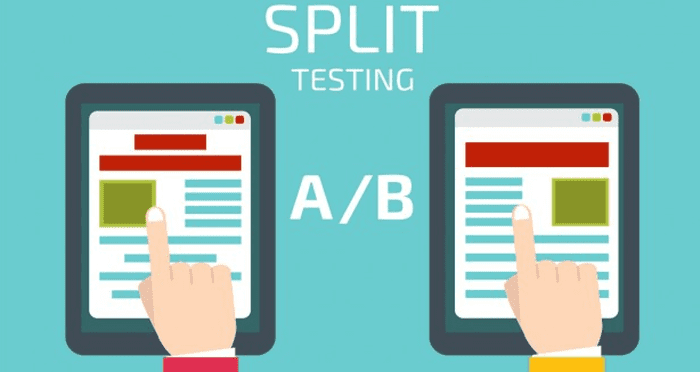
While the above analyses were done on a manual basis, many personalization platforms allow you to run split (A/B) or multivariate tests in an automated way. You’ll still need to do the tagging and set up the segments. You’ll also have to create alternate versions of creative (e.g. the chat feature UX) so the tool can serve up the different versions to your visitors. Then you just need to wait a couple weeks for the results to roll in.

Split testing

In the meantime, you can start envisioning other tests you can run. You can even run these other tests at the same time, as long as they don’t interfere with each other (involve the same UX elements). In no time you’ll have a collection of campaigns that you can learn from, even if they don’t push the conversion, AOV and RPV needle upwards. Remember, negative learnings are just as valuable as positive ones on your conversion improvement roadmap because they confirm what you should not be wasting time on.

Summing up

Guys, if you could learn which of your gifts make your spouse the happiest, you’d want to know, right? If those $50 flowers only made her happy for a week (until they wilted), but that $100 necklace kept her in the romantic mood for months, you’d soon be buying her more bling than flowers.

While this jewelry-affection correlation is subjective and may take the average guy months, even years, to discover, with an off-the-shelf dynamic optimization tool you can get quantified UX to conversion rate, AOV and RPV correlations in a matter of weeks or months. Yes, these tools will cost you a few thousand a month, but, if your website has significant traffic, you’ll likely see a 300% or higher ROI within a few months. And this payback on your investment, along with the associated revenue lifts, will soon have your marketing leadership singing your praises.

Access premium resource – Web Personalisation guide

This guide explains how to create a strategy and implement personalisation by showing you the options for delivering more persuasive, relevant dynamic web content at relevant points in the onsite customer journey for B2B and B2C sites.

Access the Website and Ecommerce Personalization Guide

16 Nov 18:16

How to Use Email Marketing to Build Brand Awareness

by Guest Post

How to Use Email Marketing to Build Brand Awareness written by Guest Post read more at Duct Tape Marketing

Employing an effective email marketing strategy is an essential tool for building up brand awareness.

Many online businesses tend to view email marketing solely in terms of sales.

However, building strong relationships with an email list is one of the best marketing strategies for increasing sales performance and strengthening the position of a company.

When employed well, email marketing can:

  • Foster serious customer loyalty by creating direct links with consumers
  • Leverage ROI of any marketing campaign
  • Establish a brand as a reliable reference point for consumers
  • Decrease email list unsubscribe rates

 In short, email marketing provides one of the most powerful tools for encouraging long-term habitual interactions with a brand.

In this article, we will take a look some highly effective methods for reinforcing brand awareness using email marketing.

These are tried and tested methods for creating trust and authority and building email marketing campaigns that really add value to consumers’ lives.

What’s great is that you can begin using these methods in your email marketing strategy right away!

Why Email Marketing Is Essential for Building Brand Awareness

Email marketing is one of the most cost-effective marketing mediums.

It provides businesses with the opportunity to target customers in the place they visit every day – their inbox.

When a user subscribes to an email list he or she has shown a desire to engage with a brand.

This makes them a highly valuable lead and the research backs it up:

  • 66% of customers make a purchase as a result of an email marketing message – Digital Marketing Association
  • Email is almost 40 times more effective than Facebook and Twitter combined in helping your business acquire new customers – McKinsey
  • Email marketing yields an average ROI of $38 for every $1 spent – Email Monday

Why is this so?

Because email offers brands the chance to reach loyal customers regularly and directly.

Of course, developing brand awareness among other marketing channels, such as social media and SEO, is important.

However, the fact is that none of the other mediums provide the direct, consistent interactions that email does.

Simply put, it is the most important component to any brand awareness building strategy.

 5 Techniques For Developing Brand Awareness in Email Marketing Campaigns

#1 – Personality and Tone of Voice

Should a brand be serious or friendly? Scientific or colloquial?

The personality of a brand’s marketing communication should be consistent with all points of contact with the consumer.

By keeping to a tone that is representative of its values a brand will instill confidence and reliability in the eyes of their customers.

#2 – Email Campaign Template

Humans are pattern-seeking mammals.

It is precisely this need for pattern recognition that forms the foundation for solid brand awareness.

The easiest way to establish this is with an HTML email template that is in line with the company’s objectives.

It is important to consider the following:

  • Do the fonts, colors, call to action and layout match those of the business?
  • Is the logo being used correctly?
  • Are the company details clearly displayed?
  • Does the email message contain a personal signature or the company name?

Email marketing templates are an opportunity to reinforce brand recognition.

Making an email instantly recognizable will encourage consumer confidence.

#3 – Make Sure That Your Email Campaign Converts

Typically email newsletters that contain graphics tend to perform better than the text-only transactional type.

In addition, users are more likely to open messages from brands they recognize. So be sure to include the company logo.

A compelling image in the top area of the email is one of the best ways to get a brand’s message across and will often determine if the email gets read or deleted.

Don’t forget to include just one “call to action” so that the receiver knows exactly what to do.

A further tip would be to split test all email campaigns. A split test could include testing a different “call to action,” graphic or layout.

The important point is to always optimise the weaker performing campaign to push up those conversion rates.

#4 – Send Out A Welcome Email

The Welcome Email is a great chance to set the tone for all future email correspondence.

Amazingly, there are still many online businesses that don’t use it.

The first few emails are typically the ones in the follow-up series that get the highest open rates – so why not make use of them?

Informing the newly subscribed user what to expect from future email correspondence will make a brand feel much more personal.

To really make a subscriber feel worth something it could be a personal note from the CEO.

You could also offer them a chance to choose the volume of email correspondence they would like to receive (weekly, monthly, etc.).

This would let the customer feel not only that they were more involved but also that they are not about to get bombarded by emails that they are not likely to engage with.

The email could contain a selection of links to choose from and then transfer the subscriber to different lists or add tags based on the links that they click.

From a marketing perspective using an email message to segment users in this way can present many opportunities for email personalization further down the line.

#5 – Create a Matching Landing Page

The email marketing sales funnel is not complete without a landing page that’s customised to match the email template.

From the customer’s perspective there is nothing worse than being presented with a scintillating offer, eagerly clicking on the “call to action” in the hope of redeeming the offer, only to be directed to a landing page where it’s hard to find the offer or worse still one that doesn’t contain the offer at all.

Keep it simple.

If the email and landing page is asking for the customer to carry out a specific task, make sure that they know what that task is and that they are able to perform it.

#6 – Avoid Continuous Sales Pitches

Email campaigns are a simple way to communicate that a brand is an authority in their niche.

A brand that is only interested in sales will find that their email drop off rate is high.

The best way to ensure that customers remain loyal and will bring repeat custom is to offer solutions to problems that they are facing.

By offering solution-focused email content customers will not only remain engaged with the brand but will be eagerly awaiting the next email follow up.

The sales will come later.

#7 – Send Emails Regularly

We spoke earlier about being consistent with branding and tone.

Make sure that you are also consistent with sending.

For example, don’t bombard subscribers with 10 emails in one month only to send them 1 the following month.

Remember to create a scenario where they are looking forward to a message from you.

This way you keep them interested and keep the trust alive!

 #8 – Segment and Personalize

Any company not working on list segmentation and deeper personalization are missing out on a method for solidifying brand awareness.

Segmenting an email list into highly targeted micro-segments allows for more customer targeted product marketing.

Consider that your business is a Day Trading Portal that caters to traders of all levels.

By creating segmented lists of say, beginner, intermediate and advanced traders you now have the opportunity to target each trading group personally.

Rather than alienate beginner traders by sending them advanced trading material the business has the opportunity to nurture the customer by way of beginner trading tutorials, tips, and strategies.

Similarly, the more advanced traders can be kept engaged with updates about various trading platforms, specific trading events, and more advanced investment strategies.

Email marketers interested in optimizing conversion rates have identified personalization and segmentation as conversion stimuli in email content for some time now.

The benefits for brand awareness include minimizing the unopened email rates, decreasing email list subscriber drop off and fostering confidence in the customer that the brand really understands what each individual customer needs.

Conclusion

 The key to developing brand awareness through email marketing lies with consistency, providing solution-focused content, personalization, and highly optimised campaigns.

 A well thought out email campaign can run for many months and keep customers coming back for repeat visits and repeat conversions.

If you’re not employing your email marketing strategy to its full potential it’s time to get to work on content and mailers and start thinking about how to keep those customers coming back.

Never before has there been a greater medium for keeping customers engaged!


About the Author

Simon James Simon James is a Marketing Consultant. He owns a Marketing Agency and Hosting Company. In addition, he runs the blog AffexPro, a tech blog focusing on Hosting, Email Marketing, Affiliate Marketing and SEO.


16 Nov 18:15

9 Ways to Know If Your Content is Actually Interesting and Valuable

by Josh Ritchie

StockSnap / Pixabay

The urge to talk about how good your products or services are is real, which is why too many marketers are “selling” in their content. It takes discipline to stop this habit, but it’s crucial if you want to do good content marketing. Instead of selling, you need to tell the right stories to bring people into what you and your brand are doing (your experience, your expertise). But what does that really look like? Here are the 9 elements of truly good content. Stick to these, and people will feel personally connected to your brand—not pushed to buy.

1) It Spotlights Benefits (Not Features)

If you’re hoping to engage people with your content, you want to frame your stories in the most enticing way possible. It’s not about what you offer people but how it helps educate, improve their lives, or solve their problems. Keep content focused on those types of benefits—not the features.

2) It Tells a Story that Hits the Sweet Spot

Your sweet spot is the thematic overlap between what your brand has earned the right to have a perspective on and what your audience cares about. It is the big idea that you and your audience can bond over.

Your sweet spot stories are those that:

  1. Your brand can tell well.
  2. Your customers want (or need) to hear.

If you stray outside this zone, your stuff may be too broad or too uninteresting. (Learn more about how to stay inside your zone.)

3) It’s Designed for Good Experiences

Most marketers aren’t trained in visual design. They’re not thinking about what the brand looks and feels like from the customer perspective. But good design is vital to good content because designers are always thinking about the end-user experience. They care deeply about brands and brand integrity, and they understand better than others what it means to be off brand and on brand. Most importantly, good designers care about the “why.” (Here are 4 ways to train yourself to start thinking like a designer.)

4) It Knows When to Market and When to Sell

What’s the difference between marketing and sales content? Marketing shows who you are and why you’re unique—without you having to come out and say it.

Sales, however, includes an articulation of why people should ultimately give you—not your competitors—their business. It helps people make their purchasing decisions more easily. For marketers, it’s important to know when and where to introduce people to each type of content.

5) It’s Bullshit-Free

Wouldn’t the world of content marketing be a better place if marketers eliminated the BS and valued other people’s time as much as they valued their own time? Is that even possible? It absolutely is.

We’ve been greatly inspired by Josh Bernoff’s book Writing Without Bullshit, which is a refreshing kick in the backside and a good reminder that we don’t have to write the same bad shit as everyone else. (To apply this mentality your own stuff, here are 5 simple ways to take the BS out of your content marketing.)

6) It’s Shaped by Culture

A lot of marketers are slave to the editorial calendar, which is understandable to a point. Editorial calendars provide a documented plan for ownership, process, what you’re working on, and in what sequence. But building out a thriving content practice isn’t just about what’s on the calendar; it starts from within your organization.

Great comes from a creative environment that encourages ideas and experimentation, so it’s important to cultivate a culture of content at every level.

7) It’s Made for People, Not Brands

People don’t care that you’re “doing” marketing. They care that you’re thinking about them. To make sure you are, you should regularly review your strategy, including what you’re creating and why. Above all, you need to produce content that provides value to the people you’re trying to reach.

That means vetting your ideas, refining concepts, finding the right angle, and writing headlines that will communicate that value.

8) It Uses Personas

Pursuing content marketing without having clear personas in mind is a waste of time. In that case, you’re just making shit up with the blind hope that someone, somewhere will come across what you’ve created and maybe like it.

If you want people to connect to your stuff, you need to get inside their minds and identify the problems they deal with, their frustrations, desires, etc. You need well-crafted personas that include this information so that you can come up with the right content ideas to address the things they care about.

9) It’s Shaped by Empathy

Empathy is the opposite of talking about yourself, your services, your pricing, and how great you are.

How do you create empathetic content?

  1. Decrease the amount of selling.
  2. Increase the amount of time listening to and thinking about your customers.

This doesn’t mean you can’t ever ask your audience to sign up for a newsletter, download an e-book, etc. It just means that the selling approach is minimized so that customer-centered content can be integrated into your marketing strategy.

While these tips are all useful, the most important thing you can do to create good content is stay educated. Keep on top of industry trends, have open conversations with your team, and do as much legwork as you can to get inside the minds’ of the people you’re trying to reach.

16 Nov 18:14

How to Nurture Your Social Networks For Better SEO

by Susan Gilbert

Improve Your Social Networks for SEO with These Tips

How to Nurture Your Social Networks For Better SEO

The days of relying on just websites to build a strong search engine strategy are now long gone. Today it’s all about who shares your URL and drives visitors to your site through the various social networks.

For the last few years, Google’s focus has been to eliminate spam websites and to crawl content that is original and conversational. Readers and social media followers are increasingly turning away from direct advertising and affiliate links and demand a more human approach.

A website that ranks well passes all of Google’s latest requirements through the following factors:

These elements not only please Google, but also attract those all-important social media shares. Here’s how to put this into action:

1 – Install social icons strategically

Just about everyone knows it’s important to install social buttons, driving people to “Like”, share your posts or “Follow” you on social media. But not everyone makes the most of this SEO boosting strategy. Thousands of website owners install plugins such as Sumo into their WordPress websites, but these need to be customized for the following reasons:

  • They might disappear below the fold
  • Are not prominent enough or are missed by more eye-catching content
  • Are in a place the eye skips over
  • The icons are too small

It’s important to make sure your social share buttons, badges and icons appear in the best location. They should be so attractive that people can barely resist the impulse to click on them.

Proven tips that work:

  • Place them in sidebar widgets (making sure they appear above the fold, preferably in the right-hand upper side of the page)
  • Place them under web contact forms or contest announcements
  • Choose plugins that allow you to put them under or on top of each post
  • Study top websites and decide which placements are the most effective

Once you’ve done the latter, decide which types of placement would work best for your particular website layout – and purpose.

Only include the most relevant social networks to your target audience, like this example from my client, Beverley Glazer of Reinvent Impossible.

Your readers will be more apt to share website content if you make it one-click easy for them.

2 – Create a mix of your content media

An attractive website includes both text based content and interactive or video content including infographics.

This allows you to use your website to inspire and drive visitors to your:

  • Facebook Page
  • Pinterest boards
  • YouTube channel
  • SlideShare presentations
  • Facebook Live videos
  • Twitter chats
  • Instagram campaigns

The more organic traffic that flows between your social sites and websites, the higher your Google search rank and the more visibility Facebook and other social networks will grant you.

3 – Maintain regular, natural social site activity

Interact on your social media daily and regularly. Don’t bombard your fans and followers with a large string of tweets and posts – but do be consistent, especially in responding and posting. People should never see “3 months ago” on your last feed.

The main goal should first be in building authentic relationships, which in turn drives more traffic to your website. Remember that less visitors means less shares from your site.

4 – Facebook sponsored posts

Now that organic reach has greatly diminished on Facebook brands now need to turn to the Sponsored Posts feature in order to grow their Fan pages, which can still be linked to your website.

You can create these out of any of your top performing posts such as photos, videos, a recent article, ect.

Here’s a rundown on exactly how this works from Facebook:

You can even promote your event through a Page Post ad – and you can have these shown to anyone on Facebook, even when the people seeing it are not connected to you through Facebook friends, Groups or Pages.

5 – Maximize your Pinterest potential

One of the best ways to ensure your website content gets shared is through pinning your posts on Pinterest. Not only does this mean adding the “Pin it” button to your images, but making it easy for them to find your profile and boards on your landing page.

Make sure your images are well optimized and sized correctly though tools like Canva or PicMonkey. These will allow you to create your own “pinnable” graphics that stand out to your followers.

Infographics are also popular on this platform — you can easily create these yourself using templates from apps such as Visual.ly or Piktochart. Or you can simply hire someone to create your infographic for you.

6-piktochart

When you post your infographic on your website you can increase your website traffic and shares not only on Pinterest, but also on places like Tumblr, Facebook, and Google Plus.

6 – Make use of SlideShare

If your demographic is younger than 35, you should especially use SlideShare, which is in the ballpark with the top sites previously mentioned on Alexa graph comparisons, currently ranking 143 globally – a top rating.

Write a post on your topic featuring the link to a SlideShare presentation summarizing or clarifying that topic.

Just make sure you optimize your slides with large print and a minimum of distraction, since SlideShare also comes in a mobile version.

7 – Provide What They Need

Ensure your content provides a useful balance. This means including different types of content:

  • Evergreen content – Posts that are always “in season” and relevant
  • Up to the minute “hot” content – breaking news, new methods, changes (especially to social media, if that’s relevant to your niche)
  • Resources visitors will return to access – infographics, lessons, diagrams, charts, templates, apps (e.g. calorie calculators) and checklists
  • Sign-up incentives – Reports, templates, checklists, tip sheets

By optimizing your website content and making it more shareable on social media your business can improve your search engine rankings as well as visibility in the major networks. The new SEO process is now tied to this marketing method, especially as content becomes more visual and interactive.

16 Nov 18:11

9 Ways to End Your Sales Presentation With a Bang

by afrost@hubspot.com (Aja Frost)

A brilliant presentation is worth nothing if you don't bring it home with a powerful close — that said, many salespeople still struggle with how to end a presentation. Most sales presentations end with a whimper rather than a bang, taking a major toll on prospect's interest and enthusiasm.

To help you add a little extra oomph to your presentations and consistently end pitches on a high note, we've put together some tips for closing sales presentations — complete with some helpful examples.

Download Now: How to Perfect Your Sales Pitch

1. Go back to your opening anecdote or idea.
2. End with a challenge.
3. Invite your audience on a metaphorical mission.
4. Use repetition for a dramatic close.
5. Offer inspiration.
6. Surface their objections.
7. Tell a story.
8. Ask an unusual question.
9. End with a quote.

1. Go back to your opening anecdote or idea.

Starting a presentation with an anecdote, analogy, case study, or thought-provoking idea can set things off with an intriguing tone — and referring back to that point at the end can add an element of compelling cohesion to your pitch.

For example, let's say you're presenting on behalf of a company selling a conversation intelligence platform to an enterprise-level prospect. You might start with something like:

"Client X's sales development team was qualified, competent, and motivated. SDRs were reliably connecting with prospects, but their conversion rate was hardly over half of what leadership wanted to see. That's where we came in."

Then, you would give your presentation — offering an overview of your product, value proposition, specs, and tailored solution. Once you've covered those bases, and it's time to wrap things up, you could say:

"Remember Client X? Well, after implementing our solution, they were able to refine their messaging, provide reps with better-informed coaching, and identify the most resonant pain points prospects were consistently raising. All told, they more than doubled their conversion rates on calls while maintaining their existing cadence."

That kind of "closed loop" synchronicity is clean and interesting — that's why bringing everything together with a self-referential nod to the beginning of your presentation is one of the better ways to cap things off.

2. End with a challenge.

how to end a presentation examples ending with a challenge

Leaving your prospects with a dramatic, open-ended challenge is one of the most effective ways to keep yourself top-of-mind after your presentation ends and motivate a buyer to act.

For instance, you might say, "Are you going to let another month pass by without addressing the crippling communication issues on your team? This is your opportunity to change things. Don’t wait."

But be careful, you need to tread lightly if you decide to go this road. Read the room and exercise caution. There's always a thin line between confidence and arrogance, and if you cross it in front of the wrong person, you could be in trouble.

If you're too brash and challenge a prospect with an "alpha" personality, you might wind up rubbing them the wrong way and do more harm than good. If you have even the slightest suspicion that your buyer might not be receptive to this tactic, go with another one.

3. Invite your audience on a metaphorical mission.

This tactic is sort of a spin on the point above — one that's a bit more collaborative and less confrontational. Instead of challenging your prospect, ask them to join you on a mission or journey.

You might say something like:

"More than 5,000 companies have decided to leverage our solution and invest in their employees' health. Are you ready to join them?"

It's more inspirational than a direct challenge but a little less frank — sacrificing some directness in the interest of caution. Still, when done right, it can inspire action.

4. Use repetition for a dramatic close.

Research shows repetition improves a child’s ability to recall new terms — in other words, if they hear an unfamiliar phrase multiple times, they’re more likely to remember it than if they only heard it once.

But that trend isn't specific to kids — the same principle applies to adults. A repetitive rhythmic close is memorable, but its value doesn't stop there. It can also be high-energy and engaging.

Not sure what this would sound like? Take a look at this example:

"If you don’t have transparency, you don’t have trust. If you don’t have trust, you won’t get honest feedback. If you don’t get honest feedback, you’ll develop blind spots. If you develop blind spots, you’ll make poor decisions, lose talented employees, and miss crucial opportunities for improvement."

5. Offer inspiration.

A well-chosen quote can tie your entire sales pitch together and help put things in a new light for your prospect.

Let's say you're selling a new CRM to a midsize business. The buyer is interested, but they know implementing a new system could be a long, challenging process.

With that in mind, you might close with something like:

"Look, I know the thought of changing CRMs is probably scary. But I think one of my favorite Warren Buffett quotes applies nicely here: ‘Should you find yourself in a chronically leaking boat, energy devoted to changing vessels is likely to be more productive than energy devoted to patching leaks.’

In the long run, this switch will save your company a lot of time, money, and effort."

6. Surface their objections.

how to end a presentation examples surfacing objections

When you sense your prospect isn’t quite convinced — or they’re not being completely open about — you can try ending your presentation by digging for objections.

HubSpot sales reps use this question: "What would stop you from moving forward?"

You can also try, "If you decide not to buy, what would the reason be?"

The thought of being so direct can be nerve-racking, but you need to keep the fact that your prospect's objections exist — regardless of whether you probe for them. Those concerns are real and will likely come to light eventually, and you can't resolve them if you have no idea what they are.

7. Tell a story.

how to end a presentation example telling a story

A story is one of the — if not the — most powerful communication vehicles salespeople have at their disposal. Telling a story makes your message more compelling, digestible, and emotionally resonant.

I recommend telling a hypothetical story of your prospect’s life after they’ve bought your product:

"It’s [date four months in the future]. You’ve been using [product] for [X use case]. [First pain point], which used to swallow up hours of your week, has been completely eliminated. [Second pain point] has been reduced to a 15-minute task every month. And your boss is completely thrilled with [Y results]."

By framing your presentation with immersive descriptions of the results your prospects can expect to see, you're helping them mentally place themselves as existing customers. If you can do that convincingly, this tactic can go a long way.

8. Ask an unusual question.

You don't have to cut your presentation short by asking, "Does anyone have questions?" Instead, try turning the tables by asking an anything-but-ordinary question at the end of your presentation.

This will jolt them back to the conversation at hand and give you a unique entry into the final portion of your presentation. Here are some example questions:

  • "How did I change your worldview or perception?"
  • "Based on what you've just heard, would you buy today? Why or why not?"
  • "What's changed between now and when I began this presentation?"

The conversations prompted by these questions are sure to be more interesting than an ordinary close. And it might go without saying, but you still have to follow up by answering any questions they have.

9. End with a quote.

Whether it's a killer client quote or your favorite Dylan lyric, ending with a thought-provoking line will cause your audience to pause.

From there, take a few moments to ask how the quote resonated with your audience and what it made them consider. They might have offering-related thoughts — or share something completely unrelated to your business.

The point of this exercise is to snap them out of the end-of-presentation daze and get them excited and inspired to think bigger. Choose the right quote and spur your prospect to action at the end.

Here are a few other presentation ideas:

Sales Presentation Ideas

  1. Share a unique "vision statement" for your prospect - Wow your audience by sharing a personalized vision statement for how you see your offering changing their work and their business.
  2. Nix language-heavy slides for images - Go easy on the eyes and provide images narrated by your key points.
  3. Use movement and gestures - Avoid a rigid, unmoving stance. Use natural or slightly animated gestures to give your presentation life.
  4. Include video or animation - You never want to distract from your main points, but a well-placed video or custom animation can help rather than hindering your presentation.
  5. Don't shy away from emotion - When appropriate, share a joke, a personal anecdote, or passionate story.
  6. Always personalize your presentation - Keep things relevant for your audience by customizing every presentation you give.
  7. Tell stories using your data - You know what's less boring than a slide full of bullet-pointed numbers? You telling a story with your data.
  8. Ask questions throughout your presentation - Make things interactive by engaging regularly with your audience and asking for their thoughts and opinions.
  9. Make examples personal - Reminding your audience of your humanity is crucial for them to feel connected and sympathetic to you.
  10. Use music - "Music embedded throughout a PowerPoint presentation can sustain attention, while slipping content into long-term memory," says Ronald A. Berk of The Johns Hopkins University

With these creative and effective ways to end and facilitate a sales presentation, your close rate is bound to improve.

Sales Pitch

16 Nov 17:57

260 Sales Terms From A – Z: The Updated Glossary of B2B Sales Definitions

by Max Altschuler

With the rise of AI, new sales technology and automation at the forefront of the sales echo chamber these days, we thought we’d take a moment to bring it back to BASICS – that’s why we’ve rounded up this complete glossary of sales terms and definitions to help you remember where it all started.

This practical sales glossary is meant for anyone in sales who needs to refresh their memory on the most commonly used sales terms – especially new reps who are still learning the playing field.

We’d also recommend this guide for any sales managers or business development leaders who are onboarding new reps. This sales glossary is meant to reduce ramp time for new reps that are getting immersed in B2B sales jargon for the first time.

Editor’s note: Special thanks to Acceleprise for helping us define these sales terms!

A

  • ABC
  • AB Testing
  • Account
  • Account-Based Everything / Revenue
  • Account-Based Marketing
  • Account-Based Selling / Sales Development
  • Account Development Representative
  • Account Executive
  • Accounts Payable
  • Accounts Receivable
  • Accredited Investor
  • Amortization
  • Analytics
  • Annual Recurring Revenue
  • Application Program Interface
  • Applicant Tracking System
  • Artificial Intelligence
  • Average Contract Value
  • Average Sale/Selling Price

ABC (Always Be Closing)

It is a sales strategy rooted behind the idea that every step a sales rep takes throughout the sales process aims towards closing a sale.

AB Testing (or Split Testing)

AB Testing (or Split Testing) is an experiment involving two variants, usually for measuring and comparing the market response to each. For example, you can measure visitor traffic or conversion rate on two different web pages having similar content and purpose.

Account

Account refers to a record of primary and background information about an individual or corporate customer, including contact data, preferred services, and transactions with your company.

Account-based Everything (ABE)

Account-based Everything (ABE) or Account-based Revenue (ABR) is a framework that entails full coordination of customized care and management of targeted customer accounts across all relevant units of your organization (such as marketing, sales, finance, and product development) as well as the entire customer life cycle from lead generation to after-sales support.

Account-Based Marketing (ABM)

Account-Based Marketing (ABM) is a strategic framework that engages qualified individual prospects or customer accounts as unique markets in themselves, worthy of focused, hyper-personalized treatment by sales, marketing, and other teams.

Account-Based Selling (ABS)

Account-Based Selling (ABS) or Account-Based Sales Development (ABSD) is a primarily B2B selling framework that treats qualified or high-value accounts as unique markets in themselves, where each account deserves dedicated resource allocation as well as hyper-personalized and multi-point engagement with different teams from your organization.

Account development representative (ADR)

An account development representative (ADR) is a sales specialist focusing on attracting, qualifying, and securing new leads for further engagement, conversion, and nurturing by account executives.

Account executive (AE)

An account executive (AE) is a sales specialist who has primary responsibility for one or more customer accounts (called a portfolio), commonly tasked not only to nurture and grow the company’s relationships with said accounts but sometimes also to convert qualified leads into paying customers.

Accounts Payable

Accounts Payable refers to an accounting entry denoting the amount of short-term monetary obligation your company owes its suppliers, vendors, and other service providers.

Accounts Receivable

Accounts Receivable refers to the amount of money yet to be collected from your customers who purchased a product or subscribed to a service.

Accredited Investor

Accredited Investor – Legally, $200k+/yr (or 300 w/ spouse) take-home or 1M+ assets.

Amortization

Amortization – paying off debt on a fixed schedule or spreading a write-down over time.

Analytics

Analytics is the active study of different types of data with the aim of discovering meaningful patterns and translating these into insight (such as historical analyses and forecasts), or action (such as those intended to improve business performance).

Annual Recurring Revenue (ARR)

Annual Recurring Revenue (ARR) is the value of contracted, often subscription-based revenues normalized for one calendar year.

Application Program Interface (API)

Application Program Interface (API) is an accessible technical framework for exchanging data.

Applicant Tracking System (ATS)

Applicant Tracking System (ATS) is a giant fancy excel chart used to follow hiring.

Artificial Intelligence (AI)

Artificial Intelligence (AI) refers to a system of computers, software, machines, and processes that simulate certain aspects of human intelligence such as image perception, voice recognition, and reasoning.

Average Contract Value (ACV)

Average Contract Value (ACV) is the average revenue you derive from a single customer in a given period. It is called Annual Contract Value (ACV) when annualized and Average Purchase Value (APV) when the revenue derived is not subscription-based.

Average Sale/Selling Price (ASP)

Average Sale/Selling Price (ASP) is a term that may refer to the average price of a product in a given market or channel or the price a certain class of products or services is commonly sold for.

B

  • B2B
  • B2C
  • B2C2B
  • BANT Framework
  • Base Salary
  • Baseline
  • BASHO Email
  • BOFU
  • Bonus
  • Bookings
  • Business Intelligence
  • Business Development Representative
  • Buyer
  • Buying Intent
  • Buying Signal

B2B

B2B is an acronym for Business-to-Business, a model for selling, relationship-building, or engagement.

B2C

B2C is an acronym for Business-to-Consumer, a model for selling, relationship-building, or engagement.

B2C2B

B2C2B is an acronym for Business-to-Consumer-to-Business, a model for selling, relationship-building, or engagement.

BANT Framework

BANT framework is an acronym used by sales reps for lead qualification to determine whether prospects have the right Budget, Authority, Need, and Timeline to purchase what they are selling.

Base Salary

Base Salary refers to an agreed-upon amount of payment an employee received as compensation for work rendered.

Baseline

Baseline refers to a minimum level or starting point from which further measurements or comparisons can be made for analyses, forecasting, performance improvement or strategy formulation.

BASHO Email

BASHOEmail is a customer engagement sequence using voicemail and email messaging aimed at increase the likelihood of a positive response from prospects.

BOFU

BOFU (Bottom Of The Funnel) refers to the last stage in the buying process where leads are about to convert to paying customers.

Bonus

A bonus is a gift or additional compensation given on top of the standard pay or fee, often serving as a reward for outstanding performance or for achieving certain business targets.

Bookings

Bookings are the net new contracts signed, in dollar amounts (typically ACV or TCV).

Business Intelligence (BI)

Business Intelligence (BI) refers to the interpretation of (primarily internal) data to inform product and market decisions.

Business Development Representative

A business development representative (BDR) or sales development representative (SDR) is a sales specialist focusing on finding new prospects, establishing foundational relationships, and refreshing the sales pipeline with new leads for account executives.

Buyer

A buyer is an individual or organizational entity that purchases a product or subscribes to a service.

Buying Intent

Buying Intent refers to the apparent likelihood of a person or organization of purchasing a product or service as inferred from behavior such as online browsing, media consumption, document downloads, event participation.

Buying Signal

Buying Signal is a verbal or non-verbal cue from a prospect is ready to make a purchase. For example, signing a contract.

C

  • Call for Proposal
  • Challenger Sales Model
  • Champion/Challenger Test
  • Channel Partner
  • Channel Sales
  • Churn
  • C-Level / C-Suite
  • Clawback
  • Click Through Rate (CTR)
  • Client
  • Closed Opportunities
  • Closed Won
  • Closed Lost
  • Closing Ratio
  • Cold Call
  • Cold Email
  • Commission
  • Compensation
  • Complex Sale
  • Compounded Annual Growth Rate
  • Content
  • Content Management System
  • Conversion
  • Cost of Goods Sold (COGS)
  • Cost per Click (CPC)
  • Cost per Impression (CPI)
  • Covenant
  • Cross-Selling
  • Customer
  • Customer Acquisition Cost (CAC)
  • Customer Relationship Management
  • Customer Success

Call for Proposal

Call for Proposal (also: RFP is similar) is the process by which a company asks for something to be sold to them. Competitors usually compete to win the client’s business.

Challenger Sales Model

Challenger Sales Model is a sales framework that takes the disruptive approach to solution selling, where customers are pushed beyond their comfort zones to embrace new ideas for their business. It alludes to the Challenger, one of five sales representative profiles as classified by CEB (now Gartner). The five profiles are Challenger, Hard Worker, Lone Wolf, Problem Solver, and Relationship Builder.

Champion/Challenger Test

Champion/Challenger Test is a testing approach for determining the best engagement strategy for a given market segment, wherein the Champion represents your current production/servicing paradigm while the Challenger(s) represent new or different ways of doing things.

Channel Partner

Channel Partner is a person or organization that offers services or products on behalf of another entity, mostly via a co-branding agreement.

Channel Sales

Channel Sales is a method of classifying and deploying your sales force into groups focusing on different distribution channels such as in-house sellers, retailers, dealers, and direct marketers.

Churn

Churn is a term that describes the percentage of customers that leave or cancel a service or product within a given period of time.

C-Level or C-Suite Executives (CxOs)

C-Level or C-Suite Executives (CxOs) are usually listed as Chief Executive Officer (CEO), Chief Technology Officer (CTO), Chief Marketing Officer (CMO), Chief Financial Officer (CFO).

Clawback

Clawback means contractual provision or action involving an employer or benefactor taking back money already released to an employee or beneficiary.

Click-Through Rate (CTR)

Click-Through Rate (CTR) is typically expressed as a percentage and refers to the number of clicks on a link (usually an ad) divided by the number of times the page containing the link is shown.

Client

A client is an entity who pays another entity for products purchased or services rendered. Also called a customer.

Closed Opportunities

Closed Opportunities is a general term encompassing closed-won and closed-lost opportunities.

Closed Won

Closed Won is the status of an opportunity where the deal has been closed with the prospect/lead who is now considered a customer.

Closed Lost

A closed lost opportunity is when a deal closes without the prospect converting into a buyer.

Cold Call

Cold Call is an attempt to engage a prospect (via a personal visit or a voice call) who have no prior knowledge about or contact with the salesperson making the call.

Cold Email

Cold Email is the use of email to engage a prospect who have no prior knowledge about or contact with the salesperson sending the email.

Commission

Commission is the amount of money a sales professional earns for reaching a specific sales volume or for executing one or more business transactions.

Compensation

Compensation is the total payment and benefits an employee receives for rendering work — covering basic salary, allowances, commissions, bonuses, health insurance, pension plans, paid leaves, stock options, and other benefits.

Complex Sale

Complex Sale is a type of sale common in B2B markets involving multiple decision-makers, custom service or purchase agreements, and relatively longer sales cycles.

Compounded Annual Growth Rate (CAGR)

Compounded Annual Growth Rate (CAGR) is the measure of growth over different time periods. Consider it the growth rate that gets you from the initial investment value to the ending investment value – e.g. we grew 72% CAGR (not the same value as YoY).

Content

Content refers to a material or document released in various forms (such as text, image, audio, and video) and created to inform, engage or influence specific audiences.

Content Management System (CMS)

Content Management System (CMS) is a computer program or software application used to create, modify, store and manage digital content.

Conversion

Conversion is the process of turning a target consumer into a paying customer; or more generally, the point at which a user performs a specific action favorable to a marketer or a seller.

Cost of Goods Sold (COGS)

Cost of Goods Sold (COGS) relates to the incremental cost of producing one good (e.g. one subscription.)

Cost Per Click (CPC)

Cost Per Click (CPC) is an advertising metric by which advertisers pay a bidding fee based on the number of people who click their ads. Commonly used in Google Adwords and Facebook Ads.

Cost Per Impression (CPI)

Cost Per Impression (CPI) is an advertising metric by which advertisers pay a bidding fee based on the number of eyeballs that are exposed to their ads. Commonly used in Google Adwords and Facebook Ads.

Covenant

Covenant is a formal written promise stating that certain activities will or will not be carried out. Restrictive covenants include NDAs and non-compete agreements.

Cross-selling

Cross-selling B2B is when a customer purchases a product and they are offered a second product at a discount or as a reward.

Customer

Customer is an individual or an organization that purchases a product or signs up for a service offered by a business.

Customer Acquisition Cost (CAC)

Customer Acquisition Cost (CAC) is the cost that is required to acquire a new paying customer for a product or service.

Customer Relationship Management (CRM)

Customer Relationship Management (CRM) is a system, set of practices, and associated technologies used to record, manage and analyze customer data and interactions, with the aim of improving customer engagement and revenue.

Customer Success

Customer Success is a proactive mindset, function, department or strategy commonly adopted by B2B companies to optimize business with customers, reduce churn rate, drive profits and increase the predictability of recurring revenue.

D

  • Dark
  • Data
  • Day Sales Outstanding (DSO)
  • Days to Term Sheet
  • Deal Closing
  • Decision Maker
  • De-dupe
  • Deferred Revenue
  • Deliverables
  • Demand Generation
  • DevOps
  • Dialer
  • Direct Mail
  • Direct Sales
  • Discount
  • Discovery
  • Doing Business As (DBA)
  • Double Trigger
  • Drag Along Rights
  • Draw on Sales Commission
  • Drip Campaign

Dark

Dark is a description for the state wherein a prospect have become unresponsive to calls, invitations, emails and other attempts at engagement (e.g., Mr.Brown has gone dark.)

Data

Data is a set of quantitative and qualitative facts that can be used as reference or inputs for computations, analyses, descriptions, predictions, reasoning and planning.

Day Sales Outstanding (DSO)

DaySales Outstanding (DSO) is the time after acquiring a client before actually getting paid.

Days to Term Sheet

Days to Term Sheet is the time from first contact to signing – average is 37 days.

Deal Closing (or Closing a Deal)

Deal Closing (or Closing a Deal) is the process of completing a sales transaction wherein the prospect agrees to purchase a product or sign up for a service.

Decision Maker

Decision Maker in the context of sales, is a person who possesses the required expertise and authority in making purchase decisions.

De-dupe (de-duplicate)

De-dupe (de-duplicate) is the process of eliminating duplicate data such as records, accounts, contact details and other information.

Demand Generation

Demand Generation is a marketing process that aims to build awareness and excitement about a company’s products and services, often used by businesses to promote new offerings or feature sets, reach new markets, generate consumer buzz and drive customer loyalty.

Dialer

Dialer is a computer software, application or electronic device that automates the process of making phone calls.

Direct Mail

Direct Mail is a communication channel where newsletters, catalogs, brochures, and other documents are sent via traditional postal services (such as the US Postal Service) that physically deliver parcels (also called snail mail).

Direct Sales

Direct Sales is the method of selling a product or service in a location other than the associated retail stores or offices, wherein the seller personally engages a prospect in a physical or face-to-face environment such as a home or a cafe.

Discount

Discount means a promotional reduction in the cost of a product or service, commonly deployed to speed up sales.

Discovery call

discovery call (might be used interchangeably with a qualifying call) is the first call with a potential customer, designed to determine if they are a good fit — wherein the seller can start building rapport, set the tone for the relationship and gain deeper insight about the prospect’s challenges.

Doing Business As (DBA)

Doing Business As (DBA) is simply a rebranding or sub-branding – meaning, the name under which they operate their business differs from its legal, registered name.

Double Trigger

Double Trigger is a clause that accelerates vesting when an employee is let go (without due cause) in an acquisition.

Drag Along Rights

Drag Along Rights allow a simple majority of investors to effect legal change (usually a sale).

Draw on Sales Commission

Draw on Sales Commission is a form of compensation for sales professionals that is released in advance against expected commissions or earnings. Also known as “Draw Against Commission” or simply “Draw.”

Drip Campaign

DripCampaign is an automated response email that is sent after a certain amount of time.

E

  • EBITDA
  • E-Commerce
  • Employee Engagement
  • End of Day (EOD)
  • Engagement
  • Enrichment
  • Enterprise
  • Entrepreneur in Residence (EIR)
  • Enterprise Resource Planning (ERP)
  • EOM
  • EOQ
  • EOY
  • Equity

EBITDA

EBITDA (earnings before interest taxes, depreciation, and amortization) – the accounting standard that large companies use.

E-Commerce

E-Commerce is a field, platform, or environment where the buying and selling of goods and services are transacted online.

Employee Engagement

Employee Engagement is the state, level, or process of building employee commitment to an organization, reflected in how much they strive to improve the company’s image, well-being and profitability.

End of Day (EOD)

End of Day (EOD) also: Close of Business (COB)

Engagement

Engagement is the state or process of keeping a specific class of audience (employees, management, customers, etc.) interested about a company or brand and invested in its success because of its perceived relevance and benefits to the audience.

Enrichment

Enrichment means the act or process of upgrading the value or improving the quality of something (such as a product, service or function) that induces the target beneficiary (customers, employees, etc.) to have a better experience, or derive a deeper meaning, connection and attachment to the product or function.

Enterprise

Enterprise (in the context of sales) is a relatively large organization typically composed of multiple levels, locations, and departments which need multi-layer software systems that support collaboration across a large corporate environment.

Enterprise Resource Planning (ERP)

Enterprise Resource Planning (ERP) refers to software that seeks to centralize purchasing, inventory, shipping and fulfillment, product planning, HR, and more.

Entrepreneur in Residence (EIR)

Entrepreneur in Residence (EIR) refers to when a venture capital firm hires a successfully exited founder to do deal flow/diligence (see also: VCR – VC in Residence).

EOM

EOM is an acronym for End of Month.

EOQ

EOQ is an acronym for End of Quarter.

EOY

EOY is an acronym for End of Year.

Equity

Equity means a common stock, preferred share or other forms of security that represent ownership interest in a company.

F

  • Fair Market Value (FMV)
  • Firmographic
  • Fiscal Year
  • Flywheel
  • Forecasting
  • Fortune 500
  • Forward Revenue

Fair Market Value (FMV)

Fair Market Value (FMV) is the price that a reasonably interested buyer would be willing to pay for a given asset or service. This is very difficult to compute, but used to value companies.

Firmographic

Firmographic is a set of descriptive attributes of prospective organizational customers that can be used to classify firms into relevant or applicable market segments.

Fiscal Year

Fiscal Year is a financial accounting period of one year (that may or may not coincide with the calendar year), which is used by governments and businesses for taxation, budget planning, performance assessment, strategy formulation and other purposes.

Fly Wheel

Fly Wheel is a method conceptualizing the sales process in which customers are perceived as an output. It demonstrates awareness, delight, and engagement can happen at any step of the sales process.

Forecasting

Forecasting is a prediction or calculation of a trend or event likely to occur in the future based on qualitative, quantitative and historical data as well as emergent but relevant factors.

Fortune 500

Fortune 500 is a listing of the 500 largest companies in the United States based on revenue, compiled and published yearly by Fortune magazine.

Forward Revenue

Forward revenue is recurring revenue projected for the next 12 months. Public SaaS co’s are valued based on this. The current median multiple is 5.0X forward revenue.

G

  • Gatekeeper
  • General Manager
  • Global Business Unit
  • Go-to-Market Strategy
  • Gross Margin

Gatekeeper

Gatekeeper is a person (e.g., an executive secretary), application (e.g., a subscription or authentication interface) or other entities that control access to a person or object with a desired attribute such as a premium feature in case of a software service, or the ability to make purchase decisions in case of a corporate executive.

General Manager

General Manager is an executive with varying levels of importance and range of responsibilities depending on corporate structure, but who generally leads a company unit or a branch, overseeing its performance, profitability and daily operations.

Global Business Unit (GBU)

Global Business Unit (GBU) is a semi-autonomous component of a multinational corporation that focuses on a specific industry vertical or a specific set of functions, products or services, operating on a global scale.

Go-to-market (GTM) Strategy

Go-to-market (GTM) strategy or Go-to-market plan refers to a plan, set of actions or road map that a company formulates with the aim of optimizing marketing and sales resources to establish the value of a new (or re-branded) product or service for consumers and achievecompetitive advantage, using methods such as advertising, distribution, pricing, direct sales and social media engagement.

Gross Margin

Gross Margin refers to total sales minus the cost of goods sold (COGS). Median for true SaaS cos is 71%, but what are considered to be “good margins” varies in SaaS. If you are running a marketplace/transaction revenue business, be very clear about gross margin.

H

  • Horizontal

Horizontal refers to a specific offering or market opportunity (e.g. buying all the other medical CRMs so you’re the only medical CRM provider)

I

  • Ideal Customer Profile
  • Inbound
  • Inbound Sales
  • Independent Software Vendor (ISV)
  • Infrastructure as a Service (IaaS)
  • Initial Public Offering
  • InMail Messages
  • Inside Sales Rep
  • IVR Systems

Ideal Customer Profile (ICP)

Ideal Customer Profile (ICP) refers to a type or class of customer who possesses all the desirable attributes (such as gender, age, location, financial capacity, lifestyle, brand affinity, etc.) that increase the possibility of an opt-in or a purchase, (your perfect type of client).

Inbound

Inbound refers to interest (could be sales or marketing driven) that comes in – e.g. cold emails to you, submitted forms on your website, press inquiries, etc.

Inbound Sales

Inbound Sales is a process, method or transaction wherein purchases occur as a result of customers directly approaching, engaging and embracing your brand, achieved by focusing on their needs and strategically leading them to your solution.

Independent Software Vendor (ISV)

An independent software vendor (ISV) is an organization specializing in making and selling software, designed for mass or niche markets.

Infrastructure as a Service (IaaS)

Infrastructure as a Service (IaaS) refers to a type of cloud computing that provides digital computing resources over the internet. IaaS is part of 3 main types of cloud services, along with Software as a Service (SaaS), and platform as a service (PaaS). Examples of IaaS are backend functions like Amazon Web Services (AWS), Zapier, , Docker, etc.

Initial Public Offering (IPO)

Initial Public Offering (IPO) refers to the sale of stock issued by a private company and offered to the public for the very first time.

InMail Messages

InMail Messages are introductory emails that are sent to another LinkedIn member you’re currently not connected with.

Inside Sales Rep

Inside Sales Rep is a salesperson who conducts most sales processes remotely via the phone or online.

IVR Systems

IVRSystems – interactive voice recording systems.

K

  • Key Accounts
  • Key Performance Indicators (KPIs)
  • Kickers

Key Accounts

Key Accounts are whale spenders or VIP customers prioritized by sales reps and customer success; churn from these clients would be a detrimental loss to the company’s revenue.

Key Performance Indicators (KPIs)

Key Performance Indicators (KPIs) are the most relevant measurable values that help indicate whether an organization or individual has succeeded at achieving targets or a desired level of performance.

Kickers

Kickers are monetary bonuses or extra commissions offered to motivate sales professionals to exceed quota, showcase a specific service or product, or target a particular market segment.

L

  • Lead
  • Lead Generation
  • Lead Nurturing
  • Lead Qualification
  • Lead Scoring
  • Lifetime Value (LTV)
  • LinkedIn
  • Loss Aversion
  • Low-Hanging Fruit

Lead

Lead refers to a prospect or potential customer (who can be an individual or organization) that exhibits interest in your service or product; or any additional information about such entity.

Lead Generation

Lead Generation is a set of activities aimed at generating interest around a product or service through methods such as 1. content marketing (blogging, podcasts, free downloads); 2. advertising (PPC, banner ads, Yellow Pages, sponsoring an event); 3. referrals (recommendations from existing customers and other people); 4. outbound marketing (cold email, cold calling), and 5. partnerships (joint ventures, affiliate marketing).

Lead Nurturing

Lead Nurturing refers to the process of engaging and building long-term relationships with prospective customers through different marketing techniques that develop their preference for your product and services.

Lead Qualification

Lead Qualification is the process of determining whether a potential customer has the characteristics of your company’s ideal client (such as sufficient purchasing ability and a higher likelihood of buying your product).

Lead Scoring

Lead Scoring is the process of assigning a relative value to each lead based on different criteria, with the aim of ranking leads in terms of engagement priority.

Lifetime Value (LTV)

Lifetime Value (LTV) is the total value of a customer from a business perspective or in terms of revenue before they churn. MRR/churn %

LinkedIn

LinkedIn is a social network for the business community.

Loss Aversion

Loss Aversion is a psychological effect whereby people feel more strongly (negatively) about losing a sum of money than they do (positively) from gaining the same amount.

Low-Hanging Fruit

Low-Hanging Fruit refers to a class of prospective consumers or a market segment that requires the least level of effort to turn into paying customers.

M

  • Machine Learning
  • Mark-up
  • Marketing
  • Marketing Qualified Lead
  • Master Services Agreement (MSA)
  • Messaging
  • Metrics
  • Mid-market
  • Minimum Viable Product (MVP)
  • MOFU
  • Monthly Recurring Revenue
  • Multi-threading

Machine Learning

Machine Learning is an aspect or type of artificial intelligence whereby a computer possesses the ability to learn various things by itself without explicitly being programmed to.

Mark-up

Mark-up is the amount added to the original cost price to cater for overhead and profits.

Marketing

Marketing is the field, set of actions, or practice of making a product or service desirable to a target consumer segment, with the ultimate aim of effecting a purchase.

Marketing Qualified Lead (MQL)

Marketing Qualified Lead (MQL) is a type of lead that has been evaluated — based on a given set of criteria — to have a higher likelihood of becoming a paying customer compared to other leads.

Messaging

Messaging is the process of communicating your brand’s value proposition, the benefits you offer, and the perceived meaning of such communication among your target audience.

Metrics

Metrics  are quantities that are measured and used to:

  • Assess a set of attributes such as a company’s profitability.
  • Determine cost efficiency or an individual’s job performance.
  • Implement corrections or remedial actions.
  • Make accurate revenue forecasts.
  • Formulate departmental or corporate strategies.

Mid-Market

Mid-Market is a classification of business organizations in terms of scale (revenue, number of employees, etc.), occupying the segment between the small companies and large multinational enterprises serving the same market.

Minimum Viable Product (MVP)

Minimum Viable Product (MVP) is a development framework by which a new product or website is built with bare minimum / basic features; just enough to satisfy early adopters. The point is to validate product-market fit and demand. This is usually a fast, crappy product thrown together to see if anyone will buy it. Speed of execution is the goal.

MOFU (Middle of The Funnel)

MOFU (Middle of The Funnel) is the stage where a prospect conducts further research for more information about a solution to their problem.

Monthly Recurring Revenue (MRR)

Monthly Recurring Revenue (MRR) is the amount of reasonably regular and predictable income a company expects to receive every month, typically used in rental and subscription-based businesses. The formula for calculating MRR = ARR divided by 12.

Multi-Threading

Multi-Threading sales are deals in which your team has connected with multiple decision-makers from the buyer’s side.

N

  • Natural Language Processing (NLP)
  • Needs Assessment
  • Negotiation
  • Net Asset Value (NAV)
  • Net New Business
  • Net Promoter Score (NPS)
  • Net X

Natural Language Processing (NLP)

Natural Language Processing (NLP) is the crossroads of artificial intelligence and computational linguistics. This is where machines learn to interpret human language based on contextual meanings and use it to do things and obey commands (e.g. Amazon’s Alexa uses NLP to take what you say and run commands with it.)

Needs Assessment

Needs Assessment is a process for analyzing a system, person, function or organization with the aim of determining what the entity lacks to achieve a desired state or outcome, usually involving the identification and classification of specific needs according to their level of importance.

Negotiation

Negotiation is a strategic dialogue, discussion, or bargaining process between two or more parties with the goal of reaching a mutually acceptable agreement.

Net Asset Value (NAV)

Net Asset Value (NAV) refers to value per share in a mutual fund or ETF.

Net New Business

Net New Business is a prospect that you have newly converted into a paying customer or an existing account that has been dormant for a long period but has been re-engaged and reactivated as a revenue-generating account.

Net Promoter Score (NPS)

Net Promoter Score (NPS) is a rating used to gauge the loyalty or satisfaction of a firm’s customer relationships. This survey is typically administered on a scale of 1-10, with 9-10 considered as promoters, 6-8 as passives, and 1-6 as detractors.

Net X

Net X indicates payment is to be delivered in X days (typical: Net 30 or Net 60).

O

  • Objection
  • On Track Earnings / On Target Earnings (OTE)
  • Onboarding
  • Opportunity
  • Optimization
  • Org Structure
  • Organization
  • Outbound Sales

Objection

Objection refers to a position, statement or view of a prospect which indicates reservation about or disagreement with a particular aspect or the entirety of your sales pitch, lessening the likelihood of a purchase.

On Track Earnings / On Target Earnings (OTE)

On Track Earnings / On Target Earnings (OTE) refers to a common sales pay structure composed of a base salary with an additional amount of commission. For example, this would refer to a sales rep’s take-home pay if they are meeting quotas and earning expected commissions. OTE is an estimation; over/under quota reps will make different salaries depending on performance.

Onboarding

Onboarding is the process or act of introducing a new customer to your product or service; or integrating a newly hired employee into your workforce or team.

Opportunity (also SQL, Sales Qualified Lead)

Opportunity (also SQL, Sales Qualified Lead) is a lead that has been determined to have a higher likelihood of opting in, subscribing or making a purchase based on a set of criteria.

Optimization

Optimization is the process or act of altering a system, design, or procedure such that it 1) attains full functionality or efficiency, or 2) generates maximum output, benefit, or impact.

Org Structure

Org Structure is a system by which the hierarchy, lines of authority, and interrelationships of teams, roles, responsibilities, and functions in an organization are defined.

Organization

Organization is a cohesive group of people working together and formally bound by a shared identity (e.g., one team, company, club, etc.) and a common purpose (e.g., business growth, athletic victory, etc.).

Outbound Sales

Outbound Sales refers to a process where the seller directly initiates contact with a prospect customer with the aim of closing a deal down the line using methods such as cold calling, cold emails and direct outreach on social media.

P

  • Performance Plan
  • Pipeline
  • Platform as a Service (PaaS)
  • Plays
  • Point of Contact
  • Positioning Statement
  • Predictive Analysis
  • Presidents Club
  • Pricing/Price
  • Pro rata
  • Pro rata rights
  • Procurement
  • Product
  • Product Lifecycle Management (PLM)
  • Product Qualified Lead
  • Professional Employer Organizations (PEO)
  • Profitability
  • Proof of Concept (PoC)
  • Purchase Order (PO)
  • Push Counter

Performance Plan

Performance Plan also known as PIP is a strategy that highlights the steps underperforming sales reps should take to reach optimal performance.

Pipeline

Sales pipelineis a visual representation of the stage prospects are in the sales process.

Platform as a Service (PaaS)

Platform as a Service (PaaS) refers to selling either a lightweight product with tons of integrations/apps or just the marketplace (e.g. Salesforce, Slack, Zapier).

Plays

Plays is an engagement strategy, set of actions, series of tactical steps, or an agreed upon selling approach developed to be repeatable and customized to deliver the highest likelihood of closing a deal with a specific group of prospective customers during a set period.

Point of Contact (POC)

Point of Contact (POC) is the person or unit representing an entity, typically tasked to facilitate decision-making and coordinate the flow of information to and from the entity.

Positioning Statement

Positioning Statements are used by sales reps at the beginning of a sales call to engage a prospect and focus on their pain points.

Predictive Analytics

Predictive Analytics refers to the field or tool that uses historical data, statistical models, emergent trends and other information to formulate an informed forecast about the future, usually with regards to the performance, growth, or feasibility of a business.

Presidents Club

Presidents Club is a prestigious award – often the most coveted in a sales organization – given to elite performers for exemplary achievements. The award often involves generous prizes and time spent (vacation, dinner, etc) with the organization’s key executives.

Pricing/Price

Pricing/Price is the amount of money needed in order to purchase the service or product.

Pro Rata

Pro rata is a Latin phrase that describes a proportional allocation of income, expenses, or other quantities to their component items based on these items’ original share of the total amount.

Pro Rata Rights

Pro rata rights refer to the right of first refusal (ROFR) given to investors (typically institutional ones) that allow them to buy an equivalent amount of equity that they would ‘lose’ due to dilution in the round(s) after the one they originally invested in.

Procurement

Procurement is the process of finding and acquiring goods and services, usually involving demand assessment, bid reviews, approval requests and transaction logging.

Product

Product refers to anything (an idea, item, service, process or information) that meets a need or a desire and is offered to a market, usually but not always at a price.

Product Lifecycle Management (PLM)

Product Lifecycle Management (PLM) is the process of managing a service or product across its entire lifecycle — ideation, design, development, deployment, termination/disposal.

Product Qualified Lead (PQL)

Product Qualified Lead (PQL) is a potential customer who meets a set of predefined criteria and has used a benchmark product(s), indicating a relatively higher likelihood of making a purchase.

Professional Employer Organizations (PEO)

Professional Employer Organizations (PEO) is a firm that provides business/administrative services that employers can outsource. Many services can be outsourced via PEOs – such as employee benefits, payroll and workers’ compensation, recruiting, risk/safety management, and training and development.

Profitability

Profitability is the potential, degree, metric, ability or relative efficiency of a business to yield financial gain (i.e., profits) after all relevant expenses and costs have been deducted.

Proof of Concept (PoC)

Proof of Concept (PoC) is a study, prototype, or demonstration attempting to prove that a business idea is feasible and has the potential to be successful.

Purchase Order (PO)

Purchase Order (PO) is a document issued by a buyer to a seller to indicate the services or products the buyer intends to subscribe to or purchase at the indicated cost.

Push Counter

Push Counter is a dashboard tracker used in some CRM’s such as Salesforce to monitor the frequency at which closing an opportunity is being pushed/postponed from period to period.

Q

  • Quarter
  • Quota

Quarter

Quarter is a three-month period in a company’s fiscal year commonly used to make comparative performance analyses, detect or forecast business trends, report earnings, and pay shareholder dividends.

Quota

Quota is a predefined benchmark indicating the amount of sales a selling unit such as a sales rep or a regional sales team should achieve within a given period, often used as a measure of success, performance and eligibility for commissions and other rewards.

R

  • Ramp up
  • Recruiter
  • Referral
  • Relationship Business Management (RBM)
  • Request for Information (RFI)
  • Request for Proposal (RFP)
  • Request for Quotation (RFQ)
  • Request for Tender (RFT)
  • Return on Investment
  • Revenue
  • Right of First Refusal (ROFR or RFR)
  • Rule of Reciprocity

Ramp up

Ramp up may refer to 1) the state at which full productivity (such as quota attainment) has been achieved by a salesperson or team; 2) the effort or campaign to achieve such a state; or 3) the amount of time or the rate at which a salesperson or a team achieves quota. Also called “Ramp Rate” or “Ramp up Time”.

Recruiter

Recruiter is a person or agency whose primary purpose is to find, assess, hire and onboard people as employees in a company or as members of an organization.

Referral

Referral means the act, process, or technique of generating sales leads wherein a third party shares information about a new prospect.

Relationship Business Management (RBM)

Relationship Business Management (RBM) refers to the process of transitioning customer interactions from a transaction-based paradigm to one of long-term subscription.

Request for Information (RFI) is a business document that aims to gather textual information about the offerings and capabilities of business entities such as vendors. Less rigorous than RFPs.

Request for Proposal (RFP)

Request for Proposal (RFP) is a business document that requests vendors or service providers to submit a proposal or bid during a procurement process.

Request for Quotation (RFQ)

Request for Quotation (RFQ) is a business document asking suppliers or service providers to give a comprehensive quote/pricing for the purchase of an item(s) or the completion of a specific task.

Request for Tender (RFT)

Request for Tender (RFT) is a formal process where suppliers or service providers are invited to submit a bid for the procurement of an item, commodity or service.

Return on Investment (ROI)

Return on Investment (ROI) is a metric — commonly expressed as a percentage — that indicates the efficiency or profitability of an investment, computed by dividing the benefit (return) by the cost of investment.

Revenue

Revenue is the amount of money a business generates during a specific period such as a year or a quarter; also called sales.

Right of First Refusal (ROFR or RFR)

Right of First Refusal(ROFR or RFR) is a contractual right granting its holder the option to perform a specific business transaction with an entity before any such transaction is offered to a third party.

Rule of Reciprocity

Rule of Reciprocity is a sociological rule that compels a person to treat others positively with the expectation that the person will be treated the same way.

S

  • SaaS
  • Sales Acceleration
  • Sales Automation
  • Sales Sequence
  • Sales Champion
  • Sales Coaching
  • Sales Cycle
  • Sales Demo
  • Sales Development Representative
  • Sales Director
  • Sales Enablement
  • Sales Funnel
  • Sales Kickoff
  • Sales Lead
  • Sales Manager
  • Sales Operations
  • Sales Partnerships
  • Sales Pipeline
  • Sales Process
  • Sales Productivity
  • Sales Prospect
  • Sales Prospecting
  • Sales Qualified Lead
  • Sales Training
  • Salesforce Administrator
  • Sandler Training
  • Scraping
  • Segmentation
  • Selling, General, and Administrative (SG&A)
  • Sender Policy Framework (SPF)/Domain Keys Identified Mail (DKIM)
  • Service Level Agreement (SLA)
  • Serviceable Available Market (SAM)
  • Serviceable Obtainable Market (SOM)
  • Share Purchase Agreement (SPA)
  • Shareholders’ Agreement (SHA)
  • Signaling
  • Siloed
  • Small and Mid-Size Business
  • Smarketing
  • Single Sign On (SSO)
  • Social Selling
  • Software as a Service (SaaS)
  • Software Capitalization
  • Solution
  • Solution Selling
  • Spiff
  • SPIN Selling
  • Stakeholder
  • Statement of Work (SOW)
  • Strategic Investment/Smart Money/Corporate Venture Capital (CVC)
  • Structured data
  • Subject Matter Expert (SME)
  • System of Record (SOR)

SaaS

SaaS is an acronym for Software as a Service.

Sales Acceleration

Sales Acceleration is the act or practice of speeding up the sales process using tools and technologies that improve the productivity and efficiency of sales professionals.

Sales Automation

Sales Automation is the act, practice or technique of using software to simplify, speed up or streamline the entire sales process or specific component activities such as customer tracking, forecasting, and inventory monitoring.

Sales Sequence

Sales Sequence is the established order of activities (such as voice calls and emails) and the frequency at which your sales team engages a prospect or an account, as guided by data analytics.

Sales Champion

Sales Champion is a prospect with influence and authority who also deeply understands and likes your product to the point of advocating for its adoption and success.

Sales Coaching

Sales Coaching is the process of helping sales professionals improve their performance, efficiency, and impact largely through behavioral changes and the development of new skills.

Sales Cycle

Sales Cycle is a repeating process characterized by a predictable sequence of stages that a company undergoes as it sells its products and services to customers.

Sales Demo

Sales Demo is the act or process of showing the functions, benefits and value of a product or service as it relates to a particular audience, with the aim of leading the audience towards a purchase.

Sales Development Representative (SDR) or Business Development Representative (BDR)

Sales Development Representative (SDR) or Business Development Representative (BDR) is a sales specialist focusing on finding new prospects, establishing foundational relationships, and refreshing the sales pipeline with new leads for account executives.

Sales Director

Sales Director is a senior-level executive who oversees an organization’s sales operations by 1) leading the formulation and execution of strategies, plans and policies for national or international sales 2) proposing and rationalizing departmental budgets; 3) supervising regional sales managers; and 4) ensuring continuous sales growth for the company.

Sales Enablement

Sales Enablement is a strategic process that provides a company’s sales professionals with tools, technology, training and other resources that improve their performance at customer engagement and at generating value for all stakeholders in the sales process.

Sales Funnel

Sales Funnel is a visualization of the sales process that defines the stages through which prospective customers go through as they are led by sales professionals towards a purchasing decision.

Sales Kickoff

Sales Kickoff is a major annual event for sales organizations, often held as a celebratory gathering where key achievements in the prior year are recalled, new revenue and organizational targets are set, and inspirational talks/strategy presentations/keynote speeches are given by guest dignitaries and top executives to galvanize the salesforce to deliver high performance in the coming year.

Sales Lead

Sales Lead is a potential consumer of your company’s product or service who have 1) expressed interest in your offerings, and 2) shared contact information.

Sales Manager

Sales Manager is an executive who leads a sales unit, team or department by setting goals and meeting targets, formulating plans and policies, designating tasks, and developing salespeople.

Sales Operations

Sales Operations is a collection of aligned business processes, strategic implementations and other activities aimed at achieving organizational goals, specially in the areas of sales revenue, market coverage and growth.

Sales Partnerships

Sales Partnerships is a formal collaboration between individuals or organizations aimed at bolstering the sales performance of a product or service for mutual benefit.

Sales Pipeline

Sales Pipeline is a type of visualization showing the status of each sales prospect in the customer life cycle or sales process.

Sales Process

Sales Process is a series of strategic steps or a set of activities aimed at driving sales growth through the alignment of personnel, market insight, methodologies, relevant business units, and technology.

Sales Productivity

Sales Productivity is a metric that indicates how efficient a sales unit is at closing sales and generating revenue for the company, based on sales volume, payroll expenses, level of personnel activity and other factors.

Sales Prospect

Sales Prospect is a potential consumer of your product or service who meets a given set of benchmarks; typically a sales lead whose financial capacity, buying authority and willingness to purchase are found sufficient enough to qualify and be upgraded in the sales funnel as a prospect.

Sales Prospecting

Sales Prospecting is the process of finding, building and qualifying a pool of potential buyers or clients through networking, cold calling, advertising and other engagement methods.

Sales Qualified Lead (SQL)

Sales Qualified Lead (SQL) is a potential customer that has already met the criteria for MQL and has further shown a higher likelihood of opting in or making a purchase. SQLs are flagged by sales development representatives and forwarded to quota-driven Account Executives (AE) for closing-level engagements.

Sales Training

Sales Training is the process of improving the skills, behavior and mindset of sales professionals to upgrade their selling performance.

Salesforce Administrator

Salesforce Administrator refers to an individual — usually a team leader or manager — tasked to maintain high employee productivity and engagement through technology, process improvements and other methods; also a person tasked to operate and maintain the Salesforce CRM.

Sandler Training

Sandler Training is an organization that trains professionals around the world on sales performance, management, and leadership.

Scraping

Scraping is the process or technique of extracting large amount of data from websites. Also called data harvesting, data scraping.

Segmentation

Segmentation is the process of subdividing a large market into distinct partitions (or segments) based on demographics and other factors, with the aim of formulating and implementing separate strategies to better engage the consumers in each segment.

Selling, General, and Administrative (SG&A)

Selling, General, and Administrative(SG&A) refers to non-production expenses that are often itemized in a company’s income statement under operating costs. These include business management expenses as well as costs incurred in the promotion, sale and distribution of the company’s products and services.

Sender Policy Framework (SPF)/DomainKeys Identified Mail (DKIM)

Sender Policy Framework (SPF)/DomainKeys Identified Mail (DKIM) verification are online security processes that prevent email fraud, phishing, impersonation, spam, spoofing, and other malicious online activities.

Service Level Agreement (SLA)

Service Level Agreement (SLA) is a contract between a service provider and a consumer that specifies the quality, availability, restrictions, and other aspects of the service.

Serviceable Available Market (SAM)

Serviceable Available Market (SAM) is the portion of the Total Addressable Market (TAM) that can be reached by a business based on its current capabilities or prior track record (i.e., how much of the market you could realistically reach).

Serviceable Obtainable Market (SOM)

Serviceable Obtainable Market (SOM) is the portion of your Serviceable Available Market (SAM) that you can reasonably capture in the short term. This is the smallest of the three market scales (TAM, SOM, SAM).

Share Purchase Agreement (SPA)

Share Purchase Agreement (SPA) is a contract between a company, its shareholders, and investors that sets the basic terms for the purchase and sale of shares. Also called Share Sale Agreement (SSA).

Shareholders’ Agreement (SHA)

Shareholders’ Agreement (SHA) is a contract among the shareholders of a company prescribing how the company’s operations should be conducted and stipulating the rights and obligations of shareholders.

Signaling

Signaling is a process in which a consumer conveys readiness to purchase your product or service as indicated by “signals” or triggers such as willingness to sign up, participation in events, asking questions about your solutions, etc.

Siloed

Siloed is a descriptive term for an organization whose units, teams or departments lack collaboration, coordination or synergy because they are run and managed as separate and exclusive bubbles, towers, or “silos”. A siloed team misses out on opportunities to benefit from interactions with other teams. Teams and individuals who prefer such arrangements are said to have a “silo mentality.”

Single Sign On (SSO)

Single Sign On (SSO) a method that allows access to multiple but independent software systems using a single ID and password. Considered safer, both in cybersecurity and in enterprise permissioning.

Small & Mid-Size Business (SMB)

Small & Mid-Size Business (SMB) is a business organization that straddles the middle of the scale between an office/home office (SOHO) and large enterprises, having varying number of employees and revenue level depending on location. In some classifications, a small business has fewer than 100 employees while a mid-sized business has 100-999 workers.

Smarketing

Smarketing is the process of closely aligning the sales and marketing operations of a business, with the aim of increasing revenues via a shared integrated strategy.

Social Selling

Social Selling is the deliberate use of online social networks as sales channels, where sellers directly engage and develop relationships with prospects by probing their needs and providing relevant and valuable insight.

Software as a Service (SaaS)

Software as a Service (SaaS) is a software distribution model where customers access and use the software under a subscription agreement. Almost always, the service is accessed on the Internet using cloud and browser technologies.

Software capitalization

Software capitalization is an accounting method that treats expenses related to software procurement or development as fixed assets.

Solution

Solution is a combination of ideas, strategies, processes, technologies and services that effectively helps an organization achieve its goals or hurdle its challenges.

Solution Selling

Solution Selling is a sales approach commonly adopted in a B2B environment where the salesperson probes the customer’s problem(s) and develops/proposes a solution using the seller company’s products or services.

Spiff

Spiff refers to a quickly awarded incentive – such as an immediate financial bonus, paid vacation, or non-cash prize – for meeting a milestone (e.g., first premium sale of the day) or performing a specified task (special quota attainment within a specified time frame). Employers, managers and other entities offer spiffs when introducing new products or hiking up production for a given period. Business people sometimes treat spiff as an acronym, ascribing the words “Sales Performance Incentive Fund” to form its meaning.

SPIN Selling

SPIN Selling is an acronym for four types of questions (Situation, Problem, Implication, Need-payoff) a sales professional should ask a prospect to establish a customer-centric selling paradigm and increase closing rate.

Stakeholder

Stakeholder is an entity with an interest in a company, process, or product, and which is typically concerned about its wellbeing.

Statement of Work (SOW)

Statement of Work (SOW) is a project management document that defines all the parameters — nature, scope, deliverables, activities, costs, schedule — of work being performed by a vendor for a client.

Strategic Investment/Smart Money/Corporate Venture Capital (CVC)

Strategic Investment/Smart Money/Corporate Venture Capital (CVC) refers to investments made by venture capitalists (VC), angel investors and corporations in startups and businesses they deem promising. In addition to cash investments these types of investors also provide non-cash value such as market insight, customer networks, domain expertise, branding, and promotion.

Structured Data

Structured data refers to highly organized information that can easily be added into, managed, and searched for in a database

Subject Matter Expert (SME)

Subject Matter Expert (SME) is a person who is considered an authority or an expert in a particular domain, topic, or field.

System of Record (SOR)

System of Record (SOR) is an information storage and management system that protects data integrity, and serves as the authoritative source for specific data items in systems where multiple sources of the same items exist.

T

  • Target
  • Template
  • Tenor
  • Top Level Domain (TDL)
  • Top of the Funnel (TOFU)
  • Total Addressable Market (TAM)
  • Total Available Market
  • Total Value to Paid In (TVPI)
  • Touches
  • Tranches
  • Triggers
  • Twitter

Target/Targeting

Target/Targeting refers to the specific group or subset of potential consumers a company plans to sell its product; or the process involving the strategic identification and engagement of such group.

Template

Template is a generic file with a framework showing the standard sections or features of a specific kind of document, used to create a new document of the same type faster and easier.

Tenor

Tenor refers to the period or amount of time left for fully settling a loan until the financial contract defining its terms and conditions expires.

Top Level Domain (TDL)

Top Level Domain (TDL) is among the highest ranking domain types in the hierarchical Domain Name System of the Internet (DNSI). Examples include the domain name extensions .com, .info, .net, and .org.

Top Of The Funnel (TOFU)

Top of the Funnel (TOFU) refers to the top and biggest portion of a sales or marketing funnel where prospects enter a screening process until only the leads most inclined to purchase are left. It is also a descriptive term for prospects (raw leads) that have shown initial interest in a service or product as a result of inbound marketing and outbound customer engagements.

Total Addressable Market (TAM)

Total Addressable Market (TAM) refers to the largest possible revenue opportunity for a specific business.

Total Available Market (TAM)

Total Available Market (TAM) refers to the total revenue potential for a specific product or service, including its future market imprint.

Total Value to Paid In (TVPI)

Total Value to Paid In (TVPI) refers to the ratio of distributed and undistributed investments in a fund to the amount of invested capital. It is a metric often used to measure fund performance.

Touches

Touches are units of milestones or points of contact used to measure the marketing effort it takes to transform a prospect into a viable, qualified lead. Also called touchpoints.

Tranches

Tranches refer to slices or portions of debt or securities often released in sequence, based on a specified periods of time.

Triggers

Triggers are a set of signals or occurrences that meet certain criteria to be considered an opportunity to make a sale.

Twitter

Twitter is a free-to-join social network with a micro blogging service that allows the sharing of links, images and videos as well as the publishing of short posts called tweets.

U

  • Unique Selling Point/Proposition (USP)
  • Unit Economics
  • Up and to the Right
  • Upselling
  • User
  • User Experience (UX)
  • User Interface (UI)
  • Unicorn

Unique Selling Point/Proposition (USP)

Unique Selling Point/Proposition (USP) is a marketing concept that refers to the distinct advantage (lowest price, highest quality, different component materials, or new service features, etc.) a business has over other businesses catering to the same market or audience.

Unit Economics

Unit Economics refers to the application of economic principles as they impact a single entity such as a business or a customer. Taken this way, quantities such as Customer Acquisition Cost (CAC) and Lifetime Value (LTV) become meaningful metrics that help a business tweak its operational model to achieve higher margins or levels of profitability.

Up And To The Right

Up and to the right is a description of a good business or sales performance, referring to the portion of a line graph where positive growth over a period of time is usually positioned; also called hockey stick growth.

Upselling

Upselling is a selling technique where a seller introduces a more expensive, an upgrade, or add-on to a buyer to increase the average order value.

User

User means a person who uses or consumes a product or a service, usually a digital device or an online service.

User Experience (UX)

User Experience (UX) covers all aspects that relate to a user’s interaction with a product, service, business, or brand, especially those factors that impact the user’s emotions, viewpoint, attitude, and behavior. In digital marketing, an excellent UX help drive excellent Call-to-Action (CTA) performance.

User Interface (UI)

User Interface (UI) refers to the all the elements that allow people to access, use and interact with appliances, software, digital devices and other machines. Web and mobile sites for example, use menus, buttons, and hyperlinks to enable users to navigate a web page or an app. Home appliances use knobs, touch screens, levers and other means to enable human interaction.

Unicorn

Unicorn is a term used to describe a startup company valued at over $1 Billion.

V

  • Value Proposition
  • Value Statement
  • Value Triangle
  • Vertical
  • Vice President
  • Video Conferencing
  • Virtual Machine (VM)

Value Proposition

Value Proposition is a statement or message that encapsulates the reasons — such as benefits and unique attributes — consumers would want to patronize a brand or purchase a product.

Value Statement

Value statement is an official declaration that informs the customers and staff of an organization about the company’s top priorities and its core beliefs.

Value Triangle

Value Triangle is a concept in sales and marketing that describes the interrelationships of three factors: cost, quality and speed in the determining the value of a product or service.

Vertical

Vertical refers to a market where a business targets only a small subset of customers such as a specific industry, sector, profession, or niche. For example, manufacturers of jet plane engines cater only to companies that produce or maintain jet planes.

Vice President (VP)

Vice President (VP) is a senior executive in an organization who heads a specific operation or unit, oversees the  achievement of strategic targets, and reports directly to the company president.

Video Conferencing

Video Conferencing refers to the technology behind or the act of establishing a visual connection between two or more people positioned in different locations to facilitate remote communication.

Virtue Machine (VM)

Virtual Machine (VM) is primarily a software-driven solution that emulates a complete and conventional computing environment, equipped with an operating system and a dedicated hardware.

W

  • Warm Call
  • Warm Email
  • Warrant
  • White Hat
  • White Label
  • Wireframes

Warm Call

Warm Call is the process or act of calling or visiting a sales prospect with whom the sales professional has had a prior contact such as during an event or via a referral.

Warm Email

Warm Email is the process or act of emailing a sales prospect with whom the sales professional has had a prior contact such as during an event or via a referral.

Warrant

Warrant refers to a contractual right entitling the holder to purchase shares in the issuing company during a specified period for a fixed amount, called exercise price.

White Hat

White Hat is a descriptive term to denote good and lawful behavior, but came to also include legalized activities (including sanctioned hacking) that are otherwise illegal in a different context. Many companies pay for White hat hackers to stress-test their computer systems and expose vulnerabilities.

White Label

White Label is a term describing a product or service that can be purchased by a business entity and legally re-sold, marketed, and distributed under the entity’s own brand or trademark. Most of these products are turnkey and lightweight.

Wireframes

Wireframes are rough or low-fidelity representations of a service or a product that show how either is structured and organized. In web development, wireframes serve as one of three types of modeling, the other two of which are prototypes (a much detailed and interactive representation of a website), and mockups (the most visually-intensive representation to convey styling and visual appeal).

The post 260 Sales Terms From A – Z: The Updated Glossary of B2B Sales Definitions appeared first on Sales Hacker.

16 Nov 17:57

Demand Generation vs. Lead Generation: What’s the Difference?

by William Anthony

ElisaRiva / Pixabay

As a sales operations professional, I work very closely with Integrate’s marketing, sales and executive teams. Further, on numerous occasions, the executive team and sales leadership have used the terms demand gen and lead gen interchangeably. This common and seemingly minor mistake is one that should be avoided, as there are significant differences between demand generation and lead generation – differences that any B2B executive or sales leader should understand.

While these terms have been used interchangeably by many B2B marketing professionals, they’re not the same thing. In a demand generation-driven marketing environment, your team is tasked with converting interest in your product or services into demand, which may be measured in leads, but is typically measured in opportunities or sales pipeline value.

The majority (80 percent) of today’s marketers rate their efforts to generate new leads as only “slightly” or “somewhat” effective. Filling your sales pipeline with marketing-qualified leads (MQLs) is a challenge for organizations of all sizes. However, understanding how lead generation fits into the larger spectrum of a holistic demand generation strategy may help marketers adopt smarter methods of measuring demand generation and improve their data-driven marketing programs.

What Is Demand Generation?

Demand generation is creating a want for your products or services. This want may not always translate to a closed-won deal as various issues can prevent it from becoming a purchase – for example, cost, lack of organizational preparedness (i.e., not enough resources, training, infrastructure), no executive buy-in and more.

Still, this demand is a pivotal part of a B2B marketing program’s ultimate goal of driving net-new or up-/cross-sell deals.

Demand gen supports the entire marketing and sales cycle, from initial prospect interest and lead generation to lead nurturing and sales enablement to first sale and cross-sell. Demand generation is in fact key to providing the full-funnel education needed to ensure loyal, profitable customer relationships.

For B2B marketers new to the concept of demand generation, it often represents a shift in thinking from generating leads to generating pipeline opportunities and revenue.

Demand Generation Activities

While the specific marketing tactics used within a demand generation strategy can vary between organizations, they may include:

  • Inbound and website marketing
  • Content marketing
  • Content syndication
  • Event marketing
  • Social media marketing
  • Paid advertising
  • Lead nurturing via marketing automation
  • Lead scoring
  • Program measurement and optimization
  • Sales/marketing alignment activities, such as sales enablement

What Is Lead Generation?

A sub-category of demand gen, lead generation is the practice of collecting information on targeted individuals that can then be used to qualify and nurture prospects into sales-ready leads, pipeline opportunities and eventually customers.

The goal of a B2B lead generation program is simpler than that of a demand gen program – to convert targeted audiences into a high volume of quality leads. In other words, lead gen focuses on top-funnel performance, while demand gen focuses on full-funnel performance.

Lead Generation Activities

While specific lead generation tactics vary by organization, they typically include:

  • Third-party content marketing offers, such as whitepapers, eBooks case studies and more
  • Inbound content offers on company website and landing page forms
  • Webinars
  • Paid, targeted advertising on social or in search
  • Ad retargeting
  • Live events

Demand Generation Vs. Lead Generation: What’s The Difference?

The difference between lead and demand generation is that lead gen is just one aspect of a holistic demand generation program – it’s just one tactic in the B2B demand marketing strategy.

Since demand generation is the broad activity of creating an increasing want for a product or service, content marketing is typically used in a much wider range of ways for demand gen than for lead gen.

Using content marketing for demand generation encompasses more tactics than lead magnet content locked behind a landing page. Some of the ways that demand marketers create and distribute content beyond simple lead gen purposes include:

  • Publishing press releases
  • Pitching media outlets to submit expert insight and quotations
  • Publishing columns, bylines or high-quality blog content to build influence over time
  • Building trust with an audience by distributing free content via third-party blogs and social media
  • Using organic search optimization tactics to increase search engine ranking and authority
  • Optimizing lead nurturing tracks based on performance metrics

Demand generation content marketing may support the brand’s objectives of gaining share of conversation, increasing awareness and developing a reputation as trusted subject-matter experts. In contrast, lead generation content marketing usually focuses on trading premium content for an individual’s contact information using owned or third-party forms or event registrations.

Can You Do Lead Generation without Demand Generation?

Absolutely. There are plenty of inbound marketers and B2B marketing teams who are using lead generation tactics without adopting a demand generation mindset. Some of these teams are remarkably successful and may consistently exceed their revenue targets by using best-of-class practices to optimize their landing pages, A/B test form fields and create original, high-quality thought leadership content.

However, without the down-funnel focus employed by demand gen strategies, B2B marketing teams are less likely to provide the full support necessary to ensure those leads convert to real value for the business in the form of customers, revenue and profit.

Using Demand Generation To Strengthen B2B Marketing Efforts

While lead generation is a component of demand generation, it’s important to understand that a total demand generation mindset is likely to support your B2B marketing goals far more than what lead generation alone can provide. Marketers are increasingly asked to focus more on lead quality rather than just quantity, and engage these contacts until they’re sales-ready opportunities. Today, marketing’s success is rarely judged by the total number of leads generated, but rather by lower-funnel metrics such as MQL-to-SQL conversion rates and pipeline value creation.

Further, using wider demand generation tactics typically leads to more intelligent lead generation efforts due to a deeper understanding of bottom-funnel performance. By closing the loop on marketing performance, demand marketers can fine-tune their lead generation efforts to capture more-qualified opportunities. With better brand authority and customer trust, they may increase their visitor-to-lead conversion rates. Even though lead generation is just one part of a demand gen strategy, it’s hard to dispute that demand generation fuels lead conversion at many B2B brands.

Will My Organization Benefit More From Lead Or Demand Generation?

Though B2B marketing has evolved substantially over the last few years, demand marketers are often asked by other B2B marketers if they should focus on generating leads or demand. The answer is almost always both.

Asking if lead generation vs. demand generation is best is like asking a professional baseball team manager if you should focus on scoring runs or getting on base. You can’t score runs unless you get on base. However, there’s a lot more to scoring runs than just hitting the ball or walking. While batting practice will improve your team’s success, you’re going to derive the most benefit from a holistic focus on hitting, running, defensive plays and all other aspects of competitive gameplay.

Lead generation tactics are a critical part of a demand generation program. Without landing page forms, your organization will struggle to capture the contact information you need to begin conversations that translate to pipeline and revenue. However, you must also focus on building the awareness and authority you need to get qualified prospects to your website in the first place, as well as the nurturing and sale enablement efforts to bring more value to the business. For most B2B organizations, a demand generation strategy that includes lead generation tactics is likely to drive the best results.

How do your demand generation efforts stack up? Download the free Demand Gen workbook from Integrate to measure your efforts. Click here to access 12 customizable worksheets to guide you through every aspect of demand orchestration.

16 Nov 17:57

Is Technology Killing the B2B Sales Role?

by Jeff Kalter

Is Technology Killing the B2B Sales Role?

The Technological Takeover

In the past few decades, automation has diminished many avenues of employment. Secretaries, better known today as personal assistants (PA’s), once were omnipresent in offices, but are now few and far between. Many more workers used to line the floors of factories. Retail salespeople are fast becoming an endangered species. After all, who needs a salesperson to help them buy a mobile phone when they’ve already done their research and read the reviews online?

Gradually, technology and automation are taking over large spheres of our lives and the economy. And given that machines often offer increased efficiency and accuracy over humans, that’s not surprising.

How Automation Changes B2B Sales

For a while, in the B2B arena, inbound marketing has been attracting prospects, and marketing automation has been providing the data and means to nurture leads. But now, with artificial intelligence, it seems that technology is also taking over some of the hard thinking. B2B sales are complex, involving buying teams with six or seven people, and sales cycles that languish for many months. Artificial intelligence can help determine who’s on the buying team, map out organizational charts and figure out intent to make a purchase and what offers could garner interest.

So where does this leave B2B salespeople? Do we still need them? There is still a role for the B2B salesperson, however, how and where they do their jobs is evolving.

Buyers have a treasure trove of information at their fingertips on the internet about which products, solutions and services might work best for them. However, when it comes to a complicated solution and significant capital outlays, they may need more in-depth, personalized insight from a salesperson. The advice and reassurance they need can only come from human-to-human conversations where buyers can ask questions that relate specifically to their businesses.

The Evolution of the B2B Salesperson

So the B2B sales role is not dead, but how is it evolving?

  • The Consultative Sale

    B2B buyers are not interested in being sold. They prefer to develop a relationship with business consultants who can guide them down the right path. To do the consultative sale right, a salesperson needs to embrace technology and data, share ideas, communicate and collaborate well and focus on business need rather than the product or service she represents.

    When the B2B salespeople act like consultants, they can establish a human connection and build trust. These elements are essential for selling a product or solution that’s complicated and requires a substantial investment, for instance, an enterprise resource planning solution that links to an e-commerce platform.

  • The Rise of Inside Sales

    Inside sales is rapidly displacing traditional field sales. The U.S. Bureau of Labor Statistics projects the U.S. economy will create 750,000 more inside sales jobs by 2020. Overall, however, Forrester forecasts that one million B2B salespeople in the United States will lose their jobs by 2020. While the overall pool of jobs is drying up, one segment is on a growth trajectory.

    Much of the shift in sales models is due to technological advances. Inbound marketing, marketing automation and predictive analytics have eaten into the role of the road warrior who prospects for sales. On top of that, technology has enabled the inside sales person to become more effective. Customer relationship management solutions help them to manage and grow existing accounts. Online conferencing, social media, click-to-call buttons and even good old-fashioned e-mail make it easier to sell remotely. So if inside salespeople embrace the analytics and automation available to them, they can be more efficient and successful than ever, all at a fraction of the cost of a field sales person.

    Finally, buyers have become more accepting of “meeting” sales reps over the phone. Many even prefer it to face-to-face meetings, which can disrupt their days and be more difficult to schedule due to the constraints of travel.

Technology is changing how companies do business. As a result, sales organizations need to evolve to take advantage of the new solutions that enable them to do business more efficiently and successfully.

16 Nov 17:57

4 Major Ways in Which e-Commerce is Benefitting From IoT

by Nidhi Dave

IOT & eCommerce

With the increasing adoption rate of internet and a large number of online shoppers, e-commerce has witnessed a steady growth. E-commerce is expected to become the future of retail, with most of the growth in retail sector taking place in the digital space. The global retail e-commerce sales was 1.86 trillion US dollars in 2016 and is expected to reach 4.48 trillion US dollars in 2021.

ecommerce

E-commerce sector is undergoing a major technological disruption. As the lifestyle of the consumers is changing and becoming more adaptive to online shopping, it is becoming crucial for the players in this industry to leverage technology to provide services that can lead to customer delight. When it comes to technology, IoT or Internet of Things is the latest buzz. IoT-enabled devices exchange data with each other through the internet, helping retail and e-commerce businesses to carry on their operations efficiently. The retail spend on the Internet of Things is expected to reach $2.5 billion by 2020! Below are some of the technology trends shaping the retail industry in future showing different areas in which retailers are planning investment in 2021.

IoT leads the list with 70% of the retailers ready to adopt the Internet of Things to improve consumer experiences worldwide. This shows that retail and e-commerce industry need to be on top of this trend to stay competitive and profitable.

With the advent of IoT devices like smart mirrors that lets customers try clothes virtually and Amazon dash button that assists users in reordering their desired products, this ingenious technology has completely changed the way consumers shop online. Below are some of the ways in which IoT is influencing the e-commerce businesses and helping them grow fast.

Inventory management

With the help of IoT, it becomes easy to keep track of inventory. IoT sensors and RFID tags make management of inventory in real-time possible, streamlining the entire flow. They improve the monitoring and tracking of inventory items, reducing human errors in reordering items. Information like product type, manufacturer’s name, the expiry date of the items and their batch IDs can be automatically stored in the system without human intervention. Smart shelves are useful in reducing customer dissatisfaction due to out of the stock products. They can track the number of products that have been sold and can place automatic orders as soon as the stock reaches reorder level.

Warehouse

IoT not only helps in optimizing inventory and reducing shortage but also eliminating over-stock of items in the warehouses. Temperature-monitoring sensors can be used to check the optimum temperature for perishable products and send alerts whenever needed. There can also be sensors that examine the forklifts in the warehouse for predictive maintenance to reduce the loss of productivity. Amazon uses warehouse robots to enhance the effectiveness of its picking and packing process. These robots can move at 8 km/h and load parcels of over 300 kg for now, which is expected to improve in coming future.

Supply chain management

An interrupted and efficient supply chain management is crucial to carry on operations of e-commerce businesses successfully. IoT ensures that goods move from one place to another smoothly. It enables tracking of goods right from the production stage to delivery.

RFID and GPS technology help in tracking the items in transit, giving complete information about location, temperature, and more. It also becomes possible to manage the route and speed of the shipped products, along with predicting about the arrival time periods, avoiding losing shipments or misplacing them. Sensors can be used in delivery trucks as well for real-time monitoring of the deliveries and decreasing losses.

Consumer Experience

IoT enables e-commerce businesses to differentiate themselves from their competitors in front of their clients. For example, Walmart uses IoT to get insights about the products which are popular on social media. This innovative technology allows retailers to deliver a comprehensive shopping experience to customers with a high-level of personalization, leading to clients’ satisfaction and engagement.

IoT can help in personalized advertising for e-commerce businesses to target a specific group of customers. It can recognize shopping patterns in search trends and online browsing, enabling businesses to sell targeted products to their customers. IoT will allow tailoring products, services and offers to customers’ choice. With more data available to marketers about consumer behavior, it will become possible to attract customers and influence their purchase decisions.

IoT also improves customer service, helping report issues even before they are noticed. This helps the businesses in anticipating possible complaints, leading to easy and prompt resolution and a smoother customer experience.

Conclusion

With more numbers of sensors, microchips, and actuators in place, IoT is expected to have a large impact on e-commerce businesses. As more devices get connected and gain smart features, more data will be gathered, and consumer experience can be improved. With the penetration of IoT, this industry will see a growth in revenue, a better management of inventory, easy tracking of thefts and losses and increase in shopper intelligence. There will be more intuitive websites, making it possible to customize consumer experience with new and accurate data!

16 Nov 17:56

10+ Insane Marketing Automation Statistics To Show Your Clients

by Albizu Garcia

Did you know that only 4% of businesses in the US with 20 or more employees are currently using marketing automation? Furthermore, for companies outside of the technology sector, that number drops to 3%. So what is holding so many brands back?

Many businesses are still unsure about when exactly is the right time to implement a marketing automation strategy and that may be playing a critical role in why so few have adopted automation tools.

However, if you’ve helped your clients establish their customer journey and you’re ready to increase your brand leads and conversion rates, then it’s never been a better time to consider automating your marketing efforts.

That’s where the following marketing automation statistics come in. If you need to convince your clients, or even your own boss, that it’s time to start automating your marketing campaign, here are some key reasons backed by statistics to show them.

Automation = Less repetition, more time for strategy

According to The Lenskold Group, 45% of those using marketing automation are using it to repurpose their content to continue generating value from it and to be more efficient.

In addition to aiding content recycling, 88% of marketers said automation helps them reduce the time they spend on preparing reports and analysis, therefore providing them with more time for campaign strategy.

Automation increases leads

According to VentureBeat Analyst Andrew Jones, 80% of those using marketing automation saw increased leads, and 77% saw increased conversions. In fact, companies that use marketing automation can generate twice as many leads as those relying on email software only.

Not only can automation help increase the quantity of leads coming in, but it can also help generate leads at a lower cost. Forrester Research discovered that companies which excelled in lead nurturing were able to generate 50% more sales-ready leads at a 33% lower cost per lead.

Automation saves time

74% of marketers claim that the biggest benefit of automation is saving time. This came before increased customer engagement (68%), more timely communications (58%), and increased opportunities, such as upselling (58%).

When marketers automate their social media posts and ads, it’s possible to save more than 6 hours per week. By automating outreach and follow up email efforts, reply rates can increase by a whopping 250%. Many marketers also saved 80% more time by setting client appointments or meetings with an automated tool.

Automation provides an edge over competition

For marketers, it can be tough to break through all of the marketing noise online. 63% of companies in Lenskold’s Generation Marketing Effectiveness Study, however, are outgrowing their competitors by utilizing automation in their marketing strategies.

Pardot reports that 79% of top-performing companies have been using marketing automation tactics for two years or more. Now is the time to consider how automation can help your brand get an edge over your competitors before they beat you to the punch.

Automation helps keep existing customers

Marketing software company, Pardot, discovered that small businesses using automation gained approximately 50% of their revenue from existing customers. On the other hand, for small businesses that did not utilize automation, this number dropped to 30%.

Automation can help marketers spend less time on acquiring new customers which more often than not, tends to be more expensive than retaining existing customers.

The use of marketing automation tools is on the rise

The use of marketing automation tools is on the rise, according to ClickZ. In fact, as many as 59% of Fortune 500 companies already use marketing automation – and for good reason. Study after study indicates that marketing automation can deliver an impressive ROI.

When it comes to marketing automation, the numbers don’t lie. Marketers that use automated tools are not only able to improve their efficiency, but they’re also able to save time and make their jobs easier. The adoption of marketing automation tools is also on the rise, and those that do not take advantage now may find themselves left behind.

Automation tools can help your team automate most, if not all, the redundant tasks that are eating up the most hours of your day. However, finding the right automation tool takes time, so it’s important that your tool can be easily integrated with your team.

This post originally appeared on blog.gainapp.com.

Image source

16 Nov 17:56

5 Ways to Identify Key Decision Makers with Social Selling

by Alex Hisaka
  • identify-key-decision-makers

While we’ve long contended that social media is an excellent way to identify decision makers, new third-party data backs up this impact. According to a summary of the 2013-2016 Sales Best Practices Study published by Tamara Schenk of CSO Insights, social media is proving highly effective for identifying new business opportunities and identifying decision makers. No wonder CSO Insights found that world-class sales organizations put twice as much focus on using social media in this way.

Here are five ways your organization can join their ranks by tapping into social selling to find the right people.

Get Specific with Searches

To zero in on the people who fit your ideal customer profile, use Sales Navigator to search LinkedIn by title, position, and even seniority. For example, plug in terms like Account Manager, VP, and Purchasing Manager. Once you enter relevant criteria, you can quickly create a list of matching leads and save them in Sales Navigator so you can gather insights over time as you monitor these decision makers’ social feeds. Connecting with a higher percentage of the buying committee while understanding their top priorities greatly ups the odds of closing a deal.

Follow the Clues in Profiles

The profiles of LinkedIn members can reveal quite a bit if you know how to read between the lines.

View decision makers by company of interest to determine see which ones are most active on LinkedIn. Those that post content and comment on or like others’ posts clearly understand the value of social networks like LinkedIn. That means they are more likely to welcome interactions and invitations to connect via social media.

At the same time, their profiles can prove very insightful. Look for updates, content, and discussions that reveal what is keeping these decision makers up at night. For example, perhaps one posts a presentation from a recent conference that outlines the company’s strategic plans for the coming year. Or maybe someone mentions frustration with a key business process that your solution can help address.

Every sales rep knows that personal interests often pave the way for professional interactions. With personalization in mind, look for details that can help establish a connection and facilitate a conversation. This might come in the form of a shared alma mater, a mutual hobby, or other common passion that you can highlight in your initial outreach.

Use LinkedIn Groups

Many decision makers seek the input and experiences of their peers in LinkedIn Groups as they conduct pre-purchase research. Visit the LinkedIn profiles of target decision makers to see what groups they belong to, and narrow those down to ones that are relevant to the value you offer. You can also focus on groups that are debating the issues that are top of mind for your prospective buyers. In both cases, group discussions can help you suss out the role these decision makers are playing in the purchase process.

Scour Company Websites

A target company’s website can be a treasure trove of important clues. Check out the company directory or leadership page to get a sense of key roles. Then review the most recent blog posts and press releases for an idea of the company’s strategic focus. The careers page can also provide hints into priorities and initiatives by shedding light on upcoming projects. Imagine connecting a key decision maker with a specific blog post in which that person outlines an important issue and then seeing that this same person is hiring to support a top initiative. These are the types of insights that give you a much better chance of reaching out with relevance and besting the competition.

Work Your Network

Tap into all the effort you’ve put into developing your existing network. You might already be connected with someone who worked with the decision maker you’re targeting. To figure this out, use the TeamLink feature in Sales Navigator to map out a web of mutual connections between yourself and the decision maker. You can also search your internal Customer Relationship Management for records of past contact. Once you identify a mutual connection, request a warm introduction to the decision maker you hope to engage.

Identifying the right people is the first step to elevating your prospecting efforts. Once you know who you need to reach, it’s about using the relationships and data at your disposal to initiate and strengthen the connection.

For more ways to find and engage the right decision makers, download our eBook, The Ultimate Guide to Account Based Marketing and Social Selling.

      
16 Nov 17:56

5 Ways to Stop Sending A**hole Emails

by dtyre@hubspot.com (Dan Tyre)

I get so many asshole emails. You know the kind -- they start with, “I was hoping to get you on the phone,” or “We’ve never met, but I’d like to tell you about what X company can do for you,” or “I wanted to touch base before the weekend.” These emails have one thing in common: They’re centered around the rep’s needs, not their prospect’s.

Salespeople live and die by their inbox. We don’t like getting self-centered emails, so why would we subject our prospects to them? It’s tough to send an email full of valuable blog articles when you really want to send a contract. But there’s an art to keeping your emails prospect-focused, and I’m sharing five of my go-to tips below.

1) Lead intelligence

Always refer to your CRM. Every time a prospect shows interest in HubSpot, we record those actions in our CRM. And those details are how I begin my lead intelligence -- research about a prospect’s position, outside interests, and business needs.

If you’re not using lead intelligence in 2017, you’re screwed. It gives you more insight into your prospect’s situation and priorities, and it’s the first step in building strong rapport. If lead intelligence shows my prospect downloaded an ebook around 11:30 on Saturday night, I might say, “I see you downloaded that ebook at 11:37 p.m. Saturday. That must be some important ebook!

We’ll both laugh a little. Then we can immediately begin discussing why that content is so important to their business -- and why they don’t have better weekend plans. From the moment we connect, the conversation is about them and how I can help.

2) Link to meetings tool

Instead of asking for a meeting, link to your calendar so your prospect can find a mutually compatible meeting time. You’ll take the pressure off your prospect and keep the conversation focused on their needs instead of your nagging wish to get on their calendar next week.

Include a link to your meeting tool (like the one included in HubSpot Sales) and let your prospect decide when they want to meet with you.

Pro tip: Don’t overload your email with links. When your prospect opens an email to see 13 hyperlinked articles, they’re overwhelmed. This also dilutes the importance of the content that’s most valuable to them. As a rule, I limit links to three per email. Any more and it looks like I didn’t care enough to curate the information I sent.

This might mean you wait to share content that will concretely move your deal forward. But if holding off leads to a better experience for your prospect, do it.

3) Write unique subject lines

I used to be known for my long subject lines. And I mean long. They were so long that when I introduced myself to the CEO of a well-known computer software company, he said, “I know you. You’re the guy who sends the entire email in the subject line!

Maybe don’t follow my lead there. But email subject lines are your most valuable real estate, so make them memorable. These days, I keep subject lines customer-focused by using my prospect’s name. For example, if I’m following up with a recent connection, my subject line might read: “[Customer name] + HubSpot Executive Follow Up.

Customizing and contextualizing the subject line helps my prospect spot my message, making it likelier they’ll respond.

4) Reference the buyer journey

In the body of the email, I always reference actions my prospect has taken on the buyer journey. If a prospect watched several HubSpot Academy videos on blogging, I know they’re in the consideration stage. They’ve identified blogging as a valuable area of growth for their company and are interested in learning more.

In this case, I would send an email packed with resources to help achieve their business goals. This email might look like:

Christy, I see you’ve got blogging on the brain

Hi Christy,

I noticed you watched several HubSpot Academy videos on better blogging. I pulled a few other blog resources you might find helpful: [Link 1], [Link 2].

If you’d like to learn more about how to supercharge your blog, you can click the calendar link below to schedule a few minutes with me.

I also noticed you just moved to San Francisco. How are you liking it so far?

Dan

send-now-hubspot-sales-bar

I’ve acknowledged Christy’s interest and actions, provided her with curated content, left a subtle call-to-action, and closed with a personalized question -- all in five short sentences. Boom! You’re suddenly sending interesting emails.

5) Track opens

Keep track of when prospects open your emails. Most sales tools, including HubSpot Sales Hub, provide integrated notifications that appear in your browser. When someone opens your email or views three consecutive blog posts on your website, wait 30 seconds and give them a call.

You might address the big brother in the room by saying, “Hey, this is creepy, isn’t it?” Then get down to business by asking, “Are there any questions I can answer about what you’re currently viewing?” or “I’ve got another article that piggybacks on the one you’re reading. I’ll send it to you now.

As with every touchpoint, follow your prospect’s lead. If they need more time to think through the email you just sent, know when to end the call early. But if they just opened an email with important pricing information inside, consider picking up the phone and talking them through the details while they’re fresh.

Today’s salespeople have to go beyond relationship selling. We need to be helpers, and that revolutionary approach to sales relies heavily on prospect-centered emails. Incorporate these best practices into your workflow, and delight prospects with less you and more them.

HubSpot Free Sales Training

16 Nov 17:56

B2B Sales Lead Generation Pros Who Listen, Learn

by Jim Hall

"The most important thing in communication is hearing what isn't said" –Peter Drucker

Those of us who use the phone to successfully generate sales leads have picked up an essential trade secret. While what we do for a living is talk, a more important part of our job is to listen.

Think of those annoying robo calls. During the last election, I seemed to get one an hour. Once the cold automated voice spoke, my mind would shout, “Hang up!” Why do they bother me so? Because it didn’t matter what I said, or what my situation was—no one was listening (literally).

Even when callers are live, they can fall into that same robot mode: Seemingly reading from a script, often talking too fast because they expect you to quickly exit the conversation and hoping against hope that you’ll stay on the line for their sake (not the person’s on the receiving end).

How do my colleagues at PointClear and I keep from falling into this trap? One simple trick. We listen.

The moment a phone contact is made, we’re all ears. The tone of the prospect is generally clear almost immediately. Once we recognize it, we respond accordingly. We accommodate their preferred communication style (as we perceive it based on our experience) with as much care as we do to their questions and objections.

Is the person I’m talking to relaxed and slow talking? Is she all-business with no patience for chit chat? Does he come across as rushed or reluctant or aggravated? One thing I’ve learned over the years is the closer my style is to the person I’m speaking with, the better chance they will accept me. This isn’t meant to be a form of dishonesty, but rather form of accommodation and respect.

I am asking this person for their time and attention so that I can present my (client’s) case and do my job. I want to be attuned to the way they are telling me, non-verbally, how they want to be addressed. And I do it by being receptive to their needs.

Empathy is important and must be paid attention to. If the person I’m calling answers in a seemingly hostile way, it may be because of things happening around them. I may have just called at a bad time. So I respond to their tone with an apologetic one and to, hopefully, quell their negativity. Sometimes, this leads to a future appointment, often it neutralizes their attitude and allows me to continue.

I want to clarify to those reading this blog that I am not apologizing for the purpose of my call. After all, the product or service that I represent can be of great value to them. Instead, my sincere words “I am sorry to catch you at a bad time,” can lead to a productive conversation. I say “Other executives in your position have been excited to hear about (describe solution with short potential benefit). Would later today or early tomorrow be a better time?” Because I heard them, and responded to them as a person, I greatly increase my chance at getting time with this prospect.

My PointClear peers and I have learned as lead generation professionals that adapting a prospect’s style of communication is helpful for immediate acceptance.

We also know that recognizing and responding to tone can increase the presentation rate on behalf of our clients.

People like my coworkers and me have scores of conversations each day. The most successful among us realize that it’s often what’s not said, but what’s understood, that makes the difference. The subtleties communicated in non-verbal ways help buyers and the sellers alike, and lead to satisfying, mutually beneficial professional experiences.

The PointClear team would like to hear from you about your sales lead generation best practices.

Jim Hall joined PointClear in 2014 with over 20 years of experience in consulting, sales, and business growth. He is also well-versed in coaching, sales management, and team-building, as well as marketing and public relations. Jim is a published author, and enjoys writing, spending time with his daughters and grandchildren, and ballroom dancing with his wife.

15 Nov 18:19

3 Ted Talks Small Business Owners Should Listen To

by Kaitlyn Hammond

rawpixel / Pixabay

As a small business owner, would you appreciate the opportunity to get advice from accomplished and world-known leaders? Would you be especially interested if this advice was free and accessible from a computer, tablet or smartphone? If you answered yes to the two questions, you will love Ted Talks — videos from leadership experts that specialize in various industries.

Ted Talks originated in 1984 as a conference on Technology, Entertainment and Design, and has grown to a collection of short videos (18 minutes or less) that are available in over 100 languages. The following three Ted Talks are particularly beneficial to small business owners as they can help them become better leaders:

How Great Leaders Inspire Action

This Ted Talk is hosted by Simon Sinek, a famous author, marketing consultant and motivational speaker. He is responsible for books such as Start With Why and Leaders Eat Last on the topics of inspirational leadership.

In this video, he tries to explore answers to how leaders can promote trust and cooperation and encourage and accept change in organizations. He utilizes real-world examples that don’t only focus on the world of business, bringing to light successes from people such as Martin Luther King, Jr. and brands such as Apple. Sinek focuses on similarities between inspiring leaders in how they act and think, and shares them with his listeners.

The video has gotten over 34 million views, and is the third most successful Ted Talk of all time!

Why It’s Time to Forget the Pecking Order at Work

While many of the inspirational leadership Ted Talks are hosted by authors or motivational speakers, this video is hosted by someone who has actually walked the walk! Margaret Heffernan was the CEO in five businesses. Her experience is diverse – she worked as a television producer, headed IPPA, a trade organization that represents independent film and television producers in England, worked on public affair campaigns, ran Internet businesses and wrote a book.

Heffernan shares what she learned throughout this time, which is that company leaders should nix the “the superchicken model” that only values the highest-performing employees, and instead focus on cohesion and the empowerment of every single member of the team to truly create change and success within the organization.

Learning From Leadership’s Missing Manual

What do the leader of the Ashaninka Nation, a leader of an NGO from Bangalore and a Chinese businessman have in common? They all provide inspiration for motivational leadership skills to the presenter of this Ted Talk, Fields Wicker-Miurin.

This social entrepreneur looks for leaders in unique situations and places, and shares what knowledge she was able to get from their stories. She is a director of Savills, an international property advisory company and CDC group, a UK development finance institution, as well as the co-founder of Leader’s Quest, an organization that connects leaders and encourages them to not only analyze their positions and roles, but to seek inspiration from leaders around the world.

In this Ted Talks, Wicker-Miurin provides examples of non-traditional leaders in order to help business owners consider their own leadership roles and how they can help their teams in a better and more productive way.

15 Nov 18:03

What Happens When Startups Turn from Their Innovation Stage to Operational Excellence?

by Mark Suster

Nearly every successful tech startup I’ve observed over the past 20 years has gone through a similar growth pattern: Innovate, systematize then scale operations.

An alternate outcome that I also unfortunately observe in some cases are companies who had extreme early success with an initial product adoption but failed in key areas that limited the growth and therefore the ultimate financial outcomes. They made one or more of these grievous errors:

  • They didn’t build an experienced or well-rounded management team,
  • They didn’t establish a well-articulated strategy or source of differentiation so that when they had hundreds of employees joined they could all pull in the same direction and for a common purpose
  • They didn’t establish a strong culture or norms that allowed for great decision-making without the founders having to intervene
  • They didn’t devolve authority or decision-making outside of the founders or a tight-knit executive group leading to delays by indecision or lack of authority
  • They failed to invest in internal systems to support growth
  • They didn’t establish enduring processes to allow the broader company to have a roadmap for how to operate.

Understanding how your company will change as you move through these phases is critical if you hope to scale to a large business one day.

Innovate

In the early years of a startup there is a lot of kinetic energy of enthusiastic innovators looking to launch a product that changes how an industry works. There is excitement about the possibilities of real change and an infectious “naive optimism” about how everything is possible. Many of us who have launched our own startups have our fondest memories of these salad days of startup life.

There is nothing more pure than building a product, putting it out in the world and seeing paying customers using your product and in some cases loving it. As a startup in this phase you often raise capital, get press, hire staff and everything feels possible.

As an early-stage VC I love this phase. I truly enjoy working with innovators who dare to take on the system and I embrace the unknown with them. I know full well that the hardest work in solving problems will come from them, not me, but I enjoy being there for every moment — good and bad.

I will always remember fondly my coffee meeting 5 years ago with my friend Sam Rosen in New York City shortly after Hurricane Sandy. Sam began drawing out plans for a new way to provide storage after he had horrific experiences with traditional storage after the storm.

Sam’s enthusiasm was infectious and his plans were bold. He came to work in our offices at Upfront Ventures as an EIR and immediately began building software to improve how storage was picked up, photographed, scanned and routed to a warehouse. Sam’s vision was to build a world-class “reverse logistics” company that could be as ambitious as Amazon has been in delivering goods to our houses. MakeSpace (as he named it) would help you get your excess goods into low-cost warehouses.

Sam also had a vision as early as 2012 about how MakeSpace would be a large employer of middle-income jobs: The company would hire employees rather than just have contractors and he would lead the effort to ensure they had opportunities for growth and benefits for their families.

As the idea went from innovating on software & systems to launching a company to rolling it out in the field brought on Rahul Gandhi as his co-founder to physically launch the company. Sam & Rahul have worked closely together on “innovate & operate” since the earliest days of MakeSpace.

Great leaders recognize their own individual strengths and recruit people who complement them rather than compliment them. They look for people who fill in their gaps and together the team can make a whole.

As companies get this initial customer feedback on their product they start to have to ask harder questions about unit economics:

  • How much does it cost us to acquire a new customer?
  • How profitable is my product or service?
  • How long does it take me to pay back my original customer acquisition costs?
  • What sized team can I afford in order to sell, market & provide service to these customers?

Answering these and other questions often forces teams to build processes so that serving customers can be done repeatably and profitably. I see many companies that don’t make this transition well. Often companies who get stuck in “that’s the way we do things around here” mindset struggle to obtain growth because in the Innovation Phase of a startup detailed processes are often eschewed in the spirit of “we’re a startup!”

The best CEOs realize that they need to build organizations and hierarchy and delegate decision making while still holding their teams accountable. The best CEOs realize that they must transition from being individual contributors to team builders and adjudicators who settle conflicts of “resource allocations.”

Many companies don’t reach the next phase either because their leadership doesn’t adapt as an organization or because they don’t design processes that lead to scaled outcomes.

Systematize

The second phase that tech startups go through is when you actually start serving customers and all of the plans you had for what customers would want, how they would want it and how much they would pay get thrown out the window.

“Everyone has a plan until they get punched in the face.” Mike Tyson

In the case of MakeSpace, at the outset we had set out with the idea that once customers had all of their items in storage they might like to sell some stuff and create a marketplace like eBay and unload their items. The reality of running a storage business with millions of items in a warehouse made us realize that this wasn’t economically practical at large scale or at least it wasn’t the most attractive economic opportunity relative to how fast our core business was growing.

You start out with vision, you must adapt and have intellectual honesty once you stare at your data and know where your true sources of differentiation and value are.

During the Systematize phase you learn how to take true customer input into account, you learn what customers actually care about (vs. what your product & engineering thought they cared about and you adapt your offering. I always push companies to hire “an operationally focused CFO” during this phase because in order to systematize you need somebody who brings economic rigor to decision making.

I recommend that teams hire somebody who is great at financial planning & analysis (FP&A) vs. somebody who is a pure accountant because keeping books (which is what great accountants do) is relatively straightforward whereas the help executive teams need most is help in planning, analyzing, communicating to investors and making sound economic decisions with the limited resources you have.

This financial leader could well have come through the finance org at another startup or at a larger company but they often also can come from strategy consulting (Bain, BCG or McKinsey) or through investment banking (Goldman Sachs, Morgan Stanley, etc.).

In the case of MakeSpace we had huge initial successes in New York City as Rahul led the scaling of our drivers, our trucks and our warehouses and we figured out the right price points to beat the local competition. We built a strong brand in the city and acquired a ton of organic traffic. But expanding beyond our core customers was going to take more effort than simply launching in new markets.

When we looked to expand to other cities we built our “marketing playbook” and our “operating playbook” so we could systematize processes and methods that we knew were intuitive in NYC but which needed to be spelled out if we were going to hire teams outside of our core location. We spent a few hundred thousand dollars opening up operations in Chicago and Washington D.C. and we were met with weak demand, slow growth and high costs. Crap! We realized that operating a business in distributed markets presented multi-city coordination efforts that we weren’t prepared for.

The flawed assumptions are now kind of obvious but when you’re running at a thousand miles an hour it’s easy to miss some signs. Whereas New York City had people living in close clusters , Chicago and Washington D.C. were more distributed. Whereas New York City has very high real estate costs and very high salaries, launching in Chicago and D.C. presented pricing challenges when compared to a whole new set of offline competitors we didn’t know well. And whereas we built a fantastic brand in our core market, launching in new markets meant starting from scratch. We weren’t in enough cities to do national advertising campaigns yet we weren’t centralized enough to benefit off of our central marketing traction.

Throughout the first year we made many fixes and saw our revenue base in these markets accelerate so we felt we were ready to attack Los Angeles, amongst the most important storage markets in the country. We used our refined playbooks for LA and figured this time we knew how to launch a market. The first few months were an instant success but after a few more months we realized that while revenue was growing rapidly our costs to acquire new customers were too high and we were therefore less profitable due in LA to a lack of “route density” to do pickups and drop offs. Crap.

So with operations in four key cities and recurring revenue now firmly above $10 million per year and with 10,000+ customers we realized that we needed a proper CFO to guide our growth. We hired Chang Paik who had previously worked at Goldman Sachs and had already been CFO for a startup so he had both the “academy training” of a world-class organization as well as the scrappiness of startup life. Building more process around our economic decisions was an important part of systematizing the business.

Following Chang’s arrival we made dramatic improvements in gross margins and massive reductions in payback periods and launched many more initiatives designed to lower costs and improve the quality of our customers through better segmentation.

I can tell you that many founders make an egotistical mistake to launch in as many markets as possible as quickly as possible and the temptation was certainly there at MakeSpace. We have well financed competitors whom despite competing with we respect deeply and when you see your competition launching in many markets it’s tempting to follow suit. After numerous discussions we held the line and all agreed as a board that profitability was much more important than chasing new markets and that perfecting our systems and methods was critical before we expanded and just increase the scope of our problems to solve.

As somebody who has seen the shift from Innovation to Systematization many times I can tell you that culturally it is very hard for organizations. Employees who are used to just making quick decisions and moving on instinct can have a hard time with the fact that they now must follow processes, consider the impact of their actions on other parts of the organization or actually get approval to spend money or commit the firm to a partnership agreement.

The process of “systematizing” a business quite literally involves building systems that help you to achieve scale. While early-stage companies have all of their engineers working on product innovation, companies that want to scale realize that you also have to build systems to help with organizational scaling.

An example of the systems companies build are pricing & revenue management tools to best help to optimize yield. At MakeSpace we had to build complex models to tell us how our pricing and conversion compared down to the neighborhood level. In the “innovate” phase it was sufficient to assume that cities would just have one price or one conversion rate but over time we had to become more sophisticated and not only did each zip code have different conversion metrics but they also had different costs for us to serve them (based on how far our trucks had to travel, how much traffic was in that neighborhood or how difficult parking would be).

We have been able to build deep customer insights on product, pricing, service, geography, competition, etc. because three years ago we made an investment in hiring Ted Conbeer (now SVP of Strategy) who was formerly with Bain & Company and was director of customer insights at Tough Mudder. In a world where startup manuals tell you to just hire engineers or product managers, I would tell you that biggest missing ingredient to successful startups scaling is hiring more Ted Conbeers in the systematization phase. And Ted knows this because every time I talk with a CEO at Upfront and say “it’s time for you to hire a Ted” he gets a call from a founder saying, “WTF was Mark talking about?” Seriously, this happens.

We also had to invest heavily in “route optimization” technology to figure out the best way to pick up goods but we also had to build bundles of routes for drivers so we could maximize what we picked up or dropped off for one driving in any given day.

So it makes me laugh to this day when I talk with a journalist or potential investor in the company and they ask flippantly, “How is MakeSpace a technology company?” The systems, algorithms and planning tools we have built were significantly more complex and differentiated than many other companies I had worked with over the past decade and form a much bigger barrier to entry. It isn’t by accident that Amazon has become amongst the most valuable companies on the planet. At its core, Amazon is a logistics and warehouse company. At its core, MakeSpace is as well, which is why we’ve spent millions of dollars on IT systems vs. other choices we could have spent money on.

It wasn’t just front-end processes like sales tools, marketing funnels, dynamic pricing, driver routes and so forth but we also had to build comprehensive systems to manage numerous warehouses across four different cities.

We have had an amazing technology & product lead now in place for several years in Nicolas Grasset who understood that to differentiate we had to be better at scanning, tracking, routing and optimizing physical location of items as well as estimating sizing dimensions. This “operations optimization” problem was basically one big Tetris challenge or Rubik’s cube puzzle to solve.

The learning curve for any new competitor to enter our market is significantly harder than any new entrant would imagine, which is why we don’t really fear new competitors at this moment. We know that to build an enormous company we don’t need to fear our largest startup competitor who is equally smart and capable but we just need to continue to invest in out-innovating the dinosaurs who provide local storage. They offer a terrible product for customers at unreasonable price points that continue to go up every year.

As a result of the efforts of Sam, Rahul, Ted, Nicolas, Chang and the entire MakeSpace team our revenue grew 150% between the months of January and October of 2017, having served more than 20,000 customers and stored more than a million individual items for our customers.

Scale Operations

Having raised $57 million, built a national team, innovated on systems designed to provide a world-class service to our customers we began asking ourself, “How can we grow more quickly?” and “How can we prepare ourselves to now roll out in many more cities with our core cities now approaching profitability?”

While we continue to innovate on our core product (check out this augmented reality space planning tool that the team built to help better plan space requirements),

the real phase of our business is now about scaling vs. trying to launch too many new features in our core product.

When companies get ready to add scale it’s important to bring in industry experts who bring real-world experiences from world-class companies that you aren’t inventing things for the first time.

In the case of MakeSpace we knew that we had to add a national head of supply chain, logistics & warehouse operations and we went out aggressively to recruit Jesus Flores del Bosque who had spent years at Amazon as a Senior Operations Manager where he got direct experience rolling out highly complex warehouses and implementing Amazon’s Kiva robotic systems in one of Amazon’s largest fulfillment warehouses. No prizes for guessing what some of MakeSpace’s innovations will be in 2018 and 2019. I don’t take anything away from the amazing team that built our existing processes and systems but having a respected leader from the outside helps bring in new perspectives.

We also know that to scale aggressively in many markets we needed to add somebody who had built world-class brands because a large part of lowering customer acquisition costs is having an aspirational brand and making sure potential customers think of you at the time of purchase. We recently added Richard Mumby to our leadership team. Richard was CMO for PAX labs a market leader in the e-cigarette category and he ran marketing for Bonobos, an innovative apparel company bought by Walmart for more than $300 million.

The amazing brand that MakeSpace has built today was the collaboration of our passionate founder, Sam Rosen, who espoused our brand values but also one of his earliest hires, the creative genius Rion Harmon who led all of our visual work and creative subway campaigns, videos, online acquisition imagery, etc. Sam built a deep and wide bench of people who each brought different and unique skills to bear and now this functional area has a leader in its own right to help scale sales & marketing nationally.

With $30 million raised in 2017 ($57 million total) we feel in a great position to execute against our ambitions and truly scale our operations although we know each new phases adds new challenges.

  • What is a reasonable payback period and how quickly do we want to grow? (Given that there will be short-term losses with each customer we add (due to CAC and on-boarding), ironically, growing too quickly could also place stress on the business)
  • How many cities do we want to serve? We know that we have competitors launching in many cities but history has taught us that this isn’t a prudent strategy and we are never led by what our competitors do
  • What CAPEX investments could we make now to lower our unit costs and make it harder for competitors but also draining today’s capital and resources?

These are the hard problems we’ll have to address in the year ahead along with the perennial,

  • When should we raise more money?” Raise too soon and likely take on more dilution, wait and get valuation up (as our metrics continue to rise) but then run to a point where you have a lower cash balance and place more risks on the business.

Summary

Startups are fun and exhilarating and filled with challenging problems to solve. To the neophyte it seems like startup challenges are strictly product or technical in nature but to innovate, systematize and scale a billion dollar company it involves way more decisions about strategy, economics, resource allocations and team composition.

Some of you may have learned that recently our passionate leader, Sam Rosen, decided to move on and hand the leadership baton to his co-founder and operations-minded leader, Rahul Gandhi. I am encouraged that they both managed the business so seamlessly until this point and that the hand-off was from friend & respected colleague to another.

I will miss my daily interactions with Sam. He’s been a dear friend to me for years, spending time at my house with my family and even attending my son’s Bar Mitzvah. And my family are a definitely a “MakeSpace family” regularly donning MakeSpace t-shirts at school and at home and cheering every time we see a MakeSpace truck driving down an LA freeway.

But I also know that Sam’s true passions are innovating and creating new products and markets and that while MakeSpace will always be his creation, I acknowledge that it was right for Sam to hand the keys off to his co-founder and begin his new journeys.

I’m excited for both Sam and for Rahul to watch them both continue to grow as leaders and as people. And I’m excited to enter this new phase of scaling operations with my fellow board members Mark Lotke at Harmony and Kimmy Scotti and 8VC as we work with this very talented executive team to continue to disrupt this $34 billion market.

Startups are messy and development is seldom linear and up-and-to-the right. They are filled with growth spurts and setbacks. They are filled with optimism and exhaustion. Startups are filled with great decisions that lead you to new heights and false positives that lead you down rat holes. I have witnessed companies like MakeSpace who have admirably made successful transitions and others who sadly got off track due to a lack of alignment of key stakeholders.

If I could close with some advice for startups and boards ….

“Startups are like families. In a startup you will experience life’s greatest joys but also go through many challenging moments — even when your company is seemingly successful. In the end, the most important ingredients in family life and startups are the same — mutual trust, respect, admiration and the feeling that you truly want everybody individually to succeed and be their best selves.
Having a team of executives and board members who build trusting relationships that can endure the hardest of decisions and changes and do so with mutual respect and candor is paramount. Some founders view boards and board meetings as a perfunctory activity to check a box and update investors on performance and then quickly get back to what they were doing. I encourage you to work harder on building a unified extended team across management and your board.
Put in the hours required at dinners and off-sites and weekend phone calls and family outings and all of the ‘non essential’ human investments that put you in a position to make sure you stay aligned at the hard transitions from innovation to systemization to scaling operations.”

What Happens When Startups Turn from Their Innovation Stage to Operational Excellence? was originally published in Both Sides of the Table on Medium, where people are continuing the conversation by highlighting and responding to this story.

15 Nov 17:42

The Simple Habits That Drive Your Sales Development Productivity

by Keith Zadig

About 658,000,000 results. That’s how many pages Google turned up when I searched “Productivity Tips” before sitting down to write this article. That’s over half a billion pieces of content! With volume that high, it’s impossible to deny that today’s culture is obsessed with increasing productivity.

We’re surrounded by constant pressure to be smarter, better, and faster each and every day. It’s that push for better performance that drives most of our customers to start using SalesLoft! But at the end of the day, you are the owner of your own productivity and the internet is still surprisingly sparse when it comes to advice for Sales Development Reps looking to develop their productivity habits and skills.

Sales Development is undoubtably one of the hardest jobs in an organization, and your day requires the requisite amount of planning and care in order to deliver on these high expectations. Sales development tasks are both varied and high volume, which makes soft skills like focus, prioritization, and execution some of the most important skills you can possibly develop.

That’s why we invited Chris Olive, Enterprise SDR Manager at SalesLoft, to share some of his personal experience and the advice that he gives his own sales development team to help them reach peak productivity each and every day.

Transcript

Chris Olive, Enterprise SDR Manager at SalesLoft here. Today I’m going to talk to you about maximizing daily productivity as an SDR. If you walk the sales floor in many companies, you’re going to see the SDRs performing an array of activities. These range from prospecting to planning, but many include non-revenue generating activities that hurt productivity. If you’re not paying attention to how and where you spend your time, repeating an effective process can be difficult. Let’s talk about ways to templatize your day to maximize productivity. An easy way to improve your productivity is to plan and prioritize tasks that are absolutely critical for your success. You’d probably be surprised on how many activities that you complete that don’t actually fit in this category. I like to think of everyday as an empty plate. Just like a dinner plate, your day has a limited size. You can choose to fill it with things that give nutrients and help you to be successful, or you can choose to fill it with empty calories. It’s easy to fill up on distracting activities, like YouTube and ESPN, but it’ll mean that you’re missing out on important nutrients. These are the activities tied to revenue that are directly correlated to performance. Conducting an honest assessment of how you’re spending your time is crucial in identifying which high-value activities should be on your plate. These activities include working new prospects and prospects already in flight, research into target accounts and identifying and creating new prospects to engage with. Now that you’ve identified what’s most important, timeboxing your day can help you stick to it. If you’re to do list and checklists are growing instead of shrinking, your calendar can be an easy way to help you gain control of your day. Carving out time for specific tasks throughout the day will hold you more accountable than a simple to do list will. It helps you avoid unnecessary multitasking and helps you to develop and stick to a habit. To test for productivity, you can test times that work for different tasks. For example, you may test outbound calls and realize that between 10 and 11 a.m. your connect rate has increased 10%. Now you can build your schedule around these time-sensitive tasks. It’s important that you schedule every task that you’ve identified, no matter how small. This can range from admin work or building and reviewing your calendar for the next day. You can even schedule downtime with the confidence that you’re still going to be hitting your number. Now you know what’s on your plate. You’ve identified meaningful tasks and know the best times for each. As you execute on important tasks, having one system of record where you complete these will speed up your day. It avoids context shifting, moving from one tool to the next, one task to the next, and minimizing distractions. Our sales reps use SalesLoft for everything, from scheduling to execution. It’s also crucial that you schedule time to invest in yourself and sharpen the saw. At the end of the day, your brain is the most important productivity tool you’ll ever have. It’s critical to cultivate knowledge to improve your skillset. Whether it’s cracking open a new book, listening to a podcast, or focusing on another area for personal development, it’s important that you set that time aside as well. As you develop, so do your skills. Thanks for watching. I hope you’ve learned a few tips to increase your productivity as an SDR. Feel free to drop any questions or comments below. Thanks and have a great day.


Download your copy of the free report today and start turning every discovery call into a highly qualified opportunity.

The post The Simple Habits That Drive Your Sales Development Productivity appeared first on SalesLoft.

15 Nov 17:42

How does your business shape your pricing?

by Drew McLellan

pricingAs we head towards the end of the year, we’re going to kick off a series of conversations about money. One of the most overlooked aspects of marketing is your pricing strategy. Over the next couple weeks, we’re going to talk about how you price and sell your services and what that says to your audiences.

Let’s first think about how you determine your pricing and what that says about your value proposition. You have lots of options, and while we might assume it’s always smarter to be more expensive, that actually may not be the best decision for your business.

When thinking about your pricing strategy, you need to consider:

Positioning: How are you positioned in the marketplace, relative to your competitors? Does one of them own the discount or premium position so strongly that it would be difficult to unseat them?

Differentiation: This is related to positioning. The more you can demonstrate a unique value proposition to your potential customers, the more valuable you are and the more of a premium price you can charge.

Your costs: Obviously your prices have to take into account what it costs you to deliver what you sell. Depending on the work you do, the kinds of people you employ, and the materials you need – some pricing strategies may not be an option.

Demand: The more people need/want what you sell, the more they’re willing to pay for it. But demand is also finite. Is this something they will always need/want or is it fleeting like Cabbage Patch dolls or a particular style of clothes.

Time/effort to deliver: Some companies make a widget that they can mass produce and sell at a relatively low cost because there is no customization or manual labor involved. On the flip side, a guy who designs and builds custom furniture by hand has a huge time investment and the value is in the individuality of what he delivers. That’s a very different reality.

Harsh reality: Sometimes you have no choice. Economic conditions, market saturation, inventory issues or some other element of your business may force you to modify your prices, either temporarily or in rare cases, permanently. There is no such thing as forever when it comes to business strategy. We must all evolve or die, and pricing is certainly one aspect of your business that may change over time.

Revenue goals: We often assume that there’s only one reason to be in business, which is to make money. But there are many shades of grey within that. Are you trying to make the most money possible in the short term? Or would you rather make less money every day but have the sale live on for longer? Are you trying to maximize profits or are you reinvesting in something else – be it your company or your community or some population of people that you serve?

Static or elastic: For some organizations, it makes sense that once you set your pricing, it remains the same for an extended period, until inflation, demand or some other combination of influences triggers a one-time price shift. On the flip side, you may sell a product or service that has a lot of elasticity in its pricing. You might run sales or promotions on a regular basis to drive traffic to your location or site. You may have a seasonality factor. If you sell Christmas trees, they’re at a premium price the day after Thanksgiving and at a deep discount price on December 24th.

These elements are the business realities that have to be factored in as you think about your pricing model. Next week we’ll dig into how to think about pricing through your marketing lens.


The post How does your business shape your pricing? appeared first on McLellan Marketing Group.

15 Nov 17:42

The Cost of Keeping a Mobile App User

by Kate Hawkes

In the fast-moving and fickle world of mobile apps, users have a tendency to lose interest in their new downloads quicker than a Snapchat story expires. The huge number of apps that each of us downloads every year is both a blessing and a curse: predictions for 2017 suggest that there will have been 197 billion app downloads worldwide this year. With so many apps becoming part of our daily lives, that leaves little time to be looking up at billboards or down at newspapers – so making your brand visible means getting your icon or logo onto people’s screens. And when so much is at stake, it’s no surprise that the costs of making that happen continue to grow. An average of $8.21 is spent for each app user who creates an account, even though a startling 25% of these users will open the app once and then disappear forever.

A recent article from eMarketer highlighted the cost of acquiring mobile users – or, more accurately, the cost of losing them. From that $8.21 per new user, the cost escalates to $64.96 per user for those who actually make a purchase, which implies a conversion rate from acquisition to purchasing users of just 5.4%. Getting users across the line from initial install to becoming a regular purchaser is no easy feat, but it’s the latter users that are the difference between making a loss and a profit. This means that in order to increase ROI there are two key objectives: to increase the average revenue that each purchasing user generates (for more ideas on this, see our blog post), and to reduce the cost of each of these users.

Retention – Where a Little Change Goes a Long Way

Reducing the cost per user can be approached either by optimizing the acquisition process, or by focusing on keeping existing users clicking, playing, swiping and buying. Taking acquisition first, it’s an open secret that this an uphill battle in a marketplace packed with apps all competing for potential downloads, and there are no quick-fix solutions. On that basis, it’s probably fair to assume that the second option – reducing user disengagement – is the smart (and cost-effective) solution. After all, if you kept losing your car keys, you would buy a key finder rather than continually getting them replaced. Increasing that 5.4% download to purchase retention rate by even one percentage point translates to an uplift of 18% in purchasing users and a corresponding uplift in revenue. And that kind of shift is absolutely possible. Take the example of this Swrve case study, in which a major global publisher achieved an increase of 46% in Day 7 retention rates. The app in question boosted early engagement through redesigning the onboarding screens, and optimising push notification campaigns to encourage opt-in and app use in the crucial first days.

To show just how powerful this approach can be, let’s imagine that a company spends $1 million to acquire 200,000 new users, of whom 20,000 spend an average of $50. The result is an app that breaks even and, as a result, has a limited lifespan. More importantly, spending more money to acquire more users isn’t going to fundamentally change that arithmetic. But if smart campaigns like those seen in the case study above are applied, the percentage of customers who make a purchase could realistically be increased from 10% to 15%, and the average amount spent by each customer to $70. The results of those shifts are compounded, to the extent that the same app then generates $2.1 million, with a highly respectable $1.1 million profit.

With acquisition a notorious drain on budgets and churn rates so high, it’s clear that the real value, and real ROI, comes from investing in the customers who have already made that all-important download. Getting space on someone’s phone screen is just the first step: staying there is the key to success.

15 Nov 17:39

How to Make Your Content More Credible, and Why That’s So Important

by David Dodd

Credibility is the single most important attribute of great marketing content. Effective content must also be relevant and valuable, but if potential buyers don’t see your content as credible, they won’t give you credit for relevance or value. Here are two ways to increase the credibility of your content.

Several recent research studies have contained both good news and bad news regarding B2B content marketing. First the good news. It’s clear that content plays a vital role in B2B buying decisions.

Now for the not-so-good news. Numerous studies have painted a rather bleak picture regarding the level of engagement that content is producing. For example:

  • In a 2016 survey of business executives by The Economist Group, respondents reported that, on average, they engage with only about 25% of the thought leadership content they see every day.
  • A 2016 study by Beckon found that the amount of content published by brands had tripled in the previous year, but customer engagement had remained flat. The study also found that just 5% of the total content produced garnered 90% of the total customer engagements, meaning that 19 out of 20 content pieces generated little or no engagements.

There are several possible explanations for this disappointing level of content engagement. One is that the tremendous growth in content volume makes lower rates of engagement inevitable. In The Economist Group study, 82% of surveyed executives reported that the volume of content available has made them more selective in what they consume.

Another possibility is that buyers simply don’t see much value in most of the content they encounter. In the Edelman/LinkedIn study, respondents said they gained valuable insights from content only about 44% of the time.

Credible Content is Essential

It’s also clear that lack of trust is undermining the impact of content. In a recent survey of technology buyers by TrustRadius, survey participants were asked to rate the helpfulness and trustworthiness of 12 sources of information used in buying decisions. Respondents ranked vendor or product websites and vendor collateral (ebooks, case studies, webinars, etc.) as the least helpful and trustworthy sources of information.

The reality is, most business buyers are conditioned to treat the information they receive from potential vendors with a healthy dose of skepticism. They recognize that prospective vendors have an agenda that is likely to cause most vendor-supplied information to be suspect. In essence, most business buyers presume that vendor content is biased and not altogether trustworthy. The challenge facing B2B marketers is to develop content that can overcome this presumption.

The single more critical attribute of effective content is credibility. Yes, great content will be relevant to the buyer’s interests and needs, and it will provide the buyer with useful and valuable information. But if prospective buyers don’t see your content as credible, they won’t give you credit for relevance or value.

Credibility, like trust, cannot be manufactured, but there are some steps you can take to increase the credibility of your content. Here are two of the most important.

Make It Authoritative

Credible content is authoritative. Therefore, it’s important not to fill your content with unsubstantiated claims or assertions. Marketing content doesn’t need to read like an academic journal or a legal brief, but the main points you make should be supported by sound evidence, preferably from recognized and reputable sources.

Business buyers have repeatedly made their preference for authoritative content clear:

  • In its 2017 Content Preferences Survey, Demand Gen Report asked survey participants what recommendations they would make to improve the quality of the content provided by B2B vendors. Seventy-six percent of respondents said use more data and research to support content.
  • In a 2016 survey of senior business executives by Grist, survey participants were asked what qualities they find most valuable in thought leadership content. The third highest ranking attribute was content that is evidence-based and contains robust data. The survey also asked participants what turns them off about content. Forty percent of respondents said unsubstantiated opinions.

Make It (Mostly) Non-Promotional

Credible content is primarily non-promotional. This is a particularly important attribute for content that’s designed for early-stage buyers, many of whom will quickly dismiss content that contains even a hint of self-serving promotion.

Once again, B2B buyers have made their preference for non-promotional content clear. In a 2017 survey of business buyers by the Content Marketing Institute and SmartBrief, survey participants were asked to identify the most desirable qualities of the content they use to make buying decisions. The third most important attribute identified by survey respondents was content that “is more educational than promotional in nature.”

“Promotional content” normally refers to content that’s about a company or its products or services, but the term “promotional” describes the tone of content as much as the content subject matter. Content can be highly promotional in tone even when it’s not about a company or specific products or services. And, it’s possible to develop company- or product-related content that’s not overly promotional.

One key to keeping your content non-promotional is to avoid hyperbole. The dictionary definition of hyperbole is “an exaggerated statement or claim not meant to be taken literally.” Example: “There was enough food at the party to feed an army.” Unfortunately, marketing content often contains claims or assertions that border on being hyperbolic, and most buyers will instinctively view such claims or assertions as lacking credibility.

In most cases, content will be more persuasive if it is less promotional. When I develop content resources for clients, I have a simple way to determine if a resource passes the promotional “smell test.” I ask myself this question: If an independent and respected journalist were writing an article about this topic, would the tone and content of the article be similar to my resource?

Keep It Real

B2B buyers have spoken, and they’ve made it clear that they want vendors to provide content that is credible, relevant, and insightful. Potential buyers will see your content as more credible if you make it authoritative and non-promotional.

Image courtesy of Ron Mader via Flickr CC.

15 Nov 17:37

B2B Digital Marketing: How to Profit from Data?

by Aashish Sharma

While data is now widely used in a B2C marketing context, its usefulness is often questioned in B2B. The volumes are smaller and the baskets usually much more significant. The equation is different, but the opportunities are real if we know how to decrypt and concertize them.

Here are some keys to evaluate its potential data and define the tracks to explore.

How to evaluate your data potential?

Admittedly, traffic on B2B sites is less than in B2C, and many professional places are still more showcases than e-commerce sites.

However, the volume of audiences is not the only parameter to consider in evaluating its data potential. We usually add two:

  • The opportunity for qualification. This is your ability to segment audiences, alone or with partners. The diversity and rarity of the eligibility concerning the market will make its value.
  • Valuation opportunity. There are three levers of indirect valuation – media acquisition, relationship marketing and on-site marketing – and right leverage, monetization.

The potential data is evaluated from end to end: “a qualified volume valued on a lever.”

It is evident that a high traffic is not very useful if it is not qualified. A smaller, well-qualified traffic, as is often the case in B2B niche sectors, can be very valuable.

How can data serve B2B business?

In B2B and B2C businesses, data is used for three purposes:

  • Identify and attract new prospects
  • Improve the user experience, customize
  • Create a new source of income

The difference with the B2C lies in the chosen partners and the volume/value equation.

Data to attract new prospects

B2B-Data-Sources

By the very definition of “new prospects,” the source of the data used will be external to your company. We choose to group data provider partners here in three categories:

  • Third-party providers, some of which have B2B-specific segments, may even be entirely specialized in B2B.
  • Advertising agencies and especially those with access to professional content and developed offers of publisher trading desks.
  • Google, Facebook, LinkedIn & other social networks that have targeting options that can be useful for B2B prospecting.

Targeting allows you to go from an advertising watering to a finer targeting but with a limit: finding a shoe to his foot regarding data providers requires experimentation and regular questioning performance and market.

It goes without announcing that the use of third-party data does not replace traditional SEO and inbound marketing strategies to acquire natural traffic and welcome new prospects.

Data to improve conversion

Whatever your goal of conversion (lead or merchant), as soon as a visitor arrives in your ecosystem, the goal is to engage with your brand until the conversion:

  • More pages viewed, more time spent – Customize the experience offered to the user by feeding the CMS, online chat, AB testing tool…
  • More visits and revisits – We speak digital retargeting mechanics, similar in principle to the process of “prospect raises,” very traditional in B2B marketing.

The desired data here will be the contact person’s position, his company, the range of products consulted, the level of commitment, even a relational history with your brand, etc.

Your data assets – websites and CRM database – are then an excellent source of data, with key details ready for your ability to:

  • Segment and make the data available to activation tools
  • Manage back and forth between nominative and anonymous data
  • Enrich or supplement your data with the data available on the market

Technology and data partners exist on the market to help you in these different tasks, with more or less packaged, flexible and integrated offers.

Data as a source of new revenue

Big Data for B2B

Finally, the data 2nd party market has been developing rapidly for several months according to two models: monetization and data exchange.

The most immediate case is to resell your B2B data to the data above providers (with the risk of seeing it used by your competitors). Another option is to identify complementary businesses to yours that may be interested in your data.

How to take the first step?

The first step is to evaluate your potential data, relying in particular on the three criteria mentioned above: volumes of audiences, opportunities for qualification and valuation. This reflection should take you to priority use cases that will allow you to feed your choices of technology and media partners, to experiment and if you’re potential is confirmed, to adopt a more industrial approach.

Question of leads in B2B

To the question, what is the role of B2B marketing, the answers can be many and varied. However, to this same problem, a salesperson will answer without hesitation: generate leads! So lead generation is at the heart of a complicated but essential relationship in all businesses, the relationship between marketing and sales.

B2B marketing today must generate leads that will directly contribute to the generation of revenue for the company. But it is not uncommon to note that this contribution is often a source of frustration. The marketing will complain about a lack of support for his leads while the commercial will argue about the low quality and waste of time caused by this multitude of leads. As a result, while the trend may have been in the past to generate as many leads as possible to prove the effectiveness of marketing campaigns, it has become essential for modern B2B marketing to generate “good leads.”

But what is a lead? And especially a good lead?

If each company can have a more or less precise definition of the lead, it is necessary that this definition is shared between the different actors within this same company. Is a lead a person who has shown interest in content? Or on the contrary, a prospect identified with an expressed need, to see a sales opportunity?

For my part, I think that lead is all at once and that it is the role of the marketing to make sure that it goes through all the stages, from the lead phase to the prospect phase, then opportunity, ending with the sale. The existing techniques to be done are numerous and will depend on the maturity and investments of the marketing department.

How to detect a “good lead”?

If the acquisition of lead can be done through a multitude of channels, Inbound or Outbound, its maturation will require an investment on adapted content, a tool to monetize b2b marketing efforts.

For this, a knowledge of its market and its buyer persona is essential to be able to evaluate the relevance of content which will be pushed to a lead and the score which will have to be attributed to him. The idea is to push content (white paper, video, webinar, technical sheet …) progressively.

Each interaction will result in an update of the first score. Once a limited company has been reached, the lead will be deemed sufficiently “hot” to be pushed to the economic force to initiate a further qualification and possibly convert it into an opportunity. In the end, marketing will no longer distribute many leads and low qualified but only those judged mature enough to be supported by a commercial.

If the marketing maturity of the company does not allow a nurturing/scoring approach yet, we must not abandon the telemarketing approach (even for complex solutions) that will allow through a pre-qualification (as for example the BANT: Budget, Authority, Need, Timing) to define if a lead can send in its commercial phase and thus obtain its label of “good lead”.

Measure the effectiveness of marketing through the lead

B2B-Lead-Revenue-Generating-Channels-Feb2017

The role of marketing should not stop at the transfer of the “good lead,” but the follow-up of the latter is also essential. Indeed, marketing budgets are often reduced or stagnant, and it is necessary to invest in the channels and campaigns that pay the most. This measurement of the ROI of a campaign, and therefore of the lead generation, is also an excellent tool to show the effectiveness of marketing if the analysis is done until the sale and not just the generation of the lead.

Of course, a CRM tool is essential to measure the contribution of marketing and changing leads. The preferred metrics cost per lead, cost per opportunity, ratio investment marketing/sales achieved and conversion rates. This analysis is all the more important because it will not only identify successful campaigns but will also detect the best channels based on cost criteria.

The lead is always a source of many questions, be it about its definition, its importance, its qualification or its analysis. But this lead must be the source of all the attention of B2B marketing, from the strategy to capture it to its conversion into real income for the company. It’s about credibility, but also the importance of the role of marketing in our businesses.