Shared posts

06 Aug 16:42

Recognize Buyers on the First Call

by info@sharondrewmorgen.com (Sharon Drew Morgen)

How to recognize a buyerA participant at one of my onsite Buying Facilitation® trainings took me to his desk where he scrolled through pages of names of one-contact prospects who’d ignored his follow up attempts. “What do I do with all of these names? They’re buyers. How can I get them to take my call?”

I scrolled through the hundreds of names, noticed the many dates of attempted follow up after each name, and told him to give me his finger. “My finger?” “Yes”, I said. “Use it to press the delete key. You’re wasting your time.”

NEED DOES NOT EQUAL SALE

Doing what sales professionals are supposed to do, this salesman sought out potential prospects with a ‘need’ his solution could resolve, assuming need = prospect. With pages of names and untold wasted hours calling, calling, calling them back (time he could have used to find real buyers), valiantly seeking a sale among those he assumed most likely, there was something he wasn’t understanding: just because it seemed to him there was a fit, didn’t mean these people were buyers.

Walk this back with me: Sales professionals have been taught that a prospect is someone with a ‘need’ that matches the benefits of their solution – someone who SHOULD buy, or likely to be a candidate to buy – and with the ‘right’ course of action, they can convert this prospect to a buyer. But after years of coming up with ‘new’ sales methods, closing techniques, e-tools, etc. etc. that employ the ‘right’ approach to target prospects, introduce the content in the ‘best’ way with the most efficient messaging, and finding hundreds, thousands, with a supposed need who don’t buy, we know ‘need’ does not equal Sale.

The mystery to me is why we keep doing it and telling ourselves that, even with a 5% close rate, what we’re doing is working. Has it never occurred that just maybe we’re doing something wrong? The truth is, selling doesn’t cause buying. Yet we keep doing the same thing and accept as normal the low close rates and silence from those we deem buyers. Nothing in this process works efficiently. We

  • obviously can’t recognize a real buyer;
  • don’t know if we’re reading the situation accurately and maybe this person isn’t, and will never be, a buyer;
  • assume that we position our pitch/presentation/marketing using the ‘right’ approach;
  • have little indication if our skills cause a sale to close – or even who might be the most effective recipients to target;
  • sit and wait and hope for call backs, continually moving the dates on our pipeline forward;
  • don’t know who will finally show up and buy.

Sellers can’t even identify prospects who will buy from their pipeline. After asking hundreds of sellers who among their current prospects will definitely buy, no one, in my entire 35 years of sales training and consulting, ever has more than a guess. But that’s because it’s not possible to know who will be a buyer on the first call using the current sales focus of seeking people with ‘need’.

And herein lies the problem: by entering prospecting calls with goals, expectations, and listening patterns that assume we can recognize a real buyer, or when we find someone with a ‘need’ we’ve got a prospect, or by sending out content marketing cleverly introducing features and functions, we not only chase those who may never buy (the majority), but overlook an entirely different set of criteria for finding those who CAN buy: people who are willing and able to change. That’s right: the criteria for finding someone who will/can buy is wholly dependent on whether they are willing and able to change. For those of you who find this concept unusual, I’ll lead you through this.

CHANGE IS THE CRITERIA, NOT NEED

Did you buy a gym membership (or get coaching, or lose weight, or…) when you first recognized a ‘need’ or when you were (finally) ready to make a change? How long did you have the ‘need’ before you actually did something about it? When you finally took action, it had nothing to do with the gym membership or the coach; you were ready and willing to change, to take action now (yes, now), find the time, develop new habits, make it a priority over something else you were doing with that time, have the funds, etc. ‘Need’ may inspire a consideration to do something different, but does not constitute the action to do it.

When we enter a conversation believing that someone with a ‘need’ is a buyer, we ignore

  • how our biased questions (based on discovering ‘need’) cause responses that may seem to imply a need, or
  • how our biased listening assures we can confirm we found someone who SHOULD buy, very often missing the full range of meaning, overlooking those who CAN/WILL buy but aren’t quite ready yet, or
  • the vast difference between ‘need’ and ability/willingness to undertake the change process inherent in a purchase.

Think about it: why would anyone spend time listening to a stranger (yes, you’re a stranger) or reading content, unless they want something? Here’s the rule: if someone is in the early stages of scoping stuff out and hasn’t yet realized they might need to buy something, or haven’t yet adjusted for how making a purchase would affect their status quo, they have no reason to spend time with you, regardless need, or the efficacy of your solution. Therefore, with our solution placement outreach methods we merely attract:

  1. people doing research for solutions to create themselves or give to their current vendors;
  2. folks examining differences between features of your solution vs how they’re handling the problem internally;
  3. people with the same buying patterns as your selling patterns (those willing to read an article, or speak to a stranger, or go to an intro meeting, for example);
  4. those with a real need who will be buyers once they have all their ducks in a row.

Even if we’re connecting in response to a request for more information or a referral, we’re entering as a solution seeking a problem without considering the range of activities (the internal change management elements) necessary before someone can buy. We forget that between recognizing a problem and taking actions to resolve it (adopt something new), essential steps must occur (I wrote a book on this. Take a look: www.dirtylittlesecretsbook.com) to

  • determine that, indeed a change is necessary (or retain the status quo if change isn’t feasible);
  • to get agreement that the problem can’t be resolved with familiar solutions and needs an external fix;
  • to know how to manage the disruption that will ensue (any additions or subtractions to the status quo causes disruption);
  • to facilitate the buy in of everyone involved.

In other words, sales shares data prematurely, before people even know what to listen for; listens for ‘buying signals’ that don’t exist; overlooks those who WILL become buyers but don’t yet understand they need us. Our prospects are restricted to the low hanging fruit who already know they need us, ensuring we play a numbers game as everyone fights to close the same pool of ready buyers. If they were fully cognizant of what they needed AND had the internal buy-in to make a purchase AND knew how much discombobulation they’d face, they would have gone online and contacted us already. To find real buyers on the first call, we need a different listening bias and goal to recognize those who are willing to change.

THE SALES MODEL RESTRICTS DISCOVERY

I’ve been told the ‘million dollar question’ is knowing who is a buyer on the first call. And yet, it’s simple. Here are two examples of me making a cold call to a Sales Director. I entered both conversations with the same Facilitative Question (FQ – a new form of question I developed that facilitates discovery without biasing choice or attempting to gather data): How are you currently adding new sales skills to the ones your folks now use for those times you seek to augment specific outcomes? Just from the responses to my opening question, it’s easy to recognize which person is a buyer.

Responder A: Every year I read 6 sales books. I then buy copies of my favorite one for each sales person, and ask them to meet once a month to discuss how to incorporate the ideas into their selling.

Responder B:  Good question. I’ve certainly tried, but I haven’t been successful. I keep training my folks with the newest sales methods, and it hasn’t seemed to make a difference. Not sure if I’m using the right training methods, or I just need to fire all of my sales folks and start all over. Or maybe something we’re doing internally that’s causing the results. I sure wish I knew the answer.

Which one is the prospect? B, of course. Do they both have a need? Probably. But it’s clear who’d be willing to change. Notice I entered the conversation to help the prospect start thinking about change, not to try to find a match between my solution and a need, or find someone (um, the ‘decision maker?’) who would listen to a pitch (why do we assume that our glorious pitch and content will rule the day, after thousands of people ignore us?). Different from conventional sales approaches that enter to discover a ‘need’ or attempt to ‘gather information’, my opening FQ used vocabulary that restricted the conversation to where change would occur, while providing me information on their willingness to change.

And it’s quite important to understand that by entering the conversation with an entirely different focus, the rest of the conversation and the resultant human connection, the ability to find a real buyer and make a sale, is quite different from a seller entering to sell their solution.

The problem has never been our solution or their need. The part we’ve left out of sales is change. Every purchase, every add-on involves shifting the status quo in some way – assuredly causing some form of disruption; unless a prospect knows how change with minimal disruption they can’t buy anything regardless of their need or my solution. I ask you: Do you want to sell? Or have someone buy? They are two distinctly different activities. And we’re only focused on the selling – all the while ignoring real buying opportunities that require some change facilitation rather than solution placement bias.

RECOGNIZING AND FACILITATING CHANGE BEFORE SELLING

Do you know what an exchange sounds like with a real buyer? Training Buying Facilitation® to small business bankers at Wachovia, we opened with a Facilitative Question that produced great results:“How are you currently adding new banking resources for those times you need additional support?” This question

  1. focused on having clients consider their status quo.
  2. assumed they had some sort of banking relationship (which all small businesses have).
  3. offered add on support (so much less disruption to ‘add’ rather than ‘change’).
  4. got them to begin thinking if change were a viable activity.

Of course the discussion involved further facilitation, but this FQ opened the dialogue and, importantly, positioned the seller as a facilitator enabling Excellence rather than a sales person pushing solutions. Using this process, the results were profound: the control group, asking for appointments to present their new small business banking services, got 10 appointments out of 100, closing 2 in 11 months. Using Buying Facilitation® and starting with the above Facilitative Question (and no pitch!), my group got 39 appointments; they closed half in the first 2 months, then half of the remainder in the next month. So in 3 months, they closed approximately 30 prospects. Same list, same product. But by starting from a change consideration, we found – and then efficiently facilitated – real buyers. The other group merely uncovered those who recognized a willingness to seek a new banker but still weren’t in a position to change (i.e. notice the difference in closing times). The most interesting thing was how little time it took to close those willing to change once the seller facilitated the prospect through their change and buy-in determinants.

A buying decision is a change management problem before it’s a solution choice issue. Making a purchase or choosing a vendor is the last thing – the last thing – a prospect will do. If we eschew a ‘selling’ focus as an entry, and instead focus on change, we can find those willing and able to consider change and facilitate them through their steps of change – enlist buy-in; design a way to maintain what’s working while adding new solutions to ensure continuity; manage people issues and internal politics – changing with minimal disruption. But it demands an entirely different skill set and entry point.

My Buying Facilitation® model has coded every step buyers must go through to discover how, when, and if, to make a change and leads them through the non-buying, systems-focused steps necessary without the bias of sales; different from sales, and used as the first step before a solution is actually introduced (although the questions are posed around the area my solution can resolve) it operates as a change facilitation approach that consists of different skills from sales – Facilitative Questions, Listening for Systems, and Presumptive Summaries to facilitate discovery and manage change.

Buying Facilitation® can be employed in a fraction of the time it takes to pitch to a stranger; it reduces the failed follow up attempts to ensure we’re only following up with those who WILL buy, and teach them how they CAN buy. And then, employ our brilliant sales approach to the right buyers. It’s win win. What would you need to know about the learning process to understand how Buying Facilitation® would enable you to close more, waste less time, and serve more clients efficiently? Call me. I’ll teach you how to do it.

____________

Sharon Drew Morgen is the inventor of Buying Facilitation®, the generic Change Facilitation model that offers influencer the tools to enable Others to make congruent changes to find their own excellence, without fallout. She has trained this in sales, coaching, leadership, and management to Fortune 500 companies globally since 1985. Sharon Drew is the author of 9 books, including NYTimes Business Bestseller Selling with Integrity, and Amazon bestseller’s Dirty Little Secrets: why buyers can’t buy and sellers can’t sell, and What? Did you really say what I think I heard? which explores the gap in understanding between what’s said and what’s heard. Sharon Drew lives on a houseboat in Portland OR.


01 Jan 16:54

11 cold calling tips to get prospects to stay on the line

by Brad Smith
cold-calling.jpg

If you think cold calling is a dead form of outreach, you’re wrong.

Tons of businesses are still using cold calls to drive revenues because they work. Phone calls are a personal way to build relationships and make sales.

Cold calling has become more difficult than it used to be in past years, though.

In fact, the total number of calls it takes to actually reach a prospect is more than twice what it was ten years ago.

alyce.png

(Image source)

It’s harder than ever to nail down an initial phone call. This means that you have to know what you’re doing when you’re reaching out.

If you can get a prospect to answer the call, you’d better be sure that they don’t hang up or rush to get off of the line.

Here are 11 cold calling tips to ensure that prospects stay on the phone with you.

Want to become a cold calling pro? Download your free copy of Your Growth Hacks Aren't Working today!

1. Prepare for rejection

Rejection isn’t easy. It’s discouraging, disheartening, and downright painful to experience. If you focus on rejection (or spend too much time fearing it), you’ll hate calling your prospects.

And you won’t be good at it, either.

But rejection comes with the territory of cold calling. If you prepare for it beforehand, you’ll be less shocked when someone says no to you or doesn’t want to speak with you.

You’ll know what to say when someone resists your efforts, making you seem even more personable.

Studies show that as many as 80% of salespeople don’t close deals because of call reluctance. Up to 44% quit after hearing their first “no.”

business-wise.png(Image source)

Feeling nervous to call is normal, but you can’t let nerves affect your actions.

According to Brevet, 80% of deals are closed after the 5th follow-up.

Create a calming work environment and eliminate as many distractions as possible before you start calling people on your list.

A simple way to “warm up” your cold calls is to rehearse what you plan to say to people, which we’ll go over soon.

Another easy way to make cold calls less cold is to research who you’re calling so that you have tons of icebreakers to choose from.

2. Do your research

You obviously already know that researching your contacts will dramatically boost your results.

But you’re probably forgetting to do it because you’re too busy focusing your attention elsewhere. So looking up each contact might be the last thing on your mind.

In today’s world, research is easier than ever before, so you really have no excuse not to look up who you’re calling.

Here’s a simple technique to complete lead research so fast that you can get it done while dialing their number.

Start researching a particular company by heading to their LinkedIn page.

trackr.png(Image source)

You’ll be able to see a company description, employees, and more.

Then, just choose an employee off of the list that you want to get in touch with. Or, search for a particular person if you already know who you’re looking for.

chris-herbert.png(Image source)

Their LinkedIn profile will reveal personal information such as past jobs, where they live, and where they went to school. Just send them a message to get in touch and set up a call.

It’s as simple as that. You can even use Twitter to get in touch in the same way.

herbert-tweet.png(Image source)

Once you’ve scheduled a call or located a phone number, you’ll need a script.

3. Use a personalized script

When cold calling, you need to show prospects exactly why you’re different from other callers. Quick.

After you’ve introduced yourself, you should begin personalizing the call immediately.

Here’s where that research you just did can come into play.

Open with a compliment on a recent award that your prospect may have won or ask them a question about their past projects.

Write up a quick script that you can reference while you’re on the phone with them.

You could even tweak an email script and use it for calls.

email-script.png(Image source)

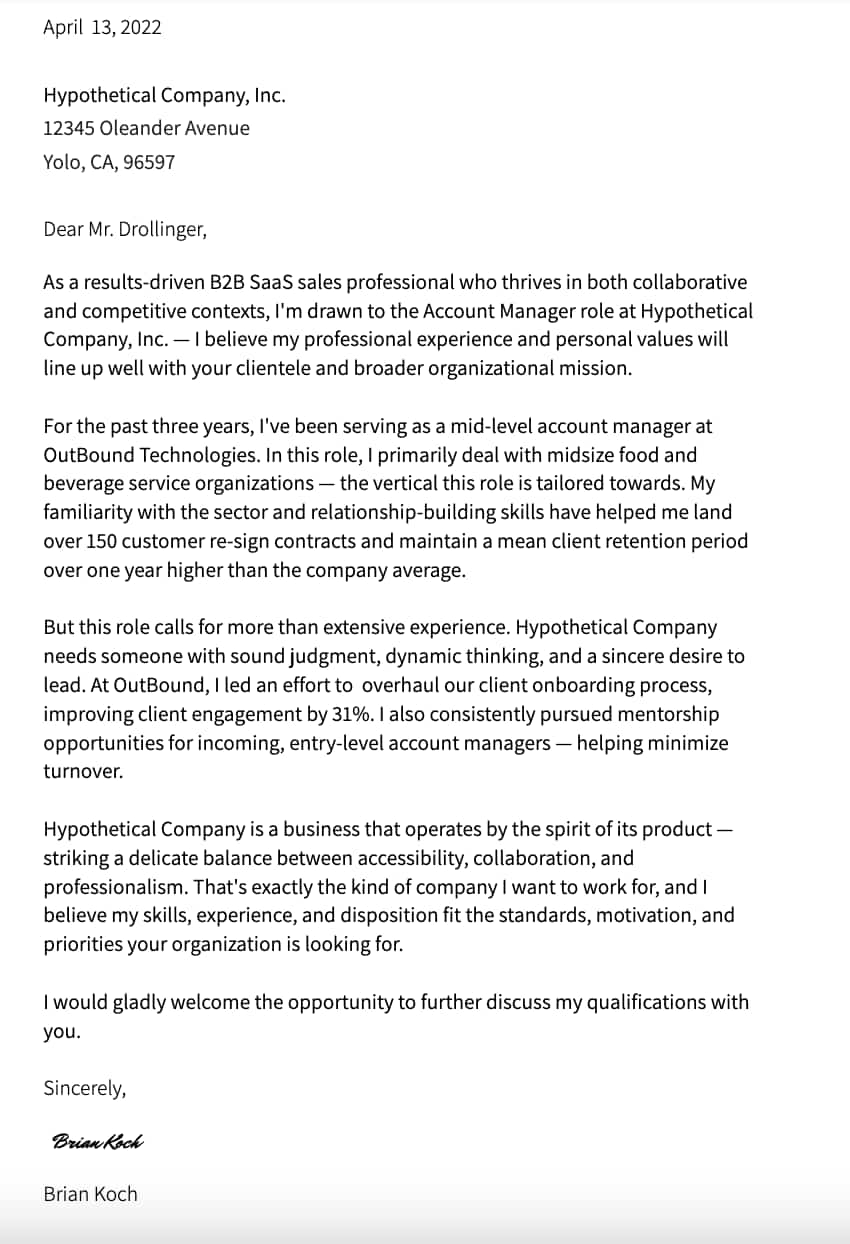
According to Criminally Prolific, here’s why the template example above from Close.io converts:

  1. It clearly identifies the sender and what they’re selling.
  2. The sender asks for direction about who to speak to.
  3. The invitation to talk more at a later time specifies the time and date and how long it will take.

You don’t have to stick to this script word for word, but it’s a helpful guide to keep you on track.

The point of a cold call isn’t necessarily to get your prospect to commit to you right away. You're trying to set up an in-depth meeting or call for a later time.

You also have to be sure to call prospects at the right time.

4. Call at the right time for your prospects.

According to Yesware’s research on over 25,000 sales calls, weekday afternoons are the best time to make cold calls.

The research shows that most calls that last over 5 minutes occur between 3:00-5:00 pm on Tuesdays or Thursdays.

call-length.png(Image source)

However, just because these are the best times for Yesware doesn’t mean they’re the best times for your company.

There are countless tools out there to help you track calls, like Close.io.

With Close.io, calling is as simple as one click. And you can even leave notes about the call for other members of your team.

close-call.png(Image source)

You can also record calls with Close.io.

close-record.png(Image source)

Just be sure to use trigger events, too, so that you call them when they’re ready to talk.

5. Track trigger events

Contacting people at the right moment is about more than just calling on the right day and the right time.

It’s about calling them when their interest is piqued.

Perfect timing is important, and it doesn’t have to be hard.

Tracking leads and opportunities is important because you’ll know exactly which stage each prospect is at within your sales funnel.

Tracking these metrics in Close.io is simple.

You can visually view and graph leads that are currently active or that you have won or lost.

trigger-events.png(Image source)

You can also track trigger events by using other services such as Google Alerts, Mention, or Zapier.

monitor-your-brand.png(Image source)

Close.io launched new Zapier triggers this year, too, so you can automate your sales workflows to best fit your needs.

With these tools, you can keep tabs on things like:

  1. New company hires
  2. Customer announcements/large company achievements
  3. Geographical company expansions
  4. Whether a prospect opened your email or not (so you can call them later)

You can monitor emails and calls at the same time with Close.io so that you can tailor outreach to companies based on these triggers.

daily-call-list.png(Image source)

Quick tip: Wednesdays tend to be the best days to send emails, while Thursdays are the worst, according to HostingFacts.com.

Once you know someone is a good outreach candidate, and you’re ready to get in touch, your first impression will either make or break the exchange.

6. Make a good impression

The very first thing you should do when cold calling is make sure that the person you’re talking to is the right individual.

How you choose to verify their identity is the first impression they’ll have of you.

It’s more effective to ask if you’re “talking with” the right person rather than asking if you’re “speaking to” the right person.

good-impression.png(Image source)

The phrase “speaking to” makes it seem like you’re planning to have a one-way dialogue with them rather than engaging in a conversation.

“Talking with,” however, implies that you plan to listen to the prospect instead of just talking at them.

That’s why it’s important to ask questions and tell personal stories.

7. Tell a story (and ask questions)

If someone tells you they’re busy when you call them, consider that a red flag.

If they were really in a meeting, would they have answered a call from an unknown number?

Probably not. That’s why you have to prove your worth quickly, even if they claim to be busy. A great way to do that is with personal stories that build rapport.

This will make your prospect feel more human and will probably even cause them to lower their defenses toward you.

Stories of social proof can also be helpful. Social proof identifies pain points and proves how your company has relieved them for others.

And it saves them time because they won’t have to worry about looking up reviews of your products and services themselves.

bright-local.png(Image source)

Start out by telling a customer success story. Then, ask your prospect questions that relate to your story. This will show that you are calling to help them with their needs.

Try out the Situation, Problem, Implication, Need-Payoff (SPIN) Selling questioning sequence to get them to realize the cost of their inaction. It might sound something like this:

Situation: “Tell me about your company?”

Problem: “How do you generate new customers?”

Implication: “How much is a new customer worth?”

Need-Payoff: “How would your business benefit from getting ten new customers each month?”

It’s personable, kind, and will make them feel like a human being that you value. The goal here is to build a lasting relationship, and this method is the best way to do it.

After you’ve done this, shift all of the attention to them.

8. Make it all about them.

It’s important to never pitch something too early. Focus the conversation on your prospect for as long as you can first. People love to talk about themselves.

Jill Angelone, the Account Executive at Lyft Corporate Travel Emerging Markets, said it best: “Be quiet and build trust through listening.”

By giving your prospect the chance to talk, you’ll also be gaining more insider information about them.

Try to hit the assertiveness “sweet spot” by avoiding being too aggressive or too sociable, too risk-averse or too unpredictable, or too uncaring or too competitive.

assertiveness.png(Image source)

You have to know what your prospect wants before anything else. That’s why it’s important to listen and only speak when necessary.

Listening is key to building great relationships. It builds the trust you need to get a prospect to commit to you.

Be sure to keep the conversation on track, though.

9. Stay on track and keep goals in mind

You only have about ten seconds to show a prospect that you’re worth their time.

That’s why it’s so important to stay organized.

Engage in conversation, but be sure to take notes, and keep the end goal in mind.

Sales organizations that use organized and structured sales processes perform better than those that do not.

Close.io’s reporting tools make staying on task simple, easy, and more organized than ever.

You’ll always know the value of a lead, the desired close date, the status of that lead, and which of your team’s members are focused on any given prospect.

opportunities.png(Image source)

That way, everyone will know exactly when to follow up.

10. Follow up when needed and leave a voicemail

When you follow up, your prospect might not be available. That’s why it’s important to leave an effective but brief voicemail.

Start out by telling them who is calling them, why you’re calling, and then end on a note that will trigger a quick response.

According to Gryphon, the optimal voicemail message is only 8 to 14 seconds long.

Here’s a great example of a voicemail template to stick to:

follow-up.png(Image source)

Typical voicemails usually suck.

By sticking to a template, you’ll stay away from filler words, speaking too fast, or rambling on and on about unimportant information.

That’s why you have to create interest naturally and quickly in your voicemails. You want your prospect to call back as soon as possible.

If they have to listen to your voicemail over and over to copy down a callback phone number, they’ll decide to devote their time to something (or someone) else instead.

Pre-recorded voicemails can solve this problem.

11. Leave pre-recorded voicemails with Close.io

If you have a voicemail template, it can get boring and stale to repeat the same message to thousands of recipients.

Why not just record one great voicemail with Close.io?

pre-recorded-voicemails.png(Image source)

When you call a prospect and hear the beep to leave a message, all you have to do is push one button, and it will leave your pre-recorded voicemail.

Then, you can move on to the next phone call.

All you have to do is:

  1. Upload a recorded voicemails message by going to Settings -> Phone Settings -> Pre-Recorded Voicemail Drop.
  2. Click the “Leave voicemail” button when hearing the beep after a prospect’s voicemail greeting.

leave-voicemail.png(Image source)

Conclusion

Most people think that cold calls are a thing of the past.

But they’re one of the most effective tools for building relationships with prospects, making sales, and closing deals.

Cold calling is harder than it used to be. It now takes twice as many calls to reach a prospect than it did ten years ago.

But if you know what you’re doing, you can make sure that they stay on the line once they finally answer.

  • Start out by preparing to be rejected. Don’t let it stop you from calling and being confident in your pitch.
  • Do your research on companies and individuals so that you have effective icebreakers. Be sure to personalize your cold calling script to whomever you’re talking to.
  • Call on the right day and at the right time of day, and pay attention to trigger events.
  • Make a good impression by asking to talk with people rather than speaking to them, and make the conversation about your prospect, not you.
  • Keep your goals in mind and follow up on time. Leave brief, powerful voicemails if you don’t receive an answer.
  • And don’t forget to pre-record voicemails with Close.io to save time so that you can move onto your next call.

Want even more cold calling tips? Download a free copy of Your Growth Hacks Aren't Working today. Learn how to qualify and close prospects, deal with sales objections, and much more!

Download Your Growth Hacks Aren't Working

Brad Smith Founder of Codeless.jpgAbout the author: Brad helps SaaS startups create actionable long-form content for a fraction of the price of a content writer. Give him a pug and a pencil and he's off to the races!

01 Jan 16:51

10 Simple Hacks to Boost Your Creative Output In 2018

by Kristen Dunleavy

Want to make 2018 your most creative year ever? Here are ten simple hacks that can help:

1. Clench your left hand

“The next time you have a creative problem to solve, squeeze your left hand into a fist,” suggests Amantha Imber at Success. Although the idea sounds far-fetched, it’s backed up by a study that asked one group of people to squeeze a ball with their left hand, while another group squeezed with the right hand. “It was found that this simple act of squeezing one’s left hand activated a brain circuit associated with thinking holistically and intuitively, and thus more creatively,” Imber writes.

2. Think “inside the box”

We’ve all been advised to “think outside the box” – the idea being that freedom from boundaries can spark creativity. But it turns out that imposing limits can, paradoxically, do much the same thing. “Setting restrictions or guidelines refines your problem, giving rise to undiscovered possibilities that might be useful in making the most creative solution,” writes Kerby Rosanes at UCreative.

3. Purposely head in the wrong direction

One cure for the lack-of-creativity-blues is to try to think of ways to achieve exactly the opposite of what you really want to accomplish, suggests Daniel Tay at Piktochart. “For example, if you want to design something elegant and beautiful, attempt to break all the rules and make something ugly instead.”

4. Leverage “psychological distance”

“Try to imagine your creative task as being disconnected and distant from your current position/location,” writes Sparring Mind, citing research indicating that subjects were much more likely to solve challenging “insight problems” if they thought of the source of the task being at a distance, rather than nearby. Doing this “may make the problem more accessible and can encourage higher-level thinking,” according to the site.

5. Don’t try too hard

“If your creativity is lacking, unplug. Relax. And let your brain do its magic,” writes Larry Kim at Inc. “Sometimes your best ideas will come when you’re not wracking your brain trying to come up with the next great idea. It could be while you’re sleeping. A good night of rest will help you be more productive and creative. It could be while your mind wanders in the shower that you get a great idea.”

6. Stay positive

“Researchers have found that it is during strong positive moods that our best creative work is done,” writes Gregory Ciotti at 99U. “Getting yourself to a positive place” is not as trite as it may sound – any number of mood boosters (quick exercise, envisioning the future, recalling good memories) will do the trick to influence your mood, and your creative efforts will be at their best when your attitude is positive.”

7. Embrace change

“Creative ideas are often new, scary and a little daunting, so becoming accustomed to change makes your creative life much easier and less tiresome going forward,” writes Cassius Kiani at UX Planet. “Take a cold shower in the morning, put on socks that don’t match or cut your hair in a fun new way. Ultimately, what you do doesn’t matter. All that matters is that you do something to shake things up.”

8. Travel (or explore your own city)

“There are plenty of things to be gained from going abroad: new friends, new experiences, new stories,” writes Brent Crane at The Atlantic. “But living in another country may come with a less noticeable benefit, too: Some scientists say it can also make you more creative,” he notes, citing research linking travel with increased cognitive flexibility. “If a plane ticket isn’t an option, maybe try taking the subway to a new neighborhood. Sometimes, the research suggests, all that’s needed for a creative boost is a fresh cultural scene.”

9. Look at something blue

“A study from the University of British Columbia found that when looking at blue objects and packaging test subjects experienced an increase in creative and imaginative thinking,” writes Ryan Cooper at That may be due to blue’s association with concepts like openness and opportunity. “Conversely, when looking at red objects or packaging the same subjects experienced an increase in attention to detail,” he notes.

10. Search for the “odd one out”

“Enhancing our ability to create new and original solutions to problems can be as simple as staring at an image that depicts the notion of ‘being different,’” writes Libby-Jane Charleston at HuffPost, citing a study comparing ideas generated by people looking at a poster depicting an “odd one out” image versus people seeing an image representing conformity, while also trying to think of different uses for an object.

“The ‘odd one out’ viewers came up with significantly more ideas,” she writes. “In addition, their ideas were judged as being 25-percent more creative.”

01 Jan 16:48

Why your buyers are focusing on the wrong things

by george@membrain.com (George Brontén)

It’s a tale as old as time. A sales team is closing in on a deal when, at the last minute, a competitor takes home the win. Being the good salespeople that they are, the team checks in with the customer to find out why they lost the deal, and the answer frustrates them. The buyer made the decision based on utterly meaningless criteria.

01 Jan 16:48

5 Tips to Achieve Stellar Sales Success in 2018

by kniemisto

It’s the end of the year. It’s crunch time for 2018 planning. Almost everyone is evaluating what worked and what didn’t and building goals and plans for the year ahead. If you’re not, it’s time to take a long, hard look at your own performance over the last year and find ways to not just hit your goals but to exceed them for 2018.

There are many questions you must ask yourself to prepare: What are you going to do differently? What are you going to improve? How specifically are you going to drive sales? Are you going to focus on generating new business? On improving your close rate? On growing your existing accounts?

In this blog, you’ll find five tips to help you achieve stellar sales success in 2018.

As you build your plan, consider how you’re going to improve in each of these critical areas:

1. Develop the Skills You Need to Succeed

Success isn’t going to fall in your lap. It takes a lot of work. Start by evaluating your strengths and weaknesses. Look at the skills that are essential to succeed and find ways to improve in these areas.

For example, the top three sales skills possessed by sellers at top-performing sales organizations are:

  1. Driving and winning sales opportunities
  2. Driving account growth
  3. Core consultative selling

Core consultative selling is an approach to sales whereby sellers redefine reality and maximize buyer value through a mix of understanding, shaping and redefining need, crafting compelling solutions to address the need, and communicating maximum impact for the buyer.

If you don’t have a process to win sales, if you can’t lead successful sales conversations, and if you don’t know how to grow your accounts, you will not achieve your maximum potential success.

2. Manage Your Time

71% of company leaders do not believe their sellers manage their time and day effectively. To beat your sales goals, you need to maximize your time and motivation. You need to find ways to get more accomplished each day.

How do you get started? First, begin to track your time and where you’re spending it. Then, plan for how you want to spend it.

The sooner you figure out where your time is going, the quicker you can start maximizing the time you spend on what’s really important.

3. Sell to the Domino

There’s much buzz in the sales world that buying committees are growing, and it’s getting difficult to get consensus on decisions. Perhaps there are more people touching every purchase, but we’ve found that most buying teams have one person who has a profound influence on the ultimate decision—The Domino. The Domino’s primary interest is to influence the action and direction of their team and is often the swaying voice that others tend to follow.

In fact, 90% of the time sellers only need to convince one person in a buying committee: the dominant influencer.

Whoever plays the role of Domino should receive special attention from you. Look for ways to secure one-on-one time with them and inspire them with what you can do for them.

Identifying and getting in with that one person will really pay off.

4. Minimize Buyer Risk

In 100 pieces of advice to “sell the ROI,” you might find one piece of advice on minimizing the perception of risk for the buyer. Consider this:

  • 61% of buyers say that the winners of actual sales opportunities help them to avoid the pitfalls they may encounter after purchase.
  • 73% of buyers say that the seller they chose was considered trustworthy.
  • Only 35% of buyers have a favorable view of sellers—and those buyers are likely to take more risks in the buying process.

Risk plays a major role in the buyer’s decision process. Buyers are naturally skeptical. Many of them have been burned in the past and don’t want to repeat their mistakes. However, with all change comes risk. It’s your job to minimize risk and overcome the risk hurdles.

5. Drive Value

81% of top performing sales organizations (those with higher win rates, revenue growth, and that achieve premium pricing) agree their sales organization is focused on driving maximum value for buyers. Sellers frequently talk about providing value, but the reality is, few actually do it. In fact, only 42% of buyers find value in their meetings with sellers. Before you can drive value, there needs to be a well-thought-out plan to create value. You must know the value you can bring in general and the value you can bring to each individual buyer.

As you start preparing for 2018, make a plan for how you’ll improve your skills, manage your time, connect with the Domino, minimize risk, and provide value. If you can focus on these five areas, you will achieve the best sales success.

What goals are you looking to achieve in 2018 for your sales team? How have you started to plan for these goals? I’d love to hear about what you’re planning for next year in the comments.

The post 5 Tips to Achieve Stellar Sales Success in 2018 appeared first on Marketo Marketing Blog - Best Practices and Thought Leadership.

01 Jan 16:44

Outsourcing Sales and Marketing to Compete in 2018

by Arvin Poole

Outsourcing Sales & Marketing to compete in 2018

Conventional wisdom suggests that 2018 will bring substantial shifts in how companies plan and execute their overall marketing strategies. Look for real change in how organizations develop their sales and marketing plans, making the best use of both internal and external resources to create more visibility and drive revenue and growth.

Over the last several years, tech, healthcare, and other SMBs have accepted that they need to change their traditional sales and marketing practices to compete. One way gaining wider acceptance is through outsourcing tasks that are not part of a company’s core business.

Outsourcing Trends for the Future

From startups to established businesses, outsourcing is now being embraced by companies of all sizes as a tool that helps them gain a competitive advantage. As businesses continue to move to multiple platforms like cloud, social, and mobile, outsourcing lets them adapt to rapidly changing business environments.

While many companies with internal sales and marketing teams have tended to think there’s no need for outsourcing those services, they’re now realizing that generating leads, appointment setting, and other functions typically performed in-house are taking up more time and manpower, as well as a bigger portion of their budget. Outsourcing these tasks can help your business build a modern sales and marketing operation without the expense of additional hires or training.

From solution expertise to team members who know how to close the deal, most companies have the basics in place. What’s missing is the ability or resources to keep pace with successful, modern sales and marketing techniques. Hiring new talent to handle these tasks is often problematic for two main reasons:

  • Finding people who are experts in these new disciplines is extremely difficult.
  • Technology is changing the process so rapidly that an “expert” you hired three to six months ago now requires new training.

Working with an outside partner lets your company grab more market shares, expand your sales reach, and realize your revenue goals much more quickly than if you performed certain non-core functions in-house. Here’s how:

The Science of Sales

Sales and marketing teams that are forward-focused must be comfortable with ever more complex algorithms. They must also be able to work with data scientists and tech experts to design industry-specific solutions. Using Invenio’s team of sales scientists for tasks like lead generation and appointment setting lets your internal staff concentrate on other core activities that generate revenue and lead to cost reduction. Other benefits include:

  • Access to an experienced team that is up-to-date with the latest technologies and techniques
  • Ability to quickly ramp up or down during high and low volume periods
  • Substantial savings by avoiding the cost of new hires

It’s no secret that lead generation is challenging. Contacting targets, determining their level of interest in your products or services, and nurturing them to and through conversion requires lots of time and substantial investment in talent. Historically, B2B companies have kept lead generation and appointment setting as in-house sales and marketing functions.

Outsourced sales and marketing is an ideal solution for businesses looking to scale. You focus on customer solution delivery while our team uses a scientific approach to provide sales and marketing strategies, like generating high-quality leads, setting qualified appointments, and consistently closing deals.

The benefits outsourcing sales and marketing brings is an easy choice for companies looking to build their sales pipeline while containing costs and increasing revenue.

01 Jan 16:44

Why You Should Charge More When Pricing Your Online Course

by Choncé Maddox

FirmBee / Pixabay

The online learning revolution has been booming these past two years and it shows no signs of slowing down. Part of me used to think people would eventually get tired of online courses and trainings but personally, I’ve taken quite a few online courses myself and can really see the value and ROI they provide.

This is what leads me to believe online learning is most likely here to stay and knowledgeable business owners should definitely consider getting a leg in that industry.

If you have some important expertise to share via an online course, pricing your product can always be one of the trickiest decisions to make.

Here’s why you should consider charging more and not undercutting the price of your online course.

The Benefits of Taking Your Course Are Valuable

You may consider offering your course at a lower rate because you don’t believe you’re a true expert in the subject matter or that all the information you acquired can be easily found online. While this may be true, your online course will still offer value to students who don’t know as much as you when it comes to the particular topic.

Your course should create a shortcut to the desired outcome students want to reach. For that, you can charge more for the product without guilt because you’ll probably be saving people more time and money by taking the fast track route (via your course) to achieve their desired results.

Students Will Take It More Seriously

I’ve taken courses as low as $10 to as high as almost $2,000. Yes, the $2k course was a 4 to 5-month long branding training program and I took it much more serious than the cheaper courses I purchased.

I’m not saying you have to charge this much for your course, but realize that the more you do charge, the more students will be committed and work hard to see results. So many people buy courses and never finish them or even start them.

By offering premium pricing for your course, you can weed out the people who aren’t really interested in taking action and doing the work. This way, you can wind up with some nice case studies and testimonials from students who become successful.

Social Proof

Before you create and sell your course, you need to prove to your audience that you can help them achieve the results they’re looking for. Instead of trying to sell a course to strangers on the internet, build your email list, create a sales funnel, and start offering value for free in the form of blog posts, podcast interviews, webinars, Facebook live interviews and digital downloads.

This will help you gain your audiences’ trust and position you as an expert in your field. You’ll also create a ton of social proof and testimonials from people you’ve helped. That will prompt more students to buy your course at a higher price because they know it will be worth it.

Helpful Add-Ons

Finally, you can drive the price of your course up if you’re able to provide helpful add-ons by creating a premium package. You can throw on an extra module, group coaching, templates, etc. to add even more value to your course and this will prompt students to feel comfortable spending more on it.

Also, doing something as simple as offering a payment plan can help more people buy your course at a higher price since they can break up the payments into more budget-friendly amounts.

Summary

Don’t sell yourself short by pricing your online course too low. You’ll not only do a disservice to your business but potentially to your students as well. Consider using some of these tactics to change your mindset and confidently set your course at a higher price point.

01 Jan 16:43

11 Traits Every Sales Hire Should Possess (& How to Uncover Them in an Interview), According to Sales Managers

by Jason Stone

Fire. We are told to look for "fire" in new sales reps so they'll have a burning desire to find and close deals. And while drive is tremendously important, staying composed, focused, and motivated during long sales cycles requires more.

To determine if a candidate will be successful, use this checklist of traits and questions.

Download Now: Free Sales Interview & Hiring Templates

1. Grit

No matter how much you love it, sales isn't an easy job. There are going to be hard days and some sales won't go your way. That's why sales reps need to have grit.

According to Dan Tyre, a Partner Sales Enablement Manager at HubSpot, "Sales reps need to have the ability to push through when things get hard."

Senior Sales Manager at HubSpot, Mintis Hankerson, agrees.

Hankerson adds, "There are always going to be lots of unknowns in a role. You will always need to learn new things. But a foundation of hard work and resilience provides the needed soft skills to learn the hard skills."

Sales is as much a mental game as it is a job. To have grit in the position means that when the uncontrollables aren't in your favor, you can lean into the controllables and your own inputs.

"Sales success is truly about our own inputs whether it be into skill development or more prospecting activity," Hankerson says.

When interviewing sales candidates, ask these questions to help determine if they have grit:

  • "Tell me something that was very hard for you to learn when you first started."
  • "How did you handle a tough life experience or challenge in your career? What did you rely on to get you through that?"

2. Natural Curiosity

To succeed in sales, you need to have a natural curiosity. Similar to problem-solving, with a natural curiosity, a sales rep should be able to troubleshoot and learn as they go.

Tyre says, "I like people who like to figure things out."

To determine if a candidate has natural curiosity, ask them these questions:

  • "What's your learning style?"
  • "What do you do for fun?"
  • "How will you figure out the right things to prioritize?"

3. Conscientiousness

While everyone thinks the confident, guns-blazing, sales rock star is the ideal hire, bringing passionate, careful, and disciplined sales reps to your team will benefit you more in the long run.

Conscientious reps may not come out of the gate with leads and sales, but their ability to plan things in advance and set and commit to goals usually correlates with better execution and outcomes.

A conscientious rep is organized, disciplined, and has excellent time management and focus.

Daniel Palacios, a sales manager at HubSpot, says, "These traits will enable you to be successful, since a process is made to enable a rep to thrive. These are foundational traits - build the wrong foundation and it all collapses - because it enables the rep to start controlling the inputs related to activity."

When interviewing, search for proof of initiative, accountability, and results. Consider using these prompts:

  • "How do you stay organized?
  • "What is your process for prioritization?"
  • "Give me a time when you were completely overwhelmed and how did you deal with it?"
  • "Have you set difficult selling goals for yourself?"
  • "What specific ways did you push yourself to achieve that goal?"
  • "Describe how you would execute something similar in the role we are discussing."
  • "If I gave you 100 accounts today how would you sort them? Be specific on the approach."
  • "How do you select which companies you invest time with? Can you give me an example where you selected to work one account over another one?"

4. Hunger

What drives your sales reps? Do they have a desire to succeed?

Aviva Walsh, a Partner Sales Team Manager at HubSpot, says, "To be successful a sales rep needs to have a why and a passion for whatever that why is. It can be anything that's important to them -- family, house, a yacht, financial stability. Whatever it is, it's something that drives them."

Walsh adds, "They need to have an end goal that gives them a path to work back from - this translates into a clear plan, that they can break down into smaller more achievable goals. If you don't know what you're aiming for, you don't know where you're going."

To figure out if they have hunger, ask about the last book they read or what has influenced their sales career. How does this translate into passion for the job they are applying for now? Determine how well they researched your company/the role and how passionate they are by asking:

  • "What keeps you up at night?" (If they say they sleep like a baby because they always hit quota, move on. This suggests a short-sighted view of sales and a failure to strive for greater accomplishments. No matter how often quota is attained, there is always room to grow and to become a better salesperson.)
  • "If you worked here, what do you think would keep you up at night?" (Their natural answer will be "hitting quota," but dig deeper here.)
  • "Tell me about a time you set a goal for yourself? Why was that goal important? How did you go about achieving it?"

5. Accountability

As a sales rep, things are going to go wrong. But it's how a rep handles those situations that speak volumes to the type of employee they'll be.

Walsh says, "It's really easy for a sales rep to blame outside factors when things aren't going their way. 'My territory isn't great, my targets too high, the rules don't make sense', etc. And oftentimes things really are challenging, but to be successful a rep needs to be able to take outside factors stride and focus on what they can control."

This means that while a rep can't control increasing quotas, they can control their own process, how they sell, where and how they find opportunity, and professional development.

To find out if a candidate has accountability, ask these questions:

  • "Give me an example of a time when things weren't going your way. How did you handle it? What was the outcome?"

6. Empathy

As we know, sales reps spend a lot of time talking to other people. Whether it's prospects or colleagues, most of the day is spent interacting with others. This means that reps need to have empathy and relate to who they're talking to.

Walsh explains, "A good rep knows what their customers feel and what they actually need. By being empathetic a rep can build trust and get a good understanding of where the customer is and what the actual issue is that they need to solve."

"Prospects these days are guarded and afraid of being 'sold to', so if a rep can show humanity, the prospect is much more likely to share important information that will allow the rep to truly be able to help," Walsh adds.

When interviewing, you can ask this question to see if a candidate has empathy:

  • "Tell me about a time a customer or prospect was unwilling to share important information with you that you needed to make the sale. How did you handle it?"

7. Coachability

This is a necessary trait for any hire, to be honest, but especially sales reps.

"Reps need to be focusing on continuous improvement to keep their skills sharp and stay ahead of the game," Walsh says. "If they can't take constructive feedback well or are not open-minded enough to learn from others, they won't progress. It's really important to keep an 'always be learning' mindset to be successful in sales."

A great way to figure out if sales candidates are coachable is to ask these questions:

  • "How do you make sure you're always learning and improving?"
  • "Do you have an example of a time where you failed at something, received feedback and was able to put that feedback into action?"
  • "Can you tell me a time your manager/mentor coached you? Can you please tell me the process on why the conversation started and how it improved?"

8. Active Listening

Not to be redundant, but sales reps talk to a lot of people in their day. They need to be able to truly listen to prospects who are sharing their goals and discussing their issues.

Brian Sexton, a HubSpot Sales Manager, says "This is important because every single day a rep is going to have a multitude of conversations. We need to understand and ensure they have the ability to actively listen to what prospects are actually saying. They need to pay attention, be mindful, pace well, have body language in the right tone, and respond appropriately."

To determine if a sales candidate can actively listen, try out this question:

  • Ask a question that might seem random just to see if the candidate is paying attention.

9. Selling Aptitude

Someone might be able to "sell," but that doesn't tell you what they know, how quickly they grasp new ideas, and if they can make big picture connections. Top-performing sales reps have a thirst for learning and growing -- you just have to determine if the person in front you meets the bill.

Review resumes closely for academic (GPAs, honors), career, and workplace achievements (President's Club or other industry awards, positions held on boards or committees, etc.) Assess their ability to simplify complex topics, especially if they'll be dealing with complex sales.

Sexton also wants to know if a candidate can challenge a prospect.

He says, "Does this individual have the ability to specifically challenge a prospect's thoughts or assumptions based on their problems. For the simple reason being we can't help everyone, so a rep can't be scared or worried to ask difficult questions and challenge a prospect during their selling process."

Additionally, a rep should have a closing mentality. "In the role we do as sales reps, it's highly transactional," Sexton adds. "Reps have a number of conversations. I need to make sure the sales hire has the ability to have a closing mentality and ask themselves, 'Is this a prospect we can help and if so, how can we move forward?'"

Palacios says that selling aptitude should translate to the discovery process and help reps match problems with solutions.

He says, "This is what enables the rep to first understand what the prospect is needing and what can we offer. Sometimes we are not the best software for their need and sometimes we fit like a glove."

These questions will be useful:

  • "Explain [complicated process] in a digestible way." (It can be any process, from changing the oil in a car to cooking Coq au Vin.)
  • "Where in sales do you want to improve? What is your plan to accomplish that?"
  • Do a role play and when you're pretending to be the prospect, give the candidate answers that the rep should challenge.
  • "How does your day-to-day looks like today? Please tell me by the hour."
  • "Could you tell me a time where you realized you were lacking a certain skill and how did you improve it?"

10. Adaptability

How will they handle the unexpected when it is followed by another unexpected? Most of us are prepared for one shoe to drop but two? Find out how the candidate would manage next steps when a prospect or client quickly changed direction, requiring mid-evaluation and new KPIs. Create role play scenarios -- one might have you becoming a somewhat antagonistic prospect so you can see how they adapt to unforeseen circumstances and difficult prospects.

Afterwards, ask them to critique themselves and then give your honest feedback. If they get defensive about their handling of the situation, move on. But if they genuinely welcome your perspective, they may be a valuable fit.

  • "How have you handled unexpected situations in your previous roles?"
  • Create a role play where you play a somewhat antagonistic prospect.

11. Record of Success

Sales achievements and college GPAs are just the first part of learning their personal meaning of success. Sales reps are driven by their competitive nature and, let's face it, money.

But simply hitting quota isn't enough in many organizations. Companies want team players, people who care about the company's success as much as their own, and reps who aspire to be leaders in the organization.

If one rep's greatest accomplishment is achieving President's Club, and another cites renewing the company's most lucrative contract as the most rewarding achievement, you get a glimpse into what each sees as most important. One benefits the rep, the other benefits the rep and the company.

Incorporate these questions into the interview:

  • "What do you consider to be your single and most significant accomplishment?" (This question is universal because whether your candidate has a long work history or is directly out of school, you will find out what is important to them and how they define success.)
  • "If you were assigned the same task today, what would you do differently?" (This may not be applicable in all situations, but it's a great way to evaluate their willingness to reflect on past performance and apply learnings to new tasks.)

Asking questions is great. Listening carefully to what your candidates say is better. But when candidates actually show you these traits, that's the sign you've got a real winner.

01 Jan 16:43

Sales Fails: Top 5 Ways Sales Pros Waste Time

by Sean Callahan
Sales Fails

What does every, single sales professional have in common?

Give up?

Every sales pro has exactly 24 hours per day, seven days per week, and 365 days per year to make it happen.

Time is the ultimate equalizer. Make the most of it, and you can blast past quota in fewer than 40 hours per week. Squander it, and, well, you know…

Isn’t it time to declare time your friend? If you agree, here are the top five time-wasters for sales pros, and more importantly, how to overcome them.

1. Focusing on Unqualified Prospects

Pursuing prospects with little chance of buying is a clear waste of your cycles. But just how do you ensure you only spend time on high-value prospects?

First, it’s essential to validate that the prospect is truly ready to make a change, whether that means adopting a new approach or abandoning an existing solution. Look for signs that the person is frustrated or dissatisfied with the status quo. You might even surface a strategic company initiative that will warrant a solution like yours. It also pays to monitor the buyer’s actions to date. Has the prospect downloaded a certain set of information that indicates a progression down the purchase path?

2. Getting Sidelined by Poor Records

As you work multiple opportunities, you need to keep track of all the activities associated with those potential deals. Unless you’ve got a photographic memory, you need to log all the details of your calls and other interactions and attempts you’ve made to engage prospective buyers. We know this is probably the least favorite part of your job, but it’s essential to being productive. (Plus, I’m willing to bet your boss is constantly on you about this.)

If you find yourself frittering away irreplaceable minutes trying to piece together random notes scribbled on the back of scrap paper, napkins, and business cards, you need a new approach.

Many CRM systems – including Salesforce, HubSpot, Infor and Zoho – have built Sales Navigator integrations into their applications. You can also access Sales Navigator directly from your Gmail inbox. That means with a single click, you can easily capture essential information as you go about your daily work of researching prospects, pinpointing key account insights, and engaging leads.

3. Relying on a Single Relationship

If you’re doggedly trying to engage the one person you’ve identified as the key decision maker, you’re barking down a dead end, so to speak. Unless you’re selling a commodity product at a low price, it’s almost guaranteed your contact makes up a fraction of a larger buying committee. Plus, decision maker churn is a fact of life, so you could easily see the value of all your time and energy immediately plummet to zero if that one person moves on.

A smarter bet is to invest time identifying and engaging everyone involved in the purchase decision. By embracing a multi-threaded approach and nurturing multiple relationships, you greatly boost the odds of that deal progressing.

4. Failing to Maximize Your Down Time

It may seem like you barely have a moment to catch your breath during the workday, but chances are you find yourself idle here and there, even as you hustle. Whether you’re on a train to meet a client, are standing in line at the coffee shop, or are in the airport to catch a flight, you can use those moments to your advantage. By accessing Sales Navigator on your smartphone, you can do the following from anywhere:

  • Prospect by searching LinkedIn based on criteria matching your ideal customer profile
  • Build pipeline by reviewing and saving daily lead and account recommendations
  • Map out a buying committee by looking through the “People Also Viewed” section of a prospect’s profile
  • Prep for a meeting by reviewing the insights displayed about your accounts and leads
  • Start a conversation or a relationship via an InMail message
  • Capture details about a contact you meet at a conference or networking event

5. Calling Upon Substandard Engagement Practices

You may be getting more dials, but are you seeing more results? Buyers are responding less and less to cold outreach. If you’re still dialing for dollars and blasting out generic emails, you’re behind the times.

Instead of playing the odds by placing as many calls as possible, get on board with social selling. Focus on polishing your professional profile, establishing yourself as a thought leader, and contributing to online discussions. These efforts will yield better results as prospects welcome your invitations to connect, and seek out your insights, perspective, and guidance. In fact, master modern engagement practices and you can drive quality leads and opportunities without picking up the phone.

For more ways to boost sales productivity, download our eBook, Proven Strategies From the World's Top Sales Professionals

01 Jan 16:43

Tracking Trigger Events: How LeadSift Tracks Leads and Books Meetings Without Using ‘Static’ Prospecting

by Collin Stewart

On this edition of The Predictable Revenue Podcast, host Collin Stewart welcomes Tukan Das, CEO of Halifax’s LeadSift, a sales intelligence platform that generates qualified leads from public web.

The post Tracking Trigger Events: How LeadSift Tracks Leads and Books Meetings Without Using ‘Static’ Prospecting appeared first on Predictable Revenue.

01 Jan 16:43

Use Email Automations to Improve Your Brand’s Online Sales

by Personal Branding Blog

Email marketing is an important tool for your personal brand in which your business can reach your prospects in a meaningful way. Using automation methods can help you stay on track and improve your communications as you segment your lists.

The right strategy that reaches a specific target market can bring into focus your message, and increase your open rate. Knowing the needs of your subscribers will enable your company know exactly who to address with just the right offer that they will love.

After conducting research, planning, and then executing your campaigns you will want to stay on top of tracking and reporting for the best results. Here are several ways your communication with your leads and customers can be narrowed down into specific groups:

  • Using tags for each list – For each campaign your brand will want to generate subscribers for specific products or services that you are promoting, and label these with a tag according to who clicked the offer from your website. Your customers may not be interested in everything you have to offer, and tagging a select group can help improve your sales.
  • Make it valuable to your subscribers – It’s important that your subscribers understand that you know their needs such as offering them specific selections to choose from. Survey questions you can also help provide valuable offers and great insights for your brand in your market.
  • Teach a topic in a series of emails – This will allow you to better figure out which categories your subscribers belong in. At the end of these automated emails include a call-to-action that encourages them to move forward into the next step whether it be a paid course, membership, ect.
  • Follow up with your automations – After sending out a few campaigns create another set of segmented campaigns that furthers the communication with your lists. Try not to saturate them with too many messages, and maximize your efforts by asking them to respond.

Placing your lists into specific categories can not only increase your brand’s click thru rates, but can also improve conversions. It’s important to pay attention to which target markets are responding the most so that you will know exactly who to focus on in your future communications.

18 Nov 19:16

The best low-cost airline in the world is taking on Amazon and international banking

by Benjamin Zhang

Tony Fernandes Fabrice Bregier Airbus AirAsia

  • AirAsia is the best low-cost airline in the world.
  • CEO Tony Fernandes wants to shift the airline's business towards e-commerce.
  • AirAsia has also launched a payments platform called BigPay.
  • Fernandes believes the first class cabin is going away within five years.

Sixteen years ago, Tony Fernandes, with a small group of intrepid entrepreneurs, took over a failing Malaysian Government-owned airline for $0.25 and the promise to assume its $11 million in debt.

Since then, AirAsia has helped bring affordable flying to the masses in South East Asia.

In the process, the Kuala Lumpur, Malaysia-based company has become one of the most disruptive forces in commercial aviation history while making the always affable Fernandes a rockstar in the business world.

What started as a two-plane operation has now expanded to a fleet of more than 150 Airbus A320 jets with another 200 aircraft on order.

And for the past nine years, AirAsia has been named the best low-cost airline in the world by Skytrax and its reviewers.

Recently, Fernandes spent a morning with the Business Insider at our headquarters in New York. Our conversation touched upon several topics including the company's future endeavors in e-commerce, AirAsia's move towards fintech, where the airline industry is going, and advice from his mentor Sir Richard Branson.

AirAsia is betting big on e-commerce

For the airline's next great adventure, Fernandes wants to move AirAsia's revenue model beyond simply selling tickets and into the world of e-commerce. With an ample supply of customer data, AirAsia wants to anchor its new e-commerce operation around the sale of duty-free goods.

Air Asia Farnborough"So when you book your ticket (online), we'll offer you the chance to buy duty-free and you can pick it up on the plane or at the airport," Fernandes told us. "It gives our customers much more time to browse and potentially we can create a marketplace for shops to put content on our website."

According to Fernandes, the average passenger has an hour to an hour and a half to shop at the airport. With the online shops, AirAsia passengers can shop 365 days a year with personalized recommendations.

Further, Fernandes wants to use the airline's fleet to transport goods purchased to destinations throughout Asia, thereby creating a logistics business.

"If you take Amazon, they started with a website and great distribution, now they are buying planes," Fernandes said. "We've got the planes and we're working backward."

Of course, AirAsia's e-commerce revolution won't get off the ground without retrofitting its fleet with high-speed Wifi, a process that's currently underway. It's an element of the passenger experience Fernandes admits had been lacking onboard his flights.

The airline is focused on getting rid of cash

These days, cabin crew on board AirAsia flights wear several hats, among them salesperson. But due to the nature of AirAsia's network that spans the entirety of Southeast Asia, cash poses a major problem. Which is why Fernandes is excited to jump into the financial technology (fintech) business.

"We're so excited about the fintech revolution," Fernandes said. "We hate cash. It's a pain for our cabin crew. FX is a super pain. It leads to fraud. It tempts my crew to do things they shouldn't do."

AirAsia Airbus A320As a result, AirAsia launched a new payment platform called BigPay that will allow the airline's customers to buy products through their smartphones. According to Fernandes, the platform is built with group travel in mind. Which means it will allow people to share bills and transfer money to one another.

Initially, BigPay will also be available with a pre-paid card, but Fernandes and his team are working to make it more app-focused using QR codes and near-field-communications.

There will be a currency exchange feature as well.

"We think our customers are being ripped off by banks," Fernandes said. "If you were traveling to Bali, [Indonesia] from Da Nang, Vietnam and wanted to exchange your Vietnamese Dong to Rupiah, we would facilitate that for you at a much lower rate."

BigPay currently works with 10 currencies, but Fernandes expects to up that figure to 14.

Ultimately, the AirAsia boss believes BigPay will be able to expand beyond the airline ecosystem and into mainstream retail.

Where AirAsia and the airline industry are headed

Even though AirAsia is thriving, the airline won't be expanding beyond its bread and butter low-cost economy model. When asked if AirAsia is looking to offer a low-cost, long-haul business-class-only product like La Compagnie, Fernandes quickly shot down the idea.

"No, not while I'm at AirAsia," he told us. "I think focus is key and we're good at what we do and [long-haul business-class-only] is a different model."

(Although AirAsia's low-cost long-haul subsidiary, AirAsia X, does offer premium flat-bed seats on select flights.)

AirAsia X Airbus A330With that said, Fernandes understands the reasoning behind a dedicated business-class airline and is baffled by why airlines would offer so many different cabins on board a single aircraft.

"Airlines were crazy to have first class, business class, premium economy, and economy on one friggin plane," Fernandes said. "That's four business models on one plane."

"You don't have Four Seasons hotels with budget rooms and super suites, they basically have one standard, but with bigger rooms," he added.

Instead, the AirAsia boss believes market segmentation in the future will see airlines specialize in one or two particular products.

"I've always said airlines will eventually become low-cost carriers and business class," he proclaimed.

According to Fernandes, we will see the end of the first class cabin within the next five years. In addition, the economy cabin on full-service airlines could disappear altogether with dedicated low-cost carriers taking over that segment of the market. This means traditional, full-service airlines could be left operating flights with only business and premium-economy cabins.

The best advice Sir Richard Branson told him during the early days of AirAsia

During the mid-1980s, Fernandes spent several years as the financial controller for Virgin Communications. Through the years, he's become known for his close friendship with Virgin Group founder Sir Richard Branson.

But Fernandes makes it clear that he has no ambitions to become Asia's Branson.

"Everyone thinks I want to be Richard, but I can confirm to Business Insider that I don't," he said. "I have no preconception of going on a balloon at 36,000 feet nor do I have any intention of going to the moon."

While at Virgin Group during the early days of Virgin Atlantic Airways, Fernandes told Branson that his decision to go into the airline industry was crazy and advised him to sell Virgin Records. It's something Branson remembered during the early days of AirAsia.

Tony Fernandes Richard Branson"One of the first people to call me up when I started AirAsia was Richard who said, 'I thought it was really stupid to start an airline'," Fernandes said jokingly.

As far as advice goes, it was pretty simple, yet profound.

"He just said have fun and make it a fun place which we've tried to do," the AirAsia Group CEO added. "But we would have done that anyway."

"Virgin was very informative in my whole cultural experience in that it was a fun place, it was a place where there were no suits, it was informal and ideas and innovation are encouraged," Fernandes said."That rubbed off on me."

According to Fernandes, this open and innovative culture has defined the company's success. For example, AirAsia encourages its employees to design their own uniform choices and to show off their personality as individuals.

"If they're comfortable coming to work, they'll be happier and more themselves," he said.

SEE ALSO: Qantas CEO Alan Joyce is challenging Airbus and Boeing to step up their game

FOLLOW US: on Facebook for more car and transportation content!

Join the conversation about this story »

NOW WATCH: The best travel hacks, according to a top airline CEO

18 Nov 19:14

Nike and Adidas have entirely different ideas of how to take over the US (NKE)

by Seth Archer

adidas

  • Nike and Adidas are two of the small number of retail companies faring well in the retail apocalypse.
  • But, the companies disagree on whether to reach their customers through scale or quality.
  • Watch Nike's stock price move in real time here.


Amid an ongoing retail apocalypse, athletic fashion companies like Adidas and Nike have stood out as bright spots, faring better than malls and department stores. But, the brands have been fiercely battling each other to expand their shares of the athleisure and sneaker markets and they have very different ideas about how to do that.

Nike's plan to outmaneuver the competition involves a "massive transformation" according to CEO Mark Parker. A big part of Nike's plan involves improving how it presents itself to its customers and focusing on the perceived quality of the brand. Nike decided to cut back its number of retail partners from 30,000 to just 40 as a part of its transformation. The ones remaining are willing to work with Nike to offer unique branded experiences for the company's products.

Adidas, on the other hand, is taking an entirely different approach, instead focusing on scale. The company's CFO, Harm Ohlmeyer, talked with UBS about how it wants to try to get on as many US shelves as possible.

'The focus in North America remains firmly on winning market share for the adidas brand as a way of creating scale-based leverage, ahead of driving profitability outright," Fred Speirs, an analyst at UBS, said in a note about meeting Ohlmeyer.

Speirs said Adidas is balancing its long-term ambitions to capture as much market share as possible with short-term demands from shareholders. Speirs notes, however, that the sporting goods market is especially fickle and subject to changing brand popularity.

A waning grasp of customers' preferences is what led Nike to rethink its strategy. Jordan shoes, one of Nike's biggest brands, is a good example. The brand lost its crown as the undisputed king of the sneaker market because Nike's production process was too slow and the presentation wasn't quite right.

Nike has grown its share price 9.21% this year and was trading around $56.74 Wednesday afternon. Adidas has risen 23.05%.

Read more about Nike's massive transformation.

nike stock price

SEE ALSO: Nike is trying a 'massive transformation' in order to stay relevant

Join the conversation about this story »

NOW WATCH: A $6 trillion investment chief reveals the one area of the stock market to avoid

18 Nov 19:13

Tech stocks once again look unstoppable

by Business Insider

mark zuckerberg happy handshake

  • Tech stocks have been an invaluable part of broader stock market strength in 2017, returning more than double the benchmark S&P 500.
  • Skeptics said for months that the air would have to come out of tech stocks, which they said had gotten overextended.
  • Tech companies have responded by reporting some of the best earnings growth out of any sector in the S&P 500.


The tide was supposed to turn for scorching-hot tech stocks.

To hear skeptics tell it, the group, which was so crucial as major equity indexes ripped past record highs for much of 2017, was getting overextended. And that was supposed to result in a sharp move lower not just in tech but for the whole market.

As recently as October, hedge funds and other large speculators were the most bearish in 16 months on tech. Back in August, investors sold more than $1 billion of tech stocks in one week, the biggest offloading since January 2016. Uncertainty was high even back in mid-July, when the traders were paying their biggest premium since 2008 for hedges against tech losses.

But tech has kept doing what it does best: expanding corporate earnings at a blistering pace. And that has alleviated concerns of a slowdown. After all, earnings growth has been proved time and time again to be the fuel that keeps the 8-1/2-year bull market running.

Tech companies in the S&P 500 expanded profits by 22% in the third quarter, the second-most in the index, trailing only energy, according to Goldman Sachs data. The firm found that the stellar performance was driven by above-forecast 17% sales growth and margin expansion.

And as was the case earlier in the year, tech wielded outsize influence over the rest of the stock market. Earnings surprises in the sector contributed to almost 90% of the benchmark's overall profit beat, relative to consensus estimates, according to Goldman data.

Screen Shot 2017 11 13 at 4.31.48 PM

As of Monday's close, tech stocks in the S&P 500 had surged 37% in 2017, more than double the benchmark. That includes an 8.8% gain since the start of October.

Going forward, internationally exposed mega-cap tech companies are expected to benefit from President Donald Trump's proposed corporate tax cut, since they pay among the highest effective rates. Further, because so many large tech firms do so much business overseas, they're also among those best positioned to benefit from the repatriation tax holiday proposed by the GOP.

Here's a look at how market-wide earnings growth — driven by tech — is expected to fare in the coming quarters:

Screen Shot 2017 11 13 at 3.14.10 PM

SEE ALSO: General Electric just slashed its dividend — and that could save its stock from free fall

Join the conversation about this story »

NOW WATCH: Watch billionaire Jack Ma sing his heart out during a surprise performance at a music festival

18 Nov 19:11

SEO and Customer Service: The Benefits of Aligning Efforts

by Tara Ramroop

Lalmch / Pixabay

Did you arrive here from Google to learn more about how SEO can improve customer service? So, too, do your customers primarily use a search engine to first learn about your business. And if you aren’t visible when potential customers look for help or for reviews, you’re allowing other voices, including those of your competitors, to dictate the conversation about your brand.

Learn how you can be a customer service hero by leveraging SEO, or search engine optimization, to improve your ticket deflection rate and much, much more.

Isn’t SEO for marketing?

Yes, but not exclusively. Your marketing org uses it, among other reasons, to ensure the right search terms are included in blog posts and other online content. This, in turn, ensures the content is as helpful as possible and ranks highly in Google searches for those terms. But those same practices can applied toward improving the agent experience, the customer experience, and your internal customer service operations.

Deflectors up!

When your agents don’t have to repeat answers to basic questions, because they already have those answers at their fingertips on product pages and within your knowledge base and owned online community, you’re already removing relationship-building roadblocks. Your SEO manager will appreciate your interest, too; any time your team can provide customer context about your online content, you’re providing an important service: boosting the SEO value of those individual pages.

Pro tip: Reach out to your in-house SEO manager or agency to find out what customers are searching for, and integrate those terms into guides, Q&As, help centers, troubleshooting, and any other content on your owned digital channels. These terms can also be used as reference points for your team, ensuring everyone is using the same terms to describe questions or issues as they come up.

Technology beyond search engines can also play a part, such as in-ticket macros and chatbots and virtual assistants, which are increasingly adept at providing automatic, suggested answers, adding an extra line of defense before heading to an agent. This leaves time for agents to spend on more complex, interesting problems, which has a proven effect on improving their experience.

To take it to the next level, push for customer-focused content, informed by your agents’ point of view, across the whole marketing funnel. That means fostering connections with your marketing team, specifically Content and SEO, to provide insight into the best-performing and most useful content across your website. This insight can inform on-page marketing copy that may have been confusing for customers; your agents are in the best stead to fill in those gaps.

The larger magnetic field

The customer service team can help provide additional organic search traffic by identifying phrases customers use—ones that, perhaps, your SEO team may have missed in its initial research. Those terms can then be integrated across the website, helping provide additional relevance to Google’s algorithm.

This only means good things. Customers and prospects stumble across articles your team advocated for. And when your agents call out content they’re referencing day in and day out, you’re providing important information across your business about how your product and customer experience is landing with your customer base.

Parting tips

  • Be public with the content lest your competitors talk over you.
  • Meet with your SEO pro to define a plan, be they in-house, contractor, or agency.
  • Define what kind of content works such as written or video formats; though this is more work, it provides more SEO opportunities.
  • Define the common topics to target and structure your knowledge base; groups or themes help to provide structure and relevance while making it easier for users to traverse.
  • Scale it up! Identify the who, what, when, where, why, and how across your products.

In the world of SEO, every page is an opportunity to pull in a first-time user who wants to learn more about your business. Seize those opportunities!

18 Nov 19:11

Stop Reading (Just) Sales Books!

by Dave Brock

947051 / Pixabay

Reading is important to our professional development and growth (not to mention the scientific evidence of how it improves our cognitive capabilities). Far too few business and sales professional actively read as part of their personal and professional growth. (Perhaps, that’s part of the reason we consistently see the stunningly poor data on results.)

Every week, however, it’s gratifying to talk to sales people and executives who’ve made reading part of their daily professional development. It’s not just blogs or trade magazines, they are actively reading books, doing deep dives into their own professional development.

I love learning what they are reading, partly to help me identify books I need to read. (By the way, I’m super thankful when they list Sales Manager Survival Guide as a book they’ve read and value.) But I get concerned when I hear they are just reading books on selling if they are sales professionals, or marketing if they are marketing, or leadership…

Don’t get me wrong, there are a lot of very good books on each of these topics. But, to be honest, it’s hard to make big break through’s in your own professional development if you just read books from the same genre. Honestly, most of the books offer different perspectives, new data, and different ways to think about the same ideas. They are valuable, they help us think about different approaches, perhaps incorporating some into our own work. But it’s hard to get real innovation or new ideas.

We won’t find the break through’s we need by reading the same subject matter, we have to look more broadly to find ideas in other disciplines or subjects, figuring out how we can adapt them to what we do.

Recently, this lesson was vividly reinforced in a conversation with a client. I walked into their offices. Normally, I turn right heading to the executive offices or the sales/marketing teams. On this particular morning, I turned left (I think it was because the coffee machines are on the left side on this particular floor at the customer).

As I was walking through the open workspace, the EVP of Operations saw me and yelled, “Dave, I need to talk to you!” I knew Peter from having participated in executive meetings, but he and I had never had much more than passing interactions. The client is a construction company, and Peter is responsible for the construction of $100’s of millions of buildings.

Peter started walking to me and I noticed he had a copy of my book in his hand. “Dave, I wanted to talk to you about some of the ideas in your book….”

I was a little startled, “Peter, I’m very flattered that you are reading my book, but why?”

You could probably guess his response, “Dave, I’m reading it, because there are some good ideas that I can adapt to what we are doing in operations. I want to learn how we can leverage them to improve our own performance.” We had a 90 minute conversation about a lot of the things I had written in Sales Manager Survival Guide, exploring how they could be tweaked to help his organization be more effective (He also gave me a lot of new ideas–at least new to me). At the end of our meeting, I asked him what other books he was reading and managed to add a number to my own reading list (many that I never would have thought of–or that Amazon would never have recommended.

At the moment, I’m reading Walter Isaacson’s Leonardo Da Vinci. One of the things I’m learning about Leonardo Da Vinci’s genius was his insatiable curiosity about a wide range of topics, whether it was anatomy, geometry, astronomy, engineering, how light works, materials, drama, music…. Leonardo was constantly learning about the widest array of topics, incorporating what he learned into what he was doing at the time, whether painting, staging a play, designing a machine. In everything he did, he blurred the lines between disciplines, incorporating ideas from many into each project. Part of his genius was even blurring the boundaries between fantasy and reality.

I believe our greatest source of ideas and innovation in sales (or whatever function you choose), comes from outside our discipline. I believe the break through ideas come from the artful adaptations of ideas in other fields to what we do, I’ve coined the phrase, artful plagiarism.

Don’t stop reading books on sales, but make the majority of what you read something outside your professional interests. Study those books, thinking, “How can I take these ideas and apply them to what I do?”

18 Nov 19:11

How Not to Ask Like a Mooch

by Anthony Iannarino

If you are going to ask someone for something, offer to trade value for what you want.

Each day, my inbox delivers me requests from people I don’t know, have never heard of, and who don’t know me. These people make requests to be on the In the Arena podcast or post their guest post on my blog, or some other thing. They start by flattering me and citing my last podcast or my last blog post, quoting it, and telling me they’re a longtime fan of my work. (This pattern is clearly the recommended approach from people who sell picks and shovels, get rich quick on the internet schemes).

I am not at all offended by the ask, and no one appreciates a little hustle when it comes to promoting one’s work like I do. I’ve said yes to a number of people, and have been thrilled that I got to spend time with them. But, having just written a book on closing techniques, the approach bothers me. There is no trading of value in exchange for the ask. It’s self-oriented, and the flattery that opens the request makes it so obviously insincere.

There is no reason not to tell the truth.

Truth 1: I was searching the internet, and it appears that you have a large audience I would love to share my new book with in hopes that they would buy it.

Truth 2: I just found out who you are, and I looked at your work. I think what I need help with is in line with what you believe, and I’d love to explore whether there may be a chance that you would help me promote my work.

Fine. It’s okay that you were hustling trying to get attention for whatever it is you need to promote. It’s a really clever idea to market and sell your wares, whatever they are. It’s also okay that you are not a longtime fan of my work, and it’s okay that you did not read all of my 3,000 posts, 100 podcasts, or 220 YouTube videos, and doing so would make you a very strange and lonely person. But here is what is missing:

Reciprocity: My audience is not very large right now, but I am working on it. Can I promote your work to my audience as a way to pay forward any opportunity to have you help me with my new . . .?”

The honesty and reciprocity change the nature of your ask. Instead of coming across as insincere, dishonest, and self-oriented, you offer to do something to help the person you are asking for help. This makes your offer easier to consider, and it demonstrates that you are willing to give in addition to your willingness to take.

The post How Not to Ask Like a Mooch appeared first on The Sales Blog.

18 Nov 19:09

Marketing and Sales Alignment—Still Conversation Worthy in 2017

by dan.mcdade@pointclear.com (Dan McDade)

The age-old issue of how Sales and Marketing work together (or not) is still on the table. While everyone agrees the two organizations must be in sync to meet revenue goals and scale, the finger pointing continues. Marketing complains that Sales doesn’t follow up on their leads; Sales contends that the leads Marketing sends their way aren’t any good.

John Golden with Sales Pop, an online multi-media magazine that empowers sales leaders, sales management, sales professionals and entrepreneurs, and I recently chatted about the dynamics at work here, the role of technology, i.e. inbound marketing, and what needs to happen for both sides to truly align.

Join John and me as we shed new insight on this topic, as well as related issues, including:

  • The need for a common lead definition, agreed upon by both Marketing and Sales;
  • The importance of a moderating entity that makes the final call on whether a lead is really a lead (I call this the judicial branch)—if it’s not, Marketing needs to nurture it; if it is, Sales needs to work it;
  • Why, in a complex B2B sales environment, inbound-only won’t generate the number of qualified leads to meet revenue goals—it takes outbound as well, or an allbound approach;
  • And the common misconception that buyers want to be 70% through the buying process before talking to a sales person, which has been debunked by ITSMA research.

What are your thoughts on the current state of Marketing and Sales alignment?

18 Nov 19:09

Taking The Guesswork Out Of Timing Your Retargeting

by Kate Hawkes

When is the right time?

The automatic response to that question is (or should be) – ‘the right time for what?’ To book flights to Paris? To plant tulips? Trying to guess what the right time is without all the information available is almost always ineffectual, and sometimes downright risky. When it comes to retargeting lapsing app users, trying to come up with a one-size-fits-all timing would be like trying to find the answer to life and coming up with 42. Not only is the optimum moment to re-approach unique to each app, it’s unique to each type of user.

With 90% of people who download an app abandoning it within 30 days, vague attempts at re-engagement are simply not enough – however, all is not lost the moment that they start lapsing. Reconnecting with users who have previously engaged with the app means that you already have the data needed to approach them in the most compelling way, and at the most compelling time. Finding what works for your app and applying it to campaigns effectively can mean the difference between a user returning to make a purchase, and them hitting ‘uninstall’ instead.

Regular readers of the Swrve blog will have seen our article on how retaining existing users leads to far greater ROI than a focus on driving acquisition. Similarly, retargeting to existing users who have started drifting away can be highly effective if done well. The classic case study in this area is cart abandonment. Studies suggest that as many as 58% of users have abandoned a mobile purchase before checkout, which stands to reason when you consider just how distracting any given five minutes on a mobile device can be. But carefully curated prompts by email or push notification can remind users of the product they were looking at, as well as maybe offering a discount, gently moving them towards to completing the transaction. One Swrve retail customer increased conversions by 15.8% through implementing abandoned cart recovery messaging.

Retail app cart recovery push notification

However, it’s not just what you say and how you say it that matters – when you say it needs to be optimized too. Sending retargeting messages too soon or too frequently is likely to become pure nuisance, or, at the least, teach users to ignore them. On the other hand, reminding someone about a cart they abandoned two months ago is unlikely to bring any benefits either: if the user was really going to purchase those products, by this point they will have bought them somewhere else. With so many variables at play, here’s a few simple tips that should set you on course for perfect timing!

Measure Your Expectations

The point at which a user’s natural absence periods end and churn begins is influenced by average frequency of use. The SurveyMonkey chart below highlights how much this varies between different kinds of apps, from Food and Lifestyle with 1.5 engagements per week, to Weather with nearly 3.5. Starting out with an understanding of how often you can expect to see your users helps you detect when they stay away longer than usual. Attempting to retarget users before the natural return time won’t bring any more sales, and if you’re using discounts as part of the retargeting, it’s money spent without adding value. If the real issue is that regular users aren’t spending enough time in the app, it might be a case of reassessing your user experience, rather than retargeting.

Average number of days per week a mobile app is used. Orange dots represent the median value for iOS and Android apps. Green dotted lines show the 20th and 80th percentile value.

Segment Your Users

A thorough analytics programme is one of the biggest assets you can have when it comes to effective retargeting. Looking back at the chart again (although I’m sure none of us need reminding), it’s obvious that users are a very varied bunch. Taking the example of Social apps, engagement as low as 1.5 and as high as 4 days per week is all fairly normal. With the right analytics package (one that goes beyond basic aggregated numbers), it’s possible to get a more granular picture of your users and thus target them more specifically. Segmenting users by the frequency and recency of their engagement with the app means that you can create a different retargeting plan to suit each group, or indeed each individual.

Get Personal

It is a truth universally acknowledged that personalization helps improve customer relationships, and this, in turn, helps improve customer retention. When it comes to timing, this means automating push notifications to be sent at the time when each individual user will be most likely to respond based on previous use. After all, no one likes being disturbed in the middle of the night – unless, of course, they work night shifts and do most of their mobile gaming at 3AM. Personalization also means taking note of specific user events. If Amy uses the app to book a hotel for July, you know that letting her know about a room upgrade option two weeks before maximises your chance of reopening that conversation.

Gaming retargeting push notification

Know Your Costs

Even once you’ve nailed down optimum timing, the type of notification you’re planning to send can also influence when the ‘right time’ is. If your retargeting message involves a discount or offer, and therefore has a cost implication, it’s wise to err slightly on the side of caution. As a rule of thumb, taking action after the normal user return period has doubled means that you avoid wasting resources on users who were going to return anyway. If, on the other hand, your planned push notification or email doesn’t have a cost implication, getting in touch sooner rather than later can avoid significant drop offs – around 20% per day once the regular use pattern has been broken. Wait too long and the effectiveness of push notification campaigns is limited at best.

If In Doubt, Test It Out

With all those elements taken into account, it’s time for A/B testing. Trying a few variations on when retargeting occurs and tracking the success rates of each can give a much clearer picture of what people are responding to best. Testing elements with even the smallest levels of difference allows you to identify areas for improvement before they can do damage to your user retention rates.

17 Nov 16:59

Is Your Sales Kick-off “In Context”?

by Corporate Visions

Sales Kickoff 2018: How to Keep Your Team Fired Up All Year

Getting your sales team fired up and ready to win is the goal of every sales kick-off. Why, then, does it seem like every year ends up as the same set of product-based breakouts where your salespeople learn all about what they’re selling, but not how to actually sell them across the range of scenarios they face?

It’s time to put your sales kick-off in context. That means addressing the many different types of selling situations your salespeople face, and giving them the right messages, content and skills to meet the distinct requirements those situations present. This eBook, Putting Your Sales Kick-off In Context, shows you how to create situational training experiences for four critical selling situations that take place across the buyer’s journey.

Learn what skills and techniques you need to address in training breakouts for when your salespeople need to:

  • Disrupt status quo bias and convince prospects to change
  • Create enough differentiation to protect premium pricing
  • Build consensus among executive decision-makers for complex solutions at higher price points
  • Ensure renewals and communicate price increases

Get the eBook: Putting Your Sales Kick-off In Context


The post Is Your Sales Kick-off “In Context”? appeared first on Corporate Visions.

17 Nov 16:54

Seizing partnership opportunities in emerging markets

by Chen Amit
 Partnering beyond your borders — something many of the world’s leading multi-sided businesses and online marketplaces already engage in — is becoming a low-friction way for those in less developed countries to add their value to the global economy. So what’s keeping businesses from getting contributions from emerging markets, and how do they overcome those obstacles? Read More
17 Nov 16:54

How artificial intelligence can help retailers deliver the highly personalized experiences shoppers desire

by Stephanie Pandolph

AI In Retail Investments

This is a preview of a research report from Business Insider Intelligence, Business Insider's premium research service. To learn more about Business Insider Intelligence, click here.

One of retailers' top priorities is to figure out how to gain an edge over Amazon. To do this, many retailers are attempting to differentiate themselves by creating highly curated experiences that combine the personal feel of in-store shopping with the convenience of online portals. 

These personalized online experiences are powered by artificial intelligence (AI). This is the technology that enables e-commerce websites to recommend products uniquely suited to shoppers, and enables people to search for products using conversational language, or just images, as though they were interacting with a person. 

Using AI to personalize the customer journey could be a huge value-add to retailers. Retailers that have implemented personalization strategies see sales gains of 6-10%, a rate two to three times faster than other retailers, according to a report by Boston Consulting Group (BCG). It could also boost profitability rates 59% in the wholesale and retail industries by 2035, according to Accenture. 

In a new report from Business Insider Intelligence, we illustrate the various applications of AI in retail and use case studies to show how this technology has benefited retailers. It assesses the challenges that retailers may face as they implement AI, specifically focusing on technical and organizational challenges. Finally, the report weighs the pros and cons of strategies retailers can take to successfully execute AI technologies in their organization.

Here are some key takeaways from the report:

  • Digitally native retailers are setting new standards for the customer journey by creating highly curated experiences through the use of AI. This has enabled them to cater to consumers' desire to interact with mobile apps and websites as they would with an in-store sales representative.
  • By mimicking the use of AI among e-commerce pureplays, brick-and-mortars can implement similar levels of personalization. AI can be used to provide personalized websites, tailored product recommendations, more relevant product search results, as well as immediate and useful customer service.
  • However, there are several barriers to AI adoption that may make implementation difficult. By and large, these hurdles stem from a general unpreparedness of legacy retailers' systems and organizational structures to handle the huge troves of data AI solutions need to be effective.
  • For many retailers, successfully leveraging AI will require partnering with third parties. Because of the barriers involved, employing an in-house strategy can be extremely costly and difficult. This has led to the rise of AI commerce startups, which can provide a more cost-effective approach to overhauling the customer experience.

In full, the report: 

  • Provides an overview of the numerous applications of AI in retail, using case studies of how retailers are currently gaining an advantage using this technology. These applications include personalizing online interfaces, tailoring product recommendations, increasing the relevance of shoppers search results, and providing immediate and useful customer service.
  • Examines the various challenges that retailers may face when looking to implementing AI, which typically stems from data storage systems being outdated and inflexible, as well as organizational barriers that prevent personalization strategies from being executed effectively.
  • Gives two different strategies that retailers can use to successfully implement AI, and discusses the advantages and disadvantages of each strategy.

Subscribe to an All-Access pass to Business Insider Intelligence and gain immediate access to:

This report and more than 250 other expertly researched reports
Access to all future reports and daily newsletters
Forecasts of new and emerging technologies in your industry
And more!
Learn More

Purchase & download the full report from our research store


Join the conversation about this story »

17 Nov 16:51

How to Reduce the Costs of Salesperson Turnover

by Andris A. Zoltners
nov17-17-hbr-dave-wheeler-managing-orgs
dave Wheeler for HBR

Even the best sales forces can’t keep every good salesperson. Loss of salespeople to competitors occurs frequently in high-growth industries in which the demand for experienced salespeople exceeds the supply, such as in fast-evolving technology markets. Poaching of salespeople also occurs when sales are driven largely by relationships. For example, wealth management companies frequently recruit advisors who have built a strong book of business at competitive firms.

Companies facing high sales force turnover situations can try to reduce undesirable loss of salespeople, but they should also use another strategy, by taking steps to reduce the negative consequences on customers and the company when salespeople do leave, as some inevitably will.

These strategies focus on minimizing sales loss during three critical phases surrounding a salesperson’s departure – the withdrawal period, the vacancy period, and the hiring/orientation period.

Managing the Withdrawal Period

In the period from when salespeople contemplate leaving until they actually depart, salespeople often stop putting full effort into the job. Too frequently, departing salespeople are distracted by their job search. Or worse, if a departing salesperson plans to work for a competitor, the salesperson might feel pressure to convince customers to defect. Minimizing withdrawal period sales loss requires a proactive approach.

It starts with detecting the possibility that a salesperson might leave as early as possible. First-line sales managers are critical to this effort. By keeping in touch with their people, managers can identify and address emerging issues before they escalate to the point where salespeople decide to leave.

One company with a large internal sales force used an early-warning system to track call agent behavior and predict the likelihood of resignations. Signals of impending departure included fluctuating productivity, an increase in the number of vacation days taken one at a time, a drop in call quality, and increased off-phone time. By tracking these signals, the system could direct incoming phone calls from important customers to agents who were not at risk of leaving. In addition, managers could meet with employees at risk of leaving to talk through their situation and try to prevent their departure. Managers could use solutions such as job rotation, job enhancement, relocation, and greater control of their work schedule.

Even when intervention can’t preempt an unwanted departure, early detection gives companies more time to prepare for a smooth transition of relationships with customers before a salesperson leaves.

Managing the Vacancy Period

From the time the salesperson departs until a replacement is found, two strategies help minimize sales loss.

The first is to shorten the vacancy period through aggressive and proactive sales force recruiting. One medical equipment company minimized vacancy time by keeping a bench of screened and trained candidates who were ready to jump into sales positions quickly when needed. Bench programs work best in large sales forces in which the sales job requires significant training time. If training needs are modest or the cost of maintaining a bench is too high, constant recruiting can create a “virtual” bench. By maintaining a list of viable job candidates before an opening occurs (including employee referrals, candidates who rejected past offers, employees in other functions), companies accelerate hiring and reduce vacancy time.

The other key to minimizing the costs of the vacancy period is to avoid lapses in customer coverage. This is especially important for major customers that depend upon and trust a departing salesperson who has in-depth knowledge of their business or who has participated throughout a long sales cycle (which means sales are often left half-completed). Even the most loyal customers may see the salesperson’s departure as a reason to consider competitive offerings. Providing temporary coverage of major customers by a sales manager or by another salesperson until a permanent replacement is found can avoid sales loss.

Managing the Hiring/Orientation Period

Once a replacement is selected, it takes time for that individual to become fully productive.

The costs of this period can be reduced by making it a priority to get salespeople up to speed quickly. Sales managers play a critical role in onboarding and training new salespeople to help them understand the culture, learn the products and customers, and become fully engaged. Hiring experienced salespeople also helps accelerate the learning curve.

An Ounce of Prevention

Defensive approaches can protect companies in high sales force turnover environments. Two strategies help minimize sales loss across all three phases surrounding a salesperson’s departure.

First, build multiple connections between customers and the company. The risk of customer loss is especially great when departing salespeople hope to bring customers along to a new job with a competitor. Take action well before a departure is imminent. Get a sales manager or sales specialist involved with customers in deals with long sales cycles. Provide customers with resources they value outside the sales force, such as a customized ordering website or easy access to customer service or technical support personnel. Such resources can encourage customer loyalty that outlives a connection with an individual salesperson.

Second, use CRM systems to capture critical information. Such systems can document customer needs, track the sales pipeline, and help ensure essential information is not lost in transition.

Turnover of salespeople too often results in missed sales opportunities and loss of business. Even the best sales forces experience some disappointing departures. By taking defensive steps now, and working diligently during the three phases that accompany an individual’s departure, those costs can be minimized.

17 Nov 16:51

How to Excel at Both Strategy and Execution

by Paul Leinwand
nov17-17-481661418-Adam-Pretty
Adam Pretty/Getty Images

For decades, we’ve often thought of leadership profiles in unique buckets—two popular varieties were the “visionaries”, who embrace strategy and think about amazing things to do, and the “operators”, who get stuff done. We intuitively knew that there must be leaders that span these areas, but in fact, few do. According to a global survey of 700 executives across a variety of industries conducted by Strategy&, the strategy consulting division of PwC, only 8% of company leaders were said to excel at both strategy and execution.

You may think that success can be achieved by excelling at either strategy or execution individually—that great visionaries can change how we see the world, or that amazing operators can wind up outperforming competitors. But our experience and research suggests that the days of keeping strategy and execution as separate topics are ending: We need leaders that can create big promises to customers, and help their organizations deliver on those promises.

Take Starbucks: CEO Howard Schultz created a very ambitious aspiration for the company, far more than just being a seller of coffee. He wanted Starbucks to be a “third place” for conviviality beyond home and the workplace. Visit a Starbucks anywhere in the world, and you will find the same consistently comfortable and welcoming ambiance. But he didn’t get there simply by telling his staff to “be warm and friendly”.

Starbucks has been able to deliver on its promise because that promise is tightly linked to the company’s distinctive capabilities. The feel of Starbucks stores isn’t created merely by the layout and the décor—it exists because the people behind the counter understand how their work fits into a common purpose, and recognize how to accomplish great things together without needing to follow a script.

Insight center

Over many years, Starbucks has built a capability to foster a relationship-driven, “employees-first” approach. It was Schultz who famously said “You can walk into [any type of retail store] and you can feel whether the proprietor or the merchant or the person behind the counter has a good feeling about his product. If you walk into a department store today, you are probably talking to a guy who is untrained; he was selling vacuum cleaners yesterday, and now he is in the apparel section. It just does not work.”

Schultz made sure that Starbucks would be different: Workers are called “partners” rather than employees, and even part-time staff (in the U.S.) receive stock options and health insurance. At the height of the global financial crisis, when other companies were cutting HR costs wherever they could, Starbucks invested in staff training, including coffee tastings and courses that ultimately qualified employees for credit at higher education institutions. Beyond employees, much of what you will see and experience at Starbucks has been well thought out to accomplish the company’s mission, from the music played to the furniture selected. Even the bathrooms are strategic at Starbucks, because they play a part in allowing customers to spend time in the “third place.”

Leaders like Howard Schultz don’t just have both the visionary and operator skills—they deeply value the connection between the two skill sets. In fact, they see them as inextricably linked, since a bold vision needs to include both a very ambitious destination and a well-conceived path for execution that will get you there. This is ever more important today, where differentiating your company is so difficult. Differentiation increasingly requires more innovative thinking, and the use of very specific areas of expertise (like Apple’s winning design, a capability that wouldn’t have been prioritized in most technology companies before Jobs).

Leaders who master both strategy and execution start by building a bold but executable strategy. Next, they ensure that the company is investing behind the change. And last, they make sure the entire organization is motivated to go the journey.

Developing a bold but executable strategy starts with making sure leaders have addressed the questions of “What are we great at?” and “What are we able to achieve?” rather than coming up with lofty plans and asking functional and business-unit teams to do their best to execute. Indeed, they spell out the few differentiating capabilities that the company must excel at to realize the strategy.

Ensuring that the company is investing behind the change means that leaders recognize that the budget process is one of the most important tools in closing the strategy-to-execution gap. Cost isn’t an exogenous variable to be managed—it is the investment in doing the most important things well. But rarely are budgets linked closely to the strategy. If your company is merely incrementalizing the budget up or down by a few percentage points, ask yourself whether the investments are really reflective of the most important tasks.

Motivating individuals is a hugely underleveraged tool to close the gap between strategy and execution. Great leaders know that success stems from specific skills that come together in unique ways to do the challenging tasks in executing the strategy. But today most employees don’t even understand how they are connected to the strategy. In a recent (not-yet-published) survey of 540 executives, managers, and non-managers by Strategy&, only 28% of employees said that they feel fully connected to the purpose and identity of their organization. Articulating the strategy in human terms—what capabilities the company will need to build, and what skills are required to do so—not only helps the company focus on how to develop the right talent, but it allows individuals to understand how their role fits into the overall strategy, and allows them to see their work in a much more fundamentally connected way.

How are you doing in combining strategy and execution? Below are some questions for you to think through that cover all three stages of the strategy-to-execution continuum. Getting these three areas right allows leaders to make a big step forward toward closing the gap between strategy and execution:

  1. Build the strategy.
  • Are you very clear about how you add value to customers in a way that others don’t, and about the specific capabilities that enable you to excel at that value proposition?
  • As strategies are being developed, are you using the classic approach of “build the strategy, then think about execution,” or are you asking yourself the question, “Do you have the capabilities needed—or can you build the capabilities needed—to execute the strategy?”
  • As you’re dealing with disruption, are you shaping the world around you with your given strengths, or are you waiting for change to happen, and therefore playing by someone else’s rules?
  1. Translate the strategy into the everyday.
  • Are you diligently following through on what you have decided? You need to be very clear about what the strategy is and what it takes to succeed—and to communicate it so that everyone in the organization understands what they should be doing.
  • Are there visible programs (for example specific new technologies, new processes, or training programs) to build the key capabilities your organization needs to win with its strategy?
  • Are you building specific connections between strategy and the budgeting process so you’re reallocating funds to where they matter most? And do you have mechanisms in place that translate the strategy into personal goals and rewards for managers and employees?
  1. Execute the strategy.
  • Are you motivating employees every single day to understand how what they’re doing connects to the important strategic levers that you have focused on?
  • Are you enabling employees to work together across organizational silos to tackle the cross-functional challenges that allow the company to win?
  • Are you keeping track not just of your performance, but of how you’re building and scaling up those few key capabilities that enable you to create value for customers in ways that others cannot?
  • Is your management team engaged in how you are executing the strategy—not just by measuring results, but by constantly challenging the organization and supporting it in improving its key capabilities? Are you setting your team’s sights high enough for what they need to accomplish, and by when?

We believe there’s a tremendous upside for companies that can succeed at strategy through execution. The leaders who are able to be both visionaries and operators, and switch between these two mindsets, are the ones who can turn their organizations into super-competitors.

17 Nov 16:47

I Wasn't Born This Way, I Trained

by Grant Cardone

I’ve been making phone calls for decades trying to drum up business, and I’m now a master on the phone. Whether it be an incoming call or making an outbound cold call, I close deals. I wasn’t born this way, I trained. I’ve been hung up on more times than most salespeople have ever even dialed.  It takes repetition to get great at anything. Do something over and over again, correct your mistakes, and you'll  perfect your craft. I promise you will never blow a phone call because of a client. Here's why you blow phone calls:

#1 Your attitude sucks.

#2 You're preoccupied with other things.

#3 You're distracted during the call.

#4 You're unprepared mentally.

#5 You don’t take the call seriously.

#6 You take a call without a format or a track to run on.

#7 You’re not trained.

#8 You don’t treat it as though it will be a sale.

#9 You wait for the customer to come to you without offering to go to them.

#10 You don’t give people choices before asking for the appointment. 

If you’ve handled all 10 items on the list above, then it’s time to tackle why your customers are stalling. The fact is, even well-trained salespeople are often woefully unprepared to handle stalls when talking to customers over the phone. Here are some common stalls you might here along with some solutions you can start responding with:

  • “I can’t make it in tonight.”
  • “Oh, so you’re not going to be able to take advantage of our big sale?” 

 Mention a big sale and create mystery.

  • “What sale?”
  • “Oh, I thought that was why you called. So can you make it in today?”

Another strategy is to talk about a commitment to move inventory.

  • “We have a certain commitment to sell ___ before the weekend.”

Create urgency and deadlines. If a customer says they can’t make it, offer an extension.

  • “Tell me when you would be available and I’ll see what I can do to extend this offer to you—is there a chance you can come by before noon tomorrow?”

 If the customer says “you always have a sale,” tell him it’s part of your store’s commitment to low prices and high sales volume.

  • “Yes we always have sales going, and it just happens to be that we have one going at the same time you’ve showed an interest. We offer a lot of deals because we are committed to having the lowest prices. Would you like to come in this evening?”

Agree with them and embrace it. You want to kill the stall and push through. Offer to bring the sale to the customer if you have to.

If you don’t take the initiative with leads and learn to handle objections before they are even said, you will lose sales. I created a Phone Sales Mastery Certification to help you learn how to answer every objection imaginable in sales and business over the phone. Are you ready to profit from it?

Be great,

GC

17 Nov 16:47

2 Applications of Marketing AI

by James Mathewson

The major hole in our book Outside-In Marketing: Using Big Data to Guide Your Content Marketing is the lack of information on marketing artificial intelligence (AI). We talk about how to transform your marketing organization to take advantage of big data, but we don’t address the crying need of CMOs and marketing analysts to incorporate AI into their marketing tech stack.

Perhaps we can be excused for this omission. Our collective 50 years of experience in marketing technology includes AI expertise. Mike, in particular, has deep expertise in text analytics. My team built a first-of-its-kind Watson-powered keyword research tool. But our biggest challenge with our clients was more fundamental: convincing marketing professionals to embrace a data-driven approach in the first place. That is the mission of the book. In light of that, AI seemed too cutting edge for our target audience.

Since the book was published, AI has gone from cutting edge to table stakes for many CMOs. This is reflected in my job. Almost all of my team’s work is about transforming IBM‘s marketing stack with AI. So I thought it’s about time to share some of this work. Perhaps in a future edition of the book, we can include a chapter on marketing AI transformation. For now, consider this a sneak peek.

1. Tagging

Measurement is the core of data-driven marketing, and just about every piece of marketing technology. But much of it suffers from a common flaw: tagging. Suppose you want to serve content to your audience based on their interests, as Netflix does. The more movies you consume on Netflix, the better it is at recommending other movies for you.

How does Netflix do it? Obviously, it logs your choices and uses an algorithm to choose movies that are similar to what you’ve watched. But how does it “know” that two movies with vastly different titles and descriptions are similar? Tagging. Every video in the collection is tagged for genre, topic, intended audience, and a load of other attributes.

What about when Netflix gets it wrong? It’s not the algorithm, it’s the tagging. If a movie is mistagged, it will show up in the wrong genres, or topics, etc. But they do a good enough job with tagging to get it right most of the time, an impressive feat.

If you want to serve more relevant, personalized content to your audience, you need rich and accurate tagging. The problem is, content producers struggle more with tagging than any other aspect of their jobs. For example, in IBM we have a tag for all of our pages called the Subject tag. We recently audited the pages for Subject and found that 70 percent of all pages had the “null” Subject value. Why? Because content producers could not figure out the most relevant Subject tag from a long list of options. Pressed for time, they left the field blank. If the vast majority of your pages are not tagged for an attribute, it renders that attribute useless.

AI solves this problem by automatically tagging marketing pages and assets for the attributes that matter. In IBM, we built an autotagging system using Watson Knowledge Studio that tags pages for their topics. When we scale the system, not only will all the pages be tagged with this attribute, it will be accurate 85 percent of the time (if our initial tests scale), which is good enough to get the job done.

If we can get autotagging working for all of our most important attributes, we can get better and better at serving the right content to our audience when they need it. We can correlate this with transnational metrics like leads and sales. And we can tune the system over time, end to end. AI is a huge enabler of this.

2. Keywords

Keywords are the life’s blood of your marketing enterprise. Keyword research allows you to learn the voice of your customer and tune your marketing messages for them. But most marketing organizations struggle to find the right keywords for their teams. The words have to be relevant to your business and have enough query volume to indicate sufficient interest in a topic by your target audience.

At IBM we built a keyword ontology, which is a fancy name for a set of taxonomies related to the keywords our target audiences most often use in their search queries. We get keyword data from Google, and we organize it into topics for our topic taxonomy. We also can arrange keywords by business unit, brands, and products. When you have all these attributes related in an ontology, there is no end to the way you can manage content using them.

For example, we have something called the web segment taxonomy. It controls the way we form our URLs for our web pages, among other things. Because it is based on the keyword ontology, we can ensure that new pages are built with the language of the customer in the URL. We can then align the URL semantics with the navigation labels, internal faceted search labels, bread crumbs, topic tags, social tags, and page headings. The more of these signals you can line up, the easier it is for your audience to find relevant content on your site through search and navigation.

Conclusion

The keyword ontology and the topic taxonomy are based on an AI classification system, built with Watson Knowledge Studio on TopBraid EDG. You don’t need to use these tools to build something similar. But you do need to understand how to use natural language processing to extract the data and classify it, and how to test and improve the models using machine learning.

17 Nov 16:47

Sales Cover Letter Tips, Templates, & Examples to Land Your Ideal Role

by afrost@hubspot.com (Aja Frost)

A strong sales cover letter can do a lot for you as an applicant — like demonstrate effective communication skills, show you're invested in the opportunity, and give you room to add some color to your application.

That said, stringing cover letters together is often one of the more grating, monotonous tasks job seekers have to put up with — but while putting a sound sales cover letter together can be a chore, it doesn't necessarily have to be a challenge. There are some key tips, strategies, and structures you can fold into your letters to make them as compelling as possible.

Let's take a look at some of those tricks, review how to arrange your sales cover letter, and see an example of what a solid one looks like in practice.

→ Click here to access 5 free cover letter templates [Free Download]

Sales Cover Letter Tips

Keep it concise.

You should aim to keep your cover letter between three to five paragraphs, and under no circumstances should it be more than one page. Employers fielding a high volume of applications could be leafing through hundreds of cover letters every day. If you're too long-winded — stringing together a multi-page history of your entire professional life — you're going to get overlooked.

Use a professional font.

A cover letter is a professional document, so it warrants a professional presentation. Don't get too cute with your font selection or colors. Go with something like Times New Roman, Arial, or Calibri — and always have the text be black.

Avoid flowery language without sacrificing flow.

You're not writing an English essay or preparing for a poetry slam here. Again, you want to keep things professional. Avoid flowery phrases like, "At your leisure" or "Please find attached herewith.” That said, you want your letter to flow and sound natural, so try not to come off too stiff.

Highlight relevant skills.

Pore over the listing for the role you're applying for. What is the company in question looking for? What specific skills and qualities do they call out in the job description? Once you have those questions squared away, try to find ways to include those elements in your cover letter.

Reference quantifiable achievements.

In most cases, employers won't look at the skills you highlight and just take you at your word — you need to point to hard, quantifiable results that demonstrate you're the real deal.

How to Write a Sales Cover Letter

Header

If you’re applying to a conservative company or work in a formal industry — like finance, healthcare, or law — include a full heading: Your name and address, followed by a space, the date, followed by another space, and the company name and address.

But if you’re applying to a less formal place, you can probably get away with simply writing your name and email address — followed by a space and the company's name and email address.

Greeting

Maybe you’re not sure who will be reading your cover letter — but don’t write "To whom it may concern," "Dear hiring manager," or any other generic title. With a little research, you can usually find the hiring manager’s name.

Let’s say you’re applying for the SMB Account Executive role at Joyfull. Google "SMB sales manager Joyfull" and see if you can find the team’s leader on LinkedIn. When applying to a conservative company, write “Dear Mr./Ms. [Last name].” When applying to a startup or relatively relaxed organization, write “Dear [First name] [Last name].”

Intro

Your intro paragraph should highlight why you’re a great fit. It’s a high-level overview, rather than an in-depth exploration of your work history and qualifications, so keep it under four sentences.

The standard cover letter opening line is something along the lines of:

"I’m interested in becoming a sales representative on your SMB team" or "I'm excited for the opportunity to apply for the SMB sales representative role."

While these sentences might not kill your chances of getting the job, they generally don’t help. You want to grab the reader’s attention and sell yourself from the very start — so don't be reluctant to try a personalized, compelling line that will draw the hiring manager in and make them want to read more.

Here are a few examples:

"I love working with small businesses — in fact, I’ve helped more than 300 in the past year at my current job — which is why I’m so excited about the chance to help SMBs discover Joyfull."

"Every week, I write a blog post about a common SMB challenge. Helping SMBs overcome this obstacle isn’t just rewarding -- it’s also a great lead gen strategy. My passion for this type of work led me to your SMB Account Executive position."

Do you know a current or former employee who speaks positively about the company? Mention them in your intro. In some cases, you might have their referral — either by submitting your application or connecting you with the hiring manager — but even if you don't, you can still drop their name.

For instance, you might say something like, "As a self-starter who thrives in autonomous, results-oriented environments, I’m drawn to the BDR role at Red Shelf. I’ve heard great things about the culture and learning opportunities from Sarah Grossman, who started as a BDR and now works on your L&D team."

First Body Paragraph

In this paragraph, choose a relevant work experience. What does "relevant" mean? You’re trying to show your existing abilities and knowledge map well to the role you’re applying for, so if you currently work in retail and you want to become a business development rep, you might write:

"As a floor associate for Wilson & Co., I help 60-plus customers every day with questions about brands, fit, quality, and more. This experience has taught me how to provide a positive customer experience and be helpful while driving sales — both skills I’d use as a HubSpot BDR. Finally, it’s made me comfortable approaching strangers and acting as a product expert, which would be invaluable when reaching out to inbound leads."

Second Body Paragraph

The second body paragraph follows the same structure as the first. Take another relevant work or educational experience, and connect the dots to the role you’re applying for. Imagine you’re currently an AE applying for a manager position. Your second section could read:

In the past 16 months on the Pacific West team, I’ve taken several opportunities to grow my leadership abilities. I started a mentorship program for new reps, pairing them with salespeople who have been at the company for at least two years. This program has been a huge success — the half-year retention is 20% higher for participants versus those without mentors. As a sales manager, I’d continue to look for ways to support, mentor, and train my salespeople so they can maximize their potential."

Third Body Paragraph

If you have another relevant experience, discuss it here. But you don’t have to add a third paragraph just for the sake of adding one — a lot of the time, a shorter cover letter is better, provided you can convey an appropriate amount of relevant information.

Let’s suppose you’re applying for a sales engineer role — a highly technical and demanding job that likely warrants a three-paragraph cover letter. You could say something like:

"After spending two years in customer support, I’m in my element when answering product-related questions. There’s nothing I enjoy more than getting a challenging ticket I can dig into — and there’s nothing more satisfying than finally solving it. As a sales engineer for HubSpot, I’d get the chance to talk to customers about the product on a daily basis and answer their most complex questions. In addition, I could use the communication skills I’ve honed as a support rep."

Conclusion

This section doesn’t need to be long or flowery. Many people end with unnecessary statements like, "Please let me know if I can provide any more information” or "Thank you for your consideration."

The problem with these? A hiring manager can safely assume you’ll give more info if asked and are appreciative of their time. You’ll seem like every other applicant who’s grabbed a generic template from the internet — which, okay, you might be doing, but they don’t need to know that.

Instead, reiterate your interest with a strong summary line like:

“The best days at work are usually the longest and most demanding — because I go home knowing I’ve helped multiple owners dramatically change the course of their businesses. Your hyper-loyal user base suggests being a Joyfull AE comes with even more opportunities to help young and growing organizations.”

Sales Cover Letter Template

Dear Jane Doe,

I’m passionate about [helping X type of customer, solving Y goal, working in Z industry] — which is how I found the [open position] at [company name]. The more I learned about [company’s] mission to [insert mission here, i.e. “improve the remote working experience,” “make personal finance easy”], the more excited I became. My [applicable skill #1 and applicable skill #2], as well as experience in [field] and knowledge of [related topic], would make me an asset to the [department, i.e. “Customer Development”] team.

As a [title] at [current employer or skill], I’m responsible for [doing X and Y]. This has helped me develop [ability] -- in fact, [insert proof of your skill, e.g. “my boss recently said I was one of the most resourceful employees he’s ever had” or “I’m known for my ability to stay collected and take the lead during high-pressure situations.”] I’d use [X skill] as your [job title] to [achieve main objective].

I’m also [skilled in X/possess Y and Z positive traits], which comes from my [previous work or extracurricular experience]. [In that role, on that team], I developed a knack for [skill/traits]. This was instrumental in [hitting specific milestones/exceeding expectations]. You’re looking for someone with [X skill/character traits], and I believe I’m a good fit.

Over the past [number of years], [company] has [accomplished X goal, such as “become a leader in the CRM space” or “used creative marketing and social media campaigns to become a household name in Colorado.”] It looks like you have ambitious goals for the future -- I hope I get the opportunity to contribute.

Thank you,

[Your name]

Sales Cover Letter Example

an effective sales cover letter example

Why It Works

This cover letter is effective for a few reasons. For one, it speaks directly to how the applicant's hard, quantifiable achievements align with both the role's required technical acumen and the more abstract qualities needed to thrive in it.

By alluding to the fact that they're familiar with the vertical the role serves, the applicant establishes the relevance of their experience — and by touching on elements like their experience with mentorship, they're demonstrating their growth potential within the role.

If you're in the middle of a job hunt, odds are you're going to write your fair share of cover letters — so knowing how to put a compelling one together is in your best interest. It might be the difference between ultimately landing a sales role and not even popping up on an employer's radar.

Professional Cover Letter Templates

17 Nov 16:47

How LinkedIn Can Help with Your Online Branding

by Guest Post

How LinkedIn Can Help with Your Online Branding written by Guest Post read more at Duct Tape Marketing


Every business wants to be seen. In this day and age, the best way to get noticed is online, especially through social media. Your online branding is important because it dictates who you are and what you do, and it’s the first thing any potential client will notice.

Facebook, Twitter, Instagram, Google+, and LinkedIn are the main social media platforms, but the latter – LinkedIn – is one of the best forms of social media businesses can use to, not only to network with like-minded business people but also to help with their online branding as well.

There are a variety of ways social media can benefit businesses, but why LinkedIn? This is because it is considered business social media, which allows businesses to interact professionally online. And to stand out, you must craft a profile that stands out.

LinkedIn is based on business connections. All of the connections you have are considered 1st level connections. Anyone connected to them is 2nd level and then connected to them are 3rd level connections. This shows how wide-ranging this social media platform is, and the opportunities are endless.

What is LinkedIn?

LinkedIn is the number one business social media platform, with over 500 million members worldwide. It is considered a professional tool used by many companies in a variety of sectors. It essentially exists to look like an online CV or resumé, which allows professionals to seek out new opportunities.

But it’s also beneficial to companies, not just as a recruitment tool, but to exist solely as a brand on the social media platform. A profile consists of several scripts (summary, experience, education, etc.) and the written content in each one can reflect the business as well as the individual.

As a member on LinkedIn, you can make connections with your connections (i.e., 1st, 2nd, 3rd level connections), and search for people who work in a sector you may be interested in. Mainly used for professional networking, LinkedIn allows professionals from any sector to find potential employees or potential business clients.

Who Uses LinkedIn?

It’s used by everyone and anyone in business who wants to be seen online and make strong business connections. With over 500 million people signed up, as of 2017, and 80% of B2B leads come from LinkedIn (statistic: LinkedIn, 2017), it has become the platform for professional business networking.

I’ve personally leveraged LinkedIn as a professional writer with the expert business growth consultant, Dr. Mark D. Yates. I’ve written content for businesses from multiple sectors. These could be digital signage, stud welding, lifts, scuba diving equipment, or polyurethane flooring. Because there’s such a variety of businesses to write for, there’s a variety of potential for anyone looking to promote, sell, or look for new clients.

The top 5 industries on LinkedIn are Finance, Medical, Educational, High-Tech, and Manufacturing, and 48% of all LinkedIn members use it at least once a day. (Statistic: SlideShare, 2016). Therefore, plenty of business owners, managing directors, CEOs, etc., can be found networking on this business social media platform, so your online branding is important.

Your Online Branding

Your online branding starts with visibility. How you look, or how you appear to others online. Using LinkedIn for your online branding is essential to be seen by professionals, or by people whom you want to see you.

When using social media for online branding, you should be doing this for the promotion of your company’s brand and yourself as a brand. It’s all about identity – Who are you? What do you do? and Why should I like you?

In doing this, it’s all about optimising your LinkedIn profile with professionally written, SEO-rich content, that reflects the individual as well as referencing the company at the same time. Having that personal touch instigates the emotional side of the brand, as it moves away from a faceless, corporate entity.

Social media marketing has made it essential now for businesses to have a personal touch to their visibility. Because the individual LinkedIn profile relates to an individual employee, it puts a friendly face on the company and makes it much more personal, too.

The things you can do on LinkedIn for your online branding are:

  • Optimise your profile
  • Make connections
  • Post consistent, quality content

LinkedIn is seen as the social media platform where businesses and professionals can network freely without having to travel anywhere. LinkedIn can help with your online branding primarily through visibility and recognition in a place where your reputation is at home with other like-minded businesspeople.

The Benefits

There are plenty of benefits to having LinkedIn help with your online branding. It’s a powerful sales, marketing, and branding asset that can result in exponential business growth and profit. LinkedIn can help with your online branding because it’s an effective tool for brand awareness and brand promotion.

The more visibility you and your company have on LinkedIn, the more people will know who you are and the positive impact you can have on their working lives. More connections mean more money. This is because the more businesspeople you network with online, the more likely you are to generate leads.

Lead generation can be turned around into potential clients and business, and it’s from this where businesses progress, move forward and achieve the success they set out to achieve. Businesses can gain quality leads simply through networking with other businesses online.

Businesses can network on LinkedIn’s Homepage, or ‘news feed’, or they can network to specific companies/sectors through LinkedIn groups. You can use LinkedIn to generate leads in three simple steps:

  • Become a group member
  • Create a piece of relevant content
  • Share the content in the group

So, get a professional-looking, well-written profile with a quality photo; network with your connections and on groups; share content consistently; and interact with people to show, not just what you sell, but who you are as a brand.


About the Author

Michael HollowayMichael Holloway is the Lead Writer at FBI Consultancy Ltd. He is a professional writer and author. His website is www.mjdholloway.com and his company website is www.fbiconsultancy.com. If you need to retain an interim director, business troubleshooter, business growth consultant, or LinkedIn consultancy, contact us on (+44) 0151 647 1716
 

17 Nov 16:47

3 ways to use social for Experiential marketing success

by Expert commentator

Effective experiential campaigns produce ongoing engagement between customer and brand, and social media is a key component in fortifying long-term consumer loyalty

If there’s one thing Millennials have taught us, it’s that people no longer want to view content passively. They want to engage moment to moment, creating their own content and enjoying intimate interactions with their favorite personalities. In short, they crave experiences.

Instagram reacted by launching its Stories feature in 2016, offering a way for people to share their experience with a more seamless alternative to Snapchat’s popular story feature. The two companies have been battling it out since then, though a 2017 study found Instagram is currently the preferred platform for popular influencers.


For their part, companies are redirecting resources from their broadcast budgets into experiential strategies. Gone are the days of models passing out products on a convention floor; now, experiential activations are becoming inherently tied to social media. While in-person engagement is great, it's no longer enough on its own. To create a truly effective experiential campaign, marketers must provide an immersive brand experience worthy of sharing with the masses.


Download FREE Resource – 10 common social media marketing mistakes guide

Our actionable guide to avoiding common social media marketing mistakes to help you avoid the pitfalls that limit engagement with your target audience.

Access the 10 Common Social Media Marketing Mistakes


But Does It Work?


The goal of an experiential campaign is to connect brands and consumers in more tangible, lasting ways than the one-way communication of old-way advertising. But how do you gauge whether those connections are meaningful and whether they are actually moving the needle toward your goals?


One of the key metrics we focus on at NVE is change in audience sentiment after an experience: What are people saying about a brand now that they’ve participated in this event? Are they sharing more of the company’s content? Are they commenting on blogs and social posts? Have they purchased the featured product? This data helps to tell the real story about experiential impact.


Every campaign is different, but generally speaking, experiential marketing campaigns should be working toward three core goals: driving consumer action, increasing sales, and fortifying brand loyalty.


The consumer action is what you want the consumer to do as a result of attending the experience, whether that means joining a cause, sharing on social media, or participating in future brand activations.


The driving sales component is pretty straightforward. Marketers need to prove return on investment by demonstrating that an experience actually moved units or generated qualified leads. Research from the Event Marketing Institute predicts that the right event can be potent for driving sales. It found that 98 percent of consumers are more likely to purchase a product or service after participating in a related experience.


Finally, experiential campaigns should solidify brand loyalty. This can be more difficult to track, but new technologies are making it possible. Laser-focused on consumer insights and analytics, we integrate RFID technology into many of our brand partners' projects. By taking a gamified approach, technology can be used to capture consumer data — like changed behavior and sentiment toward the brand — while enhancing the overall guest experience.

Download FREE Resource – 10 common social media marketing mistakes guide

Our actionable guide to avoiding common social media marketing mistakes to help you avoid the pitfalls that limit engagement with your target audience.

Access the 10 Common Social Media Marketing Mistakes


The data we remain particularly focused on is postexperience impressions: Did the experiential strategy drive an increased likelihood of viewership? Based on the social shares, photo booth snaps, and other related activities, we can connect the dots to a consumer’s future actions. Experience creates connection, and that bond inspires people to engage long after an experience ends.


Extending the Experience


An experience might last an hour or take place over a few days, but you can create impact that is exponentially more enduring if your strategy is equipped with social media. Follow these tips to gather meaningful metrics and achieve long-term momentum:

1. Create content people want to share


Social sharing is essential in driving sales among Millennials — 68 percent of whom say they’re more influenced by friends’ social posts than they are by traditional advertising. A unique experience will go viral without the help of any paid media if you craft it effectively.

For instance, the Museum of Ice Cream drove $6 million in revenue from ticket sales thanks to its highly “Instagrammable” installations. People wanted to post their own snaps in front of giant popsicles and ice cream fixtures, and hundreds of thousands of them were willing to pay $29 a ticket for the opportunity. By creating a unique, desirable experience, the museum drove incredible demand through social buzz.


Experiential campaigns can take content a step further by giving guests the opportunity for personalization — something 83 percent of marketers say they struggle with, but 63 percent of consumers say would positively impact how they viewed a brand. The best kind of content involves the guest and has branding built in. When guests can really immerse themselves in the experience and make it their own, they'll be more excited to share a piece of content because they feel like they had a role in its creation.


2. Tap into the power of influencer marketing.


Experiential and influencer marketing are natural allies. In-person activations not only provide compelling content for influencers to share, but they also allow them to be part of something, rather than simply sell it.


When determining who to work with, look to existing brand evangelists. Influencers who are already tagging your brand will feel like authentic partners, and their genuine enjoyment of your experience will shine through.


For example, when we were finding a fit to help celebrate Budweiser’s Bud & Burgers experience, Emily Ratajkowski came to mind. Tapping into the strategic insight that Ratajkowski is a Los Angeles native and a long-time Dodgers fan, we knew the relationship would be a home run for all involved. Thanks to her natural connection to the team and her large social following, the Opening Day experience tallied more than 63.7 million impressions.


That said, you don’t have to partner with big-time social celebrities to move the needle. In fact, microinfluencers can boost your organic reach, as their followers are 60 percent more engaged than those of larger influencers. Think along the lines of local celebrities or niche experts.


No matter who you choose, give them something to be a part of. Influencers should not serve as mannequins for attendees to admire. They should be active participants at the very center of your event, interacting with your products or services in memorable and meaningful ways.


3. Establish a structured social sharing plan.


Instead of targeting every social platform, invest in a few that will generate the best returns. Decide in advance which you’ll emphasize, and create hashtags and filters guests can use throughout the day.


You should also work to build shareability directly into the components of your experience. For instance, if you offer a photo booth, enable guests to share their photos instantly and directly from the machine.


Although you want your audience to share spontaneously during the event, your team should have a clear plan for sharing throughout the day and beyond. Use targeting and scheduling tools to share posts that carry the momentum forward after the experience.


To turn sometimes customers into life-long loyalists, you must invest in establishing real connections — and experiential is one of the most effective avenues for doing just that. To truly make an impact, captivate your audience members with an immersive experience they can’t wait to amplify to their followers.


Thanks to Brett Hyman for sharing their advice and opinion in this post. Brett is the President of NVE Experience Agency, a world-class experience marketing agency and event production company guided by the principle that the right moment will transform someone forever. You can follow him on Twitter or connect on LinkedIn.
17 Nov 16:47

How to Turn Facebook Fans into Customers (3 Little-Known Strategies)

by James Scherer

How to Turn Facebook Fans into Customers (3 Little-Known Strategies)

Do you have a Facebook Page with thousands of fans, but aren’t seeing the bottom-line results you want to be?

Or are you struggling to generate Fans, and haven’t even thought about monetizing them quite yet?

Either way, turning your Facebook Fans into sales is going to be key. No matter if you have a single Follower or 100,000, there’s little point in generating Facebook Fans unless you know how to turn them into customers.

In this article I’ll walk you, step-by-step, through three proven strategies that generate Facebook Fans and effectively turn them into customers.

Strategy #1: Create a Bonus-Entry Facebook Contest Designed to Generate Fans


Bonus-entry Facebook contests are, increasingly, the best way for your business to legally prompt Facebook users to become Fans.

Here’s an example of a bonus-entry Facebook contest:

How to Turn Facebook Fans into Customers (3 Little-Known Strategies)

Bonus entry contests work by incentivizing your Fans and non-Fans to Share or Like your Facebook Page in return for an increased chance to win your contest’s prize.

Here’s the strategy…

  1. Create a Facebook contest where the prize is something only your target audience would want (your product, for instance).
  2. Promote it with organic posts, website popups (to drive your website traffic to Facebook) and Facebook ads.
  3. Incentivize people to Share the contest and Like your Page with bonus-entry.

Once your bonus-entry contest is launched, you’ll be driving a bunch of new Fans. But, as we mentioned above, there’s little point in driving Fans unless you have a strategy to turn them into clients or customers.

Create the Post-Contest Strategy to Turn Fans into Sales


You’ve asked all your contest entrants for their email address, and email’s going to be the best way to turn them into customers.

Here’s the strategy…

  1. Segment your contest entrants within your email marketing tool into two lists: “People Interested in [Product Prize]” and “Contest Entrants.”
  2. Send a commiseration email to all contest entrants which includes an exclusive 7-day discount on the product you put up as your campaign’s prize.
  3. Send a follow-up email three days after the first was sent reminding people of the discount.
    Send a 24-hour reminder of the discount.
  4. Next time you’re running a promotion discounting a product related to your contest’s prize, send a newsletter to your “People Interested In [Product Prize]” segment.

The workflow looks like this:

How to Turn Facebook Fans into Customers (3 Little-Known Strategies)

Strategy #2: Create a Facebook Fan-only Discount Campaign


The second-most popular way to A) Generate more fans and B) Turn those Fans into customers is with a promotion or discount exclusively available to Fans.

Whenever you think about a strategy to drive Facebook Fans, you need to consider the reason a Facebook user should Like your Page. And, whether through awesome content or a fan-exclusive promotion, it’s about providing value.

Fan-exclusive promotions are simply the quickest and easiest way to deliver that value.

Here’s an example of the Facebook Post promoting a Fan-only discount:

How to Turn Facebook Fans into Customers (3 Little-Known Strategies)

And here’s an example of the campaign page, embedded in a Tab of your Facebook Page:

How to Turn Facebook Fans into Customers (3 Little-Known Strategies)

Then, Use Website Custom Audience Retargeting to Recapture Lost Website Visitors:

Facebook’s website custom audience targeting allows you to target people who have visited your website with ads on Facebook.

They’re a powerful way to recapture otherwise lost traffic – those people who see a link on social media or SEO and then bounce before subscribing, becoming a lead, or purchasing.

Here’s the strategy for implementing a WCA to turn Facebook Fans into Customers…

  1. Add the Facebook tracking pixel to your website (see below).
  2. Target people who have visited the web page where Fans can access their discount code.
  3. Create an ad prominently featuring the “limited-time” element of your promotion as well as the same visual elements as the Post and campaign page.
  4. Target your ad exclusively at those people who viewed your discount code page but NOT the “Thank You” page.

Here’s how to get started with the Facebook custom audience pixel…

Step 1: Click “Create a Facebook Pixel” within Facebook Business Settings.

Step 2: Give your pixel a name and click Next.

How to Turn Facebook Fans into Customers (3 Little-Known Strategies)

Step 3: Follow the simple walkthrough to add a Facebook pixel to your website’s back end.

How to Turn Facebook Fans into Customers (3 Little-Known Strategies)

Top Tip: Website Custom Audience targeting can be a powerful tool for many of your business’ objectives, social media-related and not. Many businesses use WCA campaigns to address cart abandonment or retarget people who visit your pricing page but don’t buy with value-add messaging which encourages a conversion.

Strategy #3: Promote an Educational Course on Facebook


There’s no better way to turn Facebook Fans (also known as super top-of-funnel contacts) into customers than through an educational course.

Educational courses effectively turn Fans into leads by offering value in return for an email address. And then, through progressive educational content, they start showcasing the value of your service or platform.

Here’s an example of an educational course from email marketing tool Drip:

How to Turn Facebook Fans into Customers (3 Little-Known Strategies)

Though Drip does offer the course on-page, their real objective is lead generation:

How to Turn Facebook Fans into Customers (3 Little-Known Strategies)

As far as promoting your educational course goes, there’s nothing better than Facebook Live.

Facebook Live is quickly becoming the #1 way to generate organic engagement on Facebook. And they’re absolutely perfect for promoting your educational course.

Here’s how to get started promoting your course with Facebook Live Video:

  1. Start by being super excited about introducing your course
  2. Feature some teaser content
  3. Acknowledge that the course is far too long to cover in a single video, and prompt people to visit the course’s landing page in the section below the video (driving people to your website).
  4. Run several live videos over the course of the week, either repeating the content (if you target your videos to Fans who haven’t yet viewed them) or giving new tidbits of your valuable insight each time.

How to Turn Facebook Fans into Customers (3 Little-Known Strategies)

A few cool things to know about Facebook Live Video:

  • Facebook Live Video is, in terms of the Facebook algorithm, the most organically-promoted of any content type, meaning you’ll get more Reach out of every post.
  • Every Live video you make can be saved as a permanent post after you’ve finished.
  • As a result of Video becoming permanent, paying to promote your Facebook Live videos can be extremely lucrative, as the initial momentum can be maintained once paid promotion ends.
  • Facebook Page admins can add audience targeting, custom thumbnails and more to their Live Videos.

Top Tips for Facebook Live:

  • Introduce yourself multiple times, as new viewers come in.
  • Ensure your video is 10+ minutes long. Your video’s organic reach increases as people show up and endorse it, so don’t shut down just as most people arrive.
  • Move around. Keeping the point of view static makes for a boring video.
  • Prompt engagement from viewers throughout your video.

When we tested Facebook Live videos a couple months ago, we saw a 300% increase in organic reach over our average text and image-based Facebook Posts:

How to Turn Facebook Fans into Customers (3 Little-Known Strategies)

Conclusion


Whether you’re just getting started with building your Facebook Page or have been at it for years, monetizing that Page is a crucial component of social media marketing.

Brand awareness is fantastic, and so is an engaged and happy Fanbase that loves what you do and post.

But better than both is the ability to buy a yacht.

What do you think? Have you tried any of these strategies? Which work best for you? Please share your thoughts in the comments below!