Shared posts

06 Aug 16:41

Where is your prospect in their buying journey?

by bob@inflexion-point.com (Bob Apollo)

Buying Journey Key Indicators.pngOne of the main reasons why apparently well-qualified sales opportunities fail to close or move forward is that the sales person is so intent on pursuing their sales campaign that they fail to accurately diagnose where their prospect is in their buying journey.

This misdiagnosis is at the heart of many common current sales challenges, particularly when opportunities fail to close when predicted.

The problem can exist regardless of whether or not the sales person is following a defined “sales process”, although it’s interesting (and somewhat disturbing) to observe that some poorly designed sales processes actually serve to obscure this critical piece of information.

It ought to be obvious, oughtn’t it, that if we don’t know where our prospect really is in their buying decision process, the chances that we are going to make the best possible decisions about how to pursue the opportunity are pretty remote.

That’s why accurately diagnosing the current state of our prospect’s buying journey is so important…

Many potential “champions” turn out to inexperienced buyers. Some prospect organisations don’t actually have well-defined buying processes. If you suspect either or both of these situations is at play, rather than ignoring it and hoping it will resolve itself (it won’t) you’re much better off coaching your champion in how to manage their buying journey. But that’s a topic for another blog.

There’s a remarkably consistent pattern to most successful buying processes (the ones that end in a positive outcome, rather than a decision to “do nothing”), and although it’s always possible for some opportunities to skip some of the stages, this almost always creates significant problems for the prospect, causing the project to stall or fail later on.

KEY PHASES IN THE BUYING JOURNEY

Here are the seven phases that are most commonly found in successful complex B2B buying journeys, including the “pre-buying” STATUS QUO and the post-sale IMPLEMENTATION stages. These apply particularly to high-value first-time purchases that involve multiple stakeholders (lower value, transactional purchases are often simpler):

  • STATUS QUO [Pre-Buying]
  • EXPLORING
  • DEFINING
  • SELECTING
  • VERIFYING
  • APPROVING
  • IMPLEMENTING [Post-Sale]

Although each phase normally proves to be important, the buying journey itself is not necessarily linear. At any point, the prospect can decide to stay as they are, go around in circles, move forwards, move backwards, or abandon the process altogether.

Different members of the key stakeholder group/decision-making team may think that the project is at a different phase to their colleagues. The project’s Power Sponsor has a critical role in identifying and dealing with these misalignments.

Let’s look at each of these phases and their associated indicators and milestones in more detail…

0: STATUS QUO [Pre-Buying]

The prospect appears to be unaware or unconcerned about any of the issues we have targeted.

KEY INDICATORS

During this phase, they typically:

  • Appear to be satisfied with their current situation
  • Are passively absorbing potentially useful information
  • Are likely to attend industry events, read relevant publications, visit familiar information sources and network with colleagues and peers
  • Do not appear to be suffering any significant pain
  • Give no signs of being actively in the market

MILESTONE

Before advancing beyond this phase, something must have changed in the prospect’s environment and caused them to start actively exploring the situation.

1: EXPLORING

The prospect has now become aware of a potentially significant issue and has started to actively explore their options. This is the first significant phase in a new buying journey.

KEY INDICATORS

During this phase, they typically:

  • Start to actively explore the issue
  • Seek to better understand the impact of the issue on their organisation
  • Discuss the issue with colleagues and peers
  • Try to find out if other companies are suffering from the issue and how they are responding
  • Start to identify and research potential solutions
  • Are not yet fully clear about what they need

MILESTONE

Before advancing beyond this phase, the prospect must have concluded that there is a compelling reason to act and that suitable solutions are available.

2: DEFINING

The prospect is now in an active buying cycle and is (amongst other things) defining their decision team, criteria and process.

KEY INDICATORS

During this phase, they typically:

  • Seek to prioritise the problem and identify funding
  • Seek to further refine the business case
  • Start to form a decision-making team
  • Start to define their decision criteria
  • Start to define their decision process
  • Identify and research potential solutions in significant detail
  • Attempt to come up with a shortlist of credible options for evaluation

MILESTONE

Before advancing beyond this phase, the prospect typically has some sort of vision of a solution and has defined their decision team, criteria and process.

3: SELECTING

The prospect is now actively evaluating their shortlisted options and trying to select the best solution.

KEY INDICATORS

  • During this phase, they typically:
  • Actively evaluate their shortlisted options in significant detail
  • Often issue an RFP at this stage
  • Seek clarification and reassurance from the bidding vendors
  • May have already established a preferred option without revealing this to other vendors
  • Attempt to achieve decision-team consensus around their preferred option

MILESTONE

Before advancing beyond this stage, the prospect has typically identified their preferred solution(s) and is ready to start negotiating the details.

4: VERIFYING

The prospect is verifying their chosen solution and trying to negotiate the best possible terms.

KEY INDICATORS

During this phase, they typically:

  • Engage in detailed commercial and legal negotiations (often involving legal and procurement specialists)
  • Seek references and reassurance from other users
  • May investigate the financial standing of the vendor and if necessary seek guarantees
  • Seek to reinforce the internal business case
  • Lobby the approval team to support the project

MILESTONE

Before advancing beyond this stage, the prospect must typically become satisfied that they have made the best choice and have negotiated the best possible terms.

5: APPROVING

The prospect has rejected all other options and submitted the project for final internal approval.

KEY INDICATORS

During this phase, they typically:

  • Submit the project for final formal approval
  • Expect the business case to come under detailed scrutiny
  • Shift the focus of competition to other projects that may be competing for the same resources
  • Have to answer the question “why does this project need to go ahead now?
  • Have to set up internal systems with new vendor details prior to order

MILESTONE

Before advancing beyond this phase, the project must have been signed off, and a firm order placed with the chosen vendor.

IMPLEMENTING [Post-Sale]

We may think that the sales in complete when you receive the customer’s official order, but we would be well advised to remember that from the customer’s perspective, the buying journey isn’t over until and unless the problem they originally set out to solve has been satisfactorily addressed.

SIGNIFICANT IMPLICATIONS

SKIPPING STAGES

You may think that the above journey is an idealised process and, of course, it is. Many buying journeys appear to skip one or more stages, and if only one decision-maker is involved, they can still come to satisfactory conclusions.

But in the types of opportunity I have in mind - high-value first-time purchases that involve multiple stakeholders - when stages are skipped they almost always store up trouble for the future. Rather than shortening the process, skipped stages or steps tend to lengthen the process because at some point someone in authority typically requires that the gaps are filled in before the project can proceed.

ARRIVING LATE

The buyer’s journey reflects the prospective customer’s buying process, not the sales person’s process. That’s why it’s critically important that we recognise the stage our customer has reached when we first become aware of an opportunity.

If the first time we become aware of an opportunity is during the prospect’s selecting phase (for example, if we receive an unexpected RFP) our chances of winning have already been dramatically diminished, because the prospect will have defined their requirements without our inputs.

AVOIDING GETTING AHEAD OF OURSELVES

Perhaps most important, recognising where the prospect is on their buying journey can stop us from getting ahead of ourselves, and believing that the opportunity is at a far more advanced stage than it really is.

This is one of many reasons why sales organisations that focus on their prospect’s buying journey and not just on their internal sales process typically do a far more accurate job of forecasting the outcomes of active sales opportunities, and suffer fewer competitive losses or “no decisions”.

IN CONCLUSION

I hope that I’ve managed to persuade you that aligning your sales activities with your prospect’s buying journey can deliver significant benefits. You can download a one-page summary of the buying journey phases, indicators and milestones here.

Buying Journey Key Indicators.png

If you’d like to start a discussion about how to apply the principles in your own organisation, please drop me a line or share your comments below.

IF YOU LIKED THIS, YOU'LL PROBABLY ALSO APPRECIATE:

WEBINAR: Selling in the Breakthrough Zone

Our Guide to the Value Selling System

12-Point Value Selling Self-Assessment

ABOUT THE AUTHOR

Apollo_3_white_background_250_square.jpgBob Apollo is a Fellow of the Association of Professional Sales and the founder of UK-based Inflexion-Point Strategy Partners, home of the Value Selling System®. Following a successful career spanning start-ups, scale-ups and corporates, Bob now works with a growing client base of tech-based B2B-focused high-growth businesses, enabling them to progressively create, capture and confirm their unique value in every customer interaction.
04 Jan 18:17

Is Your Smartphone Optimized for Selling? 11 Tips for Salespeople

by Steve Kearns
Smartphone

While smartphones alone changed the game for sales professionals on the go, there are numerous smartphone apps and hacks that empower reps to make even better use of their time. In fact, maximizing productivity was the catalyst for the recent revamp of our Sales Navigator mobile app.

In addition to the immediate productivity boost from the Sales Navigator app, here are eleven more ways to optimize your smartphone for selling.

How to Optimize Your Smartphone for Selling

1. Plan Your Calls

Though much of today’s selling happens online, there’s a time and place for making calls, whether to prospects or existing customers. Keeping these calls organized is essential to making the most of each day. By taking advantage of smartphone apps that make it easy to create call lists and schedule calls, you can be sure to capitalize on every opportunity to connect.

2. Schedule Meetings Online

Easily track and schedule meetings and appointments without wasting time going back and forth via email. Just include a link to an online scheduler in your emails and the recipient is taken to a web page showing your available times. Once the prospect picks a time, the meeting is automatically added to your calendar.

3. Streamline Note Taking

After talking with a prospect or customer, it’s essential to document the key points for future reference and planning next steps. Using a note-taking or voice dictation app or the record function on your smartphone, you can easily preserve your thoughts and action items as soon as the meeting ends. You’ll be sure to capture everything while it’s fresh in your mind and eliminate the need to keep track of or make sense of handwritten notes after the fact.

4. Get More Mileage from Voice Mail

The voice mail feature on your smartphone is good for more than receiving incoming messages. It’s also a valuable tool for practicing your own calls and voice messages. When you have a few minutes to spare, dial your own number and record a voice mail to rehearse for an upcoming phone conversation. Or, if you plan to call someone who never answers their phone, run through the voice message you intend to leave. By recording and listening to your own calls, you can pinpoint areas that might need strengthening and polish your delivery.

5. Easily Launch Videoconferences

Your company probably contracts with a videoconferencing provider. But sometimes you need a quick and simple way to enable a face-to-face interaction via your phone. Take advantage of a video chat app to easily connect with others, eliminating the need for dial-in numbers or logging into a URL.

6. Collaborate Online

Even if you think of yourself as a lone wolf, you need to collaborate with others to move deals through the pipeline. Whether you are trying to work through the details of a presentation or a proposal with colleagues, or are helping a prospect develop a business case, you can do it all from your smartphone using an app for storing, sharing, and editing documents.

7. Voice-to-Text Translation

With voice-to-text, your voice mails are automatically converted so you can read them as text messages. Not only does this save you from dialing in and listening to your voice mails, it makes it easier to respond and keep track of incoming and outgoing communications.

8. Save For Later

As you browse the web, you likely find interesting articles, reports, infographics, and other content that

pique your interest or would be worth sharing with prospects or customers. Rather than lose track of all that interesting content and information as you get distracted by an incoming notification or email, use an app that lets you bookmark and save the content you discover. Unlike traditional browser bookmarks, these apps are designed to help you collect and prioritize your follow-up to-do list so you will be sure to catch up when you have a moment.

9. Streamline Social Media Monitoring and Updates

Since social media plays such a big role in your sales success, you don’t want to be limited to monitoring and updating social media channels only from your laptop. Using a social media management app, you can follow social media streams to keep track of prospect activities and top-of-mind industry topics, and also schedule updates and posts from anywhere. That way you stay in the loop and maintain the momentum of your personal branding efforts online, even when out of the office or away from your desk.

10. Manage Your To-Do List

With so many activities to juggle, you need to stay highly organized to optimize your daily and weekly productivity. A streamlined, user-friendly to-do app will keep you on track so you never let an important task slip through the cracks.

11. Track Prospect and Industry News

Use Google Alerts to get notified when Google finds new results that match the search term(s) you want to track, such as about a person or company. You can indicate how often you get notifications, the types of sites you’ll see, and how many results you’ll see, to name a few. Whenever Google finds a match, you’ll receive an email. That means even while on the go, you’ll know when to reach out to a prospect or customer at just the right time.

Your smartphone is an essential sales tool. By taking advantage of all the ways you can use it to take care of your key selling activities, you’ll soon find your productivity soaring to new levels.  

For all the latest sales tips and tools, subscribe to the LinkedIn Sales Solutions blog.

04 Jan 18:15

Critical Components of E-commerce Marketing that Will Skyrocket Conversion Rates

by Analisa Sande

As the number of global smartphone users continues to explode, building an online business is one of the fastest ways to economic freedom.

Whether you sell souvenirs on Shopify or widgets on WooCommerce, offering your wares to international consumers can help you build a life of financial freedom. But building a revenue-positive business takes more than product and perseverance; it takes a deep understanding of your customers and knowledge of their trigger points.

If this is the year you skyrocket your e-commerce conversion rates, following are the seven critical components of e-commerce marketing you absolutely need to know.

Pricing

If you want to increase your e-commerce conversions, appropriate pricing is essential.

This doesn’t mean you have to charge the lowest price; your pricing needs to be appropriate for current market conditions and your target customer’s understanding of your value. Customers will often pay higher prices when they perceive your product to be of greater value.

It is up to you as an e-commerce merchant to understand market conditions and ensure your business’ value proposition is easily understood.

Scarcity

While we are on the subject of market conditions, scarcity plays an important role in e-commerce conversions.

When customers believe they might miss out on a product or a time-limited offer, they are more likely to complete a sale. Use this information to your advantage by limiting your available inventory or offering a special deal for a limited time.

Visual Imagery

Whether you use videos or photographs, the visuals you offer on your e-commerce site have a huge impact on your conversion rates.

Visual imagery impact conversion rates

Pixabay

Food porn” is a good example of the power of imagery.

Would you purchase a car without seeing it first? If you want to boost your e-commerce conversion rates, it is imperative your images are better than your competitors’ images.

Call to Action

Call-to-action buttons and precise copy are essential for online business success.

You can’t simply add a ‘click here’ button and hope customers will feel motivated enough to complete a sale with your company.

Choose copy that motivates purchases and ensure your CTA buttons are inviting and easy to find.

Free = Higher Conversions

Did you know that offering something for free increases conversions?

Whether you call it the ‘guilt factor’ or the ‘return the favor’ principle, the result is the same – customers are more likely to complete a sale when they have received a free gift from an online business.

Offer a free ebook, a free whitepaper, free shipping, or a free gift with purchase; it doesn’t matter as long as your customer feels rewarded for their patronage.

Customer Testimonials

Reviews from happy customers can have a significant impact on your conversion rates.

Reviews from happy customers can impact conversion rates

Potential customers want to know others have found value with your products/services. Highlighting positive reviews on your home page will encourage shoppers to explore your site and dig deeper for deals to discover.

Social Proof

In our socially connected world, social proof plays an important role in e-commerce conversions.

From an influencer tweeting about a purchase to a coworker sharing their latest find on Facebook, buyers look to others for social proof of your brand’s relevance. Don’t hesitate to cross-post positive social reviews on multiple social media networks.

Share links to positive Facebook comments on Twitter and vice versa. Embed positive tweets in a blog post or create a Pinterest board featuring fabulous comments from happy customers.


Increasing your e-commerce revenues is easy if you approach conversion rate optimization logically.

You don’t need to be a marketing wizard or cast a spell on your customers; simply follow the above tips and your CRO will automatically improve. Building a profitable online business is now easier than ever if you understand your customers and approach brand building in a methodical manner.

Will you be incorporating these e-commerce conversion rate tips into your growth strategy this year?

04 Jan 18:14

Pre-Qualify Prospects with a Survey…Before You Get On the Phone

by Karl Sakas

Sales pre-qualification tip: Do a survey, before you get on the phone

Learn how to pre-qualify prospects with a pre-call survey!

Have you (or one of your agency’s salespeople) wasted time on a prospect who turned out to be a terrible fit? Fix that common problem by asking clients to complete a sales pre-qualification survey before you get on the phone.

This helps you focus on the right people—and do “fast failure” with those who aren’t.

What kind of results might you see? I recently helped a client overhaul their agency’s sales process. In the first two weeks, they shortened their initial calls by 33% (from ~45 minutes to ~30 minutes), while boosting their salesperson’s close rate on Paid Discovery.

Let’s look at the questions I ask, how to customize this for your agency, and answers to common questions I hear from agency owners about doing sales pre-qualification surveys.

The 7 questions I ask

I call my survey a pre-intake questionnaire. With an eye toward digital agency coaching and consulting, here’s what I ask:

1. What’s your contact info, so I can match your answers to you?

2. Why did you start (or join) your agency? How has that matched up to reality?

3. Do you lean toward running a Lifestyle agency (where your goal is to keep running the agency as long as possible) or a High-Growth agency (where your goal is to sell it in the next 5 years)? If you’re not sure, check out my article on the topic.

4. If you could wave a magic wand, what would be different 1 year from now? What about 5 years from now?

5. What metrics would you use to track our success in working together?

6. If you’ve worked with a business consultant (or coach or other paid advisor before), what did you like and not like about that relationship?

7. Do you have any questions you want to be sure I answer during our call?

All of those are “required” questions, except #6 and #7. I’ve considered splitting #4 into separate questions, but keeping the combo gives me a window into the respondent’s thought process.

Be sure to customize the list to your agency’s situation. See below for my advice on how to handle the dreaded budget question.

How to introduce your sales pre-qualification survey

Once someone reaches out via email or a contact form, I’ll reply like this:

SUBJECT: Helping you & <AgencyName>

Hi <TheirName>,

Thanks for reaching out! From what you described, it sounds like we’re a fit—<BriefSummary>.

As a next step, let’s do an exploratory call to confirm. Please take 15 minutes beforehand to complete my pre-intake questionnaire, to help you maximize the call.

Based on your responses, my colleague <AssistantName> (cc’d) will follow up to schedule our call—or if things aren’t a fit, I’ll point you to alternatives. Thanks!

Karl

As you can see, I frame the pre-qualification survey as part of a process. I also demonstrate how they benefit from doing the survey.

Should you ask about their budget?

Yes—but don’t be obnoxious. Instead of fishing with “What’s your budget?,” give them an idea of what to expect. For instance, are you a $5,000 agency, a $50,000 agency, or a $500,000 agency?

To position yourself as a strategic agency (a “thinker” instead of a “doer”), make a soft ask. Cite your minimum level of engagement, and ask if they’ve created a budget yet. For instance:

“Have you created a budget yet for this work? As a heads up, our clients typically invest a minimum of $40,000 a year. Our initial audit is $2,500, and we can recommend your Phase 2 budget after that.”

Pro tip: If they haven’t created a budget yet, do not do a sales call—and definitely don’t create a proposal. When someone’s at the very beginning of their selection process, share your minimum level of engagement and share a wide budget range:

“Solving that kind of problem tends to run $30,000 to $150,000. I’m glad to discuss further once you’ve confirmed your budget internally.”

If you really want to insist on knowing numbers up front, you should have a drop-down with budget ranges—but I recommend making the question optional. (Some large clients may not want to disclose their budget yet; if the rest of their answers are highly-engaged, you’ll find out soon enough.)

NOTE: I don’t ask about budget in my survey because most people don’t have an explicit budget for coaching or business consulting. (And I publish budget ranges.) In contrast, your clients should be budgeting for your help, so ask away.

Send the survey before or after scheduling the sales call?

If you have a high volume of prospects, consider asking people to complete the survey before scheduling them. That way, you can turn-away people who are a poor fit, instead of taking up space on your schedule with a call that you’d ultimately pre-exclude.

If you find people in your target industry vertical are reluctant to do the survey, consider sending the survey after scheduling the call. You might also consider shortening the survey to fewer “core” questions. Be sure the survey’s mobile-friendly, especially if your clients tend to be on the run.

If someone’s initial email suggests they’re a strong fit, I’ll do things simultaneously—schedule the call while asking them to complete the survey.

Is there ever a time to skip a pre-qualification survey?

Should you ever skip the sales pre-qualification survey? Probably not, but it depends on the strength of your sales pipeline. If your pipeline is weak—and you’re willing to make compromises because you need cash—you might skip the survey to reduce “friction” in the sales process.

What if someone is referred to you by a current client or a referral partner? Use the pre-qualification survey with them, too—not every referral is a fit. The key is that you frame it as part of your process—most prospective clients like seeing that your agency has a process.

If your prospects tend to call first (instead of emailing your agency to set up a call), your Business Development Representative (BDR) would ask pre-qualification questions by phone.

What if they don’t fill out the survey?

Worried someone won’t fill it out before the call? In my experience, that’s extremely rare—it’s happened just twice in my several years of using the survey. In one case, she’d missed the reminder about the survey. In the other, one of the three partners had started filling it out before he got distracted. (Sound familiar?)

If someone doesn’t fill it out because they think it’s a waste of time, that’s a good thing—they’ve just proven to you that they don’t value you and your process. Congrats—you achieved “fast failure” by not wasting time on a poor-fit prospect!

Don’t do calls with prospects who skip your pre-qualification survey—if they aren’t willing to spend 10-15 minutes on the survey to share about their business, why should you spend 30 or 45 or 60 minutes on the phone with them?

Applying this at your agency

Ready to create and use a sales pre-qualification survey at your agency? Great! Using my survey as a model, make a list of questions that will help you vet people before the call.

You’ll need to find the right balance on how deep to probe, versus saving key followup questions for the exploratory call. Consider linking the form directly to your marketing automation CRM, to save you a step later.

Remember, this is about fast failure—spend time on the sales prospects who want and need your agency’s help. But don’t let efficiency take over—under the Warmth & Competence model, frame the survey as Warmth for them (you value their time), not Competence for you (you’re in a hurry).

Question: Thinking about your agency’s most recent sales prospect, what do you wish you’d asked before getting on the phone?

Vintage telephone photo by Alexander Andrews on Unsplash

04 Jan 18:14

How to Make Sales Training More Effective

by Mike Kunkle

If I hear the phrase “sales training doesn’t work” one more time,

I think I’ll scream.

If done well, sales training works fine, for what it’s designed to do. This may spark a semantics debate, especially with my friends in the sales consulting space and others with a performance-orientation, but to me, training – in and of itself – is not designed to improve performance. On any given topic, training teaches people:

  • WHAT to do
  • WHY do it
  • Especially HOW to do it
  • Hopefully WHEN to do it
  • And possibly (if this nuance exists) WHERE to do it

Training, done well, simply provides the potential to improve performance.

As with any knowledge or skill, knowing what to do and being able to do it, does not automatically mean that the knowledge and skill will be used. The “Knowing/Doing Gap” is legendary, and books have been written about it.

Don’t Hear the Wrong Message

As a friend of mine is as fond of quipping, “Please don’t hear what I’m not saying.” It’s not that I believe we shouldn’t focus on improving performance – we should, and it’s been my life’s work. We just need to stop putting unrealistic expectations on training alone to do it.

Training is only PART of the solution. Knowing what, why, how, when and where to do something, is not enough. And that’s where training’s responsibility ends. (“Training” in that sentence means the act of training, not the department or function leaders, who should be consulting internally with their clients to use training effectively like this, to improve performance.)

You’ve probably surmised by now that I DON’T really mean that we should stop training. I DO think that we should stop wasting money by doing it poorly. I DO mean that we should stop JUST training and expecting performance results.

Lift Sales Results with Effective Learning Systems

So how DO we improve sales performance? Well, there are dozens of ways to attack the sales performance ecosystem (also see this post) but when a knowledge or skill gap is involved, we should use training, with what I have come to call an “Effective Learning System.”

We could debate whether this is a “performance” system rather than “learning,” but I chose to learn because there are many non-training ways to address performance issues… this method applies when training/learning is part of the solution.

An Effective Learning System includes training and much more:

  • The Right Content
  • Effective Instructional Design
  • Extensive Manager Engagement
  • Purposeful Transfer Plans
  • Coaching Excellence
  • Measurement Plans
  • Performance Management Expectations
  • An Integrated, Aligned, Change Plan

The big difference between training alone and an Effective Learning System is obvious, right?

Training typically includes just Content and Design (with perhaps a smidgen of a few others, but often not). If you’re an ADDIE fan, training involves Analysis, Design, Development, Implementation, and Evaluation. Today, we’re hearing a lot about agile methods like the Successive Approximation Model (SAM), which is worth looking into, but you can use either in the Design phase here.

I hope it’s obvious that the elements that truly drive results in an Effective Learning System (ELS) go far beyond training.

The Right Content

The best training or learning system in the world can’t overcome poor content that won’t produce real-world results. When training is the right solution, it all starts here. Training pros will all be familiar with needs or gap analysis, and I strongly encourage Top Producer Analysis to find the differentiating practices between top sales producers and middle producers.

Effective Instructional Design

There is a big difference between presenting information and designing effective training. Much is written on this topic, and I have a presentation on Basic Instructional Design Principles on SlideShare, as well. You should also check out the Successive Approximation Model. Whichever methods you use, my brief recommendation here would be:

  • Chunk, sequence, and layer the content, and assess frequently.
  • Separate knowledge and skill and blend the learning (knowledge prereqs, possibly e-learning or virtual instructor-led training) with classroom skills-based training (with much practice and feedback loops).
  • Use as many simulations as possible to model the real-world and teach how knowledge and skills plug into process and workflow, in-context. (Just like when teaching Microsoft Word… don’t just teach the menus, teach the workflow of how to build a document).

Extensive Sales Manager Engagement

I mean everywhere possible, based on the organizational tolerance for it, which will create natural limits. Some examples:

  • Sales Managers were often the best salespeople, so they’ll have great content feedback as Subject-Matter Experts.
  • Sales Managers need to have buy-in for the content and support it enthusiastically with their reps.
  • Sales Managers need to understand the content and know what their reps are learning.

Purposeful Transfer Plans

How do you plan to get training out of the classroom and used on the job? This is where most training fails. Consider:

  • Plans to reinforce content and improve retention. (More and more tools are popping up to assist with this, many using gamification principles and Meetings in a Box or Manager Toolkits can help managers reinforce content.)
  • Plans for sales managers to follow-up and observe skills in action.
  • Building training content into Sales Enablement applications/tools or CRM and process workflow make great sense. Do everything you can to turn the top-producer practices into “the way we do things around here.”

Sales Coaching Excellence

This applies generally – good evaluative and developmental coaching skills are required for sales excellence. If I need to convince you about this, you’re reading the wrong post. Some ideas:

  • Coaching on using what was taught (activity) and how well the skills are being used (quality) are a key part of the above transfer plans – but even after the skills have transferred, coaching will sustain and grow the skills.
  • Sales Managers already should understand the content, but also need to know how reporting and analytics indicate gaps in the top-producer behaviors that were taught, and how to coach to close those gaps.
  • There is much support that can be provided to Sales Managers here. While managers are generally sharp folks, we shouldn’t assume that everyone will make the dot-connections on their own. You can provide support materials to help them reinforce the training with reps, training on how to diagnose gaps, and how to coach as effectively as possible (and separately, how to manage and lead their teams and exceed at other aspects of their complex and difficult role).

Measurement Plans

This addresses what success will look like, and how you will measure results to determine if you’re achieving the desired outcomes. This should:

  • Include both leading and lag indicators, with verifiable outcomes.
  • Measure both the learning (progress reports, learning assessments, feedback documentation) as well as post-training performance results (coaching sessions, and metrics that indicate progress or results for whatever behaviors were trained).

Sales Performance Management Expectations

Beyond the transfer plans and developmental coaching required to ensure training transfer and post-training success, every organization needs a great Sales Performance Management system. Utilizing what was taught in training (for reps) and coaching and developing reps based on that (for sales managers), should become part of the ongoing performance management in the organization.

An Integrated, Aligned, Change Plan

Think this stuff all happens on its own? I’d say “Think again,” but I believe you already know it doesn’t work that way.

If you’ve truly built content that will lift results, it makes sense to create a plan for leading and managing the change necessary to get those results. It’s a great start to:

  • Get the various elements of the Effective Learning System together.
  • Get everyone aligned around them, provide the training and reinforcement for reps and managers.
  • Continue the tracking and focus on getting the results you intended.

This will separate you from the masses who “spray and pray” with training, and then cry that (can’t believe I’m going to write this)…. sales training doesn’t work. (Sigh)

Don’t let that happen to you. Stop (just) training your sales reps today. Take great top-producer or best practice content that will make a real difference, and then make a real difference with it, using an Effective Learning System.

This is very abbreviated so there’s a lot more I could say and, I predict, a lot you could share to add more value. I look forward to hearing your comments, thoughts, additions, and feedback.

As always, thanks for reading, be safe out there, and by all means, let’s continue to elevate our sales profession.


Do you want to learn about how coaching can make your sales training more effective? Then schedule a free 30-minute meeting with us!

The post How to Make Sales Training More Effective appeared first on Alice Heiman, LLC.

04 Jan 18:13

The Ultimate Guide to Successful Sales Kickoffs [Agenda Included]

by afrost@hubspot.com (Aja Frost)

Each year brings a new opportunity to reset and focus on your sales organization’s new goals. What better way to get everyone on the same page and amped to hit their targets than hosting a sales kickoff?

Free Download: Sales Plan Template

If you're looking for help getting started, we've got you covered with our tips, sales kickoff themes, and sample agenda. First, let's cover the basics.

Sales kickoffs help boost morale, build team trust and rapport, and ensure that the entire organization understands the priorities and roadmap for the year ahead. Below are our specific tips for planning kickoff — so keep reading.

Virtual Sales Kickoff

The pandemic has changed the way companies do business and virtual events are becoming the norm. But just because you’re taking your SKO event online doesn’t mean that it has to be a bore. It just means you’ll need to get creative and be strategic about how you allocate time. Check out some of our virtual sales kickoff ideas below.

1. Build in breaks.

Zoom fatigue and slide overload are very real. Give your attendees time to reflect, and take small breaks in between sessions. This will keep folks from zoning out, which is easy to do when sitting through multiple hours of presentations.

2. Make it interactive.

Online events often lack the crowd participation of in-person events. It can be rough having someone talk at you for hours on end. That’s why it’s important to get the audience involved. While it is impossible to recreate the same nuance and environment of in-person gatherings, you can give people the opportunity to socialize in other ways.

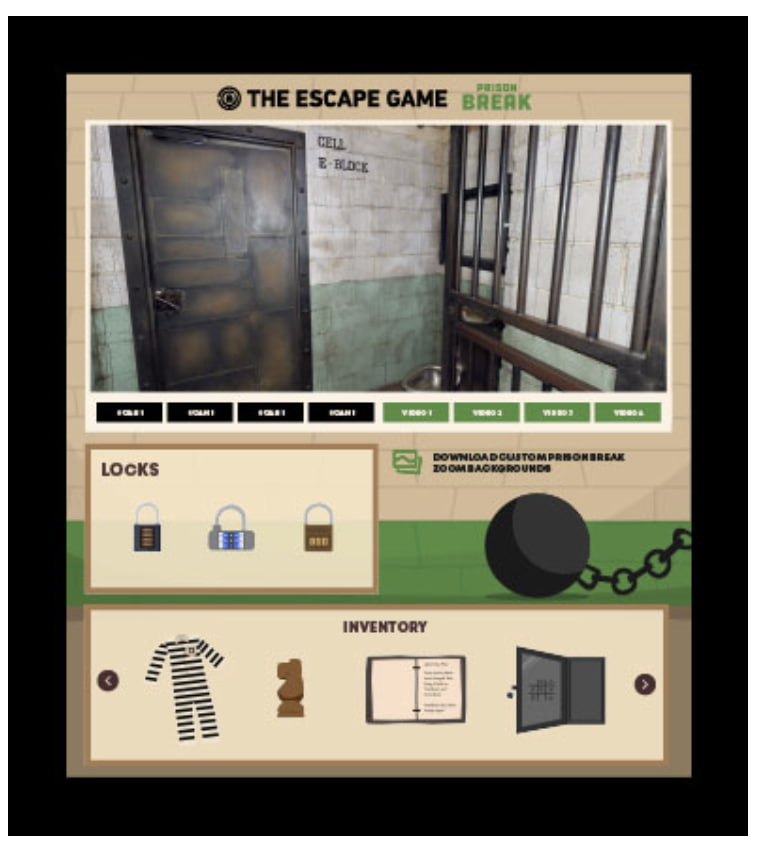
virtual sales kickoff ideas Escape the RoomImage Source

  • Divide attendees into teams for a game. Incentivize them to participate with small prizes. Mock Shark Tank or other pitching and improvisational challenges would be a good fit. Virtual escape room games are also a popular choice for team building.
  • Create breakout sessions for meet and greets or topic discussions. This will allow attendees to meet and interact with each other.
  • Encourage people to ask questions. Build in time to answer questions in the chat or in real-time with the hand-raised emoji.

3. Use engaging keynote speakers.

Having a great speaker is important at any event, but it’s absolutely a must for virtual ones. Work with your stakeholders during your SKO planning sessions to narrow down who in your organization (or outside if you have the ability to hire) would deliver the best keynote message, or who has an interesting story to share that your audience would find valuable.

4. Make your presentation count.

For virtual events, having an engaging presentation can help you hold everyone’s attention. Try not to have tons of text on your slides and incorporate more video and other visuals whenever possible.

5. Send a swag bag.

This doesn’t have to be excessive if you’re concerned about cost. Even a branded notebook that your team can use for the day with some pens can go a long way to making the event feel more cohesive and inclusive.

6. Create awards and recognize high performers.

Just because you’re not meeting in real life doesn’t mean you can’t recognize team members that are doing well. Set aside time in your presentation to celebrate wins and the people who helped the company achieve them.

Ready to get down to the nitty-gritty details of planning your event? Let’s discuss how you can make your event both engaging and informative.

1. Choose an engaging sales kickoff theme.

Why choose a theme for your sales kickoff? First, your content will be more engaging and memorable if it all goes back to a central idea. Second, it heightens the entertainment value. A theme lets you add in jokes, slideshows, skits, mini contests, and so on. Third, a theme keeps you on track. Kickoffs fail when they're all over the place — reps end up forgetting what they've heard, and there's no lasting value. To make your kickoff successful, give it an overarching theme.

But don't choose one at random. According to the "Heavy Hitter" series author Steve Martin, the right theme depends on your org's morale.

"All sales forces go through periods of high and low morale," he explains. "When morale is high, you can be more creative and take bigger risks with the theme you choose."

Martin says one of the best sales kickoffs he ever attended had a "Night at the Oscars" theme.

"Each of the sales regions created their own video about the average day in the life of a salesperson. The videos were exceptionally well-done, full of side-splitting humor, and their ingenuity was inspirational. Everyone loved watching them and a judging panel of company executives awarded Oscars to the best."

But "such an over-the-top" theme would be a bad idea during a low period. In that situation, Martin recommends a more pragmatic one, like "Better, Stronger, Faster." Planning a merger? Go with a theme that emphasizes collaboration, such as "Winning together."

Here are some ideas to get you started:

The Avengers/The Justice League

Give each of your top salespeople from last year a superhero persona. Then have them dress in costume and shoot a video or give a speech explaining what they did to be successful. You can also have your presenters dress as superheroes and stage battles.

Star Wars

This is another cinema-inspired theme that'll make your sales kickoff a good time. Give every host or sales leader a character (if you want laughs, I recommend asking the manager with the "toughest" reputation to be Darth Vader).

"Beat [Competitor]"

Do you have a clear rival in the market? Now's your chance to use that to your advantage. Nothing rallies a sales team like a common enemy, so use a theme that focuses on overcoming your competitor.

Back to the Future

sales kickoff themes back to the future Image Source

Hop in the DeLorean for this fun theme. Marty can represent your loyal, smart, enterprising salespeople; Doc Brown is their brave manager; Biff is the rival company, and getting back to their own time zone equals their sales targets.

March Madness

Assign an NCAA team to each sales team or region, then have them compete throughout the kickoff to advance through the bracket. Keep the basketball theme going throughout — have your presenters dress like coaches, use "referees" to quiet the crowd, and give basketball tickets as prizes.

Home Run

A baseball theme is another strong choice, especially when you focus on "home runs:" The ones you hit last year and the ones you'll hit next year.

Inspector Gadget/The Pink Panther/James Bond

Go with a spy theme to make things a little mysterious and fun. Your team's "gadgets" include their phones, laptops, CRM, etc. Their mission: Hit or exceed their annual quota.

[Your Company Slogan]

If you have a company tagline or slogan, consider making it your kickoff theme.

Survivor

Divide salespeople into teams. Over the course of the kickoff, hold several "challenges" to test their product knowledge, selling skills, engagement during sessions, etc. The kickoff's emcee can play Survivor host Jeff Probst. At the end of the kickoff, give the team with the most points a prize.

2. Create a sales kickoff agenda.

Salespeople want to learn what the top people at the company did so they can achieve the same success. These stories are both inspiring and insightful. With that in mind, schedule one to three panels where your highest-performing sellers discuss their biggest deals — how they started the sales conversation, how the process went, which obstacles they encountered, and how they got past them, etc.

You should also include at least one tactical sales training session. Successful salespeople never stop learning, so give them plenty of insights and new techniques to try in the new year.

Networking is another important ingredient of a great kickoff. This is the one time everyone on your sales team is in one place, so let your reps take advantage of it. They can forge valuable connections that'll lead to mentorships, informal peer training, friendships, and deal collaborations.

Of course, you also need to include the high-level content — how the sales org and company did last year and what your strategy and goals are for this year. These sessions get everyone on the same page so you're as effective as possible.

Day 1:

Welcome/breakfast: The host introduces themselves, goes over the schedule, and gets everyone excited. Free food never hurts — and if your attendees eat a good breakfast, it'll be easier for them to focus.

Year in review: Discussion of last year's numbers, the highlights and lowlights, major company industry, and product developments.

Training/breakout session: Reps get into small groups for skills-based sales training. Consider sending pre-work so training sessions are building on familiar information and concepts.

Lunch: This is a great opportunity for salespeople to network. Encourage mingling.

Marketing update: The CMO or VP of Marketing covers the initiatives their department is planning for the upcoming year (and more importantly, how these will help Sales make more money).

Live call (optional): Have a top performer run through an actual call with a prospect. Not only is listening to a live, unscripted conversation far more interesting than a planned presentation or call recording, it's also a great way to make the kickoff memorable and engaging.

Fun networking opportunity: Capitalize on the energy your last session generated. Host a Jeopardy-style quiz, ask reps to pick out the real customers from the fake ones for a prize, etc.

Competitive review: Have the Sales Enablement team discuss the major competitive players — where they're a true threat and where they fall short. To make this session more interactive, each person can play a persona of a different competitor.

Group dinner: This is another ideal time for your reps to get to know new faces and greet old ones while kicking back a little.

Day 2:

Short welcome/breakfast: This intro session should quickly go over the plan for the day.

Product training: In and of themselves, product updates aren't useful to reps. What is useful? Tactical content on how to position the new features, add-ons, and offerings.

Breakout session: To reinforce the last session, have reps get into small groups (each led by a sales manager or facilitator) and complete a training module and role-play exercise.

Lunch: The same idea as yesterday's lunch — try to encourage cross-team mingling if possible. You can also use this time to present awards to the top reps and managers of last year.

Training session: Prepare another skills-based lesson and exercise for this part of the kickoff.

The main purpose of this presentation? Get your reps fired up. You can choose someone from your company to talk — like a high-performing rep — or hire a guest speaker. Just make sure they're highly motivating and can speak to your sales org's specific culture.

Closing remarks: Have someone from your company (maybe the CEO or VP of Sales) give a short speech summarizing the kickoff's highlights and reminding everyone what they'll accomplish that year

Many companies host three-, four-, or even five-day kickoffs. This isn't a good idea: At that point, it's unlikely every session is helpful or relevant to the majority of attendees; plus, people want to get back to their regular responsibilities (not to mention lives). If this agenda doesn't fully fit your needs, swap sessions in and out.

For example, you might choose to have a session devoted to your CRM — how to navigate it, which features are most useful, expert tips, etc. Perhaps you'd like to cover an industry trend. HubSpot reps, to give you an idea, could learn how to talk to their EU prospects about General Data Protection Regulation (GDPR) compliance.

3. Integrate presentations, training, and team-building.

Once you've finished getting through the content and training that you need to cover, make sure you build in time for fun, social, team-building activities so your team can get to know one another and spend time together outside of the office. Below are a couple of ideas:

Happy hour/fun activity: Hold a happy hour with alcohol-free options for those that don’t drink. Another option is to host an activity. Give your salespeople the choice between paintball, laser tag, a cooking class, a scavenger hunt, a baseball game, or Escape the Room, to get folks mingling and collaborating.

Dinner: This is optional — you can let attendees go home after the previous activity if you'd like. But it can be nice to bring everyone together for one last dinner, especially if many attendees live too far away to travel back that night.

Host an SKO sales reps will enjoy and remember.

Each sales team is unique and you’ll want to tailor your event to your team’s culture and sales goals. However, if you follow these guidelines, reps won't just absorb a lot from your sales kickoff — they'll enjoy it, too.

This article was originally published in December 2018 and has been updated for comprehensiveness.

sales plan

04 Jan 18:11

Where Is Your Prospect In Their Buying Journey?

by Bob Apollo

One of the main reasons why apparently well-qualified sales opportunities fail to close or move forward is that the salesperson is so intent on pursuing their sales campaign that they fail to accurately diagnose where their prospect is in their buying journey.

This misdiagnosis is at the heart of many common current sales challenges, particularly when opportunities fail to close when predicted.

The problem can exist regardless of whether or not the salesperson is following a defined “sales process”, although it’s interesting (and somewhat disturbing) to observe that some poorly designed sales processes actually serve to obscure this critical piece of information.

It ought to be obvious, oughtn’t it, that if we don’t know where our prospect really is in their buying decision process, the chances that we are going to make the best possible decisions about how to pursue the opportunity are pretty remote.

That’s why accurately diagnosing the current state of our prospect’s buying journey is so important…

Many potential “champions” turn out to inexperienced buyers. Some prospect organisations don’t actually have well-defined buying processes. If you suspect either or both of these situations is at play, rather than ignoring it and hoping it will resolve itself (it won’t) you’re much better off coaching your champion in how to manage their buying journey. But that’s a topic for another blog.

There’s a remarkably consistent pattern to most successful buying processes (the ones that end in a positive outcome, rather than a decision to “do nothing”), and although it’s always possible for some opportunities to skip some of the stages, this almost always creates significant problems for the prospect, causing the project to stall or fail later on.

KEY PHASES IN THE BUYING JOURNEY

Here are the seven phases that are most commonly found in successful complex B2B buying journeys, including the “pre-buying” STATUS QUO and the post-sale IMPLEMENTATION stages. These apply particularly to high-value first-time purchases that involve multiple stakeholders (lower value, transactional purchases are often simpler):

  • STATUS QUO [Pre-Buying]
  • EXPLORING
  • DEFINING
  • SELECTING
  • VERIFYING
  • APPROVING
  • IMPLEMENTING [Post-Sale]

Although each phase normally proves to be important, the buying journey itself is not necessarily linear. At any point, the prospect can decide to stay as they are, go around in circles, move forwards, move backwards, or abandon the process altogether.

Different members of the key stakeholder group/decision-making team may think that the project is at a different phase to their colleagues. The project’s Power Sponsor has a critical role in identifying and dealing with these misalignments.

Let’s look at each of these phases and their associated indicators and milestones in more detail…

0: STATUS QUO [Pre-Buying]

The prospect appears to be unaware or unconcerned about any of the issues we have targeted.

KEY INDICATORS

During this phase, they typically:

  • Appear to be satisfied with their current situation
  • Are passively absorbing potentially useful information
  • Are likely to attend industry events, read relevant publications, visit familiar information sources and network with colleagues and peers
  • Do not appear to be suffering any significant pain
  • Give no signs of being actively in the market

MILESTONE

Before advancing beyond this phase, something must have changed in the prospect’s environment and caused them to start actively exploring the situation.

1: EXPLORING

The prospect has now become aware of a potentially significant issue and has started to actively explore their options. This is the first significant phase in a new buying journey.

KEY INDICATORS

During this phase, they typically:

  • Start to actively explore the issue
  • Seek to better understand the impact of the issue on their organisation
  • Discuss the issue with colleagues and peers
  • Try to find out if other companies are suffering from the issue and how they are responding
  • Start to identify and research potential solutions
  • Are not yet fully clear about what they need

MILESTONE

Before advancing beyond this phase, the prospect must have concluded that there is a compelling reason to act and that suitable solutions are available.

2: DEFINING

The prospect is now in an active buying cycle and is (amongst other things) defining their decision team, criteria and process.

KEY INDICATORS

During this phase, they typically:

  • Seek to prioritise the problem and identify funding
  • Seek to further refine the business case
  • Start to form a decision-making team
  • Start to define their decision criteria
  • Start to define their decision process
  • Identify and research potential solutions in significant detail
  • Attempt to come up with a shortlist of credible options for evaluation

MILESTONE

Before advancing beyond this phase, the prospect typically has some sort of vision of a solution and has defined their decision team, criteria and process.

3: SELECTING

The prospect is now actively evaluating their shortlisted options and trying to select the best solution.

KEY INDICATORS

  • During this phase, they typically:
  • Actively evaluate their shortlisted options in significant detail
  • Often issue an RFP at this stage
  • Seek clarification and reassurance from the bidding vendors
  • May have already established a preferred option without revealing this to other vendors
  • Attempt to achieve decision-team consensus around their preferred option

MILESTONE

Before advancing beyond this stage, the prospect has typically identified their preferred solution(s) and is ready to start negotiating the details.

4: VERIFYING

The prospect is verifying their chosen solution and trying to negotiate the best possible terms.

KEY INDICATORS

During this phase, they typically:

  • Engage in detailed commercial and legal negotiations (often involving legal and procurement specialists)
  • Seek references and reassurance from other users
  • May investigate the financial standing of the vendor and if necessary seek guarantees
  • Seek to reinforce the internal business case
  • Lobby the approval team to support the project

MILESTONE

Before advancing beyond this stage, the prospect must typically become satisfied that they have made the best choice and have negotiated the best possible terms.

5: APPROVING

The prospect has rejected all other options and submitted the project for final internal approval.

KEY INDICATORS

During this phase, they typically:

  • Submit the project for final formal approval
  • Expect the business case to come under detailed scrutiny
  • Shift the focus of competition to other projects that may be competing for the same resources
  • Have to answer the question “why does this project need to go ahead now?
  • Have to set up internal systems with new vendor details prior to order

MILESTONE

Before advancing beyond this phase, the project must have been signed off, and a firm order placed with the chosen vendor.

IMPLEMENTING [Post-Sale]

We may think that the sales is complete when you receive the customer’s official order, but we would be well advised to remember that from the customer’s perspective, the buying journey isn’t over until and unless the problem they originally set out to solve has been satisfactorily addressed.

SIGNIFICANT IMPLICATIONS

SKIPPING STAGES

You may think that the above journey is an idealised process and, of course, it is. Many buying journeys appear to skip one or more stages, and if only one decision-maker is involved, they can still come to satisfactory conclusions.

But in the types of opportunity I have in mind – high-value first-time purchases that involve multiple stakeholders – when stages are skipped they almost always store up trouble for the future. Rather than shortening the process, skipped stages or steps tend to lengthen the process because at some point someone in authority typically requires that the gaps are filled in before the project can proceed.

ARRIVING LATE

The buyer’s journey reflects the prospective customer’s buying process, not the sales person’s process. That’s why it’s critically important that we recognise the stage our customer has reached when we first become aware of an opportunity.

If the first time we become aware of an opportunity is during the prospect’s selecting phase (for example, if we receive an unexpected RFP) our chances of winning have already been dramatically diminished, because the prospect will have defined their requirements without our inputs.

AVOIDING GETTING AHEAD OF OURSELVES

Perhaps most important, recognising where the prospect is on their buying journey can stop us from getting ahead of ourselves, and believing that the opportunity is at a far more advanced stage than it really is.

This is one of many reasons why sales organisations that focus on their prospect’s buying journey and not just on their internal sales process typically do a far more accurate job of forecasting the outcomes of active sales opportunities, and suffer fewer competitive losses or “no decisions”.

IN CONCLUSION

I hope that I’ve managed to persuade you that aligning your sales activities with your prospect’s buying journey can deliver significant benefits. You can download a one-page summary of the buying journey phases, indicators and milestones here.

Buying Journey Key Indicators.png

If you’d like to start a discussion about how to apply the principles in your own organisation, please share your comments below.

04 Jan 18:10

My Ultimate Q4 Sales Playbook: Real-Life Tactics to Help You Win in the Final Quarter

by afrost@hubspot.com (Aja Frost)

I once closed Q4 (and a couple of significant deals) on a family Disney World trip for Christmas — all because I was able to leverage my sales playbook.

I used end-of-year email templates to send follow-ups from the theme park. I used call scripts to make calls from the beach. I checked my inbox from the ride lines. Needless to say, I was highly distracted. But thanks to a good sales playbook, I booked my orders in time.

Sales playbooks are tailor-made for sellers to close critical deals all year round, and in my experience, they’re even more essential for winning crucial year-end deals. Playbooks are deliberate and actionable, but not all are created equal. In this article, I’ll cover seven effective sales playbooks to help you and your team succeed in the final quarter. I’ll also explain how to create a playbook for top results.

Free Download: Sales Plan Template

Table of Contents

In the context of sales, a playbook serves as a detailed manual that helps sales teams navigate common scenarios they encounter during the sales process. It provides step-by-step instructions, proven techniques, and helpful resources to ensure consistent, effective sales approaches that motivate buyers and help sellers to destress.

Great sales playbooks include sales enablement tools like:

  • Value-based selling cheat sheets and customer quotes.
  • Strategy steps.
  • Discovery call questions.
  • ROI-related data.
  • Buyer personas.
  • Sales process rules.
  • Competitive battle cards.
  • Email and social media templates and ideas.
  • Call scripts and outlines.

A play is a specific strategy or set of actions designed to achieve a particular objective.

In a sales context, it’s a tactical approach that sales teams use to engage prospects, address their needs, and move them through the sales funnel. Sales plays are tailored to different scenarios, customer segments, or stages in the buying process. They are meant to provide you with a clear, actionable plan. In other words, if a sales playbook is a manual, a sales play is a specific tutorial within the manual.

Pro tip: While a defined sales play provides structure, it shouldn't be rigid. I recommend that teams regularly review and adapt plays based on real-world results and changing market conditions.

what is a sales playbook versus a sales play

Key components of a sales play typically include:

  • Objectives.
  • Target audience.
  • Messaging ideas.
  • Steps and actions.
  • Tools and resources.
  • Metrics and KPIs.

Why Your Business Needs a Sales Playbook

Many companies talk about the value of having a “single source of truth” for important company matters. A sales playbook can be that source of truth — and a treasure trove of resources for sales processes, competitive information, shortcuts to closing deals, and succeeding as a trusted advisor to prospects, partners, and customers.

Even on days when sales reps aren’t at the top of their game, a playbook can point them in the right direction and help them meet goals like quota and lead conversion rates.

Your sales leaders and longest tenured sales representatives have a lot of expertise that they’ve developed over the years. I recommend collecting that expertise into a shareable living document and connecting the dots between tried and true sales tactics and resources in book form can be invaluable for future growth.

7 Sales Playbook Templates to Help You Close More Deals

When you're in the final quarter, every sale counts. You need proven, reliable strategies to guide your team and ensure they can apply the playbook effectively during every stage of the sales process.

As a senior business development and sales and marketing professional, I’ve noticed that playbook templates help ensure your enablement materials are:

  • Effective and based on actual selling experiences, not theory.
  • Comprehensive yet digestible enough to use on the go.
  • Offer targeted content for specific industries and personas.
  • Kept current with the latest product features, benefits, and changing customer priorities.

For instance, HubSpot offers sales playbook software which is integrated into the Sales Hub platform. This tool is designed to help you create, manage, and utilize playbooks effectively to improve your sales processes. Accessibility through Sales Hub makes playbooks simple to find when needed no matter where your business day takes you.

The sales playbook application offers ready-to-use templates for various scenarios, such as:

  • Discovery calls.
  • Qualification calls.
  • Prospecting.
  • Client meetings.
  • Follow-up email messages.

Here are my favorite playbook templates.

1. Sales Plan Template by HubSpot

sales playbook template from hubspot

This customizable template allows you to work through your sales plan and playbook simultaneously so they align with each other. I recommend using this template as a foundation before you create the more advanced sections of your playbook. You can easily adapt it as your business, and your playbook evolves.

Pro tip: Your sales plan should inform your playbook, and your plays should align with the goals outlined in your sales plan. That’s why I suggest creating your sales plan first and sharing it with your team before creating and sharing other playbooks.

2. Sales Call Scripts by HubSpot

sales playbook template with call scripts

Include script templates in your playbook to ensure your team is prepared to enhance their conversations with customers and prospects. These scripts should be conversational, compelling, and used consistently for engaging sales calls, while preparing your sales team to increase their Closed/Won deal numbers.

Pro tip: I never read sales scripts verbatim during calls, but always found they were a great way to sort out what to say when opening a sales call.

HubSpot's sales call scripts provide structured templates for various scenarios, from cold calls to follow-up conversations. It includes several types of call scenarios, including:

  • Standard outreach.
  • Gatekeeper.
  • Discovery discussions.
  • Navigating referral or recommendation redirects.
  • Introductory or renewing connections.
  • Proposal and prior meeting follow-ups.

What I like: Each template explains its best use cases and provides different options, depending on whether the prospect is willing to chat, or if they’d prefer to reconnect next year.

3. Sales Email Templates by HubSpot

sales playbook email templates

Email will always remain a powerful, non-intrusive tool for reaching prospects. This sales email template kit includes emails for just about every scenario there is, including:

  • First-touch introductions.
  • Break-up messages for ending on a high note.
  • Post-voicemail “just called you” explanations.
  • Drip campaign emails.
  • Deal win or loss debrief invitations.

What I like: Your sales team won't have to write an email from scratch again, which saves time that can be better spent researching prospects and closing deals. I often found it awkward to write a follow up email after I lost a deal, or even when I won. Yet, debrief conversations are often excellent resources for learning how to navigate similar selling scenarios. I suggest you store that one in your end of year follow-up files to prepare for the coming year.

4. Sales Qualification Questions by HubSpot

sales playbook qualification questions

Qualifying leads is essential to focus your efforts on the most promising prospects. HubSpot’s list of sales qualification questions allows you or your team to discover your lead’s level of awareness and need, as well as their budget, timeline, and expected business impact from the purchase.

What I like: Although I often found extended silences can be an advantage during sales calls, it’s great to have a fresh arsenal of probing questions in your playbook. It can empower your team to better nurture promising prospects, improve their sales qualification effectiveness​, and help move deals through the sales pipeline.

5. Prospecting & Objection Handling Templates by HubSpot

sales playbook prospecting and objective handling templates

During every sales process, salespeople are bound to run into objections. Your sales playbook should include objection handling tips and methods for when they arise. Prospects always have at least a few objections in every sales engagement, otherwise successful businesses wouldn’t need to hire high-performance sales representatives of the caliber they do.

These objection-handling templates and best practices are a worthy addition to any sales playbook and provide strategies and responses for common objections. I like how this guide provides sales reps with techniques for addressing concerns professionally and keeping the conversation moving forward.

There are also some good insights on why prospects push back, and about keeping a repository of proven objection rebuttals. That way, salespeople can handle objections with politeness and empathy while dispelling a prospect’s reservations and fears.

6. Sales Battle Card Templates by HubSpot

sales playbook battle card templates

At one point or another, your prospects will challenge your sales team about a competitor’s features, pricing, benefits, or other factors. Whether they are currently using a competitive solution, or considering marketspace alternatives, you want your team to confidently position your strengths and strategic value relative to your competition.

The company I work for now — and most that I’ve worked for in my career — have a non-disparage policy about competitive sales. I read a great Klue article on selling competitively by focusing on your strengths and driving a value wedge with your company’s products or service to distinguish your offerings from your competitors.

These HubSpot battle card templates will help your team better understand your market positioning and handle objections more effectively. They enable your sales operations, product management or competitive intelligence team document and share competitive intelligence across your sales and marketing teams, including their strengths, weaknesses, and key differentiators. They can enable your sales team to better position your product, highlight unique value propositions, and counter competitive threats.

Pro tip: Work with your colleagues across your business to curate competitive data points from sources like reputable analyst reports and review websites. Protect your customers from churning and maintain your edge in competitive sales pursuits. Task your sales team to tactfully ask customers what they like and dislike about competitive solutions. Add these points your sales playbook, and empower your reps to use them to win more deals.

7. Sales Closing Guide by HubSpot

saas sales playbook sales closing guide

From my experience, the most important piece of information you can include in your playbook is how to close deals. This sales closing guide from HubSpot offers a step-by-step approach to sealing the deal, including techniques for:

  • Creating urgency.
  • Handling last-minute objections.
  • Negotiating terms.

It also offers tips on recognizing buying signals and timing your close.

What I like: I appreciate that you can include this guide directly in your playbook or share it individually with your sales team as a training tool they can reference from time to time. It’s an essential reference that will empower your people to close deals faster and more effectively.

How to Create a Sales Playbook That Closes More Q4 Deals

Your sales playbook is unique to your business. Here are steps you can take to create a sales playbook that will boost your closing rates and help you hit your targets.

Step 1. Define your sales process.

Start by mapping out each stage of your customer's journey, from initial contact to closing the deal and beyond. Identify key touchpoints, activities, and decision-making moments at each stage.

I’ve found that a visual representation of sales stages helped me to determine what I needed to do to nurture the deal forward. It also helps to strategically place trial close reminders because you never want to make a qualified prospect feel like you aren’t interested in their business.

Also, consider the pace at which deals move through your sales funnel and what actions best trigger forward progress. Identify and document the tools, resources, and skills needed at each stage. I recommend that you include both internal processes (like pricing approvals or contract reviews) and customer-facing interactions. My proposal development team has comprehensive standard operating procedures (SOPs) that make it clear how key tasks should be undertaken.

For instance, you can use the conversation intelligence tool to monitor your team’s call quality and your customers' tone of voice. There are a number of ways to use these insights during coaching meetings to help your reps better understand prospect requirements.

Pro tip: Creating a clear, step-by-step sales process outline can serve as the foundation for your entire sales playbook. It helps your team to develop a consistent and repeatable approach to guide prospects through the buying process.

How to Create a Sales Playbook (Guide)

Step 2. Develop winning sales strategies and define your key metrics.

Analyze your top performers' techniques and successful deals. Identify patterns and best practices for each stage of the sales process. Include effective methods for prospecting, qualifying leads, delivering compelling presentations, handling objections, and closing deals.

Back these strategies with data and real-world examples to demonstrate their effectiveness. To make them more effective, consider incorporating modern approaches like social selling, value-based selling, or solution selling.

Don't forget to outline strategies for different buyer personas and scenarios. The goal is to provide your team with a tailored toolkit of proven tactics to boost their success rates.

You should also determine the key performance indicators (KPIs) that will help you measure the success of your team’s sales efforts. This could include conversion rates, average deal size, sales cycle length, and customer acquisition cost.

In my experience: I enjoyed working on teams that prioritized these results-oriented metrics over activity-based metrics like call volume or lead resolution metrics. I appreciate, though, that if your conversion rates or deal closing numbers aren’t ideal, the activity metrics will demonstrate whether or not you are putting in the work required to succeed.

how to create a sales playbook

Step 3. Outline your sales playbook goals.

Use the KPIs from the previous step to identify specific, measurable objectives that align with your overall sales strategy. These goals should address key areas such as increasing revenue, improving conversion rates, shortening the sales cycle, or enhancing customer retention.

Once you identify your goals, define your short-term and long-term targets and ensure they are realistic and achievable. Your goals should also reflect the unique opportunities and challenges of your sales team’s skillset, what they sell, and how they fit into your company hierarchy.

Pro tip: Your goals should clearly illustrate individual performance targets, collaborative sales, and overall team attainment. Remember these goals will guide the content and structure of your playbook, so make them count.

Step 4. Align your sales and marketing teams.

Data shows that 90% of sales and marketing professionals feel they are out of sync in terms of strategy, process, content, and culture. Moreover, 60% believe this misalignment hurts financial performance. Clearly, this can hurt your sales strategy.

As someone who has worked in both sales and marketing, it’s often just a matter of one team reaching out to the other to initiate collaborative efforts, and for both teams to commit to working collaboratively towards common goals. Salespeople are great resources of campaign and content ideas from their customer conversations, and many marketing teams have a wealth of resources they can share to help move deals forward.

So, as part of developing your sales playbook, you need to ensure that your teams are in sync. This approach fosters a culture of mutual support and shared responsibility to create a cohesive and effective revenue-generating machine. Proper alignment can lead to significant benefits, including increased revenue growth, improved efficiency, enhanced lead quality, and a shortened sales cycle.

Good collaboration between the two teams results in a better understanding of your ideal customer, clearer mapping of the customer journey, and a more consistent message throughout the buyer's experience.

More importantly, you will need input from both teams to create a winning sales playbook that addresses the needs and challenges faced by each department.

Step 5. Pick a team.

Determine who should be involved in the sales playbook creation process so you can invite them to join collaborations.

Some of the teams I recommend tapping when building a playbook include:

  • Sales reps (including account managers, sales specialists, and business development reps).
  • Sales VPs, directors, and managers.
  • Channel sales managers.
  • Sales operations.
  • Marketing personnel who work on content, product, and sales enablement materials.
  • Product and service offering managers.
  • Customer success and support teams.
  • Industry principals and subject matter experts.

Having input from several customer facing and offering-related teams ensures your playbook reflects various aspects of the customer journey and sales process.

I also recommend identifying directly responsible individuals (DRIs) for creating the sales playbook so that other team members know who's leading the effort and who they can reach out to with questions and comments.

Step 6. Draft and publish your sales playbook.

This step is the climax of the whole process. Use all the data and insights you have gathered to put together your sales playbook. Remember those templates we talked about earlier? They're going to be your secret weapon here.

For instance, the sales plan template will help you lay out the big picture of your sales strategy. As you’re working through it, think about how you can tailor it to your specific product and market.

Pro tip: Remember, these templates are just starting points. The magic happens when you infuse them with your company's unique voice, experiences, and best practices. Don’t be afraid to get creative, but make sure it aligns with brand guidelines.

Step 7. Educate your reps on how to use the playbook.

In my experience, your sales playbook will only be effective if your reps are able to apply it effectively. They need to have a deep understanding of your products, their capabilities, and their features. They need to understand its ins and outs, including how to use customer voices for success.

That’s why I recommend hosting training sessions for my sales reps. They attend sessions with our company’s product teams and even test out products like customers. I suggest brainstorming ways you can get your team more familiar with your products so they know them inside and out.

Step 8. Make the playbook easily accessible.

To ensure your sales playbook is a valuable tool for your team, it must be easily accessible. This means storing it in a centralized, digital location where all sales reps can quickly find and use it. My team hosts these documents on a company Wiki. In the past, I’ve seen teams store this information on Google Drive and Atlassian. It all starts with accessibility — whether your playbook is in HTML or PDF, the format, locations, and access guidelines need to fit both the team’s and the organization’s needs.

Also, ensure that the playbook is mobile-friendly for on-the-go access and send regular email updates with direct links. This approach ensures everyone is well-equipped to follow best practices, practice consistent messaging, and maintain the efficacy of the playbook.

Step 9. Implement a feedback loop.

A robust feedback loop ensures your playbook remains a living, breathing document that evolves with your market, products, and team's expertise. It allows you to quickly identify and address gaps in your sales strategy, adapt to changing customer needs, and capitalize on emerging best practices.

This continuous improvement cycle can significantly boost your team's efficiency and effectiveness and, ultimately, your bottom line.

Therefore, encourage your team to share what’s working and what’s not and suggest updates to the playbook. Regular reviews and updates will keep your strategies fresh and effective.

Pro tip: Incorporate feedback into your playbook as part of your regular team meetings. This creates a culture of continuous improvement and ensures everyone is aligned with the latest strategies and practices.

Step 10. Measure the impact and optimize your efforts.

Finally, measure the impact of your sales playbook on your sales performance. Analyze the key metrics and KPIs to determine their effectiveness. Use this data to optimize your sales strategies and make necessary adjustments to the playbook.

Continuous monitoring and optimization will ensure that your sales playbook remains a valuable tool for closing more deals​.

What to Include in a Sales Playbook

It's crucial to include specific components that address every aspect of the sales process to ensure your sales playbook becomes an indispensable resource for your team. In my research, I found that the following elements were most common in sales playbooks.

1. Company Overview

Provide a company overview and discuss the sales organization in detail. Include information about how the sales organization is constructed, who manages each team, which KPIs reps and teams are expected to hit, and so on.

2. Selected Plays

Identify which plays will be used for each playbook you create to clearly define the playbook's purpose for reps.

Ensure that each play is aligned with specific sales goals and scenarios your team encounters. Regularly review and update these plays to reflect new strategies and market changes, keeping your team agile and informed.

3. Products and Services Overview

Cover every product or service reps are responsible for selling. Mention price points, use cases, core value offerings, buyers, end-users, and related industries or verticals.

You may choose to create one sales playbook for each product you sell if they're all fairly different, require radically separate buying processes, have different buyer personas, or are sold by different members of your sales team.

4. Sales Process

Explain each step of your sales process from first touch to close. You might just link to your sales process document here so reps and sales managers can easily refer to it.

5. Playbook KPIs and Goals

Define the metrics that matter most for measuring success, such as conversion rates, average deal size, and sales cycle length. Set clear, achievable goals for each KPI.

Also, ensure that guidance is included on how to track and interpret these metrics and how they align with overall company objectives. This section should also outline any incentive structures tied to these KPIs.

Pro tip: Use data visualization tools to highlight key metrics and performance trends in your playbook. Visual aids can help your team quickly grasp important insights and make data-driven decisions more effectively.

6. Buyer Personas

Include detailed descriptions of your ideal customer profile, including:

  • Demographics. Age, gender, location, profession, etc.
  • Pain Points. Common challenges and issues faced by the personas.
  • Motivations. What drives their purchasing decisions?
  • Objections and solutions. Typical objections and how to address them.
  • Marketing messaging. Tailored messages that resonate with each persona.

This information helps your team tailor their approach to each prospect.

7. Lead Qualification Criteria

Include lead qualification criteria so reps can refer to them in tandem with buyer persona information. For instance, maybe a qualified lead at your company means the lead is ready to buy in the next three months, or already has sufficient budget to make a purchase.

Expectations regarding prospecting and follow-ups should be included here, too. Guidelines should be provided regarding when to pursue opportunities and when to let them go.

8. Resources and Sales Enablement Materials

To create an effective sales playbook, you need to have ample resources and sales enablement materials for your reps. This requires a strong relationship between the sales and marketing teams, which you can define in this section.

This also means reps must be educated about available resources and materials (e.g., case studies, product pages, social content, demo videos, CRM, sales software, sales technology, etc.). List those resources in this section, too.

9. Competitive Battlecards

When working on a competitive deal, it helps to have current, accurate information about your company’s strengths relative to other vendors your prospect is considering.

Along with comparative feature and benefit information, I find it helps to provide a list of terminology cues that indicate a customer is speaking with a competitor. That competitor may give the prospect a set of objections to try and diminish your competitive position, so it helps to be prepared.

10. Upsell and Cross-Sell Strategies

Positioning product and service add-ons feels really risky when you have nearly closed a deal. By including advice on when and how to best bundle complementary products and services — like premium support, training, and extended warranties — you can better position your reps for success.

11. Sales Scripts and Messaging

A collection of introductory call statements and objection rebuttals can be helpful to alleviate stress for new hires and experienced reps selling new products or services. On-brand messaging statements and templates are great ways to save time when sending emails and posting on social media.

12. Product Roadmaps and Sample Contract Language

Prospects often ask about features that aren’t currently available or supported but are on the development team’s list of priorities over the coming months. In competitive deals, a current version of the product roadmap can give prospects confidence that even if the features they need aren’t currently available, they are in development.

I’m currently building a proposal where the customer is seeking a sample contract. I will have to do some searching, but if it was already available in my playbook, I wouldn’t have to explore our document library.

Benefits of a Sales Playbook

From my experience covering sales, I know how much time and effort goes into creating a sales playbook, but it's worth it — and you’ll start seeing results almost instantly.

Here are some of my favorite sales playbook advantages.

benefits of a sales playbook

1. Improved Efficiency and Productivity

It helps streamline the sales process by providing a clear roadmap for sales representatives to follow. This structured approach allows them to spend more time actively selling and less time figuring out what to do next.

Additionally, having all the necessary information and resources readily available allows your sales reps to work more efficiently and handle a higher volume of leads.

2. Consistent Sales Approach

A sales playbook codifies your most effective strategies, ensuring that every team member has access to proven techniques. This standardization leads to more consistent performance across your sales force.

3. Make New Hire Training Quicker and Easier

From my experience, training new salespeople is far quicker and easier when you have clear, explicit explanations of who your customers are, how they buy your products, what pain points they experience, what to say to them, and more.

Without a sales playbook, your reps are forced to learn this information ad hoc.

4. Adaptability to Different Sales Scenarios

A well-designed sales playbook includes various “plays” or strategies for different sales situations. This adaptability allows sales reps to navigate complex sales scenarios with confidence, whether they're setting up an initial meeting or restarting a stalled proposal.

It provides guidance for multiple scenarios and empowers your team to handle diverse challenges effectively.

5. Free Up Valuable Time for Reps

According to HubSpot's 2024 State of Sales Report, sales reps spend only 33% of their day actually selling.

When sales reps spend too much time searching for or creating content, they can’t focus on nurturing deals and closing sales. That's the power of a playbook; it frees up time for selling.

Rather than having each rep develop their own messaging, questions, and resources to use with prospects, give them ready-made content — a.k.a, focus on sales enablement. This will give your reps more time to sell.

6. Improved Collaboration

With a centralized document outlining the sales process, team members from both sales and marketing teams can collaborate more effectively. The playbook fosters a shared understanding of goals and strategies, enabling sales reps to work together seamlessly. This collaborative environment can lead to more innovative solutions and a stronger, more cohesive sales team.

7. Reliable Performance Metrics

A sales playbook provides a framework for tracking and analyzing key performance indicators (KPIs). You can quickly use this data to identify areas for improvement, measure the effectiveness of different strategies, and make informed decisions to optimize the sales process.

This data-driven approach ensures that your team is always working towards the most effective methods for achieving their targets.

Sales Plays to Include in Your Playbook

I've seen themes create sales plays for a specific stage of the sales pipeline. I've also seen plays just for demos, which has helped reps with presenting, asking the right questions, and handling objections. These are some examples of plays that you may choose to focus on.

sales plays to include in your playbook

  • Personalized content play. Describe how reps can personalize and tailor the content they share with prospects and customers to the buyer's journey.
  • Lead qualification play. This play should define how reps can efficiently identify high-qualified leads to reach out to.
  • Demo play. Focus this play on how reps can effectively demo products and how to strategically highlight their features and benefits to prospects.
  • Use case play. This play should showcase specific use cases that your existing customers have reported as how they get the most out of your products.
  • Prospecting play. Focus this play on how reps can use certain platforms, channels, or tactics to identify prospects that meet your ideal customer profile (ICP).
  • Closing play. Focus this play on how reps can move late-stage leads towards closing in a way that feels natural, professional, and effective.
  • Follow-up play. Focus this play on how and when reps can follow up with leads at different points in the buyer's journey, including after the sale, to ensure all of a customer’s needs are met.

Winning Tips for Crushing Q4 Sales Goals

Before we dive into some playbook examples, here are five plays I used to run in Q4 to optimize my chances of closing as many deals as possible.

1. Don’t be surprised by OOO replies.

Ask the prospect what their vacation schedule is if they suggest they will be buying in the last quarter. See if they have anyone backing them up while they are on vacation or if there are any procurement counterparts that might submit the deal. Ask for a verbal commitment on a Q4 deal for forecast accuracy.

2. Understand and leverage year-end budgets.

Does a prospect’s fiscal year end in December, March, or some other time of the year? Many businesses over budget for costs like technology and equipment, and if they don’t spend the money, it doesn’t roll over to next year.

Find ways to incentivize end-of-year purchases with volume or bundle pricing that won’t devalue your products.

3. Create a sense of urgency.

Does your company plan on price increases in the new year? Are there discounts available for this year’s models to clear aging inventory in your warehouse? Find ways to motivate prospects and existing customers to buy now — not next year.

4. Separate tire kickers from the hot prospects.

Do you have stagnant prospects in your pipeline that haven’t been responsive in recent months?

Brainstorm on incentive packages for leads that have cooled. If emails have gone unanswered, make a call or send a social media message. Maybe the contact left the company or changed responsibilities and can help you find their replacement.

Alternatively, send a break-up email to suggest you will prioritize your attention elsewhere. When you set a prospect free and they return to you with open arms in Q4, it’s often a good sign.

5. Make exclusive or personalized offers.

Many business decision-makers are too accustomed to Q4 limited-time discounts that they simply ignore them.

If your company has a customer success or training program, offer an education incentive to help your team ramp up on your products in the new year. If that training program happens at a customer conference in February, bundle in some conference passes as I’ve done in the past. Training is a great way to help customers get travel approval, especially for a company growth initiative or for training on technology.

The end of the year and the arrival of winter makes many prospects complacent, or they can get caught up with other responsibilities. These tips will help you identify ways to recapture their attention, create urgency, and submit a deal that moves the needle on your year-end revenue attainment.

Sales Playbook Examples

While sales playbooks are typically internal documents, some companies publish their playbooks. Check out a few of my favorites below.

1. HubSpot and Join.me Sales Meeting Playbook

sales playbook example from hubspot and joinme

This two-page playbook was created in a joint effort between HubSpot and Join.me. It outlines what a rep should do before and during a sales meeting to increase the chances of closing the sale.

The playbook is divided into seven sections in the sales playbook software — but don’t let that number fool you. With its clear headings and easy-to-scan checkboxes, the seven sections fly by quite quickly. In order, they are as follows.

  • Research prior to meeting. Offers guidance on exactly what sales reps should research before the meeting.
  • Set the agenda. Includes an example of how sales reps can set the agenda for the meeting.
  • Discovery phase. Lists out a few questions reps can ask to uncover information about the prospect’s business, as well as their needs.
  • Assess the need. Includes additional questions to diagnose the problem and understand what can be improved.
  • Define their buying process. Includes more questions sales reps can ask to understand the client’s purchasing process.
  • Demo. Offers a few tips on how to carry out a demo that closes the deal.
  • Close. Share an example of what sales reps can say to finish the conversation and win the deal.

Why I think this sales playbook works: The power of this playbook lies in its length. It shows that you don’t need to write a 27-page-long manifesto. With just a few quick bullet points, you can still guide your reps to success. Most importantly, I love that the playbook provides examples of what sales reps can say.

2. Global Telecom Solutions Partner Playbook

sales playbook example from global telecom solutions

Global Telecom Solutions uses this well-structured sales playbook to provide discovery questions and tips to their solution partners.

It isn't too prescriptive, which is why it’s so effective. Every spread is dedicated to one type of customer, and each has four noteworthy sections.

  • Discovery questions. Includes the questions each sales rep should ask prospects in that specific industry.
  • What to listen for. Lists a few keywords and terms sales reps should listen for in the prospects’ answers.
  • Contacts. Outlines who sales reps should reach out to at the target businesses.
  • Did you know. Includes pieces of information that emphasize the importance of GTS’s solutions.

Why I think this sales playbook works: I like that the structure is easy to follow, with every spread dedicated to a different type of customer. It also provides useful goalposts but isn’t overly prescriptive, allowing sales reps to shift gears if need be.

3. Cobalt Iron Partner Playbook

sales playbook example from cobalt iron

Cobalt Iron’s playbook for its partners is a classic example of a well-executed playbook. It provides an overview of the company and the product, then shares several elevator pitches that partners could use.

It also provides information on the state of the industry so that partners can understand where the product falls in the current landscape.

Notable sections include the following.

  • Elevator pitch for customers. Outlines common issues that customers face and reasons why customers should adopt the solution.
  • Customer challenges. Gives further insight into the customers’ needs, then goes into specific challenges as they relate to the product.
  • Target customer profile. Outlines the characteristics of a customer who needs the product.
  • Buyer profile. Offers more details on specific buyer personas at prospective businesses.
  • Managing objections. Share common objections and ways to respond to them.
  • The competition: Includes easy-to-scan bullet points on how to compare the product to competitors’ offerings.
  • Conversation starters. Offers a few questions solutions partners can use to get the conversation rolling.

Why I think this sales playbook works: I like that this playbook is thorough, comprehensive, and well-thought-out. It includes extensive information on the state of the industry and the challenges that prospective customers face. It‘s on the longer side, but there’s a good chance your reps won't mind if it helps them meet their quota.

4. Sales Datanyze and HubSpot Sales Development Playbook (SDR)

sales playbook example from

Datanyze and HubSpot created a playbook for sales development eps (SDRs) to become more efficient at account development and outreach. This SDR sales playbook acts as a guide to help SDRs combine automation and advice from seasoned professionals to provide reps with best practices on how to seek out ideal clientele at higher success rates.

This playbook provides several examples of prospect exchanges across email and calls to better equip SDRs for taking sought-after prospects down the sales funnel.

Notable sections of this playbook include the following.

  • Account development. Guides SDRs on how to create and manage a named account list for ideal buyers.
  • Research and prospecting. Covers how to perform targeted research and find the right contacts.
  • Cold emailing. Shares insight on how to humanize emailing and break through cluttered inboxes.
  • Calling tips. Demonstrates how to use modern calling tips in outreach strategy.
  • Call mapping. Outlines who to conduct calls without jumping into the pitch immediately.
  • Objection handling. Lists common objections and how to tactfully approach them.
  • Reporting: Emphasizes the importance of tracking performance metrics to gauge effectiveness.

Why I think this sales playbook works: In my opinion, this playbook is the right mix of technical instruction and anecdotal advice to create an easy-to-understand guide to client outreach. It allows SDRs to think about how their interactions can organically and inorganically nurture target audience members. The team can then reel them in with personalized experiences at every step.

Creating a Sales Playbook Destined to Be Indispensable

The key to success in the last quarter of the year lies in preparation, adaptability, and strategic execution. A robust sales playbook can help increase efficiency in your team and improve close rates across the board. Thankfully, a good sales playbook can help you simplify the entire process of creating a playbook.

Once created, don’t let the document stagnate. Stay flexible and be ready to adjust your approach based on real-time feedback and results. Gather feedback from across the sales team to ensure it is useful, realistic, and complete. Encourage your team to recommend updates or new chapters that will add value. Even though coaches, captains, and quarterbacks tend to have the strongest influence over sports playbooks, sales playbooks should have input from your entire sales team.

Refer to and use the steps I covered and the templates I provided to help you along the way. Remember, the goal isn't just to close out the year strong but to lay the groundwork for sustainable growth.

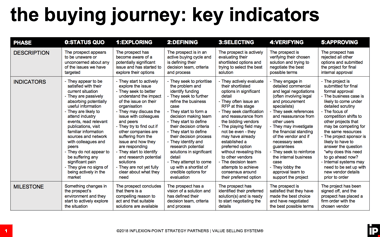
04 Jan 18:10

The Top 4 Sales Enablement Predictions for 2020

by matthew.cook@saleshub.ca (Matthew Cook)

2019 Sales Enablement Trends

  • CRMs are a necessity, not a nicety
  • AI takes over more and more of the sales process
  • Sales training is added back to the budget
  • Sales teams shrink in size

Sales enablement has grown from a buzzword into a strategic investment for organizations looking to lead and not follow.

With every New Year comes the time for predictions, and if you’re wondering what the year has in store for your sales team, look no further.

1) No CRM? You’re Already Behind

Some small to medium-sized businesses resist using a CRM and instead rely on spreadsheets and outdated data collection. If your business still hasn’t updated its sales tools today, you are already falling behind the pack.

Modern sales teams use every bit of customer data to their advantage. Today, prospects spend time interacting with your website and content long before they ever speak to a salesperson. New technology captures everything these prospects do, giving reps an idea of their interests, profile, and challenges before the first connect. If you aren’t collecting this data or wasting time manually analyzing and reporting it, we promise your competitors are running away with your sales.

Consider how you interact with platforms like Netflix and Amazon. These businesses disrupted their industries by reading their customers. They are able to tell us exactly what we want to see or buy, exactly when we need it. They use every bit of data we give them and turn it into a way to market their products and keep us coming back. Don’t be Blockbuster -- find out what your customers want and give it to them.

2) Rise of AI

Take a second and try to guess how many chatbots you’ve talked to this year. We guarantee it’s not zero! That may have something to do with the fact that 35 to 50% of sales go to the business that responds first. Why leave responding to a human when a machine can do it faster?

The rise of artificial intelligence has produced a huge range of new products, but in the sales and marketing world, chatbots are the new toy. Whether you are adding CRM or marketing automation software, we guarantee an AI feature is included. No matter if you’re a B2C or B2B organization, building your business chatbot should be a crucial sales enablement goal this year.

AI is going to start saving sales teams heaps of time in the new year. Chatbots can answer simple questions, trigger follow-up emails, evaluate responses, and make simple decisions. Your salespeople won’t need to engage with prospects until they are qualified. The lead qualification process will also become more accurate, guaranteeing your sales team only receives the most promising leads.

Organizations that embrace AI will see a huge rise in productivity and profits.

3) Reinvestments in Sales Training

After the 2008 recession, sales training was one of the first expenses cut from sales budgets. At the time, this was a way of decreasing costs. Now, years later, many companies still resist bringing back sales training and coaching.

Some sales leaders believe their teams don’t need mandatory sales training and coaching. Without it, though, they may be seeing a decline in forecast numbers, a surplus of inefficient reps, or high turnover. Sales is an evolving industry, with constant market changes and new strategies. In addition, salespeople lose 80 to 90% of what they learn after one month. Sales teams that reinforce training and stay up to date are simply more confident, productive, and efficient.

Other sales leaders know they need sales training and coaching but have a hard time finding modern coaches who have adapted their methodologies to the new sales landscape. If you’re in that boat, don’t give up. Finding the right sales training and coaching might take some time, but a forward-thinking sales enablement coach is invaluable to your team.

This year, organizations that stick to their old selling methods and resist updating their sales processes and methods will suffer -- they are too far behind. Sales leaders that get training buy-in from their teams and spend the time and money on an innovative sales coach will prosper.

4) Decrease in Sales Headcount

Sales enablement leaders this year will be focused on using AI, training, and sales tools to develop streamlined and lean sales teams. This means many sales departments may shrink. This is not to say a large group of sales reps is unnecessary, just that underperforming and inefficient reps won’t be able to hide anymore.

Sales enablement does have its casualties. It weeds out salespeople who can’t adjust and resist change. While this is unfortunate for some, it is good news for many organizations. Today, there is no need to hang on to failing salespeople. Your leads can be handled by chatbots until they are qualified and then passed onto your top people who are ready to handle inbound prospects. Your salespeople will have all the data they need and feel confident they can close the deal.

For some of you, this news simply means you are on the right track and need to double down on your inbound and sales enablement strategy. On the other hand, if reading this gives you an ache in your stomach, it’s time to take the plunge and make this the year you reevaluate, reenergize, and enable your sales team.

03 Jan 18:33

Winning and Keeping Customers for Long-Term Sustainable Value

by Bernie Borges


Steve Paul, Vice President of Sales and Commercial Operations at Breg is the featured guest on episode 191. Breg is a manufacturer of sports rehabilitation products and solutions. Steve is responsible for a global team that drives customer acquisition and retention. My conversation with Steve is focused on a business challenge that all businesses face – winning and keeping customers for long-term sustainable value. We all want to win and retain customers. On this episode, Steve explains how the customer segmentation and customer mapping process have enabled Breg to increase from 50% to 70% of customers being on a retained solution program.

Breg Mission Image

Strategizing Around the Business Challenge

Steve has been in this role at Breg for five years and has noticed how the markets shift, and the customer landscape continually evolves. He says everyone calls on the same customers within the industry and offers what looks like similar offerings. Breg wanted to figure out how to differentiate between the traditional brand proposition and value-added solutions.

Their approach started with looking at their existing customer base and competitive capture. They now look at business solutions that are tailored to customer needs. Breg segments based on revenue tied to a solution. Steve says some customers purchase products a la carte and others make purchases through a reciprocal business relationship. Tune in to learn about Breg’s customer workflow and how it helps them to understand customer challenges and drive long-term, sustainable customer value.

Breg Orthopedic Episode Image

Customer Mapping to Win and Keep Customers

Breg’s customer mapping begins with segmentation. Steve notes that there’s a difference between the a la carte purchases and purchases made through a platform. Next, detailed segmentation allows an understanding of your position in the account, their willingness to collaborate with you, and willingness to build on the relationship.

In mid-2015, Breg began using customer mapping. At the time, about 50% of customers mapped to one of their two customer solutions. One solution is focused on helping their customer drive revenue, and the other is focused on helping their customer cut costs out of the system. Today, more than 70% of their total business is mapped to a solution. Mapping customers to your most valuable solution offerings is a valuable exercise to develop sustained long-term value in customer relationships.

Breg encourages everyone to work together internally as “one team.” They connect the marketing team with the sales team to get things done. Steve says the collaborative nature and the teamwork are visible in the business results.

Identifying resources for customer relationship building and driving revenue growth is essential. Resources in this context are headcount and budget. If you don’t know the size of the opportunity along with the competitive landscape in each opportunity, you can’t confidently predict what resources are needed to achieve your customer growth and retention goals. Listen to our conversation to find out what drivers determine how Breg allocates their commercial resources.

Once you know what you need to do, Steve says to lean into it, and get it done! You shouldn’t hesitate to make the moves. Steve notes that not all customers are created equal, and you have to build a strategy to maximize customer relationships. On episode 191, you’ll learn how Breg segments customers and strategizes to build customer relationships for long-term sustainable value.

Featured On This Episode:

03 Jan 18:33

What is Customer Experience Value Creation?

by Lynn Hunsaker

Customer experience value is seldom quantified from the customer’s viewpoint. We explore it through customer journey mapping, customer advisory boards, surveys, user experience testing, and so forth. Even so, we still may not be sizing it up from their perspective.

Customer experience value creation occurs when you empower customers to achieve their goals with greater satisfaction in a win-win approach.

Customer experience value creation is creating mutual value for your whole customer base in any part of the end-to-end customer experience, across the full customer lifecycle, spanning customers’ entire dealings with your organization, products, services, channels and affiliations. It’s value as seen by the customer, relative to their alternatives, relative to all the costs they endure, and relative to the outcomes they’re pursuing.

Value is one of those ambiguous words, yet it’s an extremely important word. Value can mean price, benefits received for the price paid, deep-discount price, benefits relative to alternatives, high importance, rare and precious, earnings per share, wealth-building, and more.

We tend to think of how valuable it is to formally manage customer experience. We like to see studies about the superior value received by leaders versus laggards in customer experience management. We dabble with calculating customer lifetime value (cumulative profitability of a customer). We accept for granted that “businesses exist to create value for shareholders”.

To maximize our performance toward shareholder value, it’s essential to focus on the customer’s view of customer experience value. Why is customer experience value a precursor to shareholder value? Customers hold the purse strings. Based on their perception of overall value: they buy, rebuy, spread positive word-of-mouth, expand your share of their budget, and give you useful inputs to managing your business for greater success all-around. That’s the pipeline for shareholder value. Focusing on customer experience value puts the horse before the cart: the cart is shareholder value and the horse is customer spending spurred by the value they experience.

Customer experience value is the degree of upside compared to the degree of downside for a customer to do business with an organization.

Here are 4 prerequisites to creating customer experience value:

1st Prerequisite: Value Your Customer Value Quotient
Customer experience value quotient is a helpful way of thinking about customer experience value. It’s a ratio, where the numerator includes product and service value, as well as image and personal value. We may often overlook or be unaware of some of the cost dimensions in the denominator: money . . . plus time, energy and psychic costs (i.e. worry, inconvenience, frustration, and ripple effects to the buyer’s relationships with others). Customer experience value quotient opens your thinking for innovations on both sides of the ratio.

customer experience value quotient

Customer experience value creation can be as simple as an airline borrowing the concept of “departure gate change text messaging” and applying it to “baggage text messaging” so travelers realize as soon as they turn on their phones upon landing that their bags were re-routed on a different flight, without having to wait at the carousel, then wait in the claims line, etc. Customer experience value creation is anything that innovates a process, policy, product, service, business model, information, and so on, to improve the customer experience value quotient.

2nd Prerequisite: Value Your Value Creators
Some functional areas in your organization are value deliverers and others are value creators. Generally, the customer-facing functions are deliverers, and the upstream functions are creators. This is an ironic situation. This is a big reason why many companies are still struggling to see clear connections between customer experience management and the promised impressive financial results. The upstream functions absolutely must be plugged in to proactively manage their impact on customer experience excellence. Therefore, everyone needs to be tuned into realities of the customer experience value quotient and customer value creation.

3rd Prerequisite: Value Everybody’s Creative Potential
Everyone in your company can contribute to customer experience value. Ideas can be borrowed from other fields, formulated in the shower, spurred by informal conversations or inspired through creativity techniques. An article in Fortune magazine describes how Adobe is empowering any and all employees to bring forward their ideas, and incubating them through a systematic agile process of peer review and innovation realization. In my talk show with Diane Magers of the AT&T Office of the Customer, she explained how employees in any discipline — billing, IT, field engineering, marketing, etc. — were learning how to apply human-centered design to their job.

4th Prerequisite: Value Constructive Feedback
Value creation is strongest in company cultures where risk is tolerated and encouraged. It’s faster when failures are welcomed as learning opportunities and shared for organizational learning. It’s more profitable when everyone has insatiable curiosity about customers’ views and their realities. Welcome customer complaints as early warning signals to course-correct. A study at MIT found that $146M was generated by innovations based on customers’ ideas, compared to $18M generated by innovations based on internal ideas. That’s a factor of 8X! (1193 successful innovations across 9 industries over 5-year period: 40% of innovations were internal-idea-based.)

Agile management is a habit necessary for each and every functional area of your company. The more in-tune everyone is with one another, the smoother things will be for customers. The nicer things are for customers, the more demand generation will be organic. As demand grows organically, the happier everyone will be: shareholders, employees, and customers alike.

Customer experience value creation is the surest path to differentiation and ongoing growth. Center your business on customers to drive mutually beneficial innovations, big and small. By centering your business on customers your value creation can surpass your wildest dreams in driving business growth.

Originally published as an exclusive Advisors monthly column on CustomerThink.com

Image for use by ClearAction from Shutterstock.

03 Jan 18:11

Pull Levers in your Sales Funnel with Product Qualified Leads

by Mike Preuss

Product Qualified Leads (PQLs) have become a major trend in SaaS companies over the last couple of years. Why the shift to the new framework? I have two thoughts. 1) The way organizations sell and market their products are different and 2) business software continues to look more and more like consumer software.

We’ve scaled Visible to hundreds (soon thousands) of paid customers with a lean team through adopting a Product Qualified Lead framework.

PQL

Disclaimer: Product Qualified Leads may not fit into every business and organization as some solutions may require intensive initial implementation or for strategic reasons the end-user never gets to try the product. Typically these are high ACV products.

Regardless of your business, I hope you still get some value from this post and takeaway parts you want to use in your own processes. My goal is to get you walking away thinking how a Product Qualified Lead framework can increase efficiencies across sales, marketing, customer success, finance, and product.

The “old” way

If you’ve attended any sales or marketing conference, seminars or training sessions you’ve likely heard someone beat the BANT (Budget, Authority, Need, Timing) drum. It is a matrix provided to make sure you are spending your resources on the right leads. It looks something like this:

BANT

Paired with the BANT framework is usually the idea of the Demand Generation funnel. It looks something like this usually:

Traditional-B2B-Lead-Funnel-2

Both of these frameworks work off one another. Typically you’ll have marketing initiatives to drive leads. This might be paid advertising, webinars, downloadable content or having business development representatives (usually called BDR’s or if you are fancy “Solutions Consultants”).

Once you get a download, opt-in, etc you’re likely to consider that person a Marketing Qualified Lead (MQL) where they might be nurtured with a steady drip of content, get contacted by a Inbound BDR to qualify them some more, etc. This is where you are trying to understand the BANT for a lead to see if they should be moved to Sales Qualified Lead (SQL).

Then you might have an Account Executive accept the SQL to do their own qualification, provide a demo and truly understand the lead’s BANT. If the AE accepts the SQL it will likely be converted to an Opportunity, worked and hopefully closed from there.

Now there is nothing wrong with this framework at all. It’s deployed by tens of thousands of companies and for metric/forecasting junkies it provides a great way to measure ROI across all of your activities. However, if you layer a PQL framework into your current model, you can allocate resources even more effectively across your business in addition to having another growth lever to pull.

So what are Product Qualified Leads anyway?

Product Qualified Leads are potential leads using some version of your current product that take some sort of action. Typically this is some sort of trial or freemium experience.

Defining PQLs are ultimately up to you as engagement for every business is different. For example, Slack’s magic number is 2,000. Slack knows that if they can get you to send 2,000 messages there is a great chance they’ll get you as a customer.

At Visible, our PQL criteria are as follows:

  1. Connected 2 or more data sources
  2. Created 1 chart
  3. Published an Update
  4. Invited a colleague

PQL

If you do those actions, there is a 90% chance we will get you as a customer (if not within the trial then within 90 days).

With most frameworks, testing and iterating is crucial here to get you to zero in on your PQL qualifications. Our original PQL definition was just one data source, but we found our customers value bringing in multiple data streams so wanted our PQLs to reflect that.

Improving Marketing

You likely nurture your leads based on who they are and what they have downloaded. Shouldn’t you do the same with PQLs? What about prospects who are not yet a PQL? Can you effectively drip them helpful content while they are on a trial? The answer is yes to all of these questions.

If you have a definition of your PQL there is no reason why you shouldn’t have dynamic product marketing to go alongside it. For example, if a lead has taken actions A & C but not B, make sure that your email is geared towards making sure they do B. Whether it is social proof from a customer case study or an AE calling to offer a hand.

Hint: Intercom + Segment is great for this.

Improving Sales

PQLs can help in a lot of areas in your selling organization. The biggest impact (in my opinion) is around where AEs can dedicate their valuable time.

Demo ConversionAccording to Tomasz Tunguz, “When the sales team calls PQLs, customers typically convert at about 25 to 30%”.

If you are calling on customers who are already PQLs this is a great way to have a more meaningful conversation. They have already had a chance to use your product, will have specific questions and overall be a much more engaging conversation.

Hubspot and OpenView touch on “In Product Hand Raisers” in Why Product Qualified Leads are the Answer to a Failing Freemium Model stating that “Hand-raisers can convert at 2x-4x the conversion rate of traditional MQLs.”

PQL

In Mitch Morands’s post, “MQLs are DEAD! Enter the PQL “Product Qualified Lead” = 10X+ revenue impact” he states that PQLs convert 10X+ more revenue than MQLs

I’d argue “Need” and “Timing” are identified in BANT through PQLs. You can quickly see how they are engaging with your solution and typically your trial with have a some sort of end date. How many times have your AEs sat a demo where they prospect said “This is awesome, hit me back in 9 months when we are looking to deploy. I’m just doing some research right now”

Improving Product & Engineering

Getting your team rallied around PQLs will help prioritize the product roadmap, create focus within the product and make sure your onboarding is buttoned up.

Related: Check out our new Contextual Help Guide we just launched to help new trialers get to PQLs faster.

Improving Customer Success & Support

There is a great proverb that relates to customer success and product:

“If you catch someone a fish, you feed them for a day. If you teach them to fish, you feed them for a lifetime”

By focusing on PQLs, we make sure our customers can get in and use the product from when they sign up. If they get stuck we make sure we have a great knowledge base, help resources and more. If they are really stuck, we are always happy to get a quick screen recording or demo setup with a customer.

This has mentality has created less customer support issues which means our median response time is 5 minutes. It also lets our customer success team be proactive to help leads get into a product qualified lead state.

Improving Finance

There is no shortage of ratios that PQLs can help improve. Customer Acquisition Cost, Time to Close, Lifetime Value, Trial to Close %, etc. Focusing on creating PQLs will help all of your metrics become more attractive.

Bottomline

PQLs provide a great way to align everyone in your organization. The product team gets to focus on building a great product, the sales team can spend their team on highly qualified leads and the marketing team can dynamically nurture leads.

Don’t ditch MQLs, SQLs or your current process. Just try segmenting them with PQLs to increase conversions in all parts of your business.

Try it out and track it as a metric in your Visible account 😉

Up & To the Right,

Mike & The Visible Team

The post Pull Levers in your Sales Funnel with Product Qualified Leads appeared first on OpenView Labs.

03 Jan 18:11

Dominate Your Inbound Game with the Best Tech Stack in the Business

by Keith Zadig

As a seller, you know that both inbound and outbound leads are important. While they’re both valuable, inbounds deserve a fundamentally different approach in the beginning stages of a sale. Because they’re already familiar (and interested) in your business, they’re not the cold leads you’re accustomed to in an outbound sale.

What this means is that response time is incredibly important as you connect with your inbound leads. Catching them soon after they’ve expressed interest leads to a much higher chance of a positive outcome. This is where technology can help, allowing reps to be notified and respond quickly. In fact, one of our Sales Operations pros, Evelyn Fayad, joined us in a recent episode to discuss a step-by-step strategy on how to cut inbound response time to under four minutes.

Today, Kyle Norton shares the technology he uses to thrill prospects with a short response time and how you can do the same:

Hey, Kyle Norton here. I’m going to talk to you today a little bit about tools we found effective for managing inbound leads. A lot of factors can contribute to the success of a deal but really, one of the biggest is inbound response time. Many companies have different tactics and tech stacks that allow them to have a short response time. We tested a few ourselves and found three tools that help your team capitalize on response time. First up is immediate notifications when an inbound leads takes an action on your website. These notifications are based on automation rules. Automation rules between SalesLoft and SalesForce allow you to customize sales actions based on specific criteria. We’ve created an automation rule to notify an inbound rep via Slack whenever a prospect takes an action. Being both desktop and mobile friendly, reps have immediate feedback, which means they can reach out faster. Next up is beginning cadences automatically. Once again, it uses automation rules to trigger a cadence as soon as a prospect fills out a demo request form. This capitalizes on the response time of the first message while providing the structure for more personalized responses later on. If you’re interested in learning more, our sales operations team just did a full explanation on automation rules. Another way to provide great response time is using live chat. On that note, our personal favorite is Intercom.Live chat lets you see site traffic and interact with prospects who are currently visiting the website. Interacting in real time removes all the challenges of delayed response. I often get similar questions from website visitors. Intercom has a great feature which allows me to drop in snippets of pre-composed messages to respond quickly to prospects. This, once again, gives prospects a better experience because they can get immediate answers to their questions. Thanks for watching, I hope you learned a few tips to help you lower your response time on the inbound front. Feel free to drop any questions or comments below. Thanks again for watching, have a great day.

The post Dominate Your Inbound Game with the Best Tech Stack in the Business appeared first on SalesLoft.

03 Jan 18:11

22 Expert Sales Management Tips for 8 Make-or-Break Situations

by Alex Rynne
Colleagues Walking

Here at LinkedIn, we’re celebrating the holidays by bringing you 12 days of awesome sales content. Today, we share tips from 22 sales management experts on how to deal with big egos, hiring issues and more make-or-break situations in sales. 

There is no definitive guide to situational sales management (although there is a sales management success hub). Sure, there are plenty of books and blog posts out there offering general tips and advice, but sales managers aren’t able to consult a universal handbook for answers when encountering a particularly challenging scenario.

To fill this void, we wanted to aggregate a collection of practical pointers based on situations that frequently arise on the job today, so we rounded up some of the best topical insights from respected pros. Below, you can find expert advice on handling a variety of sales management challenges, from dealing with egos to boosting subpar revenue numbers to motivating your team and beyond.

Dealing with Major Egos in Sales

Keep Them On Their Toes

“Smart people like being around other smart people. They especially enjoy proving how much smarter they are than the others. So use this ego to the team’s advantage. Competition for scarce resources like funding and manpower will keep people on their toes. Treat everyone fairly — but not necessarily equally. That is, the more one achieves, the more recognition he will receive.” - John Baldoni, Executive Coach and Leadership Educator (via HBR)

Create Cognitive Dissonance

“For most people, ego is like a two-year-old who clings to a toy. Because toddlers’ brains are not fully developed, trying to get something away from two-year-olds is like trying to talk ego out of its story. If you want to get toddlers to release a toy, snatching it away is a bad strategy. You’ll incite a tantrum. Reason and logic don’t work either. Toddlers want what they are fixated on in the moment. It is their single-minded reality. The most effective way to bypass toddlers’ current attachment is to offer them something new and desirable. Doing so creates cognitive dissonance, because toddlers can’t hold two desires at one time. Typically, they will drop the old toy for the new one. “ - Cy Wakeman, Author (via No Ego)

Make a Plan

“If you have a disruptive ‘team’ member, create a clear action plan for improvement and then remove this person if the behavior doesn’t change. Getting rid of a top producer can be tough. But if this person wreaks havoc on the team environment, your decision will improve overall morale, which will eventually lead to increased sales. Plus, this will show that you care more about creating a positive environment for the whole team as opposed to the revenue contributions of one person.” - Koka Sexton, Social Selling Guru (via LinkedIn Sales Blog)

Difficulty Hiring Quality Sales Reps

Sample the Sales Approach in Interviews

“I ask them to sell me on the product. What I’m looking for is for them to ask me qualifying questions rather than just start pitching. Those who just dive right in and start pitching reveal themselves as middle to low 80% producers. Top 20% producers, on the other hand, start asking me questions and gathering information. They are the ones I’m interested in.” - Mike Brooks, Inside Sales Expert (via Sales HQ)

Role-Play to Assess Coachability

“You have to make sure your hires are good at taking feedback. Gauge this by doing a role play in which they actually conduct a demo for your product. Then ask them how they think they did. Then give them feedback. Grade them not just on how smoothly the demo went, but how open they were to self-assessment, taking feedback and applying it.” - Mark Roberge, Sales Advisor (via Sales Hacker)

Sales Team Struggling to Generate Leads

Find the Right Signals

“It’s the situational factors that typically indicate whether any organisation might prove to be a promising target in the here-and-now. Situational factors reflect short-term recent changes to the target organisation’s internal or external circumstances. The most common example is a recent change in management - a factor that often opens the door to change. Other internal situational triggers can include changes in organisational focus, priorities or strategy, recent funding events or a recent acquisition, or a recent setback in the achievement of key performance indicators … These situational triggers act as powerful catalysts for change: they disturb the status quo, and open the prospect’s eyes to the potential need for urgent change in response to the identified problem or opportunity. They drive the evaluation of new systems and new approaches, and often result in the willingness to spend money on a suitable solution.” - Bob Apollo, Sales Strategy Expert (via Inflexion Point)

Build a Replicability Engine

“Cloning your high-value customers is the foundation of your growth engine. Developing a sales process allows you to target these ideal customers and get the same ones time and time again … If your teams are well-aligned with your ideal customer profile, then this will cut your acquisition costs for each customer as they will naturally move quickly through your sales funnel.” - Nick Frost, Entrepreneur (via Mattermark)

Quality Over Quantity

“You can play the numbers game all you want, but you’ll be more successful if you play the game by trying to find customers that really want what you have to sell. That means identifying your ideal customer and trying to locate and communicate with them in the way that they want to be communicated with. I know this is easier said than done, but trust me, I try all the time. If you can come at this with a laser focus, you will have an easier time with much more success.” - Brian Basilico, Online B2B Marketing Strategist (via Business 2 Community)

Sales Team Isn’t Engaging the Right People

Advise Reps to Aim High

“Most businesses put their buyers and purchasing managers on the frontlines of buying situations -- but they’re not actually qualified to make any buying decisions. That’s why the most successful B2B salespeople skip right over those folks, and straight to the real decision makers. Don’t waste your time developing relationships with buyers or purchasing managers, no matter how convenient or comfortable it may feel. They simply don’t have the budget -- or the power -- to make an actual investment in your product or service. Instead, sell only to high-level stakeholders who have the power and budget to actually tell you ‘yes.’” - Marc Wayshak, Sales Strategist (via HubSpot)

Compartmentalize Your Lead Generation

“Start by investing in high quality data sources that provide accurate names, titles, and contact information. When sales reps are asked to do this, it really reduces their productivity. After you’ve handed your reps great data, you can structure that data into groups of similar leads. Your leads can be grouped by lead source, title path, industry, company size and/or message tactic. This gives sales reps the chance to prepare one time for calls to an entire group, instead of preparing for each individual call separately. This also allows managers to customize messaging strategies to entire groups to improve results.” Levi Boyd, CFO and Director of BD for Avance Care (via TimeTrade)

Empower Reps to Leverage Their Networks

“Sales leaders, sales teams, and sales people today have an abundance of connectivity tools at their disposal. As a result, personal and business networks are larger and more interconnected than ever before. Our ‘6 degrees of separation’ are shrinking, and there is no excuse for a professional, proactive sales team to not leverage the power of social – Facebook, Twitter, and LinkedIn – to gain introductions and build connections. For us, as our organization has over 2,000 employees with industry connections, the TeamLink feature is a tremendously powerful tool.” - Craig Hess, Corporate Training Expert (via LinkedIn Sales Blog)

Sales Team Isn’t Motivated

Strike a Balance

"A sales manager is equal parts drill sergeant and cheerleader. As a drill sergeant there are best practices and rules of engagement that you must teach, which may save your rep’s proverbial life. Instilling these lessons may sometimes require breaking a rep down before building them up. However once the lesson is taught and learned you must never forget to build them back up again. Confidence breeds success and therefore you must revert to cheerleader mode if you want the rep to take what you have given them and run with it.” - Jason Rasmussen, VP of Sales for Bizible (via Heinz Marketing)

Game On

“My absolute top recommendation for sales managers who want to boost their team’s efficiency is to use gamification to increase competition – Salespeople are competitive by nature. If you harness and use that drive correctly you can create an extremely efficient and hard-working team. The funny thing is that you don’t even have to put up cash or big prizes for it to work. The thrill of winning, or just being at the top of the leaderboard is usually enough.” - Judah Ross, Sales Expert (via TimeTrade)

The Sweet Spot Between “Can” and “Must”

“One source of frustration in the workplace is the frequent mismatch between what people must do and what people can do. When what they must do exceeds their capabilities, the result is anxiety. When what they must do falls short of their capabilities, the result is boredom. But when the match is just right, the results can be glorious. This is the essence of flow.” - Daniel Pink, Author (via Drive: The Surprising Truth About What Motivates Us)

Sales Reps Can’t Get on the Same Page

Create a Clear Process to Follow

“Provide your team with clear, easy to follow best practices as far as sales techniques and skill sets go for your specific sale. Give them the specific scripts and rebuttals to follow, specific qualifying questions, proper closing tools, and make sure they are unambiguous. In other words, identify what actually works in your selling cycle and what the best approaches are and then develop them into a solid selling system and make it company policy that this is the best way to handle every part of your selling process from the first call, to qualifying, to leaving voice messages and emails, to getting back to your prospects to closing the sale and handling objections.” - Mike Brooks, Inside Sales Expert (via Sales Gravy)

Hammer that Process Home

“Your sales process isn’t perfect. But it’s better than a sharp stick in the eye. Your salespeople skip whole stages of your sales process, and by doing so they don’t create value for your prospects or gain the commitments they need. You need to sell them on the process. Then you need to coach to the process. You need to follow the process.” - Anthony Iannarino, B2B Sales Coach (via RingDNA)

Sales Numbers Not Meeting Forecasts or Quotas

Encourage Reps to Try a Different Approach

“When salespeople lead with their product or service, it is impossible to be perceived as consultants or trusted advisors. It makes it as clear as day that the salesperson believes the relationship and sale are centered on his offering, not the customer and its needs. It’s as if the salesperson is begging the customer to put his offering’s features and price on a spreadsheet to be compared against every competitor’s features and price.”  - Mike Weinberg, Author (via Sales Management. Simplified)

Embrace Your Inner Scientist

“With extremely rare exception, the best sales managers we’ve encountered are unconsciously competent scientists. They hold formal meetings with formal agendas on formal schedules. They set rigorous expectations for their salespeople and track progress against those goals with equal rigor. They manage by analysis rather than anecdote and by measurement rather than gut. They are continuous-improvement experts with action plans galore. While their lower-performing peers try to manage with the same artistic flair that served them well as salespeople, high-performing managers adopt a more scientific approach to management that enables them to get consistently higher performance from their team.” - Jordan Jones and Michelle Vazzana, Authors (via Cracking the Sales Management Code)

Raise the Bar

“When sales goals are high (yet achievable), there is something worth pursuing and your group needs to believe that anything’s possible. If you achieve only 70% of a stretch goal, you’re doing better than achieving 100% of a mediocre goal, as long as there is a collective nirvana about what’s being built that is fueling your success.” - Andrew Riesenfeld, Sales Advisor (via Sales Hacker)

Trouble Retaining Top Sales Performers

Elevate Their Roles

“High-performing salespeople need fresh challenges. Give them an opportunity to launch new product and service offerings, allow them to lead training sessions, or ask them to provide advisory roles on sales strategy.”- Ken Thoreson, Sales Management Trainer (via Nutshell)

Provide a Path to Professional Growth

“The best talent in any organization focuses on higher aspirations. It's a big part of why they drive value. By enabling growth opportunity while making investments in training, businesses can support an individual’s long-term career vision. There is no greater motivation than ownership. Creating a path to equity or ownership is a powerful way to endear your most valuable people.” - Chris Lukasiak, Senior VP Sales and Marketing for My Health Direct (via Forbes)

Set Transparent and Measurable Goals

“Create a framework that makes expectations clear, sets measurable milestones and gives your top sales talent a way to track progress in a meaningful way. This way, your star performers have a clear understanding of what their role is, a way to measure their own professional growth, and know the targets they are meeting and exceeding are duly noted by their managers.” - Dane Matheson, VP of Global Business Development for Sourcebits Digital (via Forbes)

For more on how to spruce up your sales this holiday season and in 2019, check out these other insightful posts on boosting your sales effectiveness. 

03 Jan 18:10

How to Write Content for a Website — The Huge Mistake You’re Probably Making

by Adam Fout

When people ask me how to write content for a website, there’s one go-to tip I always begin with, something that is unnervingly uncommon in the world of the web — it’s a huge mistake not to do this, and it absolutely will affect your website traffic, your sales, your revenue, and, ultimately, the success of your website and all the digital marketing efforts tied to it.

A megaphone and an envelope — if you dont know how to write content for a website, you end up looking like the guy on college campuses yelling into a megaphone while everyone walks by, ignoring the selfish guy yelling about something that doesnt concern them.

It’s something I’ve been talking about for years, something that, once you start doing it, is going to make you slap yourself in the head and say “Duh! Why haven’t I been doing this the whole time!”

Strangely, it can be so subtle that you wouldn’t even think about it until someone pointed it out to you…

It’s about the language that you use—specifically, the written language you use on your website.

Copywriters have know this trick for a long time (they already know exactly what I’m talking about), but the average person who’s trying to figure out how to write content for a website that might be their first (or even second or third, after the first one failed…) is just going to miss this completely.

However, once we start to dig into this, you’ll realize that it applies to every interaction you have with your customer…

Here’s the Mistake…

The mistake is writing content that’s focused on you and your business.

And the trick to writing awesome website content starts with using customer-centric language.

Obviously, there’s a lot more that goes into writing web content, but if you’re not using customer-centric language, your efforts are going to be so held back that you might as well not even try.

The mistake is writing content that’s focused on you and your business

Simply, it means choosing language that centers around your customer and their wants and needs—and not your business, your wants, or your needs.

Remember, you have about 15 seconds to grab attention before more than half of your visitors start to bail, so if your website content isn’t on point, you’re literally losing sales.

This Is the Key — This is How to Write Content for a Website That’s Effective, That Generates Traffic/Leads/Sales

However, the trick goes so much farther than that. Truly, you should be using customer-centric language in every interaction you have with your potential leads and customers.

Sword and paper — content is a battle, and if youre not properly armed, youll lose the war.

The principle can apply to all types of communications with your customers and potential leads, but primarily, it applies to these:

  • Your website
  • Your social media interactions
  • Your print materials
  • Your user guides and manuals
  • Your written and spoken communications with your customer (including emails, phone calls, and in-person interactions)

Now, you can probably think of many examples of different types of marketing and advertising materials where you’re speaking to your customer, but for now, I want to focus on the above.

So, what does customer-centric language mean? Why does it matter? What does it look like in practice? Let’s discuss.

Customer-Centric Language Avoids Talking About Your Business and Focuses on What Your Customer Wants and Needs

Remember in high school when your teacher told you that you weren’t allowed to use personal pronouns in your essays anymore?

Maybe that was just me.

Please, for me, don’t refer to your customer as “one” on your website

When I was in school, there came a point where essays suddenly had to be in third person. You couldn’t say “I” or “me” or “we” or “us.”

Instead, you had to write “one” or something equally pretentious, as in “One might think that writing an essay in third person is pretentious.”

(Please, for me, don’t refer to your customer as “one” on your website.)

However, that first piece of advice is good! The best way to make your writing business-centric (which is what we want to avoid) is to use pronouns like “we” or “us,” to talk exclusively about the business and forget about the most important person in the (digital) room:

The customer.

Write for and About Your Customer

You see this often in websites, but it can show up in any form of communication with a customer. Here’s what it looks like in practice.

Paper, an HTML bracket, a website page — When you put your content before your design, your customers are the ones who benefit — learn more.

“We make the best widgets around. We’ve been making widgets for 30 years. Nobody manufactures widgets like we do. Our widgets will blow your mind. These widgets have the following features…”

In that horrible paragraph above, there’s only a single word that actually refers to your customer—everything else refers to the business.

Why does this matter? Why not just write about yourself?

Because your potential customers don’t care that much about you yet. Your leads haven’t gotten to know you yet. They need to know what you can do for them before they even think about contacting you.

It’s like a date—if you go on a date with someone, and they spend the whole time talking about themselves and how awesome they are, how likely are you to have date number 2?

(The answer? Not that likely at all).

Your potential customers don’t care that much about you yet

But there’s a more important reason why you want to avoid talking mostly about your business, why you should always focus on what your business can do for your customers.

Business-Centric Language Is Less Persuasive Than Customer-Centric Language

The entire point of the content in your marketing communications—the content on your website, or on your brochure, or on your social media pages—is to persuade.

The outline of a persons head and shoulders, a pen, and a piece of paper — paying for professional content is worth every penny

So ask yourself a simple question—what’s more persuasive to you:

This:

“Our vehicles are simple and affordable, and we made them beautiful too!”

Or this:

“You can get the vehicle you need, at the price that’s right for you, without compromising your personal style.”

I’m betting it’s the second one.

The second sentence is more persuasive because it speaks to the customer directly, because it considers their needs, it considers their emotional connection to the product, to issues surrounding the product that may affect their willingness to make a purchase, and to the things that matter most to them when considering the product.

Because of all of these things, it’s more persuasive.

Website content is more persuasive when it speaks to the customer directly

The first sentence is too general, has nothing to do with the customer, and is all about the business.

It’s not persuasive.

Speak to Your Customers — Inspire Them, Enlighten Them, Help Them

The marketing that’s most effective inspires people.

What is content marketing? Hand holding a gift of paper and pen.

It doesn’t even acknowledge the brand, in many cases, or only does so, say, at the tail-end of a commercial, where you realize the brand of the car in question after a discussion of personal style and class.

This can happen on websites too—in fact, it needs to, because that’s where you’re going to get a great number of potential leads. This is how to write website content that persuades, that inspires people to fill out forms and click.

Because guess what? Most of the traffic on your website, most of those potential leads? They will never come back. For most readers, you have one chance to grab their attention and convince them to take action.

So you need to make the best first impression you can possibly make. If the content on your website is all about you, those potential leads become poor, lost little leads.

If the content on your website is all about you, you’re gonna lose leads

You’re not going to impress anyone with information about who you are or what you do—at best, people will see that and say “Good, they know what they’re doing—they should.” That’s a baseline.

Instead, your content on your website should focus on your customer.

However, as I mentioned above, this applies to all your communications. While all your marketing materials need to be persuasive and speak to your potential customer, you have a wide variety of places where your leads or customers are interacting with your business in a different way.

And your language there needs to be customer-centric too.

Keep Your Language Customer-Centric Everywhere, Even Your Actual, Spoken Language—And Align Your Actions With Your Words

If you’re saying all sorts of beautiful, wonderful, glorious things to leads to get them in the door, but the emails you send them once they become a customer are atrocious, you’re going to lose them.

A computer screen with a digital mockup, a dollar sign — success starts with excellent website content.

If you promise the moon in your marketing and you deliver an asteroid, you’re going to lose them.

If you sound nice and charitable and giving on your website and answer the phone with an angry edge in your voice, you’re going to lose them.

I’m probably not blowing your mind by saying “align your actions to your words,” but seriously, it means more than you might think.

If you promise the moon in your marketing and you deliver an asteroid, you’re going to lose traffic and potential leads

Right now, there are quite a few brands in the airline industry who are struggling to prove that their actions and their words align.

Recently, a very large telecoms company took over a portion of another telecom company’s business. When they did so, they made a lot of promises about the quality of the service that the customers would be receiving, promises that were all over their website and their social media.

Their actions didn’t align with their words, and customers were angry.

And yet, they persisted in pushing out content that acted as though everything was fine—it was decidedly not.

And so, you would see this very strange thing happen—the brand would post a video related to telecoms on their social media, and this innocuous video would get slammed with angry comments from customers who weren’t getting the service they expected.

Their actions didn’t align with their words, and customers were angry

It didn’t matter how customer-centric their words were—because their actions didn’t align, they lost some business, they lost standing with their remaining customers, and they’re probably at the bottom of the list when the next big telecoms merger is considered.

It’s critical that all your communications with your customers—everything from a social media post or a tech-support chat to an automated email drip, a phone call, or even an in-person conversation—it’s critical that all of this is approached from a customer-centric viewpoint while still aligning with your actions.

And, if you’re having trouble delivering—admit it! Align your actions with your words, and you’ll get the respect of your customers.

And, if you’re having trouble delivering—admit it!

Long term, that’s going to mean more business. Period.

02 Jan 19:38

How Marketing Executives Can Successfully Master Case-based Interviews

by Bob Van Rossum

Any seasoned marketing executive is more than likely familiar with a job interview process and different types of interviews out there. However, one specialized kind of interview has been on a notable rise in the marketing executive search world: the case-based interview.

When organizations conduct a marketing executive search, they look for candidates who are able to demonstrate their analytical skills, problem-solving abilities, and the capability to think strategically and logically. Case-based interviews allow marketing recruiters and employers to test their ability to effectively process real-life business problems and come up with strategic solutions.

This is particularly important for marketing executive searches, as employers need to gauge how candidates can apply their skills toward real-life business cases. Ultimately, the way you come up with a solution for a case and how you communicate it will substantially contribute to your interview success… or failure.

The Rise of Case-Based Interviews in Marketing Executive Search

How Marketing Executives Can Successfully Master Case-Based Interviews

Three Types of Case-based Interviews in Marketing Executive Search

  1. A simple business question: a vague question a marketing recruiter or an interviewer can ask you. While the question is simple, with little details available, the answer is expected to be elaborate. Example: “Should we go into Latin America?”
  2. A specific business question: a very detailed question specific to the business. It generally addresses a business-specific issue or pain point.
  3. A presentation-style question: an interviewer can ask you to present a solution to the interview panel or to a larger group of people.

During case-based interviews, employers generally test your IQ and your EQ. They need to assess your emotional maturity and how you react in a difficult situation. Therefore, how you handle the case is just as important as what you say about it.

5 Steps to Success

Regardless of the type of a case-based interview, there are key measures to take to succeed in it:

  1. Break the question down into manageable pieces to better tackle each one and communicate how you think through them.
  2. Walk the interviewer through how you solve each one of those pieces. Each area you’ve broken it down into is essentially a separate business problem.
  3. Do the math. Marketing recruiters and employers want to see that you can logically use numbers to validate your hypothesis with a strong support of data.
  4. Define the problem after you have analytics to support your solution so the interviewer can fully understand the process you went through in solving it.
  5. Clearly communicate the solution once you have defined the problem and have the data to support it. It’s important to remember that in many cases you’re communicating with C-level executives so demonstrating emotional maturity is key.

Prepare Like You Mean It

marketing executive search marketing recruiters

Ultimately, the success of a case-based interview depends on how well you’re prepared for it and how much you practiced it. Make sure to take time to find examples of relevant case-based interviews and run through them. Consider practicing with a peer, which is the most effective way to prepare for a real-life scenario.

Practicing with numbers will certainly help you avoid freezing up when asked to provide data and analytics. Run simple formulas through your head so it comes more naturally. Practicing an entire case-based interview will ensure you’re able to demonstrate critical thinking and communication skills that high-level executives are looking for.

You Know You Face a Case-based Interview When…

There are certain industries and executives with specific backgrounds that are more likely to use case-based interviews. Businesses in management consulting, financial or technology services are certainly likely to conduct them, as well as interviewers that come from a high-level institution, such as Harvard or Emory.

Step by Step How-to

To get detailed information on how to successfully take on case-based interviews and what to expect after, make sure to watch this video:

Bonus Tips for Success

  • Ask questions to comprehensively understand the case you’re given
  • Take notes throughout the interview
  • Develop a logical framework and hypothesis you can clearly explain
  • Collect your thoughts and prepare yourself before explaining
  • Use the case as an opportunity to learn about the business
  • Structure your solution into a logical story
  • Keep up with trends in relevant industries
  • Project confidence and enthusiasm
02 Jan 19:04

3 Ways to Rebound After Losing a Sale

by Amanda Abella

woman sales agent

For many people, sales are tricky. This is especially true in the beginning when you haven’t yet practiced the skill and aren’t accustomed to thinking on your feet. The latter is handy when it comes to rebounding after losing a sale, and most beginning business owners just haven’t mastered it yet.

What You Need to Know About Losing a Sale

It’s easy to think that losing a sale is the end of a conversation, it’s not. But in order to rebound after losing a sale, you must first understand the different reasons for losing it in the first place.

I could write a book just on the first point, but for sake of simplicity we’re just going to stick to what needs to happen after you think you’ve lost a sale.

Realize that “no” doesn’t mean never.

Any good salesperson knows that “No” doesn’t mean “Never.” In fact, the most successful salespeople are resilient and persistent – especially when it comes to follow-ups.

There is a chance that right now just isn’t the right time for the client. It happens. That’s why you need to do two things:

  • Make sure they are on your email list so you can continue marketing to them.
  • Consistently follow-up with them.

I’ve had prospects that don’t become clients until months later because it just wasn’t the right time during our initial conversation. Because I was so persistent, I was the first person they thought of when they were ready to hire.

Send them a freebie.

If you think you’ve lost a sale, one of the things you can do to reel it back in is to surprise the prospect with a freebie. This is actually something I learned from one of my sales mentors back in the day and it actually works.

Let’s say you’re a business coach who helps people with branding. Let’s also say a prospect wasn’t ready to work with you right now. What you can do is send a surprise freebie – like a worksheet that helps them figure out their brand story.

This gives a little extra touch they probably weren’t expecting. It also sets you apart from all the other business coaches out there. And finally, it gives the prospect an idea of the kind of customer service they can expect from you.

Handle objections via email.

If you’re just learning how to do sales, you may be dipping your foot into learning how to handle objections. Common objections include “I need to think about it” or “I can’t afford it.”

If you didn’t get a chance to address these on the phone, you can still do it via email. For example, if “I can’t afford it” is the objection, you can show them how they are actually leaving money on the table by NOT hiring you.

Final Thoughts

The main thing to remember after losing a sale is that you probably haven’t really lost it…at least not forever. It’s also important to know there are things you can do to salvage it. With practice, all of this starts to become second nature and you save more sales.

02 Jan 19:03

The 4 Biggest Challenges for Marketers Heading Into 2018

by Kayla Matthews

The 4 Biggest Challenges for Marketers Heading Into 2018

ClearVoice, a collaborative content management platform, explores the biggest challenges of marketing content in their new survey. The poll uses open-ended responses from 1,000 marketers to provide insight on challenges like time, content quality and creation, idea generation, and distribution.

The simple question, “What’s your biggest challenge with content?” yielded a variety of responses and identified the various elements of a successful marketing campaign, including reaching the appropriate audience and channels—in addition to crafting content that shows genuine passion and credibility.

1. Time Is Constantly on the Mind

Time is a top challenge for marketers

The survey notes the word “time” as the most frequent single-word submission, highlighting the numerous ways that time can impact the marketing process. Time is where most of the difficulties arise inherently, although many of the responses highlighted specific instances that lead marketers to feel as if there’s not enough daylight.

Disorganization, an over-abundance of goals, and poor collaboration can all lead to the feeling of a time crunch. Organization can help create more room for great ideas and content creation, with time and organization going hand-in-hand.

Time significantly outweighs management and planning as a challenge. Examples of time-related challenges include scheduling the calendar, managing the review process, involving all stakeholders, and collaborating with various departments.


Marketers cite 'Time' as their greatest challenge while on the job.
Click To Tweet


2. Content Production

Content production is a challenge for marketers

Marketers feel challenged when trying to come up with original ideas. Even when you have an original idea, it can be difficult making that idea compelling for readers. You need an idea that is not only original but also appealing to the target demographic, as well. It’s not a surprise that 27 percent of respondents find producing creative content to be the biggest barrier to getting in touch with their creative side.

Marketers spend ample time trying to make their content feel genuine while also being clear and concise. Some brands have upped their engagement by intertwining original ideas with compelling storytelling, helping make abstract ideas more tangible for their audience. Airbnb accomplishes both innovation and storytelling in immersive form, via Airbnb community stories, which they integrate across various marketing platforms and campaigns, such as the “Belong Anywhere” campaign.

Airbnb shows they value their users’ artistic and giving nature—a great strategy for a business whose infrastructure is fueled by users providing homes and seeking places to stay.

3. Establishing Credibility

Credibility as a marketing challenge

51 percent of marketers cite content quality as the biggest challenge to establishing credibility—more than twice that of engagement. Naturally, quality content tends to engage, hence the 51 percent to 23.6 percent difference.

Titan Alarm is one example of a brand that provides a good range of quality content on their blog. It features a mix of how-to postslocal guide posts, and posts capitalizing on recent trends. Each post appears well-researched and is accompanied by helpful visuals that help readers more easily digest the information presented.

Feeling genuine is another challenge for content creators—often a difficult quality for corporate entities to capture. Still, several brands achieve a very genuine feel regarding their credibility, especially when showcasing their passion. For example, Asana’s marketing goes a great job of establishing genuine credibility. Their site lets visitors know NASA, General Electric, and Airbnb use their product, immediately establishing credibility. Their product tour uses a NASA space mission as the project example, reinforcing the NASA collaboration and showing passion in the uniqueness of each user.

For marketers worried about hitting their KPIs, six in 10 marketers point to lead generation or conversion as the biggest challenge. By establishing credibility and showing passion for their niche, marketers can better turn content to conversions while delivering ROI.

4. Abundance of Marketing Channels

Abundance of marketing channels

There’s such an abundance of content channels that marketers rarely referenced them by name in the survey. Google has one mention; Facebook has two mentions. (Marketers seem more focused on social sharing in general instead of individually specifying channels.) The survey audience specified a number of traffic challenges, including virality, reaching their audience, and being visible on search and social media.

Producing viral content is a common aim among marketers. Mercedes-Benz achieves viral success with its #MBPhotoPass campaign, which began in 2014. The company provides social media influencers with the keys to a Benz, helping them tell a story using the vehicle. In recent years, they utilized YouTube’s 360-degree video technology, shown in this video featuring Instagram celebrity dog Loki. The campaign generated 173 million impressions and 2.3 million likes/comments.

The ClearVoice survey revealed time, content quality and content, scaling content, idea generation, talent, distribution, and strategy to be the biggest challenges to marketing content, in order of mentions. (Time earned the most mentions.) Keep in mind, marketers were asked to cite their “biggest challenge”—not their only challenge.

Marketers and brands continue to overcome these challenges, as shown in the above examples, but difficulty remains when it comes to time management, producing content, and establishing credibility across a variety of channels.

The post The 4 Biggest Challenges for Marketers Heading Into 2018 appeared first on Convince and Convert: Social Media Consulting and Content Marketing Consulting.

02 Jan 19:03

Business Books to Watch in January 2018

by News

In order of their release date, these are the books we'll be getting to know more as the new year begins. 

How to Get Sh*t Done: Why Women Need to Stop Doing Everything so They Can Achieve Anything by Erin Falconer, North Star Way

Erin Falconer, editor in chief and co-owner of the highly respected self-improvement site Pick the Brain (with over 1.8 million monthly page views), shows overscheduled, overwhelmed women how to do less so that they can achieve more.

Women live in a state of constant guilt: that we’re not doing enough, that we’re not good enough, that we can’t keep up. If we’re not climbing the corporate ladder, building our side hustle, preparing home-cooked meals, tucking the kids in at night, meditating daily, and scheduling playdates, date nights, and girls’ nights every week, we feel like we’re not living our best lives. Yet traditional productivity books—written by men—barely touch the tangle of cultural pressures that women feel when facing down a to-do list.

Erin Falconer will show you how to do less—a lot less. In fact, How to Get Sh*t Done will teach you how to zero in on the three areas of your life where you want to excel, and then it will show you how to off-load, outsource, or just stop giving a damn about the rest. As the founder of two technology start-ups and one of Refinery29’s Top 10 Women Changing the Digital Landscape for Good, Erin has seen what happens when women chase an outdated, patriarchal model of productivity, and in How to Get Sh*t Done she shows how even the most perfectionistic among us can tap into our inner free spirit and learn to feel like badasses, rather than drudges.

Packed with real-life advice, honest stories from Erin’s successful career, and dozens of actionable resources, How to Get Sh*t Done will forever reframe productivity so that you can stop doing everything for everyone and start doing what matters to you.

Work It: Secrets for Success from the Boldest Women in Business by Carrie Kerpen, TarcherPerigee

An empowering career guide featuring bold advice from 50 high-profile women on how to succeed in work, leadership and life that shows you don’t have to be a #Girlboss or “lean in” to have a dream career and live a life you love.

In Work It, CEO of Likeable Media and popular podcast host Carrie Kerpen shares lessons from her career and an “advisory board” of powerful women in a wide range of industries to help women everywhere make their aspirations a reality. Packed with actionable tips and stories from the likes of Sheryl Sandberg, Aliza Licht, and Reshma Saujani, this inspiring book reveals their counterintuitive secrets for success, including:

  • Why women should ditch the 5-year plan to build a successful career
  • How and when to use work “superpowers” vs. “pay-to-play” skills
  • Why women must stop criticizing each other and start leveraging their collective power

With advice on everything from mastering social media to navigating office politics and the seemingly impossible work/life balance, Work It arms every woman with the courage and skills to achieve success and happiness on her terms.

Type R: Transformative Resilience for Thriving in a Turbulent World by Ama Marston, Stephanie Marston, PublicAffairs

Forget Type As and Bs. The future lies with Type Rs-the resilient individuals, leaders, businesses, families, and communities who turn challenges into opportunities in times of upheaval, crisis, and change.

In Type R, Ama Marston and Stephanie Marston explore Transformative Resilience and the strategies of those who use difficult circumstances as catalysts for growth—springing forward rather than bouncing back during turbulent times.

Here, Ama and Stephanie share inspiring stories of Type Rs thriving during unprecedented world events and increasing global pressures—from climate change to financial crises. They share the individual and collective triumphs of people coping with the stress of daily life and the challenges and disruptions that rattle all our lives at some point. And they draw upon research that spans the personal and the professional, the local and the global. Reaching across psychology, neuroscience, business, and politics, Type R demonstrates how we can use challenges to innovate, create new strengths, and grow.

Type R also teaches leaders, businesses, and organizations how to cultivate the critical Type R Vision and Culture, which is essential for navigating and thriving in disruptive change. This thought-provoking book proves that there is much we can learn from those who use change, stress, and adversity as springboards to progress in a chaotic world.

Ogilvy on Advertising in the Digital Age by Miles Young, Bloomsbury USA

From Miles Young, worldwide non-executive chairman of Ogilvy & Mather, comes a sequel to David Ogilvy’s bestselling advertising handbook featuring essential strategies for the digital age.

In this must-have sequel to the bestselling Ogilvy On Advertising, Ogilvy chairman Miles Young provides top insider secrets and strategies for successful advertising in the Digital Revolution. As comprehensive as its predecessor, this indispensable handbook dives deep into the digital ecosystem, discusses how to best collect and utilize data—the currency of the digital age—breaks down when and how to market to millennials, highlights the top five current industry giants, suggests best practices from brand response to social media, and offers 13 trend predictions for the future.

This essential guide is for any professional in advertising, public relations, or marketing seeking to remain innovative and competitive in today’s ever-expanding technological marketplace.

This Could Hurt: A Novel by Jillian Medoff, Harper

A funny and deeply felt novel that illuminates the pivotal role of work in our lives—a riveting fusion of The Nest, Up in the Air, and Then We Came to the End that captures the emotional complexities of five HR colleagues trying to balance ambition, hope, and fear as their small company is buffeted by economic forces that threaten to upend them.

Rosa Guerrero beat the odds as she rose to the top of the corporate world. An attractive woman of a certain age, the longtime Chief of Human Resources at the Ellery Consumer Research Group is still a formidable presence, even if her most vital days are behind her. A leader who wields power with grace and discretion, she has earned the devotion and loyalty of her staff. No one admirers Rosa more than her doting lieutenant Leo Smalls, a benefits vice president whose whole world is Ellery.

While Rosa is consumed with trying to address the needs of her staff within the ever-constricting limits of the company’s bottom line, her associate director Rob Hirsch, a middle-aged, happily married father of two, finds himself drawing closer to his “work wife” Lucy Bender, an enterprising single woman searching for something—a romance, a promotion—to fill the vacuum in her personal life. For Kenny Verville, a senior manager with an MBA, Ellery is a temporary stepping stone to bigger and better places—that is, if his high-powered wife has her way.

Compelling, flawed, and heartbreakingly human, these men and women scheme, fall in and out of love, and nurture dreams big and small. As their individual circumstances shift, one thing remains constant—Rosa, the sun around whom they all orbit. When her world begins to crumble, the implications for everyone are profound, and Leo, Rob, Lucy, and Kenny find themselves changed in ways beyond their reckoning.

Jillian Medoff explores the inner workings of an American company in all its brilliant, insane, comforting, and terrifying glory. Authentic, razor-sharp, and achingly funny, This Could Hurt is a novel about work, loneliness, love, and loyalty; about sudden reversals and unexpected windfalls—a novel about life.

The Motivation Toolkit: How to Align Your Employees' Interests with Your Own by David Kreps, W.W. Norton & Company

Renowned Stanford economist David M. Kreps reveals the fundamental principles of employee motivation.

Getting your employees to do their best work has never been easy. But it is a particular challenge for knowledge workers, who must attend to many different tasks and whose to-do list is often ambiguous, requiring outside-the-box thinking. Lists of dos and don’ts are rarely effective. Instead, your best bet is to align their interests with your own—the heart of motivation—and set them free to use their own drive and creativity on their, and your, behalf.

But how do you align their interests with your own? How do you avoid incentive schemes that warp priorities, encourage perfunctory and sloppy work, or cause unethical behavior?

In The Motivation Toolkit, economist and management expert David Kreps offers a variety of tools, drawn from the disciplines of economics and social psychology, that you can adapt to your specific situation to achieve better motivation. This starts with understanding both the economic and social relationship your employees have with their work, their jobs, and your organization, then using that understanding to find economic or psychological motivators that will work.

Whatever your business, and whether you’re a newly minted manager, a seasoned executive hungry for your employees’ best work, or a curious leader looking for new ways to be effective, The Motivation Toolkit will prove a useful and enlightening read.

When: The Scientific Secrets of Perfect Timing by Daniel H. Pink, Riverhead Books

Daniel H. Pink, the #1 bestselling author of Drive and To Sell Is Human, unlocks the scientific secrets to good timing to help you flourish at work, at school, and at home.

Everyone knows that timing is everything. But we don’t know much about timing itself. Our lives are a never-ending stream of “when” decisions: when to start a business, schedule a class, get serious about a person. Yet we make those decisions based on intuition and guesswork.

Timing, it’s often assumed, is an art. In When: The Scientific Secrets of Perfect Timing, Pink shows that timing is really a science.

Drawing on a rich trove of research from psychology, biology, and economics, Pink reveals how best to live, work, and succeed. How can we use the hidden patterns of the day to build the ideal schedule? Why do certain breaks dramatically improve student test scores? How can we turn a stumbling beginning into a fresh start? Why should we avoid going to the hospital in the afternoon? Why is singing in time with other people as good for you as exercise? And what is the ideal time to quit a job, switch careers, or get married?

In When, Pink distills cutting-edge research and data on timing and synthesizes them into a fascinating, readable narrative packed with irresistible stories and practical takeaways that give readers compelling insights into how we can live richer, more engaged lives.

Reset: Business and Society in the New Social Landscape by James Rubin, Barie Carmichael, Columbia University Press

How businesses can rebuild trust in a transformed media environment.

As consumers, our access to—and appetite for—information about what and how we buy continues to grow. Powered by social media, increasingly we look at the companies behind the products and are disappointed when their actions do not meet our expectations. With engaged citizens acting as 24/7 auditors of corporate behavior, one formerly trusted company after another has had their business disrupted with astonishing velocity in the wake of what, in the past, might have been written off as a bad media cycle. Gone are the days when a company could hide behind “socially responsible” branding or when marketing controlled the corporate narrative. That control has shifted to engaged stakeholders in the new social landscape, requiring a more radical change to company practices.

James Rubin and Barie Carmichael provide a strategic roadmap for businesses to navigate the new era, rebuild trust, and find their voice. Reset traces the global decline of trust in business at the same time that the public’s expectations for business’s role in society is increasing. Today, businesses must bridge this widening gap at a time when online stakeholders are committed to holding business accountable for its behavior, with unprecedented internal and external scrutiny. This requires strategic solutions anchored in a critical outside-in understanding of the stakeholder footprint of the business model. Reset offers case studies of reputations lost and found, suggesting fundamental strategies to mitigate risk and build the corporate brand. In this new era of instant transparency, corporate behavior has become the proof of corporate character for recruiting and retaining both customers and the next generation of talent. Offering essential advice for managing brand, reputation, and risk, this book is a guide to navigating the pitfalls and taking advantage of the opportunities of the reset.

The High Potential's Advantage: Get Noticed, Impress Your Bosses, and Become a Top Leader by Jay Conger, Allan Church, Harvard Business Review Press

Do You Know What It Takes to Be a High Potential in Your Organization?

Being seen as a high-potential leader is essential to getting promoted and reaching your organization's upper echelons, but most companies keep their top-talent list a closely guarded secret. And the assessment process they use to decide who is and isn't a future leader is an even greater mystery.

The High Potential's Advantage takes you behind the scenes and shows how you can get on, and stay on, your company's fast track. Leadership development experts Jay Conger and Allan Church draw upon decades of research and experience—designing high-potential programs for hundreds of large well-known global organizations and assessing and coaching thousands of talented leaders—to answer the critical questions asked by ambitious individuals like you: What will it take for me to advance in this organization? What does my boss look for when deciding whether I’m a high potential? Once I'm on the list, then what? Can I fall off it and, if so, what do I do?

Revealing the key differentiators—five critical "X factors"—that set people apart across companies of all types, Conger and Church show what you need to do to achieve and maintain top-talent status. You’ll find detailed advice for cultivating and practicing each X factor, with numerous and rich examples from those on the verge of their first promotion to those only a step away from the C-suite. The High Potential's Advantage also shows you how to gain insight into and excel at the specific process your company uses to identify and develop high potentials—and how to determine which unique capabilities your company values the most. The High Potential's Advantage is the essential guide to becoming a leader in your organization.

The Motivation Myth: How High Achievers Really Set Themselves Up to Win by Jeff Haden, Portfolio

From Inc.com’s most popular columnist, a counterintuitive—but highly practical—guide to finding and maintaining the motivation to achieve great things.

It’s comforting to imagine that superstars in their fields were just born better equipped than the rest of us. When a co-worker loses 20 pounds, or a friend runs a marathon while completing a huge project at work, we assume they have more grit, more willpower, more innate talent, and above all, more motivation to see their goals through.

But that’s not at actually true, as popular Inc.com columnist Jeff Haden proves. “Motivation” as we know it is a myth. Motivation isn’t the special sauce that we require at the beginning of any major change. In fact, motivation is a result of process, not a cause. Understanding this will change the way you approach any obstacle or big goal.

Haden shows us how to reframe our thinking about the relationship of motivation to success. He meets us at our level—at the beginning of any big goal we have for our lives, a little anxious and unsure about our way forward, a little burned by self help books and strategies that have failed us in the past—and offers practical advice that anyone can use to stop stalling and start working on those dreams.

Haden takes the mystery out of accomplishment, proving that success isn’t about spiritual awakening or a lightning bolt of inspiration, but about clear and repeatable processes. Using his own advice, Haden has consistently drawn 2 million readers a month to his posts, completed a 107-mile long mountain bike race, and lost 10 pounds in a month.

Success isn’t for the uniquely-qualified; it’s possible for any person who understands the true nature of motivation. Jeff Haden can help you transcend average and make lasting positive change in your life.

Treating People Well: The Extraordinary Power of Civility at Work and in Life by Lea Berman & Jeremy Bernard, Scribner

A guide to personal and professional empowerment through civility and social skills, written by two White House Social Secretaries who offer an important fundamental message—everyone is important and everyone deserves to be treated well.

Former White House social secretaries Lea Berman, who worked for George and Laura Bush, and Jeremy Bernard, who worked for Michelle and Barack Obama, have written an entertaining and uniquely practical guide to personal and professional success in modern life. Their daily experiences at 1600 Pennsylvania Avenue taught them valuable lessons about how to work productively with people from different walks of life and points of view. These Washington insiders share what they’ve learned through first person examples of their own glamorous (and sometimes harrowing) moments with celebrities, foreign leaders and that most unpredictable of animals—the American politician.

This book is for you if you feel unsure of yourself in social settings, if you’d like to get along more easily with others, or if you want to break through to a new level of cooperation with your boss and coworkers. They give specific advice for how to exude confidence even when you don’t feel it, ways to establish your reputation as an individual whom people like, trust, and want to help, and lay out the specific social skills still essential to success—despite our increasingly digitized world. Jeremy and Lea prove that social skills are learned behavior that anyone can acquire, and tell the stories of their own unlikely paths to becoming the social arbiters of the White House, while providing tantalizing insights into the character of the first ladies and presidents they served.

This is not a book about old school etiquette; they explain the things we all want to know, like how to walk into a roomful of strangers and make friends, what to do about a difficult colleague who makes you dread coming to work each day, and how to navigate the sometimes-treacherous waters of social media in a special chapter on “Virtual Manners.” For lovers of White House history, this is a treasure of never-before-published anecdotes from the authors and their fellow former social secretaries as they describe pearl-clutching moments with presidents and first ladies dating back to the Johnson administration.

The authors make a case for the importance of a return to treating people well in American political life, maintaining that democracy cannot be sustained without public civility.

Powerful: Building a Culture of Freedom and Responsibility by Patty McCord, Silicon Guild

When it comes to recruiting, motivating, and creating great teams, Patty McCord says most companies have it all wrong.

McCord helped create the unique and high-performing culture at Netflix, where she was chief talent officer. In her new book, Powerful: Building a Culture of Freedom and Responsibility, she shares what she learned there and elsewhere in Silicon Valley.

McCord advocates practicing radical honesty in the workplace, saying good-bye to employees who don’t fit the company’s emerging needs, and motivating with challenging work, not promises, perks, and bonus plans. McCord argues that the old standbys of corporate HR—annual performance reviews, retention plans, employee empowerment, and engagement programs—often end up being a colossal waste of time and resources. Her road-tested advice, offered with humor and irreverence, provides readers a different path for creating a culture of high performance and profitability.

Powerful will change how you think about work and the way a business should be run.

Black Fortunes: The Story of the First Six African Americans Who Escaped Slavery and Became Millionaires by Shomari Wills, Amistad

The astonishing untold history of America’s first black millionaires: former slaves who endured incredible challenges to amass and maintain their wealth for a century, from the Jacksonian period to the Roaring Twenties, and self-made entrepreneurs whose unknown success mirrored that of American business heroes such as Henry Ford, John D. Rockefeller, and Thomas Edison

While Oprah Winfrey, Jay-Z, Beyoncé, Michael Jordan, and Will Smith are among the estimated 35,000 black millionaires in the nation today, these famous celebrities were not the first blacks to reach the storied one percent. Between the years of 1830 and 1927, as the last generation of blacks born into slavery was reaching maturity, a small group of smart, tenacious, and daring men and women broke new ground to attain the highest levels of financial success.

Black Fortunes is an intriguing look at these remarkable individuals, including Napoleon Bonaparte Drew—author Shomari Wills’ great-great-great-grandfather—the first black man in Powhatan County (contemporary Richmond) to own property in post-Civil War Virginia. His achievements were matched by other unknown black entrepreneurs including:

  • Mary Ellen Pleasant, who used her Gold Rush wealth to further the cause of abolitionist John Brown.
  • Robert Reed Church, who became the largest landowner in Tennessee.
  • Hannah Elias, the mistress of a New York City millionaire, who used the land her lover gave her to build an empire in Harlem.
  • Orphan and self-taught chemist Annie Turnbo-Malone, who developed the first national brand of hair care products.
  • Madam C. J Walker, Turnbo-Malone’s employee, who would earn the nickname of America’s “first female black millionaire.”
  • Mississippi school teacher O. W. Gurley, who developed a piece of Tulsa, Oklahoma into a “town” for wealthy black professionals and craftsmen that would become known as “the Black Wall Street.”

A fresh, little-known chapter in the nation’s story—A blend of Hidden Figures, Titan, and The TycoonsBlack Fortunes illuminates the birth of the black business titan and the emergence of the black marketplace in America as never before.

Social Startup Success: How the Best Nonprofits Launch, Scale Up, and Make a Difference by Kathleen Kelly Janus, Da Capo Lifelong Books

Kathleen Kelly Janus, a lecturer at the Stanford University Program on Social Entrepreneurship and the founder of the successful social enterprise Spark, set out to investigate what makes a startup succeed or fail.

She surveyed more than 200 high-performing social entrepreneurs and interviewed dozens of founders. Social Startup Success shares her findings for the legions of entrepreneurs working for social good, revealing how the best organizations get over the revenue hump. How do social ventures scale to over $2 million, Janus's clear benchmark for a social enterprise's sustainability? Janus, tapping into strong connections to the Silicon Valley world where many of these ventures are started or and/or funded, reveals insights from key figures such as DonorsChoose founder Charles Best, charity:water's Scott Harrison, Reshma Saujani of Girls Who Code and many others. Social Startup Success will be social entrepreneurship's essential playbook; the first definitive guide to solving the problem of scale.

Herding Tigers: Be the Leader That Creative People Need by Todd Henry, Portfolio

A practical handbook for every new manager charged with leading teams to creative brilliance, from the author of The Accidental Creative and Die Empty.

New managers in creative fields got the job because they were good at being makers—and learned to strategize their time, relationships, and mindset to produce the best creative work possible on their own. But when they’re put in charge, the rules change, and they must unlearn their hard-won working habits in favor of new ones, and navigate a minefield of complex relational dynamics with colleagues and bosses.

Successful leaders of creative teams have mastered the difficult transition from doing the work to leading the work, and this book shows how. Todd Henry picks up where The Accidental Creative left off, and provides an indispensable handbook of on-the-ground, tactical advice for new managers of creatives. He draws from interviews with brilliant leaders and his experience consulting in creative organizations to share a wealth of practical advice, including:

  • Why conflict can be a good thing, and how to manage it in a healthy way.
  • How to build time and attention buffers to protect your team’s ability to do its best work.
  • How to deal with the imbalance of power on your team, and manage inevitable struggles that arise.
  • How to create “hunting trails” that will keep your team inspired and motivated to deliver brilliant work.
  • Why you should still “get your hands dirty”, even as you strive to remove yourself from the work.
  • Why you should fight to measure value, not time, when evaluating your team’s work.

Readers will come away with the tools and resources to handle the most challenging aspects of new leadership, from how to talk to your work friends when you’ve been promoted above them to how to maintain quality control without being a micromanager.

Cowgirl Power: How to Kick Ass in Business and Life by Gay Gaddis, Center Street

As the owner of one of the largest female-owned independent agencies in the U.S. and former chairman of C200, one of the country's top women's business organizations, Gay Gaddis knows a thing or two about empowerment.

In Cowgirl Power, advertising CEO and cowgirl Gay Gaddis shares insights and examples for women to lead like fearless, risk-taking cowgirls: enhance and exude confidence, developing personal power on all fronts. Gay's secrets of success have roots in the spirited strength of real cowgirls who were fearless risk-takers in everything they did. They've inspired Gay. As the owner of a fully operational Texas Longhorn Cattle Ranch, Gay is a true cowgirl. And she brings cowgirl power to the boardroom, as well. In Cowgirl Power, Gay shares her story and an inspiring action plan for women who are ready to blaze their own trail in business and in life. Whatever your goals—to start a family or your own business, to climb the corporate ladder, organize community outreach, or run for office, Gay says it all comes down to power: knowing how to develop it and not being afraid to take it when it comes your way. You build your own power through knowledge, hard work, excellence, creativity and good will and Gay's book has the Cowgirl Tool Kit that supplies all the tools to get there!

The Gambler: How Penniless Dropout Kirk Kerkorian Became the Greatest Deal Maker in Capitalist History by William C. Rempel, Dey Street Books

The rags-to-riches story of one of America’s wealthiest and least-known financial giants, self-made billionaire Kirk Kerkorian—the daring aviator, movie mogul, risk-taker, and business tycoon who transformed Las Vegas and Hollywood to become one of the leading financiers in American business

Kirk Kerkorian combined the courage of a World War II pilot, the fortitude of a scrappy boxer, the cunning of an inscrutable poker player and an unmatched genius for making deals. He never put his name on a building, but when he died he owned almost every major hotel and casino in Las Vegas. He envisioned and fostered a new industry—the leisure business. Three times he built the biggest resort hotel in the world. Three times he bought and sold the fabled MGM Studios, forever changing the way Hollywood does business.

His early life began as far as possible from a place on the Forbes List of Billionaires when he and his Armenian immigrant family lost their family farm to foreclosure. He was four. They arrived in Los Angeles penniless and moved often, staying one step ahead of more evictions. Young Kirk learned English on the streets of L.A., made pennies hawking newspapers and dropped out after eighth grade. How he went on to become one of the richest and most generous men in America—his net worth as much as $20 billion—is a story largely unknown to the world. That’s because what Kirk Kerkorian valued most was his privacy. His very private life turned to tabloid fodder late in life when a former professional tennis player falsely claimed that the 85-year-old billionaire fathered her child.

In this engrossing biography, investigative reporter William C. Rempel digs deep into Kerkorian’s long-guarded history to introduce a man of contradictions—a poorly educated genius for deal-making, an extraordinarily shy man who made the boldest of business ventures, a careful and calculating investor who was willing to bet everything on a single roll of the dice.

Unlike others of his status and importance, Kerkorian made few public appearances and strenuously avoided personal publicity. His friends and associates, however, were some of the biggest names in business, entertainment and sports—among them Howard Hughes, Ted Turner, Steve Wynn, Michael Milken, Cary Grant, Frank Sinatra, Barbra Streisand, Elvis Presley, Mike Tyson, and Andre Agassi.

When he died in 2015 two years shy of the century mark, Kerkorian had outlived many of his closest friends and associates. Now, Rempel meticulously pieces together revealing fragments of Kerkorian’s life, collected from diverse sources—war records, business archives, court documents, news clippings, and the recollections and recorded memories of longtime pals and relatives. In The Gambler, Rempel illuminates this unknown, self-made man and his inspiring legacy as never before.

The Culture Code: The Secrets of Highly Successful Groups by Daniel Coyle, Bantam

A toolkit for building a cohesive, innovative and successful group culture, from the New York Times bestselling author of The Talent Code.

Daniel Coyle spent three years researching the question of what makes a successful group tick, visiting some of the world’s most productive groups—including Pixar, Navy SEALs, Zappos, IDEO, and the San Antonio Spurs. Coyle discovered that high-performing groups relentlessly generate three key messages that enable them to excel: 1) Safety - we are connected. 2) Shared Risk - we are vulnerable together. 3) Purpose - we are part of the same story. Filled with first-hand reporting, fascinating science, compelling real-world stories, and leadership tools that can apply to businesses, schools, sports, families, and any kind of group, The Culture Code will revolutionize how you think about creating and sustaining successful groups.

Great at Work: How Top Performers Do Less, Work Better, and Achieve More by Morten Hansen, Simon & Schuster

From the New York Times bestselling author of Great by Choice comes an authoritative, practical guide to individual performance—based on analysis from an exhaustive, groundbreaking study.

Why do some people perform better at work than others? This deceptively simple question continues to confound professionals in all sectors of the workforce. Now, after a unique, five-year study of more than 5,000 managers and employees, Morten Hansen reveals the answers in his “Seven Work Smarter Practices” that can be applied by anyone looking to maximize their time and performance.

Each of Hansen’s seven practices is highlighted by inspiring stories from individuals in his comprehensive study. You’ll meet a high school principal who engineered a dramatic turnaround of his failing high school; a rural Indian farmer determined to establish a better way of life for women in his village; and a sushi chef, whose simple preparation has led to his restaurant (tucked away under a Tokyo subway station underpass) being awarded the maximum of three Michelin stars. Hansen also explains how the way Alfred Hitchcock filmed Psycho and the 1911 race to become the first explorer to reach the South Pole both illustrate the use of his seven practices (even before they were identified).

Each chapter contains questions and key insights to allow you to assess your own performance and figure out your work strengths, as well as your weaknesses. Once you understand your individual style, there are mini-quizzes, questionnaires, and clear tips to assist you focus on a strategy to become a more productive worker. Extensive, accessible, and friendly, Great at Work will help you achieve more by working less, backed by unprecedented statistical analysis.

Crushing It!: How Great Entrepreneurs Build Their Business and Influence-and How You Can, Too by Gary Vaynerchuk, Harper Business

Four-time New York Times bestselling author Gary Vaynerchuk offers new lessons and inspiration drawn from the experiences of dozens of influencers and entrepreneurs who rejected the predictable corporate path in favor of pursuing their dreams by building thriving businesses and extraordinary personal brands

In his 2009 international bestseller Crush It, Gary insisted that a vibrant personal brand was crucial to entrepreneurial success, In Crushing It!, Gary explains why that’s even more true today, offering his unique perspective on what has changed and what principles remain timeless. He also shares stories from other entrepreneurs who have grown wealthier—and not just financially—than they ever imagined possible by following Crush It principles. The secret to their success (and Gary’s) has everything to do with their understanding of the social media platforms, and their willingness to do whatever it took to make these tools work to their utmost potential. That’s what Crushing It! teaches readers to do.

In this lively, practical, and inspiring book, Gary dissects every current major social media platform so that anyone, from a plumber to a professional ice skater, will know exactly how to amplify his or her personal brand on each. He offers both theoretical and tactical advice on how to become the biggest thing on old standbys like Twitter, Facebook, YouTube, Instagram, Pinterest, and Snapchat; podcast platforms like Spotify, Soundcloud, iHeartRadio, and iTunes; and other emerging platforms such as Musical.ly. For those with more experience, Crushing It! illuminates some little-known nuances and provides innovative tips and clever tweaks proven to enhance more common tried-and-true strategies.

Crushing It! is a state-of-the-art guide to building your own path to professional and financial success, but it’s not about getting rich. It’s a blueprint to living life on your own terms.

02 Jan 19:01

Where is your prospect in their buying journey?

by bob@inflexion-point.com (Bob Apollo)

Buying Journey Key Indicators.pngOne of the main reasons why apparently well-qualified sales opportunities fail to close or move forward is that the sales person is so intent on pursuing their sales campaign that they fail to accurately diagnose where their prospect is in their buying journey.
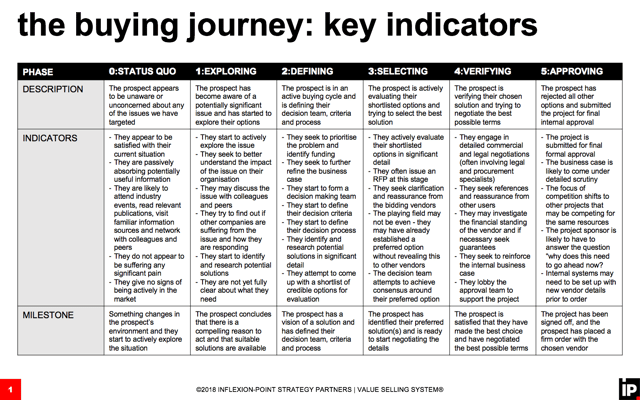
This misdiagnosis is at the heart of many common current sales challenges, particularly when opportunities fail to close when predicted.

The problem can exist regardless of whether or not the sales person is following a defined “sales process”, although it’s interesting (and somewhat disturbing) to observe that some poorly designed sales processes actually serve to obscure this critical piece of information.

It ought to be obvious, oughtn’t it, that if we don’t know where our prospect really is in their buying decision process, the chances that we are going to make the best possible decisions about how to pursue the opportunity are pretty remote.

That’s why accurately diagnosing the current state of our prospect’s buying journey is so important…

Many potential “champions” turn out to inexperienced buyers. Some prospect organisations don’t actually have well-defined buying processes. If you suspect either or both of these situations is at play, rather than ignoring it and hoping it will resolve itself (it won’t) you’re much better off coaching your champion in how to manage their buying journey. But that’s a topic for another blog.

There’s a remarkably consistent pattern to most successful buying processes (the ones that end in a positive outcome, rather than a decision to “do nothing”), and although it’s always possible for some opportunities to skip some of the stages, this almost always creates significant problems for the prospect, causing the project to stall or fail later on.

KEY PHASES IN THE BUYING JOURNEY

Here are the seven phases that are most commonly found in successful complex B2B buying journeys, including the “pre-buying” STATUS QUO and the post-sale IMPLEMENTATION stages. These apply particularly to high-value first-time purchases that involve multiple stakeholders (lower value, transactional purchases are often simpler):

  • STATUS QUO [Pre-Buying]
  • EXPLORING
  • DEFINING
  • SELECTING
  • VERIFYING
  • APPROVING
  • IMPLEMENTING [Post-Sale]

Although each phase normally proves to be important, the buying journey itself is not necessarily linear. At any point, the prospect can decide to stay as they are, go around in circles, move forwards, move backwards, or abandon the process altogether.

Different members of the key stakeholder group/decision-making team may think that the project is at a different phase to their colleagues. The project’s Power Sponsor has a critical role in identifying and dealing with these misalignments.

Let’s look at each of these phases and their associated indicators and milestones in more detail…

0: STATUS QUO [Pre-Buying]

The prospect appears to be unaware or unconcerned about any of the issues we have targeted.

KEY INDICATORS

During this phase, they typically:

  • Appear to be satisfied with their current situation
  • Are passively absorbing potentially useful information
  • Are likely to attend industry events, read relevant publications, visit familiar information sources and network with colleagues and peers
  • Do not appear to be suffering any significant pain
  • Give no signs of being actively in the market

MILESTONE

Before advancing beyond this phase, something must have changed in the prospect’s environment and caused them to start actively exploring the situation.

1: EXPLORING

The prospect has now become aware of a potentially significant issue and has started to actively explore their options. This is the first significant phase in a new buying journey.

KEY INDICATORS

During this phase, they typically:

  • Start to actively explore the issue
  • Seek to better understand the impact of the issue on their organisation
  • Discuss the issue with colleagues and peers
  • Try to find out if other companies are suffering from the issue and how they are responding
  • Start to identify and research potential solutions
  • Are not yet fully clear about what they need

MILESTONE

Before advancing beyond this phase, the prospect must have concluded that there is a compelling reason to act and that suitable solutions are available.

2: DEFINING

The prospect is now in an active buying cycle and is (amongst other things) defining their decision team, criteria and process.

KEY INDICATORS

During this phase, they typically:

  • Seek to prioritise the problem and identify funding
  • Seek to further refine the business case
  • Start to form a decision-making team
  • Start to define their decision criteria
  • Start to define their decision process
  • Identify and research potential solutions in significant detail
  • Attempt to come up with a shortlist of credible options for evaluation

MILESTONE

Before advancing beyond this phase, the prospect typically has some sort of vision of a solution and has defined their decision team, criteria and process.

3: SELECTING

The prospect is now actively evaluating their shortlisted options and trying to select the best solution.

KEY INDICATORS

  • During this phase, they typically:
  • Actively evaluate their shortlisted options in significant detail
  • Often issue an RFP at this stage
  • Seek clarification and reassurance from the bidding vendors
  • May have already established a preferred option without revealing this to other vendors
  • Attempt to achieve decision-team consensus around their preferred option

MILESTONE

Before advancing beyond this stage, the prospect has typically identified their preferred solution(s) and is ready to start negotiating the details.

4: VERIFYING

The prospect is verifying their chosen solution and trying to negotiate the best possible terms.

KEY INDICATORS

During this phase, they typically:

  • Engage in detailed commercial and legal negotiations (often involving legal and procurement specialists)
  • Seek references and reassurance from other users
  • May investigate the financial standing of the vendor and if necessary seek guarantees
  • Seek to reinforce the internal business case
  • Lobby the approval team to support the project

MILESTONE

Before advancing beyond this stage, the prospect must typically become satisfied that they have made the best choice and have negotiated the best possible terms.

5: APPROVING

The prospect has rejected all other options and submitted the project for final internal approval.

KEY INDICATORS

During this phase, they typically:

  • Submit the project for final formal approval
  • Expect the business case to come under detailed scrutiny
  • Shift the focus of competition to other projects that may be competing for the same resources
  • Have to answer the question “why does this project need to go ahead now?
  • Have to set up internal systems with new vendor details prior to order

MILESTONE

Before advancing beyond this phase, the project must have been signed off, and a firm order placed with the chosen vendor.

IMPLEMENTING [Post-Sale]

We may think that the sales in complete when you receive the customer’s official order, but we would be well advised to remember that from the customer’s perspective, the buying journey isn’t over until and unless the problem they originally set out to solve has been satisfactorily addressed.

SIGNIFICANT IMPLICATIONS

SKIPPING STAGES

You may think that the above journey is an idealised process and, of course, it is. Many buying journeys appear to skip one or more stages, and if only one decision-maker is involved, they can still come to satisfactory conclusions.

But in the types of opportunity I have in mind - high-value first-time purchases that involve multiple stakeholders - when stages are skipped they almost always store up trouble for the future. Rather than shortening the process, skipped stages or steps tend to lengthen the process because at some point someone in authority typically requires that the gaps are filled in before the project can proceed.

ARRIVING LATE

The buyer’s journey reflects the prospective customer’s buying process, not the sales person’s process. That’s why it’s critically important that we recognise the stage our customer has reached when we first become aware of an opportunity.

If the first time we become aware of an opportunity is during the prospect’s selecting phase (for example, if we receive an unexpected RFP) our chances of winning have already been dramatically diminished, because the prospect will have defined their requirements without our inputs.

AVOIDING GETTING AHEAD OF OURSELVES

Perhaps most important, recognising where the prospect is on their buying journey can stop us from getting ahead of ourselves, and believing that the opportunity is at a far more advanced stage than it really is.

This is one of many reasons why sales organisations that focus on their prospect’s buying journey and not just on their internal sales process typically do a far more accurate job of forecasting the outcomes of active sales opportunities, and suffer fewer competitive losses or “no decisions”.

IN CONCLUSION

I hope that I’ve managed to persuade you that aligning your sales activities with your prospect’s buying journey can deliver significant benefits. You can download a one-page summary of the buying journey phases, indicators and milestones here.

Buying Journey Key Indicators.png

If you’d like to start a discussion about how to apply the principles in your own organisation, please drop me a line or share your comments below.

IF YOU LIKED THIS, YOU'LL PROBABLY ALSO APPRECIATE:

WEBINAR: Selling in the Breakthrough Zone

Our Guide to the Value Selling System

12-Point Value Selling Self-Assessment

ABOUT THE AUTHOR

Apollo_3_white_background_250_square.jpgBob Apollo is a Fellow of the Association of Professional Sales and the founder of UK-based Inflexion-Point Strategy Partners, home of the Value Selling System®. Following a successful career spanning start-ups, scale-ups and corporates, Bob now works with a growing client base of tech-based B2B-focused high-growth businesses, enabling them to progressively create, capture and confirm their unique value in every customer interaction.
02 Jan 19:01

Great Pitches Start With Change

by Andy Raskin

Editor’s Note: This article first appeared on Medium here.

Nail the shift that powers your story for sales, fundraising and leadership.

The (admittedly contrarian) view that motivates my work with CEOs and leadership teams is that great pitches don’t start with your vision, your mission, your product, or a surprising statistic.

Great pitches don’t start with why, if by why you mean a reason you get up in the morning.

Great pitches don’t even start with a problem. When you tell people they have a problem, there’s a decent chance they’ll get defensive because (a) they don’t believe they have the problem; (b) they’re in denial; or (c) they worry that if they admit to having the problem, you’ll sell them something.

Besides, when you start with a problem, you offer zero context for why solving that problem matters.

Great pitches start by naming a change in the world.

In the modern business era, as I’ve written before, it all goes back to Salesforce founder Marc Benioff, whose early pitch – actually, whose entire positioning – started by naming the change in how computing services were delivered:

Benioff

Salesforce founder Marc Benioff’s “No software” message

As I like to point out in keynote talks and workshops, it’s no accident that another great change statement comes from Zuora, the subscription business platform. After all, the company’s top execs (and consultant-turned-VC Judy Loehr, who developed Zuora’s narrative) hail from Salesforce. Benioff’s influence is certainly evident in the first slide of Zuora’s pitch, which I wrote about in “The Greatest Sales Deck I’ve Ever Seen”:

Zuora pitch deck

From Zuora sales deck, 2016

Why start with change? Because no matter what you’re pitching, your most formidable obstacle is adherence to the status quo  –  that voice inside your audience’s heads that goes, We’ve gotten along just fine without it, and we’ll always be fine without it. By credibly asserting that the world has changed in a fundamental way, you offer a “non-salesy” reason to challenge the voice.

5 Criteria for Naming a Powerful Change

Still, a number of folks have told me they started with a change but it backfired. As one man wrote via email:

My prospect told me to stop wasting her time and get to the point.

To be sure, it’s always difficult to determine whether the fault lies in a framework or its application. Yet, in digging into inquiries like this, I’ve learned that great pitches start with change, but not just any change.

Obviously, you have to express the change quickly and succinctly. More importantly, for the change to engage audiences, it must accomplish certain narrative work. Which is to say, it must meet the following five criteria:

1. The change must give rise to stakes

By stakes I mean opportunity and risk for your audience. Put another way, the change must create new winners and losers. If it doesn’t, your audience is probably justified in preferring the status quo to whatever you’re pitching.

For example, the engine that powers Drift’s story is CEO David Cancel’s observation that buyers now communicate through always-on messaging channels like Slack and texts. As this slide in a recent Drift presentation asserts, buyers now practically sleep with their phones:

Drift hypergrowth

From Drift’s Hypergrowth presentation

The stakes for marketers and salespeople that Drift targets? Winners will engage through those channels, while losers will keep sending email.

2. The change must be a discrete, 0-to-1 shift

In my work with leadership teams, I start by asking them to articulate what has changed. At first, I often hear statements like this:

Today, our customers increasingly do X

Trouble is, an incremental shift (“increasingly”) isn’t jarring enough to loosen the status quo’s iron grip.

Instead, declare a discrete change – a 0-to-1 disruption – even if it feels like you’re exaggerating. Zuora’s “subscription economy” proclamation is immensely powerful, even though it doesn’t quite stand up to rigorous scrutiny. (We still buy most things outright.) Drift’s change statement, too, is hyperbole. (Most of us still use email.) They work because their finality pries open audiences’s minds to the possibility that the rules of the game have changed in a fundamental, permanent way.

Lately, when working with teams on change statements, I’ve found that the sketch below helps me elicit discrete (not incremental) ones. Yes, change happens over time, but how has it reached a tipping point such that your audience now lives in a different world?

new world old world

By the way, there’s a similar dynamic in epic films and myths. The hero, called to action by an incremental change, initially hangs back. (Mythologist Joseph Campbell famously dubbed it “refusal of the call.”) In Star Wars IV: A New Hope, Luke whines about wanting to be a pilot and have adventures, yet when Obi-Wan offers him the opportunity to do exactly that, Luke demurs. (“I can’t get involved,” he says, sounding eerily like an unconvinced enterprise buyer.)

What makes Luke finally go? The Empire destroys his home and kills his relatives, forcing him to acknowledge that he now lives in a fundamentally changed world – one in which the survival of everything he cares about is suddenly at stake.

3. The change must be stated as a done deal – not the result of your actions

The change that starts your pitch cannot be a change that you are bringing about, that you want to bring about, or that you think should be brought about.

Rather, it is a change that has demonstrably already happened (or demonstrably happening and unstoppable). It is not the result of your company, product, or idea.

The change you name must, in other words, spark recognition. Audiences should think, “Hmm, I am subscribing to a lot of things.” You’re not trying to persuade them (yet) about some future you think they should want.

That’s not to say that once your audience acknowledges the change, you can’t talk about a new future you want to make real for them. That’s what I call the Promised Land.

Elon Musk keynote

Elon Musk’s keynote for Tesla Powerwall (May 2015)

Elon Musk, in his much-talked-about keynote for Tesla Powerwall (which I dissect in “Want a Better Pitch? Watch This”), starts with the sudden spike in atmospheric CO2 (the change that has already happened), then paints the picture of a more desirable future (Promised Land) in which we no longer use fossil fuels. “We have this handy fusion reactor in the sky called the Sun” he says. “It just works.”

4. The change must, to some degree, flout conventional wisdom

“We’re all mobile now” might have worked in strategic narratives back in 2010. Now, not so much.

The hard part about flouting convention, of course, is doing so while simultaneously satisfying the previous criterion – making the case that the change has already happened in a way that sparks recognition.

In this sense, naming the change is an act of journalism. Great journalists look for developments that are new (and that create stakes for readers) yet demonstrably happening. No newspaper can publish a story today solely about the unexpected results of the 2016 presidential election; it’s old news.

Likewise, if your change statement is a variation on “We’re in the age of big data” or “Now, it’s all about digital transformation,” look for a more current, more surprising shift.

5. The change statement must describe how things have changed

Some teams duck the challenge of crafting an effective change statement by asserting that something is changing, but without saying how. Here’s one I see a lot:

Customer expectations are changing.

I often see these “how-less” statements followed by a long, bulleted list of supporting changes (“consumers want to pay in new ways”, “consumers want everything fast”, etc.). But all that does is shift the burden of making sense of it to your audience. If you can’t boil it down, how will they do it?

When you’re swimming in relevant changes, you have two choices: (1) choose the one that best meets the criteria above, or (2) craft a master change statement that captures all of them under one umbrella.

For example, now that Salesforce’s business has grown way beyond its roots (and “no software” is old news), the opening video at the company’s recent Dreamforce conference began with the declaration of a new shift:

fourth industrial revolution

Under the umbrella of the “fourth industrial revolution,” Salesforce includes lots of big technology trends, including artificial intelligence, robotics, and the Internet of Things. The risk, of course, is that the change becomes so broad that it’s rendered meaningless. I’m not sure if Salesforce has hit that point yet, but startups take note: your biggest advantage over large, established competitors is that you can tell a more focused story.

Yes, Change Powers Great Investor Pitches, Too

I’m often asked if my strategic narrative framework is applicable to investor pitches:

OMG yes. Fearful of the status quo’s tenacity, savvy investors want to hear how you’ll combat it. More importantly, a change in the world helps them detect the scent of opportunity.

In a fascinating analysis of how much time investors spend on different types of slides in funding decks, DocSend (which can track that stuff) and Harvard Business School’s Tom Eisenmann found that the “Why Now?” slide – in which many founders articulate change – outranked everything except financials, team, and competition (note where “problem” and “solution” wound up):

what we learned from 200 startups

From “What We Learned from 200 Startups Who Raised $360 Million” (June 2015. Yellow highlight added)

Of course, it’s a leap to say time spent reading a slide correlates to importance, or that high-ranking topics should come first. (Certainly don’t start with detailed financials, which grabbed the top spot.)

Still, when it comes to naming the change, it’s a leap worth taking. In fact, I’ve seen better results by shedding the “Why Now?” label (George Lucas doesn’t flash a giant “Why now?” when the Empire destroys Luke’s home). For example, Amplitude’s Series C deck, which recently raised $30 million, jumps right from an intro slide to the big, undeniable change:

Amplitude series C deck

Amplitude Series C funding deck (August 2017)

While I might have gone further (“Now, all companies are digital product businesses”), the change nicely sets up why there’s a growing market for platforms like Amplitude, which help teams improve digital products through specialized analytics.

Three Signs You’ve Named the Right Change

How do you know you’ve nailed this critical element of your story for sales, fundraising and leadership?

  • You’re ready to replace traditional mission and vision statements (“We want to be the most trusted ___”) with the change – and the future you commit to making real for your audience
  • You can imagine that 90% of your content – CEO keynotes, content marketing, etc. – will be about the change and its impact. (BTW, this is the secret to thought leadership.)
  • When you name the change, audiences nod in recognition. They open up about how the change affects them, how it scares them, and how they see it presenting new opportunities.

So like I said, if your why is about why you get up in the morning, don’t start with that. Unless, of course, the reason you get up in the morning is a change that creates stakes for your audience. Then, by all means, go for it.

About Andy Raskin
I help CEOs and leadership teams align around a strategic story  –  to power sales, marketing, fundraising, product, and recruiting. My clients include teams backed by Andreessen Horowitz, KPCB, GV, and other top venture firms. I’ve also led strategic storytelling training at Salesforce, Square, Uber, Yelp, VMware and General Assembly. To learn more, visit andyraskin.com.

The post Great Pitches Start With Change appeared first on OpenView Labs.

02 Jan 19:00

The Basic Social Media Mistakes Companies Still Make

by Keith A. Quesenberry
dec17-25-evan-smogor-376949
Evan Smogor/Unsplash

Over 90% of medium and large businesses have used social media in their marketing for five years or longer. Yet the CMO Survey reveals that nearly half of marketers are unable to show the impact of their social media investments. That’s why, no matter what your social media strategy is, it’s always a good idea to go back and make sure you have the basics covered. Your company may discover that it needs a strategic do-over.

Philip Kotler once said, “You should never go to battle before you’ve won the war on paper.” But countless businesses have done just that with social media. Although 97% of Fortune 500 corporations are on LinkedIn, 84% are on Facebook, and 86% are on Twitter, many brands entered the social media front lines without a clear strategy. Social was an add-on to existing plans — another outlet to deliver the marketing message. Later, marketers found themselves working backward to connect their social strategy to business strategy, as managers demanded greater proof of ROI.

There are a few common mistakes that marketers make with social media. The first is to start with social media objectives. Marketers take a channel such as Facebook, Twitter, or LinkedIn, and then set goals for raising their numbers of likes, comments, and shares. This approach sounds like it makes sense, but it can trap you in a social media–only perspective. After all, how much is that like, comment, or share actually worth to your business? Unless you connect your social media actions to broader business goals from the beginning, ROI can be elusive, and social media becomes an end unto itself.

The second mistake is to limit your brand presence to the most popular social media channels. Success often depends on having a multichannel social media strategy. Yet only two-thirds of the Fortune 500 (66%) are using YouTube, under half are on Instagram (45%), just over one-third (36%) have corporate blogs, and one-third (33%) are on Pinterest. If you are not using these or other platforms, you could be missing out on valuable business opportunities.

For example, research has found that 93% of Pinterest users plan purchases on the platform and 87% have made a purchase after seeing a product they liked. Other platforms, such as Snapchat, may be the ideal place to reach certain demographics (say, Millennials). Instagram has played an integral role in helping to lift sales for brands including Gatorade. And businesses that have prioritized blogging are 13 times more likely to receive positive ROI.

So how do you ensure that your social media efforts are aligned with what matters to your company — and that you are positively contributing to the bottom line? Start by basing your social strategy on business objectives, then follow that by thinking about target market, social media platforms, tools, and metrics.

Different organizational objectives and target markets may require very different channels and tools. Don’t simply set goals for higher follower or engagement metrics in the brand’s current social media accounts. Those platforms may be wrong for your business objectives; channels you aren’t on may be better for what you’re trying to accomplish.

To identify the most meaningful business objectives, ask some questions: What numbers must you hit? How will you know you are successful? How does your boss judge success? What has changed recently that is challenging you? What do stakeholders care about most? Business objectives can vary wildly, from increasing sales, generating leads, or improving customer satisfaction to raising awareness, soliciting donations, or gaining volunteers. Thus your objectives should not be social media–focused, such as “Within six months, we should grow our number of fans and increase engagement on Facebook by posting a minimum of five times a week.” That’s a tactic, not a clear goal. A good objective could be “Increase awareness of the brand by 20% for people ages 18–24 within six months.” Hootsuite suggests that real business goals often come from business conversions, brand awareness, and customer experience.

When considering platforms, think carefully about which you should be on — and which you shouldn’t. Remember that simply increasing your activity on current platforms may not bring you closer to meeting business objectives. Achieving a better ROI may require closing social accounts that are not aligned with business objectives, or even decreasing social action to focus on posts of more substance. Buffer Social, for example, recently got better results by posting less, not more, on Facebook.

Once you’ve identified your objectives and selected the right platforms, you have to create content that the audience will value. Solve a problem they’re facing, deliver a timely message, or just put a smile on their face. Stories that evoke emotion tend to perform better than straight sales messages. Even paid social media posts merely buy reach; the content itself must be engaging enough to draw action beyond a view. Plus, valuable content often gets shared, increasing your reach even further. And don’t simply post the same content to all your social accounts — customizing the content and scheduling for each channel will get better results.

Yet content only gets you so far. Much of social media ROI is earned in responding to customers. Sprout Social has found that brands reply to only one in 10 social messages that require a response. This is a huge missed opportunity, since helpful replies to even negative comments can improve your brand image, reach new customers, and increase the likelihood that customers will buy again. Depending on your industry, you may need the customer service department to get involved. Don’t forget, social is a two-way medium.

Next, ensure you have the right tools in place to manage your social media efforts. To measure success, brands need tools that can monitor, publish, and track the appropriate analytics. They also need to integrate social media across departments, since it is an increasingly important part of the strategies of many areas of the business. For efficiency, you may need tools that can bring together multidisciplinary social teams across department silos.

It’s worth considering tools like Google Analytics, which can break down social traffic to see which efforts are working, ranging from website conversions from a direct sale to email subscription, event registration, or quote requests. Setting up goals with dollar values per conversion can help determine where to focus your time and money beyond followers and likes — connecting social media to the bottom line. Monitoring tools can also track analytics such as sentiment. Too many corporations have seen crisis situations where negative comments in social media led to sales declines and drops in stock price. There are numerous social media analytics software options. Spend some time researching which ones are right for your organization.

Once the right tools are in place, identify and track the metrics that will show the returns on your social media investment. Only when you have done the hard work ahead of time — connecting social action to business objectives — do vanity metrics such as likes and followers become more meaningful. Obviously, you can’t directly connect every social action to a business objective, such as an in-store sale. But you can get close by estimating values. For example, if you know that a percentage of customers who request information on your website purchase a certain product, you can trace the connections by looking at related social media posts and the number of visitors being driven to that call to action page.

If you are struggling to link your company’s social media presence to business goals, you are not alone. But it is never too late to (re)start at the beginning. Take a step back to ensure you are considering broader business goals and the target market. Check that you are using the right platforms and are engaging in the right ways. Then make sure you have the necessary tools and metrics in place. It is a lot easier to prove ROI when you have a clear plan for meeting the business’s objectives — and are not simply increasing social action as an end in itself.

02 Jan 19:00

5,000 Marketing Technology Tools (and Sales Execs Still Need to Find Over Half of Their Own Leads)

by dan.mcdade@pointclear.com (Dan McDade)

A 2017 MARTECH TODAY infographic lists the almost 5,000 companies that are part of the marketing technology landscape, up from just 150 in 2011.

Yet, according to CSO Insights, despite the new tools, the mobile devices, the potential of social, and so on, many salespeople are working harder than ever just to achieve the same old results or worse. Quota attainment averaged across all geographies, industries and company sizes has dropped from 63% of salespeople in 2012 to 53% in 2016 – and 2017 will likely be down again – for the fifth year in a row.

My $.02 is that technology has made it possible for marketing to get more poor-quality leads to sales faster than ever before.

“The first rule of any technology used in a business is that automation applied to an efficient operation will magnify the efficiency. The second is that automation applied to an inefficient operation will magnify the inefficiency.” That’s a quote from Bill Gates, and I agree. I’ve seen a lot of bad processes automated as well, Bill.

Let’s take lead scoring for example: the more senior the executive the less likely they are to give up their “digital body language.” So, lead scoring favors lower level decision-makers and smaller deal sizes – and for that reason I would term it a bad process, automated. More senior decision makers don’t want to be treated like the human equivalent of a pinball – getting your attention only after they have hit the right bumpers and scored enough points – which is why the process doesn’t work in the first place and why the automation magnifies this fact.

I don’t place all the blame on marketing. Each year lead quotas go up while budgets go down, and marketing has to do something – so they turn to technology. Because sales reps have become conditioned to expect poor quality leads from marketing they tend to not follow up on marketing’s leads – or they call once or twice and assuming the lead was bad because the prospect did not call back – putting marketing in the position to try the next new thing, which is most cases is one of the new technology solutions that recently hit the market.

Compounding technology-driven answers to the age old sales/marketing problems is the stubborn perception that leads should cost less than they do. The cost of a lead by itself is not a valid measurement of a lead’s value. Is it qualified, nurtured, ready for sales? That side of the equation has to be factored in, that is both marketing and sales goals have to be met. Read this blog for more on this topic.

A 2017 list of marketing statistics from HubSpot included the following:

  • Only 8% of salespeople said leads they received from marketing were very high quality.
  • 52% of marketers say they provide salespeople with their best quality leads, while salespeople rank marketing-sourced leads last.

How is this going to get fixed? Read “From Chaos to Kickass” and find out how companies with optimized sales and marketing achieve kickass results by doing three things well. Not 50 things. Three things: 1. Agree on your market, media and message; 2. Measure what matters; 3. Deliver fewer, but better, leads to sales. (You’ll notice that “automate bad processes" isn’t one of them.)

Marketing can’t afford to automate processes that don’t solve sales problems. Just as marketing can’t afford to waste expensive sales talent beating the bushes looking for new business when they could be focused on closing business.

Happy 2018!

01 Jan 16:51

Are Keywords Dead? 10 Essential Ranking Factors to Include in Your SEO Strategy

by Jennifer Lux

At the genesis of Google’s search engine algorithms, near the end of the 20th century, ranking signals were as simple as matching keywords and counting backlinks. Today, Google changes its search algorithm upwards of 600 times a year and rolls out at least one notable update annually. When this happens, search results may shift significantly, resulting in big changes to organic traffic. While keywords have long played an important role in these updates, simple search terms are taking a backseat to other ranking factors as they rise in importance and contribution to the overall SEO landscape.

In fact, there are over 200 ranking signals or components that currently make up Google’s secret search algorithm. How do you begin to prioritize optimization tactics to impact your rankings?

As we usher in a new approach to SEO, you might wonder, “Are keywords dead?” Not quite, but new factors should be considered alongside the rising sophistication of search. These are 10 essential factors to consider when creating a comprehensive SEO strategy:

1. Semantics

Google has become a far more sophisticated tool than a keyword matching system, with the rise of AI and machine learning that can infer the intent of site content. By drawing conclusions about the meaning of content, using technology that interprets word phrases and matches synonyms, Google is able to make actual keywords secondary to their true meaning. This very shift was the impetus for HubSpot’s new approach to keywords with topic clusters and pillar pages.

2. Keyword Placement

It’s true, keywords aren’t as valuable as they were in years past, yet it’s important to note that the placement of keywords and their synonyms is important. This includes using keywords or their related phrases in page titles, URLs, meta descriptions, image descriptions, body copy, image filenames, and heading tags.

3. Security

In December of 2015, Google started giving weight to HTTPS pages. Just last month, Google took things a step further and began notifying both website owners and visitors of security holes when forms are running on non-HTTPS sites. A recent study by Moz found that 74% of Page One results on Google came from security websites. The bottom line is to make site security a priority. Getting an SSL certificate involves a simple protocol and will continue to be an important ranking factor amid a climate of regular cybersecurity hacks and breaches.

"Your connection is not pricate" security message

4. Schema Markup

This structured data is a defined tagging structure that can be added to HTML to pull valuable information from your site into search results. This type of microdata encourages your listing to display rich and compelling snippets in search engine results, or in the knowledge panel on the right side of search, and compels human browsers to click through to your website.

5. Speed

There is strong evidence that Google gives ranking preference to sites with faster site speed or page load time. In addition, because robots have a short predetermined time to crawl a site, slow site speed can result in fewer pages indexed and therefore poorer domain authority. Use Google’s site speed tester to know how your website compares with others and receive recommendations for improvement.

6. Site Structure

Create an XML sitemap and submit it to Google. Although this won’t compel Google bots to crawl your site any differently, it will help you to identify indexation problems as well as sending signals to Google about the quality of your pages.

7. User Experience

Signals to search engines about a good user experience include a low bounce rate and an average session duration longer than industry benchmarks. These metrics tell search engines about a user’s satisfaction while including the users’ experiences alongside navigation, content, calls to action, and accessibility. Search engines also take into account the number of additional websites a user might visit in the same search session to understand whether their question was answered to full satisfaction on your webpage. These usability and engagement metrics are a signal to Google of a positive user experience, which is awarded in search result rankings. How can you support a positive user experience? By creating the kind of content sought by your personas, in an engaging format, with a logical next step. Use clear navigation to reflect on the customer journey on your website so that your site’s user experience contributes positively to search results.

8. Mobile Optimization

Back in April 2015, Google announced plans to expand its use of mobile users’ experiences as a ranking signal. Today, most industries require a “mobile-first” marketing ecosystem. Not only is mobile optimization an important ranking signal for Google, but making your site mobile-friendly can lead to better engagement on mobile devices, which also improves rankings. Reference this Mobile Friendly Test to verify your site’s ability to meet Google mobile criteria.

9. Links

Both internal and external links are important to SEO. Websites are designed to link to good quality resources, so if your site has a high number of credible and relevant inbound links or backlinks, it’s a sign to Google that your site must contain valuable content. Links from sources with domain authority equal to or greater than your site will be especially helpful to your domain authority, which can help your site rise in search results. Internal linking between pages on your site is also good for SEO, as it can help search engines understand the purpose of your pages, and can establish site structure for crawling spiders when using a strategic URL structure.

10. Ease of Crawling

Using software to identify broken links, 404s, and duplicate content is essential in ongoing SEO efforts. Improper redirects, and lack of “no follow” meta tags when needed, could result in a poor user experience, high bounce rates, and a less-than-optimal customer journey. Using verification sites such as Moz, Screaming Frog, Xenu, or Google Search Console to regularly check and fix these issues is the ticket to maximizing your search engine potential.

Keywords might not be dead, but successful SEO requires more sophisticated tactics than ever. Consider these 10 factors as you continue to optimize your SEO strategy in the evolving search ecosystem.

01 Jan 16:48

Work Smarter by Following These 50 B2B Sales Experts on LinkedIn in 2019

by Alex Hisaka
  • spruce up your sales day 3

Here at LinkedIn, we’re celebrating the holidays by bringing you 12 days of awesome sales content. On Day 3, we're pointing you to 50 B2B sales experts and thought leaders on LinkedIn to inspire, educate and help you work smarter in 2019.

Spruce up your sales with 12 days of content: Day 3

They say it’s not what you know but who you know. When it comes to sales success, both matter. To help you “know” more people who can enhance what you know, we’ve paved a path to the B2B sales thought leaders who, if followed on LinkedIn, can help you work smarter.

Read on to discover sales experts who are known for adding relevant insights to their followers’ LinkedIn feeds.

1. Jill Konrath
Blog: https://www.jillkonrath.com/sales-blog

Jill Konrath – author of four bestselling sales books – helps sales organizations understand how to apply fresh approaches that work. As a recognized as a leader in modern sales strategies, she is adept at translating concepts into tactics that sales professionals can apply. 

2. Mark Hunter
Blog: https://thesaleshunter.com/category/blog/

Known as “The Sales Hunter,” Mark authored the bestselling books, High-Profit Prospecting and High-Profit Selling. He shares insights that challenge sales myths and strategies for finding and retaining better prospects they can close at full price. 

3. Tony J. Hughes
Blog: http://www.linkedin.com/today/posts/hughestony

Tony J. Hughes – author of the bestselling book The Joshua Principle, Leadership Secrets of Selling – is committed to elevating sales leadership and professional selling. He shares a modern approach to B2B selling centered on building pipeline leveraging the power of social platforms like LinkedIn, and applying leading methodologies to manage complex sales. 

4. John Barrows
Blog: https://jbarrows.com/blog/

John calls himself the sales trainer to the world's fastest growing companies, and through an array of helpful resources, he helps sales professionals educate themselves and get better every day.

5. Trish Bertuzzi
Blog: Inside Sales Experts Blog

Author of The Sales Development Playbook and CEO of The Bridge Group, Inc., Trish is an inside sales evangelist and game changer. Follow her for wisdom and guidance on what it takes to launch strategies that drive bigger deals in bigger companies.

6. Jill Rowley
Blog: https://www.linkedin.com/today/posts/jillrowley

Jill Rowley has been in the trenches as a sales professional and now shares her passion for helping B2B companies use social selling to drive revenue growth. Add her to your list for practical and no-holds-barred advice on how to succeed as a modern sales professional by being your authentic self, giving to give, and always be connecting.

7. Mike Kunkle
Blog: https://www.mikekunkle.com/blog/

After being on the front lines in sales and sales management, Mike packaged up his years of wisdom to help transform and improve sales forces. He advises on the latest B2B sales topics and approaches, from leveraging insights to social selling and everything in between.

8. Andy Paul
Blog: http://www.andypaul.com/blog/

As a top-rated podcaster, bestselling author of Amp Up Your Sales and Zero-Time Selling, coach and advisor, Andy Paul explores topics crucial to the success of any sales rep or sales organization. He’s all about building the trust, respect, and value that helps prospects choose you instead of the competition.

9. Jonathan Farrington

Touted as a sales futurist and customer experience evangelist, Jonathan has trained more than 100,000 frontline sales pros and has long run an international online community dedicated exclusively to the profession of sales.

10. Daniel Pink
Site: http://www.danpink.com/resources/  

Daniel is the author of six provocative books — including New York Times bestsellers Drive and To Sell is Human – and is considered one of the top 10 business thinkers in the world. Follow him for provocative ideas that get you thinking about the art and science of sales.

11. Jeffrey Gitomer
Blog: https://www.gitomer.com/blog/

The self-proclaimed King of Sales, Jeffrey has authored 13 bestselling books – including the Little Red Book of Selling – and directly helped sales team get better at discovering buying motives. Check him out for practical advice on everything from networking and personal improvement to attitude, objections, and social selling.

12. James Muir
Blog: http://puremuir.com/blog/

James wrote The Perfect Close: The Secret to Closing Sales – The Best Selling Practices & Techniques for Closing the Deal. Follow him for firsthand insight into what he learns in the trenches.

13. Matt Heinz
Blog: https://www.heinzmarketing.com/blog/

Author of six books including Successful Social Selling and host of Sales Pipeline Radio, Matt Heinz is a nationally recognized with over 15 years of marketing, business development and sales experience from a variety of organizations and industries. He shares keen, actionable insights in a lighthearted way.

14. Aaron Ross
Blog: http://predictablerevenue.com/blog

First Aaron built Salesforce.com’s outbound prospecting team. Then he parlayed that experience into two books: Predictable Revenue: Turn Your Business into a Sales Machine with the $100 Million Best Practices of Salesforce.com and Predictable Revenue Guide To Tripling Your Sales.  His blog – Predictive Revenue – covers the ins and outs of just that.

15. Craig Elias
Blog: http://shiftselling.com/the-blog/

Craig Elias was a top sales performer at every company that hired him, including WorldCom where he was named the #1 salesperson within six months of joining. He’s been named by Forbes as one of the most social sales people on the planet, and shares the secret to his success in what he calls Trigger Event Selling™ and on his blog. Send him a LinkedIn connection request, and he’ll send you a link to get a free copy of his award-winning sales book SHiFT! Harness The Trigger Events That TURN PROSPECTS INTO CUSTOMERS.

16. Jeb Blount
Blog: https://jebblount.com/blog/

CEO of Sales Gravy, Jeb Blount is the bestselling author of eight books – including Fanatical Prospecting – and is among the world’s most respected thought leaders on sales. According to Jeb, SalesGravy.com is the most visited sales-specific website on the planet so pay it a visit to soak up the knowledge of one of the most innovative sales bloggers out there.

17. Anthony Iannarino
Blog: https://thesalesblog.com/blog/

A highly respected international speaker, bestselling author and sales leader, Anthony specializes in the complex B2B sale. His daily posts at The Sales Blog have helped him gain recognition as a top thought leader in sales strategy.

18. Brian Burns
Youtube: https://www.youtube.com/user/MaverickMethod

After spending 20+ years selling enterprise software, Brian now hosts The B2B Revenue Leadership ShowThe Brutal Truth about Sales & Selling​ and Sales Questions​ podcasts. His aim? To teach what goes on inside prospects’ organization and how salespeople can guide/control the decision and keep the selection moving in their favor.

19. Ken Krogue
Blog: http://www.kenkrogue.com

Founder and president of InsideSales.com, Ken is an inside sales evangelist. Add him to your list for best practices, research, and tips concerning social selling and selling remotely.

20. Max Altschuler
Blog: https://www.saleshacker.com/library/

Max wrote the bestselling book Hacking Sales on building high velocity sales machines by leveraging technologies, virtual assistants, empathy, and modern sales tactics. Visit his blog to learn the latest B2B sales tips, tactics, strategies, and technology from the industry's top thought leaders.  

21. Tiffani Bova
Podcast: https://itunes.apple.com/us/podcast/whats-next-with-tiffani-bova/id1262213009?mt=2

As a Distinguished Analyst and Research Fellow at Gartner, Tiffani covers Sales Strategies and Channel Innovation. She’s considered one of the leading thinkers in sales transformation and business model innovation, and believes in harnessing emerging technologies and disruptive shifts in buyer behavior to create pragmatic plans for sales transformation.

22. Mark Roberge

Former Chief Revenue Officer at HubSpot, author of bestseller The Sales Acceleration Formula, and senior lecturer at Harvard Business School, Mark shares strategic advice on all things sales.

23. Timothy (Tim) Hughes
Blog: https://www.linkedin.com/in/timothyhughessocialselling/detail/recent-activity/posts/

Tim authored Social Selling - Influencing Buyers and Changemakers and developed what he calls a 5 step Social Selling Methodology. Follow him on LinkedIn for frequent musings on social selling.

24. Jack Kosakowski
Blog: http://www.jackkosakowski.com/blog/

As a true practitioner of turning social into sales, Jack calls his site the “no-fluff” resource for social selling. Follow him for a steady stream of practical advice and recommendations.

25. Jamie Shanks
Blog: http://www.salesforlife.com/blog/author/jamie-shanks

As a sales trainer and visionary, Jamie Shanks is one of the pioneers in the social selling space. He is a source of information on tactics, technology and strategies to align with the modern buyer.

26. Mike Weinberg
Blog: https://www.newsalescoach.com/blog/

Calling upon his experience as a top-producing salesperson, Mike has authored a few Amazon best sellers, including New Sales. Simplified. - The Essential Handbook for Prospecting and New Business Development. Follow him for blunt, practical advice.

27. Alice Heiman
Blog: https://aliceheiman.com/blog/

Sales strategist, coach and speaker, Alice shares strategies and tactics for those dealing with the complex B2B sale. She covers everything from networking and building relationships to social selling and improving productivity.

28. John Smibert
Blog: www.strategicsellinggroup.com/author/john-smibert-2                                                

John calls himself a B2B Sales Specialist, Change Agent, Challenger, and Coach. He’s your protagonist for elevating the professionalism of sales in a changing world.

29. Elay Cohen
Blog: https://saleshood.com/blog/

Elay co-founded SalesHood, building upon his success as the Senior Vice President of Sales Productivity at Salesforce. He also shares sales enablement insights in his book, SalesHood: How Winning Sales Managers Inspire Sales Teams To Succeed, and on his company’s blog.

30. Lee Salz
Blog: https://www.salesarchitects.com/thought-leadership/articles/

Lee, CEO of Sales Architects and The Revenue Accelerator, has authored four books, including best-seller Hire Right, Higher Profits. He shares best practices in sales processes and sales enablement.

31. Colleen Francis
Blog: https://www.salesleadershipdevelopment.com/blog

Colleen, author of Honesty Sells and Nonstop Sales Boom, has been considered a sales leader for over two decades. Her Sales EQ & IQ blog shares practical strategies for measuring and holding sales teams accountable for achieving inspiring results.

32. David Brock
Blog: http://partnersinexcellenceblog.com/

Author of Sales Manager Survival Guide,​ David runs Partners In EXCELLENCE, a global consulting practice that coaches and mentors everyone from C-level executives to individual contributors. Follow David for views on a variety of business, sales, marketing, and leadership topics.

33. Gerhard Gschwandtner
Blog: http://sellingpower.typepad.com/

Gerhard has trained over 10,000 salespeople in Europe and the US; authored 16 books on selling, sales management, and sales psychology; and is the founder and publisher of Selling Power magazine. He also hosts the Sales 3.0 Conference series in Philadelphia, Boston, San Francisco, and Las Vegas. Gerhard is a solid source of guidance on achieving peak performance.

34. Lori Richardson
Blog: https://www.scoremoresales.com/blog

Lori, recognized on Forbes as one of the “Top 30 Social Sales Influencers” worldwide, speaks, writes, trains, and consults with inside B2B sales teams in mid-sized companies. Follow her for sales strategies, tactics, and tips.

35. Steve W. Martin
Blog: http://heavyhittersales.typepad.com/

Steve authored the Heavy Hitter series of books about complex enterprise sales strategies for senior salespeople. He knows the ins and outs of how customers and sellers use language during the sales and decision-making process. Add him to your list for insights into sales organization best practices, key trends, and top salesperson performance.

36. Chris Murray
Blog: http://sellingwithease.info/sales-tips-blog-posts

Author of Selling with EASE and The Extremely Successful Salesman's Club, Chris is one to follow for practical advice you can apply daily.

37. Tibor Shanto
Blog: http://www.sellbetter.ca/blog/

Author of the award-winning book Shift!: Harness The Trigger Events That Turn Prospects Into Customers, Tibor Shanto is a 25-year veteran of B2B sales and has been called a brilliant sales tactician. He specializes in helping reps hone their prospecting and communicate value in a way that drives access to and action from decision makers. 

38. Barbara Giamanco
Blog: http://barbaragiamanco.com/blog/

Barbara is a globally recognized leader in sales, and co-author of The New Handshake: Sales Meets Social Media – the first book written about social selling. She’s one to follow for practical advice on how to become a better salesperson.

39. Jim Keenan
Blog: http://www.asalesguy.com/sales-blog/

Calling upon 37 years of sales experience – which includes selling, running, building, fixing and reconstructing sales organizations – Jim shares keen insights and lessons learned. He covers everything from inbound to outbound, from ABM (account based marketing) to content marketing, from inside sales to outside sales, and more.

40. Noah Goldman
Podcast: http://www.enterprisesalespodcast.com/

Named a top podcaster by Sales Hacker for his Enterprise Sales podcast, Noah is focused on helping scale sales through better processes.

41. Deb Calvert
Blog: http://blog.peoplefirstps.com/connect2sell

Author of the bestselling book DISCOVER Questions® Get You Connected, Deb shares ways for sales pros to improve their performance and make stronger connections with buyers. She also shares advice for sales managers who want to lead their teams more effectively.

42. Joanne Black
Site: http://www.nomorecoldcalling.com/sales-articles/

When it comes to B2B sales, Joanne believes that building relationships and getting referrals generates sales faster and more cost-effectively than cold calling. Follow her if you are looking for ways to connect with the modern buyer.

43. Tamara Schenk
Blog: http://blog.tamaraschenk.com/

Tamara calls upon her roles as the research director for CSO Insights and as a former sales professional on the front lines to tackle every aspect of sales enablement. 

44. Matt Dixon
Blog: https://www.kornferry.com/institute

Co-author of The Challenger SaleThe Challenger Customer, and The Effortless Experience, and frequent contributor to Harvard Business Review, Matt can help you keep your finger on the pulse of modern buyers.

45. Bob Apollo
Blog: http://www.inflexion-point.com/blog

Bob has worked for and with many of the world's leading B2B technology brands and most successful entrepreneurial tech-based businesses. He wraps that experience around provocative posts that reflect his deep belief in value-based selling.

46. Morgan J Ingram
YouTube channel: The SDR Chronicles

Morgan is a real-life sales development manager sharing his insights as well as the wisdom of other sales experts on his YouTube channel specifically geared to providing motivation, advice, and tactics to SDRs.

47. Nancy Nardin
Blog: https://smartsellingtools.com/smart-selling-tools-blog/

Nancy, founder of Smart Selling Tools and Hushly, is a recognized expert on increasing sales productivity through smart tools. Follow her to learn how to use technology to improve workflows, shorten time-to-close, and enhance the buying experience.

48. M. Jeffrey Hoffman
Blog: http://www.mjhoffman.com/blog

As a world-renowned sales trainer, Jeff created YourSalesMBA™, Basho Strategies™, "Why You? Why You Now?™"​ sales training programs. He shares advice and best practices on social selling, prospecting, and closing.

49. Craig Rosenberg
Blog: http://blog.topohq.com/

Craig co-founded TOPO, a research and advisory firm, and frequently shares benchmarks and recommendations for improving the experiences that sales and marketing organizations deliver to buyers.

50. Brent Adamson
Blog: https://www.cebglobal.com/blogs/business-lines/sales-service/

Co-author of the bestsellers The Challenger Customer and The Challenger Sale, Brent is Principal Executive Advisor in the Sales and Marketing Practice at CEB (now Gartner). Follow him for prescriptive advice on what works and what doesn’t.

Of course we’ll continue to surface the best insights from the brightest minds in the industry, so stay up to date on the latest by subscribing to the LinkedIn Sales Solutions blog.

01 Jan 16:42

3 Key Finding From the Frontlines of ABM

by Brandon Redlinger

front lines of ABM

The drumbeat for Account Based Marketing is getting louder and louder. As we march into 2018, top experts predict more of the same. The whispers are turning to roars and spreading like ripples across a pond. Though it may have been there all along, many of the smartest companies are beginning to join in and march to the beat of the same drum – that of accounts.

2017 was a big year for ABM. More companies are adopting the strategy and the ROI continues to swell. And I’m sure years from now, we’ll look back and laugh at the primitive tools and tactics we used to land and expand target accounts.

But until then, there’s only one thing left to do: drive the industry forward.

At Engagio, we’re constantly testing, tweaking and refining our ABM program so that we can build both a world-class marketing software company and pass our lessons learned on to you.

In the spirit of the latter, I want to share some of the biggest lessons we’ve learned doing ABM successfully over the last year.

Key Finding #1 – To execute ABM, you must implement Marketing Orchestration

Just as demand gen marketers have relied on marketing automation to drive leads, ABM marketers just rely on marketing orchestration to drive account engagement. Don’t get me wrong – you still need inbound. However, inbound alone is not enough for complex B2B Sales and Marketing. You also need a more targeted, strategic, and cross-functional approach.

You’re orchestrating personalized Marketing, Sales and Customer Success efforts to open doors and deepen engagement at specific accounts. We call these efforts “Plays,” which generally fall into one of five levels of sophistication and effectiveness. The more advanced, the more orchestration and coordination are necessary.

The ABM team is different than your demand gen team. Though the titles may not be new, the roles they play, their responsibilities and the timing of their activities will change. Here are the key professionals for your Marketing Orchestration team:

  • Growth-oriented Marketing Executives provide the vision and step in with key roles at critical times.
  • Marketing Operations sets the account-based foundation, oversees the account-based systems, and reports on the impact of ABM efforts.
  • Demand Generation and Field Marketing act as the quarterback calling and running the plays for the ABM team.
  • Customer Marketing Teams deliver on the promises and ensure the best experience for the customer.

Key Finding #2 – You must establish “Account Entitlements” before selecting and tiering your target accounts

Account Entitlements answer the question “What is the right amount of time and energy I should dedicate to each account?” If you’ve adopted a 3-tiered approach to scale ABM like many organizations, you’ll need to distinguish the different resources you’re able to dedicate to each tier.

You pay a certain price to open doors and and close deals an account. Whether it’s with time or money, both are a limited resource, which means you must be judicious with how they’re spent.

If you spend all of your time on personalizing your interactions for your Tier 1 accounts, you’re left with no other choice than to automate interactions for your Tier 2 and Tier 3 accounts. In other words, you spam those accounts, which breaks the rules of ABM. In the same vein, if you spend all of your ABM budget on elaborate direct mail and costly ads to your Tier 1 target accounts, you lack channels diversity, and you’re left with only the traditional channels of phone and email for Tier 2 and 3. This, again, breaks the rules of ABM.

In order to select your target accounts and split them up into their appropriate tiers, you must split your time and budget up appropriately across all 3 tiers.

The most important takeaway is if you’ve allocated all of your time and resources but the numbers don’t add up (i.e., there are more target accounts than your resources allow for) it’s OK to cut back the number of target accounts.

Establishing your Account Entitlement will require multiple sessions with your Sales and Marketing leadership to get it right. It’s a fine balancing act that requires a lot of tinkering and adjusting.

Here’s an example (albeit an extremely simplified example) what entitlement could look like:

abm account entitlements

Key Finding #3 – Marketing must support Sales with “Deal Nurturing” to keep opportunities moving in the funnel

When you have long sales cycles, diversity of stakeholders, you often need help moving the deal forward at your high-value accounts. You can’t use automation because that’s impersonal and can kill the conversation quickly. But we’ve realized that marketing cannot completely remove themselves and their skills from the customer journey just because an account has become a Marketing Qualified Account. That’s where Deal Nurturing comes in.

Deal Nurturing is a new kind of nurturing – it’s about cultivating and growing relationships with orchestrated human interaction in existing opportunities at high-value accounts, especially early stage or stalled opportunities.

Why do you need Deal Nurturing?

After you open an opportunity, many things can get in the way of closing the deal. For example, Marketing books a meeting, but the prospect doesn’t show up – how do you stay relevant without being too pushy? Or it’s the end of the quarter and Sales is occupied working deals that are closing now – what happens to those qualified accounts that are in the early stages? Or an opportunity goes dark in the middle of an active cycle – how do you reinvigorate interest?

More often than not, the likely result of each case is a lost opportunity. We’ve laid out a few of our new Deal Nurture plays in our Marketing Orchestration Playbook.

At the end of the day, the success of your team depends on the harmony of great leadership and the commitment of the team. Together, you’ll be able to overcome any obstacle and reach any goal. As you can see, each of the 3 lesson here hinge on these two elements. In fact, ABM – and business in general – is a losing game if you don’t have the right team and leadership to go to marketing with ABM.

So, lock arms and march forth. This is the beginning of an awesome journey.

01 Jan 16:42

How To Write Content That Generates Leads For Your Business

by Anand Srinivasan

The success of any marketing campaign hinges on its ability to generate qualified leads for your business. In the absence of lead generation, metrics such as Facebook likes or website traffic is merely a vanity metric that does not contribute towards your topline growth. Content marketing provides businesses with the unique ability to shape their readers’ opinion, nurture them as prospects and eventually nudge them towards conversion.

Identify your marketing objective

A sales cycle can be a long-drawn affair and depending on your industry, it can stretch from a few minutes to several months. Your content strategy does not have to necessarily aim for a sale. Instead, your objective should be to publish content that can take your target visitor one step closer to conversion.

Let us take the example of a business that develops marketing software for small businesses. The customer, in this case, has dozens of marketing tools to choose from. At the same time, a lot of your customers are also bootstrapped and would prefer working with inefficient free tools rather than pay for your product.

Your marketing objective in this case is two-fold. Firstly, shape your readers’ opinion on why free tools don’t work (and paid tools are beneficial for their business). Secondly, establish your business as an authority so that your prospective customers evaluate your product alongside the market leaders when they do choose to pay for a marketing software.

Develop a content strategy

Once you have identified your marketing objective, the next step is to design a content strategy that works for your prospective customer. A marketing software developer in the example above may want to publish case studies that compare small businesses who use free tools with those that pay for their marketing software and establish the benefits. This is partly educational and helps shape your audience’s opinion on the use of paid tools to market their business. A local service provider like carpet cleaner or automobile serviceman may want to publish “how to” videos demonstrating their work. Such videos are educational in nature and also help establish the authority of the business in its respective industry.

Establish the right content length

Content marketing as a lead generation strategy only works if your content is of optimal length. If your marketing objective is to get your website visitors to download your free ebook, then it is a good idea to not stretch your content and have a crisp article promoting your ebook. If your objective is to rank your blog piece on Google, then you must perform a peer benchmarking study and make sure that your article is a lot more comprehensive than what your competition has for the same target keywords. In addition to this, an industry benchmarking study will also reveal the ideal number of words that will appeal to your audience. A financial portal would have articles that are routinely over 2000 words long while there are industries where even a 500 or 700 worded piece would suffice.

The same recommendations hold true for other types of content too. A ‘how to” video demonstrating your product should be properly edited to run under five to ten minutes while a webinar on an industry topic could run for an hour or more.

Prepare a marketing roadmap

As ironic as it may sound, the content you use to market your business requires marketing of its own. Make sure that the content you write is targeted at the marketing channels you shall be promoting from. Content that is targeted at the Facebook audience works well with attractive titles. If you are publishing a video, make sure to include subtitles which help viewers watch without the need for earphones. Content targeted at search engines need to have highly researched and unique material that are worth linking from other blogs and articles. Having a clear roadmap of how your visitors will come to your page will help you draft content that will work well on the relevant marketing channels.

01 Jan 16:42

Low Sales? Use This Checklist to Figure Out Where You’re Going Wrong

by Shannon Willoby

marketing checklist

Don’t let low sales dash your dreams. Use this marketing checklist instead to figure out where you’re going wrong.

Yeah, it might take a little revision — or a whole lot — but if you’re serious about success, you can’t settle for mediocre any longer.

Ready to get started?

1. Audit Your Images ☑

Listen, it’s time to stop with the crappy photos already. You’re better than that. (And your customers deserve better than that.)

Anyone — yes, anyone — can take great product photos with a little effort and practice. So audit your photos with a harsh eye and replace any that are distracting, blurry, or otherwise low-quality — you’ve got no excuses.

Bad photos don’t entice customers to buy. They also don’t entice people to pin them on Pinterest or share with friends on Facebook — and they also won’t be picked up for PR opportunities, like features for blog posts or local news spots.

Maybe you’ve got hundreds of products so this task seems overwhelming. If that’s the case, set a goal of taking — and replacing — 10 photos per week. (Or whatever number sounds realistic to you.)

Choose your top sellers first and then work your way through the rest. It might take a while, but it will pay off in the long run.

2. Check Your Shipping Prices ☑

A funny argument for offering free shipping

Say you’re selling sandals for $12.99, but you’ve listed your shipping rate as $12. Are you actually surprised when people abandon their cart as soon as they see that strangely high rate?

I know shipping is a difficult component of being an online seller, but set your rates too high and it’s no wonder you’re experiencing low sales.

I can’t tell you how many times I personally have not gone through with a sale for the sole reason of shipping being unrealistically high — and I know it’s the same for many shoppers.

Whether you work free shipping into the cost of your product or lower your rates, figuring out a shipping-rate strategy that works for you and your customers should be one of the first items you implement from this marketing checklist.

3. Reread Your Product Descriptions and Titles ☑

Would you buy your products based on your product descriptions and titles? Be honest.

If not, it’s time to revise.

Product Descriptions

Your product descriptions must be free of grammatical and spelling errors, so run them through both a spell-checker and a site like Hemingway App to catch any issues.

They also need to be descriptive — so make sure you’ve included the essential details, like what fabric your T-shirts are made of or what your handcrafted candle smells like.

The goal of your product description is to tempt the browser to buy — so get creative. Here’s a good example from Wix Wax Candle Company, a handcrafted candle seller on Scott’s Marketplace:

Did someone just peel an orange!? A tangy, juicy orange scent with just a touch of floral thyme.

See? They did a great job of explaining to readers what this candle fragrance smells like in a persuasive manner.

Product Titles

Your product titles need to be literal — this is not the place to get crazy creative (do that in your product descriptions).

For example, “Girl dancing in the rain on a stormy weekend” doesn’t tell me anything about what the product actually is. Is it a painting? A mug? A T-shirt?

And who is it for? Women? Children? Men? Anyone?

If you aren’t specific with your title, people won’t find your product when they’re searching — and it’s not as eye-catching to those who do come across your item.

4. Consider How You Treat Your Customers ☑

Are you ignoring your customers when they call because you’re too busy? Do you sometimes not respond when social media followers send you messages or leave comments?

Are you taking a while to respond when someone wants a question answered before they make a purchase? How do you handle complaints, refunds, and otherwise unhappy customers?

Everything you do, from waiting five days to answer a customer question to getting a little snarky with an upset customer, can mean lost sales and a bad reputation online.

5. Perform a Quality Check ☑

How is the quality of your products? Are you skimping or cutting corners somewhere? These little details are noticeable — and might be why you’re not getting return buyers.

Use this marketing checklist as a prompt to ask yourself what you can do to improve the quality of your products.

If your customers see the value in buying from you, they will be likely to recommend your products to their friends, and, hopefully, buy again themselves too.

6. Stop Ignoring Your “About Us” Section ☑

People want to know about the brands they’re buying from. And whether it’s a curiosity thing, a personal-connection thing, or simply a credibility thing, forgetting to fill out the ‘about us’ section of your online store is a serious mistake.

Show your customers you’re a genuine (and credible) local business with a story to tell instead of leaving this space blank.

7. Consider if You’re Ignoring PR Requests ☑

I’m not going to name names, but as director of content marketing for Scott’s Marketplace, I know firsthand how many people don’t reply when offered free promotional opportunities for their business and products.

For example, I might email 50 sellers from our site offering them a free blog post feature that highlights their products and I’m lucky to get five replies — and that’s being generous.

I know you’re busy. I know you’re overwhelmed. And I know it’s easy to put things like this on the back-burner.

But if you want to get serious about sales, ignoring PR opportunities is only going to hurt your business.

8. Revisit or Create a Marketing Strategy ☑

If you sell on an online marketplace, you might expect that the customers will come to you — and they may. But that doesn’t mean you don’t need to do your part to promote your products.

Revisit your marketing strategy (or create one) if you haven’t already. Include all your marketing efforts — from email newsletters to social media sites and the frequency you’ll be using each one.

Is there a new social media site you can try? Are you still spending time on a social site that’s not been effective for your business? Do you have an email list and actively send to your subscribers?

What should you start doing? What should you stop doing? A marketing checklist like this will help you keep track of what’s working and what isn’t, and prompt you to reevaluate often.

9. Take a Look at Your Shipping Timeframe ☑

This checklist has already covered your shipping rates, but let’s talk about your shipping timeframe now.

First of all, do you clearly state your shipping policy on your online store for your customers to see? Or do you leave them to guess as to when their package might show up?

An inconsistent shipping timeframe means your customers will never buy from you for gifts, holidays, or last-minute needs. And if they have no idea when to expect their package, you will also come across as unprofessional and unreliable.

Even worse, are you promising customers will receive their items within a certain timeframe and then sending them late?

Nothing will make a customer angrier than over-promising and under-delivering. And we all know that angry customers take to social media to express their unhappiness — which leads to a bad reputation for you.

Decide on a timeframe that’s realistic for you — and your customers — and stick to it. No exceptions.

10. Perform a Boredom Check ☑

Keeping customers from getting bored is an important (ongoing) component of this marketing checklist.

What can you do to entice repeat buyers?

  • Can you add variety to an existing product?
  • Offer it in a different color?
  • Add a new feature?
  • Or create something new entirely?
  • Are you able to switch things up according to seasons and holidays?

Whether it’s offering your bath bombs in a seasonal scent or creating a T-shirt design based off a current trend, variety is not only the spice of life, but the ingredient that keeps customers coming back for more.

11. Analyze Your Product Prices ☑

Are you charging too much for your products? Or are you charging too little that it’s making you want to cut corners and put out a lesser quality product?

Both of these scenarios are hurtful to your business and dissuade people from buying.

12. Do a Google Search ☑

If you don’t Google your business regularly to find out what customers are saying about you, you’re making a huge mistake. Whether really good — or really bad — reading customer reviews will give you crucial insight into how your customers feel about everything from your product prices to your customer service.

And keeping on top of reviews means you can respond to any negative reviews you find to (hopefully) make things right.

But if there’s nothing about your business online, that’s not good either.

Setting up a social presence will help improve your business’ credibility, as well as getting a little local publicity going for your products. The more positive mentions you have of your business online, the more likely people will be to trust you enough to make a purchase.

Use This Marketing Checklist on the Reg

Keep this checklist handy so you can refer back to it on a regular basis. Constant analysis and improvement will help you stay on top of what your customers want — even before they know themselves.

Yes, improving your sales will be an ongoing process, but as the wise Yoda once said, “Do or do not. There is no try.”

Will you use this marketing checklist to improve your business?

This blog post was originally published on The DRIVE Blog.

01 Jan 16:41

How a Chatbot Can Help Lead Customers Through the Sales Funnel

by Nathan Sykes

The sales funnel — the process potential customers go through when making buying decisions — has played an integral part of marketing and sales for quite some time. While the basic principles of the funnel have stayed close to the same, many of the tactics marketers use to move leads through it have changed. One recent maneuver is to utilize a chatbot.

For many of today’s businesses, artificial intelligence and automation play a significant role in this movement. Web-based technologies allow companies to collect huge amounts of data on potential and current customers — so much it would take human analysts too long to sift through it.

Artificial intelligence, on the other hand, can make sense of this data and use it to predict what actions customers might take in the future. This gives marketers and salespeople more information on what they need to move a lead through the sales funnel.

One common way companies collect customer data is through chatbots. These virtual customer service representatives and salespeople communicate with people via instant messaging and help initiate them into the sales process. They can answer customer questions, collect data on people’s interests and even suggest products to them.

In fact, chatbots can help lead customers through virtually every part of the sales funnel. Although definitions of the sales funnel vary, four commonly included phases are:

  • Awareness
  • Interest
  • Decision
  • Action

Let’s walk through these four steps and explore what roles chatbots can play in them.

1. Awareness

Awareness is the stage in which a consumer first find outs a product or service exists. They can arrive at this stage through a variety of means, including email, social media, online video, television advertisements, and now possibly chatbots.

Where Companies Deploy Chatbots

Although most businesses’ chatbots exist on their website, some of them also operate through popular messaging apps like Facebook messenger, Twitter and Kik. If this is the case, a social media user might discover the bot while browsing a social site, especially if they or a friend like the company’s page.

In most cases though, someone will come to a website via one of these various pathways and then encounter a chatbot. Typically, the bot will wait a short while so the customer can familiarize themselves with the site and then pop up and ask them a basic question, such as if they need help finding anything. These bots could even be customized based on how the visitor got on the site or what landing page they’re on.

The Importance of Creating Relationships

Establishing a relationship is crucial to moving possible customers through the sales funnel. Bots do this by initiating a conversation, causing the visitor to engage with the brand. This is powerful, even if they’re just talking with a computer program at first.

Manually reaching out to every visitor on your website could be time-consuming, and some businesses might not have the resources to do it. Using these automated programs enables you to connect with every lead.

You could use a bot to communicate with five people or 500 people, and the cost wouldn’t be any higher. You just need to make the initial investment of developing and deploying the bot.

2. Interest

During the next stage of the funnel, the lead begins to show interest in a company’s product or service by seeking out more information about it. They might conduct online research, request information be emailed to them or ask a salesperson questions.

Chatbots can handle many of these preliminary questions, at least the most commonly asked ones. If they’re familiar with the query, they’ll provide the answer. If not, they’ll connect them to a company representative that does know the answer.

Customer Service in an Always-On World

In today’s world, customers want to interact with companies on their schedule. In fact, 51 percent of people say they want businesses to be accessible 24/7. Thanks to the internet, they have so many options that they can make such a demand.

Chatbots can address this demand without significant additional effort or resources from the company. Chatbots are available at all times. Even if they can’t answer a certain question and no human representatives are available, they can forward the query to a rep to be answered first thing the next day.

Increased Convenience and Customer Satisfaction

The quick response times that automated messengers offer can also be valuable during regular business hours. If a salesperson has inquiries from multiple clients at once, they won’t provide immediate responses to all of them. Chatbots, on the other hand, can.

Automatic messaging also has the advantage of being less intrusive than other communication methods. It doesn’t require the user to open a dedicated app, because it operates via another messenger app or the company website. It also doesn’t take up as much of the customer’s time as a phone call and is less intrusive than even email. Almost half of consumers say they’d rather use a bot to chat with a company than email or phone.

Chatbots can also help to pique interest in additional products and services beyond what the customer originally had interest in. For example, a bot could use someone’s purchase or web browsing history to identify products similar to the ones they showed interest in before but might not have been aware of.

3. Decision

The decision phase brings the lead closer to making a purchase. In this stage, they decide whether they will pursue making a purchase from the company in question.

To get people to make this decision, marketers present them with a variety of advertisements and informational content. Chatbots can help with this stage both directly and indirectly.

Bots as Part of Your Sales Team

Bots may provide leads with information to help them make a purchase decision. They might answer questions the individual asks or send them content of their own accord. They can figure out what info to send along based on the person’s past interactions with the company and the typical questions others ask at this stage in the sales funnel.

Based on the information the bots gather, they’ll typically send the lead through to a human salesperson at some point during this stage.

Bots as Part of Your Marketing Team

Marketers might also use the data the chat systems collect to determine what content to provide the lead with. Comparing the lead’s preferences and concerns with data on past customers can help marketers predict what will convince the lead to make a purchase.

Using AI helps to make this part of the process more efficient and can save the company resources. By gathering data on leads, chatbots can assist marketers in identifying the most qualified leads, those most likely to make a purchase. This information helps the company to dedicate their resources to the leads that will bring in revenue.

By answering initial questions and gathering data, the bots help to weed out unqualified leads. Human workers no longer have to spend their time on those that will never convert and can instead focus their efforts on those truly interested in what the business has to offer.

4. Action

The final part of the sales funnel is the point at which the customer takes the action the company wants them to. Typically, this action is making a purchase. At this point in the sales funnel, a human typically takes over to facilitate the sale. Sometimes with smaller purchases, though, customers can make a purchase directly through the bot.

Some sales funnels, particularly those of B2B companies, offer other steps after this stage. In the reevaluation phase, the B2B customer will consider whether they want to renew their contract or subscription. In non-subscription sales, the company aims to make a one-time customer a repeat customer.

The Importance of Data

During this period, the data the company collected on the customer will be crucial. The marketing and sales team will use this data, including the information collected through chatbots, to introduce their strategy for marketing to the current customer.

The company might also communicate with the current client through chatbots if they visit the website or through messaging apps. The bot could remind the individual it’s time for a subscription renewal or send them marketing or informational materials.

Based on the person’s purchase history, the bot can also suggest other items that might interest them. If an e-commerce shopper left a product sitting in their cart, it might remind them of the purchase they considered.

If the marketing and sales teams are successful, the customer will move into the re-purchase phase. The company will then collect and store that data for later sales and marketing efforts.

Use Chatbots to Grow Your Business

Companies of any size and in any industry can use chatbots to help move leads through their sales funnel, increase customer satisfaction and improve their bottom lines. They can help you turn leads into customers more efficiently and provide you with data you can use to inform about your marketing and sales efforts.

Whether you decide to develop your chatbot on your own or hire someone to make it for you, you should first define your sales funnel and target audience. Once you’ve done that, you’re on your way to moving customers through your sales funnel with the help of artificial intelligence. Even if you just make a simple bot to start out, you’ll likely see business growth that makes your efforts well worth it.

01 Jan 16:41

How to Build a Million-Dollar, One-Person Business – Case Studies from The 4-Hour Workweek

by Tim Ferriss

It’s hard to believe, but it’s been more than 10 years since The 4-Hour Workweek was published. And it amazes me that the book is still the most highlighted book across all of Amazon in 2017.

I wanted The 4-Hour Workweek to be a compass for a new and revolutionary world. While many people have misunderstood the title, the book was written as a blueprint for escaping the rat race, living more, working less, and putting yourself in control.

Few things are more enjoyable than reading the case studies I’ve come across over the years.

This guest post, by Elaine Pofeldt, is an adapted (and extended) excerpt from her new book, The Million-Dollar, One-Person Business. Elaine highlights six different people who built a million dollar business after reading The 4-Hour Workweek. Much like 10 years ago, I hope this post inspires more people to make a change for the better and accomplish more than they thought possible.

Enter Elaine

Laszlo Nadler, 36, lives a life many dream of: he is on track to bring in more than $2 million a year in a profitable business that is a one-man show. Nadler runs a five-year-old online store, Tools4Wisdom, from his home in New Jersey. The store sells inspirational weekly and monthly planners. Nadler outsources the printing, so most of his daily work consists of customer service, business development, and marketing. The business leaves plenty of time to get away for vacations with his wife and two young daughters.

When his income from the planners hit six figures a little under two years ago, he quit his job to work on the business full-time. Just four years into running his still-profitable business full-time, he broke $2 million in revenue—and has seen his life transformed.

Nadler is part of an exciting trend: the growth of ultra-lean, one-person businesses that are reaching and exceeding $1 million in revenue. According to recent statistics released by the US Census Bureau, in 2015 there were 35,584 “nonemployer” firms— that is, those that do not employ anyone other than the owners— that brought in $1 million to $2,499,999 in annual revenue. That’s up 5.8% from 2014, 18% from 2013, 21% from 20 12 and 33% from 2011.

While the Census Bureau’s name—nonemployer firms—defines these ultra-lean businesses by what they are not, many entrepreneurs clearly see them for what they are: an engine that offers the potential for high income and a balanced, interesting life—on their own terms. These businesses offer three things that elude most workers today: control over their time, enough money to enjoy it, and the independence to live life as they want.

Many entrepreneurs take one of two paths to economic freedom today: (1) quitting their job and launching a traditional small business, such as a shop or a restaurant, or (2) trying to scale a startup into the next company to go public or get acquired by a big corporation.

But the million-dollar, one-person business entrepreneurs have embraced a new, third path—one in which a single individual or business partners can extend their capabilities to achieve what it would normally take a larger team to do. What they’re pulling off takes effort, but the changing nature of work, the growth of automation, and technological developments that unlock market access are making it easier by the day. “There is a way of thinking that scales beyond them,” says Eric Scott, a partner at SciFi VC, a venture capital firm in San Francisco, founded by Max Levchin, cofounder of PayPal.

What’s driving the growth of the million-dollar, one-person business? One factor is the internet, which has enabled individual entrepreneurs to plunge into a vast global marketplace cheaply and quickly. It has become much easier to quickly set up a business’s legal structure, operations, and distribution, says Scott. Thanks to cloud-based storage, buying expensive servers—once a huge barrier to entry for startups—is no longer mandatory.

The uptick also reflects a shift in attitudes. Rather than adopt Henry Ford–era business models, in which scaling up depends on hiring legions of employees, these entrepreneurs choose to travel light. When they need to expand their individual capabilities, they often deliberately turn to contractors or firms that handle billing and other outsourceable functions—an approach some first considered after being introduced to the idea of outsourcing in The 4-Hour Workweek.

The Million-Dollar One-Person Business Revolution

So how do you get from where you currently are in your career to enjoying the freedom million-dollar entrepreneurs have? It starts with forming an idea of the type of business you want to run and the lifestyle you want it to support. While Nadler is passionate about planners, thinking about a daily planner might be a form of slow torture for you.

If what you obsess about is electronic gadgets, stock market investing, Paleo cooking, funky handbags, or collecting ceramic garden gnomes, your million-dollar business idea probably has something to do with that interest.

A good place to start is to ask yourself some key questions:

What are you really passionate about?

Where can you deliver value to people?

And would you actually enjoy turning your idea into a business?

You may find there are some passions you prefer to keep as personal interests instead.

The founders of million-dollar, one-person businesses and partnerships are everyday people who have grown very smart about the time they spend working. Solo businesses and partnerships that hit the million-dollar range typically fall into six categories:

  1. E-commerce
  2. Manufacturing
  3. Informational content creation
  4. Professional services and creative businesses, such 
as marketing firms, public speaking businesses, and 
consultancies
  5. Personal services firms, offering expertise, such as fitness 
coaching
  6. Real estate

In interviewing the entrepreneurs for The Million-Dollar, One-Person Business, I found that no two were alike. But what many have in common is they are using outsourcing, automation, mobile technology or a combination of all three to build, operate and grow their businesses.

Some of these entrepreneurs have made a commitment to remaining solo operations, while others eventually decided to scale the traditional way, by hiring employees. That isn’t what is most important about their stories. The point of the million-dollar, one-person business is that it gives you choices—whether to keep it small while earning a great income or continue growing it. Neither path, you’ll notice, involves the pain of struggling in a marginal freelance business.

Often, these entrepreneurs mentioned to me that The 4-Hour Workweek gave them valuable ideas on how to extend what one person or a team of partners could do before they hired employees. Here are some of their stories, which illustrate how they applied the lessons of The 4-Hour Workweek—and the incredible results they achieved in their lives because of that.

Case Study #1: Split-Testing for Profit

Nadler never planned to be an entrepreneur. He studied business management and technology and then built a career as a project manager for one of the top trading units at a multinational bank. It was a good job that seemed to justify the college tuition his parents had paid and enabled him to support his young family. And yet, as Nadler was talking almost six years ago with his oldest daughter about the importance of doing what you love, his words sounded hollow. He realized he was not following his own advice.

What did excite him—and had led to his career in project management—was improving his own productivity and helping the people around him do the same. Nadler decided it was time to actually follow the advice he had given his daughter and soon started a side business, designing and producing his own planners and selling them online. His goal was to create a side income by creating a truly automated business that would give him the freedom to choose to work—or not—on any given day. An online store, he realized, was the quickest and easiest route to doing that.

“The 4-Hour Workweek got me started,” says Nadler. “Tim created the system to automate his income to make space for the things he loved and travel where he wanted to go. I was inspired to hack the system, to question the status quo and see if I [could] pull it off myself—and behold, it works.”

Unlike most daybooks, Nadler’s planners are not built around making to-do lists. Instead, they focus you on the essential outcomes each week that will move you toward your primary goals. Many people loved his idea and bought the planners.

One thing that helped Nadler was using automated approaches to doing things like conducting A/B testing to determine how consumers were responding to his web pages—a time-saving idea he got excited about after reading The 4-Hour Workweek.

In “A is for Automation,” there is a section looking at software to help readers in internet businesses determine which combination of headlines, texts and images on their home page results in the most sales, instead of trying to test all variables themselves.

Nadler acted on what he had learned by turning to the site Splitly. This saves him hours of manual work. Nadler has found the site’s small team offers smart insights to the questions he is trying to answer. “The size of your company doesn’t matter when you have the right brains,” he notes.

Case study #2: Mastering the Art of Delegation

Ben and Camille Arneberg, a married couple, who live in Austin, Texas, left behind traditional careers—his in the Air Force and hers in corporate social sustainability—to launch their upscale housewares business Willow & Everett in 2015. At the time, they were just 25, and neither had any experience in retail, but they decided they wanted to hit a very concrete goal: $1 million in revenue.

Reading The 4-Hour Workweek helped them find the courage to leave behind traditional careers and build a lifestyle they love. For Camille, reading the Comfort Challenges in Tim Ferriss’s book—where he offers ideas on how to break out of your fear of not conforming to social expectations by doing something weird or ridiculous like publicly relaxing by lying on the sidewalk — helped her question the beliefs that were keeping her tied to corporate life, the first step to leaving it behind. “The 4-Hour Workweek helps you challenge social norms and what people expect of you,” she says.

To make a smooth transition from their traditional careers, the Arnebergs eased into entrepreneurship gradually. Both love living an active lifestyle—Ben was on the Air Force parachute team, while Camille is a certified personal trainer—and they initially tried selling compression sleeves (a running accessory) on the internet on the side.

When that business did not take off, they began researching other products they could sell on the giant trade marketplace Alibaba.com and decided to build a store around their passion for home entertaining. They invested about $5,000 in inventory obtained through a sourcing agent in China they found through a freelance marketplace, raising some of the cash from friends and family, looking at it as just as much of an investment in their own education as a college course would be. Even if it all went down the tube, they reasoned, the experience would be valuable.

The couple opted to launch their site on a giant ecommerce marketplace, reckoning that this would give them the exposure they needed quickly. The site grew quickly, thanks to the couple’s eye for selecting stylish but affordable products, like decorative shot glasses.

To stay focused on the high-level decisions that grow their revenue, the Arnebergs don’t try to do everything themselves and, taking a cue from what they learned in The 4-Hour Workweek, outsource tasks like customer service and photography for the site. They also outsource order fulfillment, relying on their retail platform to handle this. Another example of how they outsource is by relying on a private label manufacture overseas, who customizes their products for them, instead of trying to become manufacturers themselves.

To avoid getting involved in distracting minutia, they actively empower their contractors to make judgement calls, such as issuing a refund, that will cost the company $50 or less—a general concept they learned in The 4-Hour Workweek. (Ferriss empowered his own assistants to resolve such problems if they would cost him $100 or less). “It’s about being smart and strategic and trusting others to make decisions,” says Ben.

By eliminating unimportant tasks, the Arnebergs are able to follow entrepreneur and venture capitalist Paul Graham’s manager’s vs maker’s schedule, an idea Ferriss also practices. Ben and Camille break up their day into the “manager’s” part, focused on strategy and business growth, and the more task-focused “maker” part, where they tackle high-impact tasks best done by them in uninterrupted blocks of time.

During the “manager” part, they focus on coming up with new ideas for growing Willow & Everett, as well as new business opportunities to pursue.

The results of those sessions have been powerful. Last year, they launched a second business on the crowdfunding site Kickstarter. It sells the CubeFit Terra Mat, an ergonomic mat for people who use standup desks. The couple raised more than $108,000 to bring the project to fruition in a campaign that started in December 2016 and have since grown it to more than $1 million in revenue. More recently, they ran a successful Kickstarter funding campaign for a new product Cold Brew on Tap this past fall, raising more than $56,000 and shipping the product to backers in December 2017.

None of this would have happened if they had not made an active commitment to outsourcing and staying focused on what really matters. “It’s important to protect that space,” says Ben.

Case study #3: Fewer Distractions = More Growth

Dan Faggella, twenty-nine, is a black belt in Brazilian Jiu-Jitsu. Faggella earned enough money to support himself in graduate school by running a small martial arts gym he owned in his early twenties but had sold it by age 25, with the goal of creating a scalable, location-independent internet business.

In 2012, he launched Science of Skill, a subscription-based ecommerce site that initially sold online courses in martial arts. As a fighter, Faggella, who has a slight build, had achieved some renown among martial artists for a fight in which he beat a much larger competitor. Many people found his matches instructive. Online videos of his competitions – and, eventually, those of other instructors – drew visitors to Science of Skill’s site.

Reading the book Scaling Up by Verne Harnish and listening to The 4-Hour Workweek audiobook during a seven-hour drive from Rhode Island to Philadelphia proved to be pivotal experiences that helped Faggella grow his business to the next level, the entrepreneur recalls.

The 4-Hour Workweek opened Faggella’s mind to two key ideas that helped him grow his revenue far beyond the average “nonemployer” business: Growing a business without hiring traditional employees and finding the right communication rhythms with his team.

One idea that really resonated with Faggella, after running a traditional brick-and-mortar business, was Ferriss’s idea of working with a remote team of contractors. He found it freeing to realize that he didn’t necessarily need a physical space where his team at Science of Skill would work together under one roof.

“That’s an idea that jumped out at me,” he says. “The ease with which that can be done became evident. I knew that was going to be the way to fuel the big game.”

To find remote contractors for tasks such as copywriting and web support, Faggella turned to the freelance platform oDesk, now part of Upwork. He built a team of four reliable contractors to handle tasks such as copywriting and web support.

Faggella also learned another key lesson from The 4-Hour Workweek: the right cadence of communication with his team. Faggella found it helpful to learn that Ferriss only checked his email twice a day and made conscious decisions about when he would communicate with his team and how often.

“It wasn’t an unbroken, consistent stream of messages back and forth but was an organized way of communicating that kept things moving and functioning,” notes Faggella. “You could kind of bucket when you actually handle your digital communication and talk to these folks who are thousands of miles away. It became self-evident to me that those things were manageable.”

By establishing similar communication rhythms to communicate with team members in other time zones, such as his developer and designer in India, Faggella protected the time he needed to focus on big-picture strategizing that helped him grow Science of Skill. The direct result was that he gradually expanded his offerings beyond the martial arts world to offer products related to self-protection and self-reliance. An ongoing curriculum for self-defense and martial arts techniques became one of his biggest products.

That expansion helped him make the leap from six-figure to seven-figure revenue prior to hiring employees. “The tools and concepts in The 4-Hour Workweek were critical for Science of Skill,” he says.

In 2017, Faggella sold Science of Skill for more than $1 million to a group of software entrepreneurs from Ohio. As he got ready to sell, Faggella hired one-full time and one-part time employee to run it. He understood that he needed to demonstrate to potential owners that someone else could run the business successfully without his involvement.

The month before Faggella sold Science of Skill, it was bringing in $210,000 a month in revenue. That sale helped him fund his current startup, Tech Emergence, a media and market research firm in San Francisco that is focused on artificial intelligence, a subject that fascinates him. “That’s the stuff I’m super-duper passionate about,” he says.

Case study #4: Success Through Liberation

Sol Orwell, thirty-two, who lives in downtown Toronto, has grown his business, Examine.com, to seven-figure revenue while traveling the world. Creating a business that allows him to live the way he wanted didn’t happen overnight. For years, Orwell experimented with a variety of businesses—online gaming, domain names, local search and daily deals—until he found the ideal approach to make it happen.

One thing that finally freed Orwell to achieve his goal was reading The 4-Hour Workweek. The “L is for Liberation” section really resonated with him. It showed him how to cut the leash to traditional office work and create the freedom to travel. Orwell was intrigued by the idea of a mini-retirement—where, instead of waiting until you’re done working to travel, you redistribute it throughout life. “That switch in mindset has begotten me so many positive consequences I cannot even begin to count them,” he says.

Looking for a way to achieve his own liberation, Orwell realized he need to put systems in place to free him from daily responsibilities that might otherwise prevent him from traveling. Thanks to income from his various ventures, being able to pay for travel was not an issue for him.

Although Orwell was experienced in delegating work to contractors from his previous ventures, reading The 4-Hour Workweek helped him realize he needed to step out of the day-to-day completely at Examine.com.

“After having spent years building up my business, instead of attempting to just continue growing it, I put my #2 in charge (I trusted him and killed my own job), and then I gallivanted around the globe,” he says. Mobile access to the internet was so extensive by that point, he says, that “everywhere I went I could work… if I wanted to.”

The key to pulling this off was working with the right contractor. Orwell, who had initially gotten interested in nutrition while losing weight, had gotten to be friendly with a fellow contributor to the fitness community on Reddit and was impressed by the way in which his buddy shared his expertise with others on the site.

“The most important part was how patient he was,” Orwell says. “He would write these long answers.” Orwell was equally impressed by the way his friend handled challenging feedback—without getting angry. “Reddit is not the friendliest place,” says Orwell. “He took it very evenly.” These were qualities that would serve him well in an internet business like Orwell’s, where customers often reached out with their own questions about nutrition.

Orwell had soon enlisted his friend, as a contractor, to run Examine.com day to day, offering a small amount of equity to ensure his buddy was invested in its success. Orwell found the arrangement worked beautifully when it came to indulging his love of travel. “Giving him the authority to do whatever he needed to do implicitly brought initiative,” Orwell says.

To make sure the site had credibility, Orwell also hired a group of expert contractors, such as Ph.Ds, to evaluate the research on various nutritional supplements and write reports on them. “Using contractors was not only about simplifying our lives and processes but making sure we have the best knowledge or information on that specific topic,” he says.

As the company grew and expanded into new products, such as its Research Digest, a newsletter aimed at professionals, Orwell brought in another equity partner. Though his #2 eventually moved on to other pursuits, the company continues to thrive and grow. With Examine.com generating millions of page views a month, Orwell now wants to scale up in a more traditional way and this year began the transition to adding traditional employees.

Given that he has structured the company in a way that he does not have to micromanage everyone, Orwell still has the freedom to travel and give back to charity as much as he wants. Recently, his Chocolate Chip Cookie Off NYC X benefit, held at The Strand bookstore in New York City, raised more than $30,000 for the nonprofit She’s the First, which supports girls in low-income countries who will be the first in their families to graduate from high school.

Orwell’s next goal: Figuring out how to raise $50,000 per event—to multiply the impact even more. That’s something he probably wouldn’t have had the time or mental space to tackle if he hadn’t decided to embrace his own liberation.

Case study #5: Rethinking Scale (and Profit)

Jayson Gaignard, founded and runs MasterMindTalks, a Toronto-based firm that brings together a carefully selected group of entrepreneurs in a by-application-only annual event.

The company, which Gaignard runs with some help from his wife, an assistant who is a contractor, and, very recently a content and community manager, could easily expand. About four thousand to five thousand people apply annually to participate in the event for 150 entrepreneurs.

Gaignard has made a conscious decision to keep the business to the size it is as a direct result of reading The 4-Hour Workweek.

He read the book in 2008, when he had been an entrepreneur for about three years, and recalls vividly how life-changing the story of the Fables of Fortune Hunters story was for him at the time. “I have very few moments like that,” he says.

The tale is about an American businessman with a Harvard MBA who takes a vacation to a small coastal Mexican village on doctor’s orders. At the pier, he meets a Mexican fisherman with a small boat who leads a bucolic life with plenty of time to spend with his family and friends in the small community. The businessman encourages the fisherman to scale up his operations by buying more boats and fishing more, so he can eventually expand his operation into the U.S., do an IPO, and cash out a rich man.

When the fisherman asks, “Then what?” the businessman says, “Then you would retire and move to a small coastal fishing village, where you would sleep late, fish a little, play with your kids…”

Reading the story, says Gaignard, “made me realize I was on a hamster wheel running a business I hated. It fundamentally shifted my view on scale. I had a desire to build a big business at that time but never questioned it.”

At the time Gaignard was running a business called TicketsCanada, a tickets retailer in Toronto. Gaignard assumed that when he hit $1.5 million in revenue that he would double his $350,000 in profits if he could hit $3 million. However, he didn’t anticipate that higher overhead would prevent the expected growth in profits. In fact, when he grew to $3 million, his profits only hit $400,000—and he had to bring almost 20 people on staff to get there. He ended up in a tough financial position where he was considering bankruptcy.

Reading The 4-Hour Workweek made him start questioning the conventional wisdom on scaling a business. “I had a desire to build a big business at the time, but I never questioned it,” Gaignard says. “It made me realize I was on a hamster wheel, running a business I hated.” He eventually decided to close TicketsCanada. “It was the biggest shift I’ve ever made in business,” recalls Gaignard.

In 2011, a friend invited Gaignard to see a talk by marketing guru Seth Godin in New York City. Godin’s theme of networking with like-minded individuals resonated with Gaignard. Gaignard started holding dinners where he would invite eight interesting people, embracing the idea of developing his network.

Gaignard was new to events, but, now that he was committed to building a new way of living for himself, decided he would figure things out as he went along. He was delighted when the event proved to be very successful. That event morphed into his current business, MasterMindTalks, the following year.

Despite constant encouragement to grow his business, Gaignard has decided to keep it small, paying himself $250,000 a year. “How much more money do I need?” he says.

Keeping the business small allows him plenty of time to spend with his wife and their young daughter—and he has no intention of letting go of the perspective he gained from The 4-Hour Workweek. “I became conscious of designing my lifestyle and designing my business to fit that lifestyle,” he says.

Case study #6: How to Overcome Your Doubts and Grow

Allen Walton, 29, runs Spy Guy, an online store in the Dallas area that broke $1 million in revenue its first year. Walton learned the business from the ground up in an early job as a retail clerk at store where he sold security cameras and other gadgets to consumers who came to a store where he worked and later at an online store he ran for another entrepreneur.

Working in those jobs, Walton essentially earned a master’s degree in picking the right inventory. Although he eventually got frustrated with the world of traditional jobs and a paycheck that didn’t reflect the work he put in, it took him a while to build the confidence to start his own store.

Walton says the fear-setting exercise in The 4-Hour Workweek helped him overcome his own doubts, and, armed with $1,000 he’d saved, go into business himself three years ago.

In the fear-setting exercise Ferriss created to break free of workaholism that was keeping him from traveling, he decided to spell out exactly what nightmare that living his dream would cause—the worst-case scenario that would result.

Walton still has his notes from that exercise in a legal pad. In his own version of the “define your nightmare” exercise, Walton envisioned his business failing and being forced to work for $10 an hour in In-N-Out Burger. To his surprise, he says, “I found a little bit of comfort in it,” says Walton. Not only would he be able to live on the food he was serving at the burger joint, he concluded, but, he says, “I could get a stable income—something a lot of entrepreneurs miss.”

Fortunately, it never came to that, thanks, in part, to a lesson he took from The 4-Hour Workweek and Ferriss’s podcast on how to optimize your situation. Following Ferriss’s example, he made a list of everything that needed to be done to launch the business, so he could compartmentalize it.

“You make what would seem to be a complex, insurmountable task—starting a business—a lot more digestible,” he says. “All of a sudden you are going through the checklist—and a year later the business has launched.”

Walton’s business took off quickly, thanks to his knowledge of the business. He knew what inventory would sell and avoided inferior products that would require a lot of time spent on returns and customer service.

Not long after the one-year mark, the company was growing so fast that Walton hired an employee to handle customer service, then hired two more. He brought in $1.9 million in annual revenue last year.

That might seem to be a good position to be in, but as Spy Guy continued to grow, Walton was surprised to find himself struggling with depression and struggling to stay interested in the business.

Growing the business past the point it had reached was going to be significantly harder than getting there, he realized, and he wondered if he had the motivation to get it there. He had thrived during the struggle of the early days, and now that the business was established, lost some of his motivation.

“I’d wake up at noon and look at sales for the day and say ‘Oh, we have enough sales today. I literally just made $1,000 in profit for myself after taxes and can afford not to do anything today,” Walton recalls. “I’d browse the internet, play a video game, eat dinner at a nice restaurant and go to sleep at 2 am.”

Thinking back to The 4-Hour Workweek, Walton recalled that Ferriss discussed this very problem in the section on “Filling the Void.”

As Ferriss puts it, “Once you’re making enough money to live the way you want, “There will come a time…be it three weeks or three years later—when you won’t be able to drink another piña colada or photograph another damn red-assed baboon,” Ferriss wrote. “Self-criticism and existential panic attacks start around this time.” Ferriss recommends strategies such as committing to continual learning and service revisiting and resetting “dreamlines” set earlier to define and fulfill what you really want out of life.

To get out of his funk, Walton looked for mentorship from other successful entrepreneurs, which he found at a high-end business retreat called two12 (Tim has been a mentor twice at the event). At two12, he spoke with Noah Kagan, founder of Sumo and an early Facebook employee, who helped him reset his own dreams. “He convinced me to double down on my business when everyone else was telling me to sell,” says Walton. “I felt like I’d really regret it if I didn’t give it my all.”

For the past few months, Walton has done just that. He invested in rebranding the company as Spy Guy, instead of SpyGuy Security, a relaunch of his website and hiring a professional video studio to replace the DIY videos he was relying on. These days, he wakes up every morning, works the entire day full of energy and, at the end, asks himself, “Where has the day gone?”

“I have this really interesting niche,” says Walton. “I still think there’s tremendous opportunity to grow.”

Now that he’s committed to doubling down on his business, Walton stays pumped by watching video interviews with Tim Ferriss and listening to his podcast interviews.

“I don’t know where I’d be without Tim Ferriss,” says Walton. “The way I think about things and operate has been tremendously influenced by what he has written about.”