Shared posts

12 Jan 18:51

The Life Hacks We Actually Use

by Beth Skwarecki

As much as we are connoisseurs of life hacks here at Lifehacker, we don’t all use every single tip every single day. We also tend to write about things that are fun to try, or that we’re only excited about until the next great life hack comes along. So for the real inside scoop, I’ve surveyed our team about the tips…

Read more...

12 Jan 18:50

The three key pricing trends in 2018

by Steven Forth
blog_trend2018.png

Earlier this week we published a post on OpenView Labs on Three Pricing Predictions for 2018.

The three trends we called out are

1. The pace of commoditization will accelerate

2. Predictive analytics will get better at predicting (an this will change how we price)

3. Performance-based pricing will become more common

Each of these trends will impact how we price innovations, and how we think about building them.

Your 2018 product development plans and pricing strategy should take these trends into account.

For product management, test how fast commoditization is happening in your industry. Sooner or later, probably sooner, your current offer will be commoditized. You should have a way to monitor the pace of commoditization and the positioning of your offer. If commoditization is unavoidable you should have a plan in place to address it (more on this in future posts). You should also be building predictive analytics into your applications and making sure that you are collecting the data needed to fuel these technologies. You may not adopt performance-based pricing in 2018 but you should begin to think through how you would do so and what impact it will have on your business.

For pricing experts, it will become critical to deepen our understanding of how value is created across the value chain, where pricing power will be centered in the value chain, and how you can position offers where they will have pricing power. In commoditized markets pricing power tends to become more concentrated at one point in the value chain, and companies not in that sweet spot will struggle to eek out a living.

It is going to be an interesting year for all of us. At Ibbaka, we are committed to making your innovations successful so that you can continue to create value for your customers and yourselves.

Please take our short survey on B2B Pricing in 2018!


SUBSCRIBE TO OUR BLOG
11 Jan 18:17

How to Turn Organic Traffic into Quality Leads

by Noa Eshed

StockSnap / Pixabay

Just because you’ve done a good job showing up in SERPs and a person visited your website does not mean that person is ready to buy anything from you. At least not yet. Trying to sell and survive in a B2B world is not a sprint, but a marathon, and having them come to your page and consume some of the content there is literally just a step in the right direction. It is a long-term game that requires building trust and nurturing a relationship with prospects. (visitors who were never potential customers are grounds for a different discussion).

What you need to do first is learn to distinguish blank leads from quality leads, those that actually might buy from you down the line, from those who are just interested in consuming content, maybe learning a thing or two, and moving on.

What traffic are you driving?

The first thing you need to do is make sure you are driving the right audience to your website. Analyze your current customers, their challenges and pain points, ideas and goals. Learn as much as you can about your ideal customer, and build your content around that knowledge. Understand what they want to learn and be the one to provide it.

Then, make sure your content is optimized for search engines so that it may end up high in SERPs. For organic content you need visibility, and lots of it. That can be achieved through SEO best practices. Make sure your site is optimized for mobile and that it runs fast and smooth. Ensure that your site does not have too many levels, or ghost links that confuse Google’s crawlers. Keep in mind the keywords you are using, and that they are present in the title, the article’s body, the meta description, as well as in your images’ alt text. And last, but definitely not least, avoid duplicate content at all cost.

Leads ante Portas

Now that you have quality content and have started generating organic traffic, it is time to filter out quality leads, those you can actually market to, from those who are just interested in reading a few cool blog posts on any given subject. You will achieve that by turning your blog into the gateway to your website.

Create exclusive and valuable content in any form you feel your ideal buyer persona will enjoy most. That can be a webinar, a product demo, an interview, an audio guide or a podcast, an e-book, infographic, or any other form of media – feel free to go wild. Then, make sure you place that content behind a wall, and have your visitors sign up to receive it. Essentially, this turns them into a lead, as now you have a direct communications channel with people who have shown extra interest in your content and the product or service you offer. Just make sure you don’t ask for too much information. People are reluctant to give too much information nowadays and are quick to run away if they feel they are being asked for too much.

Don’t forget to write!

Here is where it gets tricky. Now that you have your leads’ emails (or other communications channel), what do you do with them? Do you start pitching sales right away? You should probably not do that yet, as you still can’t be certain at which stage of the buyer’s journey they are, and if they are interested, ready or willing to toss out a few greens your way yet. According to HubSpot, only every fourth lead is ready to buy at any given time. Instead, use that communications channel to offer even more value. Engage in a conversation with your leads, try to learn more about them, but at the same time look to form a relationship built on trust, transparency and professionalism.

Any information received needs to be used for lead scoring. As we have mentioned earlier, each lead is different on an individual level, and approaching them all from the same angle means wasting time and resources, hurting the user experience for the majority of your leads and probably not getting much done.

What you will want to do is think of a number of criteria that a lead must satisfy before you can consider them “sales ready”. Create a ranking system, and rank your leads based on the numbers of criteria they are satisfying. Your sales team’s approach to any given lead will be different, based on where they rank on your system, and which criteria they are fulfilling.

Final thoughts

Quality leads are like catnip for marketers. Being a potential customer of a product or a service, they are the lifeline of every business, which is why marketers tend to seek them out with almost religious devotion. However, not every lead is created equal, and some are worth your time and effort more than others. By offering engaging, educational and entertaining content, your site will bring in many people, but only a portion will move through gated content. Those leads are worth your time. Educate them, bring value to the table. Nurture those leads by forming relationships based on transparency and trust. And at the end of the day, make sure you are not selling too soon – those things tend to go haywire, fast.

11 Jan 16:43

Avoiding Those Who Perceive Lowest Price as Value

by Anthony Iannarino

There is one group of prospects you must avoid. There is nothing you can do for them or with them, and your time is better spent somewhere else. Those non-prospects are people who do not derive what you do as being valuable.

Perceptions of value differ from person to person. One person might never be willing to spend money on something that another person believes is worth the price. More still, some people are unwilling to spend more in a certain category—even if it is a strategic decision and even if they should invest more. Another person might find that same strategic purchase valuable enough to invest more than they currently invest to get a better outcome.

You are a good salesperson. Maybe you are even a great salesperson. What you have to sell is worth every penny, and probably worth even more than you are charging for it. The outcomes are far better than competitive offerings. All this can be true, and you will still find people who, regardless of your skills as a salesperson and the value you create, will not find what you sell to be compelling enough to pay more to obtain.

For some people, price is the only value proposition that resonates. They refuse to acknowledge the difference between price and cost even when you present it to them with unassailable proof. People like this will not make the investment they need to make to produce better results while spending money on things that they don’t really need because they are convinced that they got a deal.

You can spend a lot of time and energy selling to people who are so biased that lowest price is the only indication of real value only to fail to change their minds, create an opportunity, or moving them towards making the right investment. Your time is better spent elsewhere and with people who perceive what you do as being valuable enough to pay more to obtain. Even if these non-believers spend a lot of money in your category, your best bet is to spend time with people who believe you are worth the investment.

The post Avoiding Those Who Perceive Lowest Price as Value appeared first on The Sales Blog.

11 Jan 16:43

How to Make Sure People Won’t Hate Your New Open Office Plan

by Pamela Hinds
jan18-11-542349961-ullstein-bild-01
frank lloyd wright/ullstein bild/Getty Images

Organizations are rushing to implement open office spaces in hopes of retaining talent, encouraging cross-functional collaboration, enhancing exposure to different kinds of expertise, and accelerating creativity and innovation. Sometimes this works, but often it doesn’t. In our research, we discovered that success with open offices may have as much to do with how people feel about the space — something called place identity — as with the space itself.  When place identity is higher, employees report more engagement in their work, more communication with their peers, and a stronger connection to the company. Our study uncovers three things that leaders can do to increase place identity when moving to open office spaces.

Organizations such as Google, Facebook, Genentech, IBM, and Microsoft have devoted millions of dollars to the redesign of their workspaces, replacing cubicles and traditional private offices with large open spaces, smaller team spaces for collaborative work, and pods for private conversations. Furniture is adjustable so that it can be moved and modified to meet an employee’s needs and adapt to rapidly changing work demands. The hope is that these spaces will enhance the sharing of ideas, expedite decision making, and engage employees, ultimately driving more-innovative products and services. As Facebook’s Chief People Officer said about the company’s 430,000 square-foot open office design, “It really creates an environment where people can collaborate; they can innovate together. There’s a lot of spontaneity in the way people bump into each other, just a really fun collaborative creative space.”

Despite optimistic assertions about the benefits of open office space, outcomes are mixed. In some cases, open-plan office designs are reported to increase collaboration, employee satisfaction, and communication, but in others these new spaces are criticized for creating distractions, reducing privacy and autonomy, and undermining employee motivation and satisfaction.

In our research, we found that the problem may go beyond the physical features of the space itself, and come down to whether employees feel the space aligns with their self-image and enhances their sense of belonging — their place identity. The concept of place identity was first introduced by environmental psychologists who found, for example, that identifying with a particular national park led to more conservation behaviors, volunteering, and a willingness to pay higher entrance fees.

We examined the roll-out of open office spaces in a global Fortune 500 company. In concert with our coauthors, Sara Värlander, Bobbi Thomason, and Heather Altman, we talked with workers and collected survey data from over 300 employees in five different countries – France, Israel, India, the U.S., and China. We discovered that employees who felt a greater sense of place identity (as measured by the degree to which workers perceived the space as being important to them and a meaningful place to work, felt a sense of connection to the space, were proud to be a part of the space when visitors arrived, and felt the space was a reflection of them) perceived the physical features of the space differently. For example, they experienced the space as more collaborative, social, flexible, energetic, and comfortable, while those who didn’t develop place identity saw the space as noisy and cluttered. Workers who felt a greater personal connection to the space were also more engaged and enthusiastic about their work, believed their communication with colleagues and managers was of higher quality, and felt a greater attachment to the organization.

As one engineer told us, “It’s our place! It’s like another entire thing…. There’s a sense of my stuff, our stuff.” Another worker said, “In a traditional office, we might talk, but not as freely. [This space] is ours. It is our space.” These sentiments were shared again and again.

We also uncovered three important things leaders can do to build place identify and transform workers’ response to new open workspaces.

Convey the Vision Beforehand

While one might assume that the development of place identity begins after workers move into the space, we discovered that communicating the vision and purpose of the new office space prior to move in was a key predictor of employees’ connection to the space. In one of the most successful implementations we observed, Omer (names have been changed), a manager of a team in Israel, explained to the team ahead of time that the firm was investing in the new space in the hopes that it would spur more collaboration, deeper connection to the company, and better products for customers. Omer invited people from other locations where the redesigned workspace had already been implemented to share their experiences. He facilitated small group discussions between the team members and organized a forum where members could communicate with the facilities team so that workers understood what the space would look like and what to expect when they made the move.

In another example, a designer in the U.S. told us that her leaders communicated clearly that an open office design would improve the way the team worked together and the products they produced. Specifically, she told us, “The executive leadership believes that if you sit in a space which is more collaborative, where you are able to see and reach out to people in much quicker cycles, this will translate into how employees think about the products they sell.”

When leaders explicitly describe how the new space will help achieve the organization’s mission, workers are more enthusiastic about the space, have a better sense of how they should be using it, and feel more place identity. Our survey data revealed that workers who believed the space was designed to foster creativity, increase collaboration, enhance flexibility, and promote informal communication had more place identity. After moving in, they were more likely to say that they were proud of the space and that it was a meaningful place for them to work.

In contrast, when workers were not prepared with a clear vision of the space beforehand, they were more likely to perceive the space as a way to cut costs and expressed more resistance and dissatisfaction. As one team member in India said, “We expected a clean cubicle that is comfortable with carpet. The [space] is more of a garage startup with the floor like a garage.… It’s frustrating…. Why should we have this?” The employees in this location were so dissatisfied with the space that the company had to start from scratch by bringing in leaders from one of the other locations to help bridge the gap between the vision of the organization and the understanding of the employees. The new leadership team spent time communicating with employees to clarify how the space supported their work and listened to the needs of workers. This resulted in a redesign of the space that helped workers to see how the new space could enable them and the organization to achieve more innovation and collaboration, as well as meet their functional and aesthetic needs.

Be Enthusiastic About the Space

In addition to preparing employees prior to move in, a leader’s attitude about the space after the transition to the new space provides a critical source of information about how the new space aligns with the work and whether a new office arrangement is desirable, and it affects whether employees believe the new physical environment can benefit their work. Our survey data show that when leaders were positive, place identity flourished. When they were neutral or negative, place identity suffered, and workers were less likely to embrace the new office space.

Many of the employees in our study were engineers who were initially worried that the new space would threaten their traditional way of working — independently and with minimal disruptions. In many cases, the leaders themselves were also transitioning from private offices, which had historically conveyed status and power, into the open office space, where they would sit with team members. We noticed that when leaders made a point to convey positive messages about the space and express enthusiasm upon moving into the space, workers felt better about it.

As one employee said, “The transition was difficult because we had a routine [as he gestures toward the cubicles]. I ended up having a really great experience in the new space because I knew my leaders and got along with them well.” Another member of this same team told us, “Attitude matters. I think the [positive] attitude should come from the managers.” When leaders exhibit frustration or resistance to the change, this trickles down to the employees and reduces their sense of pride in the new environment. Kim, one of the managers in China, for example, felt frustrated in having to give up his private office, and made his resentment clear. When asked why, he disclosed, “I’ve been working my whole life to have my own office. Why would I want to sit with the team?” In Kim’s case, the new space didn’t align with his view of himself and his role, so place identity was never established. The employees he managed were similarly resistant to the new space. Eventually, Kim’s team returned to traditional cubicles until a new leader was hired who believed that an open office design could enhance the way in which the team designed and engineered products. In the end, with the support and enthusiasm of this new leader, a new team was formed that embraced the open office space.

Encourage Workers to Adapt the Space to Their Needs

We found when workers believed they had the latitude to personalize the space, they felt more place identity. The spaces tended to be more colorful and have more personal artifacts — pictures, drawings and playful elements such as kites or decorations hanging from the ceilings. The placement of the furniture was less systematic and reflected the needs of the team. Some teams even regularly rearranged their desks in different configurations to meet their evolving needs for collaboration or privacy.

As David, a leader in one of the U.S. locations, told us, “There are some things we thought would be a good idea and didn’t really work. We originally thought, ‘Let’s maximize the collaboration between teams and have one team sit in this room, the other sit in another room.’ It turned out that some people liked the sunlight on their back [and] some people liked music and the coolness. And so, we said, ‘Yeah, great, let’s try it out and see how it works.’ And it’s actually been good. You don’t necessarily want to sit with your team 24/7…and you get the cross-fertilization across projects. And you are still close enough where you could just walk across the hall. And if you need to, you can even pull the desk over and sit there for a day and work together. So, allowing people to select where they sit [and move the furniture] has been a kind of an unexpected learning.”

Omer, the manager in Israel, told us, “It’s a fine balance between helping people learn how to use the space [while also helping them] to think about what they can do to make the space better for them.” If, for example, an employee felt the space was too noisy, instead of complaining, Omer encouraged them to modify the space to better suit their needs.

When leaders encouraged adaptation and teams felt comfortable claiming the space as their own, they reported more place identity and generally felt better about the objective features of the space, like privacy, noise, and lighting.

Finding the perfect solution for the design of a new office space is complex. Our study reveals that while physical attributes matter, leaders need to pay attention to place identity as well. Place identity affects not only how people feel but also how they perceive the physical features of the space. When leaders communicate the value of the space beforehand, proactively help workers acclimate, and give employees leeway to adapt the space, organizations are much more likely to reap the benefits of the investment in redesigned workspaces.

11 Jan 16:43

How I use BANT to qualify prospects [+ expert tips]

by afrost@hubspot.com (Aja Frost)

I recall the first time I was introduced to the BANT framework. I was enrolled in an online education program designed to train me as a sales development representative. The program was self-paced, allowing us to study the material at our convenience. I made flashcards to assist my memorization, and I came across the word BANT.

Free Download: 101 Sales Qualification Questions [Access Now]

I immediately remember thinking this one would be easy to retain, as I saw it was not only an acronym but also a framework utilized in qualifying prospects for the sales cycle. I knew BANT would be something I needed to learn and would use often, so I began immersing myself in the model.

In this post, I will share how to use BANT as your everyday framework to qualify prospects with intention and structure.

Table of Contents

With so many ways to qualify prospects, I consider BANT to be one of the best, if not the best, methods for qualification. Why? Because it provides step-by-step guidance on how to navigate the conversation, giving you a clear plan on what to do when speaking to a prospect.

As I mentioned, I immediately adopted BANT as a daily framework when I studied and then transitioned into an SDR role. Because I studied BANT in my training program, I was even more prepared to utilize BANT when speaking to prospects in my sales role.

What does BANT stand for?

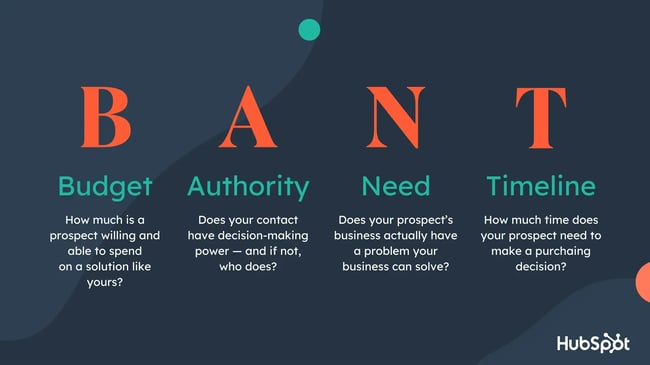
BANT’s definition is pretty clear cut — so while how you execute on the framework will involve some finesse, creativity, and a sense of how your prospect is responding to your questions, you’ll ultimately need to cover the following aspects:

  • B – Budget. Does the prospect have the budget to buy your product or service?
  • A – Authority. Is the person you’re speaking to the decision-maker?
  • N – Need. Does the prospect have a real need or problem that your product or service can solve?
  • T – Timeline. What’s their timeline for making a decision or implementing a solution?
buyers-journey-questions-4-20250602-3152570

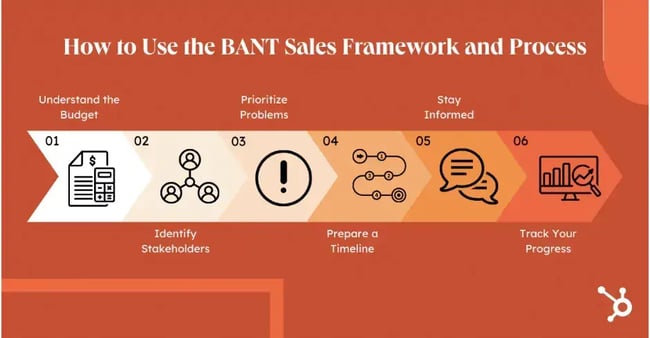
{{ sgMacro.render_ftSnippet({ header: "How to Use the BANT Sales Framework and Process", content_type: "ordered_list", list: { items : [ "Understand the prospect’s budget beyond the dollar amount. ", "Identify stakeholders in the decision-making process.", "Determine the importance of the problem.", "Prepare a timeline for the sales process.", "Stay informed through multiple channels.", "Use digital tools to track your progress.", "" ] }, paragraph: { content: "" } }) }}

Now that you are more aware of what BANT is and what it stands for, I want to show you how using the BANT framework can give you more structure and intention within your sales process.

1. Understand the prospect’s budget beyond the dollar amount.

Don’t focus on the exact dollar amount within the prospect’s budget, but rather uncover how they spend.

This was a major hiccup for me when I first implemented BANT in my conversations as an SDR. I would ask, “What is your budget?” and the prospect would respond with a dollar amount that would be out of the price range of the service I was offering.

Because it was out of the price range, I initially thought the prospect was not qualified. However, after learning to ask more questions that dug into their spending behavior, flexibility, budget source, etc., I realized that those questions opened up the conversation and allowed me to peel back the onion layers.

Pro tip: Uncover budget patterns. Learn how they usually spend money in this area by asking questions like, “Have you invested in products or services like this before? What did that process look like?”
bant expert tip

2. Identify stakeholders in the decision-making process.

When selecting stakeholders, consider a broad range of individuals who are involved in the decision-making process. You are not looking for just one specific person, but for a buying committee.

As an SDR, one of my key tasks was to identify the key stakeholders who would champion our products. Champions are internal advocates who believe in your product or service and are willing to spread the word or promote it to help drive sales forward. To do this, I would conduct research to identify their interest level and any buying signals that correlated with my current product or service.

Pro tip: Identify the buying committee early. Assume it’s more than one person, because it usually is. To uncover who else is involved, ask, “Is there anyone from [xyz department] who’d need to weigh in before you move forward? In addition to identifying your champion, you’ll also need to identify the gatekeepers, influencers, and end-users.

Operation-Everest-Bant-3-20250729-6488231

3. Determine the importance of the problem.

When evaluating the problem you’re trying to solve, ensure that you accurately identify its weight. Not all problems are treated equally, so determine whether the problem is urgent, painful, or business-critical.

As a sales coach, I was introduced to a method for helping prospects identify genuinely urgent issues. For the sake of illustration, consider the example of vitamins or aspirin. Vitamins are beneficial to have, as they help supplement or replenish what your body is lacking. But vitamins are not always needed; typically, if you miss taking a vitamin, you will be okay.

Now, aspirin, on the other hand, is required to alleviate the pain. People generally don’t take aspirin as a nice-to-have but as a must to take the pain away immediately. This analogy gave me a crystal-clear understanding of the problems my clients faced, which I could alleviate through my services.

Now your turn: Determine which problems your prospect is facing, and how your company's product or services can help. In this example, severity is one way to determine the importance of the problem. Other factors include its impact, frequency, and priority.

Pro tip: Help the prospect understand the cost of doing nothing, as people often underestimate the pain of staying the same. Help them quantify it by asking questions like “What happens if this issue goes unresolved for another 3-6 months?” and “How would that impact your goals?” This will help the prospect see the severity of said problem if left unaddressed.
bant expert tip 3

4. Prepare a timeline for the sales process.

Next, you are looking to uncover when the prospect plans to take action. When preparing your sales timeline, ensure you are building a roadmap to guide the prospect through their buying journey.

One way to prepare your timeline is to understand the evaluation stage from the decision-maker's perspective. Knowing where your prospect is in the evaluation stage will save you time and help you understand what’s next for the prospect.

The evaluation stage typically involves three key areas:

  • Exploring options. If my prospect is just exploring, they are not ready to commit to a purchase. This is similar to when you are browsing a store and the store clerk asks if you need help with anything, and you mention, “I am just looking.”
  • Comparing options. Here, your prospect is interested, but they are looking to see if you can give them the best price, experience, and solution to their problems.
  • Prepared to make a decision. They are done weighing their options, ready to decide, know what they want, and are prepared to sign on the dotted line.

Pro tip: Add a timeframe to the evaluation stage and help your prospect avoid stagnation. For example, you could say, “Other teams in your situation typically complete evaluations within 2-3 weeks. Does that feel realistic on your end?”

Operation-Everest-Bant-5-20250729-5620410

5. Stay informed through multiple channels.

There are many ways to stay informed while using the BANT framework.

Budget

To stay up-to-date on budget, I recommend checking out LinkedIn hiring updates, press releases, and funding announcements. As a representative, as part of my ICP research, I would read press releases. This is how I stayed up-to-date on the latest changes the company was making, specifically looking for growth signals or funding announcements that could qualify the allocated budget.

Pro tip: Crunchbase is a valuable resource for this, as it provides insights into investment, funding, and corporate news for companies. For example, you might see that a prospective company has just raised a Series A. Likely, that means a budget exists for scaling tools.

Authority

To stay informed on who holds the authority in your prospective company, I suggest LinkedIn Sales Navigator, company team pages, and articles.

LinkedIn Sales Navigator is a platform for discovering mutual connections, influencers, and champions. I would use it while researching decision-makers to contact. It had all the information I needed to work passively at scale while I attended to the active work of cold calling and emailing.

For example, you learn that the person you're talking to is a manager, but their VP is the real decision-maker. You catch this by seeing a LinkedIn comment on a post about a “new strategy” from the director.

LinkedIn is also a go-to channel for leveraging authority in BANT, as it enables you to view the titles and reporting structure of the prospect.

Need

For this category, I would suggest a company blog, an employee newsletter, product reviews, and industry news as the top places to gather information about new initiatives the company plans to roll out. Reading reviews will help you understand employee pain points and customer complaints. Industry news can highlight market shifts, creating new pain points and needs within BANT to address. For example, maybe you read a blog post about a prospect that is scaling remote teams. This hints they’ll need better onboarding tools.

I often read product reviews as a representative because I was selling a product or service, and I wanted to know about the issues customers experienced with the company’s product. I would research the company on Google and read reviews.

Pro tip: If you're going to gather employee reviews, consider visiting Glassdoor or RepVue, which both offer in-depth insights from the employee's point of view.

Timeline

News alerts, events/conferences, and Google Alerts will give you access to mergers, layoffs, leadership changes, and automated updates on key accounts. Events and conferences often mark the start of a project.

Google Alerts was my go-to strategy again for working passively at scale. When any changes within the prospective company occurred that were aligned as a qualified lead for BANT, I would note it within the CRM and use it as a selling point to reach out while prospecting.

Additionally, I would be aware of layoffs and understand the sensitivity behind such a massive change, or realize that it wasn’t an ideal time to reach out.
how to use the bant sales framework and process

6. Use digital tools to track your progress.

Create a BANT template or scorecard in your CRM. Log answers from prospective conversations to Budget, Authority, Need, and Timeline fields to keep track them daily.

As a rep, I was not as structured with the BANT process as I could have been. However, I do think having an organized system in place is vital, especially when you’re having daily prospecting conversations. This could be an intentional way to manage, track, and view the BANT framework within your workflow.

Pro tip: Create dropdowns or color-coded fields and label them as: Qualified, Partially known, and Unknown/Unqualified.

How NOT to Use BANT

I don’t think BANT is needed in every prospective conversation. Most of the time, when you are cold calling, there are more misses than hits that don’t warrant a discussion. Therefore, when it comes to using BANT, it must be intentional, structured, and strategized.

Earn the right to talk BANT by focusing first on insight, education, and pain discovery. Don’t assume all of this can be done on the first call.

I would identify semi-qualified prospects to reach out to and add them to my call list for the day. “Semi-qualified” means they looked like they were a target ICP, and that’s it. I would call, and they would say not interested, hang up, or no one would answer.

Additionally, I would make other calls to those who had met the initial stage of being an ICP. During a conversation, I could determine if they were a good fit for BANT or not and then move them on to the next step, which might warrant another call. Continue to revisit and update BANT throughout the deal cycle.

Pro tip: To use BANT, it doesn’t have to be in one setting or conversation. When making 50-60 calls a day, I would BANT qualify around 10-15. Not every call qualifies for BANT.

BANT Lead Qualification Questions

We learned earlier that BANT is more than a checklist. This framework helps you discover a lot of important information about a prospect in a short amount of time while also building a relationship with them. The key to making BANT work for you is asking thoughtful questions that flow together in a conversation.

Below are some of the best questions to ask a prospect for each stage in the BANT framework. Remember, you’re having a conversation, so vary the order and the wording as you need to.

Budget

1. “What do you currently spend on tackling this issue?”

Balázs Keszthelyi, founder and CEO of TechnoLynx, says, "By starting in this way, I can establish a prospect's current budget, providing a benchmark for what future spend will likely be. Ideally, this question also opens up the conversation to help sales understand if a prospect is willing to spend beyond this — based on whether their current solution achieves all that they hope for, or by how much it falls short.

2. “We’ve determined that your team is losing X amount per [week, quarter, year] on this problem. How does that compare to the budget you’ve set aside?”

From my experience, discussing budgets early in the conversation felt uncomfortable. I was providing the prospect with an easy way out if they didn't want to further the discussion, because I hadn’t yet earned the right to speak about the budget during the first call.

Instead, lead with value. In this case, this question is more effective and demonstrates the financial impact of the problem. The question helps the prospect understand the cost of inaction if they don’t take action now.

A question like this can help in the BANT process by opening the door to deeper conversations that uncover the urgency, gain a deeper understanding of their problem, and guide them to a solution that moves the deal forward.

3. “We estimate that your team could potentially gain X amount per [week, quarter, year] by making this [change, investment]. How does that compare to the budget you’ve set aside?”

This question is a straightforward way to connect the budget of BANT with the value of your solution. Instead of providing a transactional budget question, this is framed in terms of what the prospect will gain before considering the cost.

As a representative, this type of question would allow me to take a collaborative approach, where the prospects I had conversations with were thinking beyond the price and more about what’s at stake financially if they delay action. The question provides insight into how they invest, whether a budget has already been allocated, and who may be involved in the financial discussions.

​​4. What team’s budget would this tool fall within?”

As an SDR, I would often encounter prospects who either didn’t know their exact budget or felt uncomfortable disclosing it immediately. But when you frame it as a question about which team or department owns the budget, it shifts the focus from money to structure.

This helped me identify key players, learn who to loop in next, and assess whether the conversation needs to be elevated to someone in finance, revops, or IT. It’s an effective way to map the buying process while continuing the conversation with curiosity and professionalism. It’s also a smart, low-pressure way to uncover budget ownership without directly asking, “Do you have a budget for this?” which can feel pushy early in a conversation.

5. “How much would it cost to build the system by yourself?”

As a rep, I understood that early conversations can fall flat when you push too hard for dollar amounts too soon. But when you frame the question in terms of the cost of doing it themselves, you spark a different type of response.

This question positions your solution against the real costs of internal development — not just in terms of money, but also in terms of time, resources, technical expertise, and long-term maintenance. It's a more innovative, consultative approach that aligns better with the buyer journey and keeps the discovery process value-driven rather than salesy.

6. “How much would it cost if you haven’t fixed this issue in five years?

This kind of question helps the prospect quantify the risk and business impact of doing nothing, which naturally leads to a more grounded conversation about what type of investment would make sense to solve it. From experience, I’ve learned that prospects often lack a clear understanding of the long-term costs associated with their problem.

By stretching the timeline out to five years, you're encouraging them to think strategically, rather than just having a plan in place. In the BANT process, this helps you uncover the budget by creating a value benchmark that they can compare against any solution.

7. “How heavily will price factor into your decision?”

This question goes beyond just asking for a dollar amount — it helps you understand how price-sensitive the prospect is and what weight the budget carries in comparison to other factors, such as value, ease of use, or implementation.

In real sales conversations, not every prospect will know or share their budget upfront. But by asking how much pricing will influence their final decision, you‘re opening the door to understanding their internal priorities, buying behavior, and whether you’re aligned on value. In my experience, asking this question would help me pass over well-qualified opportunities and avoid wasting time on prospects who are only price shopping.

8. Have you identified a budget range for this purchase?”

I’ve learned that this question isn’t just about getting a number, it’s more about understanding how far along the prospect is in their buying journey and how serious they are about solving the problem. Asking this question early helped me avoid wasting time on leads that weren’t financially ready or aligned with our offerings.

This question also opens the door for more profound discovery: if they haven’t identified a budget, you can explore what it’s costing them not to solve the problem and help them connect value to investment.

9. “What’s the ROI you’re hoping to see?”

This question shifts the conversation from features and pricing to value and impact, where actual qualification occurs. Rather than just asking if they have a budget, this question invites the prospect to quantify what success looks like for them, whether that’s revenue growth, time saved, headcount reduction, or improved customer experience.

This type of question helped me build credibility by showing that I’m not just pitching a product — I’m assisting the buyer in thinking strategically about solving a costly or painful problem.

10. “What is the impact on your business if you don't solve this issue in the next two years?”

Keszthelyi also says, “In asking questions that focus on business implications, rather than dollar figures, sales teams can learn what a business is truly hoping to achieve from the purchase and how much the current challenge is costing them. Armed with this information, sales can frame pricing details as a saving, rather than an expense, to prospective buyers.”

11. “What value do you place on solving [specific issue]?”

Dylan Cleppe, co-founder and CEO of OneStop Northwest LLC, says, “This rephrases the budget question to focus on the value of the solution rather than the cost, indirectly revealing their spending capacity.

For example, when consulting for project management software pricing, discussing the value of streamlined operations and cost savings led clients to voluntarily disclose budget limitations, allowing us to tailor our offerings.”

Authority

12. “Who will be using the product?”

From my experience, this question helped me uncover both the end users and the influencers in the buying process, which can often be just as important as the final decision-maker.

Understanding who will use the solution provides insight into how the product will impact day-to-day operations, what pain points it needs to address, and which teams or individuals might advocate for or against the purchase.

This question can reveal alignment or disconnects between leadership goals and pain points, which is critical in qualifying real urgency and driving the deal forward.

13. “When was the last time you bought a similar product? How did the decision-making process go?”

If the prospect shares that a similar purchase took four months and required sign-off from the CFO, you now have a clearer picture of the potential sales cycle and decision-makers you’ll need to align with.

From my experience, this question opened the door to understanding not just who was involved in the past, but how decisions are typically made in their organization. On the other hand, if they’ve never bought anything like this before, it suggests that they may need more education, and the timing could be longer or unknown.

Either way, this question helps you qualify more effectively by understanding authority and timing through a real-world lens, rather than relying on surface-level answers.

14. “This is usually the stage where my customer brings in [the head of finance, the other stakeholders, their manager] to [discuss X, get their perspective on Y]. Do you want to invite [Z person/people] to our next meeting?”

This phrasing positions you as a helpful guide, demonstrating that you understand the typical buying process and think ahead on their behalf. It also creates a natural opening to reveal who else is involved in the decision. In my role as an SDR, I found that involving the right people early on helps keep deals from stalling later.

This question not only helps surface the full buying committee but also allows you to loop others in while still maintaining a professional approach. It builds credibility, reduces friction, and ensures that you’re a qualified authority, understanding the buyer’s journey, which is precisely what good BANT discovery should do.

15. “Will anyone else be involved in this decision?”

By asking this question, you’re not only identifying additional stakeholders (such as a VP, CFO, or legal), but you’re also setting yourself up for a smoother sales process.

In my experience, I quickly found out that the person you’re speaking with might not be the final decision-maker, even if they appear to be showing interest or engaging deeply. Understanding this helped me avoid being stuck selling to someone who couldn’t afford to buy.

This question opens the door for more profound discovery of who signs off, who influences, and who might block the deal later.

16. “Can you help me understand how decisions like these are typically made within your organization?”

Cleppe also says, “This opens up a broader conversation about the decision-making process and hierarchy, without directly asking about their personal decision-making power. In the context of streamlining business operations, such a question helped identify all stakeholders early on, making subsequent discussions more targeted and efficient.”

Need

17. “When did you identify [problem, opportunity]?”

This question helps me understand not only what the problem is, but also how long it has been affecting the prospect’s business, and how urgent it is to solve it. This proved crucial when I was a rep. Knowing when the problem was first recognized provides insight into whether the pain is recent and driving immediate action, or if it’s a long-standing issue that might require more nurturing and education.

This question also helps gauge where they are in their buying journey. Knowing this information can help tailor your outreach and conversations, prioritize follow-ups, and better align with their internal decision-making timeline, ultimately increasing the chance of moving the deal forward efficiently.

18. “What prompted you to seek a solution now?”

Cleppe says, "Instead of ‘What do you need?’ I find this question reveals deeper insights into their pain points and urgency. This approach was beneficial when discussing SEO management with clients, as it allowed them to express their challenges and objectives, enabling me to align our services more closely with their actual needs."

19. “What steps have you already taken to address it?”

This question helps uncover the urgency and reality of the pain point by revealing whether they’ve tried to address it before or if it’s a new challenge. If they’ve already taken action, it shows the problem matters enough to invest time and resources, which signals higher buying intent.

It also helps you identify potential obstacles or reasons previous solutions didn’t work, giving you valuable insight to position your offering as a better fit. Using this type of question as a representative, I was able to learn about their past attempts, which helped me gauge the prospect’s openness to change and readiness to engage, both crucial factors for prioritizing leads and tailoring messaging.

20. “How important is addressing this to your personal goals at [company]?”

From my SDR experience, prospects who tie the solution to their own goals tend to be more engaged and proactive, which means the qualification is stronger and the likelihood of closing improves.

This question helps turn unknown business problems into real, actionable priorities that motivate timely decisions. It goes beyond understanding the company’s problem because it helps uncover the personal stake the prospect has in solving it. When a buyer feels personally invested, they’re more likely to advocate for budget approval and move the deal forward.

21. “What are your top priorities at the moment? How do they fit within your team's goals?”

From my experience, asking this type of question helped me understand if the pain I solve is currently urgent or a “nice to have.” It also reveals internal alignment: if their priorities align with those of the larger team, it’s more likely to garner buy-in and momentum.

It also gives you insight into whether they’re just exploring or actively solving the problem, which informs the timeline. Instead of asking, “Do you have a need?” or “When do you plan to buy?” this question helps you guide a deeper conversation that uncovers motivation, urgency, and internal strategic fit — all essential for actual qualification and next-step planning.

22. “What are your team’s goals for the next year?”

When speaking to prospects as a representative, they weren’t always immediately clear on their pain points, but they’re often eager to discuss their goals. By understanding where the team is headed — whether it’s scaling, improving efficiency, or reducing churn — you can surface underlying needs that might not have been articulated yet.

These goals also provide clues about timing, budget, and potential decision-makers. It‘s not about pitching too soon; it’s about listening for alignment.

23. “What happens to your team’s goals if you don’t address this need?”

I know that buyers often recognize a problem but haven’t fully evaluated the cost of doing nothing, based on my sales experience. By getting them to think about what’s at risk — whether it’s missed revenue targets, team inefficiencies, or stalled growth — you not only validate the need, but you also help create momentum for change.

This approach positions you as a problem-solver, not just a seller, and makes it easier to transition into deeper qualification and a business case driven by urgency, already determined.

24. “What does success look like for you and your team if you're able to solve this challenge?”

Emily Trevino, co-founder and managing partner of Wise Insurance, says, "The answer [to this question] reveals so much about their priorities, constraints, and decision-making process.

"For example, I once asked this question to a retail chain that was exploring ways to improve their customer experience. The CEO shared that success would be reducing wait times by 50% during peak hours without increasing costs. This told me the budget was limited, speed and efficiency were crucial needs, and the CEO had the authority to approve a solution that met those needs.

“Armed with that information, my team was able to craft a tailored proposal that aligned with their definition of success, and we were ultimately able to win their business. Asking the right questions upfront is critical to truly understanding a prospect's needs and avoiding wasted effort. Success means different things to different people, so get clarity on what it means to them.”

Timing

25. “Are there any upcoming events/deadlines that you’d like to have a solution in place by?”

While prospecting as a representative, this question worked for me because it shifted the conversation from unclear timeframes, such as “maybe next quarter,” to specific, business-driven urgency.

Deadlines, such as year-end, product launches, hiring surges, or new leadership announcements, often create natural pressure for action. If you can tie your solution to helping them meet those milestones, you've become a strategic partner helping them achieve a goal.

26. “Are you planning any [insert relevant project here, i.e., lead generation campaign, major hiring spree, program overhauls, etc.]?”

Often, prospects don’t openly articulate their pain points or timing unless prompted by a relevant business issue. By asking about upcoming plans, you’re uncovering if there’s a driving force behind their interest — a new goal, pressure from leadership, or a strategic move — which helps you position your solution more effectively and move the conversation toward next steps.

It also indicates whether this is a genuine opportunity worth pursuing or merely a passive inquiry. For example, if they mention a hiring spree, that could indicate new team onboarding needs, a budget already allocated, and a compressed timeline — three BANT boxes in one.

27. What’s your [lead generation, revenue, retention, etc.] goal for [next quarter, half of the year]? Will you be able to meet that goal without some sort of change?”

This question ties the conversation to a measurable business outcome that your prospect is already focused on. It positions you as someone who understands their world, their pressures, and the results they’re expected to deliver. By linking your solution to their ability (or inability) to hit a key goal, you move the conversation from curiosity to urgency.

From my experience as an SDR, I realized that uncovering a real need is about helping the prospect realize that “business as usual” wouldn’t get them where they want to go. This kind of forward-looking question also facilitates more profound discovery, as it provides a natural follow-up path to explore timing, budget, and authority once the prospect acknowledges the gap between their goal and their current path.

28. “Working backward from the date you gave me, we’d need to finalize our agreement by [earlier date]. Does that sound doable?”

In my experience, buyers often provide a general goal or implementation date, but that doesn’t always accurately reflect the actual timeline for decision-making. By working backward from their target and proposing a realistic agreement deadline, you can help the prospect consider operational steps they might not have considered, such as internal reviews, decision-maker buy-in, and legal processes.

This question creates urgency in a consultative manner and helps uncover hidden roadblocks. It also provides a clearer picture of whether their timeline aligns with our sales process. Additionally, it builds trust while serving as a qualified checkpoint to determine if the opportunity is truly sales-ready or requires further nurturing.

29. “What milestones or objectives are you targeting in the short term?”

Cleppe says, “This question encourages clients to think about their immediate priorities and share actionable timelines, facilitating a smoother planning process for both parties. This question respects their planning process while providing vital information for aligning our services with their schedule.”

Qualify your leads with BANT.

When used with structure and intention, BANT isn’t just a prospect qualification tool — it’s a conversation guide. It helps you dig deeper, uncover what matters most, and move opportunities forward with clarity and purpose.

Modern buying decisions involve multiple stakeholders, and your job is to map the dynamics, not force a one-size-fits-all approach. In today’s sales landscape, you have to earn that part of the conversation by first understanding their world and what’s costing them time, money, and energy. When you do it right, you’re laying the foundation for honest, valuable conversations.

Editor's note: This post was originally published in November 2019 and has been updated for comprehensiveness.

11 Jan 16:43

Why It Is Essential to Put Strategy Before Tactics

by John Jantsch

Why It Is Essential to Put Strategy Before Tactics written by John Jantsch read more at Duct Tape Marketing

If you loved this podcast and post check out our Ultimate Guide to Small Business Marketing Strategy

Marketing Podcast with John Jantsch About Strategy

Marketing strategy is one of my favorite topics, and it’s been a distinguishing mark over the years of Duct Tape Marketing because so many marketers want to talk about tactics. When I talk about marketing strategy, the first thing I talk about is what it is not, before what it is.

What marketing strategy is and is not

I think even Google gets confused. If you type, “what is marketing strategy” or “small business marketing strategy” into Google, you’re going to get a bunch of blog posts that list 15 marketing strategies for small businesses. Those 15 marketing strategies will all be nothing but tactics.

I believe that you must develop a strategy before you even think about the tactics. If you’ve read anything I’ve written, if you have listened to anything I talk about, then you know that I mention that this is the key element to make marketing effective.

You must have an approach that is focused on a very specific type of client, with a very specific need or problem, and a promise to solve that problem in a very specific way.

That’s marketing strategy, and that’s the part we have to figure out first before we ever go out there and start listing the things we’re going to do to create awareness and to convert those people that have a need into clients.

Building a strategic foundation

When I talk about marketing strategy, I break it down into a foundation that has several elements. It’s not just one thing. It’s a handful of things that have to go together to work in concert to make your marketing strategy effective.

Understand your ideal client

You have to figure out who your ideal client is and tailor everything you’re doing for that client as though you’re talking to them one to one. You have to have a core message that helps you differentiate and stand out from everybody else who says they do what you do.

Some people might call it a brand promise, but it has to be something that gets somebody’s attention.

Develop a core message

You’ll want to focus on developing a core message. Often when a business talks about their brand they’re talking about logo and identity elements.

Identity elements, colors, fonts, a look and feel that people expect, are the things that you do need to actually build. Once you have that core message, once you know who your ideal client is, you want to build supporting identity elements.

Create content

Content has grown beyond just being a tactic. Content really is air. It’s the thing that powers the entire customer journey. It’s the way for us to actually create the voice of our strategy.

Guide the customer journey

Part of your marketing strategy has to be an understanding of how you are going to guide the customer journey.

The way people buy today has changed so dramatically that we have to understand that it’s our job not to corral or create demand but to be around and organize the behavior that the buyer actually wants to participate in.

Those elements go together to create the foundation of any kind of marketing plan, and that’s what I mean by strategy. All of those elements working effectively, working together.

As you can see, I haven’t mentioned anything that would be considered a tactic. I haven’t talked about direct mail or advertising. Those are tactics that we are going to use to orchestrate or implement our strategy.

That’s how you have to think about it. Let’s break each of those elements down.

Your ideal client

Many business owners have been taught to think about this idea of a target market. So often where that target market or that targeting ends is who we think is likely to buy.

For a lot of people, that’s people who have money. If I’m a dentist, that’s people who have teeth. I mean, that’s where we stop.

What I want to suggest is that if we go much deeper than that, if we decide who has the right problem, meaning the problem we actually are very, very uniquely qualified to solve, who has the money? That’s a great qualifier, right?

We don’t want to be working with people that can’t afford what it is that we do. Who’s motivated to fix that problem?

Just because somebody has teeth, just because somebody has plumbing in their house or has a kitchen and we’re a kitchen remodeler, just because somebody has trees and we’re a tree service, doesn’t mean they’re motivated to take care of, fix, or upgrade those.

You have to understand who’s motivated, who has the problem that you’re suited to solve, and who has the budget.

If you’re wanting to understand the characteristics of your ideal client, the ones that you have attracted, that were very profitable, and that you had a great experience with, know that they’re referring you because they had a great experience.

Take your client list today and map out your most profitable clients, and you’ll find that there’s probably some business you’re working with that you probably shouldn’t be and that you have some clients that aren’t that profitable, (but hey, you took the work because they said they’d pay you). Typically, those don’t end up being very good deals.

If you start looking at the characteristics of your most profitable clients, and then if you can identify a few of those folks who are also referring you, that’s who your ideal client is.

The reason I say that is because they’re profitable because they probably had the right problem. They had a problem you could solve and they had a mentality or behavior that allowed you to do it in the most profitable way, and consequently, you like them and they like you.

They didn’t beat your people up. They paid you on time. They’re out there telling the world what a great experience they had.

You get to choose your clients, but not if you don’t understand who they are. Once you understand who they are, you can start disqualifying people.

Once you’ve been in business for a while you can tell pretty quickly and accurately whether or not it is a business that you want to work with or a business that would be a good fit for you.

You’ll get better at this, but if you don’t start defining it and outlining it now, you’re going to start taking those clients that aren’t good fits for you. All they’re going to do is drag you down and distract you.

In a worst-case scenario, they’re going to become a detractor out there telling people you don’t do a good job, but that’s because you weren’t a good fit.

You get to decide, you get to choose your clients, but only if you define who they are.

What problems are you solving

Nobody wants what you sell. They want their problem solved. Keep that in mind. Very few people want the things we sell, the services, and the solutions.

They have problems they’re trying to solve and they see you and your products and services as the way to solve those problems to get to where they want to go.

You have to understand what problem you are solving. A lot of times it’s not the basic service that you provide. I like to talk about my friends at Jackson Tree all the time. They are a local tree service in the St. Louis area and they feel like their competitive advantage is that they are a locally owned business. They’ve been business for a long time.

There are people coming from the outside, big national chains coming into the city, and so they felt like their advantage is that they are that local business.

Well, when we looked at all of their client reviews and spoke with some of their clients, we kept hearing over and over again that what their clients loved is that they show up when they say they’re going to and they clean up the job site.

I know that sounds kind of simple and basic, but that’s the problem that their clients were having. Nobody else was doing that.

If you understand the problems you’re solving, that needs to be your message. That’s what you need to use to make the competition irrelevant or to at least change the context of how your market sees what you do.

You need to lead with that core message.

Reviews are a great way for you to learn what customers think about you. There is some real gold in the actual words that people are putting into Google reviews if you’re a local business because people are saying what value they get.

You can also pick up the phone and call clients (we do it all the time). We call our clients’ clients.

Quite often, by asking them questions about the experience they are having or have had, we can learn a lot about what should be that client’s core message or certainly the problem that they’re solving.

Your identity elements

I already touched briefly on identity elements, but the color, the fonts, the way your office looks, all of those things go into either supporting the brand promise or taking away from it.

I’m not saying that you have to spend thousands and thousands of dollars on getting designs to make everything look perfect, but it should support what your message is. It should support who you’re trying to talk to.

Hubspot has a great post highlighting some inspiring examples of small business branding and identity elements.

Content as the voice of strategy

Start thinking about content as the voice of strategy, so all the content that you produce, your web pages, blog posts, podcasts, press releases, this is all content. You want to think about the intention that you have for every piece of content, because content today is used to create awareness.

That’s sometimes how people find you. It’s certainly used to educate. It’s used to inform somebody how a product or service that they might acquire from you would work. It’s used quite often to nurture people.

People often tell me, “I started listening to your podcast and finally decided to buy from you or to become a member of the Duct Tape Marketing Consultant Network.”

Content has a nurturing component to it. In many cases, whether it’s an email or an ad or a page on your website, many times you need to produce content for when that person is ready to buy, that shows them how to buy.

Once you start producing great, useful content, use it as a referral tool.

Guiding the customer journey

marketing hourglass

Long ago, I developed the term “The Marketing Hourglass.” which involves taking people through seven stages of the customer journey: Know, like, trust, try, buy, repeat, and refer.

The idea behind that is that if somebody doesn’t know who we are, then we want to move them logically through these stages.

Very few people see an ad by a company they’ve never heard of and go, “Oh, okay, I’m going to go buy that product.” But they might go to the website and then see, “Gosh, there’s a checklist that I can download.”

This develops a level of awareness, but also some level of trust.

Over time, we communicate, continue to add value and continue to invite them back for more content or for more opportunities, before we ever really start promoting our products and services.

Once somebody has gone through those stages and they’ve educated themselves on what they do, we’ve developed a level of trust based on the way that we have marketed to them or based on the way that we have shared content and added value.

Now they want to buy.

That’s actually the stage in the customer journey where a lot of businesses drop the ball because a lot of people think marketing ends at somebody saying, “Yes, I want to but” but that is not the case.

That’s actually where some of the fun starts because you have an orientation and onboarding process, and you continue to market to them once they’ve purchased so that they might purchase more or again. You have a very intentional process where you can generate referrals.

All of these parts are linked to the journey that leads you to build campaigns, processes and touch points as part of your marketing strategy.

One of the greatest marketing strategies that any business can really employ is to make sure that they are creating such a great customer experience that people want to refer and talk about their business.

The greatest source of lead generation is a happy customer. This needs to be a part of your overall marketing plan.

11 Jan 16:42

6 Email Template Design Tips You Should Always Follow

by Annie Chun

email template design

More than 260 billion emails are sent around the world every single day. So how do you make sure your messages stand out in a subscriber’s inbox? Well, great content, for one. But another extremely important factor: email design. Eye-catching emails that effectively communicate your message will improve metrics like open rates, click through rates, and conversions. Luckily, email templates are an easy and time-efficient way to create beautifully branded messages. Most Email Service Providers have some to choose from. In fact, AWeber has more than 700 templates in our platform. (Not an AWeber customer yet? Sign up for your free trial today!) Before you start dragging and dropping your content into a template, though, there are a few design tips you should know. Follow these six simple tricks to get the most out of every template.

Pick the right template for the job

Do you want to welcome a new reader? Update them on a new product? Announce a huge sale? With hundreds of templates to choose from, you want to pick a design that best suits your goal. (Want a more customized template that perfectly matches your website or brand? Click here to work one-on-one with an AWeber designer to create one.) For instance, if you’re an AWeber customer who wants to send a welcome letter to new subscribers, you may choose the “tidal” template (shown below). Then just add in your own text, logo, and personalization.

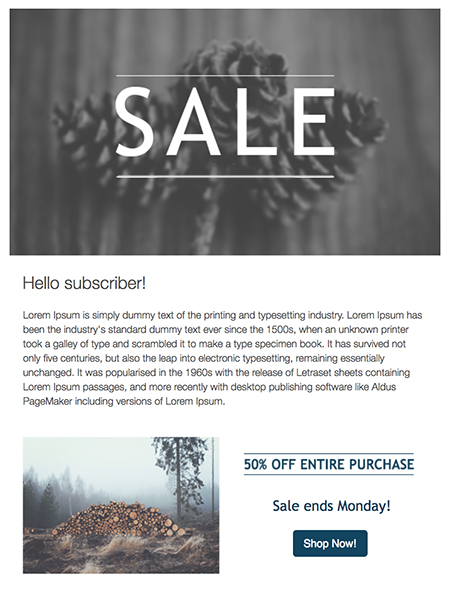
If you want to get your subscribers excited about an upcoming sale, catch their attention right away. Then lead them right to your discount, coupon, or offer. Here’s a simple, but effective design you might pick:

Keep your design clean and focused

Choice is the enemy of conversion. If you give a person too many options, it makes it difficult for them to make a final decision, according to psychologist Barry Schwartz, who named this phenomenon “the paradox of choice.” Keep this in mind as you choose or tweak an email template. The design should be a path that leads the reader toward your ultimate goal. Add in too many other routes, and your reader may never get where you want them to go. To give you an idea, here is an example from Moo, a custom print and design company. It’s a clean and focused email design that effectively promotes products. As a reader, you know exactly what the email’s goal is — to make you want to buy something!

We love this design because it:

  • Follows a simple “Z” pattern layout, which means it easily moves your eyes in a zigzag that alternates text and images.
  • Consists of minimal elements and concise writing for a streamlined look.
  • Includes visual examples of each product to minimize the use of long chunks of text and to show off their array of products.
  • Creates defined sections for each product with the use of thin dividers.
  • Contains lots of white (or in this case, blue) space to draw your attention to the images.
  • Incorporates large “call to action” product buttons (i.e.: Shop Postcards) for easy navigation to their website.

Create an eye-catching header

While you want your email template to reflect your brand, you don’t need it to look exactly like your website. You want to draw your reader’s attention to the important elements within your email — not overwhelm them with something that looks like a site. Forgo a heavy navigation bar at the top for something more user-friendly like the North Face did below. It still drives subscribers back to their site, but it limits the number of choices and keeps things clean.

If your email can serve its purpose without the navigation bar, then take it out like this Burberry email below.

The goal of this email is to advertise their trench coat line and the design visually showcases this very well and plays up their brand. With the multi-tan color palette, you instantly know that it’s Burberry. The well-structured grid layout makes for a seamless flow of design as well. If the header was filled with navigational tools, it would diminish the overall feel of the brand and the message they are trying to send.

Balance your text-to-image ratio

When choosing or changing a template, keep your text-to-image ratio in mind. Text-to-image ratio is how much text there is in comparison to images in your email. There’s no such thing as the perfect “text-to-image ratio”, but most people stick with 60 percent text and 40 percent images. Here’s why it’s important not to rely too heavily on images:

  1. “Image-only” emails risk going to the SPAM folder since email service providers like Gmail, Yahoo! and Hotmail tend to filter and block them.
  2. Images may be ‘turned off’ as default by viewers or by their email client.
  3. Images can take longer than text to load based on browser and internet connection. A subscriber may leave the email before they’ve seen all the content.

Utilize alt text for images

When you include images in your messages, they may or may not always display in the email clients they were sent to. That’s because many email services will disable images in messages that are sent to their users, unless the user actually verifies that they do indeed want to see the images. Alternative text is helpful in these cases. When an image doesn’t load, a line of text will appear that describes what should be there. Take a look at this email from Hotels.com where images were blocked, but the use of alt text was implemented.

And here’s what it should actually look like:

Now, you may be wondering, “Is including alt text worth my time?” Absolutely. Forty-eight percent of mobile clients will block images by default, according to the email testing platform called Litmus. If you set up alt text, the description will appear where the images were supposed to go. If you don’t, your reader will only see blank boxes. Alt text is also important for your subscribers with visual or certain cognitive disabilities. They may have a screen reader that will read the alt text to them so they get a full understanding of what’s included in your message. If you are using AWeber’s Drag & Drop editor, click here to see how to set up alt text for your images. Pro Tip: Not all images need alt text. If your image is purely for the aesthetics of the email, be sure to set an empty alt text value for the image.

Test your message

Mistakes can make you look unprofessional and sloppy. One bad experience may be enough to turn a subscriber away for good. So test your emails! It only takes an extra minute or two, but the payoff is huge. We even recommend sending the test email to a couple people you trust and who aren’t afraid to give you an honest critique. They offer a fresh pair of eyes that may catch something you didn’t. You should also send the test to accounts in different email services like Gmail, Yahoo! or Outlook. Here at AWeber, each of our marketing specialists has about three to five different test email accounts so they can review our messages and templates in multiple platforms before we hit the send button. And always test on different devices — desktop, tablet, and mobile — if possible. Sometimes an email template you selected on desktop may have formatting issues on a cell phone. AWeber’s email templates are all mobile-responsive, but we can’t vouch for all other ESPs, so test just to make sure. If you’re using AWeber: To easily check emails before you send, click on the “Preview & Test” button on the upper right-hand side of your screen. Enter your email address and hit “Send Test” to get a test email delivered to your inbox. If you’re not using AWeber: Check out email testing tools like Email on Acid or Litmus to preview your design before you send.

Your template design cheat sheet

Feel free to download this recap below for the next time you use an email template. And if you’re looking for an email template that perfectly fits your style and brand, contact an AWeber designer today.

11 Jan 16:41

How to Price Your E-Book for More Consistent Sales

by Penny Sansevieri

How do you price your e-Book to maximize on sales potential? I get this question all the time.

Sadly there’s no silver bullet book marketing strategy that will secure you success every time. There are some factors to keep in mind that should put you in the ballpark.

And if you’re an indie author, the ballpark is a great place to be, because you have book marketing flexibility. That lets you play with your pricing a bit to fine tune what seems to work best for where you’re at in your publishing career.

Because let’s be honest, as you become more established, with a strong following, you can command more per book.

But when you’re just starting out, and certainly if you’re new to the scene with fewer than 50 reviews, you have to price your e-Book in a way that lets buyers “take a chance” on an unknown author.


What is the sweet spot when it comes to how to price your e-book? Is there one? There is. The sweet…
Click To Tweet


Price Your E-Book in the Sweet Spot

Kindle told me at a conference I was at not long ago that 2.99 to 5.99 is their sweet spot. With most eBooks actually sold at the $3.99 price.

Publishers are ALWAYS pricing their eBooks too high, anything over $9.99 is just nuts. And the whole strategy behind pushing people to your print book with an overpriced eBook is also nonsense.

This is not what authorship and publishing should be about. Most indie authors get this, but in case you’re intrigued by that strategy, just stop.

Do Your Research

An indie author should look at their market, what others are pricing at, and aim to be competitive with these prices.

It’s also important to know who your competition is. This is a big element of numerous book marketing strategies. It will serve you well when you price your e-Book too.

Your competition likely isn’t a big time bestselling author with a 20+ year publishing history or major movie franchise, so their pricing won’t help you.

Be realistic about who your competition is and follow suit.

Be Mindful of Industry Standards

One thing you should keep in mind is to price your e-Book based on book length.

So if you have a short novella, don’t try to sell it for 5.99 – that’s ridiculous. This is another area where scoping out the indie author competition can help you.

And if your book is a series and you have it available as a boxed set as well, be sure to double-check your math. Yes, it seems simple, but I can’t tell you how many times I’ve realized I could buy the series as separate books for cheaper than the boxed set. This of course defeats the purpose of releasing a boxed set at all – certainly from a book marketing angle.

Understanding When to Use Free

Free books are getting a bit old, as in, the novelty is wearing off.

It used to be a really fun and effective way to make your e-Book stand out. With so many authors using this strategy, buyers are becoming more wary of free. Their free time is limited – no pun intended. So it doesn’t ensure big download numbers like it used to.

That being said, people still love free. A good deal will never go out of style. Authors are going to have to get more strategic with how their book marketing supports their free book – they’ll have to try harder. Free on its own won’t cut it anymore.

Permafree, however, is still a solid strategy for indie authors with a series.

Once you get to releasing book three, make your first in the series as a permafree to make starting the series a no-brainer. Once they start reading, they’ll be hooked and come back and buy the next book, right?

The Takeaway

There are a few things to consider when you price your e-Book: the sweet spot, your competition, industry standards and the changing landscape of free.

Yes, you want to make money. Especially if you’re smart enough to invest in proper book marketing and self-promotion. Success is not free in publishing.

I want to discourage you from shooting yourself in the foot, so to speak. Don’t price your e-Book outside of what your market is comfortable spending. You won’t make your money back faster if you’re not selling any books in the first place.

And keep in mind, being an indie author means you’re also a business. Would you open a business and only focus on the short-term? I hope not!

Keep writing books, and more importantly, keep building your fan base. You’ll get to a point where you can price your e-Book in a way that gives you a sweet return on each sale.

Does this all seem like a bit too much? Contact me and I can walk you through your own personalized book marketing strategy.

11 Jan 16:40

Everything You Know About Sales Is Wrong

by Anthony Iannarino

“Buyers have changed,” they say. So much so, in fact, that what you know about sales is all wrong. In fact, if you’re not already looking for another line of work, you will be in, say, the next 15 minutes. Millions of salespeople will soon be roaming the streets, tin cup in one hand, cardboard sign in the other.

This is what you are being told by Henny Penny, the kind of sales expert who quit their job in sales because it was too hard to make a living, telling you how you can succeed with the very challenges that drove them out of sales.

This when you just had a record year in sales. This when you had double-digit top-line growth and when your profitability grew by a similar number.

This, while you continue to create new opportunities using traditional prospecting methods that the “expert” insists are “outdated.” All of this when you are being told you are irrelevant at best, obsolete at worst. In spite of all that you are being told, you continue to win new clients.

You keep winning deals despite the fact that you are being told that your buyers have so much power that the only way to win is to become subservient, avoiding conflict, lest you lose the deal to one who can prostrate themselves more effectively than you.

You are creating opportunities even when the so-called experts tell you that the buyer’s journey is almost complete before they ever engage with someone like you. This while you are helping your clients understand why they need to change and how, something salespeople have done for centuries. Your clients (and dream clients) still turn to you to help them produce better results, even though they allegedly spend all of their time researching potential solutions on the Internet and now know as much or more than you do.

Miracle of miracles, as backward and antiquated as you are, you are somehow still selling more than you sold last year. You are still succeeding in spite of what you are being told are the most radical changes to human behavior ever witnessed on Earth (or any other planet).

Many years ago, I told you that the Charlatans were wrong about cold calling and social media. I am telling you now that the new variety of self-loathing sales experts are Charlatans, preying on your fears to gain attention.

Has buying evolved? For sure. But if salespeople have everything wrong, how do we keep producing better results from year to year? Not everything you know is wrong and not every opinion, especially those citing research and facts, is worth your attention.

If there is a group of people who will evolve their approach to succeed, it is surely salespeople.

The post Everything You Know About Sales Is Wrong appeared first on The Sales Blog.

11 Jan 16:38

Are You Bridging “The Differentiation Gap” in Your Market?

by Dave Wakeman

As we are just kicking into the new year, a lot of people are rethinking how they are going to do their selling and marketing in 2018.

That’s a great thing.

But just thinking about doing things differently isn’t going to be enough.

Because for many of us that are in revenue generating roles, the biggest challenge we are dealing with is “The Differentiation Gap.”

For those of you new to the idea, “The Differentiation Gap” is the idea that for many businesses there is a huge gap between how they view themselves and their unique selling proposition and the way that the market sees them and their value proposition.

If “The Differentiation Gap” is wide, you don’t have a great deal of differentiation and you are likely in or close to the realm of commodity.

Being a commodity is a terrible position to find yourself in for any number of reasons including price sensitivity, lack of customer loyalty, and inability to pick and choose projects to work on.

On the other hand if “The Differentiation Gap” is narrow, you have differentiated yourself tremendously.

The less a gap exists between how you view yourself and how the market views you creates the environment where you can charge higher prices, where you might be a sole source provider, and where you can pick and choose the people and projects you work on.

The question for many of us is how can we close “The Differentiation Gap” and benefit from a stronger reputation in our markets?

Here’s a few ideas:

Create Intellectual Property:

We all hear about content marketing as a catch-all for every bad impulse many organizations and marketers have to spam their audiences and their markets with irrelevant, useless “information” that is supposed to drive people to buy from us, “engage”, or some other buzzy word.

In creating real, meaningful IP that can differentiate you from your competition, you need to do a couple of things:

  • Think about content creation and IP through the eyes of your market. What’s going to be meaningful to them? What challenges are they dealing with?
  • Understand that different buyers and influencers are going to consume information differently. So even if you have great content and IP that you are sharing, but you are only sharing it on Twitter and your audience doesn’t Tweet…well, you have a problem.

So you need to create real, thoughtful IP that focuses on problems and challenges your market is dealing with and reaches your intended audience where they are likely to see it.

Focus On Outcomes In Your Marketing And Selling:

I hear a popular refrain when I talk with marketers and seller.

“Our market is just too price sensitive.”

You know what?

It isn’t really about price, it is about value.

Does anyone have an iPhone X?

I’m guaranteeing that you didn’t buy that phone because of the price.

You bought the phone despite price because it was valuable enough to you to make price not become a factor.

Your job is to explain your value proposition in a way that is like the iPhone X where price sensitivity isn’t an issue any longer.

You do that by focusing on outcomes, on improvement, on value.

Instead of talking about all the ways you are similar to your competition, talk about how you create results that are different.

In my case, I’m not even sure who my competition is sometimes because I am so focused on the value I create for my audience that I am often in a market of one.

You want me, not some generic service provider.

Are you in the same position?

If you aren’t, “The Differentiation Gap” is far too wide and you are creeping into commodity.

Outcome-based marketing and selling can help you close “The Differentiation Gap” so that you are more highly valued.

Keep Growing:

Brands are living, breathing things.

The brand and value you offer today should continue to grow and expand.

One way for you to fight “The Differentiation Gap” is to always keep growing.

You should be having new ideas.

You should have new perspectives.

You should have new experiences.

You should have new techniques that you use to accelerate the success of your clients.

These are all ways that you can insulate yourself from falling prey to “The Differentiation Gap.”

Growth doesn’t have to be difficult either.

In most cases, it is simply paying attention to what you are learning, patterns you see, and successes that you generate.

The difficult thing is often making sure that you spend time paying attention to what you are learning, how it applies, how it changes things, and where you can use it to create new value.

If you spend some time focusing on your ideas, using those ideas to share unique perspectives in your market, and do some constant growth activities, the likelihood of you getting caught in the commodity trap goes down.

The ultimate goal is to eliminate “The Differentiation Gap” all together by focusing on making you one of a kind and someone that has a name of your own to your market.

11 Jan 16:36

5 Ways to Generate More Sales from Facebook

by Mitt Ray

5 Ways to Generate More Sales from Facebook

Facebook is a top network you have to build a presence on. You might read articles on how the network’s growth has slowed down, but that’s because it has hit saturation point. Most online users have already joined it!

If you build a well-planned presence on it through both organic and paid methods, you will have the opportunity to reach over 2.07 billion active users.

Some businesses solely rely on this one network to generate both leads and sales. Therefore, to help you too generate more sales from Facebook I have written this easy to follow guide…

Build rapport and engagement before sharing products:

To generate sales organically from your Facebook page you need high levels of engagement. Engagement is necessary for two reasons…

It builds trust: When people are engaging with your content through likes, clicks and comments it shows that they like what you share. Your content is helping and/or entertaining them which will get them to trust you. The more they trust the more likely they will be to purchase from you.

It increases edgerank: A Facebook user’s feed is controlled by an algorithm that only shows them posts they will be interested in. Most of these posts are posts from pages they have interacted with in the past.

When someone interacts with a post in their newsfeed with likes, clicks, shares, and/or saves, Facebook makes a note that the user likes content from this page. Therefore, the next time the person visits Facebook, it will make sure that posts from this page will appear at the top of their newsfeed.

The higher you appear in their feed, the higher your edgerank is. This will ensure that you get maximum engagement every time you publish a post.

If your edgerank is high you will generate more sales from the products, you share on Facebook as more of your fans will see them. Therefore, build rapport and engagement on Facebook today by sharing quality content and only then share products.

Ocado, an online supermarket, based in the UK, understands the importance of sharing content and boosting engagement before selling.

They regularly share links to food recipes like the above one that drive engagement, increase their edgerank and gain the trust of their page fans.

They sandwich these types of posts with posts that promote their products like the above one. This ensures that they get maximum traffic and sales from these posts.

Share testimonials:

If the above technique isn’t providing you the best results, it is probably because your Facebook page’s fans don’t trust you. Therefore, you should take steps to gain their trust by sharing testimonials on your Facebook page. The best testimonials you can share are videos as a testimonial from a live person looks a lot better than something you just typed down (how can they be certain that someone really did say that).

For inspiration on how to create great Facebook video testimonials, check out Sam Ovens’ page. He regularly publishes video testimonials of satisfied customers.

Here’s one of the videos. As you can see when you watch a video from a live person it looks very credible. Sam has several more video testimonials like these on his Facebook page. Make sure you watch them.

Display products on Facebook:

When people like your Facebook page and begin interacting with your content, they will also browse through some of the other tabs on your Facebook page. Hence, you should set up a shop tab on your page.

Anyone who is interested in your products can buy them right away instead of waiting for you to post updates. Here’s a shop on the Dollar Shave Club’s Facebook page.

People who like the free content on Dollar Shave Club’s Facebook page can just visit this shop and buy products they like. Conversion rates can also be high as they are on Facebook, a site they have been using for a long time. They will trust it more than your website.

If you set up your online store with ecommerce store software, you should be able to set up your Facebook store with one of their apps. But it is better to use Facebook’s shop feature because your product will be directly listed on Facebook and the sale will happen there itself.

Ecommerce apps will redirect the person onto your online store which can negatively affect conversion rates.

Use Facebook messenger:

Social messaging apps have grown incredibly quickly over the past few years. This is because they provide people with the opportunity to have a private one to one conversation with the brand.

Facebook’s messenger is the second most used messaging app with over a billion users, the most used is another messaging app owned by Facebook, Whatsapp.

Apps are very effective as well. Digital Marketer for example were able to generate 500% of their ROI within just 3 days of using it.

Marketing with Facebook messenger is very easy to implement too as there are several bots that can help you automate the process. But to get best results don’t just rely on the bots. Combine it with some personalised messages.

Use ads:

While the above organic methods will help get you some sales, they alone will not be sufficient. To generate the highest amount of sales on Facebook you need to use ads as organic reach is low on the network when compared to others. But on the plus side ads are very cheap on Facebook.

If you can build a funnel that generates a positive ROI, investing in Facebook ads is something you should regularly do.

These are the 5 ways to generate more sales from Facebook:

The 5 methods discussed in detail above are highly effective in generating sales from Facebook. Get started with the organic methods first. This includes sharing content and sandwiching them with links to your products. After that set up a Facebook shop and a messenger marketing funnel.

To get the strongest results combine these organic methods with ads.


How do you generate more sales from Facebook? Have any other techniques (not listed here) brought in better results for you? Please leave your comments below.

11 Jan 16:36

Leads are Hard 

by dan.mcdade@pointclear.com (Dan McDade)


A Story From Yesteryear About Reader Service (aka Bingo) Cards

According to Wikipedia: “a reader service card or bingo card" was a reply card inserted in a magazine and used by readers to request free samples and literature from businesses who advertised in the issue. Many advertisers were listed on the reply card. Readers circled the advertisers they were interested in and mailed back (or faxed back) the card to the publisher which then provided their advertisers with the appropriate leads. In 1933, Thomas Register began publishing Industry Equipment News (IEN). IEN became the first publication to include a "bingo reply card.’"

bingo card.jpgNot surprisingly, the “leads” advertisers would get from the magazines were a mixed bag. There would be, assuming you could find them, some real prospects. There would also be students, competitors, professional sample shoppers … even prisoners.


Sound familiar? The more things change the more they stay the same. While the move to digital makes it faster to generate leads, it doesn’t make the leads better.

The variety of today’s “leads” are an even worse mix of “not qualified leads” than those coming from IEN magazine. At least IEN readers were, for the most part, mostly qualified “birds of a feather." (That is they are more qualified than today's random web visitor by the fact that they at least subcribed to the publication that contains the bingo card.)

I recently wrote a blog called How Much Does a Lead Cost. One point I made in that blog is that it is ludicrous to generalize about how much B2B leads should cost. One analysis documented the following:

“The average cost per lead across all the companies surveyed is almost $200 ($198.44). Admittedly, that’s a useless statistic, as these figures vary quite dramatically depending on industry, company size, etc.” Another source noted that leads cost between $35 – $100. People actually read this stuff and believe it.

There are two charts in that blog that show how much a high quality, sales qualified lead should (or at least probably will) cost, and why. Guess what. Leads cost more than you think, but probably a lot less than you are paying. This link takes to a blog on the topic that includes a video.

Back during the bingo card days marketers were thrilled to get a list of “leads” and distribute them to sales. Marketers today receive lists of “leads” from content aggregators, web forms and hand raisers who score enough points in marketing automation to apparently warrant attention. The problem is that these are all sources of relatively unfiltered, unqualified leads that should never be sent directly to sales (and, of course, I am not talking about commodity and/or low prices offers here).

High quality B2B teleprospecting and telequalifying are key to turning the garbage into gold. For every 100 low-level leads that are passed to sales from one of the methods listed herein, just 3 – 5 of them are worthy of a sales rep’s attention. How many leads do you think a sales rep will follow-up on to get 3 – 5 real opportunities? Not many. PointClear associates see this in action every hour of every day.

I can’t predict what the process will look like 20-years from now. I can guarantee, however, that there will be a new snake oil offered that people will buy. Why, because it has been going on for years.

Bingo. Leads are hard.
11 Jan 16:36

Aligning Stars: What Should Sales Ask of Marketing?

by Steve Kearns
Align Stars

Sophisticated organizations have long amplified the impact of top performers. And now that the average buyer is 57% through the purchase decision before speaking with a salesperson, companies are finding that facilitating collaboration between top sellers and marketers helps ignite early-funnel engagement that paves the way for better late-funnel interactions.

Here are ways to take advantage of the unique skills of your best marketers and salespeople and better prime prospects to make a purchase.

Strategize to Strengthen the Pipeline

With buyers holding your sales reps at bay until later in the buying cycle, it’s essential for your marketing team to reach prospects early in the upper funnel. Establishing a connection with prospects before they are even in the market for a solution increases the likelihood of staying top of mind once they do start their purchase process.

To that end, coordinate a meeting of your top marketing and sales minds to develop strategies for building a stronger pipeline. They could cover everything from defining the ideal customer, identifying target accounts and contacts, and outlining a content marketing strategy to determining processes for engaging and nurturing prospects, and validating leads.

Cross-Pollinate Efforts

Your top sales reps should share their insights and experience with the marketing team to help raise content quality. It starts by informing the marketing team about the informational needs of buyers. This includes their priorities, challenges, needs, interests, and content preferences. With this deeper understanding, marketing can create targeted content that resonates. Based on their direct interactions with prospects, your top sales reps should continually report back on which content works and which doesn’t.

Your best sales pros can also shed light on the competition’s strengths and weaknesses and other key details of how they are engaging with buyers in the market. These insights equip marketing to better evaluate their strategy and ensure that content includes differentiated messaging and positioning.

Rather than act as a one-way street, sales should invite marketing to share their insights and experience. The marketing team’s research into markets and potential customers could prove useful in forecasting. Moreover, marketing can steer the sales team to address key topics for more engaging conversations when meeting with prospects in the later stages of the buying cycle.

In fact, sales should ask marketing to explain the storyline being conveyed in the content shared with prospects so reps can pick up the conversation where marketing leaves off.

Collaborate Around Leads

One common theme across sales and marketing departments is the disconnect around lead scoring and disposition. To close the gap, your department standouts should first create a meaningful and realistic lead scoring system that helps both teams understand when to nurture and when to route leads.

Next, put in place tools and tactics that help qualify prospects objectively and nurture and route them automatically to avoid the finger-pointing that amplifies departmental divisions. Keep sales and marketing on the same page by providing a mechanism for sales to report on lead quality and for marketing to show how they are responding to the feedback.

Leverage LinkedIn

Consider ways to use LinkedIn and LinkedIn Navigator to support the efforts of your superstars. Using LinkedIn Navigator, your sales team can organize and prioritize the top accounts to target. With a focused list of target accounts in hand, your marketing experts can develop personalized content and offers that encourage high levels of engagement and response.

Calling upon a combination of organic and paid search, marketing can better reach and nurture these prospects on LinkedIn and beyond. For example, the team could feature thought leadership content such as eBooks, how-to guides, infographics, videos, and SlideShare presentations on your Company Page.

LinkedIn also provides marketing and sales access to real-time data that provides insights into the information that prospects are seeking. This helps prepare sales to engage in high-value conversations with in-market buyers.

It’s always rewarding to see your sales and marketing superstars deliver for your company. But it’s even better when you can tap into their winning approaches and unique insights to get everyone in sales and marketing working as one.

Download our eBook for more ideas on Solving Sales and Marketing Alignment

11 Jan 16:36

15 Sales Tools You Can’t Live Without

by Adam Hempenstall

Sales has never been more difficult. From the way you connect to new sales leads to the near automatic way of closing them, the entire landscape has changed. Failing to keep up will leave you at a distinct disadvantage compared to your competition.

If you were to sell today like you did in the early 1990’s, you’d be eaten alive. There’s a good to fair chance you’d never make a single sale. Technology is there to be taken advantage of so you can focus on a sales person’s core skill – communication.

There are several pillars of sales success which can be broken down into 4 categories:

  • Lead Generation
  • Organization
  • Collaboration
  • Presentation

For each, we have a few ideas and tools which will help get that area of your game up to scratch.

Lead Generation

A sales person’s biggest issue.

Without leads, you can’t even close a door never mind a sale. A steady stream of new leads coming into your pipeline is absolutely essential and non-negotiable. There are hundreds of methods of lead generation and despite being spoilt for choice, it can be really easy to have paralysis by analysis and simply do nothing.

Start where you’re strongest. If you have been networking on Facebook or LinkedIn and are part of several Groups, give your personal profiles some love and start utilizing the connections you already have.

Perhaps you’re a decent copywriter, then maybe consider using something like FindThatLead or FindThat.email to build up a list of potential leads and do some cold emailing.

Whatever you do, the key message is this. Lead generation is vital so play to your strengths.

Lead Generation Tools:

  • Facebook Groups
  • LinkedIn Communities
  • FindThatLead
  • FindThat.Email

Organization

Keeping your business organized is going to be the difference between converting a decent percentage of your new leads or having them go almost entirely to waste.

It goes without saying that you need a smart system here which can almost act as your tag team partner. You don’t have time to write down every single detail of every single interaction, but you do need to log activity. So what do you do?

You look at smart CRMs like Salesflare which connects all your systems together, intelligently pulls in information about your leads and makes suggestions about when to follow up and what to say. There’s also Pipedrive, although more established, is considerably less automated.

Use services like Calendly or BookLikeABoss to organize your calendar. No more back and forth finding times and dates that work for both parties. Just send a link to your lead to book directly onto your calendar. Huge amounts of admin, simply eliminated.

Organization Tools:

  • Salesflare
  • Pipedrive
  • Calendly
  • BookLikeABoss

Collaboration

It’s possible you’re doing everything yourself if you’re a freelancer but if you have a team then you need them onside too. The tricky part is getting everyone on the same page but without lambasting them with info that means nothing to them.

Tools like Basecamp are incredible at allowing people to dip in and out of parts of projects to get involved where needed. For other situations, you need team collaboration more like a chatroom which is where things like Slack and Chanty come in.

Collaboration Tools:

  • Basecamp
  • Slack
  • Chanty

Presentation

You’ve attracted your leads, followed up, scheduled calls now at some point you have to actually put across a presentation, proposal or contract to finalize the deal.

This is where most people go wrong. You have to understand how big of a moment this actually is, it’s your big ask. It’s called a proposal for a reason.

Microsoft Word is not the answer here. It’s near impossible to make something look good in Word and it takes ages. What you’re looking for here is something that is visually impressive, doesn’t take a long time to create and send and finally, lets your client digitally sign off to wrap up the deal.

Prezi is visually superb for the presentation side of things. DocuSign or Signable are great for getting contracts signed off and Better Proposals does a combination of the two along with analytics about what’s been read and for how long.

Presentation Tools:

  • Prezi
  • Docusign
  • Signable
  • Better Proposals

Use technology to your advantage

You can’t do all the tasks these tools are purposely designed for and still do a great job of actually selling, listening, learning and negotiating. Something will suffer and it’ll likely be your sales figures or bottom line.

You can get one of each of these tools for less than $100/mo. There’s no excuse for not being a better salesperson or entrepreneur when you can get your hands on world class tools for the cost of a couple decent steaks and a bottle of wine.

The post 15 Sales Tools You Can’t Live Without appeared first on OpenView Labs.

11 Jan 16:36

3 Technologies to Watch (and Use) Today

by kniemisto

Marketing is going through a technology revolution. Bold statement, right? For proof, just take a look at Marketo’s 2018 Predictions, and you’ll find a beefy technology section as well as numerous predictions that are fueled, if not dependent, on advancing technology. More than ever before, to evolve as marketers, we must embrace the technology innovations that will help us keep up with (and stay ahead of) ever-increasing customer expectations. We at Marketo see three key areas where technology will lead the way in 2018 and beyond: artificial intelligence built for marketersaccount-based marketing, and personalization technologies.

In this blog, we’ll look at three technologies that will elevate the field of marketing, and I’ll share some ways you can begin using these today—including some of the newest features and enhancements from our most recent product release.

Artificial Intelligence Built for Marketers

Artificial Intelligence (AI) is a hot topic. Everyone is talking about it, and there’s no shortage of AI-based technologies. But right now, some of these seem a little disconnected—like trying to apply the theory of relativity to marketing. E=mc2 is just not the right formula to drive marketing results! Damn it, Jim, I’m a marketer, not a theoretical mathematician!

As we progress into 2018, keep your eye on the AI space, and you’ll see that the winners are not just building nebulous AI products but purpose-building AI technologies that integrate into unified marketing platforms. With these, you’ll find very specific use cases and real-world benefits for marketers.

Look for a solution that uses AI-powered insights to create personal experiences and deliver relevant content at the right moment, on the right channel at scale. You should be able to add predictive content suggestions to your web pages and emails automatically. In our recent release, we enhanced Marketo’s ContentAI analytics to help you better understand how your content is performing for different audiences. Being able to see how your content is resonating with your known versus unknown leads and how it performs for audiences from different locations or in different industries will take AI from theory to reality. This intelligence not only fuels automated content suggestions in your campaigns but can also help you to focus your marketing efforts on creating and leveraging content that will answer your buyer’s questions and move the needle for your business.

Account-Based Marketing Technology

In Marketo’s 2018 Predictions, you’ll see that 2018 is expected to be the year of Account-Based Marketing (ABM). Over the coming year, we’re predicting greater adoption of account-based marketing strategies and a higher focus on personalized experiences for the accounts that matter. With ABM, there’s no need to wait—it’s a proven strategy and the technology is here for you to use today.

Putting these available technologies into practice today, you’re able to coordinate engagement of accounts between sales and marketing through account-centric targeting, personalization, and measurement. This helps you to engage select companies and the leads within them to move them towards a goal—whether that’s an initial sale, cross-sell or upsell, contract renewal or even advocacy. To help you succeed, we’ve released innovations in the last several releases including enhanced lead to account matching, the introduction of the Account Insights desktop plugin which surfaces actionable ABM and account insights to sales teams, and in our most recent release, enhancements to ABM account discovery that enable teams to target whitespace accounts. These coupled with the blending of AI with ABM as discussed above with the ability to analyze how content is resonating across ABM account lists put the power of account-based marketing at your fingertips today.

Personalization Technologies

Here’s another bold statement: in 2018, personalization across channels will no longer be an option but rather an expectation from customers. You can bet that your customers expect a consistent experience from your company that’s relevant to their specific interests as an individual—no matter where they are interacting with your brand. To accomplish this, you’ll need to reach your audiences at the right place at the right time with messages that resonate on a one-to-one basis.

There are several technologies available today to help. The first is web personalization. With all the effort we put into segmenting and personalizing emails to drive engagement, it’s a big miss for marketers not to personalize their webpages (which typically have more eyes on them every day than emails do). With personalization, you should be able to create web campaigns that display the most relevant messaging, content, and calls to action for each web visitor just as easily as you personalize your emails. In our most recent release, we’ve even added the ability to use tokens in your web campaigns so your pages can be personalized with a visitor’s name, company name, and more to help you deepen engagement and drive conversions—and to help you achieve that level of personalization across channels your audience expects.

Another way to personalize across channels comes from the merging of AdTech and MarTech which enables us to listen and respond across channels while also giving us new ways of understanding the whole customer lifecycle. For instance, with Linkedin Lead Gen forms, you now have the ability to customize forms, giving you the ability to better understand and optimize the customer journey. Essentially, you can now customize the questions to capture the unique lead details you really want. With this information, you can gain deeper insights into your audience for use in all your cross-channel campaigns.

Lastly, we should talk about personalizing emails. Email is definitely not dead. If you’re like me, I saw how alive it is when I opened up my inbox for the first time after the winter holidays. Most of the messages I received were personalized with at least my name and/or company name—but there’s so much more to personalization than saying ‘Hi Mike!’ That’s why our recent release included enhancements to make it even easier for email marketers that are using dynamic content in their emails to see how these emails will render for each segment. We’ve also added a top-requested feature that allows email marketers to specify the delivery of emails in the recipients’ time zone, making it more likely to be opened than if it were delivered at 3 AM (unless you’re marketing an insomnia remedy, that is).

These are just a few top-of-mind technologies and trends that I see enhancing the way we as marketers engage our audiences. What technologies do you foresee propelling the field of marketing forward in the future? What strategies and tactics will you be adopting this year? I’d love to hear about your plans. Tell me about them in the comments.

The post 3 Technologies to Watch (and Use) Today appeared first on Marketo Marketing Blog - Best Practices and Thought Leadership.

11 Jan 16:36

18 Awesome Benefits to Blogging

by Matt Brennan

Free-Photos / Pixabay

Whether you are just starting out, or running a seasoned online business, the benefits to blogging are significant. The Internet is becoming more crowded by the second, and publishing your own content on a regular basis will help you stay relevant.

In today’s day and age, blogging and SEO are highly intertwined activities. If your business isn’t blogging, you could be leaving money on the table. It’s that simple. The benefits to blogging should be apparent to anyone looking to grow their business online.

Make sure you are taking advantage of these 18 Benefits to Blogging

More Windows into Your Website – When you have a static website, with five pages, each page serves as a potential way to find your business, depending on how the search engines rank them. Well, the same rings true for a blog. If you have a blog with 100, 500 or 1,000 posts, each post can serve as a window into your website as well. This offers a business a tremendous advantage with the search engines and with your readers.

Better Rankings – With the additional content, you have the opportunity to rank higher for more search terms. It used to be that an entire website could maybe stay relevant with a handful of keyword phrases. Now, each blog post has the opportunity to broaden that reach. For example, my keyword phrase for this post is benefits to blogging. That is not a phrase I would spend time on if I was only ranking a few. A blog allows you a broader reach.

You as the Expert – Your blog is the perfect place for you to showcase your knowledge. It’s the perfect place for you to add value to the customer experience. When someone is doing basic research about your industry, your blog is where you can provide a deep level of help.

Stay Relevant – Your customer may be looking for factual research about your industry before they begin the process of a purchase. A blog gives your company the opportunity to be seen in that process. They may not be looking for a hard sales pitch. They may benefit from a how to, or sales tips instead.

Education – You can use your blog to educate people about your industry before they make a purchasing decision. This positions you as a valuable resource. That will come in handy as a potential customer is looking to make a purchasing decision.

Strengthen Customer Relationships – A blog has potential to be a conversation. You can ask your customers questions, and they can do the same. When you help someone out with their problem, they are much more likely to stay loyal. A blog can be the place where that happens on a regular basis.

Keep People Reading Longer – The longer someone stays on your site, the more invested they are in the relationship. When you have a significant backlog of posts, your site becomes a trusted resource, and they will spend longer amounts of time with you.

Passion is Contagious – Let’s say you’re in the tech industry. You love everything about your product. You believe. Your blog is the perfect platform to convey that passion. When you are clearly excited about your topic, it’s easier to make your readers feel it, too.

Become a Thought Leader – There’s a lot written about becoming a thought leader online. A blog gives you a valuable platform to share insights about your industry. You can help customers make better decisions. You can share opinions about significant pieces of industry news. Your blog is the perfect vehicle for you to become a thought leader within your industry.

It Allows You to Get Personal – You may stay 100 percent professional in your other online or print marketing materials. You may stick to business. Whether you are b2b or b2c, your blog allows you the chance to get personal. People want to buy from people. The more relaxed you can make them, the better the experience will be.

Sales Pieces – If you run a company with sales reps, you can arm them with physical copies of the most significant posts. You can even write a “25 Questions Potential Customers Ask Most” post. Leave the post behind with potential customers, instead of just asking them to read.

Endless Possibilities – Whenever you publish a blog post, you never know what will happen with it. If people find it helpful, they may link to it, share it, tweet it, or in some cases, maybe even republish it. The possibilities to grow your business are endless.

Supports Your Social Media Platforms – Quality blogs on a regular basis can help your LinkedIn, Twitter or Facebook presence grow. There is still a significant market and large demand for publishing useful information. This can be a great way to increase your relevance online.

Enhances the Conversation – Your customers may have questions they didn’t know they had. They may want to talk about certain aspects of your business. Your blog is a way to make them think about your industry in a way they haven’t to this point. What do you do differently than your competition? What makes you unique? These can be undercurrents running through your writing, that bring more to the industry conversation.

More Leads – This, of course, is one of the more significant benefits to blogging. Businesses that blog receive up to 67 percent more leads than those that do not, according to Hubspot. It’s easy to see why, as there is more content put out into the world.

Content Freshness – Google has hundreds of ranking factors, but one of the things they look for in a website is consistent, fresh content. They are prioritizing the most recent and timely content. Obviously, a blog can help you stay relevant. Potential customers are also looking for recent signs of life, so if you have a blog that is consistently updated, it’s a sign that your business is thriving.

Live Your Company Mission – It’s easy to say you want to help people do X, but how many chances do you get to live it? Your blog can be a place where your company mission comes to life. In addition to selling your product, the valuable information that you publish can be a true asset to your customers, and help you live out what you want to do.

The Only Cost is Your Time – Blogging increases visibility and relevance in the search engines. The other way to do this is through search engine marketing, or buying ads. Comparatively, blogging is a low cost activity. If you are blogging for your own site, the only cost is your time. You can also hire a freelance blog copywriter at an affordable rate.

Conclusion…

If your business isn’t blogging yet, why not? If your business is blogging, are you getting the most out of it? Publishing new material on a consistent basis is critical to taking advantage of everything digital marketing has to offer.

Make sure that your business is seeing the benefits to blogging.

10 Jan 17:51

How To Make The Hiring Process Faster

by Jeanette Maister

TeroVesalainen / Pixabay

Hiring the right employee is the most strategically important process a business can accomplish. Finding the right balance between speed and quality of hire is challenging. It can be more difficult and frustrating when job candidates face a long-winded hiring process and this can result in losing top talent in the blink of an eye. It’s also expensive to do. The average cost-per-hire for companies is $4,129, according to SHRM. So it’s perfectly logical to want the hiring process to move faster!

How do I make my hiring process faster?

  1. Rejuvenate Your Hiring Process
  2. Candidate Engagement and Recruitment Marketing
  3. Implement an Employee Referral Program
  4. Enhance the Pre-screening Process
  5. Test Candidates You’re Serious About
  6. Collect Input From Others in the Hiring Process.
  7. Avoid Long Lapses

Today, employees who were once reluctant to leave a job for fear of losing security are now more likely to make a move. 52% of employees said they’d be willing to leave their current job if a better opportunity came along, while another 44% said they were actively looking for a new job.

The time required for hiring processes has grown dramatically in recent years. In a study conducted by Glassdoor Data, the average overall job interview process takes 22.9 days. Job interview processes are getting longer, and have grown by 3.3 to 3.7 days since 2009. Hiring a candidate too fast may result in a hire that isn’t a good fit for your company, but moving too slowly runs the risk of losing talented candidates.

Discover these 7 ways to accelerate the hiring process to snag top talent:

Rejuvenate Your Hiring Process

Change your hiring process to be current and innovative. This may mean adding automated assessments or video interviewing technology to your process. Using automation lets you stay in constant contact with potential hires, facilitates human interaction through CRM tools and progresses large volumes of candidate applications quickly and reliably saving time and money. Automation also allows businesses to search, sort and filter candidates into set tiers from data gathered, allowing the most qualified candidates to shine through.

The world of recruiting is continuously changing. Companies need to change with the times and implement modern talent acquisition strategies. More than 50% of employees say they have different values than their employer. How can you know if your values will resonate with potential applicants if you never share them online or in your recruiting methods?

Candidate Engagement & Recruitment Marketing

Today’s top talent are looking for companies with great culture, values, a genuine purpose and competitive pay. Many of them are using Facebook, Twitter and Instagram to find their next job opportunity.

Using social media to grab job seekers attention is just the first step. Showing your company culture and dynamic through photos and social posts and on your career site will entice top talent to dig deep and research your company. Also, contextual placement of messaging on your career site is key. Be sure to tailor your recruitment strategies for different generations. For example, Millennials may prefer recruitment texting over a phone call. Hosting open houses or participating in recruitment events are also great ways to engage candidates. Discover how to manage recruitment events with a competitive advantage, engage with top talent and accelerate the hiring process for your organization.

Implement an Employee Referral Program

The best talent often comes from internal hires or employee referrals. Study after study has proven what many savvy CEOs and recruiters already know… Employees hired via referral programs are more likely to stay with a company longer than those hired through other channels. An employee referral program allows your employees to do a lot of the recruitment work for you. This will shave days off the time spent recruiting and hiring and cut advertising costs. Also, candidates that have a personal relationship with a current employee are more likely to accept job offers.

Your new employee referral program does not have to be complicated or expensive. Often participation in a referral program actually dips when the award is higher, likely due to the draconian processes employees must go through to gain their reward. Instead, try old school methods like simply asking your employees who they know and assuring them you’ll walk them through the process yourself. We offer a mobility tool to seamlessly manage internal moving or redeploying talent from role to role. Discover our MOBILITY tool and book a demo today!

Enhance the Pre-screening Process

Get to know candidates before they move through the hiring pipeline. Successfully conducting candidate pre-screening allows you to weed out both those who exaggerate on their application and determine those who have the desired cultural fit, drive and character that the position demands. Ask a “killer question” to determine right off the bat if an applicant qualifies for the position they want to apply for. This question can set the minimum expectation upfront and determine if the candidate is qualified for the job. The main perks to pre-screening applicants are to focus on interviewing the best applicants, reduce hiring errors and decrease company turnover.

Pre-screening helps recruiters and hiring managers to only be working with applicants who can meet the minimum standards and qualifications of a candidate without having to glance at the resume beforehand. Candidates also benefit from pre-screening. Completing the questions during the pre-screening process allows candidates to determine if they are a good fit for the company.

Screening candidates will look different to every employer. Some might use a sophisticated AI algorithm to determine fit, while others feel more comfortable with coding challenges or assignments. Did you know AI technology automatically identifies if you will want to interview a candidate or not from the moment an application is submitted? Because intelligent recruiting can help recruiters come to these conclusions based on historical data and real recruiting results, recruiters can save time and focus on building relationships with candidates by providing a more personalized candidate experience.

Some companies decide assessments are the best option, while a simple automated video or phone screen can work for other organizations. Whatever you decide to do, pre-screening, when implemented properly, can shave hours, days, even weeks, off your hiring process.

Test Candidates You’re Serious About

Companies can identify candidates that are most likely to perform well on the job with pre-employment testing. Besides saving time and money, it aids to the selection process by decreasing turnover and even improving company morale.

Studies show that up to 63% of candidates embellish skills and experience on their resumes. In order to ensure your new hire has the ability to do the job, pre-employment testing can help avoid costly mistakes or help you structure an offer that provides proper training if they are otherwise a good fit.

Collect Input From Others in the Hiring Process

Including others in the hiring process will greatly increase the odds of finding the best candidates and help eliminate biases. Having the candidate meet more than one employee will help them get to know the company better. In this process your hiring team will see if they mesh with your company culture and ensure your company hires the right candidate as swiftly as possible. While it can make scheduling a little tougher, a team-based approach to hiring often yields better results than one person wielding all hiring authority. Technology can help manage the interview process. Accelerate the hiring process with our candidate and recruiter friendly software to enhance and ease the interview process.

Avoid Long Lapses

While it can be difficult in large companies, with busy hiring managers to do so, do what you can to tighten up the time between screen, test, interview and hire. The only thing you should truly wait for are reference checks. Gather them during the phone screen so you can gather them while the interviewee goes through the rest of the process and you have all the information you need to make your offer once you decide they’re the one!

By hiring the right people, your company is able to build a community of involved successful, engaged employees who want to establish a strong company presence. Conducting the right amount of research, and implementing these steps may just land you your next star employee—faster than ever before.

10 Jan 17:51

5 Closing Sales Tips Based on Brand-New Data

by Marc Wayshak

Would you like to be closing more deals in today’s marketplace? Of course your answer is yes.

We’ve got sales tips based on our brand-new data to show you exactly how.

Our latest research study analyzed about 24,000 sales conversations to determine what top-performing reps are doing to close more deals than everyone else.

Ready to see for yourself?

Check out this video, where you’ll learn 5 closing sales tips based on our brand-new data:

Why Prospects Push Back on Price

1. Make it back-and-forth.

1. Make it back-and-forth.

This is one of the most important sales tips to come out of our recent study on sales. Our new data shows, unequivocally, that top performers today create more “back-and-forth” in their conversations with prospects. In fact, we learned that top performers have 54% more conversation switches in discovery, and 78% more conversation switches during presentations. Think of a conversation switch as “I talk, you talk. I talk, you talk”—top performers do this on repeat, much more frequently than everyone else does.

This new data gives us a groundbreakingly new understanding of how top performers are selling. To implement this sales tip, you must constantly bring the prospect back into the conversation—and even when they’re talking, you must be actively engaged, responding with little prompts such as, “I understand what you’re saying,” or “That makes sense.” Those little comments constitute a conversation switch. Top performers use these quick comments to create a dynamic sense of back-and-forth that continuously loops prospects into the conversation, leading the interaction forward with confidence.

2. Demand more time.

2. Demand more time.

The new data shows that top performers’ discovery calls are 76% longer than those of the rest of the team. What’s more, top performers’ presentation calls are also longer—by a difference of about 55%. Based on this brand-new data, one of the most powerful closing sales tips is to demand more time from prospects. In fact, you should expect more time from prospects. When you schedule an initial meeting, expect more time up front. Don’t just try to get your foot in the door with a 5-minute time slot and hope for the best. Short conversations aren’t going to close sales. The data is clear on that. You’ve got to have enough time set aside from the get-go to have a full-length conversation to close any deal.

3. Ask and get more questions.

3. Ask and get more questions.

The data shows that top performers ask 39% more questions in discovery and 40% more questions during presentations. Even more interesting is that prospects ask 40% more questions of top-performing reps during discovery, and 43% more during the presentation. So, not only are top performers asking way more questions, but they’re also receiving way more questions. The key takeaway here is that top performers’ sales conversations are far more engaged on both sides—prospects are fully present, not texting or checking their email. They’re really listening. And as a result, they’re asking more questions. At the same time, top-performing salespeople are asking more questions of the prospect, showing strong engagement. Having this level of questions, both asked and received, is critical to the success of the sale.

4. Slow things down.

4. Slow things down.

This is one of the most powerful yet simple sales tips we can offer from our new research: slow down. The data shows that top performers speak at an average of about 171 words per minute, while the rest of the team speaks at an average of 182 words per minute. That’s about a 6.5% difference. And what’s even more interesting is that the pace at which their prospects speak is different as well. Top performers’ prospects speak only around 174 words per minute, whereas the rest of the team’s prospects speak 198 words per minute. That’s a 14% difference between top performers’ prospects and everyone else’s prospects.

These statistics tell us that top performers are able to slow down the conversation on both sides. They’re not just trying to rush through and move on to the next thing. And when top performers speak slower, their prospects do, too. They follow suit, slowing down and fully engaging in the conversation. Be willing to slow down the conversation. Get comfortable at that slower pace, because it will have a huge impact on the likelihood of ultimately closing the deal.

5. Features = sales death.

5. Features = sales death.

It turns out that top performers discuss features during their discovery about half as much as everyone else. At the same time, top performers’ presentations mention features about 63% less than everyone else’s. This means that top performers are way less focused on selling features.

The biggest sales tip here is that we must all move into the new world of selling, which is not focused on product features. Instead, it’s focused on solutions. Your features are great; that’s good for you, but your prospects don’t care. What they care about is that you can solve their problems. Instead of focusing on the features of your product or your service, focus on the ultimate solutions and outcomes that your prospects are looking to accomplish.

So there you have it. Now you know 5 closing sales tips based on brand-new data from our recent study. Which of these sales tips did you find most useful? Be sure to share your thoughts in the comments section below to join the conversation.

Why Prospects Push Back on Price

More Data-Driven Closing Sales Tips…

Want sales tips that will actually help you close more sales? Watch this video to learn the 17 quickest, most powerful tweaks you can make to your selling strategy.

I’m curious: Are you looking to close more sales than you do right now?

I’m willing to bet the answer is yes. But exactly what sales tips should you be following in order to start closing more sales?

That question is harder to answer. But thankfully, I’ve done the legwork for you and pulled together 17 of the most powerful—and quickest—sales tips to help you close the sale.

These sales tips won’t just help you close more sales. They’ll also help you become viewed as a trusted advisor to your ideal prospects.

The data suggests that just 18% of salespeople are actually classified by buyers as trusted advisors whom they respect. This means that 82% are not seen as trusted advisors.

There are so many small changes you can make to ensure you’re not in that 82%. If you only implement a few of the sales tips I’m going to share with you now, you’ll still make a huge impact on your selling approach.

In this video, I’m going to show you 17 super-quick sales tips to close the sale. Check it out:

6. Be the total opposite of what they expect.

6. Be the total opposite of what they expect.

My father always used to say that if everyone is marching East then you should march West. I’ve lived by this mantra all my life—and it’s especially relevant in the world of sales.

The more we’re perceived as different from everyone else in sales, the better off we are. This is one of the most powerful sales tips out there.

Just think of how many salespeople your prospects deal with each and every week. Is it 10 salespeople a week? Is it 20 salespeople a week? 30? 100?

Of course, the answer depends on your industry and the type of people you’re selling to. But if you’re perceived as similar to even 10 other salespeople that your prospect has met with over the course of the past week, then you’re dead in the water.

It’s time to be the exact opposite of what they expect.

7. Break the pattern.

7. Break the pattern.

When you’re perceived as being like all the other salespeople out there, your prospects are going to naturally fall into a patterned response.

Don’t let this happen. Instead, break the pattern.

This is what we call a pattern interrupt. The pattern interrupt is about being distinct and different from the competition. Take some risks. Get comfortable being a little weird. Don’t start a conversation, for example, with, “Hey George, how are you today?” If you do, you’ll sound like every other sales greeting your prospect has heard before.

Instead, mix it up. Do or say something that’s completely different from what your prospect expects. If this is one of the sales tips you implement, you’ll see an immediate result.

8. Map out your first seven seconds.

8. Map out your first seven seconds

The data suggests that prospects make instant decisions about you within the first few seconds of each interaction.

Do you pay attention to how you’re starting most interactions with prospects?

I’ll tell you, most salespeople don’t. Script out the first seven seconds of your conversation with any prospect, client, or valued customer. Don’t leave anything to chance.

9. Zoom out to 30,000 feet.

9. Zoom out to 30,000 feet.

It’s easy to get stuck in the weeds when selling. But top-performing salespeople are constantly zooming out to refocus the conversation on the big picture.

I call this zooming out to 30,000 feet. It’s one of the most powerful sales tips I can share with you.

Data from an organization called Gong.io, which does cutting-edge research on sales interactions, shows that top sales reps ask about two times as many big-picture business-related questions than average-performing reps. That’s a huge difference.

You need to be willing to take a step back with prospects, and really understand the big picture of what they’re looking to accomplish.

10. Accept that “no” is okay.

10. Accept that "no" is okay.

When you make it clear to a prospect that you’re not going to accept a “no,” you’re actually making them uncomfortable.

By the way, this is what most of us have been taught to do, so it’s not entirely your fault. But putting pressure on a prospect to give you a “yes” doesn’t make them more likely to do business with you.

In fact, it’s quite the opposite.

You’re more likely to lose a sale when you put the pressure on—and your prospects are also more likely to say, “I need to think this one over.”

When you make “no” an acceptable outcome, everything changes for the better.

Simply say to your prospect, “You know what? I just want you to know, if you don’t think this is a fit, it’s no big deal.” When you do, you’re going to take off all that pressure and make them feel so much more comfortable.

11. Ask questions, expect answers.

Sales Tips- ask questions, expect answers

Just the other day, a person in one of my Mastermind groups told me that he has trouble getting answers to his questions in sales situations.

The reality is that most salespeople ask questions timidly, and the prospect can immediately feel that. When you ask questions, ask them confidently.

Expect answers, and they’re going to come.

12. Dig into vague terms.

12. Dig into vague terms.

Prospects love to throw out vague terms to salespeople.

By the way, the vast majority of salespeople just let them go. Think of phrases like, “Our team has had a bumpy ride, if you know what I mean.” Or, “Things really blew up for us.”

Basically, any statement that could mean a lot of different things is a vague term or a vague statement. Just take the phrase “things really blew up for us.” Is that a good thing? Is that a bad thing?

Obviously, context would help, but you’ll still never really know what it means because there’s no meat on the bones. Most salespeople will hear that and they’ll just nod.

But if you say something like, “You know what, George? Help me understand exactly what you mean by that,” you’re going to be way ahead of the pack. This is one of those simple sales tips that can transform your interactions with prospects from here on out.

13. Why? Why? Why?

Sales Tips-why?, why?, why?

The best word on the planet for salespeople is why?

The more you ask your prospects why, the better off you are. Why is the ultimate unpacking question. Just try it with your friends next time they say anything. Just respond with, “Why is that?” They’re likely to go on and on.

Prospects tend to gloss over the really important stuff, so the more you dig in by asking why, the greater value you’re going to create in their eyes.

14. Establish a budget before presenting.

Sales Tips-establish a budget before presenting

Of all the sales tips I share, this is the one I get the most push back on. I hear things all the time like, “Asking for a budget just doesn’t work.” That is crap.

Yes, maybe the first time you ask a prospect for a budget they’re going to say, “Well, that’s why you’re here,” but if you hang in there you can almost always establish some kind of a budget before you present your ideas.

This ensures that you’re on the same page, and that you can maximize the opportunity.

Notice that I didn’t say ask for the budget…I said establish the budget.

Establishing a budget means that you don’t just have to throw out a really vague question like “What’s your budget?” Instead, you can establish a budget together.

If you’re having trouble, you can say something like, “You know, George, typically a solution for something that we’re talking about here would range anywhere from $10,000 to $70,000. Where on that kind of a range could you see yourself?”

15. Know their process.

Sales Tips-know their process (1)

The data shows that one of the top reasons salespeople lose B2B sales is that they don’t understand the prospect company’s buying process.

Get intimately familiar with each prospect’s whole decision-making process. Who are the people that are really important?

Understand all the steps that go into making a decision at the organization.

Don’t be afraid to just ask. Prospects are typically really happy to share this information because it’s ultimately going to make their life a lot easier.

16. Always have a clear and scheduled next step.

Sales Tips- always have a clear and scheduled next step

Nothing screws up a sale more than not having a clear and scheduled next step.

Let’s just say that you present to a prospect and they’re excited, but they really need to talk it over with some colleagues. This isn’t an unreasonable request, but don’t just say, “Oh, you know what? How about I follow-up with you next week?”

No, no, no. That’s weak.

Instead, get a call or meeting on the calendar. Say something like, “You know what? Because we’re both really busy, and to avoid that back and forth, how about we just put something on the calendar right now?”

Really simple—and it works.

17. Use case studies.

17. Use case studies.

The data shows that once the brain loses interest in what another person is saying, people start to shut down. For prospects, this means that they don’t buy.

When presentations go on and on for a long time, packed with tons of features and benefits, people start to lose interest. As a result of losing interest, they get bored and they’re less likely to buy.

Case study presentations, on the other hand, are a far more effective way to present your offering to prospects.

So here’s what you have to do. Just mix in a few case studies or examples of other clients to tell your prospects some interesting stories. Show them how you helped another client accomplish what this particular prospect is looking to accomplish. Give specifics and work them into the presentation.

By the way, you don’t even have to give the specific name of the client that you’re using in the case study, just tell some examples and stories and shed light on some past results and outcomes. This is one of the best sales tips for giving sales presentations that will be far more engaging and ultimately more compelling.

18. Never go on for more than 60 seconds.

18. Never go on for more than 60 seconds.

Research from my friends over at Gong.io shows that top-performing sales reps have far more conversation switches than average and under-performing reps. I mean, by a lot.

In fact, in analyzing thousands of sales, they found that the sales that closed rarely went for more than about 70 seconds of one person talking before switching the speaker in the selling situation. In other words, sales that closed really engaged the prospect in a back and forth, two way conversation.

This is what leads to my 60-second rule, which is simply this: Never go on for more than 60 seconds without roping the prospect back into the conversation.

Long monologues are the death of sales.

19. Get feedback constantly.

Sales Tips- get feedback constantly

Building on the last point, you should get constant feedback from your prospects throughout your presentation. Never go more than 60 seconds without getting that feedback.

This means that you need to use what I call feedback loops to bring them back in. Get what I’m saying?

Now, do you see what I just did there? I used a little question to bring you into the loop. You want to ask these little questions to bring prospects back into the conversation during sales situations. Cool?

20. No big, hard close.

Sales Tips- no big hard close

The idea of the hard close is still being taught by gurus everywhere and it’s ridiculous.

Prospects can see this crap coming from miles away. Stop undermining the intelligence of your prospects to think that you can use some ninja, kung fu, headlock close on them.

Instead, just use the sales process to create value and then, in the process of creating many, many feedback loops, you will essentially achieve little micro-closes throughout the presentation.

By the end, there doesn’t need to be some big, hard, headlock close.

21. Take their temperature.

Sales Tips- take their temperature

Now, if at the end of your presentation you’ve gotten tons of feedback loops and it’s still not clear exactly where your prospect is, then it’s time to take their temperature.

It would sound something like this. “On a 1-10 scale, how are you feeling right now about this conversation?”

That simple question is so powerful because it’s not putting pressure on them to say yes or no, it’s just asking them how they’re feeling about the conversation and they’re going to respond with a number. Then simply dig into why they came up with that number.

22. Don’t sweat the losses.

Sales Tips- don't sweat the losses

One of my mentors used to always quote the SW cubed N rule. Again, it’s SW cubed N. What this means is Some Will, Some Won’t, So What, Next.

At the end of the day, you can’t control everything. You can only control what you can control, so only worry about the stuff that you can actually control.

If, for example, you lose a sale, just find out why. Don’t freak out, don’t beat yourself up, just get better, improve your process—but don’t get down on yourself.

The best salespeople on the planet lose sales all the time. Don’t take it personally, because if you do, then you’re just not going to last in this game of sales.

Play sales like a sport and look to win as much as you can. But you don’t have to win every single time in order to be successful. In fact, even top performers don’t.

Why Prospects Push Back on Price

10 Jan 17:47

Canada trails Europe and U.S. when adopting tech, says Amazon Canada exec

by CB Staff

TORONTO _ Canadian businesses are slower to adopt new technology than their European and American counterparts, according to Canada’s head of Amazon Web Services.

The e-commerce giant has noticed it takes more education and convincing to get Canadian firms to embrace the industry’s latest advancements, Eric Gales, country manager of Amazon’s cloud-computing subsidiary AWS told The Canadian Press.

“The U.K. is very competitive because the whole country is just that much more dense, so that has a function in driving things like adoptions,” said Gales, who moved to Canada in 2006 from the U.K. and spent 13 years working for Microsoft before joining Amazon. “Here, we find adoption rates of new technologies are generally a bit slower.”

He’s noticed that by the time a typical business in Canada adopts a product, the next version or feature with enhanced capabilities is already available because someone else pushed for it previously.

The disparity stems in part from what Gales considers to be an “old model” of business, where quick adoption was mainly the privilege of companies who could afford to make large investments in platforms and features that would grow their business and help them beat competitors.

As technology gets cheaper, more companies can afford to indulge in the latest gadgets and software, breaking down the gap between the “haves and have-nots.”

But not all companies have seized the opportunity, so Gales said Amazon is “spending a lot of time and energy on helping customers appreciate what’s possible” and dispelling the “complicated” and “scary” reputation of artificial intelligence and machine learning.

It takes more than just name-dropping big American or European brands that have latched onto new technology to get Canadian companies to follow suit, he added.

“The customers I meet with want to know about Canadian examples (because) those Canadian examples generally act as the beacon, the signal that it’s okay to move forward.”

That means he’s talking a lot about Vancouver-based athletic apparel company Lululemon, which adopted AWS products after finding its own system was too costly and slow. Similarly, National Bank of Canada’s global equity derivatives group looked to AWS when its hardware and databases couldn’t keep up with growth.

Gales is not the first to assert that the Canadian business community’s adoption of technology can be slow.

In April, a Dell and Intel-backed study from research firm PSB revealed 35 per cent of Canadians thought the technology they had at home was more advanced than what their office was outfitted with.

Long before that, industries were bemoaning how the country constantly lags behind, but that isn’t the case in every sector, said Rafik Loutfy, director of Ryerson University’s Centre for Engineering Innovation and Entrepreneurship.

Canada has been on track with financial technology, automotive, processing and aerospace technology, but retail hasn’t fared as well, he said.

“Look what happened to Eatons and Sears (Canada),” Loutfy said of the chains that filed for bankruptcy, shuttering their department stores across Canada. “Both were slow to adopt e-commerce.”

That same reluctance can trickle down to consumers, he said, noting that some Canadian start-ups struggle to find customers at home and have to resort to earning 80 to 90 per cent of their profits from American buyers.

“We tend to be more conservative in Canada than in the U.S. and in England and then we fall behind and it costs us.”

The post Canada trails Europe and U.S. when adopting tech, says Amazon Canada exec appeared first on Canadian Business - Your Source For Business News.

10 Jan 17:42

The What, Why, and How of Sales Operations, and How to Succeed with It

by Alexandra Rynne
sales operations team presentation

Editor's Note: Enjoy this special encore post which was one of our readers' favorites in 2018. Happy New Year!

Sales operations has been around since the 1970s, when Xerox first established a sales ops group. Since then the function has taken on increased importance, especially in the era of extended buying cycles and sophisticated sales technologies.

Once mainly number crunchers, sales ops professionals are now charged with handling an array of behind-the-scenes activities and tasks. Its mandate: free the sales team to focus on selling and equip them to sell as efficiently as possible. Perhaps Michael Gerard, formerly VP of IDC's Sales Advisory Practice, said it best: "Sales ops started as a team whose role was to put out fires wherever they erupted. In time, it's become more strategic and proactive, with sales ops looking for ways to avoid problems before they arise."

Let’s delve into just what sales operations is and does, and what makes a sales operations team successful.

What is Sales Operations?

The definition of sales operations varies by organization, depending on what this group is tasked with doing. That said, at a high level, Sirius Decision describes sales operations as “a force multiplier” and “the critical link between the development and the execution of the sales strategy and go-to-market strategy.” In most cases, this boils down to helping increase the productivity or effectiveness of the sales team by reducing friction in the sales process.

Think of it this way: Your sales professionals are like a team of thoroughbred racehorses. They might be incredibly powerful and experienced, but without the guidance of a jockey (aka sales ops pro), they won’t move as efficiently to the finish line.

Some confuse sales enablement and sales ops but they are separate functions. Sales ops evaluates options and makes decisions, while sales enablement puts those decisions into play. Some also split the responsibilities along the buyer’s journey, with sales enablement involved earlier and sales ops handling more of the later-stage aspects (negotiations and compensation for example).

In their roles, sales ops can handle a range of tactical and strategic responsibilities, including:

  • Compensation/incentive plans
  • Territory structuring and alignment
  • Sales and revenue strategy
  • Lead management
  • Process optimization
  • Sales technology and methodology evaluation
  • Pricing and contract support
  • Hiring and training
  • Data modeling, analytics, and reporting

Sales Operations Team Structure

The reporting hierarchy of a sales operations team will depend on the company size and overall structure. That said, standard sales operations positions include the following:

Sales operations representative: This entry-level sales operations role is often assigned tasks like generating reports and managing the sales tech stack.

Sales ops analyst: In this more experienced, data-driven position, the person is commonly charged with modeling, analyzing, and reporting on data to sales executives and cross-functional peers.

Sales operations manager: With responsibility for the sales ops team, the manager needs a solid knowledge of sales methodologies, sales behavior, sales processes, and data modeling and analytics.

VP or director of sales operations: This person will manage the sales ops team and work closely with the company’s senior leaders to ensure strategic alignment.

Because sales ops handles both tactical and strategic activities, it’s helpful for team members to be adept technically, strong operationally, collaborative in nature, and skilled at project management. While certain aspects of the job require very structured approaches, other areas benefit from creative, out-of-the-box thinking.

Bottom line: the team needs a balance of skills, including the ability to see the big picture around strategy and also get into nitty-gritty process details. In fact, diversity is crucial for efficient sales operations. To that end, it’s wise for sales leaders to build teams comprising a wide range of specialties, interests, and backgrounds.

Sales Operations Challenges

A variety of internal and external factors can cause challenges. While sales ops challenges vary by organization, the following are more common:

Unclear charter. Unless everyone in the organization understands the role and responsibility of sales operations, confusion, overlapping efforts, and wasted cycles rule the day – leaving sales operations, sales enablement, and marketing to wonder who is responsible for what.

Balancing the tactical and strategic. It’s no small feat managing the range of responsibilities typically assigned to sales ops, while also managing a team with a diverse set of skills, all while the buyer’s journey befriends complexity.

Problematic sales process. If the company hasn’t already adopted a clearly structured sales process, it’s challenging for sales operations to optimize it.

Undefined reporting structure. In many companies, existing employees move into the role of sales operations manager or director. As a new role in the corporate structure, the sales ops manager or director does not always have the authority to enact strategies or decisions without the involvement of someone like the VP of Sales.

Inadequate skill sets. If the sales ops team lacks the required expertise and skills to deal with the latest technologies, data sets, and sales methodologies, its impact will be limited.

Keeping pace with change. As the company scales, so does the role of sales operations, requiring continual adaptation and evolution.

Collaboration. In addition to working closely with their sales ops team members, those in sales operations must find ways to effectively engage colleagues from across the company.

Aligning with reorgs. When the sales force is reorganized, the sales ops team often needs to devise new go-to-market strategies, territory assignments and compensation models. These issues are amplified when sales and sales ops teams are dispersed geographically, such as in a global company.

Securing buy-in for new initiatives. If the sales ops team recommends a new or changed process or approach, it can be challenging to get sales management to sign off. 

Sales Operations Best Practices

Now that we understand the core goals and common challenges within sales ops, here are ways to pave the way for success.

Align roles and responsibilities with your company’s sales methodology. Don’t operate in a vacuum. Instead, complement your sales team by creating roles and handling tasks in a way that directly impacts how your sales reps sell.

Formalize your mission. Like any organization, a sales operations team is well served by a mission statement, which describes its purpose. The first step is figuring out why your sales operations team exists. Perhaps it’s to “Optimize the sales organization’s productivity,” or “Free the sales team to focus solely on revenue-generating activities.” Capture that reason for existing in a brief statement that gets socialized across the company.

Establish common practices. To avoid different approaches across offices and regions, establish best practices and consistent processes that guide sales ops as the company grows. This should cover everything from documenting the sales strategy and defining how to determine compensation/incentive plans and territories to how sales ops interacts with other departments and develops and socializes new (or improved) processes.

Delineate between sales ops and sales enablement. Given the common confusion about where sales enablement ends and where sales ops begins, make sure each team’s roles and responsibilities are agreed upon and clearly defined, documented, and communicated. Because these two teams can directly impact one another, highlight areas where overlap is expected.

Equip sales ops to succeed. In addition to providing initial and ongoing training, provide your sales ops team with the technology and support they need to effectively do their jobs. Encourage them to explore the latest tools to enable the sales team, such as social selling tools that streamline sales operations while driving better prospecting results.

Define sales territories according to social proximity. To date, sales territories have largely been determined according to geographic proximity, with sales focusing on nearby prospects. More recently, however, sales teams have begun shifting toward social proximity as a tool for dividing up sales territories, assigning salespeople to prospects based on their social closeness. In other words, by considering how well they are connected, or how closely their social networks are aligned. LinkedIn can be a great resource when assigning by social proximity, letting sales teams view connections and degrees of familiarity for any professional contact.

Proactively communicate with other departments. Check in regularly with marketing, sales, sales enablement, and any other relevant groups to address issues and validate sales ops’ contribution to overall goals. This is the time to understand impending changes that will impact sales ops’ tasks, ensure sales ops is not duplicating the efforts of other departments, and surface untapped opportunities to further improve processes. 

Shadow sales. Because sales ops directly impacts what your sales are doing, it’s essential that they deeply understand the daily challenges and goals of the sales team. Pair each team member with a sales person for a specified time so they can witness the daily life of a sales rep and get the chance to consider how sales ops can make things better.

All technology should have a purpose. Automate manual processes where it makes sense but don’t bog the sales team down with too many tools. Make sure each tool in the stack plays a critical and unique role, or sales reps won’t adopt them.

Go beyond the basics. Rather than just report sales numbers and campaign results, interpret them and recommend possible next steps. Instead of just managing key processes, continually look for ways to improve them.

Be a strong bridge. Sales ops should provide the connective tissue between sales directors and their sales reps by making sure all their efforts are ultimately aligned with and supported by the right go-to-market approach and campaigns.

Gain a seat at the table. Sales ops should be given its own mandate and authority to make decisions and spearhead initiatives. Otherwise, good ideas might never see the light of day.

Sales operations plays a critical role in helping sales teams achieve peak performance. Pave the way for their success by avoiding the common pitfalls and following the best practices within this page.

For more expert advice that can help your organization sell smarter, subscribe to the LinkedIn Sales Solutions blog.

10 Jan 17:41

The one thing everybody forgets about Gartner’s hype cycle, even in martech

by Scott Brinker

General Gartner Hype Cycle

The Gartner hype cycle is one of the more brilliant insights ever uncovered in the history of technology. I rank it right up there with Moore’s Law and Christensen’s model of disruptive innovation from below.

Gartner’s hype cycle describes a 5-stage pattern that almost all new technologies follow:

  1. A technology trigger introduces new possibilities — things like AI, chatbots, AR/VR, blockchain, etc. — which capture the imagination and create a rapid rise in expectations. (“Big data is a breakthrough!”)
  2. The fervor quickly reaches a peak of inflated expectations — the “hype” is deafening and dramatically overshoots the reality of what’s possible. (“Big data will change everything!”>
  3. Reality soon sets in though, as people realize that the promises of that hype aren’t coming to fruition. Expectations drop like a rock, and the market slips into a trough of disillusionment. (“Big data isn’t that magical after all.”)
  4. But there is underlying value to the technology, and as it steadily improves, people begin to figure out realistic applications. This is the slope of enlightenment: expectations rise again, but less sharply, in alignment with what’s achievable. (“Big data is actually useful in these cases…”)
  5. Finally the expectations of the technology are absorbed into everyday life, with well-established best practices, leveling off in the plateau of productivity. (“Big data is an ordinary fact of life. Here’s how we use it.”)

It might not be a law of nature, but as a law of technology markets, it’s pretty consistent.

We hear a lot about the hype cycle in the martech world, because we have been inundated with new technologies in marketing. I’m covering a number of them in my 2018 update to the 5 disruptions to marketing: artificial intelligence (AI), conversational interfaces, augmented reality (AR), Internet of Things (IoT), customer data platforms (CDP), etc.

In marketing, it’s not just technologies that follow this hype cycle, but also concepts and tactics, such as content marketing, account-based marketing, revenue operations, and so on. By the way, that’s not a knock against any of those. There is real value in all of them. But the hype exceeds the reality in the first 1/3 or so of their lifecycle.

Indeed, it’s the reality underneath the hype cycle that people lose sight of. Expectations are perception. The actual advancement of the technology (or concept or tactic) is reality.

Reality Underlying Gartner's Hype Cycle

At the peak of inflated expectations, reality is far below what’s being discussed ad nauseum in blog posts and board rooms. In the trough of disillusionment, the actual, present-day potential is sadly underestimated — discussions shift to the inflated expectations of the next new thing.

However, this desync between expectations and reality is a good thing — if you know what you’re doing. The gap between expectations and reality creates opportunities for a savvy company to manage to the reality while competitors chase the hype cycle.

Opportunities in Gartner's Hype Cycle

It’s a variation of the age-old investment advice: buy low, sell high.

At the peak of inflated expectations, you want to avoid overspending on technology and overpromising results. You don’t want to ignore the movement entirely, since there is fire smoldering below the smoke. But you want to evaluate claims carefully, run things with an experimental mindset, and focus on real learning.

In the trough of disillusionment, that’s when you want to pour gas on the fire. Leverage what you learned from your experimental phase to scale up the things you know work, because you’ve proven them in your business.

Don’t be distracted by the backlash of negative chatter at this stage of the hype cycle. Reinvest your experimental efforts in pushing the possibilities ahead of the slope of enlightenment. This is your chance to race ahead of competitors who are pulling back from their missed results against earlier, unrealistic expectations.

As close as possible, you want to track the actual advancement of the technology. If you can achieve that, you’ll get two big wins, as the hype is on the way up and on the way down. You’ll harness the pendulum of the hype cycle into useful energy.

Martech Conference in San Jose

P.S. When I program the MarTech conference agenda, my goal is to give attendees as accurate of a picture of the actual advancement of marketing technologies as possible.

I won’t try to sell you a ticket on overinflated expectations. But I will try to sell you a ticket on getting you the ground truth of marketing technology and innovation, so you can capture the two opportunities that are yours to take from the hype cycle.

Our next event is coming up, April 23-25 in San Jose. Our early bird rates expire on January 27, which saves you $500 on all-access passes. Take advantage of that pricing while you can.

The post The one thing everybody forgets about Gartner’s hype cycle, even in martech appeared first on Chief Marketing Technologist.

10 Jan 17:39

A Few Observations About Sales and Salespeople

by Anthony Iannarino

No one works in sales without having losses. Some of those losses are the result of errors, bad choices, poor strategy, or sloppy sales approaches. Some of those losses are the result of circumstances that are difficult to overcome. You can do everything right and lose, and you can do many things wrong and win. Either way, losses come with the territory.

Client issues are also part of sales. Even if you own the outcomes you sell your clients with someone else being responsible for doing the work that generates those outcomes, because you promised your client better results, they are going to look to you for help and for answers. You are accountable for the outcomes you sell, or you put future deals at risk (or more likely, you never see the new opportunities at all).

Selling is made up of two major outcomes. The first outcome is opportunity creation, and it requires that you do the work of prospecting, whether you like that work or wish there was another way. The second outcome is opportunity capture. The first outcome always precedes the second. The workload for opportunity creation is equal or greater than the workload of opportunity capture.

There will always be someone with a lower price that sells by suggesting they can produce the same result at a lower price point. Much of the time, these competitors will have an irrational pricing model that would cause you to lose money, and you will struggle to understand how they stay in business. But when they have been in business for decades, the only way you beat them is by creating greater value, not by explaining that they can’t survive with their pricing model.

Selling is not situational. It is individual. There are always salespeople who succeed at selling the most commoditized, undifferentiated products and services and do well for being able to so. There are also people in sales roles with the most compelling, differentiated offer who struggle to sell what should be a much easier sell. There are intangibles that count for a lot more than most people recognize, and these intangibles are not commonly taught or developed. Success then, is a product of developing yourself.

The post A Few Observations About Sales and Salespeople appeared first on The Sales Blog.

10 Jan 17:38

How to Make Sales Training Actually Stick

by Mark Magnacca

While sales is undoubtedly the lifeblood of any organization, the thought of implementing a successful sales training program is enough to give even the strongest business leader pause. Many organizations invest heavily in sales training (Training Industry reports $300 billion is spent globally on training programs and activities, with $161 billion spent in the U.S. alone) -- but most continue to struggle with the intricacies of managing and developing productive sales talent across various age and experience levels.

There’s clearly a gap between perceived and actual ROI when it comes to sales training, with good money being spent on ineffective practices. Research shows that the annual sales kickoff -- even when supplemented with intermittent classroom training -- is no longer producing the desired results. In fact, the National Association of Sales Professionals found 84% of training content is likely to be forgotten within 30 days. Flying sales teams to company headquarters for a three-day firehose delivery of PowerPoint no longer suffices; reps need to acquire new knowledge, absorb it, and quickly recall high-impact refreshers at the exact time and place they need them. Which modern training strategies are reps and their managers looking using to improve sales training?

The Sales Management Association (SMA) and Allego examined the highest-ROI sales training methods and the training topics most important to reps and managers. The results of Salesperson Learning Preferences revealed the two groups don’t always agree on priorities.

The Importance of Sales Skills: Where Opinions Differ

Respondents ranked nine different selling skills development topics on priority and how effectively their firm teaches them. On average, both reps and their managers consider these skills important: Product knowledge, objection handling, customer buy-in, and solutions crafting.

But managers and reps aren’t necessarily aligned on the relative priority of these topics. For example, managers rated role playing with feedback as 38% higher in importance. Additionally, managers are more likely to consider a rep’s ability to communicate their company’s value proposition as important, while reps are more likely to prioritize tactical skills like presentation effectiveness.

Managers ranked their firm’s effectiveness in every training topic lower than their sales reps. This exemplifies the divide between reps and managers and suggests management takes a less favorable view of salesperson training effectiveness.

The survey results also revealed millennial sales reps value ongoing practice even more than the norm, their organizations don’t always provide it.

How Reps Want to Learn

Salespeople consider a greater portion of their overall learning to be self-directed, indicating managers may underestimate the degree to which salespeople seek out independent. In addition, reps and managers agree the most widely used training technique is salespeople sharing best practices among each other -- which was also rated the most effective.

Giving reps a way to share best practices and practice on their own time may make training more effective. Providing such a platform could also help reps and managers increase knowledge and skills development associated with self-directed and manager-directed learning objectives -- another key survey finding.

Because today’s workforce spends so much time on their phones, mobile sales learning platforms can unify traditional training approaches with modern learning preferences. However, only 10% of surveyed companies have fully implemented mobile-enabled training content. Without a process to that accommodates selling’s “on the go” nature, these valuable training practices aren’t feasible and don’t allow reps to learn independently.

The biggest takeaway from the survey: Both reps and managers want a way to share best practices and provide direct feedback on learning assignments. While 92% of respondents view best practice sharing as key to salesperson development, managers ranked best practice sharing as particularly important, with 73% citing high ROI from their peer learning investments. Technology, particularly in the form of mobile sales learning solutions, equips salespeople with instant access to situation-specific best practices right when reps need it. The result is accelerated onboarding, improved sales certification, and enhanced customer conversations.

A more in-depth look at the Salesperson Learning Preferences results can be found in the full survey report.

HubSpot CRM

10 Jan 17:38

Self-awareness and self-honesty in complex B2B sales

by bob@inflexion-point.com (Bob Apollo)

Pinnocchio.jpgOther than an appropriate level of product knowledge, what are the key attributes of a good B2B sales person? Interpersonal skills? Emotional intelligence? Business expertise? Curiosity? The ability to build rapport?

These are all critically important to modern B2B sales. I can’t imagine hiring anyone into a new sales role that didn’t exhibit these attributes to some degree or another, together with a commitment to continued self-improvement and personal development.

Hopefully, you feel the same way. But I want to highlight another couple of attributes that seem to me to be of central importance.

They are self-awareness coupled with self-honesty, and it’s hard to demonstrate one without the other. We don’t want our sales people fooling either themselves or us. But it’s not just a matter of encouraging these virtues. As sales leaders, we need to ensure that we do not unknowingly or unthinkingly suppress them…

A MATTER OF (JUSTIFIABLE) CONFIDENCE

One of the abiding characteristics of top sales performers is that they have too much respect for their own time to waste it on deals that are unlikely to go anywhere. Their self-awareness and self-honesty gives them the confidence to qualify out bad opportunities early whilst their less-aware, less honest-to-themselves colleagues cling on to dead or dying deals for fear that eliminating them will make their sales pipeline look smaller.

Self-aware, honest-to-themselves sales people are clinically efficient in eliminating these deals even if the apparent “headline value” of their pipeline is reduced as a consequence, because they appreciate that the reality of quality is more important than the illusion of quantity.

WE CAN (AND MUST) HANDLE THE TRUTH

This honest self-awareness is manifested in other positive ways, as well. They tend to have a clear sense of what they know, and what they don’t know, and how they intend to fill in the gaps in their knowledge. They dislike uncertainty, and are prepared to ask tough questions even if they may not like the answer. They are candid in their responses to questions. To misquote Colonel Nathan R. Jessup’s memorable phrase, they can handle the truth*.

They are aware of their limitations, and have sought to reduce, remove or find ways to work around them. They refuse to fool themselves (or anyone else), and would rather know the truth than hope for the best. Far from thinking that what they don’t know can’t hurt them, they are very aware that what they don’t know or refuse to acknowledge will almost inevitably come back to bite them.

FACING REALITY

Ralph Waldo Emerson had something similar in mind when he remarked that “Great men (and women), great nations, have not been boasters and buffoons, but perceivers of the terror of life, and have manned themselves to face it” (something our current generation of politicians might do well to bear in mind).

I love working with people who exhibit this honest self-awareness and find myself incredibly frustrated working with people who do not. Even more so with people who approach the opposite end of the spectrum in their dishonesty and lack of awareness.

OUR ROLE IN NOT SUPPRESSING THE TRUTH

But as managers our behaviours can sometimes suppress these admirable qualities. Here are just a few examples:

  • Setting and monitoring activity, revenue or other quantifiable targets without regard for the quality of the outcome, thus sending the implied signal to sales people that how much you do is more important than what you do or how you do it
  • Behaving in a negative way to sales people whose headline pipeline values have fallen because they have chosen to qualify out opportunities that are clearly going nowhere in order to focus on better qualified deals
  • Running pipeline reviews in a way that encourages or forces sales people to be economical with the truth in order to tell managers what they think they want to hear, rather than what they really need to know

You might be able to think of a few others. One of the catalysts behind this blog was the number of sales people I've spoken to who work for many of today’s blue-chip technology vendors who told me that they saw their employer's forecast review process as a laughable farce in which you were expected to tell managers they wanted to hear rather than confront realities while there was still a chance to influence them. It’s no wonder that many of these vendors are in long-term decline against younger, more agile and more truth-seeking competitors.

WE HAVE CHOICES

We have choices as managers. We can choose to hire for the critical values of honest self-awareness or we can choose to ignore them. We can confront and if necessary terminate sales people who lack this honest self-awareness or we can accommodate them. We can run our pipeline reviews in the same way that Stalin ran his committee meetings or we can encourage honest dialogue.

In the long term (and even, I would venture to suggest the short-term) the virtues of honest self-awareness far outweigh the perceived short-term conveniences of being “economical with the actuality” with both ourselves and our colleagues. Are you doing all that you could to foster this culture in your organisation?

* Of course, Aaron Sorkin deserves the credit for these words rather than Colonel Jessup (Jack Nicholson), no matter how well the latter delivered them.

IF YOU LIKED THIS, YOU'LL PROBABLY ALSO APPRECIATE:

BLOG: We need to collectively develop sales competencies

BLOG: Where is your prospect in their buying journey?

WEBINAR: Selling in the Breakthrough Zone

DOWNLOAD: Our Guide to the Value Selling System

DOWNLOAD: 12-Point Value Selling Self-Assessment


ABOUT THE AUTHOR

Apollo_3_white_background_250_square.jpgBob Apollo is a Fellow of the Association of Professional Sales and the founder of UK-based Inflexion-Point Strategy Partners, home of the Value Selling System®. Following a successful career spanning start-ups, scale-ups and corporates, Bob now works with a growing client base of tech-based B2B-focused high-growth businesses, enabling them to progressively create, capture and confirm their unique value in every customer interaction.
10 Jan 17:37

8 Ways To Stand Out at a Trade Show

by Candace Huntly

Trade Show

Exhibiting at a trade show is always an exciting opportunity to connect face to face with potential customers who might not have found you otherwise despite your amazing marketing strategy.

Even though you have a captive audience roaming the trade show floor, that doesn’t mean they are automatically going to stop at your booth. And when they do stop at your booth and talk to you, it doesn’t mean they will remember you after speaking to sometimes hundreds of other brands.

Here are eight things you can do to stand out among the trade show crowd to make the best impression possible.

Do a giveaway contest

If you’re not doing some sort of giveaway you’re missing out on an easy opportunity to build your email list. The challenge with giveaways is that it can really be a race to the bottom if you try to out do everyone else by giving away more and more for free. You don’t have to spend hundreds of dollars or give away a huge chunk of your stock to have a successful giveaway. You need at least one of two things:

  • To provide value
  • Make it fun

Figure out what your audience really needs and go from there. Then you will know you are providing value for them. If you have an amazing product, then definitely use it for a giveaway so you can get it in the hands of your customers, who will then talk about it to their friends and on social. Otherwise, gift cards, prize packs, etc. are always winners.

In order to make it fun, try to gamify your booth in some way to draw people in. For example, you could:

  • Have a prize wheel – make it colourful and big enough to draw attention
  • Guess the number of objects in the jar – use something that relates to your brand if possible
  • Photo contest – have a branded photo wall in your booth for those Instagram-worthy moments that you can track through a unique hashtag

Go bigger or better than your competitors

It’s common to see the same competitors over and over at the trade shows you do. If you are new to a trade show, try to find pictures from the last event to see what types of set up other companies have. If you can, figure out what your competitors are doing and base your strategy off of that. You either want to do what they are doing only better, or you want to do something totally different. That way you ensure you can stand out visually from your competitors.

Refresh your branding

There are two reasons you may want to consider a brand refresh before a trade show:

  1. Your look and messaging is outdated: It happens. You don’t necessarily need to reinvent the wheel, you could do a refresh by revisiting your messaging and creating new signage. Regardless of your audience, if you look like you don’t care about your own branding, then you may find it hard to sell people on your product/service.
  2. You look like everyone else: In this case, it’s more about your logo and your colours. If everyone in your industry is skewing towards teal circles and 5 of your competitors have a logo with a teal circle, then maybe it’s time to change things up. You will just blend in with everyone else if you’re all the same. Take the time to review your messaging and develop a great brand visual that will help you stand out and connect with your target audience.

Don’t settle for generic

Most trade shows will set up with pipe and drape (Usually black or white) and a table with two chairs. In many cases, the table will have a black table cloth. If that is how the show is set up, that means that EVERYONE has pipe and drape in the same colour, making it easy for your booth to blend in with your neighbour’s. Spice up your both with some colour, images, product displays, etc. You would be surprised at how far a coloured table cloth and well-designed banners will go to help you stand out.

Tell people where you are

Trade shows are visual, so get visual with your social media posts while you are there. Tell them your booth number, and even do a video walk through of the show floor from the entrance to your booth. The more visuals they have, the more drawn to your booth they will be.

Another way to ensure there is chatter about where your booth is is to cross promote with your booth neighbours. Make new business and social connections and shout each other out on social media. While attendees might miss one booth, it’s hard to miss three in a row. Once they see the grouping of booths, they will likely visit all of them.

Greet everyone who walks by

This can be the most awkward-feeling thing you may do, but remember you are at a trade show to connect. It’s hard to do that if you don’t engage people in dialogue. Even if you feel awkward, a smile and a greeting is memorable and you will likely get more attention on your booth if you acknowledge attendees walking by.

Got swag?

Everyone loves getting swag. Period. And swag isn’t that great brochure you just had designed. We’re talking pens and trinkets that provide value or are just plain neat. Pens are always a classic but also try to get creative. Can you do a really cool branded t-shirt that they can put on right away? A reusable bag (that is bigger than everyone else’s so everything gets put into your bag? Stress balls? Phone holders? The list goes on. If you can get it, you can likely brand it. Don’t forget to consider candy, mints, or gum as well. While it’s something that won’t last forever, they’ll remember you for it.

Start early

Sure the trade show happens on specific dates, but your work to promote your appearance should start way before then! Use social media and add to the trade show chatter by using their hashtag. Interact with other brands and attendees wherever possible. You could even arrange for a ticket giveaway contest either through the organizers or if you get a few free tickets with your booth. Last but not least, utilize your email list to let your existing customers know you will be there.

Trade shows can be exhausting, but they can also be extremely valuable when it comes to building your business.

A version of this article was originally published to the SongBird Marketing Communications Blog.

10 Jan 17:37

Three Pricing Predictions for 2018 (and How to Use Them to Your Advantage)

by Steven Forth

January 2018 already! Your inboxes are no doubt full of predictions for the New Year, so let me suggest why you should care about pricing predictions.

Pricing is where all the different aspects of your offering (be it product or service), your marketing plan, your sales process and your customer, converge. If you can’t agree on a price with a customer, well, then you do not have a customer.

Long a rather geeky sub discipline of marketing, changes in business models and technology have made pricing a locus of innovation. Pricing will be the critical marketing discipline over the next five years, and what was once the domain of experts is becoming of general interest. So how will pricing change in the coming year, and how will those changes impact your business? Here are three predictions.

1. The pace of commoditization will accelerate

Commoditization is often seen as a bad thing by pricing experts. We like to see lots of meaningful differentiation so that we can apply value-based pricing and win our clients’ higher revenues, or profits, or market share. One cannot apply value-based pricing to commoditized offers.

What does commoditization mean? Basically, that there is widespread understanding of an offer, how to deliver it, and market acceptance of the value proposition. It means that the innovation has been a success. Think of some typical commodities – electricity, audited financial statements, bank accounts, Internet access, dish soap. We all know what these are, how to buy them, and what to expect.

Commoditized markets take three forms. If you are in a commoditizing market (and you will be at some point) you need to understand which one your own company will fall into.

  1. Captured by regulators (or their proxies, the standards bodies)
  2. Priced by markets (there is an exchange where the commodity is bought and sold)
  3. Brand driven (widely divergent prices for the same commodity based on the brand power)

There are a number of strategic options based on which paradigm captures your category. We will explore these in a future post.

2. Predictive analytics will get better at predicting

Predictive analytics is getting better and better at predicting. There are several reasons for this: the rapid advances in machine learning, the wider availability of data and the integration of value and usage models.

I suspect this will lead to the emergence of two new parameters: predictive engagement (your engagement metric will be an equation that predicts future engagement) and predictive value (you will have a set of equations that predicts the value of a solution for a specific customer). As predictive engagement and predictive value are difficult to calculate, we will be using the generic machine learning services (from IBM, Google, Microsoft, Amazon, HP, Opentext, etc.) to build models. What will be most interesting is the relations between predictive engagement and predictive value! The ability to predict use (engagement) and value will open up many new pricing models. This will be exciting to watch.

3. Performance-based pricing will become more common

There are some very smart people who have come out against performance-based pricing for B2B SaaS companies. See for example Tomasz Tunguz on The Challenge Of Performance Pricing For SaaS Companies. I think he got this one wrong. The main argument against performance based pricing is not that SaaS companies will have less predictable revenues (some investors believe that subscription models have made revenue more predictable, although there is little actual evidence for this). The problem is that buyers need predictability and are cautious about committing to open ended contracts. In many procurement and financially driven organizations budgeting trumps any notion of value.

Increasingly, we can address this objection by applying predictive analytics to tell buyers how much of a service they are likely to consume and how much value they will get from it. Companies that invest in predictive engagement and predictive value will have a major competitive advantage. They will be able to reduce uncertainty and take on more risk, shrinking the risk discount that holds down SaaS prices.

As performance-based pricing supplants fixed pricing we will enter into a more dynamic environment where prices are constantly being adjusted to reflect business conditions. The winners will be the companies that make best use of data and machine learning to reduce risk for their customers.

Trends to Watch

There will be several topics that get a lot of attention this year, but will likely not have that much immediate impact on actual pricing work. Two that come to mind are behavioral pricing and FairPay pricing. This does not mean you should ignore them. It is important to begin studying their applications to your business and finding places to experiment. Behavioral pricing is the application of prospect theory and its extensions to pricing. If you have not already done so, read Thinking Fast and Slow by Daniel Kahneman. If you have already read it, read it again and think about how to apply the insights to pricing.

FairPay pricing is a radical innovation in pricing where instead of setting prices you invite buyers to set the price based on their notion of fair pay for fair value. There is a book on this too, FairPay by Richard Reisman. Before you dismiss this out of hand, see where you could test it in your own business.
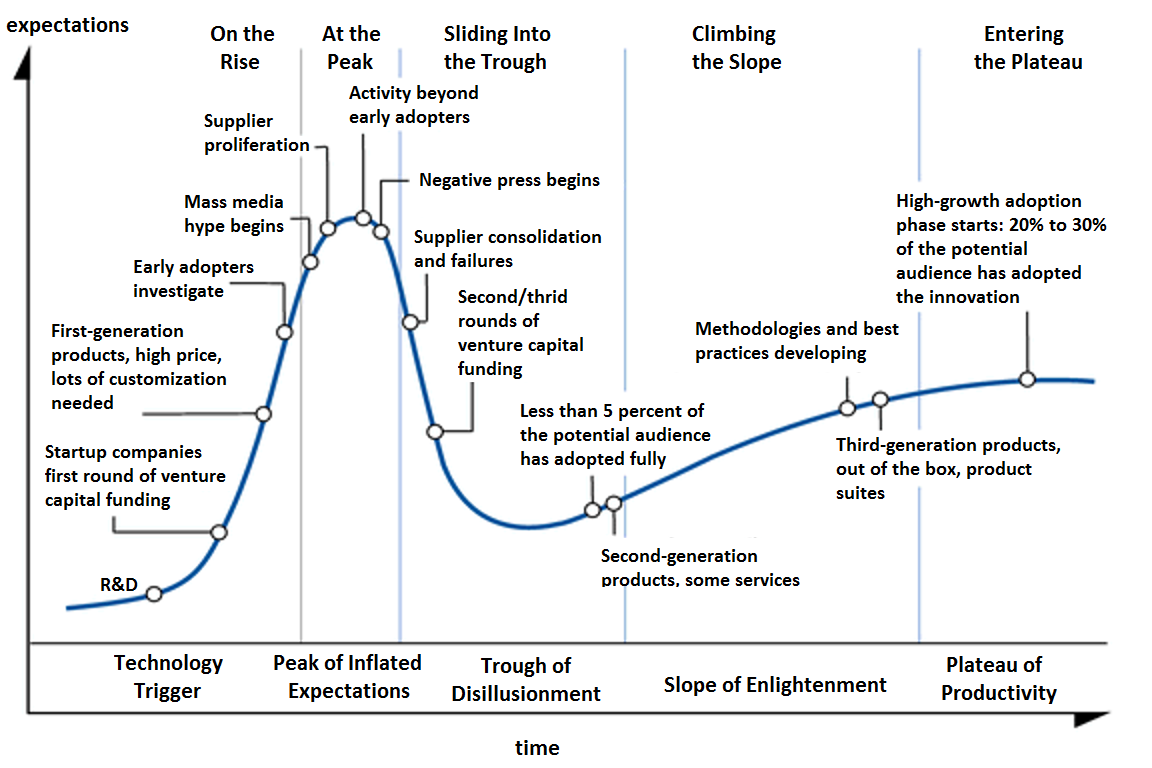
If you want to build your own pricing expertise the must read book is The Strategy and Tactics of Pricing. The Sixth Edition, by Tom Nagle and Georg Müller, came out late last year. The new edition adds material on behavioral economics, offers a more robust process for price setting and has a greatly revised chapter on Creating a Strategic Pricing Capability. This book commands a high price, which reflects its value!

Make 2018 the year in which pricing becomes a strategic lever that helps you drive up your own performance while delivering more value to your customers.

The post Three Pricing Predictions for 2018 (and How to Use Them to Your Advantage) appeared first on OpenView Labs.

10 Jan 17:34

How to Generate Leads with Webinars

by kniemisto

Any marketing and sales professional knows that most buyers don’t make a purchase decision right away. As WebAttract co-founder Mike Agron puts it: “77% or more of today’s B2B buyers will research you before they even want to speak with you. In B2B, most people are on a journey to get more educated.” There is no better way to educate leads on your value proposition than webinars. They provide huge amounts of value to your audience, all while positioning you as an authority. You can demonstrate that you’re the right person to help them.

The problem is: Many marketers create webinars that deliver little value. Worse, they don’t know how to create webinars that turn leads into ready-to-buy opportunities.

In this blog, I will outline the formula that successful brands use to turn leads into sales with webinars.

How to Choose a Topic that Draws an Audience


Webinars have become so common that there’s a lot of noise around the format. To cut through this noise, you must choose a killer topic.


This means discovering the challenges people in your audience are trying to overcome. Picking topics can no longer come from an internal brainstorm alone. The main objective of webinars is usually to convert leads into sales. Therefore, when brainstorming a topic, you should get your sales team involved from the beginning.

To find topic ideas, ask yourselves:

  • What are the most common questions that prospects ask?
  • What would we enjoy teaching?
  • What are we most knowledgeable in?
  • Which area could we deliver the most value in 60 minutes?

The topic you pick can be broad, diving into several subtopics. Or you can go deep and talk about a specific topic in a granular fashion. Your approach will depend on the nature of your offering.

To find specific topics for your webinar, start with a broad topic and brainstorm subtopics. For example, if Pipedrive were going to talk about sales challenges, here’s what a brainstorming session might look like:

Sales Challenges

You should also look outside of your organization to get an educated direction of which topic to choose.

Four sources of topic information you can go for:

  1. Current customers
  2. Most engaged leads
  3. Email surveys
  4. Data from your own content

Your best customers already understand the problem you solve. They “get” your proposition and understand your industry. Ask them what challenges your solution helped them to overcome, and why they decided to do business with you in the first place.

Your most engaged leads are those who are consuming your content on a regular basis. They’re engaged, but they need nudging into the sales cycle. Ask them what challenges they’re trying to overcome and what they’d like to learn more about. Find out which topics would get them to attend a webinar.

Setting up a survey campaign can yield quantitative data from your entire list of leads and subscribers. Ask them multiple-choice questions, as well as one or two open-ended questions where they can add nuance or express their opinions in more detail.

In this great example from Udemy Fast Track, their founder, Scott Britton asks for only necessary information:

online business

Your own data can provide great topic insights. What are your top-performing blog posts and most downloaded ebooks? Your most popular content can be sure-fire hits for webinars.

Choosing the Right Webinar Format

Now that you have a topic, you need to decide your webinar’s format. There are plenty to choose from. Our favorites:

Case studies

Prospects want to know how their peers overcame the same challenges they face. They want to know what was implemented and the results they generated. Therefore, case studies are the best way to convince and persuade before beginning the sales process. Customer stories like these add credibility. Getting a client to share their experiences on a webinar proves that they’re advocates and excited about the results you bring them. Your attendees will empathize with the journey.

One of WebAttract’s clients wanted to show how their target audience, automobile dealerships, could increase their sales. Instead of talking about the topic, they got one of their customers to tell the story instead. By targeting a pain point and introducing a customer case study, they attracted more than 600 decision makers to the webinar. They collected more than 180 leads that wanted more info and closed 30 deals. If you haven’t created case study content, webinars are a great way to get started. You can repurpose the webinar into a blog post, making for great sales enablement content.

Expert panel discussions

With Pipedrive, we collaborated on webinars with companies like PandaDoc and Sales Hacker. This form of marketing brings credibility from outside sources. If all you have is internal experts, your webinar will look like a sales pitch. Collaboration also adds a new perspective to your webinars.

Check out this webinar by Pipedrive and Sales Hacker to see this in action:

Sales Hacker

The best part, however, is the expanded audience you’ll tap into. It’s a win-win scenario for you and the brand you collaborate with. You both get access to a new source of leads, borrowing and boosting each other’s authority.

Don’t underestimate the power of thought leaders. Influencer marketing can be difficult. But if you can build relationships with one or two industry leaders and conduct a webinar with them, the results can be outstanding.

Education, tutorials and product demos

This format works great if you have a freemium version of your product or a technical solution that requires some explanation.

Pipedrive uses product tutorial webinars to empower users to educate themselves on the CRM software. They help us to retain and onboard new customers in a scalable manner.

Pipedrive

BuzzSumo has a similar approach, conducting regular webinars to help users get the most out of their software. They also run them whenever a new feature goes live. This helps boost retention and reduce churn. Your webinar’s format will depend on the topic you choose. You should also be careful to map the topic and format to the right stage of your funnel and sales cycle. As mentioned above, product demos are only useful for those using (or ready to use) your product.

How to Keep Your Audience Engaged

Getting registrations to attend your webinar can be challenging. Encouraging them to stick around to the end is even harder. Not every attendee will turn into a sale. But you can deliver enough value for them to remember you and become raving fans of your content.

1. Hook them with storytelling

All great content has a compelling hook. It’s no different with webinars. Begin your webinar with a story. Create a narrative the leads into the value that you’re about to deliver. Are you skeptical about the power of storytelling? Alex Turnbull of Groove A/B tested two different versions of his blog post. One that began with a story, and one that dove straight into the content.

No Story Story

The post with the story had 300% more people finish the entire post and average time on page was five times higher than the version without the story. Storytelling works with every form of content especially webinars.

2. Get your audience involved

You may have lots of energy and a voice as smooth as butter. But nobody likes being talked at for an hour. To get the audience involved, try breaking the webinar up with short Q&A sessions. Take two or three questions after you’ve covered a specific topic. Seek a moderator’s help to pick these questions to keep things running smoothly.

Better yet, get your audience to interact with each other using a chat box. Multiple-choice polls can add an extra layer of interactivity to keep your audience engaged while learning more about their interests.

3. Make it visual

Even marketers with little design skills can create great-looking content. Tools like Canva make it easy, so there’s no excuse to use boring webinar slides anymore:

Canva

According to the Social Science Research Network, 65% of people are visual learners. Therefore, your slides should be light on text. Walls of text are intimidating and won’t reinforce what you’re trying to teach. Create slides that contain fewer words and strong visuals. Inject some humor using GIFs where it’s relevant. Use graphs and screenshots to back up your points.

4. Use third-party data

With the right Google search, you can find statistics on virtually any topic. Use this data to back up the information you provide in your webinars. Using data from recognized third-party sources lends credibility and authority to your content. Backing up your content with statistics will inspire trust.

But don’t overdo it. Use one or two key data points that you want your audience to remember throughout the webinar.

Creating the Webinar Content

Now you have a topic and understand the format your webinar must be in—it’s time to create the content. As we’ve already covered, your webinar needs to be visually engaging. Use a tool such as Canva or recruit the help of a designer.

Outline and script

Before writing a script, create an outline of what you will cover. This will dictate the flow of the webinar, so make sure the order makes sense.

An example outline might look like this:

  1. Brief introduction (30 seconds is fine)
  2. Storytime—hook the audience in
  3. Three to five subtopics to deliver value
  4. Call to action
  5. Q&A

Then it’s time to write your script. Get everything you want to talk about on paper. However, don’t write out what you’ll say word-for-word. This will sound scripted and robotic. Instead, write down short bullet points of what you want to cover under each sub-section, which will allow you to sound natural while staying on track.

Offer and call to action

The ultimate goal of your webinar is to sell. So, part of your webinar should be reserved for your pitch:

Pandadoc

Depending on your audience, as well as your product or service, your pitch may be as short as a ‘quick plug,’ but should be no longer than five to 10 minutes—and even then, you must offer value. The majority of your webinar should be dedicated to educational content.

Of course, reciprocation is essential to developing strong relationships, so create an offer that’s exclusive to your webinar attendees to thank them for their time and attention.

This can come in several forms:

  • Discount on your product/service
  • Extended trial of software
  • Your offer + webinar exclusive bonuses

Make the offer time sensitive to create a sense of urgency to take action. In some webinars, I’ve seen people offer bonuses for those who act within an hour of the webinar’s end time. Find an offer that’s right for your business and your audience, as well as any collaborators with whom you conduct the webinar.

How to Promote Your Webinar

Like every aspect of content marketing, creating your webinar content is only half the battle. The other half is promoting the webinar itself.

Now I’ll cover how to get people registering and attending your webinar in droves.

Setting up a landing page

You’ll need a landing page to drive traffic and convert registrations. Include a form that asks for a name and email address. From our experience, extra fields result in losing 5% of your prospects per field. Running A/B tests will help you to optimize messaging, and ultimately, to maximize conversions. There may not be sufficient data to get great results the first time around, and you won’t know your typical audience until you have a few webinars under your belt. But you can optimize the messaging for future webinars.

Check out this example from Unbounce for inspiration:

Unbounce

Your webinar should include:

  • Title: An impactful summary of the value your webinar offers to potential listeners. This is what will hook your audience in, and is considered the most important factor as you promote your webinar.
  • Bios: Include information on the presenters so your attendees know who they are and why it’s worth listening to.
  • Topic: Provide a brief explanation of the topic, including what they’ll learn by attending.
  • Value: Use a “Key takeaways” or “You’ll learn” section to be clear about why they should attend. And if you are targeting a discrete type of listener, be specific—“Executives will learn…”, “Marketers will learn…”, and so on. The point is: What will the webinar empower them to do after they leave?
  • Time: Make the time and date of the webinar clear and even add an auto-scheduler so attendees can easily add it to their calendars.
  • Accessibility: Inform your potential listener how they can join the webinar, including any links, with concise instructions.

Tools like Unbounce and Leadpages come with webinar registration pages out of the box. Both solutions have powerful features that integrate with all major email marketing and webinar platforms.

Creating your email sequence

When acquiring signups for your webinar, it’s key to have an intelligent email marketing sequence set up before a single email goes out. The majority of signups will come from your list of leads, as well as those of whomever you partner with. Sharing lists can be one of the biggest benefits of collaborating with other brands, but you need to make sure that you have clear guidelines and opt-in consent from your audience. Best practice typically includes sending two to three registration emails that direct your audience(s) to your landing page. (A quick note about best practices: Always test them!)

Here’s an example from Teachable’s registration mail about choosing course topics:

Teachable

You’ll also need reminder emails should include date and time, agenda, information on the speakers, and a way to get in touch. Having this information will help registrants attend, allow you to jump straight into the story once you go live, and let them know they can still get the value of the webinar should they have to miss the live event. Depending on time, you should send two at least 24 hours and one hour before the webinar goes live. Go one step further by sending value-added emails in the days leading up to the webinar, where the webinar is advertised subtly alongside relevant or appealing content.

Finally, send out follow-up emails thanking attendees and drawing them to your call to action. Include links to any resources mentioned in the webinar and remind them of the deadline you set for your offer. You will likely need a few versions of each follow-up email—for example, you should avoid email copy that says, “Thank you for attending,” to non-attending—and should segment your email list into at least these two segments.

How to Generate Registrations

Beyond your email lists, there are other channels to source webinar signups. First and most obvious, make it visible on all of your owned media channels. This includes pinned social media posts as well as your homepage.

Here’s a good example of this in action from BuzzSumo:

BuzzSumo

Use your company blog to talk about the topics your webinar covers. Write about the topic in broad strokes. Tease the webinar as the place they can learn more. Make sure to include a call to action at the end of the post, driving traffic to your landing page. (You can include links to relevant blog content in your pre-webinar and post-webinar emails). Consider promoting these blogs using content amplification or use paid advertising, such as Twitter, LinkedIn or Facebook Ads. Target long-tail keywords using AdWords to keep your cost-per-click low. And never underestimate the power of timing. Day of the week and time of day can have a huge impact on not only signups but actual attendees, especially if you’re targeting audiences in one or more time zones.

Conclusion

Webinars have proven to be a successful driver of leads and sales. I expect the number of brands conducting webinars is going to increase in the years to come. Be sure to pick a topic that people will find hard to ignore. This is what will differentiate you from your competition this year and beyond. Not only that, but you must always offer and deliver educational or business value at the same time. Make sure your audience goes away armed and ready with the knowledge and tools they need to act on your advice.

What are your experiences with webinars? What successes and lessons have you learned? Share your story in the comments below.

The post How to Generate Leads with Webinars appeared first on Marketo Marketing Blog - Best Practices and Thought Leadership.

10 Jan 17:34

How to Get Your Content to Appear in Featured Snippets

by Brian Sutter

There have been many changes to Google’s search results over the years, but one of the biggest and most consequential happened about two years ago.

It’s when we started seeing “Featured Snippets.”

Also known as “Quick Answers” or “Rich Answers” (the terms are still shaking out), these are chunks of content that appear at the top of the search results, just below the ads.

Featured Snippets have a lot of different looks, but they fall into three categories:

  • About 11% of featured snippets are in these lists or bullet points.
  • 7% of snippets are tables.

So Why Should You Care About Featured Snippets?

Because they can get you up to 516% more organic search traffic than you’re already getting. (Though some more sober estimates clock it as low as a 20-30% increase.)

But that might not even be the best reason to make these a priority. There’s another benefit that’s big now and is only going to get bigger.

It’s the rise of voice search. As SEO expert Eric Enge says in an article for The Outline,“There’s data out there that suggests by the year 2020, which is only three years away, that 75 percent of internet-connected devices will be something other than a PC, smartphone, or tablet.”

“That 75 percent of connected devices will most likely interact by voice, and if you’re interacting by voice, and it responds in voice, you know how many answers you get? One. That’s only going to work if you have that answer.”

Featured snippets are the search result that gets grabbed for any voice searches, and for most mobile searches.

The gist of all this is that the new ways we search and surf information demand a new way to present that information. Featured Snippets are an attempt to meet that need.

They’re also a massive opportunity.

If you can get your content into Featured Snippets boxes (and keep those boxes), you’ll be in the catbird seat as Voice Search starts eating search. Even last year, 20% of searches were Voice Search, and the number of Voice Search devices is expected to quadruple just this year.

The question is, of course, how.

How Do You Get Your Content Into Featured Snippets?

It’s actually not too hard. Here’s what you’ll need to do:

  1. Be in the top ten or twelve search engine results for the search query you want to appear for.

Featured Snippets only get pulled from those top listings. So if you aren’t in the top of the search results already, get cracking.

However… you don’t have to be in the first position to nab a Featured Snippet. This is a great opportunity for sites that might not otherwise have the resources to hold first position.

In STAT Search Analytic’s whitepaper, “Rise to the top with featured snippets“, they found “70% of snippets came from sites outside of the first organic position.”

  1. Start asking questions.

Featured snippets are, at their most basic, just answers to questions. So it helps a lot if you can give Google clues by including the questions your content has answers for.

Here’s an example. This is what I’ll see for the query “How do barcodes work?”

When you look at the page that triggered this snippet, it’s got:

  • A very similar version of the question in the title tag.

The exact title tag for this page is “How do barcodes and barcode scanners work? – Explain that Stuff”. The question I typed is “How do barcodes work?” Close, but not exact.

What this means for you is that you don’t have to go crazy making different pages for questions that are this similar. But you do need to consider adding questions to your pages title tags where appropriate.

  • A section of the page that asks a similar question.

Here’s how the answer looks on the page:

Notice how again the exact question that’s on the page is not my exact query, but Google is plenty smart enough to know that this will answer my question.

There’s another takeaway for you here: Add questions to the section headers of your pages.

This focus on asking and answering questions should fit nicely into your content creation. Just look to Marcus Sheridan for proof.

Sheridan – also known as “The Sales Lion” – is often considered the father of modern content marketing. He got that name saving his pool business during the Great Recession by writing blog posts that answered questions his customers and prospects had. Every night, at his kitchen table, he just pounded out another blog post answering a question.

It worked then, and it still works now – and he’s got a new book out about exactly how to do it.

  1. Use standard HTML markup language tags like H2 and H3 to accentuate the questions in your content.

One other thing I noticed in the barcode example above: The question is marked up with an H2 tag.

I know I’m risking losing some of your by even mentioning HTML code, but hang in there – this’ll be short.

Here’s the deal with that tag: Web pages are usually marked up with these H1, H2, H3, H4, H5 and even H6 tags to show the priority of the text they enclose. H1 tags have the most priority; H6 tags have the lowest.

You should only have one H1 tag on each page, but each major section should have its own H2 tag.

Fortunately, adding tags like this is a snap – WordPress lets you do it in about three clicks. And if you don’t set up your own pages yourself, don’t worry. Just ask your web designer if the major subtitles on your pages are in H2 tags. Hopefully, they’ll say yes.

  1. Use lists – specifically bullet points and lists.

Still sticking with that example… the bullet points that make up the text of the featured snippet are marked up as an ordered list. And fortunately, once again, this will only take you (or your web developer) 2-3 clicks to format your text like this.

Adding these lists to your pages might not just help Google index your content. It might also be useful to real humans, too.

As you may already know, people tend to scan online more than they read. That’s why people like me recommend using subheaders, bullet points, and short paragraphs. It makes your pages look more accessible, but it also makes them much easier to scan, or (hopefully) to read.

This might seem contrary to the advice to keep people on your pages as long as possible, but your visitors might really appreciate a summary section on your longer content pages.

Something very much like a featured snippet, actually.

Many writers already use these type of bullet point summaries, but they tend to put the summary at the end of their content, toward the bottom of the page.

That makes sense editorially, but most readers who are in a rush aren’t going to even scroll all the way down to the bottom of a long page. They’ll give you 2-3 seconds for the page to load, plus maybe five to seven more seconds to read the first sentence or two and scan a few paragraphs down.

If it looks like the page is going to be too hard to find the information they want, they’ll leave.

You could do an interesting test to see how content pages would perform with the summary/feature snippets markup at the top of the page, or near the bottom.

I’d wager that putting the snippet markup near the opt of your pages would get you into “position zero” more often – I say that because Google tends to value links near the top of a page more than links near the bottom.

Don’t do this just for the Google search bot, either. Your human users might appreciate summaries, too.

  1. Make sure your pages load quickly – and fulfilled all the usual best practices for SEO optimization.

It STAT’s study of Featured Snippets, they found that pages that are picked for snippets are 19% faster than average pages.

The pages also tended to have “slightly higher”:

  • Word counts. (Featured snippets pages had an average of 925 words on them, compared to the average high-ranking pages having 905 words.
  • Easier readability scores
  • Links counts
  • Social media share counts

One other thing that appears to help? Using tables in your code. 41% of featured snippets pages had tables compared to 34% of regular pages.

  1. Use some of the tools available for Featured Snippets optimization.

When all else fails… go find a tool, right?

Well, you’ve got some choices for optimizing your Featured Snippets. Here’s a few of the best ones:

All of these paid SEO tools have features that can cut your time finding and managing your snippet placements.

Conclusion

Featured snippets are just too good an opportunity to pass up. And even if you don’t want to go in and do this stuff manually, you can hire someone to help.

This is a particularly important opportunity for small businesses, as so many of them still aren’t doing any search engine optimization. In the WASP Barcode 2017 State of Small Business Report, only 28% of the owners we surveyed said they were doing any search engine optimization.

There is an upside to that figure. If you can be one of the 28% who is optimizing, your competition is low and the rewards are high. Tweak your pages just a little more to grab a few featured snippets spots, and you may not need to advertise anymore. You’ll have all the free traffic you want.

10 Jan 17:34

How to Write Emails That Move the Sales Needle

by Amanda Clark

Pixabay

It’s easy to send an email—and it can cost you basically nothing. Your company can send a limitless number of marketing emails, hoping for the best—but if that’s the approach you take, you’ll find that your emails fall on deaf ears. In fact, you’ll probably find that they never get opened at all.

Just because emails are perceived as cheap and mundane doesn’t mean you should be careless in how you send them. With the right approach, marketing emails can be more than just inbox filler. They can actually move your sales needle and improve your bottom line.

How? By accomplishing a few things:

  1. First, your emails actually have to be opened and read.
  2. Your emails need to go to the right people.
  3. Your emails need to offer something of value.
  4. Finally, your emails need to earn the trust of each recipient.

Maybe that sounds like a tall order, but with the right email marketing strategy, these goals are totally attainable. Here’s how.

Get Your Subject Line Right

Remember, your marketing emails won’t accomplish anything if they don’t get read. And that largely comes down to the subject line. Your subject line sets the tone and establishes the first impression for each email you send—and a good subject line will entice the recipient to explore your message. That’s how you get your emails to be opened and read.

So what does a good subject line look like? For one thing, it’s succinct. According to one study, the best length for an email subject line is four words. Does that mean every email you send needs to have a four-word subject line? No—but you should definitely shoot for brevity.

As for the substance of your subject lines, make sure you avoid clichés. Emoji and overtly salesy language tend not to grab anyone’s attention. Instead, convey the value of your message. What does it say, or what kind of offer does it include? How will the recipient be better off for opening your message?

That’s what you should convey in your subject line—in as brief and punchy a way as you can.

Send Your Emails to the Right People

Another key to getting your emails opened and read is to make sure they go to the right people. Before you hit send, know who you’re sending to.

Accomplish this by keeping a well-curated email list. There are different ways to do this. Maybe you have lists for low-quality and high-quality leads; for returning customers and new leads. At Grammar Chic, Inc., we have distinct aspects of our business—resume writing and content marketing, for example—where the subject matter overlap is pretty minimal. Thus, we maintain separate email lists, only sending resume-related stuff to jobseekers, not to our friends who work in marketing.

Well-curated email lists are key for ensuring that, when someone receives your message, it contains something that speaks to them.

Make Your Emails Valuable

Finally, your emails must earn the trust of each recipient. To put it another way, you need to show that you respect your recipient’s time. Remember that the people who receive your emails probably receive a ton of messages over the course of the day. They have little patience for something that simply hogs space in their inbox. Rather than sending them a bunch of cursory messages day in and day out, send messages judiciously—and make sure each one really counts.

And to make a message count, you need to make sure it offers something of value. Value, of course, can come in many different forms—among them:

  • An offer for a white paper, guide, or other downloadable offer
  • A discount code or coupon
  • A first look at a new product or service, before it’s been unveiled anywhere else
  • Carefully curated, value-adding clips from your company blog

The bottom line? Don’t waste anyone’s time. Give them something that speaks to their needs and shows that you’re looking out for them—not just trying to hock your wares.

Write Emails That Improve Your Bottom Line

Good emails don’t just get read; they convert, in one way or another. As such, they can actually move your sales needle.