Shared posts
Tesla begins manufacturing solar roof tiles
35 Marketing Tips to Make Your Work Day More Productive
You marketers aren’t just busy people – you’re jugglers.
You juggle content creation, design, distribution, promotion, analytics – just to name a few of the balls you have in the air at any given time. And if you manage an in-house team or contractors … well, you deserve a medal.
The team and I here at SnapApp knew you’d appreciate some shortcuts. We compiled 35 of our best tips, tricks, shortcuts, hacks and tools to make your work-life just a little bit easier.
The Ultimate List of Shortcuts for Marketers
For Social and Outreach
1. Create lists on Twitter to keep your contacts organized while giving you more visibility to people/businesses you’re following closely on in your space.
2. Social posts with images get more clicks. You can make quick visual graphics with free drag-and-drop design tools like Canva or Crello. Get more detailed walkthrough for fast graphics here.

3. When you mention a person or company in your content, reach out to them after you’ve published that content and let them know you’ve mentioned them. More than likely, they’ll be flattered enough to share your content with their own audiences.

4. Add tweetable snippets throughout your content using a tool like ClickToTweet to create share triggers that make it easy for your readers to share your content with their own audiences.
5. Want to contribute a guest post? Find opportunities via Google Search by typing in your target market plus “become a contributor.” For example: social media + “become a contributor”.
6. Struggling to keep up with your own company’s blog schedule? Reach out to guest contributors. Ask people in your network to contribute content to your blog to take some of the weight off your shoulders. Look at LinkedIn groups or find individual writers you like and reach out.
7. Send a thank-you card to a customer without killing a tree. Use an online card delivery service like Paperless Post to send notes.
8. Or if a little tree-killing doesn’t keep you up at night, and you’d like to save money on postage, design your own printed postcards on Zazzle. Postcard stamps are cheaper than standard letter stamps. Send these postcards snail-mail-style to your customers to let them know you’re thinking of them.
For Optimizing Content
9. Improve the click-through rate of your content in search engines by writing longer meta descriptions.
10. Republish your older blog posts on Medium and/or LinkedIn to breathe new life into the content.

11. Syndicate your blog content to reach a broader audience – and possibly drive more traffic back to your company website. Here and here and here are a few syndication sites to check out.
Quick tip #11: Reach new audiences with your content by syndicating it.
12. Get more use out of your long-form content by writing excerpts and publishing them as blog posts.
For Keyboard Shortcuts and Browser Tips
13. Quickly add a column or row of numbers in Excel with this shortcut. Click in the first empty cell at the end of the column or row, then hitting ALT + =. (Mac: alt+=_)
14. Have a lot of tabs open … and your computer needs a reboot? Press control+shift+T when reopening your browser and all the previous tabs will re-open. (Mac: cmd+shift+t)
15. To automatically open a tab (or two … or three … or a dozen) when you start your Chrome browser, use the pinning function. Right click on the open tab and click “pin tab.”
16. Quickly navigate to another Chrome browser tab … without using your mouse. Hit CTRL + [tab number] to instantly open the tab you need. (Mac: cmd+[tab number]). You can also scroll tabs by hitting CTRL+ALT+ arrow key left or right. (Mac: cmd+option+ arrow key left or right)
17. Shift+Alt+5 formats your text into “Strikethrough.” (Mac: shift+option+5)
18. Use CTRL + K to insert a link in your Google Doc. (Mac: cmd+k)
19. Use the spacebar on your keyboard to play or pause a YouTube video.
20. Download a proofreading browser plug-in like Grammarly to check your writing for emails and other in-browser content.
21. Show search results for a specific website in Google Search by typing “site:” before the URL, followed by your search term. For example: site:https://www.snapapp.com “ROI calculator”.
22. In Chrome, if you need to have more than one account open at a time for the same website, open the website using incognito windows.

For Reporting and Analysis
23. Use Google Data Studio to simplify your dashboard and make pulling reports a breeze.
24. Think that other websites might be stealing the content you worked so hard to create? Quickly search for copies of your content on the web using Copyscape.
25. View a previous version of a webpage by typing “cache:” before the URL. For example: cache:https://www.snapapp.com.
26. Use an app like Attach.io to distribute and track your content and documents. You’ll get reports on opens, clicks, and how far readers get before they stop reading.
For Content Production and Workflow
27. If you’re settling in to write your next great content masterpiece, and you’re getting distracted every few seconds by emails and social media notifications, use the Freedom app to shut off the disruptions.
28. Or if your problem isn’t interruptions, but rather lack of focus, try the Pomodoro Technique to get your writing done.
29. Use BuzzSumo to find engaging content ideas. Enter your topic into the search bar and hit Go. Then view the results in the Most Shared and Trending Now tabs to see what content is already performing well.
30. Use the CoSchedule Headline Analyzer to create headlines that perform better.

31. If you’re using Basecamp for project management and you want to get back to the top or bottom of a long thread, simply double click at the top or bottom of the page.
32. If you’re stumped on what topics to write about for your company blog, refer to your FAQs. What questions do you get asked most often? Answer them in blog posts.
Quick content tip #32: Search through frequently asked questions for blog post ideas
33. Want to spend less time editing the content your freelancers produce? Create a company style guide and distribute it to all your writers – including guest contributors.
34. If you have multiple people working on a piece of content, use Google Docs so you have access to the revision history. That way you can revert the document to a previous version if necessary. To view the revision history in a Google Doc, click File, then click “See revision history.”
35. Block off time in your calendar for both writing/ researching time so no meetings can be scheduled for you then, but also block some time every week for creative brainstorming and thinking only.

Understanding, Narrowing, and Choosing Your Ideal Client
Understanding, Narrowing, and Choosing Your Ideal Client written by John Jantsch read more at Duct Tape Marketing
In marketing today it’s common to hear that you must know who your target audience is in order to be effective with your marketing. This mostly implies that you determine the makeup of a market that your business is most likely to attract.
What bothers me about this simple approach is that it has a lowest common denominator element to it – who can we attract?
Instead, I like to take the point of view of – whom do we deserve to work with?
This thought process led me to the idea of defining an ideal client which ties together both behavior and demographics. Identifying who this is from the beginning will save you tons of time going in circles trying to be all things to all people.
It really is a game changer and here’s how I recommend getting started.
Choosing your ideal client
Have you ever considered the following question? – What qualities would your ideal clients have? Thinking through this is quite a liberating feeling, no? Don’t you deserve to work with clients who appreciate the value you bring to them?
I know that might sound a bit egotistical, but it really isn’t. At the end of the day, if you want to work with the people you want, then you need to step up your game so that can deserve to do so.
I recommend getting started by exploring the types of clients you don’t want to work with. Until you know who you don’t want to work with, who you must work with, who you choose to work with, it’s easy to take work and clients that drag you away from the work you deserve to be doing (we’ve all been there and know what a headache it can be).
Who can you deliver the greatest value to, who do you enjoy working with, and who needs what you do most? Write a detailed description of your ideal client and include as much about them as possible including the problems they are trying to solve. Give some thought to how you might reach them and appeal to them. Use your best clients today to help you think about what makes them ideal for you. (Hint: they are profitable and perhaps they refer others to you right now.)
Consider following these steps to best identify them:
Step 1: What are the must-haves to be a client – this is stuff that naturally narrows your list – must be 18 years or older, must own a home – that kind of thing.
Step 2: What are the generally looked for attributes – no required, but preferred – perhaps it’s an age range, geographic location, or special interest.
Step 3: What makes them ideal – what are the attributes that make them your best prospects – perhaps they have a certain business model, unique problem, at a certain point in life or business.
Step 4: What behavior do they exhibit that allows you to identify them? Do they belong to industry associations, tend to sponsor charitable events, read certain publications?
I recommend starting with the smallest market possible. You must find a group of clients who think what you have to offer is special and can scale from there.
How to understand and speak to your ideal client
Now that you’ve narrowly defined who your ideal client is, you must spend ample amount of time understanding them in order to properly use them across the various strategic elements of your business. Knowing who makes an ideal client allows you to build your entire business, message, product, services, sales and support around attracting and serving this narrowly defined group.
Once you dig deep and profile the common characteristics you should also start asking yourself some questions about these folks.
- What brings them joy?
- What are they worried about?
- What challenges do they face?
- What do they hope to gain from us?
- What goals are they striving to attain?
- What experience thrills them?
- Where do they get their information?
- Who do they trust most?
Having answers to the questions will allow you to more fully address their wants and needs in every interaction and communication. Once you have this understanding, you can start tailoring your efforts to best speak to them.
Refocus your message
Matching your message to your ideal client is a must when it comes to marketing these days. A message that connects is one that clearly talks about what your ideal client wants more than anything else in the world – which is to solve their problems.
You must let them know that you understand what they really want. Let me let you in on a little secret: Nobody really wants what you sell – they want their problems solved – period.
I recommend making a list of the problems you solve for the clients you help the most. If you’re having trouble thinking about your client’s problems, think a bit about the things they tell you.
For example, a lot of our prospective clients might say things like – we just want the phone to ring more, so that’s what we tell them we can do for them (we don’t immediately dive into our SEO and marketing services).
That’s how you refocus your message so that it’s all about your amazing clients and the problems they want to be solved.
Create trigger phrases
Your clients don’t know how to solve their problems, but they usually know what their problems are. If you can get really good at demonstrating that what you sell is the answer to their problem they really don’t care what you call it.
Break down every solution you sell and every benefit you attribute to what you do, and map it back to a handful of “trigger phrases.”
These phrases can be questions or statements or even anecdotes, but they must come from the point of view of the client.
Write website headlines
What we mean by this is write a big, bold statement that might be the first thing anyone who visits your website will see. Now ask yourself – would this statement get your ideal client’s attention more than something like “welcome to our website?”
Want some help creating your new message? Pick out a handful of your ideal clients and go ask them – what problem did we solve for you? Test your headlines with them. Ask them to describe what you do better than anyone else.
Pro tip: If your business receives online reviews study them carefully. While it’s awesome to get 5-star reviews pay close attention to the words and common phrases your happiest clients are using – they will write your promise for you in some cases.
Until you are working towards defining, understanding and speaking to who you truly deserve to be working with, success will elude you. I can tell you that my experience suggests that you’re never really done with this exercise. As your business evolves, as you learn and grow, this model will evolve as well, but perhaps the continual process of discovery is just as important as what you discover.
ABM Fast Track: Part 1 – Roles and Responsibilities of Great ABM Teams

SeppH / Pixabay
It’s a new year, and many B2B marketers are looking to start 2018 with a bang. However, starting an ABM initiative can seem like a daunting endeavor. There’s a lot of moving parts to manage.
That’s why we’re writing this ABM Fast Track blog series. This is your roadmap to getting up and running with ABM in record time.
We’ll cover plug-and-play tools, checklists, and worksheets that take a lot of the guesswork out of planning.
So start your engines and prepare to get up and running with ABM, fast.
ABM Roles and Responsibilities
With this new go-to-market strategy, come new roles and responsibilities.
We know you’re not going to be able to build a team overnight. In fact, building a solid team can take quite some time.
Depending on where you are in your ABM maturity will determine where you should start.
The way we think of it is there are three different phases of building your ABM team. First, begin with leveraging your current team. Next, get cross-departmental collaboration. Finally, build out your full ABM team.
Start with Leveraging Your Current Team
We recommend starting with leveraging your current team and drawing on their expertise, as you get your ABM program up and running. A lot of the work they’re already doing can be focused on a smaller, select set of people and accounts.
In other words, transitioning your current marketing team into an ABM team doesn’t mean radically reinvesting the way they work.
Here are some members of your team that you can call on:
- Corporate marketing
- Product marketing
- Revenue marketing
- Field marketing
- Events
- Marketing operations
Get Your Entire Organization Involved
After you’ve figured out how to leverage your current team to get your efforts off the ground, it’s time to get cross-departmental collaboration. The truth is if only marketing is involved, you’re doomed to fail.
Even though the word “marketing” is in ABM, it’s not something that only marketing is involved with. As Rob Leavitt of ITSMA states, “ABM is a strategic business initiative.” Therefore, we must get support and alignment from other departments outside of just marketing.
This is going to look different for each organization, but when building your team, here are some other important players that you want to include in planning and executing your ABM program.
- Sales
- Operations
- Marketing
But it doesn’t stop there. Those are the key players that need to be brought in during the planning process, but there are other players that need to be brought into the mix when you’re executing your ABM campaign.
It could look something like this:
- Executive management provides vision and contributes at crucial times
- Marketing finds and nurtures the leads, and delivers powerful insights
- Sales development qualifies and sets the stage
- Sales consulting gives a great demo
- Account executives negotiate and close the business
- Customer success onboards and trains
Build Your ABM Team
Now it’s time to build out your full ABM team.
There are a few different ways to approach this. You can build your team from entirely scratch, move around your current team and fill in the gaps, or shuffle your organization around, so you don’t have to hire new personnel.
Whichever the case, here is the core of what your ABM roles and responsibilities should cover.
- ABM lead/Director of ABM
- Product marketing
- Marketing manager
- Marketing ops/sales ops
- Strategic account manager
- Executive sponsor
While you’re building your ABM team, the next component to think about it is completing your account entitlements.
Account entitlements answer the question, “What is the right amount of time, money and resources dedicated to each tier of target accounts?”
This is crucial before starting your account selection.
In part 2 of our ABM Fast Track blog series, we’ll cover how we think about account entitlements. We’ll also give you a brand new worksheet for you to plug-and-play to nail down your entitlements.
For a more detailed look at their roles in your ABM initiative, download our ABM Roles and Responsibilities worksheet.
5 Ways to Reduce Business Expenses in 2018

FotografieLink / Pixabay
Creating a profitable business is a delicate balance of making the right investments, sales and reducing business expenses. It’s a balance that takes time to figure out and requires a lot of patience on the part of the business owner.
I personally don’t think there’s a right formula so long as you are making a profit. I also believe there will be a time where you’re spending more than usual in order to get to the next level. However, you can’t let business expenses take over.
If you know you need to reduce business expenses in 2018, here are some places you can start.
Your Marketing Budget
I’ve been known to spend quite a bit of money on marketing – and it’s with good reason. If no one knows you’re out there then you can’t make money.
However, not all marketing expenses make sense for every business. That’s why it’s important that business owners regularly review what’s working and what’s not.
I personally do this through my email marketing service. My service allows me to use different tags for different groups of people. Each tag is associated with how that individual found their way onto my email list – text to opt-in, Facebook ad or a freebie. I then track the numbers each month to see what’s working on what’s not.
For example, let’s say that three months from now I see that text-to opt-in isn’t really working out for list building. If that’s the case then I’ll stop spending money on it.
Subscriptions and Fees
Another area where you can reduce business expenses is with subscriptions. After all, how many subscriptions do you have that you aren’t actually using? Here are some places to start:
- Apps
- Online image editors
- Magazines or industry publications
- Social media schedulers
- Landing pages
These aren’t fast and hard rules, they are just suggestions. As I previously mentioned, each business is different so make sure to look at your own business expenses to see if they are in alignment with your goals.
You’ll also want to look at ways to reduce fees for services you use regularly. For example, make sure to shop around when it comes to payment processing fees because they can sneak up on you.
Duplicate Services
Sometimes reducing business expenses is a matter of getting rid of duplicate services. For example, I was using a service to help automate my Twitter account and grow my following. Well, it turns out that my PR people already handle that for me, so I can cancel the automated service.
Downgrading Services
In addition to getting rid of duplicate services, you can also reduce business expenses by downgrading services.
Here’s what I mean by that. Many services – like for example, landing pages – offer different packages with different features. Maybe you’ve been paying for the most expensive package because you thought you would need all the features, but you have since come to realize you really don’t need all of that. If that’s the case, then you can downgrade and save yourself some money.
Paying Annually Instead of Monthly
The last way to reduce business expenses is to pay for services annually instead of monthly. Usually, they’ll give you a couple of months free if you do this. They may even grandfather you in to original pricing when their services inevitably get more expensive.
This method of reducing business expenses may look like you’re spending more money – but only at first.
Final Thoughts
After many years of spending money on my business, 2018 will be the year I pay more attention to reducing my business expenses. In doing so, my profits will likely increase.
How will pricing excellence benefit your company in 2018?

Pricing excellence is a core capability. It is required for success in product and service innovation, in go-to-market execution and for sales. Why?
- You and your customer must agree on a price in order to have a sale
- Price is closely connected to how you create and communicate value
- Price is the most powerful lever you have to improve revenue and profitability
To get insights into the importance of pricing excellence to your company please take this short (five minute) survey.
Pricing and Innovation
You cannot afford to invest in innovation unless you are creating differentiated value and you can capture enough of that value to provide a return on investment and continue to invest in innovation. We call this the Value Cycle. Pricing enters the Value Cycle with Communicate. Your pricing model is a critical part of how you communicate value so that you can capture it later on.

Innovation should begin with insights into how you can create emotional and economic value for customers that they cannot get from some other alternative. Begin with value. Then find out how much of that value you can reasonably expect to capture (your pricing power) and set a strategy for how and how much of that value you want to capture (your pricing strategy). This work should come early in the innovation process.
Pricing and Go-to-Market

Pricing is also at the centre of your Go-to-Market strategy. The first step in figuring out how to go to market is to understand who you create value for and how. Then you need to understand how these people buy. Beyond this, you need to understand how they will adopt your product or service to get value. Your pricing model is where all of this comes into focus. It needs to help you capture your fair share of the value you create, while communicating that value to buyers, and encouraging use. Your pricing model is dependent on your market segmentation, your target customers and your value propositions. At the end of the day, pricing is where these marketing objectives connect with with your business strategy and your financial goals (the pricing model has a big impact on key metrics like Customer Lifetime Value and the Cost of Customer Acquisition).
Pricing and Sales Execution

Pricing and sales are often seen to be in conflict. There is an old joke that "sales sees pricing as the revenue prevention function" and that "pricing sees sales as the margin destruction function." When this dysfunction occurs it is generally a result of a failure to explain the pricing model and strategy to sales and a failure to equip sales with the tools they need to sell on value. Before addressing price, sales needs to establish the value of the offer. This means answering the critical questions "Why change?" 'Why this?" and "Why us?." Objections will always come up, and some of these will be around price and value. A good pricing model connects the value metric and pricing metric and makes it much easier to address these objections. It also makes it easier to structure discounts so that they are part of the business strategy, and not just reactions to customer pressure.
Ibbaka can help your company activate and embed pricing excellence and make it part of your success.
Please take the Survey on B2B Pricing Excellence
SUBSCRIBE TO OUR BLOG
Consulting Skills In The Digital Economy
Cultural integration is key to digital transformation efforts. Lack of cultural integration is a pervasive issue for consulting firms on the digital transformation journey. A 2017 study by Prophet consulting found that cultural barriers were one of the top three challenges for digital transformation initiatives. In our own study, Digital Transformation in the Consulting Industry, 65% of respondents noted that digital capabilities are only somewhat or not at all ingrained in their company cultures. Are consulting skills and firm cultures keeping pace with the digital economy?
Consulting Skills and Digital Transformation Changes
Building the right workforce is key for any company trying to stay ahead of the curve. This does not mean hiring replacements for all current employees, but rather identifying gaps where new positions are needed, acquiring new talent or hiring internally to fill those gaps, and ensuring that current employees receive the necessary training. Interestingly, we found that hiring more people with digital capabilities and making acquisitions to add digital capabilities were only middle-of-the-road priorities for most firms. While we saw an increase in both of these areas over last year (by 18% and 100% respectively), they were still far outranked by the top priority of updating value proposition and consulting portfolio.

Moreover, when we asked consultants to rank their firms’ priorities, attracting and developing talent was cited as a lesser priority for most firms. These findings suggest that most firms do not see an urgent need to update their workforces.
A few weeks ago, we examined the job requirements for the rising majority of the workforce, namely millennials, in today’s digital economy. Similarly, we wanted to know whether the digital economy has prompted any changes to the consulting skills firms are hiring for. As a part of our study, therefore, we asked participants to rank the skills and competencies they valued most in hiring and promoting employees. Problem solving and emotional intelligence were the clear front-runners, while adaptability and digital expertise came in last.

While these findings don’t indicate that digital skills are not important in recruiting consultants, they do suggest that the traditionally desired consulting skills of problem solving, leadership, and collaboration have not changed. However, perhaps the skills for which consultants are hiring need to change. We asked the same respondents what changes they would like to see to better enable employees and the number one and two areas were training and investing in digital capabilities.

Recruiting Keywords
To bolster our findings, we took a look at what some of the top firms advertise for when recruiting consultants. On a number of career advice websites (Bright Network, TARGETjobs, experience), digital expertise is not even mentioned as a desired trait at top consulting firms. Collaboration and problem-solving are consistently listed as the principal skills consulting firms seek. When we examined the career pages of three top firms, we found the following skills listed for the ideal candidate:
Bain & Company: problem solving, leadership, delivery of results, passion
McKinsey & Company: collaboration, problem solving, entrepreneurial skills, leadership
Boston Consulting Group: curiosity, creativity, collaboration, and leadership.
It would seem, therefore, that top consulting firms do not consider digital expertise to be among the most important traits for their employees. Perhaps this should not come as a surprise; a recent article by Forbes posits that top CEOs value soft skills, such as leadership, communication, and collaboration, over hard skills in new recruits. While hard skills such as technical expertise are certainly beneficial, soft skills are more difficult to cultivate. Forbes, however, lists an additional top three skills that companies will be hiring for in the coming years. These include attention, the initiative to push beyond a college education, and agility or adaptability. Because technology changes so quickly and continually, the ability to change on a dime and not give up at the first sign of difficulty is key in the digital age.
Talent gaps can quickly become a burden, especially in the fast-paced change of the digital age. Perhaps one way consulting firms can aid their digital transformation is by rethinking the consulting skills they hire for or invest in the training programs needed to better prepare their employees.
Increase Margins with Sharper Negotiation Skills
Sales leaders and business leaders are constantly chasing more business opportunities in the race to reach their number. However, more selling isn’t the only answer. Some are discovering that smarter selling can accomplish more. With sharper negotiation skills, sellers can preserve or even increase margins of the sales that they earn in order to make each closing count.
Effective negotiating occurs throughout the selling process. Sellers do this by shaping the customer’s perception of value and working to understand their needs. The result is a mutually beneficial outcome that allows for future business. Here, we look at a few specific negotiating skills that sellers can develop in order to increase the margins of their sales.
Six Negotiation Skills That Increase Margins
-
“Prime” the Negotiation with Preparation
In any selling environment, the customer is likely to link their impression of the seller with their perceived value of the product or solution. For this reason, the seller must be prepared to illustrate their value by delivering industry-relevant insights.
This approach helps to “prime” the conversation, prompting the customer to see the seller in a positive light. As a result, trust develops at an early stage, creating an environment that’s conducive to successful negotiations.
The reason: trust signals fairness. Research published in Psychology & Marketing echoes this fact, noting that “priming a consideration for fairness, a seller can increase a customer’s satisfaction without sacrificing profit.” A negotiation outcome in which the seller is able to preserve or increase margins requires positivity from the customer. This positivity starts with a sense of fairness.
-
Understand the Power of the Anchoring Bias
Sellers can build on fairness by recapping common ground. This step also helps lead to the next part of negotiating: making an offer.
The conventional wisdom suggests that one weakens their negotiating position by making the first offer. Science says otherwise. Research from Northwestern University reveals that “there is virtually no research that supports the claim that letting the other party open first is advantageous.” To understand why this is true, we need to look at the anchoring bias.
The seller creates an “anchor” when they make the first offer. This anchor is a number that acts as a center of gravity for all that comes next. In most negotiations, the customer is unlikely to venture wildly from this figure. Some call this “pre-suasion.” The seller is setting boundaries by planting a flag. Being cognizant of the anchoring bias means that the seller can confidently make a complete first offer without timidity or hesitation.
-
Convert Demands to Needs That Can Be Met
After making the first offer, a seller will encounter resistance in the form of customer demands. Effective sellers convert demands to needs by seeking to understand the underlying “why.” This approach is important because needs (e.g., “I need more flexibility in the payment schedule.”) are much easier to discuss and resolve than demands (e.g., “I can’t pay that much.”).
Sellers can convert demands to needs with questioning. Doing so helps clarify the picture for both sides. The key is to take the time necessary to explore the underpinnings of the customer’s position. Too often, sellers in the heat of a negotiation resort to shrinking the scope of work or make price concessions that negatively affect their margins in order to accommodate customer price demands.
-
Protect the Value of the Sale with Trading
In some cases, converting a demand to a need is not possible. In these scenarios, sellers can still protect the value of the sale by trading. Effective trading means protecting essentials without unilateral concessions that leave money on the table.
Trading cannot occur in an adversarial setting. In such an environment, a customer, otherwise willing to trade, may resist at the behest of their ego. Findings published in the Harvard Negotiation Law Review “serve to shatter the myth that adversarial bargaining is more effective and less risky than problem-solving.” The author continues, “the research indicates that a negotiator who is assertive and empathetic is perceived as more effective.”
Seeing a negotiation through to a successful end almost always requires some amount of trading. What’s important is that the seller understands the dollar value of everything that they’re trading and comes out with a sale that preserves or increases margins.
-
Understand the Difference Between a Commitment and a Close
Reaching the maximum outcome means first gaining a commitment that precedes the close. To reach a close, a seller must first earn the customer’s commitment by reaching an agreement on the terms and scope of the sale. This step provides the necessary momentum for winning the sale. Occasionally, however, unresolved points slow progress. In these cases, make the sticking points contingencies and move towards a conceptual buy-in. Provide specific, actionable next steps with clear language. Otherwise, the deal is liable to drift.
This concise language creates a proactive pursuit of the sale, which avoids the exhaustion that sets in with over-negotiation. Reaching a deal is incredibly energy intensive, and everyone has a breaking point. Stop short of that event.
-
Maintain the Relationship after the Contract
Issues are bound to arise, even after signing the contract. This is when the value of a relationship is most apparent. In fact, research published by MIT Sloan Management Review explains that “formal contracts are often ineffective in taking care of the uncertainties, conflicts, and crises that a business relationship is bound to go through over time.” This same body of research cites trust and confidence as being the most important characteristics for the longevity of a relationship.
By maintaining support after everything is signed, the seller demonstrates that they value more than the financial aspects of the deal. That is, a successful negotiator considers how the outcome of the first sale impacts the likelihood of future business.
Negotiating isn’t a fixed point in time — it’s a continuum. Generating more value through increased margins requires work before, during, and after the signed contract.
Click here to download Richardson’s White Paper: Winning the Sale Without Thinning the Sale: Negotiating With The Modern Buyer. For more information about our Consultative Negotiation’s Training Program contact us at info@richardson.com or 800.526.1650.

The post Increase Margins with Sharper Negotiation Skills appeared first on Welcome to the Richardson Sales Blog.
Increase Your Book Sales with Smart eBook Stacking!
Bookbub is a great way to build an audience and to increase book sales, which is always the goal. For most authors, getting a Bookbub deal is a crowning achievement.
Bookbub deals not only increase exposure, but paid deals can also greatly increase your revenue, too. While a lot of authors like to do freebies, I like to experiment with paid deals instead. Half or more off of a book price can really help to significantly spike book sales!
But with so many books flooding the market now doing discount promotions, authors really have to get more innovative. Because while a Bookbub deal is a great thing, it will serve you even better if you maximize on it.
It’s an old book marketing strategy to sell more books. Stack your ads. Planning to increase the…
Click To Tweet
Testing it Out
Strategy testing is a big part of our work, which is how I came to try out this idea. By ‘strategy testing’ I mean that with approximately 4,500 books published each day, book marketing strategies change all the time and marketing people need to change with it. At the end of the day, we need to know what’s really going to sell more books.
So while I can typically use my own books for a lot of the strategy testing I do, I wanted to work with one of our existing authors this time around because she’s sitting in a very cluttered genre: contemporary romance.
If I can find a successful new book marketing strategy in a genre like romance, I can more easily replicate this with less cluttered genres as well.
Then and Now
It used to be that one single eBook ad or listing was sufficient to dramatically increase your visibility, but now all of that’s changed. If you’re really smart and organized, you can maximize on your discount days by using multiple channels and resources.
Many authors have already caught on to the strategy referred to as ‘ad stacking’, which very literally means getting multiple ads or listings for your book on the same day to promote your discount.
What We Did
But for a recent Bookbub deal I scored for the author in question, I tried ad stacking in a more creative way.
I wanted to see how long we could make that single day of promotion last.
The title was A Royal Affair Series, a three-book set, and I got a one-day deal day for $1.99. The regular retail price has it sitting at $5.99.

I let Bookbub select the date because the author has full control of her pricing. I planned to position everything around whatever date was chosen.
I’ll admit when I’m testing new book marketing strategies I like to leave them as open ended as possible, because in theory, it means they’ll potentially work for more authors.
The date the author was given from BookBub was August 30. I immediately started planning.
Secure Other Channels
Remember, I wanted to avoid doing things the “typical” way so we went out on a limb and started securing ads and listings to follow the primary Bookbub deal, and continue for five days in total.
There are lots to choose from that range in pricing, newsletter reach and social standing, so it takes a little research the first time but by now I have my personal favorites based on the budget I’m working with.
The general outline was this:
August 30: Bookbub deal
August 31: Promotion on site #2
September 1: Promotion on site #3…and so on. You get the idea.
Playing with Price Point
I opted to keep the $1.99 discount price point the same throughout the 5 days, but next time I’ll play with gradually increasing the price back to retail.
For the sake of full disclosure I did some small budget ads on the author’s social media, to her current network and fans, but aside from that I just let the extended ad stacking run its course and bring in new buyers, or at least I hoped!
The goal was to see what this extended ad stacking strategy could do on its own.

Most savvy authors have figured out by now that the Amazon algorithm perks up to pricing changes. This doesn’t mean I encourage my clients to change their pricing all the time, and it certainly doesn’t help if we don’t have a plan to draw attention to it.
Combine a price change with some sort of a book promotion that drives traffic to the Amazon page, like an eBook campaign. Big things can happen.
Why are We Doing This?
So the goal for an extended ad stacking strategy like this is to not only help your exposure, like a typical one-day deal will, it’s to also improve your sales rank on Amazon for multiple days to follow.
This screenshot shows where the book was on the day the Bookbub deal released.
August 30, 2017

And I was thrilled when the book retained it’s standing in the top ten paid list on Amazon!
August 31, 2017
September 7, 2017

The book remained in the top ten on Amazon for almost two full weeks, before it began to drop slightly. But even once it fell out of the top 10 it still held what I consider a great sales rank, 14,000 and better, which was still higher than it had been before the Bookbub deal.
I can honestly say the book benefited from this strategy well into late September and did not start to drop off considerably until October 5. Book sales increased significantly as well.
So What Do We Think?
The author and I were both really impressed, because remember, we intentionally did no other promotion during this period. It was hard, but it was a risk she was willing to take with me in order to really test this theory.
Extended ad stacking over a 5-day period following her Bookbub deal really paid off not only for this title. The author has a great big-picture attitude as well. She was pleased with all the exposure it no doubt brought to her other books.
If you’re going to pay big bucks to get a coveted BookBub deal, you should make the most of it. Ad stacking on top of the existing sale price works. Ad stacking to carry this book through a long sale period, worked even better.
Book sales enjoyed a strong initial spike, and then carried through for a longer period. This ultimately helped to spike the Amazon algorithm.
With the engagement of Prince Harry and Meghan Markle, we’ll be attempting this again. The books main theme is that an average girl marries royalty. As you see opportunities arise either by coordinating an event or date with your promotion, I’d grab those opportunities, too. You’re essentially ‘stacking’ an event on top of your existing promotion. You’ll want to plan for those as well!
Sell more books this year. Contact us for your personalized assessment. Here’s wishing you great book marketing success!
Marketing and Sales Content – Differences That Matter
What IS the difference between marketing and sales content? This is a good question to ask across your organization. The answers will reveal people’s thinking and understanding about “content” in general. Notice how clear, specific, consistent and actionable the responses are. Or not. Why does this matter? Effective sales content is a strategic imperative when selling in a digital age of hyper-connected, hard to engage, low attention span buyers. Sales performance suffers due to poor or missing sales content. This is the common state across most B2B sales organizations. According to SiriusDecisions, 65% of content created by marketing for sales is never used. That’s not surprising to me. This has been the case for well over a decade. What’s shocking is not only that it isn’t resolved, it’s not improving! I believe the B2B sales content predicament is actually much worse than these statistics indicate. This statistic and underlying research doesn’t address the adverse impact of required but missing sales content that was never created! Sales productivity and effectiveness opportunity cost significantly trumps the cost of content. Symptomatic of a Broader Content Problem? This article will explain marketing and sales content differences and why this matters to B2B marketing and sales organizations. It is axiomatic that you must diagnose problems correctly to understand and apply the best remedies. If organizations have limited understanding of or visibility into the state of sales content, what other content-dependent functions and initiatives are under-served? If you don’t know what makes sales content good […]
The post Marketing and Sales Content – Differences That Matter appeared first on Avitage.
6 Ways You Could Be Dooming Your Case Studies Before You Even Start Writing
Case studies are loved by marketers and sales teams alike for their ability to educate prospects and turn sales pitches and marketing spiels into verified, credible claims. Sales teams need them to show proof to their prospects. Marketers add them to email campaigns to keep mid-funnel buyers engaged. And potential customers look for them on your site to evaluate whether your solution will work for their unique situation.
But for all their perks, case studies are notoriously time-consuming. A survey of TechValidate users found 77% of our customers spent over a month on each case study, and a third spent 3 months or more! The good news is you can avoid wasting your time on preventable setbacks.
In this blog, I’ll show you 6 common mistakes companies make with their case studies before writing even begins.
1. You’re Relying on Your Sales Team to Identify Customers
It’s an easy habit to fall into: you reach out to your sales team and solicit a few good customer names for your next case study. Your sales reps work closely with your customers, so they can easily connect you with interested clients, right?
The problem is, your sales reps aren’t incentivized to help out the marketing team. Their priority is making sales. The result? You’ll likely have major gaps in the flow of customer references when you rely on your sales team alone.
Increasingly, marketers are takings back the reins and running customer surveys to gauge interest. The minimal time and effort required to fill out a quick survey can mean a lot more responses, and a much bigger pool of customer volunteers to select from.
2. You Aren’t Talking to the Right People
Bad interviews get you nowhere. So when it comes time to gather info for your case study, it’s worth taking that extra moment to make sure you’re set up with the right interviewee. Look for someone you believe will be a strong brand advocate (meaning they should have some positive things to say about your product) and who has a strong understanding of the company’s use case, or personally uses your product on a regular basis.
Commonly, when you reach out to set up an interview, the customer might rush to loop in a marketing, brand, or PR spokesperson to speak with you. It makes sense. These are the people charged with keeping public content (including your case study) consistent and on brand, so of course they have an interest in participating. But unless these are the people using your product—or the end users are on the line too—this interview has a strong chance of providing weak material for your case study.
Another tip: whenever possible, interview multiple people with different roles and perspectives to get the full picture.
3. You Didn’t Get Legal Signoff From the Get-Go
There’s no bigger let down in the case study process than when you’ve just put the finishing touches on your shiny new case study and patiently await the customer’s final approval… and then—oh no!—the customer comes back and apologetically tells you that they actually can’t endorse third-party vendors.
Not everyone you speak with will have their corporate legal policy memorized, so it pays to get approvals up front. Many companies, particularly the big names that you’d LOVE to feature on your website, have legal policies that prevent them from participating in vendor case studies. So save yourself the time and disappointment and send out a standard release form.
4. You’re Asking the Wrong Questions
The details you gather from the customer can mean the difference between an engaging, stat-filled case study and a mind-numbingly dull one. Asking the right questions is vital to building a strong customer story, so choose wisely. A few pointers:
- Always ask open-ended questions. ‘Yes’ or ‘no’ varieties won’t yield the level of detail you’ll need to craft a compelling story.
- Ask questions around each of the sections in your case study: what their company does, what challenges they faced, what solution they selected and why, and what results and benefits they’ve seen since.
- Stats and metrics make for compelling proof points, so don’t forget to ask the customer if they have any data that reflects a positive change since they started using your product.
- Don’t stick to the script. Tailor some questions to the customer’s unique use case, industry, and pain points.
- Consider sending out a questionnaire a few days prior to a phone or in-person interview to help the customer prepare.
5. You Aren’t Recording the Interview
Here’s a tip straight from the journalism playbook: if you want to remember what’s said in an interview, ditch the pen and notepad and grab an audio recorder. Memories fail, notes get lost, and mid-interview distractions happen.
And when your customer raves about your product in the most eloquent way, or when the building maintenance starts up the lawnmower and you miss a few words, having that backup audio to revisit can save the day. These days you don’t need to invest in an old-fashioned portable audio recorder (unless you’re going for the reporter-on-duty look). Just hit record on your web conferencing tool or download a third party app, and you’re set.
6. You Aren’t Aiming for a Diverse Portfolio of Customer Stories
When a prospect visits your website, will they find a case study that speaks to their industry, use case, and unique challenges? If not, they might end up feeling disconnected from your product.
Diversifying your case study collection can help your sales team as they work their way into new markets. Aim to build a collection of case studies that are relevant to each of your target verticals, personas, and applications.
The goal is to relate to your target buyers’ pain points and desired results and offer compelling proof that your solution has, in fact, helped similar companies with their own situations. Every prospect faces unique challenges—show them you understand theirs.
In what ways have you used case studies to create sales and win over potential customers? How do you seek out potential case studies? I’d love to hear about your process in the comments.
The post 6 Ways You Could Be Dooming Your Case Studies Before You Even Start Writing appeared first on Marketo Marketing Blog - Best Practices and Thought Leadership.
How to Deliver a High-Impact Sales Pitch

You’re escorted to the boardroom room with a big prospective customer. You stand to make the pitch. It’s go time — your time to wow the people around the table and win a big piece of business.
Where do you start?
For years, I started sales presentations with a lot of background about us — who we were, our capabilities, our process. Entirely expected and a total miss in terms of making an immediate and relevant impact with the customer!
Fortunately, I had a major breakthrough. In a presentation to a big restaurant client, my team flipped the script. Instead of focusing on what we brought to the table, we looked at the world through our clients’ eyes. What challenges were they facing? What did their customers expect? What made their business unique? What were their big opportunities? What could we provide that they really cared about that nobody else could deliver? How were we uniquely positioned to deliver the future that customer wanted?
You want to see a customer’s eyes light up? Talk about them in a way that helps them see the future differently. Teach them something about their category, competition and customers they don’t know. Instill confidence by showing up prepared to demonstrate how you are going to have a substantial impact on their business in way that matters most to them.
Clients report that only 20% of the salespeople they meet with are successful in achieving expectations and creating value. Only one in four of these salespeople get agreement from buyers to meet again. Customers don’t care about you. You are only relevant to the degree that you can help the customer get to where they want to go.
The presentation was a home run. It taught me three valuable lessons about how to deliver more relevant sales presentations and completely changed the way I sell. This is what customers want:
- Compelling insight. The best salespeople are teachers. What can you tell company executives about their organization that they don’t already know? What new ideas can you highlight that they may be missing? You’re an outsider with a new perspective, and you can help your customer navigate the sea of information around them to find the value.
- Customization. We’ve all tried to sell our services/solutions to someone else with a standard story or sales pitch. Those days are over. Instead, every presentation has to be personalized for that unique client. Good presentations can only be given once, because they’re only relevant to that client, in that time and place.
- Urgency. When you find compelling insight, and look at your customer’s unique perspective, you immediately create the third element of a successful sale: Urgency. When your client knows they need you to help them solve their unique problems now, the value is clear and it’s easy for them to say ‘yes’ to the sale. It’s also where you stop competing on price.
In this video, I explain how to improve every sales presentation:
Most sales organization hit reset in January. We’re starting at ground zero. Let’s make this the year that we get closer to our customers, prepare and present with impact and absolutely destroy our performance targets!
Go get it!
How To Make Your Next Sales Presentation Rock
It’s not easy being part of a digital agency. A lot of the hard work is in the sales presentation as you reach out to possible new clients. And it’s kind of different for digital agencies too because a presentation to gain new business relies on a lot more than just numbers.
Sure, data and numbers are important, because they prove ROI potential. But digital agencies are unique in that a lot of the work they do can be tailored to the needs of the client.
There is no one-size-fits-all here, and it’s up to you and your sales presentation to convey the bespoke nature of what you can achieve for clients.

Not all prospects are the same
This is so true with digital agencies and the clients they are trying to woo. Compared to other industries, preparing a presentation to clients as a digital agency means that the research needs to be incredibly rigorous before you start the pitch. This is because, on the whole, your prospects will be in a different place in their marketing journey when compared to each other.
The differences can be huge. If it’s a prospect that doesn’t have any real social media presence, they probably won’t know the basics of social media and how it works. So the data that you intend to present as part of the sales pitch could be way out of their experience. This will not help your cause.
At the same time, more experienced prospects may need a deeper view. You can talk deep metrics with these guys where you couldn’t talk about engagement with the first prospect.
This all needs to be carefully worked through. Your team need to know where the prospect is coming from because only then can you claim to be able to provide a bespoke digital marketing package.

They need something
This is something fundamental to all sales presentations but is perhaps even more relevant to those delivered by creatives. It is so easy to fall into the trap of delivering a presentation that talks all about the agency and how amazing it is. This is agency centered and will not bring you worthwhile results.
Your presentation should focus on the results you bring, but also how they are relevant to the prospect. By all means, discuss creatives, engagement and reach, but set this into a context where your prospect knows how all of that is relevant to them.
If you have carried out research, you will know what the pain points are for the prospect. By showing them solutions that speak directly to their needs, you are communicating more authentically. The beauty of digital agency work is that there are always a ton of factors for success. This allows you to pitch directly to what the client is all about.
To give an example, imagine that the prospect is a medium sized business, and they want to convert social traffic into leads. This requires a very distinct strategy, involving work on the content developed and the optimisation of landing pages so that they do a very specific job. If that same client just wanted more social engagement, the content and the strategy overall would be significantly different.

If you are presenting and you find yourself waxing lyrical about how amazing your agency is, focus on what you can do for the client and you’ll see them become a lot more interested in what you have to say.
Be honest. It makes you different
It can be easy to try and cover all bases in your presentation, but it doesn’t make sense. If the prospect wanted a digital agency that can do everything, then that makes the agency quite bland. Every agency has to stand out in the field, and if you can focus on one key aspect that you deliver on and which differentiates you from competitors, you’re being authentic.
Not too good on Twitter? Tell them. If they want Twitter, make it clear that you will focus on it (assuming you agree on it being relevant of course) but that the work will take a little longer. You’re better on Instagram and you’ve had massive success on that platform for clients. This is just one example but it pays to be upfront as soon as possible. This is because clients will feel you are straight and to the point. Transparency builds trust.

Grab credibility with data
As you will probably be aware, businesses need profit. It forms the lifeblood of what they do. By showing that you can deliver results through the clear presentation of data, you are helping decision makers move towards hiring your agency.
Beware of not explaining data, or of having anything on display that is inaccurate. The prospect needs to know that you are totally in control of what you do. And they need to be able to see a common sense progression from a client hiring you to the realization of those numbers. Chances are, the prospect is no fool, and they will want to see accurate and recent (not to mention relevant) data as close to the start of the presentation as possible. It sets your agency up as an expert.
The price thing
What we are about to share with you may be something different than what you expected when you read the subheading. No, we’re not suggesting you undercut competitors.
Instead, we are suggesting that you do one of two things (or perhaps even both). Take a look at your competitors and see what they’re offering. Then make the price of your similar offerings higher. It’s as simple as that.
This automatically makes you different, and while it may deter some prospects from taking you on, it will most likely bring you more business. You are pricing yourself highly because of your expertise.
The other strategy in the pricing area is to, once again, after looking at what your competitors offer, put together packages that show real value. Bundling up what you offer and then fixing the price so it is reasonable makes you a real choice, distinct from competitors.

Consider not showing past work
This is a bonus strategy, and can only really be carried off if your agency has a lot to be confident about. Think about not actually showing your past work. It makes your agency seem very sure of itself if you don’t keep trawling through past glories. In other words, not showing your greatest hits makes you more viable as an agency. You don’t have to show off.
If this seems too risky, take the other approach which is to carefully ensure you only show past work that is super relevant to the prospect. This shows you’ve done your homework and that you have a clear idea of what you can achieve with the prospect’s brand.
Either way, you are showing confidence and care for the prospect and their brand.
How to Unite B2B PR and Content Marketing for Powerful Results

There’s an interesting proverb that I stumbled on recently: “When spider webs unite, they can tie up a lion.” When you boil it down, there’s a lot to be said for teamwork. But what about two seemingly different teams, such as B2B PR and content marketing?
Recently there have been a variety of strong opinions circulating about PR and content marketing. Some believe that PR and content marketing are different strategies, and don’t mix well. According to these individuals, you should either have PR or content marketing — not both.
Does this reasoning stand up under scrutiny?
No.
Let’s take a closer look at PR and content marketing, and examine how both play an important role in your overall B2B strategy.
What is Public Relations?
The Public Relations Society of America puts it this way: “At its core, public relations is about influencing, engaging, and building relationships with key stakeholders across a myriad of platforms in order to shape and frame the public perception of an organization. ”
Public relations professionals take on many roles, including
- Crisis communications
- Reputation management
- Media relations
- Corporate communications
- Social media
- Writing speeches
- Events
- Product launches
As new technologies and trends emerge, public relations evolves to fit the times. In recent years, PR professionals have had to react to the emergence of fake news, artificial intelligence, and digital storytelling. And we see how public relations has gracefully handled these changes, to the benefit of all involved.
Now that we have a clear definition of what public relations is, let’s move on to content marketing.
What is B2B Content Marketing?
The Content Marketing Institute defines content marketing as “a strategic marketing approach focused on creating and distributing valuable, relevant and consistent content to attract and retain a clearly defined audience.”
Content marketing is different from traditional forms of marketing. While marketing traditionally focuses on self-promotion, content marketing avoids it. In essence, content marketing serves the needs of the audience. The goal of content creation is to demonstrate the expertise and credibility of a brand to begin to nurture prospects and ultimately convert them. This might be through blog posts that answer key questions or eBooks that delve into deeper industry trends and issues. As propsects move down your funnel, content may include later-stage content such as case studie and webinars.
Content creation covers many different types of media, including:
- White papers
- eBooks
- Check lists
- Case studies
- Testimonials
- Blog posts
- Infographics
- Images
- Videos
- Slideshares
- Podcasts
- Webinars
Content marketing incorporates various strategies to reach a target audience. These could include social media, SEO, and paid media, to promote and amplify content.
The type of content you create is contingent on your goals. For instance, if your objective is thought leadership, then you’ll want to create in-depth content (such as eEooks, videos, and white papers) that highlight your industry expertise and knowledge. If you want to generate leads, you’ll want to generate leads, think webinars, demos, case studies and other later-stage content.
How PR and Content Marketing Are More Alike Than You May Think
These two B2B strategies both focus on shaping brand perception. This includes generating:
- Awareness
- Credibility
- Thought leadership
From its beginning, PR best practices have always included some type of content marketing — they may not have had the fancy term for it that we do now, but it was content marketing nonetheless. It might for example have involved placing an op-ed on behalf of a client and distributing copies of the op-ed to prospects. To underscore the importance of content marketing to PR, the national PR organization PRSA includes in its list of PR functions: “Overseeing the creation of content to drive customer engagement and generate leads.”
Previously, PR was often limited to earned media, but now it typically integrates earned, owned, paid, and shared media as part of its strategy. This helps align PR and content marketing to work closely together in creating and distributing these various content types.
Let’s examine owned media for a moment. This includes media that you own and will always be among your assets. Think your website’s blog or eBooks that you create. Normally, this would be considered content marketing. But owned content is also an important part of public relations, where you can use your owned media to highlight press mentions and boost your brand image.
Another example is thought leadership — the idea of being the go-to authority and trusted source for others within your industry. You attain this status through the creation of in-depth content, speaking engagements, and the way you position yourself on social media — all of which blurs the lines between PR and content marketing.
As PR and marketing converge, PR increasingly takes on the role of content marketing, including SEO, paid media amplification, and even in some cases lead nurturing.
All of this showcases the symbiotic relationship that exists between PR and content marketing. Bottom line, each one helps the other. How is that? Let’s examine six key ways that these two strategies work together and benefit each other.
6 Effective Ways to Combine Your B2B PR and Content Marketing Strategies
1. Your Content Can Fuel Press Relations
Content is generally used to establish expertise and spread brand awareness. But it can easily go a step further and put you on the map for some well-deserved press.
Let’s say, for example, that you’re a manufacturing company that has recently won an award for safety. You could write a blog post about how to create a safe working environment, and highlight your recent award.
Imagine what happens if a writer for an industry magazine stumbles upon your post and realizes that your industry knowledge would be useful in a story he’s working on. Your content has created an opportunity for earned meda. This shows how your content marketing efforts can also advance your PR interests.
2. Speaking Engagements Direct Attention to Content
Choose a member of your team to speak at an industry event. This puts your brand in front of your target audience, who is listening attentively and taking note of your brand.
Use this platform to highlight your content. In fact, your content can become the nucleus for your presentation. Mention and quote from specific pieces of content. This not only puts your brand in the spotlight, but directs new audiences back to your content for more information.
3. PR Brings in an Audience
Public relations puts your brand in the spotlight — but that spotlight has some definite perks for your content marketing. As people get to know your brand, they will turn to your blog for your expertise, insights, and educational content.
Aim for media outlets that your target audience frequents. Don’t know? Ask your sales people to check with customers. Don’t forget to include a link back to your blog in your content.
This strategy only works if your content team has a rich selection of content waiting for prospects.Teamwork between PR and content marketing can ensure that the right content is strategically placed for potential audiences to peruse.
4. PR Helps Content Teams Think Outside the Box
Much of the time, content creation teams are focused on a brand’s image. While the content isn’t self-promotional, the focus is on buffing a brand’s perception — what content will create trust in the brand?
PR helps teams focus on the big picture: the public. What kinds of content does the audience read? What stories are popular? What industry trends are emerging? PR teams have a unique perspective on the “it” topics, and can help content creation teams to create fresher content from a unique angle.
5. PR Allows You to Be Promotional
Content marketing is often about educating prospects on your industry. It’s not touting your brand but exposing prospects to top industry thinking.
PR to some extent gives you an outlet for self-promotion. An effective PR strategy tells people what you have accomplished, what you’re doing now, and your future plans.
But after your’re spotlighted and people know about your brand, what’s next? Content marketing. A well-rounded content strategy will build on the foundation laid by your PR efforts. It prevents your brand from becoming a one-hit wonder, and cements you as a powerful presence in your industry.
6. Collaborate with Others Within Your Industry
Collaboration allows you to expand your reach to new audiences and heightens your expertise. Reach out to another well known thought leader within your industry and create a valuable piece of contenthat both of you can promote. This makes content creation easier and puts you in the public eye.
You could also use this collaboration for mutual distribution. Each of you can distribute each other’s content through a blog and newsletter. This expands your reach and bolsters your reputation as a thought leader.
You might even do this with influencer marketing. This leverages those within your industry with a particularly large social media following, and uses their influence to benefit both your PR and content marketing. You get a new channel to distribute your content and win the attention of the influencer’s audience.
A Few Points to Remember…
- Use your blog to highlight recent news and attract the attention of industry journalists
- Use your public relations strategy to attract new eyes to your content
- Think of content creation from a public relations standpoint to gain a wider and fresher perspective
- Establish your brand reputation with public relations, and nurture that reputation with your content marketing.
Returning to our introductory proverb, teamwork will inevitably strengthen your cause. Help your PR and content marketing teams to work together, and the results will speak for themselves.

How to Hire a Sales Representative

How do you find the right sales professional to help you boost sales, increase conversion rates, gain new leads, or meet targets? Here’s an overview of what you can do to find, hire, and work with a freelance sales representative.
Identify What Your Sales Consultant Will Be Doing
The first step in the process is to clearly define what products or services you’re selling to give your potential sales rep an idea of what they’ll be working with. Depending on the length of your sales cycle, you may need expertise in all or some of the following:
- Lead generation. Are they coming on board to help find new customers and create interest around your brand? Lead gen experts often use digital tools like website optimization, social media marketing, paid search, SEO, mobile marketing, and email.
- Consulting on your current sales process. Need a sales consultant to take a look at your existing sales operation and help streamline and optimize? Want to test another sales channel before implementing it, like live chat sales?
- Outbound sales. These sales professionals reach out directly to fresh leads, including cold calling consumers and businesses that may have an interest in the your product.
- Inbound sales and marketing. Do you have a new site or revenue stream that needs a boost? An inbound sales professional can optimize your site performance and convert website visitors into active leads using data-driven metrics. They also create sales funnels for new products to drive interest and sales.
- Peak season volume overflow or new product launches. Need sales support to handle a seasonal influx or initial, post-launch increase in calls?
- Upselling and cross-selling.
Research new trends and strategies in sales using resources like the Hiring Headquarters: There’s information available about how to craft effective sales pitches, or how to drive sales with a virtual team.
Refining your sales goals with a basic overview can help you identify high-level information such as who you’re targeting, opportunities (e.g., size of market), decision maker for each stage of the sales cycle, and any daily, weekly, or monthly goals. This may require some research to create the necessary documents your sales rep will need to get started and optimize their time.
Write an Effective Job Post
Next, you’ll use the information in your brief to create a detailed job post that will appeal to the type of freelance sales representative you’re looking for. Here’s an article to help you write an effective sales rep job post, too.
Shortlist Potential Freelance Sales Professionals
As proposals are submitted, you’ll need to vet the most promising sales pros to create a short list of people you want to interview. In general, you’re looking for them to have a solid understanding of what your customers want and need, and to have proven success navigating the intricacies of customer. This enables them to efficiently attract new customers using a variety of skills and techniques.
Here are some other points to look for:
- Professionalism. Who’s tailored their submission to speak to your business and your project? Check out their Upwork profile: How do they present themselves in general?
- Proven experience. Has the rep sold similar products or services for others in your industry? Have the received any sales awards, or met or exceeded sales goals?
- Feedback. For most sales representatives, the proof is in the numbers, but what do previous clients have to say about working with them? Reviewing feedback can give you insight into their ability to communicate, create a conversation, and generate results.
- Personality. Try a Skype interview or a Google Hangout to get a feel for the rep’s enthusiasm, personality, and communication style.
Prep for the Interview
The interview is an opportunity for you to learn more about a sales rep’s experience, motivations, and qualifications. Prepare your interview questions ahead of time so you can feel confident that you’ve covered all relevant points. We’ve created a list of sales representative interview questions you can reference.
Remember to tailor interview questions to your job post. For example, if you’re interviewing an outbound sales rep who’s cold calling a list, a good question might be “When making cold calls, what’s your trick for establishing a conversation quickly?” and so forth.
Using your observations and their responses, engage the sales rep who has the talent, experience, and mindset to bring your sales where you want them to be.
How to Hire Your First VP of Sales [Job Description]
Hiring an effective, capable sales team is one of the most important things you can do for your growing company, and choosing the right candidate to lead your sales organization is critical to the success of your startup.
- When to hire a VP of Sales
- Who to hire
- What a VP of Sales does
- Responsibilities of a VP of Sales
- How to Hire a VP of Sales
- Interview questions
When to Hire a VP of Sales
As founder, you are your company’s first salesperson. But as your startup gains traction, you need to focus on strategizing — not prospecting and closing deals.
That doesn’t mean your first hire should be a VP of Sales. If you’re looking for someone to run front-line sales for you, it’s probably best to bring a salesperson or sales manager on board. They’re far less expensive than a VP, and they won’t be reluctant to get their hands dirty and bring in revenue the way a high-level hire might.
In fact, your VP should not be directly closing any deals but the Big Kahuna ones. I’ll explain why in the next section.
But let's assume it’s been approximately 24 months since you founded the company. You’ve got one or two sellers, product-market fit, and a somewhat repeatable sales process. Now you’re ready for a VP.
Who to Hire for a VP of Sales
A startup VP of Sales should look much, much different than the VP of an established company. In your organization’s first lifestage, every day is a battle. The startup VP of sales need to convince prospects to take a chance on an untested product and unknown vendor. She’s figuring out how everything works. This VP quintuples or even 10Xs your revenue.
Once your company is mature, your VP’s job is to manage managers of managers. She’s much more of a dashboards thinker.
Keep this distinction in mind when you’re reaching out to candidates. Many founders are attracted to big names from well-known companies (especially because these VPs will bring a stacked Rolodex with them). However, if a VP’s strategy, mindset, and contacts are better suited to a big company, you’ll likely end up parting ways quickly — and that can spell major disaster for a young organization.
In fact, your VP doesn’t even need to be a VP at their current company. An ambitious, creative, hardworking manager who’s excited to jump in and build your business with you might be perfect.
Now that we understand what a VP of Sales does, let's review the key responsibilities of the role.
Responsibilities of a VP of Sales
Jason Lemkin, VC and former CEO of EchoSign, explains a startup’s VP of Sales has five primary responsibilities, from most important to least:
- Recruiting
- Advising reps on their current deals
- Optimizing the sales process and tactics
- Defining strategy
- Closing business
One-fifth of the VP’s time — in other words, an entire day of their work-week — goes to searching for potential hires on LinkedIn, taking recruits to coffee, asking their network for leads, interviewing, and hiring. To scale, you’ll need lots of human-power. Your VP needs to acquire it for you.
Their second function is helping their reps win business. That means reviewing their pipelines, pointing out obstacles, identifying opportunities, etc.
In third place, the VP should be tweaking the sales process: Creating sales scripts, email templates, and reusable demo agendas; perfecting the stages of the sales process; understanding which features speak to which prospects; writing the product roadmap with Engineering, and more.
Next, the VP must focus on the big picture. How can the company upsell and cross-sell its existing customers? Which verticals or industries should it target next? What’s the most effective way to spend the company’s budget?
And in very last place, meaning it should demand the smallest amount of their time, attention, and resources: Closing deals. If you're trying to land a whale, yes, it might be a good idea for your VP to jump in the car with you and meet with the prospect.
Lemkin says the VP can even (sometimes) take on a quota in the beginning. Yet they should never be closing more than a fraction of your deals, because it's simply more important for them to hire and train sellers than sell themselves. You know what they say about teaching a man to fish.
How to Hire a VP of Sales
If you’re ready to hire your first VP of Sales, here’s a sample job description to get you started.
Depending on your budget, you may want to use a recruiter. Yes, finding and reaching out to candidates can be incredibly time-consuming — but that’s not the main reason to use a third party.
Because salespeople are so skilled at selling, it can be tough to figure out who’s the real deal and who’s just good at B.S. In addition, recruiters usually have a much bigger network than founders. You’ll get exposure to candidates you might have never found on your own.
Whether you choose to facilitate the hiring process yourself, or use a recruiter, the same interview process applies.
- Reach out to potential fits (via a recruiter or yourself); optionally, let your network know you’re hiring
- Review applications
- Schedule short phone calls with promising candidates to screen them for interest (recruiter or you)
- Meet in-person with candidates who passed phone screen (you)
- Meet again with candidates who did well in previous interview; have them talk to several members of the team (you)
- Follow up with remaining candidates to determine interest (recruiter or you)
- Ask shortlist of candidates for references (recruiter or you)
- Extend job offer to top candidate; if they say no, send job offer to second-place candidate, etc. (probably you)
VP of Sales Interview Questions
These questions span from technical and operational to cultural. Adapt them to your company, product, and the candidate.
- Which tools are in your sales stack?
- What do you think about them?
- Did you choose them, or did you inherit some or all of them?
- If you could build a sales stack from scratch, which tools would you choose?
- What metrics do you check every day, week, month, and quarter? Why?
- How do those numbers guide your decisions?
- Hasa strategic shift ever changed which metrics you pay attention to because? Explain.
- How do you work with other departments in your current job?
- What works? What doesn’t?
- Have you experienced any challenges working with Marketing? If so, how did you tackle them?
- Have you experienced any challenges working with Support and/or Services? If so, how did you tackle them?
- What have been your ASPs in each of your previous roles?
- What motivates our buyers to purchase?
- How would you approach recruiting and hiring for your initial team?
- Roughly how many salespeople do you think we need right now?
- Approximately how much of your time would you devote to recruiting in this role? (Alternatively, “How much of your time did you devote to recruiting as [title] for [employer]?)
- How have you successfully managed to retain your best salespeople?
- How did you create a high-performance culture at [company]?
- How [did you, would you] encourage healthy competition?
- What are the best non-monetary ways to recognize performance?
- Have you experimented with sales compensation? Were any of those experiments successful? Failures? What did you learn?
- What you would accomplish in your first four months? Six? A year?
- I’ll level with you: This job will be tough. [Insert description here, e.g. We’re a small, lean team, operating with few resources and working long hours.) Are you up for that?
Try to be as patient and methodical as possible to avoid hiring someone just because they look good on paper or you need a warm body. The wrong VP of Sales can cripple your startup’s trajectory and burn valuable cash. The right VP of Sales can double your revenue in half a year.

Worthy Goals and Metrics for the Modern Sales Leader

I once overheard a sales candidate say to a VP of Sales, upon seeing the team rankings on the office door he was about to enter, “You’ve got to love the sales leaderboard. Tells you everything you need to know.”
Sure, it’s true that the sales leaderboard remains the most immediately telling report for team and rep performance – you’re bringing in revenue or you aren’t. What’s not to like about that? It’s like using the bottom line to measure company performance – you’re profitable or you aren’t. But contrary to some people’s beliefs, these reports hardly “tell you everything.” If investors only analyzed the bottom line of the companies they invest in, their clients would be broke. It’s no different for sales leaders. If you rely solely on the sales leaderboard, you risk missing insights that affect the profitability of your sales team. And that’s also why it makes sense to broaden the goals we chase and the metrics we use to track progress beyond simple revenue targets.
Recently we expounded upon modern sales goals for today’s sales pro. In this post, we do the same for the modern sales leader.
Modern Goals for Sales Leaders
Today’s sales leaders recognize that social selling activities are quantifiable and that it’s possible to measure these activities like any traditional sales metric, such as closed revenue. To that end, more sales leaders are identifying and tracking leading indicators of sales success to help their teams focus on the activities that matter.
Help Your Sales Team Establish an Effective Online Presence
Is your team losing sales without even knowing it? Or do you have reps who consistently pull in quality prospects using their strong online presence but the lessons go unnoticed, and aren’t transferred to the rest of the team? Track and measure these activities to determine the effectiveness of your sales reps’ profiles. Low numbers may indicate a need to develop a stronger, more active profiles that clearly convey value to the ideal buyers whom your sales reps need to impress. Here are a few metrics to track:
- Number of profile views as it relates to inquiries
- Number of articles the rep posts to the LinkedIn publishing platform (can be a huge advantage, but not for everyone)
- If a sales rep doesn’t want to publish content, how often do they personalize marketing or third-party content and share it with their prospects
- Number of page views published articles get, or the engagement rate of shared content
- Number of followers the sales rep gains, or number of key contacts who engage with the sales rep’s social activity
Help Your Sales Team to Identify the Right Prospects
Track and measure these activities to determine how well your reps perform at searching for (and more importantly, finding) strong buying candidates. Low numbers here may signal the need for more training or accountability:
- How often the rep uses the Lead Builder functionality in Sales Navigator
- How many saved searches the rep consistently performs to identify new prospects
- How many leads the rep saves in Sales Navigator so that they can better monitor a prospect’s LinkedIn activity
Help Your Sales Team to Engage with insights
These activities show how well reps embrace the concept of leading with value versus coming out of the gate with a generic sales pitch. If these numbers are low, the rep may need additional training or assistance with crafting insightful, personalized messaging via social content updates, emails, and InMail messages. Check in on LinkedIn, Twitter and any other social networks that make sense to see if reps are sharing content and their perspectives.
- Number of shares, likes, and comments the rep’s posts receive among named sales contacts (engagement in general is good, but it shouldn’t divert reps from trying to gain actual interest from the right people)
- Qualified leads secured from LinkedIn Groups and other relevant online forums
- Number of saved accounts (companies) in Sales Navigator
- Percentage of sales outreach that garners a response, by channel
Assist Your Sales Team’s Efforts to Build Stronger Relationships
Reps who focus on initiating and cultivating relationships using social selling best practices should see higher numbers in the following areas. If they aren’t, they may need coaching around requesting introductions through their extended networks, how to follow up on a warm introduction, and building relationships with more buying committee members at their target accounts.
- Number of personalized connection requests
- Acceptance rate on connection requests
- Number of connections at named accounts
- Number of buying committee members identified at named accounts
- Number of “get introduced” requests
Driving Profits
Anyone can “drive revenue” if they are empowered to cut price. But driving revenue efficiently? And at a high profit margin? That takes talent. If you notice opportunities are slow to close or numerous prospects fall out of, or get stuck in the pipeline, make sure your rep is not falling back on old habits like leading with a pitch instead of insights or following up for the sake of following up alone.
- Average time to close
- Pipeline attrition rate
- Average revenue per sale
- Average margin per sale
- Renewal rate among existing customers (if your sales reps are expected to stay involved post-sale, applying a metric like this can quickly shake up the sales leaderboard as you know it)
That’s a bunch of metrics you may not be measuring, but don’t worry about measuring them all. Every industry, every sales organization is different. That’s why it’s important to correlate each metric with pipeline metrics and win rates, so you get a better feel for what’s a true leading indicator at your company and what isn’t.
In general, though, by helping your reps to establish an effective online presence, identify the right people, and build stronger relationships, you are positioning your team to succeed in the modern selling environment. For more insights from sales experts and sales leaders in the field, be sure to subscribe to the LinkedIn Sales Solutions blog.

How to Get More Out of Your Existing Customers [Infographic]
Historically, the sales funnel has been considered linear. Prospects turned into leads, leads turned into customers, and customers became repeat buyers. But, processes evolve and so has the sales funnel, especially in the SaaS world. Prospects don’t just come from cold calls anymore. More than ever, prospects are referred from existing, loyal customers.
Loyal customers are created through a multitude of ways – one of which is a customer success program. Beyond simply managing a customer’s account and checking in, customer success is an operational approach through which the customer is guided in adoption and engagement with your software. With a solid customer success strategy, customer success managers aren’t just reacting to customer issues, they have proactive measures in place to ensure a customer’s success, identify potential upsell opportunities and reduce churn.
When a customer is guided through SaaS adoption with a proactive customer success strategy, it’s likely they’ll end up as a loyal user and an advocate for your solution. These are the customers, who after experiencing your consistent, branded solution, will come to represent as much as 70+ percent of total annual recurring revenue for an organization. There’s convincing math to demonstrate the value they add.
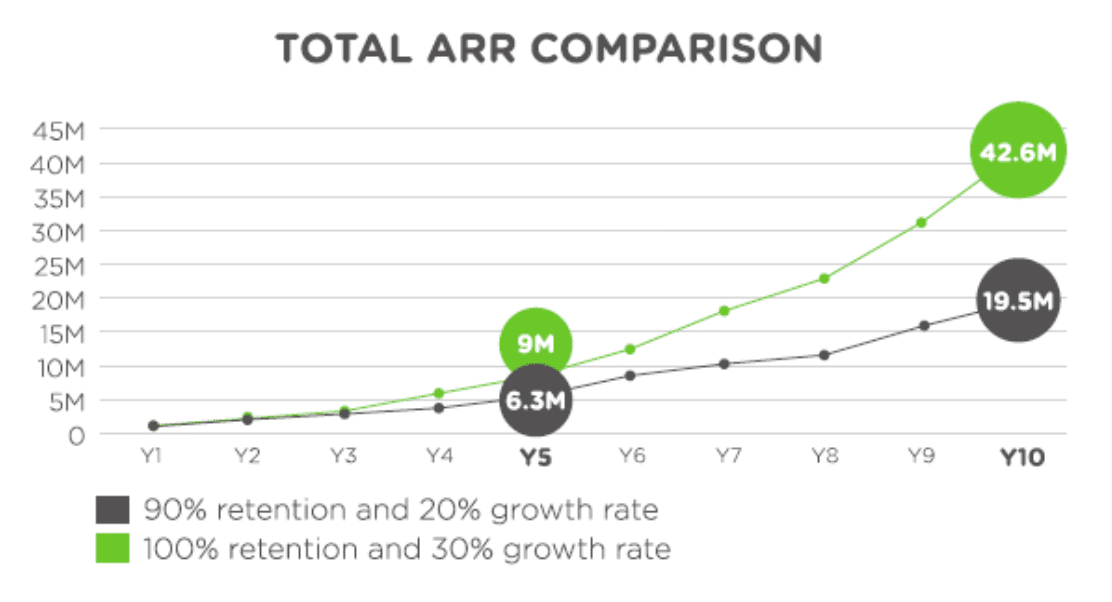
Consider for a moment the two lines in the graph above. Let’s call them “Company Grey” and “Company Green.” With a steady 20 percent growth rate and retaining 90 percent of its customers, Company Grey is doing well. Because it has a customer success team in place, their team feels they have a good strategy for customer retention in combination with a hefty outbound marketing strategy for customer acquisition. Company Grey hits nearly $20 million in ARR over the course of 10 years.

Company Green, on the other hand, retains 100 percent of customers by having an extensive customer success strategy, and by implementing a customer success platform. Though it has a solid marketing strategy, it does less outbound marketing than Company Grey to obtain customers. However, it has a 30 percent growth rate due to inbound referrals from existing customers. Because of this, Company Green reaches more than $40 million in ARR over the same 10 years. And, with double the ARR, should company Grey and Green both be up for acquisition, Company Green could sell for twice what Company Grey would.
Powerful, isn’t it? There’s just no getting around the value of existing customers to which there are two more significant points to be made:
- Existing customers that are loyal and referenceable advocates feed your funnel for new sales, which dramatically affects your total ARR.
- Budget and spend should be adjusted to reflect the value of customer retention over new (logo) acquisition.
So often, sales teams are the rockstars in an organization – known for bringing in shiny new accounts and recognizable customer names. The high visibility of their work gets them continual praise, whereas customer retention and success are far less visible across the organization. But, the influence of existing customers on new customers cannot be undervalued. It isn’t unrealistic to expect that having a strong base of referenceable customers can yield a 10 percent increase in new logo acquisition.
Because of the high value of existing customers, it’s worth reconsidering how you organize your customer acquisition funnel. Outlined in the funnel below, you can see how referrals from existing customers can be a large source of leads for the organization. While customer success managers are not salespeople, they’re clearly responsible (directly or indirectly, depending on your charter) for account growth and referrals.
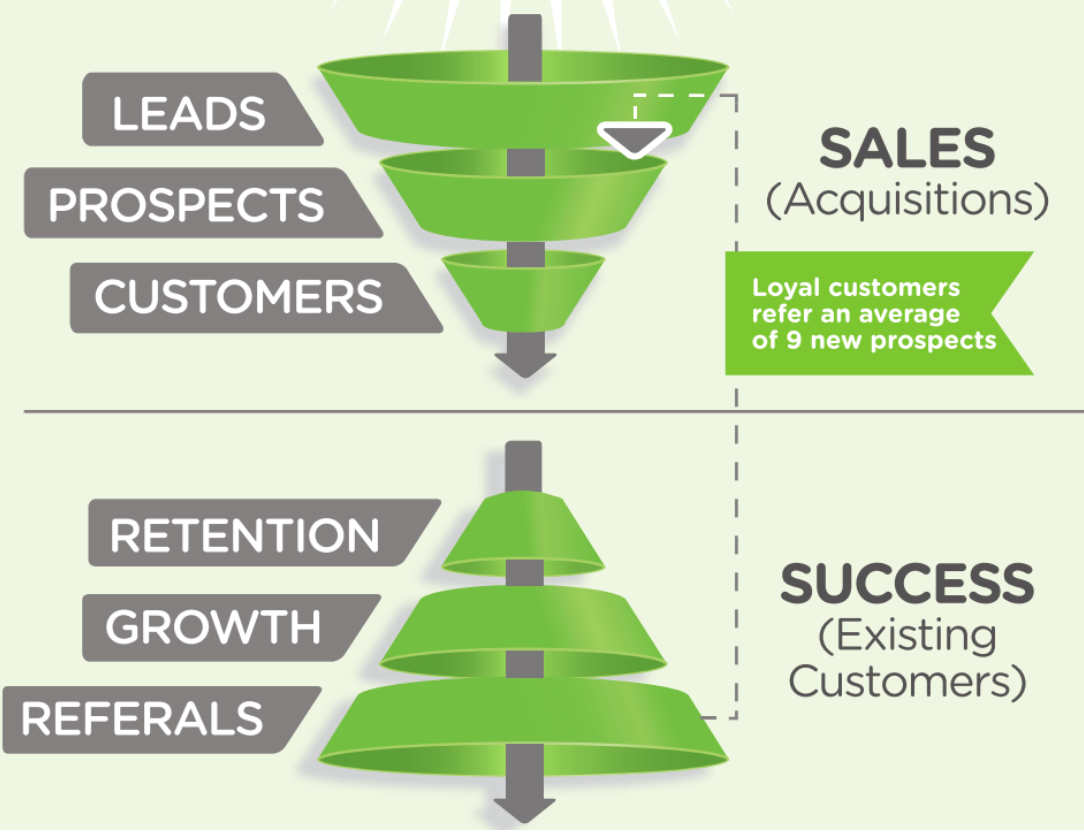
With a new perspective on your customers as a source of leads, the sales cycle must no longer rely on turning cold prospects into warm leads. When you obtain customers by way of referral, they’re already aware of the value you’re providing to another organization. They’re interested in what you have to offer and, by obtaining them as a customer and keeping them happy and successful with your product, the cycle will repeat.
This understanding is foundational to the executive decision to invest in Customer Success. The math is irrefutable and the next steps are pivotal. Take a look at the infographic below which illustrates these claims.

The post How to Get More Out of Your Existing Customers [Infographic] appeared first on OpenView Labs.
3 Tips to Refresh a Lackluster Marketing Strategy

Is your marketing strategy looking a little lackluster or not driving the results you are looking for? While you may not need to scrap your entire marketing strategy, it’s likely time for a refresh. Here are three quick tips to refresh your existing B2B marketing strategy.
Look at the Numbers
Changing any aspect of your marketing strategy should be based on data, not anecdotal evidence. Time and again, we’ve had an anecdotal hypothesis that, when we’ve looked at the metrics, is proven to be wrong. For this very reason, it’s important to look at the analytics for your various marketing campaigns.
Check your Google Analytics to see how visitors are getting to your B2B website and what types of actions they are taking. Are most of your form completions coming from organic traffic? Then it’s likely you should keep blogging and content creation as essential elements of your strategy.
Also, be sure to check the analytics from different platforms, including your email automation platform (MailChimp, ActOn, Marketo, Hubspot, etc.) and social media channels. Take a long-term view (six months to a year) of the engagement on each platform.
- Are subscribers opening and clicking on your content?
- Are they watching videos on your YouTube channel?
- Are they liking or sharing your social media posts?
A long-term look enables you to disqualify singular events or any seasonality.
Ditch What Doesn’t Work
Once you have clear metrics on your various campaigns and platforms, it’s time to make tough decisions and cut what doesn’t provide any ROI. For example:
- Did you run lead-nurturing campaigns that resulted in sub-optimal conversion rates? It might be time to ditch those campaigns in favor of creating personalized content.
- Is a particular social media channel not garnering any traffic to your website or any engagement from followers? It might be time to re-focus on one or two social networks that are providing results.
The only caveat here is to make sure it’s the channel that isn’t working and not the execution before you ditch it. For example, email marketing might be providing some level of success but needs a retooling of the content to generate better results. This can be particularly true if your B2B marketing strategy for that channel hasn’t changed in the past two or more years. It might just be ready for an update.
Fill in the Holes
The last part of the B2B marketing strategy revamp involves adding new campaigns or channels to fill in the holes or get in front of a new audience. For example, if your B2B web design hasn’t been touched in 2 years and it’s acting merely as a virtual business card, you likely need to redesign the website. This is particularly true if you are seeing more and more organic traffic arriving on your site. It’s also a good opportunity to optimize the website for conversions and enable features to streamline your other marketing activities.
It’s a good idea to take a look at what your competition is doing and see where they are clearly beating your firm.
- Do they have a rock star, engaging presence on social media?
- Do they have well-crafted digital ads that are highly visible and compelling?
While we discourage brands from copying their competitors, it’s still crucial to ensure your B2B marketing efforts are getting your brand in front of your ideal audience. It could be that your competition has already figured that out.
How to Succeed at Creating a Sales Cookbook
Dan Stalp talks about how to set sales goals for the new year, and then back into a behavioral plan to achieve them. You will learn what you should measure, how to set realistic goals, and the techniques need to find success in creating a sales cookbook.
Are Salespeople Obsolete?
Are Salespeople Obsolete?
By Richard F. Libin, President, Automotive Profit Builders and author of just released book “Who Knew?”APB.cc, rlibin@apb.cc
We live and breathe technology, 24 hours a day, 7 days a week. We are always on. In fact, there is a diagram circulating on social media showing a dinner table place setting with a designated space for a mobile device. While meant to be humorous, it is reality more often than not. With billions of bytes of data at our fingertips, do customers really need salespeople or are they obsolete?
The answer is yes, but the role of the salesperson has changed. Traditionally, salespeople have always done two things for their customers: communicate information and sell. They believed (and some still do) that if you didn’t get the immediate sale, you would never get it. Today, these two basic functions no longer provide adequate value.
If you are a salesperson who focuses on selling as hard and fast as possible, with a goal of doing business now, then yes, you may be obsolete. As a salesperson, if you believe these two functions make up your job description, then it is time to ask yourself if you have the ability to change.
Today, a salesperson’s job profile can be defined by three simple functions:
- Salespeople are responsible for helping customers find and select the right product or service. To do so, they must...
- Be 100% present and work with a single-minded focus for each customer. The formula for success is simple. When you give 100% attitude, effort and performance in a positive manner, you will get the desired results. If you put your best foot forward you have a better chance of getting what may have been one or two missed opportunities.
- Ask probing questions to develop an understanding of each customer’s unique wants, needs, and desires. It’s not about what you think; it’s about what the customer thinks.
- Listen, learn, and empathize with the customers. Understand problems from their point-of-view and discover small details in order to successfully guide the selection process and find an exact fit.
- Help the customers “try it on.” Throughout the introduction and including a demonstration of the product, if applicable, the salesperson should guide customers as they experience the features that will satisfy their needs, wants, and desires. The salesperson should help customers build an emotional bond and fall in love with their product or service.
- Introduce customers to the rest of the “family,” giving them a tour of the business or store, introducing them to everyone, not just the managers, and explaining that they are there to provide for their total needs. Begin to convert customers to long-term clients.
- Help the customer “fall in love with his choice.” When this happens, price becomes a secondary concern. Financial discussions and negotiations should be the last thing brought up and take the least amount of time in the entire transaction.
For example, in the past, if the customer spends an hour with the salesperson, 10 minutes is spent on selection and 50 minutes on negotiating price. Today, this is a sure-fire formula for disaster. Instead, the salesperson should spend 50 minutes of the hour helping the customer select the right product or service and 10 minutes on price. This approach brings the customer greater satisfaction at the time of the purchase. It delights the customer who will rave about his experience, refer his friends and colleagues, and ultimately become a loyal client. We are not saying that price is not important; however, if a salesperson succeeds in helping a customer find the right selection, then price won’t be a barrier to the sale.
- Convert customers to clients. The salesperson’s job does not stop at the close of the sale, yet most customers never get a call once they leave a store. That call is actually the beginning of a long-term relationship. Why don’t salespeople call? For most, it is fear of rejection or not knowing what to say or how to say it. Follow up calls are essential and can be successful if the following steps are used.
- Have a purpose. Understand the outcome you want from the call. Do you want a referral or additional sales, or to cement a relationship with the client?
- Know what you want say and plan the gist of the conversation. Write it out.
- Be prepared for the customer to lead you down another path. Know how to bridge back to your original plan.
Make the follow-up a continuation of the positive purchasing experience. Start a conversation that gets customers excited about their purchase all over again. This may lead to a referral for a friend who might be looking to do business with you.
So how do you start learning to sell all over again in our information-rich world? Start with this essential first step. Every day when you get out of bed, and several times during the day, say to yourself, “My job is not to sell, but to help my customers find the exact product or service that meets their needs, and in doing so, to make sure their experience is positive.” Adopt the right attitude every single day. Make this your mantra; say it, repeat it, and believe it. Only when you embrace this idea, can you continue your journey of continuous learning that is required to face a world of continuous change in the new world of sales.
Richard F. Libin has written two acclaimed books that help people of all walks of life improve their sales skills, because as he says, “Everyone is a selling something.” His most recent book, Who Knew?, and his first book, “Who Stopped the Sale?” (www.whostoppedthesale.com), is now in its second edition. As president of APB-Automotive Profit Builders, Inc., a firm with more than 49 years experience working with both sales and service professionals, he helps his clientele, through personnel development and technology, to build customer satisfaction and maximize gross profits in their businesses. Mr. Libin can be reached at rlibin@apb.cc or 508-626-9200 or www.apb.cc.
100 Best Questions That Will Guide Your Social Media Resolutions

Don’t know exactly what resolutions you should have for your social media for 2018? Here are a few questions to help you develop your social media resolutions. There are 10 sections: Audience, Identify Your Why, Engagement, Content Creation, Platforms, Video, Images/Infographics, Keywords and Hashtags, Measurement, and Personal Accounts.


Audience
There’s a reason audience is at the top of this list! When you’re talking to someone, you need to know what is important to that person, and what their pain points are. If you have no idea who your audience is, here you go: 10 Free Tools to Help You Understand Your Social Media Audience. And here: Using Surveys to Define Your Target Audience.
Who is your audience? (And please don’t say everyone!)
What is the lifestyle of your audience? In other words, what do they do when they’re not buying your product or service?
How will you build a better target persona?
What type of language does your target audience use?
What will you do to better target your audience this year?
Where do you think your audience likes to hang out?
Do you hang out the same place your audience hangs out?
If you don’t hang out where your audience is, why not?
What is the best time or the best times to post for your audience?
Where in the world does most of your audience live? Yes, brick-and-mortars will have a more local audience, of course.

Identify Your Why
Social media isn’t a magic bullet. Social media is very good for branding and recognition, but it probably can’t replace all your forms of marketing. You’ll still want to meet some people in person, go to meet ups, or do other forms of marketing. So if you’re looking for sales, realize that social media does help to generate sales, but usually not immediately.
Why are you using social media? Fun? Business? Branding? The more specific, the better!
Will you use social media to build your business?
Will you meet some of your social media followers in person?
How have businesses similar to yours leveraged social media?
What expectations do you have of your social media?
Would you like to find collaborators with social media?
Do you have power partners? Would you like more power partners?
What are your top three reasons for using social media?
Looking back at your strategy for last year, have your reasons to use social media changed?
How will you decide if you’ve been successful on social media?

Engagement
When I co-teach with Alyson Harrold (at UC Berkeley Extension, the students want to know how to engage on social media more than anything else. So I wrote this to help them (and maybe you): How to Engage on Social Media the Complete Guide. And I really like Coschedule, so here’s their 30 Social Media Engagement Tactics That Will Boost Shares And Conversions.
On a scale of 1-10, how much will you focus on engagement this year?
If your engagement was low last year, how will you create more engagement?
Are there any hashtags you could use to create more engagement?
Which hashtags will you use to increase your followers and engagement?
Do you repost from those who follow you?
Do you use the 80/20 rule (80% other people’s content/20% your own content)?
Will you thank people for sharing your posts in order to create more engagement?
Will you tag the people you write about in your posts to help increase engagement?
Will you participate in TweetChats to help your engagement on Twitter?
Could you use a Facebook group to increase your engagement on Facebook?

Content Creation
Content creation has become more important than ever. And if you don’t believe me, how about this post from SalesHub: Why Content Strategy is Important? I look at the blog as the torso, or body, of your efforts, with all the social media platforms as the arms and legs of your strategy.
Will you be starting a blog this year?
If so, what will you use (WordPress, etc.)?
Will you create a content calendar?
How often will you post?
How long will the posts be?
How many images, if any, will each post have?
Will you have a newsletter?
What will you use to create your newsletter (Mailchimp, etc.)?
How will you get signups for your newsletter?
Will you count posts, tweets, and comments on others’ posts and blogs as part of your content?

Platforms
By platforms, I mean Twitter, Facebook, Instagram, LinkedIn, etc. If you don’t know yet, this might help: Ten Simple Ways to Choose the Best Social Media Platform. The Huffington Post identifies seven best social media channels for business (#7 might surprise you! And no, that’s not clickbait!).
Which social media platforms do you want to be on?
Will you squat on a social media name until you have the time to be there full-time?
How do you propose starting out a new platform?
Which new platforms would you like to research?
Are there any platforms that you definitely don’t want to use?
Which is your favorite social media platform? Why not start there?
Which social platforms will you use less of or spend less time on this year?
Why will you use that/those platforms less?
Which top sites will you focus on this year?
How will you measure your efforts (if at all)?

Video
Why should you use video in your social media? Forbes has a nifty article: Why You Need to Know about Social Video Marketing in 2017. Yes, video is an up-and-coming item to add to the mix.
Will you add video to the mix this year?
If you choose to add video, will you produce it yourself?
What tools will you use to produce your video?
Will you use YouTube this year? Vimeo?
Do you have your own YouTube channel? My friends Chef Ivan Flowers and his wife, Tracy, and now-famous pooch Pickle have a great YouTube channel (go subscribe!).
Will you create unique video on Instagram? Facebook? Twitter?
Will you make money with ads from your YouTube videos?
How will you brand your channel?
How will you create unique calls-to-action?
How will you discover keywords to add to each video?

Images/Infographics
Social media posts have become more and more image-centric. So what’s your game plan for including images in your posts and blog articles? Here’s a good article article from Jeff Bulas: 6 Powerful Reasons Why You Should Include Images in Your Marketing (check out the infographic, too!).
Where will you find images for your social media posts?
Will you be using free images, or will you pay for images?
How many images will you create yourself?
Will you use your own photographs for your social media?
How will you give credit to those who provide images for your posts?
Will you use infographics in your social media mix?
How will you produce great quality infographics?
Will you create your own infographics?
Which social platforms will you use to showcase your images?
Will you use any interactive images? How about gifs?

Keywords and Hashtags
Keywords and hashtags have become more and more important. Keywords help your articles and post get picked up by Google. Hashtags also allow your posts to be seen by Google (thanks for this tip, Robert Nissenbaum!).
Are there keywords that you use regularly or that you’re trying to dominate?
Are keywords part of your strategy yet?
When you tag your blog posts, are there certain tags that you use over and over?
Will you continue to use the same keywords?
Do you need to research hashtags more before you use them more regularly?
Will you start using hashtags over the next year?
Do you have favorite hashtags that you use all the time?
On which platforms will you use hashtags?
Do you prefer local hashtags or more generic ones for your Instagram posts?
Do you have a way to store and then reuse your hashtags?

Measurement
Measurement of your social media efforts can be a tricky thing. You can use branded links, and you can always ask people how they found you, but often social media is one of many marketing “touches.” And people don’t always remember how they found you.
Will you measure your efforts on social media?
If you have a simple measurement system, what is it?
Are there certain items that you won’t measure?
Will you use a branded hashtag to see how far your posts have traveled?
How about branded links? Will you use those?
Do you need help figuring out what to measure?
If you measured your efforts last year, how will this year be different?
How often will you check your analytics?
Will you use Google analytics?
Or will you use each platform’s analytics to measure your success?

Personal Accounts
Some business owners would prefer not to have any presence on social media at all. Many would like to avoid it altogether! Are you one of them? Some would prefer to have one account, rather than separate personal and business accounts (I don’t recommend this approach.)
How much will you post on your personal social media platforms?
Do you plan to post at all on your personal platforms?
Will you post more or less on each platform compared to last year?
How will you guarantee that you unplug or stop surfing the net?
Will your personal accounts be in alignment with your business accounts?
Are there any topics you will avoid posting about?
Will you stop following people/pages who make you unhappy?
Will you focus on vanity metric, such as numbers of followers this year? Or not?
How do you use social media personally, and will that change this year?
How does social media affect your personal life, if at all?
5 Ways to Use 280-Character Tweets To Drive Engagement
Though the world of social media marketing is ever-changing, no other social network has rewritten the rulebook on brand engagement quite like Twitter. By enabling companies to have a direct line of communication with their followers, Twitter has provided the ideal medium for perfecting your “brand voice” and learning about consumers’ interests in real-time.
Since its 2006 debut, Twitter was set apart by a 140 character limit — originally a product of the days of SMS messaging. While once a mainstay of the platform, in November of 2017 the company updated this feature, allowing users 280 characters to broadcast their thoughts.
After once forcing marketers to pare down their messaging, Twitter is once again changing the way brands communicate. If you’re unsure what to do with your newfound space, read on to see how the biggest brands are capitalizing on the change.
1. Participating in Trends
Netflix shows that would be significantly improved if the main characters had to battle a #JurassicWorld exploding island:
The Crown
Stranger Things
Bojack Horseman
Gilmore Girls
John Mulaney: The Comeback Kid
A Christmas Prince— Netflix US (@netflix) December 8, 2017
A leader in the household entertainment space, Netflix has amassed a following of over four million movie enthusiasts. Though Jurassic World isn’t on the lineup of Netflix’s original content, their marketing team didn’t let that stop them from jumping on a trending hashtag and seamlessly integrating it with a promotion of their own programs.
The expanded character limit makes it possible for brands to market their content offerings in ways that don’t feel like ads, so they are able to appeal to their followers without directly selling to them.
2. Spreading Knowledge
Mars may be named for the god of war, but these weird things aren't cannonballs. They're pebbles.
The round 5mm concretion I found (L) contains calcium sulfate, sodium + magnesium, making it different from the hematite-rich "blueberries" (R) @MarsRovers Opportunity found. Cool! pic.twitter.com/BDWwrOv02l
— Curiosity Rover (@MarsCuriosity) December 5, 2017
The Curiosity Rover wasn’t just groundbreaking in its mission — it also quickly captured the heart of 3.5 million followers with its extra-terrestrial selfies. With the doubling of the character limit, the Rover’s updates have become more informative and educational, rekindling the public’s fascination with space travel.
Even if a brand is not attempting scientific explanations, the ability to convey long-form information is a useful tool. Companies are now able to explain industry terms or lingo, allowing brands to seamlessly step into a thought-leadership role and take an informative tone with their followers.
3. Formatted Promotions
Dogs everywhere LOVE our book!
It’s got:
•some of our all time greatest posts
•150+ never before seen pups
•a dogtionary in the backGet it in stores or right here:https://t.co/hTtoGptZHg pic.twitter.com/y2wyvOZG6W
— WeRateDogs
(@dog_rates) December 3, 2017
A result of strict character limits, tweets including a call to action or product feature were once synonymous with poor grammar and messy abbreviations. Without sufficient space, brands were unable to convey the value of what they were promoting — a digital marketer’s nightmare. With the introduction of 280 characters, brands are able to feature products using organized posts, allowing them to drive engagement while still maintaining brand standards.
4. Embellishing Timelines
. * .
*
* . .*
. *
Thanks @Twitter, we can
always use more space
. . .
. * *— NASA Goddard (@NASAGoddard) November 8, 2017

Originally launched only to select users, the expansion to 280 characters for all was a highly-anticipated event. Companies capitalized on the news by announcing the moment their accounts got upgraded, resulting in a stream of near-identical tweets from many major brands. NASA stood out from the crowd with their on-theme quip, adding visual interest to their followers’ timelines and setting an example for creative emoji-use by marketers everywhere.
Working emojis into a post is not foreign territory for marketers, but the possibilities have certainly expanded. Using visual interest is a great way to make posts stand out from a sea of text, and creative content is often the most shared. While NASA used emojis inspired by the solar system, the expansive emoji catalogue should allow for any brand to find something related to their message.
5. Team Engagement
Bruce Bochy's 2018 Staff:
Hensley Meulens – Bench Coach
Curt Young – Pitching Coach
Alonzo Powell – Hitting Coach
Ron Wotus – 3rd Base Coach@Agui13Jose – 1st Base Coach
Matt Herges – Bullpen Coach
Rick Schu – Assistant Hitting Coach
Shawon Dunston – ML Staff/Replay Analyst— San Francisco Giants (@SFGiants) November 9, 2017
The world of sports has benefited tremendously from the ability to convey real-time information, and teams now share everything from play-by-plays to major press releases via Twitter. Where they once would have implored followers to click an external link to get this update, the San Francisco Giants allow their followers to see and discuss the updated coaching staff without ever changing screens. Getting more information into the hands of the fans allows for increased engagement, even in the offseason.
Social media has revolutionized the marketing industry by changing the definition of what it means to connect with consumers. When the platforms marketers rely on make a major change, teams are given new opportunities to innovate and improve their strategy — leading to more creativity for all.
What are some of the creative ways you’ve seen brands using 280-character tweets? Let us know in the comments.
The 8 Worst Ways to Introduce Yourself Over Email
How to Make a Bad First Impression Over Email
- Use a boring or misleading subject line
- Tell them how lucky they are to speak to you
- Remind them you're a stranger
- Refer to vague connections
- Take your time getting to the point
- Say their name execessively
- Sound desperate
- Never veer from the template
Do you start every day wondering how to make a bad first impression on your prospects? Of course you don’t. But when you’ve used the same email templates and “best practices” for a while, you might not notice your introduction is turning prospects off.
It’s a small piece of your outreach strategy but one of the most important. Your introduction is the best time to set yourself apart from the competition and offer immediate value to your prospect.
So, take a few minutes and make your email introductions shine. To help, I’ve pulled together eight ways not to introduce yourself over email, along with a few suggestions on what to say instead.
8 Ways to Make a Wildly Negative Impression Over Email
1. Start with a boring or misleading subject line
Don't do this: Want to turn your prospects off before they know who you are or what you do? Use subject lines like “Just following up,” “Referral from [mutual connection],” or simply “Meeting Request.”
Really want to throw them for a loop? Send them a, “Re: [title of last email you sent],” even if they never replied the first time. Because, you know what they say, “If at first they don’t open your email, keep sending 'em until they do.”
Source: GIPHY
Try this instead: Breathe life into your prospect’s inbox with subject lines that pique their interest and make them laugh. Ask questions like, “Can I help you leave the office 10 minutes earlier?” or “Are you working towards a promotion?” that provide a benefit to the audience. If you’re local hook them with “Happy hour on me?”
These subject lines can still be templated, but they’re more interesting and make a better first impression.
2. Tell them it’s their lucky day
Don't do this: By all means, tell your prospect how grateful they should be that you’ve waltzed into their inbox. Oh, and once you’ve introduced yourself and explained at length what your company does, make the rest of the conversation all about you, your clients, and your company -- and how much your prospect stands to benefit from your service (if they’re smart, of course).
Source: GIPHY
Try this instead: Instead of making prospects Google, “How to delete an email faster than humanly possible,” acknowledge your prospect’s busy schedule and thank them for hearing you out.
Use phrases like, “You’ve done a great job growing [insert team, company, or initiative],” “I’d love to learn more about how you got there,” and “I’ve helped companies with similar accomplishments grow in X ways.”
By focusing on your prospect’s accomplishments instead of your own, and asking to learn more about their successes, you’ve made the conversation about them. And everyone is more interested in participating in conversations about themselves.
3. Remind them how much of a stranger you are
Don't do this: Opening emails from people you’ve never met is enough of a minefield. Don't be the salesperson who rewards those intrepid enough to click through by reminding them they're a stranger who scraped the underworld of the internet to find a second- or third-degree connection in common.
Phrases like, “I know we haven’t met,” “Congratulations on the recent promotion,” or “I noticed you like skiing in your free time,” point out the artificial nature of your outreach and do nothing to advance the conversation or sale.
Source: GIPHY
Try this instead: Lead with publicly shared information. For example, if your prospect’s a social media marketer whose company has just been acquired, say, “I read about your company’s recent acquisition by XYZ Corporation. Congratulations! I’d love to learn how that’s shifting priorities/pain points for your paid social team.”
Then say, “Usually when companies like yours are acquired, goals, messaging, and measurements are realigned. I’ve helped a few similar companies move past those challenges …”
It doesn’t matter whether you’ve met before, because you haven’t used obscure personal information to build a fake connection. Instead, you’ve immediately presented authentic value to your listener.
4. Throw a vague third-degree connection under the bus
Don't do this: You know the kind. They go something like, “Hello Dan. I noticed we both have second cousins who went to the Metropolitan Community College of Pawhuska 15 years ago,” or "I saw we both use the same tax accountant and thought you might be interested in ..." These are not connections, these are desperation incarnate.
Source: GIPHY
Try this instead: If you really have a referral or close connection, ask that person to introduce you to your prospect over email. If your connection is someone you met at a happy hour three years ago, try an approach like we've discussed in the points above.
Forget about using the weak “mutual acquaintance” in favor of sharing the benefits you can bring to your prospect’s business.
5. Wait until paragraph three to tell them why you’re reaching out
Don't do this: Your prospect doesn’t need a two-paragraph history of your company, and they don’t really need to know your name or what you do. They can Google your company and find your name and job title in the email signature.
Source: GIPHY
Try this instead: Don't tell them what your company does, explain how your company can help. For example, say, “I’m also a member of the Tulsa SaaS Engineers group on LinkedIn and I noticed your comment about struggling to recruit product engineers in the area. I know that’s a challenge for many Tulsa tech companies, and I’ve helped several of them increase their applicant pool 25%.”
You’ve gotten straight to the point and made the conversation interesting for your prospect. You’ve also introduced how your company can help and who you are in a much more relevant way.
6. Say their name again, and again, and again
Don't do this: “You know, Elena, I really admired your recent blog article on marketing tools. Elena, what if I told you I have one tool to rule them all? It’s true, Elena …” Do you feel like reaching through your computer and slapping me in the face? That makes two of us.
Source: GIPHY
Try this instead: When in doubt, speak conversationally. Repeating your prospect’s name will only remind them they’re reading an email from a salesperson. Use their name as pepper, not salt -- and sparingly refer to it throughout the conversation. You've only got one chance to make a first impression, make sure it's not a sleazy one.
7. Sound desperate and mildly threatening
Don't do this: If your pipeline is in such rough shape that even your introductory email sounds desperate it might be time to rethink your approach to selling. Phrases like, “I don’t want you to miss out on such a great offer,” or “Smart HR managers like yourself are already using this product,” are insulting and presumptive.
Source: GIPHY
Try this instead: These are bold assumptions to make before you’ve even spoken with someone over the phone. They also imply your prospect is somehow lesser without your all-powerful solution, and that’s not the impression you want to give. You want to be an aid to the already great work they’re doing.
Once you’ve explained how you can help, say, “If this sounds like something you'd be interested in, feel free to grab time on my calendar here,” and include a link to your meetings tool.
Or say, “I’ll follow up by phone tomorrow to answer any lingering questions you might have.” This reminds your prospect they’re in charge of the situation and avoids belittling the work they’ve done successfully without your product/service.
8. Never veer from your template
Don't do this: We all recognize a stale email template when we see one. It tells us the salesperson doesn’t really care about our pain points, goals, or business. They care about a number -- that’s it.
Source: GIPHY
Try this instead: Templates are a crucial part of a salesperson’s workflow. You can’t conduct the volume of outreach you need without them. But that doesn’t mean you should sound like a robot (or trendy Droid).
Instead of simply swapping in a prospect’s name and job title, create different email templates for specific outreach use cases. And vary more than just the basic details. Here’s an example of a droid-like email template:
Hi [Name],
I really enjoy your blog. I’m reaching out because I’ve helped businesses like yours increase blog traffic by 35% in as little as two months, and I think I could do the same for you.
I’d love to tell you more about how [company name] can help. If this sounds like something you’d be interested in, please let me know.
Regards,
[Your name]

It’s vague, impersonal, and forgettable. Here’s an example of a template that’s been varied a bit more:
Hi [Name],
I read your recent blog, [insert blog title], and was totally hooked. I especially liked your line about [insert relevant line]. I’ve been a fan of your blog for a while. It’s such a great resource for [industry type].
I’ve actually helped several companies like [company name] increase blog traffic by 35% in as few as eight weeks. They’re similar to you in [list 2-3 ways your clients are like this prospect], so I think you could achieve similar results.
If you’re interested in learning more, grab some time on my calendar here: [link to meetings tool]. Thanks for your time.
Regards,
[Your name]
This template is reusable for other blogging prospects and detailed enough you can make each email authentic and personalized. Which one would you rather receive?
All kidding -- and GIFs -- aside, salespeople want and need to send emails prospects open, read, and respond to. You can’t do that with old templates or sleep-inducing subject lines.
At least once a quarter, take a few minutes to review your email introductions and try a new approach. You might be surprised at what a small tweak can do.


Why the Rewards for Ambitious Problem Solving Are About to Get Bigger

A decade ago, Microsoft was considered a dinosaur. It had missed the shift to mobile, was out of step with consumer tastes, and seemed too big and slow to adapt to a digital world that was moving at hyperspeed. Yet today the company is thriving again, largely driven by its growing cloud business.
This is not a new effort. In fact, it began in the early 2000s, but was little noticed until recently. In much the same way, IBM’s Watson project, which is helping the venerable company overcome the disruption of its traditional business, began in 2005. Google has created its own moonshot factory, to pursue game-changing technologies that may take years to pay off.
In recent years, we’ve come to associate the practice of innovation with speed and agility, but accomplishments that truly move the needle can’t be achieved quickly or through mere iteration. We need to set our sights higher.
Why We Need to Think Bigger
One reason for the emphasis on agility and iteration in recent decades is that technology has been fairly stable. Every new generation of computer chips has offered more power and capability but works exactly like earlier generations. In much the same way, advancements in lithium-ion batteries meant that our devices could shrink, but little else had to change. Today, though, those comfortable old paradigms are running out of steam. Moore’s law will soon end, and lithium-ion batteries will approach theoretical limits in five to 10 years. These will be replaced with technologies that aren’t nearly as well understood. Other nascent fields, like genomics, nanotechnology, and robotics, require highly skilled specialists to advance them.
In the coming years we are likely to see a new era of innovation that will look more like the 1950s and 1960s (which were about solving fundamental problems, like space flight and the development of mainframe computers) than it will the 1990s or 2000s (which were more about improving on earlier technology to create applications). In the next few decades, I predict, much of innovation’s value will shift away from applications and back to fundamental problems. That will require greater focus on sustaining efforts to solve grand challenges.
Defining a Grand Challenge
A grand challenge can take many forms. IBM is one company that has a long history of pursuing grand challenges, such as the Deep Blue project, which defeated former world champion Garry Kasparov at chess, and the Blue Gene project, which created a new class of “massively parallel” supercomputers. The most recent was the Grand Challenge for Jeopardy!, which led to the development of its current Watson business.
“A successful grand challenge is one that people, even experts in the field, regard as an epiphany and changes assumptions about what’s possible,” Bernard Meyerson, IBM’s chief innovation officer, told me. “The commercial value comes in applying those new possibilities to business problems.”
Others might define it differently. For example, take Talia Milgrom-Elcott, executive director of 100Kin10, a nonprofit that is spearheading the effort to train 100,000 STEM teachers in 10 years. She told me, “For us in the social sphere, a grand challenge is a collective effort to get at root causes. We’re not only looking for a solution to a problem, but a permanent impact on everyday reality.”
She says they find these root causes through a series of questions: “Keep asking why, and you start to see connections that lead to root causes that have enormous leverage, and that’s where you need to focus your efforts.”
Ron DePinho, who as president of MD Anderson Cancer Center launched its Moon Shots program, sees grand challenges “as grand opportunities to deliver a population-level impact that requires the discovery and application of new knowledge, and therefore a cross-sector, multidisciplinary effort.”
Lots of Upside, Limited Downside
Whatever form a grand challenge takes, it is an effort to pull an organization out of a purely operational mode and create something truly new. That is the both the promise and the peril of any truly ambitious effort, because critics often object to diverting resources from more-pressing needs. Skeptics worry that scientists will spend a lot of time developing solutions that have no definable time horizon or specific application in mind.
However, DePinho points out that, over the long haul, grand challenges tend to make good economic sense. “We actually learned that there tends to be so much spinout from a major collective effort that the end result tends to be an increase of effective resources,” he says, because it propels many other efforts forward.
He points to The Cancer Genome Atlas, which sequenced over 10,000 tumor genomes across 33 types of cancer, as an example. As a first-of-its-kind effort, it created a new “periodic table” for cancer research and shifted the field in new directions. It also helped give rise to a similar effort, the Materials Genome Initiative, which hopes to make a comparable impact in manufacturing.
For established organizations, grand challenges can also represent managed risk. IBM’s Meyerson points out that projects like Deep Blue, Blue Gene, and Watson differ significantly from his company’s development of the 360 mainframe back in the 1960s, which cost $5 billion (about $40 billion in today’s dollars) and could have meant the end of IBM if it failed.
“Grand challenges are not about the amount of money you throw at the problem,” he says. “To run a successful grand challenge program, failure should not be a material risk to the company, but success will have a monumental impact. That’s what makes grand challenges an asymmetric opportunity.”
Meyerson also points out that today’s technology makes the pursuit of ambitious projects far more accessible to smaller organizations: “In the current environment of cloud computing, software as a service, and open data, the opportunities for organizations of any size to pursue grand challenges with minimal capital expenditures is unprecedented.”
No matter what form innovation takes — short, agile sprints or long-term, grand-challenge investments — innovation is fundamentally about solving problems. And the bigger the problems you choose to tackle, the larger the potential payoff. Pursuing a grand challenge won’t improve your results next quarter, but it might just take your enterprise to a whole new level.
'This is quickly becoming meaningful': Magazine giant Hearst is going all in on Amazon's Alexa (AMZN)

- Hearst says it is seeing quick user adoption of content created for voice-enabled devices like Amazon's Echo.
- The magazine giant is already making money from its beauty-focused "My Beauty Chat" and is planning to develop voice content across its suite of publications.
- Voice tech and Amazon are surely key topics of interests for marketers and media executives attending CES this week.
If 2018 is the year of voice, Hearst wants to be on the tip of everybody's tongue.
After experimenting with voice content on both Amazon's Alexa platform and Google Home, the magazine stalwart is planning to significantly ramp up voice output this year across its various titles – particularly on Amazon.
To date, Hearst has rolled out voice content (Amazon calls these offerings 'skills') such as daily horoscope readings from Elle magazine as well as regular quotes of inspiration from Oprah magazine, voiced by none other than Winfrey herself.
And in November, Hearst unveiled My Beauty Chat, a new Alexa skill that consists of a twice-a-day mini podcast. My Beauty Chat is essentially a born-on-Alexa brand featuring editors from multiple Hearst titles, including Good Housekeeping, Cosmopolitan, Oprah and Elle, talking beauty for five to ten minutes a session.
Consumers are gravitating to My Beauty Chat and other skills so quickly, that Hearst plans on making Alexa a priority across the company, according to Chris Papaleo, executive director, emerging tech at Hearst. The hope is to build out a set of skills ahead of other media companies, said Papaleo, while also nabbing key voice real estate and creating hard-to-break consumer habits.
"This is quickly becoming meaningful," said Papaleo. "Yet the main challenge for media companies on these devices is content discovery. The ones we see that happening with are those designed to be daily habits. And they answer organic questions."
Hence, it's made more sense to build a generic voice publication that can serve as an answer to anybody asking Alexa about beauty tips rather that pushing a particular magazine brand. "The roads to content are still getting paved on voice interfaces," he said.
Hearst sees big value in being early on voice. And it's already making money with Amazon
Papaleo’s innovation team has the advantage of operating independently from any single Hearst publication. So he gets to experiment with emerging platforms like virtual reality and connected devices first, without having the pressure to attract big audiences or make money right away.
 But based on the company’s experience on Amazon’s Alexa, not to mention the way that consumers have taken to voice devices, it’s time to double down.
For instance, the Elle Horoscope skill generated 4 million ‘utterances’ overall in 2017 (any time someone says something tied to a skill, that’s an utterance, according to Amazon). Activity ramped up over the last two months of the year, suggesting that interactions will reach double the digit million-level shortly.
Plus, while Amazon doesn't sell paid voice ads for Alexa – and the company says it has no plans to - Hearst has already landed L'Oreal as a sponsor for My Beauty Chat. That's something Papaleo sees as easily repeatable with other skills.
"We see enough positive here, that we think the rest of the company needs to get up skilled," he said. "So it's a 2018 priority for Hearst to use Alexa to acquire customers, retain users, making money on it."
To be sure, Hearst isn't just building on Amazon. Elle's horoscopes are also available on Google voice devices, as is service content from Esquire. But Amazon is further ahead than Google on helping publishers make money, he said.
Hearst believes it's out in front of other media companies when it comes to voice. But it's not alone. The New York Times, Comedy Central's "The Daily Show" and People magazine have all launched Alexa skills.
The voice device category is already becoming mainstream
And given the fact that voice devices have sold faster than many anticipated, many media companies are likely to accelerate their voice plans. Papaleo cited research that by 2020 there will likely be 130 million voice devices on the market. Indeed, Amazon said the Echo was its top selling item during the just-completed holiday season.
"We're seeing people buy them for multiple rooms in the house, so we're building already things for the kitchen, the living room and even the bathroom," he said. "It's already a mainstream thing."
Given that reality, figuring out how voice fits into broader marketing is surely to be a key discussion point at the Consumer Electronics Show, which kicks off this week in Las Vegas.
Doug Rozen, chief digital and innovation officer at the media buying firm OMD, said that heading into CES this year, two topics were of top of mind for nearly all big marketers in attendance: voice, and Amazon.
"We are already seeing that voice is becoming the best way for people to interact with their mobile devices. If last year was about experimenting in voice, this is the year we're talking about developing a real voice strategy," he said. "And they're all looking now at Amazon not just as a commerce company but as a media company."
Join the conversation about this story »
NOW WATCH: How Area 51 became the center of alien conspiracy theories
You Are Not a Machine
Last week a picture of robots standing in front of computers wearing telephone headsets crossed my social feed. The point is that sales is being automated, and a machine will soon do your job better than you.
Another article suggested that B2B salespeople would soon be gone unless they became social sellers and engaged with buyers in the way that they prefer (apparently buyers are holding out hope that the salespeople that call on them will first communicate with them on Twitter or LinkedIn).
If your LinkedIn feed is anything like mine, you are inundated with new, technological solutions designed to improve sales. You’ll also see no end of technology companies that want nothing more than to eliminate human beings from their business, believing that every sale is a transaction and that buyers prefer not to speak with a human in all cases. Some of these companies sincerely believe that there is no need for a human to human interaction.
All of this is to say that you are not a machine, and neither are the people who you serve. What you are is very hard to replicate with technology. Technology provides efficiency, but in human relationships, efficiency is not the goal. Effectiveness is the goal.
It is easy to believe that when people have questions they want answers. But is it true that answers alone are what is necessary to have an effective interaction, maybe one that ends in a sale? Could it be that the question is really being asked because the person asking needs greater reassurance, isn’t sure what the right decisions is, and is trying to discern whether they can trust the person they’re buying from? Could communication carry more than the answer to the question?
How do you feel about Alexa? How about Siri? Do you think about them when they are not around? Do they think about you? Do you believe that they are concerned for your well-being? Would an automated response change how you feel about your relationship with these still-primitive attempts at Turing’s test, a computer that feels human? If you were fooled, would that be enough to change the nature of your relationship with a microchip?
We are human, and we are going to remain so for a long time. Augmentation and automation are coming, but the deep human stuff isn’t going to change any time soon—if it ever changes at all.
The post You Are Not a Machine appeared first on The Sales Blog.
How to sell services like a sales pro

When you’re running a services business, it’s easy to set yourself up for failure. Unscalable sales processes, unsustainable pricing models, and bad contracts can all spell doom for the future of your company.
Before we made the transition to software, we were a services startup called Elastic Sales. We offered a sales team on-demand to venture-backed, B2B startups in Silicon Valley. We’d design predictable and scalable sales processes for these companies, and provide trained salespeople to sell their products and services.
We gained some early traction and landed a bunch of customers, but we didn’t actually have a sales process that fit our own services businesses. We weren’t built for success. So we took a step back and re-evaluated our entire sales process.
And in doing so, we went from $40K MRR to $130K MRR in just two months.
Develop your own successful sales strategy with this easy-to-use sales strategy template!
How’d we do it?
In the early days of Elastic Sales, our pricing model was completely out of whack. To keep things simple, we let companies rent salespeople on a monthly basis—no contracts, no trial periods.
After some time, we realized that we’d need to build out a commission component to our model. For one thing, our customers wanted to tie our performance to what they actually paid us. But we also understood that we’d make more money if we implemented a commission structure, too. We just didn’t know what that structure would look like.
So we designed a solution that we thought worked best for everyone. Customers would pay a fixed cost (per sales rep) for the first two months. After that, we’d design a commission structure on top of—or in lieu of—that fixed cost. As you can imagine, most of our customers were pretty cool with this plan.
Unfortunately, we encountered a few problems
With such a flexible pricing model, there was absolutely zero predictability. We’d never know how many customers we’d have next month, and we’d never know how much revenue we were going to generate. As a result, we had no clue how many salespeople to hire.
What happened next is pretty typical for many services businesses:
We’d go out and close a bunch of deals, and then panic because we had no salespeople to sell products and services for our new clients. So we’d hire more salespeople, onboard them, figure out a sales process, sell effectively for a while, and then another customer would cancel—or a few employees would leave—and we’d have to go out and scramble for customers and salespeople all over again.
Sound familiar?
When you’re constantly in stop-and-go mode, it’s impossible to build momentum. And it eventually drives you, your employees, and your customers crazy.
So how did we fix the problem?
We stepped back and, for the first time since we started Elastic Sales, identified flaws in our sales process. We’d been so busy taking on clients that we never stopped to consider whether we were set up for success.
That re-evaluation resulted in a few basic insights:
We created way more value than we were charging for
In the first couple months of new customer relationships, we did more than generate revenue through product or service sales. Many times, we had to run experiments to determine the right sales process for each customer. We’d test cold email templates, demos, phone scripts, and more, just to find a process that worked best for that particular customer.
Most of these customers didn’t come onboard with perfect sales models. That’s why they’d hired us in the first place. Not only did they need our sales team, they also needed the insights we gathered before we even started selling for them.
In short, we ended up doing a bunch of extra work for free.
We needed a pilot period
The insights we generated for customers were incredibly valuable. So we decided to frame a service offering around those insights. During the pilot period, our main product wouldn’t be a sales team on-demand—it’d be a report.
That report would include the experiments we ran, the data we collected, the insights we gathered, and the recommendations we had for what to do next—how to change your product, tweak your sales model, scale your sales team, etc.
Customers could then implement our recommendations themselves, or hire us to execute those plans for them. We’d hire the salespeople and develop the sales process based on the model we put together in that report.
We needed to create more predictability
Most prospects assume they can get started at any time, especially when they’re dealing with a services business.
But in order to create more predictability—so we could manage our cash flow and resources—we rejected the idea of onboarding customers the minute they signed up.
Instead, we told them that the earliest they could start was three months from when we closed the deal. We’d say, “Here’s the thing. We take on a limited number of clients each month, and the next two months are fully booked. The soonest we can start is three months from now, and we only have two spots left.”
Those two spots were first come, first served. Whoever put down a fully refundable deposit got them.
We’d charge $25,000–$50,000 for the pilot, and then ask for a $5,000–$10,000 deposit to secure a spot in three months. Once we made these changed, we immediately jumped from $40K MRR to $130K MRR. Three months later, we reached $180K.
Not only did we create more revenue, but we created predictability as well. We knew exactly how many customers we’d have months down the road.
We needed long-term contracts
Once you’ve conducted a pilot, you really don’t want flexible, month-to-month contracts. When you put in that much time and energy, it kills you when customers leave two months later.
And besides, the quality of service you provide inevitably increases over time. Think of it this way: if you hired a new salesperson, would you expect that person to do their best work in Month 1 or Month 2? Of course not. Sure, they can do good work in the beginning, but they’ll do much better work down the line.
The long-term contracts were a way to secure commitments from each other, so that we’d achieve better and better results the more we worked together. Fewer customers will churn if your sales numbers improve month-after-month.
What’s the takeaway?
If you’re a services business, charge for all the value you create. Conduct pilots, create predictability, and get long-term commitments, so that you can scale your business, not just theirs.
Once we made changes based on these insights, we were able—for the first time ever—to have one of our own salespeople focus on selling Elastic Sales. Before that, any time we’d hire new salespeople, we’d have to deploy them to our customers, which is pretty typical for most services businesses. This was a huge advantage, and it really helped us grow more quickly.
Your self-worth determines your net-worth.
There’s no universal way to determine your value to customers. You have to decide that for yourself.
You may try to implement changes like these and receive pushback from prospects or customers. But if you really care about the success of your business, you need to learn to push back, too.
In sales, you won’t always hear yes. You’ll get pushback on pilots, pricing, deposits, waiting lists, and contracts. People push back on everything. That’s part of being in sales. Your job is to manage these objections, and to convert 20–40% of your leads—not 100%.
When you design the right sales process for your services business, and you trust the value you provide to customers, then—and only then—will you be set up for long-term success.
Develop your own successful sales strategy—even if you've never created one before. Download your free, easy-to-use sales strategy template today!
Get the Sales Strategy Template

4 Reasons Why Your Firm Can Fly High With Account-Based Marketing

As a professional services firm, marketing can sometimes take the back seat to servicing your clients. At the end of the day, it’s those clients that are keeping you in business. But when you start to look at expanding your firm and taking it to the next level, marketing and business development are the natural first places to turn to.
In looking to form or recalibrate your marketing strategy, knowing your firm’s audience is usually the first step. Understanding who you are talking to and how you can help them, helps you create marketing touchpoints for the entire buyer journey. While this is an important piece of the marketing pie, many firms could benefit from a more strategic and customized approach. Enter: account-based marketing.
Account-based marketing (ABM) is a strategy that targets your marketing efforts on an account basis. This allows your firm to identify and target unique individuals or businesses that you think would be the ideal client for your firm. Through this approach, your firm can shorten the sales cycle, bring in larger deals, and free up valuable time for your business development teams. Below, we highlight the four reasons why account-based marketing can help your firm skyrocket to success.
1. Shorter Sales Cycles
According to Kimble Applications, the average sales cycle length for professional services firms has elongated from 88 days to 92 days in 2017. Sales cycle length can be an indicator of deal size or deal complexity, but it can also be an indicator of tighter budgets. Prospects will tend to move through the sales process faster when they have the budget to spare, and move slower when they don’t. While a longer sales cycle could mean your firm has larger deals on the table, it also means that your business development resources are bogged down throughout the process. So how can you shorten your sales cycle without sacrificing any additional revenue potential?
By targeting your sales and marketing efforts towards specific individuals through ABM, you can more effectively close deals in a shorter amount of time. Because the individuals you target through ABM are usually ideal fits for your firm, they are more likely that to convert than prospects who are unqualified. In addition, this affords your marketing and business development team to customize their approach for each key account, increasing the likelihood that the account will convert in the process.
2. Larger Deal Sizes
Deal size is a critical key performance indicator (KPI) for any professional services firm as it directly affects the bottom line. Depending on the quantity and quality of the deals you are able to close will directly influence your gross revenue and business value. Hopefully, your business development machine is closing deals at a steady rate to maintain the current state of things, but are those deal sizes large enough to propel your firm’s growth forward?
Through account-based marketing, your business development team likely already has a relationship or at least a mutual connection to the key account they are targeting. Because of this familiarity, your reps are able to strategically upsell new services and opportunities to create larger deals. Plus, if your prospects and clients share mutual connections, your reps can use this to their advantage and create new cross-selling opportunities, once again bringing in larger deals for your professional services firm.
3. More Opportunities for Personalization
Personalized emails can result in a six times higher transaction rate, but only 70% of organizations take advantage of them. Today, most of the remaining 30% of firms take advantage of personalization on a mass scale. By exporting client data from their CRM or another source, they can personalize a mass email campaign to address each client individually. While this is an important personalization step, firms can take personalization a lot further when using account-based marketing.
By identifying the key accounts you wish to target, you can not only customize each communication with prospects, but also customize your service offerings and buyer touchpoints. After doing your homework to determine the unique wants and needs of each key account, you can tailor your messages, conversations, and offerings for each prospect. This increased level of personalization ensures that you are solving specific prospect needs, increasing the chances that they will convert into clients.
4. Pre-Qualified Leads
Sixty-two percent of salespeople cite prospecting and qualifying leads as the most challenging part of the sales process. Imagine how much more effective they could be at their job if the qualification process and prospecting strategies were complete before they had to approach leads? That way, your business development and sales teams can focus solely on nurturing leads and closing deals.
ABM effectively pre-qualifies all sales leads, making sure that your business development team is efficient with their time and actively targeting only the best prospects. Because ABM requires a significant amount of initial research, once a key account is identified, they have already become a qualified lead. In addition, these accounts are chosen because they already fit your buy personas or have indicated an interest in your firm’s services, making them a more valuable lead.
Enable Fast Account-Based Marketing
Account-based marketing is the key to a customized, highly targeted business development strategy. Find out how CRM automation can give your ABM efforts a significant boost through business development and marketing alignment.
14 Email Mistakes to Avoid When Doing Cold Outreach (And the Solutions)
Email mistakes can cost more than your open rate. Some are costly enough to throw your entire outreach campaign off track.
The world of outreach is becoming more complex. On top of that, cold outreach is becoming more popular (again). Standing out in the inbox is a growing concern for marketers and sales folk alike. Knowing the best strategies will get you so far, but you also have to understand the email mistakes that can cost you leads, conversations, and dollars.
We’ve actually written on this before. This post is not just about the common mistakes, but the errors that most who use cold email are still committing.
Email outreach (really your entire outreach strategy) is like serenading your intended audience with an orchestral song. Lots of moving pieces and people working together but… One wrong note and the entire performance is tainted.
Depending on how bad, it could change the perception of your outfit.

We’ll use this loose analogy from time to time without much order. Now, let’s talk about the errors to avoid that will have your cold emails sounding like music in a lead’s ear.
Our List of Email Mistakes to Avoid
Email Mistake 1: Playing to the Wrong Crowd
No matter how beautiful an orchestra plays, there are many people who just don’t care for it. And others still who like it, but don’t LOVE it. The same is true with your products/services. The skills that you offer will speak better to some target markets than others.
Solution: Really niche until it hurts. Don’t just find potential buyers, but find out who your ideal buyers are and look for leads who match that profile. Your emails will be much more celebrated.
Email Mistake 2: “Just Checking In”
Don’t say this in your emails. Follow-up emails — Good. Passive language — Bad. In addition to this, avoid things like “following up”.
Solution: Instead of the timid options, just start out with the questions at hand. Something like, “Have you taken a look at [resource] yet, [First Name]? Would really like to get your feedback.”
Email Mistake 3: Not Using Sheet Music Email Templates
Playing a song without sheet music leaves too much to improvisation. Sending hundreds of emails without a well-thought-out template for the bulk of your copy could leave your emails sounding like you made it up as you went along.
Solution: Good templates along with personalization are also a necessary combination to avoid email mistakes.
Email Mistake 4: Not Tuning Your Email
Instruments that aren’t properly tuned can be either flat or sharp. Too flat and the music sounds dull (even confusing). Too sharp and it’s offensive to the listener. Emails (not surprisingly) are the same. If you don’t focus the call-to-action, it can be very confusing what you want a lead to do. If you just send a straight sales email, it’s likely going to come off too sharp.
Solution: Cut out all of the fluff. Take away everything you can that doesn’t add clarity. Figure out what you want the lead to do and only include words that make that most likely.
Email Mistake 5: Read the Audience
Each piece of music an orchestra plays tells a story. So does the entire concert. Conductors may re-arrange the music based on the average crowds’ reaction. All of this is to entice a maximum response. You should be figuring out when those targeted leads want to see your emails.
Solution: Software goes a long way toward reading a lead’s inbox. LeadFuze has created detailed reports to allow our users a close look at the behavior of their leads in relation to cold emails (see screenshots).


Seeing, not just the number of opens/responses, but the times that they came in can be compared to when emails were sent. This data allows for you to tweak send times and track effectiveness — allowing for improvements over time.
Email Mistake 6: Being Afraid to Improvise
Ever send a text message that was interpreted differently than you meant it?
Composers write music, but it can be interpreted in different ways. Sticking with the template alone can have lackluster results. If you only send a couple hundred emails a month, a 2% conversation rate is only 4 people. A 25% close rate would only be one new client a month. Is this ok?
Solution: Sometimes, especially if you send to fewer leads, it’s beneficial to add a little bit of improvisation to the email by looking up details about the specific lead you’re sending an email to. Templates are still helpful, but be much more personal.
Email Mistake 7: You’re Not Entertaining
If you’re on a sales call, you’re likely doing something to build rapport. Mentioning the sites/weather where the lead is at, asking questions that are “off topic”, or even being funny. Too often, this rapport-building doesn’t translate to cold email — and that’s a shame.
Solution: Many people play the violin well, but there is only one Lindsey Stirling. Her entertainment and skill far surpass playing beautiful music. Try to stand out via humor or personalization. Just be purely valuable to your lead without asking for anything (at first).

Email Mistake 8: Failure to Experiment
Sending the same email for long periods of time will diminish your results over time. Tactics change, roles change, and even your products/services change. Sending the same email is never a good idea, even if everything remains the same.
Solution: Always be testing something. Make a list of email split tests (we’ve got over 50 for you right here) and start doing them one at a time. Double down on what works and forget what doesn’t.
Email Mistake 9: Emails are Too Long
So, symphonies are long. Some are in the 4-6 hour range. Our analogy breaks apart here for just a second, because your emails shouldn’t even be 6 sentences. Long-form sales copy still has a place in the world, but long-form sales emails don’t. Like, at all.
Solution: Don’t write long emails and use the other solutions we’ve mentioned so far (i.e. templates, focus, etc..)
Email Mistake 10: Forgetting Your Audience
Musicians can become conceited (like us all), especially when they’re good. Mariah Carey, on New Year’s, said she had to rough it like everybody else with no hot tea. You may not be so vain in your cold emails, but if you say “I” too much, it will seem that way.
Solution: Good music makes people feel. Great music makes people live in the song. Ever notice how virtually every movie is about the lead character(s) discovering this latent power within? That’s because most people know they aren’t living up to their potential and want to discover it. Music and even emails can do this, but you have to show “what’s in it for them”.
Email Mistake 11: Breaking the Law
That’s right, many well-intentioned marketers are being unlawful in their outreach by violating CAN-SPAM. Not including your address is a big no-no, as well as not allowing a way for recipients to opt-out. Avoid at all costs.
Solution: Follow the email laws and do everything you can to keep from ending up on a blacklist somewhere.
Email Mistake 12: Only Playing One Song
People, even if they pay to go to a show, are distracted. Back in the day, plays would start off with funny skits to focus the audience before the play would start. Our movies have trailers and announcements. We have meetings before the day starts. We are cats that often times need herding.
Point: Your first email will not be opened by the majority of your leads.
Solution: Send more than one email. Actually, send 4-6. And, if you’re really wanting to maximize effort, include other forms of contact (i.e. voicemails, social media, direct mail).
Email Mistake 13: It’s Clearly Canned
If you’re in B2B (most of our readers are), then this one is vital. People know most emails aren’t personal, but mostly robotic. Computer programs can play music too, but people don’t listen to it. Even though a program plays flawlessly, it ultimately sounds lifeless. There’s no interpretation, no personality. Are your emails like this?
Solution: Try to “touch” each of your emails and master the template to sound as close to sending a personal email as possible. It may even be worth trying to send a truly personal email (using a template). If results aren’t there, revert back.
Email Mistake 14: You Lie
Your subject line makes a promise, much like the title of a song or movie. For instance, people saw “Star Wars: The Last Jedi” and thought it would be (at least) decent. Most people did not have their expectation met. Every Breath You Take by The Police promises to be a love song, but ends up about a stalker.

(Source: Rotten Tomatoes)
Solution: If you put something specific in the subject line, make sure it’s in the email.
The Stage is Set
An audience that came to hear a grand orchestra and a list of quality leads that don’t know they’re about to get an email have similar desires. If they pay to see the show (monetarily or opens), they want to get their money’s/time’s worth.
If you practice, tune your instruments, and have the right song — you’ll avoid these email mistakes and people will respond the way you desire.
