Shared posts

16 Jan 17:31

Maximize the ROI of Your Sales Kick Off (SKO)

by Peter Buscemi

geralt / Pixabay

Sales Kick Off (SKO) is probably the one internal event with the highest probability of positively impacting the company’s financials. SKO can solidify the organization’s go-to-market efforts and motivate the sales team to meet or exceed quota in the coming year.

12 Best Practices for B2B Sales Kick Offs:

  • Clearly define and agree upon the desired outcome
  • Develop a theme to support the desired SKO outcome – not the party
  • Reverse-engineer the SKO agenda based upon the desired outcome
  • SKO content should meet the needs of all sales reps (FSRs, ISRs, CSRs) across different roles, countries and levels of experience
  • Set expectations for presenters and attendees
  • Set the presenter sup for success
  • Require participants (sales reps) to do some homework before SKO; make sure it is relevant to the SKO content and will help them achieve their goals
  • Follow the format of a presentation followed by a workshop — the goal is to transfer knowledge and not for presenters to “show up and throw up”
  • Determine the right agenda mix of celebration, provocation, motivation and education
  • Communicate how everyone will be evaluated (speakers and attendees) and publish results
  • Evolve the kickoff strategy as the team grows in size and diversity
  • Measure the effectiveness of the sales kickoff with quantitative and qualitative surveys

SKO is probably the only time during the year that the entire sales team and supporting cast are physically in the same location. Resist the argument that SKO can only be two or three days as that’s not a logical argument on its own. After reviewing the goal of SKO, determine what comprises the relevant content and how knowledge can be transferred – that is how the duration of SKO should be determined. The cost of an extra hotel night and additional food and beverage is a small fraction of the cost to pull everyone back together again.

Here’s a List of DOs for an Efficient & Effective B2B SKO:

  • Align sales kickoff content with the SKO objective (which should cascade down from a company goal)
  • The event theme should be consistent and support the company’s tagline and messaging for the year — with an internal spin
  • Set the agenda by reverse-engineering from the SKO objective. The litmus test to determine if content should be included is to ask how the transfer of knowledge can be measured.
  • Sales reps need to do homework based on their strategic account plan: customer acquisition, expansion and retention
  • Hold competitions each day based on the work the sales team will do during the daytime workshops as well as work which may extend into evening homework
  • Establish a forum and incentive for sales reps to share success stories and techniques
  • Include customers throughout SKO. It’s important to know how customers use the solution and how reps can continue to add value for customers going forward.
  • Recognize the “A” players. Everyone always knows the sales rep who achieved the highest percentage of quota, but what else should be recognized?
  • Transfer knowledge. No one can sit in a chair for eight hours and retain the information on hundreds or thousands of PowerPoint slides — not to mention the narration that goes along with each slide. The most effective way to transfer knowledge is to hear it, see it and do it.
  • Create a scatter diagram of where the attendees and presenters are located. Consider the location of major airports and direct flights and costs. Las Vegas may sound like fun but people are human and if SKO starts at 8:00 am and the goal is to transfer knowledge, then it’s a good idea to limit potential distractions.
  • Evaluate the event. Quantitative feedback is always best and is most useful when the information is captured as quickly as possible. Electronic dissemination and capture is most efficient. And, it’s important to capture feedback not only on the content, but also on each presenter and his/her presentation value to the sales rep. Also, questions should only be included if they are actionable and can be acted upon.

The fundamental question facing attendees (usually the Chief Revenue Officer (CRO), Sales Operations and Sales Enablement professionals) is how to inspire, educate, motivate and celebrate the sales team in a way that impacts sales people long after the event ends. Spend enough time and effort before SKO to maximize the value of the organization’s investment in terms of people, program and opportunity costs.


Instantly Download the Sales Quick Reference Card Now >>

16 Jan 17:31

Sales Prospecting Techniques: Connecting vs Converting: The Number 1 Way to Grow Sales

by Tom Martin

sales prospecting techniques using social agents

Have you ever woken up one day with zero sales prospects in your sales funnel? I have. It was a pretty horrific day. Thankfully, I was able to fix the problem in under 48 hours because I focused on connecting vs converting. Today, let’s talk about what you can learn from my experience.

A Day With No Sales Prospects

On August 29th, 2005, Hurricane Katrina battered the Gulf Coast and flooded my adopted home town of New Orleans. The city was devastated and ultimately closed for 30 days. That’s right… it was, to the best of my knowledge, the only time in modern history when a US city closed its borders and forced all residents to leave.

At the time, my wife and I owned a small ad agency that did work with New Orleans based companies that sold primarily to New Orleans residents and/or tourists to New Orleans. And on August 30th, 2005, every one of those clients effectively fired us. There was no reason to advertise, thus no reason to have an ad agency.

We had no clients. Which meant we also had no income… and because we were partners, that meant no household income.

To make matters worse, our sales prospecting database was full of companies that looked just like our current clients. So that meant we also didn’t have any sales prospects.

Thank God for cold beer…. lots of cold beer.

But I digress.

The Value of Social Agents in Sales Prospecting

While my sales prospecting database was next to worthless for me, it contained a little sliver of sales prospecting gold — my Social Agents. These were folks that probably would never buy from me and in many cases couldn’t buy from me because they too worked in advertising, but they could tell everyone they knew to buy from me – the hidden secret of all great social selling programs.

Social Agents are the folks you meet at cocktail parties, PTA meetings, networking events and industry conferences, as well as your friends and family.

But as true salespeople we can get stuck in a Glengarry Glen Ross Always Be Selling (ABS) kind of mindset. We meet these folks and upon sensing they’re not a qualified sales prospect, we conveniently excuse ourselves to get a drink refilled or visit the bathroom.

STOP THAT!

Social Agents might just be the most important people that never buy from you. And in the 48 hours after Hurricane Katrina, it was my Social Agents that saved my company and my family’s future. And that’s why knowing how to leverage the power of Social Agents is the most important sales prospecting technique you should master; as part of your overall social selling approach to lead generation.

Social Agents Refer Sales Prospects to You

So there I was on August 30th, 2005, with not a single sales prospect or Client, but I had a lot of Social Agents located in the Dallas advertising community (that’s where I worked after college and where I’d evacuated to before the storm hit). So, I start prospecting for a project the only way I could — by reaching out to those Dallas based Social Agents.

I start texting everyone, since that was the most convenient way for me to reach out and for them to reach back.

In less than 48 hours, I get a text back from my former boss… not only does she know of a great short-term gig that I’d be perfect for… but it was working at my old agency, for her (my old boss) and on my old account (American Airlines)!

Can you say slam dunk?

We talked via phone, she tells me what she’s looking for, the projected duration of the project and says that I just need to come in an interview with the new Account Director. But she points out that all my old bosses (more Social Agents) have already told him he’d be crazy not to give me the project, so I shouldn’t be worried about the interview.

She tries to set something up for that afternoon but I politely decline noting that I need to go buy an interview outfit, since I evac’d from New Orleans with only a couple of pairs of shorts, t-shirts and running shoes 😉

The next day, I interview with the new Account Director as well as stopping by to say hi to all my old colleagues. Before I can make it back to the hotel, my old boss texts me that the project is mine. I can start Monday and at a rate that will make up for all of the lost client revenue due to the storm.

Why You Shouldn’t Always Be Selling

If you’re always selling, it’s all about you. And honestly, folks really don’t care that much about you… UNLESS you’ve invested in them first.

That’s why you should always be connecting… it’s the ABC’s of Selling you might say. Yes, I know… corny joke but I bet you’ll remember the ABC’s of Selling tomorrow and more importantly why ABC beats ABS every day as a more powerful sales prospecting technique.

Look, the honest truth is that we live in a world where everyone thinks they work for Alec Baldwin (another gratuitous Glengarry Glen Ross reference) and should always be selling or trying to close a deal. It’s all about them and how great they are and why they matter. It’s a me, me, me kind of world.

And folks are just plain tired of it. It doesn’t stand out anymore.

You know what stands out?

Being interested… instead of interesting.

We live in an attention starved society and absolutely nothing stands out more than honest, focused attention being paid to you by someone else. It’s seductive even. And if you’ll spend your days being interested in others and really trying to connect with them on a personal level, building a relationship vs just trying to close an opportunity, you’ll close a lot more deals. And knowing how to build those relationships is really the heart and soul of any effective social selling program.

3 Simple Ways To Show You’re Interested in Sales Prospects

The simplest way to be interested is to take notes. Pay attention to what’s going on in your sales prospects’ lives. Social media is an excellent tool for this, especially if you can get the prospect to connect with you in a platform like Facebook, where folks tend to share their private lives.

And when you do get a chance to talk to them directly via phone, at a conference or email, pay attention and then afterwards, jot down the important things you’ve learned so that you’ll remember at scale.

Call people on their birthdays. Seriously… no one does that. Sure folks will blow up their Facebook page with birthday wishes because Zuch makes it so easy for them to do it. They might even get a few emails and texts, but outside of their family, almost no one will call them. So, be the one that does and use it as a chance to check in, see how they’re doing and genuinely reconnect once a year.

Send helpful information, articles and such. Every day you should be reading information and if you’re paying attention, that information should be helpful to at least one of your sales prospects. So send it along. Group your prospects in your CRM using tags so that if you find a great tourism marketing article you can quickly send it to all of your tourism marketing sales prospects. If you’re using some kind of CRM, I currently use Nimble as mine, you can type up a quick group email message and then each person in the group will get a personal email with the article or link without seeing a big CC list of others.

The bottom line here is that in sales,

it’s super easy to deny someone on a business level but far harder, maybe even impossible to deny someone on a personal level.

So make it personal and grow your sales as a result.

16 Jan 17:18

Increase Your Marketing’s Success Rate; Start Measuring Your Campaign’s Effectiveness

by Jaime Nacach

Increase Your Marketing’s Success Rate; Start Measuring Your Campaign’s Effectiveness

There’s a great film out there called Any Given Sunday that is one of the greatest American sports films to date. It surrounds a fictional American Football Franchises of America Team that is struggling to have a successful season. In a game leading up to the playoffs he gives a speech about how football is ultimately a “game of inches” and how they must be willing to fight for each and every inch to move forward, because when you ad up all those inches it’s gonna make the difference between winning or losing. Digital marketing is the same way.

We’ve been blessed in this age to have tools to measure the effectiveness of digital marketing that we didn’t necessarily have in the age of magazines and billboards. Before with only print media, the number of impressions you made was the only metric that one could use to gauge how many people your message was reaching. Even so, how would you know whether or not someone was engaged by your ad in the bottom left corner on page 52 of the March issue of People magazine, and didn’t just pass right over it?

If you are a business owner engaged in digital marketing, which you should be, and are not making monthly reports/logs of your effectiveness via Google Analytics, Facebook Ad Insights, Bing Advertising, you are making a grave error.

Digital Marketing Best Practices in 2017

Hubspot is one of the largest authorities on digital marketing, sales, and lead generation right now, and they’ve collected an impressive number of statistics to belabor how important tracking digital marketing is. As per one of their stats, 42% of B2B marketing professionals state that a lack of quality data is their biggest barrier to lead generation. Below is a list of some key statistics.

12 29 Increase Your Marketings Success Rate 02

Lead Generation

If you want to figure out how to marginally increase your click through and conversion rates by tenths of a percent, heed the following statistics.

  • Marketers using automation software generate 2x the number of leads than those using blast email software and are perceived to be 2x more effective at communicating
  • 64% saw the benefits of using automation within the first 6 months of using it
  • Despite the above statistics only 60% of marketers use email blasts to stay in touch with customers and only 13% are using automation!

Mobile

What is your company doing to ensure that you have a healthy mobile presence? Is your website optimized for mobile viewing? I only ask because:

  • Mobile commerce is 30% of all U.S. e-commerce
  • More Google searches are done on mobile devices than not
  • 2/3rds of emails are read on smartphones or tablets
  • 82% of Twitter users watch video content on twitter, and 90% do it on a mobile device
  • 80% of adults online are using a mobile device

and these stats are just the tip of the iceberg. If your website isn’t optimized for a mobile device, have no fear.

12 29 Increase Your Marketings Success Rate 01

Video

How much video content does your business use to promote its products and services? On which platforms do you upload the content between Youtube, Facebook, Instagram, Twitter, Snapchat, etc?

  • Video ads have an average click through rate of 1.84%, the highest rate of all digital ad formats
  • 4x as many customers would rather watch a video about a product than read about it
  • Shoppers who view a video about a product are 1.81x more likely to buy a product than non-viewer
  • 43% of people want to see more video content from marketers

Remember that video marketing doesn’t have to be a full production! They can consist of 15-30 Facebook or Instagram videos! It just depends on where your market is and if you can effectively communicate your business in that span of time. What do you think of our video ad?

After implementing some of these new strategies, in addition to targeting, take the time as a business to do some A/B testing between ad campaigns and see how large of an impact implementing automation, focusing on mobile distribution, and developing video content can have on your marketing efforts. A recent study by WordStream shows us that a click-through rate of 0.9% to be a average with 0.47% to 1.61% being the range. A few years ago, Google considered 2-5% to be a good click-through rate, but it shows us how much time has changed. The changed could be attributed to the sheer larger volume of people consuming digital marketing vs. other platforms, the disillusionment with it, or marketer’s lack of innovation.

Average Click Through Rate (CTR) for Facebook Ads by Industry
Industry Average CTR
Apparel 1.24%
Auto 0.80%
B2B 0.78%
Beauty 1.16%
Consumer Services 0.62%
Education 0.73%
Employment & Job Training 0.47%
Finance & Insurance 0.56%
Fitness 1.01%
Home Improvement 0.70%
Healthcare 0.83%
Industrial Services 0.71%
Legal 1.61%
Real Estate 0.99%
Retail 1.59%
Technology 1.04%
Travel & Hospitality 0.90%

Do any of these numbers match up with the ones for your related industry? The amount of data that there is to study digital marketing can definitely seem overwhelming, but if you are afraid of the undertaking of such a study, don’t be afraid to partner with a digital marketing specialist and figure out what these numbers mean for you. Make sure your business stays ahead of the curve. Ignorance of these statistics has proven fatal to many; so don’t let yours be one of them!

In conclusion, marketing automation in lead generation, targeting mobile platforms with digital ad content, and relying heavily on the medium of video for marketing material are just a few of the minor things you can utilize to exponentially increase the success of your digital marketing campaigns. There are plenty of other ways to improve them as well, so do some A/B testing, take note of which strategies are right for your business, and employ them because compounding all of the minor changes and strategies to your campaign can have a great effect.

15 Jan 21:11

Neuromorphic Chips Leading Towards the Future of AI

by Abhishek Budholiya

Over the past few years, surging focus on neuroscience and prospect of understanding brain functionality have assisted in addressing current technological limitations by utilising neural computation principles. Recognising this potentiality, the research community has launched many remarkable projects to support computational neuroscience, for studying the nervous system’s information processing properties. An example of this is the Blue Brain Project to be held in Switzerland at Ecole Polytechnique Federale de Lausanne. This project focuses on simulation of ten thousand neurons in rat’s brain by analysing the nervous system in detail.

Advancements in Neuromorphic Chips Expected to Overcome Drawbacks Associated with Simulation

The capability of neural network models to solve several tasks was realised in early 2000’s, on the basis of human brain’s working process. “Deep learning” has become a buzzphrase and a prevalent term for every neural network model as well as associated technique. Majority of practitioners in deep learning concede its prevalence driven by hardware, among specific graphic processing units (GPUs). Core neural network algorithms, for example- backpropagation algorithm, was developed between 1970s and 80s for calculating gradients, whereas convolutional neural network was developed in late 90s.

The next logical move is foreseen to be inclination towards utilisation of neuromorphic chips from GPUs. Even if GPU architecture is specifically designed for computer graphics, implementation of neural networks by neuromorphic chips can be done directly into hardware. At present, neuromorphic chips are being developed by various public as well as private entities such as IBM, Qualcomm, DARPA, and EU. There are drawbacks of numerous studied parameters, and von-Neumann computing architecture, associated with the simulations. These drawbacks are foreseen to be tackled by advancements in neuromorphic chips, creating an opportunity for development of systems for efficiently understanding the brain functionality.

Neuromorphic Chips Development Expected to Lead Towards Artificial General Intelligence

Taking into account the investments made in neuromorphic chips, it is now possible to pave a path which leads to AGI- artificial general intelligence. The time required for developing a suitable cognitive architecture, however, is unknown. The fundamental physics of neuromorphic hardware is solid and capable to mimic the brain in terms of component density and power consumption, with 1000X speed. Even if few governments want to banish development of AGI, it would be realised at some time by someone. The matter of speculation is the consequence. With repetitive self-improvement capabilities, and access to internet, AGI is likely to pose hazardous impacts on humanity. It is therefore better to commence finding solutions before-hand for these futuristic problems, at the same time developing neuromorphic chips.

Exponential Growth Estimated for Global Neuromorphic Chip Market in the Near Future

Developments in AI systems is influencing the growth of the global neuromorphic chip market, according to a report by future market insights. Researchers and scientists are focusing on the development of diverse AI platforms by integrating neuromorphic chips for improving reasoning abilities and smart functioning of machines. Governments across the globe are concentrating on inducing surplus expenditure into development of AI systems, which in turn is catalysing incidentally the demand for neuromorphic chips across the global tech industry. The global neuromorphic chip market is projected to register an exponential growth at a high double-digit CAGR, to surpass revenues worth US$ 10 Bn through 2026.

Growing preferences for neuromorphic engineering instead of conventional computing, and large-scale analog circuits implementation for improving biological and neurological mimicking among smart machines is expected to further drive the demand for neuromorphic chips in the near future. In contrast, some technical bottlenecks such as development of complex algorithms, and sluggish neuromorphic chips’ commercialisation is expected to impede the growth of the market to some extent. In addition, high costs associated to pricing and production of neuromorphic chips is pegged to remain as a key hurdle for market players in the upcoming years.

15 Jan 21:08

Dan Heath On The Power Of Moments - This Week's Six Pixels Of Separation Podcast

by Mitch Joel

Episode #601 of Six Pixels of Separation - The Mirum Podcast is now live and ready for you to listen to.

The Heath Brothers (Chip and Dan) write some of the most compelling business books that that world has ever read. To this day, Made To Stick remains a staple and masterclass in how a brand can (and should) tell a better story. From the massive success of that book to Switch (all about change) and then Decisive (all about how to make better choices)... their books are just so powerful. Most recently, I devoured their latest business book, The Power of Moments. Why do certain experiences have specific impact on our lives? How is it that an event that took place when we were a child could be a hardwired value set that we carry with us to this day? Is it all just chance and luck (nature) or is their an opportunity for us to create moments like this (nurture)? I had the pleasure of discussing this and much more with Dan Heath. Along with writing brilliant business books with his brother, Dan is also a Senior Fellow at Duke University's CASE center, which supports social entrepreneurs. At CASE, he founded the Change Academy, a program designed to boost the impact of social sector leaders. Enjoy the conversation...

You can grab the latest episode of Six Pixels of Separation here (or feel free to subscribe via iTunes): Six Pixels of Separation - The Mirum Podcast #601.

Tags: advertising advertising agency advertising podcast brand business blog business book business conversation business podcast case centre change academy chip heath dan heath decisive digital marketing digital marketing agency digital marketing blog digital marketing podcast disruption duke university entrepreneur heath brothers innovation j walter thompson jwt leadership book leadership podcast made to stick management podcast marketing marketing agency marketing blog marketing podcast mirum mirum agency mirum agency blog mirum blog mirum canada mirum in canada mitch joel mitchjoel non fiction book podcast six pixels of separation social entrepreneur storytelling switch the power of moments wpp

15 Jan 21:07

27 Reasons Why Your Content Sucks

by Ann Gynn

reasons-content-sucksNobody thinks their content sucks – or, in other words, is weak and not deserving to be believed.

After all, why would someone intentionally create something that’s utterly useless for their organization or their audience?

And yet, a lot of content sucks. We’ve all seen (and sometimes created) it.

Consider this article the proverbial splash of cold water to help you wake up (or more importantly, wake your content up).

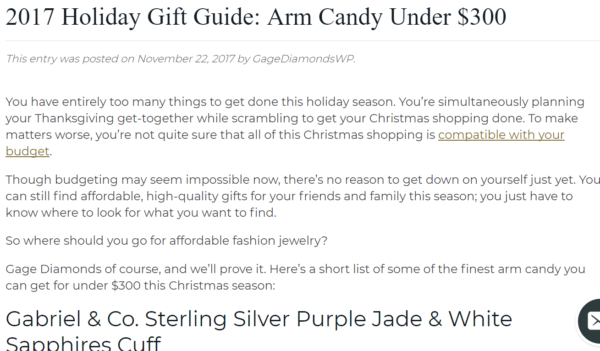
More than 70 people responded to my request for examples of bad content, but almost all demurred to offer real-life examples. But one brave, smart content creator came forward to share her own experience: Christina Russ of Gage Diamonds.

“Sadly, I’m guilty of writing (weak) content at times,” she says. “Here’s a piece I wrote that no one will ever read because, honestly, no one gives a crap about what I’m selling.”

gage-diamonds-bad-example

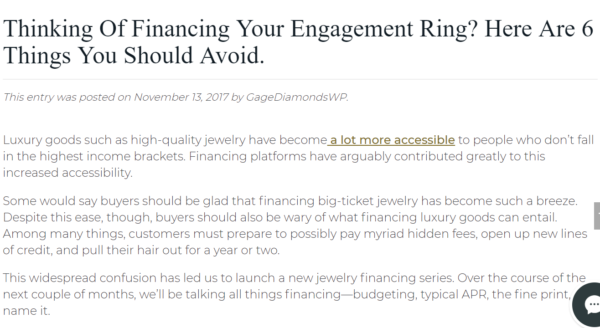
“Despite the fact that I write that type of content, I have my moments of sanity. Here’s a better piece I wrote,” Christina says.

gage-diamonds-good-example

Christina smartly recognized the difference between the two posts: “One is (perceived as) beneficial to the business. The other is beneficial to the readers because it provides useful information about store credit cards and financing opportunities.”

A lack of focus on the audience’s needs was frequently cited as a key mistake.

Now, that we have the audience-focus thing on the list, let’s dive into 27 more characteristics of content that sucks.

1. Another of the same

Blog posts that just sum up what you can find through Google searches. Regurgitation of basic information that’s reformatted on a company blog with a lot of injected ads, unnecessary links, and keyword stuffing in hopes of achieving a high SERP rank. If all your blog post does is tell me the same information I can find through a simple Google search, then it’s (weak).

Dew Smith, managing editor, Vendasta

Not only has the topic been dealt with, but even the angle taken is too familiar … I don’t need to read what’s already been published 300 times. I am not saying invent something new, just don’t share the same 10 tips that everyone is sharing.

Youness Bermime, content writer, writersdo.com


I don’t need to read what’s already been published 300 times, says @YounessBermime. #contentmarketing
Click To Tweet


2. Product name here and here and there

The more mentions of the brand or its product in the bounds of a piece of content, the higher the (weakness) of that piece of content.

Eric Kinaitis, director of content marketing, American Endowment Foundation

3. We before you

Whether it is on Twitter, blogs, or company collateral, there seems to be a recent trend to overemphasize statements about oneself or to put the company ahead of the customer. No matter the content type, this type of self-indulgence is weak. You’ll lose the reader because of braggadocious puffery. Remove the ‘I’ and ‘we’ from your marketing.

Jamie Glass, CMO and president, Artful Thinkers


Remove the “I” and “we” from your #marketing or you’ll lose the reader, says @jglass8.
Click To Tweet


4. Now obsolete

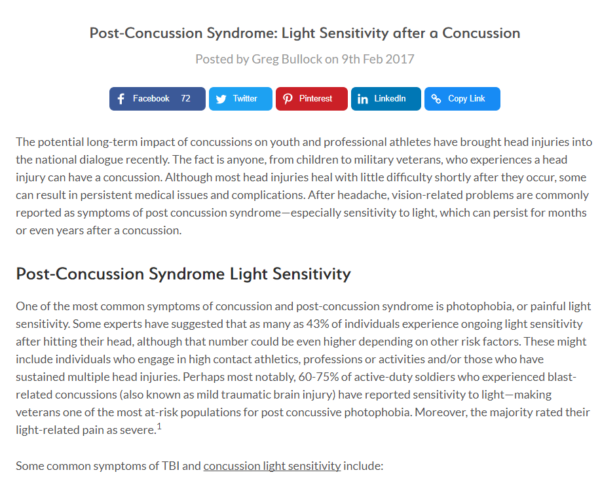
“You can have outstanding blogs when first published that ultimately turn (weak) because they are outdated.

“I rewrote this post about concussion-related light sensitivity, even though it was already ranking number one for several target keywords. I did it because: 1) it took too long to answer the question that most searchers were asking, which resulted in a high bounce rate and low average time on page. The original post wasted a lot of valuable real estate sharing info on general characteristics of post-concussion syndrome vs. the meat of the content related to light sensitivity AND 2) new research had been published, which I wanted to include to make it fresh and relevant. “

Greg Bullock, marketing manager, TheraSpecs

theraspecs-outdated-example

5. No duh

Stating the obvious. The world is round. A volcano is hot. Snakes can be poisonous. Then explaining in painful detail these obvious facts.

Holly Wolf, director of customer engagement, SOLO Laboratories Inc.

It’s trite. It’s content that tells me something obvious – an article on losing weight that recommends exercising regularly, or a piece with money-saving tips that says to cut out Starbucks from my morning routine.

Jami Barnett, associate director of research, Consumer Affairs


Weak #content tells me something obvious, says @JamiBarnett.
Click To Tweet


6. Pointless intros

Some (weak) content can be found in a lot of good content. For instance, the first paragraph or two is (almost) always filler that never tells you anything informative and can be skipped on almost every article. Go ahead and try it.

Mike Lamood, founder, Lamood Big Hats

7. No voice

There’s no excuse, no matter the topic, for dry content with no emotion or enthusiasm. You can’t convert without getting your readers excited. Instead, throw in personality and stories, create a voice, and be human.

Brittany Berger, founder, Brittany Berger


There’s no excuse, no matter the topic, for dry #content with no emotion or enthusiasm, says @thatbberg.
Click To Tweet


8. Humdrum

In the event video world, it’s a three-minute highlights video with peppy music, generic conference testimonials, and footage of attendees networking across a table.

Briana De Marco, Media Llama

9. All listicles, all the time

Ever read articles called ‘10 Ways That You Can Improve Your SEO,’ ‘5 Cool Things to Do in (City Name),’ ‘10 Healthy Diets That Make You Feel Good’? Those articles are boring. I get it – for a while people were obsessed with listicles. Yes, sometimes having a listicle on your blog isn’t a bad thing. But, if every article you post is a listicle, you just aren’t trying hard enough.

Dan Salganik, managing partner, VisualFizz


If every article you post is a listicle, you just aren’t trying hard enough, says @VisualFizz.
Click To Tweet


10. Unfulfilled premise

The Internet always manages to astound me with how much content delivers none of the info promised in the title.

Justin Golschneider, vice president of marketing, ChannelReply

 11. Wrong information

Nothing will kill your content more than false information.

Emily Trogdon, public relations manager, The Brandon Agency


Nothing will kill your #content more than false information, says @QuickFoxescom.
Click To Tweet


HANDPICKED RELATED CONTENT: How Well Do You Fact-Check Your Content?

12. Poor or no sources

It fails to establish credibility – an important concept from journalism that most marketers haven’t yet mastered. Credibility means quoting nonpartisan subject matter experts, using data from trusted, objective, neutral sources, and not editorializing. Authoritative sources build credibility, credibility builds trust, and trust drives revenue.

Jeff Roberts, digital marketing director, Olive & Company

13. Focus on length

You can find plenty of discussions debating the merits of 1,500-word posts vs. 500-word posts. Both sides promise that their ideal length gives a surefire way of keeping a reader on your page. But that misses the point entirely. Content should always fulfill its purpose and do it in a succinct, respectful way that doesn’t waste a reader’s time – regardless of if it’s 10 seconds or 10 minutes.

Shelby Rogers, content marketing strategist, Solodev

14. TL; DR (Too long, didn’t read)

We don’t have time to read a 5,000-word article – or a long video or big volume of images on social media.

Connie Chi, CEO, The Chi Group

15. Irrelevant

“Bad content is irrelevant for a specified audience. It doesn’t add value. It doesn’t entertain. It doesn’t answer a question.

 “The hinge here is the audience. As the old saying goes, ‘One person’s trash is another’s treasure,’ so it’s important to continuously challenge assumptions, with data, analytics and even intuition.”

Frank Strong, owner, Sword and the Script Media

16. Negativity

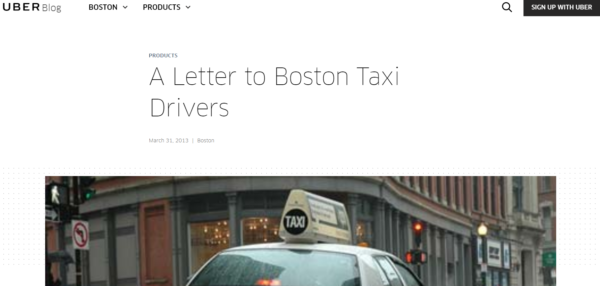
“It’s focused on attacking other players in the market, trying to put the competition down and creating conflict to get attention.

“When Uber tries to break into a new market, it has launched aggressive campaigns against taxi drivers.

uber-negativity-example

“We see competition as helping us grow the market … Just like a person could use an Uber sometimes, and other times a taxi. There’s room for everyone in this world.”

Ela Iliesi, SEO specialist and trainer, London Marketing Academy

17. Check-off task

It is usually written exclusively to check off a task on the marketing team’s SEO plan. You can almost always tell when you come across a post that’s written to grab organic traffic from some keyword.

Brinck Slattery, marketing director, LBRY

18. Fluffy

Unnecessarily twisting an article by adding useless and irrelevant words to make the post 2,000-plus words to satisfy Google. It comes at the cost of bad audience experience.

Yogesh Jain, founder, Concept Allies


Adding useless words to make a post 2,000+ words comes at the cost of bad audience experience. @mrjainyogesh
Click To Tweet


19. Generic

‘We should blog a lot because it’s good for SEO.’ The firms (who think that way) often end up publishing the same blog on their site as every one of their competitors … The recycled and sterile blog articles aren’t representative of anyone at their firm.

Spencer X Smith, instructor in social media at the University of Wisconsin & Rutgers University; author, ROTOMA: The ROI of Social Media Top of Mind

20. Word selection

The words are not compelling enough. This doesn’t mean use exciting vs. boring words but words that are appropriate for the content piece’s goal and the audience who would read it.

Laura Lopez, manager, content marketing, Notarize

21. Hard-to-read structure and exciting punctuation

“Anything with lots of passive voice, dependent clauses, and nonvarying sentence length.

“Anything with an emoticon. Just don’t. Lots of exclamation points. Makes me feel like I’m reading something written by a tween!”

Amanda Austin, founder and president, Little Shop of Miniatures

22. Boring images

It is not visually engaging. Instead of posting a photo of an event’s promotional poster or restaurant’s menu, try a picture of the event or menu item with engaging copy to support the promotion. Be descriptive but not salesy! Bad content might say, ‘Enjoy a delicious cocktail at this restaurant,’ versus ‘Tacos + margs make for the happiest of hours.’

Ashley Cady, integrated communications manager, Flock and Rally

23. Clunky design

“It’s clumsy or has a hard-to-understand layout. It’s published in an outdated manner so as to appear to be created with older technological limitations. 

It contains overused or inappropriate typefaces or boring titles … The color compliments are disturbing or irrelevant and clumsy graphics, especially, badly rendered gradients, poorly clipped out or cropped elements; low image quality such as with lack of attention to composition, lighting, styling or color, especially low resolution, blurry, or watermarked photos.”

Rich Harris, founder and CMO, insomniagraphix

24. Camel-like

“When everyone puts their two cents into ideas for shaping the content, it often becomes watered down. There is an old saying, ‘A camel is a horse designed by a committee.’

“(Weak) content also gets produced when you are afraid your company or your client might not approve the content you were originally planning.

Robert Barrows, R.M. Barrows, Inc. Advertising & Public Relations

25. Unfriendly mobile and meta

“Mobile thinking should be a no-brainer. And yet, people still publish content with huge blocks of text that are difficult to scan.

“It also doesn’t have optimal metadata. No one shares an ugly link. Search engines skip over content with missing meta descriptions.”

Benjamin Collins, CEO, Laughing Samurai


Bad #content has ugly links (no one will share) and doesn’t have optimal metadata, says @extremecollins.
Click To Tweet


26. Silly expectations

With the rise of social platforms and the desire to capture user attention in short vehicles and formats seen on mobile devices, it is creating slow music audio in a long video and expecting the user to have the time to actually get through the long video.

Robb Hecht, adjunct marketing professor, Baruch College

27. Begging

“Tweet this. Like us. Share it. Don’t reduce to begging for social shares and likes as it can reflect a negative impression and thus put your brand’s reputation at risk.”

Mehmood Hanif, senior digital marketing strategist, PureVPN


Don’t reduce to begging for #social shares & likes as it can reflect a negative impression. @MehmoodHanif
Click To Tweet


Conclusion

OK, how many of the content sins described have you committed? More importantly, how many of them do you plan to fix?

Oh, and if you have other ideas of what makes content bad, please share in the comments. Bonus points if you provide examples. Big bonus points if you own your bad examples in the comments.

Gather with over 100 experts to learn more about how to make sure your content – and your content marketing – doesn’t suck. Register today for Content Marketing World this September. 

Cover image by Joseph Kalinowski/Content Marketing Institute

The post 27 Reasons Why Your Content Sucks appeared first on Content Marketing Institute.

15 Jan 21:06

3 Scientific Reasons Salespeople Need to Post on LinkedIn

by David Fisher
Why Salespeople Should Post on LinkedIn

The image that most professionals have about posting on social media isn't too positive. In fact, it's usually downright horrible. When you picture "posting on social media," what image pops into your mind:

  • Teenagers posting Instagram selfies on their phone?
  • The hipster taking a picture of their food at a restaurant for Facebook?
  • Your friends who can't seem to stop posting their every thought to Twitter?

If that's how you view social media engagement, it's easy to blow it off. It doesn't seem connected to the goal of winning more business.

But what if I told you that there was actually science behind why you should be online? There are very specific professional outcomes that you can support through regular and consistent engagement on social media. And for your professional goals, there's still no better place to spend that time than on LinkedIn.

Unconsciously (and Powerfully) Influence Your Prospects

If you want to build your credibility, influence, and reach, there's no tool as efficient, scalable, and accessible than social media platforms. Social selling advocates tend to focus on using digital platforms for research, pipeline-building, and information-gathering, and rightly so.

But there are powerful ways that salespeople (and everyone else) can use it for building a stronger brand among your network. You can use it to make your presence known and actively influence your connections.

And your connections might not even know that it's happening, because much of what influences us isn't being processed at a conscious level.

We can see this by looking at the ideas and writing of researchers like Dan Ariely, Daniel Kahneman, and Sheena Iyenga. Central to their research are the cognitive biases and unconscious heuristics that influence our decision-making processes. Heuristics are the mental shortcuts that our brains use without us even being aware.

So instead of being completely rational, humans are influenced a lot by our unconscious mind. And if we can understand how that works, we can use it to build stronger relationships with our prospects and network.

This goal isn't to manipulate people. The goal is to present ourselves in the best possible light and build the best connections that we can with those that we want to influence.

3 Scientific Reasons to Post On LinkedIn

1. The Recency Heuristic

The recency heuristic (also called the availability heuristic) is a cognitive bias in which the mind perceives the credibility of something to be proportional to the ease of remembering it.  In other words, the more available it is to the mind, the more weight it's given. In other other words:

If it's easy to remember, it must be good.

So we're biased towards things that are easier to remember. This internal bias is one of the drivers for "top of mind" advertising, which is why companies like McDonald's and Coca-Cola spend millions of dollars every year to advertise a product everyone knows about. They want to come up first in your mind when you think, "I'm hungry and thirsty."

Every time you post on LinkedIn, the people who see your post get a little ping, a little reminder of you. They might not engage with the post. In fact, they may not even consciously remember seeing it. But you've made it a little easier to remember you. The likelihood that you are at the top of their list when it comes to your product or service increases dramatically.

Action Items:

  1. Post consistently on LinkedIn. One post a day is a good ideal to aim for. If you aren't there yet, try to get to at least 3-4 every week. Posting once every other week is not going to get you where you need to be. Use scheduling platforms like Hootsuite or Buffer so you can "set it and forget it."
  2. Engage with the content of prospects and others you want to influence. When you like, comment on, or share the content that someone else has posted, the LinkedIn algorithm thinks, "Oh, these two people are close enough to engage with each other." That means that you are more likely to see posts by them...and more importantly, that they will more likely see posts from you.

2. Halo Effect

The Halo Effect is a cognitive bias where we take the appearance of one attribute in an individual and extend the positive or negative bias to their other attributes. For example, it's been shown that we unconsciously consider people who are more attractive to also be smarter. It doesn't matter that those two attributes are not related at all.

So when we see someone being successful in one area, we unconsciously extend that success to the other areas of their life. It's why we think that people who keep posting pictures of their happy vacations on Facebook are always happy (even though there's no evidence that they are).

When your network sees your posts talking about your areas of expertise, they unconsciously extend your expertise beyond just the topic of the post. You become more competent all-around. Likewise, when you share a client success story, or a picture of you with your clients or even colleagues at a conference, that credibility extends beyond you into the offline world.

Action Items:

  • Post pictures from in-person events: conferences, networking events, client meetings, etc. Let your connections see you with other smiling people. The events don't have to be super-ritzy of fancy. It's more important to have other people with you: you're showing your online connections that you have offline relationships.
  • Share testimonials and stories of client wins. People want to be associated with successes and you showing other people's positive experiences paints you in a powerful light. If you say something good about yourself, it's bragging. If someone else says something good, it's marketing!

3. Anchoring

Anchoring describes a bias in which we give an outsized amount of value to the first piece of information obtained when making a decision. People "anchor" around that first piece of data. It's why first impressions are so powerful: whether we like it or not, all further impressions are influenced by the first

This is the same reason that salespeople are coached to offer a higher initial price when presenting to prospects. Prospects will anchor their expectations around that initial number and you'll probably end up at a higher number by the end of your negotiation.

The question to ask is: What is your personal brand anchored to? If they don't think about you at all then it's not anchored to anything. But if they see regular updates on social from you, you're anchoring them around the brand message that you want. You're anchoring it to "competence" and "expertise."

Action items:

  • Curate articles on your industry, services, and prospects. Collect and share them with a 2-3 sentence observation (this helps with the consistent posting mentioned above). It could be a question that the article suggests to you, an action it should inspire, or a connection to another industry trend. This is how you start positioning yourself.
  • Create focused content. Not every salesperson should create content (here are some ways to create content if you don't like to write). But if you do, make sure it's focused on a specific area. Make it easy for your network to draw a straight line from you to the areas you can help with.

Start Posting on LinkedIn Today

When you start looking at the science behind how humans make decisions, it becomes apparent that posting on social isn't a waste of time. The trick is to be intentional with how you use it. Create a plan that will allow you to engage with the people you want to engage with. Then, work that plan.

It all starts with the first post. Don't wait, do it today!

And don't wait to subscribe to the LinkedIn Sales Blog. To keep pace with the latest tips, tricks, and trends in sales, subscribe today. 

Photo: Perzonseo.com


15 Jan 21:06

The 5 Things Your AI Unit Needs to Do

by Alessandro Di Fiore
jan18-15-888249778-Bogdan-Dreava--EyeEm
Bogdan Dreava/EyeEm/Getty Images

Not a day goes by without the announcement of the appointment of a new VP of Artificial Intelligence (AI), a Chief Data Scientist, or a Director of AI Research. While the enthusiasm is undeniable, the reality is that AI remains an early-stage technology application. The potential is vast, but how managers cut through the AI hyperbole to use its power to deliver growth?

In our consulting work, we often encounter managers who struggle to convert AI experiments into strategic programs which can then be implemented. Michael Stern (not his real name), for instance, is the Head of Digital for a German Mittelstand office equipment company. Michael is used to starting new projects in emerging areas, but feels unable to fully understand what can AI can do for his business. He started a few experiments using IBM Watson, and these produced some clear, small tactical gains. Now Michael is stuck on how to proceed further. How can he create cross-functional teams where data experts work with product teams? And how will they pick project ideas that produce real ROI? Michael wonders if his firm even knows what new business models can be explored with their existing datasets — let alone which new ones might be made possible by AI.

Insight Center

Michael is not alone.  As more and more companies invest in AI-driven units, many newly appointed managers face these challenges – especially in companies with little or no previous experience with cognitive technologies. Part of the trouble: in many companies, the role of these teams is undefined. Very little research has been done to design the mission and scope of these new units.

At the European Center for Strategic Innovation (ECSI), we examined numerous corporate AI initiatives among large organizations, and identified five key roles that can help AI units to develop the right mission and scope of work to succeed.

1. Scouting AI technology, applications, and partners. This role is about setting up a core team of “AI sensors” in charge of monitoring new trends, identifying disruptive technologies, and networking with innovative players — mainly startups. The automobile-parts supplier Bosch and the tech and engineering powerhouse Siemens are two prime examples of this. With a planned investment of $300 million, Bosch has established three AI corporate centers focused on IoT and other AI-related fields in Germany, India, and Palo Alto. Siemens, similarly, has included AI in the company’s list of innovation fields to be monitored through its network of innovation outposts with offices in California, China, and Germany.

2. Experimenting with AI technology and applications. This role is about understanding through quick, small AI pilots how to develop or adopt cognitive technologies to the company’s business and operational models. Although off-the-shelf AI tools and open-sourced systems are available, they have limited transformational potential compared to customized ones. At Deutsche Telekom, the development of its own AI solutions is an important priority. Instead of buying AI chatbots from vendors, Deutsche Telekom has its own developer teams. With the support of partners, they design, train, and fine-tune AI solutions for the company.

Rather than concentrating efforts on a single big win, AI units and teams should embrace a portfolio approach to their experiments. The power of AI should be tested across functions and business areas. There are three types of experiments that are worth paying particular attention to:

  • Experiments in the driver’s seat are typically conducted by the company’s AI unit or internal developer teams. In the last few years, Deutsche Telekom has tested internally three different AI-backed chatbots and virtual assistants to improve the company’s corporate and private customer services.
  • Experiments with others in the driver’s seat involve joining forces with innovative players such as start-ups, research centers, and universities. In general, such experiments are focused on cutting-edge technologies or applications requiring in-depth expertise and skills that companies do not have. This is a common strategy among large organizations: Mercedes-Benz entered a partnership with the Computer Science and AI Lab of MIT; Associated Press collaborated with Automated Insight, a specialized AI firm; Deutsche Telekom partnered with the German Research Centre for AI, called DFKI.
  • Experiments by learning from others are common among companies interested in pioneering AI technology and applications, but too premature for their industry. Observing others translates into funding ventures or start-ups innovating at the frontier of AI. This is the case at German insurance company Allianz, which funded Europe’s first global AI equity fund to position itself as a “pioneer in AI investments.”

3. Supporting business units in applying AI technology. This role is about building internal capabilities through a specialized network of AI experts who can support business units in the integration and application of AI tools and solutions (from basic data visualization and chatbots to the automation of entire processes like claims management). The success of AI applications lies not in the technology per se, but in the ability of a company to align it with its business and operational models.

The Data and AI Lab is one of the most visible BNP Paribas’ AI efforts. The Lab is responsible for the development of AI tools that can improve the internal processes. At BNP Paribas, the AI team is in charge of accompanying and supporting business units all along the way, from the identification of potential applications to the experimentation and fine-tuning. It’s essential that these labs be tightly integrated into the organization, not in a far-off lab. Constance Chalchat, Head of Change Management at BNP Paribas says, “Data scientist teams need to work in close partnership with both the business and IT.”

4. Getting the entire organization to understand AI. This role is about the ability of the AI team to educate the organization on the opportunity to harness the power of AI. Why? Because AI is ultimately a tool. Organizations need to build solid foundations that enable people to actually use and secure value from AI technology. As passion for AI is rising to the top of large organizations, this applies also to the C-suite and Board. Executives need support to cut through the complexity of AI-driven discussions and find ways to extract value.

Embedding AI in the company’s culture and core skills set can be done at two levels. First, internal communication initiatives can help raising awareness and acceptance of AI technologies, in particular those with a high transformative potential, while creating a common AI language and culture. Second, targeted education efforts allow building basic, standard capabilities of people, who are not AI experts in the organization. AirBnB is a prime example of this. By setting up an internal Data University, AirBnB is teaching employees data science with the goal of making the transition to a more AI-aware organization easier and faster.

5. Attracting and retaining talent. This role is about addressing the AI skills gap. A dedicated AI unit should work in close cooperation with the HR department to identify the right skills and capabilities required, and define strategies for talent retention. Companies are currently adopting different AI talent acquisition strategies. Edouard d’Archimbaud, Head of the BNP Paribas Data and AI Lab is gradually expanding his 25-member team. “We’re recruiting around ten people a year […] we’re very careful and only like to hire the right people,” he explained. Other companies have invested more significantly. This is the case of Airbnb that recently “acqui-hired” a team of seven data engineers from Changecoin, a start-up with deep knowledge of blockchain technology.

The framework in action

Sometimes these newly created AI teams will be investing time and effort in all the five roles. The challenges at other companies can be quite different. Plotting the five roles on spider graphs like the one shown here can help companies figure out where they are currently focused and where they may need to increase or reduce their efforts. They can, for example, compare what they are currently doing with what they should be doing, given their company’s strategic intent and their capability and organizational issues.

W171218_DIFIORE_CHARTYOUR


Each AI team should design its own spider-graph based on its existing context, goals, and constraints. Companies investing – or planning to invest – in AI units need to think strategically about where to focus their efforts.

Winning the AI revolution isn’t about just the technology and the tools, it is about educating and getting your organization ready for the future.  In the same way as Amazon didn’t invent the technology that has made them a corporate titan, companies in the AI-age need to prepare their organization to be data-first in order to stay competitive in the long run.

Plotting the five roles can help align the company’s strategic intent with the organizational context and constraints.

15 Jan 21:06

How the Best Restaurants in the World Balance Innovation and Consistency

by Daniel Ospina
jan18-15-730144991-pchyburrs
pchyburrs/Getty Images

The restaurant industry is notorious for being competitive, risky, and low-margin. This is no less true for the world’s most acclaimed high-end restaurants. Despite being able to charge hundreds of dollars for a meal and being fully booked months in advance, top restaurants often still have a hard time turning a profit. And they face an even greater challenge: maintaining flawless consistency, while simultaneously being innovative and cutting-edge.

While cooking is seen as creative, high-end cooking is mainly about constant, rigorous repetition, in a highly controlled and hierarchical environment. To receive three Michelin stars – the highest rating given by the prestigious Michelin Guide – restaurants must deliver a consistently flawless experience over many visits. This means achieving precise standardization and strong quality control.

For example, at The Fat Duck in the UK (which has had three Michelin stars since 2004, except in 2016 when it closed for refurbishment, and where I worked on the innovation side), cooking temperatures are systematically controlled to 0.1°C, and most recipes are specified with up to 40 steps for a single component on a plate. Each cook is highly trained and selectively recruited, yet he or she will only be tasked with producing a few components, and will practice hundreds of times under direct supervision before achieving the necessary level of craftsmanship. The preparations, produced by small teams or individual cooks, are progressively assembled, with sous-chefs (akin to middle managers) controlling the quality at every step. Before the final dishes are served, the head chef personally tastes a sample from each batch, maintaining control over every single aspect.

However, this kind of rigorous repetition would seem to stymie innovation – by limiting opportunities to learn from mistakes, to quickly prototype, or to search for new ideas – and innovation is another critical dimension for success in the high-end restaurant world. For instance, it’s a main consideration for the similarly influential 50 Best Restaurants of the World list, which occasionally leads it to rewards different restaurants than Michelin. For example, Noma obtained the top spot in the 50 Best for its reinvention of Nordic Cuisine, while it was only granted two Michelin stars; and Paul Bocuse’s restaurant, the oldest restaurant with three Michelin stars (keeping the ranking for over 40 years), has served virtually the same menu for decades and has never made the 50 Best list.

Of course, consistency and creativity aren’t mutually exclusive. A handful of extraordinary restaurants have managed to deliver both the flawless standards of three Michelin stars and the innovation demanded by the 50 Best list – and they’ve managed to leverage this acclaim to achieve growth. In my work studying and consulting with innovative companies, I’ve found that this balance is best achieved through dedicated time and space for research and experimentation, as well as a thorough process for both iterating on and standardizing new inventions.

Let’s consider an example. The first restaurant to achieve both lists was El Bulli in Spain. With only one Michelin star in 1987, the restaurant decided to try something new. Since the business was particularly slow during the winter, its owners, Ferran Adrian and Juli Soler, decided to close shop 2-5 months a year to travel and search for new dish ideas. In 1990 they gained a second Michelin Star, and in 1994, they became the first high-end restaurant to invest in a development team and a lab.

Akin to an R&D facility for a large restaurant chain or fast-moving consumer goods (FMCG) brand, their lab hosted a small team of chefs, and occasionally other professionals, such as food scientists, designers, or engineers, in a mixed kitchen and office space. Unlike test kitchens of large chains or FMCG products, the team would work in R&D during the winter and then resume restaurant operations during the summer. And instead of concentrating on cost reduction, shelf life, or replicability, they would focus on the creative process and the customer’s experience.

Three years later, El Bulli rose to three Michelin Stars, and when the first edition of the 50 Best guide was released in 2002, they earned the top spot, positioning Spain as one of the main gastronomic destinations in the world. The company grew through consulting for other companies, opening new business lines (e.g. books and cooking gadgets), developing brand partnerships, and opening more restaurants. Though the main restaurant closed in 2011, they subsequently reopened it as the ElBulli Foundation (a sort of think tank), while the other restaurants and business lines are still operating today.

Other restaurants, like the Fat Duck and El Celler de Can Roca in Spain, also set up fully fledged test kitchens before attaining the top ranking in both guides. Like at El Bulli, the chefs working in these labs divide their time between the restaurant operation and R&D projects aimed at improving the customer experience. The projects range from developing new techniques and ingredients to designing final dishes and products. Some labs even partnered with universities to carry out research projects and explore subjects as varied as sensory perception, sustainability, narrative theory, and nostalgia.

For example, a popular dish by The Fat Duck Group called The Meat Fruit (a surprisingly realistic looking “mandarin,” made of delicate mandarin jelly and chicken liver pate) was inspired by a recipe from the 15th century that was researched by historians at Hampton Court. And a seafood dish called Sound of the Sea (enhanced by sea-like sounds coming from an iPod nano hidden inside a seashell) came from collaborations between the lab and an experimental psychology laboratory in Oxford called The Crossmodal Research Laboratory.

Although these efforts were expensive, the labs provided the capacity for numerous projects that generated revenue, like The Fat Duck’s partnership with Waitrose (a UK-based supermarket), and helped attract a wide community of collaborators that led to numerous innovations.

But while a dedicated lab expands a restaurant’s capacity for R&D, innovation more importantly has to be embedded in the DNA of the organization. High-end restaurants that cannot afford a team and space solely devoted to R&D still make innovation a key value alongside consistency. Whether or not they have a lab, all the top spots in both the Michelin and 50 Best list implement processes to encourage creativity and learning beyond the leadership or lab team, as well as processes to generate, prioritize, refine, and standardize ideas.

At The Fat Duck, a conceptual dish is developed each month by one of the restaurant cooks for the whole team to taste, while Italian restaurant Osteria Francescana (ranked #1 in the 50 Best in 2016 and with 3 Michelin Stars since 2012) holds frequent brainstorms and feedback sessions with the head chef and general kitchen staff. This collective culture of creativity multiplies the pool of ideas and softens resistance to new products and processes being adopted. Then after the ideas are collected, restaurants screen and prioritize them for development.

Let’s look at how the Fat Duck Group (their parent company) does this. First, the company’s leadership agrees on the core concept for each of its business units (the restaurants and other commercial lines). Then a team – generally composed of the CEO, the company’s head chef, the head of R&D, and the head of the unit – generates a series of loose ideas that could become products or features of each customer experience. These ideas are then divided and assigned to the R&D team, the restaurant chefs for prototyping and testing, and in the case of consumer electronics (cooking gadgets), jointly to the business partner’s R&D and the internal R&D.

This isn’t strictly top-down. The members of the R&D team also explore pet projects according to loose “areas of interests,” occasionally getting help from other employees. The company’s leaders know what these areas of interest are, but they only see specific projects if the results are promising. While many projects won’t reach a final customer, they are carefully logged on a searchable data base that is frequently used to improve and accelerate assigned projects.

All the projects follow a specific development process, alternating between collective ideation or feedback and focused work by a small team. For restaurant dishes, the development team will quickly prototype and iterate through numerous versions of the dish and its components, either in the lab or if a lab is not available, in the main kitchen during slow hours. The trials can go over for months as numerous variations are tested in a race against seasonal ingredients.

Once the results start to approach a finished product, the team will seek input from senior and junior chefs, as well as sommeliers, waiters, and other staff. After a few cycles of improvement, the project team will hand the recipes to the line cooks to prepare. At this stage, the objective is not to hand down a finished recipe and test the line cook capacity to produce it. Rather, the goal is to test the recipe’s written instructions. Both the line cook and the development team taste the result and, when problems are spotted, work together to improve the recipe until the results are reliable, consistent, and delicious.

The head chef oversees each project from the early stages, and decides when to serve a first taste to regular customers for further feedback. This process reduces cultural clashes between departments, improves the quality of outputs, and bridges the gap between a raw idea and consistently producing a finished product at scale.

The most highly acclaimed restaurants imbed creativity and learning across the organization by creating spaces and processes for both collective input and focused development. They show that a culture of precision and attention to detail can co-exist with constant re-invention, and by leveraging this core competence to achieve prestigious rankings, partnerships, and associated businesses, generate growth.

15 Jan 21:05

Marketing Plan vs. Marketing Campaign: What’s the Difference?

by Jen Phillips April

marketing plan vs. marketing campaignI

f you’re like a lot of business owners, you may feel overwhelmed at times by marketing. After all, there are approximately 98,321 ways to market your business, which are the right ones for you?

Great! This post is for you. By the time you finish reading it, you’ll understand the difference between your marketing plan and a marketing campaign and why it makes sense to have both.

If you want to skip straight to the video, you can do that here.

But first, let me share a common confusion among business owners when it comes to the whole marketing game. As you know, your goal is to generate more leads. People who are interested in what you sell.

Your job is to show them how what you sell helps them save time, money, makes them feel great…whatever the core benefit of your service does. It’s your job to get super specific on WHO you help and HOW so they can see that your product or service is meant for them. That’s part of your marketing PLAN as you’ll see in a moment.

Your marketing campaign is drop-dead specific.

1 item/product/service to 1 type of person and usually for a specified amount of time. It may feel counterintuitive to focus on one thing at a time and yet, that’s the MOST effective way to grow your business.

Here’s an example from the big leagues.

Have you noticed how a car manufacturer like Ford advertises?

They have the Ford Focus AND the Ford 150 pickup truck, right? They make separate commercials for each. Same for the rest of their vehicles. The reason is, the Ford Focus buyer is a different person with different needs and desires than the pickup truck buyer. Otherwise, they’d just make one commercial that shows all their cars and trucks. But that would confuse their customer and confused people don’t buy.

I’ll explain this a bit more in a moment but first, know that you don’t have to be a Fortune 500 company to market effectively.

See marketing principles are the same no matter whether you have a staff of 5000 or you’re a solopreneur and after I explain this further, you’ll understand and be empowered in your marketing.

your small business marketing plan

Watch the video here:

In this 13-minute video, I explain the difference between a marketing PLAN and a CAMPAIGN (they’re not the same thing and when you understand this, you just MAY have a AHA moment 🙂

If you’re not a video person (and that’s ok!) read on.

At its core, a marketing plan is strategic. It’s not a pile of random tactics that don’t move you forward. Because you have better things to do with your time.

Instead, you create a clear focus for your business that includes:

  • Who your ideal customer/client is
  • Your Core Service (s)
  • How you’ll communicate your value to those potential customers
  • Your Business Goals (including your revenue goals, plus things like your desired work hours)

You’ll want to know your numbers. What are your most profitable activities? Where do your best leads come from? What communication channels (Facebook/email/LinkedIn/etc.) will you use to reach them? What will you STOP doing this year?

You want to create a system for attracting new leads and nurturing them.

These are at the crux of your business.

Too many people start a business and work themselves to the point of burn out and/or run out money because they don’t know their top revenue-generating activities.

So, let’s plan.

These big questions provide you with a guide. After all, if you know you bring in most of your business via public speaking to local networking functions, then you’ll want to focus your marketing on obtaining more of those speaking gigs (and have a system for the follow-up.)

That’s at the heart of your marketing plan.

Are you beginning to see how thinking through these questions can guide your entire business?

You do?

Great! We’ll go deeper into that topic on another day, but for now, let’s look at the role of the marketing campaign in your business.

Define Your Marketing Campaign

This has ONE specific goal and usually for a predetermined amount of time.

For example, let’s say you’re hosting a webinar. Your webinar has one primary topic that aims to solve one type of problem. The people with that problem are the ones you’ll target in your ad content, posts, graphics, etc.

You don’t want everyone. You want the people who are going to most benefit and be a good fit for your business. The webinar is meant to be a lead generation tool to help you collect email addresses for people who’ve indicated they’re interested in what you’re offering.

This is so important that I’ll say it again, the webinar is meant to be a lead generation tool to help you collect email addresses of people who’ve said they’re interested in something you offer. There’s a deeper strategic goal to it than simply hosting a webinar. Yes, you’ll share valuable content in the webinar, and you’ll want to have a follow-up strategy for afterward.

In case that’s still confusing,

I realize that can still be confusing, here’s another example, one that everyone is familiar with from the retail world.

You’re probably familiar with holiday “specials.” Black Friday for example. Retail organizations start planning their Black Friday ad “campaigns” months out. This past season, Amazon focused on their efforts on building awareness — and desire – for the “DOT”, a smaller version of their Echo, both of which are voice controlled smart speakers that play music, tell you the weather, keep your grocery list and do other simple tasks.

Here’s how this applies to you as a small business owner.

If you offer professional services, such as an acupuncturist, you can choose a “theme” such as “back-to-school” time in the Fall and offer a special on a package of 3 treatments that will boost the immune system. Or if you’re a VA, you might offer a webinar on a particular piece of software and then make an offer to attendees that you’ll set it up for them.

As you can see, these are focused activities set for a defined amount of time. It doesn’t mean you won’t sell that activity or product at other times, but for this specified time period, you’ll focus on this one thing.

That way, you can create relevant marketing materials around it. Your social posts, blog posts, Facebook lives, Facebook ads, will revolve around this theme.

You’ve created a marketing CAMPAIGN.

If you do nothing else in your marketing today, take a few minutes and jot down the top thing or things you sell, consider how you can tie each to a season or a popular trend. Drop that in your calendar a few weeks from now and plan a few marketing materials around the topic.

When you keep in mind exactly who your top prospect is for this service, you’ll see how much easier it is.

Want to see this in action and get your free Design Your 30-Day Marketing Roadmap? Join us here.

15 Jan 21:05

How To Sell More Books When Facebook Fails You

by Penny Sansevieri

Late last year, Facebook rolled out a big algorithm change, which scared a lot of authors. It sank a lot of pages in terms of visibility, changed how authors sell more books and book marketing goals in general.

The thing is, while social media sites like Facebook are great, to use them exclusively in your promotion is never a good idea. Because if you lose the page, or if Facebook changes this or that, or whatever social media site you’re on, you’ve now lost a big share of your market.

Never put your success in someone else’s hands.


Did your one and only book marketing tool update and foil your book promotion plans? Of course not….
Click To Tweet


The Bottom Line

You need to own your own tools and one of those is your website. And, let’s face it, when was the last time you could actually track a book sale to Facebook? Yes, we all know that Facebook is great for exposure, but does it sell books? That’s often debatable. The things that do sell books is a direct author/reader connection, that’s the thing that makes the biggest difference and can actually move the needle and help you sell more books.

As we explore better, more secure ways to gather readers, build your tribe and gain more momentum for your markets, we’ll still consider social media because it’s not going away, per se.  But when it comes to book marketing of any kind, especially marketing for indie authors, you’ve got to own your marketing real estate.

In this article, and over the next few weeks, we’re going to explore good ways to own your own real estate.

But first, let’s have a look at your options:

Build your mailing list

If you don’t have a mailing list, never considered starting one or have no idea what you’d even do with one if you created it, then now if the time to figure it out. One of the best ways to sell more books is by having that direct author/reader connection as I mentioned earlier on in this piece.

A mailing list is not only an excellent and strategic book marketing tool, but it’s a way to directly communication to your market, it’s a one-on-one way to get in front of your audience without having to worry about what Facebook is doing or if someone has seen your feed.

So where do you start?

Well, that’s easy, the first piece of this to add a newsletter sign up box to your website. That’s a start. Don’t worry about what you’ll write or how often or when you’ll update folks, just get the box up there and start collecting emails.

I’ve got an in-depth piece on newsletters coming up shortly, so be on the lookout for it!

Be on your blog

If the first thing you thought of when you read this is: “I don’t have a blog” then you need to start there. Add a blog to your website.

Have a blog somewhere else and have a website, too? You want them connected.

Why? Because a blog on your site greatly helps with search value, meaning: you’ll show up in Google more. Also, as a book marketing tool – it’s a great addition to whatever else you’re doing to market your book.

So if you don’t currently have a blog, or if you have one that isn’t connected to your site, ask a good web person to help you (I’ll list someone below who we love).

They can easily either add the blog to your existing site, or add a new blog or whatever. It’s like magic and it will greatly help with your SEO (search engine optimization).

Why Should I Care?

So why on earth would you care about this? Well, you’ve heard of Google, right? And you know that over 68% of us default to Google for our online searches, so why aren’t you showing up there?

You may say: I’m showing up but I’m on page five. Well, then you may as well be on page fifty because few, if any, online searches get past page two.

A blog, if done correctly, will greatly help to enhance your online visibility in terms of reaching new readers. But you need to do more than add the blog, you actually have to write in it, too.

So how often should you blog?

Well once a week at a bare minimum, three times if you want to be a rock star. Keeping mind that not all blog posts have to be tomes. You can easily create shorter posts, maybe two shorter ones and one longer.

If the idea of doing three posts a week makes your head spin, then start with just one. Remember: quality over quantity. If you can’t muster great content in three posts, start with one, or two. But write stuff your readers want to read about.

Optimize the heck out of your blog posts

This goes to keywords, keywords, keywords. Check your Google Analytics stats.

Ask your web person, if you don’t know where to find these. If you don’t have Google Analytics, they’re super easy to add.

Open up a Google AdWords account if you want to dig further into keywords. You don’t have to place any ads, but this will give you access to the Google keyword tool that can also be really helpful.

Consumers (readers!) use keywords to find a new read, or to find something that will help them gain more information on a topic they want to learn more about. Keywords and getting some basic knowledge of how they work is a great way to build your audience and sell more books.

The point is: keywords matter – a lot. So you’ll want to know what these are.

Keywords vs. keyword strings

It’s worth mentioning here that keywords and keyword strings are not created equal.

Most consumers do not search on a single keyword, they search on a string of them.

Think of your last Google search.

If you were looking for a new car did you pop into the search bar: car? Or did you write: Toyota, SUV, hybrid. It’s more than likely the latter. And let’s say you’re trying to market your book, or interested in finding companies who will do that for you. You probably won’t pop the term “marketing” into your search bar, but rather: book marketing OR book marketing companies or whatever. You get the idea. More words are better, consumers search using strings. So be sure that you’re looking at keyword strings and not singular words. Even two words is fine, sometimes that’s all you’ll fine. But one word isn’t as great and often too nebulous to get ranking on.

Your website

Overall, your website should be ranking in Google. If you have a blog and you’re using keywords on that blog, then you should be in good shape.

But it’s also helpful to use those same keywords in pages on your website.

For example, if your keywords are: mystery and suspense author or contemporary romance author or small business expertise or small business success, you’ll want to spring that keyword string around your website in a thoughtful, non-keyword stuffing way.

What’s keyword stuffing?

Well, it’s when you use a keyword so much in your website that the sentences no longer make sense, meaning it’s just a string of keywords. Maybe this sounds crazy to you. I mean who would do that, right? Well, a lot of people as it turns out – so don’t be one of them.

You can trick Google only once, and once they figure out what you’re up to, your site will tank and you’ll wind up on page fifty of Google search results. In other words: no man’s land.

Once you identify your keywords, be sure to sprinkle them around your website and use them in your blog posts, too!

Social media

I know. We started this article talking about ways to circumvent social media changes and now we’re back talking about social media.

But the point is that social media isn’t going away, you’ve got to incorporate it, just be thoughtful in how you do so.

A few things to consider with regards to social media posting is this: you’ll want to post thoughtful, helpful content that people respond to. While this is about book marketing and selling more books, your posts shouldn’t reflect that. So it’s ok to mention you have a book, but not in every single post.

You want to post consistently, but not so much that you’re overwhelming your tribe.

And you want to post content that’s appropriate to the platform itself.

So yes, you can recycle things across platforms, just remember that it will likely do better on one than the others. You’re actually better off focusing your energy on one platform, rather than trying to be everywhere.

So your job will be to post great content that gets responses, because what Facebook did is going to get replicated to other platforms as well.

Social media sites want to see that you’re putting up great, helpful, engaging content. And this is much easier to do if you’re on one social media platform, vs. having to manage many different sites.

Create video

These days, it’s hard to escape the lure of a good video. So consider doing video on one of your sites.

Live video on Facebook is great, but it’s tricky. Unless you have an audience waiting to see you, you may be on your video just talking till folks show up and that’s not good.

So, record your video and pop it up on your blog, Facebook, YouTube or wherever you’re putting it.

Your video can be a snippet from a book event, a talk you gave, a weekly update, or some advice taken from your book. Remember when it comes to book marketing: it just needs to matter to your reader. And the best part is it doesn’t have to be long. Take a three to five-minute video and see how well it does on any of these portals. I think you’ll be surprised.

The other thing is that if video is done right, it can really help to build your audience. That’s how The Fault in our Stars became a huge hit; the author had a YouTube channel and used it as a direct link to his fans. You can, too!

The key really is to own and control more of your author real estate.

You never know when a social media site is going to implement changes. Don’t be caught off guard when they do.

Make sure your website is strong and gather fans, using tools you control.

Check this previous post where I revealed some exciting book marketing predictions for 2018.

When it comes to book marketing, or anything else you’re doing to sell more books – remember: Don’t put your key to success in someone else’s pocket, because you never know what could happen. Starting today own your success!  Let me take you to the next level with a personalized assessment.

15 Jan 21:05

How to Get a High-Quality LinkedIn Recommendation [ + Email Template]

by ebrudner@hubspot.com (Emma Brudner)

How to Request a Recommendation on LinkedIn

  1. Go to the LinkedIn profile of the person you're requesting a recommendation from.
  2. Click the "More ..." button below their profile picture, and select "Request a Recommendation" from the drop-down menu.
  3. Select your relationship to the recommender and your position at the time you worked together.
  4. Write a brief note about what you would like the recommender to say, and click the "Send" button.

Recommendations are crucial for salespeople's credibility. A glowing recommendation from a client provides social proof that can put new prospects' minds at ease.

Because they're so important, reps shouldn't just wait for reviews to come in naturally -- they should proactively seek them out.

Use these tips to source personalized, persuasive LinkedIn recommendations that will make your profile stand out against a sea of competitors.

How to Request a Recommendation on LinkedIn

1. Think about what you'd like to communicate

Not every recommendation serves the same purpose. Are you looking for a new job? Trying to attract new clients? Attempting to make a drastic career shift?

Before you ask for a recommendation, think about what you're trying to accomplish, as this will impact who you'll ask and how you direct this person.

For example, if you're looking for a new job, a recommendation from a manager or colleague about exemplary work performance will help you stand out to recruiters and hiring managers.

But if you'd like to source new clients, a recommendation from a client detailing the results you helped them achieve will mean the most to prospects.

2. Identify the person you'd like to recommend you

Next, zero in on the person you want to write a recommendation. Keep in mind the best person to write a recommendation isn't always the one you're closest with or the one with the most impressive title.

Here are some guidelines to help you find the perfect person to recommend you. Choose someone that:

  • You've worked with for six months or more
  • Has experience with other professionals like you
  • Has benefitted in a material way from your work
  • Is in a similar industry or holds a similar job to the target audience you'd like to attract (clients, recruiters, executives, etc.)
  • Is a strong writer
  • Regards you in a positive light (obvious, but critical!)

3. Identify three topics you'd like the person to focus on

Generic recommendations like the below aren't all that effective:

  • "Steve is great! He's a really nice guy."
  • "Jill is a hard worker and a smart worker."
  • "Collaborating with Stephanie was awesome."

Sure, these statements are nice. But what do they really say about you in particular? These accolades could be applied to almost anybody.

Odds are, you're hoping a recommendation will get you chosen for something -- a job, a deal, an organization. With this in mind, recommendations need to be specific enough to convince the decision maker to select you specifically, and not just someone like you.

To ensure you get a customized recommendation, prompt the person you ask with a couple topics or questions. Just make sure to do it gently and courteously. After all, this person is doing you a favor -- you don't want to seem demanding.

Here's an example of how you might phrase your prompts:

"I'm really proud of the work we did on the Corp Inc. project. Could you write a bit about that initiative and what our collaboration and results were like?"

In addition, consider adding a length guideline. This serves two purposes. First, it gives people an idea of how long this task will take. Second, it relieves the stress of wondering whether they're writing too much or too little.

4. Offer value

Never ask for something without offering value first. Before sending your recommendation request, find something to send to your contact, such as an interesting blog post, webinar invitation, research report, or even a referral.

Instead of thinking about what you find most interesting, think about what would be most helpful to your contact.

5. Send the request

All that remains now is sending the request. You can do this through email or directly through LinkedIn.

To ask for a recommendation via LinkedIn, follow these steps:

Step 1: Go to the LinkedIn profile of the person you're requesting a recommendation from.

Screen-Shot-2018-01-15-at-1.45.02-PM-compressor.png

Step 2: Click the "More ..." button below their profile picture, and select "Request a Recommendation" from the drop-down menu.

Screen-Shot-2018-01-15-at-1.10.49-PM-compressor.png

Step 3: Another drop-down menu will appear. Select your relationship to the recommender and your position at the time you worked together.

Screen-Shot-2018-01-15-at-1.11.56-PM-compressor.png

Step 4: Using the guidelines in this post, write a brief note to your recommender, and hit the "Send" button to submit your request.

Screen-Shot-2018-01-15-at-1.25.07-PM-compressor.png

Email Template to Request a LinkedIn Recommendation

To request a LinkedIn recommendation over email, use the following template:


Hi [first name],

I hope all is well with you. I recently came across this ebook on [topic they care about] that I thought would interest you:

[link to content asset]

You'll find section X particularly valuable.

I really enjoyed working with you on/at [project/company], and I was wondering if you would write a brief LinkedIn recommendation of my work. I'd love it if you could touch on Y initiative and our collaboration on Z. Just three to five sentences is all I'm after.

I know a recommendation from you will significantly elevate my profile. I greatly appreciate your time, and hope to hear from you soon.

Thank you,

[your name]

send-now-hubspot-sales-bar

LinkedIn recommendations can set you apart from competitors and help your career in more ways than one. Add a few to your profile and see what they do for you.

Subscribe to HubSpot's Sales Blog

15 Jan 20:50

Trending This Week: Applying the New Science of B2B Sales

by Alex Hisaka
science equipment

I’ve always loved the term “cutting edge.” It’s so hip, so sleek.

It is defined as “the leading position in any field,” and what organization wouldn’t want to be described as such? To be on the cutting edge is to be at the forefront -- paving the way, blazing the trail, setting the trends.

But with so much conflicting information out thee, and so many different views from different sources on the true direction of the discipline, determining the right path to a cutting-edge B2B sales strategy is hardly a clear-cut proposition.

In this regard, extensive new data shared by McKinsey & Company may prove illuminating. As one of the world’s largest business research and consulting firms, any significant study from McKinsey is worthy of attention. Over the past couple of years they’ve surveyed more than 1,000 organizations -- as well as interviewed more than 400 sales executives -- to get a definitive handle on the state of B2B selling from both sides.  

The resulting analysis of the future of B2B sales growth is, I might argue, the first absolute must-read article of 2018 for professionals in the field. Today we’ll break down some of the key actionable takeaways we distilled from this forward-looking rundown.

Five Essential Components of a Cutting-Edge B2B Sales Strategy

“B2B sales has evolved from an art to a science,” according to authors Tim Colter, Mingyu Guan, Mitra Mahdavian, Sohail Razzaq, and Jeremy D. Schneider. They point to a number of developments and innovations that are changing the very nature of the profession. And as their data bears out, sales teams that are embracing this transformation are outperforming those that languish behind the times.

The overview from McKinsey & Company suggests that “buyers being more content-driven, technically savvy, and comfortable engaging via digital channels, has led to the rise of a new breed of sales leaders who bring technical expertise and a strategic mind-set.” These findings align almost exactly with the core premises we recently laid out in our eBook, The Future of Sales: Rise of the Strategic Seller.

It only makes sense that implementing a cutting-edge approach would be reliant on embracing the systematic and experimental principles of science. Here are five steps to ensure that your business is doing so:

1. Learn About Your Customers and Their Preferences

It’s a fundamental imperative of B2B selling today, and one that’s reinforced by McKinsey’s research. Specifically, the authors call out this critical focus: engaging customers the way they want to be engaged. This refers to timing, channel, and circumstance.

To this end, the more relevant customer data you can compile, the better. Keeping logs of past interactions, identifying primary purchase intent cues, and deeply studying the types of accounts you value most will help reps bring an anticipatory understanding into prospect engagements.

2. Use Technology to Become More Nimble

Robots aren’t coming to take our jobs but new sales tech can augment our processes, making us more directed and swift in the actions we take. The article points to advanced analytics and machine learning as important components of a modernized B2B sales strategy. The most successful companies are building out comprehensive customer profiles and even using predictive scoring to boost conversions.

3. Invest in Hiring and Training

Hiring salespeople who bring a strategic mindset and some level of tech savvy should be a recruiting priority for B2B sales leaders everywhere. A surprising number of respondents acknowledged that they don’t feel they’re equipped with the right sales talent to bring them into the future, and this was especially prevalent among slow growers:

It’s not just hiring where many of us need to step our games up. Training and enablement can be just as vital if not more so. The authors note that per their survey results, “48 percent of fast-growth companies indicated that they invest significant time and resources in sales training versus only 22 percent of slow-growth companies.”

Additionally, they mention a striking statistic you might’ve heard before: adult learners remember only 10 percent of what they heard three months after the fact, and 32 percent of what they saw; however, they remember 65 percent of what they learned by doing. With this in mind, experiential training models are rightfully gaining prominence.

As the Chinese proverb goes: “Tell me and I’ll forget. Show me and I may remember. Involve me and I’ll understand.”

4. Take a Big-Picture, Strategic View

It needs to start at the top. The McKinsey article states that “a key feature distinguishing market leaders from the rest of the pack is that the CEOs of the market leaders actively lead the sales transformation, rather than leaving it to the head of sales.” Buy-in and participation from the full C-suite is a crucial aspect of actualizing a comprehensive strategy that permeates an organization.

Make decisions in the scope of a long-term view. Align every tactic with a defined overarching strategy. Ensure that every member of every team is on the same page and working from the same playbook.

5. Develop a Culture of Continuous Improvement

The scientific method is all about experimenting, learning, and refining. Your sales engine should operate around these very fundamentals. One of the final takeaways from the team at McKinsey:

“Winning sales organizations are using test-and-learn strategies to become more nimble. Some set up a sales war-room model to launch new digital campaigns and messages. Others adopt an agile test-fail-learn-adapt operating model to rapidly ideate and refine sales tactics.”

Achieving true innovation and growth requires some level of risk. There’s a reason the term “cutting edge” carries connotations of daring and danger (ouch!). But as long as you take smart gambles, react quickly, and make the proper adjustments, you’ll be on the fast track to a promising future.It’s just science.

For regular insights on future-proofing your B2B sales strategy and staying on the cutting edge, make sure you subscribe to the LinkedIn Sales blog.  

15 Jan 20:50

How & why to use sales scripts [+ 14 examples and templates]

by mhalper@salesscripter.com (Michael Halper)

I still remember the first time I froze on a sales call.

I had no script, no structure. I just had a vague idea of what I was selling and a whole lot of nerves. The executive on the other end waited in silence after my clumsy pitch, and all I could think was, “I’m never letting this happen again.”

Free Resource: 30 Sales Call Script Templates  [Download Now]

Since then, I’ve built and tested hundreds of sales scripts across industries, deal sizes, and stages of the funnel. From early-stage startups to enterprise clients, from cold calls to strategic follow-ups — I’ve seen what works and what falls flat. And here’s what I’ve learned: The best scripts don’t sound like scripts. They sound like confident, relevant conversations.

You don’t need robotic lines. You need rhythm. Structure. A compass.

In this guide, I’m going to walk you through the process I’ve refined over the last decade, covering exactly how I build sales scripts that feel natural, convert consistently, and scale trust with decision-makers.

Whether you’re a new rep still finding your voice or a seasoned seller looking to tighten your messaging, you’ll find examples, templates, and battle-tested tips to help you craft scripts that actually work, without sacrificing authenticity.

Let’s dive in.

Table of Contents

What is a sales script?

Let me start with this: I don’t use sales scripts to sound robotic. I use them so I don’t sound like one.

When I talk about sales scripts, I’m not referring to word-for-word monologues you recite like an actor. I’m talking about structured, intentional frameworks designed to keep your message clear, your tone human, and your outcomes consistent. A great script is a compass, not a cage.

In my experience, the best salespeople I’ve coached or worked with use scripts not to control the conversation, but to guide it. We’re not trying to manipulate buyers — we’re helping them make decisions. And when you’re in the middle of a high-stakes call, having a well-crafted script in your back pocket can be the difference between staying grounded and going blank.

At its core, a sales script is a repeatable set of talking points, questions, insights, and transitional lines that help you move a conversation forward — from opener to next step — with confidence and flow. It keeps your message aligned with the prospect’s needs and your tone aligned with the context.

And here’s why that matters: According to Gong's analysis of thousands of objections during sales calls, top-performing reps respond to objections with clarifying questions 54.3% of the time, compared to just 31% for average reps. Consistency builds trust, and trust closes deals.

How Sales Scripts Help Sales Reps

Let me give you a real-world comparison.

When I work with startups or consultants building outbound playbooks, script architecture is one of the first things I teach. Not just what to say, but why you’re saying it. I tell them to consider who they’re selling to and how to adapt the script in real time. Because when you’re cold-calling a COO or presenting to a skeptical CTO, winging it doesn’t cut it.

I once helped a B2B founder rework their outbound script after hearing one of their reps get shut down three calls in a row. The problem? They were leading with features. No context, no relevance. Once we built a pain-first, benefit-anchored script with real industry triggers, their reply rate jumped by 4.6% in two weeks, and meetings doubled the month after.

Here’s the truth: A script won’t save a bad product or force a decision that isn’t ready. But it will help you sound more confident, handle objections with poise, and move from transactional pitches to transformational conversations.

If you’re still thinking, “But I don’t want to sound scripted,” good. You shouldn’t. Because the goal isn’t to follow a script — it’s to internalize it so deeply that it becomes second nature.

Just like musicians learn scales so they can improvise, sales pros learn scripts so they can connect.

How to Write a Sales Script

Let’s be clear: I don’t write scripts to sound polished. I write them to stay sharp. To guide the conversation without controlling it. To make sure my message is clear under pressure — and to help new reps skip the awkward learning curve I had to stumble through.

Below is my actual process. This is what I’ve used to train SDRs, founders, consultants, and closers across multiple industries — from SaaS to staffing, supplements to AI tools. I’m not guessing. I’m giving you the blueprint I’ve battle-tested through thousands of cold calls, LinkedIn DMs, and email threads.

Step 1: Start with your ICP’s “Oh, That’s Me” moment.

Before I write a single line of any sales script, I pause and put myself in my buyer’s shoes. Not just in a general “Hey, they’re a CMO at a SaaS company” kind of way, but in a visceral, time-sensitive, emotionally charged way. I ask myself, “What’s happening in their world right now that would make them say, ‘Oh, that’s me’ the second they read or hear this message?”

I’m not trying to impress them with features. I’m trying to interrupt a specific moment in their mental feed. When I built a script for an AI staffing platform targeting overwhelmed tech leaders, I didn’t open with “We help tech teams scale talent.” That’s safe. That’s vague.

Instead, I said: “You know that moment when your backlog just doubled and your lead engineer walked out the door? That’s usually when we get the call.” It worked — not because it was clever, but because it was precise.

The key is timing, not polish. According to a 2023 LinkedIn study, 76% of decision-makers say they’re more likely to engage with outreach that reflects a deep understanding of their day-to-day challenges. So, every time I script, I obsess over that moment. Not the persona. The pain.

Step 2: Anchor to one problem (not a list of features).

One of the biggest mistakes I see — and yes, I’ve made it myself — is trying to cram too many value props into a single message. I used to think I was adding value. But I was just adding noise.

If you give a buyer five reasons to care, they won’t remember any. But if you mention one burning problem they’re actively dealing with, they’ll pay attention. Especially if that problem has a clear, measurable outcome attached.

When I worked with a B2B SaaS company on their discovery call script, we stripped away everything that wasn’t essential. No more bullet-point benefits. No more “We do this, this, and this.” We landed on one pain point, crystal clear: “We help ops teams cut manual workflows by 40% — without adding dev time.”

That was it. And the result? More booked calls and less confusion.

I always tie the pain to a business outcome, not just a task. Because the higher you go in the org chart, the more that matters. The CFO doesn’t care that a dashboard loads faster. They care that faster reporting means faster decisions — and that impacts revenue.

Step 3: Frame your solution like a category, not a commodity.

One shift that’s changed the way I sell — especially when I’m introducing a product for the first time — is learning to speak in categories, not commodities.

When I tell a prospect, “We offer AI voice agents for customer support,” they think: “Oh, another chatbot.” But when I say, “Imagine your best rep — but one that never sleeps and handles 80% of calls automatically,” they lean in. I’m no longer asking them to buy a product. I’m inviting them to picture a new way of working.

This technique isn’t just fluffy storytelling. There’s science behind it. Gong found that top-performing reps are 55% more likely to use visual analogies in their pitch. Why? Because metaphors build memory. And memory builds momentum.

If you’re struggling to make your product feel “new,” start here. Reframe it not by what it is, but by what it replaces, simplifies, or amplifies.

Step 4: Use strategic questions to pull, not push.

The best scripts don’t tell. They guide. And the most powerful way I’ve found to guide a conversation is through well-crafted, tension-building questions.

I don’t ask, “Are you interested in AI automation?” That’s binary. That’s easy to shut down. Instead, I ask, “What happens when your team gets slammed with DMs while everyone’s offline?” That creates friction, and friction is fuel for curiosity.

Great sales scripts lead the buyer to their own realization. Because here’s the truth: When a prospect says the problem out loud, it becomes real. And once it’s real, they need a way to solve it.

I treat every question like a breadcrumb. Each one nudges the prospect toward a gap they didn’t know was costing them time, money, or sleep. The right question at the right time? It doesn’t just move the deal forward. It repositions you from vendor to advisor.

Step 5: Script the first 20 seconds, not the whole call.

I’ll let you in on something that took me years to learn: The goal of a script isn’t to control the call. It’s to earn the right to keep it going.

That’s why I only script the first 20 seconds — the intro, the hook, and the reason I’m reaching out. After that, it’s all improv. Intentional improv, yes. But improv nonetheless.

Here’s one I used recently that got a 44% reply rate on cold calls:

“Hey [Name], I’ll be super quick — this is Diego. I help SaaS founders automate outbound without hiring SDRs. Built something that’s been getting wild results — mind if I give you the 30-second version?”

It’s short. It’s confident. And most importantly, it asks permission. That micro-yes? It shifts the dynamic. I’m not pushing in — I’m being invited in. And when that happens, the odds of a real conversation shoot way up.

Step 6: Build objection responses into the flow.

Here’s where most reps go wrong: They wait for objections and then scramble. I prefer to beat objections to the punch.

If I know a founder is going to say, “We already have a chatbot,” I address it before they do:

“You might already have something that kinda does this, but most of our clients switch when their volume spikes and things start breaking.”

By acknowledging the objection early, I control the frame. I show empathy without losing momentum. It’s not defensive — it’s proactive. And it isn’t just good selling, it’s neuroscience. When people feel heard, their resistance drops. So instead of arguing, I validate. And then I reframe.

This technique has saved countless deals for me, especially in competitive markets where status quo bias is strong. If you’re not addressing objections upfront, you’re leaving too much room for doubt to fester.

Step 7: End with a micro-commitment, not a close.

Here’s a controversial take: I don’t try to close the deal on the first call. I close out of curiosity.

When the call’s winding down, I might say, “This might not be for you — but if you’re even 10% curious, I can send you a 90-second demo. Worst case, you steal a few ideas.” That’s it. No pressure. No “When’s a good time for a 30-minute call next week?”

This approach works because it’s low-friction. It gives the buyer an easy out while still moving the conversation forward. And the data backs it up. According to Outreach.io, calls that end with low-pressure CTAs like “open to a quick look?” have a 31% higher reply rate than hard closes. But honestly? I don’t need data to believe it — I’ve lived it.

At the end of the day, I don’t sell through pressure. I sell through pull. I want my prospects leaning in, not backing away. And a well-placed micro-commitment is often all it takes to spark that next step.

Sales Call Script Sample

Let’s get something straight — I don’t believe in fantasy scripts. You won’t find any robotic lines or recycled phrases here. What you’re about to read is the real script structure I’ve used to book meetings with C-level executives, busy founders, and no-nonsense decision-makers in SaaS, AI, real estate, and beyond.

I’ve tested this on thousands of calls across global markets and industries — and I’ve coached SDRs, founders, and enterprise teams to use it, tweak it, and own it. It works because it’s not rigid. It works because it respects the person on the other end. And, it works because it balances tension and trust in the first 30 seconds, which is where most reps lose the game.

This script isn’t magic. But it’s built to do one thing exceptionally well: start a real conversation.

Cold Call Sales Script (Built for Humans, Not Robots)

Step 1: Pattern Interrupt & Permission

Hey [First Name] — it’s Diego. I know you weren’t expecting this, so I’ll be brief. Do you have 30 seconds to see if this is even worth a chat?”

Why this works:

I don’t pretend I’m not interrupting them — I lean into it. This isn’t about tricking someone into a conversation. It’s about being direct, respectful, and composed. When I lead with permission, I shift the power dynamic. I’m not pushing my way into their day — I’m offering them the option to opt in. That micro-yes? It unlocks the door.

I’ve found that even C-level execs, the busiest people in the building, appreciate this approach. It’s disarming. It signals that I understand their time is valuable — and that I’ll earn their attention, not hijack it.

Step 2: Role-Specific Problem Hook

I work with [ICP type, e.g., B2B founders] who are scaling but stuck spending 10+ hours a week on manual outreach. Usually, by the time we talk, they’re either about to hire a junior SDR — or regretting that they already did.”

Why this works:

Notice what I didn’t do here: I didn’t say “We’re a platform that does XYZ.” I didn’t talk about features. I went straight to their lived experience — something they feel in their body at 8 pm when they’re still typing follow-up emails.

I always aim to hold up a mirror. I want the person on the other end to say, “That’s exactly where I am right now.” Because once someone feels seen, they’re far more likely to lean in. And the specificity of this hook isn’t accidental — it comes from actually living these calls, not theorizing them from a desk.

Step 3: Social Proof Tease (Optional but Powerful)

For context, I just helped a SaaS founder in Austin go from zero to 14 meetings/month in 30 days — no SDR, no cold emails, just one AI agent doing the heavy lifting.”

Why this works:

I don’t launch into a 3-minute case study here. I don’t name-drop logos. I tease just enough social proof to create credibility, without triggering sales resistance. I call this “the credibility breadcrumb.”

It’s subtle, but effective. It says, “You’re not alone — and this isn’t my first rodeo.” And that creates psychological safety. Because if I’ve done it for someone like them, there’s a chance I can do it again. And that opens the door to possibility, which is what keeps a call alive.

Step 4: Insight-Based Question

Quick question — how are you currently handling outbound right now? Is it founder-led, or do you have reps doing cold outreach?”

Why this works:

This is the turning point — from pitch to dialogue. I’m not fishing for surface-level info. I’m inviting them to reflect, to tell me where they are in their journey. And when they answer, I’m not just listening for what they say. I’m listening to how they say it. The tone. The energy. The frustration behind the facts.

A great question is one that makes the buyer pause. It reframes the moment. And it lets them feel, not just respond. When I hear a gap in their process, I don’t jump in with solutions. I sit with it. I give it space. Because in sales, silence is often where trust is built.

Step 5: Tension + Micro Close

Got it. Based on that, there might be a fit. I’m not sure yet. But if you’re even 10% curious, I can send over a 90-second video showing how it works — worst case, you steal the idea. Would that be fair?”

Why this works:

Here’s where I separate myself from the pushy reps. I’m not asking for a full demo. I’m not pressuring for a calendar slot. I’m offering curiosity — and that’s a much easier yes.

This phrasing matters: “I’m not sure yet.” That one sentence signals honesty. I’m not assuming I can help. I’m exploring if I can. That nuance builds respect. And the “steal the idea” line? That’s pure pattern interrupt — and it works wonders because it lowers the stakes.

Low-friction CTAs like this can significantly boost reply rates.

Real-World Example: Voice AI Sales Call

Let’s break it down even further. Say I’m selling a Voice AI Agent that follows up with real estate leads in under 60 seconds. Here’s exactly how I’d run this cold call using the structure above:

“Hey Mark, this is Diego. I’ll keep this quick — do you have 30 seconds for context?

“I work with real estate teams who lose dozens of leads every week because no one has time to call them fast. One client told me, ‘If we don’t follow up in five minutes, we lose them to Zillow or Redfin.’

“We set up a Voice AI agent that calls every new lead in under 60 seconds. It books meetings, answers questions, and sounds human. They went from chasing leads to choosing who they work with.

“How are you handling new inbound leads right now? Is it manual or automated?”

[They answer.]

“Appreciate you sharing that. If you’re open to it, I’ll send a short clip — 90 seconds tops — showing how it works in real time. If it sparks ideas, we talk. If not, no worries. Sound fair?”

No tricks. No push. Just relevance, timing, and tone. That’s what turns a cold call into a warm opportunity.

Final Thought

A sales script should never feel like a script. It should feel like a rhythm.

I write scripts to open space. Space for relevance, for reflection, for trust. That’s what the best scripts do. They don’t shout. They signal.

And the reps who win? They don’t sound perfect. They sound real. They sound like someone worth talking to. Someone who gets it. So take this script. Make it your own. Tweak it. Test it. Say it out loud and stumble over the words — that’s how you find your flow.

Because at the end of the day, you’re not just selling a solution. You’re selling the experience of being understood.

Sales Script Templates
sales script, person holding a phone and speaking while walking outdoors, representing confidence during a call

Download Sales Call Scripts for Free

Ready to begin creating your own script? Use these templates as a starting point.
1. Outreach Call Script

sales script, person sitting at desk writing in notebook with a headset on, showing structured preparation for a call

Download This Sales Call Script for Free

The outreach call is the deal-starter. It’s your chance to begin on the right foot with a prospect.

This sales call script from HubSpot allows you to showcase that you’ve done your research, and you’ll begin warming the lead without coming across as overly pushy. It comes with two options, depending on whether the prospect wants to continue the conversation or presents an objection.
2. Gatekeeper Call Script

sales script, image of a gatekeeper call script template with a hubspot logo and download cta

Download This Sales Call Script for Free

Gatekeepers can be anyone, from office administrators to entry-level employees who won’t be using the tool or making the final decision.

Use this sales call script to get to the right contact. That way, you don’t waste time warming a lead who’s not even close to the decision-makers. The script allows you to stay succinct and professional and provides different script options depending on the outcome.
3. Discovery Sales Call Script

sales script, discovery sales call script template with branded header and sample layout

Download This Sales Call Script for Free

The discovery call is the crowning glory of a new deal. It’s your chance to uncover your prospect’s needs at length — and to further qualify them. It’s a good time to identify whether they’re a good-fit prospect and therefore worth pursuing.

This script is flexible enough for different industries and personas. You can get as granular about pain points as you’d like — or, if the prospect still seems reluctant, ask high-level questions that lead them slowly toward articulating their needs. Like all scripts, you’ll have different options depending on your prospect’s response.
4. Following Up Call Script

sales script, following up call script template with clear bullet points and cta for download

Download This Sales Call Script for Free

Following up is a must to stay top-of-mind and ensure you’re doing everything possible to lead prospects toward a pitch meeting.

This script is short, sweet, and easy to customize. We also love that it includes instructions to ask why the prospect may not be interested. Every call is an opportunity to further qualify prospects and refine buyer personas.

These are not the only call scripts you should incorporate into your sales process. Download the full kit here for free and get scripts for making 1:1 connections, sharing a product promotion, and more.

Sales Script Examples

I’ve written thousands of scripts in my career, and thrown out almost as many.

I’ve tested scripts that fell flat in the first 10 seconds … and others that cracked open C-suite deals worth six figures. Over time, I realized: the best scripts aren’t clever. They’re clear. They don’t manipulate — they resonate. And they’re built not to sell on the spot, but to earn curiosity, build trust, and guide a conversation that actually goes somewhere.

So in this post, I’m breaking down the real frameworks I use today. Not theory. Not guesswork. These are the exact scripts and mental models I’ve taught teams across startups and Fortune 500s — grounded in psychology, refined in thousands of calls, and designed to work across cold calls, DMs, emails, and even breakup messages.

Let’s get into it.

1. Sales Call Script Templates
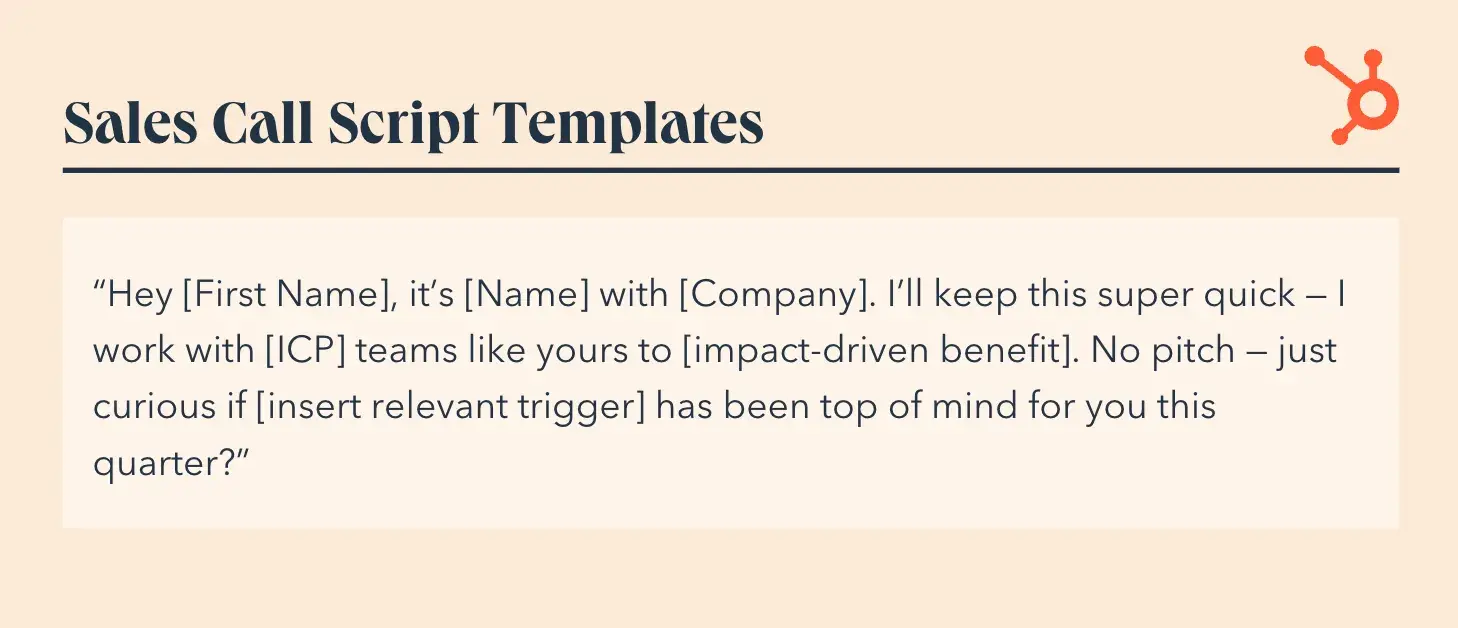
sales script, person on a call using a laptop in a home office, illustrating remote selling setup

Cold calling, for me, has always been about rhythm, not pressure. When I pick up the phone, I’m not hunting for a “yes”... I’m looking for permission. That first 20 seconds? It sets the tone for everything. If I come in hot with a pitch, I sound like a salesperson. But if I show respect, relevance, and restraint? I sound like a peer.

Here’s a version I’ve used that opens more doors than most:

“Hey [First Name], it’s Diego with [Company]. I’ll keep this super quick — I work with [ICP] teams like yours to [impact-driven benefit]. No pitch — just curious if [insert relevant trigger] has been top of mind for you this quarter?”

And if they say, “Yeah, what’s this about?”, I follow up with:

“Some teams I’ve worked with in your space were hitting roadblocks around [pain point], and what helped them was [solution preview]. Would it make sense to compare notes on how you’re tackling it?”

No pressure. No scripts that sound like they were spat out by ChatGPT and never edited. Just clarity, confidence, and curiosity — the three C’s I bring to every first call.

2. Sales Script for Working a Gatekeeper
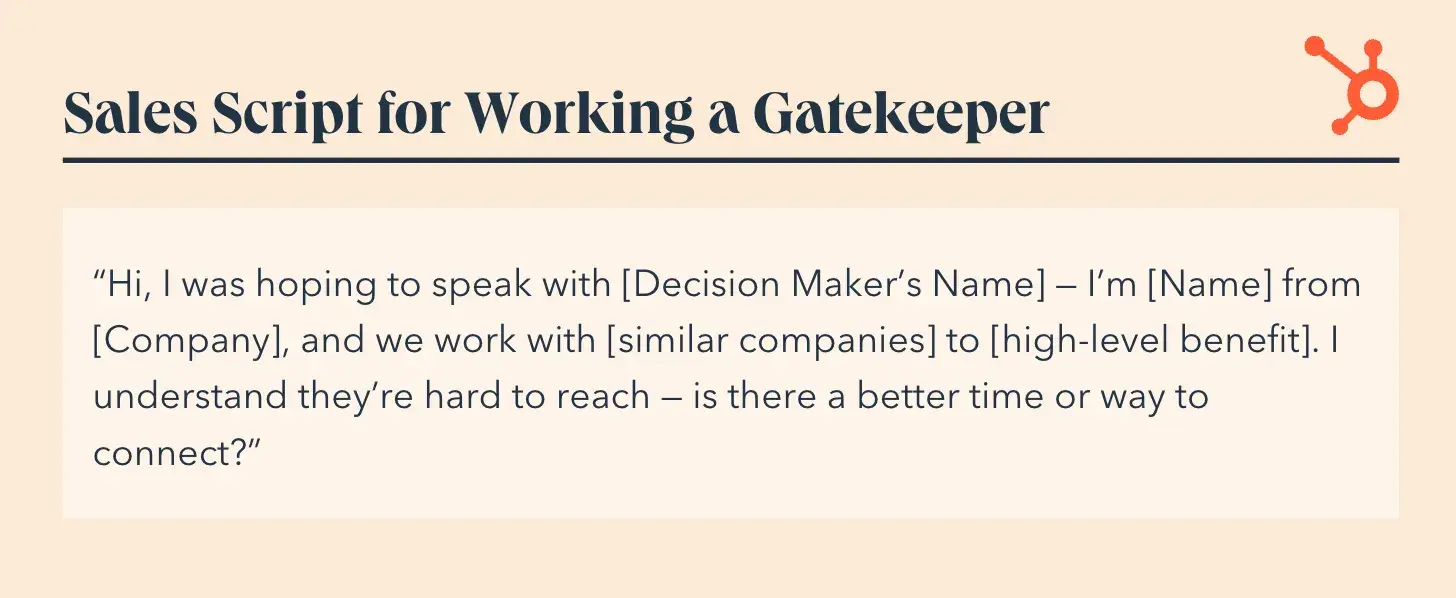
sales script, image of cold calling script template with highlighted quotes and action lines

A lot of reps treat gatekeepers like obstacles. I don’t. I treat them like allies.

I’ve gotten through to CFOs, CMOs, and even heads of security in oil and gas — not because I forced my way in, but because I showed respect to the person who picked up. I acknowledged their role and asked for guidance, not access.

Here’s how I usually start:

“Hi, I was hoping to speak with [Decision Maker’s Name] — I’m Diego from [Company], and we work with [similar companies] to [high-level benefit]. I understand they’re hard to reach — is there a better time or way to connect?”

And if they push back, I don’t resist. I pivot:

“Totally understand. If it helps, I just wanted to share something time-relevant — can I send a short note for them to review first?”

When you make the gatekeeper’s job easier, not harder, you’re far more likely to get the transfer.

3. Sales Script for Referencing a Mutual Connection
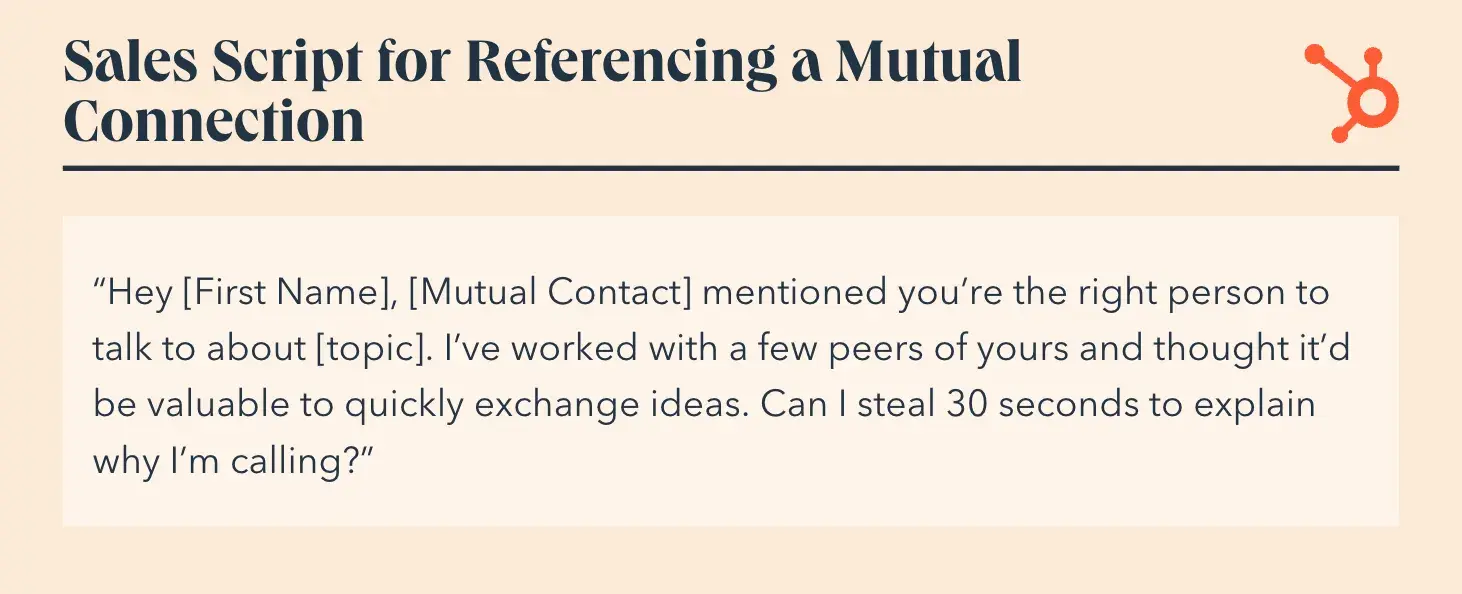
sales script, gatekeeper script template showing sample dialogue and call flow strategy

Nothing builds trust faster than relevance. And mutual connections? They’re a shortcut to credibility — but only if they’re real.

When I reference someone, I don’t name-drop. I anchor it to context.

“Hey [First Name], [Mutual Contact] mentioned you’re the right person to talk to about [topic]. I’ve worked with a few peers of yours and thought it’d be valuable to quickly exchange ideas. Can I steal 30 seconds to explain why I’m calling?”

It works because it’s low-pressure, specific, and grounded in a shared network. If they give me the green light, I don’t pitch. I pivot into discovery and let the conversation evolve naturally.

4. Sales Script for Email
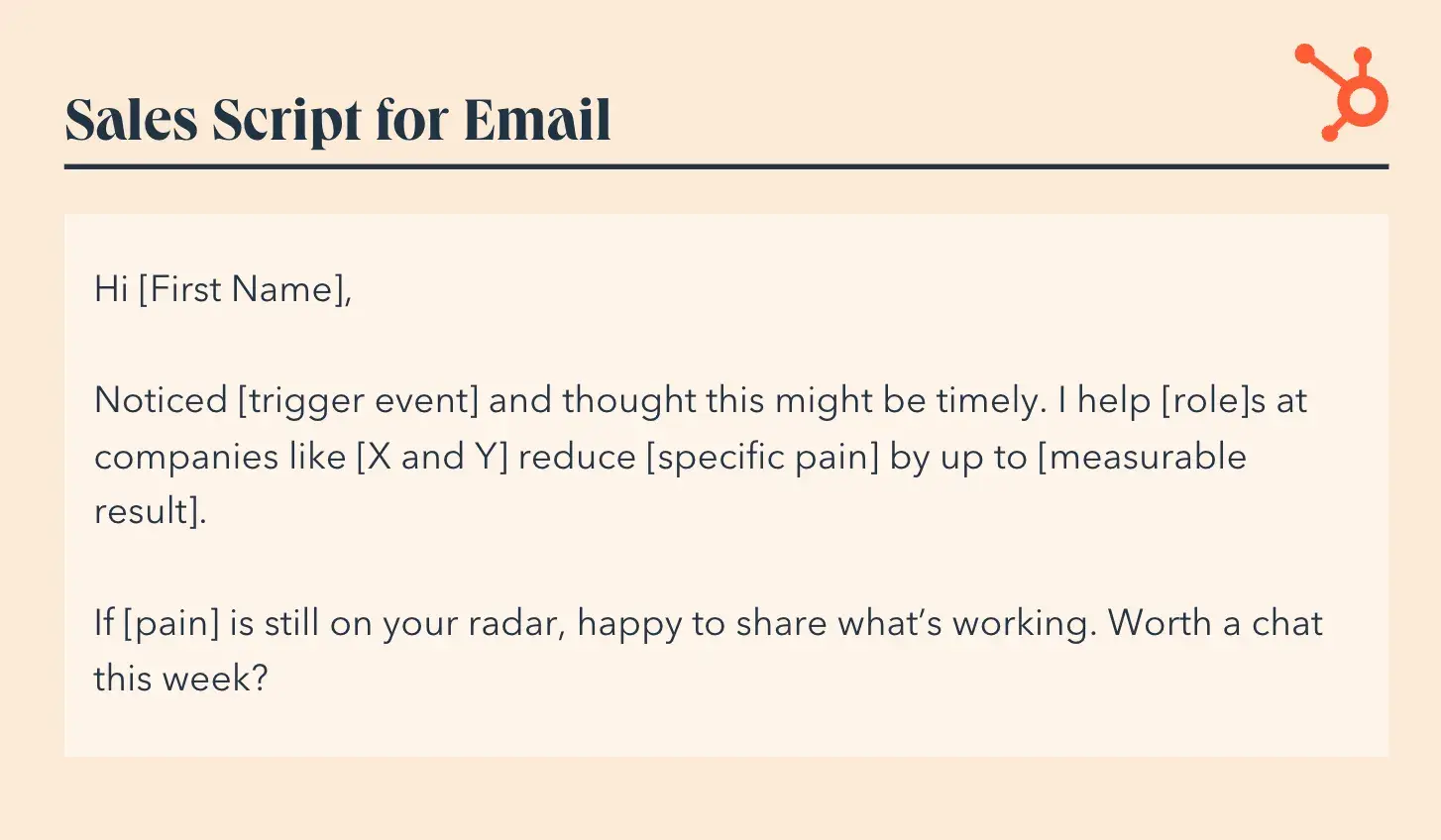
sales script, email script template demonstrating effective structure with subject and body layout

I’ve written cold emails that got 42% reply rates. I’ve also sent ones that tanked. The difference? The good ones follow what I call the 3 R’s:

  • Relevance (I know who you are).
  • Results (Here’s what I’ve done).
  • Respect (Your time matters).

Here’s a structure I’ve used for years:

Subject: Saw this on your roadmap

Body:

Hi [First Name],

Noticed [trigger event] and thought this might be timely. I help [role]s at companies like [X and Y] reduce [specific pain] by up to [measurable result].

If [pain] is still on your radar, happy to share what’s working. Worth a chat this week?

– Diego

Short. Contextual. No fluff.

5. Sales Script for Voicemail
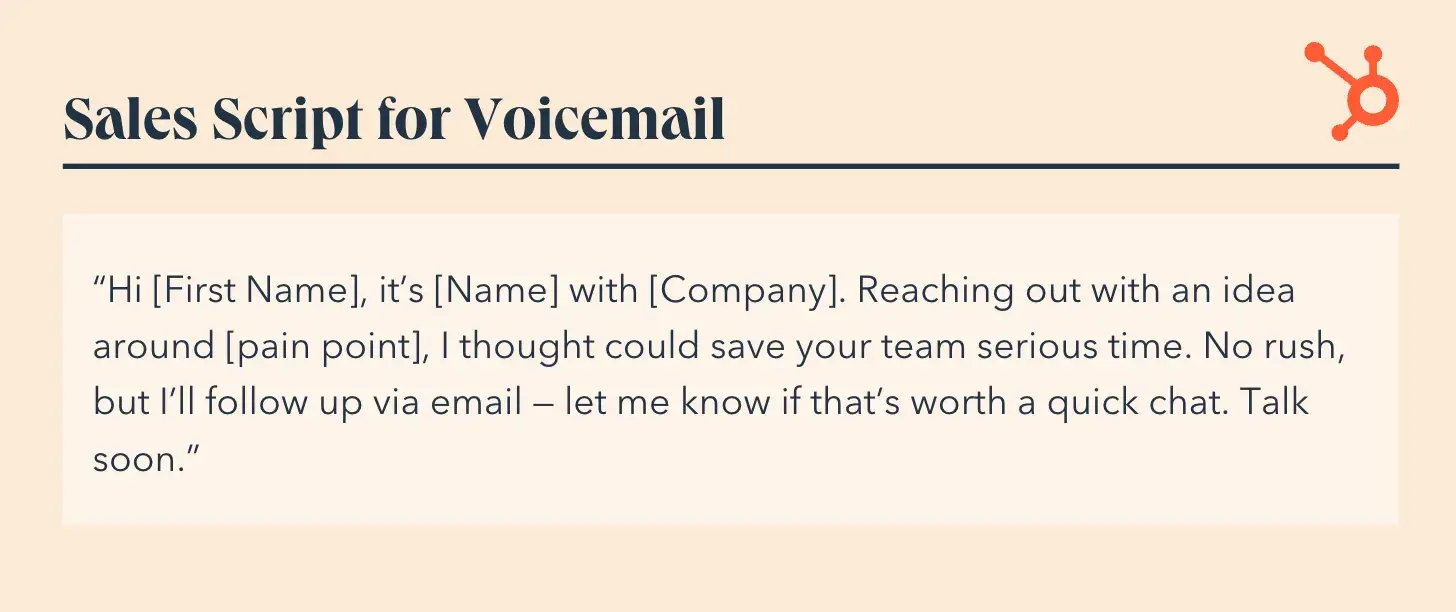
sales script, voicemail script template emphasizing brevity and curiosity in follow-up

Voicemail isn’t dead. What’s dead is leaving voicemails that sound like they’re trying to sell insurance at 3x speed.

The best voicemails I leave are under 20 seconds. They spark curiosity, not conversion.

Here’s a version I’ve used successfully:

“Hi [First Name], it’s Diego with [Company]. Reaching out with an idea around [pain point], I thought could save your team serious time. No rush, but I’ll follow up via email — let me know if that’s worth a quick chat. Talk soon.”

I treat voicemail like a trailer. Not the full movie. Just enough to earn a callback — or at least get my email opened.

6. Follow-Up Email Script
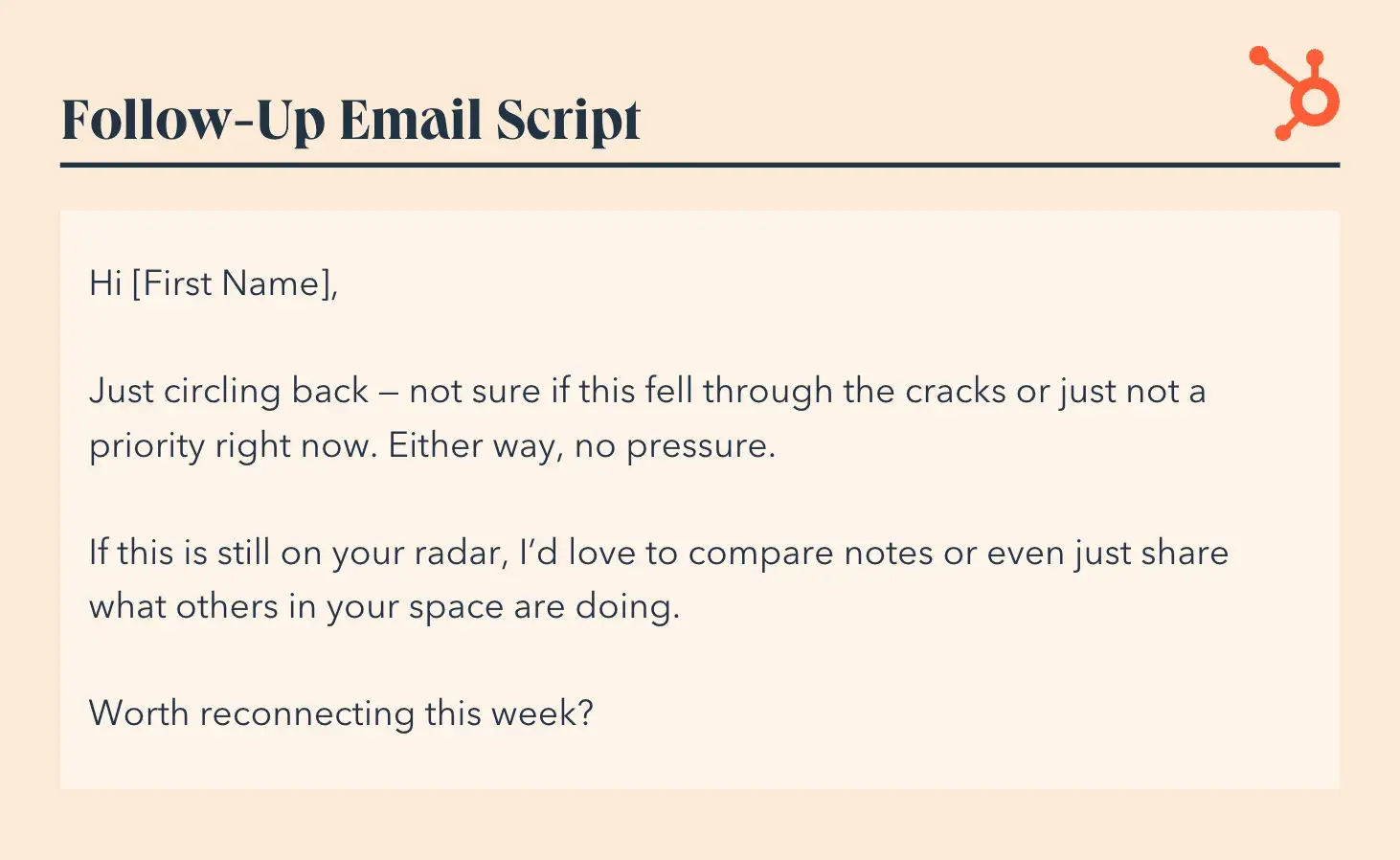
sales script, email script template demonstrating effective structure with subject and body layout

Breakup emails are like polite door-closing rituals. They let you leave with grace, but leave the handle unlocked.

I never assume silence = disinterest. Timing is the variable. And follow-up is the lever.

My best follow-up emails sound like a real human checking in, not a sales bot firing off sequence #5.

Subject: Re: [Original Email Topic]

Body:

Hi [First Name],

Just circling back — not sure if this fell through the cracks or just not a priority right now. Either way, no pressure.

If this is still on your radar, I’d love to compare notes or even just share what others in your space are doing.

Worth reconnecting this week?

Cheers,

Diego

This format has landed me 5-figure deals. Why? Because it respects the buyer’s reality. And it reopens the door without forcing a foot in.

7. Breakup Email Script
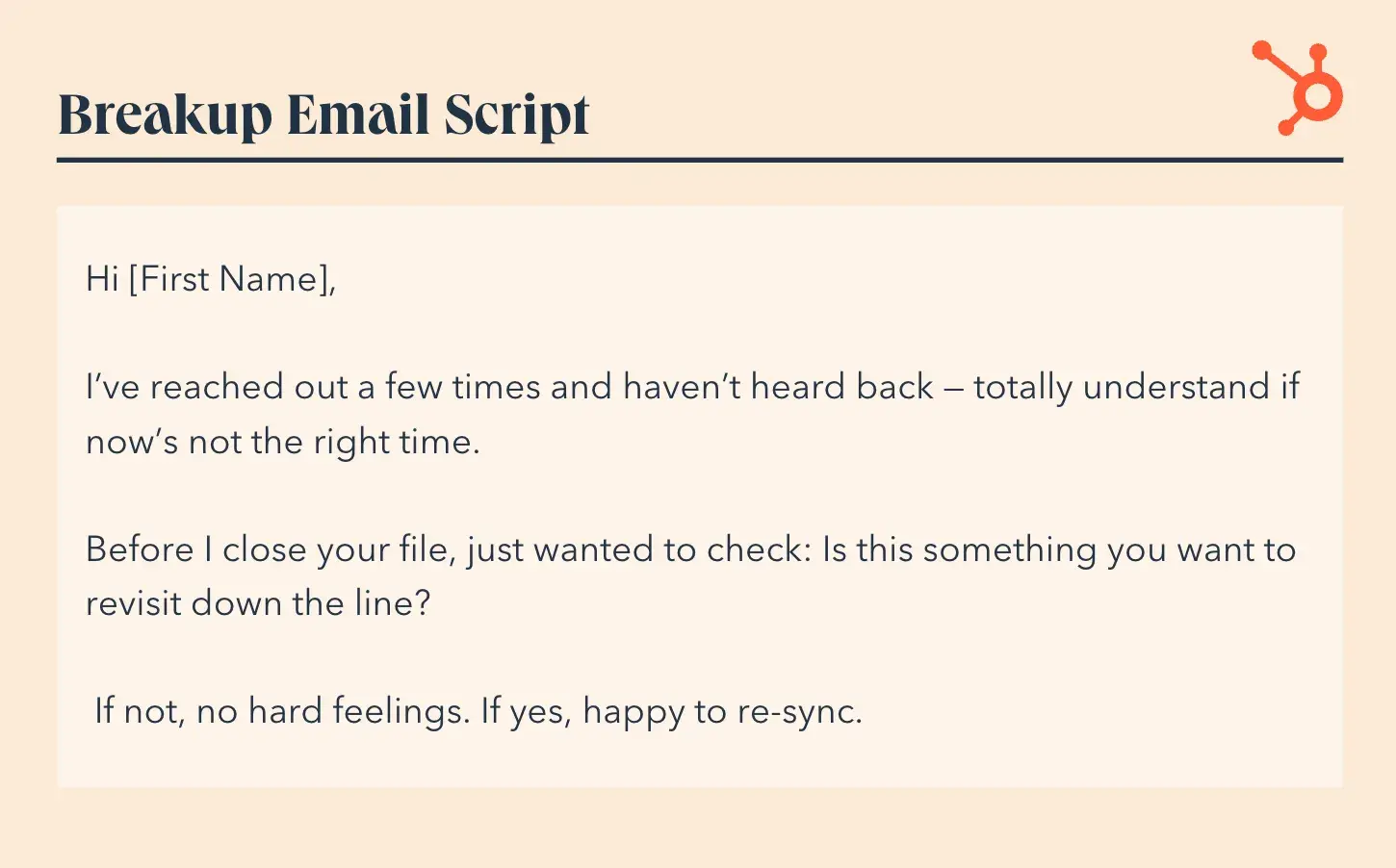
sales script, mutual connection script template with structured messaging example

Here’s mine:

Subject: Should I close your file?

Body:

Hi [First Name],

I’ve reached out a few times and haven’t heard back — totally understand if now’s not the right time.

Before I close your file, just wanted to check: Is this something you want to revisit down the line? If not, no hard feelings. If yes, happy to re-sync.

Best,

Diego

This works more than you’d think. Not because it’s clever, but because it gives people permission to re-engage on their own terms.

8. Breakup Call Script
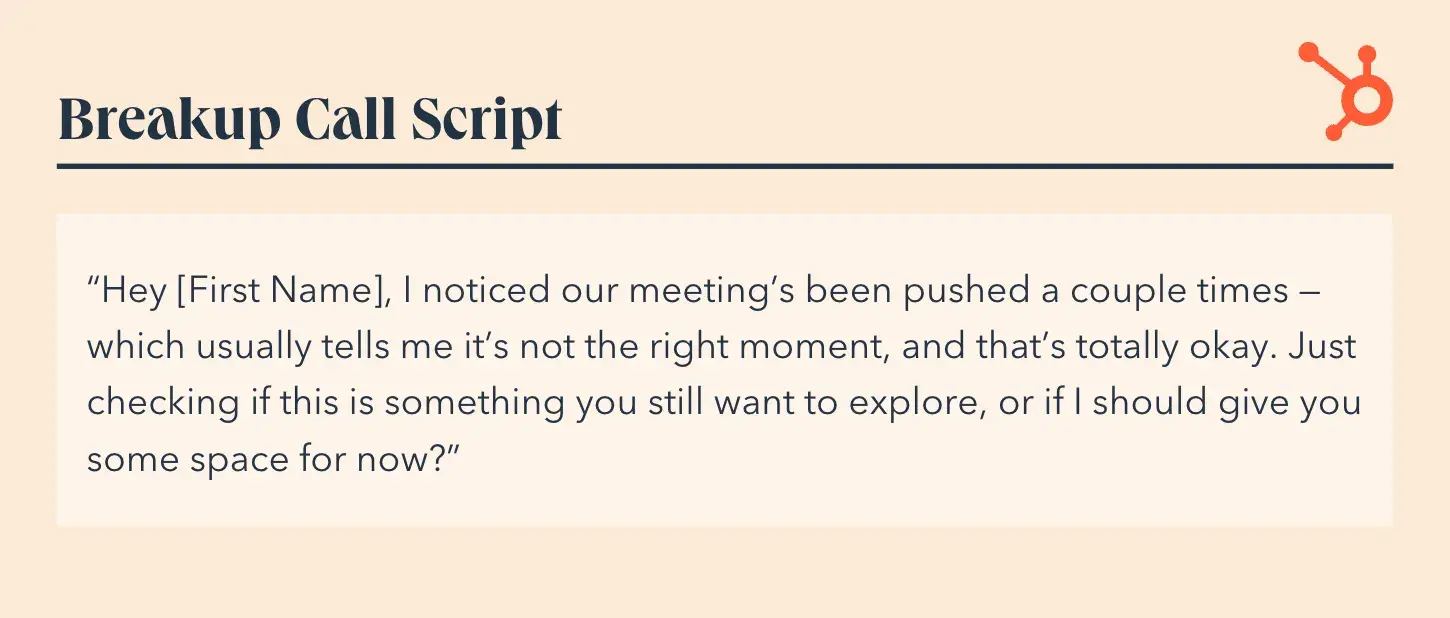
sales script, voicemail script template emphasizing brevity and curiosity in follow-up

I use this when someone ghosts me after multiple touchpoints.

“Hey [First Name], I noticed our meeting’s been pushed a couple times — which usually tells me it’s not the right moment, and that’s totally okay. Just checking if this is something you still want to explore, or if I should give you some space for now?”

You’re not being dramatic. You’re being direct. It’s a reset — and it respects their time and yours.

9. Breakup Voicemail Script
sales script, voicemail script template emphasizing brevity and curiosity in follow-up

This is my closer for leads that went cold but were worth the chase.

“Hi [First Name], Diego here — just wanted to say I’ll stop chasing you after this, since I haven’t heard back. If the timing ever changes, feel free to reach out. Wishing you the best with [their company or initiative].”

You’d be surprised how often I get a reply after this. Sometimes, it’s “Let’s talk.” Other times, it’s a simple “Thanks.” Either way, I leave the call with my reputation intact and my energy focused forward.

Scripts aren’t scripts. They’re scaffolding for trust. If you build them with empathy, precision, and a real understanding of your buyer’s world, you won’t just start more conversations — you’ll start better ones.

So take these, test them, and make them yours. Because in sales, you don’t win deals by sounding perfect. You win deals by sounding like someone worth listening to.

Why use sales scripts?

I get it — the word “script” feels rigid or like something that belongs in a theater, not sales. I used to think that too. When I was starting out, I prided myself on being spontaneous, thinking on my feet, reading the room. I thought scripts would turn me into a robot, stripping away my personality and connection.

But I was wrong. And I only realized that after I lost deals I should’ve closed. After I fumbled through conversations, I could’ve led with confidence. After I watched great prospects go cold because I didn’t know how to navigate objections, frame value, or create enough tension to keep them curious.

Eventually, I stopped winging it. I started treating sales like a craft. And that’s when everything changed. I learned that a great script doesn’t restrict you — it frees you.

Here’s why I rely on them daily — and why I coach teams, founders, and SDRs to do the same.

1. Scripts build confidence and consistency, especially in high-stakes moments.

I’ve sat in hundreds of calls with talented reps who freeze the moment the energy shifts. Maybe it’s a gatekeeper throwing shade. Maybe it’s a CMO challenging their assumptions. Maybe it’s just the nerves of pitching a five-figure solution to someone who holds the P&L. I’ve been there too.

But here’s the difference: When I’ve rehearsed my script — not memorized it, but internalized it — I don’t freeze. I adjust, pivot, and stay present. Because I already know the framework, I’m not grasping for what to say next.

Salesforce found that top performers are 1.6x more likely to prep with scripts and mental models before meetings. And it makes sense. In moments of pressure, your preparation becomes your safety net. I’ve used scripts to stay grounded through C-level pushback, pricing concerns, and unexpected curveballs — and it’s saved more deals than I can count.

2. Scripts shorten the sales cycle by eliminating guesswork.

Every time I’ve launched a new outbound campaign — whether for a new vertical, a beta product, or a strategic pivot — I start with one thing: a script. Because guessing what to say costs time. And time kills deals.

I’ve seen it firsthand: once the script is tight, discovery flows. Objections are anticipated. Calls get clearer, faster. Prospects feel seen. And we stop wasting each other’s time.

The RAIN Group reports that buyers are nearly 3x more likely to purchase from reps who show a strong understanding of their challenges early. That’s the power of a well-written script — it structures understanding. It removes fluff. It keeps you focused on outcomes, not features.

For me, a script is like a GPS. I still have to drive, but I’m not getting lost.

3. They help new reps ramp faster and avoid costly mistakes.

I’ve onboarded reps in startups, coached founders doing cold outreach for the first time, and built playbooks for teams scaling across regions. And every time, I come back to the same tool: the script vault.

It’s not just a cheat sheet. It’s a system for transferring what works. When a new SDR uses a tested script, they’re not starting from zero — they’re starting with leverage.

I’ve seen new hires book meetings in week one with the right script. I’ve also seen reps spin their wheels for months without one, stuck rewriting the same awkward opener, or fumbling through objections they should’ve seen coming.

McKinsey reports that companies with standardized sales messaging outperform competitors by up to 20% in revenue growth. That’s not about being boring — that’s about scaling what works. A good script creates repeatable wins. And that’s what turns junior reps into closers.

4. Scripts are the fastest way to identify what works (and what doesn’t).

I treat my scripts like live hypotheses. Every line is a test. Every pause is data. If I swap out an opener and response rates go up, I keep it. If they drop? I tweak again.

Over the years, I’ve built dozens of micro-variations across industries: from fintech to SaaS, healthcare to AI. I’ve tracked how founders respond to urgency versus logic. How VPs react to social proof versus ROI framing. I’m not guessing. I’m iterating — and that’s what separates reactive reps from high performers.

Because here’s the truth: If you don’t use a script, you can’t improve it. You’re just relying on gut feel. And gut doesn’t scale.

5. A script turns “talk tracks” into strategic conversations.

Here’s my unpopular opinion: Most reps talk too much. They confuse features with value, overexplain, and pitch instead of diagnose. It’s not because they don’t care — it’s because they don’t have a structure to guide them.

When I write a new script, I force myself to include five open-ended questions for every one value prop. That’s not arbitrary — that’s strategic. It keeps the focus where it should be: on the buyer’s goals.

HubSpot data shows that high-converting calls maintain a near 43:57 talk-to-listen ratio. That means the best reps talk less than half the time. A strong script makes that possible — even when you’re nervous, or when the conversation veers off-track.

I use scripts to ask better questions, not give longer answers.

Final Thought: Use the script as a compass, not a cage.

The biggest shift in my sales career came when I stopped seeing scripts as something I had to hide and started using them as a strength. Not a script to follow blindly, but a structure to show up smarter, faster, and more human.

The best reps I’ve worked with all had one thing in common: They didn’t sound scripted. But every move they made was intentional. They had rehearsed. They had frameworks. They had fallback plans. And that’s what made them sound natural, not lucky.

I coach sellers today the same way I coach myself: Don’t memorize the script. Instead, learn the rhythm, understand the psychology, and get so comfortable with it that you can throw it away when you need to — and still land the point.

Because in the end, a script isn’t there to make you sound polished. It’s there to make you present.

And presence is what closes deals.

Scripts free you to sell better.

In my career, I’ve built dozens of script variations — from cold openers to complex objection-handling sequences. And here’s what I’ve learned: The best sales scripts don’t make you sound robotic — they make you sound prepared. They create consistency without killing creativity, and they help you deliver relevance, not repetition.

Some reps still argue that scripts feel unnatural. I’d counter that what feels “natural” is usually just familiar. Once you’ve internalized a script that’s truly designed around your buyer’s problems, priorities, and language, it becomes your natural rhythm.

And that’s the real secret: A script can free you up to listen better, ask smarter, and move faster.

If you treat a script like a teleprompter, you’ll lose the room. But if you treat it like a framework — like a compass — you’ll earn trust, time, and eventually, the close.

So build scripts that sound like you. Refine them with data. Practice them like a craft. And then, when it’s showtime, show up human. Because the real power of a sales script isn’t in the words themselves — it’s in what they allow you to become when it matters most.

Editor's note: This post was originally published in December 2017 and has been updated for comprehensiveness.

15 Jan 20:48

DNA of a Strategic Marketing Operations Leader: 3 Seismic Shifts, Part 2

by Debbie Qaqish

ar130405 / Pixabay

Marketing operations (MO) as a dedicated, funded and strategic capability has exploded across B2B marketing organizations. Driven by traditional marketing’s poor response to changes in technology, customer behavior and use of data for decision-making, the marketing operations function is not only filling the gap, but also creating a competitive advantage for organizations by enabling change and revenue results from marketing.

I see a big difference in companies of all sizes with a marketing operations team versus those without one. Businesses I work with that have a dedicated operations team typically have and achieve revenue targets. Companies that do not have a dedicated marketing operations organization are laggards on the revenue marketing journey.

I’ve been lucky to have a front-row seat to the evolution of marketing operations as a capability. But what fascinates me most is the new generation of marketing operations leaders who are emerging.

I write a lot about the changing role of the CMO, and it’s also the topic of my Ph.D. research. I began working with and interviewing marketing operations leaders in 2016 and have seen three dramatic transformations in the role that an effective marketing operations leader plays within an organization:

  1. Button-pusher to tech visionary and interpreter
  2. Tech geek to multidisciplined business leader
  3. One-trick pony to multifunctional process improvement engineer

Button-pusher to visionary and interpreter

Whether the marketing operations executive is viewed and treated as a “button-pusher” or a visionary often relates to the maturity level of the marketing and the marketing operations.

In the early stages of transforming marketing from a cost center to a revenue center, marketing operations is typically represented by a single person who has some affinity for technology and is tasked with figuring out how to work the new marketing automation platform. As more technologies are added to the stack, another person may be added.

In this example, these resources are often viewed as “button-pushers” because the vision of what marketing can do with the right technology has not yet been established. One marketing leader I spoke with put it best: “I’m seen as the tactical execution guy, and while I do it very well, I’m never invited into strategic conversations.”

In contrast, marketing organizations that are more mature, meaning they are revenue contributors to the business, are run by executives who serve as digital transformation visionaries and interpreters. Let me break this down.

First, as a digital transformation visionary, the marketing ops executive works in concert with the CMO to create, sell and execute the entire digital transformation strategy. The executive blends a deep understanding of current and future technologies with a business approach to help marketing become the revenue and growth engine for a company.

It’s no longer good enough to have a surface knowledge and understanding of these technologies. They are too pervasive and are changing things too dramatically and quickly. It’s the job of the visionary to make sense of the madness and find out what works best for the company.

Tech geek to multidisciplined business leader

This has been a fascinating transformation to watch. When I first began to work with companies that were just putting marketing ops teams into place, it seemed many were only focused on the technology.

The “tech geek” mentality is even worse in companies that place the marketing ops group in IT. It just never seems to work out, because a new approach to technology is needed — one that requires the marketing ops leader to be a multidisciplined leader.

When was the last time you looked at all the responsibilities of a mature and effective marketing operations group? The marketing ops leader is increasingly responsible for more than the technology and the data. They are now tasked with applying technology and data to help solve different elements of the business. This includes sales productivity, budgeting and planning, product development, customer service and more.

Because the marketing ops leader holds so much customer data and has the resources to slice and dice to derive business insights, they are being asked to work across more and more disciplines. Expect this role to expand.

I really love the role of tech interpreter. Have you talked with a marketing ops executive recently? They can rattle off about 50 to 100 different technologies at the drop of a hat. AND they can talk about these technologies in terms of what is right for their business and why it’s right for marketing.

Being able to bridge the language barrier between technical and non-technical types is a key element of the marketing ops leader’s DNA.

When I attended the MarTech Conference earlier this year, SapientRazorfish had a session in which they highlighted their training program for today’s CMO. It encompassed helping rising executives better understand technology by actually working on projects using various digital marketing technologies.

One-trick pony to multifunctional process improvement engineer

I vividly remember talking with marketers about their technical resources in the early days of marketing operations. This person was always characterized as the odd character who kept her head down and just ran and administered technology systems such as marketing automation. Today, one of the most exciting aspects of the marketing ops leader’s job is being a multifunctional process improvement engineer for vital functions such as lead management.

For years, both marketing and sales have been frustrated by their inability to get on the same page in terms of lead flow and lead processing. Marketing worked hard to produce high-quality leads that are often summarily dismissed by sales. There is something magical that happens when marketing operations looks at this broken process and takes it on as a project.

First, marketing ops seem to have more credibility with sales than does marketing. Perhaps it is because of the working history of marketing and sales. But whatever the case, marketing ops seems to be able to influence sales to adopt changes in CRM (customer relationship management) that marketing alone could not do.

Second, marketing ops takes a project management approach with no spillover emotions in figuring out what’s wrong and what they need to do to fix it.

Finally — and this is a biggie — marketing ops makes data-driven decisions. No more “he said, she said” shenanigans.

Lead management is only one process that I’ve seen marketing ops take on, get buy-in into the changes and drive more value from the business. I was recently talking with a marketing ops about his job as a process engineer, and he admitted that while his role didn’t start out that way, given his group’s position in the company, he was doing a lot of it and loved it.

Conclusion

Visionary, interpreter, business leader and process engineer are pretty big words that describe the makeup of today’s successful marketing ops leader. Right before our very eyes, this new breed of leader is emerging and helping marketing smash through what I call the “perception barrier.” This is the set of beliefs and perceptions held across a company that marketing is the pens and mugs department and a money pit.

Nothing could be farther from the truth. Marketing today needs a new name because it’s now the growth and revenue engine in our digital engagement economy. And it’s the marketing ops leader who is leading the charge to smash these perceptions for good.

15 Jan 20:48

Referral Strategy: The 7 Factors of a Profitable Referral Incentive Strategy

by Jessica Edmondson

referral incentive, referral strategy, partner reward, referral partner, referral partner reward, incentive calculation

Upon identifying your referral sources, developing a recruitment strategy, creating a sales enablement plan and developing a plan to enable referral sources, it’s time to build a referral strategy for your incentive that drives more high-quality referrals.

This portion of your referral strategy is very important. Adding an incentive to your referral strategy isn’t just a box to check before moving onto the next step. There are a variety of different mechanisms that are involved in creating a referral incentive. Different referral sources might require different amounts and structures, and have different motivations. Here how to determine the right referral incentive strategy for your referral program.

4 factors that determine your referral incentive structure

In order to drive repeat referrals, you need to set up a referral incentive structure that is motivating to each specific group of referral sources. There are four considerations that go into this part of your referral strategy.

1. The calculation – To create an incentive amount that is both motivating to referral sources and provides the best ROI, ask yourself this question: Do you want to reward at purchase or at an earlier stage?

If the answer is at purchase, determine the best way to calculate the reward for your program. If you need help with that, look back at the second blog in the series to see how to calculate incentives based on your current CPA.

However, if you would want to have your incentive fulfilled at an earlier stage, try rewarding on a flat bounty. To do this, determine the amount and stage to be triggered.

referral incentive, referral strategy, partner reward, referral partner, referral partner reward, incentive calculation

2. Timing and multi-stage – To make sure your referral structure keeps referral sources engaged and motivated, and ensure that the referrals they provided are quality, ask yourself this question: Do you want to add a retention period before paying the incentive in full?

If the answer is yes, consider splitting the incentive into multiple stages such as at purchase and after a retention period to keep high engagement.

If the answer is no, take a look at your sales cycle. If it is a long sales cycle, consider rewarding at multiple stages to keep engagement up. However, if your sales cycle is short you can just have your incentive be fulfilled at a single stage.

referral incentive, referral strategy, partner reward, referral partner, referral partner reward, incentive calculation

3. Multi-level – To decide how to structure your incentives to motivate repeat referrals and create higher-performing referral sources, ask yourself this question: Do you want to create multiple reward levels?

If the answer is yes, you then have to decide if you want to base the reward on the number of successful referral or on the number of rewards (only used if using multi-stage rewards).

However, if the answer is no you can simply keep a non-variable reward.

referral incentive, referral strategy, partner reward, referral partner, referral partner reward, incentive calculation

4. Accrual – To understand how to handle accrual based incentives, ask yourself this question: Do you have transaction fees for EFT and/or expect a high frequency of successful referrals from your sources?

If the answer is yes, determine the frequency of the incentive payouts.

If the answer is no, payout the reward at the time the referral becomes successful.

referral incentive, referral strategy, partner reward, referral partner, referral partner reward, incentive calculation

Answering these questions can help you create a more targeted and effective referral strategy for your incentives. But once these decisions are made you still aren’t done. Now it’s time to think about incentivizing the other people involved in the referral process and the inclusion of added incentives.

3 times you should include extra incentives in your referral strategy

While having a regular referral strategy in place for your incentives is necessary, going the extra mile can help keep you top of mind for referral sources. For instance, during a slow time of the year, referral sources can be prompted with a special bonus. And you can’t forget about the other people involved in making a referral successful. To drive added referral activity there are people outside your referral sources that can be incentivized. Here‘s how to determine if you should include any of these three extra incentives in your referral strategy.

1. Prospect reward – Also known as double-sided rewards, these rewards can reduce some of the perceived risk referral sources have when making a referral. This is because it allows a referral source to offer the referral a great deal. To determine if this is right for you, ask yourself this question: Do you have the ability to offer referrals a discounted price?

If the answer is yes, determine the appropriate discount.

If the answer is no, see if there is anything else you can offer for a certain action a referral takes, like a gift card for taking a meeting with sales. If that still isn’t possible just stick with your single-sided reward.

2. Campaign bonus – When trying to drive point-in-time activity, an extra incentive such as a raffle prize or an increase in the incentive can help to re-engage referral sources and facilitate greater activity. To determine if this is right for you, ask yourself this question: Is there times during the year you’d like to stimulate an increase in referral leads?

If the answer is yes, figure out whether you want to incentivize referral lead collection or successful referrals.

If it is referral leads you will need to look to see if you have the budget to reward on each lead. However, if you don’t you can implement a raffle instead.

Even if you don’t have a specific time period in which you want more referrals, consider picking two months during the year to run a promotion.

3. Sales incentive – It has been shown that sales involvement in a referral program increases the conversion rate from referral lead to purchase by 10 percentage points for partner referrals and 17 percentage points for customer referrals. To drive consistent activity from sales or other employees, an incentive can be created to motivate them. To determine if or what type of sales incentive is right for you, ask yourself this question: Are you incentivizing a direct or channel sales team?

If you’re incentivizing your channel sales team, consider if they should be incentivized to recruit referral partners and collect referrals as part of their commission. If that is something you want, try organically incentivizing with leaderboard transparency. On the other hand, if you don’t want that, look into creating monthly goals with prizes to the top individual achievers and top sales team.

If you plan on incentivizing your direct sales team, consider if you want to incentivize recruitment or referral collection. If recruitment is where it is at for you, try quarterly goals and prizes or a swag bonus for each new recruit. However, if you are going to incentivize based on referral collection, figure out monthly goals with prizes for the highest performing salespeople.

12 Jan 20:37

Phone Sales Tips and Techniques – 8 Crushing Phone Sales Blunders Every Salesperson Must Avoid

by Marc Wayshak

Do you know the biggest blunders that salespeople are making on the phone? Most high-level prospects receive between 5 and 25 sales calls every day, and their goal is to get off the phone as quickly as possible so they can get on with their busy schedule. So, if you are making one of these mistakes, you are in huge trouble. Learn the 8 crushing phone sales blunders that most salespeople make and how to avoid them!

The post Phone Sales Tips and Techniques – 8 Crushing Phone Sales Blunders Every Salesperson Must Avoid appeared first on Sales Speaker Marc Wayshak.

12 Jan 20:30

Why Differentiation is Crucial for B2B Content Marketers in 2018

by Alistair Norman

50% of B2B content marketers are doing the same or worse than their competitors — and that’s by their own admission. Make sure you’re not one of them…

Once everyone got the memo about the power of content marketing a few years ago, the unstoppable tide began to flow.

Fast forward to now, and the B2B landscape is flooded with content creators competing for customer attention, scrabbling for prospects, and trying to cut across one another to make an impact.

In a study of 172 B2B marketers, 50% of them judged their own content to be ‘about the same’ or ‘less varied and more limited’ than that of their rivals in the industry.

In this competitive content environment, how do you make yourself heard above the noise? The answer is content marketing differentiation.

What is differentiation?

Differentiation in content marketing has multiple components. First of all, your content must demonstrate what sets you apart from your competitors, underlining your unique proposition and explaining why your customers choose you over others.

Your content itself must be differentiated from the competition. To stand out in a sea of samey eGuides and pointless infographics, you need to craft unique and attention-grabbing content that B2B decision makers haven’t seen before.

Differentiation takes on a further dimension when we consider that different channels lend themselves to different types of content. Crafting messages to suit the channel they’re presented on is important.

And so is differentiation by audience — considering who each piece of content is intended for and tailoring it intelligently to them.

How many marketers are differentiating?

In our study of 172 B2B marketers, there was widespread recognition of the need for differentiation.

But while 64% claimed to have some strategy for differentiation, only 16% of those had one in the form of a documented plan.

Why are content marketers differentiating?

The top reasons for differentiating content by channel or audience cited by B2B marketers were:

  • To provide an improved customer experience (71%)
  • To attract more customers (70%)
  • To provide greater differentiation from the competition (49%)
  • To increase customer loyalty (41%)

The majority of those surveyed recognise that content differentiation increases the appeal to customers, by avoiding a one-size-fits-all approach.

But more marketers need to recognise increased customer loyalty as a key reason for content differentiation.

Two key ways to differentiate content:

  1. By channel
  2. By audience

Differentiation by channel

A multichannel world demands multichannel content. And that doesn’t mean putting out the same stuff across social media, email, blog posts and more. Instead it’s a tailored approach that recognises the strengths, challenges and character of each channel.

For example, you might create an in-depth industry report, which could be shared in different ways across your channels to maximise impact. It can be spun into a series of blog posts for your website, visualised in a video for Twitter, and summarised in an email to your database with a link to download the full report.

Differentiation by audience

Only 17% of the B2B marketers surveyed reported no tailoring of content by audience. Of the remaining 83%, 60% of them claimed that their organisation tailored content to particular audience segments or buyer personas. A further 23% went one step further and said ‘our organisation tailors content to specific individuals’.

These were the most popular ways to differentiate content by audience in our survey of 172 B2B marketers:

  • By industry (77%)
  • By content consumed (50%)
  • By location (49%)
  • By seniority (41%)
  • By device used (28%)

Unsurprisingly, the most popular differentiation methods shown here are also the simplest ones. Segmenting and targeting your audience by industry and by the content they consume is certainly useful, but more sophisticated measurements such as differentiation by persona are less common.

Only 45% of marketers tailor their content to personas they have created. This is despite widespread use of segmentation and personas for other aspects of marketing strategy.

In the era of increasing demand for personalisation, B2B marketers would do well to focus on delivering that tailored customer experience through their content.

Differentiation is crucial for content marketing success in 2018

In the complex and competitive B2B marketing landscape, content differentiation is essential for any marketer looking to make an impact and rise above the cacophony of content out there.

To achieve those key benefits, including improved customer experience, loyalty and retention, you need to not only produce content that stands out, but also tailor it according to the channel and intended audience for optimal results.

Key Takeaways

  • Brands are struggling for market share and customer attention; 50% of B2B content marketers feel they are doing the same or worse than their competitors.
  • Differentiation has multiple components: producing standout content, defining your unique offer, and tailoring content to suit different channels and audiences.
  • The industry is slowly waking up to the importance of content differentiation — 64% of B2B marketers have a strategy in place, but only 16% have a formal plan.
  • The most common reasons marketers differentiate are: to provide improved customer experience, attract more customers and set themselves apart from the competition.
  • Marketers need to differentiate their content according to persona, channel, and individual preferences, not generic factors like industry and location.
Differentiate or risk becoming irrelevant.
12 Jan 18:51

8 Hacks to Boost Traffic & Sales Today

by Nicole Blanckenberg

Want to make 2018 your best year yet? Yes of course you do! By increasing the amount of targeted traffic to your store and optimizing your store for shoppers, you can increase your sales to make this year a cash-cow.

As we know, some traffic generators such as SEO is a long-term game, but there are a number of ways you can increase your targeted traffic today to help you start off the year right. And once you have the right traffic, there are things you can do to instantly turn that traffic to gold.

So without further ado, here are the 8 hacks to boost traffic and sales today!

1. Use Your Packaging to Increase Sales & Win Traffic

After-sales service, when done right, not only builds those loyal lifetime customers, but can generate a lot of sales. The psychology behind it is fairly simple: how do you capitalize on the moment when someone receives your product and is super happy? It can be as straightforward as putting coupon inserts into the packaging that offer the buyer extra discounts, or as creative as what one of my favorite online stores, Happy Socks, does.

eCommerce store with good packaging

I recently ordered some of their gift box sets (I have a little bit of a sock fetish…) On their packaging they include their branded hashtag which allows happy customers, like me, who have just received their order to take pics and share. We all know how UGC (user generated content) can drive traffic and sales. Being able to prompt people at that moment to share can be a lot more effective than asking for reviews or content after the fact via email.

2. Get More Traffic With Influencers

Influencer marketing is all the rage and definitely a 2018 eCommerce trend to watch. Influencer marketing is user-generated content on steroids and can have amazing results. Influencer marketing allows you to put your products front and center to niche markets in your niche; all by utilizing an already popular account. The reason why this kind of marketing is so great for generating highly targeted traffic is that you’re accessing very segmented target audiences linked to micro influencers within that niche’s online community.

With great platforms such as Tribe, you can be linked with an influencer in your niche quickly and easily and begin generating more traffic in no time.

3. Help Your Way into More Traffic

If you’ve been following our blog you know we say it a lot: being an authority or expert in your niche is fundamental in driving people to your site. You also probably know that the key to being an expert is in your content marketing plan. However, what you may not have thought of is guest posting. Think of UGC, and turn it on it’s head. Guest posting is where you approach other online blogs and submit a guest post to their site.

Now, the key to being successful with this is twofold:

  • Stay in Your Lane

Approach online publications/blogs that are within your niche. For example, if you’re selling hair care products, approach beauty bloggers with articles such as “Five Tips to Beautiful Hair.” Before submitting your posts make sure that your content suits their target audience.

  • Don’t Send Spamy Posts

This is not about hard-sell, this is about providing valuable, helpful content that the readers of that blog will read. So make sure you know the sites’ guidelines before you submit to save disappointment.

Pro Tip: Getting your content on high-traffic blogs is another form of that good-old influencer marketing we were talking about. Therefore it’s worth the investment in freelancing your guest posts out. Hop over to our eCommerce Entrepreneur’s Guide to Finding Freelancers to guide you through your search.

4. Change Your Email Marketing Strategy

The year 2018 is all about segmenting. Segmenting with influencers in small niches, segmenting by using AdWords remarketing tactics and segmenting with Facebook Messenger ads. Why? Because personalization is the key to upping your sales this year. And your email marketing is no different. Did you know that there were 269 billion emails sent last year? If you want to stand out, personalization is a must.

What you want to do is make sure your specific emails such as abandoned cart emails are automated and for the rest be far more specific in your targeting. Send promotional emails specifically designed for shoppers who have bought those products from you before, or who have very similar geographical profiles. The key is more segmentation, because segmentation means the emails are designed specifically for the reader and therefore will generate more targeted traffic. And as we know, targeted traffic means more sales.

5. Automate Your AdWords Campaigns

AdWords is still one of your top traffic drivers, although it can seem like a lot of work to keep your campaigns optimized for great results. Most small business owners who are doing most of the work themselves, just don’t have the time to keep a close eye on their campaigns. However, there is an easy fix for this with AdWords automation options. Automation rules will help you optimize your campaigns by adjusting bids and editing campaigns for you. This video guide will help you set it up.

Alternatively give apps such as our Traffic Booster a try which will run, automate, optimize and manage your campaigns for you at an expert level, for a fraction of the costs that an agency will cost.

Pro Tip:

Are you bidding on your own brand names yet? If you aren’t, you should be. Find out how branded keywords help bring in more traffic and convert more sales here: Why Do I Need to Bid on Branded Keyword Terms?

6. Add Subscription Options to Any Store

One of the hottest trends this year is subscription services. Subscriptions mean repeat business, repeat business means staying fresh in the minds of your shoppers and also more UGC opportunities. Now before you shake your head and say it doesn’t fit into your traditional model, think again. I touched on it briefly in my last blog post, but the idea is to add some subscriptions to your existing product base.

Here are some ideas to get you started: Think of something, within the niche you’re selling, that people could use more than once (such as what Dollar Shave Club does with their razors) and build subscription packages around that. Obviously if you’re in the fashion niche, you wouldn’t be sending the same thing twice. Instead, you could start an “accessory package” where people sign up for accessory subscriptions where they get a surprise purse or scarf for the upcoming season.

7. Change Email Subscriptions to Social Follows

It’s time to rethink your pop-ups. By using apps like Coupon Pop you can turn web-traffic into social followers. The beauty of this, unlike email subscriptions that only target one person, is that more social followers means more content likes and shares, which ultimately is a kind of brand exposure that email can not offer you.

add social pop ups on your store

Plus, I don’t know about you, but I am getting more and more guarded on who I give my email address too – when there are 260 billion emails being sent yearly, can you blame me? Meaning when I am faced with a pop up asking me to subscribe I am less likely to sign up than If I have to be giving away my email address.

8. Shoot a Product Video

Last, but by no way least, get out your phone and shoot a product video. Yes, right now. Today. Shoot your video and post it! At the end of last year Proven Audience Formula ‘How to get 8 million Facebook Views with an Amature Video’ and demonstrated how their single, short, home-made video took them from selling one to two units per day to 150+ units a day. That isn’t small potatoes.

If you are waiting for a budget to hire videographers, you are missing the point big time. This is where small businesses have an equal playing field with the big guys: Content! The content king Gary V has been saying this for years with his ‘Don’t Create, Document’ philosophy. Don’t know it? Here’s his video to get you inspired:

There you have it, 8 ways you can get traffic to your store and make those sales. If you do just one thing on this list this week, you are well on your way to being the most successful you can be this year. You’ve got this!

Have something to add? Post your thoughts in the comments below.

12 Jan 18:42

8 Ways to Measure Sales Training Impact

by Richardson Sales Training

Competition in sales continues to escalate. In response, more businesses are renewing their focus on sales performance initiatives. However, these directives leave little time for the most critical step: measurement. Even the best sales performance intentions will fall flat without measurement.

After decades of working with sales organizations across industries, we’ve determined a core group of eight sales metrics. These measurements are critical for getting an actionable read on how they’re performing as an organization, which is driven, in part, by sales performance initiatives. Some organizations will only need to use a few of these. Others may need them all. Here, we take a closer look at how each one works and why they matter.

  1. Win Rate: A team or company’s win rate serves as the primary indicator of market competitiveness. As an all-encompassing measurement, the number is easy to track and easy to baseline. This is a simple gauge of how many new pursuits close with a win status. However, win rates should not be viewed in isolation because the measurement is often a starting point, telling leaders where else to look for clues on business performance.
  2. Quota Attainment: When leaders want to compare performance with expectations, they turn to quota attainment as a measurement. This qualitative number answers, “What percent of the sales team is meeting their goal?” This figure serves to judge performance against expectations and is a function of how all initiatives are operating.
  3. Time to Productivity: Like a jet on a runway, a new seller has only so much time before they need to be “wheels up.” Time to productivity measures the length of this runway. This metric is particularly useful when looking to expand team capacity or when an organization is facing high-turnover. As Harvard Business Review reports, global companies like SAP examine time to productivity and even ongoing productivity. In doing so, they gain insight into what sellers can accomplish while helping managers more effectively staff their teams.
  4. Attrition: According to a body of research from the Center for American Progress, the median cost of turnover is 21 percent of an employee’s annual salary. For this reason, attrition is a valuable measurement. Attrition signals the health of the sales team and, to an extent, the demand of the product that they’re selling. The number is also a lagging indicator of other measures, such as ramp time, productivity, and engagement.
  5. Contract Value: Sellers today must work harder than ever before. Many competitive advantages have equalized as technology puts other players, big and small, on the same field. In response to this pressure, more sellers are seeking larger contract values so that the deals they close offer more value. In doing so, contract value serves to gauge the effectiveness of a team’s shift to multi-divisional solutions.
  6. Profitability: Profitability is a function of price and product mix. Moreover, diminishing profitability may stem from price-cutting, which indicates a failure to convey competitive advantages. Sustaining profitability is ultimately about effectively improving the product mix, as different products carry different margins. With this key financial measurement, sales leaders can understand their degree of efficiency when utilizing resources to win the sale.
  7. Pricing: Pricing is the primary driver of profitability. However, controlling pricing can be difficult as market conditions tighten. Effective sellers, however, can control pricing and therefore profitability by creating meaningful value and eventually elevating themselves to the role of a trusted advisor. Given that most sellers are compensated based on revenue generation, adjustments to price can also influence motivation.
  8. Sales Cycle: A company’s sales cycle reflects the effectiveness of the sales team and buyer’s engagement. Changes to the sales cycle arise from the ability to adapt to a changing marketplace. Additionally, new customer acquisition requires much more time than selling to an existing customer. Therefore, a shorter sales cycle emerges from improved customer loyalty. Research from Accenture shows that “only 12 percent of CSOs believe that their customers and prospects view their companies as trusted partners with the majority considering them as only as vendors or suppliers.”

These metrics serve not only to answer key questions regarding the health of a business, but they also lend valuable insight as to where leaders should explore further. Nearly every business will find that they have access to data that allows them to leverage at least some of these eight metrics.


Want to learn more about these 8 Critical Selling Metrics?

Click on the button below to download the complimentary brief

donwload the 8 critical selling metrics brief


The post 8 Ways to Measure Sales Training Impact appeared first on Welcome to the Richardson Sales Blog.

12 Jan 18:37

The 32 Best Google Chrome Extensions for Salespeople

by mprater@hubspot.com (Megan Prater)

If you’re not on the Google Chrome extension bandwagon yet, you will be once you start using some (or all) of these tools.

The Chrome Web Store is perfect for people who love new tools, toys, and productivity hacks. To help you get started, I've gathered a few of my favorite Google Chrome extensions for salespeople below.

Google Chrome Extensions for Task Management

1) Add To Wunderlist

This extension allows you to easily save anything from the web as a to-do on your Wunderlist -- you can even save relevant text. It also syncs new items across your devices, which is especially helpful if you're browsing and would like to follow up on something later. Instead of looking into it right then, add it to your Wunderlist. You'll stay focused and on-task.

Price: Free with Wunderlist (Wunderlist: Free for Basic, $4.99/mo. or $49/yr. for Pro/Business)

Screen_Shot_2016-04-18_at_3.42.29_PM.png

2) Wunderlist New Tab

Another beautiful tool for the Wunderlist enthusiast, Wunderlist New Tab displays all of your current to-dos every time you open a new tab. You can also quickly and easily add new to-dos or mark off items you’ve completed.

Price: Free with Wunderlist (Wunderlist: Free for Basic, $4.99/mo. or $49/yr. for Pro/Business)

wunderlist-chrome-extensions.png

3) Todoist

If you are a Todoist user, this extension allows you to see your list and add to-dos quickly from your toolbar. The extension has the full capabilities of the desktop app, so you can assign tasks to a project, add links, and so on.

Price: Free with Todoist (Todoist: Free for Basic, $28.99/yr. for Premium)

ToDoist.png

4) Prioritab

For people who don’t want to use a more involved to-do list but still want to stay on top of their priorities, Prioritab may be perfect. This simple interface opens with each new tab and gives you a breakdown of your priorities for the day, week, and month, as well as how far into each of those time periods you are.

Price: Free

Prioritab.png

5) Taco

Taco displays your to-dos from over 40 apps all in one place, and this extension makes them easily accessible every time you open a new tab. Popular supported tools include Asana, Evernote, Trello, Basecamp, Todoist, Slack, and more.

Price: Free

Taco.png

6) HubSpot Sales

HubSpot Sales is downright the most useful extension for B2B sales professionals. It provides in-depth details about businesses and individuals on the web or whom you’ve exchanged emails with. You'll see their title, company, contact information, social profiles, and even recent social posts.

And it makes scheduling meetings a breeze. Simply share a link that allows both you and your prospect to select convenient times and eliminate all that back and forth. 

HubSpot Sales also includes email tracking, which tells you which prospects opened your emails, where they were located, and whether or not they clicked on any links in your message. You can also create custom email templates to reduce the time you spend responding to emails, send pre-scheduled prospecting sequences, and track prospect interaction with content.

Price: Free for Basic, $50/mo. per user for HubSpot Sales Professional

Sequences-A3.png

Google Chrome Extensions for Collaboration

7) Zoom

The HubSpot team is obsessed with Zoom. It’s hard to find a reliable video conferencing tool, let alone one that’s simple and intuitive. But Zoom is that unicorn.

With this extension, you can instantly start a meeting or schedule a future one. The meeting URL and relevant details are sent with the invitation, so your recipient can easily join.

Zoom lets you share your screen, give remote control to someone else (so, for example, your sales engineer can take over your computer to answer a tricky tech question), record the meeting (useful for reviewing how it went), and more.

Price: Free unlimited meetings for two participants and 40 minutes for multiple participants; $14.99/mo. per host for unlimited minutes and meetings


8) Point

Point allows you to quickly and easily share websites or articles with co-workers, friends, or prospects, then discuss that content in a chat format while you both view the article in real time. Point is also helpful when sharing content via email.

Price: Free

point_app.png

9) Basecamp Notifier

Stay up-to-date with activity from Basecamp projects with the Basecamp Notifier, which alerts you of activity on projects or tasks that you are following. If your team uses Basecamp this extension is a must, and is the easiest way to avoid missing important notifications. (This extension does not yet support Basecamp 3.)

Price: Free with Basecamp (Basecamp: $99/mo. for businesses, free for teachers and students)

Basecamp_Notifier.png

10) Add to Trello

This extension provides one-click access to all of your Trello Boards, and allows you to create new cards on Trello while you’re browsing.

Price: Free with Trello (Trello: Free for Basic, $9.99/mo. per user for Business Class, $20.83/mo. per user for Enterprise)

Add_to_Trello.png

11) cloudHQ Sync

This extension is great for sales reps with files and folders scattered all across the cloud. Sync allows you to pull all your cloud-based files into Google Drive, so you can search and access all of your files in one place. cloudHQ syncs with Evernote, OneNote, Box, OneDrive, Gmail, SharePoint, Basecamp, Dropbox, and more.

Price: Free

CloudHQ_Sync.png

Google Chrome Extensions for Productivity

12) Black Menu for Google

If your organization runs on Google Apps, this extension is a must-have. Black Menu allows you to access any Google App from an easy-to-use dropdown menu with one click from your toolbar. You can customize which ones you see and even access little-known Google tools and shortcuts.

Price: Free

Black_Menu_for_Google.png

13) Pushbullet

Bring together all of your devices and spend less time looking back and forth between your computer and cell phone with this extension. The most helpful feature is the SMS sync, which allows you to send, receive, and respond to text messages on your desktop. You can also easily send files and links between devices and see alerts from all your devices in one place. I love this extension because it allows me to work with headphones on and not check my phone constantly. I can respond to calls and messages without grabbing my phone or getting off task.

Price: Free

Pushbullet.png

14) Strict Workflow

The Pomodoro productivity technique calls on you to work in 25-minute blocks -- known as “Pomodoros” -- with five-minute breaks, and Strict Workflow is an extension that makes doing so simple. You can time Pomodoros while blocking websites like Facebook, Twitter, or YouTube during your “focus” time.

Price: Free

unnamed.png

15) Forest

You’re not the only one who struggles to avoid Facebook, Reddit, ESPN (pick your poison) while you’re working. Forest is one of the best Chrome extensions I’ve found for actually staying on task.

Whenever you want to be heads down, plant a tree. It grows while you work -- but if you open any sites on your “Blacklist,” the tree will die.

Forest shows your planting history, which is a cool way to visualize your work sessions and feel a sense of accomplishment.

Price: Free, $2 for accompanying phone app

16) Skim.it

Knowing your prospect’s latest company announcements and strategic moves helps you build rapport, gain their trust, and differentiate yourself from the (less-educated) competition.

The Skim.it extension makes it easier than ever to stay on top of news. It uses machine learning to extract the key points from text-heavy content, so you can read press releases, articles, blog posts, and more in half the time.

Price: Free

skim-it-chrome-extension.jpg

17) Noisli

Improve your focus and block out distractions by putting on a pair of headphones and allowing Noisli to create a relaxed environment for increased productivity. You can customize a mix of different sounds or use a premade formula to drown out even the most persistent loud talker in the next cubicle or an entire coffee shop buzzing around you. Noisli works beyond the office as well -- use its premade “Relax” mix to get a better night’s sleep.

Price: Free

Noisli.png


18) Google Calendar

Managing a busy schedule isn’t easy, but this extension makes it a little easier. It allows you to see upcoming events with the mere click of a button. You can also add events right from your browser.

Price: Free

google-calendar-chrome-extension.png

Google Chrome Extensions for Productivity

19) Evernote Web Clipper

Say goodbye to a cluttered bookmarks bar and hello to organized and easily searchable notes for all your saved websites, articles, and quotes. Evernote Web Clipper allows you to clip and save articles straight to your Evernote, clip specific sections of webpages, add annotations, and control which notebook clippings are saved to.

Price: Free

Evernote_Web_Clipper.png

20) Google Keep

If you’re a Google maniac (and aren’t we all), Google Keep is a great option for saving random content you want to come back to. Just right-click on an image, URL, or highlighted text, then choose “Add to Google Keep.”

You can add notes or labels for easy categorization. Everything you save syncs across your platforms — from your web browser to your phone to your tablet. Plus, Keep is available offline, so your content is always accessible.

Price: Free

google-keep.png

21) Vidyard GoVideo

This tool lets you start recording yourself, your screen (or both) with a simple click. Introduce yourself to prospects, give sneak previews of your product, dive into detail for a single feature, and more. Once you’ve finished your video, share it via email or social media. You can also upload videos from the Gmail compose window.

You’ll get notified when someone watches your video, letting you follow up while you’re top of mind.

Videos are capped at 60 minutes -- and you can record as many as you’d like.

Price: Free 

22) Loom

Loom lets you quickly capture and narrate videos for prospects. It takes one click to record and one click to finish, meaning the process is nearly effortless. In addition, your video is accessible by a public URL. Simply copy and paste that URL into an email, and your recipient can watch (and rewatch) the clip at any time.

I recommend using Loom to create product and/or walkthroughs and make your sales presentations more visual.

Price: Free

Loom.png

23) Grammarly

Everyone you email will assume you have perfect grammar if you use the Grammarly extension. The tool corrects your spelling and grammar whenever you make a mistake.

Price: Free

Grammarly.png

24) Lumio

This is a tool for those of us who regularly use research and information from many sources. Instead of the normal list of links on a note somewhere, Lumio allows you to select specific quotes or videos and organize and rearrange them as cards that automatically save all the source information. Salespeople can use Lumio to aggregate third-party reviews, case studies, and related information to send to prospects.

Price: Free

Lumio-extension.jpg

25) Find My Tab

Do you always have 10-plus tabs open? You need this extension, which shows you an easy-to-read list of your current tabs. Never waste precious seconds flipping through web pages again.

Price: Free

find-my-tab-chrome-extension.png

Google Chrome Extensions for Social Media

26) Pablo

Create beautiful images with text overlays for social posts quickly and easily with Pablo. Simply highlight the text you wish to share and click the Pablo extension. In just a few clicks you will have a beautiful graphic optimized for the channel of your choice.

Price: Free

Pablo.png

27) Crystal Knows

Crystal allows you to import contacts from Google or social media and run personality reports immediately. They run your contacts against the DISC assessment which uses four primary personality types to determine behavior. Is your new prospect dominant, influential, steady, or calculating? Find out and then get tips on how to communicate with them moving forward.

Price: Free (Enterprise begins at $5/mo. per user)

crystal-compressor.png

28) Rapportive

Want to send a truly personalized email to each prospect? Rapportive pulls up a contact's LinkedIn profile in a Gmail sidebar as you're composing an email. Comment on the weather in your prospect's city or refer to a mutual connection. Rapportive also pulls in links to any social media accounts or websites your prospect has linked to their LinkedIn account, so you can quickly and easily grab pertinent information to drop in your email.

Price: Free (Premium version available only with LinkedIn Sales Navigator)

Rapportive-compressor.png

Google Chrome Extensions for Fun

29) Giphy

Sometimes the only way to spice up a sales email is to express how you feel with the perfect animated GIF. You can search whatever you need to say in GIF form, then drag and drop into your email compose window.

Price: Free (Value: Priceless!)

Giphy.png

30) Lumosity Break

Lumosity subscribers can take productive breaks throughout the day. The extension pulls a new game each time you open a new browser tab, so you can keep yourself sharp throughout the day while doing something that doesn’t quite feel like work.

Price: Free with Lumosity (Lumosity: Free for Basic individual plan, $11.95/mo. for individual plan, $5/mo. for a full-year commitment for individual plan, $3.75/mo. for a two-year commitment for individual plan, $299.95/lifetime for individual plan, $8.33/mo. for a full-year commitment for a family plan)

Lumosity.png

31) Instapaper

This extension is a simple tool to save articles for reading offline later. It's useful for stockpiling reading material before long flights or travel.

Price: Free

Screen_Shot_2016-04-18_at_3.55.03_PM.png

32) Earth View from Google Earth

Sales is a high-stress job. Taking every opportunity to center yourself makes you more effective -- not to mention, less likely to burn out. That’s where Google Earth’s Earth View extension comes into play.

Every time you open a new tab, you’ll see a beautiful new satellite image. Nature is scientifically proven to reduce stress, so this will boost your mental health throughout the day.

Price: Free

unnamed-2.jpg

Editor's note: Alexandra Holmes contributed to a previous version of this article.

HubSpot CRM

12 Jan 18:37

10 Ways to Stop B2B Churn

by Christine Crandell

Customer loyalty is critical for any business. Loyal B2B customers are made; they don’t just happen. Yet, between vendors and customers there is a disconnect around what drives loyalty. To many vendors it comes from using the product, it remains installed and renewals paid. To the customer, it means products perform as advertised, additional value in the form of information, expected experiences and access is received over the lifecycle.

Just because a product isn’t tossed out doesn’t mean a customer is loyal. The size of the investment, extent of process changes made to integrate the product, and/or the hassle factor in switching out are hurdles that deter customers from hastily churning. They refer to it as being “stuck” or “hostage”.

Value is in the eye of the beholder. It is multi-dimensional and contextual. Customers perceive value as realized over time and cumulative. It’s the summation of the pluses and minuses of the customer experience. Understanding what “loyal” means in the eyes of the customer is key to how vendors can avoid churn.

Guy Nirpaz, CEO of Totango, a customer success and user engagement vendor, believes “If all you do is focus on value and do it right, you don’t need to worry about the rest.” When Totango first started, Nirpaz believed that customer success was an analytics problem. Five years later, he’ll tell you “it’s actually a contextual value problem because the definition of value changes over time.” Vendors need to “continuously drive momentum within customers.”

Many companies are embracing analytics to help spot customers that might churn based on their behavior patterns. But the analytics tracked need to be the right ones and show the link between vendor behavior and customer churn. That linkage is key to convincing organizations there is a big pink elephant in the room.

Nirpaz advocates that organizations adopt a health score comprised of five leading indicators:

  • Usage and engagement
  • Attainment of business outcomes
  • Utilization and coverage
  • Customer feedback
  • Operational metrics (such as support, payments…)

Usage and engagement is, in Nirpaz’s opinion, an indicator of satisfaction and value. Totango’s Service Detail Record tracks detailed usage at the user, account, product and transaction level. Comparing trend lines enables vendors to easily spot changes in customer behavior. It’s then up to the vendor’s customer success manager to ask “Why?” Asking “Why” reveals how and what the vendor needs to change to reduce churn.

In our experience, the ten B2B best practices that reduce churn are:

1. Keep the customer-to-CSM ratio between 25 and 50.

Keeping the ratio below 50 enables front line personnel to develop real relationships with customers and have the time to meaningfully impact the customers’ definition of success. Enterprise customers perceive greater value and are more loyal when the help they receive is customized to their situation instead of generic.

2. Implement company-wide transparency and real-time reporting of customer health scores.

Every employee, regardless of function, impacts customers, directly or indirectly. When employees are blind to how satisfied customers are, they don’t have the opportunity to make informed changes to how they work. Customer health scores are not a secret; sharing them empowers every employee to make a difference.

3. Have the CEO and leadership team model the company’s customer values in their behavior.

Employees look to leaders and emulate their behavior. Which is why having posters and platitudes around customer-centricity fails every time when leaderships’ actions do not mirror their words. The fastest way to pivot a company to be customer-centric is to hold management accountable for their actions.

4. Customer Success, Marketing, Professional Services and Sales jointly own customer-facing processes.

Organizations are rife with silos which impede value-creating customer engagement and alignment. Instead of ‘handing’ a customer off from Marketing to Sales to Professional Services to Customer Success, bring the groups together and charter them to collective re-engineer their processes to not only streamline customer engagement but also increase value delivery, as defined by the customer.

5. Measure CSMs on their customers’ satisfaction, business outcomes, and CLV and compare that to cohort benchmarks.

Customer Success managers today are often measured on renewal rates and up/cross-sales. The result is behavior focused on the next transaction instead of customer lifetime value. While revenue is important, future revenues comes more easily if customers achieve their outcomes, of which product usage is only a small part. Measure CSMs on Totango’s health metrics as well as within and across like customer groups and cohorts; the trends lines will be accurate and insightful.

6. Replace periodic check-ins with contextual engagement.

Check-ins consisting of “how are you doing and do you have any questions?” are appreciated by the customer once or twice. Front line employees should look at customer product usage, trouble tickets, etc. compared to benchmarks and from that, craft the scope and content of routine check-ins. That’s the secret of customer loyalty; make it all about the customer and provide advice they can act on right away.

7. Continuously capture and make available to customers tribal and domain specific knowledge.

In every vendor organization is a treasure trove of knowledge and expertise; share it. Value, in most cases, is defined by B2B customers as access to the knowledge, experience and best practice that is in the heads of Professional Services, Customer Success, Engineering, etc. Leaving it in their heads is a disservice to the organization’s potential as well as to customers. Leverage it and turn it into your key differentiator.

8. Use post-purchase journey maps to identify key trigger points and align processes.

Most companies believe they understand their customers’ post-purchase journey. But if they truly did, churn would not be such a hot topic. Instead of guessing, journey map the desired and expected post-purchase experience verse reality. This becomes your blueprint for change management; it’s a faster and easier approach.

9. Enhance products with multi-channel engagement and just-in-time education.

Replace the traditional method of calling customer support or emailing when a customer has an issue or gets stuck. Embed into your products text chat, video calls, Skype phone calls, hardware ‘call home’ protocols or a direct link to a peer-to-peer community so the user can get the advice they need. If they have to stop and wait for an email response, they’ve lost work productivity and just might not use the product.

10. Set customer expectations during onboarding.

Customers come into the onboarding process with preconceived notions based on other similar products they’ve used in the past. Vendors, however, believe that customers have a blank slate of expectations. Understand those preconceived expectations and clearly and directly address them during onboarding. Also set the expectations of what they can expect in terms of cadence of contact and scope; it’ll go along way.

Customer success use cases are increasingly becoming more sophisticated and companies, with the help of technology, are looking at customer relationships holistically. How do you plan to approach customer success in 2018?

customer success webinar

The post 10 Ways to Stop B2B Churn appeared first on OpenView Labs.

12 Jan 18:36

Marketing Tips From 5 Amazing, World-Changing Campaigns

by Emily Sidley

What marketing insight can you glean from campaigns that changed the world? This post explains.

Everyone knows when you propose you use a diamond ring, right? But did you know this wasn’t always the case? Since the days of P.T. Barnum, individuals and organizations have been able to change the world by swaying popular opinion and culture through inspiring, incredibly effective marketing campaigns.

How can your brand learn from these noteworthy campaigns?

While your marketing may not be able to completely revolutionize society, it can still make a difference! Keep reading for helpful lessons gleaned from five world-changing marketing campaigns and consider how you may be able to apply them to your business.

1. P.T. Barnum: Deliver Exceptional, Distinctive Value

Traveling circus amazing show announcement: 6 flat banners composition with trained animals performance illustrations

See how PT Barnum changed the marketing world with his tactics.

For those of you that haven’t seen The Greatest Showman, P.T. Barnum was a poor tailor’s son that realized the value of providing an audience with happiness and joy. When his show was called a fake and a fraud, he replied by saying the crowd’s smiles were real.

Barnum promoted sensational, one-of-a-kind acts that had never been seen before – and delivered on them. As he says in the movie, “No one ever made a difference by being like everyone else.” If your brand doesn’t stand out, why would consumers choose your business over a competitor’s?

The marketing tactics Barnum developed hundreds of years ago are still used today: billboards, draping buildings with huge banners promoting events and plastering ads on the sides of public transportation (at the time he used horse-drawn wagons, but you see this today with modern transit companies).

What about the delivery? Copyblogger explains, “Although Barnum used outrageous stunts and hoaxes for promotional purposes, he was insanely focused on delivering exceptional value to his customers…when Barnum pulled one over on you, he told you, and then made sure you left with a smile on your face.”

Here are a couple of questions to ask yourself:

  1. Do you follow through with everything you promise in your marketing? Whether you’re promoting your business through social media ads, email marketing or Facebook updates, make sure you can follow through on what you promote. Modern consumers have come to expect transparency and honesty; be sure you deliver.
  2. Are you providing customers with true value? If they invest their hard-earned money with your business, will they be satisfied? It costs five times as much to attract a new client than to retain an old one; the first step in keeping your customer is to make sure they see the value in the services or products they receive from your company.
  3. What’s different about your business? How do you stand out from your competitors? Use your marketing campaign as an opportunity to establish why consumers should choose your organization.

2. De Beers: Reach a New Audience

Engagement ring with diamond.

See how De Beers’ marketing campaign gave the diamond industry new life.

In How to Lose a Guy in 10 Days, an advertising executive explains, “A woman in love wants diamonds.” Just watch the ads for diamond jewelry increase as Valentine’s Day gets closer. Modern marketers know our culture agrees; a diamond is a symbol of love, with the ultimate representation being the engagement ring.

But did you know it wasn’t always this way? Back in 1938, the diamond industry was having trouble making sales. The gems were associated with the wealthiest of the wealthiest, so De Beers hired an ad agency to repackage them for the average American. In conjunction with positioning diamonds as part of the “engagement tradition,” the company rolled out the slogan, “A Diamond is Forever” in 1948, marketing the gems as a sign of eternity and sentiment; it’s been used by the company ever since and was even named the best slogan of the 20th century by Ad Age.

How can your company learn from this marketing example?

  1. Don’t be afraid to reposition your brand to reach a new audience! If sales are waning and you aren’t able to reach new consumers, maybe it’s time to re-evaluate your target customer. Are they truly the best demographic for your business?
  2. Appeal to positive emotions. De Beers positioned their diamonds as a way to express love that lasts forever. How will you tie positive emotions to your brand in a way that appeals to your consumers?
  3. Keep a consistent message. De Beers has used the same slogan for decades, despite updating its marketing as the culture and technology change. Once you determine your main message, be consistent with it and repackage it in various ways to reach consumers and remind them why they should work with your brand.

3. Rosie the Riveter: Empower Your Followers

We Can Do It vector image

How did the Rosie the Riveter and ‘We Can Do It’ marketing campaign change the world?

Although the infamous “We Can Do It” poster was originally part of a work-incentive campaign for the Westinghouse Electric & Manufacturing Company, it’s become synonymous with the Rosie the Riveter campaign of World War II, which inspired women to join the industrial labor force. The marketing campaign spread through movies, newspapers, posters, photos and articles, and told women they were important and played a critical role in the war while still on domestic soil.

Following the war, the “We Can Do It” poster became a symbol of female empowerment. As this article explains, “Since then, it has been used by everyone from Clorox to Beyoncé to communicate the idea that women are strong, independent people capable of rolling up their sleeves and getting the job done.”

How can you learn from this marketing example?

  1. Choose language strategically. “We Can Do It” is the perfect example; it creates a sense of community, unity and inspiration in four simple words.
  2. Rally around a cause. Show your target consumers how they can make a difference. Nonprofits do this all the time by showing ways to get involved with even just a small donation of money or time.

4. Red Bull: Make It An Event

Astronaut in outer space.

Red Bull Stratos was a milestone in modern marketing.

Back in 2012, Red Bull sponsored Felix Baumgartner’s live space jump, called Red Bull Stratos. More than 8 million viewers watched it on YouTube, plus more than 40 TV networks around the world carried the live feed and more than 130 digital outlets streamed the video. Red Bull also leveraged social media following the jump, soliciting questions via Facebook and Twitter for Baumgartner to answer in a news conference following the jump.

This Red Bull event marked a shift in current digital culture. Rather than responding to traditional ads, modern consumers want to be part of the story and engage with current events.

How can you tie this into your marketing campaign?

  1. Focus on the experience. Come up with a way for the consumer to be involved. While you may not be able to work with an astronaut, there are countless ways to provide a fun, engaging experience for your target. For example, when the Gilmore Girls Revival was coming to Netflix, coffee shops around the country became “Luke’s Diner” for a day, offering fans a chance to step into Stars Hollow in their local cities. Think about events your target consumers would enjoy that are a natural fit for your brand, and then use them as a chance to create an unforgettable experience they’ll tell all their friends and family about.
  2. Provide an opportunity for engagement. Don’t make your message all about your brand. Give fans and followers a chance to get involved and ask questions or offer suggestions. Ask them what they want to know or for their advice. Offer an “Ask Me Anything” session – just be willing to truly answer anything they ask if you do this.

5. Netflix: Make Amazing Content

Happy couple watching movie on laptop at home

How does Netflix use marketing strategically?

Back when Netflix started, it was a DVD rental company that let users check out movies and TV shows by mail for as long as they wanted. As technology changed, Netflix stayed in the game by offering streaming TV shows and movies and, eventually, even creating their own Netflix Original shows like Orange Is The New Black and Stranger Things. By using its data to see what people are streaming, how quickly users are consuming content and more, they’re able to produce their own content that the public devours quickly. Plus, by dropping an entire season at a time, users receive the instant gratification of binging all the episodes back to back.

In addition to creating content its users love, Netflix promotes it! When you sign into their service, they put their newest shows front and center and add them to the “Recommended for You” section. In addition, they take advantage of other marketing tactics such as social media ads, offering actor interviews with the media and even running traditional ads on network TV channels.

What marketing lessons can you draw from Netflix?

  1. Create amazing content. You don’t need to develop full-length movies and TV shows to do this. Create informative blog posts, engaging social media updates, entertaining videos and compelling email newsletters. You can use each of these outlets to tell a story and connect with your target consumers.
  2. Promote your content. Netflix doesn’t just create shows and sit back, expecting users to find them; it puts them front and center. Every time you write a blog post, share it on social media and in your email newsletter. When your email newsletter goes live, share it on your social channels. Is there a piece of content you really want to be front and center? Run a social media ad campaign around it.

While your marketing campaign may not completely change the world, you can learn from those that did and apply the same principles to your strategy! Can you think of other campaigns that changed the culture? Share them in the comments below!

12 Jan 18:35

Why Amazon Alexa Skills Are Important For Your Brand

by Chelsea Kryder

We’ve had a new voice in the Greenlane office recently. It’s been great getting to know her better, and we think you should know her, too.

Meet: Amazon Alexa

Amazon echo devices

Yes, the same Alexa who plays your Spotify playlists and tells you the weather. But we wanted to experiment with what else she could do. More specifically, how could Alexa Skills be used to benefit our clients?

In case you haven’t heard the news, the Amazon Echo Dot was the top sold product on Amazon in 2017. Allegedly, it sold out before Christmas. Look at the top charting apps in your respective app store and I bet you’ll see Amazon Alexa is #1, followed by Google Home. Of course, we can’t mention Alexa without also mentioning Google Home; these two are the leaders in smart home devices. Apple’s contribution to the smart home device market should enter the market in early 2018.

Top Free Apps 2017

So why do we, as marketers, care about Alexa, Google Home, and the smart home device market?

Not Only Mobile First, but Voice First too

Voice search is a growing part of everyday life. According to Google, 20% of mobile searches in 2016 were voice searches in the Google App. A percentage that will continue to increase as device adoption of the Amazon Echo and Google Home grows. With these smart home devices set up in more and more homes, users will turn to them for answers to questions rather than opening their Chrome app and typing their query into Google. As marketers, we need to equip ourselves and our clients to succeed in this new voice-first environment.

Very few things are certain about the looming impact of voice search on traditional search, but it’s safe to say that there will be:

– Less predictable searcher behavior
– Less predictable searcher queries
– Less screen interaction
– Need for richer answers
– Increase in importance of local relevance

The Importance of Alexa Skills

While voice search grows, improves, and refines, the best way to get in front of potential customers on these devices is through the Alexa Skills base. An Alexa Skill is the smart home device equivalent of an app for your phone on the Amazon Echo series of devices. You can enable the Skills manually or by speaking a command to Alexa. Google Home has its own skills base as well, but Amazon holds ~76% of market share, so we’ve prioritized our time to match.

We’ve successfully built several prototype Skills for clients and for ourselves. Our Keithbot is an office favorite. When your Managing Partner’s name is Keith Urban, name jokes are too easy… So instead, we like to playfully tease him about his “no nonsense” demeanor. Thus, Keithbot was born.

What can I make a Skill about? Skills can meet any type of intent you can dream up. Several examples of Skill intents are:

– Planning a trip
– Ordering a car from Uber
– Changing the temperature on a thermostat
– Playing a song
– Looking up the weather
– Telling a fact

We now have the option to include a visual component to skills as Amazon rolls out new Echo products, like the Show, which now include a screen.

Alexa Skill visual component

One of the interesting by-products of the Alexa Skills is that we are training the voice search algorithm. Teaching it how humans search. How context changes the meanings of our intent. And more. The more information we feed her, the better the user experience and the faster we’ll start to see how voice search impacts traditional search behavior.

Is Building a Skill Worth My Time?

You might be saying, “Alexa Skills sound cool and all, but why should I build one? Seems like a lot of effort for something that’s not going to make me money like PPC.”

Simple answer: Yes, it is worth your time.

We’re big believers in staying ahead of the curve, so don’t wait for your competitors to beat you to the Alexa Skills market and steal potential customers. Often times we get caught up waiting for someone else to make the first move towards new technology, but getting there first can help you reap a lot of benefits.

The Skills market is in its infancy. Meaning there are abundant first-mover advantages for brands, like yours, to get into the Skills market. The value of creating a Skill is in capturing the attention of the Alexa users before your competition.

Depending on your vertical and brand, the Alexa Skill can be a great way to start a conversation with users that then transitions into a larger relationship. For example, if you have a pay-per-service model, the Skill can be a lite version of your offering, but promote full subscriptions for full content access.

Now here’s my obligatory warning: Do not create a Skill for the sake of creating a Skill. Your Skill should add value for the user and promote goodwill with your brand. I said it before in my Brand Persona post and I’ll say it again: consumers know when a brand is being disingenuous. There are enough junk Skills in the marketplace already. Have purpose.

Predictions for the Skills Market

We’re marketers, so we capitalism ruins everything. As more brands create Skills and enter the space, the Skills placements are bound for monetization. Based on what we know about the industry, here’s what we think is coming:

  1. Easy way for users to make purchases through Skills.
  2. Paying for Skill placement on the Skill SERP on Amazon.com.
  3. Paying for your Skill to be a default resource on Alexa. Meaning Alexa can use your Skill to supply the answers/solution to queries without requiring the user to invoke your Skill by name.

Don’t wait too long to start considering an Alexa Skill of your own at the risk of missing out on the abundant opportunities they bring to the table. Stay ahead of the curve.

12 Jan 18:32

10 Questions About Sales Content Sales Leaders Should Ask Marketing Leaders

by Jim Burns

  I’ve written that sales and sales channel content requirements are some of the most under-served in most B2B organizations. Selling in a digital era characterized by hyper-connected, hard to engage, low attention span buyers makes effective sales content a strategic imperative. While research indicates 65% of the content created by marketing for sales is never used by sales, the situation is in fact much worse. The adverse impact of missing sales content that was never created is undocumented but significant. The opportunity cost of sales productivity and effectiveness trumps content costs. Sales leaders should appreciate that most marketing leaders don’t have clear definitions for sales content, or even how to create effective sales-ready content. Marketing’s belief that sales content is similar to, and an extension of content marketing, is misguided. Sales content problems will persist until this thinking and the practices it produces changes.   Ten Questions About Sales Content for Marketing Leaders Here are 10 questions about sales content that might not occur to you, but should be asked of marketing leaders. This will give you a sharper understanding of your sales content strategy and execution status: 1.  How is our sales content strategy developed? Where is it documented? 2.  How are our sales content gaps identified, what’s the road map to address them? 3.  How is our sales channel content developed differently from our internal sales content? 4.  How do we think and handle knowledge and performance support content, different from documents and presentation content? 5.  How […]

The post 10 Questions About Sales Content Sales Leaders Should Ask Marketing Leaders appeared first on Avitage.

12 Jan 18:31

5 Ways Machine Learning Should Change the Way You Do SEO

by Chris Pitt

5 ways machine learning should change the way you do SEO

Machine learning is already changing the way we optimise for search engines and things look ready to quickly develop in 2018. If you’re not already preparing to power your search marketing efforts with machine learning, then now is the time to get familiar with the technology and implement it into your workflow.

It’s not only a case of adapting for Google and the other platforms you depend on, as they become increasingly powered by machine learning. It’s also about making the most of your data and stripping out the inefficiencies of your existing marketing strategy.

#1: Analysis at scale

Perhaps the biggest impact we’ve seen from machine learning so far is the automation of SEO analysis at a scale that far outperforms that which people can do on their own. SEO has become more and more burdensome over time, with ever-increasing complexity and need for analysis. Machine learning means that continual, consistent analysis can be running in the background, working at depth and scale; and leaving you more time for implementation and creativity.

Apollo-3-screens

You don’t need to spend time running the same reports and analysis every week or month anymore. These reports can be automated and all you need to do is address any issues or opportunities they detect. In fact, you can even automate many of these fixes while you’re at it.

#2: Creating content for the consumer journey

By automating repetitive tasks with machine learning, you can more time on creating content that guides users along the consumer journey. After all, this is where your priorities should really be in the first place.

Aside from freeing up resources to focus more on content, machine learning can help identify decide the kind of content to create for specific goals and user intents.

For example, machine learning can be used to answer the following questions:

  • What kind of content is trending now?
  • What kind of content have our users responded to most in the past?
  • What kind of content have our users not responded to in the past?
  • How have external factors affected our content performance?
  • How effectively is our content moving people along the consumer journey?

We’re not talking about individual pieces of content either. We’re talking about a consumer journey built up from hundreds or thousands of pieces of content and a wide range of user interactions – something that’s incredibly difficult for a human to view and analyse as a single entity.

However, machine learning can process this entire roadmap and provide you with valuable insights. It can tell you that users respond better to a certain kind of blog post after signing up to your email newsletter, for example. Or highlight a piece of content that’s actually adding friction rather than encouraging conversions.

#3: Mapping out touch points

pixel-mobile

As things stand, your typical marketing strategy caters for traffic from search, social and third-party sites with email marketing and paid advertising nurturing leads along the way. Mapping out the consumer journey across these platforms can be tricky enough but we’re facing a near future where platforms like Google Assistant, Alexa and various other platforms claim their place in the consumer journey.

It’s not only the growing number of platforms you need to think about, but how people use them and access content. When people turn to Google Assistant with a voice search, they’re not going to get a full list of SERPs in return for their query. In many cases, they won’t even visit a website to complete their task (e.g. comparing plane ticket prices) so you need to adjust your search marketing strategy accordingly.

This starts with understanding which platforms users turn to in a wide range of situations and then mapping these touch points into a consumer journey. With so many variables coming into the equation, machine learning can analyse the modern consumer journey so you can determine where your brand needs to be seen and what content it needs to provide.

#4: Dynamic user experiences

As machine learning continues to mature, the complexity of its predictive modeling capabilities will continue to increase – and so will your application of it. We can already see predictive modeling in action on sites like Amazon, which recommend products to users based on their previous actions. This, of course, impacts the user experience for them but machine learning promises to take things much further in the coming years.

For example, you might create a number of CTA variations and dynamically show them to users based on the interests they’ve already shown on your site. Or you might stop that chatbot widget popping up for users who are already engaging with your content, rather than interrupt the experience.

Over time, as you collect a deeper history of user data, machine learning will be able to recommend more complex design choices. As you add more product pages, you’ll already know what kind of layouts, images and content have been most effective in the past. You’ll know that previous customers who have already bought from you respond more to certain types of content than first-time buyers and have the ability to adapt your designs to meet different needs.

#5: Cracking the Google code?

Google’s search algorithm is the biggest enigma in digital marketing. Marketers have been trying for years to crack the Google code and have scrutinised every algorithm update for almost a decade. However, Google’s algorithm continues to become more complex, powered by artificial intelligence and machine learning – to an extent where Google engineers might not even know exactly what’s going on under the hood.

The funny thing is, while machine learning is creating a more advanced Google algorithm, it could also answer the question that has bugged marketers since SEO became a thing.

Machine learning is the only technology capable of analysing something as complex as Google’s search algorithm and pinpointing its ranking factors with any accuracy. So it’s not without a sense of irony that the technology driving Google’s future could also reveal its most closely guarded secret. Food for thought…

Machine learning isn’t only going to transform the way you optimise for search; it’s also transforming the platform you need to optimise for. Consumer journeys built up from smaller, more complex interactions (e.g. voice searches with only one result) are considerably more challenging to optimise for.

Thankfully, you can use the same technology to map out these new consumer journeys and pinpoint where your optimisation efforts need to focus. By automating the technical side of SEO and discovering new opportunities through machine learning, you can invest more time and resources into getting your brand seen and creating the content consumers what to see at the vital moment.

12 Jan 18:31

Referral Program ROI: How to Optimize a Highly Profitable Channel

by Will Stevenson

Let’s say you came into work tomorrow, opened your marketing analytics dashboard (better yet, a referral program dashboard), and saw that an Instagram influencer campaign had driven 20x ROI for your fashion eCommerce brand. Or maybe you’re the Head of Marketing for a B2B business and found that a partner webinar had driven 1,000 qualified leads and 200 new customers with an average lifetime value of $5,000.

How would you react?

Most savvy marketers would double down. They’d invest time into figuring out why those campaigns were so successful. They’d diverge resources to figure out how their business could extract more value from those channels. And they’d find a way to ensure that channel — the one that drove such a high ROI — became a critical part of their overall marketing strategy.

Put another way: They’d optimize — building and deploying a framework that ensured they extracted as much value as possible from that Holy Grail of new customer acquisition.

The Missed Opportunity with Referral Marketing

Now, let’s focus the spotlight on referral marketing.

Research has consistently shown that customers — in both B2B and B2C markets — are not only willing to refer businesses to their network, they’re looking for new ways to do it. Furthermore, our own research with Nielsen’s Harris Poll found that the vast majority of consumers (82%) seek recommendations from their network before making a purchase. As researchers from the Harvard Business Review put it: If you’re not proactively seeking ways to generate referrals, you’re likely ignoring opportunities to drive “stunning profits.”

So, why do so many companies — both B2B and B2C — treat referrals as a nice-to-have supplement to their many other marketing initiatives, instead of the revenue-driving behemoth it could be?

The answer, very simply, is that many marketers mistakenly assume that referrals just happen. They implement a referral program, enroll only their “best” customers, send a few emails, and expect the ensuing momentum of organic advocacy to take care of the rest.

Problem is: Like all other high-value marketing channels, referral marketing doesn’t work like that.

A Simple Framework to Optimize a Highly Profitable Channel

It’s time to change the way you think about referral marketing.

As with any marketing program, you need to lay out a strategic framework that’s designed to help you engineer your referral program in a way that will ensure you see the best possible results.

To get started, here are our expert tips on how to grow and optimize your strategy to increase referral program ROI.

1. Audience Size is a Critical Determinant of Success

Because the concept of referral marketing is still somewhat new to many companies, some marketers and growth strategists opt to start small — launching a referral program, but testing it with just a few dozen (smaller companies) or a few thousand (larger enterprise brands) customers before unveiling it to their full database of contacts.

While that “pilot” approach might make sense on the surface, it almost always fails.

Here’s why: Just like converting web traffic into actual customers (and converting those customers into repeat buyers) requires volume, referral marketing is also a numbers game. It’s a funnel that, frankly, requires a scientific blend of quantity (participants) and relevance (messaging and incentives).

2. Program Relevancy and Ubiquity Drive Engagement

In its 2015 Technology Vision report, Accenture published findings from a massive survey that shed light on how modern consumers — in both B2B and B2C markets — want to be marketed to and engaged with. In the report, Accenture revealed that 56% of consumers would be more inclined to buy from a retailer or service provider if it provided a personalized experience across multiple channels.

Of course, this shouldn’t come as a total surprise to marketing leaders. Just consider these stats from several other industry reports:

– 86% of people say personalization plays a role in their purchasing decisions (Infosys)

– 53% of marketers say ongoing, personalized communication with existing customers results in moderate to significant revenue impact (DemandMetric)

– 33% of consumers engage with a brand across multiple channels before making a purchase (Deloitte)

What do those numbers mean?

To be successful with referral marketing (or any marketing strategy, for that matter), you must use a mix of channels, platforms (e.g., mobile), and persona-specific messaging to ensure relevancy and awareness across multiple touchpoints. In other words, you have to view your referral program as a key piece of the entire customer journey, not just a bolt-on campaign to drive a few leads.

3. Incentive Structure Can Make or Break Your Program

As you optimize your referral program around the size of your network and the segmentation of it, there’s a third pillar of referral marketing strategy that you’ll want to keep an eye on, as well: Incentives.

More specifically, are you giving the right reward, at the right time, to the right person?

As you might expect, this aspect of referral optimization means tailoring incentives for your specific customer profile and unique segments, and different types of conversions (purchases, leads, downloads, free trial sign-ups, etc.). At the end of the day, you’ll see far greater referral results when the incentives you offer perfectly align with the interests and motivations of each ambassador.

The Correlation Between Time, Referral Marketing Maturity, and ROI

At the end of the day, there are two fundamental principles that universally apply to all referral marketing programs: Timing and maturity.

More specifically, the longer you give your referral program to grow and evolve, the better the results will be. And, the sooner you implement a program — beating your competitors to market — the more likely it is that your program will be the one people remember.

To the first point, we’ve consistently seen referral marketing activity and revenue growth compound over time. In fact, results for all types of companies are almost always substantially better in month 18 than month six. To illustrate this, here are two charts — one for B2B and one for eCommerce, both based on data from our platform — that show how referral results trend sharply upward the longer a referral program is active.

B2B-RevenueChart-01.png

eComm-RevenueChart-02.png

The takeaway here is simple: At the end of the day, referrals are like any other high-value channel. You wouldn’t start a blog, publish a few posts, and then immediately expect to see a flood of new leads. Likewise, you wouldn’t make a few tweaks to your website’s copy and suddenly expect to rank first for a highly competitive keyword.

Referral marketing is no different.

So, are you ready to get more from your referral marketing program? Download our full eBook by clicking the image below. It’s chalk full of tips, tactics, and strategies to help you optimize referral results, as well as simple takeaways that you can easily incorporate into your marketing strategy today.

When you’re done reading, give us a shout! We’d love to learn more about your business and how our platform can help it grow.

12 Jan 18:20

The 3 biggest causes of bad sales leads (and how to avoid them)

by Expert commentator
How to generate better sales leads that lead to conversion Many B2B sales organizations get bogged down with too many bad sales leads. Salespeople are often crying out for “more sales leads” but “more” is not always better! Instead of …..
12 Jan 18:20

Direct Mail Marketing: Advantages and How to Use It for Your Business

by afrost@hubspot.com (Aja Frost)

Cutting through the marketing noise can seem impossible sometimes. But businesses are rediscovering a fun way to connect with customers. It's direct mail marketing.

Direct mail can create engaging experiences that build trust and grab attention. It can make it easier to connect with elusive decision-makers and busy c-suite executives.

Free Access: Strategic Account Planning Template

But is direct mail cost-effective? Can it offer a reliable return on investment? And is direct mail a right fit for your business?

Keep reading for answers to these questions and more, or jump ahead to the section you're looking for:

How effective is direct mail marketing? [New Data]

Digital marketing is simple and there are many channels for outreach. This makes it easy for many businesses to forget direct mail.

But there are many reasons to think about using direct mail marketing for your next campaign.

1. People enjoy getting mail.

Digital media dominates the home, work, and entertainment of many people. And 2021 Deloitte research says that almost a third of U.S. consumers have felt overwhelmed by digital device and subscription management since 2020.

But according to 2021 USPS research, direct mail is a popular alternative.

72% of the youngest customers surveyed, Gen Z, say that they look forward to discovering mail with excitement. And 38% of those surveyed visited a website after receiving relevant direct mail.

71% of Gen X survey respondents say that direct mail is more personal than digital communication.

And a majority of millennials surveyed say that direct mail feels more secure than digital communication. They're also the customers most likely to take action like visiting a website or visiting a store after receiving direct mail.

2. Gets better response rates than email.

According to survey results from Lob's 2022 State of Direct Mail Consumer Insights report:

  • 44% say direct mail is their top channel for unknown brands
  • 50% of consumers 35+ say that direct mail feels more important than email communication from a brand
  • 62% say direct mail inspired them to act

How effective is direct mail marketing chart

Image Source

3. It's a valuable asset for account-based marketing (ABM).

ABM is a growth strategy that involves marketing and sales team collaboration. These teams create personalized experiences for valuable accounts.

Besides increased response rates, creativity, and other benefits, direct mail doesn't need initial permission the way that email and text messaging do for GDPR compliance. So if you're not able to reach a customer by email, you can still connect with a personal experience.

4. Opportunity to reach more than one customer at a time.

While more people are living alone than ever before, per recent census data, 72% of U.S. households have two or more people living together. In 2022, this includes more adult children still living with their parents. This includes 19% of men and 12% of women ages 25-34.

So, if you're sending mail to a home, you're more likely to reach one or more members of that household. And 72% of consumers read direct mail immediately or the same day they get their mail.

5. Less competition than email.

It's estimated that by 2025 people will be sending over 325 billion emails per day. In 2022, 33% of marketers sent weekly emails, and another 26% sent emails multiple times per month.

In contrast, the average U.S. household in 2021 received only 361 pieces of direct mail marketing. That's less than 400 pieces of mail for the entire year.

By sheer numbers alone, there is far less competition in direct mail.

6. A creative, memorable, and unique form of outreach.

Direct mail gives you a chance to get creative. Whether you plan to send postcards, gifts, or handwritten notes, it's a chance to create something personal for your audience.

Direct mail marketing creativity example: Royal mail

For example, Royal Mail won several awards in 2022 for their direct mail campaign "Open Door." They used focus group research to hone their messaging as a B2C partner for major corporations like Levi's. Each package included personalized objects that aligned with their message and value proposition. For instance, one package included a pencil case made from recycled denim to emphasize their commitment to sustainability.

Handwritten notes, detailed delivery instructions, and stunning design also made this direct mail campaign memorable and effective.

More Advantages of Direct Mail

What is the average response rate for a direct mail campaign?

A 2022 Response Rate Report from the Association of National Advertisers (ANA) says that direct mail campaigns using a letter-size envelope generated 112% ROI. That's a 19% improvement over email campaign ROI.

How can direct mail simplify account-based marketing efforts?

GDPR and the California Consumer Protection Act have a major impact on how you can connect with customers and clients. Direct mail offers another way for sales teams to connect with existing accounts offline.

Adding direct mail to your account-based marketing campaigns can strengthen your relationships with contacts. This is because you’re able to offer hyper-focused content through a medium that fosters a deeper connection than email alone.

Adding direct mail to your ABM campaigns can help:

  • Improve brand awareness
  • Make each contact more memorable
  • Boost engagement
  • Add something special to your sales pipeline

How much does direct mail marketing cost?

Direct mail costs will vary by campaign. Campaign decisions that can impact cost include:

  • Design
  • Collateral
  • Printing
  • Personalization
  • Postage

Start with your intended budget and the mailing list for your campaign. If your primary concern is postage, this USPS calculator can give you an estimate.

While some direct mail marketing can get expensive, there are simple and cost-effective ways to streamline the process.

Say you want to send sales letters to each customer on your list. There are many companies that you can use with your CRM to automate personalized direct mail to your customers. For example, Postalytics charges around $1.33 per letter with their free plan.

HubSpot customers: Integrations like Postalytics and Postgrid make it easy to automate direct mailings like this. This lets you easily add personalized direct mail into your workflow.

Can direct mail work with inbound?

You might assume direct mail and inbound are inherently at odds. After all, the former involves sending unsolicited mail to someone’s house or office. The latter draws them in with content and follows up with qualified leads.

But when used the right way, direct mail has a useful place in the inbound process. It gives you a chance to add value through education and personalized outreach. It also helps you catch your prospect’s attention and stand out from your competition.

Can you measure the ROI of direct mail campaigns?

Yes, there are a few ways that you can track ROI with direct mail.

To measure the impact of direct mail on your business's bottom line, you just need the right tool. For example, corporate gifting tools like Alyce integrate directly with CRMs like HubSpot. The integration includes reporting on gifting performance and ROI.

If you're taking a more manual approach, you'll need to figure out individual campaign goals and choose KPIs to measure ROI.

For example, say you plan to mail out a postcard with a link to a specific product landing page. For this mailing, you would want to keep an eye on metrics like:

  • Number of mailed postcards
  • Referral link clicks
  • Landing page conversions

Each of these KPIs can help build a broader picture of how effective direct mail is at driving revenue for your business. Then you can calculate your response rate by dividing the number of referral clicks by the number of mailed postcards.

You can find more formulas for calculating ROI here.

1. Define your target audience.

Your target audience for direct mail should be more detailed than your usual audience or buyer persona outline.

Campaign target audiences should be a specific group of people that you want to share an idea or important CTA with. For regular customer outreach, you'll also want to include factors to help personalize your mailings.

Learn more:

2. Update your mailing list.

Direct mail is an investment in time, money, and resources. To make the most of this investment, you need a reliable mailing list. If most of your outreach is digital, make sure that you have reliable mailing addresses for important contacts. Try to do this before you begin your campaign.

It's also a good idea to send regular mailings to test your list for accuracy.

HubSpot customers: Use list segmentation to refine your mailing list for targeted segments of your audience.

3. Offer value to your customers.

Personal, useful, and unique ideas will keep your brand top of mind with your customers and contacts. To make sure you're adding value with direct mail, start simple.

Look around your office and think about where the tools you use every day come from. For example, a branded coffee mug, pair of scissors, or pen isn't super original. But these items can be incredibly useful, and your customers are likely to hold on to them.

Next, think about how mail can build a personal connection. What kind of letters do you hold on to? Usually, they have inspirational or personal meaning.

So, a postcard with a famous quote may have more value than a logo or generic image because its recipient might hang it up on the fridge or by their desk. A letter with a handwritten postscript will be more valuable than a printed letter on its own.

You can also partner with complementary companies to increase the value of your direct mail campaigns.

4. Create a powerful design.

Great direct mail design means creating something that your customer wants to keep and remember. To do this, pay attention to the details.

Postcards are popular, and postcard size makes a difference. As you make these decisions, don't forget that unusual sizes and shapes can impact both printing and shipping costs. Next, think about colors and images. The finish of your printed mailing matter too. Glossy, satin, or matte paper can impact how your direct mail looks and feels.

You want to make sure your design meets audience expectations too. Different audiences will have distinct ideas about what makes a great design.

For example, 2021 USPS research says that 54% of Gen Z audiences want easy-to-find branding. Another 45% like unique sizes and shapes, 34% prefer thick paper, and 31% want large text.

5. Refine your call-to-action.

In digital marketing, you can rely on internal linking, page navigation, and more to drive engagement. With direct mail, your CTA must add value, drive action, and be easy to act on. Try to stick to a single CTA to simplify the process for your customers.

Remember, not every CTA has to be about conversion. Direct mail CTAs that drive prospects to digital assets with QR codes or links can also be effective.

This post is full of enticing call-to-action examples if you're looking for ideas.

6. Pay attention to the details.

Direct mail marketing is usually a big play to get the attention of your target audience. To wow them with your campaign, it's important to think about the particulars that will make your mailing memorable.

To make sure that the research and time you put into audience, messaging, and design shows up in the final product, put together a creative brief. This document will give everyone on the project a single source of truth to make your direct mail campaign a success.

7. Analyze your results.

Besides tracking the response rate and ROI for your campaign, there are other metrics that can help you measure your direct mail results. Promo codes, QR codes, physical coupons, and more can help you track conversions for your campaigns.

It's also a good idea to track cost per conversion. This metric can help you show stakeholders the value your direct mail campaign is bringing. It can also help you decide their value to your overall strategy.

You may want to collect anecdotal data from your direct mail, and use links to drive prospects to online surveys. This can engage customers to share insights you can use for future campaigns. It can also help you refine customer segmentation for outreach.

Direct Mail Examples

1. Postcards

Direct mail marketing examples: Open Kitchen

Image Source

Postcards are a quick and simple way to send a short note that grabs attention. Whether you add an image, bold CTA, or quick quote, a postcard is easy to personalize and send while standing out.

2. Personalized Items

Direct mail examples: Mail Shark

Image Source

78% of consumers say they're more likely to make a repeat purchase from brands that personalize.

Adding their first name or brand logo to a gift or adding a handwritten note makes your customer feel special and important. This influences how they feel about your brand.

3. Trade Show Items

Direct mail marketing examples: DemCo

Image Source

Many brands create products like fridge magnets, calendars, or sticky notes for trade show giveaways. These can also make great direct mail gifts for your top customers and prospects.

4. Tech Integrations

Direct mail examples: irresistible mail

Image Source

64% of Millenials and 59% of Gen X consumers are looking for interactive experiences in the mail. Try creating an experience that pairs with a VR headset to engage new users with your brand. Branded USB Drives or personalized URLs can also pull in more engagement for your brand.

5. Voice-Activated Calls to Action (VACTA)

Direct mail marketing examples: vacta

Image Source

This technology integrates smart-speaker apps into direct mail. Instead of having to type in a URL, the speaker shares a voice command for fun and exciting mail interaction.

6. Swag Boxes

Direct mail examples: University of Basel

Image Source

If you want to make your company name memorable, send a box of swag to an entire team, department, or division. It’s always fun to unpack a huge package of goodies. Even better, this strategy makes your brand and products visible to the right people.

7. Content Kits

Direct mail marketing examples: Dribble

Image Source

Put together printed versions of your most popular resources — reports, blog posts, or case studies — and send them to an influencer or decision-maker.

There’s something special about holding content in your hands instead of staring at it on screen. This gives your recipient a chance to more deeply engage with the ideas. As an added benefit, they can use it to help sell to other stakeholders.

8. Catalogs

Direct mail examples: YouTube Insights

Image Source

No longer a relic of the past, catalogs are a way to highlight a range of products with stunning photography, punchy copy, and clear paths to purchase. Catalogs also offer easy opportunities for digital tie-ins, like QR codes.

9. Free Samples

Direct mail marketing examples: Sampler

Image Source

In-person retail sales fell .6% in November 2022, more than double the expected rate.

This drop happened at the same time that Black Friday sales hit an all-time high. If shoppers aren't spending time in the stores and learning about new products in person, they may be looking for other ways to discover new products. Try showing them your stuff with free samples by direct mail.

10. B2B Direct Mail

Corporate direct mail campaigns should be targeted and customized. Whether you’re sending gifts to everyone at the company or personalizing for stakeholders and decision-makers, think niche. Learn about the industry and its pain points. Instead of sending a generic gift, offer something that solves a problem for their team, like branded whiteboards or earbuds.

Can direct mail marketing boost your business?

Whether you’re a B2B or B2C business, direct mail can offer something different. With the right tools, this tactic is affordable, easy to create, and simple to track.

So, start your next direct mail project today. Use it to kick off conversations with your prospects and customers in a way they won’t see coming.

Editor's note: This post was originally published in April 2018 and has been updated for comprehensiveness.

account plan template

12 Jan 17:58

Numbers Game: Closing the Technical Skills Gap in Marketing

by Sanjay Castelino

rkit / Pixabay

Over the last decade, marketing has shifted from a relatively creative profession to a data-driven one. Whether we’re talking how to target our customers more effectively or how to measure success, today’s marketers are expected to know more about data and analytics than ever before.

In many ways, this is great because we can ensure our marketing efforts have an impact. But what if your marketing team has few “left-brain” people?

A recent Spiceworks report, Tech Marketer Career Outlook, shows less than half of marketers are advanced in data analysis, content marketing, and digital media, even though they’re considered among the top five most important skills for today’s marketers. All three of these skillsets require “left brain” analytical skills to be successful, which may explain why many marketers are less advanced in these areas than in writing and communication.

One of the challenges is that most marketers are not technologists, even though a lot of what we deliver is supported by complicated technology. Modern marketing has evolved dramatically in the last decade. We have applied technology and science principles to marketing so quickly that there’s now an inherent shortage of marketing people who excel in data, measurement, and analytics.

But to run a successful marketing program today, the skills gap is important to address. In fact, core knowledge of content marketing, digital media, and data analysis is quickly becoming table stakes for marketers. It’s equivalent to writing skills in the 1950s. If you couldn’t write, you couldn’t be in marketing or advertising back then. Today, if you don’t know how to influence an audience and analyze your success, you can’t be a marketer.

Content marketing: Know your audience and know how to reach them

The purpose of content marketing is to get customers and prospects interested in hearing from your company. It requires you to understand your audience well and provide them with content that meets a specific need, be it an entertainment, education, or buying need. It’s about creating the content they want versus the content you want to create.

But most importantly, marketers must have patience and build an audience first. And unless you have millions of dollars to advertise your content, you won’t build an audience overnight.

Second, marketers need to know who they’re writing for — not what business. What person? And with what purpose? Once that’s understood, you can begin to think about what are the best ways to engage your audience and what type of content resonates with them.

Third, marketers must make their content easy to find, which is closely tied to SEO. This requires an understanding of Google algorithms and knowledge of how to frame content in the right way using the right keywords and tags. To be successful in content marketing, marketers must marry the discipline of understanding your audience with the technical SEO discipline. The next step is giving content marketing a boost, and that leads us into digital media.

Digital media: Work wisely within the media complexity

Although it sounds simple on the surface, digital media is more complicated than most marketers realize. It promises to target anyone in the world with an unthinkable amount of online data. But is it quality data and is it coming from a reliable source? And how do you know if you’re targeting the right audience? And how many times are you reaching the same people with no interest over and over again?

In many cases, marketers automate their digital media execution and leave it up to computers to determine when and where to place their ads, but that could have some unintended consequences when your ad shows up in a radical news site that doesn’t align with your brand. Digital media has quickly become very complex and is heavily data driven. The algorithms that do it at scale can only be done by a machine.

Still, it’s critical for marketers to understand the different layers of digital media. Even if they’re using an agency instead of executing the strategy themselves, digital media must be guided by some broader principles and guidelines to ensure it does what the marketer wants it to do.

Data analysis: Align the measurements

One of the biggest challenges in marketing is measuring the impact of your efforts, particularly in B2B. It’s rare to find linear transactions that you often see in B2C where a customer clicks on an email from a retailer and immediately purchases a product. It’s more difficult for B2B marketers to pinpoint how their efforts led to a conversation with sales.

For example, if a marketer asks a customer how they heard about their brand or why they came to their website, most customers will think of the biggest influence but not the first influence. They may forget they saw a billboard on the highway or several online ads in the last month. But they will remember a colleague who recommended your product. Marketers can’t rely on self-reporting to truly understand how they’re influencing their targets.

To effectively measure your impact, marketers must use data to build models that provide insight into how your marketing efforts are contributing to your organization’s larger business objectives. Too often, measurement models aren’t instrumented with the right input or analyzed correctly, so marketers don’t get credit for what they do or who they’ve influenced.

Ultimately, there has to be a balance on the marketing team between creative and analytical people, because a successful marketing program requires skills on both sides. However, we should be careful not to overcorrect. Digital media, content marketing, and data analysis are all skills we need as marketers, but we shouldn’t forget what our core job is – to influence people. And that still requires creativity.