
The preferences of buyers are that we begin to do things a little bit beyond the ordinary. Buyers are fatigued with ordinary sales tactics.

In an age where sales technologies run rampant, it’s all easy to run into an impersonal sales process. You’ve probably experienced it yourself. Templatized emails, broken dynamic tags, and unsubscribe links tucked neatly into the bottom of emails aren’t sincere. They’re nothing more than Marketing Automation targeting the masses.
This stems from the great technology sales professionals have at their fingertips being misused. It can be easy to send thousands of emails with a single click and feel like you’ve done your job when you get a few responses. But as you burn through your best prospects, you’ll realize this impersonal approach is also inefficient.
Chris Smith joins today’s episode to share exactly how a Sales Engagement platform can unify your tools and help you execute each sale with the personality and empathy your prospects deserve. Let’s take a look:
Hey, this is Chris Smith, Account Executive with SalesLoft. I wanted to share with you the history of sales briefly, and also want to thank you for your time in advance. 10 years ago, it was all about the phone. Phone was uprising, and that’s where I cut my teeth, 50, 7500 calls a day. I think we can relate. However, email came into play five or so years later, or five years or so back, email became the noisiest communication channel on the market.
According to Google, in 2015, this is two years ago, imagine what this is today. 205.2 billion emails per day, and if you couple that with phone, imagine the noise that your buyers are seeing on a daily basis. So, what came into the marketplace a few years later is now social selling. Email, phone, social, but we are actually behind that as more and more buyers are seeing more and more noise in the marketplace. So what I wanted to talk to you about today is how I leverage SalesLoft in a human, sincere, and personal way of selling and being relevant to my buyers during the sales process and for prospecting. So what I wanted to talk to you about first was traditional sales. We have to go back to traditional sales. Traditional sales is empathy, sincerity, humanizing the relationship, actually showing value, concern, and care for your buyers, knowing their business, right? So what I’ve done and what I love about SalesLoft, opposed to three years ago when I used to send just generic touches in a seven-by-seven cadence, sending you a templated email, I might send you a piece of content that is specific to your needs or specific to a conversation, such as, hey, you should check out page 22, it speaks directly to the account-based approach you’re looking to put in place for your team. So if you’re sending a generic piece of content that’s 48 pages, most likely you haven’t put any thought or empathy, or any time into reading that piece of content and understanding it and aligning it to the business, so it’s insincere, impersonal, and mostly likely just a waste of your time, ’cause it’s a waste of touch and a waste of their time. This leads to the second tip I wanted to share with you, specifically around how SalesLoft is helping our customers think about modern sales. Modern sales isn’t just about features, it’s about a sales rep understanding the business in a very sincere and human way. And as a modern seller, if you can relate your knowledge of their business, if you can relate and align your product or your service using a platform in a sincere, human way, you’re gonna have a much better and deeper understanding of their business.
So specifically, when you’re speaking to an executive, we all know that value selling is key, and so with SalesLoft being a modern seller, understand their business, understanding their priorities, understanding the objections, and especially their future state, you’ll have a much better understanding and a deeper conversation with an executive who’s looking to take their business to the next level and increase their stakeholder value. So, I hope this was helpful. Feel free to reach out personally, I’m always open to a discussion. Thanks again for your time.
The post Bring Sincerity Back To Your Sales Process appeared first on SalesLoft.

Engin_Akyurt / Pixabay
We talk a lot about the benefits of a strong content strategy. According to the Content Marketing Institute’s 2018 Benchmarks report, 72% of B2B marketers say having a content strategy contributes to their overall success. But while we hear many brands say they have a strategy, that same report found that only 37% actually have one documented. That’s a major misstep. If your strategy isn’t on paper, you can’t effectively implement it or evaluate its efficacy.
Yes, it can take time to craft and document a content strategy. And marketers cite many reasons for not doing it: a small team, lack of time, or other internal challenges. But it is well worth it to preserve your sanity. A documented strategy helps you:
In short: If you want to do better content marketing, bringing your content strategy into the real world is crucial. But how do you start?
It does take time to document your strategy, but don’t get overwhelmed. Getting it down on paper (or let’s be honest—Dropbox Paper) really comes down to two steps, which cover both the high-level thinking and practical/tactical elements of a cohesive strategy. This is how we approach our content engagements, and we find it’s a helpful way to distill your thinking and translate it into a useful, actionable document.
As you work through these, you don’t have to write a novel for each. A simple, concise overview works. In fact, the clearer your goals, the simpler it is to communicate them. (You can also refine and revise later if you need.) So, if you’re ready, here’s the two-part process to document your strategy.
Before you start planning out content and pitching ideas for your next blog post, you need to hit the pause button, take a step back, and reassess what you are doing and why. At the discovery stage, you are documenting an exploration of your goals and what information is necessary to guide your strategic decisions. This is the foundation upon which you will build the rest of your strategy.
You should outline these with clear, actionable takeaways. Remember: This information articulates what you’re trying to achieve through all content marketing efforts. The four elements to document:
1) Objectives
These should cover both business and marketing objectives.
2) Brand
Think about the essence of your brand.
Pro tip: Try our “movie trailer exercise” to help you identify your brand positioning: In a world where _____ (the void you fill/why you do it), _____ (your brand) is the only organization that _____ (what you do) for _____ (who you do it for).
3) Audience
You should have personas that include detailed information about the people you’re trying to reach, including demographics, psychographics, etc. These answer questions like:
4) Web and Content Insights
To know where you need to go, you need to know where you are. As such, you should audit your existing content and web properties.
Once you have this foundation, you can flesh out the rest of your strategy.
Your content strategy should be crafted around your specific needs and objectives, so you don’t necessarily have to abide by a rigid, one-size-fits-all set of content strategy deliverables. For example, if your chief objective is to engage current customers, an SEO component of your strategy isn’t likely to be your highest priority. Your discovery phase findings should inform what you need and what you should prioritize as you launch or tweak your content practice. That said, here are the elements you might include.
1) Measurement Methodology
This is a mandatory element that will inform your success at every level.
2) Journey or Lead Mapping
Outline how your buyer moves through the process.
3) Messaging Platform
You should already have your brand messaging hierarchy in place. If this needs to be updated or revised, the most current messaging should be included.
4) Channel Opportunities
Include your earned, owned, and paid strategies, considering what your audience insights reveal.
5) Storytelling Opportunities
This is an optional element, but it’s useful if you’re working with agencies or contractors who are tasked with coming up with ideas. These are the big ideas, topics, and content pillars that can help support your goals. Think of them as general inspiration vs. specific content ideas.
6) Editorial Calendar
An accurate editorial calendar is crucial to keep things running smoothly. As you craft your calendar, consider:
7) Keyword Strategy
SEO is a great benefit of content marketing, though not all plans may need to include it. If yours does, consider:
8) Media Planning
Media planning may include anything from internal emails, to out-of-home buys, to influencer outreach. These are important to budget in terms of cost and lead time.
9) Budget Allocation
This is one of the biggest benefits of a documented content strategy, as you can plan well ahead of time and determine the best way to get the most value. (This also helps if you need to ask for more funds.)
To determine how much our programs will cost, we typically work with one of two numbers: quarterly or annual budget, or a quantified marketing goal such as “2,000 leads this year.” We can use logic and formulas to work backwards from a marketing goal and create an estimated budget.
10) Tech Stack
You may create content that requires tech expertise or infrastructure. Make sure you have these issues covered or a plan to bring someone in to cover them. Consider things like:
Your content strategy should include everything your team needs to do their job well, whether that’s information, directives, or divisions of labor. As you outline your strategy, there are a few things to keep in mind.
1) Don’t forget your team. Good content marketing only happens when you have the people and the infrastructure to produce it—especially if you’re trying something new. For every directive, make sure you know:
For more tips on creating a successful operation, find out how to build a content marketing team that scales.
2) Find the right vendors. You may need to outsource some work or bring in an extra hand to complete a project. If so, do your due diligence to bring in the right creative partners.
3) Make sure you have the right tools and resources. There are plenty of tools and resources that can help you monitor your progress and efforts. Here are a few of our faves:
You can also check out our roundup of 100+ content marketing resources.
4) Design matters. A well thought-out strategy is critical, but design can be equally important. Creating content that is on-brand, consistent, and easy to navigate is crucial to appeal to people and make content easier to comprehend.
5) Strategy isn’t permanent. Most importantly, as you begin to implement your strategy, remember to experiment, test, and tweak according to your needs. A good strategy provides a foundation, but it isn’t set in stone. The more adaptable you are, the more effective you’ll be.
The goal is the same: increase sales for the business. Yet, many times marketing and sales departments have a big disconnect when it comes to the goals and strategy of getting there. Both groups focus on what they think is best for the business but sometimes it’s revealed that they’ve been at cross purposes. This disjointed arrangement can’t really continue because it’s critical to the life of the business that sales and marketing enjoy a smooth alignment.
As one might imagine, all parties (sales and marketing) intend to help their company grow, but inadequate communication and lack of shared goals get in the way of success.
To address these gaps, be sure sales and marketing teams take these steps to create alignment and ensure the joint partnership continues:
Inbound marketing software developer, Hubspot, reports that companies that build strong sales and marketing alignment will realize 24% faster three-year revenue growth and 27% faster three-year profit growth. They also enjoy 36% higher customer retention rates, and 38% higher sales win rates. They’re 67% better at closing deals. Overall, tightly synced marketing and sales organizations will see 208% more revenue than those businesses with less cooperation between sales and marketing.
Prospects rule two-thirds of the buying cycle so companies have to have an inbound marketing initiative in place in order to engage them early on. Conversion and nurturing that lead to sales are worked in tandem with the marketing and sales teams for a win for everyone involved. Developing an inbound marketing program with a solid content strategy that aligns with the sales process will help align both teams for the ultimate benefit of the business.
Part of the disconnect between sales and marketing is that much of the content created is never used. Marketing works hard to develop appropriate materials for each stage of the customer journey—data sheets for awareness, white papers for consideration and presentations for the decision stage. Unfortunately, many of the content pieces created never get used. Optimizing the pre-determined content strategy will minimize irrelevant content and focus resources on the pieces that have better usefulness in advancing the sales cycle.

According to a recent study, more than 75% of sales reps claim that they only occasionally or never use the material they get from marketing. However, when sales and marketing are in sync, content lines up with the customer journey and the content materials are used appropriately to advance sales activities.
Today’s customers expect personalization at every step of their interactions with a business so it just makes sense that sales capitalize on the help that marketing can provide in this area. But when customer communications are personalized and delivered with a unified message on a consistent basis, customers will be delighted and more inclined to maintain healthy relationships for the long-term. Personalization is important because so many companies do it and have gotten away from impersonal email blasts. A business that does not personalize their engagement through sales outreach, email, website, content and social media will be left behind and perceived as inferior.
Aside from the logistics challenges of having messages delivered by both sales and marketing, there is a significant risk that the messaging they communicate may not be consistent. Prospects and customers hear competing information between what sales tell them and what the marketing content communicates. Consistent messaging will present a unified front for the brand. Prospects and customers will appreciate the authenticity of what they learn from the business. Consistent messaging will go a long way toward building and maintain authentic and long-standing customer relationships.
As sales team members and marketers become clearer on their roles in the sales process, trust will grow. Part of this partnership is working together to develop a relevant strategy for how leads are handled in the organization. Sales know what it needs to qualify prospects and the quantity of leads they need to hit their sales goals. When marketing is aware of the challenges faced by the sales team, they will be better equipped to deliver the content and tools necessary to work the defined strategy. Everyone wins in this situation, and the company will be better positioned for solid growth.
Marketers have their fingers on the pulse of the competitive landscape due to ongoing monitoring activity. When they share this critical information with the sales team, they will be better prepared to engage with prospects and customers with messaging and offers that will put them ahead of any competitive activity.
For many years, sales and marketing didn’t always enjoy a mutually beneficial relationship. Today, however, savvy companies realize the power that exists when these two groups complement and reinforce each other. The dynamic can be unstoppable when objectives are clear and shared, and both teams are working toward one goal. But, even more, the business will benefit with increased revenue and customer loyalty which is a win for all involved parties.

Now that 2018 is here and in full swing, you might be looking for new social media tools to add to your marketing stack.
According to Scott Brinker of the Chief Marketing Technologist Blog, there are now more than 5,000 tools in the marketing technology landscape1Chief Marketing Technologist Blog, 2017.
So where do you start?
As part of our State of Social Media 2018 campaign, we partnered with the team at Product Hunt to put together a list of the latest trending social media tools for marketers to try in 2018.
Keep reading to see the full list and learn how to use the tools, or click over to the Product Hunt collection with all of 2018’s best social media tools.

Here’s an overview of all the 20 social media tools (not arranged in any order).
I’m sure I’m missing some of the great new social media tools out there. If you know of any, it’ll be great if you could share them in the comments section below.

Price: Free (with some design elements at $0.99)
Description: Crello is a new, free graphic design tool for creating social media, web, and print images. It provides 10,000 free design templates and millions of stock images and free design elements.
How to use Crello:
You can either create a graphic from scratch or use one of Crello’s nicely-created templates. Using drag-and-drop, you can easily add, edit, and move design elements around on your graphic.
Here’s a quick video on how to create a graphic with Crello:
Now, you can even create animated designs with Crello!
Here’s what a Product Hunter has to say:

Price: Free or enterprise pricing
Description: Fastory is like Canva for Stories, as a Product Hunter described it. It’s an online graphics editor that allows you to create animated or static stories easily.
How to use Fastory:
The Fastory editor will guide you through three simple steps to create an engaging story.
When you “publish” your stories on Fastory, it will send the stories to your email. You can then download them on your mobile phone and upload onto Instagram or Snapchat.

Note: Stories created with the free version come with a Fastory branding in the lower-left corner.
Here’s what a Product Hunter has to say:

Price: $49 per month, $99 per month, or $199 per month (with a 7-day free trial)
Description: Storyheap might be the only tool around that lets you manage your Instagram and Snapchat Stories — create, schedule, and analyze your stories — from a single dashboard.
How to use Storyheap:
Storyheap works like most social media management tools, except that it focuses on stories only. To schedule a story, upload an image or video and select your posting time. Storyheap will then add that story to your queue.
Besides creating and scheduling stories, you can also see the performance of your stories (e.g. views and screenshots) and the growth of your accounts (e.g. followers, average views, and open rate).

It might be good to note that some people are concerned about whether Storyheap is violating Instagram and Snapchat’s Terms of Service, though Storyheap seemed to have found a workaround that doesn’t violate the terms.
Here’s what a Product Hunter has to say:

Price: Free (for 1,000 messages every month), $23.50 per month, $53.60 per month, $85.50 per month, or custom pricing
Description: Facebook Messenger is growing as a promising marketing channel. With Botletter, you can grow your Messenger subscriber list, send your subscribers messages on Messenger (or botletters), and analyze your performance.
How to use Botletter:
Using Botletter is very similar to using most email marketing tools. The main difference is that while you send emails with email marketing tools, you send Messenger messages with Botletter.
Besides crafting your message, you can also add a Messenger card with an image, title, and call-to-action.

Here’s what a Product Hunter has to say:

Price: $10 per month, $29 per month, $79 per month, or custom pricing (with a 7-day free trial)
Description: PixelMe is an URL shortener that allows you to include a retargeting pixel in a link. When people click on your PixelMe links, you’ll be able to retarget them with ads on Facebook, Instagram, Twitter, and more.
How to use PixelMe:
All you have to do to set up your PixelMe account is to add the pixel IDs of the ad platforms you want to use. For example, for Facebook ads, that would be the Facebook Pixel.
Once you have done that, simply copy and paste your link into PixelMe and let it generate a shortened link for you. Now, share away! When enough people click on that link, you’ll be able to create a custom audience in the ad platforms and retarget them with a very relevant ad.

Here’s what a Product Hunter has to say:

Price: $49 per month, $99 per month, $199 per month, $359 per month, or enterprise pricing (You can try the editor for free and pay only when you want to download any videos.)
Description: Promo claims to be the easiest video maker on the market (and many Product Hunters agree with the ease of use). With a library of over 2.8 million premium video clips and licensed music, Promo can help you create high-quality videos in just a few minutes.
How to use Promo:
To get started, you can search and choose a video from Promo’s massive library or upload your own video clips. Promo’s videos come with nicely designed text placeholders so all you have to do next is enter your copy and logo. Promo would have even picked a music for you (though, you can change it if you want to).

Here’s what a Product Hunter has to say:

Price: Free, $5 per month, $30 per month, or enterprise pricing (with a 7-day free trial. You can pay $5 per video to remove the Typito watermark.)
Description: Typito has been described as “Canva for video”. Its drag-and-drop interface allows you to quickly create engaging videos with beautiful typography, images, and videos.
How to use Typito:
Once you upload your video clips and images to Typito, you can easily add text, icons, and music to your video. With its simple interface, you can change the text style, change the font, drag and move it around, and more.
In addition, you can convert your video into a landscape video, a square video, a letterbox video, or a vertical video with just a click. (We found that our square and letterbox videos receive the higher average engagements, views, and completion rate on Facebook, Instagram, and Twitter than our landscape videos.)

Here’s what a Product Hunter has to say:

Price: Free
Description: Anchor Videos is a new feature in Anchor, a popular audio network app, which allows you to turn your audio recordings into beautifully animated videos with your transcript.
How to use Anchor Videos:
Once you have recorded your audio using the Anchor app, tap on the video button. Anchor will instantly transcript your audio and let you share an animated video of your audio and transcript to the various social media platforms. You’ll be able to check and edit the transcript before creating the video.
Here’s a quick video on how to do that:
Here’s what a Product Hunter has to say:

Price: $39 per month, $69 per month, $299 per month, or custom pricing from $10,000 per infographic onwards
Description: The people behind the popular Funders and Founders infographics created Adioma so that people can create similar awesome infographics easily.
How to use Adioma:
To create an infographic with Adioma, simply type the text you want to include. Adioma will do the design work for you — it’ll suggest relevant icons, automatically adapt the design to the amount of text you have, and more.
You can even upload all your text at once, and Adioma will generate the infographic! Here’s a quick walkthrough of Adioma:
Here’s what a Product Hunter has to say:

Price: $69 (There’s a free trial where the mockups created will have a watermark.)
Description: Smartmockups lets you create photos of your product (digital, print, or apparel) in realistic backgrounds, without needing help from a designer.
How to use Smartmockups:
You can create an awesome-looking mockup of your product in just four steps:
Here’s a quick GIF of how it looks like to create a mockup with Smartmockups:

Here’s what a Product Hunter has to say:

Price: Free, $15 per month, $47 per month, $97 per month, $197 per month, or enterprise pricing
Description: ContentStudio is a social media content curation tool that allows you to discover content, schedule posts, and automate campaigns.
How to use ContentStudio:
A main focus of ContentStudio, as its name might have suggested, is to help you find content quickly. Using its discovery feature, you can search for a particular topic, select content sources, and filter the content as you prefer.
Once you have found the content you want to share on your social media profiles, you can share it using ContentStudio’s composer, which will recommend images and hashtags for your post.

Here’s what a Product Hunter has to say:

Price: Free
Description: Campsite solves a problem that many Instagram marketers face — having only one link for the entire Instagram account — by creating a mobile-friendly page where you can list multiple links.
How to use Campsite:
To add a new link to your Campsite page, enter the link title and URL and toggle the “Enabled” switch.
If you want people to know that a link is associated with a particular Instagram post, you can select that Instagram post and the image would appear beside the link.

Here’s what a Product Hunter has to say:

Price: Free, $19 per month, $29 per month, $49 per month, or $79 per month
Description: Running Instagram contests is a great way to drive engagement and reach on Instagram. Tagwin makes the process simple and easy.
How to use Tagwin:
It takes only a few minutes to set up your contest in Tagwin. You can set the entry conditions such as to follow your account and to like a post. Once you have set up the contest, you can track the contest entries on the Tagwin dashboard.

Here’s what a Product Hunter has to say:

Price: $299 for 25 creator deals per month, $999 for 50 creator deals per month, or enterprise pricing (Product Hunters get a discount)
Description: Influencer marketing is becoming more and more popular on social media. Insense is a platform that connects you with influencers and lets you manage and run sponsored influencer campaigns.
How to use Insense:
First, you have to create a campaign brief that’ll be read by the relevant influencers. Interested influencers will then respond to your campaign brief.
Once you have decided which influencers to work with, you can communicate with them through the Insense platform. When the sponsored post is published, you can even boost the influencers’ posts using Facebook Ads Manager.
Here’s a short walkthrough of creating an influencer campaign with Insense:
Here’s what a Product Hunter has to say:

Price: $40 per month, $70 per month, $150 per month, $300 per month, or $500 per month (with a 14-day free trial)
Description: Quuu is a social media tool that suggests content for your social media sharing. Quuu Promote, on the other hand, lets you promote your content by suggesting it to the regular Quuu users.
How to use Quuu Promote:
To promote your content through Quuu Promote, you just have to create the social media post you want Quuu users to share, and select the interest group that your content belongs to. After your post is reviewed, it will be suggested to Quuu users who want content suggestions from that interest group, and then shared on social.

Here’s what a Product Hunter has to say:

Price: Free
Description: You likely have taken multiple photos and couldn’t decide which one to post on Instagram. Lisa, using its machine learning algorithm, can help you with that.
How to use Lisa:
When you are not sure which photo to post, select those that you’re considering in the Lisa app. Lisa will analyze the photo and recommend the photo that it thinks will be most liked on Instagram.
Lisa will also suggest relevant hashtags to use with the photo.

Here’s what a Product Hunter has to say:

Price: $1.99
Description: Story Slicer helps you split your long videos into short clips so that you can post them as stories on Instagram, Facebook, WhatsApp, and more.
How to use Story Slicer:
Using Story Slicer is as simple as picking a video and selecting your preferred platform for the clips. Story Slicer will split your video into appropriate length and save them in your camera roll.

Here’s what a Product Hunter has to say:

Price: Free or $10 per month
Description: If your social media posts often don’t appear the way you want them to be, MetaShort might be what you need. Using its simple interface, you can adjust how you want your Facebook and Twitter posts to look like, without having to touch the site’s meta tags yourself.
How to use MetaShort:
After you enter your URL on the MetaShort site, it will offer you several items to edit, such as title, keywords, and Twitter card style. When you use the URL that MetaShort has provided, your social media link post should appear on Facebook and Twitter as you have configured.
You can get statistics, such as clicks, on the Pro plan, which costs $10 per month.

Here’s what a Product Hunter has to say:

Price: Free
Description: As a social media manager, you likely have many web applications (such as Trello, Pocket, and hopefully, Buffer) opened at the same time. Station lets you unite all those apps into one beautifully-built workstation and boosts your productivity.
How to use Station:
After you log in to Station, you can add all the applications you use frequently to your workstation. Station works with more than 300 applications (and is integrating more).
Once you’re set up, you can easily switch between applications using keyboard shortcuts or its search function, check your notifications across all your applications from a single place, and enter focus mode to stay distraction-free.
Here’s a short overview of Station:
Here’s what a Product Hunter has to say:

Price: Free, $49 per month, or enterprise pricing
Description: Planable is a collaboration and planning tool for social media teams. Instead of using a combination of tools such as Dropbox and Google Sheets, you can get feedback, discuss ideas, and schedule posts from a single location.
How to use:
A workspace in Planable is a mock Facebook Page (or Twitter, Instagram, or LinkedIn profile). When you create and save a new post, your post will appear on the Facebook Page as though it has been published.
Your colleagues can then give you feedback by adding comments on the side, and you can edit the post accordingly before scheduling or publishing it.

Here’s what a Product Hunter has to say:

I believe there are many great new social media tools that I’ve missed and left out from this blog post.
Would you be up for sharing your favorite ones so that fellow readers (and I) can try them? I’m excited to chat about them with you in the comments section below. Thank you!
—
Image credit: Unsplash

AI is coming. That is what we heard throughout 2017 and will likely continue to hear throughout this year. For established businesses that are not Google or Facebook, a natural question to ask is: What have we got that is going to allow us to survive this transition?
In our experience, when business leaders ask this with respect to AI, the answer they are given is “data.” This view is confirmed by the business press. There are hundreds of articles claiming that “data is the new oil” — by which they mean it is a fuel that will drive the AI economy.
If that is the case, then your company can consider itself lucky. You collected all this data, and then it turned out you were sitting on an oil reserve when AI happened to show up. But when you have that sort of luck, it is probably a good idea to ask “Are we really that lucky?”
The “data is oil” analogy does have some truth to it. Like internal combustion engines with oil, AI needs data to run. AI takes in raw data and converts it into something useful for decision making. Want to know the weather tomorrow? Let’s use data on past weather. Want to know yogurt sales next week? Let’s use data on past yogurt sales. AIs are prediction machines driven by data.
But does AI need your data? There is a tendency these days to see all data as potentially valuable for AI, but that isn’t really the case. Yes, data, like oil, is used day-to-day to operate your prediction machine. But the data you are sitting on now is likely not that data. Instead, the data you have now, which your company accumulated over time, is the type of data used to build the prediction machine — not operate it.
The data you have now is training data. You use that data as input to train an algorithm. And you use that algorithm to generate predictions to inform actions.
So, yes, that does mean your data is valuable. But it does not mean your business can survive the storm. Once your data is used to train a prediction machine, it is devalued. It is not useful anymore for that sort of prediction. And there are only so many predictions your data will be useful for. To continue the oil analogy, data can be burned. It is somewhat lost after use. Scientists know this. They spend years collecting data, but once it has produced research findings, it sits unused in a file drawer or on back-up disk. Your business may be sitting on an oil well, but it’s finite. It doesn’t guarantee you more in the AI economy than perhaps a more favorable liquidation value.
Even to the extent that your data could be valuable, your ability to capture that value may be limited. How many other sources of comparable data exist? If you are one of many yogurt vendors, then your database containing the past 10 years of yogurt sales and related data (price, temperature, sales of related products like ice cream) will have less market value than if you are the only owner of that type of data. In other words, just as with oil, the greater the number of other suppliers of your type of data, the less value you can capture from your training data. The value of your training data is further influenced by the value generated through enhanced prediction accuracy. Your training data is more valuable if enhanced prediction accuracy can increase yogurt sales by $100 million rather than only $10 million.
Moreover, the ongoing value of data usually comes from the actions you take in your day-to-day business — the new data you accrue each day. New data allows you to operate your prediction machine after it is trained. It also enables you to improve your prediction machine through learning. While 10 years of data on past yogurt sales is valuable for training an AI model to predict future yogurt sales, the actual predictions used to manage the supply chain require operational data on an ongoing basis. And this is the important point for today’s incumbent companies.
An AI startup that acquires a trove of data on past yogurt sales can train an AI model to predict future sales. It can’t actually use its model to make decisions unless the startup obtains ongoing operational data to learn from. Unlike startups, large enterprises generate operational data every day. That’s an asset. The more operations, the more data. Furthermore, the owner of the operation can actually make use of the prediction. It can use the prediction to enhance its future operation.
In the AI economy, the value of your accumulated data is limited to a one-time benefit from training your AI model. And the value of training data is, like oil or any other input, influenced by the overall supply — it’s less valuable when more people have it. In contrast, the value of your ongoing operational data is not limited to a one-time benefit, but rather provides a perpetual benefit for operating and further enhancing your prediction machine. So, despite all the talk about data being the new oil, your accumulated historical data isn’t the thing. However, it may be the thing that gets you to the thing. Its value for your future business prospects is low. But if you can find ways to generate a new, ongoing data stream that delivers a performance advantage in terms of your AI’s predictive power, that will give you sustainable leverage when AI arrives.

Alexas_Fotos / Pixabay
What does it mean to provide a great employee experience, and how do you go about improving yours?
Simply put, a great employee experience is engaging, productive, fulfilling, and enjoyable. As straightforward as that may seem, many business and HR leaders today struggle to deliver a consistently positive experience that meets those goals.
A recent Deloitte Insights report showed that 80 percent of executives considered employee experience either very important (42 percent) or important (38 percent), yet only 22 percent reported that their organizations did an excellent job of creating a differentiated employee experience.
When compared with other areas to allocate time and resources, it may seem as though an outstanding employee experience is a “nice to have,” but it’s more than that. An investment in providing an amazing employee experience is a clear and visible indication that your organization is committed to employees, and providing that kind of environment can go a long way toward inspiring long-term engagement, retention, and productivity.
The most skilled employee experience architects are attuned to their employees’ desires and actively customize their work environments to provide the most productive and supportive settings. Though upgrades to the employee’s physical environment are the most visible, upgrades that help ensure a positive emotional experience are equally important.
Building and tuning an experience that truly sets your organization apart takes time and effort, but it’s possible to make forward progress more quickly than you might think. With that in mind, here are nine simple upgrades to get started with:
One of the most important phases in the employee lifecycle is onboarding. A recent Society of Human Resource Management article reports that on average, companies lose 17 percent of their new hires during the first three months of employment
Onboarding is a critical time for employees to learn about the culture and values of the company. As a recent Harvard Business Review article illustrates, departments at Google use an electronic checklist to remind managers to discuss roles and responsibilities with new hires.
You can create a similar checklist or pair new hires with peer buddies to help them get acclimated and start off their tenure with a good experience.
To take it a step further, consider developing a full-scale strategic onboarding program that starts before employees are hired.
The Future Workplace Forecast reports that employers can improve the employee experience by introducing career mobility platforms for employees to digitally test drive new positions and experience new roles and skills.
A Gallup Workplace Panel study found that 51 percent of employees were looking for a new job. Think about career pathing, and whether or not employees have the tools they need to grow and advance without job-hopping.
You’re probably already using high-tech tools to attract talented employees, so why not explore modern tools as a way to help them find that new job within your organization?
Employees don’t want to just show and up and perform a task without knowing why they’re there in the first place. They want to know how the dots connect, and how their contributions fit into the bigger picture.
The Future Workplace Forecast found that “[a]ligning employees around a common purpose at work surpasses even workplace flexibility and mentoring and coaching as the most important attribute for creating a compelling workplace experience.”
Let employees know what’s going on in your organization and where it’s headed. Help them see how their contributions fit into that vision, and how they are helping to move everyone forward. That sense of shared goals and purpose is a significant element of employee engagement and a positive employee experience.
Many organizations are instituting wellness programs, some provide employees with Fitbits so they can keep track of their activity, or offer incentives to employees to engage in other health initiatives. These programs encourage employees to focus on their health while also lowering healthcare costs for employers.
Employers can also help make a positive impact on the financial health of their employees. An article in Forbes mentions a recent survey conducted by SunTrust Bank that found that 70 percent of working adults felt a moderate to high level of financial stress in their lives.
To address this trend, SunTrust started an online financial fitness program to help its employees save $2,000 in an emergency fund and take one paid day off to write a will or construct a family budget.
Think about other ways you can support employee wellness on a holistic level, from physical, to mental, and financial health. Every team is different; ask yours what kind of wellness programs might add the most benefit.
If you don’t know where to start, simply asking the team may prove invaluable.
A recent Deloitte Insights study found that only 22 percent of companies survey their employees quarterly or more frequently, 79 percent survey their employees annually or less frequently, and 14 percent never survey their employees at all.
There are several apps on the market today that can assist with soliciting and organizing employee feedback. Cultureamp’s tools run performance reviews and pulse and culture surveys; managers can review the data based on the lifecycle stage of their employees. TINYpulse and Officevibe are also great purpose-built tools for soliciting employee feedback.
Even if you choose to develop your own surveys in-house, it’s crucial to have some method for keeping track of your team’s pulse, and gauging the effectiveness of the initiatives you put in place.
Many organizations fail to take this crucial step. As a result, the time and effort spent soliciting feedback is essentially wasted, and the employee experience suffers.
Although artificial intelligence, apps, and surveys can contribute meaningfully to the employee experience, it is fundamentally important to process the information and take steps toward positive change.
In “Attention to Retention: Keeping Your Best Employees,” Sarah J. Meusburger suggests seeking “input from employees on ways to drive efficiency while maintaining or boosting the quality of the product or service that the company sells… If employees feel that they are being listened to, they are more likely to share ideas and may suggest something that improves a significant aspect of your business.”
Leaders can solicit feedback from their employees but not until they act on that feedback and work to improve the employee experience can they show their employees that they are heard and appreciated.
Most employees don’t want to work in a silo. They want to interact with their peers be a part of something larger than themselves. When leaders take steps to make collaboration part of an organization’s culture, they can improve both employee experience and project outcomes.
While face-to-face teamwork might be ideal in some cases, it’s not always an option; however, you can make teamwork easier by providing access to modern communication and collaboration tools.
Tools like Google Docs and Slack can go a long way toward facilitating collaboration and communication by eliminating technological barriers, but all the tools in the world won’t increase collaboration if it’s not a part of your organization’s culture.
It’s important to recognize the role leadership plays in either supporting or hindering collaboration. Recognize and reward great teamwork to communicate its value, and try to identify and eliminate silos and other organizational barriers to collaboration.
Providing employees with growth opportunities isn’t just about pointing them towards a promotion. It is also about providing avenues for them to stretch their mental capabilities. As Neuroscience News confirms, employees get excited about learning.
Give employees resources that will help them to learn and grow. Partner with a local university that offers classes, provide team training sessions, start a company library, or sponsor lunch-and-learns. Online tools like Udemy can also help employees learn and develop skills with minimal overhead requirements.
Making those tools available and encouraging their use not only helps employees grow within your organization, it can help reduce reliance on outside expertise.
Research has shown that in order to provide the best customer experience, employees need to experience what it is like to be a customer. These empathy building opportunities help employees better understand customer needs and pain points.
In 2017, the Tempkin Group reported that companies who deliver outstanding customer experiences have one-and-a-half times more engaged employees than those at the lower end of the scale.
Empathize with and work to understand employee needs, desires, and expectations the same way you would for customers. The greater your empathy, the greater your ability to provide employees with an experience they truly value.
Modern workers are assessing future employers and making quick judgments about what life will be like for them at a given organization.
Creating a great employee experience isn’t just about the layout of the work environment, health care benefits, or an employer’s contribution to a 401K, though those are important.
Great employee experiences are the result of providing the most fulfilling conditions for employees. It is caring as much about the employee as you do about the customer, perhaps even more.
As Denise Lee Yohn states in her Harvard Business Review article,
“If a company attends to its employee experience with the same level of discipline and intention that it does to its customer experience, the results can be seen across the board.”
In essence, one of the strongest investments a business leader can make is to design, build, and maintain an employee experience that encourages and produces the very best work throughout an organization.
These are just a few examples of the many ways you can upgrade your employee experience. If you’re ready to take the next step toward building better workdays, check out our latest guide:


LONDON — Bitcoin dropped below $10,000 on Wednesday, almost 50% below its December peak, as the cryptocurrency market entered the second day of a major sell-off.
Almost all major cryptocurrencies fell on Tuesday and the market slump has extended into Wednesday. The combined value of the more than 1,400 cryptocurrencies in circulation has now fallen from over $800 billion at the start of January to around $460 billion at Wednesday lunchtime, according to data provider CoinMarketCap.com.
The causes for the sell-off are far from clear, with several theories making the rounds. Here's a roundup of what analysts and market participants are saying:
The most popular theory among market commentators is that fears about a regulatory crackdown in Asia are driving the sell-off.
Fiona Cincotta, an analyst with City Index, said in an email on Wednesday: "The sell off comes amid concerns of fresh crackdowns on virtual currencies by the South Korean and Chinese government and as governments across the globe are struggling as how best to regulate bitcoin."
Fawad Razaqzada, a market analyst with Forex.com said in an email on Wednesday: "Cryptos have been held back in recent days amid increasing levels of scrutiny from regulators, most notably in South Korea, where the government is planning to clamp down on trading in virtual currencies.
"The justice ministry is apparently working on a bill to ban cryptocurrency trading through exchanges. If the bill is eventually passed by the National Assembly it would be very bad news given that South Korea is the world’s third-largest market for cryptocurrencies. The uncertainty is weighing on investor sentiment."
FXPro said in its daily client email on Tuesday: "The market seems overwhelmed by rumours regarding a complete currency ban in South Korea and the prohibition of mining in China due to high electricity consumption. What’s more, it was today reported that Chinese financial authorities plan to block domestic access to cryptocurrency trading platforms."
Investors are already getting a taste of what a market without South Korean activity could look like and this may also be playing a role in the cryptocurrency "bloodbath."
Mati Greenspan, an analyst with trading platform eToro, told Business Insider on Tuesday that volumes from Japan and South Korea had been tailing off in recent days. Traders in these markets are usually buyers and a large scale exit could have created an imbalance in the market, with more sellers than buyers driving down prices and sparking a panic.
"As we noted yesterday, there's been a trend from South Korea and Japan of lower volumes these last few weeks," Greenspan said in a note to clients on Wednesday. "That did indeed come up a bit yesterday but is still nowhere near what it was in November/December."
Greenspan provided the below graphs showing how Korean won bitcoin volume has recently declined: And a similar chart showing the same trend with Japanese yen bitcoin buying:
 Greenspan said the pickup in volumes on Tuesday shows "that the two countries, especially Japan, are indeed starting to nibble at the lower prices. Indeed, the premiums have also come down a bit and price in the top two cryptotrading countries are now more normal compared to the rest of the world."
Perhaps the wildest theory for what is driving the cryptocurrency crash is that the maturing of the first bitcoin futures contracts to blame.
Cboe and CME Group both introduced bitcoin futures contracts in mid-December, allowing institutional investors such as hedge funds to speculate on the future price of the digital currency.
The first bitcoin contracts, which are cash-settled, matured on Wednesday, January 17. The contract's settlement price is determined by a price auction on the Gemini exchange at 4 p.m. on Tuesday and some people are speculating that aggressive selling activity could have been used to drive down the price of bitcoin on the exchange to turn the futures contracts into winning bets.
"Back-of-the-envelope calculations suggest that as little as a million dollars could be used to shore up futures positions and influence the auction market," said EthNews.com's Matthew Da Silva, who reported on the theory.
 CNBC, which also floated the idea, reported that Cboe's January 17 maturing bitcoin futures were priced at $10,000 on Tuesday afternoon, meaning that holders, in theory, had an incentive to push the price down by selling bitcoins they may have held as a hedge.
A popular Reddit thread has sprung up floating this idea, saying a sudden drop in the bitcoin price could have spooked the market.
"It's always fun to spin these types of stories but personally I don't buy into it," Greenspan told Business Insider.
"Number one, the entire market crashed, not just bitcoin. All the altcoins plummeted as well and Wall Street only has access to the bitcoin futures, which is fairly disconnected from bitcoin itself and certainly from the likes of Litecoin and Dash.
"Second point, the volumes that have been traded on these futures contracts are not sufficient to move the markets."
Greenspan said that the total trade of Cboe's January 17 bitcoin contracts was around $1 billion in the month since they launched.
"Daily market volume on bitcoin is today $14.5 billion," he said. "$1 billion over the course of a month, I don't think is going to tickle anything."
Thomas Bertani, the CEO of cryptocurrency wallet company Eidoo, which has its own cryptocurrency, agreed with Greenspan. Bertani told BI: "It might have played a role, but those price movements are all but new."
Bertani thinks the biggest factor driving the crash is the market overheating. Bitcoin rose by over 200% between October and December of last year as huge numbers of new investors poured cash into the sector.
Other cryptocurrencies rose alongside bitcoin and many market watchers argued that this created unsustainable bubble-like market conditions. The recent crash is just some of the air coming out of the bubble, Bertani argues.
 "The last year has seen once again a massive growth and hype cycle (like it did already several times before) which needs to go back to normal after the current hype has reached its peak," he said. "This is most likely what is going on now.
"The hypothesis of South Korea banning cryptocurrencies, more than a driving factor, is really just an excuse for the market to rest down for a little bit before continuing with its continuous growth."
Pawel Kuskowski, the CEO and founder of Coinfirm, which provides cryptocurrency compliance services, told Business Insider on Wednesday: "It's a correction, a long-expected correction.
"It was just for too long going up and up and up. Ether, in two months, went up from $300 to $1,300. That's absurd. Just crazy.
"I think there are some positions that are being closed at the moment but I don't think it's going to be a big negative impact. The correction was quite needed because it was just absurd what was happening."
While Kuskowski doesn't expect any long-term negative impact to the sector from the currency sell-off, he does think that we are likely to see more of this type of volatility for the foreseeable future.
"I think it's going to stabilise probably not this year but probably within three or four years," he told BI. "You're going to have more checks and balances. But in principle it's going to be a crazy world for another one year, two years, that's for sure. You're going to see more and more volatility, but then it's stabilisation."
Christopher Keshian, managing partner and cofounder of Apex Token Fund, agreed, saying in an email: "The volatility of bitcoin — and other cryptocurrencies — is an expected, and important, part of the journey to becoming a mature asset class.
"We expect the volatility to continue throughout 2018 but fundamentally believe that bitcoin is still in a bull market."
Global e-commerce sales are expected to reach $4 trillion by 2020. So it’s no surprise that online sellers are increasingly turning to drop shipping to grow their businesses without overhead costs.
Drop shipping can save a lot of time, stress and money. Instead of storing the goods themselves, sellers act as a middleman, taking orders from customers and then placing wholesale orders with their suppliers.
There are extra steps required to make drop shipping run smoothly on eBay, but with the right approach, it can be an attractive option to anyone looking to start an e-commerce business.
If you’re set on starting a drop-shipping business but you’re not yet sure what to sell, take a look at what products are trending on eBay.
Source a supplier (Alibaba and Aliexpress are popular places to start with but eBay also offers a list of sourcing companies), crunch the numbers and see what products you think you can offer for a competitive rate on the eBay market.
When sourcing a supplier, due diligence is required, so don’t forget to research any company you’re considering doing business with before placing any major orders. While you’ll be the one placing the orders, it’s up to your supplier to follow through and fulfill them, so make sure you choose a reputable one.
Reputation is everything when selling on eBay.
Drop-shippers often make the mistake of assuming a supplier’s goods are exactly as advertised and start to sell immediately. But if you take orders for products you haven’t seen, and your customers receive something different to your promotional materials, you’re setting yourself up for bad reviews.
Nothing kills an eBay business faster than receiving customer complaints early on, so always keep those buyers happy. Request a sample order from your supplier first to make sure that you’re happy with the quality of your future products.
Once orders start rolling in, don’t forget to ask for feedback from happy customers. Remember, positive reviews increase sales. xSellco helps increase your seller rating by sending smart, selective feedback requests that improve your brand reputation and grow your business. You can tailor your strategy to target orders by SKU, product type, on-time delivery, destination and more.
Though relatively easy to set up, a dropshipping business does require careful maintenance and attention to succeed.
You need to consider listing fees: after the first 50 listings, eBay begins to charge fees to list goods on the site. These vary depending on the type of product. Though they’re quite low, bear in mind that so are the profit margins on each product, and plan accordingly.
eBay sellers often use the auction feature to drive up prices, but drop-shipping businesses often offer products that are commonly available at a low price, making the auction feature a bit risky.
While it can be done, there’s also the possibility that goods will be bought at a low price that won’t cover your costs. All you can do in these cases is bite the bullet and fulfill the order, as an unfulfilled one will result in penalties that could result in eBay terminating your account. To avoid this problem entirely, you can either sell products at a fixed rate only or select a minimum auction price that at least covers your costs.
When dealing with suppliers you haven’t met and selling products you’re not personally handling, the risks are clear. It’s important to communicate clearly with your customers as well as your suppliers.
The feedback you receive on your goods isn’t just for the benefit of other customers—it’s a valuable tool that can help you understand your customer’s needs and grow your business accordingly. Are products being delivered in a timely fashion? Are customers getting what they expect in terms of design and quality?
Drop shipping on eBay requires a long-term approach where sales volume is the key to profit and great service is the key to sales.
As with anything for sale on eBay, sellers are responsible for both the item and their buyer’s satisfaction. If there’s a problem, it’s up to you to resolve it, not the supplier. That’s why it’s important to work with a reliable sourcing company to avoid any issues in the first place.
Keep your finger on the pulse at all times, respond to customers quickly (using an e-commerce help desk is key) and you will be well on your way to running a successful drop-shipping business.
Provide exceptional customer service today
Try xSellco free for 14 days. No credit card needed.

freephotocc / Pixabay
As a business coach, one of the things I help many of my clients with is sales. This includes both the mindset required for sales and actual techniques. While helping business owners, I’ve noticed there are several common sales mistakes I need to work with them on. Here are just a few of them.
The number one sales mistake I see is a total lack of confidence. The reason I’m stating this one first is because it’s the bedrock of sales. You could correct all the other sales mistakes in this article, but if you lack confidence it may not matter.
By confidence, I do not necessarily mean being fearless. I do sales all the time and I’m still scared. I mean confidence in your value and confidence in your ability to figure out what to do during a sales situation.
I’ve mentioned this before, but it’s worth repeating. If you’re a business owner entering a sales situation, it’s important that you remember that you are the one interviewing the client, not the other way around.
Many beginning business owners make the mistake of thinking they are being interviewed for a job. This immediately puts them in a mindset where they see themselves as less than the client. Because of this, they start worrying about being liked instead of being respected. This leads to a whole other plethora of sales mistakes that usually lead to losing the deal.
As a business owner, you need to learn to think on your feet. This is especially true when you’re doing sales. Here are some scenarios to show you what I mean:
The main issue in all of these scenarios is the business owner not trusting themselves to figure stuff out and therefore failing to act quickly. You can figure out payment plans, custom packages and invoices on the fly if you need to.
Another one of the sales mistakes that kill business owners is not being perceptive. Now, this one can be tricky because it comes down to listening skills and maybe some intuition.
In a very practical sense, this looks like the inability to notice that you may need to pivot during a sales call because you realized something about the client’s situation that you didn’t know before. If you’re not listening to the client and you’re not being perceptive, then you can totally miss this and bomb the sale because you don’t customize what you’re selling to the client’s actual needs.
This ability takes some practice and skill, but you can get better at it with time. The secret is to come into sales situations focusing on the client, not on how you’re performing.
These common sales mistakes can be overcome with tons of practice. To give you an idea, I used to know nothing about sales and now my close rate for writing clients is nearly 100 percent. My close rate for coaching packages is around 75 percent. I got there by constantly putting myself in situations where I needed to practice.

PR pros will face growing pressure in 2018 to prove how their activities contribute to the organization’s sales funnel and bottom line.
In the coming year, it’s likely PR will increasingly work more closely with professionals who may be more accustomed to measuring results. Digital-savvy marketing teams may make substantial inroads into traditional public relations turf if PR does not PR demonstrate its contribution to the organization’s business objectives. Some PR veterans and many marketers predict PR will soon become a subunit of marketing.
PR measurement experts offer these recommendations to overcome PR measurement challenges in 2018 and gain its full benefits.
Track what matters most. PR can gain greater respect by placing less emphasis on metrics involving views and more emphasis on conversions. “Long gone are the days when effectiveness was measured by how many eyeballs you’ve reached. Today it’s all about getting the right eyeballs to act in a way that increases revenue,” says PR measurement expert Katie Paine, CEO of Paine Publishing.
Compare yourself to benchmarks. When making a case for resources, benchmark similar companies to compare staffing and results, recommends Seth Arenstein, editor at PR News. Beware of benchmarking your organization to the largest company in the niche. Compare your organization to competitors in the same geographical locations, in the same vertical markets or those seeking the same media audience.
Integrate communications measurement across all media. By integrating all communications measurement into a single dashboard, PR can collect and analyze all owned and earned media data for a comprehensive 360-degree analysis of all communications methods and strategies, making it more valuable for communications planning and implementation.
Share data and analysis with other departments. Segment the media measurement data and analysis and make it available to other departments in the organization that can use it to advance their missions, including marketing, brand management, competitive intelligence, country managers and other functions. Some media monitoring and measurement services make it easy to share data and analysis across the organization. Offer the other departments your analysis of the data and, if they are amenable, your recommendations for changes in communications programs.
Mine social media data. Social media analytics provide a treasure trove of data on consumers’ behavior. Every post, click, like and comment leaves an audit trail. PR and marketing departments can tap that data to identify audiences and understand their motivation.
“What is new is the scale of data in public relations and the growing availability of third party tools that enable us to make sense of it,” says Stephen Waddington, partner and chief engagement officer at Ketchum. Explore social media networks’ native analytics tools such as Facebook Insights and Twitter Analytics, to gain insights. Then explore third-party social media monitoring and measurement tools. Be aware of the provenance of data and any ethical considerations about using the information, Waddington adds.
Align PR objectives with the organization’s main goals. Measurement experts recommend first learning management’s top goals, and then selecting PR metrics that report progress toward those corporate goals that involve leads, revenue and profitability. “We’ll be taken serious as a discipline when we provide meaningful measurement that is aligned to the organizations that we serve,” Waddington says.
Focus on a handful of key metrics. A large number of metrics is time consuming to track, report and analyze. Some may be redundant, obsolete or even dangerous. Experts recommend focusing on five or fewer meaningful metrics.
Pursue qualitative insights. Achieving the full benefit from PR measurement requires both quantitative and qualitative measurement. PR pros can show their value by reporting how their activities impact metrics like newsletter lists, media mentions and sales leads. However, not every facet of communication can be measured by numbers. Qualitative measurement entails interpreting the data to find actionable insights not revealed by the hard numbers.
Review the content of media mentions. Measuring data from media mentions can provide many important insights on success of specific communications methodologies. But reading the actual content of traditional media mentions and social media comments, you can provide even more important insights about corporate reputation and how people really feel about the organization.
A single comment or image can lead to important recommendations. For instance, a pharmaceutical company found a photo man wrapping his leg in foil after applying the company’s pain relief ointment. He did it because the medication left stains that couldn’t be removed from certain fabrics. The photo prompted the company to change its product and improve customer satisfaction.
Select an appropriate measurement tool. Firms touting measurement tools abound, but few can meet all your needs well at affordable price. When reviewing media monitoring and measurement service it’s critical to research their media coverage, clip accuracy, customization abilities, graphic depictions and other capabilities.
Bottom Line: 2018 may be the crucial year for public relations. PR teams will fight marketing, advertising and SEO agencies to protect and expand their businesses. PR will employ sophisticated PR measurement practices to prove how their activities support key business objectives.
The article was first published on the Glean.info blog.
Sign-up for a free demo of Glean.info media monitoring & measurement dashboard.

When partners aren’t registering their deals or opportunities – your channel suffers and you don’t have visibility into what deals are being worked on. As well, the possibility of channel conflict is greatly increased and that has serious consequences that negatively affect partner churn rates, profits, and channel efficiency. Deal registration is a necessary part of any optimized channel strategy and helps you gain greater insight into what your channel partners are working on. With the data from deal management, you can start to nurture a healthy and active sales funnel.
Are You Managing Deal Registration Or Merely Recording It?
We don’t need to tell you that having no visibility into your channel deals is problematic. Our customers tell us constantly how they are struggling with overwhelmed internal channel teams due to time-intensive manual follow up with a growing partner ecosystem. We’ve heard about the struggle to forecast sales let alone ensure forecast accuracy. The impacts of unclear deal management practices range from burnt-out channel sales teams and inventory issues to countless hours wasted trying to consolidate spreadsheets and insufficient resources delegated to the channel sales team. According to IF International, Marketing Channel Strategy Consultants, channel conflict is another major issue when there is little visibility into channel sales activity.
“Destructive channel conflict can have serious consequences on channel efficiency, channel effectiveness and channel partners’ and principals’ profits. Such consequences lead to significant channel partner churn and low partner loyalty to principals.”

Modern deal registration powered by PRM software is a vital part of any channel management strategy focused on partner enablement in 2018. An effective partner deal registration workflow should be simple, mobile-friendly, integrated with your CRM, and ideally automated as much as possible.
A streamlined Deal Registration should work something like this.
*this also applies to workflows where partners submit leads to channel managers that convert approved leads into opportunities/deals.

Deal registration allows you to monitor and get involved with partner performance using a PRM portal. When partners are registering their deals, the internal channel team gains insight into channel sales activities. Are partners losing a lot of opportunities? Why? With data easily accessible through dashboards and newsfeeds of partner activity on deal records the internal team can now easily view the data that is driving the channel. They can go about improving partner performance by targeting the weak areas of partner performance. Will a partner benefit from further coaching? Training? Is access to collateral a problematic trend? How often is response time the reason for a lost deal?

Deal registration encourages active and informed partners. They need to see what’s going on after they’ve submitted a deal. We all know deals are time sensitive and partners don’t want to be left in the dark once they’ve submitted a deal. With deal registration Partners can easily scan the status of submitted deals on visual dashboards offering them a snapshot of their current sales funnel at a glance and receive notifications for follow up tasks which keeps them engaged with you as well as their prospects.
Deal registration in a collaborative PRM community answers the common questions we’ve heard over and over from the channel chiefs we’ve spoken to include: ”Did they send the quote?” and ”Do they need help?”.

Deal registration in a PRM portal provides mutual accountability in your channel environment. Partners can see what actions are being taken by the internal team to support the deals they’ve submitted while giving the internal team insights into all partner activity so they can spot opportunities to assist partners with resources or advice in real time. This dynamic increases partner loyalty, by offering more interaction & support, partners feel like they are a valued part of your sales team. Keeping them involved throughout the sales cycle will lead to happier more active partners. And the simple truth is that your partners are the best point of contact for their customers, and “When the customer is happy, every part of every channel works better.”
Back in June 2016, I reported on a relatively new phenomenon in SaaS: the rise of pricing transparency. We investigated pricing practices at 87 of the largest public and private software-as-a-service (SaaS) companies in the US. That study revealed that more than half of private SaaS unicorns (55%) were publishing their pricing online for the world to see, as opposed to only 28% of public SaaS companies.
These SaaS unicorns seemed to embrace a new ethos. Rather than being opaque and hard to do business with, like enterprise software companies of yesteryear, the SaaS company of the future had nothing to hide. They would be friendlier to their buyers, who often didn’t want to waste cycles talking to a sales rep just to get basic pricing information about a product.
Well, the pendulum has swung back the other direction. I revisited the private SaaS unicorns that I had analyzed back in June 2016, companies that include InsideSales.com, Docker, Slack, DocuSign and Dropbox, and found that today, 47% publish their pricing, down slightly from 55% a year and a half ago. No companies that had previously hid their pricing shifted towards transparency in the most recent study.
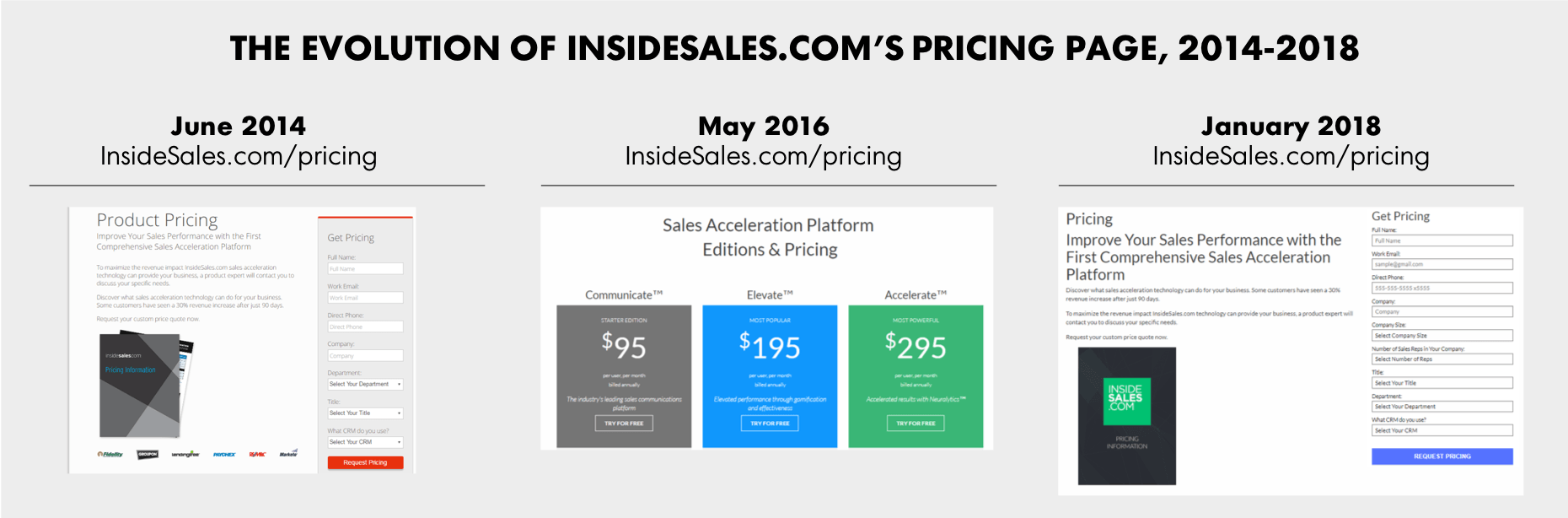
I also tracked down data on new SaaS unicorns, companies like Zuora and GitHub, that reached a billion dollar valuation after our original study. Of these new unicorns, a measly 21% publish pricing – a figure lower than what I had seen for publicly traded companies back in 2016. Taken together, just 33% of SaaS unicorns of the 66 we studied currently publish their pricing.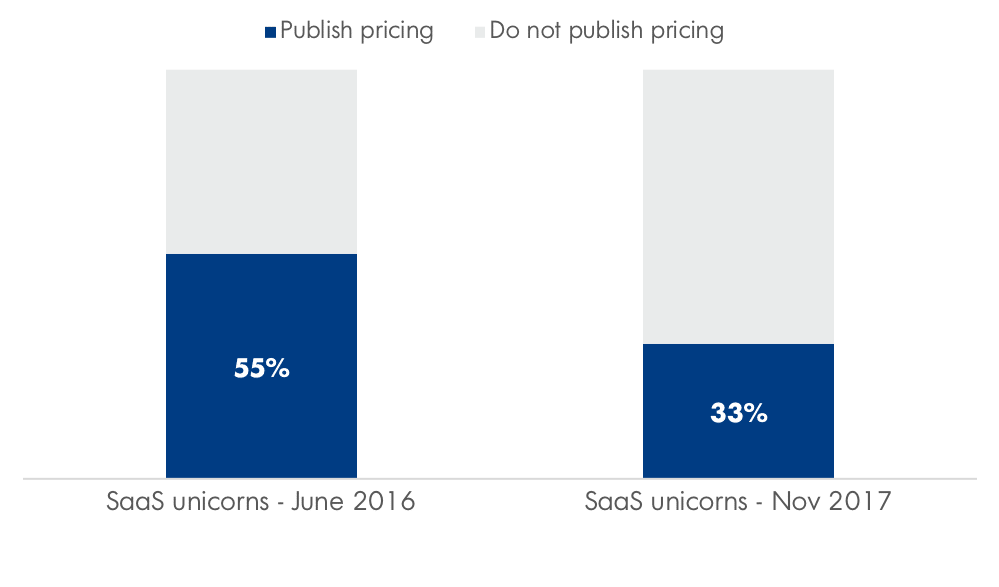 InsideSales.com – a company I highlighted in my 2016 post – has actually reversed its policies around pricing transparency. The company began showcasing their packages and pricing on their website in 2015 and kept it visible through 2016. ( Those packages and price points are archived through the Wayback Machine at web.archive.org if you’re interested).
Now, not only do they not release pricing information, they put up an onerous form to even request it. The form includes a whopping 10 fields, including email, phone number, company size, number of sales reps, title, department and CRM.
There are a few reasons for the shift we’re seeing around pricing transparency. The first is secular in nature. The new unicorns that have emerged over the past year and a half over-index in verticals like Cybersecurity (Crowdstrike, Cylance, CloudFlare) and Analytics (Uptake, Medallia, Rubrik), as opposed to SaaS Apps or SMB solutions. These verticals haven’t been known for transparency given that they typically target large enterprises and have complex inputs to calculate pricing.
The second main reason has to do with the fact that many companies often see it as in their best interest to be as private as possible. That way they don’t have to worry as much about competitors seeing their pricing, and then undercutting them to win a deal. It also means they don’t have to keep their pricing simple and straightforward, since it won’t be shared without the aid of a sales rep. Keeping pricing under wraps provides for the flexibility to change prices and packages without as much fear of having to re-price their base of customers.
Thirdly, many sales leaders believe that they have a better chance to win a deal if they lead with value as opposed to price. A buyer might get sticker shock if they see pricing online out of context. But if the sales team has a chance to showcase the capabilities and get more executive decision makers involved, perhaps they could catalyze a deal from an initially skeptical buyer.
These are all fair reasons, especially for companies that sell into large enterprises with long sales cycles. But I believe companies have gone too far, and in the process have hurt both buyers as well as themselves. In 2018 I hope to see a renewed emphasis on transparency. Here’s why.
Do you publish your pricing? Why or why not? We’d love to hear from you and learn about your results! Let us know if the comments or tweet to @poyark and @openviewventure.
The post Why SaaS Companies are Moving Away from Pricing Transparency (and Why That’s a Bad Thing) appeared first on OpenView Labs.

Here at LinkedIn, we’re celebrating the holidays by bringing you 12 days of awesome sales content. Today, sales experts share recommendations of books that can positively impact your sales career.
If you had to choose one book that has most profoundly impacted your growth as a sales professional, which would it be?
We asked this question to several influential thought leaders who have authored exceptional sales books of their own. We’re always fascinated to learn what inspires the people who inspire us. And we certainly didn’t mind the expert help in prioritizing our 2018 sales book reading list.
Fortunately, a number of the field’s brightest minds were generous enough to contribute by sharing titles that have made an indelible impression on them along the way and why. It should come as no surprise that many of these writers are also avid readers, and a few couldn’t quite stop at one recommendation.
As you peruse the submissions below, you’ll likely find a few lesser-known texts you haven’t come across before. All of the titles listed – including those from the participating authors themselves – are well worth your time.
Jill Rowley, author of Jill Rowley on #SocialSelling: 140 Tweets on Modern Selling the Social Way
Jill Recommends:
“There are soooo many amazing sales books, but given you asked for biggest impact, I have to go back to nearly the beginning of my sales career.
The Sales and Marketing Excellence Challenge by Jim Dickie and Barry Trailer, published in 2003.
#1: A book about sales AND marketing – understanding how aligned, connected, and unified the two need to be has been key to my success.
#2: The book includes first-hand interviews with 39 accomplished real world executives from a variety of industries and company sizes on how to increase the effectiveness of sales and marketing teams. This helped me understand the importance of “in the context of the customer,” and that not all customers are alike.
#3: The book covered the range of responsibilities and diversity of challenges sales and marketing leaders tackle on a daily, quarterly, annual, and multi-year basis. This helped me better understand the world in which my sales and marketing buyers live.
If Social Selling Mastery by Jamie Shanks isn’t included, it should be!”

Jill Konrath, author of More Sales, Less Time: Surprisingly Simple Strategies for Today's Crazy-Busy Sellers

Jill Recommends:
“At the beginning of my career, SPIN Selling by Neil Rackham was a game changer. It helped me understand why asking good questions was the key to sales success.
More recently, Your Brain at Work by David Rock was eye-opening. It helped me change how I worked so I could be more productive AND creative/strategic."

Anthony Iannarino, author of The Only Sales Guide You’ll Ever Need

Anthony Recommends:
“The book that had the single biggest impact on my sales career was Neil Rackham’s SPIN Selling, but not for the reason you might think. Even though the model is powerful, especially implication questions, the few pages before the model is introduced changed the way I sold. In those pages, Rackham describes the difference between salespeople who succeed at high levels and those that struggle. The difference is that the high performers continually gained a commitment that moved the sales conversation forward, something he called an advance. Once I decided to never leave a meeting without a commitment, my sales improved dramatically.
The commitments that make up an ‘advance’ are all found in Chapter 11 of TOSG. They’re so important, I wrote The Lost Art of Closing to give salespeople and sales organizations a deeper dive into how to gain those commitments.”

Trish Bertuzzi, author of The Sales Development Playbook: Build Repeatable Pipeline and Accelerate Growth with Inside Sales

Trish Recommends:
“Selling to Big Companies by Jill Konrath has had the most profound impact on my career to date. Why? Because when I finished reading it, I was so grateful for the knowledge imparted that I picked up the phone and actually called Ms. Konrath to share both my gratitude and enthusiasm. Best call of my life. Jill is now a friend and a mentor. She was the driving force behind my publishing a book. Sometimes a book can change your life. You just have to look beyond its cover.”

Daniel Pink, author of To Sell Is Human: The Surprising Truth About Moving Others

Daniel Recommends:
“INFLUENCE by Robert Cialdini.
Cialdini’s book is a classic. More than anything, he shows that influence and persuasion are as much science as art.”
Frank Cespedes, author of Aligning Strategy and Sales: The Choices, Systems, and Behaviors that Drive Effective Selling
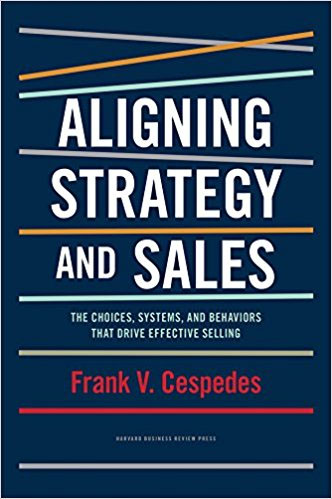
Frank Recommends:
“I would cite the collection of essays by Ted Levitt in The Marketing Imagination. Most are not directly about sales or selling. But he makes you aware that the most important thing about customer acquisition is the buyer, not the seller. And Ted discussed so well—eloquently and practically—the important things about understanding buyers, buying processes, and the implications for buyer-seller interactions and relationships.”

Mike Ellsworth, co-author of Infinite Pipeline: How to Master Social Media for Business-to-Business Sales Success

Mike Recommends:
“The book that has had the biggest impact on me is Bryan Kramer’s There is No B2B or B2C: It's Human to Human #H2H. While it’s not strictly a sales book, Bryan lays out how human connections trump typical marketing and sales approaches. Humans, not machines, buy things, but most sales and marketing approaches are mechanical and somewhat cynical. A salesperson knows if he or she dials enough phone numbers, some sales will fall in their laps. Bryan thinks sales and marketing approaches should involve more than just sight and sound and repetition. They should involve listening, and conversations, and human connection, not just huge volumes of pushed messages or cold calls.
When he released the book, I actually joked with Bryan that he stole ideas from my Be a Person book series since much of the advice in those books was congruent with his H2H concept. His followup book, Shareology: How Sharing is Powering the Human Economyexpands on these ideas and shows how the human instinct to share is disrupting and transforming entire industries.
Bryan is an important thinker in the social media, sales, and marketing spaces.”

David Hoffeld, author of The Science of Selling: Proven Strategies to Make Your Pitch, Influence Decisions, and Close the Deal
 David Recommends:
“The book that had the biggest impact on my sales career was How To Win Friends and Influence People by Dale Carnegie. I was given the book by my mother when I was 12 years old and I was mesmerized by knowing how to frame an idea could increase receptiveness. That book inspired my fascination with how influence is achieved. The perspective I learned from that book, years later prompted me to invest nearly a decade studying and testing how to apply research studies in many scientific disciplines to the process of selling.”

Chris Smith, author of The Conversion Code: Capture Internet Leads, Create Quality Appointments, Close More Sales

Chris Recommends:
"I loved Never Split the Difference by Chris Voss. We are so often in sales going for a yes and Chris breaks down why you should often go for a no. Former FBI negotiator who knows his stuff!”
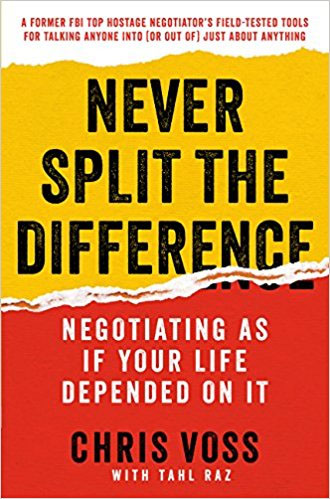
Jeffrey Gitomer, author of The Sales Bible, New Edition: The Ultimate Sales Resource

Jeffrey Recommends:
“The book that has had influence on me is by Napoleon Hill: How To Sell Your Way Through Life. It was published in 1939 – if you buy a hardcopy original it can cost you as much as $500. They didn’t print a whole lot of them. A crappy copy is $150. I’ve collected a bunch over the years. It’s about the principles of not just selling, but humanity. It’s about believing and neutralizing the mind of the buyer – way ahead of its time. It’s not just a fun read, it’s an insightful read.”

Indeed, “insightful” would be a great descriptor for many of the books listed here, and all of the folks who shared. Thanks again to those who chimed in and helped solidify this compilation of must-reads.
For more on how to spruce up your sales this holiday season and in 2019, check out these other insightful posts on boosting your sales effectiveness.


A sales manager is only as good as his or her team, and the results they produce. Because of this, hiring the most effective reps possible is a vital part of the job. But with the very nature of the profession evolving before our eyes, identifying the right candidates requires a different set of criteria than it did five – or even two – years ago.
The core skills that define great B2B sellers are changing in the digital age. Proactive sales leaders are focusing on attributes and capabilities that will continue to grow more valuable in the coming year and beyond.
With an eye on helping you acquire the best possible talent for your team, here are a few insights on hiring the best B2B sales reps in 2018.
At LinkedIn, our ability to track aggregated professional data gives us a unique perspective on the overarching trends and patterns of skills and traits for various disciplines. This has provided us with some enlightening revelations on the field of selling and its outlook.
As discussed in the Future of Sales eBook, there’s a fundamental shift taking place right now. The most common and traditional types of sales skills, which fall into the “transactional” category, are fading somewhat in recruiting demand for B2B. They tend to characterize more product-centric sellers – well versed in the art of pitching and negotiating.
Meanwhile, we see a rise in demand for strategic sales skills. These would appear on a candidate’s LinkedIn profile in the form of tags like complex selling, partner management, and business alliances – and they are far more rare than transactional staples like business development and sales leadership. The Future of Sales eBook tells us that strategic skills are found in only 1.5% of LinkedIn profiles. These competencies are more conducive to a consultative approach that B2B buyers crave, and are suggestive of a sales pro built for the future.
This is not to say, by any means, that you should be actively avoiding those transactional sales skills. They’re likely to be present on the résumés of most effective sellers, and in general, the ability to persuasively articulate a solution’s value will always be important. But these strategic sales skills and relationship-building indicators are the ones to keep an eye out for with your next wave of hires.
Another frontier that we emphasized in the Future of Sales eBook is sales technology, which is becoming an ingrained aspect of B2B selling. Lack of adoption – whether due to resistance or perplexity – holds back a huge number of organizations. Meanwhile, those who embrace the enhancements these solutions bring to the sales process are clearly seeing the benefits.
In the State of Sales 2017 report, we learned that 90% of sales professionals describe sales tech as either “important” or “very important” to closing deals. Across the B2B landscape we see companies increasing their investments in digital enablement tools, but deriving value from these investments requires team members that are willing and able to utilize them.
As such, it’s advisable to hire reps with some level of demonstrated tech proficiency. This doesn’t mean you need to be seeking out software developers or programmers, but look for signs of relevant experience or personal interest.
When conducting interviews with new candidates, you can gauge their adeptness for the era of strategic selling by asking the right questions. A while back, we suggested a couple of different spins on the old “sell me this pen” convention, posing scenarios that test a seller’s ability to think strategically and apply new-age tactics.
Here’s one idea: assign interviewees with “homework” ahead of time, providing them with a hypothetical target account they might pursue on the job. See what kind of insights about that company they bring, and ask how they’d engage a buyer in the organization as a trusted advisor rather than as a salesperson.
Here’s a quick recap of our top takeaways as you formulate your recruitment plan for 2018:
For more insights and guidance on building a future-proof sales team, download The Future of Sales: Rise of the Strategic Seller.

A timeline building software is a great tool to bring more clarity to your projects. One key difference between a timeline builder and a regular project management tool is that timeline building applications are more visual in nature. It gives the user a quick snapshot of all projects that is currently underway along with what has been planned for the future. Modern timeline building apps also allow for collaboration and let team members come together to plan their project timelines.
As a small business owner, there are two important factors to consider while shopping for a timeline building tool – the feature list and the price. In this article, we list down five timeline building apps that are best for a small business owner.
Website: https://teamweek.com/
TeamWeek is a cloud based collaborative timeline building tool that offers an intuitive click-and-drag based project management interface. For small businesses that have under five people in the team, TeamWeek is free to use. For larger teams, TeamWeek is still an affordable option starting at $34/month and includes all the premium features like Project view and the Annual view. This is especially useful for event planners, realtors, photographers and other local service businesses that have projects lined up several months in advance.
Free plan : Yes
Free trial : Yes
Website: https://hubbion.com/
Hubbion is essentially a project management app but is also useful to businesses looking for a timeline building option. The app has a ‘Calendar view’ option that lets users view the timeline of all the projects and its status. Hubbion is free to use and at present does not limit users in terms of the number of people they want to collaborate with or the number of projects they handle.
Free plan : Yes
Free trial : Yes
Website: https://www.officetimeline.com
If you are a business that needs a timeline building tool for your reports, and not necessarily to manage projects, then Office Timeline is a great option to consider. The basic version of the tool is free to use and lets users embed timeline and Gantt charts inside Microsoft PowerPoint or Excel. The Plus Edition of the software costs $49 to $59 and comes with additional options like custom templates, elapsed time management and ‘percentage completion’. Needless to say, since Office Timeline is mostly targeted at users who want to use it for their reports, there is no option to collaborate on projects with other users.
Free plan : Yes
Free trial : Yes
Website: https://www.preceden.com
Preceden (formerly known as TimeRime) is a timeline building app targeted at business users. It is similar to TeamWeek in the sense that it lets users organize their project schedules using an interactive visual interface. There are two key differences between TeamWeek and Preceden however. Firstly, it is not completely collaborative. While users can share their timelines with others in their team, there is no real way for multiple users to come in on one project and build the timeline. Secondly, the tool does not have a truly free pricing plan. While the tool is free to sign up, you can only create one timeline with five events at this price point.
Free plan : Yes (but only one timeline with 5 events)
Free trial : No
Website: https://www.smartsheet.com/
Smartsheet is a handy timeline building tool if your core project related details are stored on third party tools like Microsoft Office or Tableau. Smartsheet makes it easy to integrate with these tools to prepare visually engaging timelines of your projects. While the timeline building features are indeed as good as any other tool, Smartsheet is limited in its collaboration. Project owners can share their projects with an unlimited number of collaborators who may only view or edit these projects – creating or deleting projects are solely under the control of the project owner. This is useful for enterprises with a dedicated project manager, but might be an issue if you want a truly collaborative setup. Smartsheet does not come with a free tool and the individual plan starts at $14/month.
Free plan : No
Free trial : Yes
Calvin Klein recently partnered with Amazon Fashion to launch holiday pop-ups in LA and New York, featuring exclusive product ranges.
The physical stores were supported by a new online shop – amazon.com/mycalvins – where additional products were available. In-store consumers were able to engage with a range of new Amazon technology, including instant access to online product reviews. All very cool, high-tech... a great fit for both brand and retailer.
 It’s a new year, and I bet you picked up a few shiny tech gadgets to play with over the holidays. But while your Google Home pods, face ID-enabled iPhones, wearable fitness trackers, 3D printers, and the like might be fun and games now, there’s serious power behind those tools – power that enhances the performance of your content marketing efforts, makes them easier to produce, and makes them more enticing to your audiences.
If you read our recent 2018 Content Marketing Predictions e-book, you may have noticed how many experts anticipate tech-enhanced experiences to dominate the content landscape. For example, HubSpot’s Scott Brinker predicts chatbots and voice interfaces will experience explosive growth. Autodesk’s Dusty DiMercurio sees an impending rise in augmented reality content at live events; and Chief Content Officer’s Clare McDermott is all but ready to bow down to the AI overlords and embrace a more automated future.
These expectations of greater tech dependence are likely well founded. For example, according to CMI’s 2018 Benchmarks, Budgets, and Trends research, 25% of B2B and 28% of B2C marketers report content marketing tools and technologies have contributed to their increased levels of success over the past year.
However, the degree of tech sophistication our predictors envision for content marketing isn’t going to happen overnight. Consider this: While CMI’s research shows tactics like social media, videos, and infographics have adoption rates of well over 50%, only 4% of marketers say they are working with machine-learning-driven content formats like virtual reality or augmented reality.
Only 4% of marketers work with content driven by machine learning says @CMIContent research.
Click To Tweet

Fortunately, this means there’s lots of room for today’s more advanced communication technologies to find their footing on the marketing landscape – and plenty of time for businesses to leverage them before falling behind the curve. If your business is thinking about indulging its inner technophile, let these cool content examples from intrepid brands inspire you to swallow the red pill and enter the Matrix-like world of machine-driven storytelling.
As Paul Roetzer, founder of the Marketing Artificial Intelligence Institute, told the CMW 2017 audience, you don’t need a degree in computer science or computational mathematics to incorporate AI into your content efforts: “You don’t have to know how it works. You just have to know that there are AI-powered tools that do things you weren’t capable of doing before,” he says.
Learn more about AI’s role in content marketing in this video with Paul Roetzer:
Various forms of artificial intelligence have been behind the scenes of content efforts for years – recommendation engines used by Pandora or Netflix, smart algorithms that power marketing-automation tools and manage programmatic campaigns, image-recognition technologies used to tag photos on Facebook. But these are the tip of the iceberg when it comes to AI’s content marketing capabilities. For example:
You don’t need a degree in computer science to incorporate #AI into your #content efforts, says @PaulRoetzer.
Click To Tweet
As Julia McCoy recently pointed out, content creation robots are here, helping publishers like The Washington Post, Associated Press, and others keep up with the high demand for up-to-the-minute information. By using AI software (like Narrative Science’s Quill or Automated Insights’ Wordsmith) to handle their most fact-driven news responsibilities, publishers can free their writing staff to tackle more nuanced reporting while enabling their operations to be more productive – and more profitable – overall.
.@AP used @AInsights software to write 3,700 corporate earnings stories a quarter, says @JuliaEMcCoy.
Click To Tweet
For example, the Los Angeles Times created a tool called EQBOT, which automatically writes and delivers critical information – like magnitude and location – whenever it picks up data from the U.S. Geological Survey indicating an earthquake in the metro area. The robot even has its own Twitter handle.

While most marketers don’t necessarily need to publish content at the speed and volume of a major news agency, there are plenty of other ways brands can take advantage of AI-powered content creation.
AI tools can make messaging more targeted and valuable to your audience members on an individual basis. For example, Paul Roetzer shared at CMWorld an example of how the NBA Orlando Magic uses Wordsmith to personalize emails and in-app messages to fans and ticketholders, which are triggered by pre-set rules, conditions, or available offers like ticket resales.

DigitalSTROM – a company that provides smart home systems – uses a customized version of Wordsmith to deliver original, on-demand status reports and other service-related narratives to customers through its app and via email. These content pieces help keep DigitalSTROM users informed on relevant topics (like the status and comparative impact of their home energy usage) in a personalized way – a value-add that can go a long way toward increasing consumer trust and satisfaction.

AI-driven content distribution platforms that are chatbots and virtual assistants are growing more popular. Not only do these messaging tools enable companies to engage in helpful, human-like conversations, they can respond to all manner of customer queries around the clock, around the world, and even when customers are on the go (through familiar social platforms like Facebook Messenger, SMS, or Kik).
While some chatbots can be simple, scripted affairs that don’t require true AI, the more intelligence a brand puts into its bot, the more value they – and consumers – are likely to get. For example, Taco Bell’s Tacobot does one thing, and it does it well: It helps hungry patrons order a meal for pick-up through Slack. But should patrons have a more complex or unique task (say, reverse-engineering the ingredients to create their version of the world’s most expensive taco), they would need a much bigger bot.

.@Tacobell’s Tacobot allows patrons to order a meal for pick-up through @SlackHQ, says @joderama. #AI
Click To Tweet
On the other side of the spectrum is Nadia, an intelligent personal assistant developed by Soul Machines. “She” is an experimental avatar created for the Australian government to give people with disabilities better access to information about their national insurance benefits. Not only can Nadia convey human emotion in her conversations, she can “read” the emotional state of those who talk to her (by analyzing vocal tones and facial expressions), helping her to gauge the most appropriate response.
Another form of AI is decidedly less chatty, yet just as versatile: automatic identification and data capture (AIDC). The term refers to a range of technologies that can automatically identify an object, correlate it with other known information about the object, and apply that data to complete a designated task. This tech category covers everything from the simple bar codes on virtually every product sold and RFID tags used for luggage routing and UPS order-tracking, to sophisticated biometrics systems that recognize a person by fingerprints, retina patterns, or facial characteristics, and provide them with personalized content and experiences.
As Karola Karlson pointed out, marketers can use image recognition to build a seamless bridge between their online presence and in-store experience. For example, by using AIDC software to recognize a loyalty program member who entered the store and using the member’s profile data with AI-managed push notifications, retailers could deliver anything from personalized welcome messages to on-the-fly discount offers or customized product recommendations.
Use #artificialintelligence to automate a huge part of personalization, says @KarolaKarlson.
Click To Tweet
Speaking of product recommendations, consider what cosmetics company Sephora is doing with its Virtual Artist mobile app. Users can upload a selfie to the tool, which uses AIDC technology to map their unique facial features and gauge their skin tones (for color-matching purposes). Then, using an augmented reality overlay (more on this later), the app gives the consumer a 3D-enhanced preview of how they would look in certain shades of a product or with the application of a makeup trend. If they like what they see, they can buy the products through the app or save the selection for their next visit to a Sephora store.

.@Sephora app allows users to take a selfie & see how they look with Sephora makeup, says @joderama.
Click To Tweet
While voice recognition also falls under AIDC technology, its potential to radically disrupt the way brands communicate with consumers, generate and analyze audience data, and position their content for optimal reach and impact places it in a category all its own.
How important will voice be to the future of content marketing? According to ComScore, by 2020, 50% of consumers will interact with voice-activated technology. This should come as little surprise, considering how popular voice-controlled smart systems like Amazon Echo and Google Home have grown over the past few years – and how remarkably versatile the application of these tools can be.
By 2020, 50% of consumers will interact w/ voice-activated technology via @comScore.
Click To Tweet
Despite consumers’ rapidly growing enthusiasm for voice-enabled devices, most brand marketers are still searching for the magic formula for adding voice recognition capabilities to their creative content efforts. Fortunately, it’s still early, and brands willing to experiment now will have a tremendous opportunity to set themselves apart from the competition. But they had better act quickly: With more consumers plugging voice capabilities into their everyday lives, the playing field won’t be this clear much longer.
One early adopter that is a natural fit for voice-enhanced storytelling is USA Network’s Emmy-winning series, Mr. Robot – a show in which main character Elliot regularly breaches the fourth wall to talk with the audience as if the viewers were his personal confidant and invisible co-conspirator. To extend a Season 3 storyline full of tense action, tenuous alliances, and surprising reveals, USA launched an interactive choose-your-own-adventure-style game for Amazon’s Echo device called The Daily Five/Nine. Players answer questions, make choices, and guide their mysterious partner in cybercrime through a series of obstacles that may or may not result in being recruited into the show’s shadowy cabal known as The Dark Army.

On the more utilitarian side of voice-activated content capabilities, GPS tech company Garmin has partnered with Amazon to produce the Garmin Speak, which enables Echo users to access music and games from their entertainment libraries; request news, traffic, and weather briefings; and interact with other Amazon-based content and information features – all while traveling in their car. The device also connects to users’ Bluetooth-enabled smartphones to provide voice-activated, turn-by-turn directions to their destinations – without having to fumble with a separate GPS device.

Few advanced technologies can compare to the use of virtual reality (VR) and augmented reality (AR) when it comes to delivering a story in a rich, immersive, and compelling way. And, as StoryUp CEO Sara Hill pointed out, when paired with 360-degree camera technology, not only can it be used to put the audience in the middle of the action, it can allow them to participate in experiences they might never access in real life.
The world is no longer flat. The internet is fast-becoming a place you step inside. @sarahmidmo #virtualreality
Click To Tweet
For example, using monoscopic VR, the cast of Discovery Channel’s MythBusters created a virtual tour of a shipwreck in shark-infested waters, capturing the visceral realism of a 360-degree deep-sea exploration without subjecting viewers to any nasty bites or sea sickness. (Editor’s note: Kids, you might want to put your VR headsets on to view this one.)
Zenith Aircraft Company, which sells kit planes, wanted a way to enable prospects to take a demo flight even if they were unable to travel to its facility. StoryUp created a VR experience for Zenith that does just that. According to Sarah Hill, not only was the video highly watched and shared, the cost per impression was lower than some of the company’s other content campaigns – meaning the project used advertising dollars more efficiently (not to mention it saved on the cost of jet fuel).
.@ZenithAircraft’s #virtualreality flight demo had lower cost per impression than other content. @SarahMidMO
Click To Tweet
If life-like simulations fall outside your strategic goals (or your content budget), consider incorporating AR technology as an enhanced alternative to standard, static content experiences.
Adding an AR overlay gave GumGum HoloTats a way to delight the audience at the 2017 Clorox iConnect event and deliver a little unexpected creativity. At the company’s exhibition booth, GumGum handed out boxes of its beautiful tattoo stickers custom-designed for the event along with a prompt to download the company’s AR app to view the tattoo in full holographic splendor. Not only was the campaign a hit with attendees, it impressed the Content Marketing Awards judges enough to earn it the 2017 title for Best Use of Content Involving Machine Learning/Artificial Intelligence.
Then, there’s 19Crimes, a wine-and-spirits brand that built its marketing platform around compelling storytelling. In the late 18th century, English rogues and rebels found guilty of at least one of 19 crimes were exiled to the new colony of Australia as punishment. Today, 19Crimes gives some of those convicts an AR-enabled voice to tell their historically rooted tales: By scanning the company’s wine labels with its digital app, consumers are treated to a glimpse of the exiled convict’s life, crime, and later experience as a pioneering colonist.

While novel now, these techniques will grow commonplace. It’s as good a time as any for your brand to explore the creative possibilities these technologies offer – or at least keep a close eye on them as their application opportunities expand and grow more advanced.
Learn more about how to use technology to make your content marketing program even better. Register today for the Intelligent Content Conference March 20-22 in Las Vegas.
Cover image by Joseph Kalinowski/Content Marketing Institute
Please note: All tools included in our blog posts are suggested by authors, not the CMI editorial team. No one post can provide all relevant tools in the space. Feel free to include additional tools in the comments (from your company or ones that you have used).
The post 13 Smart Brands Using Technology to Power Their Content appeared first on Content Marketing Institute.
Effective sales management is based on a variety of different strategies, like being able to motivate your teams, setting goals and quotas, motivating reps, and reviewing data and performance.
While all of these strategies can lead you to be successful, there are also frameworks to follow, like agile sales management, that will supplement your process.
In this post, learn about agile sales, how to grow a successful agile sales team, and key processes to follow.

There are three changes in the sales world that should make you sit up and pay attention.
First, millennials are making up larger and larger parts of your sales team. Right now, they’re probably SDRs and AEs — with a few ambitious ones holding management or even director roles. But in eight years, millennials may hold half of your leadership positions. In 15? They’ll probably hold all of them.
That means you can’t keep using the same techniques and tactics. These professionals have grown up with constant access to information. As a result, they’re independent, learn quickly, enjoy collaboration, are incredibly tech-savvy, and get bored doing the same things over and over. Agile sales help you adapt your sales org to suit these traits.
Second, your customers are different. Few people have the patience or desire to be forced through a rigid sales process. Now they can self-educate — and they’ll quickly lose interest if your reps make them answer a laundry list of questions about things they could’ve learned online or don’t add any value to the research process.
If you want your salespeople to deliver unique, consultative, high-value experiences to each and every buyer they interact with, the agile sales methodology makes it much easier for reps to respond in real-time and meet client needs.
Finally, we have an unprecedented amount of data. You can learn everything from your lowest-performing rep’s average call-to-demo conversion rate to the average number of deals closed on the last day of the month in a few clicks. The dark side to all this data? If you’re not focused and intentional, you’ll get lost in it. Agile sales involve constantly reviewing and reacting to data — making it an ideal solution.
We gave a brief summary above, but let’s dive further into how agile sales works.
When using this framework, work is organized into “sprints.” A sprint typically lasts one to two weeks and has a specific objective.
Every sprint starts with a two-to-four-hour planning meeting to decide on the sprint goal (which must be summed up in one sentence) and break down that objective into discrete tasks or milestones. The latter should result in a list of projects, known as the Sprint Backlog.
Each morning, the team gets together for a stand-up. This meeting is meant to be quick — in fact, most companies make everyone stand up for the duration, hence the name. Team members go around and explain:
This helps everyone stay on the same page and provides accountability.
Implementing an agile sales methodology is centered around seven essential processes: sprints, daily standups, short-term goals, a flexible strategy, leveraging a CRM, data, and review. Let’s discuss each below.

Divide work into sprints of just one to two weeks at most. With these sprints, you can have kickoff meetings where you inform salespeople of the goal of the sprint and what tasks will need to happen to achieve that goal.
Standups are helpful for any group that works collaboratively:
The idea is simple. Have a quick (5-15 minutes) status update meeting at the beginning of the workday. Each person should share what they did the day before, explain what they’ll work on that day, and ask for help or guidance if necessary.
Standups definitely boost alignment and accountability (plus, they make your team feel like more of a team.)
Sales objectives can often feel overwhelming and impossible to achieve. For example, maybe you want to go to President’s Club this year, but that would mean performing 30% better than last year — which you don’t think you can pull off no matter how hard you work.
Or you’re a sales manager, and you want to double your team’s average contract value — but that seems like a monumental feat.
To make these goals feel in your reach, borrow the “sprint” concept from agile. Rather than looking at the end goal, break it down into sub-goals. These objectives should be short-term (think monthly, weekly, or even daily).
For example, let’s say to make P Club you need to hit 120% of your annual quota. That translates to $84,000.
In other words, you need to sell $7,000 every month. But you know that some months are better — The first quarter tends to be huge, while June, July, and August are slow. With that in mind, you create this schedule:
January: $8,000
February: $7,500
March: $8,500
April: $6,000
May: $6,000
June: $5,000
July: $5,000
August: $5,000
September: $9,000
October: $7,500
November: $8,000
December: $9,000
(If you do the math, this comes out to $84,500. It’s always good to have a cushion!)
Now that you’ve broken down your major goal into monthly ones, qualifying for P Club seems a lot more feasible.
Sales managers, use this framework to guide your reps’ goal-setting process. First, figure out their “pie in the sky” goal. What do they want to accomplish this year? Then, work with them to create a timeline with milestones.
Flexibility and iteration are the foundation of agile sales. That means reacting in real-time to new data and information and adapting as needed.
Let’s look at two examples of how you might iterate or pivot. First, imagine you’re the director of your company’s SMB segment. In the past few weeks, your reps have lost ten deals to a new, lower-cost competitor.
The first option — essentially, stay the course — isn’t agile. The second option is quintessential agile: Being quick to respond and adapt to changing customer needs.
You can also use this mentality to react to:
And more. Basically, you should constantly be analyzing what’s happening in your world and figuring out how to change your process, objectives, or strategy to keep up.
Without a system of truth, it’s extremely difficult to hold salespeople accountable. (The same goes if you’re a rep: How can you analyze your progress if you’re not tracking it?)
That makes your CRM an essential component of agile sales. At many companies, the rule is “If it’s not in the CRM, it didn’t happen.”
There are a few ways to enforce this:
Of course, getting your salespeople to record everything will be far easier if your sales and marketing tools are synced with your CRM. For example, teams using HubSpot Sales Hub will automatically have their calls, emails, and meetings recorded in the CRM — no manual data entry required.
Agile sales’ emphasis on data dovetails perfectly with modern sales management. Whether you’re a rep, a manager, or an executive, data tells you if your strategy is working — and how well.
Different metrics matter for different situations and objectives. Perhaps you review your last quarter and realize there’s huge fallout between your qualification and discovery calls. After listening to a few call recordings with your manager, you identify two issues:
Your key metrics for the next month should be:
Notice that you’re focusing on these metrics within a short timeframe (essentially, a sprint). You can easily manage these specific metrics and evaluate your progress at the end of the month.
A sales manager, on the other hand, might be focusing on these metrics:
If you have a specific goal for the month — like getting your salespeople to follow up more quickly — you’d also be focused on average lead response time.
The bottom line is: Come up with your short-term goals first, then work backward to determine the best metrics for gauging progress.
After each sprint is completed, have a review meeting to go over the outcomes of the sprint, goals met, and what was not able to be achieved.
As a sales manager, you can lead the majority of the meeting, but you can also consider having teams or specific individuals present on progress. This can help reps take accountability for their process and bolster feelings of collaboration and teamwork.
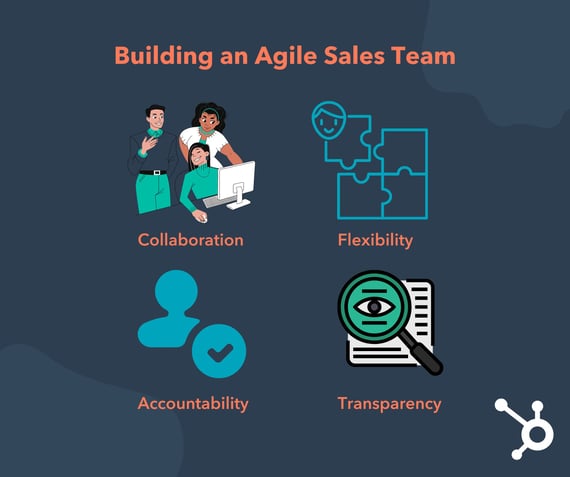
Building a successful agile sales team is dependent on four critical factors: accountability, adaptability, and collaboration, transparency.
Agile sales teams need to practice accountability. As there are specific milestones to meet during specific sprints, all involved parties need to own their actions to help the team meet their goals. Salespeople should take ownership of their practices, both positive outcomes and those that need improvement, and be forthright about them and be able to ask for help when necessary.
Agile practices can always change, so teams need to be adaptable and handle changes when they arise. Thus, while you should have a baseline framework that you follow, the framework should have room for flexibility, like working with customers that are more informed than others or pivoting a strategy as a result of data.
As successful agile sales processes require teams to be able to work together, collaboration is key. Individuals should know who is on their team, what their job duties are, and how their job duties contribute to other teams’ successes. They should be able to approach other team members to ask questions. Departments should also be aligned to achieve the same goals.
Stand-ups are incredibly valuable for establishing collaboration amongst your teams.
Transparency is similar to accountability, as reps and all team members understand progress towards meeting goals throughout the entire sprint. As a result, they aren’t surprised by quotas not met at the end of your sprints because the information is available to them throughout the entire process. Essentially, transparency is directly related to teams having context for what is happening in the sales process at all times.
Agile sales is a natural evolution for sales teams. It helps you leverage your data, team members, and motivation to get the best results possible.


Perhaps your brand blows all your competitors out of the water. Or maybe there are a handful of businesses that have much better blog posts or videos than you do – or so you think. Comparisons with your competitors are not the place to rely on hunches, feelings or the results of a couple of their killer marketing campaigns you’ve casually reviewed.

shell_ghostcage / Pixabay
To truly know how you stack up against your competitors, you need to know the facts. Those facts can come out of a competitive analysis.
Regularly conducting a competitive analysis can arm you with important information that helps your brand thrive. It can help you:
Now that you know the value of conducting a competitive analysis, it’s time to get busy with the specifics.
Identifying your direct competition is the first step, since that’s where you’ll want to focus. Direct competitors are companies that provide similar offerings across the same geographic areas that could substitute for your products or services. A good example would be a desktop computer company and another desktop computer company.
Indirect competitors are those that provide products that aren’t the same as yours but could fill the same customer need. An example here would be a desktop computer company and a company that sells laptops.
Head to your competitor’s website and make a list of the types of content produce and where it resides on the site. While you may find the bulk of the content through the top navigation menu, don’t forget to poke around other areas of the site to ensure you have all the content covered. Content types may include:
Review content types, quality, topics and publishing frequency. Determine what types of content seem to get the most attention, how in-depth they go on various topics, and what topics they tend to cover.
Looking at the SEO structure in your competitor’s content can give you additional insights as to why they may be excelling where you’re not. Here you want to review the use of keywords in elements such as:
Review the SEO structure as well as the types of keywords being used, whether they’re keywords with high search volumes or long-tail keywords with a narrower focus.
Social media can play a major role in marketing efforts, and you want to check out how your competition is integrating it into their overall plan. Determine what platforms your competition uses, along with the frequency and type of information they post. Also look at the number of followers and quality of interactions with those followers.
Evaluating what you find can include performing what is known as a SWOT analysis. SWOT stands for Strengths, Weaknesses, Opportunities and Threats, and making note of these four aspects can help you uncover areas where your own company could improve.
One more step in the process is to evaluate your own company using the same process you used to analyze your competition. This gives you a baseline to compare across the board.
Once you see where you stand with regard to your competitors’ content, you can decide what you want to do to match and eventually surpass them. It’s important to look at all areas of marketing, as they’re all interrelated.
Taking the time to conduct a regular competitive analysis can help ensure your company doesn’t lag far behind your competitors, or even fall off the map completely. You’ll consistently discover key areas where you excel, could improve, or can otherwise focus your resources and efforts to keep your brand ahead of the crowd.


“The joy of existence must be asserted in each one, at every instant,” Simone de Beauvoir wrote in her paradigm-shifting treatise on how freedom demands that happiness become our moral obligation. A decade and a half later, the mathematician and writer Lillian R. Lieber (July 26, 1886–July 11, 1986) examined the subject from a refreshingly disparate yet kindred angle.
Einstein was an ardent fan of Lieber’s unusual, conceptual books — books discussing serious mathematics in a playful way that bridges science and philosophy, composed in a thoroughly singular style. Like Einstein himself, Lieber thrives at the intersection of science and humanism. Like Edwin Abbott and his classic Flatland, she draws on mathematics to invite a critical shift in perspective in the assumptions that keep our lives small and our world inequitable. Like Dr. Seuss, she wrests from simple verses and excitable punctuation deep, calm, serious wisdom about the most abiding questions of existence. She emphasized that her deliberate line breaks and emphatic styling were not free verse but a practicality aimed at facilitating rapid reading and easier comprehension of complex ideas. But Lieber’s stubborn insistence that her unexampled work is not poetry should be taken with the same grain of salt as Hannah Arendt’s stubborn insistence that her visionary, immensely influential political philosophy is not philosophy.

In her hundred years, Lieber composed seventeen such peculiar and profound books, illustrated with lovely ink drawings by her husband, the artist Hugh Lieber. Among them was the 1961 out-of-print gem Human Values and Science, Art and Mathematics (public library) — an inquiry into the limits and limitless possibilities of the human mind, beginning with the history of the greatest revolution in geometry and ending with the fundamental ideas and ideals of a functioning, fertile democracy.

Lieber paints the conceptual backdrop for the book:
This book is really about
Life, Liberty, and the Pursuit of Happiness,
using ideas from mathematics
to make these concepts less vague.
We shall see first what is meant by
“thinking” in mathematics,
and the light that it sheds on both the
CAPABILITIES and the LIMITATIONS
of the human mind.
And we shall then see what bearing this can have
on “thinking” in general —
even, for example, about such matters as Life, Liberty, and the Pursuit of Happiness!For we must admit that our “thinking”
about such things,
without this aid,
often leads to much confusion —
mistaking LICENSE for LIBERTY,
often resulting in juvenile delinquency;
mistaking MONEY for HAPPINESS,
often resulting in adult delinquency;
mistaking for LIFE itself
just a sordid struggle for mere existence!

Embedded in the history of mathematics, Lieber argues, is an allegory of what we are capable of as a species and how we can use those capabilities to rise to our highest possible selves. In the first chapter, titled “Freedom and Responsibility,” she chronicles the revolution in our understanding of nature and reality ignited by the advent of non-Euclidean geometry — the momentous event Lieber calls “The Great Discovery of 1826.” She writes:
One of the amazing things
in the history of mathematics
happened at the beginning of the 19th century.
As a result of it,
the floodgates of discovery
were open wide,
and the flow of creative contributions
is still on the increase![…]
Furthermore,
this amazing phenomenon
was due to a mere
CHANGE OF ATTITUDE!
Perhaps I should not say “mere,”
since the effect was so immense —
which only goes to show that
a CHANGE OF ATTITUDE
can be extremely significant
and we might do well to examine our ATTITUDES
toward many things, and people —
this might be the most rewarding,
as it proved to be in mathematics.
In order to fully comprehend a revolutionary change in attitude, Lieber points out, we need to first understand the old attitude — the former worldview — supplanted by the revolution. To appreciate “The Great Discovery of 1826,” we must go back to Euclid:
Euclid…
first put together
the various known facts of geometry
into a SYSTEM,
instead of leaving them as
isolated bits of information —
as in a quiz program![…]
Euclid’s system
has served for many centuries
as a MODEL for clear thinking,
and has been and still is
of the greatest value to the human race.

Lieber unpacks what it means to build such a “model for clear thinking” — networked logic that makes it easier to learn and faster to make new discoveries. With elegant simplicity, she examines the essential building blocks of such a system and outlines the basics of mathematical logic:
In constructing a system,
one must begin with
a few simple statements
from which,
by means of logic,
one derives the “consequences.”
We can thus
“figure out the consequences”
before they hit us.
And this we certainly need more of!Thus Euclid stated such
simple statements
(called “postulates” in mathematics)
as:
“It shall be possible to draw
a straight line joining
any two points,”
and others like it.From these
he derived many complicated theorems
(the “consequences”)
like the well-known
Pythagorean Theorem,
and many, many others.And, as we all know,
to “prove” any theorem
one must show how
to “derive” it from the postulates —
that is,
every claim made in a “proof”
must be supported by reference to
the postulates or
to theorems which have previously
already been so “proved”
from the postulates.
Of course Theorem #1
must follow from
the postulates ONLY.
Half a century before physicist Janna Levin wrote so beautifully about the limitations of logic in the pursuit of truth, Lieber zeroes in on a central misconception about mathematics:
Now what about
the postulates themselves?
How can THEY be “proved”?
Obviously they
CANNOT be PROVED at all —
since there is nothing preceding them
from which to derive them!
This may seem disappointing to those who
thought that in
Mathematics
EVERYTHING is proved!
But you can see that
this is IMPOSSIBLE,
even in mathematics,
since EVERY SYSTEM must necessarily
START with POSTULATES,
and these are NOT provable,
since there is nothing preceding them
from which to derive them.
This circularity of certainty permeates all of science. In fact, strangely enough, the more mathematical a science is, the more we consider it a “hard science,” implying unshakable solidity of logic. And yet the more mathematical a mode of thinking, the fuller it is of this circularity reliant upon assumption and abstraction. Euclid, of course, was well aware of this. He reconciled the internal contradiction of the system by considering his unproven postulates to be “self-evident truths.” His system was predicated on using logic to derive from these postulates certain consequences, or theorems. And yet among them was one particular postulate — the famous parallel postulate — which troubled Euclid.
The parallel postulate states that if you were to draw a line between two points, A and B, and then take a third point, C, not on that line, you can only draw one line through C that will be parallel to the line between A and B; and that however much you may extend the two parallel lines in space, they will never cross.
Euclid, however, wasn’t convinced this was a self-evident truth — he thought it ought to be mathematically proven, but he failed to prove it. Generations of mathematicians failed to prove it over the following thirteen centuries. And then, in the early nineteenth century, three mathematicians — Nikolai Lobachevsky in Russia, János Bolyai in Hungary, and Carl Friedrich Gauss in Germany — independently arrived at the same insight: The challenge of the parallel postulate lay not in the proof but, as Lieber puts it, in “the very ATTITUDE toward what postulates are” — rather than considering them to be “self-evident truths” about nature, they should be considered human-made assumptions about how nature works, which may or may not reflect the reality of how nature work.

This may sound like a confounding distinction, but it is a profound one — it allowed mathematicians to see the postulates not as sacred and inevitable but as fungible, pliable, tinkerable with. Leaving the rest of the Euclidean system intact, these imaginative nineteenth-century mathematicians changed the parallel postulate to posit that not one but two lines can be drawn through point C that would be parallel to the line between A and B, and the entire system would still be self-consistent. This resulted in a number of revolutionary theorems, including the notion that the sum of angles in a triangle could be different from 180 degrees — greater if the triangle is drawn on the surface of a sphere, for instance, or lesser if drawn on a concave surface.
It was a radical, thoroughly counterintuitive insight that simply cannot be fathomed, much less diagramed, in flat space. And yet it wasn’t a mere thought experiment, an amusing and suspicious mental diversion. It bust open the floodgates of creativity in mathematics and physics by giving rise to non-Euclidean geometry — an understanding of curved three-dimensional space which we now know is every bit as real as the geometry of flat surfaces, abounding in nature in everything from the blossom of a calla lily to the growth pattern of a coral reef to the fabric of spacetime of which everything that ever was and ever will be is woven. In fact, Einstein himself would not have been able to arrive at his relativity theory, nor bridge space and time into the revolutionary notion of spacetime, without non-Euclidean geometry.
Here, Lieber makes the conceptual leap that marks her books as singular achievements in thought — the leap from mathematics and the understanding of nature to psychology, sociology, and the understanding of human nature. Reflecting on the larger revolution in thought that non-Euclidean geometry embodied in its radical refusal to accept any truth as self-evident, she questions the notion of “eternal verities” — a term popularized by the eighteen-century French philosopher Claude Buffier to signify the aspects of human consciousness that allegedly furnish universal, indubitable moral and humane values. Considering how the relationship between creative limitation, freedom, humility, and responsibility shapes our values, Lieber writes:
Even though mathematics is
only a MAN-MADE enterprise,
still
man has done very well for himself
in this domain,
where he has
FREEDOM WITH RESPONSIBILITY —
and where
though he has learned the
HUMILITY that goes with
knowing that he does
NOT have access to
“Self-evident truths” and
“Eternal verities,”
that he is NOT God —
yet he knows also that
he is not a mouse either,
but a man,
with all the
HUMAN DIGNITY and the
HUMAN INGENUITY
needed to develop
the wonderful domain of
mathematics.
The very dignity and ingenuity driving mathematics, Lieber points out in another lovely conceptual bridging of ideas, is also the motive force behind the central aspiration of human life, the one which Albert Camus saw as our moral obligation — the pursuit of happiness.
In the final chapter, titled “Life, Liberty and the Pursuit of Happiness,” Lieber recounts the principle of metamathematics demanding that a set of postulates within any system not contradict one another in order for the system to be self-consistent, and considers mathematics as a sandbox for the subterranean morality without which human life is unlivable:
[This] means of course that
LYING
CANNOT SERVE as an instrument of thought!
Now is not this statement
usually considered to be
a MORAL principle?
And yet
without it we cannot have
ANY satisfactory mathematical system,
nor ANY satisfactory system of thought —
indeed we cannot even PLAY a GAME properly
with CONTRADICTORY rules!In a similar way,
I wish to make the point that
there are other important MORAL ideas
BEHIND THE SCENES,
without which there cannot be
ANY MATHEMATICS or SCIENCE.
And therefore, in this sense,
Science is NOT AT ALL AMORAL —
any more than one could have
a fruitful and non-trivial postulate set
in mathematics
which is not subject to
the METAmathematical demand for
CONSISTENCY!
One of these “behind-the-scenes” moral ideas, Lieber argues, is the notion of taking Life itself as a basic postulate:
Without LIFE
there can be
no living thing —
no flowers,
no animals,
no human race —
also of course
no music, no art,
no science,
no mathematics.

In a counterpoint to Camus, who considered the question of suicide the “one truly serious philosophical problem,” and with an allusional jab at Shakespeare, Lieber writes:
I am not suggesting that we consider here
WHETHER life is worth living,
whether it would make more “sense”
to commit suicide,
whether it is all just
“Sound and fury, signifying nothing.”
I am proposing that
LIFE be taken as a POSTULATE,
and therefore not subject to proof,
just like any other postulate.
But I propose to MODIFY this
and take more specifically asPOSTULATE I:
THE PRESERVATION OF
LIFE FOR THE HUMAN RACE
is a goal of human effort.
This does not mean that
we are to go about
wantonly killing animals,
but to do this only when
it is necessary to support
HUMAN life —
for food,
for prevention of disease,
vivisection, etc.
Indeed a horse or dog or other animals,
through their friendliness and sincerity,
might actually HELP to sustain
Man’s spirit and faith and even his life.
And I interpret this postulate
also to mean that
so-called “sports,”
like bull-fighting,
or “ganging up” on one little fox —
a hole gang of men and women
(and corrupting even horses and dogs
to help!) —
is really a cowardly act,
so unsportsmanlike that it is amazing
how this activity could ever be called
a “sport.”
Echoing Alan Watts’s insistence that “Life and Reality are not things you can have for yourself unless you accord them to all others,” Lieber springboards from this postulate into the moral foundations of equality, human rights, and social justice:
All this is by way of interpreting
the meaning to be given to
Postulate I:
ACCEPTANCE of LIFE for the HUMAN RACE.
Surely everyone will accept the idea that
is definitely present,
behind the scenes,
in science or mathematics.
But this is not all.
For, I take this postulate to mean also
that we are not to limit it to
only a PART of the human race,
as Hitler did,
because this inevitably leads to WAR,
and in this day of
nuclear weapons
and CBR (chemical, biological, radiological)
weapons,
this would certainly contradict
Postulate I,
would it not?
Lieber uses this first postulate as the basis for a larger, self-consistent “System of MORALITY,” just as Gauss, Lobachevsky, and Bolyai used the landmark revision of the parallel postulate as the basis for the revolution of non-Euclidean geometry. Four years before Joan Didion issued her timeless, increasingly timely admonition against mistaking self-righteousness for morality and a generation before physicist Richard Feynman asserted that “it is impossible to find an answer which someday will not be found to be wrong,” Lieber offers this moral model with conscientious humility:
May I say at the very outset that
the “SYSTEM” suggested here
makes no pretense of finality (!),
remembering how difficult it is,
EVEN in MATHEMATICS,
to have a postulate set which is
perfect!
Nevertheless, one must go on,
one must TRY,
one must do one’s BEST,
as in mathematics and sciences.
And so, let us continue, in all humility,
to try to make
what can only at best be regarded as
tentative suggestions,
in the hope that the basic idea —
that there is a MORALITY behind the scenes
in Mathematics and Science —
may prove to be helpful
and may be further
improved and strengthened
as time goes on.

Drawing on the consequence of the Second Law of Thermodynamics, which implies for living things an inevitable degradation toward destruction, Lieber offers additional postulates for the moral system that undergirds a thriving democracy:
POSTULATE II:
Each INDIVIDUAL HUMAN BEING
must fight this “degeneration,”
must cling to LIFE as long as possible,
must grow and create —
physically and/or mentally.
And for this we needPOSTULATE III:
We must all have the LIBERTY to
so grow and create,
without of course interfering
with each other’s growth,
which suggestsPOSTULATE IV:
This Freedom or LIBERTY
must be accompanied by
RESPONSIBILITY,
if it is not to lead to
CONFLICT between
individuals or groups
which would of course
CONTRADICT the other postulates.All this is of course very DIFFICULT to do,
involving
accepting LIFE without whimpering,
growing without interfering with
the growth of others,
in short
it involves what Goethe called
“cheerful resignation”
(“heitere Resignation”).But how can this be done?
It seems clear that we must now addPOSTULATE V:
The PURSUIT of HAPPINESS
is a goal of human effort.
For without some happiness,
or at least the hope of some happiness
(the “pursuit” of happiness)
it would be impossible
to accept “cheerfully”
the program outlined above.
And such acceptance leads to
a calm, sane performance of our work,
in the spirit in which a mathematician
accepts the postulates of a system
and accepts his creative work
based on these —
accepting even the Great Difficulties
which he encounters
and is determined to conquer.[…]
And I finally believe that
the results of such a formulation
will re-discover the conclusions
reached by the
great religious leaders and the
great humanitarians.

Lieber distills from this conception of the system “some invariants and some differences,” drawing from science and mathematics a working model for democracy:
(1) Invariants: LIFE — which demands
(a) Sufficient and proper food;
(b) Good Health;
(c) Education — both mental and physical;
(d) NO VIOLENCE!
(a real scientist does NOT go
into his laboratory with an AXE
with which to DESTROY his apparatus,
but rather with a well-developed BRAIN,
and lots of PATIENCE
with which to CREATE new things
which will be BENEFICIAL to the
HUMAN RACE).
This of course implies PEACE,
and better still
(e) FRIENDSHIP between K and K’!
(f) Humility — remembering that
he will NEVER know THE “truth”
(g) And all this of course
requires a great deal of
HARD WORK.(2) Differences which will
NOT PREVENT both K and K’
from studying the universe
WITH EQUAL RIGHT and EQUAL
SUCCESS —
which is certainly
the clearest concept of
what DEMOCRACY is:
(a) Different coordinate systems
(b) Differences in color of skin!
(c) Different languages — or
other means of communication.And please do not consider this program
as an unattainable “Utopia,”
for it really WORKS in
Science and Mathematics,
as we have seen,
and can also work in
other domains,
if we would only
put our BEST EFFORTS into it,
instead of
fighting WARS —
(HOT or COLD)
or even PREPARING for wars —
HATING other people,
etc., etc.
Complement Human Values and Science, Art and Mathematics with Carl Sagan on science and democracy, Robert Penn Warren on art and democracy, and Walt Whitman on literature and democracy, then revisit Lieber’s equally magnificent exploration of infinity and the meaning of freedom.
Bringing you (ad-free) Brain Pickings takes me hundreds of hours each month. If you find any joy and stimulation here, please consider becoming a Supporting Member with a recurring monthly donation of your choosing, between a cup of tea and a good dinner.
Brain Pickings has a free weekly newsletter. It comes out on Sundays and offers the week’s most unmissable reads. Here’s what to expect. Like? Sign up.
In conjunction with our 2018 Core77 Design Awards, we've decided to explain a few of the categories in detail that may be difficult to grasp at first glance so you can decide whether or not the project you want to submit fits the mold! In our first article of the series, we dive into the area of Design Education Initiative—not only what it is, but how it's evolved and the word of education and design is rapidly expanding.
When it comes to education, many institutions are beginning to realize if they want their students or employees to survive in the modern age, they must shift their previous perceptions of learning by helping those they teach to gain timely new skills. Today, many kids are actively involved in learning coding and other real-world skills in order to become the inventors of tomorrow. Corporations more than ever are encouraging creative, critical thinking through exercises and experiments to receive the most overall value from their employees.
This ever-morphing zone is precisely what is explored within the Core77 Design Awards' Design Education Initiative category. Whether it's academic, corporate, or experimental, one of the principles that guide every project within the Design Education Initiative space is the term "design thinking". And for this year's 2018 Core77 Design Awards, it's important to us to distinguish the Design Education Initiative category as not only encompassing degree-granting design programs but also programs meant to educate with strong roots in the principles of design thinking.
 Susie Wise, 2018 Core77 Design Awards Design Education Initiative Jury Captain
2018 Design Education Initiative Jury Captain Dr. Susie Wise is involved in program precisely placed between the design and education space as Coach, Designer and Strategic Advisor for School Retool. School Retool is a fellowship for teachers guided by design principles. "What is very design-centric about how we work in School Retool," says Wise," is we really work on introducing school leaders to what we think of as some of the levers of design that are actually theirs to use. Often times you find leaders who think that the way to influence change is to send emails about a new plan; it's a planning centric approach. The more design-centric approach says 'gosh, you have all these levers that can help you build school culture. You could design space. You can design roles. You can design rituals. You can design incentives. You can design communications and process and time.'"
 School Retool cue cards
In other words, the principles of design thinking don't need to be explicitly explained in order for those using it to reap the benefits. It's a method for enacting change within the education space, inserting empathy within academic experiences, and supplying students with tools for success.
 Last year's winner of the Design Education Initiative award, Montana State's "Farm to Market" class had design and business students team up with local farmers to tackle problems surrounding food waste using design thinking.
The types of projects eligible for Design Education Initiative include but are not limited to:
- Innovative K12 educational programs
- Online or in-person learning programs run by design firms and design-driven corporations
- Museum exhibitions engineered as learning experiences
- Online learning spaces
- Organized "hack-a-thon" type events
- Business/start-up education programs
Think one of your projects from 2017 is a perfect fit for Design Education Initiative?*** Then we'd love to see it. Send in your 2018 Core77 Design Awards entry now!
***This is a Professionals-only category
TORONTO — National home sales rose 4.5 per cent in December from the month before as buyers scrambled to nab homes ahead of stricter mortgage regulations coming into effect, the Canadian Real Estate Association said Monday.
The organization’s monthly report said the number of homes on the market also jumped up by 3.3 per cent between November and December.
CREA said the bounce likely stemmed from heightened demand for homes ahead of the Office of the Superintendent of Financial Institutions’ tighter stress tests for those with uninsured mortgages that came into effect on Jan. 1.
The rules require would-be homebuyers who have more than 20 per cent down payment to prove they can still service their uninsured mortgage at a qualifying rate of the greater of the contractual mortgage rate plus two percentage points, or the five-year benchmark rate published by the Bank of Canada.
“The new OFSI measures and a shift to a rising-state environment should prevent speculative froth from building again, and contain price growth to a reasonable pace for the remainder of the cycle,” BMO Capital Markets senior economist Robert Kavcic wrote in a note.
The real estate association has cut its sales forecast for 2018 as a result of the anticipated impact of new stress tests, forecasting a 5.3 per cent drop in national sales to 486,600 units this year, shaving about 8,500 units from its previous estimate.
“It will be interesting to see if the monthly sales activity continues to rise despite tighter mortgage regulations,” Gregory Klump, CREA’s chief economist, said in the report.
In the final month of 2017, the average national home price reached just over $496,500, up 5.7 per cent from one year earlier. December home sales were up 4.1 per cent from the previous December, signalling that the country is “fully recovering from the slump last summer,” said CREA.
Various real estate experts have said that a set of policies introduced by the Ontario government in April produced the desired market slowdown in Toronto during the second and third quarters following a hot first quarter.
Sixty per cent of all local markets also saw a surge in activity in December with the Greater Toronto Area, Edmonton, Calgary, the Fraser Valley, Vancouver Island, Hamilton-Burlington and Winnipeg leading the country.
That spike came as no surprise to Toronto-based realtor David Fleming.
While agents typically avoid keeping listings up over the holidays, he saw many bucking their usual habit this year by leaving homes on the market because sales were so strong.
Of the three listings he let sit, one sold on Dec. 31 and another on Jan. 2.
“There are definitely people who thought they had to close a deal before Jan. 1. and the numbers are really showing that,” Fleming said.
“I think it will take a couple months for buyers to wrap their heads around the new rules and for the country to see the affect.”
In the interim, he believes the market is balanced, but edging towards being in a buyers’ favour.
CREA’s report noted the balance too, citing that the country’s 4.5 months of inventory is inching “steadily lower” in tandem with the monthly rise in sales that began last summer.

You may be wondering as you read about hackers, darknet insiders, and vendors how exactly are they making so many transactions without getting caught? Isn’t there a paper trail? Well the answer is not so complex but may require some explanation if you’re not familiar with blockchain ledgers and decentralized currencies. Cryptocurrencies are the primary store of value and means of exchanging goods and services on the darknet. A cryptocurrency is a virtual currency that uses encryption for anonymity. These currencies operate on a blockchain which is a decentralized ledger and is mined by anyone instead of issued through a central bank or institution. Theoretically, this means that currency manipulation is not directly possible from governments. However, due to how people have treated cryptocurrencies many economists have been very quick to point out that people treat them as assets rather than true currencies. One of the first cryptocurrencies was the formerly notorious Bitcoin, whose name used to be married to the Darknet and crime. More on that later.
Keep in mind why people go on the Darknet, to be anonymous and untraceable. Money issued from central authorities are never really anonymous and often leaves a trail behind. The way in which people’s accounts are debited and credited leave little room for anonymity from larger institutions. Even when transacting in cash at times. This is where cryptocurrencies enter, on the Darknet the goal is to be anonymous which is what the promise of Bitcoin was when it came out. So naturally some of the first people who needed their financial transactions detached from their real life identities were drug dealers and other people in shady activities. Turning to the darknet to hide their traffic and to Bitcoin to hide their transactions they were essentially able to build their wealth in whatever manner they deemed necessary. The baseline rule of the darknet was upheld. Always remain hidden.
When you first heard of Bitcoin it was likely associated with shady dealings and illegal activities. This is largely because it was associated with a darknet marketplace called The Silk Road. This was one of the only darknet sites widely known to the general population. However the marketplace came to a close in 2014, and with it so has the negative perception of Bitcoin. Lately the idea of blockchain accounting has become very popular in mainstream business, and as a result Bitcoin is now considered just another cryptocurrency. You may have noticed that when a ransomware attack is carried out the criminals often demand the ransom in the form of Bitcoins. This is because Bitcoins are still very much in circulation on the Darknet. However that may not last for much longer though. People on the darknet have slowly caught on since 2015, after the fall of Silk Road, that Bitcoin is not as anonymous as it originally claimed to be. In many cases vendors unintentionally leak data about transactions and who it’s associated with by way of web trackers and cookies. Information collected often can deanonymize almost anyone who is using Bitcoins for payments. Additionally, on the Darknet when people order drugs or something online and pay with Bitcoin, the address that the vendor sends to goods to can compromise the identity of the buyer. Nodes are also able to be traced back to an origin wallet.
These security vulnerabilities have caused concern for buyers and sellers on the Darknet. So the search was on for a better alternative. Bitcoin may be replaced soon thanks to a hyper-privacy focused cryptocurrency called Monero. The new cryptocurrency goes far beyond relying on decentralization to keep users anonymous. It instead has always-on privacy built into the core of the cryptocurrency and solves the vulnerabilities that Bitcoin and Ethereum had. As a result it offers the number one thing users of the Darknet always seek, to remain hidden.
With the rise of Monero it is possible that if a well executed cyber attack were to happen on your organization, you would not be able to trace a paper trail back to an insider who may have assisted in the attack. Since you do not have control of all devices your insiders use, you are unable to see if they use Monero, or made a transaction to a hacker from the Darknet. How money is exchanged is important to understand since you cannot turn to traditional means of “following the money”. Cryptocurrencies are a whole world of their own, and operate as an asset. The behaviors of investing in an asset are entirely different than investing in a currency, and thus require different approaches towards identifying when transactions happen. Of course leading to the final cashout of the cryptocurrency into official currency.
Cryptocurrencies are here to stay when it comes to the Darknet. Vendors and buyers will always seek ways to ensure they remain anonymous and hidden from the world. With the rise of Monero to hide their transactions in a far more effective manner than Bitcoin it is safe to say that catching bad actors will only get harder from here. Stay tuned for more coming about how insiders navigate and use the Darknet.
This post was originally published in IT Security Central and was reprinted with permission.
You’ve heard it before. To be successful with inbound marketing, your content must be catered to the customer. The content must also be ruthlessly consistent with what your company is trying to achieve. More specifically, content should speak to customer pain points and challenges throughout the buyer’s journey.
In a recent webinar from the American Marketing Association called “The Power of Persona-based Marketing,” Alice Palmer, Director of Product Marketing at Monotype, demonstrates of the importance of speaking directly to your buyer personas. According to Palmer, companies that use persona-based marketing will see a 25% increase in marketing revenue over organizations that don’t use buyer personas.
Simply making a list of your types of customers isn’t enough. How do you integrate personas into your marketing strategy with simplicity, clarity and alignment? It’s all about knowing your customers as actual people and understanding how they interact with your brand, based on both real-life experience and real-time data.
To get started with buyer personas, make sure you’re following these helpful DOs and DON’Ts of persona-based marketing.
Make sure your buyer personas reflect your real customers. Interview real people, including your customers, your marketing team, and your sales people who interact with your customers every day. Use this information to make your personas feel as real as possible by giving them a name and a face. Instead of “Persona #1,” you should have “Non-Profit Nancy.”
Just because people at your company think that “Non-Profit Nancy” is your ideal customer, your data might tell you something else. Make sure doing your research before investing in marketing to personas who might not be the most profitable target.
When you’re ready to develop your personas, brainstorm some characteristics of your customers, but remember to not be too limited when making your selections. Always consider how each persona completes his or her buyer journey. Where does she search for your product and why does she buy it? Here are some things to consider when choosing your personas:
Be sure to learn the voice of the customer persona. Is it casual, professional, corporate? How will they best understand what you’re trying to say? How will they best going to react to your marketing? Understand and get into the mind of your persona. At the same time, be honest and realistic about who your actual buyers are. Don’t force your buyer personas to fit your products.
Once your personas are created, be sure to communicate with other departments so that everyone is on the same page. Buyer personas put a face to your customer. This holds valuable beyond just the marketing department. Set up a lunch and learn session to go over your personas, and distribute buyer persona playbooks for quick reference.
Your personas will change over time. It’s important that you’re regularly analyzing, testing and updating your buyer personas. Are your customers responding to your marketing efforts? Has your target customer’s hobbies, attitude, and income level changed? Are you laser-focused on the highest profitable persona?
Marketers that use persona-based marketing are more successful and achieve better results in their inbound marketing techniques. It’s crucial for companies to identify real, research-driven personas in order to develop simple, aligned marketing strategies. I’ve seen, time and time again, that when you truly understand the customer’s wants and needs, you can better meet their expectations through brand engagement.
What other key tactics are missing from your marketing strategy?
In five minutes, Jill Konrath reveals how she reframes a problem and turns it into a challenge which has made a huge difference in her life. This is an outtake from her interview on SLMA where she talks about the five most important things she has learned in business and life:
The Most Important Things Jill Konrath Has Learned in Business and Life
"One of the things that I found that really made a difference to me early on was whenever I faced a problem, to not call it a problem. Isn't that funny? I do a lot of reframing. I just reframe failure into valuable learning experiences, and now the only thing I do is I reframe problems. I turn problems into challenges, and it's a fascinating exercise to do, but if your body perceives something as a problem, for example, being in sales and your boss comes to you and says, 'Jill, you're having a terrible month. What are you going to do about it?' It's like a big huge weight that you're carrying around. You've got a real problem there with your prospect.
"When that happens, the body gets under stress and there's literally some neuroscience behind it, the body releases cortisol stress hormones, and when a stress hormone is released in the body, it literally shuts down creative thinking and your ability to come up with better solutions.
"I discovered that when I had problems, I really felt the weight of the problem, and I was not able to tackle it as well as I wanted to. When I turned it into a challenge, it was like the sparks in my brain started flying again. And again, research shows that your brain loves challenges. And I didn't know that when I first started doing it, but it became real apparent to me that when I said, hmm, this is interesting. How can I tackle this? You could look at that as a problem, but it could be a challenge, and if you look at it that way, how are you going to solve it?
"Challenges are an invitation, literally your brain, if it's fed a challenge, and it says, Jill, how are you going to get into that big account? It's not that you've got a problem because you haven't got in so far. It's like you got a challenge. How are you going to get in there? And it opens up all these neuro pathways and your brain starts looking at things that it's done before and starts looking at that, and you overhear conversations or you might get an email newsletter that comes in your inbox and it's got such the answer you're looking for. But once you alert the brain that I've got a challenge here I'm trying to solve, it changes everything."
The full interview contains:
Jill Konrath is a frequent speaker at sales conferences and kick-off meetings. Sharing her fresh sales strategies, she helps salespeople to speed up new customer acquisition and win bigger contracts. Her clients include IBM, GE, Microsoft, Wells Fargo, Staples and numerous mid-market firms.
Jill is the author of three bestselling, award-winning books. Her newest book, Agile Selling shows salespeople how to succeed in a constantly changing sales world. SNAP Selling focuses on what it takes to win sales with today’s crazy-busy buyers. And Selling to Big Companies provides step-by-step guidance on setting up meetings with corporate decision makers.
To learn more about Jill, you can read about her professional background, personal insights and sales philosophy. Check her out on Wikipedia, and don't forget to connect with her on LinkedIn!
Jim Obermayer is the founder of the Sales Lead Management Association.

Last July, I posted a survey on this blog. My aim was to learn how most sales organizations are handing vacation for their selling reps.
I thought a few dozen companies would respond and I'd have some interesting results to share with the community. It turned into something bigger. Over 200 sales leaders (team leads, managers, directors, VPs) and 340+ individual contributors (AEs, SDRs, CSMs, etc.) participated. I combed through more than 250 individual, anonymous comments. Additionally, I interviewed seven senior leaders on the topic—four on the record and three off.
I’ve compiled the results in our new ebook PTO and Sales.
The primary question the research answers is:
Do companies offer quota relief for pre-scheduled vacations? For example, monthly quota is reduced by 25% for a one-week vacation.
Our findings indicate a resounding NO. Whether or not relief is offered seems to hinge largely on four variables: rep role, sales calendar cadence, company revenues, and company type.
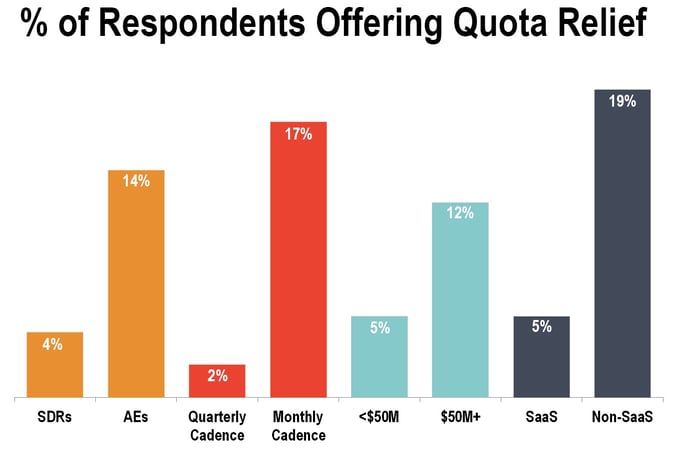
Part 1 of the ebook breaks down the survey findings and analyzes how companies handle PTO with their sales teams. Part 2 shares strategies and perspectives for blanacing making the number while also treating your people right. You can download your copy of the ebook below.
I hope you'll share what your thinking/seeing/doing in the comments. This is an important topic and one that's too often overlooked.



If you’ve created one of these 7 types of products to sell on your blog, or you’re going to start offering a service to your readers, then you need a sales page.
The sales page is (not surprisingly) a page on your blog that’s all about your product or service. You can link to it in the navigation menu, from an ad on your sidebar, from your social media accounts, and from guest posts.
As an example, here’s the sales page for Digital Photography School’s Photo Magic ebook.

While sales pages don’t need to be complicated, creating your first one can be daunting. You may have seen all sorts of highly designed sales pages on large blogs and thought, “I can’t do anything even remotely like that”.
But all sales pages have similar elements, which you can think of as ‘ingredients’. Those elements are:
Here’s what you need to know about each one.
Sometimes you can use the name of your product or service as the headline, providing it’s interesting and self-explanatory. But in most cases you should come up with a headline as if you were writing an advertisement.
Here’s an example from Copyblogger’s “Authority” membership.
Their sales page begins with a clear statement: “How to Take the Guesswork Out of Content Marketing”, followed by supporting copy about it being a training and networking community.
Try coming up with several possible headlines, and ask your readers (or fellow bloggers, if you belong to a mastermind group or similar) which one they think works best.
You might also want to look at some of the sales pages of products or services you’ve purchased, to see what they did. Do the headlines grab your attention and draw you in? How do they do it? (And are any of them a bit over the top and potentially off-putting?)
Even if your product is digital, or your service is something fairly intangible (e.g. email consulting), you need an image.
Here are some ideas:
On the 2017 ProBlogger Evolve Conference sales page, we had photos taken at past events plus headshots of all the speakers:

Normally, you’ll want to save your image as a .jpg file so it loads quickly without losing much quality.
Sometimes it seems obvious what the customer will get when they buy your product. But always spell things out as clearly as possible so there’s no room for doubt or confusion.
For instance, if you sell software you might want to make it clear they’ll receive a password to download it from your website. Otherwise, they might expect the software to arrive as an email attachment or even a physical CD.
With an ecourse, you’ll probably want to include at least the title of every module or part. And with an ebook, you may want to provide a full chapter list. Here’s what we do for our courses over on Digital Photography School. (This example is from the Lightroom Mastery course.)
When you’ve created a great product or service, it’s easy to get carried away with the “features” – the nuts and bolts of how it works.
But customers don’t buy features – they buy benefits. (Or, as Harvard Professor Theodore Levitt put it, “People don’t want to buy a quarter-inch drill. They want a quarter-inch hole!”)
Think about what your product (or service) will help your customer achieve. Will they save time, avoid silly mistakes, or overcome fears?
You might want to list a benefit for each feature. For instance, if you offer website setup and design services, some of the features might be:
But these features may not mean much to someone who’s new to websites. They might not even know exactly what a domain name is, let alone why having their own matters.
Here are those same features, along with their benefits:
You can see how adding simple, clear benefits makes the offer sound much more attractive.
One crucial sales tool is what other people say about your product or service. Readers will (rightly) treat your own claims with a little skepticism – of course you think your product is great. But what do other customers think?
Testimonials are quotes from customers recommending your product. You could think of them as reviews, though they’re invariably focused on the positive. And each testimonial may only talk about one or two aspects of the product.
Of course, before you launch your product you won’t have any customers. To get your first few testimonials, you may want to make advance copies of the product available for free (or very cheap), or offer your services for a nominal fee, or even free. You could ask people on your blog or social media sites whether they’d be interested in using your product and providing a testimonial.
Here’s how Erin Chase from $5 Dinners incorporates testimonials for her meal plan subscription:

Ideally, you’ll want to use the full name and a headshot of anyone providing a testimonial to prove they really exist. But ask permission before doing it – some people may prefer to be known by their initials alone.
It probably goes without saying, but at some point you’ll need to let customers know how much your product (or service) costs.
Be clear about the price, and exactly what it covers. If there are several options, you may want to use a pricing table (showing the options side by side) to help customers choose.
Here’s what Thrive Themes does with its Thrive Leads product (affiliate link), so customers can compare the monthly subscription to all of its products with the price of just Thrive Leads:

We have a Thrive Themes Membership for ProBlogger, and now use it to create all of our sales pages. Check out their sales page so you can see what’s possible with their drag-and-drop builder, Thrive Architect.
Providing it’s reasonable to do so, offering a money-back guarantee can help those customers ‘on the fence’ decide to buy. This is particularly true for digital products such as ebooks or ecourses. If they buy it and realise it’s not what they wanted, they can get a refund.
With services you might offer a trial period, or a short free consulting session, to help customers make up their mind.
Most bloggers find that very few customers ever ask for a refund, but giving people the option results in more sales. A standard money-back guarantee period is 30 days, but you might offer a longer period if your product is quite involved (e.g. a 60-day refund period on a six-month ecourse).
Here’s an example from a recent Digital Photography School deal. And you can check out the full sales page we built with with Thrive Architect (affiliate link)
This seems so obvious that you’re probably wondering why I’m including it. But if you’re creating your first sales page, you may not have given it much thought.
To sell your product or service, you’ll need a “buy” button. It might read:
or whatever makes sense for your product.
You can easily create a button using PayPal. If you want to style the button yourself, you can create any image and use the PayPal button link. (PayPal currently calls it the “Email payment code”. It’s just a URL you can send by email, use in a sales page, etc.)
If you want to automatically deliver a digital product when someone makes a purchase, you’ll need to use a third-party website or tool such as Easy Digital Downloads (affiliate link), which is what we use at ProBlogger and Digital Photography School.
Experienced bloggers sometimes split-test different button text, and even different button colours. But the most important thing is to make sure:
This final ingredient is one you’ll remove from your sales page, rather than add. If you look at the examples I’ve linked to in this post, you’ll see that while they all look very different in terms of design and layout, they all have one thing in common.
They don’t have a blog sidebar. And there are no interesting links and widgets to distract the customer from making a purchase.
Many bloggers use special software to create sales pages without sidebars (and even without the navigation bar or other standard elements on their blog). But you may be able to do it with your current WordPress theme.
When you’re editing a page, go to “Page Attributes” and look for an option called “blank page”, “no sidebars”, “full width” or similar:

Simply select the appropriate option and update your page: the sidebar should disappear.
I hope I’ve made the process of building a sales page a little less daunting. By gathering these ingredients one by one you can put your page together a bit at a time, rather than trying to write the whole thing at once.
Best of luck with your sales page, and your first product or service. I hope it’s the first of many for you.
The post 9 Key Ingredients for Creating the Perfect Sales Page appeared first on ProBlogger.


The New Year is a great time to take stock of your current B2B content activities and look at what has worked for you, and what maybe didn’t deliver for you in 2017.

Image courtesy of https://unsplash.com/@jonathanvez
It’s easy to get caught up in the latest trends around content, so taking a bit of time at the beginning of the year to review your strategy for the following year will help to refine and refocus your efforts.
If you’re a company wanting to build your audience in a particular industry with content, or you’re a B2B sales rep who wants to reach more prospects through content marketing, then read on for some ideas about how to refine your content strategy in 2018.
One of the main gripes that organisations report about their content marketing efforts is that marketing and sales departments are not effectively aligned. Sales teams can feel that marketing collateral isn’t useful for their specific buyer needs, while marketing can be frustrated at a lack of involvement or input from sales teams.
In 2018, sales and marketing departments need to be more aligned to ensure that content is being produced that is going to support specific sales metrics.
This starts with marketing executives sitting down with sales management to understand the sales teams’ key focus areas for the next 12 months, and specific sales scenarios that content assets could support.
An example in practice
For example, the business may want to increase revenues by 10% over the next 12 months. To make this happen, the sales team is going to focus on expanding their share of customer spend in existing accounts by selling more add-on services. To do this, sales teams may require updated presentations to take into customer meetings, business case justification proposals for clients and a case study detailing where a customer has purchased add-on services and experienced better business operations.
Without discussing specific content needs with the sales team, the marketing department could have gone away and created sales brochures and generic content relating to the new add-on services; which may have not proved useful in actual sales engagements with customers.
Likewise, marketing departments will find their content become more valuable with increased input from sales teams and their customers. This could be across case studies, testimonials, or input from customers about the type of future content and resources they would like to receive.
Don’t just create marketing plans for the sake of having a marketing plan. Ensure that every marketing activity lines up with specific sales goals and revenue objectives. Ensure marketing supports sales, and sales supports marketing efforts.
Do you have clear buyer personas in place for your content marketing efforts?
How useful are these personas for your content creation?
Sometimes, buyer personas are too broad, and consequently, any content produced is too generic and never appeals to a specific audience. Instead of thinking about targeting a specific job role (i.e. IT Manager) within a specific industry (i.e. Education), try to go ‘hyper-personal’ in 2018 by being more specific about your buyers.
Instead of thinking of a sector as a whole like Education, think about the specific organisations within that sector and try creating content related to those organisations. The reason we should do this more is because we tend to want to read content that relates to our specific situation, and the more specific and tailored, the more likely we are to engage with that content.
An example in the education sector could be trialling a content strategy targeting IT Management in Sixth Form Colleges – and tailoring content to talk about the challenges and objectives for management in these specific types of organisations.
You could interview other customers from these organisations to tailor your content further and hit on specific messages related to those types of institutions.
Have you set specific, desired outcomes for your content marketing, or are your objectives a bit vague?
If you don’t feel that content marketing has delivered for you in 2017, then this year try looking again at your set outcomes for what you want to achieve with your content creation activities.
For example, if you have been too rigid in 2017 looking only at developing qualified sales leads through content and haven’t achieve what you wanted, try considering some softer outcomes this year, such as building your reputation in a specific industry, building your brand awareness or creating a thought leadership platform across your desired target sectors.
On the other hand, if you have built up a credible position with content in your industry already, then now may be the time to put some structure around specific lead targets which you want to achieve.
These desired outcomes should also include how your sales teams will support these content marketing initiatives; i.e. this quarter, we aim to deliver 30 new early-stage leads to our telemarketing team to follow up with next quarter, who will then be invited to our industry event in 6 months’ time.
We’ve put together a Content Marketing for B2B Sales workbook for you to download and fill in with your own content strategy and desired outcomes. The workbook also includes a detailed content strategy – perfect for B2B companies and sales reps to create their own content strategies.


