Shared posts

14 Feb 17:53

How to Maintain Close Relationships When Running a Business

by Taylor Gordon

geralt / Pixabay

Running a business can be an all-encompassing thing that takes you away from your other interests and important people. None of us do it on purpose, but the business can become the main priority for a while because you want to succeed. Then one day you look up and realize you haven’t invested time in close relationships outside of your business buddies.

I believe that having business friends and keeping up your relationships with non-business friends is important. People you grew up with, went to college with or built a rapport with one random day at the coffee shop keep you grounded and can even provide some of the most objective advice as an outsider looking into your business.

Here’s how to keep those relationships strong while still being ambitious:

Be Careful of Making Your Business Your Identity

I was guilty of making my business my identity for a while. When you make a business your identity it becomes what you do for a living and what you do in your spare time. Your business is just one aspect of your life. You’re also much more. You have other hobbies, talents, hopes, and dreams that go beyond what you do for income.

If you’ve lost yourself in your business, go back to basics and start revisiting some of the things you used to like doing. These hobbies and activities are likely what you had in common with friends you may be growing apart from. Rekindle the relationship by doing things you enjoy doing together.

Work on Your Conversation Skills

If you’ve found yourself talking a lot about your business and your friends are disappearing, it could be time to bring some variation to your conversation. It’s great to share exciting news with the people you care about, but a conversation is a two-way street where you talk and listen.

Hearing about your business all the time can even make certain people feel uncomfortable or intimidated. Friends who are stuck in a position they hate may feel awkward when they hear you constantly raving about your passion projects, especially if you aren’t showing much interest in what goals they’re working towards.

I’m not saying to dumb yourself down or play small to appease the people around you. Please don’t get me misconstrued. But different relationships serve different purposes. There may be some friends you go to for encouragement when you want to share big ideas and others who know just what to say when you’re going through spouse drama. The bottom line is, reflect on what you can give and receive from your relationships and do the work to get them back on track.

Make Time

We’re all busy, but you should make time to interact with friends and family. Humans are social; we thrive when in fulfilling relationships. Make maintaining your relationships a priority. Work smarter to free up more time for social activities. Call people. Shoot out a couple of emails. Schedule nights out for drinks or dinner. Book spa or yoga appointments together.

Put in an effort even if the other person isn’t reciprocating yet. It’s true that sometimes romantic and friend relationships run their course, but there are some connections that are worth fighting for. Don’t let running a business monopolize your time so much that relationships you enjoy crumble.

14 Feb 17:53

5 Useful Hacks to Measure a Public Relations Campaign with Actual Data

by Nora Leary

Mediamodifier / Pixabay

Ten years ago, PR efforts were necessary but somewhat unmeasurable. Today, PR is a key tool for driving engagement and creating a community around a brand, and thankfully, efforts can be measured. Measuring tactics such as dissecting content analysis of articles is good, but it’s somewhat arbitrary, and clients now want more numerical results. While some tactics such as diving into any negative points made in press pieces are somewhat relevant, here are five data-driven ways to calculate how successful a PR campaign is or is not.

1. Count Social Shares

Count the social shares of each piece of press coverage you receive with Buzzsumo. Directly paste the URL of your blog post or article into the Buzzsumo search bar, and Buzzsumo will display the total shares your content has received to date. There is a limit to how many free searches you can do per day, but the tool is great for collecting social data.

2. Track Leads

There are a few ways to track leads from media coverage. First, look at analytics to see how much traffic came from the article. This number isn’t that helpful, but it’s a start. Before starting a PR campaign, set up Goals in Google Analytics. Kissmetrics gives a useful blog post to do this.

This information will tell you how many people came from a PR opportunity and actually did something — signed up for a newsletter, filled out a contact form, downloaded a white paper, etc. This all depends on what goals you want the user to complete when they land on your page.

Measurements like these are essential because they show what works and what doesn’t. We all have clients dying to be in The New York Times or TechCrunch, but do those opportunities result in leads? Or do they just get a lot of people to the website who then click off and do nothing? Having this data-driven information can help you make informed decisions on what type of press to pitch next.

3. Measure Conversions in the Funnel & Sales

Luckily, Kissmetrics created a video on how to set this up in Google Analytics as well. After a press opportunity, you want to track if any sales resulting from it. Or, and this is especially important for B2B companies, if any conversions in the funnel happened. For B2B businesses, this is going to be a longer process, but it’s vital to track leads from PR pieces to see if they do become sales so the PR team can then replicate their efforts.

After you find how many sales came from the PR campaign, you can calculate an ROI for the client.

4. Measure Domain Authority

Another way to measure a PR campaign is to track domain authority before and after a PR campaign to see if particular keywords rose because of media. Take specific keywords highlighted in your release and media pitch and measure their domain authority using a tool like Moz before the campaign (and take screenshots). After the campaign is over, see if you see a spike in your search engine rankings.

5. Count Brand Mentions and Backlinks

Brand mentions, though not tied to sales, is essential to know how your brand is viewed in the online space. Measure brand mentions with tools such as SocialMention, Mention, or TalkWalker.

Backlinks are still important to SEO, so measure those with a tool such as Ahrefs. Backlinks do have some relevance for search engine rankings, and if your PR campaign resulted in coverage from high-quality publications, this could mean a considerable SEO boost for your brand.

It’s time to move away from measuring website traffic and press clippings because those numbers don’t really say how well a press campaign performed. Now with more easy-to-use data tools available, PR professionals should rely on metrics to track campaign success. Using these five hacks, you can give clients a real, data-driven report with measured ROI.

Want more PR hacks? Download 50 Public Relations Hacks for Startups: Tactics for startups to find, pitch, and stay in the media to learn more.

14 Feb 17:53

How to Find Small Business Ideas That Attract Startup Funding

by Rafi Chowdhury

We’re living through the greatest era of business opportunities and scalability where the chances of entrepreneurial success are unmatchable as compared to the past. It has never been this easier for small businesses to get on to the pedestal of startup funding. It doesn’t mean it’s a cup of cake, though. The opportunities always come with the challenges, and startup funding for small businesses is no exception.

We’ll go deep down into the rabbit hole of small business ideation and try to figure out the art of finding the right startup ideas that could scale. We will also be looking at what makes a startup attractive enough to get the funding and how budding entrepreneurs could leverage the small business ideas to win the game.

All in all, the purpose of this blog post is to share the tactics and growth hacks for startup founders who are pondering on the startup funding for scalability and budding entrepreneurs who haven’t jumped into the game yet but trying to find the right business idea to work on.

The core elements of this blog post are:

  • The importance of business ideation
  • Coming up with the right idea
  • Break into the crowded space
  • The reality check of the entrepreneurship world
  • The myths around startup funding
  • The best way of finding the best small business idea

Let’s take a couple of minutes to understand the fundamentals of entrepreneurship that the majority of the people in this space don’t talk about and every startup founder must know before signing up for this. A lot of startup founders get caught up in the awesomeness of the startup culture, whereas the hardship often goes behind the curtain.

An article on Fortune also hinted the difficulties and challenges of being an entrepreneur, especially in today’s world where entrepreneurship seems all good.

Here are some of the fundamental points every startup founder should know:

  • Is entrepreneurship for everyone? One of the biggest misconceptions about entrepreneurship is that everybody could be an entrepreneur. It’s not the case. If you’re a purebred entrepreneur, you’ll prove it to yourself whether it takes 3 years or 12 years, meaning, it doesn’t matter to them. So someone thinks that I’ll give entrepreneurship a try and see if it works for me, then it’s a clear sign that they don’t have an entrepreneurial spirit.
  • Isn’t entrepreneurship cool? It’s understandable that communication mediums like social media and internet have made everything so excited that entrepreneurship seems to be a fun thing. A lot of budding entrepreneurs think that entrepreneurship is cool and all they have to do is come up with an app idea and then it will be a home run. Entrepreneurship is all about giving your sweat and energy for God knows how long, even when nobody is paying attention. The entrepreneurs are always passion-driven; they aren’t after the money, most of the times.
  • Is it tough to be an entrepreneur? A lot of people try to become entrepreneurs because they think it’s easy. In reality, it’s no easy game. It’s about trying day in day out. There is no such thing as easy in this game. There might be heart-breaking failures, losing accounts, and tough times along the way, but real entrepreneurs never back off. So the answer is that it’s tough to be an entrepreneur.
  • Is it a long-term or a short-term game? There is no doubt that entrepreneurship is all about the long-term play. If you think to win in the short term and neglect the long-term benefit, then you’ve already lost the game.

The great startup ideas come naturally, or sometimes by the surrounding. However, if someone is seeking out what matters in the creation of small business ideas that attract startup funding in the future, then I’ll give you a rundown. Here are some of the key elements that help you find the best small business idea that could attract startup funding:

1. Look out for the Problem Solving Ability

If the startup is purely designed to solve a specific problem in the first place, and it does the job perfectly, then the chances of scalability are broad. Meaning, it could attract startup funding in the future. However, there is no guarantee that it would happen, though. If the startup is more focused on the local audience rather than the international, then the chances are that it won’t attract international investors quickly, unless something exceptional happens.

The key here is the value it provides to the end consumers. If it does solve the problem and takes away the specific pain of the consumer, then it could attract startup funding. The reason for this is that people talk when a great product pops up, publications write, and social media reacts to it. It comes down to the problem-solving ability of the startup.

2. Become Innovative in Approach

One of the essentials of coming up with great startup ideas is the newness. Every startup that becomes big or attracts startup funding always offer something new. Hundreds of thousands of startups are coming in every month, but how many of them would survive after three years, is hard to believe.

According to a Forbes article, 90% of the startups fail. So it’s imperative to understand that have to do everything in your power to make your product work.

Nobody likes the second copy of a successful product. So you’ll be better off if you work on creating something unique, entirely new for the consumers. The innovativeness in the product could be a lightning rod.

3. Incorporate the Decision-making Power

The decision-making ability can’t be underestimated, especially in entrepreneurship. Facebook outsmarted Orkut, Myspace, and Friendster by providing a better platform based on the very same formula of socially connecting people online. Facebook came on top by offering a wide array of products under one umbrella.

On the flip side, Facebook offered billions of dollars for buying Snapchat, but they couldn’t buy it – now Snapchat has become a social media sensation.

This article briefly mentioned how Evan Spiegel didn’t sell Snapchat to Mark Zuckerberg which shows Spiegel follows the gut over outside influence.

The viral internet “Backpack Kid” who took the social media by storm barter traded the backpack from his friend. He gave his sneakers to get the pack, and later on, came up with the dance moves, and it went viral on social media.

So the decision-making power does have a vital role in finding the business ideas that could scale to the next level. If you’re looking for the greatest startup idea of all time, you’re not making progress. Just make a decision, build a product, and put it out there.

4. Using the Strengths in the Ideation Process

If you’re finding the small business or startup idea, focus on your strengths. It’s true that world pays more attention to the new, creative ideas that help change the world, but it also makes sense that there is no guarantee that the idea would work.

Every idea in the entrepreneurial world doesn’t get traction – the challenge of turning a startup idea into a business is a whole lot bigger than it seems – that’s where the strengths (of an entrepreneur) and mindset are tested.

Gary Vaynerchuk talked about the strengths and weaknesses, in a keynote speech, and his point came down to the mindset. He hinted that how the worst situation could be strength and how a lavish lifestyle could be a weakness in life.

Matt Sawyer, the co-founder of AdWap, in the interview with Entrepreneur, also emphasized on focusing on the strengths and studying the market to sync them both for creating opportunities. He also shared that focusing on your strengths is the most important thing because it tells you why you can be successful and analyzing your weakness can push you to partner up with the right people to fill those gaps.

Final Words

Being an entrepreneur isn’t easy – there is no debate on that.

The process of starting up, especially coming up with a good idea for a business is hard in today’s world where you see some great startups started from scratch and became one of a kind. Don’t let these realities mess with your mind.

Deploy empathy and patience at best; understand the behavior of the market; learn from the failures, and envision the outcome.

Mark Zuckerberg well explains the audacity to fail in entrepreneurship and finding the ideas in a speech; he said, “The great successes come from having the freedom to fail. Ideas don’t come out fully formed; they only become clearer as you work on them. You just have to get started.”

It sums up the whole point of writing this piece of content around finding the startup ideas that could attract funding in the long run.

What will you do next to find your startup idea?

14 Feb 17:50

Put simply, blockchain technology is 'a security and transparency innovation'

by Sara Silverstein and Trevor N. Cadigan

While in Davos, Business Insider's Sara Silverstein interviewed Adam Ludwin, co-founder and CEO of Chain, for a special edition of Crypto Insider. The following is a transcript of the interview.

Silverstein: And this is the biggest question that I have coming out of the these conversations at Davos — everybody is telling me that blockchain can solve all these different problems. I understand why blockchain makes sense for not being able to sell the same asset twice. That makes sense to me. What else — why is blockchain used as a solution for so many things, and why is that any better than a centralized database?

Ludwin: So I think the primary reason around the hype for blockchain is it's just a part of the hype cycle we're in. It's, sort of, captured the zeitgeist of digital transformation and a lot of folks are looking at it as a panacea for a lot of different things. When it's not. It's a tool like many other tools in your modern software suite. And it should be applied where relevant. And in the case of financial institution a relevant place to apply it would be where it's important for a particular product or service to have either more trust from third parties or to engage third parties in building a network without a traditional intermediary. That's really where it's most relevant. So I'm also equally, sort of, surprised maybe dismayed by the type of — let's call them — airport advertisements that I see proclaiming blockchain to be the cure-all for every corporate ail. it's not.

Silverstein: And when you sell — when you're talking about of a software for an institution, because when we look at bitcoin and all these currencies, every person that's involved in the network has a copy of the database right? So they can all verify that. But when you're talking about selling it to an institution, who are you getting that integrity from where is that security coming from?

Ludwin: Right, so let's start with bitcoin. So as you rightly pointed out in the case of bitcoin, the model is peer-to-peer network — no predetermined intermediary. There are, in fact, intermediaries in bitcoin known as miners, but they're not predetermined. They have to compete and you never know which one's going to actually process those transactions. And that all serves a purpose, which is to create an alternative payment rail that's censorship resistant, meaning no one can stop anyone from transacting on that network. And whether that is useful really depends on your context.  For some people in some places, having the ability to transact with someone else without censorship is important — whether those are you know people that are facing strict capital controls, or in a country of hyperinflation. Because in a particular place if you donate to a non-profit, you go to jail for political reasons. There's a lot of legitimate — I would call them — civil society reasons why bitcoin is a powerful mechanism. Very different context if your talking about an organization like Visa or Nasdaq, where we don't need miners, because we already know in advance who's going to process those transactions; who's going to order and ensure that no double spending is happening.

At the same time, the value that they see and gain from the technology is being able to cryptographically prove to third parties that they're not manipulating data; no one in their company has manipulated any data — intentionally or accidentally; no hackers have changed any state. So it's simply about increasing the robustness of that institution. It's a security and transparency innovation when we use it there. So very different uses — both in my mind legitimate, but both serving different goals depending on how it's deployed.

Join the conversation about this story »

14 Feb 17:50

Braving the Blockchain Bandwagon

by Autom Tagsa

TheDigitalArtist / Pixabay

You know you need to pay attention to a trend when you start seeing headlines of scammers cashing in on the action.

The excerpt below—sourced from a Medium post—offers an easy-to-understand backgrounder on blockchain:

« After the financial crisis of 2008, an unknown person by the moniker Satoshi Nakamoto designed Bitcoin and its original reference implementation. Along with it, they devised the first blockchain database. The Bitcoin cryptocurrency and the underlying blockchain technology allows users to establish trust and transact without the need for a third party through a peer-to-peer protocol.

To put it simply, the blockchain connects millions of computers and servers are across the globe in order to create a global ledger (a massive, connected and decentralized Excel file). This ledger records each time a transaction takes place and digitally posts it across millions of computers using a high level of cryptography.

Shutterstock

Once a transaction is posted, it is grouped into a block with other transactions which have occurred in the last 10 minutes and is then sent out to the entire network. Members of the network with high computing power, called Miners, compete to validate the blocks and are rewarded using digital currency (this is how the supply of digital currency changes on the blockchain).

The block is then time stamped and added to a chain in chronological order, creating a chain of blocks that show every transaction ever recorded on that blockchain. All these computers now have a copy of every transaction. If a single computer changes this information, the network will know that this change is inaccurate. »

Thank you, Kevin Neilsen Garcia, for the concise 411! (Suggest reading the full article for more helpful info). Understanding the basic mechanisms behind blockchain is key to a productive discourse on the topic #obvi

Now that that’s outta the way, let me draw your attention to a recent post from Forbes proposing some implications on how blockchain’s evolution is surfacing benefits for business.

In fact, the post lends itself nicely for us to frame questions around what’s being proposed:

  • Trust – « No one can destroy or alter a blockchain.» This guaranteed state of permanence is viewed as blockchain’s singularly compelling value proposition and, in effect, naturally engenders trust to the extent that it serves to underpin the existence of huge tech innovations like cryptocurrency.

    Q1
    -Apart from being touted as a ‘currency’ of trust, how else can trust be engendered by using blockchain? What other applications would work well?
  • Accuracy and accountability – particularly in digital ad delivery and targeting, the prospects of more precise ROI metrics are astounding «For example, a brand could identify ad deliveries from an ad server and release them to mining machines in the blockchain for analysis and fraud scrubbing.»Q2 – To what extent is blockchain useful in accounting for the effectiveness of tactics and or resources invested by an organization? Will it redefine metrics?
  • Unique engagement – «Information on products, especially in the consumer realm, will be instantly available to prospects who will have access to complete supply chain information as well as the full story about a single product. »Q3 – How realistic is a scenario where a prospect would gain total transparency and “have access to complete supply chain information”? Is this a bit of a stretch?
  • Social responsibility – «blockchain will help those interested easily verify that influencers for the company are true influencers meeting the brand’s criteria»Q4 – Do you agree that the integrity of corporate social responsibility (CSR) initiatives will be strengthened, if not make an organization be directly accountable, due to blockchain?? What would be a realistic example of this?
14 Feb 17:49

30 Better Alternatives to the "Just Checking In" Email

by lye@hubspot.com (Leslie Ye)

It takes almost no thought or time to write a "just checking in" email. Buyers usually receive a variation of, "Hi [Prospect], I haven't heard back from you, so I wanted to check in. Cheers, [Salesperson]." (In fact, I timed that, and it took 19 seconds for me to type.)

Download Now: 25 Proven Sales Email Templates [Free Access]

Their ease is the reason that makes them so tempting to send, but they don't provide any value to your buyer. And if they never responded to your first email, chances are they didn't feel it was worth their time. Why would you reinforce that impression by wasting their time even more?

Of course, this doesn't mean that you should stop following up with prospects — just that you put slightly more effort into it. Below are 30 things to reference in a follow-up email besides the obvious fact that you're checking in.

30 better alternatives to the just checking in email

If they never responded:

1. Send actionable advice.

Your messages should provide value to your prospects. Provide them with a short piece of actionable advice.

Example: “We see your business is trying to improve on X, we believe you could benefit from enacting Y for Z outcome.”

2. Send a how-to guide.

Email them a longer how-to guide. And offer to follow up over a phone or video call if they're interested.

Example: “We have attached a quick guide on how to X to help you achieve Y. If you’d like a more in-depth explanation, I can set up an appointment for discussion if you’re interested.”

3. Point out business weaknesses.

Send them a message about a weakness in their business that should be fixed, and offer assistance.

Example: “Your business has grown significantly over the last year, but that growth could be stunted by X weakness in your strategy. We’d like to schedule a meeting to offer you assistance in working through the matter.”

4. Describe a potential opportunity.

In your research, have you identified a potential opportunity for their company? Let them know. This will help you build a relationship as a trusted advisor with them.

Example: “Your business has more room to grow if you explore X opportunities. We’d like to schedule a meeting to offer you assistance in optimizing your strategy.”

5. Share a relevant industry article.

If you've found an article that's relevant to their industry or profession, send it to them instead of saying "just checking in."

Example: “We know your company is all about X, we thought you’d find value in this recent article analyzing the market for it.”

6. Respond on social media.

One important tool you can use to connect is social media. Respond to something the prospect said on social media, then follow up with more resources.

Example: “Hi! We saw your comment on X, not only do we have the answer you’re looking for, but we have some additional resources you’ll find useful, as well.”

7. Answer a question on an online forum.

Successful sales reps meet their prospects where they are. If they've posted on a forum, answer one of their questions and follow up with more resources.

Example: “We saw your question about X and wanted to provide you with some resources you’d appreciate on the matter. If you need any more clarification, don’t hesitate to reach out.”

8. Reference a relevant blog post.

Have they published a new post on their blog? Read it and include a reference to it in the message you send to them. This will further solidify that you're interested in them and their business.

Example: “I found your article to be so insightful to professionals navigating X, I learned so much more about X from it yesterday.”

9. Send them a blog post from your company.

On the other hand, if your company recently published a blog post that's relevant to the prospect, send it their way.

Example: “We know your company is making waves in the X industry, so we’d like to share our recent article with you to use as a resource for your mission.”

10. Recommend an event.

If there's an event in the prospect's area that's relevant to their industry or business, connect with them on that. Even if they already plan to attend, this is another way to rekindle the conversation.

Example: “We received news of an event in your region for X industry professionals, we hope to see you there.”

11. Invite them to a webinar.

Invite the prospect to an upcoming webinar or educational event your company is hosting.

Example: “You are cordially invited to join our company’s latest educational event next month, please RSVP if you’re interested.”

12. Send them a customer story.

Pass along a link to relevant press coverage of one of your highest-profile customers. This gives them an example of what's possible with your company.

Example: “Read our client success story with X and see how their profit grew Y% in a matter of weeks with our service.”

13. Call attention to a competitor.

Bring their attention to something their competitor is doing well and ask how they plan to address it.

Example: “We see company X has been using Y strategy effectively this past quarter, how are you planning to address this recent development?”

14. Bring up a common challenge your buyers face.

Provide details about a common difficulty faced by your buyers. And ask if the prospect is experiencing it.

Example: “In recent case studies we've found that businesses in X tend to have difficulty executing Y, have you experienced a similar roadblock?”

15. Send a "Did this email get buried?" email.

Move your previous message to the top of their inbox by asking if they might have missed your last email. Be sure to include the contents of the previous email as well.

Example: “Did this email get buried? If so, here’s the information I shared with you in the first message.”

16. Ask if they're still interested in achieving X goal.

Gauge their interest in achieving a goal you might have spoken about previously. Then provide a suggestion for how to get there.

Example: “I wanted to touch base with you to see if you’re still interested in achieving X goal. I have some recommendations on how to get you there.”

17. Explain a blog post you're writing.

Tell the prospect you're writing a blog post featuring industry experts, then ask to quote them. Remember: You have to actually write the post, of course.

Example: “I’m currently writing an article about X industry and the projection of Y in the next year. I found your contact while searching for experts and would like to ask you for a quote on the matter if you’re willing.”

18. Mention a mutual contact.

Let them know you were just talking to [mutual contact], and they said such-and-such good things about the prospect and/or prospect's company.

Example: “I recently had a chance to speak with [mutual contact] and they shared some positive observations on X prospect over the past quarter.”

19. Send a breakup email.

If the prospect has gone completely silent, send a breakup email to close the loop.

Example: “I haven’t heard back from you, so I’m going to assume you’ve gone in a different direction or your priorities have changed. Let me know if we can be of assistance in the future.”

If any of these trigger events occur:

1. Commend a promotion.

Congratulate a potential decision-maker on a promotion. A former champion could now influence a purchase decision.

Example: “Congratulations on your well-deserved promotion at X! Leaders with your experience and knowledge bring valuable insight to the company.”

2. Share when a blocker leaves the company.

Reach out to a decision-maker after a blocker leaves the company. The road may be clearer for you to make a sale.

Example: “We think it would be a great time to discuss our product solution for your business amid recent developments.”

3. Notify when a C-Level executive is hired.

Reach out to a new C-level executive. High-level changes can indicate a change in strategy.

Example: “We have a new addition to our executive team, here is an overview of the changes to come upon their arrival.”

4. Congratulate a funding round.

Congratulate them on a funding round. Having more resources usually means growth, and growth means addressing priorities that weren't previously top-of-mind.

Example: “Congratulations on your latest funding round! This achievement will help your business reach new heights and innovate more in your mission to X.”

5. Announce new job creation.

Ask whether newly created positions relevant to your product reflect new company initiatives — strategic shifts indicate changing needs.

Example: “With the recent influx of X jobs, I wanted to ask if your company was in need of a product to better serve this newly developed role.”

6. Explain a new law or regulation.

Ask how they're planning to respond to new legislation. A new law or regulation could impact their urgency.

Example: “Hello, due to the new legislation starting on (date) we have a resource available to further explain the impact it will have on X industry.”

If you lost the deal:

1. Check how things are going a month after implementing a competitor's product.

Just because they began working with a competitor’s product doesn’t necessarily mean they’re in love with it either. Reach out to them to gauge their satisfaction or if they still could benefit from yours.

Example: Greetings, I wanted to inquire about your current level of satisfaction with X product. Have you had obstacles since implementation?”

2. Check how things are going as their contract with a competitor is winding down.

With time passed, your old prospect could be looking for a new company. Reach out to them before they sign the dotted line to another.

Example: “I wanted to reach out to see how business has been this past few months. Our company would love to schedule an appointment to demonstrate our product’s new capabilities if you’re looking for a better investment.”

3. Congratulate them on a recent company or personal announcement.

Even if the message is brief, a congratulatory email to a prospect is enough to remind them of your company.

Example: “I wanted to personally congratulate you and your organization on reaching X milestone!”

4. Send along an article that reminded you of them.

This is another way to rekindle a conversation you began before. It also let’s them know you’re attentive to their words and worth their time.

Example: “Good morning, I came across an interesting article that reminded me of a previous conversation we held about X. It may prove useful in your day-to-day operations.”

5. Let them know your team has added a product feature they wanted.

Invite the prospect to an upcoming webinar or educational event your company is hosting.

Example: “Greetings, I know your previous request for X feature and was unable to be fulfilled, so I wanted to reach out to let you know it’s now available. Please let me know if you’re still interested.”

Times You Should Send a "Just Checking In" Email

Of course, every rule has an exception. If you've already started a sales process, there are many scenarios that could warrant a "just checking in" email. Usually, however, these scenarios have two things in common:

  • Your prospect made a commitment to do something and hasn't done it, or has gone dark.
  • An email or call following up on any of these situations should presumably be focused on that missed commitment — it's not just a generic check-in.

Any or all of the following situations all but necessitate a "just checking in" call or email:

  1. If they told you to reach back out in X days/weeks/months
  2. If they went dark after a call
  3. If they didn't show up to a scheduled call
  4. If they told you they needed a few days to make an internal evaluation, then went dark
  5. If they committed to signing a contract and didn't
  6. If they started a product trial but you haven't heard back on their progress

It’s important to note that there will be times where you shouldn’t “just check in” — and that’s when they aren’t actual qualified prospects, or when they have clearly asked to stop communicating.

Check In with a Purpose

The rule of thumb for "just checking in" emails is essentially this: If you have a good reason to reach out or new value to provide, reach out. If you don't, think of one. And if you can't think of a single legitimate reason to follow up that would be beneficial to your prospect, don't. Spend your time crafting more helpful emails, and your prospects (and your quota!) will thank you for it.

Editor's note: This post was originally published in March 2019 and has been updated for comprehensiveness.

New Call-to-Action

14 Feb 17:48

Selling Challenges Brief: Overcoming the Status Quo

by Richardson Sales Training

Optimism runs high in American businesses. In fact, optimism among small businesses at the end of 2017 surged to their highest levels in more than 34 years. This sentiment is shared among mid-sized companies as well. A staggering 80 percent of those surveyed said they were optimistic, a 39 percent increase over 2016.

If optimism is running high, then why should sales professionals be worried? The answer: too many businesses settle into inertia. They believe operations are fine as they are.

These numbers underscore a pervasive truth among sales professionals; the biggest competition isn’t another solution or another selling organization, it’s the status quo. This was an overwhelming finding in our 2018 Selling Challenges Study. When asked, “What is the biggest challenge you think your buyers face when making a buying decision” respondents decisively responded with “combating the status quo.”

In our latest brief, Overcoming the Status Quo, we look at specific ways sales professionals can incite action among buyers and decision-makers. We cover strategies like:

  • Engaging numerous perspectives on the customer’s side of the table
  • Simplify the buying process to lower the “activation energy” needed to buy
  • Incrementally building to a consensus
  • Bolstering the customer’s competitive advantage

Check out our brief and win more sales.

The post Selling Challenges Brief: Overcoming the Status Quo appeared first on Welcome to the Richardson Sales Blog.

14 Feb 17:47

9 B2B Content Marketing Musts for 2018

by Jay Baer

9 B2B Content Marketing Musts for 2018

B2B content marketing is almost universally embraced. 87 percent of all business-to-business organizations are using content, according to an eMarketer survey of firms with 100 employees or more.

So the question about B2B content marketing isn’t WHETHER it’s a viable marketing approach. Rather, it’s WHAT must be done in 2018 to make it more viable, and HOW content marketing for B2B must change in the face of altered customer expectations and heightened competition.

eMarketer recently released a new report on this topic called B2B Content Marketing 2018. I was one of the content marketers interviewed for this study. It’s a sound and thorough report, and I encourage you to review the summary, listen to the podcast overview, and consider becoming an eMarketer PRO subscriber to get access to the entire piece.

Good news: I’ve reviewed and analyzed the complete report. Here are my favorite findings, plus commentary on what I think they mean for the future of B2B content marketing.

Publish Your Own Research

According to a survey from Ascend2, 50 percent of B2B marketers say that research reports generate leads with the highest customer conversion rates, compared to other forms of content marketing.

(Note: Convince & Convert will be kicking off a research series soon.)


50% of B2B marketers say research reports generate leads with the highest customer conversion rates. #contentmarketing
Click To Tweet


Seek Content Downloads

The same survey from Ascend2 finds that leads with high conversion rates begin with a content download. Two-thirds of B2B content marketers believe this to be the case. Compare this to webinar registration (45 percent) and demo request (37 percent).

This surprises me. I would assume (wrongly, it appears) that a webinar registration indicates more specific and meaningful interest than a content download.

Taken in tandem with the point above about research (which is typically distributed via download, like the eMarketer report) the “make research, and allow people to download it if they provide their information” is an even more sound approach.

Know That Credibility Is Only Somewhat Important

This one is disheartening to me. Research from our friends at the Content Marketing Institute and SmartBrief found that when seeking information about potential products and services in a B2B environment, prospective buyers aren’t all that concerned about where that information comes from.

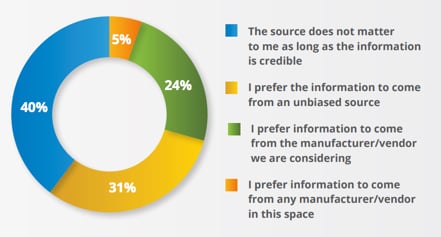
40 percent of respondents say the source of the information doesn’t matter, as long as it is credible. (To which I say, “Well, then how do you know it’s credible?”)

31 percent say they prefer the information to be unbiased.

Interestingly, 24 percent prefer the information to come from the company or manufacturer that they are considering. (I call this the “fox watching the henhouse” approach to content marketing.)

Taken together, I interpret this to mean that while it is, of course, optimal to have strong third-party endorsements, creating content marketing that extolls your own virtues is more than just possible. It’s actually acceptable and desirable in many B2B consideration funnels. Fascinating!


40% of B2B buyers say when researching, the source of info doesn't matter, as long as it's credible.
Click To Tweet


Consider Increasing Your Content Marketing Budget

Competition gets tougher, and audiences get more jaded. That’s the current cycle in B2B content marketing. To continue to succeed, many firms are increasing investment.

38 percent of companies in B2B anticipate boosting their content marketing budgets in 2018, according to an Informa survey.

And content is also becoming a larger and larger share of total marketing spend. Based on their research, Content Marketing Institute finds that the most successful companies in B2B are spending approximately 40 percent of all marketing dollars on content marketing.

So what do we cut in that scenario, as content vacuums up more and more budget dollars? Collateral material? Events and exhibits? Sponsorships? Print ads? Logo golf balls?

Part of this budget increase is for content marketing software, including robust editorial calendars and productivity tools.


38% of B2B companies anticipate boosting their #contentmarketing budgets in 2018
Click To Tweet


Don’t Stop Content Marketing at the Purchase

You’ll find excellent commentary in the eMarketer report about the need for content to be created and targeted explicitly at all stages of the funnel, including post-purchase. I couldn’t agree more. In fact, I wrote a whole piece about why B2B content marketers are spending their resources incorrectly and mostly ignoring content for retention:

B2B Marketers Are Working Harder Than Necessary

Think Quality, Not Quantity

The script has flipped on this equation. Back when there were still green field topics and authority to be seized, a quantity-driven strategy made sense. Now, there are very few—if any—stones unturned.

Changes to customer expectations, massively increased competition, and social media and search engine algorithm shifts have, in combination, resulted in a new content marketing world. Now, crafting the definitive piece on a particular topic is a far better idea than crafting a bunch of okay content executions across a broader topical spread.

I loved this quote from the eMarketer report:

“There’s this push for quality content over quantity,” said Timothy Morral, director of editorial content at Walker Sands Communications. “Part of it is driven, because B2B brands recognize that they need quality leads. Quality content and quality leads work in parallel.”

Exactly! Not only does quality content break through, but quality content creates quality leads, and mediocre content creates mediocre leads.

Get Good at Multi-Sensory Content Marketing

Most B2B content marketers come from a writing or publishing background, either via education or experience. This is because, for a long time, B2B marketers deployed the overwhelming majority of their content marketing in writing. B2B content marketing meant white papers, ebooks, data sheets, FAQs, and so forth.

Now, however, changing consumer content consumption patterns (powered partially by the shift to mobile and the ability to stream video just about everywhere) have made written content (like this content, ironically) less popular, in favor of multi-sensory executions like videos and interactive white papers and the like.

Companies (and Convince & Convert partners) like Vidyard and SnapApp are powering B2B video and interactive content to increase reach and conversions. Here’s an article Anthony Helmstetter, one of our Analysts, wrote on video marketing:

The 3-Part Secret to Video Marketing in 2018

Don’t Sleep on Search

Despite the shift to multi-sensory content executions to break through the clutter, a Digital Donut survey found that organic search is still the top-performing method for driving traffic to content, with 44 percent of respondents listing it as one of their top three choices.

39 percent cited email to your own list. (Although if those prospects are already on your list, it’s not really a new audience or source of traffic.) Paid search ranked third with 33 percent of respondents ranking it in the top three. Linkedin and Facebook were next, and the remaining options lagged far behind.


Organic search is still the number one tactic for driving traffic to B2B #contentmarketing
Click To Tweet


Find Ways to Boost Relevancy

Your prospective customers, even when in active shopping mode, have no shortage of content consumption options. Content is EVERYWHERE. From you, from your competitors, and from third parties.

Content becomes disproportionately successful when it’s more interesting at the format level (video, interactivity), or more specific and relevant to the potential customer. This is what is powering the move toward account-based marketing (ABM) in B2B. In an ABM scenario, the content is by definition customized and tailored to a specific industry or company. Why? RELEVANCY is the killer app.

One of the easiest ways to boost content marketing relevancy is through personalization. If you’re not already personalizing, you’re probably behind. 68 percent of B2B marketers said they are testing personalization of content and offers, according to a Chief Marketer study.

As I acknowledged in the eMarketer study, however, while personalization is effective—and clearly is the future of content—it requires effort. This approach can be a strain on your resources and team. This is especially true if you are already having trouble getting buy-in from leadership that the existing content program is worthwhile. Asking to allocate additional funds to create highly bespoke content can be an obstacle.

There you have it. The 9 B2B Content Marketing Musts for 2018. Thanks to eMarketer and all the other organizations that are putting out such great research and reports on this topic.

If my team and I here at Convince & Convert can help you stay ahead of customer expectations in the area of content marketing, please get in touch about a free analysis. We create Digital Marketing Maturity Maps for some of the world’s most interesting brands, and guide them as they accelerate, measure, and propel their digital. 

The post 9 B2B Content Marketing Musts for 2018 appeared first on Convince and Convert: Social Media Consulting and Content Marketing Consulting.

14 Feb 17:46

The risk discount and pricing power

by Steven Forth
risk_blog.png

Value-based pricing is based on the theory that the more differentiated value you provide the higher you can set your price. There are some caveats of course. Pricing power is the degree to which you actually capture that differentiated value into price. The three critical concepts here are differentiated value (how much value is created for a customer), pricing power (how much of the value you could capture should you choose to do so) and pricing strategy (given your differentiated value and pricing power, how much of the differentiated value should you try to capture). The relationship between these three concepts is shown below.

Value Pricing Power Pricing Strategy


It this post, we are concerned with one of the most important determinants of pricing power, risk, or more accurately, perceived risk.

There are several dimensions of risk to be concerned with. 

  • Supplier risk
  • Customer risk
  • Value risk

Supplier Risk

Supplier risk is simple to understand. Buyers do not want to invest in solutions where the supplier may disappear or the solution is no longer to be supported. This is a real risk, and not just with start-up companies. I have built several solutions on Google apps that are no longer supported (anyone remember Google Notebook?) and I was a big fan of Groove before it was acquired by Microsoft. In an era of cloud services, this is an even more serious risk as a cloud vendor can disappear and take your data with it but many of the most important innovations come from smaller companies and anyone who wants to be on the top of their game needs to use them. Buyers compensate for supplier risk in many ways. They may insist on code escrow agreements (where they have access to the code if the service is shut down), data warehousing (where they are able to download and store their own data) and service continuation and service migration agreements (to cover mergers and acquisitions). They also impose price discounts on early-stage vendors.

Customer Risk

It is not just suppliers that change. Customers change business models too, and generally want to avoid lock-in. They are also afraid of paying more than the next person (especially if the procurement organization is involved in the deal). Smart customers (and we want our customers to be smart as that way they are more likely to be successful) are aware of the risks inherent in their own business and factor them in to buying decisions. There is not a lot that suppliers can do about this, other than be aware of it, and be flexible in helping customers manage their own risks.

Value Risk

The most important risk impacting pricing power is not supplier risk or customer risk but value risk. Frankly, buyers are sceptical of seller value claims. If there is only one value claim they look at it very carefully and test each assumption, discounting where there is uncertainty. When there are too many value claims, they are also sceptical, thinking that the seller is just giving them a laundry list and has not worked to understand their business. Generally keeping to two-to-four well documented and supported value claims is the best approach. Support the value claims with white papers, value calculators and data, lots and lots of well presented data.

Even with good reasoning and supporting data doubts will remain, and those doubts will get translated into a risk discount. How much of a discount? A naive calculation, one that many buyers actually make, can look like this.

Value $100

Suggested Price $20

Perceived Risk of Getting Full Value 50%

Willingness to Pay $10 (50% x $20)

Simple to the point of silliness? Yes. But I have seen many customers perform this calculation. I have even seen salespeople offer it up. Ouch.

There are more sophisticated approaches, but the results are not necessarily any prettier.

A Bayesian Approach

Some years ago, I was working on a large deal to sell value-based pricing software to a major industrial company. One of the stakeholders was a crusty old CIO who said something that stuck with me.

"It really pisses me off when you vendors come in here and say your software is going to deliver some result when it is really the hard work of my people using your software that gets the result." 

The truth hurts sometimes, but he is right. In most cases, it is not the software but how the software is used that creates the value. And in almost all cases there is some other way to get to that value. What does this mean? Let's try a simplified Bayesian analysis to see if we can get some insight.

Bayesian statistics are taking over. The highly popular FiveThirtyEight blog by Nate Silver and his team has popularized their application in sports and politics. And many of the more advanced AI systems (including the one used at our sister company TeamFit) have Bayesian networks working somewhere in the background.

The basic Bayesian equation is deceptively simple. P(A|B) is the probability of A given B. P (B|A) is the probability of B given A. P(A) is the underlying probability of A and P(B) is the probability underlying probability of B. Putting all this together the equation looks like this.

P(A|B) = P(B|A) x P(A) / P(B)

What does this mean to the risk discount in pricing?

Let's imagine that we are talking to the CIO. He has noticed an increase in sales in the market and he is wondering if this increase is due to his competitors adopting your software or to other factors. (We are going to keep the analysis here as simple as possible, I can already hear people telling me this blog post is too long.) Let's say there is an 80% chance that if this software is adopted, it will increase sales (you have evidence for this from other similar companies). How can anyone resist this! Well, they can and do, because they know that some companies are getting the sales increase without using our software. There is a 20% chance that sales will go up among companies that do not adopt the software.

Our question, given that a company is using our solution, and that sales have indeed increased, what is the probability that the sales increase was a result of using our solution, or what is the P(A|B). This is the information we want to get to the CIO.

To answer this, we need to know the value for P(B|A). This gets a bit tricky, so we will use a decision tree to help us. There are four possibilities to consider.

1. Our software was used and sales went up (80%)

2. Our software was used and sales did not go up (20%)

3. Our software was not used and sales went up (20%)

4. Our software was not used and sales did not go up (80%)

Let's put these into a simple decision tree.

Bayesian Decision Tree for Sales Scenario

We want to plug our numbers into the Bayesian equation to see what is the probability that an observed sales increase is due to the adoption of the software.

P(A) = .2
P(B) = .32
P(B|A) = .8

Plugging these into the Bayesian equation, we get the P(A|B) = .5

P(A) is the probability of the sales software being used, which is given as .2.

P(B) is the probability sales are up, which we can see from the Decision Tree is .32.

P(B|A) is Path 1 (Use Software and Sales Increase)  is .8.

Plugging these numbers in we get the following.

P(A|B) is .5.

Two conclusions.

1) 50% of the companies who saw a sales increase used the software vs. only 20% overall and only 16% of those who didn't use the software.

2) The comparison of P(B|A) 80% to P(B|~A) 16% (those who saw a sales increase while using the software vs those who saw a sales increase without using the software) is even more compelling.  We increase the likelihood of increasing sales by 5 times(!) by choosing to use the software.

If you can explain this to the CIO ,you will have a path to a shared understanding and it may be easier to find a way past this. Let's not forget, 80% of companies using the software see the benefit, while only 16% of companies that do not use the software are seeing the benefit.

Risk Adoption and Pricing Strategy

Being able to understand and explain the risk of getting the intended value is foundational to value-based pricing. There is an explicit or implicit risk discount built into the price that buyers are willing to pay, even when they believe the value propositions.

There are two ways to address this.

One can accept that this risk exists and that the customer bears the risk. Under this strategy, the goal is to get as explicit as possible about the reasons the customer will not get the intended value and the other ways they could get the value and then help the customer reduce the risk. This is often done by the people in customer success, who are frequently accountable for renewals, the assumption being that customers are more likely to renew if they are getting value.

The second approach is to shift the risk from the customer to the vendor. This is known as performance-based pricing. As the customer is no longer carrying the risk it does not need a risk discount and much higher prices can be achieved. This works when (i) the vendor is in a position to reduce the risk through its own actions or (ii) when predictive analytics can be used to clarify the risk and to manage it. Predicting risk will depend on who has access to the data and tools to measure predictive value.

So when you are developing your pricing ask the following questions.

  1. What is the value risk?
  2. How can the value risk be reduced?
  3. Who is in the best position to predict this risk?
  4. Who is willing to accept this risk?

The company that can best reduce the value risk or predict the risk should be the company that benefits. If this is the buyer, there is a risk discount. If it is the seller, there can be a performance premium.

At Ibbaka, we are happy to help you work through this for your own markets and solutions and help you to design the pricing model that will maximize your returns.

Permalink

14 Feb 17:43

Targeting prospects who are “trying but struggling”

by bob@inflexion-point.com (Bob Apollo)

Drowning Hand marginAn uninformed and superficial review of the principles of “challenger®️ selling” might lead some people to conclude that it depends on introducing a problem or opportunity that our potential prospect has never previously given any active consideration to.

But even assuming that these projects don’t fall at the first hurdle and that we can turn them into an active opportunity, these “previously unconsidered initiative” projects - particularly if they are dependent on new budget being found - can often result in complex, lengthy and often ultimately unsuccessful sales cycles.

I’m not suggesting that such projects are always likely to end in failure - but they are far from the only way in which we can successfully challenge our customer’s current thinking. There are many other ways in which we can bring fresh perspectives to our prospects in a way that has a good chance of being rapidly accepted and implemented...

Some of the most obvious opportunities lie with prospects that are “trying but struggling”. They have already recognised that they need to deal with an identified issue or initiative. They have already allocated budget and resources to the programme. They have identified and are implementing a "solution". It’s just that it isn’t yet delivering anything like the desired results, and they may be starting to wonder if a different approach might be necessary.

This is a perfect opportunity to constructively challenge the thinking that led them to try and solve the problem with the approach that they are currently struggling with. Clearly, we need to be cognizant of the egos and politics that led to the existing "solution" being chosen and adopted. But assuming we can find ways of navigating around them, we have a perfect opportunity to introduce our prospect to a fresh perspective.

OPENING THEIR MINDS

We can open our prospective customer's minds to the implications and consequences of their existing situation that they may not have been aware of or taken into account when they made their initial choice. We can introduce new considerations that reflect the accumulated experiences of other organisations who are trying to deal with similar circumstances.

We can characterise the implications of our prospective customer's current situation in a way that leads naturally towards the uniquely relevant capabilities of our solution without coming across as insensitive or overtly “salesy”. And we can progressively open their eyes to the limitations of the approach they are currently struggling to implement.

CHANGE IS HARD

Change is hard - and your customers understand this, often through bitter experience. They know that not all change initiatives succeed the first time around. But as long as their goals are important enough, they will usually be open to rethinking their position if (with our help) they recognise that their current approach is pointing in the wrong direction or not moving in the right direction anything like quickly enough.

We can help them to rationalise the need for a fresh approach. We can share our experiences of helping similar organisations to master the transition they they are currently struggling with. We can build their confidence that we are are the right partner with whom to achieve their goals. We can make it easy to segue from their current path to ours. And we can help them to position the need to change their approach in a constructive manner that is most likely to secure internal understanding and approval.

THEY ALREADY HAVE THE MONEY

Perhaps best of all, the budget already exists. It’s a matter of switching these existing funds from the current approach that they now acknowledge is failing them to our solution, in the confidence that this time they are more likely to achieve the desired results.

These sort of pivots can’t be finessed through anything that comes across as a naïve, confrontational, “you’re idiots for making a bad decision” sales approach. They require skilled and emotionally intelligent salespersonship that puts us in our customer’s shoes.

I’ve pointed out that change is hard - I’m sure you recognise this for yourselves. You might be surprised to realise how many “trying but struggling” projects there are out there. If you look carefully in the right places, you can probably identify the signs. When you do, I advise you to approach the subject in a respectful and constructive manner, and to challenge without confronting.

WHERE TO START LOOKING

Some of these opportunities are probably right under your nose. It’s always worth revisiting previous opportunities that either ended in a competitive win, or a decision to solve the problem in a completely different way.

A decision to develop a system using in-house IT resources is a classic opportunity for this sort of turn-around, as long as you can work out how to manage the complexities of the internal politics. These in-house IT developments almost inevitably end up taking longer, costing more and achieving less than the way there were originally specified, to the great and growing disadvantage of the user departments involved.

But you also need to be aware that your recent sales can get displaced, as well: if you’ve sold something that isn’t yet delivering on your promises, you too could be vulnerable to being displaced by an unhappy client. And if you sold them the wrong thing in the first place, no amount of customer success heroics are likely to rescue that baby, and your company is likely to end up losing far more than the notional profit on the deal.

Trying but struggling... take a look around your prospect base. Look for organisations that are pursuing important initiatives but are not making the progress they had hoped for. Work out a suitable angle. And then constructively challenge your prospective customer's current thinking in a way that progressively leads them towards your approach.


IF YOU LIKED THIS, YOU'LL PROBABLY ALSO APPRECIATE:

BLOG: Encouraging our sales people to think

BLOG: Are you selling "me-too" or "breakthrough"?

BLOG: Situational awareness - a critical factor in B2B sales

BLOG: Decoding your prospect's buying decision mode

BLOG: Self-awareness and self-honesty in complex B2B sales

BLOG: We need to collectively develop sales competencies

WEBINAR: Selling in the Breakthrough Zone

DOWNLOAD: Our Guide to the Value Selling System

DOWNLOAD: 12-Point Value Selling Self-Assessment


ABOUT THE AUTHOR

Apollo_3_white_background_250_square.jpgBob Apollo is a Fellow of the Association of Professional Sales and the founder of UK-based Inflexion-Point Strategy Partners, home of the Value Selling System®. Following a successful career spanning start-ups, scale-ups and corporates, Bob now works with a growing client base of tech-based B2B-focused high-growth businesses, enabling them to progressively create, capture and confirm their unique value in every customer interaction.
14 Feb 17:43

How to Position Your Sales Team to Win in an On-Demand Economy

by Alex Hisaka

There’s an unmistakable pattern in business these days. It is so pervasive it has a nickname, based on one of the game-changers that helped usher it in: uberization.

Although this term refers more specifically to the sort of peer-to-peer transactions popularized by transformational companies such as Uber and Airbnb, the larger trend is moving us toward an on-demand economy, wherein technological advancements are leveraged to create a more responsive, tailored experience for the customer.

With ride-sharing apps like Uber and Lyft, you can tap a button on your smartphone and almost instantly have a driver on the way. Netflix uses its wealth of data, and complex algorithms, to serve up uniquely customized viewing suggestions for each subscriber. Amazon’s painless ecommerce interface, rapid delivery options, and related product recommendations have made it an exclusive shopping destination for many customers.

As these models continue to spread across more and more industries, it feels inevitable that the B2B sales process will eventually need to evolve and align with changing customer expectations. In some ways it already has, and the rise of social selling is reflective of this.

I was struck by these wise words from Dave Batt, CEO of FPX, from an interview with Forbes last year: “As B2B buyers increasingly expect more from their digital experiences, an omnichannel strategy with a ‘customer-in’ approach to experience management — delivering the right solution, at the right price when and where the customer wants it — is the only path to success for B2B organizations that want to remain competitive and relevant.”

Recognizing and seizing opportunities to transition toward an on-demand experience for prospects and buyers will prove highly advantageous for sales teams in the new era of commerce. With experience in mind, here are three recommendations for developing an ultra-modern approach.

3 Steps to an On-Demand Sales Strategy

Be Easy to Find

Getting help with a B2B purchase decision will (fortunately) never be quite the same as ordering an Uber, because the skills and experience required to guide buyers from consideration to decision are more specialized and rare than driving a car from Point A to Point B.

Still, when you think about the value that users derive from being able to quickly and easily have their needs met, there are lessons we can apply to B2B sales tactics.

Think about it this way: if a prospect determines at some point in time they have a need for a solution like yours, what steps can you take to ensure that your sales rep is the first driver to get notified of the ride request, so to speak?

Timing is everything. Research has shown that the odds of making successful contact with a lead are 100 times greater when outreach occurs within the first five minutes, compared to 30 minutes after lead submission. It goes without saying that if you engage a primed prospect ahead of your competitors, you’ve got a clear edge.

So at the moment a need is realized by a potential customer, you want your solution to be the one they find. Knowing that today’s buyers are more autonomous in their purchase research, that means adopting inbound principles and becoming discoverable.

Work with marketing to develop SEO-friendly content assets. Stay active on social media, and post often about challenges that your target audience frequently encounters. Use Daily Mobile Briefings in Sales Navigator to receive prioritized alerts on intent signals from your Saved Leads and Accounts.  

If you’re not first, you’re last. In the world of B2B selling, statistics tell us this adage often rings true.

Tailor Your Approach

We talk about this imperative quite often on the LinkedIn Sales Solutions blog, so we won’t rehash it too deeply here, but personalization is undoubtedly an essential component of the new-age model.

The State of Sales 2017 report showed that 64% of B2B decision-makers won’t engage with a salesperson if the communication isn’t personalized, and that practice doesn’t end with plugging a person’s first name into a cookie-cutter template. Ideally you will want to bring a fully customized, context-driven approach to each interaction. That means taking the time to research a prospect’s LinkedIn profile, as well as seeking out information about their company, their industry, their competitors.

For further guidance, this post on creating a repeatable personalized sales process is a good primer.

Create a Seamless Process

One of the hallmarks of successful new ventures? Minimal friction for the customer. People gravitated toward Uber and Lyft because they presented a vastly more convenient experience compared to taxi cabs.

If you haven’t lately, now might be a good time to review your organization’s purchase funnel and each touchpoint within, to make sure they are consistent, simple, and frictionless. Is your website easily navigable and structured with the most important functions front-and-center? Is it completely optimized for mobile? Does it offer a chat function for visitors seeking immediate assistance? Are you using PointDrive for sharing sales collateral rather than burdensome email attachments?

Small adjustments like these can make a big difference on the other end. You want your solution to be the one customers turn to when they get fed up with clunky interfaces elsewhere – not the other way around.

What other measures can you implement to place your sales team on the cutting edge, both today and tomorrow? Download The Future of Sales: Rise of the Strategic Seller for insights that will put you in the driver’s seat.

      
14 Feb 17:43

The “Smart” New LinkedIn Feature You Need to Know About

by John Nemo

LinkedIn’s revamped messaging system recently added another feature that makes conversing with your ideal prospects on the platform even easier.

LinkedIn has come a long way.

From its early days as little more than a glorified online résumé platform for professionals seeking employment to a “one-stop shop” for industry news, training and networking worldwide, LinkedIn continues to try and adjust to the changing professional workplace.

The latest example is with its internal messaging system, which recently added a “smart” new feature that helps make conversing with prospective clients or employers on the platform even easier.

“Smart Replies” Come to LinkedIn

“Ever need a little inspiration and help to respond to incoming messages in a timely manner?” LinkedIn’s Julie Inouye asked in a recent blog post. “LinkedIn smart replies will suggest personalized, relevant responses to make it easier for you to keep the conversation going, no matter how busy you are. The next time your teammate asks if you’d like to attend an event next week you may see smart reply suggestions, such as “Yes!,” “What time?” or “👍 .”

Yes, emojis have made their way into your LinkedIn inbox.

“Ultimately, real-time communication is where we’re headed online,” LinkedIn Sales Solutions Executive Doug Camplejohn told me in a recent podcast interview. “Rather than sending something and then waiting for hours or even days to get a response.”

Real Time Conversations = Engagement on LinkedIn

Here’s why this approach makes sense: When you meet someone for the first time in real life, you have a casual, back-and-forth conversation.

You build some rapport, asking your prospect questions about his or her work (and non-work) life. You break the ice, building up a comfort level as the prospect gets to know, like and trust you.

In that vein, LinkedIn’s messaging experience now feels more like texting with a friend instead of exchanging formal-sounding emails.

Back and forth you go, even having the ability to see the other person tying and replying in real-time.

LinkedIn’s built-in “smart replies” feature (as this video demonstrates) comes up with words, phrases or even emojis you can click on and insert into your messages based on the other person’s replies.

It’s a slick, easy and intuitive feature, and I’ve noticed it becoming “smarter” over time as I use it more often in LinkedIn messages.

Conversation + Engagement = Sales

As nice as added features like this one are when it comes to messaging your ideal connections or potential clients online, it’s still about the substance and camaraderie of your communication style more than anything else.

As one example, here are some best practices for messaging what I define as your “warmest” sales leads on LinkedIn.

Just like in real life, you still need to provide value, build up rapport and earn the right to ask a new connection for his or her time, interest and attention.

No amount of messaging features will replace these timeless truths of communication and conversation best practices, so make sure you follow those online with LinkedIn just like you do in real life!

14 Feb 17:42

How to Find Leads Online

by dtyre@hubspot.com (Dan Tyre)

Entrepreneurs, scaling startups, and enterprise companies are all in business to do one main thing: generate revenue.

Over the last 10 years, inbound marketing has proven to be a great way to do this. But it’s important to understand that people don’t go from completely unaware of your business to being a brand-loyal customer in one fell swoop.

There are levels to this kind of thing.

Potential customers need to go through a few different stages before they’re ready to entertain a conversation about what you sell: Awareness, interest, consideration, intent, evaluation, and finally purchase.

The second stage is where you get leads.

Getting people interested in what you have to sell doesn’t have to be difficult thanks to Inbound marketing. This practice is a holistic, data-driven approach where a business leverages content on its website to attract interested buyers and convert them into leads — typically after they've become aware of the products and services online.

It mirrors the way people buy in today's digital environment and works in both B2B and B2C situations.

Download 37 Tips for Social Selling on LinkedIn

But what if you don't have a marketing department or your marketing team doesn't practice inbound? What if you have to generate your own sales leads?

Here, we’ll review the online channels that’ll help you generate leads and tactics you apply to fill your pipeline today.

Many sales professionals don't have the marketing support to rely on a steady flow of inbound leads, but still have to hit their quotas. Luckily, the inbound sales methodology provides many ways to fill that need.

Inbound sales is a way to identify and connect with prospects by leveraging the inbound mindset of building relationships way before someone is ready to buy.

Most successful salespeople already practice some version of solution selling. They know sales is about consulting around the prospect's problems, not closing the deal.

It's about letting the prospect define the pace of the process and offering education and advice as a way to build confidence and trust. This makes it easy and safe for a client to buy. Here are a few ways you can make it scalable and efficient on your own.

You might be wondering "What makes a lead ready to speak with sales?" And that can depend on several factors set by your sales team. Perhaps the type of lead generation tactic that brought them into the pipeline determines who becomes a prospect. Or maybe, an SDR reaches out to the lead to qualify them manually by asking a set of layered questions.

Lead qualification should be based on your revenue goals with input from both the marketing and sales teams. But before you set criteria to qualify leads, you need to generate them first.

Let’s take a look at some of the top lead channels that won’t cost you a penny.

1.Use third-party listings.

Websites like Fiverr and Upwork can be a great source of leads for your sales team. If your business sells a service that is in demand on these sites, you can list your services to gain more leads. The best part about using third-party listings to get free leads is that they have the potential to close quickly. When there’s a match between your business and the client, they’ll likely want to get to work right away which is invaluable to your time-to-close KPI and bottom-line revenue.

2. Create content.

We’ll talk about different ways you can do this in the section below, but creating content online helps you get free leads in both the short-term and the long-term. When you use social media to promote your content, you can see a quick spike in traffic to your website and a spike in leads could follow. In the long-term, your content will live on your site and gain authority in the search engines as more people search for queries that your content answers for them. All of this is completely free and only requires time, skill, and consistency.

3. Network online.

Whether you’re on social media sites like Facebook and Twitter or using forums like Reddit and Quora, networking online with people in your market can bring your business free leads. This method of acquiring new customers can be time-consuming, but you’ll develop a better understanding of what your customers are looking for and why they buy your products or services. In turn, you’ll develop a sense of empathy and customer knowledge that money can’t buy.

1. Optimize your social media profiles.

When was the last time you actually updated your LinkedIn or Twitter profile? Keeping your social media profiles fresh and up-to-date is a great way to bring in more leads.

LinkedIn is hands-down the most beneficial social media platform for salespeople. Make your profile stand out (and potentially show up in search queries) by drafting a stellar LinkedIn headline and descriptive summary that tells those who visit your profile exactly what you do and who you serve.

Twitter is another social media platform that salespeople can use to connect with leads and generate interest in their business.

To get the most out of your Twitter profile make sure you have a professional-looking profile photo, tag your company’s account, include a link to your LinkedIn profile, and try including a few hashtags that are relevant to your buyers.

Making these simple changes to your social media profiles puts you in a better position to show up in the search results of potential buyers, making it even easier to connect.

2. Find prospects you can help on relevant social media networks.

Most salespeople are on LinkedIn, but may not be using it effectively for generating top-of-the-funnel activity. It is a salesperson's dream to be able to connect in a high-value, low-effort way to find interested prospects, and social media is a great way to do so.

A few quick recommendations to leverage your social media presence for lead generation:

  1. Try to connect with as many people as you can. The more connections you have, the wider your reach will be. You don't have to be best friends with the people you connect to. Tangential connections can be amongst the best for potential prospects.
  2. Post in the "Share an Update" section you're currently looking to identify and help a specific type of prospect with a specific type of problem by a specific date. For example, "We are looking to work with three new commercial landscaping companies by September 1 that are interested in building their business in the greater Phoenix, Arizona area".
  3. Get three recommendations from current clients demonstrating high-quality work that can vouch for your value, professionalism, and effectiveness.
(Extra credit if you can broaden your professional brand to Facebook for Business, Twitter, and Snapchat, although this does increase the amount of work involved.)

3. Post a blog article on LinkedIn with an offer for a 15-minute consultation.

I speak on behalf of HubSpot 50 times a year, and often when I mention "blogging" to my audience, people's eyes glaze over. They think of blogging as a structured and difficult way of writing a college essay — and writing is up there with public speaking on the list of things that people hate and fear.

But blogging is really just a conversation, and a blog topic can be as simple as answering the standard questions about your product that you do every day, such as "The Beginner's Guide to [Common Business Challenge]" and "X Things You Need to Know About [Business Area]."

4. Ask your current customers for referrals.

Over the course of my work helping digital agencies fill their sales funnel, I frequently ask my clients the last time they pinged their current clients, thanked them for their business, and asked for help in generating more business.

Everyone agrees that a referral collection strategy is effective, but for some reason, it's hard to implement one effectively. You can follow the seven steps below to get started:

  1. Check with your account manager to make sure the customer is happy (and if they're not, set up a call anyway to see how you can make things better).
  2. Ping the client with a phone and an email and ask for a 10-minute conversation.
  3. Thank the client for the business, explain that you value your relationship and you're always interested in making it more valuable to your client.
  4. Ask if there are any other contacts or companies she can think of that would be interested in the same level of service.
  5. Get the name, phone number, and email of the contact, and why your client thinks it is a good fit.
  6. Ask if they can tee you up with a quick introduction email.
  7. Extra credit: If you can, send them a handwritten note or small item like a T-shirt thanking them for the referral. Little touches go a long way.

5. Work with your personal network to identify potential leads.

Working your personal network is another sometimes-overlooked option that is fairly easy to get started with because you have built-in trust. There are certain people you'll meet in a personal context that you wouldn't think of as a lead generation machine but can be incredibly valuable.

In today's busy world, you have yoga friends, work friends, neighbors, and more — but they exist in these separate buckets that don't necessarily intersect. The key is remarkably simple — if you're at the point in your relationship where you can talk business, let potentially useful acquaintances know.

Identify the type of company you're looking for (size, employee number, revenue amount, location, etc.) and send an email they can forward to make the connection.

Of course, mixing the personal and professional like this needs to be effective and respectful — but it is a great way of broadening your reach.

6. Actively engage with new leads at networking events.

When possible, attending these events (in person and online) should be part of your routine because they're a great way to grow your reach and potentially drum up business.

Below are four basics I remind people of before they dive into networking (whether in-person or at a virtual networking event):

  1. It's about mingling and being human and having fun. Don't take things too seriously!
  2. Explaining your "always be helping" philosophy face-to-face is usually a pretty big differentiator.
  3. Bring business cards to hand to your new acquaintances.
  4. Offer to connect on LinkedIn from your phone while you're standing next to someone. I usually respectfully ask — would you like to connect on LinkedIn? If they say "yes," I just hand them my phone and say, "Can you find yourself and connect?", which makes things a lot easier.

7. Revisit closed/lost opportunities.

These are businesses that already know what your company does. They might have seen a product demo or made it through a discovery call and it just wasn't the right time to buy.

Touch base with these prospects every six months. Ask how their priorities have changed, if their business and team goals have shifted, and what their challenges are.

Invest in marketing to these prospects, because they're already more qualified than new, warm leads. Enroll them in appropriate marketing email drips, send them relevant blog posts, and keep communication personalized.

It might not be the right moment the first or third time you follow up, but it could work in your favor the fifth.

And you never know when a prospect will change jobs and finally have the budget or business case to implement your solution. By staying top of mind, you'll be the first vendor they call.

8. Send automated email newsletters.

At SaaStr Annual 2018, Sam Blond, CRO of Rainforest QA recommended, "Define your strategy for outreach. Then get creative with the email copy — be clever."

Blond explained that one of Rainforest's most successful email sequences is addressed from their CTO. Rainforest's SDRs send the email to the CTO of a prospect's company, framing the message as if their CTO asked them to reach out.

"It's creative, it grabs attention, and it allows us to cast a wide net over each prospect's company," Blond said.

To send a successful email sequence, have a clear purpose for each one. For example:

  • Email 1: Address pain points
  • Email 2: Explain a value message
  • Email 3: Name drop a big client
  • Email 4: Qualify your message
  • Email 5: Include a product message
  • Email 6: Reach out one last time

Implement a comprehensive, purposeful email sequence and see it work for you.

9. Guest post to other websites and blogs.

Are you writing blogs yet? You should be. Start by writing about what you're an expert in.

It could be sales process optimization, referral marketing, or your product/service — but whatever you do, start writing, and share it on your company's blog, your personal social media channels, and your customers.

It's important for you to be a visible expert in your field. Not only will it display your expertise, but you'll educate your prospects as well. Need some help on your first post? Reach out to your resident marketer or blog editor for a quick lesson. They might even offer to help you write a post or two.

10. Embed a meeting scheduler on your website.

If you're a rep in charge of bringing in your own leads, you don't have the resources to send three back-and-forth emails coordinating schedules with a prospect. It's a waste of your time and a waste of theirs.

Instead, embed an appointment scheduler on your website and your email signature. HubSpot's free Meeting Scheduling Tool syncs with Google and Office 365 calendars, so your prospects always see your updated availability.

Plus, if there's no designated sales rep, you can set a round-robin meeting link, so prospects are able to schedule meetings with the rep who's availability best aligns with their own.

Make it easy for leads to get in touch with you and schedule time to learn more.

11. Use live chat to engage with users on your website.

Another way to vet leads is through an easy-to-use chatbot builder. There are a lot on the market today, but HubSpot Conversations gives you the tools and context you need to have unlimited, personalized conversations at scale.

Customize your widget so that it matches the look and feel of your brand and pops up on your prospect's screen with a welcome message that's actionable and matches their intent. Use your chatbot to qualify leads, book meetings, answer FAQs, and more.

You can respond to chats through the Conversations inbox, Slack, on even on the go with HubSpot's mobile app. Because it's part of your HubSpot CRM, every conversation is saved.

12. Lead an online workshop or webinar.

While sharing articles and blog posts are a great way to share your knowledge, nothing tops getting the opportunity to actually teach. Hosting a webinar or online workshop sharing your expertise on a relevant topic is a great way to generate leads online.

For example, if you sell social media scheduling software for small businesses, you could host an online workshop for entrepreneurs showing them how to build engagement on social media. By sharing your knowledge on a relevant topic in an intimate format such as video, you are building trust with leads quickly.

13. Create blog content to gain visibility in the search engines.

Guest posting to other blogs and websites is a smart way to build brand awareness with new audiences, but by blogging on your own domain, you’ll benefit from long-term SEO gains.

A blog content strategy won’t bring you a ton of leads overnight, but overtime, you’ll find a sweet spot of keywords and off-page promotion strategies that will help you build a loyal following of readers who may eventually become leads.

14. Have a giveaway for a free product or service in exchange for a lead form.

Who doesn’t like free stuff? Drum up interest in a new product offering or service with a giveaway. In exchange for a lead form, you can offer your audience a chance to win a free consultation, product, or service from your business. With the consent of the people who entered the giveaway, you can add them to your email nurture campaigns where they can learn more about your business and become customers in the future.

15. Partner with other businesses online to cross-promote your offerings.

Partnerships are mutually beneficial to both you and the other business. Not only will you both gain exposure in two different audiences, you’ll be more likely to make a good impression on the other audience if your brand aligns with their needs.

When partnering with another business, you’ll want to keep a few things in mind before agreeing to collaborate:

  1. Do a quick audience analysis. Is the majority of their audience in that market for what you sell? If not, it may not be a productive use of your time.
  2. What type of collaboration will you be partnering on? Social media collaborations are popular — will you do video, a series of posts, a social media takeover?
  3. What is your goal for the collaboration? How many new leads do you plan to acquire? How will you follow up with them

16. Join networking communities to chat with professionals in your industry.

The Revenue Collective and Women in Revenue are just a few examples of networking communities that you can join to connect with like-minded professionals.

While soliciting services might be prohibited in these groups, you’re bound to find people who are looking for help with a problem that you can solve. You can also leverage your connections in these groups to help you find leads online.

17. Set up a Google My Business account and solicit reviews from existing or past clients.

Google brings in more than 5 billion searches per day. That’s “billion” with a “B”. Because of the sheer amount of traffic to the search engine, it’s a good idea to enhance your presence there. Google My Business is a free option for any business to use. So long as you have a valid physical address where your company does business, you can see an increase in traffic to your website once your account is activated.

With a Google My Business account, searchers have a better chance of seeing your business appear in the search engine results page (SERP) on a carousel, featured snippet, or in a knowledge graph.

Create a Robust Sales Pipeline with Online Lead Sourcing

No matter how small or large your business is, you can generate quality leads online to increase revenue. Whether you’re more of a writer, networker, or public speaker, the opportunity to connect with people and generate leads online is definitely worth your while. Try these online tactics to close more deals this quarter.

Editor's note: This post was originally published in August, 2016 and has been updated for comprehensiveness.
New Call to action

14 Feb 17:42

The 2 Principles of Startup Success Strategy According to MoviePass CEO Mitch Lowe

by Ken Sterling

In the early days of Netflix, the company was trying to be the Amazon of DVD movie rentals. To get feedback on how to improve their service, the execs held a number of focus groups with customers.

After one such focus group, Mitch Lowe and the rest of the executive team overheard something that changed the course of Netflix forever. A young man said that when he rented a DVD online, he had been in the mood for a comedy, but by the time the comedy arrived in his mailbox he was in the mood for a drama. It was a lightning rod moment.

By listening to customer feedback, Lowe and the other execs were able to dramatically improve the Netflix experience for customers. Speed was important. So Netflix built more warehouses over the United States between 2005-2008 to make the mailing time shorter so customers could get that comedy movie when they were in a comedy mood.

Customer convenience was also critical. So Netflix let customers keep a movie as long as they wanted to avoid late fees and so if they were not in a comedy mood when the movie arrived, they could wait until they were to watch it with no financial penalty.

In his winning culture keynote talk and business interviews, the CEO of MoviePass explains the two principles every entrepreneur should follow to ensure startup success: listen to customer feedback and simplify the process.

Listen to your customers

When Netflix was founded in 1997 by Reed Hastings and Marc Randolph (Lowe was hired soon after), Blockbuster was the biggest movie rental company in the United States. But people hated the experience: the rental process involved long lines and having to return the movie to the same rental location.

Instead of listening to their customers, Blockbuster tortured them with late fees. This opened up an opportunity for Netflix to succeed by eliminating long lines, return trips, and late fees. If you listen to your customers, your business can beat the competition.

Lowe tells another customer experience story during the time he was a consultant for McDonald’s. Yes, McDonald’s. In 2002, McDonald’s food sales were decreasing. So they brought in Lowe in 2003 to advise them on their Redox DVD rental kiosks they were installing in restaurants to attract business.

But movie rentals didn’t significantly increase McDonald’s food business; neither did creating healthy menu choices. The customers hadn’t asked for these things.

When McDonald’s finally asked what their customers wanted, it turned out to be clean bathrooms. The principal customers for McDonald’s were mothers (buying happy meals for their children) and these mothers were turned off by the dirty bathrooms in the restaurants.

When McDonald’s finally listened to their customer feedback and made sure the bathrooms were clean, their food business rebounded. The stock went from 14 to 90 dollars.

Simplify the process

Cable companies are notoriously customer unfriendly. From waiting for days to have cable installed to a user-unfriendly, video access menu, the process of viewing a movie or show is difficult. If you like a show on cable, you may be able to watch it anytime, but after you finish watching, you cannot easily select the next episode.

The menu process is too complicated. You have to click several times on the remote to find the video menu again to start the next show in the series.

Netflix understood customers didn’t want to have lots of steps before watching the next episode in a series. So the company simplified the process by immediately bringing up the next episode and starting the video automatically.

Lowe states that the startup companies that succeed simplify their internal and external processes. Amazon has one-click purchasing, Southwest flies only one type of plane, and Apple integrates all of its products.

At Redbox, Lowe says the company succeeded by simplifying the transaction process. Customers either rent or return. There’s no reserving, purchasing, or rating of films. Instead of endless movie choices, Redbox only offers the 140 most popular films (which make up 80 percent of all DVD rentals in the U.S), making it simpler and faster to choose.

If you want to succeed, Lowe suggests simplifying your business by cutting out the clutter. Each step you put between a customer and a transaction leads to customers dropping out.

Therefore, Lowe advises you examine each step in your business process (selling and internal) and get to the shortest possible route possible for customers. And the best way to do this? Simple, listen to the customer.

14 Feb 17:41

4 Tips to Get Buyers to Fall in Love with You this Valentine's Day

by Mike Schultz
Valentine's Day Candy

Editor's Note: This guest post was contributed by Mike Schultz, President, RAIN Group.

While Valentine’s Day is typically centered around relationships between loved ones, it’s also a good opportunity to evaluate and improve your business relationships as well.

Almost every business relationship begins with building rapport. Whether someone likes you or doesn't like you will determine how your selling process and the buyers' decision process will go.

Building rapport leads to some very important outcomes. People talk to people they like, they share information with people they like, they buy from people they like, they feel loyalty to people they like, and they introduce people they like.

We once polled a large group asking, “What percent of people are trustworthy?” The average response? Thirty percent.

Then, the question was slightly altered, asking a different set of people, "What percent of people that you know are trustworthy?" The average response? Seventy percent.

Simply knowing leads to trust. Trust is crucial when selling. Basic familiarity makes a difference in building trust. Knowing and liking is much more powerful, setting the stage for all selling success that comes after. Focus on these four principles of rapport when getting to know buyers.

1. Empathy

What gives your brain as much pleasure as food and money?

Talking about yourself.

Harvard University neuroscientists, Diana Tamir and Jason Mitchell, conducted a series of behavioral experiments that revealed people find talking about themselves rewarding. People can't help sharing details about themselves.

If you can get buyers to talk about themselves, you've made some progress. If you can show them that you’ve listened, they'll be more inclined to like you.

What you’ve established is empathy. Empathy is the ability to understand and share the feelings of another. If you want to build a relationship with a buyer, get them to talk about themselves, and demonstrate that you’re listening.

2. Authenticity

While most people like a listener, few people like a faker. Anyone who comes across as insincere might as well open up the other person's brain and press the "dislike” button.

This is why it’s essential for sellers to show authenticity. People like people who are genuine. Research and practice provide a bit to go on when it comes to being authentic.

For instance, research from the Journal of Nonverbal Behavior revealed that when people smile slower, and ease their way into it, it develops the sense of authenticity.

It’s important to avoid being overly friendly. This might seem like an obvious ploy to connect, but the buyer will see right through it and you’ll fall flat.

3. Similarity

People like people who are like them. They like when there are similarities. If you can find common ground, you’re more likely to develop genuine rapport.

Numerous psychological studies have confirmed that people like names better when they're similar to theirs. They prefer brands that share their initials. They prefer that people move the way they move.

What can you do to apply the similarity principle?

Uncover interests and background that you have in common with the buyer and you can not only make, but also deepen that connection. Anyone who’s shared a favorite TV show, favorite author, favorite sport, favorite activity or hobby, or even has children the same age understands what it feels like to have a connection with someone just because of that one similarity.

Another way to appear similar is to mirror buyers' basic behaviors. For instance, if they speak slow, they'd probably prefer others who do as well. If they speak fast, the same is true. They lean forward, you lean forward. However, don’t outright mimic. Interact in ways they prefer to interact, and interact like them. If you can do this successfully, you'll develop a better connection and rapport.

4. Shared Experience

People who are talked at don't feel connected to the speaker. People who are actively involved in the communication process develop a stronger liking for the people who are interacting with them and, at the same time, develop a sense of psychological ownership over whatever they're working on.

If you're selling, create shared experiences and interact with buyers in the business process. For example, define a problem, craft a solution, devise a strategy to present the solution, and work collaboratively to come to the right agreement and terms.

When you do, not only will they like you more, they'll also be much more inclined to take action on whatever it is you want them to do.

It's also true that if you simply spend time with people—lunch, coffee, events, and so on—your affinity for one another will rise.

If you want to build relationships and increase your influence with buyers, interact with them. Create shared experiences.

Rapport is the foundation for relationship building. Few people would argue that sales people, professionals, and leaders who have great relationships tend to have great success. As you're building rapport, think of it less as a mechanical part about how you should lead a meeting, and more as an investment in building a relationship.

To invest in relationships, make sure you attend to the four principles of rapport: empathy, authenticity, similarity, and shared experience.

For more advice on improving win rates and getting the most out of your sales team, subscribe to the LinkedIn Sales blog.

14 Feb 17:41

How to use data to accelerate sales growth with Guillaume Cabane at Drift and Ilya Semin at Datanyze

by Ryan Robinson
Close-Datanyze-Drift Webinar Graphic-1.jpg

Today, we've got something special for you. This is a recording of yesterday's webinar with Ilya Semin (CEO at Datanyze), Guillaume Cabane (VP of Growth at Drift) and Steli Efti (CEO here at Close.io).

In this webinar, we're talking all about how to use data to accelerate sales growth for your startup.

From the basic data points and metrics every business should be tracking from day one (and how to start tracking them today), to leveraging tools like data enrichment and technographics to increase your effectiveness with prospecting, using marketing automation to fill your sales pipeline, and more... we're covering a lot. Watch right here:  

Huge thanks again to our guests Ilya Semin and Guillaume Cabane!

Ilya is the CEO of Datanyze, where they have an array of sales and marketing-enablement tools like data enrichment, technographics (technology tracking), predictive analytics, and more—to help supercharge your prospecting and shorten sales cycles.

Guillaume is the VP of Growth at Drift, the conversational marketing platform that helps 50,000+ businesses scale their personalized engagement with website visitors—from bots that automatically book more sales meetings for your team, to generating higher volumes of marketing qualified leads, and much more.

Want more webinars like this?

We're putting together a series of webinars just like this, with sales and marketing leaders from the world's top B2B startups. You can sign up right here for updates on our next webinar.

Who would you like to hear from next?

Comment below and let us know 😊

12 Feb 23:47

How to Get Your Beauty Rest as a Hard-Working Entrepreneur

by Emelina Spinelli

how to get beauty rest as a hardworking entrepreneur

People have a tenancy to undervalue sleep.

If you’ve seen Arianna Huffington’s book, “Thrive” you know what I’m talking about. She accounts what it’s like to work constantly at the expense of your body and sleep—to accomplish more. The thesis of the book is that we can accomplish more, while having enough time to sleep and do the other healthful tasks that keep our bodies in balance.

We each have a strategy to go to sleep and wake up. If you you’re not sure what your strategy is, just literally document what you do every morning when you wake up, and every evening when you go to sleep. This is the recipe for the results you’re currently receiving.

If you go to sleep stressed out, you’ll wake up stressed out.

Not only that but, your quality of sleep will be low. You probably won’t wake up with energy or well-rested. Thinking heavily before you go to sleep isn’t healthy. If you can’t stop thinking wildly about what’s not working for you and what you have to do this week, you won’t be able to rest.

Pro Tip:

Have lots of things on your mind? Keep a notebook by your bedside to write it all out before you go to sleep.

There are other things that contribute to how well you sleep. For instance, the time you go to bed, and the time you wake up are actually important. I spent the majority of my life going to bed after midnight, waking up at around 9 or 10 am. This is totally “normal,” but goes against the natural biology of the human body.

I’ll get to more of this in a moment.

Have you heard of the circadian rhythm? It’s part of our natural body clock. I can hear you—clock!? what!? Yes, our bodies have a natural “clock” that biologically determines the best times to sleep, eat, etc. The closer you are to your biological clock, the more balanced you’ll be.

Essentially, our biological clocks dictate that going to sleep around 10:00pm is the best time, and waking up around 6:00 am for optimal energy.

I didn’t believe it— until I started getting to sleep by 10, and getting up at 6. It actually (and surprisingly to me!) made a huge difference. After doing this for a week or so, I found that it was easy to get up early (for someone that wouldn’t get out of bed before 8a). I also noticed that the difference in how I felt when I woke up changed if I went to bed at 11pm or 12pm. I was more groggy and not necessarily chipper when waking.

It helped for me, so I’m happy to share. If you’re truly a night person and can’t make it happen power to ya. However, if you’re thinking about taking your sleep heath to the next level and want to try it out- do it!

#1 Create a Nighttime Routine

Preparing to go to sleep actually helps you sleep better. Create a routine for the evening that slows you down and gives you relaxing vibes. Popular writer and entrepreneur, Tim Ferris says that he drinks tea, reads and takes a bath to unwind every night and prepare himself for sleeping.

I like to listen to meditation music, throw peppermint & lavender into my aromatherapy diffuser, and meditate and/or read. I like showering at night too as it keeps me relaxed and ready for bed.

Get in the habit of creating a routine—it’s a strategy that prepares you for sleep. Then do this every day for a month so you create a habit out of it.

#2 Get Off Your Phone or Computer at least 1 Hour Before Bed

The blue glow of the computer or your phone messes with your biological clock. If you’re staring at your phone right before you nod off to la-la-land, you’re signaling to your brain that it’s not nighttime. The color of the light in the phone simulates daylight and throws off your biological rhythm.

Get off all electronic devices at least one hour before you get to sleep, if not 2 hours. This will help prepare you for healthy sleep and allow you to relax naturally.

#3 Go to Bed & Wake Up at the Same Time

When you go to bed and wake up at the same time every day, you create a natural rhythm for your body to follow. Erratic sleep habits & sleep times will result in not getting a good night’s rest. If you create timing habits, your mind and body will naturally wind down every night before bed.

#4 Avoid Eating Before You Sleep

When you eat, your fluxing your body likely with carbs and sugar. Can you guess what this will do before you go to sleep? Carbs turn into sugar that give you energy and keep you up instead of allowing you to start winding down. If you’re really hungry, keep your snacks to fat (that won’t spike your insulin and keep you awake).

#5 Think of Really Positive Things Before You Sleep

Your brain contemplates the last 2 hours of content that you think about before you go to sleep, all night. This is true especially for the last 5-10 minutes before you fall asleep. I’ve found that if I run through a mental gratitude list before I fall asleep that I noticeably wake up in a much better mood than otherwise.

Spend a few minutes every night contemplating positive things, and/or visualizing your goals.

#6 Use Sleep Apps

My favorite sleep app is Sleep Cycle. I use it literally every night. Essentially, it monitors your movements through your phone to track how you’re sleeping. The more movements mean you’re restless, and the less mean you’re in REM sleep. You set the time you’d like to wake up in the app, and it wakes you up before that time when you leave a REM cycle.

Have you ever woken up groggy? You received plenty of sleep so you can’t understand why you’re so sleepy? Usually it’s a result of waking up at the wrong time—ie. in the middle of deep sleep. This app prevents that feeling by gently waking you up when you’re ready to wake up!

This is helpful and convenient because the app detects when you’re already waking up and helps you wake up fully. It plays a musical alarm quietly, that steadily becomes louder, making it gentle. Say goodbye to those honking, obnoxious alarms.

#7 Practice Meditation

Meditation can take some time to learn, but you can use apps to hack-it. Headspace is a popular meditation app with a great meditation selection. Mostly this is the time for you to decompress your mind of all the thoughts and clutter from the day.

Another alternative to meditation is journaling. Write out everything you can think of for the day to get it out of your head.

#8 Manage Stress to Not Disrupt Sleep

Stress takes a serious toll on the body, and your sleep. Managing stress is probably easier said than done. Either way, it’s incredibly important to create effective routines and habits that help to manage your stress levels throughout the day.

#9 Reduce Overall Caffeine Intake

In the United States especially, we think coffee is a source of energy. It’s found on every corner and is widely available in every office, usually for free. As a result, Americans pound cups of joe all day to counter sleepiness and to “be more productive.”

Here are some things about caffeine that maybe you didn’t know…

  • Caffeine riestricts your muscles to tighten (often tightening neck and shoulder muscles that cause headaches and back problems)
  • Caffeine is highly addictive with withdrawl symptoms
  • Having a constant stimulant drip to your brain and body causes a complete reliant on the stimulant to stimulate your adrenal glands
  • It’s incredibly easy to throw your entire body out of homeostasis by blowing out your adrenal glands (by having more caffeine than your body can handle, that leads to you having trouble getting to sleep, and waking up)

#10 Exercise in the Morning

There are loads of studies that show exercising in the morning gives you energy all day, and helps you sleep soundly at night.

It also is a sustainable way to receive your morning energy. Rather than slugging back a cup of coffee, consider doing a 10-minute HIT training session. Ten minutes can do the world a difference.

#11 De-clutter Your Sleep Environment

Plainly, clutter is distracting. Your room is meant to be the little sanctuary where you recharge and sleep. Keep your room clean and clutter-free. Remove any piles of cloths and put everything away and out of sight that you can.

Place some attention into your bedding. Ultimately, if your bed looks uber-comfortable, you’ll look forward to going to bed. This means that you’ll get to bed earlier, and nod off to dream state in a great mood because you look forward to getting into your bed!

#12 Place Your Phone on Airplane Mode Before You Hit the Hay

Microwaves and radiation leak from your cell phone while you sleep if it’s turned on. This can disrupt your REM cycles and sleep heath. Not only that, but when that friend drunk-texts you at 4am, you won’t be happy.

Turn your phone onto “airplane mode” before you go to sleep. This way you can leave your phone on, but the microwaves won’t disrupt your sleep or brain health. In fact, also make sure to place your phone in another room. It’s not great to have electronics really anywhere near you when you’re sleeping. I’ve started placing my phone in the living room, and it makes me be more present before I go to bed too, keeping me from getting distracted perusing Instagram.

Have more sleep-related tips to add? Try any of these? Let us know in the comments!

12 Feb 23:45

When & How to Disclose – Influencer Edition

by Amy Taylor

If you work in marketing in the year 2018, chances are you’re also working with influencers on behalf of your client brands.

If you’re not, you may want to take a moment to review the stats below on the impact of influencer marketing:

  • 70% of millennial consumers are influenced by the recommendations of their peers in buying decisions.
  • 30% consumers are more likely to buy a product recommended by a non-celebrity blogger. Consumers can relate more to these influencers and value their opinions more than that of celebrity influencers. (Just 3% of consumers are influenced by celebrity endorsements on social media.)
  • Facebook is the most influential social channel, influencing 19% of purchases. Youtube is right behind at 18%. Twitter has less than 2% influence on consumer buying decisions.

Any way you look at it, influencer marketing is here – and it’s likely here to stay. This is the new(ish) face of word of mouth marketing.

With the rise of social media and increase in brand-influencer partnerships, the FTC has started cracking down on compliance with the disclosure rules it has set for these engagements. In recent years, the FTC has started specifically targeting the influencers themselves for failing to comply with the rules and regulations.

In order to protect influencer relationships, it is essential that brands support and educate influencers on properly disclosing any partnerships with their organization at the onset of an engagement. Below is a brief overview of FTC guidelines as of 2017. In order to understand the full scope of disclosure requirements, we suggest checking out The FTC’s Endorsement Guide. (And this is a good time to note we’re not lawyers or legal experts. But we’ve done a lot of digging on this topic and pulled some of the best pieces of advice we’ve come across courtesy of some very savvy bloggers and the FTC. Having said that, we recommend working with a legal expert when building out — and updating — your brand’s influencer disclosure plan.)


WHEN TO DISCLOSE

We all know that it’s important for influencers to disclosure when they’re getting paid, but what about those instances where they just receive free product or an invitation to an event? What if there is no monetary exchange? What if a brand ships some product with no direct ask for a post or endorsement?

While it may seem like murky waters, it’s best to always disclose a relationship where a brand is providing an influencer with product or payment. To put it another way, an influencer should disclose:

  • Any time they share an opinion, thought, reviews, photo or endorsement of a product or service for which they have received compensation.
  • Any time they share an opinion, thought, reviews, photo or endorsement of a product or service that they have received for free, regardless of whether it was given to them with the expectation of an endorsement.


I’m a blogger. I heard that every time I mention a product on my blog, I have to say whether I got it for free or paid for it myself. Is that true?

No. If you mention a product you paid for yourself, there isn’t an issue. Nor is it an issue if you get the product for free because a store is giving out free samples to its customers.
The FTC is only concerned about endorsements that are made on behalf of a sponsoring advertiser. For example, an endorsement would be covered by the FTC Act if an advertiser – or someone working for an advertiser – pays you or gives you something of value to mention a product. If you receive free products or other perks with the expectation that you’ll promote or discuss the advertiser’s products in your blog, you’re covered.

I’m a blogger and a company wants me to attend the launch of its new product. They will fly me to the launch and put me up in a hotel for a couple of nights. They aren’t paying me or giving me anything else. If I write a blog sharing my thoughts about the product, should I disclose anything?

Yes. Knowing that you received free travel and accommodations could affect how much weight your readers give to your thoughts about the product, so you should disclose that you have a financial relationship with the company.

Sometimes I’ll do a product review. [Product] manufacturers send me [their product] as free gifts, hoping that I will review them. I’m under no obligation to talk about it and getting the gifts really doesn’t affect my judgment. Do I need to disclose when I’m talking about a [product] I got for free?

Yes. It doesn’t matter if you were asked to review the product or not — your opinions may have been shaped by the fact that the product was free.

“Even if you don’t think receiving a free product affects your evaluation, what matters is whether knowing that you [received a product for free] might affect how your audience views what you say about it. It doesn’t matter that you aren’t required to review.”

Several months ago a manufacturer sent me a free product and asked me to write about it in my blog. I tried the product, liked it, and wrote a favorable review. When I posted the review, I disclosed that I got the product for free from the manufacturer. I still use the product. Do I have to disclose that I got the product for free every time I mention it in my blog?

It might depend on what you say about it, but each new endorsement made without a disclosure could be deceptive because readers might not see the original blog post where you said you got the product free from the manufacturer.


HOW TO DISCLOSE
Collectively shares some smart, simple tips for properly disclosing:

Acceptable: AD, #ad, #sponsored, #XXPartner – whereby XX is the brand name, or something along the lines of “XX gifted me this product so I could review.” If placed in a sequential line of hashtags, disclosure hashtags should be used at the end of the sequence to ensure they are not lost or hidden amongst other hashtags. Example.

Unacceptable: Pretty much anything else where it is not explicitly laid out that you have some type of relationship with a company, including the use of the too-ambiguous hashtag #ambassador.

Blogs

When crafting a blog post, disclosure is expected before any mention of the product or brand. Two call outs are recommended for maximum clarity: one as an introduction at the beginning, and a second reminder at the conclusion of the post. Example.

Snapchat + Instagram Stories

For real-time video on Snapchat and Instagram Stories, a disclosure and/or prominent, superimposed text annotation is required on the video or image.

YouTube

The word “sponsored”, “ad” or “paid” needs to be included in the video description and verbally disclosed within the first 30 seconds. Example.

Built-In Disclosure Tools

While Instagram and Facebook now require the use of their branded content disclosures, the FTC has made it clear that built-in platform disclosures aren’t enough, and don’t always meet the requirements for clear and conspicuous disclosure. Always disclose your partnerships yourself.


HOW TO SUPPORT THE INFLUENCERS YOU ENGAGE WITH

Whew! Feeling overwhelmed yet? Not to fear. A great number of digital influencers are already well-versed on disclosure rules and integrating those practices into their brand engagements. Nonetheless, we feel having a conversation at the onset of a brand-influencer engagement is important, if as nothing more than a courtesy. (We include disclosure requirements in our contracts.)


BUT I DON’T WANNA…

For as long as the influencer disclosure conversation has been going on, there has been pushback and resistance from the brand side. When influencer engagements feel natural, organic and mutually beneficial, plopping the hashtag #ad on a post can make things feel a little…well, icky. We get it. But the reality is that while you may not wanna…you gotta. Protect your brand. Protect the influencers you partner with. Be honest and transparent at every opportunity. Public perception depends on it.


Sources: 

[1] Collectively, The Evolving Rules of Disclosure: How to Properly Disclose Branded Content

[2] Oh, She Blogs!, FTC Disclosures: What Bloggers & Influencers Need to Know

[3] FTC, The FTC’s Endorsement Guides: What People Are Asking


The post When & How to Disclose – Influencer Edition appeared first on Brains on Fire.

12 Feb 23:42

Build a Case Study Before a Brand

by Elliot Begoun

Case Study.png

It’s like the drums in the movie Jumanji. An incessant beat calling you, drawing you in. Don’t fall prey. Don’t play the game. It will carry you away to another dimension. One that is full of threats, traps and wild beasts.

For young brands, it’s the call of growth, the call of potential new retailers and their shiny shelves and doors. Plug your ears, walk away. Don’t heed the beat of the drums. Before you build a brand, before you find your products in disparate retailers across the country, before you find your resources stretched, your burn rate alarming, and your products under the threat of being discontinued, build a case study.

You need to go slow to grow fast. It’s counterintuitive, I know. But, there are things you must prove and figure out.

You must prove product/market fit. Investors are going to demand this proof. Can you demonstrate that consumers need, want, and most importantly are willing to buy your product? In the absence of that evidence, it’s hard to justify the investment and its accompanying risk.

You must also prove the economics. When you give birth to a product, you make assumptions. One of those is what the market will pay. You need to validate that early before you expand reach and distribution. Too many brands find out too late. Forced to lower their retail price point they find their margins depressed beyond the point of sustainability.

Additionally, there are a few things you need to figure out first before you attempt to become a household name. The first is how best to communicate with your ideal consumer. You’ll want to learn with whom and how they engage in social media. You’ll then want to understand how to leverage that in a way that allows you to build a relationship.

You’ll also want to test your trade plan. What promotional vehicles and at what price point do you realize the biggest volume lift? Just as important is understanding the frequency of promotion. How often do you need to be on promotion to see your base velocity grow? Keep in mind, if you were to graph promotional volume, you don’t want to see a graph that looks like hills and valleys. Rather, you want to see something that resembles stairs. The goal of the promotional activity is not the volume you sell during the event, but the increase in base velocity you realize by bringing new buyers to the brand.

The needed evidence and learning can’t be accomplished effectively by following the drums of growth. When you are spread far-a-field, you can’t administer the necessary experiments that deliver the data which will enable you to adjust and perfect your go-to-market strategy.

That is best done by building a case study and you can best accomplish that by going narrow and deep. Pick a geography, a channel, a single retailer, or cluster of independents. Lean in and learn. If you can find a model that allows you to build velocity, gain traction, and make money, you’re on to something. Even if that’s in fifty or hundred stores, it doesn’t matter. What you’ve uncovered is something scalable.

Only once you are confident that you have a scalable model is it then time to follow the drums of growth. You’ve mitigated risk, you have a playbook, and likely, you’ll have interested and willing investors. So, go slow to grow fast and build a case study before you build a brand.

12 Feb 23:41

5 Simple Pricing Hacks to Jumpstart Your Startup’s Growth

by Kyle Poyar

Pricing can be scary. Even slight changes can result in upset customers, bad PR, and, worse still, lost deals.

Unfortunately, taking a scientific approach to optimizing your pricing can be complicated and time consuming. Getting pricing right involves hard work like quantifying your buyer personas, gathering data on price sensitivity and willingness to pay, and carefully designing A/B tests.

Let’s face it, if you’re running an early stage startup, you don’t have the time or resources for all that complicated analysis, research, and testing. The consequence? Pricing doesn’t get touched at many startups. In fact, Price Intelligently found that an average company has only spent 8 hours on pricing. That’s not 8 hours in a year, that’s 8 hours over the company’s entire history!

We understand you’re likely strapped for time and resources. You’re probably looking for a simple answer. So what can you do to move pricing in the right direction  without weighing your team down. To help, I’ve compiled a set of (relatively) simple pricing tests that early stage SaaS companies can run to jumpstart their growth.

Test #1: Just double the price.

Who it’s for: Early stage startups; companies that have a self-service component to their business.

Why it works: Early stage companies often under-value their products at the outset and there are plenty of reasons why they do that. At such an early stage, it’s useful to try an aggressive price hike to truly see where the ceiling is.

Example: StatusPage.io, the hosted status communication and reporting tool, started out in 2013 with two plans (free and $49/month). They quickly realized that churn was low and customers loved their product. These factors led them to start charging for their free plan and to push up the prices of paid plans by 2-8x, as explained by co-founder Steve Klein. It worked incredibly well, so well in fact that StatusPage repeated the trick in 2015 and then again in 2016.

Ways to de-risk it: Apply the pricing changes only to new customers, grandfathering existing customers at the old price; consider using the upcoming pricing change as a way to create urgency for those already in the funnel (e.g. “buy in the next week to avoid the price increase!”).

How to measure success: Measure changes to conversion/win rate, average revenue per user, overall MRR, and churn. Keep in mind that even if conversion drops in half, the higher price point and better gross margin % may still make this the right strategy for your business.

Test #2: Add an incremental 10% to your proposals until 20% of buyers strongly object to pricing.

Who it’s for: Early stage startups; companies that do not publish pricing; companies that have an inside or field sales model.

Why it works: If you’re a SaaS company with a customized, negotiation-based sales process, it can be very difficult to test pricing and gauge feedback from the market. But you can look for clues from your buyers. When you tell the buyer your pricing, do they not even bat an eye? Do they tell you that it’s less than they expected? Or, do they so strongly object to your pricing that it shuts the conversation down? You should aim for a healthy percentage of qualified buyers – let’s call it 20% – who strongly object to your pricing. If you go beyond that figure, you may be cutting yourself out of too many deals. If you go under it, you’re likely leaving money on the table.

Example: You can read more about this test on Close.io.

Ways to de-risk it: By testing higher prices in relatively small increments, you won’t put too much revenue at risk. Also, because you don’t publish pricing, the overall risk for this type of experiment is relatively low.

How to measure success: Measure changes in win rate, the length of sales cycle, and the % of qualified opportunities where price is the primary reason for losing a deal.

Test #3: Introduce an ‘Enterprise’ pricing plan at 5-10x the standard price

Who it’s for: Early stage startups; companies that have a mix of customers of different sizes, but have historically focused on SMB.

Why it works: Enterprises don’t buy software like other companies. They are much more risk averse and much less price sensitive. The last thing an enterprise buyer wants to do is to roll a new solution out across their entire organization and have it fail – it doesn’t matter if that solution was half the cost of something else on the market. In some cases, a low price could signal to an enterprise buyer that a solution is just a toy and not truly enterprise-grade.

Example: When Zendesk started selling into the midmarket and enterprise space, they initially charged only a small premium for the offering. Demand failed to materialize. Then came a key insight: demand actually increased as Zendesk tested higher price points, as described by former CMO Bill Macaitis to Tom Tunguz. The enterprise segment of the market was skeptical of solutions that were too cheap, and fine paying up for a solution that truly worked. Now Zendesk’s enterprise plans cost 5-10x the standard plans.

Ways to de-risk it: Make sure you have the capabilities to actually serve the enterprise  market – customer success, professional services, RBAC, single sign-on, security features, SLAs, etc. Check out Replicated’s guide on building enterprise-ready products here.

How to measure success: Measure win rates, average deal sizes, and sales cycle lengths among the midmarket and enterprise segments.

Test #4: Put a usage cap into each of your tiers.

Who it’s for: Companies that have either flat rate plans or charge based on seats, but not based on usage.

Why it works:  The evidence is clear: the fastest growing companies expand and upsell their customers at rates far higher than slower growers. These fast growers see on average 109% net dollar retention, which means that $100 from a customer in month 1 turns into $109 in month 13 even after accounting for churn. They achieve such high net retention rates by leaving themselves multiple levers in their pricing to grow an account over time. Usage makes an especially great pricing lever because it generally grows over time and is a strong predictor of the value of your solution to a given customer.

Example: HubSpot, the inbound marketing and sales software provider, has two main axes to expand an account over time. The first, and most obvious, is based on the features that are included for a customer. HubSpot has five editions, with increasing amounts of features as a customer moves from Free to Starter to Basic and so on. The second is based on usage, specifically the number of contacts in a customer’s database that they want to market to. Including  a usage element in their pricing gives HubSpot a stake in the success of their customers: as a customer has success with inbound marketing and generates new contacts, HubSpot naturally makes more money.

How to measure success: Measure usage patterns by account, trends over time and by cohort; monitor logo retention and net dollar retention rates by cohort.

Test #5: Introduce a ‘procurement killer’ plan at $249-499 per month.

Who it’s for: Companies getting blocked by finance and/or procurement on deals; companies with very long sales cycles and low win rates.

Why it works: Does this sound familiar? You’ve just spent months and months working with an account, conducting countless demos, identifying champions internally, etc. only to find that your deal gets blocked by procurement. What if you had a fall back that got your product into the hands of your champion and set you up to catalyze a larger deal the next year, after the customer was already successful with your product? In many cases, department heads have expense approval power of up to $500 per month. If you had a month-to-month offering that’s under this amount, the department head could just put it on their credit card without needing formal approval, thereby cutting out procurement entirely.

Example: Many SaaS companies have plans that cost between $249 and $499 and can be paid for with a credit card. If we limit our search to just marketing tech vendors, these companies include Drift, Hootsuite, Brightcove, WP Engine, Hotjar, Moz, Unbounce, Litmus, and many more.

How to measure success: Measure adoption of the ‘procurement killer’ plan, changes in overall win rates, conversion of these accounts into enterprise-wide deals, and cannibalization of enterprise-wide plans.

Have you tried these or other simple pricing tests? We’d love to hear from you and learn about your results! Let us know in the comments or tweet to @poyark and @OpenViewVenture.

The post 5 Simple Pricing Hacks to Jumpstart Your Startup’s Growth appeared first on OpenView Labs.

12 Feb 23:40

How to Use Decision-Making Styles to Sell More Online

by Graham Jones

Everything we buy involves choice, so we have to make a selection and what we choose depends on decision-making styles. Even if there is only one product of its kind available, only one person delivering a specific service, we still have a choice – buy it or forget it.

The “Consumer Style Inventory” was established over 30-years ago by researchers at the University of Arizona. This established eight different types of consumers and further research over the past few decades have confirmed that these various types of buyers exist. The list is:

  • Quality conscious / perfectionist: Quality-consciousness is characterised by a consumer’s search for the very best quality in products; quality conscious consumers tend to shop systematically making more comparisons and shopping around to compare quality and value.
  • Brand-conscious: Brand-consciousness is characterised by a tendency to buy expensive, well-known brands or designer labels. Those who score high on brand-consciousness tend to believe that the higher prices are an indicator of quality and exhibit a preference for department stores or top-tier retail outlets.
  • Recreation-conscious / hedonistic: Recreational shopping is characterised by the consumer’s engagement in the purchase process. Those who score high on recreation-consciousness regard shopping itself as a form of enjoyment.
  • Price-conscious: A consumer who exhibits price-and-value consciousness. Price-conscious shoppers carefully shop around seeking lower prices, sales or discounts and are motivated by obtaining the best value for money.
  • Novelty / fashion-conscious: characterized by a consumer’s tendency to seek out new products or new experiences for the sake of excitement; who gain excitement from seeking new things; they like to keep up-to-date with fashions and trends, variety-seeking is associated with this dimension.
  • Impulsive: Impulsive consumers are somewhat careless in making purchase decisions, buy on the spur of the moment and are not overly concerned with expenditure levels or obtaining value. Those who score high on impulsive dimensions tend not to be engaged with the object at either a cognitive or emotional level.
  • Confused (by over-choice): characterized by a consumer’s confusion caused by too many product choices, too many stores or an overload of product information; tend to experience information overload.
  • Habitual / brand loyal: characterized by a consumer’s tendency to follow a routine purchase pattern on each purchase occasion; consumers have favorite brands or stores and have formed habits in choosing, the purchase decision does not involve much evaluation or shopping around.

This list is not such a problem for real-world, bricks and mortar stores as it is for online businesses. In the physical world, the sales staff can spot the behavior of shoppers and work out what kind of person they are. We give-away our decision-making styles when we wander around the stores. We might have a confused look on our face, we could be roaming around not really sure of what to buy, or we could go straight to the same spot in the store every time we visit. For real-world sales assistants, spotting the kind of buyer you are dealing with is relatively straightforward because our non-verbal behavior demonstrates our decision-making styles quite easily. Indeed, this could help explain why people prefer real-world shopping to buying things online.

Online, though, things are not so easy as for real-world stores. Much of the behavior that an online store might be able to usefully spot happens outside the store. For instance, how people search would indicate whether they are a brand-conscious shopper or someone who is price-conscious. All the online store gets is both those visitors potentially landing on the same page, looking at the same item. In the real-world, sales assistants would be able to handle these customers differently to ensure they got the sale. But online, you can’t do that because you have one page which is attempting to deal with two different decision-making styles.

Similarly, shoppers may arrive on a website having clicked an advertisement or link on another page. They may have clicked such a link because they like the brand or because they are impulsive, yet the online shop doesn’t know which is the right motivation. That means, inevitably, that the page that people land on has to be “all things to all people”. In turn, that means that online stores end up selling fewer items than they could if every encounter were able to match the decision-making styles of each individual visitor. Not only that, people are making much faster decisions to buy online than they do in the real world.

Solving the decision-making conundrum

Given that, unlike real-world stores, it is tough to get a handle on the decision-making styles of your online shoppers you need to take some steps to maximize the potential of understanding your buyers.

Live chat: This is one way in which you can get to understand your online customer a little more. An operator can then detect what kind of customer is on the particular web page and direct them to specific elements of that page or to an alternative page which more closely matches their decision-making style.

Chatbot: A chatbot could operate in a similar way to live chat, but saving your company time and money in dealing with website visitors. The chatbot could ask questions that would lead it to provide a tailor-made solution for each individual customer.

Interstitial landing pages: These are pages that people reach having clicked on a link elsewhere on the web. They offer the customers a range of options as to what to do next. This means that people can be directed to particular web pages that match their decision-making style.

Highly-focused marketing campaigns: Make sure your marketing campaigns are directed at each of the individual decision-making styles you are likely to encounter in your business. Then, each of these campaigns would lead people to highly specific landing pages with wording and images that would appeal to that particular style of shopper. Often landing pages are devoted to the product or service and not to the style of the buyer. Maybe you need eight separate landing pages for every one of your products and services, each targeted at individual decision-making styles.

One thing is for sure, getting to grips with the decision-making styles of shoppers is much easier in the real world than it is online. That’s why web-based shops need to do all they can to understand their customers in greater depth so they can match what they offer to the styles of their buyers.

12 Feb 23:39

Lessons Learned From Unsuccessful IT Sales Outsourcing

by Serhiy Kozlov

Sales. It is the bottom line that measures a company’s success. And of course, the sales team is a critical player, no matter how exceptional a product or service is.

If the value cannot be conveyed to a potential customer, there will be no sale. And companies struggle to get a winning sales team, especially when those sales take place digitally, with no face-to-face physical contact between sales pro and customer. Wooing and converting customers through online communication is both an art and a science and takes a high level of expertise.

And this is where our story begins.

Inside Vs. Outside

My company is a Ukrainian-based Java development company that assists product companies with software development, mainly as an external partner. So, we are certainly aware of what outsourcing entails.

As the CEO, though, I struggle to get the right sales reps who can gather leads and nurture them through conversion. This is especially true when our client base is all over the world and there are often cultural and language barriers.

I became aware of sales outsourcing services gradually over the past few years and watched this sector carefully for a while, thinking that this might be the way to grow my sales staff without the additional expense – the potential benefits were certainly attractive.

The Three Models of Sales Outsourcing

When I ultimately made the decision to try B2B sales outsourcing, I knew it would be on a trial basis, so was looking for companies with solid track records in software/tech sales to business clients. This narrowed the search.

I then realized that I would have to choose from three options of services:

  1. The simplest model was to create our own newsletters and other sales materials and then to purchase databases based on our client base profiles. Ultimately, we rejected this option because of the lack of control over databases and costs. It seemed like taking “shots in the dark” and hoping some might hit the mark.
  2. Option two was a model that provided specific lead generation outsourcing, with the outsourcing sales company using their own algorithms, databases, and research. This was appealing because there would be communication about our sales strategies, processes, and target points before their work began. They would identify potentials, send out cold emails and then send warm leads to us. This seemed to be the best solution for our needs.
  3. The third option and one that may very well work for many organizations is what I call the full sales cycle, in which the outsourced sales are completely handled, from initial lead generation through consummation of the final sale. One of the disadvantages of outsourcing sales function completely, however, is that you lack any control whatsoever over what is being said and how the sale is actually being completed. And, you do not have a building relationship with a customer. For a small startup with no sales force, this may be a good initial option, if the sales outsourcing costs can be afforded at the beginning.

How To Research an Outsourcing Sales Partner

Once we determined the option, we began the process of interviewing potential partners. Anyone considering sales outsourcing should be aware that there may be a lot of initial boasting about what can be provided and what their experience/background is. Dig deep into the track records of any company you are considering. We had many false starts and wasted conversations with outsourcing groups that were not really experienced in our sector – Java development.

But during this process, we began to form some understanding of the pros and cons of sales outsourcing and the type of agreement we wanted once we found the company to go with.

The Pros and Cons of Sales Outsourcing

Before I finish our tale, let me provide a quick review of the pros and cons of outsourcing your sales team.

The Pros

  • If you cannot afford the salaries, benefits, onboarding, etc. of a full sales team, this is a good option. And, as you grow, you can gradually add to your in-house team and back off from the outsourced partnerships.
  • Especially if you are involved in international sales, the cultural gaps and time zone problems are being managed by someone else and you get the warm lead for further conversation later.
  • You can get good feedback from the outsourcer on processes and procedures, including “pitches” that appear to work well with your target audience so that you can incorporate them yourself later.

The Cons

  • You do lose control. While you may have lots of communication about goals and processes, you are not privy to exactly what is said and/or promised and a less-than-ethical team may not represent you honestly. This can result in public criticism of you that you cannot afford.
  • You will not have the personal relationship built with clients, especially if you choose option 3. Long-term business is a result of lots of nurturing. This was one of our primary reasons for selection option 2 – we wanted to build those relationships by ourselves.
  • Unless your contract is “tight,” you may have expectations that the outsourcer will not meet.

Our Tainted Experience

We selected a firm for a three-month trial. While the CEO of that firm promised the moon, issues began to crop up immediately:

  • Instead of the one-week window they gave us for getting onboard (discussions with us concerning our customer profile, details of our development services, etc.) and beginning the lead generation, it took four weeks.
  • Once begun, lead generations were slow in coming. They were happy to report how many contacts they were making, about 6,000 actually, but turning them into warm leads was another matter. In fact, after three months, we had no new business from their efforts.

Approximate conversion

  • Our concerns, which we expressed a number of times over the three months were brushed off or ignored.
  • 1 ½ months after the sales activities started, the company proposed changes to the sales strategy. We agreed, but the results were the same. They also wanted to revise parts of the contract, along with costs – a big red flag for us. Obviously, they were not able to deliver what they had promised.

The final crisis emerged when we, full of distrust to our sales agency, decided to check their mailing to make our final decision. So our System Administrator exported all their e-mails from our corporate e-mail addresses. The number of e-mails was as it should be. However, we recognized dozens of strange letters with the subject “Open and reply please my amigo’. Of course, we were intrigued.

What we discovered shocked us.

The emails stated:

‘Hi,

We need your help to keep our sending rep high.

Please reply to this email when you get it.’

The replies for such letters looked like random signs – just in order, that mailbox indicated the opening of the letter and the reply to it.

So our external sales reps were mailing to each other from different corporate mailboxes of their clients to boost statistics of open and reply rates.

Moreover, the reply from the real leads proved that the database they were working with was completely irrelevant and not valid. A significant majority of replies was “Not interested’, “No need” etc. And even if there was a hint on positive reply, they did not work after we added them to our CRM and nurtured those leads.

Complete failure.

The three months passed and we obviously did not renew. Are we totally soured on outsourcing our sales? No, not yet. We have learned a lot and will be much wiser as we move forward and consider another firm.

So, is sales outsourcing actually a good idea? We believe it can be. Here is my advice, based on this first experience:

  • Know the advantages and disadvantages of outsourcing sales functions going in. You can use this knowledge as you interview and negotiate to get yourself the best deal.
  • Be certain that there are provisions in your contract for extensive communication between you and the outsourced team. You cannot have enough of these early meetings selling your product or service requires total consistency in goals and processes.
  • Demand a schedule of reporting and meetings at regular intervals. This can be combinations of email and video conferencing, but they must happen.
  • Do not be careless about reference checking with previous clients.
  • Always keep a right to check the inboxes. At least, at the beginning of the cooperation.
  • During an initial meeting with a potential outsourcing firm, make sure that you have identified your sales goals, the processes you believe to be a fit for your target base and have a list of questions you to ask. Dig deep into their success rate with your sector.
  • Do not expect an overnight miracle. But do set benchmarks for progress and hold them to those in writing.
  • Consider a model of outsourced sales commission only. If an agency is truly confident in its ability to get sales for you, then it may be happy with this arrangement. If you go with a commission based upon final sales only, however, be prepared to pay a hefty commission.
  • You must meet with every sales team member that will be working on your project. Videoconferencing should be a must for this. You want face-to-face conversation with them to get a “feel” for their personalities and behaviors.
  • If an agency offers a trial period, chances are it is a good one. And it will do its best to out-perform for you during that period. That was not our experience, but I believe that was an exception rather than the rule.

I am much wiser about outsourcing our sales function now. Will I try again? Maybe in future. But what everyone needs to remember before doing this is that you first need to spend some time analyzing your own sales strengths and then be more specific about what you want an outsourcing sales force to do.

12 Feb 23:39

The Sales Playbook That's Helped PandaDoc Win 8K+ Customers

by afrost@hubspot.com (Aja Frost)

Editor’s note: Sales managers and leaders are often faced with creating a sales playbook from scratch. The more inspiration and examples you have, the easier that task becomes. Here’s the second playbook in our series, brought to you by PandaDoc.

More than 8,000 companies use PandaDoc’s document management platform to send proposals and quotes (in fact, billions of dollars of deals have been closed with PandaDoc). I talked to one of PandaDoc’s sales managers to learn more about their playbook.

Sales Process

At its most rudimentary level, there are three stages of our sales process: Workflow Consultation, Relevant Demonstration, and Proposal Review. Depending on the type of lead, discovery call quality, and how the rep navigates the cycle, they can accomplish this process in as little as one to three calls.

We follow the same process with outbound leads, but it often takes a little longer because the rep may need to do discovery and demo with multiple stakeholders.

Sales Team

For inbound leads, we use live chat and full-cycle commercial reps working high velocity opps and closing dozens of transactions monthly. Our mid-market and outbound teams have a 1:1 SDR/AE ratio and follow an account-based model.

In total, there are seven SDRs, eight commercial reps, and seven mid-market reps on our team.

Sales Cadence

We use 14 touches for inbound leads until Marketing takes over and nurtures them with multiple drip campaigns. Our outbound cadences vary depending on the number of contacts at a given account but still tend to follow a 14/new contact touch SLA.

Outreach Email Template

A typical outreach email includes a simple introduction and inquiry about their pain or project and how we can figure out the best way to help. The tone is inquisitive, not aggressive. Our outbound messaging is all about personalizing a message that is relevant and tying that message back to our value prop. 

Connect Call

Here's how the typical connect call is structured:

  • Pleasantries
  • Reason for calling this prospect specifically
  • Learning about their business challenges
  • Suggestion to do deeper dive/potentially evaluate our solution

Demos

It's all about relevance and how well you have diagnosed the buyer’s needs. We want to relate to an individual’s specific needs in a complex workflow by showing how our product can drive change. We don't get into slide decks. We customize a demonstration to the use case and to the stakeholder’s vision.

The Strategy’s Evolution Over Time

We needed to add a layer to our stage progression when we moved upmarket. We were always aligned with the right decision maker in our smaller segments -- however, when we started selling upmarket, we learned that we were effective at selling to champions but needed work navigating larger organizations and co-selling with our champions. So Stage 3 (validate) became "closing a champion" and the remaining stages were designed around closing an economic buyer instead of just an influencer.

How Marketing Supports Sales

I meet with our Sales Enablement manager at least once a month to make sure Sales has all the content they need to be successful. Our VP of Marketing and Demand Gen teams also meet with our sales leadership about once a week. We discuss strategy, successes, and what's not working. Our sales reps also continually leave feedback for Marketing in our CRM so we know why a certain set of leads isn't working out and how we can improve our efforts to increase the quality of leads.

Building or refining your own playbook? Read our Ultimate Guide to Creating and Using a Sales Playbook.

Free Sales Training from HubSpot Academy

12 Feb 23:39

3 Tips to Turn Email Subscribers into Sales

by Austin Iuliano

3 tips to turn email leads into sales

3 Tips to Turn Email Subscribers into Sales

Hey, congratulations you set up your website the right way! You passed the number one rule of building an effective website, you created an opt-in on your main page! Now you have an opportunity to turn website traffic into sales. But how??? How do you turn email subscribers into sales?

Sure you can hope that if you send email after email asking for a sale you might get a sale.

But as mayor Rudy Giuliani said ” … ‘hope’ is not a strategy.” Let me show you exactly how to turn your email subscribers into sales.

Know the goal of your audience

What does your audience want? For instance, if you are on this article you want to know how to turn your email subscribers into sales. Seems simple enough, but we can actually dive a bit deeper and learn more. Why do you want to turn email subscribers into sales? Depending on the audience there can be very different motivations.

For instance, maybe you a 20 something who is freelancing, trying to figure out how to make money as a freelancer. You want to make a little extra money and pay for college, you don’t have time to dedicate to full-time entrepreneurship. Your motivations, and how you execute on the end goal are going to be different then say a person who is full time corporate digital marketer.

A mid-level corporate dude or babe is going to know how to set up MailChimp and write killer copy. You are gonna want to know all the psychological tips and tricks to maximize conversions. Take a deep dive on direct sales copywriting, and how split test marketing funnels. I’m sure you will geek out in learning that an opt-in message that says “my best email” converts better than “email address.”

Therefore know the goal of your audience. What do they want to do and why, take a deep dive into the mind of your audience and build an empathy map and buyer persona. Don’t know how to do that? Download this free resource.

When you know your audience like the back of your hand, reverse engineer their end goal and the steps they need to take to achieve it.

Map the customer’s journey and the major “roadblocks.”

Turning email subscribers into sales is a simple process of creating so much value for the customer that the sale is a no brainer. If you kow the end result the audience wants to achieve and why it is important to do so, you can reverse engineer how to get them there.

Let’s assume for a second that to achieve the end result, the audience has to overcome 3 major roadblocks before they are ready to make a purchase. Knowing these roadblocks you can create different types of content to educate and nurture the prospective customer deeper down the marketing funnel.

For example let’s assume the prospective customer wants to grow a personal brand using social media so they can have more opportunities, have more money and live a happier life.

Help your potential customer overcome the first roadblock by writing an article to drive them to your website. For this example, their first roadblock would be helping them create their personal brand. Once they are on your site reading an article offer them a “content upgrade” an opt-in that makes sense contextually to their journey.

The second roadblock might be helping them grow their followers on Instagram. As a personal brand can only exist if people know who you are online. Instagram is one of the best social media’s today for generating new clients and building a community. Growing on Instagram is super hard. This training helps the potential customer know exactly what to do in 90 minutes to grow their account by Instagram expert and consultant Emelina Spinelli.

Once you have them on your email list, continue nurturing by offering more types of content. The third roadblock in this scenario is understanding what the best hashtags to use on Instagram are. Offering a small introductory offer of a $11 ebook is extremely low risk for the customer, allows them to put skin in the game and give them a super valuable resource. Our ebook the Instagram Lovers Guide to Hashtags has over 200 top hashtags to use, tons of content examples to give you inspiration and has been used by hundreds of people.

Finally, the people who have gone through this entire journey are ready to make a purchase. Offer them another low risk, high reward way to work with you.

Using email marketing you can story tell your way into the customers pocket. Storytell to sell.

Turn Email Subscribers into Sales by Storytelling

Stories allow us to visualize being in the situations; it imparts the messages more keenly in our brains and allows people to actually remember. When it comes to building an effective email series storytelling is the only way to keep someone’s attention all the way through the email and get excited about the next email.

Storytelling also is the most effective way to communicate information such as why your product is superior to the competition. Therefore I want to share with you an amazing storytelling hack I learned a long time ago.

Your homework is simple, read the rest of this blog post then go watch a great Netflix series like Lost, 24, Walking Dead, The Wire. Pay particular attention to how each episode ends, you will understand what they are doing in a minute.

All these great T.V series have one thing in common; they use a technique called an open loop. Master email marketer Andre Chapron first showed this to me in his amazing course Autoresponder Madness. An open loop is an unresolved build up of tension.

The sniper looks down his scope, the crosshairs steadily work their way up Jack Bowers body and land on the back of his head. The sniper slowly exhales and pulls the trigger. You here the BANG and the screen goes dark! Than you hear the infamous tick-tock of the 24 countdown.

Your entire body screams “WHAT HAPPENED TO JACK!?” you have to wait till next episode!

So your homework is to go watch some TV! Have fun practicing building up tension and relieving it in your email series. Like anything else, you will get better at it in time!

One final story for you before you go.

Picture this, you are at an influencer event in Los Angeles. There are about 30+ beautiful “Instagram Famous” people there. This means super attractive woman fully decked out to look their best. These girls all have 50-500k followers and make a full-time living using social media. There is lots of champagne flowing, awesome food, amazing people to collaborate with, and share massive audiences with.

Every time I go to these events, I laugh as usually there are only a handful of guys. But it is always fun. Just wanted to share with you a quick peak of what influencer events are like.

That is how you turn email subscribers into sales. Anything I miss?

12 Feb 23:38

Why there's no such thing as an old hot lead

by steli@close.io (Steli Efti)
old-hot-lead.jpg

Most startups assume that hot leads stay hot, no matter how much time has passed.

But a prospect who tried your product six months ago isn’t a hot lead. If anything, they’re pretty damn cold.

I hear the same thing from sales leaders all the time:

“I know we haven’t reached out to these prospects in a while, but they know our product. They signed up for a free trial months ago, so we’re already in the door. They just need a little reminder.”

If you’ve ever said something like this, I’ve got some news for you:

These leads aren’t hot. They’re not even lukewarm. If you have to remind people who you are or what you’re selling, you’re dealing with ice cold prospects.

Create a sales strategy that works for you. Download this free, easy-to-use template right now.

Startups often have unrealistic expectations for their leads

They take brand recognition for granted and set out to build on momentum that just isn’t there anymore. Prospects move on. They find other solutions. They forget all about you. When you think of them like old hot leads, you set yourself up for a world of disappointment.

This problem is most common when you build campaigns around expired trials and cancelled customers. Once in a while, you’ll go back to the well and revisit these lists. You’ll try to win people back with new trials and discount offers.

It’s a strategy that’s worked for many startups, but don’t fool yourself into believing these are warm leads. Smart sales leaders take these lists and treat them like cold leads. They create campaigns that acknowledge a previous engagement, but they go the extra mile to sell prospects all over again.

And they don’t expect to see meteoric reach rates and conversion rates for these campaigns.

After a week, you’ve already lost a lot of heat

And if your list is older than 6–12 months, you’re probably going to convert at the same rate as your cold leads—maybe even worse, if your cold leads are well-researched and fit your ideal customer profile.

When I tell people this, their minds are usually blown. They assume that their brand and/or product has a reputation that’s somehow unaffected by time. But the truth is, most sales leaders underestimate how quickly a lead moves from one stage to the next.

A month is an eternity for a new lead.

So how do you get the most out of your leads?

Set realistic expectations for your campaigns

Don’t pin your hopes to the conversion rates of hot leads that aren’t actually hot. When you reach out to old lists—even if they’re former trial users and customers—expect results closer to those of cold leads.

Prevent hot leads from going cold

There are two ways to do this:

  1. Improve your speed to contact

When someone gives you their phone number or email address, get in touch with them immediately. Start a conversation. Build a relationship. Reach out to every trial signup user within 5 minutes. If you do, your chances of reaching a lead will be 100X higher than calling or emailing after 30 minutes.

  1. Never disengage with leads

Startups love to run big, splashy campaigns, but they often forget about their lists after the initial push. Months later, they remember those lists and think, “Well, let’s just blast this message one more time and see what shakes loose.” But that’s not the way to go. You can’t allow for breaks in communication. That’s exactly how leads go cold.

Stay in touch with hot leads at least every couple of weeks, if not once a week. And when you do reach out, offer something of value. Provide advice, tactics, scripts, or templates. Help your prospects achieve real results.

We invest an incredible amount of time, energy, and resources creating compelling, tactical content for sales professionals. Signing up for a trial means you’re going to hear from us once a week.

People who find out about Close.io through the blog usually engage with our content for 6–9 months before they ever sign up for a trial. But at that point, we know they’re hooked. And we keep providing valuable content, even after their trials expire.

Prospects tell us all the time, “I love how helpful you’ve been since I discovered Close.io. The minute our company is in the market for a CRM, you’re the first software we’ll check out.”

Because we stay in contact with them throughout this process, these leads never really have a chance to cool off.

Remember, hot leads don’t stay hot forever

They drop in temperature quickly—sometimes in a manner of minutes, hours, or days. So engage your prospects early and often. Design sales and marketing campaigns that minimize turnaround times and maximize contact frequency. If you go about this strategy in the right way, you’ll never use the phrase “old hot lead” again.

Want more help creating successful sales campaigns? Download your free sales strategy template today!

Get your free sales strategy template

12 Feb 23:38

Timing Is Everything: Using LinkedIn for Spot-on Sales Outreach

by Sean Callahan
LinkedIn Active Status

Timing is everything. The old saying never rings truer than when it comes to reaching out to a sales prospect. With ideal timing – first to respond to a hot lead, for example – a not-so-perfect sales message has a shot. But when the timing isn’t right, even the most well-thought-out, personalized message faces an uphill battle.

Sometimes good timing is just lucky, just as sometimes bad timing is merely an unfortunate circumstance. There's no way to guarantee spot-on timing in every instance, as you know, but with a little know-how, you can hush luck's say in the matter. 

How to Use LinkedIn’s Active Status and PointDrive to Better Time Your Sales Outreach

Is Your Sales Prospect in a Professional Context?

Back when social media became a thing, the newfound ability to see a prospect’s real-time social activity represented yet another way for salespeople to win with social. If a prospect just recently participated in a social interaction, particularly a relevant one, the sales pro could assume the prospect was more willing to engage at that time.

This doesn’t always work, of course. Sometimes the message is auto-scheduled, meaning the prospect is working while their social profile says otherwise. And sometimes the social activity doesn’t match the intent. Just because a prospect responds to an old friend on Twitter doesn’t mean they’re in the mood to talk software. Timing outreach with social activity still works, so long as qualitative analysis and common sense exist.

LinkedIn’s Active Status feature holds several benefits for sales pros, but for the purposes of this post, it can particularly help you be more certain that your timing is right because you can now see who in your network is online and available on LinkedIn. Here’s how:

Next time you look at a connection’s profile page, you will notice a green status dot next to their photo. This means they’re currently online and that now might be the best time to engage them, whether via instant message, InMail, or email.

Now granted, this only works for connections – just one more reason to connect with members of the buying committee at your target accounts when the opportunity arises.

What Happens After You Hit Send?

If you’re like most sales pros, you’re not sure what happens to your message and the content you shared after you hit the send button. You hope the prospect read it. Better yet, you hope they shared it with multiple decision makers.

But when we have no clue what happened, we send vague follow-up messages that only annoy our prospects, even the interested ones who haven’t expressed their interest yet. Think about it, the person who completely disregarded your message gets the exact same follow-up message as the person who read every last word and shared it with three people. This uninformed follow-up has been going on since before email.

There are several ways sales pros can use LinkedIn PointDrive to optimize outreach. Among the biggest benefits are timing and context. PointDrive lets you know whether a recipient opened, consumed, and even shared your content. Using this information, you have a better handle on your prospect’s interest level – your follow-up strategy is an informed one.

And as your content gets forwarded, the insight from PointDrive empowers you to identify other stakeholders in the buying committee. Using this information, you can:

  • Save these prospects as leads in Sales Navigator and monitor their social activity
  • Connect with other buying committee members on LinkedIn, when it makes sense
  • See which content the recipients accessed and consumed so that you have a better idea of where to start your conversations

Wait-and-wonder is a powerless mode for sales pros. By gaining insight into your sales messages, you are better positioned to seamlessly continue the conversation in a manner that respects buyers’ time.

For more ways to sharpen your engagement strategy this year, be sure to check out our Sales Prospecting Toolkit.


12 Feb 23:38

Defeating Your Confirmation Bias

by Anthony Iannarino

We seek information that confirms our existing beliefs while avoiding information that conflicts with what we believe to be true. This confirmation bias is a governor on your growth as well as your ability to take another person’s perspective, a good part of what makes up emotional intelligence, or empathy. Most of the time we don’t recognize that we eliminate the ideas and beliefs that make us uncomfortable, stunting our growth and making us less effective than we might be otherwise.

One of the benefits of law school is that you must prepare to argue both sides of a case. You are taught to look at the issue from both sides, taking the opposing view into account. This is a good starting point for overcoming your confirmation bias.

Let’s say you have some affinity for a particular political belief. You spend time on Facebook arguing with other people with conflicting views (sadly, and mostly to your detriment, as no minds are changed – surely not your own). You scour the Internet seeking information that confirms you are correct and allows you to prove the other person’s opinion is incorrect. Getting past your confirmation bias would begin with understanding why someone else believes what they believe and what truth is contained in their viewpoint . Instead of looking at only what confirms your view, you would look at what conflicts with it to gain a greater understanding and greater knowledge.

Maybe you believe the old prospecting methods are dead, that no one should pick up the phone and interrupt another human being at work, and that sales should only begin with inbound marketing, where a prospect expresses the desire to have you help them do something different. So, you search the internet for evidence that you are right, that you shouldn’t have to dial the phone, and that your leads should come to you ready to buy. This may be what you want to be true because it would make selling easier. Defeating your confirmation bias would require that you explore other objective facts, subjective experiences, and opinions that might, like the example of political beliefs, expose you to some truth that might benefit you by deepening your understanding.

When another belief or opinion or objective piece of data causes you to feel uncomfortable because it conflicts with what you believe, that information is worth exploring. The more uncomfortable something makes you, the greater opportunity there is for growth, development, and understanding other people’s perspectives.

What if what you know is only a partial truth? What if there are other partial truths that might provide you with a greater perspective?

The post Defeating Your Confirmation Bias appeared first on The Sales Blog.

12 Feb 23:38

Marketing Automation Interview Questions (Use-Case Based)

by Jay Famico

geralt / Pixabay

Marketing automation is just a glorified (and really expensive) email delivery tool without a power user. In the hands of a chump it drives pretty good results, but nothing amazing. In the hands of a superhero-esque power user it drives results – huge results. In trying to find a solid power user to join your marketing team, it can be hard to tell the difference and often the interviewer doesn’t know what to look for. Here are four marketing automation interview questions I’d ask any person that says they’re a marketing automation power user along with responses I’d be listening for. The objective isn’t to make sure that the person can rattle off every response that I’ve listed. At a minimum, candidates should hit on two or three points, and be able to go into depth explaining how they did it, why they did it that way, and what they would do different now and why.

Touch governance: At a recent conference, I met a marketer who told me that his company was sending too much email, essentially spamming people. As an example, he said that one contact received more than 15 unsolicited emails from his company in one month. What advice would you give him?

Responses to listen for:

  1. Email Reporting: Review batch emails sent out in the past month. Those with high opt-outs, high spam reports, and low click through rates likely had an overly broad defined target group. Work with those marketers to improve and specify segmentation. Then, look through those with low opt-outs, low spam reports, and high click through rates as they likely were sent to a well targeted segment. Work with that group of marketers to identify best practices for the company.
  2. Touch governance: Identify shared traits between contacts receiving an overabundance of email. Also, review the number of contacts receiving no emails in the last month and research why they aren’t receiving any emails?
  3. Not all emails count: Not all emails count toward these measurements. Exclude those emails that are expected. (e.g. a confirmation email after registration for a webcast or event).
  4. Combine emails: Emails can sometimes be combined with a primary and secondary call to action.
  5. Strict Rule: Have a strict rule that prevents emails from being sent to contacts that have received X emails or Y type of emails in a certain timeframe.
  6. Email timing: Not all emails need to be sent out immediately when they are requested (e.g. a new analyst report). Schedule them via an automated workflow that sends them out according to when they achieve the strict rule.
  7. Preference center: Ensure the company has an active preference management center.


Preparing for marketing automation: How should a company prepare for marketing automation? What should the company look at and prepare for so that when it rolls out marketing automation things go smoothly?

Responses to listen for:

  1. Email and landing page templates: Design email and landing page templates for inbound and outbound marketing activities.
  2. Data quality: Assess CRM data quality by evaluating for duplicate records and fields used for personalization (first name, title) and segmentation (industry, product of interest). For fields containing data that is structured (e.g. state, department, industry), determine each field’s level of data consistency (e.g. standardization of terms). Next, audit the level of data accuracy on a field-by-field level (e.g. job titles) and for all contact types (e.g. customers, prospects, partners).
  3. Baseline performance report: Before determining the marketing automation platform’s overall ROI and project impact, ensure a baseline of the “as is” state of marketing and sales is recorded.
  4. Request-and-approval process: Document the process by which activities, such as email distributions, are requested and approved.
  5. Campaign reporting: Marketing automation enables detailed activity reporting for campaigns. It’s important to identify and document how the marketing team wants to track their success.
  6. Use cases: Review all program efforts that generate and cultivate leads. Determine which will be moved over “as is” to the marketing automation platform, which ones need to be updated, and those that won’t be moved. Next, prioritize the new campaigns that will be making use of marketing automation
  7. Lead scoring: Scoring leads can’t happen until sales and marketing agree on lead scoring values and processes. First, reach agreement on what constitutes a lead that is ready to send to sales. Next, indicate the information sales reps should expect to receive when a lead is sent for follow up. Finally, develop a scoring model.
  8. Funnel management: Document your organization’s marketing funnel, including the conversion points between each stage.
  9. Service-level agreements: Create an agreement between marketing and sales on the timeframes, procedures, alerts, and escalation steps governing the way leads move through the funnel.
  10. Website Content/offer placement: Ensure that your website is optimized to drive visitor interaction by highlighting high-value content and offers on the appropriate pages (e.g. product pages).


Minimizing the number of requests and their associated effort: If a marketing automation team is being overrun with requests from the broader marketing team, what are some things that they should consider doing?

Responses to listen for:

  1. Request types/process: Look at the types of requests that are received. Are all appropriate? How are they prioritized? Is there a system or workflow for how the marketing automation platform team receives requests?
  2. Templates: Everything does not have to be customized. But, creating email, landing page, segmentation, form, etc. templates can reduce work effort.
  3. Playbooks: Pre-define program flows for programs that are frequently requested (e.g. tradeshow follow-up, webcast invites and follow-up, etc.).
  4. Level of centralization: Not everything needs to be completed centrally; some things can be done by the marketing team as a whole (e.g. basic reporting, sending out small email distributions to a limited set of contacts).
  5. Staffing: How many marketing automation platform resources are there? It might make sense to bring in another resource if the function is under staffed, especially if a new resource would offload a more senior level (costly) resource.


Rolling out nurture: Can you walk me through how you would build a marketing automation platform program that follows-up with every contact who downloaded a certain whitepaper on a corporate website? In doing so, please describe the optimal sequencing of steps so as to minimize rework and/or effort.

Responses to listen for:

  1. Final program specification: Obtain prior approval for final program design (e.g. the flowchart).
  2. Final content: Secure final content for all emails, landing pages, etc. (working with non-final content significantly increases back-and-forth).
  3. Build landing pages: Build all landing pages and get them approved by the requestor (landing pages are completed first as emails will contain URLs that point to them).
  4. Build emails: Build all the emails and have the requestor sign off on them.
  5. Build the program: Build the program. The program should be built after the landing pages and emails are created. Without them, you would need to use placeholders and update the program afterwards, thus creating more work.
  6. Test the program: The creator should test the program themselves and then have the requestor sign off on it (a formalized QA process is needed).
  7. Preflight the program: Roll out the program slowly by gradually opening the filter (e.g. just internal employees, then add anyone from CA, then add anyone on the West Coast, then anyone in the USA, then global, etc.). A slow rollout ensures that if there is an issue at any level, it doesn’t impact everyone, just a subset.

Where do these marketing automation interview questions come from? I was a marketing automation power user starting 15 years ago. Yep, marketing automation existed back then, though barely. In fact, I remember having to explain what marketing automation was to my VP back when Eloqua synced to SFDC via a report in SFDC that had to be downloaded a few times a day. I then went into marketing automation consulting and was the first consultant certified in both Eloqua and Marketo. Eventually, I moved on to an analyst role. There, I wrote dozens of reports and gave way to many presentations on marketing automation, its vendors, and how to maximize its value impact. Throughout this time, I’ve spoken to hundreds of ops folk and heads of marketing; these are the marketing automaton interview questions that I personally have always used to determine if they are actually knowledgeable or just full of it.

Jay Famico

Jay Famico

Co-Founder and Editor

Prior to co-founding Marketing Converts, Jay led SiriusDecisions’ Technology and Services practice, where he oversaw SiriusDecisions’marketing and sales technology and service coverage. He also launched and chaired the SiriusDecisions Technology Exchange (TechX). He is a widely regarded expert on marketing automation technologies, and how to rationalize an ever-growing martech stack into a competitive differentiator.

The post Marketing Automation Interview Questions (Use-case based) appeared first on Marketing Converts.

12 Feb 23:37

Google AMP: Will It Boost or Ruin Your Business?

by Anastasia Sidko

Shutterstock

One second is a blip on a universal scale, but in the mobile world it can be enough to steer your customers away, drop your revenue, and ruin your business:

  • Amazon estimated that with each added second of load time it loses $1.6 billion per year (and this statement was made back in 2012 when mobile was less dominant!)
  • A single second delay in load time can lead to a seven percent loss in conversion.

Modern users demand quick access to the information they want—half of users abandon a website if the page doesn’t load within three seconds.

To secure the attention and loyalty of users, business are turning to accelerated mobile pages (AMP) which are lightweight pages that take almost no time to load.

What exactly is AMP?

Accelerated mobile pages, or AMP, is an open-source project created by Google in 2015 as an answer to Facebook Instant Articles and Apple News. In essence, an AMP page is a simplified version of a webpage that shows up in mobile search results.

AMP code inserted on a website optimizes its pages by cutting off heavy elements that take too much time to load. The result: pages that load extremely fast, have no redundant information or annoying pop-ups—only relevant content served almost instantly. Sounds like a dream for the users, but is it equally beneficial for businesses?

This lightning speed comes with its price. To determine if it’s worth making AMP part of your mobile strategy, let’s look at its benefits and drawbacks.

AMP benefits

  • Improved speed. AMP was created to make websites faster and is excellent in doing this job indeed. The median load time of an AMP page is less than one second—literally, in a blink of an eye. It is four times quicker than a traditional mobile website. Search Engine Journal compared the performance of an AMP vs. non-AMP version of the same page, which shows a significant difference in speed:

Performance of a non-AMP page:

Performance stats for a responsive page

Performance of an AMP page with the same URL:

Performance stats for an AMP page

Images source: Search Engine Journal

  • Greater visibility. Apart from showing up in usual search results, AMP pages have their own image-based carousel. A carousel appears on the very top of the search results page (even higher than paid results) and naturally draws more attention and higher click-through rates.
  • Higher search rankings. Even though AMP is not a ranking factor (yet), it affects other critical aspects, like load speed, bounce rate, and time on page. These factors contribute to better SEO and can boost a website’s position in mobile search.
  • More effective ads. By cutting off JavaScript, AMP restricts the choice of ad types, but in the same way, it can make an ad more powerful. If a full-version page is overloaded with calls-to-action (like pop-ups, social sharing buttons or sign-up forms) an ad is likely to get lost among them. AMP eliminates all those distractions and thus makes the ad more prominent. 80% of publishers reported higher viewability of ads on their AMP pages.

AMP drawbacks

  • Limited functionality and design. AMP doesn’t provide mobile users with full desktop experience and functionality—that’s where it differs from responsive design. To lighten a page, AMP strips most of its clunky long-loading parts, including forms, widgets, and other interactive elements. For example, if you are using a sign-up form to collect emails, mobile users won’t see it in the AMP version. You can create AMP-compliant versions of certain elements, but this will require time and developer resources.
  • Limited use of ads. Commonly used ad types are created with JavaScript and therefore not allowed in AMP. You still can integrate ad units into an AMP page, but the options are limited to types and networks supported by AMP. If you primarily rely on highly-customizable and interactive ads, you risk seeing a revenue drop.
  • URL problem. When users open an AMP page in search results, they see a Google URL instead of the publisher’s:Googles URL instead of publishers

    The reason behind this is simple. To load pages instantly, Google stores them in its AMP Cache and serves to users from this cache, and not from the publisher’s website. Google is on the way to solving this problem, as it announced in January 2018. Until then, this issue remains one of the most annoying for AMP adopters.

SO, DOES YOUR BUSINESS NEED AMP?

In a nutshell, to take advantage of AMP’s speed, you have to cope with certain limitations. Accelerated mobile pages are not a silver bullet, and some businesses just won’t benefit from it.

Who is likely to benefit from AMP:

News sites, blogs, magazines, and other content-focused websites. AMP was primarily designed for static content-rich pages, like articles, blog posts, recipes, and travel guides, and performs best with this type of site. The content loads quickly, and what is more, the page without cumbersome elements becomes neat, scannable, and easier to read. If speed and readability are your focus, AMP definitely can help.

Businesses targeting developing countries. Despite the technological progress, the internet is not the same across the world, and some countries are still struggling with slow connection. Load speed is a powerful competitive advantage for those who target audiences with poor internet connection.

Businesses with websites not optimized for mobile. U.S. users spend 71 percent of their online time using mobile devices. If you haven’t developed mobile version or made your website responsive, you’re losing customers. The same goes for websites with slow mobile versions. In this case, AMP could give you the chance to win these customers back.

Who should use AMP with caution:

Ecommerce websites. For retail businesses, the decision to use AMP is not straightforward. AMP is not suitable for some types of pages as it cuts off essential functionality like search filters, reviews, and chat applications. But ecommerce businesses can still take advantage of AMP and its blazing-fast speed. The trick is to thoroughly choose where it makes the most sense to implement it—for example, only on the homepage and product pages. A couple of things to pay attention to:

  • Since AMP pages are kept in Google’s AMP Cache, they may not be updated in real-time. So if price changes or a product goes out of stock, customers may receive outdated information. Try to implement AMP on static pages that are rarely updated with new content.
  • For the purchase phase, a customer will have to proceed to the full-version website, as AMP doesn’t support secure payments. Make sure this transition is smooth and doesn’t ruin customer’s experience.

For whom AMP might be risky:

Websites that need dynamic functionality. If most of the website content is dynamic and interactive ( say, on a ticket booking site), users won’t get the full experience with AMP. In this case, sacrificing vital elements and functionality to speed is likely a poor decision.

Websites that use JavaScript elements for conversions or lead generation. If your monetization strategy entirely relies on features that are not supported by AMP—or example, push notifications or lead capture forms—you risk losing money and leads.

FINAL THOUGHTS

Before adopting any technology, take into account all aspects and characteristics of your business and evaluate if this is something you can benefit from—or if having a proper mobile website would be preferable.

One thing is evident: Google is interested in mobile users and favors websites that provide them the best experience possible. AMP is continuously being improved and enhanced, so even if right now it doesn’t have the functionality suitable for your business, that may change soon.

08 Feb 18:43

Your LinkedIn Profile: Resume or Your Professional Reputation?

by Dan Swift

Many people join LinkedIn to get a job or to change jobs. They upload their resume or CV proudly boasting about their professional accomplishments in an attempt to appeal to recruiters and hiring managers. Others join, then do little more, presenting an empty page to the world.

Here’s the problem.

As I noted in my previous article, ‘Best Practices for using LinkedIn in 2018‘, the IDC found that 75% of buyers use social media to learn about potential vendors. That means 3 out of 4 prospects when looking for a new product, service or solution for the first time, or changing an existing vendor relationship, are turning to social media platforms like LinkedIn as part of their due diligence process.

With this in mind, take another look at your LinkedIn profile and answer these questions. Does it:

  • Educate prospects on your experience of helping other buyers, just like them, achieve their goals?
  • Differentiate you from other salespeople?
  • Position you as a trusted advisor?
  • Motivate prospects to engage with you proactively?

Here are my top five recommendations for transforming your profile from your resume (or blank page) to your professional reputation:

  1. People buy from people. Not having a photograph on LinkedIn, the world’s largest professional network, is the equivalent of going to a networking event with a bag on your head. Smile in your headshot. In a series of experiments studying judgement from facial appearances, Princeton psychologists Janine Willis and Alexander Todorov found it only takes 100 milliseconds to form an impression of someone from just looking at a photo of their face. Some 80% to 90% of that first impression is based on just two qualities—trustworthiness and competence.
  2. First impressions count. Particularly with prospects considering your company. Have your marketing department create a corporate-branded banner for your LinkedIn profile to replace the default LinkedIn blue that sits behind your headshot. LinkedIn recommends 1,584 x 396 pixels.
  3. Differentiate yourself. Update your professional headline from: “Salesperson at Company X” to something more alluring. For example, imagine you work in marketing software: “Helping brands survive and thrive in an increasingly digital world” or something similar. You want to stand out in search results on LinkedIn. Include words that a prospect may search for on LinkedIn.
  4. Leverage your electronic billboard. The summary section on your LinkedIn profile provides 2,000 characters (don’t feel obliged to use them all) to present yourself to prospects in a human, customer first, educational manner. What should they know about you? Remember—you would not introduce yourself in the third person to a prospect during a meeting. Don’t do it on LinkedIn. Be human. Be humble. Be approachable. Be thoughtful. Four brief paragraphs. The first one outlining the challenges that your prospects face. This demonstrates that you understand their pain. The second one describing your experience (in a non-egotistical way) of helping customers, just like them, achieve their goals. The third paragraph is your why. I’d always recommend simply lifting the about us section from your company website. The final paragraph is a call to action: “Feel free to connect with me here on LinkedIn and let’s arrange a time to chat at your convenience,” or something of this nature. Pointed, relaxed and professional.
  5. People like media. You can add or link to external documents, photos, videos, and presentations from your LinkedIn profile in multiple locations. The summary section is one of them. Include links to your company website, to customer testimonial videos, or success stories on your corporate website. What do you want prospects to read as they evaluate you and your company against other salespeople and their companies?

Of course, there are many more LinkedIn profile best practices that will attract prospects to your LinkedIn profile and motivate them to connect with you, but these will get you started. Sales is easier when prospects come to you.

In my next article, I will share best practices for salespeople to build a professional network on LinkedIn for referrals at scale.