Shared posts

07 Aug 16:39

Avoid Sending Email Disasters Like These 5 Poorly Targeted Sales Messages

by Jennifer Marston

Vague, suspect messages. False compliments. A subject line that’s almost too absurd to seem real. These are just a few of the gems in this month’s roundup of shame-worthy emails. If I had to draw one thread connecting all five of these messages, it would be the dangers of spamming a huge list of poorly targeted leads with irrelevant emails, or sending emails that are so general they’ll apply to anyone (or no one).

Behold, our latest SalesFolk Hall of Shame roundup:

1. Formatting Fred

Crimes: excessive and arbitrary formatting, too long

Where to begin? This is basically a marketing brochure the sender tried to turn into a sales email by tacking some empty pleasantries onto the beginning of the message. And that crime pales in comparison to the formatting issues here.

After reading up on what this company does and seeing the business mentioned by reputable publications, I was somewhat intrigued. But I had to do a lot of my own work to get to that place. Here at SalesFolk, it’s our business to thoroughly examine cold email, but the average recipient wouldn’t even be able to get past the links, bold fonts, italicized fonts, bold-italicized fonts, and bullet-point lists. So this email is a really good example of how a compelling product, service, or company can get lost if the sender spends more time focusing on cosmetic adjustments to the text than on communicating benefits to recipients. 

2. Mr. Sketch

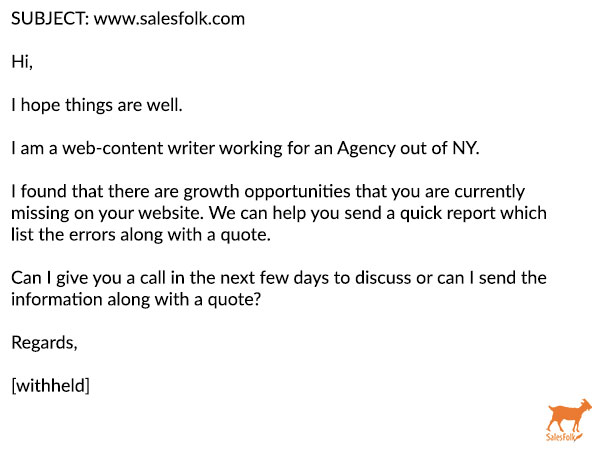
Crimes: vague, empty words, lack of information

Hall of Shame March 2

Vague emails aren’t sketchy by definition, but in the case of this one, the lack of information definitely makes one raise an eyebrow: “an Agency,” “growth opportunities,” “errors.” Maybe I wouldn’t have questioned the legitimacy if I hadn’t Googled this company’s URL and gotten a Page Not Found with that little frowning face, not to mention an address that doesn’t actually have a building, according to Maps.

And even if it is a legitimate email, it’s too vague to be enticing in any possible way. Moving on . . .

Mr Sketch

3. The Aloof Recruiter

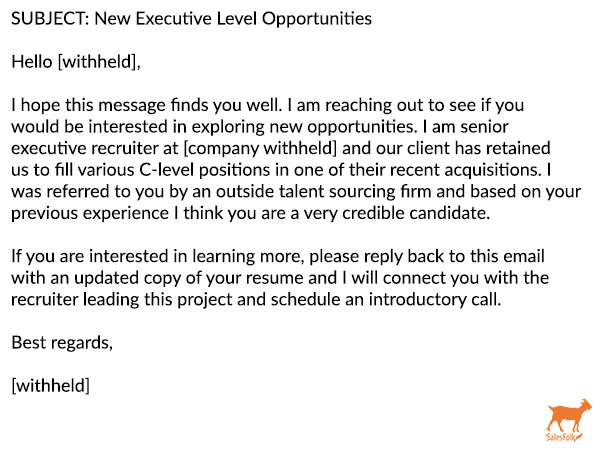
Crimes: detached tone, lack of details

HoS 3

I know it’s normal that recruiters don’t always include the company name in their initial emails, but this message seems to be actively trying to not include any useful details. What size company is it? Where is the job located? What do you actually know about my previous experience that’s led you to reach out?

When a sender withholds as many details as they’ve done here, it’s practically impossible to get excited about the message. After all, it’s hard to imagine yourself fitting in at a company that needs “various C-level positions.” My guess is that this is a mass, un-researched list sent by someone looking to fill a quota. Unfortunately, that tactic rarely gets responses.

Hos 4

4. The Performer

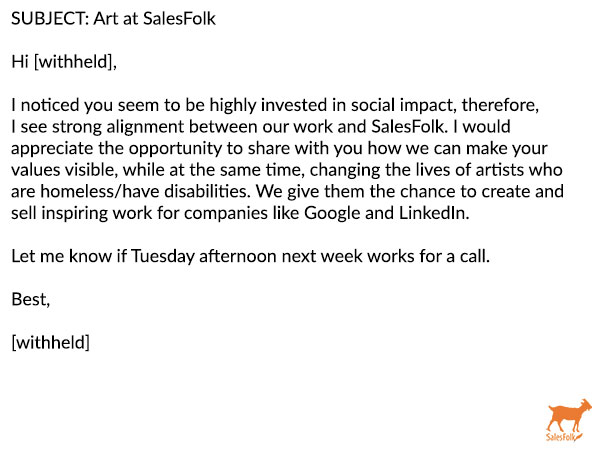
Crimes: putting on an act, obscuring the message

Hall of Shame 4

Most of us at SalesFolk are, in fact, invested in social issues, but we tend to keep those pretty separate from our work lives and avoid talking about our views anywhere on the company website. That unfortunately renders the opening line of this email a completely false pleasantry. A better tactic would have been to turn that assumption into a question: “Has SalesFolk ever considered investing in a worthy cause?”

The false tone continues throughout the rest of the email with phrases like “make your values visible” and “changing the lives of artists.” No one talks that way in a real conversation. This email is pure performance.

Hos 5

5. The Slacker

Crimes: that subject line . . .

HoS 5

Yes, that subject line is real. And yes, it was probably a mistake, which is yet another lesson in why proofreading is so important for cold email.

The Slacker shows up in some form almost every time we do this roundup. This time, it’s another case of marketing emails parading as sales messages. In other words, we didn’t opt into this email. More importantly, this highly un-targeted email tells me nothing about this event—what I’ll learn, why the topic is important. It’s just a list of speaker names, which the sender already included in the world’s longest subject line ever.

Never assume a recipient has seen previous emails sent. There are dozens of reasons why they may not have, so it’s best to make every email in a campaign tell it’s own complete story with all the necessary details.

Slacker

The post Avoid Sending Email Disasters Like These 5 Poorly Targeted Sales Messages appeared first on Salesfolk.

22 Mar 16:10

The Best Growth Hack That Works For Every Company? Experimentation

by Gilles De Clerck

“We should have a higher overall cancel rate.”
– Reed Hastings, Co-Founder & CEO Netflix

June 2017. While his company is enjoying unparalleled subscriber success, Netflix CEO Reed Hastings is worried that his widely loved streaming service is having too many hit shows. “It’s a sign we’re not trying enough crazy things. We should take more risks.”

Was Hastings trying to hedge his company’s position towards investors in the sight of more cancellations? That’s a way of looking at it. The other way is that he’s willing to sacrifice a fraction of today’s profits to ensure Netflix’s growth tomorrow.

Or should we call it survival? After all, Netflix’ rise coincided with the fall of Blockbuster as the latter neglected the future to make more money in the present. “Why would we care about you mailing DVDs if we’re making billions of dollars a year with our physical stores,” is what I imagine Blockbuster CEO John Antioco replied to Hastings when he proposed to join forces in 2000. Blockbuster declared for bankruptcy in 2010.

Hastings could’ve also gotten his inspiration from Netflix’ current rival, Amazon and its charismatic founder Jeff Bezos. Bezos, soon-to-be wealthiest man in the world, doesn’t make a secret of what his secret sauce is. “Our success at Amazon is a function of how many experiments we do per year, per month, per week, per day.”

Bezos likes to compare business to baseball. If you swing for the fences, you’re going to strike out a lot, but you’ll also hit a couple of home runs. The difference between business and baseball however, is that in baseball the outcome is at most four runs – no matter how well you hit the ball. In business, you can get up to 1,000 runs and more.

Image Credit: Nassim Nicholas Taleb

So even if you miss nine times out of ten, the massive potential return justifies being bold. If you want to win, you need to experiment. No need to look further than Amazon Web Services (AWS) to understand that Bezos is right on the money. Starting off as an experiment totally unrelated to Amazon’s core e-commerce business, AWS became the fastest growing B2B company in history and has given Amazon the kind of digital infrastructure no other e-commerce business can ever catch up with. The same can be said about Amazon Prime, Echo and Kindle – all multi-billion dollar experiments that paid off.

Are you learning as fast as the world is changing?

Startups often pride themselves on out-hustling their competition. I too wake up every morning with the mindset that nothing is off-limits if you put in the work, but just putting your muscles to work isn’t going to cut it. More than ever, the one question leadership should be able to answer is: how do we learn as fast as the world is changing? Rather than ‘what’ you think, the crucial skill today is ‘how’ you think.

Netflix doesn’t care as much as having hit shows today as it does about having hit shows tomorrow and the day after tomorrow. They want to able to out-think the competition, to develop a privileged point of view of what the future will look like and get there before anyone else does.

Their vehicle to get there? Experimentation. The same vehicle Amazon, Facebook, Google, Uber and many others are riding. There’s a reason experiment-fuelled companies have been emerging as the best of the class in short span of time: they’ve developed better mechanisms to grasp reality and internalize the learnings into their strategies. The closer to reality you stand, the better decisions you make.

Experimentation used to be considered something a company could do on the side, while the other 99% could focus on the ‘core business’. Today it’s a prerequisite to play the game and the players compete on the quality, volume and pace of experimentation.

Experiment-driven marketing

Growth hacking is nothing but figuring out the fastest ways for growth through rapid experimentation across marketing channels.

Netflix making crazy shows to see how their subscribers react to it and gauge their changing consumer preferences is no different from me throwing up a landing page for a crazy new product feature. As a growth marketer, I too am looking to learn more about reality by throwing something at it and see how it reacts. Is the marketing message I’m sending viable, does it resonate with target audience and does it have ROI potential for the business?

Once I know, I can use that learning – whatever it might be – to revisit my ideas or generate new ones to then design new experiments to test those ideas. Slowly but surely I’ll iterate my way to the formula that determines growth for my business.

“What’s the number one growth hack for my company?”

The most frequently asked question prospects ask me in sales meetings is also the one I love most.

As soon as it pops, a trace of a smile plays across my lips.

It’s the perfect opportunity for me take control of the conversation and enlighten the prospect on what makes our agency different from others.

“Science.”

They look at me with big eyes.

They expected a magic formula, a silver bullet, a stroke of genius.

I give them a methodology, a process.

And explain why they’ve been reading too many ‘how to increase your traffic with 350% in two weeks’ – blog posts.

“I am the wisest man alive. For I know one thing and that is that I know nothing.”

This quote is by the famous Greek philosopher Socrates and I live it religiously as a growth marketer.

When I get into a sales meeting with a prospect, I know nothing.

I don’t know their product, I don’t know their audience and I don’t know their business model.

That may sound like a disadvantage, but it isn’t.

It means I’m 100% free of assumptions: things I think I know but don’t actually have proof for. Every such an assumption is essentially a risk to your business because you don’t know if it aligns with reality or not. And boy do entrepreneurs have a knack for thinking they have their companies figured out. Their business models are swamped with risks disguised as assumptions. The worst kind of risks: risks of which you don’t know that they’re risks.

As an outsider, I am in a better position to assess the assumptions that lay at the grounds of the business and turn them into experiments to find out whether they’re true or not. If an experiment proves an assumption to be truthful, I now have data to back it up and have stripped the business model of a risk. If an assumption proves to be wrong, I’ll have learned something new – putting me in the position to turn a risk into an asset.

Whichever one of the two it is – right or wrong – strategic decisions for growth today can be made from evidence and not gut feeling. Marketing used to be about big bombastic campaigns that would take months and millions of dollars to set up without a valid way to track actual ROI. Those days are over. With the tools and tracking possibilities we have at our disposal today, there’s no more excuse to make decisions purely based on gut feeling. Let alone complain about the outcomes after. You can know the exact return of each marketing dollar you spend.

A quest for truth

Marketing is about understanding and influencing customers behaviours. We aim to make people react to stimuli in predictable ways. For every action, there is a reaction and we want to be able to anticipate those reactions as much as possible.

That makes marketing a never-ending quest for truth. Never-ending because the idea of truth itself is an illusion. As human beings, there’s only so much we can grasp from reality. It is too vast and complex for our brains to fully make sense of, and changes at unprecedented speeds. Experiments are our gateway to reality. One experiment will tell you which subject line gets more opens, which image converts better and which copy gets clicked more. A series of experiments will gradually make you understand what your customers need, what moves them, where they hang out, how they like to be talked about. And how all of that can come together in a brand and marketing strategy.

The pitch I make to prospects pretty much comes down to this. When it doesn’t do the trick, I give them the link to Ladder.io’s Playbook with 849 growth tactics and propose they guess which ones might work for them instead of actively finding out what will work.

What we call a ‘growth hack’ is the result of a thorough understanding of your target audience and its relation to your business. You find one by slowly making sense of the complex reality that is a business.

Dropbox’s growth hack wasn’t the referral program

From September 2008 to January 2010, Dropbox grew from 100,000 to 4,000,000 users.

I’m guessing you heard this story over and over again. What I’m not sure about is whether they’ve told it to you the right way.

Sean Ellis drove virality by inventing the modern referral program: users who got their friends to sign up for Dropbox received 500MB of extra storage, an enormity at the time.

Businesses from industries all over the world were quick to ‘steal’ the referral program, only to find out it wasn’t performing for them as it was for Dropbox.

They copied the wrong strategy.

Dropbox’s success isn’t built on the referral program, it’s built on the process that gave rise to their referral program: experimentation.

Before doubling-down on the referral program, Dropbox conducted small experiments to find out how far users were willing to go for free storage space.

Experiments like these taught Dropbox users were willing to perform certain actions to gain extra storage. They went from connecting social media accounts to inviting friends and eventually mass-inviting friends through a clever integration with Gmail.

They didn’t discover the referral program as a growth hack overnight. It was the logical consequence of an ongoing loop of small-scale experiments. Experiments that gradually revealed the referral program as a major growth lever for Dropbox. First they discovered they were getting a lot of referral signups for enthusiastic early adopter users by looking at the data, then they ran experiments to find out whether people would perform certain actions to get free storage – the logical consequence was the referral program

The simple reason this referral program doesn’t work for you the same way it works for Dropbox is that your customers aren’t the same as Dropbox’s.

It sounds obvious and yet every day again people ask me if I can give them plug-and-play growth hacks for their businesses.

This obsession with tactics over process is the number one thing people get wrong about growth hacking. Your growth hack isn’t someone else’s.

To quote growth hacking godfather Sean Ellis:

“Sustainable growth comes from understanding best customers and figuring out how to find and acquire more of them.”
– Sean Ellis, Growth Hacking Godfather

Similarly to how Dropbox learned its users would be willing to refer friends to get more storage, Twitter found out all of its active users followed at least thirty people and Airbnb found out its target audience was looking for vacation rentals on Craigslist.

Both then turned those learnings into effective tactics. Twitter started showing users interesting people to follow in the signup process to boost activation. Airbnb built an integration to cross-post listings on Craigslist to drive awareness.

The rest, as they say, is history.

These examples come to show that growth comes from relentlessly pursuing the truth about your customers through an iterative process of experimentation: test, measure results, internalize learnings, rinse and repeat.

Embrace failure as a tool to make better decisions

I can’t tell you how many entrepreneurs I meet that hold the flag of creativity and innovation up high, yet fail to act on it because of fear of mistake and disappointment. They’re afraid to be wrong. Which in turn is why they lack both innovation and creativity and get outmanoeuvred by competitors who are willing to experiment and fail.

Rather than being afraid of being wrong, you should strive to be less wrong. Experiments and failure are inherently connected with one another. No matter how well-designed, 9 out of 10 experiments will fail, for the simple reason that as human beings we’re way worse at understanding reality than we think we are. Which is exactly why we need failure: it teaches us reality.

“I haven’t failed. I’ve just found 10,000 ways that won’t work.”
– Thomas Edison

Failure as a teacher is a liberating idea, because it implies you can’t lose. Losing would be not knowing, staying stuck in the dark guessing why your traffic isn’t converting.

What most companies don’t get is that failure is a feature of learning, not a bug. If you’re not prepared to fail, you’re not prepared to learn. In fact, most breakthrough ideas are hidden within ‘failed’ experiments.

There is no such thing as failed experiments – only unexpected outcomes.

If the demographic you expected to click isn’t clicking that means you need to adjust your message. Or adjust your focus to target the demographic that is clicking, often with substantial implications for your initial value proposition altogether.

Consider the case of ‘Circle Of Friends’, a sort of Facebook Groups before there were Facebook Groups: people could organise themselves in self-managing communities. KPIs for activation and retention weren’t met, except with one target audience: moms. Moms were using it intensively to connect with one another and share best practices on parenting. The then startup realigned its value proposition, rebranded to ‘Circle Of Moms’ and was acquired by PopSugar four years later.

Reality is too complex for us humans to predict. Experiments are what enables us to test our ideas in reality. Failure is reality’s way of getting back to us and show us what’s real and what’s not. Whatever happens, there’s always a learning you can take with you.

The Minimum Viable Experiment

If you’re going to double the number of experiments you do per year, you’re going to double your inventiveness.
– Jeff Bezos

The best part about this Jeff Bezos quote is that it’s actually inaccurate.

If you double the number of experiments you do per year, you’re going to more than double your inventiveness.

Think about it. Every experiment widen and deepens you knowledge. New knowledge allows for better experiments, better experiments allow for richer insights and richer insights again allow for better experiments. Rather than double, your inventiveness will grow exponentially. This is the idea of the compound effect.

Speed of execution is key here. The goal of experimentation is to learn and stack up knowledge quickly, not to be perfect and look pretty. If you have a new idea to acquire customers, you should test it in the real world as quickly as possible before designing a whole strategy around it.

This also has to do with resources: why spend huge amounts of time and money on Instagram ads or a new product feature if you have no clue if it will appeal to your target audience? As soon as an idea hits you, you find a way to put it out in the real world as a fast as possible and see what happens. You test with a small target audience to avoid a big budget gamble.

It doesn’t have to be good, it has to be good enough to validate or dismiss your assumption underlying the idea: a Minimum Viable Experiment.

I can hear you thinking already: “yeah yeah, build an MVP before going all-in.” But do you stick to that idea through thick and thin?

My experience is that aggressive growth KPIs often drive teams to forget about the minimum part of their MVE. Apart from the learning, they also strive to drive KPIs and, without realising it, end up with blown-up failed experiments, expensive in terms of budget and time.

Take the example of a startup that believed introducing a subscription model would be huge growth opportunity. Instead of testing that assumption in an MVE, they went on to change their payment system and onboarded existing users in the subscription model. To then, after about two months come to the conclusion a subscription model didn’t appeal to their target audience at all. They could have easily tested this without risk by putting up a landing page for a subscription signup, driving traffic to it and compare conversion on it against the current pricing model.

Fake it if you have to. One hour, a computer and an internet connection are sufficient to put together a mockup of two, a landing page and a Facebook Ad to drive traffic and see how your idea, be it marketing or product, stands the test of reality. If you can’t think of a way to fake a product experience in order to get your hands to validating data, you’re not trying hard enough.

Growth Hacking, demystified

To its core, growth hacking is an amazingly simple concept.

First, you pick a metric that you would like to see go up or down. This can be number of signups, number of returning users, CTR on Facebook Ads, email opens or the number of coffees you drink per day.

Then, you look for other factors you believe influence that particular metric. You may believe signups go up if you remove a step from the signup process, think gamification will spike retention, assume emojis in copy will make people click more, be convinced emails sent in the morning will get opened more and trust you’ll drink less coffee if you sleep one hour a night more. Ideally, you base this influencing relationship on data – data you already have or data you have seen elsewhere. Something that tells you there is a correlation between the two factors. If you don’t have any data, because your idea is particularly new and/or you’re just starting out, you go by gut feeling. You may have found research that sleeping more reduces coffee consumption or you just believe it to be true.

Once you’ve identified the two factors that are correlated – the one you want to change and the one you think will change along with it – you’re going to figure out a way – an experiment – to test if that correlational relationship is also a causal one: does the one factor’s change determines the other factor’s change? Translated: if I send my emails in the morning and the open rate goes up, is it because I sent them in the morning? To know this for sure, you can for example send the exact same email with the exact same subject line to half of your email list in the morning and the other one in the evening. That way you exclude the possibility of other factors being the causal drivers of the metric change.

When you’ve found causality between two factors, backed up by nice and unambiguous data with every other possibility excluded – you can optimize the causal factor to drive the metric you picked in the very begin up to the point where you want it to be.

Your Most Powerful Growth Hack: The Scientific Process

Time to get our hands dirty and practice some science.

You don’t need to be Einstein to do this. Science is about pursuing curiosity, embracing ignorance and relentlessly bridging the gap between the two.

The scientific process will remove the guesswork from your marketing and turn your company’s growth into something scalable, predictable and repeatable.

It goes something like this:

  1. Set goals
  2. Ideate on how to reach goals
  3. Design experiments to test ideas
  4. Execute experiments to see how reality reacts
  5. Study data & document relentlessly
  6. Rinse and repeat

Step 1: Set Goals

Always start with the end in mind.

Are you looking to drive more traffic to your website, reactivate idle users or increase revenue from upselling?

Simply ‘drive more traffic’ isn’t going to cut it. To design effective experiments, you want to break down your objective in more manageable parts following the SMART criteria: Specific, Measurable, Assignable, Realistic and Time-related.

Let’s assume you run an e-commerce business with 14,000 monthly unique website visitors and an average spend of $7.3, resulting in $1,226,400 annual revenue. To get to $2,000,000 by the end of next year, you’ll need to either grow your website traffic to 22,832 monthly unique visitors or increase average spend per visitor to $11.7.

Your goal could look like this:

We want to increase website traffic to 23,000 monthly unique visitors within 90 days — weekly growth rate of 13%.

Here’s how that aligns with the S.M.A.R.T. dimensions.

  • Specific: increase website to 23,000 monthly unique website visitors
  • Measurable: 13% per week
  • Assignable: the marketing team
  • Realistic: Up to you to decide what is ‘realistic’.
  • Time-related: Good goals are set between 30 and 90 days.

Base your objectives on the pirate funnel to align your experiments to stages in the customer journey.

Driving website traffic is just one example of how you could trigger growth. Every stage of the pirate funnel offers opportunities in this respect. Be smart about which stage of the funnel you’re going to grow first: it doesn’t make a lot of sense to double traffic to your webshop if 95% of your visitors leave without spending.

Step 2: Ideate on how to reach goals

After the ‘what’ comes the ‘how’.

This is where you come up with ideas to reach your objectives. In this case: to increase traffic with 13% in a week.

Try to find to find a balance between ideas you base off data from past experiments and totally new experiments. That way you’ll be able to improve existing tactics as well as maximise your odds to discover new ones.

Let’s say past experiments have proven Instagram ads to be an effective traffic driver. You can try to improve those past experiments in terms of media, copy or targeting to gain a bigger increase in traffic.

Another idea is to start following influencers on Pinterest because you’ve seen competitors doing it and want to find out if it would work for you too.

More ideas:

  • team up with other e-commerce businesses for a big giveaway and share email lists and Facebook Audiences to cross-promote it
  • create a chatbot that helps people choosing the best gifts for their mother, father, sibling, friend etc. — write a blog post about it, share on social/in relevant communities and post on Product Hunt
  • start shipping stickers with orders to increase offline exposure

Come up with as many ideas as possible, then select the ones you want to focus on in the upcoming weeks and put the rest in your backlog to revisit later.

Step 3: Design experiments to test ideas

Turn ideas into experiments by identifying:

  • the hypothesis to validate
  • the variable to test
  • the metric to measure
  • the criteria to base success off

For the Pinterest-idea, that would look something like this:

As soon as I’ve confirmed that following influencers on Pinterest works, I can run further tests to determine the characteristics of the influencers most likely to follow me back and pin my products. The more experiments I run, the more I’ll get to know Pinterest as a social platform and the more I’ll be able to eventually turn it into a traffic machine.

Stay true to the idea of the Minimum Viable Experiment.

  • Don’t waste time on perfecting copy or design. Implement whatever is need to validate/dismiss your hypothesis.
  • Don’t burn your monthly budget on one ad campaign. Start with a fraction and scale up as it gains traction.
  • Don’t make ten changes at once: test one element at a time to learn its relative weight in relation to the other elements.
  • Don’t argue about which ad looks the best: A/B test all of them in the market and the best one will automatically emerge.

Step 4: Execute experiments to see how reality reacts

Time to unleash your experiments into the world.

Work hard, but smart. Use tools to facilitate and automate non-creative work.

You can draw inspiration from Google’s design sprints to schedule experiments, manage time and assign tasks.

Step 5: Study data & document relentlessly

The most important stage of the process is also the most overlooked one.

About every marketing agency these days claims to be ‘data-driven’ but few of them really are.

The whole point of the scientific process is to discover new knowledge and internalize it to gain power over your reality. There’s no sense in running experiments if that new knowledge is then ignored, overlooked and not captured.

Take the time to look at the results of experiments and try to understand the surrounding ‘why’ by combining quantitative with qualitative data.

Here are some guiding questions:

  • What were the results of the experiment?
  • How valid was the initial hypothesis?
  • Why are the results what they are? Try to understand the whole story, not just the occurrence.
  • Are there ways to segment or combine data to reveal new insights?

Remember: breakthrough insights are hidden within ‘failed’ experiments.

Document your experiments relentlessly. As experiments are all about learning and the most powerful learnings are often hidden within the failed ones, it is crucial that you keep track of what you have been doing and internalize learnings to avoid spending time on finding out things you already know.

Step 6: Rinse and repeat

Congratulations, you’re smarter now. Now use that to become even smarter.

Align goals, scale successful experiments, adjust failed experiments, come up with new ideas, design better experiments and harvest new learnings.

To then do it all over again.

There’s always more things to test, more experiments to run, more knowledge to gain. You can never win the game but the more you play, the better you’ll get.

Looking to fuel your experiment machine?

On June 7th of this year, my agency The Growth Revolution will be setting new standards for conferences on growth in Europe with The Growth Conference in Antwerp, Belgium.

22 Mar 15:58

65 Best Sales Questions to Determine Your Customer's Needs

by TA@alessandra.com (Tony Alessandra)

Thoughtful, well-structured, strategic sales questions and needs analysis questions are central to any sales professional's ability to provide value to prospects.

We‘re in the age of the empowered buyer, and potential customers are as complex as they’ve ever been. They're busy, well-informed, and often reluctant to share information — with a diverse array of wants, needs, interests, and buying preferences.

Whether you're new to sales and looking for a go-to list of sales qualification questions or a manager looking to test new questions with your team, this list of great sales questions to ask customers will help you identify your prospects' core needs.

Free Download: 101 Sales Qualification Questions [Access Now]

Table of Contents

Sales Questions to Ask Customers

Here are some of the most critical questions salespeople should ask their prospects.

  1. “Do we need to include any other decision-makers in our conversation?”
  2. “If timeline or budget were not constraints, what would your ideal solution look like?”
  3. “Why is this a priority for you now?”
  4. “What challenges do you think will come up as you try to purchase the product?”
  5. “Are you currently using another solution? If so, why are you switching?”
  6. “Has your team tried to use a similar product? If so, how did it go?”
  7. “How can I make this process as easy as possible?”
  8. “What’s your approximate budget for this project?”
  9. “What other tools do you use in your day-to-day?”
  10. “What challenges have you experienced in the past year related to [product-related goal]?”

Asking the right questions is crucial when speaking with a prospect for the first or second time. As a salesperson, your job is to discover their core needs quickly and succinctly. The questions above will uncover needs — while also helping you figure out whether this customer is the right fit for your product.

After you get your customer’s answers, you can customize your sales presentations and pitches to their specific circumstances.

Next, we‘re going to cover some key strategic questions from real sales leaders. Let’s take a look.

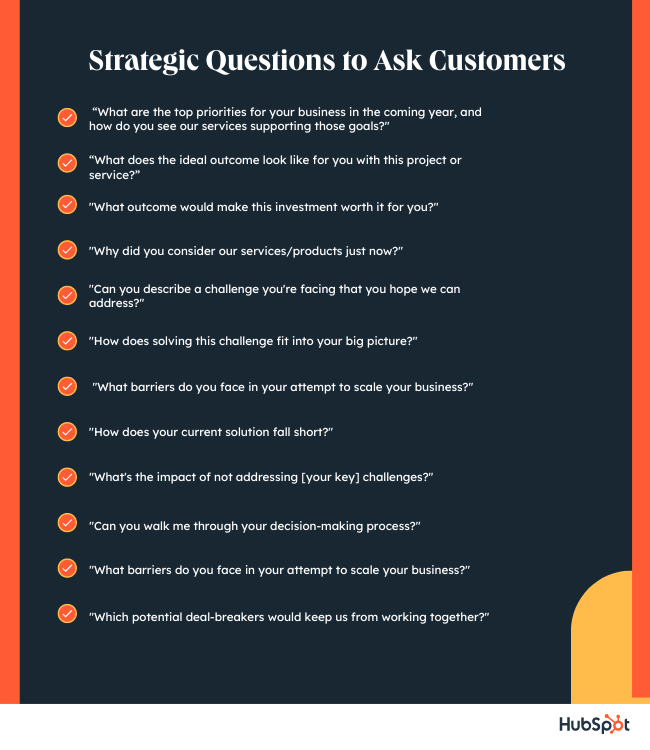
Strategic Questions to Ask Customers

1. “What are the top priorities for your business in the coming year, and how do you see our services supporting those goals?"

According to Magee Clegg, CEO of Cleartail Marketing, “This question does two things incredibly well — it helps prospects articulate their short-term goals, giving you insights into their immediate needs, and it positions your services as a solution within the context of their strategic planning. It’s a question that naturally leads to a deeper dialogue about how your offerings align with their objectives.”

2. “What does the ideal outcome look like for you with this project or service?”

This question is essentially a bit more of a focused play on the sixth question on this list. Clegg says that this question "allows the prospect to envision the future success that your service can bring them. It turns the conversation into a more positive, forward-thinking one, where the prospect isn‘t just focused on what’s wrong now but on the potential for improvement and growth.

“This question has helped me transform sales conversations at Cleartail Marketing into collaborative strategy sessions, where the prospect sees us as a partner in achieving their vision, rather than just another vendor.”

3. “What outcome would make this investment worth it for you?”

This question is another way to phrase the previous one with a bit more of a product-specific, value-oriented edge. Bayu Prihandito, Founder of Life Architekture, suggests you ask it because it helps with “Understanding your prospect's definition of success helps align your offer with their expectations. It clarifies their goals and sets the stage for how your product or service can meet them.”

4. “Why did you consider our services/products just now?”

Prihandito recommends asking this question because it can help you “find out the 'why' behind their interest, understanding the urgency and any immediate motivations for them to look for solutions.”

5. “Can you describe a challenge you're facing that you hope we can address?”

Prihandito says salespeople should ask this question because “[being] able to directly pinpoint specific problems allows you to understand where your offering will fit best into their current situation.”

6. “How does solving this challenge fit into your big picture?”

Prihandito suggests asking this question because “linking your prospect's immediate need to bigger goals gives you an understanding of their values and long-term plans. Then, you can align your solution within a larger context, which will increase its perceived value.”

7. “What barriers do you face in your attempt to scale your business?”

According to Baidhurya Mani, Founder of SellCoursesOnline, “Scaling the business is often the number-one reason business leaders integrate technology into their operations. When you can pinpoint what their barriers to scaling are, then you can also determine what solutions to offer them in this scenario. Whatever challenge is preventing them from growing their business, that is your prospect's premium priority at the moment, and that is the number-one need they need you to meet.”

8. “How does your current solution fall short?”

Casey Jones, Founder of CJ&CO, says asking this question can help you identify key gaps in your prospect‘s operations. According to him, this question helps you "[dig] for dissatisfaction — this is where you’ll find the gap your product or service can fill."

9. “What's the impact of not addressing [your key] challenges?”

Jones also suggests asking this question because it allows you to “[emphasize] urgency. It makes the cost of inaction real, often a powerful motivator to move forward.”

10. “Can you walk me through your decision-making process?”

Jones says that this question “unpicks the power structure, timelines. We understand the 'how'—crucial to tailor the pitch.”

11. “What barriers do you face in your attempt to scale your business?”

According to Baidhurya Mani, Founder of SellCoursesOnline, “Scaling the business is often the number-one reason business leaders integrate technology into their operations. When you can pinpoint what their barriers to scaling are, then you can also determine what solutions to offer them in this scenario. Whatever challenge is preventing them from growing their business, that is your prospect's premium priority at the moment, and that is the number-one need they need you to meet.”

12. “Which potential deal-breakers would keep us from working together?”

Johannes Larsson, Founder and CEO of JohannesLarsson.com, “This will allow your prospect to voice any concerns or reservations they might have about the product or service. By addressing these upfront, you can demonstrate your commitment to understanding and resolving issues, which builds trust and rapport with the prospect. This question will also help you gather valuable insights into the prospect's priorities and non-negotiables so you can tailor your approach accordingly.”

Needs Analysis Questions About Goals

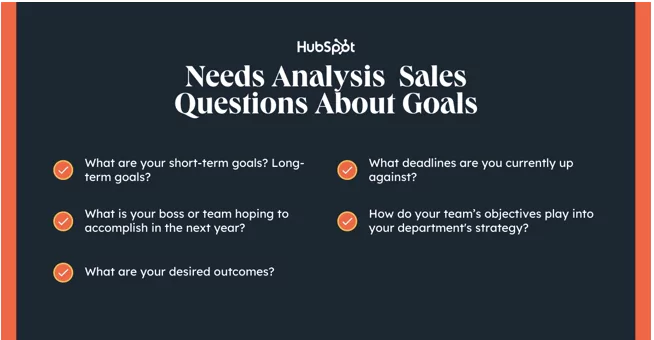
13. “What are your short-term goals? Long-term goals?”

According to Uka Tomikis, CEO of Messente, asking this question is important because “[understanding] a prospect's goals enables you to align your solution with their objectives and demonstrate how you can contribute to their success. This indicates your interest in their business success rather than just completing a transaction.”

14. “What's been preventing you from reaching these goals?”

Tomikis says that asking this question is crucial because “[identifying] hurdles allows you to directly address how your product or service will overcome these limitations. It also helps to prioritize which demands are most urgent.”

15. “How are you currently addressing these challenges?”

Tomikas recommends asking this question because “knowing a prospect's current solutions lets you differentiate yours by emphasizing new features or benefits that fill gaps in their current strategy.”

16. “What does the ideal solution look like to you?”

Tomikas asserts that asking this question “lets you grasp the prospect's expectations and tailor your pitch accordingly. It highlights their top features or outcomes, allowing you to focus on the most important components of your service.”

17. “What criteria will you use to evaluate solutions?”

Tomikas recommends asking this question because “[understanding] your prospect's evaluation criteria provides insight into what is most important to them, whether it be cost, ease of use, scalability, or support. It enables you to adapt your proposal to fit these criteria.”

18. “Have you ever solved this problem before? What worked and what did not?”

Tomikas recommends you ask this question because “[learning] from previous attempts allows you to understand what not to propose and what might be a better strategy, preventing recurrent failures and building trust by respecting their experience.”

19. “What is your boss or team hoping to accomplish in the next year?”

This is another question that covers a prospect‘s goals — but this one adds an element of specificity that the previous ones don’t, enabling you to really hone in on what the business is hoping to achieve.

Pro-Tip: Be sure to stress that you want to know company leadership‘s or the broader org’s goals here. This question is meant to get prospects thinking beyond themselves. You can ask how your solution will improve their day-to-day later — here, you want them to place your offering in a “bigger picture” context.

20. “What deadlines are you currently up against?”

Add more urgency to the conversation by explicitly asking your customer if they’re up against any deadlines. Once you find out if they have a set date where they must achieve or do something, you can highlight your solution as a tool for getting there more quickly.

Pro-Tip: This question is good for disqualifying prospects. If your prospect is working on a timeline you can't realistically accommodate, you can end the engagement and spare yourself crucial time and resources.

21. "How do your team’s objectives play into your department's strategy?”

This question might seem extraneous, given that we’ve already covered two questions about objectives and goals — but knowing the role of their team in the department’s larger strategy can hint at the needs of the entire department.

For instance, if you’re selling an SEO software solution, you might want to listen for the team’s role in increasing traffic, meaning that the business is intending to grow its organic acquisition. If your software also offers acquisition tools, you can pitch those as well.

Needs Analysis Questions About Weaknesses

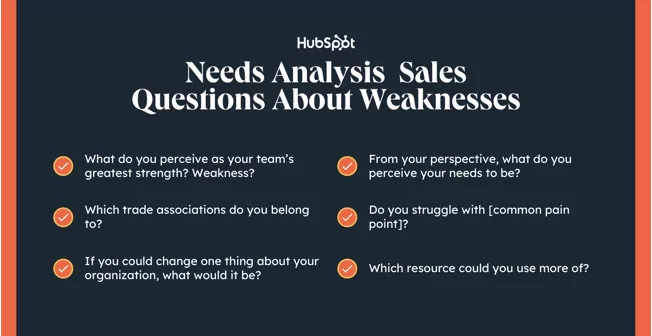
22. “What do you perceive as your team’s greatest strength? Weakness?”

You need to have a sense of both aspects of this question. You want to have a frame of reference that enables you to position your solution as a resource for enhancing your prospect‘s company’s strengths and accommodating its weaknesses.

Pro-Tip: Ask about your prospect‘s greatest strengths first — you don’t want to set too negative a tone with this line of questioning.

23. “Which trade associations do you belong to?”

This question will come in handy if you’re selling marketing software, sales software, or PR services. By asking which trade associations they’ve already joined, you can begin to figure out what your customer is doing to network and get their word out about their business.

Pro-Tip: Understand that not belonging to a trade association could be a potential weakness — as it can impede a company's ability to find more customers using your software.

24. “If you could change one thing about your organization, what would it be?”

This is a great question to keep the conversation flowing while learning more about the challenges and pitfalls of the organization at large. Even if the answer is unrelated to the product, you can begin to understand some of the organizational challenges and pitfalls your customer deals with.

Pro-Tip: Give your prospect room to elaborate here — this is one of the more potentially constructive, revealing questions you can ask. Don't interject with your suggestions about what you think they should change.

25. “From your perspective, what do you perceive your needs to be? How important are they?"

A better alternative to “What are your needs?”, this question will specifically ask for your customer’s perception of their needs, not necessarily their actual needs. After asking a series of needs analysis questions, you’ll likely have a better understanding of your customer’s needs than they do. But it’s important to understand what they perceive their needs to be.

26. “Do you struggle with [common pain point]?”

This is a classic question to uncover your customer’s challenges. It works because it puts a name to the pain point. Your customer might not even know what their pain point is until you mention it outright. Sometimes, they might be used to dealing with the challenge and not even bring it up. By posing this question, you force them to reckon with it.

Pro-Tip: This is a good opportunity to raise pain points that your solution is uniquely positioned to address, but you need to understand your vertical as thoroughly as possible to touch on reasonable, relevant ones. “Common pain points” vary by factors like scale and industry — so don't just throw random examples out for the sake of throwing them out.

27. “Which resource could you use more of?”

Ask this question to not only understand what resources you could offer right then and there — but to see the types of resources your team could create to convert more prospects. You can send this information straight to your marketing department so you can begin to nurture leads with this new resource.

Pro-Tip: Your customer might also respond in general terms: They might need a bigger budget or a bigger team. Use this information to further qualify them or figure out if you could create a better package for them.

Needs Analysis Questions About Buying Processes

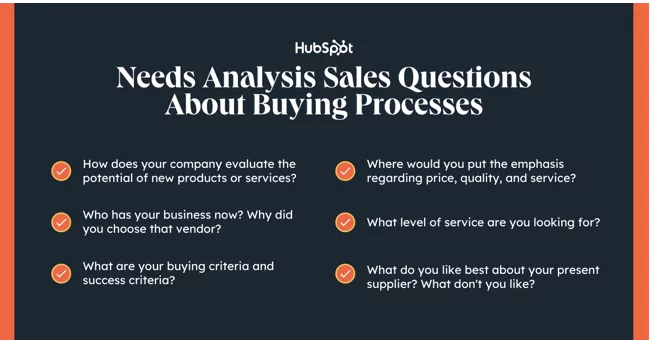
28. “How does your company evaluate the potential of new products or services?”

If you want to sell the product, you need to know how your customer evaluates a product prior to purchasing it. The main benefit of this question is that it’s broad enough that the customer can talk about anything — they’re not being forced to give a certain answer.

29. “Who has your business now? Why did you choose that vendor?”

Your customer might be using another solution — an extremely important piece of information to know. If you find out why, you can also figure out what has won their business in the past and use that to your advantage (or even point out ways that you’re better than your competitor). A good question to follow up with would be, “Why are you switching?”

30. “What are your buying criteria and success criteria?”

This question prompts your customer to describe, in general terms, the key factors for choosing a product. But don’t forget the second part about success criteria. For them, is a success criterion met when they gain more customers? Streamline operations?

31. “Where would you put the emphasis regarding price, quality, and service?”

Use this question to choose whether to upsell your customer or create a discounted package. It can also help you further qualify them if you sell an enterprise product that has a high contract value or if your service team is still growing and developing.

32. “What level of service are you looking for?”

Will they need extensive onboarding? Or do they want a solution that they can simply plug in and start using straight away? Knowing the level of service and attention they expect will help you gauge their needs once onboarding has started.

33. “What do you like best about your present supplier? What don't you like?”

This question should only be asked after you’ve found out that they’re currently using another solution. By finding out what they like and don’t like, you can begin to understand where your product makes up for their current solution’s pitfalls.

34. “What do you look for in the companies you do business with?”

It’s important to understand what your customer is looking for in more general terms. Is it a long-standing relationship? Or speedy service interactions? Or a dedicated contact whom they can reach out to?

35. “What might cause you to change suppliers?”

Customer churn is a real and unpleasant reality for B2B businesses. You want to find out, from the get-go, what could cause your customer to churn. If they don’t have an answer, try asking, “What caused you to leave a supplier in the past?”

Pro-Tip: Try to go for an anecdotal response — social proof is a major asset when you ask a question like this.

36. “What do you like best about your current system? What would you like to see changed?”

This question speaks not to the company they’re doing business with, but to the product that that company sells. It’s a valuable question because you get to find out what’s going well and what’s going wrong on a product level.

37. "How do you typically reach purchasing decisions?”

Is it by attending a team-wide meeting, and everyone votes on whether to adopt a solution or not? Does it depend on the contract value of the product? If you’re selling a cheaper product, your customer might have a much more speedy process. But if your product is pricier, they might have a different process.

38. “Would you rather cut costs, save money, or increase productivity?”

This is another way to uncover where your customer’s priorities lie. The fun part is that it offers choices in a “Would you rather” format, making it easier to ask and leading to a more conversational or casual answer.

39. “Which product features would lead to a purchasing decision?”

Some product features might not be necessary to your customers, while others might be critical. Whatever your customer mentions here, use that to highlight that exact feature in your product.

40. “If you’ve considered a similar product in the past but didn’t purchase it, why?”

Has your customer come close to making a similar purchase, but pulled back at the last second? This question will give you insight into potential objections you could face as you near a closed deal.

41. “On average, how long does it take for your team to purchase a product?”

Take advantage of this question to find out how long you could potentially be in conversation with this customer.

Questions to Ask Customers About Your Product

When you‘re checking in with current clients with the hope of either upselling, cross-selling, or renewing, it’s imperative you ask the right questions.

If you fail to ask tough questions about the good and bad of your product/service, you risk missing warning signs they're unhappy and would consider churning to a competitor.

Don't leave the door open. Close it with these questions:

  1. “On a scale of one to 10, how happy are you with our product?”
  2. “Why did you give us that score?”
  3. “Can you explain the weaknesses or challenges you've found in our product/service so far?”
  4. “What do you love about our product/service?”
  5. “How likely are you to recommend our product/service to a friend or colleague?”
  6. “How has adoption and internal use gone in your team?”
  7. “Do you feel you've received outstanding customer service?”
  8. “Are you ready to renew today?” (Only if the first seven questions have had positive answers)
  9. “What can we do to earn your business for another year?”
  10. “Would you be interested in our new add-on Feature X?”

Questions to Ask Customers to Close the Deal

As you near the end of your conversation with a customer, you want to find out, in no uncertain terms, how you can get their business. Use your customer’s background as a guidepost for how you’ll word this question.

If you get the sense your customer doesn’t like being pushed or is on the fence, try to close in a more circumventive way. Here are some options:

  1. “What will it take for us to do business?”
  2. “How soon can we begin?”
  3. “What is my best shot for winning your account?”
  4. (If they’re a returning customer) “What did we do in the last sale that impressed you most?”
  5. "What’s the best time to touch base before you present the product to stakeholders?”

Ask Better Questions to Analyze Your Customer’s Needs

Great sales questions enable you to tailor your messaging to your prospects' goals and show them your solution is the best choice. By asking the right questions, you can further qualify your prospects, close more deals, and increase recurring revenue at your company.

Editor's note: This post was originally published in May 2014 and has been updated for comprehensiveness.

sales qualification

22 Mar 15:55

Clari raises $35M for its AI-based sales platform, expands into marketing and supply chain management

by Ingrid Lunden

Clari — a startup that has built a predictive sales tool that provides just-in-time assistance for sales people close deals and for those who work in the bigger chain of command to monitor the progress of the sales operation — is capitalising on the big boom in interest for all things AI in the business world. The company is today announcing that it has closed a Series B round of $35 million, funding that it will be using to build out its own sales and marketing team and expand its platform capabilities.

The round was led by Tenaya Capital, the VC fund that started its life as a part of Lehman Brothers, along with participation from other new investors Thomvest Ventures and Blue Cloud Ventures, and previous investors Sequoia Capital, Bain Capital Ventures and Northgate Capital. It brings the total raised by Clari to $61 million.

Andy Byrne, the founder and CEO who is a repeat entrepreneur and has been involved in several exits, said the funding closed “definitely at an upround, and much bigger than we thought it was going to be,” but declined to give a number. For some context, Clari, according to Pitchbook, had a relatively modest post-money valuation of $83.5 million in its last round in 2014, so my guess is that it’s now comfortably into hundred-million territory, once you add in this latest $35 million.

The funding comes at an interesting time for AI startups, particularly those aimed at enterprise IT.

When Clari first emerged from stealth in April 2014, the idea of applying AI to solve pain points for non-technical people in organizations was a fairly nascent and still-novel concept.

Fast forward to today, things have moved very fast, as is often the case in the tech world. Now, you can’t seem to move for all the enterprise IT startups that are either using or claiming to use AI in their solutions. There are so many startup hopefuls, and so many organizations looking for the best way to use AI to improve their business and operations, that there are even startups being founded to manage that opportunity of connecting the two pieces together, such as Element AI.

“I’m not saying we were clairvoyant for targeting the idea of using AI for sales in 2013,” Byrne said. “There has been a large macro trend and if you happen to be a small company that is along for the ride. When we first launched, we had this thesis about AI for sales. Now it’s not the number three or two priority for sales teams, it’s number one. It’s everywhere. Businesses want to invest and spend more money on AI and making things more efficient.”

Clari says that its customer base has tripled in the last year, with customers including Adobe, Audi, Check Point Software, Equinix, Epicor Software Corporation, GE, and PerkinElmer.

Clari’s approach for using AI for the sales team comes in two main areas. First, the company’s system is aimed to reduce some of the busywork that salespeople have in maintaining and updating files on people, by bringing in a number of different data sources and using them to provide composite pictures of target companies that salespeople might have had to otherwise compile with more manual means. Second, Clari puts a lot of focus on its “Opportunity-to-Close (OTC) solutions” — a type of risk-analysis for salespeople and their managers to help them figure out which leads and strategic directly would be the most likely to produce sales.

“Working with Clari since inception, we have been impressed with its growth and strong execution,” said Aaref Hilaly, Partner at Sequoia Capital, in a statement. “Clari has fast become indispensable to many of the most successful sales teams, giving them visibility into their most important metrics: rep productivity, pipeline health, and forecast accuracy.”

Indeed, risk and outcome is a smart area to be in: using AI to help model this is a key area of focus in enterprise IT at the moment, according to feedback I’ve had from a number of others in the enterprise world.

“If you have 150 opportunities presented to you as a salesperson, how do you choose 10 where you should spend your time?” Byrne asked. “A more traditional CRM platform has never showcased your risk and outcomes.”

While up to now Clari has focused on providing intelligence on what is already in a company’s account database, the next step, Byrne noted, is to draw on data from around the web, providing completely new business leads to the sales team.

When we last covered a funding round for Clari, we noted that the company’s laser focus on sales was something that made the company stand out for investors: nailing one aspect of a business’s operations without distractions from other parts of the organization and what it could be spending time solving elsewhere (in fact, when you think about it, the very goal that Clari has been aiming to achieve for salespeople through its product).

But four years on, the company is now widening that ambition. It’s applying its AI engine now to help marketeers weigh up the best opportunities for reaching out to prospective customers; and interestingly it sounds like it will also be applying its engine to product development and specifically supply chain management.

Byrne described one customer, a medical device maker, that was encountering “inefficiencies” around what they should build and when to meet market demand. “Now that they can predict and forecast order bookings and revenue targets, and what’s happened is that their supply chain has become more efficient,” he said. “It is great example of how our AI is now being expanded.”

“The Clari team has leveraged its deep AI expertise to build a unique platform that surfaces predictive insights for sales reps, managers, and execs during the opportunity-to-close process,” said Brian Paul, MD at Tenaya Capital, in a statement. “We see a massive opportunity for AI to transform how sales teams operate which is clearly validated by Clari’s customers and the impressive growth the team has achieved.”

21 Mar 16:09

How B2B Salespeople Can Optimize Their LinkedIn Profile to Engage Buyers

by Alex Hisaka
your linkedin profile is more than just your online resume

In our ongoing quest for qualified leads, we search, research, size up, and scrutinize. We examine the digital clues at our disposal and then ask ourselves, is this prospect worth my time?

What we tend to overlook, is, B2B buyers do the exact same thing to us. They evaluate our credibility, experience, connectedness, approach, demeanor, and any other factor that helps them answer: Is this salesperson worth my time?

When buyers pull up your LinkedIn profile, one of two things will happen: They will gain confidence in you, or they won’t. This post contains advice on getting your LinkedIn profile to perform meaningful work, even when you’re not.

Ways to Optimize Your LinkedIn Profile to Meet Your Sales Objectives

LinkedIn profile optimization boils down to a basic concept: Present the digital version of you that will be useful and meaningful to the buyer you hope to attract.

In the IDC white paper, Social Buying Meets Social Selling: How Trusted Networks Improve the Purchase Experience, analyst Kathleen Schaub notes that 75% of B2B buyers and 84% of C-level executives use social media when making purchase decisions. They’re looking for ideas, answers, and a trusted partner to take them where they need to be. Will they find what they’re looking for in your profile?

How to Turn Your LinkedIn Profile into a Magnet for Buyers

Headline: A concise summary of who you help, and how can be much more powerful in this field than a simple job title. A well-crafted headline implies that you’ve taken time to make the rest of your profile more enjoyable, too.

Photo: Choose a photo that gives off a warm, genuine vibe. Shoot for approachable, but not too casual. We’re drawn to faces so be sure yours is in focus and in full view.

Contact Info: Check to see that all fields contain your current information. Pay close attention to spelling and number sequence to ensure inadvertent transposed numbers or misspellings don’t keep someone from getting in touch.

LinkedIn URL: A personalized URL is memorable, easily linkable, and will help distinguish you in search. Aim for your name, or a close variation with middle initial.

Connections: Your network reflects the quality of your professional relationships. Be thoughtful about making connections. The invitations you issue should convey your interest in connecting, and the value you intend to offer. Personalize each connection request by giving the recipient a compelling reason to accept. If you have trouble coming up with a compelling reason, it may be best to wait until you have one.

Summary:  Think about what information could be most influential in getting someone to read more. A brief, meaty data point or area of professional pride might entice someone to dive deeper into your profile. Concentrate on answering the question, what’s in it for my ideal buyer?

Articles & Activity: This section is a brief recap of your personal activity on LinkedIn. If you publish on the LinkedIn platform, post an update, or interact with the content of others, that activity will appear in the LinkedIn feeds of your connections. These actions can demonstrate how you conduct yourself, contribute to solving the problems of others, and how you introduce your own solution into discussions.

Rich Media Content: In-profile media gives a reader more context about your skills and experience. Be selective about what you post and check to see how the image renders to make sure you’re happy with it. Consider periodically rotating or refreshing rich media content to avoid looking stagnant.

Experience: The experience section resembles the layout of a resume. While it’s appropriate to list your title, company, and tenure, this area shouldn’t read like a list of your duties and responsibilities. Those items might interest a recruiter, but don’t hold value for buyers. Instead, emphasize the results you helped clients achieve and the methods you used to serve them. When you showcase client successes, the implication is you were instrumental to the process.

Honors and Awards: Think about how your achievements might be relevant to a prospective buyer. Personal honors are acceptable here, too. If you’re committed to a cause or organization, others may admire your other-centered spirit and deduce you’ll go the extra mile for them, too.

Publications: Does your company have a case study that highlights a satisfied client of yours? Do you maintain a blog? Showcase your critical thinking and writing skills in this section. As with all the areas of your profile, periodically check back to confirm all looks as you’d like it to. If you link to your blog, keep it current. Jill Rowley’s profile serves as an example of how to keep your profile fresh and compelling.

Education: List any degrees, as well as any coursework or certifications that demonstrate your qualifications and credentials.

Groups: Your participation in groups can be good way for a prospective buyer to learn about your offering and discover how you work with people. List the groups you’re a member of to make it easy for buyers to find you at your consultative and conversational best.

Recommendations: Third-party recommendations carry a lot of water with B2B buyers. A recommendation should come from someone who can directly speak to your characteristics and strengths. Ideally, they should also be able to mention specific benefits from their association with you, either in terms of a statistic, dollar figure, or achievement. Recommendations increase your credibility and are quick trust-builders, but you already knew that.

Your LinkedIn Profile is the Sales Tool That Works When You’re Not

As you conduct your due diligence, so will buyers. Take care to craft a LinkedIn profile that impresses the buyers you’d like to attract.

For more ways to accelerate your sales this year, download our latest eBook, Read Me If You Want to Create an Effective Sales Profile on LinkedIn.

21 Mar 16:07

Master these 7 grammar tips if you want to sound smarter

by Kelly Laffey

laptop working email

  • Poor writing can make others think you aren't intelligent.
  • I'm the executive editor of a magazine and know firsthand how grammar can change the meaning of a sentence.
  • Don't get caught up in miscommunication. Master these simple tips.

As the executive editor of Avenue Magazine, a luxury lifestyle publication based in New York City, I see the importance of proper grammar every day. But you don't have to work in publishing to realize the necessity of good writing. Misplaced commas, an incorrect spelling, or a missing hyphen can change the meaning of a sentence.

Language rules exist for clarity. A classic example is the sentence "Let's eat mom," which reads much differently from "Let's eat, mom." In the first, the writer is having her mom for dinner. In the second, she is urging her mom to eat with her.

Don't get caught up in an email chain of miscommunication. Read on for seven tips on how to improve your English expertise.

1. Read frequently

Writing well can become second nature to those who also read well. Pay attention to how authors structure their sentences and how they use commas and sentence length to adjust tone and cadence. Reading can help to increase vocabulary. If you don't know where to begin, ask colleagues for reading suggestions specific to your field, or browse best-selling book lists (here's a great list of business books). 

To write well, you must also understand the basics of the English language — how sentences are composed, the different parts of speech, subject/verb agreement, tense, and punctuation. Pick up a copy of Stephen King's "On Writing" for a fresh take on writing rules.

2. Memorize homophones

There's no way around it — many rules in the English language require memorization. Among the most frequently committed grammatical errors are misused homophones, which are words that sound the same but have different meanings.

"You're/your," "there/their/they're," "its/it's," and "then/than" are all commonly confused. An easy tool to help with contractions is to remember that they are derived from two words. "You're" is "you are"; "they're" is "they are"; and "it's" is "it is." "Then" is used to indicate time, whereas "than" is used as a comparison.

3. Learn first-person singular pronouns

Sentences often call for choosing the correct first-person singular pronoun — either "I" or "me." Remember that "I" is a subject pronoun, whereas "me" is an object pronoun. A helpful way to determine word choice is to remove any other subjects.

For example, consider the sentence "My roommate and I/me went to the store." If you think about the sentence as "I went to the store" or "Me went to the store," it's more obvious that "I" is correct."I" is the subject of the verb "to be."

4. Learn how to use commas

As a very broad rule of thumb, commas are used to indicate pauses in a sentence. They should not be used in place of a period. For example, "We went to the baseball field, it was fun" is incorrect.

But "We went to the baseball field, and it was fun" is correct, as commas can be used to separate two independent clauses when joined by coordinating conjunctions like "and," "or," or "but." Commas are also used to separate three or more phrases in a series, after an introductory clause or phrase, and to set off nonessential clauses or phrases.

5. Beward the dangling modifier

A dangling modifier is a word or phrase that doesn't have a clear subject. "After reviewing your notes, the conclusion remains elusive" contains a dangling modifier. Who is reviewing the notes? The sentence should be rewritten to say, "After reviewing your notes, I am unable to come to a conclusion."

6. Stay active

All sentences are identified as being either active or passive. In an active sentence, the subject performs the action. "The girl ate the salad" is an active sentence.

In a passive sentence, the subject of the sentence is also the subject of the action. "The salad was eaten by the girl" is a passive sentence. Though both are grammatically correct, passive sentence structures often lead to more errors, including dangling modifiers, misplaced commas, and run-on sentences. Sticking to the active voice will help ensure clarity.

7. Proofread and read your piece out loud

A common cause of poor writing is time, as writers often power through emails and memos, giving a document a cursory glance before sending it to colleagues or clients. Step away from your piece before you submit it, and give it a thorough proofread.

Reading your writing in a new form — for example, on paper instead of on a screen; in a different font; or out loud — can be helpful in finding typos or grammatical errors.

Speaking aloud will also help you to catch redundancies — phrases like 3 a.m. in the morning and $2 million dollars are redundant because a.m. indicates morning, and the word dollars is a repetition of the dollar sign.

SEE ALSO: 13 grammatical mistakes that instantly reveal people's ignorance

Join the conversation about this story »

NOW WATCH: Why the Saudi crown prince met with Trump, Oprah, Bill Gates, and Jeff Bezos

21 Mar 16:06

Why Printed Marketing Still Matters for Mid-Market Businesses in the Digital Age

by Shawn Rice

Source: Pexels

Mid-market businesses still rely on a visually stimulating, cohesive look with printed marketing materials to help them succeed at trade shows and expos, even as a lot of marketing has become digital. With all the competing digital noise, businesses are primed to capture their customers’ attention with printed marketing materials.

Businesses looking to get ahead of the competition with their use of print materials for 2018 need not look any further than Staples Business Advantage, a longtime supporter of small and mid-market companies. Staples has invested in state-of-the-art technology and first-class proofing to ensure best results in print materials.

Your printed marketing materials represent your business in the eyes of potential customers, and they are one of the best way to present the desired image of your company. Therefore, it is important for your business to have a reliable print partner that will make sure every piece makes an impression on your customers. Staples has a team of committed experts who will work with you to make sure your company is putting its best foot forward when it comes to marketing materials .

With a one-stop-shop for all small business printing needs, Staples Print & Marketing Services offers small and mid-market businesses all their print marketing needs to present their business in a visually appealing and cohesive way at annual trade shows and expos where key demographics are found. While businesses should absolutely focus on their online presence, print marketing materials, such as tradeshow collateral, can increase customer trust and improve brand image overall.

What can you use to foster this trust and generate a strong return of investment for your business? Banners, promotional products, brochures, business cards, signs, forms, and custom collateral are still just as important to an in-person audience when attending trade shows and expos. Even if your business does not participate at trade shows, you will still need to publish professional-looking, well-designed, printed marketing materials to stay ahead of the competition.

For your next trade show or expo, Staples Business Advantage can create custom products that let your business stand out from the competition. Staples can assist you with putting together amazing marketing materials, signs and banners, presentations, forms and labels that will attract customers and boost sales. Print materials remain important in customer interaction so why not showcase your brand using the most creative and cost-effective form of advertising. Staples Business Advantage is ready to assist you in making promotional products that reinforce your brand relationships and drive business results.

This is a sponsored post written by me on behalf of Staples Business Advantage. All opinions are 100% my own.

21 Mar 16:05

What sales teams can learn from high jumpers

by george@membrain.com (George Brontén)

In some ways, salespeople are a lot like athletes. They operate in a highly competitive field, and their performance is directly related to their skills, their capabilities, and their personal drive. In both cases, a certain amount of inborn talent is necessary to reach the highest levels of performance.

21 Mar 15:39

The Transformational Power of Negotiation

by Devon Smiley

I’ll lay it right out there…you need to know how to negotiate if you’re going to get what you want in business or in life. It’s a must.

The value of learning about negotiation isn’t so that you can become some sleek television caricature of a negotiator…it’s so that you can transform your business and life.

I know. Transform. That’s a big word. I can see you rolling your eyes! Yes. Transforming your business is big. Learning how to ask for what you want, need and deserve opens avenues and opportunities for your business that you would never have thought possible. A lot can change – and you’ll be leading that change.

How Negotiation Can Transform Your Business & Life

1) More Money.

When you know how to negotiate, you’ll be able to raise your fees right from the get-go with new clients. You’ll also be able to rollout new pricing with current clients without feeling panic at the thought of having those conversations. Learning how to negotiate will also help you finesse contracts so that you’re not paying more than you need to be for the services and products you use in your business or life – shaving down those cell phone bills adds up!

2) More Enthusiasm.

Knowing how to pitch to your ideal clients means you’re far more excited to get down to work each day. No more worrying over what to include in your proposals, or second-guessing yourself to the point of never sending them (I see you over there…with that stack of unsent pitches…). Negotiation will also help you set boundaries around what type of work you take on, and which activities you’re responsible for. The result? Doing more work that you love!

3) More Time.

No matter how productive you are…there’s time each day that’s being wasted. Time waiting for a client to finally send over the copy to incorporate in the design. Time chasing pay checks when invoices are overdue. When you know how to effectively ask for what you want and need, you increase the control you have over things that drag you down or waste your time.

how negotiation can change your business.png

Sounds good, right?

There are three essentials to learning how to be a great negotiator that I teach here on the blog, an in my work with clients. When you have each of these mastered, you’re able to ask for – and get – what you want, need and deserve.

Clarity

Sounds simple…but before you #maketheask, you need to know what to ask for! The only thing worse that not making the ask, is asking for something – getting it – and then realizing it was entirely the wrong thing and you have to go through that process all over again.

Confidence

There are many aspects to your negotiation toolkit, and each serves to build your confidence. Strategies, scripts, tricky tactics to watch out for – when you’ve developed these skills, you know that you can handle any situation that comes your way.

Courage

You know what you want, you’ve got the tools…and now you need to guts, gumption and mojo to actually make that ask! Frankly, sometimes it takes a big bold burst of the crazies to pursue a huge ask…but it’s oh so worth it.

21 Mar 15:35

6 Essential Strategies Used by High-Volume Sellers to Compete on Amazon

by Andrew Maffettone

To succeed in e-commerce, you must be competitive in everything you do.

Want to increase your sales and become a real force in your market or niche? Study what high-volume sellers are doing and apply it to your own business practices.

Here is a close-up look at what successful sellers are doing both on and off Amazon—and how you can make it work for you and your business.

Tips to stay competitive on Amazon

To say Amazon is a competitive marketplace is an understatement. In order to be successful when selling on Amazon, you need to make sure your product is visible to the people who might actually want to buy it and that your listing entices them enough to make a purchase.

Optimize your listings: Optimizing your Amazon listings is one of the most effective things you can do to improve your best sellers rank (BSR) and increase the chances that your product will show up in a search.

Start with your title. It should contain keywords to improve your search engine optimization (SEO). Amazon gives you 500 characters for your title and while that may seem like a lot, it’s important to choose your words wisely.

After all, your title still needs to make sense and clearly explain to any potential buyers exactly what your product is. Don’t just load it up with keywords. It may help search results but it will be off-putting to a potential buyer. Remember, keywords that you do not have space for in the title can be used in the product description.

Invest in ads: High-volume sellers undoubtedly make use of Amazon sponsored ads. These ads ensure that your product is visible on the pages your potential buyers are already browsing. Simply put, sponsored ads allow you to purchase space at the top of Amazon search results and category listings.

Offered on a pay-per-click (PPC) system, you only pay when someone clicks on the ad. If that click converts into a sale, it can go a long way toward helping you improve your BSR and increase the visibility of your brand across the entire channel.

Use A+ pages or enhanced brand content: A+ pages and enhanced brand content (EBC) give you a greater opportunity to display your product to people who are viewing your listing.

Both of these options offer more room to describe your product and post additional pictures, allowing potential buyers a more in-depth look at your product.

This additional content provides customers with a deeper understanding of not only the product you are selling but your brand, too, leading to an increased likelihood of a purchase.

Choosing A+ or EBC depends on your store type. EBC is designed for third-party sellers and is available through Seller Central while A+ is for first-party sellers or vendors using Vendor Central.

Tips to stay competitive across e-commerce

To be a truly successful high-volume seller you need to be able to move your product outside of Amazon, too. It may be a dominant marketplace but there are other options available that can significantly increase your sales and boost your profits.

Create your own store: Creating your own e-commerce store gives you the freedom to market your product the way you would like. When you are only selling through online marketplaces such as Amazon, you must adhere to their rules or risk suspension and, worse, an outright ban from the site.

With your own store, you can create a customer experience of your choosing. Everything from page layout to themes and color schemes is entirely within your control.

Not to mention, you can control your price points: a price can be set without the fear that someone will come in and steal potential customers by underselling you. You can offer sales and discounts when they suit you and your business model instead of in response to another seller. Having your own store gives you a greater ability to establish and control your profit margins.

Not a whiz at web development and design? No problem! There are several tools available that can help you build an online store. Shopify, to name just one, enables you to set up shop right on their platform. There are many more great options out there. Explore and find the one that works best for you.

Use social media: Social media plays an undeniably large role in the lives of most people. If you are not marketing your business and your products on social media, you are missing a golden opportunity to drive traffic to your store.

These platforms can be used in a handful of ways, all of which can provide incredible returns. You can create ads or posts that link directly to your e-commerce store or your Amazon product listing that will send potential customers straight to the point of purchase.

Social media also provides an opportunity for you to cultivate brand awareness and trust. People are more likely to purchase from a company they feel like they have a relationship with. By staying active online and engaging with your followers, you are growing this relationship.

When operating on so many channels it can be hard to keep track of customer information and which efforts you are making and where, but it is important that you try. Social media followers and their responses to your posts give you that social proof you need to convert a sale from someone who may have otherwise been sitting on the fence.

Sell on another marketplace: Upping the number of places you sell your product can only increase the number of sales you stand to make. Amazon is massive. That’s why it’s an obvious place to list your products.

But no matter how much the marketplace continues to grow, it is still only part of the wider e-commerce space. And with so much competition, it makes sense to try less crowded spaces as well.

Similar to Amazon, eBay sells just about anything and has a wide-ranging customer base. If you sell handcrafted items, Etsy may be the place for you or Newegg for electronics. For every niche product, there is a niche market so do your research and list your product anywhere that makes sense.

When establishing yourself on these other channels, make sure all of your listings are different. The purpose of doing so is twofold. First, when you write a custom listing for each marketplace, you can speak directly to the customer that shops in that space. Using language that is not appropriate for the audience will alienate potential buyers and make them less likely to purchase your products.

Secondly, writing the same thing in all your listings can hurt your results in a Google search. The first result Google returns will be the most popular page. The vast majority of the time, that first hit will be your Amazon listing. Some customers will be happy to visit your Amazon listing to learn more or purchase your product but not everyone will.

If you are using different language in each listing, you increase the chances of returning multiple results on the first page and that makes it more likely that the person who initiated the search will end up clicking a link that takes them to one of your sales channels.

To be a competitive, high-volume seller, you need to make proper use of the tools that are available to you both on and off Amazon. Following the tips listed above can increase your brand recognition and position you to not only keep pace with the big sellers but move well ahead of your direct competition.

21 Mar 15:33

Increasing Your Level of Accountability

by Anthony Iannarino

What you are willing to be accountable for is a large part of how your client perceives you and the value you create. If you want to be considered something more than a vendor or supplier, increasing your accountability will move you up levels.

Let’s say you want to be accountable for sharing products and their features and benefits. While product knowledge is important, being accountable for taking orders is such a low level of value that your clients are always going to be open to meeting with people who can create greater value for them. This low level of value now competes with the internet, which provides information and order-taking capabilities without any friction.

Maybe you can do better. Maybe you really take care of your clients, holding yourself accountable for making sure things are just right. When they have a problem, you are Johnny or Janie on the spot, dealing with service and support issues. Even though your title suggests that you are a salesperson, your behavior indicates that you are really something is more accurately described as “glorified customer service rep.” You are going to have nice, but very limited relationships here, but not ones that allow you to hold a better position than customer service rep.

Being accountable for solving bona fide business problems and challenges is a much better space to occupy. You have the ability to diagnose your client’s issues, make recommendations, and improve their results. This is a much higher level of accountability, and one that will move you up a level in your client’s eyes, knowing that you can help when there is an identified challenge or opportunity. While this good, it isn’t the very best space for you to occupy as it pertains to your accountability.

What you want to be accountable for is the client’s strategic decision as it pertains to the areas where your business insects with theirs. You want to be the accountable for having a clear vision of the future decisions they need to make, as well as providing direction before there is a challenge to respond to at all. To do this, you need business acumen and situational knowledge. You also need to look like a peer, someone who could easily be a part of your client’s management team. This level of accountability differentiates from all the lower levels.

The more you increase your level of responsibility, the more you are accountable for in the way of results, and the more valuable you are to your client.

The post Increasing Your Level of Accountability appeared first on The Sales Blog.

21 Mar 15:32

The Top 7 Points of Failure in B2B Commerce

by Karie Daudt

We’ve all seen the media stories trumpeting the trillions of dollars in revenue potential from B2B eCommerce. But the reality for those of us with “boots on the ground” is that B2B eCommerce initiatives are failing all over the place.

In fact, only 5% of B2B initiatives within organizations are actually meeting their goals.

That’s a downright dismal statistic. However, it’s not due to a lack of effort. Most organizations have good intentions when it comes to B2B commerce. The failures are based on a lack of understanding of the complexities of B2B commerce, from both B2C vendors anxious to get a piece of that trillion-dollar pie, as well as a management mindset that it’s “just another website.” And in some cases, the measurements of success are just plain wrong.

After nearly two decades in the manufacturing and distribution industries, I know that B2B is incredibly complex. I shake my head as I think about all the wasted time and money spent trying to achieve B2C-like objectives in a commerce environment that looks about as much like retail, as a dog resembles a platypus.

It’s time we all took a breath, sat back and re-established the real purpose of B2B eCommerce. From there we can move forward to create appropriate objectives, align them with strong B2B strategies, and ultimately check more boxes in the win category.

I believe that in order to do that, we need to look at our mistakes first. Here are the 7 points of failure my team and I observe when it comes to failed B2B eCommerce projects:

1. The company is stuck in a website mentality.

Too many B2B organizations view eCommerce as just a website for customer orders. Executives toss the project over the wall to the IT department and marketing to spin up a pretty commerce site. They assume that once the site goes live, customers will start ordering and the result will be millions and millions in new revenue. This attitude couldn’t be further from the truth. Although B2B customers do want a user experience that mirrors the ones they experience in their personal lives, that’s where the similarities between B2C and B2B end. B2B eCommerce is much more than a simple website. In fact, it’s an entirely new paradigm. For example, it requires integration with business systems, including sales CRM’s. Sales and support contracts are customized for each unique customer. Prices are not, for the most part transparent.

B2B commerce is incredibly customized and complex. eCommerce initiatives within this realm have to respect these intricate and often unique business processes and the myriad of roles involved in each transaction.

2. The leaders are setting the wrong goals.

B2B eCommerce can result in more revenue for the organization, but that shouldn’t be the assumed goal. Companies have to understand that what they’re creating is a hybrid selling environment that includes a complex set of scenarios ranging from entirely full-service, to a 100% self-service model, and everything in between. The goal of B2B eCommerce, first and foremost, should be to achieve greater productivity by automating low-value tasks and allowing the customer to participate with the organization according to the needs of each individual buyer, and each separate interaction.

Quantifiable goals should be set for revenue, of course, but metrics need to be established that identify efficiency and productivity goals, or a reduction in cost of sales. Key performance indicators for commerce have to be the real measure of success, not revenue alone.

3. There is no overall commerce strategy.

Without the correct goals, it can be challenging to create strong B2B eCommerce strategies. Whether the desired end result is greater efficiency, new customer or channel revenue, or a larger share of wallet, strategies like list management, lead generation, and price transparency have to be considered before a single design decision is made. In an omnichannel selling environment, strategy is key and provides direction for every possible encounter with the customer whether in person, online, or some combination of the two. We’re not moving to a world where everything is self-service, it’s a blend of traditional and digital sales methods. A strong B2B eCommerce strategy will reflect that.

4. The sales team is not aligned with the digital commerce environment.

Perhaps the biggest mistake I’ve seen as companies invest in B2B eCommerce initiatives is leaving sales out of the picture, whether it’s gaining buy-in during the planning stage, or providing a view into the digital buying experience of their customers. In reality, it’s the sales team that will onboard customers into the online environment. If they don’t believe there is value in doing so, or worse, that eCommerce will compete with their own revenue streams, it’s not going to happen

As I’ve mentioned before, B2B eCommerce is a hybrid model. Salespeople need to understand that the self-service component of this model should empower them, not hurt them. Strong B2B eCommerce systems should automate low-value tasks and elevate the work of sales to a consultative level. If they feel they’re being replaced, or that the system will cause them to lose clients, they’ll never join forces with the overall organization to support the new paradigm.

5. Executives are disconnected from the initiative.

B2B eCommerce requires commitment and effort from the top down. Period. It is not a simple shopping cart sitting in front of an existing sales engine. To achieve the true potential of a B2B hybrid commerce environment, executives must first understand its impacts and then embrace the changes it will bring to the entire organization. Executives and top-level managers have to invest a significant amount of time paving the way for success through strong communications and support throughout the duration of the project, and post-implementation.

Digital transformation in the area of commerce represents not only enormous opportunity for B2B companies but also a certain amount of peril. At the very least, Failure to recognize its overall impact on the organization nearly always translates into failure for the B2B eCommerce initiative. Worse, it could mean failure to remain competitive in the long run.

6. Nobody’s paying attention to the post-purchase experience.

Expectations from B2C customer experiences are raising expectations for B2B eCommerce not only on the front-end but at the end of the buying cycle as well. And yet strategies for post-purchase activities are often ignored, which puts pressure on CSRs and salespeople to troubleshoot when problems occur. Reports show that even a longstanding relationship between customer and distributor can be destroyed in an instant by a poor support experience. A recent study from Pew Research revealed that more than 70% of customers stop doing business with a brand when their online experience is poor. Post-purchase events in the B2B world are remarkably complex. Returns, for example, can be extremely complex. Without the right “view” into the system, sales and support can be left holding the bag.

Without the use of strong post-purchase digital marketing tactics, significant revenue may also be lost if strategies for remarketing, price transparency, and others are not implemented after the first buy in particular.

7. They’re picking the wrong technology.

It goes without saying that when one or more of these problems exist, no one is really choosing the right technology either. The opportunity within B2B eCommerce is undeniably large, but B2B commerce platforms often can’t deliver what they’re selling. Too many technology companies are entering the market without an understanding of B2B complexities. They’re selling strong user experiences that aren’t backed up by B2B capability out of the box. Project deadlines are missed, complex customizations are attempted, and ultimately the decision to re-platform is made, often before the first year is out. Organizations need to vet their platform choices not only from a user experience standpoint, but from the capabilities of the technology to handle complicated B2B processes, integration with backend business systems, and all the requirements of a hybrid eCommerce model, and an omnichannel selling environment.

I admit that I’m frustrated from hearing over and over in meetings that B2B commerce “doesn’t work.” That’s simply not the case. What we have is a market misunderstanding from a focus that has primarily been on a flashy CMS, and not on the true potential for B2B commerce. Everything I’ve described above can really be summarized as a “mindset” problem. B2B eCommerce represents a business transformation that can reap huge rewards in worker productivity, operational efficiency, and new revenue streams. But it needs to have the respect it deserves, from the top down, to realize those benefits.

21 Mar 15:31

How to Prep Copy For a Designer to Create an Infographic

by Chaviva Gordon-Bennett

The most powerful piece of static visual content in any marketer’s toolbox these days is undoubtedly the infographic. It can grab and hold your audience’s attention more quickly than text, while also making data-heavy topics more digestible—and memorable.

With nearly 50 percent of your brain involved in visual processing and 70 percent of your sensory receptors being located in your eyes, it only takes one-tenth of a second to understand a visual. Infographics just make sense for content marketers!

Every year, more marketers are vowing to spend more time—and money—on visual content like infographics, with 41.5 percent of marketers in 2017 saying that infographics garnered more engagement than any other content. The question is: If you’re used to producing text-based content, how do you prep copy for a designer to turn it into an engaging, traffic-growing infographic?

Here are some quick tips for you to master the art of prepping infographic copy for your designer:

Keep It Short and Sweet

The first thing to remember when prepping infographic copy is that there shouldn’t be much of it. If you have a data-rich 1,000-word blog post, you’re going to have to curate what aspects of the post you want to feature in the infographic.

Keeping your content concise will also cater to the majority of the audience that will be accessing your infographic via smartphone. When two-thirds of the world’s 7.6 billion people have a mobile phone and smartphones account for 52 percent of total web traffic, you want your infographic to be mobile friendly.

Know Your Copy Components

There are very specific types of copy that your designer will need in order to create the infographic. These typically include:

  • Title: This should match the tone of the overall graphic, whether it’s serious and informative or artsy and creative.
  • Intro: Craft a few short sentences that summarize what the infographic is about or intends to accomplish.
  • Subheadings: Typically, an infographic will have a series of sections dividing up the main topics. The subheadings should be just a few words and geared toward guiding the reader through the infographic’s story. If your infographic has charts or graphs, make sure you also create brief unique subheadings to guide the reader through these.
  • Data Explanations: Most infographics comprise gobs of numerical data displayed graphically to pull the reader in. Using our infographic statistic from above as an example, the designer might place the “41.5%” in a large, engaging font, while the data explanation you’ve written sits below it, saying, “Marketers who say infographics garner greater engagement.” If you have a data-heavy topic, you’ll be writing a lot of these explanations, so try to keep them concise and remember that they generallydon’t follow typical grammar rules (e.g., not a complete sentence, no punctuation at the end).
  • Footnotes and Sources: Readers are all about transparency, so make sure to include links and necessary footnotes if you’re citing data collected from sources outside your company.

Lastly, depending on what your designer has in mind, you might need to write some content to serve as supporting copy. These are short, grammatically correct blocks of one or two sentences that provide clarification to the story being told through the visuals. If your infographic is focused mostly on data like figures and charts, you might not need supporting copy, as the introduction will provide the only necessary explanation for the data.

For example, this infographic is an illustrated guide to Dr. Who and relies almost entirely on data explanations, so supporting copy isn’t necessary. On the other hand, some infographics need supporting copy to move the reader through the graphic, such as in this series of infographics about Warren Buffet.

Communication Is Clutch

As you prep your copy, communicate with the designer and anyone else with a stake in the infographic’s success. Having information about what it might look like or any kind of character or word-count limitations will ensure that you don’t produce too much—or too little—copy for the designer to work with.

Ultimately, you want your visuals to do the heavy lifting in any infographic. The copy you craft and curate should add to, not detract from, the visuals. Think of the infographic as a quick guide and remember to ask yourself frequently: “Does this text add value to the infographic?” With these copy prep tips, your designer will be able to seamlessly produce an infographic with the power to educate, sell, gain subscribers, and position your brand as an industry expert.

21 Mar 15:31

Here are 3 Reasons Why Salespeople Fail to Close Deals

by Renzo Costarella

Sales is one tough job. It’s tough because you’re going to hear the word no time and time again. You’re going to hear the word no so many times it’ll make you question your skills as a salesperson. So what does it really take to close deals?

Truthfully, there’s no single solution. Sometimes, they just aren’t the right buyer. However, a lot of the time it boils down to the salesperson. Luckily, many have shared their some of their pitfalls so you don’t make the same mistakes time and time again.

That said, here are three reasons why salespeople fail to close deals.

They fail to address the needs of the buyer.

Ultimately, a buyer is looking for a solution. That solution is what you need to sell them on. During your sales pitch, a buyer will begin to amass information that will help them make their decision. They look for information on decreasing costs, increasing revenues, streamlined operations, competitive advantages, and anything else that provides strategic value.

As the salesperson, you need to make sure you are addressing those needs. If you fail to do so, they won’t be able to justify the purchase. Before you begin conversations, spend the time to research their business. Make a quick checklist of the values your product brings and what needs you can fulfill. If you’re clear and concise, the buyer won’t have to spend the time analyzing it themselves.

They don’t establish personal connections.

At the end of the day, sales is about relationships. Sure both the buyer and seller represent a company, but people by from people. Sales requires you to be persistent. Often times, that persistence gets annoying. There’s a point however, when the buyer views that persistence as conviction. That is when the personal relationship starts to develop.

When engaging in conversation with the buyer, try to gather as much information as you can without asking. How do they communicate? Are they shy? How old are they? The more you can gather the better position you’ll be in to build chemistry.

If someone is shy, you probably don’t want to be too aggressive. If someone is super aggressive, you don’t want to come off as timid. Try to match up with their personality and engage in conversation outside of business. The more you can get to know them, the better.

They fail to express knowledge about their industry.

In sales, trust is key. You want your buyer to trust that you know your industry inside and out. Not only that, you should be knowledgeable about their industry as well. Let’s say you work for a payments company. Your prospects may range from large e-commerce retailers to SaaS providers. Sure it’s not expected that you’re an expert in every industry, but you need to express basic knowledge.

When it comes to your own industry, it’s pretty obvious that you need to be sharp. Even when it comes to departments you aren’t familiar with. For example, if you work for a technology company, you should know the basic technology well enough to have initial conversations about technical integrations. Failure to express this knowledge will cause the buyer to lose confidence in you and your offering.

As mentioned above, sales is a game of resilience. You’re going to hear a lot more no’s than you’ll hear yes. If you want to increase your chances of closing deals, make sure you avoid the three mistakes listed above.

21 Mar 15:29

Leading Effectively in a Workplace Overrun by Millennials

by Robby Riggs

What happens when Millennials run the workplace?

That was the question posed in a 2016 New York Times headline. The centerpiece of the article was an employee who worked at a company comprised of Millennials, led by a Millennial CEO. This employee asked for a day off to attend a funeral wake, which was accommodated by the company without hesitation.

Unfortunately, a rather serious problem arose when the employee in question chose to Tweet about his day off. No, he didn’t Tweet about the wake, because there was no funeral. The employee had actually taken time off to…wait for it…build a treehouse.

You just can’t make this stuff up! The wake story, it seems, was a bit of Millennial subterfuge. The CEO, when he learned of the deception, was “sort of taken aback.”

No kidding?

It’s a good question: What in the world is going to happen when these Millennials run the workplace? We can actually put that discussion aside, since they’ve already taken over. They might not be in the majority as leaders, but, as of 2016, they already comprised the largest segment of the workplace, and they have enthusiastically brought their habits, attitudes and technology expertise (some say dependence) along for the ride.

To point out that Millennial habits and attitudes are a bit different than the traditional Boomer manager they work for is a safe bet for understatement of the year. Boomers have been shaking their heads at perceived Millennial shortcomings for quite some time now, and we’ve watched with some fascination as Boomers have scurried off to conferences and keynotes to learn how to “manage Millennials” as though it’s a special pill you can take. Maybe a cheat sheet of some kind?

And that’s why many Boomer managers are failing rather dramatically as leaders. With the historic changes that have occurred in the past 20 years, leaders are left with two very simple choices — adapt or fail.

There really is no middle ground.

The Answer is Actually Quite Simple

Yes, the newer generations of employees are different. Frankly, you need to get over it.

Allow us to summarize the plethora of articles, interviews and books that have been written about what the younger generation wants: to feel valued, to have a sense of purpose (to be part of something bigger than themselves) and to feel like they’re adding value — from Day One on the job.

There’s no magic wand you can wave to make them just like you AND still tap into their performance potential. Sure, you could maintain your command-and-control, you-say-jump-I-ask-how-high brand of leadership and continue to watch your turnover numbers (and bottom line) struggle.

The question is whether or not you will choose to adapt to the differences they bring to the workplace and leverage them to take your organization to the next level.

No, there are no magic tricks to learn. You just need to learn how to be an effective leader, which will impact every employee, not just the younger ones. The fact is leadership isn’t generational, it’s relational, and the sooner you connect with the talent of the youngest generation, the sooner workplace performance — for both you and your team — will improve.

Here are the key areas to focus your time and attention on if you hope to escape the race to mediocrity.

  1. You must over-communicate.Everything begins with communication. As a leader, especially with the younger generation, you will only be as successful as you are an effective communicator. Communication begins during the talent identification and acquisition process and continues through onboarding, training and coaching. Everything is communicated, and communication is everything!

Communication is not just about what you say, it’s also about how you say it. It includes the things you don’t say. What you do communicates loudest of all, but what you don’t do communicates as well (like when you don’t address performance issues on your team).

As a leader, you must own your words and your actions. The good news is that your ability to be a great communicator is a function of two things very much within your control: intent and effort.

  1. You must understand the different perspectives.There are wildly different perspectives in today’s chaotic, four-generation workplace. Individuals value different things and prefer different types of recognition and attention. Each generation was raised differently, taught differently, and places different values on different things! Once you understand this, you can take the steps to leverage those differences.

When you actually take the time to understand your people — seeking to understand their perspective on the workplace, the company and the day-to-day challenges they face — you will start to understand why they make those decisions and take those actions. They will stop “coming out of nowhere” and you will begin to value their different points of view, even if you don’t agree.

Need we remind you that you were “different” when you entered the workplace?

  1. You must own the relationship. Talking about a relationship is one thing; owning the responsibility for that relationship is quite another. That relationship is the difference between engagement and disengagement, and, therefore, the difference between success and mediocrity for your team!

Taking ownership (read accountability) of a relationship starts with setting clear expectations. When you clarify your expectations, you will rapidly reduce the level and frequency of conflict because conflict is simply frustrated expectations. As you do this, engagement will increase and turnover will decrease.

In order to own the relationship, it’s also imperative that you take the time to create a shared vision for what success is and define the path forward. This absolutely includes things that you think everyone should just know. Since the younger generation typical has different definitions for things like respect, loyalty and work, you need to take the initiative to align expectations on those things.

The Answers Are Simple; Change Is Not

Here’s a reality check for you: people join companies, but they quit managers.

Two decades of research have made that clear: A single underperforming manager can be causing a significant drain on your company’s productivity. But, think about what is typically said about employees when they leave your company:

  • “They don’t get it.”
  • “They just didn’t fit.”
  • “I didn’t have time to hold his hand on every project.”

Although those statements may be true on occasion, the most common culprit of poor performance and excessive turnover is the leader, not the employees.

How do we know? Just answer these questions:

  1. Who hires the employee?
  2. Who trains the employee?
  3. Who is responsible to lead the employee?

#awkward

You hire the employees. You train them. And you are the leader. So, if that employee underperforms or is disengaged, whose fault is it? Yes, an individual employee may fail, but if it happens consistently you come face-to-face with reality: You hired the wrong person. Or you trained the employee poorly. Or you are an ineffective leader who failed to develop the worker.

In all three cases, the root cause of the problem is you, the leader.

Ouch.

So, it’s your choice. You can adapt to the realities of the modern workplace, or you can fade into irrelevance. You can change your leadership habits, or the Millennials will be running the workplace sooner than later.

21 Mar 15:27

Inside Sales vs. Outside Sales: How to Structure Your Sales Team

by Gabe Larsen

Inside or outside sales? I’ve often seen how these two strategies are at odds with one another. But, as someone who’s been in sales for over a decade now, it’s becoming evident that the two roles need to blend, as both have become a vital part of sales organizations.

Download Now: Free Sales Training Plan Template

So, are the lines really blurred? Is inside sales just sales as usual? Wondering which go-to-market should you choose? I believe both can be essential components of a well-rounded sales plan.

Let's explore the inside sales vs. outside sales equation and study how each fits into modern sales teams.

Table of Contents

According to much-cited U.S. Census data, out of the 5.7 million professional salespeople in the U.S., approximately 45.5% are inside sales professionals. Outside sales reps represent 52.8%.

The Benefits of Inside Sales

The popularity of digital channels has made it more common for consumers to do online research on goods and services and communicate with sales representatives instead of meeting in person. In fact, a Gartner study has revealed that CSOs anticipate that 60% of the sales staff will continue to work virtually.

So let’s explore how else an inside sales model can benefit you apart from meeting customer demands.

Wider Reach of Customers

Inside sales teams can establish connections with a large number of prospects in a shorter amount of time. Hubspot’s 2024 sales report found that compared to in-person sales, 21% of sales representatives believe that remote sales are somewhat more successful.

Inside sales professionals can effectively manage and follow up on several leads at once by using tools such as CRM platforms, email automation, sales automation tools, and phones. They can easily connect with many prospects and customers through technology, regardless of where they are or what time it is.

More Affordable

Generally speaking, inside sales have lower costs than outside sales. When travel, lodging, and other associated expenses are eliminated, inside sales operations can become more cost-effective.

Inside sales teams can also contact many prospects at a fraction of the cost of typical outside sales with newer technology and methods. This enables companies to retain high levels of productivity and efficiency while saving money on overhead expenses.

Adaptable and Saves Time

Thanks to inside sales, businesses can swiftly adjust to shifting business requirements. When inside sales teams have the proper resources and tactics in place, they can interact with potential customers in a timely and personalized way and give them the information needed to make good purchasing decisions.

This results in increased revenue, quicker sales cycles, and higher conversion rates. Hubspot’s recent sales report also found out that more than a quarter (28%) of sales professionals believe that a lengthy sales process contributes to most prospects backing out of deals. Moreover, I’ve experienced that you can avoid the logistical difficulties involved with outside sales, allowing teams to be scaled up or down in response to demand and real-time adjustments to sales plans.

Even Chase McKee, founder and CEO at Rocket Alumni Solutions, mentions that they’ve used inside-sales strategies to efficiently expand their client base to over 500 schools without the overhead and complexity of an external sales force. This approach not only streamlined their operations but also contributed to a 50% boost in conversion rates.

So, an inside sales model can help a lot when fulfilling your company goals. I’d suggest you look at which strategy you want to implement based on what you want to achieve.

What Do Inside Sales Reps Do?

Inside sales reps work remotely with their potential customers to guide them through the sales process, ensuring they find an adequate product or service that helps the customer solve their problem.

What are inside sales activities?

Key responsibilities of an inside sales rep include:

  • Demonstrating superior product knowledge to answer customer questions and inquiries.
  • Building relationships with potential customers to establish trust and rapport.
  • Nurture leads with the goal of converting them to customers.
  • Managing referrals from existing customers.
  • Reaching their monthly quota goals.
  • Closing customer deals.
  • Reporting on relevant sales data.

Since inside sales reps typically don't meet with prospects face-to-face, they leverage tools like phones, email, video, and virtual meetings to connect with potential customers.

Their schedule is more predictable, and they often have a target for the number of activities they accomplish each day (e.g., number of calls, meetings booked, proposals sent).

Pro tip: If you‘re interested in becoming an inside sales rep, you’ll need to have a deep understanding of your product. Unlike an outside sales rep who can give an in-person demo, inside sales reps need to have the ability to explain the functionality and value of their product to customers during a cold call, if need be.

Another perk of inside sales is that it's a better fit for salespeople or teams functioning remotely.

What do outside sales reps do?

Outside sales reps spend most of their time traveling to meet with clients, connect with prospects, and nurture relationships.

The 2021 Xant.ai report found that outside teams engage in 25% more calls and over 50% more email activities.

They often sell at industry events, conferences, or speaking engagements. This type of sales position is a good fit for those who like to manage their own schedules and work independently.

However, the tools that inside and outside sellers use are so similar — CRMs, email, social media — there‘s really no more inside versus outside sales anymore. It’s all sales.

Inside Sales Team

To create an inside sales team, there are key roles you’ll need:

  • Sales development representative (SDR). Qualifies the lead.
  • Account executive (AE). Closes deals.
  • Account manager. Manages customer relationships.
  • Customer success manager. Oversees customer support.

Pro tip: The rule of thumb when it comes to your sales team is to have one SDR for every two to three AEs.

Should you outsource your inside sales team?

To decide the best setup for your company, you’ll have to do an evaluation of where your company currently stands.

If you’re a startup or a small business, you may want to outsource your inside sales team and keep your overhead costs down. If you’re a larger company, however, having an in-house team may be a better investment.

Now, let’s say your sales team is currently focused on acquiring new leads instead of closing deals. Sales reps spend a lot of time connecting with prospecting, nurturing relationships, and qualifying leads.

I would advise you to think about outsourcing an inside sales team and having your in-house team focus on leads that are already qualified and purchase-ready.

McKee agrees that outsourcing sales allows for geographic expansion with consistent brand messaging sharing that, “When we partnered with an educational tech provider, strategic negotiation and inside-sales support secured a deal 40% above the initial offer, demonstrating financial gains and improved credibility.”

While there are many upsides to outsourcing, you can see that it’s only effective with the right vendor. You’ll want a vendor that has a clear understanding of your brand, product, and messaging.

Your vendor should also be transparent about:

  • Their sales process.
  • What they’ll deliver (pipeline building, number of qualified leads a month, etc.).
  • Progress reports.

Inside Sales vs. Outside Sales Salary

To retain top talent, companies need to pay market value for salespeople.

Often, sales leaders believe outside reps bring more experience to a role, so they demand a higher base salary.

According to our data, companies that had the majority of outside sales reps had a base salary that was 36% higher than inside sales. Interestingly, the OTE for outside sales was only 9.2% higher.

OTE should be an indicator of expected earnings, so inside sales positions actually earn relatively close to the same amount as outside sales.

Inside Sales vs. Outside Sales Quota Attainment

According to the 2024 B2B Sales Benchmark Report from EBSTA and Pavilion Found, 70% of sales reps missed quota in 2024. Interestingly, outside sales reps have a 10% higher quota on average than inside sales reps, according to Spotio.

While salespeople are sometimes assigned territories based on specific roles (inside/outside), companies often allow inside sellers to close smaller value deals on their own — and support the outside seller when working on key strategic accounts.

Inside vs. Outside Sales Models

Here’s a breakdown that will help you visualize the structure of an inside versus outside sales team.

Inside Sales Model

  • Sales rep connects with prospects, leads, and clients using digital channels.
  • Focuses on acquiring leads.
  • Faster sales cycle (<90 days).
  • Costs less and is more scalable.

Outside Sales Model

  • Sales rep travels to meet clients face-to-face.
  • Focuses on nurturing and converting leads.
  • Slower sales cycles (>90 days).
  • Costs more and is less scalable.

Finally, when choosing a sales organizational structure, you'll always be at the whim of your customer. How do your customers prefer to be contacted? How do they allow you to close a deal? Can you close a $1M deal over the phone? Only your customer can decide that — but you still have to train your salespeople effectively.

Pro tip: This sales training plan can help!

hubspot sales training template

Image Source

A Balanced Sales Model Is Key

I don‘t believe there’s a specific vertical, industry, or product where a field sales model is indispensable. Sure, there are industries that have a field sales model. But, this doesn‘t mean it’s the optimal sales model in the current market.

The buyer of today is becoming more digitally savvy. As they‘re purchasing more goods for personal use on Amazon and other websites, they’ll naturally expect this model to work seamlessly in the B2B environment as well. You must be ready to meet them with a solid digital sales model — and this means including inside sellers on your team.

There really is no manual when it comes to inside and outside sales. Over the years, I’ve observed that companies are trying different models and testing various organizational structures to make sure they find the right fit for their product, buyer, and market.

What I’ve experienced going through this debate myself is that there’s no one-size-fits-all strategy you can implement. With the evolving digital landscape, you’ll have to find a balance between the two.

Editor's Note: This post was originally published in April 2020 and has been updated for comprehensiveness.

21 Mar 15:27

The Shocking Truth about How Many Emails Are Sent

by Andrea Robbins

Ever wondered how many emails are sent per day around the world? How about the number of emails that hit your inbox? There are a lot of emails getting sent and received, and these numbers are probably higher than you think.

Pause for a moment and try to estimate the average number of emails that come into your own inbox on a daily basis. Is it 10? 50? More than 100?

Modern inboxes are noisy, crowded, and extremely competitive. For marketers, that means most emails are just part of the cacophony and they’re probably not getting opened or clicked.
So what can you do to stand out within the inbox? Well, you need emails that are doing something unique and special.

Let’s start by understanding the truth about how many emails are sent each day and then dive into ways you can make your email marketing efforts more effective.

How many emails are sent?

Beginning at a high level, let’s look at how many emails are sent around the globe both daily and annually.

Projections show that by the end of 2019, we can expect to see 2.9 billion worldwide email users (which is more than one-third of the global population). In regard to email sends per day worldwide, we know that about 269 billion emails were sent and received each day in 2017. That figure is expected to grow to almost 320 billion daily emails in 2021, according to Statista.

Statista – Daily Number of Emails Worldwide

Radicati takes things a step further and breaks down the daily email traffic in a bit more detail. This data set shows that as of 2018, there are about 124.5 billion business emails sent and received each day, while there are about 111.1 billion consumer emails sent and received each day.

Radicati – Daily Email Traffic

At a personal level, DMR reports show that the average office worker receives 121 emails per day. That’s a lot of emails, and they come in various forms. From content, deals, event invitations, and beyond, all of these email messages are trying to convey some form of value to the recipient.

However, is every email sender doing a good job of conveying value? And if not, how can they do a better job? If you’re not providing values in your emails, then it will be difficult for your subscribers to separate you from the pack.

How B2C brands can break through the noise of the inbox

For many brands, increasing the value of email comes when they take the time to nail down what their subscribers both want and need from them.

In fact, marketing expert Jay Baer wrote an entire book on this approach called Youtility. Baer says:

“Youtility is marketing upside down. Instead of marketing that’s needed by companies, Youtility is marketing that’s wanted by customers. Youtility is massively useful information, provided for free, that creates long-term trust and kinship between your company and your customers.”

Makes sense, right? The more emails provide value and interesting material, the stronger the bond between recipient and sender becomes. In your inbox, you probably have a select group of emails from brands or individuals that you always open because you enjoy reading what they have to say or because you get real, tangible value out of the material included.

This is what brands should be striving for when re-thinking their approach to the modern inbox. Take the time to spell out how you’ll better provide value and build long-term relationships with subscribers (rather than always trying to make the quick sale).

3 Steps to Better, More Valuable Emails

From a tactical standpoint, there are three main elements brands can work into their strategy for better, more effective emails. Let’s look at each in detail.

1. Personalization

Personalization means crafting emails that are extremely relevant, timely, and tailor-made for the recipient. The mass-email approach is dead: it’s time to think about how you can leverage subscriber data to create more personalized and dynamic emails. By integrating your CRM and eCommerce data with your email efforts, for example, you can leverage rich customer profiles and create customer journeys based around data points like past purchases, customer behaviors, birthdays, etc. A good example of this can be seen from Converse, as personalization is used in their subject lines.

Converse Subject line personalization

2. Feedback

The best way to find out what a subscriber wants and needs from you is by regularly gathering direct feedback from the source. With the help of surveys, you can find out what’s working and what’s not in regard to your email strategy, and you can start crafting more relevant future emails based on the data you’ve collected. Dropbox does this well:

Dropbox feedback email

3. Format accordingly

It’s important to understand how your subscribers prefer to read and digest your emails–and then to design accordingly. Keep in mind that 63% of email users now open via a mobile device, so mobile-friendly email templates are a must. Tools like Litmus make testing your email in different email clients and across different devices simpler than ever.

Note: In talking about improving email efforts, it’s also a good idea to consider the frequency of your sends. Taking a quality vs. quantity approach to send frequency enhances brand reputation and can encourage better campaign deliverability overall.

Wrap up

Mass email is dead. With billions of emails being sent each day, now is the time to re-think your email strategy and to come up with a strategy that boosts value and relevance for every subscriber. Use every touchpoint as a meaningful interaction with your subscribers. After all, that’s how you can stand out in a world where their subscribers receive hundreds of emails each day.

21 Mar 15:26

4 Reasons to Seek and Be a Mentor

by kniemisto

It’s been an intense start to the year, hasn’t it? As marketers, we tend to load up the front half of our year with too many events and (sometimes unrealistic) goals. By the end of Q2, we’re exhausted. Our budgets are under scrunity and suddenly, becoming a novelist or going back to school to fulfill your lifelong passion of becoming a professional ballerina (despite not making it past beginning ballet at age five) is starting to look REALLY good.

Sound familiar? You’re not alone. We tend to try to solve all of our problems by ourselves out of fear of being perceived as ineffective or unintelligent. You don’t have to navigate the workplace by yourself. Mentorship can play a vital part in any healthy and productive work environment.

Unfortunately, mentor programs in the workplace are not as prevalent as they should be. In fact, 71% of Fortune 500 companies have mentorship programs, but 79% of Millennials view mentorship as crucial for workplace success. Furthermore, those who have a mentor are twice as likely to intend to stay with an organization for five or more years.

In this blog, I’ll cover why you need to seek a mentor and be a mentor, no matter where you are in your career.

It’s Never Too Early or Too Late 

“When I was at IBM, employees volunteered to work with 4th and 5th-grade classes and talk about the importance and role of math and science in life. In one class, we showed the role of math in baking chocolate as a relatable example of math in action. 

Mentorship is a great way to help employees navigate areas in a company that might be murky or new, especially if they are a minority. A mentor can provide a “penalty-free” question and personal development zone where employees can more safely and openly learn how to navigate teams, manage careers and demystify tacit company characteristics and culture.” Sandra Zoratti, CMO & Co-Founder, The Marketer Network

Are you mid- or late-career employee who has never had a formal mentor before? Consider a reverse mentorship where you are paired with a younger worker to learn about how you can improve the business together. This mutually beneficial relationship can enhance your perspective while helping a younger worker benefit from your experience and relationship building skills.

Early career and eager to share your story? You may not think you have a lot to offer yet, but think about how much your life has changed since graduation. Consider reaching out to your university or a local high school to start talking with students on what your steps were between where they are and gainful employment.

You Need a Sounding Board

“Be proactive and invest in building relationships. Seek out female and male colleagues, managers, mentors, role models, and sponsors who can serve as sounding boards and provide advice and encouragement. The diverse set of relationships I’ve built throughout my career has helped me through the most difficult times and lifted me during the greatest moments. Some women make the mistake of keeping to a small circle of other women similar to themselves — the key is to make an effort to expand your community and find people who will challenge and stretch you.” Clara Shih, CEO/Founder, Hearsay

Broaden your circle; take a chance on a new hire or on someone you view as being unapproachable who’s been with the company for years. The insight you can gain from another’s perspective can be invaluable. And, of course, advice and encouragement are both important, especially when they come from someone who knows what you’re going through.

It’s Okay to Fail

I want to make this clear: no one is expecting transformative results from you immediately. Starting a mentor relationship will not completely change your life in one meeting. Your first mentor or mentee may not be a great fit. You might schedule and reschedule your mentorship meeting four or five times before it actually happens. Keep at it.

Be sure you’re not limiting yourself when it comes to selecting a mentor. Mentors do not have to be in your industry, company, or even in a role you’re aspiring to. Look into mentors who have leadership styles that you admire, reach out to people who have taken the road less traveled, or find a someone who is drastically different from you. Everyone has something to teach you.

“Start by encouraging employees to bring their whole self to work. That means their passions for mountain biking, crocheting, extreme ironing, tree shaping or whatever. If we’re building products and services for customers with diverse backgrounds, then we have to have companies reflect the makeup of our customers. Companies can encourage workplace diversity by asking for different points of view. Cultures kill diversity through things like making disagreement a CLM (career limiting move), rewarding “think like me” behavior, and looking to hire new employees that think like existing ones.” Carla Johnson, Author & Chief Experience Officer, Type A Communications

Impact Your Bottom Line

77% of companies that have a mentoring program reported that it improved both employee retention and job performance. Employee turnover rates are reduced, and those who are involved in a positive mentoring relationship within their place of employment are more likely to be engaged and dedicated employees. Furthermore, encouraging and seeking diverse mentor/mentee relationships can bring fresh ideas to the table and help create new dialogue in your organization.

“When you value perspectives as a way to broaden the outlook of the entire team, you minimize your blind spots, and you optimize your perspectives. When you implement that, you actually have significant opportunities to see things that, quite frankly, your competitors don’t see. Teams are much, much stronger when you get a very diverse set of perspectives.” Jim D’Arcengelo, SVP, UpCity

Whether you’re a Fortune 500 CEO with retirement on the horizon or an early career marketer in your first startup role after graduation, mentorship can have huge and measurable benefits for your business. Encourage diversity in the selection of mentors and focus on creating opportunities for those who may not feel confident enough to seek mentorship on their own. When we create an environment where it’s okay to ask questions and fail, we create a place that employees want to dedicate their value to instead of a place where they come to collect a paycheck.

Who was the best mentor you’ve ever had? Why were they great? What advice would you give to those who are looking to start a mentorship program? Let’s keep the conversation going in the comments.

The post 4 Reasons to Seek and Be a Mentor appeared first on Marketo Marketing Blog - Best Practices and Thought Leadership.

21 Mar 15:26

Tips for Scaling Your Small Business Efficiently and Effectively

by John Jantsch

Tips for Scaling Your Small Business Efficiently and Effectively written by John Jantsch read more at Duct Tape Marketing

When you started your business, chances are you didn’t do it with the intention of working with high-stress levels and long hours the rest of the life. In an ideal world, many business owners have the idea to create a business and then let it run in the background without a whole lot of their own involvement.

The thing is, scaling your business in itself can be stressful and is often where many businesses fail, but it doesn’t have to be that hard. You just need to learn to let go a little bit.

I know, your business is your baby, but you must understand that there are very few things in your business that it makes sense for you to actually to do.

After owning a business for almost thirty years now, here’s something I firmly believe to be true: Your business is worthless until it can operate without you, and the only way it can operate without you is through delegation and outsourcing.

Take inventory

To begin your scaling process list all of the tasks you currently do in your business, which, if you’re just getting started, could be very long.

While this process could take a bit of time, the point of it is to understand what you can and should delegate. In the past, I’ve thought about this in two ways, so feel free to approach it in whatever way makes the most sense to you. The first approach is to categorize tasks into the following categories: work you hate, work you must do, and work you can’t do.

For each task, ask yourself if you could get somebody else to do it less expensively or with greater output than if you did it on your own. If the answer is yes, then you need to pass that work off to somebody else.

Another approach is to add values to the work you need to do, such as $5, $50, $500, $5,000. The idea here is that some work you do has greater value and is the work you should focus on and some work has little value and is the work you should delegate.

Don’t underestimate the value of outsourcing to somebody who could do the work far better than you. My bookkeeping virtual assistant charges $65/hr, and while that may seem high to some, it would take make so much longer than it takes her and wastes valuable time that I could focus on high-profit tasks related to my business. Plus, I hate doing this kind of work, so overcoming the mental block to actually get the work done takes a significant amount of time on its own.

Develop systems and processes

Let’s be real, much of the success of your business resides in the heads of your staff. So, what happens when they leave? Do they take your processes with them? Ideally, no, because you should have these processes documented.

Now, just to warn you, this part takes a lot of time up front but can save you incredible amounts of time in the long run. In order to delegate and outsource effectively, you must document your systems and processes for others to refer to. Why waste time on training numerous VAs and employees when you can have everything laid out for them to review for themselves?

You’ll need to adjust these documents occasionally, but aside from the initial development, this should really work behind the scenes for you.

Using a project management tool, such as Asana, is a great way to manage your delegated tasks and house your processes.

Focus on what matters

Small business owners often get bogged down with day-to-day tasks (I’m talking tasks as meaningless to your business as taking out the garbage) and easily get distracted with these smaller tasks.

After you come up with your inventory, start creating priorities and managing your days, weeks, months and even quarters based on doing more high payoff activities that you identified in the exercise mentioned above.

It was a great day when I was able to lock myself away and come up with a new product or service innovation, or simply get priority to-dos done without interruption. In fact, even today, I have “John Focus Days” blocked off on my calendar so that my team is aware those are the days where I’m in the zone and would ideally not be disturbed.

This is how scaling a business happens: when daily tasks are outsourced and you can focus on next steps to grow.

What you shouldn’t delegate

Now that you’ve made your list and a commitment to delegate, you also must figure out what you can’t delegate because there are definitely some tasks that should fall within your to-dos.

Even if you put together an awesome internal and outsourced team, there are a few things that small business owners shouldn’t delegate, including:

  • Culture – The core beliefs, operations, and core story are areas you must continue to nurture and teach no matter how large your staff grows.
  • Processes, overall strategy, and company vision – You must own the idea of where you are going and why you are going there, as well as how you plan to get your business there.
  • Client relationships – Sure you can have your staff run day-to-day interactions, but make sure you still show your face and keep open communication with your clients. How your clients feel about your business and how they understand the results they gain by working with you are items of great value to your business and must be guarded and practiced by you.
  • Hiring – As a small business owner, make sure you know who you have working for you. When it comes to outsourcing and delegation, this component is key.
  • Finances – You at least need to track financials and make the ultimate decisions on large expenses or investments. While I have that VA who handles bookkeeping, I insist on staying on top of key performance indicators and managing the money inside the business.

At the end of the day, in order to truly scale your business, you must work to replace yourself in two key areas – the doing of the actual work that makes money and the selling of the work that makes money. Do that, and you’ll be on your way to setting your business up for success.

If you liked this post, check out our Guide to Building a Small Business Marketing Consulting Practice.

21 Mar 15:23

3 Unmatched Sales Enablement Strategies to Try in 2018

by Ben Cotton

How do you help top salespeople improve their performance? It’s a question that’s plagued business leaders for decades, a question sales enablement is one step closer to answering.

In short, sales enablement ensures your sales team has access to the information, content, and tools they need to sell more effectively. It’s a concept still in its infancy which is why we need more people talking about their experience and sharing their knowledge.

In the spirit of sharing knowledge, I’m going to show you three sales enablement strategies that can help your sales team reach their goals in 2018:

  1. Provide on-demand consultation for sales reps
  2. Use AI for sales enablement
  3. Boost underperformance with a sales bootcamp

1) Provide On-Demand Consultation for Sales Reps

A study of over 2200 businesses found sales teams who respond to a lead within one hour are 7 times more likely to qualify the lead than those who waited an extra hour. They were also 60 times more likely than those who waited 24 hours.

Speed is of the essence for your sales team. Of course, that means your sales reps need instant access to information. This way they’re better positioned to advise potential clients and close deals.

On-demand consultation offers exactly that. An agile method of support that gives sales reps the information, resources, and advice they need, when they need it.

Here’s how to set up on-demand consultation for your business.

Analyze sales rep requests

You want to document all sales rep requests for analysis. You’re looking for recurring patterns; the more an issue comes up, the more likely improvements to those requests and their attached problems will move the needle.

Where to start with this is going to be individual to your business. However, I’d recommend starting with:

  • Competitive intelligence

Competitive deals raise the stakes and your sales rep is going to need a little extra help to beat the competition to close the deal. You need to anticipate what the competition will offer and the kind of questions prospects will ask your sales reps so you can provide better answers.

  • Deal Strategy

This is something that’s going to vary by large degrees as it’s related to the overall strategy you employ. Start by analyzing the rep requests at major choke points in the pipeline as these are the low hanging fruit that will bring the fastest results.

Jump on a call with your sales rep to work through potential solutions to those choke points. This could go no further than you and the rep, or it could involve other departments like Legal, Sales Engineering, or Sales Ops.

Sometimes this is nothing more than you offering a second opinion on the strategy your sales rep has already put in place. At its core though, it’s a consultation on a specific area of the strategy that doesn’t seem to be working.

  • References

Social proof is a powerful persuasion tool for any business. Linking your prospects with a happy current customer for a call can be a great way to remove any resistance and secure the sale.

You should be collecting information from the reps on the key questions prospects ask that might be better coming from a current customer than your brand.

Build your foundation

Once you’ve analyzed your reps’ requests and identified the key sticking points, you need to build a library of resources to answer them.

This library creates something of a swipe file of answers. You’re able to quickly pull out the most relevant answer to your sales reps question and send it directly to them.

With this in place, you’re ready to implement your enablement strategy. But you should also prepare for the final stage.

Track, Measure, Improve

The whole point of sales enablement is to help your sales reps become more efficient and effective. To ensure that your time isn’t being misplaced, you have to track how sales strategy is affecting overall success.

2) Use AI for Sales Enablement

Personalized on-demand consultation is an important part of sales enablement. However, I found that I was spending a large portion of my time answering high volume, run-of-the-mill questions that are low in value. These queries only require a templated response.

Email can be a good way to send these templated responses, but the better method is to automate the sales process by implementing a chat bot through a service like Slack. The level of personalization now available through chat bots makes them the ideal medium for sales enablement.

It provides an extremely convenient and personalized service for your sales reps offering immediate answers to sales rep questions.

Some of the benefits I’ve listed below:

  • Push and pull messaging: While email can only “push” messages, and information on an intranet is only “pulled”, an automated ChatBot can push and pull on-demand and in real-time.
  • No login required: A chatbot removes the hassle of gaining remote server access. Once set up, there’s no VPN, web address or password to remember.
  • 24-hour instant response: Convenient for any schedule, in any time zone, answers are available fully on-demand.
  • High levels of engagement: This study, reports up to 90% of text messages are read within three minutes, and Recart reports message open rates almost double email, with responses at just under 8X email. 

3 months ago, we launched a SalesBot at HubSpot as an internal tool to help answer our sales reps questions.

For example, our sales reps can ask the ChatBot things like:

  • Competitive intelligence
  • Market research / statistics
  • Pricing information
  • Case studies
  • ROI of HubSpot
  • GDPR information
  • Sales aids / sales decks / playbooks

Despite only being active for 3 months, the bot required almost no adoption time and answers over 500 questions each month. On top of that, I’ve personally reduced the time spent answering questions by roughly 20 hours per month.

I can also monitor the questions’ type and frequency, and then add them to the bot.

3) Organize Sales Bootcamps

Even with the most effective sales team in the world, some reps will outperform others. You need only glance at your CRM software to prove this quantifiably.

It’s easy to champion your superstar sellers and encourage them to do more of the same. But the fastest gains often come from low hanging fruit. Instead of rewarding sales reps who consistently do well, consider bringing the low performing reps up to at least an average success rate for faster improvements.

However, don’t fall into the trap of implementing a traditional lecture-style training model because sales reps typically dislike training that’s one-size-fits-all, overly structured and slide-heavy. Instead, offer them the personalization you’re trying to have them offer the prospect.

Before starting, be careful to clarify that sales bootcamp is not a “punishment”. Reps should be hand-picked based on their potential, on whether you believed they would hit their quota with some support.

Meet with reps individually to answer their questions, analyze their needs and ask them to create their own program from a menu of topics.

Enrollment must require an all-or-nothing commitment: they can come to every session or none of them.

Each session should be designed for engagement and flexibility. Limit the trainers to a small amount of pre-prepared material so there’s more white-boarding, discussion, and coaching.

Stepping back from the traditionally prepared lessons encourages trainers to go more off-piste. It gives them the freedom to focus on areas the rep finds valuable rather than simply flipping through slides.

This is the process we incorporated at HubSpot which helped our reps improve their quota attainment by an average of 31%. And more importantly, all but one rep maintained a higher performance level after the program was finished, with five attendees receiving a promotion.

Make it personal

I won’t pretend these strategies are a silver bullet for sales. But I’m confident that your team’s quota attainment, win-rate, and revenue this year will see a boost, by investing in deeper levels of on-demand personalization in sales enablement.

The post 3 Unmatched Sales Enablement Strategies to Try in 2018 appeared first on Sales Hacker.

21 Mar 15:18

Guest Post: Vital Sales Statistics That Everyone Should Know

by SalesDrive, LLC

Guest Post by Reuben Yonatan


Vital Sales Statistics Everyone Should Know

While a percentage of sales will always be personal, instinctual and individualized, putting your team in the best position to make a sale is all about understanding the numbers, set statistics and the evolving methods available when delivering conversions.

GetCRM put together these metrics to help outline some of the key findings in 2017. These are numbers that every salesperson should know in order to lessen the challenges that are inherent in sales and inspire teams to work smarter.


It’s Not What You Know

As sales concepts evolve the most important truisms stay the same. Adages like “It’s not what you know, it’s who you know” are just as much a part of the sales toolbox as they ever were, but with email and social media this concept has achieved a digital renaissance.

We all understand that referrals are powerful, and some even realize that referral is their most effective tool, but just how effective takes the right numbers to clarify the impact.

  • Customers who have received referrals are 4x more likely to buy.
  • Referrals also have power for retention as referred customers have 16% more lifetime value than non-referred.
  • When courting executives a vast majority (73%) are more inclined to work with someone who they already know or has been referred by someone they know.
  • According to a survey, most people land at least 70% of their customers due to referrals.


This article in Forbes, claims to challenge the general assertion, but actually deepens the argument. The author maintains that it’s not just who you know but also WHEN you contact them that’s of primary importance.

Focusing not only on connections, but adding timing can make all the difference.

For example, when there are changes in executive structure it is the best time to make a sales pitch. By understanding not just the people but the evolution the companies that make up your best leads, you have a better chance of landing a new account.


How Many Calls Does It Take?

How Many Calls it Takes to Make a Sale

It’s time consuming and filled with layers of rejection. It feels like a waste of time. But according to the statistics, cold calling can be an effective use of team resources – as long as you continue to follow up. For some it may be past the place of comfortability, but the results will eventually take shape.

No one wants to be a pest, but there is a difference between pestering and persistence. You may think a couple of calls puts your team on the verge of becoming an annoyance, but the statistics say otherwise.

  • 44% of salespeople give up after one follow-up call, however, the metrics say it takes an average of 8 calls to reach a single prospect.
  • Even after getting a meeting, the 80% of sales require 5 additional follow up calls


That’s a total of 13 calls before the sale is finalized – and that’s just the average.

Another source claims a good number of calls to make is 18, recognizing that the amount of return is less than 1% out of all the calls made. In fact it takes between 100 – 500 cold calls for each qualified lead. While this can get disheartening, it is a crucial part of the process. This is particularly true when trying to get meetings with C level position holders, 75% of executives say that they decided to attend an event or meeting due to a cold call or email.

But again, timing is everything. The sheer volume of touch points, just by phone, that it takes to land a cold call sale demonstrates that it is important to stretch out your phone correspondence over a few months.

Learning to organize these calls properly can be a kind of “sales hack” for your team. Make it a priority every day to make a few follow up calls as waiting until the end of the quarter just will not produce the best results.


E-mail Sales Still Crucial

Email Sales Are Crucial

Sales emails sometimes feel as though they do not have the ROI that one would want.

Percentage click-through rates tend to be low (around 2%) and conversions even lower. In the modern landscape, it is tempting to skip the sales email and focus on social media, which can often feel like it’s achieving more immediate measurable results.

However, it’s important to remember that email is still a crucial touch point in the sales landscape. In fact, campaigns including email marketing have been shown to be 40 times more effective when it comes to reaching new customers, than Facebook and twitter.

But email marketing can only be effective if it is customized for the clients that it means to reach. Tailoring emails to specific customer classes is crucial, but just as important is to make sure that your pieces work across devices.

  • 40% of emails are opened on mobile devices initially. If you are not customizing your advertising for that platform, you are missing out on a significant percentage of potential sales.
  • Getting personal works – targeted and personal emails show a 14% bump in click-through and 10% rise in conversions.
  • Just using the word “new” in your email improves open rates by close to 25%.
  • 70% of email openers are searching for a deal, discount, or coupon.


Being Mindful of Timing

It’s difficult to respond instantly to requests, but unfortunately instant gratification is beginning to be an overarching expectation.  Customers expect responsiveness no matter what time of day or night they are sending correspondence.

  • The statistics say that there is 10x less of a chance of picking up a lead if you do not respond within the first 5 minutes after being contacted.


Setting up automated ways to respond to clients then is imperative. If possible, making these customized to specific requests is a great way to give potential clients a connection to your company while buying you the time you need to put together a more organized response.


Buy In For Influencers

Buy In Social Media Influencer Sales

While phone calls are important and emails are key, your social media savvy should increasingly be one of the most highly used tools in your sales arsenal.

The world of social media advertising is constantly evolving, and it might be useful to look into connecting with social media influencers to see if they can improve your exposure. Influencers are becoming gatekeepers when it comes to building traction online and you are hamstringing yourself if you do not take advantage of this resource.

The people who do this properly treat it very seriously – it’s not a lark or just a hobby for them. Treat contacting these organizations as you would any other advertising avenue. It’s not just a trick or added flash, it is an integrated part of the current sales landscape.

Why is this so important?

  • 43% of your customers are more likely to buy a product if they hear about it from a friend or family member on social media. Get more likes and show your brand more with social media influencers.


While sales methodology continues to change, the basic rules boil down to hard work and persistence. There’s no panacea that will allow you to begin converting regularly without that diligent drive. The hope is, however, to use statistics and intelligent strategies in phone calls, email and social media that put you in the best possible position to succeed.


Author Bio

Reuben Yonatan is the founder and CEO of GetCRM. As a tech enthusiast and entrepreneur, Reuben brings a wealth of cloud computing and hands-on telecom experience, backed by his 10-year track record in strategically shaping operational functionality in all his ventures.

The post Guest Post: Vital Sales Statistics That Everyone Should Know appeared first on SalesDrive, LLC.

21 Mar 15:17

5 Ways to Liven Up Your Boring Products with Content Marketing

by Kevin Payne

It is one thing to develop a marketing strategy for engaging content if your product or service is exciting and appealing. However, not all businesses are just as lucky. In fact, many profitable companies are those that people would classify as “boring.”

For many marketers, this sobering reality puts them in a disadvantageous position. Because the product or service is anything close to being interesting, they assume the options for marketing them are limited, including content marketing.

Believe it or not, there have been several companies from otherwise “boring” industries that were successful in using content marketing in generating leads and increasing sales profits.

How did they do it? That is what I will be sharing in this post.

1. Understand your buyer persona

One of the reasons why people consider a specific product or service boring is because it is a necessity. In fact, it is an integral part of your target customers’ lives that it is practically taken for granted. Think of car tires, gasoline, light bulbs, and even toilet paper. They may sound boring, but it is next to impossible to imagine living without them.

So instead of focusing your content marketing strategy on your product or service, shift the focus of your content instead towards your buyer persona.

A buyer persona is a semi-fictional portrayal of your ideal customer. This goes beyond demographics, wants, and needs. A well-thought-of buyer persona also includes details about your it is customer’s pain points, challenges, and questions.

Creative Chris Buyer Persona

Your buyer persona should also include information where they are looking for solutions for these. This need is what can make your content appealing to them.

2. Tell a captivating story

Stories about your brand have an uncanny way of evoking your target audience’s emotion. That is because they go right to the heart of your brand’s mission and beliefs.

Marketing consultant and motivational speaker Simon Sinek once said that people buy more into why a brand is in business over what they are offering. He also points out that the same region of the brain responsible for processing our feelings and emotions is the same region where decisions it is. So when you can create content that taps into your audience’s emotions, you are it is “speaking” directly to the part of the brain that makes all the decisions. Not only does it capture their attention, but also increases the chance for them to take action.

For example, say you need to create content for a company that sells custom labeled bottled water. Since these make excellent souvenirs, a compelling story that you can use to market this is how these make practical giveaways for a beach or outdoor wedding during the summer.

3. Simplify things

Sometimes, boring is another word for confusing. This is often the case if you are creating content for a specialized company with customers that are not as technical.

That said, it is essential to make sure you create content that’s simple to read and understand. Using short sentences and simple, non-technical language is one way of doing this.

Another way is to use analogies. This is very helpful especially if you have a very technical service or your product is not tangible. This makes the concepts you are trying to explain in your content easier to understand.

4. Use visuals

Visual content is trending now because more engaging than text. It can quickly transform any boring topic into something appealing.

Not very many will be keen to read an article about the benefits of eco-plumbing. However, put the information into an infographic, and it becomes an impressive piece of content that your audience will not only want to read but also share.

Eco Plumbing Infographic

Source: Pinterest

Don’t worry if you do not have any experience creating infographics or have a flair for graphic design. Platforms like Venngage provide a range of ready-made templates you can use to create stunning infographics to liven up your content.

5. Maximize user-generated content

Most companies focus using branded content. While this is good, this is just one of the many kinds of content you can use for your content marketing strategy. Another is user-generated content.

User-generated content, or UGC, are just as effective—if not, more effective,—when it comes to generating leads and increasing conversions. That is because these are content are created by your target audience or customers, making it more genuine and therefore, more influential.

Customer feedback, positive reviews, and images posted by your customers on social media are great examples that you can use.

The success of a content marketing strategy lies on the type and quality of the content you publish, not on your product or service. That is because every single business has something valuable to offer, including those most people label as boring. Use these five simple techniques as you develop your content marketing plan, and you will notice an increase in the amount of site traffic and leads your content generates.

21 Mar 15:17

7 Marketing Automation Strategies You Can Implement Today

by Jaime Nacach

7 Marketing Automation Strategies You Can Implement Today

Increase Your Conversion Rate with These Strategies

There’s an excitement that comes from subscribing to a marketing automation tool. Sadly, it’s not going to last for long if you don’t know how to use it. The best approach is to see every tool as an integral part of your marketing plan.

This is a significant mindset shift. Because you now understand how to tap into the many benefits which it covers, like gaining new leads, nurturing contacts, increasing productivity, and maximizing sales in your funnel.

In the end, it boils down to implementing proven marketing automation strategies for your campaigns. Here are some of the best-kept strategies:

1. Use dynamic content to engage your customers

To get the best result out of any automated marketing tool, you must have dynamic content. Dynamic content is what drives your interaction with leads. Having no content or sending the wrong content to your lead could result in a loss of a potential customer.

What is dynamic content?

Here’s how HubSpot defined it:

“Also referred to as “dynamic” or “adaptive” content, smart content is a term for the aspects of a website, ad, or email body that change based on the interests or past behavior of the viewer. It creates an experience that’s customized specifically for the visitor or reader at that moment.”

And one way to understand user’s and customer’s past behavior and interests is to embrace content marketing fully and start building trust with your customers.

According to DemandGen Report, 47% of buyers viewed and engaged with 3-5 pieces of content before interacting with a sales agent. This is why you should not only create content but great and credible content. No wonder 96% of B2B buyers want content with more input from industry thought leaders.

To give your automated marketing efforts the best chance of success, you must have the right content that aligns with customer’s past behaviors and satisfies their interest.

If you gather enough data about your leads, it’s a lot easier to convince and engage them with your content.

For example, by collecting and analyzing data from their marketing automation software, Cincom, an enterprise software solutions company implemented a behavior-based content campaign. This led to an increased click-to-open rate of 1,941%. The company also generated an average of 18 new sales leads every week.

dynamic interactive content generate leads

Not all content types are created equal. Blog posts and articles, for examples, are good at the top of the funnel, but when customers are considering buying your product, you need visual content (e.g., videos, slide presentations, product demo).

In some cases, let’s say you’re an e-commerce business selling a product, visual content like pictures of the product and videos of other customers using it could go a long way in convincing your potential customers.

2. Set up a Drip Campaign

Having a Drip campaign for your automated marketing efforts is marketing at its finest. Why? Because it is all about your customers. Here’s an example of a 3-stage drip campaign from Yesware:

drip campaign customer online behavior

A drip campaign is an automation that takes action based on the customer’s online behavior.

For instance, when a lead signs up for your emails, a welcome message is sent to them. What if they visit your product’s sales page? You send more content about the product along with promotional offers.

Instead of blasting a single message to all your email subscribers, for example, which is really ineffective, you should tailor your content to each lead based on their behaviors. Because Drip campaigns are all about what the customers want, it’s a win-win for your company and the customer in question.

Messages sent through Drip campaigns have about 80% higher open rates and 3X click-through rates than a message that’s blasted to everyone at the same time. 79% of marketing qualified leads never convert because they aren’t nurtured using drips. Furthermore, companies that are great at drip campaigns generate 80% more sales at 33% lower cost.

drip campaigns marketing automation

A Drip campaign is so effective because you can nurture relationships with your leads without direct human involvement. You can also build credibility and trust over time with such leads.

KANA Software increased their average CTR by 3X, compared to their normal blasted emails. Submission rate on their CPC landing pages also increased from 2.63% to 34.19%. Their website visitors from drip campaigns spent an average of 3:02 minutes compared to 1:56 minutes — the average time spent by visitors from non-dripped emails.

3. Automate team collaborations in real-time

One of the biggest problems that can occur in a workplace is a communication gap. Even before you gain customers, many departments are unable to get information across to other departments without hitches. This problem could even be more pronounced when you have customers.

In a Salesforce survey of more than 1400 corporate executives, employees, and educators, 86% of the participants believed that lack of collaboration was responsible for workplace failures.

communication gap business departments

Different departments have different data about a particular customer. Sometimes the data available to the accounting department could be important to the marketing department. This communication gap reduces the quality of communication of each department with customers or leads.

Today, with the use of automated marketing software, you can make all the information about a customer available to every department. This makes it easier for every department and teams to interact with the customer.

This makes information about every progress made on a lead available to all departments. Because any update about a lead is available, through the marketing automation software, to all the departments in the company.

4. Setup nurture campaigns in your funnel

Not every visitor to your website is ready to buy your product. At least, not just yet. But most of them are potential buyers. Whatever strategy you implement will determine whether the lead will become wasted or a regular paying customer.

For leads who are not yet ready to buy your products, you have to nurture them. How do you nurture them? Through dynamic content that is tailored to the specific needs of each lead. Forrester research shows that companies that excel at lead nurturing generate 50% more sales at 33% lower cost.

When a lead subscribes to your email, you send them a welcoming email. From this stage, however, most of your leads take different paths depending on their online behaviors. Whatever path they take, you can use your content to nurture them until they make a purchase.

A new lead is usually at the awareness stage. Through nurture campaigns, you move your leads from the awareness to the consideration and to the decision stage. You turn them from a marketing qualified lead (MQL) to a sales qualified lead (SQL).

For instance, if a lead visits your winter cloth section on your e-commerce website, this is a clue to send them content related to winter clothing. What are the negative effects of excessive cold? Why should you buy adequate clothes for winter? And so on.

All of these can be achieved easily because your marketing automation software provides all the data that you need. With tools like Salesforce, Infusionsoft or AgileCRM, you can segment each lead automatically and nurture them accordingly. Through nurturing, Marketo had a 30% improvement in quality leads.

subscribers email marketing lead generation

5. Use email sequence to follow up prospects who fill out a lead form

For a potential customer (i.e., a lead) who has filled your form, what is your plan to follow up such a lead? With an automated marketing tool, you can prepare a list of ‘welcoming’ emails you can schedule and send to them.

You can prepare more than a sequence which will be applied to different leads through a change in their behavior.

This email sequence is the series of emails that are sent to leads to convert them into paying customers. Did you know that for every $1 spent on email, you can generate up to a $38 in ROI?

This is why it is important to prepare an email sequence that will turn your leads into paying customers.

email marketing highest roi marketers

6. Leverage marketing automation in list segmentation

There is a lot of information you can obtain from your leads. When you’re armed with this information, you can group your leads into different segments. Making a list segmentation can be done manually but this takes a lot more time and can be prone to human errors.

With marketing automation, though, you can segment your list from your settings. Customers or leads can be segmented based on different criteria like their demographic information, geographical information, past buying behavior, engagement level, etc. You can get as creative as possible with segmentation depending on the metrics that are important to you.

With email marketing tools like AgileCRM or Active Campaign, you can achieve list segmentation easily and determine the content to send to each list.

By developing an effective email marketing automation, QIS Packaging, a company that sells paper bags and packaging increased its ROI by 830% and sales conversion rate grew by 13%.

List segmentation also helped PaperStyle.com, a stationery specialist company, to increase email open rate by 244% and a 330% increase in revenue per mailing and here’s an example of a drip campaign.

high performing marketing automation strategy

7. Study and hack Top Performers in your market

In every industry, there are top performers and leaders. And there are many reasons why they are leaders: They are able to exploit new technologies effectively. There are high performers in online marketing — and they probably use marketing automation.

For you to implement the most robust marketing automation strategies, you have to study the high performers.

How do they approach marketing automation? How often do they send emails to their leads? How do they structure their content? What type of content do they send to their prospects?

Another option could be to pay these performers to teach you how to exploit the best of marketing automation as you may be unable to get some important information by studying them alone.

Conclusion

Marketing automation has endless possibilities. The truth is that some companies will get more out of it than others.

The number of potential benefits you can reap from marketing automation will depend on how robust your marketing automation strategies are.

As you embrace and implement these 7 strategies, you’ll be able to multiply your conversion rate with marketing automation.

21 Mar 15:17

Kyklo is bringing the billion-dollar electromechanical industry into digital sales

by Jon Russell

The electromechanical industry may not be the kind of sexy tech that you’ll regularly read about in TechCrunch, but we like solutions to problems, and that is why I am about to write about a company in the aforementioned industry. Add in that the startup is based in Asia — Thailand, to be precise — and we have the recipe for a young company to keep an eye on.

Kyklo is the company and it is aimed at bringing the electromechanical space, which is worth over $1 trillion per year across 100,000s of distributors and retailers worldwide, into the digital era. The company operates a service that brings sales channels, inventory and networks online to replace the existing system, which is largely offline.

As of now, for example, if an OEM is selling air conditioning units for a new building development — the industry touches 5-20 percent of every new building via electrical equipment — the process will typically be handled by a reseller who presents a paper-based inventory to the buyer. Kyklo is proposing to take things online by allowing OEMs to lay out their inventory in a web-based shop — like Shopify — which can then be used by the reseller to solicit sales.

The idea may seem elementary, but the benefits go beyond ease of use — a website obviously has plenty of benefits over a physical sales catalog — including increased visibility to the OEM, who previously relied on the reseller for sales data. Resellers themselves also have a more dynamic catalog of products to share with prospective sales leads, which is also designed to feature highly in search engine rankings to help bring in inbound sales leads.

Kyklo began as a Shopify-like solution when it was founded in 2015 by two former employees of Schneider Electric, the $50-billion electric and energy company that is listed in Paris, France. Over the past year, however, the startup refocused into a sales lead and management tool for both OEMs and resellers.

CEO Remi Ducrocq — who started Kyklo with fellow co-founder and CTO Fabien Legouic — told TechCrunch that there was an expectation that simply by launching a store sales leads would land. While Kyklo does optimize search ranking, it works best as an aid for teams by helping coordinate sales leads, giving greater transparency on data — for future sales predictions — making it easy to add new products quickly, and automating much of the process for repeat customers.

Kyklo CEO Remi Ducrocq and CTO Fabien Legouic (left and right) both formerly worked for Schneider Electric

Rather than spending time requests from existing customers with phone calls and emails, resellers can simply provide a link to the catalog and enable customers to handle the re-purchasing process by themselves. That frees up resources to chase new sales and more.

“When we pitch distributors on why they should digitize their sales operations, it is first about how you get your existing customers online. So you shift your business from offline to online and by doing so you’ll get better satisfaction and you’ll be able to saturate your customer base,” Ducrocq said, pointing out that the service has helped some customers add 20 percent more sales from existing customers.

“Considering a distributor has 10 sales guys covering 1,000 customers, the truth is they only spend time with 50 guys who do 80 percent of the orders,” Ducrocq added. “On existing customers, a lot of the work is really admin [so] that’s something you can take off by making it digital.”

Kyklo’s customer base includes Schneider Electric and Thailand-based Interlink, the latter of which told TechCrunch in a statement that it grew revenue from its online business five-fold “in a matter of months” after coming on the Kyklo platform.

The benefit for OEMs is obvious, but initially some resellers were initially unsure of allowing a third-party into the relationship with their supplier (OEM). Kyklo CEO Ducrocq said his company has no interest in entering the reseller space. In fact, it has field agents who accompany resellers to meetings with their major buyers to help them come aboard while it jointly works on data and statistics to help reseller teams target new sales opportunities.

While it is sticking firmly to its position in the sales cycle, the startup does, however, have designs on international expansion. Right now, has customers in seven markets in Asia — Ducrocq is half-French, half-Thai hence the initial location in Bangkok — but already it is casting eyes on the European and North American markets.

U.S.-based Handshake, a B2B sales platform that has raised over $20 million from investors, is perhaps one of the most notable competitors it would come up against, but Kyklo believes its focus on the electromechanical space can help it conquer its niche. The startup is also looking to expand its relationship with existing global customers who it services in Asia to cover new markets that will give it a rolling start to its expansions.

“Right now we’re looking at which two countries we will do in Europe, and where we will go in the U.S.,” Ducrocq said.

In order to aid that expansion, Kyklo has raised funding from investors that include Singapore-based duo SeedPlus and Wavemaker Partners. Ducrocq declined to provide financial details of the round, while he also declined to give financial details on Kyklo’s business.

The company currently has 40 staff in its Bangkok HQ, with a number of remote business development and sales executives. While it plans to increase the number of staff it has outside of Thailand, there is no plan to relocate its main office from Bangkok.

The Kyklo office in Bangkok

21 Mar 15:15

54 Artificial Intelligence Powered Marketing Tools

by Lee Odden

AI Powered Marketing Tools

The expression, “Marketers are data rich and insight poor” is more true today than ever.

Marketers all over the world are working to optimize marketing operations and effectiveness using their abundance of data. Many are turning to tools and platforms powered by artificial intelligence and machine learning. AI promises to make sense of all the dark data companies are sitting on as well as structured and unstructured data online to surface insights about customer behaviors, opportunistic content and emotional triggers to inspire conversions.

In an age of too many choices, increased competition for customer attention requires every advantage to optimize for reach, engagement and conversion. Marketers are using AI to automate and optimize their marketing because that’s what it will take to meet customer appetite for personalized experiences.

  • In a study by Smart Insights, AI and Machine Learning were rated the #3 marketing activity that will make the largest commercial impact on business in 2018.
  • Another study by Salesforce found that high-performing marketing teams are more than 2 times as likely to use AI in their campaigns than under-performers.

What are marketers doing with AI? Areas of focus include advertising automation and optimization, chat bots for service and assisting in sales, and content personalization to name a few.

Chat apps and bots are increasingly being used beyond light customer service to engage customers during the sales process. In fact, 1.82 billion people worldwide are projected to use a chat app in 2018 and by 2020, customers will manage 85% of their relationship with the enterprise without interacting with a human.

Make no mistake, the artificial intelligence platform market is growing fast: it’s estimated to be worth $9.88 billion by 2022.

As Josh Nite mentioned in his recent post, “This changes everything. AI is transforming digital marketing.” From A to Z and then some, here are 54 tools that leverage artificial intelligence and machine learning to make your marketing smarter, more efficient and effective.

Acquisio Turing – A set of 30 high frequency predictive algorithms working together to ingest search marketing campaign data across platforms. Data such as seasonality, times of day, times of week, location, positioning, ad platform, campaign and others enable the platform to self-learn and make smart bid and budget decisions in real-time. @acquisio

Acrolinx – Built on an advanced linguistic analytics engine, this software platform “reads” content and guides writers to make it better. @Acrolinx

Albert – An autonomous platform that uses AI: predictive analytics, machine learning, natural language processing and other proprietary algorithms to execute seamlessly across all channels, paid and non-paid, including email, mobile, social, search and display. @albertaimktg

Atomic Reach – Delivers a deep understanding of what makes your content perform and how to perfect it. @Atomic_Reach

Automat -AI and machine-learning technology that helps brands deliver messaging experiences that are tailor made for each individual consumer and dynamically optimizes conversion for the best results. @automat_inc

Bloomreach – An open and intelligent platform for businesses to build, extend, personalize, analyze, test and optimize their digital experiences across all channels. @bloomreachinc

Boost Linquistics – AI-powered platform for your team to drive revenue by personalizing search and browse experiences at scale and AI to improve site structure, content, and landing pages, maximizing SEO at scale and driving traffic. @boost_ling

CaliberMind – Connects, unlocks, and activates data to help high-growth B2B SaaS organizations to acquire new buyers, grow revenue, and improve the customer experience. @calibermind

CONCURED – Uses AI to analyze people’s behavior towards content at scale in order to prescribe what you should create next to maximize engagement and ROI. @concured

Conversica – AI Sales Assistant helps companies find and secure customers more quickly and efficiently by automatically contacting, engaging, qualifying and following up with leads via natural, multi-channel, two-way conversations. @myconversica

CORTEX – A social media content optimization platform for marketers and agencies to continuously improve post engagement. @meetcortex

Crayon – Market and competitive intelligence tools to track, analyze, and act on everything happening outside of the four walls of your business. @Crayon

Datorama – One Platform for all marketing data, investments, KPIs, and decisions to connect data, report across channels and campaigns, and surface the right insights instantly. @Datorama

Demandbase ABM – A comprehensive set of ABM solutions driven by artificial intelligence: platform, targeting, engagement, conversion. @Demandbase

Drift – A conversational marketing and sales platform (chatbot) that connects your business with the best leads in real-time. Like a virtual assistant for your website, Drift lets you turn any conversation into a conversion. @drift

Emarsys – Understand each contact as an individual customer and execute highly personalized campaigns at scale with AI solutions. @emarsys

FindTheRipple – The AI-driven platform supporting marketers in creating content with impact, finding untapped trends and resonating digital assets for target audiences. @findtheripple

Genie – AI-powered recommendation engine from Grey Jean Technologies that provides accurate predictions of consumer purchase behavior. @getgenie

Google Cloud AI – Build chat bots, do analysis of video, images and text. @gcpcloud

HubSpot – Content Strategy Tool helps marketers discover and validate new content ideas that perform well. @hubspot

IBM Watson – Cognitive marketing platform that provides journey pattern analysis, real-time personalization, marketing insights, weather effects and cognitive tagging. @IBMforMarketing

Idio – Demand Orchestration platform that learns from each interaction to improve engagement and accelerate demand at large B2B enterprises. Automates 1:1 engagement with target accounts, at scale & across all digital channels. @idioplatform

Intellyo – The Creator Engine leverages machine learning and data-driven analytics to automatically tell you which actions to take to build quality into your content. Features include topic research, workflow management, content quality analyzer and customizable service integrations. @intellyo

Invoca – Enables granular campaign attribution to understand why customers are calling, gain real-time intelligence about who’s calling and analyze what’s being said in conversations. @invoca

Jetlore – Artificial intelligence-powered “learning to rank” technology that helps retailers build stronger customer loyalty, higher conversions and increased revenues. @Jetlore

KYNDI – Explainable Artificial Intelligence platform for government, financial services, and healthcare with AI products that analyze massive amounts of data, making organizations and people 100X smarter, 100X faster. @kynditech

Lexalytics – Text Analytics & Survey Analysis with customizable Sentiment Analysis, Categorization & Named Entity Extraction. Platform leverages machine learning, artificial intelligence and natural language processing to allow enterprises to create custom analytics solutions to address their unique data problems. @lexalytics

LiftIgniter – Machine learning personalization recommendation and discovery engine enables every website and app to have a 1:1 “conversation” with users. @liftigniter

Lucy – Solution from Equals 3 powered by Watson. Lucy delivers insightful conclusions, refined segmentation analysis, killer marketing plans, and world-conquering media strategies. @equals3ai

Market Brew – Artificial Intelligence Platform for SEO Teams. @mktbrew

MarketMuse – AI-powered research assistant that accelerates content creation and optimization so you can win in organic search. @MarketMuseCo

Motiva AI – Learns to adapt your messaging to customers automatically and delivers better engagement, at any scale. @MotivaHQ

Nudge – Access new accounts, analyze deal risk, and measure account health – powered by relationship intelligence. @nudgeai

Onespot – Technology platform for personalizing content marketing across digital channels. @onespot

Oribi – Simplifies analytics to enable marketing and product teams to get valuable data without any help from developers. @getoribi

PaveAI – Turns Google Analytics data in actionable insights + reports with our data science AI algorithm. @paveai

Path – An intelligent messaging platform that helps businesses generate more leads, close sales faster, and improve client service. @chat_path

People.ai – Automatically capture all sales activity to drive intelligent sales management and marketing insights. @ppl_ai

Persado – AI generated language that resonates the most with any audience, segment or individual. @persado

Phrasee – Enterprise marketing solution that uses artificial intelligence to generate brand compliant marketing language on a client-to-client basis. @phrasee

Quill by Narrative Science – Powered by Advanced Natural Language Generation, Quill is an intent-driven system that automatically transforms data into Intelligent Narratives at scale, in conversational language anyone can understand. @narrativesci

Rocco – AI powered social media marketing agent that will suggest fresh content that your followers are likely to engage with. @Rocco_Ai

Salesforce Einstein – A layer of artificial intelligence that delivers predictions and recommendations based on your unique business processes and customer data. @salesforce

Sentient Ascend – A patented AI Conversion Optimization solution that mimics biological evolution, enabling it to quickly learn, adapt and react to determine the best performing design from the building blocks you provide. @sentientdai

Smartly – Facebook and Instagram advertising automation and optimization platform with machine learning. @smartlyio

SmartKai – AI-powered assistant that manages your social media marketing. @thesmartkai

Stackla – AI-powered enterprise platform to discover, manage and display the most engaging user generated visual content across all marketing touchpoints. @stackla

The Grid – Molly, a AI-powered web design platform uses machine learning combined with constraint-based design and flow-based programming to make form dynamically adapt to content. @thegrid

Unmetric – Xia provides AI powered social media marketing insights to create compelling content. @unmetric

Vestorly – Vestorly uses artificial intelligence to build personalized touch points with news, blogs, or your own content. @vestorly

Wordsmith – Solution from Automated Insights that uses natural language generation to convert data into content. @ainsights

X.ai – An artificial intelligence personal assistant who schedules meetings for users. @xdotai

Yseop – Artificial intelligence software writes and explains data in six languages using natural language generation. @YseopAI

ZetaHub – Marketing Automation powered by AI. @zetaglobal

There you have it. 50 plus tools that leverage artificial intelligence for marketing. For your convenience, I’ve made a list of all Twitter accounts on this AI Marketing Tools list here, in case you want to follow the category easily.

Whether you’re trying to get more out of existing marketing software like analytics or automate content generation or boost your ability to understand customer behavior for better personalization, there’s a tool or platform for you.

At the same time, very few of these AI powered marketing solutions are “set it and forget it”.  They still need humans for optimal performance. That’s why I like the expression “Augmented Intelligence” as a reflection of how people and technology can work together for more optimized marketing. And when it comes to marketing people, I don’t know any better than the team I get work with at TopRank Marketing.

What AI powered marketing tools did I miss? Which do you use? Please share in the comments.


Email Newsletter Gain a competitive advantage by subscribing to the
TopRank® Online Marketing Newsletter.

© Online Marketing Blog - TopRank®, 2018. | 54 Artificial Intelligence Powered Marketing Tools | http://www.toprankblog.com

The post 54 Artificial Intelligence Powered Marketing Tools appeared first on Online Marketing Blog - TopRank®.

21 Mar 15:15

How to Write a LinkedIn Headline that Makes Sales Prospects Take Notice

by Sean Callahan
pencil shavings indicating that you need to sharpen up your linkedin profile headline

Editor's Note: Enjoy this special encore post which was one of our readers' favorites in 2018. Happy New Year! 

What causes a prospective buyer to further explore a LinkedIn profile?

The style and quality of the profile photo weighs in, of course. But the headline is a B2B seller’s key opportunity: a bite-sized banner that can compel a click, and perhaps a next step.

Because it shows up next to your name in LinkedIn search results, and appears in large lettering atop your LinkedIn profile, the headline is your single most crucial field of text on the platform. For social sellers looking to expand their networks and generate online leads, maximizing this real estate is imperative.

Here’s how you can ensure your headline is helping you gain visibility on LinkedIn.

What Does Your LinkedIn Headline Say About You?

If you don’t customize your LinkedIn headline, it will automatically default to your job title and company. There’s nothing wrong with this – it’s very common, but that is exactly why it won’t help you stand out from the crowd.

Content marketers and journalists alike understand the persuasive power of a headline, with its ability to grab someone’s attention and make the case to keep reading. It’s not enough to just summarize what’s in your story, especially in today’s overloaded media environment; you need to succinctly explain why readers are missing out if they don’t click.

The same principles apply to your LinkedIn sales profile headline. This also a high-visibility area for search engines. Using the right keywords can increase relevant traffic to your page.

Here are some examples of default headlines flipped into more catchy, informative, search-friendly versions:

A few examples of job titles used as profile headlines:

  • Sales Representative
  • Senior Solutions Consultant
  • Sales Development Specialist

Alternatively, a few examples of creative profile headlines:

  • I help marketers meet their demand generation goals
  • Building high velocity sales machines for tech startup companies
  • Client cost savings identification expert

How to Optimize Your LinkedIn Headline for Selling

Think about headlines and titles that appeal to you. What kind of messaging prompts you to click on a blog post, or an article from an online publication? Chances are it’s tailored to your interests, it’s unique, and it concisely articulates the content’s purpose in a straightforward way.

Follow this same blueprint for an effective LinkedIn sales headline:

Consider your ideal buyer: Your industry or field may have some unique parameters that factor into how buyers make purchase decisions. Those criteria and hot buttons will vary, but if your sales and marketing teams have collaborated on some buyer personas, you’re able to pinpoint what motivates the buyers you would like to reach, and what’s important to them in a sales partner. Use this knowledge to write your LinkedIn headline in a way that appeals directly to your persona.

Play up your points of differentiation: Maybe you excel at delivering products or services a week earlier than other suppliers or at 5% below estimated cost. Whatever measurable characteristic or quality you hang your hat on, if buyers seem to appreciate it, find a way to weave it into your profile headline.

Express your value to the reader: What traits or abilities have enabled you truly help your customers? Maybe you’ve repeatedly heard buyers say they appreciate your diligence in listening to their needs and thoughtfully recommending options. Or maybe feedback always includes accolades for your timely and thorough communication. These attributes have real meaning to buyers facing what may be long and/or complex purchasing processes. Be sure your LinkedIn profile headline communicates your value proposition to catch the eyes of these buyers.

Avoid confusion: Exercise caution when writing your profile. If you try too hard to express too many ideas in your headline, you risk confusing the reader. Say your headline out loud. Would the average person get your meaning? You want to connect directly with people inside your niche, but you’ll also be networking with people outside of it.

Follow Business Communication Best Practices in Your Headline

It may seem obvious to some, but general business writing best practices apply to your LinkedIn profile just like they would if you were drafting a memo or proposal.

We recommend you avoid:

  • Emoji and other symbols appropriate for personal text messages
  • All capital letters, which may be interpreted as the equivalent of yelling
  • Jargon, often subjective, can read as too casual or overeager

Your LinkedIn headline can be one of the first areas a person notices when looking at your profile page or scanning results after running a search. A descriptive or interesting headline can prompt a sales prospect to go a step further with you than they otherwise would have.

Download our eBook, Read Me If You Want to Create an Effective Sales Profile on LinkedIn, to learn other tips and best practices for creating a standout profile.

      
21 Mar 15:14

Avoid Sending Email Disasters Like These 5 Poorly Targeted Sales Messages

by Jennifer Marston

Vague, suspect messages. False compliments. A subject line that’s almost too absurd to seem real. These are just a few of the gems in this month’s roundup of shame-worthy emails. If I had to draw one thread connecting all five of these messages, it would be the dangers of spamming a huge list of poorly targeted leads with irrelevant emails, or sending emails that are so general they’ll apply to anyone (or no one).

Behold, our latest SalesFolk Hall of Shame roundup:

1. Formatting Fred

Crimes: excessive and arbitrary formatting, too long

Where to begin? This is basically a marketing brochure the sender tried to turn into a sales email by tacking some empty pleasantries onto the beginning of the message. And that crime pales in comparison to the formatting issues here.

After reading up on what this company does and seeing the business mentioned by reputable publications, I was somewhat intrigued. But I had to do a lot of my own work to get to that place. Here at SalesFolk, it’s our business to thoroughly examine cold email, but the average recipient wouldn’t even be able to get past the links, bold fonts, italicized fonts, bold-italicized fonts, and bullet-point lists. So this email is a really good example of how a compelling product, service, or company can get lost if the sender spends more time focusing on cosmetic adjustments to the text than on communicating benefits to recipients. 

2. Mr. Sketch

Crimes: vague, empty words, lack of information

Hall of Shame March 2

Vague emails aren’t sketchy by definition, but in the case of this one, the lack of information definitely makes one raise an eyebrow: “an Agency,” “growth opportunities,” “errors.” Maybe I wouldn’t have questioned the legitimacy if I hadn’t Googled this company’s URL and gotten a Page Not Found with that little frowning face, not to mention an address that doesn’t actually have a building, according to Maps.

And even if it is a legitimate email, it’s too vague to be enticing in any possible way. Moving on . . .

Mr Sketch

3. The Aloof Recruiter

Crimes: detached tone, lack of details

HoS 3

I know it’s normal that recruiters don’t always include the company name in their initial emails, but this message seems to be actively trying to not include any useful details. What size company is it? Where is the job located? What do you actually know about my previous experience that’s led you to reach out?

When a sender withholds as many details as they’ve done here, it’s practically impossible to get excited about the message. After all, it’s hard to imagine yourself fitting in at a company that needs “various C-level positions.” My guess is that this is a mass, un-researched list sent by someone looking to fill a quota. Unfortunately, that tactic rarely gets responses.

Hos 4

4. The Performer

Crimes: putting on an act, obscuring the message

Hall of Shame 4

Most of us at SalesFolk are, in fact, invested in social issues, but we tend to keep those pretty separate from our work lives and avoid talking about our views anywhere on the company website. That unfortunately renders the opening line of this email a completely false pleasantry. A better tactic would have been to turn that assumption into a question: “Has SalesFolk ever considered investing in a worthy cause?”

The false tone continues throughout the rest of the email with phrases like “make your values visible” and “changing the lives of artists.” No one talks that way in a real conversation. This email is pure performance.

Hos 5

5. The Slacker

Crimes: that subject line . . .

HoS 5

Yes, that subject line is real. And yes, it was probably a mistake, which is yet another lesson in why proofreading is so important for cold email.

The Slacker shows up in some form almost every time we do this roundup. This time, it’s another case of marketing emails parading as sales messages. In other words, we didn’t opt into this email. More importantly, this highly un-targeted email tells me nothing about this event—what I’ll learn, why the topic is important. It’s just a list of speaker names, which the sender already included in the world’s longest subject line ever.

Never assume a recipient has seen previous emails sent. There are dozens of reasons why they may not have, so it’s best to make every email in a campaign tell it’s own complete story with all the necessary details.

Slacker

The post Avoid Sending Email Disasters Like These 5 Poorly Targeted Sales Messages appeared first on Salesfolk.

21 Mar 15:10

I Interviewed 17 SaaS Marketing Experts: Here’s What I learned About Growth

by Edward Ford

​”​The only way I know to accelerate progress is through learning from others.​”
– David Cancel, CEO of Drift

Growing a SaaS company is hard.

And for marketers who are driving that growth on the frontline, it’s challenging to deliver results in an increasingly consolidated SaaS landscape whilst managing the balance between strategic planning, tactical operations and a wave of new skills and technologies to master.

So any form of help is most welcome, and one of the best sources is through learning from others.

Since launching The Growth Hub Podcast, I’ve had the pleasure of interviewing some of the top marketing experts in SaaS from companies such as Slack, Trello and Drift to go behind the scenes and discover the successes, challenges and lessons of their growth. I’ve learned so much along the way and I wanted to take this opportunity to share some of the most important lessons on what it really takes to grow a successful SaaS company.

Product & Growth

Pedro Magrico

You’ve probably heard the term “growth loop” thrown around, but what does it actually mean? For Pedro Magriço, Head of Product Growth at Typeform, he defines it as a set of inputs and outputs that repeat themselves indefinitely.

There are different types of growth loops, the challenge you have is to understand which growth loop(s) you can benefit from.

For example, a very basic growth loop would be the paid loop, which is where you use paid acquisition to drive traffic to your website and aim to convert it as cost-effectively as possible into sales. If the lifetime value of each customer is greater than the cost of acquisition (LTV > CAC), then you have found one sustainable growth loop. Others include SEO to Content, a Marketplace, or a Viral Loop.

For Pedro and the Typeform team, they realized their product, data collection via forms and surveys, is viral by nature; you create one and send it to 100 people, exposing your product and brand to that group. Five out of those 100 people might decide to create their own Typeform, and they send it on to another 100 people each. Then 25 out of those 500 will create their own – and so the loop continues.

This an example of a Viral Loop (or what some refer to as product-led growth), and for Typeform they took advantage of this with the addition of one small button in the bottom corner of their product that read “Powered by Typeform”.  Pedro and the team experimented with copy and the landing pages you were directed to after clicking the button, which had a huge impact on their growth numbers.

Powered by Typeform

As a marketer, you can also leverage multiple growth loops simultaneously, but the challenge is to find those that work for you. You’ll then understand that increasing your inputs by X will increase your outputs by Y.

As Pedro says, finding and scaling new loops is what brings 10X growth!

Hiten Shah

When we talk about growth, discussion often tends towards scalability and uncovering those tactics that will generate hockey-stick curves. This means you might also hear marketing, growth and product teams say, “But that’s not scalable.”

Hiten Shah is one of the most successful names in SaaS and has a solid track record when it comes to building products that stick – he’s also the founder of KISSMetrics, Crazy Egg and Quick Sprout. And he also evangelizes growth strategies that don’t scale, like spending time talking to your actual customers.

When we first used Draftsend it was a few weeks after the product had launched, and a couple of weeks later my colleague and I found ourselves having a 30 minute Zoom call with Hiten and his Co-founder Marie Prokopets about our experiences of using the product. They asked why we wanted to use the product, what parts of the experience were the most challenging, and shared plans for the future.

Taking the time to speak with your new users is difficult to scale up, but then again, customer-centricity is not something you value, it’s something you do.

Guillaume Cabane

Guillaume Cabane, aka G, is known as the mad scientist of silicon valley.

That’s because he experiments and has a reputation for pushing the barriers of what can be done when it comes to growth marketing.

And one big source of inspiration came from sales when G tried to replicate what sales teams were doing well compared to marketers.

He realized that the best salespeople listen, understand the key pain points and problems, and then adapt their approach for the unique needs of each prospect. In marketing, on the other hand, we push the same message to everyone in the hope that it resonates with a few, who will eventually go on to become a customer.

This is what G calls the  “Spray & Pray” approach, since if you convert at 3%, that means for every three customers you get you annoy 97 other people. So he went about personalizing marketing at each stage of the funnel.

Back when G was working at Segment as their VP of Growth, he stumbled upon a paper about the psychological effects of hot drinks upon buying behavior. In short, if you’re making a purchase decision, the addition of a hot drink will make you more inclined to buy (so the next time you go to buy a car, make sure you take some ice cold water with you).

Taking this thinking to a marketing field, G thought it would be cool if he could deliver a hot cup of tea or coffee to his best leads while they were browsing the website. So he used Drift to qualify if their top prospects would like a hot drink, and once they’d selected their preference it would trigger a notification to Postmates that would deliver it directly to the person’s office within 15 minutes.

Now you see why he’s called the mad scientist.

What makes G stand out is his original thinking and questioning of the commonly accepted practices in modern day marketing. With an overwhelming amount of technologies out there, the marketers that will win are those who get close to the customer and align the way they market and sell to the way the customer wants to buy.

There is no limit to what can be done when it comes to marketing, all you need is curiosity, a bit of craziness, and a little bit of coffee.

Ed Fry

Data is everywhere. It’s in your CRM, your marketing automation platform, and all the others tools that are part of your stack. We can be smarter with data by centralizing it to form a single source of truth, which is precisely what the Hull platform does.

By compiling your data, it enables you to deliver more personalized marketing messages at scale, which is what Ed does through the application of a five-part framework called Who, What, Where, When, Why.

Here’s how it works:

Who: It starts by defining your data-driven customer profiles. Understand the customer journey based on how people buy and use your product, and then create a set of customer segments that will enable you to deliver personalized messages addressing the needs of each segment.

What: Ed’s mantra of segment first, content second allows you to define what it is you will say. Craft your message and then use dynamic content to achieve personalization at scale.

Where: Which channels should you share this message with? Basically, all of them. As Ed puts it, you want to aim for delivering personal messages across multiple channels to help nurture each person along their unique customer journey.

When: Your message should be timely based on the activity and lifecycle stage of who it is you’re trying to reach. If someone’s on your site then you want to reach out at that time. If someone is slipping away then you need to be able to re-engage them. If there is a relevant discussion someone could chime in on then you need to reach them at the right time.

Why: Ultimately this framework is there to support customers at each stage of their journey; from acquisition to activation, from free to paid, and from paid to expansion. Essentially, have a goal for each stage of the lifecycle that will give purpose to your growth operations.

In summary, it starts with who you’re targeting, then you can define what message you send, which you can roll out across all channels, at the right time, and finally at every stage of the customer lifecycle.

Marketing

Jessica Webb

Marketing, sales and customer success teams typically own the various stages of the customer journey. In addition, growth teams often float across the organization to work on experiments within a function, whether it’s new user acquisition or onboarding flows.

But there is one key discipline that holds everything together; product marketing.

For Jessica Webb, who works in a relatively unique product marketing role within Trello’s growth team, product marketing is a function that sits at the intersection of marketing, product development, customer and user acquisition. Their success is based on two key points; acquisition (sign-ups) and activation (MAUs).

From an acquisition perspective, this means the product marketing team must truly understand the customer. With Trello being such a horizontal product, former HubSpotter Jessica realized the traditional persona approach wasn’t going to work, so the team found the Jobs to be done framework much more applicable when it came to understanding their key customers. This enabled Trello to provide empathy towards the end user and talk to them in a human way.

Then from an activation perspective, product marketing owns that first experience a user has, and that’s all about providing value to users as quickly as possible. Optimizing the activation process means increased engagement, which means Trello is much more likely to retain users who will then invite others to join the app.

While product marketing has traditionally been externally facing, for Jessica it’s also very much an internal-looking role since product marketing needs to have a 360° view and keep everyone updated and aligned on what’s going on when it comes to launching new features or even a brand new product; it’s the glue that holds everything together.

Kieran Flanagan

HubSpot is a powerful platform for marketing and sales, but it’s also a complex sell. Having started with an inside sales team before moving into freemium, managing the balance between offering a self-service sales model or a high-touch sales model became challenging.

When chatting with Kieran Flanagan, HubSpot’s VP of Marketing, he mentioned that the key to growth is ultimately about being able to allow all your customers to buy the way in which they want to buy, particularly when it comes to upgrading your free to paid users.

So to tackle this challenge, Kieran and his team tried to figure out the right points when a user would want to talk to someone or if they would just like to upgrade themselves. After mapping these points, they then ensured users were able to upgrade as seamlessly as possible, whether that was touchless or through discussing with a member of the sales team.

In short, match the way you sell to the way your buyer wants to buy

Dave Gerhardt

It started with a phone call.

Drift CEO David Cancel called Dave Gerhardt and said, “We need to kill all our forms.”

Wait, what?

The entire marketing playbook was built around marketers hiding their best content in pdf format behind a gated form, because that’s how we generated leads. And that’s how Dave Gerhardt and the Drift marketing team had generated leads too.

But David Cancel realized that it’s a poor user experience, so rather than following the same playbook used by marketers, the Drift team killed all their forms overnight, ungated their content, and started making marketing more personal, human, and conversational. Although a little shocked to receive the message of that call, Dave quickly realized this made total sense and that marketing had lost its way. “10-15 years ago it was about opening the door and starting conversations, and then we over-rotated and became about lead generation and MQLs.”

Applying first principles thinking will enable you to question what it is you’re doing when it comes to marketing and develop new practices that are both different to what everyone else is doing, and more importantly, deliver a better customer experience.

So what can you do differently to everyone else?

Write your own marketing playbook.

Lidia Lüttin

When Lidia Lüttin joined Dutch startup Bynder in 2013 as employee number four she was responsible for marketing in neighboring Germany.

In order to start generating high buying intent leads, one of the first things Lidia did was to create a digital asset management comparison guide, which compared features of all the leading platforms to help buyers make a purchase decision. Quickly after launch, it started generating very positive results, so in order to take advantage of the opportunity the team quickly translated the guide into multiple languages and boosted it with a Google Adwords campaign – still today, this is one of Bynder’s best performing content pieces.

So when you’re starting out, Lidia’s advice is to focus on end funnel leads and aim to acquire high buying intent traffic comprised of people who are already looking for a solution like yours. Then have very simple conversion paths on your website and optimize using tools such as live chat, which have been a great way to convert visitors into leads and auto push relevant content based on browsing behavior.

As a marketer of an enterprise platform, for Lidia it was all about lead gen and delivering those to sales in order to gain feedback, iterate and scale up growth. To do that, just go for the low hanging fruit.

Luke Summerfield

“We need to update our website.”

We’ve all heard those words before, or even said them ourselves, before embarking on a big website redesign project that takes place every 2 to 3 years.

But Luke Summerfield of HubSpot realized this traditional approach to web-design is broken, since what happens after those big redesign projects is nothing. You spend so much time and effort working on the website that when you hit publish you breathe a sigh of relief and pat yourself on the back. But the reality is that that’s when the work begins since you then need to test, learn, iterate and repeat.

Simply put, we need to rethink the way we manage and develop our websites.

Rather than having the big redesign every two years, Luke is an advocate of a different approach that is built upon a more agile and lean sprint-based framework. This is what Luke calls Growth-Driven Design, and that’s why he started the GDD program at HubSpot, because there is a smarter way to do web design.

Learn more about GDD here.

Content Marketing

Karola Karlson

A big battle content marketers face on an almost daily basis is that between quality and quantity of content.

When Karola Karlson started Aggregate, a blog about growth marketing and facebook advertising, Karola focused on short-form posts that quickly explained a tip, trick or hack. After some time she then wrote a long-form post about how to build an audience and drive long-term traffic to your blog. This one post took considerably more time to create, but it drove considerably more traffic than 10 shorter posts combined.

It was at this moment that Karola pivoted her blog strategy and went from two posts per week to one post every two weeks.

The results? Huge growth in traffic with increased site engagement.

So when it comes to this battle, think long term when crafting content and aim for organic traffic that will deliver compounding returns over time. Quite simply, less is more when it comes to content.

Ed Shelly

What is the purpose of content marketing?

Is it to increase awareness, acquire new traffic, or build your brand? It’s a simple question but it would most likely generate an array of answers from content marketers.

For Ed Shelley, he had been building ChartMogul’s content efforts for some time before it dawned on him…

Ed realized that the purpose of your content should be fully aligned to the purpose of your business.

At ChartMogul, they’re mission is to help SaaS companies build a better subscription business. Therefore, every single piece of content Ed and the team produce should in some way help SaaS companies build a better subscription business.

It’s a refreshingly simple philosophy when it comes to content marketing, but take care of that and the rest will take care of itself.

Brand Strategy

Bill Macaitis

Word of mouth is one of the most effective ways to grow a business, the reasons being that it is both hyper-scalable and extremely cheap. However, in order to benefit from WOM you must build a brand that people love.

Bill Macaitis, first marketing hire and former CMO at Slack, stated that “a brand is not your slogan, it’s not your logo; it’s the sum of every single touchpoint a customer has with you during their journey.” And the functions that have the greatest influence on brand experience are the go-to-market teams, or more specifically marketing, sales and customer success.

Having bought a lot of software himself, Bill found that buying experiences in B2B typically sucked. You were forced to fill in 17 form fields of personal information to unlock gated information, which resulted in an immediate phone call, and in the occasions when you did buy, the interaction dropped, you got no support, and you were pretty much left to your own devices.

So at Slack, Bill helped foster a culture of customer-centricity. Internally that meant hiring against a set of key values, with people who had worked in hospitality or the service sector scoring particularly well, and externally it meant doing everything to serve the customer.

For example, if customers stopped using the product they would provide a refund. The team also spent less time measuring sales but rather the quality of the sales, so metrics such as NPS and CSAT became more of a focal point than revenue. If they nailed that customer experience across the whole journey then they knew Slack would benefit twofold from its evangelist customers; firstly they would boost new user acquisition via word of mouth, and secondly they could grow the business via expansions and upsells.

That’s the power of a strong brand.

And a culture driven by customer-centricity.

Liam Boogar

In the consolidated world of SaaS, it’s becoming increasingly difficult to compete on features, price or product. In the early days of SaaS, being one of the first to market was a competitive advantage in itself, but the commodity is no longer enough.

For example, if you launch a CRM, you won’t be able to challenge the likes of Salesforce on features. You need something else, and that something is brand.

Gibson Biddle, former VP of Product Management at Netflix, stated “Marketing defines the brand and product brings the brand to life by building a great product. Together, the two teams hope to create a world-class brand and product.” Brand is way more than some fluffy values or your visual guidelines, it defines who you are as a company.

And Liam Boogar states that there is one core ingredient that, no matter what your brand stands for, must be at the heart, and that’s authenticity. Because even if copy-cats can replicate your prices, features and products, an authentic brand is something that only you will ever truly own.

A strong, distinct and authentic brand is a moat that not only protects the long term future of your company, but also provides you with a competitive advantage.<

Leadership

Madhav Bhandari

When Madhav Bhandari joined Hubstaff’s marketing team back in the early stages of the company, revenue was owned by marketing – and pretty much just marketing. Madhav and the marketing team spent their time working on experiments and initiatives that would help hit revenue-specific goals, but other functions within the company were focusing their efforts on different areas.

Realizing this challenge, the team came together and agreed they needed alignment around one common goal. In this specific case, Hubstaff agreed their primary goal was to increase MRR to $65k by the end of the year.

With this common understanding, the entire company would focus every strategic decision, every task, and every detail around hitting this goal.

In addition, every team had their own set of KPIs, each of which would contribute towards the achievement of the common goal. For Hubstaff’s customer support team it meant reducing response time from 20 minutes to 8 minutes since that would help reduce churn and boost MRR. The development team set KPIs around an improved user experience since that would increase retention, reduce churn, and hence also boost MRR. And then the marketing team set KPIs based on new user acquisition and being able to find the most effective channels to drive scalable growth.

With the entire organization aligned around a clearly defined common goal, from the company founders to virtual assistants, every action was contributing to the team’s success. It was this focus and alignment that enabled Hubstaff to surpass their goal and achieve $70k MRR by the end the year.

Steve Rayson

When it comes to SaaS growth, a lot of discussion focuses on hyper-growth tactics as companies bid to become the next tech unicorn. But unicorns are rare and they are outliers, and as Steve Rayson of BuzzSumo pointed out, there is another route…

By putting sustainability and profitability above hyper-growth, BuzzSumo has built a steady SaaS business that is loved by growth and content marketers alike, going from beta launch to $5M ARR within three years. This is what Steve calls a SaaS Donkey.

By bootstrapping, BuzzSumo kept its destiny in its own hands, which allowed the team to first focus on profitability, which they scaled their growth on top of.

Some of the key factors enabling them to do this were building a large fanbase through the BuzzSumo beta, a freemium model that facilitated word of mouth, and through building valuable relationships with key influencers such as Rand Fishkin and Matthew Barby, who would go on to become brand advocates for BuzzSumo.

In Aesop’s famous fable, it was the tortoise who beat the hare.

And in SaaS, the donkey might also beat the unicorn.

Marie Prokopets

We all have worries, anxieties and fears about our work. Whether it’s reaching an ambitious growth goal, securing the next funding round, or successfully launching a new product to market, there is often something keeping us up at night.

For Marie Prokopets, Co-founder of ProductHabits & Draftsend, it was public speaking.

When you’re building products and companies within the tech and SaaS space, speaking is becoming part and parcel of the founder, leader or manager’s role. So when Marie was invited to speak at SaaSFest in Boston, she accepted knowing it would be a good opportunity to face her fear, but without realizing how big the conference had become. This is when she started to freak out a little and the bad scenarios started appearing in her mind.

Having a strong background in consulting and strategy before getting into SaaS, Marie had a lot of experience speaking, but more so in smaller settings. Realizing she could no longer continue living like this and relying on her co-founder, Hiten Shah, to do all the speaking, she decided to conquer this fear.

Marie spoke with friends and got advice from others who had experience in public speaking. She used mindfulness and meditation to understand the fear, which enabled her to identify the root cause. Once she solved the underlying problem, Marie moved beyond those fears and just started practicing and ultimately ended up getting nervous about not being nervous as she took the stage at SaaSFest.

Face your fears!

David Darmanin

When building your SaaS company, there will be challenges you have to deal with that you never even contemplated. It’s all part of the journey, and no one knows that better than Hotjar CEO David Darmanin.

Being from the tiny mediterranean island of Malta, David and the team knew they would have the challenge of building a fully remote company from day one. After launching a successful beta and generating 60k sign ups through a gamified referral program, they had the challenge of converting free beta users into actual paying customers. And after assigning a $29 price to their lowest paid tier, they had the challenge of managing a price point that they soon realized was too low.

But remote work practices, conversion from free to paid, and pricing are all challenges you know you’ll need to tackle. It’s the unexpected ones that have the ability to really derail your progress.

And that’s what happened just days before Hotjar’s commercial launch.

The culprit? European tax law…

David and the team realized Europe’s relatively complex tax laws could hugely delay their release. There is a concept known as VAT, which stands for Value Added Tax, and it’s essentially a sales tax for goods and services for each European country. The thing is, each country within the EU can set its own tax percentage, meaning the team would need to completely rethink and modify their legal and financial operations. This was the last thing on their mind, but after multiple phones calls with lawyers and a few late nights, they were somehow able to deal with the situation and launch as scheduled.

And of all the lessons about growth, this is perhaps the most important – you will always face challenges. You will always need to find creative ways to solve problems. And you will always be tested. And that’s because growing a SaaS company is hard. And that’s exactly why it’s so great to work in this field.

Edward Ford is Marketing Strategist at Advance B2B & Host of The Growth Hub Podcast. You can listen and subscribe on iTunes, SoundCloud, or your favorite podcast app

The post I Interviewed 17 SaaS Marketing Experts: Here’s What I learned About Growth appeared first on OpenView Labs.

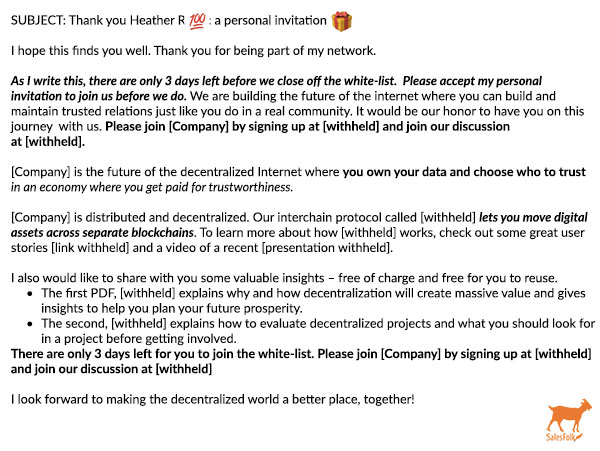
21 Mar 15:09

Top Five Reasons Curiosity Leads to Sales Success

by Gerhard Gschwandtner
Here are the top five reasons curiosity leads to sales success.
21 Mar 15:07

GDPR Compliance Guide for Sales (It Likely Affects You)

by Josh Slone

If you send emails outside of the U.S. of A., you’re going to want to pay attention to this post. I will explain everything you need to know about the upcoming laws being enforced in the E.U. (namely, the GDPR) and how to ensure your organization’s GDPR Compliance.

You say, “Well, I’m in ‘Merica. It won’t affect me.”

Yes it will. But we’ll get into that in a minute. Here’s what we’ll cover in this guide:

  • What is GDPR in Both Legal and Layman’s Terms.
  • Why It Matters to You (Whether You’re in the E.U. or Not).
  • How to Prepare for the New Law.
  • What Moves to Make in Your Email Outreach.

Let’s get into it.

What is GDPR? (Or, What is the General Data Protection Regulation?)

The General Data Protection Regulation (GDPR) puts a regulatory control and governmental guidance on how EU countries (and those outside the EU) handle personal information.

It’s been a 4 year work by the EU and will replace the Data Protection Act of 1998.

GDPR Compliance

Essentially, it requires that companies have the highest level of privacy protection and gives people the right to decide what a company can do with their data.

Companies (mainly in the E.U., or those who have the data of E.U. citizens) need to implement the required processes. In many cases, companies will need to add staff to ensure that all user data that is handled remains protected.

The protections will include communications and processes that are concise and clear and done with the approval of the stakeholders.

In order to be GDPR compliant the user data needs to be encrypted, pseudonymized or anonymized.

  • Encryption is the process of converting data into code to prevent unauthorized access.
  • Pseudonymization is the process where different parts of the data are separated but can be put back together on an as needed basis.
  • Anonymization is complete removal of identifiable information such that it can never be traced back to the user. GDPR promotes and prefers pseudonymization of data to keep it secure.

Here is the best layman’s terms definition that I can muster.

All private data for each and every citizen in an E.U. Country is about to go on lockdown.

What does GDPR protect?

GDPR aims to protect all information of the user such as name, address, ID numbers, IP addresses, RFID tags, cookie data, location, health information, family history, racial or ethnic origin, biometrics and even sexual orientation and political opinions.

Does GDPR Compliance Affect Cold Email Outreach?

Yes, GDPR will affect all businesses who handle, collect or use any kind of user data and that includes use of personal information such as names and email addresses for outbound sales.

More specifically, it’s a yes if…

  1. You are an individual or an organization targeting the personal data of anyone in the EU (e.g. outbound marketing).
  2. Your company handles or stores personal information about EU states and their citizens. (This even means inbound sign ups.)
  3. You handle certain types of sensitive data or if it is currently subject to the Data Protection Act (DPA).

If that’s you (which is likely many of our readers) — pay attention.

Are you saying that I shouldn’t target the E.U. for cold email?

Probably not*. Unless your product is specifically tailored to E.U. Member States, it’s likely best to search elsewhere.**

* That’s an opinion and should NOT be taken as official legal advice.

** Seriously, not legal advice.

Here’s why I give my *opinion*.

  • First, data is going to be harder to find. If you can find lists of contacts with a company in Europe — it’s highly likely it could have been attained…less than on the up and up.
  • Secondly, it’s just harder. In the U.S., all you need is your address listed in the email and a way for recipients to opt-out of future correspondence. A walk in the proverbial park, by comparison.
  • Lastly, it’s risky. Contacting people you don’t know (via email) in the E.U. will be looked down upon more and more. The number of violations possible with European cold outreach are staggering.

Make one mistake and it could cost you your job — or your company.

What is the Penalty for Violating GDPR Compliance?

Fines can be imposed for a number of reasons.

  • If a required data protection protocol is not present.
  • User data can be handled incorrectly.
  • Or, if there is a security breach at the company holding an E.U. citizen’s personal data.

The fines could vary. Starting at 2 percent of the firm’s turnover or €10 million (whichever is more) for a small offense. All the way to 4 percent of the firm’s turnover or €20 million Euros (whichever is more) for more severe offenses!

It’s for these reasons that we here at LeadFuze are in the process of removing EU contact data, and focusing on the U.S. market. By finding quality leads in the States, our customers won’t run the risk of violating the new legislation.

Does GDPR affect Customer Contracts (e.g. Email Sign Ups/Inbound Marketing)?

Another big —Yeppo (yes). Customer contracts come in different forms such online forms, sign-ups or even paper agreements. In all cases, the client lays out how they want the data accessed, viewed and processed.

This means inbound marketing needs to be careful, too.

All new contracts or sign ups need to be reviewed to understand how the data will be processed and stored so they meet the GDPR compliance standards.

7 Steps (even in America) to Ensure GDPR Compliance?

  • Take time to read the law.
  • Complete an audit of your data security process.
  • Ensure that all third party companies are you work with are in GDPR compliance.
  • Use software tools that enhance privacy.
  • Have a privacy policy in place (for collection, storage and transfer of email addresses).
  • Communicate data privacy policy to staff an.
  • Educate all staff (especially customer reps, those in charge of CRM systems and even data entry personnel).

7 Things to Keep in Mind Before Sending Cold Emails

  • The email marketing campaign must be sent to a targeted audience.
  • Send customized emails only to carefully chosen people at selected companies.
  • Make sure you are up to date on current Spam Laws in the U.S.A. (aka CAN-SPAM).
  • The data obtained for the mailing list requires transparency and legal consideration.
  • Know why all personal data is in your hands, ready for explanation.
  • Keep track of your contact information, where is it coming and how it has landed in your database.
  • All cold emails sent must have an opt-out option from further correspondence.

It’s Not the End of the World

Sure, not being able to cold email 28 countries in the world isn’t awesome. But it’s definitely not the end of the whole world.

If your primary sales strategy is based on inbound, you can still collect private data and be in GDPR compliance. But be careful. That data is now protected better than ever before. Now, if you do outreach… The E.U. may not be nearly as lucrative starting May 25th, 2018.

There are still millions of quality contacts in the U.S. and it’s very unlikely that you’ve contacted every one of them. So, get to prospecting.