Shared posts

03 May 16:14

Why side-by-side sales coaching is dead

by Richard Smith
The exercise of live observing reps (aka ‘riding along’) on sales calls has long been a tried and tested method for managers to become exposed to how their reps sell, in order to coach them to a higher level. Plugging into headsets or simply sitting silently in a meeting room, is something most managers committed to coaching their reps have done. However this approach to coaching is fraught with failure and its place in the world is over. Here are eight reasons why side-by-side coaching is dead:

The sales person feels the pressure
Going into valuable sales conversations with quotas at stake, is high pressure enough. Why then are sales managers ramping up the heat on sales reps by rubbing shoulders with them in the meeting room, or sitting as a silent partner on the conference line? Some people may say they perform better under pressure, but having a watching sales manager judge our every word and decision in a live sales conversation will only increase the risks of reps making mistakes. This approach has often been the reason why call listening has the negative stigma of ‘Big Brother is watching’ attached to it.

Sales reps put on an act
Naturally when they are being observed live, sales reps will be tempted to act unnaturally. Whether its asking questions they wouldn’t normally ask, making a more concerted effort to qualify further or over-build rapport with prospects, when reps aren’t acting naturally – coaching feels false. Coaching carries its greatest impact when we observe true skills, behaviours, and approaches of our sales reps. Delivering feedback to staged performances runs a risk of being a waste of time.

The risk of taking over the call
When listening live, one of the hardest things as a manager to do is to not ‘take over the call’. We see our reps struggling to answer a question; We feel like we have a much more compelling question to ask which we know the rep won’t have thought as; Or we simply feel we need to rescue a failing call and stamp our authority. The temptation of taking over a call is hard to resist and as soon as we do so, we’re ultimately doing the job of the sales rep. By nature of this, our reps don’t make the mistakes which they learn from, and their coaching experience ends up with them taking a back seat at the back of the room.

Hand-writing notes is hard
When coaching side-by-side, as managers we are likely frantically scribbling down every coachable moment we observe using the trusty pen and paper. I’ve tried this before and unless you’re Superman, there is no possible way of inking down every coachable observation as its happening; not to mention being able to ‘listen and write’ at the same time. Furthermore, if you have handwriting like mine, those hieroglyphics often don’t make too much sense five minutes after the call has finished. Why run the risk of not capturing valuable coaching moments and wasting valuable coaching time? Plus, saving paper and cutting down less trees is something we should all be doing!

Calendar Clashes
‘Rich, can you sit in on my 11:00am demo? I’d love to get your feedback on how I get on’.

Before call recordings, I used to get this request quite often. But unfortunately, all too frequently my calendar would have something in place happening at the same time. Whether it be a management meeting, a sales call, or a coaching session with another rep, calendar clashes meant I had to reject the request from the sales person. Whilst calendar clashes can’t be helped, this seemed like such an unnecessary problem and blocker to coaching taking place. This same scenario is playing out every day across busy sales leaders, where time on their calendars is often at a premium.

Live listening takes up lots of time
As valuable as call coaching is, with the average sales demo taking somewhere between 45 minutes to an hour, this is potentially a huge amount of time soaked up with live side-by-side coaching. Combine this with the increasing number of reps we have on our sales teams these days, finding lots of spare coaching hours in our already busy days is nigh on impossible. Given the fact that the average sales manager only spends 5% of their time coaching as it currently stands, the time, which is allocated to coaching, has to be utilised wisely. More time efficient coaches have their sales conversations transcribed and analysed using technology such as Refract to accelerate call reviews and to get more ‘bang for their buck’ on coaching time. More coaching time across more reps equals more level-jumping and higher results.

Not having the ability to replay
Ever done a side-by-side call ride along and was met with a bemused look on the face of the sales rep as you delivered your post call feedback? Ever struggle to remember the exact moment where the sales call took a nosedive? Without being able to bring self-reflection into the feedback experience, by replaying the key moments of a sales conversation, you run the risk of a coaching conversation full of friction and ambiguity. Reps will disagree with what they apparently did or didn’t say, and worse still, they will simply deliver lip service just to get the coaching session over and done with. A video coaching platform used in partnership, opens up a much more transparent and productive coaching dialogue. Reps can hear where they went wrong or what they did well, and will be more inclined to either change or repeat their ways next time round.

Coaching benefits are locked in the meeting room
Finally, the big problem with side-by-side coaching, is that all of the value of the coaching conversation is ultimately locked within the confines of the meeting room or the telephone. Even if not directly involved in a sales conversation, other sales reps can glean huge amounts of insight and data by listening to their peers. Educating ourselves on how our colleagues handle common objections, frame questions, or run the sales process enables sales teams to replicate success across the team at scale. None of this is possible without recording that call and sharing it with ease.

New call-to-action
12 Apr 17:44

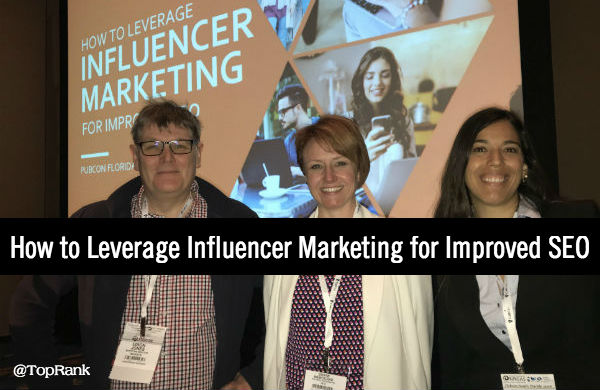
How to Leverage Influencer Marketing for Improved SEO #Pubcon Florida

by Lee Odden

How to Leverage Influencer Marketing for Improved SEO

This session on influencer marketing and SEO is the first up for me on day one of Pubcon Florida, which has grown from a one day to a two day event. It’s easy to see why: The speaker line up is chock full of current smart search marketing advice from a great collection of expert practitioners.

With moderation duties handled by Susan Wenograd @SusanEDub the speakers for this session included the dynamic duo of:
Marcela De Vivo @marceladevivo from SEMRush
Dixon Jones @Dixon_Jones from Majestic

First up is birthday woman Marcela De Vivo. Happy Birthday Marcela!

Influencer Marketing is hot right now for a variety of reasons: consumers increased use of ad blocking, increased competition and working with the right influencers can make your marketing more effective, especially with SEO.

But working with influencers and getting them to pay attention to your brand can be hard.

There are many examples of big brands leveraging influencer marketing including Pedigree, Hulu and Bob’s Red Mill. But there are also small brands like YogaClub that have had great results too. “Working with influencers revolutionized our brand.”

Impressions are nice, but how do you get influencers to truly impact your ROI?

One of the best ways to get ROI out of influencer marketing is to bring it into your SEO strategy.

To do that, understanding the top SEO ranking factors will help you understand opportunities to incorporate influence with SEO.

  1. Site traffic – Number of direct visits for high volume keywords. Influencers can be a great source for direct traffic. Influencers can generate demand for your brand which also creates visits to your site.
  2. User engagement signals – Visitors coming to your website from search – pages viewed per session and bounce rate. Influencers that have a trusted niche of followers that trust them to recommend sites to visit. That trust should result in an audience that delivers stronger user engagement signals.
  3. Links – Total backlinks to a domain, referring IPs, and total follow backlinks. With influencers you get links they share to your site but ideally, their followers may also link to you. One way to work with influencers this way is through giveaways where content is part of the contest.
  4. Natural organic content – Longer content tends to perform better than shorter content. Things like keywords in the title and H1 tags. Influencers can contribute content to your site that your brand owns. Then you can encourage influencers to share that content that they created hosted on your site. You can also use Facebook ads to promote that content. Alternatively, you can sponsor the influencer to create content on their own site and encourage them to promote.

Steps to build an effective influencer marketing campaign:

  1. Start by picking the social media channels you want to target.
  2. Create a list of potential influencers using Google, social networks or specialty tools / networks of influencers.
  3. Shortlist your influencers.
  4. Contact the influencers via email, phone and/or social media. Get creative.
  5. Get pricing information from the influencer.
  6. Negotiate a detailed agreement with deliverables. Focus on long term partnerships.
  7. Send the influencer a descriptive campaign brief.
  8. Track, monitor and amplify their posts.
  9. Measure performance.

Hacks for working with influencers:

Measure influencers against each other with an assessment tool. Gather all the data about influencer activity and estimate the CPM value. Include data like: followers, blog traffic, demographic data, engagement per post.

Calculate total relevant audience. Then figure out the engagement to audience ratio. Add total cost and divide by total relevant audience divided by 1000. With this data you can identify which influencers are the best to work with.

Combine Facebook live videos with influencer amplification. Live videos often have good organic reach. Run ads against the influencers own audience. Be sure to use the same post ID when you promote content to build social proof.

After the live video on Facebook, upload them to YouTube, creata a bog post with them, get the influencer to share your video blog post and use Facebook ads to amplify the posts.

Following these guidelines will result in links, traffic and engagement – all signals that are good for SEO.

Next up is Dixon Jones who is retiring after 20 years in the industry at the end of this year. Congratulations Dixon!

Dixon asks, to leverage influencer marketing to improve SEO what are we trying to do? Get them to write about you and to get them to like and share your content.

Likes and shares are nice, but they’re just not as impactful to SEO as links.

BuzzSumo did some research on why people share and link to content which is useful when planning how to get influencers to link to your content.

Why might influencers link to your content?

  1. Original insights research
  2. As reference to support an article
  3. To share authoritative content including research and facts
  4. To cite dynamic data that changes

But do links still matter? “Yes” says Andrey Lipattsev from Google. Also Google’s Gary Illes, “Ranking without links is really, really hard. Not impossible, but very hard.”

Takeaway – An influencer can amplify a link for you very effectively.

How many links is enough? Dixon says “one” if they’re from the right source. It’s not about the quantity, it’s about the quality. That means being careful about which influencers you work with.

Steps to engaging influencers:

  1. Identify the right influencers. Use Majestic’s search engine to find relevant content with desirable inbound co-linking ratios. Also, BuzzSumo’s tool for finding top content and authors for a keyword. Review where they publish. Use whatever communication tool that the influencer prefers – not what is most convenient to you.
  2. Engage the influencers. Doing this right is hard. Networking is priceless. It’s your chemistry not the tools that matter. Use tools like Influsionsoft, Sendible, Outlook, Rapportive. Build trust, be honest and be sincere. Ultimately, its about the beer (for Dixon). Build genuine relationships that can be leveraged when you have something valuable to share with them.
  3. Define the digital asset. Content isn’t necessarily king. The best thing might be an idea, a produce, or a process. It doesn’t have to be a URL.
  4. Prepare the launch. When you have something good to say and great relationships with relevant influencers, send them a preview of what you’re going to announce. Tell them the link URL and the exact time of launch. Then remind them it is live.
  5. Monitor results. Choose a KPI and stick to it, Is it a digital asset? Traffic from the influencer’s content? Search traffic? Citation flow or Trust flow? Just be sure to look at impact over time, not just in the short term. Compare similar campaign metrics with each other vs. mis-matched metrics.

Finally, Dixon asks and answers: How can you get influencers’ attention? By sharing something new, authoritative, referenceable, or unique.

And that’s a wrap. Great job Marcela and Dixon!

If you’re interested in influencer marketing tools to use or other content about influencer marketing, be sure to check out our past posts on the topic.


Email Newsletter Gain a competitive advantage by subscribing to the
TopRank® Online Marketing Newsletter.

© Online Marketing Blog - TopRank®, 2018. | How to Leverage Influencer Marketing for Improved SEO #Pubcon Florida | http://www.toprankblog.com

The post How to Leverage Influencer Marketing for Improved SEO #Pubcon Florida appeared first on Online Marketing Blog - TopRank®.

12 Apr 17:40

Ambush Marketing: What It Is & Why It Works

by Dan Shewan

Ever found yourself telling someone about some good news you got, only for the other person to completely ignore what you said and start talking about themselves?

That’s a little what ambush marketing is like.

Ambush marketing

Image via Japanese Olympic Committee

Today we’ll be taking a look at ambush marketing – specifically, what it is, what it looks like, and why brands spend countless millions of dollars on glorified pissing contests.

We’ll be examining the advantages and disadvantages of ambush marketing, including some real-world examples of how ambush marketing has been utilized to great effect by some of the world’s best-known brands.

First up, a primer on the basics.

What Is Ambush Marketing?

Ambush marketing – also known as coat-tail marketing or predatory ambushing – is the practice of hijacking or coopting another advertiser’s campaign to raise awareness of another company or brand, often in the context of event sponsorships.

One of the earliest known examples of ambush marketing is the bitter feud that erupted between MasterCard and Visa during the 1992 Winter Olympics, which was held in the town of Albertville in southeastern France.

Having paid $20 million (approximately $35.5 million in 2018 dollars) for the privilege, Visa was the official credit card sponsor of the ’92 Winter Games. For months prior to games, Visa ran TV commercials advising American Express cardholders to leave their AmEx at home as “the Olympics don’t take American Express.”

Technically, this was true – tickets to the games could only be purchased with Visa credit cards. However, Visa’s aggressive ad campaign soon raised the ire of American Express, which claimed Visa’s ads were purposefully misleading by suggesting that American Express cards were not accepted anywhere at the ’92 Winter Games.

AmEx soon launched its own series of TV spots, which featured the slogan, “When you go to Spain, you’ll need a passport – but you don’t need a Visa,” a sly reference to the forthcoming Summer Games in Barcelona and a subtle dig at the company’s rival. American Express was accused by Visa of engaging in “parasite marketing,” which later gave rise to the slightly more palatable name of ambush marketing.

4 Real-World Ambush Marketing Examples

Now that we’ve looked at what ambush marketing is, it’s time to see some examples of this technique in action, from the inspired to the irreverent.

#1: BMW vs. Audi

Santa Monica, California, may be famous for its lengthy pier and near-perfect weather, but this affluent coastal city was also the battlefield upon which two of the world’s largest car manufacturers waged a war for billboard dominance.

The spat began soon after BMW hosted a rally in Wisconsin, an event that was publicized through an accompanying campaign. The slogan of the campaign was “A BMW rally with two nearby service centers. What’s next, paramedics at a chess tournament?”

Crappy, nonsensical slogans aside, Audi saw an opportunity to capitalize upon BMW’s campaign. In response to BMW’s ads, Audi purchased a billboard in Santa Monica advertising its new A4 sedan and mocking BMW’s slogan:

Ambush marketing Audi vs. BMW billboard war Santa Monica

Image via Jalopnik

Not long after the billboard above appeared in Santa Monica, Audi doubled down and erected another giant roadside provocation to BMW, while cleverly sticking to BMW’s regrettable chess theme:

Ambush marketing Audi vs. BMW billboard Your Move, BMW

Image via The Branding Journal

BMW didn’t take this attack lying down. In response, BMW purchased an enormous billboard across the street from Audi’s billboard:

Ambush marketing Audi vs. BMW billboard war Checkmate

Image via Jalopnik

By now, you’d think that two of the world’s largest vehicle manufacturers would have tired of their childish tit-for-tat.

They hadn’t.

After BMW erected its “Checkmate” billboard response, Audi upped its game again by launching yet another billboard ad with yet another witty chess-related quip. Ultimately, BMW won the day with its final, withering response:

Ambush marketing Audi vs. BMW billboard war blimp game over

Oh, and to really twist the knife, BMW actually tethered the blimp to Audi’s R8 billboard.

Savage.

#2: Paddy Power

Unlike our friends in the States, many of whom seem to have an irrational, almost phobic aversion to a friendly wager, my countrymen in Britain love a good bet. Walk down any high street in the U.K. and you’ll most likely see at least one or two bookmakers, among the best-known of which is Irish gambling chain Paddy Power.

Like so many of the most notorious ambush marketing campaigns, Paddy Power’s first foray into the exciting world of predatory ambushing took place during the Olympic Games – the London 2012 Games, to be precise.

Ambush marketing Paddy Power London 2012 billboard campaign

Image via AdAge

As the British capital geared up for the Games, Paddy Power launched a wide-scale billboard campaign across the city, claiming it was the “Official sponsor of the largest athletics event in London this year.” Below the bookmaker’s bold claim was a disclaimer that revealed Paddy Power was referring to the town of London, France –the event the ad referred to was not the Olympic Games, but rather a traditional egg-and-spoon race that Paddy Power really did sponsor.

The IOC took a predictably dim view of Paddy Power’s tongue-in-cheek campaign, and demanded the Irish bookie take down the ads immediately. Paddy Power challenged the IOC’s order in court, and ultimately won its fight against the IOC in a landmark ruling.

#3: Samsung vs. Apple

In October of 2011, Apple was preparing to launch the then-latest iteration of its flagship mobile device, the iPhone 4S.

The device launch was expected to be one of the most hotly anticipated tech events of the year – so Samsung decided to crash Apple’s party by erecting a pop-up store just a few feet away from Apple’s prestigious storefront in Sydney, Australia.

While eager Apple acolytes (Appolytes?) waited patiently to get their hands on the new iPhone, Samsung proceeded to sell its Galaxy SII device for just $2 AUS – mere pocket change compared to Apple’s $850 iPhone.

Ambush marketing Samsung vs. Apple Sydney pop-up store iPhone 4S launch

LOL. Image via Sydney Morning Herald.

Plenty of people managed to resist Samsung’s tempting offer, but many more still chose to walk away with a brand-new Samsung device rather than wait in line for the iPhone 4S.

Although Samsung took an enormous financial hit with its iPhone launch event stunt (which we’ll break down shortly), the incident proved just how easy it can be to ride the coat-tails of one of the world’s biggest brands.

#4: Rona and the iPods

When you’re one of the wealthiest companies in the history of mankind, you can’t help but attract attention. Case in point, another classic ambush marketing example of a company leveraging Apple’s advertising to its own ends.

Back in 2010, Apple’s colorful iPod Nano was among the most popular MP3 players on the market (just typing this makes me feel ancient). To advertise its iPod Nano line, Apple erected a billboard ad next to the Jacques Cartier Bridge in Montreal displaying the vividly colorful MP3 players in a satisfying rainbow-ribbon arrangement.

Ambush marketing Rona paint Apple iPod billboard

Image via Coloribus

Sensing an opportunity, Canadian paint and hardware firm Rona seized its chance. Rona soon erected its own billboard ad directly beneath Apple’s iPod ad to advertise the company’s new paint recycling program. The ad, which bore the slogan “Nous récupérons les restes de peinture,” or “We collect leftover paint,” was brilliantly simple, and the ad remains one of the best and most creative examples of ambush marketing in recent memory.

Why Use Ambush Marketing?

Now that we know what ambush marketing is, let’s take a look at some of the advantages of this type of advertising campaign.

Ambush Marketing Campaigns Can Be Very Clever

Something I personally love about ambush marketing campaigns is how cheeky they can be and the creative flexibility these campaigns offer.

Since most ambush marketing campaigns directly respond to or otherwise leverage an existing campaign by a close competitor, ambush campaigns can – and often, have to – be extremely creative. This includes everything from visual trickery to witty wordplay. As a result, ambush marketing campaigns are often a lot more memorable than a typical ad precisely because they’re unusually entertaining or clever.

Ambush marketing Newcastle Brown Ale chalice campaign

Subtle references and sly jokes are often integral to the success of ambush marketing campaigns. As we saw in the Audi vs. BMW example above, ambush campaigns often respond directly to one another, which can turn visual humor into a vital competitive edge.

Even if one ad is “better” than another, the funnier or cleverer ad will often be much more memorable, as Newcastle Brown Ale proved in the example ambush campaign above.

Ambush Marketing Campaigns Can Go Off-Script

When it comes to display advertising – online or IRL – cohesion is crucial. From enormous, towering billboards in Times Square to a mobile sidebar ad, brands have to ensure that their campaigns look, feel, and sound the same across all platforms.

Ambush campaigns, however, can get a little more creative.

Ambush marketing Fiat photobombs Volkswagen Swedish headquarters Google Maps

One of the key advantages of ambush marketing is that it allows brands to go off-script from their regular advertising campaigns, whether in style, tone, or content. Brands can and frequently do employ techniques that may be beyond the scope of a company’s established brand or advertising guidelines, affording the ambusher a great deal more creative freedom and flexibility.

Italian car manufacturer Fiat leveraged this principle to great effect in an impromptu ambush campaign back in 2013 when Fiat somehow managed to park a red Fiat 500 hatchback car on the front steps of Volkswagen’s Swedish headquarters – just in time for a Google Maps car to pass, which preserved Fiat’s little stunt for years in Google Maps results. (The offending little red Fiat is no longer immortalized in Maps results, as Google refreshed the old image with a newer image that was taken in June of 2017).

Ambush Marketing Can Change Consumer Perceptions

Another benefit of ambush marketing is that, done well, it can actually help brands cultivate and exhibit new brand attributes and values that consumers may not necessarily already associate with that advertiser.

Take South African airline Kulula, for example. To coincide with the 2010 World Cup, Kulula launched an ad campaign branding itself as the “Unofficial National Carrier of the You-Know-What,” a not-so-subtle reference to the forthcoming soccer tournament. The World Cup’s governing body, FIFA, demanded that Kulula cease the campaign immediately, claiming that the airline sought “to gain a promotional benefit for the Kulula brand by creating an unauthorized association with the 2010 FIFA World Cup.”

Ambush marketing Sepp Blatter Boston Terrier

Sepp Blatter, the real MVP

Though unhappy with FIFA’s decision, Kulula reluctantly complied with FIFA’s order. However, the airline wasn’t done quite yet. Shortly after the ads were pulled, Kulula said it would fly anyone named Sepp Blatter – the name of FIFA’s then-president – for free. Eventually, the airline located a Boston Terrier that shared a name with FIFA’s former president, and made the improbably named pup an unofficial mascot.

This campaign serves as a great example of how ambush marketing can help brands cultivate new brand values. Air travel is an insanely competitive industry, but Kulula’s ambush campaign not only gained the airline some invaluable publicity, but also advanced the idea that Kulula isn’t just another dry, boring airline.

What Are the Disadvantages of Ambush Marketing?

So, we’ve looked at how and when ambush marketing can work well, but this approach is not without its downsides.

Ambush Marketing Can Be Very Expensive

The main drawback of ambush marketing is that it has the potential to be very expensive.

Take the very public spat between Audi and BWM in Santa Monica above, for example. For the sake of argument, let’s assume that a billboard in Santa Monica costs $10,000 per month (not including actual design or printing costs). The fight between Audi and BMW lasted for several months and resulted in four separate billboard ads running simultaneously in the same geographic location, which almost definitely drove costs up even further. Then BMW went and put a zeppelin above all four billboards, which can cost anywhere between $500,000 and $5 million. So far, we’re talking almost $100,000 on the billboards alone, plus the cost of BMW’s blimp, plus all design and production costs.

Not exactly small change.

Ambush marketing Hindenburg disaster

The Hindenburg, also known as “your advertising budget”

Ambush marketing might seem like a great way to piggy-back on another brand’s efforts – and it can be – but it also demands a certain level of spend that puts this approach beyond the reach of smaller companies or newer, less established brands. That’s why ambush campaigns tend to be launched by well-funded brands at major international events like the Olympics or the Super Bowl – it’s so expensive, the return has to be worthwhile.

Calculating the ROI of Ambush Marketing Is Very Difficult

Another problem with ambush marketing campaigns is that calculating the ROI of such a campaign can be very difficult, if not actually impossible.

Take our Samsung hijacking example from earlier. In terms of the upfront overhead costs, Samsung’s little stunt in Sydney wasn’t that expensive. There was the cost of refurbishing the pop-up store itself and the wages of the Samsung employees who manned the store during the event.

The real cost of this ambush marketing campaign was the massive hit that Samsung took on each individual Galaxy SII device sold during the event.

Time for some napkin math!

First, we need to establish the base cost of a Galaxy SII device. For the sake of example, let’s say that a Samsung Galaxy SII cost $499, which is what the device retailed for at launch in many regions.

Next, we need to determine how many Galaxy SII devices Samsung sold during its ambush marketing event. For our purposes, we’ll say that the Samsung pop-up store sold 750 Galaxy SII devices that day.

Ambush marketing Samsung vs. Apple Sydney pop-up store iPhone 4S launch

Fans wait outside Samsung’s pop-up store in Sydney in 2011. Image via
The Next Web.

Finally, we need to figure out how much it cost Samsung to put on its event in Sydney. Let’s say Samsung hired two people to staff the pop-up store, paid each of them $15 per hour (ha!), and asked them to work for eight hours each. This means our staffing costs would be $240. Now let’s say that it cost Samsung $10,000 to actually refurbish the store. Using these figures, we can say that Samsung’s ambush marketing event cost $10,240.

If this were a typical ad campaign, we might use the following formula to come up with some numbers:

Value of a Galaxy SII multiplied by Number of devices sold minus Event overhead costs

Since we know that a Galaxy SII costs $499, that Samsung sold 750 devices during the event, and spent $10,240 to actually put on the event itself, the formula above would look like this:

499 x 750 – 10,240 = 364,010

So, using the monkey math above, we could say that Samsung’s ambush marketing campaign generated $364,010 in revenue – not bad for a pop-up store!

But wait a minute – wasn’t Samsung was selling its Galaxy SII devices for just $2? Now our math looks a lot less attractive:

2 x 750 – 10,240 = -8,740

Going by the actual numbers, Samsung actually lost almost $9,000 in revenue because it was selling its Galaxy SII devices for just two bucks..

This is how much it really cost Samsung to put on its event in Sydney.

For our purposes, we’re not actually interested in that figure. For a global brand like Samsung, $364,000 is couch change. What we want to know is whether the ambush marketing campaign was worth $364,000 – and this is where it gets complicated.

You can’t assign numerical values to intangible factors such as brand awareness or positive consumer sentiment, which makes it very difficult to effectively gauge the ROI of an ambush marketing campaign. It’s easier to gauge the overall reception of an ambush campaign by monitoring mainstream and social media for mentions, links, and other engagement metrics, but when you get down to brass tacks, proving the financial ROI of an ambush marketing campaign can be very difficult.

Time and Space Are Factors in Ambush Marketing

Another problem with ambush marketing campaigns is that in addition to the potential costs involved, these campaigns often require a relatively quick response or coordinated planning (or both) if they’re to work effectively or successfully leverage the target campaign to achieve its goal. To complicate matters further, the availability and price of advertising inventory can make or break an ambush marketing campaign before it even gets off the ground.

Take Newcastle Brown Ale’s “chalice” campaign above, for example. Although these ads were quite memorable, their effectiveness relied solely upon the neighboring Stella Artois ads they mocked; by themselves, Newcastle Brown Ale’s ads would only be memorable because they wouldn’t make any sense (and for potentially confusing American passersby with their use of the word “bollocks”).

This means that time and space are crucial factors in many ambush marketing campaigns. Unless you can be sure that the target of your ambush campaign will be there for a while – such as a sports stadium with a corporate sponsor or something similarly semi-permanent – you need to move quickly.

It’s a Trap!

Ambush marketing isn’t a viable marketing strategy for most businesses. The costs involved can be prohibitively expensive to all but the wealthiest of brands, but the underlying strategies beneath ambush marketing as a concept can be easily applied to your campaigns, from PPC campaigns on the search network to primarily visual campaigns on Facebook.

Hopefully, this post has given you some creative inspiration for new approaches you can take to your existing ads. Next time you sit down to write or optimize your next campaign, consider what you could learn from the examples above. You might not get to rub a competitor’s face in it with a gigantic billboard in Times Square, but you might be able to poke a sly dig at your competitors in your next Facebook campaign.

12 Apr 17:35

How Top Companies Drive Offline Conversions From Online Ads

by Christie Huber

According to Google, when people use mobile search to help make a decision, they are 57% more likely to visit a store and 40% more likely to call a business. And those offline conversions are 51% more likely to make a purchase. It’s why many businesses are now looking to optimize their mobile ad campaigns for these valuable offline interactions.

Honda, for example, saw this as an opportunity to shift its media buy to pay only for mobile ads that drive people to their dealerships. Digital ads, normally bought on impressions or clicks, will now be bought on a cost-per-visit basis, reducing the risk of wasted media spend and providing a way to measure whether ad exposure is driving offline conversions that lead to purchases.

Google, mobile search stats

Source: Google

Optimize Your Digital Ads to Drive Call Conversions

Businesses and agencies spent over $37 billion in search advertising in the US in 2017 to drive leads, customers, and revenue. It’s fiercely competitive, and every conversion counts. Yet call conversions are still a metric commonly overlooked by most marketers. You can’t measure and optimize digital marketing ROI if you ignore call conversions.

For many business, a phone call is the most valuable type of marketing interaction. Research shows that inbound calls convert to revenue 10x more than web leads. And industries like auto, insurance, financial services, health care, home services, and tech all rely on inbound calls to drive appointments and acquire customers.

Here are 4 strategies to take a data-driven approach to calls and optimize digital campaigns to drive more calls and customers:

1. Make It Easy for Consumers to Call You

Calls are an important part of the customer journey for industries with complex, expensive, infrequent, or urgent purchases. Consumers want to call and speak to a real person, regardless of the device they use to search for a product or service. For marketers in these industries, your search ROI hinges on your ability to drive calls. Add phone numbers and click-to-call buttons to your digital ads and throughout your website to make it easy for consumers researching your products or services to call.

Optimize Your Digital Ads and Websites for People Who Want to Call

2. Capture Complete Marketing Analytics on Every Caller

For each call, you should capture information on the caller and the marketing channel, ad, keyword search, or other marketing source that drove it. You should also understand what happens on the call to be able to measure lead quality, caller intent, and the outcome and value of that conversion.

Marketing data from each inbound call

3. Integrate Call Analytics with the Tools in Your Marketing Stack

By including offline data from calls into your CRM, bid management, web analytics, and other marketing tools, you can get a holistic view of your buyer’s journey. Armed with this insight you can then allocate budget and optimize campaigns to generate the greatest return on your investment.

Integrate call analytics tools

4. Use Call Analytics to Personalize the Caller Experience

It’s critical for businesses to offer callers the right experience to convert them to customers. To do it, advertisers can use the data they capture on each caller to personalize their on-call experience, providing a seamless transition from online search to offline conversation and increasing the chances of winning that caller’s business. By implementing intelligent call routing processes, every caller is directed to the most appropriate sales associate or department.

Route callers

Calls Convert to Customers — Don’t Ignore Them

For many DialogTech customers, phone calls represent half or more of overall conversions. Not only is it important to track (and get credit for) the leads that come in over the phone, but it’s also critical to make sure those calls get routed to the right person to turn them into revenue. Marketers must take a data-driven approach to calls to boost ROI and optimize media spend.

To learn more about businesses who are using call analytics solutions to drive sales and better prioritize marketing spend, take a look at The Marketer’s Big Book of Call Tracking Success Stories.

12 Apr 17:34

How to Use the Marketing Funnel to Create Your Growth Plan

by Ryan Gould

As marketers, we all want reliable information that tells us precisely where we need to focus our efforts in order to enjoy the greatest yields. This is why, in digital marketing, analytics have been the Holy Grail for so long.

But there are other tools at our disposal as well.

One of the most reliable models for understanding customer behavior is what’s known as the marketing funnel.

The funnel itself is a series of action categories representing the states a person goes through when interacting with your business.

When your prospects pass down through the funnel, it’s also known as the flow—ts movement are a direct result of your audience interactions. As these targets pass through the various stages of interaction, your audience becomes smaller and smaller to the point they’ve gone from a broad, general group to customers/evangelists.

The stages of the marketing funnel are as follows:

  • Awareness
  • Interest
  • Conversion
  • Referral

As mentioned above, the stages become narrower the further you travel down.

For example, in the largest stage—the awareness stage—you are interacting with what’s called the “total market.” This is the start of the journey and you are reaching out to anyone, anywhere who would benefit from your product or service.

Of course, you can’t appeal to everyone, only those who aren’t impeded by geographical limitations, lack of media access, cultural differences, etc. So for your awareness phase, you are now implementing marketing tactics to appeal to your “reachable market,” or those audience members you know you can interact with.

Successfully interacting with them produces two new subsets made up of those now aware of your brand, and those looking for a product or service such as yours.

If your interactions remain fluid, the next step down is into the interest phase, where these subsets turn into qualified leads.

The step now becomes to use sales and persuasion tactics to convert the leads.

It’s at the conversion stage when leads become customers, and the referral stage when customers become evangelists as well.

Not only is the funnel a proven model, but marketers have gotten creative about how to wield its power. This is particularly true where it concerns growth.

Many forward-thinking marketers have developed solid hacks to get the most out of your marketing funnel. But before we get to these 10 tips, let’s take a look at what you need to do beforehand to get your overall strategy in order.

Growth Plan

#1 Establish a baseline

This comes first, before any implementation of your funnel process, or any change to the funnel itself.

In short, a baseline is a comparison tool, necessary for you to understand whether your actions are effective or not. Really it’s a set of metrics that measure overall performance. Bounce rates, page visitors, list sign-ups, cart abandonment, etc.—these all provide valuable insight into your customer’s behavior.

You want to harness this operational data in order to create your baseline. There a number of handy tools out there to help you achieve this, such as Google Analytics.

To this, you should link any success KPIs as outlined in your business plan.

#2 Set your targets

Now that you have a baseline, it’s time to set your priorities for audience interaction.

Each of these should correspond to a particular stage in the funnel.

First and foremost, a common goal for most marketers is to aim to drive more traffic to your website. So you set a target of 25,000 new and unique visitors per month. This corresponds to the first stage, the awareness stage, of your funnel. Then, as a long-term target, perhaps you’d like to convert 3% of these visitors to customers.

That’s a target of 25 per day and takes you further down the funnel to the referral stage.

Web Visitors

Of course, you’re lost unless you can find the pain points in this journey.

Maybe you aren’t hitting your 25,000 unique visitors goal—that means there’s something precluding audience awareness somewhere along the way. To determine these pain points, calculate your target vs. performance gap and look at them in relation to the funnel.

Work your way from the bottom of the funnel up, dealing with each pain point as you go. This will define your problem areas and clarify metrics you need to work on.

#3 Identify which metrics you need to improve

Maybe your bounce rates are through the roof, or your cart abandonment is too high.

Whatever the issue, any growth plan starts with acknowledging where you’re falling short.

Obviously, these will go hand in hand with your customer pain points. Then it’s time to revamp your marketing channels according to where they’re flagging. It could be that your content efforts are falling short, or perhaps your email list is lacking subscribers, or your social strategy isn’t getting many shares.

In the B2B realm, take Basecamp as an example.

They continue to reinvent their marketing to get the word out about their project communication tool.

Their website has changed frequently over the years, a tell that they’ve been retooling their design and optimization efforts to focus on problem metrics. Maybe first-time visitors just weren’t understanding the core functionality of their software. However, anyone who visits their homepage now can see that Basecamp relies heavily on visuals to help guide the user.

They also emphasize their social proof by including a number of customer testimonials.

Moreover, they show their product in action and place a CTA for a free 30-day trial front and center on the homepage. There are three main marketing steps in their sales funnel here, each leading from one to the other. These are:

  • Inbound marketing efforts (blog, social, organic search)
  • Homepage information
  • 30-day free trial

In other words, they have eliminated many pain points in the customer journey by explaining simply and through eye-catching animations how easy their product is to use, and how folks can even try it for free.

The result is fewer impediments to their audience moving down the funnel towards, hopefully, the customer/evangelist stage.

#4 Create your growth plan

Now it’s time to develop your growth plan.

Consider this a corrective blueprint—a plan to right the ship of your flagging marketing efforts and promote growth. Having a solid growth plan pinpoints the exact problem on the customer journey, helping you to understand the voice of your customer in the process.

Have an Action Plan

First, settle on a timeline from where you are now to where you’d like your business to be in a certain amount of time.

Depending on your organization this could be 12-16 months (a typical target date due to the time it takes to see results from each marketing channel), or it could coincide with more long-term goals and represent a 3-5-year timeline.

Regardless, know that oftentimes, depending on the channel, there can be a lag in seeing results of a few months at a minimum. This is particularly true where it concerns your SEO channel.

If you’re retooling your optimization efforts, plan on it taking at least a few months to glean measurable results.

#5 Define success target goals by metric

There is an endless number of metrics and KPIs you can track, and you’ll want to focus on those that are red flagging.

For example, maybe your social channels are DOA—e.g. no one is chattering about you on Facebook or Twitter. You’ll then want to make tracking how people hear about your brand on social channels a cornerstone of your growth plan.

And if your social channels aren’t bearing fruit, likely your visitor metrics are suffering as well. You’ll want to look at your first-visit stats, that metric that tells you how your audience is finding your website and how engaged they are when they do.

Following directly from this is your returning visitor metric, or how effective your site is at building an audience. If all these metrics are struggling then you’re likely having problems with most if not all of your marketing channels, from content to social to search.

But even if only one channel is the problem, the solution is setting overall target goals to fix it.

Maybe you want to increase purchases by 500 or a thousand each month. We recommend also setting a monthly goal—a target you can realistically hit per month that will get you to your end goal.

#6 Work within your budget

This may sound simple on paper, but we all know how marketing budgets can explode once you start setting new target goals. The solution is to work backward.

Marketing Budget

So, traveling up your funnel from the bottom, what do those 500 new customers per month represent in site visits during the awareness stage? Maybe that’s 20,000 new, unique visitors per month to your site.

Can your budget compensate for doing a website overhaul or beefing up your content and/or social game? If not, you may have to set more realistic goals.

#7 Organize your marketing channels

So you’ve got your problem metrics and target goals sorted out, all with budget figures firmly in the black.

Now you need to know exactly where to spend that money.

The best strategy is to organize your marketing channels according to your funnel action category.

For example, there are a number of channels open to you that will help you build brand awareness, which corresponds with the awareness stage of the funnel. These include, but are not limited to:

  • Copywriting
  • Paid advertising
  • Social media campaigns
  • Co-branding partnerships
  • Email marketing

As for that last channel, any fledgling entrepreneur looking to make a name for him or herself would do well to take a page from Mixergy.com. The company sells interviews with successful entrepreneurs to a target audience of business owners.

By visiting their site, right away you know what channels they are focusing on in accordance with their funnel. In this case its email marketing.

Front and center on Mixergy’s homepage is a CTA prompting the user to click a tab and receive nine of their most popular interviews for free.

It’s a savvy tactic because in offering this free content, Mixergy is showing the value of their service.

Of course, in exchange, the user provides his or her email address. But now the user is incentivized, and Mixergy has started an initial relationship via email that has turned a general audience member into a qualified lead.

If Mixergy plays their cards right, from here the trip further down the funnel only gets easier.

#8 Assign an action for your most promising marketing channels

Once you have your ideal marketing channels in line with the appropriate action category, then it’s time to set it in action.

Just as importantly you need to assign a duration to this strategy of how long you intend to implement it. Make sure you can measure accurate results based on relevant KPIs.

Implement your strategy with targets in mind.

That means, like with Mixergy, you implement your traction channels with the goal to building a relationship with the target, not hard-selling them. Therefore all your channels need to be operating contextually and, when possible, offering personalized content for the target.

#9 Analyze the results

Do this by calculating the conversion rates between the stages of the funnel.

This time start at the top, with your general audience, and work your way all the way down to the conversion/referral stages, analyzing all marketing channel strategies and your closed-deal percentages.

Planning for Growth

#10 Have a backup plan

If you reach the end of your allotted duration and you still haven’t hit your targets, then go to the next traction channel on your list and implement it for another specific duration.

But, don’t forget that the marketing funnel only works in conjunction with your growth plan if you have a working business model,

If you’ve gone down your list and attempted every tactic according to your most promising traction channels, that means your product-market fit leaves something to be desired, so if you’re having trouble after working your way through your traction channels, you may need to regroup and come up with a new plan, or secure a larger budget for testing.

Now would be the time to ask yourself (and probably your customers) the hard questions about whether your product or service can satisfy the current market.

If it can’t, you don’t have a problem with marketing, you have a problem with the core of your business.

11 Apr 17:32

How a tech giant from India stumbled into a talent jackpot in Canada

by Kevin Carmichael

There is more to investment than Trump and taxes.

Those things matter, for sure. The chief executives of Royal Bank of Canada and Bank of Montreal say they are watching capital flee to the U.S., where executives can be certain they will avoid the U.S. president’s penchant for import tariffs, while taking advantage of his recent tax cuts.

But neither Donald Trump nor any of his policies came up when I talked to Harinder Takhar, who runs the Canadian unit of Paytm, India’s largest mobile payments company.

Paytm, a tech unicorn that’s said to be worth around $10 billion, chose Toronto in 2014 for its first major foray abroad because the city was thick with young experts in machine learning. It appears to have no plans to leave. Paytm Labs now has about 70 employees. Last year, the company created a mobile app for Canada that allows users to pay their bills instantly in one place. This week, it added a rewards program to lure more customers.

“We have more data scientists working out of this office than any other office in our company,” Takhar said during a telephone interview on April 10. “It is a serious competitive advantage to have access to so much skill. The fact that Canada has a good financial sector and a lot of universities all in one concentrated area, this is very rare. This was almost like a discovery for us.”

There is lots for Prime Minister Justin Trudeau’s government to like in that statement.

Notice that a leader of one of Asia’s most promising tech firms described Toronto’s potential as a fintech hub as something of a discovery. It’s a reminder that Canada isn’t top of mind as an investment destination, which is why Trade Minister François-Philippe Champagne launched Invest in Canada, an agency whose mandate is to ensure Canada isn’t an afterthought for executives like Takhar.

Paytm arrived when Trudeau was leading the third party in Parliament; still, the prime minister surely will appreciate a break from hearing that his tax policies are driving entrepreneurs out of the country. He might even like evidence that at least one prominent Indian firm is sticking with Canada, despite the negativity that pervaded his trip to that emerging economic power in February.

I was somewhat surprised when Takhar said he had few complaints about Canada’s regulatory system. At a conference at the Rotman School of Management last month, there was lots of talk about cryptocurrencies and fintech, and the overwhelming opinion was that Canadian authorities were failing to keep up with the pace of change in the financial industry.

Paytm so far only does payments, so maybe Takhar is spared the frustrations of those upstarts who want to take deposits, lend, or trade. He said he found that regulators were conscious of not getting too hung up on rules designed for another era. He said he needed the approval of only “one or two” authorities to launch his app in Canada, whereas in the U.S. he would have had to seek more than 40 separate licenses.

“Canada is a very good testing ground,” Takhar said.

He did have one negative thing to say about his new home: Takhar is “appalled” that in 2018 he can’t risk going out in Toronto without cash in his pocket.

You might expect the senior executive of a digital payments company to dislike Canada’s stubborn refusal to give up its shiny coins and its pretty polymer notes.

In Mumbai, for example, a shopper can use the Paytm app almost everywhere; the company’s logo is about as pervasive as Mastercard and Visa stickers are here. But in Toronto, plenty of sellers don’t even accept credit cards. The Bank of Canada reports that Canadians show no sign of quitting cash, which is one of the reasons policy makers feel little pressure to make a decision on whether they need to involve themselves with things such as cryptocurrencies.

At that Rotman conference, Tiff Macklem, the school’s dean and the former No. 2 at Canada’s central bank, warned that authorities might not have as much time as they think to decide on digital finance. Platforms such as Airbnb and Uber were adopted astonishingly quickly. A company with a similarly good service or business plan could disrupt Canadian finance just as fast, Macklem said.

Paytm, with all its experience and financial muscle, looks like it will be in the vanguard of those that try.

Canada originally was meant to be a research hub. Then executives noticed that no one was trying to make it easier to pay bills. So they decided to build an app for Canada and see if an Indian fintech company could make money in North America. The rewards program is a bet that Canadians actually are attached to their points, not cash and credit cards.

If the strategy works here, Paytm may try the U.S., although that’s not a near-term goal. Takhar said his primary focus is Canada.

“If I don’t carry cash in my pocket in downtown Toronto, I think we will have done a very good job for this country and its people,” he said.

And when might that occur? “My personal goal, less than two years,” he said. “In 2019, I should not carry cash in Toronto.”

• Email: kcarmichael@nationalpost.com | Twitter: CarmichaelKevin

11 Apr 17:29

6 Sales Letter Copywriting Tips for the DIY Business Owner

by Matt Brennan

TeroVesalainen / Pixabay

Sales letter copywriting may seem overwhelming for the sheer length of the document, but as long as you stick to a few basic principles it’s not as hard as it looks. You don’t need to be a professional copywriter to pull it off for yourself.

Some businesses choose to hire a sales letter copywriter, and some choose to do it themselves. You’ll need to be passionate about your product and your offer, and be able to speak in a meaningful way with your potential customer. Once you gain a feel for this, you can write a more powerful sales letter that will achieve results.

Writing a strong sales letter is also similar to writing a landing page. You’re putting your best message out there in order to convert sales.

6 Sales Letter copywriting Tips

Grab attention fast (and keep it) – Picture your reader walking out to the mailbox and finding your letter. They run their finger through the envelope seal and open it. Your letter came on a day where they have a pile of bills, as well. They may even be reading while standing over the garbage can, ready to “file” your hard work. There’s not a lot of room for error.

This is why headlines are so important. You have to provoke readers’ curiosity and keep them proceeding down the page. Your reader needs to feel a powerful pull with that headline, and keep them reading sentence by sentence. One of the best things you can do is study headline writing. David Garfinkel’s Advertising Headlines that Make You Rich is an excellent resource. So is John Morrow’s Headline Hacks.

Identify with the reader – In a sales letter it is critical to lay out the problem in a way that the reader can identify with. You have to show them that you understand exactly where they are coming from, and how your offer is their solution. When you do this well you start to build up trust.

There are other subtle tricks you can use to identify with the reader as well. For example, you can subtly acknowledge typical objections and put them to rest. A Q&A section to the letter may be a good format for doing this.

Think of an attorney building a legal case. It’s slow and methodical. Brick by brick they are making their case. When you show that you can identify with the reader you’re building the foundation. They’ll begin to trust you. From there it becomes a whole lot easier to make an offer. This is one of the most important sales letter copywriting tips.

Provide Social Proof – The reader expects you to sell. They expect you to rattle off all the benefits of your product and talk about how great it is. They want to know if the people who already bought your stuff are singing your praises as well. Testimonials are a great way to show that other people love your product or service. Make sure to include at least a few on your sales letter.

When you select the testimonials to use, make sure you find the ones that are relevant to the products or services in the offer.

Write Conversationally – As I mentioned earlier, a critical element to sales letter copywriting is creating a document that keeps people reading from one sentence to the next. To do that effectively, the copy needs to convey a friendly and conversational tone. With that in mind, it’s best to keep the industry geek speak to a minimum, and tone down the $10 words. If you have to use an inside-baseball term, define it first. Contrary to what your high school English teacher told you, contractions are perfectly acceptable.

Like any other form of marketing, you want to know exactly who you’re writing to. Once you have your target audience in mind, picture your customer sitting across the table from you, over a cup of coffee. Now write how you would talk to them.

Use emotion – We all fancy ourselves savvy consumers who only buy based on logic and facts. The reality is that’s far from the truth. We buy based on emotion. Fear, greed and other emotions can help you sell more.

People want to be safe and have fun. They want to make sure their family’s have enough resources. These are basic human reactions. The more you can make your reader feel, the more you’ll sell.

Use Laser Focus – A traditional sales letter is a long document, often somewhere between 1,500 and 3,000 words – depending on the product and the offer. This doesn’t mean that sales letter copywriting is sloppy or unfocused. Your letter needs to carry the basic structure of laying out an argument for the reader.

You’ll need to stress the benefits of your product and how it can resolve their situation. Every last sentence needs to work toward that sale. If your letter is written to sell “Product A” then “Product B” has no place. Off-topic sentences about a different subject have no place. If a sentence isn’t in some way supporting the sale of Product A, it needs to be deleted.

Conclusion

Sales letter copywriting can still be an effective way to reach prospects, but the message needs to be strong. Businesses can write their own sales letters, as long as they keep some of these tips in mind. If the process seems a little daunting, you can always contact a professional sales letter copywriter.

11 Apr 17:13

5 Tips for Choosing the Perfect Learning Management System for Your SMB

by Christopher Pappas

TeroVesalainen / Pixabay

In a recent conversation with an HR manager at a midsize tech firm, I was asked why the company’s investment in a learning management system (LMS) had not delivered the results he had expected.

The system was not a complete failure, but it definitely fell short of his goals. Employee performance was still low, retention rates were actually dropping, and the company couldn’t seem to get a hold of its spending (causing its return on investment to take a hit). Clearly, something was amiss.

When I asked what sort of LMS reviews he performed and how he went about the vetting process, the deafening silence on the other end of the line told me everything I needed to know. Instead of researching the various LMS tools available and clarifying the company’s goals and objectives to find the right features, he had made a common mistake: thinking all LMS platforms are created equal.

Staff size, essential features, budget, and future growth all play important roles in determining which LMS platform is an ideal fit. After some targeted inquiries, I learned that the company in question had an LMS with an overly complicated UI that lacked the reporting features necessary to monitor relevant key performance indicators.

The last straw was the system’s inability to properly scale as the company expanded into new markets and added more staff. These issues stemmed from a lack of support for multiple languages, data management tools, and role-assignment features.

Most companies don’t have the time or resources to waste on trial and error, which is why it’s crucial to get your choice right the first time around. The best way to make that happen? Understand that there is no one-size-fits-all LMS solution.

Choosing the Right Tool for the Job

A study by Deloitte found that 83 percent of executives recognize the importance of learning experiences and employee development. That’s probably why there are hundreds upon thousands of available LMS options. Such variety means that you can theoretically find a system with the precise features, pricing plan, and flexibility your organization requires. Of course, the sheer quantity of options can make it feel impossible to find the right fit.

Not long ago, small and midsize businesses were forced to purchase more product than they actually needed or sacrifice features for an improved user interface. Fortunately, that’s no longer the case. A number of LMS vendors now offer SMB-specific solutions that cater to businesses with finite resources and rapidly evolving needs.

With an LMS specifically designed for a business of your size, you can provide targeted online training resources for your employees instead of casting an unnecessarily wide net and overspending on learning and development. LMS metrics have also become more robust in the past few years, meaning you can monitor, reevaluate, and adjust every aspect of your training program on the fly.

Fortunately, online directories of LMS reviews allow you to compare platforms based on the criteria you find most important. When deciding which LMS best meets your needs, there are a few questions you should ask yourself:

  1. What is the skill set and experience level of your in-house team?
    Many organizations make the mistake of choosing platforms without considering the experience of their team. They might end up with one that’s too complex or a platform that lacks the advanced features they need. Evaluate your in-house team, and find a balance between a user-friendly platform and one with robust features.
  2. What is your online training budget?
    Your LMS isn’t the only factor in this equation. Include your content development, maintenance, and other “hidden” fees so you can calculate a realistic budget that you can meet.Cloud-based platforms typically offer three distinct pricing plans based on users, functionality, and payment frequency. Instead of maxing out your budget for tools you don’t actually need, pay only for the features that are most valuable to you.
  3. How big is your workforce, and where is it located?
    Because LMS platforms have different price brackets for users, make sure you’re taking into account your requirements. Some platforms also limit access for users so employees don’t overload servers and slow down the training process. This creates issues like lower engagement and reduced effectiveness.The size of your team is a major consideration, but the location of your employees is equally important. Two key LMS features come into play here: responsiveness and multilingual support. Can team members access online training materials anytime, anywhere, and on any device? And is the LMS platform able to deploy content that they easily can absorb?
  4. What are your plans for future growth?
    It’s easy to make the mistake of choosing an LMS solution based only on your current training needs. As your team grows, however, those needs will likely change. Where will your company be a year from now or even five years down the road?Imagine every scenario possible, and consider whether your systems can adapt as your company matures. What would happen if your company were to hire 100 employees only a few months after investing in an LMS? Objectives could also change based on industry trends. Choose an LMS that can evolve with you to avoid any unnecessary growing pains later on.
  5. What are your measurable learning objectives?
    The beauty of the saturated LMS market is that you can find a platform that aligns with any objectives or outcomes. However, you must start with measurable objectives in order to pick a solution that can track them and make necessary adjustments.For example, if your critical metric is a customer satisfaction score, you’ll want an LMS that offers online training certification courses or microlearning performance support tools for your customer service staff. Customizable reports will also be crucial for monitoring individual progress and relating LMS metrics to changes in customer satisfaction ratings.

What role does learning tech play in your overall business strategy? Deciding how your LMS will properly equip employees and maximize your return on investment is a critical component of finding a platform that will enable your organization to expand.

Take advantage of free trials and demos to ensure LMS tools live up to your expectations, and schedule follow-ups with vendors to guarantee you’re using the right LMS for your SMB. Lastly, educate yourself about available support services and other features included in the pricing package. A methodical approach will help you take full advantage of the services you’re paying for while avoiding any unwelcome surprises.
11 Apr 17:13

Why dynamic pricing is still as relevant as ever

by Min-Jee Hwang

Years ago, we got used to airline tickets fluctuating in price and then Amazon began dominating online retail and put their own version of dynamic pricing to work.

Since then, dynamic pricing has become increasingly commonplace in online retail.

Read more...

11 Apr 17:05

Adobe Stock: Royalty Free Images for Creatives

by Ben Stegner

Anyone who works in a creative field knows how important it is to have the right media on hand. With a rich library of stock images, videos, and more, you can pick one out for any situation.

But simply having a large library isn’t enough. To streamline your workflow, your stock image library should integrate right into the apps you already use. That’s where Adobe Stock comes in.

What Is Adobe Stock?

Adobe Stock is a service from Adobe that provides 90 million premium and royalty-free images, vectors, videos, templates, and even 3D objects for creative projects. This giant collection makes it easy to always have the right media on hand without having to hunt something down.

Royalty-free means that you can use assets from Adobe Stock without any worries about licensing concerns. If it’s available on Adobe Stock, you can use it in a professional environment without worrying about expiration dates. That means no more wasting time confirming that you have the license to use a piece of media.

If you’re interested in Adobe Stock, you’ll need to sign up for a free Adobe account and choose the right subscription for you, which we’ll discuss below.

Using Adobe Stock

Visit Adobe Stock’s website to start browsing the royalty-free media collection. If you know what you’re interested in, just type a keyword into the Search bar at the top of the page. You’ll see relevant results right away. If you’re not sure what to look for, check out the categories found at the bottom of the page.

Select an image to view basic information about it, such as the resolution, file type, and category. If you’re interested in an image, select Save Preview. You can then choose to save it to a library, download a low-resolution watermarked copy to your PC, or open the image in an Adobe editing app.

Adobe Stock Save Preview

This allows you to keep track of images you like (in multiple libraries) and test them out in your projects before committing to downloading them.

On the search page, click View filters on the left side to sift through the results. This lets you select certain image orientations, change the sort order, or search for only certain kinds of videos or photos. Make sure to change the All dropdown box to Videos, 3D, or something else to restrict your search if applicable.

Adobe Stock Search Filters

Integration With Creative Cloud

Adobe Stock really shines when you combine it with Creative Cloud. This allows you to easily add stock images, videos, and more to your projects without ever leaving your Creative Cloud apps. You can easily open images from the libraries you’ve created on Adobe Stock’s website. Licensing an image instantly replaces the watermarked version.

To get started, open a Creative Cloud app that integrates with Adobe Stock. Photoshop, Illustrator, InDesign, Premiere Pro, After Effects, and Dreamweaver are all supported. We’ll use Photoshop for this example.

On the right side, you should see a Libraries panel that has images you’ve saved to your libraries. If you don’t see this, open the Window category on the menu bar and select the Libraries entry to show it.

Use the dropdown box to switch between the default My Library and other libraries you’ve created. You can also search for new Adobe Stock images right from this panel. Right-click an image you like and choose Save Preview to add a watermarked version to your collection. Selecting License and Save to will purchase the full version right away.

Adobe Stock Search Inside CC

To use an image, simply drag it onto your current working canvas. You’ll see a low-resolution version of it with a watermark. Make any edits to the image that you wish. When you want to license the full-size version, right-click the photo in your Libraries panel and choose License Image.

If you’ve already purchased a subscription, it will license right away. You can check your remaining image downloads right in the Libraries panel. If you don’t have an Adobe Stock subscription, you’ll see a prompt to make a purchase on the website (see below).

Adobe Stock License Image in CC

Once licensed, the image will automatically update to the high-quality version with all of your edits preserved.

You don’t need a Creative Cloud subscription to use content from Adobe Stock. However, you’ll miss out on the convenient benefits.

Adobe Stock Pricing

While you’re free to test out Adobe Stock’s vast royalty-free library as much as you like, you’ll need to subscribe to a plan to use the full images. Visit the Adobe Stock Plans page to decide what’s best for you.

The least expensive plan, paid with an annual commitment, costs $29.99 per month for 10 standard assets. If you need more images, you can upgrade to the 40 standard assets plan for $79.99 per month. Both plans include 12 month’s worth of rollover if you don’t use all your assets in a given month.

Adobe Stock Plans

If you’re not sure yet, you can start a 30-day free trial for either of these plans. Those using Adobe Stock in a team setting should check out Adobe’s teams plan page.

If you want access to Adobe Stock’s Premium Collection or don’t use media frequently, Adobe Stock also offers credits. These let you buy premium images, HD video, and other content on an as-needed basis. For example, with 40 credits (costing $359.99), you could buy 8 premium images or 5 HD videos.

Credits make a great complement to an Adobe Stock plan so you don’t miss out on the content you need.

Adobe Stock Makes Royalty-Free Media Easy

For creative folks who regularly need access to high-quality media, Adobe Stock is extremely useful. It includes access to millions of royalty-free images, videos, vectors, and even templates right inside Creative Cloud apps helps you work more efficiently. Powerful filters let you find exactly what you’re looking for.

And with all of Adobe Stock’s high-quality content coming without royalty concerns, it really is an impressive offering. Anyone who’s spent far too long searching for the perfect stock images should give Adobe Stock a try.

11 Apr 17:04

Royal Caribbean uses this psychological trick to get you to spend more money (RCL)

by Mark Matousek

Royal Caribbean

How much should a TV cost?

It seems like a simple question, but it can be difficult to answer. Of course, it depends on factors like size and quality — but once you've determined those, it's still hard to figure out what the price should be without referring to other TVs you seen, owned, or read about in the past.

Even then, a $700, 55-inch Samsung TV might seem more or less expensive based on context. If you're spending $3,000 on speakers, furniture, and video game consoles to accompany the TV, paying $700 for the screen itself might seem like a bargain.

But if you're browsing at Best Buy and see the $700 TV next to a $500 TV, the $700 one may seem more expensive.

This tendency contradicts a classical economic theory that says the values we assign to goods and services don't change in different situations. So if you value a TV with the capabilities of a 55-inch Samsung model at $700, you'd be willing to pay up to $700 for it in any context.

We think about prices in reference to other prices

But behavioral economics, a hybrid discipline that fuses economics and psychology, suggests otherwise.

In 1979, the psychologists Daniel Kahneman and Amos Tversky released an influential paper called "Prospect Theory: An Analysis of Decision Under Risk" that introduced the idea of a reference point as a benchmark to evaluate investments.

Reference points can arise from several factors — for example, you might compare a TV against other TVs in a store, the last TV you bought, and the total price of the goods and services you plan to purchase in addition to the TV.

Read more: A former Royal Caribbean employee reveals the one question you should always ask cruise ship workers

Michael Bayley, the CEO of Royal Caribbean International, uses reference points to increase how much money customers spend on the company's cruises by emphasizing pre-trip purchases. The idea is that spending $100 on a drink package, for example, will seem less expensive if you by it alongside a $1,500 cruise ticket.

If your reference point for what that cruise should cost is $1,800, then buying the drink package to make your total pre-cruise expense $1,600 still feels like a deal. And once you're on the cruise, you're less likely to consider the cost of the drink package when buying other items, meaning you're likely to spend more overall.

"What we found is if you spend $100 before you sail, that's spent and gone — you don't even put it in your budget for when you're on vacation," Bayley told Business Insider during a 2018 interview. "So every pre-cruise revenue dollar that we generate will often generate 50% more onboard revenue for that customer."

The strategy worked, and it was one of the reasons Royal Caribbean doubled earnings in the three years after Bayley became CEO at the end of 2014.

Businesses influence how we think about prices

Royal Caribbean is far from the only business that uses reference points to influence your spending behavior. Walk into any store, and they're everywhere.

"These are used on price tags, these are used in advertising, this is used inside retail stores on signage — all of which are ways to try and get you to anchor on a particular price, so it is against that price that you would then evaluate the current offering," Priya Raghubir, a marketing professor at New York University's Stern School of Business, told Business Insider.

When a bookstore runs a "buy two, get one free" promotion, it's encouraging you to use the price of three books as your reference point for buying two. So even if the total cost of the books is more than you would have been willing to pay if each had been discounted separately, you still feel as if you're coming out on top.

And when a clothing store advertises a $20 discounted shirt by urging you to compare it to another one that costs $40, it wants you to use $40 as the reference point for that particular shirt, even if no other store would sell it at that price.

Raghubir says that being aware of your tendency to use reference points still won't make you immune to pricing strategies designed to increase your spending, not even for the economists and psychologists who study them.

"These biases are really strong," Raghubir said. "Even if you are aware, you are unable to control their influence."

SEE ALSO: Cruise-line workers reveal one of the worst parts of living on a cruise ship

Join the conversation about this story »

NOW WATCH: WeWork went from a $47 billion valuation to a failed IPO. Here's how the company makes money.

11 Apr 17:02

Microsoft is set to pour $5 billion into the IoT (MSFT)

by Nicholas Shields

IoT data collection

This story was delivered to Business Insider Intelligence IoT Briefing subscribers hours before it appeared on Business Insider. To be the first to know, please click here.

Microsoft revealed last week that it plans to spend $5 billion over the next four years to develop new products and services for the IoT.

With this initiative, the company will develop products and services for three areas: IoT operating systems, cloud storage platforms, and AI-based analytics tools to derive insights from data collected by IoT devices. This effort is likely a supporting strategy that’s part of the new restructuring that Microsoft also unveiled.

There are two strategic offerings that Microsoft could pursue through the new investment:

  • More advanced edge computing solutions. At the firm's Build developer conference last year, it stressedits ability to provide edge-based computing solutions as a supplement to its Azure public cloud business.AWS has added a host of machine learning capabilities to its edge-based computing solutions over the last few months, and Microsoft likely doesn’t want to be left in the dust by a major rival. As more companies begin to deploy IoT devices in remote settings where network latency limits data analytics and storage, Microsoft has an opportunity to grab a share of the 5.6 billion IoT devices that Business Insider Intelligence predicts will be connected to an edge-based solution in 2023.
  • Mixed reality-based solutions to help support companies' IoT projects. While not available to consumers, Microsoft Hololens MR headset is available for businesses around the globe. For example, the company recently partnered with a Japanese maritime systems provider to test the headsets for training and maintenance work. The company could look to develop new offerings that integrate IoT sensor data with these headsets, allowing companies to, for instance, pull up a machine's maintenance records while wearing the Hololens.

Microsoft likely hopes that new products and services — potentially at a reduced cost — will help it stay ahead of the increasingly fierce competition in the IoT platforms space. Microsoft was a very early entrant into the IoT platforms space when it launchedAzure IoT back in the spring of 2015, but since then, Amazon, IBM, Cisco, SAP, a slew of startups, and most recently Google have entered the $200 billion market.

Leveraging their public cloud businesses, these companies have been steadily adding more advanced analytics features to their product lineups. Notably, Amazon gave AWS IoT a series of major upgrades last fall, while Google continues to add features to its IoT Core technology stack through acquisitions and partnerships.

Even before the announcement of this investment, Microsoft had one of the most extensive IoT product and service lineups available — the company offers stream analytics, managed services, edge computing solutions, a hub, and several Windows OS variants all designed to help support companies' IoT ecosystems — and it's likely razor focused on maintaining its position. Moreover, Amazon slashed some of AWS IoT's pricing 20-40% last fall, a move that could trigger Microsoft to make similar price reductions to stay on par with arguably its chief competitor in the enterprise IoT.

Subscribe to an All-Access membership to Business Insider Intelligence and gain immediate access to:

Content like this delivered straight to your inbox daily
Access to 250+ expertly researched reports plus all future reports
Forecasts of new and emerging technologies in your industry
And more!
Learn More

Join the conversation about this story »

11 Apr 17:00

So, Are You Providing More Value Than You Receive in Payment?

by Robert Terson
One of my favorite individuals is Bob Burg, who is the author of a number of terrific books, including Endless Referrals, and co-author of The Go-Giver. Bob is someone you should be following—www.burg.com. I often purchase Bob’s books for friends of mine. Not too long ago I picked up a copy of Endless Referrals for […]
11 Apr 16:58

3 Sneaky Ways You Might Be Spamming Your Email List

by Lane Harbin

Email marketing is the single most effective digital marketing strategy, delivering as much as a $44 for every $1 spent. With these high success rates, it’s tempting for marketers to go to any lengths to reach inboxes.

However, the only way to truly foster customer loyalty, promote relationships, and nurture the lifetime value of a customer is to acquire email addresses honestly, deliver content subscribers actually want, and develop an overall winning email marketing strategy.

It’s easy to get wrapped up in getting results from email and forget about the subscribers receiving your messages. When you reflect on your email tactics, are you sure you’re not spamming those on your lists?

This post will present an overview of the top three ways you might be spamming your email list, either without even knowing it or without understanding how it will negatively impact your ROI. Ultimately, spamming your list will waste your time and budget in the long run.

Let’s dive right in to some of the top spamming no-no’s.

1. Engaging fake sign ups

There are a few ways fake subscribers may end up on your list. One of the more common ways is if your brand purchased email addresses to add to your list.

While it may be shocking that marketers would engage in this practice, it’s more common than you’d think. Sometimes, it’s not the marketers who buy the lists, but founders, business operations, and other professionals who aren’t educated about the negative effects of doing so.

There are several problems that come from purchasing lists full of subscribers. They are as follows:

  • There is no guarantee the subscribers you purchase are real.
  • If the email addresses are real, there is no guarantee the people are interested in your brand or messages.
  • It’s possible the email addresses could have been obtained illegally, which could result in a $16,000 fine for each email you send. Yikes.
  • The moment you send out a message to a purchased list, you’ll look like a spammer and subscribers may even mark your email address as spam.
  • Your response rates will plummet.
  • You’ll get in trouble with your email service provider, who could boot you off the platform.
  • Your reputation as a top brand and industry influence will be shattered.

Buying an email list will boost the amount of subscribers you have. However, advertising to people who either aren’t real or don’t want to hear from you will do nothing for promoting customer loyalty or increasing ROI.

When it comes to buying fake subscribers, just don’t do it.

Unfortunately, there are other innocent ways you may end up with fake email addresses. If you fall victim to a prankster or a spambot, you can unintentionally acquire fake subscribers.

The best way to protect yourself from pranksters and spambots is to use a trusted email service provider that protects you and your reputation. A great email provider will offer double opt-in features, spam prevention systems, and detection of fake accounts with honeypot fields and throttling methods. With these services in place, you decrease the chances significantly of obtaining fake email addresses.

Remember, it’s not quantity that counts when it comes to winning over subscribers. It’s quality. Do everything in your power to keep your lists clean and accurate.

2. Making it difficult for subscribers to opt out

You may think making it easy for people to unsubscribe would encourage them to leave your list as soon as possible. However, the exact opposite is true. Giving subscribers a way out, if they want it, builds trust with your valuable customers.

To avoid looking like a spammer, make sure to include a highly visible unsubscribe link. This link can appear at the top of your email, the bottom of your email, or in the text of your email. You’ll also want to include a page that confirms to your audience the unsubscription was successful.

If you are worried people may unsubscribe to your list accidentally, you can either require an extra click to validate the unsubscription or you can ask the subscriber to enter their email address before clicking “unsubscribe.” Both of these methods still make it easy for people to unsubscribe, but ensure only people who don’t want to hear from you unsubscribe, instead of interested customers with a clumsy finger.

Another great option to avoid looking like a spammer and to fine-tune your lists is to offer for subscribers to update their preferences. For example, if you are a large brand, you probably have one or more email lists and customers may have accidentally subscribed to all lists instead of just one.

Furthermore, you may send emails at different frequencies. It may be the case that a subscriber simply wants to hear different messages from you or less often from you. When a subscriber clicks “unsubscribe” or “update your preferences” present them with the option to opt out of specific lists or hear from you less often.

Option to Opt Out of Specific Email Lists

Beta List Email Marketing – Opt Out Message

Remember, the goal of email marketing is to engage people who want to hear from you, not trap readers into receiving messages from you. If you make it easy to unsubscribe and/or update preferences, you are just taking extra measures to make sure your list is polished.

Finally, when you make it difficult or impossible to opt out of messages, you run the risk of subscribers marking you as spam. The more emails that people mark as spam, the higher your chances are of getting in trouble with your email provider.

3. Using words that trigger spam filters

Did you know if certain words pop up in a subject line, most email services will automatically send your email to the spam folder?

You may have the best intentions as a marketer, but if your email subject line and/or copy are spammy, there is little to no chance of your email ever even seeing your subscribers’ inboxes.

The 455 spam words to avoid are compiled into a handy list for your viewing pleasure here, but here are some of the top words, phrases, and symbols you want to avoid:

  • 100%
  • $$$
  • Amazing
  • Be amazed
  • Can’t live without
  • Call now
  • Claims to be legal
  • Click
  • Deal
  • Double your
  • Free
  • Extra income
  • For only
  • Free preview
  • Great
  • Hello
  • Limited time
  • Make $
  • No cost
  • Now
  • Once in a lifetime
  • And many more!

Also avoid writing in all caps, attaching any files to your email, and including too much copy in your emails.

A better option for email copy is to use creative and engaging copy, A/B test your subject lines, include personalization (e.g. including a first name in the subject line and copy), keeping the message short, and using a reliable email service provider.

Wrap up

Email marketing truly is one of the best ways to reach customers and experience a high ROI. However, this is only true if you follow email marketing best practices and avoid engaging in tactics that make you look like a spammer—even if it’s on accident.

11 Apr 16:58

How to Handle a Client Who Demands a Discount or Other Price Cut

by Karl Sakas
Heres how to handle agency clients who want a discount or other price cut.

Are your agency’s clients demanding price cuts or other discounts? Here’s how to handle them.

Got a client who wants your agency to cut your rates, without cutting the scope? Stand firm—don’t offer a discount without a scope reduction!

An agency owner and coaching client recently asked me:

“I’d love to get your take on a client of ours. The online bank is currently our largest client, but they have also been a huge pain. Long story, but the latest is they think our hourly billing rate ($175) is too high and want to see us lower it, and/or put different billing levels into place for different staff members. He also wants us to potentially switch to fixed-scope vs. [flexible hourly] retainer.

I’m wondering if you’ve had clients who have been asked to lower their agency billing rate, and how you would approach this?”

Short version? Don’t give clients a discount when they demand it—it’s a slippery slope, and you’re setting a bad precedent.

Instead, here’s how to fight back—and preserve your dignity—when a client wants a discount from your agency.

Three Steps to Fight Back

The right solution depends on your bargaining position. If you have a Client Concentration problem (this client is more than 20% of your business), you’ll need to take steps to fix that before you push back.

1) Use an example from their industry. For example: “I’m curious, if one of your depositors said they wanted you to pay them 3% instead of 1% on their savings account, how would you respond?” And then hold your tongue so they can be uncomfortable and respond.

They’ll probably make some excuse about products vs. custom services. You can also create an example from their prior job, if their current industry doesn’t lend itself to this comparison.

2) Reframe the conversation to be about value. Ask: “What value are you getting from your work? [Pause to let them share] If you’re not seeing value, we can reduce the scope of what you get, but just as your interest rates aren’t negotiable, our hourly rate is not negotiable.”

3) Weigh alternative pricing models… if you’d even consider them. Can you do it profitably? For instance, if they want a fixed-scope arrangement but they constantly want change orders, you and they will both be frustrated.

This is a Power Struggle. Hold Firm.

Ultimately, your agency should be willing to reduce scope (and/or change the format), but you should never agree to cut your prices without them giving up something they want.

Clients do not get to dictate how you do business—don’t even entertain the idea. In the original example—if you want to charge different rates by role, that’s your choice, not your client’s. The bank marketer was being unreasonable.

If you’ve never pushed back to them before, they’re going to be surprised. They’re going to feel uncomfortable, and they may lash out—be ready for that.

Your client may threaten to leave. Then you’ll have to decide what to do. Would you tell your lawyer they’re too expensive and you want a price cut? No, but that’s exactly what’s your client is doing. Their actions are common, but they’re not right.

Keep in mind that discounts are OK if you’re the one choosing to extend them—that’s an example of doing something “strategically free.”

How to Fix This Long-Term

When clients perceive your agency as irreplaceable, they’ll keep paying more.When clients see you as interchangeable, they’ll leave—or threaten to leave. That’s why you need to specialize, avoid Client Concentration, and think like a personal trainer.

More broadly, this is about agency positioning—consider whether to position yourself as a “premium” agency, instead of mid- or low-priced option. That way, no one’s surprised that you’re expensive.

A colleague recently found a big-agency pricesheet from 1988. Twenty years ago, a senior person got billed-out at $317/hour—nearly $700/hour today! The industry has changed in many ways, of course, but your competition includes expensive firms, not just cheaper ones.

Question: How do you respond when clients demand a discount?

11 Apr 16:57

In Search of the Perfect Sale…

by Bob Apollo

Perfection

Is there such a thing as a “perfect sale”? A sale in which we got the highest possible price in the shortest possible sales cycle with the least possible effort, and in which our customer got far more than they hoped for whilst spending far less than they feared?

Complex B2B sales are complicated. They involve multiple stakeholders, some of whom may have conflicting objectives. They often involve multiple solution options, some of which might have completely different approaches. They are rarely if ever friction-free. They typically include “do nothing” as a common potential outcome.

Under these circumstances, seeking perfection might seem like an impossible dream, and maybe it is. Maybe perfection is better seen as a journey, rather than as a destination. But what if we saw the challenge instead as reducing imperfection, or eliminating avoidable error?

If we adopt the latter thought process, then maybe – just maybe – we can turn an impossible dream into an achievable goal…

I’ve written and talked before on the subject of art vs. science vs. engineering in complex B2B sales. I see them as necessarily complementary skills. If artists seek perfection, if scientists seek the truth, then I see engineers as seeking the avoidance of predictable errors, and I believe that adopting an engineering mindset is a critical foundation for anyone and any organisation seeking to systematically improve sales performance.

It’s impossible to remove every possible source of error from complex systems like the typical B2B high-value buying decision journey. But it’s entirely possible to progressively eliminate the most common predictable, repeatable errors that often seem to bedevil the B2B sales process.

We can start by identifying the most common sources of high-impact error. In his excellent book “The Checklist Manifesto”, the Harvard Medical School professor Atul Gawande talks about errors of ignorance and errors of ineptitude.

Errors of ignorance

Errors of ignorance are facts that we did not know or failed to acknowledge that turn out to have a significant impact on the outcome of the project. These are typically caused by a failure to do sufficiently deep discovery and compounded when sales people cannot resist the “itch to pitch” their solution before they have managed to truly understand the full nature of the prospective customer’s problems and their implications.

We can eliminate many of these potential errors of ignorance simply by asking the right questions of the right people at the right time during the sales process – and by listening carefully to the answers.

Errors of ineptitude

Errors of ineptitude are different but no less damaging and just as frustrating. Errors of ineptitude involve knowledge that existed somewhere in the system, but which was not applied to the particular situation. This is a common problem whenever salespeople are left to their own devices to work out how to deal with complex or unfamiliar circumstances.

In a sales organization of any size, it’s likely that the situation has been seen and maybe has been mastered by another member of their sales organization – but this knowledge was never internalized, and the lesson was never recognized nor shared.

As a result, the often-painful experience is wasted and the error is likely to be repeated, again and again. The gap between the top sales performers (who are typically much more adept at deriving and applying personal learning from these situations) and the rest continues to rise. New hires struggle to cope with situations they have never experienced or been taught about before. The overall performance of the team is less – often far less – than it could and should be.

Systematically eliminating avoidable error

Dealing with this requires a continuous organization-wide error avoidance initiative. It starts with identifying and honestly acknowledging when, where and why mistakes have been made in an environment of learning rather than punishment.

It requires that we cultivate self-awareness and self-honesty in our salespeople. It requires that we bring problems to the surface rather than sweeping them under the carpet, and it requires that we build and implement systems that guide our salespeople in making the right choices at the right points in their sales campaigns.

It requires that we implement a defined sales process that reflects the accumulated lessons learned from both successful and unsuccessful sales campaigns without turning our salespeople into automatons or doing anything to diminish their curiosity or initiative.

This typically involves identifying the handful of critical things that experience tells us our most successful salespeople have learned that they need to know, to do and to avoid at each key stage in the sales cycle and making these experiences part of every sales person’s regular routine.

This involves capturing the most common sales scenarios (discovery being typically the most significant) and sharing best practice guidelines in the form of simple checklists that help our salespeople to avoid behaviors that are likely to rest in errors of ignorance.

It involves creating a framework that shares collective learning and shows how the accumulated lessons learned can be applied to help eliminate the most common errors of ineptitude. And it involves creating regular opportunities for salespeople to share war stories and learn from each other.

There is no excuse for not implementing this sort of collective learning framework, and many reasons why it is an essential investment for any sales organization that wishes to systematically improve sales performance.

Maybe perfection is an impossible dream – but the progressive elimination of avoidable errors certainly isn’t. So, what are the most common errors in your sales environment? And what’s stopping you from dealing with them?

11 Apr 16:57

The Importance of Blogging to Market Your Brand

by Kristel Staci

There are so many ways of marketing a brand these days, and you need to look at what you can do to improve your strategy. You have to make your business stand out from all the others on the market, and help the company thrive and grow as a brand. You can do a lot to market the business, but it’s pretty clear that online marketing remains the most important and influential form of business promotion. Whether it’s social media, content creation, or even paid advertising, not only do you need to create value for your audience, you should also

The post The Importance of Blogging to Market Your Brand appeared first on Blogging Tips.

11 Apr 16:57

GIF search is coming to LinkedIn messaging through Google’s GIF engine Tenor

by Matthew Lynley

Tenor is now going to exclusively power GIF searches in LinkedIn messaging after Google a few weeks ago, adding yet another service to its already pretty large portfolio of messaging platforms.

Tenor has long positioned itself as a GIF search tool working across a number of different platforms, ranging from its own keyboard to Facebook Messenger. As such, it wasn’t a huge surprise that Google — a search platform — decided to acquire the company toward the end of march. Tenor at the time said it powered more than 12 billion GIF searches every month, and that kind of search volume fits pretty neatly with Google’s quest to index the world’s information in a way that’s easily searchable. LinkedIn adds another component to that Swiss army knife, and it also gives Google another entry point to a different platform when it comes to some variation of GIF search.

The new engine is available for 50% of users today, and will be rolling out to more users over time. This gives LinkedIn messenger a robust GIF search platform, as well as ways to find trending GIFs, as well as a custom trending stream based on GIFs most often found in their network.

GIFs are increasingly popular in messaging apps, and Tenor is one example of how it’s become almost table stakes for any messenger platform. While LinkedIn is mostly a place where you’d expect to be closing deals and acquiring customers — or searching for a job — it doesn’t really change the core value proposition of what a GIF provides. Companies like Tenor seek to position GIFs as a way to compress more information (or some kind of emotion) into a compact form factor that has very little friction inside a messenger platform.

Tenor is going to exclusively power the GIF search engine, which is going to be another pretty substantial win for Google as it looks to expand its search capabilities into other areas of the Internet — even if it’s just a consumer-oriented GIF format. Tenor can places sponsored GIFs inside its quick search interface, offering brands a unique opportunity to capture the attention of users as well as creating a new advertising category that could be very appealing for larger marketers. Google, at its heart, is an advertising business and finding these new use cases (even if it doesn’t plan to get started on them right away) is something that would fit neatly inside its model.

This also gives Google a unique entry point into different platforms, including even Facebook Messenger, which may seek to find GIF search platforms and use them indiscriminately. Google already has its own keyboard with GBoard. As Google looks to further integrate with a typical user’s lifestyle, tapping the popularity (and potential) of GIFs is something that will be important down the line.

Messages on LinkedIn have grown 60% year-over-year, the company said as part of the announcement, as messaging increasingly becomes a core component of any platform that has any kind of sticky human communication component. That’s especially important for trying to explain the nuance behind a connection while building that relationship through a faux-warm intro as well as finding ways to appeal to customer acquisition. Microsoft acquired LinkedIn in mid 2016 for $26.2 billion, essentially picking up one of the largest customer acquisition channels in the world.

11 Apr 16:57

Creating a Sense of Psychological Ownership Will Boost Sales

by Graham Jones

Psychological ownership is that feeling that “this is mine”. We clearly get that feeling when we do own something. But we also feel attached to things as being “ours” even if we do not own them. Many people, for instance, have a deep attachment to a football club, even calling it “my” club. Others have a sense of ownership of items they share and do not own outright. They say it is “my car”, when actually it is jointly owned with another family member, such as a partner.

Psychological ownership comes from trying on clothes

The sense of owning something – even when we do not – is an essential aspect of our understanding of ourselves as individuals. What we “own” helps define us and knowing what we own helps us be sure of who we are. And when that happens, we can operate in the world more effectively. If we had a limited understanding of our own individuality, we would find it hard to operate on a daily basis, so a sense of ownership helps us “be normal”.

There are several signals to the concept of psychological ownership that we check to determine whether something “is ours”. Location is important – if it is close to us, then we get a greater sense of ownership. Similarly, the knowledge of a transaction taking place, such as paying for it or being handed the item as a gift, is another crucial factor in our sense of ownership.

However, we also get psychological ownership through touch or through using something. These are areas in which businesses can help create a sense of ownership, thereby enhancing the likelihood of a purchase.

How companies create psychological ownership

Many businesses already create a sense of psychological ownership so that they can increase sales. Clothes stores do this all the time. They have changing rooms so you can try on the items you like. The notion is that this is so you can check the size. That’s only partially true because most people know what size to buy already. They don’t need to try on clothes to confirm the size, even though the shop might suggest that’s the reason for changing rooms.

A significant value to clothes retailers from changing rooms is the sense of ownership it helps create. Once you have tried on the item and you are wearing it, seeing yourself in the mirror, you become much more attached to it. Trying on creates psychological ownership, and it is much harder to reject the item once that has happened. Changing rooms in clothes stores help increase sales due to the enhanced level of psychological ownership they help create. Shoe shops do the same.

However, it’s not just clothing stores that do this. Car sales outlets work on the same principle. You are offered a test drive, in many instances where you take the car home for the weekend driving it around to your heart’s content. It is much harder to reject the car and not buy it because you have had 48 hours sensing you have owned it.

Housebuilders also offer similar concepts, as do some estate agents. Rather than just visit a new property for 20-minutes, they suggest you can stay in it for the weekend. They sell this idea on the basis of it being your largest lifetime purchase, so you need to spend time considering it. Again, that is true. However, when you have spent 48 hours living inside a house you might buy, your sense of ownership kicks in, and it is much tougher to ignore the potential deal. Property developers increase their conversion rate using “home trials” thanks to psychological ownership.

Creating psychological ownership online

Even if you run an online business, you can boost the chances of a sale using psychological ownership. Companies that sell software have 30-day trials, for instance. If you have used the product for a month, the likelihood of buying is high. Whereas if you cannot try the product you don’t get a sense of ownership.

Similarly, the “freemium” model of online services creates psychological ownership by allowing people to sign up for a service and use it free of charge, only costing money when premium features need unlocking. The free version provides people with a secure attachment to the service and therefore the conversion rate to paid-for plans is higher than would otherwise be the case.

Even service companies can provide psychological ownership. Remember, we can become attached to intangible things too. So merely creating “membership” of a website for something like a firm of accountants would make those members feel “this is my accountant”.

Whatever you sell, you can increase your conversion rate and make people more likely to buy if they feel they already own the product before they have parted with any cash.

11 Apr 16:55

Here is Your 2018 Guide to Maximizing Sales Success on LinkedIn

by Kylee Lessard
sales navigator ebook sitting on a table

Half a billion. That’s a big number. For sales professionals seeking to network and build relationships on LinkedIn, staring into a sea of more than 500 million members can feel overwhelming.

It is a whole lot easier when you know where to look. Successful social sellers around the world are using Sales Navigator as a compass, directing them to key decision-makers and specific insights that help forge meaningful connections. With our newly refreshed guide, How to Maximize LinkedIn’s Value with Sales Navigator, you can ensure you are getting the most out of this critical sales enablement tool.

At a time where relevant, contextual buying experiences are essential for B2B selling success, the professional data available through LinkedIn holds immense value. Understanding how to efficiently pinpoint the most pertinent information, and engage right prospects with the right message at the right time, separates high-performing teams from the pack.

We’ve compiled input from LinkedIn experts and power users to form the backbone of this handy resource. Within its pages, you will learn how to:

Target Your Ideal Buyers

  • Narrow your scope with features like Advanced Lead and Company Search
  • Quickly surface commonalities for warm introductions and personalized outreach
  • Uncover Lead Recommendations and receive notifications via desktop, mobile, and email
  • Sync Sales Navigator with your current CRM to take full advantage of your existing data

Understand What Buyers Value

  • Receive real-time sales updates so you can jump on opportunities instantly
  • Keep detailed records of interactions to keep your pipeline organized and actionable
  • Capitalize on inbound interest by identifying prospects who’ve viewed your profile

Engage Buyers the Right Way

  • Improve success with InMail outreach
  • Deliver personalized sales content through the PointDrive tool
  • Use TeamLink to leverage the collective networks of your team

No need to feel overwhelmed. Our new guide will show you exactly how to navigate the crowd and find your way to individuals and companies whose needs align with your solution.

Download How to Maximize LinkedIn’s Value with Sales Navigator and equip your team for social selling mastery.

11 Apr 16:55

How to Hire Independent Sales Reps to Represent Your Brand

by Sarah Leung

For many brands that sell wholesale, utilizing independent reps and rep firms is a key part of their sales strategy. For some, it’s not cost-effective to employ in-house reps, or they simply need to get feet on the ground quickly without having to put resources into establishing a salaried team. Others recognize the depth of the existing networks and relationships an independent rep may provide, which can open up new business opportunities in existing markets, and provide access to new territories.

Whatever the reason, wholesalers often look to hiring independent sales representatives, also called manufacturer’s reps, as an alternative to way to build a sales force. These independent reps usually have their own companies or work for a rep firm that employs a group of salespeople. They work as independent contractors on commission only (generally resulting in higher commissions on each sale) and may represent other brands, but hiring an independent rep requires no up-front risk.

If you’re thinking of hiring independent reps but aren’t sure where to start, here’s a quick overview.

How to Hire Independent Sales Reps to Represent Your Brand

So you’ve decided that you want independent reps to at least be part of your sales force. How do you find a rep that’s in the territory you want, with the domain experience needed to sell your product? Here are a few ways:

1. Find independent reps at trade shows:

Trade shows can be great networking opportunities, not just for finding new customers, but also for finding sales representation. By attending high-traffic trade shows in your industry, you may come across independent reps or firms representing other brands at the show and/or looking for new lines to represent. Try to branch out at trade shows to develop relationships with these kinds of contacts.

2. Use a rep-matching service or database:

Services like RepHunter.net or RepRight.com specialize in helping to match independent sales representatives with wholesalers, manufacturers, and distributors who need their services. Sales reps go to these sites looking for new product lines to represent, while companies seek commission-only sales representation. (For more great insights on working with independent reps, check out RepRight Founder Alice Errett’s guest post on our blog, as well as a post from Jeffrey Simon of RepHunter).

3. Take advantage of LinkedIn:

Social Media can also help. Try finding independent reps in your industry by joining relevant LinkedIn groups or conducting a quick search for independent reps working in the industry/territory you’re looking for.

4. Ask existing retail customers for recommendations:

If you already have an existing list of customers, try asking them to recommend independent sales reps that they’ve met or worked with before. As retail buyers, they have likely worked with many independent reps over the years, and this method can be a great way to find independent sales reps that retailers already enjoy working with.

5. Post the position on online job search sites:

While this kind of approach may not yield many targeted results, it can’t hurt to make it part of your search strategy. At the very least, doing this kind of exercise will force you to create a concrete job description that outlines the key qualifications you’re looking for.

6. Place an ad or request in a trade publication or relevant sales association publication/website:

This is a more targeted approach than the point listed above, as publications or websites dedicated to your industry or to the independent sales rep community will more likely get you connected with exactly the kind of people you’re looking for. Note, however, that there are many organizations geared toward specific industries, so be sure to do your research.

Of course, in any of these scenarios, remember that despite the fact that these reps aren’t working on a salaried basis, they’re still going to be representing your brand to customers. Be sure to conduct a thorough interview process, get a good idea of their experience in the industry and the quality of their relationships with their existing customers, and seek referrals to validate what they’ve told you.

Do you have any strategies for finding and hiring independent sales reps that we haven’t covered here? We’d love to hear from you in the comments.

11 Apr 16:54

How to Influence Buyers Who Think They Don’t Need You

by Joan
11 Apr 16:54

Make Your Sales Job More Meaningful: How to Find Purpose in Your Work

by Sean Callahan
Finding Purpose in Your Sales Job

When did you decide to build a career in sales? Was it a conscious decision as a teen? Or did you find yourself migrating to the field after discovering you had a knack for connecting people with things they need?

Whatever your reason for working in the sales profession, chances are you’ve been disillusioned a time or two. It happens to almost everyone at some time.

Thirty percent of American workers view the work they do as “just a job to get them by,” according to a report published by Pew Research Center in October 2016. About 18% of U.S. workers say their job is a stepping stone to a career, according to the same Pew report. And a Gallup study released in 2017 revealed 51% of the nation’s estimated 100 million full time employees are disengaged in their work, having little connection to and finding little meaning in it.

These findings about the state of the workforce may alarm you. However, another, more productive way to look at the data is to grasp the significant opportunity it presents for consciously finding purpose and value in your work. The average person will devote over 90,000 hours to work between the ages of 20 to 65. Why not choose to develop a more positive mental outlook by actively recognizing the value of what you do and your power to help others.

Take Pride in the Mundane

Author John Coleman recently published an article in the Harvard Business Review titled “To Find Meaning in Your Work, Change How You Think About It.” In his article, Coleman explains his belief that purpose is built, not found. “Working with a sense of purpose day-in and day-out is an act of will that takes thoughtfulness and practice,” Coleman writes.

His article describes a unique, longstanding annual competition held by the New York City sanitation department dubbed the Sludge Olympics. The participants compete in various events to demonstrate skill in their work. The job is dirty, physically taxing, and generally goes unnoticed by residents. But as one competitor explained, “It’s enough to serve the public.”

This attitude is a prime example of how to take personal pride in the mundane parts of your daily workload. Put in a sales perspective, remember prospects appreciate timely, thorough, and well-organized communication. A salesperson who consistently delivers clear, detailed information not only helps themselves by minimizing their own administrative chaos, but also helps their prospect get a solid grasp on the situation. Effective communication builds trust.

Create the Work You Want to Do

Coleman’s article goes on to describe a study conducted by Yale Professor Amy Wrzesniewski, who interviewed hospital custodian staff to determine what helped certain team members excel.

Wrzesniewski learned the custodians looked beyond the tactical requirements of their jobs to discover ways to enhance the quality of stay experienced by hospital patients. The workers would “[create] the work they wanted to do out of the work they’d been assigned—work they found meaningful and worthwhile.” For example, one worker rearranged artwork in the rooms of comatose patients to help stimulate their brain activity.

Anyone can dig deeper than the scope of their functional work assignment to create enhanced value for those they serve. As an example, a salesperson can ensure their offering is well suited for their marketplace by getting involved with developing tests, running evaluations, or observing field tests.

First-hand accounts of the product in action along with customer feedback could help a salesperson generate valuable insight for their company’s product development team while ultimately improving the product taken to market. In this manner, you take more ownership of the products you represent, which can make you a more genuine resource to prospects.

Make Your Work Bigger Than You Are

We’ve all spoken of people who “go out of their way” when we’ve inquired about a product or needed information about subscribing for a service or setting up an account. Considering 84% of B2B sales happens on referral, there’s great opportunity for salespeople who go the extra mile with their prospects.

One approach to try involves thinking about the downstream effects of your efforts. By taking care of your prospect’s needs in a timely, efficient manner, you help them avoid future hassles, saving them time, and connecting them with (what you believe is) the best solution to their problem. You’re more than a salesperson. You’re a problem-solver whose work impacts bottom lines and helps other people shine in their own work.

Overcome Inertia

We all know that sales can sometimes be tough. Buyers are wary, budgets shrink, and competition can be stiff. When you face a not-so-great day or week, it’s important to remember the big picture, and remember that this, too, will pass.

One healthful way to make the not-so-great periods pass is to take control of your outlook and focus on ways to connect your work with the end user or application. Continue working closely with your prospects and don’t be afraid to ask, “How can I serve you better?"

With this blog, our purpose is to be of use to sales professionals of all kinds — account executives, sales development reps, customer relationship managers, and sales managers. To make sure you don't miss any of this useful information, subscribe to the LinkedIn Sales Blog today
Photo: Caleb Roenigk


11 Apr 16:50

Marketing Automation: 6 Steps to Convert Social Chatter into Actionable Leads

by Jaime Nacach

Marketing Automation: Six Steps to Convert Social Chatter into Actionable Leads

It’s All About Engaging with Your Followers

Social media can funnel qualified leads to your business. However, you must know how to automate the tedious process, so you can get more done in less time.

The truth is that you work hard to build and grow your social media fan base. Unfortunately, you don’t have control over your social account. You could wake up one morning and find your Facebook page blocked for reasons best known to Facebook alone.

When that happens, most businesses and marketer will quickly create a new page and start all over again. Inasmuch as that’s a great skill, I bet it’s even more important to convert social chatters and fans into leads for your business.

More so, if you’re serious about social media marketing, studies show that the average cost of a social media campaign falls anywhere from $1,000 to $20,000.

That’s a lot of investment for small businesses. What are you going to do to maximize your ROI? According to BrandWatch, 3 out of 4 marketing executives are unable to calculate social media ROI.

calculate roi social media

Generating leads from your social media campaigns and closing deals to generate revenue is the best way to measure true success on social media.

But if you don’t know how to go about it, here are 6 simple steps you can implement right away:

Step #1: Decide up front which social chatters you want

Once, a social media consultant, Peter Shankman, tweeted a shoutout about how Morton’s Steak would be just the right ending to his flight arriving in Newark. He was greeted at the airport by a man in a tuxedo sent by Morton’s to deliver a complete steak dinner.

gain new customers by engaging in social chatters

This is an example of how businesses can gain new customers and satisfy current ones by engaging with social chatters (fancy term for “social users”).

This is possible because about 75% of American families are on social media. And they want to engage in a conversation on social media.

Social chatters are just waiting to become your customers. But you have to show them “what’s in it for them!”

According to a survey by DemandWave, 55% of businesses believe social media is one of their best lead generation channels, but to what end?

social media best lead generation channel

Remember that not all social media users are created equal. There are those who don’t care about your brand, and it shows because they don’t even engage by way of Likes, retweets, comments, etc.

However, there’s another group of social chatters that engage with your brand on Facebook, Twitter, Instagram, and other social networks. They write useful comments on topics or issues that pique their minds.

Stick to the later type of social chatters. Studies show that this group of social media users is spending 1 out of every 6 online minutes interacting with social issues.

By collecting useful data through social media listening, Pizza Hut Canada, the world’s largest seller of pizza pies targeted their campaign on a select group of social chatters who asked a question about French fries on Pizza.

increase brand awareness and boost ROI social media

As a result, Pizza Hut was able to pick up on it, engage with them and let them know about their poutine pizza. This approach increased brand awareness and boosted ROI.

Don’t ignore a social chatter (i.e., social user), as they could help your business in several ways, such as promoting your cause or appreciating your efforts. This can inspire you to do more.

Step #2: Create a high-converting sales funnel to convert social leads

After investing your resources into a social media strategy that brings leads for your business, what next? Your leads have to be able to slide from the top of your sales funnel to the bottom without a hitch. Else, your social media investment will be a waste.

One key to making your sales funnel as effective as possible is to convert your leads when they are sales-ready, and not before.

It’s worthy to note that up to 73% of your B2B leads are not ready to buy yet. You can gauge when your lead is ready to take a buying action, especially through their interactions on your social media pages.

social media sales funnel to convert leads

To get the best out of your sales funnel, it’s important to make your social media page the top of your funnel.

For example, when a user likes your Facebook page, you can deem that as the “awareness stage” and from there, you’re expected to work your way down the funnel by identifying loopholes in the funnel, offering enormous value with your content, and helping users trust your brand better.

Social media offers a lot of potentials to businesses, regardless of the model or industry. Annmarie Gianni, a Skin Care Professional landed 20,258 leads from social media with a solid sales funnel and realized $200,000 in sales in just 2 months.

annemarie gianni skin care social media campaign

Step #3: Draw social user’s attention and incentivize them

Rewards build interactions with customers. It attracts attention. In fact, 54% of consumers would consider increasing their transactions with a business for a loyalty reward, and 46% said that they already have.

Social media offers the best opportunities to incentivize people who follow or Like your page with discounts.

You can improve on this and host a contest where your social media prospects play against one another. But this can even get better.

For example, a game that requires your customers to produce content (e.g., videos, memes) that relates to your product usage, you will not only draw the attention of potential leads — you will also create massive brand awareness.

What better social proof can you possibly ask for?

A while ago, Microsoft created a competition that required users to create ‘an entertaining and engaging 60 to 90-second film that shows how a Windows 7 PC is at the core of a student’s life.’

offer games rewards contests social media

The reward for the winner was a prize money of $8,000, a trip for two to the Cannes Film Festival, and a meeting with Social Network star Jesse Eisenberg.

Even if your small business can’t afford these big rewards, you can provide enough incentive for them to participate in producing user content and brand awareness for your company.

Step #4: Understand social media leads are soft leads, not hard leads

When you consider that 73% of your leads are not ready to buy, it goes to show that on social media, users are not out primarily to buy a product or invest in any program financially.

They simply want to “socialize” and have fun doing it.

socialize with social chatters and followers

But as a marketer, you can’t achieve our goals by merely socializing with social chatters and followers. Hence, we need a better approach that will enable us to move these “soft leads” and warm them up for sales.

On social media (e.g., Facebook page), you provide valuable content that answers common questions and helps users make informed decisions.

Use helpful and interesting content to eliminate common objections in the sales process and provide opportunities to convert your leads into customers.

According to IBM, a lead developed via social media is 7X more likely to close.

So how do you identify a hard lead?

Simple: By monitoring their interactions on your social media page. Look closely and you’ll be able to detect when they want to know more about your product. Also, when these social chatters/prospects sign up for a product demo or to attend a product-based webinar.

Step #5: Provide conversion opportunities via social media

Nowadays, the Internet has made things easier. Your potential buyers don’t want to go through the stress of browsing your website endlessly before they purchase your product.

Any complexity here could discourage a buyer. And that’s why you must make your sales process as easy as possible for your leads. Before they leave your social media page, they must be able to get all the information they’ll need to purchase your product.

Clearly place your website address on your social media page and even the links to your landing and sales pages if possible. That’s exactly how Michael Hyatt, author of Your Best Year Ever sells his book on his Facebook page.

make the perfect cover photo facebook fanpage

The Creme Brulee Man is a Food Truck in the U.S. that keeps people up-to-date about its next location via Twitter.

It has gained over 12,000 followers on Twitter and we can agree that this business converts almost 73% of its customers through social media interactions.

Step #6: Create high-quality content tailored to certain groups on social media

Are you trying to please everyone on your social media page? Of course, trying to please everyone may yield more interactions on your page but it will not end well.

Why? Because that’s not how social media marketing works.

Here’s the harsh truth:

You have an ideal customer profile. Stop targeting everyone!

You must create high-quality content to meet the needs of these people and attract them to connect and buy from your brand. Although this might yield less interaction — it will result in a better engagement that will grow your business.

When Body Wash brand for men, Old Spice, engaged in a social media campaign which included sending personalized video messages to social media fans and celebrities, it led to a 55% increase in sales 3 months after the heat of the campaign and 107% in the final month.

choose specific target for social media marketing

Conclusion

There you have it. In the end, it all boils down to build a social media presence and creating an enabling community where social users can interact with like-minded peoples, share their opinions, and be a part of your cause.

This will, in turn, build trust between you and your social media audience.

A Bain & Company report revealed that customers who engage with companies over social media spend 20-40% more with those companies.

By leveraging marketing automation tools and best practices, you can streamline the entire process of building a social media community (e.g., on Facebook page), engaging with them, and turning them into actionable leads that will have a positive impact on your business on the long run.

11 Apr 16:50

What a Clear Lead Handoff Process Looks Like and How to Make One

by John Hodge

What a Clear Lead Handoff Process Looks Like and How to Make One

Everyone knows what a lead handoff process looks like, right? Well.. Not quite everyone.

Some teams really do have a rock solid process for handing over leads to sales, which is great. But some understand that they don’t have a clearly identified process for handing leads over to sales. Then again, a lot of teams think they get it even though the everyone on the team has their own idea of what lead handoff is.

Let’s spend a little bit of time talking about what a good sales handoff process looks like and how to replicate on in your CRM.

It’s an Agreement That Holds Everyone Accountable for Distinct Responsibilities

I use this spreadsheet to establish the touch points at each stage and share it with the sales team.

This spreadsheet clearly states, in plain language, what marketing and sales teams should be doing with contacts at each lifecycle. Notice the columns labeled “Marketing Team Responsibilities:” and “Sales Team Responsibilities:”. Pretty plain English right?!

If the cell is blank, then that team doesn’t have any responsibilities to a contact at that stage. Now, sales teams could decide to reach out to leads if they want. This tends to happen with smaller sales teams who have capacity to reach out sooner.

This also outlines, again pretty obvious, where the handoff happens.

Spoiler: if you’re looking at the HubSpot CRM tab it happens at line 4. Additionally, line 5 even says “The agency should provide an up to date list of all Marketing qualified leads to the client” under “Marketing Team Responsibilities:”

Sounds like a handoff to me, how about you?

It’s a Guide That Lets Everyone Know What Has Been Done at Each Stage of a Lifecycle

Huddling around the handoff spreadsheet will help everyone understand what activities have been done to qualify a contact.

If marketing qualified leads aren’t really qualified, then we can turn to this spreadsheet to say what triggers (found in column D) need to change. Pretty idiot proof, huh?!

This means no more confusion like “why the hell are these leads are so goddamn bad?!”. All you have to do is compare where unqualified MQLs are coming from and look at the spreadsheet for the proper alterations.

Blamo.

It Helps Us Improve Our Ability to Determining a Sales Pipeline Entry Point

We probably won’t create a deal for every MQL that gets handed over to sales, and the salespeople probably know why. Simply put, they aren’t qualified… obviously. However, the salespeople will know more than that. More importantly, they’ll know what needs to happen to make them qualified.

A lot of times, it’ll be something like attending a demo, request a free trial, scheduling a consultation, etc. In more straightforward sales processes, it might simply be a response to an initial follow up.

In either event, this trigger will be how to qualify an MQL into an opportunity.

It Forges Value Between Sales and Marketing

A proper sales handoff clearly identifies place where salespeople will go for the most up-to-date list of MQLs.

If you’re looking at the HubSpot CRM tab, refer to line 4, row C (“Tools”). It states exactly where to go to get an up-to-date list of MQLs. Hint: it’s the contact list and contact profile tool in the HubSpot CRM. Jackpot.

I like to train the salespeople on how to interact with contacts in these tools. It’s going to be important for them to know how to create and activate filtering that shows them the MQLs they have been assigned to.

From there, I like to show them how to create a deal from inside the contact record and how to track the progress of that deal through the sales pipeline.

It’s really great if they bring a prospect’s information they’re actively working on to the meeting. Then, we can add the prospect to the CRM and use them as an example through all (or a lot of) the steps. Now we’re talking about how to qualify an MQL, track notes, set meetings, place calls, etc, and create and work a deal through the pipeline.

This meeting proves a lot of value since they’ll be learning about cool tools inside the CRM. More importantly, it lets them get some experience interacting with the parts of the CRM where they’ll go to gather new MQLs, add their own, qualify them, and create and work deals.

It Looks Like Rock Solid, Closed-loop Reporting

So, that super valuable meeting I just talked about is really only the beginning. If a set process is followed, then we can report on it really well.

I know I’ve mentioned the HubSpot CRM a bunch of times, but in all honesty, it’s great for this. The software works very well with, what I would consider, a pragmatic sales process. By establishing an understanding of the handoff strategy and what happens after it, we can build a process that sits on top of the CRM.

Now for the great news, most CRMs plug into reporting tools like Databox really nicely. In turn, this gives us transparent reporting through real-time dashboards, and the ability to track our marketing and sales efforts against goals.

Hey, have fun getting your sales handoff pulled together, and if you need any help don’t hesitate to reach out.

11 Apr 16:50

3 Tips to Increase the Quality of Your Leads (That Most Businesses Don’t Know About)

by Marco Cirillo

Are you generating leads for your business? Are they high quality leads that have the potential to turn into customers? If your answers are yes and no, then you are not alone, 61% of b2b marketers said generating quality lead is their number one challenge.

For most businesses, generating leads is not a big deal, the issue is getting targeted high quality leads.

So, how do you scale this hurdle?

One of the ways you can generate quality leads is by using content marketing. It is a tried and tested strategy. This is why 89% of b2b marketers are using content marketing for their business.

So, why should you use content marketing to generate quality leads?

One, it is a cost-effective way of generating quality leads and you can get three times as many leads per dollar spent.

Again, 20% of internet users’ online time is spent on reading content and 68% of people spend time reading about brands that interest them. Creating valuable content for your prospective clients will draw their attention to your business. As you do that, they will connect more with your brand and they will be willing to take relevant actions.

In this article, you will learn how to use content marketing to generate targeted and high quality leads for your business using three strategies.

Let’s get started!

1.Blog post on your niche sector

Blogging is one of the top ways you can generate quality leads for your business. Many businesses are creating content daily on the internet. In fact, Hostingfacts revealed that about 2 million blog posts are published daily on the internet.

Again, a report stated that 62% of marketers have blogs.

The question is, are all the blog posts created generating leads?

Of course No!

So, how do you create blog posts that generate quality leads for your business?

Simple!

Create contagious viral content.

Creating viral blog posts and promoting it heavily will position it in front of your targeted audience. They will help you to share it and boost its conversions. This will lead to generating more of high quality leads.

An example of a company that did this is River pools – a pool selling company. When they were just starting out, it was difficult for the company to generate leads. So, they started creating content that adds value to their audience.

They wrote blog posts that generated over $2,000,000 in sales. This catapulted the company to a multi-million dollar success story.

So, how do you create such content?

  1. Create valuable content: Create content that adds value to your audience. No one will share a post that is devoid of useful information.
  2. Evoke emotions: Humans are emotional beings. Creating content that triggers emotions will enable people to read and share your posts. Examples of such emotions include joy and laughter.
  3. Use catchy headlines: Blog posts with catchy and interesting headlines makes it easy for people to click, read and share.
  4. Use relevant content upgrades such as checklists, cheat sheet, etc. When you create useful content that evokes emotions, readers will be interested to read more about it. This is where the use of content upgrades come in. You can easily package the posts into a downloadable format and add it to the content as upgrades. Readers can read and also share.

2.Guest blogging on niche blogs

The second way to generate high quality and targeted leads for your business is by guest blogging on relevant and popular blogs in your niche.

Guest blogging is an effective lead generation strategy because you are leveraging on the success of other websites that have captured your target audience’s attention.

To generate considerable success from your guest blogging campaign, follow the steps below:

a.Create an audience persona

Knowing the type of audience you want to reach will help you to succeed in your guest blogging campaigns. This will enable you to reach out to the right niche blogs that have the attention of your audience. But, how do you get these blogs?

b.Find them on search engines

One way you can find top and popular niche blogs in your niche is by searching for them on search engines, such as Google. You can use queries such as:

“your niche” + “write for us”

“your niche” + “guest post”

“your niche” + “contribute to”

“Your niche” here represents your business E.g. “real estate” + “Write for us”.

A large number of websites that accepts guest posts in that niche will be displayed as shown below:

When you find relevant and popular niche blogs you want to use, find out the number of daily visitors, comments on blog posts and domain rating of the websites. This is to prevent you from guest blogging on spamming websites that will affect your rankings on search engines.

Once you find good websites that meet the criteria above, research for popular, most shared topics on the websites using the Buzzsumo tool. Then, create similar topics and pitch your content ideas to them.

c.Add a lead magnet connected to your email marketing

A lot of people stop at writing and publishing guest posts. They missed the most important aspect of generating quality leads from their content. One way you can get more out of your guest posting effort is by creating a lead magnet. This can be a checklist, a cheat sheet or an ebook, like in the example below:

The black book of lead generation:


Any resource that is valuable and relevant to the topic of your guest post will do. You can share a link to it in your guest writer’s bio, in the introduction or within the content.Content upgrade link in the introduction

Content upgrade link within the content

A good example of a company that leveraged guest posting to generate scores of leads and customers is Bufferapp. They wrote 150 guest posts within the space of 9 months to generate 10,000 customers for the business.

3.Answer selected question on groups and communities

Online groups and communities are great places to get targeted traffic, leads and customers for your business. This is because they are places where your audience hangs out. Two of the best groups and communities you can use to generate quality leads for your business are Quora and Reddit.

Quora

Quora is a question and answer community with over 190 monthly users and 200 million visitors per month. It works for lead generation because it gives you the opportunity to connect with your prospective customers when they ask questions. On Quora, prospects start the questions and you provide the answers.

Below are steps you can take to leverage Quora for lead generation:

1.Follow relevant topics in your niche.

Follow topics you that is of interest to your target audience. Quora will constantly update you when there is a fresh question that needs an answer.

2.Provide valuable answers to questions with expertise.

When you see relevant questions to answer, do it professionally. Write long form answers and include images in it. Carefully add your content links or links to your free resource within the content. When you offer thoughtful answers, users will click to download your resources.

3.Create content around popular Quora questions on your website.

You can write valuable posts on popular Quora questions. Search for popular questions in your niche, change the titles a bit and write on them.

4.Connect with your followers

Quora allows you to connect with followers. You can do that by sending a direct message to them to interact and engage with them.

5Track your success

You can view your success on Quora through the analytic dashboard. It will show you the number of upvotes, views and shares on your answers. This will enable you to create a solid strategy for your business.

Reddit

Reddit is another great community for lead generation. It has over 1.58 billion users all over the world. It is a social platform where you can share your content and have lots of views and clicks to your website.

Below are three hacks that will help you to generate highly targeted leads from Reddit:

  1. Publish your content on the right subreddit

The success of your lead generation efforts depends on the quality of your content and posting it in the right subreddit. There are different subreddits for every niche.

So, how will you know where to publish your content?

Simple! Follow the steps below:

  1. Select a website that has the same audience as you. For example, if you are in the inbound marketing niche, you can use Hubspot’s website. Simply type – http://www.reddit.com/domain/blog.hubspot.com into your browser. See the result below:
  2. Choose the post with the highest engagement (i.e. lots of comments) and check the subreddit they were posted to. Then submit your article to the same subreddit.
  3. Post your content to trending subreddit

There are content that are trending at one point or the other on Reddit. When a subreddit is trending, it means it is getting lots of traffic. That is where you need to post your content.

So, how do you know a trending subreddit?

Use redditmetrics. Type the URL into your address bar and check out the list of currently trending subreddits. However, ensure your content is relevant to the subreddit.

  1. Use the AMA strategy

AMA means Ask me anything. It is a strategy that became popular on Reddit. It is a thread of questions within Reddit hosted by a person. It gives you the opportunity to generate high quality leads and traffic. Below is are samples of an AMA threads:

So, how do you start your own AMA?

  1. Type http://www.reddit.com/r/IAmA/ into your web browser
  2. Click on submit an AMA (as shown below)

3. Fill in the required details and submit

4.Ensure that you create an AMA on a topic you know so well. As Redditors ask you questions, respond to them and include leads to further reading or resources on your website.

Conclusion:

If you are struggling to generate quality leads for your business, use the three content marketing strategies mentioned above. With them, you will boost your lead generation efforts and acquire quality leads that can turn into customers.

11 Apr 16:50

Is Sales a Solo Activity or a Team Sport?

by Mark Hunter

Are you the lone wolf at your company or are you the first one to sign up to help organize the 3-legged sack race at the company picnic?

Sales is emotional and don’t say it’s not.

We all have found ourselves screaming loudly after closing a big sale and gnashing our teeth when the “stupid customer” doesn’t agree to the sale.  It’s the same reason why when we close a big sale, so often another big sale follows suit.  Makes you wonder if success loves company?  I’ll tell you the answer.

Success DOES love company and that’s why I believe sales is a team sport!

Early in my career, my territory consisted of 1/3 of the state of Oregon.  To make it worse, the 1/3 I had also didn’t have any people.  The size of the territory was bigger than territory in 4 other states I covered driving my company-supplied Buick.

That Buick was a fine tuned machine, tuned so well that when you stepped on the gas the air-conditioning shut off.  Obviously, this was lousy! Sure, it created more power to the engine, but simultaneously I became drenched in sweat.

Don’t feel bad for me driving my Buick, because I was never alone in the car.  I had an amazing friend with me. You know the “friend” I’m talking about — it’s called the windshield.   During my long drives between calls, I would have amazing conversations with my windshield.

If I had been smart enough, I would have realized the windshield would have counted as a second occupant to allow me to drive in the carpool lanes.  Oh, I forgot — carpool lanes would require minimally a second lane, and that simply didn’t exist in all of Eastern Oregon.

During my time counting cattle in Eastern Oregon on my drives, I came to the conclusion I don’t play well alone.  It’s boring!  Worse yet is when I’m alone too long, I can come up with conspiracy theories about sales that would rival anything heard on AM talk radio today.

Sales is a team sport. We need each other, we need feedback, we need encouragement, and we need the brother and sisterhood of other salespeople.  Who do you connect with and feed off of?   As you feed off others, you’re also feeding them.  Sales is not a solo activity.

Over the years, I’ve seen in my sales career and as a sales consultant and speaker that my best results always happen when I’m playing a team game.

Who’s on your team?  I can’t stress enough for you to find other salespeople with whom you can connect, share and help each other.

A big reason I’m sharing this today is because TODAY is the day 600 salespeople, including a number of you who are reading this, are gathering in Atlanta for the OutBound Conference.  A key reason I’m one of the four people putting on OutBound is to help create a team — an amazing sales team.  We all sell different things to different markets, but we’re all on the same team — the sales team.

Your goal this week is to start getting others on your sales team.  Sales is NOT a solo activity!

A coach can help you excel in your sales career! Invest in yourself by checking out my coaching program today!

Copyright 2018, Mark Hunter “The Sales Hunter.” Sales Motivation Blog. Mark Hunter is the author of High-Profit Prospecting: Powerful Strategies to Find the Best Leads and Drive Breakthrough Sales Results

11 Apr 16:49

Hiring for sales in a product-led world

by Laurabeth Harvey

Editor’s Note: This article first appeared on the Intercom blog here.

Founders make natural salespeople. So much of what they do, particularly fundraising, is selling. They’re the first and best salesperson your company will ever have.

But even if you have a great product, there will come a point where you simply need to build out a sales function. This can be a terrifying thought to anyone whose image of sales resembles Silicon Valley stereotypes.

Potentially the greatest culture clash a startup will ever face is the day they bring in their first sales team. But if you scale this function with intention, a sales org will enrich your company’s existing culture, help you build better product, and sell it too😉

Getting the right team is the hardest part. As VP of Sales at Intercom, I lead a 50-person team that aspires to be both world class and culture additive, and plan to continue building out the best team possible for Intercom. Here’s how we thought through what was most important to us in the early days of team formation.

Discuss your company’s non-negotiables

A healthy discussion for founders to have with their early sales leaders is to identify each other’s non-negotiables. This is a discussion of values and ways of working. There are two questions in particular that should be addressed:

What absolutely must not change about the company’s culture when you bring in a sales team? For us, it was:

  • We’re product-led – At Intercom we’re product-led, rather than sales or marketing-led. We value a positive customer experience above all else. As it pertains to sales it means we will never subject all our customers to crappy features just because the highest bidder wants them.
  • We’re personal – Another non-negotiable is keeping communication with leads personal and respectful, a testament to our mission of making business personal. We dogfood our own products. We strive to make data-informed decisions about who, when and where to talk to a lead.
  • We value impact – We believe in a culture where people come to the office to focus and make an impact, and then go home at a reasonable hour. You may think this is an obvious one, but it’s not always true in practice. Lots of offices support a laissez-faire work ethic where people come and hang out for hours on end. Eoghan, our CEO, and I clicked when early on he said he never wanted us to own a ping pong table. It’s a small thing, but ping pong tables send the message that your office is an adult playground where you go to play and stay late.

Where can we bend to accommodate different work styles, personalities and traditions?

  • Volume – When I first came to Intercom the work environment was really quiet in order to allow people to focus. That’s great, but in sales we need to be able to talk comfortably out loud, bounce ideas off of each other, listen to each others’ calls. We create spaces to support this that don’t disrupt other teams.
  • Recognition – Another thing we’re exploring is how we externally motivate our sales people. I’m a big believer in positive reinforcement and the symbolic banging of the gong. We continue looking for ways to celebrate our team in a way that fits culturally. For example, we’re exploring technologies that would allow us to celebrate accomplishments in real time. We do a monthly global all hands and regional all hands even more frequently. We want to ensure there is a good platform to celebrate all the fantastic things going on in the business and share best practices.

The traits of product-led salespeople

Once you and your executive team are on the same page in terms of values, you can surround yourself with the right talent. Just like how Darragh has written about the traits he looks for in exceptional engineers, here’s what I value most when looking for great salespeople for Intercom.

  1. They respect product. In a product-led company this is really important. Salespeople don’t always need technical backgrounds to sell business software, but they certainly need to be passionate about the product and how it relates to the company’s mission and vision. They’re innately curious about how the product could evolve to delight users and they care deeply about customer success.

At a product-led company you’re constantly looking at ways to better connect your go to market and R&D functions, and striving to be thoughtful in the types of customer insights you deliver.

  1. They’re resilient. Sales people will get rejected time and time again and fail to win deals more often than not. You want people with a track record of resilience and grit. I always ask candidates:
    • When have you failed?
    • How did you pick yourself up and move forward?
    • What did you learn and how have you evolved as a result?

A good example response might be: “I really messed up a large customer acquisition deal that I was working on. My manager and I worked together to understand that I hadn’t actually done discovery at the right levels within the organization so I never had executive buy-in. I learned a ton from that. We actually came up with a plan to make sure that I’m getting in at the right level for these types of large, complex deals moving forward.”

Besides listening to their response, watch for non-verbal signs. Are they comfortable with, are they owning up to, their failures? Or are they dismissive, agitated, defensive?

  1. They care about more than quotas. In sports, stacking your team with all-star players doesn’t always lead to a championship. Similarly in sales, hiring prima donna salespeople rarely leads to a great sales quarter. Great sales people care deeply about driving to cross their own personal quotas, but they care about the company too. How can you tell?
    • They go out of their way to deliver customer feedback to product teams.
    • They’re dedicated to protecting your non-negotiables
    • They’re fired up to help the team create best practices and scalable processes
    • They raise fellow salespeople along the way and instinctively understand the whole is greater than the sum of their parts

None of those things will ever directly impact their quotas, but they’ll lead to a better customer experience and product and ultimately, these things are easier to sell. It’s a win-win.

  1. They don’t solely rely on past playbooks. Your first sales hires have to be comfortable with ambiguity and happy to help create the playbook. This is absolutely critical because while some best practices from their previous experience might apply (like a solid discovery process), there are a lot of unknowns in the go to market process that have to be figured out for your specific company. Understanding what pitch resonates, how to speak to your specific buyer, what competitive differentiation is effective, etc, cannot simply be extrapolated from their previous role.

Look for folks who get excited to be part of the team that helps create the path forward for the next generation of sales people to come. One question I like to ask candidates is for an example where they improved a process or innovated in some way.

Value drives culture

Jason Fried once wrote, “You don’t create culture. Culture happens. It’s the byproduct of consistent behavior.” We can talk at length about what a sales culture should look like, but in the end, it’s a tapestry of the people you fight to hire, the values you uphold, the behaviors you celebrate. These values come first.

Illustration: Alexandra Bond

The post Hiring for sales in a product-led world appeared first on OpenView Labs.

11 Apr 16:49

The Right Cadence Creates a Lead with a $1 Billion Company

by dan.mcdade@pointclear.com (Dan McDade)

One of PointClear’s business development representatives, working on behalf of a global software company, made 11 touches (calls, voicemails and emails) and his persistence paid off. He landed a huge lead for our client (with a $1 billion company).

The timing and number and type of touches makes up what is called a cadence, which must be carefully orchestrated. A typical B2B cadence includes five dials, three voicemails and three emails over a 10-day period (in this case it was nine days). This is, in fact, the cadence designed for the client in this example. 

Following is how we build a cadence for a client:

Execution Strategy

As an example, PointClear targets two contacts within each account location. These contacts are worked until completed or until the contact cycle is exhausted. We call that state of completion a disposition.

There are six dispositions that we assign a prospect: Lead, Pipeline, Nurture, No-response, Not Qualified and Bad. Obviously our objective is to deliver Leads, which are ready to be turned over to sales now. However, it is important to come to an informed conclusion about all targets to help us determine how marketing and sales resources are prioritized in future contact cycles.

Cadence

We start the cadence once a contact is validated, and we work it to arrive at a disposition. Here’s what a cadence might look like, depending on the market and offer:

Attempt Number

If No Connection

Business Day

Dial Number

1

---

1

1

2

Voicemail #1

1

2

3

Email #1

1

-

4

---

3

3

5

Voicemail #2

4

4

6

Email #2

4

-

7

---

5

5

8

---

7

6

9

Voicemail #3

9

7

10

Email #3

9

-

11

---

10

8


Productivity

While the table above shows the cadence used to disposition a particular contact, the table below shows the production estimation of a PointClear business development associate. Our professionals complete an average of eight dispositions a day. It takes 80 dials a day to get there. Assuming a 5% lead rate, client can expect approximately eight Leads per month, not counting the longer-term opportunities (Pipeline and Nurture) that also result from the effort.

80

Dials per day

1.5

Targeted contacts per account

1

Navigation/preliminary dials

8

14

Dials per contact

Total dials per account

8

5%

8

Completed dispositions per day

Estimated lead rate

Leads per month


More About How Our Cadence Works

After navigating to ensure that we have the right contact(s), we deliver a story to prospects we don’t reach live using voicemail and email. The voicemails and emails build on one another. This approach takes discipline and persistence, but it works. Approximately 20% to 30% of leads generated are as the result of a call back or email reply. In this case the prospect called us back after Email #3. Let me explain.

Over a period of time we make multiple dials and deliver voicemails and emails to follow up on our calls. In the case of the client I referenced at the beginning of this post, Voicemail #3 says “I am not going to call you again” followed by Email #3 that says, “I am not going to send you another email.” That is a moment of truth for the prospect. If they are the right contact(s) at the right company, and the timing is right, then it’s likely that they will want to talk to us. If they want to talk to us now, they’re a Lead. If they want to talk to us in two weeks, or after their upcoming conference or vacation, or some other reason, they’re a Pipeline.

Alternatively, if the timing is off (we don’t reach the prospect(s) and they don’t reach back out to us), assuming it is a qualified company and contact(s), we then consider them a Nurture, rest them for six-to-eight weeks before re-segmenting the various list segments containing Nurture prospects (based on knowledge gained during the first touch cycle/cadence). Then we schedule execution of touch cycle #2. The voicemails are carefully crafted and the emails carefully written. Voicemails and emails are tested frequently and constantly tweaked.

Cadence Involves Analysis, Automation

Cadence is a rhythmic flow of activity—with an important analytical component. We continually test the timing, the number and the type of touches so that we can optimize the process. PointClear also automates management of the process to keep associates as productive as possible, and our clients well served.

As always, we invite your comments.

11 Apr 16:49

How IT Sales Are Made: A Journey Through the B2B Pipeline

by Barbara McKinney

How IT Sales Are Made: A Journey Through the B2B Pipeline

Every B2B marketer worth his salt knows what a sales funnel means. It’s a fancy word that refers to the process of guiding customers towards making a purchase. What could possibly be harder than that?

Well, leading a prospect towards a purchase is nothing like a healthy stroll through the local park. And it sure is nothing like convincing your uncle to buy you the latest game console for Christmas. Indeed, B2B companies will need to focus more on keeping their pipelines productive. After all, revenue generation depends on a whole lot on how you engage your clients throughout their journey.

For IT companies, engagement is the world. In an industry that’s chock-full of technical jargon, building bridges is crucial to growth, and IT enterprises regardless of size will have to maintain better engagements with their audience. There’s no doubt that doing so involves addressing the most crucial aspects of one’s pipeline.

From bad leads to building trust, IT companies are certainly in a pinch when it comes down to maintaining a healthy funnel. But perhaps the most important issue that these companies will have to address is creating a well-defined sales process.

The ideal structure

Apparently, there are no standards in creating an ideal sales cycle. Different organizations have their own ideas of what their sales process looks like. The number of stages also vary, depending on the strategy that a company employs.

What’s important to consider is for organizations to define their processes well. The number of stages customers will go through before purchasing a product or service provides minimal value. Instead, more emphasis should be put on how you identify what happens in each stage.

Writing for HubSpot, Taylor Burke was able to outline the five essential stages in a B2B sales process. She likens it to talent shows where contestants will have to undergo several levels before they are qualified for the last stage.

First stage: Awareness

For Burke, companies will have to promote their products and services first before they can accept potential customers into their pipelines. Like the contestants of America’s Got Talent, potential IT clients should be aware of your offers first. This will get them to engage you, thereby kickstarting their journey down the pipeline.

Second stage: Maintaining interest

The reason why reality talent shows are loved by many is mainly because of the drama that unfolds during a contestant’s journey. It’s actually the challenges and tribulations that encourage the contestant to become better as he ventures deeper down the path. Viewers of the X-Factor can relate to the battles that their favorite contestants are going through. It makes for great TV and also an important reminder for you to connect with your clients. Focus on their needs, and they will be focused on purchasing an offer.

Third stage: Creating a proposal

Now comes perhaps the trickiest part of a buyer’s journey: The proposal. When you’re selling an enterprise software product to a decision-maker, presentation is an important element.Winning a contract requires a compelling message that would push a prospect to keep listening. For this, you may need to brush up on how best to prepare for a business presentation with a prospect. For good measure, make sure to keep your proposals free from exclusive mumbo-jumbo. Get straight to the point!

Fourth stage: Negotiate

When you feel like you have won over a client to your side using your proposal, don’t think that a purchase is inevitable. Even if you have made a stellar presentation for a decision-maker, you still need to flex your negotiation skills. In other words, don’t assume that a CFO or an IT operations manager will buy your product no questions asked. But the thing is, you still need to qualify a lead if it is purchase-ready. Burke suggests determining certain pain points and addressing other crucial concerns.

Fifth stage: Follow-up

Right when a prospect makes a purchase, make sure that the resulting partnership will last in the long term. With that being said, it is crucial to be wary of the client’s needs. As Burke points it, “circumstances and needs change” and its imperative that you solicit feedback from the client. Reviews and testimonials can help you improve your service and stay at the top of your game.