Shared posts

11 Apr 17:07

Turning a Downturn in Business into Record Profits

by Paul O'Brien

When a business is going well, we have a tendency to become complacent and forget what we did to make it successful. Sadly, business has a tendency to work in cycles and if you aren’t careful, your successful business can experience a downturn and quickly become a ghost town.

Suddenly your sales drop, your bottom line is reduced, and you need to start looking at staffing and what you can do to stop a very successful business into a failing business venture. This happened during the GFC to a business which I was running and instead of cutting staffing, we looked outside of the box to look at what we could do and how we could do it better.

The first thing that you need to do is to stop panicking and take into perspective the whole situation so that you have a clearer view of the where you are and what you can change.

Once you can think straight, analyse the books and look at the following and ask yourself these questions:

  1. What market sectors are your clients in?
  2. Who are your biggest clients and why? Can you gain more of these types of clients to reduce risk and spread your revenue across more clients?
  3. What market sectors are your biggest clients in?
  4. What market sectors are experiencing a downturn, which are stable and which sectors are experiencing growth?
  5. Can you re-negotiate your expenses?
  6. Can you restructure your company?

What market sectors are your clients in?

If they are all in the same sector, then your business is very risk adverse and has a good chance of failure if regulations or legislation changes in this sector, or if there is a downturn in this sector.

Try to spread your business across multiple market sectors to reduce risk and improve revenue.

Why Making Money Shouldn’t Be Your Primary Goal

Who are Your Biggest Clients and Why? Can you gain more of these types of clients to reduce risk and spread your revenue across more clients?

1 or 2 big clients makes for a very risky business model, because if you lose them, you may lose your business.

If you have more larger clients, the less chance of a major loses to your business if they leave, renegotiate terms or implement your service or product into their business.

Don’t ever think that your business is irreplaceable. People use outsourced services because it is cheaper then having the service inhouse. If they are paying you too much for your services, a new financial adviser may ask the simple question, won’t it be cheaper to have someone inhouse doing this job and it may be one of your staff members who they head hunt for the role.

What Market Sectors are your Biggest Clients in?

If you understand this question, then you will improve your knowledge of your industry and market, putting your business in a better position to handle downturns.

By understanding what market sectors which your biggest clients are in and why they use you, you may identify potential markets which you didn’t know existed beforehand and may be able to improve or tailor your services/products and marketing to target these markets, increasing revenue and product offering.

What Market Sectors are Experiencing a Downturn, Which are stable and Which Sectors are Experiencing Growth?

If one market sector has a downturn in business, it doesn’t mean that all market sectors are affected by this. By identifying which market sectors are the least affected, if not growing, you have the ability to change your focus to concentrate on more stable or growing market sectors, to help grow your client base and revenue in these sectors.

Why Your Business Needs a Contract Management Solution

Can You Re-negotiate Your Expenses?

Just as your clients may ask you to renegotiate your service offering and pricing for your services, you have the ability to do the same as well as a legitimate reason for doing this. This is one of the best ways to improve your profits rather than losing your staffing.

Many companies would much prefer to reduce their pricing, rather than losing you as a client totally, you may also be able to see who else is in the market offering the same or similar services to gain a better price or offering. You never know, your suppliers may have been experiencing a boom in their services and may have allowed their pricing to increase substantially while other businesses are offering a better price and service.

Staff Restructure

Can You Restructure Your Company?

Rather than lose staffing and experience, by looking at restructuring the company, you may find a better way to run the company under the current economic climate.

You can look at the what the key positions and requirements are for the business and gain a better idea of what the business needs over how it is currently structured. This will allow you to look at how to make the business more efficient and streamlined.

11 Apr 17:05

Sales Territory Management: 5 Best Practices

by Brandon Gracey

Comfreak / Pixabay

For wholesalers, distributors, and manufacturers with larger sales teams, territory management is key to making sure that sales reps are putting their time and energy where it will have the most impact, maximizing every in-person appointment and minimizing windshield time for low-return accounts.

The process involves effectively segmenting customers and prospects so that sales managers and reps can track sales, do better account planning, and improve sales prospecting strategies. Many sales teams, however, neglect to do this kind of planning or have trouble tracking sales performance to revise and re-optimize their plans as time goes on. As a result, they miss out on opportunities to increase both sales and efficiency.

Sales Territory Management Best Practices

1. Be systematic to focus on the right appointments.

One of the best ways to go about segmenting your customers is to systematically categorize them, and develop a strategy for each category. Your first group of accounts is made up of your best customers––the ones that require little effort from your reps but generate steady revenue. The second group may be a bit more volatile, but potential revenue gains justify the extra effort required by reps. The third group are those accounts ath require large amounts of effort with relatively little return.

By getting this clear understanding of your customer base, you’ll be able to better position your reps for success and make sure that they’re spending their time wisely.

2. Develop a plan.

Use your customer segmentation strategy to develop account objectives and a plan of attack. How often will your reps visit certain accounts? What looks feasible geographically, in terms of the travel time your reps will have to put in? Are there accounts that you can manage with fewer in-person appointments and a B2B eCommerce portal that allows them to place simple re-orders online?

3. Work closely with other customer-facing teams.

Think about who else in your organization regularly comes into contact with your key accounts. Are the goals of the sales, marketing, and customer service teams aligned? Figure out how to promote better collaboration between these teams to give customers a consistent experience across all touchpoints, drive your objectives forward, and eliminate any unnecessary calls/visits.

4. Think about timing.

Look at sales data over time to make sure you’re in the right territories at the right time. Get a granular understanding of your retailers’ seasonal buying patterns. What are they buying when, and how much? This will help you set better sales goals and your reps will be more productive in the end. You can also align these insights directly with your product development and inventory management strategies.

5. Always continue to reassess.

After the initial planning period, make sure to measure your progress. Keep an eye on how sales are performing by territory and by individual rep to assess whether or not your current strategy is effective. If a particular rep isn’t performing as expected, dig deeper. Are they getting sidetracked? What can you do to improve the situation?

How to Track Performance

So you may be wondering at this point how to effectively track your sales reps’ activities without having to expend an enormous amount of effort gathering data and putting together reports. One way that companies are managing to do this is by digitizing the order writing process.

Brands are arming their reps with mobile order writing software that allows them to access a digital product catalog, customer contact information, order history, and customer-specific pricing from a mobile device. They can write orders digitally, and all of the data can be automatically compiled into useful reports for managers to analyze.

The great thing about these kinds of solutions is that they can not only allow sales managers to track performance by territory, including sales rep and regional performance, they can also enable a separation between reps, so that reps can only see the accounts and products relevant to them. Writing orders and tracking sales digitally can help make the task of sales territory management much easier, allowing both managers and reps to concentrate on strategy, rather than administrative tasks.

11 Apr 16:57

10 Affordable Marketing Ideas for Software Startups

by Judy Caroll

At the way things are going at the moment, people continue to look towards the IT industry for solutions in everyday life. Complex tasks have become simpler through automated systems and mobile applications. This is not to mention the fact that nearly all other areas of society depend on software and IT products to streamline routine processes.

Nowhere has this been truer than in the B2B industry. From financial services to industrial solutions, you can bet that there is an IT product that best fits the preferences of larger companies. And this would explain why there is a great wealth of business start-ups out there that have software to sell for a variety of purposes.

But as the number of software and IT start-ups grow year by year, it has become a challenge for many smaller players to get themselves noticed by their target audiences. Marketing remains to be a crucial factor for success and without focusing too much in this area would be downright dire for a software enterprise that’s still in its infancy.

At any rate, B2B marketing remains to be a tough cookie to crack. According to Business 2 Community, 68% of B2B marketers are struggling to generate high-quality leads using their present marketing strategies. This number alone should get software start-ups all riled up in formulating their marketing plans.

Fortunately, there are numerous ways that start-ups can do to better promote their software products and services. Here are just a few of the most effective ones.

Make use of referrals

Nothing passes off more as an affordable marketing method than generating referrals from previous customers. One thing’s for sure, a great deal of B2C sales have been influenced through social media referrals. If it works for consumers, then we might have the same chances when it comes to getting new B2B customers into the fold. The dynamics might seem a bit different, but at least referral marketing allows you to better increase your clout.

Attend industry events

Another cost-effective way to get your brand known is to participate in software and IT-related events. Trade shows and product unveilings provide great opportunities not only to get information about issues affecting the industry. They also allow start-ups to enhance their image and generate potential leads from big-time attendees.

Optimize your sites

When it comes to generating leads through your landing pages, a presentation is everything. But not only presentation. You also need to ensure your site’s functionality. Luckily, you can do all this for less by simply focusing your resources on making effective web designs and graphics.

Do outreach on LinkedIn

Social media is your go-to place for affordable marketing. But Facebook and Twitter just won’t cut it for start-ups that want to have bigger brands on board. Your best bet will be LinkedIn. Ever since it was founded, the service has offered individuals and enterprises an apt avenue where they can interact with each other and do business. By creating your account, you will get access to a whole roster of important contacts to pursue.

Grow your network

No man is an island. Or rather, no business startup in the IT world is an island. For survival’s sake, you will need to rub elbows with important industry leaders to build your credibility and get the customers you need to ensure success.

As for Ted Rubin, The Return on Relationship Expert said:

The deciding factor will be whether or not enough brands and marketers are willing to go beyond just talking about relationships… to actually building and sustaining those relationships with consumers, peers, employees, and others in their social graph.

Make your pitches irresistible

Now, this may seem like something a person from the sales department would do. But sometimes, the pitch can also be inserted into a marketing conversation. It’s only a matter of knowing how to craft irresistible talking points.

Contribute

If you want to build influence even further, write for reputable websites like Forbes or Business 2 Community. This will surely convince potential software buyers that you know a lot about the industry.

Write effective copy

Using Google Adwords isn’t effective if you settle for less than stellar ad copy. As much as possible, make it a goal to compose strong and irresistible offers. Here’s the secret.

Involve sales

Coordination with the sales team will surely help marketing in formulating strategies that work and that would result in tangible successes.

Create stellar infographics

On top of writing lengthy white papers and reports, you can always create fun infographics that will make software and IT less of a technical area than it already is.

This post originally published at The Savvy Marketer.

11 Apr 16:53

How to know when exactly you should contact your prospects

by steli@close.io (Steli Efti)
timing - film-min.jpg

When we talk about sales strategies, it’s easy to obsess over specifics. How to write the best cold email or sales script. Where to find your prospects. How to ask for the close. But there’s one crucial fundamental that so many salespeople ignore: Timing.

Here’s the thing. It doesn’t matter if you’ve got the best product that’s going to save me millions of dollars a year. If you don’t contact me at the right time, I won’t care.

It’s as simple as that.

Timing is the one factor that underlies and supports everything you do. And if you’re not thinking about it at every step of your sales process, you’re shooting yourself in the foot.

You need to have a deep understanding of how your customer spends their days

Being purposeful and deliberate about timing is like creating your own luck. You’re 10–100X’ing your chance of being in the right place at the right time and getting the sale.

Timing is the defining factor in whether any of your sales strategies are successful. And to be truly successful, you need to go deep and think about all the timing factors and how they can influence your buyer’s mood, priorities, and willingness to talk.

This means thinking about:

  • Time of the day: How does your buyer start and finish their day? What’s their routine like? When during the day are they most likely to have a few minutes to really think about your pitch and engage with you?
  • Days of the week: What do you know about how your buyer structures their week? When do they have stressful meetings or deadlines? How much can you learn about the flow of their week?
  • Weeks in the month: Does your buyer have projects that are on a month-to-month basis? Are they so slammed the last week of the month that you’re going to piss them off by calling over and over?
  • Months in the quarter: Again, what is the structure of your buyer’s quarter? When are they under the most pressure and thinking more short term? (like when they have a quota to hit)
  • Quarters in the year: Lastly, what is the whole flow of your buyer’s year? When does their fiscal year end? When are they more likely to even have the budget to work with you?

Timing isn’t just about time

It’s not just dates we’re looking at when we talk about timing in sales. There’s also specific events that will influence when is the best time to contact your customers.

There’s company events and announcements, like funding rounds, hiring, or new product releases, which can inform when you reach out and how you tailor your pitch. Are they going on a marketing hiring spree? Maybe it’s a good time to reach out about your marketing automation software.

Or industry events like tradeshows and conferences, which can let you know your buyer might be busy and not open to talking about your service.

Even world or industry news might have a serious impact on your buyer’s business and willingness to buy. Did a big competitor just enter or leave the market? What about regulation or new technology that might threaten their business?

And what about when a customer signs up for a trial of your service? If you contact a lead too late, they’re much less likely to become a customer.

Calling customers within 5 minutes of them signing up can give you a 100X higher reach rate than if you wait an hour or a day. You know they’re at their computer and are interested in your service. So why not use this timing data to your advantage?

There are even timing events that aren’t public. You can use a service like Datanyze to let you know when your prospect is trialing your competitor’s product. This is the perfect time to reach out as you know for sure they’re trying solutions.

Each of these timing factors can determine not only whether or not you get a response. But if your prospect is in the best frame of mind to hear your pitch and ready to progress in your sales funnel. Catch them at the right time and you’re already a step ahead of the competition.

Yes, timing is complex. But there’s a simple solution: Customer intimacy.

The more you know about your customer and can get in their head, the better chance you have of reaching them at the right time.

Founders often ask me: What’s the right time to cold call or email a prospect? The answer is, I don’t know. How could I?

I don’t know your customer. I don’t know their schedule, their routines, or their industry.

The only way to answer this question is to know how your customer spends their days, weeks, months, and years.

For example, I know my type of buyer usually spends the last hour of their workday cleaning up their inbox. At this point of the day, their inbox is less polluted and they’re more open to thinking long term rather than just what needs to get done today.

By knowing how they spend their day, I know that I’ll get a better response by emailing them later in the day.

Now, let me be clear. That’s my buyer.

Yours might be completely different. But if you don’t know their schedule, you can write the perfect pitch or script and you’ll never get those kinds of results.

So take 30 minutes with your sales team and go through all those timing factors we listed above. Grab a whiteboard and map out what your customer is doing hour-by-hour, day-by-day and so on, with all the key dates that impact their business.

The more you know about how they spend their time, the better results you’ll get from your sales efforts.

If you don’t know where to begin, start by following up

I’ve dropped a lot of ideas on you in one post and it might feel overwhelming. But that shouldn’t stop you.

Timing will become much clearer as you gain more customer intimacy. You need to go out there and test, learn, and adapt. And the best way to do that is to use our follow-up strategy.

Following up in the right way dramatically increases your chance of reaching the right person at the right time. Most cold calling campaigns fail fail for this very reason. Plus, it gives you a structured way to test when is the right time to reach out, for your customer.

So, if you looked at this post and said “I have no idea where to start,” that’s ok. Just start by following up and learning as much as you can about how your prospect spends their day. The rest will come together in time.

Timing makes all your other sales strategies more powerful

There’s no “perfect time” to reach out to every customer. But there is a perfect time to reach out to your customer. And the closer you get to understanding when that is, the more powerful all your other sales strategies will become.

Get in the head of your customer. Figure out what their days, weeks, and months look like. Understand when they’re most likely to talk to you. Because when you start at the right time, everything else becomes that much easier.

Want to unlock the power of timing and close more deals? Get a free copy of The Follow-Up Formula:

Get your free copy of The Follow-Up Formula

11 Apr 16:51

Cold Calling is Dead: How Inbound Marketing Has Taken the Lead(s)

by Angel Lawrynkiewicz

Cold Calling is Dead: How Inbound Marketing Has Taken the Lead(s)

In the past, cold calling was the primary (and, usually, only) strategy that a salesperson could utilize to generate leads. If you’re not in sales or are just unfamiliar with the ancient technique, cold calling is the act of tirelessly dialing potential clients and pitching your product or service over the phone with the hopes that the person on the other end will take the bait.

In the ideal cold calling scenario, the prospect will make a purchase or set up an appointment to learn more.

Sound annoying? That’s because it usually is.

Time is money, so you can’t legitimately expect someone at the managerial-level to sit there listening to a stranger’s spiel for longer than 30 seconds. Why would a business executive want to waste their day listening to a spammy sales pitch when they could be off improving their business?

If you think I’m exaggerating or just dead wrong about how bothersome the whole cold calling process actually is, now is probably a good time to remind you that there are now 229+ million phone numbers listed on the National Do Not Call Registry who would probably agree with me.

Cold calling isn’t only an aggravating experience for the prospects, either. Unless you’re made of stone, dealing with rejection after rejection can take a toll on even the most seasoned sales pro.

Thankfully, it seems that in 2018, cold calling has virtually become a dead practice. Digital marketing has paved the way for simpler lead generation, causing more and more businesses to leverage inbound marketing strategies over intrusive and outdated practices to produce the results they’re after.

cold calls converted into appointments

Inbound Marketing Explained

For those newer to the realm of digital marketing, you may be wondering what the phrase inbound marketing refers to, and how it differs from outbound. Hubspot describes the approach as follows:

“Inbound marketing is focused on attracting customers through relevant and helpful content and adding value at every stage in your customer’s buying journey. With inbound marketing, potential customers find you through channels like blogs, search engines, and social media.

Unlike outbound marketing, inbound marketing does not need to fight for potential customers attention. By creating content designed to address the problems and needs of your ideal customers, you attract qualified prospects and build trust and credibility for your business.”

In a nutshell, inbound marketing empowers consumers by granting them complete control over their buying process from start to finish, without the company tracking them down and contacting them first. Unlike outbound marketing, which refers to more traditional practices such as print advertising, direct mail (and of course — the dreaded cold call) inbound marketing acts as a more non-intrusive sales funnel, which in turn creates a more beneficial experience for both the user and the business.

improving seo top inbound priority

Inbound Marketing Generates More Qualified Leads

If you are someone who is well-versed in traditional marketing, there’s a good chance that outbound methods are all you know. It can be a bit intimidating making the switch from traditional to digital; but fear not. The pros outweigh the cons. Once you convert (no pun intended) to online marketing, you won’t want to go back to traditional.

While inbound marketing takes away the anxiety of dealing with strangers who aren’t interested in your service, the increase in “qualified leads,” is what really makes it an invaluable tool. Knowing the person you are calling is not only interested in your product but meets most, or all, of your company’s qualifications is an advantage that cold callers of yesteryear could only dream of.

This is crucial because unqualified leads can be a serious waste of time and money. If you have ever been stuck cold calling on the job, then you already know how pointless it is pitching to prospects that just aren’t in need of your product or service, and don’t want to give you the time of day.

In a study conducted by the Keller Center for Research at Baylor University, realty agents made 6,264 cold calls over the span of a seven-day period. The results? It was concluded that for every 330 cold calls that were made, one sales appointment with a potential client was scheduled. Ultimately, only 19 appointments were made along with receiving just 11 referrals. And, most shocking of all, only 28% of the calls made by agents were even answered.

If that sounds like a complete waste of time, you’re not alone. Stats and studies like these are the reason why businesses have learned to embrace the advantageous world of digital marketing.

Inbound marketing is unique in that instead of your sales reps tracking down any trace of a prospect despite whether or not they’re qualified, it attracts consumers who are already seeking your product or service at that exact moment.

According to Hubspot’s 2017 State of Inbound report, 59% of businesses report that inbound practices provide the highest quality leads for their sales teams. This proves that if you’re serious about making sales, inbound is the way to go.

inbound practices quality leads

Inbound Marketing in Action

Inbound marketing is a much broader specialty than most professionals realize. It isn’t made up of just landing pages and contact forms, though that is a large piece of the puzzle. Inbound marketing is the entirety of all of the digital tactics involved that engage a user and eventually convert them into a customer of your company.

Take my employer, Fast Capital 360, for example. We provide straightforward business funding to small companies who are in need of working capital. Fast Capital 360 was founded in 2009, back when inbound marketing wasn’t as prevalent as it is today. So, as you can imagine, obtaining new clients once required Business Advisors picking up the phone and making hundreds of calls a day with the hopes of being connected with someone who was looking for a quick funding solution for their company.

In our industry, creating relationships with our clients is paramount; it can be hard to do that when a prospect’s first interaction with our company is entirely unexpected and catches them off-guard.

fast capital 360 inbound visits

With this in mind, Fast Capital 360 has come to embrace the dynamic world of digital marketing to generate leads. Instead of strictly relying on traditional outbound marketing to create client relationships, we now have a digital marketing team that focuses on inbound marketing methods, including search engine optimization, content marketing, and social media to attract sales leads.

With so much competition in our industry, we knew that if we wanted to stand out from the crowd that our first focus would have to be on optimizing our website for organic search. HubSpot has conducted research that shows 75% of users won’t even scroll past the first page of search results — meaning that if your company’s SEO isn’t up to date with Google’s latest trends, well, you’re just out of luck.

Like many digital marketing professionals, we turned to SEMrush’s tools to conduct keyword research and audit our site to determine how and where we could improve our SEO efforts. By efficiently optimizing our website, leads are now able to discover our company by merely searching “quick business funding” on Google.

We also knew that we had to establish trust with our website’s visitors, so we started a blog that could act as a go-to resource for small business owners. Our content marketing strategy focused on providing quick, knowledgeable answers to a variety of financial questions troubling our client-base, such as “What The 2018 Tax Cut and Jobs Act Means For Your Business” and “How Small Percentage Owners Can Still Get a Business Loan.”

According to DemandCentric, not only does content marketing cost 62% less than traditional marketing, but it also generates approximately three times as many leads. By affirming our expertise in business finance through the avenue of educational content, readers are more likely to choose us for their funding rather than opt for one of our competitors they don’t already have a relationship with.

We also wanted to create a compelling social media presence to show prospects that the team at Fast Capital 360 is made up of real, live people that care about the needs of our clients. We’re not just a bunch of soulless robots hiding behind a website. We share behind-the-scenes photos on Instagram of what goes on at our headquarters and even share the occasional funny dog .gif on our Twitter account. With Forbes reporting that more than 50 million business pages are now on Facebook, social media definitely isn’t a domain that a company in any industry wants to neglect.

world social network usage

Moving Forward

Between employing the inbound marketing techniques we discussed, along with the occasional landing page campaign, inbound has completely revolutionized the way our company conducts sales. I’m not saying that we completely abandoned the landline for communicating with our consumers, but what I can say is the time our Business Advisors spend with our clients and prospects is so much more valuable and efficient to everyone involved.

By the way, I am not bashing the art of cold calling; after all, it contributed to our client-base and helped get our company to where it is today. But now that we have seen the advantages of taking our marketing efforts digital, I think it’s safe to say that the cold calling approach is becoming an obsolete marketing tactic that has seen much better days.

Has your business undergone a marketing strategy transformation like ours? Share your story in the comments below.

09 Apr 16:07

How To Write Marketing Text Messages

by Brian Mikes

When your business uses SMS messaging services, you reach thousands of clients instantly. Read here to learn how to write effective marketing text messages.

How To Write Marketing Text Messages

marketing text messages

Marketing text messages have become over 4 times as effective as marketing emails. Research shows that customers are 8 times more likely to redeem text coupons than email coupons.

Your customers are almost 400% LESS likely to even open their emails: compare marketing texts open rate of 98% to marketing emails’ meager 22%.

That said, you can’t expect the same old email marketing strategies to work in this new marketing medium. But don’t worry. We have everything you need to know about effective SMS marketing right here.

Follow these 6 Essential Steps to Writing Marketing Text Messages That Will Drive Sales.

Who Are You?

“90% off all products and services, today only!” That sounds like an amazing deal.

Too bad your customers don’t know who sent it.

Identifying yourself may sound like a no-brainer, but it’s easier to miss than you might think, especially if you are used to email marketing. Emails automatically identify the sender. But unless you make yourself known in your marketing text messages, your customers will only know you as a jumble of numbers.

Always state your company’s name or website in the text.

Who Are You Talking To?

Would you send the same text message to all of your customers? The ones who shop from you every day and the ones who only shop once a year?

That doesn’t make any sense… does it?

Your customers are not all the same person. If you only send messages to one demographic, the rest of your customers will likely opt-out. But if you pay attention to your analytics, and segment your lists, you can personalize your messages to multiple people.

You can tailor offers specifically to your customers’ shopping habits, what types of items they buy, how often they shop, whether they tend to shop online or at a brick-and-mortar location, etc.

You can also offer exclusive promotions to win back customers who haven’t purchased in a while.

Analytics-based targeting is vital. Your customers will receive more relevant information, and you’ll receive more orders!

Be Timely

Text messaging exists to be the most instant form of telecommunication possible. When customers receive a text from you, they’ll expect you have something immediately relevant to say. So, if you’re texting your customers right now, it better be important… right now.

For example, customers actually love getting timely promotional offers in their texts. It’s the number one reason consumers opt-in to SMS marketing programs.

But what if, instead of a coupon, your customers get a text from you promoting an event that doesn’t start for 3 months? Or a message saying, “We still have the biggest selection!”? Your customers are going to feel dissapointed and your texts will come off as irrelevant and annoying.

As a business, there are always hundreds of things you want your customers to know, but that’s what newsletters are for. With text messages, customers expect urgency. If you fill your marketing text messages with non-urgent information, you’re wasting their time.

Instead, use your texts to show your customers you always have something new to offer them. New sales, new items, rebranding, site improvements. Now each text is an exciting new development!

Being timely also goes hand-in-hand with analytics-based targeting. You can use demographic targeting to advertise upcoming sales and new items to those who will find it most relevant. Or you can time sales and promotions based on which demographics you need to boost.

A Call To Action is Mandatory

You’ve sent a text about a “flash sale” that ends today. Your customer opens it, likes the sound of it, but doesn’t get around to it. What’s missing?

A call-to-action. Don’t just inform customers, invite them to “act now!” Always assign them a simple action toward your desired sales goal.

Add a link in your marketing text messages to your online store, or a phone number they can call right then an there!

You’ve offered your customers a great deal that’s personally relevant and time sensitive. That’s great! But don’t stop there or it will never make it off their to-do list.

If you give them the first step toward taking advantage of your deal, you build their momentum to get the task done. People often procrastinate starting tasks, but it’s much easier to finish a task once they’ve started. Give them that first step.

It will mean the difference between a customer at your store and a customer who misses out.

Some practical ways to do this:

  • Use commanding speech at the end of your message. (“Use this coupon code,” “Find a store,” “Sign up here,” “Show this text at checkout.”)
  • Use a link or button. (“Click to View Coupon,” “Buy Now”)

Here’s a special tip… if you add your link at the end of the text message, some phones will show the link as an active BUTTON people can click in the message!

Keep It Simple

There’s a second part to the urgency people expect from text messages: brevity. No one ever wants to read a daunting wall of text, especially in a text message. Keep marketing text messages simple, focused, and very short.

People text to share time-sensitive information as quickly and conveniently as possible. They expect the same in return.

Now that we’ve shown you what customers do want in your texts, cut out everything else. Pick 1 point to make per text, use the four guidelines above to make it and that’s it! Anything more will take longer than your customer plans to invest in reading your text.

One sentence can be enough to achieve this; there’s no reason you’d need more than three.

Remember, this isn’t your newsletter. Customers don’t want to know every new thing your company is up to in one text. They only want the one thing that is personally relevant for them right now.

Now for some other tips on what NOT to do…

Avoid Spam Speak

Lastly, here’s what NOT to do in a marketing text:

  • DON’T USE ALL CAPS. It’s the text version of shouting, and no one likes to be yelled at.
  • DON’T overuse emoticons. It’s annoying, cluttered and looks spammy. One or two is fine.
  • DON’T overpunctuate!!! Why??? Customers won’t respect a company that texts like a middle-schooler.
  • DON’T leeve uncorrected tyypos. Same reasons as above.
  • DON’T sound too “sales-y.” No one likes a pushy salesperson. You want your customers to feel like you’re giving to them, not selling to them, helping them, not taking advantage of them.
  • DON’T sound like a robot. When trying to stay brief it’s easy to start sounding like a computer-generated message. Try to keep a personal tone in your message. It will make your customers feel more special.

These are guaranteed to annoy your customers into opting out of your texts. Avoid them like the plague.

Marketing Text Messages Cheat Sheet

Do:

Identify Yourself. Add a link to your site, or at the least remind them who you are!

Personalize: Use analytics to send relevant information and offers to targeted demographics.

Be Timely: Don’t text anything unless it is relevant to that customer right now.

Call To Action: Give customers an easy first step to making that purchase, signing up, inviting friends, etc. and they’ll want to finish the task.

Be Brief: 1-3 sentences.

Don’t:

Forget your name.

Send long texts.

Sound impersonal, unprofessional, juvenile, pushy or spammy.

Allow typos, triple punctuation or too many emoticons.

Conclusion

The importance of these steps and SMS marketing itself is not wisely overlooked.

09 Apr 16:05

The C-Suite Still Doesn’t Understand Social Media Metrics – And Here’s How We Can Change That

by Arik Hanson

A post by Ted Bauer got me thinking lately:

“The dirty little secret about our supposed data revolution in organizations is that C-Suiters literally have no idea what they’re looking at most of the time

He’s right. But, I’d take it one step further: Not only does the C-suite have no idea what they’re looking at most of the time, they frequently aren’t even looking at it in the first place!

This is a big problem, folks.

But, before I get to the fix, let’s talk about how we got here.

Remember, social media marketing is still a relatively new discipline. It’s really only been around for 7-8 years–before that, it was really just experimentation. So, many companies are still (even in 2018) relatively new to the social media metrics game.

Second, there’s a significant skills and understanding gap among CMOs and other senior-level marketers when it comes to social media marketing. Keep in mind, most of these CMO/senior-types are 45-plus. They grew up with typewriters (literally)–not smartphones. They grew up before there was an internet. They still read hard copy newspapers and magazines. I know all this, but I lived much of this myself. But, these are the people in these roles, and they never really got smart on this whole social thing because, mostly, they didn’t have to. They hired people to do it for them. They built out teams. Sure, they know the basic concepts, but their knowledge about social metrics is typically surface-level at best.

Finally, let’s face it, for many companies, social is still secondary to more traditional forms of marketing. Direct marketing, advertising and sales-driven marketing still rule the roost at many organizations. So, there’s no big business push to learn more about social media marketing or metrics. Execs understand they need to be “doing social media”, but many really have no deep understanding of what that means for the business.

And, at the end of the day, there’s this: These execs are so darn busy, they really only have a few moments to glance at your social media report.

So, that’s the backdrop–and I think it explains a lot about how we got here.

Now, the question is: What do we do about it?

I have a few ideas:

Get away from reach and impressions–COMPLETELY

It’s always been the softest social media metric. But, we used it because, partly, it was what are leaders were used to seeing. For me, on the PR side, impressions were always something we reported on. And, execs have always asked about reach. So, it was easy to include this in the mix. But, if social is going to be taken seriously, we have to get away from even including this in our reports. Just ditch it completely.

Put a finer point on “engagements”

One of the biggest issues I’ve always had with social media metrics is the WIDE variety of items counted as “engagements” by many of the social media platforms. In particular, counting “video views” as “engagements” on Facebook. Think about it. Facebook is counting a video view as any view of three seconds or more. THREE SECONDS. That’s damn near the amount of time it takes you to scroll over a post on your phone! Those three-second video views are counting as engagements. That’s not helping. That’s not engagement–heck, it’s barely an impression. We need to put a finer point on “engagements” in social and limit it to the more meaty engagements (likes+comments+shares, predominantly). I could even make an argument for prioritizing your engagement metrics and reporting on them in that order.

More focus on traffic and actions

The bulk of any social media marketing metric report in 2018 should really be focusing much more on traffic driven to your site/landing pages and actions taken on site. Both are attainable objectives (provided you have budget, at least). And, both are something we should all expect from social media marketing in 2018. For years, we debated if this was possible. Well, we’re well past that point now. Not only is it possible to drive traffic and actions with social media marketing–it should be expected.

The Cost-per Click–the Ultimate Equalizer

The best way to compare your social media work against other marketing tactics. And, because of that, a metric almost all C-level folks are used to seeing in reports. Virtually every CMO you meet understands the exact meaning of cost-per-click, so there should be no lack of understanding here. Cost per click (and cost per engagement) is a must in social reporting in 2018–and it also gives you a great way to show not only how ads and content is performing against one another–but how PLATFORMS are performing against one another.

09 Apr 15:56

5 Expert Tips for Selecting the Right Business Intelligence Dashboard Tool

by Telmo Silva

Selecting the Right Business Intelligence Dashboard Tool

Business Intelligence tools have become the go-to solution when urgent decision-making is required thanks to their ability to provide in-depth data analysis quickly and in a consumable format. As the amount of business data continues to multiply and the pace of business seems only to increase, the need to manipulate and analyze data in an easy-to-use tool is undeniable. Fortunately, self-service BI tools enable users throughout the business to create unique dashboards and run their own reports whenever the need arises.

According to a Capterra, the most common features used by the majority of businesses include data analysis, data visualization, ad hoc analysis, dashboards, ad hoc query tools, ad hoc reports, KPIs and performance metrics. However, your business needs will vary. When searching for the right solution, it’s critical to know your goals and objectives from the beginning. BI solutions range widely in regard to the specific functionalities they provide. Maintaining clear objectives will enable you to narrow your search more quickly.

Top 5 Tips When Choosing a BI Solution

Data management is at the core of everything you want to accomplish with a BI tool, and there are many variables to consider when thinking about data and a BI solution. Be sure that the tool you choose supports access to multiple data sources, including data warehouses, internal databases, the cloud and data marts. Depending on the disparate sources you are using, your tool may also need to cleanse and transform the data for proper use within its system.

Find out whether the platform must import data into its own store before processing it, or if it can process data queries on the fly. The answer to this question could have a significant impact on the speed at which you can access your data. Ensure that the tool enables data manipulation once imported and find out what the limitations are on data capacity, so you can make an informed decision about whether the solution will work for you.

Data visualization is what makes your analyses come to life. Be sure dashboards are configurable and incorporate dynamic, real-time information. Some tools provide multiple graphical options and interactivity such as drill-down capabilities. You will want the ability to demonstrate points of impact visually. Look for flexibility in presentation options and engaging graphic visualization capabilities including heat maps, geographical mapping and multiple chart styles.

Reporting is one of the most used BI features. The ability to share output in a useful format is critical, so confirm there is a high level of design appeal within reports as well as in dashboards. Intelligent data visualization with machine learning capabilities is an added value as it will save you time on frequently run reports. Choose BI tools that are not dependent on your IT department and that makes it easy to customize reporting for different viewers.

Usability and adoption rate are critical success factors that often don’t get the consideration they deserve. While ease-of-use, visual appeal, and intuitiveness may seem like nice-to-haves vs. need-to-haves, those user experience nuances can make the difference between successful user adoption and a refusal by employees to use the new system. Check with the vendor on the availability of product training.
Vendors focused on high-quality performance will deliver frequent updates to their platform so check their recent history of releases, new features and enhancements. Be sure integration with other applications is easy to implement and seamless for your users. Open APIs are ideal.

Access & Security is non-negotiable for today’s mobile workforce and should provide a high speed of access and real-time updates. Full functionality and a mobile-friendly design are needed for users to reap the full benefit of the tool. Ensure your tool offers portability and accessibility across all necessary devices.

Security features are related primarily to internal security concerns such as access credentials. Ensure there are flexible options for department leaders to set permissions necessary for protecting sensitive or proprietary information. These credentialing capabilities ensure that secure data cannot be accessed, transmitted or modified by unauthorized users.

Pricing options play a huge role in purchasing decisions. Fortunately, there are various pricing models available. Research your options and be clear on the lifetime cost of a subscription service vs. a licensing model. Think about your ability to pay high upfront costs or ongoing maintenance. Your deployment model will affect your overall cost depending on whether you choose an on-premises or cloud-based solution. An on-premises solution will generate added costs such as physical space and additional human resources to manage and maintain operations.

There are many other factors to consider that will be specific to your business requirements. Performing your own evaluation based on your unique needs is crucial. Your BI tool should be flexible enough to handle your changing flow of business needs. Choose a solution that is scalable and will last at least ten years.

Take a deep dive into more detailed considerations and read recommendations for specific questions to ask when evaluating BI tools. Download SelectHub’s Free Buyer’s Guide, “How to Buy Business Intelligence Software.”

09 Apr 15:55

The Price You Pay for Work-Life Balance

by Anthony Iannarino

If you want to succeed at work, you must pay for that success with time and focused energy. That time and energy has to come from somewhere, each of us starting with 24 hours in each day.

If you want family to be at the center of your life, that also requires time and focused energy. It mostly requires a presence, something that many of us struggle with because, while our body is present, our minds can be far away, still at work.

Taking time from one of these provides more time for the other. If you believe that work and family are most important, then there are other places from which you can pay for that time.

You can take time away from watching television, even the sports and shows that you most enjoy. Sporting events take hours of time that you might use for something you value more. This is not to say that one shouldn’t watch television, but that one cannot complain about not having time if they spent 8 hours watching television over the course of a couple days.

You can also pay for work-life balance by getting up much earlier in the morning. If you don’t want to take time from your family to devote to work, then work when your family is asleep. Get up at 5:00 AM instead of 6:30 AM and give yourself an hour and half of time to work when the people you care about don’t care about spending time with you. It’s true, to wake up at 5:00 AM and get 7 hours of sleep, you will have to be asleep at 10:00 PM. But, if you have kids, they’ll be long asleep by then. If you have teenagers, they won’t want anything to do you anyway.

The idea of a weekend off is only a hundred or so years old. Before the Industrial Age, you worked as much as was necessary without regard for weekends. Weekend mornings between 5:00 AM and 9:00 AM give you an additional workday each week. While others work 5 days and 40 hours, you get an additional eight hours. You can block the rest of your Saturday and Sunday for time with your family and friends.

The very idea of balance is more a measurement of your fulfillment than it is hours, but know that hours spent in one area are hours that cannot be invested in another. You must pay for time, but the decision as to how to pay for that time is up to you. In all cases, you have to forego something to have the time for something you want more.

The post The Price You Pay for Work-Life Balance appeared first on The Sales Blog.

09 Apr 15:53

Salesforce is working on a blockchain product

by Ron Miller

Salesforce has always been a company that is looking ahead to the next big technology, whether that was mobile, social, internet of things or artificial intelligence. In an interview with Business Insider’s Julie Bort at the end of March, Salesforce co-founders Marc Benioff and Parker Harris talked about a range of subjects including how the company came to be working on one of the next hot technologies, a blockchain product.

Benioff told a story of being at the World Economic Forum in Switzerland where a bit of serendipity led him to start thinking about blockchain and how it could be used as part of the Salesforce family of products.

As it turned out, there was a crypto conference going on at the same time as the WEF and the two worlds collided at a Salesforce event at the Intercontinental Hotel. While there, one of the crypto conference attendees engaged Benioff in a conversation and it was the start of something.

“I had been thinking a lot about what is Salesforce’s strategy around blockchain, and what is Salesforce’s strategies around cryptocurrencies and how will we relate to all of these things,” Benioff said. He is actually a big believer in the power of serendipity, and he said just by having that conversation, it started him down the road to thinking more seriously about Salesforce’s role in this developing technology.

He said the more he thought about it, the more he believed that Salesforce could make use of Blockchain. Then suddenly something clicked for him and he saw a way to put blockchain and cryptocurrencies to work in Salesforce. “That’s kind of how it works and I hope by Dreamforce we will have a blockchain and cryptocurrency solution.”

Benioff is clearly a visionary and says a lot of that comes from simply paying attention as he did when he talked to this person in Davos, and recognizing an opportunity to expand Salesforce in a meaningful way. “A lot [these ideas] comes from paying attention, listening. There’s new ideas coming all the time,” he said. He recognizes that there are more ideas out there than they can possibly execute, but part of his job is understanding which ones are the most important for Salesforce customers.

Blockchain is the electronic ledger used to track Bitcoin or other digital currencies, but it also has a more general business role. As an irrefutable and immutable record, it can track just about anything of value.

Dreamforce is Salesforce’s enormous annual customer conference. It will be held this year from September 25-28 in San Francisco, and if it all works as planned, they could be announcing a blockchain product this year.

__

Check out the whole interview between Salesforce founders Parker Harris and Marc Benioff and Julie Bort from Business Insider:

09 Apr 15:50

Road Map to Success: Content Distribution Essentials That Win Eyeballs

by Jodi Harris

content-distribution-essentials

No matter how much time and care you put into building your strategy, outlining your editorial plans and processes, or crafting persuasive, engaging, high-quality copy, your brand’s potential for success often lives or dies by your distribution and promotion choices.

Though a lot of work must happen before you reach this point, the distribution phase is ground zero for your content marketing program – the point where your goals, audience insights, tactical choices, and creative executions get put to the test. And remember, with so many media channels and platforms to choose from and so many messages competing for your audience’s attention, you also need to promote what you publish (through social media or other paid and unpaid techniques) to fulfill its marketing promise.


The distribution phase is ground zero for your #contentmarketing program, says @joderama.
Click To Tweet


Ready to set the stage for optimal content discovery, engagement, and performance? Read on for a handy tutorial on the essentials, along with resources to help you hit the ground running.

Before you proceed: If you aren’t confident you have the right foundation to support your distribution and promotion – or just need a quick refresher on a topic – review our previous Road Map to Success guides:

Practical view of content distribution

There are three main components in the process for enabling your brand to build (and grow) communities of loyal, engaged consumers around your content:

  1. Evaluate your distribution options.
  2. Develop and document your channel plan.
  3. Promote your content and amplify its impact.

1. Evaluate your distribution options

Many brands mistakenly assume they need to post their content anywhere and everywhere to increase their chances of achieving the desired results. But the problem with the spray-and-pray approach to content distribution is that it holds little regard for whether the right people are being reached, whether those communities are receptive to your messages, or whether the audience relationships built there make a meaningful impact on your business.

Because your team’s ability to produce, track, and measure content gets exponentially more complicated with each outpost you add to your marketing matrix, it’s important to gauge the relative value of each publishing platform and channel before you share your content there.


Gauge the value of each publishing platform & channel before you share content, says @joderama.
Click To Tweet


Explore your media platform options

Content distribution opportunities typically fall into one of three platform categories:

  • Owned media: Your brand owns and controls these content and distribution channels, such as your websites, email, newsletters, and (to a degree) social media accounts. However, it can be challenging to condition audiences to go out of their way to visit these outposts regularly.
  • Shared media: Social media channels have opened up a host of opportunities for marketers to post original content – both on a schedule or in response to relevant consumer conversations happening in the community. However, your activities on these platforms are ultimately controlled by the business decisions of a third party, which can change its policies and procedures – or cease operations altogether – at a moment’s notice.
  • Paid media: I dig into this category more when I discuss promotion (in Part 3 below), but from a general standpoint, these opportunities enable your business to share any messages it wants and control the environment in which they appear at a cost.

Establish your primary distribution media model

Most brands eventually need to distribute content effectively across a mix of platforms to stay competitive and grow their influence. However, when starting your program (or launching a new initiative under an existing program), it may be helpful to start with a single channel on one owned-media platform – like a company blog or a podcast on your business website.

Not only is it easier to control the flow of information on a channel that you own, it also can serve as a home base for the flow of traffic your content generates. Once you build a strong audience of engaged followers, you can expand to other channels to drive more traffic your way and extend and enhance the audience’s experience with your brand.

Make smart channel choices

Whether you are a content marketing novice looking to start small, an experienced practitioner looking to refresh a flagging initiative, or a seasoned expert wanting to make the biggest splash possible with a massive, multi-platform content launch, you need to decide which channels make the most sense for distribution. Some channels are more appropriate for your content than others, so you want a clear understanding of the unique value proposition of each, and how strongly those benefits align with your audience, brand voice, and goals.


You need to decide which channels make the most sense for #content distribution, says @joderama.
Click To Tweet


Here are some factors to consider:

  • Audience characteristics: What audience are you most likely to reach on this channel? Does it align with any of your content personas? Will this audience find value in what you have to offer?
  • Rules of engagement: How often would this audience be open to hearing from you? Are certain topics off limits? Would it be acceptable to share lengthy, text-based content here or would photos or videos be a better fit?
  • Communication style: Will your brand’s content tone, voice, and style be a good fit for this community? Are there conversations of a sensitive nature that might put your brand at risk?
  • Brand resources and capabilities: Do you have the right resources to consistently engage here? Are you prepared to listen to, respond to, and participate in existing discussions in addition to starting conversations of your own?

Deepen your understanding

Need more help selecting the best distribution media, formats, and channels for your business? Start your journey of discovery with these key resources:

2. Develop and document your distribution plan

Determining your most valuable distribution venues is a core step in the content distribution process. But it’s equally (if not more) important to document your channel plan (or use case) so everybody on your team knows what is expected and can move in the same direction.

Plan for purposeful channel usage

Once you’ve generated a short list of the most viable channel options, building an actionable distribution plan is straightforward. Kick things off by looking at how each channel you want to use matches with the audience, goals, and priorities outlined in your content marketing strategy, and the team resources and content types established under your editorial plan. If a channel doesn’t line up for any reason, consider keeping it off your plan (you can always go back and add it later).


Match your channel to the audience, goals & priorities defined in #contentmarketing strategy. @joderama
Click To Tweet


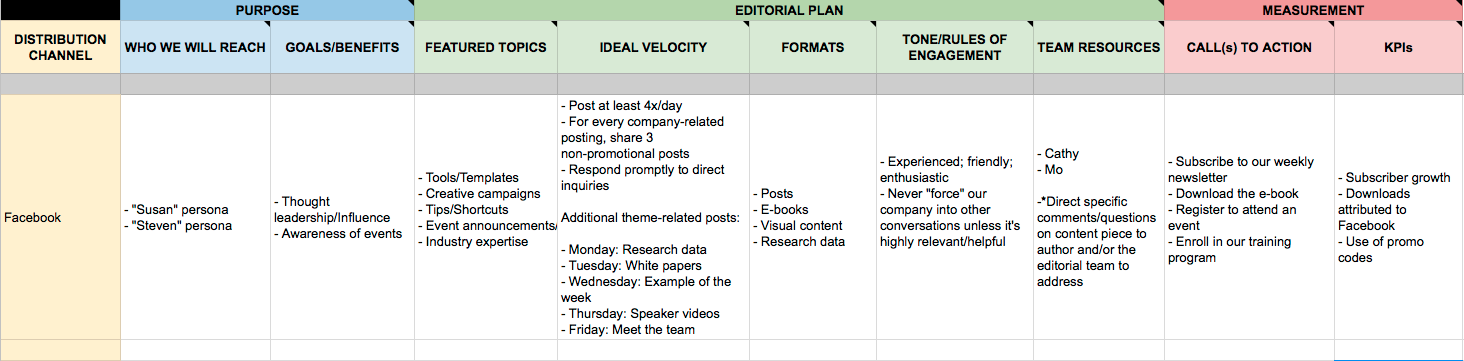
Don’t have a documented content marketing strategy or editorial plan in place? You can use this list of considerations to build a quick framework for distribution:

  • Your audience: What persona(s) is most active/engaged on this channel?
  • Target goals/benefits: What will this channel help you accomplish? Do unique opportunities exist that you can’t achieve elsewhere?
  • Featured topics: Specify subject areas/conversations likely to resonate with this community.
  • Target velocity: How often and what time of day should you post on this channel? How much should be spent listening vs. contributing to relevant conversations?
  • Formats: What content types will you use here? What formats could give you a competitive advantage in this space?
  • Tone and rules of engagement: What conversation style and voice work best? What are special criteria or considerations to follow?
  • Team resources: Who is the team member in charge of communication on this channel? Will other personnel be authorized to post on company’s behalf? Who will be notified if questions arise or issues escalate?
  • Calls to action: What owned media/conversion points should traffic be driven to?
  • Key performance indicators (KPIs): What metrics will gauge content performance against your goals?

Document your decisions

The final step is to document the pertinent details of your distribution decisions, so the information can be referenced easily, updated as necessary, and shared throughout your organization.

One method is to build a detailed matrix of key information for each of your chosen distribution channels. If you take a look at the sample template below – in which the information has been filled in for a single channel (Facebook) – you can get an idea of how this might look once you are finished.

Click to enlarge

Click to enlarge

Editor’s note: While we used CMI as a reference for this template, the sample data shown does not represent our actual channel plan.

Put all the pieces in place

Looking for additional tools and templates for building your distribution plan? These resources might help:

3. Promote your content and amplify its impact

Simply posting your content and waiting for your ideal audience to magically discover it just doesn’t cut it. You need to do a little marketing legwork for your efforts to get found and consumed by the right audiences (at the right times and places), deliver on their expectations, and enable them to spread your brand influence further – no matter where you decide to publish.

Optimize your content for organic search

How you position your assets largely determines whether they make it into the hands of the consumers you are looking to engage. With search playing such a powerful role in content discovery, it’s vital your content be optimized for search engines to easily discover, categorize, and feature it prominently when your target audience runs queries relevant to your business.

Consider these factors when setting up your content for greater search success – and stronger performance overall:

  • Metadata: Metadata is a broad category that covers a range of ways you can ascribe meaning and context to your content assets – including categories, tags, page titles, and URLs – so search engines can effectively rank and display your content.
  • Keywords/key phrases: Keywords are a type of metadata tag – they tell search engines what your content is about, so they can let your audience know when you have the information they seek. Make sure the ones you choose are descriptive and clear, but also hit the sweet spot between search volume and level of competition.
  • Link building: Earning referral traffic via backlinks to your content from authoritative, well-respected publications, relevant social media influencers, prominent industry thought leaders, and other high-profile communities is the currency that SEO successes trade on.
  • Calls to action: These are the “little statements that could,” as they both signal to users you want them to do something after engaging with your content and to put them on your designated path toward that conversion.

With organic reach on social media in sharp decline, and search trends and algorithm changes continually complicating the playing field, if you want your content to help further your business purpose, you should consider amplifying its power with paid promotion.

Most marketers should be familiar with paid advertising techniques – like banner ads, sponsorship deals, paid product placement, and the like – and you can certainly use these techniques to promote your content just as you would a product or service. But content marketers can also take advantage of more strategic, subtle, and authentic means of getting their high-quality content efforts in front of the right consumers, such as:

  • Native advertising: Rather than disrupting the reader’s editorial experience, the content in native advertising and other sponsored content campaigns is designed to align with the tone, format, and topical focus of the articles a reader would expect to find on that publisher’s site.
  • Paid search: This technique involves purchasing pay-per-click ads or other sponsored listings that appear near the top of search engine results pages (SERP) when consumers search for information relevant to your content.
  • Influencer marketing: Influencer marketing programs enlist the assistance of strong voices in your industry – i.e., people who have the ear of your target audience – to help bring your content to their attention.
  • Paid social media promotion: You should be distributing your content on your audience’s favorite social channels, and organically promoting it by encouraging your fans and followers to share it among their networks. But you can boost your content’s reach much further, and do so much faster, by building paid promotional campaigns around your strongest content assets and special features.

Recycle high-performing assets into evergreen classics

Above and beyond paid and organic promotion, you can extend the reach and impact of your top-performing assets by periodically reusing and resurfacing them. By amplifying content pieces already resonating and driving strong results, you reinforce your brand’s value in the mind of your audience, while increasing the odds that your best work will get discovered by audiences that may have missed it the first time around.


Extend the reach and impact of your top #content assets by periodically reusing or resurfacing them. @joderama
Click To Tweet


The following recycling techniques – used alone or in combination – can help you extend the value of your older assets, place your best information in a fresh context, or add something new and useful to a popular conversation:

  • Republish it: If an asset’s value hasn’t diminished since its publication but its performance has started to slip, simply republish it (making sure to replace any outdated information) so it makes its way back into readers’ feeds and onto their radar.
  • Repackage it: This involves deconstructing your long-form content – like blog posts, white papers, and e-books – into smaller, modular assets. Those assets can be combined with other relevant information on the topic to form a new piece that might be more attractive to different audiences.
  • Repurpose it: Like repackaging, repurposing involves deconstructing your original assets; but rather than combining them with other content pieces, the individual pieces become a new form of conversation. The message itself remains mostly intact – it’s just tailored to suit a different purpose or to fit a different platform.
  • Syndicate it: You can partner with news sites, trade media, and other like-minded mass media outlets that might be interested in republishing your content on an ongoing basis. Syndication deals can take several forms (both paid and unpaid), but regardless of how you structure the agreement, you’ll likely get some added link juice in the deal.

Pack more power into your promotion plans

Want to explore your amplification options in more detail? Here are some of our favorite guides to this part of the content marketing process:

Conclusion

With all the opportunities available to help you spread your brand’s value far and wide, there’s no excuse for letting your best assets wither and die in obscurity. Distribute your content wisely and promote it conscientiously, and your brand will enjoy enhanced performance from every piece of content you create.

Map your plans to travel to Cleveland, Ohio, Sept. 4-7 for Content Marketing World, and expand your content marketing knowledge and skills. Use the code BLOG100 to save $100 when you register. 

Cover image by Joseph Kalinowski/Content Marketing Institute

The post Road Map to Success: Content Distribution Essentials That Win Eyeballs appeared first on Content Marketing Institute.

09 Apr 15:50

Building a Learning and Development Culture for Remote Employees

by Kristine Yamartino

Editor’s Note: This article is the second in a series on Learning & Development. You can read the first post here.

In just over a decade, the number of Americans working remotely has increased 115%. The rising popularity of remote work among employees is due in large part to a favorable work/life balance. In fact, employees see monetary value in this balance. A study run by economists from Princeton and Harvard indicated that employees would be willing to sacrifice up to 8% of their wages to have work-from-home flexibility. And employees aren’t the only ones realizing the benefits. Employers are capitalizing on remote workforces.

From a hiring perspective, remote flexibility widens the talent pool, allowing employers to hire from more diverse backgrounds. Once employed, remote employees have been shown to be more productive than their onsite counterparts, and their retention rates are higher. As an added benefit, operating costs are lower for a remote workforce.

While there are numerous advantages to working remotely, there are challenges surrounding engagement and management. When managing onsite employees, it’s relatively easy to ensure that the members of your team have equal access to learning and professional development opportunities. With remote employees, ensuring this access is more difficult. A conscious effort needs to be made in order to guarantee the same opportunities – beginning with onboarding.

Onboarding onsite employees usually begins with an orientation and a discussion of expectations. This is often followed by hands-on practical job training. If possible, bring remote employees onsite for onboarding. Doing so can help standardize the onboarding process across all employees, and establish a personal connection.

If onsite training isn’t a possibility, you’ll likely have to rely more heavily on screen-sharing and video conferencing tools. A primary pain-point in remote working relationships is communication. Setting expectations early as to channels the team will use to communicate (both for training and daily communication) is important. Whether it is through email, text, or a company-wide messaging service (like Slack), both employees and managers should have the same expectations surrounding communication.

Once communication lines are established, provide training as you would for an onsite employee, and then allow the remote employee to work autonomously for a few hours. Remain available for questions throughout that time, but let the employee drive the work. After a few hours, collaboratively review what they’ve done, and offer assistance and recommendations as necessary. This onboarding process will set the tone for your future working relationship, so encourage questions and make yourself an available resource.

Once onboarding is successfully completed, it’s important to align expectations regarding check-ins and update meetings. Although casual in-person check-ins are not available to managers of remote employees the same way they are to onsite-employee managers, managers can set the expectation of scheduled video calls weekly or biweekly. These check-in calls can serve a twofold purpose: on the one hand, managers will be able to make sure their employees are accountable and supported. On the other, the remote employee has an outlet for questions or concerns, and a more casual way of connecting with the team.

As employment continues and formal learning opportunities are offered to the rest of the team, make sure all resources are accessible to your remote employees. Whether this is a live-stream of a speaker coming into the office or putting all interesting reading materials in a shared Box or Drive folder, informing and encouraging remote employees to engage with these resources is key.

One strategy for engaging remote employees for continuous learning and development is to assign more casual “homework assignments.” Offer readings or e-learning exercises, and allow remote employees to complete them at their own pace. This is a way to take advantage of the autonomy remote employees already successfully implement.

Although formal training programs are important, informal learning comprises up to 75% of total employee learning, and should be fostered. Creating a “virtual water cooler” can be a great way to engage remote employees and encourage peer relationships. These peer relationships bolster employee engagement while simultaneously providing a channel for collaboration.

Offering your remote employees learning and development opportunities, as well as informal ways to connect with peers, is a great way to foster employee engagement. It’s also a way to counteract an “out of sight, out of mind” philosophy when it comes time for raises and promotions.

A 2013 study indicated that although remote call-center employees were more productive than their onsite counterparts, they were at a disadvantage when it came to receiving performance-based raises and promotions. This is attributed to remote employees having less face-time with managers, as well as remote employees being less informed about opportunities for advancement. In order to counteract this, define metrics for performance-based raises and promotions. In establishing a formal evaluation process, remote employees will be judged based on the quality and breadth of their work, as opposed to intangible factors.

As remote work rises in popularity, access to learning and development will continue to be critical. In order for employers to fully realize the benefits of a remote workforce and avoid common pitfalls, they will need to make a conscious and consistent effort to democratize resources for all employees.

The post Building a Learning and Development Culture for Remote Employees appeared first on OpenView Labs.

09 Apr 15:47

Do You Have A Leak?

by Alan Weiss

When you have a water leak, it makes sense to check the fittings, the faucet, the valves, and so forth. Somewhere along the pipe something has gone wrong.

If you have a buyer who has agreed to review a proposal but then “goes dark,” you have a sales process leak in one of these areas:

  1. You weren’t interesting or compelling and the buyer just wanted to get you out of the office without saying “No” to your face.
  2. Your ROI wasn’t sufficient because you had little monetization and/or the objectives were purely internal.
  3. Your process and proposal made sense, but the buyer didn’t believe that you could pull it off, because there was insufficient trust.
  4. You were insensitive to the conversation and missed certain responses and/or didn’t ask the right questions to begin with.
  5. You failed to reconfirm everything before you left the meeting, including budget if necessary, and didn’t agree on the next time, date, and action.

Some buyers are just rude, but that’s unlikely if you’ve gone as far as a proposal. Your pipes are leaking in one of those five areas.

The post Do You Have A Leak? appeared first on Alan's Blog.

09 Apr 15:47

Stop Selling and Start Leading: How to Make Extraordinary Sales Happen

by News

James Kouzes and Barry Posner are a prolific team best known for their 1987 book, The Leadership Challenge (one of The 100 Best Business Books of All Time). One of the four key leadership characteristics they identified in that book was the tendency to be forward-looking, to be able to "Inspire a Shared Vision."

Veteran sales expert and consultant Deb Calvert has joined the writing team for their new book, Stop Selling and Start Leading: How to Make Extraordinary Sales Happen, and a key focus remains that all-important trait of looking, and moving, forward—even when things haven't gone as planned, even in the face of failure.

And, to do that, they explain why… 


◊◊◊◊◊


Mindset matters. If you believe you are powerless to effect change, you’ll miss your opportunities to do so. Instead of learning from challenges and disappointments, you’ll feel negatively about them. Negativity is contagious and repels buyers. When you fail, look for ways to reframe your failures as learning and growth experiences.

You can formalize this process and conduct “lessons learned” reviews. With your buyers or internal partners, talk openly about what worked and what did not. Don’t dwell on blame or shame for what didn’t work. Instead, ask what you could do differently next time. Make it a priority to learn together anytime things don’t go as expected. One buyer told us such “lessons learned” meetings with sellers were very important, a top priority. Another said, “It’s good to work together as a team and to go over things—positive as well as negative—and to think about how we can better ourselves and the company in the future.”

For some sellers, the idea of baring your failures and errors to buyers may seem strange. But consider these three very important truths:


Y
our Buyers Already Know Something Didn’t Go as Planned or Promised.

Concealing mistakes plants seeds of doubt in the buyer’s mind. They may wonder if you’re aware of the mistakes. If it appears you’re not aware, they may feel apprehensive because now there’s a good chance the mistakes could happen again. Buyers need to know you’re in control when there are mistakes. You want your buyers to feel the way this one did after a problem occurred: “The product had an issue, and the seller was helpful with fixing it, by listening and being open and honest. The seller came up with solutions on how to prevent this from happening again. It made me feel great, less stressed, and more confident in the seller as a long-term partner.”


Whe
n You Acknowledge Mistakes and Seize Opportunities to Learn from Failure, You Set a Standard for Your Buyers.

Perhaps they won’t let their fear of failure prevent them from taking risks to champion your shared vision when the going gets tough. You want your buyers to think of you the way this one thinks: “I have a vendor that often faces issues with their raw material suppliers. They always focus on our relationship first. Then they look for creative ways of overcoming the obstacle. It’s all out in the open. I’ve learned a lot from their approach.”

 
Being Vulnerable and Open Makes You More Trustworthy.

In the buyer/seller relationship, trust is hard to build and easy to lose. Being transparent keeps buyers like this one happy: “There was a problem with an order I placed with the seller. They were on the ball communicating with us, no smoke and mirrors, and they did everything in their power to make sure we were happy. They gave us a discount for the mistake they made, and they were very professional. It made us have confidence in that company and trust in those sales people.”

Failure is bound to happen at some point when you’re pursuing possibilities and challenging the status quo. It’s what you do in response to the failure that matters most. That’s what experimentation is all about, and that’s how you should think about it even before you begin. There’s bound to be trial and error involved in testing new concepts, new methods, and new practices. Your buyers don’t expect perfection. They expect effort to prevent problems as well as acknowledgment when failures or setbacks do occur. You can proactively set expectations on the front end, too, so no one is surprised when learning opportunities manifest.

There are opportunities for learning in everything you do. Learning is essential for leading.


Excerpted with permission of the publisher, Wiley, from Stop Selling and Start Leading: How to Make Extraordinary Sales Happen by James M. Kouzes, Barry Z. Posner and Deb Calvert.
Copyright © 2018 by James M. Kouzes, Barry Z. Posner and Deb Calvert.
All rights reserved. This book is available wherever books and ebooks are sold.


ABOUT THE AUTHORS

JAMES M. KOUZES is the Dean's Executive Fellow of Leadership, Leavey School of Business, Santa Clara University, and according to the Wall Street Journal, one of the twelve best executive educators in the United States.

BARRY Z. POSNER, Ph.D., is the Accolti Endowed Professor of Leadership at the Leavey School of Business, Santa Clara University, where he served for twelve years as Dean of the School.

DEB CALVERT is the founder of People First Productivity Solutions and The Sales Experts Channel, and author of one of HubSpot's "Top 20 Most Highly Rated Sales Books of All Time."


For more information about their new book Stop Selling and Start Leading, please visit stopsellingstartleading.com

09 Apr 15:47

Boosting Revenue with a Strategic Sales Partner

by Waseem Khan

Consistent top-line revenue generation is necessary for the continued survival, and success, of any business. Yet, while organizations are more than happy to hand over the reins of functions like payroll and IT to third-party service providers, when it comes to sales many CEOs balk at the notion of allying with a strategic sales partner.

Although you might consider sales to be a core competency of your business, the truth is that most in-house sales teams are inadequately equipped to deal with the demands of customer acquisition, lead generation, appointment setting, and closing. In fact, 82% of CEOs acknowledge that they currently have a broken sales process, an admission that all but confirms that the strategic vision required to revamp sales processes is lacking within a majority of organizations.

For businesses that are struggling to optimize their revenue generation, these problems can be easily resolved at a fraction of the cost, with the aid of professional sales team.

Consider the Statistics

Researchers at Marketo, have identified the following metrics related to lead qualification and sales:

  • A 5% increase in selling time results in a 20% increase in revenues.
  • A 1% increase in active opportunities along the sales pipeline leads to 25% more revenue.
  • A 15% shorter sales cycle can increase revenue by up to 30%.

Now ask yourself, does your sales department have the necessary resources, or technical skills, to deliver on any of these objectives? At Invenio, we employ a team of data scientists that are solely focused on adding efficiency to the lead generation process. Using cutting-edge automation tools, and data-driven insights these sales specialists can deliver qualified customers right into the hands of experienced closers.

Identifying New Opportunities for Growth

By design, in-house sales teams are constrained in terms of their location, expertise and outside reach. While your existing networks might be enough to secure a few big-ticket customers that will sustain your business, they simply won’t offer you the necessary flexibility to pursue customers in new markets.

At Invenio our sales team functions as a strategic partner for your company’s lead generation and growth strategies. Our channel experts can help you identify the best channels for reaching new prospects, while our analysts can work on developing sales opportunities in overlooked vertical and geographical markets.

Leveraging Analytics

Analytics tools and CRM software may have brought new efficiencies to the selling process, but maintaining the necessary infrastructure and personnel to properly leverage these technologies requires a substantial investment of time and money.

At Invenio we already operate a multichannel technology stack that can target customers across social media, chat, and voice. In addition, our data scientist can develop and implement industry-specific analytics platforms that can help them break down thousands of data points within the customer’s journey. Using these insights, we can anticipate objections proactively, and identify the best time to move a lead from one part of the marketing funnel to the next with the ultimate purpose of securing a speedy conversion.

09 Apr 15:47

Here’s How LinkedIn Can Become Your Inbound Sales Machine

by Alex Rynne
White Clock

Inbound is in.

HubSpot hosts an annual event by that name, and in 2017 it drew more than 20,000 attendees to Boston. You would be hard-pressed to find a marketing department anywhere that doesn’t rely on inbound tactics to some extent, and many businesses focus on these acquisition principles almost exclusively.

It’s only logical at a time where consumers and companies have taken so much of the buying process into their own hands. Inbound represents a shift from push to pull; a methodology designed to turn your brand into a destination that magnetically attracts potential customers along the journey to purchase.  

As sales and marketing departments become more strategically aligned, building out an infrastructure for inbound success is a crucial priority. This is a subject covered in our new eBook on LinkedIn targeting, and today we thought we’d dig a little deeper into the fundamentals of effective inbound sales on the platform.

Why is Inbound So Important?

HubSpot defines inbound marketing as “attracting customers through relevant and helpful content and adding value at every stage in your customer's buying journey. With inbound marketing, potential customers find you through channels like blogs, search engines, and social media.”

In many ways, this reflects the principles of social selling, a practice that is very much inbound in nature. Sellers are experiencing tremendous success through this approach, which enables them to cut down on time and rejection with prospecting.

In marketing, inbound tactics are proven to deliver far better ROI than outbound ones, mostly because of the significantly lower costs. With inbound marketing, you’re not buying huge prospect lists, or sending out mass email blasts. Instead, it’s about laying the groundwork for being discovered by interested parties and generating buyer-initiated conversations.

Sales can absolutely adopt this mindset, and teams everywhere are already doing so. On LinkedIn, there are three activities in particular conducive to creating, and capitalizing upon, inbound interest.

Boosting Inbound Sales Success on LinkedIn

If you’re fairly active on LinkedIn, and orienting your presence on the platform toward the people you wish to engage, then you’re likely to gain some level of inbound traction naturally. Professionals in your niche may come across your profile because they sought out keywords and content relevant to their jobs, or because of mutual connections.

Here’s how you can be sure you’re making the most of these opportunities.

Present Yourself as a Helpful and Knowledgeable Authority

We like to put it this way: When you think about prospective buyers exploring LinkedIn, what would make them say “I’m glad I found this profile!” when stumbling across yours? Your profile shouldn’t simply look like a résumé or barebones professional snapshot. For social sellers, it should serve as a valuable resource hub that features unique stories, insights, and ideas relevant to your customers.

There are several places you can add these dimensions. For instance:

Headline: It’ll automatically populate with your current job title, but you can customize it. Get specific. Try to make it compelling and attention-grabbing for the specific type of members you’d like to reach.

Summary: You’ve got 2,000 characters to work with here. We don’t necessarily recommend using them all, but the space provides ample flexibility to frame yourself as an advocate and trusted advisor.

Experience: Don’t just rattle off your previous jobs as if you’re trying to sell yourself to an employer. List details about your work experiences that help make you great at what you do now, and a valuable partner in the buying experience.

Track Who’s Viewing Your Profile

Even if someone views your profile and enjoys it, they won’t always try to interact or connect. This is why the ability to see who’s viewed your profile — plus the added insights available to LinkedIn Premium and Sales Navigator users — are quite beneficial. You can keep tabs on members who are checking you out, and when it makes sense, reach out with a personalized connection request or message (or at least make a note that they’ve showed some level of interest).

Use Activity as a Timing Trigger

As every seller knows, timing is everything. When it comes to prospecting, it’s not only about “who” but “when.” Engage at the wrong time, when someone is busy with other things, and your outreach can easily slip off their radar. Then you’re already treading the line of coming off as pesky if you try again later.

LinkedIn feeds update in real-time. If you’re following people and vigilantly keeping an eye on your feed, you can pinpoint moments when they’re active on the platform and — in all likelihood — more open to taking a call or responding to a message.

A Sustainable Inbound Process

Think about ways you can apply the three actions above cohesively. If you build out your profile, track and segment members who view it, and then reach out at times when they’re active on the platform, you’ve got a strong recipe for conversations that will move on to the next step. And really, once you’ve established this routine, you don’t have to do all that much work to make it happen.

That’s inbound sales in a nutshell.

Want to make sure you’re doing all you can to load the funnel with qualified leads? Download Read This If You Want to Target the Right Prospects on LinkedIn.

09 Apr 15:47

Expert Insight: 7 Ways to Take Personalization in e-Commerce Beyond Targeted Emails

by Cammi Pham

Twenty years ago, a young entrepreneur told The Washington Post, “If we have 4.5 million customers, we shouldn’t have one store. We should have 4.5 million stores.” That person was Jeff Bezos, founder of Amazon, who turned his vision into one of the biggest e-commerce brands on the planet.

Even in the behemoth’s earliest days, Bezos believed personalization to be the future of online shopping.

In a nutshell, e-commerce personalization is tailoring a consumer’s journey, offers and content based on their previous behaviours, demographics and personal data.

Here’s an example you may be familiar with:

Dynamic remarketing ads are another example. While remarketing allows you to show ads to people who visited your website, dynamic remarketing takes this a step further, allowing you to show personalized ads for the exact products that previous visitors viewed on your site.

Another familiar case with this touch of personalization is an email reminding visitors to come back to the store when they abandon a cart.

ecommerce personalization

By modifying your website in real time based on consumer behavior, you can increase your conversion rates and reduce your acquisition costs.

Before implementing e-commerce personalization, ask yourself:

  • Who you are personalizing for
  • What do you want to show them
  • What type of impact you will expect in revenue and how to measure success

Marketing without data is like driving with your eyes closed. If you are treating every customer the same, you are leaving money on the table.

With the rise of artificial intelligence (AI) and sophisticated data analysis software, personalization is no longer exclusive to big e-commerce brands. Any online store can easily personalize their customers’ buying experience in real time based on user behavior beyond email marketing segmentation.

#1. Geo-location targeting

The internet has erased the border between countries, helping e-commerce brands reach people all around the world.

However, factor in different currencies, pricing, shipping and promotion and things start to get complicated. For instance, you don’t want to send a snowsuit promotion in euros to an Australian customer during summer.

In this example, Nordstrom redirects visitors to their Canadian store to view pricing in Canadian dollars as well as a list of stores and tailored messages.

ecommerce personalization

Apps such as Currency Converter Widget (WooCommerce) or Multi Currency (Shopify) enable e-commerce businesses to add multiple currencies to their shop with just a few clicks. You can also redirect visitors from specific IP addresses to custom landing pages for their country.

#2. Chatbots

facebook ads ecommerce personalization

Source: AdEspresso

According to Facebook, 53 percent of people are more likely to shop with a business they can message, while 56 percent of people would rather message than call customer service.

Top e-commerce brands have started to adopt chatbots. Facebook and Telegram have already created their own and software such as Botsify, Chatfuel, ChattyPeople and MEOKAY makes it easy for anyone to build a chatbot in a few simple steps.

Facebook rolled out Messenger Destination for News Feed, a new form of advertising that consumers don’t expect and have not yet developed blinders to. It allows brands to initiate a two-way conversation to learn more about current and prospective customers.

This data helps to segment the audience and improve targeted advertising targeting, which allows brands to serve more tailored and personalized ads to their target market and customers.

#3. Dynamic advertising

Targeted advertising is no longer a standalone tactic. With AI and behavioral data, marketers can now tailor ads to each consumer at the right time during their purchase journey. Some will convert with discounts; others will convert at full price if you can tell a relevant story.

ad ecommerce personalization

One of the most obvious mistakes that e-commerce advertisers make is targeting customers who have already converted with conversion ads.

By syncing your e-commerce store and advertising platform, you can exclude any recent purchaser from your conversion funnel. This saves your marketing dollars and ensures your ads are being pushed to the right people.

ecommerce personalization

Source: Klaviyo

Personalized advertising can also go beyond top funnel. Advertisers can leverage AI to serve retention ads based on consumer behavior.

Some people buy often, others take longer. By leveraging data, advertisers can avoid annoying customers with high-frequency ads, reduce cost per action (CPA) and increase return on ad spend (ROAS).

Here are some campaign ideas that you can easily create by leveraging custom audiences in Klaviyo or using tracking pixels.

  • Winback: target customers that haven’t purchased in a while featuring popular or trending items
  • Re-engage: target inactive subscribers with a relevant Facebook Ad featuring items they viewed on your site or featuring a limited-time offer promotion
  • Cross-sell: target customers who bought one product (pants) with a different but complementary product (shirts)
  • New customer: target those who visited your site and never purchased to encourage first-time conversions
  • Cross-channel: target customers you’re already reaching by email with relevant Facebook Ads that reinforce the message and have a similar call-to-action
  • Lookalike: take a VIP list or segment from Klaviyo and create a lookalike audience on Facebook to reach new leads that resemble your best customers

Lastly, you can always use geofencing or IP targeting to spotlight people based on places they have visited. This way you can target people who have been in your physical store and follow them around the internet, which helps your brand stay top of mind.

#4. Personalized content marketing promotion

Sixty-three percent of consumers said they would think more positively of a brand if it offered them content that was more valuable, interesting or relevant, according to Rapt Media.

That’s why 20 percent of content marketing is creating great content, while 80 percent is pushing it to the right people, at the right time, in the right place.

Done well, content marketing enables e-commerce stores to push product-placement campaigns based on customer interest.

Focus on your most loyal fans first through email marketing and social media. They already know your brand and will likely engage with the content. Once you gain some initial traction within your current circle, promote the content with paid ads to prospects based on their online behavior and purchase interest.

#5. Personalized video marketing

Video marketing is one of the hottest marketing trends of 2018. This year you’ll see more brands host live video to connect with consumers in real time.

Using software like Idomoo, Vocalcom and CoVideo, brands can send tailored videos in real time to customers to address all their top pain points.

This tactic has not yet been widely adopted which allows brands to stand out. Videos are tailored based on profile, historical and situational data attributes that are personalized to the individual, leveraging your CRM and data.

ecommerce personalization

Source: Idomoo

#6. Push notifications

With new competitors joining the market every day, e-commerce brands need to find new ways to grab visitors’ attention and keep them coming back. By tracking your customer’s behavior, you can send relevant push notification messages.

For example, whenever your customer abandons a cart, they will immediately receive a message with a reminder or offer. You can also send a message when you have a price drop or a new promotion or when sold-out items are back in stock.

ecommerce personalization

E-commerce stores are slowly adopting this strategy, so there is still time to adopt before it becomes the norm.

Here are some great apps to add push notifications to your e-commerce store: PushOwl (Shopify) Push Notifications by FirePush (Shopify) and PushAlert (WooCommerce)

#7. Create a sense of urgency

The internet allows your brand to easily reach their target audience, but it also creates a million distractions. You should try to convert customers as soon as possible before they lose interest.

For example, Leesa offers an introductory promotion with a countdown clock. Including a sense of urgency makes people feel as though they’re going to miss out on something and they will be more likely to take action for fear of losing out.

ecommerce personalization

Another hot trend is capturing emails with a spinning wheel pop-up. You can layer the two trends by allowing your customers to spin a wheel to unlock a coupon and then add a sense of urgency by using a countdown feature.

Wheelio (Shopify) and WP Optin Wheel ( WooCommerce) are two examples, while there are many apps that allow you to add promotion countdowns such as Countdown Cart by Beeketing (Shopify), Sales Countdown Timer Bar (Shopify), Countdown Timer (Shopify) and WooCommerce Sales Countdown (WordPress).

Meanwhile, Facebook Countdown Retargeting by TopVid ( Shopify) will allow you to retarget your visitors with an interactive countdown timer inside a video ad.

ecommerce personalization

Right now is the best time to start an e-commerce store, but it is also the hardest time to grow an e-commerce store. In order to stand out, e-commerce brands can no longer treat every customer the same. The more personalized you can get, the better customer relationships you can build.


Sell more with a connected e-commerce platform

Try xSellco now

Sign up for a 14-day free trial today. No credit card needed.

07 Apr 17:02

7 Stats That Will Make You Rethink Mobile Email

by Andrew Gazdecki

geralt / Pixabay

Making marketing efforts seamless on mobile is a challenge for businesses of all sizes. Unfortunately, businesses tend to resist the call of mobile for far too long because they don’t fully understand what it means to “go mobile.”

That’s because mobile is an umbrella term that covers a wide range of tactics, trends, and strategies. Many of tactics are already being performed by your business in some form, while others may remain a challenge.

Mobile’s impact is undeniable and email is one dimension of your marketing strategy that is affected by it. The impact is a positive one, but getting the most out of these new technologies means accepting mobile. It is no longer a question of if and when you should incorporate mobile, but how.

Mobile email is a great place to start. If you’re still avoiding mobile or don’t understand how it can impact your company, you’re already behind the game. So read fast, take notes, and begin rethinking mobile email immediately with these seven key statistics.

1. Emails that display incorrectly on mobile may be deleted within three seconds (Adestra)

Poor formatting is the number one complaint about mobile email. If an email displays poorly, no matter how good the content is, it’s likely to be deleted in under three seconds (in >70% of cases). As many as 15% of users will even unsubscribe, instead of delete. All in all, that’s an 85% drop in potential customers on mobile.

What qualifies as poor formatting for mobile email?

  • Oversized or out-of-place images
  • Too much text without enough breaks
  • Multiple column layouts (without a responsive template)
  • Lack of alt text (for when signals are poor)

So how do you make sure that your emails are formatted correctly and won’t be doomed to immediate deletion? Get a responsive email template, then test it.

Even with a template, you’ll still have to watch your image sizes and make sure to break up your text appropriately. Furthermore, it’s a good idea to use buttons for your CTAs instead of links. Links are hard to tap on and frequently require a user to resize or zoom in.

2. 37% of in-store retail sales are influenced by a shopper using a mobile device (Deloitte)

Customers are loud and clear when it comes to mobile and shopping. Even when consumers make purchases in-store, there’s a high chance that some form of mobile or digital interaction influenced the final decision to buy.

In addition to mobile influencing spur-of-the-moment purchases, it can also be used to spark planned purchases. In a survey of roughly 2,000 American shoppers, 38% reported buying a product they had first seen or read about in a marketing email on their mobile phone. 45% of those purchases were in-store.

Three of the most common reasons people use their smartphone while shopping in a physical store are:

  1. To perform more extensive research on that particular product and products like it to find the absolute best fit for their needs
  2. To search for any deals or coupons offered by the store or to compare with online prices
  3. To see if the store provides self-checkout through a mobile device (a relatively new option for some stores that is gaining traction)

3. Emails are now opened more on mobile than desktop (eMailmonday)

How much more emails are opened on mobile varies depending on certain factors, like the age of the email recipient, type of email (direct sell, newsletter or otherwise), type of product or industry and so on. While open rates are affected by a lot of factors and different sources report a range of mobile email open rates, there are a few overall conclusions we can draw:

  • Almost every report on email open rates concludes that mobile is responsible for, at least 50% of all opens
  • Mobile email open rates are significantly higher among younger generations than older audiences
  • IT, B2B and wholesale companies have the weakest mobile email opens, while TV/radio/film, events, and real estate are some of the highest benefactors of mobile email campaigns

The impact of mobile on email marketing is evident, especially if the intended target audience is on the younger side (i.e. under 34-years-old).

4. Mobile users check their email 3x more (Google)

Mobile users spend the majority of their time on mobile devices inside apps. More than 70% of people read their email in a mobile app, with most checking their email in the morning.

What does this mean for you? First, it means you need to make sure that your emails are formatted for mobile, so test your emails before sending and make sure they look good on multiple screens.

Next, time your emails right. Yes, the highest rates of email-opening on mobile occur mid-morning. However, if your information is time-sensitive, mobile users are still likely to be the most receptive group. Nearly three out of four people will check their inbox many times a day (or as new emails arrive). The majority of desktop users, as a group, tend to check their email once a day or less.

5. Mobile email traffic is more valuable than desktop clicks (Yesmail)

With more customers buying products on mobile, it’s no surprise that mobile conversion rates are up. What is surprising is exactly how much more valuable they are than desktop clicks. In the span of a year, email conversion rose, across the board, as much as 70% for mobile email. During the same period, desktop traffic reported slightly lower conversion rates across the board.

6. 52% of customers are less likely to engage with a company because of bad mobile experience (Wow Local Marketing)

This statistic sums up the impact of mobile and why you should rethink your mobile strategies immediately. Essentially, half of your potential new customer will walk away if you offer a bad mobile experience. By putting mobile on the backburner, you not only run the risk of engaging fewer new customers, but you indirectly encourage those potential customers to turn to your competitors instead. And, once displeased with your mobile experience, it can be incredibly hard to re-engage those users, even once you’ve fixed your mobile woes.

7. 73% of companies surveyed prioritize mobile device optimization of emails (Smart Insights)

A many as nine in ten businesses are developing a strategy to optimize for email marketing, though some report that a lack of resources may prevent them from implementing it. With nearly three in four businesses currently providing that experience, it’s perfectly reasonable for your customers to expect that your business will too.
This result is also 14% up from the previous annual survey, showing that marketers are placing an increasing priority on mobile optimization across many industries. Whereas just a few years ago email optimization for mobile was a rare event, lack of optimization is now an anomaly. Further, without an implemented mobile or “omniplatform” optimization strategy, it can be hard for a business to move on to the emerging trends in email strategy, such as interactivity, segmentation, and personalization.

Wrap up

Your target audiences are using mobile more and more, and they expect you to do the same. It’s time to meet mobile demands and expectations of your target audiences so that you can give customers the experience they deserve.

07 Apr 16:58

Book review: Fear of a nuclear winter remains

by Tracey Tufnail

The Doomsday Machine: Confessions of a Nuclear War Planner

By Daniel Ellsberg

Bloomsbury Publishing, New York, London, Oxford, New Delhi, Sydney

2017, $40, 420 pages

What would you do if you were a young professional working at your dream job, and you discovered your employer was lying to the public, promoting a disastrous foreign war and steadily expanding a weapons program that threatened to destroy human life on earth? In 1971, that was the dilemma facing Daniel Ellsberg, a brilliant young academic and consultant at the Rand Corporation, a Cold War think-tank with close ties to the US Air Force. 

His work for Rand gave him a close look at the dysfunctional underbelly of US nuclear war policy and the decades-old record of government lies that surrounded and supported American involvement in Vietnam. He resolved the crisis of conscience that resulted from these discoveries by smuggling documents out of his office at Rand and arranging for the evidence they provided that the US government had lied to the American people about Vietnam to be leaked to the New York Times and the Washington Post. Known as the Pentagon Papers, these documents played an important role in the emerging resistance to the war around the world and made Ellsberg a kind of prototypical whistleblower. (Part of this drama is captured in Steven Spielberg’s recent movie “The Post.”)

According to his new book, The Doomsday Machine, Ellsberg wasn’t just concerned about Vietnam and government mendacity about the war. He was also terrified by what he had learned about America’s nuclear arsenal and the dangers to life on earth posed by the inadequate provisions made to prevent the outbreak of an accidental nuclear war.

We tend to think that the end of Cold War tensions has resolved any concerns about nuclear war, but Ellsberg points out that the existing arsenals held by nine states (which come to nearly fifteen thousand warheads) still represent a clear danger to human survival. Even a limited nuclear exchange would be enough to trigger a life destroying “nuclear winter,” and the combination of blast, radiation and climate disruption could wipe out all human life. The seasoned whistleblower argues for a series of reforms that would reduce the risk these weapons pose and challenges his readers to support demands for dismantling the “doomsday machines” maintained by all the nuclear powers. This is a compelling and alarming book, and it should be read by anyone who cares about the human future.

• Tom Sandborn lives and writes in Vancouver. As a child, he was encouraged at school to “duck and cover” under his desk if atomic war broke out. It didn’t seem like an adequate response at the time, and it still doesn’t. He welcome feedback and story tips at tos65@telus.net

07 Apr 16:58

How to Manage an Integrated Marketing Campaign Like a Boss

by Triniti Burton

StockSnap / Pixabay

From the customer’s perspective, a great integrated marketing campaign shouldn’t feel complicated.

The Data & Marketing Association (DMA) defines integrated marketing as,

“an approach to creating a unified and seamless experience for [people] to interact with the brand…[across] tactics, methods, channels, media and activities.”

For a B2B demand generation organization, an integrated marketing campaign can span many digital and traditional marketing channels, personas and full-funnel touchpoints. With so many moving pieces, achieving a customer experience that feels “seamless” is far from simple.

Many B2B organizations struggle to drive successful full-funnel campaigns, let alone achieve a truly integrated marketing effort. The following nine to-do’s and resources will enable your demand gen team to build stronger integrated campaigns for greater future results.

9 Steps to an Effective Integrated Marketing Campaign

1. Define Campaign Goals

The success of an integrated marketing campaign isn’t just measured in the volume of leads generated, or even the quality of quality leads. It should be measured by full-funnel marketing success (like how many opportunities it impacts and how much revenue it drives).

What types of goals should you set for an integrated marketing campaign?

Without getting too far into the nitty-gritty of demand marketing KPIs, here are a few categories:

  1. Customer Types: Personas, Target Accounts
  2. Budget
  3. Marketing-Qualified Leads
  4. Sales-Qualified Leads
  5. Closed-Won Deals

Once you’ve defined who you’re targeting and how high you’re reaching, make sure you’ve got the tools in place to automate the top-of-the funnel and achieve full-funnel visibility throughout the campaign lifecycle.

2. Know Your Target Accounts & Personas

If you haven’t taken the time to complete your buyer persona profiles–yes, actual documents which profile your ideal customers and accounts–now is the time to do it.

Here are the questions you should answer to understand who you’re targeting:

  1. What’s their job title?
  2. What’s their education level?
  3. What’s their personality type?
  4. How do they research, learn and consume content?
  5. What industry are they in?
  6. How many employees does their company have?
  7. What are their individual, team and professional goals?
  8. How is their professional success measured?
  9. What problems are they trying to solve today?
  10. What blogs do they read?
  11. Which conferences or industry events do they attend?

3. Make Sure You Have the Right Team Members

Successful integrated demand generation requires a symphony of people, processes and technology. But it all starts with the people. Each integrated program needs to have a strong leader, as well as numerous collaborators and contributors. If you don’t have the team you need to execute, consider leveraging outside expertise.

Signs you may need to hire a consultant or outsource parts of your integrated marketing efforts can include:

  1. A sheer lack of manpower
  2. Lack of budget to hire internally
  3. Lack of internal expertise
  4. A need for strategic guidance
  5. A need for training

If you’ve got talented marketers on board who lack integrated marketing expertise, a consultant may be the right solution. If you don’t have a designer and can’t hire one, a contractor might be the right solution. If you don’t meet any of the use cases listed above, you may be struggling from pain points more related to processes or technology than pure human talent.

4. Determine the Right Marketing Channels

Integrated marketing campaigns are, by definition, multichannel. Today’s B2B marketers are adopting an increased number of owned, earned and paid channels for full-funnel demand generation.

Ultimately, the best channels for your brand vary depending on your personas, brand, industry and other possible factors. The channels that drive success at the top of the marketing funnel might not be the most successful for bottom-funnel conversions.

Surveys of B2B marketers published in The 2018 Demand Generation Benchmark Survey Report reveal that the following channels were ranked as the top-three most effective by funnel stage in 2018:

Top 5 Early-Stage Engagement Channels for 2018

  1. Email (59%)
  2. Search (56%)
  3. Website (51%)
  4. Social (44%)
  5. Online Ads (27%)

Top 5 Later-Stage Conversion Channels

  1. Email (81%)
  2. Website (50%)
  3. Telemarketing (45%)
  4. Retargeting (27%)
  5. Direct Mail (20%)

Be sure that your execution plan includes a diverse range of channels, including third-party partners who can improve your ability to engage your target audiences. And don’t be afraid to test new channels and always let the data be your guide.

5. Deliver a Consistent Brand Experience

Brand consistency breeds a brand promise–an expectation of the customer experience. The more consistency you achieve with tone, design, messaging and themes of your integrated marketing campaign, the better.

What goes into a consistent brand experience?

Among other things, a mission statement, company slogan, logo designs, color schemes, typography, imagery rules, copy guidelines, good examples and a “hall of shame.”

Required documentation likely includes:

  1. Visual brand guidelines
  2. Brand voice guidelines
  3. Brand messaging and theme guidelines
  4. Buyer persona documentation
  5. Definition of your buyer’s journey

Work continuously to ensure your brand guidelines are maintained, accessed and used religiously by members of your marketing teams and third-party contractors involved in your integrated marketing campaigns.

6. Incorporate Consistent Messaging

Brand voice isn’t the same as a human voice. It’s about the use of a consistent tone, vocabulary and positioning throughout multimedia content to create a consistent customer experience.

In integrated marketing campaigns, consistency in voice and messaging matters.

Achieving consistency is easier said than done, especially if you’re coordinating with multiple content creators or even third-parties to create campaign content. The solution is to create brand voice standards ahead of time, and complete a messaging map for your integrated marketing campaign which defines personas, pain points, goals, content types, resources and promotion plans.

7. Create Content Adaptable for Multiple Channels

Remember the messaging map? It’s about to be useful once again, as you develop a campaign content calendar with an eye towards repurposing and upcycling content assets for efficiency.

Let’s say your campaign is centered around one hyper-premium content asset–an original research report you spent months developing that’s jam-packed with ground-breaking industry insights.

You’re going to publish a full-length report, but how else could a white paper research PDF be repurposed?

Possibilities:

  • 3 Industry-Specific Fact Sheets
  • 1 Data Brief
  • 1 Slideshare
  • 2 Webinars
  • 6 Social Media Graphics
  • 8 Blog Posts
  • 3 Lead Nurturing Workflows

You get the picture.

Not only does content repurposing keep your messaging consistent, it keeps duplication of efforts and wasted work to a minimum. When your integrated marketing campaign is targeting multiple personas, it also allows you to tailor your messages perfectly to the needs of specific buyers.

8. Have a Lead Nurturing Follow-Up Plan in Place

Lead nurturing shouldn’t be an afterthought once you’ve launched your integrated marketing campaign. Once the leads start rolling in, do you have a plan for processing, routing, nurturing and qualifying your new leads?

The messaging of your lead nurturing workflows should be a natural extension of your messaging map and campaign content to ensure the experience feels seamless to your prospects.

Use follow-up emails to continue sharing value and building trust.

Just as importantly, make sure you’re letting marketing automation technology do the heavy lifting by automating the sending of lead nurturing emails to your new contacts. Manual lead processing and uploading is time-consuming and error-prone and can result in lengthy delays. Automating the lead verification and upload process can speed time to follow-up, and allow you to begin moving your leads through the sales funnel.

Just as importantly, ensure your tools are able to adjust to the engagement level of your prospects, communicating with less-engaged leads less often, and accelerating how you’re conversing with your most-engaged contacts.

9. Measure, Learn, Iterate & Repeat

Integrated marketing campaigns aren’t a one-and-done effort.

Once you’ve published your lead generation content, you’re not stuck waiting to improve your efforts until your next campaign. That is, you’re not stuck waiting if you have the right tools for full-funnel measurement. These tools allow you to analyze performance in real-time, tracking things like:

  1. Lead generation velocity
  2. Lead to marketing-qualified lead (MQL) conversions
  3. MQL to opportunity (SQL) conversions
  4. Closed-won business

With oversight into every stage of the funnel, integrated marketers can understand their campaign and businesses health and adjust their campaign accordingly–increasing the budget for syndication, or improving the quality of lead nurturing workflows on an as-needed basis.

Using these metrics, you can understand pipeline health and answer questions like:

  • Do you have enough leads in each part of the funnel?
  • Is your volume steady, or better yet, growing month-over-month?
  • Is marketing’s contribution to the pipeline sufficient?

Ideally, measurement and optimization should be a never-ending cycle in a demand generation environment. With the right technologies and processes in place for real-time, agile decision making, marketers can achieve a system of iterative improvements.

Successfully Integrating Demand Marketing Campaigns

While the top of the marketing funnel at many B2B organizations is complex and involves many channels, you don’t need to manage every component of an integrated marketing campaign individually. With technologies and processes to holistically plan your demand generation strategy, you can achieve efficiency and consistency.

Orchestrating a successful integrated marketing campaign is no small effort. If one component of your program is out of sync, it can diminish results. For a comprehensive look at how your firm stacks up against programs at best-of-class B2B organizations, check out the free Integrate resource: B2B Demand Marketing Assessment Guide & Orchestration Workbook. It includes everything you need for end-to-end diagnostics, including 12 customizable worksheets.

07 Apr 16:58

5 Steps to Validate Your Idea for a Profitable Online Course

by Justin Kemp

Online courses are rapidly growing in popularity. A GM insights report estimated the value of the e-learning market at $150 million in 2016 and predicts that it will cross $250 billion by 2024.

Launching your own online course can be a very profitable venture. However, there are several elements that you have to address before you can get started.

  • How do you identify a niche that is profitable?
  • How do you compete with other existing courses?
  • How do you determine if people will buy your course – even before you create it?
  • How do you easily set up the technology required to launch your course without wasting valuable time and money?

In this article, I will cover a simple five-step process for building an online course.


1. Identify the Niche

You have an interesting idea for a course, but how do you determine if there are enough people prepared to purchase it? The first step is to look for similar courses in your chosen niche.

Check Similar Courses

For instance, if you are planning to launch a language learning course, look for similar language courses by doing a Google search. You should also go through online course marketplaces such as Udemy.

Are there several similar courses? More importantly, are those courses popular?

Udemy displays the number of students enrolled in every course. That will help you gauge the level of interest in the market.

Check Similar Courses
Image source: https://www.udemy.com/language-learning-online-magnetic-memory/

If there are plenty of popular courses, that’s actually great news. If people are already buying courses on that topic, it means that there is a market for it.

On the other hand, if no one has even built a course on that topic, or if the existing courses have few customers, it’s an indication that the niche is likely not so profitable.

If that’s the case, you should look for similar niches that are profitable or a different niche altogether.

Finding Your Differentiation

Just because your niche already has several courses, doesn’t mean that it’s saturated with competition. You can be a player too. Compete by addressing gaps in other courses in these ways:

  • Giving better solutions
  • Addressing unanswered questions
  • Making your course easier to learn
  • Offering a better price

To understand how you can build a better course, you need to do a bit of research.

Let’s see how.

2. Identify Problems

People will buy your online course only if your content offers them compelling solutions to problems that are a major pain.

But what problems are your audience losing sleep over?

For example, if you want to create a course that allows students to learn French rapidly, you need to identify the specific roadblocks people are most frustrated about.

Here are a few ways to do that.

Udemy Reviews

Begin by looking at negative reviews of existing French courses on Udemy. These provide great insights into how you can create a competitive advantage with your course.

Udemy Reviews
Image source: https://www.udemy.com/my-first-french-course/

Amazon Reviews

Look for books in your niche and go through the reviews, especially the negative ones. What questions have those books not answered? How are people reacting to the solutions given?

Amazon Reviews
Image source: https://www.amazon.com/Vegetable-Gardeners-Bible-2nd-R-D/dp/160342475X

Quora and Reddit

Both of these platforms have vast, rabidly engaged communities. Search for common questions that people are asking, and look through the answers carefully.

Quora Reviews
Image source: https://www.quora.com/in/How-do-I-quickly-and-efficiently-learn-a-new-language

Google Search

Perform a Google search for keywords associated with your potential topic alongside keywords associated with learning, and go through at least a few dozen articles. Take down notes listing the different challenges people are writing about. Make sure you also read through the comments. They are a great source of information about people’s complaints.

Email List Surveys

If you’ve been blogging about your general topic for some time, then you may already have an email list consisting of interested people. Send out a survey via email asking for people’s specific knowledge gaps and learning challenges. If your blog is about entrepreneurship and you are thinking of launching a course about crocheting, you might not get the best responses from your email list. In that case, try the next step.

Facebook Surveys

Any meaningful survey should have at least 100 responses. If you don’t get as many from your email list, you can run a paid survey on Facebook.

Facebook Reviews
Image source: https://www.facebook.com/simple.surveys/app/155008507867572/

Focus Group Interviews

Don’t just stop after the survey. Reach out to people who have given the most detailed responses and ask them to hop on a call to discuss their challenges in detail. Assure them that you won’t be selling them anything at the end of the call, and you will have plenty of people willing to share their thoughts with you.

3. Analyze and Refine

Now that you have a lot of data, it’s time to analyze it and turn it into a specific idea.

Look for Themes

Most of the challenges that you come across will fall into a few common themes. Pick two to five of the most common themes. Pay close attention to the problems that other courses are not addressing. Including them in your online course will be your competitive advantage over other courses.

Define the Scope of the Topic

Your topic can be narrow or broad. For instance, should you make a course about investing in stocks in general or investing specifically in emerging market stocks? More specific topics are usually better – that is, as long as they have a sufficiently large audience interested in it. Your scope is also closely tied to your buyer persona, though. Let’s look into that.

Pixabay
Image source: https://pixabay.com/en/lego-doll-the-per-amphitheatre-1044891/

Identify a Persona

A persona is a profile of your ideal customer. There can be different groups of people interested in a niche. But you should focus on a specific persona so that you can address very specific problems, as well as tap into a community. For example, emerging market investors would form a more tightly knit community than equity investors in general. However, the community should be large enough to support viable demand for your course.

Also, make sure you target a persona that has the capacity and inclination to pay. For instance, just because people are interested in the topic of productivity, doesn’t mean that they will invest money in a productivity course.

Finally, focusing on a specific persona will help you dedicate your post-launch marketing dollars to the specific people who are most likely to buy, thereby maximizing your ROI.

4. Test Your Idea

Don’t start building your course yet. First, run a small test to see whether people are willing to buy. You could create an ebook ($9.99), paid webinar ($29.99), or a 20-minute one-one coaching session ($49.99).

If people are willing to pay a small amount of money to buy any of these resources, it’s a great indication that they are inclined to purchase a higher-priced course. Try to sell this pilot launch to your email list, through Facebook ads or with an affiliate partner.

Setting up a platform to sell an online product can be extremely complicated because there are several tools involved in the process – building landing pages that will host your offer, setting up a payment gateway, creating post-purchase automated email sequences and so forth.

5. Evaluate, Refine and Build

Your test launch is more than just a validation exercise. It’s also an opportunity to get extremely relevant feedback from real buyers about what more they want. You can learn what people are most interested in within your topic, and how much they are willing to pay for it. Try to get on a call to get a few people’s feedback, or at least get them to fill out an exit survey.

Now it’s time to evaluate all your assumptions about your online course.

Persona

Which persona do most of the buyers fall into? Many online course entrepreneurs discover that their ideal buyer profile is quite different from what they had imagined.

Pain Points

What key challenges were they trying to solve? What more would they have wanted to know? Use this information to create the syllabus for your online course.

Evaluate Your Marketing

Use heatmaps to see what people are doing on your test landing page. How many visitors are clicking on your buy button? How can you improve your page copy or ad copy?

The experience and feedback from the test launch will give you all the ingredients you need for building a successful course.

Conclusion

You might have a great idea for an online course. But smart entrepreneurs don’t risk their money on ideas alone. They run tests first.

Follow these steps and you are on the way to building a successful course that is truly profitable.

07 Apr 16:57

Why Venture Capitalists Dominate New Markets

by Steve Wunker

Why Venture Capitalists Dominate New Markets

The success of the Venture Capital (VC) industry is staggering. Despite financing just 1/6 of 1% of the new businesses in the United States, VCs back a full 60% of the companies that grow to the point of an Initial Public Offering (IPO). Year after year, VC returns exceed public market comparables – one study found that the average VC fund has outperformed publicly-traded stocks by 25%. Especially for new markets, the VC model is tremendous.

Why? We can boil the distinctness of the VC approach down to four major elements:

1. Blank Slate Strategy

Most large companies devote substantial resources to strategic planning, so it may seem odd to say that VCs succeed in part due to strategic clarity. The distinction is that corporate planning is typically focused on maximizing the potential of an existing business, and so it sees the world from the perspective of a company seeking to push more units of whatever the firm sells. The plan revolves around variables such as how much to invest in marketing and R&D and how aggressively to price. Frequently, the strategic plan is really a financial plan with a thin veneer of competitive analysis on top. There is little fresh thinking about industry change, nor about how an entrepreneur would approach the industry if he had a blank slate. As Clayton Christensen has chronicled very well, this is how companies end up in strategic dead-ends – Digital Equipment kept on making better and better mini-computers, but owners of PCs simply did not care.

A VC uses a totally different lens. He is constantly scanning the world for new markets that seem on the cusp of taking off. He develops a clear point of view about how these markets might evolve and what sort of bets might work out. Then, sometimes, he waits. As explained by David Aronoff of the leading early-stage investor Flybridge Ventures,

“We take the crocodile approach. We identify trends that we have a passion for, we find out enough about them, and then we lie in the relevant pools waiting for interesting things to float by, from entrepreneurs, academia or companies that have been bootstrapped.”

Other VCs will seek to run a strategic play again and again. Versant Ventures, a major healthcare VC firm, invests across a wide array of medical specialties and technologies. However it looks for some common features in its portfolio companies. As explained by Versant’s Charles Warden,

“We like to move the site of care, from an expensive and centralized setting to one that is more cost-effective and accessible. We also like to support less invasive technologies. These might sell at higher prices than more invasive alternatives, but the faster patient recovery time reduces the total cost of care. We also try to be first to market with a strong intellectual property position and an ability to generate more data about medical outcomes than any competitor. Sometimes we will follow if a technology is clearly superior to current options. We avoid the middle ground, where there are multiple players in a nascent market and we are trying to pick which technology will win.”

VCs succeed because they are strategic opportunists. They follow a strategy suited to the moment, not to yesteryear when an established company first entered a market. They focus resources on what has high growth potential today, not on sustaining businesses that may have already passed their peak. Because the canvas for VCs is so broad and open, they have to be very clear about what they are seeking. When the opportunity presents itself, the crocodile can then move lightening fast.

2. Portfolio Planning

Consider your retirement plan. It likely has a mix of assets – stocks and bonds, domestic and foreign holdings, and perhaps precious metals and real estate. In some years, conservative investments will do well. Other times are more favorable to riskier assets. While any particular holding might have a great or terrible year, over time total performance balances out.

Now consider the typical company’s portfolio of investments in new markets, when these investments exist. There may be a very small handful of ventures – not nearly enough to provide year-to-year stability. Because sallying into new markets is so distinct from most companies’ norms, approval for these investments may come all the way from Mount Olympus. The Gods in their plush offices decreed that they liked an idea. The C-suite does not deal in small figures, so plenty of money supports the few ventures approved. Failure would therefore be crushingly expensive – financially and for a few peoples’ careers – so the venture may play “small ball” – going for easy wins that may not be market-shaping moves. Or, if the going gets really bleak, the venture may try to double-down on its wagers by investing in a massive push to snatch victory from the jaws of defeat. Either way, many of the investments fail to meet expectations. They sputter forward, or they flame out.

In other words, the corporate portfolio lacks asset diversity. It owns a few Treasury bills and a cement factory in Uzbekistan. This is not really what the Gods wanted, but their lack of a portfolio plan allowed the peculiar calculus of company politics to create a mix of holdings that no right-minded investment advisor would dream of recommending.

A VC looks at the world in a completely different way. He knows that 6 out of 10 VC investments will be a total loss. Another 2 or 3 will pay back the investment but make little positive return. Hopefully, the remaining 1 or 2 will be huge wins. He can make this formula work by rigorously limiting amounts invested until companies prove their potential, spreading his wagers over several investment theses and ensuring that the inevitable failures are quick and inexpensive. He looks askance at portfolios where every investment works out. As the autoracing great Mario Andretti once said, “If everything seems under control, you’re just not going fast enough.”

A portfolio plan provides courage to kill new ventures. For a large company, this can be terribly hard. Ending a venture sometimes means effectively terminating a career, so the natural tendency in most big firms is to struggle forward. With a portfolio plan, it is easier to kill 2 out of 5 investments if the plan allows for only 3 to move forward. The plan provides cover for people associated with the losing ventures, allowing them to save face by blaming the strictness of the process; it can make the career stakes less life-and-death.

Additionally, the plan allows for better budgeting of resources. Many new market programs start with backing multiple ideas. As the concepts grow to become real businesses, the needs increase for money and skilled staff. New projects also keep coming in; there is often no shortage of interesting ideas or their champions, and it is hard to deny support to potential internal allies of the new market program. So the firm tries to stretch its resources, leading to longer timelines for building the ventures. Ultimately the situation reaches a breaking point and many projects are cut all at once. Critical decisions get made very quickly about what stays and goes. A VC avoids this trap by knowing at the outset how many financial and human resources will likely be required at what time. He does not spread his resources too thinly, and he can provide appropriate support to ventures as they grow.

Few companies are more rigorous than Royal Dutch Shell. In a business where billions of dollars are invested on the basis of geological probabilities, Shell puts great emphasis on detailed analysis and minimizing its number of failed explorations. Yet in its Gamechanger program, which emulates VC practices, the company has a totally different approach. Gamechanger aims for 3-5 big wins per year. To get there, the program estimates it needs at least 200 ideas, with 50 active projects at any one time, of which 15% get to proof of concept. In some years just 35% of those are deployed. By expecting such a high rate of failure, Shell can pay appropriate attention to sourcing the requisite number of ideas while preserving resources for its most promising ventures.

3. Expectation Of Variabiity

For a well-established business, spreadsheets rule. The potential profitability of investments determines where the money flows. Because the company understands its business deeply, it can require managers to submit detailed budgets for coming years and hold them to their word.

New markets should be treated differently, but oftentimes they are not. When I was building a mobile commerce business in Africa, a very senior executive at our corporate parent – one of the continent’s largest cellphone networks – closely examined the two-year budget I had just passed to him. He leaned over his desk, looked me keenly in the eye, and said, “This is a contract. Do you understand?” Unfortunately I did, and I was terrified. We had just set up our systems, had no customers, and did not even have regulatory approval to operate. The revenue figures were a total guess. I had a rough idea of the total market size, but huge uncertainty about how quickly customers would sign on. One might think that a totally new industry in a place like Zambia would be given some leeway to find its path, but no. The company’s budgeting process needed my figures to create an overall revenue estimate for non-core businesses. The consequence was that my wild speculations were placed on an equal footing with rock-solid estimates from well-known holdings that the company had owned for years.

Now listen to how a VC approaches this task. David Aronoff at Flybridge Ventures explains,

“The VC approach to financials for new start-ups has nothing to do with what I learned in business school. I want to ensure that expected expenses are reasonable, and we do some sensitivity analysis around that. This tells us how much money we need to raise. We look at the business plan’s revenue picture, and then we throw it out the window. This is at best a dream.”

The VC method reflects how an asset manager would evaluate high-risk holdings. He has a plan for how much will be allocated to these assets every year, and a targeted rate of return on those investments. However he knows that any one investment will likely deviate significantly from that target. The secret is to have enough investments so that the variability is neutralized.

Because a VC does not budget based on fictional revenues but instead focuses on real costs, he does not over-fund ventures. He asks how much is needed to finance the company until its next funding round, which is typically associated with a major milestone in the firm’s development such as its first customer. This approach concentrates the company on that milestone, avoiding distraction from the countless other things that the company will eventually need to do but matter little in terms of reaching that immediate goal. The VC thereby keeps his investments manageably small, which enables him to spread his bets.

4. Sequencing Risks

The VC not only sets focused goals for reaching the next milestone but also ties those criteria to the most important risks facing the venture. He is not looking to build an institution for the ages – there will be time later for that. At the moment, he wants to know that the institution is worth building.

For instance, if a company is trying to sell something online the VC may not look for the firm to build a sophisticated IT and order fulfillment system. In the near-term that can be borrowed from another company, or some manual processing can handle the few sales the venture will chalk up in its early days. While the company will eventually need such a system, there is little doubt that it can be created. A much bigger risk is whether customers actually want to buy whatever the company is selling.

For all their sometimes cumbersome bureaucracy, established firms can lack patience. Even if a company’s senior leadership expects its new market ventures to iterate their way toward success, the managers of those businesses may feel differently. They are frequently high-potential staff in the company on a brief stop-over in the venture to build their credentials. They do not have years to show results. Because they are A-list players seeking an unbroken string of successes in their careers, they push to build the business fast. Oftentimes they will be in another position before the potential flaws in this strategy become apparent, and it will be easy to escape blame. By contrast, a venture fund typically has a ten-year duration, and VCs receive much of their compensation on the back-end of that timeframe as investment returns become clear. They have few political incentives to game the system by tackling too much too soon.

The Blake Project Can Help You Expand To New Markets. Take The First Step With Us.

Build A Human Centric Brand At Marketing’s Most Powerful Event: The Un-Conference: 360 Degrees of Brand Strategy for a Changing World, May 14-16, 2018 in San Diego, California. A fun, competitive-learning experience reserved for 50 marketing oriented leaders and professionals.

Branding Strategy Insider is a service of The Blake Project: A strategic brand consultancy specializing in Brand Research, Brand Strategy, Brand Licensing and Brand Education

FREE Publications And Resources For Marketers

07 Apr 16:55

Cheap Is Expensive

by Anthony Iannarino

People believe that the way to determine whether something is cheap or expensive is to look at the price, oftentimes comparing the price of one offering with a similar offering. While price can sometimes be a factor, it generally has less to do with whether something is expensive. In large part, it is because companies have taught people to expect that they can have better, faster, and cheaper.

Let me explain this in a way that makes this simple to understand. Price and cost are different factors, and they are separate from one another. Let’s assume you are looking at two pairs of shoes, one pair with a price tag of $250 and the other priced at $450. There is a massive difference in price, but you do not have enough information to determine which pair is more expensive. To make that determination, you need more information.

The $250 shoes are of average quality, and they will last about 18 months if they are worn to work every day before they need to be replaced. These shoes cost you about $14 a month. The $450 shoes are of a much higher quality, lasting 48 months if worn to work daily. These shoes cost you something less than $10 a month, meaning that they have a lower cost, even while having a higher price. You have to buy 2.5 pairs of the lower-priced shoes over the 48 months, which means you will spend $750 to cover your feet over the same period of time.

“Cheaper” tends to come with a lower price and a higher cost. When this is true, cheaper is more expensive. “Expensive” tends to come with a higher price and a lower cost. When this is true (and it often is true,) even if one does not appertain the value, expensive is actually “cheaper,” if by cheaper we mean a lower cost.

This rule of thumb applies to all kinds of things in life and business. The cheap fast food place may be expensive because of its impact on your health. The employee that you hire because you are trying to save money can cost you much more than you saved by being thrifty. And being cheap with your attention can be expensive when it comes to producing the results you need.

The post Cheap Is Expensive appeared first on The Sales Blog.

07 Apr 16:55

B2B vs B2C Differences in Customer Service Interactions

by Laura Ballam

Ever since we were kids, the impact customer service has had on our lives has been profound. Small children will beg their parents to go the local bakery or butcher shop – not because they have a craving for bread or steaks – but to get their hands on a free cookie or piece of candy that the owner gives them every time they walk in the door.

As we grew up and entered the business world, our perspective on customer service naturally changed. Yet, at the same time, our memories of great service experiences remain the same, regardless of the industry. So, where do we draw the line when it comes to what matters in our B2C (business-to-consumer) and B2B (business-to-business) service interactions?

Recent research by Gartner highlighted some key differentiators, in particular how they emphasize B2B and B2C interactions. Here are a few interesting B2B vs B2C differences in relation to customer service…

Self-service is currently more prominent in B2C – Finding your own answers online has been an emerging trend for many years. As a result, B2C companies have spent a significant amount of money to create and maintain online self-service portals. Simply put, it’s easier for companies to let their numerous customers in this industry figure out their own issues, even if some get frustrated and switch to a competitor. While the latter is unacceptable in business to business relationships, self-service is on the rise in B2B as companies make information more accessible online. However, self-service in the business world is still viewed by some companies as only “nice to have” rather than “must have” and it needs to become more closely integrated with the rest of their offering for optimal success.

B2B customers want service to help guide decisions – In B2B, making the right decision in a timely manner can cost companies thousands or even millions of dollars. As a result, companies place a high value on accurate and knowledgeable customer service professionals that help guide the decisions they make professionally. An informative, responsive agent can be an asset to not only your company but also your customers as a subject matter expert for your business and your entire industry. This type of customer-agent relationship isn’t as common in B2C where decisions are generally less important.

Both B2B and B2C emphasize digital communication – One distinct way B2B and B2C are both similar should surprise no one. Both industries have moved a substantial amount of their conversations to digital channels. While email is still on top, live chat and video chat have caught up in popularity for B2B customers after lagging far behind its B2C counterpart in the past. This change in chat usage has many businesses scrambling as they try to create a similar “tech-savvy” support experience for their customers that matches their personal experiences.

Mobile remains less important in B2B than B2C – Gartner, a global technology research firm, actually recognizes the mobile customer service experience for B2C companies as being twice as important than in B2B. While this may not be true for all industries, it does make sense on a practical level. Many B2B customers are in front of their computer for multiple hours every day, and as a result it’s simply more convenient for conducting support interactions than mobile.

Extensive support integrations are far more important in B2B – In a time of interconnectivity – where you can watch TV in one room, move to another and pick up right where you left off – it’s somewhat surprising to see that this isn’t overly important to B2C customer service. In fact, the B2B industry places a much stronger emphasis on service integrations both with internal and external systems, likely because they have a direct impact on the bottom line. Missing a few minutes of a TV show won’t be a big deal, but having an integration between two vendors configured improperly can be catastrophic to a company.

Crisis management has more value in B2B service – We’ve all had that experience of calling our local telecom provider only to bounce from agent to agent to find out why the internet is down. As a consumer it’s frustrating, but honestly there isn’t much we can do but wait. For companies with complex SLAs (Service Level Agreements) and processes, waiting during an outage is completely unacceptable. Because of this, B2B companies place a high value on crisis management and will sometimes even pay a premium to avoid delays when there’s an emergency. A few thousand spent fixing the outage faster is easily worth it to them when the amount of money they are losing every minute they are offline far exceeds the crisis management fees.

To conclude, there are several key differences between B2B and B2C customer service. B2C pushes self-service and leads the charge in technology, but overall it’s impersonal and focused on helping large groups at a surface level. Customer relationships and satisfaction matter, but not too much in B2C, so churn can be off the charts. B2B customers, on the other hand, want their service experience to be more “white glove” and are often willing to pay up for it. They want to speak to intelligent, knowledgeable agents and don’t want to wait around to have the conversations they need. The line between B2B and B2C customer service can be fuzzy at times, but at the end of the day it’s drawn by the B2B industry placing a higher value on sustaining positive, long-term relationships with their customers.

07 Apr 16:55

How to Upgrade Your Sales Enablement Program for Better Revenue

by Blake Vernon

Sales enablement tools should be just that: tools that enable your sales team to work more efficiently and sell more of your products or services. It sounds simple enough, but according to Aberdeen research, about 92 percent of companies see lower conversion rates because of friction within the sales cycle.

In their eagerness to help their sales teams get the job done, too many sales leaders hamstring these efforts with misguided sales enablement strategies. They might make the mistake of throwing the wrong technology at the problem or provide lackluster content or inadequate coaching.

Want to avoid these pitfalls in your own organization? Fortunately, there are a few strategies you can implement to successfully empower your team to sell.

Evaluating Your Sales Enablement Tool Kit

Poor sales enablement efforts can take many forms. When it comes to technology, for example, some sales leaders prioritize customer relationship management systems that excel at tracking and forecasting opportunities through the pipeline instead of simplifying the sales process for their sales reps. Unfortunately, very few CRMs do both well. If you want to enable your sales team to sell more, make the sales process as simple as possible. It’s not about having the most tech tools; it’s about having the right tech tools.

Other times, leaders might focus on the wrong type of content for sales enablement. Giving your sales team members the right marketing content is a great way to help them articulate the value of your product and services to the prospect, but remember that content doesn’t close a sale — your reps do. Make sure you’re giving them something they will actually use.

Training is another challenge. We all know that practice makes perfect, but with the right kind of training, we continue to improve our performance even after we’ve mastered a skill. Role-playing alone won’t cut it for training and coaching. While some regular role-playing is helpful, it’s not reality. Without feedback on real examples, your team is missing a huge piece of the training puzzle.

Sharpening Your Team’s Skills

Do any of these struggles sound familiar? Maybe it’s time to ask yourself whether your sales enablement strategy is actually working. If you think it’s time to upgrade your strategy, consider starting with these four tactics:

1. Choose your technology wisely.

Don’t force sales reps to use technology that doesn’t enable them to sell more. According to InsideSales.com, sales reps spend only 37 percent of their time on revenue-generating activities. They also spend an astonishing 10 percent of their time working inside spreadsheets. Tech is here to help — but only if that tech empowers your sales team with efficiency and heightened productivity. At the end of the day, salespeople are held accountable for their performance. Don’t sacrifice team performance for tech features that might be useful to you alone.

2. Enable your sales team with the right content.

According to Salesforce research, 80 percent of salespeople in high-performing teams say their views on what they needed to exceed their goals aligned with their employers’ views. Not all content is created equal, however. Reps need content that helps them articulate your company’s value simply and efficiently. More content does not necessarily equal more sales. Don’t bog down the process by making your team recite passages of the beautifully designed marketing brochure you spent a quarter of your budget on if it’s not working.

3. Train hard — and train smart.

Although not always possible, leaders can provide the best coaching after sitting in on sales meetings and providing feedback immediately afterward, while it’s still fresh in their minds. If your team sells over the phone or via video conference, have team members record their meetings and review them together. Look at what your top performers are doing, and help your other salespeople replicate the behavior. To save time and maximize efficiency, you can use a coaching platform designed to help sales leaders coach more efficiently, including Balto Software, Chorus.ai, and Gong.io.

4. Empower your closers to close.

Clear the path for your closers to do what you pay them to do. Ideally, you have the time and resources to build out a top-notch prospecting team internally to tee up opportunities for your closers. If that’s not a viable strategy, use a technology that will help them prospect more efficiently, or outsource your appointment setting entirely so that your closers can focus on what they do best: closing new business.

We all have the same goal: to meet — and exceed — our revenue numbers. Most of us consider skills development and sales enablement critically important to this goal, but too many aren’t providing the tools and resources to enable their teams to succeed. Don’t let this be you. Get in the trenches, find out what your team needs, and empower them for peak performance.

Want to outsource your appointment setting so that your closers can focus on what they do best?

07 Apr 16:52

3 Keys to Develop a Powerful Tone of Voice in Content Marketing [Infographic]

by Beatrice McGraw

The tone of voice in content development is critical. It is something that most marketers forget to focus on. Tone of voice in content is not what you say, but how you say it. It’s actually the tool that enables us to have a conversation with our users. In copyism, ‘tone of voice’ depicts the author’s feelings about a particular subject, expressed through the power of words – writing. In the web, we are speaking to users who are our target audience. Hence, we should talk about what they need. What they’ve come to purchase.

Primarily, there are four dimensions to having an appropriate framework of tone-of-voice.

(1) Humor vs. seriousness
(2) Formal vs. casual
(3) Respectful vs. irrelevant
(4) Enthusiastic vs. irreverent

Further, there are three main techniques for having the correct tone of voice, which are like the perfect ‘secret sauce’ to go with your content BBQ platter.

Tip: You can season as per taste (according to the industry you operate in).

1. You define your position

Tone is more than just words. It describes your business’s personality. It’s the way we choose to tell our audience how we feel about the message we are delivering, and how it will influence them. Three things work flawlessly here; “Being Consistent, Being Authentic, and Being Unique.” The tone of voice embodies your personality and overall core values.

2. Have an exclusive style

Make your content’s tone of voice, real, practical and develop details around it; defining the perfect attitude and mode for it.

• Be concise but not abrupt
• Confident but not corny
• Be friendly but not sloppy
• Be precise but not pedantic
• Comprehensive but not complicated
• Be direct but humble
• Be simple but savvy
• Be warm
• Be professional
• Be inspiring
• Be whimsical
• Be engaging
• Be interactive
• Be informative and educational
• Be delightful
• Be Fun
• Be honest
• Be positive
• Be rationale

You have to develop your own personality traits so that your customers know you by the way you mingle with them through your content. So, when developing your content strategy, keep you style in mind, as you are building trust with your consumers. What you will give out will define your positioning or standing in the market. Therefore, being careful about it is key.

3. Influence and persuade

Can the words you use, really help your brand to stand out?

The one size fits all strategy doesn’t really work everywhere around, especially in web content. Your customers are not ordinary. They are buyers! They are professionals who are looking around for something in your content – on your webpage, which no other similar business is probably offering. Be differentiated – persuade them through the tone of your voice that you have the edge. Keep your tone formal, yet humble, and very sophisticated.

Reminder – What to avoid

Cliched communication styles, making the message inauthentic should be avoided. Do not use memes, slang or colloquialisms, along with an ocean of information for the visitors in the marketing business.

Must-Know Content Marketing Trends to Grow in 2018 – INFOGRAPHIC

B2B Content Marketing Trends in 2018

Source By: ExportHub

07 Apr 16:52

Introverts and Selling

by Tobin Lehman

MasterTux / Pixabay

Are you an introvert in a sales role? No, it’s not an oxymoron. It’s an opportunity to use your strengths for your advantage.

All introverts, please raise your hand… Anyone?

Now – that is the typical view of introverts. Those who are shy, reserved, and inside themselves – and not the ones who raise their hands. They don’t want to stand out. They don’t want to be in the spotlight.

Well, that’s actually a bit inaccurate.

Susan Cain, the author of Quiet: The Power of Introverts in a World That Can’t Stop Talking has a different definition.

Introverts have a preference for a quiet, more minimally stimulating environment. They listen more than they talk, they show caution to risk, and tend to think more than act.

It’s not about being shy. It’s a perspective on relationships, life, energy, and personhood that affects how they want to run their lives.

So, with this working definition, being an introvert has little to do with abilities, let alone with having some kind of disadvantage over the extroverts we might expect in a sales role. It also leads to the reality that sales is not a role that is only for extroverts.

So, How Should Introverts Sell?

I think introverts (being one myself) can be very competent business development professionals in the B2B space – because developing business involves developing relationships.

Yes, we can dive into cold calls, card swaps, and other extroversion-based activities, but if you’re an introvert, that will not be your sweet spot. The struggle will be almost primal, against all aspects of your personality – and for the right reasons.

Introverts are going to do well in certain areas of the sales process.

  • One-to-one networking lunches
  • Meeting with prospects early-on
  • Talking about their company and service to a smaller audience
  • Gathering needs and reflective listening
  • Developing real relationships, not surface acquaintances.

The key is to shape your engagements and interactions toward areas of your strengths, and supplement your weaknesses with additional strategies for success.

That is how marketing can help the introvert more successful.

Marketing + Introverts = Success

There are a few areas that marketing can help the introvert with to develop more business. These are ways to leverage the strengths of marketing to complement the areas and tasks that introverts don’t really excel in.

Lead Generation

Introverts are not going to be capturing new leads at the same rate as extroverts, due to the challenge of doing large anonymous events or making cold calls that require a high stimulus.

Allowing marketing to help generate leads puts the introvert in the driver’s seat. The prospect shows interest online, and submits information for a conversation. This puts the introvert into the driver’s seat in the relationship for a real conversation.

Lead Nurture

Introverts can also feel like they’re communicating too much in the sales process. They don’t want to do follow-ups, or “pop-bys”.

Marketing can create lead nurture campaigns that help communicate value to a prospect in the sales process without the salesperson having to do the redundant and repetitive reach out. And, being that it can be customized and personalized, it’s a win-win for introverted sales professionals who want each communication to be meaningful.

Social Media Marketing

At times the entire concept of social media is a bit of a challenge for introverts. It’s overwhelming and daunting if they are trying to use it for sales, and it feels inauthentic at times.

This is where having some outside perspective on social media marketing can help. Either through additional editorial guidance, or even ghost-posting, marketing can help provide the content and interactions needed to succeed on social media. Additionally, introverts can leverage their personality to help establish and communicate with those relationships they want to nurture.

The Rise of Introverted Selling

I think the world needs more introverts in the sales or business development roles. In the B2B space, we have a real need for authenticity and expertise that can help develop value in the marketplace. Especially in the US, we have some of the best and brightest in the world here, but without marketing, the world will never know about them.

06 Apr 19:57

Building A Profile of the Sales Rep of the Future

by Sonja Jacob

There’s a lot of talk these days about the future of sales. And a great deal of that discussion is propelled by just two little letters: AI.

Obviously, I’m talking about artificial intelligence.

By default, when you talk about AI, you’re not just talking about the tech behind it. You’re also talking about things that are far more impactful, like how it’s going to change the way we live and work.

Lately, I’ve noticed that many of the narratives around sales and AI are ominous, focusing on things like how and when bots might “steal” people’s jobs, or take over the world. They capitalize mostly on people’s fear of the unknown, without really digging into how AI and bots might be beneficial in the sales space.

Look, there’s no doubt, changes are coming. But the future of sales and AI doesn’t have to be bleak. In fact, AI has the potential to elevate the sales profession in a way that nothing else has in the last twenty years—but only if sales orgs and reps get ahead of this change.

So what do sales reps need to be successful in the future? Let’s talk through it.

4 Ways Reps Can Future-Proof Their Sales Careers

1) Understand the new way people buy
2) Use information to contextualize a sale
3) Own the friendly/strong sales persona
4) Know how to listen

1) Understand the new way people buy

The behavior of the B2B buyer has fundamentally changed.

People don’t shop for business software the way they did ten or even five years ago. In most cases, they’ve done a ton of research on your business and brand before they even hit your site. And once they’re there, they don’t want an aggressive pitch from a sales rep—they want an ally. Someone who can help them solve the business challenges they face without making them jump through hoops.

Despite this, most B2B companies still force old school sales practices on new school buyers. Instead of building relationships, they’re burning prospects with endless and impersonal outreach that goes nowhere.

Not a winning strategy.

future-of-sales-profession-image1

This type of conversational sales doesn’t mean we have to sacrifice talking to prospects at scale. With the help of tools that enable one-to-one conversations and data that helps us get to know prospects faster, it’s easier to imagine a future where sales reps elevate their game with AI.

2) Use information to contextualize a sale

Buyers have more choices than ever before, and brands no longer have the option of delivering a bad experience.

future-of-sales-profession-image2

But we can’t put the burden of providing information on the buyer. No one wants to fill out a ten-field form just to talk to a rep about a product. That’s a terrible experience.

Now–and in the future—intelligent chat will provide the insight and context sales reps need to guide buyers to a purchase without intrusive forms. Bots powered by AI can even play a role in improving your sales process efficiency.

They can help build your pipeline, handle initial conversations with prospects on your site, and route them to the right sales rep. This allows businesses to scale conversational sales while maintaining a one-to-one connection with prospects.

3) Own the friendly/strong sales persona

Sales will always need humans, plain and simple. But the rep’s role needs to be elevated from mere touchpoint to trusted guide in the sales process.

“Humans will always need help from a rational point of view, and an emotional point of view,” Steli Efti, founder and CEO of close.io says, referring to the influence of AI and bots in the sales process.

But their involvement must be marked by an obsession with doing right by the customer—not driving a sale. By cultivating a “friendly/strong” persona with a buyer, reps can become the trusted ally business buyers will demand in the future.

4) Know how to listen

Sales reps of the future must know how to listen. But that’s easier said than done. 

“You need to be listening carefully and well, which is the hardest skill to learn in sales,” says Efti.

future-of-sales-profession-image3

Listening is the starting point for building rapport.

One of the easiest ways to do that?

Focus the sales conversation on your prospect, not what you’re selling.

Sounds simple, but how many times have sales calls felt more like a monologue rather than a dialogue? How many times have you recited a script versus truly trying to get to know the person you’re talking to?

“If you pay attention–if you truly care–and if you make the prospect feel truly understood… you’re always going to have people that will want to buy from you,” Efti says.

Of course, how you listen, speak, and build rapport depend on the type of outreach you’re doing. For e.g. these cold call statistics show you can’t approach cold calls the same way as other sales calls.

The Future Starts Now

AI is going to change sales, but not in the way that we think. Leveraged in the right way with the right tools, it can actually be used to streamline the sales process and make it easier for people to buy—and what business doesn’t want that?

But AI is also capable of much more—specifically when it comes to elevating the status of sales reps.

By employing bots and other agents of artificial intelligence to handle the repetitive tasks associated with sales, we can free reps from the work they dislike. Thus giving them more time to do what they do best: sell.

In the process, we transform sales professionals into trusted allies in solving business challenges.

The post Building A Profile of the Sales Rep of the Future appeared first on Sales Hacker.

06 Apr 19:53

Rust Belt Cities Need Investment, not Gentrification Worries

by Jason Segedy

The following essay by Strong Towns member and director of planning and urban development for the City of Akron, Ohio, Jason Segedy, is republished from the American Conservative with permission.


There is a type of neighborhood that you never hear about in the gentrification story mostly told by writers living in the coastal centers of power. It is the type of neighborhood where the majority of ordinary people in ordinary cities like Akron actually live.

 A rubber factory building in Akron (Source: Jason Segedy)

A rubber factory building in Akron (Source: Jason Segedy)

This type of neighborhood is a lower-income, working-class, mixed-race community, comprised primarily of single-family homes, many of which are owner-occupied.

The standard gentrification narrative is typically about affluent newcomers displacing existing lower-income residents—driving up housing prices, rents, and property taxes to stratospheric heights.

But there are millions of people throughout the cities of the Rust Belt living in neighborhoods with the opposite problem. They are lower-income, working-class homeowners, living in deteriorating homes, with no foreseeable prospects for property appreciation.

The working poor living in these neighborhoods typically cannot afford to reinvest much in their property to begin with, and even the few who can often choose not to, because they will never come close to getting their money back.

These are places where the property values are so low that people have to sell their houses at a loss—if they can even find anyone interested in buying them at all—and where there is little economic incentive for homeowners to improve their properties.

Consequently, over time, these houses begin a long and tortuous cycle of decline and neglect, as they transition from owner-occupancy, to reputable rentals, to disreputable rentals, to vacancy, tax delinquency, abandonment, and eventual demolition – often at public expense.

South Akron is a perfect example of the type of neighborhood that I am describing. The residential heart of the neighborhood is located about a ten-minute walk from where Firestone Tire and Rubber’s massive industrial complex and world headquarters once stood. The neighborhood reached its zenith in the 1930s, populated by thousands of predominately Eastern European immigrants, many of whom worked at Firestone, and at other nearby machine shops and foundries, at a time when the rubber and tire industry alone employed nearly 60,000 people in Akron.

Census tract 5045 is representative of what South Akron looks like today. The median household income is $28,684. The poverty rate is 45 percent. Of the more than 800 housing units, 92 percent are single-family detached homes, and 46 percent are owner-occupied. The typical home was built during World War I. The median value of an owner-occupied house is $62,300. Only 9.1 percent of the population over the age of 25 has a 4-year college degree.

Forty-four percent of the population is white, 34 percent is black, and 22 percent is Asian, Latino, or multiracial. It probably goes without saying that this neighborhood is more racially diverse than 99 percent of the census tracts in the United States.

 Neighborhoods like these need our attention and investment. Yet they're often ignored in conversations about urban development. (Source: Milwaukee3181)

Neighborhoods like these need our attention and investment. Yet they're often ignored in conversations about urban development. (Source: Milwaukee3181)

Yet this is the type of place that is routinely ignored by urbanists and pundits. It is a community that is already racially diverse, and where many residents may be poor, but are also employed, and also own their home. This is the type of place where the binary, coastal gentrification narrative of rich versus poor, or white versus black, simply does not apply.

In many of Akron’s neighborhoods, just like this one, and in neighborhoods throughout the Rust Belt, the problem is not that housing costs are so high that virtually no one can afford to pay the rent. The problem is that houses routinely sell for less than $50,000—which is essentially the point at which, even in a low cost-of-living market like ours, it no longer makes any economic sense to maintain them.

New investment and residential redevelopment is not the enemy of these types of neighborhoods. It is their best friend. If new housing were built, it would help raise the values of existing homes to levels that would at least warrant cost-effective investment in their renovation and rehabilitation.

So what does gentrification look like in a place like South Akron?

It doesn’t look like hordes of bourgeois newcomers building million-dollar homes and displacing long-time residents.

It looks like ordinary middle-class people incrementally drawn back to the neighborhood by private investment in new infill housing construction and rehabilitation of existing homes, all incentivized by the City of Akron’s newly-launched 15-year, 100 percent residential property tax abatement program.

It looks like a $40,000 house that gradually becomes an $80,000 house. In a city where the median household income is $35,000, that $80,000 house is still affordable for the typical family. But the critical difference is, unlike the $40,000 house, the $80,000 house is worth maintaining and improving.

Applying national narratives about gentrification, without understanding the realities of our regional real estate market, can lead people to the mistaken belief that new housing, or any change at all, is bad. But new residential development and private reinvestment is exactly what the traditional working-class neighborhoods of the Rust Belt desperately need. Opposing it is like bringing a fire extinguisher to a flood—it is bringing the wrong tool to the wrong disaster.

(Top photo source: Lotzman Katzman)


06 Apr 16:18

The 3 Biggest Mistakes Sales Reps Make on the Phone

by Josh Schwartz

How to Sell Over the Phone: Rookie Mistakes to Avoid

1) Not picking up on pain or interest signals.
2) Failing to recognize and overcome objections.
3) Losing control of the call.

Let me ask you a question. Do you get excited when you receive a cold call? What about when you have to call into your cable, internet or phone provider?

The lack of coaching, amongst other factors, has directly contributed to a negative stigma with sales people to the point where we now prefer other methods of communication. It could be live chats or texts over speaking with someone directly.

I’ll be the first to admit I’ve made some terrible cold calls! I’ve also had my fair share of awful demos, discovery calls, and  bad negotiation tactics. The good news is, I’ve learned from it all so you don’t have to go make those mistakes again.

1) Not Picking up on Pain or Interest Signals

Sales coaches and managers can give sales reps a list of the right questions to ask but they can’t listen for them. Experience can lend us a hand in knowing what to listen for but the faster we recognize the pain signals that go along with discovery questions, the better off we’ll be.

Solution: Work backwards from the value prop

When you’re building a list of discovery questions, you should start with the end in mind.

How does this question align with your value prop? When you’re teaching your “Discovery Call 101” class, align your questions with possible answers from a prospect and the eventual reveal of the value proposition aligned with that question.

It should look something like this:

Discovery Question>Answer or Surface Level Pain Statement> Pain Statement>Value Proposition>Customer Story (if available).

This should help sales reps recognize why they’re asking that question and what to do afterwards.

2) Failing to Recognize and Overcome Objections

What’s an objection? Well, there are common objections, or “Buyer Scripts” like Jeb Blount alludes to in his book “Sales EQ”. And then there’s just about everything else a prospect says while they’re on the phone.

I’m in the camp that believes that just about everything that comes out of a prospects mouth is an objection.

What’s your pricing?
How long does it take to implement?
Is there a free trial?
I don’t have time to speak with you right now.

These are all objections!

Solution: Practice your common objections and get to the truth

Understand this. 

The most effective sales people understand that they aren’t necessarily overcoming objections as much as they are trying to get to the truth.

When you think of objection handling from that point of view, everything changes.

Buyer scripts such as, “I need to speak with my spouse/other decision makers”, “Call me back later”, and “I need to think about it” should all be answered with scripted objection handling techniques. You should know what works, recognize, and overcome these with ease.

Other objections are often harder to recognize because we’re hungry to answer them.

For instance, “How long does it take to implement your solution” is an objection that should cause you to pause. Do we understand why the prospect is asking this question or are we making an assumption?

Use question reversal techniques to stay in control and get complete understanding of these types of questions.

The truth is uncomfortable and people would rather avoid conflict and tell you, “let me think about it” than telling you what’s stopping them from making a purchase. Remember, you’re just trying to get to the truth! 

3) Losing Control of the Call

In a shorter sales cycle, there are two types of calls reps can lose control in; inbound and outbound. When reps lose control of the call, they fail to do adequate discovery, spill the candy in the lobby (see video below), and waste precious leads.

Solution: For inbound calls—focus on the “why?”

If you’ve ever taken an inbound call from your website, mailer or anything else, you might have heard this before.

“I was just on your website, and I just want to know how much this costs” or “I’m just looking for some information, can you tell me about ______?”

Should you just give the person pricing or the information that they want?

NO!

This is where a lot of reps lose control of the call.

You can control the call flow through the questions you ask and with that, can make the call flow predictable, and in your favor.

Say something like, “It sounds like _____ is important to you and I’ll make sure we cover that. Is it ok if I ask you a few questions first to get an understanding of what you’re looking for and then we can go over ________?”

Sound good?

If you can control the beginning of the call, you can set the tone and an agenda without pushing the prospect off the phone. Yes, they do want pricing and information and all of those things, but you have to build value before giving everything away, or they’ll just hang up and call the next place.

Solution: For outbound calls—be human

Taking or staying in control of an outbound call is even more difficult. And there’s a lot more room for mistakes here.

The reason is balance. You have to balance your talk time, jar someone enough to get their attention, and retain their attention even though you just interrupted their flow.

The best way to do that is to get them involved in the conversation. If I’m repeating myself, then there’s a theme here. Ask questions!

Take time to build rapport with your prospects and always have a good handle on your time, purpose, agenda, and outcomes. If you can do this in a short and relevant way, you’ll smash your first 10 seconds and remain in control of your outbound cold call.

Sales Is Tough! So Are You

The best way to improve is to keep practicing and approach it as a learning experience. I’ll leave you with a quote from the famous Thomas Wayne and Alfred Pennyworth.

“Why do we fall, Bruce? So that we can learn to pick ourselves up”

Keep crushing it!

The post The 3 Biggest Mistakes Sales Reps Make on the Phone appeared first on Sales Hacker.