Shared posts

20 Apr 15:30

How to Build a Content Marketing Strategy That Delivers Hot Leads

by Guy Little

A content marketing strategy is dead in the water if it can’t deliver significant sales-ready leads. How good is your content strategy?

The B2B sales cycle has undergone a complete change and the length of the B2B sales cycle is shrinking as prospects engage later after doing their own research. With the move online, marketing has an even more important role to play in capturing prospects’ attention as they do their research in order to generate, nurture and deliver more sales-ready leads.

This means taking a new approach to how leads are managed, scored and measured and to the steps taken to move prospects along the sales funnel.

Preparing your content marketing strategy

1. Going micro with content marketing

Today’s marketers have to provide significant amounts of content in order to pull prospects
in and keep them engaged. While content such as case studies, white papers and blogs on your company website have a big part to play in this, developing a ‘micro content’ strategy is also key.

creating the content

Micro content is the comments that you post on social media and on other people’s blogs and while responding to posts in LinkedIn groups and other forums can seem like it doesn’t need a strategy, it does. With a strategic approach, micro content can help drive inbound marketing leads into your sales funnel so that you can then score and nurture them until they are sales ready.

It’s not just about written content either, as today’s web-savvy audiences expect interactivity, images and videos. So your overall content marketing strategy has to include everything from the look and feel of your site(s) and tone of voice. Getting your content and micro content strategy right can drive engagement levels and position you as a thought leader in your field so that when people want what you sell, your company will be the first that comes to mind.

To easily keep track of what’s going on (and where) in the social media space, a new idea is the “listening dashboard”. This is a customer intelligence gathering strategy that consists of collecting and combining small pieces of information to produce a larger and more insightful picture of a given topic, brand or prospect. The data gathered through a “listening dashboard” can inform your micro-content strategy so that you can ensure you’re delivering what people are interested in.

Measure the success of your content marketing strategy

2. Measure everything to do with your content marketing strategy

OK, everything may be a slight overstatement; but the marketing automation solutions available today mean that the data available can give much deeper insights into buyer behaviour. By establishing a lead scoring process based on the digital behaviour your prospects exhibit, you can ensure that the qualification process is robust enough to improve the quality of the leads that you deliver to the sales team.

Research shows that rushing through qualification and needs analysis creates problems later in the sales cycle. Not taking the time to qualify that the prospect is likely to buy, that you have a good chance of winning the business and that the opportunity is worth winning means that a lot of effort gets wasted on opportunities that should never have reached an advanced stage in the pipeline in the first place.

the client-agency relationship

3. Work together with the best content marketing agency

One of the biggest problems businesses face in taking advantage of the opportunities that the digital world brings is that their sales and marketing teams don’t work together.

Research by the Aberdeen Group has shown that in the best performing organisations, sales and marketing are closely aligned and meet 69% more frequently than in other companies, resulting in 31.6% year-on-year annual growth, compared to the industry average 18.2% growth.

sales and marketing alignment

By combining closer sales and marketing alignment with marketing automation solutions, content marketing strategy, and well-defined processes to manage and nurture leads, businesses have been shown to generate 50% more sales-ready leads at 33% lower cost. But agencies first need to find a partner that they can trust and work with for the long term.

To ensure your business doesn’t get left behind in the digital revolution and can increase the number of sales-ready leads generated, take our content capability audit and see how effective your strategy really is in delivering hot leads.

18 Apr 16:04

Messaging Matters: 6 Steps to Create Marketing Key Messages That Resonate

by Rebecca Joyner

satyatiwari / Pixabay

I have children, so my “vacation” plans are typically driven by their needs. Is there a place to burn off energy? A restaurant where occasional screaming is acceptable? Some kind of Disney attraction?

When I recently had the chance to escape for a few days without my kids, my “needs” changed dramatically. Is there a bar? Is there a pool? Is there someone who will carry drinks from the bar to where I’m sitting beside the pool?

I got exactly what I hoped for. Sun: check. Pool: check. Bar: check. But our hotel at the end of a street otherwise populated by spring breakers had also built its brand around the arts, and that grabbed me, almost as much as the poolside mojitos. (Almost.)

There were artists’ interpretations of select poems hanging in the hallways. There were mini curated libraries in the common spaces. The courtyard housed iron sculptures featuring prose about the sun and the sea. And the hotel had a room set aside where writers come to rest and work.

Someone on the marketing team had clearly written a buyer persona that looked a lot like me, and they had mapped everything from design to service to messaging to that persona. “Where culture and creativity meet” was among the key messages I saw in every nurturing email before I arrived, and every communication I received after I left.

Key marketing messages for B2B brands

We don’t work with companies that sell sunshine and rum, so what does this example have to do with business-to-business branding and messaging? There is a human being at the center of my story, and there should be a human being at the center of B2B brand messaging, as well.

My buyer persona was parent-who-fancies-herself-a-creative-type-and-is-splurging-on-a-rare-vacation-without-her-children. The buyer persona you need to reach might be frustrated-manager-who-knows-he’s-capable-of-more-if-only-he-could-automate-these-time-consuming-IT-tasks. Or perhaps, IT-security-leader-losing-sleep-over-cyber-breach-risks. Whatever your ideal buyer’s profile, you can bet emotion somehow factors into the messages that will determine whether they buy from you or from your competitor.

They want some task to be easier tomorrow than it is today. They want to be viewed differently within their organization and need help to make that happen. They’ve been charged with a challenge they’re not sure how to overcome.

Understanding which force is driving your potential customer is a critical first step to infusing key messages into your marketing strategy.

6 Steps toward drafting the right marketing messages

Key messages create cohesion, help define your focus and serve as the cornerstone of your branding, marketing and internal communications. They ensure accuracy and consistency, help spokespeople stay focused during media interviews and provide a gauge to measure marketing success.

But defining your company’s messages can be a daunting task.

Start with these six steps to identify your differentiators and the value proposition that makes your company unique:

  1. Identify your target audiences. Once you’ve identified a few key personas, start “interviewing” them. What are their pain points? What are their hopes? What do they fear? Which brands do they identify with? How do they see themselves within their organizations? Are there phrases to which they’re likely to respond? The answers to these questions should infuse your messaging.
  2. Review your company goals. Before you spend time honing your key marketing messages, it’s important to understand what those messages need to achieve. If your company is a startup, your primary goal may be branding, so key messages should be long-term to support the brand image you want to convey. Or, your company may be branching into a new market segment, in which case, your key messages should communicate the company’s expertise and credibility within that market.
  3. Ascertain your primary value and benefits. This is the crux of a good key message. How is your business or product different? What special capabilities, expertise or accolades set your company apart? How do you do what you do better/faster/smarter/cheaper than the next guy? Synthesize these benefits into one or two sentences to help your audience understand what’s in it for them.
  4. Research competitors’ messages. That’s research, not copy. It’s important to understand what your competitors are saying – and what seems to be resonating with their customers – to ensure your messages are hitting the right points and to counter their claims. If Company B says its solutions are the most advanced on the market and help your target buyers look like rock stars at work, your messages should debunk that statement, while emphasizing what sets your offerings apart. You have a wealth of data to comb through, from competitors’ website to PPC ad copy and performance to trending content.
  5. Brainstorm key words associated with your brand. When people think about Apple, the words that come to mind may include innovative, ubiquitous and effortless. What words do you want your audience to associate with your brand? Gather your team and throw out all the words and emotions relevant to your company, product and mission. Then refine the list until you arrive at a handful of descriptive, powerful words to weave into your key messages.
  6. Test, test, test. Once you’ve developed your messages, it’s time to test them out. Work the messages into written materials and conversations internally and externally. Are the messages easy to convey? Do they sound as strong verbally as they do on paper? What reactions do they illicit? Take the time to test and hone your messages until they’re perfect, and then roll them out across your organization.

Key message development is a time-consuming process, but it’s one that should be done before you embark on any other part of your marketing and communications efforts – including your website, your content and social media strategy, your media relations outreach and more.

17 Apr 16:26

To Understand the Future of Tesla, Look to the History of GM

by Steve Blank
apr18_16_HBRStaff
HBR Staff

The entrepreneur who founded and grew the largest startup in the world to $10 billion in revenue and got fired is someone you have probably never heard of. The guy who replaced him invented the idea of the modern corporation. If you want to understand the future of Tesla, and Elon Musk’s role in it — something many are keen to do, given the spate of negative headlines about the company — you should start with a bit of automotive history from the 20th century.

Alfred P. Sloan and the Modern Corporation

By the middle of the 20th century, Alfred P. Sloan had become the most famous businessman in the world. Known as the inventor of the modern corporation, Sloan was president of General Motors from 1923 to 1956 when the U.S. automotive industry grew to become one of the drivers of the U.S. economy.

Today, if you look around the United States it’s hard to avoid Sloan. There’s the Alfred P. Sloan Foundation, the Sloan School of Management at MIT, the Sloan program at Stanford, and the Sloan/Kettering Memorial Cancer Center in New York. Sloan’s book My Years with General Motors,  written half a century ago, is still a readable business classic.

Peter Drucker wrote that Sloan was “the first to work out how to systematically organize a big company. When Sloan became president of GM in 1923, he put in place planning and strategy, measurements, and most importantly, the principles of decentralization.”

When Sloan arrived at GM in 1920 he realized that the traditional centralized management structures organized by function (sales, manufacturing, distribution, and marketing) were a poor fit for managing GM’s diverse product lines. That year, as management tried to coordinate all the operating details across all the divisions, the company almost went bankrupt when poor planning led to excess inventory, with unsold cars piling up at dealers and the company running out of cash.

Borrowing from organizational experiments pioneered at DuPont (run by his board chair), Sloan organized the company by division rather than function and transferred responsibility down from corporate into each of the operating divisions (Chevrolet, Pontiac, Oldsmobile, Buick, and Cadillac). Each of these GM divisions focused on its own day-to-day operations with each division general manager responsible for the division’s profit and loss. Sloan kept the corporate staff small and focused on policy making, corporate finance, and planning. He had each of the divisions start systematic strategic planning. Today, we take for granted divisionalization as a form of corporate organization, but in 1920, other than DuPont, almost every large corporation was organized by function.

Sloan put in place GM’s management accounting system (also borrowed from DuPont) that for the first time allowed the company to: (1) produce an annual operating forecast that compared each division’s forecast (revenue, costs, capital requirements and return on investment) with the company’s financial goals; (2) provide corporate management with near real-time divisional sales reports and budgets that indicated when they deviated from plan; (3) allocate resources and compensation among divisions based on a standard set of corporate-wide performance criteria.

Modern Corporation Marketing

When Sloan took over as president of GM in 1923, Ford was the dominant player in the U.S. auto market. Ford’s Model T cost just $260 ($3,700 in today’s dollars) and Ford held 60% of the U.S. car market. General Motors had 20%. Sloan realized that GM couldn’t compete on price, so GM created multiple brands of cars, each with its own identity targeted at a specific economic bracket of American customers. The company set the prices for each of these brands from lowest to highest (Chevrolet, Pontiac, Oldsmobile, Buick, and Cadillac). Within each brand there were several models at different price points.

The idea was to keep customers coming back to General Motors over time to upgrade to a better brand as they became wealthier. Finally, GM created the notion of perpetual demand within brands by continually obsoleting their own products yearly with new models rolled out every year. (Think of the iPhone and its yearly new models.)

By 1931, with the combination of superior financial management and an astute brand and product line strategy, GM had 43% market share to Ford’s 20% — a lead it never relinquished.

Sloan transformed corporate management into a real profession, and its stellar example was the continuous and relentless execution of the GM business model.

What Does GM Have to Do with Tesla and Elon Musk?

Well, thanks for the history lesson, but why should I care?

If you’re following Tesla, you might be interested to know that Sloan wasn’t the founder of GM. Sloan was president of a small company that made ball bearings, which GM acquired in 1918. When Sloan became president of General Motors in 1923, it was already a $700 million company (about $10.2 billion in sales in today’s dollars).

Yet, you never hear who built GM to that size. Who was the entrepreneur who founded what would become General Motors 16 years earlier, in 1904? Where are the charitable foundations, business schools, and hospitals named after the founder of GM? What happened to him?

The founder of what became General Motors was William (Billy) Durant. At the turn of the 20th century, Durant was one of the largest makers of horse-drawn carriages, building 150,000 a year. But in 1904, after his first time seeing a car in Flint, Michigan, he was one of the first to see that the future was going to be in a radically new form of transportation powered by internal combustion engines.

Durant took his money from his carriage company and bought a struggling automobile startup called Buick. Durant was a great promoter and visionary, and by 1909 he had turned Buick into the best-selling car in the United States. Searching for a business model in a new industry, and with the prescient vision that a car company should offer multiple brands, that year he bought three other small car companies — Cadillac, Oldsmobile, and Pontiac — and merged them with Buick, renaming the combined company General Motors. He also believed that to succeed the company needed to be vertically integrated and bought up 29 parts manufacturers and suppliers.

The next year, 1910, trouble hit. While Durant was a great entrepreneur, the integration of the companies and suppliers was difficult, a recession had just hit, and GM was overextended with $20 million in debt from all the acquisitions and was about to run out of cash. Durant’s bankers and board fired him from the company he had founded.

For most people the story might have ended there. But not for Durant. The next year Durant cofounded another automobile startup, this one started with Louis Chevrolet. Over the next five years Durant built Chevrolet into a competitor to GM. And in one of the greatest corporate comeback stories, in 1916 Durant used Chevrolet to buy back control of GM with the backing of Pierre duPont. He once again took over General Motors, merged Chevrolet into GM, bought Fisher Body and Frigidaire, created GMAC, GM’s financing arm, and threw out the bankers who six years earlier had fired him.

Durant had another great four years at the helm of GM. At the time he was not only running GM but was a major Wall Street speculator (even on GM stock) and was big in the New York social scene. But trouble was on the horizon. Durant was at his best when there was money to indulge his indiscriminate expansion. (He bought two car companies — Sheridan and Scripps-Booth — that competed with his existing products.) But by 1920, a post–World War I recession had hit, and car sales had slowed. Durant kept building for a future assuming the flow of cash and customers would continue.

Meanwhile, inventory was piling up, the stock was cratering, and the company was running out of cash. In the spring of 1920 the company had to go to the banks and get an $80 million loan (about a billion dollars in 2018) to finance operations. While everyone around him acknowledged he was a visionary, Durant’s one-man show was damaging the company. He couldn’t prioritize, couldn’t find time to meet with his direct reports, fired them when they complained about the chaos, and the company had no financial controls other than Durant’s ability to raise more money. When the stock collapsed, Durant’s ownership share was at risk of being taken over by the bankers he owed, who would then own a good part of GM. The board decided that the company had enough vision — they bought out Durant’s shares and realized it was time for someone who could execute.

Once again, his board (this time led by the DuPont family) tossed him out of General Motors (when GM sales were $10 billion in today’s dollars).

Alfred Sloan became the president of GM and ran it for the next three decades.

William Durant tried to build his third car company, Durant Motors, but he was still speculating on stocks, and got wiped out in the Depression in 1929. The company closed in 1931. Durant died managing a bowling alley in Flint, Michigan, in 1947.

From the day Durant was fired in 1920, and for the next half a century, American commerce would be led by an army of “Sloan-style managers” who managed and executed existing business models.

But the spirit of Billy Durant would rise again in what would become Silicon Valley. And 100 years later Elon Musk would see that the future of transportation was no longer in internal combustion engines and build the next great automobile company.

Days of Futures Past for Tesla

In all of his companies, Elon Musk has used his compelling vision of a future transformed to capture the imagination of customers and, equally important, of Wall Street, raising the billions of dollars to make his vision a reality.

Yet, as Durant’s story typifies, one of the challenges for visionary founders is that they often have a hard time staying focused on the present when the company needs to transition into relentless execution. Just as Durant had multiple interests, Musk is not only Tesla’s CEO and product architect, overseeing all product development, engineering, and design. At SpaceX (his rocket company) he’s CEO and lead designer overseeing the development and manufacturing of advanced rockets and spacecraft. He’s also the founder at Boring Company (the tunneling company) and cofounder and chair of OpenAI.

All of these companies are doing groundbreaking innovation, but even Musk only has 24 hours in a day and seven days in a week. Others have noted that diving in and out of your current passion makes you a dilettante, not a CEO.

One of the common traits of a visionary founder is that once you have proven the naysayers wrong, you convince yourself that all your pronouncements have the same prescience.

For example, after the success of the Model S sedan, Tesla’s next car was an SUV, the Model X. By most accounts, Musk’s insistence on adding bells and whistles (like the Falcon Wing doors and other accoutrements) to what should have been simple execution of the next product made manufacturing the car in volume a nightmare. Executives who disagreed (and had a hand in making the Model S a success) ended up leaving the company. The company later admitted that the lesson learned was hubris.

The Tesla Model 3 was designed to be simple to manufacture, but instead of using the existing assembly line Musk said, “the true problem, the true difficulty, and where the greatest potential is, is building the machine that makes the machine. In other words, it’s building the factory. I’m really thinking of the factory like a product.” It may turn out that the Model 3 was a great example of over-automating an assembly line.

Tesla now has a pipeline of newly announced products, a new Roadster (a sportscar), a semi truck, and a hinted crossover called the Model Y. All of them will require execution at scale, not just vision.

Unlike Durant, Musk has engineered his extended tenure, and this year he got his shareholders to give him a new $2.6 billion compensation plan if he can grow the company’s market cap in $50 billion increments to $650 billion. The board said that it “believes that the Award will continue to incentivize and motivate Elon to lead Tesla over the long-term, particularly in light of his other business interests” (emphasis mine).

Yet as Tesla struggles in the transition from a visionary pioneer to reliable producer of cars in high volume, one wonders if that $2.6 billion would be better spent finding Tesla’s Alfred P. Sloan.

17 Apr 16:25

These 3 Website Copywriting Mistakes Could Cost You Sales

by Matt Brennan

Ramdlon / Pixabay

You built your company’s digital presence to be the “go to” workhorse for your company, and a few simple website copywriting mistakes could be interfering with that goal. Are you committing any of the below mistakes? It may be time to head back to your site and take care of some tweaking.

Three Website Copywriting Mistakes to Look For:

The Welcoming Committee Is in Full Force – People know what they’re looking for and they’re at least conscious of where they’re looking. There is no need to welcome them to your website. It may sound polite and vaguely like the right thing to do, but you’re passing up on valuable real estate.

Instead: Convey value. Lure the reader into your website or blog by addressing their needs. You can do this by conveying the benefits of your product, asking key questions or hitting their “pain points.” These pain points are the reasons they’re looking for your services. One of the best things you can do would be to study how to write headlines. You can read books like David Garfinkel’s Advertising Headlines that Make You Rich or Jon Morrow’s Headline Hacks.

You can stop inviting your readers in and make the headlines so powerful they can’t help but join you.

A Failure to Sell with Your Customers’ Needs in Mind – A mismatch between your message and your customers’ needs is one of the more deadly website copywriting mistakes out there. Often time businesses operate on talking points. They’re interested in simply getting their message out whether it’s what the customer wants to hear or not.

Instead: Focus on your customers’ pain points. What is driving them to your website to begin with? What are the key questions they want answered in their short visit? If you can acknowledge these points, you can build trust with your reader and they’re more likely to take action as they visit your site.

An Effective Call to Action – Too many websites drop off seemingly in mid-thought. The content is completed arbitrarily, leaving the customer wanting more. If the content ends, and there’s no solid indication for the reader on what to do next, don’t be surprised if “nothing” is the answer they choose.

Similarly, there are websites that offer the reader too many choices. Have you ever been stuck behind someone who can’t make their mind up when they’re ordering at the counter? If you give your readers more than one option for what to do next, they may very well choose “nothing” as well.

Instead: Your website pages need to be complete with an effective call to action. The goal of your website should be to sell your products or services. With this in mind, it’s perfectly acceptable to ask them to order, buy, call, download, share or fill out the form on any page. Make sure they understand exactly what you want them to do.

This is also a good place to make your most effective closing argument. Remind them of whatever emotion they might feel by ordering your product. Remind them of the horrible consequences they can avoid.

Conclusion – Are you making any of these website copywriting mistakes? If so, now may be a good time to go back and tweak. Your content is the most effective when it’s in line with what the readers are expecting to find.

17 Apr 16:24

“But That’s More Than We Planned To Pay!”

by Dave Brock

PublicDomainPNG / Pixabay

Too often, we get to the end of a buying cycle and pricing becomes the issue. The deal stalls, the customer may discuss a competitor’s lower price, they are looking for concessions. The “D” word–discount–dominates the discussion.

Price will always be an issue, but it becomes the winning/losing issue when we fail to establish a strong based of differentiated value, and because we have failed to focus the customer on the goals they are trying to achieve.

Early in their buying process, we have to help the customer understand and quantify the consequences of doing nothing. We have to continue to build on this, reinforcing it and helping the customer internalize it through the buying process.

At the same time, we have to help the customer build their business case for the solution. Inevitably, the business case is more than just the price of what they buy from us, it’s the costs they incur in implementation and managing change. It’s the risks they undertake in making the change.

And we are always working with them, making sure they understand how we will help them manage those risks and achieve their goals.

By the end of the buying process, if we’ve done our jobs, the customer clearly sees a huge gap between the costs of doing nothing and the costs of the change.

Then we reach that moment, when the customer says, “I want to buy, you clearly have the best solution, but your price is too high….”

Now rather than discussing price, we focus on the discussion on the business outcomes. If they choose to do nothing, then they will not achieve the business value they expected to achieve in the implementation of the solution. It’s amazing how quickly this moves the focus from our price.

As an example, some years ago, a client wanted me to reduce my price by about $300K. Why he felt he deserved that, why it was $300K, I didn’t really understand. But when I called his attention to the fact that every month he deferred making a decision, he was losing $40M in revenue. I asked, “Does it make sense to defer achieving these goals for this difference.

When I presented this, he paused for a moment, thought, then smiled, “I’m being a little silly, aren’t I? We need to move ahead…..”

What I was able to do was make the critical issue the capture of an incremental $40M in revenue, not the $300K in price reduction he sought.

But if we’ve failed to establish this difference early in the buying cycle, and if we’ve failed to re-validate it through the buying cycle, we have no possibility of shifting the conversation from price to the value/goals the customer expects to achieve.

Yes, some of you will say, “But they will talk about the competitor’s price…..”

Yes, they will, but if you haven’t established the clear differentiation and value of working with you over the competition, then you have made price the only differentiator.

Managing the pricing objection must start early in the buying process and you must continue to focus the customer on the value of the change through the process.

17 Apr 16:21

5 Most Important Timing Triggers for Selling on LinkedIn

by Sean Callahan
LinkedIn Sales Triggers

In B2B sales, timing is everything. Research tells us that 74% of buyers will sign on with the first vendor to convincingly outline a solution to their problem. Consistently being first requires an ability to proactively pick up on those first signals of outward interest or curiosity.

As a salesperson, you want to be at the right place at the right time. Not only does this enable you to beat the competition to the punch, but also increases your influence. By connecting with a potential buyer early, before decisions are set, you can serve as a resource while building the trust needed to help guide their buying journey to completion.

How do you ensure you see the early signs?

Some high-achieving sales professionals find that by setting up a prospecting system in LinkedIn Sales Navigator, they uncover potential social selling opportunities early and have the data needed to leverage them. Sales Navigator keeps you up to speed on the social actions of people in your network, extended network, and groups. These activities reveal clues and interest signals you can act on to generate leads and advance them through the sales funnel.

Set Up Your Sales Prospecting System

Sales Navigator allows you to set up professional connections as leads, and establish target accounts or companies. We suggest you save existing customers as leads, for they may change jobs at some point and you’ll want to stay in touch.

The Lead Builder function enables you to initiate a search using criteria and filters relevant to your business. Work with marketing to arrive at a filter combination that yields your ideal buyer persona. The search queries can be named and saved for use again later.

You may have a great many contacts, so it’s important to invest time into organizing your records with descriptive tags and notes. Contacts can be identified as leads and associated with a company or account. As your network grows, you can find ways to deepen your contacts and relationships within an account, improving the odds of being called on later to help them. The deeper your contacts within an account, the more visibility you’ll have into potential sales triggers.

If you haven’t already, commit time now to set up a sound prospecting system. It will help you access high-quality information and insights, and save time for valuable selling activities like acting on the sales timing triggers below.

Sales Prospecting Triggers You Don’t Want to Miss

  • Stay alert and active in group message threads. You may already have a strategy in place for maintaining an active presence in relevant LinkedIn groups to build authority and stay top-of-mind. While you’re there, watch the group comments closely for any indication a member might need information or assistance with a solution you can help with. Consider responding publicly so your expertise is on display to all members, and also reply with a brief private message to initiate a more personal conversation
  • Consider a profile view as a warm invitation. If someone views your profile, it’s safe to assume they have some interest in learning more about you, whether it’s the type of work you do now or the story your background tells. In any case, it’s perfectly acceptable to use that curiosity and interest as a springboard to initiate direct contact. Keep the message simple and unassuming, along the lines of “Hi Bob. Thanks for taking a moment to learn more about me on LinkedIn. If there’s ever a time I can give you a hand, just reach out. If you’d like to connect now to make it easier to contact me, please feel free.” Your friendly, low-pressure outreach could be just the invitation they need to feel comfortable talking about their situation.
  • Act on notifications about members of your network. Job changes, work anniversaries, birthdays, and other milestones present good opportunities to reconnect with people in your network. If they reply to your note, their message might lead you to suggest a phone call where you can catch up in a more meaningful way. It’s best to react to a milestone quickly. From the main navigation, click on the bell icon (“Notifications”) to see a list of recent milestones and social activity within your networ
  • Follow up when a contact is mentioned in the news. We all value professional recognition. When a contact is mentioned in the news or referenced in an article, seize the opportunity. Reach out privately to comment on your discovery of the mention and ask a thoughtful question to encourage further discussion. At the very least, they’ll appreciate that you noticed and will be more likely to remember you when a need arises.
  • Request a recommendation and referral from a happy, connected customer. Once you’ve closed a sale, spend some time learning what your buyer enjoyed most about working through the process with you. With soliciting referrals, timing is vital. Asking for a referral or recommendation before you’ve earned it can leave a bad impression. Conversely, waiting too long makes your request less relevant, and more likely to be ignored. It’s often helpful to plant the seed during the sales process and circle back afterward. For the most part, a satisfied customer will be happy to put in a good word.

Receiving a recommendation is also a good opportunity to embrace the “pay it forward” rule by reaching out and offering a recommendation of your own to a deserving member of your network.

Timing triggers can vary by industry and circumstance. We encourage you to spend time examining what drives most prospects to your company and solution. If you have the ability to empathize with your typical buyer and can map out their usual journey to purchase, you’ll identify triggers in common. That knowledge can then be used to surface the ideal timing and methods you’ll need to get your foot in the door.

Get a jump on your sales prospecting efforts this year when you download our new eBook, Read Me If You Want to Target the Right Prospects on LinkedIn

17 Apr 16:20

Will the Rise of Artificial Intelligence be the Demise of Sales Professionals?

by Kyle Taylor

Artificial intelligence is shaping up to have a dramatic impact on our lives. With the emergence of this new technology, businesses are looking to understand the impact it will inevitably have on them.

Emerging technologies have always brought with them a certain level of uncertainty. Artificial intelligence (AI) seems to take on an especially ominous tone. AI has the potential to influence any market, leaving many people concerned about which jobs it will impact the most, and which might be replaced.

After all, what job is safe when competing with technology that is faster, never sleeps, and costs less than its human counterpart?

The sales world can rest easy.

The introduction of AI will not only make sales jobs easier, but it will also elevate the sales profession in a number of unprecedented ways. Automation of repetitive tasks, improved coaching, and a better buying experience are just a few of the benefits we see on the horizon.

The Better Personal Assistant

Artificial Intelligence: The Better Personal Assistant

Batman had Alfred, and the future of sales will have AI.

Artificial intelligence will remove many of the administrative tasks that bog down salespeople. McKinsey Global Institute found that 45% of sales activities could be automated with the help of AI. Repetitive tasks such as organizing emails, updating contact information, and scheduling meetings take valuable time out of a seller’s day.

With AI, these tasks can be handled automatically and seamlessly.

Sellers will be able to focus more on the actual sale, rather than preparing for the sale. It’s the difference between having all of the building materials ready for you to build a house, as opposed to having to cut down your own trees.

Improve the Coach, Improve the Seller

Sales coaching will see a drastic improvement with the advent of AI. Instead of having to listen to hours of sales calls to pinpoint what a seller could have done better, or where an upsell opportunity was missed, technology can trim down calls to critical points in the conversation.

Artificial Intelligence can make sales coaching easier

Management will be able to efficiently discover improvement opportunities, and where they can best focus their coaching efforts. The ability to better coach sales teams will inevitably lead to increased sales numbers.

Cultivating the Relationship

Personalization is key to building a relationship, and relationship building will lead to increased sales. Buyers have more choices than ever, which means brands need to place a heavier emphasis on the buying experience. After all, the sales experience drives 53% of customer loyalty. By analyzing consumer data, AI can help pair the best possible sales personality with each customer. That more profound connection lends itself to a better customer experience.

AI also has the potential to grow the personal connection by surfacing the right content and insights to specific buyers. By analyzing behaviors of similar customers, AI can ensure that the content the customer receives aligns with their sales need. It’s a powerful and useful way to align messaging and content with a customer before ever picking up the phone.

The fear that AI will replace the human seller is unwarranted. If anything, the sales relationship will see an improvement thanks to the removal of monotonous tasks and the higher focus on personalization and relationship building. It’s automation without losing the personal touch.

Knowledge is Power, and Power is in the Data

Analyzing data is crucial in the modern sales environment. From understanding the correct sequence of cadences that lead to a deal to a customer’s buying patterns, data is key to understanding how to prioritize a seller’s time best. AI will be able to correctly analyze vast amounts of data in the blink of an eye. It can provide key insights that can help a seller reach their goal.

Research into sales interactions and what approaches work best can improve any seller’s performance. Cracking the code on cadences is key to improving sales performance and figuring out what sales approach works best. With enough data, AI can discern patterns and domain-specific data in an instant.

AI is like having your own personal sales data wizard!

The Future is Here

As artificial intelligence becomes more adept, so too are the benefits that many sellers see when they utilize the technology in their own sales process. Businesses that incorporate AI into their sales process can look forward to reaping the rewards of the changes that lie ahead.
AI is capable of more than we can even imagine today. As the technology advances, we will continue to uncover its benefits.

It’s an exciting time to witness how AI will help shape the future of the sales landscape!

The post Will the Rise of Artificial Intelligence be the Demise of Sales Professionals? appeared first on SalesLoft.

17 Apr 16:18

6 Tips to Keep You From Wasting Time on LinkedIn

by Colleen McKenna

ElisaRiva / Pixabay

Connecting with the people who are active on LinkedIn takes a discerning eye. It’s worth paying attention to, especially if you are working intentionally to generate new leads, talent, job opportunities.

We’re keenly aware of this as we support our clients with their recruiting and business development initiatives. When you review the number of profiles we create, you can’t help but notice how poorly so many important folks look on LinkedIn. We wonder why someone doesn’t have the heart to tell them how they’re showing up to the world.

As of late March 2018, there are more than 546 LinkedIn members and, according to Omnicore, 250 million are active monthly; 133 million are U.S. based and 40% use LinkedIn daily.

We want to find the 40 percenters. They are most likely to connect, respond, engage and potentially move to a real opportunity.

Leading and talent building on LinkedIn can be laborious. There are a lot of people, so having predetermined criteria is critical. Here’s a list of indicators you should consider when you are deciding who you should add to your lead or talent list.

Photo — No photo could mean they haven’t set their settings correctly. However, no photo, yikes.

Outdated information — That’s kind of lazy.

No Summary or description in the Job Experience area — We should all be letting people know who we are and what we do so they can help us out.

The company logo is missing — This is easy to miss. However, if they’re paying attention and know their company has a LinkedIn Company Page, they should notice they’re missing something.

Few connections — We don’t have to have thousands of Connections. However, if they’ve been in business for some years, it makes sense they know at least a couple of hundred. And just as a sidenote – If you’re on multiple social networks, it’s smart to decide who fits best where.

No activity — They’re not posting or sharing.

These six tips will save you a bunch of time and frustration. Why bother sending someone something they won’t see or pay attention to? If you expect everyone to pay attention and be interested in responding, you will be frustrated. They’re just not going to. Have enough qualified people, so you get enough responses that you aren’t left wistfully wondering about those who don’t respond.

If you want to connect with someone and they are not responding, find another way to get in front of them. Don’t give up, get creative. And most importantly, keep prospecting.

When someone responds, go to their profile and find something that serves as a smart, relevant conversation starter. Sometimes you need to let your “lead-in” go and be interested in something about them first. (Hmm… this should be clue number seven and eight).

My youngest daughter, while super duper clear on her resume and LinkedIn profile that she is graduating in May has received about ten inquiries from recruiters in the last couple of weeks (awesome) and the conversations take a fast right turn. In almost every case, they ask her when she is available to start work and when she says after graduation, they seemed surprised and explain they are looking to fill the position immediately. Wowza. As she likes to say, “For the love of God, can’t they just read my information.”

Of course, each conversation helps sharpen her interview and conversation skills, expands her network and typically creates a follow-up activity. Her friends have experienced the same conversation. C’mon recruiters, take a second and skim, if not read their resume or LinkedIn profile before you initiate the conversation.

It’s critical we work smarter and more confidently. And we can, if we take the time to learn a couple of hacks to jumpstart our prospecting activities and then consider the best way to start a conversation with someone. Babbling about a marketing value proposition is typically lost on people when they have no context for who you are and worse, you have no context for who they are.

17 Apr 16:17

You Are Not a Rainmaker. You Are a Rain Barrel.

by Anthony Iannarino

If you are unwilling to prospect, you are an order-taker. If you refuse to do the work of creating opportunities, you are not a rainmaker. You are a rain barrel, sitting empty, eyes pointed towards the sky, praying for rain. The Gods of Prospecting are certain in their demands, requiring activity in exchange for their blessings. They punish those who violate this rule with empty pipelines and a sense of desperation and despair.

What salespeople do can be boiled down to two things: opportunity creation and opportunity capture (everything is simply some form of commentary as to these two, most necessary outcomes). For some reason, there are people with titles that indicate that they work in sales who believe that selling is only the second and not the first. They like the idea of pursuing deals but they hate the idea of having to create the opportunity in first place. They believe it is someone else’s job to do the lowly work of prospecting, allowing them to reserve their highly specialized skill set from something more valuable work.

The idea that someone else is supposed to create your opportunities for you is the mindset of an order-taker. It’s also a strong indicator that you are conflict-averse and lack the chops to interrupt a prospective client and share something valuable enough to command their time and attention. More still, it means you can’t gain the first commitment, the Commitment for Time, which means it’s suspect that you gain the equally difficult commitments of Consensus, Investment, and Resolving Concerns. One can hardly imagine trusting the conversation about value and price and the negotiation that follows to one who is afraid to call a stranger for fear of being rejected, or whatever it is they fear.

Because of the very limited value an order-taker creates for clients and the business for whom they work, they are increasingly becoming less and less valuable. The real value a salesperson brings is their ability to both create and capture new opportunities. The rewards in sales accrue to the rainmaker, not the rain barrel.

There aren’t too many things that make you an order-taker more than an aversion to prospecting, that being necessary to create new opportunities.

The post You Are Not a Rainmaker. You Are a Rain Barrel. appeared first on The Sales Blog.

17 Apr 16:17

Thomas Gunton: Trans Mountain pipeline is not needed

by Harvey Enchin

The prime minister’s announcement that he will subsidize the Trans Mountain Pipeline expansion project has added a new and disconcerting dimension to the pipeline debate. 

The question is: Why should taxpayer funds be used to support a U.S. pipeline company that is putting B.C.’s coast at risk when there are Canadian pipeline companies capable of transporting Alberta oil to market without risking B.C.’s coast and without requiring any subsidy?

To understand how we got to this seemingly illogical decision, we need to go back a few years when oil markets were booming and it looked like we needed a large number of new pipeline projects. Five new projects, including Trans Mountain, were proposed during that boom time.

But then things changed. The oil market has weakened as the world transitions away from fossil fuels, and Alberta oil production forecasts have declined by about 1.5 million barrels per day (2014-2017), thus reducing the demand for new pipelines.

The Energy East pipeline connecting Alberta to eastern Canada was cancelled because of declining demand, and Enbridge’s Northern Gateway was rejected by the federal government. That leaves three new approved pipelines still on the table: Enbridge’s Line 3, Keystone XL, and Trans Mountain. In addition, Enbridge is proposing 0.5 million bpd of expansions to its existing pipeline. 

The new capacity from these proposed expansions — without Trans Mountain — is 1.7 million bpd. But with the declining oil market, Alberta only needs between 0.5 and 1.3 million bpd of new capacity by 2030 (and likely closer to the lower end). Bottom line: There is more than enough new pipeline space proposed without building Trans Mountain.

Trans Mountain’s alleged advantage is that it connects to Asian markets, thus reducing dependency on the U.S. But much of the oil destined for Trans Mountain will go to the U.S., and the other proposed Enbridge and TransCanada pipelines connect to world market prices at tidewater in the U.S. Gulf. 

There may be short-term market constraints that cause temporary divergence in prices in specific markets, but, over the longer term, prices in all tidewater locations will be similar as oil moves from market to market to equalize price.

Therefore, all the pipeline expansions on the table will fetch world prices for Alberta oil. 

But Trans Mountain has a big disadvantage: It has a much higher risk factor than the other projects because it cuts through the middle of Canada’s third-largest metropolis and requires tankers that will put B.C.’s coast at risk. The risk of a port spill is 77 per cent, and the median risk of a tanker spill is 56 per cent.

Trans Mountain will also increase gas prices in B.C. by more than doubling the toll on the existing pipeline than transports gas and oil to the B.C. market to help subsidize the new pipeline.

Enbridge Line 3 and Keystone XL have a much lower environmental risk because they connect to the world market price in the U.S. Gulf without using tankers.

Therefore, it is possible to meet Alberta’s need to get its oil to world markets and protect B.C.’s coast by using the alternative pipeline projects.

Add to this a concerted effort by Alberta to get more value for its oil by upgrading it into a refined product instead of shipping it out as raw bitumen and strengthening our climate change policies, and we have the elements of a compromise that comes close to meeting everyone’s interest than pushing through with Trans Mountain.

Why then is the prime minister doubling down to subsidize Trans Mountain when there are more palatable alternatives?

Justin Trudeau points to the need to protect Canada’s international reputation and the authority of the federal government to deliver on its decisions. Egos are no doubt also at stake.

While there is merit to the prime minister’s argument, it needs to be balanced against his own statements that the review process that led to the approval of Trans Mountain was deficient and his commitment to First Nations reconciliation.

And it has to be balanced against the harm to Canada’s reputation that will come from the massive protests and arrests and the reopening of the constitutional discord with Quebec and others that will ensue if he continues to push the building of Trans Mountain in the face of escalating opposition.

The federal government no doubt is facing a tough dilemma. But doubling down on Trans Mountain by using taxpayer funds to subsidize one company at the expense of its Canadian competitors and risking a major conflict that will do irreparable damage to Canada’s reputation is a risky course.

Maybe it’s time for the federal government to reconsider other options and let Kinder Morgan make good on its ultimatum to shelve Trans Mountain. Like most compromises, this will not make everyone happy, but it may come closer to meeting everyone’s objectives than the current option of subsidizing a controversial American owned pipeline.

Thomas Gunton is director of the Resource and Environmental Planning Program at Simon Fraser University and is a former deputy environment minister for B.C. who helped resolve the province’s “War in the Woods”.

17 Apr 16:16

A Simple Tool to Start Making Decisions with the Help of AI

by Ajay Agrawal
apr18-16-688066597-Martin-Holste--EyeEm
Martin Holste/EyeEm/Getty Images

There is no shortage of hot takes regarding the significant impact that artificial intelligence (AI) is going to have on business in the near future. Much less has been written about how, exactly, companies should get started with it. In our research and in our book, we begin by distilling AI down to its very simplest economics, and we offer one approach to taking that first step.

We start with a simple insight: Recent developments in AI are about lowering the cost of prediction. AI makes prediction better, faster, and cheaper. Not only can you more easily predict the future (What’s the weather going to be like next week?), but you can also predict the present (what is the English translation of this Spanish website?). Prediction is about using information you have to generate information you don’t have. Anywhere you have lots of information (data) and want to filter, squeeze, or sort it into insights that will facilitate decision making, prediction will help get that done. And now machines can do it.

Better predictions matter when you make decisions in the face of uncertainty, as every business does, constantly. But how do you think through what it would take to incorporate a prediction machine into your decision-making process?

In teaching this subject to MBA graduates at the University of Toronto’s Rotman School of Management, we have introduced a simple decision-making tool: the AI Canvas. Each space on the canvas contains one of the requirements for machine-assisted decision making, beginning with a prediction.

W180106_AGRAWAL_THEAI_v2


To explain how the AI Canvas works, we’ll use an example crafted during one of our AI strategy workshops by Craig Campbell, CEO of Peloton Innovations, a venture tackling the security industry with AI. (It’s a real example, based on a product that Peloton is commercializing, called RSPNDR.ai.)

Over 97% of the time that a home security alarm goes off, it’s a false alarm. That is, something other than an unknown intruder (threat) triggered it. This requires security companies to make a decision as to what to do: Dispatch police or a guard? Phone the homeowner? Ignore it? If the security company decides to take action, more than 90 out of 100 times, it will turn out that the action was wasted. However, always taking an action in response to an alarm signal means that when a threat is indeed present, the security company responds.

How can you decide whether employing a prediction machine will improve matters? The AI Canvas is a simple tool that helps you organize what you need to know into seven categories in order to systematically make that assessment. We provide an example for the security alarm case.

W180106_AGRAWAL_THEAIEXAMPLE


First, you specify what you are trying to predict. In the alarm case, you want to know whether an alarm is caused by an unknown person or not (true versus false alarm). A prediction machine can potentially tell you this — after all, an alarm with a simple movement sensor is already a sort of prediction machine. With machine learning, you can take a richer range of sensor inputs to determine what you really want to predict: whether the movement was caused specifically by an unknown person. With the right sensors — say, a camera in the home to identify known faces or pets, a door key that recognizes when someone is present, and so on — today’s AI techniques can provide a more nuanced prediction. The prediction is no longer “movement = alarm” but, for example, “movement + unrecognized face = alarm.” This more sophisticated prediction reduces the number of false alarms, making the decision to send a response, as opposed to trying to contact the owner first, an easier one.

No prediction is 100% accurate. So, in order to determine the value of investing in better prediction, you need to know the cost of a false alarm, as compared with the cost of dismissing an alarm when it is true. This will depend on the situation and requires human judgment. How costly is a response phone call to verify what is happening? How expensive is it to dispatch a security guard in response to an alarm? How much is it worth to respond quickly? How costly is it to not respond if it turns out that there was an intruder in the home? There are many factors to consider; determining their relative weights requires judgment.

Such judgment can change the nature of the prediction machine you deploy. In the alarm case, having cameras all over the house may be the best way of determining the presence of an unknown intruder. But many people will be uncomfortable with this. Some people would prefer to trade the cost of dealing with more false alarms for enhanced privacy. Judgment sometimes requires determining the relative value of factors that are difficult to quantify and thus compare. While the cost of false alarms may be easy to quantify, the value of privacy is not.

Next, you identify the action that is dependent on the predictions generated. This may be a simple “dispatch/don’t dispatch” decision, or it may be more nuanced. Perhaps the options for action include not just dispatching someone but also enabling immediate remote monitoring of who is in the home or some form of contact with the home owner.

An action leads to an outcome. For example, the security company dispatched a security guard (action), and the guard discovered an intruder (outcome). In other words, looking back, we are able to see for each decision whether the right response occurred. Knowing this is important for evaluating whether there is scope to improve predictions over time. If you do not know what outcome you want, improvement is difficult, if not impossible.

The top row of the canvas — prediction, judgment, action, and outcome — describes the critical aspects of a decision. On the bottom row of the canvas are three final considerations. They all relate to data. To generate a useful prediction, you need to know what is going on at the time a decision needs to be made — in this case, when an alarm is triggered. In our example, this includes motion data and image data collected at the home in real time. That is your basic input data.

Further Reading

But to develop the prediction machine in the first place, you need to train a machine learning model. Training data matches historical sensor data with prior outcomes to calibrate the algorithms at the heart of the prediction machine. In this case, imagine a giant spreadsheet where each row is a time the alarm went off, whether there was in fact an intruder, and a bunch of other data like time of day and location. The richer and more varied that training data, the better your predictions will be out of the gate. If that data is not available, then you might have to deploy a mediocre prediction machine and wait for it to improve over time.

Those improvements come from feedback data. This is data that you collect when the prediction machine is operating in real situations. Feedback data is often generated from a richer set of environments than training data. In our example, you may correlate outcomes with data collected from sensors through windows, which affect how movements are detected and how cameras capture a facial image — perhaps more realistic than the data used for training. So, you can improve the accuracy of predictions further with continual training using feedback data. Sometimes feedback data will be tailored to an individual home. Other times, it might aggregate data from many homes.

Clarifying these seven factors for each critical decision throughout your organization will help you get started on identifying opportunities for AIs to either reduce costs or enhance performance. Here we discussed a decision associated with a specific situation. To get started with AI, your challenge is to identify the key decisions in your organization where the outcome hinges on uncertainty. Filling out the AI Canvas won’t tell you whether you should make your own AI or buy one from a vendor, but it will help you clarify what the AI will contribute (the prediction), how it will interface with humans (judgment), how it will be used to influence decisions (action), how you will measure success (outcome), and the types of data that will be required to train, operate, and improve the AI.

The potential is enormous. For example, alarms communicate predictions to a remote agent. Part of the reason for this approach is that there are so many false signals. But just think: If our prediction machine became so good that there were no false alarms, then is dispatch still the right response? One can imagine alternative responses, such as an on-site intruder capture system (as in cartoons!), which could be more feasible with significantly more-accurate and high-fidelity predictions. More generally, better predictions will create opportunities for entirely new ways to approach security, potentially predicting the intent of intruders before they even enter.

17 Apr 16:16

8 Cold Calling Openings to Use in 2024 [+ Script Templates for Sales Pros]

by Bsignorelli@hubspot.com (Brian Signorelli)

If you were to ask me about what I’d include in a perfect recipe for how to open a cold call, I’d tell you that, unfortunately, there isn’t one. However, hope isn’t totally lost. There are actually a few frameworks that do the trick, especially if your ultimate goal is to nurture a prospect and, eventually, secure them as a lead.

Free Resource: 30 Sales Call Script Templates  [Download Now]

I asked a few experts about how they’d approach opening a cold call and what makes their formula successful. Whether you’re making B2B or B2C cold calls, below I’ll share their answers and strategies for making your own cold calls worth your (and your prospect’s) while.

Let’s get started.

Table of Contents:

Successful Cold Call Openings Used by Sales Experts

I had the pleasure of chatting with some leading sales professionals across industry, and I learned a lot about what makes a great cold call opening. Spoiler alert: It’s not one “special” thing, it’s actually a few easy-to-change things.

When I asked these seasoned sales reps about their go-to cold call openers, I was pleasantly surprised by how simple and effective many of their techniques were. So, if you’re looking for ways to make your cold calling efforts more impactful, I advise glancing at what they had to share below:

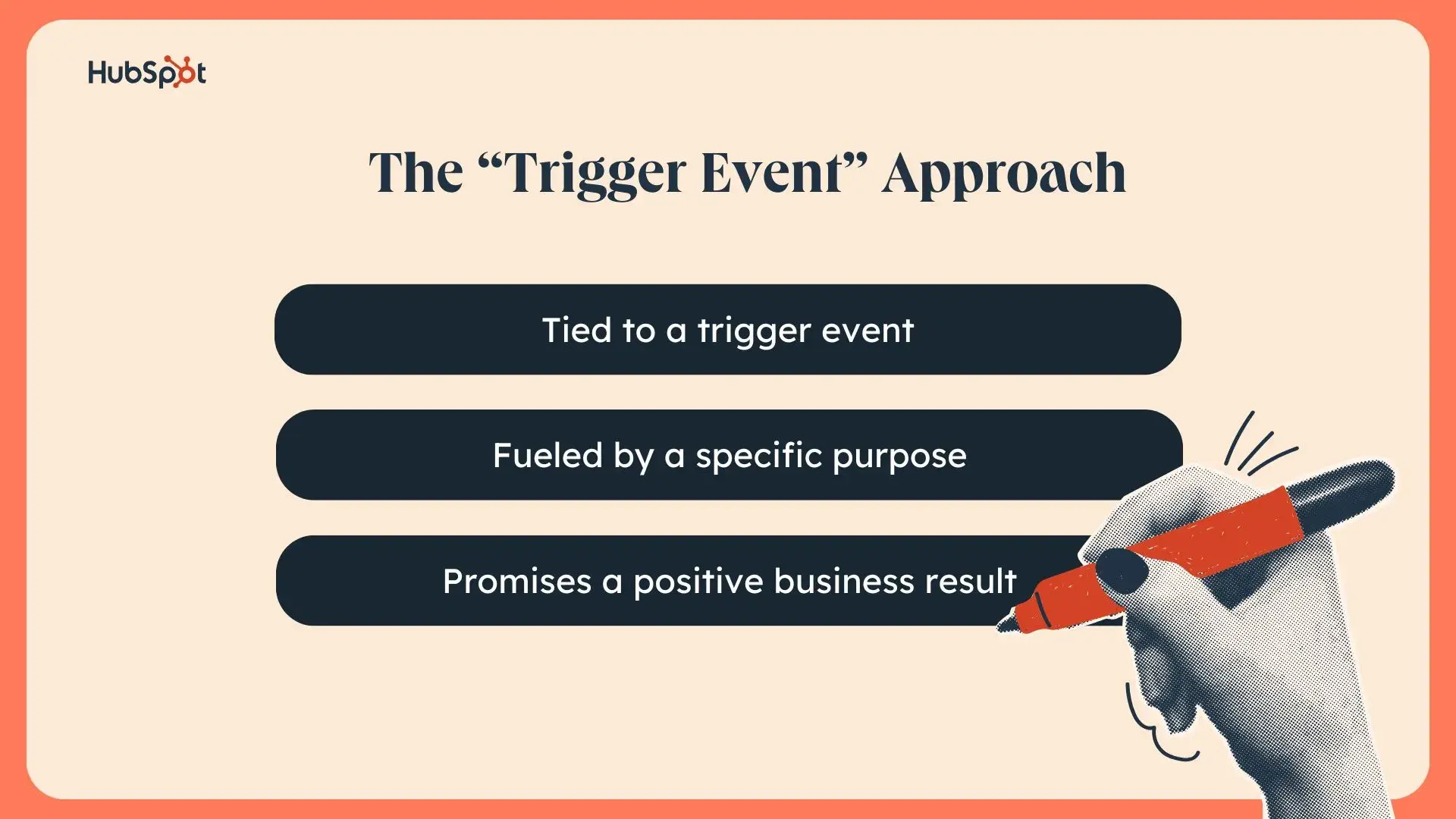
1. The “Trigger Event” Approach

graphic showcasing the key aspects of the trigger event cold calling approach

David F., CEO and Co-Founder, Maven Sales Group

How to Open a Cold Call

If you’ve been ruminating over what to say to a prospect, David raises this cold call opener: “I'm calling because I understand you just announced a new product line and, as you already know, a new product launch requires a strategic outbound effort to connect to the market and get feedback faster.

What Makes It Effective

This opener is effective because it’s tied to a trigger event. This product launch is a real event, and the fact it’s being referenced lets the prospect know you’re not randomly calling to sell my service.

Plus, the fact that this trigger event is something the prospect is actually dealing with and your promise of a positive business result sets the table for a value-based conversation – not a commoditized pricing conversation.

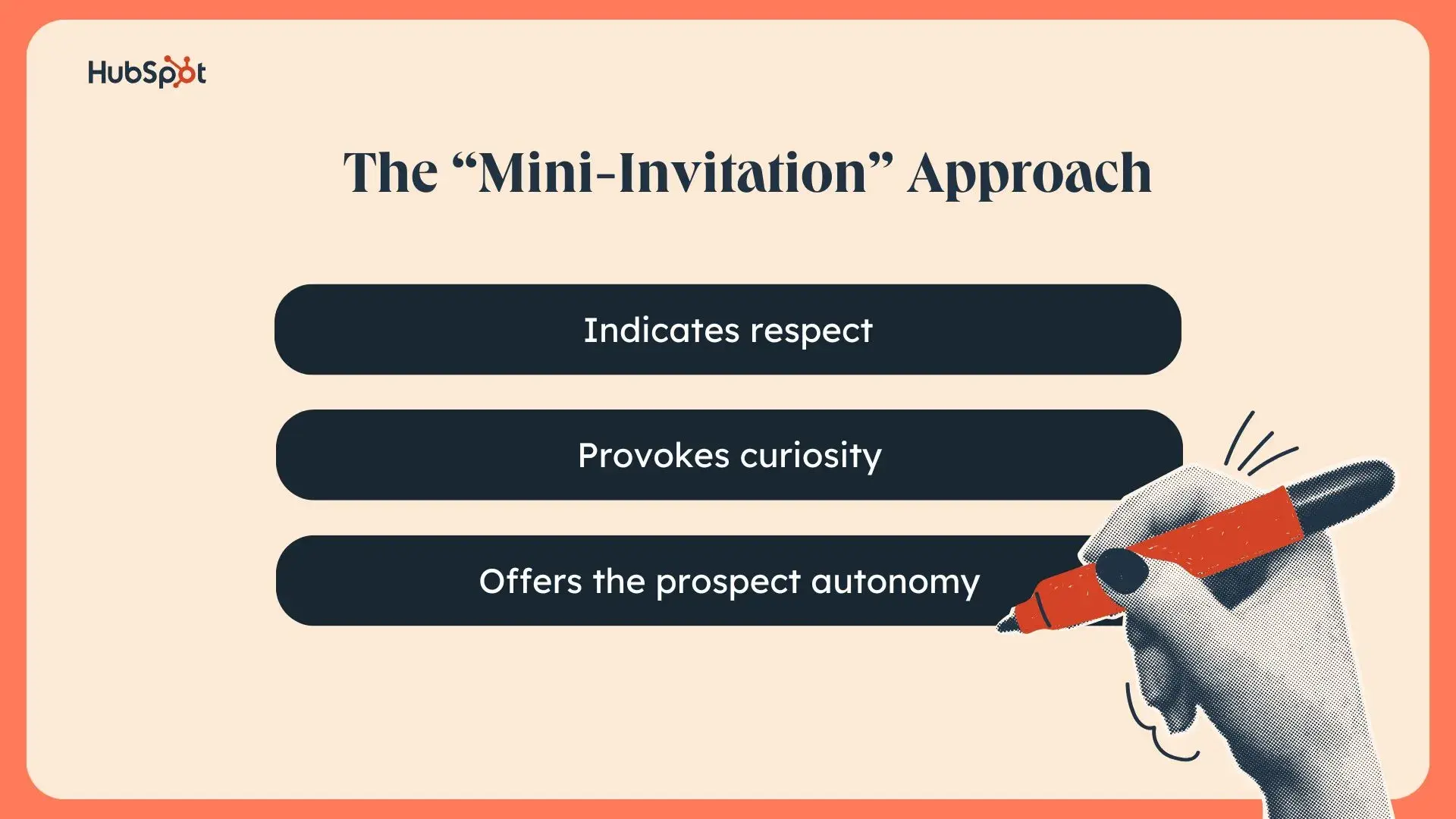
2. The “Mini-Invitation” Approach

graphic showcasing the key aspects of the mini invitation cold calling approach

Eric Q., CMO, Cience

How to Open a Cold Call

Never start a cold call with asking how your prospect’s day is. Instead, always ask for a minute to talk. The goal is to create a mini-invitation that can be granted. Eric proposes that salespeople give this opener a try: "This is [your name] with [company name]. I know you weren’t expecting my call. Is now a bad time to talk? Because I’d like to take a minute to share why I’m calling.

What Makes It Effective

As Eric’s approach has highlighted, creating a mini-invitation is an indication of respecting the prospect's time. The goal is to provoke curiosity in the prospect’s mind, and this statement situationally disarms the prospect with manners.

Plus, by recognizing the interruptive nature of the call the prospect is given an out, which the caller can also benefit from by saying, "Okay, I understand now doesn't work. Is there another time I might call back?"

The purpose of any cold call is to be invited into the conversation. Without this, you’re either pitting yourself against the other party, talking over them, or performing what can best be described as a monologue instead of a dialogue.

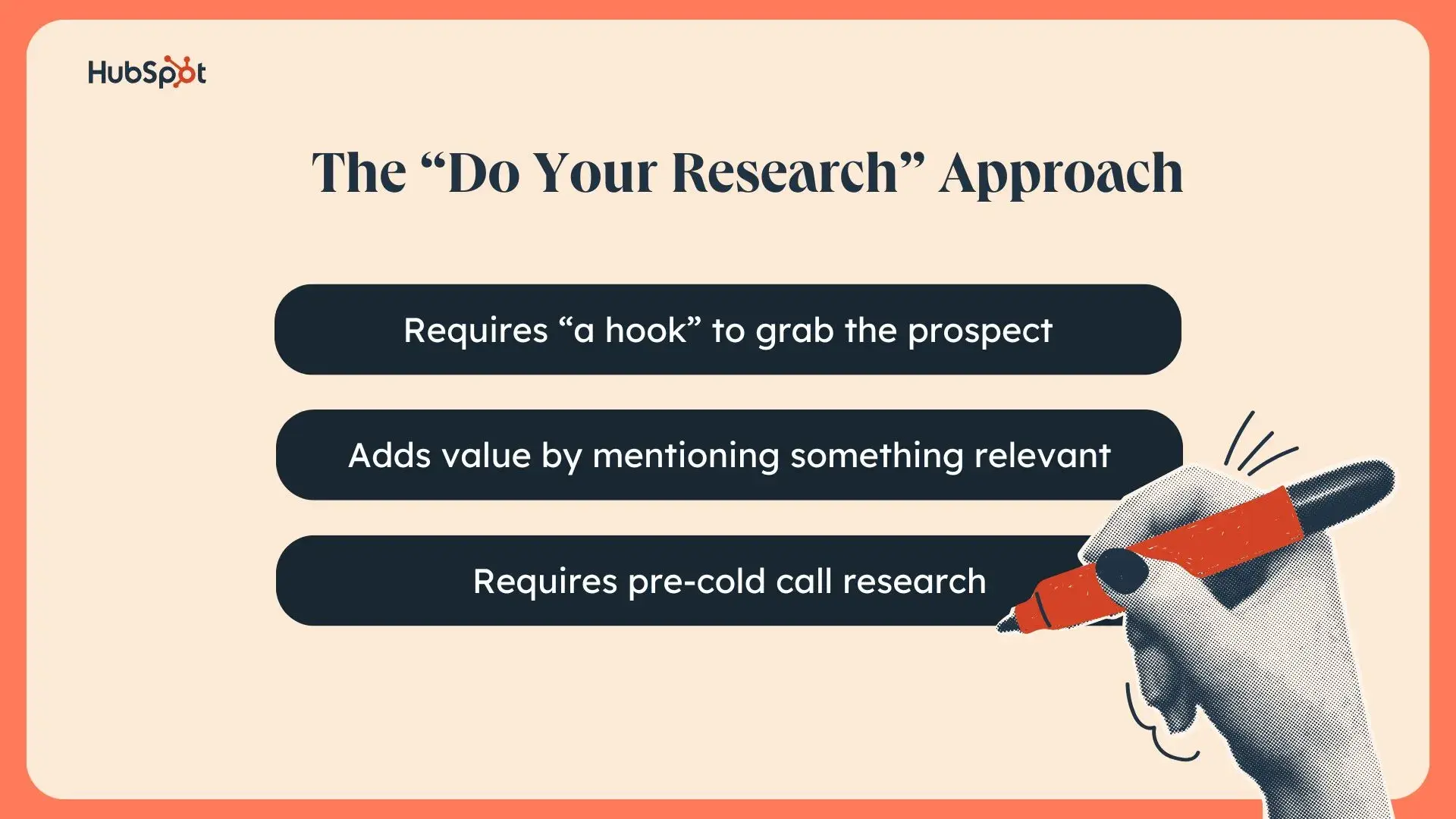
3. The “Do Your Research” Approach

graphic showcasing the key aspects of the do your research cold calling approach

Zenaida L., Lead Sales Trainer, Unstopped Sales

How to Open a Cold Call

There’s no one question or statement that will make a prospecting call effective. Instead, Zenaida suggests that “salespeople should focus on who they’re speaking with, and make a statement or ask a question that’s 100% relevant to them.”

What Makes It Effective

The first few words – the hook – must make potential prospects stop and listen. Key decision-makers get hundreds of cold calls a month. Most salespeople don't do any research. They use a canned cold calling script that adds no value.

It’s annoying, and when decision makers hear it, they tune out and rush to get off the phone. But, if you add value by mentioning something that’s important to them, you earn their attention for a minute or two.

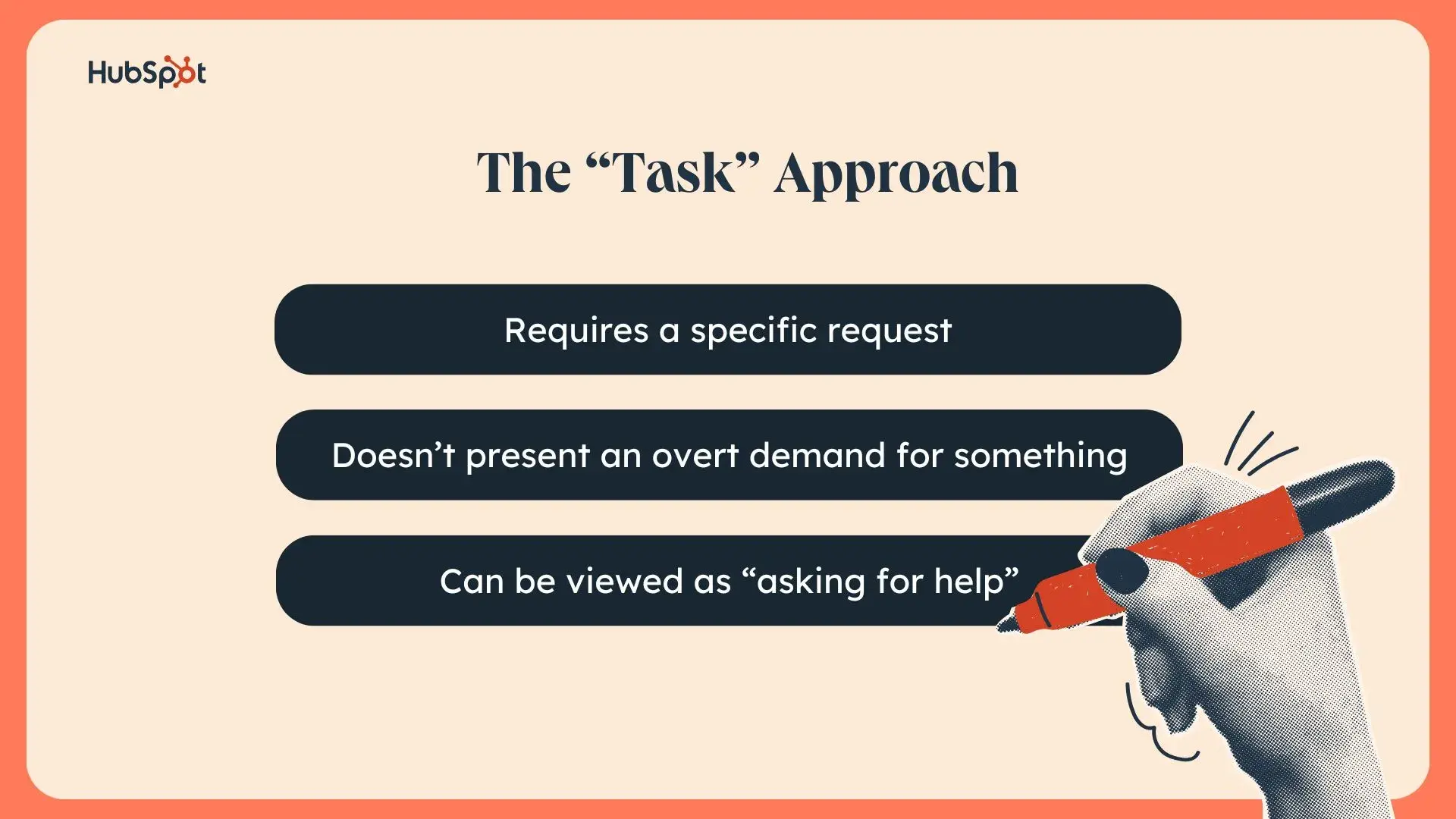
4. The “Task” Approach

graphic showcasing the key aspects of the task cold calling approach

Mallory D., Owner, Durrick Designs

How to Open a Cold Call

Mallory recommends following this cold call script: “Hi, My name is [Your name]. I wanted to introduce myself, and I know you‘re very busy. I’m not trying to sell you anything. I was hoping that you might be able to help me ... [insert your goal for the call].

Your goal could be to find out "Who handles the purchasing of print and copy machines at your company?” or “What is the name of your IT director, and, if possible, would you kindly put me in touch?

What Makes It Effective

You’re not (overtly) trying to sell them anything. That’s what makes the line effective. Most company representatives are very responsive to being of assistance, because their job is to screen calls. Asking for help is a great way in.

Cold calling isn’t dead … but it has been revamped. Salespeople have more information than ever at their fingertips, and it’s up to them to use that information to craft a better experience for every prospect they call.

Kick your stale cold call scripts to the curb and show up to do the work, and a better job. Your cold call success rate will skyrocket and your coworkers will be wondering what your secret is – I recommend you share it.

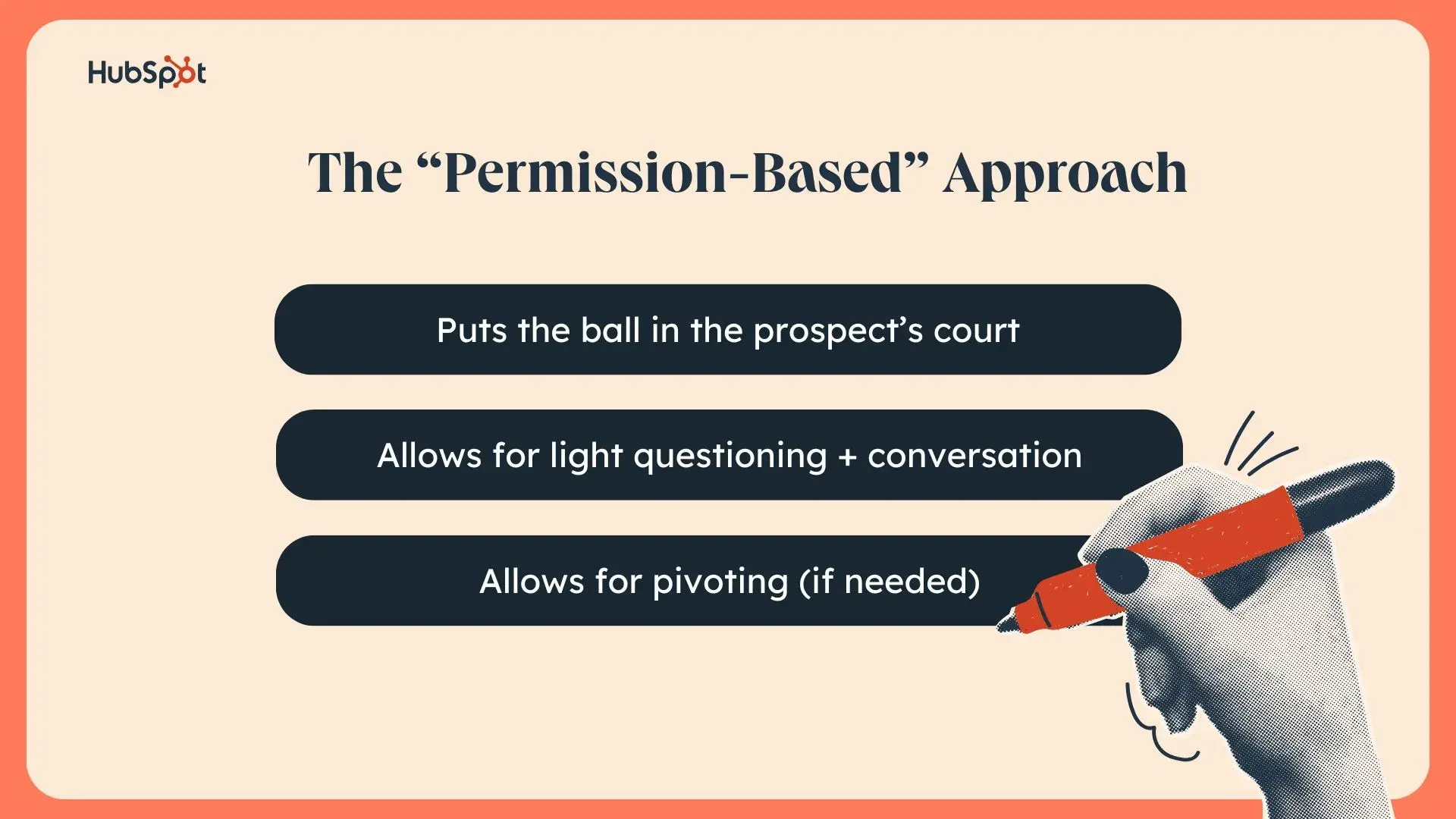
5. The “Permission-Based” Approach

graphic showcasing the key aspects of the permission-based cold calling approach

Patrice J., Business Development Representative, HubSpot

How to Open a Cold Call

According to Patrice, one of the best cold-calling tips she’s ever gotten was to be “super nonchalant.”

“Prospects can smell desperation or when someone is overly eager and it can be off-putting.” she shared. “Removing yourself from the outcome also takes the pressure off and allows you to have a genuine conversation.”

Patrice mentioned that her go-to opener is pretty standard, but still consensual. “It goes like this: ‘I know I’m calling you out of the blue. Do you have 30 seconds so I can tell you why I’m calling?’

What Makes it Effective

“This opener puts the ball in their court,” Patrice revealed.

“If they have time, it gives you the green light to ask questions about their company and then make your pitch. If they don’t have time, you can always pivot into rescheduling the call at a time that works for them or even sometimes booking a meeting right then and there. Of course, there’s the chance that they say no and tell you to get lost, but that’s just the name of the game.”

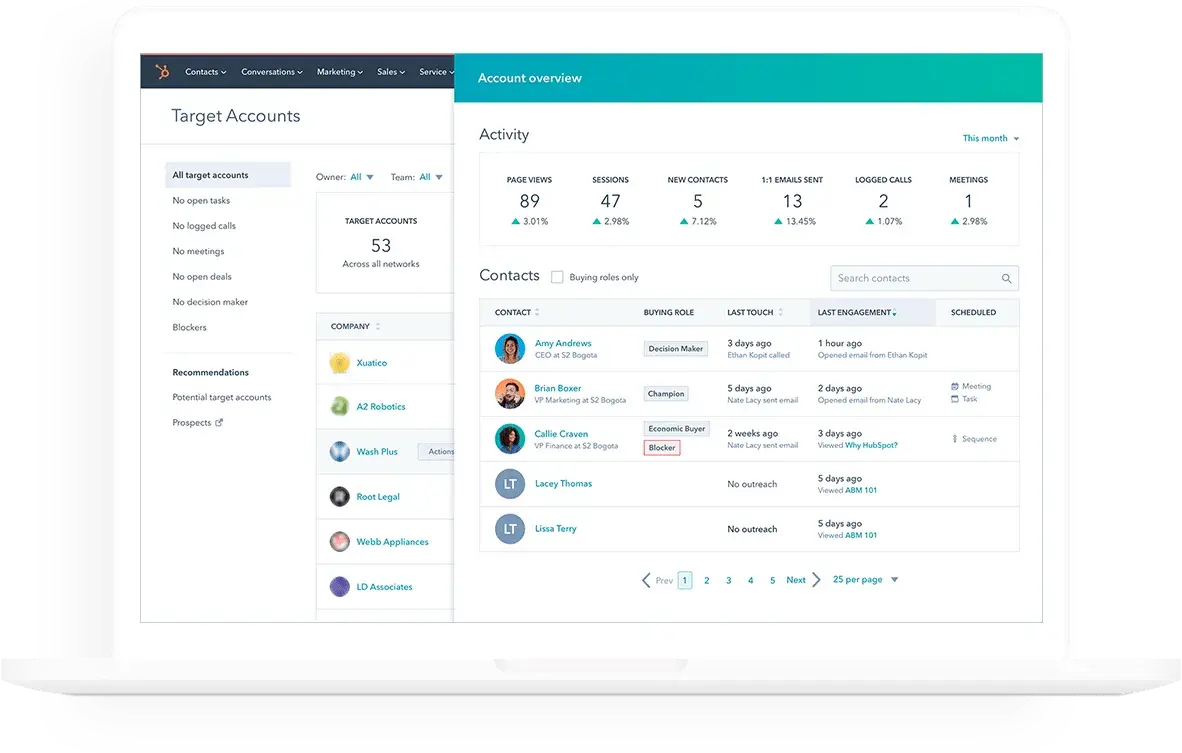
And speaking of rescheduling and/or booking time with prospects, you can rely on HubSpot’s Sales Hub to keep any and all interactions streamlined, in one place. With Sales Hub, you can prospect smarter, efficiently, and easily, leaving you more time to spend on building meaningful relationships with potential customers.

screenshot of hubspot's sales hub

Image Source

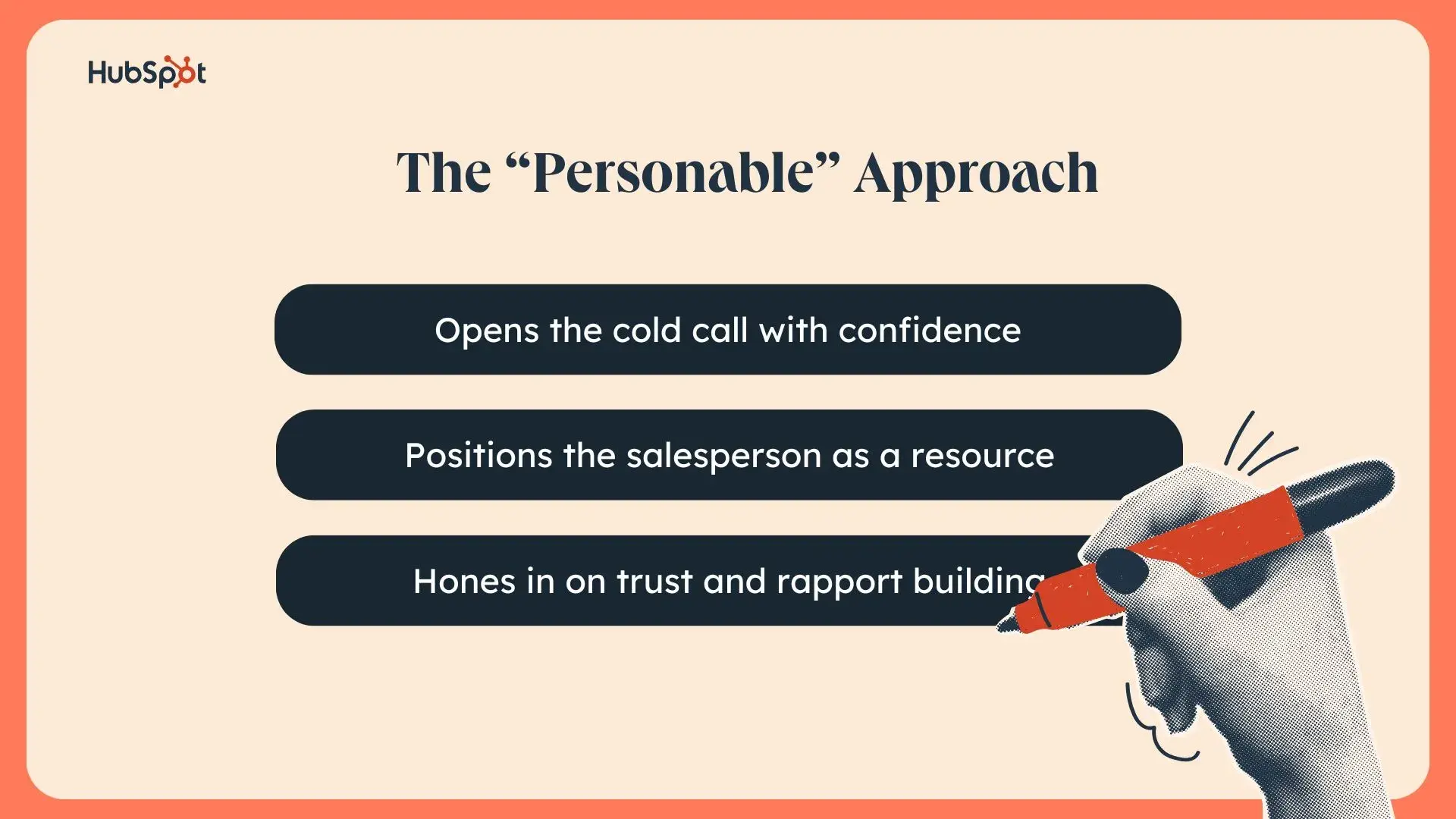
6. The “Personable” Approach

graphic showcasing the key aspects of the personable cold calling approach

Brianna S., Business Development Representative, HubSpot

How to Open a Cold Call

Brianna successfully uses the template below to get beyond the wretched few minutes of a cold call:

“Hey [Prospect name], This is [Your name] from [Company] – I know I’m calling you completely out of the blue but I stumbled upon [Their Company] while doing some research and saw [company news, new leadership, new role, etc]. Wanted to see if you have a few moments to chat and see if I could be a resource to support.”

Brianna recommends opening your cold call “confidently, with a quick mentioning of the reason for calling.” She also adds that “being considerate, mindful of their time, and positioning yourself as a resource for the customer” is essential if you want to nail that first few seconds of your cold call conversation.

From there, Brianna suggests handling any objections by being “courteous, curious, and confident.”

What Makes it Effective

“Most decision-makers/receivers of cold calls are already aware of what is going on and have a common stereotype of how these calls go,” Brianna noted.

Additionally, she strongly advises that sales folks really hone in on trust and rapport building. “By setting the tone of the call by being friendly, kind, and not overly pushy, will allow the prospect to feel more comfortable and open up.”

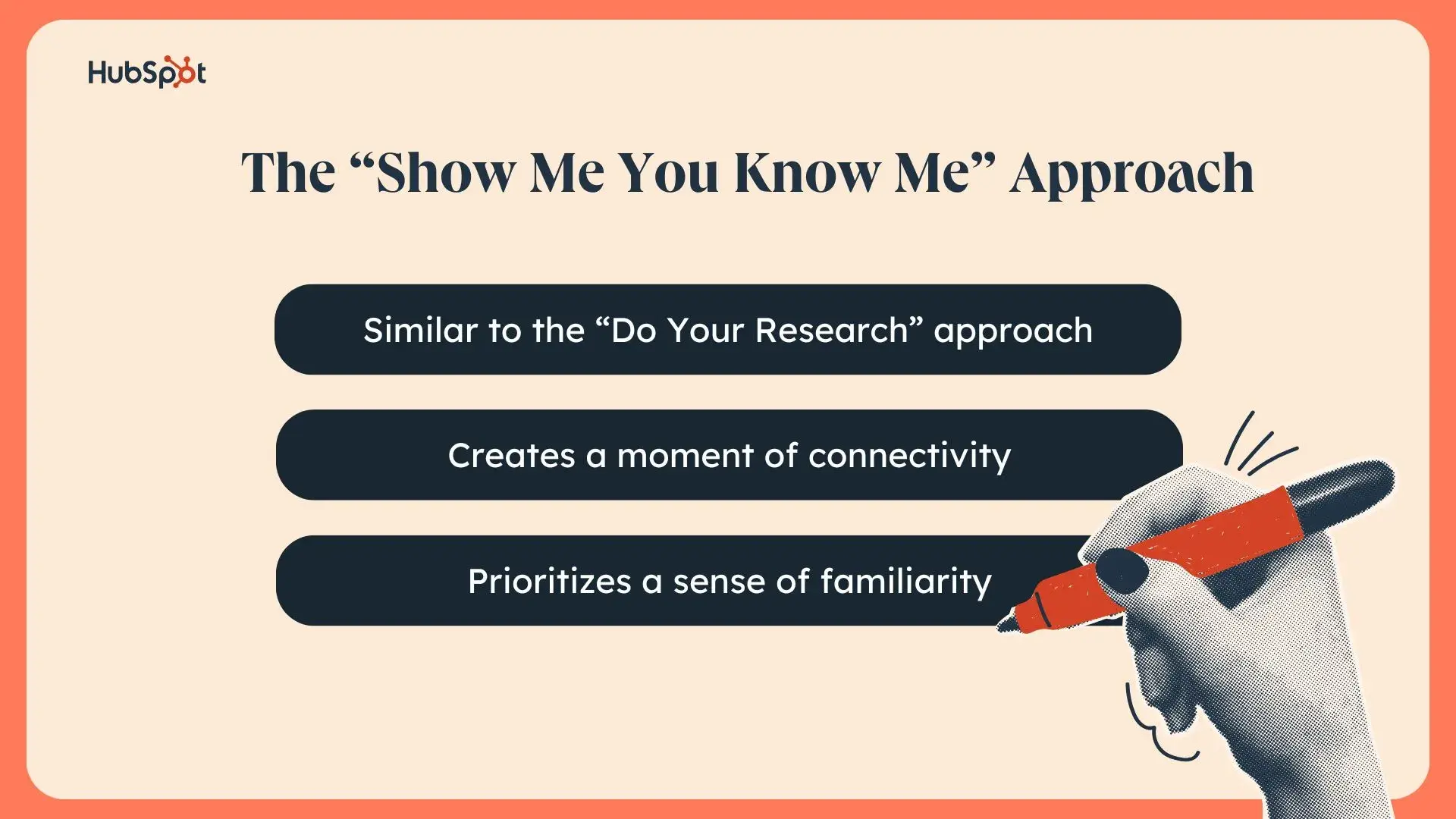
7. The “Show Me You Know Me” Approach

graphic showcasing the key aspects of the show me you know me calling approach

Bri L., Business Development Representative, HubSpot

How to Open a Cold Call

Similarly to Zenaida, Bri shares that doing a little bit of stalking before ringing your prospect truly does go a long way. “I’ll state a piece of information from their company, LinkedIn bio, their area code … I’ll establish some familiarity with them so that they know they’re not just talking to another salesperson,” she shared. In short, you want your prospect to know that you’ve done some snooping.

For example, here’s how you could format your own cold call opener using this approach: “Hey [Prospect name], I saw that [insert familiar piece of information here] on your LinkedIn …”

What Makes it Effective

Ultimately, what makes this approach effective is its personable undertone. Bri clarified that it’s easy for prospects to identify when a salesperson has done preliminary research versus not, so starting out with questions about things that are familiar to the customer – like their old alma mater or a business local to their zip code – helps establish a rapport that’s natural and guided by genuine curiosity.

In its simplest form, quotas and deadlines aside, cold calling is about creating an unexpected moment of connectivity with a prospect; don’t overlook this, it could be what separates your interaction from an unsolicited cold calling incident.

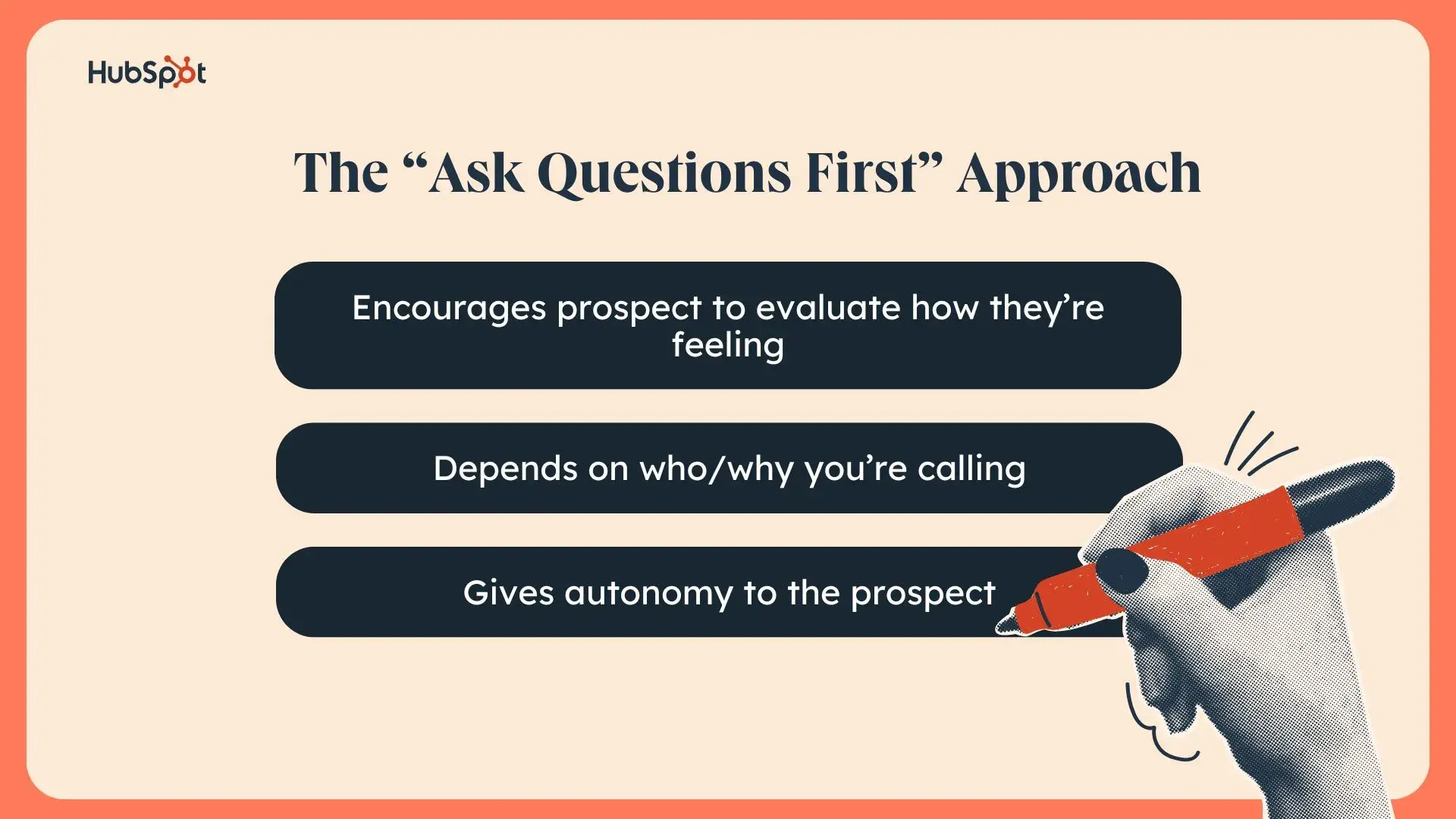
8. The “Ask Questions First” Approach

graphic showcasing the key aspects of the ask questions first cold calling approach

Bri L., Business Development Representative, HubSpot

How to Open a Cold Call

Bri also continued to note that starting off with a check-in can reveal a lot to sales folks about if their prospect is even in the mood to chat. “My other favorite approach is being like, ‘Hey [Prospect Name], this is [Your name] from HubSpot. Things keeping you busy over there?’

What Makes it Effective

“Asking this question first usually causes the prospect to stop and go, ‘Oh, yeah … I am busy right now’ or ‘Actually, I’ve got some time to talk to you,’” Bri further elaborated.

Additionally, she says that whether or not she uses this approach sincerely “depends on who she’s calling,” the reason for her call, and if the call she’s doing is a tried and true cold call or something that’s a follow-up. However, I think this approach is a great one to keep under your sleeve, especially if you’re nervous about catching your prospect at the wrong time.

Keep Calm and Cold Call On

Now that you’ve got a few cold call opening strategies up your sleeve, you’re well-equipped to tackle your next sales call with confidence.

And if you’re still feeling anxious about picking up the phone, even after reading this article, I suggest taking this piece of bite-sized advice with you: When all else fails, the most important elements of a successful cold call is your own ability to be genuine, value-driven, and conscious of your prospect’s time.

With the right approach and a little practice, you’ll be able to build strong relationships, close more deals, and achieve your sales goals. Happy calling, my dear reader.

Editor's note: This post was originally published in April 2018 and has been updated for comprehensiveness.

17 Apr 16:12

Recording Sales Calls: 3 Ways Marketers Can Use This Data to Help Win Deals

by Jen Spencer

Recording sales calls gives both salespeople and marketers a goldmine of information to help influence the sale! For example, how to close more deals with words that sell or the talk-to-listen ratio.

Marketers are known for their gift of gab. After all, a marketer’s job is to persuade, to influence.

If you’re familiar with DISC assessments and have ever reviewed team profiles, you know your marketers will likely exhibit a high “I” (influence) on their reports. Enthusiastic, warm, and persuasive, a “high I” thrives on engaging with others. We (yes, we, as I’m a proud, “high-I” marketer) thoroughly enjoy convincing others to see it our way. However, sometimes the best thing we can do for ourselves and our teammates is to stop and listen.

If you’re on the go or you’d rather listen to this blog instead of reading it, here’s an audio version.

Hear me out (I get the irony of this).

We’re doing a fantastic job of gathering data, synthesizing, and then executing a strategy based on empirical evidence, particularly as technology has evolved to support our efforts. Gold stars for everyone. Where our efforts fall short is when we need to be listening — listening to the people who are the stories behind the data we’ve come to hold so dear. Yes, I’m talking about our customers, but also our sales reps.

The Value of Recording Sales Calls

A strong sales organization is already using call recording as part of their ongoing training practice. Sales leaders use call recording to ensure messaging is accurate, process is followed, and individuals are improving.

Sales executives themselves review their own calls to identify gaps in their process and to catch any important subtleties they might have missed while they were on the live call. While the call recording and review process has been largely embraced by sales, it’s time for marketing to listen-in as well.

Here are three ways marketers can use recorded calls to be a better partner to their sales teams:

1) Validate buyer personas
2) Improve company messaging
3) Identify sales enablement opportunities

1) Validate Buyer Personas

Buyer persona research typically occurs during an organization’s marketing infancy, but it needs to be revisited on an ongoing basis. For early-stage startups, buyer personas should be assessed and validated every six months because your business is continually in a state of experimentation. More established organizations can go one year (sometimes more) between persona validation, especially if there have been no significant changes to your product or service.

One of the simplest ways to validate your buyer personas is to listen to calls that your sales team is having with your buyers. Read through your documented buyer personas first, then listen in on three to five conversations for each persona.

Were they successful calls? Was there a persona match? Does the person on the other end of the phone sound like the person you’ve represented on paper?

If the answer is no, this isn’t something to be ashamed of. Buyer personas evolve. It’s your job as a marketer to now respond and ensure your persona-based marketing strategy is aligned with your target customer. The worst thing you can do is ignore this gap. This will only dilute your marketing efforts and contribute to the growing silos of sales and marketing teams.

2) Improve Company Messaging

We all know that the better half of the buyer’s journey happens without the involvement of a sales rep. This means it’s critical that your website messaging is 100% on-point, otherwise you may be at risk of missing potential new customers. By listening to recorded sales calls that occurred early in the sales process, marketers will better understand what their prospects think their company does.

A simple audit could look like this:

Build a list of sales qualified leads or opportunities whose original lead source was an organic website visitor and who viewed more than 3 pages of your website prior to submitting a decision-stage form (ie, request a demo, talk to sales) or prior to booking a meeting with an SDR.

It’s even ok if the person you are reviewing has since become a customer. The goal is to find a segment of people who you know explored your website thoroughly prior to committing to time with sales.

Ask sales leadership for recordings from the first call these individuals had with someone at the company. This may have been a sales executive, or it might have been an SDR. As you listen to the calls, hone in on one thing: Did the salesperson need to clarify what your company does, or what value you provide? If the answer is yes, your website messaging needs some work.

3) Identify Sales Enablement Opportunities

How many times has a sales rep stopped by your desk to say, “I could really use a flyer that explains _____?”

Whether we want to admit it or not, marketing plays an enormous role in sales enablement. This encompasses the processes, content, and technology that empower sales teams to sell efficiently at a higher velocity rate.

Rather than respond reactively to requests from the sales team for enablement materials, start by listening to call recordings. You will then pick up on the needs of both your prospective customers and your sales team members. It’s possible that while the sales rep thinks she might need a particular flyer. You’ll be able to see a crack in the customer’s marketing-to-sales experience that demands more than just another piece of product marketing.

Proceed Collaboratively (and with caution)

Regardless of which of these three areas you want to address first, be aware that call recording may be a sensitive subject for your sales team. Imagine if all of your business conversations were recorded and scrutinized.

Call recording is an effective training tool because the sales leader has built trust among the sales team. As the marketing leader, you may not have yet been a part of that circle of trust. Don’t try to force your way in. Partner with sales leadership and explain what you’d like to do and why. Together build a plan that includes the entire sales team.  

The post Recording Sales Calls: 3 Ways Marketers Can Use This Data to Help Win Deals appeared first on Sales Hacker.

17 Apr 16:12

Who Owns the Pipeline, Marketing or Sales?

by jobermayer@salesleadmgmtassn.com (James Obermayer)


Traditionally few would contest who owns the pipeline in any organization. It’s referred to as the sales pipeline and it’s owned by sales people, right? But is this still true? With the advent of new marketing automation capabilities, AI apps and other technology, marketing is inserting itself deeper in the pipeline at almost every level.

I recently talked to Dan McDade with PointClear as part of a series on SLMA Radio that I’m hosting that deals with the issue of pipeline ownership. Dan has some interesting perspectives, as have other guests on my show. Listen to Dan’s segment below.


Following are highlights of my interview with Dan:

  • Dan agrees that the question of who should own the pipeline is an important one. He’s observed that while marketing has made inroads, they are limited—marketing is currently providing sales with only 25% to 30% of the leads needed to meet revenue goals, and sales is still expected to generate 60% or more of their own leads.
  • He maintains that technology alone doesn’t address the need for marketing to generate more leads for sales. While marketing does need to enable a field sales team to focus on what they do best—which is close deals—they can’t do that if the leads they’re sending over are not qualified and nurtured.
  • What marketing needs to do is leverage technology not to simply send more poor quality leads to sales faster than ever before, but to cultivate the leads that sales needs to close deals that drive revenue for the company.
  • Marketing automation and AI can be valuable tools, but only when the technology is driven by smart best practices, including: Mutual agreement on the definition of a lead; account-based management processes that enable sales and marketing to work together toward common goals; and ingrained understanding that it takes more than one channel to get the job done (an allbound approach).

What are your thoughts on pipeline ownership?

Jim Obermayer is the founder of the Sales Lead Management Association, an organization serving 8,000 members and subscribers worldwide, with a website that includes 360-plus articles from 65 industry authors. The SLMALive Radio program has produced 415 weekly episodes and has 96,600 listeners. SLMA Radio is one of six marketing and sales shows for at-work listeners on the Funnel Radio Channel.


17 Apr 16:12

Cold Email Template Issues: Are You Still Using These Stale Tactics?

by Justin McGill

Using a cold email template that’s outdated and overused won’t help you.

Predictable Revenue was a book written 6 years ago, about stuff they were actually doing 10 years ago. It doesn’t work anymore. Are you still using these stale tactics?

We’ve rounded up the top cold email template and examples in use today. These are being shared by other sites and resources as though these are the models to follow. We give our thoughts on the good, bad, and downright ugly parts of each.

Cold Email Categories:

  • Cold Call Email Rules
  • General Cold Call Email Example
  • Template for Cold Email Followup
  • Cold Email to Decision Maker
  • Voicemail then Cold Email After
  • Cold Email Breakup Template

10 Successful Cold Email Rules – The LeadFuze Grading Criteria

  1. Catchy subject line & first line – You want to catch the recipient’s attention and avoid getting caught in SPAM filters. 4 words or less is deal.
  2. Short and to the point – Four to five sentences at most is recommended. I recently wrote about a cold email framework to follow called QVC to make this easier.
  3. Personalized not just “personalization” – Using proper mail merges is important, but taking it further with something more direct about your recipient helps your cold email stand out even more.
  4. All about them… not you – Replace every “I” and “we” with “you”. This will force you to change the tone of the email to be focused on the recipient and not be self-serving.
  5. Easy to understand value prop – If you can’t explain what you do and why you’re great in one to two sentences, then you need to go back and better understand your business and what it brings to the table.
  6. Value offered before CTA – Are you actually delivering value in your message first? Or are you just going right in and hoping to book a time with them? Even asking to be introduced to someone else says you haven’t done your homework. Bring value before an ask.
  7. No obvious red flags – Bad grammar, obvious sales or marketing pitch, missed personalization are some of the obvious red flags that will get you deleted, or worse yet routed to spam, in a heart beat.
  8. Not an obvious canned template – With more and more companies adopting cold email as a lead generation strategy, your potential customers are seeing these emails on a more regular basis. Make sure yours stands out.
  9. Easy Call-to-Action – Don’t ask them to book a time in your first email. Just try to get the conversation started.
  10. CAN-SPAM Compliant – There are seven simple cold email laws you must follow in order to stay compliant when cold emailing anyone in the United States.

These are the factors that go into our cold email reviews. Feel free to use this grading formula yourself as you construct your own cold emails.

General Cold Email Template

The general cold email is your first attempt to start a conversation with a prospect.

Below these general cold email examples you can listen to a video of Damian and myself breaking down these emails in more detail.

Cold Email Example 1

cold email template 1

Thoughts:

At first glance, this cold email doesn’t seem so bad. It’s nice and short, there’s mail merge level personalization, etc. However, there are a few things that make this a bad cold email:

  • “My” “I’m” and “We” are all on the first line of this email.
  • Asking for introduction to someone else might have worked for Salesforce years ago, but this strategy simply doesn’t work anymore and smells of you not doing your homework. Why should they do it for you?
  • It doesn’t follow CAN-SPAM laws

Cold Email Example 2

cold email template 2

Thoughts:

So this one is a little more obvious that it’s a bad cold email. Why it is floating around online as an example to use is beyond me. Here are a few of the things wrong with this cold email:

  • The phrases “stab in the dark” and “based on your online profile” just smell of generic.
  • Should have homework done already. Saying “if that’s you” says you’re just finding a decision maker and hoping they introduce to someone.
  • Multiple calls-to-action is a weak close. They are asking to be introduced, but hey… if they hit the lottery and the recipient is the right person then lets go ahead and schedule a call.
  • This is not a simple call-to-action either. You are either asking for them to forward your message to someone else or be so in love with who you are out of the gate to book a call. This is a big first ask.
  • If you do ask to book a time, there are two things wrong with giving a very specific date and time. One, if they aren’t available it is very easy just to say no. Two, if you send this out to 2 people and they both want to book it – then what? This is a time when getting a little more generic can actually be really helpful.
  • Again, it fails to use CAN-SPAM laws.

Cold Email Example 3

Cold Email template 3

Thoughts:

So this email is short and sweet. At first glance, I can see why people think this example is good. However, we have a few pitfalls here:

  • The first line is wasted on yourself. They do not care about you or your company, they don’t know you. This first line is the single most important part of your cold email because its what they see in their preview panes in their email client or on their phone. Don’t waste it by talking about yourself.
  • The next two sentences have “We” “I” and “we’re” in them which is self-serving and not putting the emphasis on the recipient.
  • Call-to-action has the same issue as the one above and is not a good way to get a conversation started.
  • Fails to comply with CAN-SPAM laws.

Cold Email Example 4

Cold Email template 4

Thoughts:

Again, not even sure how this gets promoted as a good cold email example. I think it is relatively obvious what’s wrong here, but let me list the reasons:

  • For starters, it’s a long wall of text.
  • “I/we” rather than “you” all throughout the email.
  • It basically just repeats itself by asking for an introduction to someone else… TWICE. As if once isn’t bad enough. Then of course, asks for 15 minutes on the calendar.
  • It closes weakly with “I don’t want to waste anyone’s time” yet that is precisely what this email did.

Full Cold Email Video Commentary:

Summary:

The goal of this initial cold email is to simply start a conversation. You need a compelling value prop communicated in a crystal clear way that is focused on the recipient and not yourself.

Cold Email Example to Decision Maker

The cold email to ask for the decision maker is a popular template choice today. Does that mean it works? Hint: NO. As I’ve stated above in each of those examples, this strategy just does not work today. You should know the role and industry of the people that make good customers for you. Focus your prospecting efforts on those personas!

You should know the role and industry of the people that make good customers for you. Focus your prospecting efforts on those personas!

Below these introduction cold email examples you can listen to a video of Damian and myself breaking down these emails in more detail.

First Cold Email to Decision Maker

Cold Email example to Decision Maker 1

Cold Email to Decision Maker Number 2

Cold Email example to Decision Maker 2

Third Cold Email to Decision Maker

Cold Email example to Decision Maker 3

Thoughts:

Predictable Revenue was a book written 6 years ago, about stuff they were actually doing 10 years ago. It doesn’t work as well anymore.

I know it can be difficult putting together a quality cold email and so far all you have seen are bad examples. However, I think there’s value in breaking down some of these supposed “good cold email examples” that are being promoted and getting you to see the various ways in which they’re written. Some are a little easier to identify as bad than others.

Cold Email to Decision Maker Commentary:

Cold Email Template – Follow Up

The cold email follow up template goes after your first cold email failed to generate a response. Follow-ups are a great time to go for a bigger ask such as hopping on a call.

I also feel like this is a great time to hammer home a different angle on your value prop. Perhaps one benefit didn’t resonate from the first email, so use your follow-ups as a chance to highlight other benefits.

Below these follow-up cold email examples you can listen to a video of Damian and myself breaking down these emails in more detail.

Cold Email Follow Up Template 1

Cold Email Follow Up Template 1

Thoughts:

So I actually kind of like this one. I’m a fan of the second email being a one-liner question. This goes beyond that and is even more powerful with just the line “Let me know what makes sense as a next step, if any?”

This one question makes the recipient feel obligated to respond, all the while encouraging them to review the previous emails.

Speaking of previous emails, if you include the previous emails in your message and they have all the CAN-SPAM compliant things like address and a way to opt-out, then you don’t need to provide that again in your next email.

Cold Email Follow Up Template 2

Cold Email Follow Up Template 2

Thoughts:

Telling people you are following up is unnecessary. Letting them know they didn’t email you back is not a good way to start a relationship either. There’s no real added value to this email as a whole.

I know I have spent a bunch of time hammering the whole “introduction to someone else methodology”, but in follow-ups it actually works and makes sense. If they didn’t respond, it is natural to then ask if perhaps someone else might be a better fit.

Cold Email Follow up Commentary:

Cold Email Template – After Voicemail

This cold email goes out after a voicemail to the prospect. Below these voicemail examples you can listen to a video of Damian and myself breaking down these emails in more detail.

Below these voicemail cold email examples you can listen to a video of Damian and myself breaking down these emails in more detail.

Cold Email After Voicemail 1

Cold Email example After Voicemail 1

Thoughts:

We’re missing context here so we don’t know if they know this person or if perhaps they filled out a web form.

Assuming you don’t know the person, this is a great opportunity to re-emphasize your value proposition.

Don’t assume they think you’re great just because they contacted you first.

Cold Email After Voicemail 2

Cold Email example After Voicemail 2

Thoughts:

This is actually a really solid follow-up after a voicemail.

The subject line pique’s curiosity and forces the recipient to at least make a courtesy glance at the intro sentence.

Since this is a manual follow-up, I think having a set time and date to follow back up makes sense. Asking them to call you is actually inviting in this case.

Cold Email After Voicemail 3

Cold Email example After Voicemail 3

Thoughts:

Leading in with “How is it going?” is a waste. You don’t really care and they aren’t going to answer that anyway.

This cold email follow-up is also missing a value prop or hook.

There’s no reason why someone would respond to this email.

Cold Email after Voicemail Commentary:

Cold Email Breakup Template

The cold email breakup template is your final attempt to start a conversation with a prospect (after prior emails have gone unresponded).

Below these breakup cold email examples you can listen to a video of Damian and myself breaking down these emails in more detail.

Cold Email Breakup Template 1

Cold Email Breakup Template 1

Thoughts:

The breakup email strategy isn’t as effective these days. We’ve still seen some responses, but usually they are negative responses by this point. These can still be worthwhile as it helps show engagement, but you have to understand that most people are using this as a final email.

Not only is it becoming more common, but do you really want to promise to not follow up again?

Maybe now is just not a good time for your prospect. You should still have a goal of getting them into a different sequence in the future.

Cold Email Breakup Template 2

Cold Email Breakup Template 2

Thoughts:

For starters, nobody “closes” files anymore, so this is not really believable. Unfortunately, it happens three times in this example.

That said, I think this email closes with a great call-to-action. It makes them think about what the next step should be.

Cold Email Breakup Template 3

Cold Email Breakup Template 3

Thoughts:

If you say you are removing the fluff… ACTUALLY remove the fluff. There’s still a lot of fluff in this email.

While some of this is fairly decent and unique, I would add better benefits. Or a possible alternative would be to turn these benefits into questions (ie, “is managing your content difficult?”).

Using specific statistics in this case is clever, but it ends weakly by not having a specific question to respond to.

Cold Email Breakup Commentary:

The bottom line is if you are going to use a cold email template, make it your own.

Then, once you find something that works, make sure that only people on your team are using that cold email template. After awhile, the cold email template will get out there. I see it all the time with one’s we experiment with.

However, this lets you maximize results with it first before others come in to copy it.

17 Apr 16:12

The 6 Ingredients to an Engaging Email Campaign

by Steve Hamm

Whether it was from the perspective of a subscriber or a marketer, you’ve likely discovered by now that campaigns that “blast” customers with messages are ineffective. Total volume of emails doesn’t mean anything if the content is generic and your list is unsegmented.

Here’s how to fix that problem in six steps:

Create multiple campaigns

There’s no law that says you can only run one email campaign at a time. Sometimes it helps to create multiple campaigns so you can clearly separate your goals, subscribers, and content.

Segment your list

The number one way to make sure you don’t blast subscribers with messages is to segment your email list. This way, you can create subgroups based on demographics, interests, and behavior.

According to this Forbes article, switching from blasts to segmented campaigns can have a drastic impact on your open rates:

“When 2,000 MailChimp users were sampled in 2017, the results were clear. Those who sent 11,000 segmented campaigns to almost 9 million recipients had a higher open rate than those who sent the same email to everyone, regardless of their interest. When they went from general blasts to segmented email campaigns, they saw opens increase by 31% and clicks increase by 95%.”

Having one giant email might work at first for very small businesses, but it isn’t sustainable. The more subscribers you add, the more pressure there will be to segment your list. Don’t fight it.

Flexible design

You don’t need to create every design from scratch. In fact, it’s best to work with flexible templates so that you can easily edit elements and move them around. Make sure your emails are responsive so that they look nice on mobile devices.

Focus on the engaged users

Many marketers focus on the least engaged users since they think the engaged ones don’t need any further assistance. In reality, it’s a much better use of your time to move your engaged subscribers through the sales funnel as opposed to waking the dormant ones up.

This Marketing Land article explains why it’s best to focus on the engaged users. According to the article, you can ask if they want to receive specialized deals:

“Marketers should keep an eye out for subscribers who consistently engage with emails. High engagement may provide your team with the opportunity to reach out and directly ask what level of engagement these interested subscribers are comfortable with and if they’d be comfortable with receiving specialized deals.”

Sending specialized deals is a great way to move qualified leads through the sales funnel. This is way more efficient than spending time on leads who have no interest in your messages.

Automate your campaign

It’s understandable that email marketing isn’t always on your mind. It’s not an excuse for forgetting to send your newsletter out, however.

By automating your campaign, you can set everything up in advance and gleefully forget about your email marketing duties. This makes sure you abide by a schedule and keep subscribers engaged.

Generate performance reports

Trial-and-error is a huge part of email marketing. The only way you’ll learn is by trying new things and seeing how your campaign performs as a result.

Too many businesses and marketers look at their sales numbers to determine if their campaign is effective. In reality, there are many factors affecting your sales that you can’t see or control. To evaluate your email marketing performance, you should focus on metrics like your open rate to see how subscribers are responding to your messages. Ideally, the program or application you use will generate these reports for you so all you have to do is analyze them.

17 Apr 16:12

Vast Networks: How To Connect Your Sales Circles with TeamLink

by Kylee Lessard
sales navigator customer quote

Every person has a story, and a circle.

Throughout our lives and careers, we all meet different people along the way, forging connections. These relationships are reflected in our social networks. Each individual on your team, and in your company, has their own unique circle — some larger than others, and no two the same.

As salespeople know, when our stories and circles overlap with others, these are the commonalities that spark conversations, discovery, and kinship.

Surfacing these intersecting points is perhaps the most powerful capability of Sales Navigator, and one that every sales pro should seek to capitalize upon.

Tapping Into Vast Networks

“Sales Navigator has enabled my team to tap into the vast networks that our own employees have in order to make connections with prospects and current customers, reducing sales cycles by as much as one-third! Indispensable,” said Bridget Gleason, former VP of Sales for Yesware, in our guide, How to Maximize LinkedIn’s Value with Sales Navigator.

If you use LinkedIn for social selling, chances are you’ve stumbled across a hidden pathway to an introduction through your professional network on the platform. Maybe you identified a key decision-maker within a target account and realized that they were a second- or third-degree connection, acquainted with someone you know more closely.

These are critical links that open doors and opportunities. As the data below from the State of Sales 2017 report shows, prospects are far more likely to respond to sales outreach when introduced through a contact.

If you are consistently scouring your own network for ways to gain an “in” while prospecting, that’s smart. But if you aren’t tapping into the collective networks of your colleagues, then you’re probably missing out on any number of channels for potential warm intros.

Your personal circle becomes immensely more valuable when you’re able to multiply it by orders of magnitude. The TeamLink feature in Sales Navigator makes this easy by combining and intertwining the circles of everyone on your team.

Getting By With a Little Help

For B2B sales reps, cultivating relationships is essential. But as Reid Hoffman has pointed out, the number of relationships we can meaningfully maintain is not infinite. You only have so much mental bandwidth to keep everything in order, and so much time to actively stoke the coals of familiarity.

Hoffman talks about the importance of I-to-we. “Your career success depends on both your individual capabilities and your network’s ability to magnify them,” he wrote. “An individual’s power is raised exponentially with the help of a team (a network).”

That word — exponential — is at the heart of what we’re discussing here. If you’ve built out a robust professional network, then you’re in good shape, but it will still pale in comparison to the cumulative system of connections across your entire team. This is a fundamental strength of using LinkedIn for B2B sales.

Most likely, your coworkers have all followed journeys very different from yours. Their hobbies and past work experiences have ingrained them in communities and circles you haven’t encountered. This diversity is highly beneficial in the scope of business development, broadening your sales team’s reach across varied industries and niches. TeamLink is how you connect the circles and take full advantage.

Making It Personal

Not only does TeamLink help reveal connection pathways, it also highlights specific commonalities that might help facilitate a conversation. These include attending the same college or crossing paths at a previous employer.

“Hey, I noticed that you used to work at Microsoft with my coworker Gerald! He mentioned that I should reach out to you.” Even this seemingly minor reference can make a big difference during your first contact. Buyers are five times more likely to engage if the outreach is through a mutual connection.

And it’s not just these common ties that bolster your odds. By consulting acquaintances and exploring profiles through extended LinkedIn network access on Sales Navigator, you can gather insights around third-degree connections that help tailor your messaging.

This is crucial, because 64% of B2B decision-makers won’t engage with a salesperson if the communication is not personalized.

It’s simple: in the modern digital sales environment, your story and your circle are among your most vital assets. Using Sales Navigator and TeamLink enables you to coalesce yours with those of your entire company. This leads to cascading benefits for your sales team, producing a vast network that teems with opportunity.

To learn more about enhancing your sales prospecting, download our guide: How to Maximize LinkedIn’s Value with Sales Navigator.

16 Apr 15:30

Eye-Tracking Study: Email-Signature Banner Effectiveness

What types of email-signature banners draw the most interest? Does it help to include a call to action? Which are more effective: horizontally or vertically aligned units? Read the full article at MarketingProfs
16 Apr 15:18

6 Top Marketing Challenges Solved by Influencer Content

by Lee Odden

Marketing Challenges Solved by Influencer Content

Whether you’re a new Marketing leader at a company in need of establishing wins quickly or part of a growing organization with ambitious revenue goals, the challenges within marketing today are greater than ever.

To help make sense out of these challenges, I’ve listed 6 of the top obstacles to brands achieving effectiveness out of their marketing and how collaborating with influencers on content help solve each problem.

1. Challenge: Ad Blocking

600 million devices are using ad blocking leading to a loss of $22 billion in ad revenue for publishers (PageFair). If buyers don’t ever see your ads, what chance do you have?

Challenge solved: Contrary to ads, influencers are liked and because people pay attention to the influencers they follow, shared brand messages are far more likely to attract and engage buyers.

When you subscribe to the idea that everyone is influential about something, especially with their friends, co-workers and social connections, this statistic from Nielsen (83% of consumers trust recommendations from their peers over advertising) becomes very powerful.

Collaborating with influencers on content that the influencers then promote to their subscribing community can become a powerful differentiator for any marketing program.

Of course not all customers use ad blocking and there are incredible opportunities to be realized with sophisticated ad targeting. That’s why when properly executed, influencer content can be leveraged for both organic and paid promotions.

2. Challenge: Information Overload

Consider this: 90% of the world’s data has been created in the last 2 years. That’s 2.5 quintillion bytes of data a day (IBM). In fact, 74gb of media are sent to the average consumer on an average day (USC/ICTM).

The sheer number of choices faced by consumers and general distrust has turned brand marketing into noise for many customers.

Challenge solved: Influencers are Focused. One of the most compelling reasons a person is influential is because of the specificity in the topics they cover. Because of that specialization, buyers anticipate rather than ignore or feel overwhelmed by what their trusted influencers share.

While some influencers distribute their content on multiple channels, their personal brand focus plus consistency and trust equals a signal that buyers pay attention to.

3. Challenge: Google “Hates” SEO

Search Engine Optimization bloggers have been positing this question for 10+ years. With Google algorithm and platform updates including Florida, Panda, Penguin, Hummingbird, Pigeon, RankBrain, Mobile, Possum, Fred and the thousands of launches, live traffic experiments, side-by-side experiments and over 130,000 search quality tests, it makes you wonder: is this all for improving the customer experience or is some of it to thwart SEO?

Challenge solved: Google actually likes influencer content. Another key ingredient to why someone is influential is their credibility and authority. An influencer’s specific expertise and their ability to provide insights, answers and even research based perspectives all deliver on the Google’s expectation that content be useful.

Beyond influencer content being useful, there’s the practice of making content worth linking to. Influencers typically have a subscribed audience, many of which publish themselves. When influencers publish and promote content, it naturally attracts links.

By optimizing content for search and activating influencers, brands can create opportunities to help customers find trusted content and everybody wins.

4. Challenge: Buyers Don’t Trust Brands

Or ads. This is a hard pill to swallow: 42% of consumers distrust brands and 69% distrust advertising according to a study by (Ipsos Connect).

Challenge solved: Influencers are trusted.  A recent study by Fullscreen and Shareblee via MarketingCharts found that nearly 40% of 18-34-year-olds are more likely to trust what an influencer says about a brand than what the brand says about itself. Additionally, Twitter reports that users trust influencers nearly as much as their friends.

Collaborating with influencers on content can bring authenticity, credibility and trust to that content. When influencers share that content, the effect of their audiences’s trust goes even further.

5. Challenge: Content Doesn’t Scale

According to the annual study by Content Marketing Institute and MarketingProfs, some of the top content challenges marketers included: 60% producing engaging content, 57% producing content consistently.

Challenge solved: Creator Influencers are experts at creating content. Influencer content creation and storytelling skills come in many forms: blogging, podcasting, video, images, and sometimes interactive.

Brands can extend the media creation skills of their marketing departments by partnering with creators with specialized skills. In addition to skill, creator influencers have an audience to promote the content to.

6. Challenge: Organic Social is Dead

Not only is Facebook organic reach down 52% (MarketingLand) but declarations that organic reach on Facebook is outright dead for brands are being stated by many credible industry publications, including Digiday.

Challenge (partly) solved: Influencers have optimized social popularity. Influencers create the kinds of signals that social network algorithms reward with higher visibility. Influencers understand what resonates with their audience in terms of topic, content type and promotion. Those same influencers also have an active audience that engages with their shared content. This is a powerful combination for triggering social network algorithms to prioritize influencer content in the feed.

Influencer Marketing is no silver bullet. Neither is content marketing or any kind of marketing approach.

But when influencers are intelligently researched, qualified and engaged during the planning phases of a content marketing program, the benefits of the collaboration can include improved content in a variety of ways:

  • Authenticity – Choose influencers that represent your customers and the resulting message will be a lot more genuine to what buyers actually care about.
  • Variety – Including experts beyond your marketing department can generate a greater span of content ideas.
  • Quality – Tapping expertise can boost the quality beyond what marketing department copywriters might be able to produce.
  • Quantity – Engaging a group of influencers on an ongoing basis can boost the volume of content. Factor in repurposing and you’ll create even more content options without increasing spend.
  • Reach – Trusted, credible experts promoting content can reach audiences that are very difficult to connect with through any other way.
  • Trust – The credibility, expertise and authority of influencers that collaborate with a brand over time can grow trust for the brand.

On top of that, there are efficiency benefits. We have implemented influencer content campaigns where influencers have contributed anywhere from 20% to 80% of the content for the entire campaign.

Then there are the effectiveness benefits. For an organic influencer content campaign, achieving a 50% share rate amongst influencers is impressive. We’ve had many programs with over 100% share rate. Why? By communicating effectively, setting expectations and making content that contributors are proud to be a part of.

The reality is that influencer content programs can deliver value across the entire customer lifecycle, not just awareness. That means improved engagement and conversions.

There are many more challenges for marketing than the six above. I didn’t get into martech shock (too much tech), difficulty in finding qualified marketing candidates, measurement challenges or the implications of the lockdown on data represented by GDPR in the EU and recent attention being given Facebook by lawmakers. But addressing the six above should give the vast majority of marketers reading this an advantage.

Establishing relationships with qualified, capable influencers can bring a tremendous amount of value to a company’s content marketing effectiveness. When influencer marketing is thoughtful, ongoing and properly managed, it becomes a force multiplier that is difficult to duplicate.

Are you planning a content marketing program right now? Who are your best influencers? Who are your best employee advocates? Which industry media do you have the attention of? Which of your customers are most likely to advocate for your brand? Do you know if they are influential? Do you know which of your prospective customers are influential?

Answering these questions can open the door to content marketing success for your brand and mutually valuable relationships with the people that actually influence your customers.


Email Newsletter Gain a competitive advantage by subscribing to the
TopRank® Online Marketing Newsletter.

© Online Marketing Blog - TopRank®, 2018. | 6 Top Marketing Challenges Solved by Influencer Content | http://www.toprankblog.com

The post 6 Top Marketing Challenges Solved by Influencer Content appeared first on Online Marketing Blog - TopRank®.

16 Apr 15:18

You Ask, I Answer: How to Speak to Buyers In the Customer Journey

by Christopher S Penn

Sandie asks, “How do I speak to my buyer at the right stage in the journey?” This is a terrific question that has three parts. First, we must categorize all our customer communication in each stage of our buyer’s journey and run text mining analytics on it to understand what they say at each stage. […]

The post You Ask, I Answer: How to Speak to Buyers In the Customer Journey appeared first on Christopher S. Penn Marketing Blog.

16 Apr 15:17

Time And Money

by Fred Wilson

One of the least discussed aspects of investing in startups is the value of the time commitment one makes to a company they invest in.

The money part is pretty simple; you invest capital into a business and get an equity participation in the upside. Both sides of that deal can analyze that transaction and understand it fairly well. Of course neither side knows what the ultimate payoff will be, but one can handicap it.

The time piece of the transaction is way more complicated.

Consider:

1/ The founder doesn’t know if they will actually get the investor to deliver on the promises made to add value and spend a lot of time on the investment. A founder can reference an investor and get a better sense of this but there is nothing written into an investment agreement that binds either party to make a specific time commitment to an investment.

2/ An investor doesn’t know for how long they may need to contribute to an investment. Will it be three years, five years or fifteen years?

3/ A founder doesn’t know how much of their time they will have to spend managing their investor group. Will the group be invasive and annoying or will it be value adding and helpful, or both?

4/ An investor doesn’t know if they will have to shore up a weak team with a ton of day to day support or if the team will be largely self sufficient and only need occasional advice and counsel.

I could continue with these examples but I think you get the idea.

Time is a valuable resource for all parties and it should be a factor that both sides include in the deal making analysis. But it often is not.

A good example of where it is explicitly considered is a late stage financing where a company specifically seeks out “passive capital.” In that scenario, both sides are choosing to largely remove the time equation from the investment analysis and simply treat the deal as an exchange of capital for equity. That is clean and simple and well understood.

Contrast that with a hotly contested seed transaction where a founder has demand for 5x what they want to raise. Every investor is promising to add value to get into the deal. The founder has to assign some value to the time each investor will contribute along with capital but has very little information to do so. The truth about these situations is a few seed investors will massively over deliver and the rest will massively dissapoint.

As an early stage VC who typically invests at the seed and Series A stage, I feel that the time piece of the equation in our deal making is the hardest part to get right. We should price our time into the investment math. We should pay a premium valuation for an investment that will require less time from us. And we should get a discount for an investment that will require a lot of our time.

We do consciously think about this in our deal making but we don’t have a crystal ball and we get this part wrong a lot. I have spent huge investments of time on situations that have not moved the needle for us and likely won’t. And I have been involved in companies that have delivered fantastic returns to us and our partners with very little effort on our part.

If one has time to evaluate the time commitment issue as part of an investment process, it becomes a bit easier for both sides to get this right. A rushed financing makes it harder and can lead to miscalculations on both sides.

Like everything in business (and life), you learn about this by getting it wrong. Founders and investors with a lot of experience understand the importance of this and factor time heavily into their investment decision making. And that leads to a healthier dynamic for everyone.


USV TEAM POSTS:

Albert Wenger — April 23, 2018
World After Capital: Laying a Foundation (Needs)

16 Apr 15:17

Mindful Presenting – 9 Ways to RESPECT your Audience

by Maurice DeCastro

Presenting is one of the greatest privileges any of us could experience. When you pause for a moment to consider the most precious resource we all have, it is of course time. Each time we present we are using peoples most valuable asset. We live in such a fast-paced world with so many demands on our time that we scarcely find moments to value the minutes that pass us by so furiously.

It’s no wonder that one of the greatest sources of anxiety is our fear of wasting our audience’s time. Regardless of the health of our individual level of self-worth, we all inherently know that no one has time to listen to us unless we have something worthwhile to say. That’s often why so many of us speak so quickly and go out of our way to tell our audience everything we know rather than what they need to know.

We have also evolved in a world where many of us were taught that presenting is more about the speaker than it is our audience. Some of our predecessors in business have inadvertently used their position, authority, and knowledge to simply massage their egos at their audience’s expense.

Look at how much I know, have clever, creative and important I am, has long been the internal mantra of many business professionals. In our strife for acknowledgment, acceptance, and respect for ourselves many of us have been taught to disrespect our audience in our quest to simply look good.

At Mindful Presenter our philosophy is that our presentation is nothing to do with us and everything to do with our audience.

Most articles on presenting and public speaking will tell you that every presentation has to have 3 parts; a beginning, middle, and end. Personally, I find the obviousness of such a simple truth annoying. What I believe they should say is at the very core of every part of your presentation or speech should be the word respect.

How do you respect your audience?

1. Don’t tell them how wonderful you are.

A couple of years ago I spent several hundred pounds to attend a full day conference organized by one of the most established networking organizations in London. Their promise was to show me how to ‘harness technology for business growth’. I spent the entire day listening to some of the biggest and most successful brands in the world tell me how fabulous they were.

I was already a customer of most of them and I learned nothing aligned to their promise.

Respecting our audience means that we have to leave our egos at home and not use their time to tell them how much we know and how great we are. Our job is to tell them how we can help them and how what we have to say will make a difference to their professional or personal lives.

2. Do your homework

Respect means doing whatever it takes in advance to learn as much as you possibly can about your audience before you even begin to think about your presentation.

Don’t make assumptions that what you have to say will be of interest or value to them. Ask them.

Phone them or send them an email telling them what you have in mind and ask them how helpful that would be. But more importantly, ask what they want, need and expect from you.

I used to have a boss who was always generous in telling me what a great presenter I was but how what I presented wasn’t what he wanted. My polite response was that I wasn’t a mind reader. How could he possibly expect me to know what he wanted? After that conversation, he told me in advance what he wanted and expected.

3. Prepare, prepare, prepare

I once created for myself the very unfortunate and unintentional situation of upsetting a delegate on one of our workshops. During the section where we were discussing and exploring bad habits, she told me what her bad habit was.

‘I don’t prepare’

I replied saying, ‘I don’t think that’s a bad habit.

She smiled thinking that all was well.

I then went on to say that ‘what I think you have is a bad attitude’.

I went on the stress that I was only being serious if she was. I explained that if she genuinely didn’t prepare then she was disrespecting her audience and had no right to present to them.

We have to prepare. No exceptions.

4. Don’t just learn your lines

The old saying ‘practice makes perfect’ is a little misleading. You can practice something exhaustively but that doesn’t necessarily make you good at it. We owe it to our audience when presenting to practice our presentation on a whole new level.

– Knowing our message and the key supporting points.

– The verbal expression of our message. How do we actually sound when we express it vocally; what works and what doesn’t work.

– The non-verbal expression of our message. How do we look, how do we stand, how much eye contact do we make, how do we gesture?

5. Get them involved

I don’t really know anyone who likes sitting through business presentations. Most of them are similar and many are boring. Everyone I know (myself included) likes a good conversation.

Don’t be the one who is doing all of the talking.

Ask them questions and give them time to respond. Challenge and stimulate their thinking by crafting a conversation rather than a lecture.

Don’t overwhelm them with data. They don’t need it all, won’t remember it and won’t thank you for it. Imagine you are are panning your data for gold and give them only the big shiny nuggets.

6. Please, please don’t read

By far the most disrespectful thing you can do to your audience is to insult their intelligence by reading your slides to them. The moment you do so you are telling them that they can’t read. If you insist on ignoring this advice then be aware that despite what we have been led to believe, your audience can’t read and listen to you at the same time; not effectively anyway.

Use images, make them clear, creative and compelling.

Stick to one idea per slide, make it bold, make it relevant and make it matter.

7. Start with the end in mind

At Mindful Presenter we believe that presenting is actually quite easy. Anyone can do it with varying levels of confidence and clarity. Millions of us are doing it every single day in businesses all over the world. Our greatest challenge and the mistake many professionals make is not being explicitly clear in our own minds how we want our audience to feel.

The greatest way to connect with your audience is to help them to feel something. The very first thing we have to do is to decide exactly what we want our audience to feel when we have finished speaking.

8. Close with clarity

Have you ever sat through a business presentation and left the room not knowing exactly what the presenter wants you to do with all of that information they just shared with you?

It doesn’t matter how rich your content is, how stunning your slides are or how compelling your message is. You have to tell your audience what you want them to do next. Don’t leave them guessing.

9. Connecting is everything

The only thing your audience want from you is to connect with you and your message.

Connecting really is everything and the way to do so is by treating your audience with the utmost respect. As you set about doing so make sure you:

– Smile

– Make eye contact

– Be honest

– Be open

– Tell them stories

– Be authentic

– Be passionate

Image courtesy of: istockphoto.com

16 Apr 15:17

A List of Sales Weaknesses

by Anthony Iannarino

There are plenty of ways to lose deals, many of which are within your control. The idea here is to shore up your weaknesses.

Weak Qualification: The real culprit may, in fact, be a lack of prospecting. Too few real opportunities can cause starvation, and everything looks like filet mignon to a starving person. When your qualification is weak, your results will follow suit. Don’t spend time with people who won’t benefit from buying whatever it is you sell.

Weak Approach: When you start with your company’s history, board of directors, products, and services, it is clear that you have little value to create yourself. This is the death knell for salespeople. Start from a strategic level of value, the reason your client should change.

Weak Orientation: Being self-oriented is a weak orientation. Being other-oriented is how you put points on the board. The more you are concerned about helping your client produce the results they need, the more you will produce the results you need. Focus on “other.”

Weak Discovery: When your discovery only elicits the presenting problem, it is weak. When discovery doesn’t take into account all of the necessary stakeholders whose insight you need, it is problematic. Here you lose to people with better chops who see the problem and solution more clearly. Improve your understanding of what needs to change and why, as well as the skill set to elicit these things.

Weak Chops: If you don’t have ideas, insights, and situational knowledge, you have weak chops. This means instead of occupying the role of peer and trusted counsel, you occupy some lesser role. Your personal and professional growth here is imperative.

Weak Control of the Process: One way you make selling more difficult is to not know what commitment your client needs to make next and how to gain that commitment. Skipping steps and letting the client skips steps in the sales conversation will cost you dearly. Learn to control the process.

Weak Language Choices: When asked about what made his company different, one salesperson I heard answered, “We’re just better than everyone.” Maybe it was true, but the language he chose did nothing to further his case. Work on your ability to master powerful communication.

Weak Command of Critical Conversations: A critical conversation, like justifying the delta between your price and your competitors, is crucial to success. When you can’t have the conversation around why your dream client should invest more, that weakness will cause you to lose to a lower-priced competitor.

If you have a weakness, do the work to improve until it no longer costs you deals. Spend the time to improve in all of the areas that make you professional salesperson and someone worth buying from.

The post A List of Sales Weaknesses appeared first on The Sales Blog.

16 Apr 15:16

Why should your customers migrate to your new solution?

by bob@inflexion-point.com (Bob Apollo)

MigrationIf - like many of the clients I work with - you are an established enterprise software company, it’s likely that your initial success will have been based on selling a perpetually licensed on-premise solution.

And even if you’ve developed a new cloud-based version of your application, it’s likely that many of your customers will still be running on your older on-premise platform. You probably want to move them on to your new solution.

But what’s the best way of achieving this? The natural inclination of most technology-based businesses is to sell the advanced capabilities of their shiny new solution.

But some compelling recent research has concluded that this is a potentially costly mistake...

The research was conducted by Corporate Visions and Dr. Nick Lee of Warwick Business School and published in the International Journal of Sales Transformation. You can download the research brief here.

Without the benefit of the research, you might initially be tempted to position your new cloud-based platform as a “better” solution. But in many cases, it’s also going to be a “different” solution - one that will involve a certain amount of disruption.

Some sort of migration is probably going to be necessary to move from the old platform to the new one. You’ll probably offer to hold your customer’s hand during the transition. But it may involve inevitable disruption, which you’ll probably seek to minimise.

Why migrate?

Your customers may be satisfied with their existing solution. They may feel that they are being pressured to move - and if they do, and if they feel that disruption is inevitable anyway, they may well take the opportunity to evaluate alternative competitive solutions.

If they weren’t already looking outside, this probably isn’t something that you want to encourage them to do. So your “why migrate” message needs to be delivered with at the right time, with particular care, and in a specific sequence.

But before we turn to the conclusions of the research, it’s vital to stress the importance of understanding how your customer is using your current solution today, and the business benefits they are achieving.

The customer’s situation

This should be obvious, but it is somewhat distressing to see how many installed base account managers don’t understand at any level of detail how their customers are actually using the existing solution.

Even more significant, they are often regrettably ignorant of the business benefits their customer is deriving, or what their current corporate priorities and initiatives are, or how these priorities and initiatives might have evolved since they first installed your solution.

This ignorance can also extend to what’s going on in the customer’s markets - for example how competition, legislation and regulation is changing the industry dynamic, and how key trends are affecting the customer’s position.

We need to do our research first. We need to know all of the above factors, and more. Before promoting the idea of a migration, we need to make sure that our story is relevant to our customer and based on a solid foundation.

5 different message scenarios

The research tested 5 different message scenarios and sequences: respectively promoting the “product as hero”, the strength of the relationship, “why change?”, “why stay?” and the use of peer pressure/social influence.

The test involved a statistically significant simulation involving over 400 business-to-business decision makers. All the participants were asked to imagine that they were engaged in a dialogue with a sales person from their existing vendor, who was seeking to persuade them to upgrade from a legacy on-premise application to a new cloud-based solution.

It’s a situation faced by many established enterprise-focused B2B software companies, and for many their natural inclination is to take a “product as hero” approach and to promote the virtues and capabilities of their shiny new solution. If you are in this position, it may be an approach that you recognise.

So here’s something that may surprise many tech-based businesses: the “product as hero” message turned out to be amongst the least successful strategies. The relationship-based message sequence proved to be 5-16% more effective across a range of significant metrics.

The winning sequence

But the relationship-led “why migrate” message needs to be delivered in a particular sequence. Drawing on both Corporate Vision's research, and my own projects with a cross-section of clients who are involved in complex B2B sales, here’s my recommendation for a successful migration story-arc.

Step 0: Preparation

You must do your research first. It’s critically important that you understand not only how your customer is currently using the product, but also how their circumstances and priorities have and are changing in response to changes in both their internal and external environment.

Step 1: Summarise what you’ve achieved together

Remind them of the quantifiable business benefits they have achieved as a result of using your solution - and reaffirm that they made a great choice when deciding to work with you in the first place.

Step 2: The world has moved on

Refer to new trends and issues, show them how and why they are making traditional approaches and solutions increasingly inadequate - and explain how you have invested heavily to re-platform your solution in response to these trends.

Step 3: Implications for their business

Highlight the implications of these trends on their business in your role as their trusted adviser - and suggest that even if they have not yet already done so, they will also conclude that change is inevitable.

Step 4: The risks of not changing

Emphasise the increasingly harmful risks to their business of ignoring these trends, sticking with the status quo and refusing to change - and reinforce why we believe there is an increasingly compelling case for change.

Step 5: The potential for gain

Conclude by helping them to recognise the benefits to their business of all our new features and capabilities - and explain how we plan to make it as easy as possible for them to take advantage.

This is a very different story-arc from the traditional "you're going to love our better product" approach. It anchors the story in the unarguable changes that are happening both within the customer and in the markets they serve, and it explains how and why we are acting in their best interests.

Making it easy

Some of the ways in which you can make the migration easier include minimising the economic impact in the first year - if you can find a way of funding the move through what they are already paying in maintenance, etc., for their existing system it can make the decision that much easier to make.

No matter how brilliant your new generation solution, taking this relationship-based approach to the migration message is likely to have a statistically significant impact on the success of your migration efforts.

Your customers made a great choice when they first chose your solution. But as they must surely acknowledge, the world has moved on since then. And now, with your help, they can equip themselves for the future and preserve a valuable relationship.

If you want to find out more about the original research and keep track of other related developments, I recommend that you visit the Corporate Visions website, follow Dr. Nick Lee and subscribe to the International Journal of Sales Transformation.

Please comment below or drop me a line if you'd like to share your own migration story experiences.


IF YOU LIKED THIS, YOU'LL PROBABLY ALSO APPRECIATE:

BLOG: Discovery - the foundation of B2B sales success

BLOG: The compelling case for hastening slowly

BLOG: Sales training: should we emphasise technique or thinking?

BLOG: The issue with generic "unique value propositions"

BLOG: Are your sales people leading with gain or pain?

BLOG: Encouraging our sales people to think

BLOG: Are you selling "me-too" or "breakthrough"?


ABOUT THE AUTHOR

Apollo_3_white_background_250_square.jpgBob Apollo is a Fellow of the Association of Professional Sales and the founder of UK-based Inflexion-Point Strategy Partners. Following a successful career spanning start-ups, scale-ups and corporates, Bob now works with a growing client base of tech-based B2B-focused high-growth businesses, equipping them to Sell in the Breakthrough Zone by systematically creating, capturing and confirming their unique value in every customer interaction.
16 Apr 15:05

5 Tips to build an effective B2B Content Marketing Strategy

by Sahil Kakkar

While B2B and B2C content strategies follow a largely similar approach, the B2B landscape differs from B2C in many ways. On one hand, B2B intent is mainly educating its audience while B2C intent mostly involves engagement through content that can be enjoyed.

For B2B content strategy, there is a high probability that the content strategy will be diverse because the marketing funnel generally involves more stages since the B2B audience is focused on keeping and nurturing the business relationships.

Here are 5 tips that will help you in building an effective B2B content strategy:

1. Create a uniform strategy with well defined objectives

Your content strategy should be uniform. When laying down your content plan, it is essential to focus on creating a common objective so your content is aligned with your goal and doesn’t contradict it.

By having a set of well defined objectives, you can create posts that are in sync with your marketing goal. For instance, if the key goal is to drive traffic through useful content which is not salesy then your strategy must be aligned with the objective and not include anything that is promotional.

CMI report

Additionally, it is important to focus on the content type that will aptly suit your objective and at the same time, engage your audience.

2. Know your target audience and solve their queries through content

A very crucial aspect of content creation is to understand your audience. Different generations of users may respond differently to the type of content you create. So start by creating buyer personas so you have an effective content plan in place.

While the creation of buyer personas may seem overwhelming, you can start with small steps. Facebook Audience Insights is one great way to build your buyer’s identity and as a result, target them effectively.

Additionally, conducting surveys and interviews can be a great way to come up with first-hand analysis and thereby craft unique content. For advanced research, you can study industry trends and analyze your competitor’s strategies to gain better insight.

Here are a few questions you should be able to answer:

  • What influences their buying decision? Does social media play an important role?
  • What is the solution they are looking for?
  • When evaluating a product/service, what is most important to them?
  • What makes people buy from your competitors? What is the unique value offered by their product/service?
  • What makes them see a business in a negative light?
  • How do they decide the best option?

Buyer personas are crucial to your strategy’s success because the user experience is a crucial determinant of driving better sales.

3. Create content that is relevant to your audience

Once you understand your target audience, you should create content that is relevant to them, content that addresses their pain points in the most friendly way.

So it makes sense to deliver information using those content formats that your audience finds most relevant.

The type of content you use depends on a number of things, especially the generation of audience you are targeting. For instance, memes may not appeal so much to older generations but the young audience will be able to easily relate with them.

Additionally, engagement will not just depend on offering the solutions to problems but going a step beyond to create an interactive layer. This can be done through creating polls, contests etc on social channels.

Here is a tip: Use Ogilvy’s 50-50 rule to write compelling posts.

4. Find the right channel to distribute your content

With the availability of multiple distribution channels for your content, it has become confusing to find the relevant touch points. In this struggle, brands often take a route that encompasses all possible social platforms. This is not the right way to approach your audience.

When you have created content, you must ensure that they are put out on those channels which make the most sense to your users. Additionally, with more channels getting added to the list, there will be a greater need to focus on optimizing for different platforms.

B2B preferred channels differ vastly from B2C. While Facebook is the most important medium for the B2C audience, for B2B users, LinkedIn takes the lead.

5. Mapping out the buyer’s journey before planning your content

B2B buyers look for building long-term relationships with the brand. So your content should help you in achieving that goal.

Before you start out your content strategy, make sure to map out your buyer’s journey so you know at what points you will meet them. This will help in creating content that is more useful for your users.

Mapping this journey is extremely crucial as it helps you optimize the content formats for different stages.

B2B content is information rich but at the same time, it should also be engaging. Additionally, B2B content needs to have an extensive content approach because the marketing funnels for B2B are usually longer than B2C. So your content strategy should optimize the various touch points and effectively engage readers and create a positive consideration effect.

The post 5 Tips to build an effective B2B Content Marketing Strategy appeared first on OpenView Labs.

16 Apr 15:04

5 Lead Magnet Ideas to Segment Your List Like a Pro

by Syed Balkhi

Learn how to segment your lists like an expert.

Many businesses still use the same old tactics they used back in the early 2000’s to get people to subscribe to their list.

Imagine if a salesperson walks up to you on the road and asks for your phone number just to call you and tell you about more sales and promotional stuff. Would you give it to him? Of course, not!

The same applies to emails. You need to show how much you value a person’s email by offering something even more valuable in return.

In this post, we’ll show you some of those brilliant lead magnet ideas you can use to lure in more people and drive your email subscription rate through the roof.

1. Give away eBooks

Everyone loves eBooks because they give you more detailed and in-depth information related to a topic or an industry than any other content format. eBooks work much better than most other lead magnets because it provides more value to the users.

Ebooks can be a great tool to increase leads.

(Example: Matthew Barby)

It’s not easy to create an eBook. It takes a lot of work and heavy investment. In fact, audiences know this very well. Which is why they won’t even hesitate to give their email to grab a copy of your eBook.

2. Offer content upgrades

Most people who visit your blog won’t have the time to read the entire blog post. They’ll often skim the blog post and never return to your website again. Content upgrades are an effective strategy you can use to capture these visitors and convert them into subscribers.

With content upgrades, you can offer the blog post in a different medium like as an eBook download or an audio file. Or you can give away an additional piece of content that complements your blog post, like a free template.

This can be achieved by embedding your opt-in form between the paragraphs of your blog post, or at the end.

3. Create exclusive case studies

You can find similar guides and tutorials on almost any topic all over the web. But you’ll never find the same survey or case study anywhere else.

Content such as case studies and research reports are exclusive offerings that your audience won’t be able to find on any other website. That’s what makes them one of the best type of lead magnets to offer your visitors.

Case studies help to differentiate your website from the rest.

(Example: Backlinko)

The only downside is that creating a case study or a survey will take time and effort. You’ll need to find an audience or team up with another business to gather the data and then craft it into a downloadable piece of content to offer to your email subscribers.

4. Guides and checklists

Guides, checklists, and cheat sheets are great lead magnets not only for growing your email list, but also for helping your audience.

This type of lead magnet is especially useful for eCommerce businesses looking to help people make important buying decisions.

A simple checklist can help turn potential customers into converted customers.

Checklists can be a great way to boost sales and leads, but also segment your list.

(Example: Kim Garst)

If you’re a business selling a product or a service, you can create a simple checklist or a guide to help your target audience realize how your product can benefit them in their day-to-day life or show them how it solves a common issue.

5. Toolkits and resource lists

Creating a toolkit or a list of resources for your users is one of the easiest lead magnets you can create to attract more email subscribers. People love to discover new tools and apps to make their work or life easier. Help them out by giving them a list of your favorite tools in exchange for their email.

Tools and resources help your customers and help your business.

Tools and resources help your customers and help your business by attracting more customers.

(Example: Lilach Bullock)

These toolkits and resources can also double as both email list incentives and a way to make money by promoting affiliate products as well.

Keep customers coming to you

Of course, these are just a few of the lead magnets ideas you can use to grow your email list. Depending on the type of business you manage, you can use many other types of incentives such as free product trials, guides, tutorials, and email courses.

Creating more than one lead magnet is always a good idea. Also, consider setting up landing pages to promote your lead magnets across social media and other marketing platforms more easily.

14 Apr 16:59

Digital Disruption: Not Just for Millennials Anymore 

by Daniel Burrus

Being anticipatory can mean many things. In some cases, it’s about identifying opportunities for major disruptions that you yourself can introduce (think Uber, Kickstarter and other ideas that set entire industries on their ear.)

But being anticipatory also means being aware of disruptions from others that may impact you—and knowing how to prepare accordingly.

To that end, let’s consider the relationship between two important forces: digital disruption and the people in your organization.

The Continuing Digital Disruption

Recent research by Accenture Strategy found that 82 percent of business leaders anticipate that their organizations will be digital businesses within the next three years.

On one hand, leaders see that as a decidedly positive trend, boosting productivity, innovation and other workplace attributes. On the other hand, there is a perceived disconnect as well.

Acknowledging the expected benefits of being digital is by no means the same thing as being digital. More importantly, simply expecting something to happen doesn’t adequately prepare your workforce to use new digital tools to successfully drive innovation and uncover new opportunities. According to the Accenture report, those things begin at the top.

Strong leadership should encourage a positive, constructive future outlook and actively support that through collaborative technologies and widespread employee engagement and education.

Employee Expectations

The Accenture study identified a number of positive aspects for increased use of digital applications.

Employees are excited about the possible advancements from greater use of digital technology, particularly innovation. Even more traditional attributes such as agility were cited as benefitting from greater use of digital tools.

By a wide margin (82 percent), employees said they expected digital technology to transform the way they work over the next several years; forty-four percent said they anticipated that level of change to be significant.

But it’s interesting to observe that employee attitudes toward digital disruption often go beyond mere anticipation. In effect, employees expect their organizations and leadership to commit to adapting and embracing the different work environment that digital technology can introduce. That’s particularly the case with younger employees and millennials.

The reasons are compelling. For one thing, younger employees are much more digitally savvy than prior workforces. Not only are they inherently more comfortable with digital technology, they are taking it upon themselves to prepare for digital change.

According to the Accenture study, more than 70 percent of employees said they are proactively learning new digital tools and skills to better adapt to digital change.

But, in their eyes, it shouldn’t be a solely solitary effort. They will also expect access to the best digital tools to enable them to do their job. They will also look askance at any organization that fails to recognize the value of sufficiently adopting and investing in digital systems.

A Changing Mind-set

These and other factors are also contributing to a very different mind-set regarding the workplace, one that leaders need to anticipate and prepare for. As many commentators have pointed out, younger employees often value their working environment as much as their salary.

Moreover, younger employees see a less distinct separation between their personal and professional lives. Given the connectivity of the internet and other tools, they’re used to being in touch and available. They’re a generation who’s comfortable with indistinct lines between home and work.

To me, this comes down to a different expectation of leadership. Since technology can make work more independent and flexible by nature, younger employees expect a new level of autonomy and freedom from their leaders. They value control of where and when they work and a reasonable amount of freedom in what they do.

In my consultations with organizations of all sorts, it’s evident that digital disruption is driving pervasive change. What are you doing to anticipate those changes and prepare accordingly?

Eager for more insights? I share them with you in my new book, The Anticipatory Organization, grab your copy at www.TheAOBook.com

14 Apr 16:58

How to Make Strategic Decisions in Sales

by Anthony Iannarino

The question asked of me last week was this: “How do you think about making the right decision in sales?”

There is no way you can know with absolute certainty what the right decision is before you make it. But there are ways that you can do a better job of making decisions in sales—or in any other area of life. The challenge is in not getting wrapped around the axle and committing to a course of action before you have had a chance to think things through.

The way to make good decisions is to first consider your options. Once you have identified all your choices, you can weigh them against each other to determine which choice you believe will allow you to achieve the result you want. More choices improve your chances of success while believing there is only one course of action limits your chances.

Let’s assume you are calling on your dream client, and their gatekeeper decides to lock you out, forbidding you from gaining access to the contact with whom you need to meet.

You might decide that you are going to do any one of the following:

Contact the client directly. A decision worth considering, even if it comes with the downside risk of alienating the gatekeeper and making an enemy.

Identifying and pursuing a new contact. Another reasonably good choices depending on the context. The downside risk here is that word gets back to the contact and their gatekeeper and you end up bringing negative attention to yourself.

Identifying someone who can make an introduction. Maybe you have a shared contact that would be generous enough to make an introduction. This might be especially valuable if you have done good work for this person and they’d like to do this for you.

Enlisting the client as an ally. Maybe the best thing to do is try to win the gatekeeper’s heart and mind, enlisting their help in your cause, proving you create value, and making them look good in the process.

There are still more choices available to you, like having someone else on your team work on access through another channel. From the small number of facts and clues, it’s still difficult to make a good decision, but with a little context, a good choice becomes clear. If your best client used to work for the contact you are pursuing, the decision is easier to make. If you have another contact that has engaged with you, that might make taking a different path a better option.

The key to making good decisions is to first start by identifying your options before you make a decision and act.

The post How to Make Strategic Decisions in Sales appeared first on The Sales Blog.

14 Apr 16:57

Why Future-Oriented Analytics Can Boost Customer Lifetime Value

by Kath Pay

When it comes to your marketing efforts, you likely pay a substantial amount of attention to analytics. However, your view may be limited. You may be looking at the past without thinking carefully about how to model the future.

And despite what marketers would like to believe, the past is not necessarily a good way to model the future. That’s why whenever you see a financial-services company touting its ability to turn a small investment into major wealth, there’s usually a fine-print reminder: “Past performance is not an indicator of future performance.”

Naturally, that doesn’t stop us from using performance to predict behavior through propensity and predictive modeling. But, how we use performance could change as predictive metrics begin to prove their worth, thanks largely to the mastery of artificial intelligence and machine learning.

Today, I’m sharing why marketers need to consider future-oriented analytics as they look to the future.

Marketers need the full picture

Marketers are campaign-oriented. You probably focus heavily on measuring the success of each campaign as a unique entity, often over and above measuring the customer lifetime value (CLV). This happens for various reasons. Mainly, campaign metrics are easier to measure than individual CLV.

While campaign-level metrics are important, of course, concentrating only on one campaign at a time without looking at trends in factors such as engagement over time means you miss out on the larger picture – failing to track unforeseen gains or, more dangerously, missing warning signals.

Added to this, today’s method of calculating CLV isn’t overly accurate. It uses known historical data and bases it solely upon past transactions for a specific customer or group. This provides insight into only what has already occurred. As such, it sheds little insight into the potential value of new subscribers and customers.

Future-oriented analytics boosts CLV

Because of this tendency toward inaccuracy, many advanced marketers discount the value of using CLV to guide marketing strategy and tactical approaches. This makes them optimize for short-term gains at the expense of long-term gains. I argue, instead, that we need a better way to calculate CLV that goes beyond using the past to predict the future.

This led me to predict that 2018 would become the year marketers begin clamoring for this more accurate means of calculating CLV. Not that we’ll have full acceptance of the concept and mastery of it by Dec. 31. But, an increasingly sophisticated population of marketing teams will come to see the value and begin working toward it.

What makes me feel so optimistic that we will be able to improve on predictive marketing metrics such as calculating the CLV is the growing understanding and adoption of machine learning to predict individual and group customer lifetime value. In other words, the growth of Predictive CLV.

Effective marketing must look forward

I borrowed this definition from SAS for its clarity and application in the marketing analytics world:

“Predictive analytics is the use of data, statistical algorithms and machine learning techniques to identify the likelihood of future outcomes based on historical data. The goal is to go beyond knowing what has happened to providing a best assessment of what will happen in the future.”

It has multiple applications outside the marketing world – “Hey, Siri!” – but it has special pride of place for marketers, especially those in retail and other ecommerce operations:

  • Reduce customer churn by picking up signals of disaffection that current analytics overlook.
  • Anticipate changing behavior rather than doing damage control such as relying on re-engagement or retargeting.
  • Increase revenue through reducing attrition and targeting messaging to encourage more repeat spending and higher basket totals.
  • Increase customer lifetime value.

Research backs predictive over historical metrics

The Relevancy Group has done extensive research into future-oriented analytics and its role in advanced marketing, as you’ll see in the three charts below.

In the first chart, the research shows the benefits for using advanced analytics such as predictive CLV over basic analytics such as historical CLV.

relevancy-group-survey-roi

Predictive CLV measures types of current actionable insights that help marketers make better informed, data-backed decisions that contribute to increased revenue:

  • Which group of subscribers and their attributes will be the most profitable over a specific period.
  • Which acquisition channel/tactic delivers the customers with the highest CLV
  • Which customer attributes assist in driving increased lifetime value.

What do marketers want?

The second chart reveals that marketers value helpful and insightful analytical services.

relevency-survey-results-what-marketers-want

Wrap up

We’re not there yet, as you can see in the third chart. Two factors could accelerate this trend: greater familiarity with and applications of machine learning, which drive predictive analytics; and the inclusion of data scientists as key members of the marketing team.

relevancy-group-survey-data-utilized-by-marketers

Source: The Relevancy Group Executive Survey n=431 1/17, US Only.

I look forward to seeing marketers turn toward predictive analytics to power CLV and provide other helpful insights. This will happen as more marketers become aware of the benefits of using predictive marketing metrics to help them provide both more value to the customer by gaining valuable insights and in turn benefiting from the use of these predictive marketing metrics.

14 Apr 16:55

12 Obnoxious Sales Phrases That Make Prospects Hang Up on You

by pcaputa@hubspot.com (Pete Caputa)

Sales Words to Avoid

  1. "Thank you for your time."
  2. "Just checking in."
  3. "Touching base."
  4. "I wanted to ... "
  5. "Do you have budget for this?"
  6. "Are you the decision maker?"
  7. "I don't want to waste your time."
  8. "Can I send you some information?"
  9. "To be honest with you ... "
  10. "Trust me."
  11. "I haven't heard back from you."
  12. "If I don't hear back from you ... "

“Sales is rejection. Plain and simple.” -Warren Greshes, "The Best Damn Sales Book Ever"

One of the biggest differences between weak and strong salespeople is how they react to rejection. The worst salespeople have to take a walk around the building to recover every time they get rejected, while top salespeople recover right away when it inevitably happens.

But top salespeople also have another trick up their sleeve -- they use the right phrases, words, and questions to help them avoid rejection more often than not.

There’s a relatively simple fix if you want to be rejected less often: Stop saying certain words and phrases that signal you're there to sell something. Instead, use every word you say to indicate you're an expert who is graciously and generously making yourself available to help them.

Here are nine rejection-provoking phrases you should avoid at all costs, and what to say instead.

1. "Thank you for your time."

This one is my biggest pet peeve. Here's my rant: Don't ever thank a prospect for their time. When you thank them for their time, you're implying that they did you a favor, but that’s not the way they see it. They gave you their time because you were helpful, and they'll continue doing so if you continue to be helpful.

Not to mention that if the prospect does ultimately buy from you, they should benefit disproportionately more than you or your company. So at the end of your selling process, they should be thanking you for your time and expertise.

Many salespeople say this as they're getting off the phone with a prospect. It's a difficult habit to break, especially if you don't have something to say instead. I suggest swapping this phrase out with, "Was this call helpful for you?" Assuming you were helpful and they say "Yes, thank you," do not say something like "No -- I should be thanking you," or "No problem." (Ugh. It hurts just to write that.) Instead, follow up with a simple "You're welcome." It’ll be awkward at first. But do it anyways.

If you really want to know how good of a job you did, ask, "Why was this call helpful for you?" or "Good to hear. What are your takeaways from this call?"

2. "Just checking in."

Usually when a salesperson is "checking in," it's because the prospect didn't show up for their last appointment, or didn't respond to the last email or voicemail. Now, I'd advise you to avoid ever needing to "check in" by getting clear buy-in and commitment from prospects at the end of every interaction. But if you do need to check in without a scheduled call, you should be prepared to add additional value.

You can add value in multiple ways, but it usually depends on how far along you are in the sales process. If it’s early, ask some insightful questions or offer a tip that will be immediately useful to your prospect. If you're in the middle of your sales process, call to clarify something they said on an earlier call, and tell them you have an additional idea to share with them if they have a few moments. In this way, while you might have an agenda for "checking in" (like clarifying a decision making process or budget), you can avoid this played-out phrase by framing it around additional value -- just be sure to offer the value first, and then move on to your own agenda.

If you have trouble shaking this phrase, modify it by elaborating on why you're checking in. For example:

  • "I'm checking in because I had an idea that might help you."
  • "I'm checking in because I realized I might have missed something important. I'm afraid I'm not going to be able to help you effectively on our next call if we don't talk about it. Do you have a few minutes?"
  • "I was reviewing my notes with my manager and they pointed out that I glossed over something you said that is probably an important detail. I'm really sorry about that. Do you have a few minutes before our next call so that I can make sure I understand your situation completely?"

3. “Touching base."

Not dissimilar to "just checking in," salespeople tend to use this phrase when they're waiting on a prospect to sign a contract. To avoid this phrase, get the prospect to sign the contract while you're meeting with them or while you're talking to them on the phone. Signing the contract should ideally happen at the end of the call -- or in the middle even!

When it comes to closing time, if for some reason they can't sign the contract without approval or some other legitimate reason, then set up another call. However, don't make "signing the contract" the focus of that call -- after all, they probably don’t need your help to sign a contract, and, if they’re not ready to sign, they’ll just blow you off. Then you're back to the dreaded "touching base" strategy.

What I recommend, once again, is scheduling a call where you continue to add value. For example, there might be an implementation step you can do now, or a checklist of next steps you can review with them. Nine times out of ten, I find that prospects sign the contract before this call. But if they didn't, "Why didn’t you sign the contract?” becomes a natural part of the conversation since you're going to talk to them about implementation or operation of your product.

Same as with “just checking in,” you don’t have to get rid of “touching base” entirely. You just have to finish the sentence to make your value clear: "I'm touching base because ... "

4. "I wanted to ... "

This is the second most annoying phrase to me on this list. Whenever I hear a salesperson on my team say this one, I usually ask them, "Who gives a sh*t what you want?" Your prospects don't care about you. They care about themselves, their needs, and their own agenda.

Unlike some of the other phrases on this list, this one is really easy to change. Salespeople often use this phrase when starting a call and trying to introduce an agenda. To avoid it entirely, simply change it to "Would you like to ... ?"

While you might be afraid that they’ll say “no,” it’s better to keep the prospect engaged by including them in the agenda-setting process. Also, when you introduce your suggestion for the call, make sure you highlight the value they’ll receive. For example: "My suggestion is that we discuss how I've helped other companies like [adjectives that describe companies like theirs] facing [challenges they're facing]. Does that sound like a good plan?" (Just so that’s clear, here is a real example: “My suggestion is that we discuss how HubSpot has helped other high-growth SaaS software companies who were struggling to get past product/market fit. Given you mentioned that as your main struggle the other day, I’m wondering if that sounds like a good agenda from your perspective?”)

At that point, you should pause, listen, and restate what they say using your Active Listening skills. Then ask, “What else do you want to discuss today?"

5. "Do you have budget for this?"

Long gone are the days when you call a prospect, find out they have a problem they really wished that someone cold called them to talk about long ago, introduce a solution they immediately believe they can't live without, and ask whether they have a budget for it.

Today, buyers are much more empowered. They diagnose their own challenges and find their own solutions. Increasingly, pricing information is online for most types of products and services. Even if your company doesn't publish pricing, I bet that one of your competitors does, or the buyer can formulate a reasonable estimation from an online forum or review site. Heck, buyers can even discover how much you and your competitors are willing to discount on the internet these days. Talk about having the upper hand, ha?

So it's silly to ask a company whether they have a budget for your offering early in the process before you've differentiated yourself. If they want to keep talking to you, they'll say they do (even if they have no idea whether this is actually the case). If they don't want to keep talking to you, you just gave them an easy out by letting them say "No." You’ve also opened the door for premature negotiation: "You're way too expensive compared to competitor X."

Luckily, there’s an easy fix: Stop asking this question -- especially early in your process before you've established value and agreed upon ROI.

6. "Are you the decision maker?"

Just like the budget question, this question is dated. Today, there is rarely one decision maker. More than ever, decisions are made by committees -- formal or informal. More than ever, a full implementation plan is required before making any buying decision.

So the better question to ask is "How would your organization make a decision like this?" If you want to take a page from Sharon Drew Morgen (the inventor of Buying Facilitation®), another strong alternative is, "How would your organization know when it's time to make a change?" That's the start of the conversation.

For more tips on handling the authority issue, read Morgen's book, Dirty Little Secrets: Why Buyers Can't Buy and Sellers Can't Sell and What You Can Do About It.

7. "I don't want to waste your time."

Salespeople often say this when they realize that a prospect isn’t a good fit for their product or service, and they're trying to politely get off the phone. The problem with this early disqualification approach is that it leaves a dead end for the prospect, as you're basically giving up on trying to help them.

Today, we're all more connected than ever, so I try extremely hard to make sure the prospect -- qualified or not -- felt like they got value out of our conversation. You never know who will one day become a good fit prospect, or who might be able to refer you into a great fit account. Don't get me wrong -- I am still a proponent of disqualifying prospects if you have no way to help them directly. But I'm not a fan of doing it before you've really evaluated whether you can help them with something.

If you realize they aren't a fit for your service, but do have a need, I will often recommend an alternative service that does fit their needs, connect them with someone else they can speak with who might know how to help, or send them some useful content. If they take your advice and it leads to good things, they'll be an advocate for you.

On the other hand, sometimes salespeople say "I don't want to waste your time" when they're about to give up on a difficult prospect. In this case, if a prospect is being disagreeable and difficult, try to get them to drop their guard. Say something like, "Today, I feel really off. You’re the third call in a row where I feel like I'm just wasting everyone's time. Is there something I'm doing wrong you think?" If they're being a jerk, this politely encourages them to give you a shot -- even if it's just because they feel sorry for you. And if you're really not adding any value, they might be willing to give you advice on how you can help them.

8. "Can I send you some information?"

For decades, old school sales experts have advised against saying this. You might have heard something like "Sending information is not selling," or "Direct mail is an excuse for salespeople who are afraid to pick up the phone." The argument is that if you can't establish a prospect's need over the phone, your prospect isn't going to take the time to read your information. Not to mention that if a prospect asks you for some information early in your process, they are most likely just trying to get rid of you.

I tend to agree with this logic for the most part. But these days, given that prospects are going to do their own research online anyways, you should be willing to send information to prospects if it'll truly be helpful. If they're going to complete two-thirds of their buying process without you, you at least want your content to shape their decisions along the way.

However, you have to be sure you're sending the right stuff. So don't ask this question before you can determine what to send them. And replace "Can I send you more information?" with "I was talking to someone that expressed a similar need to me the other day. I sent them X, Y, and Z resources and they found them extremely useful. If I sent you something on that, do you think you might find it valuable?" Along the same lines, if a prospect asks you to send information, your question should be, "We have lots of information that I could send you. So that I can send you the most relevant information, could you tell me what things you are working on right now?"

If you're later in the sales process, content can be a powerful tool. Just be careful not to overdo it. Some salespeople send 10 links in an email. Most prospects will never read all of that, and they'll think you're being lazy by letting your content do your selling for you.

If you're going to send something that's important for them to read, be bold about it and say "I'm going to send you three articles that you need to read before our next call. It'll take you 15 minutes. These resources will help you understand how to solve your XYZ challenge. Can you do that?" In other words, get commitment that they'll read it. Then, make sure you use that as the start of your next conversation.

Most importantly, make sure you're using software that lets you track which links they're clicking in your email and which pages of your website they're viewing.

9. "Honestly" or "To be honest with you."

This is the coup de grace for most sales pursuits, and a fitting phrase to end my list. This has to be the worst phrase you can say to a prospect. Why? As soon as you say "honestly," you imply that you've been lying before.

Some salespeople say this so frequently it's insane. There is no alternative -- just don't say it. If you have been lying, do us all a favor and stop. Not only does it do more harm than good to you, your company, and the world -- it's just not necessary. Every business that's in business adds value in some way. Focus on that and identify the prospects you don't have to lie to.

10. "Trust me."

Is there anything less trustworthy that a salesperson saying, "Trust me?" I don't think so. Like our friend, "Honestly," this is a quick way to plant a seed of doubt in your prospect's mind about whether what you're saying is true or not. 

Instead of saying, "Trust me," back up your points with data, contracts, and previous success. Show your prospects you're serious, instead of asking them to put faith in you. Because, let's face it, you're virtually a stranger to them. Make your case airtight by backing up your claims.

11. "I haven't heard back from you."

Well, congratulations, you've just stated the obvious. Your prospect already knows you haven't heard back from them. So, why are you wasting time giving them a reminder? 

If you're reaching out after a period of silence, start by engaging them with a non-work-related question like, "Did you see last weekend's game?" or "How was your vacation to Hawaii?" Once you get them talking again, ask your question and move the deal forward.

12. "If I don't hear back from you."

Ah, the threats. Don't be this desperate. It will turn your prospects off, and it only moves deals forward from a place of guilt. That's not how long-lasting customers are made. 

Instead, try personal, lighthearted phrases like, "I don't want to take up more of your time," or "I'll touch base in six months to see if this is more of a priority for you.

This leaves the door open for future business and avoids giving your prospect an ultimatum -- never a good move.

If you're guilty of using any of these words or phrases, I hope you'll start employing the alternative phrases and approaches listed in this article. Or if you have better alternatives, share them with us in the comments. If I’ve missed any words we should all avoid during sales calls, please share those in the comments too.

At HubSpot, we're on a mission to help the sales profession establish a reputation of being honest and helpful, trustworthy and credible. “Honestly,” due to overuse of many of these words and phrases over the decades, we’ve done our entire profession a big disservice. And now that reputation is coming back to bite us -- one rejection at a time.

I don’t think it’s too late to break the cycle, however. We just have to start replacing these words with better selling practices. I hope you'll join us -- one word at a time, one less rejection at a time.

HubSpot Free Sales Training