Shared posts

27 Jan 18:10

Don’t Help the Users – Move Your A$$ Monday #32

by admin

Warren has a great solution to help you separate the advice-seekers who want to waste your time from those who really want and need your help.

To inquire into Warren’s availability for speaking at your keynote or seminar, send him some info here: Keynotes and Seminar Speaking.


Transcript

Move Your Ass Monday! #32 – Don’t Help the Users

Hi this is Warren Greshes and welcome to, “Move Your Ass Monday!”  I’m here to eliminate all the excuses, get your week started on a high note and make sure you reach your fullest potential.

Don’t you just hate it when people ask for your advice and help but when you give it to them they come up with a Christmas list of excuses for why they can’t do it or why it can’t be done.

What’s even worse is when you spend a lot of your own time and energy helping someone who asked for your help, let you do most of the heavy lifting, and then flaked out on you.

That is why years ago I decided to live by one very simple rule, which you might be very interested in.  It’s designed to separate the serious people from the time wasters.  And it is this:

I will give you all the help and advice you want and ask for as long as your commitment to yourself remains larger than my commitment to you.  The second my commitment to you becomes greater than your commitment to yourself, I’m outta here.

Unfortunately, I had to have my time wasted way too often before I figured it out.  Now when people come to me for help or advice, I tell them I’ll be glad to help them as long as they complete a list of tasks I give them.  These tasks are related to what they want to achieve, and by completing them will get them on the way to where they want to be.

Once they’ve done those things, I ask them to come back to me and I’ll give them all the help they want.  Why not; they’ve shown they’re willing to do what it takes.  Of course, asking them to do those tasks eliminates 97% of the people who approach me, otherwise known as the “Time Wasters,” or “Users.”

They were never serious, but figured, “Hey, if this dope wants to do all the work for me, I’ll take him up on it.”  Well not this dope.  Besides, the time you waste with the “Users,” is time you could have spent with the 3% who need your help and advice, will use it and prosper because of it.

If you like this video series and want the link delivered right to your email first thing Monday morning go to my website at greshes.com and in the upper right hand corner sign up for a free subscription.  See ya next Monday.

07 May 22:44

Sales Performance Tip: Ego—The Ultimate Deal Killer

by Chris Carson

Blind and Stupid

Ego can be a deal-killer. If you think ego is just another word for confidence, pride, expertise, judgment, or experience, stop right there. Ego is quite different! Ego is all about promoting yourself and that’s dangerous!

When we’re driven by self-promoting ego, the client’s success is no longer our highest goal. As business developers, we become dangerous because ego makes us blind and stupid. We see only what we want to see, which leads to poor judgment and poor execution. Just think about a time when an ego-centric person tried to pitch you on something. Did it inspire confidence? Was the person really listening? Did you trust the person?

The No-Ego Zone

There are four natural ego temptations that tend to come up when we meet with clients, namely:

  1. Becoming Defensive when you sense the client is questioning your solution or your company.
  2. Seeking Approval when you lack the confidence in your skills or products.
  3. Demonstrating Brilliance on those days you feel like you're really 'on fire.'
  4. Exercising Control because you really need to muscle this deal through (usually because of a menacing quota).


I'm sure you've experienced each of these temptations at least once in your career. You know exactly what it feels like when ego gets in the way. The trick is learning how to stay in the "No-Ego Zone." But how?

It's conscious decision. When you're aware of the temptations you face, it becomes so much easier to overcome them. Take a few minutes before each sales call, client meeting, etc. to prime yourself. Visualize the following graphic. Imagine the four temptations as boundaries and commit yourself to stay in the middle no matter what.

noEgoZone

It's like the scene in the movie Hitch: "…this is where you live…this is home." (watch the scene on YouTube - I love this movie)!

When you feel yourself start to bump up against one of the boundaries, give yourself a subtle prompt and move back to the center. Again, it's about awareness and choice.

I'd love to hear about your experiences and thoughts. take a moment to share your thoughts in the comments.


hcs Overview

07 May 22:44

Slow Down to Speed Up Sales - 3 Keys to Increase Sales Effectiveness

by Matt Conway

Slow down to Speed Up Sales

Slow down to speed up sales? What???

Please, bear with me. There’s method to the madness. This is an exercise in counter-intuitive selling behavior.

One of the most common mistakes I see when working with sales teams is their desire to put the “pedal to the metal” when talking with a prospective customer. They try to:

  1. get to the closing stage of sales as quickly as possible, and
  2. treat all stages of the sales process with equal importance

This is a mistake!

In their haste to win business, sales professionals and managers (yes, managers are complicit in driving this behavior as they want proposals out the door and closed deals) fail to do the following:

1. Ask the Right Questions

Sales Professionals often fail to ask enough solution or consultative questions to appear interested in their client’s challenges, objectives and outcomes they are looking to achieve.

Many sellers still ask “leading” questions that point to one of their solutions, rather than having broader conversations and asking true “no agenda” questions which will help get a wider perspective of their prospective customer’s environment. This behavior means that they often miss opportunities to sell more holistic solutions (leaving money on the table or smaller deals).

2. Dig Deeper

After they hear “the magic words” (the customer articulates one or two problems or outcomes that the sellers solution can impact), average sellers get excited start ‘standing up on the pedal’ and move too quickly to advocating how their solution can meet or address the needs the customer has just expressed (we call this behavior ‘eating the marshmallow’ – top sellers don’t do this and delay the impulse to start advocating/eating the Marshmallow).

The problem is, in many early selling/buying conversations, the buyer has not taken the time to think through and prioritize the issues or objectives that they are looking to address. This often means that the first 1 to 3 issues or objectives that they share with the seller are often ‘symptoms’ of a deeper ‘core’ pain/gain that needs to be addressed.

If the sales person doesn’t help guide the customer down to the ‘core’ objective by asking “what else” to their list of challenges/objectives (they can even show expertise by sharing what other companies in their customer’s situation face) and then help to put them in order of priority, then the sales person risks proposing a solution that doesn’t scratch the real itch.

Result: no decision or the deal goes to a seller who took the time to do this exercise well.

3. Add Value

Sales professionals send proposals that either contain no business cases and/or use the seller’s metrics as justification for making a decision.

With no business case, all the customer sees is a BIG ‘I’ and a small ‘r’ (as in roI – return on INVESTMENT).

With a case that uses a vendor’s metrics only without the input of the clients numbers, business cases are simply not believed by the majority of buyers (so they end up only closing 1 out of 10 or even 20 opportunities).

Top sales performers elicit the customer’s beliefs about return and value of investing in a solution and base their case on conversations on the numbers that the client believes are possible. These sellers have much higher win rates, as high as 1 out of 2.

Dramatic Results

Slowing down the sales process by spending time in these critical areas dramatically increases the probability of a win and the scope and size of the deals that your sellers could be winning. And there is an art in how to do these things well.

I’d love to have a conversation about this topic. Please comment!

07 May 22:44

Sales Performance Tip: Discussing Money!

by Chris Carson

5 Tips for Discussing Money


Please recommend us! If you've found these sales tips useful, please invite your colleagues to sign up as well at: http://www.HelpingClientsSucceed.com/Sales-Tips


So let’s start at the beginning. When is the right time—or at very least—a good time to have a conversation with your clients about money? Here are 5 great tips that might help.

TIP #1: Qualify the Opportunity
The money conversation, or “value justification conversation,” is best handled after an opportunity has been identified and qualified. If you’ve clearly identified your client’s list of business issues (problems to solve, or goals to achieve), and gathered evidence and impact, you can begin the discussion about money. The money conversation comes easily at this point because your client will understand the benefits to be gained if a solution can be found.

TIP #2: Test the Range
It is absolutely essential to have a discussion about money sooner than later. Before you get too far down the business development process, you need to know if you and your client are both in the same ballpark--or universe--when it comes to price. Test the range—it's easy to do, and can save you valuable time and resources. We will cover this in a little more detail next week.

TIP #3: The Right Person
Are you talking to the right person? It's possible that your contact is not the person "holding the purse strings" so to speak. Instead of having your contact act as the "middle-man", ask for an introduction the the decision maker so you can personally talk through the opportunity and impact, and then test the range with the person who can move the deal forward.

TIP #4: Only a Range
Remember, right now, all you are looking for is a range. The range will help you determine if you should even play ball. You want to make sure there is an overlap in the ranges (your range and the client's range) so you don't waste each other's time. If there is no overlap, you have a yellow light and you need to determine how to handle it.

Test the Range

TIP #5: Too Soon?
Occasionally, your client may bring up money prematurely—at least it seems so to you. For example, they may ask: "how much is this going to cost?" We recommend a simple process of handling premature money questions.

  1. First, listen to what your client is saying. I mean, really listen!
  2. Validate their question by thanking your them for bringing it up telling them that it's an important conversation to have.
  3. Request the opportunity to gather more information first so you can return with a better idea of your range.
  4. Follow up: Schedule another meeting (by phone or in person) where you can share your thinking and you can both decide whether to “keep going” or “stop immediately” (either way, you’re both better off).

Important Note: never offer ranges, costs, budgets, etc., without first gathering and assessing information from the client and then discussing it with your team.

Keep in mind that you and your clients both want the same thing—a solution that meets the client's needs. As you practice talking about money at the right time and in the right way, you'll find you're spending more time and energy on deals that are more likely to close, and less time on deals that—try as you might—can never close.

Again, if you are finding these tips useful, please recommend them to your colleagues. Thank you! 


Looking Keynote Speakers for Sales Kick-off Meetings? Contact us at 1-800-707-5191

29 Jan 21:58

Push Back Politely on Your Sales Prospect – Just do it

by Chad Levitt

There are times in the sales process when it is in your best interest as a sales rep to push back politely on the prospect. A hot sales book right now is The Challenger Sale and it outlines some interesting dynamics most seasoned sales vets don’t know, or have backwards. What I really like about pushing back on the prospect or politely challenging their thinking is that it shakes their frame of reference and the status quo. When you can shake up the status quo, you get the attention you need to sell.

Selling features will bury you

There are of course different ways to push back depending on your industry, who you sell to, etc but the overall premise is that you need to get your prospect to think differently. Get them off of features as best you can and focused on the end game or state you are going to help take them too. It’s easier said than done, but it is worth the effort.

Here’s a little story from the sales trenches

I once had a prospect in a deeply competitive sales pursuit that sent me over the competitors RFP and asked me to take the time to fill it out. I tried calling her first and got her voicemail, but I ended up emailing her that I would not fill our a competitors RFP as a matter of good business practice.

I then coached her that competitors grease analysts/consultants to dream up these RFP’s that they then use to try and tilt the conversation in their favor. I rhetorically asked her to go through that RFP and rank the items on the 10+ page document in order of mission critical/can’t live without to nice to have. I also told her if she did this it was probably not the best use of her valuable time. She got the big picture and I never heard about that RFP again. We won the deal. Through continuously challenging her to come up a level to strategy we won the deal. Our competitors lead with features, confused her and lost. We would have absolutely lost if we answered that RFP as requested.

Challenge prospects politely and you will earn their respect

While we do want customers to like us, we’re not there to become their best friend. We’re there to show them how to get better results, show them how they can do it differently, easier and change the direction of the company for the future ahead. To do that is not easy. To do that you have to politely challenge your prospects and lead the charge. When you challenge properly you earn the respect of your prospects and they turn into customers. When you just chat people up and try and close on features you lose most of the time.

Sales Strategy

Related posts:

  1. Is Fear Holding You Back?
  2. Is Fear Holding You Back?
  3. 59 Beliefs That Are Holding Back Your Company
  4. The Wrong Definition of Sales 2.0
  5. Do You Freak When They Tweet?
29 Jan 21:57

Sales Strategy – Stop Sucking at Sales Presentations: Nancy Duarte HubSpot Biz Talk

by Chad Levitt

At HubSpot we’ve had the pleasure of having some really awesome people stop by to tell us their stories and share their awesomeness in their respective field. For HubSpot’s last Biz Talk we had the pleasure to have Nancy Duarte come tell us her story. For those of you that don’t know Nancy Duarte, she is widely regarded to be the top mind in creating, designing and delivering world class, kick ass presentations. If you have ever seen an Inconvenient Truth by Al Gore, you have experienced the work of Nancy Duarte – she designed the slides for the documentary that became known across the world.

If you are in sales or marketing and want to tell better stories that resonate with your prospects, internal and external stakeholders — you should watch Nancy’s presentation shared here. She is good. She will make you a better story teller and presenter.

Here is her similar presentation from TED xEAST if the video does not work from the Google Video. Grrr.

Nancy Duarte’s talk at TEDx East from Duarte Design on Vimeo.

Related posts:

  1. 7 Forward Thinking Sales Presentations You May Have Missed
  2. B2B Sales Strategy: You Are Your Search Results
  3. 47 Sales Strategy Questions To Get You Thinking
  4. The Most Counterintuitive Sales Strategy You’ve Ever Read
  5. Sales 2.0 Strategy | Build Your Personal Brand Now
29 Jan 21:57

7 Forward Thinking Sales Presentations You May Have Missed

by Chad Levitt
29 Jan 21:57

The Most Counterintuitive Sales Strategy You’ve Ever Read

by Chad Levitt

I just finished Aaron Ross’ new book entitled: Predictable Revenue. If you are in Sales or Marketing leadership you need to read it. If you are a front line sales or marketing professional, read it too and buy it for your boss. For those of you that don’t know Aaron lead the charge at Salesforce.com in building their Enterprise inside sales team. Aaron grew the team from just himself to over $100m in incremental recurring revenues over a few short years.

I was reading David Skok’s For Entrepreneurs blog (one of my favorites if you are interested in building SaaS sales and marketing teams) and I stumbled across this excellent interview with Aaron Ross. Below is my favorite excerpt.

Excerpt:

One of the biggest productivity killers is lumping together a mix of different responsibilities (such as raw web lead qualification, cold prospecting, closing, and account management) into one general “sales” role. This creates significant inefficiencies:

1) Lack of Motivation: Experienced sales people hate to prospect, and are usually terrible at it.

2) Lack of Focus: Even if a salesperson does do some prospecting successfully, as soon as they generate some pipeline, they become too busy to prospect. It’s not sustainable. Any individual that tries to juggle too many responsibilities, will have a much lower ability to get things done.

3) Sales people have a reputation for being ADD – how does adding more responsibilities help that? For example, qualifying web leads is a much lower value distraction for sales people than managing current clients. And managing a large current client base is a distraction from closing new clients!

4) Lack of proper training and support: Their company doesn’t train them on how to prospect effectively, give them helpful tools or reasonable goals. Usually the guidance is along the lines of “make more calls!” Wow, that’s helpful.

5) Unclear Metrics: It’s harder to break out and keep track of key metrics (inbound leads, qualification and conversion rates, customer success rates…) if all the functions are lumped into single areas. Different roles makes it much easier to break out different steps in your processes, which means better metrics.

6) Less Visibility Into Problems: When things aren’t working, lumped responsibilities obscure what’s happening and make it more difficult to isolate and fix issues with accountable follow through.

If you want some insight into bleeding edge modern sales and marketing strategy, you can read the rest of the post here:

Why Sales People shouldn’t Prospect – An interview with Aaron Ross

Related posts:

  1. 7 Quick Read Tips for Increased Sales
  2. The Funniest Linkedin Profile I’ve Ever Read
  3. Some Great B2B Sales and Sales Strategy Articles
  4. B2B Sales Strategy: You Are Your Search Results
  5. 47 Sales Strategy Questions To Get You Thinking
29 Jan 21:57

Lead Generation – How to Fill the Sales Funnel Like a Pro [INFOGRAPHIC]

by Chad Levitt

If you’ve ever been in marketing or sales you know how important quality lead generation is to the revenue pipeline. You also know how hard it can be. In a recent Marketing Sherpa survey, 78% of CMO’s cited quality lead generation as their biggest marketing challenge. While generating those high quality leads to feed sales is no easy task, it can be done. Below is a handy little infographic that details the modern lead generation process from the inbound channel.

The Inbound Marketing Process Infographic

The Inbound Marketing Process Infographic

Source: http://blog.hubspot.com/blog/tabid/6307/bid/31271/How-Inbound-Marketing-Works-From-Start-to-Finish-INFOGRAPHIC.aspx

Related posts:

  1. Google Adapts Search Platform: What Effect Will it Have on B2B Lead Generation
  2. B2B Sales and Social Media – Very Cool Infographic from InsideView
  3. Lead Generation: Biggest Marketing Challenge for Organizations [Chart]
  4. Demand Generation and Inbound Marketing – Is There Really a Difference?
  5. Inside Sales Hiring – A Visual View of the Trends [Infographic]
29 Jan 21:56

Mind Your White Paper Research

by Jonathan Kantor

Research is an important part of a white paper. The inclusion of industry statistics, quotes from an industry spokeperson or expert, and testimonial examples makes a white paper more enjoyable and believable. It also makes it more effective.

This is especially true in the introduction section of a white paper when industry and background issues are presented. Quality research helps to establish credibility with the reader that can be verified later in the paper in the solution advantage section.

Uncovering highly accurate and timely research directly tied to your particular point can also be a time consuming and arduous process to uncover on the Internet. Because of this, many organizations outsourcing their white paper function also want the writer to conduct the background research. Here are some flaws with this strategy:

1. Impact on the Sales Process - Many white papers are used in face-to-face meetings and with prospective clients as leave behind materials during a sales call, a presentation, or a trade show, etc. If a prospect asks your salesperson about a particular statistic used in the white paper, it doesn’t look very good if they say, “I don’t know“, or “I’ve never heard about it“. The research statistics used in a white paper should be very familiar to each person in your organization. They should be able to explain how that research compliments your solution.

2. Access to a Subscribed Website - Most companies subscribe to industry publications, keep tabs on competitive or industry websites, or read articles and/or white papers from industry analysts. Whenever you read an article in one of these publications that represents a view complimentary to your solution or strategy, you should bookmark it in your browser. Then with your next white paper project, you can use these bookmarks for reference and validation in your white paper. A freelance writer may not have access to a subscription/industry news site where that quote, statistic, or article is used and referenced.

3. Outdated or Unprofessional Material - Your freelance writer may uncover background research that is more than three years old. Research information of this age is considered outdated and no longer valid. Old research will discredit your white paper in the eyes of your reader and make them think that current research does not support your current solution message. Information from a blog is often opinion-based information, without valid proof or reference, and is not qualified for the integrity of a white paper.

4. Lack of Control - You never know what your writer may use that they may feel is pertinent to the subject. A quote from a competitor? A source that later publishes an article counter to your solution claims? An analyst that might be paid for their perspective? If you use these “less than credible” claims, they can yield a “less than positive” outcome for your white paper. Take control and guide your writer to the sources you want to use for background research. Take control over your content and provide them with articles, industry publications, websites, etc, that you know reinforce your solution messages. Freelance writers are paid to write and polish your content and not come up with information that is responsible for reinforcing your corporate strategy, strategic direction, or marketing messages.

By understanding where the lines are drawn with your white paper research, your writer will be able to produce a more effective white paper that established credibility for your corporate solution or strategy and generates greater leads, increasing your chances for success.

29 Jan 21:54

The Sales 2.0 Gift Horse

by Nigel Edelshain

A story from my consulting work.

I thought it would be a good idea for my client to see if they could sell more to their existing top accounts (I’m quite the strategist you will note.) The first step to doing this was to get a list of those top accounts.

After playing with the client’s accounting software for a fun few hours I managed to get a list of their top 100 accounts by revenue for the last year. Opening this list I thought I’d take a look at how their sales coverage was on account number one. What had they done to sell more to this top account?

I was working a hypothesis that my client’s sales people were mostly selling their main products not all their products. I thought there might be room to boost revenue by selling more to their strongest existing clients.

I jumped into the client’s CRM system to see what notes lay in there. Which contacts in this top account had been spoken to; met with; and what other activities had been completed?

One thing I found in the CRM system was the name of this account’s head of marketing.

So then my habits kicked in. I typed this head of marketing’s name into Linkedin. But he was hard to find. I typed in his name and the name of this account into Linkedin’s search function. I did not find him. Then I searched by the account’s name and the word “marketing”. He did not come up. So then I searched Linkedin by only the account’s name and waded through pages of employee profiles.

Still the name of this head of marketing did not come up.

Finally I just typed his name into Linkedin (without the account name) and got a bunch of profiles (luckily his name was not “John Jones” but it was not that unique either). After a lot more time wading through profiles I finally found him.

You may have guessed by now…he was no longer at the company per his Linkedin profile! He had left a year ago.

So next I typed in just the title “VP Marketing” and the account’s name into Linkedin and came up with two people – one who literally had the title “VP Marketing”. I like to cross check such findings. So I looked this guy up in Insideview and found that he was also listed there as the VP Marketing for this company.

Admittedly this was on odd situation where the sales person did not know who a key contact was in such a key account. The account had changed hands as a sales person had left. The new sales person had been told by someone at the company who they should talk to. But that person was not the head of marketing – more of a gatekeeper. And the sales person (here’s the key) never investigated any further. Even though they could have found out in 15 minutes by searching Linkedin, Insideview or Jigsaw – like I did.

I admit I’m a crazy fan boy of Sales 2.0 tools like Linkedin, Insideview or Jigsaw. But as this story illustrates these are valuable tools. These tools are massive repositories of information on companies and they are available right from your desktop. They are very low cost or often free. But the information you can get from them could make a huge difference in your commissions.

Not using them to cross-check/update account information seems like looking a gift horse in the mouth to me. What do you think?

29 Jan 21:54

Social Selling – This Could Take a While

by Nigel Edelshain

A few things happened to me this week that remind me how long It can take for new sales techniques to be adopted – and become a habit with sales people.

I was discussing a situation with one of my sales consultant friends where they are seeing a sales force where solution selling is still only a skill of the minority.

This sales force is largely made up of “product presenters” that don’t ask about the prospect’s business. These sales people show up to sales meetings and say things like “check out our new product. It’s great, right?” and “look at such-and-such a feature” rather than saying things like “what are your major business challenges? And how are you going about achieving those?”

The result of this “product presenting” sales approach is that the company is only selling its core legacy products and very few of its new products that are strategically important to the company. In addition, there seems to be a large amount of discounting going on even for the company’s core products.

This scenario is in no way an isolated case from my travels around many small firms. My experience in these environments is that only a fraction of the sales people in these firms solution sell.

But solution selling is 35 years old. It’s hardly a new skill. And yet many of the sales people in these companies are not doing it. They’ve all heard of solution selling. In fact, many of them seem to have been trained in it – in one way or the other. Many of them even say they were solution selling when they’re not.

So if a methodology like solution selling that was created 35 years ago is not common practice yet what of Sales 2.0 and Social Selling. I’d place those approaches as 6-7 years old?

I’ve stated that in a few years sales people that can’t Social Sell will be like an assistant that can’t use a computer but only a typewriter. Their career prospects will not be good. But maybe my view of the timeline here is that of an innovator wearing rose-colored glasses. Perhaps the typewriter users have a much longer career ahead than I think.

Is there a way to speed up the adoption of Social Selling and Sales 2.0?

Vehicles like the Sales 2.0 conference and Anneke Seley’s great book Sales 2.0 have certainly brought these approaches to the attention of sales people and managers worldwide. But once people know about these approaches how do we make them a habit? After all nearly all the sales people I mentioned at the beginning of this post knew about solution selling – in fact they treated it as old hat. But they did not do it. They knew about it but it was not a habit.

Do companies need to hire a bunch of sales trainers to train on Sales 2.0 and Social Selling? Will sales management coaching do it? Do we need to train the trainer (sales managers) in lots of companies and that will do it? Do companies need to buy lots of Sales 2.0 tools? And putting those tools in place will change behavior?

What do you think? How do you speed up adoption of new techniques and turn them into habits in your company?

29 Jan 21:53

Deals Have Momentum

by Nigel Edelshain

photo by Loco Steve

Deals rarely slow down then close.

Deals that close have momentum. The pace of the communication accelerates as you get near closing. The prospect has questions. They are about to make a commitment. As they draw closer to making that commitment questions crop up in their mind. They want to be sure they are making the right decision so they ask questions. This is a good sign. These are buying signals. So the pace of communication speeds up. It’s more frequent. They ask a question about how your product works. You answer. Then they ask something else. And so on until it’s time to sign up.

What about those opportunities that go silent? Those are the ones to keep an eye on it. Why has the momentum slowed?

Sometimes it’s legit. Sometimes the momentum has not really slowed but you just can’t see the communication. Behind-the-scenes the buying organization is going through its buying process. The people you know in the prospect account may be talking to people you don’t know in the prospect account (remember there could be up 21 people involved in buying your product in there.) You’re not plugged into this internal communication. So you don’t see the momentum. But it’s there.

But often deals that go silent have really lost momentum. They’ve slipped OFF the buyer’s “must-do list” and onto the buyer’s “nice-to-have-someday” list. And guess when things on “nice-to-have-someday” list get done – usually NEVER. Or if ever, not this year. Certainly not this quarter. Essentially these deals have slipped out of the sales pipeline.

The best way to think of these deals is that you need to start again. That does NOT mean all the sales work you did is wasted but I’d take these out of your pipeline. Be honest. Start again. Your forecast will be so much more accurate if you do.

Take a close look at your pipeline. How many deals have been hanging out there for a long time? By a “long time” I mean for more than one sales cycle. By “sales cycle” I mean the average time it takes you from when you find a real opportunity to the time it takes to close it – based on your historical data on past deals that you end up closing (see this post for more on my definition of sales cycle.)

Take a look at the deals hanging out in your pipeline for a long time very closely.

If you’re a sales person, do you know for sure that your buyer is moving this deal forward? Have you spoken to them recently? Have they replied to your emails? Is there information in those communications that tells you definitively the deal is moving forward, taking the next step, building momentum?

If you’re the sales manager ask your reps about these factors. Can they show evidence that these aging deals are alive and momentum is building? If not, consider taking the opportunity out of the pipeline and put it into your nurturing process.

By the way, CRM’s can give you a handy-dandy report showing the age of your opportunities. I’d suggest you have at least one report that is sorted by the age of each opportunity in your sales pipeline. Take out your magnifying glass on the opportunities that are oldest. Ask some questions. Dig around. Convince yourself those oldies are alive or move ‘em out of the pipeline and into the nurturing process.

Deals have momentum. They don’t age well. They are not Merlot.

29 Jan 21:53

Sales 2.0 fact that can Kill your Sales Funnel

by Nigel Edelshain

I keep reading this one: “buyers complete 75% of their sales cycle on the web before ever talking to a sales person”.

But just over the last few weeks of selling for our Internet start up I’ve found several examples where taking this data is best ignored.

I’ve been on a wide-ranging mission to get into new accounts – most of them in the Fortune 1000. This campaign has been going quite well [in my biased opinion because (a) I'm using Social Calling techniques and (b) we have an interesting product.] On meeting with some of these accounts, I found that some of them did in fact have needs and a few may indeed end up becoming customers.

But a big majority of them had not concluded “75% of their sales cycle on the web” before meeting with me. They had not defined their need formally. They had not gotten to that stage.

When we met they brought up something in their area of responsibility that they thought could be improved by something like the product we were discussing – the one I had brought to them. Some of them were then open to discussing this possibility from there.

So a group of companies entered our sales funnel without having completed their web research. They spoke to us first and put us in the driver’s seat. Sure they may decide down the line here to send someone out to do some web research on alternatives to our product but who has the edge then?

This happened because a sales person was proactively prospecting not because we have a great website, great SEO or a great blog.

OK, in some cases buyers have formalized their need and then they, or someone they delegate, go out and scour the web for solutions. This is when your SEO and inbound marketing needs to shine. This is the case where we sales people need great fellows in our marketing department.

The danger for sales people is interpreting this scenario where the buyer goes out looking for solutions as they only scenario. It’s the ultimate excuse to ditch cold calling. Very tempting. I mean it’s backed by fact, right?

But it’s not always true and I’m finding evidence that it’s most often false with the “whale accounts” we all strive to land. Every now and then, execs from these “whales” will find their way to your website but if you look at the statistics of business sizes out there you’ll see it’s one big “iceberg” with the huge majority of businesses being tiny. By pure statistics your website is likely to gather far more “sardines” than “whales”.

I’m no fan of traditional (aka dumb) cold calling. But I am a fan of smart prospecting. For sales people to rely on inbound leads to make their numbers is tantamount to professional suicide unless you work for an exceptional marketing company like a Hubspot where buyers flood to your website.

So sales people if you hear “buyers complete 75% of their buying cycle on the web before speaking to a sales person” you might want to stick in some ear plugs while you carry on prospecting.

29 Jan 21:36

Why Value-Based Pricing is Overrated

by Holden Advisors

Whenever we meet with organizations that are eager to reap the benefits of adopting more sophisticated pricing approaches, we always ask executives what they want to accomplish through better pricing.  The nature of the answers that we receive ranges from spot-on to muddled to being in open conflict with sound business practices.  Often there is someone in the organization that either has some good experience with pricing, has been to some conferences or has read one of the many great books on pricing that are out there.  Their typical position is that their firm needs to implement “value-based pricing.”

While familiarity with the principles of value-based pricing gives organizations a huge leg up, some significant perspective is required.  To help with that perspective, here’s a question to ponder:  Over the last ten years what percentage of the revenues and profits of the Fortune 500, Russell 2000 or any other group you choose can be attributed to the adoption of value-based pricing?  While I haven’t done the research, as a bit of a pricing insider, I can assure you that answer ranges from negligible to very low.

Don’t get me wrong, organizations that focus on improving pricing performance often see major jumps in both revenues and profits.  The questions is what is at the root of those results.  There are typically three stages that lead to improved pricing results over time.  The first stage typically involves getting control over unearned discounts and closing loopholes in the full set of terms under which transactions are conducted (a.k.a. the price waterfall.).  Since most firms do some form of cost-based pricing, Stage 1 benefits are often a result of becoming better at cost-plus pricing.

The second stage is focused on setting list prices that more accurately reflect customers perceptions of value and the alternatives presented by competitors.  By tempering the view of what competitors are doing with a sense of the unique value that they offer, firms at this stage are often engaging in what we call disciplined market-based pricing.  They look at competitor prices but they also adjust price levels according using data that helps define their value position relative to those competitors.  At this stage, that value data doesn’t necessarily have to be  overly scientific.  It could be based on something as simple as a survey of the sales team regarding the circumstances under which they have or do not have pricing power.  It might also come from traditional, attitudinal market research that shows customers preferences or perceptions of one product vs another.

This brings us around to Stage 3:  full-on value-based pricing.  While this should be every firm’s objective, the truth is that implementing a sustainable value-based pricing program is extremely difficult and can take years to become standard practice in the organization. It requires sophisticated knowledge of the economic benefits received by customers; changes in  market research, how competitive strategies are conceived, product management, sales practices, and incentive systems at all levels of the organization – just to name a few.

The thing to remember in all of this is that the primary purpose of doing the hard work on pricing is to achieve sustainable, long-run improvements in profitability.  Value-based pricing is not a prerequisite for achieving this objective.  All it really takes is a commitment to improving on whatever pricing approach that your firm is currently using – whether it is cost-plus, market-based, or value-based.


29 Jul 16:25

Psychometric Testing in the Sales Hiring Process Guidelines for Implementation

Summary: Too often sales executives find that newly hired sales professionals do not possess the particular traits needed for the jobs they were hired to do. ES Research Group estimates that this happens 25-33 percent of the time. In all cases, those salespeople endured or even thrived throughout a rigorous interview process, and in most, they underwent specific skills training after they began at their jobs. If underperforming salespeople went through interviews and completed specific job training and yet still lack traits need to achieve results, where is the gap? ES Research Group believes one missing link is to test the candidate using a scientifically rigorous psychometric instrument that is directly connected to the candidate’s specific job profile. Mentioned in this Brief are The Complex Sale, Inc., Miller Heiman, Revenue Storm Corporation, The Brooks Group, Kurlan and Associates, The Richardson Company, and PI Worldwide.
10 Jul 23:16

Secrets to Uncovering Unmet Customer Needs

by Tony Ulwick

Market Opportunities

People buy products and services to get a job done. The goal of innovation is to create products and services that address unmet customer needs, making it possible for customers to get the job done better. We have discovered that in any market customers use between 50 to 150 metrics to describe the successful execution of the job-to-be-done. These metrics are the customers needs.

Knowing which of the customer’s 50 to 150 needs are unmet in a given market is a difficult challenge for most companies for three reasons: (1) managers don’t agree on what a customer need is, (2) they fail to capture all the customers’ needs, and (3) the methods they use to determine which are unmet are flawed.

The challenge begins because companies fail to agree on what the focus, structure, and content of a customer need statement should be. Precise inputs are required to guide innovation. As we have suggested above, the input should not be a transcription of customers’ heartfelt remarks regarding a product or service, an idea for a new solution, or a vague statement about how the product should be more reliable or easy-to-use: rather, it should be a statement that describes the successful execution of a job. (Learn more about customer needs.)

To capture all the customer’s needs, we first create what we call a job map. A job map identifies all the steps in the job-to-be-done from beginning to end. It is used as a framework to guide the collection of all the customer’s needs. With a job map in hand, we identify the metrics customers use to describe inefficiencies in each step. For those with business process improvement or a Six Sigma background, this is akin to deconstructing a business process and determining what metrics must be measured and controlled to produce a predictable output.

Lastly, opportunities for growth vary in their attractiveness. Some unmet customer needs are more important and less satisfied than others, making them better growth targets. To identify which needs are most unmet, we suggest the use of the opportunity algorithm. This formula calculates the degree to which each need is unmet and reveals those that are most unmet.

All these techniques are part of our innovation process, Outcome-Driven Innovation (ODI). ODI transforms the jobs-to-be-done innovation theory into practice, and because it reveals all the unmet customer needs, it has a success rate that is five times the industry average.


10 Jul 23:16

What Is Market Segmentation?

by Tony Ulwick

Market Segmentation

So exactly what is market segmentation? When it comes to innovation, segmentation can be defined as the ability to identify groups of customers that have a similar set of under- or overserved needs, enabling the creation of a product or service that will appeal to all members of the group. Targeting a segment of customers that share a common set of unmet needs dramatically increases the chances that a product or service will succeed, as it is more likely to connect solidly with the target customers.

Despite the importance of getting segmentation right, the practice of segmentation has evolved along a continuum that has been both defined and limited by the type of customer information that is available. Many managers continue to group customers into attribute-based categories such as product type, price point, age, business size and other demographic or psychographic classifications. But these methods do not help companies innovate because they fail to consider the customer’s jobs-to-be-done and their needs.

So what is market segmentation all about when it comes to innovation and growth? Segmentation is a way to discover segments of opportunity; segments of customers that have have different unmet needs and potentially require different solutions. The discovery of these segments drives product strategy as companies may choose to target the most underserved segments (the ones that will pay a premium to get the job done better), or the most overserved segments (those that require a low-cost, disruptive solution).

So how do we find these segments? Well, we know that people buy products and services to get jobs done and that they use between 50 and 150 metrics to define the successful execution of a job-to-be-done. These metrics are the customers’ needs and they provide a foundation for a powerful approach to innovation we call outcome-based segmentation. It is part of our innovation process, Outcome-Driven Innovation (ODI).

Outcome-based market segmentation works because it enables managers to segment customers based on what makes them truly different—the outcomes they want to achieve when hiring a product or service to get a job done.

05 Jul 16:54

Culture vs strategy: which will take you past the winners' post?

by Alison Esse

I very much enjoyed Fast Track's blog on Culture vs Strategy. It highlights the need for a strong, believable strategy to underpin the success of a business, regardless of how great or strong the culture. Bob Frisch gives a number of examples where companies have gained competitive advantage as a result of a great strategy, making the point that while culture reinforces the strategy (and indeed can be a critical success factor when it comes to the winners' stakes), culture can't be depended upon alone to make a company great.

05 Jul 16:51

Buyer Roles, Buying Stages, and Perception Challenges

by Steven Woods
We looked earlier at the evaluation of existing content assets that can be done at each stage of the buying process, and for each buyer role involved.

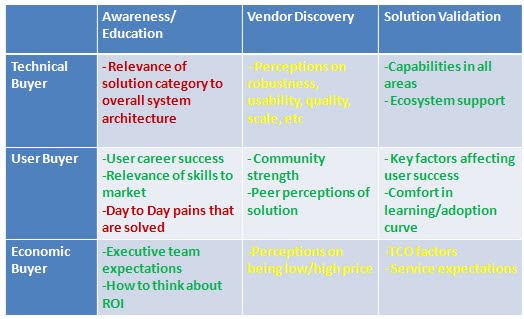
A similar exercise needs to be done to assess where the need for content is greatest. For each stage in the buying process, and for each role, a list of the perception challenges we face in the market can be created. From here, we will know the ideal messages for buyers to absorb.

These "messages" can be facts that are actively or passively sought by buyers. Actively sought examples are messages that are searched for, such as the specifications for integrating with a specific third party system. Messages that need to be delivered passively, however, are not actively searched for - such as corrections to misconceptions such as the idea that your solution is not appropriate for larger organizations.

Evaluating Messages

To begin, much like the evaluation of current content assets, a matrix can be created that has buyer roles along the y-axis, and buyer stages along the x-axis. In each box, the messages, information, and perceptions that need to flow out to the market can be listed, along with an assessment (red/yellow/green) of whether you are currently being successful in getting those messages out to the market. The value of this exercise is in its ability to shine a light on areas where you may have a significant messaging gap.

Successful marketers are able to inject these messages, perceptions, and criteria throughout the overall education process of a buyer, slowly altering perceptions, guiding the way in which solutions are evaluated, and ensuring that needed information is discovered.

The need to get this broad variety of messages out to buyers, now that buyers are in control of their own buying processes, is what has led to the growth in nurture marketing, as well as the business use of social media as a publishing platform. At each stage, a failure to successfully get these messages out to prospective buyers can quickly lead to buyers failing to progress in their buying process - the three types of leaks in the funnel covered in an earlier post.