Shared posts

17 Jul 15:55

5 Steps to Keep Control of the Sale

by Monika D'Agostino

Buying or leasing a car is an emotional decision. At least for me it is and listening to most of my friends it feels like it’s similar for them. Yes, you are buying a product but you are also making a decision as part of an experience. Not only the driving experience, but the way you feel in the car, the way people perceive you in that car, how practical it is and the list goes on.

So, when I walked into a Toyota dealership the other week looking at some models that could compare to the VW Jetta that I was currently driving, I was almost “sold” on the idea that the RAV4 could make sense to me. I was over on my mileage allowance with my Jetta and the new model doesn’t come with a built-in navigation system. My husband had gone to the dealership the day before to see if we could get a good deal trading in our Jetta and I felt that it was a good idea to make that move. Everything made sense and I was prepared to give up my European car, which is a “biggie” to me, to save some money and to get my navigation system that I so desperately need to not end up lost in a dark alley somewhere.

So, what happened that I didn’t buy the Toyota, but instead, decided to go with another Jetta? It was mainly the whole sales & customer service experience. You could say I just simply didn’t feel the love. But there are five important steps in the consultative sales process that were missing in this situation (not necessarily in this order).

1) Understand & Acknowledge Who the Buyer Is (and Understand Who the Influencers Are)

The sales person never looked at me, only addressed my husband although we had told her on numerous occasions that it was my car, and I was the buyer. Even when buying a car there are influencers (my dog, for example, and I took him along to make sure the car wasn’t too high for him – don’t judge me – LOL!). In this case, I was the Economic Buyer. It was my car therefore I was the final decision-maker.

2) Listen to Your Customer’s Needs

When I test drove the car the sales person pointed out how great the model was and that it’s literally flying out of the showroom, because it’s so extraordinarily popular and in such high demand. She never asked me if I liked the way it drove (I didn’t). In fact, she never even asked me one question – assuming that this “great” model would sell itself.

3) Manage Expectations

Under-Promise and Over-Deliver – a good motto to have.  It turned out that their initial calculations were off. The trade-in turned out to be far less attractive financially the day we showed up at the dealership than they had calculated the day before. A big negative for me as I was truly looking to find an economically sensible solution.

4) Stay in Control of the Sale

And most importantly, she let me leave the dealership to go home and think about it. Once I went home and reflected on the experience, I really started missing my Jetta (although it was still sitting in my garage). I couldn’t bear the thought of giving it up. Quite unexpectedly, it didn’t bother me anymore that there was no factory-installed GPS system.  I also realized that I could use my large screen Smartphone instead. And finally, I didn’t feel valued during the entire process and it reflected on how I felt about the car. The more I thought about it, the less I liked the whole idea of switching.

5) Create Value

Had the sales person addressed me (instead of my husband) and asked me questions about my needs, focusing on the fact that the Toyota offered navigation, a feature I couldn’t get with the new Jetta, and had the numbers not changed to my disadvantage, maybe I would have signed right then and there. I would have felt understood and valued. But she didn’t do any if the above. She didn’t seem to care about my needs. She only focused on other features of the car that didn’t speak to my needs and once I walked out of the dealership the sale was lost.

We have a segment in our Consultative Sales Certified Training Program that showcases an example similar to what occurred, but it wasn’t until I experienced it myself that I realized that even cars don’t sell themselves.

Consultative Selling Puts the Buyer in the Driver’s Seat

A comprehensive consultative sales approach truly helps sales people guide the customer/client through the sale to their final purchasing decision. Consultative sales people don’t push features – they identify needs and create a solution that is of value to that particular prospect/client. Buyers working with committed consultative sales professionals will never feel “sold to”. They know they’ll have made a decision that works for them. And surprisingly enough, consultative selling isn’t only necessary when you sell a service, but obviously also when you sell a product.

17 Jul 15:54

Here's The 'Ugly' Truth About What's Killing Revenue Growth At Yahoo (YHOO)

by Jim Edwards

marissa mayer is not impressed

All Yahoo CEO Marissa Mayer wanted to talk about yesterday on her Q2 2013 earnings call was the company's new product portfolio, Tumblr, and how it hoped to grow its audience.

But all the Wall Street analysts wanted to ask her about was the effect of "programmatic" advertising and RTB, which appear to be the culprit of falling ad prices at Yahoo.

Some called it Yahoo's "ugly" problem.

Revenues declined 1% to $1.07 billion. She also lowered her year-end revenue guidance slightly. Display revenue (ex-traffic acquisition costs) was $423 million, an 11 percent decrease.

"Programmatic" or "RTB" advertising are ads that are bought and sold in super-fast, automated online auctions. They're designed to find the best ad inventory at the cheapest available price for buyers — and thus have a tendency to drive down prices for publishers like Yahoo.

In fact, some are pinning the blame for Yahoo's yet-to-materialize turnaround on RTB.

Two analysts asked Mayer about the effect of RTB on Yahoo's stagnant ad biz. She said, "We can do better in display and this will be a clear focus for the business," and later added, "Our display business has felt some negative impact, particularly due to the shifts around programmatic buying. We need to do a much better job here in order to reverse these trends."

Analysts appear to regard the RTB trend with horror:

Sameet Sinha of B. Riley & Co. told Bloomberg, "We could have another year of absolutely no growth.”

BGC analyst Colin Gillis told Reuters, "This core business is going to be ugly for quite some time before it gets better."

Join the conversation about this story »

17 Jul 15:52

How to Use Pinterest to Increase Sales

by The Wishpond Blog

How to Use Pinterest to Increase Sales image tumblr inline mpzlpnLw8c1qz4rgp

Pinterest now drives more sales than Facebook, and it is significantly more product driven. 70% of users on Pinterest say they use the site to get inspiration on what to buy.

It’s also on the fastest growing social media platforms in the world. According to Semiocast, Pinterest now has over 70 million users globally. According to expandedramblings, six months ago, the site had 50 million users.

Marketing on this site gets your products seen. Marketing well on this site gets your products sold, and flying off the shelves.

I’m going to assume that if you’re reading this post you have some familiarity with the allure of this social platform. It’s demographics skew strongly towards women (80% of Pinterest users are women), there’s a lot of sharing that happens on the site, and it’s extremely visual in nature.

I kind of think of Pinterest as a new way of flipping through magazines and scrapbooking. You may remember, back in the day, if you’ve ever been involved in planning a wedding, changing home decor, or sharing great fashion trends – you’d flip through stacks and stacks of magazines with multi-coloured post-it notes. Well, Pinterest kind of does away with this – and makes sharing your product pins with customers and their friends incredibly simple.

As a business with goods to sell – Pinterest can be a gold mine for your bottom line. You need to know the nuances of the site, though. You need know the best practices, and how to really connect with your market. You don’t want to making The Top 9 Worst Mistakes in Pinterest Marketing (an article I previously wrote).

How can you present your products in the best way on Pinterest? What makes a pin get more repins, likes and shares?

Here are five of the best tips on how to use Pinterest to increase your sales.


How to Use Pinterest to Increase Sales Tip #1: Coupons

Coupons are hot on Pinterest. The words free, discount, and deal have long been selling staples in marketing success, and they still are.

Whether you use store coupons, online coupons or group coupons, deals promoted through Pinterest sell your product. Consumers love the prospect of getting a good deal. Combine that with very visual nature of this social site and you can have a home run for your product sales.

It’s easy to setup coupons. You can run them directly through your company website. Use a coupon application like Wishpond. Using a third party coupon application will make your promotions pretty headache free, and it gives you lots of additional marketing tools like email databases and real-time coupon campaign analytics.

Make a coupon board on your business Pinterest account. Pin images of your deal, with details of your offer, and a link back to the specific coupon page on your website.

A great coupon offer will get you tons of likes, repins and shares of your offer. What’s better than getting a great deal than sharing that deal with your friends? Coupons on Pinterest make this desire a simple, easy reality.

Check out this innovative company, Baby.Steals, who run deals twice a day everyday. The deals are hosted on their website, and promoted on social sites like Pinterest:

How to Use Pinterest to Increase Sales image WCgXg8IxHA N8ZR5aIcgj440WbZTYxRRB81fsR YHyHFYkiKO6KHRaw 7Eoxq8OH d0BOmC u7CiHPZ 15xZPjX8D4UJ YUinimc25ur1Q2fe kmhQa FwF

The baby.STEALS business model is based on giving away discounts on great quality items. It is now a multi-million dollar business.

Pinterest has tons of coupon pinners and boards. Do a search for “coupons” on Pinterest, and you will find results for a myriad of them.

Get your coupons pinned on prominent coupon boards to extend your offers’ reach. Here is a screenshot of my quick Pinterest search for coupon and discounted deal boards:

How to Use Pinterest to Increase Sales image gI3TVeWyQaZ90a4n1nf WBB7y 9hyPQf0rNJr5IhnV9nLUGyTEcEOiTUQ2Bcsa4TLmorx7wkjib1P9nO gcqAYX38zpa8y0jwhhJC9msARBSz3d41 EvDy t

Couponing pinning and repinning on Pinterest has almost become a way of life for some dedicated Pinners.

Tip: make sure your coupon pin links back directly to your website offer landing page.This way, when your pin gets shared on the site, your customer will always be able to click your image to link back to your coupon page.

How to Use Pinterest to Increase Sales Tip #2: Pinterest SEO

With 70 million users on the site, many Pinterest shoppers are looking for your product. To stand out and be found by your eager Pinterest consumer, there are a number of optimization tactics you need to incorporating.

1. Make sure your company username is optimized. Pinterest Business pages let you make your own company URL (so long as it’s not already taken). Be sure to take advantage of this, by making your username clear and reflective of your company. The username is limited to 15 characters, so if your company name fits – use it. If your company name is longer than this limit, create a shortened version that is easy to understand.

2. Include your company keywords in your “About” section. When you are setting up your Business account, be sure to clearly explain who your company is and what you do. This makes it easier for your customer to find you in any search.

3. Include links back to your website. Your ultimate goal of marketing on Pinterest may be to drive traffic back to your website. It’s good for inbound linking, and it’s good for getting clicks into your sales funnel if you have an ecommerce site. Include links to your products in every product pin you post. Include your website in your profile.

4. Use Pinboard names that reflect your keywords. When you’re making a new board name it based on what you will be pinning to it, and think like your consumer when you are naming it. What are they looking for when they find your products? Check out how Walmart uses different Pinboard names to show a variety of their products:

How to Use Pinterest to Increase Sales image KKDpdJL7gQDFuivUoU8qakUR0J 4piVdP45MVs FSOf7znomqqCRYpxC0wfCVL mGFMcn66XpOyLbgMNM7ODnBhatJGmuDADL0Oru OFZdOamBN kWNaRzilHow to Use Pinterest to Increase Sales image k94lVu96T496j RVlCV7ac0N9AtwawEd2g 3xWL L8IPkVXBrtSF0c fx lZlgMUY 1qP76pafCkKJcf6X6u6Hk3rYhNLFIZRyA1uUAt6OUXTBNRCyVooeBt

5. Use hashtags in your pin descriptions. Like Twitter, Tumblr and now Facebook, Pinterest uses hashtags. (A hashtag is basically a word or two behind the # symbol, that categorizes topics.) Include one to three hashtags in your pins. Think outside of the box, too. If you are a party planner, for example, use hashtags that include your location and any particular specialties your are offering with your pins.

6. Make good use of your pin descriptions. In addition to adding hashtags in your pin descriptions, be sure to include the words you want to be searched for. Pinterest lets you work with up to 500 characters to comment on your pins. Use this to make your images more enticing and easier to search by including keywords. Check out how London Drugs uses this tactic in their pins:

How to Use Pinterest to Increase Sales image Z8UZRIrUhf3jYCLP8I5Sh5kMi9J 1rfmxNyIZAx3LTJQYO Dog AsXjyvoIpdxvzbTY3TDB79hPW6Ed0JNK9wYOd9eMV7 8hH9Rtgdmwr7508V2kQSkxUbOi3

How to Use Pinterest to Increase Sales Tip #3: Rich Pins

Pinterest is listening to the needs of their business users, and continuously adding better functionality for you and your business marketing.

A major new feature Pinterest added this year is rich pins. Rich pins enable you to include a lot more details about your pins, and this information is automatically updated. For example, the rich pins feature updates prices, product availability, ingredients in a recipe and even movie reviews. It also makes the pins more mobile friendly.

The three types of rich pins currently include: product pins, recipe pins, and movie pins.

Here are a few examples of companies using the rich pins now.

Target: using product pins

How to Use Pinterest to Increase Sales image DFehY3UApSoXXB61NMpR74ecRvlLpOWtaxty3pH3VU1g3FBYNyLgrbDMfUnxuuPtOPx8pSldnClAY8dp1GSVgy5ODL2g5ZeQ1geuiIyPYegR8qHTMVd5lKWZ

Whole Foods: using recipe pins

How to Use Pinterest to Increase Sales image P6Hc58fxSoL0mkW71za4nBTyelBJ5NcA5z1TAkskzbKOzHaW1 lYmVFzCm7BuwlEx4B17Z55wPQfTRLwjNPU1cBajSvEoikm klpH NjrZAc2wHnNPKw8mou

Netflix: using movie pins

How to Use Pinterest to Increase Sales image 9tMkibB85BpjaHcOqCelw3WJEk isM7Szn2dLV1CUcJasbXxLk0w3SGCMAvPMFJ Dx0uLPDnkqMFURawUxmGktS9tzAwVJVRnJ G96IX yS C7Tc0EGcF986

With the rich pins feature, automatically updated information about your product appears in a lighter shade of grey on your pins.

You need to apply to Pinterest to get the rich pins, and your website needs to be coded with the required meta tags.

Though the feature is still new, my hunch is it’ll catch on quick. Having your products automatically updated save you a lot of time a hassle as a business owner or marketer. Having your product pin optimized for mobile is kind of an essential these days too.

How to Use Pinterest to Increase Sales Tip #4: Contests

Contests on Pinterest create an amazing method to connect with your consumer, and to generate tons of repins, likes and shares. Contests breed excitement, and are a great way to get your products associated with positive events. They can market your brand and your product to an enormous audience on Pinterest.

Like coupons, you can host your contests on your website, to drive traffic. Or, you can host contests directly on Pinterest.

Pinterest recently tightened up their regulations on “Pin it to Win it” types of contests. You’re no longer allowed to just ask someone to repin your pin to be entered to win. You need to create contests with a bit more substance. Additionally, you cannot suggest that Pinterest endorses your promotion.

The new regulations are really just good practise in running contests anyway. If you use a third party contest app, like Wishpond, we make your contests in keeping with the new regulations.

Here is an example of a successful contest hosted by Sephora.

How to Use Pinterest to Increase Sales image qEWoSvr3wlwyyio8MzOMUsUUq uf0fGL3meWE72 wLswDi WdimXy9oU1mMgp7ZK3sLD34ZUQP 693GvKdm Epag5jmmiDvOZVQ3m0dhmmoa5UYLpeGfJoyL

This sweepstakes had over 900 repins, 800 likes and 95 comments.

Contests and promotions can you tons of new followers on Pinterest, and get your products sold. A few general rules of thumb for creating a great contest that will get you more participants include:

1. Make the Pinterest contest easy to enter
2. Make the contest visually appealing
3. Make your sweepstakes prize appealing
4. Make your Pinterest contest mobile friendly
5. Cross-promote your contest through Facebook, Twitter and your website

Check out the article: 7 Tips for How to Run a Successful Pinterest Contest for more great tips on running contests on Pinterest.

How to Use Pinterest to Increase Sales Tip #5: Cross-Promote

No matter what site you are promoting your products on, it’s always good practise to cross-promote your site. On Pinterest, there’s two great ways to cross-promote your pins and page:

1. Pin it Button 2. Pinterest Tab

The Pin it Button is a Pinterest business feature. You’ve undoubtedly seen these buttons on numerous sites and pages:

How to Use Pinterest to Increase Sales image nAqNtfFr 3wUJQRWAq8ErmYMR90n SkANKnQKM58alZCerN9BNN9Qa1qP8d6rWCakMgIzlh7bx8BZomIAHBzuxQw3Xxctpvj96tvxqtatoelRv1RhiBYQbdY

They’re very simple to set up. You go to the Pin it Button site on Pinterest, and complete the information. You choose the Pin it image you want, submit your URL, paste your image file, and build it.

How to Use Pinterest to Increase Sales image 1btW8yD SiNEjhZwitaT4w1X35Nt9mxvktgU8ptq5 SVdJ9ggQGDpmLLjP7Zhqpd1e1XZxDoEq3NgGOALSZ GOJA1w7P89 Wl1g6Oq78R2EOn GEHWve4LT6

Paste the code for the Pin It widget onto your website.

Use Pin It Buttons to put beside all of the images of your products on your site. It anyone likes your product there, the button makes it super easy to share on Pinterest. The more your product is pinned to Pinterest, the easier it is get your product seen by tons of other interested consumers. And it doesn’t cost you anything.

Using the Pin It button can link back to your website too. According to Pinterest, the buttons create massively increase referral traffic back to your site. Allrecipes.com, for example, added the Pin It button, and in just three months, people pinned their recipes over 50,000 times, resulting in 139 million views on Pinterest.

A Pinterest Tab can be added to your Facebook Page or your website. The Pinterest Tab enables you to show all of you Pinterest boards as they appear on your Pinterest account. This means that any pin you make can easily be shared to your Facebook Fans, and your website viewers. A Pinterest Tab encourages fans on your other sites to both view your Pinterest images, and to really get interested in following you on Pinterest too. The tabs generates tons more views on your products and gets more shares through Facebook too.

Here’s what a Pinterest tab looks like when it is clicked on in your Facebook Page. This example is from one our clients, London Drugs:

How to Use Pinterest to Increase Sales image X4S5MvOy57x HF kiYQQwLICAQEu92O33JpWjIPez4c6oaQCYcwug34jX3xpxmvNbCjnE1uiEvD 4WAjOml2AzAw YpJ1twTQHrpHy118ytxy6OyNCVHZgv

Wishpond’s Social Marketing Suite includes really easy to make Pinterest Tabs. The Social Marketing Suite also includes coupon, contest and sweepstakes apps.

Conclusion

The motivation to get your products on to Pinterest really is a no-brainer. If you have products or services that the 70 million users worldwide will buy – you need to be marketing your wares on this socially sharing site. Use these tips to get your products found and seen on Pinterest and you’ll have well loved, repinned, shared – and sold – merchandise.

What do you think? Do you promote your goods on Pinterest? What successes have you had?

Written by Krista Bunskoek @ Wishpond

How to Use Pinterest to Increase Sales image tumblr inline mq1hig0NoO1qz4rgp

17 Jul 15:52

The Epic Rise of Video in Sales

by Mike Ricciardelli

The Epic Rise of Video in Sales image videomarketing1 resized 600Sales professionals obviously prefer face-to-face meetings with their prospects but sometimes, given their territories, that just can’t happen on a regular basis.  The alternative has mostly been to set up a conference bridge, email over a slide deck or Powerpoint presentation or get on the phone to sell.  Maybe they’ll toss over some whitepapers so their prospects can read up before the call and prepare some questions.

The future of these sales meetings will one day be all video-based, no longer just a voice over a phone and a LinkedIn picture to match a face.  Just tossing over a PowerPoint presentation and hoping that will close a deal will be as cool as wearing a Hello Kitty backpack on your first day of high school.

Those traditional sales and marketing webinars will fall into obscurity as they will morph into a more visually interactive forum.  Still shots and slides will be far and few between.

We did some work for a client whose business model was based on the ability to make enterprise video searchable, like a corporate Youtube where every spoken word is a searchable term. Through our outbound activity we found that, although these projects aren’t all happening right at this moment, companies are preparing to make a gigantic push to utilize video.

We’re talking videos being used within every department, but for sales, we see video being used on a larger scale: collateral, social selling and marketing, sales training, onboarding, coaching, development, employee-to-employee communication and employee-to-prospect communication. Also, video can be archived so it’s easily accessible for future use and with the amount of storage now available, there shouldn’t be a problem worrying about taking up valuable server space.

Let’s face it: if people have a choice between watching a video and listening to a recording or reading through presentations, I’m sure watching a video will far outdo its predecessors.

I’m curious to know your ideas. How can video be utilized by sales teams and what are your experiences with it thus far?

The Epic Rise of Video in Sales image 8c93f22f 8aa5 4300 a7f7 a9ec881c6475

The Epic Rise of Video in Sales image 07f0bf66 1dcb 40ea acd9 7c4ff5605ab011

17 Jul 15:52

Relationship Selling Is Dead (Redux)

by S. Anthony Iannarino

Relationship Selling Is Dead (Redux) is a post from: The Sales Blog | S. Anthony Iannarino

Some people (mistakenly) believe that relationship selling is dead. Some (mistakenly) believe that the only thing that matters is price.

Some of your dream clients believe that the sales organization that support them are nothing more than vendors and should be treated as such. But before we throw stones, we might want to clean the many windows that make up our glass house; some sales organizations behave like vendors and deserve to be treated as such.

What follows is a true story.

A sales organization has a longtime relationship with a client. That client company is purchased and their long time client contact’s job is in jeopardy. The acquiring company doesn’t really understand what he’s done or how he’s set up the program he runs. A big part of the reason they don’t understand what he’s done is because he collaborated with the sales organization in building something rather unique. The sales organization’s contact is in serious risk of losing his job.

But because the relationship is deep, the sales organization’s leadership assures the contact that, should the acquiring company fire him, he will have a place in their company. The sales organization’s contact is more than grateful.

But as the acquiring company assess their new acquisition, they realize the outstanding results the sales organization’s contact has produced. He shares how the sales organization did more than their part in generating those excellent results. As it turns out, the sales organization’s contact didn’t need their job. And he didn’t forget who had his back when it looked like things were going south.

After carefully reviewing the acquiring company’s business, the sales organization’s contact awarded them a number of new lines of business. This business never went to bid. There was never an RFP. No one else was even considered for the new lines of business.

Think relationships don’t matter? Think again.

Questions

Are relationships still important in sales? In business?

Maybe you couldn’t get your contact a new job in your company, but how could you help them if they were in trouble?

Have you ever had trouble penetrating a prospective client because your competitor’s relationships was so deep?

How deep are your relationships? Was that strength built on helping them tackle tough challenges?

What’s your best relationship story?

17 Jul 15:51

If You Can Follow a Recipe – You Can Launch an Inbound Marketing Campaign that Rocks the Revenue!

by Craig Klein

If You Can Follow a Recipe – You Can Launch an Inbound Marketing Campaign that Rocks the Revenue! image youvegotemailIt’s pretty clear that the old ways of marketing and sales are losing ground. Being a hard-working salesperson out knocking on doors and using previously proven sales techniques is brutal. You need to learn something new that works to keep food with your meals and you need to learn it now.

I have some good news and bad news.

The good news is the internet has provided statistics that show exactly what works and what sends your prospects down the road…or worse yet…frozen in paralysis of analysis.

The bad news is it requires sales automation. At least it sounds like bad news on the surface. Most really talented and driven sales executives resist being parked behind a computer to make sales. They would much rather be on their feet, meeting new people and shaking hands with a smile.

The good news about the bad news is that you will make more sales if you (and the rest of your company) adopt these ideas. In our recent eBook, “The Magic 5 of Content Based Email Marketing Campaigns that Drive Sales”, we talk about a marketing automation method that allows you to be out in the field with fresh sales leads that are ready and able to move toward a sale.

You may have heard about inbound marketing before. Marketers at the large corporations are developing ways to cause the customer to come to them with a client-centric content campaign. The “Magic 5” method can be used by every size business. Just follow the simple steps (the recipe) to get the benefits.

Email Marketing Works

If you have ever tried email marketing you may be pushing back on the bold statement about how it works – because it didn’t work for you. If that is your response, you are not alone. Lots of people have tried email campaigns that have fallen flat. Even with the most well-written email campaigns that is possible. However, when you combine the efficiency of email, customer-centric content and a hard-nosed, unwavering commitment to disqualifying those who are not yet ready – you are left with really, really good sales leads.

Nourish the “Not Ready” Sales Leads

When you are ruthless about qualifying each sales lead that comes in, there is going to be a lot of unworthy sales leads left to the sides. Maybe the term unworthy sounds a bit harsh, but it is true. Most of the sales leads that are fed to you as a salesperson are not worthy of much of your time. If they are treated right, with a high quality lead nurturing system, they will come back to you ready to talk to you about the purchase.

Total Customer Focus

The most common reason for marketing automation to fail is the person writing the email content feels they should share all the features and benefits of the product or service. That is a big mistake. What today’s buyers want is for you to only give them information they can use and appreciate – even if they never buy from you. Trust me, it sounds selfish on their part, but it works to increase sales.

Content that Converts

More good news…with a good, web-based CRM you can adjust any email campaign that is not pulling in the sales as you hoped. You will quickly learn what words turn up the desire to purchase and which ones don’t get any traction at all. All the data is waiting for you in the online CRM. You can even set up automatic measurements for every step in the sales process to help you tweak each step for optimum sales growth.

Switching to the new way of selling can sound a bit intimidating. Really, it is not. You know your ideal client. You know what they need to know to make an educated decision. The main thing that has changed is you educate them with email automation instead of with a sales person. When the buyer is educated enough to make a good decision, those sales skills are priceless.

17 Jul 15:51

Channel Partner Success Through Content Syndication

by Brian Tervo

Are you a vendor that increasingly relying on your indirect channel for a greater share of revenues? Or maybe the indirect channel is simply an important contributor to your overall revenue mix? Either way, it’s critical to help your VAR partners be effective and successful. Yet every vendor working with VARs faces the same challenge – securing the mindshare of a partner that is representing tens or even hundreds of vendors.

In order to be successful, you must take steps to set your company apart. In today’s world, that means going beyond supporting a channel sales and marketing program backed by funding. It means addressing the following:

  • Helping generate leads for partners
  • Making it as easy as possible for a VAR to sell your solution
  • Enabling VARs to engage in the social media conversation

In the end, the key is to deliver the information, content and campaigns that empower VARs to sell your solution – without requiring much from the partner and still maintaining control of your brand. After all, most indirect channel partners are small organizations with limited resources. In fact, they may not have a dedicated marketing expert who is focused on generating leads and updating the website with vendors’ latest messaging and content.

The right answer is a channel content and social media syndication solution that is simple and automated. Channel content syndication replicates and customizes digital content across external web properties. As a result, enrolled partners always have up-to-date information, tools and rich content to improve their branding, communications, lead generation and sales conversion.

Automate and Simplify Lead Generation for Channel Partners

The first challenge for vendors is helping partners generate leads. In fact, 60% of B2B marketers in the US surveyed by BtoB Magazine cited lead generation as their top challenge.

Because VARs with limited resources find it difficult to keep their websites up to date with vendors’ latest messaging and content, they often include a link to the vendor’s site on their site. Unfortunately, this sends prospects to the vendor’s site and they might never return to the channel partner’s website.

Automatically Publish to Your Partners’ Sites

Content syndication from is a powerful tool for directly and automatically publishing your microsites, collateral and topical campaigns on a partner web page with next to zero work required of the partner. Automating content distribution through partners is an effective way to increase the quality and amount of leads for partners.

Content syndication automatically distributes new content and handles details such as co-branding PDFs when applicable, eliminating the need for the partner to access a portal and modify individual PDFs. Because the VAR’s site then features up-to-date, comprehensive information about your products and solutions, the prospect doesn’t need to leave the website. A smart syndication provider also strategically places call- to-action buttons and lead capture forms where appropriate, helping to qualify and push traffic toward a conversion.

Generate Better Results for You and Your Partners

Partners with automated content distribution are able to remain focused on selling the product, while you focus on the intricacies of lead generation. Plus, you can analyze which content delivers the most qualified leads and apply these best practices across the entire channel instantaneously. As a result, your will generate better results and leads through your partner websites. Moreover, by simplifying lead generation through automation, you can realize a lower cost per lead, even while generating the same – if not higher – number of quality leads.

Automate and Simplify the Indirect Sales Process

Let’s face it – the best sales reps, whether direct or indirect, always look for the quickest and easiest way to make a sale. When a partner sales rep gets a prospect on the phone, he can choose from a multitude of solutions his company resells to satisfy the prospect’s needs. It’s only logical that he will opt for the solution that is backed by the most information and marketing content.

With syndication, you can strengthen the indirect sales process by distributing content to your partners’ internal business systems. Specifically, you can push entire sales dashboards right into your partner’s intranet to automatically delivery any new and/or relevant pricing, collateral or tools. As a result, you inject your company into the sales process, empower the indirect sales force and keep your company top of mind. This microsite displays specific content for individual partner, with content filtered based on the partner’s profile and automatically co-branded if applicable. When the salesperson clicks on your solution, he can access all relevant content and tools in real time while on the phone with a prospect.

Automate and Simplify Social Media Engagement through Partners’ Social Identities

It goes without saying that social media is playing an increasingly important role in the sales process. Consider findings from a report published by Twitter and Compete that evaluated how more than 6,000 Twitter users engaged with over 400 B2B tech sites at the end of 2012.

59% of site users visited B2B tech sites, compared to 40% of average online consumers. 30% of the Twitter users actively searched for B2B tech brands, while only 12 percent of average Internet users did the same. This why it’s critical to empower your partners to get themselves seen in Twitter feeds. Yet the social media sphere is still underutilized by most vendors with channel partners.

Some vendors that are trying to help their partners tap into the power of this channel have used social media syndication solutions that allow their partners to automatically Tweet out a message provided by the vendors. However, these solutions can’t close the loop and send prospects back to the partner’s site. Some even put a cap on the number of messages and partners you can manage through the solution.

Maximize the Value of Your Partner Relationships

So there you have it – your partner needs your help to generate leads to sell your products or services, whether that be through content on their website and or as a part of the social media conversation. As you seek ways to maximize the value of your partner relationships, it’s critical that you become an extended marketing department for your resource-constrained partners and help generate leads – without requiring much of your VARs.

17 Jul 15:46

Social Media A Must For Brands, But Needs A Strategy, Says Vision Critical Study

by Emily Wilson

Social Media A Must For Brands, But Needs A Strategy, Says Vision Critical Study image socialsale

(illustration taken from Vision Critical report)

A comprehensive study from market research firm Vision Critical indicates just how important social media is (and will continue to be) for brands, especially when considering product sales. Called From Social to Sale: 8 Questions to Ask Your Customers, the report reveals — based on 6,000+ survey respondents — that consumers are often more likely to purchase items after seeing them and/or interacting with posts about them on the social media platforms Facebook, Twitter, and Pinterest. More specifically, “4 in 10 social media users have purchased an item online or in-store after sharing or favoriting it on Facebook, Twitter or Pinterest,” according to the report. Additionally, it found that Pinterest is the site most likely to drive “spontaneous purchasing.”

An article about the report on Cantech Letter summarized some key findings, noting that “social media drives both in-store and online purchases in almost equal numbers. 38% of people who have liked, shared or commented on a product on Facebook have gone on to buy the product. And 43% of people who have favorited or shared a product on any social media platform ultimately purchased it. Facebook is still king in terms of volume, with 75% of respondents logging in daily, compared with 17% for Twitter and Pinterest.”

That same article also highlights the differences between social media and other mass media outlets that marketers often use. At the core, the difference is social media’s “fragmented nature.” According to the article: “Members of online communities are not homogeneous couch potatoes, but instead seek each other out and have online conversations based on mutual interests. For the marketer, targeting value-rich consumers involves more effort but is worthwhile compared with the old buckshot mono-message approach.”

In order to accurately target those users, there must be a strategic approach to the social media campaign. The article adds: “the challenge for marketers is to know the difference between the white noise of social media and meaningful data relating to their brand, where to find it, how to listen to it, and how to act upon it.”

Magnet’s own Director of Social and Interactive Marketing Services R. James Cupelli weighed in on the report’s findings and the mentioned Cantech Letter article. He found the following to be the most meaningful quote from the latter: “Don’t try to tackle the whole social media universe at once.”

“Generally speaking I think it’s important for brands to make sure that they factor in social media as additive to their overall marketing mix. Social media can have positive impact on brands, but only if it’s managed strategically. If social media is done wrong…I believe that most of the time their message gets diluted,” he said.

Brands need to look inward when thinking about social media strategy, he added. “Brands need to answer that age-old question: ‘What is our competitive advantage, unique selling proposition, etc.?’ And then they need to develop a social media strategy around that.”

But even as these Vision Critical findings can help brands understand how to better foster social media channels and increase engagement and sales or viewership (or whatever the given end-goal may be), there’s still plenty of room for innovation in this relatively new marketing sector, according to Cupelli. “Don’t get hung up on all these articles being written about detailed metrics, what competitors are doing, etc. because social media is still new and experimental,” he said.
…………………………………………………………………………………………………………………………………………………………………………………………….
Any thoughts on the Vision Critical report? Does you company actively use social media? Let us know in the comments and connect with us on Twitter, Facebook, Google+, and LinkedIn.

Register for our FREE Resource Center and Newsletter to access our growing library of valuable Guide Books, Tip Sheets, and more!

17 Jul 15:46

Why it’s Your Fault Deals Get Sideways

by Keenan

How many times have you thought you were about to close the deal and the client throws you a curve ball? How many times have you thought the sale was on track, when all of a sudden, BOOM, your prospect says they need more time or additional information? Does this sound familiar?

There is nothing more frustrating than when a prospect or customer does something different than what they say, hen they become inconsistent, and send conflicting messages.

Customers or prospects become inconsistent when they do things during the sale process that conflict with what they said they would do. If your customer says they see the value of your product and want it, then go dark or come back and ask for more information or say they want more time to think, they are being inconsistent. When your prospect says they will introduce you to the head of IT or the head of supply chain, then don’t they aren’t being inconsistent.

When customers or prospects become inconsistent, it’s your, job as the sales person, to get things back on track and to do this you have to be bold and challenge the inconsistency.

When a deal gets sideways and the prospect isn’t being consistent something has changed. The ground has shifted and figuring out what changed is paramount. Unfortunately, too many times we get “scared” and don’t call out the inconsistency. We don’t challenge the prospect and when this happens we only extend the length of the sales cycle AND decrease the probability it will close.

Sales people, it’s your job to “manage” the sale and the sales process. One of the biggest issues in failed sales and lost deals is when the sale process gets out of control and customer inconsistencies are at the core of it all.

When a customer starts acting inconsistent stop everything and ask why. Don’t let one strand of grass grow under your feet. If the prospect said they were the decision maker and then when you send them the contract they tell you their boss needs to review, call em out. Respond with, “I’m a bit confused, I didn’t know your boss has to review this as well. I was under the impression you were the final decision maker.”

Challenge the inconsistency. Get them to share with you why things are different than they had originally told you.

The reason you MUST challenge the inconsistency is it allows you to get to what is really going on and redirect your deal strategy. It allow you to get the sale back on track.

When the prospect or customer starts becoming inconsistent the sale will get away from you if you let it. Don’t let it. Challenge the prospect, call out the inconsistency and get them to commit to a new direction or remain consistent with their original commitments.

Don’t let deals go sideways because you don’t have the guts to hold your prospects accountable. Challenge them, it’s in everyone’s best interest.

17 Jul 15:45

Social media for professional services marketing

by Graham Laing

Professional services marketing: Build a business case for social success Social media adoption has been rapid within organisations serving consumer markets. The same however can't be said for professional services, where social media generally speaking remains a struggle. Many professional …..

The post Social media for professional services marketing appeared first on Smart Insights.

17 Jul 15:45

How a Simple Pause Can Save a Sales Call

by TheSalesHunter

stop closing 300x199 How a Simple Pause Can Save a Sales Call photoSure, you may know quite a bit more than your customer, but if you don’t learn to pause at the right time, you may lose the sale.

The typical salesperson thinks they know everything, and many times they do know quite a bit more than the customer.

Just because this might be true doesn’t give the saleseperson the right to assume the sales call is their time to play “conquer the enemy.”

On every sales call there is always a rhythm, and typically the salesperson’s rhythm is faster than the customer’s. What this does is get the customer to believe the salesperson doesn’t value what it is they have to say.

One of the most effective ways to slow your rhythm and allow the customer to have input is by pausing.  Don’t think for a moment that every second of a call must be filled with your voice.

After the customer gets done saying something, pause, wait, and restrain yourself from jumping in to talk.  By pausing and allowing a second or two to pass before talking, you give the customer the sense you’re listening, as well as processing what you’re going to say next.

This makes the value of what you say seem that much more important.

Another great benefit about pausing after the customer speaks before saying anything is oftentimes the customer will start talking some more.  In my book, that’s beautiful. The customer is talking and you didn’t even have to ask a question.

Pausing is also a powerful tool when we are communicating something of importance.  As I mentioned earlier, it gives the impression of increased importance in what we are saying.  This means that when you pause anytime you share a key piece of information or answer an objection,your response will seem more credible because of the pause.

The pause is of particular importance when you are sharing the price.   A slight pause before you state the price and an even longer pause after are critical.  I say a longer pause after you state your price because your objective is to ensure the customer speaks first after you’ve shared the price.

The power of the pause. Try it on your next call.

Yes, it can feel uncomfortable at first, but after you master the technique, you’ll feel a lot more comfortable, thanks to the additional sales you’re closing.

Copyright 2013, Mark Hunter “The Sales Hunter.” Sales Motivation Blog.

button receive a free9 300x51 How a Simple Pause Can Save a Sales Call photo

17 Jul 15:45

Sales Training Article: Prospects in Your Base

by Customer Centric Selling

Sales Training Article: Prospects within the Base

By John Holland, Chief Content Officer, CustomerCentric Selling® - The Sales Training Company
improve sales performance
Most everyone in sales appreciates how difficult it is to secure new clients. Challenges in closing new accounts can include the need to:

  • Establish relationships with new people
  • Prove your capabilities
  • Establish credibility for your company
  • Negotiate new agreements
  • Displace an incumbent that suddenly will do anything to save the account

In Business Development Workshops we define prospecting as getting Key Players that weren't looking (people with latent needs) to share goals that can be achieved through the use of the seller's offering. There is no mention of whether that Key Player works for a client or a prospect. In either case you are uncovering new opportunities.

When working with existing clients few of the barriers listed above apply. Win rates for securing add-on business should be significantly higher. Sales cycles are likely shorter than when working with new accounts if for no other reason than there is an existing agreement in place. Incidents of "no decision" are also likely to be less frequent.

Sales cycles with new accounts are somewhat analogous to dating (early discussions), getting engaged (a committee agrees to evaluate your offering) and getting married (making buying decisions). At some point after the honeymoon (implementation), things settle down into a different rhythm. Contact with key executives over time may become more limited. If and when Key Players leave the company, sellers may not establish relationships with their replacements. Ultimately, incumbents can become vulnerable to being courted by new vendors lose accounts.

Painting with a broad brush, some clients may feel they're being taken for granted. In some cases they are. Part of that may be due to an underlying attitude that if clients have requirements, they'll contact the seller. A few years ago I spoke with an SVP of Sales who had recently visited a satisfied long-time client. During the call, the executive indicated he recently made a buying decision for an offering. The SVP asked why his account rep wasn't asked to bid. Painfully, the client said he was unaware they competed in that space.

As this story indicates, it's dangerous to wait for clients to call you with new requirements. As an incumbent vendor sellers should focus on taking Key Players within their customer base from latent to active needs for add-on offerings. In some cases, the seller may gain access even higher levels than were contacted in securing the initial order.

My suggestion is to be as concerned about the org charts of clients as you were when courting them as prospects. An active plan to bring potential business outcomes that can be achieved with new offerings can minimize the times you may be caught asleep at the switch and either lose an opportunity or worse yet a client to a vendor who courted your client.


sales training companyNeed some help with your sales performance? Take a look at the sales training workshops available to you and improve sales performance.

Read more sales training articles from CustomerCentric Selling® - The Sales Training Company.

17 Jul 15:45

New hardware: the hidden cost of cloud computing - PC Pro


PC Pro

New hardware: the hidden cost of cloud computing
PC Pro
Coin stacks One reason why PCs sales continue to slide year-on-year is that software no longer blackmails us into upgrading our hardware. The system requirements for Windows haven't been upgraded since the launch of Vista; my five-year-old home laptop ...

and more »
17 Jul 15:45

5 Tips Every Content Curator Needs to Write Better Calls-to-Action

by Pawan Deshpande

content curatorCalls-to-action (CTAs) are among the most neglected of content marketing components — in both curated and created content. Yet, they are also among the discipline’s most essential features in terms of providing brand value. These simple, yet targeted, phrases are directly responsible for encouraging your audience to take a next step toward becoming a loyal customer, such as downloading your white paper, following you on Twitter, registering for your webinar, or sharing your content with a friend or colleague.

Without a call-to-action, content marketing efforts amount to little more than writing exercises. It’s not enough to publish useful information; you want readers to engage with you and take an action that will provide value for your business. 

Here are a few examples:

CMI cta

  • From an article on blog content, from Think Traffic:

cta-add to comments

In addition to being essential to your original content creation efforts, CTAs are also vital tools for the content curator. In the curation scenario, focus should be placed on the portion of the curated article where you provide commentary on why the content is relevant, rather than impacting any sections that you’re quoting and attributing to the original author. In the process of annotating and adding your own perspective, you can also elicit opinions from your readers and ask them to comment, as I did in this post on content marketing tools:

list-cta attributions

Creating your call

What goes into a strong call-to-action? Here are five tips for making yours as effective as possible.

  • Choose a goal: Should your CTA generate webinar sign-ups? eBook downloads? Social media shares? Something else? Write your CTA based directly on your most important current marketing goal — and always include a link so that the reader can take the desired action with minimal hassle.
  • Consider the context: Where is the prospect in the sales cycle? It doesn’t make sense for someone coming to your home page for the first time to get a CTA about buying an expensive product. In such a case, a CTA such as “request a demo” or “learn more” might be more appropriate. In addition, CTAs for content on your own blog might assume more familiarity with your brand than CTAs in guest blogs or other content you place on third-party websites; but remember that, thanks to Google, you never know where someone will enter your site for the first time.
  • Make it short and actionable: Cramming multiple CTAs into one piece of content can lower conversion rates, while long, wordy CTAs can confuse readers or simply get ignored. Another reason to keep it short: If you’re putting a CTA in a button, long strings of text won’t have the same visual impact as a short one. Nowadays, most consumers understand that a hyperlink is intended for them to click, so it’s unnecessary to say “Click here to register for our free webinar.” Instead, a simpler call action stating, “Register for our free webinar” is likely to have a stronger impact.
  • Place it strategically: When writing a short snippet of curated content, it’s probably not the best idea to include a CTA there, as it may distract readers when viewing that content. When providing a longer annotation on why the content is relevant, that might be a more appropriate place for your CTA. Below is an example of a CTA incorporated within the curated annotation.

CTA insights

Alternately, you could encourage readers to spread your content through social media or email by including a share bar or sharing buttons on your site.

  • Test your CTAs: Conduct A/B testing to find out what CTA messages are working best for your target audience. Does tweaking the wording or placement of your CTA change its impact? If so, you will want to adjust your strategy accordingly for future content creation/curation.

Looking for additional tips to make your content creation and curation efforts more targeted and effective? Don’t miss your chance to engage with Curata, and our other fantastic sponsors, at Content Marketing World 2013.

Cover image via Bigstock

17 Jul 15:45

Who’s Driving Your Online B2B Sales Strategy?

by Mike Olson

Who’s Driving Your Online B2B Sales Strategy? image webtraffic

Who drives your company’s online B2B sales strategy? Buyers, that’s who! Who has more choice and is more connected than ever before? Yes, your buyers!

B2B companies face many challenges in the transactional shift as the traditional customer contact strategies for their sales, marketing, and communications move away from a ‘human only’ context and into a hybrid or crossover that integrates social media and online search into the new ‘digital/human’ sales path. Forrester Research recently coined the term, “the new physics of Lead to Revenue Management (L2RM),” what others called “ye olde sales funnel.”

Digital Maturity

Companies are facing both information overload and ‘under-load’ at the same time. Technology and Internet strategy are changing business practices faster than many companies can manage. For instance, who in your organization leads and is responsible for the digital content in your company? Many B2Bs don’t even know where to begin to answer this critical business question.

Digital Maturity is a relatively new concept that measures digital best practices in your company. It creates a benchmark to measure your progress in developing the best practices needed to be successful online. Measurement is critical.

If you can’t measure it, you can’t manage it.

- Peter F. Drucker

If it takes a community to raise a child, it is also true in the business of raising a brand. Here are some key questions to ask when determining your path to digital maturity:

  • Does your company have one person who manages the decisions on investment for the ‘digital core’ in your business, or is it a shared decision?
  • How well are the teams working together?
  • How is your C-level, marketing and sales strategy aligned to share and create content that will be published and broadcasted from your unique brand content ecosystem?
Your Turn

Starting this week, we are launching a new series of ongoing educational blog posts to continue the discussion on all things ‘Digital Maturity for B2B’. The goal is to share insights and know-how so that B2Bs can successfully bridge the content gap with tools to assist in balancing the workload for sales, marketing, and management teams. We look forward to your input into this conversation, and we’ll be listening for more ideas to promote why ‘being social with relevant content to help buyers buy’ is a critical next step for B2Bs to succeed in this ever-changing digital/human world.

17 Jul 15:44

One of the most important changes ever made to Google Analytics?

by Dave Chaffey

Google rolls out a major update to Advanced Segments

Value: ★★★★

Timing: Originally announced July 16th 2013, rolled out end August 2013

Recommended link: Google Analytics announcement on new Advanced segmentation feature

I’ve updated this post as a reminder that this feature is now live in Google Analytics accounts. I haven’t seen an official announcement on the GA Blog, but I am now seeing this feature in my analytics at the top of relevant reports:

New segments

A couple of points I’ve noticed now it’s live are:

1. It’s not actually labelled “Advanced Segments” with a button unlike the original. Instead you see a slightly intriguing circle next to a drop down – not sure that’s the best usability decision.

2. By default you get to see all your standard and custom advanced segments together, for example, we have two based on a custom dimension in Universal Analytics for Basic and Expert members. You can filter standard, custom and starred, so the grid seems more efficient.

Commentary on the new segmentation feature

I’ve long been a fan of using Advanced Segments in Google Analytics since if you’re not using them, then you’re only reviewing the average visitor and it’s similar to marketing without targeting different customer segments.

In 2010 I wrote a guide I have recently updated showing 10 key types of Advanced Segments to use to encourage more use of Advanced Segments since I found that the majority of marketers on Analytics workshops weren’t using them. We also show how to apply segments to identify quick wins to improve a site in our 7 Steps Guide to Google Analytics. To stress how useful they are,  I say in the post:

“If you use Google Analytics and you’re not using Advanced Segments, you’re not really using Google Analytics”.

So, as a fan of Advanced Segments it was good to hear about this major new update to Advanced Segments which makes it easier to use segments.

It features a major update to the UI as shown below, but you won’t see this for a month or two – it’s being rolled out gradually.

NewUserSegmentation

But this isn’t the major change… We now have:

  1. User segmentation. In addition to the original visit-based segments you can group users by behaviour across several visits within a date range, for example, users who visit, buy or subscribe within a period (cohort analysis).
  2. Sequence segmentation. Users who perform actions across multiple site visits.
  3. Segment templates. To make it easier to create segments, 6 types of templates are provided as a starting point ‘Demographics’, ‘Technology’, ‘Behavior’, ‘Data of First Visit’, ‘Traffic Sources’ and ‘E-commerce’ for you to start with.

So, lot’s of tools to help you get closer to customers and optimise customer journeys to increase sales! If you want to find out more about the new segment model in advance of the rollout, watch this video or read this Google Analytics Segmentation post by Justin Cutroni who describes this as…

“One of the most important changes ever made to Google Analytics”.

17 Jul 15:44

Great Sales Talent is Only a Few Clicks Away

by John Kenney

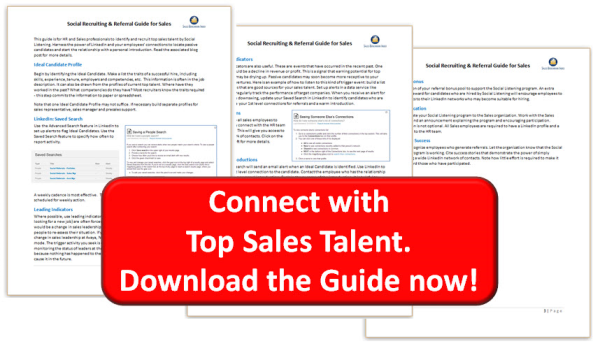
LinkedIn_ConnectionsSales and HR leaders face a common challenge – sourcing top sales talent. Even when the team is fully staffed and killing their quotas, things can suddenly change. A strong program for sourcing candidates is the key to consistently Make the Number. This post answers the question, “How do I consistently find top sales talent?" It will turbocharge your sales recruiting program by leveraging ‘social listening.’ It includes a downloadable guide to get you started.
Social_Recruiting_Referral_Guide

What’s Social Listening?

Social Listening is the proactive monitoring of indicators through social media. In this case, it's used to identify passive candidates for sales positions.  According to research by LinkedIn, 79% of their 225 million subscribers are passive – not looking to change jobs. Top talent is out there, and this program connects with them.

It starts with identifying the key characteristics of your ideal hiring candidate. Those criteria are used to set up alerts in social media to identify potential candidates. The true power is to leverage the contacts in your own employees’ networks through referrals.

Here’s why HR professionals prefer employees as a referral source for new talent:

  • Your employees know the company culture and recognize a strong fit
  • Top sales talent can best be reached through a personal connection
  • ‘A’ players ignore website postings and delete email job offers
  • Referred candidates have already passed a preliminary reference check by someone you know
  • 'A' players keep in contact with other 'A' players

Why Start with Sales?

Social listening is an effective way to staff for every position in your organization. But it is especially potent for sales positions. Sales people are experts at connecting with people outside to the organization to find new business. LinkedIn is their tool of choice. It allows them to quickly make the connections that lead to sales opportunities. So, top sales people are connected via social media. Connected to the people you want to hire.

Sales people are also among the most expensive to hire. And among the most expensive to mis-hire. Leading HR departments start social listening programs with with open Sales positions. The current sourcing approach is often most broken in this area. And the potential gain is the greatest.

Leverage the Full Power of LinkedIn

Recruiters know how to get the most from LinkedIn Talent Solutions. They are experts at using the LinkedIn Referral Engine to mine their connections. They also charge hefty recruiting fees for this service. In spite of their professional skill, they the lack access you already possess. They are not connected to your firm’s employees.

Social Listening gives you access to these priceless connections in a programmatic way. No external recruiter can do that. The math is in your favor, too. Here's an example: You have 500 employees and they each have an average of 300 LI connections. That's 150,000 people you can reach directly! You can search their profiles at the click of the mouse. Plus you have the ability to leverage established friendships and business relationships.

HR leaders must do more with less. Think of how much you could save on the recruiting dollars you spend today. This program provides direct access to the kind of individuals that your organization needs.

You Already Have the Connections

Social Listening combines 2 powerful catalysts:

  1. LinkedIn Signal to identify passive candidates with ‘A’ player characteristics
  2. Personal referrals from your employees

The downloadable Social Recruiting & Referral Guide provides the details on how to set up an effective program.

Here’s an example of the the program and the results you can expect:

  1. Initial research into characteristics of top sales people in the company identifies 7 trigger events for a job change. One of these is the arrival of a new sales leader. 
  2. A social listening system is set up to regularly scrape LinkedIn for announcements of newly hired sales leaders. 
  3. An alert is generated that a competitive employer just hired a new SVP of WW Sales. 
  4. A search of the LinkedIn connections of the sales organization identifies 5 candidates at the competitor firm who meet the top talent criteria.
  5. An email is sent to the employees who are connected via LinkedIn. They are asked to provide a personal referral.
  6. With warm introductions, the recruiter makes contact and stimulates interest with several of the target candidates.
  7. The ‘A’ player candidates listen and consider the new job opportunity. Two days later they meet with the hiring manager for an interview. They are excited to join the firm.

Next Steps

This all assumes that HR recruiters are the most socially connected people in the organization. Start by connecting with everyone in the Sales organization. (Then expand across your entire organization.) This provides the ability to directly search the people in their networks. One of the first onboarding tasks for all new hires is to establish a 1st Connection with the HR recruiter.  Your own people are the best route to hiring the next ‘A’ player.

Download the Social Recruiting and Referral Guide for Sales. Start leveraging the power of the connections within your organization today. Read this article by my colleague, Steve Loftness for tactical ideas. If you need help setting up your program, contact me at John.Kenney@SalesBenchmarkIndex.com. And please share comments on your experiences in the space below.  

Make Connections – Get Referrals – Hire the Best - Make the Number!

Author: John Kenney

sbi on linkedin

Follow @jdkenney

Follow @MakingTheNumber

If you enjoyed this post, never miss one again by subscribing your Email Here and/or subscribing to the RSS Here.

17 Jul 15:44

Buy a physical book, get the ebook for free

by Springwise
alttext

Digital literature has disrupted the publishing industry for good and book companies are still looking for ways to stay relevant. While there have been options such as Total BooX, which lets readers pay for ebooks by the page, Canada’s BitLit is now offering another way – giving consumers companion digital versions of the physical books they’ve already bought.

While some may view consumers as either for or against ebooks, the reality is that many like the different qualities of both. BitLit takes its cue from the music industry, which has offered digital download codes inside the physical product. Rather than target new sales however, the BitLit platform wants publishers to be able to offer ebooks for every book they’ve ever sold in retrospect. Consumers download the app and use its recognition technology to ‘scan’ their book’s front cover and copyright page, which needs to have a unique mark such as a written name. It then detects the title and stores the marked copyright page as having been used. The consumer can then access a digital version of the book for free, although sellers can also charge a small percentage of the ebook retail price if they wish.

This allows book owners to get ebook versions of their entire collection without having to pay full price, engaging them with the content by offering it on multiple platforms and gaining booksellers extra revenue on print copies. Considering experiments where physical books were bundled with ebooks have seen sales increase by up to 300 percent in bookstores, could this be a viable option for both consumers and publishers?

Website: www.bitlit.ca
Contact: www.bitlit.ca/contact

Spotted by: Murray Orange


17 Jul 15:42

Essential Q and A on SEO & Content Marketing for Small Businesses

by Lee Odden

SEO Content Marketing Small BusinessThe idea of making online content that is useful to people as well as easy to find and share applies to any organization whether it’s a B2B software company, a non-profit association or a government organization. There’s so much information being produced and promoted plus a growing array options for consuming content that standing out can be a real challenge.

I recently did a Google+ Hangout with a group of Chamber of Commerce executives from all over the U.S. talking about the role of content in marketing for small businesses. We dug into the fundamentals of what to talk about and how it can create a mutual benefit for SMBs and their customers. We also discussed the notion of empathy for our audiences and how important it is to invest in quality content as well as efforts to make that content easy to find and share.

Here’s a “cliff notes” version for our conversation, which was organized and led by Frank J. Kenny:

What’s more important, content or SEO?

Content is the reason search engines exist and if they didn’t, content would still be what people use to connect online.

In the modern digital marketing mix, it’s a holistic and customer centric approach that wins. That involves objectives and planning but also an understanding of the topics that matter to customers through the buying journey. Knowing how customers seek out answers online and what content formats they prefer is important too. Understanding how to create useful, entertaining information that moves the buyer along from awareness to purchase is how investments in content pay off.

SEO plays a role for discovery across the entire sales cycle to surface brand information that helps buyers come to know your company as the “best answer” to their problem.

By understanding how your target audience Discovers, Consumes and Acts on information, we can optimize to Attract, Engage and Convert them as customers.

How do you decide what to write and how much is enough?

Intuitively, content creation should come from a place of passion about what your company stands for and how it helps customers. There are many reasons people buy a product or service and that translates into stories to be told. As long as different people buy a company’s products and services for different reasons or applications, there will be reasons to create content.

I think it’s important to understand that Content Marketing is not a project. It’s a commitment to your customers that you’re there to help them get the information they need to feel confident about buying from you.

Logistically, content should be planned in an editorial calendar that focuses on the topics, frequency and channels that matter most to potential customers and any other audience you’re trying to connect with: existing customers, the media and industry influencers.

Crawl, walk, run and base the transitions on your goals, resources and monitoring of what’s working and what’s not. Always be optimizing!

How does social media work with search and where does content fit?

I like to say SEO is peanut butter, Social Media is the jelly and content is the bread that holds it all together. Except this sandwich is in more than one dimension.

Content is where your stories get told and both SEO and social media are ways to amplify the reach and engagement of those stories. Insights from SEO keyword research can review topics in demand that you should probably write about to attract customers that are actively looking. At the same time, monitoring social media can reveal topics and trends that can drive your editorial plan by covering issues, topics and especially, answering questions that your customers and buyers are interested in.

Understanding customers, researching relevant keywords, planning, creating, optimizing and promoting content are all part of a process that any small business owner can begin to tackle through a blog or contributing articles to other blogs and industry publications. Think about what kinds of questions customers have when they buy and then create content with answers that is easy to find and compelling to share. Become the best answer for what your business is best at, make it easy to buy and your sales will grow.  That’s a win for everyone.


Email Newsletter Gain a competitive advantage by subscribing to the

TopRank® Online Marketing Newsletter.

© Online Marketing Blog, 2013. | Essential Q and A on SEO & Content Marketing for Small Businesses | http://www.toprankblog.com

17 Jul 15:42

The Power of Questions for Attracting and Engaging New Buyers

by Jeff Korhan

The Power of Questions for Attracting and Engaging New Buyers image 2012.8.25 Questions1

Content marketing makes your business more attractive to prospective buyers by eliminating questions that stand in the way of them engaging with your company.

Thus, when thinking about selling products and services, it’s smart to first consider the most relevant questions that need to be addressed.

Have the mindset that social media puts your company in the answers business.

Questions have to be answered to engage buyers on a web where more than 50% of all consumers go for answers to their most relevant problems, needs, or desires.

Following are 3 reasons why your business should be asking and answering more questions.

Learn to leverage this practice to engage new buyers, build trust with them, and create the alignment that makes your business memorable.

#1 – Asking Questions Engages Buyers

Consumers are often afraid of asking questions, or they simply do not know which questions they should be asking. This is something I discovered by accident when I launched the landscape business that I operated for over two decades.

Before entering an industry that was then new to me, I conducted extensive research to learned about standard practices, which surprisingly were seldom used by many local businesses.

So, I asked questions that got prospective buyers thinking, and then provided answers that got the phone ringing.

When the truth hit the streets it spread throughout the communities we served; and in a short period of time our previously unknown business was the talk of the town. This was before the Internet, so we were using print media to reach our target audience.

Questions are differentiators. They show you understand your small business and its ideal customers.

Use questions to engage your social media communities. It is a practice that is a vital component of successful social marketing.

#2 – Asking Questions Builds Trust

For consumers and businesses alike, it is easy and therefore common to follow the crowd. However, when your business asks good questions it soon becomes apparent to your buyers that you honestly want to help them make better decisions.

For example, what is the question that is on the mind of every prospective buyer: What is the price?

This is the question that most companies dread, when in reality it is one that opens the door to let the buyer into your world of truth and trust.

Price is much more than a number. There are short-term and long-term costs associated with price. Those long-term costs are not always evident, and smart buyers intuitively know to ask about it. When they don’t, you have to ask for them.

When you ask your buyers if they want to know why your price is higher, you will get their attention. People are curious and your willingness to be transparent will be refreshing.

Nobody wants to pay the higher price, but educated buyers will when you validate your price with evidence that suggests other companies are taking short-cuts that will cost the buyer more over the long term.

Content marketing educates buyers about a practice known as “lying by omission.” If something should be included but isn’t, you have instantly eliminated that company as one that is not trustworthy.

#3- Asking Questions Shows You Care

Traditional marketing in the form of advertising was the business telling the marketplace what they thought they needed to know.

Today consumers have a voice and they expect to be engaged in a productive dialogue. Your questions will bring up more questions that will feed that conversation, and more important, demonstrate that your business cares about them.

When you care enough to ask you humanize your business, thereby building the trust that is essential for prospective buyers to step forward and take action.

Even if they do not buy today, you will have planted the seeds for them to come back after they have done more research.

Have you ever gone to a website where the “support” or “help” is packaged within a short list of FAQ’s – frequently asked questions? Often you cannot find the question that thoroughly responds to your particular concern.

This is why the practice of content marketing is so powerful. Answering questions in a narrative format creates familiarity. It helps the buyer see their situation in the solutions you have provided for your customers.

Your job as a content marketer is never done, because the most relevant problems are chronic. You have to keep doing this again and again to learn more, while serving up more relevant solutions to the most commonly asked questions.

Your sales team is providing relevant solutions every day – and so is your content marketing. This is one reason why social marketing is the new relationship selling.

Ready to get started?

If you would like to get the full story of how I used content marketing to launch my landscape business, read the Introduction to my new book: Built-In Social, by downloading it and Chapter One for FREE right here.

Photo Credit

17 Jul 15:42

Your Traditional Marketing Tactics Don't Work on Millennials: Here's How to Adjust

by John Bonini

millennial-marketingLet's level. Are Millennials just tablet-toting whiners living in their parents' basements?

In short, no. Of course not. But we're marketers; the only part of that much belabored stereotype we care about is maybe the tablet-toting part. What's more interesting is the fact that, according to USA Today, Millennials represent the largest demographic in the United States. Now that matters, and so does knowing how we can communicate with them.

Recently, Brian Halligan published an article on Inc. -- "How Millennials Think, and What to Do About It" -- where he concluded Gen Y’ers are more motivated by the mission rather than money. “They want to transform a broken industry, save the planet, feed the starving, etc.,” said Halligan. This idealistic undercurrent carries over to their buying behavior, as well. In order to feel invested, they need to believe in your product and the message behind it.

Along with the rise of the Millennial, then, comes a change in many people's buyer persona -- and the time has come to recognize once again that our traditional methods of targeting this persona may not be working. I've written about this extensively in my latest ebook, The Guide to Marketing to Millennials, but in this post I just want to break down how you can shift some of your more traditional methods of marketing to appeal to the Millennial generation.

Direct Mail

When it comes to your direct mail strategy, here’s the thing; it’s not working. 

To help illustrate the decline in engagement with physical media, one only needs to look at music sales. In 2013, CD sales dropped 13%, while digital formats increased 9.1%. Millennials don’t necessarily value the touch and feel of a product -- but rather the ease of acquisition and use of a product.

The same goes for mail. Most even pay their bills electronically, rendering the mailbox a place often reserved for an ever-growing pile of recycling. Says Tracy Lewis, senior consultant at PR 20/20, “I rarely see traditional advertising. Aside from bills and birthday cards, mail goes straight into the recycling bin.”

How to Adjust

Shift your mindset dramatically. If you're used to direct mail, I think you'll find the easiest transition into more Millennial-friendly turf in email marketing. It'll help promote new products or services in a similar way to direct mail -- one piece of content for one person -- but allows you to personalize your messaging more easily, and more efficiently, than personalized print marketing. These efficiencies will enable you to reallocate budget to other aspects of your marketing strategy.

And, most importantly, it’s measurable. Direct mail is often feast or famine, but email marketing is easier to track and improve upon. By analyzing open and clickthrough rates, you can more effectively make the necessary adjustments to increase conversion rates.

Email Blasts to Purchased Lists

The days of blasting emails to purchased lists -- or to your entire contact database for that matter -- are over. It provides very little context and minimal return in comparison to the more personalized methods synonymous with inbound marketing.

Keep in mind that Millennials grew up with caller ID. They were early adopters of luxuries like TiVo and Hulu. They’ve been marking emails as spam since Boy Meets World was on the air. They’re extremely adept at recognizing spam and blocking it out altogether -- and then creating their own blog to make fun of you for email spamming them.

How to Adjust

Before you consider ditching your entire email strategy, understand that Millennials are still utilizing it. According to a study by Pew Research Center, 90% of Millennials use the internet to send and receive email at least occasionally.

Therefore, it’s not them; it’s you.

Utilizing a marketing automation platform, introduce a little context into your email marketing strategy. By segmenting your contacts into lists based on demographics and behavior on your website, you can more effectively target your emails to the right audience and experience greater returns as a result. 

The skeptics will point to volume. “But I can get even more contacts from a list than I could ever get from my own database.” The retort is a simple one; a smaller list of relevant, targeted contacts is far more valuable than a higher volume of prospects that will simply drop you in their spam folder.

Print & TV Advertising

It’s not that Millennials aren’t watching shows or reading magazines -- they simply have a much different method of doing so.

Millennials all but created second screen viewership, using online streaming in order to access their favorite shows anywhere. The same applies to reading their favorite magazines. It’s more convenient to stream your favorite show or read a magazine on your laptop, tablet, or smartphone.

While live TV still dominates, Millennials are watching 5 hours and 39 minutes of video online every week, a number that has continued to rise. And while newspaper circulation continues to decline – nearly 20% since 2003, it has become imperative for marketers to discover alternate methods of reaching younger audiences.

How to Adjust

While TV advertising can still be effective as a whole -- although more so if you have a big budget -- relying on mass media as a sole method of promotion moving forward will prove to be ineffective. Consider how Millennials prefer to view video. They want it on-demand. Whether it's through their tablet or through TiVo, they’ve found ways around advertisements.

As Millennials redirect their attention to a second screen, so should you. There’s tons of video online that your audience is viewing. Find out where, and look into methods of advertisement there ... or better, yet creating your own online videos and amping up your YouTube presence. The same applies to print; Millennials prefer digital subscriptions to the touch and feel of paper. Considering the nature of your product or service, shift your budget away from physical media as much as possible in order to attract a more digital, multi-screen generation of buyers. May I suggest, say, a blog as your own version of the digital magazine?

Cold Calling

This is exactly the kind of solicited marketing initiative that simply won’t resonate with the Millennial market. At all. (Actually, is there any generation with which cold calling resonates?)

Technology has enabled us to learn more about prospects before a call is ever placed. And they know this. As a result, Millennials expect a more personalized, engaging experience in order to solve their problems.

“We care about authenticity, we care about sustainability,” says Brianne Carlon, content marketing director at Kuno Creative. “Don’t try to trick us; give us something real and useful. Tell us a story. Better yet, make it funny.”

Relying on cold outreach as a method of prospecting will yield nothing but a ton of hang-ups ... and perhaps even a few expletives.

How to Adjust

Stop doing it. Well … the “cold” part of it, anyways. Stop prospecting over the phone. Younger buyers don’t respond to this. Instead, let your content do the prospecting and educating for you. That’s ultimately what they’re looking for, a resource to assist in their decision-making process.

Reallocate budget and focus your marketing efforts on creating resourceful content that effectively shortens your sales process. This means less time on the phone. And more importantly, the time spent on the phone is with quality leads, ensuring a more efficient, personalized conversation and higher close rates.

PPC Advertising

“Millennials are a skeptical bunch,” says David Wells, founder of Inbound Now. “If there is a bunch of marketing/sales jargon behind a specific product, an alarm immediately goes off.” But PPC advertising can be tricky in the sense that, when targeting the appropriate audience and channels, it can still be effective with Gen Y’ers. 

Therefore, ditching PPC altogether isn’t the answer. Instead, supplementing your PPC campaign with other effective strategies consistent with Millennial behavior will help to maximize results.

How to Adjust

Millennials are taking to social media as a method of performing search queries almost as much as search engines.

According to a recent study by Telefonica, “57% of them use search engines to find information on restaurants, nightlife, entertainment and services. Nearly as many (52%), however, said they also use social media a.”

It’s nearly a split, which means allocating your entire online advertising budget toward PPC won’t deliver the type of results you expect or may have experienced in the past. Supplementing your PPC campaign with social media advertising, however, has never been more essential.

Using Facebook’s model as an example, you could target your ads to a specific demographic based on age, gender, or location, and establish a complementary organic presence with potential to be even more effective than PPC.

Banner blindness, coupled with the fact that Millennials spend 8 hours a week on social media -- more than any other generation -- stresses the importance of valuing social adverting and organic social presence as much as you do PPC.

Tone it Down

If you’ve noticed, there’s an obvious underlying theme here of a generation extremely adept at blocking out unwanted marketing messages, and more importantly, seeking out brands that provide the substance and engagement they’re looking for.

Millennials come equipped with a fairly accurate BS radar, if you will, meaning it’s critical that you adjust your tone in order to engage them more effectively -- no matter what marketing channel.

They’re adverse to sales pitches. Rather than being sold to, they prefer doing the research on their own in order to make decisions. They value conversation. Think walkie-talkie over megaphone. 

The need for engaging and resourceful content has never been greater thanks to the buying behavior of Millennials and their thirst for information. Consider adding someone to your team with strong written, oral, and communication skills that can more accurately convey the message to your personas in a manner that speaks to and with Millennials, rather than for and at them. Work hard to include them in the conversation. If not, the conversation will be happening somewhere else -- without you.

This is a guest post by John Bonini (@Bonini84), marketing director at IMPACT Branding & Design. Visit the IMPACT Blog for more content from John and the agency.

Image credit: Themeplus

  Marketing to millennials

subscribe to the hubspot marketing blog

17 Jul 15:42

Tell the Customer's Story, Not Your Story

by Geoffrey James

Why are you wasting everyone's time telling your company's story?

Every day, I receive around a dozen press releases from companies announcing new products. Here's a real-life example (name changed):

"I'd like to introduce you to Acme, a new cloud-based call center solution. Acme asked the question, 'Why can't your CRM software easily talk to your call center?' and when they couldn't find a solution to do that-they built their own."

Okay, they're telling a story. I give them credit for that. It's better than blitzing me with a list of product features.

However, while they've told a story, it's a story about them. And frankly, nobody gives a flying squirrel's sphincter about your company's decision-making process, which is the corporate equivalent of "how I spent my summer vacation."

This "look at us! we're so smart!" style of marketing has become woefully common in the post-Facebook era. People--particularly young people, I note--seem convinced that business communication consists of telling people about YOU.

But in business, it's never about you. It's always about the customer.

Ironically, call centers are full of vivid customer stories waiting to be told:

  • Call center people stressed out of their minds because they're under pressure to handle calls more quickly but they can't get the data they need.
  • Customers going nuts trying to figure what else they need to buy while talking to a call center person whose only answer is: "I dunno..."
  • Executives tearing their hair out at the cost of customer support and the apparent inability of the call center to upsell anything.
  • Investors selling stock short because the companythey've invested in can't make their numbers predictably.

Given that there's so much going on in this situation, why not tell a story that has real human drama? Like so:

Imagine you're calling a vendor for support and the call center guy has NO CLUE what you've already bought. Suddenly you're spending your valuable time providing information that your vendor should already know. So here's my question: how long before you start looking for a new vendor who has their sh*t together?

That took me two minutes to write that. I'm sure somebody really talented could up with something better, but that's not the point. The point is:

Tell the customer's story not your story.

Like this post? If so, sign up for the free Sales Source newsletter.


17 Jul 15:42

The Magic of Telling Your Story Again and Again and Again

by Marcus Sheridan

storyI’m going to say a few things here that may appear as a form of self-aggrandizing, but such is clearly not my intent. In fact, if you stay with me over the next few paragraphs, I think you’ll see exactly what I’m trying to say…

In my little corner of the digital world, I’m known for a couple of things. In fact, if one was to describe the brand that is Marcus Sheridan/The Sales Lion, a few phrases would likely pop up:

“Pool guy”

“HubSpot”

“Content Marketing”

“Answer every customer question.”

“Talk about pricing.”

“Transparency”

“SEO/Web Traffic”

“Enthusiastic Speaker/Presenter”

There may be more some folks would mention, but those are a few of the core aspects to my brand.

I mention this because over the last 3.5 years since starting The Sales Lion, I’ve written over 400 blog posts, given over 75 presentations to audiences about “marketing,” and been interviewed well over 100 times—be it podcasts, video interviews, textual interviews, etc.—and in almost every single one of these events I’ve told a simple story—again and again—that essentially sounds like this:

A struggling pool guy discovers HubSpot and embraces the power of inbound and content marketing, mainly by answering every customer question he’d ever received—including pricing—on his company blog. This transparency ultimately saved River Pools and made it the most trafficked swimming pool website in the world, and further led to a teaching and speaking career as a highly sought-after business/marketing consultant.

I don’t care if you read an interview/talk/etc. I gave 2 years or 2 days ago, this is the basic theme and story you’ll read or hear each time, and it’s also the reason I’ve had the opportunities to contribute to amazing books like Youtility or be featured in the New York Times—two events that would not have taken place had I grown tired of telling my story and allowed it to be buried long ago after the first 50 times I said it.

I mention this because I think there is, at times, too much focus on originality in the world of marketing. We think if it’s already been said then we shouldn’t say or talk about it again.

This could not be further from the truth.

Studies show that the average “customer” needs 6-7 touches before they make a buying decision. Well, I submit the average customer also needs to hear your story 6-7 times before it truly sticks, almost as if they were watching a great movie again and again and again.

So my point here is a simple one:

Don’t run from who you are. Don’t hide what makes you unique. Rather, embrace your story. Tell it again and again, allowing for changes as they occur.

By so doing, people will remember you, relate to you, and the brand will eventually stick.

Your Turn:

A quick couple of questions my friends. In a few sentences, what’s your story? And what are you doing to make it an intricate part of your brand?

17 Jul 15:41

How Paid Social Media is Being Used by Marketers

by VerticalResponse

Understanding how other marketers use paid social media (ads on Facebook, Twitter, YouTube, etc.) is important for anyone trying to compete in the social media marketing world. When it comes to social media, you don’t need to pay to play, but it’s a good idea to know what everyone is up to as you form your own marketing strategy. Patricia Redsicker, of Social Media Examiner recently poured over the results of a new survey by Visu,( a Nielson company) on paid social media. Incorporating some of Redsicker’s findings should help you get the best results out of your own social campaigns. Her findings include:

  • 65% of marketers are increasing their paid social media ad budgets in 2013

But don’t rush out just yet to start buying social media ads until you’re fully prepared. Redsicker advises, “Paid social ads are appealing because you can use them to target the right audience, increase traffic to your website and gain new customers for your business. However, before you start using this tactic, make sure that your social media presence justifies your planned spending.”

  • Currently, 89% of advertisers use free social tools

While many of this 89% also use sponsored tools (such as buying pages and ads on Facebook, Twitter and other free sites), the vast majority have a free presence as well, such as a Facebook fan page or corporate Twitter account, that are well integrated into the social media marketing campaign.

No longer are ads on a social media network viewed as their own device. Rather, a rapidly increasing number of advertisers are integrating the social media campaigns with efforts elsewhere, such as on television, on the radio or even on other online channels. Redsicker writes, “It’s not wise to put all your eggs in one basket. Cross-platform marketing allows you to spread your message across many different channels where it can reach more people and have a greater impact.”

  • Marketers are struggling to measure ROI

Redsicker explains, “Marketers are investing in a wide variety of online and offline marketing channels, not just social media. Hence they want to be able to use the same kind of metrics across different platforms so that measuring their overall marketing performance can be more consistent. In fact, 42% said that they wanted the exact same metrics for their online campaigns as for their offline campaigns, “with some additional metrics specific to the online medium.”

Social media marketers should be sure to clearly define their goals, expectations or conversions before starting a campaign. If you’re looking for real-world metrics, like leads generated, then devise a campaign to reach the necessary end result. Never invest in social media (or anything else), just for the sake of investing it. Social media management tools are a great way to stay focused on the business end of your social media investment.

Now that you’ve got an idea how the average paid social media marketer thinks, how will it change your social media marketing strategy?

17 Jul 15:41

In Case You Don't Appreciate How Fast The 'Windows Monopoly' Is Getting Destroyed...

by Henry Blodget

Bill Gates testifies

In the late 1990s, a single technology company became so unfathomably rich and powerful--and so hellbent on dominating not just its own industry but a massive and rapidly growing new one--that the U.S. government dragged the company into court and threatened to break it up over anti-trust violations.

The case was settled, and the company, Microsoft, agreed to play nicer.

But it turns out that the world had nothing to worry about. As often happens in the technology industry, what has really destroyed Microsoft's choke hold on the global personal computing market over the past 15 years hasn't been a legal threat but a market shift.

Just when it looked like Microsoft's vision of the PC as the center of the tech world would lead to the creation of the world's first trillion-dollar company, the Internet came along.

And it washed over the PC industry like a tidal wave swallowing a pond.

In terms of market value, Microsoft's loss of power has long been visible: The stock is still trading at about half the level it hit at the peak of the tech boom 13 years ago. The effects on the actual PC industry fundamentals have taken longer to develop, but they are also now crystal clear.

Microsoft's "Windows monopoly" hasn't been so much destroyed as rendered irrelevant. Thanks to the explosion of Internet-based cloud computing and smartphones, tablets, and other mobile gadgets, the once all-powerful platform of the desktop operating system has now been reduced to little more than a device driver. As long as your gadget can connect to the Internet and run some apps, it doesn't matter what operating system you use.

Three charts really bring home the challenges that Microsoft and other PC-powered giants like Intel, Dell, and Hewlett-Packard face in adapting to this new Internet-driven world.

First, look at global device shipments. For the two decades through 2005, the personal computer was the only game in town, selling about 200 million units a year. But then smartphones and tablets came along. And now they dwarf the PC market.

internet connected devices


This shift in personal computing device adoption, meanwhile, has radically diminished the power of the Windows operating system platform. As recently as three years ago, Microsoft's Windows was still totally dominant--the platform that ran 70% of personal computing devices.

Now, thanks to the rise of Google's Android and Apple's iOS, Windows' global share has been cut in half, to about 30%. More remarkably, Android is now a bigger platform than Windows.

bii global computer market share


Lastly, and most recently, this chart from analyst Horace Dediu of Asymco illustrates that the PC business is no longer just getting dwarfed by the explosion of smartphone and tablet sales... It has now actually begun to shrink.

Now that people have a choice of devices, it turns out that a full-blown personal computer is often not the most cost-effective, convenient, or simplest way to do what a user wants to do. Instead of being the center of the personal computing world, in other words, the PC is becoming a specialized office-productivity device.

Windows shipments


The news for Microsoft is not all bad. The company has been quite successful at moving from a "unit-driven" sales model to a licensing model, in which companies pay a fee per user per year rather than buying a perpetual license with each new computer. And Microsoft's Office franchise is still extraordinarily profitable and dominant, in part because Google, Apple, and other more Internet-centric companies have made so little investment in their competitive products.

But only 15 years after the government went after Microsoft for anti-trust violations, the idea that the company ever had a "monopoly" on anything is hard to to even understand. And the outlook for Windows, and the traditional PC business in general, seems sure to get even worse going forward.

Join the conversation about this story »

17 Jul 15:40

Social Media Lags Behind Google As A Source Of Online Retail Customers

by Cooper Smith

E-commerce retail sites are acquiring just .18% of their online customers via Facebook and Twitter, according to a study released June 25 by Custora

The study analyzed Google Analytics data linked to 72 million customers — an online visitor who purchased something — from 86 U.S. online retailers across 14 industries.

(E-commerce sites typically add tags to their links across the Web, in both paid and non-paid placements, in order to track the source of their leads and sales in Google Analytics.) 

Organic search continues to grow as a channel, accounting for nearly 17.53% of customers acquired in the first half of 2013, according to the study, led by data scientist Aaron Goodman.

E-mail has more than quadrupled its share of customer acquisition volume over the last four years, making it the fastest-growing among all the channels tracked in the study. 

Other search-related channels also performed well. 

Social media ranked low as a customer-generation channel. That said, Facebook is showing some potential. In 2009, less than .01% of new online retail customers came from Facebook, compared to .17% so far this year. 

Twitter has never accounted for more than .01% of new retail customers during the five-year study. Worse, a Twitter customer's lifetime value was 23% less than the average across all customer sources. 

There is more than one way to interpret Custora's data.

One could conclude that social media is ineffective as an e-commerce customer acquisition tool. But another way to look at it is that online retail sites simply aren't putting a lot of resources into marketing themselves on social media, and are favoring search and e-mail channels instead.

Also, even if social media still isn't there yet as a reliable direct source of customers, there's no way to tell how many customers were in fact influenced by content they saw on social media, and visited retailers' sites later. 

Download the chart and data in Excel. 

BII customer acquisition channels


Join the conversation about this story »

17 Jul 15:40

What Can Content Marketing Do For Me?

by Andrew Schulkind
What Can Content Marketing Do For Me? image 7506999282 9d853708b4 m

Photo credit: Saad Faruque

Content marketing has been a buzzword long enough that most marketing-aware business people have a pretty good sense of what content marketing is. I’m sure that’s true for the vast majority of the Biznology audience. What’s less commonly understood – and less frequently discussed – is how to apply content marketing. In other words, what can content marketing do for me? Here are five ideas.

Find New Customers
This is the granddaddy of all the content marketing goals. (Of all marketing goals, actually.) Keeping a fresh stream of content running improves your chances of being found (SEO) and being shared. (Social media, email marketing.) It can also be one of the more difficult goals to measure, as the path from content to closed sale can be indirect.

Strengthen Your Brand
This is much more marketing-focused than sales focused, so in many ways it’s the other side of the “find new customers” coin. Interestingly, this can be easier to measure accurately than sales results, but much harder to quantify. What is a new fan of your brand worth? What is he or she worth this quarter? Over the lifetime of your relationship?

Improve Customer Service
If customers can find information more quickly, or learn more about how to use your product or how deal with common issues, they’ll be happier than if they have to wait to get you on the phone or worse, go to an “authorized service center” for help.

Lower Administrative Costs
Improved customer service can also lead to lower administrative costs. If your customers can help themselves, your staff doesn’t have to. Arming your audience with information not only helps them solve their own problems, it can help prevent issues from coming to pass in the first place. Again, it’s a win for you and a win for your audience.

Establish Thought Leadership
The content you publish can become strong evidence of your expertise in your field. As you establish that expertise, you gain an almost unassailable advantage over your competitors – who your prospects may look at as commodity entities. Everyone wants to work with a leader, an expert, an acknowledged authority because it lowers the risk they are taking no matter who they hire. Remember, it’s your prospect’s butt on the line. He or she doesn’t want to risk embarrassment (or his/her employment) by making a mistake. Hiring a thought leader makes the decision that much easier.

There are, of course, many other ways you can put content marketing to profitable use. As you examine your needs and the areas where your current marketing isn’t working, I’m sure you’ll come up with other ideas.

And if a so-called content marketing guru comes knocking and tells you that you have to “do” content marketing without having a goal like one of these in mind to measure progress against, show him or her the door. “Doing” content marketing isn’t likely to get you anywhere. Determining what content marketing can do for you before you start is the way to solid results.

17 Jul 15:39

7 Definitions Of Big Data You Should Know About

by Timo Elliott

7 Definitions Of Big Data You Should Know About image big data in lego

Faced with the ongoing confusion over the term ‘Big Data,’ here’s a handy – and somewhat cynical – guide to some of the key definitions of big data that you might see out there.

The first thing to note is that – despite what Wikipedia says – everybody in the industry generally agrees that Big Data isn’t just about having more data (since that’s just inevitable, and boring).

(1) The Original Big Data

Big Data as the three Vs: Volume, Velocity, and Variety. This is the most venerable and well-known definition, first coined by Doug Laney of Gartner over twelve years ago. Since then, many others have tried to take it to 11 with additional Vs including Validity, Veracity, Value, and Visibility.

(2) Big Data as Technology

Why did a 12-year old term suddenly zoom into the spotlight? It wasn’t simply because we do indeed now have a lot more volume, velocity, and variety than a decade ago. Instead, it was fueled by new technology, and in particular the fast rise of open source technologies such as Hadoop and other NoSQL ways of storing and manipulating data.

The users of these new tools needed a term that differentiated them from previous technologies, and–somehow–ended up settling on the woefully inadequate term Big Data. If you go to a big data conference, you can be assured that sessions featuring relational databases–no many how many Vs they boast–will be in the minority.

(3) Big Data as Data Distinctions

The problem with big-data-as-technology is that (a) it’s vague enough that every vendor in the industry jumped in to claim it for themselves and (b) everybody ‘knew’ that they were supposed to elevate the debate and talk about something more business-y and useful.

Here are two good attempts to help organizations understand why Big Data now is different from mere big data in the past:

(4) Big Data as Signals

This is another business-y approach that divides the world by intent and timing rather than the type of data, courtesy of SAP’s Steve Lucas. The ‘old world’ is about transactions, and by the time these transactions are recorded, it’s too late to do anything about them: companies are constantly ‘managing out of the rear-view mirror’. In the ‘new world,’ companies can instead use new ‘signal’ data to anticipate what’s going to happen, and intervene to improve the situation.

Examples include tracking brand sentiment on social media (if your ‘likes’ fall off a cliff, your sales will surely follow) and predictive maintenance (complex algorithms determine when you need to replace an aircraft part, before the plane gets expensively stuck on the runway).

(5) Big Data as Opportunity

This one is from 451 Research’s Matt Aslett and broadly defines big data as ‘analyzing data that was previously ignored because of technology limitations.’ (OK, so technically, Matt used the term ‘Dark Data’ rather than Big Data, but it’s close enough). This is my personal favorite, since I believe it lines up best with how the term is actually used in most articles and discussions.

(6) Big Data as Metaphor

In his wonderful book The Human Face of Big Data, journalist Rick Smolan says big data is “the process of helping the planet grow a nervous system, one in which we are just another, human, type of sensor.” Deep, huh? But by the time you’ve read some of stories in the book or the mobile app, you’ll be nodding your head in agreement.

(7) Big Data as New Term for Old Stuff

This is the laziest and most cynical use of the term, where projects that were possible using previous technology, and would have been called BI or analytics in the past have suddenly been rebaptized in a fairly blatant attempt to jump on the big data bandwagon.

And finally, one bonus, fairly useless definition of big data.

The bottom line: whatever the disagreements over the definition, everybody agrees on one thing: big data is a big deal, and will lead to huge new opportunities in the coming years.

17 Jul 15:38

Surprises Are the New Normal; Resilience Is the New Skill

by Rosabeth Moss Kanter

The difference between winners and losers is how they handle losing.

That's a key finding from my ongoing research on great companies and effective leaders: no one can completely avoid troubles and potential pitfalls are everywhere, so the real skill is the resilience to climb out of the hole and bounce back.

Volatile times bring disruptions, interruptions, and setbacks, even for the most successful among us. Companies at the top of the heap still have times when they are blindsided by a competing product and must play catch-up. Sports teams that win regularly are often behind during the game. Writers can face dozens of rejections before finding a publisher that puts them on the map. Some successful politicians get caught with their pants down (so to speak) and still go on to lead, although such self-inflicted wounds are harder to heal.

Resilience is the ability to recover from fumbles or outright mistakes and bounce back. But flexibility alone is not enough. You have to learn from your errors. Those with resilience build on the cornerstones of confidence — accountability (taking responsibility and showing remorse), collaboration (supporting others in reaching a common goal), and initiative (focusing on positive steps and improvements). As outlined in my book Confidence, these factors underpin the resilience of people, teams, and organizations that can stumble but resume winning.

For anyone who wants to get beyond adversity or start over rather than give up, America is the Land of Second Chances. According to Jon Huntsman, former US Ambassador to China, getting back on our feet is an American strength widely admired in China. And everywhere, rapid recovery from natural disasters is increasingly a key to a robust economy. Entrepreneurs and innovators must be willing to fail and try again. The point isn't to learn to fail, it is to learn to bounce back.

Some stumbles are due to circumstances outside of most people's control, including weather events and geopolitical shocks. But while people might not control the larger problem, they control their reactions to it — whether to give up or find a new path. Recession in Europe is an example. I recently spoke to European audiences at public conferences and within companies about cultivating resilience in their businesses even when markets are shrinking, so that they hold their own as recession continues and are well-positioned for recovery. A German machinery company showed resilience by growing its service contracts when demand for machines slowed, and it mobilized employees to find new service possibilities. An Italian cosmetics firm grabbed talent from job-shedding multinationals and increased its international marketing tied to both health and fashion; new sales followed. In both companies, like others described in my book SuperCorp, such initiatives were made possible by a strong sense of purpose that drew members together and motivated them to take responsibility to help the companies survive and thrive. Employees were resilient because they cared, and that made the companies resilient.

Complacency, arrogance, and greed crowd out resilience. Humility and a noble purpose fuel it. Those with an authentic desire to serve, not just narcissism about wanting to be at the top, are willing to settle for less as an investment in better things later. Raymond Barre, former Premier of France, after being defeated for reelection at the national level, ran for a lesser office as Mayor of Lyon and became a hero of his region. That's the strategy Eliot Spitzer is taking by running for a lesser city office after having been governor of a state. He showed remorse quickly when scandal surfaced and then reentered the public conversation talking about the issues, increasing his comeback prospects.

Some observers say it is harder for women to stage comebacks. Still, consider Martha Stewart. She served prison time for insider trading rather graciously, showing remorse, and that graciousness restored much of her fan base afterward. In a more positive vein, Hillary Clinton was not a sore loser to President Obama in 2008 (though some of her followers were) and accepted his offer to become his Secretary of State. She's now perhaps even better-positioned for a 2016 Presidential run. In the long term, graciousness beats sour grapes.

Resilience draws from strength of character, from a core set of values that motivate efforts to overcome the setback and resume walking the path to success. It involves self-control and willingness to acknowledge one's own role in defeat. Resilience also thrives on a sense of community — the desire to pick oneself up because of an obligation to others and because of support from others who want the same thing. Resilience is manifested in actions — a new contribution, a small win, a goal that takes attention off of the past and creates excitement about the future.

Potential troubles lurk around every corner, whether they stem from unexpected environmental jolts or individual flaws and mistakes. Whatever the source, what matters is how we deal with them. When surprises are the new normal, resilience is the new skill.

17 Jul 15:38

Here Are The Major Players In Mobile Advertising

by Josh Luger

mobile ad forecas

We are in the post-PC era, and soon billions of consumers will be carrying around Internet-connected mobile devices for up to 16 hours a day. Mobile audiences have exploded as a result.

Mobile advertising should be a bonanza, similar to online advertising a decade ago. However, it has been a bit slow off the ground, and its growth trajectory is not clear cut.

In a recent report from BI Intelligence on the mobile advertising ecosystemwe explain the complexities and fractures, and examine the central and dynamic roles played by mobile ad networks, demand side platforms, mobile ad exchanges, real-time bidding, agencies, brands, and new companies hoping to upend the traditional banner ad.

Access The Full Report And Data By Signing Up For A Free Trial Today >>

Here's an overview of some major players in the mobile advertising ecosystem:

In full, the report:

To access BI Intelligence's full reports on The Mobile Advertising Ecosystem, sign up for a free trial subscription here.

Join the conversation about this story »