Shared posts

18 Jul 15:43

Sales Process vs Sales Techniques

by Will Brooks

Will Brooks
Executive Vice President, The Brooks Group 

“Give a man a fish, you feed him for a day.  Teach a man to fish, and you feed him for a lifetime.”

~ Lao Tzu

What does this rather overused Chinese proverb have to do with sales process or sales techniques?  Let me explain:

By providing your team with sales process training, you’re teaching them a methodology which – if the sales process is proven and taught correctly – they can fall back on time and time again regardless of the selling situation in which they find themselves.  They will become more self-sufficient and will be much better prepared for the ever-changing realities in today’s marketplace.

Presuming, of course, that your company chooses the right sales process for your sales environment (inside sales vs. outside sales, direct sales vs. channel sales, etc.), teaching a linked, sequential sales process will allow your salespeople to follow a set of flexible principles they can tap into as they work with prospects and customers, regardless of whether the prospect or customer is ready to commit at that moment or if he or she is just in the early research stage of the buying process.

In other words, you will have taught them to “fish.”

The IMPACT Selling® System, for instance, has 6 steps, 3 rules and 5 characteristics that need to be internalized.  Once a salesperson takes ownership of IMPACT, that salesperson can then apply the process across all selling situations and be able to know exactly what step they’re in and what needs to happen next.  They’re not held captive by knowledge of just a few (or many) memorized, “canned” sales techniques.

How Does Sales Process Compare To Sales Techniques?

First of all – and this is a personal opinion not necessarily based in fact – sales techniques, to me, sound possibly manipulative and seem like something you do to a person as opposed to something you do collaboratively with a person.  They seem memorized, scripted and quite rigid, something to be repeated over and over.

Only providing your team with sales techniques training is much like giving them a “fish” to eat.  In the absence of anything other than sales techniques training, you will have given them particular skillsets that are useful only when certain circumstances present themselves…the equivalent of giving them access to the occasional “meal.”

A great example of what I’m talking about might be closing skills.  Let’s imagine for a moment that one of your salespeople has made contact with a prospect who is involved as a committee member in the buying decision but who doesn’t control the budget.  This person is only in the early stage of the buying process.

How in the world are closing skills going to help your salesperson in this situation?  They simply won’t. In fact, they'll get in the way.

With that said, sales techniques can be quite useful when applied as a tool to be used within the sales process.

Here’s how that might work.

Questioning techniques are a great example of how sales techniques can fold into sales process.  When the salesperson enters the “interview” phase of the sales process with the prospect (the time at which it is appropriate to drill down and understand the buying motivations in the prospect’s own words), questioning techniques can be useful.

Closed-ended questions, open-ended questions, and 3-deep questioning skills are valuable sales techniques that come to mind here.

So, as you weigh the benefits of both sales process training and sales techniques training for your team, I urge you to consider the value of providing a flexible, principles-based sales process for your team to use while at the same time training your team on the appropriate sales techniques to be used within the framework of that process.

- @WilliamPGBrooks

The post Sales Process vs Sales Techniques appeared first on Sales Evolution.

17 Jul 15:52

Increasing Customer Engagement …Do You Matter to Your Prospects and Customers?

by Louis Foong

Increasing Customer Engagement …Do You Matter to Your Prospects and Customers? image b2b customer engagement 277x300

As an avid explorer of food and wine, I seek out new places to visit and different cuisines to try. My experiences range from satiated to unimpressed and delighted to disappointed. It’s all good, I enjoy the adventures. Then I have my list of favourites, the tried and tested wines and restaurants that I will go back to any time with pleasure. Not all of these are fancy labels and/or expensive ones. But they work for me every time, especially when I don’t have the time to plan ahead or just don’t want to plan my meal. This, my friends is a standard, very typical human choice. And we don’t give much thought to this behaviour in general.

As a B2B marketer, however, this is perhaps one of the key behaviours one should pay attention to. Seth Godin talks about being rational and fickle at the same time in their choices. He explains competitive advantage as a situation where you win as a marketer because your customers choose you. Your ideal customer, he says, wants you as a marketer to remember these 4 key points:

  1. Matter to me: Not matter to you or to the next guy, but matter to me. That’s all I care about. (Example: it might mean more to me that my friends use your product than it does that you’re cheaper).
  2. Worldview: Based on the way I see the world, the assumptions I make, the truth that I believe in. (Example: If I don’t trust young people as a matter of course, I’m not likely to choose you if you’re young, all other things being close).
  3. Options I’m aware of: If I don’t know about you, you don’t exist.
  4. Switching cost: The incumbent gets a huge advantage, especially in high cost/high risk/network effect instances.

In my opinion, this wisdom from Seth is worth its weight in gold if only all marketers pay attention to it. But most of us don’t. So we have studies that tell us Customer engagement is the top concern keeping CMOs up at night” (new study by executive recruiting company Korn/Ferry International mentioned inB2B Magazine).

I’m actually glad to read that more and more CMOs are thinking beyond the numbers—past the Likes, Fans, Followers, Shares, Tweets, web traffic—to focus on building engagement. The important thing to remember is that to appeal to the fickle-yet-rational customer, you really need to differentiate yourself from the others in your industry. You need to sell that competitive advantage to customers, and each customer is unique. So this can get quite complicated, right? How long can you keep second guessing, employ trial and error, drain your resources, waste your time? You cannot and there is no need.

6 Ways to Simplify and Grow Customer Engagement

Automation and now digitalization has clouded our marketing vision. We see “leads”, “prospects”, “customers”, “lists”, “data”—do we see people somewhere in all this? Let’s start with this very basic step towards simplification. The concept of human choice that I started this piece with is based on the premise that our customers are living, breathing, thinking individuals and we can engage them because they are so. No matter how advanced your CRM system, sales automation software, email marketing engine and whatever other technology/tools you use for lead generation may be, there are some simple ways in which you can start counting real, valuable relationships.

  1. Humanize your social properties. Don’t worry about how many new links have been posted to your company’s Facebook wall or how many times your latest promotion has been Tweeted and Re-Tweeted or how many Pins and Re-Pins your latest product photos are attracting. Update your social platforms with stories that are of interest to your community of users and potential customers.
  2. Be Socratic. Ask questions, pertinent ones. Provide answers to questions being raised by your customers even outside of your direct interaction with them; for example, on industry forums, review sites, third-party blogs and user groups. This may have been the method of Socrates and his contemporary Greek philosophers in ancient times but it is still the most scientific method of inquiry and observation.
  3. Use the power of the crowd.Or crowdsourcing as it is now called. You don’t have to be solely responsible for starting and sustaining brand conversations. Your prospects and customers are already doing it informally. Now bring them into your own forums and reward them for sharing insights, best practices and comments about your brand. There is a lot more power in what others say about you than you can ever hope to infuse into a piece of communication on your own. At the same time, monitor your LinkedIn groups and other social communities—keep an eye on who comes to the party and filter out the ones that don’t or cannot add value. Anyone who wants to get up there on the bandstand all the time to shout overtly promotional messages is just not in the right place. Set your guidelines and regulate the conversations to ensure there is no “noise pollution”. Those who are engaged will remain and be more engaged seeing that you are keeping the spammers out. We recently started a new LinkedIn Group specifically for Channel Executives to discuss B2B lead generation and social media. One of our mandates is to have this group become highly engaged, to have real, value added discussions. (By the way, if you think you can add value, please apply to join the group.)
  4. Enhance the longevity of your content.Marketers today have a plethora of content formats available to them—audio, video, mobile content, social networks, online news portals, and more. You don’t need to use all channels all the time, but knowing which one is best suited to the target audience you want to reach is important. Here is a useful Infographic on Content Marketing Media Matrix for Small Businesses.

Increasing Customer Engagement …Do You Matter to Your Prospects and Customers? image content marketing media matrix for small businesses

5. Get a 360-degree view. Too often there are just too many holes in our sales and marketing processes. Cracks and gaps develop in relationships, as a result, and high potential, good quality leads simply disappear into thin air…because no one was looking from a 360-degree perspective. There was no all-round feedback loop created. To impact customer engagement, you need a steady dialogue at every touch point or interaction with a prospective customer and even after the sale is complete. There needs to be employee accountability at all levels within the organization and only then can you hope to engage customers and win them for the long term.
6. Get your channel partners and supply chain on board. The guy behind the wheel of your delivery truck, the technician who installs your product at the customer’s site, the reseller or dealer who you depend on to serve a specific local geography, all play an important role in customer engagement. Take the time and make the effort to get them on board your marketing vision so you can start creating a consistent customer experience all around.

What customer engagement strategies are you using at your B2B organization? Are you looking for ways to fuel demand generation and increase marketing ROI? Download a free copy of The ALEA Demand Generation Playbook to further help your efforts.

Image credit: Shutterstock

17 Jul 15:52

5 Keys to a Strategic Marketing Partnership

by Sydney Hadden

For the past several months, I have been working with a few companies developing strategic marketing partnerships. This is not something I have had much experience with in the past, so I wasn’t sure exactly how it would work. I had a few concerns about entering into such a shared arrangement. I worried about loss of control, division of responsibility, and trusting that each party would be responsible and timely. With all these concerns and lack of experience I was definitely walking in with my cautious shoes on. But after several months, my worries have evaporated. I’ve come to realize some serious benefits from working with a strategic partner (and from my feedback, I would say our partners are very pleased as well). To give you a brief idea of how and why these partnerships work, I’ve outlined the 5 keys to working in a strategic partnership.

1- Expertise:

Both ends of the partnership should bring some level of expertise to the table. Whether it be design capabilities, project management, sales, PPC, etc. Both parties should bring a level of expertise to the table that the other is incapable of or less efficient in. Focusing on your expertise generally means efficiency, allowing you more time to focus on what you know and less time fumbling in areas that are not your strong suit. Working with an expert in another field lets you focus on your core competency, making sure the end client gets the best possible solutions.

2- Reputation:

Working with a partner that has a strong reputation can help strengthen your own reputation. Providing top quality work to a client means satisfied reviews, positive word of mouth, and most likely a growing business. It’s imperative to work with a partner that can build reputation.

3- Relationships:

Building a trusting relationship is incredibly important to the success of any partnership. If you can build and grow in your partnership, new opportunities, efficiencies, and personal growth will follow. Building relationships will improve your performance, open communication, and likely build business.

4- Clear Division of Responsibility:

This rule applies to in office work as well as strategic partnerships. Every project should have a clear strategy outlined with division of responsibility. Each party should know 100% on which tasks they are responsible for. And for any of those crisis moments, grey areas, etc. clear communication is a must. The best way for a strategic partnership to do this is through a general hierarchy – from a project manager down to a coordinator, there should be a sense of ownership on every project and task.

5- Team Work & Trained Eyes

As I said before, every partnership should have different people with different areas of expertise. The benefit of bringing together different minds is to see a different perspective, catch problems that might be outside of your general thought process, and to learn from each other for constant improvement.

Thinking about engaging in a digital partnerships or any strategic marketing agreement? Feel free to contact us for more information.

As with any business decision, there are risks associated. As long as these elements are carried out successfully, a strategic partnership can be extremely beneficial to both parties. Go into each arrangement with an open mind, a strategic plan, and make sure you communicate to ensure a positive partnership. Londes Digital Marketing offers digital marketing partnerships. Our focus is on meeting the digital needs of clients of all sizes.

16 Jul 23:08

Your Price is Too High!

by Dale Furtwengler

These words strike fear into the hearts of CEOs and salespeople like no others.  The reality is that this is the one statement we should long to hear.  Why?

Because it opens the door to negotiation.  Now if you’re not an experienced negotiator I suggest that you take some classes, read some books, do whatever you need to do to develop this skill.  It’s one that will serve you, not only in your business, but in your relationships with family and friends.

One simple question

In the meantime, here’s one question that will help you launch the negotiation.  When a prospective buyer tells you your price is too high, simply ask “What would you like to give up?”

This simple question puts them on the defensive.  They now have to explain why they think the price should be lower instead of you trying to convince them that your price is fair.  Often they’ll cite another store or the internet where they can get a cheaper price.

To which you’ll respond, “I have no doubt that you can find a cheaper price, but what will you be giving up with that lower price?”  Again, don’t be surprised if they say “Nothing, it’s the same product.”

Agree that it is the same product.  Then ask what they’ll do when they experience the myriad problems that can occur after the sale.  How will those be handled?

How will they feel dealing with a disembodied voice in a distant location that isn’t authorized to deal with their problem.  Or they’re left to their own devices because it isn’t the company’s policy?  How much time will they spend shipping the defective product back and forth versus getting an immediate exchange from you?

The goal

The goal isn’t to denigrate your competition, it’s to help your prospect understand why your price is higher than your competitors.  That there are a number of intangibles that are often overlooked that add real value and warrant higher prices.

This approach also helps them make conscious decisions about the choices they make.  If the price really is outside their budget, it opens the door for you to guide them to alternatives that will meet the majority of their needs and provide an enjoyable experience for them.

In B2B situations, that means tailoring the offering to their specific needs.  In B2C transactions you offer alternative products after your questions have ferreted out what’s most important to them.

Strategy

Your sales strategy should include sufficiently high prices to get prospective customers to say “But your price is too high!”  It opens the door for you to:

  • Discover what’s really important to your customers versus what’s nice to have.
  • Guide them to making informed decisions that benefit them and you.
  • Get higher prices despite what your competitors or the economy are doing.

In those instances in which the customer really only cares about price, it’ll let you recognize that condition early in the sales process so that you limit the amount of time and energy expended in what will inevitably be a failed effort.

Once you’ve developed the skills you’ll find that negotiating is a lot of fun.  It’s a wonderful outlet for the creativity that exists within each of us.  Enjoy!

16 Jul 23:07

New Business Trend: Vacation Time as a Commodity?

by Elizabeth Smith

New Business Trend: Vacation Time as a Commodity? image vacation daysIf you’re a manager or business owner, you’re no doubt are familiar with the frustration brought on by employee absenteeism. There are always one of two in every office situation – they just seem to be gone more than their vacation time allows, while another group of employees lets their allotment dissipate without using all of their days. NBCNews has reported that there is a solution for employers who wish to strike a vacation balance with their employees.

Buy and Sell Vacation Time

Some employers are letting their employees sell their excess and unused vacation time back to the company. The employers then take these extra vacation days and put them up for sale to employees who would like additional time off. This plan, which has so far only been adopted by a few businesses, treats “time as a resource.” Like all resources, time off can be used by those who need it and ignored by those who do not.

The set-up is pretty simple. Employers determine a set enrollment period at the beginning of every year. At that point in time, employees who will not use their allotted vacation time sell it back to the company. Generally, the company will pay them their salary for those days and the payment is dispersed over the entire year’s pay checks. Then, employees who want additional vacation time buy it from the pooled extra time. Again, the cost is one’s salary for those days and the payment is deducted from checks over the course of year.

While this method certainly requires more work for you as an employer, it will help cut down on the scheduling nightmares that happen when people call in sick to extend their vacation time. Moreover, if you already use an online scheduling program, you should be able to set this program up without learning a new method.

Increased Flexibility and Employee Satisfaction

So far, companies that have implemented this system seem to like the increased flexibility. Employees who would not use their vacation time appreciate the boost to their paychecks and those who desire extra time away do not end up calling in “sick” throughout the year. Furthermore, the program does not seem to be too difficult for businesses to implement. Because the vending and purchase process takes place during a set timeframe at the beginning of the year, scheduling concerns can be handled before any problems arise.

This idea that you can buy and sell vacation time amongst employees could work for your business, especially if you have found yourself with more employees than you have had in previous years. It seems as though the key factors to making this system work are having a hard and fast deadline by which employees must enroll and a system for handling the payments. At the very least, it may help to increase your business’s productivity by avoiding the situation where employees call in sick frequently to extend their vacation time.

What do you think of this idea? Have you tried anything similar in your business?

16 Jul 23:07

How to Stay Poor In Business. S**t Sales Strategies for the 21st Century

by Mike Seddon

How to Stay Poor In Business. S**t Sales Strategies for the 21st Century image poorinbusiness 03Nigel Botterill knows a thing or two about creating successful businesses. In the last eight years he’s built EIGHT separate million pound plus businesses, from scratch. In the process he’s won countless awards including Glazer Kennedy Info Marketer of the Year. I attend that event every year and I know how tough the competition is. Of course Nigel didn’t just win it once. He won it two years in succession. I believe he’s the only person who’s ever done that.

He’s also one of the most enthusiastic speakers I’ve known and trust me I’ve seen a few VERY enthusiastic speakers in my time.

So I was delighted to learn he was coming to the Stratford Business Show at Ragley Hall with his brand new talk for 2013.

The title of the talk is very tongue in cheek. How to stay Poor in Business is clearly not something any of us “consciously” try to do. Of course, that’s the point. Throughout the talk Nigel highlighted the dumb stuff we do that holds us back.

I’d like to give you a complete review of the talk but that would mean I would have to give you all the details and that would spoil a lot of the surprises as well as impact of his talk should you get to see it. AND SEE IT YOU SHOULD!

I will however pull out some of the key points and explain why you should attend this talk.

Turn your Sensitivity Meters Down!

One word of caution though. If you are easily offended then you might want to give his talk a miss because he doesn’t pull his punches. As he said himself, you may want to turn down your sensitivity meters whilst he is talking!

I’d given a talk that morning at the show called “Your website sucks” and it was a straight look at why so many businesses fail to create websites that sell. Basically they build websites to pander to their egos or to impress friends/colleagues etc. I thought I’d given a fairly frank talk but I certainly got a lesson in frankness from Nigel!

The one thing that holds all Businesses back

One of the things he drives home straight from the start of his talk is there is only one thing holding you back from more sales and a successful business. It’s the same thing for all of us and he is completely right. To find out what that is then I’m afraid you will have to attend his talk.

His opinion of sales brochures as a marketing tool was pretty damning. He basically thought they were a complete waste of time. A view I share but not one I felt the room shared. Ironic really as that talk was at a trade show and most of the trade stands were giving out brochures!!

I particularly liked the very visual illustration of how business cards are abused and misused by so many people. I wonder how many people will be updating their business cards now.

And the bit I enjoyed the most! (Thanks Nigel)

My favourite part of the talk was when he asked how many people in the room were using Adwords to grow their business. Not many hands went up. Maybe 20% of the room. Nigel then basically told the rest to “get of their backsides” and start using it. He quite rightly said they need to learn how to use it properly otherwise they will waste a lot of money. He likened it to learning to drive. Of course I’m in complete agreement about Adwords. The only thing I disagree with Nigel about is that people shouldn’t just learn to drive. Some of them should then hire a driver!! (But then as I sell Adwords Management then you’d expect me to say that wouldn’t you!).

Anyone who’s seen Nigel talk will know that you leave his talks all fired up by his enthusiasm. This talk is no different. He packs it in with great advice for growing your business and it’s delivered in his usual full on style.

And finally a mention for Brain Tumour UK, the charity for which funds raised by Nigel’s talk are being given to.

What do you think?

Were you at the talk? What are your thoughts?

If you weren’t at the talk then why not try to guess what the one thing is that’s holding your business back!

16 Jul 23:06

25 Compelling Reasons To Blog For Business Yesterday

by Tatiana Liubarets

25 Compelling Reasons To Blog For Business Yesterday image should I start bloggingHave you heard that 90% of companies are using custom content for marketing? Or that consumers believe that blogs are the most useful form of content? There’s a lot of compelling reasons to blog starting yesterday, not the least of which is that it’s no longer a differentiating factor. There are now nearly 7 million blogs on the internet, a meteoric increase over the 100,000 that existed a decade ago. From increased brand awareness to thought leadership to positive SEO, the reasons to blog are nearly endless. We’ve highlighted 25 of our favorites below:

1. Blogging Leads Are More Qualified

Organic search yields some of the most qualified leads of any form of marketing. One of the most compelling reasons to blog is being able to capture interest from the 89% of consumers who begin their search for branded solutions on a major search engine:

25 Compelling Reasons To Blog For Business Yesterday image lead to customer close percent

Image credit: HubSpot

Search leads are more than twice as likely to become customers as clicks from paid search, and are significantly more qualified than social media leads. Creating quality blog articles allows your brand to score high search rankings, and connect with consumers who are already looking for your product.

2. Your Competitors Are Blogging, a Lot

There’s a difference between blogging, and having a company blog that you update so often. The average marketer made 145 website updates in 2012 – assuming the majority of those changes are new blog articles, that’s around 4 fresh articles each week!

Google and other major search engines associate fresh content with authority. Each new blog you publish sends a clear signal that you’re actively investing time in your business, and increases your chances of fresh SEO, a concept that’s illustrated in the infographic below:

25 Compelling Reasons To Blog For Business Yesterday image Fresh Content

Image credit: Commercial Web Services

3. Everyone Loves Blogs

If you think that blogging doesn’t work for B2B companies with serious buyer personas, you’re probably doing it wrong. In fact, the Roper Public Institute has found that 80% of B2B decision makers prefer product research through a series of branded articles. Blogging can position your company to deliver information on-demand, regardless of who you’re trying to attract as a customer.

4. You’ll Become an SEO Magnet

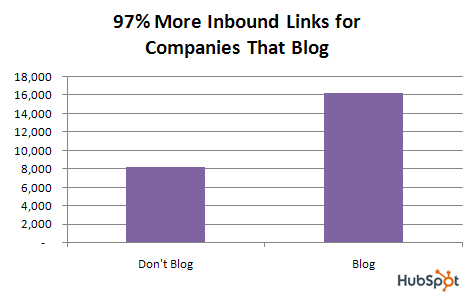
Links from other websites send a powerful message to search engines that you know exactly what you’re talking about. The more fabulous content on your website, the better your chances of becoming a resource for other content creators. In fact, businesses that blog generate 97% more inbound links:

25 Compelling Reasons To Blog For Business Yesterday image companies that blog vs those that dont blog

Image credit: HubSpot

5. It Powers Up Your Customer Acquisition

Blogging is a tool for self-expression and positive PR, but it’s also a powerhouse tool for customer acquisition. In a recent survey of bloggers, it became clear that the majority of corporations creating custom content were clued into the secret that it’s an amazing way to generate new business:

25 Compelling Reasons To Blog For Business Yesterday image reasons why you blog

Image credit: Zemalf

Why is it so effective? One of the reasons to blog is that it’s an avenue to provide value to your prospects without cost. Positioning yourself as an educator and resource builds trust, and makes prospects more likely to return when they’re ready to purchase.

6. Other People Are Already Creating Content

Nielson has found that 45% of consumers turn to social media to talk about companies, and 35% contribute to online review websites. Regardless of whether or not your company is creating custom content, people are already creating content about you. One of the most brilliant reasons to blog is that it allows your company to positively contribute to conversations occurring about you online.

7. It’s Easy ROI

Anyone who says that it’s difficult to ascertain the ROI of content marketing might not be doing it right. In fact, the math surrounding reasons to blog is pretty simple. 92% of companies who blog multiple times daily have acquired a customer through content. The more you blog, the more likely it is you’ll win new business. When Gary Vaynerchuk wrote “the more content I create, the more luck I have,” he knew exactly what he was talking about.

8. Consumers Are Hungry for Content

Aren’t there already enough blogs on the web? Actually, the opposite is true. The biggest challenge facing professional content marketers isn’t writing the kinds of articles that convert customers or content promotion, it’s writing enough:

25 Compelling Reasons To Blog For Business Yesterday image challenges marketers face

Image credit: iMedia Connection

We’re definitely not saying that self-publishing is easy, because it isn’t. However, rest assured that one of the simplest reasons to blog is that your competition is struggling to keep up with demand.

9. It’s Not Demographic-Specific

Blogging isn’t just for young people, or women. Everyone reads blogs, and a recent study by Sysomos of over 100 million articles confirmed that consumers of all ages are consuming custom content:

25 Compelling Reasons To Blog For Business Yesterday image blogs age demographics

Image credit: Sysomos

Sure, blog consumption is slightly skewed towards millennials, but that doesn’t mean you lack reasons to blog if your ideal customer is a baby boomer. The truth is, people of all ages are utilizing blogs to research products and services.

10. It’s Free Market Research

Remember when corporations had to spend thousands of dollars on focus groups to compile consumer insights? Blog marketing metrics can yield an abundance of market research, if you’re willing to take a look into the data. Comments act as qualitative insights into how prospects and customers perceive your business, while traffic metrics can reveal a wealth of information about your visitors’ social media usage. Regularly analyzing your social referral traffic to determine whether Facebook, Twitter, or other networks are driving the most clicks can reveal which platform you should focus on.

11. Blogging “Sharpens Your Sword”

Marcus Sheridan believes blogging saved his business for multiple reasons, a phenomenon he refers to as “sharpening your sword.” It’s a metaphor for the research and thought which go into quality content creation, which include the following benefits:

  • You’re continually researching trends and new developments
  • You become better at explaining things in your customers’ language
  • You learn how to answer all of your customers’ questions

If you’re still grappling with reasons to blog, consider this: it makes you smarter and more knowledgeable about your field. And there’s absolutely nothing wrong with that.

12. It’s a Branding Tool

While the idea of branding can spark some controversy among marketers, consider that one of the reasons to blog is that it allows you to claim more internet real estate in your company’s unique voice. Each article you produce is an opportunity for educating consumers not only about your industry, but also about your values, voice, and brand personality. This can feed into better brand recognition, which spurs loyalty and preference:

25 Compelling Reasons To Blog For Business Yesterday image branding blogging

Image credit: Blog Engage

13. Compelling Content Creates Multiple Points of Contact

Sales and marketing professionals have known something for decades: people purchase from companies they trust, which isn’t built overnight. In fact, it typically takes around 7 points of contact for a consumer to be ready to buy. Compelling blog content makes people want to subscribe, which allows you to continue communicating after their initial site visit. One of the best reasons to blog is that it allows you to nurture leads and provide your sales team with better-qualified leads.

14. It Creates Offline Opportunities

You know another amazing one of the reasons to blog? It positions you as an expert, which opens up a wealth of opportunities in both the offline and online realm. As Sprout Content’s Dechay Watts points out, many journalists consider business bloggers a primary source for stories. From speaking engagements to traditional media features, blogging expands your presence so you can stand out enough online to be heard throughout your niche.

15. Modern Consumers Are Always Connected

The meteoric rise of mobile technology means that consumers are always reading content. In fact, ComScore studies have found the average person uses their smartphone in the morning, their PC during the day, and a tablet at night:

25 Compelling Reasons To Blog For Business Yesterday image UK Mobile Device Preferences StatisticsImage credit: Smart Insights

Tablets and smartphones are definitely here to stay, and one of the most pressing reasons to blog is that people are consuming more content than at any point ever before. For more on the amazing growth of mobile, check out our article 50 Amazing Mobile Marketing Statistics Which Will Move You to Action.

16. $118.4 Billion. That’s Why

If you had any lingering concerns that content marketing is a bubble that’s about to burst, it’s an enormous industry. Brafton estimates that companies will spend around $118.4 billion on custom content this year alone. The growth of the field shows no signs of slowing, which is one of the most powerful reasons to blog.

17. Traditional SEO is No Longer Effective

3 or 4 years ago, small businesses could soar to the top of search ranking by dedicating budget to SEO. However, times and search engine algorithms have changed significantly, and one of the best reasons to blog is that great SEO is nearly impossible without it. Purchasing links and stuffing your website pages with keywords is more likely to get you banned from Google than ranked well.

18. It’s Probably Easier Than You Think

There’s a good chance that your company already has enough custom content to serve as fodder for your first few dozen blog posts. Resources for blogging could include emails from your sales and customer service team, internal training documents, and any number of other tools you’re using. HubSpot’s Corey Eridon writes that simply sharing an Excel Template became a high-performing blog post for their company. Repurposing might not be one of the most glamorous reasons to blog, but it’s certainly a reason that the practice is easier than you think. For more ideas on how to use what you have, see our article 17 Ways to Repurpose Content and Triple its Lifespan.

19. Outsourcing Is Totally Painless

Around 44% of marketers are currently successfully outsourcing their content marketing: 43% of them use some outsourcing while 1% of companies outsource all content creation to freelancers and agencies. If you’re not convinced you’ve got the bandwidth to create enough content, rest assured that companies are using the tactic with success. To learn more about why your fear of writing won’t trump all the reasons to blog, delve into 10 Great Advantages of Outsourcing Content Creation.

25 Compelling Reasons To Blog For Business Yesterday image companies that outsource content creation

Image credit: Sprout Content

20. Authority Matters More Than Ever

Google’s head web spam fighter, Matt Cutts, has stated in recent interviews that website authority will soon matter more than ever to your ranking in search. Authority isn’t built overnight, but rather through social signals, organic backlinks, and creating unique content. If you needed any more reasons to blog, your articles could be crucial to establishing your company as an expert in your niche.

21. It’s a Tool for Retention

Every small business owner has heard that acquiring a new customer is 5 to 10 times more expensive than keeping your current clients. However, few know that one of the reasons to blog is that it allows you to keep in touch with your clients. 64% of marketers are currently using content to achieve retention goals.

22. Blogs Are Brilliant Content Marketing

It’s easy to get overwhelmed by companies who are creating an abundance of content, which can range from case studies to videos. However, 59% of marketers believe that blogs are the most effective form of content marketing. If you don’t have the budget or time to try niche networks or eBooks, understand that nearly 6 out of 10 marketers stand behind all of the many reasons to blog.

23. They’re a Decision-Making Tool

There’s a number of statistics which clearly connect content creation with ROI, but one of the most exciting is that 21% of consumers consider blog articles a primary tool for deciding on purchase decisions. Consumers don’t just read and bounce, they evaluate articles to pick vendors.

24. It’s a Cultural Shift

50% of CMOs – arguably some of the most knowledgeable individuals worldwide about the state of marketing – believe that blogs are the status quo. A particularly interesting study by eMarketer discovered that half of chief marketing officers think blogs are the norm:

25 Compelling Reasons To Blog For Business Yesterday image Reasons to launch blog

Image credit: Heidi Cohen

25. You’ll Capture Market Share

71% of companies who blog have gained more attention in their industry as a result of their content creation. The more articles you write, the better chances you’ll gain of standing out against your competition. Perhaps the best reason to blog we know is that it’s a tool for winning in your niche.

What were your deciding reasons to blog? Are there any other benefits you’d add to this list?

16 Jul 23:06

How to Reduce Your Cost Per Conversion by 16-80% (Sorry, Haters, Quality Score Still Matters)

by Larry Kim

Quality Score: Is it the be-all-end-all of AdWords metrics, or no big deal? You’ll get a different answer depending on who you ask. Proponents believe Quality Score is a good measure of the health of your account – high scores tend to correlate with lower costs and better results across the board. Detractors will say QS is a distraction and all that really matters is your cost per conversion, because that’s how you determine your ROI.

How to Reduce Your Cost Per Conversion by 16 80% (Sorry, Haters, Quality Score Still Matters) image haters gonna hate quality score

So who’s right? What should you focus on in your PPC reporting?

What Is Quality Score?

As a quick refresher, Quality Score is a metric Google uses to determine where advertisers rank on the SERP and how much they pay. Although AdWords functions as a kind of auction, if the system was purely determined by bids, spammy companies with lousy, irrelevant ads could always bid their way to the top. Quality Score serves as a check against rule by budget alone, by requiring advertisers to prove their relevance.

Better, more relevant ads generally get higher click-through rates (CTR), so CTR is one of the major components of Quality Score. Other factors that influence your QS include:

  • The relevance of your keyword to its ad group.
  • Landing page quality.
  • The relevance of your ad text.
  • Your historical account performance.

Every time one of your ads qualifies to be displayed on a SERP, based on what keywords you’re bidding on and what match types you’re using, Google calculates a score between 1 and 10 for your ad on the fly. The higher your score, the better your ad rank will be – in fact a high Quality Score can qualify you to rank above people who are bidding more than you.

How to Reduce Your Cost Per Conversion by 16 80% (Sorry, Haters, Quality Score Still Matters) image quality score ad rank relationship

But Quality Score doesn’t just affect your ad position – it also has an enormous effect on how much you pay when someone clicks your ad.

How Quality Score Affects Cost Per Click

Your cost per click (CPC) is determined by the following formula: the ad rank of the advertiser below you, divided by your Quality Score, plus 1 cent. The chart below illustrates how this formula makes it possible to rank higher than advertisers who are actually paying more.

How to Reduce Your Cost Per Conversion by 16 80% (Sorry, Haters, Quality Score Still Matters) image how quality score affects cpc

This is all well-known. What’s not so well-known is that Quality Score is even more valuable today than it used to be. I’ll explain how in the next section.

The Changing Relationship Between CPC & Quality Score

In 2009, Craig Danuloff at Click Equations published some charts that showed how much you save by raising your Quality Score. They looked like this:

How to Reduce Your Cost Per Conversion by 16 80% (Sorry, Haters, Quality Score Still Matters) image quality score google

At the high end, a QS of 10 provided a 30% discount on CPC compared to someone whose Quality Score was 7. At the low end, having a Quality Score of 1 forced you to pay 600% more. (Suckers.)

Back in March, I decided to revisit these numbers. Craig originally used 7 as the neutral value because it was the mean Quality Score across most accounts at the time. The thing is, average Quality Scores have fallen over time. In 2013, impression-weighted average Quality Score in 2013 is closer to 5.

If you’re thinking, “So what?,” let me make it clear: That drop in the average Quality Score means that having a QS of 10 now saves you 50% over the average advertiser – 66% more than it saved you four years ago. Even a meh QS of 6 saves you about 17% – in 2009, a 6 would have cost you. Here’s what the savings look like given the new landscape:

How to Reduce Your Cost Per Conversion by 16 80% (Sorry, Haters, Quality Score Still Matters) image google quality score

Of course, some people will still tell you that Quality Score is overrated, because CPC savings are meaningless compared to cost per conversion.

Why Optimizing for Quality Score and Optimizing for CPA Are the Same Thing

What those Quality Score detractors don’t seem to realize is that QS is every bit as important in determining your cost per conversion, as well. Here’s how I know:

To quantify the relationship between cost per conversion and Quality Score, I manually compiled CPA data from thousands of campaigns across several hundred WordStream client accounts, representing about $100 million in annualized spend.

I then plotted the average cost-per-conversion versus the impression-weighted Quality Score for each campaign. Here’s what it looked like:

How to Reduce Your Cost Per Conversion by 16 80% (Sorry, Haters, Quality Score Still Matters) image cost per conversion vs quality score graph

The data reveals that there is a very strong relationship between average cost per conversion and average Quality Score. Just as above, the higher your Quality Score is, the lower your CPA will be on average. So optimizing for Quality Score and optimizing for CPA are essentially the same thing.

The below table show how much you’ll save on CPA (not CPC) if your Quality Score is higher than 5:

How to Reduce Your Cost Per Conversion by 16 80% (Sorry, Haters, Quality Score Still Matters) image impact of quality score on cpa

Note that if your QS is below the average, you’ll essentially pay a penalty – up to 64% more per action than your average competitor. In a nutshell, for every Quality Score point above the average 5/10 score, your CPA will drop by 16% on average. Conversely, for every Quality Score point below the average of 5/10, your CPA will rise by 16%.

Michael Wiegand at Portent found similar results a few months back – that for each point that your QS goes up, there was an average CPA reduction of 22%. The main difference between his study and mine is that my data size is about 100x bigger.

It’s worth pointing out that I didn’t see a big difference in average conversion rates vs. Quality Scores. I found that keywords with high Quality Scores converted only slightly better than low Quality Score keywords, meaning that lower CPAs are primarily driven by lower costs per click — which are a direct result of your Quality Score.

(Note: I wrote about my findings over at Search Engine Land last week – there’s some interesting discussion in the comments over there, so check it out if you want to dig into the data in more detail.)

4 Ways to Improve Your Quality Score

At the risk of repeating myself, I think these numbers show that optimizing for Quality Score and optimizing for cost are essentially the same thing. High Quality Scores give you lower costs per click, and lower CPCs almost always translate into lower costs per conversion.

So how do you get your Quality Scores up above the average? Here are four quick tips:

  • Use ad extensions. Google AdWords ad extensions and Google sitelinks make your ads bigger with more places to click, so they increase CTR (at no extra cost).
  • Write better ad text. We co-wrote a guide with PPC Hero that has ten tricks for increasing CTR, including no-brainer stuff like using symbols and exclamation points.
  • Bid on brand terms. Branded keywords tend to have really high click-through and conversion rates and they can bring up your whole account average.
  • Be more methodical about account organization. Don’t just add new keywords to the same ad group until it’s 200 large. Make sure each ad group is organized around a clear theme. If an ad group has 50+ keywords, try to break it down into smaller, tighter groups.

I also recommend getting our free Quality Score toolkit. In addition to a white paper, cheatsheet, and video, it includes a Quality Score worksheet you can use to find your account’s average Quality Score, both raw and weighted by impressions, plus impressions, clicks, conversions, average position, CPC, CTR, conversion rate and other metrics for your keywords at each Quality Score level, for each match type and for different query lengths (1 to 10 words). Download it here.

So what do you think about these results? Let me know in the comments. Got problems with my data? Bring it on.

16 Jul 23:06

How to Persuade Your Boss to Focus on Content Marketing

by Amanda Clark

How to Persuade Your Boss to Focus on Content Marketing image convince your boss

Content marketing is an essential part of branding your company, but it (unfortunately) often gets placed at the bottom of a “to do” list, particularly when companies are running lean in a recovering economy. For those marketers who see the value in content marketing, it is important to get your boss on board with your vision. Here are some tips for doing so:

Know the facts

Managers and business leaders typically respond to cold, hard facts about a particular situation, especially if it’s information about what their customers are saying they want. If you’re looking to get your boss on board with the importance of content marketing, throw these facts their way:

  • 61 percent of consumers say that they are more confident in a company that creates its own content. In fact, they feel more likely to make a purchase from one of these organizations.
  • 70 percent of purchasers hope to learn more about a company through information that the business produces on its own, as opposed to ads.
  • 78 percent of consumers feel more trust in companies that create custom content; they think that these organizations will yield more trustworthy relationships.

Researchers have also gotten inside the mind of marketers in order to provide some strong evidence about the benefits of content marketing. Check out these facts:

  • 37 percent of marketers think that blogs are the most valuable type of content marketing.
  • 69 percent of marketers view the creation of custom content as the most challenging task that they face.
  • 87 percent of business-to-business marketers rely on content distribution that happens on social media platforms.

Still not convinced? Here are some other benefits to content marketing:

  • There are serious benefits that you can’t buy: One of the most challenging tasks that any business professional faces is getting a customer to feel trust and interest in a brand. Content marketing works to make this happen organically. When prospective or current customers are able to get information about a business that is written in a natural tone, they are more likely to feel as if they’re hearing from a friend or trusted partner instead of being “advertised to.” Many individuals are hesitant about being on the receiving end of advertising, so this kind of marketing message is an important way to convey your points without overwhelming the consumer.
  • You can create your own voice: Instead of hoping that your press is positive, your business can control its own fate. Putting out compelling and creative content allows a person to control what is said about their organization. No more waiting for other media outlets to spread positive messages, this is a proactive approach to the situation.

In years past, companies were dependent on billboards, commercials and traditional media to get their message to the public. With the rise of social media and the Internet, that has all changed. It’s time for you and your company to get out in front of your intended audience, talking with them in a real, natural way. You already know that your prospective customers are hanging out on social media and other online platforms all day, now it’s time to capitalize on that knowledge.

The team at Grammar Chic specializes in a variety of professional writing and editing services. For more information about how we can help you, visit www.grammarchic.net or call 803-831-7444.

16 Jul 23:05

What Does it Take to Be One of the Top 50 Social Media Power Influencers?

by Sam Milbrath

What Does it Take to Be One of the Top 50 Social Media Power Influencers? image Forbes Logo registered 310x75Forbes.com recently posted a list of the Top 50 Social Media Power Influencers. These influencers are not the powerhouses behind the world’s biggest brands or most popular celebrities. They are self-starters, motivational leaders and accessible social media experts with genuine influence over their active following. According to Peek Analytics, their individual pull, or influence, over their massive social followings ranges anywhere from 1000-3000 times greater than the average social media user.

Many of this year’s power influencers have either made social media their business, or are helping make social media your business. We connected with some of the Top 50 Social Media Power Influencers of 2013, to highlight how they’re using social media. Here’s what they had to say:

John Paul Aguiar ~ Blog and Social Entrepreneur

What Does it Take to Be One of the Top 50 Social Media Power Influencers? image FTOP50 John Aguiar

Meet John Paul Aguiar

Name: John Paul Aguiar
#6 Social Media Power Influencer of 2013
Twitter: @JohnAguiar
Bio: Blogging Entrepreneur helping bloggers with blog and Twitter marketing and social media management.

John Paul Aguiar is a blogging entrepreneur who shares tips and advice with a touch of humor to bloggers looking to make money and market themselves on social media. His internet success sprouted in 2001, after a Kidney transplant and monthly disability checks forced him to get creative. From selling on EBay to learning everything about online marketing and the rise of social media, John quickly shaped his future online.

After discovering how to make money online, John Paul transferred his success to blogging. In less than two years, he built up the Money Dummy Blog with over 110,000 followers. The purpose of the Money Dummy Blog is simple: to help you build a blogging business that makes you money. As one of the Top 10 of Forbes’ Social Media Power Influencers of 2013, John Paul’s experience and wealth of knowledge in social media marketing is clear in every blog headline.

“I use social media for a number of things: Driving traffic to my blog, promoting my products and services, expanding my brand and content’s reach, building relationships with great people and having a little fun. About 85% of my social content is scheduled and monitored daily on HootSuite. The same goes for my social media management clients and consulting clients’ social. I either use HootSuite to manage content and social sharing for clients, or it’s the first tool I teach them to use.”

Paul Barron ~ Social Restaurant Revolutionary

What Does it Take to Be One of the Top 50 Social Media Power Influencers? image FTOP50 Paul Barron 310x331

Meet Paul Barron

Name: Paul Barron
#17 Social Media Power Influencer of 2013
Twitter: @paulbarron
Bio: Restaurant industry guru, CEO @Foodable Network, speaker, social media mentor for restaurants. Founder FastCasual.com and DigitalCoCo & Author of Chipotle Effect

Paul Barron started a “fast casual” social revolution in the restaurant industry. Fast Casual, now a leading restaurant segment in a $500 billion dollar market, taps into consumer habits around food, social and digital media. Paul is helping shape the landscape of the American food consumer and the way restaurants do business.

His understanding of developing a social brand is clear from his widespread digital footprint. Besides being named Restaurant Trendsetter of 2012 and one of Forbes’ Top 15 Social Power Influencers of 2012, Paul’s launched six successful media and technology companies over the past two decades. Some of them include: Restaurant Social Media Index (RSMI), Fast Casual, web-based Foodable TV Network and DigitalCoCo, which within months became the leading digital brand development group in the restaurant business. In his recent award-winning book “Chipotle Effect,” he highlights the changing consumer digital habits around food, like using the “Urbanspoon” app to find a bite.

“I use social media as an idea generator, trend mapper and strategic compass for all of our online business ventures. Using the vast amount of social data, we can predict consumer actions as it pertains to the restaurant industry around the world. We use HootSuite to easily track trends across multiple social networks and for our clients to quickly respond and adapt to real-time social challenges.”

Jeff Barrett ~ Social PR Thought Leader

What Does it Take to Be One of the Top 50 Social Media Power Influencers? image FTOP50 Jeff Barrett

Meet Jeff Barrett

Name: Jeff Barrett
#36 Social Media Power Influencer of 2013
Twitter: @BarrettAll
Bio: Named the Most Influential Ad Exec on Twitter by Business Insider, CEO of StatusCreative and contributing writer for Mashable and The Washington Times.

Jeff Barrett, “The Most Influential Ad Exec on Twitter,” got hooked on social media back when it was all trial and error and selfies. Now an award-winning social PR thought leader, Jeff is the Co-Founder of Status Creative and a contributing writer for Mashable and The Washington Times.

Status Creative, a digital PR and social engagement business, creates shareable, digital content that creates an initial groundswell of attention – attracting conventional media coverage. The result is high ROI and a more engaged brand audience. “If you are trying to get coverage: A press release is good. But 100,000 people already talking about it is better,” says Jeff.

“I use social media to network and provide value. I run a weekly tweet chat, #BareItAll, that trends in the top ten nationally. Topics center around PR, technology and daily current events. But the key is access: If you tweet me, I will respond. Social media is not a billboard. It’s a conversation.”

“HootSuite is essential for running a successful tweet chat that generates 10 million impressions an hour. It makes it easier for me to stay ahead of the conversation, interact and stay engaged. Without HootSuite, I would be banging my computer against a desk like Owen Wilson and Ben Stiller in Zoolander.”

Thank you John Paul Aguiar, Paul Barron and Jeff Barrett for your participation!

Want to know one thing these influencers have in common? They all use HootSuite. Try it now for free.

16 Jul 23:05

7 Ways to Sell to Older People

by Barb Sawyers

7 Ways to Sell to Older People image selling to older peopleOlder people often have more money to spend. Because they’re overlooked by marketers chasing the coveted younger demographic, they may be the untapped opportunity you need to seek.

Take the example of tablet computers. Many 50+ love their touch screens, ease of adjusting font size and light weight. Yet nobody has tailored marketing campaigns to them.

According to web usability guru Jakob Nielsen, the number of older people on the web has grown by 16 per cent each year over the past decade, compared with an annual growth of three per cent for those in the 30 to 49 age group.

The challenge is to employ marketing strategies that take into consideration the decline in eye sight and multi-tasking abilities, which can start around age 40. They may compensate with a sharper ability to connect complex ideas.

What’s more, you need to appreciate that while most are computer savvy, they may want more personal connection than digital natives. They thrive on personal communication.

Many of these tactics will enhance the communication experience for people of all ages.

  1. Make Everything Easy to See

    Employ larger fonts, 12 points or more, in simple, sans serif fonts. Avoid italics and ALL CAPS.

When you’re presenting, make sure somebody who forgot their glasses can read your slides from the back of the room.

Use sharp color contrasts, more black on white backgrounds with green or blue, less reverse type with white on black, less red.

Cut down on glare on any screens your customers use, such as card readers.


  • Provide Step-by-Step Instructions 

    As people age, they become less adept at multi-tasking and more methodical in their thinking. Their error rates have declined dramatically in the past 10 years, probably as a result of better web design and increased online experience, according to Nielsen.


Still, error rates, which have a big influence on who makes it to the checkout, are more than double those experienced by people in the age 21 to 55 group. Older adults are also more likely to give up than to continue trying.

Make forms and fields easy to complete. For example, if you want somebody to enter a date, give them a calendar to click or show how you want the numbers recorded.

  • Allow More Time to Complete Transactions 

    As Nielsen found, the aging population needs more time. People older than 65 are 43 per cent slower at web tasks. They are frustrated if a page times out before they have figured out seating and purchased their pricey theater tickets.Marketers also need to avoid artificial deadlines and high-pressure closings. Give them alternatives that will allow them to ask questions and decide later, without condemning them to a web or telephone labyrinth.

  • Make Everything Easy to UnderstandIn addition to letting people get more information or ask questions later, you need to explain everything in plain language. Don’t use jargon. Communicate in your customer’s everyday language.

    Offer communication options, for example a choice of text, images, audio and live communication, where body language and personality also speak.

  • Get Personal

    The 50+ crowd loves face-to-face communication. If you can’t meet them in person, try simple, quick videos, Skype, your photo on your brochure or site so they can picture who they are communicating with.While they love email and are the fastest growing group on Facebook and other social media sites, they did not grow up in the digital world. Many want personal, not virtual, relationships.

    They can also be more in tune with their intuition, emotional cues and shared experience and insight. So tell stories that support the point you want to make. Ask questions about their experience.

  • Show RespectPeople who are not yet using walkers usually don’t want to be called seniors. Older middle aged or boomer may work. Ask them.

    As people age, they often they see themselves as younger than they are. So use younger-looking images. Don’t get sucked in by stereotypes. They may be wearing bifocals, thinking more methodically and less engaged in faceless online relationships, but they are not over the hill.

  • Test, Redesign and RetestAfter you’ve tried these techniques, remember to test, improve, then test again with many demographic groups. You’ll find that many of the improvements you made for people older than 50 are a hit with those in the younger groups too.

You’ve probably have nothing to lose—but a big untapped market to gain.

16 Jul 22:51

Do People Trust Your Web Content?

by Nicole Beckett

If you want people to buy from you, they have to trust you.  After all, when’s the last time YOU spent your hard-earned money on a product that was being pushed by someone who struck you as less-than-upfront?

On the web, though, you can’t just sit down and give your customers a chance to get to know you face-to-face.  The only chance you have to earn their trust is through your content.

That’s why you have to follow these 4 tips EVERY TIME you hit the “Publish” button:

Do People Trust Your Web Content? image Trust 300x217

1.  Inform, don’t sell

Unless you’re writing a page of sales copy, you shouldn’t mention your products or the name of your company.  Readers want to learn something useful, not feel like they’re sitting through an infomercial!  Before you can expect anyone to take you seriously, you have to establish yourself as an expert.  The only way to do it is with content that’s chock full of facts — not hype.

If people like the quality of information that they get from you, they’ll like YOU — which means they’ll be much more likely to check out your products.  Even if they don’t buy something from you right now, they’ll remember that you really know your stuff — which means they’ll remember to come back later, or to pass your name along to a friend.

If you want to see your business grow by leaps and bounds, consider your web content to be a way to “pre-sell” your products.  For example, if you sell wrinkle cream, write an article that explains how hydroxy acid strips off old skin cells and stimulates the growth of newer, smoother skin.  That way, when readers head to your sales page — and they see that your wrinkle cream has hydroxy acid as the main ingredient — they’ll know your product is a good one!

2.  Let readers know you “get it”

Writing successful web content isn’t like writing a research paper.  Yes, you have to be informative, but you also have to inject some emotion into it.  Remember, your readers are looking for information because they have a problem that needs to be solved.  If you can show that you understand their problem, you’ll leave much more of an impact than the writer who just lays out a bunch of unemotional facts.

Luckily, you can let your readers know that you “get it” in just a few sentences.  Back to the wrinkle cream example, you can mention how wrinkles are stressful because they make you look older than you are, or because they make you cringe when you look at the photos of your son’s graduation.  As soon as you make one of these points, your readers will know that you truly understand the depth of their problem — which will instantly make you seem more trustworthy.

3.  Eliminate the corporate speak

Your readers should think of you as someone they’re having a friendly one-on-one conversation with.  If you use a bunch of fancy “corporate” words — instead of simply talking to people like you would in a normal conversation — they’ll never be able to relate to you as much.  And, if your readers can’t relate to you, they won’t be able to trust you.

Bottom line — before you type out a single word of web content, close your eyes and envision talking about the same subject with a friend over lunch.  That way, you’ll be in a conversational state of mind, instead of a stuffy corporate one.

4.  Let them know who’s doing the talking

As important as it is to have a conversation with your readers, it loses its luster if your readers don’t know WHO they’re having a conversation with!  You have to make it perfectly clear WHY you’re a trusted expert on the subject.

How do you do that without making your content read like a sales pitch?

If you’re publishing your content off-site, your resource box is a good place to do it.  Even in just a couple of sentences, you can provide details that make readers say, “yeah, this person really IS an expert.”  If you’re publishing your content on your own site, make sure you have an “About Us” page that explains who you are and what your credentials are.

Another way to do it is by sharing brief anecdotes in your content, when appropriate.  For example, if I was writing an article about creating the best online video, I would mention something about my days as a news anchor.  That way, if I gave out advice on how to speak into the camera or how to frame up the shot, my readers would be much more likely to trust what I was saying.

16 Jul 22:51

Advice for Sales Managers From Their Salespeople

by Kevin Davis

A few years back a leading office products company surveyed its 1,500 B2B salespeople, asking them to rate how well their sales managers did in 80 categories. Their findings suggest a lot about what salespeople think their sales managers need to do differently to accelerate team success.

Sales managers’ #1 highest-rated item out of 80 – where sales managers did the absolute best according to their salespeople – was “My sales manager wants me to succeed.”Advice for Sales Managers From Their Salespeople image 26127280 Thumb votes

The item that sales managers ranked absolutely worst at – dead-last at #80 in the survey – was “My sales manager views one of his/her priorities as developing my individual skills.”

Interesting, yes? So sales managers want their salespeople to be successful but were not providing the hands-on sales coaching and teaching that salespeople need to actually get better. The manager’s heart is in the right place, but not how they apply their time.

This pattern was borne out by the additional items at the bottom of the list. According to salespeople, their sales managers …

  • Are not clearly communicating the criteria used in evaluating sales rep performance
  • Are not working with salespeople to create a plan for their development
  • Are not dealing effectively with salespeople who do not meet their commitments

(My reaction is that if sales managers are not doing these things day-in and day-out, then they aren’t really managing their sales team!)

I’m willing to bet that if you asked the sales managers at this office products company how they thought they were doing, they would have rated themselves much more highly in the management skills than their reps did! I’m confident in that prediction because I was once in a similar position.

Years ago when I was District Manager, I decided to get feedback from my troops. So I created a survey. I instructed my sales team that I valued their candid feedback. And to protect their identity, I instructed our receptionist to collect the rep surveys and re-word any written feedback in summary form before providing it to me.

This feedback turned out to be incredibly valuable, and in some cases difficult for me to swallow. At the top of my list of “lessons learned” was that a few of my salespeople saw me as what I now call a “gunny-sacker.” Though I could identify problems early on, I often didn’t talk with the reps about ineffective behaviors until the problem had gone on for awhile or gotten big. So by the time I talked to them about it, they were caught by surprise and the stakes were high. Naturally, they became defensive when I approached them.

So… I changed. I made a conscious effort to provide my salespeople with more frequent constructive feedback. When I saw a behavior that was unsuccessful I immediately took them aside and talked about it. This gave them the opportunity to change their negative behavior before it became a bad habit. And I learned one of the maxims of effective sales management leadership: that the sooner you address a negative situation, the less negative emotion is involved in fixing it.

The results from the office products internal survey bolstered my opinion (based on my own experience) that all sales managers need to get feedback from their teams.

To help you get started, download this sample Sales Managers 360 Assessment which is based on a longer form I use in my courses. It includes both general open-ended questions and sample questions in a number of skill areas that are necessary for effective sales leadership. You can distribute this form or use it as the basis for developing your own version.

As I know from personal experience, it’s not always easy to get feedback… but it’s always helpful. And it’s absolutely essential if you want to keep improving your sales management skills.

Advice for Sales Managers From Their Salespeople image 301b1c85 7bbc 46b7 bc1d 22355203a6f0

16 Jul 22:50

Guidelines for White Papers and Case Studies

by Rekha Mohan

Carolyn Goodman, president and creative director of Goodman Marketing Partners, Inc, defines content marketing as “creation and distribution of original content that has perceived value in order to positively position your brand in the minds of your prospects and customers.”

Along with Cyndie Shaffstall, the founder and CEM of SpiderTrainers, Goodman recently presented an Act-On-sponsored webinar, “Direct Marketing on a Shoestring Budget, Part 2: Content Marketing” providing guidelines for white papers, case studies and other content; today, I’m going to be recapping her half. My post about Shaffstall’s discussion of content promotion will be coming to you next week.

The first part of content marketing is, of course, the content itself. For any marketing campaign to work, you have to create outstanding content, or at least somehow provide something to distract readers from all the less-than-outstanding content on the web.

Guidelines for White Papers and Case Studies image guinea pig hat 1

In unrelated news, look! A guinea pig in a crocheted hat! Now back to the COMPLETELY OUTSTANDING CONTENT.

First, a quick look at the history of content creation

  • Initially, the majority of content generated by businesses was research.
  • This was often difficult to read and interpret, and soon evolved into the white paper, which simplifies research findings and states benefits backed by facts.
  • White papers were named so because their selling point was the fact that there were no logos or sponsorships on the page – they were designed to look non-partisan and factual, existing solely for the purpose of helping readers.
  • To lend credibility to white papers, businesses started implementing case studies, which are proprietary to a company and demonstrate proof of concept.

Guidelines for White Papers and Case Studies image research dog 2 700x484

Gosh, this dog sure is tired after reading so much HIGH-QUALITY CONTENT.

Guidelines for white papers

Let’s look at some tips for making sure your white papers are the best that they can be.

  • Make sure the writing is in third-person narrative form.
  • Focus on a timely and relevant topic, and possibly create a series of white papers so as not to make one drag on too long. A few typical white paper topics are:
    -Introductory information about new technology
    -Best practices or how-to guides
    -Opinions on industry changes
    -Analysis from research
  • Make sure your white paper has clean graphics and is well broken-up, easy to read, and quickly summarized at the beginning.
  • Don’t show readers who the sponsor is before the very last page. Remember, a white paper’s goal is to inform the reader, not sell to them.
  • Try to include a subtle call to action, such as a phone number or website suggestion.
  • Be scrupulous about ensuring your paper is factual and professionally written. Don’t skimp on this – hire a professional writer as well as a professional graphic designer.

Guidelines for White Papers and Case Studies image dog professional 3 700x701

An actual picture of a professional graphic artist. Incidentally, I too happen to be a professional creator of GREAT CONTENT.

And here are some tips on what NOT to do:

  • Don’t have a first page that lacks information and a hook.
  • Don’t include less information in the white paper than you advertised was going to be in it, e.g., calling a white paper “10 Tips for SEO Optimization” and including only four.
  • Don’t try to masquerade a sales pitch as a white paper. It’s annoying and easy to spot.

Guidelines for White Papers and Case Studies image grumpy cat 4

Grumpy Cat sees right through your “white paper” and is highly un-amused. Though I hope you’re amused by all the TRULY EXCELLENT CONTENT on this page.

Guidelines for case studies

Case studies are part of your branding efforts, and have different rules.

  • Establish a problem, lay out the solution, and highlight the results.
  • Include at least one quote from a named source, but preferably more. This increases credibility and provides readers with outside sources.
  • Include an executive summary or abstract of the case study.
  • Hire professionals to create the content and layout.
  • Think about how people will be reading it – digital? Printed? – and format it accordingly.
  • Use your brand colors and style; case studies are part of your brand story, and as such should use brand colors and style.
  • Write all case studies in third person.
  • Make sure the front page includes a summary, a pull quote giving credibility, a few statistics, and a visual.
  • Break up paragraphs, and avoid huge chunks of text.

Guidelines for White Papers and Case Studies image tldr cat 5

Fun fact: cats as a species quickly grow bored with paragraphs that exceed four inches. I hope you never got bored with any of this AMAZING CONTENT. Unless you’re a cat. Then it’s okay.

The purpose of content marketing is to deliver information that makes your buyer more knowledgeable. This is based on the belief that if you deliver consistent, ongoing, valuable information to potential buyers, you will be rewarded with their business and loyalty. It’s to your benefit to create the best content you possibly can to inform your prospects and customers.

We invite you to watch the on-demand recording of Goodman and Shaffstall’s “Direct Marketing on a Shoestring Budget, Part 2: Content Marketing” webinar, and I’ll be back next week with Shaffstall’s advice for marketing your content – and many more puppies.

16 Jul 22:50

Elevate Your Business Growth Practices to The Web

by Jeff Korhan

Elevate Your Business Growth Practices to The Web image 2011.11.28 High Quality Web Qualilty

Business consultants, coaches, and authors are fond of admonishing that what got you here won’t get you there.

Their reasons often stem from their desire to teach you their methods, thereby helping you to break free from your past.

The flaw in this reasoning is your past is precisely what got you here. Why would you want to abandon that?

It should be obvious that digital technologies, the Internet, and especially the social web, are responsible for much of the upheaval in our current business environment. Therefore, the true challenge is simply adapting to all of it.

What got you here will indeed get you there, provided you learn how to move your proven business growth practices to the social web.

Learning to translate your business growth to the web is vital, for the simple reason that the web is now central to ever business – and its customers.

Therefore, start with understanding the core components of your current business model. That good old foundation is still solid. Now let’s find out how to make it more relevant.

The Marketing Driven Business

If you were a successful marketer before the Internet, you can be successful today, regardless of your affinity for technology. The distinction is recognizing that the marketing that works these days is much more than pure advertising or promotion.

The one thing every marketing driven business needs to learn is that today they are teachers first.

Your marketing must have a content marketing component that educates your communities, thereby teaching them how to be better buyers. That is what you promote – the value that precedes or is associated with your products and services.

If smart marketing brought you business to its current level, that should be your focus for moving it to the next one.

Nearly every person and business is using social media in some way. The trick is understanding that it is essential to bring great content to if. Without solid educational content marketing to back up your social media, your business is pretty much dead in the water.

The Sales Driven Business

Are you someone that passionately cares about helping people? If so, then this business environment is perfect for you.

Legendary sales trainer Zig Ziglar was known to say there are no “born salespeople.” What he meant was selling is a skill, and that means it can be learned by anyone that cares enough to help their customers.

One thing sales professionals need to learn today is that social marketing is a new way of selling.

The process of freely giving of your time to help your customers by answering their questions can now be accomplished with online media. Your sales team has been doing this for years; they only need to bring those skills and experience to this digital platform.

Selling ultimately comes down to one-on-one conversations, and bringing those stories online serves to give them greater reach for connecting the dots to new buyers.

The Production Driven Business

For some mainstream businesses their work is their marketing. It speaks for itself. This describes the company that I sold my landscape business to, and is one of the reasons I sold to them. Their production efficiencies married nicely with our sales and marketing strengths.

Can you amplify the quality of your work online? Absolutely. Using Pinterest and Facebook to not only capture the beauty of the finished product, but also the methods and practices for creating it is powerful.

One thing every business should be doing is creating shareable, visual, digital objects that instantly capture the nature of their work. Those visual media objects speak for themselves, just as your work does.

There are more social media channels, tools, and methods than any business (large or small) could possibly use, so don’t even attempt to keep up. Instead, seriously consider the strengths that you already know are responsible for bringing your business this far.

Now consider how to best adapt them to how the trending, social web. For example, Twitter moves fast and is probably not the best channel for buyers to soak up all of the finer details of photos that profile your best projects.

Match the digital medium with the message and the messenger – your business.

How about leaving a comment about how this transition is working for you?

Photo Credit

16 Jul 22:50

Get Linked: Ways to Use LinkedIn for Profit

by Leon Castles

Get Linked: Ways to Use LinkedIn for Profit image getlinked ways to use linkedin for profit vkiy sTo many people LinkedIn is merely a resume posting tool in order to obtain a job. However, when leveraged properly, LinkedIn can give a business a tremendous leg up in marketing.

While it is true that LinkedIn is becoming the go to site for business networking, resume posting, and job hunting, there are aspects to the site that provide the marketing professional with valuable intelligence about potential clients. Published statistics about the site show that it is much more than Aunt Sally talking about how to make fruitcake; in fact, Aunt Sally is probably not even there. Who is there are some of the top wage earners in the country. Author Brian Carter discusses these statistics in his book, LinkedIn for Business.

Some of the interesting statistics cited by Carter:

  • LinkedIn users earn higher salaries: 54% earn more than $60K per year and 36% top $100K
  • They are active users with 51 percent visiting the site at least monthly
  • LinkedIn has more 6 figure earners than the average website
  • Users are more educated and affluent than users of the average website

As you can see from just a few of Carter’s statistics, LinkedIn is a great place to look for customers with disposable income. Like other social media outlets, there are key ingredients to making social media work for your business. If you plan a LinkedIn strategy and follow it consistently you will likely see an increase in your sales. Here are some ways to leverage the capabilities of LinkedIn to your advantage:

Set Up a Routine

Consistency is key in any marketing campaign. The more your message is in front of people, the more they will remember it and act on it. There are several things you can do in LinkedIn to consistently get your message out to people:

  • Post to LinkedIn groups
  • Network: accept invitation requests and send out your own requests to network and connect
  • Be an expert: look for questions posted by people that you can answer

Finding New Customers

The newsfeed on LinkedIn is a useful tool for finding new potential clients when properly filtered. You can filter the newsfeed to look for new connections, when one of your contacts makes a new connection then you can see if you would like to connect with that person. You can also filter it for recommendations. When someone posts a review or recommendation you can see that and then leverage it to your marketing benefit.

Lead Generation

LinkedIn groups are great places to generate leads. These are the places where people discuss issues that are important to them and ask questions that matter. Active participation in the groups increases your chances of spotting something you can answer and finding interesting people to connect with. Don’t forget that, in the groups, you can also post your message and have it seen by the group’s subscribers.

Remain visible and be valuable to the group. The groups are there for communication and networking. Don’t overlook networking tips when joining a group on LinkedIn. If you want your networking to be successful, you have to become an asset to the group. One way to do this is to show your expertise and willingness to help.

Creative Advertising

LinkedIn is part of the ever changing world of the Internet and advertising here is just as important as on other websites. While many opt to hire an internet advertising company, it is definitely something you can handle in house. The key is to constantly test and analyze your ads and accurately judge their effectiveness. Here is a strategy to follow when working on your advertising.

  • Target your audience by knowing whom your products or services can help and focus on them.
  • Use variation in images. Create your ads with your target audience in mind but create several of the same ads with different images. Give your audience something new to look at.
  • Dig into the data and analyze it. Once you have run the ads and received some results and feedback you need to analyze that data and learn what worked and what did not. Improve on what worked and trash what did not work.
  • Keep doing this week after week and month after month.

Online marketing and leveraging social media is no great mystery. In fact, it is those two facets of the Internet that are probably the biggest improvements for business in many years. Taking the time to learn how to use the different social media platforms, getting involved, and becoming known are all tricks of the online marketing world that you need to employ in your business. Once you have done this, use it to capitalize on the next big thing to hit the Internet.

16 Jul 22:50

8 Ways to Spice Up B2B Social Media Marketing for a Boring Product

by David Caffey

B2B companies who think their product is too boring for social media are missing something. It’s not the product that’s boring. It could be the social media.

8 Ways to Spice Up B2B Social Media Marketing for a Boring Product image Spicy B2B Social Media resized 600

Let’s face it: not every brand using social media is as exciting and sought after as Apple, Playstation or Nike.

B2B social media marketers sometimes think that their product or service is not sexy or interesting. In most cases however, it’s not the product or service that’s boring. It’s the social messaging and branding that isn’t grabbing attention.

Sure, it can be a challenge, but that doesn’t mean that technical or highly-specialized B2B brands should avoid social media altogether. When properly executed, social media marketing can increase awareness, build relationships, and generate leads.

So, to spice up your B2B social media marketing, use these eight ingredients:

  1. Benefits > features – This lesson goes back to Sales 101, but it’s important to remember for social media marketing. Exciting social content focuses on solutions to problems, and technical terminology really doesn’t translate to the average social media user.  Instead, focus on communicating the ways your product or service can grow business or make life easier.
  2. Post compelling images – Posts with images attract more engagement than posts with text and links only. If your brand isn’t gaining social traction with just words, bring your message to life with a cool photo or, better yet, an infographic.
  3. Take it a step further with video – If words or images can’t get the job done, try using video to showcase the benefits of your brand. Remember, don’t get too technical and stay on one topic at a time.  Create video content that can be easily understood, and try to get the point across in 2-3 minutes.
  4. Drop the one-size-fits-all approach – What works on Facebook won’t work on Twitter, and what works on Twitter doesn’t work on LinkedIn. Nothing will bore your social following quite like repetition on multiple channels. Keep your messaging consistent, but make sure you tailor your content to each social media platform.
  5. Appeal to your industry-specific nerds – Everybody is a nerd for something. Find content that the passionate geeks in your industry appreciate, and share it on Facebook and Twitter. Mind-blowing stats or pictures can grab the attention of dorks and dweebs alike.  For a great example of how a highly-technical brand used this tactic check out General Electric on Facebook.
  6. Let your brand personality shine – Don’t let your social media messaging sound like it was taken directly out of a sales brochure. When you’re writing posts, drop the “serious business” attitude in favor of conversational language and humor where appropriate.
  7. Be part of the conversation – Social media is an ongoing conversation between you and your followers. Boring brands either don’t interact on social media or don’t contribute much to the conversation. Set up some social alerts and respond to people mentioning your company or product.
  8. Don’t stop with social – Once you’ve livened up your brand personality on Facebook, Twitter, G+ and beyond, translate your new-found social personality to your blog and website. You don’t want to send your engaged followers to a boring website.

Remember, what works for you may not work for everyone. After putting these tips into practice, use social analytics to see what type of content drives engagement for your audience.

8 Ways to Spice Up B2B Social Media Marketing for a Boring Product image f55a1d1a 90ef 46de 96a4 37c8b206cd53

8 Ways to Spice Up B2B Social Media Marketing for a Boring Product image 2ec98568 dda4 498f a943 d9dea2df767e1

photo credit: Misserion via photopin cc 8 Ways to Spice Up B2B Social Media Marketing for a Boring Product image

16 Jul 22:46

Why You’re a Passenger in Your Career

by Corey Harlock

Why You’re a Passenger in Your Career image Why Youre a Passenger in Your Career

Many of us are passengers in our job or career. You go to work, do your job and hope someone recognizes your hard work. If “they” do actually recognize your contributions then you have to hope they actually deliver on their promise of career advancement and give you a promotion.

It’s like going on a road trip.

Imagine you and your spouse, friend – whoever, are driving down the road on a hot summer day on a vacation you have been looking forward to for months.

You’ve done all your planning, made your reservations and planned your route. You’ve been on the road for 6 hours when your co-pilot says, “We’re going the wrong way.”

What happens next?

There are only 3 responses to the statement “we’re going the wrong way.”

  1. If we keep going this way will there be a connector where we can get headed back in the right direction? This is usually the first option. Can we still get there from here?
  2. Do we need to turn around? This is usually the second option. If we need to turn around how far back do we have to go before we head in the right direction and start making progress again?
  3. Where will we end up if we just keep heading in this direction? This is the least common and generally reserved for thrill seekers and the truly spontaneous. Where options 1&2 are safe and conservative, this option is risky and you never know where you’ll end up.

So why in our work life do most of us take option #3?

Think about it for just a minute. We join a company excited about the future and possibilities. After 3 months we know there is no future and aren’t excited about the possibilities BUT we stay there anyway – along for the ride, not knowing where we will end up. We’re caught in the monkey trap!

How often in your career or work life have you thought, “Can I get to a job I’ll love from here?” Or, “how far back do I need to go to get back on track and headed in the right direction?”

I know I did it for 3 years. I worked for a company that I hated BUT the whole time I was with them all I thought about was how to get promoted. Get promoted into a position that I would’ve hated in a company I didn’t like. I was the definition of option #3. Along for the risky ride not knowing where I would end up.

Until I had the realization that I could change my course by breaking my old habits– all by myself! I didn’t need them.

So I developed a plan. The first step was to approach the company I didn’t like with a proposal for a job that I would love! I wanted to see if I could get there from here – option #1.

After they made it clear that I could not get there from here, I tried option #2. I back tracked as far as I had to so I could get back on the route that I wanted, the path that met my needs and made me happy. That path lead me to professional recruiting and even better – working with people who need to re-discover their “path.”

If you are in a situation where you’re doing a job that is different than was advertised, in a bad or toxic environment with a boss that uses your hard work to push their agenda where A bad job search resulted in a bad employer. Or you don’t feel valued, appreciated or respected I encourage you to review your options and get back on the right “path” for you.

I have always wondered why we plan our day, our holidays our families but not our careers? You need to focus on what you love to do.

Let me know what you will do to “change your path” below and I will answer back. Can’t wait to see what you come up with.

Thanks Brett Levin Photography for the photo via Flickr.

16 Jul 22:45

Crafting Your Signature Story and Capturing Your Prospect's Imagination

by Britton Manasco
Want to separate your signal from all the noise and get the full attention of senior decision makers? 

Then bring them striking and distinctive insights -- new perspectives that offer a new way of looking at their world. 

Signature Story
You have to present a Signature Story that addresses the breakdown your buyer may be experiencing -– and the breakthrough solution that can address it.

So what is a Signature Story? It’s a far-reaching narrative that cuts across the stages of a buyer’s decision cycle.

Your Signature Story should offer a proven path forward. It should reflect your vision of what lies ahead.

But the success of your story, more than anything, revolves around its ability to motivate a buyer to change. You have to vividly clarify the potential consequences of sticking to the present state.

With this in mind, here are three key criteria to keep in mind when developing your Signature Story.

  • Provoke, Engage and Clarify. The only way you’ll get attention is by offering a new perspective that speaks to the key concerns and interests of your targeted decision maker. You have to offer valuable insights -– revealing risks and opportunities that were previously unknown (or insufficiently understood).   
  • Create a Sense of Urgency. It’s tempting to leap ahead to the great promise associated with your solution. But that won’t get you where you want to go. You have to create urgency by clarifying why the current state is somehow risky and unacceptable. You have to get to the hidden costs and consequences of the problem.  
  • Craft through Consensus. It doesn’t matter how compelling your message is if your product, marketing and selling teams aren’t unified and bought in. And they aren’t going to buy in unless they participate in the actual creation of your story.  You want to get your key stakeholders and influencers in a room and drive consensus.

Ultimately, your Signature Story lays a foundation for creating an array of messaging assets -– assets that support both demand generation and sales outreach campaigns.Indeed, you'll create actionable assets that your people will actually use.

This is a far more cost effective and better performing approach than creating content in a vacuum, especially considering that 80% of today's assets go unused by sales in the field, according to the American Marketing Association.

Instead, you'll create an expansive story that's fully modular, making it easy to make it relevant. You can unbundle and repackage your story in many ways –- creating content for many different interactions and conversations.

But it’s important to keep in mind that it's not your story alone. When you craft a story that captures the imagination of your buyers, it becomes theirs as well.    

16 Jul 15:36

B2B Marketers: How to Calculate ROI of Your Social Media Campaigns

by Daniel Kushner

Should major corporations use social media for their B2B marketing? Certainly – and most of them do! But for smaller businesses that can’t afford to hire elaborate marketing teams and directors, the answer is more challenging. There’s no doubt that social media should be part of every business’ marketing campaign, but how much time and resources should it consume? B2B Marketers: How to Calculate ROI of Your Social Media Campaigns image ROI 300x200

Unless businesses are able to accurately calculate the ROI of their B2B social media campaigns, it’s difficult to tell whether the current strategy is working. Want to know the bad part? Up to 70 percent of businesses that market online either don’t measure ROI or have no benchmarks to determine success or failure. In fact, up to 88 percent of marketing professionals say that they’re uncomfortable measuring social media success. Out of those respondents, 52 percent cited ROI as the toughest issue to measure.

So why is B2B social media marketing so hard to measure?

  • Metrics aren’t easy to monetize. Likes, tweets, shares, and comments, for instance, don’t necessarily translate into sales.
  • We’re used to seeing hard website analytics such as visitors, the number of email subscribers, click-through-rates, and sales metrics.
  • Most companies don’t set clear goals for their B2B social media efforts. Whether they’re looking for sales, traffic, or brand recognition remains unclear.

First, determine the goal of your B2B marketing efforts.

Before you can accurately measure the success of your social media campaigns, you must set a goal to accomplish. As simple as this sounds, you cannot measure success unless you know what you’re measuring – yet most companies don’t set goals! While many B2B marketing goals will be the same for most businesses, not all goals apply to every campaign. Common B2B social marketing goals include:

  1. Sales conversions. Ultimately, it’s all about the bottom line, but don’t let this be the only determiner of your success. When online analysis first appeared, it was the final link that led the person to purchase the product that got the credit. Now, however, we know that a Facebook post could inform someone about a product, though they might later use Google to find it and purchase it from you. While sales conversions are the ultimate goal, see how measuring this could be tricky? (We’ll discuss this in a few!)
  2. Targeted traffic. One of the great benefits of social media is that it’s free recurring traffic. Unlike PPC, social media drives traffic to any links you post without you having to pay a dime. Your goal could be to drive targeted traffic to your website through social media posts.
  3. Prospect engagement. While other businesses are less likely to publicly engage with your social media efforts through likes or comments, the importance of engaging with other brands online cannot be underestimated. Perhaps the goal of your entire campaign is to simply engage potential B2B clients on a variety of social media fronts.
  4. Brand reputation. Perhaps you’re not trying to land hard sales with this B2B social media campaign. Instead, you’re positioning your company as a thought-leader that businesses will think of later when they need your services.
  5. Search engine rankings. Because of the immense power that Facebook, Twitter, and other social media sites hold, they have an incredible impact on search engine rankings. If your goal isn’t to create conversions on social media itself, it could be to simply strengthen your overall presence.

You can certainly have B2B marketing goals that aren’t on this list, but these are the most common elements.

Once you’ve defined your goals, take advantage of the built-in analytics tools that social media sites provide for free.

When measuring ROI for business-to-business marketing efforts on social media, it’s important to remember that often times these efforts result in soft leads.

Fortunately, Facebook makes it easy for page administrators to measure their own data. If you run ads on Facebook, for instance, Conversion Measurement allows you to track the behavior of those who click on your ads, whether or not they liked your page, and whether they ultimately made a purchase. Even if they didn’t make a purchase, it could be considered success if they visited your website and browsed for a bit.

Furthermore, using built-in analytics to measure total reach and engagement is a prime way to measure exactly how much traffic your social media is driving to your site. Compare these numbers to those of any PPC campaigns you may be running. Are you seeing similar conversion rates for the PPC campaigns you pay for versus the social media postings you make for free?

Whether or not you’re on Facebook, also use plugins, visitor flow, and URL tracking to measure conversions through your social media B2B marketing efforts. And of course, there’s always the Social Analytics Dashboard for B2B
Marketers when you use Oktopost to schedule your social media content!

16 Jul 15:36

10 Twitter Tips for B2B Social Media Marketing

by Ben Green

If your customers, prospects, or competitors are spending time on Twitter, you need to be there as well. These 10 tips will help you establish a successful Twitter presence, or make your current presence there more effective for B2B social media marketing.10 Twitter Tips for B2B Social Media Marketing image twitter leads 300x210

1. Listen before you tweet. 

Here’s your opportunity to demonstrate that you care about your customers’ and prospects’ concerns. Using Twitter dashboards, listen — not just for mentions of your own name, but for mentions of your competitors, your customers, and your industry, particularly industry news and events.

2. Make a great first impression.

Have a professional from your design department prepare the photo or image used for your B2B Twitter account. What looked great in your casual snapshot may be barely recognizable when viewed as a tiny image on a Twitter stream — a designer will help you avoid that error. Never post a picture of yourself with a cocktail in your hand (unless you are in the food and beverage industry) or photo of you frolicking in a skimpy swimsuit on a tropical beach (unless your company sells beachwear or suntan lotion). The idea is to convey the same image you’d project at a sales meeting. Note that a number of companies have begun using as their Twitter photos a version of their corporate logos or a picture of their product.

3. Put a communications professional in charge.

Social media technology is easy to master, but effective business communication requires common sense and experience. Don’t be tempted to hand your Twitter stream (and your company’s reputation) over to a summer intern just because she can type with two thumbs on her smartphone. Select as your Twitter spokesperson someone you would be perfectly comfortable with talking to the press during an public relations emergency — the press, after all, will be scrutinizing your tweets when there is an emergency.

4. Follow the right companies and people.

Follow companies and people who add value to the conversation. Ruthlessly unfollow and then block accounts that “talk trash.” Nothing will drag down your reputation and get you “unfollowed” faster than having someone with a name like “SleazySuzy” retweeting your observations or clogging your Twitter stream with junk. It’s not the number of people who follow you but the quality of the conversation that counts.

3. Join the conversation.

Once you’re following customers, prospects, and industry opinion leaders, post tweets that add information or a new perspective to their existing conversations. Jumping in out of the blue with off-topic comments about your own product or company is a recipe for getting ignored.

4. Establish your company as an authority.

Find some aspect of your customers’ work and become an authority on it. Find out their biggest challenges and frustrations, and tweet tips that can help them address those.

5. Focus your voice.

If your company is large, or has clearly segmented markets, consider setting up Twitter accounts for each market. To see how this works, take look at what Microsoft and Wells Fargo are doing on Twitter. If you have a communications or marketing executive who is a well-known spokesman for your company, consider creating a Twitter identity for her or for him. On Twitter, people pay more attention to a person than a company.

6. Commit to being part of the conversation.

You get out of Twitter what you put into it. No investment, no return. If you’re part of a lively debate or conversation on Twitter, you can’t drift off for two days and expect anyone to wait for you to get back. At the very least, make sure that a customer visiting your company Twitter page doesn’t see that your last tweet was two months ago.

7. Be prepared to market and sell when those opportunities arise.

Once you understand the culture of Twitter, and the sub-culture of your industry on Twitter, you’ll be able to spot genuine opportunities to help people solve problems using your product or service. In such instances, don’t be afraid to message the person directly and ask if you can help. If they’ve already met you through previous Twitter conversations, they’re more likely to take you up on your offer.

8. Learn how, and when, to start a conversation.

It’s a common practice on Twitter to start a conversation by asking a provocative question. It’s even more effective if you ask that question to people you know are likely to give an interesting answer that gets the ball rolling. Of course, they’ll be more likely to try to answer your questions if you’ve already established a reputation for doing the same for them.

9. Learn how to use hashtags (#).

Use existing hashtags, or create new ones, to make it easy for people to follow and contribute to conversations or news about events. Here’s the official guide to using hashtags.

10. Integrate your tweets with your other B2B social media activities.

WordPress can be set to notify Twitter about your latest blog post. Similarly, you can have your tweets appear on your company’s Facebook and LinkedIn pages. The idea is to make the most of your investment in social media by configuring accounts to make it convenient for prospects and customers to get to know you and your products.

Check out Oktopost, our great tool for managing your social media marketing activities!

16 Jul 15:31

The B2B Content Marketing Business Case

by Phil Vallender

Even as a small B2B business, you have to take content marketing seriously, here’s why.

These are exciting and unsettling times to be a B2B organisation marketing itself. Your buyer has changed and, whether you know it or not, your marketing has to change too.

The traditionally affordable methods of reaching, engaging and influencing prospective customers are running out of steam. Results are declining all the time, which means that the average cost per customer acquisition goes up, and return on investment goes down.

So what happened?

The information age

The B2B Content Marketing Business Case image BLD briefcase postits AW 04 07 2013

In the information age, the B2B buyer has changed.

They, like you, are web savvy. They, like you, search almost as quickly as they think. They, like you, search for solutions to problems and consume a wide range of information in self-service mode. They, like you, trust their networks. And they, like you, select potential future suppliers long before contacting them personally.

But that’s not all.

Once contact is made, they, like you, retain the power. They can choose to follow you or not, to subscribe to and read your emails or not, to download your content in return for richer information, or not.

In fact, 60 per cent of the B2B buying process is complete before a prospect contacts a supplier.*
*Source: Corporate Executive Board

So as you can see, it’s all about them. It’s about what problems they have, when they have them. It’s about what channels they use to find information and what’s in it for them when they find it.

And they are just like you. So, if you’re in any doubt that this is indeed true, take a look at yourself and how you behave next time you identify a problem. Alternatively, trace back a recent B2B purchase to its source – We’d bet that it wasn’t a cold email, sales call or any single piece of direct marketing. We’d bet it was the result of a relationship you had developed with the supplier, over time, without even talking to them.

Content marketing is the solution

Content marketing is the act (or art?) of producing valuable content and placing it such that it moves prospects down a hypothetical lead funnel – from problem identification through to purchase – with your brand in mind.

It is the anti-thesis to interruption based methods. As a result, even though it is still marketing, it becomes marketing that your prospects welcome since it’s about them and their issues. This is backed up with a sense of self-discovery, which makes it even more effective.

So to benefit from content marketing, you need to visualise your lead funnel, as well as your buyers, and align activities to each stage. Then start creating and placing content in ways that support the movement of prospects down your funnel towards conversion.

Sounds like hard work?

It kind of is, but it’s a different kind of hard work. This hard work provides instant gratification when content gets shared or website visits go up. And the results are cumulative, not additive, meaning your persistence and perseverance will be rewarded with ever increasing results.

If your objective it to grow your business, it is your duty to understand content marketing – or to work with those who do.

Link to this post!

16 Jul 15:27

How NOT to be Agile for B2B Marketers

by Christabelle Tani

How NOT to be Agile for B2B Marketers image Agile marketing process

Because B2B marketers are so used to the long buying cycle, they think they have plenty of time to do marketing. As a result, they are usually good at putting things off.

However, if you need more tips on how to be sluggish, then you MUST follow these rules.

1. Slow Down Change

Fancy new strategies like content marketing, social media and blogging are uncharted territory. You don’t want to change, but you know if you don’t, you’ll fall behind. While you could plan the bare minimum needed to give it a go, this new way of thinking is just way too uncomfortable!

So what can you do to settle your mind? Meticulously plan every element of every campaign, then pass it around to every single person you can think of for their thoughts. In fact, create procedures and spreadsheets that will slow you down even more. The more hesitation to just do it, the better.

2. Do Nothing

You don’t want to look silly in front of the whole internet, do you? Exactly. So the best way to make sure you don’t say the wrong thing is by not saying anything at all. Don’t send lots of emails because you might annoy your leads. And don’t talk about your buyer’s problems either. This will make sure that your buyers think you are only interested in talking about what you sell, which is what you’re used to. After all, there’s not much room for error that way.

3. Be Easily Discouraged

Failure sucks. You get your hopes up only to see them tumble to the ground. That’s why you should avoid this soul-crushing feeling by never attempting anything of the sort again. Forget looking at the data and thinking about what you can do differently – bin the idea altogether. It’s not worth the potential disappointment you might feel.

For those who wish to succeed at agile marketing…

Do the opposite of everything we’ve just told you.

1. Get over cold feet

At which point does your marketing plan get stopped short? Where is the longest delay? Is it when you have to finalise something – like a payment, or a content piece? You can only examine something so many times.

Make your decisions quickly because too much planning and hesitation will slow down the process to the point that you fall behind. You need to be able to quickly adapt to change to be successful.

2. Accept failure

It’s not a big deal, everyone stumbles from time to time. Do not be deterred by it. As the saying goes, ‘wisdom comes from experience, and experience comes from making mistakes’. As long as you deal with it in an honest way, people will understand, and respect you for treating them like adults.

3. Bounce back

Learn from your mistakes. Do this by measuring the results, and adjusting according to what you could do differently. Don’t stop completely, or keep doing what you’ve always been doing just because you’re nervous about trying new things. Tweak until you achieve the results you want.

Also, have a look at AgileMarketing.Net, who sum up the principles of agile marketing extremely well:

  • Make your highest priority to satisfy your customer through early and continuous delivery of marketing that solves problems and creates value.
  • Welcome and plan for change. Your ability to quickly respond to change is a source of competitive advantage.
  • Deliver marketing programs often, from every couple of weeks to every two months, with a preference to the shorter timescale.
  • Ensure close alignment with the business, sales and development.
  • Give motivated individuals the environment and support they need, and trust them to build great marketing programs.
  • Learn through the build-measure-learn feedback loop.
  • Keep a constant pace and pipeline to ensure sustainable marketing.
  • Don’t be afraid to fail, just don’t fail the same way twice.
  • Pay attention to marketing fundamentals and good design.
  • Aim for simplicity.

For more tips on B2B marketing, be sure to subscribe to our blog.

How NOT to be Agile for B2B Marketers image a62d0e72 0ba3 40d0 a48b bf78510c1df1

Image source: AgileMarketing.Net

16 Jul 15:26

Social Analytics Startup Awe.sm Rolls Out A Dashboard Just For Marketers

by Ryan Lawler
awesm-logo-orange-white-background

Social media analytics startup Awe.sm is getting serious about making its product available to different types of clients. The company, which provides a platform for measuring the effectiveness of their social media campaigns, has refined its technology to create a new product that is aimed at brands and marketers.

Until recently, Awe.sm had been mostly focused on developers and enabling them to better understand how their products were distributed through social media. But it’s been gradually shifting its business model to focus on big brands and advertisers.

But in shifting its strategy, it had to tweak its product a bit. For one thing, Awe.sm’s API-based approach generally required its users to have some sort of technical or engineering knowledge to take advantage of its platform. And even if they did, those clients generally didn’t need all the features that Awe.sm made available to them.

The new dashboard was developed with feedback from the social media teams at various big brands and agencies. Among them, BMW USA and H-P provided feedback for the tools that were most beneficial to measuring the effectiveness of their social media campaigns. In particular, it stripped away a lot of the capabilities that were available in its old dashboard.

The new product focuses on attribution and conversion rates of various social networks — including Facebook and Twitter. It allows clients to see which channels have the greatest reach, which means counting all the likes, shares, tweets, and retweets. More importantly, though, it keeps track of various conversion and sales metrics based on social sharing.

Awe.sm recently changed CEOs, with co-founder Jonathan Strauss stepping aside so that Fred McIntyre, a veteran industry exec from CBSi and AOL, could take over as CEO. Strauss remains as head of product management, and showed me a demo of the new product yesterday.

Awe.sm counts companies like Say Media, Maker Studios, Topspin Media, StockTwits, and LocalResponse as its clients. The company has raised more than $6.5 million in funding from investors that include Upfront Ventures, Foundry Group, kbs+ Ventures, Neu Venture Capital, Social Leverage, and Apricot Capital.


16 Jul 15:26

Joining Boards: It's Not Just Who You Know That Matters

by Boris Groysberg and Deborah Bell

For many, a corporate directorship is a career capstone. But attaining one is far from easy. No one can say for sure how to get on a corporate board, but many people point to two routes: the first is to break into the "right" network and the second is to seek a progression of board seats that begins with, for example, a seat on a not-for-profit or community board and eventually results in appointment to a corporate board.

Both paths are problematic — neither is particularly transparent or relies on objective measures and given that many boards are stubborn bastions of white masculinity, pursuing the "right" network can be fraught, especially for women and other diverse candidates. Indeed, our research reinforces that concern: many boards still rely on their own (mostly white, mostly male) networks to fill seats.

There's a different way — one that is more measurable, controllable and offers greater transparency. It starts with a focus on skills. Although many boards continue to select new members from their own networks, our research suggests that more are beginning to implement objective processes to select members based on the skills and attributes that boards need to be effective. Our 2012 survey, in partnership with WomenCorporateDirectors and Heidrick & Struggles, of more than 1,000 corporate directors across the globe, found that only 48% of the boards had a formal process of determining the combination of skills and attributes required for their board and, therefore, for new directors

We know this approach can work because we've seen it: We studied a large corporation that was being split into two public companies for which two new boards had to be created. The chairman wanted to create two balanced boards, with the mix of skills, knowledge, and experience each company needed. He appointed a special team to create an objective, transparent method for selecting the directors. After reviewing the roles and responsibilities of each board and the natures of the new businesses, the team derived lists of the skills each board needed. Then it created a model containing the dimensions critical to a high-performing board, from functional and industry expertise to behavioral attributes. This approach led both companies to recruit board members that were diverse in needed strategic skills. Both boards are on to a good start — demonstrating that when a firm builds a board using a rigorous assessment of the qualities it needs to carry out its governance task, rather than personal networks, the board is better equipped to execute its functions.

In our survey, we also asked about specific skills. We wanted to know which were the strongest skills represented on boards and which were missing. Directors named industry knowledge, strategy, and financial-audit expertise as their strongest skill sets.


Skill Sets Overall


And 43% cited technology expertise, HR-talent management, international-global expertise, and succession planning as the skills missing most on their boards.


Missing Skills Overall


We also looked at results by industry and region. The industry with the greatest skills gap was IT & telecommunications, whose boards are in serious need of international-global expertise and HR-talent management.


Missing Skills By Industry


The region with the greatest board-level skills gap is Asia, where risk management and M&A adeptness are sorely needed.


Missing Skills by Region


Based on our research and experience with boards, we believe that the future of director selection is becoming increasingly objective and skill-focused process. Networks aren't going away, but aspiring directors may want to approach their search by asking not only, "what skills do I need to get on a board?," but also by looking at what skills boards already possess and what skills boards need. One strategy might be investing in your own human capital to become the board member corporations need.


Untitled2_grayscale-thumb-628x8-4069-thumb-628x8-4120.jpg

Methodology
We surveyed more than 1,000 board members in 59 countries. (U.S. boards made up 37% of the sample while 62% of boards represented were from outside of the U.S.) We analyzed the data along several dimensions including geography and industry. Specifically, we did a geographical breakout by eight major world regions: Asia; Africa; Australia and New Zealand; Eastern Europe & Russia; Latin America; the Middle East; North America; and Western Europe (due to low sample size or domination by one or few countries in a region we have excluded three regions, Africa, Latin America and the Middle East, from our findings).

The industry breakout was done using eight major sectors (similar to those in the Global Industry Classification Standard system): Consumer Discretionary (e.g., consumer durables & apparel, retailing, education, media, hotels, restaurants & leisure); Consumer Staples (e.g., food, beverage & tobacco, household and personal products); Energy & Utilities (e.g., oil, gas & consumable fuels, electric, gas and water utilities); Financials (e.g., banking & financial services, insurance, real estate); Health Care (e.g., pharmaceuticals, biotechnology & life sciences, health care equipment and services); Industrials (e.g., aerospace & defense, construction & engineering, industrial conglomerates, professional services, textiles); IT & Telecommunications (e.g., computers & peripherals, electronic equipment & components, semiconductors, wireless telecommunication services); and Materials (e.g., chemicals, metals & mining, paper & forest products).

The following multiple choice list of 14 skills was used in the survey: Compensation; Evaluation-Assessment; Financial-audit; HR-Talent management; Industry knowledge; International-Global; M&A; Operations; Regulatory, legal and compliance knowledge; Risk management; Sales & Marketing; Strategy; Succession Planning; and Technology. Participants were asked to choose one (or a write-in option of "other") for the strongest skill set or area of expertise that they brought to the board. They could choose as many as applied for skill sets or areas of expertise missing from the board (including a write-in option of "other").

16 Jul 15:26

How to Close More Deals with Accelerator Campaigns

by Shonal Narayan
accelerate

Author: Shonal Narayan

A few days ago I was stuck in traffic near our San Mateo office (highway 101 for the locals) and the carpool sign caught my eye for some reason. My mind tends to wonder when I am stuck in dense traffic, so I started to diagnose the intent of the sign. The purpose of the carpool lane is to incent vehicles with multiple passengers, in the hopes of reducing traffic congestion and air pollution. Awesome right? But, what if you had no clue that such a restricted traffic lane existed? The carpool sign serves a very important purpose of notifying drivers what the carpool lane is and who can use it. Simple, but effective.

This got the cogs in my brain to start spinning (unfortunately my wheels weren’t) and I began thinking about how the carpool sign translates to the customer engagement world. Imagine all the leads in your database being drivers, your email nurturing tracks being the freeways, and your emails being the roadside signs. Each email that you send should help your leads make an informed decision and get to the desired destination–hopefully, purchasing your product or solution. But, how do you accomplish this with the right person at the right place at the right time?

This is where accelerator campaigns come in. Accelerator Campaigns are used to move leads through the funnel faster by sending purposeful content at the right time. These campaigns are like your carpool signs–guiding qualified drivers into the fast lane.

Here is an example of an accelerator email campaign:

accelerator

The key is to give leads a reason to act now (in the case of the example email, the prospect would receive a $50 Visa card in exchange for a demo). Here are some quick tips to incorporate accelerator campaigns in your marketing strategy:

Start Small

Leverage offers that you already have. You should choose late stage offers that help identify purchase intent, such as product demos, buyer’s guides, etc. The accelerator offer does not need to be tied to a monetary reward.

Segment

Use a combination of demographic and behavioral data to narrow down your target list. This becomes extremely important when your campaign is tied to a monetary reward, as you don’t want a cluster of unqualified leads engaging simply for the reward.

Test

You should expect lower engagement with an accelerator campaign vs. an early-stage content piece, but continue to optimize copy, subject line and offer to improve engagement. Here are some things we’ve tested: offer (demo vs. book/white paper); reward amount (no reward vs. $50 vs. $100 giftcard); personalization (standard HTML email vs. text-only).

Track

Use scoring and sales alerts to route engaged leads for immediate follow-up. Make sure you can prove the impact of your accelerator campaigns to generating opportunities and closed business.

Results

At Marketo we frequently use accelerator offers in our marketing campaigns. And over time, we have learned some very interesting data. In a recent test we compared the use of money based accelerators (like the Visa giftcard) vs. non monetary accelerators like demos and a gift basket. Interestingly enough, we found that although the monetary incentive accelerators had higher numbers of leads who converted, interest has been declining over time and the prospects who convert on these campaigns haven’t been the greatest quality. Take a look:

accelerator1

In response to these declining numbers we started to create accelerator campaigns with more diverse offers such as winning a trip to our Summit, getting a gift basket, or just a demo offer.  These seemed to perform better in our tests.

accelerator2

So not only are these accelerators performing better, but we also know that the people who do respond are much closer to making a purchase. Someone interested in just getting a $50 Visa gift card won’t respond to an accelerator offering a download to a 3rd party report validating your service. However, someone who is closer to making a purchase will. So you can make sure your sales teams are spending time following up with the right people.

As your leads drive down the buying highway, help them get to their destination faster.  Accelerator campaigns can help nudge them along.

Have you used accelerator campaigns in your marketing? Please share your thoughts/comments.


How to Close More Deals with Accelerator Campaigns was posted at Marketo Marketing Blog - Best Practices and Thought Leadership. | http://blog.marketo.com

16 Jul 15:26

Still Unsure about Content Marketing? As Nike Would Say, ‘Just Do It!’

by Alise Robinson

Still Unsure about Content Marketing? As Nike Would Say, ‘Just Do It!’ image nike2 625x586

Consumers are so over being told how and where to spend their money. They want to be able to make the decision for themselves, not be pushed or prodded in a certain direction.

Think about it. They pay the cable company a little more for DVR so they can fast-forward through commercials and will immediately leave a website if it has too many annoying ads, so the thought of some faceless, over-paid bigwig trying to manipulate them is a bigger turnoff than B.O. and, honestly, insulting. They want to be given information to make their own choices, not settle for someone else’s idea of what’s best for them.

To keep up with what consumers want, more and more companies are turning to content marketing. This replacement for traditional branding uses content to share ideas and topics that are most interesting to their target market. This opens the platform for discussion about a product or service and allows consumers to learn why it’s the right choice for them, making the consumer feel like he is making an informed decision about his purchase instead of being told what to do.

Forget about the product, it’s all about the experience

Think of Nike’s current push to interact with consumers. I say current, but the company has actually been practicing some form of content marketing since 1996 when it reduced spending on traditional media by 55 percent.

Since then, Nike execs have pushed initiatives like the Find Your Greatness video campaign, the #makeitcount initiative on Twitter and the Nike+ Fuelband, an interactive device that lets you record your fitness progress and share with your social media followers. What do these programs have in common? They focus on the consumer’s interest, fitness, not the brand or product.

Aside from building an online following, these campaigns give Nike a tangible view of how strong their client base is, what their clients think about their products and, most importantly, what topics or products their clients care about most. Instead of having to pull sales numbers for a certain product or sales period, a Nike employee can simply pull up the product’s Facebook or Twitter page and see if followers have increased or decreased and what sort of comments consumers are leaving.

Nike also made the smart move to have a mix of celebrity endorsements and regular people in their campaigns. Consumers are much more likely to relate to a product used by a regular person than a professional athlete.

Nike’s focus on the consumer instead of the product is a great example of content marketing. With so much competition for identical products, consumers are going to go with the option they feel most comfortable with, and you can’t be comfortable with something if you don’t know anything about it. If you’ve been hesitant about making the move to content marketing, now’s the time.

16 Jul 15:26

How Well Do You Know Your Ideal Company Persona? (4 Ways You Can Know)

by Tony Zambito
How Well Do You Know Your Ideal Company Persona? (4 Ways You Can Know) image 300px 20080703 Crane Company Building

English: Crane Company Building (Photo credit: Wikipedia)

The concept of targeting companies has been around for a long time. Opportunity pipelines usually consist of company names. Sales automation typically has started out with creating a company account name. Knowing which companies to target has been the lifeblood for B2B Sales for decades.

This approach however is starting to become like trying to race across a quicksand lake. B2B organizations find themselves sinking deep into darkness with little knowledge about the companies being targeted. There is a reason for this. For years, we have done targeting quantitatively, categorically, and statistically. One problem, these approaches give us no clue about how companies behave.

While there has been much focus on how much buyer behavior is changing, it is an easy oversight to miss how much organizational behavior is changing. The emergence of the new digital age has affected how organizations, or companies, operate and behave. We are seeing new strategies, structures, processes, systems, cultures, and roles. These are all affecting how companies operate and behave. And, importantly, how they make decisions.

Big Shift in Thinking

Changes in company behavior can no longer be missed. Today’s buying companies expect understanding of their businesses, how they operate, and what can be done to improve it. What is needed in terms of company profiling is a big shift from inside-out thinking. Here are four ways designed to enable making the shift to outside-in thinking:

Realize Profiling is Inadequate

Going through an exercise discussing what is the Ideal Company Profile can be painful. The focus is entirely on categories labeled with internal definitions. The terms used are related to internal benefits. You know these terms – segments, number of employees, revenues, products sold, geography, and more. Of course these are valuable to know. However, they are not indicative of how companies behave. Behavioral insight is what is needed to be effective at how to help buyers today.

Adopt Company Persona™ Viewpoint

About ten years ago, I began to explore the use of organizational or company personas. It had been explored in the design world previously. I explored with a few best-in-class organizations how to shift the thinking from profiling to persona-based thinking about companies. Through context-based qualitative research, these organizations were able to build a Company Persona™ as well as an Ideal Company Persona™ viewpoint into their strategies. These company personas provided an archetypal view of how companies were predicted to behave, what processes impacted decisions, how different roles and people interacted, an archetype of a company’s customer value chain, and what were the overarching goals of an archetype company. Radically shifting how they thought about as well as succeeded at customer acquisition and retention.

Build Context for B2B Sales and Marketing

In B2B organizations, company targeting and profiling can be dominant. It is usually accompanied by a single buyer focus. The adoption of buyer personas in both marketing and sales, present serious challenges. The reason for this is both marketing and sales has no context in which to put buyer personas. And without this context, buyer personas can be poorly developed. Hence, you can get a backlash against buyer personas.

B2B companies today now expect suppliers to understand how to bring value, which impact the organization. Not just to the buyer. This changes the game. To know how to bring impacting value, B2B marketers and B2B sales need an understanding of how companies work, operate, and behave. The complement of a company persona houses buyer personas, providing the view marketers and sellers need. Here is a case in point:

For years, an enterprise software application provider in the healthcare industry, had targeted hospitals, large clinics, long-term care facilities, and pharmaceuticals. New healthcare information technology is radically changing this industry and impacted how these institutions operate and behave. Research-based company personas – providing insights on new procurement processes, new systems, new roles, and how these new roles interacted – was created. Which led to robust buyer personas portrayed within the context of the company persona. The adoption by marketing and sales is overwhelmingly positive – they have an internal navigation tool they never had before. Most importantly, they are able to message and converse with these institutions on how their application makes the transition to new processes and systems easier and possible. Leaving their competition stuck on the first floor at the reception desk.

Incorporate Into Education and Enablement

Knowledge of organizational behavior can be sorely lacking in B2B entities. With organizations undergoing significant behavioral change, this will turn into a serious disadvantage before too long. I advocate for the use of both company personas and buyer personas to be used in educating and enabling marketing and sales. Without it, B2B marketing will not know who to send the right message to and B2B sales can be stuck on the first floor with the receptionist – not knowing where to go and what floor to get off on.

Organization impact can often be overlooked and taken for granted. B2B marketing and sales leaders need to propel a big shift towards understanding how companies behave. It will change their own perspectives, generate deeper buyer insights, and create strategies, which give them the edge needed in tough competitive markets.

(I welcome further conversations to help explore how the combination of company personas and buyer personas can open new paths of revenues. I am very interested in getting your thoughts and perspectives. Please share widely – your peers and colleagues are wondering how to target the right company.)

16 Jul 15:25

Why “High Price” is Only a Perception

by TheSalesHunter

cash flow pricing 250x300 Why High Price is Only a Perception photoWhat is the criteria that makes a price seem too high?

Think about that for a moment and it’s amazing what you might think up.

Most people would respond by saying a price is too high when it is either more than what a competitor’s price is or if it’s not in their budget.

These two reasons or variations of them are the most common, but there are a wide number of other perceptions.

Problem is these are nothing but perceptions.

Even if someone claims to have proof of a competitor’s price, it’s still only a perception.   It’s our job to show them how what we’re offering is a better option. When we do this, there is much greater likelihood that we will eliminate their high-price perception.

We should never view a customer’s perception as something we can’t overcome.   Rather, we should see a customer’s perception as just that —  a perception.

When a customer comes at you with their belief your price is too high, a strategy you can use is the power of contrast.   Frame your price against something much higher as a way of creating contrast.

An example might be if you’re selling software with multiple year service upgrades.   What you can use is the price of what a 10-year agreement might be as a way of mentioning a much higher price than what you’re asking.

Another example would be to use two other products and/or services the customer might be familiar with.  I’ll use an example of two autos, as it’s pretty easy to mention the price of a high-end car and contrast it with the price of small economy car.

The objective is to simply use the contrast of the price point more than the actual comparison.

Perception is just that — perception.

Whatever the approach you use with a customer, the objective is the same. Get them to see your price as something they expect and can afford.

Copyright 2013, Mark Hunter “The Sales Hunter.” Sales Motivation Blog.

button receive a free9 300x51 Why High Price is Only a Perception photo

16 Jul 15:25

Of Likes and Tweets: The Current State of Social Media Marketing

by Belinda Summers

Of Likes and Tweets: The Current State of Social Media Marketing image tweet and like

It happened so quick, we didn’t even realize it was already in front of us.

Several years ago, we were delightfully plagued by the conception of Facebook, Twitter, and tons of other social networking sites and we found ourselves captivated by these ingenious platforms of communication and self-expression. And then suddenly, there it was – the complex world of marketing came into the picture and got hold of social media’s greatest gift: exposure.

But it’s not as if it was unexpected.

A medium with such enormous power to get people’s attention is bound to be taken advantage of, sooner or later. It was just a matter of time before companies started sticking their brands on every page accessible on the internet, and no matter how annoying this might be to some people, these companies cannot be blamed. It is, without any sign of decline, a force to be reckoned with.

How is social media faring these days?

According to Nielsen, about 46% of netizens (yes, it’s a word, says Merriam-Webster) depend on social media when making decisions on purchases. That means the other 54% is measly divided among the other remaining media which include TV/radio ads, readable materials, and even telemarketing.

Experian Marketing Services, a global information group, calculated that 27% of the total internet time in the U.S. is spent on social networking sites. This number may not appear big but that’s more than one-fourth of the time, considering that other users, especially older people, spend time on websites that are more inclined to business, travel, news, email, shopping and adult entertainment.

Here’s another interesting fact: Out of the 10 most visited websites in 2012 according to USA Today, 3 of them are for shopping (Ebay, Amazon, Craigslist), 2 are search engines (Yahoo, Google), 2 are IT/Software hubs (Microsoft, AOL), 1 is for blogging (Tumblr) and 1 is for sports (ESPN). Only 1 is a social networking site (it’s a no-brainer), Facebook. And it’s ranked #1.

Okay, people are all-eyes-and-ears on social media. But attention doesn’t always equate to productivity. So is it really working?

Apparently it is.

Reported Hubspot, a software marketing giant, social media lead conversion rates are 13% higher than the average lead conversion rate. And that’s not all; when compared to traditional methods like trade shows, telemarketing, or direct mail, the leads are almost doubled when produced from social networking sites.

The success of social media marketing can easily be attributed to its quick and effortless access to an unprecedented quantity of audience. There’s practically no limit to how far its reach can go, and the more coverage it has, the bigger the chances of conversion. But aside from looking at the figures, one could also put forward that the “personal” facet can also be the factor behind why people respond better to social media marketing. Whenever a friend “likes”, “shares” or “retweets” about a product, the action becomes grounded in a more personal plane as compared to actively visiting a product’s website without prior references.

In any case, social media proves to be a godsend for marketing as long as there are people who are willingly (or otherwise, unconsciously) active in spreading the goods via word of mouth, or, in this case, the power of clicks.

This content originally appeared on my Sales and Marketing Solutions Blog