Shared posts

22 Jan 00:46

The (Sales) Checklist Manifesto

by Dan Zamudio

What do a heart surgeon, a fighter jet pilot, a structural engineer for a skyscraper, and an enterprise software salesperson have in common?

Their jobs are all high stakes, complex, and require orchestration across a large team to achieve a successful outcome. Most saliently, there is little or no room for error and even one missed step can result in failure. Granted that for some of these cases, the stakes are life-or-death, but for an enterprise software salesperson (or their manager) whose quarter or year hinges on closing a major deal or retaining at an at-risk strategic account, the consequences of failure can feel if not life threatening, at least, career-ending.

Atul Gawande, a professor of surgery at Harvard Medical School and a staff writer at The New Yorker, wrote “The Checklist Manifesto – How to Get Things Right”, a New York Times Business Book Best Seller. He makes the case that checklists can help professionals to more effectively deal with the increasing complexity of their responsibilities. Failure, he argues, stems not so much from ignorance (not knowing enough about what works) as from ineptitude (not properly applying what we know works).

The book’s main point is simple: no matter how expert you may be, well-designed checklists can improve performance. In medicine, he writes, it is just too easy for an otherwise competent and well-trained surgeon to miss a step, forget to ask a key question of a nursing staff member, or fail to plan properly for every eventuality during surgery. This is equally true for an enterprise software salesperson, who in the stress and pressure of a critical sales call, might forget to make an essential point or neglect to ask a pivotal question. Or, in the haste of managing his or her day-to-day activities, fails to plan for possible objections that might arise at an upcoming important prospect meeting or doesn’t thoroughly assess their competitive position and relationship vulnerabilities at a key account. In either case, failure to plan and manage critical best-practice steps can lead to irreversible damage.

Gawande tells the story of how stupid mistakes in surgery were largely eliminated through the use of a simple pre-operative checklist leading to staggering success for his surgical team. He discusses how checklists first became common in aviation, where pilots found that minor oversights led to tragic crashes, and how, as a result, flying today involves formal checklists and formal confirmation among pilots, air-traffic controllers, and anyone else involved in air travel.

So here’s the connection to your day-to-day management of salespeople. To increase the likelihood of success, whether it be qualifying a lead, working an opportunity, managing a strategic account, developing a territory plan, or conducting a pipeline and deal review meeting, you and your salespeople and anyone who is collaborating with them need a simple checklist to optimize results. In the parlance of sales, we call these sales processes. Not every deal or account will require the surgeon-like thoroughness Gawande advocates, but your most strategic ones will. Do it right the first time because it may be the only chance you get.

Even experts need checklists and you don’t have to be a brain surgeon to understand this – or maybe you do.

Have you crafted your checklists?


20 Aug 17:14

Meaningful Buyer Personas for the Buyer Journey: Support Stage

by Stephanie Kapera

Meaningful Buyer Personas for the Buyer Journey: Support Stage image support wood beamYour buyer made the purchase, so why are we still writing blog posts about the buyer’s journey? The sale closed, so the journey’s over, right? Well, not exactly.

Just because someone purchases your solution doesn’t mean he’ll stick around. If it’s a high ticket item, he might not be able to get out of it so easily, but he’ll definitely be vocal in his network if he’s unhappy with his initial experience. Your new buyers have networks full of peers who are potential SQLs, which means you should consider this stage of the buying cycle to be another sort of entry point for new customers. When delivering support content to new buyers, you’re both working to retain them and market to their networks.

After decision comes support. You might consider support to be in the realm of customer service, but customer service isn’t skilled in the art of creating an experience. If your company’s support experience underwhelms, your buyers will tell their peers, and your sales pipeline will suffer.

Buyer Persona Development for the Support Stage

You can use the same buyer persona interviewing process to gather information about your support experience. What you ask will depend on what you sell, but your goal should be to find out how supported your buyers felt post-purchase. So, for example, you might ask questions like:

  1. Once you bought our product, what were your next steps? How did you get the product implemented?
  2. Now you’ve used our product for a while, what’s your opinion of it? How did things go when you first started using it? Were there any problems? If so, how did you get them resolved?
  3. How often do you communicate with someone from our company? Do you contact customer service? Get marketing emails? How do you feel about those communications?

What should you do with this information?

  • Fix what’s broken. If the implementation process was rocky, find out what went wrong and get it fixed. If content can help, make that happen.
  • Do more of what’s working (and less of what’s not.) If you’re customer service team is excelling, find a way to play that up and create more content around it. Have your best customer service people blog about frequently asked questions or talk about them via Google Hangout.

You’ve almost made it! There’s just one more stage to go. It’s retention, and we’ll talk about it next.

Meaningful Buyer Personas for the Buyer Journey: Support Stage image 4947be1b d2cc 4d92 9654 85f7d9f0f8ef12

Photo credit: Clearly Ambiguous

20 Aug 17:13

How To Boost Content Marketing Effectiveness with Buyer Persona Scenarios

by Tony Zambito
How To Boost Content Marketing Effectiveness with Buyer Persona Scenarios image 4155009907 e520751110 m

Honora’s November Holiday Shows at QVC – Behind The Scenes (Photo credit: Honora Pearls)

(This is part two of a three part series on the use of Buyer Persona Stories™, Buyer Persona Scenarios™, and Buyer Persona Story Mapping™ to drive effective content marketing strategy.)

Understanding what activities buyers perform as they attempt to solve complex problems has been a challenge in the digital age. The activities of buyers are no longer transparent and it is harder to figure out what activities directly relate to you and their purchase decision. Yet, in order to be on the same level with buyers, this is exactly what you need to know.

In this three part series, we are looking at how to get the inside story about buyers. As I did in part one, it is important to note this capability starts with first conducting buyer insight research and buyer persona development. The elements used to know your buyer persona stories come from these efforts. Without it, there are no research and insights, which can be used to tell a buyer persona story.

The Scene

Scenarios are one of the crucial building blocks of buyer insight research and buyer persona development. They are often difficult to do well and poorly understood outside of the design world. Scenarios help us to understand what users and buyers do in order to achieve a goal. Specific to buyers and this series, Buyer Persona Scenarios™ help us to understand the activities and actions buyers take to achieve specific goals.

When it comes to content marketing, particularly in the very early stages of buyer awareness, this level of insight can vastly improve effectiveness. Buyer Persona Scenarios are written specific to the needs of teams using them. So in this case, they can be specific to content marketing and to a Buyer Persona Story™. Helpful, as we covered in part one of this series, to improving content marketing effectiveness.

Buyer Persona Scenarios help in understanding activity-based insights, which come from field buyer insight research. Providing a sense of what buyers are doing as they attempt to meet specific goals. Combined with powerful Buyer Persona Stories, it gives us intimate proximity to the activities and actions buyers take at a specific moment in time.

The Key Elements

As with all major components related to buyer insight research and buyer persona development, our interests are in meeting the goals of buyers. Mapping to the specific business as well as personal goals buyers are wanting to achieve. The elements you will need to create on target Buyer Persona Scenarios are:

  1. Buyer Persona: the central character in any scenario. When done with the appropriate level of goal-directed buyer insight research, you will have the right character to place in your scenario.
  2. Goal: as with Buyer Persona Stories, understanding the goals of buyers helps us to know what they are attempting to achieve – both on a business and personal level.
  3. Activity: we identify the specific activities buyers engage in relevant to a specific to a goal, which they are attempting to fulfill achieving.
  4. Action: the focus is on learning the specific action the buyer takes as a result of the activities he/she engaged in.
  5. Value: we want to identify what value is received when buyers engage in activities and take a specific action.

Creating the Interaction Scene

The purpose of the elements is to give us a portrayal of how buyers interact both internally and with a company’s products, services, or touchpoints. If based on qualitative buyer insight research, you can get a robust picture of buyers in action. Let us look at a real scaled-down version of a buyer persona scenario developed for a supply chain organization:

How To Boost Content Marketing Effectiveness with Buyer Persona Scenarios image John VP Production Scenario.jpg 1024x610

Buyer Persona Scenario

In this specific scenario, we are dealing with early stages of the buying process. It provides a current snapshot of archetypal buyer activities and actions. Hinting at what frustrates buyers and what becomes relevant to them from a value perspective. Content marketing team members can gather around to review, along with other members from sales, service, and operations. Giving them insights into how to develop the most effective content strategy to meet John’s goals, activities, and actions.

Goals

Buyer personas are focused on mapping to the goals of buyers. Buyer Persona Stories and Buyer Persona Scenarios bring goals and buyer stories to life. Bring completeness and a level of depth now needed to be effective with content marketing. Done with the right level of research, insights, and perspective, they can help to reinvent content marketing, as you know it today. And, get the inside story of your buyers.

(I welcome further conversations to help you adopt Buyer Persona Scenarios™ to improve content marketing effectiveness. I am very interested in getting your thoughts and perspectives on this powerful technique. Please share widely – your peers and colleagues are trying to get the inside scoop about their buyers.)

12 Aug 16:49

How Kevin O’Connor, and FindTheBest Got Lean

by steveblank

When we started E.piphany there was an equally scrappy startup called DoubleClick (later acquired by Google for $3.1 billon). Over the years Kevin O’Connor, former CEO and founder of DoubleClick and I got to know each other.  It’s been fun watching a 20th Century entrepreneur learn new tricks as he builds his next startup, FindTheBest using Lean Methodology.  Here’s Kevin’s story to date.kevin_oconnor_headshot

——–

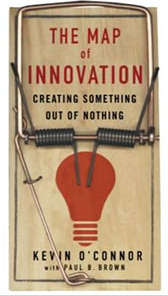
You might say Steve and I have lived parallel lives. We’re both serial entrepreneurs. We’ve both used a combination of luck, hard work, and mild insanity to get where we are today. We’ve both published bestselling books.*map_of_innovation_kevin_oconnor

* Okay: my book sold way less copies than Steve’s.

Steve and I have long held similar beliefs about how to run start-ups, even if we’ve used different names to describe the key principles. He came down a few weeks ago to visit our company, FindTheBest, where we chatted about his lean start-up concept and held a Q&A for the FindTheBest team and others in the Santa Barbara tech community. Here’s how our company is following the Steve Blank blueprint.

1. An Untested Hypothesis
Lean Start-up Connection: Business Model Canvas

By 2009, I was fed up. I remember trying to search for the best college for my son and the top ski resort for a family vacation, only to find scam sites promoting a “top 10″ list or “featured” options, meaning they were getting paid to promote them. Visiting each official site took too long, and the information wasn’t always easy to compare (ex: “Net Cost of Attendance” vs. “Resident Tuition per Semester”).

That’s when it hit me: what if there was a site where you get all the best information in one place, and have access to great research tools to help make a decision? What if you could think like an expert on any topic in a matter of minutes, instead of after hours of inefficient web browsing? Granted, the idea was a little crazy. To really be a game-changer, FindTheBest would have to compete against the thousands of niche sites that focus exclusively on a single market.

When we started building the site, we had to assume a lot. We figured our key partners would include consumers (to contribute data much like Wikipedia’s users), manufacturers (to keep their product information updated) and the US government (to supply datasets to power our content). We assumed our customers would be any smart Internet users looking to make a decision—granted, an extremely broad customer segment. We guessed that these customers would find value in the ability to make quick decisions on complicated topics. We hoped to start acquiring customers mostly through responsible, focused SEO, where we would target a variety of high-value search terms and provide relevant, useful content to users.

From day one, we knew our biggest cost would be hiring more employees, but we didn’t know exactly how much it would cost to enter each new market (ex: smartphones, then mountain bikes, then business schools, etc.). By leaning on our technology, we knew we could build cheaply, we just didn’t know how cheaply. We resolved to build out the first dozen comparisons before we started calculating an exact cost per new market.

Regarding revenue, we made a big bet on “purchase intent.” We looked at social sites—like Facebook and Twitter—with huge user bases, but comparably small revenue. We then looked at wildly profitable ventures—like Google or Kayak—noting that their users were much more likely to make purchases. When you enter a search query for “car insurance,” or submit details for a trip to London, you’re much more likely to end up spending money. We hypothesized that FindTheBest, with its focus on making big decisions, would attract the same purchase-minded users found on Google or Kayak.

We didn’t need to spend months researching; we just needed to create a viable product to test these hypotheses against. As we went out and started building, many people thought we were insane, stupid, or both. In fact, some probably still do.

Our First FIndtheBest Wireframe

A very early FindTheBest screenshot

2. Validation
Lean Start-up Connection: Customer Development

Over the next couple of years, several of our hypotheses were confirmed. Thousands, then millions of new customers were coming to the site through SEO, just like we’d guessed with our customer acquisition hypothesis. Our assumptions about cost also proved correct—we were entering new markets incredibly cheaply. Here, we even beat our most optimistic assumptions.

Once we built out a sales team, revenue also started to grow nicely. We’ve confirmed our ability to harness purchase intent, like Google and Kayak before us, verifying our revenue stream hypothesis.

That said, a few of our hypotheses were proven at least partially wrong. First, our assumption that consumers would be a key supplier of content (like Wikipedia contributors) was wrong. While user adds and edits grew at a small rate, it wasn’t nearly enough to support the hundreds of topics on the site. Visitors loved using the site to research new topics, but were less likely to add their own listings or consistently update old content. Our customers had identified a flaw in our original plan. We realized our internal team would need to be bigger, and adjusted our business model canvas accordingly .

Additionally, our value proposition needed adjustment. We had focused on quick decisions, when really, users wanted a sophisticated research tool for making carefully considered decisions. As a result, we’ve had to adjust our positioning and messaging to better capture the value users see in our product. We’re now promoting FindTheBest as a research hub that helps you think like an expert, much closer to what users were telling us in feedback surveys.

3. Staying Agile
Lean Start-up Connection: Agile Development

At FindTheBest, we constantly practice a “test-fail-learn-test-succeed-scale” approach, which is simply another way of describing the philosophy of “agile development.” We’re happy to fail, as long as we do so quickly, learn the appropriate lesson, and move to a new hypothesis. Once we find one that works, we scale the hell out of it.

For example, we tested out two features early on that didn’t end up as popular as we’d wanted: video guides (a how-to video about researching the topic) and green guides (an environmental report on which products and services were most eco-friendly). Each time, we hoped to capture a new audience by appealing to a specific subset of Internet users. We rolled them out on a limited number of pages to test. Once we saw that these new guides weren’t attracting significant visits or creating increased interaction, we quickly ended the projects.

On the flip side, we’ve had many major successes that have helped inform our product’s direction. Sister sites FindTheData (a site for researching huge datasets on topics like crime, salaries, and government spending) and FindTheCompany (a tool for finding key information on millions of companies and organizations) have grown user bases of several million visitors per month. We’ve found that people love our platform and use our technology for doing research in a variety of different ways.

* * *

At just 3 years in, FindTheBest is real-time proof of Steve Blank’s lean start-up blueprint. Even as we make the transition from startup to established company (which I call “company puberty”), we’ll continue to test our hypotheses, seek customer feedback, and test before we scale.

Hopefully we’ll find that FindTheBest will have a bigger exit than DoubleClick – this time as a Lean Startup.
Listen to this post here:

Download: clearshore_steveblank_130805.mp3

Download the podcast here


Filed under: Customer Development
12 Aug 16:45

Content marketing stats: 35 of them with a touch of @funnelholic -ism

by Craig Rosenberg

I had to do a content marketing stats post. There are already a lot of content stats posts out there, so I did pause for a minute. Here is what makes mine different:

1. My two-year old got on my computer and typed a bunch of stuff in that I have had to extract.

2. I added my own take..some takes are funny. In others I think I am funny, but you likely don’t agree. But I tried.

If you can’t tell, I am having a blast with content marketing lately on the blog. I am going to cap this content rush with our Keys to Content Marketing Summit on August 14 starting at 9AM PDT. I don’t know you, but I really think you should come. (:

Also, props to the Inbound Marketing Agents and Kapost blogs where I borrowed most of these stats.

Lets move on to the stats after this really cool picture of numbers.

Content Marketing Statistics

  1. Spending on content marketing, video  marketing, and social media will increase by 15.1% in 2013 to a total of $118.4 billion. (eMarketer)  – My take: That’s a lot of cheddar. We are just getting started in content marketing and as the field gets increasingly competitive…spend will need to increase to keep up. 
  2. Nine in 10 organizations market with content. (Content Marketing Institute) — Alternative title: 1 in 10 organizations have no idea what they are doing
  3. 79% of marketers report their organizations are shifting to branded content (Forrester) — My Take:  The age of competitive content is upon us. Similar stat to #2…re-confirmation that “it’s on”.
  4. According to 37% of marketing managers, the most important way to engage customers is content-led websites (The CMA)  –Alternative Title: US scientists to study 63% of marketing managers to understand what they are thinking. Maybe they still lead people to brochure-ware sites or discount offers?
  5. 78% of chief marketing officers think custom content is the future of marketing. (Hanley-Wood Business Media) –Alternative Title: 22% of CMO’s will be fired in the future.
  6. The use of video content has risen from 52% in 2011 to 70% in 2012. (Content Marketing Institute and Marketing Profs) — Take: This is exciting. Unfortunately, 30-40% of those using video content are creating really boring, contrived customer success stories or scripted interviews. Fine, I’ll be nice — video is about to get big.
  7. The use of mobile-optimized content marketing has risen from 15% in 2011 to 33% in 2012. (Content Marketing Institute and Marketing Profs) – Alternative Title: 67% of marketing organizations in 2012 think people still use Blackberry to check email.
  8. Companies with fewer than 10 employees typically allocate 42% of their marketing budget to content. (Content Marketing Institute and Marketing Profs) – Take: My all time favorite quote on content is from Jon Miller: “We wrote our first blog post before our first line of code”. Every young company should be parallel processing — getting leads for immediate impact while building content relentlessly which will pay off down the line.
  9. Companies with over 1,000 employees typically allocate 24% of their marketing budget to content. (Content Marketing Institute and Marketing Profs)  – Take: Actually, that seems right…for big companies. Sorry to bore you on this one.
  10. Lack of human resources (42%) and lack of budget (35%) are key barriers to content marketing. (eConsultancy and Outbrain) — Take: Quote overheard at numerous corporate meetings: “Lets make content! – Ok, you over there – add this to your list of things to do and figure it out. “
  11. Creating original content was seen as the biggest challenge for 69% of content marketers. (Curata) – Take: It’s like driving to Vegas from LA. It is an exciting idea, filled with hope…but 2.5 hours in, you realize it’s farther than you think. Content is hard but for many it takes “doing it” to realize that.
  12. Companies with 10,000 or more employees use an average of 18 different content marketing tactics. (Content Marketing Institute and Marketing Profs)  – Take: The real question is “How many of these tactics do you use to support one idea?”. The real scale in content marketing is to take one idea or raw content material and create multiple pieces from it.
  13. The average marketer made 145 website content updates in 2012. (Custom Content Council) — Note to self: This number should be 260 as in EVERY business day.
  14. Content marketers use unique visitors (88%), pageviews per visitor (76%) and total pageviews (71%) as their main metrics. (Econsultancy and Outbrain) — See take below in #14
  15. 60% of B2B marketers use web traffic to measure effectiveness of content marketing. (Content Marketing Institute and Marketing Profs)  – Take: Great start but content marketing is not just for blogs – it should be used and measured across the funnel (lead management, nurturing, and sales). So, start at the top and work your way down…if you are doing content marketing right…everything increases.
  16. B2B companies that blog generate 67% more leads per month than those who do not blog. (Social Media B2B)  – see take below in #17
  17. Marketers with more than 15 blog posts per month average 1,200 new leads per month (Hubspot) – Take: I used to not believe that blogs would be this powerful of medium from driving demand. Now, I have seen the power of the blog. It is the foundation for content marketing and inbound marketing and all things marketing. Who knew? (Well some people did just not me)
  18. Organic search leads have a 14.6% close rate, while outbound marketing leads have a 1.7% close rate (Hubspot) – Take: Guy finds you while searching Google versus guy who gets an email from you out of the blue. Search will win. Most people know that, it’s just that in most cases, the search demand generation numbers wont be enough to fill the funnel. Ultimately, both will have to exist to hit your demand generation goals.
  19. Articles with images get 94% more views. (Jeff Bullas) — Take: Great post on this on the TOPO blog on this topic: 15 Ways Images can Improve Conversion Rates.  Why do images convert better? I am not the guy to answer this, but I know that if it works, then do it.  I certainly find myself drawn to posts with great pictures.  Net-net: Please take note of this trend. It’s very important for conversion.
  20. 64% of B2B marketers believe case studies are the most effective content marketing tactics. (Content Marketing Institute and Marketing Profs) — Tip: First understand your buyer and how they buy, then create case studies.  Even great content marketing organizations fall back into old school content creation bad-habits when it comes to case studies. Remember, content should be designed to move buyers from one stage to the other. Case studies can be a powerful tool across many areas in the buying cycle. The case studies should be stories focused on how your customers solved problems and challenges not just advertisements. That’s when case studies really work. 
  21. 79% of B2B marketers use content marketing to achieve brand awareness goals. (Content Marketing Institute and Marketing Profs)   — Take: But they underfund and understaff it? (Stat #9) That must mean there are a lot of companies suffering in the brand awareness department.
  22. Only 38% of brands have a defined content marketing strategy. (Econsultancy and Outbrain) — Take: So a bunch of companies are doing it, but they have no strategy, underfund it and understaff it (see Stat #9 again). Sounds like a winning formula. (Sarcasm intact)
  23. 86% of B2C marketers use content marketing. (Content Marketing Institute) — Take: There are some great b2c content stories to learn from. Check out OK Cupid! for example.  Also: With b2b and b2c creating content like it is going out of style, I can’t wait to see what the internet will look like in the next couple years.
  24. The use of research reports has risen from 25% in 2011, to 44% in 2012. (Content Marketing Institute and Marketing Profs) — Take: Data and research are great ways to create differentiated content versus writing the 87th version of “10 reasons that…”
  25. 80% of business decision-makers prefer to get company information in a series of articles versus an advertisement. (Source: Content Marketing Institute) — Take: Very good to know. I liked this stat . I am just not sure who likes advertisements? Does this mean 20% prefer ads? From the immortal worlds of Will Ferrell in Old School: “You’re crazy man, you’re crazy”.
  26. 70% of consumers prefer getting to know a company via articles rather than ads. (Source: Content Plus) — Take: Oh, they do too?
  27. 68% of consumers are likely to spend time reading content from a brand they are interested in. (Source:The CMA) — Take: In this use-case, content may not have drawn them to your web site but now content is the way to keep them coming back for more.
  28. 70% of consumers say content marketing makes them feel closer to the sponsoring company. (Source:Content Marketing Institute) — Take: See take above in #27.
  29. 82% of consumers like reading content from brands when it’s relevant. (Source: The CMA) – Take: Simple, yet daring.
  30. 60% of consumers feel more positive about a company after reading custom content on its site. (Source:Content Plus) — Take: Another “great to know” stat. Content builds relationships with consumers when you aren’t even talking to them. That is a beautiful thing. That’s called “Marketing and Selling in your sleep” which is the best kind.
  31. 90% of consumers find custom content useful, and 78% believe that organizations behind the content are interested in building good relationships. (Source: TMG Custom Media) — Take: Great stat but I am sure you are tired of me talking about it.
  32. 72% of marketers think that branded content is more effective than magazine advertisements, 69% says its superior to direct mail and PR (Custom Content Council) — Take: Considering that last 4-5 stats say the buyers feel that way, it’s good to see marketers following suit.
  33. Blogs give websites 434% more indexed pages and 97% more indexed links. (Content+) — Take: Boom.
  34. Interesting content is one of the top 3 reasons people follow brands on social media. (Content+) — Take: I have a buddy who is doing all the Twitter tricks in the world and not picking up (legit) followers at the pace he wants. His problem: He does not create his own content. I have seen the effect of original content on social following first hand. If you create your own great content, they will follow. When I stalled on creating content, so did my Twitter follower numbers. When I create content on a regular basis, it grows like bamboo.
  35. 27,000,000 pieces of content are shared each day (AOL and Nielson) — Take: Holy moly.

If you have more stats for me, then let me know in the comments section below.

Keys to Content Marketing Success Virtual Summit - August 14th at 9am PDT. — Learn, have fun, interact with experts on the art and science that is (drum roll) content marketing.
Craig Rosenberg is the Funnelholic and a co-founder of Topo. He loves sales, marketing, and things that drive revenue. Follow him on Google+ or Twitter

Photo credit: Håkan Dahlström via Creative Commons

12 Aug 16:45

Seven Traits of Press Releases That Actually Get Read

by Veronica Maria Jarski

I wince at 99.99% of the press releases I receive daily. That’s because 99.99% look like sloppy cut-and-paste jobs, ones that have nothing to do with the Daily Fix and its readers, and everything to do with the sender, the sender, and, oh, right, the sender. Reading a press release that doesn’t make me wince is rare—yet not impossible.

Now and then, I receive press releases that are smart, audience-focused, brief, and interesting. So, for this week’s post, I thought I’d stay on the sunny side of the street and share seven traits about press releases that DO get read.

1. A Zippy Email Subject Line

The email subject line often sets the tone for the email I am about to skim. A subject line that captures (positive) attention is one that highlights the main focus of the article and why readers should care about that focus. Remember: The subject line isn’t a last-minute addition to your emailed press release. The subject line is the friend that will either get you into the party or get the door slammed on your face. Treat your friend well.  

2. A Decent Greeting

Personalization would be fantastic. A “Hello, Veronica” beats a “Hi, There” any day. (However, my expectations are real, and most days, I receive emails from people addressing Victoria, Valerie, Vanessa, Sir/Madame, Blog Editor, Admin, Editor, Veronicaj, and Jarski.) Any greeting that shows that the sender did take time to read the guidelines for blog submissions or to understand the Daily Fix audience puts me in a good mood right away. So when writing your press releases, take time to think about how you will address the reader.

3. Clean, Crisp Lines

I receive myriad emails that have the greeting in a tiny font and the rest of the piece in a larger, bold font. Sometimes, the emails are in different colors or fonts. Clearly, my name was swapped out in a form email. I don’t expect people to handcraft every email to me, but, sheesh, at least don’t be obvious about the form letter.

A fantastic press release doesn’t look like a press release. Instead, a fabulous press release looks like a quick, interesting email from someone who knows his stuff. The “official” press release (if it really needs to be included at all… ) is an attachment or added to the bottom of an otherwise intriguing email.

4. Well-Written Summary of What’s Up

An elevator pitch is the best kind of pitch. For the digital world, imagine your elevator pitch is a tweet. Just tell me quickly and briefly why the news you’re about to share matters. What’s your point? And why should I care about it?

5. Bullet Points

Bullet points make for a easier, clearer read. Also, they demonstrate whether the author knows the most important details of the press release. If someone can’t write brief bullet points about their content, that person does not know his content. If you write good bullet points, you’re also very quotable, which is always a plus.

6. An Invitation to Talk More

One of my favorite endings to any email or press release is: “If you’ve any ideas of how this can be a better fit for the Daily Fix, please feel free to email me.” I love that line. Those emails respect the reader’s time and also demonstrate a willingness to create content that better suits the audience.

7. A Shareable Piece of Content

Remember when we were kids who attended birthday parties and received little goody bags? A good press release makes you feel like you’ve received something fun and captivating. So, when writing a press release, be sure to include information regarding where to get additional content for the readers. For example, a good press release will mention a related infographic available for download, a downloadable whitepaper, or even a cartoon or photo of the newsworthy event.

Remember, when you’re writing a press release, you are writing for a person, not a building, who will receive your press release. And if you’re really stuck on how to approach that person, imagine you’re writing for your neighbor, who knows nothing about your business and will end the conversation if you get too long-winded or boring. Always write for people.

12 Aug 16:44

Email Deliverability is Really Hard, Part 1

by Scott Axworthy

email deliverability

Nathan previously talked about how email actually works, but that’s the easy part when it comes to email. The hard part is email deliverability — getting a mail server to actually accept your message and, harder yet, to drop it in the recipient’s inbox.

I’ll cover the topic of deliverability in a three-part series of posts. Today, I’ll outline the problem and raise a few issues. Next, I’ll dig further into what the big email players are doing to determine if your message is worthy of an inbox. Finally, I’ll look at the reality of getting mail delivered and what it means to you and your brand.

Let’s go straight to the punch line: email may still be highly effective compared to other marketing channels, but your very brand is in peril every time you hit “send.”

Email is FREE!

Back when the Internet was shiny and new, email was one of the first applications. It flowed with minimal delay through unprotected relays and always dropped right into your inbox. And still to this day, anyone can send email — free — anytime, as much as you want. You don’t need Optify or an email service provider. Just set up a computer with an email package (also free) and start sending to every email address on the planet. There’s no central post office; you get to send straight to each recipient (with one caveat, via their chosen “provider”).

But the email system has been so grossly abused. You can still send, but most everyone has stopped receiving. This is like writing a letter, mailing it, the post office sends it to its destination and then, out for delivery, the mailman tries to open the mailbox but the door won’t open. Or he puts it in, but the letter mysteriously spits back out. He tries this several times, but it keeps falling on the ground until he finally gives up. He might return it stamped ‘undeliverable’, or he might just leave it on the ground and continue on. Why send email if no one will accept a message? Obviously some email is getting through, but the mailbox has a mysterious gatekeeper, like the old bridge-keeper from Monty Python and the Holy Grail movie.

For those who haven’t seen this movie, an old, decrepit man blocks a bridge that King Arthur and his knights need to cross. The bridge-keeper stops each in turn and asks three questions. And if you can’t answer the questions, you are flung into the “Gorge of Eternal Peril”.

With apologies for making this about email…

Stop, who would cross the mail gateway must answer me these questions three, ‘ere the Inbox he see:

  1. What is your name?
  2. What is your content?
  3. What is the bounce rate of your last email campaign?

And even though I’ve co-opted the bridge-keeper’s questions to be about email, they were oddly similar. Our email gatekeeper wants to determine your identity, your quest! and your reputation before he’ll grant your email access to the inbox.

The Modern Email Ecosystem

Let’s step back and define a few things we need to know:

  • Email marketing tools: That’s us, Optify. We provide a suite of marketing tools, including tools to manage your email campaigns. We don’t actually send email — we hand it over to delivery specialists, the ESPs.
  • Email Service Providers (ESPs): In our case, ExactTarget and SendGrid. They are specialists in delivery. They only exist, and we pay them dearly, to help answer the bridge-keeper’s questions correctly.
  • ISPs and portals: Comcast, AT&T, Google, Yahoo, Microsoft, AOL, etc. It turns out that these guys are pulling the strings when it comes to delivery. They’re the bridge-keepers; they get to make and ask the questions. And like the Holy Grail bridge-keeper, the questions are always changing.
  • CAN-SPAM Act: Just because you can send email free to anyone doesn’t mean that it’s legal. The CAN-SPAM Act attempts to define what’s legal for commercial email.
  • Blacklists: Lists of mail server IPs known to send SPAM, these are “block” lists. Examples: Spamhaus.org, OpenBL.org, as well as internal lists by all the ISPs listed above. Once you’re on the list, it’s very hard to get off the list.

The above are very important parts of our deliverability issue.

Let’s just stop accepting all email

So back to our problem: mail servers don’t want to accept incoming email. In fact, some don’t by design. One method, called graylisting, flat out rejects all email on the first try. That’s because spammers use a shotgun approach, which won’t retry. Blast and move on. Normal email will retry — after a delay.

But let’s say that the receiving email server actually accepts your message. It’s then run through a non-standard gauntlet of tests (many more than 3 questions!) before it decides the fate of your message. Typical SPAM scoring includes sender analysis (note: see Nathan’s post covering SPF and DKIM), the reputation of the sending server IP, the words you use, image size, attachments, blacklists, etc. to determine a score. Too high, you get ejected; the recipient doesn’t even know you tried to send a message. Low enough, and you land in the prized inbox. In between, you may get rejected — hopefully with a reason. Or you land in purgatory AKA the dreaded SPAM folder.

This is where email delivery gets tricky. This analysis process is different for every one of the ISPs, portals, hosted email providers, and email server products on the market. This is where your ESP (and its sending reputation and relationships with providers) can add value, but you hold the delivery power in your content and the relationship (or lack thereof) you’ve established with your intended recipient. And it’s really important to point out that reputation is hard earned over time, but can be destroyed in an instant. And worse, you’re sharing a sending IP with others (your ESP has many customers.) If you send to that purchased mail list, and your bounce rate is sky high, you’re destroying the reputation of the sending IP for your ESP and tool providers. You’ll be cut off because you’re taking everyone’s reputation down with you. Everyone loses.

Now we’re getting to some of the keys to delivery: identity, reputation, content and relationship. A spammer has a forged identity, no (or hijacked) reputation, questionable content, and no relationship. You better have a great reputation, good content, and a relationship established with your intended receiver. This is where we’ll pick up in part 2: trying to understand how the gatekeepers judge our mail.

Homework

But your assignment until the next installment is to think about the email marketing term ‘Engagement Management’ — tracking the opens, bounces, click-throughs, unsubscribes, i.e., the engagement, of your intended email recipients with your campaigns. The tools from your tool providers (like Optify) and ESPs make this data and analysis possible. But who else can determine this same information? And who else would be interested in this information? If you said the “ISPs and portals” (your providers), you’re correct. I’ll cover why and how this works in the next installments, and why it puts your brand and reputation at risk, based on whom you mail to, how you mail it, and when you attempt to deliver your email.

The post Email Deliverability is Really Hard, Part 1 appeared first on Optify.

12 Aug 16:44

Never Fight The Latest War

by The Leads Explorer

Me-Too strategy

Your nearest competitors have a similar new product out on the market and have considerable success with it. Typically you would join the party with another similar (‘Me-Too’) product which will be hard to sell and is likely to end in a price war as the competitors’ products are already established in the market. A ‘Me-Too’ strategy is not really rewarding and will not build the status of your company or brand. Instead the brand will be perceived as a follower instead of an innovator. Meanwhile your competitors are already working and creating the next challenge for you. The result is that your company will always be lagging behind.

Challenge with next generation

Instead you should raise the bar and bring an entirely new product or a big improvement as your next product: the next generation. In this way you will lead the market, drive the future and require your competitors to follow. In this case you have the advantage of being the first onto the market and establish your leadership.
Of course it is harder to harder to innovate than to create a ‘Me-Too’ product, but the rewards will be higher if successful.

Proving leadership

Fighting the current or latest war is like looking back and this will not bring the expected rewards and will only decrease your margins and create the perception of a lagging behind company. Instead raise the bar and challenge your competitors with an innovative or next generation product for the future which proves your leadership.

What war are you currently fighting ?

Share

12 Aug 16:44

Revisiting the basics of lead generation

by Ipshita Jain

Lead generation or, in other words, finding new customers, is essential for any business to survive. But every now and then, I believe it is a good idea, for any organization, to revisit its lead generation strategies. One of the ways I like to think about it is by going over a list of all the possible strategies that might be available for lead generation. The marketing team at ZoomInfo thought that it would be a great idea to compile this list and make it available to our readers as well. While many of us might be the lead generation ninjas, it never hurts to go through the ever evolving lead generation strategies once again.

The new guide that we have published covers all the basic concepts of lead generation, including ‘what is a lead?’ and ‘how to define a lead for your organization?’. I would encourage you to download this free resource and use it as best as possible, but I would also like to give a sneak peek of our latest guide.

Most organizations use the marketing and sales funnel to describe their lead generation process. But I always prefer a customer-centric approach to creating lead generation strategies. It is great that you have established a lead generation process in your organization, but have you ever wondered about your prospect’s process during that time? If you understand your customer’s buying process, you would be better equipped to devise lead generation strategies that would complement your buyer’s purchase process.

prospect’s purchase funnel -

Awareness is the first step in the customer’s purchase process. Awareness includes both types of prospects – ones who know that they have a problem and need to solve it, and the others who don’t know yet that they have a problem. As a company it is your job to create this awareness and draw leads to your product.

Consideration is the next step where customer is aware about you and now is considering various options. This is a less difficult problem to solve than not knowing who your customer is, because once you know your lead, you can target your buyers better. Create customized content to woo your leads at this stage. Make them feel that you understand their needs and are not just trying to push your product to them.

Purchase is where you want to arrive at with all the efforts you have put so far. By this stage, the buyer is almost ready to close the deal with you. Purchase is a lot about negotiations, pricing and other product related details.

As you might have heard from sales teams, a deal is not closed until it is all signed and filed. Customer is now ready to sign but sometimes there may be factors that he/she might be reluctant to close at the last moment. Always think from customer’s perspective about things you should take care of to close a deal.

Marketing and sales funnel -

To complement the customer’s funnel, create strategies to complement each stage of the customer’s buying process described above.

Top of the funnel (TOFU) includes all the inbound and outbound strategies that would help you create awareness for all kinds of prospects. You can read more about TOFU strategies in our new guide, where they are are described in a great detail.

Middle of the funnel (MOFU) is mostly about creating lead nurturing strategies. Without MOFU, all the time and effort you put in your TOFU stage is a waste. Has your organization put its best effort in nurturing the leads? Probably this is the time to revisit your efforts now.

Sales is the process when the customer knows a lot about you and probably your business is one of the shortlisted companies for him/her. This is where your sales team must get involved in the process, as it is the time to sell. Always try to put yourself in the prospect’s shoes and then answer his queries. You have come this far, but most likely your prospect is still considering other options. Try to illustrate features that would differentiate you from everyone else in the market/

Closed deal is when you have everything signed and sealed. While closer now seems easy, it is never closed until it is actually closed. Take care of all the things under your control. Create a sense of urgency, such as ‘You would receive a free subscription for the  first month if you send us the signed paper by the end of the month’. It works! While this can make a whole new chapter, we wanted to make sure that we at lease give you the basics so that you can make sure that you have covered all the aspects in your lead generation process.

Intrigued to read more? Download our FREE Lead Generation guide now!

12 Aug 16:44

How to Attract More Clients and Grow Your Agency [Free Whitepaper]

by Danie Pote

grow your agency

When do you worry about finding new business? The odds are, you worry about it when it’s almost too late.

That’s not surprising. Given the deadlines you have for existing clients, new business often goes on the back burner. But then something happens to trigger the need for new clients – perhaps your client’s budgets have been slashed, or perhaps there’s a new CMO who’s causing you trouble, or maybe one of your clients has decided to take their work in-house.

The fact is, every digital marketing agency can expect to lose 25% of their business every year — through no fault of their own. It’s the churn rate, and it’s held steady in our industry for more than 30 years. That means you have to win new business just to maintain your current revenue.

While everybody likes to win business, nobody likes to look for it.

We put it off and eventually we might get desperate enough that we resort to cold calling. Ouch. Everyone knows it keeps getting harder – partly because it keeps getting easier to screen callers out. But also because behavior has changed. People prefer to communicate through messages (text, email, etc.) on their own schedules, rather than taking time for a phone call. Know, too, that if you do get through, you look as though you “need the business,” which can be a bad start to the relationship.

Here’s our suggestion. If you don’t like trying to find new clients, focus instead on helping new clients find you.

Download our latest whitepaper ‘How to Attract More Clients and Grow Your Agency’ to help you craft a strategy that’s bound to make potential clients come running. Then you can focus on what you do best: winning new business.

The post How to Attract More Clients and Grow Your Agency [Free Whitepaper] appeared first on Optify.

12 Aug 16:44

Four Reasons Marketers Need to Embrace Google+

by Stephan Hovnanian

In an informal MarketingProfs poll, marketers cited Google+ as their most hated social network. Reasons given, both in the poll and the subsequent comments, mentioned things like convenience (or lack thereof), complexity (huge learning curve, not enough time), and my favorite, “my target audience isn’t there.”

Lack of convenience, I can understand. Google’s API is limited at this time, so it may not be fully integrated into the tools marketers use to manage their other social presences.

Complexity, I can appreciate. Google+ offers a broader feature set than other social networks. So, if a marketer wanted to maximize his efforts on Google+, he would need to put the time in to learn how each of these features worked, such as Hangouts, Photos, Circles, and Events.

But “my target audience isn’t there” is a lousy excuse not to spend at least a little time integrating Google+ into your marketing mix.

Here’s the thing, marketers: “Google+ is Google itself,” according to BradleyHorowitz, VP products for Google+. That means if your target audience uses Google for search (likely), YouTube (likely), Gmail (probably), and has an Android device (possibly), Google+ will help them find you faster.

Let’s explore that further.

1. Google+ and Search Marketing

Maybe your business has vibrant communities on other social networks, but by neglecting Google+, you are missing out on search engine marketing that you can do. Simply sharing your blog posts on Google+ will get them indexed faster and create more content about that topic that your target audience will find in search.

Ask your SEO team for the keywords you are supposed to be targeting, and include them in a very simple public share of your blog posts. Just because SEO isn’t your cup of tea doesn’t mean you should exclude a social network that has tangible search benefits for using it. Add a title; a short, thoughtful intro; and for bonus points, +mention (tag) your author. Maybe even add a few hashtags for faster discovery (but Google will do that for you if you forget).

2. Google+ and Social Listening

Every public post on Google+ is indexed. That means if someone is saying bad things about your company, you need to know about it, lest that post show up in search results when your target market is searching for you.

Set up your Google+ brand page to get emails when you are +mentioned (i.e., tagged). Then push those emails into your social listening software, so you can determine if you need to respond. Who knows? Maybe you’ll find that your target market is talking about you on Google+. Or better yet, you have major fans there that you’ve been neglecting!

3. Google+ and the Rest of Google

If your target audience uses Gmail, if you have an Android app, or if you have a YouTube channel, you need to think about building up your Google+ presence. When your company sends emails to Gmail users, its Google+ page will appear next to the message. A major brand reinforcement opportunity is there. By promoting your Android app directly on Google+, you can tap into a market that will recommend it, link to it, and broaden the app’s reach. If you have a YouTube channel, you could run live events directly on Google+ using Hangouts on Air, or simply create more “web pages” (Google+ posts) that link to your YouTube videos, which will get indexed by Google and help your video marketing efforts.

4. Google+ and Content Creation

Google+ has built in photo-editing tools to create memes, filters, and more on top of your own photos. It can even animate them! Each photo you share on Google+ becomes another image about your brand that gets indexed in search or that could be downloaded and used on other social networks. Google+ loves its photographers, too, so if your brand happens to be in an industry that lends itself well to photography, you have a huge built-in support system to push those photos out to a larger audience.

Google+ posts themselves have formatting capabilities, such as bold, italics, and strikethrough text, meaning you can convey more emotion and context with your message. Posts also have a very large character limit, meaning you can pack a post with lots of information to build more context around your target topic.

Lastly, Google+ posts tend to have a longer shelf life when it comes to being found in public streams (news feeds). This means less time spent re-posting the same content so your audience can find it.

Why Marketers Need Google+

Maybe your customers don’t want to have to follow you on another social network. And maybe you don’t want to invest in building a social presence on another social network. That’s fine—but Google+ is not just another social network. It brings much more to your content marketing strategy and “discoverability” than other social networks.

Put simply, using Google+ as part of your content marketing plan will help your target audience find you faster and when they’re ready to buy.

12 Aug 16:39

Is price discounting a marketing problem?

by Corporate Visions

Tim Riesterer, chief strategy and marketing officer, Corporate Visions

Recent research from McKinsey and Co. indicates that a 1% change in discounting during sales negotiations can have a 9% impact on a company’s operating margins. But price discounting is clearly a sales problem, right? Not exactly. According to our recent survey of marketers and salespeople, we found that over half of the respondents cited an inability to differentiate themselves from competitive offerings as the reason for unwanted discounting. So how do marketers help salespeople avoid these difficult negotiations?

To find out, read Tim Riesterer’s article on MarketingProfs for marketing strategies that help salespeople avoid excessive discounting.

12 Aug 16:39

Paying Sales Commissions on Revenues vs. Profit

by peaksales

There are many different ways to structure and layer sales compensation and commission plans and most are based on revenue performance, but in some sectors compensating based on profit is popular and there are situations where it may make sense for your company as well.

Compensating on Revenues
The most common form of sales compensation, involves a paying a commission on sales. This works well where sales people need to be highly focused on driving top line results and growth. It is also typical where the sales person cannot influence margins either because they are selling an offering with a non-negotiable price or because the sales rep does not get involved in delivery. The benefit is that compensation is easy to calculate and sales people are not distracted by anything other than sales.

Compensating Based on Gross Margin
Compensating based on gross margin is popular in the services business where there are no fixed costs and in other price sensitive businesses such as Value Added Resellers.

Commission based on profit or gross margin has its pros and cons.

In the pros column the sales rep’s compensation is tied to their contribution to the bottom line, something that sounds like it could have no downside. It has the effect of encouraging sales reps to chase profitable business (however this can be achieved with fixed pricing as well) and striving to maximize profit, a healthy share of which the company keeps. Compensating on gross margins also discourages discounting because even a small drop in price might have a big impact on overall margin and therefore commissions paid out.

In a services business paying on gross margin can cause the rep to be distracted from the selling effort if they are worrying about how much delivery is making on a project and consequently how much they will be getting paid. This can even cause frustration if the rep feels delivery is not performing effectively and furthermore, there may be instances where you want to offer some concessions to win an account however this will cause your rep to lose interest as they will not be rewarded for their sales effort. In both cases these issues can be mitigated by paying on forecasted gross margin rather than actual gross margin.

In the end each company’s specific goals, business model, sector and set of economic conditions will dictate which path to take, and a properly structured plan will be a win-win for the employer and sales rep regardless of whether it pays on revenue or gross margin.

To your success!

Eliot

12 Aug 16:38

The Number One Mental Illness in Business

by Charles H. Green

Watch Your Blind Spot.Sometimes we don’t think right. Often we don’t think right, and we don’t even notice it. (This is well-described in a book called Blind Spot, by Banaji and Greenwald).

People in business have big blind spots, just as we do in other social milieu. Recently I’ve run across two items that, together, highlight one of the biggest blind spots of them all.  I don’t know what to call it, and I’d like your help in deciding that.

The two items popped up in neuroscience, and in business strategy.

Neuroscience

I’ve written before about How Neuroscience Over-reaches in Business. In response to that particular article, reader Naomi Stanford sent me a stunningly good academic critique of the “neuro-leadership” research. Sober, laser-like, and devastating, it lists a number of reasons why the neuro-leadership crowd is up to non-sense.

It’s called Not Quite a Revolution: Scrutinizing Organizational Neuroscience in Leadership Studies, by Dirk Lindebaum and Mike Zundel. It’s tough going unless you love philosophy of science, but worth it if you’re into this issue.

I want to highlight just one of the many points they make, because it jumped out at me so strongly. In their words:

… we argue that a predominant focus upon neuro-science to the study of leadership as an individual difference excludes further important units of analysis…a more appropriate ontological locus of leadership resides in the dyadic relationship between a leader and follower – as opposed to a leader-centric or follower-centric locus…Our appreciation of the dyadic nature of leadership, coupled with the need to be contextually sensitive, is incongruent with the predominant view of organizational neuroscientists who view leadership largely as residing in the leader.

In other words: leadership is a relationship. It’s not [just] a character trait, a skill, or a neuron path residing in an individual, any more than is love, or trust. It’s a 1+1 = 3 situation. You can’t get to the whole by just analyzing the parts.

In leadership, this suggests the key doesn’t lie in examining (or training, or selecting) one party, but in understanding multiple parties in relationship.

What’s the name of this blind spot in neuroscience? The authors suggest it’s reductionism – a desire to break things down to simpler parts.

I think it also smacks of the cult of the individual.

Strategy

Until the 1970s, business strategy was thought of in metaphors of war, and distinguished largely from tactics. But in the late 1960s, Bruce Henderson took a backwater part of strategy – competitive strategy – and turned it into a quantitative, matrix-hugging bounded idea set. Michael Porter put the finishing touches on it in Competitive Strategy in 1979.  The triumph of this view was so complete that the adjective has been redundant ever since. We now think all strategy is competitive strategy.

The essence of BCG and Porter’s worldview eerily presages the neuroscientists decades later. They saw the essence of strategy as lying within the single, solitary organism of the corporation (or the business unit, if you will).

Strategy, by this view, is all about the solitary struggle of each company to gain and sustain competitive advantage over the Hobbesian hordes who would do it in.  Nearly all business strategy today assumes the solitary nature of the business – the corporation is the atomic unit of business.

But strategy makes the same mistake the neuroscientists would make later. We are increasingly seeing that the successful businesses are not those who see themselves as valiantly struggling alone against the odds – they are instead those who collaborate, form trust-based relationships, and basically get along with the rest of business and society – rather than constantly struggling to ‘win’ against everyone else.

Again, 1+1 = 3. Unless you insist on looking only at 1, and then at 1 – in which case you’ll always end up with 2.

Here’s a small example: the Top Ten most trustworthy companies, over a three year period, outperformed the S&P by 24%.

What’s the name of this blind spot? Perhaps it’s reductionism again. Perhaps it’s the delight that economists like Milton Friedman take in pushing abstract models to the hilt. Perhaps it’s the alienated angst of Ayn Rand lovers. Perhaps it’s the thrill of the old Wild West rugged individualism, or maybe it’s just protectionism.

But whatever – I think the blind spot is the same in both cases.  It is a case of looking to individuals, instead of to relationships, for answers to what are most completely seen and understood as relationship problems.

The blind spot we’re stuck in – focusing on individuals, not relationships – carries multiple penalties. We should interview people for how they get along in groups – but instead we scrutinize their individual performances. College admissions look mainly at SAT scores and grades, not at social abilities. And I’m not even going to mention Congress.

In strategy, Michael Porter is an interesting case. A brilliant mind, he knows full well that the imperative of businesses these days is to get along. But in his recent writings, he is struggling to square the circle – to explain why a company must get along with others in order to gain maximum competitive success. The goal is inconsistent with the tactics for getting there. Companies who “do good” in order to “do well” end up doing neither.

We really need to stop seeing things this way in business, as elsewhere. We live in a relationship world. Thinking we are solitary Robinson Crusoes floating around on our solitary islands is sub-optimizing at best, and destructive at worst.

This post was written by Charles H. Green
Charles H. Green is founder and CEO of Trusted Advisor Associates LLC; read more about Charlie at http://trustedadvisor.com/cgreen/You can follow him on twitter @CharlesHGreen

12 Aug 16:36

Curiosity might have killed the cat – a lack of curiosity can kill the sale

by admin

Just what do you know about your customers?

Are you really interested in your customers and their business or just interested in the little bit of their business that buys your product?  The distinction is an important one, especially if you are looking to be seen as a key supplier.  Customers increasingly expect partnership suppliers to not just understand their little bit of the business but to have a broad understanding of the customers’ business in totality.

  • What do they do?
  • Who do they do it for?
  • What’s their on-going strategy and objectives?
  • What are their strengths and weaknesses?
  • How are they seen by their customers?
  • How do they add value to their customer offering?
  • How can you help?
  • Do your customers know more about you than you do about them?

It’s time for “constructive nosiness!”

ChesapeakeThis is much more than just identifying customer needs and requires a much broader perspective.  It demands a real interest and curiosity in the customer’s business. You need to see what your product or service does within the context of the customer’s total business.  The only way to do that is to employ a degree of “constructive nosiness”.  The reality, it seems to me, is that not enough of us are constructively nosey.

You have to be genuinely interested…………….

Curiosity doesn’t just happen.  You need to be motivated enough to be curious, and that motivation stems from Interest. If you’re not interested you won’t care anyway, so curiosity simply won’t exist.

No curiosity? No knowledge….

The problem with this is that if you aren’t curious you don’t explore, and question, and look and observe and learn. And at the heart of knowledge lies opportunity, the golden nuggets that you are looking to unearth.

And at the heart of value selling lies curiosity.  Go find some.

Check out my previous blog – and join the Free Curiosity Campaign! http://www.axiavalue.com/2012/02/

09 Aug 22:47

10 inspiring digital marketing campaigns from Coca-Cola

by David Moth

Coca-Cola has achieved some notable successes in digital marketing, not least its massive following on social media and various polar bear campaigns.

As such I thought it would be interesting to round-up 10 of its most interesting digital initiatives, some of which involve massive global campaigns while others are unique local examples.

This post follows on from similar articles focusing on McDonald’s and Nike.

And for more information on Coca-Cola’s digital strategy, checkout our blog posts looking at how the brand uses the four main social networks and how it used co-creation to crowdsource marketing ideas...

The Coca-Cola Happiness Machine

Despite the rather naff name, this simple idea managed to attract a huge amount of online buzz for Coca-Cola.

The Happiness Machines are classic Coke vending machines that dish out treats including drinks, pizza, flowers and sandwiches.

While some give away the freebies to all-comers, others require a specific action to earn a reward. For example, one in Singapore required a hug before it would dispense a free drink, while another in Belgium was dance-activated. 

Coca-Cola then videoed people’s reactions and put the footage on YouTube, earning it millions of views and tons of goodwill towards the brand, all for what appears to be a relatively low level of investment.

London 2012

Following the two guiding principles of creating ‘liquid and linked’ content, for the Olympics Coke decided to target teenage consumers by taking advantage of the inherently social values of the Games, which see the whole world coming together to focus on one event.

The campaign was called ‘Move To The Beat’, and the idea was to use music as the critical element of the storytelling.

Coke recruited London-based producer Mark Ronson and singer Katie B, then took five Olympic hopefuls and used the sound of their sports to create a song.

The campaign involved five key elements that we’ve discussed in a previous blog post: a feature length documentary, the song, TV commercials, Beat TV, and a series of digital/mobile apps called 'The Global Beat'.

Overall the campaign yielded some impressive results:

  • There were more than 25 million video views in total across desktop and mobile.
  • 1,220 people subscribed to the channel.
  • Coke was the second most talked about brand during the Games.
  • It achieved 242 million social web impressions, 39 million impressions on Facebook and 546,000 impressions on YouTube and Beat TV.
  • Move To The Beat was mentioned 246,000 times on Facebook.
  • Coca-Cola attracted an additional 1.5 million Facebook fans and 21,000 Twitter followers.
  • The campaign achieved 245 million search impressions, 461,000 clicks and a CTR of 0.2%.

Super Bowl 2012

In 2012, Coca-Cola’s Super Bowl ad campaign involved two polar bears that reacted to events on the field in real time.

Viewers could interact with the polar bears, who were supporting different teams, by asking questions and posting photos to Facebook or Twitter. When the bears responded they pulled out a smartphone to tweet messages or used a tablet to display images submitted by fans.

As well as a dedicated microsite and social media channels, Coke streamed the real time footage to rich media ad banners on ESPN.com and on mobile apps.

By the third quarter of the game more than 600,000 people were watching the live stream, spending an average of 28 minutes watching the footage.

Overall a total of nine million consumers had viewed the campaign across various platforms.

Coke Zone

Coke Zone is a rewards programme launched in 2008, setup with the aim of capturing customer insights, encouraging customer engagement and helping with global CRM efforts.

Coca-Cola raised awareness of the platform with a series of TV and billboard ads that encouraged young people to sign up.

On-pack codes linked to a rewards website, where points could be redeemed for items such as two-for-one Blockbuster film rentals, Coca-Cola branded items, or used to enter competitions to win bigger prizes.

The key to the campaign was an email and SMS programme that delivered personalised offers and rewards. The marketing messages were triggered by events such as birthdays, reactivations and referrals which supplemented the monthly e-newsletter.

The results were very impressive:

  • The email newsletter receives above industry-average open and click-through rates (29% and 6% respectively) with loyalty communication offers rising to an open rate of 49% and a click through rate of 71%.
  • From November to December 2008 the Coke Zone site achieved the highest unique monthly visitor numbers of any grocery brand website.
  • Monthly site statistics show that dwell time averages nine minutes, and prize draw entries total 116,497.

The site has since been redesigned and now feeds into Coca-Cola’s other social activities.

Share A Coke

It goes without saying that Share A Coke is one of Coca-Cola’s most noteworthy digital campaigns.

It’s such a simple idea, yet the response has been amazing and it’s now a global campaign that has been running for around two years.

The campaign was originally trialled back in 2011, resulting in a 7% increase in sales. It also earned a total of more than 18 million media impressions, and traffic on the Coke Facebook site increased by 870%, with page ‘likes’ growing by 39%.

The campaign gives people the chance to order personalised Coke bottles through a Facebook app, while in some countries the labelling has been changed altogether so all Coke products have different names on them.

It’s been a massive success on social networks as it turns out that people love to share images of Coke bottles with their name on the side.

Tweet Your Christmas Wish

For Christmas 2011 Coca-Cola gave people the chance to have their tweets displayed on its giant neon sign in Piccadilly Circus.

Users had to submit their messages through Coke Zone and could then view a live stream of the billboard to see their message come up if they couldn’t be there in person.

In 2011 there were 94 tweets per day, twice as many as in 2010, with a total of 864 tweets displayed.

Overall there were 6,278 total webcam views, which isn’t really a startling amount, but it’s still quite a neat campaign.

Share A Coke Australia

One interesting development in the Share A Coke campaign ran recently Australia as part of Coke’s new deal with Spotify, whereby people could share a song from the past 50 years.

Each Coke Zero and Coke bottle has a QR code on it that customers can scan to unlock a song. Users can then create playlists or share the songs through Facebook and Twitter. 

It’s a great way of incentivising people to buy Coke products while reinforcing the brand’s association with music and social occasions.

The Friendship Experiment

Over in China Coca-Cola ran a campaign that invited people to take part in a ‘friendship experiment’ with photographer Kurt Tang.

Tang toured the city of Guangzhou asking strangers to take part in a moment of connection in front of his lens. 

The images and a ‘making of’ video were shared in a photography exhibition, through Coca-Cola’s ‘Happiness Network’ digital channels and on Sina Weibo and Renren.

King of the Recycle

In order to encourage recycling in Israel, Coca-Cola created Facebook Places for 10,000 recycle bins around the country.

Users were then encouraged to check-in to the spots and take photos as they recycled their bottles.

The idea was that social influence would play a part and people would be encouraged to recycle after seeing their friends do it. And obviously it helped Coke’s image as a conscientious company. 

The most active participant in the campaign was crowned ‘Recycling King’. 

This is a cool way of using Facebook Places as a marketing tool even when you don’t have actual stores for people to check-in to.

The Ahh Effect

One of Coca-Cola’s most recent digital marketing initiatives, The Ahh Effect, involves a series of online games aimed at teenagers.

The idea was to create fun, ‘snackable’ digital games that cater primarily to mobile users.

It is apparently Coca-Cola’s first all-digital campaign and envisaged to be an on-going initiative over several years.

The games are all quite basic and several of them involve the company’s products, such as one where you have to pin a tail on a can of Coke.


Coca-Cola promoted the games by marketing them through sites such as Buzzfeed, Vevo and Twitter, and also challenged people to create their own mini-games to be included on the Ahh Effect domain.

There will ultimately be 61 different games in the campaign, each designed to cater to the short attention span associated with teenagers.

Econsultancy's Punch event is where 'Marketing meets Creative in the age of data and insight'. Curated by Creative Review, this event showcases the best of insight-driven creative. This event forms part of our week-long Festival of Marketing extravaganza.

09 Aug 16:44

Siemens Taps Tumblr as Recruitment Tool

by Lisa Lacy
The Tumblr, The Manager’s Call, invites participants in the Siemens Graduate Program to debate topics like business, workforce and career.
09 Aug 15:43

Does Sales Need to Become More Professional?

by Lucia Litman

200158746-001In our last post on hiring, I tackled the question of whether or not sales has an image problem. Our research from this year’s study on Driving Sales Transformation found that many prospective job candidates were not attracted to sales jobs. In this post, I will focus on how 3M is combating sales’ negative perception by partnering with universities to develop sales curriculum that is designed to engage students and drive an interest in a career in sales.

As we have mentioned, sales organizations face many challenges when it comes to hiring sales reps. The common solution to this problem is to simply hire better talent. However, the type of talent most organizations are interested in, are likely not looking for a career in sales. The negative perception and reputation of sales prevents college candidates from even considering it as a viable career choice. Thus, the solution to attracting better talent may in fact be to solve sales’ image problem.

Earlier this year we profiled 3M, a company actively working across several college campuses to alter the perception of sales. By working with professors at various universities, 3M has developed sales programs to increase students’ interest in sales careers. These programs provide students with examples of careers paths in sales and teach the actual responsibilities of sales reps, all while debunking commonly held stereotypes about the industry. Due to the success of these programs, 3M is now able to address its need to source high-potential entry-level sales talent.

Recently, CEB sat down with several key participants in 3M’s partnerships to discuss this program more in depth. In the past, 3M faced the issue of attracting high-potential talent.  Instead of investing more resources into traditional recruiting initiatives, 3M decided to take a different approach and invested its resources and efforts in the primary source of new-hire talent: colleges and universities. 3M collaborated with professors at schools to build rigorous sales education programs designed to professionalize sales, with the goal of producing better-prepared “performance-ready” talent for 3M.

Candace Mailand, the Director of Sales Innovation at 3M, described 3M’s approach to shifting the reputation of sales, “So the question we {3M} asked, is how do we change that perception? How do you develop a rigorous program that attracts high potential students by convincingly showing them the art of sales, and even more so, the science…the program was designed with the intent of increasing the amount of sales education content, with the goal of elevating sales as both a discipline and a profession. It is because of these university sales programs that are now in place that 3M is able to address our need for attracting a diverse talent pool of performance-ready candidates.”

These programs not only fill 3M’s need for qualified sales talent, but also assist students in discovering a viable career choice. Before 3M’s involvement at DePaul University, one if it’s partner schools, the University surveyed its students to gauge student’s interest in sales careers. They found that 0% of surveyed students had any interest in sales careers. After 3M’s involvement on campus, DePaul found that after just one sales class, 35% of students wanted to pursue a career in sales. More importantly, at the end of DePaul’s sales program, 75% of the students enrolled chose a career in sales, and went to work for one of the University’s partner companies, including 3M.

SEC Members, read the full case study and listen to the webinar replay. Also, read the key findings from the study, Hiring Challengers in Today’s Sales Environment.

09 Aug 14:55

How One Company Added $7 million in Sales

KnowledgeTree Case Study - Software AG

Every sales person wants an edge. A secret weapon that lets them sell more -- a lot more. We’ve seen our own customers do exactly that. Software AG, one of the world’s largest software companies, doubled the win rate of a key team. They added $7 million in additional sales. How? Here's the case study ... and let’s take a look.

Know What Content Works

if your company is like most, you likely have dozens or even hundreds of sales enablement tools. ROI calculators, datasheets, white papers, videos, and more. Which piece of content should you use in a given sales situation? Where can you find it? For most sales people that’s a struggle. They simply can’t find it.

Software AG recognized this challenge. They decided to make it easy for their sales team to know what content works in any sales situation. When armed with the right sales and marketing materials their sales people multiplied their effectiveness. That meant that they could message to their prospects even more effectively.

read more

09 Aug 14:53

The Six Skills of Great Sales VPs

by Drew Zarges

Not all “A” Player sales reps were meant to be managers.  If you’ve been in sales long enough, you’ve seen this mistake unfold.  

6 essential skills Sales VP

The newly promoted manager repeats behavior that made him successful as a rep.  He neglects his skill development and sales initiatives.  His team flounders.  He tries to do it himself. Before the year is over, he’s back in the field or on the street.

This role confusion doesn’t stop at the manager level.  Frequently, the top manager gets the nod for the VP of Sales.  The thought is that he has the right skillset.  He turned a struggling region into the anchor.  However, we frequently see Sales VPs still stuck in the sales manager mindset.  This can have catastrophic consequences.  An ill-prepared sales manager damages his region. A Sales VP focused on the wrong things can ruin the entire company.

See if you have the focus needed to be a Successful VP.  Get a copy of our 6 Sales VP Essential Skills Scorecard when you register for this event: How To Make Your Number in 2014: A Sales Strategy You Can Execute.

Here's a sample of three skills (out of six) that the scorecard addresses:

Department Alliances

Sales managers live in the sales silo.   They cross collaborate with manager peers, their reps, and the VP.  But they are limited to these relationships.  Cross collaboration with outside departments is scarce.  HR may receive feedback on a candidate.  Marketing might be called in for a presentation design.  However, the majority of internal company time is within their department.

The successful Sales VP spends a lot of time outside of sales.  She evaluates skills and backgrounds of successful reps.  Then she creates ideal candidate profiles with HR to get the needed talent.  She works closely with marketing to enable her team with content and leads.  Finally, she embraces conversations with the CEO about strategy and goals.  Then she aligns her projects to these corporate initiatives.

Day to Day Activities:

The successful sales manager is out in the field 50-75% of the time coaching reps.  He is getting in front of prospects and valued customers.  He helps the new reps ramp up quickly.  He provides individual coaching on a weekly basis.  He establishes a presence at the largest opportunities to show the company’s dedication.

The successful VP of Sales spends about 25%-40% of his time out in the field.  However, he can’t spend time with every customer.  Instead, he’s working on current projects.  He builds tools and systems to ensure his managers execute these projects. He’s looking at compensation analysis, territory design, and sales structure.  In short, he’s thinking 6-9 months ahead.  He expects his management team and reps to execute day-to-day sales activities.

Skills Training:

Unless directed, the sales manager takes an ad-hoc approach to skills.  She finds gaps in a rep’s skill set, and creates an action plan to improve individual behavior.  She follows up to ensure skill building activities are completed.  She recommends reading the latest books or product training.  However, once the activity is completed, there is little continuing reinforcement.

The successful VP of sales takes a systematic approach to skill development.  He studies the skills needed to execute in the field.  Then he assesses the entire department based on these skills and competencies.  From this, gaps are identified and a training program is constructed. The program has defined skill building activities, and a reinforcement calendar.  He expects managers to execute these activities. Skills are reassessed at the end of the program to ensure success.  Reps that fail are re-trained.

Summary

For new Sales VPs the hardest change is letting go of previous role responsibilities. Great Sales VPs operate differently than managers. They create a strategic direction for their department.  They identify roadblocks and opportunities. Then they build plans to eliminate or capture them.  They trust their managers to execute. Afterwards, they measure to gage success. Download our 6 Sales VP Essential Skills Scorecard to determine if you are operating like one.

Author: Drew Zarges

sbi on linkedin

Follow @DrewZarges

Follow @MakingTheNumber

If you enjoyed this post, never miss one again by subscribing your Email Here and/or subscribing to the RSS Here.

09 Aug 14:53

6 Types of Facebook Posts That'll Help You Generate Leads

by Ginny Soskey

facebook_lead_generation_tipsThis post is an excerpt from our ebook, How to Generate Leads Using Facebook. Download our free ebook to learn about the type of content you should promote, how to leverage paid advertising, and different ways to measure your success on Facebook.

According to The 2013 State of Inbound Marketing Report, 52% of all marketers sourced a lead from Facebook in 2013.  And even if you're not known for your number-crunching abilities, but let's look at that stat another way: it also means that 48% of marketers have not sourced a lead from Facebook in 2013 ... which is definitely a number that needs to change.

Whether you fall in the 48% who need to get started generating leads with Facebook or the 52% who could generate even more leads, we all could probably use a little boost in our lead generation efforts.

And to make sure we're all on the same page, let's dive in from the beginning. For those of us who are brand new to inbound marketing or who might need a refresher, let's backtrack a second and talk about what a lead is in the first place.

What Is a Lead?

Definitions of a lead vary between companies, and the sales process can look different for different niches. In general, a lead is a person who has in some way, shape, or form indicated interest in your company's product or service by giving you their information. People can show interest in a variety of ways: filling out a form to download an ebook, requesting a demo, or completing an online survey. 

A lead is not just a Facebook Like since someone who Likes your page may not be interested in your company or product -- he or she may just be Liking your post because it features cute puppies. 

Types of Leads You Can Capture on Facebook

Now that we have an established definition of a lead, let's dive into the two ways you can generate leads on Facebook:

  • Direct Leads: Direct leads are generated by sharing content that links directly back to a form on your website where visitors can share information in exchange for an offer -- whether that be an ebook, coupon, infographic, or any other piece of content. This form is housed on a landing page dedicated to that specific offer.

  • Indirect Leads: Indirect leads are generated by using Facebook on the path to conversion. For example, if you shared a blog post that had a call-to-action to a landing page at the bottom of the post, your initial Facebook share is helping direct visitors to that landing page.

While directly promoting landing pages is an instant gratifier of leads generated, providing content without a form makes your Facebook presence a friendlier home for content that your fans will want to come back for again and again. Now, let’s dive into six ways you can capture leads, whether they are direct or indirect.

6 Ways You Can Capture Leads From Facebook

1) Use Calls-to-Action in Cover Photos

Earlier this year, Facebook removed a clause from the Facebook Page guidelines that prohibited users from using calls-to-action on, or in the caption of, cover photos. This change unveiled various opportunities for you to generate leads through your cover photo.

Here’s a great example from ShortStack, a custom app design company, on how you can promote a lead generation offer through your cover photo: 

shortstack_facebook_cover_photo_cta

Notice that besides compelling copy within the cover photo itself, this offer has a link within the caption -- something incredibly important that we'll talk about next. 

2) Include Links in Captions

Late last year, we analyzed 8,800 Facebook posts from B2B and B2C companies’ Facebook Pages. The analysis revealed that photos on Facebook Pages received 53% more Likes than the average post. Now while this calls on the importance of using visuals in your Facebook strategy, be sure that you’re also making these photos lead generation opportunities, when appropriate, by including a link back to your website.

Here’s the difference in appearance between a link post and a image post with a link in the caption:

Facebook_Image_vs._Link

3) Host a Facebook Chat

Similar to a Twitter Chat, a Facebook Chat is a virtual gathering of Facebook users to discuss a common topic. You can use a Facebook Chat to bring fans together around a conversation topic you selected. The key difference between a Facebook Chat and a Twitter Chat is that a Facebook Chat is not hosted on a hashtag -- it's hosted directly within a post on your Company Page.

Here's what a Facebook Chat format looks like:

what-is-facebook-chat-1

The lead generation component comes in when you share a landing page with a relevant resource throughout the chat. Whenever a question is posed that can be answered in a blog article, ebook, or other resource you have on your website, use it for an opportunity to link to that site page. That will give your Facebook Fans a ton of resources to learn from -- and give you more opportunities to convert them into leads. If you're looking for some tips for running a Facebook Chat, check out this blog post.

You can also generate leads by participating in other Facebook Chats -- just be sure you offer resources in a helpful, not spammy, way.

4) Make Facebook Events for Webinars

While we’ve already covered sharing landing pages with dedicated content offerings such as ebooks or coupons, another lead generating content type is through webinars. 

If you decide to host a webinar, capture leads from Facebook by creating a Facebook Event with a separate registration page on your website. This way, once you invite someone to a Facebook Event, they'll receive notification for popular activity on that Event page -- and you'll have them registered as a lead on a separate landing page. Bonus: a Facebook Event is more visible than a standard Facebook post.

Here’s an example webinar Event Page created by our friends over at Desk.com:

work-dot-com-webinar

5) Use Targeted Advertising to Extend Your Content's Reach

According to a Vizu/Digiday study via eMarketer, 64% of U.S. advertisers are upping their social ad budget in 2013. We're not entirely surprised -- Facebook has very sophisticated targeting options that can help you reach the right Facebook Fans with content they would like at the right time. And, since you're not doing the "spray and pray" approach with your advertising, it'll be much easier to prove the ROI of your Facebook ads.

While we won't go too much in depth on Facebook advertising (you can download the ebook if you want to learn more), here’s an example of a Facebook ad that in a user’s Facebook News Feed that targets people based on their interests:

facebook_ad_lead_gen

6) Build Forms on Tabs 

If you have some coding and design help, another viable option for collecting information on Facebook is to have your forms live right on the platform. Forms can be built on a custom tab on the Page. Since forms on Facebook pages serve the same purpose as landing pages, they offer some incentive for the information exchange: give your email to get a coupon, deal, or a free content. The best part about this type of lead generation is that Facebook Fans won't have to interrupt their time on Facebook to download your offer.

Here’s an example from Andrea Vahl's Facebook Marketing for Dummies Facebook Page

facebook-tab

These are just a couple ways you can generate leads from Facebook, so we'd love to hear from you. How do you generate leads through Facebook? What works -- and doesn't work -- for your Facebook Fans?

generate leads with facebook

subscribe to the hubspot marketing blog  

09 Aug 14:52

Make More Sales... While You SLEEP!

First off, this is *not* a cheesy sales pitch about how my Never Cold Call Again system will generate leads for you while you sleep.
(Although it really does do that. Seriously.)
No, no... this is about something altogether different...
The Museum of Ideas
Thomas Edison was famous, or maybe infamous, for sleeping only three or four hours each night.
He made up the rest with frequent fifteen minute catnaps throughout the day.
But Edison knew better. That crazy sleep schedule wasn't a sleep disorder, and those short catnaps weren't just about making up for lost sleep.
To the contrary, Mr. Edison deliberately used those naps as a method of accessing the creative power of his subconscious mind.
When Mr. Edison would drift off to sleep, he repeated to himself, "Take me to the museum of ideas ... take me to the museum of ideas."
Invention of the Light Bulb
In fact, it was this technique that finally solved the problem of the lightbulb.
It's well-known that Mr. Edison had failed in over 10,000 attempts (!) to create a working, incandescent lightbulb. The problem is that the filament would always burn out after only a few minutes.
One day while working on the problem, he laid down for one of his catnaps, asked his mind to take him to the Museum of Ideas, and like magic, the solution to the lightbulb problem came to him in a dream: Pump all the air out of the bulb so as to remove all the oxygen, and the filament will continue to glow without burning out.
He tried it, and it worked!
Are You Using Your Museum of Ideas?
Yesterday, over lunch, a friend presented a few of his business challenges with me. He was amazed at how I'd immediately rattle off a solution to each one, mostly because of how creative and "outside the box" they were.
But to me, there's nothing unusual about it. This is simply the result of two things:
1. Regularly visiting my "museum of ideas" through quiet thinking time. Whether I lock my office door, close the light, and close my eyes and listen for ideas for twenty minutes during the day, or I run through a challenge in my mind as I fall asleep at night, I keep the creative center of my brain constantly at work.
Napoleon Hill took daily 10-mile walks for many years, not so much for the exercise benefit as for the quiet thinking time they gave him.
2. Keeping my mind open to new ideas. I'm sure some people will read this and write me off as some kind of a nut, but those same people would be astonished to learn that of all these newsletters I write, the ideas for the most popular - and best-selling ones - come to me in dreams.
Ask yourself: Are YOU visiting your "museum of ideas" regularly? And are YOU keeping your mind open to new ideas?
Most wildly successful people, people like Mr. Edison, achieve so much by keeping the creative centers of their brains on fire with new ideas.
On the other side of the coin, most people who fail miserably, do so by closing their minds to new ideas.
The sales world is notorious for this. Salespeople fail for two reasons: Because they're lazy, or because they won't accept new ideas.
And guess what - there's nothing new about the fact that cold calling is dead. It annoys people, it's a random process that fails to generate qualified leads, and on top of all that, it destroys your credibility. As marketing master Dan Kennedy said, cold calling hasn't REALLY worked since the 1950s!

First off, this is *not* a cheesy sales pitch about how my Never Cold Call Again system will generate leads for you while you sleep.

(Although it really does do that. Seriously.)

No, no... this is about something altogether different...

The Museum of Ideas

Thomas Edison was famous, or maybe infamous, for sleeping only three or four hours each night.

He made up the rest with frequent fifteen minute catnaps throughout the day.

But Edison knew better. That crazy sleep schedule wasn't a sleep disorder, and those short catnaps weren't just about making up for lost sleep.

To the contrary, Mr. Edison deliberately used those naps as a method of accessing the creative power of his subconscious mind.

When Mr. Edison would drift off to sleep, he repeated to himself, "Take me to the museum of ideas ... take me to the museum of ideas."

Invention of the Light Bulb

In fact, it was this technique that finally solved the problem of the lightbulb.

It's well-known that Mr. Edison had failed in over 10,000 attempts (!) to create a working, incandescent lightbulb. The problem is that the filament would always burn out after only a few minutes.

One day while working on the problem, he laid down for one of his catnaps, asked his mind to take him to the Museum of Ideas, and like magic, the solution to the lightbulb problem came to him in a dream: Pump all the air out of the bulb so as to remove all the oxygen, and the filament will continue to glow without burning out.

He tried it, and it worked!

Are You Using Your Museum of Ideas?

Yesterday, over lunch, a friend presented a few of his business challenges with me. He was amazed at how I'd immediately rattle off a solution to each one, mostly because of how creative and "outside the box" they were.

But to me, there's nothing unusual about it. This is simply the result of two things:

1. Regularly visiting my "museum of ideas" through quiet thinking time. Whether I lock my office door, close the light, and close my eyes and listen for ideas for twenty minutes during the day, or I run through a challenge in my mind as I fall asleep at night, I keep the creative center of my brain constantly at work.

Napoleon Hill took daily 10-mile walks for many years, not so much for the exercise benefit as for the quiet thinking time they gave him.

2. Keeping my mind open to new ideas. I'm sure some people will read this and write me off as some kind of a nut, but those same people would be astonished to learn that of all these newsletters I write, the ideas for the most popular - and best-selling ones - come to me in dreams.

Ask yourself: Are YOU visiting your "museum of ideas" regularly? And are YOU keeping your mind open to new ideas?

Most wildly successful people, people like Mr. Edison, achieve so much by keeping the creative centers of their brains on fire with new ideas.

On the other side of the coin, most people who fail miserably, do so by closing their minds to new ideas.

The sales world is notorious for this. Salespeople fail for two reasons: Because they're lazy, or because they won't accept new ideas.

And guess what - there's nothing new about the fact that cold calling is dead. It annoys people, it's a random process that fails to generate qualified leads, and on top of all that, it destroys your credibility. As marketing master Dan Kennedy said, cold calling hasn't REALLY worked since the 1950s!

09 Aug 14:52

B2B Sales: Forecasting must be a blend of fact and judgement

by Bob Apollo


Virtually every company I speak to wishes they could do a more accurate job of forecasting sales revenues. The issue is often particularly challenging for B2B-focused companies with lengthy, complex sales process.

forecasting 225There’s no doubt that there is significant room for improvement. CSO Insights research suggests that less than 50% of forecasted deals close at the projected time and for the projected amount.

Given the variables involved, it’s hard to imagine that vendors with highly-complex, lengthy sales processes could regularly achieve 100% sales forecast accuracy - but many sales organisations are consistently doing far better than the CSO Insights figures would suggest.

How are they achieving this? There are a handful of common principles that serve to support a robust and accurate forecasting process:

  • Consistent application of pipeline stage definitions and milestones

  • Basing forecasting on a combination of fact and judgement

  • Forecasting at both the opportunity and territory level

  • Measuring sales people on sales forecast accuracy

Consistent pipeline stage definitions and milestones

You’ve got to start by publishing consistent pipeline stage definitions and milestones - and insisting that sales people conform to them. If this essential foundation isn’t properly laid, you have absolutely no chance of achieving acceptable sales forecast accuracy.

Your chosen pipeline stages must be carefully chosen, clearly defined, simple to understand and they must reflect key steps in your prospect’s buying decision process and not just your sales people's activity - and they must be embedded into your CRM system.

In particular, the milestones that separate one stage from the next must reflect observable evidence of progress in the prospect’s decision-making process - for example, agreeing an evaluation plan. Each milestone must be an issue of provable fact, and this evidence must be captured in the relevant opportunity record.

Base forecasting on a combination of fact and judgement

Placing individual opportunities at the appropriate stage of the prospect’s buying decision process provides the factual foundation for the forecast. This is why it's so critical that you insist that your sales people keep the CRM system up to date.

In fact, I strongly recommend that you reject any forecast that does not accurately reflect the current status of the opportunity as recorded in your CRM system. Once the facts have been clearly established and proven, it’s time for judgement to be applied, and it’s equally dependent on a clear and consistently implemented understanding of definitions.

Forecast at both the opportunity and territory level

The likelihood of any individual opportunity closing in the current forecast period is an issue of judgement. I’ve found the following categories to be useful and effective:

  • CERTAIN: It is expected that almost all of the opportunities in the “certain” category will close in the current forecast period, the exceptions being associated with some completely unpredictable change in circumstances. Over time, at least 90% of such opportunities should end up closing at the predicted value in the predicted period

  • PROBABLE: It is expected that most of the opportunities in the “probable” category will close in the current forecast period. Over time, at least 75% of such opportunities should end up closing at the predicted value in the predicted period

  • POSSIBLE: It is expected that some of the opportunities in the “possible” category will close in the current forecast period. Over time, at least 25% of such opportunities should end up closing at the predicted value in the predicted period

These judgements must be backed by what I’ve referred to as a “common sense interlock”. Unless opportunities have provably reached the appropriate advanced stage in the pipeline, they cannot be flagged as “CERTAIN”. Similar principles must apply to the PROBABLE and POSSIBLE categories. The idea here is to eliminate wishful thinking that is unsupported by either the facts or the past outcomes of similar opportunities.

In addition to accurately assigning probabilities at the individual opportunity level, sales people should also be expected to come up with accurate territory-level forecasts for the current forecast period. These aggregated forecasts must take into account all the individual opportunity-level forecast categories, but additionally require that the sales person apply an additional level of personal judgement and commitment.

I’ve found the following territory-level forecast definitions to be useful and effective:

  • The COMMIT number is the minimum revenue value the sales person commits to deliver from their territory in the given forecast period. Sales people should be expected to rarely if ever deliver below their commit number

  • The FORECAST number is the number the sales person actually expects to achieve. This number should be achieved at least 75% of the time, and over time the long -term achievement is expected to be at least 100%

Measure sales people on sales forecast accuracy

Last, but by no means least, sales people must be measured on their sales forecast accuracy - and a growing number of sales organisations have seen benefit from tying some element of the sales person’s compensation to their forecast accuracy.

The key thing when comparing forecast to actual is to ensure that you investigate the underlying causes of deviation, extract the lessons learned, and take targeted action to eliminate the sources of variation.

Sometimes, this will be connected to individual sales behaviour that is consistently either optimistic or conservative. But you’ll often find that the root cause lies in the sales process itself, and that a targeted programme or initiative can help to systematically improve performance.

In conclusion

How do these recommendations relate to your own experiences? Have you got other proven strategies you could share?


06 Aug 16:04

The One Word That Will Help You Close More Sales

Being curious about why your customers are buying will help you earn more sales. Here's one easy way to get there.
06 Aug 16:01

42 Tweets of Sales Wisdom via Mark Suster {revised}

by Kyle Porter

Mark Suster on SalesMark Suster is arguably one of the most popular venture capitalists in the world. His blog “Both Sides of the Table” has brought him celebrity status in the technology ecosystem. As an “entrepreneur turned VC”, Mark has a lot of fantastic advice for sales. We mined out our favorite tips here & listed them in a tweet-able fashion. See below & enjoy

    1. Sales is the lifeblood of any organization. [Tweet This]
    2. Once you understand customer pain points and position your solution, you then must answer the question: “Why buy mine”? [Tweet This]
    3. Reference-ability is the most critical tool to solving the problem of “why buy mine?” [Tweet This]
    4. Customers seldom like to buy unless they perceive they have options. [Tweet This]
    5. Customers like to compare your solution to something else on the market. [Tweet This]
    6. Having reputable people from reputable businesses reference your company makes all the difference in the purchasing decision. [Tweet This]
    7. Overcome the “Why buy now?” question. It’s what kills most sales cycles[Tweet This]
    8. The most experienced sales reps are the ones who know that the 3 most important things to do with a sales lead are to qualify, qualify, qualify. [Tweet This]
    9. You can only sell effectively when your sales cycle matches the customer’s buying cycle[Tweet This]
    10. Great sales people are direct about asking whether the individual that they’re speaking with controls the budget[Tweet This]
    11. Put sales prospects put into 3 buckets: ready to buy this quarter (A), ready to buy soon (B) & not likely to buy in the next 12 months but still interested (C). [Tweet This]
    12. Selling through the web, your goal should be to elicit email addresses with as little else required as possible[Tweet This]
    13. To accelerate sales, create a “compelling event” or a burning platform. [Tweet This]
    14. Many companies lack the discipline to answer the question, which kind of customers do you want to serve? [Tweet This]
    15. Know the size of customer you want to serve, what people in a company that size do, the problems they have, the features that will resonate & the channels needed to reach them. [Tweet This]
    16. Elephant hunting does not work for most startups. [Tweet This]
    17. Whichever company size you go after, focus on them and build your tools to accomodate them. [Tweet This]
    18. For the most part, avoid the low end of the market. It’s too elusive and hard to shake enough money out of them. [Tweet This]
    19. When you loose a deal, ask for real and honest feedback. Don’t be defensive about it – try to really understand it. [Tweet This]
    20. If you sell a product direct, understand customer’s pain points & position your product benefits against those pain points[Tweet This]
    21. You’re most vulnerable right after you win a deal. [Tweet This]
    22. Don’t naively think that when somebody tells you that you’ve won the deal that it is carved in stone. [Tweet This]
    23. When you’ve been told that you’ve won make sure that you keep your sales campaign up, don’t take anything for granted. [Tweet This]
    24. When presenting, don’t assume that the entire room is up to speed on your company. [Tweet This]
    25. In multi-party sales pitch, agree to a plan with your sponsor on how to play the meeting. [Tweet This]
    26. Get a champion on the inside so that you can best prepare for your presentations & meetings. [Tweet This]
    27. As a sales professional you MUST learn how to tell stories…for every type of engagement. [Tweet This]
    28. Do SOMETHING that makes you stand out. [Tweet This]
    29. Your chances of selling are much lower if you’re talking rather than actively listening. [Tweet This]
    30. The goal in your early meetings is to get the customer to trust you enough to talk about their existing problems. [Tweet This]
    31. Listen & record notes, then say this: “I’d love to list out what I think I heard are your issues to test whether I had properly understood them.” [Tweet This]
    32. Non verbal communications (body language) is 90% of all communications. [Tweet This]
    33. Be careful not to jump into a long-winded discussion on any topic without seeking cues from your audience.[Tweet This]
    34. Follow the PUCCKA Methodology: Pain, Unique Selling Proposition, Compelling Event, Champion, Key Players, Added Value. [Tweet This]
    35. Early stage selling is way more “evangelical” than process driven. [Tweet This]
    36. On hiring for sales: hire somebody who wants to punch above their weight class. [Tweet This]
    37. Don’t confuse your early sales success with a scalable sales process. [Tweet This]
    38. The best test for consultative sales types is how many questions they ask, and how they synthesize and share the information that they acquire. [Tweet This]
    39. You have to align a company’s sales cycle with a prospects buying cycle. [Tweet This]
    40. The sales process is a series of hurdles (objections) that are put up to avoid making a purchase and your responsibility is to work through these common objections with your customer. [Tweet This]
    41. Running great sales programs is mostly about running great sales processes. [Tweet This]
    42. Don’t be a crocodile salesman, “big mouth & no ears.” [Tweet This]

MarkSuster

06 Aug 15:54

[Video] You Can't Lose With This Old-Time Sales Tip

If I could show you a way to increase your lifetime income by over $1 million dollars, would you be interested? How about if I could show you a way to live 9 years longer and be healthier at the same time? Would that capture your attention?

I know those are old-time sales questions – and I’m not trying to set you up. There really is a simple way to make all that a reality. Be happy! Be happy with who you are and with what you already have.

According to Marci Shimoff, author of Happy for No Reason, “Your success won’t make you happy. Your happiness will make you successful.” And you know what? Research supports this statement.

Why am I telling you this? Because so many people have it backwards. They think they’ll be happy when they make $150,000 – yet when they do, it’s not sufficient. They think they’ll be happy when they drive the BMW – yet their happiness is short-lived.

But when you focus on loving what do, appreciating what you have and enjoying your relationships – you can be happy today. And, believe it or not, that happiness actually helps you achieve those otherwise elusive goals. Give it try! There’s no way you can lose with this sales tip.sales tip

06 Aug 15:54

5 Steps to an Effective Sales Strategy

by Andrew Urteaga

imagesThe board is not happy with the results of your last strategic sales initiatives.  Cost of sales is rising and no revenue lifts to show.  You are confident about the plan you put in place; nothing seems to move the needle.  In addition, you made sure you built the proper consensus between sales and marketing.  The execution piece is not happening.  As CEO, you are asking yourself “What am I missing?”
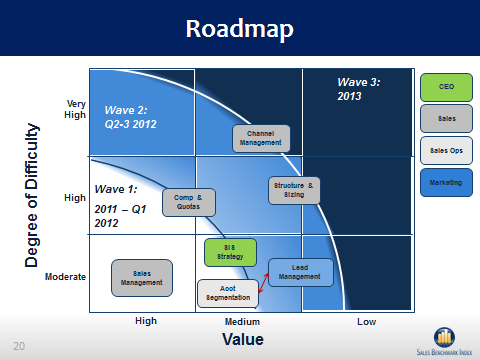
In this post, we will help pinpoint why initiatives fall short.  We will then help prioritize sales initiatives your leadership team will execute.  SBI’s 7th annual research tour is under way.  Sign up for the onsite session for your leadership team: How to Make Your Number in 2014:  A Sales Strategy You Can Execute.  You will be able to download the Sales Strategy & Execution Tool to help you make your number.


Common Signs of Poor Sales Strategy

  • Lack of Collaboration – This is something that plagues most organizations today.  Every function is operating in a silo.  The senior team does not think of themselves as followers.  The result is a decentralized process.  Initiatives with low value to the organization get pushed to the front.


  • Too Many Initiatives - One problem that plagues sales organizations is they try to do too much.  You see sales organization trying to implement over a dozen individual initiatives.  This is a sure recipe for failure.  Confusion sets in with your sales force on what’s most important.


  • Lack of Executive Support – Executive sponsorship is mission critical.  The initiatives need to have the support of your senior leaders.  They have to be committed to the change and implementation processes.


  • Lack of Field Adoption – There is no reinforcement by the sales and marketing leaders.  When you reach message clarity, the field is empowered to act. When you lack clarity, it causes paralysis and impedes progress.

These things all add up to 70% failure rate on sales initiatives.

5 Steps to Building an Effective Strategy

  • Step 1 (Sales Gap Analysis) – You really just want to understand how your sales force stacks up.  You are trying to understand how your sales force is producing against your competition.  Then measure against best in class sales organizations.   You will reveal where the sales force is thriving and where it is weak.  Moreover, in the end you will have defined the problem. The Sales Strategy & Execution Tool will help you improve sales strategy clarity.
  • Step 2 (Sales Improvement Priority List) - Use the evidence to assess which initiatives will have the biggest impact on revenue.  Then measure the degree of difficulty and value your initiative will provide.  The result is a set of priorities that will help you make the number.

describe the image 

  • Step 3 (Program Design) – This goes beyond setting the course and more about visible leadership.  This is about defining the execution strategy.  You want to build clear objectives, milestones, project team, communication plan, metrics, and ownership.  This is the blue print by which you will realize your results. 
  • Step 4 (Sales Kickoff Program Launch) –The communication plan is put into place.  You are sharing the clear objectives of the program and the impact on all key stakeholders.  This is the beginning of an ongoing communication plan towards adoption. 
  • Step 5 (QBR Benchmarking) – This is a way to keep track of key milestones of the project.  Inspect what you expect!  You have spent time carefully constructing a strategy.  Ensuring its’ success is staying along for the journey.  You will review results as a team at the beginning of each quarter.  In addition, you will iterate striving for constant improvement and ownership.

In a recent Wall Street Journal article, the average tenure of a CEO is 4.5 yrs.  Stakeholders are much more vigilant about the performance of the organization.  The margin for error is slim.  In addition, frustration sets in with the level of impact from your strategic initiatives.  You feel like you have pulled every lever with no significant results to show.  Turn the results around by starting to answer the questions in the Sales Strategy & Execution Tool.  You will be better able to answer the question “what am I missing?”  Identify your gaps. Then develop a plan to help you make your number.

 
You can also sign up for the onsite session for your leadership team: How to Make Your Number in 2014:  A Sales Strategy You Can Execute

Author: Andrew Urteaga

sbi on linkedin

Follow @UrteagaSBIi

Follow Sales Benchmark Index @MakingTheNumber

If you enjoyed this post, never miss one again by subscribing your Email Here and/or subscribing to the RSS.

06 Aug 15:53

Is ‘Big Brother Sales Manager’ Looking Over Your Shoulder?

by Frank Rumbauskas

Stupid sales managers never cease to amaze me. Or, more specifically, I’m especially amazed at how many stupid sales managers still have jobs!

I’ve heard a couple of real doozies in the past week, and wanted to share them with you, so here are both for your amusement!

Sales Manager Horror Story #1

I just took on a new sales training & marketing strategy client. On our initial call, before we got down to business, we shared some old “war stories” from our sales careers, and he had a real whopper for me.

He was brought in as sales director at a company whose sales were suffering.

Why?

Because the sales reps were told to do nothing but … wait for it … COLD CALL!

It was one of those micro-managed horror offices where you had to check in at 5:30 PM every day with your stack of business cards to “prove” you’d knocked on enough doors.

In any case, my client came in, put a stop to all that nonsense, implemented what he’d learned from my Never Cold Call Again system, and sales skyrocketed! Better yet, sales turnover dropped, which is a big deal, because in preparation for a presentation I’m giving tonight, I learned that the cost of turnover per salesperson is equal to 150-200% of that person’s annual salary. (Wow!)

When he eventually resigned to start the company I’m now helping him with, they went back to their old ways, and took it a step further: All sales reps now have GPS tracking devices on their cars so Big Brother Sales Manager can keep tabs on them all day.

THIS IS INSANITY! And, needless to say, sales dropped to an even lower level than before my friend took over.

Sales Manager Horror Story #2

Here’s a real email that came into our helpdesk yesterday:

I just read about ‘crap that comes out of salespeople’s mouths’, and had to share this story. Some time ago I got into contact with a company owner in New England who was looking for people to cold call for his consulting business. When I touched base with him, I told him that I had access to several groups that were already doing business with his ideal prospects and that I wanted to set up a plan for him to contact those prospects all at once instead of one at a time.

His response was, “I’m looking for dialers, not order takers.”

WOW! Another moron! Do these unqualified, idiot managers not realize that becoming an order taker is the pinnacle of success for a salesperson? But I guess people like this have some kind of Napoleon complex and a desire to rule others.

How To Avoid Big Brother Sales Managers

If you don’t want an overbearing sales manager breathing down your neck, there are two ways around it:

1. Quit and go sell for someone else. I know jobs are tight in this economy, but if you’re being forced to cold call 40 hours a week, you’re not going to sell much anyway.

2. Sell SO MUCH – I mean blow your numbers out of the water, to the 200% amount and beyond, and your manager won’t care if you show up to work in your underwear, because those numbers are making him look good AND are showing up in HIS commission check.

Regardless of which path you choose, you’ll never succeed if you don’t know how to really make a ton of sales, consistently, month after month. And cold calling will never get you there.

06 Aug 15:52

Sales and Marketing Analytics in CRM Idol

Overview of Sales and Marketing Tools

CRM Idol is a fantastic annual competition for CRM software developers to get in front of a panel of thought leaders. KnowledgeTree has been selected as a contestant amongst a field of strong contestants that provide solutions for the many different areas of sales enablement technology and related sales software.

The competition gave a good opportunity to look at solution areas that add value to sales and marketing teams. So, over the next few weeks, I’ll post some thoughts on the various market spaces that vendors on this hot list are in.

CRM Idol shortlisted several solutions that deliver sales and marketing analytics – a key discipline for modern marketers. Forrester Consulting also covered this hot topic of analytics earlier this year in its commissioned research study, “The New Paradigm of Predictive Analytics.” The paper describes how advances in statistical analysis, or predictive analytics, enable marketers to anticipate customer behaviors and respond consistently across channels and touchpoints.

So, how can you use analytics to achieve your sales and marketing goals? There are many ways. While Salesforce.com has many powerful tools for analyzing customer and prospect data to mine for trend information, upsells and new business, it’s critical to explore tools that help analyze sales and marketing data for specialized functions and goals.

read more

06 Aug 15:52

Article: Leads Take Hold as the Primary Goal of Content Marketing

This year, as content marketing becomes integral to nearly half of US companies’ marketing efforts, the purposes of the tactic are converging on one key goal: lead generation. This jumped from the No. 4 goal in 2012 to the No. 1 goal in 2013, “leading” by a wide margin.