Shared posts

05 Sep 14:37

3 Smart Things: Customer feedback and social media

by admin

1. Two trends—getting customer feedback in product development and using social media marketing—may not be compatible, according to researchers at the University of Texas and the University of Calgary.

2. Research shows that consumers who have helped develop products (like voting on new colors) resist social media influence and purposely express opinions divergent from the social media.

3. It seems that after providing consumer feedback, individuals recognize and resent attempts to influence them.

20 Aug 17:14

Accelerate Content Marketing Effectiveness With The Power of Buyer Persona Stories

by Tony Zambito
Accelerate Content Marketing Effectiveness With The Power of Buyer Persona Stories image 497411169 d6eeb0849a m

“Story Road” (Photo credit: umjanedoan)

(This is part one of a three part series on the use of Buyer Persona Stories™, Buyer Persona Scenarios™, and Buyer Persona Story Mapping™ to drive effective content marketing strategy.)

One good trait of a storyteller is they also know about the story of the person or people they are telling a story to. Knowing how to tell the story in a way that draws them in. Creating an experience, which can suspend time and make a person believe they are in the story. This is the goal of content marketing – to tell good stories compelling a buyer to act.

A Story Frame of Mind

Two of the difficulties in content marketing effectiveness today are first to understand the story of buyers and two translating this understanding into powerful stories to tell. The difficulties lay in filtering through data, requirements, bullet points, presentations, and more to derive a compelling content strategy designed to spur action.

A powerful modeling technique, Buyer Persona Stories™, can help you understand the story of your buyers as well as guide your content strategy development. A good Buyer Persona Story™ provides context for understanding buyer goals, topics, activities, and values. Designed to help us understand how to zero in on why certain values are important to a purchase decision.

Elements of a Good Buyer Persona Story

There are several elements to creating buyer persona stories accelerating the effectiveness of your content marketing strategy. This is a good place to point out the elements require a stage prior to the actual creation of buyer persona stories. A level of buyer insight research is required to gather the necessary insights, which characterize the essential elements of valuable Buyer Persona Stories. Not doing so will amount to guessing and lost of effectiveness.

The creation of powerful Buyer Persona Stories requires the following elements:

  1. Buyer Persona – this becomes your central character in the Buyer Persona Story. As mentioned above, you will need to perform buyer insight research to identify your target buyer persona.
  2. Goal – buyer persona story development is a goal-driven effort. It is important to identify the central goal and purpose for your buyer’s story. The goal also is helpful in identifying the behavior your buyer will engage in to accomplish a goal.
  3. Topic – identifying what information buyers seek is crucial for this element. Topics and information tie back to both the buyer persona and the specific goal.
  4. Preference – this element hones in on the specific output preferences a buyer will have for the topics and information sought.
  5. Value – the buyer story development must clearly end in a specific business or decision value. This requires us to understand “why” this story is important to the buyer.

Buyer Persona Story Construction

Constructing a story is a process of combining the elements into a meaningful story statement. Providing the context needed to see how a buyer’s story is both relevant and important. We borrow from approaches which exist in both agile and waterfall methods for development as well as design. Buyer Persona Stories can be developed with this recommended approach:

As a (buyer persona)

I want/need to (goal)

The information I need (topic)

And is most helpful (preference)

So that I know/ in order to (value)

Writing the Buyer Persona Story

As you can see, the elements and construct of a buyer persona story requires good input from buyer insights and buyer persona development. Without it, the story structure, even in its simplicity cannot be filled out. Let us use an actual case of an IT Director buyer persona seeking information for a specific problem:

Accelerate Content Marketing Effectiveness With The Power of Buyer Persona Stories image IT mgr buyer story.jpg2 1024x609

Buyer Persona Story™: Available below is a link for a helpful modeling tool

I have purposely used a real story of a fairly complex situation. Although this buyer persona story consists of a few sentences, it breaks down the complex to a level of meaningful simplicity, which can often be missing in content creation. And, this is what we want. To enable sharpened focus on what we need to understand about buyers at a particular stage. Buyer Persona Stories offers a powerful technique for teams to get on the same page about buyers.

It does not end here. As mentioned at the start of this article, this is part one. Next, I like to share how this technique can help you understand Buyer Persona Scenarios™. Introducing elements related to activities and context. We will examine how to bring completeness to the true story of buyers. Looking at how Buyer Persona Stories, Buyer Persona Scenarios, and Buyer Persona Story Mapping can help you be on target with content strategy.

(The Buyer Persona Story™ modeling tool is available here for you: Buyer Persona Story Model. I welcome further conversations to help you adopt Buyer Persona Stories™ to improve content marketing effectiveness. I am very interested in getting your thoughts and perspectives on this powerful technique. Please share widely – your peers and colleagues are trying to get the right story to their buyers.)

12 Aug 16:45

The Four Stages Of Content Marketing

by The Leads Explorer

Content Marketing Concept

The concept of Content marketing seems very simple: you create some content and people will buy your products or services as you have created their interest. However in reality Content Marketing is more complex and subtle.

The 4 Content Marketing Stages

There are four stages in Content Marketing:
- The first stage is to attract interested people or potential buyers with an interesting article by given them free information or tips about the market or business
- The second stage is to create awareness of your business or company and your products or services most likely achieved by the authority of your content
- The third stage is the build the link or relation between the content and the products or services you offer.
- The fourth stage is when the potential customer needs to make up his short list when he needs to remember your company, products or services for solving his problem

First stage: The basic content

The first stage requires creativity, experience in the business matters or industry and some imagination in order to create the interest. Nevertheless your content needs to be readable and preferably entertaining in order to keep the attention of the audience. This is not feasible for all of us but still for many people with experience in the business.

The second stage: The authority building

The second stage is requires not just one great article, info-graph or content but probably several concerning the business you are in or the typical problems your customers are facing. This requires already more than just one piece of content. This is when you build up your authority in the matters which will lead to awareness and retain your brand name. The best is when the interested party starts forwarding your content to others as he is very positive of the given insight by your article or value of your content.

The third stage: The bridge to products or services

The third stage is tricky as the general approach of your content needs to build a link to your products or services. This bridge shouldn’t be a real sales pitch but still should point out why it suits or matches the previously describe issues, problems and solutions perfectly.

The fourth stage: The short list

The fourth stage is the most difficult as people are used to have the same companies or brands on their short list. Thanks to the created content your brand needs to make it onto the short list. Preferably at the first position as your content was explaining exactly what the potential customer investigated for or was afraid of.

How good is your Content Marketing machine ?

Share

12 Aug 16:45

Marketing your consulting business: 5 not-so-surprising marketing tips used by consultants to generate revenue

by Craig Rosenberg

I just realized I have been consulting again for almost a year now. Time flies.

I didn’t think my next business would be consulting again. I had myself pegged to start another tech or internet company. Consulting was just going to be a stop gap…But then we started working with clients again and realized — this is fun (but hard…more on that).  We saw we can actually make a difference and that felt great.  We founded TOPO.

Consulting is a unique business. One of the difficult areas to manage is the fact that you have  ”eat what you kill”.  (For my vegan friends: Eat what you grow and pick?). This aspect of the game takes some getting used to as you are in a constant balancing act of delighting clients and generating new business.

Today I want to talk about the sales and marketing aspects of consulting. I have studied some of the successful consultants and how they grew their business. I talk to everyone I can and observe heavily. Interestingly, consultants really have embraced and ultimately thrived using a lot of the current hot marketing tactics especially content marketing, inbound marketing, and social. If you want to know if a marketing tactic works or not, check out consultants who won’t eat that month if they don’t drive business. If they are doing it, it’s worth noting.

Tactics for marketing your consulting business:

1. Create content —  I believe in content marketing. Actually, I live it (I am actually writing this post at midnight…). We wouldn’t have been able to start our business so quickly without content marketing. Most of our leads come from this very blog and now our TOPO blog. You write content, content gets shared, content builds the brand, and people find you. Content marketing is also critical for pipeline acceleration — people that don’t know you initially, can easily go online and see your expertise and street cred in real time. Your credibility level increases by virtue of your great content. Social proof Look, I am like you, I am not interested in reading another post on why you need content marketing…but I see it working for us and for a lot of consultants out there is the market.  When I was starting the business, Matt Heinz from Heinz Marketing gave me this advice: “Start writing”.

In many ways, content marketing is the great equalizer. Don’t get my wrong, not many of us have the resources to compete on output with Hubspot. On the other hand, if you create great content – you can compete with anybody for thought leadership. Look at top 100 influencer lists, the vast majority of people on that list are consultants, bloggers, etc. By the way: If you want to learn more about content marketing, we are holding a content marketing virtual summit on August 14th which should provide some great tips and best practices. Click here to RSVP.

For inspiration on the power of content marketing, there are some role models to emulate:

1. Bridge Group Inc – They have a great blog, great social presence, and most notably, have created a series of must-read reports on inside sales.  The link provided is for their content resource center which houses their reports. This an example of content marketing at its best and something everyone should learn from. They also have one of the best LinkedIn groups on inside sales partly because the monitor content quality like hawks.

2.  Anthony Iannarino — Anthony’s story is a fable: Years ago, Anthony started blogging every day. Repeat: every day. Years later, he is one of the biggest names in sales consulting. Point scored content marketing.

3. Sales Benchmark Index — I always mention these guys because they have truly taken inbound marketing/content marketing principles and applied them to the consulting business. Formula: Post 7 days/week + Ebook/month + webinar/month + free tools and templates = Thousands of monthly leads.  I have written about them before, but I have picked up on another content tactic by them — the free tools and templates. They write posts that offer free tools and templates which is a great way to seamlessly move anonymous blog readers to leads. I provide a picture of their template offers on this post: Blogging best practices: 8 ideas for curated blog posts.

4. Dave Brock’s Partners In Excellence Blog — Check out some of the comment strings on Dave’s posts. He is literally using content to have interactions with his prospects and clients. And knowing Dave, he will call you to talk about your comments as well.

The hard thing for many consultants is “giving it away for free” but that is how you reach new audiences today. If your website is still brochureware, you can’t compete.

2. Write a book — The people that write books have basically executed a timeless consulting content marketing play. You don’t have to look far to see what a well-received book can do for your business. Ardath Albee has created a big business for herself and all the business comes to her. She credits being a published author as one of the main channels for this inbound lead flow. Jill Konrath is another great example. I go on site to customers and her book is sitting on their shelves. That’s a winner.

3. Do everything you can to build your thought leadership profile — What #1 and #2 come down to is thought leadership. Thought leadership = revenue. Until you have a big enough name, don’t charge for speaking engagements. For example, speaking at vendor or media company webinars allow you to share your expertise and someone else is on the hook to bring the traffic. The key question should be: Who is the target audience? If they fit your target buyer persona, go. For a consultant, speaking engagements are the best deal out there. Another way to build your thought leadership profile (and site traffic) is to guest blog. Guest blogging allows you to show your expertise to a new audience. Same rule applies to guest blogging as speaking: Who is the target audience of the blog? If it’s yours — then do it.

4. Get email addresses — Emails are the new black. Vendors and media companies have been collecting email addresses for years. Top consultants are in the game now.  Bottom line, email remains the best channel for getting your content into people’s hands. Here is what many consultants do: For webinars, their stipulation is typically access to the registrations.  As well, if you are creating great content consistently — then build your site to capture emails. The resurgence of pop-ups is almost exclusively a by-product of web properties hoping to get visitor’s email addresses. Get the email address and then nurture people. For an example, check out Neil Patel’s site – here is a guy who is one of the masters of SEO and one of his core strategies is to get email signups to deliver his content.

inbound marketing

5. Nurture till the cows come home — Marketing consulting services is the ultimate case study for lead nurturing. Consulting is a pain-driven and trigger-driven buying process. Customers don’t buy until they decide they have a problem they are willing to pay to fix. Nurturing will keep you in the hearts and minds when they are ready to act. Content marketing is a critical component to this process. We will send relevant content assets to prospects on a consistent basis to keep them engaged with us. We send via LinkedIn or email. Just the other day I sent a piece I wrote to a prospect, who wrote back and said: “Do you do this…? We need help here.”. Bingo.

In closing:

1. If you want to get beefed up on content marketing, I recommend the Keys to Content Marketing Success virtual summit.

2. Basically, there are a large number of consultants who are living, breathing examples of all the marketing advice you read and hear about. If you are in the game, my advice is to jump on the bandwagon.

Craig Rosenberg is the Funnelholic and a co-founder of Topo. He loves sales, marketing, and things that drive revenue. Follow him on Google+ or Twitter

12 Aug 16:45

Content Marketing: How a technology company used its employees to generate quality content [Video]

by bcarroll@startwithalead.com (Brian Carroll, MECLABS)

Content marketing is one of the most effective and widely used lead generation tactics, according to the MarketingSherpa 2012 Lead Generation Benchmark Report. Although it is one of the most difficult forms of marketing, second only to trade shows, 62% of marketing budgeters expect an increase for content marketing, according to the same report. Developing a content marketing strategy remains a big undertaking.

To help you learn more about content marketing ideas and tactics at Lead Gen Summit 2013 in San Francisco, we’re sharing this video replay of Edwin Jansen, Director of Business Development, The Ian Martin Group, presenting on content marketing from B2B Summit 2012.

Jansen explained by generating content from within Softchoice, a technology solutions and services provider, it empowered employees throughout the company to become advocates of the content they created. Educating departments on the use of social media and recognizing talents and abilities within the team increased the quality and reputation of the content that the company generated.

This clip features the first of four lessons that Jansen learned in his quest to transform his company’s marketing strategy into a content-rich experience for customers. Others include:

  • Managing processes that best serve customers
  • Using the right tools
  • The one thing he wished he knew before he started.

To hear the rest of Jansen’s lessons and confessions in his journey towards “pull” marketing, watch the full, free presentation from last year’s B2B Summit in the MarketingSherpa Video Archive.

Related Resources:

Lead Gen Summit 2013: Sept. 30 – Oct. 3, San Francisco

Event Recap: MarketingSherpa B2B Summit 2012

Content Marketing: Your questions on B2B online lead gen, metrics, content from SMEs and more

Content Marketing: Targeted persona strategy lists sales leads 124%

Content Marketing How-to: 7 steps for creating and optimizing content in any size organization

12 Aug 16:37

The Value of Apathy! It’ll all come right in the end. I hope.

by admin

Extraordinary isn’t it?  At a time like this, when sitting back and doing nothing really isn’t an option, how many people are doing exactly that.  Sitting back.  Hoping things will get better.  And they might – but then again, they might not, at least not for a while.

I was reading an article from a 2006 Harvard Business Review sales supplement the other day.  The following statement  struck me:

“Customer’s buying processes have evolved in our world of ubiquitous, instant, global communications, but companies’ selling processes have, for the most part, stayed the same”.

Thomas Stewart, Editor HBR Sales Supplement August 2006

word-cloud-change So, have you changed?

Are you still doing the same things you did 12, 18, 24 or more months ago?  And expecting different results?  Do you truly understand your customers buying processes?  Just sit back and think about that.

  •  Do you truly understand your customer’s buying processes, who’s involved and how they make decisions?
  • Do you really understand the things that are important to them, their decision-making criteria?
  • Do you know enough about them and their business to be able to hold a conversation with them about their business problems, their challenges and their opportunities?
  • Do you understand the things that they value, as a business and as individuals?
  • And do you recognise that if you know it today it might all have changed by next week?

“The times they are changing”……still!

And the world is a very different place now.  When we started our focus on value we were talking about building value, improving margins, not leaving money on the table.  Utilising value in positive ways to demonstrate why your clients should choose you rather than your competitors and to capture some of that value through improved pricing – what one of our clients calls “not more orders, but better orders!”

Now many of our clients are under serious price pressure from customers who see forcing down prices as the only way of reducing costs.  So now you need to be able to use your value delivery as a means of defending your prices.  But that means you need to fully understand the things your customers truly value.  And if you don’t really, deeply understand your customers, that is going to be very difficult.

Are you Selling on Value?

 Now more than ever you need to be selling – and pricing – on value.  To do that you need to have a sales team (and that includes everyone else in the organisation that has an impact on your sales efforts) that works together to really understand the things that customers value.  Value is dynamic.  The things that customers value today will change over time.  Next week could be different.

Today the focus may well be on costs and cost reduction (cost reduction, not necessarily price reduction, they are not the same thing).  In 6 – 12 months time the focus is likely to be elsewhere – will you be there?

09 Aug 22:47

10 interesting digital marketing statistics we've seen this week

by David Moth

Here are some of the most interesting digital marketing statistics we've seen this week.

Statistics include email marketing, online travel agents, tag management, Google+, data collection and ecommerce site speed.

For more digital marketing statistics, check out our Internet Statistics Compendium.

22% of marketing emails fail to reach the subscriber's inbox

  • Just over one in five (22%) commercial emails sent globally on the first half of 2013 never made it to the subscriber’s inbox, according to a new report from Return Path.
  • Furthermore, the global inbox placement rate actually declined slightly versus the first half of 2012, dropping 4% year-on-year.
  • Return Path’s report also looks at deliverability by industry. Retailers proved to be one of the best performing sectors with an inbox placement rate of 92%, up 5% on last year’s total.
  • Only utilities (95%), consumer products (93%) and publishers (97%) performed better in the first half of 2013.

Tripadvisor is most visible travel site in organic search

  • Tripadvisor is the most visible brand in organic search, according to a new report from Epiphany. Travel aggregator sites also feature prominently in the list.
  • The report shows that Tripadvisor dominates in terms of overall visibility and the number of keywords it’s visible for (815,885 keywords), with TravelSupermarket the second most visible site despite only appearing for 86,000 keywords.

Tag management adoption to reach 50% by 2017

  • Up to 50% of websites will have adopted tag management technology by 2017, according to new research from Qubit.  
  • The data shows a massive surge in take up among the top 100,000 websites globally, with adoption increasing by 600% since May 2012.
  • The research, which looked at the tag management technologies in use on 100,000 leading websites, also found some key trends in the TMS marketplace.
  • While server-side tag management represented 49% of the market in 2012, client side solutions now dominate with more 80% of the installed base.
  • Furthermore, free products now represent 44% of the total installed tag management market.

Ecommerce page load times are becoming slower

  • A new report from Radware suggests that despite the effort that businesses put into ensuring a fast load time, average site speeds are actually getting slower.
  • The study shows that in spring 2012 the median page took 6.79 seconds to load, but this has now dropped to 7.72 seconds, a slowdown of 13.7%.
  • Among the top 500 leading retail websites, as ranked by Alexa.com, Ikea was found to have the fastest full load time at just 1.85 seconds followed by AbeBooks (2.06 seconds) and Pixmania (2.20 seconds).

Just 20% of businesses tie data collection to business objectives

  • Only one-fifth of businesses (20%) have a company-wide strategy that ties data collection and analysis to business objectives, according to a new report Econsultancy and Lynchpin.
  • The Online Measurement and Strategy Report has tracked the extent to which data and business objectives feed into one another since 2009, with the results remaining fairly consistent for the past five years.
  • The proportion of companies who claim to be working a strategy has remained at around 60% since 2009, which indicates that these companies aren’t having much success at achieving their objectives.

52% of agencies now offer a 'full range of digital marketing services'

  • Data included in our new UK Search Engine Marketing Benchmark Report 2013 shows that more than half of agencies (52%) now offer a ‘full range of digital marketing services’, and increase from 45% in 2012 and 42% in 2011.
  • In comparison just 12% of agencies specialise in SEO while 7% focused exclusively on paid search. A further 10% of agencies carry out both SEO and paid search.

What area is your main focus as an agency?

  • The report also asked businesses whether they outsource their search, display and social media marketing to an agency.
  • A majority of companies (69%) take care of social marketing in-house, while only 7% exclusively use an agency.

Australian companies face challenges delivering great digital user experience

  • Almost half of Australian companies rate the user experience (UX) on their digital properties as just ‘ok’, and 16% rate it as ‘poor’ or ‘very poor’.
  • These findings come from a new report by Econsultancy and Macquarie Telecom which sheds light on the challenges organisations are facing in this area.
  • The research found that three-quarters (74%) of respondents say their companies are committed to delivering the best possible online user experience, including 17% who say they are ‘seriously committed’.
  • A huge 96% of respondents agreed that user experience must lead all marketing and ecommerce efforts.

Google+ shows strong correlation with high search rankings

  • A new report by Searchmetrics shows a strong correlation between a site's social signals and its ranking in Google SERPs.
  • Websites that rank in the top positions for Google usually have a large number of social signals, with Google+ apparently having the biggest impact.
  • The report is based on analysis of 10,000 search terms from Google UK, using the first three pages of results.

  • It’s important to point out that this is a correlation rather than causation, so we can’t necessarily say that social signals definitely lead to higher search rankings. But it does seem to suggest that there’s some relationship between the two.

Agency coordination becoming impossible

  • Almost half of European marketers (48%) say the burden of agency coordination has become unmanageable, according to a new report from Charterhouse.
  • According to the research, almost two thirds (63%) of European marketers, and almost three quarters (70%) in the UK, feel that working with so many agencies is making creating integrated campaigns more difficult.
  • More than half (53%) say problems also arise as a result of lack of, or miscommunications between agencies. 

Email still top dog for marketing

  • New research from TagMan shows that digital marketers still find email to be the most useful form of advertising.
  • The data shows that 43% are not confident that social media drives ROI, while 63% of marketers still consider email as the most useful form of digital advertising.
  • Furthermore, 55% still measure success of display campaigns by click-through rates, while 31% are struggling with data overload.
09 Aug 16:30

Google Launches Views, A Community Site For Your Panoramic Photo Spheres [Updates]

by Saikat Basu
updates-image

In a nice development for photo sharing enthusiasts, Google has launched Views, a photo-sharing hub that, unlike any other, is all about sharing 360 degree panoramas or photo spheres as Google calls them. Before you start to wonder at the complexity of composing 360 degree shots, it is probably already possible on your Android phone (in case you forgot). Photo spheres was one of the improvements on Android 4.2 — a direct face-off with the iPhone’s Panorama mode. The Views community hub hopes to be the catchment spot for all the panoramic captures you take with your Android (version 4.2...

Read the full article: Google Launches Views, A Community Site For Your Panoramic Photo Spheres [Updates]

06 Aug 16:03

How to Know if You’re Bringing Value – Note to Sales People

by Keenan

How do you know if you offer enough value in the sale to close it? How do you know if you have enough leverage to not compete on price? How do you know if the client needs to make the deal? Ask this one question;

What’s the impact to the customer or prospect if they DON’T buy my product or service?

Your answer to this question tells you everything you will need to know. This one little question tells a BIG story.

With that said, I don’t want to confuse you, because this question seems rather simple, but it is a little more complex than it seems. The answer to this question is NOT missing out on the value proposition of your product or service. In fact the answer has very little to do with you. The answer to this question must start with — My client . . .

  • misses out on
  • can’t
  • is unable to
  • will lose
  • will fail in
  • will struggle with
  • will pay more for

followed by a business issue UNIQUE to the customer or prospect. If your answer to the question doesn’t contain any of the previous descriptions AND doesn’t have substantial impact on the specific customers business, you don’t offer value, you don’t have leverage and the odds of making the sale are slim.

The value of something is measured not by how bad they want it, but rather by what they are willing to give up for it.

If your customer isn’t willing to give up much for what you offer, you haven’t demonstrated value. If you want your customer or prospect to pay more, move faster, chose you over the competition, push through procurement, sign a long-term contract, etc. focus on the value they perceive they are getting, not the value you say exists.

Take a look at all of your current opportunities. Can you articulate the customer’s value? What impact does your product or service have on that buyer and only that buyers world? What happens if they don’t buy what you’re selling? How big of an opportunity do they miss out on? What do they lose? What is the cost of not doing business with you? If you can answer these questions and the impact is substantial, you are in a good place. If not, time to revaluate your sales pipeline as there just might not be enough value.

If the impact is substantial then you’re headed in the right direction, all that’s required is that the customer or prospect agrees with you and well, that’s your job and another blog post.

Value is leverage, knowing if value exists is easily determined if you are looking through your customers eyes, not yours. Find the impact to your customer if they don’t buy your product or service, everything stems from there.

06 Aug 16:02

LinkedIn and Salesloft: Your Ultimate Tools for Sales Prospecting

by Colleen MacNeil

LinkedIn and Salesloft: Your Ultimate Tools for Sales Prospecting image linkedinsuit resized 600This is a sales blog, so if you are reading this, you’re most likely already a Linkedin pro. If not, you should check out our guide to resourcefulness, which includes basic information about how to get started on LinkedIn. This post is for a more intermediate audience, so after reading that, come right back!

LinkedIn is widely used for many different reasons, but no matter what, you should always try to maximize your return. Inside sales reps use LinkedIn for everything, from verifying data, such as a prospect’s job title or current company, to searching for any personal connections with prospects. Linkedin has a simple and easy-to-use interface, but there are some secret tricks that only some Internet users know. Here are some of the tools and tricks I use when I prospect through Linkedin.

The Marriage Between LinkedIn and SalesLoft

Salesloft has done a great job of not only integrating well with LinkedIn, but also highlighting and extracting important information. Most importantly, this tool will save sales reps valuable time by pulling all relevant information from multiple sources into a single, customized dashboard.

The Dashboard: The dashboard provides you with personal prospecting alerts such as: notifying you when your prospect has changed jobs, using crawlers from the web to pick up any sizeable event such as gaining another round of capital or new product releases, and sending notifications when your prospect publishes a new blog post.  Salesloft also uses a ranking system to help you evaluate the likeliness that your prospect will buy based upon growth by employee hiring rates, various market “spends,” and lastly by social media influence trajectory.

Building Lists: Linkedin is an awesome source for finding contacts, but if you want to use it to build a list you’re going to spend a lot of time hitting Ctrl-C and Ctrl-P. With just a few clicks, Salesloft allows you to build a super-targeted list from the massive and up-to-date data source that is LinkedIn.

The Google Plug-in: Salesloft doesn’t just make it easier to find many targeted contacts, it simplifies the process of looking for one specific contact as well. We have all googled some combination of a contact’s name, title and company in hopes of verifying data or finding additional information. What is the first link you click on when your search results pop up on the screen? For me, it is almost always Linkedin.

Salesloft’s Google Chrome plug-in sits in the top right corner of your browser. Instead of opening a new tab and googling a prospect’s name, click on the blue and white Salesloft button, type in the prospect you’re searching for, and hit enter. A new window will open with a list of links in Google, including the Linkedin profile for the contact you were looking for and related profiles.

Alerts: This tool also helps you keep your data up-to-date by alerting you with any changes in your prospect’s job position or career. If you are following specific companies on Linkedin, it will show you any news related to those companies. Over time, like a velociraptor, Salesloft begins to learn, and will show you the updates and articles most relevant to you and your needs.

Syncing: You will not find very many applications that integrate well with LinkedIn compared to the copious amounts that are solely created to sync with other social media platforms like Facebook, Twitter, Instagram, etc. However, you can choose to receive updates via email or have this information synced to your company’s CRM system. Combining Salesloft with LinkedIn can be a very powerful and time saving tool for inside sales reps.

Using LinkedIn for Sales Prospecting

Now that you’re using Salesloft with your LinkedIn profile, let’s look at some tips for using LinkedIn for sales prospecting and mastering LinkedIn. In these posts, Anna and Pamela make very informative points on how to maximize LinkedIn for sales prospecting. I would like to highlight tips #3, #7 and #9 from Anna’s blog, and tips #15 and #27 from Pamela’s.

Tip #3: Make Fewer Cold Calls. Now, I’m not going to go so far as to say that you will never make a cold call again, but Linkedin is a great tool to help turn a cold call into a lukewarm call before you even pick up the phone. As Anna points out, “You can almost always learn enough about someone to make your call more relevant and useful to them.” Some useful things to look for would be articles they shared, connections you have in common, posts in groups or changes in their job/title.

Tip #7: Use Groups for More than Simply Keeping Up to Date. Groups can give you further insight into your prospect’s companies, they allow you to see an individual’s full name without being connected to them, and being in the same group as someone else allows you to connect with each other – even if you don’t have any shared connections!

Tip #9: The ‘Look and Look Back’ Trick. Most people don’t thoroughly understand this feature, but depending upon your settings, you can see who has viewed your profile.  Knowing that information could give you a great excuse to reach out to them with a connection request. In the same vein, if you look at someone else’s profile, most likely they will turn around and look at yours and BAM, that gives you a reason to connect.  This could be a great method to connect with prospects!

Tip #15: Export Connections. If you’ve conquered the last tip, you have a decent amount of new connections on LinkedIn. There is an easy way to obtain all of their contact information in one place. Click on “Contacts,” then find “My Connections,” and finally click “Export Connections.”  Therefore, you can easily download your new connections (prospects’) contact info into a spreadsheet and upload it to your CRM.

Tip #27: Use Group Statistics for Better Targeting and Marketing. Not very many users realize that they can access information to better target prospects when in LinkedIn Groups.  Simply go to the group’s page, click ‘More’ in the top navigation, then select ‘Group Statistics’ from the drop-down menu. Take a look at the information and make sure that those statistics fit your buyer persona; if they do, that’s great, if not, you may want to think about which groups would be more beneficial for you.

Linkedin is one of the most valuable tools in my ‘Sales Prospecting Toolbox’.  When combined with additional tools, like Salesloft, and a few secret tricks of the trade, you are bound for success in your sales prospecting. What are some tricks you use when searching for prospects on Linkedin?

LinkedIn and Salesloft: Your Ultimate Tools for Sales Prospecting image b0ddad19 d31c 4f64 9abf 2b5bca6bd32d4

LinkedIn and Salesloft: Your Ultimate Tools for Sales Prospecting image 07f0bf66 1dcb 40ea acd9 7c4ff5605ab017

06 Aug 16:02

Inside Sales Is Already Displacing Field Sales

by Josiane Feigon

The question of the hour is this: Will Inside Sales Overtake Field Sales by 2015? Yes, I realize that 2015 is still 18 months away. But the reality is that this trend has already started and is picking up speed.

Check out Harvard Business Review’s article on The Growing Power of Inside Sales for some real-time stats that align with my early predictions of this important sales shift. The article provides examples of companies that have shifted models to make inside sales a priority, and cites the following reasons for the field sales decline:

1. Inside sales is a less expensive and more efficient sales vehicle — it reduces the cost of sales by 40-90%.

2. Customer 2.0 is more comfortable communicating and collaborating with virtual or remote sales reps than more formal face to face meetings with field sales.

3. New tools such as videoconferencing and online webinars make it easy for reps to have these intimate, virtual relationships with their customers.

I also want to give a shout out to a couple of sophisticated sales thought leaders who picked up on this topic right away. My webinar at the recent Inside Sales Virtual Summit was on this topic, and Dan McDade with ViewPoint ran a blog post on it. I also had the pleasure of being interviewed by Bill Caskey on his Advanced Selling Podcast on this topic. Thanks, guys!

If you are in field sales and feeling panicky about what you should do, maybe it’s time to make the switch. Be forewarned: You’ll  need these 25 superhero qualities to succeed in inside sales:

1. Intellectually curious
2. Hungry
3. Write well
4. Explain clearly and succinctly
5. Persuasive
6. Like to collaborate
7. Understand financial value
8. Move at the speed of light
9. Maintain maximum momentum
10. Have laser focus
11. Tenacious
12. Rebound well from objections
13. Forge solid partnerships
14. Have strong product and technical knowledge
15. Coachable
16. Competitive
17. Resourceful navigator
18. Professional team player
19. Have digital influence
20. Understand Customer 2.0
21. Not discouraged by hierarchies
22. Have a high Tool IQ
23. Savvy marketer
24. Trustworthy
25. Like winning


The post Inside Sales Is Already Displacing Field Sales appeared first on TeleSmart Communications.

06 Aug 16:02

Sales Ninja: Why category selling kicks butt

by Paul O’Donohue

Category versus Product Selling   If selling on value is the way to defeat selling on price. Then what can we do to provide more value to increase our sales results? Answer: Focus on the business category you are in, not the product you sell. For example, if you are selling photocopiers you are in [...]

Read the full article here: Sales Ninja: Why category selling kicks butt

06 Aug 16:01

Cold Calling is Dead & Marketers Deserve Sales Commission

by Jeff Jewett

cold calling is dead

Traditional cold calling is dead.

Not too long ago, cold calling was one of the most important tools in a sales person’s arsenal, but today it’s nearly pointless. While saying that cold calling is dead may be a bit extreme, the old practice and methods for cold calling are absolutely a thing of the past.

Even if you’re lucky enough to get through to your intended target, chances are they have no interest in what you’re selling. That’s because the web has fundamentally changed buying behavior. The buyer now controls the selling process, which has profound implications for sales and marketing.

cold calling is dead

Consumers typically won’t buy from companies they don’t know, especially ones that interrupt them with unscheduled phone calls. Instead, they buy from companies that have addressed their pain points, proven that they understand their industry and taken the time to build trust.

Most B2B organizations have a marketing department designed specifically for generating highly qualified leads for their sales team. Because of recent technological developments in sales and marketing automation tools, even small businesses can deliver the same targeted results.

Content marketing is alive and well.

I’ve heard it’s safe to assume that 3% of any one market is buying at a given moment. These active buyers are sales-ready leads and it’s marketing’s job to get as close to that 3% as possible. The problem with cold calling is that 97% of your market is not buying right now, so content marketing programs can help to create meaningful conversation with your target market and marketing automation triggers are designed to alert the sales team based on behaviors correlated with an intent to purchase.

Essentially, modern marketers allow sales teams to focus on only the best leads and reduce the amount of time the sales team spends trying to speak with non-buyers.

marketing-automation-infographic (1)

Marketers deserve commission.

It’s common knowledge that marketing and sales teams are both responsible for generating revenue and growing a company. So, why is it that only one side of this equation gets commission?

In a B2B market you need to track leads through their lifecycle in order to understand the revenue impact. This requires technology, processes and collaboration, which is led by marketing. Sure, ten years ago trying to measure the influence and impact of marketing and advertising on revenue was a difficult task. So difficult, in fact, that most marketers were left guessing — but that’s no longer the case.

The played-out quote: “Half the money I spend on advertising is wasted; the trouble is, I don’t know which half” comes to mind.

Not too long ago sales teams were doing their own marketing. They were cold calling lists of names that marketers were gathering from events or website forms. Some might argue that this is prospecting, but today’s marketing is prospecting. Think about it: cold calling was trackable, measurable and it directly aligned each sales person’s efforts and their contributions to the bottom line. Today, marketing automation and lead intelligence tools (like Optify) enable marketers to manage this process without ever picking up a phone, and they consistently deliver high-quality, sales-ready leads.

Greater efficiency means it takes fewer sales people to generate the same revenue. In other words, more sales reps are closing more business, faster, which means more revenue.

So, I’m going to stand on the roof tops and scream, “Marketers deserve commission!” Who’s with me?

image credit: Book Line and Sinker and Dell Cloud Applications

The post Cold Calling is Dead & Marketers Deserve Sales Commission appeared first on Optify.

06 Aug 16:01

The Great Sales Training FRAUD!

In my Google Alerts I get a daily email with a list of news articles about cold calling, and time permitting, I usually browse the ones that look interesting.

Or in this case, dumb.

One in particular caught my attention last week, about how cold calling “still helps the bottom line.”

Curious, I clicked on it, and was not at all surprised by what I found. Disgusted? Yes. Appalled? Yes. But not surprised.

Whose “Bottom Line” Does Cold Calling Really Help?

Several months ago I bought a book on recruiting and selecting the best possible sales reps for my company.

I damn near threw up when not very far into the book I began to understand the general theme: “Force your sales reps to cold call. We all know that it’s obsolete and doesn’t work anymore, but if sales reps starve and can’t make enough money to make ends meet, that’s their problem, not yours. As a business owner, you have to look out for yourself, so ‘churn & burn’ sales reps. If you send enough out to cold call, some of it will stick, and you’ll hit your target numbers even if they don’t succeed individually.

” DISGUSTING!

In summary, the book admitted that cold calling doesn’t work, but if you hire enough sales reps, under-pay them, and order them to cold call, even though they individually won’t make their numbers and will suffer, you’ll profit in the end.

And unfortunately, that was the theme of the article I read last week about how cold calling “helps” the bottom line.

It helps the COMPANY’S bottom line, while harming the sales reps who are forced to do it.

How Sales Trainers Profit By

This If that didn’t make your stomach turn, it gets worse: Nearly all sales trainers who are hired by big corporations come in and teach sales reps to cold call.

Why?

Because that’s what the companies want to hear! They’re on the “screw the sales reps, it’s all about us” bandwagon and they’re only interested in hiring sales trainers who toe the company line.

But it gets worse. Not only do most sales trainers teach cold calling to get hired, even though they secretly know it doesn’t work, many exploit this fact to get re-hired over and over again.

Here’s how it works: They know cold calling doesn’t work. And when the sales director who hired them calls to ask why their teachings made no difference, they respond with, “Your sales reps aren’t making the minimum number of calls I told them to make.

” And what does the sales director do? They have the sales trainer come out – AGAIN – to teach cold calling, and the absurd mantra of “make more calls” – AGAIN!

They know that if they teach people to keep failing by cold calling, they’ll keep getting re-hired over and over and over again, just about forever since no sales team is going to succeed by cold calling.

Protect Yourself From The Great Sales Training Fraud

If/when your company brings in sales trainers who tell you to cold call, let it go in one ear and out the other!

Better yet, instead of letting that training time go to waste, covertly read Never Cold Call Again while sitting in the training room, or put the CDs that come with it on your iPod and listen to that instead of the garbage you’re being taught!

If you follow the systems & strategies I teach in my Never Cold Call Again system, you won’t have to worry about failing by cold calling and having to listen to these dumbass sales trainers any more. You’ll be bringing such tremendous sales numbers that you’ll become one of those elite top sales pros who are exempted from attending the required company training.

06 Aug 16:00

Sales Training Article: Ready for 2014

by Customer Centric Selling

Sales Training Article: Ready for 2014?

By George de los Reyes, Sales Benchmark Index (SBI)

sales training workshopsHave you started thinking about 2014? If not, you should be. The best-in-class marketing leaders have already started planning for next year. They follow an annual planning process that starts in July with a Marketing Productivity Benchmark. A productivity benchmark assesses the marketing organization's capabilities - its strengths and weaknesses. The output of the assessment is a prioritized list of initiatives for the coming year.

Want to know what your peers are planning for in 2014? Register today for SBI's 7th Annual Research Tour and find out. Attendees well receive an Overachievers Tool Kit. Inside will be the framework for a Marketing Productivity Benchmark.

Top marketers assess their organization through four lenses: process, technology, people and content. Below are a few things to consider in each category.
Image courtesy of Danilo Rizzuti at FreeDigitalPhotos.net

PROCESS

Account Segmentation: The focus of Account Segmentation is twofold:

  • Define a company's Ideal Customer based on propensity to buy factors and historical customer data
  • Identify the total available market for a company's product or service.

The output focuses marketing efforts on customers & prospects with the highest potential to grow revenues.

Campaign Planning & Execution: How good is your team's ability to build & execute

marketing campaigns. If you cannot run effective campaigns, you will be hard-pressed to generate leads for the sales force. Effective campaign execution has two steps: Planning and Execution. The best marketers assess both.

Lead Management: Someone who form-fills isn't a sales-ready lead. Unfortunately, many marketing organization act this way. They pass along prospects that are not ready to interact with sales. The best practice is implementing a lead management process that nurtures leads until they are truly sales-ready.

TECHNOLOGY

Marketing Automation: Marketing Automation is the art and science of automatically managing the targeting, timing, and content of your outbound marketing messages. The technology responds to prospects' inbound actions and online behaviors. Today's marketers use the technology to automate the tasks associated with lead management, lead nurturing and lead scoring. They also leverage it to create and maintain a marketing lead database.

Done right, it can help marketing organizations improve their productivity as well as their collaboration with sales organizations.

PEOPLE

Content Creators & Curators: In today's buyer environment, the need for content is essential. And not just any content, but relevant & contextual content. To succeed, marketing needs resources dedicated to content creation and curating. They are responsible for researching your buyers. They answer questions such as: What is important to my buyers? What are their needs, goals & objetives? Why and how do they buy? As such, these resources must be proficient in Buyer Personas and Buying Process Maps.

Building on buyer research, they also spearhead content creation. Their goal is to know what resonates with buyers: Blog posts, webinars, slideshare, white papers, etc.

Lead Development Reps: A lead development rep is not a tele-marketer. A lead development rep (LDR) is not a sales rep either. They hold a very strategic role within the sales and marketing organization. The LDR's job is to increase the quantity and quality of leads provided to sales. If done correctly, the LDR is the first human contact a prospect has with your company. They make that vital first impression. The LDR's job is to stay with the prospect and nurture them until they are sales ready.

CONTENT

When assessing your marketing team's content capabilities, follow these four steps:

Personas: Great content is based on research captured in Buyer Personas. Personas are modeled representations of..

  • who your buyers are
  • what they are trying to accomplish
  • what goals drive their behavior

If you want to produce content that resonates with your buyers, step 1 is building Personas.

Buyer Process Maps: The key to effective marketing is the ability to deliver the right message at the right time. Buying Process Maps (BPMs) facilitate this. A BPM is a tool that maps the decision making process used to purchase a product, service or solution. It captures the phases, key actions and micro decisions that make up the buyer's journey.

Content Audit: With a BPM in hand, the best marketers audit their content. They take inventory of all forms of content and overlay them on the BPM by persona. This critical exercise reveals gaps in content. It provides a content production roadmap for the marketing team.

Content Production: You need to cultivate the ability to consistently create great content. Generally, marketing leaders struggle with whether to outsource or use internal SMEs. Whichever route you take, your content must drive your buyers to act by

  • Highlighting a problem exists
  • Compel the reader to solve it
  • Clearly articulate you're the only solution

CALL TO ACTION: It's July. Have you started planning for 2014? Be world-class and start now with a Marketing Productivity Benchmark. Assess your marketing organizations strengths and weaknesses. Identify the gaps and develop a prioritized action plan to close those gaps.


sales training companyNeed some help with your sales performance? Take a look at the sales training workshops available to you and improve sales performance.

Read more sales training articles from CustomerCentric Selling® - The Sales Training Company.

06 Aug 16:00

6 Killer Individual Sales Stats to Measure Your Sales Reps

by Keenan


In baseball, there is the batting average, on base percentage, slugging percentage, HRs, ERA, WHIP, RBI’s and a whole gang of other stuff. In football, there is completion percentage, TD’s, YAC (yards after the catch), QBR (Quarterback Rating), yards per carry, yards per game and more. In basketball, there is field goal percentage, blocked shots, steals, free throw percentage, points per game, efficiency and, as with the other two, a whole slew of other individual stats.

As we’ve seen, with the increased interest in Moneyball and sabermetrics, sports has become an accountants world, accounting for the good and the bad of every at bat, every throw, every steal, every missed basket, every carry, shot taken, and more. The effectiveness and efficiency of every player is counted, manipulated and evaluated like the balance sheet of a Fortune 100 company.  It’s the ultimate in individual accountability and player evaluation. Players go from team to team, year to year with their stats following them around like an albatross or a medal of honor. All culminating in the end their careers with lifetime stats; a lifetime 320 hitter, a career scoring average of 27 points per game, 755 HRs, 2000 yard season etc. As much as team sports is about the team, the accounting of individual accomplishments is as much about the game as is wins and losses.

Unfortunately sales seems to view things differently. We don’t track much more than quota attainment. An arbitrary metric where the industry’s best can find themselves plummeting above or falling below through no fault of their own.  Beyond the quota attainment, sales does little to track, measure and embrace the statistical nuances of selling.

Like sports, there are a number of stats that can tell us a great deal about the selling prowess of our sales reps, that is if we chose to measure them.

Sales organizations could benefit tremendously from individual stats. It would give them the ability to measure their athletes, cause let’s admit that’s what they are, on more than just quota attainment, but on their entire body of work.

Determining what to measure isn’t a daunting task. We don’t need a plethora of complex, confusing and superfluous stats. We just need a few that tell the bigger story;

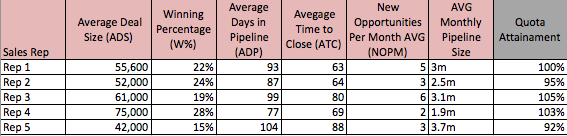
  1. Average Deal Size: How good is the sales rep at up selling? How quickly do they discount deals? How strong of a negotiator are they? Average deal size provides insight into how well a sales rep can maintain the integrity of pricing and drive greater value into the sale.
  2. Winning Percentage: What percentage of opportunities does the sales rep close? How effective are they with the opportunities they get. A higher winning percentage suggests an impressive ability to qualify or add substantial value to the sale. High winning percentages means less leads and opportunities wasted.
  3. Average Days in Pipeline: Take all the opportunities in the pipeline and add up the number of days they have been in the pipeline, then divide by the number of opportunities.  How long do deals sit in the pipeline? How good is the sales rep at knowing when to stop working a deal and close it? Is their pipeline stuffed with “stuff” that just isn’t going to close? Is there a decent ratio between average days in pipeline and average time to close? There should be.
  4. Average Time to Close: How long does it take for a sales rep to close a deal from start to finish? Who on your team closes deals faster? Who takes longer? How do average time to close rates compare with quota attainment and overall revenue attainment. Are those with longer sales cycles selling more?  Or are those with faster close rates selling more.  Average time to close includes both wins AND losses.   It’s designed to measure the amount of time it takes a sales rep to bring a buyer to the decision.
  5. New Opportunities per Month (NOP): Who is best at building their pipeline? Which reps are focused on new opportunities vs. closing existing opportunities. How many new opportunities are your sales people putting into the pipeline each month? NOP is a critical metric few pay attention to.  Knowing who is bringing in the opportunities is critical.
  6. Average Monthly Pipeline Size: What does the pipeline look like from month to month.  Who is good at being able to keep it consistent, vs those who see big shifts as they close, then prospect, then close. AMPS allows you to see who is capable of maintaining a strong pipeline while closing deals and driving revenue.

Screen Shot 2013-08-02 at 10.53.59 AM

Measuring sales reps around these individual statistics requires nothing more than a commitment, a commitment to track them, share them and rank the team against them. The information generated around these 6 stats will change the sales game. Good reps will be found even in bad years, bad reps will no longer be able to hide. One hit wonders, like those in the majors, will not be able to bask in the glory of a lucky kill. Management will have more information to work with; trends will be easier to spot and opportunities will present themselves.

It’s time we start measuring sales people on more than just quota attainment. It’s time we start looking at the entire body of work. I can imagine a future where we are proud to say I have a lifetime winning percentage of 34%.  Now that’s just cool.

What would your stats say about you?


06 Aug 16:00

Sales Management Styles: Deal Manager vs. Sales Leader

by peaksales

Many sales managers were once sales people themselves and this experience serves them well both in terms of knowing what it takes to make sales and the psyche of the reps they manage. They know what it is like to hammer away, day after day at the list, calling prospect after prospect, pitching and tossing and dealing with objections, closing the deal and then handling the delivery and the obstacles that can get in the way of sales.

Somewhere along the way, new sales managers either evolve into leaders or deal managers. Both can be useful depending on a company’s goals, but they are very different types of sales managers.

Deal Managers

Deal managers focus on the deal, the bottom line and the end result. They tend to be highly control oriented, like to get personally involved in closing big deals and may even compete with the reps on the team for the best leads. They are intensely focused on the present and if the goal is to drive revenue now, then this type of sales manager will be very useful. Having worked with a few of these types in my start-ups over the years, I can attest to the value that they bring to a company.

Deal managers are also less likely to focus on long term growth potential while they pursue current deals ad targets and they are also less likely to adequately cover the whole sales management role such as coaching and development of the team and subsequently typically have a higher than average staff turnover rate.

Given that most sales managers graduate from sales roles and have a tough time shaking old habits, deal managers represent the majority of sales managers in the workforce.

Sales Leaders

For the sake of this discussion and so as not to be confused with sales managers in general, we’ll call a sales leader someone that provides more balanced coverage of all aspects of revenue generation and team management in both the short and long terms.

While all sales managers tend to manage at least a few accounts, sales leaders are more of a manager than a sales person. They are visionary and strategic and will sacrifice the short term for long-term growth and overall upside. They focus on building the right sales force, developing skills, providing clear direction, instituting process and building support and infrastructure. Sales leaders believe that the will be successful if the team is successful.

Sales Leader style sales managers are the minority and often tend to make their way into larger companies with higher targets and greater resources.

Bottom Line.

I’m not saying one style of sales management is better than the other. Both are valuable in different situations and getting it right is critical to your company’s success.

06 Aug 15:59

How to Increase Sales {with Software Tools}

by Greg Klingshirn

How to increase sales

Finding a way to drastically increase sales is every salesperson’s dream. And with nearly four million sales professionals worldwide, there’s plenty of competition.

There’s one thing we can all agree on- it’s not easy.

Although there’s no set answer, there are several things you can do to increase your sales. We’re focused on four categories of software tools that can help: CRM, marketing automation, data, and process improvement.

Let’s get started. How to increase sales…

#1. CRM

Over the past few years, most companies have implemented CRM. We’re going to focus on ways to maximize it’s use to best increase sales.

One way to do this is to integrate your sales reps calls with their CRM list. While most of us use lists and campaigns to manage contacts and accounts, taking it one step further is very helpful. Look at it this way- rather than calling through a random list of 100 leads, strategize which contacts are new, which have been reached out to, and what the next step is in each case. Calling 100 people one day and moving directly to the next 100 tomorrow won’t yield the best results. Keeping track of the appropriate follow ups in CRM is crucial.

It’s also helpful to visualize progress. If your reps have a daily or quarterly goal, implementing a chart of their progress on a dashboard will not only let them know where they are, but will provide motivation. Reporting features in CRM often provide easy tools to configure data visualizations, which can be on each rep’s desktop, or on a communal board.

One of the easiest improvements is dialers. They can easily connect with your CRM to streamline communications. By pressing one button to dial each client, you’re letting sales reps focus on what matters- the conversation.

These are simple changes within your CRM, yes. But it’s the little things that will set you apart from the competition.

#2. Marketing Automation

Marketing automation provides easy ways to save time for your marketers and sales reps alike. You can provide customized messages to clients and prospects in a fraction of the time it would take to type each individually. While it’s often used for campaigns, you can also implement it with various sales emails you have to send out day to day. Every automated email you send allows a rep two outbound calls. Think about it. 5 emails a week means 10 more calls. 20 automated emails a month leaves time for 40 extra calls. Extrapolate this over a year among every rep on your team, and you’re talking thousands of extra calls.

Platforms like Marketo, Pardot and Hubspot provide a variety of marketing automation for B2B companies. Anything you can automate, be it emails, filtering lead, or reporting, saves your sales reps time.

#3. Data

Sales data can be frustrating. While it’s often used to make big decisions, many business leaders have trouble sifting through and understanding all their data. This is where companies focused on categorizing and presenting information can add efficiency.

Salesloft’s Job Change Alerts and News Alerts keep you up to date with the prospects and companies that interest you. These sales triggers can provide incredible opportunities to connect with a sales professional who just changed jobs or a company making the news.

Domo is another one of these options. Their software provides a clear picture of how your sales, marketing, operations, and finance are all found in one place. Interpreting data from Salesforce, spreadsheets, apps, and social platforms provides the big picture of how each affects your company.

With software at your side, data is easier than ever to understand. And with understanding comes improvement, with increased sales sure to follow.

#4. Process Improvement

There are plenty of platforms out there for your consideration, and which can provide unique advantages to your company’s sales. Improve your outbound lead generation process using SalesLoft’s Prospecting Tool. Or use software like Rivalry.com that allows you to foster competition within your team, benchmark your numbers against your competitors, and find out which of your reps is best for a specific task. Although it’s often overlooked, understanding your sales process is invaluable.

Regardless of your specific sales goals, implementing a software that tracks your business processes will make your reps more efficient and increase your sales.

A simple exploration of software that can keep you answer the question of how to increase sales. While it’s not easy, increasing efficiency in any way possible will boost your business.

Did we miss something on how to increase sales? Leave a comment and we’ll add it to the list. Your feedback is important.

06 Aug 15:59

When Marketing Meets the New Sales Leader

by John Koehler

marketings new sales leaderMeet Kathy. She’s a Marketing VP at a B2B logistics company.  The CEO just introduced her to the new sales leader. The last VP of Sales got canned at the end of Q2. He was struggling to make his number. Kathy had done everything she could to support the sales team.
The former leader never fully supported or appreciated Kathy’s marketing team efforts. The sales force neglected to utilize marketing developed sales support materials. Kathy believed the former leader would still be here had he leveraged Marketing’s support.

Kathy was ahead of her time. She was developing Buyer Process Maps and Social Selling tools for the sales field. Below is a brief overview (learn more about them at this event):

Buyer Process Maps

  • BPM’s are a sales tool that map the decision-making process used to purchase something.
  • Provides sales teams a blueprint to get into deals early enough to win them.
  • Increases win rates through Buyer and Seller alignment.

Marketing’s Role in the BPM:

  • Facilitate the creation of BPM. Manage the selection of a consulting firm who specializes in developing Buyer Process Maps.
  • Evaluate the prototype in the field through interviews and field observation.
  • Contribute company and/or 3rd party executed buyer research to validate BPM findings.

Social Selling Guidance

A modern prospecting methodology that fills the lead generation funnel with opportunities.

  • Generates meetings with decision makers inside of your target prospects
  • Frees sales from day-to-day dependence on marketing for leads

Marketing’s Role in Social Selling:

  • Training and quick reference guidance on social selling best practices.
  • Company content and support to create LinkedIn profiles.
  • Introduction and referral templates for InMail, Email and Connection messages.
  • Nurture content for LinkedIn status updates.

Today, Kathy has a fresh beginning with a new sales leader. The CEO still views Kathy favorably. Her work ethic is unmatched. Her team is full of ‘A’ players. Despite feeling that her job is safe, she’s nervous about the new Sales Leader. What if he is just like the previous sales leader? What if he doesn’t like me? What if he disregards marketing with patronizing comments about creating glossy brochures?  What if he points the finger at marketing if he misses the number?

Kathy knows the new Sales Leader is motivated to make an impact. He’s sure to be asking: “What do I need to turn this around in year one? How do I get there?”  Kathy thinks to herself: “Now is the time to align Sales & Marketing.”  “How do I build a bridge?”  It now dawned on her. It was a perfect time to attend an event she had been thinking about. A good friend of hers from the BMA (Business Marketing Association) had recommended it to her.  It’s the annual Make The Number Research Tour.

This year it is titled: How to Make Your Number in 2014: A Sales Strategy You Can Execute.  It’s an onsite executive forum reviewing the sales strategies of top producing sales teams. It’s like being told what the ingredients are in the Big Mac’s secret sauce. The session features content for the Head of Sales, Sales Operations and benefits the CMO.  If you want to improve field execution, (like Kathy) you will want to attend. Learn more about the event and sign-up here.

By attending this event you will receive access to tools, guides and templates. This includes the Sales & Marketing New Leader Toolkit with the following:

  1. Sales & Marketing Lead Gen Alignment Guide
  2. Buyer Process Map Template
  3. Promoted to VP Sales eBook: The Year 1 Toolkit
  4. Sales Ops Guide to delivering value to VP of Sales.

It’s now time to win the new Sales Leader over. Help him achieve his goals and you’ll secure alignment long term. Your new sales leader may not understand marketing knowledge. Investing time into teaching social selling and buyer behavior will be to your advantage. Sign-up for the research tour now to secure an early bird no-cost session.

Author: John Koehler

sbi on linkedin

Follow @SearchMaster

Follow @MakingTheNumber

If you enjoyed this post, never miss one again by subscribing your Email Here and/or subscribing to the RSS Here.

06 Aug 15:59

15 Tips for Getting Sales Strategy Right in Major Accounts

by Richard Ruff

15 Tips for Getting Sales Strategy Right in Major Accounts image White Paper Cover2 copy copy opt 1

Major accounts are not just big little accounts; they are quantitatively different. So top performers selling to major accounts cannot just do faster and better what they did when selling to smaller accounts.. Successful major account salespeople sell differently – starting with crafting sales strategy.

Major account salespeople must be business-savvy sales consultants who have developed superior sales skills, have a comprehensive knowledge of their customer’s business and the knowledge and political acumen to leverage and orchestrate internal company resources – to both close new business and grow existing business.

Fifteen tips are:

Sales Strategy Formulation

  • Get the right information from the right people at the right time during the sales cycle.
  • Move from just “filling out forms” to analyzing information gathered.
  • Focus on a few pivotal goals – then delineate what needs to be done and how to do it.
  • Recognize that the future doesn’t necessarily look like the past – changes driven by global marketplaces make the past a bad predictor of the future – from buyer requirements to competitive advantages.

Sales Strategy Execution

  • Network – know who is playing which role, the relationship between the players, and what they think about you and your competition.
  • Leverage institutional resources – major account selling is a team sport.
  • Develop and rehearse internal champions – so they can tell the seller’s story since most of the time the major account salesperson isn’t on site.
  • Document good news since it doesn’t document itself – make sure everyone in the buying process knows the good news story. Bad news will document itself!
  • Deal with passive competition – when the buying process stalls and customer does nothing, by crafting strategies to overcome the no-decision momentum.
  • Be proactive - complacency in Public Enemy #1.
  • Manage the completion by staying focused on the customer’s needs, challenges, and concerns – top performers focus on the customer and manage the competition.
  • Broaden the definition of competition – competitors include everyone competing for the same budget dollars – not just direct competitors.
  • Differentiate by adding value – since the product or service being sold may not vary much from one company to the next, profiling the value of all of the other services and assistance extended to the customer (often called the value adds) is critical.
  • Sell to the c-suite - the probability of capturing the business is significantly reduced if major account salespeople cannot successful sell at the senior level.
  • Make the business case – it’s unlikely a major account sale will be closed without making a strong business case to prove the business need to invest in the solution – and the measurable benefits.

To dive deeper into these best pratices deployed by successful, major account salespeople you can download the white paper – Getting Sales Strategy Right in Major Accounts.

If you found this post helpful, you might want to join the conversation and subscribe to the Sales Training Connection.

06 Aug 15:58

What is Sales Enablement? 3 Definitions that Help Tell the Story

by Brendan Cournoyer

What is Sales Enablement? 3 Definitions that Help Tell the Story image In a recent blog post for SiriusDecision, Jim Ninivaggi wrote, “Unlike established corporate functions like accounting, finance and marketing, sales enablement is still evolving, and the term means different things to different companies.”

This assessment couldn’t be more spot-on (he even points out that the word “enablement” isn’t technically a word at all). While nearly every organization today has some sort of sales enablement function, only some are formalized as such, many report into different departments, and almost all are different.

This has left us without a common, universally accepted definition of what sales enablement truly means. At Brainshark, we define sales enablement as:

A systematic approach to helping reps prepare for customer interactions, engage effectively with their audiences, and advance sales opportunities to close.

The key to all of this? Powerful content and communications.

One of the reasons we feel confident in this definition is because so many others in the industry agree. Check out some of the other sales enablement definitions floating around the web (and there are many), and each is bound to reference the importance of strong communication.

Of course, one of the challenges of nailing down a single definition is that sales enablement is such a huge topic that involves nearly every other business function. To help tell that story, I’ve dug up three unique explanations from the web and bolded the parts that I think are particularly interesting about each.

#1. “Getting the right information into the hands of the right sellers at the right time and place, and in the right format, to move a sales opportunity forward.” – IDC

This definition from IDC has been around for a few years now, but it really does cut to the core of things. I particularly like how they stress not only the information necessary for enabling sales, but the format it’s delivered in as well. To me, this point is important for two reasons.

First – training. Whether you are onboarding new hires or providing resources for existing reps to access on the go, you need to create content that’s engaging and promotes learner retention. For example, since people are generally better at retaining information they can both see and hear, our customers have found on-demand video to be a valuable training asset when used along with other in-person and traditional learning formats.

Second – you have content as a selling tool. The more assets reps have at their disposal, the more prepared they’ll be to effectively engage with prospects and customers. Once again, video can be a powerful tool for nurturing opportunities and on-demand communications, but whitepapers, data sheets and other content types are also useful. Similarly, approved and compliant PowerPoint presentations or product demonstrations are especially critical for live and in-person conversations.

#2. “Sales enablement is a strategic, ongoing process that equips all client-facing employees with the ability to consistently and systematically have a valuable conversation with the right set of customer stakeholders at each stage of the customer’s problem-solving life cycle to optimize the return of investment of the selling system.” Forrester Research

This is another popular definition, and Forrester has certainly done plenty of research into what sales enablement looks like for businesses today. That they specifically call out “all client-facing employees” is especially significant in my eyes. It drives home the point that sales enablement is about more than just those with the word “sales” in their titles.

Marketers, business development teams, customer service and support reps – all of these people communicate directly with potential and current customers. As a result, they all have an impact on the organization’s ability to drive new revenue and maintain existing business, which makes them important pieces of the sales enablement puzzle.

#3. “Aligning marketing processes and goals, and then arming sales with tools to improve sales execution and drive revenue.” – The Pedowitz Group

While this is hardly the most complete explanation out there, the fact that it starts out with a sales-marketing alignment message shouldn’t be overlooked. Keeping that line of communication open and healthy is a key component of sales enablement. Not only does it help reps become better informed on the company’s products, customers and overall brand messages, but it also helps ensure that the content generated by marketing is relevant to reps and aligned with their sales conversations.

Though not a definition per se, marketing consultant and speaker Matt Heinz recently blogged about what sales enablement means to him. In his post, he writes that “a tactical definition of sales enablement that fits all companies – sizes, industries, cultures – would be next to impossible,” and instead opts to define it as more of a guiding principle.

While I agree that a universally accepted definition of sales enablement is difficult to nail down, the common threads and components presented above are becoming clearer every day. For more on the critical role content and communications play in the process, visit our What We Do page and check out the additional resources below.

Download Our Sales Enablement eBook

06 Aug 15:58

On-Boarding Sales Hires in Small and Medium Sized Companies

by peaksales

How do you bring your new hires onboard your business? Leading corporations often have an orientation and indoctrination program that matches the multi-stage recruiting process they implement to ensure they get the people they believe are best suited for the roles they will fill within the company and the best fit for the company culture. They do spend considerable sums finding the right people, it makes sense to invest in keeping them and they are firm believers in the old adage’ “begin as you intend to go on”.

That’s fine for the larger companies with resources to invest and staff to manage the on-boarding, but what about small to medium enterprises (SME)? I know from first hand experience (my own included) that in smaller companies, the predominant philosophy applied to new sales rep on-boarding philosophy is sink or swim.

I am not proud to admit that more than once, in my start-ups, we would hire a new rep, show them their desk and phone and literally ask them what they needed from us to get going. Then we would cobble together whatever was required and ask them to start pounding the phones looking for leads. They would learn our company culture and how we sell ad-hoc and by osmosis.

We did this even though it is completely counterintuitive to invest a lot of time and money to find people and then potentially compromise your return on that investment by not setting reps up to be successful and hit the ground running. Partly I was too stupid to know better and partly I didn’t have anyone to help me provide a more comprehensive approach to acclimatizing a new sales hire.

No Excuse for Risking Your Investment in People

And it really is no excuse. There is a reason why a few start-ups grow faster than all the others and later in my career, I realized you are compromising results by not have a structured program for bringing new hires on-board.

We have written about sales on-boarding basics before on this blog, so I won’t rehash that, but suffice to say that the most successful companies, no matter how big or small, value their staff and want to ensure their new hires settle in with the minimum of problems and obstacles and the investment is small compare to the difference in sales output vs. the sink or swim approach which may work some of the time, but most of the time doesn’t.

To your success!

Eliot Burdett

06 Aug 15:57

Protecting New Recruits From The Mediocre Masses – Sales eXchange 211

by Tibor Shanto

By Tibor Shantotibor.shanto@sellbetter.ca

change

Many in sales buy into, or more accurately, settle for the 80/20 rule, one example would be 20% of a company’s reps generating 80% of sales.  This post is less about disputing or validating the accuracy of the rule, if you want that, download The Shanto Principle; but more about how to ensure that your new recruits develop to be the 20%.  AT the same time, you can you use the same tactics to move from the 80% group delivering just 20% of the revenues, to the 20% club, the group that makes a difference.

Let’s look at a new rep joining a company, being social critters they want to fit in, be part of the team (part of the crowd, easy to hide in a crowd), they look around the office and take in the atmosphere.  Part of the ritual, is talking to their colleagues, getting the lay of the land, “how are things done around here?”

So who is likely to be in the office, who is likely to have time to just “talk”, rather than being out at client/prospect meetings; who lacks the discipline to not stop what they had scheduled, and shoot the breeze with the new guy?  You guessed it, the members of the 80% club.  The 20% club is too busy being out and driving revenues.

This is not to say that the 20% club members are not willing to help a new person out, on the contrary, they do, but they are not in the office, hanging around, they are making things happen.  So for the new team member, they need to make the effort to find and engage with the 20% club members.  In fact this can be an early indicator as to what you hired, how well do they seek out, engage with and model the 20%.

This is why the onboarding process is crucial, managers and organizations must proactively guide and steer new recruits, even experienced sellers, sheltering them from the 80%.

Picture the new recruit in the office with the all-knowing non-producing masses, as he or she stands up to peak out over their cubical walls, and the see the 80% members at their desk, getting ready to prospect, getting ready to learn about the new product, getting ready to go and ask the manager for a further discount so they can win the deal – putting more effort into selling the need to discount than they did selling the prospect on the value, getting ready finish their picks for the pool; for the most part, getting ready.

What is the take away for the new recruit – “hey this is the way they do things around here, if I’m gonna fit it, I best do the same”.

Stepping out to do the things the 20% do requires guidance, or expectation from their manager, and the ability to against the crowd.

Inviting the 20% club members to mentor new recruits not only instills good habits in new team members, but develops future leader in the process.  This in turn can help you increase the quality of the team, and tilt the numbers in your favour, over time, you can move the dial from 80/20, to dare we say it, 70/30.

What’s in Your Pipeline?
Tibor Shanto

06 Aug 15:55

Inside Sales Power Tip 126 – Stop Calling High

by Lori Richardson

Stop calling high for sales successIf you are a B2B seller using the phone and email to connect with prospects and only calling on the C-suite, I’d like to ask you to stop calling high for just a moment and consider broadening your reach.

I’ve been in your shoes, working to reach top executives in hundreds, even thousands of companies over the years. In one position my preferred contact was Chief Financial Officers. I called and emailed for them all day long, every day for weeks and weeks.  I reached very few.

The problem is that C-level folks are very difficult to connect to. It is a bit easier today with more and better tools to help determine when to reach out, and with newer strategies like using InMail – LinkedIn’s version of email which receives a better response than traditional email.

In the position I mentioned earlier I ended up calling investor relations people who are much easier to reach. I still worked to reach the CFO but also broadened my reach and had multiple contacts within a single prospect company.

Why Broaden Your Reach?

You can learn so much from people who ARE reachable! If you are making effort to reach people and never reaching them, you are not talking to anyone in the prospect company. How is that working for you?

Call wider – find an administrative assistant who can fill you in. They don’t have to be in the c-suite either – a good admin is well-connected to other admins and to executives.

Call wider – find a manager or VP who can share insight which will give you more ideas on how to reach your executive level contacts.

Recently I’ve talked to a couple of sales reps who only target C-level people and these reps could be calling others in the companies they are reaching out to.

Because of their exclusive target, they go a long time before reaching anyone to talk to.

After humoring me with a “trial” outreach program to see if they’d be effective, BOTH reps gained  appointments with their target, the CIO, only they did it through lower level connections.  One rep tripled her meetings and the other doubled his.

They got creative and reached out through a multi-faceted strategy.  They also cobbled together an inbound marketing strategy which already is gaining them visibility on the web.  Good outbound calling tied in with a smart inbound marketing program is a great combination to grow sales opportunities.

Don’t Make it So Hard on Yourself

Calling and calling and calling with no one answering is a dire situation. In addition to prospecting, you also need to practice your craft, which talking is a part of.

You will feel better if you talk to more people – even though they are not all part of the buying team. Look to learn when you get someone responding to your email or get someone on the phone. Keep calling high – just don’t do it exclusively if you want to master your craft of actual communication with prospective companies.

Plus you can back it up with facts. The Outbound Index Report created by The Bridge Group and AG Salesworks showed in it’s April Index that “prospecting to directors and managers converts to pipeline” and that “it’s not all about the c-suite.”

Finally, this strategy will make the day pass by quicker. Wouldn’t you rather talk to people than not?

Lori Richardson - Score More SalesLori Richardson is recognized as one of the “Top 25 Sales Influencers for 2013″ and one of “20 Women to Watch in Sales Lead Management for 2013″. Lori speaks, writes, trains, and consults with inside and outbound sellers in technology and services companies. Subscribe to the award-winning blog and the “Sales Ideas In A Minute” newsletter for sales strategies, tactics, and tips in selling. Increase Opportunities. Expand Your Pipeline. Close More Deals.

Image credit: picsfive / 123RF Stock Photo

The post Inside Sales Power Tip 126 – Stop Calling High appeared first on Score More Sales.

06 Aug 15:55

Skip the Presentation and Close More Sales

by TheSalesHunter

boring presentation 238x300 Skip the Presentation and Close More Sales photoDo you really think your customer wants to sit through your boring sales presentation?

Who are you kidding?

What they want is a discussion.

They want to know why it would make sense for them to buy from you.

If a customer wanted to hear a presentation, they could go to YouTube and watch a video.   Ask yourself this question:  ”Would I rather be me or would I rather be a YouTube video?” 

The objective of a sales call is to have a discussion with the customer. The objective is to engage them and find out their needs.

The more engaging you are with the customer, the more likely you will be in closing the sale.

When working with a salesperson, I tell them to know their material so well and be so confident with every aspect of how they can help a customer that the they (they salesperson) won’t need any sales material to conduct a sales call.

Too many salespeople are what I call “presentation crippled.”  They don’t know their business well enough and are so lacking in confidence that they need PowerPoint or a sales deck to guide them through their own sales call.

If you need materials to make a sales call, then you don’t know your business.  This is increasingly becoming a major issue, because of the amount of information customers can get on the web.

If all you’re doing is providing them with information they could get on the web, then what does that make you?  I’ll tell you what it makes you — a human internet.  Well, that is something I’ve always aspired to be!

Your job is to help the customer see and understand things.

Sure, you can show them pretty pictures and glossy charts, but they’re all meaningless unless the customer understands how they will impact them.  The way you find out is by engaging them in a conversation.

Make your next sales call discussion focused. Skip the materials and just converse by asking questions.  Let me know how it goes! Drop me an email or post a comment.

My sense is that within a week or two of moving to this approach, you’ll be closing more sales and making a bigger impact with your customers.

Copyright 2013, Mark Hunter “The Sales Hunter.” Sales Motivation Blog.

button receive a free9 300x51 Skip the Presentation and Close More Sales photo

06 Aug 15:55

Sales Training Article: When Will This Deal Close

by Customer Centric Selling

Sales Training Article: The Worst Question a Sales Manager Can Ask

By Scott Gruher, Sales Benchmark Index (SBI)

Image courtesy of imagerymajestic at FreeDigitalPhotos.net

sales training workshop"When Will This Deal Close?"

The worst question a sales leader can ask a rep. This question adds no value. It is a selfish question. You are thinking solely of your own quota. Yet, you need the answer because your boss will ask you the same question. In this post we will discuss best practices around coaching to behaviors.

Great coaches give suggestions that improve daily selling behaviors. Poor coaches ask high level questions about accounts and deals. These questions don't provide the rep with any guidance around what to do next.

Great coaches are masters of behavior change. They diagnose the problem, hone in on it, and change it. The problem is that most sales leaders aren't doing this. They are managing at the forecasting and pipeline level. Forecasting is an output of day-to-day performance. You need to focus on the activities and behaviors that determine the performance.

Sign up for SBI's 7th annual research tour: "How to Make Your Number in 2014: A Sales Strategy You Can Execute." It is an onsite session with you and your leaders. By participating, you will get the Coaching to Improve Behaviors Tool. In the guide you will learn:

  • Get better results by coaching to the right behaviors
  • Add more value during coaching discussions
  • How to use coaching to drive incremental improvement

Let's dig a little deeper. The tendency is for sales leaders to inject themselves into large late stage deals. This is a mistake. You don't get a good understanding of your sales team's skills this way. Great sales leaders are involved in large opportunities earlier on.

improve sales performance

Here are 5 best practice coaching techniques you should consider:

1. Get involved in deals early - buyers are more informed and therefore feel more independent in the early stages. Differentiating in the early stages is important. Bring insights and value early on or you will be a product (or service) and a price.

2. Teach selflessness - nothing changes the tone and differentiates your rep more than this. What do I mean? Bring the buyer value that isn't related to your solution. I am not kidding. Introduce them to a potential dream customer. Connect them with a peer they can learn from. Go out of your way to give before you ask for something.

3. Be involved in call preparation - ask tough questions to ensure your people are truly prepared for important sales calls. Typically they are not.

4. Reduce the internal noise - sales organizations create a lot of work. As a leader you need to filter how much of this reaches your team. Keep them focused on selling and improving their skills. All activities and behaviors should be focused on the buyer.

5. Have your team surface risks early - why do this early? Change the conversation by understanding what will stop the customer from buying. Average sales people avoid risk and difficult conversations. Top performing sales people start these conversations. They challenge buyers and differentiate themselves. Are your sales people brave enough to proactively surface buyer risk? (i.e.- Mr. Buyer you have so many conflicting priorities. If I were you I wouldn't do this now. Why do it now?)

As a Sales Leader, are you focused on improving behavior in these areas? Or are you so focused on the number you don't have time? Make time. You can't move the number without effective execution of daily activities and behaviors. Consider participating in the research tour to get the Coaching to Improve Behaviors Tool.


sales training companyNeed some help with your sales performance? Take a look at the sales training workshops available to you and improve sales performance.

Read more sales training articles from CustomerCentric Selling® - The Sales Training Company.

01 Aug 16:05

Older Women – The Future of Tech Marketing

by Vivienne Egan

Older Women – The Future of Tech Marketing image 5268001834 115a7fdf0b 228x300

In the early days of tech and the internet, conventional wisdom said that these were boys’ toys – women weren’t interested and would never be. So tech was marketed at young men in the 18-35 demographic. But these days, it’s… the same. However recent research has uncovered that this received wisdom is outdated and not doing any favours for brands.

Why? Because from computers to eReaders, GPS devices, tablets, social networking, Skype and a whole host of mobile phone services, women are the leading adopters in western countries. Brands will need to pay attention to this demographic if they want to maximise their sales, instead of the kinds of regressive, sexist marketing that often goes on, presumably in order to target a male demographic (the Huffington Post has collated examples).

The research comes via Dr Genevieve Bell, a social scientist and anthropologist at Intel, who presented her findings to the Commonwealth Broadcasting Association Conference last year. She suggests that women – specifically those aged 40-60 are fundamentally remapping the world through their technology use.

The findings also note that women – still primary caretakers for young children – are in some ways the gatekeepers of technology use in families. As they are doing the purchasing, they are also mediating what the kids can use – another thing worth noting for tech brands:

Bell noted that:

“Most consumers don’t own devices just by themselves, those devices exist within social networks. Consumers share devices in families.”

There is a large and widely acknowledged gender gap in technology companies, which is presumably part of the reason why women are being so unilaterally ignored by their marketing teams. You could be forgiven thinking that all tech and digital products were made by men, for men.

Women seem to be adopting the technologies despite the current marketing, but brands would be well advised to ensure that they are meeting their key demographics in the market to ensure their requirements, interests and uses are being catered to. This doesn’t mean jumping on the “technology made for women” bandwagon like this ill-advised Fujitsu offering (pre-installed apps feature scrapbook and horoscopes), but finding out how technology – which is inherently gender neutral – is being used in daily life at work, at home and at leisure.

01 Aug 15:42

One Easy Tool to Improve Sales Efficiency Now

by Patrick Seidell

This time of year, Sales Ops leaders are often faced with a pressing question.  We’re nearly 60% through 2013.  Just five months left.  If your organization isn’t at or above revenue plan, what will you do?  More to the point, what can you do that will show an impact quickly?C  Users Patrick Seidell Pictures Sales Benchmark Index Sales Effictiveness

The answer is usually a tradeoff between two fundamental courses of action.  Option 1: Add resources.  Option 2: Get more out of those you already have.  Your approach most often depends on available budget. 

If you’re below revenue target, budgets get squeezed, programs scrapped and hiring frozen.  Today’s post is about a simple approach to improve efficiency with current sales resources.

Sign up for SBI’s 7th annual research tour:  "How to Make Your Number in 2014A Sales Strategy You Can Execute."   Participating in this onsite session, you and your leaders will get the Customer Priority Scorecard.  This easy-to-use scorecard will enable your sales organization to:

  • Improve how your sales reps prioritize their time with existing customers
  • Deliver better results with the same sales resources
  • Reduce your cost of sales

How Are Your Reps Prioritizing Their Customers?

Daily, your reps are faced with important decisions about how they spend their time.  Which fire should they put out?  How much preparation should they do for specific sales calls?  What additional resources should be pulled in for this opportunity?

Human nature often causes reps to grease the squeakiest (or biggest) wheel.  Too often, focus is put on customers based soley on total revenue or loudest complaint.  What types of pre- and post-sales resources do they require?  How well do they match your ideal customer profile? Is there significant un-tapped opportunity? 

A best practice for time allocation is to prioritize customers based on multiple items.  Develop  priority rankings for existing customers with factors including:

  • Revenue & Revenue Growth
  • Profit Margin (%)
  • Profit Volume ($)
  • Revenue Potential
  • Sales Rep Time to Serve (Average hours per week or month)
  • Other Costs to Serve (customer service time, billing inquiry time, post-sales support time, etc.)
  • Strategic Fit
  • Competitive Position

Some of these factors may seem difficult to quantify but should be addressed.  Here’s an example of giving a value to a customer's Strategic Fit.

Product and service offerings have to evolve to meet changing demand.  Consider a company that offers on-premise and cloud data storage and apps.  Their strategic emphasis is now more heavily weighted toward cloud-based services.  The market has dictated.  Assigning a 1-5 scale to this will do the trick.  Their buyers of on-premise data storage hardware only might get a “1”.  Purchasers of cloud-based storage packaged with virtualized desktop apps receive a “5”.

Of course, there are other ways to improve sales time allocation.  Examples include optimized territory structures and off-loading non-essential tasks.  These initiatives take time and a re-allocation of resources.  Time and resources you won't have if you’re below revenue goals.

Help them Improve Their Focus

With no increased budget and only five months remaining in 2013, efficiency is needed.  Focus on what you can do now to improve efficiency for the sales team.  Providing them an objective way to better prioritize customers is a great start.

The data outlined above is essential to prioritizing existing customers.  To make this a
reality, reps should use the Customer Priority Scorecard and:

  1. Gather the relevant data at the customer level.  This may include separate line items for divisions within an organization.  Revenue, margin % and $’s, Opportunity $’s, Time Spent, Strategic Fit,
    etc.
  2. Score each customer for each variable on a 1-5 scale with 5 being of greatest value.  I recommended that reps distribute these score evenly so 20% receive a “5”, 20% a “4”, etc.
  3. Assign a weighting to each variable.  Some variables will be more important than others.  Have the total of all weights add to 100%
  4. Let the Scorecard tool do the math delivering an overall customer priority score.

Reps that do this objectively will gain great insight.  Comparing a customer priority score to time and resources spent will better align their time.  Customers that get more time than they should will be re-evaluated.  Customers with lover revenue but high potential will get moved up in priority.  Customers that are a poor fit for the future will be moved down.

As a sales operations leader, you can drive and support this approach.  Start with a pilot with a more progressive sales director.  Pre-populate some of the data fields for their team. 
Brainstorm on the variables used and weights given to each.  By making this director part of the process, they will be a supporter.

Time is running short for 2013.  If your organization is behind the number, resources are drying up too.  Help your reps more efficiently spend their time.  This scorecard will enable them to allocate their most precious resource wisely.

Author: Patrick Seidell

sbi on linkedin

Follow @pseidell

Follow @MakingTheNumber

If you enjoyed this post, never miss one again by subscribing your Email Here and/or subscribing to the RSS Here. Comments are welcome below.

01 Aug 15:42

Mike Wilkinson Thought for the Day: To break the "discount default" sales approach, sales and pricing have to understand each other.

Mike Wilkinson Thought for the Day: To break the "discount default" sales approach, sales and pricing have to understand each other.
01 Aug 15:41

Inside Sales and the Power of Being Fast

A recent article in The New York Times takes a look at how software makers are innovating to keep businesses efficient as companies move toward an inside sales – an often mobile – sales model.

As is evident in the Times article, one of the major trends is that mobile sales teams are only part of the equation. In parallel is the massive rise of inside sales teams. The sales force has to have the same level of enablement in the field and the office. And these teams need to be able to quickly respond to inbound inquiries and outbound generated prospects.

According to InsideSales.com, research shows that 35-50 percent of sales go to the vendor that responds first. Today’s sales environment is a sprint on a treadmill, and the treadmill switch is never turned off. Salespeople need to be ready to run at all times, in the field or in the office. Maybe during an in-person meeting a rep is asked about a different product? That sales person needs to instantly pull up collateral to foster that conversation, because by the time they get back to the office, that prospect might have already gone somewhere else.

And throughout a sales engagement, they need to be able to sustain the conversation. That means having scripts, videos, and supporting materials that can help a sales person deliver effective messages and keep prospects engaged. So, discovering the right message that will resonate with a prospect is critical.

read more