Shared posts

05 Sep 14:56

I love that the new Kindle Matchbook will cost me thousands a year in royalties

by David Meerman Scott

Kindle MatchBookThis morning, Amazon announced an October launch of Kindle MatchBook, a new program that will allow people who have purchased print copies of a title to get the same title as a Kindle ebook for a nominal price, ranging from free to $2.99.

I figure this will cost me $4,000 a year. And I just love that fact(!!). Let me explain.

As an avid reader this is great news

I’m happy to have the ability to read paper books at home and then when I travel, bring the ones I am part way done with on my trips and to read on my Kindle.

For example, I am now reading the hardcover edition of Alone on the Ice: The Greatest Survival Story in the History of Exploration in preparation for my trip later this year to Antarctica. I like the paper version when I am at home, especially with books like this one that have maps and photos. But this weekend I’m on the road, so I’d love to have this book, which I already own, on my Kindle. In the past, I’ve sometimes double-purchased, but not always. Now, with Kindle MatchBook, I’ll get many more books in both formats.

As an author, I love this even more

I’ve gotten dozens of emails from the readers of my books who want to have both print and digital of the same title. They tell me they own the print version and ask if there is anything I can do to get a free digital version for them.

Alas, no. There is nothing an author can do. The online booksellers like Barnes & Noble (Nook), Apple (iBook), Amazon (Kindle) and the like, working with publishers, control pricing and distribution.

As an author, I want people who purchase my content to have access to it in any way they want. I suspect many authors will complain because the think an approach like this will take money out of their pockets because people willing to pay full Amazon price for both a Kindle edition and a print edition will now pay less. Actually, that’s true!

The benefits of happy readers exposed to your books who might by your next one far outweighs the downside financial aspects.

In the case of my bestselling book The New Rules of Marketing and PR which has sold more than 300,000 copies over four editions, I guess some 20% of copies sold since 2007 are digital. The percentage of digital editions vs print keeps increasing over the years so those selling now are likely higher than 20%.

Here’s some math: If a (wild guess here) quarter of my digital sales for The New Rules of Marketing & PR are people who also own print, that means 15,000 copies sold to people who already paid once for the content. At, say. a "typical" 20% author royalty on a $9.99 ebook we’re talking $30,000 royalties over seven years for people who have already purchased once, which is about $4,000 per year that I’d give up under this scenario.

Yes, I am thrilled to make my most avid readers happy in exchange for a few dollars less in my bank account. Because I know, as a reader myself, that happy content consumers come back for more. I’ll certainly make more in the long run on future book sales than I’d lose by getting people to pay twice.

Thank you Amazon for Kindle MatchBook.

This is a lesson the music business forgot

Let’s remember the challenges facing the music business as the world goes from CDs to digital music. The music business is in turmoil because executives did the wrong things in response to digital music, like sue teenagers.

Rather than clamp down and live in the past the music executives, instead we authors, publishers, and booksellers like Amazon need to put customers first.

05 Sep 14:55

8 Steps to Planning for a Social-Media Crisis (Infographic)

by Kevin Allen

If you’ve ever managed a social media crisis, you know that it can be an all-consuming experience. All you want to do is go home and bury your head in a mountain of pillows and blankets.

At the same time, the last thing you want to do is stop working until it’s solved.

So how do you solve–or rather, manage–a social media crisis? There’s no perfect formula, but this infographic from 360PR gives you a nice outline as a jumping-off point, particularly in regards to the all-important factor of reacting to the crisis quickly.

It’s great advice that, sadly, is not often followed.

Click to Enlarge+

8 Steps to Planning for a Social Media-Crisis (Infographic)

05 Sep 14:55

Is It Finally Time to Bid Adieu to the Press Release?

by Dan Lyons

press-releasesI have a confession to make. When I was a reporter at Newsweek, I received literally thousands of press releases via email -- and I deleted almost every single one of them without even opening them.

Basically, I used my Newsweek email account as a filter. My “real” email was my personal Gmail account. The only people who wrote to my Newsweek account were PR people who didn't know my Gmail address and probably got my Newsweek address from some list.

Every morning, I’d find 50 or so messages in that Newsweek account, almost all of them press releases, virtually all of them things I did not care about. I’d glance through the subject lines and then zap them all (I’m pretty sure every other reporter does essentially the same thing).

So ... if nobody’s reading these releases, why on earth are companies still spending all this money to create and distribute them?

A spokesperson for PR Newswire, a distribution service, indicates the volume of press releases it sends out has grown over the past four years. The company has even created a list of “The Top 10 Reasons to Send a Press Release,” and they argue that press releases still make loads of sense.

From my perspective, as a journalist who was on the receiving end, I really wonder about the value of press releases and whether companies are too liberal in sending them out without truly contemplating the merit of doing so.

Not Dead Yet, But Getting There

While some PR professionals will assert press releases are still a viable medium -- which is true, in some ways -- a number of PR people feel they should be universally out of use. In fact, some industry members think they should’ve been dead for some time now.

“The simple press release should have died years ago. In my mind they’re dead already,” notes Frank DeMaria, a veteran PR executive. DeMaria, who used to run PR for the NASDAQ stock exchange, Newsweek, and Reuters, is currently the CEO of Social360 Monitoring, a company that monitors social networks for big brands.

In Silicon Valley, a lot of tech companies have pretty much stopped bothering with press releases. Some, like Twitter, have never issued a single one. Tumblr sends out “the occasional press release,” but relies more on its own Staff blog to announce news, says Katherine Barna, the social networking site’s head of communications.

“I can count on my hands the number of press releases we’ve sent out in the past 12 months, and that’s with 22 clients,” states Brooke Hammerling, founder of BrewPR, a New York agency that works with numerous tech startups. "Startups, whenever possible, should not put out a press release. We have worked really hard with a majority of our clients to scrap the press release whenever possible.” (BrewPR’s clients include charity: water, whose CEO, Scott Harrison, gave the final keynote at HubSpot’s INBOUND conference in August.)

Even some old-guard, traditional companies are calling for change. Former Forbes reporter Tomas Kellner says his goal as managing editor of the GE Reports blog is to “retire the press release” by conveying the same information but in a more compelling form on the blog.

But Some Businesses Still Find Press Releases Useful 

Though many marketing and PR pros seem to be moving to new methods to disperse their own companies’ or clients’ news, not everybody in the industry has such a strong aversion to press releases. 

Michael Celiceo, a director at Sparkpr, an agency in San Francisco, says press releases should be seen as “one component of a transmedia storytelling effort.” And while he notes the form is “best used sparingly and when appropriate,” he insists that, “News releases are not dead, nor will they go ‘south’ anytime soon.”

Betsy Kosheff, a veteran tech PR person and independent PR consultant in Boston, also shares that opinion. When I asked her if press releases were obsolete, she just scoffed at me.

“Every couple of years the press release is declared dead, and today we’re thrilled to announce it’s not dead again or even sick but more alive than ever,” Kosheff asserts. She also points out that she now calls them “news releases” instead of “press releases,” because “there’s no press now, so can we stop calling them ‘press releases'?”

Fair enough. But the question arises again: why use them? What benefits are there to still put out releases in this day and age?

“They’re still a good way to get a company thinking about what their story is,” Kosheff proclaims. “They’re also a route into search engines and content aggregators, especially if you are a startup or private company. They’re the best way for two companies to show they are working together, and a great way to serve something up when an editor says, ‘That sounds interesting, is there a news release on that?’”

The bottom line, it seems to me, is that the traditional press release may still play a role in an overall marketing strategy, but that role is getting smaller and smaller, and other platforms are becoming far more important. While press releases may live on for a few more years, it’s safe to say that if you’re still relying on them as your primary tool for relaying products or company news, you’re at risk of falling behind.

If You’re Looking for a Change, Here’s What to Do Instead

And so the conundrum presents itself: if you shouldn’t be sending out press releases or news releases (or whatever you prefer to call them), what should you be sending out? Here are three expert suggestions from the aforementioned PR pros:

1) Provide company info through a blog.

If you’re an inbound marketer, you already understand the value of using content to draw people toward your brand. But your blog can do much more than just serve up SEO keywords and generate leads. It can also be a place where you announce news, in a format that feels more friendly (and believable) than a cold, sterile, impersonal press release.

“When it comes to news we urge our clients to write a blog post, in the first person -- in their voice,” says Hammerling at BrewPR. “And if we want to brief the media ahead of time, instead of forwarding them a press release we send them the blog post.”

2) Utilize social networks to relay news.

You’ve spent all that time building a presence on Facebook, Twitter, Tumblr, and other social realms. Now be sure you communicate with the audience(s) you’ve built.

“If I want to show the world a new product, I’ll write about it in a launch article, post that article to Tumblr, and then post items on Facebook and Twitter,” notes DeMaria at Social360. “If I’ve done the right job of building a community I can do that.”

3) Consider developing sponsored posts.

Pretty much every major media company now accepts sponsored content. So, instead of spending money to craft a press release and mail-bomb it to every reporter in the world, why not just write the article yourself (or hire a freelance journalist to write it) and then pay to have the article posted in whatever publications you think make the most sense?

In effect, you’re paying for distribution. Instead of the “spray-and-pray” approach of sending out a release to the whole world and seeing who bites, you get to choose where the story appears and you get to control what it says. Better yet, that story is more likely to get picked up by other publications than if you’d just issued a press release.

Bottom line, press releases should act the same way your other marketing acts. Who wants to read this, and in what format do they want to read it? Boring, untargeted content doesn't belong anywhere in your marketing -- in the format of a press releases, email, blog post, social media post, etc. If you do decide to use press releases, think of the audience first.

Image credit: wherearethejoneses
boring content ebook

subscribe to the hubspot marketing blog

05 Sep 14:54

Adjust How You Think About Content (It Could Actually Lessen Your Workload)

by Michelle Bodnar

content-workContent is one of the more important aspects of your website, but it can also be the biggest pain. Although it makes good sense for SEO and lead generation purposes to keep updating your social media sites and keep up a blog, business owners -- and even some marketers -- are generally not writers. Thus, having to come up with topics, read over submissions, and create original content is quite groan-worthy for many.

If implemented properly, though, content can easily lessen your overall workload plus save costs. Re-think your relationship with the words on your website and instead of fighting against the content creation burden, put them to work for you and your business. Here's how.

Create Once, and Create Well

Think of content as an investment, if only for the SEO value it will provide. When you create one blog post -- just one day of content creation effort -- it's indexed in search engines forever. If you create one blog post, and create it well, that can drive results for your business in the form of traffic and leads for years and years to come.

So while one hour today may seem impossible, that one hour of work could drive hundreds or thousands of leads in, say, ten years.

Talk about ROI.

This concept of creating once, and creating well, should be applied to marketers at any stage -- but none is more critical than marketers undergoing a website redesign. If that's you, now is the ideal time to invest in carefully choosing your page structure, and thoughtfully crafting content to perform well for both readers and search engines. A successful build (or rebuild) will make your website an enduring presence online. A great keyword strategy combined with appropriate content and site structure turns your website into a 24-hour marketing machine for your company!

Crowdsource Content

Part of investing in content means investing in a process to source it that is actually sustainable. In other words -- you shouldn't be the only content creator in your company. This is important for your sanity, sure, but it's also important if you want to build a content creation machine that helps contribute to growing your business, and supporting that larger business.

Make use of those people out there that actually love content and are good at it. Ask around your office if someone is a closet writer and has the skills necessary to take on your blogging and content work. They could be a member of the marketing team, or any other team -- often the people on the front lines of lead and customer communication are the best equipped for roles like this. (More on that in a second.) 

If that doesn’t work, your next best option is to outsource -- Zerys, for instance, is a very effective online content marketplace for business owners to obtain content in an easy, cost-effective manner. 

Wherever your content comes from -- and chances are, it will be a variety of sources -- creating that sustainable pipeline now will make your life easier, and your content investment easier to predict and manage. Oh, and it'll also get rid of that manic running around you do when you remember you haven't updated your blog in a week.

Work Closely With Sales

Keeping the needs of your sales team met should be priority one for any business. If they're not being included in your content planning, you are missing a huge opportunity to lighten your workload -- and theirs!

Your sales team has very “real-world” experience with your products and services that you or your marketing team may not have. Their input is essential for figuring out what people really want to know. They can let you know exactly what they need to make their job easier -- both in terms of sales enablement content, and generated more qualified leads -- that will allow them to make bigger and better sales.

Take the time to align your content strategy with the needs of your sales team, then, so your effort produces the kinds of leads they actually want to work (and turn into real business). And of course, create content that addresses the FAQs they receive every day to make their time more productive. Wouldn't you rather Sales spent time closing business, rather than answering the same question a hundred times? Your content as the power to do that.

(Tip: Don’t stop there, either! Your sales team also very likely has great suggestions for social media content and blog ideas. Content creation should always be a team effort. The more people you get involved, the more your website will grow into the robust and energetic internet presence you want it to be.)

Recycle and Reuse

Proper analysis is pivotal to reducing your overall workload and saving you money on ineffective content creation. Once you know what performs well, there’s no reason to keep re-inventing the wheel. Creating blog after blog in the hopes that something will work without really looking into what you’ve done in the past will not only waste more time, it will also cost more money.

Content is malleable. It can take many forms, and be reused over and over. For instance, if you have a great FAQs page that you’re really proud of, turn those questions into social media content. Collate the material on your site for a downloadable ebook. Turn some successful content pieces into visual content -- like a SlideShare or infographic.

Content is a commitment, and provides the building blocks of your site. Think of it as your website’s infrastructure -- if is it carelessly installed and then ignored it will eventually weaken, and so will your online presence. With a strong start and regular maintenance, though, it can remain strong and sturdy for a very long time, and yield a high return on your investment.

This guest post is by Michelle Bodnar, content manager at Calgary's Emphasize Design. Find us on Twitter at @emphasizedesign and visit the Emphasize Resource Centre for more online and inbound marketing tips!

Image credit: blumpy

free low cost leads ebook

subscribe to the hubspot marketing blog

05 Sep 14:54

Case Study:: B2B Content Marketing: Software company increases list 130% with content curation

Establishing trust with your audience is a delicate feat. But stir in garnering relationships within your industry while promoting your own brand, and you've got a real hurdle. Master these aspects, and you have a truly invaluable innovation. In this case study, we examine how an end-user experience management company did just that through the launch of a content curation campaign. Read on to see how your company can excel in building such relationships through this content marketing strategy.
05 Sep 14:40

Creating A Social Media Marketing Strategy

by Jessica Rogers

Another eleven-week term wrapped up for my students and I last week. As we reflected on all the topics we have covered in all three social media marketing related courses I teach, a common theme emerged. Almost all the work we did in our final project within the concluding course was dictated by set goals … Continue Reading

Creating A Social Media Marketing Strategy by Jessica Rogers - Maximize Social Business - Maximize Social Business - Your Social Media for Business Resource ... Featuring Contributions from Global Thinkers . This copyrighted content was originally published on Maximize Social Business and may not be republished on any other website or in any other format without explicit permission from the publisher.


Related Stories

05 Sep 14:38

New Opportunities to Advance Your Business: Mobile, Big Data, & Cloud

by Gerhard Gschwandtner
Almost everywhere I look these days, I see opportunities to advance business. Mobility is always an obvious one. Not only is mobile increasing efficiency for many companies and shortening sales cycles, it's offered sales teams the ability to convey better and more compelling messages to engage customers. This video from Hotels.com is a great example of how mobility can speed up and enhance your business. Check it out. Of course, this is an extreme example. Yet it captures what customers expect to see today from companies. If you can't keep up with their demands to deliver great service, anytime, anywhere,...
05 Sep 14:38

Inside Sales Power Tip 130 – Know Your Buyer

by Lori Richardson

Know Your Buyer Grow SalesWant to get slowed down as a sales prospector and waste a lot of time? Call on the wrong prospects. You can waste literally days out of every month looking for the wrong buyers.  I would go so far as to say that some sellers waste 2 months out of every year going after the wrong prospective customers.

Does Outbound Lead Gen Still Work? 

Outbound prospecting does work and it works well when you know who your target market is, what your buyers are looking for, and you have a compelling message to offer that extols value for those buyer.

We get calls from companies every week who want us to evaluate or use their sales tool. In some manner it helps salespeople because of something – like mining data, or tracking sales opportunities, or helping sales teams with Gamification, or CRM – all things that I write about and consult with midmarket companies about.

But most callers don’t get a reply because we are too busy. They leave a boring, generic message and they don’t really understand who we are and what we do. It isn’t tailored and they should know better. We are too busy with customers of our own to stop everything and see if what we are getting called about might work for us too. Instead the message is the same one they leave a VP Sales about how this tool will help my sales team.

Are they lazy or ignorant?

It is usually one or the other – often sellers get a list from somewhere – often I will attend a webinar or visit a website.  They just crank out a call and leave their generic voice mail message. I have even been one of the speakers on a particular webinar and still get a call. I would call that lazy.

Ignorance is more around the idea that a very broad message will suffice and whether I am a strategic recommender or actual user it could be the same message. Wrong.

As in all aspects of selling, you need to make it simple and easy for a potential buyer. Don’t try to have me figure out how what you say might work for me, instead tell me how it would work. Let me clarify that – let me know how using or recommending your services would be valuable for me. Once I “get” it, and if I see the value, I’m now a more probable prospect.

Keep Your Eye on the Right Buyers

Learn who they are, where they go online, what they are interested in, and what issues they are having in their world. Create a list of ideas that could be helpful to them.

From there, it’s all in the messaging. Put compelling messages together for key buyers. Forget all of the other things in selling to be thinking about – one thing is clear that if you focus on this — great messaging to the right audience – your pipeline of sales opportunitites will grow.

Here are a couple of posts that will help you find your buyers online:

Share ideas that help you “Know Your Buyer”

Lori Richardson - Score More SalesLori Richardson is recognized as one of the “Top 25 Sales Influencers for 2013″ and one of “20 Women to Watch in Sales Lead Management for 2013″. Lori speaks, writes, trains, and consults with inside and outbound sellers in technology and services companies. Subscribe to the award-winning blog and the “Sales Ideas In A Minute” newsletter for sales strategies, tactics, and tips in selling. Increase Opportunities. Expand Your Pipeline. Close More Deals.

The post Inside Sales Power Tip 130 – Know Your Buyer appeared first on Score More Sales.

05 Sep 14:38

5 Ways to Identify a Masquerading Salesperson

by TheSalesHunter

masquerading salesperson 300x199 5 Ways to Identify a Masquerading Salesperson photoIs it real?  Is it fake?  What is it?

What I’m talking about is the person who thinks they’re a salesperson, but is anything but one.

It’s time to have one of those frank discussions about the salespeople who simply are not salespeople.

Here are 5 ways you can identify a masquerading salesperson:

1. They fail to ask for the order.

Masquerading salespeople are too scared to ask for the order. They’re afraid of being rejected, so the way they work around it is by simply not asking for the order.

2. They fail to follow-up on leads.

In fact, not only do they fail to follow-up on leads, but they also fail to follow-up on virtually everything.   The typical response is, “I’m too busy with paperwork to follow-up with the prospect.”  What they’re really saying is they don’t know what to do with the lead.

3. They give everyone a discount.

They’re wiling to cut the price for any reason whatsoever.  Yes, in their opinion, list price is only a starting point from which to discount and the masquerading salesperson always believes the price is way too high right from the start.

4. They spend all day in the office preparing to prospect.

Before they know it, the day is done and they merely decide to wait until tomorrow to begin prospecting.

The beautiful thing to them is when tomorrow comes, they don’t remember where they left off the day before, so they go back to preparing to prospect.  Gee, does that sound like the “Groundhog Day” to you?

5. They spend their day talking with others about how they could make a lot more sales if only they had some new brochure or PowerPoint or whatever.

Sure, let’s put the whole reason why sales aren’t made all on a piece of paper or some stupid software. Sure, let’s do it, because that’s the excuse from idiots who are trying to pass themselves off as salespeople.

I’m being blunt for one reason.  Too many salespeople are anything but salespeople.  Do you see any traits on this list in people you know?  In yourself?

Copyright 2013, Mark Hunter “The Sales Hunter.” Sales Motivation Blog.

button receive a free9 300x51 5 Ways to Identify a Masquerading Salesperson photo

05 Sep 14:38

Can You Use A Sales Caddy?

by Tibor Shanto

By Tibor Shanto - tibor.shanto@sellbetter.ca

Caddy

While Labour Day may be behind us, it is still too early to put the golf clubs away, or to take in a tournament or two on the television. I am not much of a golfer, they have banned me from a number of courses on suspicion that I was there to set the world’s record for size of divot. What is interesting when you watch the pros is their reliance on their direct and extended team, while they may strike the ball alone, their caddy is right there on the battle field, intimately involved in key aspects of the game, and the outcome, be it a win or a loss.

While many sales professionals play golf, they don’t allow that kind of thinking to enter their day to day selling. While they are open to help, input and support on the links, they often turn away from or refuse help on the sales field. They are open to suggestions from their managers, or respected peers, but when the time to “play” comes, they tend to want to go it alone. No what you would expect, given that they carry the revenue responsibility for their companies. The best reason I can think of for this is ego, a necessary but not singular sales skill or trait.

I say this because I remember sitting with a VP of Sales some time ago, he understood he need outside help, felt that we could collaborate, but was reluctant to commit. When I asked why, he said:

VP: “If I bring you in, what does that say about me?”

He is not alone in thinking like this. On a regular basis I hear VP’s say, “Well that’s what they pay me for”, or something to that effect. The same lone wolf superman outlook many of his reps had, they didn’t need anyone telling them how to things, that would be a sign of weakness, not good for the ego; they can continue to bring in 95% of quota on their own, they don’t need help doing that, thank you.

As for the VP, I think that they are paid to drive performance, behaviour and success, I am not sure the intent is for them to do it all, strategy to tactical roll out and execution, hiring the right resources, internal and external, are like closer to the mark.

There is often a sense that if they hadn’t been able to drive a set of behaviours or to get the team to adhere to the sales process, it is a case of the people not getting it; rather than maybe the VP’s skills are vision, strategy, the ability to align that strategy with other internal departments, and buyers, gather a team who understands the strategy and has the means to execute the tactical steps needed to succeed, and make the VP look good, and stroke that ego.

Which is the realization the VP above had when I responded to him:

VP: “If I bring you in, what does that say about me?”

ME: “Well even Tiger Woods has a caddy”

He got it, his ego was able to deal with it, and more importantly the outcome, success, greed, recognition trumped, and in fact feed his ego.

Time you got a caddy!

What’s in Your Pipeline?
Tibor Shanto

05 Sep 14:29

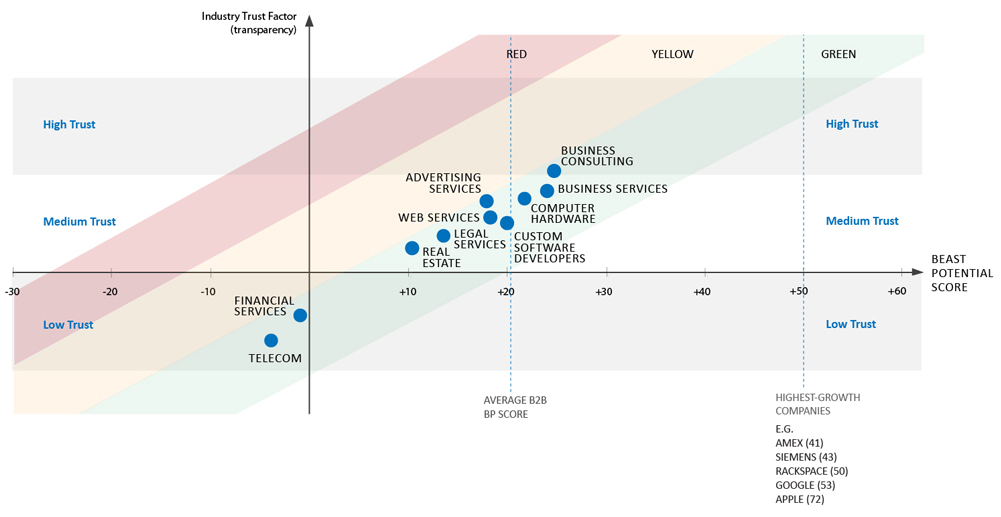
Net Promoter Score, Meet Beast Potential Score

by Drew Williams
Net Promoter Score, meet Beast Potential Score

If you know anything about the Net Promoter Score, you know that tens of thousands of companies use it to gauge customer satisfaction and to track their company’s growth potential based on that satisfaction.

For our book Feed The Startup Beast: A 7-Step Guide to Big, Hairy, Outrageous Sales Growth, we used the Net Promoter Score methodology as the basis for our Beast Potential Score. The Beast Potential Score is a more marketing-focused adaptation of the Net Promoter Score, intended to help you better understand the customer mix within your “Beast Cave” – that is, how many “Fans” you have (good) versus “Fence-sitters” or “Critics” (bad). You would then use those findings to do two things:

  1. Determine whether you should invest in marketing your business at this time, and;
  2. Identify and profile your Fans so you’re in a position to find more customers like your best customers – a very valuable marketing shortcut. To make your life easier, we provide interview templates on our Beast Tools site to help you better profile your best customers.

Because the Beast Potential Score (whose calculation I haven’t gone into here) is such an uncanny predictor of your future growth potential (like the Net Promoter Score), it’s valuable to compare your score to the scores of other companies in your industry. And there lies the problem. There is very little public data on industry benchmarks for the Net Promoter Score. As a result, we’ve assembled the diagram above from data that is publicly available, with the addition of our own experience with the Beast Potential Score over the years.

This chart should be used for directional purposes only. Ultimately, the best Beast Potential Score to use as a benchmark is your own score, which you should track over time to gauge the health and ongoing growth potential of your business.

For a more in depth discussion of how the Beast Potential Score is calculated and used, please refer to our book.


The post Net Promoter Score, Meet Beast Potential Score appeared first on Feed The Beast.

05 Sep 14:20

Delight your Buyers with Real-Time Unified Customer Engagement

by Omer Minkara

The dynamics of contemporary buyer / seller relationships have dramatically changed over the past several years. With a growing ability to access and share information that impacts purchase decisions, today’s customers command greater control in their interactions with businesses — a notion defined as “empowered customers.” Aberdeen’s new research on Real-time Unified Customer Engagement (RUCE) identifies numerous best practices that organizations can deploy to manage the changing dynamics of buyer / seller relations.

Before delving into an overview of the best practices outlined in the report, let’s first identify what RUCE is. As part of this research, we defined RUCE as an enterprise-level initiative where numerous organizational stakeholders (e.g., sales, marketing, and customer service) work together to deliver consistent messages that address each buyer’s needs through multi-channel and multi-touch interactions aimed at engaging clients in a relevant and timely fashion.

Now, what is the business value of RUCE? Does it help improve customer satisfaction results or drive revenue? Figure 1 below demonstrates that it does indeed address organizational needs for performance improvements in these key metrics. However, its benefits go beyond these two measures. It also helps companies rapidly identify and handle customer requests, reducing (improving) response time to customer requests — a key metric as the longer clients wait to have their needs addressed, the more likely they will become unsatisfied.

Figure 1: Year-over-Year Performance Improvements

Delight your Buyers with Real Time Unified Customer Engagement image abc3 300x179

Source: Aberdeen Group

The building block of RUCE programs is ultimately organizations’ ability to better utilize existing customer data within their business activities. This helps companies improve the relevancy and personalization of each customer interaction across numerous touch-points (e.g., social media, web, email, print, and phone). Findings within the recent Aberdeen report outline the following strategies as some of the key ingredients that help companies build a successful RUCE program and accomplish the aforementioned performance results:

  • Determine the most relevant key performance indicators (KPIs) that are indicative of organizational success in delighting customers
  • Establish a centralized repository of product / service information
  • Use multi-channel customer feedback and experience data to personalize buyer messaging
  • Facilitate employee collaboration to execute a consistent CEM program within the broader enterprise

Please read my recent report on RUCE to learn more about secrets to establish and nurture the capabilities noted above as well as learn the technology enablers RUCE users deploy to automate these activities.

05 Sep 14:19

Realtime (Honest) Feedback on your Sales Proposals?

by Donal Daly

As you may know I published my most recent book – Account Planning in Salesforce - earlier this year. I am always nervous when I am launching a book.  I put a lot of myself into it and, even with a topic like Account Planning, I find that my writing always seems to become infused with my values, my opinions and my beliefs.  I really just don’t know any other way and I wanted the readers to get value from the book. I want them to feel that the time they spent reading it was worthwhile.

So, as you can imagine, when Account Planning in Salesforce went to #1 Bestseller in its segment on Amazon I was really pleased.  And the reviews were pretty good too – even the ones from people I don’t know!

But what I did not realize was that as people read the book on their Kindle devices, they were highlighting the passages of text that resonated with them. Meanwhile, the elves in the background at Amazon are continually collating and analyzing the highlighted areas and can provide a summary of what people care about. (See below the top 5 highlighted passages – I am really thrilled with the one that came in at #1.)

These insights are hugely valuable to me and I plan to use what I have learned from Amazon’s analysis in a webinar I am delivering on Account Planning in Salesforce for 2014 later this month.

But also this whole process got me thinking,  what if …

Wouldn’t it be great if you could do this for all sales proposals, PowerPoint presentations or marketing collateral?  It would be like having someone watch your customers as they read through your documents; highlighting, underlining, adding ? and X marks, circling paragraphs of interest or drawing lines through parts that they disagreed with.  Then you’d really know what they really think. (Scary? Maybe!)

At The TAS Group, we do a lot of micro-analysis on the effectiveness of our digital marketing, and of course that is really helpful in making sure that we are presenting the messages and content that add most value to our customers.  But we can’t micro-analyze on a personal emotional level … but thoughts are percolating here …

In the meantime, here are the Top 5 Most Highlighted passages from Account Planning in Salesforce.  (If you are interested, in an upcoming webinar, I will be discussing these comments and other issues that I think we should all be caring about as we plan for 2014).

Top 5 Most Highlighted

1

The impact on a customer of a poor buying decision is usually greater than the impact on a sales person of a lost deal. 

2

You need to be a specialist and expert in the business, strategy and market of those few customers with whom you are working. 

3

Research for Insight. Integrate for Velocity. Focus for Impact. 

4

Remember, customers don’t need you to learn about your product: they can get all of the information they need from the Internet. They don’t need you to recommend solutions: they can get that from their peers. Your opportunity is to help them shape their needs, identify or suggest initiatives, and then to figure out how you can apply your solutions to those initiatives. If you don’t know how to do that you should look for outside assistance. 

5

The cost of new customer acquisition is 500% that of customer retention. Increasing customer retention by 2% equates to decreasing costs by 10%. Reducing customer defections by 5% can increase profitability by up to 125% (depending on industry). (Source: Leading on the Edge of Chaos, Emmet C. Murphy and Mark A. Murphy)

If there were particular parts of the book that you enjoyed I’d love to hear from you.  If you have not read it you can get an extract here.


Post to Twitter

05 Sep 14:18

#oeHacks Part I: Using Hashtags to Automate your Sales Process

Hacking a Cure to the Sales Headache If you work in sales you already know that: 1) You don’t have time for meaningless administrative, non-sales tasks that don’t generate revenue. 2) You suck at meaningless administrative, non-sales tasks that don’t generate revenue. 3) Your company still needs you to do all those meaningless, non-sales tasks […]
05 Sep 14:18

This Logo Change Caused Tropicana Sales To Plunge

by Max Nisen

People rarely consciously look at logos. Their shopping habits were formed years ago, and don't change, especially for essentials. But when packaging suddenly changes in a big way, they definitely notice. When Tropicana tried to change things up, customers revolted, and they lost a fifth of their sales in a matter of weeks. 

Bloomberg's Market Makers brought on Olson Chief Creative Officer Dennis Ryan, a veteran of campaigns for Target and Budweiser, to discuss Yahoo's logo strategy. He reminded viewers of Tropicana's efforts to modernize its classic straw-in-orange packaging. 

"About five years ago [Tropicana] went to this very clean but kind of cold-looking logo, and their sales dropped 20% in one month. Some pundits said they weren't recognizable," Ryan said. "Tropicana has something like eight feet in the refrigerated section. People recognized it. They didn't trust [the new logo]."

Here's the offending logo, alongside the one that preceded it:

Tropicana logo

People don't like change. And when a logo or packaging  for a favorite product changes, it creates trust issues. The package has changed and they wonder if what's inside has, too. The generic logo made people expect a generic product. 

It's one of the reasons Yahoo has chosen to ease people in and experiment rather than up and change things without some preparation. 

Join the conversation about this story »

05 Sep 14:18

6 Steps to Creating a Killer Sales Culture

by Keenan


The five of us would sit in the cafeteria every day, eating lunch together. Everyone in the company knew who we were. There was an energy you could feel. We were a small team, but a team we were. We were at 200% of quota. We had secured 90% of the market. We devastated the competition. We were thought leaders in our space. We all loved going to work. We were aggressive, intelligent, accountable, creative, responsive, fun, and knew how to sell. That was until they broke us up.

We were the victims of our success.

We were killing it, while other sales teams weren’t doing so well. While we were consistently over quota, year over year, the other sales team struggled to make the number. This was not lost on the executive team and that’s when the decision was made. Let’s put Keenan over the under-performing team and move the head of the under-performing team to the performing team.

Brilliant!

Yeah, whatever.

With in 3 months it was clear to everyone, except the executive team this was a colossal mistake. The underperforming team rejected my approach, my style, my expectations and my efforts. They didn’t see themselves as underperforming, in spite of what the numbers said, and they weren’t going to change. I was unable to replicate the culture. The performing team regretted losing their leader and more importantly didn’t understand why change was required if things were working. The new leader didn’t embrace the same behaviors or have the same expectations of the performing team as I did. He didn’t maintain the culture. With in 12 months of the change, I was gone, one of the members of the performing teams was gone and the culture was never the same again.

There have been some market changes, however the company has yet to replicate the success it had during the times when the culture was phenomenal and everyone was bought in.

Culture matters.

I came to see in my time at IBM, that culture isn’t just one aspect of the game — it is the game.

Louis Gerstner, Former CEO IBM

I read Built to Last in the late 90′s and it changed my view of business forever. 50% of success, whether it’s in sales, business, sports or family, comes from culture and if you aren’t deliberate in building culture and maintaining it, you will fail. Period!

Culture can be anything you want it to be. You get to decide, but it must contain these 6 things:

Vision: What does it mean to be apart of the group, the team etc? What is it you’re trying to create. What is the “point” of the culture and the team.

Why?: Why are you doing what you are doing? Why does it matter. Why does the vision even exist? Get to why and constantly reinforce “why?”

Behaviors: What behaviors are expected? How do you expect people to behave? What behavior do you want to reinforce? How are people supposed to act?

Goals: How are you going to measure success? How will you and the team know you are being successful? What results are you looking for?  The key here is to make sure they align with and empower the culture.

Consequences: I know this one sounds rather harsh, crazy uh?!  We live in a world were the word consequences conjures up negative and harsh thoughts, but when it comes to developing and maintaining a “cult like culture” there must be clear and definitive consequences for not conforming to the culture. Cultures can’t and won’t survive without everyone embracing it to the fullest. The minute a behavior contrary to the culture is allowed to persist, the culture is in demise, and almost impossible to turn around.

Rewards: Reinforcement is the name of the game here. It’s not enough to just set expectations. Reinforcing the expectations is critical. Spend time thinking about ways to reward the behaviors you expect from the team.  Rewarding behaviors is different than rewarding results. We’ve become good at rewarding results. That’s easy. Aggie makes quota, Aggie get’s rewarded. Rewarding behaviors on the other hand is different. Aggie busts her ass and flawlessly sells the biggest deal ever, but loses it in the end to the competition, rewarding her for how she sold the deal as representation for how deals should be sold is more valuable than rewarding only for the result. Make sure you find ways to reward behaviors.

As a sales leader, it’s your job to build and maintain a productive sales culture. You get to pick it, but pick you must.

Is your sales culture an aggressive, get it done at no cost culture, where alpha dogs are rewarded? Or, is it a training culture where those with the greatest command of the market, the products and the industry are celebrated? What behaviors do you celebrate? FYI, achieving quota is NOT a behavior. HOW one achieves the quota is what you need to be focusing on.

Cultures are funny. They exist whether or not you create one. You have a culture.  The question is, is it the one you want or the one you have?

Every killer sales team has a killer culture, period.  Every shitty sales team, has a shitty sales culture.  It’s that simple.

If you haven’t been deliberate in the development of your sales culture, it’s not too late. Spend the time solving for the 6 challenges above and you will be on your way.

Don’t wait, get it done now. The number and your sales team will thank you!

05 Sep 14:17

Structuring a Great Sales Email

by Kassia Gardner

This month seems to have been all about sales emails. I’ve been writing several sales emails and then another enquiry comes through on email today as well.

My problem with sales letters is that a lot of them sound the same, “I’m writing to introduce myself. My company, ABC, is the leading supplier of thingymabobs and you should really buy your thingymabobs from me at ABC. Call me to place your order!”

If you’re like me then you’ve probably already switched off and thrown the letter in the bin.

So how do you keep people’s attention and get them to read your letter? First of all there’s the subject line. You need a great subject line to get people to open your emails, but I’m not going to discuss it here as I’ve written about email subject lines before.

When it comes to the content you’ve got to show people that you understand their problem, have the solution, are the right person for the job and tell them what to do next. So to help your here’s a quick and simple sales email structure to keep people interested.

Discuss the problem
Keep your sales letter limited to one subject and use the opening paragraph to discuss the problem that people are facing in regards to the subject. For example, if you’re selling accountancy services talk about new laws that require real-time information and the administrative burden that puts on people. People who are concerned about this issue will now read on.

Describe the solution
In your second paragraph talk about how your service or product will solve the problem so that people understand you are the potential solution to their problem. Talk about your service or product in terms of the benefits rather than it’s features.

State your credentials
In the next paragraph explain to people why you’re the best person for the job. This might include your experience, the people who work for you or qualifications. Keep to the facts rather than use unquantifiable terms such as ‘leading’ and ‘best’. Also include at least one testimonial.

Tell them what to do next
You need a clear and simple call to action. Don’t make it complicated and make sure it’s clear so people know what to do next and why, for example ‘Call us now on XXXXX XXXXXX and get your free copy of Reducing your admin burden. Your call to action should always be specific and offer a way to answer their questions.

Whatever product or service you sell you can adapt this simple template to create your sales emails that are read and get results.

And if you need help writing your sales email, just get in touch.

05 Sep 14:16

The Key Ingredient to a Successful Sales Rep

by Craig Ferrara

The Key Ingredient to a Successful Sales Rep image Positive Attitudes Are Essential For The Success Of The Sale resized 600I often wish I can go back to those specific points in my career to let myself know that everything’s to be alright. You know those moments where you feel like the sky is falling and nothing is panning out they way you hoped it would?  At the time, these thoughts consume you, but a month later, you’ve all but forgotten it.

Be honest: How much emotional energy did you dedicate to one lousy moment? Was it worth it in retrospect?

Having perspective when you cold call can be a difficult thing. Lousy days can be abundant at times. It can be easy to get mired in a slump. We can often get into the mindset that you’re only as good as the previous day, week, month, quarter, etc. That’s the oath we feel we need to take when inducted into the sales world. The key, however, is how you rebound from those lousy periods.

Obviously, selling can be a grind at times, but the people I’ve seen prevail at sales are simply willing to embrace the challenge. The reps on my team who have the make-up for success recognize that it will inevitably suck at certain points in time. Once my newbies come to this realization, then I tell them that they’ve taken the first step to becoming a successful sales rep. It’s how they choose to embrace the realization of what they’re working with.

We all have different styles that work for us in sales. I’ve had the benefit of managing a wide combination of personalities over the years. In some cases, I’d have to admit that there were certain folks who I felt didn’t have the make-up to get it done, but somehow they made it work and adapted a style that worked for them.

At AG. we’ve long given up trying to hire the cookie cutter sales reps. I love the wide range of personalities that make up our team. The only common characteristic I see from our employees nowadays is one thing: Attitude.

Attitude overcomes pretty much any roadblock you’ll hit when you cold call.

It overcomes the rough periods when you can’t seem to get anyone on the phone.
It overcomes the lousy quarter when you just missed your number.
It overcomes the times when you feel you don’t have all the answers for a prospect, but you keep him or her interested anyway.

Tomorrow is a new day. Have you checked your attitude lately?

The Key Ingredient to a Successful Sales Rep image 49c4943b e150 418f 9be2 fc3bf3fee2a3

The Key Ingredient to a Successful Sales Rep image 07f0bf66 1dcb 40ea acd9 7c4ff5605ab021

05 Sep 14:16

Social Selling: 5 Twitter Tips for the Sales Pro

by Laura Pistachio Fitton
Twitter, and many other social media tools, give you unprecedented abilities to unobtrusively get to know your prospects, both one on one and as a community in general. Depending on your sales process, this can be hand-picking smaller sets of contacts at target companies, or it could be using search tools to gather sales intelligence at scale.
05 Sep 14:16

Eurozone Retail Sales Miss

by Joe Weisenthal

The Eurozone is coming back, and retail sales are growing.

But it's still uneven and mediocre.

For July retail sales in the Eurozone grew just 0.1% vs. expectations of 0.4%, per ForexLive.

Join the conversation about this story »

03 Sep 15:41

A Diseased Mindset

by S. Anthony Iannarino

A Diseased Mindset is a post from: The Sales Blog | S. Anthony Iannarino

Value Creators have a code. They have a certain mindset. It looks different to people who haven’t yet come to understand what the Value Creator knows. A lot of people have a mindset that is still diseased, poisoned by unhealthy beliefs and bad ideas.

I Need a Motivator

“My sales manager doesn’t motivate me.”

Do you really need someone to motivate you? Okay, try this: If you don’t do the work I will fire you. Are you motivated yet? This is what motivation is, an external stimulus, a threat.

Maybe what you really meant was that you wanted inspiration? So you need someone to convince you that your work is meaningful, that it is worth doing well, that it is worth giving yourself over to?

If you ever want to do meaningful work, you are going to have to provide that meaning yourself. The only inspiration that lasts is the kind that comes from inside of you. Someone may come along on light the match that you are already holding, but you have to catch yourself on fire.

I Need an Incentive

Incentives are bribes, aren’t they? If you do this, I’ll give you that. This is motivation, too. But instead of a threat it’s a reward.

What it often says is that you are unwilling to do what is necessary unless someone is willing to bribe you to do it. Value Creators live by a different code. They are proactive. No one has to incentivize them to do what’s right. They have a greater internal incentives.

I’ll Withhold Value

“If they aren’t going to pay me what I am worth, I am not going to do the work.”

That’ll teach them, won’t it, Sparky? It never pays to get value creation in the wrong order. If you want to capture value, you must first create value.

Old Zig Ziglar said that you can have anything you want in this world if you help enough other people get what they want. He didn’t say withhold the value you can create for others until they give you what you want. Why not? because it doesn’t work that way. It never has.

Never withhold. Do the work. The rewards will most surely follow.

It’s Someone Else

“My school system didn’t prepare me.”

“My government should help me.”

“This is all someone else’s fault.”

Your school system didn’t prepare you. Your parents didn’t prepare you. Your first sales manager didn’t love you enough.

You’ll never find the answers you are looking for by looking outside of yourself. You’ll never find what needs to change by looking to someone or something external. You will never find anyone more responsible for you than you. You are all you’ve got, make of it what you will.

Believing or behaving differently is a diseased mindset.

Questions

Who is responsible for motivating or inspiring you?

Why do you need incentives? What’s your real incentive for creating value?

What do you gain by withholding the value you might create?

Who is ultimately responsible for your results?

03 Sep 15:41

Your Customer Doesn’t Care About Your Price

by TheSalesHunter

price tag 289x300 Your Customer Doesnt Care About Your Price photoYour customer doesn’t care about your price as much as you think.

Some of you reading this are looking to argue this point with me and I’m fine with that.  Let me share with you my perspective and then I’ll  be anxious to hear your perspective.

Customers don’t care as much as salespeople think they do because we, salespeople, tend to have far too many voices in our head telling us our price is too high.  The voices are quick to say how the sales we’ve lost are because our price was too high.

Customers aren’t looking at price as much as you think.

Remember, customers are looking for benefits first.

They aren’t looking to spend money just to spend money.  The money they are going to spend is going to be in relationship to what they’re going to gain.   Let me put it another way: The more gain the customer receives in comparison to other options, the more they’ll be willing to pay.

My belief is that if we as salespeople put more focus on helping the customer see value, there would be less need for us to spend time worrying about our price.

The other thing that would happen is that if we focus on the benefits the customer is looking for, then we are going to see better the value we bring. In turn, we will feel the price we’re requesting is not a stretch at all for the customer.

Approach your next sales call as if the customer doesn’t care about price at all.  This perspective will shift how you think and give you a huge increase in confidence.

As a result of changing your perspective, you’ll be in a better position to help uncover benefits.   The effort salespeople spend defending their own price in their mind winds up spilling out in customer conversations.

Start embracing the perspective that your customer doesn’t care about your price and see what happens.

For those of you who want to challenge me, I welcome your opinion. I would appreciate hearing from you, because this matter of pricing is of vital importance as we succeed in helping our customers.

Copyright 2013, Mark Hunter “The Sales Hunter.” Sales Motivation Blog.

button receive a free9 300x51 Your Customer Doesnt Care About Your Price photo

03 Sep 15:35

Business And Engineering Students Name The 10 Most Innovative Companies

by Max Nisen

Google San Francisco Campus Office

A good salary, great culture, and awesome perks go a long way towards attracting top talent. But many of the most driven and desirable employees want more.

“It is becoming extremely important to be seen as an innovative employer if you want to win the top talent," says Petter Nylander, the CEO of employer branding consultancy Universum. "When we ask the students about top associations with their ideal employers, innovation is one of the most common words.”

As part of its annual survey of how the next generation of employees regards America's biggest companies, Universum asked both business and engineering students which companies they thought were the most innovative employers out there.

Interestingly, both business and engineering students put tech giants Apple and Google at the top.

Business students also highly rated companies like 3M, General Electric, and Nike. 3M was the first company to explicitly give employees 15% of their time to pursue independent, innovative projects. General Electric has the world's oldest and best-known corporate university, and Nike has one of the most committed workforces out there. 

Here are the top 10 according to business students:

  1. Apple
  2. Google
  3. 3M
  4. NASA
  5. Daimler/Mercedes-Benz
  6. BMW Group
  7. Honda Companies
  8. General Electric
  9. SAS Institute
  10. Nike

For engineers, who have their pick of top companies, having an innovative employer is essential. Out of 40 areas that they graded employers on in the survey, innovation was listed as the second-most important.

And while business students picked several car companies, engineering students seem to prefer places that make slightly larger machines, naming companies like UTC Aerospace, Lockheed Martin, and Boeing. All emphasize and invest in research, which may be why engineers rate them so highly.

Here are the top 10 according to engineering students:

  1. Google
  2. Apple
  3. NASA
  4. UTC
  5. Bose
  6. Lockheed Martin Corporation
  7. Autodesk
  8. 3M
  9. Genentech
  10. Boeing

Join the conversation about this story »


03 Sep 15:05

Creating The Moment of Delight in Sales

by Kyle Porter

delightment 2-01Salespeople say bad things behind the backs of their prospects. I know you’ve witnessed it…this is our dirty little industry secret.

Reps brag about “winning deals” as if it was at the customer’s loss.

That’s just insane to me.

That kind of attitude is for legacy salespeople. This kind of attitude is for salespeople focused on themselves and their own process.

Fortunately customer service and success teams have it right. We’re smack dab in the middle of a world-wide business trend to be delightful to our customers…to love our customers and put them at the center of our universe.

But loving customers is not enough. We need to love prospects and delight them as early as possible in the funnel. Salespeople (not marketers) hold the keys to make this happen.

The deal is this:

Customers have choices. In almost every market worth being in, there will be competition. Buyers are increasingly choosing the option that makes them emotionally the happiest. How can you make the best emotional experience when you’re focused on “crushing it” or “winning” against your customers?

Aaron Levie, CEO of Box says it well here:

People don't experience ideas, they experience details. Which is why every detail matters.

— Aaron Levie (@levie) September 2, 2013

He’s captured something vital for sales professionals to adopt. Every decision you make as a seller impacts the buyer and the deal. Every action you take creates a positive or negative emotion for the buyer. I urge you to delight your customers on first impact.

Do it early in the sale process and they’ll never forget it.

Have your prospects walk away from the first encounter with a smile on their face and the feeling that no other vendor or salesperson has given them.

There are thousands of ways you can do this. Here are a few:

  1. Respond to your prospects faster than anyone else. Ping them right after they’ve opened an email or taken an action like visited your pricing page.
  2. Give them a simple free taste of your offer on the website. Don’t make them have to work hard to figure out what you do and how you can help.
  3. Make their life simple with super short and helpful emails.
  4. Find our where they went to college and do a little research on the school. Tell them a fun fact they might not know.
  5. Follow them on Twitter. “Star” a tweet of theirs you really like. Retweet a message you want to share. (Bonus – look at Twitter pics. You can learn a lot about someone here).
  6. Admit you we’re wrong…be shockingly upfront and transparent.
  7. Read something they’ve written and leave a valuable comment.

DO SOMETHING DIFFERENT & SPECIAL FOR YOUR BUYER

The goal is to be your prospect’s biggest promoter…and not their opponent. And the goal is to be it in the first moments when they encounter you.

03 Sep 15:05

Labor Day and a Few Thoughts on the Sales Industry

by TheSalesHunter

Today, the United States is celebrating Labor Day — a holiday that dates back to the late 1800s.

While not everyone is off work on this holiday, quite a few companies do close and give their employees an extra day to spend relaxing.

Those of us in the sales industry may find it is a great day to catch up on such things as cleaning out the email inbox or reading sales-related articles.  If that describes you, I hope you don’t spend too much time on those activities and you are able to get out and enjoy time with your friends and family too!

Wherever this day finds you, take a few moments to reflect on your career and what you like about sales.

The industry as a whole sometimes gets a bad rap, but the truth is that without sales, so much of what we take for granted wouldn’t happen.

I appreciate that sales is an opportunity to genuinely help people!  We get to help people solve problems, experience benefits, reach desired outcomes and so forth!  What a great privilege.

What about you?  What do you like about the sales industry?

Also, if you haven’t seen it already, check out this fascinating video:

The Past and Future of Selling in America

Copyright 2013, Mark Hunter “The Sales Hunter.” Sales Motivation Blog.

button receive a free9 300x51 Labor Day and a Few Thoughts on the Sales Industry photo

03 Sep 15:05

3 Ways Sales and Support Can Do Less Labor Year Round

by Olivia Cole

3 Ways Sales and Support Can Do Less Labor Year Round image labor day relaxThe whole point of Labor Day is to celebrate the contributions of laborers by taking a day of rest. But even though Labor Day only comes once a year, here are three ways businesses can reduce their labor year round by automating manual processes and making life easier on their sales and support staff.

Automate Calls to Customers

Say you’re having a special promotion and you want to notify your customers and ask them to place an order. Instead of spending thousands of man-hours on the phone manually notifying every customer—or sending an email blast that may get ignored or trapped by pesky spam filters—automate a fleet of voice broadcasts and wash your hands of the matter. Voice broadcasts can be personalized and have on-time delivery guarantees. You can reach thousands of customers in seconds with little effort on your part.

Manage Callers and Survey Customers with IVR

Don’t force your office receptionist to spend all day answering calls. Instead set up a sophisticated, intelligent IVR system to assist callers and route them to the correct department or rep. Callers can also access information like your businesses hours, office and store locations, and even listen to and update their own account information without ever talking to a live representative. You can even use inbound and outbound IVRs to conduct automated customer satisfaction phone surveys to measure customer loyalty.

Save Time with a CRM Integration

When a lead calls your sales team, you want that rep to be focused on selling, not on manually hunting for information in your CRM. If you integrate voice-based marketing automation with your CRM, your reps can stop wasting time searching for and inputting customer data in your CRM records. If a caller is an existing contact, their CRM record is available with a click of the mouse; if they are a new lead, your rep can create a pre-populated record just as easily. So now when you or your agent accepts a call, the caller’s account info is right in front of you, enabling you to concentrate on selling, not data processing.

There’s always work to be done—even on Labor Day—but if you work smart, it can still feel like vacation.

03 Sep 15:04

Lead Tracking: 6 Ways To Track Leads More Effectively

by Lauren Licata

Lead tracking is a vital component of every sales organization. Without a proven lead tracking strategy, it can be near impossible to understand the status of each lead, forecast overall sales and calculate the ROI of each campaign. But tracking leads effectively can be intimidating, right? It’s not just about wrapping your arms around sheer volume of deals your team is working on – you have to coach them along the way and make sure they’re following the process outlined by your business. And doing all of this can take hours (or days, or weeks) more than you have time for.

So how can you better track leads? From start to beginning, here are some ways to make sure your lead tracking strategy is as efficient as possible.

Confirm buy-in (from everyone)

Effective lead tracking requires data. Good data. And in order to collect that data, you must have buy-in from all parties involved: top management, who will encourage compliance, and your sales team, who will enter the information. Making sure everyone is a proponent of the strategy should always be the very first step.

Define your expectations

Make sure your sales team knows what you expect from them. Outline best practices on how to qualify leads, how to move them through the sales cycle, how to report on them. And here’s the important part: deliver this information in different ways. Some of your reps will learn best in training, some by reading a tips sheet, and some by working with them one-on-one. Tailoring your approach will ensure you reach every rep and they understand how to meet their goals.

Automate data collection

No one likes entering data twice – not you, and definitely not your sales reps. Your lead tracking system should offer ways for sales reps to import contacts without typing it all out. These offerings may include syncing with your email contacts or gating forms that import information directly. Be sure to check out Base’s contact clipper to read more about the next generation of easy data collection.

Make moving leads easy

It often requires multiple steps to move leads from place to place in the sales pipeline – and for your sales team, that’s discouraging. Keeping it simple makes following your business’s best practices easy, which helps ensure that your reps follow through. Base’s drag and drop functionality is a proven way to keep pipeline management simple.

Be mobile

There’s no better way to make sure the status of each lead is always up to date than giving your reps 24/7 access to your CRM tool. That way, reps can update accounts real-time, while it’s top of mind, without having to wait until they return to the office. And an added bonus: constant access encourages consistent account updates – which increases the accuracy of your prospect database.

Get creative

What other ways can you simplify lead tracking? Some suggestions include offering incentives for the most comprehensive data or tagging leads with labels unique to your business. What works for each business might be different, so don’t be afraid to test a strategy – then keep the ones that work, and abandon the ones that don’t.

Even if you only act on a few of the suggestions I laid out above, I guarantee that lead tracking is about to get easier for your business. If you haven’t already, be sure to sign up for a free trial of Base CRM to see how simple we make it to automate data collection and simplify the sales pipeline. And we offer free, native apps – even with your free trial. What do you have to lose?

Have you found a creative lead tracking strategy that works for your business? Tell me all about it below.

03 Sep 15:04

B2B Sales: Focusing on your Prospect’s Needs is a Misguided Strategy

by Bob Apollo

I recently suggested that seeking to achieve “customer delight” may be a misguided and ultimately unprofitable strategy for customer service organisation organisations. I’d now like to share another potentially controversial idea: that focusing on satisfying your prospects apparent needs may be an equally misguided strategy.

To be clear, I’m only referring to well-defined needs that your prospect is already aware of, not all those latent pent-up needs that they may not currently be aware of or concerned about. And I’m thinking particularly of high-value B2B sales environments with lengthy and complex decision making processes, not short-cycle, low-value transactional sales.

Why look for undefined needs?

B2B Sales: Focusing on your Prospect’s Needs is a Misguided Strategy image Warning SignHere’s the problem with focusing too high a proportion of your sales and marketing energies on identifying prospects with existing well-defined needs: in most cases, they will either already be in an active buying cycle (in which case some other vendor’s fingerprints are probably all over their requirements) or they may have already concluded that the issue, although interesting, isn’t urgent and therefore not worth spending money on.

The already-in-an-active-buying-cycle-problem, by the way, is why insisting that your sales rigorously BANT qualify opportunities before investing time with the prospect is a counter-productive strategy: by the time most opportunities fully tick all four BANT boxes (Budget, Authority, Need, Timeframe), their decision criteria have usually already been influenced by other vendors who got in early.

The not-worth-spending-money-on-problem can be equally challenging, unless you can persuade the prospect to expand the scope of the problem (and therefore their needs) to embrace some urgent – and much more valuable – new dimensions. Either way, focusing on needs your prospect is already aware of can dramatically restrict your addressable market – and it doesn’t do a great deal for your sales win rate, either.

It’s time to Challenge your prospects

So what’s the answer? Well, as the authors of The Challenger Sale suggest, it is to focus your energies on issues that your prospects may either be unaware of, assume cannot be solved, or believe that their current approach to solving them, no matter how inadequate, is the best available to them.

In doing so, it’s pretty much inevitable that you will take their thinking beyond their current perceptions of what they need. By educating them on new possibilities, they may come to conclude that their initial perceptions about what the problem was, what the consequences were, or how the problem could best be solved, were wrong – and they can come to regard you as the expert that can take them forward in the right direction.

Unsticking the Status Quo

You need to challenge their assumptions, to offer them fresh perspectives, and to highlight the potentially economic (and other) consequences of sticking with the status quo. You need them to believe that the costs, consequences and rewards of taking a new approach – with your guidance – outweigh any risks that may be involved.

Let’s be clear: changing from what they are doing today to your solution will involve them in some degree of risk. Any change involves risk. But so does sticking with what they have got today. By helping them take a fresh perspective on what they really need, and helping them avoid the inevitable landmines that could lie in their way, you can dramatically change the balance of their risk and reward.

A less risky strategy

And while we’re talking about risk, what about the risk to your sales and marketing productivity that would inevitably be caused by choosing to focus on asking your prospects what they need and then jumping through hoops to suggest that your offering is best at addressing it?

That approach may work for Systems Integrators (and customers with deep pockets), but if you are a B2B-focused organisation wanting to take replicable solutions to market, you’re much better to focus on uncovering or creating issues that are going to prove critical to your prospects, and which you can show how you can solve better than any other approach open to them.

So please don’t (just) base your sales strategy on asking customers what they think they want. You’ll do far better focusing on issues that if your prospects only knew enough about them, they would conclude that they had to do something, and that your organisation was best placed to help.

03 Sep 15:03

Mobile commerce now accounts for 23% of online sales: report

by David Moth

Mobile commerce sales have doubled in the space of a year and now account for almost a quarter of total online sales, according to a new report.

It again highlights the growing importance of m-commerce at a time when many retailers are still struggling to develop effective, user-friendly mobile sites and apps. 

The new data from IMRG and Capgemini shows that sales completed through mobile devices accounted for 23.2% of total ecommerce sales in Q2 2013, up from 11.6% in the same period last year.

A separate survey included in the Econsultancy Mobile Commerce Compendium found that half of smartphone owners (51%) hadn’t made a purchase using their smartphone in the previous six months, which shows that there is still huge potential for m-commerce sales to continue rising as a proportion of total online sales.

In the past six months how many times, if at all, have you used your smartphone to make a purchase from a mobile website or using a mobile app?

However the IMRG stats also serve to underline the fact that the mobile web is primarily used for research and browsing rather than making purchases, as m-commerce sales lag far behind site traffic from mobile devices.

As mentioned, 23.2% of online sales came from mobile devices in Q2 2013, however smartphones and tablets accounted for 34% of visits to ecommerce sites (up from 21.1% in Q2 2012).

Click-and-collect

The new report also states that there was a significant rise in ‘click and collect’ sales in Q2, reaching a record high of 16% of online sales for multichannel retailers. 

This represents annual growth of 33%, up from 12% in the same period last year.

Click and collect has proven to be very effective at driving online sales and was a key factor behind New Look’s recent 79% jump in online sales.

Similarly, Argos’ ‘Check and Reserve’ service accounted for 31% of online sales in Q4 2012, while Halfords introduced a click and collect service three years ago and now 86% of all its online sales are for in-store collection.

To find out more about what it takes to be a successful multichannel marketer, come to Econsultancy's JUMP event on October 9. Now in its fourth year, JUMP will be attended by more than 1,200 senior client-side marketers. This year it forms part of our week-long Festival of Marketing extravaganza.

Bounce rates

Finally, the switch in device usage also appears to have had a knock-on effect on bounce rates.

At the beginning of 2010 over 97% of retail site access was through a desktop. Over the subsequent three years, as mobile device access began to grow rapidly, the bounce rate rose from 21.7% in 2010 to 23.7% in 2011, before reaching 27% in 2012. Year to date in 2013, the bounce rate is 26%.

This could be caused by consumers researching product options and prices on a mobile device before they eventually make a purchase on desktop.

The IMRG Capgemini figures come from The Quarterly Benchmarking Index which tracks over 40 key performance indicators across seven categories.

03 Sep 15:03

How to use digital word of mouth to boost sales

by David Olshanetsky

I recently completed an internship with Econsultancy, and on my final day I rounded up a group to play Cards Against Humanity.

How did I find this game? Digital word of mouth, that's how. 

Below I list three ways to capitalise on digital word of mouth...

Haul videos

YouTubers like Blair Fowler and beauty bloggers such as Jane Cunningham have increased monthly earnings by generating ad revenue from haul videos.

This started out as a genuine way for bloggers to show off the products they enjoyed using, and what they recommended for, for example, the ‘Back To School Season’. These haul videos regularly attract around 1m views for popular YouTubers.

Brands such as Top Shop and MAC have collabrated with Zoella to create haul videos and a giveaway to viewers. A word of caution here: while at first these endeavours engendered trust in the brand and promoter, they ended negatively when viewers began to suspect Zoella had never even used said products.

Haul videos with influencers are recommended for brands with a strong digital presence that are social media savvy.

Free sample send-outs

Services like BzzAgent, which sends out free samples to potential customers identified via surveys, aim to acquire a selection of new customers for paying brands.

The targeting of these free samples is determined by brand demographics and psychographics, combined with the answers users provide to questions about such topics as ethnicity and profession.

One drawback of this approach is that many users of these sites simply want the free samples. These services suit companies and products that have little-to-no brand awareness.

Having a genuinely good product

If your product is good, you don’t need fake reviews or to pay people to write about it.

Create a good product, with online interaction, and customers will happily promote you. This is seen all the time, as with the game Cards Against Humanity which I mentioned earlier. A friend of mine tweeted about the game, and I bought it. Simple.

Indeed, 92% of respondents in a Nielsen survey said they completely trusted a friend or known person’s thoughts on a brand, while only 70% trusted that of a stranger.

Creating a benefit for a customer who recommends a product to others is something coupon site Groupon capitalised on. It rewards users who help them to acquire new members, with money and prizes.

As a friend is recommending the site, the user will immediately feel like the product is worth purchasing.

Everybody has a digital voice, and its impact can be greater than you are aware. A negative comment about a new movie might make one or two of your hundred Twitter followers decide against seeing it, while an Instagram post of your new favorite drink might help brand awareness for the new product.

Don’t underestimate the power that an individual customer has to bring in more business.