Shared posts

22 Jan 00:55

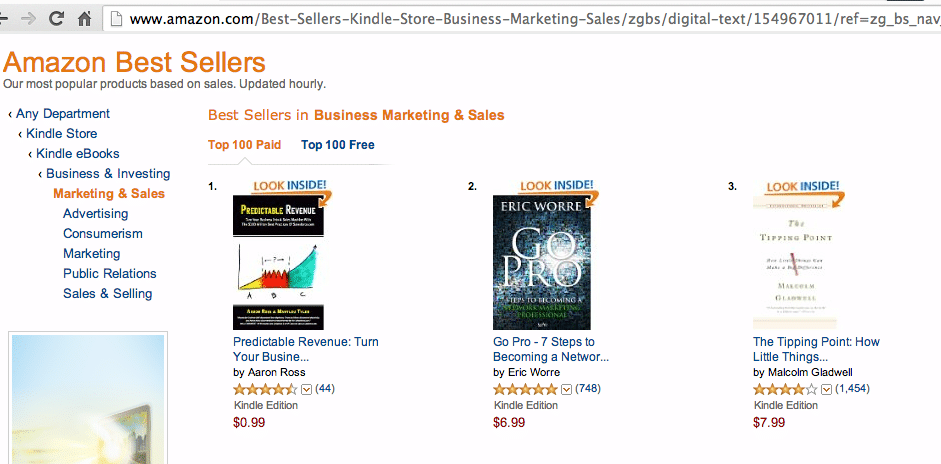
Predictable Revenue Kindle hits #1 of all “Sales & Marketing” books!

by Aaron Ross

predictable revenue #1 sales ebook on amazon

This week, Predictable Revenue was the #1 sales &/or marketing ebook on all of Amazon.com!  (And spiked to be the 17th top overall business book, above titles like Blink, Getting Things Done, The 4 Hour Workweek, Seth Godin, and other classics) -

Read more on Predictable Revenue Kindle hits #1 of all “Sales & Marketing” books!…

The post Predictable Revenue Kindle hits #1 of all “Sales & Marketing” books! appeared first on Predictable Revenue.

03 Sep 15:44

9 Takeaways from a Sales Leader Discussion with Ken Krogue, Aaron Ross, and Kyle Porter

by Greg Klingshirn

SalesLeaderDiscussionHeader-01

What better way to learn than to be a fly on the wall when leaders share conversation?

Last week, Aaron Ross and Kyle Porter joined Insidesales.com’s Ken Krogue for a Sales Strategy Hangout. The discussion about sales strategy yields some great points about doing the right things for your business.

We thought it would be interesting to pull out the three best tips from each sales leader. Check them out below:

Aaron Ross

1. Don’t let salespeople prospect, instead build a team of prospectors that only prospect. This will help proactively get to the best fitting companies who aren’t calling you. It will also allow you to get the best return from your expensive sales reps.

2. For both emails and calls, go from the top down, preferably using referrals to get in contact with correct people. By following a referral either by phone or email, it’s much more efficient to find the right people to talk to and ultimately whether or not your product will be a good fit.

3. The human element of hiring salespeople and taking care of them is important. You have to motivate your team to bring personality. Prospects can relate to a human connection (and moments of delight).

Ken Krogue

1. Do your research and use it for entry points in emails. Finding something relevant and specific to a prospect will earn you the right to a conversation.

2. In our recent research, we look at the appointment set vs. appointment held ratio. What we’re finding is that timing is crucial for holding appointments. Immediacy in appointment setting in inside sales will stop decay.

3. If there’s ever a time when you want to get into a deal, it’s when they change jobs. Use proactive notifications to find sales triggers.

Kyle Porter

1. By building a lightweight version of your product, with free and easy sign-up, you can grow your customer base. Deliver a free piece of value followed by advice, and you’ll create a great sales funnel.

2. Amazing cold emails use something that someone is most passionate about. Making a cold email familiar, unique, and personal works wonders.

3. Oftentimes, early stage companies have sales leaders or executives going in too many directions. Once you can take tips and put them to process, that’s when you have strategy.

If you’re interested in watching the full video (which we highly recommend), take a look below:

We hope these nine tips hit home and can help start some great things for your sales team. Watch the full video and Ken Krogue’s Friday webinar series to get plenty more.

03 Sep 15:44

Sales Leadership and Meeting the CEO: Are You Ready?

by TheSalesHunter

Securing a meeting with the CEO is cause for celebration, right?

chief executive officer 300x195 Sales Leadership and Meeting the CEO: Are You Ready? photoIt should be, but for some salespeople, the thought of talking to the head of a company can cause anxiety.

If you want to strengthen your sales leadership skills, though, these types of meetings are exactly the situations you need.

The good news is that you can more than adequately prepare for a meeting with anyone in the C-Suite, if you are willing to put in the extra effort and time.

I guarantee that you will be glad you did, especially if you can move past your trepidation and embrace that such a meeting may result in more business and better relationships.

Here are a few tips:

1. Read whatever you can on-line about the company.

The more knowledge you have about the company, the better.  This can include everything from public information, such as their annual report, to newsworthy stories, such as the company’s involvement in local civic and charity organizations.

Also, be sure to find out as much information as possible about the CEO, especially his or her involvement in the community.  You are looking for common points of interest, shared acquaintances and a general understanding of the CEO’s interests, personality, etc.

2. Monitor the news for stories that could impact the company.

Ideally, you want to be able to not only understand the industry of the company, but also any current events or policy changes that could impact their industry.  For example, if it is a transportation company, consider how energy prices are impacting their bottom line.

Essentially, you are looking for any information that could be a stepping stone into relevant conversation — and, at the same time, demonstrate to the CEO that you are paying attention to the bigger picture.

3. Identify key objectives of the company.

This is where your homework is vital.

The CEO isn’t concerned at all with “buying” anything.  The CEO is only interested in “investing” in products and services that better equip the company to meet its objectives.  You need to understand those objectives as much as possible before you go into the meeting.

Don’t expect the CEO to tell you the objectives; expect him or her to elaborate on them.

BONUS TIP:  Prepare a list of “peer questions/comments” that you can use in the meeting.  These are questions or statements that show you are aware of their level and environment, and you are comfortable having discussions at that level.

Be sure that before using the peer questions and comments, you have first rehearsed and practiced multiple times in front of a mirror.  You need to not just appear comfortable, but to genuinely be comfortable in the discussion.

The next time you get a meeting on your calendar with the CEO or other top level company official, use the tips above to make sure the CEO knows that you appreciate how valuable their time is.

After all, securing a meeting with the CEO is an opportunity that doesn’t come along every day.

Copyright 2013, Mark Hunter “The Sales Hunter.” Sales Motivation Blog.

button receive a free9 300x51 Sales Leadership and Meeting the CEO: Are You Ready? photo

03 Sep 15:43

7 Steps to Build Your Lead Gen Machine

by George de los Reyes

Build Lead Gen Machine resized 600I have never spoken to a sales leader who didn’t ask for more qualified leads.  Leads fuel the revenue engine.  Yet most organizations struggle to generate truly sales-ready leads. In this post I want to walk you through the 7-steps to building a lead generation machine.

Register here for SBI’s 7th Annual Research Project and find out how your World Class peers plan to make the 2014 number.

Step #1 – Define Your Prospect Universe

Who is my ideal customer?  If you want to outperform the competition you must 1st get clarity on who is your Ideal Customer. In my last blog post, I walked you through the mechanics of account segmentation.  Account segmentation involves:

  1. Defining the prospect universe - who is best fit to be your customer
  2. Determining the size ($) of the market potential – Total Available Market for your products & services

Don’t skip this step or you’ll build your lead gen engine in the dark.

Step #2 – Build Buyer Personas

Step #1 defines your ideal customer profile at the company level.  But you don’t sell to companies, you sell to people.  So the next critical step is building Buyer Personas.

Most complex purchasing decisions are made by a group.  The group or Buying Decision Team typically consists of:

  1. Ultimate Decision Maker – Final approval of the decision.  Only person who can say No when everyone else says Yes.
  2. User Prospect – Buyer(s) who will be using the solution.
  3. Technical Prospect – Buyer(s) involved in evaluating the solution (Purchasing, IT, etc.).
  4. Key Influencers – Anyone with considered input into the buying decision.

Don’t skimp.  Do the buyer research and build all the applicable buyer personas. 

Buyer Personas can vary by product, vertical and geography.  Make sure you account for these variances.

Step #3 – Map the Buying Process

IN 2011, the SEC published their landmark study on buyer behavior.  The study found that B2B buyers completed 57% of their ‘buying journey’ before first contact with a sales rep.  In 2013, the number has grown to 65%.  In this new buying environment, the new skill is “selling when a rep isn’t present”. 

The key to successful marketing is influencing the buyer early in the journey.  You have to ‘get their attention’ early with relevant messaging.  To be relevant, you need to understand the macro & micro decisions buyers make as they advance down their buying timeline.  The best marketers do this by mapping the buying process of their key personas.

A Buying Process Map (BPM) is a tool that maps the decision making process used to purchase a product, service or solution.  Using a BPM ensures your ‘message’ aligns with where you buyer is on their buying journey.  When your message aligns with the buyer, your message is relevant.  Relevance leads to value and value builds trust.  Trust brings the buyer back for more.

Want to learn more on how to build Buyer Process Maps, register here for SBI’s 7th Annual Research Presentation. You will get tools & templates to build Buying Process Maps.


Step #4 – Audit Your Content

Content is king.  It fuels the marketing machine.  It is also leveraged & re-purposed by sales for 1-on-1 prospecting.  Content must be contextual and relevant.  You need content that both stimulates demand and nurtures your leads.  In short, you need content that pulls buyers along the BPM.

A content Audit has two components: Inventory & Mapping.  You first need to inventory what you have by persona.  Secondly, you need to overlay your existing content atop the BPM.  The 2nd step reveals your content gaps.  You now have a content-creation blueprint.

Step #5 – Build a Campaign Framework

There is a skills gap in knowing how to build & execute marketing campaigns.  If you cannot run effective campaigns, you will be hard-pressed to generate leads.  See this blog post for Campaign Planning best practices.

Step #6 – Create a Lead Nurturing Process

Just because someone form-fills doesn’t mean they want to speak to a sales rep.  Seems pretty obvious, right?  Yet many marketing departments act this way.  They send leads to the field that aren’t sales-ready.

Here’s another common mistake.  Many marketers believe Marketing Automation alone fills the gap.  A lead churns through a few automated campaigns, hits a scoring threshold and then gets pushed to sales.  Better than the first example, but still not a best practice.

World class marketers implement a nurturing process that combines ‘process, people and technology’.

  1. Process – a multi-staged & gated lead management process that combines both automation & human interaction.
  2. People – Lead Development Reps dedicated to one-on-one nurturing and lead qualification.
  3. Technology – Marketing automation that scales marketing campaign capabilities and provides visibility into ROMI

Step #7 – Measure

The final step in the process is measuring results.  What is the return on marketing investment?  In my opinion only three metrics matter: (1) number of leads generated, (2) number of leads passed to sales and (3) new revenue attributable to marketing leads.  Measure what you want, but don’t forget these three.

CALL TO ACTION: You’re the marketing leader.  Everyone looks to you to build a sustainable lead gen machine.  Have you omitted one of the steps above?  If so, you’re not running on all cylinders.

Author: George de los Reyes

If you enjoyed this post, get free updates by subscribing by Email or RSS.

03 Sep 15:43

3 Trade Show Strategies That Maximize Sales Potential

Today's post from the Chamber of Commerce features business-growth advice for small companies.

trade show strategiesWhen it comes to the trade shows, Susan Friedmann says that most companies have the wrong attitude.

“Companies, and individual employees, see trade shows as a necessary evil,” Friedmann, better known as The Trade Show Coach, said. “They don’t view a trade show as part of an overall marketing plan.”

As a trade show expert, Friedmann is invited by companies and trade show organizers to help exhibitors make the most of the events. She recently created an online trade show training program too, designed to prepare attendees to take advantage of the many opportunities the events provide.

In her experience, she has found that people are perhaps the least-utilized component of trade show marketing.

“Companies spend hundreds, thousands even, on prettying up their booths, when really there should be more focus on the people manning that booth,” Freidman said. “It is the people who will make the sales, not the booth.”

She also has this advice to help companies maximize trade show potential for sales:

1. Go for the right reasons. Friedmann says that the “lamest” reason to attend a trade show is simply because competitors will be there. “There is something to be said for having a presence, but don’t make that the only point of going,” she said.

Instead, develop specific goals and outcomes for the trade show and put the steps in place to accomplish them. Showing up the competition should just be a bonus.

2. Prepare.  There are some challenging circumstances that are out of the control of exhibitors, like disastrous weather conditions or the booth pieces arriving late. For the most part though, companies attending trade shows should prepare for as many details as possible. What questions are booth visitors likely to ask? How can employees best take advantage of conversations with booth visitors?

Companies should also set at least some appointments ahead of time and invite people to stop by the booth at trade show opening events and mixers.

3. Don’t waste time. Friedmann says that the site of people simply sitting at a trade show booth – eating, reading or having conversations with colleagues – is all too common. She says that the main reason people do not take advantage of all trade show opportunities is because they do not know any better.

“People often do not know why they are there, or what is expected of them,” Friedmann said. Employers need to empower exhibitors with the pre-determined goals and the authority to make them reality. Take advantage of every opportunity to make a good impression and every sales strategy.

“Gearing up for a trade show is like putting together a giant jigsaw puzzle,” she said. “Pieces can come up missing, but companies should do their best in advance to make it all fits together to their advantage.”

Attending trade shows makes sense for businesses, just make sure you approach it with the right attitude and come prepared. What tips have helped boost your effectiveness at trade shows?

(Photo Source)

Katie Parsons writes for ChamberofCommerce.com where she specializes in business news affecting major markets. ChamberofCommerce.com helps small businesses with online growth. Plus, it facilitates connectivity between local firms and over 7,000 Chambers worldwide. 


03 Sep 15:43

Bring on the Sales Thought Leaders ….

by Jonathan Farrington

Team_565_Blogit02


As I bid a fond farewell to my good friend Blogit, with whom I have shared many a late night and more than the occasional armagnac – even the odd very early morning (sounds incredibly illicit doesn’t it?) – it is time to look forward.

Nothing lasts for ever; we must always be realistic and recognize when a project has reached the end of its shelf-life, because all projects – even you and me – have a sell-by date.

Much has changed since I made my first foray into the blogosphere: Twittering, for example, was reserved for feathered friends in those days or dialogue between elderly female neighbors; Sales 2.0 was still a figment of Nigel Edelshain’s imagination – it took another two years before he finally worked it out, and we all owe him a huge debt of gratitude.

Social selling meant taking your prospect or customer down the pub to close the deal and self-styled social media experts were simply called vultures, eagerly awaiting the next kill so that they could strip the carcass bare – come to think of it …

But I must say, on the whole, the changes we have witnessed have all been positive in some way or another, and this is certainly a very exciting time to be part of this wonderful industry of ours.

So, what about this new blog then JF, I hear you ask, almost breathless with anticipation ….

Over the past couple of years, my good chum Linda Richardson and I have discussed our desire to create a new venue where we could share our thoughts and visions about the sales space, and this is it.

We are delighted to be joined by some more good chums – all highly successful thought leaders – who like us, wish to continually elevate the sales profession.

There is a new conversation taking place right now: It centers around the future of professional selling, and focuses on those incredible changes that have taken place during the past three years – more changes than we have witnessed in the previous fifty years in fact. We want to extend that dialogue, and explore what is going to come next.

We do hope that you will come and join us regularly, adding any views and comments you may have.

Thank you for your incredible support over the past seven years.

Now let’s move on together shall we?

Come and join us HERE

JF

PS: I’ll leave you with this thought …

JonathanFarrington


03 Sep 15:43

Relationships and Competitive Threats

by S. Anthony Iannarino

Relationships and Competitive Threats is a post from: The Sales Blog | S. Anthony Iannarino

I just received a note from a client with whom I have a great relationship. It reminded me of these stories, all true.

The salesperson had a great relationship with her client. They spent a lot of time together, and they worked very closely setting up a solution that really worked. When the client got in trouble with a messy legal issue, the salesperson’s advice helped the company out of a seriously complex issue. This salesperson’s competitor dropped off doughnuts and other treats to her client each week, attempting to open the relationship and make a play to displace her. When the competitor left the food stuff at the client’s office, the client called the salesperson to come over so she could share the competitor’s snacks.

Another salesperson with a strong relationship had competitor’s who would drop off their pricing and competitive proposals with his client almost weekly. The client saved all of their proposals and prices. Then, when his salesperson showed up to visit, the client handed the salesperson all of his competitor’s proposals, including their pricing.

A salesperson had pursued a client for seven years. Over that time, they developed a relationship. When the prospective client decided to make a change, she had three meetings with the salesperson before she met with her internal team to discuss putting the business out to bid. She worked with the salesperson to develop her needs. The salesperson was the most expensive of the four potential partners. All four presented, and the prospective client’s cohorts liked a lower-priced provider. She brought the salesperson into meet with her team a second time. They bought from the salesperson at the higher price.

I could write dozens more stories where the salesperson’s relationship helped them win or retain business at a higher price because they had a relationship of value. The relationship either allowed them to win or to avoid competitive threats.

What the ROI on relationships of value?

03 Sep 15:42

Some Thoughts on Pricing Power

by S. Anthony Iannarino

Some Thoughts on Pricing Power is a post from: The Sales Blog | S. Anthony Iannarino

There are gaps worth noticing when it comes to pricing power.

Two Levels Deep

If your client’s clients don’t have pricing power, they will expect your client to help absorb their weakness. Your client’s client can’t capture value, so your client struggles to capture value. You can follow this weakness all the way through to your price.

Your client will likely expect you to help absorb their inherited weakness when it comes to pricing. Unless you find a way to create more value for your client in a way that allows them to create more value for their client or by helping them improve their profitability.

One Level Deep

Sometimes your client’s client has good pricing power. They can command a higher margin because they create and capture value. But they are tough negotiators, and they demand value or a lower price. If your client provides them with a high level of value, they get to capture value.

But if your client doesn’t create value and instead behaves like a commodity, they will take the business at a lower margin, and it’s likely they’ll expect you to do the same. Unless you can create more value for your client and help them to be more profitable.

Zero Levels Deep

In scenario 1, everyone has a weakness when it comes to pricing. The weakness is absorbed all the way down the line. In scenario 2, how much value you capture depends on how much value your client can create and capture. The stronger they are, the stronger you are. In both cases the only way to higher margins is to create more value and help your client do the same.

Let’s look at one more scenario.

Your client’s client has pricing power. Your client has pricing power, too. Because both of these facts are true, you aren’t inheriting anyone else’s pricing problems. You should be able to both create and capture value.

Unless it’s you. If you can’t capture value here, it’s likely that you aren’t creating it or that you aren’t doing enough to capture it. It’s easy to blame this on poor negotiation skills, but the perception of value, the most important factor in a negotiation starts long before you sit down at the bargaining table.

When it’s all said and done, the only thing you can do to capture more value is to create more value. Even if you are dealing with the unenviable and sticky challenge of inheriting someone else’s pricing problem.

Questions

How much does it matter how strong or weak your client’s clients are when it comes to pricing?

How important is it that your clients have pricing power?

Can you inherit a pricing power because you are deep in the value chain?

How do you increase or improve your pricing power when your clients are weak?

03 Sep 15:41

Why Your Reps Don’t Use Your Sales Process

by Mark Synek

Your reps don’t use the process because it was never fully adopted by the field.  

We write frequently about aligning your sales process to your ideal customer's buying process.  Here is a great recent post from my colleague Matt Sharrers on the topic.  If you don’t do this, you’re mis-aligned with your buyers.  Frustration results.  The reps don’t use it because it doesn’t work.  You miss the number.

Sales Process Adoption

But there is another reason some companies’ reps don’t use the process.  Even if it’s a well-designed one.  You focused so much on creation and rollout that you neglected reinforcement.  You held a big rollout event.  Everyone flew in for it.  Then they all went home.  Life got in the way.  A year later you ride in the car with a rep.  He takes you to a big appointment.  Amazed, you watch him visit with the prospect.  No call objectives are stated or achieved.  The rep believes he’s impressed you by showing you how much rapport he’s built.  Meanwhile, nobody makes a purchase decision. 

Sign up for SBI’s 7th annual research tour:  "How to Make Your Number in 2014: A Sales Strategy You Can Execute.”  Learn why your team ignores your sales process and how to fix it.  Get details on what best-in-class organizations are doing differently next year.  When you register, you’ll also receive the Reinforcement Framework Tool.  It’s a customizable example of how to create a reinforcement plan that works.

Reinforcement Framework Tool

Many sales processes are devoid of an adoption and reinforcement plan.  You spend all your energy upstream of the training event.  Selecting a vendor to partner with.  Performing discovery.  Building a process.  Creating tools.  Embedding it in your CRM.  The event happens and it’s a huge success.  Then you wait.  It takes time to run the new process against a set of sales opportunities.  The normal sales cycle plays out, and revenue doesn’t improve.  What happened? 

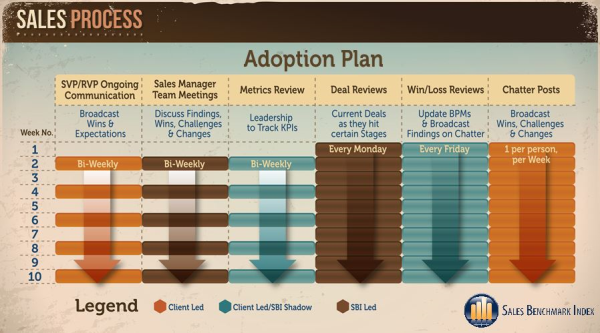
Let’s review what a real adoption plan looks like:

Sales Process Adoption Plan Example resized 600

In this generic example, it’s all about a defined and executed cadence of activities.  First a set of activities is created.  Communication is delivered to the field by the CSO.  Team meetings are run by sales managers.  Leadership reviews metrics.  Leadership reviews deals as they enter certain phases.  Win/Loss/No Decision reviews are completed like clockwork.  You’re all collaborating on Chatter, Yammer, or Jive.  The process and tools are iterated and improved as the team learns.       

Seems obvious, right?  Then why doesn’t it happen?  There’s too much going on.  You and your team left the training event to find 500 e-mails waiting.  Three other initiatives are pending.  Customers are screaming.  Everyone has the best of intentions, and months slip by. 

Here’s where you may want to consider a professional services firm to help execute.  Firms like ours can help build a plan.  As importantly, we can help you run it.  In the example above, some activities are run by the company.  And some are run or shadowed by SBI.  This works because there’s an entity involved that does nothing but focus on adoption. 

You may be able to do this internally.  Many organizations who recognize the need for an adoption plan try.  The SVP tells the CEO he “owns” the adoption.  Then he has to go to EMEA for a week.  Then there’s a board meeting to prepare for.  Then his top director quits.  As I said before: life gets in the way. 

Reinforcement plans aren’t limited to sales process rollouts, of course.  All successful initiatives require them to succeed.  For example, the Reinforcement Framework Tool was created to reinforce sales leadership training.  It’s a real artifact from a recent engagement.  Download it here when you register for our research tour.  It focuses on recorded webinars, which can be another form of reinforcement. 

Reinforcement and adoption are frequently overlooked.  Ask yourself: how are you assuring adoption of your company’s current initiatives?

Author: Mark Synek

sbi on linkedin

Follow @MarkSynek

Follow @MakingTheNumber

If you enjoyed this post, never miss one again by subscribing your Email Here and/or subscribing to the RSS.

03 Sep 15:37

How To Manage Recent Grads Without Driving Them Crazy

by Max Nisen

Wix offices 17

Sometimes, managing entry-level employees can be, well, a pain.

At my company Ciplex, I've learned a lot about managing young employees through trial and error. With the help of my CEO, who's an expert in leadership and management, I've seen my staff make the shift from disengaged individuals to a fully connected and motivated team.

Here's my guide for getting the most out of entry-level employees:

1. Make regular communication mandatory.

If you're not regularly communicating with your entry-level employees, you may have a problem brewing. Keeping communication chains open and frequent is the best way to ensure your employees are kept in the loop, and trained to reach out to you when questions or concerns arise.

In my experience, it's best to choose a communication tool and standardize interactions with employees. For example, an internal instant messaging program, if your company requires frequent back-and-forth throughout the day, may be just what you need. Of course, pick the method that fits best with your workflow.

2. Let the feedback flow. 

As millennials, your entry-level employees likely thrive on feedback. According to a recent study, 80 percent of the millennial respondents say they prefer to receive feedback in real time. Sure, entry-level employees may be at the bottom of the totem pole in your company, but if you want them to improve (and hopefully advance), you've got to keep the feedback flowing.

What if providing regular feedback doesn't always fit into your schedule? Block off 30 minutes every month to meet with your entry-level team members to give feedback.

3. Find ways to recognize them.

 It doesn't matter whether your employees are entry-level or hold a senior role, they want praise. Plus, it's one of the simplest and most inexpensive things to give to your employees to improve engagement.

I make it a practice to reward even the smallest improvements in entry-level employees. This only increases their interest in pleasing you and helps them take pride in their work. You can recognize them with one-on-one praise, praise in front of their team, or even a small reward.

4. Teach them the value of hard work. 

Far too many entry-level employees believe they're just "putting in time" in their roles. You need to put an end to this way of thinking immediately. Your entry-level employees need to understand the value of hard work, and that they can't just coast until it's time to advance.

At my company, we work hard to instill the value of hard work into our teams. Things won't flow correctly if everyone isn't pulling their weight. Sometimes this means working late and helping your team members when you've finished your part of the project.

5. Be a mentor, or find someone who's up for the task. 

I can vouch for the importance of having a mentor--I attribute much of my success to a mentor I had in college. Your entry-level employees need an experienced professional to guide them, act as a sounding board, present them with valuable career insight--and help them become better employees. So, why not set up a mentorship program in your office or with an external resource?

6. Get rid of the time clock. 

Most employees and especially millennials crave flexibility in the workplace. Transform your office into a place where work is about goals being accomplished, and not about the hours on a time card.

My employees don't have hours and they're more productive and team-oriented than ever before. Give your employees core hours they need be in the office and let the rest come down to what meets their schedule. Trust your employees and you may be surprised with how they utilize their flexibility.

7. Ask questions instead of giving commands. 

Entry-level employees are probably used to receiving assignments, tasks, and delegated work. But no one likes being told what to do and how to do it. Rather than commanding your employees to do things, ask them a question to plant the idea.

For example, don't say, "I'd like you to do it this way," say, "Do you think it's a good idea if we do it this way?" This encourages your entry-level employees to take matters into their own hands.

If you manage your entry-level hires well now, you'll end up with a team of engaged, profitable, and team-oriented employees.

Do you have any secrets for managing entry-level employees?


Join the conversation about this story »


03 Sep 15:28

Create and Close Customers up to 40% Faster

by Gerry Murray
IDC's CMO Advisory has conducted an annual IT Buyer Experience survey for the past six years. We have tracked many changes and interesting trends, but one thing stands out as a consistent inefficiency in the market: every year IT Buyers report the purchase processes can be approximately 40% shorter. Over the course of a 10-month average process that means the potential is to accelerate revenue by an entire quarter. This is a huge opportunity for both buyers and sellers with tremendous financial incentives for both and yet no improvement in six years. Why not and what to do about it?

Buyers put about 2/3 of the blame for this inefficiency on themselves. There are scheduling issues, conflicting agendas, changing budgets, changes in personnel, immature purchase processes, etc. The challenge for vendors therefore is two-fold:

  1. Reduce the inefficiencies that are inherent in their own marketing and sales processes, and
  2. Better facilitate the buyer's process(es)

Gap between actual and ideal IT purchase processes, 2009-2013
To do this, vendors need to intimately understand the Buyer's Journey. It starts with Exploration, moves to Evaluation, and ends with a Purchase.  Buyers spend the most amount of time in the Exploration stage, largely independent of direct vendor interaction. As they move through each stage, their agendas change dramatically and the process accelerates. Buyers spend less time in each subsequent stage and have higher expectations of vendor response times. By carefully defining and monitoring buyers' journeys, marketing and sales can better serve customer needs, keep pace with buyer expectations, and cut out big chucks of inefficiency.

For example, in the Exploration stage, the buyer's main objective is to establish fit between their business challenges and a solution. The main resources they use are related to trends in their industry. The primary internal influencers are business buyers (functional leaders, business unit mangers, and executives.) Once they enter the evaluation stage, however, their objective and trusted sources change completely.

In our report, IDC CMO Advisory 2013 IT BuyerExperience Survey: Create and Close Customers up to 40% Faster, we outline specific steps IT marketers should take at each stage in order to get the right messages to the right decision makers. For more information, please contact me at gmurray (at) idc (dot) com.
Copyright 2011 IDC. Complete articles may be reposted. Reproduction in part is forbidden unless specifically authorized. All rights reserved. Please contact IDC for information on republishing or web rights.
03 Sep 15:26

What does a perfect agile marketing strategy look like?

by Chris Lake

A few months ago I compiled a list of 26 wonderful agile marketing campaigns, as there are some serious wins to be had for brands that can act fast. 

But what does it take to react quickly? 

Good timing is everything in comedy, in sport, in fashion, in cooking, and in business. Wait too long and you’ve missed your moment, but there’s a very sweet spot to hit if you get it right. As Anna Wintour says:

It’s always about timing. If it’s too soon, no one understands. If it’s too late, everyone’s forgotten.

Vogue’s editor in chief could have so easily been talking about agile marketing, which requires superlative timing. How are you supposed to win the earned media game if you sit around twiddling thumbs, or don’t have the right set up to make things happen quickly?

With this in mind, I thought I’d outline the key agile marketing success factors, and to try to figure out what kind of team structure and processes need to be put in place.

Culture

Responsive marketing is still a relatively nascent area, focusing as it does on social media channels to underpin earned media wins. It requires experimentation, and that opens the door to risk.

You can minimise risk by putting this kind of structure in place, but there also needs to be an open approach to agile marketing, where people are applauded for coming up with new ideas, and nobody fears for their job if things don’t work out. An entrepreneurial ‘let’s try it’ culture needs to exist for these teams to succeed.

Budgeting

Agile isn’t about putting all of your eggs in one basket. Econsultancy CEO Ashley Friedlein wrote about the 70/20/10 rule of agile marketing, where he suggests that:

70% of your marketing is the planned ‘marketing as usual’ activity. 20% of your marketing should be programmatic. 10% of your marketing is purely responsive Oreo-style. For this you typically need people resource available.

Make it so!

People

To make the most of the real-time marketing opportunity you need a closely-knit, multi-discipline team, primarily comprising of content, design and tech people. These folks will make things happen for you. Give them the right tools and empower them.

Planning

Not long-term planning, but rapid response planning. You have to plan for news hooks, and to know what kind of things you should react to. Seasonal or major scheduled events are relatively easy to plan for, but how will you deal with the things that materialise out of the blue?

Radars / triggers

Have you established a listening station? Are you properly tuned in? Do you know what you’re looking for? It is ultra-important to listen, if you want to be able to quickly react. 

Workflow

What’s the process, when you spot some major breaking news that you can sensibly use as a jumping off point, or when one of your competitors baits you via Twitter? Who alerts who? Who does what? How can you get from A to B in the shortest possible time?

Think about the processes involved in an online newsroom, where every second counts.

Parameters

This is all about topics and tone. Guidelines and rules must be in place. People need to know what they should and shouldn’t say, in order to be able to say the right things quickly. Dumbass moves such as hashtag hijacking do not equate to best practice in the real-time marketing world. 

Brainstorming & creativity

Once you have a target, you need to engage the left brains of your most creative people, but in a structured way. For example, you can create your own shortcuts. I’ve done this for our writers by compiling the 34 blog post templates that we regularly use, and which work well for our brand. You could do something similar for agile marketing content formats.

Metrics

What are they? What does 'good' look like? I think short-term metrics are most important for agile campaigns (and ‘campaign’ might be too strong a word, for an ad hoc tweet), such as retweets, or retweet velocity.

A broader view can be taken after the campaign is done and dusted, where you can measure things like engagement and sentiment. And for the longer term you must be happy to correlate agile marketing wins with sales spikes, as you cannot accurately measure the effect of social or earned media on business performance

Goals

What are your organisations goals? How can an agile marketing team support them? It is essential for responsive marketers to engage audiences in the right way. Focusing purely on ‘going viral’ is madness, unless there’s a strategic reason for doing so.

Marketing exists for one reason only, and if your sales and profits and brand metrics are all in decline then I doubt that your CEO will be too impressed that you trended on Twitter last month. Laser-guided marketing is the only form of marketing worth bothering with. 

No doubt I’ll have missed some things out from the above list, so be sure to let me know in the comments area below. I’d also love to hear from any brands that are figuring out how to structure an agile marketing team, or have already done so (email chris@).

Finally, be sure to join us at Punch, we’re running in conjunction with Creative Review and Design Week, and which is part of our inaugural Festival Of Marketing (8-10 October, London).

03 Sep 15:23

From Hubspot’s Conference: “Simple, Sane & Successful Inbound Marketing”

by Aaron Ross

hubspot simple sane successful inbound marketing aaron ross predictable revenueHubspot had an awesomely well-done “Inbound 2013″ conference in Boston recently, and I had the privilege of speaking on a couple of topics there, one of which was brand new for me….

Read more on From Hubspot’s Conference: “Simple, Sane & Successful Inbound Marketing”…

The post From Hubspot’s Conference: “Simple, Sane & Successful Inbound Marketing” appeared first on Predictable Revenue.

03 Sep 15:21

The Buyer Revolution: 4 Steps To Evolve or Be Toppled

by Tony Zambito
The Buyer Revolution: 4 Steps To Evolve or Be Toppled image 6817840912 185871a34d m

Knowledge will make you free (Photo credit: tellatic)

The rapid changes in technologies and business models continue at breakneck speeds. Shifting the landscape of buyer behavior along the way. Fermenting the once dormant ability of buyers to redefine the seller-buyer relationship . Creating a buyer revolution marching on unabated.

B2B business, marketing, and sales leaders are faced with rethinking long-held strategies and redefining tactics. Confronted with a new reality, which bears little resemblance to just a few short years ago. One thing has become clear in the buyer uprising B2B businesses face today – they must evolve or they will be toppled.

Meeting Demands

The buyer revolution is resulting in new demands. Buyer demands can be boiled down to two essential elements involved in all revolutions. Information and knowledge. Buyers are demanding more access to information and want more knowledge. Just as the invention of the printing press by Johannes Gutenburg in 1440 changed the world forever, new digital technologies are changing the seller-buyer relationship forever. Sellers can no longer hold back information and knowledge – or – there will be no relationship.

Information And Knowledge

To evolve today means staking out a leadership position in meeting the demands of buyers. Specifically, meeting the demands for information and knowledge. A mistake companies make in their attempts to evolve is focusing on the former versus the later. Inundating buyers with so much information, it actually harms more than foster relationships. Information is dumped without thought to knowledge, which the buyer desires to internalize.

Misguided attempts with information are becoming more evident. The newest is the fad-crazed use of the word “insight” today. Recasting information as insight. Insight has no value unless it can be translated into knowledge. Let these words from a recent interview illuminate:

“Recently, I did spend time on the phone with a rep from (Vendor A). Not too long but was interested in hearing more. He said he would send valuable insight on how my issues and such can be fixed. Well, basically what I got was product information. Nothing new so to speak.” Vice President, Retail Banking Group

As you can see here in this simple statement, what actually happened is expectations were raised for knowledge to be gained, only to fall short significantly. In the end, this does more harm than good.

Evolve You Must

To evolve today, B2B marketing and sales today must work in tandem to bridge the gap between information and knowledge. What the buyer revolution is all about is buyers no longer want to feel like they have to pull teeth to get the knowledge they need. The more sellers resist the freeing up of information and knowledge, the more the ramifications of the buyer revolution will persist. What can B2B businesses do to evolve in the face of the buyer revolution? Here are four suggested steps:

Identify Gaps Customers Have In Knowledge

This is a crucial step. B2B companies today will need to engage in buyer insight research to identify the gaps customers and buyers have in knowledge. Not easy for buyers often have difficulty in articulating and may not used standardized terminologies. Yet, it must be done.

Evaluate Information

Once you know the knowledge gaps of your customers, it is important to evaluate your existing information. If you have done your homework, be prepared to cringe. This effort goes well beyond the content audit often recommended today. It goes to the heart of what you are willing to give.

Redesign Information

What we may call content, buyers think of as information. Not getting this could mean your content will be just plain bad. You need to know what information means to buyers, design it, and deliver it. One of the causes of content marketing ineffectiveness is related to this issue. Too much inside-out thinking on content means no connection to the information buyers are seeking. Frankly, they do not care how cool your content is if it says nothing.

Build A Bridge To Knowledge

Buyers are seeking knowledge. We may be getting confused with insight being knowledge. The true difference maker is helping customers to translate information they are receiving into to newfound knowledge they seek. The role of insight is to be the bridge itself. Companies who get this right will separate themselves from competitors dramatically.

The Buyer Revolution: 4 Steps To Evolve or Be Toppled image Knowledge1 300x168

Turn Insight into Knowledge

History serves us well. Institutions who embraced Gutenberg’s invention and evolved the knowledge of societies flourished. Those who resisted perished. The buyer revolution today means flourishing by providing customers and buyers with knowledge they need to accomplish their goals. Following these four steps helps you to evolve the capability of bridging information to knowledge.

Time is running out. The pace of change is only quickening. Evolve you must.

(Schedule time with me and a conversation to help you understand how the buyer revolution impacts you. I am very interested in getting your thoughts and perspectives on these impacts. Please share widely – your peers and colleagues are trying to evolve before it is too late.)

03 Sep 15:08

Amplify Your Warm Leads with One Four-Letter Word!

by Alon Popilskis

The funnel of generating, qualifying, and then closing leads is the biggest driver of sales for most businesses. However, a majority of companies tend to focus their efforts on the first step of generating leads more than anything else. They figure that the more people they can bring to the top of their sales funnel, the more sales they will generate at the bottom.

While this is true, it turns out that most of the time it’s actually more efficient to improve the conversion rate of your sales process than it is to increase the traffic that goes into a leaky funnel. By increasing the conversion rate of your funnel, you increase the odds of closing a sale for every single visitor that comes to your site from that point on. This means it’s easier for you to see a return on your investment in both paid and earned media, since more of the traffic will convert and you will reach your break-even point faster.

For businesses that use this multi-tiered sales funnel of “generate, qualify, and close,” the first conversion that happens is turning passing website visitors into warm leads by collecting their contact information so the company’s sales staff can follow up with a proposal or collateral materials. Just improving the number of visitors who enter your funnel as warm leads can lead to dramatic increases in sales.

This post breaks down one excellent, time-honored tactic that can help you amplify warm leads for your business: Free content!

This often-overlooked strategy has been a cornerstone of both direct and internet marketing for decades. Here’s how it works: A company will offer something free, like an information kit, trial product, or reference material, in exchange for the prospect’s contact information. Once their information is captured, the prospect is then sent additional communications and marketing messages to build their trust in the company and ultimately turn them into a paying customer.

Online you typically find businesses will offer an Ebook or other information product related to their paid offerings in exchange for the prospect’s email address. For example, a company whose business is performance coaching might have an Ebook containing their company’s 5 keys to high performance including case studies of their clients. They would give this away in exchange for the prospect’s email address and permission to contact them.

Anyone who downloaded the Ebook would immediately be identified as a quality lead by the business, because they were interested enough in the topic to take action to download the Ebook and join the mailing list. Now that the prospect is in the warm lead database for the hypothetical performance coaching business, they can experiment by sending the prospect additional resources related to the performance field to continue to demonstrate the company’s expertise, and also include special offers and discounts to further encourage the prospect to become a paying customer.

The Ebook itself should also be specifically designed to encourage readers to become paying customers. Strategic information should be left out that only paying customers can access in order to make the prospect aware that they are lacking important details. This is known as opening a “Knowledge Gap,” since the prospect becomes aware that there is gap in what they know about the subject, which is extremely uncomfortable for them from a mental standpoint. Prospects will often make a purchase just to close this gap.

Calls to action that up-sell the prospect on why the company’s paid offerings are better than the free Ebook should also be included to drive sales.

Having an Ebook and regularly emailing warm leads with additional tips also helps get more paying customers by increasing the trust the prospect has for the business. Especially with online products, many consumers are skeptical of web-based companies. By providing an Ebook and regular emails with additional helpful information, it will allow the business to gain the skeptics’ trust. The key point here is that the content must be good enough to earn that trust.

If all you are doing is sending sales messages to your warm leads, you are more likely to alienate your prospects instead of keeping them interested until they are ready to buy. Seth Godin wrote an excellent piece about “The curse of frequency” where he points out that, while it’s true that if you promote something twice to 100 people you will get more sales than if you only promoted it once, the people who have already purchased no longer want or need to hear that message a second time. The longer you push the same promotion or message to your audience, the more likely you are to alienate your core customers – the ones who were first to purchase and eager to support you.

Keep this in mind when you are communicating with your warm leads. Your goal should always be to provide additional help to your prospects related to your business’ field. You want your prospects to use your free advice and get results, that way they come to trust your brand and eventually will have enough faith to buy.

Show us examples of how your business generates warm leads with free content in the comments!

03 Sep 15:07

Dispelling Four Delusions (A Note to the Sales Leader)

by S. Anthony Iannarino

Dispelling Four Delusions (A Note to the Sales Leader) is a post from: The Sales Blog | S. Anthony Iannarino

The allure of the magic bullet is a strong force. At times, it’s overwhelming, irresistible. The idea that there is an easy answer to a difficult question is a delusion. Here are four magic bullet answers that are really delusions.

Believing Headcount Equals Growth: Adding more people adds a lot to your sales organization. It absolutely adds costs, complexity, and an increased workload for sales management and leadership. But it doesn’t necessarily add growth. That requires something more than just increasing your headcount. You also need the right people, a training and development program, a good sales process, and the ability to lead the sales force.

Headcount isn’t the easy answer to revenue growth unless you are prepared to invest in all that is required to ensure that investment produces a return.

Believing Non-Salespeople Will Sell: They say that they’ve been told they belong in sales. They say they will do whatever it takes. And they are personable, charming, and persistent. But if they aren’t really salespeople, they won’t sell. They’re just non-salespeople. They don’t like to “bother” anyone. They don’t like to ask people for commitments because it makes them “uncomfortable.”

If someone really wants to be a teacher, they aren’t likely to be a salesperson. You can’t make them something they’re not. Could they sell if they really wanted to? Absolutely! But they don’t want to. They are unwilling.

Believing That Activity Equals Results: Activity is good. I’ve heard good things come to those who wait, but the evidence is to the contrary. Good things come to those who hustle and make it rain. But activity alone doesn’t always equal results. Results come from effective activity. Good sales management (and me management) is a careful balance of activity and effectiveness–not one or the other.

Too many salespeople are active without results because they are ineffective. Even more may be effective but take too little action. Activity alone doesn’t equal results. But neither does no activity.

Believing People Are Already Equipped to Succeed: It doesn’t matter if a salesperson has experience or not. It doesn’t even matter how long they’ve been selling. And it doesn’t matter that you hired them because they have experience. You may believe that the salesperson you hired is equipped to succeed, but they aren’t.

You owe any salesperson–every salesperson–you hire training, development, coaching, and leadership. There isn’t any circumstance when a salesperson can’t use more training in the principles of effective selling, the development of new–and greater–skills, the opportunity to be coached, and a leader that cares about them.

These four delusions, these misconceptions, can prevent you from doing what you really need to do to increase revenue and grow. Avoid the delusions and do the heavy lifting instead. It’s faster and more certain.

Questions

Why is it easy to believe that adding headcount adds to revenue? What does it really add?

How do non-salespeople convince you they want to sell?

Is activity enough alone to produce results?

What do you owe your sales force? What do you owe them even if they are experienced veterans?

03 Sep 15:07

How to Organize Your Sales Force to Generate More Revenue

by Ryan Tognazzini

This post is focused on organizing sales talent to help you make the number.

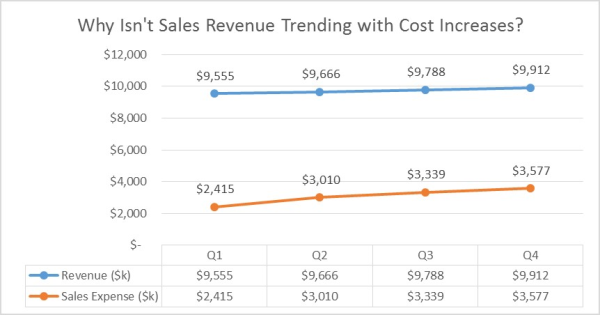
The cost of sales is increasing. Hiring ‘A’ player sales reps is expensive. Deploying those resources incorrectly can be even more expensive. If organized incorrectly, your team will miss the number.

A symptom of this is: your revenue trends haven’t increased with your sales expense. Why not? 

Why isn%27t sales revenue trending with cost increases1 resized 600

To learn more about designing sales organization models, sign up for SBI’s 7th Annual Research Session. How to Make the Number in 2014: A Sales Strategy You Can Execute. In this session, we will cover subjects like:

  • Leading organizational models for 2014
  • How to identify and hire The New ‘A’ Player
  • How to help your reps succeed in your organizational model

As part of attending this session, you will get the Sales Org Evaluation Tool. Benefits of the tool:

  • Determine the right org model for your sales team
  • Drive revenue growth by deploying the right resources on the right accounts
  • Lower cost of sales by eliminating the hiring of the wrong resources
New Call\u002Dto\u002DAction

Picking the Wrong Model

Deploying the wrong model comes with consequences that can cause you to miss the number. Here are a few that may be signs for you:

  • Customer attrition
  • Below average win rates
  • Sales rep turnover
  • Fewer than 2/3 of reps make quota
  • Loss of market share
  • New product launch failures

If you are seeing these in your sales force, you might consider making a change.

Modern Organizational Models

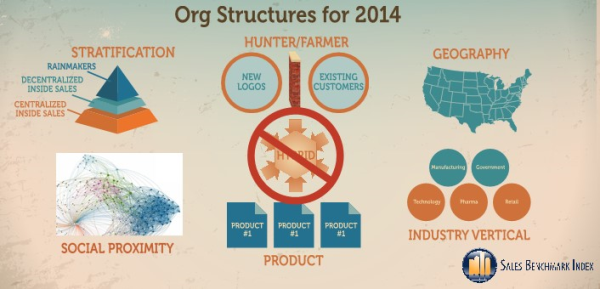
There are seven sales models you might consider to make the number. Below is an image of each, along with a brief description.

 describe the image

1.  Stratification – focusing sales on accounts based on size. This may be revenue, current spent, potential or number of employees.

Make the # by: Putting your best people (rainmakers) on your biggest and best opportunities.

2.  Hunter/Farmer – dividing sales by activity. In this case, you would have reps focused on opening new logos. The farmers focus on cross and upselling in the installed base.     

Make the # by: Segmenting the team by focus area (new logos vs. installed base). Often, sales reps are good at one or the other. Rarely both.

3.  Geography – territories are designed by zip code. You have reps who live in (or near) a particular geo where they sell.

Make the # by: Building territories around rep proximity. This can increase the volume of sales calls to drive growth.

4.  Industry Vertical – reps are organized by specific industry types (government, pharmaceutical, tech, etc.). They sell into these verticals only.

Make the # by: Ensuring the right people are having the right conversations with your buyers.

5.  Product – similar to industry. However, your reps in this model are organized by specific product offerings.

Make the # by: Leveraging product expertise to sell more of each one. Can also ensure new product launches are successful with focused resources.

6.  Social Proximity – an emerging model. Your reps are organized by their social proximity to specific buyers.

Make the # by: Assigning your reps to accounts where they have the shortest path to the buyer. Easier access can equal more wins.

7.  Hybrid – this is a combination of 2 or more of the above models. From the image, you can see this is not recommended. It dilutes your team’s effectiveness and may be part of your issues today.  

The Sales Org Evaluation Tool goes deeper for you on this. It will take you through when you might deploy each of the above options. It also provides you with the pros and cons of each model.

What to Do Next

There’s a lot of work that goes into determining the right org model for you. You need to get a complete view of your best options to eliminate waste. Here are some ideas for you:

  • Customers– understand how your customers buy, the value sales brings and how they want to engage.
    • Why? It’s all about the customer, in the end. To make the number, your customer has to value interaction with your reps.
  • Prospects– similar to customers, but with buyers unfamiliar with your offerings.
    • Why? Your model needs to support new logo growth. Knowing how net new buyers want to engage is critical.
  • Competitors– learn how your biggest competitors engage with your customers. What do they do well? Where do you have an edge?
    • Why? In an emerging market, you have to organize to beat the bad guys. In a competitive replacement market, you need to organize to take share.
  • Corporate– understand how well your process align with what your customers want. Do you sell the way they want to buy? Are there trends in their purchase history to suggest where to point your resources?
    • Why? The org model has to align with your strategy. If you are developing new products, the sales team has to sell them successfully. If you are acquiring companies, the sales model has to accommodate the new business.
  • Field– determine how your team engages with your customers today. How well does this align with what they want? How well do they do it?
    • Why? You need the above items complete to compare to current state. Who on the team today can transition to the new model? How far away are you from making the change real?

If you are inward-out with your approach, it will not yield the best results. This approach is design to help you determine where to point your resources.

Ensuring your sales investments convert to revenue is a critical strategic initiative. Getting this right will help you make the number. To learn more about this, consider signing up for our free research session. 

Author: Ryan Tognazzini

sbi on linkedin

Follow @RyanTognazzini

Follow Sales Benchmark Index @MakingTheNumber

If you enjoyed this post, never miss one again by subscribing your Email Here and/or subscribing to the RSS.

03 Sep 15:07

Sales and Promotions are Overriding Brand Loyalty [Infographic]

by Brian Wallace

Conventional wisdom has taught us that if our products are high quality and our service is friendly that customers will be loyal, but advances in technology and a changing economy have made brand loyalty a thing of the past.

Smart phones have enabled consumers to price check on the go and online retail has provided more options and competition than ever before. A recent study has shown that 67% of consumers believe that they can find the best deals online. Consumers are more price conscious than ever and 80% of consumers are willing to switch brands or stores because of a promotion. Nearly 80% of consumers have left stores without buying anything in the past 12 months. In order to adapt to these changes retailers must develop new strategies. One strategy is to focus on influencing unplanned purchases. Promotions influence 83% of unplanned purchases and 65% of unplanned purchases were made in brick-and-mortar stores.

The illusion of brand loyalty can present unforeseen risk to retailers unless they are willing to change. To learn more about changing consumer behavior and how to adapt check out the infographic below from MarketTrack.

Sales and Promotions are Overriding Brand Loyalty [Infographic] image MarketTrack consumer and retail behavior2
© Market Track

03 Sep 15:06

BYOD: The Next Big Trend in Sales You Don’t Want to Miss

by Jenna Cheng

BYOD, which stands for Bring Your Own Device, offers many benefits for sales organizations such as mobile access, cost savings and increased productivity. The BYOD trend encourages employees to bring their own devices including mobile phones, tablets, smartphones and even their own laptops. Businesses have jumped on the BYOD bandwagon for many reasons. While some critics have raised concerns, this trend continues to climb. Here’s why.

BYOD Allows Easier Access

Although schools and IT departments have already adopted the BYOD trend, B2B businesses are beginning to have their sales teams take advantage of it. In fact, Cisco states that 89 percent of businesses are already using the BYOD trend.

As you know, the lead time for a B2B sale can be anywhere from a few weeks to a year, and in most cases it can take a few months. When a business is ready to buy, it is best prepare for the sale by having access to its information and your company’s database at all times.

A sales agent who has a mobile device such a tablet or smartphone will be able to access data from anyplace with Internet connection as soon as the lead is ready to make a purchase. This could mean accessing the information from home, during a meeting or even while on a call with another qualifying lead. This eliminates the appearance of being unprepared or the worry of losing potentially promising buyers altogether.

The BYOD Trend Cuts Costs

Besides improving sales, the use of BYOD can also cut your overhead expenses. Encouraging your employees to bring their own connected devices to work allows you to redirect money to your marketing campaigns and other areas of your business, instead of investing in expensive office equipment. It also reduces turnover rates by producing happier employees.

Secondly, allowing your employees to bring their own devices to work eliminates needless business phone bills. It also reduces downtime from system crashes that could grind your sales department to a complete halt. Since your sales agents may work from different platforms, the likelihood of all three systems going down at once is extremely remote.

To see if the BYOD trend is right for your business, you should assess the size of your company and the type of clients you work with. If you have a lot of impulse buyers, the BYOD trend may be best for you, because many impulse purchases happen outside of normal business hours. Also, if your business spends too much money on overhead costs and not enough on sales or marketing, BYOD could free up the funds needed to expand these areas.

SaaS Solutions for BYOD

The BYOD trend will drive businesses into adopting cloud-based services for mobile device management, particularly in the SMB market where IT staff and budget are limited. Software as a Service (SaaS) solutions such as InsideView work directly with cloud computing platforms to provide CRM intelligence through data, alerts and social connections. For example, InsideView integrates with Salesforce, Marketo, Oracle CRM, SAP, SugarCRM, Microsoft Dynamics CRM and Netsuite which streamline communication and keep data stored on servers in the cloud.

Is the BYOD trend right for your business? As shown in this infographic, Gartner predicts that two-thirds of the workforce will own their own smart phones in 2016 and 40 percent of the workforce will be mobile. Using SaaS solutions on BYOD laptops and smartphones means that your business doesn’t have to worry about data stored on an employee’s personal device. SaaS can help a true BYOD organization work seamlessly across devices; anytime and anywhere.

03 Sep 15:06

What’s Your Question? – Sales eXchange 215

by Tibor Shanto

By Tibor Shanto - tibor.shanto@sellbetter.ca

iStock_000004159256XSmall

Most would agree that questions are the most powerful weapon; a seller has at their disposal. Yet it is interesting to see how many will either not use them at all, or to their full advantage. As with any weapon, practice is key, not just on the battlefield, but off the field as well, the better you become at the technique the better the outcome for both you and your buyer.

But day after day you see sellers come to play with either the wrong questions, dull questions or just plain stupid questions.

Some questions are so self-serving they leave buyers just depressed and so reluctant to answer, because they know that the “correct”, not the right, answer will just extend a bad selling experience. A couple of weeks ago I had someone trying to sell me a piece of technology that would “just rock my sales”. After a few set up statements, he highlighted the areas that he was claiming his app would help, and then he used one of my most hated forms of question: “Wouldn’t you agree that blah blah blah would be a good thing?” In this case knowing what the prospect was thinking about the presentation. It is a no win situation for the buyer, and everyone knows it. Yes it would be good to know that, but if I pick that obvious answer it does not mean that your app can do it, or more importantly that I want, like or am remotely interested in your app; but if I provide the “correct” answer, I am committing to play the stupid game – or – trap. So I decided to take the less painful route and said no. Which highlights another misuse of questions, no follow up to the “no”; they are all set for the “yes”, because it is the logical answer, but throw in a “no” at the right (wrong) time, and watch the void, in their eyes, sales and pipeline.

This is sadder (funnier) than we think, all it takes is a little practice to know how you will handle any of the potential responses to your question. After all, as sales people we are usually in the advantageous position of asking the first question in most selling situation (if you are not asking the first question 99% of the time, then you are an order taker not a sales person); given that, you should figure out in advance what the answers potentially may be, and then plot a course for each one, except the one where the prospect disqualifies themselves, then just work on replacing them.

People answer the question they are asked, extrapolating that to mean things you “need” them to be can be a mugs game. Avoid this in two simple ways. First make sure that ask a number of validating follow through questions, get to the root of the issues, and don’t just linger at the surface. Second, come at the issue from a number of different angles, things can be interpreted differently by different people based on their views and experiences. By exploring the issue from a few different viewpoints will ensure an understanding, and that you are really working with someone in a position to buy. It may take time and effort up front, but it beats getting one right answer but no sale.

What’s in Your Pipeline?
Tibor Shanto

03 Sep 15:06

Sales Training Article: Expand Reach on LinkedIn

by Customer Centric Selling

Sales Training Article: How to Accelerate and Expand Your Reach on LinkedIn

By Tony Albachiara, Sales Benchmark Index

sales trainingYour Reach on LinkedIn will be one of your best sales assets in 2014. How do I know? Because numbers don't lie. 84% of B2B decision makers begin their buying process with a referral. Contrast this with the 4.4% e-mail open rates. Furthermore, compare it to the 1-3% cold calling success rate.linked-in-reach

These numbers leave little room for doubt: More referrals = more qualified opportunities = more sales.

So, how do you get more referrals? In the digital age, the answer is LinkedIn. You build your LinkedIn network, and increase your Reach.

NOTE: This is part 2 of a 3-part series on utilizing LinkedIn. Part 1 covered Profiles. Focusing on Reach and Referrals is foolish without a solid profile. Start there, and then move into Reach.

LinkedIn Profiles, Reach & Referrals is how you make your number in 2014. What else can you do to make the number in 2014? Sign up for the Q3 Tour to get top-notch insight. Become world-class.

High-Quality + High-Quantity = Reach
There are two aspects to developing strong Reach on LinkedIn. These aspects are quality and quantity. To have world-class Reach you need both in spades.

1.Quantity: When considered on its own, the "quantity" aspect is pretty straightforward. In order to expand your network, you need to connect with lots of people. More connections increase the chance you'll have an "in" with potential buyers. Your goal should definitely be to exceed the 500+ connection threshold. If you aren't there yet, get to work. If you've reached that threshold, keep going!

2.Quality: This is where things get tricky. Go to your LinkedIn page, and examine your 500+ connections. Who are they? If 300 of those connections are family and college friends, you're in trouble. The chances of these connections acting as a referral are very slim. Narrow your focus to primarily business contacts. Think about the networking you've done in person. Reach out to those people. Remember: low-quality connections are the same as no connections at all. To be worthy of your network, connections must add value. If they don't, move on to someone else. This is the key to developing a strong Reach.

Download the Quantity & Quality Measurement Tool by signing up for the Q3 Tour: "How to Make Your Number in 2014: A Sales Strategy You Can Execute."

Who You Know > What You Know
Tag Your Connections - SBI has written before about Tagging Your Connections. This is a LinkedIn feature that I can't stress enough. Tagging your connections helps you understand your network. It also helps you pinpoint where your network is lacking. This is what Reach is all about - building more quality connections. Tagging allows you to discover your Reach strengths and weaknesses all at once. This will help you decide where to place your network-building efforts in the future.

Use Your Buyer Personas - Buyer personas aren't created just for marketing. They're made to supercharge your selling process. Personas are one of the key ingredients in improving LinkedIn Reach.

Is one of your buyer personas a CEO? If so, you better be connected to lots of C-Level professionals. If you aren't sure whether or not this is the case, look at your tags. How many CEOs do you see tagged? If you don't have many, start brainstorming today. How can you connect with more CEOs? Or, how can you connect with people who can refer you to CEOs? This is all part of the process. Follow this line of thinking with tagging and networking. Before you know it, your Reach will be off the charts.

Bottom line for 2014: the buyer has evolved. The old "tried and true" techniques don't work anymore. We need to adapt with the buyer. Embrace Social Selling and increase your LinkedIn Reach. Once your Profile and Reach are mastered, you can start leveraging them. This is what we will discuss next time. Start making LinkedIn work for you with referrals and more opportunities.


sales training companyNeed some help with your sales performance? Take a look at the sales training workshops available to you and improve sales performance.

Read more sales training articles from CustomerCentric Selling® - The Sales Training Company.

30 Aug 15:14

Chat About “Sales Strategy” With Ken Krogue (President, InsideSales.com) and Kyle Porter (CEO, SalesLoft)

by Aaron Ross

salesloft insidesales.comInsideSales.com has been on a tear the past few years, doing a lot of creative marketing and expanding their ideas with a lot of research.  I had the pleasure of joining their founder/president Ken Krogue and Kyle Porter (CEO, SalesLoft) on a Hangout chat to talk about “Sales Strategy”, and what the heck that means.

Read more on Chat About “Sales Strategy” With Ken Krogue (President, InsideSales.com) and Kyle Porter (CEO, SalesLoft)…

The post Chat About “Sales Strategy” With Ken Krogue (President, InsideSales.com) and Kyle Porter (CEO, SalesLoft) appeared first on Predictable Revenue.

30 Aug 15:14

How Sales Can Better Align with Marketing and Support

by Blair Symes

How Sales Can Better Align with Marketing and Support image alignment 1024x790When your car needs an alignment, you know it. The tires are wandering, the steering wheel is vibrating, and other telltale signs that indicate something needs to be tweaked are appearing. When it comes to sales and marketing alignment, it’s not much different. The machine feels “off.” Miscommunication—or complete absence of communication—is rampant; leads are slipping through the cracks and other “glitches” that keep business from running as smoothly as it should rear their ugly heads. Having a way to integrate your sales and marketing team—and even your support team—can solve a lot of problems your organization is facing: the key is using the right technology to make it happen.

Sales-Marketing Alignment

One of marketing’s main goals is to drive quality leads to sales. But when marketing and sales aren’t aligned, marketing can feel like it is lobbing leads over the fence to sales, with no idea what happens to those leads. Is every lead being worked? Is the quality of leads high? What campaigns are driving the most opportunities and revenue? And sales can feel like they are being inundated with leads from nowhere, with no context as to where marketing found them or how to frame their initial conversation.

First, marketing should always keep sales appraised of new campaigns. Second, sales and marketing should agree on the definition of a lead, and marketing should institute filters to only pass people that qualify as leads to sales. Third, sales should always be aware of where each lead came from. And fourth, marketing should be able to see which campaigns generated the most leads, opportunities, and revenue.

Three pieces of technology can help you do all four:

  • Marketing automation tools like Marketo and Eloqua can help filter web leads and content downloads using registration forms and behavioral scoring. These tools can integrate with your CRM system so sales will know where every lead came from before calling, and marketing can follow each one through the salescycle.
  • Voice-based marketing automation (VBMA) tools can do the same for phone leads using IVR (interactive voice response) technology to score callers before passing to sales. VBMA tools also have call tracking technology that tell marketing which of their campaigns are generating leads. VBMA can also be integrated with your CRM to track each phone lead through the sales cycle. What’s more, when someone calls in, sales will see what campaign or keyword search the lead came from before taking the call. Knowing where a call is coming from can be a significant help to a sales rep trying to close a deal.

Sales-Support Alignment

A commonly overlooked disconnect is that between sales and support teams. Support may receive common concerns and questions from confused or fed up customers who are frustrated or even ready to cancel, but if sales never hears about it, the rep is 1) at a disadvantage when management is wondering why that rep’s accounts don’t stick, 2) going to continue not addressing that particular customer concern when they’re closing sales. They may be unintentionally leaving out a key bullet in company policy when pitching to prospects, but the problem will continue until support makes them aware of the error with detailed call history data. Using VBMA call activity reports, sales can see how many calls their accounts are making to support, and the length of those calls. Sales can also access audio recordings of the calls to hear first hand customer complaints and be able to formulate a plan to repair the relationship. Nothing slips through the cracks.

To learn more about how voice-based marketing automation technology can align the wayward tires of your sales, marketing, and support organizations, read the free Definitive Guide to Voice-Based Marketing Automation. No registration required.

30 Aug 15:13

Tips for Writing Better Emails for Sales

by Nancy Anderson

Tips for Writing Better Emails for Sales image salesemailetiquetteWhether you work in a retail store or sell via an eCommerce site, it’s important to learn to write compelling sales emails to compete in today’s marketplace. Unfortunately, not all personal sales skills translate into virtual communication. Use these tips from industry experts to get the most out of your sales emails.

In an article for Inc.com, international sales strategist Jill Konrath reminded sales professionals to watch their language. She wasn’t talking about four-letter words, although it’s probably a good idea to avoid them as well when writing emails of any kind in relation to your job. Konrath advised against the use of so-called delete-inducing words. Such verbiage might include things like state-of-the-art, exciting, or leading edge. Avoid over-the-top descriptions and clichéd words that customers are tired of reading. Instead, opt for simple, honest communication.

Leslie O’Flahavan and Marilynne Rudick, partners in E-WRITE, add that you should always include benefit information in sales emails. It’s important to tell potential customers what service or product you are offering, but if you don’t tell them why the item is important to their lives, then you aren’t giving them a reason to make a purchase. Make sure you include one or more things the product will do for the client, and then close the email with a call to action. Instead of pushing clients to make purchases, create an educational call to action that shows how they can take advantage of the benefits you listed.

Mike Halper of SalesScripter also addresses the importance of a strong subject line when writing emails. The subject line is the first thing a customer sees and will often determine whether your email is opened at all. Try to keep subject lines informative and helpful; you always want to avoid subject lines that sound spammy. Never head your sales emails with a dishonest subject line; that tactic may be successful in getting the customer to open one item, but you may end up on the customer’s blocked email list after that. If you can include a teaser for your benefit in the subject line, you’re more likely to entice the reader, especially if you understand what the client wants or needs. Keep headers for sales emails simple and clear—identify a potential problem and let the reader know that a solution can be found in the email.

Sales emails are important tools for any industry professional. Learning to write compelling copy, keeping messages short, and educating the reader about benefits are essential deal-closing skills. You should also develop a well-rounded communication tool belt. Sales emails are a great way to communicate with some clients, but they don’t work in every situation. Know when to send an email and when to pick up the phone.

30 Aug 15:13

Why Marketing To Leads Is Important

by Leah Weisman

Why Marketing To Leads Is Important image B2B content marketing teamwork 344x230 300x200A big goal of marketing is lead generation, especially inbound leads. That could be by search engine optimization, blogging, and social media — putting feelers out there and letting the leads come to you.

However, an area where marketing can be key is closing deals by pushing outside leads further into your sales funnel through marketing.

Establish Your Credibility

Marketing can help your sales team nurture leads. This can be especially important in the realm of business-to-business sales and marketing.

By utilizing marketing methods like blogging, e-newsletters, and social media, you can position your brand as an authoritative and credible source. When it comes to your lead making a purchasing decision, that person is going to go with a business they view as competent and credible.

By marketing to them while they move through your sales funnel, you can get a leg up on making that impression.

It Can Better Qualify Leads

You might have a lead who’s interested in your business…or what they think your business is. Targeting them with marketing messaging might make it a whole lot clearer to them who you are and what you’re offering.

That could mean that some leads may back off when they realize what you have isn’t what they need, which could save your sales team time. Or it could…

Make Selling Easier

The more information about your business, product or service, and industry you have with your own branding, the better the chance your lead really understands your value.

Targeting your leads with marketing messages and valuable information will only grease the wheels for your sales team when they step in. First off, they’ll remember you better and second, they will be more educated about your product or service.

So, invite your leads to visit your social media pages and share your blogs or other useful industry information with them. Let your marketing do what it’s meant to: build your brand and inform your audience.

Need help developing a marketing plan to generate more qualified leads? Contact us today to get started!

30 Aug 15:13

Inside Sales Managers: Training is Team Building

by Paul Alves

Inside Sales Managers: Training is Team Building image DSC 1215I have been meeting with my team recently to better understand what they like, don’t like, what they would like to see more of, less of, why they joined the AG team, why they stay, and whatever else I might learn that can help improve the AG employment experience. Each and every person I have met with told me they were attracted to AG for a number of reasons, but the most important one was our training. They wanted to be at a company where they could learn. We are very proud of our internal training program and continue to invest and improve it. The conversations I am having validate that we are on the right track.

This got me thinking. How can we do more? How can we take our learning culture to the next level. We decided to make a significant investment in an outside firm to work with us. They would bring many, many years of experience as well as an objective point of view.

About six months ago we engaged with an outside firm to help us further train our team. Our focus is on three specific areas. Sales training for our Business Development Reps, Leadership training for our executive team, and Process Improvement training across the entire organization.

I was excited for the team, I understood the message that learning was important to them and I was delivering more of a good thing. I expected and received all of the positive things that would come from training. Skills development, higher productivity and improved job satisfaction. What I did not expect was the team building aspect of the training process. I always thought of team building in the more traditional sense. A two or three day retreat, a ropes course, even a scavenger hunt. I’m sure there are a hundred more.

What I have noticed halfway through, what will end up being a yearlong training is that the team is becoming stronger in ways I would not have expected. I expected an improvement as a result of the learning and improved skills, it was the improved relationships, processes, and the special bonds that have been created through spending time learning together that surprised me a bit.

I have seen new relationships develop as team members that might not have spent time together otherwise have an opportunity to interact. I have seen managers develop closer relationships with their team by participating in the training along with their team as opposed to facilitating the training. We now have improved processes around team management and scheduling as we have had to schedule more than 70 people into various training schedules without losing productivity.

We are getting better as a result of working through the process of getting better. Very cool stuff! Please share any team building activities that you and your company have participated in, we’d love to hear of them!

Inside Sales Managers: Training is Team Building image 744a9650 9e53 453f a451 6111a8b797aa3

Inside Sales Managers: Training is Team Building image 07f0bf66 1dcb 40ea acd9 7c4ff5605ab023

30 Aug 15:13

The Final Post: We MUST Have a Sales Process

by Jonathan Farrington

On October 16th 2006, I made the first post here on Blogit, so it is fitting that today, I also make the last one.

Tomorrow I will be announcing details of my new blog – and the friends who will be joining me – which launches on Monday. “Great Minds Thinking Alike About Sales!”

But back to today, and some thoughts about sales process ….

Even companies that enjoy the luxury of clearly superior products realize that those products will not sell themselves. As a minimum, companies need a sales force comprised of skilled professionals who understand the application of the product range, have an in-depth knowledge of their customer base, market sector and of course the competition But even all these elements together are not sufficient to ensure optimum performance levels and profitable sales. We must have a sales process.

So What Is A Sales Process?

Put quite simply, it is a set of procedures, which determine how a company wishes it’s sales team to operate – “The way we do things around here”

The most successful organizations have implemented a process and an all-encompassing framework for defining performance standards. This involves assessing, appraising, developing, reviewing, providing continual feedback on performance, as well as implementing efficient and relevant process tools.

From the Sales Director’s/VP Sales perspective, developing a consultative sales process means developing a comprehensive, formal, realistic, and step-by-step outline of what salespeople are expected to do. This is just as appropriate for internal and totally reactive sales teams as it is for external pro-active ones. This outline includes the activity and calls they must make, the relationships they should establish with prospects, the documentation they should use in sales calls, the issues they must discuss and resolve with prospects and the tangible goals they must achieve in sequence along the path to each sale in order to achieve maximum effectiveness.

It’s only when such an outline is in place that sales management can be in a position to:

  • Monitor the sales force’s activity, progress and results,
  • Assess issues as they arise and take appropriate action,
  • Redirect individual sales representatives’ efforts efficiently.

Although many organizations appreciate the importance of being customer-focused and talk in vague terms about their “consultative sales process” surprisingly few sales leaders invest the time and energy required to develop a formal sales process – a sales process that is at once detailed and resilient enough to guide their salespeople and permit effective management of their efforts.

 Overcoming Implementation Inertia

Even when a consultative sales process has been developed, understood by sales managers, written down and circulated, it’s often not enough. No matter how brilliant, a sales process will only be effective to the extent it is followed and used by front-line sales staff. And this is where most organisations fall down: overcoming inertia – among managers and salespeople alike – and implementing the process. The hurdles that must be cleared in order to get people throughout the organisation to actually implement it, are enough to cause Sales Directors to tear their hair out. But a select few, of the very best, have found some innovative strategies that have enabled them to achieve the Holy Grail: Sustained sales growth achieved efficiently, reliably and by design.

Can there be a downside to sales process? Yes, if it restricts, and if it suffocates creativity, and if it removes individual identities.

That’s it – join me tomorrow for that news on my latest venture (adventure)

Bon w/e a tous!

30 Aug 15:12

On Hiring Non-Salespeople for Sales Roles

by S. Anthony Iannarino

On Hiring Non-Salespeople for Sales Roles is a post from: The Sales Blog | S. Anthony Iannarino

Having too few salespeople may be your problem. You can’t make your number without the proper headcount, and you can’t cover all the opportunities in your territory without the human capital necessary. You may want to hire fast, and you may want to hire right now. And there are a lot of people right now who need jobs. Some of these people may even pretend to be salespeople in order to get work.

But hiring non-sales people for a sales role is a mistake. I’m not writing about hiring people without sales experience. If you have the ability to train and develop sales people there’s nothing wrong with hiring people without sales experience.

What I’m writing about here is hiring people who don’t really believe that they’re sales people. They don’t enjoy the work of selling. They don’t love the challenge of winning a new client. They don’t love the challenge of opening a relationship with a prospective client, creating enough value to win their business, and eventually acquiring a new client.

They don’t love the chase. They don’t love the hunt. And they don’t love the hustle.

Some of these people may have worked in roles that they considered sales, but roles in which the clients came to them. Like retail. These people are perfectly comfortable in sales–without the opportunity acquisition component and without the “asking for commitments” component. If that’s the kind of salesperson you need, fine, hire them.

But if you truly need hunters, the sales people who can acquire opportunities for your business, then hiring non-salespeople will only give you the false comfort that you have your headcount and that you can make your goals. But you can’t. And you won’t.

It’s difficult to find hunters. It’s tough to building a salesforce that can acquire opportunities. It takes longer, too. But it’s the fastest path to growing your revenue. Anything that feels easier, is probably wrong. Take your time. Hire well. And then work like crazy to coach, to train, and develop your sales hunters.

30 Aug 15:12

3 Trade Show Strategies That Maximize Sales Potential

Today's post from the Chamber of Commerce features business-growth advice for small companies.

trade show strategiesWhen it comes to the trade shows, Susan Friedmann says that most companies have the wrong attitude.

“Companies, and individual employees, see trade shows as a necessary evil,” Friedmann, better known as The Trade Show Coach, said. “They don’t view a trade show as part of an overall marketing plan.”

As a trade show expert, Friedmann is invited by companies and trade show organizers to help exhibitors make the most of the events. She recently created an online trade show training program too, designed to prepare attendees to take advantage of the many opportunities the events provide.

In her experience, she has found that people are perhaps the least-utilized component of trade show marketing.

“Companies spend hundreds, thousands even, on prettying up their booths, when really there should be more focus on the people manning that booth,” Freidman said. “It is the people who will make the sales, not the booth.”

She also has this advice to help companies maximize trade show potential for sales:

1. Go for the right reasons. Friedmann says that the “lamest” reason to attend a trade show is simply because competitors will be there. “There is something to be said for having a presence, but don’t make that the only point of going,” she said.

Instead, develop specific goals and outcomes for the trade show and put the steps in place to accomplish them. Showing up the competition should just be a bonus.

2. Prepare.  There are some challenging circumstances that are out of the control of exhibitors, like disastrous weather conditions or the booth pieces arriving late. For the most part though, companies attending trade shows should prepare for as many details as possible. What questions are booth visitors likely to ask? How can employees best take advantage of conversations with booth visitors?

Companies should also set at least some appointments ahead of time and invite people to stop by the booth at trade show opening events and mixers.

3. Don’t waste time. Friedmann says that the site of people simply sitting at a trade show booth – eating, reading or having conversations with colleagues – is all too common. She says that the main reason people do not take advantage of all trade show opportunities is because they do not know any better.

“People often do not know why they are there, or what is expected of them,” Friedmann said. Employers need to empower exhibitors with the pre-determined goals and the authority to make them reality. Take advantage of every opportunity to make a good impression and every sales strategy.

“Gearing up for a trade show is like putting together a giant jigsaw puzzle,” she said. “Pieces can come up missing, but companies should do their best in advance to make it all fits together to their advantage.”

Attending trade shows makes sense for businesses, just make sure you approach it with the right attitude and come prepared. What tips have helped boost your effectiveness at trade shows?

(Photo Source)

Katie Parsons writes for ChamberofCommerce.com where she specializes in business news affecting major markets. ChamberofCommerce.com helps small businesses with online growth. Plus, it facilitates connectivity between local firms and over 7,000 Chambers worldwide. 


30 Aug 15:11

Sales Training Article: Why a Rising Win Rate Is Bad

by Customer Centric Selling

Sales Training Article: How a Rising Win Rate Could be Bad

By Drew Zarges, Sales Benchmark Index

The software company's VP of Sales boasted about his win rate. "Over the last four years we've increased our close percentage in opportunities from 21% to 34%. Each year we've improved."

The CEO was not impressed. During this four year period, his VP missed the target two times. This year revenue was behind goal again. If the sales team was getting better, why did they keep missing quota?

improve sales performance

The reason was simple. The Sales team hadn't vastly improved. Instead, their buyer was engaging with sales later in their buying cycle. The overall number of opportunities within the company was decreasing. Sales used to know when they'd been eliminated. Early stage deals were previously marked as lost. Now they never even hit the radar. The buyer had more information. Their shortlist could be created without even interacting with sales representatives.

The software company VP of Sales missed the shift in buyer power. Now his job was in jeopardy. The frontline of the buying cycle is research and information gathering. His firm was still hyper-focused in the second half the deal: sales engagement.

Register for our Q3 Tour to download our 15 Questions for the New Era VP of Sales. You'll be provided with 15 questions every VP of Sales should be able to answer. Those that can't will continue to lose in opportunities they never knew existed.

In 2011, the Sales Executive Council reported the average B2B buyer engaged with a vendor 57% of the way through their buying cycle. Our research indicates this trend is increasing. More information is available to the buyer than ever before. This prolongs the engagement with the vendor. Now, the average B2B buyer engages with sales at the 65% mark.

The only way to gain mindshare early is to provide access to the information your customer demands. Many organizations fail to adjust for this trend. The software company was among them. We don't want to show our product too early. We want to make sure we tailor it to each customer. The company didn't realize people would see their product anyway.

Youtube videos of their software were all over the internet. One former buyer had posted common software glitches on a poorly implemented system. User groups filled with the buyer's peers shared success and horror stories. 3rd party expert research sites offered opinions on within their current landscape. The information was out there whether they wanted it or not. People used it to determine who they would engage with. The software firm didn't want to show the software early. This meant people turned elseware to see it in action.

The only way to gain mindshare early is to provide the information your customer demands. Companies that live in the second half of the sales cycle will increasingly find themselves in a competitive battleground. Prices will be slashed to capture the win. The only way to avoid it is to engage the customer in the first 65% .

As the VP of Sales, it is your responsibility to ensure your organization has the collateral your customers demand. This means:

  • Capturing the information your buyer demands through prospect interviews
  • Gathering competitive intelligence through mystery shops
  • Building and reviewing sales collateral in conjunction with marketing
  • Addressing hostile or poorly reviews about your solution

The successful VP of Sales doesn't solely rely on engagement to win deals. They proactively seek the buyer early in their journey. They work closely with Marketing to build content the buyer demands. It's time to realign yourself with the buyer.


sales training companyNeed some help with your sales performance? Take a look at the sales training workshops available to you and improve sales performance.

Read more sales training articles from CustomerCentric Selling® - The Sales Training Company.