Shared posts

30 Sep 20:58

How banks are using social media

by Kit Nicols

Gone are the days of waiting in a queue in a branch or on the phone to talk to your bank.

Today, customers are able to quickly raise their issues through social media, and it has become an important method for banks to build relationships with their customers and to reach a younger audience.

As is true for success in any business, it is important to be where your customers are, and future banking customers are online.

So how are the UK’s biggest banks using social media?

Barclays Bank

Twitter

Barclays has a number of different branded Twitter accounts for each of its areas of business, sponsorships and services (we counted nearly 20!), including Careers, Cycle Hire and Barclays Stockbrokers.

Its biggest following comes from its official title sponsor’s feed for Barclays Premier League football supporters @BarclaysFooty, which has 106,348 followers and regularly posts content relating to the football Premier League teams and matches, as well as running competitions to win tickets to games, and promoting its #YouAreFootball campaign.

Meanwhile, @Barclayswealth, its Twitter page for Barclays wealth and investment management, has 17,231 followers, and pushes out regular content generally about financial services and economy.

While Barclays’ Twitter account dedicated to ‘news’ (@Barclays) has 6,048 followers, it is the customer service account @BarclaysOnline (16,616 followers) that has the most interaction with followers.

Barclays promotes its Twitter customer service through a link from its website ‘Contact Us’ page, actively encouraging its customers to contact Barclays via Twitter.

@BarclaysOnline responds to queries/complaints via Twitter Monday-Friday between 8am and 8pm, meaning that potentially complaints and criticisms could be unanswered but visible to the wide Twitter audience for almost 12 hours overnight and even longer at weekends. 

However, during the working hours, Barclays is relatively quick to reply to Tweets, although having a 140 character limit means that it often spends quite a while trying to resolve the issue publicly via Twitter before eventually asking customers to email.

Facebook

Barclays regularly updates its Facebook page and has received over 328,000 ‘likes’. Similar to its Twitter account, Barclays delivers customer service through Facebook, responding to comments and wall posts and engaging with customers between 8am and 8pm, Monday-Friday.

It also uses its Facebook page as a promotional tool, advertising competitions it is running, promoting its services and products such as its Lifeskills programme and personalised debit cards, and pushing other campaigns, like #YouAreFootball.

To promote Barclays’ launch of Your Bank – Barclays’ new website for its customers to share their ideas on how Barclays can improve everyday banking - Barclays ran live discussions on Facebook every day for a week. This coincided with a promoted #YourBank trend on Twitter in the middle of the week.

This was a great way to launch the new customer feedback website, as it engaged with customers and enabled people to join in a live discussion with senior Barclays personnel around topics of interest to them, such as ‘Mobile Banking’ and ‘Local Branches’.

LinkedIn

Barclays does have a LinkedIn presence, but the main profile page is used mainly for recruitment and posting job vacancies.


There are some areas on the profile that are still incomplete, and Barclays could make better use of its profile page to highlight their products and services.

However, Barclays is a lot more active on LinkedIn Groups.

Google+

While Barclays does have a Google+ page, with 808 followers, it is not actively posting on the page.

HSBC

Twitter

HSBC also has a number of different Twitter accounts for different areas of its business, such as the Press Office and Careers, and also for the different countries it has branches in, e.g. HSBC Brazil, HSBC Mexico.

In the UK, HSBC promotes its official customer service Twitter feed on its website as a means for customers to contact the bank.

Compared to @BarclaysOnline, @HSBC_UK_Help has a much smaller Twitter following, with only 5,769 followers. This is despite the fact that it is managed seven days a week, 7am-11pm, and is quick to respond to customer queries and complaints.

Facebook

HSBC has a Facebook page set up dedicated to students, which has over 134,000 ‘likes’ and actively engages with its student audience on a daily basis.

HSBC also runs its annual student bursary competition via its Facebook page – creating brand ambassadors by giving something back to its Facebook fans.

However, it seems that students are the only customers able to interact with HSBC via Facebook, as the main HSBC Bank Facebook page is inactive and appears to be unmanned with no replies from HSBC Bank on the questions and complaints posted on the page.

LinkedIn

HSBC does have a LinkedIn page, with 320,765 followers, but it is not regularly posting any content other than job adverts. However, it does have more LinkedIn content than Barclays overall, highlighting its Products & Services and even sharing video content.

HSBC also has an open LinkedIn Group with over 11,500 members, but a lot of the discussions posted are unrelated to banking or finance.

Google+

HSBC has a few different Google+ pages, none of which are actively used. The main HSBC Google+ page has 878 followers, with 675 people having HSBC in their circles, yet the generic Google-issued cover image hasn’t been updated to reflect the HSBC branding and there are no posts.

Natwest

Twitter

NatWest also has a variety of Twitter accounts, but it is its Customer Service team at @NatWest_Help and @Natwest_Help2 that has the biggest following (over 21,600 followers). @NatWest_Help is managed 7 days a week, 8am-8pm, and responds quickly to direct Tweets.

It also proactively searches for mentions of NatWest and replies to them, too. In the case of complaints about other banks with mentions of switching, @NatWest_Help helpfully Tweets with offers of assistance and the link to their Account Switching webpage, making potential new customers feel valued.

Facebook

Natwest has an active Facebook page with over 131,000 ‘likes’. It posts content regularly and delivers customer service via Facebook by replying to customer posts and comments.

It also promotes its latest campaigns and advertising, and engages with its customers through quizzes.

LinkedIn

NatWest has a couple of LinkedIn pages but is very inactive, having not even updated its profile picture from the default and doesn’t appear to be utilising this platform at all.

Google+

Of the three banks we have discussed, NatWest is the most active on Google+ - although fresh content is not posted regularly. It has 2,588 followers and 281 people have NatWest in their Circles. 

But it has not updated its cover image to remain consistent with the branding on its Facebook and Twitter pages, suggesting that it isn’t following a clear strategy for its Google+ management.

Pinterest

NatWest used Pinterest to showcase its ‘Pigs by Kids’ competition entries when it was looking for a new piggy bank mascot.

The competition was open to children aged 13 years and younger, so using social media was a great way to reach this younger audience. The bank has not used Pinterest since this competition ran in November 2012, however.

Summary

Overall, while each bank has a presence across the main social media platforms, they are primarily focusing on using Facebook and Twitter to deliver customer service.

None of the banks are shying away from complaints on social media, and are quickly acting to appease disgruntled customers.

This shows that they all place importance on these platforms for interaction with their customers, even if most of the issues cannot be solved over social media and require following up by telephone or email.

But, there is room for banks to use Google+ and LinkedIn to engage with current customers and potential customers, and to get more creative with their content across all platforms.

30 Sep 20:58

The science of sharing videos: marshalling the subjective

by Ben Davis

As we've just had Social Media Week, I’ve been thinking about the unnatural relationship between the commercial considerations of brands and the social motivations of their customers.

If we admit it’s ludicrous to create a formula for making friends in the real world, then it’s also difficult to preach to brands on a definitive way to engage fans online. That’s because social media to a lot of people is considered respite from advertising.

The only way to advertise is to make sure your content is engaging enough to be considered not content. If you can do that, your adverts will be shared, my son.

With 100 hours of content uploaded to YouTube every minute, your brand has to understand the alchemy of boredom. Thankfully, Unruly Media has been taking steps to bring some sanity to sharing.

Unruly's ShareRank metric attempts to bring a degree of qualitative research to the creative punt on the subjective. ShareRank measures the propensity for an audience to share video on social

Why would a user share your content?

In this table, Unruly has summed up the social reasons for sharing a video. This is just one view of the motivations behind sharing, but it’s fairly broad and importantly is used consistently to bring a degree of objectivity to sharing. 

Reasons for sharing range from ‘zeitgeist’ to ‘self expression’, ‘shared passion’ to ‘social good’. Once these scores are averaged, one attains a score for 'social motivation to share.'

How do users respond to your content?

This table examines the more visceral side of video and the primary reasons for sharing. Lots of us have enjoyed watching ‘Ultimate fail compilation’ on YouTube, and other such stupid content that nevertheless leaves our mouths agape. 

To sum up our reactions to video, Unruly lists varying degrees of emotion. So, for example, nostalgia can be measure as n/a to wistful to nostalgic to deeply nostalgic. 18 Emotions are measured in this way, including contempt, arousal and fear. Once again, an averaged score for psychological response is calculated. This is combined with the social sharing score to give a ShareRank number. 

How sharable were this year's Super Bowl ads?

This paper from Unruly uses ShareRank to examine 12 television commercials from Super Bowl XLVII, which aired on February 3, 2013. 10,000+ consumer responses were analysed to predict the social impact of video content.

The average Super Bowl 2013 ShareRank score was 4.8/10. 

Year-on-year sharing grew by 118% from 2012 to 2013, with Super Bowl teasers and ads generating 7,739,917 shares in 2013, up from 3,546,560 shares in 2012. 

Here are two of the most successful adverts, and one that shows the difficulty of going to that edge beyond the ledge.

Budweiser 

Budweiser’s Brotherhood ad was the most successful. Redemption and great music is a powerful combination. Shunning humour helped the ad to stand out – this is probably one area the a ShareRank algo can’t help – knowing what your competition are up to, and how your ad will stand out in any reel is quite difficult to do.

  • Unruly ShareRank score: 7.8 (+78.9% Super Bowl avg) 
  • Shares: 2,096,560 
  • Psychological Responses evoked: Happiness (8.7) Warmth (8.3) Sadness (8.0) 
  • Social Motivation evoked: Overall 3.4 (+29.4% Super Bowl avg)

Unruly notes that ‘Sadness scored highly early in the ad, which served to intensify viewers’ feelings of happiness experienced later on in the video.’ Fleetwood Mac’s emotive “Landslide” capitalised on this pathos. 

Music has great emotive power, and the right song selection here is the key to increasing sharing.

Ram 

In similar territory to Budweiser was Ram, and its adverts praising the farmer. 

  • Unruly ShareRank score: 7.3 (+52.1% Super Bowl avg) 
  • Shares: 823,691 
  • Psychological Responses evoked: Pride (9.0) Warmth (8.6) Happiness (8.6) 
  • Social Motivations evoked: Overall 3.3 (+22.4% Super Bowl avg) 

Unruly notes,

'Farmer' was the top Autos ad of the Super Bowl, scoring highest for both social motivation and psychological response. It stood out with its serious approach, evoking feelings of national pride, warmth and happiness.

And here’s a good example of how hard it can be to predict an advert’s success without applying some objectivity like ShareRank.

GoDaddy 

'Perfect Match '

  • Unruly ShareRank score: 3.1 (-35.4% Super Bowl avg) 
  • Shares: 138,885 
  • Psychological Responses evoked: Shock (8.2) Disgust (7.8) Surprise (7.2) 
  • Social Motivations evoked: Overall 1.7 (-35.2% Super Bowl avg)

Unruly gets it bang on here:

GoDaddy evoked strong psychological responses (surprise, shock and disgust), but still generated a low ShareRank score and share rate as a result of its very low social motivations (35% below the Super Bowl sample norm).

Although viewers felt a strong emotional reaction to this controversial piece of content, the ad alienated the general public, which inhibited sharing.

They go on to point out that ‘hilarity is a fickle trigger’. Brands need to be exceptionally funny, or risk being anticlimactic (I pointed out a similar phenomenon with first direct’s platypus adverts).

Here I think it’s important to try to take note of shifting political and social attitudes. Since the recession, comedy has somewhat taken a backseat. Will Ferrell and the frat pack are no longer the order of the day, rather it's now considered humour and pathos. 

Unruly recommends brands move away from humour for future media events in order to be remembered and shared.

Download the paper and think about how objectively you measure reactions to your ads. There are so many case studies to go on - knowing the current mood of the people and the strengths of your products is all it takes to find the right pitch.

30 Sep 20:57

20 Simple Ways to Integrate Social Media with Traditional Marketing Practices

by Jessica Rogers

It is becoming less and less often that I see a national brand, or even a local Mom and Pop store without some form of social media profile.  This is a good thing. However, more often than not they are only using Facebook and social profiles are not integrated with other marketing communications, or worse … Continue Reading

20 Simple Ways to Integrate Social Media with Traditional Marketing Practices by Jessica Rogers - Maximize Social Business - Maximize Social Business - Your Social Media for Business Resource ... Featuring Contributions from Global Thinkers . This copyrighted content was originally published on Maximize Social Business and may not be republished on any other website or in any other format without explicit permission from the publisher.

30 Sep 20:48

Article: Content Takes a Notable Share of Marketer Budgets

Nearly half of marketers in North America devote 10% or more of their budgets to content creation, according to research. Articles and videos are the top pieces of content, and these are largely created in-house.
30 Sep 20:48

Lead Management: 4 principles to follow

by info@meclabs.com

I’m at MarketingSherpa Lead Gen Summit 2013 in San Francisco on day one, live blogging the Lead Management Workshop that features a dive into larger topics including lead capture, lead qualification and lead nurture.

Flint McGlaughlin, Managing Director, MECLABS, presented the introduction to the workshop, and I’ve now had the opportunity to speak with Brandon Stamschror, Senior Director of Content Operations, MECLABS, and co-author of Lead Generation for the Complex Sale.

The main principles of the Lead Management Workshop were pulled from that book.

Brandon explains, “We updated the workshop material with a lot of the discoveries we’ve made over the past five or six years. It’s infused with MECLABS customer psychology process, so the workshop is really the best of both worlds – meaty lead generation strategy and tactics coming at it through the customer theory perspective that MECLABS has pioneered.”

Key principles of lead management

At the fundamental level, lead management is guided by four key principles:

1. Leads are people, not targets – Brandon says this goes back to the difference between company logic and customer logic. The focus should be on the customer.

2. People are not falling into the funnel, they are falling out – “It creates an intriguing, and I think important, model about how to rethink the traditional marketing funnel,” Brandon explains. “Everyone thinks with a funnel people are going in and narrowing down and that’s not really the case.” The inverted funnel shows the pipeline is more of a climb, with micro-conversions all throughout the process.

3. We are not optimizing webpages or call scripts, we are optimizing thought sequences – this means getting into the psychology of the customer and understanding those thought sequences to achieve the desired conversion – whether it’s a click, a filled-out form, or even a sale.

4. To optimize thought sequences, we must enter into a conversation and guide it toward a value exchange – Brandon says this means the perceived value of the marketing goal must be greater than the perceived cost. An example would be a Web form. The cost is giving up information, the value is what that person recieves in return for providing that information.

The entire process of lead management is based on the concept of the inverted funnel, and the idea that the buyer’s pipeline requires a series of “micro-yesses” before getting to that “macro-yes” in the form of the final conversion-to-sale.

“There are all the little micro-yesses that you’re having,” Brandon explains. “A marketer may not be able to look at all the micro-yesses in their funnel on day one, but as they start to break down each one of those micro-yesses and start to look at what the perceived value and perceived cost is at each stage, that marketer is putting themselves in the mindset of the customer over the company.”

The ideal customer profile

In the lead qualification section of the workshop, understanding the ideal customer is a key concept.

Brandon says this is a place where marketers are not focused enough.

“You’re truly defining your ideal customer profile,” he says. “That ideal customer profile should be informed by your data. If you have contacts or companies in your list that don’t meet that ideal customer profile, then they shouldn’t be in your list. Or, you shouldn’t be marketing to them.”

To provide a set of guidelines for database form fields you might find valuable, here are two lists from the workshop.

Data to be collected

Basic:

  1. Company Information: Industry type, annual revenue, number of employees, URL, general contact info, etc.
  2. Champion Information: Number of contacts, roles and titles, level of authority/influence, contact information, etc.
  3. Relationship History: Number of touch points, type of touch points, records of correspondence (what was said), etc.
  4. Current Lead Status: Place in the funnel, lead scores, last actions, next steps, etc.

Advanced:

  1. Engagement Metrics: Email opens, webpage visits, clickthrough, types of articles downloaded, etc.
  2. Business Intelligence: Competitive data, industry trends, organizational changes, press releases, articles, quarterly reports, etc.
  3. Life-Cycle KPIs: Average sales cycle, longest/shortest cycle, touch point clusters, lead source and touch point contribution reporting, etc.
  4. Trend and ROI Reports: Lead flow, dials to disqualification, dials to leads, email success rates, revenue per customer, lead costs at various funnel stages, etc.
  5. All Communication Records: Track, report and archive all email messages, calls and voicemails from contacts that can be associated with accounts or companies.

Keep in mind that these are all guidelines, and your business needs will determine the form fields that are most valuable to your marketing needs, but both the basic and advanced data field lists provide a starting point to begin creating your ideal customer profile.

Related Resources:

Infographic: Customer experience in the digital age

Customer-centric Marketing: Learning from customers helps increase lead quality 130%, Sales-accepted leads 40%

Customer-centric Marketing: 7 triggers to engage customers and build loyalty

Online Marketing: 4 sources of customer insight on your website

30 Sep 20:41

WayBack Marketing Series: Jesse Hertzberg on Experiencing Rapid Growth and Following Your Instincts #WayBackMachine

by Aaron Dun

For the next installment in the WayBack Marketing Series, we checked in with Jesse Hertzberg, COO of Squarespace.

If you are not familiar with Squarespace, you should be by now. The company started with a simple idea: to make a content management system that was beautiful and easy to use—two descriptors rarely associated with content management. But rather than wade into the crowded enterprise CMS market, Squarespace did the opposite and first targeted the individual site builder and made it easier than ever to create a beautiful website. With hundreds of thousands of customers and some incredibly compelling and offbeat marketing, Squarespace is, without a doubt, on a serious run.

As an industry watcher and former insider myself, I wanted to learn more about how they got here. Here is their story.

I just saw your most recent ad on TV (and even in a taxicab!), but I am sure you weren’t doing those ads when you got started. Jesse, let’s start off by asking what are the top two or three things you did back when you got started that enabled you to scale to the platform you have today?

JH: In the beginning, years ago, it was all about PPC. We were really able to arbitrage blog-related keywords. Of course, this was back when we were primarily a blogging tool and the environment was led by paid products, not free competitors.

We’ve only ever operated out of cash flow, which then and to this day has imparted an operating efficiency on our spend and focuses us on constantly optimizing toward cash-on-cash returns. As a result, the discipline we developed on PPC years ago continues to serve us well.

How has that philosophy evolved as the business started scaling rapidly?

Over the last couple of years—particularly this year, in which we’ve been experiencing torrid growth—we’ve kept things simple. We focus on supporting great content and personalities across all media. There are folks out there who have amazing relationships with their loyal audiences. Many of them are Squarespace customers or become customers as a result of the relationship. We help these folks financially to ensure their content will continue to be produced for a long time. In turn, we accrue audience loyalty along with the host. Win-win.

On the technology side, we have relentlessly invested in data analytics and business intelligence. Today, our data and analytics team is world class, and it represents about 10% of our workforce. We are able to produce sophisticated multichannel ROI figures, from search keywords to podcast episodes. Our brand-response models measure both DR attribution and brand lift. This level of accountability and diligence helps us optimize our spend but also helps us to work with our partners to fine tune the joint content and messaging we are putting out.

Technology is one thing, but you run a pretty tight team correct?

Definitely. People cannot be overvalued. We operate a tiny marketing team, with a ton of dollars flowing through each person. We hire young but strong athletes, typically generalists with a deep love for our product and a fantastic gut for our brand. We let them run pretty free. Given the strength of our data analytics, the quantitative chops develop rapidly. The talent we’ve fostered and their lack of preconceived notions are what allow us to regularly uncover unexpected sources to mine.

That is an interesting way to frame the connection between data and talent. In my experience if you don’t have that data rigor in place, it’s a great deal harder to ensure that “letting them run pretty free” doesn’t turn into chaos!

Let’s turn to something perhaps that you starting doing more recently, that you wish you had started doing earlier…

The one thing we should have done, we did. There was a point in time about two years ago when we were down to a bare-bones engineering staff. We took over half the team and asked them to create our data analytics and attribution platform from scratch. It was a big risk in that our resources were highly constrained and the process slowed product development down to a crawl. But we knew the rewards we would reap down the road. We’re lucky to be a software company with strong developer talent that makes it possible to get these things done in house. The month we turned it on, we found hundreds of thousands of dollars in spend savings without losing a single conversion, and today our marketing engine as well as our product and customer care teams are deeply wired into our data platform and testing frameworks.

Very impressive—and the kind of gutsy call not everyone makes!

Yes, thanks, it really did pay off. Though I still owe you an answer. Nearly every time we’ve tested a new broad reach marketing channel or taken an existing channel and tried to find a bigger concentric circle to grow it, we’ve been able to succeed and buy significant growth. While we are not slaves to data, we have entered these new opportunities with a conservative test/learn/expand/test/learn/expand approach. Looking back, I have to admit we haven’t leaned into success fast enough. For instance, we saw one program work really well in three markets, which we then tested in 12, and so on. Looking back, we could have reaped larger rewards had we gone national more quickly. Data is important, but sometimes your gut should just make the call.

To be fair to your team though, I imagine scaling from three markets to 12 and beyond probably felt like you were flying at the time! Taking that one extra leap can feel paralyzing, which is where balancing your gut and data comes in to play I imagine?

I always want to move faster. At Squarespace, we believe everything can and should be measured. But we also believe that successful business metrics are simply a reflection of our ideas, values, and execution in the marketplace, not the goal in and of itself. We optimize towards ideals and are confident the numbers will follow. I think it’s this confidence in what we believe in that lets us regularly step back from the data and push the business more aggressively.

Thank you for your valuable insights, Jesse. I think we can all appreciate your rigor on analytics and see how we can apply aspects of it to our own strategies! As always, I welcome input from our readers on how you are using data to drive your marketing. Happy analyzing!

30 Sep 20:40

Lead Management: 4 principles to follow

by bcarroll@startwithalead.com (Brian Carroll, MECLABS)

I’m at MarketingSherpa Lead Gen Summit 2013 in San Francisco on day one, live blogging the Lead Management Workshop that features a dive into larger topics including lead capture, lead qualification and lead nurture.

Flint McGlaughlin, Managing Director, MECLABS, presented the introduction to the workshop, and I’ve now had the opportunity to speak with Brandon Stamschror, Senior Director of Content Operations, MECLABS, and co-author of Lead Generation for the Complex Sale.

The main principles of the Lead Management Workshop were pulled from that book.

Brandon explains, “We updated the workshop material with a lot of the discoveries we’ve made over the past five or six years. It’s infused with MECLABS customer psychology process, so the workshop is really the best of both worlds – meaty lead generation strategy and tactics coming at it through the customer theory perspective that MECLABS has pioneered.”

Key principles of lead management

At the fundamental level, lead management is guided by four key principles:

1. Leads are people, not targets – Brandon says this goes back to the difference between company logic and customer logic. The focus should be on the customer.

2. People are not falling into the funnel, they are falling out – “It creates an intriguing, and I think important, model about how to rethink the traditional marketing funnel,” Brandon explains. “Everyone thinks with a funnel people are going in and narrowing down and that’s not really the case.” The inverted funnel shows the pipeline is more of a climb, with micro-conversions all throughout the process.

3. We are not optimizing webpages or call scripts, we are optimizing thought sequences – this means getting into the psychology of the customer and understanding those thought sequences to achieve the desired conversion – whether it’s a click, a filled-out form, or even a sale.

4. To optimize thought sequences, we must enter into a conversation and guide it toward a value exchange – Brandon says this means the perceived value of the marketing goal must be greater than the perceived cost. An example would be a Web form. The cost is giving up information, the value is what that person recieves in return for providing that information.

The entire process of lead management is based on the concept of the inverted funnel, and the idea that the buyer’s pipeline requires a series of “micro-yesses” before getting to that “macro-yes” in the form of the final conversion-to-sale.

“There are all the little micro-yesses that you’re having,” Brandon explains. “A marketer may not be able to look at all the micro-yesses in their funnel on day one, but as they start to break down each one of those micro-yesses and start to look at what the perceived value and perceived cost is at each stage, that marketer is putting themselves in the mindset of the customer over the company.”

The ideal customer profile

In the lead qualification section of the workshop, understanding the ideal customer is a key concept.

Brandon says this is a place where marketers are not focused enough.

“You’re truly defining your ideal customer profile,” he says. “That ideal customer profile should be informed by your data. If you have contacts or companies in your list that don’t meet that ideal customer profile, then they shouldn’t be in your list. Or, you shouldn’t be marketing to them.”

To provide a set of guidelines for database form fields you might find valuable, here are two lists from the workshop.

Data to be collected

Basic:

  1. Company Information: Industry type, annual revenue, number of employees, URL, general contact info, etc.
  2. Champion Information: Number of contacts, roles and titles, level of authority/influence, contact information, etc.
  3. Relationship History: Number of touch points, type of touch points, records of correspondence (what was said), etc.
  4. Current Lead Status: Place in the funnel, lead scores, last actions, next steps, etc.

Advanced:

  1. Engagement Metrics: Email opens, webpage visits, clickthrough, types of articles downloaded, etc.
  2. Business Intelligence: Competitive data, industry trends, organizational changes, press releases, articles, quarterly reports, etc.
  3. Life-Cycle KPIs: Average sales cycle, longest/shortest cycle, touch point clusters, lead source and touch point contribution reporting, etc.
  4. Trend and ROI Reports: Lead flow, dials to disqualification, dials to leads, email success rates, revenue per customer, lead costs at various funnel stages, etc.
  5. All Communication Records: Track, report and archive all email messages, calls and voicemails from contacts that can be associated with accounts or companies.

Keep in mind that these are all guidelines, and your business needs will determine the form fields that are most valuable to your marketing needs, but both the basic and advanced data field lists provide a starting point to begin creating your ideal customer profile.

Related Resources:

Infographic: Customer experience in the digital age

Customer-centric Marketing: Learning from customers helps increase lead quality 130%, Sales-accepted leads 40%

Customer-centric Marketing: 7 triggers to engage customers and build loyalty

Online Marketing: 4 sources of customer insight on your website

30 Sep 20:36

20 Simple Ways to Integrate Social Media with Traditional Marketing Practices

by Jessica Rogers

It is becoming less and less often that I see a national brand, or even a local Mom and Pop store without some form of social media profile.  This is a good thing. However, more often than not they are only using Facebook and social profiles are not integrated with other marketing communications, or worse … Continue Reading

20 Simple Ways to Integrate Social Media with Traditional Marketing Practices by Jessica Rogers - Maximize Social Business - Maximize Social Business - Your Social Media for Business Resource ... Featuring Contributions from Global Thinkers . This copyrighted content was originally published on Maximize Social Business and may not be republished on any other website or in any other format without explicit permission from the publisher.


Related Stories

30 Sep 20:36

Are You Committing Any of These 10 Referral Destroying Mistakes?

Referrals are touted as being the best prospecting tool in any salesperson’s toolbox. According to sales legend, referrals are the key to becoming a top producer.
Virtually within 30 minutes of entering the sales field, most salespeople are told that if they want to succeed, they must get referrals from their customers and clients.
Yet, the truth of the matter is that few salespeople generate very many quality referrals. Certainly, a few salespeople have figured out how to generate enough quality referrals to run their very successful sales businesses. These men and women are by far the exception, not the rule. Moreover, studies have shown that those men and women who have learned how to generate a large number of high quality referrals earn four to five times their industry average.
There are others who get a few names and phone numbers here and there and think they are getting referrals. Unfortunately, most of these “referrals” don’t turn into sales. They do, of course, get a sale out them every so often, but for the most part, these “referrals” are nothing more than names and phone numbers that are no more qualified than if they simply picked names at random out of the phone book.
Most salespeople, however, find that referrals are not all they’re cracked up to be. In fact, referrals have proven to be so disappointing that the majority of salespeople don’t even ask for them. Many salespeople quickly conclude that referrals just aren’t worth their time and effort. These salespeople determine that referrals are just a myth, or that their clients won’t give referrals, or that their clients don’t have referrals to give, or that they will irritate a client if they ask for referrals.
In fact, the problem isn’t with referrals or their clients. The problem lies with how the salesperson goes about asking for referrals. Here are the top 10 referral mistakes salespeople make:
1. Not asking 
It shouldn’t be a big surprise that if you don’t ask, you won’t get referrals. Almost 70% of all salespeople don’t even ask for referrals. They don’t even bring the subject up! Of course, they don’t get referrals. Of course, referrals are a myth. How can you expect to get something if you don’t even try?
Seldom do referrals simply drop out of thin air like manna from heaven. Moreover, those who don’t ask have a legion of excuses as to why they don’t ask. They don’t ask because they know they won’t get them anyway; their clients don’t know anyone to refer; they will upset their client; their clients are too busy to give referrals; they don’t want their client to think they are begging for business or that they are needy. These are simply excuses. Salespeople don’t ask because they are afraid of asking. Pure and simple.
2. Asking only once 
Studies have shown that those salespeople who do ask generally only ask once. Certainly, asking once is better than not asking at all. But statistically, asking once will only generate 1.47 names and phone numbers. Less than one and a half referrals per client. And since most of the “referrals” the typical salesperson gets are of poor quality, getting less than one and a half referrals per prospect is pretty discouraging. That means they’ll have to ask several clients to get a single sale.
However, the same studies that show salespeople receive less than one and a half referrals when they only ask once show that salespeople who ask for referrals twice receive 2.03 names and phone numbers from each client. That means for every 10 customers asked, the salesperson who only asks once for referrals will get 14 names and phone numbers, while the salesperson who asks twice will receive 20 referrals–almost 50% more. Now, these aren’t any better quality referrals than the ones the salesperson who only asks once receives, but at least they have many more opportunities to make a sale–simply by asking for referrals a second time.
And those who had the temerity to ask a third time? They received, on average, 3.28 referrals from each customer. Therefore, for every 10 customers asked, these salespeople receive 32 referrals, more than three times the number of the salesperson who only asks once. You think they might make more sales than the person who isn’t asking or who only asks once–or even those who ask twice?
Those salespeople who use the PWWR Referral Generation System(TM) averaged 5 referrals per customer. In addition, these weren’t the typical name and phone number but were high quality referrals. For every 10 customers, these salespeople received an average of 50 referrals, most to high quality prospects. If their close ratio is only 25%, they will close 12 sales without having to spend time prospecting and money marketing.
3. Suggesting instead of asking 
Many salespeople “suggest” referrals instead of asking for them. Instead of making a direct request, they try to soft peddle the request by saying something like: “Mr. Client, if you happen to run across someone who could use my product or service, would you give them one of my cards?” Alternatively, “Mr. Client, if you know of anyone I might be able to help, I’d appreciate it if you’d tell them about me.”
This is the chicken’s way out. They don’t want to offend, so they don’t ask. But they don’t want to miss the opportunity for a referral. The solution is to suggest that the client pass their name along. If this is your referral generation format, don’t hang around the phone waiting for the calls to come in.
4. Waiting until the sale has been completed to bring up referrals 
Most who do ask wait until the sale has been completed before they even bring the subject of referrals up. One of the issues salespeople have with referrals is they believe based on their experience, that asking for referrals makes their clients uncomfortable. The request seems to be an unwelcome one by most of their clients. And it is–not because the request for referrals is itself an intrusion, but because of the timing of the request.
By waiting until the last minute to bring the subject up, the salesperson has given the client no time to think of whom to refer and they have waited until the client has mentally moved beyond the sale. The sale is complete. It’s over. The client has already mentally moved on to other issues. They’re simply waiting for the salesperson to leave so they can begin to take care of other business. And, bam, here comes a request out of the clear blue that tries to pull them back into the sale. What should have been a simple request is now an intrusion.
5. Focusing on their needs, not the client’s 
The typical referral request goes something like this: “Mr. Client, let me ask a favor. It would really help me if could give me the names and phone numbers of a couple of people (or companies) that I might be able to help as I’ve helped you.” Or, “Ms. Client, do you know anyone else that might be able to use my services? It would be a great help to me if you could give me their names.”
Clients don’t give referrals because they like you, because they respect you, or even because you did a good job. Clients are human beings. Therefore, like most human beings, they do things because they perceive them to be in their own best interests. For the most part, clients don’t really care what will help you; they care about what will help them. That’s not to say that a few clients won’t give referrals for no reason; there are a few who will. Most will not.
The majority of salespeople focus on themselves when requesting referrals instead of focusing on the client. To be successful in generating referrals, you must give the client a reason why giving referrals is in their best interest, not yours.
6. Not defining what a good referral is 
As basic is it is, few salespeople let their client know what a good referral is. Instead, they assume the client understands what a good referral is. Bad assumption.
Although you know what a good referral for you is, your client doesn’t. They need direction. While you are standing there thinking, “Give me someone just like you,” they’re thinking “what does this person want and how do I get rid of them.” If you want a quality referral, you must let your client know who you’re looking for. If you don’t, no telling what you’ll get.
7. Not understanding the psychology of the referral 
Getting a large number of high quality referrals from clients and prospects isn’t easy. In fact, less than 15% of all salespeople generate enough quality referrals to significantly impact their sales.
In order to become a successful referral salesperson, you must come to understand the psychology of referrals. Clients and prospects assume that whomever they refer you to will be more demanding and more critical than they have been. They assume that whomever they refer you to will be less forgiving of the little issues that come up in a sale. They assume that whomever they refer you to will be less satisfied with the sale than they have been.
In addition, clients and prospects will refer you to people whom they have various types of relationships with. Some of the people they refer you will trust and respect them. Others will be casual acquaintances who neither trust nor distrust your client. Some will even be people who distrust and disrespect your client.
To make matter even more complicated, you must understand your psychology of referral selling. What goes on in your brain is just as important as what goes on in your client’s and the prospect’s brain.
Unless you have a thorough understanding of the psychology of referrals and the relationship between your client and the referred prospect, your likelihood of massive success is minimal.
Like much of selling, the process is more psychological than physical.
8. Calling the referred prospect
The natural inclination when you’ve received a referral is to pick up the phone and call the prospect. Wrong move. When you simply pick up the phone and call, you’re giving the prospect the opportunity to determine you’re nothing but another tele-marketer and to mentally cut you off before you even have the opportunity to bring up your client’s name.
There are a number of ways of contacting a referred prospect, but the key is to get a personal introduction, not just a name and phone number.
9. Not helping the client give referrals 
Despite their best efforts, even mega-producers who make huge incomes off their referral-based business have clients and prospects who claim not to know anyone to refer. Yet, these men and women still walk away with a fistful of high quality referrals.
How do they do this? They don’t rely on their client to come up with people or companies to refer. Instead of hoping that their client has referrals for them as most salespeople do, they are proactive and help their client make high quality referrals. They discover whom the client knows that they know they want to be referred to and they ask to be referred to those people.
10. Not earning the referrals 
If you want a large number of high quality referrals, you can’t just ask for them–you must earn them. They’re not just given, they’re earned.
Successful referral salespeople understand that the number and quality of the referrals they receive is dependent upon giving their client the purchasing experience the client wants, not the one the salesperson wants to give the client. Consequently, they find out what the client wants and expects to happen during the course of the sale and then they give the client the exact purchasing experience the client wants, thus earning the referrals.
You cannot ask and expect referrals if you haven’t earned them. And you don’t get to determine whether or not you’ve earned them–the client makes that decision so you must give them an objective way to determine whether or not you have earned them.
Obviously, generating a large number of high quality referrals is difficult. If it were easy, every salesperson would do it. However, by understanding the issues that kill referrals and then learning how to eliminate those issues, you can generate a huge volume of high quality referrals. Referral selling isn’t dependent upon luck, or having the “right” clients, or using bribes or incentives. It is dependent upon knowing the process that will overcome the issues associated with getting referrals, implementing that system, and then honing your referral selling skills. And once you’ve learned the system and honed your skills, it becomes a natural part of your selling process.
No matter your product or service; no matter whether you sell to individuals or businesses; no matter the cost of your product or service or the length of the selling cycle, you can build a referral-based business. It simply takes knowledge, skill, and practice.

Referrals are touted as being the best prospecting tool in any salesperson’s toolbox. According to sales legend, referrals are the key to becoming a top producer.

Virtually within 30 minutes of entering the sales field, most salespeople are told that if they want to succeed, they must get referrals from their customers and clients.

Yet, the truth of the matter is that few salespeople generate very many quality referrals. Certainly, a few salespeople have figured out how to generate enough quality referrals to run their very successful sales businesses. These men and women are by far the exception, not the rule. Moreover, studies have shown that those men and women who have learned how to generate a large number of high quality referrals earn four to five times their industry average.

There are others who get a few names and phone numbers here and there and think they are getting referrals. Unfortunately, most of these “referrals” don’t turn into sales. They do, of course, get a sale out them every so often, but for the most part, these “referrals” are nothing more than names and phone numbers that are no more qualified than if they simply picked names at random out of the phone book.

Most salespeople, however, find that referrals are not all they’re cracked up to be. In fact, referrals have proven to be so disappointing that the majority of salespeople don’t even ask for them. Many salespeople quickly conclude that referrals just aren’t worth their time and effort. These salespeople determine that referrals are just a myth, or that their clients won’t give referrals, or that their clients don’t have referrals to give, or that they will irritate a client if they ask for referrals.

In fact, the problem isn’t with referrals or their clients. The problem lies with how the salesperson goes about asking for referrals. Here are the top 10 referral mistakes salespeople make:

1. Not asking 

It shouldn’t be a big surprise that if you don’t ask, you won’t get referrals. Almost 70% of all salespeople don’t even ask for referrals. They don’t even bring the subject up! Of course, they don’t get referrals. Of course, referrals are a myth. How can you expect to get something if you don’t even try?

Seldom do referrals simply drop out of thin air like manna from heaven. Moreover, those who don’t ask have a legion of excuses as to why they don’t ask. They don’t ask because they know they won’t get them anyway; their clients don’t know anyone to refer; they will upset their client; their clients are too busy to give referrals; they don’t want their client to think they are begging for business or that they are needy. These are simply excuses. Salespeople don’t ask because they are afraid of asking. Pure and simple.

2. Asking only once 

Studies have shown that those salespeople who do ask generally only ask once. Certainly, asking once is better than not asking at all. But statistically, asking once will only generate 1.47 names and phone numbers. Less than one and a half referrals per client. And since most of the “referrals” the typical salesperson gets are of poor quality, getting less than one and a half referrals per prospect is pretty discouraging. That means they’ll have to ask several clients to get a single sale.

However, the same studies that show salespeople receive less than one and a half referrals when they only ask once show that salespeople who ask for referrals twice receive 2.03 names and phone numbers from each client. That means for every 10 customers asked, the salesperson who only asks once for referrals will get 14 names and phone numbers, while the salesperson who asks twice will receive 20 referrals–almost 50% more. Now, these aren’t any better quality referrals than the ones the salesperson who only asks once receives, but at least they have many more opportunities to make a sale–simply by asking for referrals a second time.

And those who had the temerity to ask a third time? They received, on average, 3.28 referrals from each customer. Therefore, for every 10 customers asked, these salespeople receive 32 referrals, more than three times the number of the salesperson who only asks once. You think they might make more sales than the person who isn’t asking or who only asks once–or even those who ask twice?

Those salespeople who use the PWWR Referral Generation System(TM) averaged 5 referrals per customer. In addition, these weren’t the typical name and phone number but were high quality referrals. For every 10 customers, these salespeople received an average of 50 referrals, most to high quality prospects. If their close ratio is only 25%, they will close 12 sales without having to spend time prospecting and money marketing.

3. Suggesting instead of asking 

Many salespeople “suggest” referrals instead of asking for them. Instead of making a direct request, they try to soft peddle the request by saying something like: “Mr. Client, if you happen to run across someone who could use my product or service, would you give them one of my cards?” Alternatively, “Mr. Client, if you know of anyone I might be able to help, I’d appreciate it if you’d tell them about me.”

This is the chicken’s way out. They don’t want to offend, so they don’t ask. But they don’t want to miss the opportunity for a referral. The solution is to suggest that the client pass their name along. If this is your referral generation format, don’t hang around the phone waiting for the calls to come in.

4. Waiting until the sale has been completed to bring up referrals 

Most who do ask wait until the sale has been completed before they even bring the subject of referrals up. One of the issues salespeople have with referrals is they believe based on their experience, that asking for referrals makes their clients uncomfortable. The request seems to be an unwelcome one by most of their clients. And it is–not because the request for referrals is itself an intrusion, but because of the timing of the request.

By waiting until the last minute to bring the subject up, the salesperson has given the client no time to think of whom to refer and they have waited until the client has mentally moved beyond the sale. The sale is complete. It’s over. The client has already mentally moved on to other issues. They’re simply waiting for the salesperson to leave so they can begin to take care of other business. And, bam, here comes a request out of the clear blue that tries to pull them back into the sale. What should have been a simple request is now an intrusion.

5. Focusing on their needs, not the client’s 

The typical referral request goes something like this: “Mr. Client, let me ask a favor. It would really help me if could give me the names and phone numbers of a couple of people (or companies) that I might be able to help as I’ve helped you.” Or, “Ms. Client, do you know anyone else that might be able to use my services? It would be a great help to me if you could give me their names.”

Clients don’t give referrals because they like you, because they respect you, or even because you did a good job. Clients are human beings. Therefore, like most human beings, they do things because they perceive them to be in their own best interests. For the most part, clients don’t really care what will help you; they care about what will help them. That’s not to say that a few clients won’t give referrals for no reason; there are a few who will. Most will not.

The majority of salespeople focus on themselves when requesting referrals instead of focusing on the client. To be successful in generating referrals, you must give the client a reason why giving referrals is in their best interest, not yours.

6. Not defining what a good referral is 

As basic is it is, few salespeople let their client know what a good referral is. Instead, they assume the client understands what a good referral is. Bad assumption.

Although you know what a good referral for you is, your client doesn’t. They need direction. While you are standing there thinking, “Give me someone just like you,” they’re thinking “what does this person want and how do I get rid of them.” If you want a quality referral, you must let your client know who you’re looking for. If you don’t, no telling what you’ll get.

7. Not understanding the psychology of the referral 

Getting a large number of high quality referrals from clients and prospects isn’t easy. In fact, less than 15% of all salespeople generate enough quality referrals to significantly impact their sales.

In order to become a successful referral salesperson, you must come to understand the psychology of referrals. Clients and prospects assume that whomever they refer you to will be more demanding and more critical than they have been. They assume that whomever they refer you to will be less forgiving of the little issues that come up in a sale. They assume that whomever they refer you to will be less satisfied with the sale than they have been.

In addition, clients and prospects will refer you to people whom they have various types of relationships with. Some of the people they refer you will trust and respect them. Others will be casual acquaintances who neither trust nor distrust your client. Some will even be people who distrust and disrespect your client.

To make matter even more complicated, you must understand your psychology of referral selling. What goes on in your brain is just as important as what goes on in your client’s and the prospect’s brain.

Unless you have a thorough understanding of the psychology of referrals and the relationship between your client and the referred prospect, your likelihood of massive success is minimal.

Like much of selling, the process is more psychological than physical.

8. Calling the referred prospect

The natural inclination when you’ve received a referral is to pick up the phone and call the prospect. Wrong move. When you simply pick up the phone and call, you’re giving the prospect the opportunity to determine you’re nothing but another tele-marketer and to mentally cut you off before you even have the opportunity to bring up your client’s name.

There are a number of ways of contacting a referred prospect, but the key is to get a personal introduction, not just a name and phone number.

9. Not helping the client give referrals 

Despite their best efforts, even mega-producers who make huge incomes off their referral-based business have clients and prospects who claim not to know anyone to refer. Yet, these men and women still walk away with a fistful of high quality referrals.

How do they do this? They don’t rely on their client to come up with people or companies to refer. Instead of hoping that their client has referrals for them as most salespeople do, they are proactive and help their client make high quality referrals. They discover whom the client knows that they know they want to be referred to and they ask to be referred to those people.

10. Not earning the referrals 

If you want a large number of high quality referrals, you can’t just ask for them–you must earn them. They’re not just given, they’re earned.

Successful referral salespeople understand that the number and quality of the referrals they receive is dependent upon giving their client the purchasing experience the client wants, not the one the salesperson wants to give the client. Consequently, they find out what the client wants and expects to happen during the course of the sale and then they give the client the exact purchasing experience the client wants, thus earning the referrals.

You cannot ask and expect referrals if you haven’t earned them. And you don’t get to determine whether or not you’ve earned them–the client makes that decision so you must give them an objective way to determine whether or not you have earned them.

Obviously, generating a large number of high quality referrals is difficult. If it were easy, every salesperson would do it. However, by understanding the issues that kill referrals and then learning how to eliminate those issues, you can generate a huge volume of high quality referrals. Referral selling isn’t dependent upon luck, or having the “right” clients, or using bribes or incentives. It is dependent upon knowing the process that will overcome the issues associated with getting referrals, implementing that system, and then honing your referral selling skills. And once you’ve learned the system and honed your skills, it becomes a natural part of your selling process.

No matter your product or service; no matter whether you sell to individuals or businesses; no matter the cost of your product or service or the length of the selling cycle, you can build a referral-based business. It simply takes knowledge, skill, and practice.

30 Sep 20:35

Are Your Limits Self-Imposed?

by TheSalesHunter

5003104 medium 300x199 Are Your Limits Self Imposed? photoRecently, I was sitting with a salesperson with more than 20 years of experience.
We were discussing his opportunities and goals, not just for this year, but for the next 5 years.

As I asked him questions about various things for him to try, he would come back and state how each item I suggested simply was not possible.

I’m fine with people pushing back on my ideas, but what I found interesting was how everything he told me was, in his opinion, beyond his control.

During the entire discussion, he continued to make one broad statement after another — how his financial situation and lifestyle were due solely to situations outside of his control.

Clearly, I wasn’t successful in convincing him that his dire financial situation was of his own doing based on his willingness to accept artificial limits.

There wasn’t one item he shared that wasn’t in his control.

What are the artificial limits you’re placing on yourself?

What have you allowed yourself to believe?

Success is achieved not by what we don’t do. It’s achieved by what we do.

Next time you feel you can’t do something, ask yourself if the reason you feel you can’t do it is because of what you want to believe.   The salesperson I was talking to had clearly reached a point in his life where he was willing to accept his lack of results and subsequent lower standard of living.

What I find amazing about anyone who sets self-imposed limits is how once they accept their beliefs, everything they do is based around supporting their beliefs.   In essence, their beliefs become self-sustaining.

This week challenge yourself to push past one of your self-imposed limits.  The reason is simple: If you fail, you’re no worse off than before.

If, on the other hand, you’re successful, then you will have achieved success! And you will have proved that the only thing self-imposed limits are good for is having something to break.

Copyright 2013, Mark Hunter “The Sales Hunter.” Sales Motivation Blog.

button receive a free9 300x51 Are Your Limits Self Imposed? photo


30 Sep 20:34

How to Make Your Number by Creating Social Debt on LinkedIn

by Tony Albachiara

In my previous blog, I wrote about obtaining LinkedIn referrals. In the digital age of selling, LinkedIn referrals are like gold. But in order to find the gold, you need to know where (and how) to look. That’s where this blog comes in.

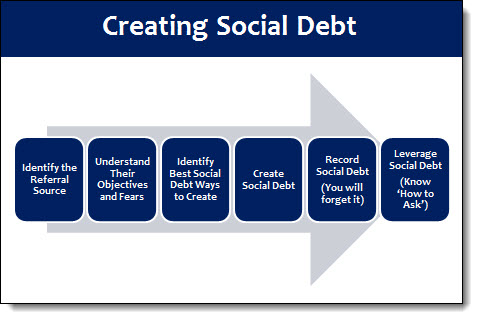
Social debt is one of the most powerful tools to obtaining new referrals. In this blog, I will cover 5 different ways that you can create social debt. Follow these tips and you’ll be swimming in referrals for 2014.

LinkedIn referrals are also dependent on a few more things. First, you need to have a strong LinkedIn Profile. Secondly, you need to spend time on your network to create extensive LinkedIn Reach. The two articles I wrote on these subjects (linked earlier in this paragraph) can help get you there.

create social debt

The 5 Most Effective Ways to Create Social Debt

1)   Provide a warm introduction to a dream prospect. Everyone you know is working towards a professional goal. This goal may be a revenue quota, or something else entirely. In the majority of these cases, these people have dream prospects. There’s someone out there who they would love to sell to. In some cases they may have been trying to secure a meeting for years. Can you connect them to this prospect? If so, you’re looking golden for referrals down the line.

2)   Help with a professional job search. Individuals in your accounts are naturally going to move around. Just like you, they are seeking the next career opportunity. They want to experience upward mobility and professional success. If you help get them closer to their dream job, you’ve successfully created social debt. Scour your connections and see how you can help. It could pay off for both parties in the long run.

Succeed with the Social Debt Tracker

SBI’s 7th Annual Research Tour is underway.  One core area of focus is social selling. This article is exploring one more way to get your sales team engaged in social selling. To learn more, sign up for the on-site session for your leadership team.

How to Make Your Number in 2014: A Sales Strategy you can execute.

You will also be able to download the Social Debt Tracker. This tracker will help you take stock of the social debt you currently have. You will export your tagged connections from LinkedIn by Persona. After this, the Tracker will help you understand the debt you have with each Persona. This will indicate where you’re succeeding and where opportunities are still available.


Social Debt Tracker


Evolve with the industry to make your number. Now back to creating social debt…

3)   Introduce a qualified candidate for an open position. Any good manager will tell you that they’re only as good as their team. But rarely will they tell you that their team is flawless. They’re often seeking to fill an open position, or replace a weak link. You’re likely connected to a few executives on LinkedIn. Do you know of anyone who could contribute on their team? If you can fill a need for them, they’ll do their best to fill one for you. Social debt and referrals are on the horizon.help others succeed

4)   Generate professional visibility. As I just mentioned, everyone is looking to take another professional step. They’re working hard and probably achieving great things. However, these achievements might not always be noticed. In that case, their great accomplishments is not garnering the proper attention. What can you do for them? Can they speak on your next webinar? Can you feature them in a blog post? Anything along these lines will create social debt.

5)   Connect somebody to a professional peer. C-Level positions can often be very challenging and lonely endeavors. Since there are very few (often just 1) of these positions per company, C-Level execs have no one to discuss difficulties with. Do you know another C-Level exec who is having similar difficulties? If so, you could connect them. All of a sudden, both C-Level execs are indebted to you. You’ve swooped up two new referral sources in one stroke.

Social debt is really about helping others to succeed. If you help them, they are likely to help you. Staying dedicated to these methods of creating social debt will pay off. Concentrating on social debt now paves the way for a strong, successful 2014.

Download the Social Debt Tracker today to get started. It’s never too early (or too late) to find new ways to make your number!

Author: Tony Albachiara

sbi on linkedin

Follow @TonyAlbachiara

Follow @MakingTheNumber

If you enjoyed this post, get free updates by subscribing by Email or RSS.

30 Sep 20:32

5 Simple Secrets to B2B Lead Generation on Facebook [SlideShare]

by Shannon Johnson

5-secrets-b2b-lead-gen-facebook-promo-image-w-checklistI once went to a marketing conference. I don't remember the name of it.

What I do remember is that some smart person presented about the difference between B2B and B2C marketing. Smart Guy said, "B2B is still P2P" (meaning person-to-person, not peer-to-peer illegal downloading ;).

The thing is, I don't remember his name either, so I can't give him credit. Now, I like to strut around the office poofy-chested and pretend I came up with it ... though at the time, I was placing palm to forehead and wondering why I wasn't the cool person who strung those four words together. It's so simple. 

Yet a lot of us B2B marketers still get hung up on what to say and how to act in social media. It's as if selling to people who work at companies somehow regresses our interpersonal skills. It shouldn't. There really isn't that much of a difference, and we can rejoice knowing that we can continue going about business both online and off just as if we were speaking to one another -- in person -- over a BBQ frisbee and some iced tea at California Pizza Kitchen. 

And we've seen first hand how successful you can be on social media if you think of B2B like P2P. The HubSpot Facebook Page has amassed over 570,000 fans and generated 190,000 leads, and we’ve done that by focusing on people. We've also learned a few things along the way about what types of content to create and share on Facebook to generate those fans and leads. 

But you know how this whole inbound marketing thing works -- you share your secrets with your audience. So that's what we're gonna do today. Take a cruise through the SlideShare presentation and blog post below to see what secrets we've uncovered. And, if you want to get your own copy plus a printable tip sheet, click here.

1) You Don't Need a Facebook Strategy. You Need a Content Strategy.

At HubSpot, we create content like blog posts, presentations, templates, and ebooks that aim to make the jobs of marketers easier. All this content creation arms our social media manager with a library of resources to promote in unique ways on Facebook. Without all this helpful content, we'd simply have nothing interesting to post or advertise on Facebook, and we sure as heck wouldn't generate any leads! You can't play Scrabble without any letters, now can you?

2) To Generate Leads, You Can't Only Post Lead Gen Content.

It just doesn't work. The key to generating leads on Facebook is to post a variety of content that will sometimes address goals other than generating leads or driving sales. Aiming for “fluffier” goals like reach, awareness, buzz, customer satisfaction, and engagement (comments, likes, shares) are just as important as rigid lead gen or sales goals. They’re the stepping-stones to what you really want: more business. That’s why a balance is so important. No eyeballs --> no clicks --> no leads for you. 

3) Have a Non-Lead Gen Goal for Every Post.

b2b_facebook_lead_gen_whaddaya_mean_goals_other_than_sales_

Although our ultimate goal on Facebook is to generate leads all the leads all the time, we have immediate engagement goals for each post we publish, and those goals can vary. You can't always address them all with one post. Sometimes we really want to encourage comments because we want feedback. Other times, we may strive to for a high volume of shares because we want a particular message to spread as far and wide as possible. We first focus on those eyeballs --> then we get those clicks --> then we get those leads. 

4) Whatever You Do, Don't Skimp on the Visuals.

We may not always be sure what we’re posting will incite the interaction we desire, but one thing can be sure of is we’re better off posting a photo as opposed to a link, video, or plain ol’ status update.

In a recent 30-day experiment, we found that the click-through rate of posts containing photos is 128% higher than the CTR of posts containing videos or links. We also know photos on Facebook generate 53% more Likes than the average post. That's why, no matter what we’re trying to communicate, we try to do it visually. If our social media manager doesn’t have a pre-made image to work with, doggonit she’ll spend the time creating one or she's banned from the beer fridge!

5) Oh Yeah ... You Probably Gotta Advertise.

The people who “Like” our company already know about us, but that doesn’t mean they even know what we sell, or that they’re ideal future customers. Even though we’re approaching 600,000 fans, only a fraction of those people actually have the need and authority to buy our all-in-one software.

That’s why we also pay to reach marketers who fit our target and are not yet connected to our page using various types of Facebook ads. But even though we advertise, we're not advertising our software. We're advertising all that helpful content we created. Jay Baer calls this pro tip "marketing your marketing." You're gonna wanna do that.

These are just a few tips we have to create engaging Facebook content for B2B brands. Want to get more resources so you can do it yourself? Click here to download our presentation above and a printable tip sheet to help you produce engaging content every time you post.

free facebook lead gen guide

subscribe to the hubspot marketing blog

30 Sep 20:12

How GE Makes Big Brand Content Feel Up Close and Personal

by Michael Weiss

brand content-GEHow does the third largest company in the world connect with customers? In a recent interview, Linda Boff, GE’s Executive Director of Global Brand Marketing, explained how the brand uses grassroots events and digital owned moments for engineers, technologists, and inventors to create brand content that uncovers the “maker” in all of us. 

Michael Weiss: GE is a massive company, and yet the brand content you’re producing feels very accessible. Is that intentional?

Linda Boff: It’s extremely deliberate. The more people know about us, the more interested they are in partnering with us, investing with us, and coming to work with us. So being accessible — being human and approachable — was a huge goal for us from day one. It’s not something we stumbled upon.

We are blessed with the most enlightened CMO on the planet, Beth Comstock. She doesn’t just support us, she eggs us on. When I returned to GE after three years as CMO at iVillage, I was all charged up by the power of community. GE.com was still a walled garden. Building communities of passionate stakeholders became a burning platform for me. How do we engage? How do we show people in the world who love science, tech, and invention who we really are?

The culture of GE is unbelievably strong. People who work here have a passion for what they do. And we have the great privilege to market things like renewable energy and affordable health care. We are solving tough problems, and to be able to share that passion with people who are excited about the space we are in is very intoxicating.

Weiss: GE is such a household name. Some may think you don’t really have to sell the brand name.

Boff: Ten years ago if you surveyed people, they thought of GE as a lighting and appliances company. In the 12 years since Jeff Immelt has been chairman, people increasingly associate GE with health, energy, transportation — which is important since lighting and appliances are a very small percentage of our overall business. Jeff has transformed GE into a new kind of industrial company. Part of our job in marketing is to make sure people know GE is a leader in these exciting high-growth industries like health care and energy.

People can have an awareness of a brand but not familiarity. Familiarity is so important. When you engage with GE on social media, we are increasingly focused on transportation, health care, energy, aviation. And we love the passion these industries evoke!

Weiss: Tell us about GE Garages. Was it hard to get buy-in?

Boff: Let’s say that I pitched it more than once. The truth is we have incredible research centers around the world, but the general public doesn’t get to walk around and see what our scientists are doing. There’s incredible work going on in these places. These are the same labs that go all the way back to Thomas Edison. We wanted to give people a taste of what they would experience in our labs.

We also leaned in to the hardware-meets-software moment. The “maker” community (think: engineers, technologists and tinkerers of all stripes) is so robust. Our Garages give people the opportunity to learn about us, and roll up their sleeves to do welding and 3D printing. We launched GE Garages at South by Southwest. It was incredible. The weather was like a monsoon, but the space was mobbed. One young woman spent hours and hours there. Her father told us the experience changed what she wants to do with her life.

We had an insight, and we matched it with an opportunity. It’s been a great way to make the brand real. Every marketer should get that lucky. And the reaction has been phenomenal.

Weiss: Which content marketing tactics do you use, and which are resonating more?

Boff: I think about that more than anything else. There’s that line we’re all aware of: Where do you place your big bets, and where do you experiment? What we’ve tried to do is be nimble where nimble makes sense. For example, two years ago, I wasn’t sure about Instagram. A young woman on the team said, “I think it would be great to experiment with Instagram and show the beauty of our industry.” I thought, “It’s not going to cost a lot. Let’s try it.” As a result we were a very early brand on Instagram, and we’re very proud of it. It’s not a big-dollar commitment or people commitment, but we’ve been very accessible on Instagram. It feels very up close and personal.

But your question points to an everyday challenge. Where do you experiment? Where are you nimble? Where do we pour consistent resources to ensure we’re telling the great stories around big GE initiatives? It’s a balance.

Weiss: Instagram is an interesting example because I would think those are not your target demographics.

Boff: We evaluate channels by looking at audiences. It’s easy to be GE and say, “We want to talk to anyone.” But in truth the people we want to talk to most are business decision-makers, tech enthusiasts, and potential employees. With that as a lens, it becomes much easier to say, “On Instagram we are hitting tech enthusiasts and would-be employees.

We have increasingly gotten into the software game, partnering with tech companies to do more venture funding. Something like Instagram offers a great, targeted niche audience. All of our content and social efforts are about finding the right audience, not the biggest audience. On Facebook we are closing in on one million fans. If that’s what it should be, great. I’m not coveting Coca-Cola’s 20 million fans.

Of course our CMO sees our video view counts and asks, “OK, but what’s Psy up to these days?

Weiss: You mentioned balance. You’re clearly managing a lot of owned brand content, like in-person events. I know you also do a lot of paid. How do you know how important one type of media is versus another?

Boff: I have been wanting to find or create a formula for what I’m about to tell you: We have gotten really good at spending $10 on paid media and then sprinkling another one dollar of earned/owned amplification. That 10 “paid” plus one “earned and owned” equals about $25 of value. Of course that’s a bogus formula, but you get the idea. Paid alone is yesterday’s game. I know it in my bones. It just doesn’t work that way anymore. It’s dopey to interrupt people. If you get lucky, it’s only wallpaper. If not, it’s really annoying.

Now, whether you can catch fire… you really can’t plan for that. We can take great content and find ways to amplify it through multiple channels. That’s as much as what we can do to spark virality. Because we moved into permission-based marketing, the idea “spray-and-pray” has lost its luster.

This article originally appeared in the August 2013 issue of Chief Content Officer. Sign up to receive your free subscription to our quarterly magazine.

30 Sep 20:12

How to Battle 7 “Sins” that Derail Content Marketing Success

by Dennis McCafferty

devil-angel-sins and absolution-successful content marketingThey push for a “hard sell” when the target audience isn’t looking for an advertisement. They’re passive-aggressive about critical deadlines. And they’ll never tell you what they want when they demand a redo on content you produced (they only give less-than-constructive criticisms, like, “I Hate Hate Hate it!” before bouncing it back to you. Grrrr…).

Content marketing professionals serve challenging clients and internal stakeholders like these all the time. Fortunately, most clients are perceptive enough to recognize their shortcomings, and try to manage them without impacting the quality of the work itself. But the reality is that there will always be those who impose obstacles that can threaten any chance they have of achieving content marketing success. 

According to the Content Marketing Institute’s report, B2B Content Marketing: 2013 Benchmarks, Budgets, and Trends-North America, only 36 percent of B2B marketers say they are effective at content marketing. As any content marketer can attest, all it takes is one difficult client and/or internal corporate stakeholder to make it feel like content success is unlikely, if not impossible.

With this in mind, let’s take a look at the top seven “sins” of challenging clients/internal stakeholders to successful content marketing, along with some expert recommendations on how to defuse these situations and move forward in the right direction:

The sinner: The sales director who insists that every piece of content must “sell, sell, sell.” For her, great content looks, reads, and smells like an advertorial. You, however, realize this will kill chances of placement success and target-audience engagement.

The path to absolution: Demonstrate that the competition for the audience’s attention is immense. According to data compiled by Contently.com, there are 1.6 million blogs, 140 million Tweets, 1.5 billion Facebook content posts/status updates/comments, 2 million videos and 5 million images created every day online. Oh, and there are 60,000 new websites added every 24 hours, too.

Because there’s so much content out there, users are especially quick to detect corporate shilling thinly disguised as helpful content. “In a businesslike manner, you need to explain how we live in an age in which people open their mail over garbage cans and watch TV with their thumbs ready to press ‘fast forward’ on their DVR once the commercials start,” says Rachel Parker, President/owner of Houston-based Resonance Content Marketing. “If they get the slightest inkling that your content is a dressed-up infomercial, they’ll be clicking on the next blog or eNewsletter or video.”

To present a winning alternative plan, turn the tables and “sell” said sales director — on the reality that the audience primarily seeks to learn from brand content. The voice of respected authority always trumps that of a self-serving vendor. “You introduce evidence that the best way to increase sales is to advise, enlighten, and share,” says Lisa Tilt, president of Full Tilt Consulting, a brand development/marketing firm in Atlanta. “You convince [that] sales director that you’re in competition for the audience’s trust, which you gain through your teaching, not your selling. Then, you build upon it by being highly personal, inventive and interesting.”

The sinner: The COO who insists that every single “brilliant” word he has ever written must be included in content — even if that content is a 300-word blog post.

The path to absolution: Actually, this is easier to resolve than you’d think. In fact, you can turn it into a “win-win” by breaking up the COO’s luminous ponderings into individual pieces. If it’s a blog or podcast, make it a multi-part one. Or suggest that you repurpose the material as something more ambitious, like a white paper. If you go this route, the blog can serve as a short teaser to draw the target audience to the longer paper.

“By proposing this, you drive home the message that words of wisdom will overwhelm an audience if heard all at once,” says Frederic Chanut, Managing Director of Manly, Australia-based marketing agency In Marketing We Trust. “Lao-Tsu did not dispense his whole “Tào Té Chīng” teachings in one seating, but by producing a series of classes for his disciples.”

There are many benefits to this strategy. First, you generate more content to promote the brand. Second, you’ll engage verbose executives by turning them into “stars” of a series or long paper. (Flattery is your friend here.)

“Progressively distilling down the knowledge into a series of easily digestible content pieces can more effectively demonstrate, and even increase, its value,” Chanut says. “Present the idea as a prime opportunity to build the executive’s personal brand, in addition to the corporate one.”

The sinner: The regional director agreed to be interviewed for a client case study, only to clam up on the phone. He leaves you, the content marketer, feeling like you need a crowbar just to get him to open his mouth, let alone say something remotely usable.

The path to absolution: Remember what you learned in a basic interviewing class: The more open-ended the question, the better. An inquiry such as, “What do you think of the state of the widget industry today?” may work. But a terse exec will more likely open up if you provide them with some parameters, like, “Could you list three driving trends that are shaping the widget industry today?

But before you start interviewing, try to engage. These execs will loosen up if you express interest in their backgrounds and interests. Impress them with your knowledge of their career (you always check their LinkedIn profile and/or company-site biography before interviewing someone, right?). Make sure you’re up on all of the very latest industry trends and market drivers, so you can discuss them in-depth.

When you segue to the interview, don’t resort to scripted questions. Stick to important topic points, but be flexible enough to ask insightful follow-ups and even detour into a subject area that seems interesting — especially if the exec gets on a roll.

Also remember that certain executives and other interviewees may clam up because they worry, in mid-interview, how every word they utter will look in print. “This is quite common,” Chanut says. “So put their minds at ease by offering to send a draft for review. You establish very amenable ‘rules’ up front about what can be shared and what can’t. If they’re still uncomfortable, then you probably need to switch from doing a phone interview to either an in-person setting or via email. Every executive is different. Some open up in person, and others really get their thoughts flowing in email.” 

The sinner: The CFO who speaks in nothing but arcane terminology and insider jargon.

The path to absolution: A safe initial approach is to explain how a content piece loaded with esoteric “inside baseball” references is going to misfire with, oh, probably 90 percent of the potential target audience. “We strongly emphasize content marketing for building our clients’ brands,” says Caitlin Dodds, a SEO specialist with Lancaster, Pa.-based agency, Web Talent Marketing. “When we run into this, we gently explain how this kind of content isn’t going to get them any links, or engagement, or readers, or customers.”

And if that doesn’t work?

“Then I ask them, ‘What kind of content do you like to read – especially when you’re exploring an unfamiliar subject area?‘ ” Dodds says. “They realize that they’re seeking to educate, so they usually get it. They then understand that web users and readers want the same, direct easy-to-digest content that they do.”

OK, so what if even that doesn’t work? That’s when Dodds resorts to her heavier artillery:

“If I need to push the point, I’ll provide them examples that the competition has produced,” she says. “If we’re still not on the same page, I’ll suggest doing a test in which we post one blog with lots of jargon and another without. Then we compare the numbers: traffic, time spent on the page, click-throughs and more. In most cases, the data will convince them.”

The sinner: The chief legal officer who sits on content drafts and other materials needing approval right up to — or beyond — their deadlines. His frequent delays damage your relationship with industry press editors, cause you to miss industry award submission deadlines, and mess up the timing of content for product launches.

The path to absolution: Let’s start with establishing a sense of perspective on the part of you, the content deliverer. Because whenever you deal with an organization of any kind, you should keep in mind that there are often greater priorities that come up. “Your content may not be as important as a critical, last-minute, lengthy legal doc that the same team of execs must review in-depth,” says Arienne Holland, Communications Director at Raven Internet Marketing Tools, an online marketing software company based in Nashville. “Or a great video you made promoting a product’s new ‘holy cow!’ feature may go on hiatus because the tech side found an operational flaw in the feature, and IT is too swamped in trying to fix it to give the marketing people a ‘heads up.’ Don’t be angry. Be flexible.”

With the right demeanor, you can nip tardiness early by establishing ground rules in the very beginning of the process, as opposed to waiting until you’ve invested a ton of time into content creation.

“Make sure everyone knows the goals, and why they’ll benefit the product, and company,” Holland says. “Assign roles and make it clear as to what will happen if deadline targets are missed. Send status update emails to the entire team, which reinforces the accountability of all involved.”

Parker performs “end-arounds” on procrastinating parties by making it as easy on them as possible: If the content has been sitting in limbo forever awaiting corporate approval, she swings into proactive mode. “I’ll ask them how I can help,” she says. “For example, ‘Would it be easier to review changes over the phone instead of typing them into the doc? What about an email?’

Don’t be afraid to demonstrate to clients/stakeholders the consequences of tardiness, such as how much they’re losing in SEO rankings because their website content is stale. “We’ve shown them measurable losses in traffic and rankings,” says Alex Turbett, Digital Marketing Associate at allwebcafe, an agency in Philadelphia. “Showing these slips emphasizes the importance of hitting deadlines and staying on schedule.”

The sinner: The marketing VP who will only say things like, “I don’t like the way this is phrased…” or “This section doesn’t work for me,” without offering any real feedback on what she would like to see.

The path to absolution: To be candid, there really is no magic-bullet remedy here. These kinds of executives usually have overall communications issues. Or they may harbor unrealistic expectations of a content marketer’s ability to “fix” anything. (Or they could simply be impatient, self-important and not-particularly-nice people, but for sanity’s sake, let’s assume that isn’t really the case.)

But, like members of your family, you can’t pick the executives to whom you’re assigned. So you must work well and play nicely with all of them. For opaque types, try pushing the conversation just a bit by offering multiple remedies. Naturally, it never hurts to appear as if you’re on the same page with their thinking — as in: “You know what? You’re right. The paragraph always bothered me too, but I couldn’t quite figure out a better way before I had to send it along. Since then, I’ve had time to think about it, and here are three alternative routes to express the same perspective which could work…

This enables you to both empower and force the hand of the executive. The ball, as they say, is moved to their court. So you’re setting up the outcome you seek, while aligning yourself with the executive instead of potentially alienating him or her with an even slightly confrontational response.

But what if the exec replies with something to the effect of, “I don’t have time… are you asking me to do your job for you?” In this case, it’s safe to say that you have a very tough nut to crack. The exec is essentially saying, “Use your judgment and don’t bother me,” which is exactly what you should do: Suck it up. Trust your instincts. And try, try again until you hit the right notes.

The sinner: The CEO who feels his product/service is so clearly superior to any others that even the highest-profile content outlets should be knocking down his door to cover it. He perceives of anything less than a profile in Forbes to be a failure, even when content placed in lower-profile industry press would reach his target audience more successfully.

The path to absolution: This seems like a perennial problem with clients/internal stakeholders. On the one hand, these execs demand ROI on their content spend. But on the other, the placements that generally deliver the best ROI aren’t really the sexy ones. And let’s face it: Every CEO’s bucket list probably includes, “Get my head shot printed as one of those ‘dot’ portraits on the front page of the Wall Street Journal.

You can counter hubris with (surprise) an appeal to the ego. True, the marquee placements are great. But they’re typically one-offs. You have your day in the sun, and then the heavy media hitters move on to tomorrow’s cover story. With niche publications, on the other hand, you build opportunities for residual, routine placements — perhaps as a regular columnist or blog/executive byline contributor. And this can often trigger eventual placement in the A-lister publications (especially if you explain that the writers and editors at the top-tier media outlets often come up with their topic ideas from the niche ones).

“I explain that smaller press leads to bigger media coverage down the line,” says Adam Grunwerg, Managing Director of Searchable.co.uk, a digital-marketing firm in London. “If you demonstrate how you constantly position yourself and your company as a brand leader in a smaller outlet, then you’ll gain the traction with the bigger ones. Especially when the stories on the smaller sites are shared with larger ones. But you have to present a convincing case that a time investment is required, and that starting with smaller news stories and blogs greatly helps.”

Love the sinner (thereby fixing the sin)

Ultimately, the secret to dealing with the “sins” committed by difficult content marketing clients boils down to a lesson that’s literally as old as the scriptures: Follow the Golden Rule. Yes, you were hired for your content-marketing savvy. But you can’t just steamroll clients and other stakeholders into following your path to content marketing enlightenment. You’ll likely find that defaulting to kinder, gentler, and more gradually paced tactics will ultimately produce greater payoffs.

Perhaps Caitlyn Dodds says it best: “Having the right attitude makes all the difference. When you’re patient and understanding, your advice and ideas go much farther than they would if you attempt to force them upon people. After all, they are paying your salary.”

For more ideas on how to break down the barriers to successful content marketing, read Joe Pulizzi’s new book, Epic Content Marketing: How to Tell a Different Story, Break Through the Clutter, and Win More Customers by Marketing Less.

Cover image via Bigstock

30 Sep 20:10

Social Selling Doesn’t Work When It’s The Last Day Of The Quarter

by Gerry Moran

Does using social selling techniques make sense when it’s late in the quarter and you need to achieve your quota? Especially when your sales manager is telling you to do everything to close your deals? Aberdeen Group research states that 31% more sales teams achieve quota when they use social selling techniques, so it makes sense. Well, social selling is good, but not THAT good that it can be instantly turned into sales. It’s no silver bullet when it comes to helping you close sales today, over the next five days, or whatever your timeline is. However, if you implemented a solid social selling strategy during the previous 90 to 180 days, then your last-minute calls today might be more successful. Or, those last-minute calls could even have been avoided! You see, the payout of your social selling strategy is more long-term than short-term.

Social Selling Doesn’t Work When It’s The Last Day Of The Quarter image coldcallobjection

“I should have started using social selling earlier.”

A good analogy is being hungry and addressing that urge. In the short term, you can run to the fast food restaurant to solve your hunger. However, that short-term solution is costly and is not sustainable. Alternatively, with proper planning, you can create a shopping list so you can visit a grocery store to buy healthier, less expensive and more food to eat for weeks. No, it’s not as convenient as running to McDonalds or Red Lobster, but it pays out in the long run for you – more food, cheaper food, more convenient food.

Social selling has its place in each part of the sales cycle. To maximize social media at the end of a quarter, you need to have been using it well before you need to close the deal!

5 Things To Do With Social Selling To Help You Meet Your Sales Quota

  • Improve Your Curbside Appeal Before You Try To Sell The House! Face it, when people meet you for the first time they check you out on social media. Whether they further investigate the credibility of your LinkedIn Group posts, emails, blog post or Tweets they check out the source, which is usually your LinkedIn profile, Twitter profile and Google search results. Make sure you tune up your profiles to your social brand’s curbside appeal is the best that it can be so you can advance your social selling customer relationship.
  • Establish Your Credibility As A Solver, Saver or Revenue Generator. Yes, you can try to meet you entire quota by sending emails and making phone calls. But he buyer journey has changed. 70% of the buying decision is made before a customer ever engages with you. They use blogs, tweets, LinkedIn and their network to help make this decision. And, 89% of them start their buying process using a search engine. So, you need to be present to win. And by winning I mean that you need be establishing you credibility with your current and future customers by delivering relevant content for which they are searching.
  • Connect With Your Customers On Their Terms And Show Them That You Get It. Your customers are on LinkedIn, Twitter and blogs, so you need to be there, too! There is no excuse that you do not know how to tweet, or how to use tools to find where your customers are engaging on social media. Put on you CSI hat and fire up your social selling forensic skills to surprise your cusTtomers to be where they are with a relevant and solving content. If they use Twitter, then be on Twitter. If they are a contributing member of a LinkedIn Group, then find and engage, in a non-selling way, in that Group. And if they blog, be a regular reader and commenter on that blog.
  • Get Your Customers To Do Something That Gets Them Closer To Making A Decision. Social media is the secret sauce of selling tools. It is a non-intrusive way to pass on customer-centric calls-to-action. Here are give things you can do to get your customer to move closer to a decision, whether it’s attending an event, a webinar or accessing content:
  1. Send a Twitter mention to a customer with a link to a registration page or blog post
  2. Reference a content or event link in your LinkedIn Group messaging
  3. Send a link to a blog post via a direct message on Twitter
  4. Use your two daily LinkedIn updates with a direct call to action to your followers
  5. Mention your customer in your tweets that reference content that will be helpful to your customers.
  • Help To Support Your Customer’s Decision With Social Selling Content. Once your customers are close to making a decision, they are still doing their last-minute vetting by checking blogs, communities and their personal network. Customers are searching for specific answers to specific requirements. They are asking questions to help them validate that they are making the best decision. Social sellers need to forward blog posts, tweets and any other socially delivered content on channels other than email and telephone to show them that they are making the best decision. Think of this content pass-along as a gentle reminder that will break through the barriers that standard communications channels pose.

Do you have another end-of-quarter tip to use social media to help others close on their quota? If so, then please share your idea below. Or, contact me directly on MarketingThink.com or @GerryMoran on Twitter.

If you found this social selling advice helpful, then you might also want to add these tools to your social selling tool kit:

  1. How to get found more easily on LinkedIn
  2. How to make sure your Linkedin profile picture is not scaring customers
  3. How to tweet better to sell more
  4. How to prospect with Twitter
  5. Social selling anatomy of the B2B decision maker

Social selling is not selling better; it’s selling differently. With the buyer journey changing, sellers need o be changing too and relying less on the stressful quarter-end tactics of phone calls and emails. Connect with your customers and prospects with social media early in the process and you will lay the foundation to your social selling success!

30 Sep 20:10

A Monday Morning Massive Attack of Marketing Lessons

by Eugene Farber

I think it’s safe to say that at this point, my brain works much differently than most people’s.

While most people’s “Lizard Brain” sends them subconscious signals for primal needs. Like…

“I’m hungry”
“I’m scared”
“That’s my towel…don’t touch it” (what?)

Mine just usually sends me one signal: “There’s a marketing lesson in that…”

Sick…I know.

Last night the girlfriend and I went to see a performance by Massive Attack. A lot of people have probably heard their music simply because one of their songs was used as the theme song for “House.”

A Monday Morning Massive Attack of Marketing Lessons image massive attack v adam curtis

Their music wasn’t even the focal point of the night, however. We stood in the middle of a room, surrounded by screens showing a film. And Massive Attack’s performance set the soundtrack.

Really, it was one of those “artsy fartsy” things you could only find in a city like NYC.

But it was intense!

It told the story of how countries like the U.S., Russia and Afghanistan got where they are today due to the desires of those in charge to “manage society” and “avoid risk.”

Basically, I took it as an anti-propaganda propaganda movie.

There were certainly some pitfalls in the arguments the film made. And I don’t really agree with all of their political stances (to put it lightly). I just like their music.

Plus, if I boycotted all the musicians who I didn’t agree with politically I’d have nothing left to listen to :) . That’s not the point of this post though…

This time, I agreed with the overall message. And that brings us to the first marketing lesson…

Lesson 1: Give people what they want by entering the conversation in their head.

There are two ways to get people to take a desired action (in business that action is to buy from you).

The first is to tell them what they already want to hear, and what they already agree with. That’s why news networks are so damn profitable. None of them give real news, they just give opinions their target audience want to hear (because they already believe them).

The other way is to convince those that disagree with your view point that yours is the right one. While doing this will likely create much more loyal followers, it takes a lot of effort to create a paradigm shift in someone’s head.

Targeting the former is certainly more realistic.

Moving on…

Lesson 2: Tell a story…and personify

The film told the story of how we got here. But it didn’t focus on countries. It focused on specific individuals.

For example, it didn’t tell the story of what happened to Russia as a country. But rather followed the story of a punk musician named Yegor Letov.

This is really a classic copywriting technique that worked extremely well in this case (as it usually does).

It’s easier to relate to a specific individuals, than the history of an entire country. It humanizes things. Makes you feel more connected.

That’s why case studies work so well.

Speaking of humanizing…

Lesson 3: That data point is human

A story of how we got here isn’t complete without the financial collapse half a decade ago.

The film recounted how bad loans were made to people who couldn’t afford them. They were then packaged with other investment to “dilute” the effect of the bad loans.

Probably seemed like a really good idea at the time.

But as the movie claims…and this makes a lot of sense…we are a society obsessed with data. And that’s what these investment packages were viewed as: data points in cyber space.

Everyone neglected the fact that there were real people at the end of those data points that couldn’t afford to pay their loans back.

Data is, of course, extremely important in business and marketing.

We are always trying to increase opt-in rates. We are always trying to test to see which button color is going to increase that conversion rate.

But at the end of the day, it’s important to remember that the “conversion” is a person with goals and desires.

And that brings us back to Lesson 1 :) .

Over to you

With that in mind, I want to get to know you better. Shoot me an email and tell me something about yourself or about your business.

What are your goals? What are your fears? What’s your favorite cheese?

Anything you want to share is fine.

Looking forward to your response,
Eugene

P.S. Although this film made data seem like an evil being controlling our lives, it’s really just a tool. And like all tools, it depends on how you use it.

It can be used the “Wall Street” way of forgetting there are people on the other end. Or, you can remember that each new “subscriber” is a potential new client or customer whose life you can change for the better with your product or service.

And that’s what I am trying to do with my [CSH] Premium Newsletter. I know that the people who sign up are business owners who are serious about taking steps to improve their marketing, and thus their businesses. And when they do that, they can help others in turn.

30 Sep 19:59

How to Map Your Sales Funnel (And Rock Your Content Marketing)

by Gigi Griffis
How to Map Your Sales Funnel (And Rock Your Content Marketing) image map content to your sales funnel

Image Credit: zabdiel

A few months ago, we talked about creating content for the top, middle, and bottom of your sales funnel.

We also told you that the sales funnel has changed and looks more like a maze than a funnel.

And we recommended that every content marketer address each stage of the sales funnel with consistent, quality content that focuses on users and what they need at each stage of the buying process.

Today, I want to talk a little more about your sales funnel—and how to map it out.

Step one: figure out your funnel

Before we can talk about where your users, teams, and tone of voice fit into the sales funnel (all of which are important things to understand), we need to know what it looks like.

The top of your funnel is the first contact users have with your brand. In many cases, this first touch-point is usually social media, an infographic, a video, or a blog. For others, events might be the first domino in the sales process. And for still others it may be customer referrals or review sites.

The middle of your funnel, where buyers have already given you their contact info and expressed interest in your product or service, is usually full of email marketing, blog posts, eBooks, and other content designed to provide deeper education for your prospective customers and remind them that you’re there.

The bottom of your funnel (or the really qualified leads) is some of the last contact your users have with your brand before they buy. Often, the content in this stage of the funnel is very personal and is controlled by the sales team. Personal phone conversations, emails, content selected for this specific prospect.

And then there’s post-sale—where many companies let up on their efforts, having already earned a new customer. There’s still a lot of opportunity here to create future sales, testimonials and positive reviews, and brand advocates.

Which means when you’re mapping your sales funnel, don’t forget to map the post-sale as well.

Post-sale content may include further content marketing pieces (blog posts, eBooks, etc.) that meet the known needs of your audience, follow up emails from account managers or customer service, and content that requests feedback via poll or survey.

Okay, so you’ve got a sketch of a funnel…now what?

Once you have an idea of what paths your users are taking to get to know, buy from, and love your brand, it’s also important to be strategic about each stage in that sales funnel.

Here are a few key questions that will help you better understand and create content for each stage of the funnel:

  • What are the business’ goals of this stage in the funnel?
  • Who is looking at content at this stage of the funnel? (Who is our target audience?)
  • What are the user’s goals at this stage of the funnel?
  • What is the emotional state of the user at this stage of the funnel?
  • What kind of content is relevant for this stage’s goals, audience, and mindset?

Once you’ve written out your sales funnel stages, audiences, goals, and mindsets, it becomes much easier to figure out what kind of content belongs, what tone is appropriate, and where that content should lead.

Multiple audiences often mean multiple funnels

Keep in mind that when it comes to content marketing strategy, everything should be customized to your business goals and user needs. Some companies will have a really simple funnel with a well-defined top, middle, bottom, and post-sale. Others will have multiple sales funnels that meet the needs of different user types.

For example, if you’re creating content for a university, you might be addressing parents, prospective students, current students, alumni, donors, and faculty. All of these audiences will have different needs and likely the business will have different goals for each one. This means that there are probably a number of sales funnels to be mapped and each might look just a little bit different.

What comes next?

Once you understand your sales funnel, it’s time to map your teams to each stage, hone your process, and use that information to better serve user needs and meet business goals.

30 Sep 19:59

How to Create the Perfect “What We Do” Statement for Your Inside Sales Team

by Laney Pilpel

How to Create the Perfect “What We Do” Statement for Your Inside Sales Team image j0433139 resized 600Anyone who has ever made cold calls or managed an inside sales team knows these infamous words from prospects: Who are you and where are you calling from again? This is likely the first type of objection immediately after you have introduced yourself to a prospect over the phone. The best thing to do is always be prepared to answer this question quickly, with confidence, and without hesitation. The question is, though: How do you create that perfect what we do statement for your team?

Within the first 30 seconds of a cold call, you’ve introduced yourself to your prospect and you have most likely confirmed that they are the most appropriate person to whom you should be speaking regarding the pain points that your product or service addresses. Once you’ve done that, odds are that they have inquired more about your company. The key is, you want to give them enough to strike some interest, but you don’t want to give them too much where they have the option to hang up on you and throw out the “I’m not interested” objection right away. Your goal in creating a what we do statement is to guide your prospect down the path leading to probing questions and qualification questions. This will allow you to further explore their environment so you can reach your ultimate goal of deciphering whether or not your product or service can help them, and if it makes sense to take the next step in the sales process.

So here it is, my “to do” list when it comes to creating the perfect what we do statement:

Make it quick. Keep the statement to 2 sentences, max.

Be succinct. Get to the point with a crisp, clear message that doesn’t allow for the prospect to be confused.

Eliminate weak words. Remove words like “hoping,” “wishing,” “wanting,” “kind of,” and “sort of” when it comes to actually delivering the message. I cringe when I hear these words and I immediately hang up. They scream uncertainty and demonstrate a lack of confidence.

Leave your ego at the door. Do not boast about you or your company in this statement. It is extremely off-putting and quite frankly, prospects don’t care – they care about their environment and how you can help them. Discussing awards and other accolades can come later on in the conversation once you have peaked their interest.

Follow up with a transition question. Avoid that long, awkward pause after you have delivered the statement. It gives your prospect the chance to throw out an objection. Instead, take a quick pause and follow up with an open-ended transition question that will lead the prospect into talking about their existing environment.

From working with clients and from receiving cold calls from prospects directly, it’s interesting to hear what companies believe their what we do statement should be. I’m not saying there has to be a right or wrong answer here, but I do believe that there are some key do’s and don’ts when it comes to creating the right statement for your business. What is your what we do statement, and is it leading to the number of opportunities you are striving towards?

How to Create the Perfect “What We Do” Statement for Your Inside Sales Team image f5bfcdf6 ed55 4abc 82ca 59a05f9f81865

How to Create the Perfect “What We Do” Statement for Your Inside Sales Team image 07f0bf66 1dcb 40ea acd9 7c4ff5605ab012

30 Sep 19:58

How To Turn Your Sales Team Into Mutants—the Good Kind

by Olivia Cole

How To Turn Your Sales Team Into Mutants—the Good Kind image mutantThe way Hollywood tells it, you have to be the victim of a toxic waste spill or a scientifically enhanced spider bite to be capable of miraculous feats of awesomeness. We know many a sales manager has looked at a lackluster sales team and thought—to themselves, not out loud—“What I wouldn’t give for a little toxic waste right now. The good kind. The kind that would turn my sales team into sale-closing mutants.” And who can blame them?

We’re here to tell you that you can have a freakishly efficient (and successful) sales team without exposing them to the almost certain risks of noxious chemicals or untested spider venom. The key is splicing not genes, but strengths. Your agents’ skills paired with voice-based marketing automation tools will get you the right kind of mutant.

Speed Meets Need

Your agents may be great at pitching your product/service to potential customers, but if they’re not getting to the phones fast enough, they may be throwing away your leads. Advanced call forwarding options erase this problem. With the ability to forward calls to an agents’ cell and office phone simultaneously, ring several agents’ phones at once or in a specific order, forward calls based on your office schedule, etc., you don’t have to worry about important sales calls going unanswered. Your agents’ skill of providing the information prospects need, spliced with the speed offered by advanced call forwarding creates one heck of a combo.

Web Leads Meet the Whisper

Your agents are used to following up with leads that submitted their information in a Contact Us form online. But what if they didn’t have to go out of their way to be connected with those leads? For many businesses, web leads slip between the cracks because they get lost in the tornado of other prospects who might be calling your business directly. What if, instead of having to follow up with web leads separately, you gave your agents the ability to be connected automatically with leads that submit to a web form online? You can, you know. When web visitors complete a form online, voice-based marketing automation tools can immediately call your sales team, “whisper” the leads’ information to the rep, and then (if the rep accepts the call) connect the two in conversation instantly. Your agent doesn’t need to do anything fancy. The ability is built in.

Alignment Meets Awesomeness

Sure, your sales team is awesome. But they could be more awesome. How? By splicing their talent with talent from your other teams. The companies with the smoothest processes are those that can boast of departmental alignment. When your business is well-aligned, marketing can pass lead source data to sales when they get an inbound call; sales can pass lead lifecycle data back to marketing to optimize programs; and support can access complete customers histories and sales call recordings to improve service. What’s better than one department of freakishly efficient employees? An entire company full of them.

Want to know more about using voice-based marketing automation tools to turn your sales team into sale-closing mutants? Download the free Definitive Guide to Voice-Based Marketing Automation. No registration required.

30 Sep 19:58

Getting Sales Out of the Social Struggle

by Lawrence Anderson

It doesn’t take long to find out that social media challenges businesses to go where traditional marketing has never dared to venture. Before the technology existed, it has always been rather impersonal and plans were based on mass collected results instead of the individual customer experience.

Clearly, the playing field has changed. Through social media, one customer’s complaint can soon blow up into an entire movement that could topple your organization.

Now for consumer businesses, a disaster like that is still easier to handle since interacting with customers is already part of their experience.

But for B2B organizations and enterprise software vendors, I find that even giants like Oracle don’t always do it right. Then again, it’s really not that surprising. From LinkedIn to Facebook, social media can be a struggle for industries that normally don’t express much of their social side.

Think about it. When you say ‘social’, you’re thinking celebrity profiles, controversial tweets, or promo events from your favorite fast food chain. There are examples of good B2B pages too but it’s hard to say if this is still comparable to what Starbucks or Disney have already done.

Getting Sales Out of the Social Struggle image posts status about socially awkward penguinOne might even say that B2B companies are just ripping off the B2C examples. This just further demonstrates the difficulty given that the nature of B2B business hasn’t really left much of a social side for them.

Still, putting that social side can be quite simple if you implement the following.

  • Emphasize the ‘person’ in salesperson. – Some common mistakes in social media marketing involve spamming. That includes spamming for connections or spamming the newsfeed with ads. Instead of that, just be more active in reaching out. Search and communicate as if you were in an actual networking event
  • Be as real as you can get – The more anonymous you are, the less successful you’ll be. How do you expect potential clients to trust you if nobody in your company wants to show their faces? What about your products? Being cloud-based is no excuse (just look at Salesforce). Your social media presence is supposed to represent a real company so be as real as you can get!
  • Yes, you have a lighter side – It sounds awkward but it goes well with trying to be real. You can’t get any more real than giving your followers the occasional glimpse of your office. If there’s an event at work, don’t hesitate to put some pictures. (Although, you obviously have to set some boundaries for the sake of good PR).

Social is now an important element in marketing and it is here to stay. However, you won’t have to struggle so long with the alleged ‘norms’ if your business is not just a business but a group of real people your customers can count on.

Getting Sales Out of the Social Struggle image ERP16

30 Sep 19:58

Get Sales Coaching Happening – Target Trigger Events

by Richard Ruff
Get Sales Coaching Happening – Target Trigger Events image images22 150x150

Sales Coaching and Trigger Events

People who are knowledgeable and experienced in sales excellence know sales coaching is worthwhile; it can make a difference; and it needs to be a priority. Sales pros agree sales coaching is a necessity if you want a world-class sales team.

While most sales leaders agree about the importance of sales coaching, most also admit “the job isn’t getting done.” Many great companies start coaching initiatives with tremendous energy and commitment. Far fewer exit the other end of the tunnel.

Two developments increase the urgency for a renewed dialogue about getting coaching to happen.

  • Sales force performance is a bigger piece of the competitive advantage puzzle. Presently, it is extremely difficult to sustain a competitive advantage by product alone. Even if you have a winning product, the competition is likely to get a product to market that is just as good, at half the price … in half the time it took several years ago. Although a superior sales force is extremely difficult to assemble and train, once you have one, it is of the few sustainable advantages left.
  • Sales excellence is more difficult to achieve. Not only is superior sales performance more important than ever; it’s harder to get there. Today, sales people must develop their knowledge and skills to an unprecedented level. Now top performers have to know more and know it at a higher level of competency than ever before. In many companies, a substantial number of the top performers 15 years ago would not make the first cut for this year’s President’s Club.

One step for making it happen is addressing a critical stumbling block for achieving sales excellence – why more companies don’t get serious about sustaining a coaching effort? In that regard it’s not that folks don’t think it’s important; they do – also is not primarily a lack of skill. Sure some front-line sales managers need to improve their coaching but even when they do, coaching often still does not occur.

We would submit the fundamental culprit is lack of commitment and discipline. Consequently another high priority coaching initiative or a new coaching training program, by themselves, are unlikely to fix the problem.

Enter Trigger Event Sales Coaching

In organizations certain events occur that create an enormous amount of organic energy and focus. This is due to the strategic importance of these events and the time, effort, and financial resources the organization has committed to making them happen. Let’s call these occurrences – Trigger Events.

Launching an important new product, initiating a rebranding effort, implementing a merger/acquisition, and instituting a strategic sales shift like moving from selling individual products to selling an integrated solution are all examples of Trigger Events.

When it comes to coaching, Trigger Events are important because if you initiate a targeted coaching effort to making them successful, the importance of the Trigger Event will provide the focus and commitment necessary to make sure the coaching happens. All Trigger Events represent some type of strategic shift so the sales team will indeed need to adjust and adapt their selling skills to the new reality. So coaching is clearly needed and warranted.

Example – New Product Launches. Let’s take the example of a new product launch. In this case let’s assume the new product is a potential game changer. In such a case the company would have committed substantial R&D and Marketing dollars and lots of people would be interested in creating a success story.

In is also true if the product is a game changer, then the sales team will likely face new sales challenges and a need to upgrade their selling skills. So it will be easier than normal to get everyone behind the idea of implementing a six-month targeted coaching effort for helping the sales team get smart about selling the new product. And if needed, it will also be easier to get the budget to implement manager coaching training or purchase a coaching software package customized for the new product.

Summary. When it comes to sales coaching our observation is the problem is not so much about bad sales coaching but the fact that sales coaching does not systematically occur. When it does occur, it works.

So one answer to the dilemma is connecting the sales coaching effort to a high priority organizational Trigger Event that has everyone’s attention and focus. Our bet is under these conditions the right people will actually get serious about coaching, its merits will be demonstrated, and perhaps coaching will become institutionalized. And if the latter thing happens –that’s a good thing.

If you found this post helpful, you might want to join the conversation and subscribe to the Sales Training Connection.

30 Sep 19:47

PPC for Lead Generation: How to Get More Leads with PPC

by Brad McMillen

Ask any business owner what he or she needs, and you’ll likely hear “more customers.” Businesses can’t just rely on their existing customers to fuel growth, so there’s a constant need for more leads who will eventually become clients.

This guide will tell you how to use pay-per-click (PPC) advertising with Google AdWords to get more leads and grow your business.

Who PPC Lead Gen Works For

A common misperception is that PPC is only for e-commerce websites, but that’s not the case at all. PPC is a highly effective channel for websites and companies doing lead generation.

Lead generation (often referred to as “lead gen”) is a requirement for businesses that can’t or won’t do business with just anyone. There’s usually a prequalification and information-exchange period that takes place so the company and consumer can make decisions based on information.

Lead-gen business characteristics might include:

  • Trial periods
  • Approval and denial processes
  • Long sales cycles because of the complex nature of the product or service
  • Price quotes

For example, financial services (credit cards and mortgages), all types of insurance, and business-to-business software survive with lead generation. In fact, anyone who’s reading this guide is, or at some point has been, a lead for a company. As a lead you were categorized with a label, like “hot lead,” and were then marketed to on a regular basis until an event occurred: you may have signed up, were denied, decided to do nothing, or just went to the bottom of their lead pile to be marketed to later.

The goal of lead gen is to get prospects into the lead-tracking system (commonly depicted as a funnel – see below) to begin a contact period in which the company learns more about your needs and qualifications, and you learn more about the company’s products and services.

The ultimate goal is for a sales person to close the deal, so the company gains a new customer. It starts with obtaining basic information, like a name and email address, then progresses to getting more detailed information about the prospect.

Why PPC Is Great for Lead Gen

If you consider your typical lead funnel, it won’t take long to realize you need to keep filling the funnel full of leads.

PPC for Lead Generation: How to Get More Leads with PPC image ppc lead gen funnel

At first leads go into the top of the funnel, then work their way down to an eventual conversion. The challenge is getting the initial leads to feed the top of the funnel. Let’s look at the ways this may be accomplished and why PPC is an excellent source of leads:

  • Blogging: This can be a good source of leads, but you need to a) constantly publish new content, b) hope your blog posts get shared a lot, and c) have a lot of blog subscribers. This takes time.
  • Email: You can repeatedly email your existing subscribers, or you can rent or buy a list of email addresses and hope you’re targeting great new leads for your business.
  • Social media: This can get you new followers and fans and expose you to new prospects. However, it doesn’t mean those followers are in your target market or need your product or service.
  • Organic search: Organic ranking is the top of the heap. Approximately 85 percent of search clicks come from page one organic listings, and the clicks are free! The only problem is you’re competing with thousands of others for those positions, and you’ve got to do a ton of on- and off-page SEO work and wait months, maybe years, to get to page one.
  • PPC: You can instantly appear on page one and be in front of people who are searching for your solution to their problem. More people are aware of you and what you have to offer than before. Bingo!

Yes, PPC is a channel you pay for by the click. Do keep in mind, though, that no marketing channel is free. Someone has to manage social media, write the blogs, work with the SEO agency (not free), and publish the emails—and those people don’t do it for free.

Benefits of PPC for Lead Generation:

  • Attract visitors who are looking for what you offer
  • Achieve immediate keyword rankings and traffic
  • Bid on various stages of the funnel
  • Control the message for each funnel stage
  • See what people are searching for and craft your message to their needs
  • Know more about your leads and their behavior
  • Track ROI down to the penny
  • Grow your database of leads and market to them with other methods

How Lead Gen Compares to E-Commerce

Back to our initial statement about how e-commerce and lead generation both use PPC marketing. The most glaring difference is the qualification process: in e-commerce, there is none. As long as you have a credit card you’re in the target market.

Lead gen vs. e-commerce ad copy

Starting with the ad copy itself, you’ll notice the messages and calls-to-action vary between e-commerce and lead-gen companies:

PPC for Lead Generation: How to Get More Leads with PPC image lead gen vs e commerce ctas

Notice how e-commerce is about immediate gratification (and sales!), while lead gen is a bit more discriminating. It’s rarely the case where you become an immediate customer in lead gen because you have to go through a process first.

Here are some real-world examples of how the ad copy, CTA, and landing page experiences compare. For lead gen, the keyword is “car insurance.”

PPC for Lead Generation: How to Get More Leads with PPC image ppc lead generation ads ctas

Now look at the e-commerce copy and CTAs used for “asics running shoes”:

PPC for Lead Generation: How to Get More Leads with PPC image e commerce ppc ad examples

The ad copy and CTAs are somewhat subtle in their differences. The landing pages, however, are where a distinct difference between e-commerce and lead gen is clear.

Lead gen vs. e-commerce PPC landing pages

Here are some examples of lead-gen landing pages for PPC:

PPC for Lead Generation: How to Get More Leads with PPC image ppc lead gen landing page example

PPC for Lead Generation: How to Get More Leads with PPC image ppc lead gen landing page example 2

The landing pages are limited and with few distractions.

There’s a clear pattern of headline, benefits, and multiple calls-to-action: “Start,” “Get an online quote,” “Call,” etc.

Your choices are limited: either make a call or provide them with your zip code.

Visitors need to tell the companies more so the companies can start to qualify and route the leads through the funnel.

With e-commerce, it’s a different landing-page experience. Visitors are free to shop the stores and make purchases.

PPC for Lead Generation: How to Get More Leads with PPC image ppc e commerce landing page example

PPC for Lead Generation: How to Get More Leads with PPC image ppc e commerce landing page example 2

Both landing pages are relevant to the search query and provide additional pages to look at.

There’s urgency associated with the “free ground shipping” offer – it’s a limited time offer so visitors are motivated to purchase soon.

The theme of both landing pages is to shop now. They’re encouraging visitors to make purchases now.

How to Optimize Your Campaigns to Get More Leads Through PPC

Optimizing lead-gen campaigns with Google AdWords requires the same principles you incorporate with e-commerce: tightly themed ad groups, testing ad copy and offers, and a variety of keywords. The major differences are the types of calls-to-action and the landing pages, as evidenced by the previous examples.

The goal is to keep topping off the funnel with qualified leads, and you do this by collecting information from your visitors. It’s a numbers game because not every click you get is going to convert, therefore you need to cast a wide net and increase your chances of getting qualified leads with PPC.

Actionable tips for improving your lead-gen performance:

Entice visitors with offers. Offer something (e.g., a free white paper or guide) in exchange for the visitor’s email, name, and more. At the very least, give them the opportunity to sign up for your blog or follow you on social media. Though the latter outcomes are not ideal, you at least have not wasted the click by getting nothing for it.

Use focused landing pages. Repeat the benefits and why the person should give you their information. Ask for just the right amount of pertinent information instead of making the transaction appear laborious by asking for too much information. Use primary and secondary CTAs. Test landing page length and fields. In short, make it as frictionless as possible.

Example of a PPC landing page that was reached via PPC:

PPC for Lead Generation: How to Get More Leads with PPC image pr web ppc landing page for lead generation

Things to notice:

  • Very few fields to fill in = increased response
  • Simple bullet point list of benefits
  • Testimonial and short client list
  • Free offer in exchange for information
  • Trust and credibility proof

BONUS: Three excellent resources for landing pages:

Try dynamic number insertion (DNI). DNI allows you to dynamically change the phone number that appears in your ads and on landing pages. This ensures your call representatives know what type of keyword triggered the call. You’re then better able to route calls to the right reps in your organization. Two of the better known providers are ifbyphone and Call Rail.

Invest in a solid CRM. Tracking your leads and staying in touch with them can become overwhelming—fast. A CRM (customer relationship management) program allows you to record who contacted you, what they were interested in, and what happened. You can then classify your leads and engage with them via email or a phone call. There are tons of CRM companies out there, but some of the more popular ones are Infusionsoft, Zoho, and Salesforce.

Focus on a “new” KPI. In PPC we’re usually talking about metrics like cost-per-click and conversion rate. In lead gen, though, one of the major key performance indicators is cost-per-lead (CPL). It’s simple to calculate: [Overall cost of PPC campaign / number of leads = CPL]. In short, it will reveal how much you’re paying for your leads and will drive your decision-making process.

30 Sep 19:45

Red Light Calls – Sales eXchange 219

by Tibor Shanto

By Tibor Shanto - tibor.shanto@sellbetter.ca

redlight

No no no, I am not switching from the second oldest profession to the oldest, but rather speaking about how to make small efforts pay off big. A Red Light Call is simply a call you can make while stopped at a red light driving between appointments or wherever. While it can be thought of being in the same group as Coma Calls, they are different. Red Light Calls can be used in a number of ways to help with a few specific scenarios.

First is to get closer to engaging with potential buyers. Depending on who you read, it could take anywhere from 8 to 12 or more touch points to just connect or engage with a potential prospect. A recent article I read from a credible source, suggested that her recent findings show an average of 8.4 tough points are required in B2B sales. The assumption is that you are ready for the call, know the talk track, salient points you want to hit, and it is just down to getting that other person “on the line”. These touch points can be a combination of e-mail, telephone/voice mail, text messages, snail mail, whatever you can think of, they should vary in the time carried out.

In the majority of instances, I am just looking to set an appointment with the person I am call, understanding that it is unrealistic to complete a quality call on an initial cold call, but it is more than doable to set an appointment where they commit to set aside time to at least listen to you, this can be either face to face or phone. I don’t need to be at my desk to make this appointment call, in fact if I wait for that, it may be hard to vary the times of the call. So one place to be efficient in the use of time and improve you odds is to call when stuck at a red light.

PSA: please take advantage of hands free technology to dial the number, don’t want you to get a ticket or worse.

You’re less inclined to talk, and therefore will be more inclined to focus on getting the appointment and selling from a position of strength. Even if you don’t connect with the party, you can still leave a voice mail, and complete another touch point; but if you connect….

The other great Red Light Call, are those elusive prospects who you just can’t seem to get a hold off in the office, or prospects who have gone “radio silent” in the middle of a sale. There is a certain quality to random calls, not to mention the ability to be productive during “windshield time”.

There is also the benefit of not being trapped to routine. While I am a big fan of structure and planning, there is also a risk of being trapped by it. We get used to a set of behaviours that become habit, and habits can be good or limiting. Including an element of random activities, allows you to make the most of structure, but at the same time do things the schedule does not always allow for. While you can make the most of calling time in the office to focus on your primary targets, Red Light Calls, allow you to go for third tier or other long shots. There goes the light, good bye.

What’s in Your Pipeline?
Tibor Shanto

30 Sep 19:45

Sales Training Article: Discussing Risk to Win

by Customer Centric Selling

Sales Training Article: How Top Sales Reps Discuss Risk to Win the Next Deal

By Dan Bernoske, Sales Benchmark Index (SBI)

Image courtesy of Stuart Miles at FreeDigitalPhotos.net

sales training companyThe sooner you discuss risk with the Buyer the better. Why? Two reasons:

1. You can dispel "false risk" by eliminating misconceptions the Buyer may have.

2. You address risk early. When it's time to launch your solution, you will be ready to deliver.

Gartner Group published a study about failed enterprise software implementations. 20-30% fail, and up to 80% exceed time and budget estimates.* They attribute much of these failures to organizational issues. For sales reps that sell these platforms, there is enormous risk of failure. To close the deals and make the number, these reps must confront the probable risks.

5 Types of Risk

Let's be honest, most solutions do not perfectly solve a problem. You close a deal because your solution was the best fit. Not the perfect fit. It will have shortcomings. The customer will find reasons to be unhappy. Something might break.

sales training workshops

You have a choice. You can ignore the risks and pretend that everything will be perfect. Or you can embrace the risks and discuss them with the Buyer. Here are the 5 primary areas of concern your Buyer may have. These risks can come from the client or from you. Either way, keep an open mind and address them.

1. Career. Apprehension that a failed implementation could lead to termination or demotion. This could be the toughest subject to talk about. If your solution is innovative and new, it could carry this added risk. Sometimes the status quo is what keeps a job. Will your Buyer get sacked if this fails? On the flip side of that coin, will this launch their career?

2. Talent. Risk their team lacks the ability to adopt and manage a new solution. Managing the status quo is the easiest way to hold down a job. For many, learning new capabilities is extra work for the same pay. This closed-minded attitude can doom a project to failure. Then there is the issue of raw talent. Your Buyer may not have the technical expertise to launch and manage your solution.

3. Execution. Uncertainty about whether the desired implementation timeline can be met. A great idea is only as good as its execution. Lack of management support can jeopardize a project. Perhaps the timing of a deployment falls in the middle of a busy season. Or maybe the needed resources are on leave or tied up with other priorities.

4. Operational. Fear of the potential business disruption during the transition to a new solution. Your Buyer's organization may have competing responsibilities. There may be a potential interruption of service. A transition period my not be successful. Workflows may need to change and be re-trained.

5. Financial. Concerns regarding implementation delays or errors. Will a delay cause a loss in revenue? Will the Buyer assume extra costs? Would this give the competition (yours or the Buyer's) an advantage? This pain is most easily quantified.

What Next
Schedule a meeting with the Buyer to discuss potential concerns. Position the meeting as one where you share the risks with them. Discuss some common concerns and some specific ones you see here. The objective is to come up with mitigation plans for each.

Use the Risk Discussion Guide to walk the Buyer through the risks. Develop a mitigation plan for each known risk. Share your findings with your manager. Then work it out with the Buyer. The sooner you discuss risk with the Buyer the better. You will prove yourself to be a trusted resource.


sales training companyNeed some help with your sales performance? Take a look at the sales training workshops available to you and improve sales performance.

Read more sales training articles from CustomerCentric Selling® - The Sales Training Company.

30 Sep 19:45

What Kind of Sales Person are You?

by Colleen Francis

What Kind of Sales Person are You? image rsz 1question mark

Not long ago, a client of mine asked me how he could identify a successful sales person, and what kinds of sales people he should try to avoid. This question has since come up repeatedly in training sessions, and not just by managers trying to evaluate their team, but by sales people who are looking to improve their results, despite what others see as a soft economy.

As often as not, the question is followed by: “Is it even possible to be successful in sales today?”

The answer? Absolutely. How? Simple – stop blaming the economy. It’s not the economy that’s the problem. If you’re not making enough sales today, it’s because of one of two things:

1. You’re not working hard enough; or
2. You’re perceived poorly by your customers.

The first is easy enough to fix. If you’re not working hard enough, work harder! Get out and make those extra calls. If that doesn’t work, make five more.

The second problem is more difficult. To solve it, you first need to answer two questions: How do your customers perceive you? And how should they perceive you?

How do your customers perceive you?

Based on my research, sales people are generally perceived by buyers in one of four ways:

1. Purely transactional.

Purely transactional sales people are in for the kill – always. They love “the deal,” and once a deal is done, they immediately move on to the next one. Most transactional sales people work in high volume but low price environments, where they can close numerous transactions each day or week. Traditionally, they don’t excel at building long-term relationships with their customers, and if the customer isn’t looking to buy right now, the transactional sales person quickly moves on.

2. “How do you like me so far?”

These sales people rely on humor to get them in the door, and get customers to like them. They try to charm their prospects into buying. They tell jokes, dish great gossip and are always everyone’s favorite water cooler companion.

3. The Ginsu knifers.

This category represents the majority of sales people – those who use greed to convince their prospects to buy. I call them “Ginsu knifers” in honor of the old infomercials where a slick announcer would constantly tease prospects with the line “but wait… don’t order yet!” and then proceed to tell us about all the great discounts, special offers and additional products we could expect to receive. Today, we see greed being used a little more subtly, but still in the same familiar ways, whether it’s through offering free samples, special discounts, money-back guarantees – or simply the lowest price.

4. Honesty sells.

Finally, a small but exceptionally successful group of sales people simply focus on being nice to – and, yes, honest with – their customers. They genuinely care for their customers, feel empathy or compassion for their problems and sincerely want to help them. Honest sales people don’t “pitch” prospects or sell features and benefits. They don’t pressure with limited-time offers and discounts. Most importantly, they do little talking (25%) and a lot of listening (75%).

Maybe P.T. Barnum was wrong…

So, between these four main types of sales people, who really finishes last – and who finishes first?

Transactional sales people may close lots of deals up front, but because they don’t create a memorable customer experience, their customers will eventually feel used, as if their value to the company is solely determined by the size of their last order. Customer service issues will go ignored, because solving them has no immediate impact on the bottom line. As a result, the customer begins to shop around. Sales managers beware: if you’re paying your sales reps more to close new business then you are for add-on business from existing customers, you risk creating a department full of only transactional style sales people.

You can only be the life of the party for so long, and let’s face it, how can your customer take you seriously when you don’t take yourself seriously? You’ll probably close some smaller deals because people like you, but will they trust you when it comes time for the big deal? Plus, being the jokester is a difficult role to maintain, and you could end up offending someone important. If you were one of those rare individuals who is so gifted and so well informed that they can hold the interest of a large group of people over a long period of time through humor alone, chances are you’d already have your own sitcom deal with NBC.

Unless you’re Wal-Mart, Price Chopper or Costco, playing to people’s greed is not a good way to differentiate yourself or your company in the long term. Why? Far too many companies are already trying to occupy this space, and eventually, all those discounts will lead to eroding profits, unprofitable sales and bankrupt organizations. Your customers soon learn that you can’t be trusted, and when that happens, they start holding out for lower and lower prices, or playing you against your competitors for more features, freebies and faster delivery. In the end, playing low-ball puts your prospect in the driver’s seat of your career. If you want to stay on top of your profession, you need to regain control.

Nice guys finish first, because nice guys understand that closing business is not about them. It’s about the customer. Nice guys focus on creating a positive customer experience that is based on trust and honesty. As a result, 98% of their customers don’t look elsewhere when they need to reorder. This means that “nice” sales people do 70-80% of their business each year with their existing customer base, proving that being honest is the true secret to working less and selling more.

8 steps to a more positive customer experience

Success in sales depends on creating a positive customer experience. How can you make yourself more likeable, and create a more positive experience for your customers?

1. Be empathetic and compassionate. Truly care about your customer (no matter how good an actor you are, faking it won’t work). Ask questions, take notes and lean in to show that you’re engaged in their answers. When you take an interest in people, they remember you – and when people remember you, it’s good for business.

2. Observe their eyes, handshake, body language and tone of voice. Try to capture the physical impression your prospect makes, then do your best to match it. (Read our previous sales tips on using body language to build rapport at Building Rapport: Style Before Substance).

3. Make eye contact. This is especially important when you walk into a room full of people. Eye contact is also essential after we get to know people, because it cements our existing relationships and lets them know that we’re still interested in their well being. So few sales people ever look their prospects directly in the eye. By simply smiling and making eye contact, you’d be surprised how much you will set yourself apart.

4. Add value and give first. Share your network of contacts with your customers, and don’t expect them to give you their business without you giving them something first. I don’t mean give away free product in the hopes they will buy more. Instead, look to give away things that increase your value. Perhaps they need a referral to a partner of yours, or help finding a new dentist. Or maybe they have a business problem that can be fixed with a new idea you read about or heard from someone else you’ve met.

5. Express your true intent. Tell customers upfront: “I don’t know if there’s a fit between what you need and what I have right now, but I’m hoping we can explore that in more detail during this meeting.” Or: “I only have your best interests at heart, and I promise to be honest with you throughout our conversation. In the end, I hope that we can mutually decide if there is a reason to move forward. If not, that’s fine too, and I hope you’ll feel comfortable telling me so.” Does this make you uncomfortable? I’m not surprised – this advice runs counter to 90% of the approaches I see being used in the field today. But then again, maybe that’s why only 10% of sales people are top performers. Try it yourself a few times, and you’ll be amazed at the response you get.

6. Don’t go for the big decision all at once. In our personal lives, we don’t propose to someone before we’ve been on a first date. The same is true in our business relationships, so get approval from the customer to move ahead in increasing increments. The first approval might be just to agree to speak openly with each other, as outlined in Tip #5 above. The second could be an agreement on a follow-up call or meeting date. The third might be gaining agreement on the decision making criteria, then a commitment to have the “big boss” present at the demo, followed by an agreement to a “go/no go” decision date. All too often, I see sales people jumping way ahead of their prospect’s buying curve. This puts the buyer and the seller out of synch. When the sales person is trying to close while the prospect is still evaluating options or determining risk, trust is broken, the prospect feels pushed and the sale comes dangerously close to disappearing.

7. Use friendly, warm words instead of formal business speak. When you use simple language, people respond better and trust you more. So limit your words to three syllables max. And don’t try to impress prospects with your extensive vocabulary, or you may end up just sounding fake.

8. Use people’s names. When it comes to using names, there are just two rules to follow: first, be aware of whether they’re more comfortable with first name only or title + last name; and second, never overuse their name – this only sounds corny and false. Dale Carnegie once said, “nothing is so beautiful to a person as the sound of their own name.” Just use your discretion.

Remember: your success is directly determined by the way you are perceived, and the amount of effort you put into your career. Changing either of those variables will have a huge impact on whether you succeed or fail when the going gets tough.

In other words, in good times or in bad, the type of sales person you choose to be is 100% up to you. Chose to be “nice” – by which I mean honest, open and empathetic to your customers’ needs – and you will experience consistent sales growth, build an excellent reputation and become a leader in your field, regardless of the market you sell in or the state of the economy.

30 Sep 19:44

Move forward in the face of constant no’s: Sales madlibs w/ @heinzmarketing

by Craig Rosenberg

First a personal note: Trish Bertuzzi recently accused me of having a bromance with Matt Heinz.

Second a business note: We are hosting a Virtual Sales Summit on October 2nd: Quota Busting Strategies from the World’s Best Sales Leaders – Please RSVP NOW. It’s going to be such a great event…Dave Brock, Scott Albro, Anthony Iannarino, Ryan Tognazzini….and surprise, Matt Heinz - Join us!.

Finally, Matt Heinz. Matt did a great Madlibs on marketing a number of months ago. He has been doing great work with sales as well, so I knew he would provide some amazing content on the topic. And he delivered. I have been waiting to put up a Boiler Room image and he provides me the relevant opportunity to do so…After the image: Matt’s Madlibs.

Inside sales, sales

1.    The b2b buyer is tired of crappy marketing and lazy sales pitches.  Put their priorities first and you might have a chance of getting her attention.

2.    The biggest innovation in sales is saving the demo & pitch for after the qualification.  Leading sales organizations today are qualifying based on need and customer-centric outcomes well before talking about what product or service they offer.

3.    The coolest thing happening in b2b sales is automation of prospecting, processes, reporting and qualification.  Partnering with marketing makes this even more successful and comprehensive.

4.    My favorite Sales 2.0 technology is LinkedIn.  Table stakes for B2B sales professionals today, and few are using it to its full potential.

5.    My favorite sales book is Mastering the Complex Sale by Jeff Thull.

6.    My favorite social media channel is LinkedIn.  I get more clicks and awareness-building via Twitter, but more qualified leads and sales from LinkedIn.  No question.

7.    Social selling is becoming an overused cliché, which unfortunately is keeping many sales professionals & managers from taking advantage of its immense pipeline-building potential

8.    I use Linkedin to find prospects, nurture opportunities, manage my network, keep track of trigger events and birthdays, aggregate my contacts from multiple sources (I could go on and on and on and…)

9.    Cold calling is alive and well, as long as you start with context and customer value.  It’s still not 100% successful, but what channel or initiative is?

10.  In b2b, the idea of a funnel is still valuable for creating process and consistency across marketing and sales organizations for how they execute, as long as you don’t go so far to assume that your buyer actually follows the funnel from top to bottom

11.  The first thing every sales person should do is get to know their customer.  Who are they, what do they care about, what keeps them up at night, who else influences their decisions, etc.

12.  Voicemail is still important, especially if you want to accelerate familiarity and brand awareness in advance of getting that call-back or response.

13.  The biggest mistake sales people make is failing to follow-up and stay in touch.  The majority of your deals can come from qualified-but-not-ready-to-buy prospects if you stay patient and stay with them

14.  The biggest myth in sales is amplified by movies like Boiler Room and Glengarry Glen Ross.  Those sales environments do exist, but are the exception to the rule

15.  My most forgettable sales experience was, well, I don’t remember.  Because it was forgettable.  That seller is clearly not getting any additional sales or referrals from me…

16.  The hardest part of selling is picking up the phone again and continuing to move forward in the face of constant no’s.  But the best salespeople in the world hear no more than most of us, yet keep going.

17.  The next “hot-thing” in sales will be the next “get rich quick” scheme that many professionals flock to, but likely won’t pan out.  The fundamentals with a customer-centric approach is what works best.

18.  In 2015, sales will be a more integrated part of marketing’s job.  They may not do the selling directly, but they will have revenue responsibility far more than they do today.

19.  My favorite sales saying is “coffee is for closers”, for no particular reason other than it’s fun to say and makes people smile.

20.  Over the next couple years in sales, I can’t wait to see marketing’s compensation tied to pipeline contribution and revenue performance.

21.  Madlibs with the Funnelholic is harder than you think!  But fun, I got a couple blog post ideas from answering these…

Matt Heinz is president of Heinz Marketing, and is a frequent speaker and author on B2B marketing and sales strategy. You can connect with Matt via emailTwitter, LinkedIn or his blog.


Craig Rosenberg is the Funnelholic and a co-founder of Topo. He loves sales, marketing, and things that drive revenue. Follow him on Google+ or Twitter

30 Sep 19:44

One Excellent Way to Build Sales Lists

by Kyle Porter

building lists-01

This is a self-serving post. But since our mission is to help salespeople every day, I feel compelled to write it.

With the help of an amazing team, we’ve built what sales and marketing people have been asking for since we started the company.

We built the simplest and most effective way to build sales lists on the internet.

We call it the Prospector. If you’d like to see step-by-step methods for building revenue lists, please continue:

Step 1. Determine your ideal customer profile (ICP)

It’s simple. Figure out who you want to be a customer. If you don’t exactly know who your prospect is, make an educated guess and go with it. You can always change your decision later.

Step 2. Sign up for Prospector.

It takes less than a minute and doesn’t require payment to get started. It’s a no-brainer. One of our customers recently mentioned you’d be stupid not to use it, but we’d never call you names :)

Screen Shot 2013-09-30 at 6.13.19 AM

Step 3. Create a new list in SalesLoft.

Label it with your ICP and the date.

Screen Shot 2013-09-30 at 6.17.52 AM

Step 4. Run a search for your ICP

You can use geography, title, industry, and other keywords. Heck this search bar is your oyster, you can put in anything. We’re going to search for VP’s of inside sales with SaaS experience in Atlanta, but you can search ANYTHING. Try it.

Screen Shot 2013-09-30 at 6.22.00 AM

Step 5. Add the people you care about to SalesLoft.

You can add them one at a time or all at once. Take a quick glance at their current title in the results to decide if they’re the right person.

Screen Shot 2013-09-30 at 6.24.16 AM

Step 6. Find a group on LinkedIn that matches your ICP.

Here’s a link to take you to the group search box. As an example, I’m going to look for people who know marketing automation. We found the “Marketing Automation Experts” Group:

Screen Shot 2013-09-30 at 6.28.57 AM

Step 7. Create a new list and label it the name of the group plus the date.

Copy the name of the group and search for it in quotes. Repeat step 5.

Screen Shot 2013-09-30 at 6.30.33 AM

You can also use the plugin in the top right corner of your Chrome browser:

Screen Shot 2013-09-30 at 6.30.55 AM

Step 8. Create one last list on SalesLoft. Let’s call it “Direct from LinkedIn”

Go to someone’s profile in LinkedIn that you’d like to add to your lists. Click the “add to Prospector” button at the top of the screen. Now throughout the day while using LinkedIn, you can add people to this list. A good start is to follow the trail of similar profiles. This means clicking on people who are similar in the bottom right hand screen. You can also run LinkedIn advanced searches and open multiple tabs to extract more quickly.

Screen Shot 2013-09-30 at 6.34.09 AM

Step 9. View your lists

Notice the information you’ve collected (first, last, company, title, hyperlinks, # of connections, city, industry, & email)

Screen Shot 2013-09-30 at 6.37.25 AM

Step 10. Notice the emails!

The green email icon means we’ve discovered the prospect’s email address. This is done through a combination of intelligent tactics and results in a corporate email address. SalesLoft typically matches ~40% of email addresses on prospector results (but your individual results will vary).

Step 11. Add to CRM

You can do this individually to salesforce.com by clicking the cloud button on the prospector results

Screen Shot 2013-09-30 at 6.39.13 AM

Or you can do it in bulk to any system by exporting to a .CSV

Screen Shot 2013-09-30 at 6.43.31 AM

Step 12. Grab Phone #’s

By clicking the “Add Data” button, we can find phone numbers for some of our prospects. This feature is only available to certain customers and costs $1/contact.

Screen Shot 2013-09-30 at 7.09.06 AM

I hope you’ll agree this is a simple and effective method for building prospect lists. Run outbound campaigns to turn these prospects into sales leads and let us know how we can help along the way!


Troubleshooting: If you have any challenges with the Prospector, you can ping support or check out this help post here.

30 Sep 19:43

Creating a Better Sales Funnel for B2B Sales Prospecting

by Tom Martin

Creating a Better Sales Funnel for B2B Sales Prospecting image Sales Radar3

To find and acquire self-educating, invisible buyers your company needs to set aside your traditional funnel based sales mentality and sales prospecting tools.

Instead of seeing your selling process as a funnel to be filled at the top with unqualified prospects, picture it instead as a radar screen that is constantly pinging the world around you and identifying and qualifying prospects worthy of being added to your database.

Why Do We Cling To Sales Funnels?

Sales Funnels are some of the oldest sales prospecting tools known to man. They’re often the first tool we are introduced to when we begin selling. But sales funnels are a product of a selling world largely devoid of information on both sides of the selling equation.

Prospects had to talk to a sales person in order to obtain product or service information on which the prospect would then base a buying decision.

Likewise, salespeople couldn’t communicate with or research prospects without talking to them on the phone or meeting with them in person.

But with the proliferation of on-demand, high-speed internet available whenever and wherever people want it has changed the game by changing human behavior.

Now that a Google Search is just a thumb click away, the idea of “Googling it” has fundamentally changed the pre-purchase research model.

The Benefits of a Sales Radar Approach

Enter the Sales Radar, which is a far better sales prospecting tool. As opposed to the sales funnel, which is based on leveraging an outbound prospecting method, the sales radar is focused on sensing buyers in the wild and helping your company identify and classify those prospective buyers.

Through buying signals created by prospects as they conduct their active or passive pre-purchase research, the sales radar triangulates the prospect’s location within the buying process and helps you focus your outbound sales prospecting efforts on only the most appropriate prospects. Just as a submarine uses sonar and radar to navigate underwater, where they lose the benefit of sight, so too can your company better navigate today’s complex sales prospecting landscape which is largely invisible.

Learn How To Build Your Own Sales Radar

I talk a lot more about building a sales radar in my new book, The Invisible Sale and if you CLICK HERE you can register to download a FREE SAMPLE CHAPTER that I’ll be sending out to all of my registered readers on September 29th! prior to the book publishing in October.

30 Sep 19:42

A Key Part of Sales Coaching Most Sales Leaders Don’t Do

by Keenan

As sales managers, it’s our job to coach. Good sales coaching or sales people development starts with observation. I talked about the three steps to coaching a while back; observation, description, and prescription. When it comes to observation the key is knowing what you are looking for and therefore I wanted to touch a bit more on this.

Far too often, I see sales leaders reacting to what they see in their people. They don’t have a deliberate set of desired behavior criteria they are looking for before they start to observe. Coaching is about evaluating what we see, however evaluating what we see in the absence of what we WANT to see is a problem.

When I’m teaching skiing, and someone wants to ski steeper, off piste terrain, I start with looking for their position over the skis (fore/aft position), I looking for their skis to be tipping from edge to edge with little washout. I’m looking to see their legs rotating in their hip socket. I’m looking for a strong flexion and extension. When I am coaching skiing, there a series of things I’m looking for BEFORE I evaluate what the skier is doing. These movements are critical to creating the ski performance the skier is looking for.

Coaching sales people is no different. Before we start critiquing what we see, we have to know what behaviors we are looking for. Observation starts with knowing what success looks like before we go in. Once we establish what it is we are looking for, the key is to match the sales person’s behaviors with the desired outcomes and most importantly the cause and effect.

To get more out of your coaching consider breaking down the observing part of the coaching sessions like this:

  1. What are the goals the sales person wants to achieve, make them specific. Increased revenue, better prospecting, improved cold calling, shorter sales cycles, etc. Know what you or the sales person want to accomplish before coaching starts.
  2. Once the goals have been set, identify the specific behaviors you’re looking for that support reaching the goals — know what behaviors matter.
  3. Be clear on the cause and effect, know the effect of the behaviors you are looking for as well as the behaviors you are seeing. When it comes time to describe, it will be critical to understand the effect of the observed AND desired behaviors
  4. Have tools, or approaches that allow you to accurately identify the behaviors  you’re looking for. (In skiing, when watching the skis looking for good [tipping] or edge to edge skills we look for the absence of “smearing” in the turn. The presence of smearing tells us they aren’t tipping appropriately.) Developing strong methodologies for identifying the success criteria you are looking for will increase the chances you accurately observe the behaviors required.

It’s not enough to just sit back and say a sales person is doing this right and that wrong. As sales leaders we need to be more specific and deliberate in establishing the specific behaviors we want to see in our sales team and what it is we do to find them. Knowing what it is we’re looking for before we start the coaching sets the entire process of the right way.

When it comes to coaching, I say; “Know before you go!”

30 Sep 19:42

[Video] Why Your Biggest Sales Opportunities Probably Won't Close

I want you to think about all those prospects you’re planning to close this month. Pretty confident that you’ll get their business?

Well, I’ve got news for you. Research shows that 60% of the people you’re expecting to close – won’t. And they’re not going to your competitors either. They’re sitting there, mulling it over and asking themselves …. Does it really make sense to change?

Intellectually they may say yes, but then they get to thinking about hassle – and ultimately decide to stick with their status quo.

Your biggest opportunity to increase sales is to focus on that 60%. How? Start by asking yourself these two questions:

  1. How can I help them understand what they’re really losing out on by continuing with the status quo? People hate “losing” so it’s a good place to put your emphasis.
  2. How can I make it easier for them to say yes? Decisions grind people to a halt. If you can reduce their risk and simplify the process, you’ll improve your results.

So … rather than running out chasing new prospects … take a look at the ones you already have. The 60% you’re losing right now have already raised their hands and said they’re considering a change. You just have to get better at helping them do it.

sales opportunity